Category: Suburbs

  • Detroit: Urban Laboratory and the New American Frontier

    The troubles of Detroit are well-publicized. Its economy is in free fall, people are streaming for the exits, it has the worst racial polarization and city-suburb divide in America, its government is feckless and corrupt (though I should hasten to add that new Mayor Bing seems like a basically good guy and we ought to give him a chance), and its civic boosters, even ones that are extremely knowledgeable, refuse to acknowledge the depth of the problems, instead ginning up stats and anecdotes to prove all is not so bad.

    But as with Youngstown, one thing this massive failure has made possible is ability to come up with radical ideas for the city, and potentially to even implement some of them. Places like Flint and Youngstown might be attracting new ideas and moving forward, but it is big cities that inspire the big, audacious dreams. And that is Detroit. Its size, scale, and powerful brand image are attracting not just the region’s but the world’s attention. It may just be that some of the most important urban innovations in 21st century America end up coming not from Portland or New York, but places like Youngstown and, yes, Detroit.

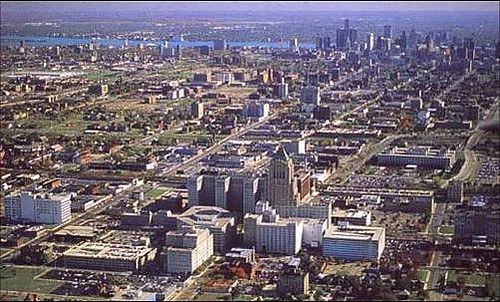
    Let’s refresh with this image showing the scale of the challenge in the city of Detroit proper:


    There are zillions of pictures to illustrate the vast emptiness in Detroit. Kaid Benfield at NRDC posted these:

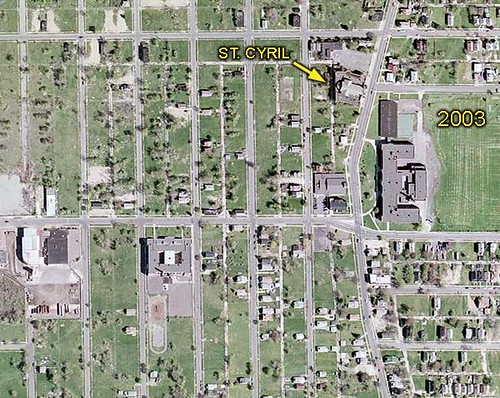
    This phenomenon prompted someone to coin the term “urban prairie” to capture the idea of vast tracts of formerly urbanized land returning to nature. The folks at Detroit’s best discussion site, DetroitYES, posted this before and after of the St. Cyril neighborhood. Before:
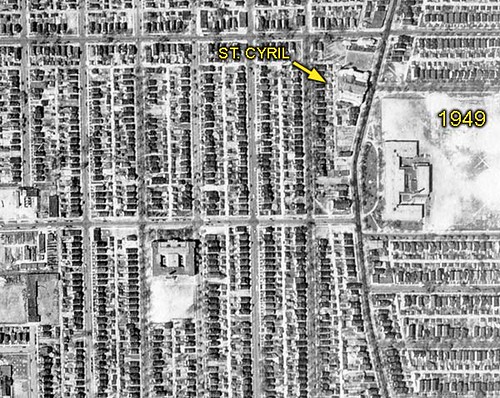

    After:

    A site named “Sweet Juniper” recently had a fantastic photo of the spontaneous creation of “desire line” paths across all this vacant land. You should click to enlarge this photo.


    One natural response is the “shrinking cities” movement. While this has gotten traction in Youngstown and Flint, as well as in places like Germany, it is Detroit that provides the most large scale canvas on which to see this play out, as well as the place where some of the most comprehensive and radical thinking is taking place. For example, the American Institute of Architects produced a study that called for Detroit to shrink back to its urban core and a selection of urban villages, surrounded by greenbelts and banked land. Here’s a picture of their concept:


    It seems likely that this will get some form of traction from officialdom, as this article suggests, though implementation is likely to be difficult.

    Detroit is also attracting dreams of large scale renewal through agriculture, as Mark Dowie writes in Guernica (hat tip @archizoo).

    Were I an aspiring farmer in search of fertile land to buy and plow, I would seriously consider moving to Detroit. There is open land, fertile soil, ample water, willing labor, and a desperate demand for decent food. And there is plenty of community will behind the idea of turning the capital of American industry into an agrarian paradise. In fact, of all the cities in the world, Detroit may be best positioned to become the world’s first one hundred percent food self-sufficient city.

    This isn’t just a crazy idea from some guy who lives in California. He documents several examples of people right now, today growing food in Detroit. It wouldn’t surprise me, frankly, if Detroit produces more food inside its borders today than any other traditional American city.

    About five hundred small plots have been created by an international organization called Urban Farming, founded by acclaimed songwriter Taja Sevelle. Realizing that Detroit was the most agriculturally promising of the fourteen cities in five countries where Urban Farming now exists, Sevelle moved herself and her organization’s headquarters there last year. Her goal is to triple the amount of land under cultivation in Detroit every year. All food grown by Urban Farming is given free to the poor. According to Urban Farming’s Detroit manager, Michael Travis, that won’t change.

    The fact that Urban Farming moved to Detroit is exactly the effect I’m talking about. To anyone with aspirations in this area, it is Detroit that offers the greatest opportunity to make your mark. It is the ultimate blank canvas. For urban agriculture and many other alternative urban dreams, it is Detroit, not New York City that is the ultimate arena in which to prove yourself.

    It’s not just farmers; intellectuals and artists of various types are drawn to Detroit, both to study it and pursue ideas about the remaking of the city:

    Detroit has achieved something unique. It has become the test case for all sorts of theories on urban decay and all sorts of promising ideas about reviving shrinking cities.

    “It’s unbelievable,” said Sue Mosey, president of the University Cultural Center Association, who has been interviewed recently by two separate PBS crews and an Austrian journalist writing about Detroit.

    “All of us have been inundated with all of these people who somehow think that because we’re so bottomed out and so weak-market, that this is this incredible opportunity,” Mosey said.

    Robin Boyle, a professor of urban planning at Wayne State University who has been interviewed by numerous visitors, echoed that sentiment.

    “They realize that there is an interesting story to tell, that has real characters, but even more, they discover a place that is simply not like everywhere else,” he said.

    Toby Barlow wrote in the New York Times about out of towners buying up $100 houses, moving to Detroit, and doing all sorts of interesting things with them:

    Recently, at a dinner party, a friend mentioned that he’d never seen so many outsiders moving into town…Two other guests that night, a couple in from Chicago, had also just invested in some Detroit real estate. That weekend Jon and Sara Brumit bought a house for $100.
    ….
    A local couple, Mitch Cope and Gina Reichert, started the ball rolling. An artist and an architect, they recently became the proud owners of a one-bedroom house in East Detroit for just $1,900. Buying it wasn’t the craziest idea. The neighborhood is almost, sort of, half-decent. Yes, the occasional crack addict still commutes in from the suburbs but a large, stable Bangladeshi community has also been moving in.

    So what did $1,900 buy? The run-down bungalow had already been stripped of its appliances and wiring by the city’s voracious scrappers. But for Mitch that only added to its appeal, because he now had the opportunity to renovate it with solar heating, solar electricity and low-cost, high-efficiency appliances.

    Buying that first house had a snowball effect. Almost immediately, Mitch and Gina bought two adjacent lots for even less and, with the help of friends and local youngsters, dug in a garden. Then they bought the house next door for $500, reselling it to a pair of local artists for a $50 profit. When they heard about the $100 place down the street, they called their friends Jon and Sarah.
    ….

    But the city offers a much greater attraction for artists than $100 houses. Detroit right now is just this vast, enormous canvas where anything imaginable can be accomplished. From Tyree Guyton’s Heidelberg Project (think of a neighborhood covered in shoes and stuffed animals and you’re close) to Matthew Barney’s “Ancient Evenings” project (think Egyptian gods reincarnated as Ford Mustangs and you’re kind of close), local and international artists are already leveraging Detroit’s complex textures and landscapes to their own surreal ends.

    In a way, a strange, new American dream can be found here, amid the crumbling, semi-majestic ruins of a half-century’s industrial decline. The good news is that, almost magically, dreamers are already showing up. Mitch and Gina have already been approached by some Germans who want to build a giant two-story-tall beehive. Mitch thinks he knows just the spot for it.

    It’s what Jim Russell likes to call “Rust Belt chic”, and Detroit has it in spades.

    This piece also highlights the absolutely crucial advantage of Detroit. It’s possible to do things there. In Detroit, the incapacity of the government is actually an advantage in many cases. There’s not much chance a strong city government could really turn the place around, but it could stop the grass roots revival in its tracks.

    Can you imagine a two-story beehive in Chicago? In many cities where strong city government still functions effectively, citizens are tied down by an array of regulations and permits that are actually enforced in most cases. Much of the South Side of Chicago has Detroit like characteristics, but the techniques of renewal in Detroit won’t work because they are likely against code and would be shut down the minute someone complained. Just as one quick example, my corner ice cream stand dared to put out a few chairs for patrons to sit on while enjoying a frozen treat on a hot day. The city cited them for not having a license. So they took them away and put up a “bring your own chair” sign. The city then cited them for that too. You can’t do anything in Chicago without a Byzantine array of licenses, permits, and inspections.

    In central Indianapolis, which is in desperate need of investment, where the city can’t fill the potholes in the street, etc., the minute a few yuppies buy houses in an area and fix them up, they immediately petition for a historic district, a request that has never been refused, ensuring that anyone who ever wants to do anything will be forced to run a costly and grueling gauntlet of variances, permits, hearings, etc. Only the most determined are willing to put up with that.

    In most cities, municipal government can’t stop drug dealing and violence, but it can keep people with creative ideas out. Not in Detroit. In Detroit, if you want to do something, you just go do it. Maybe someone will eventually get around to shutting you down, or maybe not. It’s a sort of anarchy in a good way as well as a bad one. Perhaps that overstates the case. You can’t do anything, but it is certainly easier to make things happen there than in most places because the hand of government weighs less heavily.

    What’s more, the fact that government is so weak has provoked some amazing reactions from the people who live there. In Chicago, every day there is some protest at City Hall by a group from some area of the city demanding something. Not in Detroit. The people in Detroit know that they are on their own, and if they want something done they have to do it themselves. Nobody from the city is coming to help them. And they’ve found some very creative ways to deal with the challenges that result. Consider this from the Dowie piece:

    About 80 percent of the residents of Detroit buy their food at the one thousand convenience stores, party stores, liquor stores, and gas stations in the city. There is such a dire shortage of protein in the city that Glemie Dean Beasley, a seventy-year-old retired truck driver, is able to augment his Social Security by selling raccoon carcasses (twelve dollars a piece, serves a family of four) from animals he has treed and shot at undisclosed hunting grounds around the city. Pelts are ten dollars each. Pheasants are also abundant in the city and are occasionally harvested for dinner.

    This might sound awful, and indeed it is. But it is also an inspiration and a testament to the human spirit and defiant self-reliance of the American people. I grew up in a poor rural area where, while hunting is primarily recreational, there are still many people supplementing their family diet with wild game. Many a freezer is full of deer meat, for example. And of course, rural residents have long gardened, freezing and canning the results to help get them through the winter. So this doesn’t sound quite so strange to me as it might to you. The fate of the urban poor and the rural poor are more similar than is often credited. And contrary to stereotypes the urban poor often display amazing grit and ingenuity, and perform amazing feats to sustain themselves, their families and communities.

    As the focus on agriculture and even hunting show, in Detroit people are almost literally hearkening back to the formative days of the Midwest frontier, when pioneer settlers faced horrible conditions, tough odds, and often severe deprivation, but nevertheless built the foundation of the Midwest we know, and the culture that powered the industrial age. No doubt in the 19th century many of those sitting secure in their eastern citadels thought these homesteaders, hustlers, and fortune seekers crazy for leaving the comforts of civilization to head to places like Iowa and Chicago. But some saw the possibilities of what could be and heeded the call to “Go West, young man.” We’ve come full circle.

    More Detroit

    Detroit: Do the Collapse
    Detroit: Not the Future of the American City
    For talent – good jobs, cools places, new narrative (Crain’s Detroit Business – featuring Yours Truly)

    Aaron M. Renn is an independent writer on urban affairs based in the Midwest. His writings appear at The Urbanophile.
  • Housing Design: Create The Next Classic

    I often compare home marketing to automotive marketing, not because I was raised in Detroit and am somewhat of a motor head, but because these are two very big ticket items that have been developed and marketed in very different ways. You may think that auto companies are huge corporate conglomerates, and builders are mostly small, local companies selling a home or two, but the major builders certainly are not small concerns. A major builder selling 50,000 homes at $250,000 each would generate the same total income as a small auto company selling 500,000 cars at $25,000 each. Yet, there has been much more product research, development, testing, and marketing on cars, SUVs or trucks than on homes.

    To “drive” this comparison home consider the following: Compare the specifications on a $140,000 (adjusted for inflation) 30 year old Ferrari 308 which was state of the art in 1980, and even the most basic car, for example a Hyundai Genesis Coupe. The two passenger 300 horsepower Ferrari would do 0-60 in 6.8 seconds with a top speed of 142 HPH, slower than the $25,000 Hyundai ‘s 0-60 in 5.5 seconds, top speed at 149 MPH. The Hyundai would actually make that hairpin turn with a computer assisted 0.90g lateral acceleration, while the Ferrari would slide into the roadside ditch at only 0.81g.

    And the list goes on. The Hyundai adds 10 more highway MPG to the Ferrari’s 16 MPG. Watch out for deer? At an emergency stop from 60 MPH the Hyundai takes only 111 feet, a whopping 42 feet less than the Ferrari which plows right through Bambi. After adjusting for inflation, the specifications of the Hyundai blow past the Ferrari for 80% less money. Reliability? Not even close. The Ferrari 308 owner will be on a first name basis with his or her mechanic, and probably even know his family.

    So… while it seems stagnant at times, the auto industry has still made tremendous progress. From a style, materials, and overall design standpoint, any of today’s cars and trucks render those built in the early 1980s obsolete. The industry offers an astonishingly better product than it did twenty-five years ago. This is despite a few moments when auto manufacturers lost their way. Remember 1981 — a recession with car showrooms in shambles and the government rescuing Chrysler — and Lee Iacocca touting the “K” Car? My, auto makers have come a long way!

    Now let’s compare the 1980 suburban single family home to the 2006 (the height of the housing market) suburban single family home.

    From National Association of Home Builders data we see that the average 1980 house was just over $76,000 and averaged about 1,800 square feet. Adjusted for inflation, that 1980 home would be approximately $190,000 in 2006 dollars. This equates to approximately $105 a square foot. The 1980s were also the age of large sprawling suburban lots; 10,000 sq.ft would have been considered, in some areas, too small. Suburban densities of two units per acre were typical in the north, with higher densities in the three to four unit per acre range as one traveled south. The 1980’s home price included a spacious lot.

    Fast forward through 26 years (of evolution?). Homes gradually increased in size to an average of 2,414 sq.ft. (again, NAHB data). The typical home in 2006 cost $264,000, or $109 a square foot. Essentially, the home built at the peak of the market cost only slightly more than the home built in 1980. Lot areas generally have come down in size. In the south where densities were already higher, the lot size reduction was minimal, but in the north that 1980 10,000 sq.ft. lot that was once considered small would today be considered quite large.

    The 1980s home would have been built to a lower standard with little in energy conservation; it was wasteful. The home built 25 years later — at the height of the market in 2006 — would have been built to much higher standards, both in construction and in energy efficiency.

    Today’s consumer may favor the older, 1980s suburban home. It is likely built in an area with mature landscaping, local conveniences, and established schools, and it is probably located closer to town (employment), on a larger lot. Yes the home is slightly older, but not significantly visually different than the more recent home, at least to the naked eye. The transition from the previous three decades, 1950 to 1980, was drastic. But it was not so in the past 30 years.

    The new suburban home in today’s market is typically on the outer edge of urbanization. The confidence level that services and schools will be developed in a timely manner is much lower. There simply has not been a significant change in housing during the past three decades. The garage-forward 1980s home that proudly displays massive garage doors that define the streetscape is similar to the suburban homes built today, except the home built today might also include the obligatory porch sitting next to the garage.

    Three decades ago Chrysler responded to market changes with the K car, a cheap car that was commercially successful. Notice how many K cars you see on the road today? Longevity, reliability and quality were not its strong points. Cars are temporary. They are disposable and recyclable. Today’s home builders are largely responding to the housing market with a K car attitude of scrimping that will only make the homes built on yesterday’s developments seem even more attractive.

    But housing stock cannot survive on temporary solutions that respond to short trends. The lot that is sold today is likely to be around for many centuries. The home will likely be remodeled over time, but its foundation may last as long as the lot. There are no junk yards for houses…well there are, and they’re called slums.

    Builders rely on suppliers to develop products that improve the housing stock. For example, the vinyl cladding era of the 1980s has been (somewhat) replaced by more attractive concrete based products and wood alternatives. The problem is that these vinyl alternatives are often more expensive – in some cases, much more.

    It’s time for builders to respond by following the automotive industry. That means offering enough of a design revolution to attract new customers. Investing in research and development at a time when banks turn away builders and developers might seem an impossible task. As a design and technology company, we know that first hand. We have a huge investment in future technologies that will not be available until the beginning of 2010.

    Before the recession, we typically invested 10% of our gross income (designing new developments) in new technologies. Planning and architecture is not exactly a thriving industry today. Banks are not interested in funding anything related to land development, sustainability, or software. To keep development on track, our investment now represents over 50% of our total income.

    Getting through this period has been tough, but at the end of the day we will have a revolutionary product with a new range of services that will benefit development-related industries. Architects can respond to a down market by investing their down time in experimentation and development of better design methods to increase the value of housing, instead of sitting around waiting for a client to call.

    During this past decade people got used to making a new home purchase to supplement their income, assuming that home values would rise several thousands of dollars annually. Those days are gone. Give consumers a new reason to buy: a better product. When future housing customers have the opportunity to significantly increase their living standards by purchasing new homes vs. staying where they are, they will want to buy new again.

    Rick Harrison is President of Rick Harrison Site Design Studio and author of Prefurbia: Reinventing The Suburbs From Disdainable To Sustainable. His website is rhsdplanning.com.

  • Home-Based Businesses: Residential Zoning and The Cyber Village

    Currently in the United States about 27% of all homes have some form of a home based business. These businesses can be key to conservation efforts that lower our carbon footprint by reducing transportation needs, eliminating redundant facilities, and consolidating equipment. They provide significant opportunities for two solutions to problems that face today’s growth issues.

    My software company was founded in Dallas, where I worked from the dining room table in an apartment. I yearned for the day my business could operate out of a real office. After the business started generating a positive cash flow the apartment was left behind, and my office moved to a location in the newly built Dallas Galleria. My 104 square feet of office space was complimented with a separate meeting room, receptionist, and a parking space in the garage. All this cost me $600 a month. After the initial six month lease was up the rent skyrocketed and parking was no longer free; however, the 104 square feet remained the same.

    Oh, how I yearned for a nice dining room table to work from!

    Soon I decided that the money spent on rent — both apartment and Galleria office — could build a really nice home. In 1982 I built a home specifically designed for a residence and my business. With about 4,000 square feet, of which about one third was dedicated business space with a separate office entrance, we had a viable base from which to live and work.

    The IRS allowed us to write-off one third of the total housing expenses without question. By not having to pay office rent we could double the home payments, and the 30 year mortgage was paid in full in less than 10 years.

    Maple Grove, the lakefront suburban Minnesota community where we had built, allowed a home business occupation via ordinance limited to one non-family employee. At first we complied, but the business grew. At times there were up to 6 employees at the home, but neighbors did not complain.

    I was not the only lake front home operating a big business. Across the lake, a major manufacturer of car radar warning units operated out of the basement of a house. This was a husband-and-wife business, but it was no small operation. The company had full page ads in leading automotive magazines. I sometimes visited; I’d hear the phone ring with an order, and the wife would say ‘I’ll see if we have any in stock at the warehouse, can you hold?’ She would then call down to the basement and ask if they could make an A-50 unit for shipping. Nobody but the UPS man would know the truth!

    Solution #1: The Residential/Business
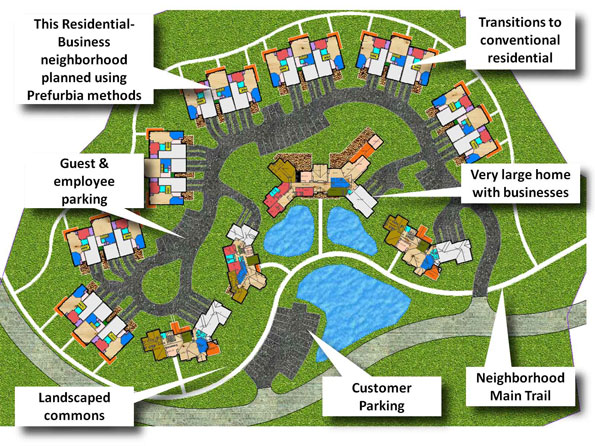
    The Residential/Business (RB zoning) would be an entirely new land use, sort of a morphing of an office center and a neighborhood of luxury single family homes. Office complexes typically have a higher degree of landscaping and architectural detail than single family developments. In the RB neighborhood, homes would be large and impressive with heavily landscaped commons that serve as pedestrian access to the businesses that are located within the home structure.

    Family members and employees would park in the rear, with multiple garage spaces and outside parking for the employees. From the arterial streets abutting these developments it would be an impressive sight, giving a sense of wealth to the neighborhood and municipality. The types of businesses would be restricted to low traffic professional services, including medical services, but also could include very light manufacturing. The RB zones would be an excellent transition (buffer) from commercial centers to residential ones. The RB residential structures would house the entire business and home, serving as the main hub for all of the business needs.

    Below, a Residential/Business community

    There could be some overlap of business functions into the residential elements of the home. For example, a conference center with an 80 inch screen for presentations could be used for Monday night football on occasion. From a financial standpoint, for a small to medium sized business owner this is a win-win situation. It delivers the advantages that I had experienced in my own situation in a comprehensive, specifically designed development plan.

    Solution #2: The Cyber Village
    George E. Van Hoesen, of Global Green Building, LLC, has developed an alternative solution, the Cyber Village.

    The proliferation of computers and cell phones, as well as video conferencing and express delivery, has made the notion of the at-home cyber office an excellent solution for growth issues. New definitions of work, recreation, and education have brought the family home again. Residential design and community planning can begin to address the increasing needs of these new households while keeping the neighborhood’s primarily residential character.

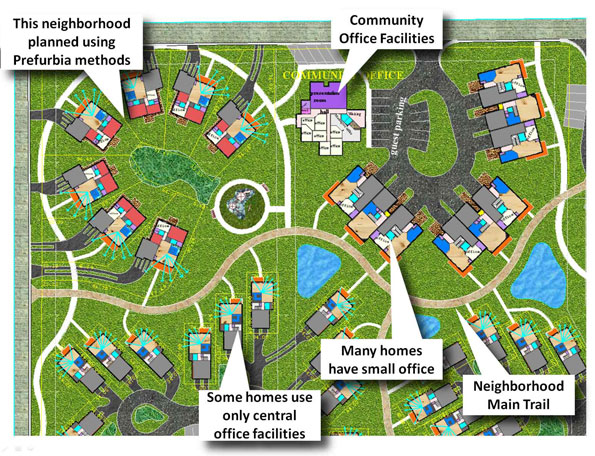
    Unlike the Residential/Business solution, homes in the Cyber Village need not be as business intensive or change the character of a neighborhood. A main component of the Cyber Village is the Cyber Office, serving as the community foundation for business activity. This facility, complete with offices, reception services, mail services, meeting rooms, board rooms, reference libraries and office equipment, would serve subscribers (businesses within the neighborhood) for their out-of-office and administrative needs. This Cyber Office location could serve as the hub for deliveries, recycling, storm shelter, resource center, rideshare, and other community resource needs. Subscribers would choose the level of access to the facility based on their own individual business needs. The features of the cyber office would lend credibility and added professionalism to a residence-based business without breaking the bank.

    Below, a Cyber Village

    The neighborhood Cyber Office could be managed as a for-profit business, providing services for a fee. Communities could also manage a Cyber Office as a part of the homeowners association. A mix of services could be provided, depending on the needs of the community. The overall concept reduces the carbon footprint of the home-based business and addresses the needs of the changing work place.

    Zoning Both Solutions
    Both solutions fall outside the scope of conventional zoning. The Cyber Village may comply more easily with existing regulations, especially those that allow a home to operate a business with a few employees. If a city’s regulations are flexible enough, it may be possible to design and implement a Cyber Village that complies with city code now. The Residential/Business solution, with its more aggressive business size, would compete with — or make obsolete — office complexes. Office “use” is often taxed at a higher rate than residential use. Since cities do not like to lose tax revenue, it is likely that municipalities would require a new basis to tax the RB residents.

    Creating a new zoning class and tax classification is not difficult, but it might be time consuming. The current slow market allows cities to restructure their zoning and tax codes, so now is the time to act.

    Both solutions would have a significant reduction on the carbon footprint of land development. They offer alternatives to the Smart Growth solutions in which shop owners are encouraged to live over their stores in high density developments. Both the Residential/Business and the Cyber Village alternatives curb traffic and sprawl…and at the same time, provide residential settings with enough space for family enjoyment.

    Rick Harrison is President of Rick Harrison Site Design Studio and author of Prefurbia: Reinventing The Suburbs From Disdainable To Sustainable. His website is rhsdplanning.com.

  • The White City

    Among the media, academia and within planning circles, there’s a generally standing answer to the question of what cities are the best, the most progressive and best role models for small and mid-sized cities. The standard list includes Portland, Seattle, Austin, Minneapolis, and Denver. In particular, Portland is held up as a paradigm, with its urban growth boundary, extensive transit system, excellent cycling culture, and a pro-density policy. These cities are frequently contrasted with those of the Rust Belt and South, which are found wanting, often even by locals, as “cool” urban places.

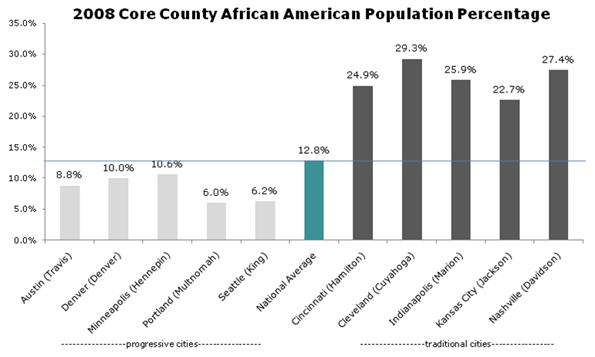
    But look closely at these exemplars and a curious fact emerges. If you take away the dominant Tier One cities like New York, Chicago and Los Angeles you will find that the “progressive” cities aren’t red or blue, but another color entirely: white.

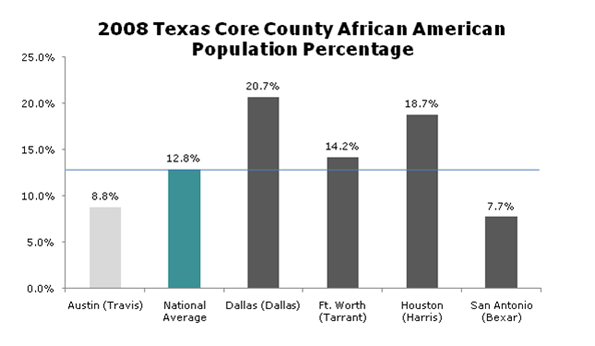
    In fact, not one of these “progressive” cities even reaches the national average for African American percentage population in its core county. Perhaps not progressiveness but whiteness is the defining characteristic of the group.

    The progressive paragon of Portland is the whitest on the list, with an African American population less than half the national average. It is America’s ultimate White City. The contrast with other, supposedly less advanced cities is stark.

    It is not just a regional thing, either. Even look just within the state of Texas, where Austin is held up as a bastion of right thinking urbanism next to sprawlvilles like Dallas-Ft. Worth and Houston.

    Again, we see that Austin is far whiter than either Dallas-Ft. Worth or Houston.

    This raises troubling questions about these cities. Why is it that progressivism in smaller metros is so often associated with low numbers of African Americans? Can you have a progressive city properly so-called with only a disproportionate handful of African Americans in it? In addition, why has no one called these cities on it?

    As the college educated flock to these progressive El Dorados, many factors are cited as reasons: transit systems, density, bike lanes, walkable communities, robust art and cultural scenes. But another way to look at it is simply as White Flight writ large. Why move to the suburbs of your stodgy Midwest city to escape African Americans and get criticized for it when you can move to Portland and actually be praised as progressive, urban and hip? Many of the policies of Portland are not that dissimilar from those of upscale suburbs in their effects. Urban growth boundaries and other mechanisms raise land prices and render housing less affordable exactly the same as large lot zoning and building codes that mandate brick and other expensive materials do. They both contribute to reducing housing affordability for historically disadvantaged communities. Just like the most exclusive suburbs.

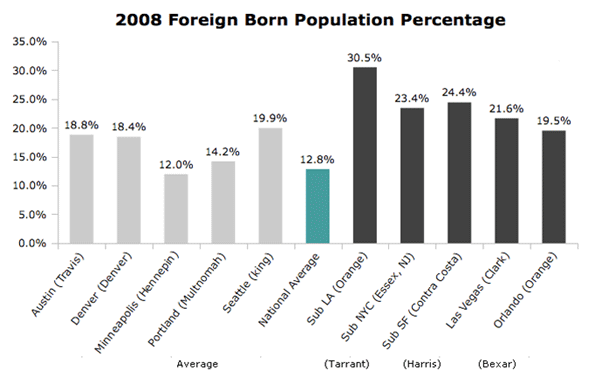
    This lack of racial diversity helps explain why urban boosters focus increasingly on international immigration as a diversity measure. Minneapolis, Portland and Austin do have more foreign born than African Americans, and do better than Rust Belt cities on that metric, but that’s a low hurdle to jump. They lack the diversity of a Miami, Houston, Los Angeles or a host of other unheralded towns from the Texas border to Las Vegas and Orlando. They even have far fewer foreign born residents than many suburban counties of America’s major cities.

    The relative lack of diversity in places like Portland raises some tough questions the perennially PC urban boosters might not want to answer. For example, how can a city define itself as diverse or progressive while lacking in African Americans, the traditional sine qua non of diversity, and often in immigrants as well?

    Imagine a large corporation with a workforce whose African American percentage far lagged its industry peers, sans any apparent concern, and without a credible action plan to remediate it. Would such a corporation be viewed as a progressive firm and employer? The answer is obvious. Yet the same situation in major cities yields a different answer. Curious.

    In fact, lack of ethnic diversity may have much to do with what allows these places to be “progressive”. It’s easy to have Scandinavian policies if you have Scandinavian demographics. Minneapolis-St. Paul, of course, is notable in its Scandinavian heritage; Seattle and Portland received much of their initial migrants from the northern tier of America, which has always been heavily Germanic and Scandinavian.

    In comparison to the great cities of the Rust Belt, the Northeast, California and Texas, these cities have relatively homogenous populations. Lack of diversity in culture makes it far easier to implement “progressive” policies that cater to populations with similar values; much the same can be seen in such celebrated urban model cultures in the Netherlands and Scandinavia. Their relative wealth also leads to a natural adoption of the default strategy of the upscale suburb: the nicest stuff for the people with the most money. It is much more difficult when you have more racially and economically diverse populations with different needs, interests, and desires to reconcile.

    In contrast, the starker part of racial history in America has been one of the defining elements of the history of the cities of the Northeast, Midwest, and South. Slavery and Jim Crow led to the Great Migration to the industrial North, which broke the old ethnic machine urban consensus there. Civil rights struggles, fair housing, affirmative action, school integration and busing, riots, red lining, block busting, public housing, the emergence of black political leaders – especially mayors – prompted white flight and the associated disinvestment, leading to the decline of urban schools and neighborhoods.

    There’s a long, depressing history here.

    In Texas, California, and south Florida a somewhat similar, if less stark, pattern has occurred with largely Latino immigration. This can be seen in the evolution of Miami, Los Angeles, and increasingly Houston, San Antonio and Dallas. Just like African-Americans, Latino immigrants also are disproportionately poor and often have different site priorities and sensibilities than upscale whites.

    This may explain why most of the smaller cities of the Midwest and South have not proven amenable to replicating the policies of Portland. Most Midwest advocates of, for example, rail transit, have tried to simply transplant the Portland solution to their city without thinking about the local context in terms of system goals and design, and how to sell it. Civic leaders in city after city duly make their pilgrimage to Denver or Portland to check out shiny new transit systems, but the resulting videos of smiling yuppies and happy hipsters are not likely to impress anyone over at the local NAACP or in the barrios.

    We are seeing this script played out in Cincinnati presently, where an odd coalition of African Americans and anti-tax Republicans has formed to try to stop a streetcar system. Streetcar advocates imported Portland’s solution and arguments to Cincinnati without thinking hard enough to make the case for how it would benefit the whole community.

    That’s not to let these other cities off the hook. Most of them have let their urban cores decay. Almost without exception, they have done nothing to engage with their African American populations. If people really believe what they say about diversity being a source of strength, why not act like it? I believe that cities that start taking their African American and other minority communities seriously, seeing them as a pillar of civic growth, will reap big dividends and distinguish themselves in the marketplace.

    This trail has been blazed not by the “progressive” paragons but by places like Atlanta, Dallas and Houston. Atlanta, long known as one of America’s premier African American cities, has boomed to become the capital of the New South. It should come as no surprise that good for African Americans has meant good for whites too. Similarly, Houston took in tens of thousands of mostly poor and overwhelmingly African American refugees from Hurricane Katrina. Houston, a booming metro and emerging world city, rolled out the welcome mat for them – and for Latinos, Asians and other newcomers. They see these people as possessing talent worth having.

    This history and resulting political dynamic could not be more different from what happened in Portland and its “progressive” brethren. These cities have never been black, and may never be predominately Latino. Perhaps they cannot be blamed for this but they certainly should not be self-congratulatory about it or feel superior about the urban policies a lack of diversity has enabled.

    Aaron M. Renn is an independent writer on urban affairs based in the Midwest. His writings appear at The Urbanophile.
  • Wikigovernment: Crowd Sourcing Comes To City Hall

    Understanding the potential role of social media such as blogs, twitter, Facebook, You Tube, and all the rest in local government begins with better understanding the democratic source of our mission of community service. The council-manager form of local government arose a century ago in response to the “shame of the cities” — the crisis of local government corruption and gross inefficiency.

    Understanding what business we are in today is vital. It drives the choices we make and the tools we use. Railroads squandered their dominance in transportation because they defined their business as railroading. They shunned expansion into trucking, airlines, and airfreight. While they were loyal to one mode of transportation, their customers were not. Similarly, newspapers are in crisis because they defined their trade as the newspaper industry. Today’s readers don’t wait for timely news to arrive in their driveways. They have digital access on their computers and hand-held phones. Guess where advertisers are going?

    Most local governments suffer similar myopia. Many managers define our core mission as delivering services. But that overlooks the history of why local governments deliver those services. We deliver police services in the way that we do because Sir Robert Peel invented that model in response to the public safety challenges of industrializing London.

    We deliver library services because Ben Franklin invented that model in response to the need for working people in Philadelphia to pursue education and self-improvement. Governments didn’t arise to provide services; services arose from “government of the people, by the people, and for the people.”

    Our core mission is not to provide traditional services, but to meet today’s community needs. To do this, we can learn more from the entrepreneurial risk-taking of Peel and Franklin than from public management textbooks.

    We face these new dangers and opportunities:
    • Transitioning from unsustainable consumption to living in sustainable balance with planetary resources.
    • Overcoming an economic crisis that is slashing our capacity to maintain traditional services and meet growing community needs.
    • Embracing growing diversity while dealing with increasing fragmentation marked by divergent expectations about the role of local government.

    During a similar period of historic upheaval, the young Karl Marx wrote that “all that is solid melts into air.”

    Of course, it’s possible to underestimate the emerging crisis from the perspective of local government in many American towns and suburbs. The local voting population seems stable, though declining in numbers. The “usual suspects” still populate the sparse audiences at council and commission meetings. The budget is horrendous, but we’ve seen these cycles before.

    In reality, this overhang is typical of the lag between action and reaction, the inertia Thomas Jefferson identified when he wrote, “Mankind are more inclined to suffer, while evils are sufferable, than to right themselves by abolishing the forms to which they are accustomed.”

    In California, we’re confounded by the seemingly endless crisis in political leadership that is squandering our state’s credit rating and capacity to deliver vital services. Members of our political class resemble cartoon characters who dash off a cliff, then momentarily hang in the air before abruptly plunging. As the economist Herb Stein wryly observed, “If something cannot go on forever, it will stop.”

    Global Communication Tools
    In the current tough times, we all pay lip service to civic engagement and we all pursue it, with varying degrees of enthusiasm and success. But if we want to avoid plunging into the vortex like the state of California (and Vallejo, California, its bankrupt local counterpart), we will need to reassert and reinvent government of the people, by the people, and for the people in our communities.

    The textbook model puts the elected governing board squarely between us and the public. Elected officials interpret the will of the people. They’re accountable to the public. We report to those who have been elected. But in the modern world, professional staff cannot hide behind that insulation. We cling to the old paradigm because we lack a better one.

    That’s where the real significance of social media comes into focus. These aren’t just toys, gizmos, or youthful fads. Social media are powerful global communication tools we can deploy to help rejuvenate civic engagement.

    The Obama presidential campaign lifted the curtain on this potential. “Nothing can stand in the way of millions of people calling for change,” he asserted at a time when conventional political wisdom doubted his path to the White House. MyBarackObama.com wasn’t his only advantage, but he deployed it with stunning effectiveness to raise colossal sums from small donors, pinpoint volunteer efforts in 50 states to the exact places of maximum leverage, and carry his campaign through storms that would have capsized a conventional campaign.

    It remains to be seen how this translates into governance at the federal level. But it has direct application to local democracy. Crowd sourcing is a new buzzword spawned by social media. It recognizes that useful ideas aren’t confined to positional leaders or experts. Wikipedia is a powerful success story, showing how millions of contributors can build a world-class institution, crushing every hierarchical rival. “Wikigovernment” is not going to suddenly usher in rankless democratic nirvana, but it’s closer to the ideal of government of the people, by the people, and for the people than a typical local government organization chart.

    “To govern is to choose,” John Kennedy famously said. Choices must be made, and citizens will increasingly insist on participating in those decisions. As citizens everywhere balk at the cost of government, we can’t hunker down and wait for a recovery to rescue us. Like carmakers suddenly confronted by acres of unsold cars, we are arriving at the limits of the “we design ‘em, you buy ‘em” mentality.

    A crowd-sourcing approach to local government resembles a barn raising more than a vending machine as a model for serving the community. Instead of elected leaders exclusively deciding the services to be offered and setting the (tax) price of the government vending machine, a barn raising tackles shared challenges through what former Indianapolis mayor Stephen Goldsmith calls “government by network.”

    Citizen groups, individual volunteers, activists, nonprofits, other public agencies, businesses, and ad hoc coalitions contribute to the designing, delivering, and funding of public services. The media compatible with this model are not the newspapers such as — for example — the local newspaper that reports yesterday’s council meeting. The new media are the instant Facebook postings, tweets, and YouTube clips that keep our shifting body politic in touch.

    The Dark Side
    It’s not hard to conjure up the dark side of all this. Web presence is often cloaked in anonymity. This isn’t new in political discourse; the Founders engaged in anonymous pamphleteering. But the Web can harbor vitriol that wasn’t tolerated in the traditional press (at least until recently).

    The Web also tends to segregate people. One study concluded that 96 percent of cyber readers follow only the blogs they agree with. This self-selection of information bypasses editors trained in assessing the credibility of information. Opinion is routinely passed off as fact.

    But it isn’t surprising that the cutting edge of digital communication is full of both danger and promise, nor should it keep us from using these new media in our 2,500-year quest for self-government. The atomization generated by a zillion websites also breeds a hunger for the community of shared experience. Both the election of Barack Obama and the death of Michael Jackson tapped into that yearning.

    We can foster that yearning by deploying these exciting new tools in the service of building community. Yes, it’s risky to be a pioneer, but in a rapidly changing world, it’s even riskier to be left behind.

    This is part two of a two-part series. A slightly different version of this article appeared in Public Management, the magazine of the International City/County Management Association; icma.org/pm.

    Rick Cole is city manager of Ventura, California, and this year’s recipient of the Municipal Management Association of Southern California’s Excellence in Government Award. He can be reached at RCole@ci.ventura.ca.us

  • E-Government: City Management Faces Facebook

    Does a City Manager belong on Facebook?

    Erasmus, the Dutch theologian and scholar, in 1500 wrote, “In the country of the blind the one-eyed man is king.” I feel this way in the land of social media — at least among city and county managers. Inspired by the first city manager blog in the nation, started by Wally Bobkiewicz in Santa Paula, California, I began posting back in 2006. Although most bloggers strive for frequent, short blurbs, I’ve employed blogging to provide a place to get beyond the sound bites (and out of context quotes) in the local press. I seek to provide background, explanation, and context for the stories in the news, along with the trends that don’t make the news.

    I tried MySpace and Facebook initially out of curiosity. For my first six months, I had only six friends on Facebook. Now I have more than 400, and few days go by when I don’t review requests for more. I post at least once a day, usually links to intriguing articles on public policy and photos of my three kids.

    While I was finding my way as a boomer in cyberspace, I resisted Twitter…until an invitation arrived from a friend 30 years older than I. If someone in his 80s was interested in tweets from me, I figured the time had come to join the crowd. And although I’ve never made a YouTube video, several videos of me are floating in cyberspace.

    For local managers, all of these social media offer new tools to work on one of democracy’s oldest challenges: promoting the common good. What local governments can’t do is fall hopelessly behind. The fate of railroads, automakers, and newspapers shows what happens to the complacent. It’s time to get online — and reach far beyond the initial step of a city website with links — to lead the effort to build stronger communities and a healthier democracy for the 21st century.

    Civic Engagement and Social Media: The Ventura Case Study

    Ventura has a civic engagement manager position, but civic engagement is considered a citywide core competency, like tech savvy and customer service. It’s not something we do periodically; it’s how we strive to do everything.

    One of our key citywide performance measures is the level of volunteerism in the community. We look not just at the 40,000 volunteer hours logged by city government last year, but at the percentage of the population that volunteer for any cause or organization: 50 percent versus 26 percent nationally. We strive to raise awareness, commitment, and participation by citizens in local government and their community.

    Reports by Council staff not only list fiscal impacts and alternatives, but document citizen outreach and involvement in each recommendation. There are obviously different levels; they recently ranged from a stakeholder committee that held four facilitated sessions to produce rules governing vacation rentals, to a citywide economic summit cosponsored with the chamber of commerce that drew 300 businesspeople and residents to develop 54 action steps unanimously endorsed by the city council at the conclusion.

    Effective engagement requires aggressive, fine-tuned, and immediate communication. We address traditional media with a weekly interdepartmental round table that reviews what stories are likely to surface and identifies other stories we’d like to see covered. We encourage city staff to quickly post comments to online newspaper postings to set the record straight, respond to legitimate queries, and direct citizens to additional information on our website.

    We have two public access channels — one for government, one for the community — and actively provide both with programming. Our most direct access comes from a biweekly e-newsletter that goes out to 5,000 addresses, linking directly to website resources, including the city manager’s latest blog post.

    Slow at first to embrace Facebook, Twitter, and YouTube, we’re closing the gap. One councilmember is a prolific blogger, and another uses Facebook for interactive community dialogue. We make judicious use of reverse 911 to get public safety information out quickly to residents. We’ve also pioneered “My Ventura Access”, a one-stop portal for all citizen questions, complaints, compliments, and opinions, whether they come by phone, Internet, mail, or in person.

    Not Your Grandfather’s Democracy

    Twitter, which allows just 140 characters – including spaces and punctuation – per “tweet”, gets a disproportionate share of the social media chatter. After a Republican member of Congress was ridiculed for tweeting during the State of the Union address this past February, Twitter usage exploded 3,700 percent in less than a year. By the time you read this, U.S. Twitter users will outnumber the population of Texas, or possibly California. In just five years, techcrunch.com reports, Facebook users have zoomed past 250 million. A Nielsen study estimates that usage has increased by seven times in the past year alone.

    Yet as blogs, tweets, Facebook, YouTube, and text blasts reshape how America communicates, few local governments — and even fewer city and county managers — are keeping pace. E-government remains largely focused on websites and online services. This communication gap leaves local government vulnerable in a changing world. “Business as usual” is not a comforting crutch; it’s foolish complacency. Just look at the sudden implosion of General Motors, the Boston Globe, and the state of California.

    It would be equally shortsighted to thoughtlessly embrace these new communication media as virtual substitutes for thoroughgoing civic engagement. We’re part of a 2,500-year-old experiment in local democracy, launched in Athens long before Twitter and YouTube. Local democracy operated long before the newspapers, broadcast media, public hearings, and community workshops familiar to today’s local government managers.

    We may live in a hi-tech world, but the basis of what we do remains “high touch,” involving what some of the most thoughtful International City/County Management practitioners call “building community.” Social media offer new tools to build community, although they aren’t a magic shortcut.

    This is part one of a two-part series. A slightly different version of this article appeared in Public Management, the magazine of the International City/County Management Association; icma.org/pm.

    Rick Cole is city manager of Ventura, California, and this year’s recipient of the Municipal Management Association of Southern California’s Excellence in Government Award. He can be reached at RCole@ci.ventura.ca.us

  • There’s No Place Like Home, Americans are Returning to Localism

    On almost any night of the week, Churchill’s Restaurant is hopping. The 10-year-old hot spot in Rockville Centre, Long Island, is packed with locals drinking beer and eating burgers, with some customers spilling over onto the street. “We have lots of regulars—people who are recognized when they come in,” says co-owner Kevin Culhane. In fact, regulars make up more than 80 percent of the restaurant’s customers. “People feel comfortable and safe here,” Culhane says. “This is their place.”

    Thriving neighborhood restaurants are one small data point in a larger trend I call the new localism. The basic premise: the longer people stay in their homes and communities, the more they identify with those places, and the greater their commitment to helping local businesses and institutions thrive, even in a downturn. Several factors are driving this process, including an aging population, suburbanization, the Internet, and an increased focus on family life. And even as the recession has begun to yield to recovery, our commitment to our local roots is only going to grow more profound. Evident before the recession, the new localism will shape how we live and work in the coming decades, and may even influence the course of our future politics.

    Perhaps nothing will be as surprising about 21st-century America as its settledness. For more than a generation Americans have believed that “spatial mobility” would increase, and, as it did, feed an inexorable trend toward rootlessness and anomie. This vision of social disintegration was perhaps best epitomized in Vance Packard’s 1972 bestseller A Nation of Strangers, with its vision of America becoming “a society coming apart at the seams.” In 2000, Harvard’s Robert Putnam made a similar point, albeit less hyperbolically, in Bowling Alone, in which he wrote about the “civic malaise” he saw gripping the country. In Putnam’s view, society was being undermined, largely due to suburbanization and what he called “the growth of mobility.”

    Yet in reality Americans actually are becoming less nomadic. As recently as the 1970s as many as one in five people moved annually; by 2006, long before the current recession took hold, that number was 14 percent, the lowest rate since the census starting following movement in 1940. Since then tougher times have accelerated these trends, in large part because opportunities to sell houses and find new employment have dried up. In 2008, the total number of people changing residences was less than those who did so in 1962, when the country had 120 million fewer people. The stay-at-home trend appears particularly strong among aging boomers, who are largely eschewing Sunbelt retirement condos to stay tethered to their suburban homes—close to family, friends, clubs, churches, and familiar surroundings.

    The trend will not bring back the corner grocery stores and the declining organizations—bowling leagues, Boy Scouts, and such—cited by Putnam and others as the traditional glue of American communities. Nor will our car-oriented suburbs replicate the close neighborhood feel so celebrated by romantic urbanists like the late Jane Jacobs. Instead, we’re evolving in ways congruent with a postindustrial society. It will not spell the demise of Wal-Mart or Costco, but will express itself in scores of alternative institutions, such as thriving local weekly newspapers, a niche that has withstood the shift to the Internet far better than big-city dailies.

    Our less mobile nature is already reshaping the corporate world. The kind of corporate nomadism described in Peter Kilborn’s recent book, Next Stop, Reloville: Life Inside America’s Rootless Professional Class, in which families relocate every couple of years so the breadwinner can reach the next rung on the managerial ladder, will become less common in years ahead. A smaller cadre of corporate executives may still move from place to place, but surveys reveal many executives are now unwilling to move even for a good promotion. Why? Family and technology are two key factors working against nomadism, in the workplace and elsewhere.

    Family, as one Pew researcher notes, “trumps money when people make decisions about where to live.” Interdependence is replacing independence. More parents are helping their children financially well into their 30s and 40s; the numbers of “boomerang kids” moving back home with their parents, has also been growing as job options and the ability to buy houses has decreased for the young. Recent surveys of the emerging millennial generation suggest this family-centric focus will last well into the coming decades.

    Nothing allows for geographic choice more than the ability to work at home. By 2015, suggests demographer Wendell Cox, there will be more people working electronically at home full time than taking mass transit, making it the largest potential source of energy savings on transportation. In the San Francisco Bay Area and Los Angeles, almost one in 10 workers is a part-time telecommuter. Some studies indicate that more than one quarter of the U.S. workforce could eventually participate in this new work pattern. Even IBM, whose initials were once jokingly said to stand for “I’ve Been Moved,” has changed its approach. Roughly 40 percent of the company’s workers now labor at home or remotely from a client’s location.

    These home-based workers become critical to the localist economy. They will eat in local restaurants, attend fairs and festivals, take their kids to soccer practices, ballet lessons, or religious youth-group meetings. This is not merely a suburban phenomenon; localism also means a stronger sense of identity for urban neighborhoods as well as smaller towns.

    Could the new localism also affect our future politics? Ever greater concentration of power in Washington may now be all the rage as the federal government intervenes, albeit often ineffectively, to revive the economy. But throughout our history, we have always preferred our politics more on the home-cooked side. On his visit to America in the early 1830s, Alexis de Tocqueville was struck by the de-centralized nature of the country. “The intelligence and the power are dispersed abroad,” he wrote, “and instead of radiating from a point, they cross each other in every direction.”

    This is much the same today. The majority of Americans still live in a patchwork of smaller towns and cities, including many suburban towns within large metropolitan regions. There are well over 65,000 general-purpose governments, and with so many “small towns,” the average local jurisdiction population in the United States is 6,200, small enough to allow nonprofessional politicians to have a serious impact.

    After decades of frantic mobility and homogenization, we are seeing a return to placeness, along with more choices for individuals, families, and communities. For entrepreneurs like Kevin Culhane and his workers at Churchill’s, it’s a phenomenon that may also offer a lease on years of new profits. “We’re holding our own in these times because we appeal to the people around here,” Culhane says. And as places like Long Island become less bedroom community and more round-the-clock locale for work and play, he’s likely to have plenty of hungry customers.

    This article originally appeared in Newsweek.

    Joel Kotkin is executive editor of NewGeography.com and is a distinguished presidential fellow in urban futures at Chapman University. He is author of The City: A Global History. His next book, The Next Hundred Million: America in 2050, will be published by Penguin Press early next year.
  • Homebuilding Rebound… Or Boredom in the Burbs?

    The economy might come back – but will the housing market return? And in what form?

    Right now, builders are jumping into the low end of the market because of the $8,000 first time home buyer tax credit. This tax credit cannot survive indefinitely. Compared to homes sold in 2006, today’s are bare bones in size, materials and finishes in response to current, temporary market conditions. But the scrimping only makes the homes built in yesterday’s developments more attractive to potential buyers. The next wave of home buyers will have a choice: stay where they are, move to a more recently built (devalued) home, or buy new.

    Here’s a rundown on the major factors — and the forces on them — that will guide home buyers in their decisions. It’s also a rundown for any community, planner or developer — government or private sector — who would like to see the market rebound.

    Lot Size: Will buyers want to be shoehorned into new compressed development, or will they prefer to remain in the larger lot suburbs, where there are plenty of bargains today with usable yards and at least some views?

    The administration is pushing for compact (very dense) development, something the home buying market historically finds less desirable. If one hundred residents of a subdivision were asked the square footage of their lot, few would know the answer (more would be aware of their house’s square footage). Homes placed close to the street guarantee a claustrophobic feeling of space. Space is defined by that object that stops viewshed – typically a home, wall (fence) or low vegetation.

    Density is increased by the creation of narrower lots (and homes). When the lot narrows either the square footage of the house must plummet, or the home must get deeper. Assuming that facing directly into the home next door is not a quality view, the percentage of wall space that allows windows with a good view becomes very small as the home narrows.

    To illustrate, take a business card and look especially at the long edges. The shape emulates the rectangular perimeter of a typical suburban home built in the past few decades. Now imagine nice front and rear yard spaces with plenty of wall surface for windows, even with a garage taking up a portion of the front.

    Along comes the anti-sprawl movement pushing narrower lots, and making those on City Councils and Planning Commissions feel guilty about destroying the planet. Across America over the past two decades lots have been getting smaller – in some cases much smaller. Now take that business card and rotate it 90 degrees. This would represent the shape of a typical suburban home today.

    Huh. Wouldn’t all those side windows now look into the neighbors home? Well, windows now are placed along the short side of the home. What about the garage? Well, typically that’s still along the front, but since cars did not suddenly get 33% narrower, occupants just lost quite a bit of precious viewing area. Density went up by 33% but useable yards went down by 33%.

    Today we are building with much less width than we did during the past few decades. Yet the environmentalists and press do not seem to have taken notice.

    What is most likely coming down the road?

    Miniscule, very narrow lots combined with vertical growth. To illustrate, cut that business card in half. OK, so there goes the square footage right? Take one half and place it on top of the other. Well, it’s likely that the home was already two story, so that means three stories right? How much do you like climbing stairs? Better buy stock in residential elevator companies. So how do you park cars in this very narrow lot? If you do not want the street to appear as a solid wall of garage doors, then the only way to provide garage space is a single width garage, two stalls deep — another inconvenience — or a two car garage in the rear… but there goes any attempt for quality rear yard space.

    Architecture: Suburban homes have been looking pretty bland for the past few decades. Slapping on a front porch (most are the size of a stoop) really doesn’t make that much difference.

    Blame architects? An AIA registered, certified, artistically talented architect was not likely involved in the design process of the mass market home. It’s far cheaper to let Harry down the street (nephew of what’s his name) to draw up plans. How do you think many small home builders get financed? If they go to a lumber yard and select from a series of home plans, they can get a package deal; materials and financing furnished by the same source, standard packages from which to choose. Any wonder why 30 home builders in the same town seem to all build the same character-free house?
    Did the lumber yard hire a talented architect to gain advantage in the local market? What incentive do you think the supplier of the materials would have to actually be efficient in the drafting of the home? Excess material means increased profits!

    Homes in suburbia lack character and devalue a community as a general rule, but it’s not always the case. For example, in many areas in Texas, housing is affordable and full of architectural character with great landscaping. Builders in the major Texas markets know that if they shortcut curb appeal, nobody will clamor to their door. The local home buying market is astute… and today’s strongest home market.

    National large home builders? Most of the nationals expand into an area by buying out a local builder that showed signs of success (see above).

    Green: Ask your banker how much green means to the value of a home. Ask the appraisal company, does green add any value? Green certification is commonly messy and difficult, requiring builders to chase points instead of building wisely. Most green standards were inspired by a social engineering agenda. My own certified green home earns me lots of points because I’m near a bus stop and walking distance to a coffee shop. No wonder the financial people don’t take the movement seriously. My residential elevator? Not listed on the “points” system. Home designed to maximize quality viewsheds? No points! We had intended to place a 1 ½ inch foam insulation fill around the entire foundation surface, but a 2 inch minimum was required to earn points . That increased the cost of construction by $900. I’m not an expert in insulation, but it seems I spent 30% more to get a 0.1% benefit on my utility bill – hell of a deal! That $900 extra added to my payments – let’s see with interest, that cost me $5.25 every month… got my point though.

    Will the home market flourish when the economy returns?

    In the last few weeks I was Keynote Speaker at the Western States Planning Association Annual Meeting and at the North Dakota American Institute of Architects.

    Planners and Architects are very different groups. Ever wonder why the neighborhood plan and the architecture of the homes within it rarely seem related to each other? Nobody looks at mass market housing from a perspective of combined architectural spaces as a main component of the overall neighborhood design. The merging of planning and architecture on housing for the masses was well received by both groups.

    How will we bring the housing market back?

    Not by scrimping and reducing value, but by increasing value through a combined effort of architects, planners, and engineers to create a new era of sustainable communities that increase living standards affordably. Density is not a solution. A revolution in design is.

    Rick Harrison is President of Rick Harrison Site Design Studio and author of Prefurbia: Reinventing The Suburbs From Disdainable To Sustainable. His website is rhsdplanning.com.

  • How Smart Growth Disadvantages African-Americans & Hispanics

    It was more than 45 years ago that Dr. Martin Luther King, Jr. enunciated his “Dream” to a huge throng on the Capitol Mall. There is no doubt that substantial progress toward ethnic equality has been achieved since that time, even to the point of having elected a Black US President.

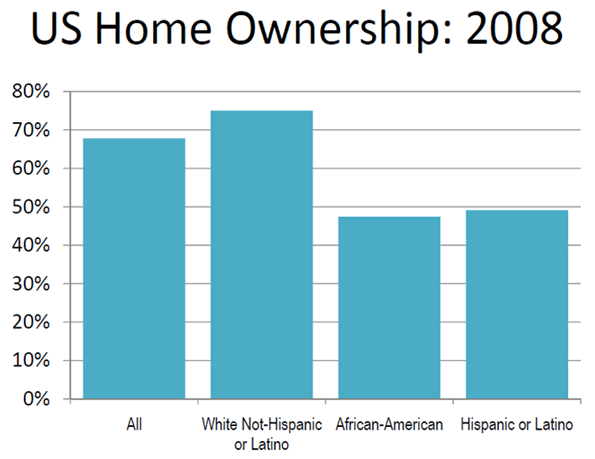
    The Minority Home Ownership Gap: But there is some way to go. Home ownership represents the core of the “American Dream” that was certainly a part of Dr. King’s vision. Yet, there remain significant gap in homeownership by ethnicity. Rather than a matter of discrimination, this largely reflects differing income levels between White-Non-Hispanics, African-Americans and Hispanics or Latinos. Today, approximately 75% of white households own their own homes. Whites have a home ownership rate fully one-half higher than that of African-Americans and Hispanics or Latinos at 47% and 49% (See Figure).

    Setting the Gap in Stone: A key to redressing this difficulty will be convergence of minority household incomes with those of whites, and that is surely likely to happen. However, there is another important dynamic in operation: house prices in some areas have risen well in advance of incomes, so that convergence alone can not narrow the home ownership gap in a corresponding manner. It is an outrage for public policy to force housing prices materially higher so long as home ownership remains beyond the incomes of so many, especially minorities.

    The Problem: Land Use Regulation: The problem is land use regulation. The economic evidence is clear: more restrictive land use regulation raises house prices relative to household incomes. This can be seen with a vengeance in the house price increases that occurred during the housing bubble. As we have previously described, metropolitan markets with more restrictive land use regulation (principally the more radical “smart growth” policies) experienced house price escalation out of all proportion to other areas in the nation. In some cases, they topped out at nearly four times historical norms. On the other hand, in the one-half of major metropolitan area markets where land use regulations were less severe, house prices tended to increase to little more than historic norms, at the most.

    How Smart Growth Destroys Housing Affordability: This difference is principally due to the price of land, which is forced upward when the amount of land available for building is artificially limited, as is the case in smart growth markets. At the peak of the bubble, there was comparatively little difference in house construction costs per square foot in either smart growth or less restrictive markets. However, the far higher land prices drove house prices in smart growth markets far above those in less restrictively regulated markets. Where house prices rise faster than incomes, housing affordability drops as prices rise at escalated rates.

    Wishing Away Reality: It is not surprising that the proponents of smart growth undertake Herculean efforts to deflect attention away from this issue. Usually they pretend there is no problem. Sometimes they produce studies to indicate that limiting the supply of land and housing does not impact housing affordability, which is akin to arguing that the sun rises in the West. Even the proponents, however, cannot “walk a straight line” on this issue, noting in their most important advocacy piece (Costs of Sprawl – 2000) that their more important strategies have the potential to increase the cost of housing.

    The Assault on Home Ownership: Worse, well connected Washington interest groups (such as the Moving Cooler coalition) and some members of Congress seek to universalize smart growth land rationing throughout the nation, which would cause massive supply problems and housing price inflation that occurred in some markets between 2000 and 2007. Even after the crash, these markets experienced generally higher house prices relative to incomes in smart growth markets than in traditionally regulated markets.

    House Price Increases and Minorities: House price increases relative to incomes weigh most heavily on ethnic minority households, because their incomes tend to be lower. This is illustrated by an examination of the 2007 data from the American Community Survey, in our special report entitled US Metropolitan Area Housing Affordability Indicators by Ethnicity: 2007. The year 2007 was the peak of the housing bubble, but represents a useful point of reference for when future “smart growth” policies were imposed nationwide.

    Median Priced Housing: The data (Table) indicates that median house prices were 75% or more higher for African-Americans than Whites, however that African-Americans in smart growth markets require 84% more to buy the median priced house. The situation was slightly better for Hispanics or Latinos with median house prices at least 50% more relative to incomes than for Whites. House prices relative to Hispanic or Latino median household incomes were 86% higher in smart growth markets than in less restrictively regulated markets.

    SUMMARY OF HOUSING INDICATORS BY
    LAND USE REGULATION CATEGORY
    Metropolitan Areas over 1,000,000 Population: 2007
    HOUSING INDICATOR Less Restrictive Land Use Regulation Markets More Restrictive Land Use Regulation Markets All Markets More Restrictive Markets Compared to Less Restrictive Markets
    MEDIAN VALUE MULTIPLE        
    All 3.1 5.8 4.5 1.89
    White Non-Hispanic or Latino 2.7 5.1 3.9 1.90
    African-American 4.9 8.9 6.9 1.84
    Hispanic or Latino 4.2 7.9 6.1 1.86
    LOWEST QUARTILE VALUE MULTIPLE      
    All 2.1 4.2 3.2 2.01
    White Non-Hispanic or Latino 1.8 3.7 2.8 2.01
    African-American 3.3 6.5 5.0 1.95
    Hispanic or Latino 2.9 5.7 4.4 1.98
    MEDIAN RENT/MEDIAN HOUSEHOLD INCOME      
    All 13.8% 17.1% 15.5% 1.24
    White Non-Hispanic or Latino 12.1% 15.1% 13.6% 1.25
    African-American 21.9% 26.1% 24.0% 1.19
    Hispanic or Latino 19.1% 23.0% 21.1% 1.20
    LOWER QUARTILE RENT/MEDIAN HOUSEHOLD INCOME    
    All 10.8% 13.1% 12.0% 1.22
    White Non-Hispanic or Latino 9.4% 11.6% 10.5% 1.23
    African-American 17.0% 20.0% 18.5% 1.17
    Hispanic or Latino 14.9% 17.5% 16.2% 1.18
    NOTES        
    Median Value Multiple: Median House Value divided by Median Household Income
    Low Quartile Value Multiple: Low Quartile House Value divided by Median Household Income
    2007 Data
    Calculated from American Community Survey (US Bureau of the Census) Data
    “More restrictive” land use regulation markets (generally "smart growth") include those classified as "growth management," "growth control," "containment" and "contain-lite" and "exclusions: in "From Traditional to Reformed A Review of the Land Use Regulations in the Nation’s 50 largest Metropolitan Areas" (Brookings Institution, 2006) and markets with significant large lot zoning and land preservation restrictions (New York, Chicago, Hartford, Milwaukee, Minneapolis-St. Paul, and Virginia Beach). Less restrictive" land use regulation markets (generally "traditional") include all others, except for Memphis, where urban growth boundaries have been drawn far enough from the urban area to have no perceivable impact on land prices and Nashville, where the core county is exempt from the urban growth boundary requirement in state law.

    Lower Priced Housing (Lowest Quartile): I recall being told by a participant at a University of California–Santa Barbara economic forum organized by newgeography.com contributor Bill Watkins that, yes, smart growth increases house prices, but not for lower income residents. My challenger went so far as to say that lower income households were aided economically by smart growth. The facts are precisely the opposite. Comparing the lowest quintile (lowest 25%) house price to median household incomes indicates that minorities pay even a higher portion of their incomes for lowest quintile priced houses than the median priced house. African-Americans in smart growth markets needed 95% more relative to incomes to afford the lowest quartile house. Hispanics or Latinos needed 98% more.

    Rental Housing: The problem carries through to rental housing. There is a general relationship between rental prices and house prices, though rental prices tend to “lag” house price increases. In the smart growth markets, minorities must pay approximately 20% more of their income for the median contract rental in smart growth metropolitan areas than in less restrictively regulated markets. Similar results are obtained when comparing minority household median incomes with lowest quintile contract rents, with African-Americans paying 17% more of their incomes in smart growth markets and Hispanics or Latinos paying 18% more.

    Moreover, it is important to recognize that all of the above data is relative, based on shares or percentages of incomes. Varying income levels are thus factored out. Minority and other households in smart growth markets face costs of living that are approximately 30% higher than in less restrictively regulated markets, according to analysis by US Department of Commerce Bureau of Economic Analysis economists. Some, but not all of the difference is in higher housing costs.

    Social Costs of Smart Growth: In 2004, the Tomas Rivera Policy Institute, which focuses on Latino issues, noted concern about the homeownership gap in California, which has been ground zero for land use regulation driven house price increases for decades:

    Whether the Latino homeownership gap can be closed, or projected demand for homeownership in 2020 be met, will depend not only on the growth of incomes and availability of mortgage money, but also on how decisively California moves to dismantle regulatory barriers that hinder the production of affordable housing. Far from helping, they are making it particularly difficult for Latino and African American households to own a home.

    Examples of the restrictions cited by the Tomas Rivera Policy Institute are restrictions on the supply of land, high development impact fees and growth controls.

    California has acted decisively, but against the interests of African-Americans and Hispanics or Latinos. The state enacted Senate Bill 375 in 2008, which will impose far stronger state regulations on residential development, increasing the likelihood that minorities in California will always be disadvantaged relative to White-Non-Hispanics. At the same time, State Attorney General Jerry Brown has forced some counties to adopt more restrictive land use regulations through legal actions. California, which had for decades been considered a state of opportunity, is making home ownership and the pursuit of the “American Dream” far more difficult, particularly for its ever more diverse population.

    Stopping the Plague: In California, the hope to increase African-American and Latino home ownership rates to match those of white-non-Hispanics may already be beyond reach due to the that state’s every intensifying radical smart growth policies. However, the “Dream” continues to “hang on” in many metropolitan markets. Hopefully Washington will not put a barrier in the way of African-Americans and Hispanics or Latinos that live elsewhere in the nation.

    US Metropolitan Area Housing Affordability Indicators by Ethnicity: 2007 includes tables with data for each major metropolitan area in the United States

    Photo: Starter house in Atlanta suburbs (by the author)

    Wendell Cox is a Visiting Professor, Conservatoire National des Arts et Metiers, Paris. He was born in Los Angeles and was appointed to three terms on the Los Angeles County Transportation Commission by Mayor Tom Bradley. He is the author of “War on the Dream: How Anti-Sprawl Policy Threatens the Quality of Life.

  • The Crisis of Academic Urban Planning

    A wide gulf has opened up between mainstream Australian values and the prescriptions of our urban planning academics. So much so that the latter are at risk of degenerating into a cult. While it’s usually unfair to criticise a group in generalised terms, there are ample grounds in this case. Anyone who doubts the existence of an urban planning “establishment” in and around the Australian university system, and that it’s in thrall to ultra-green groupthink, should revisit some recent correspondence to our newspapers.

    A perfect example appeared in the Australian Financial Review of 31 July 2009. On that day, the paper carried a joint missive penned by no less than eight leading-lights from various urban and planning related faculties, along with two others from like-minded institutions.

    Stirred by the perennial bugbear of residential development on the urban fringe, the authors wrote to denounce the Victorian Government’s plans to develop 40,000 hectares of new suburbs.

    The signatories included the Dean and the Chair of Melbourne University’s architecture faculty, leaders of the university’s Nossal Institute for Global Health and Eco-Innovation Lab, the Director of Curtin University’s Sustainability Policy Institute, a Professor of Planning and the Dean of Global Studies at Royal Melbourne Institute of Technology (RMIT), and the Director of Urban Research at Griffith University.

    They were joined by two holders of non-academic posts, one in the City of Melbourne’s Design and Urban Environment Department, the other at the Melbourne Sustainable Society Institute.

    Since they’re all attracted to some variant of the command economy, let’s call them “the ten commandants”.

    Their letter opens with the standard formula of green urbanism. The Victorian Government’s plans are “unsustainable – environmentally, economically and socially”. This highly abstract phrase, a mainstay of the urban planning literature, implies a seamless and mutually reinforcing compatibility amongst the three dimensions of sustainability. In the real world things aren’t so simple.

    The formula conceals far more than it reveals. It’s not at all clear that environmental sustainability, as conceived by the commandants, is compatible with economic sustainability. More than likely, it isn’t. As most prescriptions for environmental sustainability include measures to suppress economic activity, including regulations and cost imposts, the more likely outcome is economic stagnation.

    Economic stagnation may well be compatible with environmental sustainability, at least in the eyes of ultra-green academics, but it’s hardly compatible with social sustainability. A society without economic opportunities will descend into division and conflict.

    In this regard the commandants’ agenda is ominous. “[W]e will have these [new fringe suburbs] to deal with”, they complain, “when we finally commit to a low carbon economy”.

    This paternalistic tone pervades the whole letter, even when the public are offered apparent choices. Having spilt a lot of ink on how, in the sustainable future, “developments will be denser than the surrounding suburbs”, the commandants still claim “we will live with … more choice of housing type”. And the false choices keep coming. Consider this intriguing paragraph: “Not everyone wants or needs to live in an activity centre or on the tramline, but a sustainable city is one where you can get there without a car”. You can live wherever you like, as long as you don’t need a car. Plenty of choice there.

    “This is a future”, they say of their vision, “where we will be fitter rather than fatter”. This is a future, more accurately, where intellectuals treat people like laboratory rats.

    What it all means, of course, is that the public won’t have a say, let alone a choice. “The fear of a suburban backlash is unfounded”, say the commandants, “and attitudes will become more supportive when imaginative design visions and construction projects demonstrate what is possible”. Behind the condescending verbiage lurks a strategy of imposing a fait accompli. Indeed, they end up hoping that the federal government will intervene.

    There’s one good thing about the letter. It concedes that releasing more land does improve housing affordability. Planners have tended to argue that it doesn’t work, since nobody wants to live on the fringe. Still, the commandants question the benefits, arguing these are “short term” and “outweighed by the long-term costs in capital expenditure and car-dependency”. Such criticisms underestimate the substantial and positive ripple effects of affordable housing on disposable incomes, consumer demand, job creation and ultimately state revenues.

    Green platitudes usually get a pass in the media, but on 3 August the AFR published a valiant letter in reply from Alan Moran of the Institute of Public Affairs, aptly titled “Planners’ patrician arrogance”.

    Moran makes two powerful points. First, had the commandants bothered to canvass public opinion, they would have discovered that “consumers around the world overwhelmingly prefer [separate houses to apartments] … One United Kingdom survey showed that only 2 per cent of people prefer to live in apartments”. Second, despite all the guff about the “sustainability” of denser development, the Australian Conservation Foundation found that “emissions from inner city households are a third greater than those on the fringe”.

    Leading up to the global financial crisis, demand for residential property was subdued, especially in Sydney. Buyers baulked at the combination of rising interest rates and developer costs, together with inflated prices linked to stymied land supply. Commentators speculated about a cultural shift away from outer suburbia. But things changed.

    Since the crisis, plummeting interest rates and government incentives have unleashed a new wave of demand. Buyers, including a substantial proportion of first home buyers, have flocked to new fringe suburbs. According to one report “[p]roject-home builders are reporting a boom in new house sales in parts of Sydney that were until recently green pasture.” NSW Department of Planning figures show that in the current financial year building on Sydney’s fringe made up just under 20 per cent of all construction, compared with 10 per cent in 2005-06.

    Things are no different in Melbourne. The city’s fastest growing area is the outer western suburb of Werribee.

    Where does that leave the commandants? They would agree that urban planning should alleviate socio-economic disadvantage. If so, they and the planning establishment need to acknowledge that most low to middle income Australians reject their vision of a compact ecopolis. These Australians cherish their lifestyle, and sense that the social and economic costs of planning fetters will far outweigh the environmental benefits.

    The suburbs have spoken. Unless planners ditch their utopian dreams and integrate academic research with social reality, they face increasing alienation from the policymaking process.

    This article first apeared at The New City Journal