Category: Suburbs

  • Online Neighborhood: The Front Porch Forum

    Last summer, Sharon Owens had a problem. The Burlington, VT mother of three was trying to satisfy the wishes of her soon-to-be 14-year old daughter who wanted to celebrate her birthday with a canoe outing with friends. The problem was that renting the necessary canoes would have cost hundreds of dollars. Interestingly, it seemed that nearly ever other house in Sharon’s neighborhood had a canoe in the backyard, or parked under a tarp next to a garage. But Sharon, like many of us, did not know her neighbors, and felt uncomfortable asking them.

    The solution to this dilemma came in the form of a website called Front Porch Forum (FPF), a micro-community site geographically focused on a neighborhood within Burlington encompassing a couple hundred households. Within days of posting her situation to the site there were over a half-dozen canoes on her front yard. Problem solved. But more than that, a community built. As Sharon says, “not only did my daughter have a great birthday and I saved a couple hundred dollars, but now I have a genuine connection to a half-dozen neighbors. Why didn’t I know these good people years ago?”

    Front Porch Forum is the brainchild of Michael Wood-Lewis and his wife Valerie who faced a similar challenge back in 2000. Newly moved in to the Five Sisters Neighborhood in Burlington, they too had trouble connecting. When they missed word of the annual block party, a neighbor later told them: “Oh, well, I guess you gotta live here 10 years before you’re really on the grapevine.” Michael and Valerie weren’t about to wait around for a decade; they had an idea. They set up a simple neighborhood email list and stuck a flier in each of the nearby 400 front doors. As Michael tells it, attention grew slowly, but surely: “We live in a neighborhood full of active people with something to say. So people saw it as an easy way of being in touch.” Nine years after the “grapevine” conversation, more than 90% of Five Sisters subscribe with a recent survey indicating that more than half of them had posted an item to the service recently.

    But the Wood-Lewis’ did not stop there. Actually, they had little choice. When surrounding neighborhoods heard about Front Porch Forum, they wanted in. Wood-Lewis said no, since he had a better idea: he’d build one for them. Today more than 14,000 households (all in Vermont’s Chittenden County) subscribe to FPF – each in subgroups of 200-400 households – small enough to “feel like a neighborhood/local community”, says Wood-Lewis. All told, Front Porch Forum hosts a network of 130 online neighborhood forums covering its pilot region. More than 40% of Burlington, the state’s largest city, subscribes.

    Some readers at this point are no doubt saying to themselves, “Well isn’t that a nice little story, but I already use Craigslist/Facebook/MySpace”. With the birth and persistent growth of Front Porch Forum, Wood-Lewis is demonstrating something quite different from those sites: the incredible power of the internet to build physical “community”, while at the same time showing the web’s effective limits. At its root, Wood-Lewis is proving two, vital axioms pertinent to all community building, online or off: size and proximity matter.

    This isn’t a mini-Craigslist, as Wood-Lewis himself says (in words that might make Craig Newmark cringe): “Craigslist is wonderful and huge. But FPF is different. We’re all about helping clearly identified nearby neighbors connect, while Craigslist helps somewhat distant strangers have a single and often anonymous transaction.” Even as local as Craiglist tries to get it doesn’t begin to approach FPF’s micro-communities. For example, I live in the Los Angeles area, and even though that Craigslist page is broken down into six geographic sub-regions, the one where I live, westside-south bay is still home to well over a million people, spanning dozens of square miles. And, unlike FPF, I can venture into other geographic areas in search of, well, anything. It is not without reason that Craigslist’s two most popular “product” areas are “erotic services” and “casual encounters”. The latter phrase must seem oxymoronic to Wood-Lewis: a “casual encounter” in your neighborhood?

    That’s not to say that you can’t find a good used car on your local Front Porch Forum. In fact, Wolfgang Hokenmaier recently sold his minivan to a neighbor in his FPF, noting, “We had more people… showing up to look at the van who found out through the Forum than the interest generated by the Burlington Free Press, Cars.com and Craigslist combined.” Along with cars sold, there are also cats found, block parties organized, and local council meetings advertised. Community is built not just by searching for a futon, but by checking their FPF for what is happening around them. While it is not a mini-Craigslist, it isn’t a mini-newspaper either. Requests for canoes and lost cats do not an exciting newspaper make, but as a recent survey showed, over 95% of Forum members tune in to their local edition almost daily.

    FPF members are illustrating the simple truth that we’re interested in what happens around us. In part, this is de Tocqueville’s oft-quoted “self-interest rightly understood”: we want to be aware of proximate things that might help (a cheap desk) or hurt (a council meeting about a big apartment complex moving in) us. But the success of the Forums also demonstrates the power of geographic closeness in creating that “glue”, which builds communities: trust. The Forums have proven to be a great place to find baby-sitters. Of course, this is because people tend to trust those within a certain geographic area; in very real ways, we are bound to them and they to us. They are our “neighbors” (our “bors” or “dwellers” who live “nigh”). We see them and they us, whether it’s in the driveway of our neighbor’s ranch house or in the elevator of our 50-story apartment building. At the same time, FPF’s methodology builds a virtual “hedge” around that neighborhood, making sure that only neighbors can participate.

    This increase in social capital paired with a small daily dose of neighborhood news often results in people getting more involved in their local community. An independent survey found that 93% of respondents reported heightened civic engagement due to Front Porch Forum. Put another way, how much more likely is canoe-borrowing Sharon to help rebuild the local playground or volunteer with a local nonprofit after her experience around her daughter’s birthday?

    So how come we’re not seeing millions of FPF’s springing up around America? Well, it demands the two things that are often difficult to find: unremunerated time, and love for where you live. At the base of each Forum are one or two “Neighborhood Volunteers” who act as important local boosters for the site, promoting its existence and encouraging civil participation. They have no admin/editing privileges, but, interestingly, experience has shown that keeping dialogues civil is self-enforcing when neighbors know they’ll actually see each other at some point after they post. The Volunteers’ only compensation is a hearty “Thanks” from neighbors who almost unanimously appreciate the service and, of course, the benefits of living in a more connected neighborhood. As Wood-Lewis tells it, “getting folks to sign up is hard and slow work. People do NOT want to sign up for one more thing, and they procrastinate, and they hit technology hurdles, and they forget.” Still, he concludes, “FPF is incredibly successful at generating word-of-mouth neighbor-telling-neighbor buzz… this gets people to actually sign up.”

    FPF is a for-profit company that, after some initial foundation funding is only beginning to see some revenues from local advertising and fees paid by municipal departments for access to the neighborhoods. With four employees and steady growth in its pilot area, Front Porch Forum is eager to expand to other regions and is open to finding other financial partners as it helps build communities one neighborhood at a time.

    Google “online community”, and you’ll receive over 60 million results. From the “ASPCA Online Community” to the “children with diabetes community”, all of the participants have entered in to a group due to some affinity – common experiences, hobbies, ethnicity, religion, etc. – but most will never actually meet. Along with these “communities of support” are “communities of practice” – sites like Flickr and Wikipedia, where participants with particular skill sets or knowledge edit/critique/contribute to a particular product. What Michael Wood-Lewis is building in Vermont turns these models on their heads. He has created FPF to force interaction, and while people are free to sign up, they “qualify” only because of where they live, not who they are, or what they know. With this micro-geographic focus, Wood-Lewis is deepening community ties by bringing people together who may have very little “in common” save for their street address.

    What does all this mean nationally? A couple months ago, I wrote about the White House’s well-intentioned efforts to convene “national discussions” around particular policy issues. The whitehouse website, in fact, calls itself an “online community”. While it has been focused on gaining public input on policies ranging from transparency to health care, much of the online “community organizing” has taken place over at DNC headquarters, with Organizing for America, or OFA 2.0.

    Gathering local supporters to talk about the president’s policies is a far cry from the community-building of Front Porch Forums. As online gatherings get more focused on a particular subject, or expand geographically, they diminish the chances of enabling the kind of reciprocating community – the kind of neighborhood – which is most naturally found when geography is focused and interests broadened.

    Pete Peterson is Executive Director of Common Sense California, a multi-partisan non-profit organization that supports civic engagement in local/regional decision-making. His views here are not meant to represent CSC. Pete also teaches a course on civic participation at Pepperdine University’s School of Public Policy.
  • The New Industrial City

    Most American urban economic development and revitalization initiatives seek to position communities to attract high wage jobs in the knowledge economy. This usually involves programs to attract and retain the college educated, and efforts to lure corporate headquarters or target industries such as life sciences, high tech, or cutting edge green industries. Almost everything, whether it be recreational trails, public art programs, stadiums and convention centers, or corporate incentives, is justified by reference to this goal, often with phrases like “stopping brain drain” and “luring the creative class”.

    The future vision underpinning this is a decidedly post-industrial one. This city of tomorrow is made up of people living upscale in town condos, riding a light rail line to work at a smartly designed modern office, and spending enormous sums – with the requisite sales tax benefits – entertaining themselves in cafes, restaurants, swanky shops, or artistic events.

    In contrast the factory has no place in this future city. Indeed industry is considered a blight that needs to be eliminated or repurposed. What were once working docks are to be converted to recreational waterfront parkland. Warehouses and small factories become the site for developing lofts, studios, or boutiques. This urban economy is based almost solely around intellectual work and services, not physical production.

    But there is a problem with this equation. In almost any city, the bulk of the people do not have college degrees. According to Brookings, the average adult college degree attainment rate for the top 100 metro areas is only 30.6% In the many years it will take to raise this, what are the rest of the people supposed to do for a living? Younger cohorts are better educated than their grandparents, so this will improve over time. But better educated for what? Not everyone is cut out, or wants to be a stock-trader or media consultant. We have to think about those who would rather work with their hands, or are better suited for that kind of work.

    The vision touted by too many urban boosters is that of an explicitly two-tier society. There are elite, well paid knowledge workers in industries like finance, law, and technology, and then there is everybody else. Programs designed to boost knowledge industries turn out to be subsidies to cater to the most privileged stratum of society. The public is called on to pay for urban amenities for the favored quarter of the intelligentsia, with the benefit to the rest of the people assumed.

    But little thought is given as to how everyone else will get by, other than working in low wage service occupations catering to the privileged. In the Victorian era, they called this going “into service”. Today we might think of them better as globalization’s coolie class.

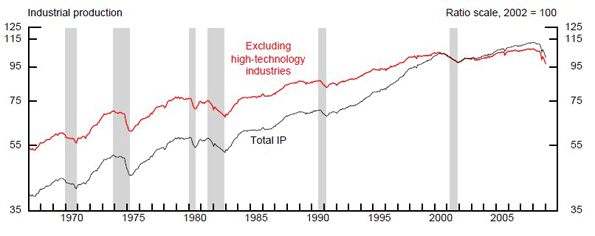
    Beyond this, can we as a country prosper if we don’t actually make things anymore? Some of the fear of manufacturing decline is overblown. Despite large scale job losses in the manufacturing sector, the US has continued to set industrial production records outside of recessions. However, as the chart below from the Federal Reserve shows, industrial production growth flattened significantly in the late 1990s.

    Sadly, manufacturing has been hammered in this Great Recession. There will certainly be a cyclical upturn in output, but restructuring in the automobile industry portends a permanent reduction in domestic output in that sector among others. Unless carefully handled, increasing regulation of carbon emissions, along with the associated energy price rises, will encourage further offshoring to countries with few climate change obligations, such as China, India, Brazil and other developing nations.

    Yet to remain both a prosperous and fair society, the United States must remain a manufacturing power. Manufacturing still provides the traditional route to middle class wages for those without college degrees. It also alone employs 25 percent of scientists and related technicians and 40 percent of engineers and engineering technicians.

    Of course, the next wave of manufacturing will differ greatly from the past. Improvements in productivity and global competition mean a bleak future for large scale, low value-added, routinized production. The era where an assembly plant provided thousands of good jobs at good wages is a thing of the past other than for the lucky few. And where there are new factories, they are often in greenfield locations like the new Honda plant in Greensburg, Indiana – halfway between Indianapolis and Cincinnati – not urban centers. Polluting heavy industry like primary metals and refining really are incompatible with neighborhoods. So what is to be done?

    One answer is to build a new industrial city focusing on small scale craft and specialty manufacturing with high value added. We’re seeing a precursor to this in the rise of organic farming and artisanal products of all kinds. TV shows featuring hip young carpenters renovating homes or gearheads tricking out cars and motorcycles make these professions seem glamorous. Magazines targeted at the global elite like Monocle scour the world in favor of the finest handcrafted products from old school workshops, building demand for these products. The New York Times Magazine recently did an article making the case for working with your hands, and also noted how digitally oriented designers are rediscovering the use of their hands. Perhaps it is no surprise that sociologist Richard Sennett turned his attention to the idea of the craftsman. In short, making things, craftsmanship, and quality are back in fashion.
    The challenge for urban economies is to develop this and put it on a sound industrial and economic footing. One key might be to inspire people to start these craft oriented businesses by tapping into people’s desire to purchase ethical and sustainable products. We increasingly see with foods and other items that people want to understand their provenance, to know who made them, how, with what, and under what conditions. Often today businesses catering to this desire are small scale “Mom and Pop” type operations, but there is no reason they can’t be done at greater scale, or expanded into areas like organic food processing, not just organic farming. American Apparel has done just that by manufacturing low cost, stylish clothing “Made in Downtown Los Angeles. Sweatshop Free.” at scale, for example.

    Beyond craft products, reinvigorating small scale, specialty fabrication and other businesses, to rebuild an American version of Germany’s Mittlesand, creates another, often ignored option for urban economies. Quality, flexibility, responsiveness, and a willingness to do small runs are keys. These businesses can also underpin product companies higher in the value chain. They start building an ecosystem of local companies and expertise that can be useful for related or spin-off businesses. Jane Jacobs, and before her the great French historian Fernand Braudel, noted how cities could incubate many new enterprises because all the diverse products and services they needed were available locally. If you need to scour the globe looking for custom parts and services, it can quickly overwhelm a small business. That’s one reason American Apparel started in Los Angeles, which already had a network of garment producing firms and expertise to draw on. What’s more, these firms might be ideal candidates to take over empty strip mall or other space in decaying inner ring suburbs, helping to solve the “graybox” problem. Even Main St. locations could potentially benefit from businesses beyond traditional boutiques.

    Today these types of specialty firms are often found in America’s largest cities, so they stand to benefit most from this. Smaller cities also need to figure out how to build this ecosystem. The culture needs to change too. Particularly in the Midwest/Rust Belt area, industrial labor has tended towards low skill, repetitive work in larger scale mass production industries. Retraining will be needed for these newer types of businesses, but this is vocational or skill training, not necessarily a college degree. It is a much more tractable problem.

    Not only could this new manufacturing base be a source of urban middle class jobs for the non-college degreed, it would do something arguably more important. It links the fortunes of the new upscale urban residents, the people who are both the customers for many of these products and potentially also the entrepreneurs making them, with that of their less educated neighbors. For many owners, managers, and workers, it might bring into daily contact people who might not otherwise ever interact if one group worked in an office and another in a warehouse. Rebuilding that sense of community and commonwealth, that we are neighbors, fellow citizens, and all in this together, is critical to building a truly sustainable, well-functioning and broadly prosperous society.

    Aaron M. Renn is an independent writer on urban affairs based in the Midwest. His writings appear at The Urbanophile.

  • Immigrants Are ‘Greening’ our Cities, How About Giving them a Break?

    Debate about immigration and the more than 38 million foreign born residents who have arrived since 1980 has become something of a national pastime. Although the positive impact of this population on the economy has been questioned in many quarters, self-employment and new labor growth statistics illustrate the increasingly important role immigrants play in our national economy.

    There has also been an intense debate within the environmental community about the impact of immigrants. Yet there has been relatively little research done about how immigrants get to work and where most immigrants live. As the ‘green’ movement in the U.S. has increasingly pushed for higher-density housing and transit-oriented development in order to improve public transportation (specifically rail), few have considered how immigrants use transit and what might be the best way to accommodate their needs. In fact, all too often, “green” policies advocate transit choices – favoring such things as light rail over buses – that may work against the interests of immigrant transit riders.

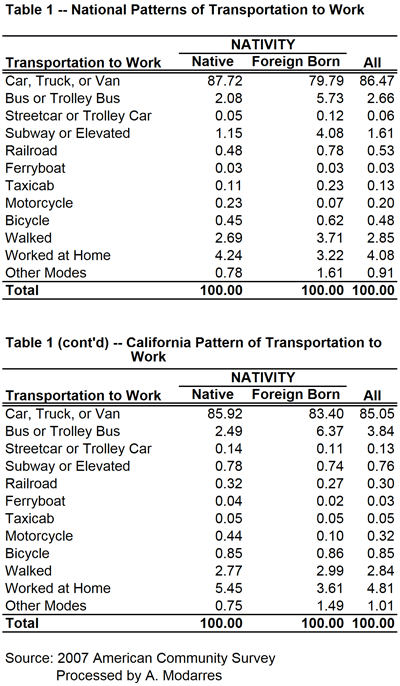
    Based on the 2007 American Community Survey, 117.3 million native-born and 21.9 million foreign-born individuals commuted to work. As Table (1) illustrates, a higher percentage of immigrants rode buses (5.7% vs. 2.1%) and subways (4.1% vs. 1.2%) and many walked to work (3.7% vs. 2.7%). A much smaller percentage drove to work (79.8% vs. 87.7%). Unfortunately, despite their higher usage of alternate means of transportation to work, or perhaps because of it, the commute to work time was on average longer for the foreign-born commuters than their native-born counterparts (28.8 minutes versus 24.7).
    Clearly in terms of using public transportation, immigrants are a bit greener than those born here. But why? Is this habit formed elsewhere? In that case, are recent immigrants even more likely to use public transportation than those who immigrated earlier? Or is it their income that affects their transportation choices?

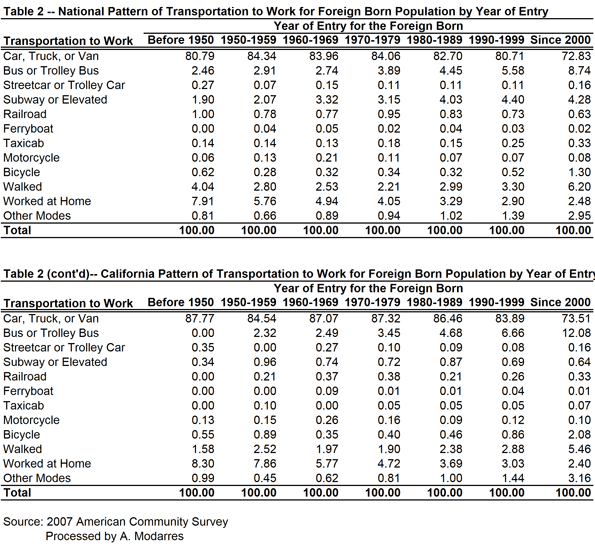
    Table (2) provides the answer to the first question. Recent arrivals are clearly less likely to drive to work and have a higher propensity toward using public transportation, compared to all foreign-born individuals (and significantly more than the native-born). Additionally, over 6% of the immigrants who have arrived since 2000 walk to work.

    Overall, more than a quarter of the immigrants who have arrived since 2000 use an alternative mode of transportation to work. If the rest of America could do the same, we’d be a bit ‘greener’ already. However, it seems that as immigrants stay longer, they eventually tend to use cars more often because automobile usage allows for access to better jobs, better shops, and better schools. For example, immigrants who arrived in the U.S. in the 1970s (which means they have been here over three decades) drive a bit more and use public transportation less.

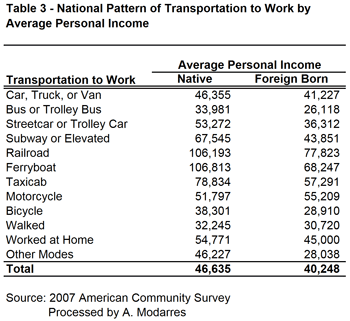
    Even so, their rates are still slightly better than the native-born (compare Tables 1 and 2). This may be in part because of their lower incomes (see Table 3) yet at every level of income they are still more likely to take transit. Table (4) illustrates this point by grouping commuters into income categories and their nativity. In every income category, immigrants use their cars less and are more likely to use public transportation, even though their car ridership increases with income.
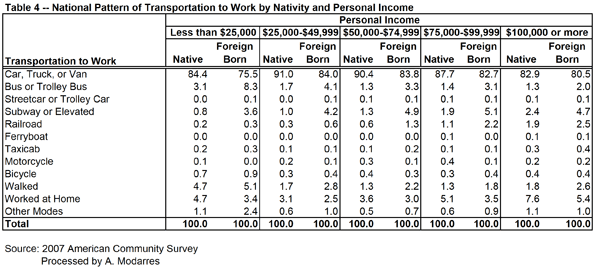
    The message from these statistics is loud and clear. Immigrants are more likely to ride public transportation than those born in the U.S., regardless of their income. The ones arriving more recently are even more likely to do so. Overall, this suggests that familiarity with public transportation, combined with the effects of income and place of residence, has made the immigrants’ lives in the U.S. a bit ‘greener’ than those of the native-born. In fact, one factor that may contribute to their higher usage of public transportation stems from their living in neighborhoods whose densities are, on average, 2.5 times higher than those of the native-born. Immigrants, in essence, are doing precisely what planners want the rest of us to do.

    Moving to Southern California

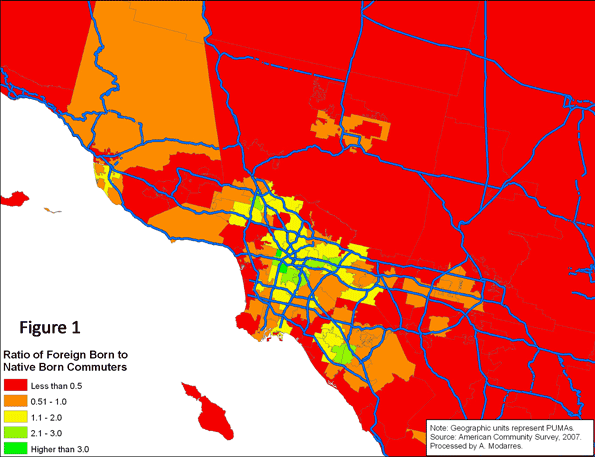
    Southern California still stands as the icon of immigration and multiculturalism and is home to a large number of immigrants in the urban region that extends from eastern Ventura County to the southern tip of Orange County and the Inland Empire. As Figure (1) illustrates, in a number of neighborhoods in Southern California, the foreign-born population outnumbers the native-born by large margins. For example, in areas west and south of downtown Los Angeles, immigrants are more than three times as numerous as the native-born.

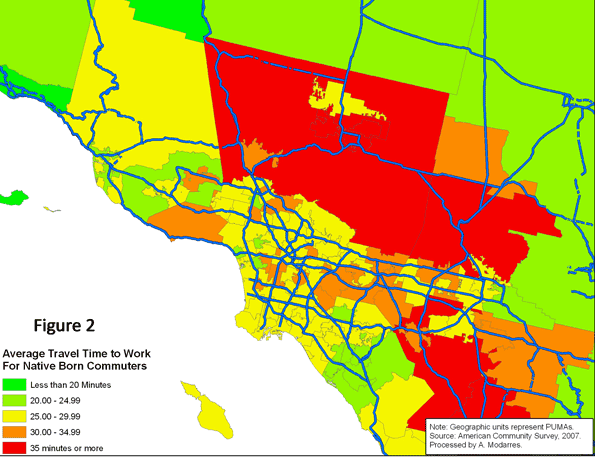
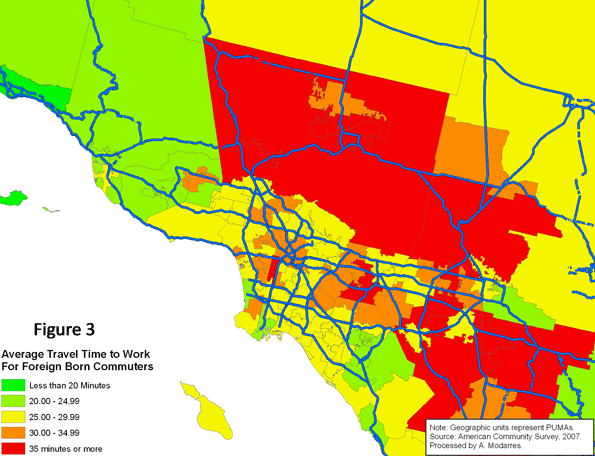
    A comparison of Figures (2) and (3) suggests a wide geographic difference between the native-born and the foreign-born and how long it takes them to get to work. The foreign-born population experiences much longer commutes in highly urbanized areas around downtown Los Angeles and the San Gabriel Valley. Conversely, in the more rural areas, such as northern Ventura County, the foreign-born population experiences shorter commutes compared to their native-born counterparts.

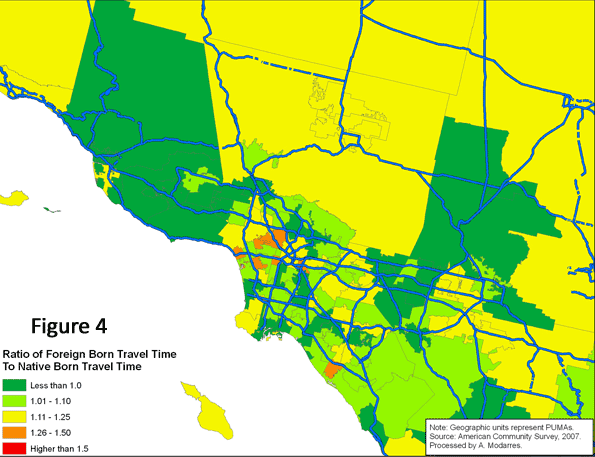
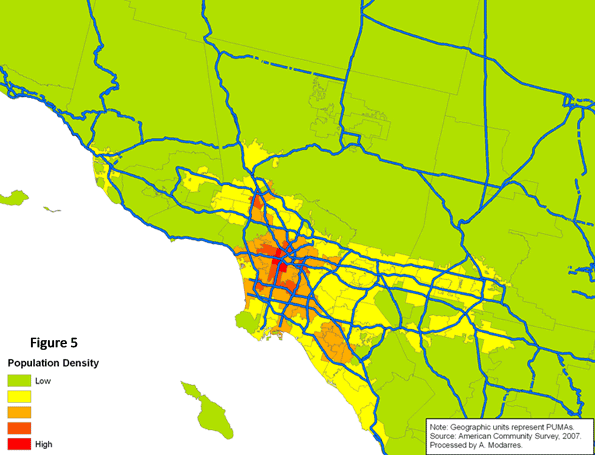
    Figure (4) provides a clear comparison of average travel time to work for both populations (visually comparing Figures 2 and 3). In all areas appearing in the darkest shade of green, the foreign-born population experienced shorter commutes compared to the native-born. These shorter commutes, however rarely occur in high density areas (compare with Figure 5). Conversely, in areas such as Santa Monica, the Wilshire corridor, East Los Angeles, and southern sections of downtown Los Angeles, the foreign-born population experiences much longer commutes than the native-born.


    Statistically speaking, there is a positive relationship between average travel time and density – i.e., the higher the density, the higher the reported average travel time. For the foreign-born population who live in higher density areas, this means much longer commutes, a problem caused by a number of factors, including their dependency on slower public transportation systems and the long distances they have to travel to reach job centers outside the city center.

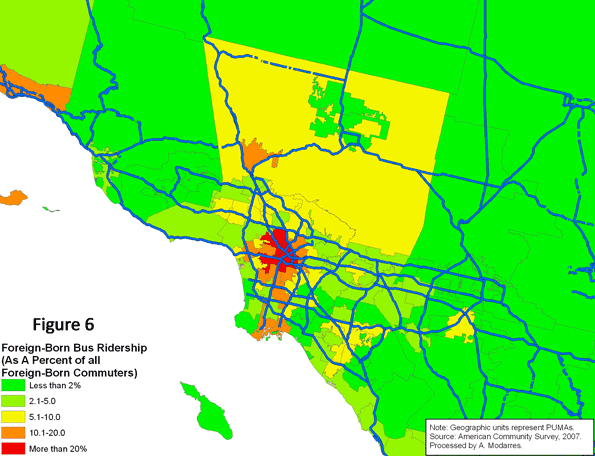
    Figure (6) illustrates the geographic pattern of bus ridership among the foreign-born commuters. As with national patterns, immigrants in Southern California are more likely to settle in high density areas and use public transportation to work, but unfortunately, they also suffer much longer commutes.

    What should the policy responses be? One may be to promote increased car ownership among immigrants and low-income populations in the U.S. This may be objectionable to some environmentalists and planners, but it’s clear that those people who live by the principles of higher density and public transportation use are not rewarded and indeed suffer longer commutes.

    An even more relevant question is why advocates for public transportation focus disproportionately on rail, when buses are so frequently used by low income populations, including immigrants. In California, these riders outnumber the native-born on buses. The situation is reversed on rail and subways. An intelligent policy response to public transportation planning would suggest that buses should receive much more attention. Major metropolitan areas have become polycentric in their employment patterns, and most major employment centers are located at long distances from the central city. Specially-designed buses for reverse commutes could help alleviate transportation problems while helping working immigrants reach their destinations more quickly.

    This challenges the priorities of some public transport advocates, who tend to focus on very expensive rail projects designed primarily to draw more middle class, largely native-born riders who commute to places like downtown Los Angeles. Meanwhile those ‘new’ Americans who already live by a number of ‘green’ standards suffer from the misallocation of transit resources. Those who are already doing what we hope the middle class will do deserve better.

    Ali Modarres is an urban geographer in Los Angeles and co-author of City and Environment.

  • Reducing Vehicle Miles Traveled Produces Meager Greenhouse Gas Emission Reduction Returns

    Senators Jay Rockefeller (D-West Virginia) and Frank Lautenberg (D-New Jersey) have introduced legislation that would require annual per capita reductions in driving each year. Another bill, the National Transportation Objectives Act, introduced by Representative Rush Holt (D-Indiana), Representative Russ Carnahan (D-Missouri) and Representative Jay Inslee (D-Washington.) would require a 16 percent reduction in driving in 20 years.

    Last week, a highly publicized report by the Urban Land Institute (Moving Cooler) also called for policies that would reduce the vehicle miles traveled (VMT) by people in their cars. This report was analyzed here by Alan Pisarski). The reductions in driving would be achieved by highly intrusive land use policies that would make it impossible for most Americans to live where they want, allow for only minor expansion of roadway capacity and force almost all new development to be within existing urban footprints. It would employ such radical strategies as forcing people to pay $400 per year to park their cars in front of their own homes.

    The assumption behind these initiatives is that reducing driving will produce substantial reductions in greenhouse gas emissions. It sounds like a simple enough proposition, since cars emit greenhouse gases in direct proportion to the gasoline they consume. It would seem logical that reducing their use would lower their emissions by a similar percentage. Moving Cooler assumes that for every 10 percent reduction in driving miles, there will be a 9 percent reduction in greenhouse gas emissions.

    Meager GHG Emission Reductions from Reducing Driving: But things are not nearly so simple. It appears that reducing vehicle miles would not produce a similar reduction in greenhouse gases from cars.

    It is well known that at the slower speeds of vehicle operation in cities, fuel economy tends to decline with speed. Further, as congestion increases, so does fuel consumption, due to longer idling periods (such as at signals or in stopped traffic), more acceleration and more deceleration. Thus, not only does fuel economy drop when average speeds drop, but it drops even further when traffic congestion intensifies. The extent to which any reduction in urban driving would reduce greenhouse gas emissions is not at all well known, simply because there has been insufficient research on the subject.

    Perhaps the best indication is a comparison of Environmental Protection Agency (EPA) “driving cycles,” which are tests used to estimate some emissions (although not greenhouse gases) and fuel economy. There is considerable data for the normal urban cycle, which replicates driving conditions in most of the nation’s urban areas. There is much less information available for the “New York City Cycle,” which replicates the congested traffic conditions in New York City, which is far more congested than any of the nation’s urban areas (Note).

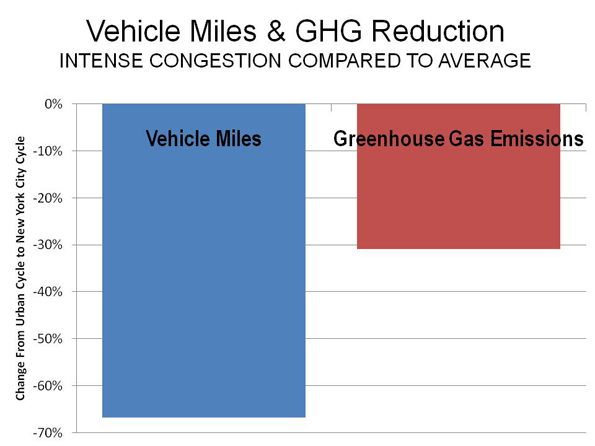
    Under the New York City Cycle average speeds are two-thirds less than under the average urban cycle. This reduction in speed and increase in congestion results in a 50 percent loss in fuel economy, according to an Argonne National Laboratory Study. Thus, between New York City and the average urban area, fuel efficiency drops at a rate 80 percent of the lower driving rate in New York City.

    On average, vehicle travel in New York City is approximately 8 miles per capita daily. In the average large urban area outside New York City (such as the Phoenix urban area, or for that matter the suburbs of New York City), vehicle travel is approximately 24 miles per day per capita. Thus, per capita driving in New York City is 67 percent less than in Phoenix. However, because of the loss in fuel consumption, the greenhouse gas emissions from cars per capita is only 31 percent less (Figure 1). Thus, the limited data indicates that nearly one-half of the greenhouse gas emissions difference between New York City driving rates and Phoenix driving rates are cancelled out by the impacts of slower speeds and increased congestion.

    Shortcomings of Policies to Reduce Driving: UCLA’s Lewis Center for Regional Policy Studies Program on Local Government Climate Action Policies raised concerns about relying on VMT reduction policies in a submittal to the California Air Resources Board:

    Especially in congested areas of California, VMT is an inadequate proxy for vehicle greenhouse gas emissions.

    Yet it is precisely more intense traffic congestion that we can expect if federal laws and policies should force most development into present urban footprints. Between 2010 and 2030, nearly 70,000,000 residents will be added to US urban areas, an increase of more than 25 percent. This increase would mean that the legislation introduced by Congressmen Hold, Carnahan and Inslee would require a one-third reduction in per capita driving to achieve its overall 16 percent reduction. Per capita driving declines such as those envisioned by the Congressmen or Moving Cooler have never occurred before in any American (or international) urban area. By comparison, charging people $400 to park their cars in front of their houses seems utterly reasonable.

    Further, higher population densities are associated with more intense traffic, both at the national and international level. Policies such as recommended by Moving Cooler would produce little additional highway capacity to handle the far higher levels of driving produced by a larger population. We could expect traffic congestion to increase markedly. It would take longer to get to work and local air pollution would be more intense (a health impact largely ignored by proponents of higher densities).

    The Economic Cost: A serious economic toll would be produced by more grid-locked urban areas, because of the positive relationship between personal mobility and economic performance. Remy Prud’homme and Chang-Woon Lee of the University of Paris have shown that greater economic mobility is associated with greater economic growth. Greater personal mobility also alleviates poverty, according to a Progressive Policy Institute study):

    In most cases, the shortest distance between a poor person and a job is along a line driven in a car. Prosperity in America has always been strongly related to mobility and poor people work hard for access to opportunities. For both the rural and inner-city poor, access means being able to reach the prosperous suburbs of our booming metropolitan economies, and mobility means having the private automobile necessary for the trip. The most important response to the policy challenge of job access for those leaving welfare is the continued and expanded use of cars by low-income workers.

    The UCLA submission further notes that policies aimed at reducing driving could damage the economy:

    … policies which seek to reduce VMT may hinder economic growth without reducing emissions.

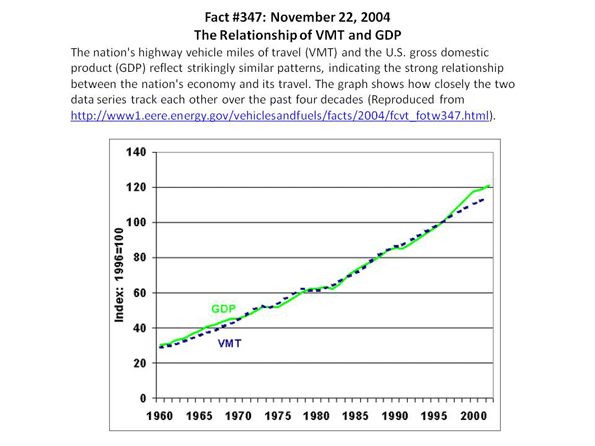
    The relationship between greater mobility and economic prosperity is also demonstrated at the national level. This is vividly illustrated in the chart from the United States Department of Energy (Figure 2).

    The significant improvements in fuel economy from higher mileage cars and less carbon intensive fuels will do far more to reduce greenhouse gas emissions from cars than the meager results that can be achieved by heavy handed policies to “coerce” people out of their cars (as Secretary of Transportation Ray LaHood put it). And, critically, it would do so with far less impact on both economic and physical mobility.

    Both the Economy and Greenhouse Gas Emissions at Stake: With the economic challenges facing the nation, policy makers need to steer clear of strategies that hobble the economy, like forcing people to drive less (or pay $400 to park in front of their houses) and make only minor improvements in reducing emissions. Indeed, a society with less money will have less to spend on reducing emissions through the adoption of new technologies that offer greater hope for creating a more prosperous as well as more environmentally sustainable society.


    Note: The New York City refers to the City of New York, not the metropolitan area or the urban area.


    Wendell Cox is a Visiting Professor, Conservatoire National des Arts et Metiers, Paris. He was born in Los Angeles and was appointed to three terms on the Los Angeles County Transportation Commission by Mayor Tom Bradley. He is the author of “War on the Dream: How Anti-Sprawl Policy Threatens the Quality of Life.

  • People, Planet, Prefurbia

    The term “sustainable” relates to a concept called the “Triple Bottom Line” (TBL): People, Planet, and Profit (the three P’s), endorsed by the United Nations in 2007 for urban and community accounting.

    American suburban land planning is about the SBL (Single Bottom Line): Profit. In city after city, mindless cookie cutter subdivisions, with characterless architecture, serve cars more than people. This dysfunction is caused by the boiler-plate regulations; engineers adhere to the minimum dimensions mandated by city ordinances to gain density, which maximizes developer’s profits. City council and planning commission members are appalled by the monotonous plans developers submit. Subdivisions that meet the minimums must be eventually approved. Developers are judged as evil, but they rely on the engineer who simply follows the city rules. Everyone mistakenly trusts that the consultant whose business card says “Land Planner” is the expert who will lay out the best development. However, “Land Planning” is not a regulated profession.

    What? Astonishingly there are no regulatory requirements to prevent anyone from representing him or herself as a land planner… you too can become one by simply printing the title on your business card, and everyone will assume that you, too are an expert. The suburbs have been ripe for a preferable system, one that we call ‘Prefurbia’. The concept was recently featured in Environmental Protection because of its potential for urban renewal. In terms of what it can do for suburbs, compare Conventional development to Prefurbia in terms of the three P’s of sustainability:

    People: Conventional Subdivision

    The land planner subdivides lots into ordinance minimums. If the city requires that a percentage of the site be set aside for open space, the area likely to be chosen is one that would not be fit for construction, rather than the best open space location for residents. Streets are designed first, then lots. No attention is given to the home or townhome unit other than a “pad” size to fit the structure. The main design focus is always the street layout (also true in Smart Growth plans). If there are any walkways, they parallel the street edge. The typical suburban maze-like street pattern is often difficult to drive through, and even more difficult for pedestrians, which further encourages a drive over a stroll. Suburban Land Use Transitions (zoning) place the lowest income (highest densities) in the most undesirable places. Positioning a high concentration of families overlooking loading docks along the rear of strip retail centers is not just acceptable, it’s encouraged.

    People: Prefurbia

    In Prefurbia, the Neighborhood Planner designs the pedestrian system first. Destinations for the walks are targeted as a basis for the open space “system,” assuring convenient pedestrian connectivity through the developers land. This is called a Pedestrian Oriented Design (POD). In Prefurbia, the suburban desire for space reigns supreme. Each home, attached or detached, is designed to assure that living areas are placed along the best views, giving the illusion of low density. The consultants who design the Prefurbia neighborhood (architects, planners and engineers) must do something that is foreign to them: they need to actually talk to each other! The architectural floor layouts, interior walls and window locations are an integrated component of the overall neighborhood, a first for land planning. Housing is situated so that each home sculpts a unique streetscape, eliminating monotony while embracing individualism (even if the architecture is somewhat repetitive).

    Prefurbia land use places higher density along the most desired site amenities without regard to residents income. In the design process, all income levels are treated as upper class. This new land use theory is called Connective Neighborhood Design (CND).

    Retail in Prefurbia is called the Neighborhood Marketplace. Neighborhood congregation areas such as patios, boardwalks, decks, ponds, etc., are placed along the rear of retail centers, which are also main pedestrian destinations. Since the Prefurbia pedestrian systems are separate from streets, there are few conflict points with vehicles. When walks are situated along streets they meander gracefully as far from the street edge as possible.

    Planet: Conventional

    Subdivision planning sets homes parallel to the edge of the street at the exact minimum distance allowed by regulations. The land planner must stretch the street as much as possible through the site to gain density (also true with Smart Growth design). The developer is burdened with constructing enormous street and utility main lengths to achieve the greatest density. Traffic flow is an afterthought.

    Planet: Prefurbia

    The Prefurbia Neighborhood Planner designs something very unnatural… a plan with dimensions greater than the minimums. Using entirely new geometric theory made practical by new technologies, the Neighborhood Planner separates the street pattern from the positioning of the homes, which results in lesser street length, but maintains density. This creates more organic (non-paved) space – lots of it! It’s more art than science to create independent, meandering shapes that open up the streetscape. In this scenario, it’s possible to maintain density by reducing the length of street by (typically) 25% compared to conventional planning and up to 50% compared to Smart Growth principals.

    The extra landscaped area allows the Prefurbia Neighborhood Engineer to design with much lower environmental impact, and to reduce development costs. The flowing vehicular pattern reduces both time and energy when driving through the neighborhood. All of this together means that in Prefurbia, Green is affordable. Imagine the implications worldwide.

    Profit: Conventional

    A cookie-cutter subdivision developer relies on a price point to generate a profit. The local Land Planner is likely to design the same style for all clients with the thought that the minimum dimensions allowed by ordinance are in fact the absolute dimensions. Because of this, most, if not all, of the developments within the town will look and feel alike. Because competing developments look the same they must compete mainly on price. Selling cheaper to make a profit makes little sense. This is made worse when the Conventional (and Smart Growth) design requires the longest possible street lengths (and, therefore, costs) to achieve density. With the reduced lot values today, building excessive infrastructure from Conventional and Smart growth design can make many developments unprofitable.

    Financial Sustainability: Prefurbia

    Profit is not the correct word to describe the financial advantages of Prefurbia. A home is not something that is disposable after the initial sale. Subdividing land sets a pattern that continues to exist for many centuries. An average home sells once every six years. If the number of residents for each home represents just three people, a 100 unit layout will affect the lives and finances of 10,000 people over two centuries. The financial advantage of Prefurbia is based on a significant reduction of infrastructure that’s needed for development, which allows more funds to be spent on curb appeal. The ability to pay more attention to character building (architectural and landscaping elements) without increasing the initial home price provides a tremendous market advantage.

    Will the home buyer or renter prefer the claustrophobic garage grove subdivision over the beautiful, functional, open Prefurbia neighborhood? The advantages will continue to provide financial sustainability every time a resident resells the property.

    And with a significant reduction of public infrastructure, the municipality is the big winner. A 25% reduction in streets translates into 25% less cost to maintain, yet the tax base stays the same. With the increase in open space, Prefurbia neighborhoods can justify an increase in density that reduces the effects of sprawl.

    Perhaps the best news is that Prefurbia can be ideal not just to develop new suburbs and exurbs, but to redevelop urban areas… and maybe to rewrite the triple bottom line to People, Planet, Prefurbia.

    Rick Harrison is President of Rick Harrison Site Design Studio and author of Prefurbia: Reinventing The Suburbs From Disdainable To Sustainable. You can view a portfolio of pictures and videos of prefurbia at his website, rhsdplanning and at prefurbia.

  • Downtown Central-Cities as Hubs of Civic Connection

    There’s been a torrent of spirited banter lately about the reemergence of downtown central-cities. Much of this raucous debate is between advocates of urban revitalization, who offer an assortment of anti-sprawl messages as justification for this movement, and those who see suburban growth options as essential to quality of life in America. Adding to the fray are environmentalists who see housing density and alternative forms of transportation as the panacea for confronting our carbon-choked world. Downtown central-cities, they say, will incentivize citizens to relinquish their cars in favor of bikes and walking paths.

    These discussions largely ignore a greater significance to the reemergence of central-cities; namely, the recognition of downtowns as the epicenter of civic and cultural activity. This represents a shift away from the traditional concept – barely a century old and now antiquated – of downtown as predominately an economic and job center hub.

    This primary role for downtowns has been declining since the 1950s. According to Robert Fogelson, professor of urban studies and history at MIT and author of Downtown: Its Rise and Fall, 1880-1950, after World War II, downtowns lost their prominence as places where people “work, shop, do business, and amuse themselves.” As he states in the book, “Downtowns were once thought to be as vital to the well-being of a city as a strong heart was to the well-being of a person.”

    Increasingly the word “downtown” has become associated exclusively with large urban centers, fostering images of traffic, crime, homelessness and other forms of unsavoriness. A closer look, however, reveals a wide range of downtown genres – small and large, central-city and suburban, safe and sketchy, chaotic and peaceful, established and emergent. Some downtowns are situated in major urban regions while others are nestled in small-town communities. The senior demographic is prominent in some, college crowd in others.

    This new assessment of downtown as primarily a center for civic opportunities makes sense and revives the ancient role of the plaza “forum” or “agora” concept–places that H.G. Wells affectionately referred to as ideal for “concourse and rendezvous.” This redefinition may bother some who wish to return to the downtown apex of the 1950s, yet the idea is both viable and sustainable.

    With the traditional town-center model serving as the hub of civic activities, residents and visitors alike are frequenting dining establishments, arts and music venues, and coffeehouses in the spirit of civic connection and community. No longer a phenomenon exclusively associated with young artists, bohemians, and intellectuals, the downtown experience is also drawing unprecedented numbers of older folks who appreciate the history, cultural significance, ambiance and architecture of the old core.

    Downtown planning efforts in many locales are responding to this surge of interest by creating a brand identity for their cities – Austin, Texas, has developed a vibrant music scene, with a number of entertainment venues tucked along its 6th street corridor; Indianapolis promotes itself as a spectator-sports mecca, with its downtown activity infused by a robust fan base frequenting college basketball tournaments, pro and minor league baseball games, and the nation’s largest sporting event: the Indianapolis 500; Chicago touts itself as a tourist destination replete with world-class museums, city and architectural tours, and fine dining in its vast downtown core. Smaller downtowns in cities like Davis, California, Evanston, Illinois, and Iowa City, Iowa, tap into a bustling college crowd from area universities.

    Traverse City, Michigan, with a population of over 15,000 (142,075 in the surrounding metro area) offers another model: the quintessential small-city downtown. Quaintly situated along the Grand Traverse Bay on Lake Michigan, the area is primarily known for boating, kayaking, and sailing, except in July, when the city hosts its annual, week-long Cherry Festival that attracts swarms of people to its historic downtown area.

    According to Rob Bacigalupi, Acting Executive Director of the Traverse City Downtown Development Association, downtown traffic is driven by the office population and events. “Downtown Traverse City has somewhere in the neighborhood of 3,500 office workers. Certainly that’s a small number by any measure, but for a town of 15,000, these workers provide a good base for retailers who otherwise have to rely exclusively on seasonal visitor traffic,” he says.

    In terms of a niche identity for downtown Traverse City, tourism seems to be front and center. The calendar is jammed with events, many of which are designed specifically to attract locals downtown. Other cultural activities, such as the Cherry Festival, Traverse City Film Festival and Horses by the Bay, draw visitors by the tens of thousands. Bacigalupi cites a recent convention and visitor’s bureau survey indicating downtown shopping as one of the main regional attractions. “There’s no doubt,” he says, “that regional tourist traffic is perhaps the largest driver of foot traffic downtown. This says a lot for a region that has a number of other attractions and activities to offer.”

    For many city leaders the potential impact of downtown on regional economics and culture is what’s creating the most buzz. Kansas City (Missouri), Roanoke (Virginia), and Asheville (North Carolina) are among a growing number of cities seeking to capitalize on their unique brand of cultural connection to generate badly needed tax revenues for their downtown areas. Some experts say this is a sound move amid tepid economic times as city and local governments look to draw customers from closer to home.

    This message rings true for economically ravaged Rust Belt cities like Cleveland, Ohio. For years, downtown Cleveland has struggled to survive – beginning in 1960 when manufacturing and heavy industries began their decline and the flight to the suburbs gained momentum. In 1978, Cleveland had the dubious distinction of becoming the first American city to enter into default since the Great Depression. Despite small glimmers of promise, downtown Cleveland has been stuck in neutral, unable to build a cohesive identity and direction.

    There are some successes though: Redevelopment efforts have transformed a downtown corridor along E. Fourth Street into a bustling fine dining and nightlife mecca, demonstrating the appeal that well-constituted areas have on the local populaces and tourists. And the area’s rich ethnic and cultural heritage shows promise as a catalyst for change in the central core. While all of this points to some progress for downtown Cleveland, it still must overcome a heavy stigma associated with crime, poverty, and a declining population base to truly achieve civic vibrancy.

    Many of our nation’s suburban communities are setting the pace for downtown civic connection. Naperville, a Chicago suburb and the fifth largest city in Illinois, has established itself as a model for suburban downtowns. This city of 142,000 residents features a cornucopia of sophisticated shops, restaurants and entertainment venues that attract foot traffic to the town center-oriented central district. Open space has been integrated into the cityscape through well-maintained walking paths along the DuPage River, which flows through downtown. Thoughtful planning for the provision of abundant, free parking, train accessibility, and bike lockups enables convenient accessibility to the area both day and night.

    Folsom, California, is indicative of a suburban community that fosters civic ties and activities through its historic downtown district. With a population of 70,000 this city located in the eastern portion of rapidly growing Sacramento County draws an eclectic crowd to its old town boardwalk setting replete with saloons, outdoor restaurants, and antique stores. The downtown core also serves as a gathering post for legions of bicyclists who have helped shape Folsom into one of the top bicycling communities in the nation.

    During summer, downtown Folsom hums with activity generated by two weekly events: Thursday Night Market, featuring live music, food and shopping, and the Sunday Farmers Market, where frequenters can purchase fresh, locally grown food from area farmers. Plans are afoot for a street-scape improvement and a storefront restoration – projects that are designed to preserve historic elements while enhancing the city’s tourism desirability. Also in the works are mixed-use housing units and a restaurant that incorporates a railroad roundabout. All of this comes on the heels of a new parking structure and ice-skating rink, which debuted last year.

    In the end, downtown central-cities seem poised to reclaim some of their prominence as magnets of culture and social connection. We may not be witnessing the rebirth of the great economic centers of the 1950s, but a revival of our central space represents a positive development for communities both large and small.

    Michael Scott is a researcher and writer focusing on the growth and sustainability of downtown central-cities. He can be reached at michael@vdowntownamerica.com.

  • ULI Moving Cooler Report: Greenhouse Gases, Exaggerations and Misdirections

    Yesterday a group of environmental advocacy groups, foundations and other organizations released a report, Moving Cooler, amid much fanfare, seeking to have us believe that it is a serious study of GHG reduction options in the transportation sector. It is immensely disappointing. The world could use a dispassionate, objective and broad-based assessment of petroleum reduction options as well as their positive and negative consequences. This is not it.

    As one reads one can’t help but feel that you are being hit with a sales pitch, or a legal brief from advocacy groups and those who would benefit financially from the derived policy options. The main point, amidst all the array of statistics, confirms the dogma of the already convinced that the only solution to greenhouse gases is major re-structuring of society.

    These notions, critically, were already on the front burner of these same groups long before the climate change issue came to prominence. “Progressive” foundations, new urbanists, planners and urban landowners long have advocated the re-assembly of urban living into high density transit-oriented bikeable/walkable communities. Even though their numbers as reported in the text don’t bear it out, the rhetoric is all focused towards that end and the pricing out of existence the automobile and all the evils it represents: suburban living and long trips.

    This is a report meant to be waved rather than read as the Congress goes about its fulminations in the coming months. It understates the prospect of gaining the full potential of greater energy efficiency from the vehicle fleet – the only way to justify the wholesale reorganization of society. In fact, if the vehicle/fuel assumptions had been as comparably optimistic as the land use assumptions, with a robust and honest assessment of fuel and vehicle technological development opportunities, one wonders whether this report would be worth doing at all.

    We have been here before. In the struggle to improve air quality, it turned out that the solution was not so much changing people’s behavior as it was technological – largely the improvement of fuel and vehicle technology. In the 1970s we were told we could not have cleaner air and automobiles; yet in fact that’s exactly what happened, without having to heed a sermon about our need to repent and change our suburban, car-driving ways. Some people just have a penchant for telling others how to live.

    Maybe the saddest part of it all, the authors appear not to take global warming or energy security very seriously at all. Rather these public concerns are just a convenient hook, the cause du jour, on which to hang their favorite solutions. If global warming matters – and it does; if energy security matters – and it does; then early action is clearly called for, particularly given the cumulative nature of GHG gases. But somehow the things easily done and carrying with them little in the way of disruption or public costs – carpooling, telecommuting, dispersed work – are largely written off. Such immediate, low-cost actions as highway operations strategies including better traffic signalization, improved traveler information and accident response systems receive little emphasis.

    Overall, the treatment of costs and benefits will leave readers gasping:

    • Travel times don’t get counted – so shifting from a 15 minute car trip to an hour on transit or walking has no penalty.
    • Transit subsidies don’t get counted – so doubling subsidies to increase ridership has only benefits.
    • Every possible pricing strategy is invoked – congestion pricing, cordon pricing, on-street parking fees, extreme fuel prices – in order to get people out of cars, and then the loss of their cars is counted as a benefit.

    At the same time the benefits and the costs involved are so corrupted to be meaningless. It will take weeks for analysts to tease out what really was done in the way of assumptions to create winners and losers. And there is no effort to tally all the costs exacted on the average household, or the typical business or even governments for that matter. The costs would add up to a permanent recession.

    I am sure the millions affected by these policies, particularly the middle and working class people who can now just barely afford a car, who would be priced out of the system by these policies, will say thank you for this “benefit”.

    As we work our way through the recession, workers will be willing to travel farther and farther to find the right job – or any job. With continuing increased specialization in our society larger and larger market sheds for jobs and for workers, quality transportation will be critical to our national productivity. This is the work that transportation does and it is totally dismissed by this report. It can not be addressed adequately by rail or transit even with a complete radical reorganization of work and society.

    In order to further bolster their ineffective case the proponents use a tool called “bundles” in which packages of actions are assembled for their “synergistic” qualities and either given a boost or cut based on the assertion that some things work well together. How this was done is not explained. So land use plans, which will take 30 years to come to fruition, are coupled with carbon pricing policies in a sort of horse and rabbit stew, that help make density solutions seem effective.

    Those who see the solution of so many of our present ills by cramming people into ever higher densities miss the point. Residential density is one of the most fundamental choices households make. Changing residential densities to make transit work better is the smallest tail wagging the biggest dog I can think of. It puts planning dogma ahead of the most basic human needs and rights.

    It is clear that most people, excepting a small but often very loud minority, opt for lower density living when income permits. As the society changes and choice patterns evolve, the marketplace must be ready to respond with development that is both responsive to household choices and to the demands of environmental needs. Any public policies that inhibit a market trend toward higher densities must be addressed. But the market place must be the final arbiter in a free society. People do not live “efficiently” in order to optimize some imposed societal goal, certainly not commuting.

    The serious work that needs to be done in this area still awaits an independent and credible group to undertake this work. It can’t come soon enough.

    For almost 40 years Alan E. Pisarski has been involved in the national transportation policy scene, from vantage points at the original Tri-State Transportation Commission in New York, the Metropolitan Washington COG, the Office of the Secretary, U.S. DOT, or in a personal consulting capacity. In his work he has measured the transportation activities of our nation from the metropolitan, state, national and international levels. In the U.S. DOT he organized the major travel surveys of the nation and designed and managed the U.S. transportation statistical system under the Assistant Secretary for Policy, establishing programs that are still the basis of much of the U.S. transportation statistical system today.

  • Globalization Leads to Civic Leadership Culture Dominated by Real Estate Interests

    Cleveland’s leadership has no apparent theory of change. Overwhelmingly, the strategy is now driven by individual projects. These projects, pushed by the real estate interests that dominate the board of the Greater Cleveland Partnership, confuse real estate development with economic development. This leads to the ‘Big Thing Theory’ of economic development: Prosperity results from building one more big thing.

    Ed Morrison wrote the above about Cleveland, but he could have been describing any number of other cities. Why is it that so many cities have turned to large real estate projects to attempt to restart growth, turning away from strategies that previously made them successful?

    The answer possibly lies in structural economic changes resulting from the nationalization and globalization of industry. Up until the 1990s, many businesses – including retail, utilities, some manufacturing, and especially banking – operated on a regional or local basis. This meant that the civic leadership of a community was heavily dominated by businessmen, again, especially bankers, whose success was dependent on the overall macroeconomic health of the particular city or region they were located in.

    But with banking deregulation, we saw large numbers of hometown banks merged out of existence. Industry after industry was subjected to national or international level roll-ups as changes in the economy and regulatory environment gave increasing returns to scale.

    Why is it that “real estate interests” dominate in a local economy like Cleveland? Because, to a great extent, they are among the only ones left. Consider the local industries that were not as subject to roll-ups. Principal among these are real estate development, construction, and law. This means the local leadership of a community is now made up of executives in those industries, and they bring a very different world view versus the previous generation.

    Consider the difference between a banker and a lawyer. Banks make money on the spread between what they pay for deposits or wholesale funding, and what they charge for loans. This means the CEO of a bank is making money while he plays golf at 3. He’s got a cash register back at the office that never stops ringing.

    By contrast, lawyers get paid by the hour for work on specific matters and transactions. The law partner is only making money on the golf course if he is closing a deal. It’s similar between many other “operational” businesses that were previously prominent in communities, and the “transactional” businesses that are now often dominant.

    Additionally, even where the hometown bank or company did not get bought out, it likely escaped that fate by getting big itself and making large numbers of acquisitions or otherwise expanding. This means those institutions are less dependent on the health of the particular local market they happen to be headquartered in than they are overall macroeconomic conditions. While no doubt they want the headquarters town to be successful, not least of which so they can effectively recruit talent, they can afford to take a portfolio view of local markets.

    Not only has the drying up of local and regional operating businesses led to a business leadership community unbalanced in favor of transactionally oriented firms, the loss of those local and regional operating businesses robbed many of the transactional companies such as law and architecture firms of their principal local client base. Large national businesses employ national firms for advertising, law, architecture, etc. If they use local firms, it is in a subsidiary role. (Or, if a smaller firm is fortunate enough to land a contract, it is servicing a client on a national, not local basis).

    Richard Florida described this in his Atlantic Monthly article on the financial crash. “As the manufacturing industry has shrunk, the local high-end services—finance, law, consulting—that it once supported have diminished as well, absorbed by bigger regional hubs and globally connected cities. In Chicago, for instance, the country’s 50 biggest law firms grew by 2,130 lawyers from 1984 to 2006, according to William Henderson and Arthur Alderson of Indiana University. Throughout the rest of the Midwest, these firms added a total of just 169 attorneys. Jones Day, founded in 1893 and today one of the country’s largest law firms, no longer considers its Cleveland office ‘headquarters’—that’s in Washington, D.C.—but rather its ‘founding office.’”

    Where then is the source of transactions these firms can turn to in order to sustain their business? The public sector, of course.

    I would hypothesize that many local transactionally oriented services companies have seen the public sector take on a greater share of billings than in the past. With the old school bankers and industrialists mostly out of the picture, the leadership in our communities consists increasingly of the political class and a business community dominated by transactional interests.

    When you look at the composition of this group, it should come as no surprise that the publicly subsidized real estate development is the preferred civic strategy. Politicians get to cut ribbons. Cranes always look good on the skyline. Local architects, engineers, developers, and construction companies love it. And there is plenty of legal work to go around.

    This is not to say these people are acting nefariously. And nor were old school bankers and industrialists always acting purely altruistically. Rather, the difference comes from the world view and “theory of change” that people steeped in transactionally oriented businesses bring with them.

    With the current financial crisis, bigness, as a strategy, is out of favor for the moment. Also, the gimmicky financial transactions that underlie much of the crisis are calling the entire transactional model into question. There’s an increasing alarm at the precipitous decline of manufacturing, particularly the auto sector. And people are questioning whether we as a country can survive simply through services, or whether we need to revitalize the concept of the operational business and actually making things. Plus, real estate deals are tougher to get done because of tight credit, and it seems unlikely that the go-go days of recent years are coming back soon.

    We’ll see where this leads. But if we see more local and regional scale operating businesses start to emerge again, then perhaps the urban development pendulum will start swinging the other direction again. In the meantime, large scale real estate development will likely continue to be preferred.

    Aaron M. Renn is an independent writer on urban affairs based in the Midwest. His writings appear at The Urbanophile.

  • Moving to Reloville, America’s Cross-Country Careerists

    Peter T. Kilborn’s Next Stop, Reloville: Life Inside America’s New Rootless Professional Class documents an important piece of social history: the lives of relocating corporate executives. These modern-day ­nomads—overwhelming white, well-educated and middle-class—maintain the business machine of large companies. They include the technicians, marketing executives and professional managers who accept a rootless life in exchange for handsome remuneration.

    Most of these people live in what Mr. Kilborn calls ­Relovilles, an archipelago of mostly newer, upscale suburban communities that includes places such as Alpharetta, Ga., Highland Ranch, Colo., Overland Park, Kan., and a series of Texas locales from Plano, outside Dallas, to the Woodlands on the periphery of Houston.

    In the many vignettes he provides, Mr. Kilborn portrays these executives and their families in a dispassionate, even sympathetic manner. We meet Jim and Kathy Link, who have moved seven times in a little more than 10 years as Mr. Link pursued a career in selling ­employee-benefit services. The author rides along with Kathy as she shuttles the kids to ­soccer practice,and he tracks the buying and selling of the Links’ homes. “The basement is approximately the same size as my parents’ entire house,” says Jim, marveling at how much house his $200,000 annual ­income bought in Alpharetta.

    We also meet Matt Fisher and his family. He’s an inventory-management specialist who, we’re told, has “averted dead-ending his career by mining his network of contacts to move from Chicago to Cleveland, to Columbus, to Houston, and ­finally to Flower Mound,” in Texas. Matt explains: “You can escalate your career if you want to move around. The ones who don’t move around don’t get the calls . . . because ­nobody knows who they are.”

    Although Mr. Kilborn is clearly an advocate for the ideal of rooted, organic ­communities—a value shared by many of the “Relos” in his book—he evinces none of the snobbish dismissal of middle-class values and aspirations that one finds in the work of new urbanists such as James Howard Kunstler or Andres Duany. Yet despite the appealingly sensible outlook of ­“Reloville,” the book does not rise to the level of the great social histories, such as ­Herbert Gans’s “Levittowners” or even Alan Wolfe’s “One ­Nation.” Mr. Kilborn’s work lacks both the statistical rigor and deep historical perspective found in the best such works.

    Mr. Kilborn also falls into something of the old journalist’s trap: trying to sell your story as something bigger than it is. He calls the Relos “a disproportionately influential strain of the vast middle class.” Yet in many ways they may not be as important as he suggests.

    Overall, Mr. Kilborn estimates the total Relo population at around four million in 2007. The number includes something like 800,000 households that are moved every year by companies in the U.S.—not an insignificant group but hardly a major one in a country of more than 300 million people.

    Despite his claims of their significance, Mr. Kilborn ­acknowledges that the Relos are far from “masters of the universe” who actually shape economies and societies. In fact, most are more the servants of top management than people in control of their own destinies. They are, Mr. Kilborn notes, “twenty-first-century heirs of William S. Whyte’s ­‘Organization Man,’ who ­exchanged the promise of job security and a pension for his loyalty and toil.”

    Yet it seems clear that the whole world of “The Organization Man” of the 1950s—predicated on stable employment— is shrinking, and rapidly. The days of large corporate ­organizations with a secure cadre of midlevel executives seems ­itself an anachronism. Companies routinely restructure their bureaucracies and outsource—to smaller independent firms domestically as well as to firms overseas. Relos may represent less the wave of the future than a stubborn ­hangover from the past.

    One critical reason for the reduced need to uproot workers is new telecommunications technology. For generations, IBM was instrumental in shaping the Relo group that Mr. Kilborn describes. After all, this was a company with initials that, executives joked, really meant “I’ve been moved.” Yet today IBMers are not as mobile as in the past—not in terms of physical movement anyway. As much as 40% of the IBM work force operates full-time at home or remotely at clients’ businesses. For members of the company’s highly regarded consulting practice, the percentage is even higher—they’re logging frequent-flyer miles, and piling up points at ­Residence Inns, not putting down even shallow roots.

    Perhaps even more important may be social changes that could make Relos less relevant in the future. For decades in the post-World War II era it was believed that “spatial mobility” would increase, hastening social disintegration. This vision was epitomized in Vance Packard’s 1972 best-seller, “A Nation of Strangers,” with its vision of America as “a society coming apart at the seams.”

    But in fact, far from becoming ever more nomadic, Americans are becoming less so, as the population ages and as ­formerly urban amenities are more widely dispersed and ­accessible. As recently as the 1970s, 20% of Americans moved annually; by 2004 the number had dropped to 14%— the lowest since 1950. By 2008, barely 10% were relocating.

    These days human-resource executives complain that workers are increasingly unwilling to move even for a promotion, citing family and other concerns. With the recent economic downturn, worker ­mobility in the U.S. has waned further. The decline in the relocation tradition seems likely to persist in good times or bad.

    Even the denizens of ­Relovilles who bought houses under the assumption that they’d be selling and moving on after a few years are now deciding to stay put. And formerly transient communities are evolving into something more permanent. Recent interviews that I conducted in the Woodlands, near Houston—one of the Relovilles identified by the author—revealed a growing sense of community, with some three-generation families now settled in the area.

    Over the past 40 years the institutions of community have emerged in the Woodlands. For example, a well-managed and expansive social-service organization called Interfaith has risen to take care of many needs, from welcoming new families to providing services to children and seniors. A well-attended cultural center has grown up in the town, as has something of a Main Street shopping district. The Woodlands is shedding its past as a generic Reloville and becoming its own place.

    Urban critics might see these evolving Relovilles as too faux for their tastes, but they do hint at a more rooted, less mobile suburban world, far more human than that envisioned by many futurists over the past few decades. Mr. ­Kilborn’s “Reloville” may turn out to be less about America’s social future than a fair and well-written chronicle of a ­phenomenon that is slowly, but inexorably, relocating into the history books.

    This article first appeared in The Wall Street Journal.

    Joel Kotkin is executive editor of NewGeography.com and is a presidential fellow in urban futures at Chapman University. He is author of The City: A Global History. His next book, The Next Hundred Million: America in 2050, will be published by Penguin early next year.

  • Elected Official Domestic Migration from San Francisco?

    San Francisco, like every other core county in a metropolitan area of more than 1,000,000 (with the exception of New Orleans) continues to lose domestic migrants. Between 2000 and 2008, US Bureau of the Census data indicates that more than 10 percent of San Franciscans have left for other counties. But if one is a member of the San Francisco Board of Supervisors (board of county commissioners), it may be convenient for only part of the family to join the exodus.

    According to the San Francisco Chronicle Supervisor Chris Daly moved the wife and kids to exurban Fairfield, claiming that the environment was better there for the kids, since they would live closer to their grandparents. Doubtless the environment will be better there for the kids in a lot of ways – more places to play, a safer environment and probably better schools.

    What’s more, the Supervisor moved the family to a cul-de-sac, that urban form most despised by the most orthodox urbanites.

    It is understandable that Supervisor Daly himself did not move, announcing that he continues to “eat, sleep and bathe” in his San Francisco home. Don’t be surprised, however, if when Supervisor Daly’s term expires, he should find the shower and bathtub more to his liking in the exurbs.