Category: Suburbs

  • The Blue-State Meltdown and the Collapse of the Chicago Model

    On the surface this should be the moment the Blue Man basks in glory. The most urbane president since John Kennedy sits in the White House. A San Francisco liberal runs the House of Representatives while the key committees are controlled by representatives of Boston, Manhattan, Beverly Hills, and the Bay Area—bastions of the gentry.

    Despite his famous no-blue-states-no-red-states-just-the-United-States statement, more than 90 percent of the top 300 administration officials come from states carried last year by President Obama. The inner cabinet—the key officials—hail almost entirely from a handful of cities, starting with Chicago but also including New York, Los Angeles, and the San Francisco area.

    This administration shares all the basic prejudices of the Blue Man including his instinctive distaste for “sprawl,” cars, and factories. In contrast, policy is tilting to favor all the basic blue-state economic food groups—public employees, university researchers, Silicon Valley, Hollywood, Wall Street, and the major urban land interests.  

    Yet despite all this, the blue states appear to be continuing their decades-long meltdown. “Hope” may still sell among media pundits and café society, but the bad economy, increasingly now Obama’s, is causing serious pain to millions of ordinary people who happen to live in the left-leaning part of America.

    For example, while state and local budget crises have extended to some red states, the most severe fiscal and economic basket cases largely are concentrated in places such as New York, New Jersey, Illinois, Pennsylvania, Michigan, Oregon, and, perhaps most vividly of all, California. The last three have among the highest unemployment rates in the country; all the aforementioned are deeply in debt and have been forced to impose employee cutbacks and higher taxes almost certain to blunt a strong recovery.

    The East Coastdominated media, of course, wants to claim that we have reached “the twilight” of Sunbelt growth. This observation seems a bit premature. Instead, traditional red-state strongholds such as the Dakotas, Idaho, Texas, Utah, and North Carolina, dominated the list of fastest-growing regions recently compiled for Forbes by my colleagues at www.newgeography.com.

    When the recovery comes, job growth also is most likely to resurge first in the red states, while the blue states continue to lag behind. For reasons as diverse as regulatory policy, aging infrastructure, and high levels of taxation, blue states continue to be more susceptible to recessions than their red counterparts.

    This assumption is borne out by an analysis of economic cycles by the website JobBait.com, which has found that since 1990 the states most vulnerable to economic downturns include the Great Lakes states of Michigan, Illinois, Ohio, and New York as well as Connecticut and California. Those most resistant have been generally red bastions such as the Dakotas, Nebraska, and Texas, and resource-rich states such as Alaska, Montana, New Mexico, and Wyoming.

    This suggests that even the hardest-hit red states, notably Florida and Arizona, are likely better positioned in the long term for a recovery. A generation of out-migration may be slowing down temporarily due to the recession, but many people moved to places such as Arizona, Florida, Texas, and Georgia over the first seven years of the decade; in contrast, the high-tax blue states, including New York, New Jersey, and California, lost 1,100 people every day between 1998 and 2007. Most of them headed to the red states.

    “When the economy comes back,” notes veteran California-based economist and forecaster Bill Watkins, “there will be a pent-up demand. People will compare and move to the places that are affordable and don’t have the fundamental tough tax and regulatory structures.”

    Devolution in Blue

    These demographic and economic trends will have a long-term political impact. The net in-migration states—almost all of them red—will gain new representatives in Congress after the next census while New York, Pennsylvania, Michigan, and perhaps even California could see their delegations shrink.

    In fact, amidst the Blue Man’s current political ascendency, the devolutionary process is likely to continue. Its roots are very deep, and will prove more difficult to reverse than media and policy claques suggest. In historic terms, blue states’ relative decline represents one of the greatest shifts of political and economic power since the Civil War.

    In the modern period that starts with the end of the Second World War, the states that are now blue were also, to a large extent, the best. They included the undisputed centers of finance, industry, culture, and education. Blue-state politicians also dominated both parties, either directly or behind the scenes.

    In contrast, the Red Man was disdained. As late as the 1940s, Los Angeles—still then very much in its red period—as well as Houston, Dallas, Charlotte, and Phoenix, were all not listed on the Social Register, the ultimate list of the socialite elite. You might visit Texas or invest in its oil, buy Los Angeles real estate, or winter in Scottsdale, but these were not places of consequence. These cities were not for civilized, serious people.

    Yet demographic forces changed this balance of power forever. In sharp contrast to Europe, often the preferred model for the Blue Man, the United States’ population exploded in the postwar era. This expansion could not be comfortably accommodated in the old cities.

    New demographics and timing shaped America’s urban patterns in largely unforeseen ways. Urban theorist Ali Modarres notes that America’s population over the second half of the 20th century grew by 130 million, essentially doubling, while the populations of France, Germany, and Britain together increased by 40 million, or 25 percent.

    In Europe slower population growth meant that planners could accommodate expansion through gradual expansion of existing cities. In contrast, America’s huge growth could only be accommodated by creating new places and vastly expanding others. This led to the growth of suburbs everywhere, but the bulk of expansion took place in vast emerging metropolitan areas such as Los Angeles, and later Phoenix, Dallas, Houston, Atlanta, Miami, and Las Vegas.

    This trend held up through much of the past decade. Nevada’s s population grew at four times the national increase of 8 percent while Arizona expanded three times as much and Florida twice the average. In contrast, growth in the blue states of the Northeast and Midwest generally stood well behind the national average.

    More important still, the new regions experienced a broad entrepreneurial explosion that reshaped the whole economy. In many cases, this growth came directly at the expense of the blue states. When major companies relocated they tended to leave places like New York, Pittsburgh, Cleveland, and Chicago for the burgeoning red cities.

    In 1950 Atlanta did not rank among America’s most important economic centers; 50 years later it stood among the most popular cities for large corporations and their subsidiaries. The same could be said for places like Houston, Dallas, and Charlotte. It was the quintessential American story, evidence, as Marxist scholar William Domhoff observed, that America’s “open class system is almost the opposite of a caste system.”

    Blue Man Economics

    Today two principles now drive the political economy of the blue states—and so shape the Obama administration today. The first one is the relentless expansion of public sector employment and political power. Although traditional progressives such as Franklin D. Roosevelt, Harry Truman, Fiorello La Guardia, and Pat Brown built up government employment, they never contemplated the growth of public employee unions that have emerged so powerfully since the 1960s.

    Public sector employees initially played a positive role, assuring that the basic infrastructure—schools, roads, subways, sewers, water, and other basic sinews of society and the economy—functioned properly. But as much of the private economy moved out of places such as New York, Illinois, and, more recently, California, public sector employment began to grow as an end to itself.

    Some blue-state theorists, columnist Harold Meyerson among them, have identified this new, highly unionized public sector workforce not so much an adjunct to the middle class but its essence. This has become very much the reality in many core blue regions—particularly big cities like New York, Chicago, and Detroit—as the private-sector middle class has drifted to the suburbs or out to the red states.

    Even before the recession these public-sector unions and their lavish benefits had become a major burden for blue states and cities. In California alone state pensions are now $200 billion underfunded. San Francisco has more than 700 retirees or their survivors earning pensions in excess of $100,000 per year. In New York, despite Mayor Michael Bloomberg’s occasional utterances about the city’s expanding pension system being “out of control,” city contributions to the pension system have grown fivefold under his watch. They now consume roughly one in ten dollars in the city budget.

    The only way to pay for these expenditures rests on the second key blue economic principle—the notion of an ever expanding high-end “creative economy.” This conceit is based on the notion that tangible things matter little and that, as former Wired magazine editor Kevin Kelly put it, “communication is the economy.”

    New York pioneered the idea that the economy could depend totally on the efforts of the talented few, mostly those on Wall Street but also those in the media and other “creative” industries. This formula has been widely accepted since New York Mayors John Lindsay and Ed Koch allowed New York City’s public sector to expand, often with borrowed money.

    Sadly this focus has tended to leave little room for a diverse economy that might employ an expanding, upwardly mobile middle class. Instead, companies and employees in these high-value industries tend to dominate almost all the attention of blue-state policy makers.

    Since this class had less need than traditional industries for basic infrastructure, a confluence of interest has emerged between the post-industrial elites and the public employees. Money raised from the monied post-industrial elite would essentially buy social peace by funneling largesse not into improving the roads, subways, or ports but into the pockets of the public employees.

    The Great Delusion and Its Blue-State Victims

    This elite strategy has served to bifurcate most blue states into an affluent core and a rapidly declining periphery. For example, California, a state whose shift from red to blue has given some heft to “progressives” everywhere, has experienced an increasing gap between a small sliver of wealthy metropolitan residents along the coast and an increasingly marginalized interior populated largely by middle- and working-class Hispanics.

    And then there is the imposition of increasingly stringent environmental regulation. This has hit hardest the essential sectors of the non-“creative class” economy such as manufacturing, warehousing, and agriculture. Basic industries depend more than finance or “creative” ones on reasonably priced energy and land, access to raw materials, and a sane regulatory regime. “In California,” notes economist Watkins, “everything has priority over the economy.”

    You can see the effects clearly in California. Climate change regulations work to constrain new construction of homes, particularly suburban single-family homes. Manufacturing industries, even relatively “clean” ones, make easy targets for carbon-hunting regulators. A recent Milken Institute report found that between 2000 and 2007 California lost nearly 400,000 manufacturing jobs, all this while industrial employment was growing in major competitive rivals such as Texas and Arizona.

    Trucking firms, saddled with harsh new deadlines to shift to cleaner vehicles, also are going out of business. Like manufacturers, many of these have historically been sources of upward mobility for largely Latino entrepreneurs and workers.

    Perhaps the most searing disaster is unfolding in the rich Central Valley. Large areas are about to be returned to desert—due less to a mild drought than to regulations designed to save obscure fish species in the state’s delta. Over 450,000 acres have been allowed to go fallow. Nearly 30,000 agriculture jobs—mostly held by Latinos—were lost just in May. Unemployment, 17 percent across the Central Valley, reaches to more than 40 percent in some towns such as Mendota.

    “We are getting the sense some people want us to die,” notes native son Tim Stearns, a professor of entrepreneurship at California State University at Fresno. “It’s kind of like they like the status quo and what happens in the Central Valley doesn’t matter. These are just a bunch of crummy towns to them.”

    A similar process of secular decline can also be seen in the peripheries of other blue states such as upstate New York, which has ranked near the bottom of job growth nationwide over the past 40 years. But nowhere has this occurred more completely than in Michigan.

    Under the leadership of Governor Jennifer Granholm, Michigan has sought to reinvent itself from an industrial powerhouse to a center of the “creative economy.” For much of her first term, Granholm focused on such inanities as promoting a “cool cities” program, following the notion that creating places for the terminally hip would help turn around her state’s economy.

    Yet in the end, Michigan stands at the worst end of almost every calculator, with the highest unemployment and rates of out-migration, and the worst cities for business. Its per capita income, which was 16th in the nation shortly before Granholm ascended as governor, has now dropped to 33rd, the lowest since the federal government has been keeping records.

    Detroit now suffers a 22 percent unemployment rate, the highest of any major city. Nearly one in three residents is on food stamps. But the pain goes well beyond Motor City. Altogether Michigan communities account for a remarkable six of the nation’s ten worst job markets, according to the most recent ForbesNew Geography survey.

    Waiting for Obama

    Many in the true blue states greeted Barack Obama’s election like the coming of a Messiah who would redress these serious problems. After all, it is widely believed in blue states that the red-state barbarians had looted the Treasury for their clients in the energy, industrial, home-building, pharmaceutical, and defense industries. Now the blue states, and their industries, would get payback. A vast expansion of public infrastructure, more emphasis on basic industry, and incentives for new entrepreneurial ventures could now help rapidly declining areas in the blue states.

    Yet hopes that Obama would emphasize such basic infrastructure now have been dashed. Instead, the stimulus has been largely steered to social service providers, “green” industries, and academic research. One reason, as we now know, is that feminists saw such an approach as too favorable to “burly men” who might not have been among the president’s core fan base.

    Sadly, many of those “burly men,” particularly the unemployed, still reside in the blue states. They might not be in the places inhabited by the post-industrial elites but they do live in the hardscrabble neighborhoods, industrial suburbs, and small towns from Michigan and upstate New York to California’s vast interior.

    Another group that may be unexpectedly hurt by the Obama policies will be the middle and upper middle classes in blue states. Already burdened by high rates of taxation locally and higher costs for everything from housing to education, these hardy souls—making more than $125,000 to $250,000 a year—now are about to find themselves heaped in with the “rich.” Higher federal tax rates, as proposed by the administration, could prove disastrous for many blue-state middle-income families.

    The Chicago Model: Obama’s ‘Closed Circle’

    This skewed allocation of resources reflects the administration’s roots in contemporary Chicago. It derives from a pattern of rewarding core constituencies as opposed to lifting up the whole economy.

    The financial bailout reflects one part of this. Money lavished on bankers and lawyers, most of them in New York and Chicago, represents relief to what is now a core Obama constituency. Indeed the whole Troubled Asset Relief Program mechanism is being run by what Simon Johnson, a former chief economist at the International Monetary Fund, has described as a “wonderfully closed circle.”

    This approach, notes University of Illinois political scientist Dick Simpson, comes naturally for an administration dominated by veterans of the Chicago machine. Politicians in the Windy City do not worry much about opposition—49 out of 50 aldermen are Democrats—and follow policies adopted by the small central cadre.

    Once the message is set upon, notes Simpson, Chicago Mayor Richard M. Daley operatives such as David Axelrod set about spinning things. This system is ideal for cultivating both media skill and political discipline during election season—something so evident in Obama’s brilliant campaigns against first Hillary Clinton and then John McCain, Simpson observes.

    But machine politics do not necessarily work out so well for the rest of the population. “The principle problem is that the machine is not subject to democracy,” notes Simpson, who remains hopeful for the Obama presidency. “There’s massive patronage, a high level of corruption . . . There’s a significant downside to authoritarian rule. The city could do much better.”

    To be sure, there has been considerable gentrification in Chicago, as in many cities. Chicago’s “revival” also has been a classic case of blue-state economics, driven largely by a now fading real estate boom, the financial industry, a growing college and university population, and tourism. But overall, from the point of view of most middle and working class residents, Chicago’s political system has proved inefficient and costly. This can be seen in demographic trends that show Chicago as the only one of few large U.S. cities to lose population. At the same time, the middle class, particularly those with children, continue to flee to the suburbs. Roughly half of all white families (as of 2005) leave when their children reach school age.

    Is There Hope for Blue America?

    Ultimately, waiting for Obama will not revive the blue states. Instead the best prospect lies in blue states healing themselves. Fortunately, there are some tentative signs of unrest. The same regime failure that stuck to Republicans in the wake of the Bush presidency soon may be felt by Democrats burdened with the failed legacy of Illinois Governor Rod Blagojevich, New Jersey Governor Jon Corzine, or New York Governor David Paterson. Even Illinois, the president’s home state, could go Republican, suggests political scientist Simpson, if the Republicans put up a viable, middle-of-the-road candidate.

    Powerful signs of mounting resistance have emerged in the most important state of all, California. The massive rejection of the budget agreement last spring was a blow to not only its architects, Governor Arnold Schwarzenegger and the Democrats in the legislature, but the general conventional wisdom that holds increased taxes as the key to addressing the state’s budget problem.

    Even in deep blue Los Angeles, the public sector machine built around onetime union organizer and current Mayor Antonio Villaraigosa has lost some recent battles, including an attempt to create a public sector union monopoly over the city’s solar industry. There is now greater appreciation of soaring public sector pension obligations as groups like the California Foundation for Fiscal Responsibility expose lists of public employees enjoying mega-pensions.

    Similar efforts have started in other states, and with private-sector pensions being cut around the country, anger over the emerging privileged class of public workers may well gain traction. Ultimately, more people in blue states will begin to realize that their states need to learn again how to compete against both their red counterparts and the rest of the world.

    There is no intrinsic reason blue states should continue to decline. They have created much of the industrial enterprise, technological innovation, and cultural vitality that made the United States the world’s preeminent country. The prospects for these places can certainly be brighter than they are today.

    This article originally appeared at the American.

    Joel Kotkin is executive editor of NewGeography.com and is a presidential fellow in urban futures at Chapman University. He is author of The City: A Global History. His next book, The Next Hundred Million: America in 2050, will be published by Penguin early next year.

    *State map courtesy of Mark Newman: http://www-personal.umich.edu/~mejn/election/2008/
  • The Next Culture War

    The culture war over religion and values that dominated much of the last quarter of the 20th century has ended, mostly in a rout of the right-wing zealots who waged it.

    Yet even as this old conflict has receded , a new culture war may be beginning. This one is being launched largely by the religious right’s long-time secularist enemies who are now enjoying unprecedented influence over our national politics.

    For all the manifest differences between these two groups, these culture warriors have much in common. Each represents an effort by a highly motivated minority to impose a particular vision of life on a population that does not share either their level of conviction or specific policy preferences.

    The Christian right saw its mission as using government policy to restore family and faith to a country they saw losing adherence to both. Not content with hometown pieties, they wanted to use government power to regulate areas ranging from abortion and gay marriage to stem cell research, in ways reflecting their values and agenda.

    For a while, their agenda also appealed to white ethnics in urban areas, largely Catholics, who recoiled against the crime and disorder in city streets. When they moved en masse to the suburbs, the religious right’s social base narrowed further.

    One critical weakness of the movement stemmed from the fact that many prominent figures like Pat Robertson, Jerry Falwell and Jesse Helms rose from the segregationist South. This limited their appeal outside the white Confederate ethnic enclaves in small towns and some Southern suburbs. They were notably less successful in the fastest-growing, more ethnically and socially diverse communities, where the future of evangelical Christianity now is being shaped.

    Many of the goals espoused by Christian political activists are clearly commendable – promoting charity and respect for human life. In some areas, such as abortion, they have made real inroads on influencing broader society’s attitudes. But overall, their political attempts to impose a narrow religious agenda has fallen into disrepute even among Republicans.

    Today, the locus of the culture war has shifted to the secularist left, whose primary geographic base lies in our densest, most elite cities. This group has evolved into its own version of what the Calvinists would call “the elect” – those chosen to thrive amid a sinful nation. They might also be called “the cognitive elite,” since their self-image comes not from religious worship but from a sense of higher intelligence, greater rationality and even superior healthfulness.

    Perhaps the most honest description of this largely urban grouping was made in the Seattle alternative paper The Stranger shortly after George Bush’s 2004 re-election. Shocked by John Kerry’s defeat, The Stranger defined their preferred constituency as “islands of sanity, liberalism and compassion.” The red regions, they concluded, were the abode of “people [who] are fatter and slower and dumber.”

    At the time, The Stranger’s solution was to secede in spirit from the red states and build a new America hewing to what they considered humane and scientific values. Yet four years later, the self-proclaimed “islands of sanity” now dominate the government in a manner unprecedented in recent American history.

    The rapid ascendancy of the new culture warriors has everything to do with class and caste. The religious right’s base lay predominately in the small towns and lower middle class. They may have had more votes than the sophisticated city-dwellers, but in the end they had little influence among Bush-era policy-makers, whose greater allegiance was to Wall Street, energy and other corporate interests.

    In sharp contrast, the cognitive elites rise straight from the critical bastions of Obama-era power. They draw strength from the mainstream media, the vast “progressive” non-profit community, the universities, and the professional policy elites. University and think-tank denizens, according to a recent National Journal survey, constitute 37 percent of the top 366 appointees by the Obama administration, far more than under the Bush regime.

    One group, not surprisingly far less well-represented, are white Christians, whose number, according to the National Journal, has dropped from 71 percent under Bush to 46 percent. It’s not that the Obamites lack faith, just that they lean less to conservative Christianity and more toward the gospel according to Al Gore.

    Like their Christian right counterparts, the cognitive elite’s agenda does address some important issues. You do not have to embrace the theology of global warming (aka climate change) to favor incentives for reducing energy use and cleaning up pollution. Advocating healthier outcomes through more walking, bike riding and better school lunches also make sense as public goals. And a planning approach that allows for more housing options in suburbs and better access to transit also could be useful.

    The problem here, as with the Christian right, lies with overzealousness and intolerance. Whether environmentalism qualifies as a religion or ideology for legal purposes, it is clearly being embraced in a quasi-theological way. As Bjorn Lomborg and others have pointed out, any objection to the Gorite carbon emissions agenda invites scorn and denunciation for, as Paul Krugman recently suggested, “treason against the planet.” Even mild skeptics can expect to be treated like a strident atheist at a mega-church – although probably with likely far less compassion or politeness.

    Critically, the climate-change zealots likely will be in our faces and wallets far more than the religious fulminators. Although the public is widely skeptical of the whole climate change agenda, they will have to confront a huge new bureaucratic apparatus that could impact millions of businesses and local planning decisions down to the household level.

    This desire to micromanage in the public interest also extends well beyond climate change. There is clear desire now to influence everything from how we live to what we eat. You can see the beginnings in everything from ever-higher cigarette taxes to bans on trans-fats at your local hot dog stand.

    San Francisco, always ground zero for such intrusive lunacy, now has determined to find ways to shove healthy foods on the plates of city residents, preferably from urban gardens. The city is even taking steps to prevent city workers from ordering donuts for meetings. Now bureaucrats must follow guidelines from the Health Department.

    City workers even have to cut bagels into quarters or halves, presumably so that workers may all look as svelte as Mayor Gavin Newsom. “We have an eating and drinking problem in America,” declared Newsom, a candidate for governor with an admitted former alcohol problem of his own.

    But perhaps the most intrusive changes may come in terms of planning and development. The Obama administration has already declared its desire to “coerce” people out of their cars and discourage sprawl in order to promote its health and carbon-cutting agendas.

    This could evolve into a concerted attempt to force more Americans into the high-density housing as opposed to the single family suburban homes they prefer for reasons ranging from cost to privacy and safety. It may be questionable how much these steps will improve health or the environment, but this may not matter much given the current theological consensus.

    What we now see is policy enacted in the name of scientific dogma, even though science’s essence lies in open inquiry and debate. In the process, agendas are often conflated; reports even mildly contrary to the received wisdom of climate change are ridiculed or ignored. For some urbanists, climate change also provides a convenient excuse to reverse the dispersion to suburbs that they have railed against for decades.

    What we need now is not self-interested dogma, but open, wide-ranging debate designed to find the most effective ways to achieve energy efficiency in both cities and suburbs. Amid the worst economic downturn in a half-century, we also might want to weigh the impact of some “green” policies on the employment, income and wealth prospects for middle- and working-class Americans.

    The anointed secular clerisy seems destined to become very unpopular. Americans do not like to be preached to by their political leaders about how to manage the details of their lives, particularly when the preachers often fail to follow their own precepts; this was a core problem with those who aligned with the religious right. Environmental and health activists would do better to focus more on suasion as opposed to coercion and to offer incentives rather than dictates to achieve their goals.

    They should also learn that problems are addressed most effectively at the local, community and familial levels. The wide access to information through the Internet undermines the very logic for relentlessly centralized solutions; the best “green” policies may be those that evolve organically and fit specific local conditions.

    Basically, cultural warfare makes for stupid politics, as the Republicans should have – but likely have not – learned by now. The new culture war now developing could pose similar dangers for the Democrats, if they are not careful.

    This article originally appeared at Forbes.

    Joel Kotkin is executive editor of NewGeography.com and is a presidential fellow in urban futures at Chapman University. He is author of The City: A Global History. His next book, The Next Hundred Million: America in 2050, will be published by Penguin early next year.

  • Housing the Next Generation with Old Shipping Containers

    If the predictions are accurate, America will have to house some 100 million more people by 2040 to mid-century than is now the case. Despite the current round of foreclosures and rising apartment vacancy, over the long term the demand for humane, affordable, sustainable housing is going to escalate dramatically in the coming years.

    In this recessionary time, it may be tempting to ignore the coming boost in housing demand. Yet eventually growth will pick up and the housing market will become re-invigorated. Nonetheless, the problem of meeting the demand for affordable housing will remain. For now, the federal government is trying to help state and local governments acquire, renovate and sell foreclosed properties, and individual homeowners to reduce their mortgage payments to 31 percent of their income. Federal efforts are also being aimed at increasing funds to redevelop public housing and at giving first-time homebuyers an $8,000 tax credit.

    But these are short-term measures. Others, with more lasting impact, may be more effective. One will be the size of houses. Although some may still choose to build large lot homes and McMansions, the longer-term trend will be for somewhat more compact houses. Contrary to the visions of some urban boosters, Americans will continue to favor single family homes over apartments. But these houses seem likely to trend back to the more traditional, modest scale. Between 2006 and 2007, after years of expanding, the size of a median single-family house actually decreased slightly.

    Another critical element of a housing solution lies in building workforce housing close to the workplace. For years, many moderate income Americans have been forced to “drive ‘til they qualify.” Throughout the nation’s metropolitan areas, teachers, police officers, firefighters, salesclerks, municipal workers, and young people, among others, are being elbowed out of the local housing market. In a recent survey conducted by the Urban Land Institute in cooperation with Harris interactive, of the 110 larger firms (over 100 employees) surveyed, fifty-five percent reported a lack of affordable housing nearby, sixty-seven percent of the workers interviewed (who earned less than $50,000 per year) said they would move closer to work if more housing in their price range were available, and fifty-eight percent of the companies reported having lost employees due in part to long commute times.

    For most Americans, particularly between ages 30 and 70, the demand for affordable homes near workplaces will be paramount. In some areas, there may also be greater demand for apartments, even though these too are suffering due to the recession.

    Many zoning and building codes are obsolete and need to be updated, because as written they restrict the construction of low and moderate income housing and segregate residential, retail, and industrial/commercial land uses. Changing zoning to permit and provide incentives for mixed use development, more intense land uses, and higher density development would make workforce housing more affordable.

    The steps above do not apply only to city living. Through good design, suburban living can be made slightly more compact without sacrificing quality of life. Accessory buildings can often be added on a lot, “granny flats” can be built, large old single family homes can be converted into duplexes, empty spaces could be filled in, and other steps can be taken to meet the need for more housing when that need materializes.

    But perhaps the biggest gains can come by using innovative approaches to expanding housing. One novel idea that has begun to emerge is to use old shipping containers that have been transformed into building blocks for home-building materials. Actually, one can hardly call the idea novel, because shipping crates have been used in construction for thousands of years. But today, the old practice is being revived with entrepreneurial, innovative, outside-the-box thinking.

    These reconfigured containers have the advantages of being more economical and durable than conventional materials, speedier to construct, highly customizable, fire-, termite-, water-, and earthquake/hurricane-resistant, strong, safe and green, with a lower carbon footprint. Hence the name of one of the companies working in this field, one with which I am associated, SG Blocks LLC (SG stands for “safe and green”). As the company puts it, “We are in the business of converting instruments of trade into instruments of construction.”

    Shipping containers are big: each weighs 9,000 pounds and measures 8 feet wide by 40 feet long by 9 feet tall. Hundreds and thousands of them are sitting empty in ports around the country. What possible use could they be, one may wonder, in building a new residential or office complex?

    Consider, therefore, that these steel-on-steel containers, when used as re-fabricated “blocks,” are stronger than conventional house framing. They can be cut, fabricated, re-modeled, and turned into a basic home structure for approximately $25-$27 a square foot. Stevan Armstrong, COO of SG Blocks, has pointed out that multi-family mid-rise units built with containers cost 10 to 15 percent less than typical “stick frame” houses. When appropriate coatings are installed, says Dan Rosenthal, a principal with the Lawrence Group, “we have an envelope that reflects about 95 percent of outside radiation, resists the loss of interior heat, provides an excellent air infiltration barrier and does not allow water to migrate in. Because of the superior roof structure, it is easier to incorporate ‘green’ roof systems.”

    Using shipping containers also saves energy on the front end. It takes 6,481 kilowatt-hours to make a ton of steel from virgin materials, 9,000 kilowatt hours of energy to melt down a container, but only 400 kilowatt-hours of energy to convert shipping containers into SG Blocks.

    The possibilities for utilizing this type of construction – infill housing in urban and suburban communities, new construction for residential, commercial, industrial and retail buildings, single- and multi-family homes – are practically limitless. From a design perspective, SG Blocks claims that their modified containers “can be used to build virtually any style of construction, from traditional to modern and all in between…from traditional Main Street to ultra-contemporary.” In short, they can provide people with an opportunity for ownership and economic mobility in a decent community environment.

    To cite a few examples:

    • A continuing care community for seniors on the historic Mission San Luis Rey grounds in Oceanside, CA, 340,000 square feet with 450 SG Blocks, is going up.
    • In Salt Lake City, the first mid-rise container building is being planned for downtown; it will be called City Center Lofts, with eight units and a ground level art gallery.
    • In Ft. Collins, CO, discussions are being held about creating “block” homes for 500 families as part of the city’s Homeless Shelter Program.
    • John Knott, the guiding light in the Noisette Community in North Charleston, SC, wants to build a six- to eight-story “container” building, retail on the first floor with residential units above, topped with a green roof. He proposes using ninety prison re-entry men to do the construction.
    • Work is in process on a three- to four-story student housing and recreational mixed use facility at Lubbock Christian University in Texas.
    • In Panama, “blocks” are being used to build four buildings that will house community and education centers for the U.S. Southern Command.
    • Attached to the top of this article is a photo of a house built with SGBlocks in St. Petersburg, FL.

    Demography is destiny, as has been said so many times. With 100 million more people in the pipeline, we have to find humane, innovative, affordable ways to house them and provide them with opportunity for advancement. Salvaging empty shipping containers to address this problem is only one step, but a most interesting one that is well worth the trying.

    William H. Hudnut III, former Member of Congress and sixteen-year Mayor of Indianapolis, is the principal in his firm, Bill Hudnut Consultants LLC, and an associate of SG Blocks LLC. His email address is: bhudnut3@gmail.com.

  • Forcing Density in Australia’s Suburbs

    Australia is a continent sized country with total urbanized area of only 0.3%.  As is the case with the USA, the population is increasing as a result of natural growth and immigration. The country is blessed with a sunny climate and enough space to enable its inhabitants to enjoy a relaxed, free lifestyle.

    Given this, one would expect there would be little support for the higher density housing ideology of the Smart Growth advocates. Yet since the early 1990s the Australian Federal Department of Housing has been pushing exactly this approach.

    Sydney, located in the state of New South Wales, has been the forefront for this densification policy. Sydney (population 4.34 million) is subdivided into local municipalities, each run by a popularly elected council. Traditionally these councils have had the responsibility of planning their own areas. Over the years council zoning plans have complied with the expressed preference of over 80% of Australians to live in free-standing homes. In an effort to alter this long-standing pattern the New South Wales Government has resorted to the use of authoritarian processes to force densification, whether areas like it or not.

    High-density regulations from the Planning Minister come about by ministerial fiat without discussion in the State Parliament. These regulations require municipal councils to submit planning strategies to the Planning Minister that increase density, to his/her satisfaction, under threat of removal of a council’s planning powers. In a blatant conflict of interest, half of the members of the minister’s assessment panel are developers who stand to gain from the implementation strategies being assessed and the other half are bureaucrats. There is no community representation.

    Most councils have meekly complied with the coercive demand to submit high-density planning strategies.  As a result previously attractive suburbs with their flowers and foliage are being overcome by the relentless march of grey concrete and bitumen. Bewildered long-time residents find themselves isolated amongst the drab shadows of upward-rising, smothering unit blocks.

    One leafy, mainly single-residential council area in the northern part of Sydney (Ku-ring-gai) insisted that the submission of their residential strategy be delayed until studies could be conducted of the effects of the resulting higher density on infrastructure, traffic, the environment and heritage. This cheekiness was dealt with savagely. Its traditional planning powers have been taken away and given to a planning panel appointed by the Planning Minister.

    This planning panel organised a plan that will increase the population density of the municipality by some 50%. The plan proposes that the traditional village centres and numerous surrounding homes in the area be replaced by massive high-rise tower developments, many spreading deep into surrounding residential streets.

    In a token show of democracy the panel arranged for a public consultation meeting on the draft plan. During the meeting, resident after resident excoriated the high-density plan as grossly excessive, defiant of independent studies and contemptuous of environmental and heritage constraints. Speaker after speaker denounced the panel’s processes – as “failures of transparency and due process”, “patronising and condescending of community concerns”, “pandering to developer interests”, being “part of a process to impose a policy that was not in the greater public interest” and a “sham”. The panel ended the meeting when only half of those who registered to speak had done so. Despite tumultuous scenes of uproar, the planning panel resolved to adopt the high-density plan.

    One would think that such dictatorial impositions on a community could be warranted only by indisputably being in the wider public interest. The Planning Department has attempted to justify its stance by alleging benefits for the greater public good. Chief among these are claims that high density is better for the environment and that the policy saves on infrastructure cost.

    In Australia the evidence points to the contrary. On the question of greenhouse gas emissions, a recent study which allocates greenhouse gas emissions to final consumption at the household level1 shows that on average per person emissions in the high-density inner city areas are nearly twice that in the outer low density areas. Another study shows that there are more greenhouse emissions from domestic energy use in high-density living (5.4t/person/year) than in detached dwellings (2.9t/peson/year)2. This results from lifts, clothes dryers, air-conditioners and common lighted areas such as parking garages and foyers. What is more, the energy required to construct high-rise is nearly five times the energy needed to build single-residential, per resident. 

    In Australia high density hardly reduces travel intensity at all. Research on Melbourne areas shows that the people squeezed into newly converted dense areas did not use public transport to any greater extent than before and there was little or no change in their percentage of car use3.

    There is not nearly enough difference in the greenhouse gas emissions of public versus private transport to counter the increased emissions of high-density dwelling. Greenhouse gas emission per passenger km on the Sydney rail network is 105 gm. The figure for the average car is 155 gm – but for  modern fuel efficient vehicles is as low as 70 gm.

    Adding more people to existing infrastructure results in overload. After 15 years of high-density policies, the quality of Sydney suburban roads, rail service, water supply and electricity has noticeably deteriorated. High-density retrofit is hugely more expensive than laying out new infrastructure on greenfield sites. Infrastructure costs quoted by the authorities almost always omit the cost of restoring the standard of infrastructure back to the level of service people enjoyed before high-density was imposed. One example of these “forgotten” costs – the augmentation of electricity supplies in downtown Sydney, necessitated by 4900 additional apartments, will eventually cost $A429 million ($US340 million) – or $A80,000 per new apartment.4

    The effect of high density policies on the cost of housing has been devastating to the younger generation. In attempting to force people into higher density on existing land, the authorities have drastically cut down the supply of new land for housing. This has resulted in the cost of land now comprising 70% of the cost of a place to stay, instead of the traditional 30%. A new dwelling on Sydney’s outskirts should cost about $A210,000 ($U168,000) but is actually more than $A500,000.

    The cost of commercial land in Sydney has also rocketed out of control. Employers take their business elsewhere. Back in 2000, the New South Wales proportion of the national economy was 35%. This has now plunged to barely 30%.5  The proportion of bankruptcies has increased from 25% to 38%.6

    Besides ostensible “green” ideology, perhaps the powerful driver for high-density policies lies with the resulting opportunities for infill developers to make huge profits. Over the last five years, the ruling New South Wales Labor Party received donations from the development industry of $A9 million while the opposition party netted $A5 million. These donations exceeded the total contributions for all political parties over the same period from the gambling, tobacco, alcohol, hotel, pharmaceutical and armaments industries combined7.

    The political donations gain donors favoured access to government.  This inevitably results in policies sympathetic to them, which in turn result in more profits and more donations.  

    Other Australian states also have implemented high-density policies but not to the degree of New South Wales. Recently in Victoria8 and in Western Australia9 carefully couched announcements have revealed that policies are moving away from excessive high-density.

    Mistaken ideology and financial rewards to a minority have made high-density an enduring feature of New South Wales planning policy. The results are not pretty: more greenhouse gases, high traffic densities, worse health outcomes, a creaking and overloaded infrastructure, a whole generation locked out of owning their own home and business fleeing the state for the greener, less congested pastures elsewhere.

    (Dr) Tony Recsei has a background in chemistry and is an environmental consultant. Since retiring he has taken an interest in community affairs and is president of the Save Our Suburbs community group which opposes over-development forced onto communities by the New South Wales State Government.


    1 Australian Conservation Foundation Consumption Atlas, ,http://www.online.org.au/consumptionatlas/

    2 Myors, P. O’Leary, R. and Helstroom, R.,2005, Multi-Unit Residential Building Energy and Peak Demand Study, Sydney, New South Wales Department of Infrastructure, Planning and Natural Resources

    3 Christopher Hodgetts, 2008,Thesis: Urban Consolidation And Transport, University of Melbourne

    4 EnergyAustralia website accessed October 2008

    5 Sydney Morning Herald 15 November 2008

    6 Sydney Morning Herald 29 March 2009

    7 Sylvia Hale, Member of NSW Legislative Council, 29 April 2009, Speech to the National Trust Breakfast

    8 http://www.theage.com.au/opinion/opposition-to-a-bigger-melbourne-smacks-of-cultural-snobbery-20090624-cwpv.html?page=-1

  • Solar Gains On The Green Competition

    The living room of my electrician friend Harry Gres was filled with solar panels which were destined for his roof to demonstrate the advantages of his new eco-business venture. In the spirit of Herbert Hoover’s campaign pledge of a car in every garage, Harry envisions solar panels on every roof (including garages).

    I know very little about solar electric generation, but I was once a very satisfied owner of a 10kW wind energy system back in the (failed) green era in the early 1980s. Wind generation is very visible. When the blades spin on a wind system one can imagine a generator producing power. The whop-whop noise means the electric meter is turning backwards, a beautiful noise indeed. Harry Gres will have a silent 5kW system on top of his roof; the only visual excitement will be to see the electric meter spinning backwards during sunlit hours. Fortunately, here in Minnesota we have an abundance of both wind and sun.

    Harry’s excitement about a self-sufficient future was apparent. He explained how in his latest- generation solar system, each panel powers its own inverter, so shade in one area does not shut down production. I did not know that in earlier, typical solar systems the entire grid shut down if one panel was in the shade.

    I asked the million dollar question: What’s the cost? Harry explained that you could buy a $50,000 SUV that in 5 years would have little value, or purchase a solar array that would produce electricity for 25 years. I was able to figure out that the system cost 50 big ones. He then went on about how it was not the price, but rather the stewardship of the earth that was important. He also went on about the 30% tax credits which I’m not a fan of for a variety of reasons that are too lengthy to get into here.

    I was skeptical about a 5kW, $50,000 solar system, even though I’ve been deeply rooted in the green industry for 25 years. As a customer, I recently built my own green certified home, and back in 1983 I built a net-zero home (it produced more energy than it used) that used wind generation.

    As a professional, my business is designing sustainable neighborhoods for my developer customers. When I built my green home there were about a dozen other “green” homes that had recently been built and were on tours or home parades. All of them had elaborate — and expensive — geothermal heating/ventilating/air conditioning systems as part of their green packaging. I decided that spending a few thousand dollars on a highly efficient conventional HVAC system was a better investment than spending upwards of $50,000 on a geothermal design. My $200 natural gas bill for my 3,600 sq. ft. house during one of the coldest Januarys on record proved that I had made the right choice.

    Geothermal systems get a lot of buzz. The green certified homes I visited sold quickly at the asking price in a terrible housing market. Most sold for over a million dollars. But a new green home has a low energy bill not because of its geothermal design, but because its emulation of “thermos bottle” construction means that it requires little heating or cooling.

    While Harry was giving me the sales pitch on the $50,000 panels I began to ponder: What if those green homes on parade had been designed with solar arrays instead of geothermal systems? Had they used highly efficient HVAC systems instead of geothermal ones, the homes could have come to the market at the same selling price, and then had free electricity.

    Wind generation may be cheaper to install, but the chances that you’ll get a wind system approved in your dense neighborhood is pretty much a fantasy, whereas the solar array is likely acceptable anywhere. A wind generator is really cool: Directions are not necessary and guests always have something to converse about. The owner of a wind generator does not have to worry about shadows or cloudy days, only about those times when the wind is calm. Wind can happen 24 hours a day. On the other hand, the solar array does not produce the loud whop-whop-whop sound similar to a helicopter hovering a few feet over your and your neighbor’s homes.

    The $26,000 I spent in 1983 for the wind generator would be equivalent, after inflation, to spending $54,000 today. So— those who purchase solar systems like Harry’s today will spend about the same post-inflation dollars that I spent in 1983, and they will have the prospect of free electricity.

    Given the mindset of the new green home buyer, and the apparent success of those who sell homes with geothermal systems, maybe $50,000 for the prospect of solar electricity is not so farfetched. The more I began thinking about this the more excited I became for my friend’s new venture.

    Unlike wind power, which can never hope to achieve high volume distribution, solar panels have the potential for high production numbers. Relatively high sales numbers foster competition, which drives research and development for product evolution.

    As an example, back in the 1980s I sold $10,000 desktop Hewlett Packard Workstations along with a $5,000 Civil Engineering Software package we developed. For today’s market, we developed a $995.00 sustainable neighborhood design software package that works great on a $300 notebook. Comparing the systems we sold in the 1980s to those we sell today at 1/10 the cost is like comparing the Model T Ford to a ZR1 Corvette. Profits from the early adopters of those expensive computer systems financed the research and development that eventually led to the price/performance ratio we take for granted today.

    So is Harry onto something?

    I hope Harry, his family, and all those who jump in during a deep recession profit greatly from this risk he’s taken on. I hope the day comes when we look up at the low cost energy producing tiles on our roofs and think back to the entrepreneurs like Harry Gres that risked all on a venture to make it possible. That’s the American spirit that we need to get back to.

    Rick Harrison is President of Rick Harrison Site Design Studio and author of Prefurbia: Reinventing The Suburbs From Disdainable To Sustainable. His websites are rhsdplanning and prefurbia.

  • Telecommuting And The Broadband Superhighway

    The internet has become part of our nation’s mass transit system: It is a vehicle many people can use, all at once, to get to work, medical appointments, schools, libraries and elsewhere.

    Telecommuting is one means of travel the country can no longer afford to sideline. The nation’s next transportation funding legislation must promote the telecommuting option…aggressively.

    The current funding legislation, called SAFETEA-LU, is set to expire on September 30. On June 24, a House subcommittee approved a discussion draft of the new funding bill: the Surface Transportation Authorization Act of 2009. U.S. Representatives James L. Oberstar (D-MN) and John L. Mica (R-FL), Chair and Ranking Member, respectively, of the Transportation Committee are now sparring with the Obama Administration about just when Congress should focus on reauthorizing SAFETEA-LU; the lawmakers say now; the Administration says 18 months from now. Regardless of the timetable adopted, the measure the House and Senate ultimately pass must maximize the powerful benefits of internet-based travel.

    Whereas the infrastructure for cars, buses and trains consists of roads and rails, the infrastructure required for telecommuting is broadband. Fortunately for the framers of the new transportation package, the stimulus legislation already provides significant funding – over $7 billion – to expand access to broadband. The transportation legislation should provide more. It should also expressly encourage the use of that broadband to telecommute.

    Some Congressional leaders have called on their colleagues to recognize telecommuting as a full-fledged transportation mode. On May 14th, twelve members of the House wrote to both the House Transportation Committee and the House Committee on Energy and Commerce, requesting that they consider including some pro-commuter reforms as they design the nation’s new transportation and energy laws. Among their requests were initiatives to incentivize telecommuting.

    One strategy these lawmakers proposed for encouraging telework was to condition federal grants to states and localities for transportation infrastructure on their creation of bold incentives for telework. Why impose this condition? Telework limits the wear and tear on new roads and rails, as well as the demand for further construction. Thus, it protects the federal investment in such infrastructure and mitigates future costs.

    There is precedent for insisting that the recipients of federal funding for infrastructure focus on telework’s potential to reduce the need for that infrastructure. Federal law provides that executive agencies, when deciding whether to acquire buildings or other space for employee use, must consider whether needs can be met using alternative workplace arrangements such as telecommuting. Requiring state and local governments that seek federal aid for new roads to include telecommuting in their transportation plans would demonstrate the same kind of fiscal responsibility.

    Other lawmakers have introduced legislation specifically linking broadband and more conventional kinds of transportation infrastructure. Representative Anna G. Eshoo, a Democrat from California, together with Democratic Representatives Henry A. Waxman from California, Rick Boucher from Virginia and Edward J. Markey from Massachusetts, has sponsored the Broadband Conduit Deployment Act, a bill that would require new federal highway projects to include broadband conduits. Democratic Senators Amy Klobuchar from Minnesota, Blanche L. Lincoln from Arkansas and Mark R. Warner from Virginia have introduced companion legislation in the Senate.

    The proposal set forth in the two bills makes economic sense. It would be an unconscionable waste of taxpayer dollars to dig up roadways, expand and repave them and then dig them up again to lay the broadband pipes the stimulus bill made possible. If the pipes are installed while the roadways are under construction, they will be available when broadband providers are ready to get communities online.

    If passed, the Broadband Conduit Deployment Act would only strengthen the case that funding for infrastructure projects should be conditioned on state and local government efforts to facilitate telework. If, as they finance highway projects, American taxpayers also fund broadband, they should not then have to struggle to telecommute. They should be able to help contain transportation costs and, at the same time, easily make the greatest possible use of the broadband access they financed.

    What kind of steps to promote telework should states and localities be required to take if they want to qualify for federal transportation funding?

    Congress should insist that they provide telework tax incentives for both employees and employers; eliminate tax, zoning and other laws that are hostile to telework; and offer both public and private sector employers technical help in developing and implementing robust telework programs. The government grantees should be required to create such programs for their own employees. They should also be required to designate certain high traffic and high pollution days as telework days — days when employees are specifically urged to take the web to work — and to conduct public awareness campaigns about the benefits of telework.

    These benefits go beyond transportation infrastructure savings, emissions reductions, and congestion management. Telework can help businesses and government agencies reduce real estate, energy and other overhead costs and use the savings to avoid job cuts or to hire new staff. It can increase employers’ productivity by 20% or more, and enable them to sustain operations if an emergency, such as the recent swine flu outbreak, compels significant absenteeism.

    Telework enables Americans who cannot find work in their own communities – and cannot sell their homes – to look for more distant positions. It can help those still employed to lower their commuting costs and juggle competing work and family obligations. It can help older Americans who cannot afford to retire to continue working even when they no longer have the stamina for daily commuting. And it can help disabled Americans with limited mobility join or re-enter the workforce.

    When Congress finalizes its new transportation policy, it must exploit the tremendous mileage it can get from encouraging web-based travel. Conditioning funding to state and local governments on investment by those governments in pro-telework measures – and offering meaningful federal funding to promote telecommuting – is a dual strategy that would yield a greener and leaner transportation system.

    In the process, this strategy would advance crucial energy, economic, quality of life and contingency planning goals. A clear emphasis on the need for telework in the new transportation bill is essential to help the nation get to where it needs to go.

    Nicole Belson Goluboff is a lawyer in New York who writes extensively on the legal consequences of telework. She is the author of The Law of Telecommuting (ALI-ABA 2001 with 2004 Supplement), Telecommuting for Lawyers (ABA 1998) and numerous articles on telework. She is also an Advisory Board member of the Telework Coalition.

  • Death of the Suburbs: Part Nauseum

    For decades, those who know best have been chronicling the death of the suburbs. In every new announcement of demographic data, they find evidence that people are “moving back” to the core cities, even though they never moved away. The coverage of the latest Bureau of the Census city population estimates set a new standard. “Cities Grow at Suburb’s Expense During Recession” was the headline in The Wall Street Journal. The New York Daily News headlined “Census Shows Cities are Growing More Quickly than Suburbs.”

    Robert E. Lang, co-director of Washington’s Metropolitan Institute at Virginia Tech noted that inner suburbs that have developed transit systems grew more last year and that others will begin to grow faster in the future. Lang specifically cites the Washington, DC suburbs of Alexandria and Arlington. William Frey of the Brookings Institution told Time magazine that the cities are “a lot better” able to withstand the “ups and downs” in the economy.

    This is something for which no evidence was reported, but it was the “inside-the-beltway” (Washington) spin that Time and other media have been eager to adopt. Even the latest government numbers still showed the suburbs with a growth rate more than 20 percent above that of the core cities.

    Premature Death Syndrome?

    Despite the spin, an analysis of the 51 metropolitan areas with more than 1,000,000 population indicates that the nation’s suburbs are in no danger of being displaced as growth leaders by the central city. To start with, suburbs represent nearly 75 percent of the nation’s major metropolitan population. Further, the overwhelming evidence is that people continue to move out of the core cities in far larger numbers than they are moving in (net domestic migration).

    In 2008, the core cities accounted for 23 percent of growth in the largest metropolitan areas. This is up from the decade annual average of 16 percent (Note 1). But this improvement is not the result of more people moving to the core cities but a huge decline in domestic migration, which has driven suburban growth for decades. Thus, the story in the latest census estimates is not that the cities are growing faster. It is rather that people are generally staying put amidst the steepest economic decline since the Great Depression. Stunted hopes, not a sudden enthusiasm for urban living, have driven the relative change.

    Table 1
    Metropolitan Area, Suburban and Core City Population: 2000-2008
    Metropolitan Areas Over 1,000,000
      Metropolitan Area Suburbs Core City
    Metropolitan Area 2000 2008 Change 2000 2008 Change 2000 2008 Change Share of Growth
    Atlanta       4,282       5,376       1,094       3,861       4,838          977          421          538          117 11%
    Austin       1,266       1,653          387          602          895          293          664          758            94 24%
    Baltimore       2,557       2,667          110       1,909       2,030          122          649          637          (12) -11%
    Birmingham       1,053       1,118            64          811          889            77          242          229          (13) -21%
    Boston       4,402       4,523          121       3,813       3,914          101          589          609            20 16%
    Buffalo       1,169       1,124          (45)          877          853          (24)          292          271          (21)
    Charlotte       1,340       1,702          362          770       1,014          244          570          687          117 32%
    Chicago       9,118       9,570          452       6,222       6,717          494       2,896       2,853          (43) -9%
    Cincinnati       2,015       2,155          141       1,683       1,822          138          331          333              2 1%
    Cleveland       2,148       2,088          (60)       1,671       1,655          (17)          477          434          (43)
    Columbus       1,620       1,773          154          904       1,018          114          716          755            39 26%
    Dallas-Fort Worth       5,196       6,300       1,104       4,006       5,020       1,014       1,190       1,280            89 8%
    Denver       2,194       2,507          313       1,638       1,908          270          556          599            43 14%
    Detroit       4,458       4,425          (32)       3,512       3,513              1          945          912          (33)
    Hartford       1,151       1,191            40       1,027       1,066            40          124          124            (0) 0%
    Houston       4,740       5,728          989       2,761       3,486          725       1,978       2,242          264 27%
    Indianapolis       1,531       1,715          184          749          917          168          782          798            16 9%
    Jacksonville       1,126       1,313          187          390          505          116          737          808            71 38%
    Kansas City       1,843       2,002          159       1,442       1,563          122          401          439            38 24%
    Las Vegas       1,393       1,866          473          909       1,307          399          484          558            74 16%
    Los Angeles     12,401     12,873          472       8,697       9,039          342       3,704       3,834          130 28%
    Louisville       1,165       1,245            80          613          687            74          552          557              6 7%
    Memphis       1,208       1,224            16          518          554            36          690          670          (20) -130%
    Miami       5,027       5,415          388       4,663       5,002          338          363          413            50 13%
    Milwaukee       1,502       1,549            47          905          945            40          597          604              8 16%
    Minneapolis-St. Paul       2,982       3,230          248       2,599       2,847          248          383          383              0 0%
    Nashville       1,318       1,551          233          772          954          183          546          596            51 22%
    New Orleans       1,316       1,134        (182)          832          822          (10)          484          312        (172)
    New York     18,353     19,007          653     10,338     10,643          305       8,016       8,364          348 53%
    Oklahoma City       1,098       1,206          108          590          654            64          508          552            44 41%
    Orlando       1,657       2,055          398       1,464       1,824          360          193          231            37 9%
    Philadelphia       5,693       5,838          146       4,179       4,391          212       1,514       1,447          (66) -46%
    Phoenix       3,279       4,282       1,003       1,952       2,714          762       1,326       1,568          242 24%
    Pittsburgh       2,429       2,351          (78)       2,095       2,041          (54)          334          310          (24)
    Portland       1,936       2,207          271       1,406       1,650          244          530          558            28 10%
    Providence       1,587       1,597            10       1,413       1,425            12          174          172            (2) -23%
    Raleigh          804       1,089          284          514          696          182          290          393          102 36%
    Richmond       1,100       1,226          126          902       1,024          121          198          202              4 3%
    Rochester       1,042       1,034            (8)          822          827              5          219          207          (13)
    Riverside-San Bernardino       3,278       4,116          838       3,020       3,821          800          258          295            38 4%
    Sacramento       1,809       2,110          301       1,399       1,646          247          409          464            55 18%
    St. Louis       2,724       2,841          116       2,378       2,486          109          347          354              7 6%
    Salt Lake City          973       1,116          143          791          934          143          182          182            (0) 0%
    San Antonio       1,719       2,031          312          555          680          125       1,164       1,351          187 60%
    San Diego       2,825       3,001          176       1,597       1,722          124       1,228       1,279            51 29%
    San Francisco       4,137       4,275          137       3,360       3,466          106          778          809            31 23%
    San Jose       1,740       1,819            79          841          871            29          899          948            50 63%
    Seattle       3,052       3,345          292       2,489       2,746          258          564          599            35 12%
    Tampa-St. Petersburg       2,404       2,734          329       2,100       2,393          293          304          341            37 11%
    Tucson          849       1,012          163          359          470          111          489          542            52 32%
    Virginia Beach       1,580       1,658            78       1,346       1,424            78          234          234            (0) 0%
    Washington       4,821       5,358          537       4,249       4,766          517          572          592            20 4%
    Total   152,409   166,323     13,914   109,318   121,097     11,778     43,090     45,226       2,136 15%
    Population in 000s                    
    City share column blank where both metropolitan area & city lost population          
    Metropolitan areas are named after their largest city or cities. The first city listed is the core city, except in Virginia Beach where the core city is Norfolk.
    Italization indicates that core city was largely built out in 1960 and has annexed little or no territory.
    Calculated from US Bureau of the Census data for county based metropolitan areas  

    On close examination, the recent better relative performance of the cities stemmed from three factors, none of which involved people moving to them from the suburbs or anywhere else in the nation.

    (1) Decline in Domestic Migration

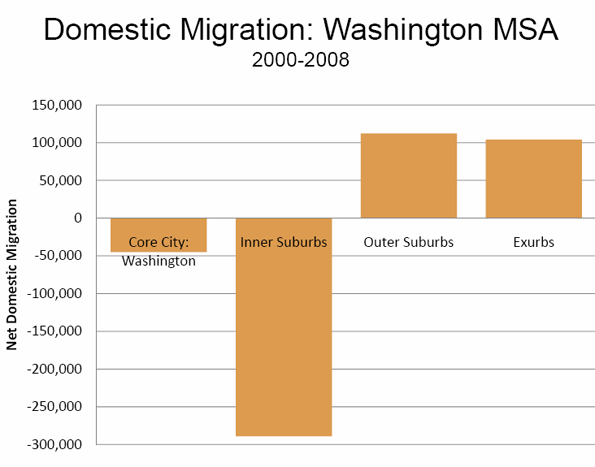
    Suburban growth has declined because the economic downturn has reduced the number of residents moving from one part of the country to another (domestic migrants). In 2008, net domestic migration fell to 30 percent below the decade average. The suburbs and exurbs were the largest gainers from domestic migration in past and have thus declined the most. This is not surprising, given the fact that a major part of subprime mortgage crisis that precipitated the Panic of 2008 (or the Great Recession) was the granting of mortgages to under-qualified households who stretched their financial resources to move to places where housing was the least expensive. Many of these households defaulted on their mortgages, were forced out of their houses and moved away.

    Nonetheless, as a new Bureau of the Census report indicated, in each of 12 large metropolitan areas analyzed the percentage growth in the exurbs was greater than in the core city. So even in the worst of times, the basic claim by the “inside-the-beltway” analysts and the media were totally off-base.

    The slowdown in net domestic migration also has pushed up city population growth. Fewer people moved away from the core cities than in the past. This, however, is different from people moving into the cities from the suburbs.

    It seems likely that stronger domestic migration gains will be restored to the suburbs when the economy improves. In the meantime, the growth rates of both the core cities and the suburbs have converged toward the natural rate of growth (births minus deaths).

    (2) Net International Migration

    County level data indicates that net international migration was only 9 percent below the decade average in 2008. The core cities have routinely attracted more international migrants than the suburbs. This, combined with a decline in domestic migration among metropolitan areas with more than 1,000,000 population helped to improve the growth rate of the core counties relative to the suburbs.

    (3) Not Adding Up: City Estimates

    Putting it frankly, the births minus deaths, plus domestic migration and international migration fall far short of the increases being reported in the core cities. This can be shown by examining the only core cities for which full “component of population change” data is available (natural increase, net domestic migration and net international migration). The Bureau of the Census does not release component data at any level of government below counties or their equivalents. In five cases, cities are fully consolidated with counties.

    The consolidated city-counties are New York (an amalgamation of five counties, or boroughs), Philadelphia, San Francisco, Baltimore and Washington (DC). Some places referred to as consolidated city-county governments are not genuine amalgamations, because some separate cities remain, such as in Miami, Jacksonville, Louisville and Indianapolis. An examination of the components of population in the five genuinely consolidated city-county jurisdictions reveals huge unallocated discrepancies (the Bureau of the Census term is “residuals”).

    Combining the births, deaths, net domestic migration and net international migration all of the five cities produces a population loss. The difference is the unallocated residual, which is huge in four of the five city-counties and a number of others and is small in most places that are not core cities.

    This unexplained “residual” is largely the result of the Bureau of the Census population “challenge” program. Four of the five consolidated cities have mounted successful challenges to their estimates and have thus added significantly to their populations. In San Francisco and Washington, the challenges added more population than the 2000-2007 gain (2008 challenges are yet to be filed). In New York, the challenges amounted to 80 percent of the 2000-2007 growth (Table 2).

    Table 2
    Unallocated Residuals & Estimates Challenges : 2000-2007
    Fully Consolidated City-County Jurisdictions
      Change in Population: 2000-2007 Unallocated Residual: 2000-2007 Successful Census Challenges: 2000-2007
    With Successful Challenges      
    Baltmore               (8,400)            34,700                 56,400
    New York            294,500          325,000               236,100
    San Francisco              21,700            37,400                 34,200
    Washington              16,100            19,900                 31,500
    Subtotal            323,900          417,000               358,200
    No Successful Challenges      
    Philadelphia             (65,200)             (6,800) 0
    Unallocated Residual: Population Change not accounted for in births, deaths, international migration or domestic migration
    Calculated from US Bureau of the Census data.  

    This is just the beginning of the story. More than one-half of the core city growth in the decade has been attributable to similar challenges. In contrast, only three percent of suburban population growth has been attributable to challenges. It does seem curious that the Bureau of the Census that has produced such erroneous estimates in places like New York (230,000), Atlanta’s Fulton County (110,000) and St. Louis (40,000), missed not a soul Los Angeles, Chicago, Cleveland, Phoenix and a host of other core cities and thousands of counties. The next census (2010) may be a good gauge of the challenge program’s accuracy, although it is not beyond imagining that anti-suburban elements may seek to politicize the results.

    Inner Suburbs

    Further, the theory of inner suburban growth is left wanting, even in the Washington area. Despite their transit improvements, between 2000 and 2008, Arlington and Alexandria lost 45,000 domestic migrants, both losing in every year except 2008 (in both cases, additions due to challenges were greater than the 2000-2007 population increase). Washington’s other inner suburbs, Fairfax County, Montgomery County and Prince Georges County are served by the same transit system (largely paid for by the taxpayers around the country), yet between them have lost another 240,000 domestic migrants between 2000 and 2008. On the other hand, the second ring suburbs have gained 112,000 migrants and the exurbs have gained 104,000 (See Figure). During the last year, the inner suburbs grew at approximately one-third the rate of the outer suburbs. And despite the subprime induced distress in the exurbs, the inner suburbs could achieve no better a rate. Analysts may trade anecdotes at coffee houses about people moving to the city or the inner suburbs from the exurbs or beyond. However, the Bureau of the Census data is clear. For every anecdote that that moves in, more than one moves out.

    The Numbers Tell it All

    When the 2008 county and metropolitan area population estimates were published a few months ago, we showed that the central counties (Note 2) continue to lose residents at a rapid rate. Among the metropolitan areas with more than 1,000,000 population, central counties lost 4.6 million domestic migrants, while suburban counties gained 2.0 million domestic migrants between 2000 and 2008. Over the past year, the core counties lost a net 314,000 domestic migrants while the suburbs gained 197,000 (Table 3).

    Table 3
    Domestic Migration: Core and Suburban Counties: 2000-2008
    Metropolitan Areas over 1,000,000 Population
      Latest Year: 2007-2008 Decade: 2000-2008
    Metropolitan Area Suburban Core Total Suburban Core Total
    Atlanta          32,925          10,126          43,051        395,836          (1,749)        394,087
    Austin          24,216          10,825          35,041        156,890          41,142        198,032
    Baltimore          (6,000)          (6,352)        (12,352)          32,952        (67,923)        (34,971)
    Birmingham            5,658          (2,356)            3,302          48,700        (25,755)          22,945
    Boston          (2,889)          (5,372)          (8,261)      (154,086)        (99,006)      (253,092)
    Buffalo             (358)          (4,127)          (4,485)          (5,933)        (48,232)        (54,165)
    Charlotte          21,327          13,060          34,387        125,223          93,513        218,736
    Chicago               921        (43,031)        (42,110)        160,765      (667,507)      (506,742)
    Cincinnati            3,803          (7,372)          (3,569)          65,905        (85,538)        (19,633)
    Cleveland               861        (15,757)        (14,896)          14,726      (141,445)      (126,719)
    Columbus            3,325             (826)            2,499          64,211        (40,624)          23,587
    Dallas-Fort Worth          62,022        (18,847)          43,175        514,011      (254,016)        259,995
    Denver          13,940            3,932          17,872          86,262        (50,881)          35,381
    Detroit        (17,020)        (45,140)        (62,160)        (53,478)      (273,695)      (327,173)
    Hartford               379          (4,065)          (3,686)          10,789        (21,639)        (10,850)
    Houston          38,559          (1,835)          36,724        279,389        (89,222)        190,167
    Indianapolis          11,747          (5,040)            6,707        113,378        (51,262)          62,116
    Jacksonville            8,723          (3,955)            4,768        101,954          20,185        122,139
    Kansas City            4,908          (3,495)            1,413          57,007        (34,481)          22,526
    Las Vegas (*)
    Los Angeles        (12,033)      (103,004)      (115,037)      (232,281)   (1,006,985)   (1,239,266)
    Louisville            4,281               818            5,099          38,420          (9,798)          28,622
    Memphis            5,986        (10,533)          (4,547)          49,979        (52,412)          (2,433)
    Miami        (18,598)        (28,399)        (46,997)          31,551      (252,098)      (220,547)
    Milwaukee               939          (7,382)          (6,443)          13,987        (86,392)        (72,405)
    Minneapolis-St. Paul            1,179          (4,619)          (3,440)          61,162        (86,920)        (25,758)
    Nashville          17,172             (547)          16,625        128,921        (19,094)        109,827
    New Orleans          (2,520)          22,856          20,336        (72,561)      (233,021)      (305,582)
    New York        (68,081)        (76,018)      (144,099)      (672,435)   (1,118,025)   (1,790,460)
    Oklahoma City            5,707             (226)            5,481          42,399        (10,302)          32,097
    Orlando          10,495          (7,342)            3,153        174,428          55,611        230,039
    Philadelphia          (9,639)        (12,209)        (21,848)          36,553      (144,849)      (108,296)
    Phoenix          22,614          28,463          51,077        117,550        411,697        529,247
    Pittsburgh            1,169          (3,601)          (2,432)            5,221        (60,564)        (55,343)
    Portland          10,641            7,355          17,996        106,163          (4,247)        101,916
    Providence          (3,983)          (6,643)        (10,626)        (13,399)        (34,136)        (47,535)
    Raleigh            6,030          23,238          29,268          35,263        132,769        168,032
    Richmond            5,625               937            6,562          76,608          (4,095)          72,513
    Riverside-San Bernardino (*)
    Rochester             (425)          (3,325)          (3,750)          (7,121)        (36,181)        (43,302)
    Sacramento            8,255          (3,731)            4,524          97,304          34,798        132,102
    St. Louis               561          (6,253)          (5,692)          17,988        (57,090)        (39,102)
    Salt Lake City            1,407          (1,164)               243          10,191        (41,646)        (31,455)
    San Antonio          10,850          11,941          22,791          69,824          84,409        154,233
    San Diego (*)
    San Francisco            4,092            1,414            5,506      (269,093)        (80,543)      (349,636)
    San Jose             (528)          (2,097)          (2,625)          (6,119)      (221,378)      (227,497)
    Seattle            7,894            3,975          11,869          61,244        (38,132)          23,112
    Tampa-St. Petersburg            8,610          (2,100)            6,510        169,346          91,106        260,452
    Tucson (*)
    Virginia Beach        (11,093)          (4,430)        (15,523)            7,486        (15,941)          (8,455)
    Washington        (16,637)          (1,622)        (18,259)        (77,894)        (43,457)      (121,351)
    Total        197,017      (313,875)      (116,858)     2,015,186   (4,645,051)   (2,629,865)
    * Indicates no suburban county(ies)
    Calculated from US Bureau of the Census data for county based metropolitan areas

    There is a simple test that the reporters and the analysts can apply. When the cores experience net domestic migration gains and the suburbs experience net domestic migration losses, only then can it be claimed that people are moving to the cores are gaining at the expense of the suburbs. The reality is that between 2000 and 2008, there was not a single instance out of the 51 metropolitan areas with more than 1,000,000 population where there was suburban net out-migration and core county net in-migration. There was one case in 2008, but it was an anomaly. The suburbs of New Orleans lost a modest number of domestic migrants, while the city gained strongly. This occurred because people moved back to the city in large numbers, after more than half left due to Hurricane Katrina.

    Spin can change perceptions, but not reality. People are not moving from the suburbs to the core cities. The reverse continues to be true, even in the worst of times.


    Note 1: Excludes New Orleans due to significant population variations from Hurricane Katrina.

    Note 2: Counties are the smallest jurisdiction for which the Bureau of the Census publishes migration data.

    Reference: Demographia 2000-2008 Metropolitan Area Population & Migration: http://www.demographia.com/db-metmic2004.pdf

    Wendell Cox is a Visiting Professor, Conservatoire National des Arts et Metiers, Paris. He was born in Los Angeles and was appointed to three terms on the Los Angeles County Transportation Commission by Mayor Tom Bradley. He is the author of “War on the Dream: How Anti-Sprawl Policy Threatens the Quality of Life.

  • Shrinking the Rust Belt

    An article in the London Daily Telegraph suggesting that President Obama might back a major program of bulldozing parts of cities in the Rust Belt has put so-called “shrinking cities” back in the spotlight. Many cities around the country, especially in the Rust Belt have experienced major population loss in their urban cores which has sometimes spilled into their entire metro area. They have thousands of abandoned homes, decayed infrastructure, environmental challenges, and no growth to justify a belief that many districts will ever be repopulated.

    Cities in the Rust Belt grew in an era when large scale manufacturing required large amounts of labor. Today, productivity improvements mean that the United States can set new industrial production records with a fraction of the workforce of yesteryear. With much of its traditional labor force no longer as in demand in the modern economy, many Rust Belt cities lack an economic raison d’etre. Some may transform themselves for the modern economy, but many will be forced to accept the reality of a significantly diminished stature in the 21st century.

    In this world, size can prove a liability. One of the biggest problems in turning around Detroit is the sheer size of the region. The metro area has a population of 4.5 million – not including nearby Ann Arbor or Windsor, Canada. Is there really any need in the modern day for a city the size of Detroit in Southeastern Michigan? It seems doubtful. As I’ve argued before, transforming that city’s economy would be much easier if the region were smaller.

    One challenge is that a decline in population, which is already occurring naturally, doesn’t shrink the area of urbanization or the accompanying infrastructure that needs to be maintained. Indeed, although it is losing population and can’t support the infrastructure it has, Detroit still wants to build more, such a new regional rail transit system. And legacy debts such as pension liabilities don’t get smaller just because people leave. As with leverage, scale economics works in declining places as well as on the growing ones. The people who operate new transit systems or police who secure expanded areas must be paid. Roads, sewers, and water lines need to be maintained. In many places that are losing people, jobs, and tax base, such fixed costs could prove ruinous over the long run.

    Under such conditions, Rust Belt cities require both outside help and a program of managed shrinkage. The first challenge will be getting these cities, especially larger ones like Detroit, to admit that they need to do it on a regional basis. Medium sized cities like Flint and Youngstown have been more willing to face up to challenges. In contrast, places like Detroit, Cleveland, and Buffalo still see themselves as important national cities. Pride is blocking the effort to undertake a major managed shrinkage program. Instead of adjusting to reality, these cities continue to pour hundreds of millions into projects that vainly attempt to restart growth. .

    What would a federally assisted managed shrinkage program look like? No one can say for sure since this is a new field in America. Clearly, study of what has happened in Europe, particularly in Germany, where managed shrinkage has long been on the agenda, is warranted. But these ideas can’t just be transplanted via lift and drop. We need to create a distinctly American program informed by the best practices of elsewhere. That program should include the following elements:

    1. Education. Raising educational attainment not only makes people more employable in the new economy, it makes them more mobile.
    2. Relocation Assistance. Many people in the Rust Belt might want to move but be unable to do so because they are upside down on a mortgage or can’t sell their house. As more people leave, that will put downward pressure on the housing market. Hence, some government relocation assistance to help buy out people who want to move might be helpful.
    3. Shrinking the Urban Footprint. The quantity of urbanized land needs to be reduced so that the excess housing and infrastructure can be retired and the cost of servicing it eliminated. This means painfully identifying areas which will not receive reinvestment, and encouraging and assisting the people and businesses that remain to relocate. This will be difficult as these neighborhoods are still the locales for people’s homes and they have a strong emotional sense of ownership. Sensitivity is clearly called for. We need to increase localized density in areas targeted for redevelopment and convert other areas to non-urbanized uses such as nature preserves or agriculture. This will be a long process.
    4. Financial Restructuring. Older cities are often hobbled by mountains of debt, underfunded pensions, overstaffed payrolls, and too many municipal fixed assets. The government needs to be right-sized. Federal assistance may be needed to take over pensions and to give cities some tools to restructure unsustainable debt loads outside of bankruptcy.
    5. Development Restrictions. In return for federal assistance, there ought to be a real insistence that these cities sign up to the shrinkage programs. This might include enforceable restrictions on their ability to adopt policies that are oriented towards servicing growth such as restrictions on the ability to use federal funding for net new infrastructure. For example, if Detroit wants to build a federally funded rail system, it should retire an equivalent amount of other infrastructure elsewhere to offset it.

    Participation would be voluntary, but the federal government should make it clear that it will not finance futile attempts by these cities to try to recapture the glory of their pasts.

    This is of course only a conceptual outline of a program. Significant thought, analysis, and research would be needed to develop a program. Given our lack of experience in the field, experiments should be encouraged, flexibility granted within broad parameters, and real world feedback continuously incorporated back into the program. Clearly, we will not get everything right the first time around. We need to have the courage to learn from our mistakes and not forge headlong into failure simply because it would look like a political retreat.

    This won’t be pleasant or easy. It is not a path anyone wants to take. But given the condition of much of the Rust Belt, the only viable options appear to be painful ones. As local blogger Tom Jones recently said, “Too often, dealing with urban problems in Memphis is like the stages of grief. Just this once, maybe we can move past denial, anger, bargaining and depression, and unabashedly move to acceptance and develop the kinds of bold plans that can truly make a difference in the trajectory of our city.”

    Aaron M. Renn is an independent writer on urban affairs based in the Midwest. His writings appear at The Urbanophile.

  • Did Homeowners Cause The Great Recession?

    The person who caused the current world recession can be found not on Wall Street or the city of London, but instead could be you, and your next-door neighbor–the people who put so much of their savings and credit to buy a house.

    Increasingly, conventional wisdom places the fundamental blame for the worldwide downturn on people’s desire–particularly in places like the U.K., the U.S. and Spain–to own their own home. Acceptance of the long-term serfdom of renting, the logic increasingly goes, could help restore order and the rightful balance of nature.

    Once considered sacrosanct by conservatives and social democrats alike, homeownership is increasingly seen as a form of economic derangement. The critics of the small owner include economists like Paul Krugman and Ed Glaeser, who identify the over-hot pursuit of homes as one critical cause for the recession. Others suggest it would be perhaps nobler to put money into something more consequential, like stocks.

    Homeowners also get spanked by leading new urbanists, like Brookings scholar and urban real estate developer Chris Leinberger. He lays blame for the downturn not on unscrupulous financiers but squarely on aspiring suburban home buyers. “Sprawl,” he intones, “is the root cause of the financial crisis.”

    If only we built more high-density, transit-oriented housing–which, incidentally, is not exactly thriving–the crisis could be happily resolved, he believes. This approach is echoed by big-city theoreticians like Richard Florida, who believes that both homeownership and the single-family house “has outlived its usefulness.” In his “creative age,” we won’t have much room for either single-family homes or owners. Instead, we will be leasing our ever-more-tiny cribs–just like yuppies with their BMWs–as we wander from job to job.

    To be sure, many people who bought homes in the last few years should not have qualified. Weak lending standards, promoted by both unscrupulous industry figures like Countrywide’s Angelo Mozillo as well as Congress–including the many “friends” receiving cut-rate loans from the disgraced mortgage firm–clearly made things worse.

    Yet the recent real estate debacles should not obscure the tremendous positives associated with homeownership. Widespread and diffuse ownership of property has been a critical element in successful republics, from early Rome and the Dutch Republic to the foundation of the United States. Jefferson held that “small land holders are the most precious part of a state.” In the ensuing generation, progressives embraced widespread ownership of property as central to democratic aims. Lincoln’s Homestead Act stands out as a prime example.

    Even by the 1940s, this model was only partially realized. Barely 40% of the population owned their homes. Homeownership remained confined largely to small-town denizens and the urban upper classes. No one in my mother’s family–growing up in the tenements of Brownsville, Brooklyn–even considered homeownership an achievable goal. It was hard enough simply to pay the rent and put food on the table.

    Yet by the 1960s, rising prosperity and government-subsidized loans helped most of my numerous aunts and uncles own their residence.

    Presidents from Roosevelt to Clinton all identified homeownership as a critical social goal. Government loan programs exploded as housing starts doubled in the post-war era. By 2005, the homeownership rate was approaching 70%.

    This trend also took place in other advanced countries, from the U.K. and Australia to Canada and Spain. It reflected what the Italian urbanist Edgardo Contini once referred to as “the universal aspiration.” In some cases, such as Japan, societies that had been divided between landlords and peasants for millennia now boasted a huge, and growing, cadre of small owners.

    In virtually every country, this was largely a suburban phenomenon. People bought houses where land was cheaper, stores and schools newer. Here, too, people could transcend the often confining social limits of the old neighborhood. It was also, as the novelist Ralph G. Martin, noted “a paradise for children.”

    Through all this, the chattering class never lost its contempt for homeowners and their suburban refuges. Old gentry long disliked the idea of dispersed ownership of property–even if many got rich selling their own estates to developers. Aesthetes disliked the seemingly banal housing tracts “rising hideously,” as Robert Caro put it, from the urban periphery. This critique was applied not only to Queens and Long Island but also to places like Milton Keynes or Basildon outside London, and greater Tokyo’s Chiba prefecture.

    Along with the fashion police, the new owners also took criticism from their urban betters, many of them also owners of country homes, for deserting the city. Some on the left feared the homeowners as a bastion of conservative politics. Architects, planners and developers identified them as opponents of their grand plans to refashion suburbia into a denser, more rental-oriented environment.

    Yet, despite the disdain, the dream of homeownership survived. Many boomers, who in their 1960s radical phase denounced suburban tracts as sterile and racist, meekly ended up buying homes there. So, increasingly, did middle-class minorities, whose rates of homeownership rose faster after 1994 than that of whites.

    To be sure, the financial crisis has led to a sharp drop in levels of homeownership, as occurred in the last big recession of the early 1990s. In the future, some suggest that aging boomers will force the home market to collapse even more due both to the current mortgage meltdown and changing demographics.

    Yet there are limits to how far homeownership will drop. Urban boosters, apartment-builders and greens–all advocates of expanding the renter class–tend to ignore several key facts. For one thing, the vast majority of boomers are holding onto their mostly suburban homes far longer than ever suspected. Many will remain there until forced into assisted living, nursing homes or the cemetery.

    Then we have the X generation, who, if anything, has favored large homes and exurbs in large numbers. In addition, behind them lie the large cohorts of millenials, who according to surveys conducted by generational chroniclers Morley Winograd and Mike Hais, prioritize the ownership idea even more than their boomer parents do.

    No doubt, the weak economy will slow this generation’s push into the home market. However, by the next decade, as this generation enters the late 20s and early 30s, they will find their economic footing and be ready to enter the market for houses in a big way.

    The real question then will become which companies and regions will meet the expanding demand. Over the past decade, we saw the demand for housing push middle-class families toward destinations as varied as Las Vegas and Phoenix, Austin, Houston, Dallas and Atlanta. Others have started heading to more affordable markets in the nation’s heartland, to the metropolitan areas like Kansas City, Des Moines and Sioux Falls.

    Rather than a source of economic weakness, this renewed quest for homeownership could underpin a sustainable recovery. As prices fall to reasonable levels, more people will qualify for reasonable loans. First, the empty houses and somewhat later, the condominiums now on the market will find buyers, in most places in a matter of a few years.

    This shift will create huge opportunities for a diverse set of geographies. For urban areas like New York or Los Angeles, there will be a unique–perhaps once in a generation–chance to induce middle-class people to settle down in big-city homes or condominiums. If they become homeowners, they will be more likely to stay than move elsewhere to the suburbs or other regions when the time comes to buy a home.

    Other, more affordable, less regulated and often more economically dynamic places like Texas and the Great Plains may realize even greater gains. Over time, we will likely see a recovery in some now-suffering parts of the Sunbelt. The renewal of home demand could also help revitalize many of our hardest-hit sectors, including construction and manufacturing.

    Sadly, some policymakers in Washington seem less than enthusiastic about this prospect. Many close to President Obama seem to dislike single-family homes and suburbs. Some embrace the policy which the British called “cramming,” essentially forcing people into ever smaller, denser units. Energy Secretary Steven Chu recently praised the notion of small apartments with numerous people. “You know, body heat keeps a lot of the apartment warm,” he suggested. You can’t do this in a big apartment with a few people.”

    My suspicion is that most Americans are not quite ready to become their own heaters, any more than modern farm families like having farm animals live with them–although they, too, generate warmth. Instead, we should explore less unpleasant ways to cut energy use though such things as incentives for decentralizing work, promoting home-based labor, more tree planning and effective insulation.

    An administration that places itself at odds with the “universal aspiration” that has driven growth in the advanced world for over a half-century could delay a full recovery unnecessarily. Advocacy of what amounts to declining living standards and a return to feudalism might also prove a less than successful political strategy.

    This article originally appeared at Forbes.

    Joel Kotkin is executive editor of NewGeography.com and is a presidential fellow in urban futures at Chapman University. He is author of The City: A Global History. His next book, The Next Hundred Million: America in 2050, will be published by Penguin early next year.

  • The Suburban Economy and its Enemies

    Treasury Secretary Ken Henry’s recent address to business economists was an apt prism through which to survey Sydney’s immediate past and distant future. According to reports, he said ‘the [Chinese] resources boom had produced a “two-speed” economy, with unemployment rising in the south-eastern states but falling in the west and north’. Dr Henry is reported to have told his Sydney audience, ‘I don’t think everybody in this room should be moving to Perth. But let me make this prediction: some of you will’.

    These comments serve as a reminder of how quickly the ground shifts in an open and dynamic economy. It wasn’t so long ago that New South Wales, dominated by Sydney, was dubbed the powerhouse of Australia’s extended boom.

    Even the most elaborate attempts at urban planning can be superseded by events. After all, modern Sydney was itself, until recently, shaped by forces that outpaced the bureaucrats and planners. These forces are assuming a new dynamic in the conditions described by Dr Henry. Competition from the interstate resources boom is a now major factor driving state politics, together with slowing jobs and property markets and nagging infrastructure constraints. All are feeding the momentum for revitalization – for a new phase of urban growth that will push the limits advocated by planners, environmentalists and others campaigning to turn the city’s socio-economic tide.

    The suburban economy

    There is surprisingly little acknowledgement that, overall, the transformation of suburban Sydney in the wake of globalisation has been a success story. Over the last twenty years, the middle to outer suburbs adapted to volatile domestic and international environments, as well as technological change at breakneck speed, with an effective model of economic development. The key point is that this had more to do with the interplay of space and mobility than good planning.

    By no means was this inevitable. Sydney could have succumbed to the downside of what urban theorists call the ‘world city’ phenomenon. According to the research group Globalisation and World Cities (GaWC), world cities are major international hubs with stronger ties to the global economy in terms of capital flows, trade and movement of people and information than to their own hinterlands. GaWC ranks Sydney in the second or ‘beta’ echelon of world cities, along with places like San Francisco and Mexico City (Melbourne is ranked in the third or ‘gamma’ echelon). Hence Sydney’s ‘global arc corridor’, which stretches from Macquarie Park south to the CBD’s gleaming towers and onto Sydney Airport and Port Botany, hosts the cream of the country’s finance, legal and business services, information technology, engineering and marketing industries.

    Some world cities are distinguished by vast disparities in wealth and economic opportunity – between such globally oriented zones, sucking up the region’s capital, infrastructure capacity, skills base and government services, and stagnant hinterlands inhabited by struggling workers in declining, marginal industries or masses of unemployed. But that was not Sydney’s fate.

    Why and how did a viable economy develop in the middle to outer suburbs of the city? To answer this question it is necessary to recall some of the constants of Sydney’s recent history. The gradual emergence of global Sydney generated higher land values throughout the inner-city. Consequently, many inner-city land uses associated with nineteenth century transport nodes, such as the light industrial plants, depots and warehouses clustered near the railway junction south of the CBD or along the harbour foreshores of the inner-west were no longer sustainable in the face of escalating demands for office space and gentrification.

    Combined with the growth of motor vehicle mobility for passenger and freight transport, particularly since the 1950s, this led to the transfer of many industrial, transport and warehousing activities to cheaper land on the western and south-western fringes. At that stage of the city’s evolution, there were relatively few restrictions on the acquisition of space for these and related purposes. And the growth of road transport relative to maritime and rail sealed the necessary links to international gateways on the eastern seaboard, like Sydney Harbour, Port Botany and the airport.

    These trends were intensified by the construction of a road network to service the interstices of Sydney’s nineteenth century ‘hub-and-spokes’ or radial railway lines, culminating in the orbital motorway network (the dreaded ‘tollways’). Not only did motor vehicle mobility facilitate industrial dispersion, but also residential settlement adjacent to the new industrial jobs. The radial railway lines were Sydney’s nineteenth and early twentieth century template; the orbital motorway is the city’s contemporary template.

    As in the case of industrial relocation, there were fewer restrictions on residential development for the workers employed in these dispersed industries (this began to change by the mid-1990s). Inexpensive housing, a mild climate, out-door lifestyles and a preference for detached houses on sizeable blocks were also attractions. Over time western Sydney achieved 75 per cent regional employment self-containment, and key travel patterns are now intra-regional.

    Later phases of globalisation reinforced this spatial pattern. The rise of global Sydney was a major driver, at least since the early 1980s, of economic policies that favoured the liberalisation of economic activity. Naturally, this had repercussions across the rest of the city. One fundamental outcome was the expansion of services – such as retail – relative to manufacturing and commodities as a proportion of the national economy. The appearance of diverse service industries in the outer suburbs was yet another function of space and mobility. In western Sydney, this was closely associated with the region’s booming population growth. From the 1970s to recent times, western Sydney’s population growth outstripped the rest of the city and country.

    By the early 1990s, market oriented reform had ushered in a period of low inflation, interest rates and input costs, the latter having been wrung from difficult reforms to energy and other public utilities. The interaction of steady economic and population growth powered a strong consumer economy linked to settlement of the fringe suburbs. Such areas experienced a boom in residential and commercial construction, and the related demand for household fixtures, appliances and goods.

    These conditions unleashed a thriving small business sector in services, operating in a competitive market characterised by low entry barriers (low costs and overheads) and narrow profit margins. This, too, was a by-product of globalisation, as SGS Economics and Planning explain: ‘The concentration of small business activity in NSW (and Sydney) and the more rapid growth in the share of employment in this sector compared with other parts of Australia may reflect the tendency for heightened fragmentation of supply chains in globally engaged economic regions’. Presumably, this is why Mark Latham harped on about ‘the small business-people, the contractors, franchisees and consultants of the new economy’.

    While market pressures caused the ‘unbundling’ of service providers, advanced information and communications technologies were integrating head office, back office, manufacturing and distribution activities in land extensive facilities like the 50,000 plus square metre Coles Myer and Coca Cola distribution centres at Eastern Creek, and, in a different way, cutting-edge business and technology parks like Norwest and Macquarie Park. These facilities, contiguous with the orbital motorway, are creatures of space and motor vehicle mobility, and always will be.

    That is why the best elements of the NSW government’s City of Cities plan represent responsive rather than prescriptive planning; they reinforce successful trends emerging from the interplay of market forces. Plans for intensive commercial development along orbital motorway corridors, such as the M7 and particularly at its intersection with the M4, dubbed ‘the western Sydney employment hub’, the refocus on important western centres like Parramatta, Liverpool and Penrith as ‘regional cities’, and the series of road-rail transport interchanges (also land extensive) are prime examples.

    Its enemies

    This vibrant though vulnerable web of socio-economic connections is always at the mercy of global conditions – witness the impact of petrol prices – but also increasingly under challenge from domestic political actors, principally environmentalists, urban planners, some property developers and opinion makers. Their determination to freeze urban boundaries and, as far as possible, reduce mobility to public transport capacity, particularly rail, is hurting Sydney. Hopefully, their influence is gradually receding under Morris Iemma’s leadership.

    Environmentalists and planners – two increasingly interchangeable categories – are oblivious to the prospect that their creeping regulations and imposts, and misallocated resources, could unravel the suburban economy. Yet they will always struggle to mobilise public opinion. Their all-purpose pretext, the climate change hypothesis, relies on aggregated data which can’t be used to argue particular cases. Take the NSW government’s recent decision to review the costly ‘energy efficiency building sustainability’ rules. While the Housing Industry Association came to the issue armed with a raft of statistics about price impacts and falling housing starts, green outfits like the Total Environment Centre could do little but sputter the magic words ‘greenhouse’ and ‘global warming’. They were not in a position to show why, how and to what extent this particular decision would exacerbate climate change.

    Their other weapon is the peculiar concept of ecological or urban ‘footprint’. This purports to measure how much productive land and water an individual, a city, a country, or humanity requires to produce all the resources it consumes. On this measure, Sydney has a footprint that covers 49 per cent of NSW or 150 times its actual size, so its expansion must be constrained. The notion that wealth can be equated to an amount of land, however, is a throwback to pre-modern times. In advanced economies, wealth creation has more to do with the elaborate transformation of natural inputs, capital accumulation, forms of business organisation and services. And as one scathing writer points out, the concept fails to acknowledge that a stretch of land can be used for several different purposes simultaneously. Nevertheless, this absurd idea continues to pass unmolested into almost every discussion of urban planning, including City of Cities.

    If environmentalists are taken seriously at all, it is because they ride on the back of vested interests who benefit from artificially inflated land values, since this is the inevitable consequence of restricting new releases. Alan Moran of the Institute of Public Affairs argues that the reluctance of governments to burst the bubble of housing unaffordability by releasing more land for development can be traced to the undue influence of existing property owners, including powerful developers, who stand to suffer a capital loss if the scarcity value of land is diminished. It is a case of the ‘haves’ depriving the ‘have nots’, such as low income earners and young first home buyers.

    Then there are the progressive academics and commentators who insist the suburbs are zones of social alienation, inimical to personal contentment and well-being. Consider the Australian Financial Review’s property writer Tina Perinotto, who opposes sprawl because we can’t afford the ‘psychologists to deal with people who end up in the lonely greenfield sites’, or left-wing writer Natasha Cica, who raves about ‘the aesthetic and ethical slums of McMansion affluenza’, or Sydney Morning Herald planning and architecture writer Elizabeth Farrelly, who calls suburbanisation ‘total-indulgence parenting’, or urban policy academic Brendan Gleeson, who believes ‘shadows of fear and antipathy are spreading across’ the suburbs.

    Progressives clearly feel a need to delegitimise suburban life. This stems from their barely suppressed rage against people they can’t control. Like Kurtz in Joseph Conrad’s Heart of Darkness, suburban people have strayed too far from civilisation, they contend, and will lose their minds. Yet they fail to explain why surveys indicate an overwhelming preference for detached housing on sizeable blocks, or why the latest Australian Unity Wellbeing Index registers higher rates of happiness amongst suburban people than their inner-city counterparts.

    The left’s new poster-boy of urbanism, Gleeson, in particular, leads a tortured existence: he idealises suburbs as the nation’s ‘heartlands’ while hating almost everything about them. Gleeson has latched on to the emergence of so-called ‘gated’ communities as ‘harmful to collective democratic purpose’. This sort of socio-economic segregation is a recognised downside of the ‘world city’ scenario, especially in developing countries. In Sydney, however, it is more likely to mark a transitional stage of historically disadvantaged areas attracting more prosperous residents, eager to replicate the superior amenity of affluent suburbs. To the extent that it heralds the arrival of generally higher living standards in these localities, it is not necessarily the evil denounced by Gleeson.

    Of course, the enemies of growth don’t give a damn about the storm clouds perceived by Dr Henry. Sooner or later, however, they will bow to the inevitable: space and mobility made Sydney’s past; they will make the city’s future, if it is to be a future worth having.

    This article originally appeared at The New City Journal