Category: Suburbs

  • Biggest Income Gains In U.S. Accrue To Suburban Cities

    After a long period of  stagnation, last week’s announcement of the first substantial annual income gains since 2007 was certainly welcome. Predictably, analysts inclined toward a more favorable view of President Obama’s policies reacted favorably. Progressive icon Paul Krugman crowed that last year the “economy partied like it was 1999,” which he said validated the president’s “trickle up economics.”

    Equally predictably, conservative pundit Stephen Moore wrote that the stagnant longer-term numbers were actually a ”stinging indictment” of both the Obama and Bush records.

    The reality may be in between. The 5.2% increase over the past year was the largest in the nearly 50-year history of the Census Bureau’s Current Population Survey, and does represent some progress. Yet real incomes remain approximately 2.5% below the 1999 peak. This is an extraordinarily long time for incomes not to have risen, a decade longer than the previous modern record (1989 to 1995), according to the Federal Reserve Bank of St. Louis.

    And there are some reasons to be skeptical about the dramatic gains, as outlined in a virtually unprecedented report by the economist Gary Burtless of the generally left-leaning Brookings Institution. He suggests that the year-to-year increase may have been much less and that the CPS had been under-reporting annual income increases since 2003. John Crudelle of the right-leaning New York Post notes that recent CPS methodology changes could also have inflated the 2015 increase.

    To be sure, there are no signs of an economic boom that will sustain income gains — the 1.1% real GDP growth in the second quarter is no indication of a miraculous recovery.

    Nonetheless, real income gains were made last year, but they were not distributed evenly across the nation. We sought to assess the areas that did the best – and worst.

    The media has spun the story as further evidence of suburban decline and the resurgence of dense, hip cities. The Wall Street Journal went so far as to point to the migration of “highly educated millennials” to downtown areas as a factor, something that simply could not be deduced from the data that was reported.

    With more than 80% of millennials residing in the suburbs, this was heroic conjecture. Within metropolitan areas, CPS reports only “inside principal cities” and “outside principal cities.” The Census Bureau abandoned “central city” and “principal city” data more than a decade ago, in recognition of the fact that many suburban communities had become major employment hubs. As a result, principal cities include such low density, sprawling suburban behemoths as Mesa, Ariz. (Phoenix), Hillsboro, Ore. (Portland), Arlington, Texas (Dallas-Fort Worth), and, Anaheim, Calif. (Los Angeles). Simply put, the data does not support the assumption that hipster urbanism played a part in the one-year upsurge.

    The numbers suggest a more nuanced picture. For one thing, downtown residents represent little more than 1% of our metropolitan population, and less than 10% of the jobs. Nor did the biggest income gains occur in the metropolitan areas with the large, elite urban cores. Indeed, it is hard to imagine results more at odds with theme of dense urban core gain and suburban malaise.

    By far the largest gain was in Nashville, where household income rose 10.2% to $57,985. Nashville’s downtown is doing well, as is the case with many metropolitan areas. However, Nashville is hardly a model of the urban density planners would like to force around the nation. Its urban density is one-fourth that of nation-leading Los Angeles, a third that of New York and half that of Portland. The vast majority of its growth has taken place outside the core, and largely in the suburbs.

    Perhaps most surprising is second-ranked, Birmingham, Ala. It is harder to imagine a more poorly performing metropolitan area in the rapidly expanding South, but last year household income there grew 9.4% to $51,459, according to the CPS data. Just after World War II, Birmingham was a third smaller than Atlanta; now Atlanta is five times as large. Nor does Birmingham set any density records. No metropolitan area the world with a population over a million has a lower urban area density.

    Atlanta ranked third, with an increase of 7.2% to $60,219. The metropolitan area has the lowest population density among world urban areas with more than 2 million residents.

    Other metro areas with suburban core cities in the top 10 include No. 5 Kansas City; No.7 Memphis, which could be argued has performed as poorly as Birmingham in recent decades; and No. 8 Orlando. None of these has an urban density much higher than the national average, which includes urban areas as small as 2,500 population. In 10th-ranked San Jose, the core of Silicon Valley, household income rose 5.7% to $101,980, the highest of any metropolitan area in the nation. It is a virtually all suburban metro area, having developed almost entirely since World War II, and among the most automobile oriented, with a miniscule 4% of commuters using its bus, light rail and commuter rail services. Milwaukee, another metropolitan area that has lagged economically for years, ranked ninth.

    To be sure, the urban elites were not shut out. San Francisco, buoyed by spillover growth from suburban Silicon Valley, ranked fourth with a center that is the very definition of a dense urban core. Urban planning model Portland ranked sixth, yet it has an urban density 40% below that of all-suburban San Jose.

    The nation’s three largest metropolitan areas did poorly. New York, ranked 39th, with income growth of 2.5%, well below the 5.2% national gain. Los Angeles, the nation’s densest region, grew slightly better, at 3.4%, but still ranked only 32nd; Chicago, the nation’s third largest ranked just above New York at 38th.

    In last place is Oklahoma City, where, amid the oil and gas bust, household income dipped 0.4% to $52,221.

    Thus, the story is not about media-favorite cities or their favored urban core, as the progressive punditry may suggest. The one-year spike is perhaps the first long overdue indication that things could be getting better for the struggling working class. The biggest gains were in poorer metro areas. It could signal, to some extent, higher wages as employment tightens, particularly at the lower end of the job spectrum.

    Overall, it’s clear that even modest economic growth, sustained long enough, would bring some blessings to the poor, particularly in the inner cities. The question is whether these gains can be sustained in an economy where growth seems to trending slower still.

    This piece first appeared at Forbes.

    Joel Kotkin is executive editor of NewGeography.com. He is the Roger Hobbs Distinguished Fellow in Urban Studies at Chapman University and executive director of the Houston-based Center for Opportunity Urbanism. His newest book, The Human City: Urbanism for the rest of us, will be published in April by Agate. He is also author of The New Class ConflictThe City: A Global History, and The Next Hundred Million: America in 2050. He lives in Orange County, CA.

    Wendell Cox is principal of Demographia, an international pubilc policy and demographics firm. He is a Senior Fellow of the Center for Opportunity Urbanism (US), Senior Fellow for Housing Affordability and Municipal Policy for the Frontier Centre for Public Policy (Canada), and a member of the Board of Advisors of the Center for Demographics and Policy at Chapman University (California). He is co-author of the “Demographia International Housing Affordability Survey” and author of “Demographia World Urban Areas” and “War on the Dream: How Anti-Sprawl Policy Threatens the Quality of Life.” He was appointed to three terms on the Los Angeles County Transportation Commission, where he served with the leading city and county leadership as the only non-elected member. He served as a visiting professor at the Conservatoire National des Arts et Metiers, a national university in Paris.

    Photograph: Downtown Nashville from BigStockPhoto.com
  • The Incompatibility of Forced Density and Housing Affordability

    New research supports the conclusion that anti-sprawl policy (urban containment policy) is incompatible with housing affordability. Build-zoom.com economist Issi Romem finds that: “Cities that have curbed their expansion have – with limited exception – failed to compensate with densification. As a result they have produced far less housing than they would otherwise, with severe national implications for housing affordability, geographic mobility and access to opportunity, all of which are keenly felt today as we approach the top of housing cycle.”

    Romem had previously produced stunningly innovative research, estimating the extent of urbanization in US cities every decade from 1940 to 2010. He provides maps that show the changing urban expanses in each census. Romem uses the larger metropolitan areas, the currently defined Combined Statistical Areas (CSAs). This combines metropolitan areas that are adjacent and significantly economically connected, such as San Francisco and San Jose, New York , southeastern Connecticut and Allentown, and Los Angeles and Riverside-San Bernardino.

    The new research is a similarly important addition to urban policy. Like most in urban planners, Romem strongly believes that the "ills of the urban sprawl must be curbed." However, importantly, Romem’s research is driven by data, rather than urban planning principles often disconnected from the aspirations of households. This article examines Romem’s most recent research in the context of middle-income housing affordability.

    Middle-Income Housing Affordability

    Housing affordability is much broader than “affordable housing” for lower income households. In markets regulated by urban containment, middle-income housing usually becomes too expensive for many middle-income households. In such markets, there is considerable discussion of housing affordability, but little that gets to the heart of the matter.

    Housing affordability is appropriately compared both between housing markets and  within markets over time. Perhaps the most effective tools are price-to-income ratios, such as the median multiple (median house price divided by median household income) used in the Demographia International Housing Affordability Survey. Now in its 12th edition, the Survey shows virtually all major metropolitan areas with seriously unaffordable housing to have urban containment policy.

    Development Limits: More Politics than Mountains or Water

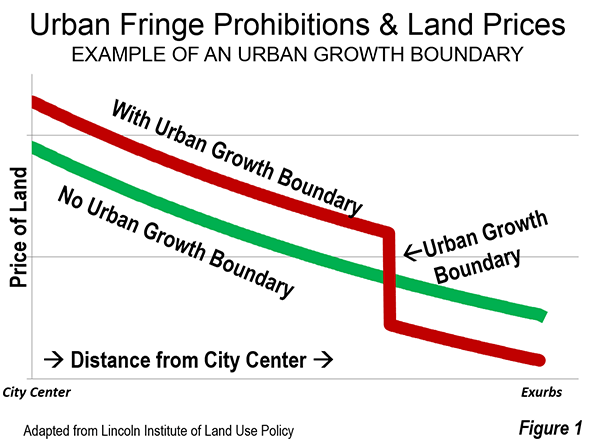
    In covering Romem’s research, Richard Florida acknowledges describes the crucial role of role of land markets in maintaining housing affordability. Of course, housing affordability is a casualty of urban containment policy because it destroys the competitive market for land on the urban fringe. As a result house prices rise substantially relative to incomes (Figure 1).

    Romem and Florida, to their credit, have proposed means they think can preserve housing affordability within a framework of urban containment, such as by land use regulation that permits higher densities, including redevelopment of lower density areas. While wishing them luck, there is little cause for optimism. Near 50 years ago, legendary urbanologist Sir Peter Hall suggested that “soaring land prices …. certainly represent the biggest single failure of the system of planning introduced with the 1947 [Town and Country Planning] Act” (see: The Costs of Smart Growth Revisited: A 40 Year Perspective). Urban containment policy, the principal strategy of forced densification, cannot repeal the law of supply and demand. Seventy years of experience prove that.

    Florida and others have noted the challenges of cities running up against their development limits. However, in the United States, only the artificial political limits of regulation have been approached, rather than the natural barriers of topography or geography (see: A Question of Values: Middle-Income Housing Affordability and Urban Containment Policy). Where a binding urban growth boundary is imposed between the city and an impassible mountain range, the scarcity induced price increases result from the boundary, not the mountain.

    Politics, Topography & Geography in the San Francisco Bay Area

    Take, for example, the San Francisco Bay Area, which has often been cited as a place where natural barriers have left little land for development. This is an impression easily obtained observing the fairly narrow strips of urbanization on both sides of San Francisco Bay, hemmed in by hills.

    However the Bay Area’s urbanization long ago leapt over the most important water bodies and then the Berkeley Hills to the east. Not only is the San Francisco Bay Area CSA high density, but it is also spatially small. In 2016, the San Francisco built-up urban area was only the 23rd largest in land area in the world. New York, the world’s largest built-up urban area in geographical expanse is more than four times as large.

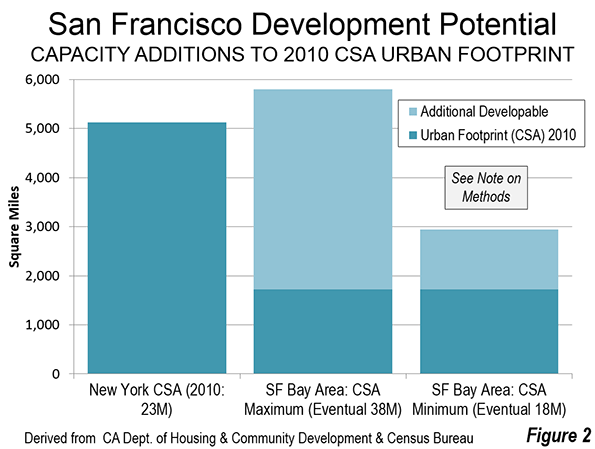
    There is plenty of developable land in the San Francisco Bay Area. Data in a 1997 state analysis indicated that another 1,500 to 4,300 square miles (3,900 to 11,000 square kilometers) could be developed in the Bay Area CSA. The lower bound assumed no farmland conversion and stringent environmental regulation. The report also found that in recent years, residential development had become marginally denser, yet not incompatible with the detached housing remains the preference in California (Figure 2). The state has more than enough developable land for future housing needs.

    Updating the data to account for the development that occurred through 2010, the developable land supply could support an urbanization of between 18 million and 37 million population, well above the 2010 urban population (Note on Method). At the most, there is capacity to accommodate the population of Tokyo – Yokohama, the world’s largest urban area. At a minimum, use of the available land would catapult the Bay Area CSA ahead of the Los Angeles-Riverside CSA, more than double its present population.

    Of course, the Bay Area is simply not growing fast enough to reach even the lower population figure any time soon. Even with its slower growth, however, the competitive market for land no longer works, in large measure because of land use regulation. The San Jose metropolitan area has the fourth worst housing affordability in the Demographia International Housing Affordability Survey and the San Francisco metropolitan area is 7th worst (both metropolitan areas are in the CSA).

    The decades old Bay Area housing affordability crisis, and that of other metropolitan areas seeking to force higher densities, is more the result of policy than nature.

    Urban Containment: Negative Externalities

    Moreover, planning authoritarianism cannot tell everyone where and how to live. For many, high density apartments (owned or rented) are not a substitute for the detached house. Indeed the substitute for the detached housing the Bay Area for many is often a detached house in Nashville or Kansas City or any of many other major metropolitan areas where housing is much less expensive. Last year’s (2014) IRS migration data shows that California is losing both younger households and middle income households.

    Higher than necessary house prices are, of course, an even greater problem for low-income households, who not only are excluded from homeownership but most pay unaffordable rents. The latest data shows that California again has the worst housing cost adjusted poverty rate among the 50 states. Even Mississippi, with its reputation for poverty, cannot compete with that.

    Romem expressed concern to The Wall Street Journal: “What you’ll get there is an exacerbation of the problems we already have in expensive cities. The distinction between homeowners and renters will become less and less a stage of life and more and more if your parents can help you.”

    The Economist came to a similar conclusion: “Suburbs rarely cease growing of their own accord. The only reliable way to stop them, it turns out, is to stop them forcefully. But the consequences of doing that are severe" (See: Cities: Better for the Great Suburbanization).

    Note on Method: Some of the CSA urban population is not in the continuous urbanization of San Francisco-San Jose built-up urban area, such as in the Santa Rosa, Stockton and Santa Cruz urban areas. This analysis is based on data from the California Department of Housing and Community Development and the U.S. Census Bureau. It is based on an estimate of additional development occurring from 1996 to 2010 and the land remaining after deduction of recently developed land. The population capacity assumes the “marginally higher” densities used by the California Department of Housing and Community Development, which it notes would not require substantial changes in the “current form of housing development” (1997).

    Wendell Cox is principal of Demographia, an international public policy and demographics firm. He is a Senior Fellow of the Center for Opportunity Urbanism (US), Senior Fellow for Housing Affordability and Municipal Policy for the Frontier Centre for Public Policy (Canada), and a member of the Board of Advisors of the Center for Demographics and Policy at Chapman University (California). He is co-author of the "Demographia International Housing Affordability Survey" and author of "Demographia World Urban Areas" and "War on the Dream: How Anti-Sprawl Policy Threatens the Quality of Life." He was appointed to three terms on the Los Angeles County Transportation Commission, where he served with the leading city and county leadership as the only non-elected member. He served as a visiting professor at the Conservatoire National des Arts et Metiers, a national university in Paris.

    Photo: San Mateo County on the San Francisco Peninsula (by author)

  • Local Govt. Control: The Ignored Campaign Issue

    In an election cycle full of spittle and bile, arguably the greatest issue — the nature of governance and the role of citizens — has been all but ignored. Neither candidate for president has much feel for the old American notion of dispersed power. Instead each has his or her own plans for ever greater centralization: Trump by the force of his enormous narcissistic self-regard; Hillary Clintonthrough the expansion of the powers increasingly invested in the federal regulatory apparatus.

    This profound disregard for the restraints of federalism comes at a time when our economy is undergoing profound centralization. Regulatory and monetary policy has benefited those with access to the most capital, making this economy more concentrated than at any time in recent history. This is particularly true in the information sector, which is now dominated by a handful of firms able to devour any competitor without  fear of anti-trust objections from Washington.

    Ultimately the very things James Madison and the other Founders worried about — the concentration of wealth in a few hands, the devolution of republican institutions and the rise of a central imperium — are becoming increasingly evident, with precious little debate about what this means or how it could be reversed.

    Is This What People Want?

    This centralization is not occurring by popular demand. By a wide margin — 64 percent to 26 percent, according to a 2015 poll — Americans say they feel “more progress” comes from the local level than the federal level. Majorities of all political affiliations and all demographic groups hold this same opinion.

    The preference for localism also extends to attitudes toward state governments, many of which have grown more powerful and intrusive in recent years. Seventy-two percent of Americans, according to Gallup, trust their local governments more than they do their state institutions; even in California, the mecca for ever-expanding government, large majorities favor transferring tax dollars from Sacramento to the localities.

    This also applies to millennials. Though liberal on issues like immigration and gay marriage, they are not generally fans of centralization. Fewer than one-third of them favor federal solutions over locally based ones.  “Millennials are on a completely different page than most politicians in Washington, D.C.,” notes pollsterJohn Della Volpe.  

    The federal government, a source of pride in the days of the New Deal, the Second World War, the Cold War and the civil rights struggle, is now regarded by  half of all Americans, according to Gallup, as “an immediate threat to the rights and freedoms of ordinary citizens.” In 2003 only 30 percent of Americans felt that way. A recent survey conducted by Chapman University  found that more Americans now have a greater fear of their own government than they do of outside threats.

    Has Centralization Reached Its Peak?

    Although he is hardly the originator of this trend, President Obama has become one of the most prolific authors of executive power in U.S. history. Critically, this has occurred in a time of relative peace and no compelling national emergency.

    The conservative Heritage Foundation estimates that by 2015 the Obama administration had passed at least 184 “major rules” (regulations with at least a $100 million economic impact) and thousands of smaller ones. During its first six years, the administration promulgated more than twice as many major rules as during the first six years of the predecessor George W. Bush administration.

    Many  directives  have been implemented as a way around legislative approval, a marked shift from earlier eras of legislative-executive cooperation during both the Reagan and Clinton  administrations. Some of this stems from the antics of an often obstructionist Congress but much of the long-term damage to federalism largely rests with the president. As Obama prepared for his last year in office, his agendawas defined primarily by new executive orders and regulatory edicts.

    Once executive power has been validated, the road back to a more balanced federalism may prove difficult. The tools of dictatorship grow ever more comfortable in the hands of those of wield it, whatever their politics, something that occurred in the decades before the collapse of Roman Republic.

    Not a Partisan Issue

    In a new paper, “Our Town: Restoring Localism,” my colleague Wendell Cox and I argue that centralization should not be regarded as a partisan issue. Some progressives, particularly in academia, assert that support for localized decision-making rests “not in facts but rather in ideology and politics.” Some also link any devolutionary agenda to the crimes committed in the name of “states’ rights,” most notably slavery and the post-Reconstruction Jim Crow laws.

    Yet, historically, many on the progressive left, including Justice Louis Brandeis, favored decentralization. As governor of Arkansas, Bill Clinton supported the view that local governments were often better suited to address civic problems. In his forward to David Osborne’s book “Laboratories of Democracy,” Clinton praised “pragmatic responses” to key social and economic issues by both liberal and conservative governors. Such state-level responses, Clinton noted, were critical in “a country as complex and diverse as ours.”  

    Nor are centralized solutions as efficient as some claim. After a half-century of massive federal investment, poverty rates are now worse than before the advent of the Great Society. Similarly, educational outcomes continue to deteriorate even as federal officials seek to intrude ever more into the minutiae of public schools.

    Nor have attempts to consolidate local areas enhanced efficiency or reduced spending, as is commonly suggested. Overall, large consolidations have proven inefficient, with higher costs  and levels of indebtedness than smaller ones.

    More important still is the critical role of localism in maintaining the traditions of American democracy. This is understood by many self-described progressives who express support for Main Street businesses and local farms and as a reaction against globalization and domination by large corporations.  Progressive author Heather Gerken has argued that social causes such as gay marriage and marijuana legalization tend to be adopted first at a local level before spreading to other areas.

    Sadly, the closer one gets to the Washington honey pot, the more that progressive passion for localism tends to fade. Some liberals embrace nothing short of an administrative dictatorship in pursuit of their policy agendas. Last year, a writer in the Atlantic actually called for the creation of a “technocracy” to determine energy, economic and land-use policies throughout the world. This regime would impose such unpopular notions as energy austerity on an already fading middle class, limiting mundane pleasures like cheap air travel, cars, freeways, suburbs and single-family housing.

    Such top-down approaches may gain much favor under Hillary Clinton, a centralizer by nature. Federal regulators would almost certainly nest ever deeper into what was once the realm of local governments in matters of zoning, housing, education and control of neighborhood demographics in ways that will hamper local initiatives and sap grassroots democracy.

    Over time, these efforts may elicit resistance not only among conservatives or libertarians, but also left-leaning professionals who won’t want to cede all control over their local communities to the federal super-state. The next generation of hipster merchants may share an affinity for social liberalism, but they will chafe at increasing regulatory burdens already hampering entrepreneurial growth.

    Despite the powerful economic and political forces behind it, the triumph of Leviathan is not inevitable. There is no compelling reason why the emerging Information Age needs to become an electronic dictatorship controlled by a few players, concentrated overwhelmingly on the coasts. Internet technology,  a gift originally funded by taxpayers, could instead be harnessed to effectively distribute power and authority downward across this vast country to states, regions, towns, neighborhoods and families.

    We need to forge a new path that empowers the grassroots economy and polity, and respects the diversity of contemporary America. We can’t expect that this movement will draw much interest from Washington institutions, which gorge on centralization, but it could be propelled by local communities and people who still believe in the decentralized democracy envisioned by the Founders.

    This piece first appeared in Real Clear Politics.

    Joel Kotkin is executive editor of NewGeography.com. He is the Roger Hobbs Distinguished Fellow in Urban Studies at Chapman University and executive director of the Houston-based Center for Opportunity Urbanism. His newest book, The Human City: Urbanism for the rest of us, will be published in April by Agate. He is also author of The New Class ConflictThe City: A Global History, and The Next Hundred Million: America in 2050. He lives in Orange County, CA.

    City Hall photo by Flickr user OZinOH.

  • Our Town: Restoring Localism

    This is an introduction to a new report from the Center for Opportunity Urbanism, "Our Town: Restoring Localism." Download the full report here.

    America is facing a critical moment in its evolution, one that threatens both its future prosperity and the integrity of its institutions. Over the past several decades, government has become increasingly centralized, with power shifting from local communities to the federal level. This has been accompanied by a decline in non-governmental institutions, a matter of concern to thinkers on both the right and the left.

    The issue here is not the irrelevance or intrinsic evil of government itself, nor is it a debate of liberalism vs conservatism. Rather, it is a question of how to meet society’s primary challenges. Is it most effective to try and solve our myriad problems from a central federal, state or regional authority, or from a more local one?

    We believe the right answer, in many cases, is to make a shift back towards local governing agencies, to neighborhoods, and to families. This change in direction would be a return to the roots of our current federal system, which allows different levels of government to make their own decisions, providing a market- place for various ideas and approaches.

    To be sure, local governments also make mistakes, and they can be authoritarian, corrupt, and short-sighted in meeting the needs of residents. But for the most part, locally generated negatives remain contained to local jurisdictions, and can be fixed through the democratic process at the more accessible local level.

    Download the full report here.

  • The Evolving American Central Business District

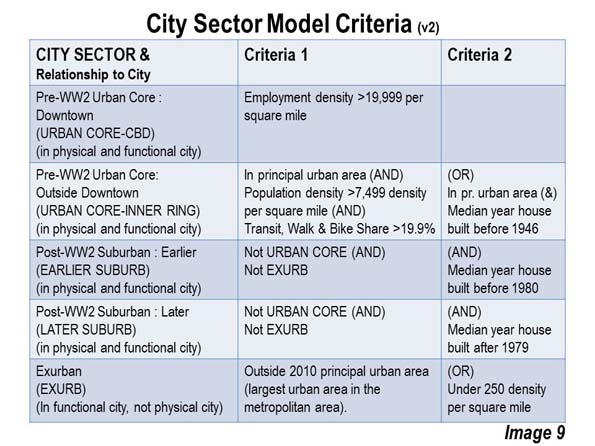
    After decades of serious economic decline, the inner cores in many of America’s largest metropolitan areas have experienced much improvement in recent years. This is indicated by the “City Sector Model,” (Image 9) which we developed to analyze the largest cities (metropolitan areas) using small functional areas, ZIP Code calculation areas (ZCTAs). The 2015 update to the City Sector Model added a fifth broad category of urbanization, when the Urban Core was divided into the Urban Core: CBD, and the Urban Core: Inner Ring (hereinafter referred to as CBD and Inner Ring).

    The CBDs have far higher densities of employment and population than the surrounding Inner Rings that surround them. The largest CBDs are nearly all products of the pre-World War II period, when metropolitan employment was more concentrated. Overall both the CBD and the Inner Ring are more similar than not, with higher densities than the suburban and exurban sectors and with greater use of transit, walking and bicycles in commuting. In contrast, the suburban and exurban areas have near universal use of automobiles.

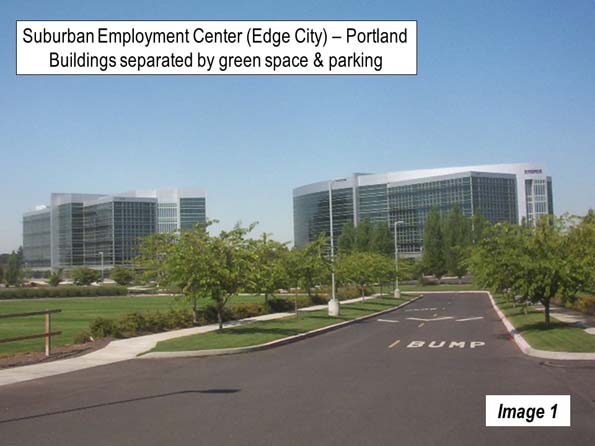
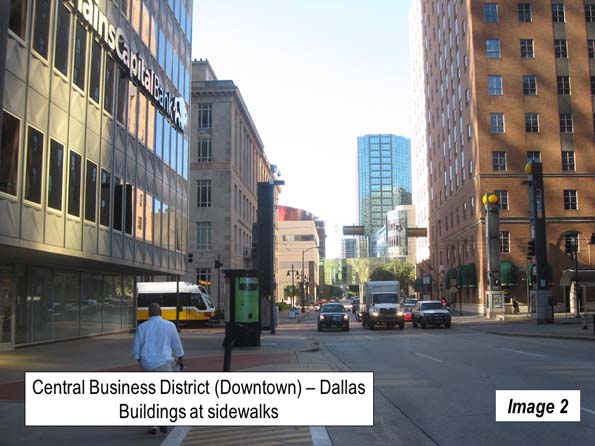
    This article includes analysis of the Urban Core: CBD (CBD) using the latest data from the American Community Survey for 2010 to 2014 (Note 1), with a middle year of 2012. The defining feature of the CBD is high employment densities. The City Sector Model uses employment densities of 20,000 and greater for designation of the CBDs. There are other dense employment centers in metropolitan areas, such as the “edge cities,” but they tend to be characterized by less concentrated development with their buildings, including high-rises, separated by green spaces and parking lots (Image 1). CBDs, on the other hand, typically have their high-rise buildings adjacent to street oriented sidewalks, with less space between the buildings (Image 2).


    Population Trends

    Since 2000, the CBDs have added approximately nine percent to their population. The CBD population growth rate largely tracked the overall metropolitan area growth rate. Critically, these remain a very small part of the urban population. Some 1.3 percent of the metropolitan population lived in the CBD in 2000, a figure that remained virtually the same in 2012.

    This growth rate, however, was not sustained throughout the Urban Core, which includes the much larger Inner Ring. The Inner Ring, which includes 91 percent of the Urban Core population, grew only 0.3 percent. The much larger Inner Ring drops the Urban Core growth rate down to only 0.9 percent, far below the 9 percent in the CBD component.  The other functional sectors grew faster, from two percent in the Earlier Suburbs to 39 percent in the Later Suburbs.

    Becoming More Residential

    Historically largely business districts, CBDs are becoming much more residential. Old, largely abandoned commercial buildings have been converted to new apartments and condominiums. In some places, there is new residential construction. There are new restaurants and other amenities that are associated with vibrant residential areas. There is more of a look of prosperity.

    Indeed, it may be surprising, given these developments that CBDs have not grown more. The net effect is that of the nearly 20 million new major metropolitan area residents added since 2000, less than 0.1 percent have been in the CBDs. However, as some people have moved in, others have moved out (Note 2).

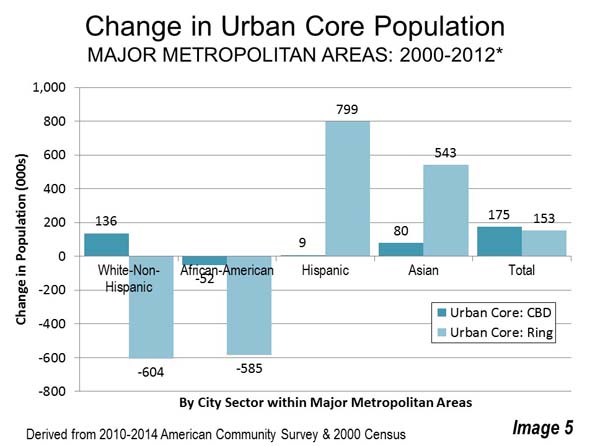
    The growth in CBD population has been dominated by higher income ethnicities (Image 3). While the CBDs were adding 175,000 residents, the growth in Asian and White-Non-Hispanic residents was 215,000. African-American population declined more than 50,000, while Hispanic population edged up less than 10,000.

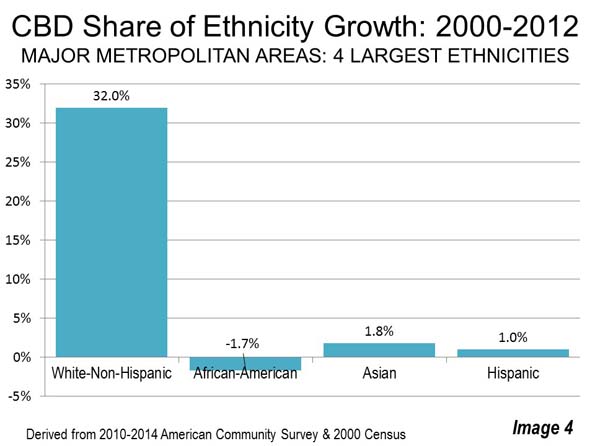
    Astoundingly, the CBDs, with barely one percent of the population, have attracted 32 percent of the major metropolitan White-Non-Hispanic growth. The 135,000 growth in White-Non-Hispanics compared to their slow, overall growth of 435,000. The share of the population growth among African-Americans, Asians and Hispanics in the CBDs has been far less (Image 4).

    Trends in the Inner Ring have been much different. There has been an exodus of approximately 600,000 of both white non-Hispanics and African-Americans. This has been somewhat more than offset by increases in the Asian and Hispanic population. Since 2000, Inner Ring has gained approximately 150,000 residents, somewhat less than the 175,000 gain in the CBDs (Image 5).

    The CBD Employment Market

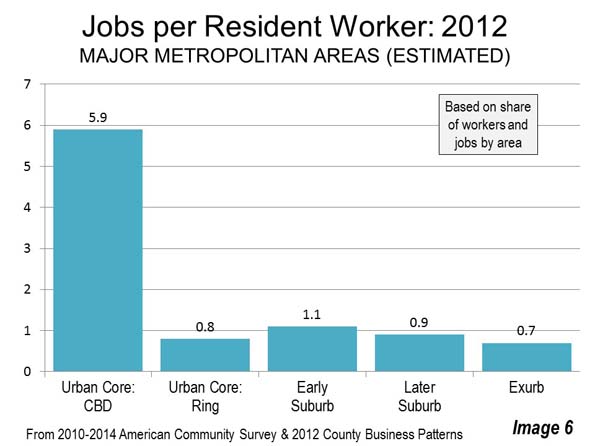
    Another defining feature of CBDs is a huge imbalance between employed residents and jobs. The most recent data indicates that the CBD boasts  nearly six jobs for every employed resident. Elsewhere in the metropolitan areas there was a much closer balance between jobs and resident workers (Image 6).

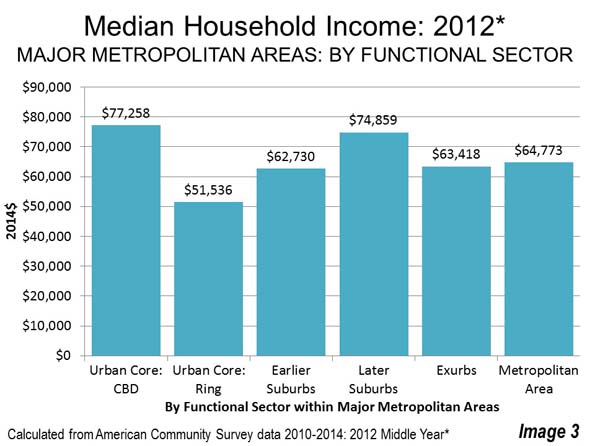
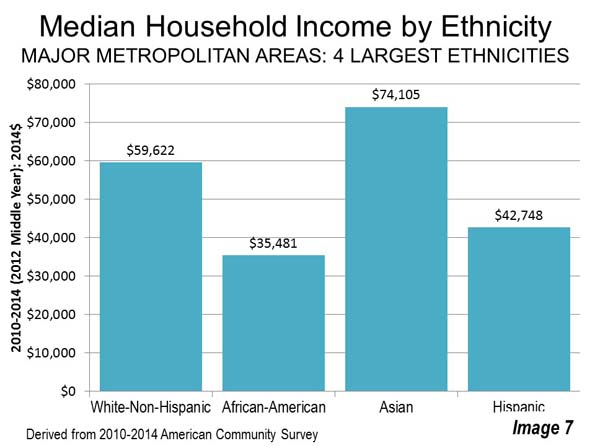
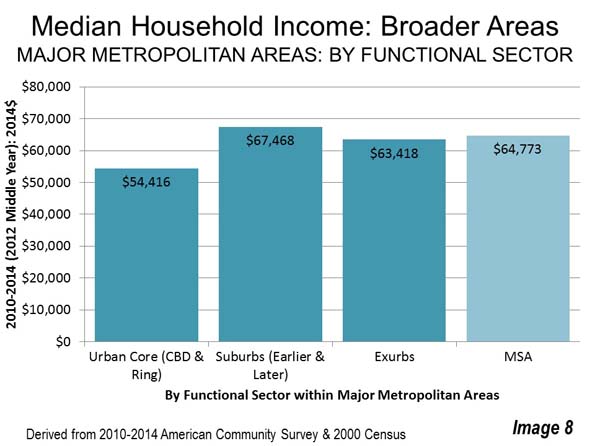
    This huge excess of jobs provides a rich employment market for residents. This and the growth in higher income ethnicities have combined to make the CBDs the most affluent sector in the major metropolitan areas by 2012, at nearly $77.300. This compares to the overall median household income of $64,800, the second ranking $74,900 in the Later Suburbs and the $51,600 in the Inner Ring. The median household income in the Inner Ring was by far the lowest (Image 7).

    Overall, as we speak about the core, the lower incomes of the Inner Ring dwarf the higher incomes in the CBD. Overall, the Urban Core (including the CBD and Inner Ring) median household income is $54,400, approximately 30 percent below that of the CBD (Image 8), and well below incomes in the suburbs, exurbs and metropolitan area as a whole.

    Assessing CBD Progress

    The CBDs have made significant progress. This is an important development because they, like other sectors of the city, best play their part as vibrant and healthy areas, rather than the depressed places that they used to be. They have attracted many younger people (Millennial age).

    In context, however, the progress in the CBD has been more symbolic than substantive. The CBD is not a model for what the rest of the metropolitan area. It cannot be. Metropolitan areas are labor markets. This means that they have a jobs to resident worker ratio of approximately 1.0. By definition, labor markets cannot have six times as many jobs as employees. Even with their impressive attraction of younger people, more than 97 percent of Millennial population growth since 2000 has been outside the CBDs.

    CBD population growth has been impressive, but small in relation to the metropolitan area. When combined with the much larger urban core component, the Inner Ring, its income advantage and demographic dynamism fades. Reviving the CBDs is a good thing. But the much larger Inner Ring needs revival as well.

    The bottom line:  the city is better off when all of its component parts are healthy, from the core to the exurbs.

    Note 1: This is the latest available data for small areas and was collected from 2010 to 2014. Thus, approximately one-fifth of the data was collected in each of the five years. For convenience, this article refers to the data as being reflective of 2012 (the middle year).

    Note 2: The ethnic analysis is based on one-race and Hispanic data. This represents 98 percent of the major metropolitan area population.

    Wendell Cox is principal of Demographia, an international public policy and demographics firm. He is a Senior Fellow of the Center for Opportunity Urbanism (US), Senior Fellow for Housing Affordability and Municipal Policy for the Frontier Centre for Public Policy (Canada), and a member of the Board of Advisors of the Center for Demographics and Policy at Chapman University (California). He is co-author of the "Demographia International Housing Affordability Survey" and author of "Demographia World Urban Areas" and "War on the Dream: How Anti-Sprawl Policy Threatens the Quality of Life." He was appointed to three terms on the Los Angeles County Transportation Commission, where he served with the leading city and county leadership as the only non-elected member. He served as a visiting professor at the Conservatoire National des Arts et Metiers, a national university in Paris.

    Photo: Kansas City CBD (by author)

  • What the Blues Brothers and Ferris Bueller’s Day Off Tell Us About Gentrification

    The Blues Brothers and Ferris Bueller’s Day Off are two of the seminal films set in Chicago. Indeed, Chicago itself is a character in both films.

    The films are radically different even though released only six years apart. There are many ways to slice this. Some have said that one is the South Side movie (The Blues Brothers) and the other the North Side movie (Ferris Bueller). Some see one as more urban, one more suburban.

    One other way to look at it is to see how the films portray an urban transition in progress. The Blues Brothers is a look backward at a fading industrial, working class metropolis.  Ferris Bueller looks forward to an upscale, gentrified city.

    I explore the parallels and contrasts in my new article in the Summer issue of City Journal, “Gentrification on the Big Screen“:

    Florida might regard some of Ferris Bueller’s traditional settings for diversion—the Art Institute and Chez Quis, a fictional fancy French restaurant—as stodgy relics from the city’s older, pre–knowledge economy era. But the scene in which Ferris bluffs his way into Chez Quis for lunch, claiming to be Abe Froman, “Sausage King of Chicago,” is perhaps the most revealing one in the film—and it marks another contrast with The Blues Brothers, in which a French restaurant also figures prominently. In the earlier movie, when Jake and Elwood show up at the legendary Chez Paul, they behave boorishly on purpose, to compel a former bandmate now working a legit job as the maître d’ to quit and rejoin them. By contrast, when Ferris and friends crash Chez Quis, they foreshadow a changing of the social guard. The hip young friends are destined to become Chicago’s new proprietors. They will soon be remolding the city, and its restaurants, in their own image. Chez Paul closed in 1995. Today, the city’s highest-end restaurants—like Alinea, a sleek, uber-hip purveyor of innovative cuisine—represent the culmination of this transition. A 48-year-old Ferris might well be eating at Alinea today.

    Watching these films today, viewers under the age of, say, 45 would be struck by how alien Jake and Elwood’s Chicago seems and how familiar Ferris’s Chicago has become. The vibrant working-class culture, tough old nuns, SROs, and Maxwell Street Market of The Blues Brothers have all either disappeared or survive only as shadows of what they once were. With a bit of cultural updating to cars, hairstyles, fashion, music, and phones, however,Ferris Bueller’s Day Off could be remade today, virtually shot for shot. Modern proto-hipsters might well still skip school to visit Wrigley Field, the lakefront, the Sears Tower Skydeck, or the Art Institute. Three decades after Ferris Bueller played hooky from the suburbs, the triumph of the gentrified city is complete.

    Click through to read the whole thing.

    Aaron M. Renn is a senior fellow at the Manhattan Institute, a contributing editor of City Journal, and an economic development columnist for Governing magazine. He focuses on ways to help America’s cities thrive in an ever more complex, competitive, globalized, and diverse twenty-first century. During Renn’s 15-year career in management and technology consulting, he was a partner at Accenture and held several technology strategy roles and directed multimillion-dollar global technology implementations. He has contributed to The Guardian, Forbes.com, and numerous other publications. Renn holds a B.S. from Indiana University, where he coauthored an early social-networking platform in 1991.

    Photo: Aretha Franklin singing in a diner in The Blues Brothers. Image via City Journal

  • Jerry Brown’s Housing Hypocrisy

    Jerry Brown worrying about the California housing crisis is akin to the French policeman played by Claude Rains in “Casablanca” being “shocked, shocked” about gambling at the bar where he himself collects his winnings.

    Brown has long been at the forefront on drafting and enforcing regulations that make building housing both difficult and very expensive. And now he has pushed new legislation, which seems certain to be passed by the Legislature and signed by the governor, that makes it worse by imposing even more stringent regulations on greenhouse gas emissions, mandating a 40 percent cut from 1990 levels by 2030.

    The press and activists may cheer the new bill, which will require massively expensive and intrusive measures likely to further raise housing costs. A 2012 study by the California Council on Science and Technology found that, given existing and potentially feasible technology, cutting back carbon emissions by 60 percent, roughly comparable with the new legal mandate, would require that “all buildings … either have to be demolished, retrofitted or built new to very high efficiency standards.” Needless to say, this won’t do much for housing affordability.

    Brown’s bona fides in promoting housing inflation goes back, at least to his days as attorney general. Throughout his career, Brown has fostered policies that have contributed to the regulatory quagmire largely responsible for helping drive house values in California up more than three times the national rate in the last half century. Over that period, a dense mesh of regional and local regulations have seriously restricted land for urban development, adding significant costs for housing developers.

    Some have seen Brown’s recent suggestions to loosen up some regulations and add to housing subsidies as positive, although they have little chance of making it through Sacramento due to environmental, labor and municipal opposition.

    Read the entire piece at The Orange County Register.

    Joel Kotkin is executive editor of NewGeography.com. He is the Roger Hobbs Distinguished Fellow in Urban Studies at Chapman University and executive director of the Houston-based Center for Opportunity Urbanism. His newest book, The Human City: Urbanism for the rest of us, will be published in April by Agate. He is also author of The New Class ConflictThe City: A Global History, and The Next Hundred Million: America in 2050. He lives in Orange County, CA.

  • Geographies of Inequality

    Joel Kotkin’s new report, “Geographies of Inequality,” is the latest in a series of ahead-of-the-curve, groundbreaking pieces published through Third Way’s NEXT initiative. NEXT is made up of in-depth, commissioned academic research papers that look at trends that will shape policy over the coming decades. In particular, we are aiming to unpack some of the prevailing assumptions that routinely define, and often constrain, Democratic and progressive economic and social policy debates.

    Dowload the .pdf report or read it on the web here.


    EXECUTIVE SUMMARY

    There’s little argument that inequality, and the depressed prospects for the middle class, will be a dominant issue in this year’s election, and beyond. Yet the class divide is not monolithic in its nature, causes, or geography. To paraphrase George Orwell’s Animal Farm, some places are more unequal than others.

    Housing represents a central, if not dominant, factor in the rise of inequality. Although the cost of food, fuel, electricity, and tax burdens vary, the largest variation tends to be in terms of housing prices. Even adjusted for income, the price differentials for houses in places like the San Francisco Bay Area or Los Angeles are commonly two to three times as much as in most of the country, including the prosperous cities of Texas, the mid-south and the Intermountain West.

    These housing differences also apply to rents, which follow the trajectory of home prices. In many markets, particularly along the coast, upwards of 40% of renters and new buyers spend close to half their income on housing. This has a particularly powerful impact on the poor, the working class, younger people, and middle class families, all of whom find their upward trajectory blocked by steadily rising housing costs.

    In response to higher prices, many Americans, now including educated Millennials, are heading to parts of the country where housing is more affordable. Jobs too have been moving to such places, particularly in Texas, the southeast and the Intermountain West. As middle income people head for more affordable places, the high-priced coastal areas are becoming ever more sharply bifurcated, between a well-educated, older, and affluent population and a growing rank of people with little chance to ever buy a house or move solidly into the middle class. 

    Ironically, these divergences are taking place precisely in those places where political rhetoric over inequality is often most heated and strident. Progressive attempts, such as raising minimum wages, attempt to address the problem, but often other policies, notably strict land-use regulation, exacerbate inequality.

    The other major divide is not so much between regions but within them. Even in expensive regions, middle class families tend to cluster in suburban and exurban areas, which are once again growing faster than areas closer to the core. Progressive policies in some states, such as Oregon and California, have been calculated to slow suburban growth and force density onto often unwilling communities. By shutting down the production of family-friendly housing, these areas are driving prices up and, to some extent, driving middle and working class people out of whole regions.

    To address the rise of ever more bifurcated regions, we may need to return to policies reminiscent of President Franklin Roosevelt, but supported by both parties, to encourage dispersion and home ownership. Without allowing for greater options for the middle class and ways to accumulate assets, the country could be headed not toward some imagined social democratic paradise but to something that more accurately prefigures a new feudalism.

    Dowload the .pdf report or read it on the web here.

    Joel Kotkin is executive editor of NewGeography.com. He is the Roger Hobbs Distinguished Fellow in Urban Studies at Chapman University and executive director of the Houston-based Center for Opportunity Urbanism. His newest book, The Human City: Urbanism for the rest of us, will be published in April by Agate. He is also author of The New Class ConflictThe City: A Global History, and The Next Hundred Million: America in 2050. He lives in Orange County, CA.

  • Why Most Cities Will Never Be All They Used to Be

    Recently I published a piece on my Forbes site that discusses the disparate impact that demographic and social shifts had on larger, older U.S. cities over the second half of the 20th century.  Basically, the smaller American household size, generated by later marriages, rising divorce rates, lower fertility rates and rising life expectancy, among other things, has meant that unless cities were adding housing, they simply weren’t growing.  Yeah, I know I’m quoting myself, but here’s a sample:

    “Most people intuitively understand the economic underpinnings of urban decline, and the economic advantages that have led to their rebound. The loss of manufacturing destroyed the economic base; the spread of globalization and the new economy has created new opportunity in cities. But far less well understood are the far-reaching cultural and social changes that impacted the demographic makeup of cities — and would have caused population loss, even without economic restructuring.”

    I encourage you to check it out.

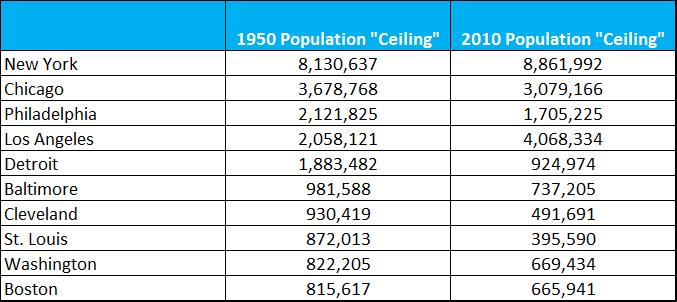
    I go on to suggest that population loss was inevitable for the most of the largest cities of mid-century America, and point out that today’s cities may never reach their previous population peaks.  I put together a cool table that demonstrates this:

    However, in putting this piece together I left quite a bit on the table, both in terms of graphics and additional content.  So consider this an addendum to the Forbes piece.

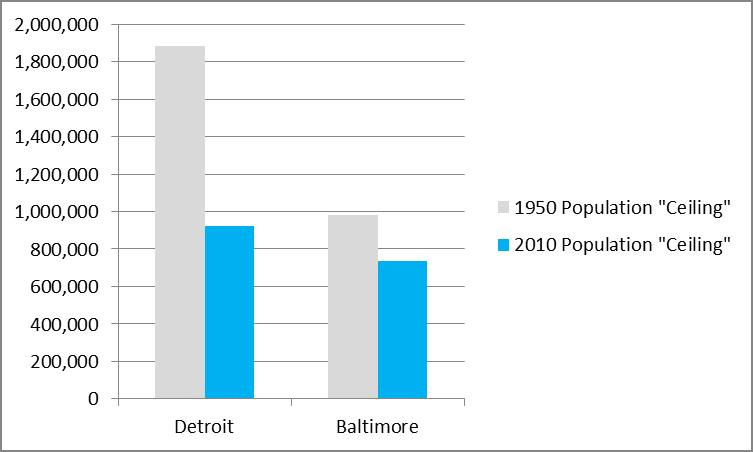
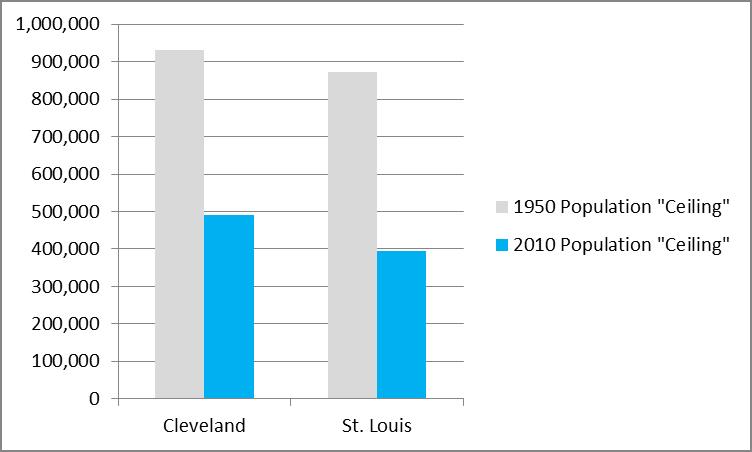
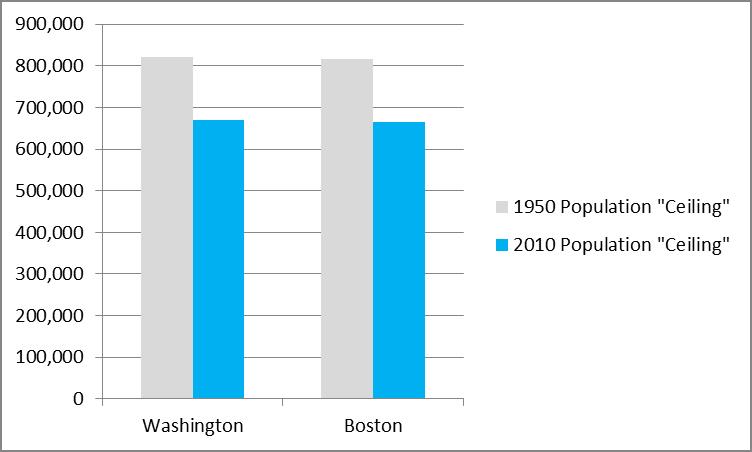
    First, I think it’s stunning to see a visual that illustrates the differences in a 1950 and 2010 population ceiling for the ten cities examined.  Check these out, shown two cities at a time:

    I think it is absolutely stunning to see that cities like Cleveland, Detroit and St. Louis could at best (at least right now) attain maybe half of their population in 1950.  And a case could be made that smaller household size may be the most significant factor in their decline.

    Three points I was unable to expand on in the Forbes piece.  First, now that the pendulum is swinging back in favor of cities, their influence is ascending faster than their population growth.  Cities are leading discussions now the economy, on infrastructure, on energy, on housing.  For the latter third of the 20th century the suburbs led that discussion.  But today, cities have reclaimed that role.  Their actual size, in terms of population, matters less today than it did 60 years ago.  

    Second, the American preference for new over old has nearly as much to do with this shift as shrinking household size.  For nearly 50 years the suburbs (and by extension, the Sun Belt) was new, and that was a main feature of their attraction.  But there’s also that saying, “everything old is new again.”  Cities are the new thing, and while they’re not everyone’s cup of tea, they are doing better than at any time in the last 50 years.

    Third, it’s conceivable that many suburbs and/or Sun Belt cities may find themselves impacted by emerging demographic or social shifts.  Having a huge inventory of single family homes in a world that is asking for multifamily options?  A strong auto-oriented landscape when more people are looking for walkable environments?  

    I’m not suggesting that all older cities are ascendant, and the suburbs and Sun Belt are doomed.  But staying ahead of trends may be the lesson all need to heed.

    Pete Saunders is a Detroit native who has worked as a public and private sector urban planner in the Chicago area for more than twenty years.  He is also the author of “The Corner Side Yard,” an urban planning blog that focuses on the redevelopment and revitalization of Rust Belt cities.

    Top photo: Vacant homes in Philadelphia, awaiting their revitalization.  Source: smartgrowthamerica.org

  • Ireland Adopts Plan to Increase Housing Supply and Improve Housing Affordability

    The government of Ireland has adopted a new policy (Rebuilding Ireland: Action Plan for Housing and Homelessness) intended to improve the quality of life and the national economy by making housing more affordable. In this regard, Ireland joins New Zealand (and Florida) in having recognized the disadvantages of overpriced housing and signaling reforms to alleviate the problem.

    Background: The Great Recession in Ireland

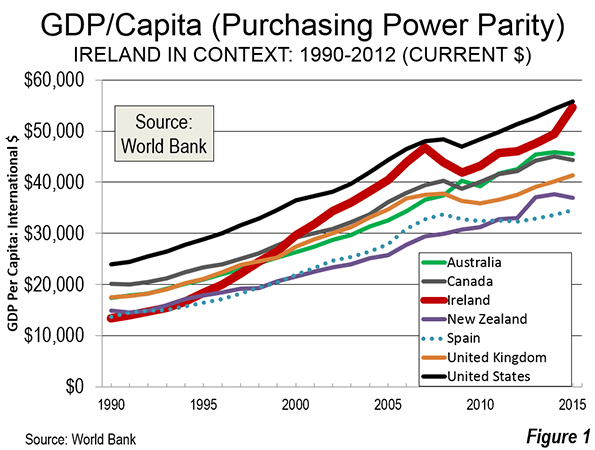
    Probably no nation suffered more during the housing bust induced Great Recession than Ireland. By 2007, the Irish economy had reached its peak, having achieved a gross domestic product (GDP) per capita, purchasing power adjusted, only 2.8 percent below that of the United States. This was an incredible accomplishment, given that as late as 1990 Ireland’s GDP per capita was approximately 45 percent below that of the United States, Australia, Canada, the United Kingdom, New Zealand and Spain, which are shown on Figure 1.  .

    However, as the overheated housing market tanked, Ireland’s GDP per capita dropped 8.4 percent relative to that of the United States, despite own housing bust economic losses. Things were so bad that Ireland was forced to take a large loan from the European Union and the International Monetary Fund to help stabilize its economy.

    Ireland’s economic losses were even greater than that of Spain, which had a particularly severe housing bust and whose economy continues to languish. But Ireland has done much better. The EU loan has been repaid. According to World Bank data, Ireland has reached a new peak, reaching within 2.1 percent of the US GDP per capita (Figure 1).

    The Housing Bubble and Bust

    During the housing bubble,   Dublin and Cork became severely unaffordable, where the median multiples (median house price divided by median household income) reached 6.0 and 5.4, respectively. This was to be expected as demand increased, well beyond the supply permitted by Ireland’s urban containment land-use regulations. As Dublin economist Colm McCarthy of  University College, put it: "Ireland passed its first major piece of land-use planning legislation in 1963, modeled on the UK’s Town and Country Planning Act of 1947. The intentions were laudable, to restrict the construction of unwelcome developments and to empower local authorities to take a more active role in shaping the built environment. There was no desire to screw up the residential housing market, but that is eventually what happened."

    As the economy get began to recover, house prices again began their rise simply because the reforms in   that would have prevented it were not implemented.

    Rebuilding Ireland

    The new housing policy announced July 20  is comprehensive, with strategies to reduce homelessness, improve the rental market and supply sufficient owned housing at affordable prices. Ireland has a high homeownership rate, at 68.6 percent and is important to the national economy.

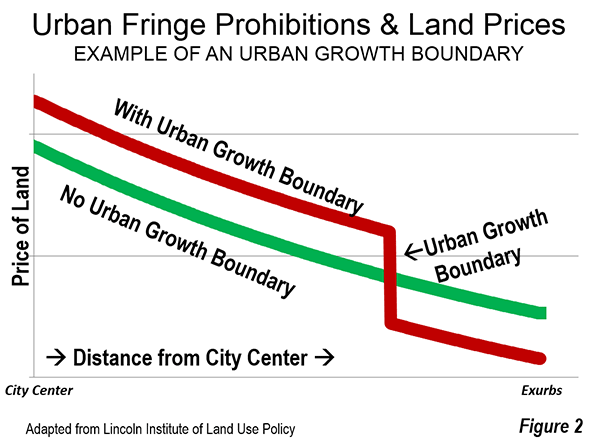
    As has occurred in the United Kingdom, Australia, New Zealand and some markets in Canada and the United States, large  house price increases relative to incomes were   experienced where urban containment policies were in effect. This is because urban fringe development prohibitions are associated with higher land prices inside urban containment boundaries (Figure 2). Indeed, this type of urban fringe regulation is present in virtually all major markets rated as severely unaffordable in the Demographia International Housing Affordability Survey, which rates 87 such markets in nine nations.

    Rebuilding Ireland policy acknowledges the importance of the housing market the national economy. As has been typical under urban containment planning regimes, house construction has fallen significantly short of demand. Under this policy, the government intends to accelerate the release of land for new development, especially in making government owned land available for development.

    Rebuilding Ireland is intended to double the rate of home building in Ireland over the period of 2017 to 2021. This will be aided by "Opening up land supply and low-cost State lands." This is important not only to meet the needs of Irish households, but also to diminish the potential for a highly volatile housing market that led to Ireland’s financial distress in the Great Recession.

    The government also intends to take action to support infrastructure development for new housing projects. A €200 million "Local Infrastructure Housing Activation Fund" will assist in "enabling infrastructure that opens up large sites for early development."

    As in California, virtually all large new housing projects today are appealed on various grounds. In recognition of this, Ireland intends to speed up the development process by allowing larger developments to proceed directly to the national planning appeals board ("An Bord Pleanála") for approval. The intention is to "jumpstart" the development of new housing.

    Defining Affordability

    Unlike most governments, the government of Ireland has supplied a definition of housing affordability. Rebuilding Ireland will hold a competition to develop new housing that can be delivered for than €200,000 in construction costs.

    Rebuilding Ireland also notes that land costs must be kept affordable and should add no more than €30,000 to €50,000 to the price of a new home. This would result in a "development ratio" of 15 percent to 20 percent (land price divided by total price including land). This development ratio is similar to US development ratios where urban containment policy has not been implemented and similar to development ratios in Australia and New Zealand before urban containment policy was adopted across those nations.

    Moreover, based on Irish household incomes, housing that costs between €230,000 and €250,000 would be generally consistent with the median multiple of 3.0 or less that is rated by the Demographia International Housing Affordability Survey as affordable (new house prices are generally more expensive than those of existing housing).

    Enforcement

    The government is signaling the seriousness of its intentions, indicating that local authorities must strive in their statutory development plans for “affordable prices to meet the housing needs of each local authority area, across tenures and types as well as the social housing requirement."

    This is a unique requirement in view of the fact that there has been virtually no serious attention to the issue of delivering housing affordability in other markets that have had strong urban containment policies.

    Implementation will not be without challenges. In the longer run, the inertia of currently in vogue planning philosophy could well prevent achievement of the housing affordability goals of Rebuilding Ireland. Yet, as Rebuilding Ireland indicates, the stakes are high. Rebuilding Ireland notes that "Excessive housing costs have demographic impacts, including a tendency for households to defer important lifecycle choices in order to prioritise home purchase" (such as having children).

    Further, as Rebuilding Ireland indicates: "Rising prices for residential accommodation impact adversely on competitiveness. The attractiveness of Ireland as a potential investment location and, of course, the cost base for existing businesses will be impaired should price inflation continue, as rising prices place upward pressure on wages, deter inward migration and impede the labour market."

    This could be particularly important in light of Brexit (the exit of the United Kingdom from the European Union). To the extent that international businesses may decide to leave the United Kingdom to stay within the European Union, Ireland and especially Dublin could be attractive for relocation because of the dominance in the nation of the English language, which would be made more attractive by improved housing affordability.

    Wendell Cox is principal of Demographia, an international pubilc policy and demographics firm. He is a Senior Fellow of the Center for Opportunity Urbanism (US), Senior Fellow for Housing Affordability and Municipal Policy for the Frontier Centre for Public Policy (Canada), and a member of the Board of Advisors of the Center for Demographics and Policy at Chapman University (California). He is co-author of the "Demographia International Housing Affordability Survey" and author of "Demographia World Urban Areas" and "War on the Dream: How Anti-Sprawl Policy Threatens the Quality of Life." He was appointed to three terms on the Los Angeles County Transportation Commission, where he served with the leading city and county leadership as the only non-elected member. He served as a visiting professor at the Conservatoire National des Arts et Metiers, a national university in Paris.

    Photo: Custom House, Dublin by Peter Brown from Dublin, Ireland (The Custom House, Dublin) [CC BY 2.0], via Wikimedia Commons