Category: Suburbs

  • Future of Suburbia: Report from Cambridge

    In the United States, over 69 percent of all residents live in suburban areas. Across the globe many other developed countries are primarily suburban, while developing countries are increasingly suburbanizing. By 2050, an additional 2.7 billion people are anticipated to live in metropolitan regions around the world, and suburbs are a significant portion of this urban expansion. Over the past two years, 150 experts from numerous, diverse disciplines contributed research that explores this contemporary global phenomenon – and on April 1st their work was showcased at the MIT Media Lab for the Future of Suburbia conference.

    The “Future of Suburbia” was chosen as MIT’s Center for Advanced Urbanism biennial theme in order to shed light on the growing role suburbs play in our lives and how they may be improved for the future.   Suburbia is an often polarizing issue that should no longer be ignored by the fields of Planning and Design.

    The conference is just one of three products the Center for Advanced Urbanism created for its biennial research theme. An exhibition, located on the ground floor of the MIT Media Lab included infographic mappings, a 22ft x 8ft dynamic model of a 3 million population polycentric region in the year 2100, and aerial footage of global suburbs. The third product, a publication entitled Infinite Suburbia (Fall 2017), brings together 50+ authors and about 700 references, providing groundbreaking research on our low-density future.

    Each of MIT’s five schools were represented at the conference, spanning twelve key fields. Attendees also included students from Harvard and Chapman University, and speakers in demographics, entrepreneurship, history, urban design and media production. The findings were presented within four design frameworks, including heterogeneous, productive, autonomous and experimental, which were explored through a variety of fields; including design, architecture, urban planning, history and demographics, policy, energy, mobility, health, environment, economics, and applied and future technologies.

    The conference centered on the question, how might suburbia be upgraded to better suit our needs? Can new suburban models be created for developed, but also developing, countries? What challenges will suburbs face in the future? Despite such a large and complex topic, enlightening data, opinions and predictions were given regarding suburbs and their role in a sustainable future.

    Forgetting the Urban-Suburban Divide

    The urban-suburban dichotomy is highly debated (in fact, urbanists and planners themselves use 200 different terms to describe suburbia), but the Future of Suburbia conference tried to stay above the fray, instead describing the two camps as one evolving continuum. Throughout the day points were made that the suburb and urban can and should learn from one another. Traditionally, we have failed to recognize just how important suburbia is in this country and globally. By polarizing the suburb and the city we ignore how the making of peripheries can greatly contribute to urban centers, and vice-versa. However, this conference did not focus on trying to define suburbia, but on how we should think of urbanization’s holistic impact.

    Historian Robert Bruegmann kicked off the conference by outlining its history and persistence worldwide despite economic and political differences. Bruegmann finished his introduction by advocating that we be “more modest in what we think we know and what we plan for our future.”

    The Suburbs as a Heterogeneous and Productive Form

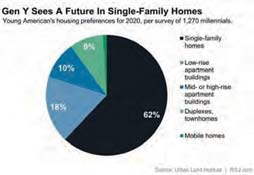
    The conference’s first panel of the day, on heterogeneity, dealt largely with numbers and trends. One statistic that stood out – 90 percent of Americans live in suburban areas, while only 10 percent live in urban cores. Also, 80 percent of Americans wish to live in a detached home. As millennials get older, more will be married and begin having children, making suburban living all the more desirable. In the United States, the denser the community, the fewer children there are. Just take a look at San Francisco, where there are more dogs than children and families are increasingly moving out of the city, or Manhattan, which has the lowest percentage of children in the country.

    It is also the highly educated and majority white that are moving to city centers, while two thirds of millennials do not have college degrees. It seems that what people truly want in their hearts, is being mixed up with costs, in both the city and suburbs. Economist Jed Kolko described the process as circular – where do people want to go, what is the economic situation, and where are the externalities. Kolko admitted it’s hard to quantify how much demand for suburbia is an impact of policy, or consumers’ hearts.  

    Ali Modarres, director of Urban Studies at University of Washington Tacoma, presented on the suburbanization of immigrants, stating, “Immigration is redefining and complicating the word suburb”. He explained, “…suburbs, old and new, are more likely to become super diverse.” Why are immigrants moving increasing to suburbs and not city centers? Because suburbs are home to a growing working class population, seeking affordable housing close to emerging job centers. For example, Orange County and northern LA County have seen significant foreign born population growth. And David Rudlin, winner of the prestigious Wolfson Prize, has high hopes for the future of the polycentric city. He emphasized the importance of a strong economy in suburban settings, asserting, “If you don’t have the economic driver of a city, you end up with a dormitory.” He called for the open sourced suburb as a way for creating a bio-system that allows diversity to develop.

    How can we design suburbs in a more productive, environmentally friendly way? The next panel explored this question beginning with Susannah Hagan, professor of Architecture at the University of Westminster, who emphasized that the suburban and urban are different, but should not be thought of as separate entities. The suburb can benefit the city, while the city, in turn, can benefit the suburb. Hagan also discussed strategies for post-industrial cities, to “manage degraded industrial spaces.” She talked about different types of seeds – actual plant seeds, investment seeds, and the concept of idea seeds for regenerating cities and suburbs.

    Joan Nassauer, professor of Landscape Architecture in the School of Natural Resources and Environment at the University of Michigan, showed that suburbs can be environmentally productive places, making the point that by area, as much carbon is stored in Michigan’s southeast exurban residential landscapes as in the managed forests of North Country.

    Mitchell Joachim, co-founder of Terreform ONE and associate professor at NYU, proposed that agriculture should be brought back into the suburbs which would create a “new kind of nature” that can shrink our ecological footprint. Innovative ecological designs such as living houses, urban farm pods, and cricket shelters were explored. The question then becomes, are suburban residents ready to break the model?

    An Autonomous and Experimental Future

    The main challenges of autonomy in the suburbs are regulatory, technical, and complicated by the user experience. But with the right tools, autonomy has the ability to transform the way people live and travel outside the city. Joseph Coughlin, professor and Director of the MIT Age Lab moderated the panel that included Knut Sauer of Hyperloop Technologies, Eran Ben-Joseph of MIT’s Urban Studies and Planning department, and Nick Roy of the Department of Aeronautics & Astronautics at MIT.

    New technologies will change our lives, allowing us to travel from LA to San Francisco in 25 minutes, or purchase something in the middle of the night and have it delivered by drone within the hour. The ideas presented look promising – in just a couple years the Hyperloop will be a reality for human passengers. But the innovations may still need tweaking, since people tend to reach out to drones and dangerously interfere with their motors.

    If these weren’t experimental enough, the next panel consisted of conceptual housing models and the creation of an entire city dedicated to testing. The experimental panel was moderated by ex-suburbanite and writer for the New York Times, Allison Arieff, who explained how she wanted to see cities and suburbs learn from each other rather than fight.

    Paul Fieler laid out upcoming plans for CITE City, a New Mexico based model city that will be built to test, evaluate, and certify new urban technologies. The development will look and function as a real city, and thousands of people will move into the houses and apartments to conduct real-life experiments. David Neustein of Other Architects proposed another urban concept for Australia, the most suburbanized nation in the world. As the population ages and preferences shift towards sustainability, Neustein’s model would facilitate the downsizing of Australia’s many “McMansions” so that the elderly could rent out their second stories. It would also boost Australia’s housing stock and redesign facades to become more integrated into nature.

    Meanwhile, Bob Geolas of the Research Triangle Foundation in North Carolina cities must understand what to embrace in terms of their brand, culture, and urban form. He outlined how the Research Triangle is overcoming its outdated research park form and building upon its values and strengths to become relevant in the economy and contribute to a sustainable future. Physical and programmatic collaboration, unique and relevant design, events and programs, and public spaces will all be key components for making the Triangle an attractive place to work in the suburbs.

    Takeaways

    Topics included innovation in cities, and economic and cultural trends, including immigration, demographics and lifestyle preferences, and how these forces interact in the urban, or suburban milieu. As population grows and technology improves, the researchers predict that the urban-suburban divide will disintegrate, resulting in a continuum of urbanity, one that takes form as a poly-nodal fabric of different hubs of innovation, living and sustainability.

    Also, we learned how important it is for urban designers to collaborate with business leaders, economists, and city officials, and the community residents themselves to design and implement the most appropriate and beneficial suburban structures. These fields traditionally function in silos, but the future requires that these disciplines co-mingle in the creation of sustainable, productive, and creative places to live. If we focus less on the semantics of the urban-suburban divide, and channel our energies on creating better places to live for all types of people, more will benefit.

    Alicia Kurimska is a researcher at the Chapman University Center for Demographics and Policy. She is a first generation American with a Slovakian background who graduated from Chapman University with a degree in history, writing her thesis on Czech President Edvard Benes’s struggle to preserve the Czechoslovak nation, inspired by her year-long studies at the Anglo-American University in Prague.

    Charlie Stephens is a researcher at the Chapman University Center for Demographics and Policy, and an MBA candidate at the Argyros School of Business and Economics at Chapman University. He is also a regular contributor to the creative business site PSFK.com and the founder of substrand.com, a hub for sharing and discussing the creative, intellectual and emotional aspects of cities.

    Photos by Justin Knight.

  • The Sun Belt Is Rising Again, New Census Numbers Show

    From 2009-11, Americans seemed to be clustering again in dense cities, to the great excitement urban boosters. The recently released 2015 Census population estimates confirm that was an anomaly. Americans have strongly returned to their decades long pattern of greater suburbanization and migration to lower-density, lower-cost metropolitan areas, largely in the South, Intermountain West and, most of all, in Texas.

    Among the nation’s 53 largest metropolitan statistical areas, the two biggest population gainers between July 1, 2014, and July 1, 2015, were Houston and Dallas-Ft. Worth, together adding roughly 300,000 people. Their growth, in absolute terms, was larger than that of both Los Angeles and New York, which, respectively, are nearly two and three times as populous, notes demographer Wendell Cox. Two other Sun Belt metropolitan areas, Atlanta and Phoenix, also added more people over the year to July 2015 than L.A. and New York.

    The divergence in growth is even greater when expressed in percentage terms. Of the 10 fastest-growing metro areas in the country, all but two were located in the old Confederacy. Austin ranks first, with 3.0%  growth, followed by Orlando, Fla. (2.6%), and Raleigh (2.5%). Other fast-growing southern metro areas included San Antonio, Texas (2.2%); Nashville, Tenn.; and Jacksonville, Fla. (both 2.0%). The fastest growers outside the South are Denver (2.1%) and Las Vegas (2.2%), the latter of which is now clearly back from the dead.

    The old big cities aren’t all losing people. New York and Los Angeles’ populations grew as well, 0.43%  and 0.65%, respectively, but that’s well below the overall U.S. population growth rate of 0.79% over the same span. Some metro areas, notably Chicago, Pittsburgh, Rochester, Hartford, Cleveland and Buffalo suffered slight losses, while many others, such as St. Louis, Memphis, Milwaukee and Detroit remained essentially stagnant.

    Critically, the most recent patterns confirm longer-term trends. Most of the cities at the top of the list are also the ones that have been growing fastest since 2000, led by Raleigh, Austin, and Las Vegas. Also in the top 10 since 2000 are the other three big Texas cities, Phoenix, Charlotte, Orlando and one California metro, largely exurban San Bernardino-Riverside. The slowest growth also follow a similar pattern, with Chicago, several Rust Belt cities, as well as Los Angeles and New York, all in the bottom quintile in percentage terms.

    Where Americans Are Moving

    To look ahead to where America will be growing in the future, perhaps the best indicator is net domestic migration. This measures where people are moving, essentially taking their skills, purchasing power and capital with them. Houston and Dallas-Fort Worth enjoyed the largest net gains from domestic migration, roughly 60,000 each, from July 1, 2014, to July 1, 2015, followed by Phoenix, Tampa-St. Petersburg, Atlanta and Austin. The Sun Belt, once written off as doomed by the urbanist punditry, is clearly back.

    In percentage terms, Austin led the nation, with a population expansion of 1.7% from net domestic migration. The top 10 cities in percentage terms are all in the Sun Belt (Tampa-St. Petersburg ranked second, followed by Raleigh, Orlando and Jacksonville) or the Intermountain West (Denver and Las Vegas).

    The biggest losers in overall domestic migration are New York (-164,000), Chicago (-80,000) and Los Angeles (-71,000). In percentage terms, Chicago suffered the biggest losses, followed by New York, Hartford, Memphis and Milwaukee. Despite the explosive growth in Silicon Valley,   San Jose ranked 9th in percentage loss, just behind 10th place Detroit.

    In looking at these trends, the Atlantic’s Derek Thompson, one of the more savvy Census watchers, recently suggested that “it’s 2006 again” as people head out to the Sun Belt metros. When international migration is added to the mix along with the domestic migration numbers, the top five gainers remain in the Sun Belt, led by Houston and Dallas-Fort Worth, which are also becoming meccas for immigrants.

    These trends predate the recession. Since 2000, the biggest migration winners in percentage terms are Raleigh, Austin, Las Vegas, Charlotte, Phoenix, and Orlando. In total numbers since 2000 it’s also a familiar list, led by places like Phoenix (net gain: 705,000), Dallas-Ft. Worth (569,000), Atlanta (547,000), Riverside-San Bernardino (513,000) and Houston (496,000).

    The biggest losers are also familiar, led by the New York metropolitan area, which has lost 2.65 million net migrants since 2000, followed by Los Angeles (negative 1.65 million) and Chicago (down 880,000). Remarkably the two metro areas that have benefited the most from the digitization of the economy are in the loser’s column; between them San Jose and San Francisco lost over 550,000 domestic migrants since 2000.

    The Suburban Revival Continues

    The other big finding from the new estimates: suburbs are back. In the wake of the housing bust it was widely predicted that the ‘burbs were doomed by high gas prices, millennial preferences and a profound shift of employment to the core cities. The New York Times NYT -0.08% evenpublished fantasies on how the suburban carcass could be carved up, envisioning suburban three-car garages “subdivided into rental units with street front cafés, shops and other local businesses” while abandoned pools would become skateboard parks.

    As  economist Jed Kolko has noted, the much celebrated era when core cities grew faster than suburbs — the immediate 2009-2011 aftermath of the recession — turned out to be remarkably short-lived. From July 2014-July 2015, only seven out of 53 core cities added more domestic migrants than their suburbs. Of these, the District of Columbia (Washington) could be considered high density urban; the other five core counties are functionally more suburban than urban (Phoenix, Raleigh, Richmond, Sacramento and San Antonio).

    Overall domestic migration continues from the core cities to the suburbs. Over the last year core counties lost a net 185,000 domestic migrants, while the suburban counties gained 187,000.

    Looking Ahead

    These trends are likely to continue as long as the economy achieves even modest growth.  One big factor will be the migration of millennials, now headed increasingly to Sun Belt cities and suburbs. Since 2010,  among educated millennials, the fastest growth in migration has been to such lower-cost regions as Atlanta, Orlando, New Orleans, Houston, Dallas-Fort Worth, Pittsburgh, Columbus, and even Cleveland.

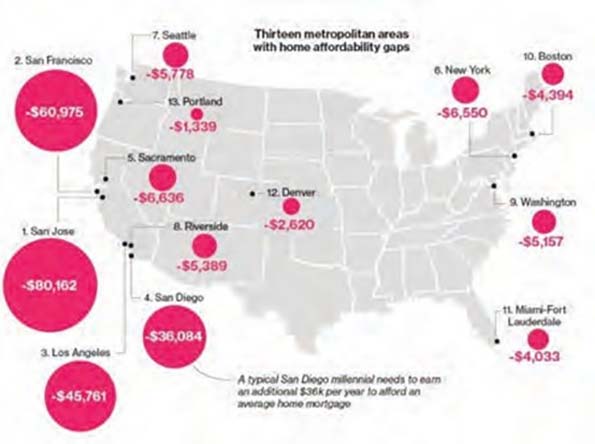
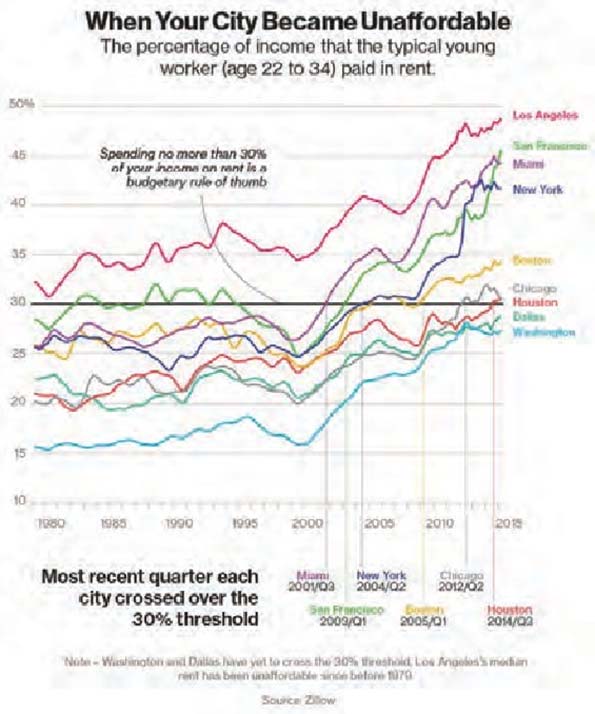
    This is largely a product of high housing prices. According to Zillow, rents claim upward of 45% of income in Los Angeles, San Francisco, New York, and Miami compared to less than 30% of income in places like Dallas-Fort Worth and Houston.  The costs of purchasing a house are even more lopsided: in Los Angeles and the Bay Area, a monthly mortgage takes, on average, close to 40% of income, compared to 15% nationally.

    Millennials are also headed increasingly to the suburbs. According to the National Association of Realtors, 80% of the homes purchased by millennials between 2013 and 2014 were detached houses, and 8% had chosen attached housing. This trend will accelerate in the next few years, suggests Kolko, as the peak of the millennial wave turns 30.

    Similarly immigrants — the other big driver shaping our future geography — are also moving increasingly to Sun Belt cities such as Houston, Dallas-Ft, Worth and Atlanta, as newcomers seek out both economic opportunities and lower housing prices. New York remains the immigrant leader, with the foreign-born population increasing by 600,000 since 2000, but second place Houston, a relatively newcomer magnet for immigrants, gained 400,000, more than Chicago and the Bay Area combined. The regions experiencing the highest growth in newcomers in percentage terms were Charlotte and Nashville, which each have seen their foreign-born populations double.

    In the coming decade, immigrants and millennials will produce the vast majority of the country’s children — and they increasingly sending them to school in the suburbs of Sun Belt cities. Central (urban core) areas lost substantial numbers of schoolchildren between 2000 and 2010, while school populations rose in newer suburbs and exurbs. Overall the child populations in cities such as Austin, Houston, San Antonio, Raleigh, Orlando and Nashville are on the rise while dropping in places like Los Angeles and Chicago, as well as some Rust Belt cities.

    America’s geography will be increasingly dominated by Sun Belt cities as well as suburbs. This challenges the preferred narrative among most planners and the mainstream media, as well as some developers who  believe more Americans desire to live in high cost, high density locales. Some day perhaps the facts — as seen both in this year’s numbers and longer term trends — will intrude on the narrative. Dispersion is back, and getting stronger. It’s time that developers, planners and the media adjust to the facts, rather than just reflect their prejudices.

    Population Change in the Nation’s Largest Metropolitan Areas, 2014-2015
    Change Rank Region 2014 Population 2015 Population 14-15 Change % Change
    1 Houston-The Woodlands-Sugar Land, TX  6,497,864 6,656,947 159,083 2.4
    2 Dallas-Fort Worth-Arlington, TX  6,958,092 7,102,796 144,704 2.1
    3 Atlanta-Sandy Springs-Roswell, GA 5,615,364 5,710,795 95,431 1.7
    4 Phoenix-Mesa-Scottsdale, AZ  4,486,543 4,574,531 87,988 2
    5 New York-Newark-Jersey City, NY-NJ-PA  20,095,119 20,182,305 87,186 0.4
    6 Los Angeles-Long Beach-Anaheim, CA  13,254,397 13,340,068 85,671 0.6
    7 Miami-Fort Lauderdale-West Palm Beach, FL  5,937,100 6,012,331 75,231 1.3
    8 Washington-Arlington-Alexandria, DC-VA-MD-WV  6,033,891 6,097,684 63,793 1.1
    9 Seattle-Tacoma-Bellevue, WA  3,672,866 3,733,580 60,714 1.7
    10 Orlando-Kissimmee-Sanford, FL  2,326,729 2,387,138 60,409 2.6
    11 San Francisco-Oakland-Hayward, CA  4,595,980 4,656,132 60,152 1.3
    12 Denver-Aurora-Lakewood, CO  2,755,856 2,814,330 58,474 2.1
    13 Tampa-St. Petersburg-Clearwater, FL  2,917,813 2,975,225 57,412 2
    14 Austin-Round Rock, TX  1,943,465 2,000,860 57,395 3
    15 San Antonio-New Braunfels, TX  2,332,790 2,384,075 51,285 2.2
    16 Riverside-San Bernardino-Ontario, CA  4,438,715 4,489,159 50,444 1.1
    17 Charlotte-Concord-Gastonia, NC-SC  2,379,177 2,426,363 47,186 2
    18 Las Vegas-Henderson-Paradise, NV  2,069,146 2,114,801 45,655 2.2
    19 Portland-Vancouver-Hillsboro, OR-WA  2,348,607 2,389,228 40,621 1.7
    20 Nashville-Davidson–Murfreesboro–Franklin, TN  1,793,910 1,830,345 36,435 2
    21 Boston-Cambridge-Newton, MA-NH  4,739,385 4,774,321 34,936 0.7
    22 San Diego-Carlsbad, CA  3,265,700 3,299,521 33,821 1
    23 Raleigh, NC  1,243,035 1,273,568 30,533 2.5
    24 Sacramento–Roseville–Arden-Arcade, CA  2,244,879 2,274,194 29,315 1.3
    25 Minneapolis-St. Paul-Bloomington, MN-WI  3,495,656 3,524,583 28,927 0.8
    26 Jacksonville, FL  1,421,004 1,449,481 28,477 2
    27 Columbus, OH  1,997,308 2,021,632 24,324 1.2
    28 San Jose-Sunnyvale-Santa Clara, CA  1,954,348 1,976,836 22,488 1.2
    29 Oklahoma City, OK  1,337,619 1,358,452 20,833 1.6
    30 Indianapolis-Carmel-Anderson, IN  1,971,861 1,988,817 16,956 0.9
    31 Kansas City, MO-KS  2,071,283 2,087,471 16,188 0.8
    32 Philadelphia-Camden-Wilmington, PA-NJ-DE-MD  6,053,720 6,069,875 16,155 0.3
    33 Salt Lake City, UT  1,154,513 1,170,266 15,753 1.4
    34 Richmond, VA  1,259,685 1,271,334 11,649 0.9
    35 New Orleans-Metairie, LA  1,251,962 1,262,888 10,926 0.9
    36 Baltimore-Columbia-Towson, MD  2,786,853 2,797,407 10,554 0.4
    37 Grand Rapids-Wyoming, MI  1,028,962 1,038,583 9,621 0.9
    38 Cincinnati, OH-KY-IN  2,148,450 2,157,719 9,269 0.4
    39 Louisville/Jefferson County, KY-IN  1,271,172 1,278,413 7,241 0.6
    40 Virginia Beach-Norfolk-Newport News, VA-NC  1,717,853 1,724,876 7,023 0.4
    41 Tucson, AZ  1,004,244 1,010,025 5,781 0.6
    42 St. Louis, MO-IL  2,806,191 2,811,588 5,397 0.2
    43 Providence-Warwick, RI-MA  1,609,533 1,613,070 3,537 0.2
    44 Birmingham-Hoover, AL  1,142,823 1,145,647 2,824 0.2
    45 Milwaukee-Waukesha-West Allis, WI  1,574,115 1,575,747 1,632 0.1
    46 Memphis, TN-MS-AR  1,342,914 1,344,127 1,213 0.1
    47 Detroit-Warren-Dearborn, MI  4,301,480 4,302,043 563 0
    48 Buffalo-Cheektowaga-Niagara Falls, NY  1,136,642 1,135,230 -1,412 -0.1
    49 Rochester, NY  1,083,678 1,081,954 -1,724 -0.2
    50 Hartford-West Hartford-East Hartford, CT  1,213,225 1,211,324 -1,901 -0.2
    51 Cleveland-Elyria, OH  2,064,079 2,060,810 -3,269 -0.2
    52 Pittsburgh, PA  2,358,096 2,353,045 -5,051 -0.2
    53 Chicago-Naperville-Elgin, IL-IN-WI  9,557,294 9,551,031 -6,263 -0.1

    This piece originally appeared in Forbes.

    Joel Kotkin is executive editor of NewGeography.com. He is the Roger Hobbs Distinguished Fellow in Urban Studies at Chapman University and executive director of the Houston-based Center for Opportunity Urbanism. His newest book, The Human City: Urbanism for the rest of us, will be published in April by Agate. He is also author of The New Class ConflictThe City: A Global History, and The Next Hundred Million: America in 2050. He lives in Orange County, CA.

    Photo by telwink.

  • Rise of the Mixed-Use Monoliths

    Density rules new development. From Florida to Texas to points west, city boosters herald a mixture of apartments and shops as an improvement on local ‘density’. Dense development can be well designed, and can contribute to the form of a city, but the new density’s formulaic style is a crossbreed of strip shopping centers joined with 1980s apartment complexes. Instead of a newly walkable urban environment, we are spawning more traffic than ever, in uninspired, pricey, new trophy projects that adorn our busy highways and replace quirky, individualistic neighborhoods with soulless, mock historic monoliths.

    The official name for the form of these developments is “urban mixed use,” but they are a far cry from city-center urbanity. Each new development is a variation on beige stucco and predictable planning. A mixed-use development is not a bad thing in and of itself; for every 200-unit mixed use development in the works, 200 acres of Florida’s wilderness is kept for future generations. Their repetitive nature, however, is depressing. Nowhere is this more evident than along the ten-mile Central Florida strip called US 17-92, where five of these developments are in various stages of life.

    US highways 17 and 92 combine south of Orlando to create a six-lane artery running north through several towns before splitting up once again, 17 going northwest and 92 going northeast. One response to the highway is the eccentric, prosperous community of Maitland, with 17-92 as its main street.

    Premodern Maitland still exists, from the unpainted vernacular architecture of the Holly Anna orange grove store all the way up to the last vestiges of Parker’s Lumber, a railside lumberyard that dates from the 1920s. Both signal an era when Maitland actually produced something. The town’s rather elegant, light brick church tower and the angled, delicate columns of Maitland Plaza, an office complex, indicate Maitland’s midcentury phase, that once-hopeful era when architecture smiled at tailfins and speed.

    Maitland, however, bought big into the new density storyline. At 17-92 and Lake Avenue the first in its collection was Victorian flavored, with a foil-lined particleboard tower thrust high over the empty storefronts lining the narrow sidewalk. Chunky columns rest between the storefronts, and thin-skinned apartments perch above whizzing cars.

    That development sits across from the venerable Lake Maitland Terrace, a 1960s era resort-style campus sensibly buffered from the roar of traffic by green trees and a lawn. Lake Maitland Terrace has a waiting list, and is memorably well detailed in precast concrete, built to last. But living over a busy commercial strip is in vogue today, so we can’t seem to produce any more Lake Maitland Terraces. Instead, we have the empty mixed-use hulk across the street, harbinger of more to come.

    And more have arrived, indeed. Maitland’s newer mixed-use experiments are beige neoclassical foam and stucco, looking vaguely like excrescences of Mediterranean and Victorian-town villages. The newest development-in-process promises “gathering… entertainment… living… swimming…” under the baleful stare of city hall’s recent stucco-and-foam tower looming in the background.

    Enthusiasm for these places has worn off among long-time Central Floridians, and reality has set in. Each one resembles the last more and more, as developers fine-tune the machine that pumps out mixed-use developments with alarming regularity. The public is already suspicious of them, pointing to more congested traffic, rising prices, and the banishment of individual businesses in favor of the chain stores. Gone are entrepreneurs building businesses, replaced by minimum-wage clerks and a store manager working for the somewhere-out-of- state home office.

    The design formula appears to mix a little bit of stacked stone (for authenticity’s sake), beige stucco smeared liberally over large, puffy columns, and a shopping-center canopy facing a parking lot. A narrow concrete sidewalk turns depressingly nasty when it gets to the apartment complex, where the outdoor entry corridor inevitably takes over – a no-man’s land of trash cans, aluminum mailboxes, and iron bar security gates. Apartment floor plans still have a couple variations on the one and two bedroom schemes, with living rooms that don’t quite fit the furniture found in Ikea.

    Maitland, in particular, has succumbed to a mock-historical design aesthetic of boxy architecture, carriage lanterns, and scrolled gewgaws. This city, when left to its own design aesthetic, commissions monuments along US 17-92 that nicely reference its own original architecture, a 1930s art colony built in a fantasy Mayan style. Originality, however, is out with the builders of the new density.

    Further north lies Altamonte Springs. Here, the developers went for an early Soviet Union period style, Floridified, with giant, pyramid-hatted apartments. These overlook Crane’s Roost, a pretty lake that is now over-engineered with parking along its banks. Planned with good intentions, the architecture falls apart upon closer inspection, its chief design innovation being a dark red three-story stucco wall along the sidewalk, perfect for absorbing the hot Florida sun. It almost makes me nostalgic for my 1980-vintage apartment complex with its slanted redwood siding and river-rock balcony.

    What unites all of these developments is their earnest puffery. Each is styled with gaudy mascara and rouge to look like something it is not. This is the DNA inherited from their ancestor, the shopping center. They all have large fat columns, thickened corners, and Neanderthal eyebrows to give them a sense of heaviness. But if you watch them under construction, you will see lots of metal or wood studs: they are hollow inside.

    Grafted onto this mask is an apartment block, but not one like the brownstones of old. These have no connection whatsoever to the street – no stoop or entry door on the sidewalk. Brownstones had architectural scale and character made famous by Ada Louise Huxtable; for example, she could date one by the lintels over the windows. No such luck here. The only decoration that adorns the exterior façade is a stucco control joint pattern.

    It’s as if every movie has to have blockbuster special effects, and can’t just tell a good story with actors anymore. By contrast, these developments replace a midcentury minimalism of architecture with a now- lost delicacy. Lake Maitland Terrace wasn’t special before the rise of mixed-use properties along the highway, but it was about itself, and nothing else: it didn’t pretend to be a Victorian main street or a Mediterranean hill town. With no special effects budget, it simply offered good views and workable, decent floor plans.

    I don’t believe that the hollowness marking the current taste in commercial development reflects the taste of everyone who actually uses it. Many of these places are vacant, a wave of retail space crashing upon us just in time for the online shopping trend. Welcome to the new America.

    What can we, as local users, do to combat this? Humanize them, renovate them, and add our own local color as they get older. Steer them closer to our own specific pathways. A certain sidewalk here might get a sun shade or a trellis added to shade it, converting it from an oven to a lovely pocket park.

    The spaces that we love in our town grew that way over time. We cannot let these hollow, mixed-use monoliths defeat or dispirit us. They are here to stay, and more are coming, so our job is now to take ownership of these buildings and start individualizing them. The sooner we can inflict the spirit of place upon them, they will cease being monstrosities, and become members of our own community of buildings.

    Richard Reep is an architect with VOA Associates, Inc. who has designed award-winning urban mixed-use and hospitality projects. His work has been featured domestically and internationally for the last thirty years. An Adjunct Professor for the Environmental and Growth Studies Department at Rollins College, he teaches urban design and sustainable development; he is also president of the Orlando Foundation for Architecture. Reep resides in Winter Park, Florida with his family.

    Photo of Maitland by the author

  • Suburban Sustainablity

    There’s a philosophical debate about what is “sustainable.” The two dominant camps tend to advocate on behalf of either the hyper efficient dense city or bucolic rural self sufficiency. Personally, I’m not a fan of either.


    The more finely tuned and efficient any system is the more vulnerable it is to disruption. There’s also an inevitable concentration of authority in large systems that doesn’t appeal to me.

    Screen Shot 2015-06-07 at 2.31.03 AM

    The picturesque farm out in the country has a romantic allure, but the reality is mostly isolation, lack of economic opportunity, and a stifling culture.

    Almost all of the built environment in North America is actually suburban which is neither fish nor fowl in terms of the urban/rural divide. And that isn’t going to change anytime soon.

    Screen Shot 2016-02-16 at 9.20.34 PM

    At the moment suburbs have none of the efficiencies of the urban core and none of the productive capacity of the countryside. Suburban residents are just as dependent on large centralized systems as people living downtown. Where does suburban food come from? Energy? Water? Where does suburban trash go? Sewerage? Who owns everything? (If you have a mortgage… the bank, not you.) A small family farm in the country can manage all these things right at home on a tight budget. But the average tract house is no different from a high rise apartment.

    Screen Shot 2016-02-17 at 1.12.42 PM

    Screen Shot 2016-01-30 at 10.24.54 PM

    That private vehicle that sits in the driveway appears to be a source of personal freedom unlike the city bus or subway. But the car is invisibly tethered to gas stations, pipelines, refineries, and ultimately to the oil fields of North Dakota, Venezuela, and Nigeria by way of massive corporations and no small amount of Big Government. Wall Street also finances these cars as well, so add that to the mix of dependencies. Suburbanites believethey’re more independent than city people. They aren’t.

    unnamed

    Screen Shot 2016-01-30 at 4.56.01 PM

    Screen Shot 2016-01-30 at 7.17.32 PM

    Screen Shot 2016-01-30 at 7.10.47 PM

    Screen Shot 2016-01-30 at 7.13.20 PM

    Segovia 054 (800x600)

    Screen Shot 2016-01-30 at 7.08.44 PM

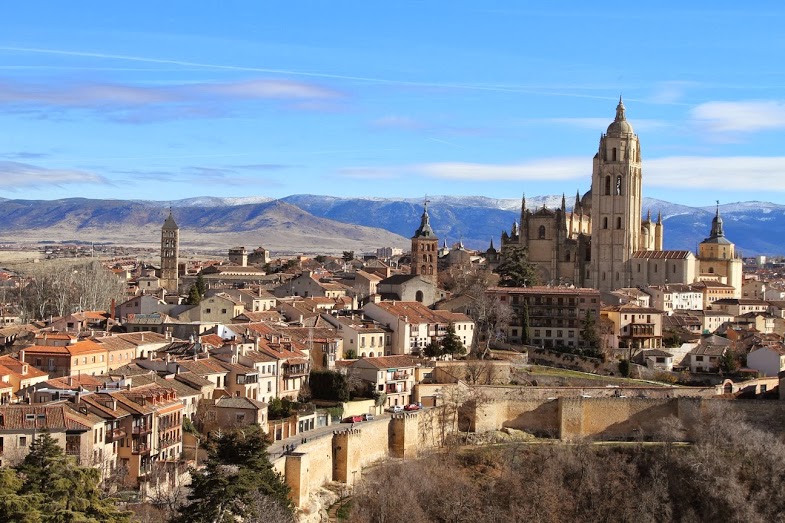
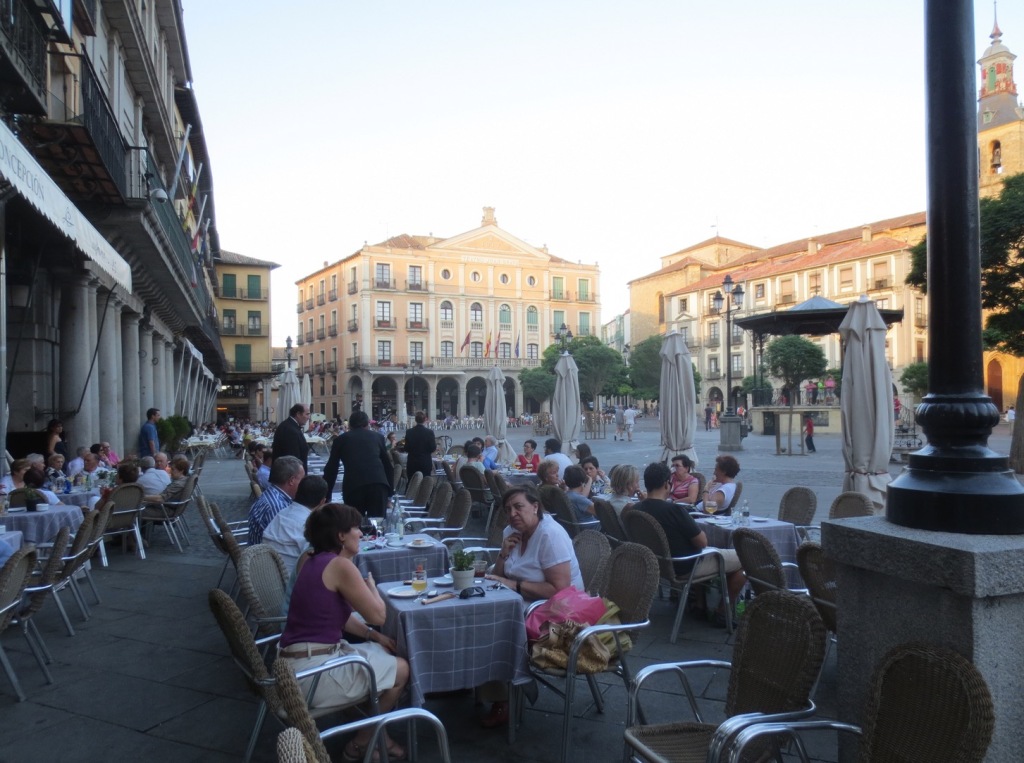
    Historically this tension between efficient urbanism and rural productivity was resolved by building compact medium density towns that were immediately surrounded by farmland. Economic opportunity, high culture, and great efficiencies were baked in to every level of the built environment. Take a fifteen minute walk from the center of town and you’ll find water, grain, grazing livestock, orchards, and all other essentials for supporting the population. A two thousand year old settlement like this one in Spain demonstrates pretty clearly that this is a sustainable model. But how does it relate to American suburbs?

    Screen Shot 2016-01-30 at 5.29.30 PM

    Screen Shot 2016-01-30 at 5.29.11 PM

    Screen Shot 2016-01-30 at 10.03.43 PM

    Screen Shot 2016-01-30 at 10.04.38 PM

    Screen Shot 2016-01-30 at 10.04.57 PM

    Screen Shot 2016-02-18 at 12.40.44 AM

    Screen Shot 2016-02-01 at 2.27.06 AM

    Screen Shot 2016-01-30 at 10.24.23 PM

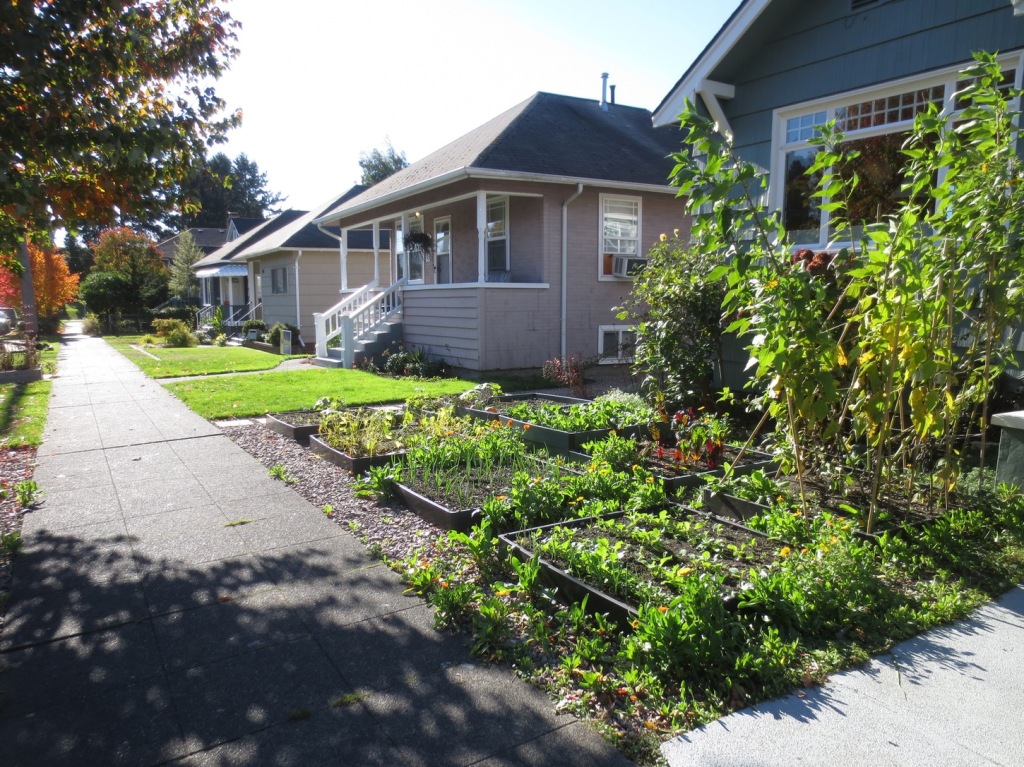
    The typical suburban home is surrounded by a modest patch of garden. Instead of growing a lawn (the largest single crop in North America) the land could be producing fresh food. Ornamental shrubs and specimen trees could just as easily be fruit bearing. No need to truck in refrigerated lettuce from 1,500 miles away. The supply chain is effectively reduced to a matter of feet. There’s no need for battery hens from a distant factory farm. This transforms a consumptive landscape into a productive property. No one is suggesting this is “self sufficient”. But it’s a huge step up from having a kitchen full of Lean Cuisine, Fruit Loops, and Go-Gurt from the supermarket.

    Screen Shot 2016-01-30 at 10.23.22 PM

    Screen Shot 2016-01-30 at 10.21.38 PM

    Screen Shot 2016-01-30 at 10.23.06 PM

    In addition to home gardens suburbia is full of places that can be transformed into community gardens. Every church, school, and vacant parking lot is a potential veggie patch or orchard.

    Screen Shot 2016-02-18 at 12.23.05 AM

    Screen Shot 2016-02-17 at 1.13.15 PM

    This solar water heater is the biggest bang for the green buck. A couple of tanks, some black boxes covered in glass, a little pump… and you’ve got free hot water for decades. The cheapest and greenest energy is always the power you don’t need to use in the first place.

    Screen Shot 2016-02-18 at 12.17.53 AM

    Screen Shot 2016-02-17 at 1.13.26 PM

    A modest number of photovoltaic panels can often provide nearly all the electricity for a suburban home, particularly if the house was first fitted with high efficiency lights and appliances. Combine this with loads of insulation, solar hot water, and a food garden and a suburban home begins to resemble a small family homestead in the country.

    Screen Shot 2016-01-30 at 10.58.30 PM

    Screen Shot 2016-01-30 at 10.56.36 PM

    Screen Shot 2016-01-30 at 2.14.11 PM

    Screen Shot 2016-01-30 at 2.14.28 PM

    Screen Shot 2016-01-30 at 2.14.46 PM

    Screen Shot 2016-01-31 at 2.44.44 AM

    Screen Shot 2015-09-09 at 11.58.24 PM

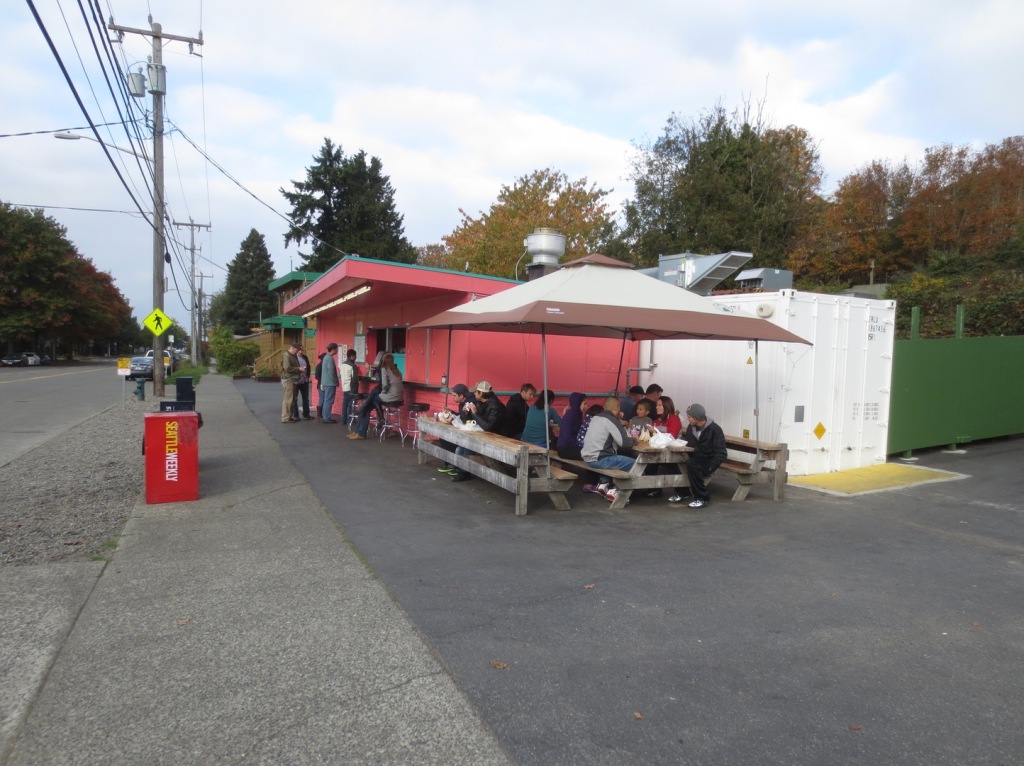
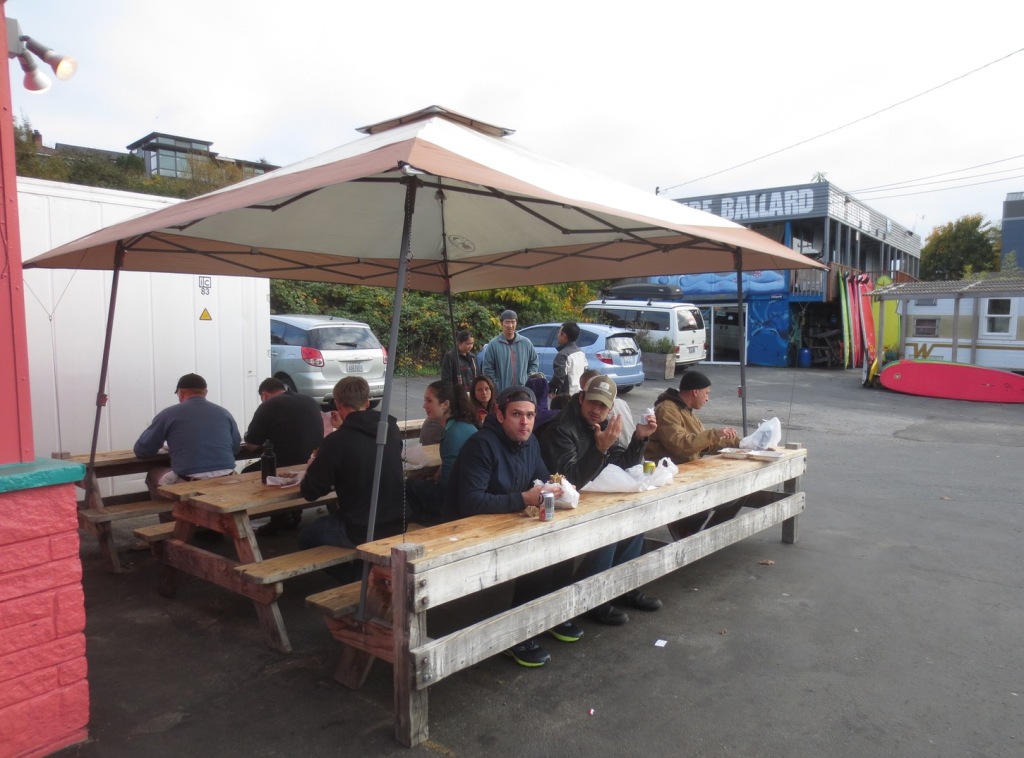
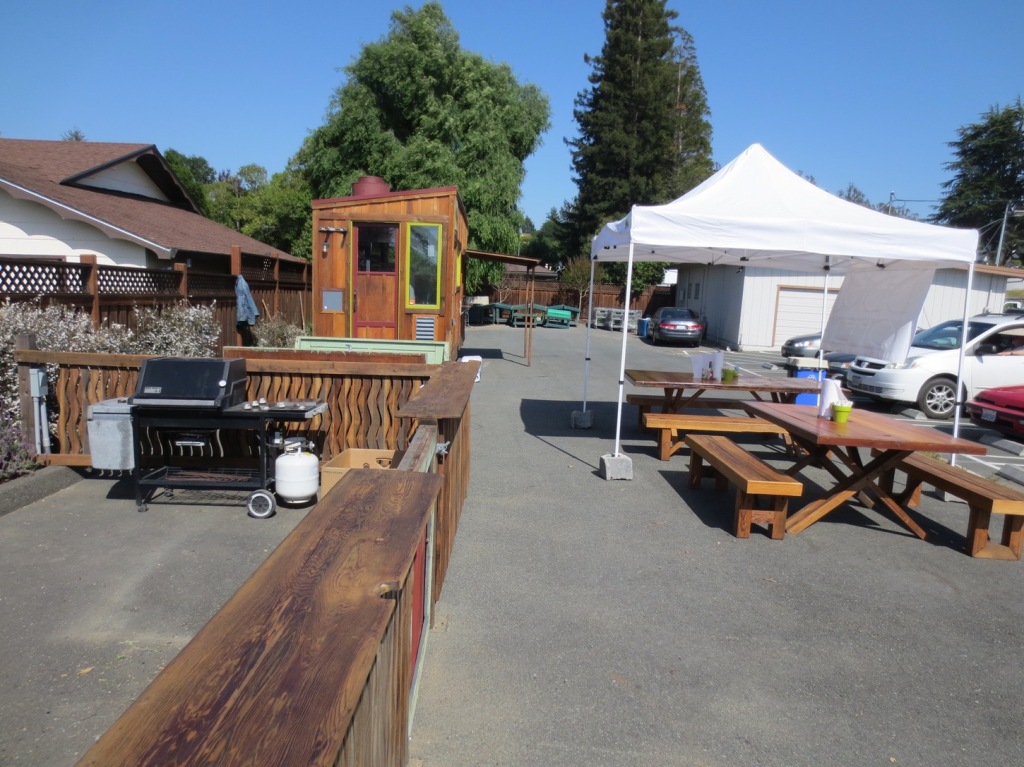
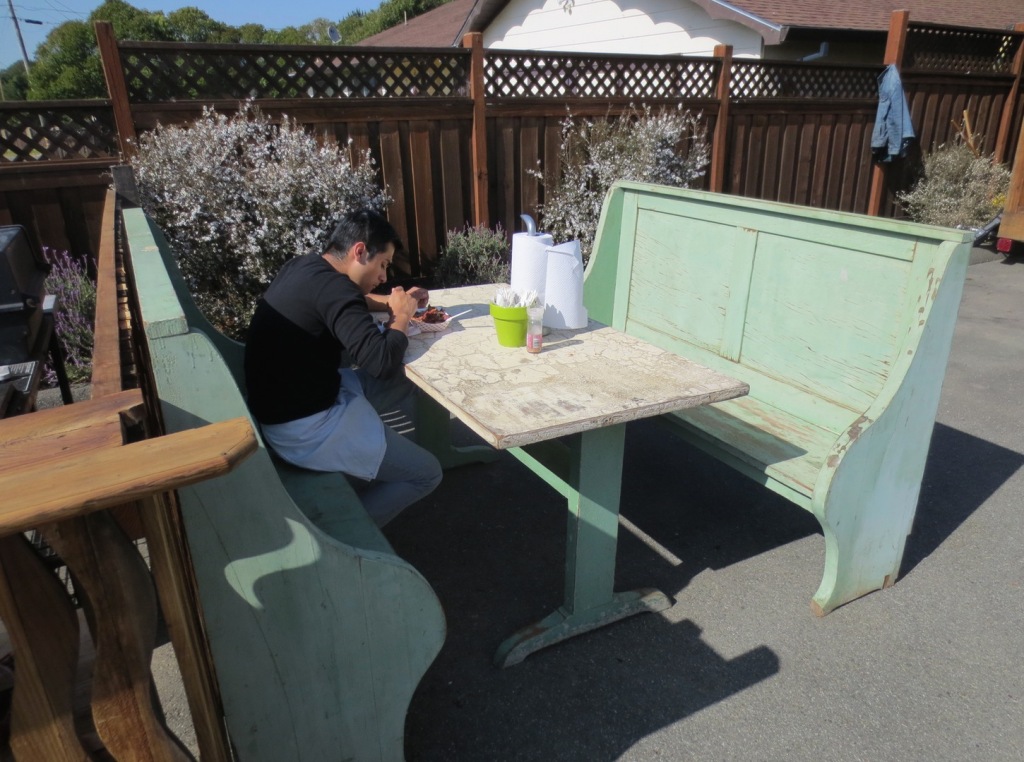
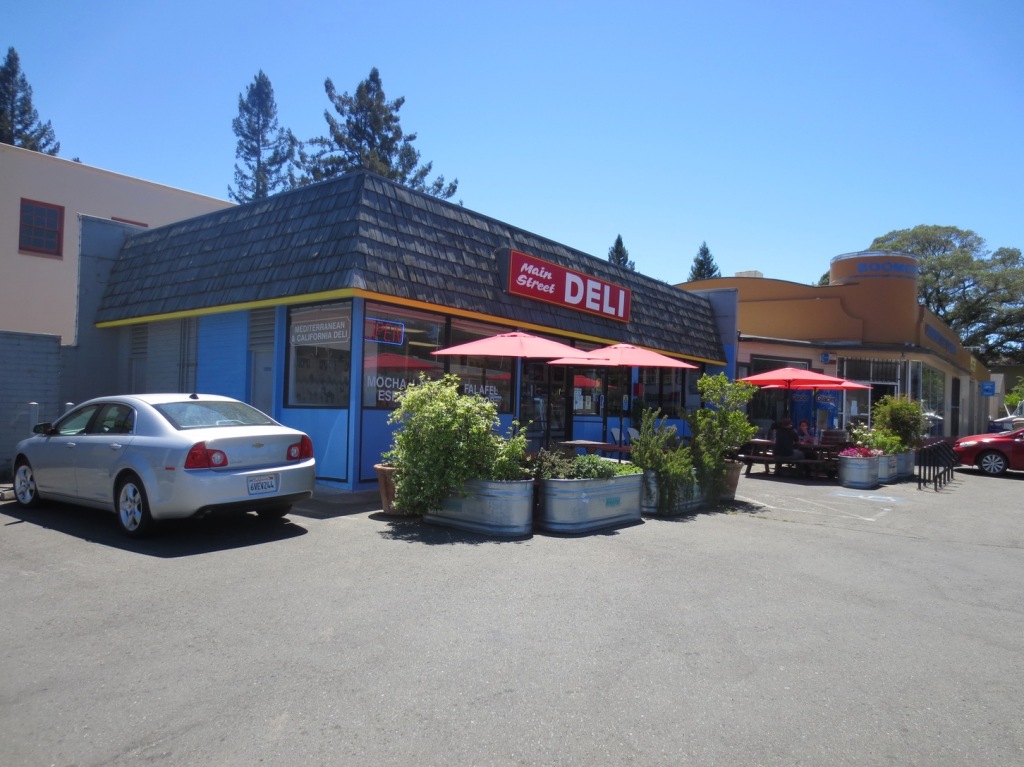
    The weakest aspect of suburbia has always been the impoverishment of the public realm. Suburbs are first and foremost about private space. In order to become more vibrant parts of the suburbs need to be activated with shared community spaces. These strip mall parking lot cafes may not resemble Paris, but they do the job in a straightforward cost effective manner. The food is good. The company is pleasant. Commerce and culture can start to take baby steps. If many more such places are allowed to gradually evolve and connect they might eventually turn in to something more refined and dynamic.

    Screen Shot 2016-02-01 at 2.52.37 AM

    Screen Shot 2016-02-01 at 2.53.06 AM

    There will always be people who prefer to drive no matter what. And the suburbs do provide serious challenges when it comes to alternative forms of mobility. Public transit rarely works well in dispersed sprawling environments. Honestly, I don’t think it’s worth even trying to serve most suburban neighborhoods with transit. But knitting together the viable parts of suburbia with bike infrastructure is so incredibly cheap that it’s worth doing in places where people value the option. Most folks may still drive, but they may not need to do it nearly as often if walking and biking are at least reasonable options.

    Screen Shot 2016-02-17 at 1.10.51 PM

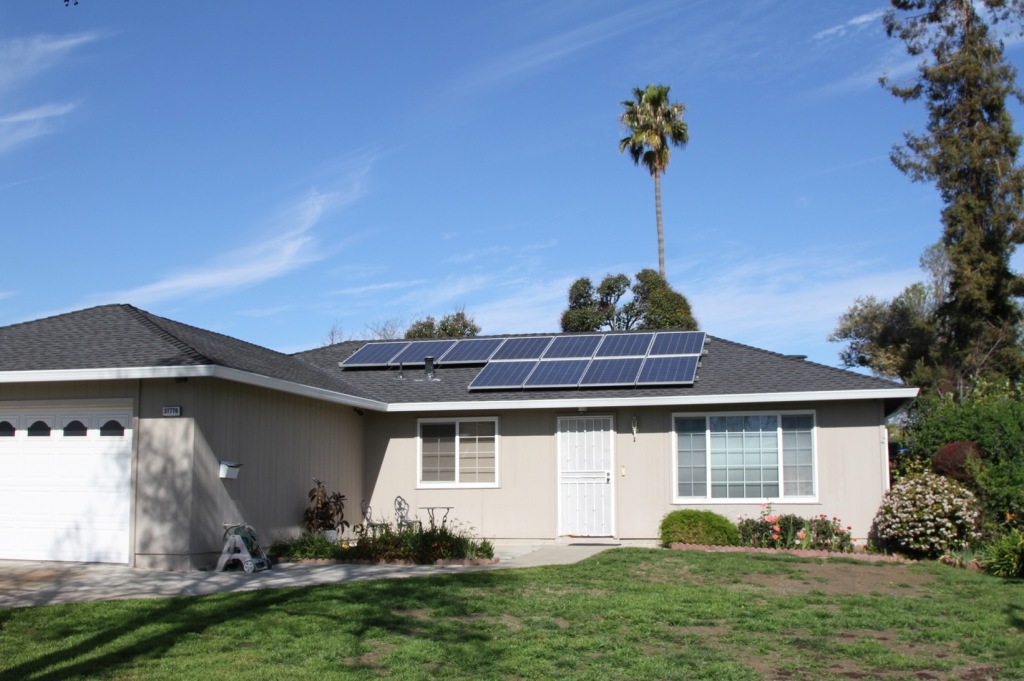
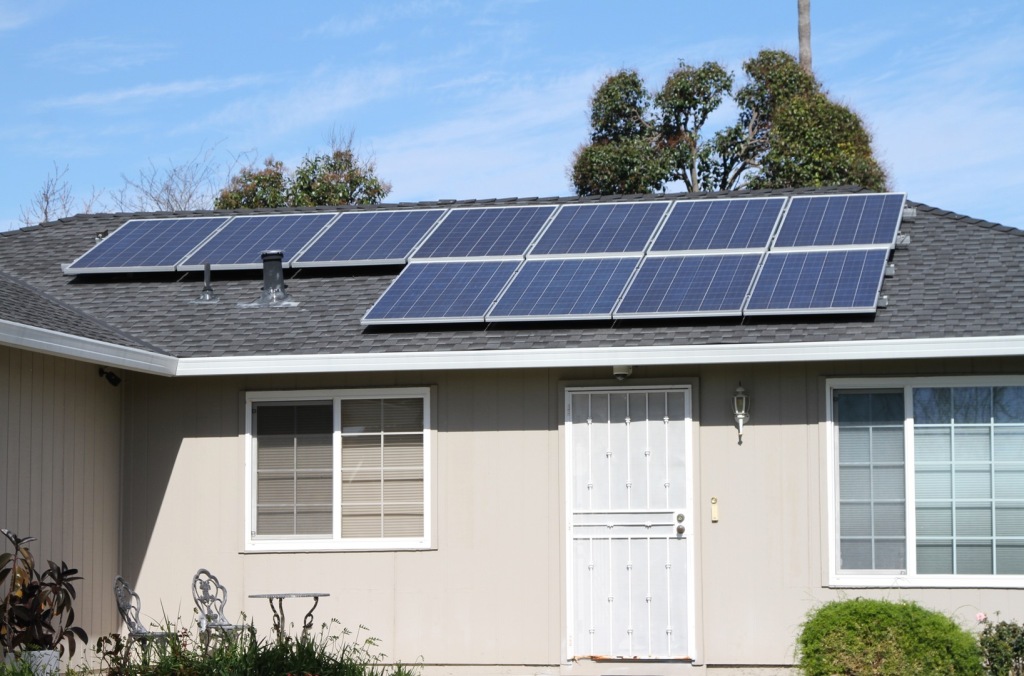
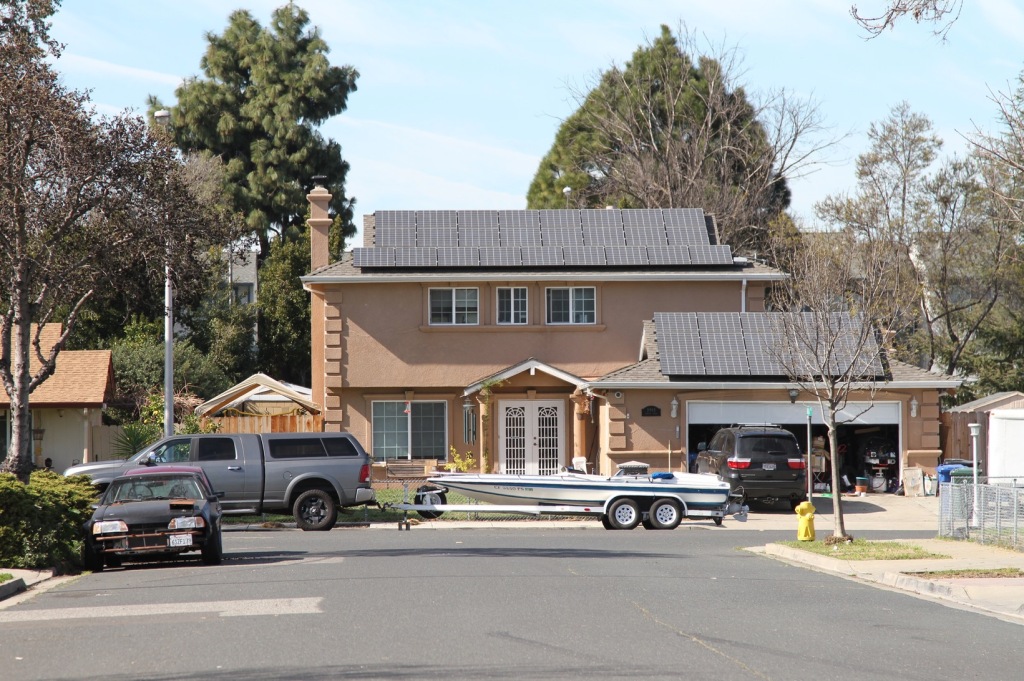
    While I’m at it, I’d like to describe what isn’t sustainable. Massive solar arrays on suburban rooftops appear to be a step in the right direction. But look closer. This homeowner could have installed far fewer panels and spent the remaining money on added insulation and energy efficiency instead. But being frugal and productive was never really the goal here.

    Screen Shot 2016-02-17 at 1.12.17 PM

    Screen Shot 2016-02-17 at 1.11.46 PM

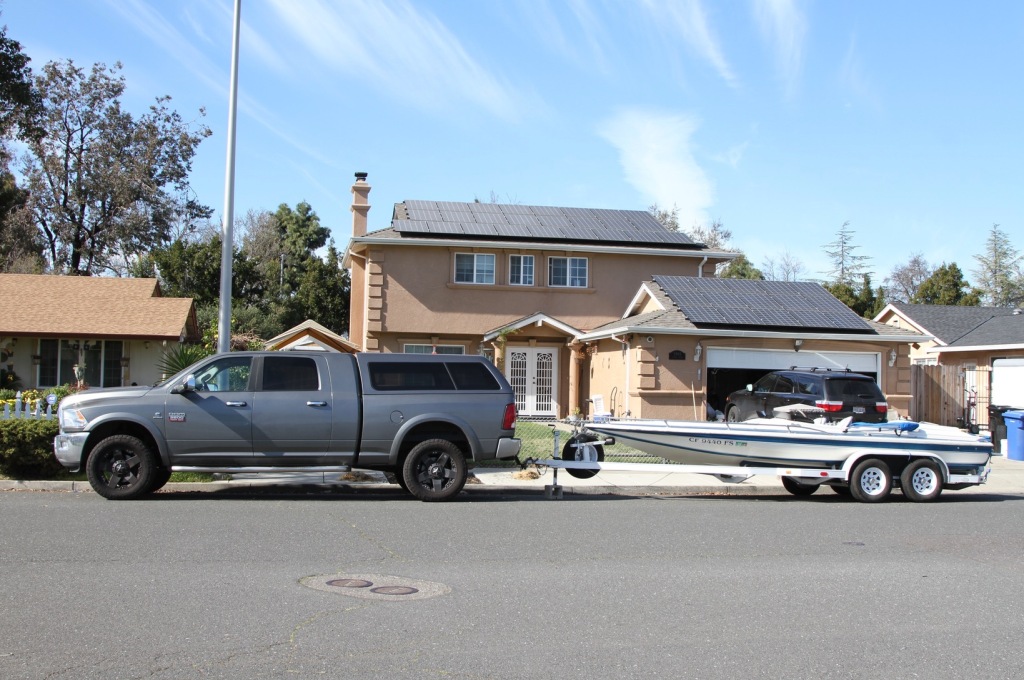
    Next to the sterile lawn are all sorts of toys that run on liquid fuels. I’m not saying people shouldn’t have playthings. I’m saying these items are expensive and disposable and were almost certainly bought on credit. The extended cab pick up truck has never seen a sheet of plywood, an eight foot length of pipe, or a bale of hay. It’s sport. Not utility. The speed boat isn’t exactly built for fishing. This is standard suburban debt and consumption. It’s fragile and unlikely to hold up well over the long haul.

    John Sanphillippo lives in San Francisco and blogs about urbanism, adaptation, and resilience at granolashotgun.com. He’s a member of the Congress for New Urbanism, films videos for faircompanies.com, and is a regular contributor to Strongtowns.org. He earns his living by buying, renovating, and renting undervalued properties in places that have good long term prospects. He is a graduate of Rutgers University.

  • Designing Suburbs: Beyond New Urbanism

    This essay is part of a new report from the Center for Opportunity Urbanism called “America’s Housing Crisis.” The report contains several essays about the future of housing from various perspectives. Follow this link to download the full report (pdf).

    It is not primarily the fault of land developers that the American suburbs are thought to be dysfunctional and mundane. The blame belongs largely to the influence of boiler-plate zoning regulations combined with design consultants who seek the most minimum criteria allowed by city regulations.

    Yet for all its problems, decade after decade 80% of new home purchases are not urban, but suburban. Some (architects, planners, and university professors) suggest we should emulate the dense growth of other nations not blessed with the vast area of raw land within our country, yet most of those countries as they prosper strive to emulate our American suburbs.


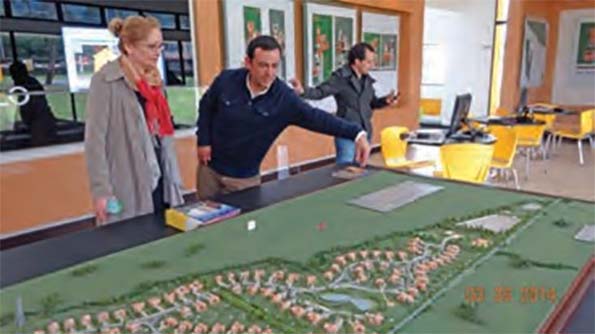
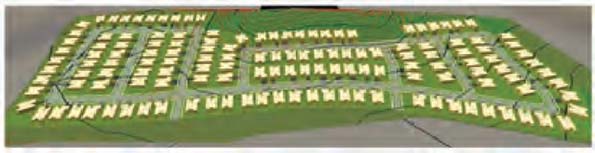
    Figure 1 A model in the sales office of a new Suburban Development by AMARILO in Bogota, Colombia

    The planning of our cities is about design. Yet, for the past quarter century a highly organized group consisting mostly of architects (acting as planners) have pushed a New Urbanist agenda that is as much about social engineering as it is design.

    Their ’The Congress of New Urbanism’ (cnu.org) preaches of the world to come where all people of all races and incomes live in harmony along straight streets where densely compacted homes are aligned perfectly along a tight
    grid. This ’New Urbanism’ is exactly how cities were designed before contemporary suburbia. In this sense they are not so much new, but as they themselves suggest “neo-traditional”.


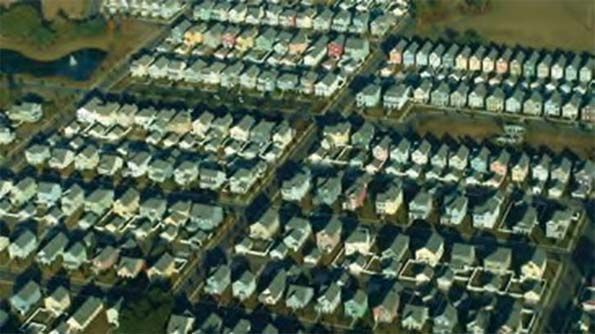
    Figure 2 A new development near Charleston, South Carolina using New Urbanism Design Methods

    To convince others of the evils of suburbia they present the worst suburban examples lacking proper design as emblematic of their essence. Their solution is to forever banish suburban growth by whatever means necessary—usually through regulation — that essentially eliminates choice for the  consumer.

    For most urban planning professors there appears to be just one singular solution: ever higher levels of density and a return towards the urban core. Young students study such models but, from my experience as a land planner, are grossly under-educated about what works in suburbia, where the majority of growth has been, and, short of a total political triumph of “progressive” planners or another catastrophic recession, will continue to take place.

    One tragic result of this anti-suburban meme is that very little attention is played to how to improve suburban development, where design standards have stagnated since the mid-1950s. That is, until now… A new era of innovation made possible by technological advancements solves most, if not all, of the suburban growth problems, in a manner that deflates
    the New Urbanist ’one solution fits all’ agenda.

    DENSITY HAS NOTHING TO DO WITH DESTINY

    Density is the most misunderstood and misrepresented excuse  to attack suburban growth. Density and affordability are two very different concepts.

    New Urbanists argue their high density solution allows people of all incomes to live in harmony, yet finding any affordable (non-heavily subsidized) dwelling in a New Urban development is highly problematic. The CNU boasts of their gentrification which by definition means upper income.

    It turns out that diversity has nothing to do with ’design’ and everything to do with people wanting to live in neighborhoods with others, like themselves. Many conventional suburbs are far more diverse in terms of class and ethnicity than new urbanist communities, or revitalized parts of  our downtowns.

    Similarly, restricting how many families can be sardined into an acre of land (the definition of density)  has absolutely nothing to do with affordability—if it did the New Urban projects would be the most affordable, not the most expensive.

    New Urbanists are quick to point out the sprawl of new growth, completely ignoring today’s environmental restrictions. If cities of the past were designed using today’s wetland preservation (and buffers), shoreline buffers, slope restrictions, tree preservation, open space targets, and detention ponding, they would have sprawled also. Cities built with 2015 restrictions would likely consume 1/3rd more land area than if planned using 1915 restrictions. Much of today’s sprawl is due to environmental restrictions which have counter-productive side effects—higher housing costs, less convenience, and more commute time.

    Those arguing against sprawl fail to recognize that a suburban land developer’s main goal is to maximize the number of units on their site, not build the least homes. Consultants hired by the developer assume maximum profit is achieved by the greatest number of homes, thus decreasing sprawl. If a developer could increase profits by proposing a 20 story multi-family building on their suburban tract of land they would seek an approval. But this runs up against demonstrated consumer preference: suburban dwellers do not commute to be on the 18th floor of a high-rise, instead they seek the most home on the largest lot within their budget.

    However, a suburban problem is that higher density too often relates  to ’cheapness’, and can result in unsustainable growth as characterless projects decrease in value over time.


    Figure3 Unfortunately suburban higher density often equates to substandard housing as this example in Fargo, North Dakota

    Developers will submit site plan proposals based upon market conditions. If the market desires large lots with estate-sized homes, that is what they will pursue. If the market desires dense single family homes with no usable yard squeezed in at six per acre that’s also what they will pursue.

    However, because of possible forced regulations by New Urbanist, in some instances the developer may not have a choice but to submit a proposal with excessive densities when there is no market demand.

    For example, in 2014 we designed a 60 acre site in Lake Elmo, Minnesota at a mandated high density. The city was forced by court order to adhere to density mandates of the Metropolitan Council, an agency who controls both transportation and sewer service for a seven county region surrounding Minneapolis and St Paul. In order to get approvals we had to design narrower than usual single family lots including high density multi-family.

    However, the developer could not secure a viable multi-family builder as the market demand favored only single family. Luckily the site was located next to a medical clinic, so a high density senior housing building was proposed and was marketable, however, the single family homes would be harder to sell with a towering building in their immediate back yard. Other developers were forced to submit hundreds of multi-family units housing without residents to buy them.

    That is why the New Urbanism movement and their Smart Growth agenda is so dangerous, they lead to instances where choice in density and in some cases design standards, is no longer a developer’s option.

    IDENTIFYING ACTUAL SUBURBAN PROBLEMS

    In most of the country, city regulations allow various uses (Land Use) be placed within a certain defined boundary or zone (Zoning). Each ’Land Use’ will have a set of minimum setback distances between structure and lot property lines for side, front, rear yards, and minimum lot size.

    The problem with suburban zoning is that it encourages placing the highest density (the most families) in the worst locations, and the lowest density (least families) in the best locations. What constitutes the worst locations? Along noisy highways, behind loading docks of strip malls, and near loud railroad tracks. Somehow this ’transition’makes sense to City Planners who advise municipalities on growth.

    Prime development land would have city water and sewer as well as provide great schools. For example, a non-serviced farm has low value, but when sewer service extends to the 80 acre corn field, developers are likely to come a calling enticing the farmer with a lucrative offer. After securing the land, the very next step is to ’plan’ the project
    for submittal, most likely contracted with the local civil engineering firm.

    In order to secure their lucrative engineering fees, the consultant offers to design a quick layout (typically for free) using the regulations most minimal dimensions to maximize the number of homes allowed on the site for a given zoning classification.

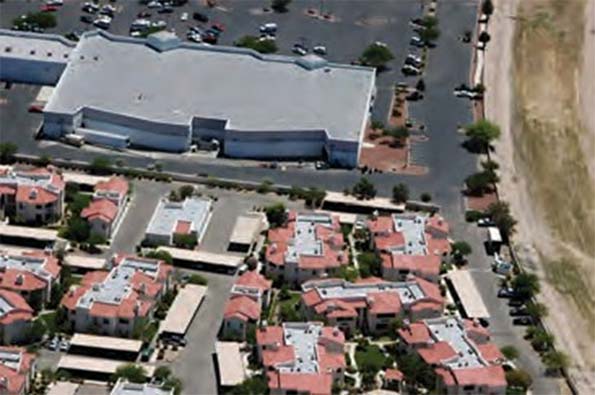
    Figure 4 How ironic is it that placing  high density in the worst location (overlooking loading docks) somehow makes sense?

    Quality of living, vehicular and pedestrian connectivity, curb appeal, views from within the homes, and more are rarely implemented in the above scenario. Nothing in the cities minimums-based regulations require anyone to strive above ’average’! To make this bad situation worse, the ’planner’ of that 80 acres is likely to use an automated CAD software system to produce a site plan in minutes using preset configurations guaranteeing the cookie-cutter look of suburbia, thus what is called ’land planning’ is simply reduced to basic drafting geometry lacking any design sense.

    Advances in technology have improved almost every aspect of today’s living—but for land development, current software solutions have done far more harm than good.

    Unanimity in ideology, and lack of innovation prevented us from addressing how to improve the places where most Americans reside.

    No universities concentrate on suburban design—only dense urban design. There’s little new knowledge about how to develop for the vast majority of people. Not surprising then, that a new development being proposed in 2015 is likely to be ’planned’ worse than one designed in 1955!

    Today’s generations of designers (CAD operators) lack the passion to move the land development industry forward into a new era. We desperately need a properly trained new generation of consultants and architects who focus on how to make suburbs work better, more sustainably and, not to be forgotten, make a profit for the developers.

    DESIGN CANNOT PROGRESS IN A NON-COLLABORATIVE INDUSTRY

    For typical suburban and urban planning, a house is envisioned as a simple rectangular footprint only. The four main professions of land development design: architecture, civil engineering, land planning, and surveying tend to fail at both communication and collaboration, even when they all work for the same company. This problem is made worse by universities that teach multiple disciplines and enforce the barriers when students graduate. You would think architectural students would participate with engineering and planning students on the same projects to learn collaboration, but that is not the case. This lack of collaboration stagnates progress in land development.

    A RECIPE FOR SUSTAINABLE GROWTH

    ’Sustainability’; that meaningless buzzword everyone uses on their company brochures generally avoids any real definition. Solar panels and rain gardens in inefficient neighborhood site design is hardly sustainable. However, if a developer builds a more efficient neighborhood that increases living quality maintaining its value and desirability over a long life span, it’s the definition of ’sustainable’. So, given all of the problems stated above—how is it possible to achieve it?

    DESIGN FOR PEOPLE FIRST

    Instead of using a software package to whip out a 200 lot site plan in less than 5 minutes, the land planner must place themselves in each and every home. They must imagine themselves in that space.


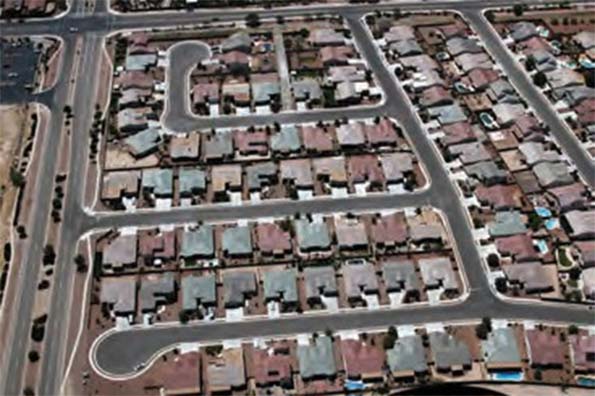
    Figure5 A new suburban project near Tucson – what quality of living do these residents have – really?

    The land planner must be passionate about those that will live in the neighborhoods they design and realize that their living standards, safety, and investment are strongly influenced by the planner’s efforts.

    So we have to focus on very basic parts of what constitutes everyday life. What quality is the view from within the living spaces of the home? Does the street design allow a safe transit through the neighborhood maintaining traffic flow, or must the drivers contend with multiple intersections, sharp turns and pesky (trendy) roundabouts that only serve to increase both drive time and energy use? Do pedestrians cross at dangerous 4-way intersections and have only streets to walk near, or is there a dedicated pedestrian system that avoids conflicts with vehicles?

    Are architectural details implemented to increase the beauty of the streetscape and to maximize the financial return for the residents? Will the neighborhood deliver a sense of pride at all income levels?

    None of the above can be achieved by shoehorning in every home allowed by regulation minimums. It’s also not possible to reach those goals without a more collaborative relationship between the various consultants at initial concept design stage. No software program can automate any of the above. Professors need to teach good land planning design— not social engineering using methods of city planning from centuries ago.

    THE MORE PROFITABLE SUSTAINABLE NEIGHBORHOOD

    Putting people first seems like a  noble goal, but won’t all that functionality destroy the developer’s profits and make suburban growth just as risky as the New Urbanism? The key here is to realize that to achieve higher profits and greater efficiency, you don’t have to change the regulatory minimums, but actually seek to exceed them.

    Consider the following: Suburban planning and New Urbanism places every home at the most minimal setback guaranteeing monotony and restricting views from within the homes. Structures are placed as close as possible to the outermost boundary of a tract for densification. Streets parallel each other in a straight or curved pattern as the design of a neighborhood begins at the perimeter and builds inwards until all land is consumed. Thus ’land planning’ is reduced to simple geometry.

    Unwittingly, this scenario not only maximized how many homes fit on the site, but also maximized the length of infrastructure (street paving, sanitary and storm sewer, utilities, sidewalks, etc.). The consumption of developed land typically forces re-grading (earthwork). Earthwork costs quickly destroy profits (not to mention trees, natural waterways, and any character of the existing land).

    For centuries it’s been assumed that the most minimal dimensions were the most efficient way to design. A discovery make in 1988 proved otherwise. We discovered that separating the pattern of the homes front setback line (which typically parallels the street) with a different street pattern could maintain density while significantly reducing the length of street for any given set of minimums. The discovery was unintuitive—simply provide more than the regulatory minimums and efficiency is gained—not lost!

    The resulting streetscape created a park-like setting with undulating open spaces in ’coves’, thus we coined the  term for the method: Coving. This initial discovery led to scores of innovations that solve most suburban problems deflating arguments against suburbia.

    We designed over 1,000 neighborhoods in at least 47 states and 18 countries contracted by over 300 land developers, those who desired to advance both suburban growth,as well as those involved in urban redevelopment.

    EXAMPLES OF FUTURE SUBURBIA BEING BUILT TODAY

    The following neighborhoods will help explain the benefits of the many innovations that grew out of the discovery of coving.

    Example #1: The Enclave of Westpointe – New Braunfels, Texas

    Below is the actual approved ’before plan’. With changes in water detention mandated by the city, there was 136 lots and 7,461 lineal feet of public street. There was 19 lots adjacent to the 7 acres of park. The typical lot was 8,000 square feet.


    Figure 6 The original APPROVED plan for The Enclave at Westpointe

    No developer or city would question the efficiency of the above design.

    However, there is an enormous amount of waste in the design. Did you instantly recognize it? Neither the designer nor those at the city saw how wasteful the design is because recognizing unintentional design waste is counterintuitive and certainly not taught in planning schools.

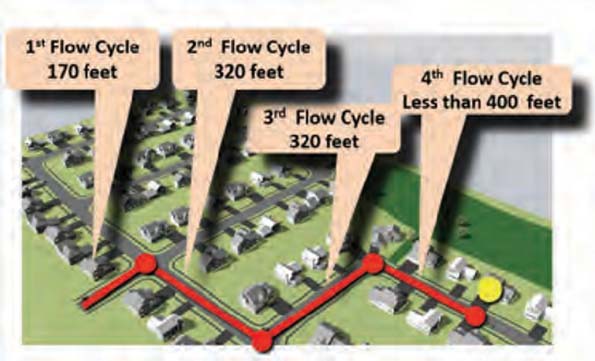
    What about travel to and from most of the homes? One of the discoveries was due to research in traffic flow. Newton’s law: A body in motion tends to stay in motion. To get that body in motion (your car) takes an enormous amount of energy to reach the 25/30 MPH typical of residential streets and each stop repeats the waste. This process of acceleration to efficient cruise and stop will consume 400
    feet and take approximately 20 seconds (called a ’flow cycle’). The drawing below proves for most residents the multiple intersections they encounter destroy flow. What at first looks efficient… is not.


    Figure7 Short runs with stops and turns destroys f low and wastes both time and energy

    Still trying to see the waste? An efficient street has homes that front both sides, but on the above plan much of the street is consumed by side yard. This waste consumes available land with Right-of-Way and pavement, thus to maintain density the smallest possible lot must be designed. Now look at the reapproved redesign:


    Figure8 The After Plan of The Enclave at Westpointe

    The redesign has only 4,973 lineal feet of public street reducing the infrastructure by 33%, or approximately $300,000 less construction costs. The original plan had only 19 premium lots (abutting open space). The redesign has 85 lots backing into open space (all lots are more premium), resulting in $600,000 in added value. The 136 lots average 9,395 square feet (15% more than the original typical lot), and a savvy engineer would have easily reduced both storm sewer and earthwork costs. The streets ’flow’ reducing time and energy while the wide elegant meandering walks invite a stroll. The city wins with 33% less maintenance costs and a higher tax base, the developer benefits, but most importantly the people investing in living in the neighborhood and those they will eventually sell to also benefit.

    Example #2: The Sutherlands – Louisiana

    This site is both long and narrow, never a good combination to design a good site plan. Most land planners simply squeeze lots to the most minimal depth to maximize density:


    Figure9 The original plan for submittal for The Southerlands

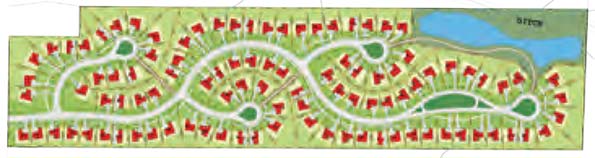
    The above site plan has 91 lots requiring 5,200 feet of street (just short of a mile). At the time of this writing a lineal foot street infrastructure in the Lake Charles area was $600. Thus about $34,000 in infrastructure alone per lot, not including the cost of the land or site grading (earthwork). Because of the tight distances at the entrance, the previous planner decided to place the smallest lots at the entrance cheapening the image of the development at the most important spot—the front door. The above plan lacks any sense of arrival.

    The discovery of coving made it possible to rework even the most difficult of sites into a better place to live as seen below in the approved new neighborhood design:


    Figure 10 The resulting redesign was approved in less than 2 months!

    The new redesign creates a sense of arrival which continues all the way through the back of the neighborhood. The wide walks at the end of the cul-de-sacs are designed to handle emergency vehicles providing alternate access without having to build excess streets, while also providing increased pedestrian connectivity.

    The oversized cul-de-sacs contain parks in the middle and towards the end of the road is a split island that adds landscaping and park-like space. You may think that all of this would be far too expensive to build. However the length of street plummets to 3,999 feet and there was a gain of 8 lots while also eliminating the low value miniscule lots at the entrance. The length of street suggests a construction savings of $720,000 the oversized cul-de-sacs as well as the elegant street island and wide walks serving as alternate emergency access does add some costs. The increase of 8 lots goes directly to the developer’s bottom line, however, and the added tax base to the city with reduced ongoing maintenance costs is of great advantage for the municipality.


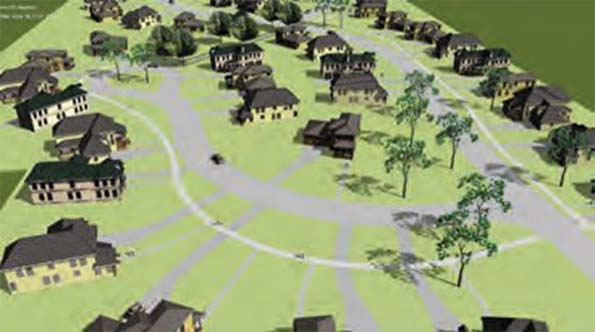
    Figure 11 Beauty and space is no longer a privilege of the wealthy

    The residents all live in a unique elegant estate-like setting with large yards and great views from within their homes. The park-like streetscape with the wide meandering walks and even wider trails invite a stroll.

    Both examples used coving to maintain street frontage along the setback line while reducing the length of street and related infrastructure.

    Coving allowed (for the first time in the history of planning neighborhoods) compliance with existing regulations by exceeding minimum expectations and reducing construction costs, all while providing more space for homes at an equal density compared to conventional land subdivision. The cost reduction for site construction allows more funds to be used in other aspects of the development such as architectural detail, insulation, windows, landscaping, and as in the case of The Sutherlands creating landscaped islands to add neighborhood character and interest.

    Example #3: Sundance Village— Dickinson, North Dakota


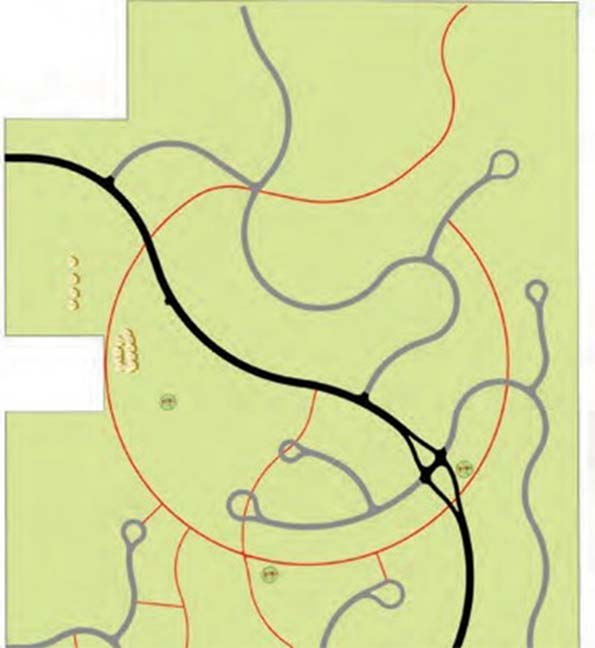
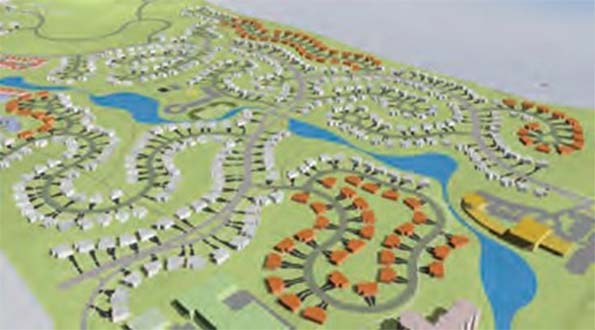
    Figure 12 The 305 acre Sundance Viallge showing main circulation


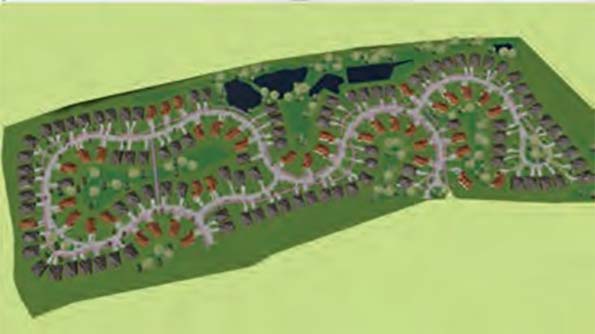
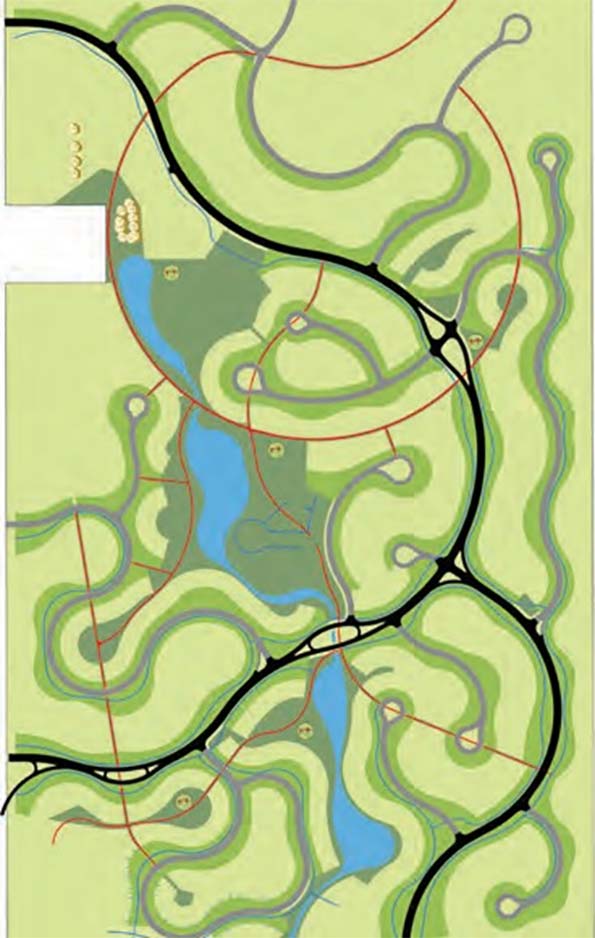
    FIgure 13 Sundance Village Linear parks & cascading ponds.

    This next example is of a larger community. The last two examples were small sites explaining basic premises of this new era of design on relatively flat tracts of land. The same concepts to reduce infrastructure, maintain flow, and provide pedestrian connectivity scale up and down as the available acreage changes.

    Larger sites can create more function and variety as well as more opportunity. This 305 acre site will house almost 1,000 families and provide a variety of services within walking distance.

    The plan above shows the main trail interconnections (red) as well as the major internal streets (black) and minor streets (grey).  The main trails cross the major streets at ’diffusers’ which provide a safer crossing while maintaining traffic flow.

    Almost all residents can get home with one turn or less (terrific ’flow’).

    Unlike a round-about that disrupts all traffic, a diffuser maintains flow on the higher volume street reducing time and energy, but the real advantage over the roundabout is much safer pedestrian crossing.

    Most suburban cities require a percentage of the site as open space. This may be in dedicated city park or spaces exclusive to the use of the residents within the development. Each city will be different in their open space requirements. The park areas (dark green) in this particular neighborhood follow the contours of the land. The north part (upper part of the map) is on top of a hill allowing sledding (this is North Dakota!) or kite flying, and the remaining parkland follows a cascading ponding system along lower elevations. Both the trail system and drainage lead to a retail center at the southwest corner of the land (lower left). This method of design embraces the terrain and reduces storm sewer costs by embracing natural drainage flow.

    To solve the problems of exclusion caused by the typical suburban transitional zoning we simply reverse the transition.


    Figure 14 Reversing zoning transition makes housing inclusionary—not exclusionary. White is Single Family, Orange is Duplex.

    Instead of having the highest density at neighborhood entrances, we place the lowest density and best housing at the front door. Disney’s Celebration, a New Urban design, does the same thing. As
    price points lower, those residents drive through higher priced housing creating a sense of arrival without cheapening the feel of the development or image of the city it’s located within. Single Family (white) large lots are along the main streets with smaller single family or duplex (orange) lots in pockets behind the single family. The main trails lead to a church (yellow), senior housing (pink), and retail (green). A school (not shown) is across the street from the church.

    Wide meandering walks add that special touch of elegance along the street and provide added sense of scale to the undulating open space adjacent to homes.


    Figure 15 Sundance Village: Creating a sense of arrival is very important

    Example #4: Rivers Edge— Sugar, Utah

    There is a good reason why, now, we can enter a new age of more sustainable growth. Just 40 years ago a single property intersection of a lot line with a curved street would require a half hour of tedious geometric calculations, encouraging the simpler designs of the past. Today, automated software can produce a 1,000 lot development in the
    same time span! Both suburban and New Urban design does not consider the living experiences within a home as tied to surrounding open spaces (if any).

    Figure 16 A San Antonio project by a National home builder—no attention to how the floor plan merges with open spaces..

    Figure 17 Same project as the above picture—but in aerial view. Where was ’passion’ in this land plan design?

    Instead of using software to produce a faster cookie-cutter plan, we can harness (and develop) technology to produce better neighborhoods. Technology makes it possible to discover better design models. New models provided the basis to create new forms of software and training. Both developers and cities have the opportunity to build better neighborhoods—if they are passionate about building better communities to invest the time and effort.


    Figure 18 This neighborhood in Orno, Minnesota uses the ’BayHome’ design method merging interior and exterior spaces.

    This next example demonstrates the evolution of planning which merges both site design and architecture, providing a significant market edge above competing home builders. This evolution allows neighborhoods to be designed to a much higher level of detail increasing efficiency, function, value, and livability.

    In 1999 Professional Builder Magazine called the BayHome method of design ’New Urbanism with a View’. It was the first time (ever) in planning, that the floor plan became a major component of the neighborhood design. This meant that communication and collaboration between all consultants (planning, architecture, engineering, and surveying) became critical at the initial design stages (also revolutionary).


    Figure 19 BayHome: living space expands to adjacent open spaces and scenic views, merging planning and architecture

    With just a handful of floor plan options, placing homes in a staggered relationship allows significant views both front (porch side) and side of every home. The staggering eliminates the ’alley’ look of a rear serviced home while providing space for two and three car garages.

    BayHomes hide parked cars and garage doors, improving the look of the street and the neighborhoods.  However, they are alternatives to attached housing such as townhomes and duplex units because the yards are common as well as the maintenance of them. To achieve this design they are platted as townhomes, not traditional single family lots along a public street.

    This example, Rivers Edge is typical of how BayHomes are utilized on typical suburban neighborhoods. Like normal single family homes, there are very little economic barriers serving low and high income families.


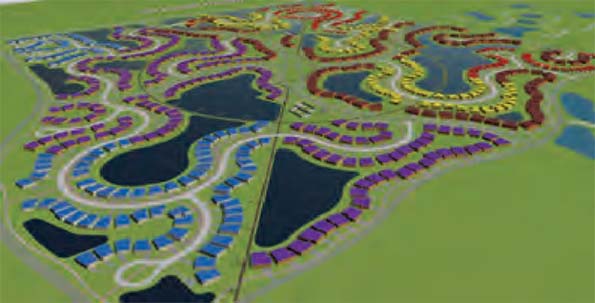
    Figure 20 Rivers Edge in Sugar, Utah uses BayHomes along the arterial street (lower right) and along the river (rear of the site).

    The success of BayHomes with their attention to detail allowing expanded views influenced us to wonder: Why not have this attention to detail on every home?


    Figure 21 The Fellowship Church redevelopment in Detroit shows low income ADA BayHomes to house disabled Veterans.

    Example #5: Viera—Melbourne area, Florida

    Viera in Melbourne, Florida takes land development design to a much higher level.


    Figure 22 The original Viera architecture placed along the 35’ wide lots of the ’before’ plan would have appeared as above

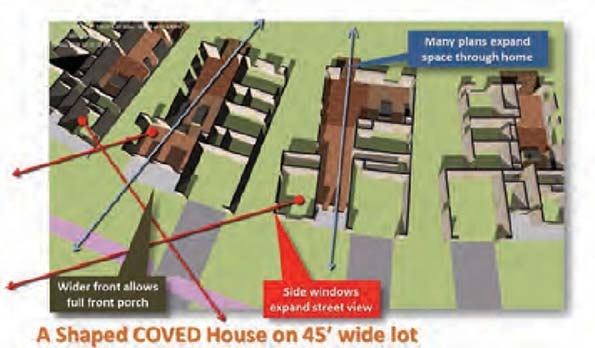
    Not only does Viera harness all of the above methods of design, it also incorporates the coordination of architecture to lot shape, eliminating the largest problem in high density, narrow, single family lots (suburban and New Urban): reduced curb appeal and views. By coordinating both architectural design and creating a consistent angle between interior and exterior ’coved’ lots, the home can be widened at the front or rear:


    Figure 23 A narrow home no longer has limited floor plan options nor the garage dominant streetscape using ’shaping’

    What makes Viera unique and revolutionary, is that both developer and builder decided to throw out all the existing rectangular floor plans and make every home have the benefit of home-to-lot shaping! The resulting neighborhood when it is built by mid-2015 will certainly challenge competing homes being built at similar densities.


    Figure 24 Viera Homes on the same 35’ wide minimum width as the before plan (similar density) as shown on Fig. 22!

    Viera clearly demonstrates the advantages of advancements in home and land development design made possible when the consultants collaborate to take the extra effort and attention to detail needed to create sustainable suburban neighborhoods that will rival the New Urbanism, without waging war on suburbia per se.


    Figure 25 Viera was the first development of many since that takes form and function to the next level.

    From an economic and environmental perspective, Viera demonstrated a 38% reduction of infrastructure compared to the before  plan (loosely based on New Urban design).

    CONCLUSION

    If land developers stopped contracting (paying) engineering consultants for mundane plat geometry to regulatory minimums and demanded better, change would be immediate. If universities taught design and collaboration instead of social engineering, we would have hope for a better future, both suburban and urban. If consultants imagined themselves living in the neighborhoods they design, we would have change. Complacency—not the idea of suburbia—is the primary cause of unsustainable growth. Suburban developers today must rediscover of the innovation that characterized the first wave of builders, who created, however imperfectly, an unprecedented wave of property ownership and privacy. Our challenge now is not to reject suburbia but to look for something that goes beyond replicating tradition, but actually improves how we live and interact with the natural world, and each other.

    This essay is part of a new report from the Center for Opportunity Urbanism called “America’s Housing Crisis.” The report contains several essays about the future of housing from various perspectives. Follow this link to download the full report (pdf).

    Rick Harrison is President of Rick Harrison Site Design Studio and Neighborhood Innovations, LLC. He is author of Prefurbia: Reinventing The Suburbs From Disdainable To Sustainable and creator of Performance Planning System. His websites are rhsdplanning.com and performanceplanningsystem.com.

  • “To the Suburb!” Lessons from Minorities and the New Immigrants

    This essay is part of a new report from the Center for Opportunity Urbanism called “America’s Housing Crisis.” The report contains several essays about the future of housing from various perspectives. Follow this link to download the full report (pdf).

    When I was in college the suburbs were vilified. It was the mid-2000s, and here we were, enlightened coeds having one last hurrah in the flat Midwestern expanse before finding our place in the world, and there really was only one world to find: the city.

    A lot was fueling this. Some of us were reacting to Walmart childhoods, the big box strip malls a symbol for all that embarrassed us about America – corporate consumerism, excess materiality, a primacy on efficiency over heart. Others found in urban contrasts a call to heal social divides. But whether motivated by altruism or hipsterdom, the city seemed like the only place to live a meaningful, “authentic” existence. We were taught that the suburbs were vanilla, bland, buffers for Boomers to hibernate with their own kind. Cities, by contrast, offered risk, adventure, diversity and grit.

    Fast-forward a decade, and these differences have faded and even reversed. Sure, cities in the mold of New York, San Francisco, Chicago and Los Angeles still appeal to the young and mobile. But, lately, as housing prices in the most appealing urban cores skyrocket across the country, metropolitan centers find their middle class aspirants fleeing for greener and less expensive pastures.

    Today, many suburbs are remaking themselves as formidable incubators for social mobility and globalism, their sprawl punctuated by street signs in other languages, strips of ethnic eateries, self- confident civic innovation and a fresh aura of hope.

    This suburban blossoming represents an underreported shift in settlement
    patterns of our new immigrants and minorities. Where “To the city! To the city!” was the unquestioned mantra of newcomers landing on Ellis Island in  the first wave of mass migration between 1880 and 1924, today’s Latin Americans, Asians, Africans and African Americans are voting with their feet in a new direction. “To the suburb!” – if it didn’t sound like a minivan’s whimper – would be the banner of the day.

    SOME FACTS

    It would take a hermit lifestyle not to notice the demographic sea change that’s swept the United States over the last three decades. European immigration, once the mainstay of growth for the U.S., fell 32 percent, even amidst the continent’s hard times, from 2010 to 2013. In 1980, Mexicans accounted for the most populous group of foreign-born at 2.2 million, followed by Germans at 849,000. By 2010, the Mexican population had more than quintupled while European immigrants had fallen from being 36.6 percent of the total foreign- born population in 1980 to 12.1 percent in 2010. Mainland China now follows Mexico at 2.2 million, with Indians and Filipinos close behind at 1.8 million each. Today, the sending regions with the largest numerical increases in the number of immigrants living in the United States since 2010 are East Asia (up 642,000), South Asia (up 594,000), Sub-Saharan Africa (up 282,000), the Middle East (up 277,000), the Caribbean (up 269,000), and Central America (up 268,000).

    The swell of these “new immigrants” has revived perennial American questions around national identity that ever undergird our migration policy debates. The issues touch almost every region, with suburbs and smaller cities in the country’s interior feeling them most acutely. Where Los Angeles, New York City and Chicago were once the obvious gateways to build an American life, now the cities in the South and West are increasingly attracting the foreign-born. Since 2000, 76 percent of the growth in the immigrant population has occurred in these smaller metropolises, with Pittsburgh, Indianapolis, Oklahoma City and Columbus growing the fastest. A related trend is that as of 2007, four in 10 immigrants now move directly from overseas to the suburbs, eclipsing the urban experience that had always been the landing pad.

    The Brookings Institution came out with an important report last year detailing these shifts. In 2000, more than half of the nation’s immigrants lived in the suburbs of our largest metros. According to census data from 2000-2013, that number is now up to 61 percent.

    More than a third of the 13.3 million new suburbanites between 2000 and 2010 were Hispanic, with whites accounting for a mere fifth of suburban growth in that same period. Between 2000 and 2012, the Asian population in suburban areas of the nation’s 52 biggest metro areas grew 66.2 percent, while that in the core cities grew only by 34.9 percent. African Americans have also been steadily moving from inner cities to the suburbs. The 2010 Census showed that each one of the nation’s 20 largest metro areas saw a significant decrease in their proportion of black residents, with African Americans as a group shrinking from 65 percent urban in 2000 to 49 percent in 2010.

    The regional details are even more striking. Since 2000, the suburban immigrant population has doubled in 20 metro areas. In 53 metro areas, the suburbs accounted for more than half of immigrant growth, including nine metros in which all of the immigrant growth occurred on the periphery: Chicago, Cleveland, Detroit, Grand Rapids, Jackson, Los Angeles, Ogden, Rochester, and Salt Lake City. Atlanta and Seattle, long skirted by immigrants and even now ranking outside the top 10 largest immigrant destinations, each added more immigrants to their populations than did Chicago, San Francisco, Boston, or Los Angeles. Crucially, since 2000, not one metro area has seen its foreign-born population in the suburbs decrease.
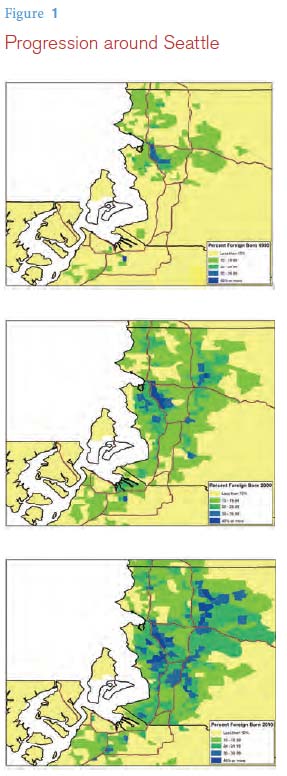
    What this means is that the suburbs as a whole are now equally, if not more diverse, than the populations living in most urban cores. They also are generally less ethnically segregated.  Go to a Starbucks in Sugar Land, Texas, and you’re more likely to stand in a line resembling the United Nations than anything you’d find in the center of Manhattan. Same goes for Fairfax, Virginia, where the demographics far out-pixelate Washington, D.C. 29.5 percent of Fairfax residents are foreign born, compared to 13 percent in D.C. 16.4 percent of Fairfax’s residents are also of Hispanic origin and 19.2 percent are Asian, compared to only 10.4 percent Hispanic and 4 percent Asian in D.C.ix Irving City and Carrollton just outside Dallas see their foreign born comprising 35 and 28 percent of their residents, respectively, while Dallas proper caps at only 23 percent. In Washington State, 34 percent of Bellevue is foreign born, while Seattle’s foreign born stands at a mere 17.7 percent.

    It’s important to note that this movement to the periphery does follow overall population settlement patterns observed since 2000 – it is not simply an immigrant or minority phenomenon. As elite urban hubs suffer from high housing prices, experiencing then a widening chasm between the very rich and the very poor, the suburbs have become a harbor for the middle class to find more reliable footing. And while my suburban-raised college classmates and I turned our noses up at their presumed provinciality, an Aspen/Atlantic poll from three months ago showed that most Americans still consider a family-oriented, suburban neighborhood closest to their “ideal” in terms of where to live, with 53 percent of whites, 53 percent of African Americans, 53 percent of Hispanics and 63 percent of Asians aspiring to this future.

    Recognizing that immigrant and minority migration patterns mirror shifts undergone by the population at large, there remains a texture to the suburban shift specific to both the contexts and the aspirations of today’s immigrant and minority groups, a texture laden with distinct promises and challenges as many pioneer lives on a more sprawling landscape. Here is a closer look at why the New America is suburbanizing, and what this may bode for the future.

    THE CASE OF HOUSTON

    Take a drive westward from almost any major airport today and you’ll see these worlds unfurling. In Houston, now the most ethnically diverse metropolitan area in the country, its white population is increasingly concentrated inside the inner loop (particularly millennial singletons) with everyone else settling beyond. As of 2013, over half of the city’s immigrant population—56 percent—live in Houston’s suburban municipalities, with 80 percent of the growth of the area’s foreign-born population since 2000 occurring in the suburbs.

    This diversity shapes how I live.  One recent Sunday, after waking up at 6:30 AM for a game of tennis with some Vietnamese friends who’d trekked in to Houston’s inner loop from Sugar Land, I found myself traveling the world in a zip code. The court transitioned to church at an all-black Methodist congregation 32 minutes from Houston’s downtown, followed by a Peruvian brunch at a rotisserie chicken eatery sitting just across the street from a large Indo-Pakistani shopping plaza. I then wandered over to the neighboring Hispanic mall known as PlazAmericas before taking a right on Bellaire Boulevard to peruse flavors of shaved ice at Chinatown’s Dun Huang Plaza and sampling Korean pears at the pristine Super H, with Latino shelf-stockers backing the Korean cashiers. Café Beignets, a Vietnamese interpretation of New Orleans charm, nourished with fried dough in the middle of a “Saigon Houston Plaza” that seemed to take its aesthetic cues from Pottery Barn, Asian-accented. All manner of sacred architecture beckoned from behind the strip malls, with the Buddhist Teo Chew Temple peeking out from beneath the tree tops and a dozen Spanish and African-speaking church signs within view around the corner.
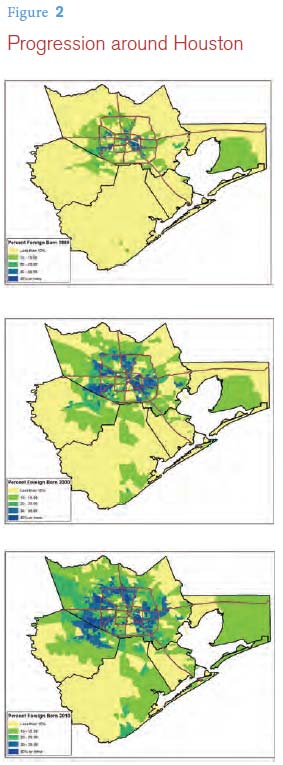
    This was all a suburban version of “verges” – the vortexes where civilizations clash and conceive a fresh dynamism. Only in this case it wasn’t Istanbul; it was the Beltway crossing route 59.

    Houston rightly carries a reputation as one of the most welcoming cities in the U.S. While cultural traditions from elsewhere are invited to express themselves, the first question most Houstonians ask is not, “Where are you from?” but “Where are you headed?” The environment is future-oriented, open and adaptable. Buildings are torn down one month and rebuilt the next. There’s something for everyone, and the more outsiders come for jobs and the hope to establish a stable and happy life, the more Houston is texturizing to reflect the values and needs of the globe within it.

    “I think Houston offers people an opportunity to entrench themselves,” says John Tran, a second-generation Vietnamese lawyer in his mid-thirties, living in Sugar Land, also the town of his childhood. “It’s one of those places that gives people time to assimilate at the same time that it also gives them time to develop their own identity.”

    The sprawl invites a tension to play out between tradition and innovation, stability and risk.

    “The message is: Do it your own pace, do it your way, you have a home here,” Tran says.

    This is a great opportunity as well for the realtors and homebuilders as they reinvent the sprawling landscape to suit the aesthetic tastes of their diversifying clientele. Local architect Tim Cisneros is currently working on a $10 million dollar Indian wedding facility in Sugar Land that will be capped by a helipad and bridge built to withstand an elephant’s weight for the groom’s entrance. Cisneros serves some of Houston’s most entrepreneurial immigrants, his portfolio including a Chinese museum of history and culture (“Forbidden Gardens”), multiple Indian restaurants and a Messianic Jewish worship center.
    Each project involves an anthropological education. Cisneros recalls:

    “When I was in the running to design a Daoist temple, I had to go to this ritual. They’d put the various names of the architect candidates into a calligraphic gold pot with sparks and smoke. My job depended on whether some karma favored my name.”

    Cisneros now calls Houston his “favorite third world city,” hinting both at its development potential and the ambience that appeals to today’s new immigrants. From the tropical climate, to the zone-free real estate possibilities, to the hodge-podge aesthetic that disorients and welcomes anyone looking to make a mark, there’s both a familiarity to those coming from the developing world but also a chance to enjoy greater personal space than they were allowed in cities like Seoul, Abuja or Delhi.

    “The immigrants we work with,” says
    Cisneros, “they think they’ve died and gone to heaven. They don’t get caught up in the fact that their father’s generation wasn’t born here.” There’s opportunity, and perhaps more importantly, a sense of limitless sky.

    THE PERCEPTION OF MORE CHOICE AND OPPORTUNITY

    For most of U.S. history, immigrants have been concentrated in iconic cities. Early waves of European immigrants initially moved into neighborhoods close to the factories and shops that employed them. Go to Manhattan’s lower east side and you’ll still catch a whiff of the German, Irish and Jewish flavor that defined this neighborhood at the turn of the 20th century. As increasing numbers of immigrants have flocked to the suburbs at the turn of this century, however, it’s clear the new immigrants are reshaping the geography of opportunity.

    To dig into this, I’ve spent the last few months interviewing national migration experts and district school superintendents, exploring the growing array of suburban social services and attending a wide variety of religious services and cultural celebrations in the most diverse county in the nation—Fort Bend, just west of Houston. What’s come to the surface, amidst all the variance in regional patterns of settlement, is the issue of agency. Choice, or lack thereof, is the fault line in the nationwide trend toward suburban living. Some move because they can and choose to – the suburbs have attractive features worth pursuing. Others are forced out as they’re displaced by gentrification, changes in local labor demand, and, sometimes, black-white racial tensions.

    “You’ve got two streams of immigrants flowing out of the urban core,” says Stephen Klineberg, founder of the Houston-based Kinder Institute. “One contains the engineers, doctors and information technology professionals, many of whom are Asians and Africans that enter this country with higher educational levels than many native- born Anglos, and the other contains the poor and uneducated, most of whom are black and Hispanic. Where the upper middle class of Asians and Africans tend to go where the property values are higher, where the schools are good and the jobs plentiful, [poor] blacks and Hispanics are increasingly being clustered in low-cost areas, getting pushed farther and farther out.”

    These ethnic delineations may be too sweeping — there are many upper income Mexicans and Africans, for example — but Randy Capps of the Migration Policy Institute at least agrees on the pattern. “Your distressed communities are going to attract people who have no choice,” he says. “The poorest people are going to be increasingly transient, namely, poor blacks and Hispanics.”

    For those with the capacity to move of their own accord, choice itself explains the reasons for the suburban move. Behind the practical appeal of lower housing prices, more jobs and better schools, every immigrant I interviewed alluded to the air of untapped possibilities that they no longer sensed in dense urban cores. The growing magnetism of a city like Houston, for instance, along with other suburban cities in the South and West, is in part rooted  in the sense that you don’t have to be a part of the establishment to move up. Social mobility is possible for those with the wherewithal to climb.

    “The American Dream is alive and well here,” said one restaurant owner. “If you want to make it, you can. I haven’t been able to find that possibility in other cities.” Other suburban dwellers agreed. “Urban density doesn’t grant easy permission for the imagination,” said a Vietnamese couple. “Suburban landscapes at least invite you to try to make your own mark.”

    THE IMPORTANCE OF HOME OWNERSHIP

    If more space and choice lie at the core of most minorities’ hopes, buying a home seems the first logical step to securing them. For immigrants in particular, transitioning from renter to homeowner is an important milestone in committing to the United States. The question is: Where is this transition now possible? And are immigrants and minorities more willing to take the  leap into far-flung coordinates because owning a home is more critical to their civic credibility than it is for today’s average native citizen?
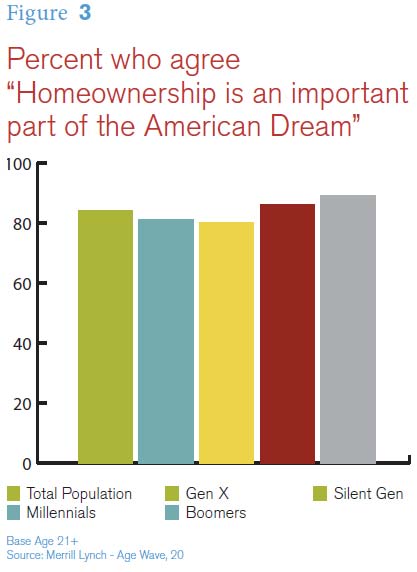
    There’s some data to suggest that in a society increasingly accepting of a “rentership” mentality, immigrants remain more likely to strain for permanence. The national homeownership rate has been declining for ten consecutive years.xii You see this pronounced especially amongst the young. Those in the prime of their adulthood, between 35 to 44 years of age, are buying homes at a low rate not seen since the 1960s. And for minorities, the numbers dip lower – the gap between white and minority home ownership is 25.5 percentage points.

    However, when you look at the maps detailing migrations of minorities and immigrants, and where they tend to be growing, they are growing fastest in places where houses are being bought. According to a report by the Research Institute for Housing America, immigrants accounted for nearly 40 percent of the net growth in homeowners between 2000 and 2010; in the 1970s they represented just over 5 percent of the growth. Meanwhile, the foreign born have been moving towards ownership, with renting growth happening only in the states that have become tough for prospective homeowners – e.g. California, the Washington D.C. area, New York, New Jersey, Massachusetts, Connecticut and Illinois.xiv In the current decade, California and New York are projected to be the only two states where foreign-born homeowner growth declines. Texas and Florida, by contrast, are attracting foreign- born buyers in droves, with net increases of 492,000 and 342,000 projected.
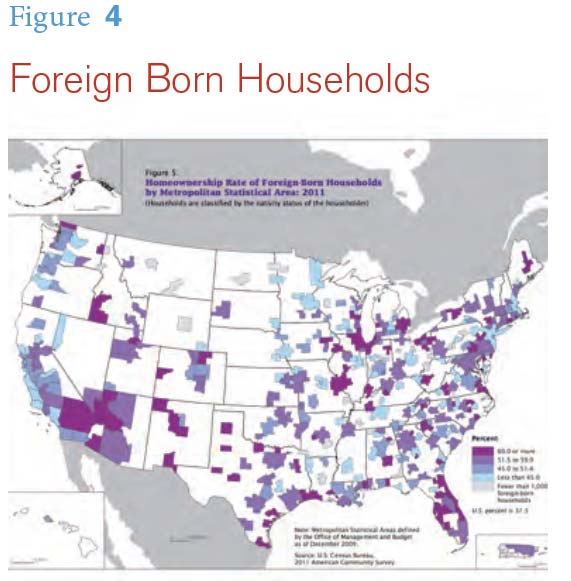
    As Hispanic and Asian homeownership in particular is climbing, they’re buying in the second-ring suburbs and even exurbs where they are settling in large numbers. We can see this by looking at maps of several major metropolitan areas such as San Francisco, New York, and Chicago.

    Obviously, when home ownership is the top priority, where it can be affordably attained becomes all the more relevant. Aspiring homeowners tend to want to live around other homeowners – there’s a like-attracts-like buzz of “I want to be around other people who are making it.” Minorities also seem  to be maintaining the more traditional American idea that homeownership equals the final seal of adulthood.

    “Buying a house was important,” says Tran, the 35-year old lawyer who lives with his wife in Sugar Land, a town in Fort Bend County. “It was roots being planted, physically and emotionally. If marriage was the emotional commitment, the house was the physical aspect of that.”

    The Trans’ neighbors, an African American couple named Geoff and Robin Boykin, agree.

    “As a minority, owning a home gives you a level of credibility in the community that renting won’t,” Boykin says. “When we first moved to this neighborhood, we rented, just to be sure, and when people would come up and ask us about it, there was an underlying feeling of embarrassment. Like we were second-class citizens. Perhaps especially because we’re the only black couple in this neighborhood.”

    Geoff grew up in Brooklyn, New York, “where you don’t even think about buying.” But when he met a 24-year old who owned a house in Houston, he thought, “Wait a second. Where can you buy a house at age 24?” He moved to Texas to follow suit. Southwestern sprawl offered an opportunity to get established, cheaper.

    Suburbs have always been family- friendly, at least by brand, and as Caucasian family size continues to shrink, those Hispanic and African American still having children, even three to four, kids want to be in safer, more affordable family-oriented neighborhoods.

    “You are now more likely to have inter-generational communities in  the suburbs,” says Randy Capps of the Migration Policy Institute.

    Tim Cisneros, the architect who serves some of Houston’s most entrepreneurial immigrants, says that his clients typically want something “colonial or traditional, to show they’ve assimilated. They also want big, to host multi-families.”

    "It’s now the Indians and wealthy Mexicans building the McMansions in the exurbs,” says Cisneros. “In Sugar Land. Pearland. The Woodlands [just north of Houston] is like going to private
    Mexico now. With armies, guards, the whole nine yards of the Mexican elite.”

    If homeownership remains one of the more important seals of legitimacy for
    today’s immigrants and minorities, it’s also a tool for consumer status – in this case one’s civic and cultural status.

    “With many immigrants,” Cisneros says, “the shinier it is, the more expensive they assume it to be and thus more attractive. More ’making it’ in America.”

    On the other side of the real estate spectrum, of course, are those who are getting priced out of longstanding ethnic enclaves that lie closer to the city center. Ron Castro is a sociology and psychology teacher at Spring Woods High School in Spring Branch, a gentrifying suburb straddling Houston’s second freeway loop, and says that in 15 years of teaching, house prices have climbed from $90,000 to $400-500,000.

    “Folks I used to know can’t  afford to live here anymore,” he says. “Everyone’s saying, ’we’ll be on our way out pretty soon.’”

    “In ten years, these mini-mansions pop up. The neighbor can’t afford that. I don’t see how low-income people survive another 10 to 15 years here in Spring Branch.”

    JOBS, SCHOOLS AND AN ECONOMY AGING BACKWARDS

    Most of today’s middle class economy is now found outside of central downtowns. Suburbs and exurbs accounted for 80 percent of job growth between 2010 and 2013.
    Irvine and Santa Clara in California, Bellevue just outside Seattle, and Irving, a Dallas suburb, have higher job to resident worker ratios than their closest core municipality. The booming technology sector is adding most of its jobs to suburbanized areas like Raleigh-Durham, Dallas-Ft. Worth and Orange County, attracting high-skilled Indian and East
    Asian employees, in particular.
    And, as “live, work, play” locations proliferate, it isn’t just a matter of where the jobs are located, but also where the highest quality of integrated living – work + leisure + community – may be found.

    “Sugar Land’s Town Center has everything you need,” says Geoff Boykin, who works for Coca Cola two miles from his home. “All the amenities – restaurants, Home Depot, a movie theater, the gym – I love the convenience.”

    At the same time, many suburbs are developing multi-purpose complexes  of community and leisure that complement their growing professional class, while telecommuting is on the rise, especially amongst millennials. For younger minorities and adult children of immigrants, commuting to work is no longer a must. So long as a suburb is relatively close to a freeway entrance, other desires like strong recreational possibilities and a good night life can take the front seat. The Internet has lessened the need for many to weigh the variable of long commutes.

    Rental properties for small businesses – many of which are owned and run by immigrants – are almost universally cheaper in the suburbs. And as more and more millennials are moving to  the suburbs, businesses are noticing the outflow of their consumption habits.

    “My clientele here is getting older, less willing to spend,” says Yoichi “Yogi” Ueno, the owner of a Japanese Sushi restaurant in Rice Village inside Houston’s inner loop. A few years ago he decided to open another more casual location in Fort Bend County on Bellaire Boulevard, in part to attract the freer flow of youthful wallets.

    “The well-educated, higher income younger people are having kids and moving out to exploding suburbs like Sugar Land and Katy,” Ueno says. “They now have more vibrancy. I may move this restaurant out there one day. I think business may be better.”
    For those with kids, of course, the historic sense that the suburbs have better schools and safer streets remains true, and of acute appeal to those looking to give their offspring a secure and promising future. There’s also more educational choice in the suburbs, and with lower costs of living, the possibility to send one’s child to a private school becomes easier.

    “For many Asian families in particular,” says a Vietnamese couple with one middle schooler and two elementary-age sons, “living where the schools are ’good’ becomes the number one priority.”

    THE PRE-EXISTING CULTURAL CLIMATE

    The movement of immigrants to the suburbs draws more to the same places. Just as immigrants in the first wave of mass migration went where families had already set up house and shop, today’s suburbanizing immigrants report a stronger sense of belonging and feeling welcomed in the suburbs, compared with urban cores too entrenched in established legacies and racial histories to leave room for more. There is also more of a chance for coherence and authenticity in immigrant expression in the suburbs, manifested most obviously in ethnic restaurants and supermarkets, distinctive religious congregations and social networks.

    “In the suburbs, I can run a sushi restaurant more like they do in Japan,” says Yoichi Ueno. “Here, closer to the city, with more of an affluent and white clientele, I had to invite in a chef to introduce things like California rolls [to appease American tastes]. In Japan we don’t actually sell those rolls!”

    These commercial enclaves are attractive in both entrepreneurs and their customers.

    “I like being in a Latina neighborhood,” says high school teacher Ron Castro, who’s chosen to stay in what some consider a less desirable suburb outside the loop. “There’s a Fiesta out here. A carniceria.”

    There are also scads of religious communities in the suburbs, the spires of sacred structures peeping just behind the strip malls. With secularism predominant in elite urban hubs, faiths from all over the world are finding welcome and freedom of expression in the wide open spaces where immigrants and minorities are settling. Religion remains a central artery for those beginning new lives, providing a sense of ethnic identity and continuity, social services and social status.

    SOME BROADER OBSERVATIONS ABOUT TODAY’S SUBURBAN ECOLOGY

    As I’ve wandered through and sampled the flavors of various suburban communities in Houston and elsewhere (including Charlotte, Dallas, northern Virginia and Chicagoland), it is clear there is a more textured political climate developing there. Most minority suburban dwellers I spoke with sounded progressive on immigration and the role of government in providing social services, and conservative on business regulation. The flourishing of the family was clearly important, even in its traditional expression, but those interviewed skirted any political commentary on that front.

    The suburbs also appear to be eclipsing the city as centers for civic renewal and volunteerism, though more empirical study of this is needed. Every suburban resident I interviewed was involved in at least one local initiative, such as Moms against Drunk Driving, seasonal clean-up effort and local arts & craft festivals. This stands in stark contrast to the average single professional renting a loft downtown, most of whom are involved in loose social diasporas but otherwise see the city as a one-way consumption opportunity.

    Some of this may have to do with life stage, and the higher proportion of families in suburbs—the attendant reality being that kids naturally invite parental involvement in the milieu of their upbringings. But the sense of voluntary generosity is also a testament to the growing presence (and confidence) of immigrants in the suburbs, who show higher rates of volunteering both inside their ethnic networks and, with growing levels of affluence, beyond them.

    Finally, the influx of immigrants demonstrates how suburbs are where a strong sense of community can be built and sustained. I repeatedly noticed how rare I was as a single car-user in parking lots that otherwise saw piles of kids tickling each other in the back seat – particularly the case for lower to middle class Hispanic and African American neighborhoods. In a Peruvian restaurant in Fort Bend on a Sunday afternoon, I was the lone millennial eating lunch solo and scrolling through my iPhone, the other tables raucous with the laughter of children and grandfathers in church attire. It struck me that the suburbs, with all of their automobile dependence, remains a relative bastion of strong community feeling and sense of obligation. Contrary to the general academic and media portrayal of suburbs as hotbeds of alienation and anomie, they are becoming bastions against the seduction of a consumerist, individual autonomy.

    COMPLEXITIES AND CHALLENGES

    As stated at the outset, it is in many ways impossible to speak about “the suburbs” in a generic sense. There remain two streams of movement outward: one rooted in choice and the other in forced displacement. But there also remain important caveats to these selling points, caveats that illuminate the open questions around the future of suburban life and human flourishing within it. The first is the challenge of isolation and integration, especially as the suburbs continue pixelating in ethnic and cultural diversity.

    Houston, for instance, is a city that welcomes the stranger, but its layout is sprawling, enticing for those with gumption can prove intimidating for those torn from their native support structures (or lacking them in the first place). Social services slim down the further you get from the Beltway. Public transportation is sparse, and sustaining driver’s licenses can be tricky for the undocumented. Information is under-institutionalized and rife for predatory activity – immigration lawyers and mortgage brokers, both. For those with few resources, life can be a constant struggle.

    Public schools feel the brunt of these rapid demographic shifts, with diversifying student populations outpacing the cultural training of teachers. H.D. Chambers is the superintendent of the most diverse district in Texas – Alief – and he says the avalanche of students coming from economically disadvantaged backgrounds (800 new Burmese refugees amongst them), combined with those coming with little to no English knowledge, make providing a strong educational experience profoundly difficult.

    “I’m talking about diversity that’s deeper than color of skin,” Chambers says. “It’s about diversity of life experiences, and what these kids face when they go home. Many of their parents can’t help them. How do we teach them to interact with others? How
    do you prepare these sorts of kids for a global economy and the world at large?”

    Not all immigrants – particularly the children of the foreign born – appreciate the suburban edition of the American Dream their parents foisted upon their upbringings.

    Raj Mankad is the editor of an architecture magazine housed at Rice University, and as a child emigrated from India to a cul de sac in Mobile, Alabama. Years later, as an adult, he asked his parents why they opted for the spacious suburbs after the chaotic yet cozy density of living in India. They answered in classic 1.0 form: As an immigrant, you want to go for the opposite of what you left behind.

    “We arrived with five dollars in our pockets,” they told him. “We could not buy expensive things or houses in the best neighborhoods. And we grew up with very little, sharing bedrooms with all our siblings, sleeping on the floor, walking to school without shoes. So when we arrived in the United States, we wanted exactly the opposite.”

    Raj has since rejected a lifestyle he finds plastic for a hipper, culturally creative and environmentally conscious life with his Caucasian wife and two young kids in Houston’s Montrose corridor. He rides a bike to work and aspires to start his own spiritual community inside the loop.

    “I want my kids to understand their Hindu heritage, but the temples are in the suburbs, and I don’t want to schlep out an hour for a religious service. I want to start my own spiritual community, but not in a conservative way.”

    The price may be high compared to what his Indian American peers are choosing on the periphery, but it’s his preferred assimilation – honest, expensive, and full of uncomfortable tensions.

    CONCLUSION

    People have any number of reasons for move to suburban locales. But it’s not just the cash nexus at operation here. There’s also the emergence of more mysterious and fascinating blends of culture and community in ways that will shape our perceptions of what constitutes the best of American life.

    Suburbs used to be a device to “protect” people from the Other. No longer. Many now foster the creation of hybrid identities, tight yet pluralistic communities, alternate information loops and various commercial exper- iments. As immigration in particular plays out through the quotidian experiences of today’s suburban blends, the institutions and leaders within these communities could be critical to formulate policy reform, especially as it relates to questions around integration. More broadly, the suburbs will be the battleground where debates around home ownership, social mobility, and the promise and challenge of a pluralistic society will need to be waged.

    If you’re interested in the New America, keep an eye on your suburbs. They’re not as peripheral as the horizon would suggest, and may even be at the nexus of what is next.
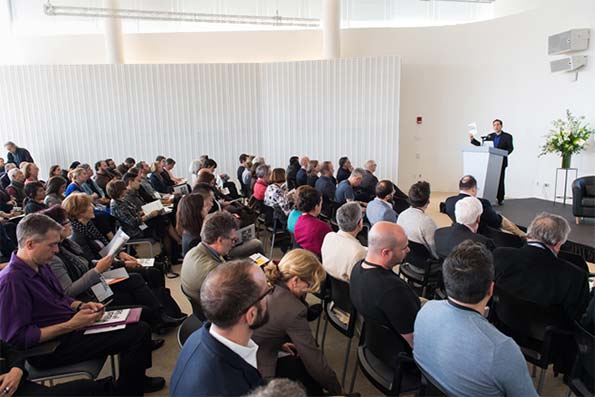

    This essay is part of a new report from the Center for Opportunity Urbanism called “America’s Housing Crisis.” The report contains several essays about the future of housing from various perspectives. Follow this link to download the full report (pdf).

    Anne Snyder is a fellow at the Center for Opportunity Urbanism and covers stories within the vortex of immigration, social class and values. Prior to living in Houston she worked at The New York Times, World Affairs and the Ethics and Public Policy Center.

  • Hurdling the Obstacles to Millennial Home Ownership

    Justin Chapman contributed research and editorial assistance to this piece. This essay is part of a new report from the Center for Opportunity Urbanism called “America’s Housing Crisis.” The report contains several essays about the future of housing from various perspectives. Follow this link to download the full report (pdf).

    If the United States could remove current obstacles holding back members of the Millennial Generation from owning homes, the value of the housing market would increase by at least one trillion dollars over the next five years. Policies that would eliminate or sharply reduce financial obstacles that are currently hindering thirty somethings who want to start raising a family in the suburbs from buying a home would enable the construction and sale of as many as five million more homes between now and 2020. Residential investment represents about five percent of the country’s GDP, not counting the ancillary spending that results from such purchase. So any sound housing policy for the United States should begin and end with programs that allow these “missing Millennials” to join the ranks of America’s home owners.

    HOW WE ARE FAILING  THE NEXT GENERATION… AND OURSELVES

    The Millennial Generation (born 1982–2003), is made up of about 95 million Americans, most of whom are now in their twenties or thirties. They have been raised to think of life as a series of hurdles to be jumped with each obstacle becoming increasingly more difficult to overcome. Part of this mentality stems from the sheer size of the generation, which created enormous peer competition for success in school. Another source of this pressure to achieve came from their parents, who constantly
    emphasized the importance of going to college, doing extracurricular work in high school to improve the chances of being selected to attend the college of their choice, and spending time studying, not working, to make sure their grades were good enough. This kitchen table conversation was at least partially generated by the pressure that an increasingly global economy put on family incomes as they were growing up, with particular urgency after the Great Recession.

    Despite the investment in education the generation has made  in response to these pressures, the question remains as to whether or not Millennials will be able to fully participate in the experience of home ownership. The answer to this question will be determined both by the efforts of Millennials and also to the degree that efforts to lower the height of the hurdles in front of them are successful.

    There are some people, such as Brookings Institute researcher Matthew Chingos, who don’t believe the hurdles are unique to this generation. He has suggested, for instance, that student debt loads weren’t high enough to really impact the housing market.iv, John McManus, an award-winning editorial and digital content director for Builder magazine, suggested any delays in home ownership were due primarily to the inherent desire to wait before making decisions in the hope something better will turn up.vi Despite evidence
    of mounting student debt, declines in workforce participation, and stagnant wages, these economists believe the housing issue can solve itself within the context of existing policies and current economic growth rates.

    Yet from the perspective of most young Millennials these hurdles are both very real and huge indeed. Not addressing them will impact their lives—and the nation’s economy—for decades to come.

    LOVE AND MARRIAGE: MILLENNIAL STYLE

    From 1920 to 1940, when members of the GI Generation were about the age that Millennials are today, the median age for a first marriage was 24.4 for males and 21.3 for females, numbers that remained fairly constant until the 1980s. In the 1990s, the median age for first marriages by Generation X males rose to 26.5 and 24.5 for females.

    The early marriage age in the 50s and 60s sparked a rapid growth in suburbs; the percentage of Americans living there doubled after World War II. By 1970, 38 percent of Americans lived in the suburbs and, by 1980, 45 percent did, triple the rate of suburban home ownership than before WWII. As of 2012, nearly 75 percent of metropolitan area residents live in suburban areas. Overall, 44 million Americans live in the core cities of America’s 51 major metropolitan areas; more than half of them live in areas that are functionally suburban or exurban with low density and high automobile use. Meanwhile, nearly 122 million Americans live in the suburbs.

    Will Millennials reverse this pattern? Clearly they are marrying even later: the average age of first marriage in the United States as of 2011 was 28.7 for men and 26.5 for women. This trend has caused more to linger longer in cities and postpone home ownership until much later in their lives. Furthermore,  in line with their more urban existence,
    the fertility rate has fallen from the replacement rate of 2.1 for Generation X to 1.9 for Millennials.

    But this doesn’t mean Millennials aren’t interested in starting a family later in life.

    A Pew Research Center report found that among those who have never married and have no children, 66 percent wanted to marry and 73 percent wanted to have children. Although they may be late to the family party, the large size of the Millennial Generation, almost double that of Xers, means there are still plenty of families being formed, just not at the rate that historical precedents suggested would happen. In fact, the absolute number of household formations rose to their highest level in a decade in 2014. The trend continued in 2015 as more and more Millennials entered the prime age for getting married.

    These Millennial trends in marriage and parenting can be explained, in part, by the impact of the Great Recession and more than a decade of stagnant wages. But they are also due to “cultural changes over time… including more women in the workplace, the increased amount of higher education among members of the generation, particularly females, and greater social acceptance of premarital sex, birth control, and cohabitation before marriage,” according to Christine Elliott and Williams Reynolds III of Deloitte University Press.xv For example, one of the reasons members of the Silent Generation got married so young in the 1960s was so they could have socially acceptable sex. No such incentives exist for members of the Millennial Generation.

    Liberated from the straight jacket of gender determined roles in society, female Millennials now outnumber men in every type of higher educational pursuit. Almost 40 percent of female Millennials aged 25–34 have a bachelor’s degree and about half of them are married, a greater percentage than among any other educational attainment cohort. Whereas few if any female 25–34 year  olds had attended graduate school in 1964, 13 percent of Millennial females of that age have reached that milestone today. All of these gains outpace college educational gains among males in the same time period.
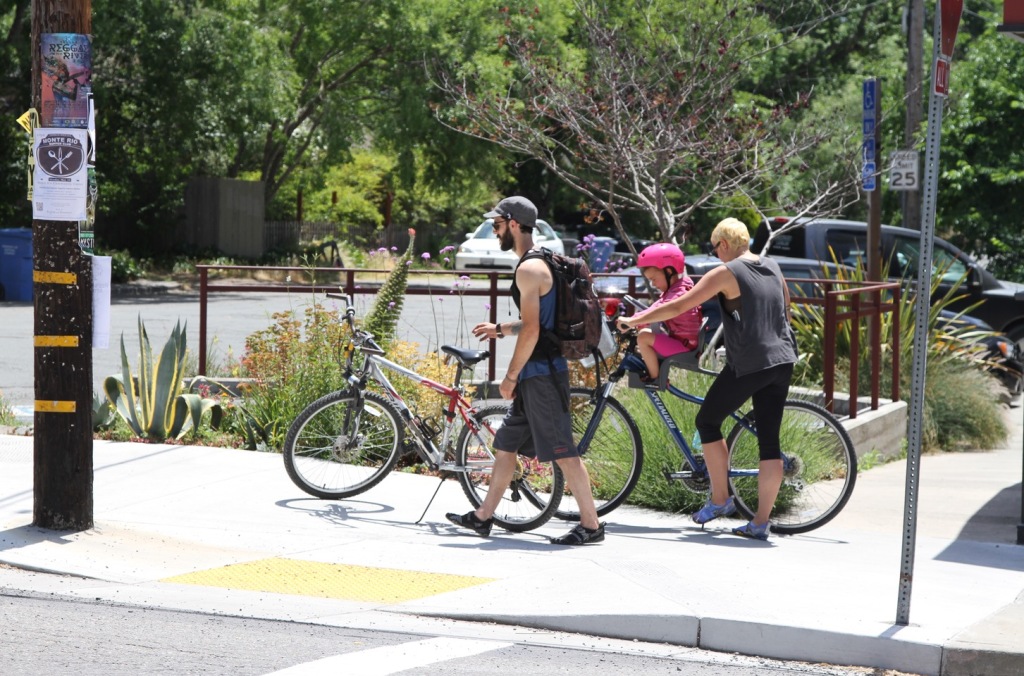
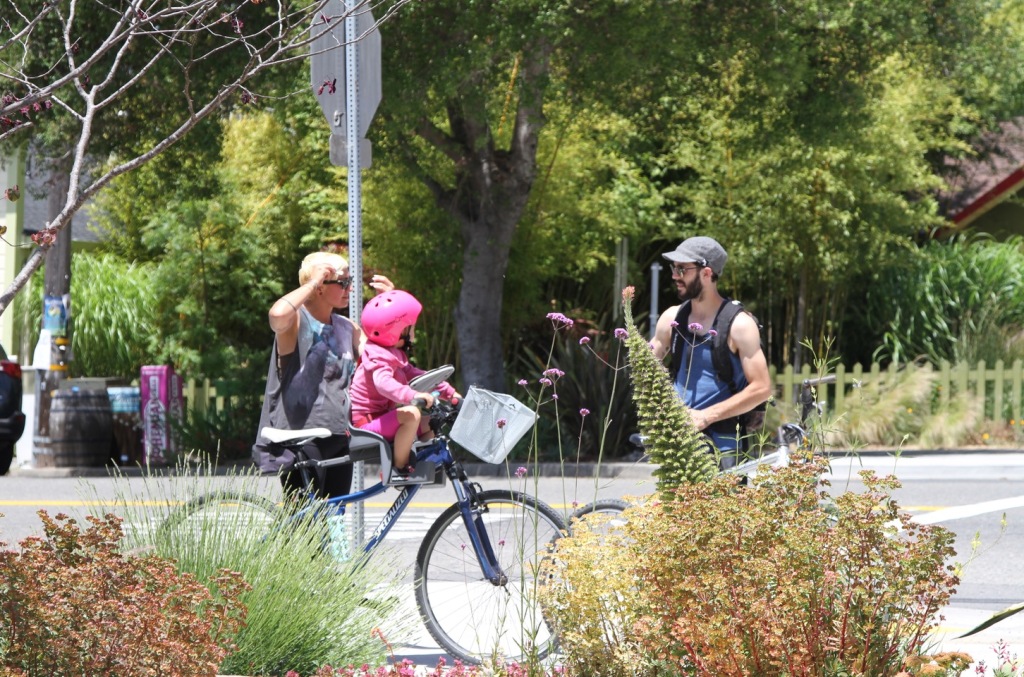
    Source:www.whitehouse.gov/sites/default/files/docs/millennials_report.pdf

    Millennial women who are not as well educatedxvi and do not have any economic stake in pursuing a career have their first babies, on average, at age 19 or 20. Well-educated moms have their first child around 28 or 29, usually after they have saved some money from their participation in the workforce. The delay in childbearing is greatest among those women with graduate degrees. Their average age for having their first child is now over 31, a full decade longer than their counterparts with only a high school degree. This represents a remarkable reversal of earlier trends over the last 25 years when more educated women were more likely to have children earlier than their less well-educated peers. In all likelihood, this phenomenon represents another kitchen table conversation about family finances with more educated females having more to lose by stepping out of the workforce and their preferred career track by having a baby than their less educated counterparts.

    In a sense, the cultural changes that society has witnessed, driven by a new set of Millennial beliefs and values about the role of women in society, has run up against the realities of today’s economy. The best solution to overcoming this obstacle would be a growing economy with wages increasing comparable to what transpired in the 1990s. Expanded parental leave policies from companies such as Facebook and Netflix introduced for both their male and female employees might also impact this trend, or at least the timing of starting a family. Other solutions designed to artificially increase wages or provide tax incentives are much less likely to overcome the strong cultural trends impacting family formation that are embedded within the Millennial psyche.

    MILLENNIALS WANT A PIECE OF THE AMERICAN DREAM, IF ONLY THEY COULD AFFORD IT

    Not only when they marry but also where these new families choose to reside will have an enormous impact on American living patterns for decades to come. Despite what some of have written about Millennials being a “sharing generation” averse to owning things, the generation’s actual attitudes or aspirations toward home ownership are remarkably similar to those of previous generations. An Urban Land Institute study, conducted at the end of 2014 of Americans between 19 and 36 years of age, found that Millennials remained determined to eventually own their home, with 70 percent of them planning to do so by 2020. “The Great Recession has not dimmed the generation’s preference for single-family homes, mostly detached,” wrote Leanne Lachman, the survey’s co-author, a real estate consultant and a Columbia Business School executive in residence, in a report outlining the survey’s findings.

    The same percentage of renters as home owners in the New York Federal Reserve’s Survey of Consumer Expectations in February 2014 thought home ownership was a good or very good investment. Almost 65% of millennials aged 21 to 34 looked at real estate websites and apps in August, and the market share of first time home buyers of existing homes increased to 32 percent from 28 percent in July of the same year. Realtor.com’s chief economist, Jonathan Smoke, found that 25–34 year olds were 70 percent more likely than the average adult to be looking for a home to buy on realtor.com. He estimated half of all home sales activity for the first half of 2015 could be attributed to first-time buyers and, according to the NAR 2015 Home Buyer and Seller Generational Trends report, Millennials comprised 68 percent of all such buyers.

    “People who believe that Millennials are disinterested in home ownership are grossly mistaken,” said Smoke. “This generation hit the job market during one of the largest recessions of all time and
    they’ve had to work hard to establish credit and save for a down payment.”

    One solution for Millennial couples unable to qualify for a mortgage is, of course, to rent a course of action many young families just starting out in life have traditionally pursued. The New York Federal Reserve study found the number one reason renters gave for not buying a home was they didn’t have enough money saved for a down payment or had too much debt. A majority also reported that their incomes were too low to support the payments on a mortgage. These responses nicely summarize the economic barriers to Millennial home ownership. As a result, the typical first-time home buyer now rents for six years before buying, up from 2.6 years in the early 1970s, according to a new analysis by Zillow. The median first-time buyer is 33—in the upper range of the Millennial generation, which roughly spans ages 15 to 34. A generation ago, the median first-time buyer was about three years younger.

    Ironically, many Millennials are being pushed into the home buying market by continuously rising rents that are making all forms of housing increasingly unaffordable. As Svenja Gudell pointed out, “We’re also finding that—given how much rental rates are currently rising—a lot of folks are having a hard time saving for a down payment and qualifying for a mortgage.” The oft violated rule of thumb says that families should not spend more than 30 percent of their budget on housing costs. But many young renters are paying more than that. “A striking 46 percent of renters ages 25 to 34—the core of the home buyer market among Millennials—spend more than 30 percent of their incomes on rent, up from 40 percent a decade earlier,” according to a report by Harvard University’s Joint Center of Housing Studies.

    Along the coast, in cities such as San Francisco, Los Angeles, New York, or Miami, rental costs exceed 40 percent of Millennials’ median income, with many paying as much as half of their budget on rent. A minimum wage worker in Orange County, Southern California’s most desirable suburban environment, would have to work 110 hours per week or over 15 hours a day to afford a one bedroom apartment where he or she worked. Inland, in cities such as Dallas, Houston, Chicago, and D.C., Millennials are spending just about 30 percent of their median income on rent. And the situation continues to worsen.

    More striking than these regional differences is the new relationship between the costs of renting versus owning a place to live. By the fourth quarter of 2014, the average mortgage cost was just 21 percent of average household income in the Dallas area, compared to an average of 28.5 percent of a family’s income being spent on rent. Across the country, it has become less costly on average for Millennials to own a home (21.4% of income) than to rent (30.1%).

    MILLENNIALS TRYING TO BUY HOMES

    For those who decide to take the plunge and buy a house, the tighter mortgage-qualification standards put in place after the Great Recession in reaction to the collapse of the financial markets when collateralized debt obligations (CDO) supposedly backed by sound mortgages turned out not to be worth the computer screens they popped up on present the first hurdle to their goal. To prevent such disasters in the future, Fannie Mae, whose reinsurance programs set the boundaries of risk that mortgage lenders will tolerate, prohibited certain types of mortgages altogether and emphasized a return to the traditional 20 percent down, thirty year term, fixed rate mortgages that had become the standard lending instrument when they were created to revive the nation’s housing market after the Great Depression.

    For a generation that has experienced falling wages and high levels of unemployment, this requirement can be seen as just too high a hurdle to even attempt to jump. Even if they can scrape up the money for the down payment, two-thirds of Millennials have a FICO score of under 680, limiting their ability to secure a government guaranteed mortgage and often saddling them with additional payments. Andrew Jennings, senior vice president and chief analytics officer at FICO said that “people in the 600 to 700 [credit score] range average have $25,000 in non-mortgage debt mostly from credit cards and student loans.” He pointed out that changes to the FICO score would make it easier for young adults with a thin credit history to qualify for a home loan. “One way to ease some households into ownership is to ease access to credit.”

    Fannie Mae’s Community Home Buyer program takes a step in that direction by lowering the down payment requirement for qualified buyers to just 5 percent. North Carolina and New Hampshire have also introduced programs that lower down payment requirements to 3 percent in an attempt to woo Millennials into buying a home in their state.xxviii More of these programs should be enacted to knock down this particular hurdle facing Millennials.


    (chart:  https://www.whitehouse.gov/sites/default/files/ docs/millennials_report.pdf)

    Much of their lack of credit worthiness stems from the lousy economic environment Millennials have experienced as they grew up.
    Americans between 18 and 34 years of age are earning less today than the same age group did in the past. The average earning of a Millennial was $33,883 (in 2013 dollars) in the four years following the recession. This represented a drop in average wages of 9.3 percent in just a decade (after adjusting for inflation) and is the lowest average wage for this age group since 1980. According to Rob Shapiro, a noted economic policy analyst, annual income gains for thirty something households (headed by Boomers) averaged 2.6 percent under Reagan and 2.4 percent under Clinton. Similarly aged households headed by members of Generation X under George W. Bush experienced income losses averaging 0.3 percent per year, followed by even greater losses averaging 1.8 percent per year among the first wave of Millennials in Obama’s first term.

    The situation is even worse for those with only a high school education. In a report written for the Brookings Institute in 2015, Shapiro showed that in the last century those with a high school education could expect their income to grow as they got older, even if it started from a lower base. This is no longer the case. In this century, those with only a high school education have actually experienced a drop in their earnings as they got older. Meanwhile, those with a college education not only start with an initially higher level of income, they can also expect to see their earnings grow in the course of their lives. College has become the ultimate hurdle in a Millennial’s life, with failure to get a degree becoming a life sentence of lower economic opportunity.

    The part about going to college that most parents worry about is not so much whether or not their child will get in and graduate, but how in the world they or their children will be able to afford to pay for their tuition bills. From 1980 to 2010 the price of tuition skyrocketed by 600 percent. In the same period, health care inflation rose by just over 200 percent. Meanwhile incomes for all but the top 5 percent of earners remained basically flat.

    In many ways this crisis has been precipitated by the unwillingness or inability of government to absorb much of the burden for higher education. This follows a notion introduced by the Carnegie Commission in the 1970s that an educated workforce was not an investment that government alone should pay for, despite its proven benefits in expanding the middle class and the country’s economy. Most people agreed with the report’s argument that those who would benefit most directly from acquiring some sort of a degree—the student and their family—should pay an increasingly large share of its cost.

    Coupled with the inability of states, particularly after the Great Recession, to subsidize the cost of college at historical levels, this policy led to families in 2014 shouldering the majority of the cost of sending their child to college for the first time in the nation’s history. Overall, the share of higher education costs paid for by students and families increased from 33 percent in 1977 to just under 50 percent in 2015.

    Faced with the need to somehow pay for school, students and their families turned to student loans as the default solution. The result has been a disaster for them and for the American economy, particularly its housing industry.

    Student loan debt doubled from 2007 to 2015. It now exceeds $1.2 trillion in the United States, more than the country has borrowed to pay for all the cars on the road today. The average debt for a college graduate in 2015 was $35,000. Eight million former college students are now in default on their student loan debt with no way to discharge that obligation in bankruptcy. Only 49 percent of Millennials manage to graduate college with less than $10,000 in debt, a major shift from the 74 percent of the Baby Boomer generation who were able to do so. According to a recent iQuantifi study, Millennials aged 21-25 shoulder an average of $13,116 in debt. Millennials in their late 20s carry $46,622 and Millennials in their 30s harbor an average of $69,552. All of this presents an enormous headwind that the first time home buyer must overcome.

    Under these circumstances, the clearest, most compelling action to grow the housing market would be to do something about Millennials’ student debt. A staggering 56 percent of Millennials between the ages of 18 and 29 who have student loan debt told Bankrate. com that they have delayed major life events because of their debt burden, with home buying the number one thing they have put off doing. Thirty percent of millennials (versus 22% of adults overall) say that student loans have forced them to delay buying a home.

    To make it easier for Millennials to leap the other hurdles to home ownership without the deadweight of student debt on their back, some have proposed to go so far as to declare a “jubilee year” and have the nation simply forgive the $1.2 billion in outstanding student loan debt. Home developers might well be a major beneficiary of such a windfall, although bailout of student loan debt at this scale is unlikely to occur any time soon for both financial and political reasons.

    A smaller and more personal solution to the problem is offered by the Public Service Loan Forgiveness program. It allows students to have their loans forgiven if they work for government or for certain not-for-profit organizations. Unfortunately, the time period under which a person must serve—ten years for the federal government, for instance— makes the actual impact of this law seem
    more like indentured servitude to those working under its provisions.

    Other solutions also exist or are under discussion. The Obama administration has greatly expanded eligibility for “income based repayment” (IBR) loans, which limit annual loan payments to a specified percentage of a person’s income, usually ten percent, and are forgiven even if the debt is not fully repaid after 20 to 25 years of payments depending on the particular terms of the original student loan. Some have proposed making IBR loans the standard for all federally guaranteed student loans, while others believe they represent too much risk for the federal government to undertake. Even if this type of loan becomes more prevalent among future home buyers, it still would mean lenders would have to take ten percent of a prospective home buyer’s income off the table when it comes to determining the buyers’ qualifications for a mortgage, thereby lowering the value of a home the buyer might consider.

    Some presidential candidates have joined the chorus in favor of allowing student loans to be refinanced, just as many people do with their home loans. About 25 million borrowers are estimated to be locked into higher rates that student loans require today. For these borrowers, such a plan, which many states have also started to explore, would reduce their loan payments by thousands of dollars early in their careers, making it more financially feasible for them to consider taking out a mortgage to buy a house.

    The states of Tennessee and Oregon have gone one step further in terms of reducing the scope of this problem in the future. The Republican governor in one state and the Democratic legislature in the other enacted laws that make their community colleges tuition-free. President Obama has proposed doing the same thing for all the nation’s community colleges in partnership with the states. Other communities from Kalamazoo, MI, to El Dorado, AR, have used personal or corporate philanthropy to make all levels of college tuition-free for their high school graduates. The idea continues to spread since the initial program was established in 2005 in Kalamazoo with over 30 cities now offering some form of this benefit to their youth in the hope of increasing the number of families who want to live in their community and stimulating their local economies.

    More directly, new home developers and lenders could begin to accept student loans as a fact of life for the Millennial market, and generate innovative new offerings to address the issue. One idea is to rent a home to Millennials under terms that lower the price if they elect to buy it  in the future, just as is done with many  car leases today. One such experiment is being offered in Miami for two unit town houses whose sales price is 21 percent lower than it would be otherwise. Another would be to find lenders willing to consolidate student debt into a larger home mortgage, with the lender trading the benefits of a loan not dischargeable in bankruptcy to a theoretically safer loan that uses the physical collateral of a house. Finally, builders and banks could take advantage of the Millennial Generation’s love of their parents and build housing designed not just for multi-generational living, but multi-generational financing, with different members of the family responsible for the mortgage payments at different times over the period of the loan.

    WHEN MILLENNIALS DO BUY, WHERE WILL THEY LIVE?

    Much has been written about where Millennials will buy a home. Some urbanists hope that Millennials will embrace the denser, less suburban lifestyle these pundits favor. Yet survey research and moves by older Millennials belie these assertions.

    According to the Urban Land Institute’s (ULI) most recent data, only 13 percent of Millennials live in or near downtowns; 63 percent live in other city neighborhoods or suburbs. The number of downtown dwellers was 12 percent in ULI’s 2010 survey. In fact, the Commerce Department reported that more Millennials moved to the suburbs from the city than vice versa in 2014. So even though some young Millennials, especially right after college, do move into urban neighborhoods, which certainly benefit temporarily from their presence, most think of the suburbs when their thoughts turn to raising a family.

    The National Association of Home Builders survey in January 2014 found that most of their Millennial respondents intended to purchase a single family home in the suburbs; another survey put the figure at 66 percent. Both studies confirmed the ULI findings that 75 percent of Millennials expected to live in a single family, detached house by the end of the decade. The myth of a new urban dwelling generation largely misreads the difference between “age related” effects and generational attitudes and beliefs.
    This misreading has impacted homebuilders who have built fewer homes that Millennials want and can afford, reducing the supply and driving up the price. The result is what economist Jed Kolko calls the “Millennial mismatch—Millennials can afford markets where they don’t live, but they can’t afford many of the markets where they do live.”

    (chart: Urban Land Institute’s Gen Y and Housing report, uli.org/wp-content/uploads/ULI-Documents/ Gen-Y-and-Housing.pdf)

    One way this lack of affordable housing manifests itself is the continuing phenomenon of Millennials living
    in their parents’ house. Despite their improving economic circumstances, a Pew Research Study found that about 42.2 million Millennials, or 67 percent, were living independently in 2014, compared with 42.7 million Millennials, or 71 percent, who did so before the recession in 2007. Since 2010, the percentage of Millennials moving back in with their parents actually increased from 24 percent to 26 percent.xlv While this behavior may temporarily balance the demand for housing with its supply, it greatly increases the number of Millennials missing from the country’s housing market.

    HOW TO GET MILLENNIALS BACK IN THE MARKET

    There are, however, some examples of what would attract these missing Millennials into the housing market. Almost all of them are successful because they have built upon the most fundamental of Millennial behaviors—the desire to share their experiences. And almost all of them make it possible for Millennials to afford a lifestyle they can share with families and friends.

    First on the frugal Millennial’s wish list is the need for the house to be affordable. According to a Rent.com survey of 1,000 Millennial renters, nearly half said they moved to a different city than the one they grew up in, mostly because of the job opportunities that city presented. Given the generation’s strong ties to their family and their friends, this finding puts an exclamation point on how important a consideration affordability is for Millennial first time home buyers.

    As Millennials continued to enter the housing market, their desire for a more affordable home became evident not just in survey data but actual buying behavior. For instance, 60 percent of those who  took out a mortgage to buy a home in August 2015 in Des Moines, Iowa were 25-34 years old. The top ten markets where Millennials dominated the home buying market that month were also ones with very affordable housing prices, with the exception of Provo, Utah. The cheapest big city in America in terms of housing prices, Pittsburgh, was the only one to make the list.

    Beyond a place they can afford, the
    next thing Millennials want is to own a home they can share with their family and friends. Millennials “want to live where it’s easy to have fun with friends and family, whether in the suburbs or closer in,” says M. Leanne Lachman, one of the authors of the Urban Land Institute’s study. “This is a generation that places a high value on work-life balance and flexibility. They will switch housing and jobs as frequently as necessary to improve their quality of life.”

    Only about 28 percent of Millennials told the Demand Institute’s Housing and Community Surveyxlix that they needed grocery stores and restaurants within walking distance of their next home, which is a common characteristic of urban environments. But more than half wanted such amenities to be within a short drive. This creates the demand for compact, livable communities that crop up in less-dense areas, but remain fundamentally suburban albeit with more options for walking, bike-riding and closer shopping. Unfortunately, these characteristics make many places in America, particularly its large coastal metropolitan areas, off limits to young Millennial families. It’s yet another hurdle they must overcome, often sacrificing their desire for shorter commutes to work and time with family to find a place to live that they can afford and safely raise their family.

    When they find the place they want to live, Millennials look for the type of housing that makes for a great living experience. It doesn’t have to be large—the most common size of a first time Millennial buyer’s home is less than 1,200 square feet. Half of all homes purchased by Millennials average less than 1,650 square feet and cost less than $148,500. But it does have to be high tech with an open floor plan, making many older homes unsuitable or strictly fixer uppers for this new generation of buyers. For instance, a generation ago, formal dining rooms may have been on every buyer’s wish list, but today they hold little appeal because of the way Millennials entertain. Millennials often convert space originally conceived as a dining room into a home office and move the food fest outside, weather permitting, or into the kitchen where the joys of cooking can be shared.

    A majority of Millennial home buyers believe the technological capabilities of a house are more important than “curb appeal.” More than 13 million Americans work from home and all signs point to that trend continuing, especially among high tech Millennial workers. Many of them see their home as a place to “do work,” not just a place to return “after work.” They want to hear about the strength of the mobile carrier’s signal in the house and its Internet speeds, not the embedded infrastructure of cable wires and land lines. Few if any of these desired attributes are present in older suburban tract housing, which further constrains the supply of houses for Millennials, presenting yet another obstacle in their path to home ownership.

    Breaking the current chicken and egg standoff between the demand and supply of Millennial style housing will require developers to stop listening to those who claim that Millennials aren’t interested in owning homes—or anything else—and focus on the market opportunity staring them in the face. Realtor.com’s chief economist Jonathan Smoke suggests that the supply of homes for Millennials is the key to igniting the next housing boom. “Despite the increased role of Millennials in the housing market, setbacks still exist and are preventing first timers from making even more of  an impact,” says Smoke. “As inventory returns to more normal levels, expect the blooming of Millennial homebuyers to turn into a boom.”

    Recent research from Zillow, for instance, found that adults age 22 to 34 were actually more eager to own a home than older Americans.lv If all the surveys of Millennial attitudes weren’t convincing enough, the actual home buying behavior of Millennials who can afford to buy a house should finally get builders off the investment fence. According to Zillow’s data, young married couples in which both partners work own homes at a rate close to or above historical norms for that demographic. Even single employed Millennials are slightly more likely to own a home than their counterparts in the 1970s, 1980s, or 1990s. All that’s needed, it would seem, to bring missing Millennials into the housing market is a larger supply of homes they want to buy. In short, build, builders, build.

    Home building, especially construction of single-family stand-alone residences, has not rebounded as much  as it should given the last few years of ultralow mortgage rates. For example, the number of single family housing starts and completions were both lower  in June than in May of 2015, even as family formations hit highs not seen in a decade. Both of the top two reasons older Millennials gave to realtor.com for not having bought a house yet had to do with the limited supply of affordable housing. It’s not up to Millennials to build the houses they want to buy, it’s up to those with the insights and market leadership skills to step in and create the supply and
    knock down this last hurdle to Millennial home ownership.

    MISSING  MILLENNIALS ARE A ONE TRILLION DOLLAR OPPORTUNITY

    A Demand Institute survey of more than 1,000 Millennial households suggests the generation will generate
    $1.66 trillion in revenue between now and 2020, using an average home sale price of $200,000, based solely on Millennials’ desire for home ownership and their arrival in the peak new starter home buying ages of 25–34 years old. If current conditions hold, it predicted the number of Millennial households would rise by 8.3 percent over the next five years, from 13.3 million to 21.6 million.

    But the Institute’s own data comparing existing home ownership  rates among Millennials based on student debt suggests that just removing the burden of student debt would increase these numbers even more. According to their findings, debt elimination would increase the number of home owners among 25–34 year old college graduates by 24 percent, 16 percent among 25–29 year olds, and eight percent for 30–34 year olds.lix Based on the cohort’s current population that would represent over five million more homeowners or $1 trillion in new home purchases. But some portion of that population would actually be forming joint households. If 60 percent marry each other, that would still mean an additional three million new home buyers, or a roughly $600 billion dollar increase in market sales over five years from just this one barrier-busting move.

    A separate analysis by John Burns Consulting argued that just the hurdle of student debt cost the U.S. housing market $83 billion dollars in sales last year. They estimate that every $250 in monthly student loan payments decreases home borrowing and purchasing power by $44,000. The number of households
    headed by those under 40 who owe at least $250 in monthly student loan payments has tripled since 2005 to 5.9 million. Multiplying those numbers times an average home sale price of $200,000 leads to their $83 billion conclusion—or $415 billion over five years.

    Others put the impact on the housing market of missing Millennials at more than twice that level by taking a look at the entire panoply of financial hurdles the generation faces, not just student debt. A Ned Davis Research report suggested these hurdles caused a drop in demand  for housing from Millennials of three million homes, for an annual market impact of $600 billion. Their estimate suggests “missing Millennials” represent more than a 1.3 trillion dollar market opportunity over the next five years. Whether the housing market will enjoy that type of revenue growth depends a great deal on how hard it focuses on the hurdles facing this critical home buying cohort.

    Although no one is going to wave a magic wand and make student debt disappear overnight, it is possible for government to take
    aggressive steps to limit if not eliminate these obligations. Furthermore, easing of credit and down payment requirements would have an immediate impact on Millennials’ decision to buy a new home. More generous parental leave policies on the part of the nation’s employers, either by their own initiative or government mandate, would help accelerate the pace. And policies designed to actually grow wages and expand the economy, such as easier access to affordablehigher education, would certainly help a generation struggling to put together the money they need for a down payment. Longer term policy initiatives designed to increase the supply of housing are certainly worth exploring, but the likelihood that they will be put in place in time to help the bulging number of Millennials moving into early adulthood is not high. Altogether, these initiatives could add at least an extra trillion dollars to the nation’s housing market and make Millennials so much more a part of that market than they are today.

    It’s time to give the country’s next great generation, Millennials, the same chance earlier generations had to become home owners. We need to help them overcome the hurdles they face in joining this coveted group of American families. Fortunately, the housing industry has it within its power to take the first steps to provide Millennials their piece of  the American Dream, helping ignite a housing boom that will spark an economic boom for the entire nation.

    This essay is part of a new report from the Center for Opportunity Urbanism called “America’s Housing Crisis.” The report contains several essays about the future of housing from various perspectives. Follow this link to download the full report (pdf).

    Morley Winograd is co-author of the newly published Millennial Momentum: How a New Generation is Remaking America and Millennial Makeover: MySpace, YouTube, and the Future of American Politics and fellow of NDN and the New Policy Institute.

  • Where American Families Are Moving

    Much is made, and rightfully so, about the future trends of America’s demographics, notably the rise of racial minorities and singles as a growing part of our population. Yet far less attention is paid to a factor that will also shape future decades: where families are most likely to settle.

    However hip and cool San Francisco, Manhattan, Boston or coastal California may seem, they are not where families are moving.

    In a new study by the Chapman Center for Demographics and Policy, we found that the best cities for middle-class families tend to be located outside the largest metropolitan areas. This was based on such factors as housing affordability, migration, income growth, commute times, and middle-income jobs. Many of our best-rated cities tend to mid-sized. The three most highly rated were Des Moines, Iowa, Madison, Wis., and Albany, N.Y., all with populations of less than 1 million. Among our top 10 metropolitan areas for families, five are larger than this, but only two—the Washington, D.C. area and Minneapolis-St. Paul—are among the nation’s 20 largest metropolitan areas.

    Download the full report (pdf) here.

    Our bottom 10 includes the media’s favorite two cities, New York and Los Angeles, also the largest metropolitan areas in the nation. Three other large metropolitan areas rank in the bottom 10: Miami, Riverside-San Bernardino, Calif., and Las Vegas. The hipster cities, in other words, are not so amenable to the new generation of young families.   

    Why Families Head to the Suburbs

    In the 1960s, renowned urbanist Jane Jacobs asserted that “suburbs must be a difficult place to raise children.” But they remain popular nonetheless. According to U.S. Census Bureau statistics, in 2011, children between ages 5 and 14 constituted about 7 percent in urban core Central Business Districts (CBDs) across the country, less than half the level in newer suburbs and exurbs. In Manhattan, singles comprise half of all households, based on the American Community Survey. The highest percentage of women over 40 without children, notes geographer Ali Modarres, can be found in expensive and dense Washington, D.C.

    One clear example of the new child-free city is San Francisco, which is now home to 80,000 more dogs than children. In 1970, children made up 22 percent of the population of San Francisco. Four decades later, they comprised just 13.4 percent of the town’s 800,000 residents. Nearly half of parents of young children there, according to 2011 survey conducted by the city, planned to leave in the next three years, largely due to high housing costs. This pattern is accelerating: Since 2011, less-dense ZIP codes have been growing far faster than the more dense ones.

    The desire for affordable, single-family homes is driving this trend. Over 80 percent of married couples live in such housing, compared to barely 50 percent of households of unrelated individuals and single. The choice to move to the suburbs also reflects the preference for a safer setting. FBI crime statistics show the violent crime rate in the core cities of major metropolitan areas is nearly 3½ times higher than in the suburbs. Given the murder rate in many major cities, this gap can be expected to grow.

    Another key motivation in choosing the suburbs, especially for families with children, is frustration with the quality of urban public education. Suburban schools still consistently out-perform those of inner cities in terms of achievement, graduation and college admission.

    In the coming years the progressive penchant for enforced densification—contrary to the preferences of most Americans—could cause some serious intra-party rifts, even in areas that today are reliably Democratic “blue.” The biggest opposition to building more single family housing has often been in liberal bastions such as Marin County, Calif., Boulder, Colo., and Westchester County, N.Y., the official residence of Hillary and Bill Clinton after they left the White House. As one Bay Area blogger observed, “suburb-hating is anti-child”—because it seeks to undermine neighborhoods with children.

    Exclusionary and Opportunity Regions

    America has always had its fancy neighborhoods, often associated also with racial or ethnic exclusion. But increasingly large parts of the country, and this is true in certain cities and suburbs, are evolving into what Dartmouth College’s William Fischel has called “exclusionary regions”—too expensive for middle-class families to access.

    Fischel traces much of this development to regulatory policies that restrict housing supply. In 1970, for example, housing affordability in coastal California metropolitan areas was similar to the rest of the country, as measured by the median multiple (the median house price divided by the median household income). Today, due in part to a generation of strict growth controls, home prices in places like San Francisco and Los Angeles are now three or more times higher than in some other metropolitan areas.

    The impact is being felt disproportionately by younger adults, who, unlike earlier generations, do not benefit from housing inflation, and who face other barriers to home-buying ranging from student debt to weak income growth. Coupled with an overall weak economy, the net worth of people under age 35 has plummeted almost 70 percent from 2004 levels, making affordable housing an even more pressing issue.

    This cash-short generation is moving to more affordable places. Since 2010, the fastest growth in the ranks of college-educated millennials has been to lower-cost regions such as the four large Texas cities (Dallas-Fort Worth, Houston, San Antonio and Austin), Nashville, Tenn., and Orlando, Fla., as well as such Rust Belt cities as Pittsburgh and Cleveland. These cities offer what the “exclusionary” regions once did: an affordable inner-city option for the young and childless as well as suburbs they can move to as they start families. Other families are settling in small, relatively inexpensive metropolitan areas: Fayetteville, Ark., Cape Coral and Melbourne, Fla., Columbia, S.C., Colorado Springs, Colo., and Boise, Idaho.

    High rents, which now constitute the largest share of income in modern U.S. history, could be determining these change in youthful migration. Since 1990, renters’ income has been stagnant, but inflation-adjusted rents have soared 14.7 percent. Housing, long the largest expenditure item, now takes an even larger share of family costs, while expenditures on food, apparel and transportation have dropped or stayed about the same. In 2015, increases in housing costs essentially swallowed gains made elsewhere, notably savings on the cost of energy.

    This situation is most severe in the highest-priced markets. In New York, Los Angeles, Miami and San Francisco, for example, renters spend 40 percent of their income on rent, well above the national average of under 30 percent. In each of these markets there have been strong increases (income adjusted) relative to historic averages. In New York, rents increased between 2010 and 2015 by 50 percent, while incomes for renters between ages 25 and 44 grew by just 8 percent.

    Where the Future Is Being Built

    This wide disparity between “opportunity” and “exclusionary” areas is being locked in place by the persistent lack of new housing in most high-priced regions. Since 2010, among the 10 areas that experienced the biggest increases in housing supply, only one was in a deep-blue urban area: Seattle. The cities producing the most new units—Austin, Raleigh, N.C., Houston, Dallas-Fort Worth, Nashville, Charlotte, N.C., Orlando, Oklahoma City, and Jacksonville, Fla.—have managed to keep their housing costs, and rents, to levels acceptable to middle- and working-class families.

    In contrast New York, San Francisco, Los Angeles and Boston are authorizing far fewer new units per capita than these rising cities. Houston and Dallas-Ft. Worth, with a population roughly one-third of Los Angeles-Orange Country, have produced close to two times as many new units. Overall, California’s rate of new housing permits is one-third that of the Lone Star State.

    This divide will become more pronounced as progressives work to undermine lower-density lifestyles, often in the name of combatting climate change. In California, new single-family homes are gradually being made the exclusive province of the super-affluent, while multi-family units often face opposition from neighbors and even environmentalists. Older residents, with lower property taxes and ideal weather, may stick around, but young people likely will be forced to migrate, particularly as they enter their 30s or get tired of living in their parents’ spare rooms.

    No surprise, then, that expensive and highly regulated markets have seen declines in their numbers of children since 2000. In contrast, affordable cities continue to gain families with children in the 5 to 14 age range. Dallas-Ft. Worth, for example, gained 230,000 youngsters between 2000-2013. In Houston, the number was 190,000 and in Atlanta it was more 167,000 over that span. During the same period, Los Angeles’ child population dropped by 303,000, or 15 percent. In New York it fell by 238,000 kids.

    Increasingly, employers are factoring affordable local housing stock as an equation into their decisions about where they locate—or relocate. A recent SMU study found that high housing prices to be the biggest reason why Toyota left Los Angeles for the Dallas-Fort Worth area.

    The Emerging Family/Childless Divide 

    Although American localities are being pitted against one another not just by politics but by their ability to attract young families, the emerging map of where families live is not necessarily custom-made for conservatives.

    Key Democratic groups, including African-Americans, are also moving to the suburbs, particularly in less expensive cities, largely in the southeast and Texas. The suburbs are also increasingly the chosen destination of immigrants and their offspring, another blue-leaning cohort. Roughly 60 percent of Hispanics and Asians already live in suburbs. Between 2000 and 2012, the Asian population in suburban areas of the nation’s 52 biggest metro areas grew 66.2 percent, while in the core cities it expanded by 34.9 percent. Of the top 20 cities with an Asian population of more than 50,000, all but two are suburbs.

    Republicans also will be challenged to appeal to the rising number of suburban millennials, who also lean Democratic. But there’s some good news for Republicans in that the political future is not going to be shaped primarily in the Obama hotbeds along the coasts, but places, such as the South and the suburbs, where conservatives at are more competitive.

    To compete for diversifying suburban, Sunbelt and smaller city electorates, conservatives need to better show why families of all ethnicities should support them. They must make the case that Republican policies are better for voters economically and can provide the most efficient and effective services, particularly for their children.

    As for Democratic Party leaders, they would do well to push back the narrative of their urban core elites, who tend to characterize suburbs and Sunbelt cities as soulless enemies of culture and killers of the planet. It is time to recognize that most American families, whatever their ethnicity, desire a decent home in a nice neighborhood, whether in a suburb or a city, where children can be raised. In addition, and this is of increasing importance, they want a place where seniors can grow old amid familiar places and faces. These homeowners will likely yield disproportionate influence over elections since they are more likely to vote — and be active in local affairs — than the general population.

    Ultimately, these families will determine the political future of the country. After all, there is no “replacement” generation for singles and childless couples. In the long run, wooing families will determine who wins the political wars not only this year but in the decades ahead.

    Download the full report (pdf) here.

    Joel Kotkin is executive editor of NewGeography.com and Roger Hobbs Distinguished Fellow in Urban Studies at Chapman University, and a member of the editorial board of the Orange County Register. He is also executive director of the Houston-based Center for Opportunity Urbanism. His newest book, The New Class Conflict is now available at Amazon and Telos Press. He is also author of The City: A Global History and The Next Hundred Million: America in 2050. He lives in Orange County, CA.

  • New Report: Building Cities for People

    This is the introduction to a new report: “Building Cities for People” published by the Center for Demographics and Policy. The report was authored by Joel Kotkin with help from Wendell Cox, Mark Schill, and Ali Modarres. Download the full report (pdf) here.

    Cities succeed by making life better for the vast majority of their citizens. This requires less of a focus on grand theories, architecture or being fashionable, and more on what occurs on the ground level. “Everyday life,” observed the French historian Fernand Braudel, “consists of the little things one hardly notices in time and space.” Braudel’s work focused on people who lived normal lives; they worried about feeding and housing their families, keeping warm, and making a livelihood.

    Adapting Braudel’s approach to the modern day, we concentrate on how families make the pragmatic decisions that determine where they choose to locate. To construct this new, family- centric model, we have employed various tools: historical reasoning, Census Bureau data, market data and economic statistics, as well as surveys of potential and actual home-buyers.

    This approach does not underestimate the critical role that the dense, traditional city plays in intellectual, cultural and economic life. Traditional cities will continue to attract many of our brightest and most capable citizens, particularly among the young and childless. But our evidence indicates strongly that, for the most part, families today are heading away from the most elite, more congested cities, and towards less expensive cities and the suburban periphery. (See report appendix “Best Cities for Families”)

    New York, San Francisco, and Los Angeles long have been among the cities that defined the American urban experience. But today, families with children seem to be settling instead in small, relatively inexpensive metropolitan areas, such as Fayetteville in Arkansas and Missouri; Cape Coral and Melbourne in Florida; Columbia, South Carolina; Colorado Springs; and Boise. They are also moving to less celebrated middle-sized metropolitan areas, such as Austin, Raleigh, San Antonio and Atlanta.

    Traditional cities will continue to attract many of our brightest and most capable citizens, particularly among the young and childless. But our evidence indicates strongly that, for the most part, families today are heading away from the most elite, celebrated cities, and towards less expensive cities and the suburban periphery.

    Download the full report (pdf).

  • Our Anemic Suburbs: Every Urban Area Needs its Outskirts — and New York City’s Are in Trouble

    New York City has prospered since the great recession of 2008, buoyed by an endless supply of free money from Washington that’s elevated the stock and real estate markets. But the broader metro region has struggled, in an ominous sign of tougher times to come.

    Little acknowledged in the discussion of New York’s “tale of two cities” is something beyond the control of Mayor de Blasio: the fading of the city’s once-thriving suburbs, even as the city grows more populous and more expensive.

    Although some urban boosters blame suburbs for city ills and wish for their demise, the truth is they depend upon one another. Suburbs, including in New York, have long provided a local outlet for people to migrate to from the urban core as they start families and otherwise age out of cloistered living. But in the outskirts of Gotham, this model now appears to be in decline.

    At a time when New York City itself is growing, the suburban dream here has slowly died, choked off by a difficult commutes, stagnant local economies, rapidly rising house prices and punishing property taxes. House prices have increased in New York’s suburbs in New York and New Jersey at double the increase of household incomes since 2000. In Suffolk and Passaic, N.J., they’ve tripled. The suburbs in New York also have among the nation’s highest property taxes.

    When New Yorkers get to the point they want to start a family and buy a house, those who can — the best and brightest — are no longer decamping for places like Great Neck or Scarsdale but appear to be leaving the region entirely.

    The decline is evident in Long Island, where there is very little new building and time seems to have stopped around 50 years ago. New restaurants, malls and cultural facilities are rare. Long Island and New Jersey have lost sports franchises to Brooklyn. Unlike in other regions, few businesses leave the city for the surrounding suburbs.

    Nor is this just a matter of mass migration to one or two places. Greater New York loses net migrants to virtually every big urban region of the country, including Los Angeles as well as such diverse places as Philadelphia, Washington, Boston, Atlanta, Dallas-Fort Worth and Houston.

    To some urbanists, this decline of New York’s suburban belt represents welcome news. After all, between 1950 and 2010, more than 95% of the region’s growth took place on its periphery, and worries focused on the hollowing out of the urban core.

    Since 2010, those trends have had a stunning reversal: The boroughs have added 316,000 people — a growth rate four times that of the burbs.

    But what makes urban boosters trill in ecstasy also suggests that greater New York is no longer a place that accommodates upward mobility.

    A lot of that comes down to the bottom line. Between property values and property taxes, the cost of suburban living in Nassau and Westchester no longer offers the relief it once did. Throw in arduous commutes, and even the appeal of a yard and a good school fades for many.

    The point comes into especially sharp focus when you stack New York City up against other big metro areas. Across the country, suburbs are still growing faster, often much faster, than cities, according to a Brookings Institution analysis of Census statistics.

    Many of those places — including Austin, Charlotte and Nashville — are experiencing a revival of both their cores and their suburban rings. In Houston, which has enjoyed one of the biggest inner-city booms in the nation, two-thirds of all new units are single-family houses, usually in the suburbs. This preponderance of single-family homes is common in the areas that New Yorkers are going to, such as Charlotte, Orlando and Dallas.

    Of the nation’s 52 largest metropolitan areas, New York had the lowest percentage of single-family homes, some 26%. Nor are enough new apartments being built to accommodate New Yorkers. Between 2011 and 2014, the New York region was 42nd in the percentage increase in the number of building permits issued.

    To some extent, the ailment reflects Gotham’s unique economic climate, increasingly dominated by key industries — tourism and hospitality, media and finance — that tend to concentrate in high-cost, high-density urban centers. These sectors, along with tourism, have driven New York’s recovery, unlike in the Bay Area, Raleigh or Austin, where technology has played the key role.

    Once, greater New York boasted a large and important technology industry (remember IBM?), but no longer. Despite the endless hype about New York being a “high-tech” capital, today the region suffers one of the lowest percentages of engineers per capita — 77th out of 85 large metro areas. Greater New York City is never going to be the next Silicon Valley.

    With no economic engine, but with property taxes among the highest in the nation, New York’s suburbs are a drag. In a recent ranking of the best places for jobs we developed for Forbes, New York City, although slipping somewhat, ranked a respectable 17th. But Northern New Jersey, Long Island and close-in parts of Connecticut were all near the bottom of the 70 metropolitan areas studied.

    The result is that even as the city swells, giddy with gentrification and Brooklynization, the region continues to hemorrhage people at the highest rate of any large metropolitan area. Over the past four years, 528,000 more people left for other parts of the country than came here from them.

    New Yorkers tend to think of the city as diverse and of suburbs as lily-white. But in other parts of the country, suburbs are increasingly the geography of opportunity not just for young families, but for immigrants and minorities in particular.

    New York is the exception. Few African-Americans head to Westchester, but many leave for the sprawling reaches of Atlanta, Dallas or Houston — places where they are twice as likely to own their own homes.

    It may be fine for the jaded offspring of the wealthy who can afford to stay in Gotham to look down on these new sunbelt residents and suburb-dwellers. But for many, these geographies offer unprecedented opportunity to live in safer and less poor areas.

    And the New Yorkers who leave — like migrants in general — tend to be those who are most ambitious. One doesn’t move to Texas to gain access to government benefits, which are much less generous there than in New York, but for greater opportunity.

    One could argue that New York City can thrive simply by drawing ever more highly educated millennials to the five boroughs. Between 2010 and 2014, the city gained 106,000 college-educated people ages 25 to 34, with nearly half of them moving to Brooklyn. The suburban rings gained barely 38,000.

    But new research shows the millennial rush to Gotham is already slowing. Between 2008 and 2010, according to an analysis by demographers at Cleveland State University, New York ranked a respectable eighth among the 40 largest metropolitan areas in terms of attracting young, college-educated people, growing by 15.6%. But it dropped to 27th between 2010 and 2013 with a growth rate of barely 5%.

    One reason for this shift: the rising cost of shelter. In New York City, market-rate renters now spend 40% of their incomes on rent, well above the national average of under 30%. Rents increased between 2010 and 2015 by a staggering 50%, while incomes for renters between ages 25 and 44 grew by just 8%.

    Some suggest that young New Yorkers will be willing to live in ever-smaller places, like the “micro-apartments” now being pushed by developers and the mayor, in order to stay in the city. But basic research does not support this assertion. As the price of housing in the city has skyrocketed, young people have instead begun opting for less expensive metropolitan areas entirely. People move to such places to live an urban lifestyle that, although hardly as exciting as New York, does not require living in a glorified shipping crate.

    Half-hearted attempts in places like Nassau to become a bit more urban haven’t helped, since they ignore the fundamental advantage — particularly to families — of a less dense, village-like atmosphere.

    And ignore trend stories about retirees moving back to the city. In fact, urban residence drops precipitously with age. Between 2000 and 2010, America’s dense urban cores registered a decline of more than 100,000 seniors, while the suburbs and exurbs gained 2.8 million.

    A final note of warning: If trends hold, and middle-class families with no affordable place to settle flee the region entirely, it is likely that New York’s already deepening inequality will get worse.

    As Mayor de Blasio continually reminds us, poverty here co-exists cheek-to-jowl with wealth. If it were a country, New York City would have the 15th highest inequality level out of 134 countries, landing between Chile and Honduras.

    To bridge this growing gap, the larger New York area needs homes not only for investment bankers and media moguls, but also for ordinary middle-class families. In a functioning economic ecosystem, those homes are naturally found in Levittown and other towns in the suburban rings.

    Which means the fate of de Blasio’s project to build a fairer city depends in no small part on the revival of the suburbs once considered escape valves from the five boroughs. If the suburbs continue to flail, the region — and the city itself — will suffer.

    This piece originally appeared in The New York Daily News.

    Joel Kotkin is executive editor of NewGeography.com and Roger Hobbs Distinguished Fellow in Urban Studies at Chapman University, and a member of the editorial board of the Orange County Register. He is also executive director of the Houston-based Center for Opportunity Urbanism. His newest book, The New Class Conflict is now available at Amazon and Telos Press. He is also author of The City: A Global History and The Next Hundred Million: America in 2050. He lives in Orange County, CA.

    Wendell Cox is Chair, Housing Affordability and Municipal Policy for the Frontier Centre for Public Policy (Canada), is a Senior Fellow of the Center for Opportunity Urbanism (US), a member of the Board of Advisors of the Center for Demographics and Policy at Chapman University (California) and principal of Demographia, an international public policy and demographics firm.He is co-author of the “Demographia International Housing Affordability Survey” and author of “Demographia World Urban Areas” and “War on the Dream: How Anti-Sprawl Policy Threatens the Quality of Life.” He was appointed to three terms on the Los Angeles County Transportation Commission, where he served with the leading city and county leadership as the only non-elected member. He served as a visiting professor at the Conservatoire National des Arts et Metiers, a national university in Paris.