Category: Urban Issues

  • Bringing Soviet Planning to New York City

    New York City Mayor Bill de Blasio wants to bring the same policies that worked so well in the Soviet Union, and more recently in Venezuela, to New York City. “If I had my druthers, the city government would determine every single plot of land, how development would proceed,” he says. “And there would be very stringent requirements around income levels and rents.”

    As shown in the urban planning classic, The Ideal Communist City, soviet planners also believed they were smart enough to know how every single plot of land in their cities should be used. The cities built on their planning principles were appallingly ugly and unlivable. They were environmentally sustainable only so long as communism kept people too poor to afford cars and larger homes.

    If de Blasio believes in this planning system so much, why doesn’t he implement it in New York City? The biggest obstacle, he says, is “the way our legal system is structured to favor private property.” He blames housing affordability problems on greedy developers who only build for millionaires.

    The reality is that, under the control of private property owners, New York City housing was quite affordable in 1969. It was only when planners began to interfere with private property rights that housing prices spiraled out of control.

    In 1969, New York City median family incomes were $,9692 and median home prices were $25,700, for a value-to-income ratio of 2.7. This was affordable because, at 5 percent interest, someone could devote 25 percent of their income to a mortgage that is 2.7 times their income and pay off the loan in 15 years. Housing was even more affordable in the suburbs, as value-to-income ratios in the New York metropolitan area were 2.6.

    By comparison, value-to-income ratios in 2015 were 8.8 for the city and 5.1 for the metropolitan area. Even at today’s 3 percent interest rates, someone buying a home that is 8.8 times their income could devote a third of their income to the mortgage and not be able to pay it off in 40 years.

    What happened since 1969 to make housing so much less affordable? Contrary to de Blasio, one thing that didn’t happen is that developers got greedier. While there is no accurate measure, I am sure that people were just as greedy in 1969 as they are today. The human desire to accumulate wealth hasn’t changed in thousands of years, which is one reason why the kind of socialism that de Blasio favors never works.

    Instead, one thing that happened was rent control. New York state first imposed rent control in 1950, but the law exempted rental housing built after 1947, and other housing was gradually deregulated through 1969. But in 1969, New York passed a new law that applied rent control to all housing, thus discouraging anyone from building new rental housing.

    Another thing that happened was the city’s historic preservation ordinance, which was passed in 1965 and which has gradually restricted more and more of the city from redevelopment. More recently, New York City responded to unaffordable housing by passing an inclusionary zoning ordinance which provides affordable housing for a tiny number of people at the expense of making it less affordable for everyone else.

    New Jersey and Connecticut did their part by passing statewide growth management laws, thus restricting people’s ability to escape New York City’s high housing prices by moving to the suburbs. Connecticut first passed its law in 1974 and New Jersey in 1986.

    All of these actions are examples of the kind of government control that de Blasio supports, and all of them contributed to the high housing costs that de Blasio objects to. The next time he wants to find a greedy person to blame for unaffordable housing, he should look in a mirror.

    This piece first appeared on The Antiplanner.

    Randal O’Toole is a senior fellow with the Cato Institute specializing in land use and transportation policy. He has written several books demonstrating the futility of government planning. Prior to working for Cato, he taught environmental economics at Yale, UC Berkeley, and Utah State University.

    Photo: Kevin Case from Bronx, NY, USA (Bill de Blasio) [CC BY 2.0], via Wikimedia Commons

  • Garden Grove: The Other Kind of Incremental Urbanism

    This is the historic Main Street in Garden Grove, California. Back in 1874 land was platted in small twenty five foot wide lots and sold off with minimal infrastructure. Individuals built modest pragmatic structures with funds pulled largely from the household budget, extended family, and short term debt. This was long before the thirty year mortgage, government loan guaranties, mortgage interest tax deductions, zoning regulations, subsidies, economic development grants, or the codes we have today.

    Many of these simple one story shops were specifically designed to be subdivided in to two smaller shops that were each about twelve feet wide and not terribly deep. These were ideal economic incubators with a low bar to entry for tenants, yet they generated a high yield per square foot for the landlord. Businesses could expand and contract as needs changed. Some things failed. Others succeeded. Time sorted it all out.

    Families often lived above their own shops. In many cases rooms or apartments were rented to tenants. Sometimes the upper floors served as professional offices or hotel rooms. This was an additional layer of flexibility that allowed properties to adapt over time while providing affordable yet profitable accommodations. Everything expanded gradually as money and market demand permitted. This was the process that produced our Main Street towns all across the country.


    Here’s an aerial view of Main Street courtesy of Google. At one time it was the economic and cultural center of a thriving farm community. Notice the amount of private value relative to public infrastructure. Let’s pull out a bit and see what the surroundings look like today.


    Google

    Whatever may have existed around Main Street is now a vast ocean of surface parking lots. Next door and across the street are big box stores along high speed arterial roads. Times change. When transportation switched from shoe leather and horses to cars and trucks the scale of absolutely everything in society ramped up exponentially. The the old Main Street became a relic.

    Garden Grove’s civic leaders obviously thought its historic center was worth preserving, so planners did the best they could to keep it viable. Removing defunct buildings in favor of parking lots made the shops available to suburban motorists.

    Decorative paving, ye olde lamp posts, hanging flower baskets, park benches, lots and lots of American flags, potted shrubbery, and piped in music created a respectable unified atmosphere for retail. The place is clean, safe, and orderly.

    Events are programmed to keep Main Street active and attract customers. An Elvis festival, a vintage car show, the annual celebration of the strawberry… Shops that might otherwise go empty are filled with civic organizations like the Chamber of Commerce and the offices of elected representatives. Garden Grove’s remaining historic center – all one block of it – is well maintained. But it stopped functioning as a town a long time ago. It’s now an embellished strip mall. The current regulatory environment and larger economic context have halted the iterative wealth building process that might have otherwise continued. Now it’s dependent on city planning efforts to keep up appearances with grants for fresh lipstick and rouge. It’s an exercise in sentimentality and kitsch. Nothing else is legal anymore.

    Advocates for a return to the kind of development pattern that existed a century ago are up against hard limits of every kind. Reforming the current system of regulations and cultural attitudes is a waste of time. What they don’t recognize is that the small scale, fine grained, mom and pop process is alive and well in places like Garden Grove. It just doesn’t look like a Norman Rockwell village. That era is gone and isn’t coming back anytime soon. But a new version is already here. The mobile shop is the new version. I see more and more of these all across the county, because this is the new low resistance entry point for small businesses to form.

    This is only the visible stuff. Inside many suburban homes are businesses that you can’t see. These aren’t traditional retail stores. Operating a physical shop makes no sense in most cases. Who can compete with Costco or Amazon? Who wants to try to extract permission from the zoning authorities? But household ventures generate income in ways that aren’t readily apparent from the curb. I can’t publish photos of the best examples because I’d get a lot of good people in to trouble. But trust me. They’re out there in large numbers under the radar.

    When it comes to housing it’s incredibly difficult to build anything simple and cost effective anymore. A combination of endless regulations and outraged neighbors means only production home builders are left in the game. They build whole subdivisions of single family homes, or they build two hundred unit apartment complexes. The middle range of modest accommodations is no longer a reasonable option. Under the circumstance the existing stock of suburban homes are pressed in to service as de facto multi family buildings. On my way out of Orange County I asked a waitress at the airport about her living arrangements. She said she rented shared space in a five bedroom house in Costa Mesa. The overall rent was $4,200 a month. Her share was $1,100. She had three room mates. She also had three kids. That’s why so many front lawns are parking lots.

    There’s a general acceptance of the super sized suburban home. A plain vanilla ranch home can become a much larger house without breaking any rules. The neighbors don’t always love being in the shadow of such upscaled structures, but there’s the countervailing knowledge that surrounding property values go up with this kind of redevelopment. Borderline insolvent municipal authorities understand this sort of activity allows a rare opportunity for property taxes to be adjusted upwards without building more public infrastructure. And it’s difficult to create codes that forbid such additions so long as set back regulations, health and fire safety, and other concerns are addressed. It’s all still a regular house so the suburban imperatives remain inviolate.

    I have a peculiar ability to wander around and get myself invited in to people’s lives. This place in Garden Grove was once a little 1950s tract home. It was added on to in a way that perfectly conformed to all the existing rules and procedures and is still a fully detached single family home. But individual rooms are rented out and the tenants share a common kitchen and baths. It’s a small apartment building by other means. This is what we get when we forbid the Norman Rockwell Main Street model. Some people hate it. I see it as a perfectly natural response to the artificial constraints that have been placed on the old Main Street model. We can’t go back. But we can adapt and move forward under the circumstances.

    This piece first appeared on Granola Shotgun.

    John Sanphillippo lives in San Francisco and blogs about urbanism, adaptation, and resilience at granolashotgun.com. He’s a member of the Congress for New Urbanism, films videos for faircompanies.com, and is a regular contributor to Strongtowns.org. He earns his living by buying, renovating, and renting undervalued properties in places that have good long term prospects. He is a graduate of Rutgers University.

  • Back Office Decentralization

    In my “superstar effect” series I’ve been presenting examples of where superstars (whether individuals or cities) are generating a disproportionate share of the rewards these days.

    I mentioned that I had some counter-examples and wanted to share one today. Namely that backoffice decentralization, or the move of less-than-superstar functions out of superstar cities, has benefitted a certain class of places like Denver and Salt Lake City.

    The Wall Street Journal, for example, recently wrote about the decentralization of West Coast finance out of San Francisco:

    Traditional finance hubs have yet to recover all the jobs lost during the recession, but the industry is booming in places like Phoenix, Salt Lake City and Dallas. The migration has accelerated as investment firms face declining profitability and soaring real estate costs.

    The market’s shift to low-cost passive investing compounds those difficulties, pushing firms to look for new ways to cut costs.

    Charles Schwab is emblematic. Since announcing its relocation strategy in early 2013, the company has shrunk its San Francisco headquarters to fewer than 1,300 people, a 45% decrease. Its 47-acre campus south of Denver is now Schwab’s largest office, employing almost 4,000 people. An expanded office in Austin, Texas, will be completed next year, and construction is under way on a new location near Dallas.

    Surely high end finance around tech is still in the Bay Area. But more workaday firms like Charles Schwab can’t justify a huge labor force there.

    They name some of the places benefitting from this exodus, what I’ve previous labeled “horizontal” cities (in contrast to the “vertical” superstar cities). It’s part of the sorting of the economy that has been going on.

    In some respects its better to be a horizontal than a vertical city. The costs are lower. You’re more likely to get large scale employment. And you can be more diverse.

    The problem is that there are only a limited number of these successful horizontal cities. There are plenty of places that are succeeding in neither model.

    But for places like Salt Lake City, Denver, Austin, Nashville, Columbus, etc. they don’t need to be Manhattan or San Francisco. They can still have great success without being superstar oriented.

    This piece originally appeared on Urbanophile.

    Aaron M. Renn is a senior fellow at the Manhattan Institute, a contributing editor of City Journal, and an economic development columnist for Governing magazine. He focuses on ways to help America’s cities thrive in an ever more complex, competitive, globalized, and diverse twenty-first century. During Renn’s 15-year career in management and technology consulting, he was a partner at Accenture and held several technology strategy roles and directed multimillion-dollar global technology implementations. He has contributed to The Guardian, Forbes.com, and numerous other publications. Renn holds a B.S. from Indiana University, where he coauthored an early social-networking platform in 1991.

    Photo: Mike Mozart, CC BY 2.0

  • Neighborfest: Building a Stronger, More Connected World from the Block Up

    As we write this piece, the whole world is watching in disbelief as rain and flooding wreak devastation again along the Gulf Coast and Florida. Upwards of 50 inches of rain fell in parts of Southern Texas, thousands have been displaced from their homes in Miami and Houston, and some residents may never fully recover their livelihoods and homes. The Mayor of Houston called upon neighbors to help each other while first responders did their best to respond to the thousands of calls for help. It is in the shadow of their heroism and grace that we offer the following approach to mitigating the impact of future events in your communities.

    “All disasters are local” is a phrase we hear often in the emergency management field. While the initial coverage of large events is often framed at the city level, the narrative soon shifts to the neighborhoods that experience heightened levels of damage and stress. The 9th Ward, Red Hook, and the Rockaways have all become household names due to major disasters which unfolded there. In San Francisco, the Marina district became the center of the world as the media covered the events that followed the famous “World Series” Earthquake of 1989. As the helicopters flew overhead, firefighters desperately tried to stop flames from leaping from house to house but were hampered by broken water pipes. Residents in the area leapt to action. They started guiding their vulnerable neighbors out of harm’s way and took the lead on running fire hoses from the fire boats on the bay up to the fire scene so the fire teams could do their job.

    That day, every resident became a first responder.

    Role of Social Capital in Emergency Preparedness

    Fast-forward almost 30 years, and the field of emergency management has evolved in the face of mountains of evidence that shows that, while professional personnel and gear are essential, well-connected communities that work together on both challenges and opportunities every day are better positioned to respond to times of stress, experience lower levels of impact, and recover faster to a more improved condition. In other words, they are resilient.

    Connections, also known as social cohesion or social capital, serve as the invisible fabric that connects us with our family, neighbors, and friends. These ties make up a critical but underappreciated component of strong neighborhoods and thriving cities. Having more connections and trust makes collective action more likely. We can solve problems more easily and are more likely to engage in planning meetings, attend PTA bake sales, and tackle crime and blight.

    When it comes to preparing for large disasters, we may imagine that building better roads, ports, and buildings will be enough to give our society resilience to future shocks. Unfortunately, traditional investments in the built environment to mitigate risks are important but not adequate. Research from communities around the world shows that social, not physical, infrastructure is the key to building resilient neighborhoods and cities. These neighborhoods and towns can recover from any kind of shock to residents, whether they’re extreme weather events or terrorism.

    Knowing the importance of social ties, we still must help our residents and their surrounding community get ready to meet the immediate needs of their loved ones and vulnerable neighbors. Social cohesion is great, but they still need to feed and care for each other under intense circumstances — so how do we get them to prepare for that mission without using fear based messaging?

    In San Francisco, we’ve developed an easy solution: “Throw a Block Party!”

    Introducing Neighborfest

    Preparedness messaging to date has been presented as an almost arduous checklist of things that you have to do above and beyond your existing list of tasks. While all would agree these investments make sense, they appear to be more like “homework” than anything else.

    When we unpack the phrase “All disasters are local,” it can be either perceived as a clinical assessment of what happened, or a roadmap for an approach that will ensure the health and safety of residents. And there is nothing more local than a block party.

    In 2015, the San Francisco’s Neighborhood Empowerment Network partnered with the Red Cross, SF SAFE (a community policing NGO), NERT (our local version of CERT) and the Department of Emergency Management to pilot a new community capacity building initiative that would advance a variety of capacities to increase a neighborhood’s ability to respond to a disaster with little or no support from professional first responders.

    The program was called “Neighborfest — the World’s Greatest Block Party”, and eight neighborhood watches signed up to participate. The underlying goal was to create an experiential learning event that would advance the following capabilities:

    1. Build a team of volunteers around a unifying mission.

    When our hosts come together to organize their block party, we provide them with a framework that builds on the first responder’s Incident Command System (ICS). ICS sets goals, objectives, roles, and responsibilities for times of stress. It’s a simple framework and works perfectly for pulling off a great block party.

    2. Develop an asset registry for critical resources in the immediate neighborhood.

    Block parties need a lot of different resources, including tables, chairs, bounce houses, charcoal for BBQs, and food. Neighborfest hosts learn to identify needs as a team and then crowdsource each resource from their neighbors, buy it, or get it donated. Practicing this form of asset mining will be an invaluable investment when residents need to work quickly to meet needs — and Home Depot and Safeway aren’t open, the likely situation in a large-scale disaster.

    3. Become effective conveners and generate social capital throughout their community.

    Humans have amazing potential to come together during times of stress and to help each other overcome overwhelming challenges. The critical factor for magnitude and comprehensiveness of that support is the level of connection that people have among themselves pre-event. In other words, you are more likely to offer or accept help from someone you already know. The Neighborfest program generates social capital from the moment the host committee is formed to the actual event when people are celebrating with old friends and strengthening their connection or meeting new neighbors for the first time.

    In order to onboard communities the Neighborfest Program offers the following benefits and resources to hosts:

         • A toolkit that provides them with step-by-step guidance for everything from organizing a Host     Committee to cleaning up after the event

         • A suite of tools such as a custom website that they can use to promote their event, door     hangers to reach out to nearby neighbors, and free barricades to manage traffic

         • Technical support on how to navigate the City’s permitting system and to remove fees

         • Coordination of first responder resources, police and fire, to arrive the day of the event and     engage residents

         • A professionally facilitated “Map Your Resilientville” exercise and preparedness information

         • A bin of disaster supplies comprised of gloves, helmets, vests, and first aid kits to help     neighbors help each other in the hours after an event

    The first round of pilots were a smashing success and the decision was made to run a second round of pilots in 2016. In 2017, the program was opened up to a wider range of engaged networks and over 35 neighborhoods were enrolled.

    Beyond the fantastic food that is a hallmark of a great block party, a real highlight from the last three years is the amazing range of activities that hosts created for their guests. From pinball machine competitions to belly dancing flash mobs, the residents always seem to find a way to build on the foundation of a classic neighborhood street party and add a unique cultural twist that makes it all their own. For the City, we have our own layer that advances our mission in a manner that generates deep impact with very little of the traditional logistics associated with community engagement.

    A key requirement of participating in the Neighborfest Program is that hosts allow the City, and its partners, to join the event to table and raise awareness of our programs and initiatives. A very popular activity that complements the provision of the bin of disaster supplies is the “Map Your Resilientville” exercise. This fun and easy game offers participants an opportunity to asset map their community for sources of food, water, power, medical, sheltering, and open spaces resources in their community so they can survive for 72 hours. Once the resident has written their answers on the sheet, they are offered a wide range of culturally competent preparedness information resources which they overwhelming accept. As the event winds down, the hosts bring their guests together for a group photo with their new disaster resources map and bin of supplies. The map is then rolled up and put in the bin to be retrieved at a moment’s notice to guide their response activity should times of stress arrive.

         • For cities considering adopting this program, the process for its implementation is fairly     simple. Determine what systems are in place for residents to secure permission to close a street     and engage the managing agencies to join the program as partners. (NOTE: Neighborfests are     also held in parks, plazas and parking lots)

         • Convene any and all agencies that offer programs and resources to communities and invite     them to join the initiative.

         • Use the current Neighborfest toolkit or develop your own.

         • Launch a pilot and secure the participation of reasonable number of neighborhoods that will     afford partner agencies enough activations to fine tune planning, operations and logistics     responsibilities.

         • Make any necessary adjustments to your Neighborfest strategy and open a second round of     block parties. Continue to increase the number of events in reflection of your staffing and     budgeting capacities.

    Over time, you’ll most likely develop a team of committed volunteers who enjoy engaging people about this important issue as well as being in a joyful environment where people from all walks of life come together and celebrate what they have in common — their neighborhood.

    The intent of the Neighborfest program is to be prepared for times of stress that may arrive at any time. However, the social dividends generated literally from the moment the Host Committee is convened are immediate and tangible. Almost everybody wants to live in a community surrounded by people they know and trust, and the Neighborfest program is valuable resource for achieving that goal.

    So let’s get local and have a party.

    This piece originally appeared on Medium.

    Daniel Homsey is the Director of The Neighborhood Empowerment Network (NEN) for the City Administrator’s Office of the City and County of San Francisco. A fourth generation San Franciscan who has a degree in Political Science from San Francisco State University, Mr. Homsey has spent the last 25 years as a communications professional in both the private and public sector. After a long stint in the tech sector, Mr. Homsey joined the City in 2004 and in January 2008 became the Director of the NEN which is a coalition of residents, community supported organizations, non-profits, academic institutions, and government agencies whose mission it is to empower residents with the capacity and resources to build and steward stronger more resilient communities. For more information about the NEN, please visit www.empowersf.org.

    Daniel Aldrich is professor and director of the Security and Resilience Program at Northeastern University. He has published four books, more than forty peer reviewed articles, and written op-eds for The New York Times, CNN, and Asahi Shinbun. He has appeared on popular media outlets such as CNBC, MSNBC, NPR, and HuffPost, and has a PhD in political science from Harvard. His research has been funded by the Fulbright Foundation, the Abe Foundation, and the National Science Foundation. Hee has carried out more than five years of fieldwork in Japan, India, Africa, and the Gulf Coast. His newest book, Black Wave: Connections and Governance in Japan’s 3.11 Disasters, is under review, and his articles and OpEds can be downloaded for free from http://daldrich.weebly.com/. For more on Prof. Daniel Aldrich’s work — please visit https://www.amazon.com/author/danielpaldrich. Daniel can also be reached on Twitter: @DanielPAldrich.

  • Toward a Science of Cities: “The Atlas of Urban Expansion”

    New York University Professor Shlomo Angel and his colleagues (Alejandro M. Blei, Jason Parent, Patrick Lamson-Hall, and Nicolás Galarza Sánchez, with Daniel L. Civco, Rachel Qian Lei, and Kevin Thom) have produced the Atlas of Urban Expansion: 2016 edition, which represents the most detailed available spatial analysis of world urbanization, relying on a sample of 200 urban areas. It was published jointly United Nations Habitat, New York University, and the Lincoln Institute of Land Policy and released in conjunction with the Habitat III conference in Quito. The Atlas follows the publication of Angel’s Planet of Cities, published by the Lincoln Institute of Land Policy which was reviewed in New Geography in A Planet of People: Angel’s Planet of Cities.

    In his Foreword, Joan Clos, Under-Secretary-General, United Nations and UN-Habitat Executive Director Joan Clos describes the Atlas findings as “quite shocking.” Indeed, for urban planners and others who have been misled into believing that the cities of the world are becoming denser as they grow larger, the message of the Atlas should be a “wake-up call.”

    In his Foreword, Professor Angel notes that: “The anti-sprawl agenda—decrying unplanned, low density, fragmented and non-compact urban expansion—has been guiding city planners for decades and we now find that the majority of cities have adopted land use plans that seek to contain their outward expansion in one form or another.” The clear message is an inconvenient truth that despite such planning, urban areas have continued to expand spatially faster than they had added population. Worldwide urban densities continue to drop virtually without regard their relative affluence or poverty.

    Under-Secretary-General Clos describes the purpose of the Atlas as: “to provide informed analyses to policy makers, public officials, research administrators, and scientists for use in their decision-making processes. In this sense, the Atlas of Urban Expansion is part of the emerging ‘science of policy’ that is dedicated to the production of knowledge that best serves the public interest.” Obviously, that is a laudable goal and improving cities — which at a minimum requires both improving affluence and reducing poverty — should design their policies to achieve these objectives.

    The Atlas shows that the densities of urban areas have been dropping 1.5 percent annually over the past 25 years in more developed countries. The decline in density has been even greater, 2.1 percent, in less developed countries, which is where the vast majority of urban growth is taking place. The Atlas predicts that this trend will generally continue.

    These trends are likely to continue in one form or another. Between 2015 and 2050, urban extents in more developed countries can be expected to increase by a factor of 1.9 at the current rate of increase in land consumption, by a factor of 1.5 at half the current rate, and by a factor of 1.1 if land consumption per capita remains constant over time. During this period, urban extents in less developed countries will increase by a factor of 3.7 at the current rate of increase in land consumption, by a factor of 2.5 at half the current rate, and by a factor of 1.8 if land consumption remains constant.

    The Atlas has data that will not be found anywhere else, as it delves deep into the fabric of the urban area sample. There is data for each of the urban areas on each of these measures (too detailed for examination here): fragmentation, compactness, infill development and “leap frog” development.

    Some of the individual urban area density trends over the past 25 years are particularly shocking. For example:

          • Guangzhou, China (which includes the urbanization of huge Foshan) is now 10 times its 1990       population, yet has experienced an urban density decline of about 75 percent.

          • Seoul has added more than a third to its population, yet its urban density has dropped by       more than 50 percent.

          • Bangkok‘s urban population density dropped by one-third, even as the population more than       doubled.

          • Budapest and Warsaw have seen their urban densities decline by more than 40 percent.

          • Tokyo, Paris, Tehran, and New York have experienced urban density reductions of at least 20       percent.

          • Mumbai, still the fourth highest urban density in the sample, has dropped more than 10       percent, as have Santiago, Chile and Buenos Aires. Since the 1947 census, virtually all       population growth in Buenos Aires has been suburban (outside the core city of Buenos Aires).

          • Curitiba, Brazil, which has received at least as much international acclaim from urban       planners for its model policies as Portland, has seen its population density drop one third in the       last 25 years. Still, Curitiba’s urban density is nearly triple that of sprawling Portland (which       ranks 189 the out of 200 in urban density, see Note 1).

    One of the exceptions to the falling density “rule of thumb” is Dhaka, which the Atlas shows as having the highest density of any urban area (Note 2). Dhaka’s urban density has risen three percent over the last 25 years, as much of the additional population has been housed in low-rise, unhealthful shantytowns (see: The Evolving Urban Form: Dhaka), where densities are reported to be as high as 2.5 million per square mile or 1 million per square kilometer (photograph above). This is 35 times the 70,000 per square mile density of Manhattan (27,000 per square kilometer) in 2010.

    As the Atlas puts it: “When cities grow in population and wealth they expand. As cities expand, they need to convert and prepare lands for urban use. Stated as a broad policy goal, cities need adequate lands to accommodate their growing populations and these lands need to be affordable, properly serviced, and accessible to jobs to be of optimum use to their inhabitants.” The concern of the Atlas is that this urban expansion be well managed.

    Regrettably, this would be at considerable odds with the distortion of land markets and destruction of housing affordability (and the standard of living) associated with urban containment policy. The favored planning approach flies in the face of economic reality (See: People Rather than Places: Ends Rather than Means: LSE Economists on Urban Containment and A Question of Values: Middle – Income Housing Affordability and Urban Containment Policy).

    As The Economist has pointed out, suburbanization (pejoratively called urban sprawl) can be stopped only forcibly, “But the consequences of doing that are severe.” Urban residents can only hope for a future of policies fashioned from reality rather than dogma.

    Note 1: Portland’s urban density lower than that of 94 of the 200 urban areas in the Atlas sample. This is nearly the same as its the ranking in Demographia World Urban Areas, where Portland’s urban density is lower than that of 93 percent out of more than 1000. Demographia World Urban Areas provides population, urban land area and urban population density for the more than 1000 identified with 500,000 or more population.

    Note 2: Dhaka is also shown to be the highest density urban area in Demographia World Urban Areas, which provides population, urban land area and urban population density for the more than 1000 identified with 500,000 or more population.

    Wendell Cox is principal of Demographia, an international public policy and demographics firm. He is a Senior Fellow of the Center for Opportunity Urbanism (US), Senior Fellow for Housing Affordability and Municipal Policy for the Frontier Centre for Public Policy (Canada), and a member of the Board of Advisors of the Center for Demographics and Policy at Chapman University (California). He is co-author of the “Demographia International Housing Affordability Survey” and author of “Demographia World Urban Areas” and “War on the Dream: How Anti-Sprawl Policy Threatens the Quality of Life.” He was appointed to three terms on the Los Angeles County Transportation Commission, where he served with the leading city and county leadership as the only non-elected member. He served as a visiting professor at the Conservatoire National des Arts et Metiers, a national university in Paris.

    Photograph: In a Dhaka shantytown (by author).

  • U.S. Cities Have A Glut Of High-Rises And Still Lack Affordable Housing

    Perhaps nothing thrills mayors and urban boosters like the notion of endless towers rising above their city centers. And to be sure, new high-rise residential construction has been among the hottest areas for real estate investors, particularly those from abroad, with high-end products accounting for 8o% of all new construction.

    Yet this is not an entirely high-end country, and these products, particularly the luxury high-rises in cities, largely depend on a small segment of the population that can afford such digs.

    No surprise, then, that we see reports of declining prices in areas as attractive as New York, Miami and San Francisco, where a weakening tech market is beginning to erode prices, much as occurred in the 2000 tech bust, John Burns Real Estate Consulting notes. There have been big jumps in the number of expired and withdrawn condo listings, particularly at the high end; last year, San Francisco saw a 128% spike in the number of withdrawn or expired listings for condos over $1.5 million.

    Several factors suggest the high-rise residential boom is over, including a growing recognition that these structures do little to relieve the housing affordability crisis facing middle-class residents, the inevitable aging of millennials and their shift to suburbs and less expensive cities, and the impending withdrawal of some major foreign investors who have come to dominate the market in many cities.

    Cost And Affordability

    One common refrain among housing advocates and politicians is that high-rise construction is a solution to the problem of housing affordability. The causes of the problem, however, are principally prohibitions on urban fringe development of starter homes. Critics also note that high-rises in urban neighborhoods often replace older buildings, which are generally more affordable.

    One big problem: High-density housing is far more expensive to build. Gerard Mildner, the academic director of the Center for Real Estate at Portland State University, notes that development of a building of more than five stories requires rents approximately two and a half times those from the development of garden apartments. Even higher construction costs are reported in the San Francisco Bay Area, where the cost of townhouse development per square foot can double that of detached houses (excluding land costs) and units in high-rise condominium buildings can cost up to seven and a half times as much.

    Almost without exception, then, the most expensive areas are precisely those that have the most high-rise buildings: New York, San Francisco, Seattle and Miami. More to the point, these buildings don’t tend to be occupied by middle-class, much less working-class, families. And in many cases, these units are not people’s actual homes; in New York, as many as 60% of new luxury units are not primary residences, leaving many unoccupied at any given time.

    Even worse, a high-density strategy tends to raise the price of surrounding real estate. As Tim Redmond, a veteran San Francisco journalist, points out, luxury apartments often tend to be built in areas with older, more affordable buildings. The notion that simply building more of an expensive product helps keep prices down elsewhere misses the distinction between markets; the high-rises in Washington, DC, are not the affordable units that the vast majority of city residents need.

    Other cities favored by luxury developers – like Vancouver, Toronto, Seattle and San Francisco – have also seen deteriorating affordability and, in some cases, a mass exodus of middle- and working-class residents, particularly minorities. San Francisco’s black population, for example, is roughly half of what it was in 1970. In the nation’s whitest major city, Portland, African-Americans are being driven out of the urban core by high-density gentrification, partly supported by city funding. Similar phenomena can be seen in Seattle and Boston, where long-existing black communities are gradually disappearing.

    The New Demography Works Against This Trend

    It is common in retro-urbanist circles to maintain that more Americans, particularly younger ones, will opt to remain customers for ever-greater density, a preference that could sustain an ever-growing market for high-rises. Yet that notion may be past its sell-by date, with demographic evidence suggesting that most Americans, including younger ones, are looking less for an apartment in the sky than for a house with a little backyard.

    Suburbs, consigned to the dustbin of history by many urban boosters, are back. Demographer Jed Kolko, analyzing the most recent Census Bureau numbers, suggests that population growth in most big cities now lags that of their suburbs, which have accounted for more than 80% of metropolitan growth since 2011. Even where the urban core renaissance has been most prominent, there are ominous signs. The population growth rate for Brooklyn and Manhattan fell nearly 90% from 2010-11 to 2015-16.

    The real trend in migration is to sprawling, heavily suburbanized areas, particularly in the Sun Belt. To be sure, there are high-rises in most of these markets – quite a gusher of them in Austin, for instance – but the growth in all these regions is overwhelmingly suburban.

    The most critical factor over time may be the aging of millennials. Among those under 35 who do buy homes, four-fifths choose single-family detached houses, a form found most often in suburbs. Surveys consistently find that most millennials see suburbs as the ideal place to live in the long run. According to a recent National Homebuilders Association report, more than 66%, including those living in cities, would actually prefer a house in the suburbs.

    The largely anecdotal media accounts of millennial lifestyles conflict with reality, Kolko notes. Although younger millennials have tended toward core cities more than previous generations, the website FiveThirtyEight notes that those ages 30-44 are actually moving to suburban locales more than in the past.

    The China Syndrome

    Given the limits of the domestic market, the luxury high-rise sector depends heavily on foreign investors.

    Already, harder times for some traditional investors – Russians and Brazilians, for example – have hurt the Miami market, long attractive to overseas buyers. There is now three years’ worth of inventory of luxury high-rises there, with areas such as Edgewater, Midtown and the A&E District suffering an incredibly high inventory of seven and a half years. Miami Beach is faring a bit better but is still a buyer’s market at a little over two years of inventory.

    Still, the greatest threat to the luxury high-rise market may come from the Far East, the region of the world with the most surplus capital and, given the rapidly aging society, often the fewest profitable places to put it. Korea and Japan have lots of money sitting around looking for a home. Japan and its companies, according to World Bank data, are hoarding more than $2 trillion in unused liquid assets.

    But as in all things East Asian, China stands apart. Last year, the country had a record $725 billion in capital outflows, according to the Institute of International Finance. China is now the largest foreign investor in US real estate.

    But now the Chinese government has placed strong controls on these investments, which could leave some places vulnerable. In Downtown Los Angeles, according to local brokers, many of the new high-rise towers are marketed primarily in China. (LA claims to have the second-highest number of cranes, behind only Seattle.)

    These expensive units are far out of reach for the younger people who tend to inhabit the neighborhood, instead serving as what one executive called “vertical safe deposit boxes” for people trying to get their money out of China. If the new crackdown on such investments is strongly enforced, this could leave a lot of expensive units without buyers. Prices have already softened, and with several new luxury buildings coming up, Downtown is likely to experience a glut.

    Even in Manhattan, another market long dependent on foreign investment, projects are now stalled, including some once-hot properties in Midtown that are delaying their sales launches. Overall sales of condos over $4 million dropped 18% last year from the high levels of the previous three years. The ultra-premium market for condos over $10 million saw a 5% sales decrease in 2016.

    Changes Ahead

    The current slowdown, and perhaps longer-term stabilization, could lead to lower rates of migration out of the expensive cores.

    Yet this trend is not likely to reverse the movement of younger people to less dense areas. Luxury high-rise units were not built for families, and they are often located in areas with poor schools and limited open space. They may simply become high-priced rentals, attractive no doubt to childless professionals but not to middle- and working-class families.

    In the end, the real need is not for more luxury towers. What is needed, particularly in America’s cities, from the urban core to the urban fringe, is the kind of housing middle- and working-class families can afford.

    This piece originally appeared at Forbes.com.

    Joel Kotkin is executive editor of NewGeography.com. He is the Roger Hobbs Distinguished Fellow in Urban Studies at Chapman University and executive director of the Houston-based Center for Opportunity Urbanism. His newest book is The Human City: Urbanism for the rest of us. He is also author of The New Class ConflictThe City: A Global History, and The Next Hundred Million: America in 2050. He lives in Orange County, CA.

    Photo: Sharon Mollerus, via Flickr, using CC License.

  • Elusive Population Growth in the City of Los Angeles

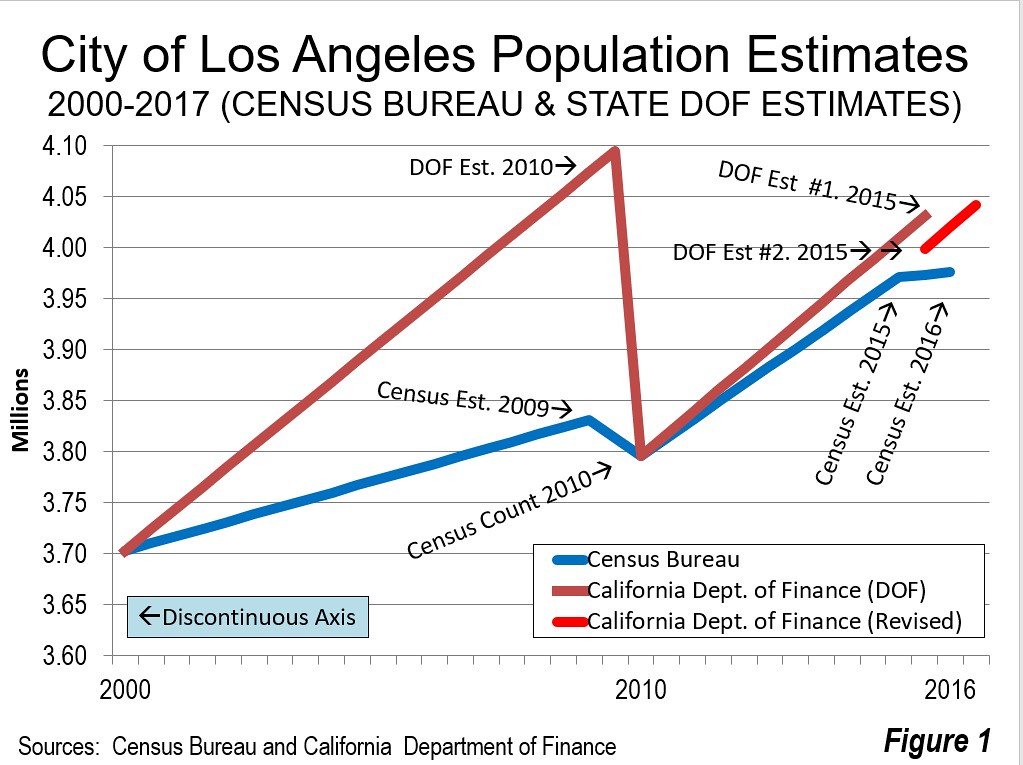
    How many times can a city reach 4 million population for the first time? I submit that Los Angeles (my birthplace), now near its fourth such celebration, is the undisputed champion, with each of the first three having not actually been reached.

    The first time was in 2008, when the California Department of Finance estimated the city’s population to have jumped to 4,046,000 from the 2006 figure of 3,996,000. The reported population growth continued to 2010, when the Department of Finance estimated that the city had reached 4,095,000 residents. But when it came to counting people, the 2010 United States Census found only 3,793,000. Thus, between 2000 and 2010, the city of Los Angeles population rose 98,000, not the four times higher of 400,000 that the state had estimated.

    Since only the U.S. Census Bureau actually counts all of the nation’s people, it is the authoritative source for population data. The state Department of Finance appropriately recalibrated its 2010 data to equal the census number for 2010.

    The Second and Third First Times

    The second cause for celebration came in 2016, as the LA Weekly headline trumpeted, “Thanks, Millennials: L.A.’s Population Tops 4 Million for the First Time,” reporting on the just released 2016 state Department of Finance estimate of 4,031,000 city residents.

    The third celebration was held just a year later, when the 2017 state Department of Finance population estimate was released, prompting a Los Angeles Times headline, “Los Angeles hits a milestone: 4 million people and counting.” Reaching this milestone the third time was possible again, because the state Department of Finance had revised its 2016 city population estimate to just shy of 4,000,000 (3,999,237), a reduction of 32,000. When releasing its January 2017 estimate of 4,042,000, the Times did not mention either of the two previous times the “milestone” had been reportedly reached. They don’t do history much in newsrooms these days.

    But the U.S. Census Bureau still places the city’s population at below 4,000,000 (3,976,000), as of July 2016. So a fourth first time could be on the horizon (Figure 1).

    Revised U.S. Census Bureau Estimates: 2015

    The reduction in the state estimated population for the city may have been in response to revised 2015 U.S. Census Bureau estimates for virtually all of the nation’s jurisdictions, issued as its 2016 estimates were released (see The Urban Inversion is Over). The city of Los Angeles did poorly in these revisions. The city of Los Angeles had a 22,700 reduction compared to the original estimate, the second greatest in the nation. The city of New York did worse, with a loss of 33,900, though with more than double the population of Los Angeles, actually performed better proportionally.

    Southern California also did poorly in the census recalibrations. Los Angeles County, the nation’s largest, had the greatest reduction, at 58,000. This was more than four times the second largest loss (13,400), which was in Cook County, Illinois (Chicago). The Los Angeles County downward revision was 0.57 percent, while the Cook County reduction was less than one half that, at 0.26 percent. Orange County, the other county in the Los Angeles metropolitan area, had the third greatest reduction out of the more than 3,100 counties, at 13,300, a 0.42 percent loss. The five counties of the larger Los Angeles metropolitan region (the combined statistical area or CSA that includes Los Angeles, Orange, Riverside, San Bernardino and Ventura counties) had a downward reduction of 87,800. Overall, the national reduction was 520,000. Thus, Los Angeles CSA represented 17 percent of the national downward adjustment, nearly three times its six percent share of the population.

    The revisions, even in the Los Angeles area, were small. However, they are further evidence of weakness in California’s population growth. So far this decade, California has grown approximately 12.1 percent less than projected, and, remarkably, grew less than the national average over the past year, a rare, if ever, occurrence. The even greater 27.5 percent shortfall in Los Angeles County means that there will be 175,000 fewer people than projected by 2020, if the current population growth rate continues.

    For the better part of two decades, Los Angeles County has led the nation in domestic migration losses —- the number of people moving out compared to those moving in. Just since 2010, the county has lost 350,000 net domestic migrants, equal to the population of Glendale and Pomona combined.

    All of this will be unwelcome news to people expecting the population growth explosion necessary to support planning “pack and stack” densification dreamss. There are just not enough people moving to Los Angeles, and the horrendous housing costs encourage more to move away.

    The Challenge of Estimating Population

    Ultimately, estimating population is not simple and its accuracy can only be fully known by the actual counts taken in the United States every ten years in the census. The experience of the Census Bureau itself indicates the difficulty. In 2009, the Census Bureau estimated the population of the city of Atlanta at 541,000, a full 120,000 above the actual count taken a year later. Its New York City estimate in 2009 was more than 200,000 above the 2010 census count. The city of Chicago estimate was more than 150,000 high. Similar cases could arise once the 2020 census data is in.

    The Fourth First Time

    Meanwhile, maybe the fourth time will be “for real” and Los Angeles will pass 4,000,000 residents for good. But, even if it actually achieves the milestone a decade after the initial announcement, a good deal less bravado is called for by the trends.

    Wendell Cox is principal of Demographia, an international public policy and demographics firm. He is a Senior Fellow of the Center for Opportunity Urbanism (US), Senior Fellow for Housing Affordability and Municipal Policy for the Frontier Centre for Public Policy (Canada), and a member of the Board of Advisors of the Center for Demographics and Policy at Chapman University (California). He is co-author of the “Demographia International Housing Affordability Survey” and author of “Demographia World Urban Areas” and “War on the Dream: How Anti-Sprawl Policy Threatens the Quality of Life.” He was appointed to three terms on the Los Angeles County Transportation Commission, where he served with the leading city and county leadership as the only non-elected member. He served as a visiting professor at the Conservatoire National des Arts et Metiers, a national university in Paris.

    Photograph: Los Angeles City Hall (by author)
    http://www.newgeography.com/files/imagecache/Chart_Story_Inset/lacityhall2.PNG

  • The Great Transit Rip-Off

    Over the past decade, there has been a growing fixation among planners and developers alike for a return to the last century’s monocentric cities served by large-scale train systems. And, to be sure, in a handful of older urban regions, mass transit continues to play an important — and even vital — role in getting commuters to downtown jobs. Overall, a remarkable 40 percent of all transit commuting in the United States takes place in the New York metropolitan area — and just six municipalities make up 55 percent of all transit commuting destinations.

    But here’s an overlooked fact: Transit now serves about the same number of riders as it did in 1907, when the urban population was barely 15 percent of what it is today. Most urban regions, such as Southern California, are nothing like New York — and they never will be. Downtown Los Angeles may be a better place in which to hang out and eat than in the past, but it sorely lacks the magnetic appeal of a place like Manhattan, or even downtown San Francisco. Manhattan, the world’s second-largest employment center, represents a little more than 20 percent of the New York metropolitan area’s employment. In Los Angeles, by contrast, the downtown area employs just 2 percent.

    Transit is failing in Southern California

    As we demonstrate in a new report for Chapman University, our urban form does not work well for conventional mass transit. Too many people go to too many locales to work, and, as housing prices have surged, many have moved farther way, which makes trains less practical, given the lack of a dominant job center. But in its desire to emulate places like New York, Los Angeles has spent some $15 billion trying to evolve into what some East Coast enthusiasts call the “next great transit city.”

    The rail lines have earned Mayor Eric Garcetti almost endless plaudits from places like the New York Times. Yet, since 1990, transit’s work trip market share has dropped from 5.6 percent to 5.1 percent. MTA system ridership stands at least 15 percent below 1985 levels, when there was only bus service, and the population of Los Angeles County was about 20 percent lower. In some places, like Orange County, the fall has been even more precipitous, down 30 percent since 2008. It is no surprise, then, that, according to a recent USC study, the new lines have done little or nothing to lessen congestion.

    This experience is not limited to L.A. Most of the 19 metropolitan areas with new mass transit rail systems — including big cities like Atlanta, Houston, Dallas and even Portland, Ore. — have experienced a decline in transit market share since the systems began operations.

    Read the entire piece at The Orange County Register.

    Joel Kotkin is executive editor of NewGeography.com. He is the Roger Hobbs Distinguished Fellow in Urban Studies at Chapman University and executive director of the Houston-based Center for Opportunity Urbanism. His newest book is The Human City: Urbanism for the rest of us. He is also author of The New Class ConflictThe City: A Global History, and The Next Hundred Million: America in 2050. He lives in Orange County, CA.

    Wendell Cox is principal of Demographia, an international public policy and demographics firm. He is a Senior Fellow of the Center for Opportunity Urbanism (US), Senior Fellow for Housing Affordability and Municipal Policy for the Frontier Centre for Public Policy (Canada), and a member of the Board of Advisors of the Center for Demographics and Policy at Chapman University (California). He is co-author of the “Demographia International Housing Affordability Survey” and author of “Demographia World Urban Areas” and “War on the Dream: How Anti-Sprawl Policy Threatens the Quality of Life.” He was appointed to three terms on the Los Angeles County Transportation Commission, where he served with the leading city and county leadership as the only non-elected member. He served as a visiting professor at the Conservatoire National des Arts et Metiers, a national university in Paris.

    Photo: Esirgen (Own work) [CC BY-SA 3.0], via Wikimedia Commons

  • Changing the Narrative in Cleveland

    Cleveland, like many Rust Belt cities, has both an image and a self-image problem. Its residents have simultaneously had passion and loyalty for the city, while also being filled with shame about it and relentlessly negative and fatalistic about its future. Again, this is something that is the case for any number of places.

    This is a problem because the economy runs on expectations. Why do you start a business doing X? Because you expect to make a profit at it. Why move to city Y? Because you expect the job you have there will be a good fit or you otherwise expect that you are going to find personal satisfaction there.

    If we expect the economy to do poorly, we tighten our belts and help create the weakened demand conditions that bring that economy about. If we have positive expectations about the future we behave differently.

    Any number of cities seemed to be created from nothing much out of sheer boosterism, a sort of fake it till you make it approach that generated expectations that ultimately became a self-fulfilling prophecy. Houston may be a good example of this.

    So in a sense the real future of a place depends on people’s expectations about it in the future. That’s not to say that any expectation can simply be willed into being. Just because you expect to win the Super Bowl doesn’t mean it will happen. But positive expectations play a critical role in creating positive realities.

    Expectations are simply beliefs about the future, and thus can be shaped by sales and marketing techniques. This is part of what the city branding business is all about.

    Traditionally, marketing folks in Midwest cities have struggled to definite a positive aspirational identity and sell it to the world. Cleveland falls into this category. But a recent article in Cleveland Magazine talks about how the narrative and expectations about the city have changed in light of recent developments such as the return of LeBron James and the resulting NBA championship.

    “It got to the point where we began to believe the negative side of our image, to the point where we ourselves began to reinforce that,” says Mayor Frank Jackson. “When we did that, it became true, not only what the world thought we were, but also what we thought we were.”

    Research by Destination Cleveland showed that in 2012, only 34 percent of locals would recommend Cleveland to friends and family. Consider that for a second. Only five years ago, 66 percent of Clevelanders were so down on their town they couldn’t even bear the agony of putting in a good word with their college pals or Uncle Al. Other similar cities would usually have positive numbers in the mid-60s.

    Well, we’ve got a problem, thought David Gilbert, Destination Cleveland president and CEO.

    Five years later, amid an avalanche of good news, our chests swell with civic pride. LeBron came back. We won an NBA championship and made it to the World Series in the same year. We hosted a major political convention. The renovated Public Square opened. The lakefront is blossoming. Health care technologies and professional services are opening a connection to the globalized economy. We are, proportionately speaking, drawing more than our fair share of millennials to the region.

    The article goes on to describe the various ways in which Clevelanders are much more optimistic about the future of their city than they were in the past. That’s great news and a sign of shifting internal expectations.

    It’s hard to convince the world your city is great if you don’t even believe it yourself. I myself have had the experience in other cities of having people berating their own town and wondering why people who had moved there had done such a darned fool thing. Changing the internal narrative really helps set the stage for changing the external one.

    The article rightly highlights the risk facing Cleveland and other cities in the region. Namely that this expectations turnaround has been based on events like the NBA win, the GOP convention, etc. Previous Cleveland renaissances flamed out when those externals changed.

    The challenge for Cleveland is to create something durable that carries them through the difficult challenge of long term change and dealing with some of the challenges they face. But for now the fact that the spirits of residents have been lifted – and not without cause – and that there have been some events that generated positive national press is good news for this long-struggling city. It’s right and proper to celebrate it.

    This piece first appeared on Urbanophile.

    Aaron M. Renn is a senior fellow at the Manhattan Institute, a contributing editor of City Journal, and an economic development columnist for Governing magazine. He focuses on ways to help America’s cities thrive in an ever more complex, competitive, globalized, and diverse twenty-first century. During Renn’s 15-year career in management and technology consulting, he was a partner at Accenture and held several technology strategy roles and directed multimillion-dollar global technology implementations. He has contributed to The Guardian, Forbes.com, and numerous other publications. Renn holds a B.S. from Indiana University, where he coauthored an early social-networking platform in 1991.

    Photo by Aeroplanepics0112 (Own work) [CC BY-SA 3.0], via Wikimedia Commons

  • Children and Cities

    My wife recently gave birth to our first child. It’s an exciting time – and also one that portends great changes for our future.

    Cities are supposedly hostile to children. But living on the Upper West Side of New York, we’ve experienced nothing but oohs and ahhs over our son. The people in our neighborhood love children. And there are plenty of them around. The UWS is one of those places you could probably classify as a “strollerville.”

    But it’s hard not to notice that while there are lots of very young children here, there are far fewer school aged ones. I don’t have any desire or plans to leave, but I have to recognize that children have a way of changing your priorities. Realistically, most people with school-aged children still seem to move to the suburbs. Those I see raising older kids in the city are generally well-off enough to afford large apartments or even single family homes (in cities like Chicago). They can also either pay the premium to live in a high quality neighborhood school zone or pay the freight for private schooling.

    The number of children in cities, particularly in the dense urban centers were the creative class often congregates, is often low. San Francisco, one of the paradigms of creative class urbanism, has the lowest share of children of any major city at only 13%. The city famously has as many dogs as children.

    This has important implications. These global cities are where the culture is made, where the media are, etc. To the extent that they represent a very atypical demographic profile that largely excludes families with school-aged children, this only perpetuates the “bubble” in which America’s leadership class often lives.

    The values and priorities of people without children are different from those with children. One example is the value people put on space. In our central cities populated with largely people who have no children, a big obsession is changing zoning regulations to allow smaller units, including so-called “micro-apartments.” These kinds of developments would enable more upscale young adult singles to live in cities. That’s good in itself. Yet it is not paired with equal concern about creating more housing for families. What’s more, urbanists are often hostile to changes in the city that would increase child friendliness. For example, central cities often have smaller apartments. One way to create the space families require is to combine units. But people doing just that in Chicago – converting or deconverting multi-flat buildings into single family homes – are opposed by urbanists, who see this as destroying housing supply and reducing density.

    Jane Jacobs saw cities as a superior vehicle for the socialization of children, writing:

    In real life, only from the ordinary adults of the city sidewalks do children learn – if they learn at all – the first fundamental of successful city life: People must take a modicum of public responsibility for each other even if they have no ties to each other. This is a lesson nobody learns by being told. It is learned from the experience of having other people without ties of kinship or close friendship for formal responsibility to you take a modicum of public responsibility for you.

    Yet today cities are increasingly no longer seen as a locus of family life and child rearing, but rather an “entertainment machine” for adults, as Terry Nichols Clark famously labeled.

    There’s nothing wrong with urban centers playing that role as playground for adults and production node in the creative class economy – as long as you recognize the limits that implies. These urban environments are often held up as the model for the future, especially in a world of climate change. But a city without children has no future. To the extent that central cities outsource the rearing of future generations to the suburbs or foreign countries, they cannot plausibly serve as a general-purpose model. The world can have and celebrate its San Franciscos or lower Manhattans, but they will remain a minority of places.

    Aaron M. Renn is a senior fellow at the Manhattan Institute, a contributing editor of City Journal, and an economic development columnist for Governing magazine. He focuses on ways to help America’s cities thrive in an ever more complex, competitive, globalized, and diverse twenty-first century. During Renn’s 15-year career in management and technology consulting, he was a partner at Accenture and held several technology strategy roles and directed multimillion-dollar global technology implementations. He has contributed to The Guardian, Forbes.com, and numerous other publications. Renn holds a B.S. from Indiana University, where he coauthored an early social-networking platform in 1991.

    Photo by Garry Knight, via Flickr, using CC License.