Category: Urban Issues

  • Gary Hustwit’s “Urbanized” Re-lighting Debate on Cities

    Gary Hustwit’s new film, “Urbanized,” is the third in his series of documentaries concerning design.  In his first two films, he looks at consumer product design and the global visual culture.  The existential problem of the city, an urgent one about which much of this website is concerned, is scarcely treated in our contemporary mainstream, and Hustwit’s effort is laudable. In this film, he tackles urban design, introducing ideas about how cities should – and should not – accommodate growth.  “Urbanized” tends to favor the big idea over the small, and airs the conventional wisdom of the urban design community.  In doing so, he brings to the public an important debate, but he misses some opportunities to explore change in the urban realm.

    In a visual feast of a film, interlaced with intriguing interviews of some of the luminaries of the 21st century design culture, “Urbanized” makes a case for elevating the environment to the same level of concern as architecture and mobility.  The documentary tends to reinforce, not question, notions of right and wrong growth that are promulgated by the urban intelligentsia, and he declines to explore the validity of most of these notions.  He also tends to focus on large, dramatic solutions to the urban growth dilemma, perhaps because they make for good cinema.  Flashy red Transmilenio buses in Bogatá; NASA-like control centers in Rio de Janiero; and Green Party clashes with the police in Stuttgart all imply that heroes must be at work to keep our cities livable and inspiring.

    To his credit, Hustwit does show local and small changes that are taking place in cities like New Orleans and Detroit.  He interviews urban agriculturalists, conceptual artists, and folks who spray-painted a graph of their power consumption on their street in Brighton, England.  Small moves like these are important, and tell us about how people are coping with unique urban challenges today.  But these stories are background to the larger profile stuff happening elsewhere on the globe.

    In Santiago, Chile, “Urbanized” shows the viewer how affordable housing is being developed on highly desirable land close to jobs.  The architect interviewed potential residents, giving them a choice between a water heater or a bathtub (all chose the bathtub, preferring to save up for the water heater).  Recognizing employment value over land value is exactly the kind of brave step that is much needed in our cities today, and this project provides a bold experiment to watch in this regard.  Even bolder is the strategy that assumes people, through their own devices, will prosper and increase the value of their home on their own – save up to buy a water heater, for example.  The documentary provides an interesting glimpse into an alternative approach to housing in this segment.

    Of course, no moviemaker could expect a good reception to a movie like this without paying homage to New York City, and Hustwit delivers us affectionate portraits of the Big Apple at the beginning, middle, and end of the film.  With the recent transformation of the city’s old elevated rail bridge, the High Line, Hustwit nicely showcases environmental awareness, historic preservation, and sustainability.  In a city that has effectively raised its hierarchy of needs to the ether, the issues of poverty and sanitation are worlds away.

    Which, in fact, they are in this film.  Over half the globe’s population lives in cities, so most—nearly one third of the globe’s population—live in urban  slums.  Hustwit exposes the pain of this reality.  Edgar Pieterse of the African Center for Cities describes the horrific conditions of urban poverty, and in Mumbai, architects discuss the government’s obstinacy in addressing these conditions in this famous slum.  Here, urban design is viewed as a strikingly pessimistic problem.  Density without modern technology violates basic hygiene and human dignity; and there appears to be no solution.

    The stereotype of Mumbai’s slums is reinforced, with a touch of Cape Town thrown in as well.  Yet, one wonders if the contemporary desperation of urban poverty in Western cities might be worth looking at, too; the vicious manner in which the Western poor vandalize their own city and strike out at their fellow citizens seems to be perpetually ignored, while the relatively mild behavior of the Mumbai slum dweller seems all too pitiable when viewed large on the big screen.  The poorest classes in the Western world, lacking access to education and upward mobility, are acutely aware of their neighbors’ material success, thanks to the ubiquitous media.  For fifty years, this tension has wrecked our inner cities, but has been ignored by urban designers.  “Urbanized” continues this trend.

    In the meantime, Hustwit interviews architects, urban planners, politicians, and academics who aspire to make cities walkable, compact, and connected.  Within this community, the car is deemed as a painful problem, and “Urbanized” takes us from Ebenezer Howard’s Garden City to modern day Phoenix.  The arc of the film begins with trains, and then showcases buses, cars, bicycles, and walking solutions.  By now, it is ritual to condemn the car and rejoice in the other options, and “Urbanized” follows this formula.

    Just as Mumbai is shorthand for slums, Phoenix is shorthand for sprawl.  Footage of traffic jams suggest that Phoenix is a worst-case scenario, even though the longest commutes by far take place in denser regions, such as New York and Los Angeles. Again, “Urbanized” does slip in a small, but important point, using Grady Gammage, Jr., a real estate attorney, academic, and political leader in Phoenix.  Gammage reminds the viewer that what is commonly labeled as “sprawl” is, in fact, the density level at which humanity has always dwelt.

    “Urbanized” serves as a timely milestone, bringing together voices and ideas that dominate our thinking about cities today.  While it deals with problems like the rebuilding of New Orleans, it also seems timeless by not mentioning some of the recent changes that affect our urban existence.

    The global recession cooled off the credit market, which has paused construction in all but a few places.  The impact this has had on our cities would be an interesting documentary to watch, for our built environment is much like a consumer product, as buildings go quickly obsolete and competition forces building owners to keep up.  Nimble private developers have already switched gears to repair and renovate; yet our municipal codes, fees, and processes are still geared to the boom.  This schism between private and public thinking is constraining our cities today.

    Affordable housing will sharply affect urban life in the near future, and western cities seem to be on a trajectory that increasingly looks headed towards Mumbai.  Ignoring the gap between the rich and the poor and heaping requirement upon requirement until prosperity is all but lost to the poor could negatively affect our cities.

    The last time city planning was earnestly discussed at the mainstream level was perhaps in Jane Jacobs’s heyday in the early nineteen sixties.  Since then, the arguments and theories seem to have been put away, having solved the problem at the time, and new solutions have not been eagerly considered. These solutions – born in the righteous indignation of Jane Jacobs’s – are a bit shopworn.  Much has changed since the 1960s:  Our population has increased by an order of magnitude; urban dwellers outnumber rural, and our image of the city has changed.  We acquired an internet.  It is time to take stock.

    The debate about how our cities will grow in the 21st century must reach the mainstream, and get out of academia and the professional specialists.    “Urbanized” is a timely examination of the problems of the city today – how to provide a sanitary and dignified urban form at the basic level, and how to inspire and rejoice in the sheer spectacle of the city at a higher level.  It has started to relight the much-needed fires of debate and conversation among citizens of cities today.

    Richard Reep is an Architect and artist living in Winter Park, Florida. His practice has centered around hospitality-driven mixed use, and has contributed in various capacities to urban mixed-use projects, both nationally and internationally, for the last 25 years.
  • How A Baby Bust Will Turn Asia’s Tigers Toothless

    For the last two decades, America’s pundit class has been looking for models to correct our numerous national deficiencies. Some of the more deluded have settled on Europe, which, given its persistent low economic growth over the past 20 years and minuscule birth rates, amounts to something like looking for love in all the wrong places.

    More rational and understandable have been those who have looked for role models instead in East Asia. After all, East Asia has been the world’s ascendant power for the better part of past 30 years. It is home to both China and Japan, the world’s second and third largest economies, as well as the dynamic “tiger” economies of Korea, Taiwan, Hong Kong and Singapore.

    Thomas Friedman, long enamored by authoritarian leviathan China, recently praised the tiger countries as exemplars of forward thinking. He traces their strong emphasis on “highly effective teachers, involved parents and committed students” as keys to turning their resource-poor countries into first world successes.

    Yet for all their laudably good school test scores, these tigers could turn somewhat toothless in the future. Already Japan, which fashioned the first great Asian model, is beset by a series of massive challenges including a lack of technological competitiveness and disastrously declining demographics. They also face competition from places like China and India, behemoths which may not equal the Tigers’ spectacular per-capita education numbers, but which can marshal overwhelming numbers of ambitious, educated and skilled people.

    Many in the tiger nations recognize this competitive plight far more than their western cheerleaders. Some even wonder if they may even have been too rational and credential-obsessed for their own good. Like Japan after the Second World War, they invested heavily in educating their young people to excel on tests and work long hours . But this also fostered high levels of stress and hyper-competition that discourages both family formation and child bearing .

    Singapore (where I serve as Senior Visiting Fellow at the Civil Service College) is arguably the best planned and most cleverly conceived of all the Tigers. Singaporeans live well — their per-capita incomes surpass those of Americans — but this edge is largely blunted by extremely high costs. As in all the Tiger countries, consumer goods like cars are extraordinarily expensive (a modest Korean model can run upwards of $75,000 or more in Singapore) and housing costs far higher than experienced by most Americans. In Hong Kong, notes researcher Wendell Cox, an average apartment, usually quite small, costs roughly twice as much as one  in New York or San Francisco, two most elite metro U.S. markets, relative to income.

    These conditions, observes Vatsala Pant, a former Nielsen executive and long-time Singapore resident, create what amounts to an accounting-like mentality about their lives. “Singaporeans seem to be born with a calculator in their heads,” she notes. “Every decision seems to weighed in a cost and benefit analysis, including such things as family. If it’s not perfect, they don’t want it.”

    This turn from family represents a sharp break in these countries. All the “tiger” economies flourished based on a Confucian culture that places kinship at the top of the value pyramid. Parents are still widely revered, but Li Lin Chang, an associate director of the Lee Kuan Yew School of Public Policy, suggests that Singapore’s “Confucian roots may not be as evident and some may argue that it may have disappeared.”

    Certainly increasing number of Singaporeans and others from Tiger countries are opting out of marriage. In 2000, 14% of women between age 30-39 chose to remain childless, according to demographer Gavin Jones of the National University of Singapore. By 2009, this figure has gone up to 20%. Jones estimates in some east Asian societies up to a third of all women will remain childless.

    Japan, the original model for all these countries, is now leading the way off the demographic cliff. In Japan, notes researcher Mika Toyota, 20% of 50-year-old males have never married, up from 12 percent just a decade ago. By 2030, she estimates nearly 30% of 50-year-old males will have never wedded. And unlike the U.S. and Europe, very few people have children out of wedlock in East Asia, so no marriage means no children.

    This plunge in marriage and family formation is not entirely voluntary. Few of the 40 or more Singaporean younger adults I have interviewed in recent months celebrated singleness like some of their Western counterparts. Most still wanted children and linked their reluctance to wed or to have babies on the high cost of living, intense competition in their workplace and even increasingly crowded mass transit.

    “Most of my friends are not married,” one 35-year-old female civil servant told me. “They don’t want to be single but they are too busy with their work commitment. My friends are consumed by work. Money, status, prestige, climbing the ladder. You expect things to change when you get older but it doesn’t. The calculation just doesn’t work out”

    For many of these people, not having offspring makes sense in terms of concentrating on career goals and reducing financial pressure. But it could prove a social disaster in the long run. All Tiger nations now suffer fertility rates roughly half the 2.1 children per household needed to replace the current population. By 2030 these countries could have fewer people under 15 than over 60.

    Not surprisingly, many Tiger country policymakers place a priority on producing more cubs. Most offer highly generous packages of support offered to those willing to take the nativity plunge. Some who have children cope with entrenched male reluctance to share in child-raising by relying on low-cost maids, often from the Philippines and other poorer countries. A recent move by the Singapore government to require giving maids the day off elicited howls of protests from female professionals, who, as authors Teo You Yenn and Vivienne Wee put it, regard “care of one’s own offspring as tedious, beneath oneself and rightfully the responsibility of a hired woman.”

    Some professionals who desire children consider taking their finely honed skills elsewhere. A recent survey by the MRI China Group showed that a majority of professionals surveyed in Taiwan and some forty percent in Singapore, as well as roughly one-third of those in Hong Kong, were actively looking to relocate to another city. Most covet a move to less high-pressure, lower-density Australia or New Zealand. Others, particularly from Taiwan, are attracted to greater opportunities in China.

    There may not be too much the bureaucracies can do immediately to address these problems. Clearly adding more degrees per capita or bringing in more foreign expertise, as is common in Singapore and Hong Kong, has not addressed looming baby shortage. Instead, as one one young University researcher put it, “we need a new mindset.”

    Most particularly, these countries need to change the incentives that, albeit unintentionally, create unsustainable levels of singleness, childlessness and the prospect of massive, rapid aging of their societies. They may have to consider more flexible work-styles, the promotion of home based business and better use of their limited space. Individual entrepreneurship, more rooted in each country and able to meld with family life, could be stressed as a counterbalance to employment in often fickle multinational corporations who can always move to greener, or at least cheaper, locales.

    More difficult still will be shaping attitudes that restore the primacy of family that propelled these societies in the first place. This is an existential challenge that would have seemed unimaginable 40 years ago when these countries fretted about overpopulation and widespread poverty. But success in the future can not be purchased by simply continuing what has worked so well for a generation. To avoid a toothless future, the Tigers need to unlearn some of the secrets of their past success.

    This piece originally appeared in Forbes.com.

    Joel Kotkin is executive editor of NewGeography.com and is a distinguished presidential fellow in urban futures at Chapman University, and contributing editor to the City Journal in New York. He is author of The City: A Global History. His newest book is The Next Hundred Million: America in 2050, released in February, 2010.

    Singapore skyline photo by Bigstockphoto.com.

  • The Evolving Urban Form: Osaka-Kobe-Kyoto

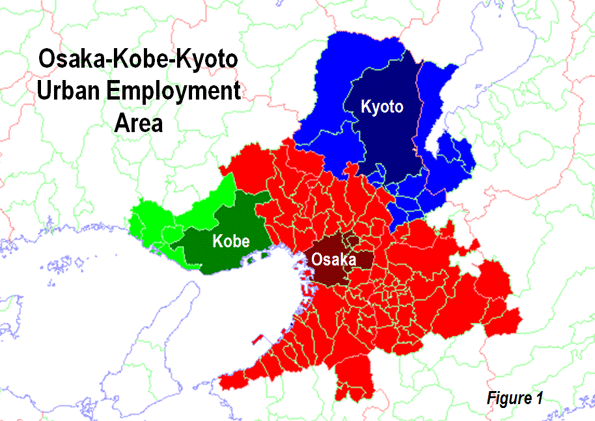
    Osaka-Kobe-Kyoto is Japan’s second largest urban area and ranks as the 12th largest urban area in the world. With a population of approximately 17,000,000 and a land area of 1240 square miles (3200 square kilometers), Osaka-Kobe-Kyoto has a population density of 13,700 per square mile (5,200 per square kilometer), making it the most dense major urban area in Japan and among the denser urban areas in the high income world. The larger metropolitan region includes four prefectures, Osaka, Kyoto, Kyoto and Nara (Figure 1).


    Adapted from WikiCommons user Kzaral

    World’s Largest Conurbation

    Osaka-Kobe-Kyoto is a conurbation, an urban area that has grown together from multiple cores (here, the urban areas of Osaka, Kobe and Kyoto). Most urban areas grow concentrically from a single core. In the process their suburban growth can engulf and incorporate smaller urban areas (such as Gifu in Nagoya, Bogor in Jakarta or Newark in New York), However, conurbations — such as  Rhine-Ruhr region in Germany (Essen, Dortmund, Duisburg, and Bochum), Katowice-Gliwice-Tychy (upper Silesia) in Poland, Dallas-Fort Worth and Minneapolis-St. Paul in the United States — develop when major urban areas grow together (or merge), forming a larger urban area.  

    The municipality of Osaka, the largest in the region, long had been Japan’s second municipality exceeded by Yokohama (in the Tokyo region) in 1980; in the 17th century it was the country’s commercial capital. Kobe, across Osaka Bay (20 miles or 32 kilometers), was one of the most cosmopolitan cities and was the site of the devastating 1995 earthquake, from which it has recovered remarkably. Kyoto is the former, historic, imperial capital as is 35 miles (55 kilometers) north of Osaka. The previous imperial capital, the historic municipality of Nara is also located in the region. Both cities are well known for its historic temples.

    Post-War Growth

    Between 1950 and 1970, the Osaka-Kobe-Kyoto region experienced extraordinary growth, adding nearly 5.7 million residents. The increase from 9.8 million to 15.5 million exceed that of all urban areas in the world except Mexico City (approximately 6 million) and Tokyo (11 million). Tokyo’s 20 year increase was the largest numerically in history for a metropolitan region. By comparison, Los Angeles, the Western world’s fastest growing metropolitan region between 1950 and 1970, added 5.0 million new residents. In 1970, only the Tokyo and New York urban areas were larger than Osaka-Kobe-Kyoto.

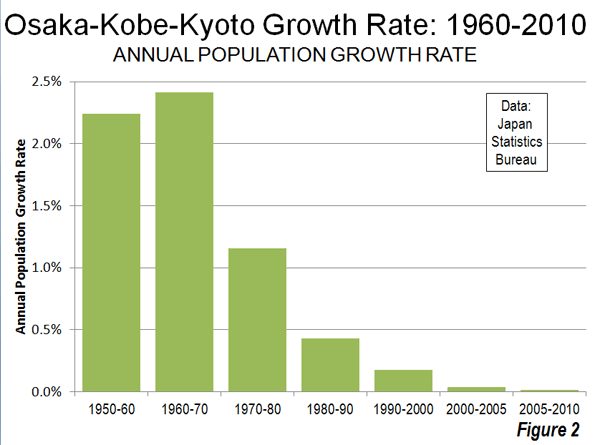
    The region grew quickly after the Second World War but experienced an even higher growth rate — well in excess of two percent during Japan’s great economic takeoff in the 1960s. During the 1970s, the annual growth rate dropped to 1.5%, still well above the current experience of most high income urban areas.

    Stagnating Growth, Presaging Decline

    As it turned out, the 1970s represented the conclusion of Osaka’s strong growth. From then on, growth fell quickly and   has since virtually stopped. It  appears likely that Osaka-Kobe-Kyoto will become the world’s first megacity (over 10 million population) to fall into population decline (see  end note).

    According to the 2010 census, the metropolitan region’s population of approximately 18,500,000 barely grew, adding only 13,000 residents from 2005. This represents  an annual growth rate of 0.014%, a decline of 60% from its anemic  0.036% growth rate between 2000 and 2005 (Figure 2).

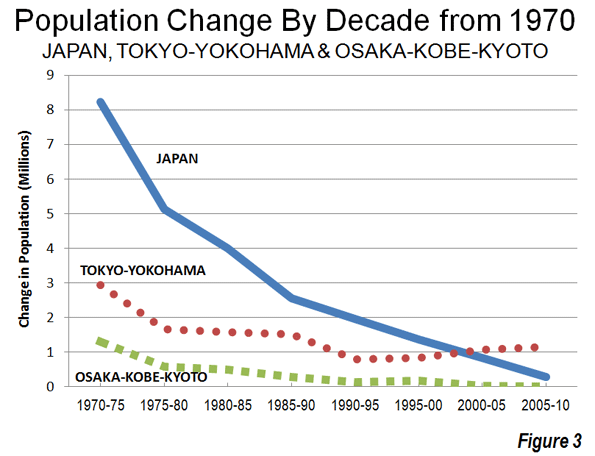
    Osaka-Kobe-Kyoto’s is falling behind even Japan’s slow growth pace, being 2005 to 2010 expanding by  less than one third of the national rate. One reason for this lies in continued concentration in the Tokyo metropolitan region (Figure 3). The Tokyo area captured 56% of the growth between 1970 and at 2010. Over the past five years Tokyo has added 1.1 million people, while the balance of the nation lost 1.4 million people. Japan’s population has stabilized and is expected to fall into decline in the years to come.

    Suburban Expansion

    As is typical of major metropolitan regions in the world virtually all of the growth in Osaka-Kobe-Kyoto since 1950 has been outside the historically core municipalities. Only 150,000 of the 6,250,000 population increase from 1950 to 2010 was in the municipalities of Osaka, Kobe or Kyoto. The suburbs accounted for nearly 98% of the region’s growth.

    As growth came to a virtual stop, however, the historical core municipalities have done better. Between 2000 and 2010, the municipalities of Osaka, Kobe and Kyoto had added 125,000 people, while suburban areas lost 79,000. The net result was a 46,000 population increase between 2000 and 2010 (Table).

    Osaka-Kobe-Kyoto Metropolitan Region
    Population Trend: 1920-2010
    Historical Core Municipalities
    Year Osaka Kobe Kyoto Total Suburban Region
    1920 1,253 609 591 2,453 4,289 6,742
    1930 2,114 765 788 3,667 4,668 8,335
    1940 3,252 1,090 967 5,309 5,056 10,365
    1950 1,956 765 1,102 3,823 5,941 9,764
    1960 3,012 1,114 1,285 5,411 6,774 12,185
    1970 2,980 1,289 1,419 5,688 9,780 15,468
    1980 2,648 1,367 1,473 5,488 11,866 17,354
    1990 2,623 1,477 1,461 5,561 12,556 18,117
    2000 2,599 1,494 1,468 5,560 12,883 18,443
    2005 2,629 1,525 1,475 5,629 12,847 18,476
    2010 2,666 1,545 1,474 5,685 12,804 18,489
    In 000s
    Data from Census of Japan


    Transport in Osaka-Kobe-Kyoto

    With its high density, Osaka-Kobe-Kyoto has a high level of traffic congestion. Osaka-Kobe-Kyoto ranks 19th highest road traffic density out of more than 90 urban areas for which data is available in the Millennium Cities database. This traffic density is despite the fact that Osaka-Kobe-Kyoto has the highest mass transit market share of any high-income world megacity outside Tokyo. In 2007, 57 percent of trips in the metropolitan region were by mass transit, compared to Tokyo’s 65 percent. By comparison, mass transit’s market share is approximately 30 percent in the Paris region and 10 percent in greater New York. The annual number of transit trips in Osaka-Kobe-Kyoto alone is more than one-half the total US ridership, despite having a population only 6% of the US.

    However, lest any conclude that Osaka-Kobe-Kyoto (or Tokyo) might be a model for US or European metropolitan areas, it must be noted that transit’s market share has dropped from 80 percent in the late 1980s.   Osaka-Kobe-Kyoto (as well as Tokyo and Nagoya) also demonstrate the "mass transit cannot be profitable" claim is a myth. In each of these three metropolitan areas, the vast majority of transit travel is on profitable private suburban railways.

    Osaka-Kobe-Kyoto: The Future?

    Very few large metropolitan areas have experienced population declines, and none with the vast scale and historic importance of Osaka-Kobe-Kyoto. Smaller metropolitan areas like Pittsburgh, Cleveland, Liverpool, Manchester and Genoa have stagnated and even experienced periods of population decline. But none have faced a future bleaker  than likely for Osaka-Kobe-Kyoto. United Nations population projections indicate that Japan will decline in population by 20 percent between 2010 and 2050. As the nation’s economic activity continues to centralize in Tokyo, this could be particularly be ominous for Osaka-Kobe-Kyoto. The trains could get less crowded.

    Wendell Cox is a Visiting Professor, Conservatoire National des Arts et Metiers, Paris and the author of “War on the Dream: How Anti-Sprawl Policy Threatens the Quality of Life

    —–

    Note: New York is reputed to have become the first megacity in the world in the 1920s. As late as 1980, there were only five urban areas in the world with more than 10 million residents. In 2010 there were 25 megacities.


    Photo: Himeji Castle, Kobe Prefecture. By Jean Love

  • The Great Reordering of the Urban Hierarchy

    A delegation from Chicago is in Brussels this week to sell the city as a tourist destination in advance of the forthcoming NATO Summit. A Phil Rosenthal column explains that the city has a long way to go:

    "I don’t think most people in the U.K.have any idea where Chicago is," said Rowan Bridge, a BBC Radio producer who last year spent six months based in Washington D.C. "Most people in England think the United States consists of three cities — New York, Washington D.C., and Los Angeles — because they’re the ones that run the media, they’re the ones where the celebrities hang out, they’re the ones where the politicians are."

    Rosenthal notes that Chicago has long worried about its image, and it has never been a top global tourist destination, but a recent drop in international visitors highlights the challenge even a colossus like Chicago faces in getting its word out in a competitive global economy.

    Reading this, it once again strikes me that the old urban hierarchy is being reordered by globalization and the dramatic expansion of the US federal government, to the disadvantage of Chicago and other cities. This, I believe, helps account for its recent struggle.

    Joel Kotkin has tirelessly documented the remorseless rise of Washington, DC, rain or shine, in a manner defiant of business cycles. Washington, once a sort of commercial backwater, is now becoming much more a national capital of the type other countries have had.

    Meanwhile, back in the "spiky world," the peaks thrive while the valleys suffer. But it is the highest peaks that thrive most of all. Hence we’ve seen the emergence of a robust NYC post-9/11. It seems to have become if anything more the center of the universe, a huge financial center, media center, fashion center, cultural center, etc. – and adding to it new strength such as its emergence as America’s #2 tech startup location after Silicon Valley. New York is at an all time population high and even withing about 60,000 jobs of its all time peak employment.

    So we have New York entrenched as America’s first city, and Washington, DC increasingly its new "Second City." Los Angeles, which seems to have never quite recovered from the early 90s defense draw down, and Chicago with its 2000s malaise, seem to be the victims of DC’s rise. Another loser is Boston, which has seen its status as a financial hub decline and whose Route 128 corridor of tech, having first lost out to Silicon Valley, now appears to be losing out to NYC.

    Second tier cities in developed countries may indeed suffer as globalization proceeds. Zipf’s Law has historically governed the hierarchy of urban population (and thus proxied for overall urban importance) within particular geographies. Richard Florida and his colleagues showed that Zipf’s Law does not apply on a global basis, possibly because of the difficulty of migration between countries.

    But many other migration type barriers have declined over time, and it’s easy to conceptualize that many types of activities that once operated largely in purely domestic hierarchies now complete in global ones. If true, this would suggest that some cities, like LA, Chicago, and Boston, which ranked high in a national hierarchy might be pretty far down the list in a global one. Those cities with the greatest advantages of talent, high end specializations, and the greatest global connections would be best positioned to succeed in making the transition. We can also note the rise of new cities of importance in the BRIC counties, the Middle East, and other parts of the "developing world" that would bring new competition to traditional developed world power players, particularly for those that were already secondary centers in their own country.

    To see this playing out, contrast the differing life histories of Chicago and Hong Kong, which were effectively founded at the same time.

    I would describe this as a mix of observation and hypothesis at this point, but would love to see more formal analysis. And of course we’ll see how the trends play out. Even if true, we may not be at the end of this Great Reordering. With Washington continuing to soar, we are seeing shifts in the balance of power even with New York, such as the increasing importance of Washington as a media center. Though the inexorable mathematical logic of the budget may crimp Washington at some point, it’s certainly not impossible that some time in the future it may take its place as a London-like truly dominant national capital.

    Aaron M. Renn is an independent writer on urban affairs based in the Midwest. His writings appear at The Urbanophile.

    Photo by Doug Siefken

  • The Leveraged Buyout of the GDR

    Until the European Central Bank purchased a call option on the future assets of the Greek government (which remains out-of-the-money), the largest leveraged buyout of a sovereign state had taken place in 1990, when the West German government acquired the German Democratic Republic (GDR), thought at the time to consist largely of liabilities. By most accounts the Bonn government paid over the odds for East Germany, estimated to have cost the West more than $1 trillion.

    The resulting peaceful unification of Germany has been one of the great achievements of postwar European integration. In recent months, Germany has faced the opportunity for another buy-out of a European neighbor, this time of Greece, but it has showed little appetite for the purchase. Does East Germany provide a model for the Greek bailout? ,

    To take stock of what the West Germans got for their investment, my son Charles, aged 16, and I recently biked around the principle cities of the East—Dresden, Leipzig, Weimar, Potsdam, and East Berlin—that for a long time fell on the dark side of the Iron Curtain.

    Berlin is unified and elegant, Dresden is a restored cultural monument, and Leipzig (where J.S. Bach lived) is a city of vast commercial and artistic ambitions. If our bike ride along the ragged edges of the Iron Curtain taught us anything, it was that the GDR was worth the money.

    To get to Dresden, we loaded the bikes onto an overnight express from Basel to Prague and slept until the train joined the River Elbe, historically the frontier between Western and Eastern Europe. In the last days of World War II, American and Russian armies met on its riverbanks at Torgau, just north of Dresden.

    At the end of the Cold War, the city synonymous with World War II fire bombings was a tired European backwater, with only a fraction of its royal splendors rebuilt and a trickle of Bulgarian tourists.

    Starting with the main railroad station in the early 1990s, the German government has transformed Dresden into a showroom for tourists and industry. The station is elegant and grand, a hybrid of the classical and the new, and Charles and I toured an ultramodern Volkswagen plant where the VW Phaeton, a bourgeois saloon car, is assembled largely by hand.

    We steered our bikes around the revived cathedral square, rolled past the elegant opera house, and wandered around the grounds of the royal palace. The city museum—like Kurt Vonnegut’s novel Slaughterhouse Five (a reference to his prisoner-of-war location, from which he witnessed the February 13, 1945 bombings)—tells how the city was engulfed in fireballs, the effect of detonating explosives detonated at an altitude of 2000 feet, which then sucked the air and life out of Dresden.

    To get to Leipzig, we biked northwest along the River Elbe, through industrial suburbs, apartment complexes, shopping centers, and finally a pristine landscape of orchards, villages, and river scenes. Only occasionally did we see the remnants of the GDR, the crumbling concrete so synonymous with the central committee’s five-year plans. Otherwise, the East has been gentrified.

    The 1989 revolution that brought down the Berlin Wall and the East German government started in Leipzig, with vigils in front of the Stasi headquarters and with larger rallies at the St. Nikolai Church.

    The Stasi building has been preserved as a memorial to its victims. The display cabinets are arranged around the offices of the secret police, complete with exhibits of wigs, tape recorders, phone taps, uniforms, typewriters, metal desks, maps, shoe phones, and devices suitable to steam open letters.

    Were its practices and legacies not alive and well in Homeland America, I would consign the Stasi to some dead-letter file, to be archived with Hitler’s SA in the dark nights of German history. The Stasi museum had the feel of an amateur theater production that had opened in East Germany and, after 9/11, moved to Broadway.

    From the museum director, I bought Anna Funder’s memoir of the GDR, Stasiland. She writes: “In Hitler’s Third Reich it is estimated that there was one Gestapo agent for every 2000 citizens, and in Stalin’s USSR there was one KGB agent for every 5830 people. In the GDR, there was one Stasi officer or informant for every sixty-three people.”

    In the U.S., the ratio of Homeland Security employees to the general population is one for every 1500 citizens.

    Weimar is the path not taken in German history—toward representative government and the celebration of intellectual enlightenment over what Bismarck called “iron and blood.”

    Charles and I found the assembly hall that lent its name to the post-World War I governments that were wiped away in the 1923 currency inflation. We rode to the houses of the poets Goethe and Schiller, each of whom found artistic freedom in the city that has the feel of a small university town, with libraries and parks. Nevertheless, the choreographers of Nazism and Communism arranged their own Weimar stage sets to tell the story that democracy leads to weakness, chaos and bankruptcy.

    Potsdam and East Berlin are monuments to vanished empires. Prussia’s Hohenzollern dynasty settled on Potsdam for its imperial palaces and amusements (one ballroom we saw is lined with thousands of seashells), and East Berlin was the people’s court of Stasiland.

    Funder writes of her visit to the condemned East German parliament: “Like so many things here, no one can decide whether to make the Palast der Republik into a memorial warning from the past, or to get rid of it altogether and go into the future unburdened of everything, except the risk of doing it all again.”

    Riding along the remnants of the Berlin Wall, which is preserved as an art gallery in several sections, I was curious about “ostalgie”—nostalgia for the simpler ways of the GDR, absent unified Germany’s cult of material ambition.

    Funder quotes a conversation about the Wall’s legacy: “It was an historical necessity. It was the most useful construction in all of German history! In European history…. Because it prevented imperialism from contaminating the east. It walled it in.”

    The highlight of the ride came between Leipzig and Weimar, where we spent much of our time exploring the Napoleonic battlefields of Jena and Auerstädt, where in 1806 France doomed Prussia to the fate of a second-rate European power until Bismarck redeemed the nation in the 1870 Franco-Prussian war.

    In tracking down the routes of Napoleon’s marshals, we rode through farm villages, towns, and small cities, many of which are rebuilding town squares or repainting important buildings—all part of the East German renovation. When Erich Honecker was the East German party chief, buildings were only painted up to the first floor, allegedly because that’s all he could see from the backseat of his limousine.

    It was just up the road in Leipzig where Napoleon lost his empire, in the 1813 Battle of Nations. It was perhaps the first attempt at a European Union. But Austria, England, Prussia, and Russia all decided that Napoleon was a nuisance on the continent, and sent him packing to Elba—even if they had to repeat the exercise at Waterloo.

    A similar coalition has tendered its offer to keep Greece in the grand alliance. Having East Germany in the money should give the EU confidence in its convictions, proof that it can be more cost effective to buy a nation than to put one through liquidation.

    Photo by Matthew Stevenson. Near Leipzig, formerly in East Germany, a railroad station that will soon be renovated.

    Matthew Stevenson is the author of Remembering the Twentieth Century Limited, a collection of historical essays. He lives in one of the wine regions of Switzerland. His next book is Whistle-Stopping America.
  • The Evolving Urban Form: Ho Chi Minh City (Saigon)

    Vietnam may be the next China. With a nominally communist government, Vietnam has liberalized its markets and is prospering from an increased reliance on exports. Vietnam’s gross domestic product per capita is still only about $3000, but has been among the faster growing economies over the past 10 years. Vietnam is well positioned to capture any growth that might be diverted from China’s east coast urban areas as labor costs there rise and concerns increase about the influence of that country’s powerful state-owned corporations.

    Political power in Vietnam may lie in Hanoi, but the economic heart of Vietnam is Ho Chi Minh City, the former Saigon. Ho Chi Minh City is the core of Viet Nam’s largest urban area, which is headed toward a population of 9 million, including exurban areas beyond the municipal boundaries.

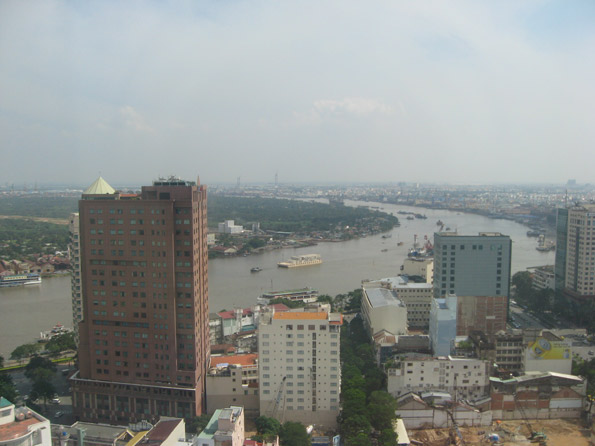
    For planning purposes, the area has been divided into five subregions. The urban development trends in the Ho Chi Minh City area are similar to those of high income world urban areas. The core is experiencing little or no population growth, while peripheral areas are growing much more strongly (Photo: Core and Saigon River).


    Core and Saigon River

    Suburbanizing Ho Chi Minh City: Historical data for the districts of Ho Chi Minh City are difficult to obtain. However, the last five years provide a representative view of urban development trends, especially when combined with population projections through 2025 as reported in transportation planning documentation from the Ho Chi Minh City master plan.

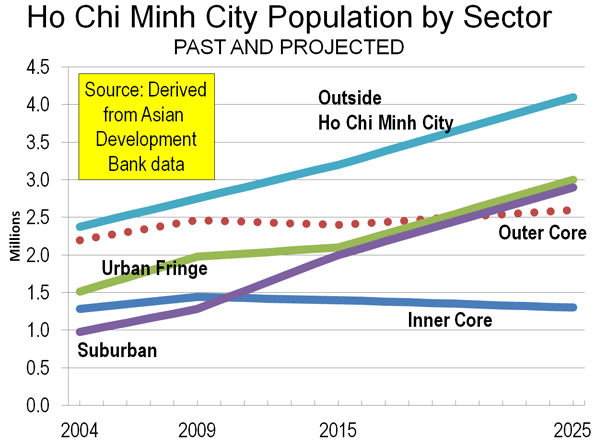
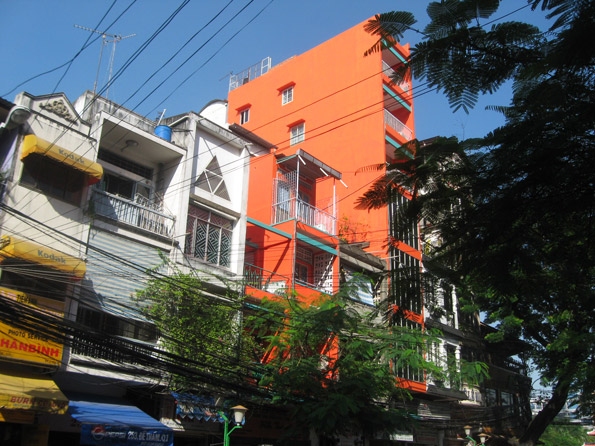
    The inner core area has a population of approximately 1.4 million, with little growth expected, and is expected to decline in population by 2025. At the same time, the inner core is particularly dense, with more than 100,000 residents per square mile or 40,000 residents per square kilometer. This is approximately 1.5 times as dense as Manhattan or the ville de Paris. By 2025, the inner core will decline further to a population of 1.3 million. One unusual distinguishing characteristic of the core is very thin buildings, the result of taxation based upon building width (Photo: Tax induced thin buildings)


    Tax induced thin buildings

    Growth is stronger, but still limited in the outer core area (adjacent to the core, but differentiated because of its lower density). Over the past five years, the outer core grew from approximately 2.2 million to 2.5 million, which is strong growth in most high income world urban areas but not as notable for a rapidly growing urban area in the developing world. This growth is expected to moderate even further by 2025, when the population is expected to reach only 2.6 million. The population density in the outer core area is 60,000 per square mile or 23,000 per square kilometer.

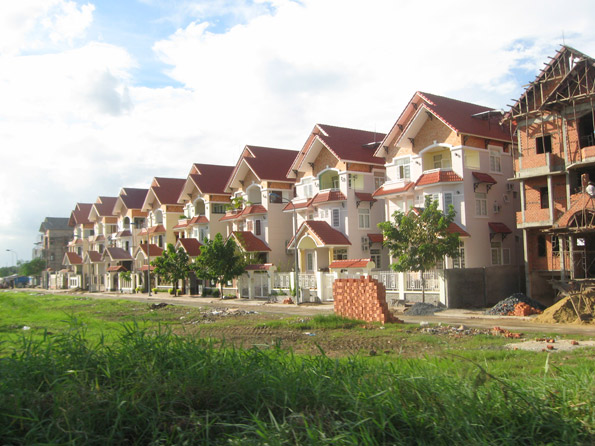
    In contrast, almost all  the growth is expected outside the core, with both less formal development and very attractive housing (Photo: New suburban housing).


    New suburban housing

    The urban fringe areas, or the second ring of development beyond the inner core grew from 1.5 million in 2004 to 2.0 million in 2009, a 31% growth rate. By 2025, the urban fringe is projected in transportation planning documentation to grow to 3.0 million. The population density of the urban fringe is 14,500 per square mile or 5,500 per square kilometer, nearly as dense as the city (municipality) of San Francisco.

    The suburban areas within the municipality of Ho Chi Minh City grew from 1.0 million in 2004 to 1.3 million in 2009, again approximately a 30% growth rate. By 2025, the suburban areas are expected to experience the greatest growth, adding 1.6 million population, rising to 2.9 million residents.

    Comparable data for the exurban areas outside the Ho Chi Minh City municipality are not as readily available. However, it is projected that from 2007 to 2025 the population in these areas will rise from 2.6 million to 4.1 million.

    Overall, the municipality grew from 6.1 million population in 2004 7.2 million in 2009, for an 18% growth rate. Including the municipality and the exurbs, it is expected that there will be an increase from 9.1 million population in 2007 to 13.9 million in 2025. At least 95% of this growth is expected to be outside two core areas (Figure 1).

    Employment growth is also projected to be dominated by areas outside the two core areas. Between 2007 and 2025, it is expected that 80% of the new employment will be in peripheral areas.

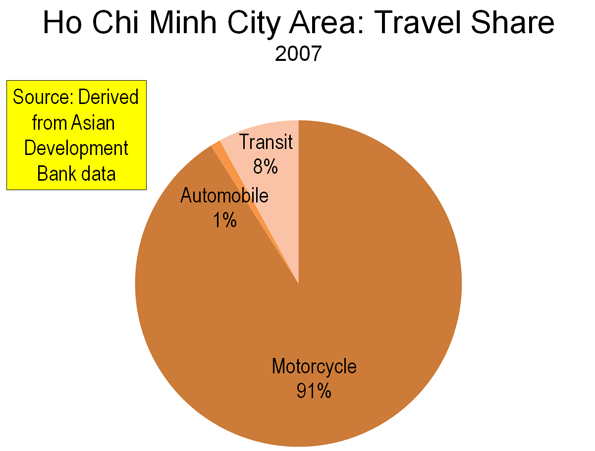
    Building a Metro: Ho Chi Minh City may have the highest personal transportation market share outside North America. The personal vehicle (motorcycle and car) share of travel is 92%, leaving just 8% for transit (one estimate indicates an even lower 5%). Most of this travel by motorcycle, which sometimes carry three or more people.  As Ho Chi Minh City becomes more prosperous, the share of travel by automobile will likely increase. Automobile ownership is rising at 20 percent annually, more than twice the rate for motorcycle ownership.

    The government would like to change this pattern and has embarked on building a Metro in hopes of increasing transit’s market share to between 40% and 50% by 2025. This huge capital investment will be largely limited to feed and serve the core areas that will account for virtually none of the population increase and little of the new employment.

    There is no precedent for an increase in transit usage remotely of the magnitude that is sought in Ho Chi Minh City. In fact, consultants for the Asian Development Bank were so concerned that they provided an alternative projection for the system, indicating a 2025 transit market share of 22%, instead of the official goal of 40% to 50%. The consultants indicated:

    As noted earlier, the above demand models were adjusted to reflect the Government “policy” objective of achieving 40-50% PT mode share by 2025. This will entail a massive shift in travel behaviour and introduction of some very strong transport and policy initiatives. Clearly there is a risk that this may not happen as quickly or to the extent targeted. Therefore forecasts were developed for a “trend” scenario – still based on major PT transport improvements and strong policy initiatives, but with parameter values based on the consultants’ experience of what has been achieved in other cities.

    However, virtually tripling transit’s market share to 22% seems little less doubtful than increasing it to 40% to 50%. The consultant provided no examples to indicate that such an increase had "been achieved in other cities."

    Personal Mobility in Ho Chi Minh City: One of the challenges for a pedestrians in Ho Chi Minh City – like Hanoi – is dodging the swarm of motorcycles in crossing streets. Even with the Metro, more and more will buy motorcycles and cars. Traffic congestion is likely to worsen. This is principally because, even in congested urban areas, door to door travel tends to be more rapid by personal modes than by transit.

    Fortunately, the authorities are allowing the urbanization to expand, which will limit the growth of traffic congestion. They would do well to follow the advice of urban planners like Shlomo Angel (of New York University and Princeton University), who recommends building a grid of arterials streets to accommodate the growth on lower cost peripheral lands.   Strategies such as these provide Ho Chi Minh City the potential to suburbanize gracefully, maintain its high level of personal mobility and contribute substantially to its continued economic progress.

    Wendell Cox is a Visiting Professor, Conservatoire National des Arts et Metiers, Paris and the author of “War on the Dream: How Anti-Sprawl Policy Threatens the Quality of Life

    Top photo: Typical transport in Ho Chi Minh City

    All photos by author

  • The Expanding Wealth Of Washington

    Throughout the brutal and agonizingly long recession, only one large metropolitan area escaped largely unscathed: Washington, D.C. The city that wreaked economic disasters under two administration last year grew faster in population than any major region in the country, up a remarkable 2.7 percent. The continued steady growth of the Texas cities, which dominated the growth charts over the past decade, pales by comparison.

    Boom times in the capital — particularly amidst a weak recovery elsewhere — are driving this growth. Since 2007, notes Stephen Fuller at George Mason University, the D.C. region’s economy has expanded 14 percent compared to a mere 3 percent for the rest of the country. Washington’s unemployment never scaled over 7 percent, well below the national average, and is now down to around 5.5 percent, about the lowest of any major metropolitan area. Unemployment of course is much higher, reaching 25 percent, in some of the district’s poorer neighborhoods.

    This prosperity is rooted largely in the steady growth of the federal workforce, as federal spending accounts for one-third of the region’s economy. Over the past decade 50,000 bureaucratic jobs have been added in the area while local federal spending grew 166 percent. The D.C. region, with but 5 percent of the nation’s population, garners more than three times that percentage in payroll and more than four times that percentage in procurement dollars.

    This debt-financed gusher has helped expand the economy beyond simply federal workers. You think California is the biggest beneficiary of the current tech boom? Think again. Washington’s tech sector employment , according to an analysis by Economic Modeling Systems Inc., has expanded by over 5 percent since 2009, more than twice the national and California average of barely 2 percent. California may have Facebook, Google and Apple, but Washington tech has federal agencies, the defense establishment, a growing media sector and the lobbying industry to feed upon.

    Washington also ranks fourth in middle-income job growth, with employment in that category expanding at four times the national average over the past two years. The relatively higher salaries — and far better benefits — propel even modestly educated workers into middle incomes. The recession may have been brutal for the middle class, but not those who work for Uncle Sam. Not surprisingly, according to Gallup, Washingtonians are the most optimistic in the country about the improvements in the economy.

    This, of course, did not start with the Obama administration’s relentless expansion of federal power. The Washington region has been growing steadily — well ahead of all major eastern regions — for a generation. The expansion of defense spending under President Ronald Reagan and then again under George W. Bush helped create wealthy suburbs around the city; four of the nation’s five wealthiest counties (the other is in suburban New Jersey) and nine of the top 15 are located in the Virginia and Maryland suburbs around the capital. These counties all enjoy median house incomes over $100,000, twice the national average.

    But the biggest change has occurred in the district itself, which last led the nation in population growth in the early 1940s. The hopelessly dysfunctional, crime-ridden city of the era of four-term Mayor Marion Barry in the 1970s and ‘80s has been left behind like the much-maligned 19th century swamp town that aspired to be the next Paris but was widely regarded by diplomats as a hardship posting. Barely three decades after its founding, the city had “not a single great mercantile house,” a foreign dignitary observed in 1811-12, according to “The Age of Federalism,” by Stanley Elkins and Eric McKittrick, and had “a total absence of all sights, smells, or smells of commerce.”

    Washington may still not be a great center of real commerce, where people make things or risk their livelihoods on ideas. But it thrives as the marketplace for the collusional capitalist state that has been growing for decades and may now be at its apex. Offices fill with well-paid lobbyists and lawyers, and their service help, as they protect the interests of investment banks, real estate interests and unions that are increasingly influenced by Washington. The central area has been revived by new condo, hotel and office developments. It may still not be Paris, or even Chicago’s Gold Coast, but it’s a fair bit better than the drab, dangerous place of 30 years ago.

    No one should ever disparage the success of a region, but there is something disturbing in D.C.’s recent rise. Most expansions of the federal region came to meet a perceived national challenge: the Depression, the Second World War, the Cold War, the Space Race and the Civil Rights movement. Since the Depression, Washington’s “good times” usually have paralleled that of the rest of the country. Only now do we see a “new normal” where Washingtonians, like the pigs in Orwell’s Animal Farm, seem “a bit more equal” than the rest of us.

    Will this trend continue? The outcome of the election may prove determinative. In a second Obama term – which should bolster the power of agencies such as the EPA, Energy and Justice – the federal grip on daily life will expand. This could greatly expand the appeal of being close to the capital. When everything from zoning and the location of industrial plants and healthcare is under Washington’s control, the capital could conceivably even emerge as a challenger to New York’s two century reign as the country’s most important city.

    Yet as the Washington Post’s Steve Pearlstein points out, this ascendency could be curtailed. Even under a second Obama administration, he notes, “the federal gravy train” could be derailed, with inevitable cuts in spending. Steve Cochrane at Moody Analytics suggests that the Washington as “the leader in terms of job growth and economic strength are really over.”

    The election certainly will determine which part of the Washington ox get gored. If Democrats rule, one can expect these cuts to come in large part at the expense of defense firms, which, after all, now tilt to the Republicans. This could be particularly tough on the suburbs, where many military contractors reside.

    More dangerous still would be a Republican sweep, which would bring a budget-cutting mentality back to the White House, particularly on the social spending and regulatory apparatus dear to many Democrats . These jobs tend to be in the district. Even a renewal of the current balance of power threatens federal expansion since the House still holds the appropriation purse strings. The oxygen that sustains Washington seems likely to be cutback in any case.

    None of this, however, means that D.C. is about to slip back to its dystopian past, much less its swampy roots. The region boasts the nation’s wealthiest and best-educated population. This could give it a leg up on other areas in the tech and business service job markets. Many millennials may find a steady career in the bureaucracy safer, and even more satisfying, than finding places in a slow-growing, hyper-regulated private sector economy.

    Yet the key lies to Washington’s future may lie with the fate of the national economy. Eighty years of relentless federal expansion has created a relentless parasite that knows how to feed on its host. But if that host weakens, so too will the federal state. To sneak an early pick for this scenario, hop a flight to Madrid, Rome or Athens, where being tied to the bureaucracy no longer provides exemption from the vicissitudes of economic struggle.

    This piece originally appeared in Forbes.com.

    Joel Kotkin is executive editor of NewGeography.com and is a distinguished presidential fellow in urban futures at Chapman University, and contributing editor to the City Journal in New York. He is author of The City: A Global History. His newest book is The Next Hundred Million: America in 2050, released in February, 2010.

    Washington, DC photo by Bigstockphoto.com.

  • The Use and Misuse of Glaeser’s Triumph of the City

    Appeals to authority are now the stock-in-trade of progressive pundits across a range of public controversies. In the face of popular discontent bubbling up from forums on the net and elsewhere, their fall-back posture is heavy-handed ‘expertism’. Policymaking is the prerogative of those with the right qualifications and credentials. Ordinary citizens should butt-out, no matter how self-interested the experts may seem. So too in the field of urban policy, encumbered as it is with a green-compact-city orthodoxy, do appeals to authority hold sway.

    Over the course of 2011 a book title kept cropping up in some of the media coverage of urban issues – Triumph of the City by Harvard economist and New York Times blogger Edward Glaeser. Arguing that successful cities should be “urban theme parks” or “playgrounds” for the benefit of “smart inhabitants” – as progressives like to conceive themselves – while the energy-wasting populace must be brought to heel, Glaeser is, for the pundits, an authority figure from central casting.   

    The Sydney Morning Herald’s urban critic, Elizabeth Farrelly, claimed the book “instantly became flavour of the month amongst the cognoscenti”. Proceeding to deliver another full-throated hymn in praise of density, she abridged Glaeser’s argument in typically hyperbolic terms. If only we lived in “dense urban centres”, miracles would abound: cheaper housing, better transport, protected wildernesses, no climate change, decent coffee and “a choice of walk-to tapas”. 

    Her colleague Ross Gittins, the paper’s economics editor, was equally impressed. “Glaeser’s observations seem of obvious relevance to Sydney”, he wrote.  “Our sky-high house and unit prices are partly the product of … excessive government restrictions on development”, wrote Gittins, before adding, without a hint of irony, “there are limits to how far Sydney can be allowed to sprawl”. He resolves this contradiction with the phrase “Sydney needs to go up”, echoing a warning of Glaeser’s which serves as the new slogan of green urbanism: “If cities can’t build up, then they will build out”.  

    This is sweet music to the green-tinged intelligentsia, for whom there is no worse crime against the planet than a bulging ‘human footprint’. Before weighing-up the merits of Glaeser’s build-up-not-out pitch, though, it should be said that many of his Australian fans either misrepresent or misunderstand his position. Farrelly’s diatribes against developers and suburbs are commonplace. She is all in favour of rigid ‘urban growth boundaries’, prescriptive urban consolidation and other features of the anti-sprawl agenda adopted by state and local governments over recent decades. So apparently is Gittins.

    Glaeser’s views are more complex. “The government should not be in the business of enforcing lifestyles that we happen to find appealing”, writes Glaeser, “[t]he government’s job is to allow people to choose the life they want …” He takes care to explain that this perspective accords with sound economic thinking:

    “[A]t the heart of economics is the belief that businesses work best by competing furiously in a market that the government oversees as impartial umpire. The same is true for cities. Competition among local governments for people and firms is healthy … The national government does no good by propping up particular places, just as it does no good by propping up particular firms or industries.”

    Identifying this principle as ‘spatial neutrality’, Glaeser is indifferent to the type of ‘growth boundaries’ so popular with Australian town planners and their green theorists, commenting at one point that “greenbelts may serve to check urban growth – which may or may not be desirable”. Indeed, it’s hard to see how any form of coercive zoning can be consistent with his position.

    Glaeser’s core argument is that the principle of neutrality has been systematically violated in the United States. “Cities [by which he means inner-cities] can compete on a level playing field”, he says, “but over the past sixty years, America’s policies have slanted the field steeply against them”. These policies include inner-city development controls, especially height restrictions, the home mortgage interest deduction, the Interstate Highway system, inferior inner-city schools administered by local school boards and inadequate gasoline (petrol) taxes. Remove such “artificial barriers” and “everybody, not just the privileged few, can enjoy the pleasures of Manhattan or Paris or Hong Kong”.

    Lurking behind Glaeser’s sedate prose, but never quite breaking out, is some kind of ultra-centripetal theory of human settlement. Human beings maximise their satisfaction by living in the centre of the world’s leading city, measured by size, wealth and amenity. It’s just that economic and legal barriers fix most of them in various grades of less desirable places. If the whole world could, in other words, they would pack up and move to Manhattan (“New York is still a paradigm of urbanity”, says Glaeser). In the years between 1880 and 1920, when millions of people from all over Europe swarmed into the crowded tenements of New York’s lower east side, such a theory might have had some plausibility. But the world changed. Since at least the middle of the twentieth century, the statistical and historical evidence points in the opposite direction. Countries like the US and Australia saw massive population shifts to the suburbs and attracted millions of immigrants hoping for their own suburban lot and house.

    However much Glaeser’s “artificial barriers” may have contributed to suburbanisation in the United States, the key issue is how important they were relative to one of the great transformations of the twentieth century: the unremitting growth of motor vehicle ownership and motorised commercial transportation. Even Glaeser concedes that “transportation technologies shape our communities, and modern sprawl is the child of the automobile”, though he insists the convenience of car ownership can be diminished.  

    The problem is that the trend towards urban dispersion started well before Glaeser’s so-called barriers came into existence. In his book  Downtown: Its Rise and Fall 1880-1950, Robert Fogelson writes that “by the mid and late 1920s, however, some Americans had come to the conclusion that the centrifugal forces were beginning to overpower the centripetal forces – or, in other words, that the dispersal of residences might well lead in time to the decentralization of business”. And the trend shows no sign of abating. Having analysed the 2010 US census, Joel Kotkin and Wendell Cox find that during the 2000s, just 8.6 per cent of the population growth in metropolitan areas with more than a million people took place in the core cities, the rest took place in the suburbs. “America continues to suburbanize”, they say. This is despite the financial crash, which would have blunted some of Glaeser’s pro-suburban incentives. Could it be that most people just prefer space over density?

    As for Australia, Glaeser’s core argument simply doesn’t hold. Most of his “artificial barriers” have no direct equivalents here. Our advanced motorways are intra-urban rather than interstate networks, and attract significant toll charges, our schools are subject to state rather than local board control and home mortgage interest is not tax deductible. No reasonable person would claim that our governments have “slanted the field” in favour of suburbs over recent decades. The very notion of spatial neutrality has been anathema. Urban consolidation is all the rage, suppressing land releases while driving up values to the point that Australian houses are consistently ranked ‘severely unaffordable’ in the annual Demographia survey, due in no small measure to a crushing mix of developer and infrastructure contributions and utility levies.  

    Still, Australian Bureau of Statistics figures show that four of the five strongest growing Sydney Local Government Areas (LGAs) in the year to 30 June 2009 were in the outer west: Blacktown, Parramatta, The Hills Shire and Liverpool, which offer home buyers the best prospect of owning a detached house and provide many industries with the cheap land, low rents, extensive space and proximity to major road junctions they need to thrive. According to the Department of Finance, 90 per cent of the containers passing through Sydney’s Port Botany originate in or are destined for the city’s outer western region. In its recent decision to abandon some of the previous state government’s residential zoning restrictions on Sydney’s fringe, the current government is just coming to terms with reality.

    Following Glaeser’s logic, if, in conditions of “a level playing field”, or even a “field slanted” against outer suburbs, residents and businesses still “choose” to locate on the periphery, government officials have no right to interfere, and will cause economic damage if they attempt to restrain these choices. Contrary to the impressions of his green-tinged admirers, Glaeser offers, in the Australian context, a powerful argument in favour of hands-off planning, decentralisation, suburbanisation and urban growth. 

    John Muscat is a co-editor of The New City, where this piece first appeared.

    Chicago photo by Storm Crypt / Flickr

  • The Sorry State of American Transport

    We constantly read about the infrastructure crisis in America. I’ll have more to say on this at a future date, but it is pretty clear that we need to spend more money in a whole lot of areas: airports, roads and bridges, public transportation, and more.

    Yet it’s very easy to see that so much of what ails transport has nothing to do with a lack of funds and everything to do with a lack of will. I took a train ride on the Northeast corridor last week that really drove it home to me.

    Start with the sorry state of Penn Station in New York City, America’s busiest train station. (In fact, it’s the busiest transportation facility of any type in the United States, if Wikipedia can be believed). Yes, the place is a depressing underground dump. Yes, there used to be a glorious train station there that was demolished in the 1960s. Yes, we probably need to invest many billions in upgrades.

    Yet is it a lack of funds that make the three agencies that call it home – Amtrak, New Jersey Transit, and the Long Island Railroad – act as though the others don’t exist? The three railroads have completely separate ticketing areas, signage systems, etc. This is hardly the only case in America. For some reason, Amtrak seems to despise sharing ticket agents with other carriers. There are separate windows for Amtrak and commuter lines everywhere I’ve been. Given that many journeys include both commuter and inter-city segments, this seems crazy. If you can’t have integrated ticketing (and actually, I don’t see why you can’t), at least you should be able to have a single agent help you.

    The worst example of this I know is in Providence, where Amtrak monopolizes the four ticket windows. If you want to buy an MBTA T ticket, you have to go to a cafe next door. This tiny little coffee shop found a way to sell both pastries and train tickets (albeit from separate registers), so why can’t Amtrak figure out how to sell two kinds of tickets?

    Also, as near as I can tell, there’s no way to actually get your Amtrak ticket online. You can book a reservation, but then you need to get a physical ticket printed at the station, either from a kiosk or an agent. (If there’s a way to avoid this, please let me know).

    I decided to get my ticket at the window. The line was very short and I was early in any case. When I got there, some guy with his kids was at the window screaming at the agent about a problem with their tickets. I chalked this up to one of those cases where the frustrations of travel just cause somebody to snap. But then as I walked up to the window, the person next to me was also having a similar problem with their ticket and was having an animated discussion with an agent who didn’t seem to care. Fortunately, I had no such issues, but the agent I had to talk to was extremely surly and kept asking me to repeat myself over and over. Who would want to put themselves through such an experience? Customer service is clearly something that should also be within Amtrak’s control.

    Amtrak markets themselves as having wi-fi. But on the train itself, as anyone who has ridden the NEC knows, the wi-fi is basically unusable. How much capital investment would it take to get working wi-fi?

    In short, though the facilities can somewhat be excused as resulting from insufficient capital funding and bad decisions decades ago, there’s so much that could be done right now to upgrade the passenger experience it’s not even funny.

    It’s the same with airports. While a few American cities like Indianapolis and Detroit have upgraded their terminals, too many key gateways remain depressingly dreary and non-functional. While some overseas places like Heathrow certainly would give any American airport a run for its money in the Hall of Shame, the general experience of flying to someplace like Madrid, Singapore, or Tokyo is like night and day versus the US.

    Key among the worst offenders again is New York City, especially LaGuardia. Matt Chaban at the New York Observer recently wrote a piece that is a good overview of the depressing state: “Terminal Condition – How New York’s Airports Crashed and Burned.”

    This is certainly not news to anyone who has flown to New York. But again, the vast billions it would take to replace these decrepit facilities is only part of the problem. Nobody forces America to put its passengers through the “TSA experience.” Last time I flew I was delayed at security while agents patted down some guy that looked like he was around 85 years old who apparently hadn’t stripped down quite far enough to go through the full body scanner. Somehow other advanced nations manage to run safe air travel systems without resorting to this.

    While we are waiting around for funding issues to be resolved, wouldn’t it be nice if our governments and various travel companies actually focused on fixing some of these straightforward problems with coordination, ticketing, and customer service? It’s hard to take their capital requests seriously if they aren’t going to do what they can now.

    Aaron M. Renn is an independent writer on urban affairs based in the Midwest. His writings appear at The Urbanophile.

    Photo By Kyle Gradinger, Amtrak Keystone Snowstorm I. Amtrak AEM-7 locomotive 904 leads a Keystone Corridor train through the snow in Rebel Hill, King of Prussia, PA.

  • The Republican Party’s Fatal Attraction To Rural America

    Rick Santorum’s big wins in Alabama and Mississippi place the Republican Party in ever greater danger of becoming hostage to what has become its predominate geographic base: rural and small town America. This base, not so much conservatives per se, has kept Santorum’s unlikely campaign alive, from his early win in Iowa to triumphs in predominately rural and small-town dominated Kansas, Mississippi, North Dakota and Oklahoma. The small towns and rural communities of states such as Michigan and Ohio also sheltered the former Pennsylvania senator from total wipeouts in races he would otherwise have lost in a blowout.

    If America was an exclusively urban or metropolitan country, Mitt Romney would be already ensconced as the GOP nominee and perhaps on his way towards a real shot at the White House. In virtually every major urban region — which means predominately suburbs — Romney has generally won easily. Mike Barone, arguably America’s most knowledgeable political analyst, observes that the cool, collected, educated Mitt does very well in affluent suburbs, confronting President Obama with a serious challenge in one of his electoral sweet spots.

    Outside the Mormon belt from Arizona to Wyoming, however, sophisticated Mitt has been a consistent loser in the countryside. This divergence between rural and suburban/metro America, poses a fundamental challenge to the modern Republican Party. Rural America constitutes barely 16 percent of the country, down from 72 percent a century ago, but still constitutes the party’s most reliable geographic base. It resembles the small-town America of the 19th century, particularly in the South and West, that propelled Democratic Party of Nebraska’s William Jennings Bryan to three presidential nominations.

    Yet like Bryan, who also lost all three times, what makes Santorum so appealing in the hinterlands may prove disastrous in the metropolitan regions which now dominate the country. Much of this is not so much particular positions beyond abortion, gay rights, women’s issues, now de rigueur in the GOP, but a kind of generalized sanctimoniousness that does not play well with the national electorate.

    We can see this in the extraordinary difference in the religiosity between more rural states, particularly in the South, and the rest of country. Roughly half of all Protestants in Mississippi, Alabama and Oklahoma, according to the Pew Center on Religion and Public Life, are evangelicals, not including historically black churches. In contrast, evangelicals make up a quarter or less of Protestants nationally and less still in key upcoming primary states such as Pennsylvania, New York, California and Connecticut, where the percentages average closer to 10 percent.

    Let me be clear: Urbanity is not the key issue here. Cities have become so lock-step Democratic as to be essentially irrelevant to the Republican Party. Instead it’s the suburbs — home to a record 51 percent of the population and growing overall more than 10 times as fast as urban areas — that matter the most. Much of the recent suburban growth has taken place in exurbs, where many formerly rural counties have been swallowed, essentially metropolitanizing the countryside.

    What accounts for the divergence between the suburban areas and rural areas? A lot may turn on culture. Small towns and villages may be far from the isolated “idiocy of rural life” that Marx referred to, but rural areas still remain someone more isolated and still somewhat less “wired” in terms of broadband use than the rest of the country.

    Despite the popularity of country music, rural residents do not have much influence on mainstream culture. Most Hollywood executives and many in New York still commute from leafy ‘burbs. Few of our cultural shapers and pundits actually live predominately in the countryside, even if they spend time in bucolic retreats such as Napa, Aspen or Jackson Hole.

    Until the recent commodity boom, much of rural America was suffering. And even today, poverty tends to be higher overall in rural areas than in urban and especially suburban countries. Some areas, notably in North Dakota and much of the Plains, are doing very well, but rural poverty remains entrenched in a belt from Appalachia and the deep South to parts of west Texas, New Mexico and California’s Central Valley.

    Rural areas generally do not have strong ties to the high-tech economy now leading much of metro growth. This remains a largely suburban phenomenon, urban only if you allow core cities to include their hinterlands. All the nation’s strongest tech clusters — Silicon Valley, Route 128, Austin, north Dallas, Redmond/Bellevue in Washington, Raleigh-Durham — are primarily suburban in form. High tech tends to nurture a consciousness among conservatives more libertarian than socially conservative and populist. Not surprisingly, libertarian Ron Paul often does best in these areas and among younger Republican voters.

    Another key difference: a lack of ethnic diversity. There are now many Hispanics living in rural areas, but they are largely not citizens and most are recent arrivals, attracted by jobs in the oil fields, slaughterhouses and farms. Many small towns, unlike suburbs, remain more homogeneous than suburbs, emerging as the most heterogeneous of all American geographies. Ethnic cultural cross-pollination occurs regularly in metropolitan suburbs; this is not so common in rural America.

    Equally important, environmental issues spin differently in rural areas than in suburbs. Energy development and agriculture drive many rural economies. In some areas, like Ohio and western Pennsylvania, shale oil and gas is bringing long moribund regions back to life. In the Dakotas, parts of Louisiana, Texas and Wyoming, it is ushering in a potentially long-term boom. In contrast, there aren’t many oil and gas wells located next to malls and big housing tracks.

    This does not mean that suburban voters share the anti-fossil fuel green faith of the urban core. But for them “drill baby drill” represents more a matter of price at the pump than a life and death issue for the local economy. Suburbanites feel the energy issue, but do not live it the way more rural communities do. One of the great ironies of American life is that those who live closest to nature are often less ideologically “green” than those, particularly urbanites, residing in an environment of concrete, glass and steel.

    Rural America, of course, is changing, with many areas, particularly in the Plains, getting richer and better educated. These areas are growing faster than the national average and attracting immigrants from abroad and people from other U.S. regions. Yet the influence of newcomers, new wealth and new technology is still nascent. The political pace in rural America today still is being set by an aging, overwhelmingly white and modestly educated demographic.

    Until the Republican nomination fight is settled, the party’s pandering to the sensibilities of such conservatives in rural areas could prove fatal to its long-term prospects. A Santorum nomination almost guarantees a replay of the Bryan phenomena; no matter how many times he runs, he will prove unlikely to win, even against a vulnerable opponent. Even in losing, his preachy, divisive tone — on contraception, prayer, the separation of church and state — has opened a gap among suburban voters that Obama will no doubt exploit.

    The suburbs, with its preponderance of white, middle income independent voters, gave the 2008 election to Obama, and that’s where the next contest will be decided. The countryside will rally to a GOP standard bearer like Romney, albeit somewhat reluctantly, for both economic and social reasons. The battle will then shift to the suburbs, including those urban areas, common in the vast cities of the South and West, that are predominately suburban in form.

    Most of the urban core, meanwhile, will vote lockstep for Obama. But the president, as thoroughly a creature of urban tastes and prejudice as to ever sit in the White House, could prove vulnerable in the suburbs, if the Republicans can deliver a message that is palatable to that geography’s denizens.

    This piece originally appeared in Forbes.com.

    Joel Kotkin is executive editor of NewGeography.com and is a distinguished presidential fellow in urban futures at Chapman University, and contributing editor to the City Journal in New York. He is author of The City: A Global History. His newest book is The Next Hundred Million: America in 2050, released in February, 2010.

    Rick Santorum Image by Bigstockphoto.com.