Category: Urban Issues

  • The Evolving Urban Form: Guangzhou-Foshan

    The Pearl River Delta of China is home to the largest extent of continuous urbanization in the world. The Pearl River Delta has 55 million people in the jurisdictions of Hong Kong, Shenzhen, Dongguan, Guangzhou, Foshan, Zhongshan, Jiangmen, Zhuhai and Macau. Moreover, the urban population is confined to barely 10 percent of the land area. These urban areas are the largest export engine of China and reflect the successful legacy of Deng Xiaoping’s reforms which had their start with the special economic zone in Shenzhen and spread to the rest of the Delta and then much of the nation.

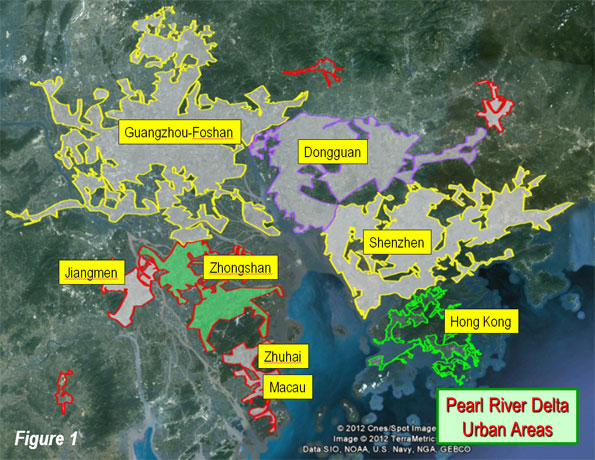
    Adjacent Metropolitan Areas: However, the Pearl River Delta today is not a metropolitan area, as is often asserted. Instead it is rather a collection of adjacent metropolitan areas or labor markets (Figure 1). Metropolitan areas are not created by a large number of people living close to one another. Metropolitan areas are labor markets, crudely delineating the geography of the jobs-housing balance. There is little commuting between the Pearl River jurisdictions. Moreover, as labor markets, metropolitan areas cannot be international unless there is virtual free movement of labor (Note). In the case of Hong Kong and Macau, commuting between the neighboring jurisdictions of Shenzhen and Zhuhai requires crossing the equivalent of an international border.


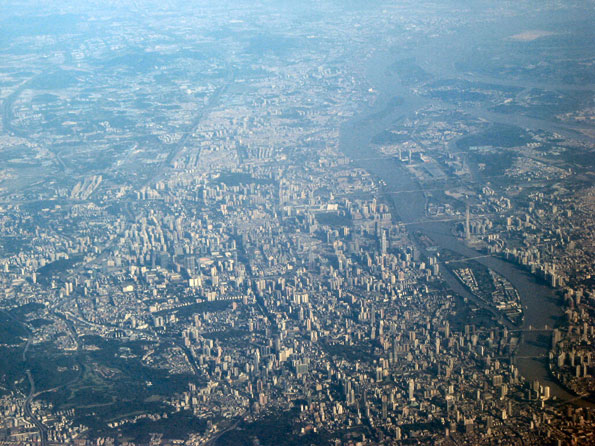
    Integrating Guangzhou and Foshan: Transportation integration has already come to two of the jurisdictions, Guangzhou and Foshan. The adjacent prefectures (confusingly interpreted into English as "cities") are now linked by a subway and unlike the other Pearl River Delta jurisdictions, the continuous urbanization does not narrow at the border (Figure 1). There are even proposals to merge the adjacent prefectures.

    Guangzhou and Foshan are separated by a tributary of the Pearl River, with a number of bridges that provide similar crossing capacity as exists in cross-river metropolitan areas like Portland (Willamette River), Cincinnati (Ohio River) and St. Louis (Mississippi River).

    Guangzhou itself is the capital of Guangdong, the largest province of China, with approximately 105 million people. Guangdong is the third largest state or province (sub-national jurisdiction) in the world, trailing the states of Uttar Pradesh (contains the eastern suburbs of Delhi) and Maharashtra (capital Mumbai) in India.

    Guangzhou is larger than Foshan. It is better known to many Westerners as Canton, and for many years served as China’s “window” on the west. Even in China, the alternative name is still used, for example in the annual Canton Fair, one of the largest trade fairs in the world.

    Canton was also a principal flashpoint of 19th century hostilities between the British and Chinese. The First Opium War (1839-42) began at Canton and led to the cession of Hong Kong to Great Britain and the establishment of British treaty ports at Fuzhou, Xiamen, Ningbo, Shanghai and Canton (Guangzhou). After the Second Opium War (1856-60), other treat ports were established and France, the United States, Russia, Germany, Japan and others gained similar rights to the British from a weakened Chinese government.

    In 2010, the metropolitan area county and district level jurisdictions of Guangzhou-Foshan had 18.3 million people. This is an increase of 4.4 million from 2000 and 11.6 million from 1982. This is surely a rapid rate of growth, but Shanghai and Beijing grew even faster over the last decade, each adding more than 6 million people.

    Distribution of Population Growth: In contrast to Shanghai and Beijing, where virtually all of the growth has been outside the core, the Guangzhou-Foshan core is growing robustly. From 2000 to 2010, the core districts increased from a population of 4,040,000 to 5,050,000. With a land area of 107 square miles (279 square kilometers), the core is similar in size to the city (municipality) of Sacramento, which has less than one-tenth the population. The core density is 46,800 per square mile (18,100 per square kilometer), up from 37,500 per square mile (14,500 per square kilometer) in 2000. This is about one-third less dense than Manhattan or the ville de Paris (the central city).

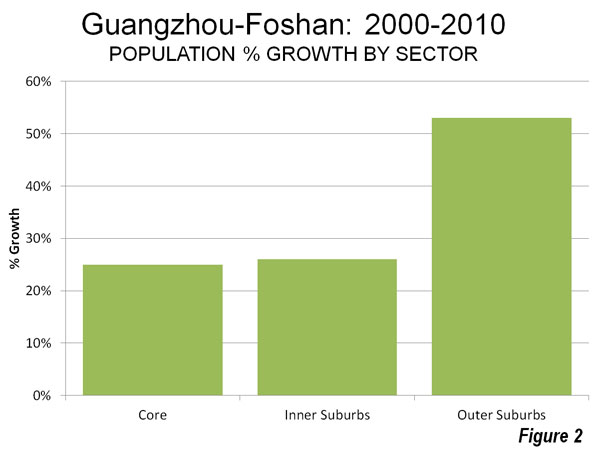
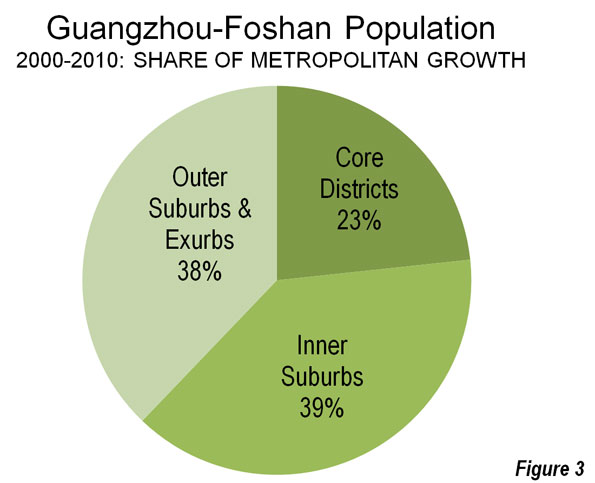
    However, as is typical for metropolitan areas around the world, Guangzhou-Foshan’s growth has been most concentrated in suburban areas. The core accounted for 23% of the population growth over the past decade, while the suburbs accounted for 77%.

    The inner suburbs grew from a population of 6,670,000 to 8,400,000. The density rose from 5,000 to 6,300 per square mile (1,900 to 2,500 per square kilometer), similar to that of the San Francisco urban area. The inner suburbs accounted for 39% of the growth and grew 26%.

    The outer suburbs grew from a population of 3,150,000 to 8,200,000 over the past decade. The population density rose from 2,000 to 3,100 per square mile (800 to 1,200 per square kilometer), slightly more dense than the Philadelphia urban area and slightly less dense than the Portland urban area. The outer suburbs accounted for 38% of the growth and grew at the greatest rate, 53% (Figures 2 & 3, Table).


    Guangzhou-Foshan Metropolitan Area & Urban Area
    2000 & 2010 Census
    Metropolitan Area Core Inner Suburbs Outer Suburbs Total
    2000         4,040,000        6,670,000            3,150,000         13,860,000
    2010         5,050,000        8,400,000            4,820,000         18,270,000
    Change         1,010,000        1,730,000            1,670,000           4,410,000
    % 25% 26% 53% 32%
    Share of Growth 23% 39% 38% 100%
    Area (KM2)                   279               3,429                   4,003                  7,711
    Area (Square Miles)                   108               1,324                   1,546                  2,977
    Density (KM2)              18,100               2,400                   1,200                  2,400
    Density (Square Miles)              46,800               6,300                   3,100                  6,100
    Urban Area  Core   Suburbs   Total 
    2010         5,050,000          11,225,000         16,275,000
    Area (KM2)                   279                   2,894                  3,173
    Area (Square Miles)                   108                   1,117                  1,225
    Density (KM2)              18,100                   3,900                  5,100
    Density (Square Miles)              46,800                 10,000                13,300
    Notes
    Boundary changes render district area data incomplete.
    Core: Yuexiu, Liwan, Haizhu, Tianhe 
    Inner Suburbs: Baiyun, Huangpu, Panyu, Nansha, Nanhai, Changcheng
    Outer Suburbs: Huadu, Luogang, Gaoming, Shunde, Shanshi 
    Nansha is in the inner suburbs because 2000 data is combined with Panyu (should be in the outer suburbs)

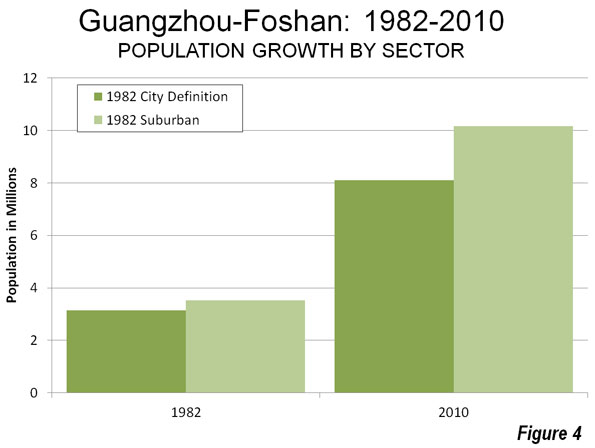
    Earlier data shows this suburban pattern has been a long term trend.  Between 1982 and 2010, the suburbs accounted for 57% of the growth outside the city of Guangzhou as then defined (Figure 4). District boundary changes limit a more precise analysis based upon a core that did not include large areas without development.

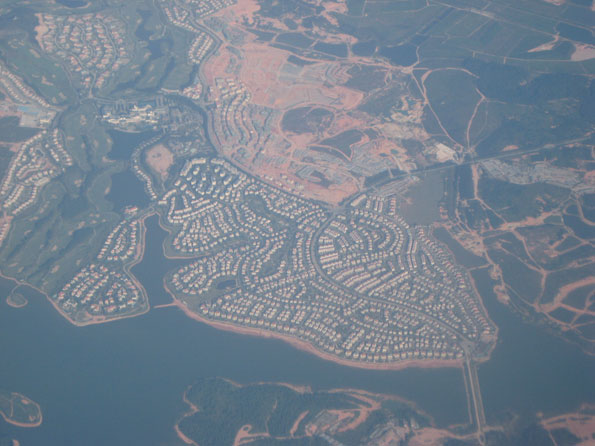
    The Guangzhou-Foshan Urban Area: The soon to be released 8th Annual Demographia World Urban Areas will show the Guangzhou urban area (area of continuous development within the metropolitan area) to have a population of approximately 16.275 million, with a land area of approximately 1,225 square miles (3,173 square kilometers). Barring later data from the multiple national censuses that will soon be reporting data, Guangzhou-Foshan is likely to be ranked the 14th largest urban area in the world. The population density is approximately 13,300 per square mile (5,100 per square kilometer), roughly comparable to the London or Barcelona urban areas. The suburbs of the urban area have a density of approximately 10,000 per square mile (3,900 per square kilometer). Most of the new residential development is multi-unit, such as high rise condominium buildings and work related housing, including dormitories. However, there is some detached housing, which is very expensive.

    A Larger Metropolitan Area: In the longer run a much larger metropolitan (and urban) area could result, if Chinese residents begin traveling to work over much longer distances between these jurisdictions and should the border restrictions at Hong Kong and Macau be eliminated. To achieve this end, there will need to be important local transportation improvements between the jurisdictions, such as more urban railways (which are planned) and wider automobile ownership, to use the already comprehensive (toll) freeway system.

    Wendell Cox is a Visiting Professor, Conservatoire National des Arts et Metiers, Paris and the author of “War on the Dream: How Anti-Sprawl Policy Threatens the Quality of Life

    ——

    Note: International metropolitan areas can now exist in the European Union, where there is free movement of labor across national borders. For example, the Lille metropolitan area is located in both France and Belgium. France and Switzerland (not a member of the European Union) provide another example, where treaty provisions permit international movement of labor with little difficulty in the resulting international metropolitan areas of Geneva (Switzerland-France) and Basel (Switzerland-France).

    Photo (top): Pagoda: Temple of the Six Banyan Trees, Guangzhou (all photos by author)

  • How Libraries and Bookstores Became the New Community Centers

    Bookstores and libraries have long played a central role in fostering a deeper appreciation of knowledge, and in lifelong learning. Increasingly, these places are also filling another critical need in our communities, by providing a haven for those seeking a communal connection in an ever-more isolated world.

    Ray Oldenburg, author of The Great Good Place, coined the term “third place” to describe any environment outside of the home and the workplace (first and second places, respectively) where people gather for deeper interpersonal connection. Third places include, for example, places of worship, community centers, and even diners or pubs frequented by the “locals.”

    Third places, according to Oldenburg, are vitally important to the social fabric of communities because they facilitate the healthy exchange of ideas and provide a public venue for civil debate and community engagement.

    Libraries and bookstores clearly are long-time ‘third places’ That shouldn’t be a surprise, given that books serve as the lingua franca of new ideas. Notice, though, that these establishments frequently provide coffee bars, meeting rooms, Wi-Fi access, public computer terminals, and other amenities. They serve as accessible retreats for community groups and clubs, offices for transitioning job-seekers or home-based business owners, logical meeting places for children’s literacy organizations, havens for latchkey kids, and bases of operation for homeless men and women as they try to reintegrate into the community. These are the features, probably more so than the rows of books and racks of periodicals, which grant libraries and bookstores their ‘third places’ status.

    Libraries have been hit hard by the proliferation of home-based Internet access and digitized material. The impact is exacerbated by state and local budget cuts that place some libraries in a vicious downward spiral — reduced foot traffic from those with other options often is held out as “evidence” of library irrelevance, leading to more budget and staff cuts and further reduced access for those who need it.

    Large libraries in major urban centers are particularly vulnerable, with their cavernous buildings and row upon row of books that are rarely touched. If libraries are to survive, city leaders and library boards must continue to explore creative solutions for the changing needs of their patrons. As economists would put it, they must “drive demand” for expanded library services.

    A great example of success with this approach is the Martin Luther King, Jr. Library (www.sjlibrary.org) in San Jose, California. It purports to be the only institution of its kind: It serves as the primary library for both a major university and a major city. This joint partnership between the city of San Jose and San Jose State University was announced in 1997, and the primary building opened in 2003. It boasts over 7 floors and 1.6 million books. There are also dedicated rooms for quiet study sessions, teen activities and multimedia access. In effect, SJSU students have access to all the popular features of a typical public library, while the public has access to all the academic resources of a university library. The entire community is well served by this far-sighted collaboration.

    It represents the convergence that is taking place between the traditional role that libraries have long played and the virtual world. According to a study funded by the American Library Association in conjunction with the Bill and Melinda Gates Foundation, the number of U.S. libraries nationwide offering public Internet access has ballooned from under 13% in 1994 to nearly 100% today. What this suggests is that the role of libraries as technology hubs is increasingly supplanting their function as simply a repository of books.

    The use of community space in libraries to access technology is particularly vital for low-income residents and for individuals in small towns where the library may be the only connection point for free Wi-Fi access.

    Bookstores are confronting the dual challenge of staying both vital and profitable. The most successful brick and mortar bookstores have evolved into third places. Once just exclusively retail outlets, they now are quasi-library/community gathering spots with onsite coffee shops and free Wi-Fi access. While bookstores have always attracted those who wish to browse and kill time, they now also draw others, laden with backpacks, to research, write, and study. Bookstore-based reading groups abound.

    But even when a bookstore embraces its role as a third place institution, its viability is not guaranteed. The bankruptcy and closure of more than 600 outlets of Borders Books nationwide is evidence of a shakeout in the retail book industry, amid the proliferation of electronic book portals such as Amazon, Apple and Google. Independent bookstores especially have struggled to maintain their niche in the marketplace (although they may have more flexibility to quickly embrace third place-related amenities).

    The lesson in this case is that capitalism can be harsh. For example, Amazon’s controversial price comparison tool allows shoppers to scan bar codes to check prices at rival brick and mortar and online stores. But capitalism also encourages differentiation. As every good business owner knows, becoming a commodity dealer and competing only on price usually is a recipe for failure.

    Rather, libraries should be more like bookstores, creating an inviting, leisurely environment. Bookstores should be more like libraries, providing community rooms and programs.

    Both should think creatively about how to provide the things that online sellers cannot. That includes, of course, the pleasures of shelf browsing as opposed to web-based browsing. But beyond that, the most successful libraries and bookstores will embrace the opportunities for relevance that their special third place status enables.


    Michael Scott is a speaker and co-host of the Internet radio show Bookmark Radio. He can be reached at michael@bookmarkradio.com. Photo by the author of the Tattered Cover bookstore in Denver, Colorado.

  • America’s Demographic Future

    Perhaps nothing has more defined America and its promise than immigration. In the future, immigration and the consequent development of what Walt Whitman (1855: iv) called “a race of races” will remain one of the country’s greatest assets in the decades to come.

    At a time when anti-immigrant fervor has been building, a number of states—including Arizona, Georgia, and Alabama—have enacted draconian laws aimed at apprehending undocumented immigrants. Those laws are widely seen even among legal immigrants and long-term residents as hostile to immigrants. Indeed, newcomers are already leaving those states. This Latino exodus has been happening in once-thriving neighborhoods in Gwinnett and Cobb counties in Georgia—as shown in business closures, arrest statistics, and declining church attendance—caused both by the economy and the increased immigration enforcement (Simmons 2010). Nationwide, there has been a declining number of unauthorized immigrants living in the United States, a decrease of 1 million from 2007 (Hoefer, Rytina, and Baker 2011).

    These laws and other similar efforts could have long-term negative effects for many communities, particularly for local enterprises in sectors such as agriculture, construction, transportation, and hospitality, which are highly dependent on foreign labor. Other industries that would be negatively affected include the professional and related industries, as well as the service industry (Shapiro and Vellucci 2010).

    But beyond specific industries, immigration may prove more important in the future than in the past. The three key elements behind this assessment are the global demographic slowdown, globalization of the world economy, and challenges to our own longterm economic and social sustainability. Immigration represents a key factor in determining whether the United States can avoid longterm stagnation and maintain its leadership role in the world economy. Overall we should be less concerned about too many newcomers than with the consequences of drastically reduced rates of immigration.

    New Global Demographics
    The developed world is entering an unprecedented era of largely unexpected demographic change. To the Baby Boomer generation, brought up on fears of overpopulation promoted in books such as Paul Ehrlich’s The Population Bomb, the idea of there being too few people seems almost absurd. Many xenophobes and anti-immigration activists still advocate a “national population policy” aimed at slowing population growth by strict limits on immigration.

    Yet in sharp contrast to Ehrlich’s predictions, global population growth has not increased but slowed considerably over the past few decades. Global population growth rates of 2 percent in the 1960s have dropped to less than half that rate, and past projections of the number of earth’s human residents in 2000 overshot the mark by more than 200 million.

    That pattern is likely to continue, with annual population growth rates declining to less than 0.8 percent by 2025, largely due to an unanticipated drop in birth rates in developing countries such as Mexico and Iran. Those declines can be attributed to increased urbanization, the education of women and their entrance into the workforce, and greater secularization. Close to half the world’s population, notes demographer Nicholas Eberstadt (2010), lives in countries with birth rates below the replacement level. Rather than out-of-control births, the world is experiencing a “fertility implosion.”

    Overall what author Phil Longman (2010) calls a “gray tsunami” will be sweeping the planet, with more than half of all of the population growth coming from the number of people over 60 while only 6 percent will be from people under 30. The battle of the future, including in the developing world, will be to maintain large enough workforces required for the economic growth needed to care for the elderly (Longman 2011).

    Those growth numbers could plunge further if slow economic growth, particularly in advanced countries, persuades couples to postpone having families, perhaps permanently. This factor may already have contributed to slow population growth in Europe and Japan, which have suffered low growth rates over the past two decades. In fact, the annual growth rate in the 2000s for eastern Europe was _0.1 percent and is expected to decline to _0.2 percent in the 2010s and _0.33 percent in the 2020s. For western Europe the same trend is projected—from 0.46 in the 2000s to 0.29 in the 2010s, and 0.18 in the 2020s. In the case of Japan, since 2010 the total population has begun to decline, with fewer births than deaths (U.S. Census Bureau 2011).

    But even in better economic conditions, the prospect is for continued slowing and even reversal of population growth, particularly in the most advanced countries in East Asia and Europe, where rapid aging, dramatically reduced marriage rates and low birth rates are now the norm (The Economist 2011).

    Today, among the major countries in the world, only the United States produces enough children to reach near replacement—a case of what demographer Eberstadt (2010) calls “demographic exceptionalism.”

    Although native-born Americans do not create enough children to sustain the population, immigrants and their offspring make up the difference. For example, the Mexican-American population grew more as a result of births (7.2 million) in the past decade than as a result of new immigrants (4.2 million) (Pew Hispanic Center 2011).

    In the next several decades, the fate of Western countries may well depend on their ability to make social and economic room for people most of whose origins lie outside Europe (Rifkin 2004: 256_57; Eberstadt 2001: 123). Yet given Europe’s current considerable problems integrating its immigrants, particularly Muslims, the continent seems ill-disposed to open its doors further; Denmark and the Netherlands are considering measures to sharply restrict immigration (Feller 2005). Even more dire may be the situation in countries such as China, Japan, and Korea, which are culturally resistant to diversity.

    In comparison, the U.S. record of healthy and sustained immigration marks a major competitive advantage. The largest immigrant population, Mexican American, is younger and has higher fertility rates than other groups. The median age of Mexican Americans in the United States is 25, compared to 30 for non-Mexican-origin Hispanics, 32 for blacks, 35 for Asians, and 41 for whites. The typical Mexican American woman has given birth to more children (2.5) than a similar aged non-Mexican Hispanic (1.9), black (2.0), white (1.8), or Asian (1.8) woman (Pew Hispanic Center 2011).

    Mexican and other immigrants are one key reason why America boasts a fertility rate 50 percent higher than Russia, Germany, or Japan, and well above that of China, Italy, Singapore, Korea, and virtually all of eastern Europe (The Economist 2002; United Nations 2005; Longman 2004: 60). Consequently, it is widely believed America’s workforce will continue to grow even as that of Japan, Europe, Korea, and eventually even China will start to shrink. Between 2000 and 2050, for example, the U.S. workforce is projected to grow by over 40 percent, while that of China shrinks by 10 percent, the EU by 25 percent and, most remarkably, Japan’s by over 40 percent (U.S. Census Bureau International Database).

    Over time the impact of an older population could prove ruinous to these economies both in terms of consumption and growth and perhaps more importantly in terms of their ability to support retirees.

    By 2050, barely one in five Americans will be over 60 while the proportion in Japan, Germany, and Korea will be closer to two in five (Longman 2004: 53).

    Lower birth rates in poorer countries such as Brazil can be seen as beneficial, offering significant short-term economic and social benefits (Gorney 2001). In advanced countries, however, a rapidly aging or decreasing population does not bode well for societal or economic health, whereas a still growing population offers the hope of expanding markets, new workers, and entrepreneurial innovation (Sheram and Soubbotina 2000).

    Too Few Immigrants?
    In public perception and in many state legislatures there has been a growing sense that the United States receives far too many immigrants. That view is particularly understandable during a period of deep economic pessimism and wrenching change. Yet in reality, under current conditions, the problem may soon be too little as opposed to too much immigration.

    Although the foreign-born population in the United States grew by 10 million over the past decade, few have noted that immigration has entered into what could be a secular decline. Take, for example, illegal immigration, which is most noxious to many policymakers, particularly on the right. According to the U.S. Department of Homeland Security (DHS 2011), an estimated net 3 million undocumented immigrants entered the country in the five-year period between 2000 and 2004, but that number fell by two-thirds, to under 1 million between 2005 and 2009 (Hoefer, Rytina, and Baker 2011).

    To some extent, stricter enforcement has been one reason for this drop-off (Cave 2011, Stevenson 2011). But a look at legal immigration also shows a decline. The number of Mexicans obtaining legal permanent resident status declined from the decade of the 1990s to 2000s by more than 1 million (2.76 million compared to 1.70 million), according to the Department of Homeland Security (DHS 2011). Indeed, since 2008 there has been a precipitous reduction in the number of naturalizations. In 2008 there were over 1 million naturalizations; in 2010 there were barely 600,000, a remarkable 40 percent drop (DHS 2011: Table 20).

    The reduction in immigration and naturalization extend well beyond Mexico, which accounts for roughly 30 percent of all U.S. immigrants (Grieco and Trevelyan 2010). Asian naturalization rates, for example, have been dropping since the mid-2000s, and in 2010 fell to 250,000 compared to 330,000 in 2008, a 24 percent drop. Similar falloffs can be seen across America and Europe (65 percent drop for North America, 31 percent for South America, and 28 percent for Europe). In fact the only place from which naturalizations are on the rise appears to be Africa, with an 18 percent increase (DHS 2011: Table 21).

    Why is this happening? One likely reason is that the world demographic slowdown has moved from advanced countries to traditional sources of immigrants such as China, India, Mexico, and the rest of Latin America. Mexico’s birth rate, for example, has declined from 6.8 children per woman in 1970 to roughly 2 children per woman in 2011 (The Economist 2010). Meanwhile, the number of Mexicans annually leaving Mexico for the United States declined from more than 1 million in 2006 to 404,000 in 2010, a 60 percent reduction (Pew Hispanic Center 2011).

    This trend means that the number of future job seekers will be greatly diminished. In fact, in the 1990s Mexico was adding about 1 million potential job seekers annually. By 2007, the new potential job seekers declined to about 800,000 annually, and it is expected to drop to 300,000 by 2030, which will likely further slow Mexican immigration (Cave 2011).

    A second major cause lies with the improved economy in many developing countries. In Mexico, employment and educational opportunities have improved since 2000. Both per capita gross domestic product and family income have climbed by more than 45 percent over the past 10 years. Not only are there fewer children to emigrate, but there is more opportunity for those who chose to remain (Magnini 2011).

    These factors apply even more to immigration from Asia. Not only are birth rates lower there, but Asia also boasts some of the world’s fastest growing economies, from China and India to a host of smaller states in East Asia. As a result, immigrants (many of them well educated and entrepreneurial) who, in earlier years, might have felt the need to come to the United States now can find ample opportunities at home. Not surprisingly, naturalizations dropped 51 percent between 2008 and 2010 for immigrants from South Korea, 35 percent from Taiwan, 15 percent from China, and 7 percent from India (DHS 2011: Table 21).

    The current economic crisis in the United States has contributed to the decision of Mexicans to stay in their country. That decision is particularly connected to troubles in housing and construction, industries that have been major sources of employment to both legal and illegal immigrants (Mataconis 2011). Hispanic immigrants have suffered a disproportionate share of job losses in the construction, agriculture, forestry, fishing, and manufacturing industries (Park 2009).

    Over time that trend could create a labor shortage, notes John Skrentny, director of the Center for Comparative Immigration Studies at the University of California San Diego (Aguilera 2011). Already 40 states, reported in the last census, have fewer children than in 2000. Those that did not, such as Texas, can attribute much of their growth to immigrants and their offspring. “The new engines of growth in America’s population are Hispanics, Asians and other minorities,” notes demographer Bill Frey (Yen 2011).

    Still the Multiracial Superpower?
    A continued decline in immigration could undermine American competitiveness in other ways. Immigration has driven America’s successful evolution toward a society that will eventually be majority nonwhite, a factor that could prove critical in U.S. relations with developing nations, who will dominate the world’s economic growth for the foreseeable future (Cannadine 2002: 23; Kennedy 1993: 23).

    Immigration represents much of what makes America different. This feature is particularly evident in relation to the Muslim world. In Europe, unemployment among immigrants from Muslim countries is often at least twice that of the native-born—and Muslims are deeply alienated. In contrast, American Muslims seem to be integrating with remarkably rapidity. More than four in five are registered to vote, a sure sign of civic involvement. Almost three-quarters say they have never been discriminated against (Manji 2007, MacFarquhar 2006, Valla 2007).

    Such well-educated and entrepreneurial newcomers constitute a unique asset in a shifting global economy that relies on skilled workers and is increasingly tied to developing countries. Even today, the United States is by far the largest recipient of educated immigrants from these countries and attracts twice as many foreign students as any other country, with nearly two out of three coming from Asia (Docquier and Marfouk 2004).

    Keeping a large portion of these immigrants should be a national goal and should not be difficult—given a proactive immigration policy, opportunities for advancement, better housing, political freedoms, and economic growth. Over the past two decades no country has proven as successful as the United States in retaining skilled foreign immigrants (Flora 2006; Sum, Harrington, and Khatiwada 2006; Anderson 2006).

    By far the majority of America’s immigrants, both undocumented and legal, come from developing countries: China, India, Mexico, the Philippines, and the Middle East. Since roughly four in five immigrants come from nonwhite countries, by the early 2000s the majority of new workers entering the labor force were nonwhite. By 2039, due largely to immigrants and their offspring, the majority of working-age Americans will be nonwhite (Fraser 2004, Roberts 2008).

    The role of America’s non-Western emigrants—Indian and Middle Eastern entrepreneurs, African intellectuals and scientists, Chinese technologists, and Mexican skilled workers—cannot be easily overestimated. Even as they return home, often as U.S. citizens, they retain strong familial and business ties to this country. Their ties here testify to America’s special ability to integrate all varieties of people into its society (Kurlantzick 2007: 9; Legrain 2007: 196).

    The Entrepreneurial Force of 21st Century America
    The greatest impact of immigration will be felt in the economy. Nowhere is this more critical than in the all-important entrepreneurial sphere. Immigrants by nature tend to be entrepreneurial as most come to America to find a better life for themselves and their families. The immigrant role in creating new business has been particularly critical during the current recession. According to a recent Kauffman Foundation report, the foreign-born were the one bright spot in the otherwise shell-shocked U.S. entrepreneurial sector. Overall, immigrants have boosted their share of new entrepreneurs from 13.4 percent in 1996 to nearly 30 percent in 2010 (Reedy 2011).

    Immigrant commerce manifests itself most visibly in the proliferation of small stores, restaurants, food-processing businesses, garment factories, and trucking lines, as well as in high-tech and financial services. Immigrants are more likely to start a new business than native-born Americans. The number of self-employed immigrants has grown even in New York City, where the number of self-employed among the native-born has dropped (Bowles and Colton 2007).

    Some of the country’s highest rates of entrepreneurship are found among immigrants from the Middle East, the countries of the former Soviet Union, Cuba, and Korea. These entrepreneurs can be found in a broad array of industries, including food and retailing as well as manufacturing and technology (Fairlie and Meyer 1996, Bowles and Colton 2007).

    Perhaps most remarkable has been the movement of Asians into the technology industry. Between 1990 and 2005, immigrants mostly from the Chinese diaspora and from India started one of every four U.S. venture-backed public companies. In California, they account for a majority of such firms, particularly in technology (Anderson and Platzer 2006). Although many of these companies are small, a significant number have also become sizable, including Sun Microsystems, Yahoo, AST Research, and Solectron.

    But it would be a mistake to see immigrant entrepreneurs as relevant largely to big cities and traditional technology hubs. Beginning in the 1990s, immigrants rapidly moved into regions once considered inhospitable to newcomers, particularly nonwhites—namely, the exurbs, Southeast, and Great Plains (Jacoby 2004: xxvii; Pickel and Clarke 2007).

    Like other Americans, they are finding opportunities increasingly in regions where home prices are low and the business climate more conducive to entrepreneurs (Millman and Pinkston 2001, Spivak 2010). Many of the areas with the rapidly growing entrepreneurial classes among minorities—places like Atlanta, Nashville, Houston, and Dallas—are regions with diffuse, multipolar and heavily suburbanized land patterns. The strip mall, much detested among urban aesthetes and planners, often serves as “the immigrants’ friend,” in the words of Houston architect Tim Cisneros (Kotkin 2011).

    Policy Prescriptions: Sustaining and Reforming the American Model
    Given their contributions to our overall economic and demographic vitality, the current downturn in U.S. immigration should be a major concern to American policymakers. Although steps to curb illegal immigration may well be justified, the United States needs to start devising policies that encourage legal immigrants to come here and stay. This is particularly true for skilled and entrepreneurial newcomers.

    Policymakers need to think much more about what happens to these potential immigrants. If there is a notion that America is not welcoming for newcomers, we could move toward a paradigm in which people come to the United States for relatively a brief stay, then head back home once they have achieved their educational or career goals—something already occurring with educated migrants, and even citizens, from booming economies such as China and India (Wadwha 2009). If this pattern becomes predominant, America would lose much of its competitive edge and its claims to still being an “exceptional” country.

    Economic growth is a prerequisite for many things, and continued strong immigration is one of them. But certainly more can be done to encourage college and graduate school students to become citizens. The United States should make efforts to keep entrepreneurs and all kinds of skilled workers, whom the country will need, particularly as the Baby Boom generation retires. The current recession has had a devastating effect on the long-term finances of Social Security and Medicare, now expected to run out of funds earlier than forecasted. This will affect the 78 million Baby Boomers retiring over the next two decades at a time when immigrants will play key roles in the U.S. economy as taxpayers, workers, consumers, and homebuyers (Ewing 2009).

    Ultimately how America approaches immigration will have much to do with future development. We could turn inward (Hanson 2002; Huntington 1996: 204–06), hoping to salvage the older notions of an Anglo-Saxon national identity from ethnic encroachment by those who, in Pat Buchanan’s phrase, are not “melting and reforming” (Buchanan 2002: 12). Or we could follow the welfare state model of Europe, as many on the left prefer, becoming a permanently slow growth country with a rapidly aging population.

    Neither of these scenarios is worthy of America. Our great genius as a country has been in our ability to integrate newcomers culturally as well as economically. Within a generation or two the overwhelming majority of Latinos lose their primary allegiance to their mother country and 97 percent consider America their home country (Winograd and Hais 2008: 95; Preston 2007b). They also embrace English—only 7 percent of second-generation Californian Latinos speak Spanish as their primary language (Hakimzadeh and Cohen 2007, Preston 2007a). Latinos also represent a growing portion of the U.S. military, hardly a sign of disaffection from the national culture (Rodriguez 2004, Porter 2002).

    If attitudes harden against immigration, America will sacrifice much of its demographic and cultural uniqueness. We would also suffer the loss of a major source of entrepreneurial growth and innovation.

    Essentially, the United States must remain an open economy and an open society if it wishes to retain its standing as the “land of the free.” A rational immigration policy would work against a scenario of rapid aging, stagnant population growth, labor shortages, and declining entrepreneurship, which are likely to afflict Europe and Asia. By remaining the world’s leading immigrant country, America would assure its future as the world’s beacon of liberty and prosperity.

    This piece originally appeared in The Cato Journal..

    Joel Kotkin is executive editor of NewGeography.com and is a distinguished presidential fellow in urban futures at Chapman University, and contributing editor to the City Journal in New York. He is author of The City: A Global History. His newest book is The Next Hundred Million: America in 2050, released in February, 2010. Erika Ozuna is a Research
    Fellow at Pepperdine University.

    Photo from BigStockPhoto.com.

    References

    Aguilera, E. (2011) “Illegal Immigration from Mexico Continues Decline.” Sign On San Diego. Available at www.signonsandiego.com/news/2011/jul/07/illegal-immigration-mexico-continuesdecline.

    Anderson, K. W. (2006) “A Decline in Foreign Students Is Reversed.” New York Times (13 November).

    Anderson, S., and Platzer, M. (2006) “American Made: The Impact of Immigrant Entrepreneurs on U.S. Competitiveness.” Arlington, Va.: National Venture Capital Association. Available at www.nvca.org/index.php?option=com_content&view=article&id=254&Itemid=103.

    Bowles, J., and Colton, T. (2007) “A World of Opportunity.” New York: Center for an Urban Future (February). Available at www.nycfuture.org/images_pdfs/pdfs/IE-final.pdf.

    Buchanan, P. (2002) The Death of the West: How Dying Populations and Immigrant Invasions Imperil Our Country and Civilization.New York: Thomas Dunne.

    Cannadine, D. (2002) Ornamentalism: How the British Saw Their Empire. New York: Oxford University Press.

    Cave, D. (2011) “Better Lives for Mexicans Cut Allure of Going North.” New York Times (6 July).

    Cohn, D., and Passel, J. S. (2009) “Mexican Immigrants: How Many Come? How Many Leave?” Pew Hispanic Center (22 July).

    Docquier, F., and Marfouk, A. (2004) “Measuring the International Mobility of Skilled Workers (1990–2000).” Policy Research Working Paper No. 3381. Washington: World Bank.

    Eberstadt, N. (2001) “The Population Implosion.” Foreign Policy (March/April).

    (2010) “The Demographic Future: What Population Growth—and Decline—Means for the Global Economy.” Foreign Policy (November/December).

    The Economist (2002) “Five Hundred Million Americans.” The
    Economist (22 August).

    (2010) “Mexico’s Population: A Falling Birth Rate, and What It Means.” The Economist (22 April).

    (2011) “Asia’s Lonely Hearts.” The Economist (20 August).

    Ewing, W. (2009) “Immigrants Could Soften Effects of Baby Boomer Retirement.” ImmigrationImpact.com (14 May). Available at http://immigrationimpact.com/2009/05/14/immigrantscould-soften-effects-of-baby-boomer-retirement.

    Fairlie, R. W., and Meyer, B. D. (1996) “Ethnic and Racial Self-Employment: Differences and Possible Explanations.” Journal of Human Resources 31(4): 757–93.

    Feller, B. (2005) “U.S. Immigrants Lag Behind in School, but Gaps Are Bigger in Other Nations.” Associated Press (15 May).

    Flora, C. B., (2006) “Immigrants as Assets.” Rural Development News 28 (3). Ames, Iowa: North Central Regional Center forRural Development, Iowa State University.

    Fraser, N. (2004) “The New Americans.” BBC News (2 April).
  • Britain Fears a Developer’s Charter

    The UK Government’s Department for Communities and Local Government (DCLG) announced that there were only 127,780 new housing completions last year in Britain. British house building activity is down to levels of after the First World War, when reliable industrial records began, and still falling. In 1921 the British population was nearly back up to 43 million following the slaughter of the First World War. In 2011 the population of England, Wales, and Scotland is approaching 61 million people. By 2031 the British population is expected to be closer to 70 million. With such existing unmet and growing demand for new housing the DCLG, the Government department that runs the Planning System should be busy finding ways to allow developers to build.

    Many feared that the National Planning Policy Framework (NPPF), prepared by the DCLG for an expected release in January 2012 would be a developer’s charter. We wish it was a developer’s charter! The NPPF continues planning policies, supported by all Parliamentary political parties, which continue to frustrate volume housebuilding. Developers have to prove that their proposals for house building are not merely about building useful homes at a profit, but are “sustainable development” when measured against disputable social and environmental criteria. No developer is free to build on their own land without first having to obtain planning approval from an array of third party interests all insisting on their interpretation of the moral idealism of sustainability.

    This makes the NPPF an anti-development charter for all those who oppose house building and population growth. Anyone can claim that more house building and more households are unsustainable in their area, in the effort to stop a project which they don’t approve of.

    The NPPF will do nothing to challenge the power of contemporary anti-development campaigners, who are well known. Anne Power, Lord Richard Rogers and other members of New Labour’s Urban Task Force (UTF) have correctly identified themselves as allied to the “Hands off Our Land” campaign run by The Daily Telegraph, the Conservative supporting newspaper.  The UTF favors a continuing commitment to ‘… reclaiming brownfield sites and re-densifying cities.’ To build only on previously developed land is the green ideal of the UTF and the “Hands off Our Land” campaign.

    We all know where these policies lead. Not to a golden age of regeneration for all, but to lucrative property investment for those with access to sufficient capital and the right connections to steer themselves through the planning system to obtain approvals. The volume of Greenfield land developed declined dramatically under New Labour. The present Conservative led Coalition Government continues the practice of obstructing development on Greenfield land.

    Between 2000 and 2006 the total area of land built on for new housing fell by 23%, with a 42% fall in the annual amount of Greenfield land used. In 2010 76% of all housing was built on previously developed Brownfield land, a slight decrease from the 80% in 2009. Only 2% of housing was built on the Green Belts around major cities and towns. The Green Belt in England covers 13% of the land, or twice the area already developed for housing. Small wonder that the price of the shrinking supply of land with a prospect of being approved for sustainable development remains inflated.

    House building was only increased from the low point of 2001 by increasing the density of development in the cities. Average densities rose from 25 dwellings per hectare (dph) in 2000, to 43 dph by 2010. In London the average density for new housing is much higher, at 115 dph in 2010.

    Densification policies considered sustainable have meant that the majority of the working British public can no longer buy a new house with a garden, in ways that previous generations may have taken for granted. Instead the plan has been to squeeze more new households into less space. UTF supporters and the DCLG imagined they were regenerating cities and saving the planet for all of society. Like traditional Conservatives they mean to keep developers and the population off Britain’s ample supply of otherwise redundant farmland.

    The Daily Telegraph’s campaign, best articulated by the conservative anti-growth philosopher Roger Scruton, is clearly the flip side of the UTF’s densification argument. He is happy as long as the population is kept away from the countryside he loves. ‘Thank God for obstacles to economic growth,’ says Scruton.

    Scruton speaks for the comfortable who already enjoy plenty of space. The Daily Telegraph’s campaign is ultimately concerned that existing housing markets are protected, sustained through the division between Town and Country, and moralised as a concern for environment and heritage. New Labour supporters are more likely to read The Guardian, but its more middle-class readership finds nothing to object to in The Daily Telegraph’s campaign, in order to restrict the “sprawl” of suburbia and halt the imagined damage this will do to the environment and urban communities. The Guardian’s readership formed the bed-rock of New Labour’s support, and back Next Labour. The working class may have deserted Labour, but is depoliticized and passive. The Guardian and The Daily Telegraph – still supposed by many to be at opposite ends of the old-fashioned and defunct ideological spectrum of Left and Right – prove closer than either cares to think.

    Labour Members of Parliament have traditionally feared the “flight to the suburbs” lest they lose voters and the associated tax revenue. The planning system has proved very effective in maintaining the political geography of Britain. Labour politicians negotiate their political dependency on urban containment with a Red-Green stance in urban areas, without threatening the Blue-Green interests of those who want to keep development out of the countryside. All depend on the denial of development rights that date from the 1947 Town and Country Planning Act, and which the NPPF reinforces.

    Meanwhile working class families are squeezed into what little Twentieth Century suburbia is still affordable, competing unsuccessfully with the more affluent for ownership of this increasingly scarce and valued commodity. What new housing is built is at higher density, usually on the least attractive sites. That is land previously occupied by factories, old infrastructure, and utilities, or by council housing estates re-developed at higher densities. Yet even these unpopular sites enter the inflated British housing market, sustained through a chronic lack of house building.

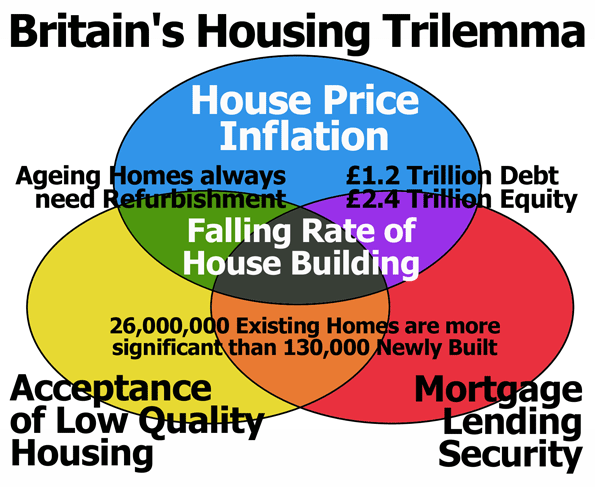
    The working class is caught in a political crusher made manifest through the planning system. The Red-Greens, who may imagine themselves on a new Left, gentrify towns and cities with “sustainable redevelopment”, and the Blue-Greens, who persist with being on the Right, protect their landscape for their exclusive enjoyment. Meanwhile the majority of home owners have come to depend on the inflated and unaffordable housing market. New Labour needed this house price inflation to allow the owner occupying majority to supplement inadequate wages by withdrawing equity from their homes. So does the Coalition. Deliberate or not, The Daily Telegraph’s commitment to building fewer new homes will stabilise what we have called the Housing Trilemma.

    Our current predicament may be thought of as a Trilemma, in which house price inflation supports burdensome mortgage lending and private debt, while households in the owner occupied sector accept low quality housing conditions. High rents shadow private sector housing costs, and private rental housing quality is often of the lowest quality. Many in Britain, including the majority of the home owning middle class, are dependent on the Housing Trilemma remaining stable.

    The planning system serves well in protecting the interests of existing home owners. Behind the NPPF’s moral idealism of sustainability, the immediate instrumental objective is to restrict new housing supply to avoid destabilising housing markets.  Appearing as a moral mission to save the planet from developers, the NPPF and the denial of development rights sustains the Housing Trilemma. Debt is secured, but housing remains unaffordable, quality low, and house building activity is at an all time industrial low. This is not a conspiracy. It is a predicament.

    When Britain’s elites talk about wanting to revive economic growth, they don’t mean a massive surge in new house building or an expansion of infrastructure. What they have in mind is a revival of financial services in The City, subject to uncertainties in the fragmenting Euro Zone, and the maintenance of high housing prices in the hope of more inflation to come. Meanwhile the countryside is kept pristine for the few who can afford access to it as a weekend retreat for the wealthy, including the pro-urban intelligentsia, in all their Red-Green-Blue moral plumage.

    The Coalition could have challenged the Housing Trilemma. Instead they have reinforced it.

    The result is predictable. Planning applications are falling in number and ambition. Only 25,000 new homes were approved in the second quarter of 2011 compared to 32,000 in the second quarter of 2010. This will be read by The Daily Telegraph campaign members as “proof” that there is no demand for development, inverting the causality. Money is being made out of an environmentally sanctioned scarcity rather than through increased productivity and innovation in a sector like house building and the wider construction industry. Britain’s already backward construction industry is further retarded, and it is becoming commonplace for social elites, and not only crazed nationalists, to blame immigration for housing shortages.

    Britain’s economy needs growth, but is unlikely to get it from the house building sector. Britain too needs a dose of political reality while the pro-urban intelligentsia preen their green morality.

    The Coalition cannot afford to confront the political problem of the Housing Trilemma if it is to sustain its fragile political base. Increasingly, only the elderly bother to vote and this equity rich group will be mostly satisfied with modest house price inflation as a hedge against general inflation, while savings in banks attract little return. Meanwhile an influential propertied elite still enjoys sustained house price inflation at the top of the market. They are anxious that environmental and heritage designations operate to enhance the exclusivity and enjoyment of their investments. The unelected charities, agencies and Non-Governmental Organisations that were aligned against the draft of the NPPF in July 2011 represent these elite interests. They may now back the redrafted 2012 NPPF with all its demands for sustainability. Their “Hands off Our Land” campaign has worked for them.

    The NPPF means that house builders face a future in which building on Greenfield land is effectively considered an eco-crime. Only those who can develop Town Centre sites, perhaps as rental housing, or as luxury homes for the equity rich will thrive. Basically Britain is no longer building homes with gardens for sale to young working families on modest incomes.

    If you are in a young working family, or hope to start one, the question is: What are you going to do about the housing predicament you and your friends face?

    We have to face a stark reality. Sadly, there is no contemporary habit of young working families organising to demand housing collectively. Meanwhile the 2011 to 2012 production figures look set to be lower again, and the developmental uncertainties about to be articulated in a redraft of the NPPF in pursuit of sustainable development will further the decline in production.

    Anticipating this feature of Britain’s ratcheting austerity does not make for a Happy New Year. Much depends on what the people of Britain, and particularly the young, do to demand that family houses are built at modest prices in places they want to live together. At present Britain fears a developer’s charter, even though the National Planning Policy Framework is nothing of the sort. Parliament might yet instead be in fear of people demanding cheap land on which to build a better place to live.

    James Stevens is Strategic Planner at the Home Builders Federation, www.hbf.co.uk. Email him at james.stevens@hbf.co.uk. The views expressed are his own and not those of Home Builders Federation. Ian Abley is a site architect and runs the pro-development website audacity, www.audacity.org. Email him at abley@audacity.org. Together they organise the 250 New Towns Club, www.audacity.org/250-New-Towns-index.htm.

  • Preserving the “Ideal of a Property Owning Democracy:” Annual Demographia International Housing Affordability Survey

    Demographia and Performanceurbanplanning.org  have just released the 8th Annual Demographia International Housing Affordability Survey, with an introduction by Professor Robert Bruegmann of the University of Illinois at Chicago and author of Sprawl: A Compact History. The Survey is unique in providing cross-national housing affordability comparisons using the median house price data from leading indexes in Australia, Canada, Hong Kong, Ireland, New Zealand, the United Kingdom and the United States.

    The Demographia International Housing Affordability Survey employs the “Median Multiple” (median house price divided by gross annual median household income, before taxes) to rate housing affordability (Table 1). The Median Multiple is widely used for evaluating urban markets, and has been recommended by the World Bank and the United Nations and is used by the Harvard University Joint Center on Housing.

    Table 1

    Demographia Housing Affordability Rating Categories

    Rating

    Median Multiple

    Affordable

    3.0 & Under

    Moderately Unaffordable

    3.1 to 4.0

    Seriously Unaffordable

    4.1 to 5.0

    Severely Unaffordable

    5.1 & Over

    Historically, the Median Multiple has been remarkably similar in Australia, Canada, Ireland, New Zealand, the United Kingdom and the United States, with median house prices having generally been from 2.0 to 3.0 times median household incomes (historical data has not been identified for Hong Kong). This affordability relationship continues in many housing markets of the United States and Canada. However, the Median Multiple has escalated sharply in the past decade in Australia, Ireland, New Zealand, and the United Kingdom and in some markets of Canada and the United States. There has also been a substantial loss in affordability in recent years in Hong Kong.

    Housing Affordability in 2011

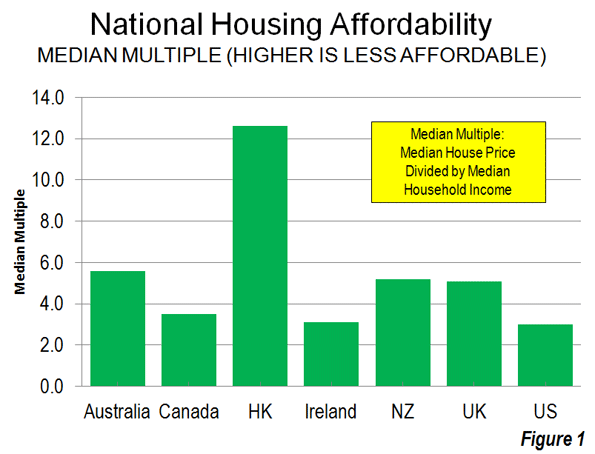
    Housing affordability was little changed in 2011, with the most affordable markets being in the United States, Canada and Ireland. The United Kingdom, Australia, New Zealand and Hong Kong continue to experience pervasive unaffordability (Figure 1).

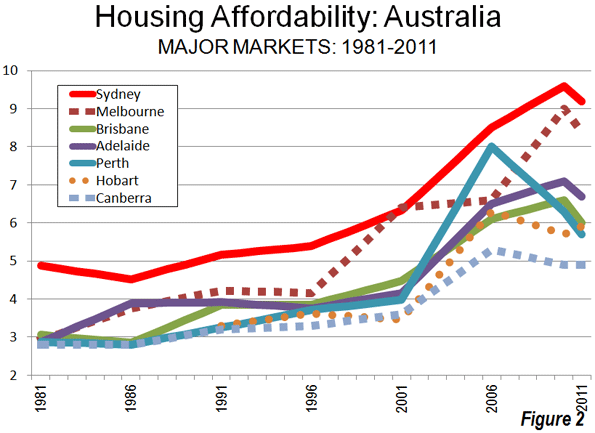
    The Survey covers325 metropolitan markets, including the 81 major markets with more than 1,000,000 population (Table and Chart Attached). There were 24 affordable major markets, 20 moderately unaffordable major markets, 13 seriously unaffordable major markets and 24 severely unaffordable major markets (Table 2). The severely unaffordable major markets were principally in the United Kingdom (8), the United States (6), and Australia (5). Hong Kong was severely unaffordable and there were three severely unaffordable major markets in Canada and one in New Zealand (Table 2). Australia had the highest major market Median Multiple outside Hong Kong (Figure 2).


    Table 2

    Housing Affordability Ratings by Nation: Major Markets (Over 1,000,000 Population)

     Nation

    Affordable (3.0 & Under) 

    Moderately Unaffordable (3.1-4.0)

    Seriously Unaffordable (4.1-5.0)

    Severely Unaffordable (5.1 & Over)

    Total

    National Median

     Australia

    0

    0

    0

    5

    5

    6.7

     Canada

    0

    3

    0

    3

    6

    4.5

     China (Hong Kong)

    0

    0

    0

    1

    1

    12.6

     Ireland

    0

    1

    0

    0

    1

    3.4

     New Zealand

    0

    0

    0

    1

    1

    6.4

     United Kingdom

    0

    0

    8

    8

    16

    5.0

     United States

    24

    16

    5

    6

    51

    3.1

     TOTAL

    24

    20

    13

    24

    81


    The most affordable major market was Detroit, with a Median Multiple of 1.4. This Median Multiple is artificially low, arising from the collapse of housing demand in the most severely depressed major market in the United States. There were another 22 affordable major markets, the most affordable of which were Atlanta, Phoenix, Rochester, Cincinnati, Cleveland and Las Vegas. The strong growth markets of Dallas-Fort Worth, Houston, Orlando, Jacksonville, Nashville, Oklahoma City, Sacramento and Indianapolis also achieved affordable ratings.

    All major markets in Australia and New Zealand, as well as Hong Kong were severely unaffordable.
    Hong Kong was the least affordable major market (ranked 81st), with a median multiple of 12.6. Vancouver was second most unaffordable, at 10.6 (ranked 80th). Sydney was the third most unaffordable, at 9.2 (ranked 79th).  Melbourne and Plymouth & Devon all had Median Multiples above 7.0.

    Among all 325 markets surveyed, there were 128 affordable markets, 117 in the United States, 9 in Canada and 2 in Ireland. There were 71 severely unaffordable markets, principally concentrated in Australia and the United Kingdom (Table 3). Honolulu and Bournemouth & Dorsett (8.7) were the least affordable outside the major markets.

    Table 3

    Housing Affordability Ratings by Nation: All Markets

     Nation

    Affordable (3.0 & Under) 

    Moderately Unaffordable (3.1-4.0)

    Seriously Unaffordable (4.1-5.0)

    Severely Unaffordable (5.1 & Over)

    Total

    National Median

     Australia

    0

    0

    7

    25

    32

    5.6

     Canada

    9

    19

    1

    6

    35

    3.5

     China (Hong Kong)

    0

    0

    0

    1

    1

    12.6

     Ireland

    2

    3

    0

    0

    5

    3.3

     New Zealand

    0

    0

    3

    5

    8

    5.2

     United Kingdom

    0

    1

    12

    20

    33

    5.1

     United States

    117

    64

    16

    14

    211

    3.0

     TOTAL

    128

    87

    39

    71

    325


    Preserving the "Ideal of a Property Owning Democracy"

    One of the principal accomplishments of high-income world societies has been the expansion of property ownership and home ownership to the majority of the population. At the same time, there are dark economic clouds on the horizon. Governments in high income nations are faced with some of the most challenging times in their history. In this environment, the property owning middle class is likely to face significant challenges in the longer run. Since housing is largest element in household budgets, unaffordable housing is a serious threat to the standard of living.

    At the same time, the economic evidence shows that more restrictive land use regulations, such as urban growth boundaries, have been an important factor in the deterioration of housing affordability. On this point, economist Anthony Downs of The Brookings Institution stressed the importance of maintaining the "principle of competitive land supply." The escalation of house prices relative to incomes, from Sydney and Vancouver to London and across California testify to the failure of planning to maintain that principle. The record shows that smart growth (urban consolidation and compact cities policies) is incompatible with housing affordability.

    But there are signs of hope. Florida repealed its growth management law ("smart growth") in 2011. Further, a recent New Zealand government report outlined the importance of a competitive land supply in restoring housing affordability to that nation.

    Four decades ago, urbanologist Peter Hall expressed concern about the threat of such policies to the "ideal of a property owning democracy." The Demographia International Housing Affordability Survey is dedicated to younger generations who have right to expect they will live as well or better than their parents. In large measure due to land use planning that has made housing unaffordable, they may not.

    Wendell Cox is a Visiting Professor, Conservatoire National des Arts et Metiers, Paris and the author of “War on the Dream: How Anti-Sprawl Policy Threatens the Quality of Life

    —-

    Note: The 8th Annual Demographia International Housing Affordability Survey is sponsored in Canada by the Frontier Centre for Public Policy.

    Photo: Suburban Montréal (by author)

  • Florida’s Quick Rebound

    Adding nearly 119,000 people in 2011, Florida has capped a decade of steady population increase  to see the state grow 19% since 2000.  Despite 2009, an historic year where more people left than arrived, the overall net growth of Florida has yielded two additional congressional seats, moving the state well on its way towards the becoming third most populous state in the nation.  This ascendancy brings new responsibility to the shoulders of the state’s leaders, and the direction this state takes in the coming years will depend upon how Florida reacts to this influx of new population.  It is time for true leadership to find appropriate voice for our state on the national scene.

    Contrary to the predictions of many within the urbanist intelligentsia, Florida’s farm counties grew the fastest. Osceola County, just south of bustling Orlando, grew by 55%; sleepy Sumter County, northwest of Orlando, grew by 75%; and Flagler County, home to historic St. Augustine, nearly doubled in population. Tampa, Orlando, and Miami have each seen their healthy share of immigration, but Florida’s rural areas have dramatically increased their appeal over a decade ago.

    At first this trend might be puzzling.  Lacking urban amenities such as museums, transit, and Starbucks, parts of rural Florida seem almost timeless.  Wildwood and Leesburg, nestled in the center of Florida, lack both beaches and theme parks.  They have one thing, however, that the urban areas do not have:  affordable housing.  And this is the elusive reality that must be turned around by Florida’s leadership if the state is to grow in a responsible manner.

    The Miami-Dade market has plenty of supply, but the average home lists for $509,000 .  Up in Wildwood, the home lists for $175,000, and you get a lot more house for your money.  People are voting with their feet for affordability.

    It’s not the price alone that seems to be putting people off, however.  Naples, which lists homes even higher than Miami, saw growth over the past ten years at a pace two and a half times that of Miami, and is expected to continue to grow at the same pace through 2015.  Anecdotally, it seems that newcomers have relocated to their vacation homes after selling off their other high-priced property, usually in the north. They sometimes reduced their expectations of what they can receive for their old houses and then permanently located where they prefer to live. If the buyers are older, they still likely made a nice profit over the past few decades.

    In Orange County, meanwhile, relieved realtors are finally starting to say goodbye to distressed properties.  Appraiser Lee Barnes commented that “foreclosures and short sales are 40% fewer, compared to this time last year,” and in an economy fueled by growth, the welcome sight of occupied rooftops means that commercial real estate is beginning to come back.  In fact, Orlando is near the top of the list in expected home price gains for 2012, a dramatic turnaround for the region.

    Florida’s comeback is timed with some key changes in regulating real estate development.  With state oversight all but vanquished by the governor, starving local counties welcome the property tax dollars associated with new growth.  No other revenue, apart from a sales tax, provides much cash to operate government in the Sunshine State. This makes growth a priority.

    But economic activity occurs in two forms:  growth (making more stuff) and development (making stuff better).  Quietly, in the past decade, Florida has added biomedical research clusters to its twin engines of growth and tourism, and this promises to increase greater resilience to the state economy.

    Some signs, however, point to Florida abandoning this strategy and continuing its boom-bust mentality.  The Governor, already warning the legislature of budget cuts in 2012, has expressed disappointment that the job creation return is poor on the State’s venture capital invested in bringing Scripps, Nemours, and other cutting-edge research organizations. He claims that are simply not adding jobs fast enough for his taste.  Abandoning these investments could mean that the organizations reduce their presence or even abandon the state.

    At the same time, Florida’s cities seem to be uncertain about how to tackle the problem of adding density without reducing affordability.  Land prices haven’t wavered much in the recession, with stubborn property owners holding on to assets that won’t sell, and they may benefit from this land-banking strategy in the long run.  Many who escape the Rust Belt and come to Florida express shock at the cost of living in the Sunshine State and are further dismayed over the quality of schools and surprising amount of congestion.  This mismatch between cost of living and quality of life may be part of the reason why Florida’s five largest cities were listed among the nation’s “saddest” in a recent Time poll .

    Casino gambling, a typical 1990s way to boost revenue, is being entertained by the Legislature, but other ideas should be considered as well.  For one thing, investment in the future means a better education system, perhaps a higher priority than ostrich food subsidies (currently exempt from state sales tax ).  Closing tax loopholes and fixing some long-broken parts of Florida’s tax code will help gain some badly-needed revenue.

    Very large infrastructure projects are also important to make Florida competitive.  On the east coast, NASA’s 60-year-old facilities need a major overhaul to continue providing America a spaceport for the 21st century and to pave the way for private space exploration.  This will maintain the deep investment in human capital of which Floridians were once justly proud.  The spaceport has a great deal of synergy with the National Simulation Center, located in Orlando, which is currently the country’s premier provider of military simulation and training.

    In more than one region, the Florida Venture Capital Act has brought world-class biomedical research laboratories, making dramatic advancements in cancer, diabetes, children’s health, and other key areas.  Already surging ahead and competing with area like Boston’s Research Center and the Silicon Valley, Florida must keep its edge in this field by continuing investment in the Venture Capital Fund.

    On the west coast, the Tampa Port Authority is already preparing for the widening of the Panama Canal, working in collaboration with ports of Mobile and Houston to partner with ocean carriers.  Continuing this investment and modernizing the logistics of truck and railroad traffic into the port is critical to make this economic engine prevail in the 21st century.

    Such infrastructure investment will improve Florida’s already existing assets, allowing for prosperity and upward mobility to occur within the state.  Competing with Texas will be difficult, given Florida’s lack of petrochemical resources, but the state’s native industry, tourism, has already made it a world-class destination. Florida’s leadership has already entered the national stage by saying “no” to high speed rail, but it has yet to define what it will say “yes” to.  Without intelligent citizen input, the state will likely fall back on its traditional pattern of being a passive receiver of investment and people, but not a creator of great new enterprises. 

    In contrast to states like California and Texas, Florida has been willing to be eternally passive; Disney World is a classic example.  Florida, a grateful recipient of this California enterprise, has benefitted secondarily, but the real power of this company still resides in Burbank.  This story is played out over and over again, with real estate developers from Dallas and Atlanta continuing to define the face of the state, aided and abetted by Wall Street investors who see Florida primarily as a waterfront real estate asset with some moderate margins available in between coasts.

    It is time for Florida to start doing, instead of being done to.  With investment in real infrastructure, good education and intelligent leadership, Florida can assume its responsibility as one of America’s new high-profile states, capable of exporting science, technology, and culture.  Our population growth contains within it the seeds of a bright future once we fix what is broken about our beautiful state.

    Richard Reep is an Architect and artist living in Winter Park, Florida. His practice has centered around hospitality-driven mixed use, and has contributed in various capacities to urban mixed-use projects, both nationally and internationally, for the last 25 years.

    Photo courtesy of BigStockPhoto.com.

  • Three Cheers for Urban Sprawl

    “Hands off Our Land!” screams the Daily Telegraph, like some shotgun-toting red-faced farmer.  The newspaper, on behalf of the reactionary toffs who form the least pleasant section of its readership, has launched a campaign directed against ‘urban sprawl’ (ie. the rest of us).

    On a good day, the Telegraph serves up enlightened articles by progressive liberals like Janet Daley and Simon Heffer and Jeff Randal (I’m talking about real liberals here, not American Trotskyites).  But then it disappears under the desk, drinks some devilish, bubbling potion and emerges looking like Mr Hyde, all wonky teeth and messy hair.  “Hands off Our Land” is the Telegraph at its worst – a campaign to thwart the government’s all-too-modest suggestions to reform Britain’s vicious planning laws.  

    NIMBY (Not In My Back-Yard) is a misnomer.  As James Heartfield observes in his brilliant book Let’s Build! if it was their back-yard there wouldn’t be a problem.  By “Our Land”, the Telegraph’s Colonel Blimps do not mean “land owned by us”.  They mean “other people’s land”, over which they wish to continue to exercise control via the State. 

    The battle against suburbanisation (which the Greens these days clothe in the jargon of ‘sustainability’) has been going on for decades, and the success of the NIMBYs in keeping the bulk of Britain’s population locked inside towns and cities, has disfigured Britain and blighted the lives of millions of people.  As a result of State planning restrictions, Britons are stuffed into towns and cities like battery-farmed chickens.  We are among the most densely packed people in the world.  In Britain, 90 percent of people live in urban areas.  In Germany (which has a similar population density) only 75 percent of people live in urban areas, while only 68 percent of Italians live in urban areas, and only 62 percent of the Irish (is the Italian or Irish countryside so awful?).  In India only 30 percent of the people live in urban areas. 

    And to make matters much worse for the Brits, our urban areas constitute a mere 9 percent of total land use.  That’s right – 90 percent of the people crammed into 9 percent of Britain.  Compare that to the 13 percent of land devoted to ‘Green Belt’ (the stuff holding us in).  Even in the South East of England, by far the most densely crowded bit of the UK, woodland and farmland, absurdly, accounts for more than three quarters of land use. 

    Britain is not a crowded island – contrary to the frothing rants from the misanthropes at the Telegraph.  Viewers wrote in to express their incredulity when the BBC broadcast a series called ‘Britain from Above’.  The BBC helicopters filmed hour after hour of vast, unending tracts of flat, rectangular fields and giant swathes of green nothingness.  It was astonishing to the naïve urbanites watching to see how empty the place was.  (Just take a look on Google satellite images).  The reason why Britain feels, to most of us, like an overcrowded island, is because all most of us ever see are congested towns and cities (or a fleeting glimpse of industrial farmland out of a car window as we travel along ‘urban corridors’ between towns). 

    Hemming people into towns and cities with ‘Green Belts’, has acted like a pressure-cooker on property prices.  The planning system, by limiting the amount of land available to build on, has created an artificial shortage of living space, forcing up the prices of houses and flats to such astronomical heights that many young couples can only dream of affording one.  The less affluent dare not get a job for fear of losing housing benefit.  There are families in London where the children sleep three and four to a room – a tiny room in a dingy flat.  Children who have outgrown their cots are forced to stay in them, sleeping with their legs bent (I have direct knowledge of such cases).  It is impossible to document the sheer bloody misery caused by the planning system – countless examples of diminished lives.  Even well paid professional couples in London now struggle to afford dark, crumbling Victorian houses, in rough parts of town.  Houses built for costermongers and chimney sweeps in the late 19th Century.

    But it goes far beyond property prices. Soaring urban land values have a knock-on effect, raising the cost of everything, from cinema tickets to shoes.  The land and property shortage (artificially created remember) has pushed all prices up, reducing our quality of lives in a myriad of unseen ways.  Meanwhile, the few remaining patches of green in our towns and cities are fast shrinking and disappearing. Gardens are designated ‘brown-field’ sites to allow more flats and houses to be built.  Houses are horribly divided into tiny disfigured flats.  School fields, parks and squares are shrinking and disappearing at an alarming rate, extra blocks of flats spring up everywhere, like weeds in the cracks.  The shocking effect of Green Belts has been to empty our urban areas of green spaces, and yet, as State planners know fine well, these are the most cherished bits of green in Britain, giving far more people, far more pleasure than ‘the countryside’ (to which so few of us go).  Worryingly, the London Planning Advisory Committee has decided that London has room for 570,000 extra homes.  As James Heartfield pleads, ‘Do we really want every inch of London packed with houses, instead of parks, squares, playgrounds and other amenities?’  And of course transport in our congested urban areas has become a living hell.  They cram us in then prohibit us from parking anywhere and charge us for causing ‘congestion’.

    Nor is the misery confined to the towns. Green Belts have killed the countryside.  Although a gigantic amount of Britain’s land mass is reserved for agriculture, farming accounts for less than one percent of Britain’s economic activity (and even this is massively subsidised).  In the countryside itself, only 3 percent of people actually work in agriculture.  It is argued the countryside must be preserved in order to protect traditional communities and ways of life.  But there is nothing traditional about our countryside.  The vast, boring fields you see today bear no resemblance to the small, labour-intensive agriculture of old.  The landscape has changed, the ‘communities’ have changed, the economics has changed.  Nor should we idealise what went before … grovelling, impoverished tenant small-holders and agricultural labourers (and before them serfs) breaking their backs to maintain the idle gentry.   Life for the rural masses was poor, hard, dull and servile. 

    The NIMBYism of the new gentry (organised, for example, in the Council for the Protection of Rural England) has stunted and thwarted genuine economic development in the countryside.  The vast bulk of Britain is now a wasteland, a poorly attended heritage theme-park, fit for well-heeled second-homers to live out their naff rural fantasy every third weekend.  Ordinary folk in the countryside are reduced to working in National Trust postcard shops, and with their meagre wages, they struggle to afford small nasty-looking houses which face directly onto busy A-roads.  No wonder the young want to get the hell out. 

    But the battle over planning laws has nothing to do with the giant wide open spaces in Northumbria and wherever else, because no-one in their right mind wants to go and live there.   The land in dispute is in truth much smaller.  The desire for planning restrictions is really an expression of upper class disdain for suburbs, and the people who live in them and like them.  Peter Hall, the professor of planning at the Bartlett School of Architecture, in his book Cities of Tomorrow, exposes the motives behind ‘sustainable development’, which in effect means ‘pulling up the drawbridge to stop anyone else entering their well-healed enclaves (save a few select people like themselves, whom it would be quite fun to invite for drinks on Sundays) … pulling up the drawbridge against newcomers, especially if they lack the right income or right accent.’ 

    The snobbery and hatred of the suburbs dates back to the end of the 19th Century.  The railways allowed the first suburbs to flourish as the working and lower-middle-class ‘clerk’ class, experiencing prosperity for the first time, sought to escape the urban slums, to have a little house and a little garden.  The suburbs were considered vile because of the people who inhabited them. In a book called The Suburbans, written in 1905, the poet T.W.H. Crossland launched a vitriolic attack on the ‘low and inferior species’, the ‘soulless’ class of ‘clerks’ who were spreading into the new comfortable houses in the suburbs, eating tinned salmon.  He was disgusted by them, their aspiration to self improvement, offensively self-made and self-assured.

    Professor John Carey, in his magnificent book The Intellectuals and the Masses, describes the widespread upper class loathing of the newly enriched masses and their suburban ways.  In Evelyn Waugh’s Vile Bodies, two characters are leaving England in an airplane. They recall Shakespeare’s description of England, ‘This precious stone set in a silver sea’, but then they look out the window.  They see the ‘straggling’ suburbs, the hills sown with bungalows, the wireless masts and overhead power cables, and ‘men and women, indiscernible except as tiny spots’ who were ‘marrying and shopping and making money and having children.’  Then one of Waugh’s characters says, ‘I think I’m going to be sick.’

    HG Wells contemptuously describes suburbs as a ‘tumorous growth’ … ‘ignoble’ Croydon and ‘tragic’ West Ham.  Betjeman of course pleaded to the Nazis, ‘Come friendly bombs and land on Slough, it isn’t fit for humans now’.  The suburbs were “Bathed in the yellow vomit” of sodium lamps.  Carey describes Betjeman’s horror of the suburbs, ‘harbouring the mixed bag of atrocities with which Betjeman associates with progress – radios, cars, advertisements, labour-saving homes, peroxide blondes, crooked businessmen, litter, painted toenails and people who wear public-school ties to which they are not entitled.’

    The vile lower orders had to be stopped.  It is no accident that one of the key figures in post-war planning was Sir Patrick Abercrombie, founder and head of the Council for the Protection of Rural England.  Planners like Abercrombie knew that ordinary folk were itching to escape the grimy crowded towns.  But instead of the semi-detached houses with nice back gardens, which they craved, they would have to be stacked high in tower blocks.  The planners knew that it wasn’t what people wanted.  They knew that people wanted a little space of their own, with a little back lawn where they could keep an eye on their three-year old playing.  A fairly modest, basic human desire in this day and age, you might think, and yet one they would be deprived of.

    A system of Green Belts was devised to keep the proles locked in.  Professor Hall refers to Green Belts, correctly, as ‘the polite English version of apartheid’ … ‘a system of controlling and regulating the suburban tide to a degree that would have been unthinkable in the United States’.  The Town and Country Planning Act of 1947 effectively nationalised the right to develop land.  Hall describes how the containment of the lower orders in increasingly crowded urban areas, and the resulting inflation of land and property prices, led to distress on a vast scale.  Since land was so scarce and pricey, to build houses which people could actually afford, private builders were forced to build smaller and smaller homes, reducing the quality to make them less expensive.

    As the private housing market was strangled, it was decided that instead the State would build inner-city accommodation for the masses.  They were to be confined to urban areas, forced to live in high densities in high-rise blocks.  Rather than chose their own home in a free market, ordinary people had to apply to the State to be housed and would be allocated one (a very nasty State produced home).  By the 1970s around a third of the British population lived in State housing.  The State thus determined how and where we should live.  Over the years, it has become suffocating.  Green spaces inside towns have shrunk or disappeared as more and more nasty council blocks have been crammed in.  Early ‘leafy suburbs’ like Ealing have become more and more crowded and less and less leafy.  Now, they feel like part of the towns, only without the attractions of the bright lights.  In Britain, the dream of better living stopped in 1947.

    We have had enough of all this crap about ‘protecting the countryside’.  Planning (let us call it what it is: authoritarian State control of our lives) has always been primarily a tool of social prejudice.  Behind the cult of the British countryside, from Wordsworth and Ruskin onwards, has always been contempt for the masses.   Who are we protecting the ‘countryside’ for?   And from whom are we protecting it? 

    Let us be honest about ‘the countryside’.   These days it is largely made up of very big, very flat rectangular fields used for (largely pointless, subsidised) industrial farming … not at all beautiful and frankly the last place you would want to have a picnic. (Ironically most of the green rural fantasists in our midst tend to hang out in relatively crowded places like Southwold and Alderburgh (to enjoy the music festivals) and the ‘Wordsworth-country’ bit of the Lake District where Beatrix Potter lived.)

    Very few bits of the countryside look like it does in Postman Pat, and these bits are enjoyed by very few people indeed.   Let’s have more of them.  Wonderfully landscaped areas – big ones – not far from towns and suburbs, accessible to lots of people, with adjacent toilets and cafes and car-parks.  We do not want Green Belts, we want Green Patches – big parks and broad, lovely town squares, and large chunks of beautifully landscaped green spaces, close to where people live.  We want green everyone can enjoy.  And in between the green bits, we demand the freedom to build what we want, where we want. Three cheers for ‘Urban Sprawl’, the motor car, roads, supermarkets, golf courses and service stations.

    It’s time to get angry with the angry-brigade at the Telegraph.  To get angry with the organic, home-grown TV chefs and their agro-hobbyist friends, with the grungy middle class road protesters (imaging themselves to be radical), with the suburb-hating, supermarket-opposing, free-range chicken loving reactionaries, the metropolitan elite who can afford second-homes, yet who would deny first-homes to others, the heritage bores and bearded ramblers and people who drink cloudy expensive beer from local breweries and write bad guide books and erect plaques everywhere and think Ruskin had a point.  It’s time to get angry with Prince Charles – the Dark Lord, and his toady friend Richard Rogers, who thinks we should all live in shoe-boxes.  This collection of bigots are trying to keep us in our place.  They have damaged the lives of millions of people.  Now they must be stopped.

    Martin Durkin is a documentary film director and TV producer based in the UK.

    Photo from Bigstockphoto.com.

  • Urban Legend: Wei Ping Contemplates Motherhood

    Driving through the bustling Orchard Road in the heart of Singapore, Wei Ping stares at the shiny new Prada hoarding. Maybe she should ”invest” in a new Prada bag. She must watch out for the next big season sale. Her birthday is a distance away but ever since she and her husband had started talking about the baby, she needed some retail therapy to lift her mood.

    As she drives under the ERP (Electronic Road Pricing) barrier at Orchard Road at the heart of Singapore her mind shifts to the balance in her cash card and the fact that she should load it soon. Singapore, like many other cities trying to control car population, levies an entry tax every time you drive into the central business district. Every car comes fitted with a special electronic unit that can be read by the overhead ERP gantry. All that a car driver needs to do, is insert a cash card into the special unit and hope that the cash card has enough money in it to avoid being fined. The electronic gantry allows for manipulation of the ERP amount depending on the traffic. The amount to be deducted is prominently displayed on the gantry but once you are in the queue for entering the city, and realize that the balance in the cash card is lower than the entry tax you budgeted, you are in trouble with the LTA Local Transport Authority anyway in this “fine” city.

    The 30 year old prides herself in maintaining a smart yet frugal existence, the famous “kiasu” attitude of Singaporeans, which many outsiders interpret as “stinginess” but to Wei Peng is all about  getting the maximum out of a deal, the only way to go.

    Coming on top of inflated car and fuel prices as well as road tax, cost of living in one of the most modern cities in Asia tops the concerns for most people in Singapore. Worse, with rising prices, Singaporeans have to think twice before doing what they like best: upgrading housing and clothing to better housing and better clothing. In fact being kiasu, or looking out for the best deals in housing, clothing and food, is really the only smart way to survive in this expensive city. And that was the reason why Wei Peng had driven 45 minutes all the way from the heartlands (normally called suburbs) to the centre of town, braving the Friday evening crowds and struggling for 10 minutes for a parking slot, to check out the year-end deals in the shopping district.

    Wei Peng has a friend who had recently landed a job with a property developer. Fuelled by a real estate boom and resulting commissions, Diane has booked a swanky new condominium close to her current HDB (government provided) unit, significantly upgrading her lifestyle. Wei Peng would love to do the same, for that she would have loved to look for a job paying more than her current one of three years. However she knows it wouldn’t be possible, especially since her husband of two years had actively expressed interest in starting a family. The painful afterthought of financial implications of an expanding family was all she could think about lately.

    For years now, Singapore has been struggling with a declining birth rate. The government has tried to stem it with cash incentives, extended post-pregnancy leave and open immigration policies with limited success at best.

    The Singapore of today is faced with twin problems of slowing birth rate and ageing population. In 2000, 14% of women between age 30-39 chose to remain childless. By 2009, this figure has gone up to 20%. A similar trend was seen in the 40-49 year age group. In a country with a life expectancy of 81 years, the age support ratio or the ratio of working age population (15-64) to the elderly (65+) has declined from 9.9 in the year 2000 to 8.2 in 2009. (Source: Singstat.gov.sg)

    In human terms this translates into a no escape from cost of living even after retirement. There is no cheaper “hinterland” they can migrate to. The newspapers are full of stories of ungrateful children and abandoned elderly parents. A recent government campaign talks of family values and of children fulfilling their duties towards their parents. Wei Peng, who is an only child, knows she has to think of taking in her parents in to live with her someday. And for her husband, it means sharing the duties of “filial piety”, as the campaign calls it, with his younger siblings.

    Most of her friends were not keen to become parents anytime soon. The few who did relied on their retired mothers and fathers but she could not think of imposing on her parents’ lifestyle. She saw a close friend go through one child after another in quick succession and finally decided to quit her flourishing career in the private sector. Her friend’s life is now consumed with the tension of getting admissions into a reputed school, and hustling the children into “special classes” ranging from music to sports. They don’t talk on the topic but for Wei Peng the thought of giving up her own ambitions hurts. Not to mention the small sacrifices like giving up on the comforts of a car for the city’s clean, efficient but often very crowded public transport.

    After all, starting a family meant having to plan for one less income, at least for some time,  and additional expenses indefinitely. For instance, raising a child would mean hiring a full-time nanny. Finding a nanny is easy, thanks to Government policies that allow “domestic workers” to live and work in Singapore. However, keeping a nanny means paying the government two hundred odd dollars as tax, not including the worker’s salary and the cost of her upkeep. Having a baby would also drive a more disciplined lifestyle.

    Right now, she’s cooked in her kitchen precisely two times, once for Chinese New Year and the other when her husband’s parents had come over. It was simply more convenient and maybe even cheaper to eat out at the various hawker centers/food courts conveniently scattered across the city. Of course eating out came with the added attraction of hanging out with like-minded friends, especially over the weekend. She looked forward to scouring the papers for a new restaurant review that could potentially be the weekend outing.

    With a baby, the look of her pristine kitchen would definitely change. Was she ready to stop looking after that lovely coffee machine and the induction cooker which looked like it belonged in a show flat even after two years?

    No eating-out, no annual holiday, increased expenses, maybe missing that promotion she so wanted…where were the positives to motherhood?

    As she drove into the overcrowded car park filled with deal seeking crowd, her glance fell on the road tax sticker stuck to the windshield. The expiry date was within 15 days! Oh well, she sighs, another day, and another expense. Prada will have to wait for a while and the baby, a while longer.

    Note: Wei Peng is fictitious but Singapore’s baby problems are real.

    Vatsala Pant is a management graduate with several years of business leadership experience and a connoisseur of people, places and cultures. She currently lives in Singapore.

    Photo of Singapore ERP system by Flickr user choyaw99.

  • Urban Development: Playing Twister With The California Environmental Quality Act

    When it comes to environmental issues, emotions often trump reasoned argument or sensible reform, especially in California. In Sacramento at our state capitol, real world impacts are abstracted into barbed soundbites. It’s the dialogue of the deaf as environmental advocates rally around our landmark California Environmental Quality Act (CEQA) — and economic interests decry it as “a job killer.” Perhaps the polarization can be put aside to ask about a specific example in the real world. Why does an old K-Mart sit vacant on Ventura’s busiest boulevard despite initial City approval for a Walmart store? All the thunder and lightning surrounding whether a Walmart belongs in Ventura is behind us. A vigorous and contentious debate (and a failed citizen initiative) have rendered the verdict that filling an empty discount retail space with a different discount retailer is a function of the market, not government regulation.

    Nor can we directly blame the stalemate directly on the California Environmental Quality Act (CEQA). What keeps the store empty is not the controversial law itself, but the way it has been twisted like a pretzel into a tool to stop urban developments opposed by well-funded interests. Recently, the Los Angeles Times exposed the ironic way it has even been adapted by developers and big corporations to fend off their competition.

    The California Environmental Quality Act is the toughest state environmental protection statute in the nation. Passed more than 40 years ago in the wake of the first Earth Day (and signed by Governor Ronald Reagan), CEQA has spawned an industry of specialist consultants, attorneys and planners. Its original laudable goals for managing natural resources have been obscured by the hard ball tactics of litigators in our state.

    The vast majority of Californians support sensible environmental protections and are suspicious when business interests lobby to weaken them. They remember oil spills and toxic dumps and slash and burn hillside developments. Yet the case law that has grown up around CEQA is so burdensome that virtually any public or private project can be slowed or killed on bogus grounds that really have nothing whatever to do with protecting our natural environment.

    Yes, the law has protected stands of redwood trees from clear-cutting and sensitive habitat from suburban sprawl. And there are David and Goliath stories: a little band of neighbors stop a mega-developer from flooding their neighborhood with traffic (although this is a long stretch from protecting “natural resources”.) But it is now routine for special interests to hire high-powered law firms to exploit the law for their own economic interests.

    Here in Ventura, lawyers for construction unions combed over the Environmental Impact Report done for the new Community Memorial Hospital project with the goal of seizing on any technical errors or ambiguities. They fired off a thirty page “comment letter” which lays the groundwork for a lawsuit. The goal was certainly not “protecting the environment” — it was to pressure the hospital to use union labor for the construction. They were successful.

    The proposed Walmart at the old K-Mart site is stalled after initial city approval because the company knows that even something as simple as changing the facade on the building could trigger a lawsuit alleging inadequate “environmental review.” So the project sits in limbo while Walmart analyzes its legal options. What Walmart fears is exactly what happened to WinnCo grocery, which did see its proposed new signage and facade challenged by a CEQA lawsuit.

    There are lots of things not to like about development in a city. But that’s why we have planning commissions, public hearings and appeals to elected City Councils, along with detailed rules that must meet stringent legal guidelines for adoption and enforcement. But why have an elaborate land use entitlement and permit review process if it can be superseded by anyone with the resources to file a CEQA lawsuit? Democratic due process goes out the window, replaced by months or years of costly legal maneuvering.

    No sensible person advocates repealing CEQA. But after forty years, it is past time to return to its original, laudable purpose and intent: to protect our natural environment and sustainably manage our natural resources.

    Understandably, environmental advocates are skittish about tinkering with the law. There is precedent, however, for consensus reform. When the League of Conservation Voters pushed a bill to curb greenhouse gas emissions and promote sustainable regional planning, they won the support of both the League of California Cities and the Building Industry Association by incorporating a modest relaxation of onerous CEQA burdens on “infill development.” There’s lots more room for common sense consensus to separate environmental protection from a racket for special interest litigation.

    One of the worst ways to proceed is to pick out individual projects for favorable CEQA treatment. That’s what’s happened on a couple of controversial stadium projects that won legislative relief from the typical CEQA procedural hurdles. Having to lobby Sacramento to pass a special law is a brutally stark example of special interest litigation. Football stadiums are not the only or even the most important projects held hostage by CEQA abuse. Comprehensive reform is long overdue.

    In these economic times, the jobs lost to CEQA abuse aren’t offset by the ones created for CEQA experts and CEQA attorneys. California led the nation in protecting our state’s environment. If we can look past the symbolism that CEQA has assumed to both advocates and detractors, we’ll see that it’s urgent to restore the law’s original purpose and keep it from being hijacked for other agendas. That may be unlikely in today’s polarized political climate. That’s why it is crucial to bypass the soundbites and the symbolic posturing, and remember the real world fallout of failing to reform the way CEQA is administered in the Golden State.

    Rick Cole is city manager of Ventura, California, and recipient of the Municipal Management Association of Southern California’s Excellence in Government Award. He can be reached at RCole@ci.ventura.ca.us

    Photo: The vacant K-Mart in Ventura, California

  • The Evolving Urban Form: Kolkata: 50 Mile City

    More than a decade ago, the Sierra Club and I crossed keyboards over urban density. The Sierra Club had just posted a new "neighborhood consumption calculator," that gave visitors the opportunity to look at the purported impacts of various density levels. The Sierra Club designated 500 dwelling units per acre as "efficient urban." Independently, Randal O’Toole and I quickly were on the Internet pointing out the absurdity of such high density. I noted that the so-called "efficient urban" density was far higher than that of the "black hole" of Calcutta, and high enough for all US residents to live in the Portland urban area.

    Within 24 hours of our responses, the "neighborhood consumption calendar" had been taken off the Internet. It was later to reappear with "efficient urban" density being discounted a full 80 percent, to 100 housing units per acre. This is still far more dense than nearly all of the world except for low income world shantytowns.

    The Kolkata Municipal Corporation (KMC): The central city of Calcutta, now called Kolkata, remains one of the densest on earth. Its population density is 63,000 per square mile (24,000 per square kilometer)  is nearly the same density as in Manhattan or the Ville de Paris. More accurately, it resembles the entire urban area densities of Mumbai and Hong Kong. The expanding suburbs of Kolkata have a population density of 25,000 per square mile (9,000 per square kilometer). The next edition of Demographia World Urban Areas (due out in the spring) will estimate the population density of the Kolkata urban area at 30,000 per square mile (12,000 per square kilometer).

    Kolkata’s spreading urbanization, however, has been going on for at least a half century. Since the 1951 Census, the central city of Kolkata has accounted for only 19% of the urban area population growth. The central city has added nearly 1,800,000 people while the suburbs have added approximately 7,650,000 (Figure 1).

    Over the past two decades, the central city’s growth has been minimal, adding 87,000 people from 1991 to 2011, while the suburbs added more than 3 million new residents. This intensifies the pattern of the last half-century where most growth clustered close to the city core.

    Between 1901 and 1951, 59% of the growth in the Kolkata urban area was in the central city (Kolkata lost the British capital to Delhi in 1911).


    Photo: Victoria Memorial, KMC

    Slower Growth in the Urban Area: Kolkata is an unusually shaped urban area, nearly 50 miles (80 kilometers) long and stretched along the Hooghly River, one of the many mouths of the Ganges. Dhaka, the megacity capital of Bangladesh used to be on a mouth, until the river’s course changed. The urban area averages little more than 10 miles (16 kilometers) in width. The municipality of Kolkata is in the south, on the east bank of the Hooghly, with most of the suburbs to the north or just across the river.

    Like a number of major urban areas around the world, Kolkata has seen its population growth slow markedly. The peak population growth decade was the 1930s, when there was an increase of 69%. Growth dropped to 29% during the 1940s but continued at 20% or more until 2001. However, between 2001 and 2011, the urban area growth rate dropped to 7%, as the area added only 900,000 new residents. Despite its earlier, smaller size, the Kolkata urban area had not added this few people since the 1921 to 1931 decade.

    In reality, Kolkata is getting less dense by the day. The results of the 2011 Census of India showed that every new resident of the Kolkata urban area was added in the suburbs (Note 1). Yes, the central city of Kolkata remains very dense but its population fell from 4,573,000 people in 2001 to 4,487,000 people in 2011. At the same time, the population of suburban Kolkata grew by nearly 1,000,000 people, and accounted for 110% of the population growth.


    Photo: Howra Bridge, Hooghly River (Howra)

    Kolkata, Los Angeles and China: It also may seem strange that despite its huge typically third world growth since 1951, the Kolkata urban area grew at a rate similar to that of the Los Angeles urban area (Note 2). Los Angeles was larger from the 1960s to 1990, while Kolkata was larger in the 1950s and has been larger the last two decades (Figure 2). Still, Kolkata’s growth has fallen to high income world rates. Other Asian megacities (over ten million)  including Delhi, Shanghai, Beijing, Mumbai, Shenzhen, Manila, Jakarta, Dhaka and Guangzhou) have all experienced much faster growth over the past decade (Note 2). Shanghai and Beijing combined added nearly the same number of people as live in Kolkata.

    Hyper-Densities: Nonetheless, Kolkata continues to have some of the highest densities in the world. In 2001, one third of the central city population (1.49 million) live in slums and shantytowns (photo). They are crammed into just 2 square miles (5 square miles). This would be like all the population of the San Fernando Valley living within a radius 0.6 miles (1 kilometer) of Los Angeles City Hall or all the population of the city of Dallas in the space covered by the passenger terminals at Dallas-Fort Worth International Airport. This is more than 725,000 people per square mile (280,000 per square kilometer), and would nearly equal the "efficient density" definition that the Sierra Club wisely discarded. It can only be hoped that when the 2011 Census slum data is available, it will show that all of the city of Kolkata’s  population loss will have been from the slums.

    Kolkata, like that of other large urban areas around the world described in The Evolving Urban Form series, shows that, given a chance, people reveal their preferences by moving to more space, to construct a better life for themselves and their households.


    Photo: KMC Slum

    Wendell Cox is a Visiting Professor, Conservatoire National des Arts et Metiers, Paris and the author of “War on the Dream: How Anti-Sprawl Policy Threatens the Quality of Life

    Kolkata Urban Area: Population 1901-2011
    Year Kolkata Municipal Corporation (KMC) Suburbs Kolkata Urban Area (Urban Aggolmeration) KMC Share of Growth KMC Growth Suburban Growth
    1901         848,000         662,000          1,510,000 56.2%
    1911         896,000         849,000          1,745,000 51.3% 5.7% 28.2%
    1921      1,031,000         854,000          1,885,000 54.7% 15.1% 0.6%
    1931      1,141,000         998,000          2,139,000 53.3% 10.7% 16.9%
    1941      2,109,000      1,512,000          3,621,000 58.2% 84.8% 51.5%
    1951      2,698,000      1,972,000          4,670,000 57.8% 27.9% 30.4%
    1961      2,927,000      3,057,000          5,984,000 48.9% 8.5% 55.0%
    1971      3,149,000      4,271,000          7,420,000 42.4% 7.6% 39.7%
    1981      3,305,006      5,888,994          9,194,000 35.9% 5.0% 37.9%
    1991      4,400,000      6,622,000        11,022,000 39.9% 33.1% 12.4%
    2001      4,573,000      8,633,000        13,206,000 34.6% 3.9% 30.4%
    2011      4,487,000      9,626,000        14,113,000 31.8% -1.9% 11.5%


    —–

    (Lead Photo: Mahatma Gandhi Road, KMC.

    —–

    Note 1: This is the Kolkata "urban agglomeration," which is the term the Census of India uses to denote urban areas, or areas of continuous urban development. The Census of India, however, applies to criteria to its urban area definitions that make them difficult to compare to urban areas in other parts of the world. The Census of India does not, for example, allow an urban agglomeration to be defined across state lines. Thus, the Delhi urban area continues to be shown as smaller then the Mumbai urban area. This is despite the fact that the immediately adjacent urbanization of Delhi includes millions of additional people in the states of Haryana and Uttar Pradesh and is by international definition by far the largest urban areas in India. The other difficulty is that the Census of India includes the entire land area of any municipality in the urban area. Thus, where municipalities are particularly large in area, as in the case of Mumbai, considerably more land area is reported that he is truly urban. This can lower urban area densities by the inclusion of large areas that are rural. In the case of the call, urban area, the municipalities are generally much smaller, and the geographical definition of the Census of India is much closer to a genuine definition of an urban area or urban agglomeration.

    Note 2: The Mission Viejo urban area is included in the 2000 Los Angeles urban area population in this comparison. Much of this urban area was included in Los Angeles before the 2000 census and it seems likely that it will be reunited with Los Angeles in 2010. The 2010 US urban area geographical definitions have not yet been released. Based upon the change in the Los Angeles metropolitan area population, it is assumed that the Census Bureau’s urban area will show a population of approximately 12.5 million.

    Note 3: Chongqing is sometimes incorrectly characterized as a megacity, because of its status of a "provincial level municipality" in China. However, the Chongqing provincial municipality is largely rural, and covers a land area similar to that of Austria or Indiana. The Chongqing urban area has a population of approximately 7 million.