Category: Urban Issues

  • Let’s Face It, High Speed Rail Is Dead

    Advocates were ecstatic when President Obama had $8 billion for high speed rail put into the stimulus bill. His administration planned to make HSR one of the cornerstones of its infrastructure investment program. Secretary of Transportation Ray LaHood visited Europe to check out HSR there in person and came back proclaiming, “High speed rail is coming to America.” The $8 billion, we were told, was a down payment, and that in little more than two decades, America’s largest cities would be linked by a web of high speed trains.

    But as it turns out, a series of snafus and reversals has left Obama’s HSR agenda on life support.

    First is the public perception of the failure of the stimulus bill. Unemployment never came down to projected levels. Spending largely went to keep state and local government workers already employed, not towards infrastructure or new jobs. Obama has since admitted he was mistaken to believe there were such things as “shovel ready” projects for even roads, much less a complex undertaking like high speed rail. But more importantly, rather than put that $8 billion towards focused projects that would really advance the ball of high speed rail in America, it was peanut butter spread across a large number of projects around the country, ultimately not driving significant improvements. This feeds the perception of $8 billion that just went “poof.”

    At the same time, the federal deficit ballooned to $1.5 trillion and the national debt to an astounding $14 trillion. Virtually all parties agree on the need to address our massive structural deficit. The Tea Party focused on a hodge podge of issues, but primarily on reducing government spending. The movement grew to prominence and fueled a Republican comeback in the 2010 elections. In this environment, getting anything done will be difficult, and especially funding items like HSR that are easy to characterize as frivolous and favoring just a few urban regions.

    The biggest impact may have been at the state level, however, as a wave of new Republican governors ripped up HSR plans and sent stimulus funds back to Washington.  This includes Scott Walker of Wisconsin, John Kasich in Ohio, and Rick Scott in Florida, all of whom said “thanks, but no thanks” to federal rail funds.

    But beyond those philosophically opposed to HSR, some  high speed rail advocates have done themselves no favors either. They’ve resolutely backed pretty much any and every rail project regardless of whether it is potentially useful or an outright boondoggle. They’ve engaged in false advertising by labeling 110 MPH peak speeds as “high speed rail” instead of what it really is:Amtrak on steroids. (One of the more serious HSR advocates is Richard Longworth, who labeled the Midwest 110 MPH rail plan the “Toonerville trolley”). Nevertheless, Illinois is pocketing well over $1 billion of the HSR stimulus funds for this “high speed” system that will offer end to end journey times that are at best only slightly better than what’s already being provided today by Megabus – and that for only a handful of trains a day on a line still subject to freight interference.

    Advocates have excoriated opponents to high speed rail, but have shown themselves largely utterly unserious about the enterprise as they have put no focus on overcoming major institutional barriers such as the steam road era thinking of the Federal Railroad Administration which is stuck in the 90s – the 1890s – or the mismanagement at Amtrak.  Getting to an HSR system that works is going to involve major reform (or replacement) of those agencies since all proven, international HSR systems are illegal in the US under current rules.  Witness here also the histrionics about a Republican proposal to privatize the Northeast Corridor rail operations rather than engage with it as a starting point.  Even in Europe and Japan, many HSR operations are private, so there’s no reason they can’t be in the US too.

    To be clear, though I myself have been ambivalent about the high speed rail enterprise, I do not consider myself anti-rail in the slightest. I agree that HSR could bring potentially significant benefits, particularly in the Northeast, although it’s a somewhat more speculative enterprise in most parts of the country.  This is one on which reasonable people can disagree.  But however one feels, getting to the benefits will require a properly designed and operated true high speed system, something few of the current proposals would provide.

    It’s time to take a major gut check on high speed rail in America and rethink the direction. Clearly, with the budgetary and political situation, significant future HSR investments are unlikely. Even if some billions materialize, the experience of the stimulus suggests that they will be frittered away as salami slices sent hither and fro.

    A better approach might be to take some time to think more clearly about what we want high speed rail to look like in America.  It starts with learning from best – and worst – practices abroad, while noting the important differences versus the US. We need to put a proper regulatory regime in place and reform the FRA; to set up a framework for a successful privatization of any system, probably with operations contracted to an international operator with high speed experience; and to jettison any thought of Amtrak as the ultimate HSR system operator.

    We can then prove these concepts out in the one corridor where high speed rail is clearly a slam dunk in America: the Northeast Corridor from DC to Boston.  Despite what the Acela brand might imply, this is far from high speed service today, and there’s clearly room for vast improvements. Studies can proceed in parallel in other regions, and one we’ve proven in the NEC that HSR can be for real in America, other regions might opt in.

    In short, it’s time to stop pretending we are going to get a massive nationwide HSR rail network any time soon.  Advocates should instead focus on building a serious system in a demonstration corridor that can built credibility for American high speed rail, then built incrementally from there.  That’s about the best hope for HSR left in America. Without a rethink of the current approach, high speed rail is well and truly dead.

    Aaron M. Renn is an independent writer on urban affairs based in the Midwest. His writings appear at The Urbanophile.

  • “Art, Design, Portland” District Offers Opportunities To Work, Play, and Profit in Portland’s New Economy

    In a dreary economy, with record numbers of Portlanders unemployed and underemployed, the shared work space is hoping to tap into the city’s DIY sensibility to foster innovation, creativity and a new connection to work. But similar projects have tried here before — and failed. Will ADX’s new approach pencil out?

    Located on the edge of Portland’s eastside industrial district, ADX (Art Design Portland) occupies a 10,000-square-foot warehouse once filled by Apex Manufacturing. The warehouse has since been gutted and renovated, with the letters ADX printed across its façade.

    Inside, the bright space smells of new paint and freshly cut wood. “It’s our first day” says founder Kelley Roy as we walk to the makeshift interview area — three wooden chairs set in front of the company’s gallery space. A slow-moving Labrador trails us and lies down at Kelley’s feet.

    Kelley ticks through her professional history as if one gig could only have led to the next: Program Manager for Metro, green building developer, founder of food source and prep company Get Fresh NYC, author of Cartopia: Portland’s Food Cart Revolution, and now founder of ADX. “Everything I’ve done is about bringing people together over something I cared about,” she says. “Bringing people back together and giving them a place to work, to make their own jobs, do meaningful work. It’s just important to me.”

    Her business partner, Eric Black, joins us a minute later. Trained as an architect, Eric spent the past seven years at the architecture firm Yost Grube Hall in downtown Portland. From there he moved on to found the first iteration of ADX, located in a 3,000-square-foot building on southeast 9th avenue. This first version of ADX was a shared workspace and shop for architects, with 1,000 square feet of gallery space.

    The pair met when Kelly needed space to show work for a visiting artist friend, and ended up leasing the ADX gallery. It was then that they began re-envisioning ADX as a true cross-disciplinary work space.  “We started to prototype the idea of what it could really mean within that space,” says Eric. “It was a nice test.”

    The pair secured a $145,000 loan from Albina Opportunities Corporation and Mercy Corps Northwest to lease, renovate and equip their new building. The nonprofit lenders stepped in to support ADX because they saw its potential as a jobs catalyst, an objective not lost on Kelley: “We’d really feel that sense of success in what we’re trying to create if those jobs really thrive here in Portland. Take the bad economy and the lack of jobs and turn it into an opportunity.”

    Shared builder spaces have popped up around the country throughout the last decade. 3rd Ward, a shared work space in New York’s Williamsburg’s neighborhood, was founded in 2006 by Jason Goodman and Jeremy Lovitt as a response to the city’s prohibitively expensive artist studio rates. The company has more than doubled membership in the past year, reaching1,250 members and bringing in over 200 instructors to teach everything from studio lighting to welding. It employs 20 full and part-time staff. 3rd Ward is currently expanding to the second floor of their building, adding 10,000 square feet of classrooms, a wood shop, tech and photo studios and more shared work space. The company has been growing throughout the recession, wrote Jessica Tom, director of marketing, “As people lose their jobs, we pick them up as freelancers who use our space as their company structure.”

    ***

    Early interest in ADX, to the pairs’ surprise, came largely from local creative firms, as opposed to the casual hobbyist. The firms signed up for ADX membership include The Official Manufacturing Company, Factory North, Hand Eye Supply, Build Design and Kate Bingaman Burt.

    The success of these firms largely hinges on the fact that they actually make what they design. “I think people are so tired of the plastic nature of the way things are made” says Eric, “they want something better, and they see it can be better if people actually put their hand to it than if a machine makes it.”

    The Official Manufacturing Company was in the process of tooling up their own shop when they stumbled across ADX and decided to lease the attached office. For Official Manufacturing, the access to space and tools made sense. “If we weren’t subleasing from them we definitely would have a business membership, and use the tools we wouldn’t be able to afford on our own,” says founder Fritz Mesenbrink.

    For the weekend hobbyist or entrepreneur needing a little help realizing his or her concept, ADX has assembled a cohort of experts — designers, videographers, architects — dubbed the “Gang of Ten.” This group of experts pays for desks and access, and offers their consulting services at a 10 percent discount to other members.

    The model has allowed ADX to diversity revenue streams: one third from memberships, one third from classes and workshops, and one third from the Gang of Ten fees. Once the space has a healthy community of builders, says Kelley, they’ll begin selling pieces from individual members under the ADX label. “Sort of like Ikea,” she laughs.

    The numbers haven’t always penciled out for similar operations, however. TechShop, founded out of the Bay Area in 2006, opened several franchises across the country. One of these locations on the outskirts of Portland, in Beaverton, was forced to file for Chapter 7 bankruptcy in 2010 after low membership turnout.

    But, Kelley notes, TechShop was in the wrong location (suburban Beaverton) and with memberships starting at $99 a month, was too expensive for the casual hobbyist. Kelley hopes ADX, with its multiple revenue streams, central location and affordable rates (starting at $25 a month) can be profitable within a year.

    Rather than franchising, says Kelley, ADX is interested in partnering with existing maker spaces like 3rd Ward. “They did a lot of research to figure out what their community needs were, and they’re serving the needs of their community — that’s what we did here.”

    In a dreary economic climate, the community seems to be responding well: ADX’s open houses enjoyed healthy turnouts, and Kelley and Eric report they are on track to meet their yearly subscription goals. “I don’t know if it’s tied to the recession, but I do think that people are getting over modernism, from a design standpoint,” says Eric “People are actually recognizing high craft.”

    Kelley relates the rising consciousness around manufacturing to the organic and local food movement: “I think it’s the same thing with objects. It’s not mainstream yet, but there’s a certain sector of people who care, and care about the people who are making and designing things.”

    “Think about it,” says Eric “A hundred and fifty years ago, everything in your life was made by somebody that you knew; that wasn’t that long ago.”

    Written by Ilie Mitaru for Stake, a new business magazine set to launch this fall. You can read more and support thepremier issue here.

  • A Guide to China’s Rising Urban Areas

    From a Rural to Urban Dispersion in the Middle Kingdom

    China’s rise to economic prominence over the past 30 years has rested in large part to its rapid    urbanization. Prior to ‘reform and opening up’ that started in earnest during the 1970s, cities in China were viewed as pariahs by the party leadership. Millions of young urban dwellers were forced into the countryside to labor on farming communes during the Cultural Revolution. In stark contrast, today millions of rural migrants make their way to the city.

    The scale at which this is happening is unprecedented. Currently, there are 85 metropolitan areas in China with more than 1 million people, compared to 51 in the US. By 2015, urban regions will account for half of China’s population and by 2025, the urban population’s share should reach about 75%.

    To date, international attention has remained fixated on China’s largest cities of Beijing and Shanghai (and to a lesser extent, Guangzhou and Shenzhen). This is not without good reason, as Beijing and Shanghai are not only the respective government and financial centers of mainland China, but both were host to two of the most visible world events of the past decade: the 2008 Summer Olympics and the recently concluded World Expo.

    Second and Third-Tier Cities Enter Onto the World Stage

    Increasingly, however, the real trajectory of urban growth is shifting to China’s so-called ‘second-tier’ and ‘third-tier’ cities. To the outside observer, China’s lesser-known cities might seem all too similar to one another given the monotonous aesthetic of their newly constructed cityscapes. Indeed, the newfound appearance of Chinese cities is a point of contention among local urban development scholars who are concerned about the converging ‘identical faces’ of these urban areas.

    Yet to Chinese locals and foreigners who have spent some time living here, it Chinese cities are defined more by their local cuisine, dialect, history, geography, culture and climate rather than their architectural character. These often-overlooked nuances of local culture are much more essential to the identity of these cities than buildings. In the future, these distinctions may prove more effective in attracting investment and talent than flashy new construction projects.

    Here’s a short guide to these rising urban areas by region and their current identities and prospects.

    TOP 20 URBAN AREAS IN CHINA: 2010 ESTIMATES
    Rank
    Urban Area
    2010
    Area: SqMi
    Density
    Area: SqKM
    Density
    Base Year
    Base Year Pop.
    1 Shanghai, SHG 18,400,000 1,125 16,400 2,914 6,300 2010 18,400,000
    2 Shenzhen, GD 14,470,000 550 25,900 1,425 10,000 2008 14,000,000
    3 Beijing, BJ 13,955,000 1,275 10,800 3,302 4,200 2008 13,545,000
    4 Guangzhou-Foshan, GD 13,245,000 760 17,000 1,968 6,600 2007 12,600,000
    5 Dongguan, GD 10,525,000 535 19,200 1,386 7,400 2007 10,000,000
    6 Tianjin, TJ 6,675,000 500 13,100 1,295 5,000 2007 6,400,000
    7 Chongqing, CQ 5,460,000 280 19,100 725 7,400 2007 5,240,000
    8 Hangzhou, ZJ 5,305,000 250 20,600 648 8,000 2007 5,015,000
    9 Wuhan, HUB 5,260,000 275 18,700 712 7,200 2007 5,040,000
    10 Shenyang, LN 5,160,000 280 18,100 725 7,000 2007 4,950,000
    11 Chengdu, SC 4,785,000 220 21,300 570 8,200 2007 4,585,000
    12 Xi’an, SAA 3,955,000 205 18,900 531 7,300 2007 3,785,000
    13 Harbin, HL 3,615,000 235 15,100 609 5,800 2007 3,460,000
    14 Suzhou, JS 3,605,000 245 14,300 635 5,500 2007 3,400,000
    15 Nanjing, JS 3,550,000 330 10,500 855 4,100 2007 3,400,000
    16 Dalian, LN 3,255,000 270 11,800 699 4,500 2007 3,105,000
    17 Changchun, JL 3,170,000 145 21,300 376 8,200 2007 3,010,000
    18 Kunming, YN 3,070,000 130 23,100 337 8,900 2007 2,925,000
    19 Wuxi, JS 2,925,000 150 19,000 389 7,300 2007 2,760,000
    20 Taiyuan, SAX 2,900,000 120 23,600 311 9,100 2007 2,755,000
    Source: Demographia World Urban Areas: Population & Projections: 6th Edition. http://demographia.com/db-worldua.pdf


    The Interior Rises

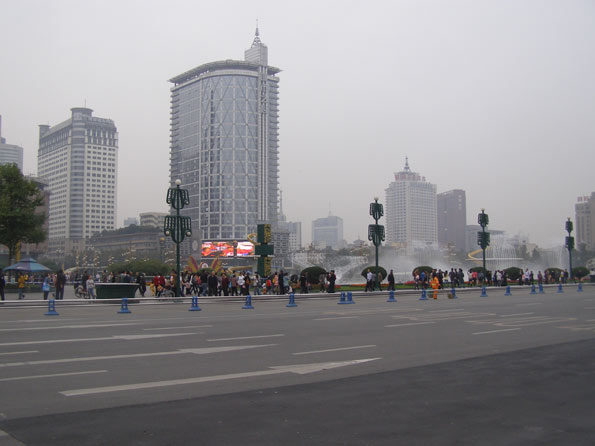
    Chengdu (成都): It was the devastating 2008 Wenchuan Earthquake that first out Chengdu onto the international radar, but it’s the rapid expansion of its massive high tech sector that may define its long term prospects.  The aerospace industry also plays an important role in the capital city of Sichuan Province as it is the site of the development of China’s first stealth fighter, the Chengdu J-20. Despite all the new development, Chengdu remains a pleasant city, known for pandas and spicy food as well as its generally relaxed and agreeable disposition. The local government has done a good job of promoting ‘quality of life’ and relatively low cost of living to attract both investment dollars and skilled labor away from the prohibitively expensive eastern metropolises.
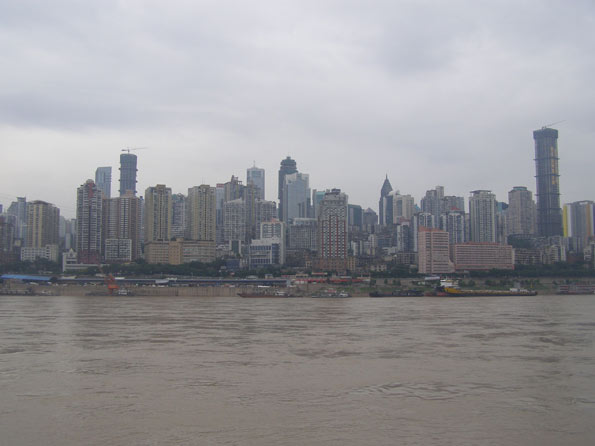
    Chongqing (重庆): Also known for spicy food, this municipality, which falls under direct control of the central government, is bisected by the Yangtze River. Its urban vista is unique, with deep gorges. It long has been known as a rough and tumble place, long plagued by organized crime. This has abated under the leadership of Communist Party Secretary Bo Xilai who has waged a war against organized crime in Chongqing since assuming office there in 2007. Though a controversial leader with a penchant for strong “red” leanings, the ambitious Bo has been applauded for cleaning up the city and implementing a large-scale public housing program.
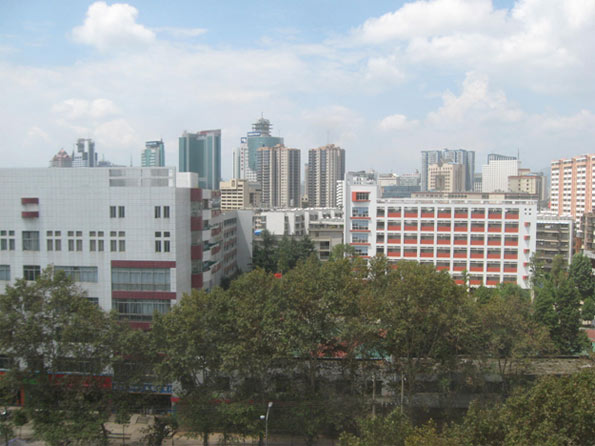
    Kunming (昆明): The city of Eternal Spring and the capital of China’s ethnically diverse southern Yunnan Province, Kunming claims the best weather in the country. As such, Kunming’s residents would rather enjoy the sunshine then spend their days indoors working in factories. The lack of industrial production doesn’t mean this city isn’t important- as Kunming has China’s 6th busiest airport and is the country’s gateway to Southeast Asia. If China goes forward with its ambitious plans to link itself with Southeast Asia via high-speed rail, Kunming could enhance its status an international transportation node.
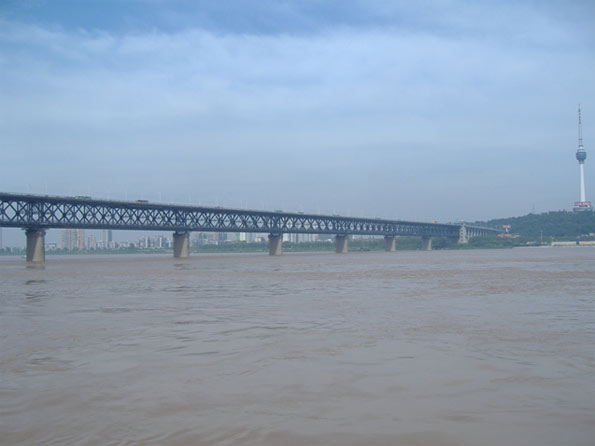
    Wuhan (武汉): Wuhan, capital of Hubei Province, is an important rail and river transport hub at China’s central crossroads. Known for its unbearably hot summers, Wuhan sits on the Yangtze River a few hundred kilometers downstream from the infamous Three Gorges Dam. The city is China’s center for the optical-electronic industry, with a focus on the production of fiber-optics. It was also recently announced that Wuhan will get China’s third tallest building, the 606 meter Greenland Center.
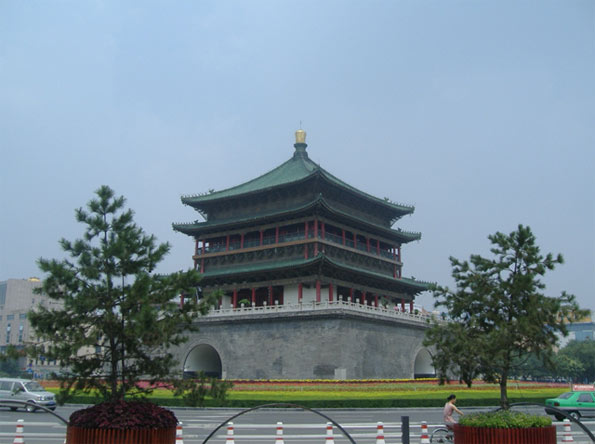
    Xi’an (西安): Once known as Chang’an (‘eternal peace’), Xi’an was the capital of multiple Chinese dynasties throughout history. It remains as one of the most popular international tourist destinations in China thanks to its world-renowned Terracotta Warriors. But today this ancient city and present day capital of Shaanxi Province is also positioning itself as a hub for the development of the software and aerospace industries. The city is also host to several reputable universities, which could help supply a strong local talent pool.
     

    Yangtze River Delta (Greater Shanghai)

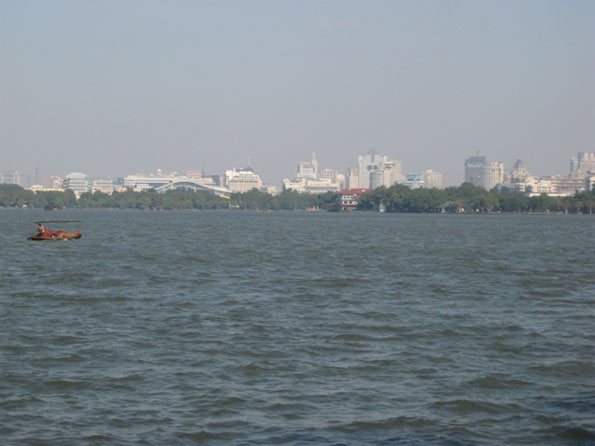
    Hangzhou (杭州): Arguably China’s most naturally beautiful large city, Hangzhou is famous for its scenic Xihu or ‘West Lake’, which just became a UNESCO Heritage Site. The capital of Zhejiang Province not only attracts tourists, but investment as well, especially in the light manufacturing and textile industries. Already somewhat of a ‘bedroom community’ for Shanghai’s wealthy, The recently inaugurated Shanghai-Hangzhou high-speed rail line, which has cut travel time down to 45 minutes between the two cities, means that Hangzhou stands to further benefit from this connection.
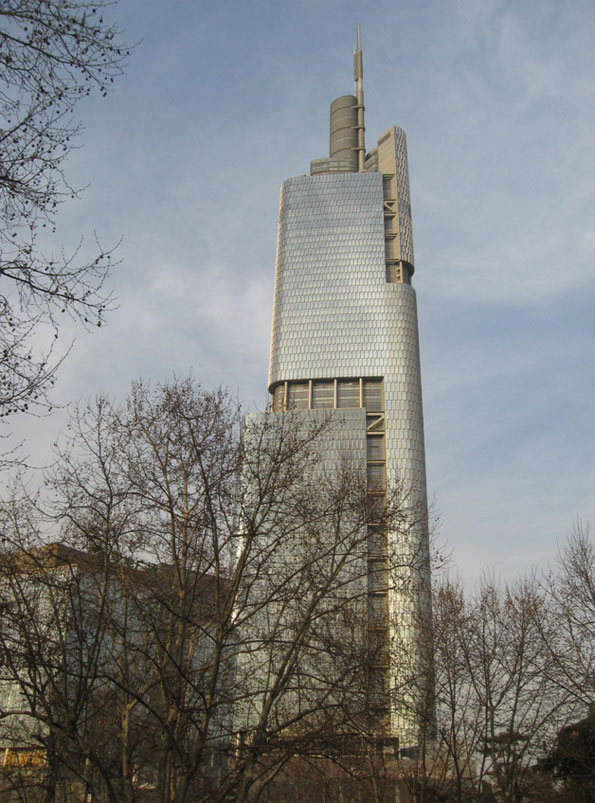
    Nanjing (南京): One of the ‘Four Great Ancient Capitals of China’, the capital of prosperous Jiangsu province is today a bustling modern metropolis. Located on the Yangtze River, Nanjing has greatly benefitted its location within the greater Yangtze River Delta Region. The city’s close proximity to Shanghai means that is has absorbed some spillover from investors looking for a lower-cost alternative. Nanjing is also home to one of China’s tallest towers, the newly opened Nanjing Greenland Tower and Asia’s largest railway station.
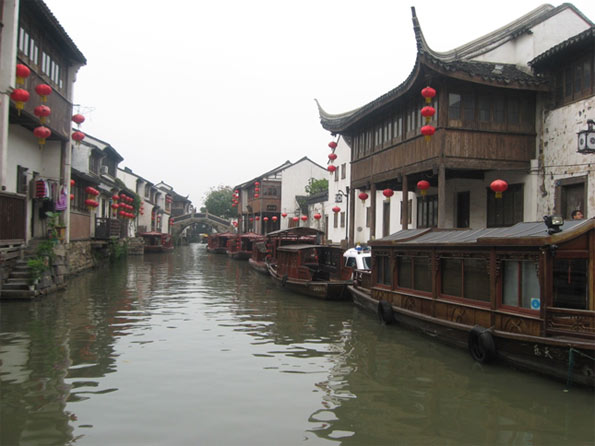
    Suzhou (苏州): Situated in Jiangsu Province en route from Shanghai and Nanjing, Suzhou is strategically located in the center of a booming region. Often referred to as the ‘Venice of the East’, the city is famous for its historic canals and classic Chinese gardens. In addition to being a popular tourist destination Suzhou is an emerging hi-tech center. The China-Singapore Suzhou Industrial Park, the largest strategic partnership between the two governments, has been established in the city.
    Wuxi (无锡): Only 50 km from Suzhou, Wuxi straddles the north shores of Lake Taihu. With 3,000 years of history, Wuxi is today one of China’s most business friendly cities. Wuxi is particularly attractive to Japanese businesses, with companies like Sony, Nikon, and Konica Minolta owning manufacturing and assembling facilities in the city’s New District. The city’s relatively new airport, which opened in 2004, serves the city as well as neighboring Suzhou.


    The Industrial North: China’s Rustbelt

    Changchun (长春): Changchun was the last capital of Manchuria and the seat of Japan’s ‘Puppet Government’ during their occupation of the region during WWII. Today the capital of China’s northern Jilin Province stands as “China’s Detroit” as the country’s largest automobile producer.The Changchun Automotive Economic Trade and Development Zone is home to the country’s biggest wholesaler of used cars, automotive spare parts and tires.

    Dalian (大连): Consistently ranked as one of the ‘most livable’ of China’s big cities, Dalian sits strategically on the Liaodong Peninsula making it the principle seaport for the country’s northeast (‘DongBei’) region. Banking and IT is big here, with semiconductor giant Intel just having recently opened a $2.5 billion manufacturing facility in the city. The Dalian Commodity Exchange, highlighted by the trading of soybean contracts, is China’s largest futures exchange. Bo Xilai also left his mark on the city when he was Mayor before heading to Chongqing by initiating a campaign to add significant green space to the city.

    Harbin (哈尔滨): The capital of Heilongjiang province, Harbin is the country’s northernmost big city. Famous for its local beer and annual winter ice sculpture festival, Harbin is China’s gateway to neighboring and resource-rich Russia. Russian culture has also left its mark on the city, influencing everything from the local cuisine to the architecture. Today Harbin’s economy is focused on textiles and power equipment manufacturing.

    Shenyang (沈阳): Shenyang, the capital of Liaoning province, is the largest city in China’s northeast. Once the capital of the Manchurian Empire during the 17th Century, Shenyang is today an industrial powerhouse producing industrial equipment,  construction vehicles, power tools, and biomedical equipment. Shenyang is also a hub for agriculture and the production of foodstuffs.
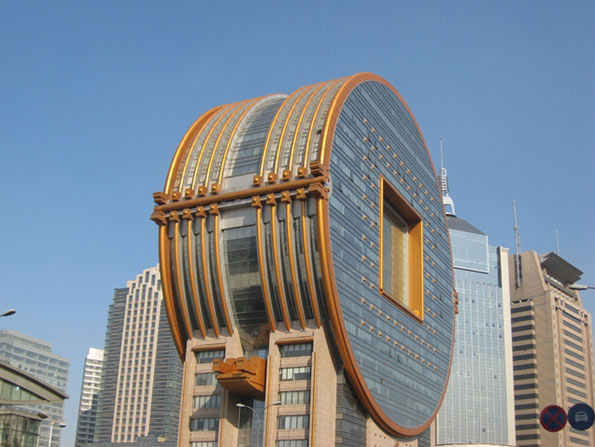
    Taiyuan (太原): The capital of coal producing Shanxi province, Taiyuan is moving up on China’s urban radar. The city serves as the administrative center for both Chinese state-owned and foreign enterprises involved in the coal mining business. The city is also home to the Taiyuan Steel and Iron Company, China’s largest producer of stainless steel. Unfortunately, due to the heavy industrial activity in the region, Taiyuan is also one of the country’s most polluted cities.
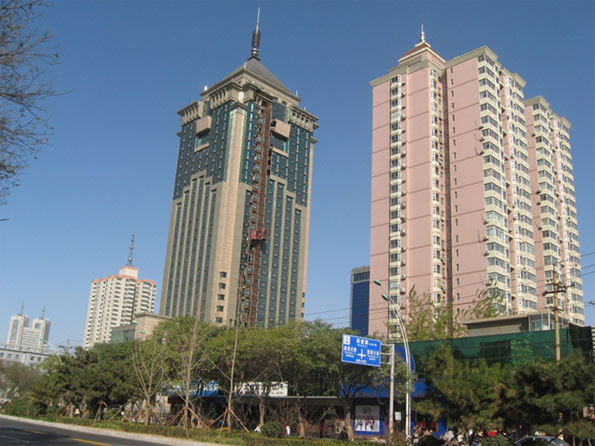
    Tianjin (天津): Long ridiculed by Beijingers, Tianjin is ambitiously positioning itself as a financial and sea logistics center for northern China. One of China’s four direct-controlled municipalities, Tianjin is less than 30 minutes from nation’s capital by high-speed train yet still has a distinct dialect and culture. The city is divided into two distinct parts: the charming historic city center, which retains colonial buildings from 19th Century foreign concessions, and the Binhai New Area, an up-and-coming Special Economic Zone next to the Bohai Sea. Tianjin is also aiming to become the center of China’s burgeoning biotech industry.


    The Outlier

    Dongguan (东莞): As the fifth largest city in China by population, Dongguan should register more prominently on the international radar. Unfortunately the most defining characteristic about this urban amalgam is its lack of character. A sprawling unplanned mass of factories in the Pearl River Delta situated between Shenzhen and Guangzhou, Dongguan is the largest city in the world without an airport. As the Pearl River Delta de-industrializes as more factories move into the lower-cost inland regions of China, Dongguan will need to reinvent itself.
    Adam Nathaniel Mayer is an American architectural design professional currently living in China. In addition to his job designing buildings he writes the China Urban Development Blog.

    Photos: Chengdu and Chongqing photos by author. All other photos by Wendell Cox.
  • The Costs of Smart Growth Revisited: A 40 Year Perspective

    “Soaring” land and house prices “certainly represent the biggest single failure” of smart growth, which has contributed to an increase in prices that is unprecedented in history. This  finding could well have been from our new The Housing Crash and Smart Growth, but this observation was made by one of the world’s leading urbanologists, Sir Peter Hall, in a classic work 40 years ago. Hall led an evaluation of the effects of the British Town and Country Planning Act of 1947 (The Containment of Urban England) between 1966 and 1971. The principal purpose of the Act had been urban containment, using the land rationing strategies of today’s smart growth, such as urban growth boundaries and comprehensive plans that forbid development on large swaths of land that would otherwise be developable.

    The Economics of Urban Containment (Smart Growth): The findings of Hall and his colleagues were echoed later by a Labour Government report in the mid-2000s which showed housing affordability had suffered under this planning regime. Author Kate Barker was a member of the Monetary Policy Committee of the Bank of England, which like America’s Federal Reserve Board, is in charge of monetary policy. Among other things, the Barker Reports on housing and land use found that urban containment had driven the price of land with "planning permission" to many multiples (per acre) above that of comparable land where planning was prohibited. Under normal circumstances comparable land would have similar value.

    Whether coming from the left or right, economists have demonstrated that prices tend to rise when supply is restricted, all things being equal.  Certainly there can be no other reason for the price differentials virtually across the street that occur in smart growth areas. Dr. Arthur Grimes, Chairman of the Board of New Zealand’s central bank (the Reserve Bank of New Zealand), found the differential on either side of Auckland’s urban growth boundary at 10 times, while we found an 11 times difference in Portland across the urban growth boundary. 

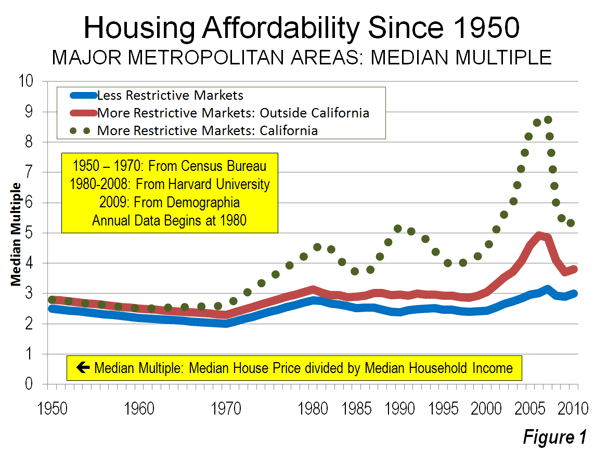
    House Prices in America: The Historical Norm: Since World War II, median house prices in US metropolitan areas have generally been between 2.0 and 3.0 times median household incomes (a measure called the Median Multiple). This included California until 1970 (Figure 1). After that, housing became unaffordable in California, averaging nearly 1.5 times that of the rest of the nation during the 1980s and 1990s (adjusted for incomes). Even after the huge price declines from the peak of the bubble, house prices remain artificially high in Los Angeles, San Francisco, San Diego and San Jose, with median multiples of six or higher.

    William Fischel of Dartmouth University examined a variety of justifications for the disproportionate rise of California housing prices and dismissed all but more restrictive land use regulation. He noted that "growth controls (restrictive land use regulations) have the undesirable effect of raising housing prices." Throughout the rest of the nation, more restrictive land use regulations have been present in every market where house prices rose substantially above the historic Median Multiple norm, even during the housing bubble. No market without smart growth has ever reached these heights.

    Setting Up for the Fall: Excessive Cost Increases in Smart Growth Markets: The Housing Crash and Smart Growth, published by the National Center for Policy Analysis, examined the causes of house price increase during the housing bubble. The analysis included all metropolitan areas with more than 1,000,000 population. It focused on 11 metropolitan areas in which the greatest cost increases occurred (the "ground zero" markets), comparing them to cost increases in the 22 metropolitan areas with less restrictive land use regulation (Note 1).

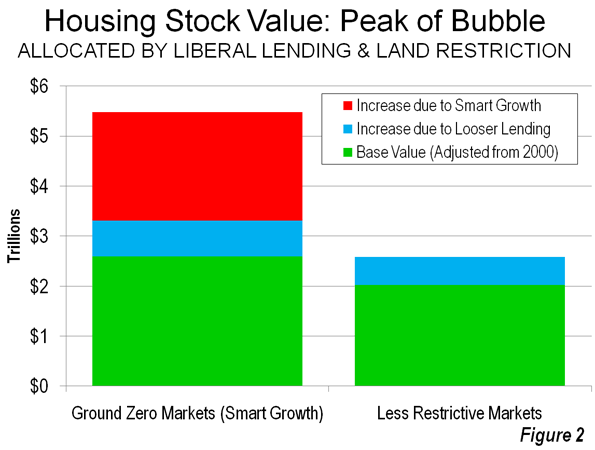
    • Less Restrictively Regulated Markets: In the less restrictively regulated markets, the value of the housing stock rose approximately $560 billion, or 28 percent from 2000 to the peak of the bubble (Note 2). In nearly all of these markets, the Median Multiple remained within the historical range of 2.0 to 3.0 and none approached the high Median Multiples that occurred in the "ground zero" markets.
    • Ground Zero Markets The value of the housing stock rose $2.9 trillion from 2000 to the peak of the bubble in the "ground zero" markets, all of which have significant land use restrictions (Note 3). The 112 percent increase in the "ground zero" markets was four times that of the less restrictively regulated markets. The Median Multiple rose to unprecedented levels in each of the "ground zero" markets, peaking at from 5.0 to more than 11.0, four times the historic norm.

    The 28 percent increase in relative house value that occurred in the less restrictively regulated markets (those without smart growth) is attributed to the influence of loosened lending standards. The excess above 28 percent, which amounts to $2.2 in the "ground zero" markets is attributed to to the supply restricting strategies of smart growth (Figure 2).

    The Fall: Smart Growth Losses

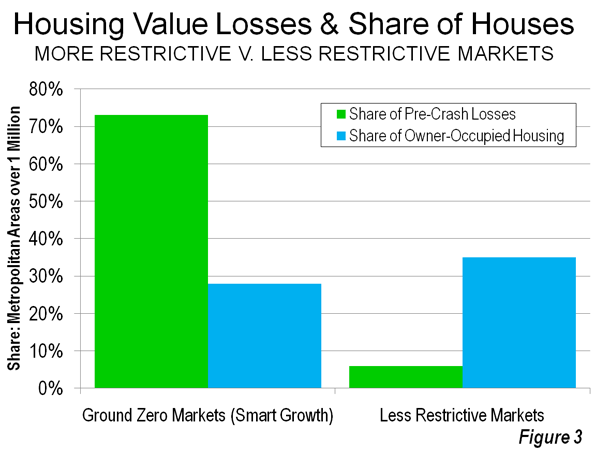
    The largest house price drops occurred in the markets that had experienced the greatest cost escalation, both because prices were artificially higher but also because prices in smart growth markets are more volatile.  The "ground zero" markets, with only 28 percent of the owner occupied housing stock, accounted for 73 percent of the pre-crash losses ($1.8 trillion). Thus, much of the cause of the housing crash, which most analysts date from the Lehman Brothers bankruptcy (September 15, 2008), can be attributed to these 11 metropolitan areas.

    By contrast, the 22 less restrictively regulated markets accounted for only six percent ($0.16 trillion) of the pre-crash losses. These 22 markets represented 35 percent of the owned housing stock (Figure 3).

    If the losses in the ground zero markets had been limited to the rate in the less restrictively regulated markets (the estimated impact of cheap credit), losses would have been $1.6 trillion less (Note 4). The Great Recession might not have been so "Great."

    Economic Denial and Acknowledgement: In his writing forty years ago, Dr. Hall noted that English planners denied the connection between the unprecedented house price increases and urban containment. This same denial also informs smart growth advocates today. This is perhaps to be expected, because, as Hall noted 40 years ago, an understanding of the longer term consequences would have undermined support for these policies.

    To their credit, some advocates recognize that smart growth raises house prices. The Costs of Sprawl – 2000¸ a volume largely sympathetic to smart growth, also indicates that urban containment strategies can raise housing prices. The only question is how much smart growth raises house prices. The presence of urban containment policy is the distinguishing characteristic of metropolitan markets where prices have escalated well beyond the historic norm.

    The Social Costs of Smart Growth: Moreover, the social impacts of smart growth are by no means equitable. Peter Hall says that the "less affluent house-owner … has paid the greatest price for (urban) containment" (Note 5). He continues: "there can be little doubt about the identity of the group that has got the poorest bargain. It is the really depressed class in the housing market: the poorer members of the privately-rented housing sector." Finally, Hall laments as well the impact of these policies on the "ideal of a property owning democracy."

    Hall’s four decades old concern strikes a chord on this side of the Atlantic. Just last week, a New York Times/CBS News poll found that nine out of ten respondents associated home property ownership with the American Dream. Planning needs to facilitate people’s preferences, not get in their way.

    ——–

    Note 1: The housing stock value uses a 2000 base, which adjusts house prices based upon the change in household incomes to the peak.

    Note 2: The underlying demand for housing was substantial in some of the less restrictively markets, which is illustrated by the strong net domestic migration to metropolitan areas such as Atlanta, Austin, Dallas – Fort Worth, Houston, Raleigh and San Antonio. At the same time, some more restrictive markets (smart growth) that hit historically experienced strong demand were experiencing huge domestic outmigration, indicating little in underlying demand. This includes Los Angeles, San Francisco, San Diego and San Jose. Demand, however is driven upward in more restrictively metropolitan areas by speculation which, according to the Federal Reserve Bank of Dallas is attracted by supply constraints.

    Note 3: The 11 "ground zero" metropolitan markets were Los Angeles, San Francisco, San Diego, San Jose, Sacramento, Riverside-San Bernardino, Las Vegas, Phoenix, Tampa-St. Petersburg, Miami and the Washington, DC area.

    Note 4: The pre-crash losses in the 18 other restrictively regulated markets were $0.5 trillion. These markets accounted for 37 percent of owner occupied housing in the metropolitan areas of more than 1,000,000 population, compared to 35 percent in the less restrictively regulated markets, yet had losses three times as high.

    Note 5: The Containment of Urban England also indicates that new house sizes have been forced downward by the planning regulations (see photo at the top of the article).

    Photograph: New, smaller exurban housing in the London area (by author)

    Wendell Cox is a Visiting Professor, Conservatoire National des Arts et Metiers, Paris and the author of “War on the Dream: How Anti-Sprawl Policy Threatens the Quality of Life

  • The Next Boom Towns In The U.S.

    What cities are best positioned to grow and prosper in the coming decade?

    To determine the next boom towns in the U.S., with the help of Mark Schill at the Praxis Strategy Group, we took the 52 largest metro areas in the country (those with populations exceeding 1 million) and ranked them based on various data indicating past, present and future vitality.

    We started with job growth, not only looking at performance over the past decade but also focusing on growth in the past two years, to account for the possible long-term effects of the Great Recession. That accounted for roughly one-third of the score.  The other two-thirds were made up of a a broad range of demographic factors, all weighted equally. These included rates of family formation (percentage growth in children 5-17), growth in educated migration, population growth and, finally, a broad measurement of attractiveness to immigrants — as places to settle, make money and start businesses.

    We focused on these demographic factors because college-educated migrants (who also tend to be under 30), new families and immigrants will be critical in shaping the future.  Areas that are rapidly losing young families and low rates of migration among educated migrants are the American equivalents of rapidly aging countries like Japan; those with more sprightly demographics are akin to up and coming countries such as Vietnam.

    Many of our top performers are not surprising. No. 1 Austin, Texas, and No. 2 Raleigh, N.C., have it all demographically: high rates of immigration and migration of educated workers and healthy increases in population and number of children. They are also economic superstars, with job-creation records among the best in the nation.

    Perhaps less expected is the No. 3 ranking for Nashville, Tenn. The country music capital, with its low housing prices and pro-business environment, has experienced rapid growth in educated migrants, where it ranks an impressive fourth in terms of percentage growth. New ethnic groups, such as Latinos and Asians, have doubled in size over the past decade.

    Two advantages Nashville and other rising Southern cities like No. 8 Charlotte, N.C., possess are a mild climate and smaller scale. Even with population growth, they do not suffer the persistent transportation bottlenecks that strangle the older growth hubs. At the same time, these cities are building the infrastructure — roads, cultural institutions and airports — critical to future growth. Charlotte’s bustling airport may never be as big as Atlanta’s Hartsfield, but it serves both major national and international routes.

    Of course, Texas metropolitan areas feature prominently on our list of future boom towns, including No. 4 San Antonio, No. 5 Houston and No. 7 Dallas, which over the past years boasted the biggest jump in new jobs, over 83,000. Aided by relatively low housing prices and buoyant economies, these Lone Star cities have become major hubs for jobs and families.

    And there’s more growth to come. With its strategically located airport, Dallas is emerging as the ideal place for corporate relocations. And Houston, with its burgeoning port and dominance of the world energy business, seems destined to become ever more influential in the coming decade. Both cities have emerged as major immigrant hubs, attracting on newcomers at a rate far higher than old immigrant hubs like Chicago, Boston and Seattle.

    The three other regions in our top 10 represent radically different kinds of places. The Washington, D.C., area (No. 6) sprawls from the District of Columbia through parts of Virginia, Maryland and West Virginia. Its great competitive advantage lies in proximity to the federal government, which has helped it enjoy an almost shockingly   ”good recession,” with continuing job growth, including in high-wage science- and technology-related fields, and an improving real estate market.

    Our other two top ten, No. 9 Phoenix, Ariz., and No. 10 Orlando, Fla., have not done well in the recession, but both still have more jobs now than in 2000. Their demographics remain surprisingly robust. Despite some anti-immigrant agitation by local politicians, immigrants still seem to be flocking to both of these states. Known better s as retirement havens, their ranks of children and families have surged over the past decade. Warm weather, pro-business environments and, most critically, a large supply of affordable housing should allow these regions to grow, if not in the overheated fashion of the past, at rates both steadier and more sustainable.

    Sadly, several of the nation’s premier economic regions sit toward the bottom of the list, notably former boom town Los Angeles (No. 47). Los Angeles’ once huge and vibrant industrial sector has shrunk rapidly, in large part the consequence of ever-tightening regulatory burdens. Its once magnetic appeal to educated migrants faded and families are fleeing from persistently high housing prices, poor educational choices and weak employment opportunities. Los Angeles lost over 180,000 children 5 to 17, the largest such drop in the nation.

    Many of L.A.’s traditional rivals — such as Chicago (with which is tied at No. 47), New York City (No. 35) and San Francisco (No. 42) — also did poorly on our prospective list.  To be sure,  they will continue to reap the benefits of existing resources — financial institutions, universities and the presence of leading companies — but their future prospects will be limited by their generally sluggish job creation and aging demographics.

    Of course, even the most exhaustive research cannot fully predict the future. A significant downsizing of the federal government, for example, would slow the D.C. region’s growth. A big fall in energy prices, or tough restrictions of carbon emissions, could hit the Texas cities, particularly Houston, hard. If housing prices stabilize in the Northeast or West Coast, less people will flock to places like Phoenix, Orlando or even Indianapolis (No.11) , Salt Lake City (No. 12) and Columbus (No. 13). One or more of our now lower ranked locales, like Los Angeles, San Francisco and New York, might also decide to reform in order to become more attractive to small businesses and middle class families.

    What is clear is that well-established patterns of job creation and vital demographics will drive future regional growth, not only in the next year, but over the coming decade.  People create economies and they tend to vote with their feet when they choose to locate their families as well as their businesses.  This will prove   more decisive in shaping future growth   than the hip imagery and big city-oriented PR flackery that dominate media coverage of America’s changing regions.

    Cities of the Future Rankings
    Rank Metropolitan Area
    1 Austin, TX
    2 Raleigh, NC
    3 Nashville, TN
    4 San Antonio, TX
    5 Houston, TX
    6 Washington, DC-VA-MD-WV
    7 Dallas-Fort Worth, TX
    8 Charlotte, NC-SC
    8 Phoenix, AZ
    10 Orlando, FL
    11 Indianapolis, IN
    12 Salt Lake City, UT
    13 Columbus, OH
    14 Jacksonville, FL
    15 Atlanta, GA
    16 Las Vegas, NV
    16 Riverside, CA
    18 Portland, OR-WA
    19 Denver, CO
    20 Oklahoma City, OK
    21 Baltimore, MD
    22 Louisville, KY-IN
    22 Richmond, VA
    24 Seattle, WA
    25 Kansas City, MO-KS
    26 San Diego, CA
    27 Miami, FL
    28 Tampa, FL
    29 Sacramento, CA
    30 Birmingham, AL
    31 New Orleans, LA
    32 Philadelphia, PA-NJ-DE-MD
    33 Minneapolis, MN-WI
    34 St. Louis, MO-IL
    35 Cincinnati, OH-KY-IN
    35 New York, NY-NJ-PA
    37 Boston, MA-NH
    38 Memphis, TN-MS-AR
    39 Pittsburgh, PA
    40 Virginia Beach, VA-NC
    41 Rochester, NY
    42 Buffalo, NY
    42 San Francisco, CA
    44 Hartford, CT
    45 Milwaukee, WI
    45 San Jose, CA
    47 Chicago, IL-IN-WI
    47 Los Angeles, CA
    49 Providence, RI-MA
    50 Detroit, MI
    51 Cleveland, OH

    This piece originally appeared at Forbes.com.

    Joel Kotkin is executive editor of NewGeography.com and is a distinguished presidential fellow in urban futures at Chapman University, and an adjunct fellow of the Legatum Institute in London. He is author of The City: A Global History. His newest book is The Next Hundred Million: America in 2050, released in February, 2010.

    Photo by Exothermic Photography

  • Honolulu: Mega Rail Project in a Micro City

    An exorbitantly costly rapid transit heavy rail project has been proposed for the small Hawaiian island of Oahu, where the leading metropolis, Honolulu, ranks 53rd in population among U.S. cities, with less than 500,000 people. If the project moves forward it will be the world’s only elevated heavy rail in a metro area with a population of under four million.

    Nothing about this 20-mile long rail project makes sense, except for its politics and its cronyism. It is projected to cost $5.3 billion according to the financial analysis of the city, or $7.2 billion, according to the state. For comparison, the Blue Line between Los Angeles and Long Beach that opened in 1990 has the same length and would cost roughly $1.5 billion to build now.

    Cities worldwide and in the U.S. have shown a clear preference for light rail. The only rapid transit (heavy rail) system built in the US since 1990 is the one in Los Angeles in 1993; another was constructed in San Juan, Puerto Rico in 2004. In the same period, 19 light rail systems were installed.

    Honolulu lost a case against the EPA concerning its sewage in 2008; the current bill for fixing its sewage treatment stands at between four and five billion. Note that project costs in Hawaii have a wide range. That’s part of being a remote island state with high transportation and inventory costs, and of crony politics that generate multiple change orders and inefficiencies which result in large cost overruns.

    Hawaii’s liabilities add up: a total of the sewer consent decree, the proposed rail, the necessary airports and harbors modernization, repairs to some of the worst road pavements in the nation, and one of the nation’s highest — and underfunded — public employee pension and medical benefit systems comes to $40 billion over the next 20 years, for a state of 1,360,000 people. That’s about $120,000 per family of four, of which 17% is for the proposed rail, which is the only discretionary project in the mix.

    The 2008 recession sensitized the previous governor, Linda Lingle, to the mounting liabilities. She ordered a financial analysis of the rail project by one of the nation’s leading financial assessment firms. They opined that it will cost $7.2 Billion. Current Governor Neil Abercrombie and the pro-rail mayor dismissed the report as an “anti-rail tirade.”

    The city’s advocacy forecasts for the rail project are seriously suspect. Bent Flybjerg, Chair and Professor of Major Program Management at Oxford University’s Saïd Business School, has revealed that forecast manipulation is the norm in rail proposals, internationally. For example, the Blue Line in Los Angeles was forecast to carry 35,000 trips in the opening year. It carried only 21,000. A more suitable comparison for Honolulu is Tren Urbano in San Juan, Puerto Rico, which opened in 2006. The similarities are eerie. Both are unique island cities with heavy rail projects under Federal Transit Administration (FTA) oversight, and have the same project planner, Parsons Brinkerhoff, who estimated 80,000 trips in the opening year for Tren Urbano, and a construction cost of $1.25 billion. FTA approved both. Tren got 25,000 trips, and was ultimately built for $2.25 billion, a nearly 100% cost overrun.

    After the first year of operation, bus fares were doubled to push people to use the Tren. It didn’t work. A new sales tax of 5.5% was eventually enacted, and San Juan added 1.5% on top of that. Tren Urbano was a catalyst for financial hardship.

    Another recent example is the Edinburgh trams, originally scheduled to open in July 2011 but rescheduled to 2014. The original cost was projected at $640 million, but estimates now are over one billion dollars. As of spring 2011, 72% of the construction work remains to be done, but only 38% of the budget is left.

    Past experience and hard evidence have never fazed politicians in Hawaii. In 2008, Honolulu’s mayor Hannemann used several million dollars of taxpayer and political contribution funds to convince voters that his fully elevated (heavy) rail is actually a light rail system that would cost under $4.5 billion, and would solve Honolulu’s congestion problems.

    Hannemann gave then-Minnesota Congressman and Transportation Committee Chair Jim Oberstar a helicopter ride along the route. He failed to indicate that three of the train route’s 20 miles would be on prime agricultural land, and that 12 of the 20 miles would be in low-density suburbia. Oberstar declared it a good project, and offered promises of federal funding.

    Then the city released the draft Environmental Impact Statement (EIS), just two days before elections which included a referendum or rail. The EIS was several thousand pages long. Many cried foul, but Senator Inouye advised the people to read the abstract. It was devoid of any quantitative information. The plan for passage barely worked: 50.6% of the voters voted in favor of rail.

    The 2010 final EIS revealed that congestion in 2030 with rail will be far worse that it is now. The project is not green, given that 96% of Honolulu’s electricity comes from oil and coal. The present marketing push has switched to jobs and development opportunities. But six billion dollars would produce many more jobs and benefits if spent on almost any other infrastructure endeavor.

    In late March, Transportation Secretary Ray LaHood, FTA Administrator Peter Rogoff, Senator Inouye and Hawaii Congresswoman Mazie Hirono descended on Honolulu to stage a pro-rail rally with the mayor, the unions and the cronies. However, anti rail sentiment is growing, and, following an earlier lawsuit, a second one was filed in May 2011.

    Honolulu is still completing the paperwork for its heavy rail, but preparatory construction has already started. This irrational project needs to be stopped. Stopping it will save the federal government $1.8 billion, save overtaxed Hawaii residents well over $5 billion, and save visitors to Hawaii about $700 million. It will save prime agricultural land, preserve island beauty and, importantly, save Honolulu from decades of added taxation, debilitating construction, and lack of funds for essential infrastructure projects.

    Panos D. Prevedouros, PhD, is a Professor of Civil Engineering at the University of Hawaii-Manoa.

    Photo by super-structure (Jason Coleman), “Honolulu Murals”.

  • Australians Are Getting A Carbon Tax They Don’t Want

    Within weeks, the Australian government is expected to announce a package of measures including a carbon tax to stimulate renewable energy sources and abate carbon emissions. Officials, activists and journalists around the world will hail Australia as a courageous and forward-looking country, ready to take its responsibilities seriously. Some will rebuke their own governments for being less bold. Yet they will ignore an inconvenient detail. According to opinion surveys, at least 60 per cent of Australians strongly oppose the tax. Since it was flagged in February, support for the ruling Labor Party has fallen to its lowest level in 40 years. Only 27 per cent of Australians now nominate Labor as their first preference. Nor did they vote for it. In the lead up to last August’s federal election, both major parties ruled out a carbon tax. Prime Minister Julia Gillard declared, just hours before polling day, that “there will be no carbon tax under the government I lead”. Her job approval rating is 31 per cent.

    So why is this happening? The current malaise can be traced to a combination of long and short term causes. Like other western countries, Australia was profoundly changed by the 1960s social movements. In the decades after World War II, as Britain lost its empire and turned to Europe for an economic future, Australia shifted its agricultural and mineral commodity trade to Asia, admitted growing numbers of immigrants from outside the British Isles, and came to rely on the United States for security. Elites in the professions, judiciary, churches, universities and bureaucracies conceiving Australia as an outpost of British civilisation, found the ground moving under them.

    Radicalised by Australia’s participation in the Vietnam war, baby boomers poured out of an expanded university system to spearhead a range of movements, over time supplanting the old elites. By the 1980s, universities, schools, many professions, the media, and most of the public sector were dominated by left-progressives. Their “long march through the institutions” was perhaps more thorough-going than in the United States, since anti-leftists had yet to find a substitute for British imperialism.

    One of the social movements was environmentalism. Australia is an isolated, sparsely populated continent with hauntingly beautiful landscapes and unique natural species. Late-coming westerners found a pristine wilderness, populated by aboriginals with close spiritual ties to the land. Since European settlement, these features have, in various forms, injected a romantic strain into the country’s transplanted British culture. That strain was mostly confined to the arts and radical fringe movements. In large part, the colonies, federated in 1901, evolved a practical outlook shaped by nineteenth-century liberalism and the blessings of trade, industry and commerce.

    The 1960s saw a fusion of the romantic strain with ideologies shaped by streams of Marxism, left-wing anarchism and revivals of Counter-Enlightenment Romanticism. Sharing a preference for ecological protection over economic growth, inner-city-based activists, including many socialists, current or former communists, Trotskyites and others from counter-culture circles, like hippies, together with aboriginal peoples, campaigned to lock up remnant bushland, native forests, wetlands and traditional aboriginal sites in “green-belts” or national parks. They targeted urban expansion and industries like logging, cattle-grazing and mining, which boomed in a mineral-rich arc across northern Queensland and Western Australia. Conflicts over mining projects were routine in the 1970s and 1980s. Uranium was particularly contentious.

    But it was in Tasmania that the new environmentalism came of age. State government plans for a hydro-electric dam on the Franklin River became a cause celebre, attracting strong opposition from environmentalists, and wide public interest. Many leading-lights of the movement, including the current Greens Party leader, made their name in that struggle. Ultimately, the activists came out on top, winning support from federal Labor just before the 1983 election, at which they returned to power.

    The Franklin tussle cast a long shadow over Australian politics. Many analysts thought it contributed to Labor’s victory. Nature conservation crept onto the mainstream agenda. In 1984, various green lobby groups, including some of the more hard line activists, came together to form Greens parties in New South Wales and Queensland, modeled on the German Greens. Other states followed, and in 1992 a national Greens Party emerged. Over time, Greens gained a presence in state and federal parliaments. Some were ideological refugees from defunct communism. Before joining the Greens, for instance, one serving Greens senator was a member of the Socialist Party of Australia, a successor organisation to the Communist Party.

    While open to compromise on environmental concerns, Labor never embraced green ideology. A moderate party in the British tradition, built on craft trade unionism rather than socialism, Australian Labor was essentially pragmatic. Its environment agenda was adapted to job security, rising living standards and the interests of mining, forestry and transportation workers. For most Australians, the environment was still a marginal issue.

    Then came the climate panic. Australia is a land of climate extremes, where severe drought alternates with devastating floods. By 2006 the continent had been in the grip of drought for virtually a decade. Water restrictions even hit the major cities, as morale began to sag under fears of interminable dryness. That year also saw some unseasonably hot days. From their posts on the “commanding heights” of academia, politics and media, green ideologues sensed a chance to ramp up their rhetoric on global warming, claiming the drought would persist until carbon emissions were cut. Now they hoped to impose their anti-growth philosophy on the whole economy, not just individual projects.

    This time their message fell on fertile ground. Surveys began to show majority support for strong action on climate change. Conservative Prime Minister John Howard, who was lukewarm on the issue, and had refused to sign the Kyoto Protocol, was caught off guard. Looking to the election due in 2007, Labor succumbed to opportunism. They took to spouting green rhetoric, promising ratification of Kyoto, an emissions trading scheme (ETS) and a renewable energy target. Come 2007, the sense of exhaustion around Howard’s eleven year government was enough to tip Labor into office. But the party’s green chickens eventually came home to roost. Having hyped global warming as a great moral cause, Prime Minister Kevin Rudd suffered the indignity of returning empty-handed from the failed Copenhagen Conference. By this time the drought had broken, and the Liberal-National opposition changed course, defeating Rudd’s ETS in the senate.

    Public support for climate action began to slide. According to the authoritative Lowy Institute Poll, it is now down to 41 per cent, from 68 per cent in 2006. Workers grew nervous about the implications for trade-exposed or energy intensive industries like mining, steel production and power generation. They shifted back to former attitudes on the environment, leaving the government stranded. Following advice from his inner-circle, including then Deputy Prime Minister Gillard, Rudd deferred the ETS until after the election scheduled for late 2010, but he suffered a crushing loss of credibility. His colleagues dumped him for Gillard.

    For city-based progressives, especially in the publicly-funded sector, climate action became a vehicle to burnish their moral authority and claim a larger share of the nation’s wealth, reversing two decades of market-oriented reform. Prompted by Labor’s turmoil, more of them defected to the Greens. At the election hastily called for 21 August 2010, neither major party won a majority in the House of Representatives. The balance of power was held by the Greens and four other independents. In the senate, the balance went exclusively to the Greens. Desperate to survive, Gillard signed up to a formal alliance with them. After weeks of negotiation, the Greens and enough independents sided with Labor to form a minority government. Their price was the carbon tax she ruled out just hours before election day.

    When the dust settled, Australians found that, by pure chance, their country was in the hands of a climate junta, euphemistically called the Multi-Party Climate Change Committee, consisting of Gillard, the Treasurer, the Minister for Climate Change, the Greens leader and his deputy, and two independents. Posing as an open-minded enquiry into Australia’s climate options, the Committee is driven by an inescapable political logic. None of them can break ranks without bringing down the government, ending the most power any of them will ever have. This logic overrides everything, even rising public anger. The opposition’s line, that “Labor may be in government but the Greens are in power”, resonates widely. Few think Gillard really believes in the tax. Moreover, it comes at a time when consumer confidence is weak, and cost-of-living pressures dominate surveys of public concerns.

    Never has such a gulf opened up between elite and popular opinion. Nothing has turned around opposition to the Committee’s tax, not Gillard’s promise of compensation for low to middle income earners, not favourable media coverage, not reports by scientific experts, not declarations signed by eminent citizens, not even an advertising campaign fronted by Oscar-winning actress Cate Blanchett. Urging Australians to “say yes”, the ad unleashed a wave of resentment towards the globe-trotting star, who owns a $10 million “eco-mansion” in one of Sydney’s exclusive suburbs. Tabloid newspapers dubbed her “Carbon Cate”.

    Most opinion-leaders will applaud Gillard’s carbon tax package. They will ignore the real story: Australians are being made to walk the climate plank, with a cutlass at their back.

    John Muscat is a co-editor of The New City.

    Photo by MystifyMe Concert Photography

  • The Evolving Urban Area: Seattle

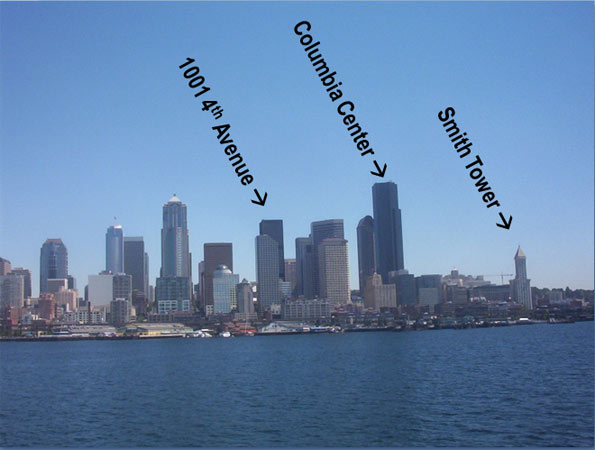
    Lunching at Seattle’s Space Needle, the casual observer might imagine that one of the nation’s most dense urban areas is spread out below. To the immediate south of the Space Needle is one of the nation’s premier downtown areas. In 2000 downtown Seattle had the seventh largest employment base in the country and was one of the most dense. Its impressive, closely packed buildings witness a storied past. For more than 60 years, between 1914 and 1990, downtown Seattle has had the tallest building on the West Coast, Smith Tower, and was the fourth tallest building in the world when built. It held the title for an impressive 55 years, from 1914 to 1969, when another Seattle building briefly took the title (1001 4th Avenue). Later (1985), Seattle’s Columbia Center became the first building on the West Coast to exceed 75 floors, but by 1990 had been passed by the U.S. Bank Tower in Los Angeles (see Elliot Bay photograph and Note 1).

    However, looks can be deceiving.  In 2000, Seattle ranked last in urban population density out of the 11 urban areas in the 13 western states with more than 1 million population (just behind Portland, which ranked next-to-last).  The Seattle urban area’s density was approximately 60 percent below that of Los Angeles, the US’s  densest urban area. Even the Houston and Dallas-Fort Worth urban areas, famous for their great expanse, were denser than Seattle. Updated urban area density data from the 2010 census will not be available for at least a year.

    Nor is the historical core municipality of Seattle particularly closely packed. With a population density of 7,200 per square mile, the city of Seattle is considerably less dense than a number of Los Angeles suburbs such as Santa Ana (12,000) and Garden Grove (9,500). Even so, the city of Seattle is nearly two-thirds more dense than the city of Portland (4,400), despite the latter’s densification claims.

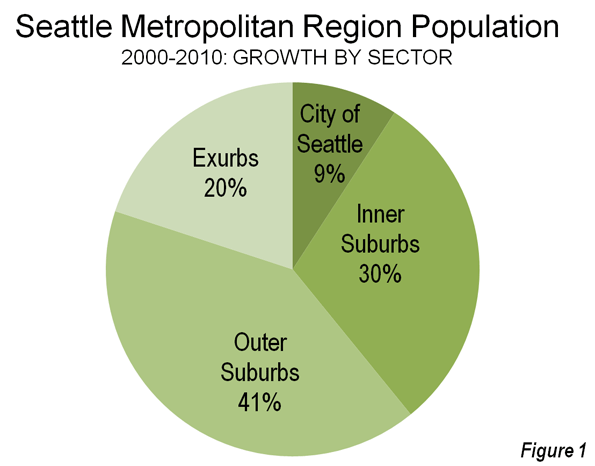
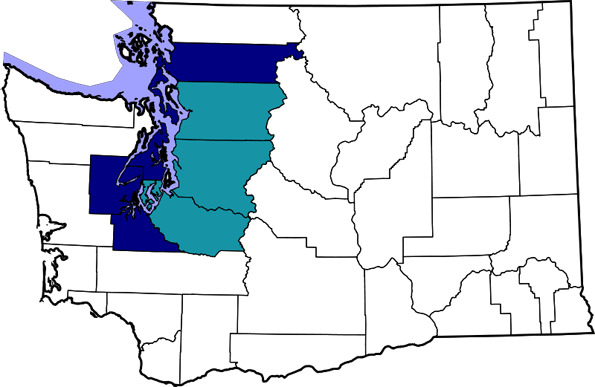
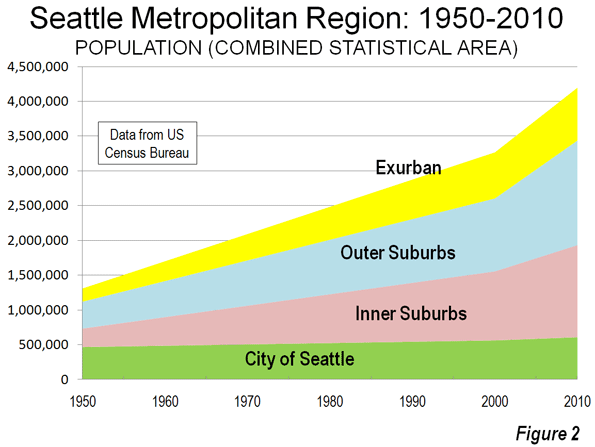
    The 2010 Census: The 2010 census indicates a continuing dispersion of population in the Seattle metropolitan region (Figure 1). The Seattle metropolitan region, formally the Seattle combined statistical area (Note 2) is composed of the core Seattle metropolitan area (King, Pierce and Snohomish counties) and five exurban statistical areas, Bremerton (Kitsap County), Olympia (Thurston County), Mount Vernon (Skagit County), Oak Harbor (Island County) and Shelton (Mason County).

    Seattle Combined Statistical Area: Population 2000-2010
    Area 2000 2010 Change % Share of Growth Share of Population
    City of Seattle        563,374        608,660           45,286 8.0% 9.2% 14.5%
    Balance: King County     1,173,660     1,322,589        148,929 12.7% 30.3% 31.5%
    Pierce & Snohomish Counties     1,306,844     1,508,560        201,716 15.4% 41.0% 35.9%
    Metropolitan Area Outside Seattle    2,480,504    2,831,149        350,645 14.1% 71.2% 67.4%
    Metropolitan Area     3,043,878    3,439,809        395,931 13.0% 80.4% 81.9%
    Exurban Metropolitan Areas        663,260        759,503           96,243 14.5% 19.6% 18.1%
    Combined Statistical Area    3,707,138    4,199,312        492,174 13.3% 100.0% 100.0%
    Calculated from US Census data


    City of Seattle (Historical Core Municipality): Overall, the historical core city of Seattle grew 8.0 percent, from 564,000 to 609,000 between 2000 and 2010, which was one of the healthiest increases among major cities. In adding 45,000, the city still only accounted for 9.2 percent of the Seattle metropolitan region population growth.  The city of Seattle now constitutes less than 15 percent of the metropolitan region population, down from 36 percent 1950 (same geographic area). In 1950, the city of Seattle had nearly two thirds of the population of King County. By 2010, the city of Seattle was less than one third of King County’s population, despite annexations. As the city has continued to decline in its share of the metropolitan region’s population, the impressive downtown area has also lost its dominance and by 2009 had fallen to 8 percent of the metropolitan region’s employment.

    Inner Suburbs: Areas outside the city of Seattle accounted for more than 90 percent of growth in the metropolitan region. The inner suburbs, which include the residential development to the south, north and east of Seattle in King County grew more than 50 percent faster than the city of Seattle, at 12.7 percent between 2000 and 2010. The inner suburbs grew from 1,170,000 to 1,320,000, adding nearly 150,000 new residents, more than three times the city of Seattle increase. King County outside Seattle also captured 30 percent of the metropolitan region’s growth and now has 32 percent of the metropolitan region’s population. The eastern suburbs of King County are home to one of the nation’s largest, most diverse and successful edge cities, Bellevue, as well as the Microsoft campus in neighboring Redmond.

    Outer Suburbs: The outer suburbs, which include Pierce County (Tacoma is the county seat) and Snohomish County grew 15.4 percent, nearly double the growth rate of the city of Seattle. The outer suburbs grew from 1.3 million to 1.5 million, adding 200,000 new residents, more than four times the city of Seattle’s increase. Pierce and Snohomish counties captured 41 percent of the metropolitan region’s growth and now account for 36 percent of the metropolitan region’s population.

    Exurban Areas:  The exurban statistical areas grew nearly as quickly as the outer suburbs. Between 2000 and 2010, the exurban areas increased their population by 14.5 percent.  The exurban statistical areas accounted for 20 percent of the metropolitan region’s population growth. These more distant areas grew from 660,000 to 760,000 people, adding nearly 100,000 new residents. This is more than double the increase in the city of Seattle population. Approximately 18 percent of the population in the metropolitan region lives in the exurban statistical areas, a larger number than residing in the city of Seattle.

    The Dispersion Continues: The dispersion of Seattle, like that of metropolitan regions around the nation and the world, has been going on for decades. The city of Seattle has accounted for only 5 percent of the metropolitan region’s population since 1950 (Figure 2) with suburbs and exurbs accounting for the vast majority of the nearly 3,000,000 increase.

    Despite the pre-2010 census media and academic drumbeat to the effect that metropolitan areas were no longer dispersing, the census revealed a totally different and even inconvenient truth. This does not mean that both residents of the entire metropolitan region, suburbs and core city, should not be proud of an attractive urban area in an incomparable natural setting. Yet, the vast majority of the region’s population and employment growth is taking place outside the core. Seattle is following the national and international pattern to ever greater dispersion.

    _________

    Note 1: Downtown Seattle is on a hill and the newer buildings are generally on higher ground than Smith Tower, which makes the difference in height look greater.

    Note 2: "Combined statistical areas" were formerly "consolidated metropolitan statistical areas."

    Top Photograph: Downtown Seattle from the Space Needle (by author)

    Wendell Cox is a Visiting Professor, Conservatoire National des Arts et Metiers, Paris and the author of “War on the Dream: How Anti-Sprawl Policy Threatens the Quality of Life

  • Will J.R. Recognize the New Dallas?

    In the sixties and seventies, Dallas’s prime tourist attraction was an assassination site. The town seriously needed a new image. It got one in a soap opera that revealed a city besieged by blonds, big  hair and big homes. “Dallas,” which premiered in 1978, did for Big D what “Sex in the City” and “Seinfeld” did for New York: it painted a portrait of the city for the world.

    The last “Dallas” episode aired in 1991, but TNT recently resurrected the hit show. This iteration features a new crop of Ewings beside originals Larry Hagman, Linda Gray, and Patrick Duffy. Dallas, of course, was never like “Dallas.” Since the series premiered, Dallas evolved. From its residents to its politics, Dallas today bears little resemblance to the city the show depicted. Which Dallas will J.R. come home to?

    When the series debuted, Dallas was a conservative place. In 1980, Reagan took 59 percent in Dallas County, the anchor of the much larger Dallas-Fort Worth metroplex, now home to more than 6 million people. As the county grew, it became more diverse, and consequently, more Democratic.  No one would mistake it for San Francisco, politically and demographically, but it more resembles present-day Los Angeles than old Dallas.    

    In 2008, for example, Obama won 57 percent in Dallas County. Since “Dallas” first aired, Dallas elected two female Jewish mayors and an African-American, current U.S. Trade Representative Ron Kirk. Although voters rejected gay marriage in 2005, they sent openly gay city councilor Ed Oakley to a mayoral runoff two years later (Oakley lost). If a real J.R. today causes trouble, he’ll contend with Sheriff Lupe Valdez, who’s also gay.     

    Minority growth transformed Dallas County politics. In 1980, there were two white residents for each non-white resident. Now, it’s the other way around. After “Dallas,” whites fled to northern exurbs. African-Americans, Hispanics, and other minorities spread throughout the urban core and inner-ring suburbs. Dallas votes Democratic; the surrounding counties don’t. Southfork Ranch, the white mansion in the “Dallas” opening, sits in rock-Republican Collin County, a mostly white, upper-middle class area with more than five times the residents as were there in 1980. In many respects, this is where “Dallas” culture – as defined by the old series – still thrives.

    Outposts of the exclusive “Dallas” lifestyle still exist in much of North Dallas. George W. Bush settled into his post-presidency in an 8,500 sq. ft. Preston Hollow estate. Old-moneyed enclaves Highland Park and University Park draw the ire and envy of the metroplex. In Good Christian Bitches, socialite Kim Gatlin dishes about Botoxed beauties and Bible belt back-stabbers. These clichés sell: ABC used her Park Cities-inspired tale for their upcoming series “Good Christian Belles.”

    Besides the population, the economy has also diversified: oil is now an ensemble player, not the lead. Exxon Mobil has headquarters near Dallas, but Houston is the energy superstar, despite not getting its own show. The metroplex hosts twenty Fortune 500 companies, including Southwest Airlines, Texas Instruments, and GameStop. This mix, along with the fact the region mostly avoided the housing crisis, explains why the recession hurt Dallas less than other cities.

    If you only saw “Dallas,” you’d suspect shoulder pads and cowboy boots pass for high-fashion. But Dallas was always more cosmopolitan than the series let on. Neiman Marcus started in Dallas. Dallasites who can afford to—and many who can’t—gather at upscale eateries, fashion premiers, and charity galas.  J.R. Ewing-types may fill Cowboys Stadium suites, but they also fill box-seats at the $354 million AT&T Performing Arts Center. It’s not all BBQ, rodeos, and pageant queens in Big D.

    That perception, nonetheless, persists as does the idea of J.R. as the archetypal Texan. On a trip to Spain, his name came up after I told my hosts I was from Texas. Who knew Sevillanos loved Aaron Spelling productions? As Dallas transforms, it can’t shake the cowboy/oilman stereotype. Like a Hollywood starlet, Dallas has been typecast.

    But still I hope the next “Dallas” includes a broader cast of characters. An uptown Indian high-tech executive or feisty female mayor would be nice. Producers must show off the city’s grandiosity. Dallas strives for bigger and best, for bragging rights if no more; it never lets up. The same year it lost a quixotic Olympic bid, it opened the colossal American Airlines Center. Ridiculed in the nineties, the Dallas Mavericks stand as N.B.A. champs today. Always scouting for new business, Dallas lured AT&T from San Antonio in 2008.

    “Dallas” left fans wondering, “Who shot J.R.?” The real mystery, three decades later, is why a multi-layered city retains a one-note reputation. Dallas, after all, has remade itself.          

    Writer Jason Thurlkill grew up near Dallas. He reported for “The Hotline” and a “New York Observer” publication. Previously, he worked for a Washington D.C. political consulting firm. He studied government at the University of Texas and earned his Master of Public Policy at the University of Chicago.

    Photo by david.nahas.

  • Can Florida Escape the Horse Latitudes?

    When it comes to the winds of change, Florida remains in the horse latitudes.  This zone of the Atlantic around 30 degrees latitude was so named by ship captains because their ships, becalmed in the water, seemed to move faster when they lightened their load by throwing off a few horses.  Florida’s governor Rick Scott, who campaigned on a promise to create 700,000 jobs in this state, appears to have adopted the same tactic by throwing overboard the Department of Community Affairs, the state agency that regulated real estate development.  Other bureaucracies may be next in line if the state doesn’t show signs of improvement soon.

    Billy Buzzett, appointed head of this bureaucracy, was in Orlando last week to discuss the new future of Florida growth management.  Growth will now be lightly monitored by the Department of Economic Opportunity , which is in charge of reviewing development plans, and will handle unemployment benefits as well.  Mr. Buzzett stated that the department’s mission will also include items such as weatherization of structures for hurricanes. All of this is good, but it’s a puzzling mix to throw into a single bureaucracy.  Obviously, real estate regulation is not the focus of this governor, who saw regulation as one of the chief obstacles to creating jobs in this state.

    The Department of Community Affairs was created in 1985 to set some standards for quality of life as well as for environmental protection.  Failing at both tasks, the DCA came under fire during the last election cycle as a statewide referendum (Amendment 4) on growth gained support from people tired of seeing forests converted into strip malls.  The referendum, narrowly defeated, would have people vote in Cailfornia-style ballots for such changes.  This may have been a bad idea, based on how California’s growth controls have stifled its once vibrant economy.

    In this era of minimal new building, the reinvention of growth management may be seen as a way to pass the time while we wait for the economy to recover.  In reality, however, there are some very large implications in the future.

    Governor Scott wants the state to be more like Texas, which regulates with a far lighter hand and seems to be navigating through this particularly horrid recession better than other big states.  Texas has growth and does not have an onerous, time-consuming process which weeds out all but the deepest pocketed investors.  Unlike Texas, however, Florida has few natural resources like oil and mineral wealth to fall back on for revenue, and therefore deregulates itself without any diversification of income stream.

    What this means to the local economy will be hard to predict.  Certainly, the DCA was able to negotiate with private developers, and helped to shield cities and counties from a lot of the pressure from out-of-state interests.  Without the DCA, it will be interesting to watch which of Florida’s regions stand up to this pressure and which regions, starved for cash, cave in to the pressures of growth.

    Although defeated, Amendment 4 clearly scared the real estate interests to death.  Legislation now prevents anything like that from happening again.  While real estate development clearly needs to be left in the hands of professionals, it also seems to have risen to the top of citizens’ awareness.  Whether it stays there or not is up to the state’s citizens, most of whom immigrated from elsewhere in search of the good life.  Growth benefitted the lowest economic class by creating cheap housing, construction jobs and access to consumer goods.  Florida, however, by grabbing the bottom tranche of workers, has missed a chance to build a more vertically integrated middle class with higher skilled workers.

    Orlando in particular is in an unfortunate situation, as it has no natural hard boundaries like the sea.  Like Atlanta, Central Florida’s metropolitan area can grow in concentric rings forever and ever, gobbling up more agriculture, wetlands, and forests.  Such a development pattern puts value on the rim, rather than in the center, leaving the older parts of the city devoid of investment, energy, and hope.  With private interests, whose mission is to grab the low hanging fruit, in chargethere will be little redevelopment of these interior districts, despite the sunk costs of infrastructure that could give them an edge. 

    Making more stuff is the business of growth.  Making stuff better is the business of development.  And development is what older neighborhood areas like this sorely need.  Successful in-fill redevelopment, in both suburban and urban locations, can still happen if employment can be added to the mix.

    It is up to our region’s leadership to turn this pattern around, and start valuing our real estate a little differently than in the past.  For example, debasing our wetlands to their mere economic value overlooks their larger value in terms of biodiversity.  Bringing wetlands and agriculture into our growth management policy would be a good first step towards creating a sustainable future for Central Florida.  Florida’s environmental movement need not turn into a shrill anti-growth machine as has happened elsewhere, but should be a partner with the real estate interests to protect the more long-term natural assets that bring so many to the Sunshine State in the first place.

    Recycling also need not be just the job of the utility department.   Recycling land through the EPA’s brownfield program is already underway by many municipalities, and provides a vehicle to reinvent neighborhoods that have failed. 

    As always, clean water will be the limiting factor to growth.  Already a concern of Florida, the state is divided into various water management districts, who regulate how clean water can be removed from the aquifer, and what kind of dirty water can be put into it.  No doubt this regulation will be under assault next.

    Without Secretary Buzzett’s new department, Florida is already showing signs of new employment opportunities and diversity.  Military spending in Florida is up, thanks to the National Center for Simulation, and medical research spending is continuing at a steady pace.  These were added to the mix of growth, tourism, and agriculture upon which Florida has traditionally relied. More jobs that revolve around these two industries will include support technology, computer science, manufacturing, and services. 

    These industries grew despite the regulatory burden of the state.  What is dangerous about Secretary Buzzett’s new department is its blasé treatment of the public’s genuine desire for better environmental management and a better quality of life.  Like many places, Florida has its share of “not in my backyard” sentiment reacting against more development.  The anger voiced in 2010 through Amendment 4, however, represented something new and deeper:  a collective sense that enough is enough.  Speculative development, built during the boom and remaining unoccupied to this day, is in every community, urban and rural.  Few believe that the empty condos, ghost town subdivisions, empty strip shopping centers, and vacant office parks are improvements over what was there before, and fewer still want this kind of insanity to return.

    So the death of the DCA, which allowed speculative development to the point of embarrassment, may have been a good thing.  Employment-based growth, which so far has eluded Florida’s regions, may now have a chance to take place.  With the new industries arriving, job creation is already a reality – no horses had to be thrown overboard to make that happen. What Florida needs now is some leadership at the local level to promote more employment-based growth that is slow, but sure, and that is sustainable for the long haul.   

     Richard Reep is an Architect and artist living in Winter Park, Florida. His practice has centered around hospitality-driven mixed use, and has contributed in various capacities to urban mixed-use projects, both nationally and internationally, for the last 25 years.

    Photo: Desiree N. Williams