Category: Urban Issues

  • California’s Green Jihad

    Ideas matter, particularly when colored by religious fanaticism, wreaking havoc even in the most favored of places. Take, for instance, Iran, a country blessed with a rich heritage and enormous physical and human resources, but which, thanks to its theocratic regime, is largely an economic basket case and rogue state.

    Then there’s California, rich in everything from oil and food to international trade and technology, but still skimming along the bottom of the national economy. The state’s unemployment rate is now worse than Michigan’s and ahead only of neighboring Nevada.  Among the nation’s 20 largest metropolitan regions, four of the six with the highest unemployment numbers are located in the Golden State: Riverside, Los Angeles, San Diego and San Francisco. In a recent Forbes survey, California was home to six of the ten regions where the economy is poised to get worse.

    One would think, given these gory details, California officials would be focused on reversing the state’s performance. But here, as in Iran, officialdom focuses more on theology than on actuality.   Of course, California’s religion rests not on conventional divinity but on a secular environmental faith that nevertheless exhibits the intrusive and unbending character of radical religion.

    As with its Iranian counterpart, California’s green theology often leads to illogical economic and political decisions. California has decided, for example,  to impose a rigid regime of state-directed planning related to global warming, making a difficult approval process for new development even more onerous.  It has doubled-down on climate change as other surrounding western states — such as Nevada, Utah and Arizona — have opted out of regional greenhouse gas agreements.

    The notion that a state economy — particularly one that has lost over 1.15 million jobs in the past decade — can impose draconian regulations beyond those of their more affluent neighbors, or the country, would seem almost absurd.

    Californians are learning what ideological extremism can do to an economy. In the Islamic Republic, crazy theology leads to misallocating resources to support repression at home and terrorism abroad. In California green zealots compel companies to shift their operations to states that are still interested in growing their economy — like Texas. The green regime is one reason why CEO Magazine has ranked California the worst business climate in the nation.

    Some of these green policies often offer dubious benefits for the environment. For one thing, forcing California businesses to move to less energy-efficient states, or to developing countries like China, could have a negative impact overall since shifting production to Texas or China might lead to higher greenhouse gas production given California’s generally milder climate.   A depressed economy also threatens many worthy environmental programs, delaying necessary purchases of open space and forcing the closure of parks. These programs enhance life for the middle and working classes without damaging the overall econmy.

    But people involved in the tangible, directly carbon-consuming parts of the economy — manufacturing, warehousing, energy and, most important, agriculture — are those who bear   the brunt of the green jihad. Farming has long been a field dominated by California, yet environmentalist pressures for cutbacks in agricultural water supplies have turned a quarter million acres of prime Central Valley farmland fallow, creating mass unemployment in many communities.

    “California cannot have it both ways, a desire for economic growth yet still overregulating in the areas of labor, water, environment,” notes Dennis Donahue, a Democrat and mayor of Salinas, a large agricultural community south of San Jose. Himself a grower, Donahue sees agricultural in California being undermined by ever-tightening regulations, which have led some to expand their operations to other sections of the country, Mexico and even further afield.

    Other key blue collar industries are also threatened, from international trade to manufacturing. Since before the recession California manufacturing has been on a decline.  Los Angeles, still the nation’s largest industrial area, has lost a remarkable one-fifth of its manufacturing employment since 2005.

    California’s ultra-aggressive greenhouse gas laws will further the industrial exodus out of the state and further impoverish Californians.  Grandiose plans to increase the percentage of renewable energy in the state from the current unworkable 20% to 33% by 2020 will boost the state’s electricity costs, already among the highest in the nation, and could push the average Californian’s bill up a additional 20%.

    Ironically California, still the nation’s third largest oil producer, should be riding the rise in commodity prices, but the state’s green politicians seem determined to drive this sector out of the state.. In Richmond, east of San Francisco, onerous regulations pushed by a new Green-led city administration may drive a huge Chevron refinery, a major employer for blue collar workers, out of the city entirely. Roughly a thousand jobs are at stake, according to Chevron’s CEO, who also questioned whether the company would continue to make other investments inside the state.

    Being essentially a religion, the green regime answers its critics with a well-developed mythology about how these policies can be implemented without economic distress.  One common delusion in Sacramento holds that the state’s vaunted “creative” economy — evidenced by the current bubble over   surrounding social media firms — will make up for any green-generated job losses.

    In reality the creative economy simply cannot  make up for losses in more tangible industries. Over the past decade, as the world digitized, the San Jose area experienced one of the stiffest drops in employment of any of the 50 largest regions of the country; its 18% decline was second only to Detroit.  Much of the decline was in manufacturing and services, but tech employment has generally suffered. Over the past decade California’s number of workers in science, technology, engineering and math-related fields actually shrank. In contrast, the country’s ranks of such workers expanded 2.3% and prime competitors such as Texas , Washington and Virginia enjoyed double-digit growth.

    So who really benefits from the green jihad? To date,  the primary winners have been crony capitalists, like President Obama’s newly proposed commerce secretary, John Bryson, who built a fantastically lucrative  career (he was once named Forbes’  “worst valued chief executive”) while  running the regulated utility Edison International. A lawyer by training, Bryson helped found the green powerhouse National Resources Defense Council. He’s been keen to promote strict  renewable energy  standards  that also happen to benefit solar power and electric car companies in which he holds large financial stakes.

    Other putative winners would be large international companies, like Siemens, that hope to build California’s proposed high-speed rail line, the one big state construction project favored by the green-crony capitalist alliance. Fortunately , the states dismal fiscal situation and  rising cost estimates for the project, from $42 to as high as $67 billion, as well as cuts in federal subsidies, are undermining support for this project even among some liberal Democrats.  Even in a theocracy, reality does, at times, intrude.

    Finally, there are the lawyers — lots of them. A hyper-regulatory state requires legal services just like a theocracy needs mobs of mullahs and bare knuckled religious enforcers. No surprise the number of lawyers in California increased by almost a quarter last decade, notes Sara Randazzo of the Daily Journal. That’s two and a half times the rate of population growth.

    The legal boom has been most exuberant along the affluent coast.  Over the past decade, the epicenter of the green jihad, San Francisco, the number of practicing attorneys increased by 17%, five times the rate of the city’s population increase. In the Silicon Valley, Santa Clara and San Mateo counties boosted their number of lawyers at a similar rate. In contrast, lawyer growth rate in interior counties has generally been far slower, often a small fraction of their overall population growth.

    If California is to work again for those outside the yammering classes, some sort of realignment with economic reality needs to take place.  Unlike Iran, California does not need a regime change, just a shift in mindset that would jibe with the realities of global competition and the needs of the middle class. But at least with California we won’t have to worry too much about national security: Given the greens anti-nuke proclivities, it’s unlucky the state will be developing a bomb in the near future.

    This piece originally appeared at Forbes.com.

    Joel Kotkin is executive editor of NewGeography.com and is a distinguished presidential fellow in urban futures at Chapman University, and an adjunct fellow of the Legatum Institute in London. He is author of The City: A Global History. His newest book is The Next Hundred Million: America in 2050, released in February, 2010.

    Photo by msun523

  • Orlando’s Sunrail: Blank Checks Induced by Washington

    We are supposedly living in an age of austerity, but many federal programs are leading many states into overspending and potential fiscal insolvency.  Transit spending is a case in point, as is indicated by the proposed Orlando Sunrail commuter rail project.

    How Washington Induces Higher State and Local Spending: For decades, the federal government has encouraged state and local governments to build expensive projects, as is the case in Orlando. Under the Federal Transit Administration (FTA) "New Starts" program, state and local governments can obtain federal funding for such projects, contingent on their taxpayers providing "matching funding." This can be in the form of higher taxes, budget increases or in unplanned subsequent expenditures that are higher than projected. The responsibility for cost overruns and operating subsidies belong exclusively to state or local taxpayers.

    Inaccurate Cost Forecasts: This can prove very expensive. European researchers Bent Flyvbjerg, Nils Bruzelius and Werner Rottengather (Megaprojects and Risk: An Anatomy of Ambition) and others have shown that new rail projects routinely cost more than planned (Note 1).

    Flyvbjerg et al found that the average rail project cost 45 more than projected and that 80 percent cost overruns were not unusual. Cost overruns were found to occur in 9 of 10 projects. Moreover, they found that despite increased attention to these cost blow-outs, final costs continue to be far above the projections presented to public officials and the taxpayers at approval time. Further, they found that ridership and passenger fares also often fell short of projections, increasing the need for operating subsidies.

    Moreover, urban rail systems are of questionable value. Transport economist Clifford Winston of the Brookings Institution has noted that "the cost of building rail systems are notorious for exceeding expectations, while ridership levels tend to be much lower than anticipated" and that "continuing capital investments are swelling the deficit." 

    Federal policies, however, often force state and local taxpayers to guarantee the accuracy of notoriously inaccurate cost projections. The standard FTA "full funding agreement," a prerequisite for federal funding, requires state or local taxpayers to pay for any cost overruns. Further, if the projects are not completed, state and local taxpayers are required to pay back the federal grants (more on Florida’s experience with that later).

    Sunrail: The "Sunrail" commuter rail project is planned to parallel Interstate 4 in the Orlando metropolitan area. From the perspective of Florida taxpayers, the tragedy is that the project has proceeded so far. Project forecasts say that in 2030, Sunrail will add only 1,850 new round trip riders daily to Orlando’s already sparse transit ridership (barely half a percent of travel). Even if all Sunrail trips were for employment, it would not even be a "drop in the bucket" in a metropolitan area likely to add more than 400,000 jobs by 2030. Further, despite inferences to the contrary, this will have less than negligible impact on traffic congestion. It is likely that traffic on Interstate 4 will increase by at least 100,000 cars daily by 2030 (Note 3), many times the cars that Sunrail could possibly remove, even under its probably exaggerated ridership projections.

    Sunrail also will do little to increase job access to jobs in a metropolitan area where less than two percent of employment can be reached by the average commuter in 45 minutes using transit, according to Brookings Institution research. By contrast, at least more than 80 percent of jobs in the Orlando metropolitan area are reached in 45 minutes by car, and more than 55 percent in 30 minutes. Despite the high costs of all this and Sunrail’s negligible effect on regional mobility, politics may preclude cancellation of the project.

    Sunrail’s first phase is projected to cost $350 million (after a half-billion dollar right-of-way purchase). The Federal Transit Administration intends to pay a maximum of $175 million for the project. State taxpayers (through the Florida Department of Transportation) will be required to match that funding with another $175 million, though that amount could grow.

    Florida Taxpayers Already Burnt Once: In addition in paying for likely Sunrail cost overruns, Florida taxpayers would be obligated to fund service levels that satisfy the Federal Transit Administration. Otherwise the federal government can demand that taxpayers send the money back. This is no idle threat. When the Miami commuter rail system (Tri-Rail) provided service levels deemed insufficient, FTA demanded a return of $250 million in federal grants. This repayment was averted only by a state bailout that provided up to $15 million in annual subsidies to increase the service levels (Note 2).

    Essentially then, to obtain federal funding for Sunrail, Florida taxpayers must write a blank check out to a rail construction industry that has repeatedly demonstrated an inability to build rail projects for promised amounts.

    Negotiating a Way Out? Florida taxpayers, however, may have some options to avoid writing the blank check. In March, the US Department of Transportation (USDOT) desperately sought to find governments in Florida willing to provide a blank check to fund the now cancelled Tampa to Orlando high-speed rail line, with costs that were so low that they had "big cost overruns" written all over them.

    In a February 27 letter USDOT told local officials the federal grant repayment provisions were negotiable. Based upon this policy latitude available to USDOT, Florida officials could seek less unreasonable terms with USDOT. For example, a revision might be negotiated to limit Florida’s cost overrun liability to amounts resulting from state actions. Further, Florida should seek agreement that it does not have to operate service levels that are greater than required by demand or can be afforded. This would prevent a repeat of the unhappy Tri-Rail experience.  

    Provisions such as these would provide important protections to Florida taxpayers, who could otherwise be forced to pay hundreds of millions in cost overruns and higher operating subsidies and potentially higher taxes.

    Lessons for Taxpayers: Projects like Orlando’s Sunrail provide important lessons for the nation. The stimulus, now winding down, boosted questionable spending policies well outside the Beltway. Washington needs to stop writing blank checks on taxpayer accounts. It’s time for the feds to stop inducing state and local governments to mimic its fiscal irresponsibility.

    —–

    Notes

    1. Flyvbjerg is a professor at Oxford University in the United Kingdom. Bruzelius is an associate professor at the University of Stockholm. Rothengatter is head of the Institute of Economic Policy and Research at the University of Karlsruhe in Germany and has served as president of the World Conference on Transport Research Society (WCTRS), which is perhaps the largest and most prestigious international association of transport academics and professionals.

    2. The Florida Department of Transportation has made agreements local governments to participate in funding of Sunrail cost overruns. However, in the event that local governments are unable to pay their share, it may be expected that the state will pay, as it did in bailing out Miami’s Tri-Rail (discussed above).  

    3. Assumes that automobile traffic would grow at the projected population growth rate (based upon University of Florida population projections). 

    —–

    Wendell Cox is a Visiting Professor, Conservatoire National des Arts et Metiers, Paris and the author of “War on the Dream: How Anti-Sprawl Policy Threatens the Quality of Life

    Photo: Downtown Orlando (by author)

  • UN Celebrates Seven Billion People a Year Too Early

    The UN has decided to announce that on October 31, 2011 the Earth’s human population will pass the seven billion mark, up from the six billion that was designated on December 5, 1998. The United Nations Population Division Agency is the main organization that estimates global population. Every two years, their report attempts to piece together surprisingly fragmentary national census data and demographic surveys to arrive at a global estimate. As a geographer, I have long been interested in these reports, and in all aspects of population change and distribution on the earth.

    The UN report is subject to a variety of interpretations, but the main news story has been that a revised methodology projects a global population of 10.1 billion in the year 2100, driven most notably by continued rapid population growth in Africa. This will be a call to arms for population planning programs to increase funding targeted in Africa, along with a new round of debate over the long term sustainability of seven billion people.

    The numbers reveal mostly positive news for those concerned about population growth and hoping for a leveling off of population (achievement of zero population growth). First, the aggregate global estimates from 1950 to 2010 show that the rate of global population growth peaked in 1969 at 2.12% per year, and has now declined to 1.15% per year. This means that population growth has been slowing down for the past 42 years.

    In addition, the absolute annual increase in population peaked in 1988 at 89.63 million and has declined to 78.152 million in 2010. The overall dynamic is a deceleration toward a leveled-off population this century, with some uncertainty as to whether the peak will be eight, nine or ten billion persons.

    We are going from a preindustrial world of a half billion people to a post industrial, urbanized one of seven to ten billion with a global economy hundreds of times larger than the one in the year 1800. Seven to ten— is it too casual to give or take three billion? The difference is not as large as it sounds, since most human activity is concentrated on ten percent of the surface.

    That’s because three quarters of the Earth’s surface area is covered in ocean and ice, and of the dry land, sixty percent of that consists of tundra, deserts, boreal forests and other lands that have very low population densities. As a result, the difference between a world of 7 billion and one of 10 billion is 350 persons per square mile compared to 500 per square mile of settled land. To put the difference in perspective, look at the densities of France, at 296 per square mile, compared to that of Italy, at 521 per square mile. Passing the seven billion mark, or hitting 10 billion, doesn’t call for some fundamental reckoning, or indicate that we’ve reached a carrying capacity ceiling.

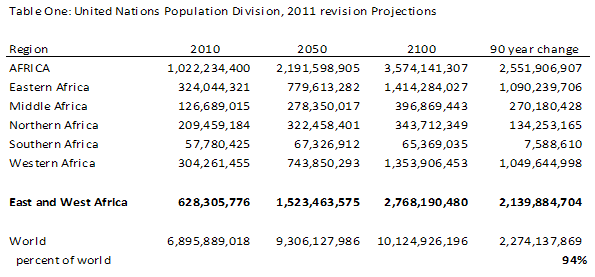
    Still, given that UN numbers are estimates, how accurate are the projections for Africa? Table #1 shows the 2010 estimates for the five regions of Africa, and the 2050 and 2010 projections. While East and West Africa combined represent 9 percent of global population and land area, this last frontier of population growth is interesting. The estimates indicate dramatic growth from 1950 to 2010. Population in North, South and Middle Africa as a group have peaked, while East and West Africa are still accelerating. (The other 91 percent of the globe is 80 percent of the way to the UN’s population peak in 2058 and is basically done with population growth.)

    The dynamics of global population change are becoming focused on East Africa and West Africa, the two regions which together comprise about forty percent of the land area of Africa. With the rest of the world experiencing a mix of modest population growth and decline, East and West Africa are projected to experience 94 percent of future global population growth. Even with a more likely scenario of a leveling off at 1.523 billion rather than going on to a very large 2.14 billion, East and West Africa will still represent the largest demographic change story of the 21st century.

    Do East and West Africa have some demographic similarities with China and Latin America back in 1960? If so, as has been seen around the world, fertility declines from 6 to 2 children per mother will happen much more quickly than the UN 2011 projections suggest. Given that African real economic growth of 57% has been robust in the last ten years, including a 29% gain in real per capita income, there is evidence that the continent is slowly emerging out of a poverty trap. Africa is also rapidly urbanizing, and demographic surveys conclusively show a big difference in the fertility rates of women living in urban areas as opposed to rural ones. East and West Africa represent a very interesting final chapter in modern population growth, with the challenge to use land and fresh water efficiently and protect significant wildlife resources, while potentially becoming an economic powerhouse later into the century.

    The story will be interesting and important to follow. In the next forty years, East and West Africa, along with South Asia, will be the big population growth centers, while the rest of the world will increase very slowly. Even with dramatic economic growth, urbanization, and a doubling of population in East and West Africa in the next few decades, the global population could very well level off at 8.8 billion rather than 10.1 billion.

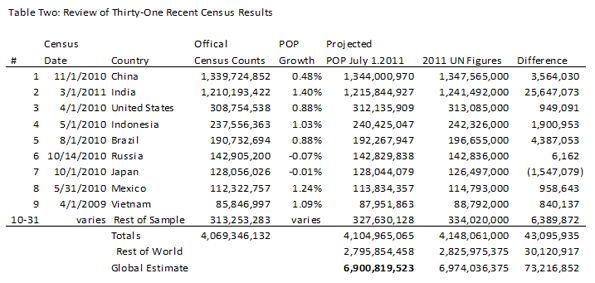
    Back to the estimates themselves: The UN pieces together a global story from a set of data and estimates from countries with infrequent censuses. Table Two shows official national census estimates for 31 countries, which represent about 60% of the global population. Most of the census results are coming in below UN projections.

    Assuming that the rest of the world’s nations that have not conducted recent censuses have similar overall projection problems, one could infer that the actual population is at least one percent lower than the UN 2011 estimates. If we just assume the UN population growth rates for 2010-11 are accurate, and project these 31 country census results forward to July 1, 2011, we get a population of 6.9 billion people. We would then estimate that the world population would hit 7 billion in October, 2012.

    So why is the UN declaring October 31, 2011 as the day of 7 billion? While nobody knows what the true world population is, perhaps the UN should err on the side of accuracy… and put off this announcement until 2012. A delay would increase the probability that we actually have crossed that symbolic threshold, something for all people on earth to reflect upon.

    Ron McChesney is a Geographer who founded a research firm called Three Scale Strategy and a related non-profit called Three Scale Research. The company studies and reports on the economy of the state of Ohio and how Ohio interacts with the rest of the world. His research interests include the study of patterns and changes in population, land use, economics, energy production and transportation.

    Data Sources: UN Population Division, International Monetary Fund, Geohive.com

    Photo by etrenard, “Niger Portrait”

  • Inside Sydney’s Central Business District: the Retail Core

    World famous for its beautiful harbour setting, Sydney’s Central Business District is undergoing a resurgence. As the hub of Australia’s finance sector, it stumbled during the global crisis. Office vacancies jumped from 5.7 per cent in early 2008 to 8.8 per cent in mid 2009, despite stable supply. Ultimately, though, Sydney was spared the worst, owing to its rise as a staging post for trade and investment in the Asia-Pacific region, which averted the havoc of Europe and North America. Recovery is now underway, if slowly. White-collar employment is picking up and the vacancy rate is down to 7.3 per cent. Landlords are again celebrating the prospect of rising rents.

    But there’s a bigger story. This revival is happening amid some notable trends. Post-crisis, the CBD’s functional map is being redrawn by a wave of Asian and other visitors and investors, prominently listed property trusts and pension funds looking for a safe haven, the spatial demands of a transformed white-collar workplace, intensive residential development on the CBD fringe and officials pushing flashy “green” projects. There’s no doubting the importance of these developments, or that they will be hyped by inner-city based media.

    In fact, central Sydney has been losing economic clout, in relative terms, to the periphery or suburban hinterland for some time, a polycentric trend observed in other countries. Between the 1981 to 2001 censuses, encompassing the most active period of economic liberalisation in Australia’s history, Sydney’s general population growth was 23 per cent, while outer areas in Greater Western Sydney grew by 38 per cent. The CBD’s share of Sydney’s jobs shrunk from around 30 per cent to 9 per cent during this period. Four of the five strongest growing Local Government Areas (LGAs) in the year to 30 June 2009 were still in the outer west: Blacktown, Parramatta, The Hills Shire and Liverpool.

    The latest wave of change will prove significant and long-lasting, but the CBD isn’t destined for a return to metropolitan supremacy.

    Sydney CBD
    Sydney CBD

    The retail core

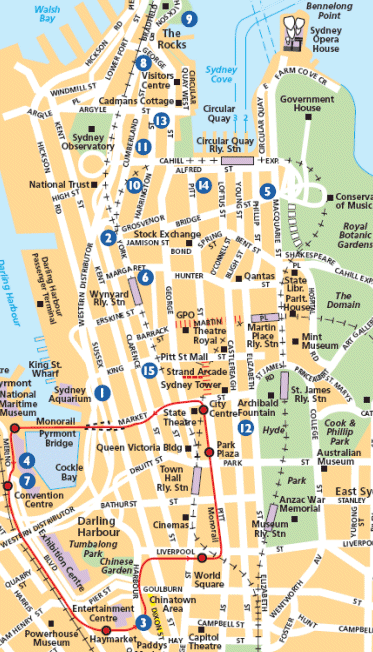
    For theorists of the CBD, peak land value intersection (PLVI) is a pivotal concept. This is the centrally-located point, usually at the intersection of two thoroughfares, where land values are highest. Without doubt, Sydney’s PLVI is the intersection of George and Market Streets. George Street is the CBD’s spine, traversing a north-south axis from Circular Quay to Central Station. Historically, Market Street was the critical entry route from the west, extending from the defunct Pyrmont Bridge (over Darling Harbour), and now from a branch of the Western Distributor. Blocks surrounding the PLVI are typically occupied by upscale department stores, absorbing peak land prices with high turnover of quality goods on multiple floors. Thus Myer and Gowings stores occupy the north-east and south-east corners respectively, and David Jones a site further east along Market Street (the Gowings site is earmarked for refurbishment as a boutique hotel). The iconic Queen Victoria Building arcade sits on the south-west corner.

    According to the “core-frame model”, another tool of CBD theory, activities competing for the highest rents, like upmarket retail and superior grade office towers, concentrate in core blocks, while marginal activities disperse to peripheral blocks. In terms of the theory, the latter are a “zone in transition”, at an intermediate stage between lower grade building stock and future redevelopment. Activities like low-end retail, fast-food, novelty shops, pawnbroking, wholesaling, storage, off-street parking, warehousing and light-manufacturing locate there.

    Traditionally, Sydney’s CBD had a retail core around the PLVI bounded by York, Park, Elizabeth and King Streets, south of an office core bounded by King, Clarence and Macquarie Streets and Circular Quay. Judging by the headlines, the retail core is Sydney’s biggest news. Long a feature of suburban life, the CBD is being transformed by the arrival of mall-style shopping, adding to the mix of department stores, arcades and stand-alone shops. In some ways, it’s catching up with the social evolution of shopping as a “complete experience” linked to identity formation.

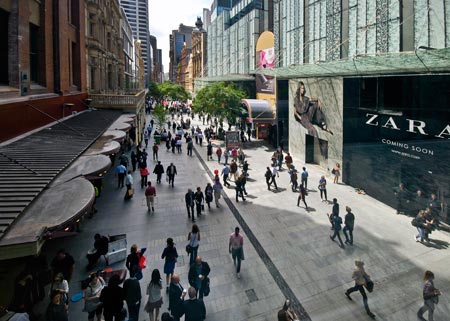
    The catalyst is Westfield’s $1.2 billion development at the corner of Pitt Street Mall and Market Street, just a block east of the PLVI. A pedestrianised section of Pitt Street between King and Market Streets (not a regular mall), Pitt Street Mall is the retail core’s epicentre. Last year, global real estate firm CB Richard Ellis (CBRE) rated it the second most expensive street for retail rents in the world. The first was New York’s Fifth Avenue.

    With rents so high, investment dollars are pouring in. Fronting the eastern side of Pitt Street Mall, Westfield’s contemporary glazed-glass structure, box-like at street level but topped by Sydney Tower, converts four properties into 93,000 square metres of retail space, distributed over a six-storey shopping mall. The first stage opened last October. On completion, it will house 330 flagship and specialty fashion outlets, and lifestyle stores, most of them international brands, including Sydney firsts Versace, Gap, Zara and Miu Miu, together with several eateries. Two skybridges link the complex to nearby Myer and David Jones department stores.

    Westfield’s opening coincided with a general revamp of Pitt Street Mall, featuring landscaping, paving and tree-planting by Sydney City Council, and reconstruction of the mall-like Mid-City Centre, 52 shops on four-levels fronting the Mall’s western side, almost opposite Westfield, penetrating west to 420 George Street. One Mid-City store, jewellery retailer Diva, is reputedly paying the highest rent in the CBD, $13,500 per square metre a year.

    Pitt Street Mall’s face-lift set off a reshuffle of fashion and luxury goods retailers around the retail core, with knock-on effects all the way up George Street. Burberry is moving to refurbished premises at 343 George Street, Louis Vuitton to a new flagship store on the corner of King and George Streets, Dior to Castlereagh Street, and Zegna and Prada to Westfield, from Martin Place. This follows the 2008 opening of the world’s largest Apple store, at glass-clad 367 George Street (roughly opposite Mid-City at 420).

    Pitt Street Mall
    Pitt Street Mall

    A sign that the retail core may be busting out of its old confines, and creeping north of King Street, major retail developments are planned in the vicinity of Wynyard railway station, at 301, 333 and 383 George Street. Some of these anticipate the most striking proposal yet: a futuristic commercial and residential precinct on the foreshore of East Darling Harbour, or Barangaroo, seeing the retail core spill into the CBD’s rising “western corridor”, which was a "zone in transition" in the days when Darling Harbour and Walsh Bay were working ports. This $6 billion plan includes 30,000 square metres of retail space and a pedestrian walkway to nearby Wynyard, the CBD’s busiest underground station.

    It’s easy to explain such hyperactivity. Sydney is one of a handful of global cities in a developed country which wasn’t flattened by the financial crisis. There’s a clear international dimension to the CBD’s resurgence. According to Cushman & Wakefield’s International Investment Atlas 2011, the Asia-Pacific is dominating global property investment. Ranked eleventh, Sydney joins 6 other Asia-Pacific cities in the top 20. In the 18 months to June 2010, reports CBRE, Sydney ranked fourth in the world in terms of cross-border investment. Foreign investors accounted for 42 per cent of Australia’s property asset acquisitions in the third quarter of 2010, way above the typical level of 10 to 15 per cent. In these conditions, Sydney shot up to ninth out of 65 cities in AT Kearney‘s 2010 Global Cities Index. And a 2010 survey by real estate agents Jones Lang La Salle rated Tokyo and Sydney the most popular Asian cities for investment. At a time when many asset classes carry outsized risks, Australian commercial property is a safe option.

    Of course, there’s nothing new about Asian investment in the retail core. Three of its most fashionable shopping arcades belong to Ipoh Pty Ltd, which is owned by a Singaporean fund manager: the Queen Victoria Building, The Strand Arcade between Pitt Street Mall and 412-414 George Street, and The Galleries, on the corner of George and Park Streets, the core’s southern edge.

    But urban planners would be wrong to overestimate the impact of all this on the wider metropolitan region. Quite clearly, Westfield’s target market embraces a small minority of Sydney’s 4.5 million residents. Commenting on the mall’s opening, the Group’s managing director hoped it would be a “destination for the people of Sydney, and the 26.8 million domestic and international visitors who come to Sydney each year”. The Australian Financial Review, citing Westfield, reported that it will “service not only 240,000 workers in the [CBD], but 1.5 million in the primary trade area across the richest suburbs and the 26 million tourists who visit the city each year”. David Jones’ CEO expressed similar sentiments, saying “my hope is that Sydney’s CBD retail precinct becomes a world-class shopping destination on a par with the world’s best such as Oxford Street, London, and Rodeo Drive in LA”.

    Much of the investment surge is predicated on large numbers of visitors, and the growth of inner-suburbs ringing the CBD. If the travelling patterns of China’s newly cashed-up middle class are any guide, for instance, these hopes won’t be disappointed. The number of Chinese visitors to Australia is forecast to grow by 7.9 per cent a year, reaching 783,000 a year by 2019. Meanwhile, Sydney LGA’s population is ballooning (the CBD and environs). Between 2001 and 2009, it grew by 38 per cent, or 49,000 new residents. Eager to meet the former state government’s target of 55,000 new residential units over the next decade, Sydney Council is presiding over a number high-density projects on derelict industrial or recreational sites. Most of the newcomers will belong to the same demographic as current residents, younger, upper-income professionals with a taste for inner-city living. They are no cross-section of Sydney’s population. Below average in age, their median weekly income is $717, compared to $518 for the whole metropolitan region.

    To an extent, Sydney CBD is exhibiting features of the global city phenomenon, when highly-developed zones “secede” from their hinterland and develop stronger ties to distinct occupational classes and overseas markets. The revitalised retail core is unlikely to lure the vast majority of shoppers — who live and work far from the CBD — away from suburban megacentres like Chatswood Chase, Miranda Fair, Warringah Mall, Castle Towers, Minto Mall, Top Ryde City, Westfield’s other centres at Bondi Junction, Parramatta, Burwood, Hurstville, Hornsby and Penrith, local retail strips, or the growing number of Australians who shop online. Just as suburban malls attract customers from their surrounding feeder population, the same applies to the retail core, but with a higher proportion of domestic and foreign visitors.

    The CBD’s revival shouldn’t be misinterpreted. It doesn’t herald a return to regional primacy. Calls by green-tinged academics and newspaper editors and columnists for billions to be spent on CBD-centric rail networks are wrongheaded. Such plans can only have a distorting and negative effect on economic vitality across the metropolitan region, especially fast growing outer LGAs. Look at the CBD’s story. For all the contemporary rhetoric linking urban success to green amenity, it owes more to plain old capitalism.

    John Muscat is a co-editor of The New City, where this piece originally appeared. 

    Photo by Christopher Schoenbohm.

  • Listing the Best Places Lists: Perception Versus Reality

    Often best places lists reflect as much on what’s being measured, and who is being measured as on the inherent advantages of any locale.  Some cities that have grown rapidly in jobs, for example, often do not do as well if the indicator has more to do with perceived “quality” of employment.

    Take places like Denver and Seattle. Both do well on what may be considered high-tech measurements – bandwidth, educated migration, entrepreneurial start ups – but have trailed other places in terms of creating jobs. Others, such as Oklahoma City and Raleigh, do better in terms of overall job creation and cost competitiveness.

    There are effectively few truly objective criteria, and the Area Development list does tend to weigh a bit heavy on the factors that help more expensive – although not necessarily the most costly – cities. If cost of doing business, or regulatory environments were given more weight, some of the high fliers would not do as well.

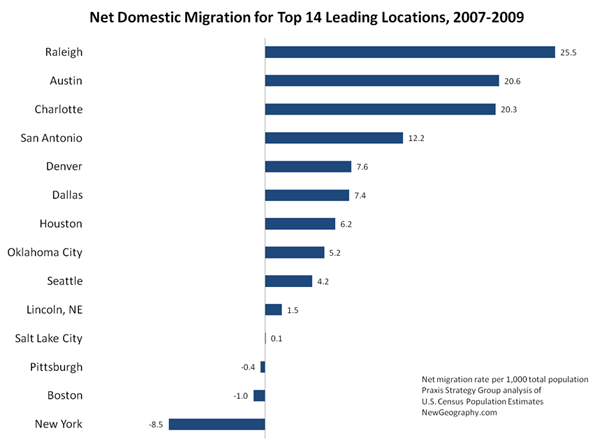
    We prefer to focus less on atmospherics and more on how people, and businesses, are voting for their feet. San Francisco and New York have generally had slower job growth and greater outmigration, but do well on lists that focus on perceived qualitative factors.

    But then there is Austin. Here is one region that has it all, the low costs and favorable regulatory climate of Texas along with the amenities associated with a high-tech region. The area creates a large number of jobs of varying types and is still inexpensive enough to attract young, upwardly mobile families. This gives it a critical advantage over places like Silicon Valley, Los Angeles or New York.  Unlike those three centers, Austin performs extraordinarily well in quantitative measurements.

    The region that most closely matches Austin in these respects is not Seattle and Denver, but Raleigh Durham. Recently a group of leaders from Raleigh made a visit to Denver to learn what makes that city successful. Speaking to the group, we pointed out that by objective measurement – job growth, educated migration, population growth – Raleigh beat Denver by a long shot, yet it was to Denver the group was looking for inspiration. In fact, over the past three years, Americans have moved to Raleigh at a rate more than three times that of Denver.  Perception can be a funny thing which makes a winner feel inferior to a clear runner-up.

    Another strange result is that New York and Houston had the same number of mentions. Yet looking at numbers — from educated migration, job growth, population increase — Houston slaughters New York. People, from the college educated on down are flocking to Houston while fleeing, in rather large numbers, from New York. One has to wonder where the rankers live and where they are coming from. Houston triumphs on performance, while New York, to a large extent, wins on perception. 

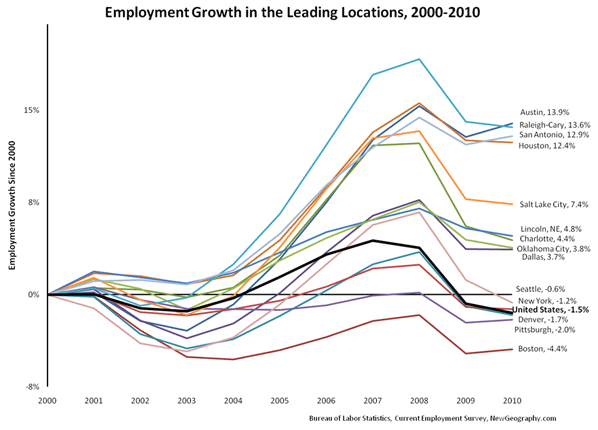
    Looking simply at job growth over the past ten years for the Leading Locations mentioned on at least five surveys, the 14 regions separate themselves into three groups.  The top tier of places – Austin, Raleigh, San Antonio, and Houston – all have seen job growth of more than 12% and seem to be recovering from the recession faster than the others.  

    Salt Lake City and Charlotte were tracking with the top tier of places until 2007 but have since fallen to the second tier of cities.  The remainder of the second tier includes steady growers Dallas and Lincoln, along with Oklahoma City, a region that has seen a boom in jobs since bottoming out in 2003.

    The final job growth tier of places includes five regions that have fewer jobs than ten years ago.  Seattle drops just below the zero line after being hit particularly hard by the 2001 and 2008 recessions, while New York and Denver finish near the national rate.  Pittsburgh and Boston spent most of the decade below their 2000 employment levels, but each seem to be recovering from the recession faster than many of the other Leading Locations cities. 

    But perhaps the biggest problem with lists has to do with the size of regions. Much of the fastest growth in America, particularly in terms of jobs, has been in small metros, many with fewer than 1 million or 500,000 residents. Smaller dynamic areas such as Anchorage, Alaska; Bismarck, North Dakota; Dubuque, Iowa; or Elizabethtown, Kentucky – all in the top 25 of NewGeography’s Best Cities for Job Growth 2011 Rankings – are too small to show up on some lists yet may be a location of choice for expansion. This reflects not so much their relative desirability but the fact that, unlike larger regions, they simply are not included on many rankings.

    Ultimately, a list of lists does tell us much, but perhaps only so much for a specific individual or business. For someone interested in the movie business, for example, Los Angeles – and increasingly places like New Orleans or Albuquerque – are great draws, but perhaps not so much for financial services.  The lists of lists are useful to identify hotspots, but for most location decisions, it may be more imperative to drill down to more detailed industry sectors and workforce attributes. And most of all, take the perception factor into account and look instead at the real numbers to tell you where to go.

    This piece first appeared at AreaDevelopment.com, as part of its Leading Locations series discussing best cities rankings.

    Joel Kotkin is a Distinguished Presidential Fellow in Urban Futures at Chapman University in California, an adjunct fellow with the London-based Legatum Institute, and the author of The Next Hundred Million: America in 2050. Mark Schill is Vice President of Research at Praxis Strategy Group, an economic research and community strategy firm.  Both are editors at NewGeography.com, a provider of two surveys for Area Development’s Leading Locations list.

    Photo by mclcbooks

  • Orlando: Uncle Sam Meets Mickey Mouse

    Hawks and doves disagree on whether World War II ended the Great Depression.  Depending on which species of bird squawks louder, military spending may be the only way out of our current financial malaise.  In many ways it is already happening, although it is a surreptitious and quiet influence felt mostly in the high-tech economic sector.  Defense growth in one of the most unlikely places – Orlando, Florida – has already begun to diversify the region’s income stream, create a new urban corner of Central Florida, and tap into some of the natural allies and partners that already exist here.  Mickey Mouse is now sharing Orlando with Uncle Sam as the militarization of the local economy increases.

    America’s current rough patch, as Dr. Roger Siebert recently wrote about , seems to be deeper than any in recent memory, and recalls the 1930s.  During that time, isolationism was only cured by a slap in the face:  Pearl Harbor.  Today’s isolationism, so vigorously voiced in the calls to depart Afghanistan, seems to echo that period.  Enlistment in the military isn’t exactly vigorous, and intervention in troubled regions is not on the radar screen of even the most ardent hawk.  America seems too self-involved at the moment to care.

    Yet at this very same time, Pentagon spending is quietly rising in the modeling, simulation, and training fields.  Already employing 53,000 Floridians, 9,000 more than the state’s hallowed agriculture industry, this growth sector is hugely dependent upon a high-skilled, high-wage workforce.  The ability to train soldiers, sailors, and pilots without the expense of actual bombs and equipment has clearly demonstrated its benefits to the satisfaction of the military brass, making it inevitable that more is to come.

    Co-located next to Florida’s premier high-tech medical research park, Lake Nona, the National Simulation Center is the most common name used to describe the efforts underway at the Central Florida Research Park on the east side of town.  More importantly, however, the Center is adjacent to the University of Central Florida.  Already the second largest university in the country, UCF is home to much of this Center’s local 18,000 workforce.   With Navy, Air Force, and Marines research and training, the Simulation Center has quietly become the world’s largest military simulator .

    Regionally, it leverages its old Naval Training Center roots and proximity to NASA facilities at Cape Canaveral to capture workers, skill sets, and continuous research and improvement.    While the town struggles with slumping tourism and anemic population growth, the high-tech military industry is rapidly taking over as one of the biggest new economies to hit Florida.

    Spinoffs from military research can only benefit Central Florida’s attractions and rides, as future tourists will be able to experience more and more virtual thrills in addition to more traditional meatspace rides and shows.   In the meantime, it remains a quiet partner in diversifying the economy.

    In the 1990s, the Naval Training Center left Orlando, ostensibly because it duplicated facilities that the Navy had elsewhere.  Its developable land, close to downtown Orlando, became Baldwin Park, and the old barracks, classrooms, and laboratories were quickly bulldozed for lucrative residential real estate.  Few were aware that the functions of the Orlando Naval Training Center were downsized, not eliminated, and were quietly relocated to the east side of town.

    The Training Center evolved into the National Simulation Center. As a research-intensive industry, it capitalized on its new proximity to the University of Central Florida’s campus, and began an interchange with the engineering and computer science programs at that school.  UCF, today with over 50,000 students, has quickly grown to become the nation’s second largest university, just behind Ohio State.  UCF’s own Research Park has grown to rival the fabled Research Triangle in North Carolina, due to the synergy between military and higher education.

    Its new location also moved the Training Center a little bit closer to the Kennedy Space Center as well.  The Navy has always had a presence at Cape Canaveral, and with the employee base around the Space Center available less than an hour’s commute away, the Training Center has already benefitted from the availability of this highly skilled workforce who has suffered from the ebb and flow of NASA’s political fortunes.

    Medical research being conducted by Scripps, Burnham, and Nemours will also benefit from this activity, as they are all building new facilities at Lake Nona.  This medical research campus will employ many with the same skills, education, and training as the Simulation Center, and provide choices for the scientists and engineers living in Lake Nona’s suburbs.  This makes the residential real estate around Lake Nona a bright spot in Central Florida’s otherwise horrendous housing market .

    Surrounding the Simulation Center, small companies have already started feeding creativity and innovation into the giant maw of the military, and spinoffs – commercialization of its technology – have also benefitted larger companies such as Orlando’s game design team at Electronic Arts and the military contractor Lockheed Martin.  This supply chain, once established in Orlando, gives localized sustainability to this industry and suggests that it has achieved a foothold among the tourism, agriculture, and growth industries firmly established in Central Florida.

    Geographically, East Orlando is difficult to develop.  Like the surface of swiss cheese, land above the flood plain, traditionally agricultural, is interlaced with wetlands and lakes, and it has been historically ignored for the broad swaths of low-hanging fruit closer to the theme parks and population centers on the west side of town.  Pressure to develop, however, has suddenly put this area in the spotlight, and controversial proposals by homebuilders and other owners have raised questions about whether Florida should stay on its historic pathway of man vs. nature.   Infrastructure – roads, utilities, and other unglamorous investment – still doesn’t exist in much of East Orlando.  Because development has historically been in small pockets fragmented by the area’s mosaic of wetlands, connectivity and sheer mass will be difficult to achieve without great cost to the environment.

    Yet this does not have to be so.  Dense development can happen with respect to nature, as proven by countries such as Germany and Sweden .  If left to the same old forces that developed the rest of Florida, it is unlikely that East Orlando will experience any innovation regarding development strategy, and Central Florida will host the same old battles of environmentalists vs. developers again and again.  The state’s growth strategy – leaving it up to private interests – may have already guaranteed this outcome.

    If, however, innovation transcends the research mission and influences the style of development to support this research, then the military and medical centers in East Orlando have a chance to provide a true, new pathway to the future.  Like Victor Gruen’s 1963 concept for Valencia, which recognized such modern aspects of society such as the car, East Orlando could be planned as an employment-based community within the context of nature using contemporary science and technology.  Orlando, the ephemeral city home to amusement parks and orange groves, could become a model for development to influence other areas struggling with the same questions.

    Militarization of the economy may become a vehicle for true change.  The cluster of military agencies and private businesses, headed by Lockheed Martin, all revolve around this economy and provide a badly-needed shot in the arm of Orlando’s workforce.  With high-salary, highly educated workers, global connectivity, and a growth engine no less than the Department of Defense, Orlando can be assured of some good times ahead while the tourism and housing sectors recover.  The region’s leadership must think carefully how to embrace this new savior, and what the greater implications are for the future.

    Richard Reep is an Architect and artist living in Winter Park, Florida. His practice has centered around hospitality-driven mixed use, and has contributed in various capacities to urban mixed-use projects, both nationally and internationally, for the last 25 years.

    Photo by Research Development Engineering Command

  • The Katrina Effect: Renaissance On The Mississippi

    In this most insipid of recoveries, perhaps the most hopeful story comes from New Orleans. Today, its comeback story could serve as a model of regional recovery for other parts of the country — and even the world.

    You could call it the Katrina effect. A lovely city, rich in history, all too comfortable with its fading elegance and marred by huge pockets of third-world style poverty, suffers a catastrophic natural disaster; in the end the disaster turns into an opportunity for the area’s salvation.

    Had Katrina never occurred New Orleans would likely have continued its inexorable albeit genteel decline; the area’s population dropped from 627,000 in 1960 to 437,000 in 2005, the year the hurricane occured. Instead the disaster brought new energy and a sense of purpose to the Big Easy.

    I first realized that New Orleans was going through some kind of renaissance when looking at some numbers.  In our list of the country’s biggest brain magnets — based on analysis of where college-educated adults were moving to by demographer Wendell Cox —  New Orleans ranked No. 1, ahead of such hot spots as Raleigh-Durham, N.C., and Austin, Texas.

    Then came our analysis of the best large cities for jobs: New Orleans ranked No. 2 in our survey, up a remarkable 46 places. New Orleans’ performance was particularly impressive in the information field, which includes software and entertainment, and in which the Big Easy grew the most — over 30% last year alone – among our major metros.

    Yet numbers do not tell the whole story. Sometimes statistics simply look great against the background of catastrophic decline. New Orleans was so far down and received so much recovery money that recent improvements could be explained as a short-term bounce back from a disaster.

    But the resurgence of New Orleans, whose population is now back to almost 350,000, represents something far more significant and long-term. For one thing, the storm undermined the corrupt, inept political regimes that had burdened the area for decades. “Katrina shattered the networks and broke down the old hierarchies,” notes Tim Williamson, a New Orleans native and founder of Idea Village, a nonprofit focused on aiding local entrepreneurs.  ”People felt we were dying. Now we feel like we are refounding a great American city.”

    For example, inept leaders like former Mayor Ray Nagin and the equally lost Kathleen Blanc have been replaced by more effective figures like Mayor Mitch Landrieu and Gov. Bobby Jindal. Equally important, according to a recent Brookings report, New Orleanians have become noticeably more engaged with their community. Particularly impressive have been improvements in the local schools, once among the nation’s worse. Last year, the majority (61%) of public school students in Orleans Parish (counties in NOLA are called parishes) attended charter schools, which are now attracting some middle class families.

    Most impressive, this once stagnant region has transformed into an entrepreneurial hot bed. “Five years ago people thought we were crazy to be here,” says Matt Wisdom, founder of Turbosquid, a firm with 45 employees that provides three-dimensional images to corporate clients. “Now instead of people being amazed we are here, they want to get here to ride the wave.”

    Walking along Magazine Street from the edge of the Garden District to the Central Business District, you still pass some rough areas. But the way is peppered with scores of independently owned shops and small businesses, many of them opened since the hurricane. Their owners for the most part appear to be younger than 40.

    “We used to have this huge brain drain to the Northeast, the West Coast and Texas, but this has changed,” Williamson says. “After Katrina everyone was forced to become an entrepreneur. The dominant concept for the rebuilding has become one of resiliency and self-employment — it’s been bottom up. It’s become as much of our identity as Mardi Gras or the Jazzfest.”

    Since its founding back in 2000 Idea Village has assisted 1,000 local companies with business plans, financing and focus. Most are small, but some of what Williamson calls post-Katrina generation companies, like Naked Pizza, founded in 2006, have expanded rapidly. Specializing in a healthy, organic version of the traditional high-fat fast food, Naked Pizza has won financial backing from Dallas Maverick owner Mark Cuban. The company, which employs 40 employees at its New Orleans headquarters, expects to have over 70 franchises by the end of the year  .

    Many rapidly rising businesses specialize in digital media, attracting talent from other places like the West Coast and New York. 37-year-old Kenneth Purcell, founder of Iseatz, moved his entertainment and travel business from New York to NOLA in 2009 and has since grown his company from seven people to 25.

    One big advantage of starting a business in New Orleans is its affordable housing. Based on median price against median household income, the region’s prices are roughly 50% less than those in New York or San Francisco. This is particularly attractive both to middle-aged couples with children who can afford a spacious suburban home that are far less expensive than their equivalents in Los Angeles, Westchester or Silicon Valley.

    It also is attractive to the smaller subset of employees, many of them young, who are drawn to traditional cities. Some New Orleans neighborhoods remind me of pre-1980 Greenwich Village, offering a charming urban environment without either the extortionate price tag or oppressive density.

    Immigration, much of it from Mexico, also is contributing to the regional remake. Over the past decade, as both white and black populations dropped, the Asian population grew by 3000 and Hispanics by 33,500, most of them settling in suburban Jefferson Parish.  Once predominately African-American, New Orleans is returning to its more multi-racial past while re-establishing its strong cultural and social ties to Latin America.

    Yet despite all positive signs, it may be too early to proclaim, as some boosters do, a “New Orleans miracle.” After all, the city’s population remains over 100,000 below its depressed pre-Katrina levels. There are still over 47,000 vacant housing units in the city, many of the uninhabitable, notes Allison Plyer, who runs the Greater New Orleans Community Data Center. Overall, the recovery remains stronger in the suburbs, many of which suffered less damage from the storm. The share of regional population living in Orleans Parish, where the city of New Orleans is located, has slipped to 29% compared with 37% in 2000. Jefferson Parrish now has more jobs than the city across all income categories.

    Plyer believes the priority for the entire region lies in restoring the higher-paid blue-collar and middle-class jobs that for decades have disappeared from the city.  Young tech and media firms can help gentrify parts of a city, but they are not sufficient to provide opportunities to the vast majority of its residents. To do this, Plyer suggests, the region will have to focus more on “export” oriented jobs in industries such as  energy, manufacturing and trade.

    Critically these fields can provide decent salaries for a broad swath of workers.  Right now, Plyer adds, 45% of the workforce earns less than $35,000 a year, one byproduct of the domination of the generally low-paying tourism industry. Jobs connected to shipping pay twice as much on average as tourism; energy three times as much. A new steel plant announced recently by Nucor in suburban St. James Parish could create more than 1200 jobs with average pay of $75,000 annually.

    “We’ve allowed Houston and Biloxi to move ahead in a lot of these other industries,” she explains.  ”We have to move ahead in engineering and services and energy to compete with Texas. We can’t be just a tourism economy.”

    Ultimately, New Orleans’ long-term recovery may depend on exploiting historic raison d’etre: location. The region  stands astride the primary corridor for the Midwest grain trade and sits in the middle of the Gulf trade routes. It also boasts some of the nation’s richest energy deposits.

    Coupled with its enormous cultural appeal, resurgence in the  more traditional economy could spark the most remarkable urban comeback story of the new century. Once the poster child for urban despair, New Orleans may develop a blueprint for turning a devastated region into a role model not only for other American cities but for struggling urban regions around the world.

    This piece originally appeared at Forbes.com.

    Joel Kotkin is executive editor of NewGeography.com and is a distinguished presidential fellow in urban futures at Chapman University, and an adjunct fellow of the Legatum Institute in London. He is author of The City: A Global History. His newest book is The Next Hundred Million: America in 2050, released in February, 2010.

    Photo by Adam Reeder

  • The Evolving Urban Form: Jakarta (Jabotabek)

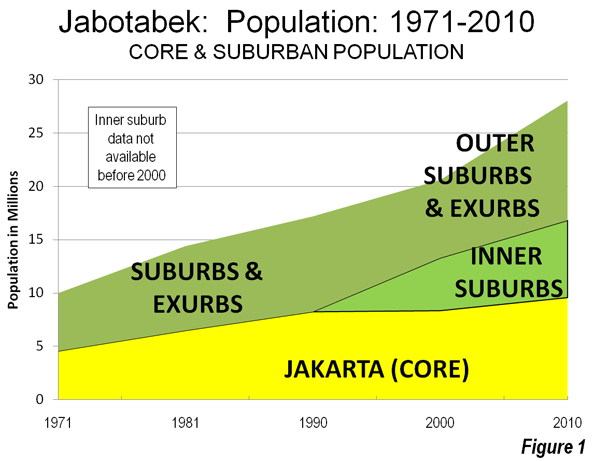
    There is probably no large urban area in the world that better illustrates the continuing dispersion of urban population and declining urban population density than Jakarta. Recently released 2010 census data indicates over the past decade that 84 percent of the metropolitan area (Jabotabek) population growth occurred in the suburbs (Note 1). This continues a trend which saw more than 75 percent of growth in the suburbs between 1971 and 2000 (Figure 1).

    Savannah State University (Georgia) Professor Deden Rukmana notes that this trend includes “many moderate and high-income families” who left the central city for better amenities while many poor people moved out to the fringe areas to escape what might be seen in the West as gentrification . 

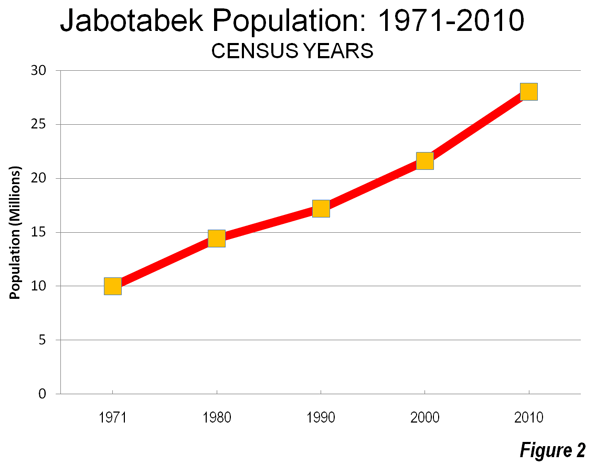
    The Megacity: Jabotabek: Jakarta is one of only a few world megacities (over 10 million) that have changed their names in recognition of their regional rather than core city focus (this sentence corrected from original). The most recent megacity with a new name is Mexico City, now referred to as the Valley of Mexico (Zona Metropolitana del Valle de México). Other examples are Tokyo-Yokohama (Kanto) and Osaka-Kobe-Kyoto (Keihansh1n).   Jakarta’s changed name, Jabotabek, represents an acronym made up of the beginning letters of the municipality of Jakarta and the three adjacent regencies (subdivisions of provinces), Bogor, Tangerang and Bekasi (Note 3). Jabotabek is one of the fastest growing megacities in the world and is experiencing accelerated growth. This is in contrast to the situation identified by the McKinsey Global Institute, which noted the declining growth rates of most megacities. In 2000, Jabotabek had a population of approximately 20.6 million, which by 2010 had risen to 28.0 million or 36 percent, nearly doubling its rate of population from the 1990s.    Jabotabek’s additional 7.4 million people is nearly equal to that of London (Greater London Authority), nearly as large as the city of New York and more people than live in the entire Greater Toronto area. In 2000, Jabotabek had a population of approximately 20.6 million, which by 2010 had risen to 28.0 million (Figure 2).

    Jabotabek’s unexpectedly high growth was greater than the 6.6 million added in both the Shanghai and Manila regions over the same period and above the 5.8 million increase in the Beijing region. The percentage growth in Shanghai and Beijing was slightly higher than in Jabotabek and slightly lower in Manila. The megacities of the United States, Western Europe and Japan have all fallen back to growth rates of less than five percent per decade (Tokyo-Yokohama, New York, Osaka-Kobe-Kyoto, Los Angeles and Paris).

    Population Trends by Sector: Population growth and rates are indicated in the table for the sectors of Jabotabek and the constituent jurisdictions.

    Jakarta Region (Jabotabek)
    Population by Sector: 2000-2010
    2000
    2010
    Change
    % Change
    Core: Jakarta 8.36 9.59 1.23 15%
    Inner Suburbs (Municipalities) 4.94 7.23 2.30 47%
    Tangerang 1.33 1.80 0.47 36%
    Tangerang Selatan 0.80 1.30 0.50 63%
    Depok 1.14 1.75 0.61 53%
    Bekasi 1.66 2.38 0.71 43%
    Outer Suburbs & Exurbs 7.30 11.20 3.90 53%
    Bogor (Municipality) 0.75 0.95 0.20 27%
    Bogor (Regency) 2.92 4.78 1.86 64%
    Tangerang (Regency) 2.02 2.84 0.82 41%
    Bekasi (Regency) 1.62 2.63 1.01 63%
    Jabotabek: Total 20.60 28.02 7.42 36%
    Population in millions


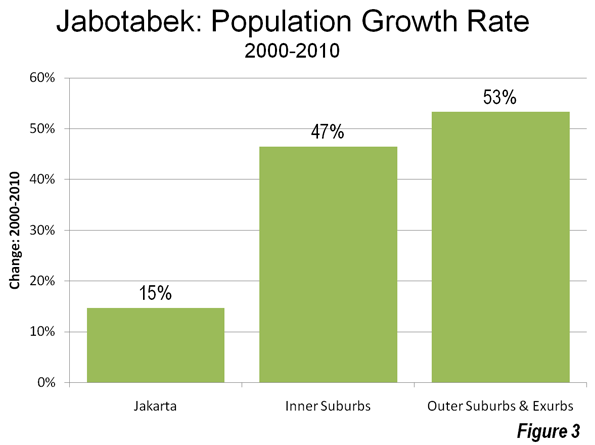
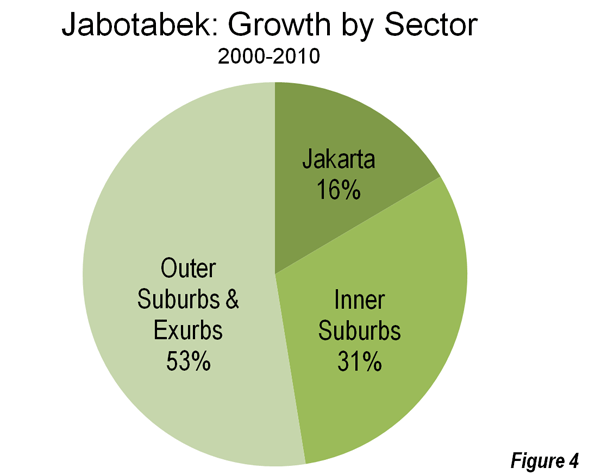
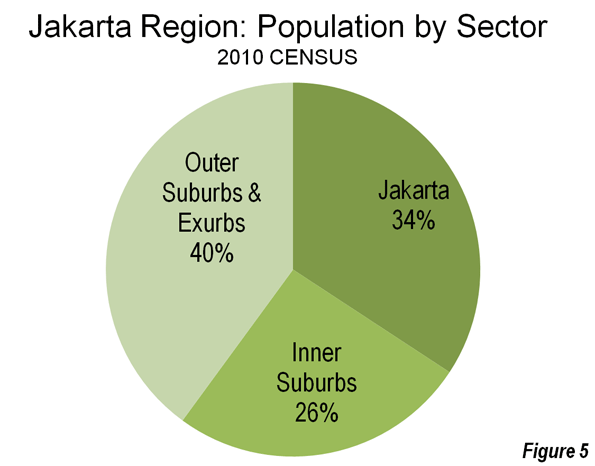
    City of Jakarta: The core city of Jakarta is the "Special Capital Region" of  Indonesia, similar to the District of Columbia in the United States, the Distrito Federal in Mexico or the Capital Federal in Argentina. This core of Jakarta grew 15 percent and added more than 1.2 million population, rising from 8.36 million in 2000 to 9.59 million in 2010, a turnaround from a loss of nearly 500,000 people between 1995 and 2000. The city of Jakarta captured 16 percent of metropolitan area growth and now accounts for 34 percent of the population of Jabotabek (Figures 3, 4 & 5).

    Inner Suburbs: The inner suburbs, which are made up for the purposes of this article by the municipalities of Bekasi, Tangerang, Depok and Tangerang Selatan (South Tangerang) grew 47 percent during the 2000, from 4.94 million to 7.23 million. These inner suburban municipalities captured 31 percent of the metropolitan area growth and now have 26 percent of the population of Jabotabek (Figures 3, 4 & 5).

    Outer Suburbs and Exurbs: The outer suburbs and exurbs (Note 2) experienced the greatest growth, at 53 percent, rising from 7.30 million to 11.20 million. For the first time, the outer suburbs surpassed the core with the largest population. The outer suburbs and exurbs accounted for 53 percent of the metropolitan area growth and now have 40 percent of the population of Jabotabek (Figures 3, 4 & 5).

    Urban Area:  The substantial growth of Jabotabek occurred principally in the urban area (the area of continuous development or the agglomeration). It appears likely that the urban area population will exceed 24 million (Note 4). It thus seems likely that the Jakarta urban area will again be ranked as the second largest in the world, following Tokyo-Yokohama. Jakarta had been displaced by Delhi (and Seoul-Incheon), for which United Nations 2010 estimates had indicated higher than anticipated population growth as Delhi passed Mumbai to become the largest in India.

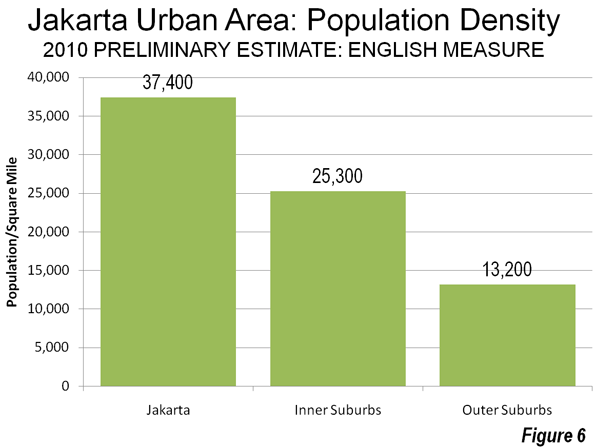
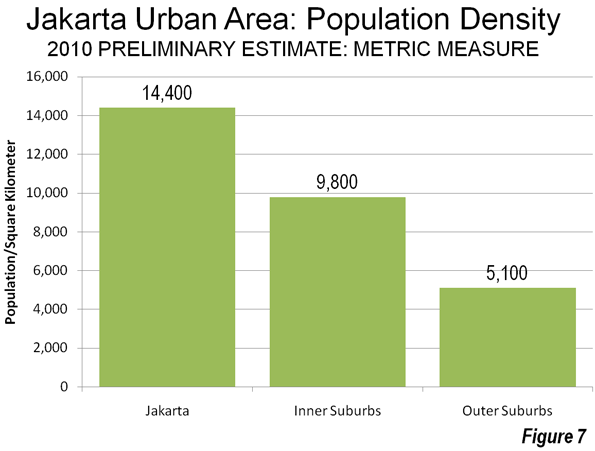
    Overall, the Jakarta urban area has a population density of approximately 22,000 per square mile or approximately 8500 per square kilometer. Yet the overall density of the Jakarta urban area has declined as population has moved to the outer suburbs which have a population density only one third that of the city of Jakarta. The inner suburbs have a population density that is only two thirds that of the city of Jakarta (Figures 6 and 7).


    Despite this, the Jakarta urban area is much denser than most large urban areas in the high income world. Overall, the Jakarta urban area is approximately 2.5 times as dense as the Paris urban area, more than three times as dense as the Los Angeles urban area, and approximately seven times as dense as the Portland urban area. Other urban areas in the developing world are even denser:  Delhi is more than 1.5 times as dense as Jakarta, Mumbai more than three times as dense and Dhaka is more than four times.


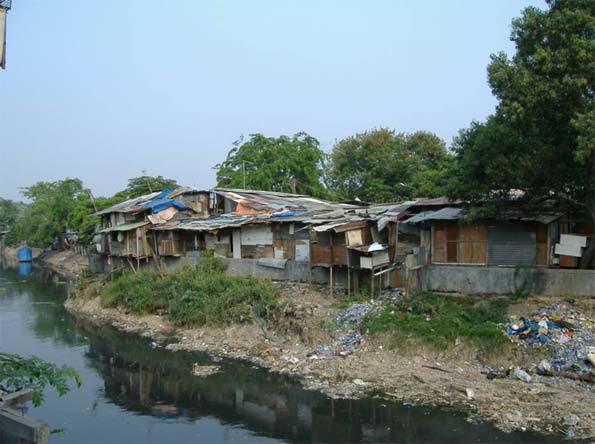
    Informal housing, city of Jakarta (photo by author)


    A Larger Metropolitan Area?  This continuing population growth could cause Jabotabek to expand even further. Indonesia’s President Susilo Bambang Yudhoyono (SBY) has proposed expanding the metropolitan area to include the regencies of Karawang, Serang, Purwakarta and Sukabumi as well as the municipalities of Serang, Sukabumi and Cilegon. Already, Jakarta’s continuous urbanization nearly reaches the Karawang urban area to the east (population over 600,000) and is nearing Serang regency to the west. SBY’s "Greater Jakarta" has a population approaching 36 million according to the 2010 census. Further pressure on suburban growth could be generated by plans in Jakarta to limit the core city’s population to 12 million.

    Yet even so it may take some decades, before Jakarta, or perhaps Delhi, could pass Tokyo-Yokohama’s nearly 37 million people to become the world’s largest urban area, assuming that they do not experience the reduced population growth so widespread in other megacities.   

    ———

    Notes:

    1. Caution should be used in making comparisons of metropolitan areas, especially between nations. There is virtually no consistency in the delineation of metropolitan areas between nations. In some cases, such as Japan, the United States, France and Canada, Metropolitan areas are based upon commuting patterns, but even between these nations there is no consistency.

    2. For the purposes of this article, suburbs are inside the urban area, but outside the central city (Jakarta). Exurbs are the portions of the metropolitan area (Jabotabek) outside the urban area.

    3. The provinces of Indonesia and the state of Virginia are subdivided similarly. In Virginia, all of the land area is divided into municipalities or counties. In the provinces of Indonesia, all of the land area is divided into municipalities (kota) and regencies (kapupaten). The regencies are further divided into sub-districts (kecamatan). Jabotabek is located in three provincial level jurisdictions, the Special Capital District of Jakarta, and the provinces of West Java (Java Barat) and Bantan. West Java has a population of 43 million, approximately 6,000,000 more than the largest state in the United States, California. Banten is bordered on the west by the Sunda Strait, location of Krakatoa, the volcano.

    Further, the name Jabotabek may not survive. As municipalities (Note 3) were carved out of the regencies in the 1990s and 2000s, the megacity was called Jabodetabek by some and proposed additions to the metropolitan area could bring even more variations. Inconsistent and alternative names probably make likely that sources will continue to call the megacity "Jakarta."

    4. This urban area population is much larger than reported by the United Nations, which for Indonesian urban areas limits its estimates to the jurisdiction of the core city, and thus excludes suburbs. As is generally the case throughout the world, the continuous urbanization of Indonesian urban generally areas extends far beyond core cities.

    —–

    Photograph: Luxury housing in Cileungsi sub-district, Bogor regency (outer suburbs), by author

    Wendell Cox is a Visiting Professor, Conservatoire National des Arts et Metiers, Paris and the author of “War on the Dream: How Anti-Sprawl Policy Threatens the Quality of Life

  • Recover, Rebuild: Christchurch New Zealand After the Earthquake

    Lincoln University in New Zealand did a great job of assembling some leaders in the principles and practice of disaster recovery for its Resilient Futures workshop recently in support of recovery in Christchurch after the February earthquake.  And in keeping with one of the themes – the importance of quality and timely communications – the papers and summary are already posted on the web.

    Without being there, it’s hard to judge the tone of discussion and the weight given to the lessons from experience overseas and in New Zealand.  But quick publication of the papers provides useful insights. 

    My immediate thoughts follow – but I recommend anyone interested to read the summary and original papers.

    Key themes

    Some of the papers looked a bit academic, but there is correspondence between what the practitioners and academics have  to say.  It’s good to see theory and practice reinforce each other. 

    Here are what I see as the most important threads:

    (1)    The common sense but urgent approaches proposed for recovery, and the practicality of  some of the examples of what has been done elsewhere and what can be done in Christchurch;
    (2)    The role of central government; there were differences in the detail among speakers, but by and large they see government adopting a leadership and motivational role, providing funding and oversight, especially in the recovery stage;
    (3)    Local democracy is a key based on the role of local government and citizen participation, especially in the planning and rebuilding processes, and on the importance of involving local, even localised, communities (“clusters", "villages”).
    (4)    The need for existing institutions to adapt to changed circumstances, streamlining decision-making while maintaining transparency;
    (5)    The need to ensure that citizen, community, and other interest groups can participate and contribute by way of knowledge, resources, and time;
    (6)    The need for speed, which nevertheless brings with it a risk of exacerbating pre-disaster imbalances and inequities between areas and groups; and the trade-off that may be required between speed and deliberation to deliver good long-term outcomes;
    (7)    Recognising how easily the temporary can become permanent, and planning accordingly;
    (8)    The window of opportunity that might be created for improving land uses and infrastructure in the course of replacement and rebuilding;
    (9)    Finding the time to envision the future, to build consensus around architecture and planning options, and to achieve citizen buy-in to proposed solutions;
    (10)The need for plans to address and reduce – and be seen to reduce – future risks;
    (11)The significance of open space,  the importance of greenways and green-spaces, the likelihood that the city will have to expand, and the notion of an expanded city as an assembly of connected villages.

    (It’s reassuring to see I’m not alone in advocating a new approach to spatial planning to limit the damage arising from extreme events, and to facilitate post-disaster recovery.  See my post of March 2 2011).

    The challenges

    There are potential contradictions in all this.  For example, speed is of the essence where infrastructure and shelter are laid waste, where jobs have evaporated, and communities have been torn apart. But haste should not create a city with parts which are forever temporary, where material gaps among groups widen, or where short-term expediency creates long-term risks. 

    Nor should the importance of government leadership limit the capacity of the community at large to participate in rebuilding, to deliberate and debate, and help shape the new Christchurch.

    The various speakers confirmed the importance of addressing multiple risks, something fundamental to planning for resilient cities.  If it can address multiple risks and provide outcomes that reduce them, then planning for the new Christchurch will enable “communities and local leaders to make best use of the opportunities the event has created”.

    The experience of previous disasters confirmed that public engagement is central to achieving “political stability, community buy-in and support for new initiatives, the identification of workable solutions, and a generally positive recovery that promotes confidence in both the process and the likely end result”.

    Differentiating recovery and rebuilding

    Perhaps what we need to do if we are to use the wealth of material and insight provided by the Lincoln University initiative, and others like it, and to work through the contradictions is distinguish between recovery and rebuilding.  Recovery is about restoring as quickly as practical safety, security and shelter, and the structures and infrastructure needed to ensure them.  It demands urgent attention, rapid deployment of resources, and  high level of expediency. 

    Rebuilding is a little less urgent and maybe even more challenging.  It is about the way communities will live in the future, how people get on with their lives, their play, their work, and their recreation in a healthy and prosperous urban environment.  Rebuilding requires deliberation, identification of options, and working our way to consensus.  It cannot be rushed.  Nor should it be unnecessarily prolonged.  Ideally, rebuilding will start with community engagement rather than tagging it on through consultation later on, a strategy which risks energy- and morale-sapping disputes about objectives and outcomes.

    Getting the governance right

    It appears from the papers presented that we know what has to be done: it’s how we set about doing it that is critical to a successful rebuild.

    Accelerating and sustaining recovery while laying solid foundations for rebuilding is perhaps the biggest challenge facing those in positions of authority and leadership.  Recognising the differences between them might be a good starting point.

    If this challenge is to be met, it is important that the governance structures – who does what and under what authority – are appropriate at the outset.  The creation of a central agency, the Christchurch Earthquake Recovery Authority (CERA), looks like a good start, especially if it focuses on recovery and thereby gives Christchurch City Council the space and capacity it needs to provide leadership in the rebuilding process.  How these two agencies demarcate their roles and work alongside each other will have a major impact on the creation of a resilient and liveable Christchurch.

    Phil McDermott is a Director of CityScope Consultants in Auckland, New Zealand, and Adjunct Professor of Regional and Urban Development at Auckland University of Technology.  He works in urban, economic and transport development throughout New Zealand and in Australia, Asia, and the Pacific.  He was formerly Head of the School of Resource and Environmental Planning at Massey University and General Manager of the Centre for Asia Pacific Aviation in Sydney. This piece originally appeared at is blog: Cities Matter.

    Photo by Geof Wilson

  • Goodbye, New York State Residents are Rushing for the Exits

    For more than 15 years, New York State has led the country in domestic outmigration: for every American who comes to New York, roughly two depart for other states. This outmigration slowed briefly following the onset of the Great Recession. But a new Marist poll released last week suggests that the rate is likely to increase: 36 percent of New Yorkers under 30 are planning to leave over the next five years. Why are all these people fleeing?

    For one thing, according to a recent survey in Chief Executive, New York State has the second-worst business climate in the country. (Only California ranks lower.) People go where the jobs are, so when a state repels businesses, it repels residents, too. It’s also telling that in the Marist poll, 62 percent of New Yorkers planning to leave cited economic factors—including cost of living (30 percent), taxes (19 percent), and the job environment (10 percent)—as the primary reason.

    In upstate New York, a big part of the problem is extraordinarily high property taxes. New York has the 15 highest-taxed counties in the country, including Nassau and Westchester, which rank first and second nationwide. Most of the property tax goes toward paying the state’s Medicaid bill—which is unlikely to diminish, since the state’s most powerful lobby, the political cartel created by the alliance of the hospital workers’ union and hospital management, has gone unchallenged by new governor Andrew Cuomo.

    New York City doesn’t suffer from outmigration to the extent that the state does; in fact, the city grew slightly over the past decade, thanks to immigration. And there’s more work in Gotham than in the state as a whole. The problem is that the kind of work available shows that the city accommodates new immigrants much better than it supports middle-class aspirations. A recent report from the Drum Major Institute helps make sense of the Marist numbers: “The two fastest-growing industries in New York are also the lowest paid. More than half of the city’s employment growth over the past year has been in retail, hospitality, and food services, all of which pay their workers less than half of the city’s average wage.” Worse yet, more than 80 percent of the new jobs are in the city’s five lowest-paying sectors. Parts of the country are seeing a revival of manufacturing—traditionally a source of upward mobility for immigrants—but not New York City, whose manufacturing continues to decline. The culprits here include the city’s zoning policies, business taxes, and declining physical infrastructure.

    Then there’s the cost of living in New York City. A 2009 report by the Center for an Urban Future found that “a New Yorker would have to make $123,322 a year to have the same standard of living as someone making $50,000 in Houston. In Manhattan, a $60,000 salary is equivalent to someone making $26,092 in Atlanta.” Even Queens, the report found, was the fifth most expensive urban area in the country.

    The implications of Gotham’s hourglass economy—with all the action on the top and bottom, and not much in the middle—are daunting. The Drum Major report, which noted that 31 percent of the adults employed in New York work at low-wage labor, came with a political agenda. The institute wants the city to subsidize new categories of work by expanding the scope of “living-wage” laws, which require higher pay than minimum-wage laws do, to all businesses that receive city funds or contracts. But that would mean higher taxes for the middle class and a further narrowing of the hourglass’s midsection.

    Governor Cuomo is calling for a property-tax cap, but without “mandate relief” for localities—for example, relaxing state laws that require localities to pay out exorbitant pension benefits. Mayor Michael Bloomberg has pledged not to increase local taxes, but even at their current level, city taxes and regulations will keep serving as an exit sign for aspiring twentysomething workers. In short, we can expect New York to lead the country in outmigration for the near future.

    This piece first appeared in the City Journal.

    Fred Siegel is a contributing editor of City Journal, a senior fellow at the Manhattan Institute, and a scholar in residence at St. Francis College in Brooklyn.

    Photo by Christopher Schoenbohm