Category: Urban Issues

  • Transit: The 4 Percent Solution

    A new Brookings Institution report provides an unprecedented glimpse into the lack of potential for transit to make a more meaningful contribution to mobility in the nation’s metropolitan areas. The report, entitled Missed Opportunity: Transit and Jobs in Metropolitan America, provides estimates of the percentage of jobs that can be accessed by transit in 45, 60 or 90 minutes, one-way, by residents of the 100 largest US metropolitan areas. The report is unusual in not evaluating the performance of metropolitan transit systems, but rather, as co-author Alan Berube put it, "what they are capable of." Moreover, the Brookings access indicators go well beyond analyses that presume having a bus or rail stop nearby is enough, missing the point the availability of transit does not mean that it can take you where you need to go in a reasonable period of time.

    Transit: Generally Not Accessible: It may come as a surprise that, according to Brookings, only seven percent of jobs in the nation’s largest metropolitan areas can be reached by residents in 45 minutes during the morning peak period (when transit service is the most intense). Among the 29 metropolitan areas with more than 2,000,000 population, the 45 minute job access average was 5.6 percent, ranging from 12.6 percent in Boston to 1.3 percent in Riverside-San Bernardino. The New York’s metropolitan area’s 45 minute job access figure was 9.8 percent (Figure 1).
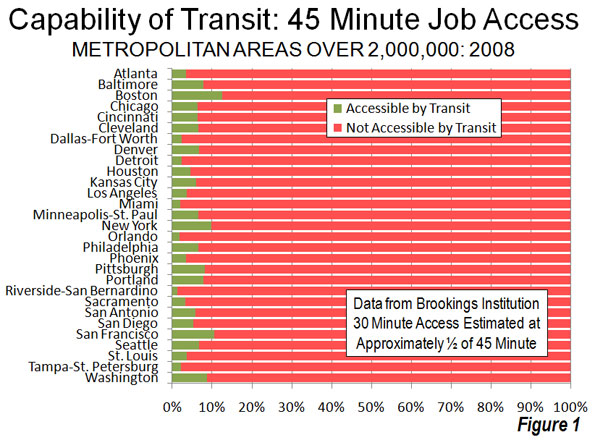
    Brookings did not examine a 30 minute transit work trip time. However, a bit of triangulation (Note 1) suggests that the 30 minute access figure would be in the range of 3 to 4 percent, at most about 4,000,000 jobs out of the more than 100 million in these metropolitan areas.   At least 96 percent of jobs in the largest metropolitan areas would be inaccessible by transit in 30 minutes for the average resident (Figure 2).
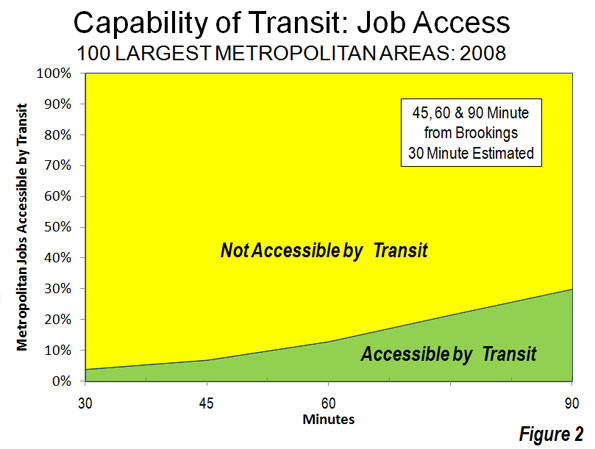
    The Brookings report also indicates that indicates that 13 percent of employment is accessible within 60 minutes by transit and 30 percent within 90 minutes (Note 2). Brookings focuses principally on the 90 minutes job accessibility data. However, the reality is that few people desire a 45 minute commute, much less one of 90 minutes.

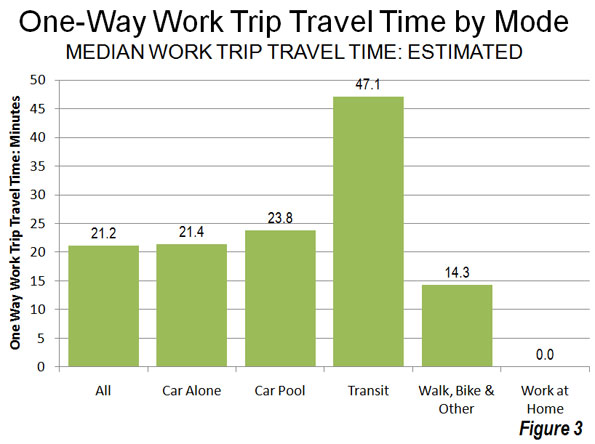
    In 2009, in fact, the median one way work trip travel time in the United States was 21 minutes (Note 3). Approximately 68 percent of non-transit commuters (principally driving alone, but also car pools, working at home, walking, bicycles, taxicabs and other modes) were able to reach work in less than 30 minutes. The overwhelming majority, 87 percent, were able to reach work in 45 minutes or less, many times transit’s seven percent. Transit’s overall median work trip travel time was more than double that of driving alone (Figure 3).
    A mode of transport incapable of accessing 96 percent of jobs within a normal commute period simply does not meet the needs of most people. This makes somewhat dubious claims that transit can materially reduce congestion or congestion costs throughout metropolitan areas. The Brookings estimates simply confirm the reality that has been evident in US Census Bureau and US Department of Transportation surveys for decades: that transit is generally not time-competitive with the automobile. It is no wonder that the vast majority of commuters in the United States (and even in Europe) travel to work by car.

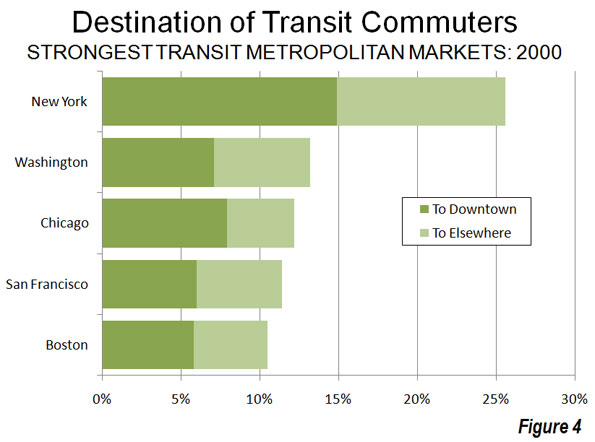
    Much of the reason for transit’s diminished effectiveness lies in the fact that downtowns — the usual destination for transit — represent a small share of overall employment. Downtown areas have only 10 percent of urban area employment, yet account for nearly 50 percent of transit commuting in the nation’s largest urban areas (Figure 4).
    Meanwhile, core areas, including downtown areas, represent a decreasing share of the employment market as employment dispersion has continued. Since 2001, metropolitan areas as different as Philadelphia, Portland, Dallas-Fort Worth, Salt Lake City, Denver and St. Louis, saw suburban areas gain employment share. Even in the city of New York, outer borough residents are commuting more to places other than the Manhattan central business district (link to chart).

    Transit: The Long Road Home: Transit problem stems largely from its relative inconvenience.    In 2009, 35 percent of transit commuters had work trips of more than 60 minutes. Only six percent of drivers had one way commutes of more than 60 minutes. For all of the media obsession about long commutes, more than twice as many drivers got to work in less than 10 minutes than the number who took more than an hour. In the case of transit, more than 25 times as many commuters took more than 60 minutes to get to work as those who took less than 10 minutes.

    Economists Peter Gordon and Harry W. Richardson have shown that the continuing dispersion of jobs (along with residences) has kept traffic congestion under control in the United States. Available data indicates that work trips in the United States generally take less time than in similar sized urban areas in Europe, Japan, Canada and Australia.

    Transit Access is Better for Low Income Citizens: The Brookings report also indicated that job accessibility was better for low income citizens than for the populace in general. Approximately 36 percent of jobs were accessible to low-income residents in 90 minutes, compared to the overall average of 30 minutes. This, of course, is because low income citizens are more concentrated in the central areas of metropolitan areas where transit service is better. But even this may be changing. For example, Portland’s aggressive gentrification and transit-oriented development programs are leading to lower income citizens, especially African-Americans, being forced out of better served areas in the core to more dispersed areas where there is less transit. Nikole Hannah Jones of The Oregonian noted:

    "And those who left didn’t move to nicer areas. Pushed out by gentrification, most settled on the city’s eastern edges, according to the census data, where the sidewalks, grocery stores and parks grow sparse, and access to public transit is limited." 

    Realistic Expectations: More money cannot significantly increase transit access to jobs. Since 1980, transit spending (inflation adjusted) has risen five times as fast as transit ridership. A modest goal of doubling 30 minute job access to between 6 and 8 percent would require much more than double the $50 billion being spent on transit today.

    Moreover, there is no point to pretending that traffic will get so bad that people will abandon their cars for transit (they haven’t anywhere) or that high gas prices will force people to switch to transit. No one switches to transit for trips to places transit doesn’t go or where it takes too long.

    Nonetheless, transit performs an important niche role for commuters to some of the nation’s largest downtown areas, such in New York, Chicago, Boston, San Francisco, and Philadelphia. Approximately half or more of commuters to these downtowns travel there by transit and they account for nearly 40 percent of all transit commuters in the 50 largest urban areas.   

    Yet for 90 percent of employment outside downtown areas, transit is generally not the answer, and it cannot be made to be for any conceivable amount of money. If it were otherwise, comprehensive visions would already have been advanced to make transit competitive with cars across most of, not just a small part of metropolitan areas.  

    All of this is particularly important in light of the connection between economic growth and minimizing the time required to travel  to jobs throughout the metropolitan area.

    The new transit job access is important information for a Congress, elected officials, and a political system seeking ways out of an unprecedented fiscal crisis.

    A four percent solution may solve 4 percent of the problem, but is incapable of solving the much larger 96 percent.

    Notes:

    1. For example at difference between transit commuters reaching work in less than 30 minutes and 45 minutes, Brookings employment access estimate of 7 percent at 45 minutes would become 3 percent at 30 minutes.

    2. The Brookings travel time assumptions appear to be generally consistent with data from the Census Bureau’s American Community Survey (ACS) and the US Department of Transportation’s National Household Transportation Survey (NHTS). Brookings, ACS includes the time spent walking to transit in work trip travel times (For example, the ACS questionnaire asks respondents how long it takes to get from home to work and thus includes the time necessary to walk to transit).

    3. Median travel times are estimated from American Community Survey data for 2009 and includes working at home. The "median" is the point at which one half of commuters take more time and one-half of commuters take less time to reach work and is different from the more frequently cited "average" travel time, which was 25.5 minutes in 2008.

    4. Is Transit Better in Smaller Metropolitan Areas? It is generally assumed that transit service is better in larger metropolitan areas than in smaller metropolitan areas. Yet, the Brookings data seems to indicate the opposite. Larger metropolitan areas tended to have less job access by transit than smaller metropolitan areas. In the largest 20 percent (quintile) of metropolitan areas, only 5.5 percent of employment was accessible within 45 minutes. This was the smallest quintile accessibility score, and well below the middle quintile at 9.2 percent and the bottom quintile at 8.3 percent. The top quintile included metropolitan areas with 2.6 million or more people, the middle quintile included metropolitan areas with 825,000 to 1,275,000 population and the bottom quintile included metropolitan areas between 500,000 and 640,000 (Figure 1). This stronger showing by smaller metropolitan areas probably occurs because it is far less expensive for transit to serve a smaller area. Further, smaller metropolitan areas can have more concentration in core employment.  Even so, smaller metropolitan areas tend to have considerably smaller transit market shares than larger metropolitan areas.

    Wendell Cox is a Visiting Professor, Conservatoire National des Arts et Metiers, Paris and the author of “War on the Dream: How Anti-Sprawl Policy Threatens the Quality of Life

    Photo: Suburban employment: St. Louis (by author)

  • The Recipe for Unlivable Cities in New Zealand

    The Auckland Council’s great vision is to make Auckland one of the world’s most livable cities. Yet the outcome of its currently proposed plans will be a city which is second best for most Aucklanders.

    Some 60% to 80% of residents of New World cities state a clear preference for a single family home with its own backyard. In Victoria state, where Melbourne is located, 70% of the population, for example, preferred a single family home according to one government study. There have been similar findings from US based groups like the National Association of Realtors.

    Yet even when this is acknowledged, many in the media, taking their clue from planners and urban theorists, seek to change this reality.  The May 9 issue of the NZ Herald carried a story titled “The Dying Backyard Dream” tells us “Many Auckland suburbs will become home to high-rise apartment blocks with the quarter acre dream (1,000 sq m) reserved for the privileged few.”

    This fairly represents the intended outcomes of Council’s Spatial Plan as outlined in the discussion paper “Auckland Unleashed”.  But if this new vision is realized how can Auckland be a “liveable city” for all those residents who are unable to realize their preference for a low-density suburban home? Instead, they must “learn to accept” life in “terrace houses, duplexes, courtyard houses, maisonettes, and 4 -5 storey apartment buildings”.

    When working-class and middle-class households find they are priced out of the market for the housing of their choice, they will simply move to some other location, here or overseas. This has long been the case with British migrants to places like New Zealand and now people from China and the diaspora countries, currently the largest source of new immigrants.

    Yet these households provide the core labour force for the productive sectors, and for the manufacturing sector in particular. For some reason engineers and scientists tend to place more emphasis on home life and work life balance than financiers, and other members of the “creative classes”. (i.e. those who are creative with other people’s money). Hence, in the Bay Area, engineers and scientists gravitated to suburban Silicon Valley while the “creative classes” gravitated to downtown San Francisco.

    The New Geography team have documented the recent changes in the diverse states of the U.S. using the data from the 2010 U.S. Census. Their findings deserve careful study if we want to provide livable cities for the mass of New Zealanders, rather than for a wealthy elite.  In the U.S., according to the most recent Census, middle class people and companies have moved to Texas and the Southeast, because these areas are business-friendly, have low housing costs, reasonable taxation, and regulatory environments that encourage industrial expansion.

    This suggests it may be time to propose urban visions that are more humane for the vast majority by rejecting intensification and concentration in favor of the more adaptable and resilient environment of more dispersed cities and suburbs.  A key advantage of smaller dispersed cities such as Raleigh, Austin, San Antonio and Indianapolis, is their more affordable housing means up to four out of five households can afford their preference for a suburban house with a backyard.

    The densifiers insist that dispersal increases commuting times and yet the average commute in low-density urban areas like Salt Lake City and Kansas City is slightly above twenty minutes. (Aucklanders should be so lucky).  If the aim is economic growth and job creation, the transport system must provide genuine mobility throughout the entire labour market of the metropolitan area, not just to the central business district.

    Auckland’s Spatial Planners should take note of this recent research, and Christchurch leaders should seize the opportunity to be the Number One City in New Zealand if they don’t.
    A major source of evidence in support of Unleashing Auckland is the ARC’s “Future Housing Demand Study” which assumes that Auckland’s density must increase to develop a healthy and growing urban economy. Unfortunately these assumptions are not supported by any evidence from the rest of the New World. In fact, forced densification is as often as not a   recipe for failure.

    The Auckland urban area is already the second densest in the New World and the street network was never designed to cope with such high densities. Rather than reducing congestion, doubling the density on a given street increases the vehicle trips on that street by at least 70 – 90%. How can such densification reduce congestion?

    These surveys of housing preference also tell us that the growing number of smaller households will not NEED three bedrooms, and hence will not prefer them. Such inferences ignore the growth in the spatial demands of home occupations, home arts and crafts, telecommuting, and the need for spare rooms to accommodate visiting friends and relatives – not to mention a lifetime’s accumulation of stuff. Even single people will buy a three bedroom house to guarantee long term salability and value. The rooms soon fill it up.

    Aging couples are presumed to want to be rid of their backyard “burden”. Yet we are a nation of gardeners, and retirees are some of the keenest gardeners of all. It’s a healthy hobby.

    The Wellington Regional Strategy Report also assumes the need for intensification, and also presumes “need” determines “preference” as in:

    The eventual decrease in two-parent families will have implications in terms of reducing demand for larger dwellings on larger sections, resulting in a surplus of this stock.

    So larger dwellings must be getting cheaper. Sorry, they are not.

    The report also presumes that ordinary folk just don’t know what they are doing when they make their choices. Researchers find that people actually make their trade-offs very well – especially the trade-off between travel times and distances, and price and amenity.

    Evidently, the early development of Silicon Valley was a dreadful error because“ … having centrally located and compact form of residential development provide greater benefits to the city than lower density forms.” But what would those scientists and engineers know? They built the world’s premier technology region in the suburbs, just as had been done a half century earlier in Los Angeles or in scores of other tech belts scattered from Austin, TX to the outer rings of London, Paris and Tokyo.

    The report also claims a “large proportion of retirees are currently moving to Kapiti Coast, which indicates there is an insufficient housing supply in other locations to meet their needs.” Maybe these retirees have actually chosen to live on the Kapiti Coast, an area of smaller, low density development sixty kilometers from Wellington, because they prefer it. Many people would share their choice. Similarly, who speaks for the children who lose the freedom to enjoy spontaneous outdoor play, and to benefit from a free-ranging life?

    There is nothing wrong with medium and high-density living for those who make a free choice within a functioning and affordable market. Councils should be maximizing our freedom to choose by focusing on general affordability. They must start by reducing the cost of land by freeing up supply.

    Owen McShane is Director of the Centre for Resource Management Studies, New Zealand.

    Photo by Pat Scullion

  • Asia’s New Landless Peasants?

    Landless people have long sparked instability in Asia. From the days of the Qin dynasty (3rd century B.C.), through the huge Taiping rebellion in the mid-19th century, to the successful Communist revolutions in China and Vietnam and a nearly successful insurrection in Malaysia during the mid-20th, the property-less have historically risen against those in power.

    Today as East Asia grows more affluent, landlessness is again on the rise. Although peasants in many places remain both poor and restive, the real threat is in the region’s dynamic cities, where rapid increase in housing prices threatens to push hundreds of millions outside the property-buying market.

    This boost in prices is due to the rapid economic and population growth in many Asian cities. Across China the price of housing per square meter more than doubled over the past decade, according to the National Statistical Bureau. Prices-compared-to-incomes in the diaspora hot beds of Singapore and Hong Kong are now, according to research from the consultancy group Demographia, the highest in the advanced world — at least 50% higher than New York, San Francisco, Toronto, Sydney or London.

    There are some good market-based reasons for these high prices. Most major Asian cities are thriving economically and growing far more rapidly than their Western counterparts. Over the past decade, the population of Shanghai, China’s largest city, rose 35%, or by nearly 6 million, which is more than the population of any Western European city besides London, Paris and Essen-Dusseldorf. Beijing’s population rose by 6 million in the past 10 years to nearly 20 million. And Singapore’s far more affluent population jumped 20%, a rate exceeded in the advanced world only by Atlanta, Ga., among urban areas of more than 4 million.

    The recent spike in prices, particularly in the more affluent cities, also stems from high liquidity, low interest rates and rising inflation, notes Cheong Koon Hean, CEO of Singapore’s Housing and Development Board. To these factors she adds what she calls “a herd mentality” as people rush to invest in property as a hedge against inflation.

    The traditional Chinese obsession with property ownership exacerbates these factors. As  Nanjing-based blogger and social critic Lisa Gu writes, “Owning a property is the greatest life-goal for most Chinese citizens.”

    In mainland China the rush to own is bolstered by the lack of a strong social safety net or popular trust in other investment vehicles, such as stock and bonds. ”China lacks good investment channels besides housing,” says Han Hui, senior partner in prominent Beijing real estate law firm. “People put money into real estate because they still don’t trust anything else.”

    The appeal of home-ownership in China is particularly marked since it’s more of a land-use right, which in the case of residential property, expires after 70 years (40 years for commercial property). The lease begins to run out on the date that the real estate developer signs for the land, and not on the homeowner’s date of purchase.

    Whatever its cause, this Asian form of irrational exuberance is clearly boosting inequality across the region’s cities.

    This is becoming a key issue, particularly for the younger generation.  ”House price” ranked third on the list of the top 10 most popular phrases used by Chinese netizens, says Lisa Gu. Many young Chinese, she notes, are giving up on the ideal of owning a house before marriage and starting their lives together as renters. This is widely called “getting married naked.”

    For young professionals this now might just prove a temporary annoyance, but it could evolve into something more bothersome as they age. Some might opt to avoid very expensive cities, such as Beijing or Shanghai, for up-and-coming smaller urban centers such as Chengdu, the provincial capital of agriculturally fecund Sichuan province. This city has a growing tech center but offers housing prices as much as one third those in China’s existing megacities. Although salaries are also lower, overall affordability remains much higher than in the established urban regions.

    For the many millions of poorer Chinese, including the many migrants from the countryside, the housing crunch presents a more serious issue. Most have moved to the big cities, particularly in eastern China, for better opportunities and quality of life. Virtually all the net growth in Beijing and Shanghai, according to the most recent Chinese census, came not from registered residents but among migrants — those lacking hokou status. They constitute now over one third of the population in these megacities.

    Such migrants include people of various incomes, but also a large impoverished population.  Some live in sub-standard conditions not often associated with the gleaming epicenters of Asian capitalism. Like residents of the slums of third-world cities, many are landless peasants, a group now estimated at 70 million or 80 million.

    This problem of landless peasants is likely to grow as more land is set aside for urban and industrial development. Many will face difficulty finding a decent place to live even as more affluent Chinese snatch up multiple apartments for speculative investment. This has accelerated a worsening gap between rich and poor that is of major concern to the country’s Communist rulers.

    Of course, no one suggests anything like a new peasant rebellion is in the offing. It is critical to recognize that, for all its imperfections, China’s astounding rise has lifted hundreds of millions of people out of the grip of unceasing poverty.

    But unaddressed, the property crisis could well slow east Asian capitalism’s rapid ascent. High housing prices may already be contributing to depressed birthrates — even in places where the “one child” policy does not apply, such as Singapore, Taiwan and South Korea.

    Such long-term problems are overshadowed by more immediate concerns. Fallout about cascading house prices led the Chinese central government earlier this year imposed new restrictions aimed at slowing rampant speculation — such as requiring 60% payments for second homes and restricting the purchases of additional homes.

    The interior city of Chongqing has taken even more drastic steps. The hardline government there has embraced a distinctly uncapitalist response to the housing crisis: a massive program to increase the supply of rental as well as state-owned apartments that would be available to poorer residents, including those from the countryside. This contrasts with programs in Singapore, where 80% of the population live in the public housing, but some 95% own flats purchased from current owners or the Housing Development Board.

    In China, the failure of the housing market to find places for the poor and working class could provide a rationale for expanding the state’s role in managing the economy. It certainly provides fuel for Chongqing’s active affirmation of what is seen as a revival of “red culture.”

    Beyond such ideological implications, the housing crisis could threaten both the long-term social stability and economic growth of East Asia. Unless addressed, growing dissatisfaction among a large bloc of property-less citizens has the potential to become a politically destabilizing force and a brake against market-friendly liberalization. As East Asia remains the primary driver of the world’s economic engine, this could prove bad news not only for upwardly mobile Chinese but everyone else as well.

    This piece originally appeared at Forbes.com.

    Joel Kotkin is executive editor of NewGeography.com and is a distinguished presidential fellow in urban futures at Chapman University, and an adjunct fellow of the Legatum Institute in London. He is author of The City: A Global History. His newest book is The Next Hundred Million: America in 2050, released in February, 2010.
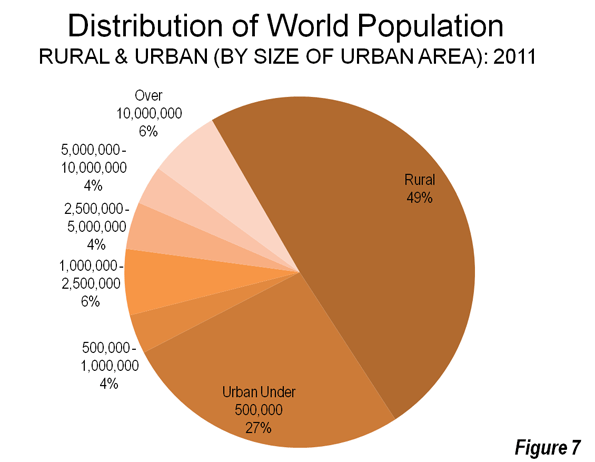
    Photo by Colin Manuel

  • Condo Culture: How Florida Became Floridastan

    Welcome to Griftopia. The Florida housing industry needs a karmic rebalancing. Our recent roar of building new structures is echoed today by the squeaks and pops of a different type of construction industry. Invasive testing – the architectural equivalent of a biopsy – seems to be on the rise. Saws, hammers, and cranes can be heard through the quiet suburban developments and subdivisions around Florida, as shingles and stucco are cut off in small patches to reveal serious problems within.

    Like the hidden defects in mortgage-backed securities and other arcane instruments of finance, these flaws are covered up and papered over, but are no less damaging. They are also just as revealing about our collective haste to accommodate growth.

    Few other places saw as much suburban expansion as Florida did, beginning in the 1990s and lasting right up until the bursting of the 2008 real estate bubble. Old hands in the Florida real estate development game see the cycle as never-ending, stretching all the way back to Ponce de Leon, whose “fountain of youth” was perhaps the state’s first marketing gimmick. The most recent bust, however, provides important lessons, should future cycles include speculators and regulators alike feeding at the trough. Rapid growth breeds errors, compromises, and sloppiness which have dire, lasting consequences.

    Pundits are assigning blame for the Millennial Depression up and down the economic ladder, and certainly the Florida housing boom and bust provides many examples of all that went wrong. The largest developers, driven by stockholders and Wall Street to seek rapid growth and high profits, gambled that Florida’s population boom would last forever. With the good addresses already taken, “B” properties close to interstates, under flight paths and adjacent to sensitive wetlands began to see activity. Low density reduced the developers’ risks and reduced construction costs, as well.

    The Florida condominium – outwardly appearing as an apartment complex — was a home ownership product for the masses. As long as the product lasted 30 years (or however long it took to pay off the mortgage), no one much cared about its quality and stability as an asset. Anonymous, stick-built stucco boxes, baking in the Florida sun, seemed the perfect solution to meet the demands of stockholders and investors, and the regulatory pathway was smoothed over to keep the production line rolling.

    Immigrants from abroad and from other parts of the country bought their own piece of the American Dream: gated entries, warrens of tight garages, patches of St. Augustine grass, buggy-whip sized oak trees and tightly wrapped stucco and glass boxes. Balconies are common, although the tiny decks and the heat preclude much enjoyment of the outdoors. Designed to prevent neighbors from meeting or children to freely play, these contemporary cracker box condos sullenly sweat in the heat. Still, they gave a much-needed step-up for the vast service workforce looking for a way out of the rental market and into an ownership position, and buyers can perhaps be forgiven for overlooking the cheapness of construction in favor of a new way to prosperity and success.

    The demand, however, outstripped the ability to deliver. Design and construction delays simply due to over-commitment and lack of manpower meant that corners were cut, compromises were made, and slop was tolerated. It was as if the investment mania on Wall Street – in journalist Matt Taibbi’s words, “griftopia” – had trickled down to the field superintendents, masons, and framing crews. A collective haste gripped much of the state’s growth industry, haste that is cause for regret today.

    A ten-year-old stucco building may look to be in perfectly good shape from the outside. When entering the bland, beige entry hall, however, the tang of mold immediately invades one’s nose. Once water has been trapped in a building it breeds a most sinister fungus.

    Condominium units that suffer this malady are ascending the legal chain one by one across the girth of the state. First, individual owners collect themselves and confront their homeowner’s association. HOAs bombarded with complaints succumb quickly to “condo chaser” attorneys who promise to split the goodly sums they can rake off the insurance companies that covered the contractors and design professionals involved in the mess. And then, discovery begins.

    It takes about a week to vivisect a low-rise building. Ordinarily, the stucco walls are saw-cut down to the bone, and the plaster comes off in a solid sheet, revealing metal strap ties and sheathing tissue within. The sheathing panels themselves are made of glued together wood chips – so-called “oriented strandboard” – only as strong as the glue itself. Removal of the sheathing layer reveals the deep ligaments and structural bones of the building.

    Buildings designed in Texas, Ohio, Georgia, and elsewhere populate the Florida landscape. These buildings have almost no roof eave at all, as if the fierce Florida sun didn’t matter. The skin-tight stucco may not be Portland cement plaster, because dryvit (an acrylic latex substitute for stucco invented after World War II to quickly rebuild Europe) has become a popular substitute. The windows are set at the outside of the wall, with no shading at all on the glass. The effect is that the building looks as stretched tight as a balloon.

    Unfortunately, such a combination frequently admits water into tiny cracks and crevices, and the water has no way to seep out. Revealing the interior guts of a building is the only way to uncork mold and rust horrors that are otherwise invisible. Insidious ants wind their way into the dark spaces between walls and floors where water and food are available.

    Biopsies on sick buildings reflect our collective errors of judgment, and the healing process will be lengthy and expensive. Designs that do not reflect the harsh realities of Florida’s hot, wet climate are certainly responsible for some of the errors. Designs that did not acknowledge the scarcity of experienced construction crews were also responsible, because construction takes teamwork and skill. And contractors, encouraged to cut costs in order to boost their own bottom lines, cut time or cut labor to get the job done faster.

    Designers and contractors may also legitimately point the finger back at clients who pushed hard. A collective irrationality set in towards the end of the last decade. More work had to be done by fewer people, less experience was available to go around, and in the heat of the moment steps could be skipped in the name of innovation. The consequences are being felt only now.

    A huge, sad pile of lost resources, our vanishing wood and raw materials, must be hauled off to clean these errors out of the system. Sadder to see are the homeowners, as they pack up and move out of their mold-infested units. But saddest of all is the apparent inability of the industry to learn from its own mistakes.

    Let’s hope that this time around it can happen differently. Reject growth for growth’s sake. Florida, hooked on this drug for too long, deluded itself into filling up wetlands and paving more and more space.

    Instead, as the tide rolls in once again, Florida can make a pact with itself to invest in development, rather than growth. Redeveloping older, inner cores of cities where services and employment are already in place can go a longer way towards making the state a sustainable, diverse place to live than paving one more tract of raw land mowed down for home lots can.

    Revamp the state’s development culture. Private developers have written Florida’s growth management code, and gradually increased the requirements so that only the largest and most deep-pocketed developers can compete. Protecting neither the environment nor quality of life very well, the development regulations are in dire need of rewriting, with a different set of requirements that favor smaller-scale development and redevelopment, and encourage affordability.

    In the meantime, discovery continues. More leaky roofs, more fungus-infested units, and more attics seething with ants, testimony to our collective haste and greed. As the nation slowly recovers economically, Florida has paused for breath on the pathway to healthy construction. Before the next boom, its development industry would be wise to use this break in the action to consider the alternatives.

    Richard Reep is an Architect and artist living in Winter Park, Florida. His practice has centered around hospitality-driven mixed use, and has contributed in various capacities to urban mixed-use projects, both nationally and internationally, for the last 25 years.

    Photo by the author.

  • Chicago: Out of the Loop

    The “global city” is one of the dominant themes related to  urban success today.  In this model, cities serve both as huge agglomerations of top specialized talent and also as “control nodes” of the global economy serving as key sites for the production of financial and producer services demanded by the new globalized economy. In her seminal book on the subject, Saskia Sassen noted New York, London, and Tokyo as the paradigmatic examples of the global city.

    The status of global cities, however, is protean, and not all “global cities” are created equal or occupy a similar status. Tokyo, for example, is clearly fading in the face of the shift of economic power from Japan to the Chinese sphere of influence – Shanghai, Beijing, Hong Kong and Singapore.

    Chicago has long prided itself as one of those cities, and consistently rated in the top ten global cities in various surveys. It’s a huge business services hub, financial hub, transport hub, cultural center, and massive draw for talent. The greater Loop area is clearly a classic global city area, densely packed with knowledge workers, with gleaming towers all around – over a hundred of which went up in the last decade. The transformation of the Loop and the surrounding neighborhoods in the last 20 years has been nothing short of stunning and remains a testament to the record of both Mayor Daleys.

    Even at its best, the global city model has its weaknesses, such as extreme income inequality, but at least it seems to provide a model that works in an era when so many urban formulas have failed.  Chicago, for example, has used its global city status to avoid the rot that has hit so many Midwestern cities.

    But for Chicago, though its global city side is running strong, there’s a serious problem. Although impressive both economically and awe-inspiring in its physical form, the greater Loop economy is just too small – especially relative to the size of the region. This suggests that the Chicago region cannot rely primarily on the global city to carry its economy.

    This might seem difficult to believe given that the greater Loop is the second largest business district in the United States and home to over half the region’s office space. But it can be easily illustrated by comparing Chicago employment to that in Manhattan.  Here’s a comparison of total jobs in Manhattan vs. all of Cook County, Illinois.


    Source: Quarterly Census of Employment and Wages

    As you can see, Manhattan has almost as many jobs as all of Cook County, and the two are converging. Given trends in both cities, it doesn’t seem unreasonable to think that in the near future Manhattan may actually have more jobs than Cook County.  Not only are there more jobs in Manhattan, but they pay significantly higher wages.  Here is a comparison of the average weekly wage between the two:


    Source: Quarterly Census of Employment and Wages

    Manhattan wages dropped as a result of the financial crash, but still remain 70% higher than Cook County – and until the crash had been pulling away.  They may be surging again as Wall Street has been a notable beneficiary of the bailouts. But the difference in scale is significant under any circumstances. Manhattan, with a mere tenth of the regional population, has about as many jobs as Cook County, which has over half the regional population. The wealth and income engine of Manhattan is simply of a different order and power than any other US city. As a result, the global city side of New York for which Manhattan is a proxy really can pay the freight for not just the outer boroughs, but also the greater region and the budgets of not only New York but to some extent New Jersey and Connecticut as well.

    By contrast, Chicago’s global city side, strong as it is, simply cannot perform the same role in powering its region and state. Though estimates are that it encompasses something like 600,000 people participate in it, and though the Loop along with select suburban business districts are legitimately thriving, this economy is just too small to support the entire region. In fact it can’t pay the bills even for the rest of Chicago itself, much less the region or state, especially considering that the non-global city parts are basically Rust Belt in character.  That’s one reason local government finance is in such rough shape.  The city is facing a deficit of about $650 million and the state’s unfunded future liabilities are upwards of $160 billion.

    Clearly, Chicago needs to continue focusing on expanding the size of its Loop economy and ensuring that it remains a top global city destination in the future. But unlike some other places that can hang their hat on that if they want, Chicago has to go beyond just being a global city and also be something more. After all, Chicago does not enjoy a “lock” on any industry, like New York with finance and media, or even Houston in energy, the Bay Area in technology or Los Angeles in entertainment. In almost every major business category it is not the lead player, which allows for greater economies of agglomeration and, perhaps even more importantly, a powerful and enduring global signature.

    But bluntly, the world city economy is too diffused and small to offer much to the 90% of its people who aren’t a part of that.  In short, Chicago needs more “outside the Loop” thinking.

    A critical aspect of the challenge here lies with improving  the state and local business climate, recently rated as one of the worst in the country by Chief Executive magazine. If you’re a hedge fund partner, architect, or celebrity chef, things are great. But for bread and butter type businesses and workers, which constitute the vast majority of the economy, things are quite different. That’s why everyone from the CEO of Caterpillar,based three hours from the city, on down is publicly complaining and threatening to move.

    Fixing this means finally rooting out the corruption that undermines confidence in local government, restructuring state and local finances to provide more certainty to investors, continuing to focus on education, addressing the infrastructure investment deficit, and radically reducing the red tape that plagues small and medium sized businesses.

    None of these are sexy or easy. In fact, the CEO of the Chicagoland Chamber of Commerce recently said he’s not putting any faith in claims by Rahm Emanuel, the new mayor  that red tape relief is on the way, reflecting the level of skepticism in the local business community right now. Today businesses in the city literally need a city ordinance passed in order to do seemingly simple things like add an awning or get a sidewalk café permit – something that is totally at the discretion of the alderman.  The Chicago Reader recently reported that this sort of “ward housekeeping” accounts for over 95% of city council legislation. Clearly this approach is toxic to business.  That’s why these items are absolutely mission critical items to creating a regional economy that can actually generate employment and pay the bills going forward. Glamor jobs and prestige employers downtown just aren’t going to cut it by themselves anymore.

    Aaron M. Renn is an independent writer on urban affairs based in the Midwest. His writings appear at The Urbanophile.

    Photo by Doug Siefken

  • Natural Gas Vehicles Floor It in Long Beach

    The Alternate Clean Transportation Expo held in Long Beach earlier this month was a spectacular display of engineering ingenuity by Natural Gas Vehicle providers. The event’s theme was that America’s self sufficiency in natural gas has decoupled our energy resources from petroleum prices. But the consensus among the gathered engineers and scientists was to look beyond the current prices of petroleum alone, and consider that domestic self sufficiency includes keeping jobs at home.

    The NGVs (Natural Gas Vehicles, which include Compressed Natural Gas—CNG, as well Liquefied Natural Gas—LNG) reduce greenhouse gas emissions almost 20 percent on medium and heavy duty models, and 30 percent on light duty vehicles.

    All fuels, including natural gas, release energy by burning. But cleanliness and renewability are probably the single most talked-about aspect of NGVs. From energy field to vehicle engine, natural gas needs very little processing to make it usable, compared to crude oil, which is processed into gasoline by complex and expensive refining techniques. A naturally occurring fuel, its chemical formulation is about 90% methane, with smaller amounts of ethane, propane, butane and carbon dioxide, a high octane rating of about 120 – 130, and clean burning characteristics.

    Biomethane gas is extracted from biomass, and is therefore renewable, and it can be produced economically in large quantities. Current estimates are that the US has proven reserves of over 1500 TCFs (trillion cubic feet) of natural gas which, by some estimates, should last for the next 100 years.

    Potentially, natural gas will create jobs not only through vehicle manufacturing, but through the construction of new CNG stations. A landfill processing plant near Dallas, Texas, owned by a pioneering company in CNG station installation, Clean Energy™, creates up to 9,000,000 GGEs (gasoline gallon equivalents)of biomethane gas for fueling stations. It has agreements with airports in Tampa, New York City, New Orleans and Philadelphia to build CNG filling stations that will support ground transport vehicles and off-airport parking shuttles.

    Of course, legitimate concerns have been expressed about the safety of natural gas vehicles. Notably, in a tragic 1998 accident a stopped bi-fueled Honda (a vehicle that can run on CNG or gasoline) was impacted by another vehicle moving at almost 100 mph. A fire started by the gasoline engine broke out.

    NGV supporters counter that the 50 liter CNG tank was intact and remained secure in its support bracket, that NGVs are subject to same federal standards as regular vehicles, and that natural gas cylinders are thicker and stronger than conventional gas tanks.

    The NVG safety record also includes a survey of more than 8,000 natural gas utility, school, municipal and business fleet vehicles that have traveled 178 million miles, in which the vehicle injury rate was 37% lower than in a gasoline fleet. Under federal and state regulations, fueling stations, indoor parking structures, repair garages and car dealerships must all meet high safety standards. Leaking gasoline forms puddles and creates a fire hazard; if the CNG engine leaks at all, the fuel will normally rise to the ceiling and disappear. Insurance companies nationwide have looked at the safety of natural gas buses and fleets and have no reservations about insuring them.

    Hybrids were also on display at the Expo, including a notable innovation by Parker Hannifin Company. Says Tom Decoster, business development manager of the Cleveland-based firm, “We are going to let California know there are alternatives to electric and CNG.” Parker’s alternative is the hydraulic hybrid, with regenerative braking energy stored as a pressurized gas in a vessel. These vessels are known to be accumulators, which Parker compares to batteries. While stored electricity from a battery drives a motor, energy from an accumulator powers a pump-motor to drive wheels. This assistance increases fuel efficiency and sometimes permits a smaller engine.

    Average fuel consumption for a conventional Class 8 vehicle is about 9,800 gallons per year. RunWise™, Parker’s vehicle, reduces the fuel consumption by 30 to 50 percent, depending on route density and operating conditions. “The more stops a vehicle makes during the day, the more efficient the system becomes relative to a conventional drive train,” Decoster says, adding that the NGV also reduces CO2 emissions, compared to a conventional vehicle, by 38 tons per year, the equivalent of about six midsize cars or planting 1,500 trees. It has reduced brake replacement cycles from every few months to almost 2 years. Parker’s technology is intended for refuse trucks and for fleets that need frequent stops, such as those run by FedEx and UPS.

    This highly technical conference and engineering-driven trade show was innovative in one other way, too. Expo organizer GNA designed events to reach out beyond the technorati to ordinary consumers who — it hopes — will one day be its loyal customers.

    Shashi Parulekar is a Los Angeles-based engineer. He holds an MBA, and served as Asia Pacific M.D. with Parker Hannifin Co in Michigan for over ten years.

  • Where Do the Children Play?

    Are compact cities healthy cities? One argument for compact cities is that they are good for our health.  The New Zealand Public Health Advisory Committee in 2008, for example, cited four principles for healthy urban planning based on the density of development: urban regeneration, compact growth, focused decentralisation, and linear concentration.  The aim is less time in cars and more use of active transport.

    One objective of Auckland’s Regional Growth Strategy, with its emphasis on CBD and centre-focused residential growth is “safe and healthy communities”.  But how far can that be achieved through residential intensification?  Does regulating for a compact city work for everyone?  Everywhere? 

    Kids and consolidation

    Research by Penelope Carroll and Karen Witten of Massey University, summarised here and in a recent article in The Aucklander, highlights the disadvantages for children in the inner city. 

    Witten and Carroll suggest that traffic volumes, strangers on the street, and lack of outdoor play space mean that children in central city environments are likely to be confined indoors.  And that raises the disadvantages of high density dwellings: insufficient space, internal noise, lack of natural light, lack of privacy, inadequate parking, inadequate indoor play space, and the potentially hazardous nature of balconies.  Poor health outcomes is a major concern.

    A key issue for children in compact parts of the compact city is lack of opportunity for outdoor activity.  Heavily trafficked streets are not good for bike riding, or even walking alone.  Auckland’s centre is devoid of segregated cycleways or play areas.  Getting to school or the park is a major mission, and may well need a car trip. 

    Even the Auckland Domain, a splendid sprawling park on the CBD fringe, is surrounded by high intensity streets, remote from most central apartments, and is hardly child-friendly.  The much smaller Victoria Park is similarly difficult to access, isolated by major arterial roads.  Albert Park is about the only central green space of note, but this is a throughway between university and town, not an ideal area for children to play. 

    Auckland CBD Green Space

    Perhaps the well-being of children is not a major issue here, because only around 600 (aged under 15) lived in the CBD in 2006.  But it was up 130% over a decade.  And they do count.

    Anyway, the limits of central city living for children – and families – flag more general issues:

    • The need to think seriously about how we cater for families in higher density living generally, in the CBD, in other centres, and in suburbs targeted for intensification;
    • How we provide safe, public green space, areas for play, and ease of movement in high density, mixed use environments; and
    • Just how healthy is the inner city residential for living generally?

    CBD living – not so healthy?

    The factors potentially stressing children in the CBD impact on adults too.  Research for Auckland City in 2003 (CBD Metadata Analysis by No Doubt Research) suggested dissatisfaction with inner city apartment living came from a diminished sense of security and safety, noise nuisance, small units, absence of outdoor living spaces, and lack of a sense of community. 

    In the absence of outdoor recreation space adult residents may get some exercise in the burgeoning gymnasium sector (for between $1,000 and $2,500 a year).  But for many recreational and social activities a car is a necessity.  Simply to take advantage of the key benefits cited for living in Auckland – access to outdoor recreation opportunities, organised sports, beaches, bush and countryside – residential Intensification around centres means more time- and fuel-consuming car trips.

    On top of a lack of open useable space the latest State of the Region Report documents the heaviest concentration of air pollutants in and around central Auckland, hardly a healthy living environment.

    Central Auckland Haze
    Source: Auckland Regional Council,
    State of the Region, 2010

    Community in the central city

    Research by Larry Murphy of the University of Auckland (“Third-wave gentrification in New Zealand: the case of Auckland” Urban Studies 2008, Volume 45) described different communities in the CBD: the well-to-do with their spacious harbour edge apartments (and quite possibly a second home – a beach cottage or lifestyle block – outside the city); the student-dominated quarter to the east; and the low income population to the west.  Families may end up in the latter area, in cramped apartments in featureless apartment blocks, simply for reasons of affordability.

    These are transient populations, some 52% of residents in the Central East and Central West Census Area Units had been in their current dwellings for less than a year in 2006.  This compares with 23% in Auckland as a whole.  These particularly high residential mobility figures contradict any suggestion that high density living might create a strong sense of community cohesion.

    Okay for some, for some of the time

    The CBD works for some people.  The proliferation of downtown bars and entertainment caters particularly for the young and well-to-do.  Gentrification of the harbour-edge works for the professional couple, the wealthy, and out-of-towners.  But the central city is not right for middle or low income households, or families. 

    Two key ingredients of a compact city strategy are increasing residential densities and boosting inner city living.  But these raise health and equity issues.  At the least, they call for investment in the quantity and quality of public space in areas targeted for intensification, making potentially big demands on the public purse given the value of land in the CBD and other commercial centres. 

    We may just have to acknowledge the benefits of suburban living for some time to come and seek opportunities for sustainable development that don’t oblige less well-off families to dwell in small apartments and featureless blocks around busy commercial areas for lack of affordable alternatives.

    Phil McDermott is a Director of CityScope Consultants in Auckland, New Zealand, and Adjunct Professor of Regional and Urban Development at Auckland University of Technology.  He works in urban, economic and transport development throughout New Zealand and in Australia, Asia, and the Pacific.  He was formerly Head of the School of Resource and Environmental Planning at Massey University and General Manager of the Centre for Asia Pacific Aviation in Sydney. This piece originally appeared at is blog: Cities Matter.

    Photo by Pat Scullion

  • World Urbanization Update: Delhi 2nd in a World of Smaller Urbanization

    Perhaps the most surprising development in urban areas over the past year was the ascendancy of Delhi to rank second in the world in population, following only Tokyo – Yokohama. Based upon the new United Nations population estimate, the 7th annual edition of Demographia World Urban Areas places Delhi’s population at 22.6 million. Tokyo – Yokohama, however, is in no immediate jeopardy of losing its number one status, with a population estimated at 36.7 million, approximately 70 percent greater than that of Delhi (Note 1). Demographia World Urban Areas includes population estimates  for all identified urban areas in the world with 500,000 or more residents. Among these 796 urban areas, 169 are in higher income nations and 627 are in lower income nations.

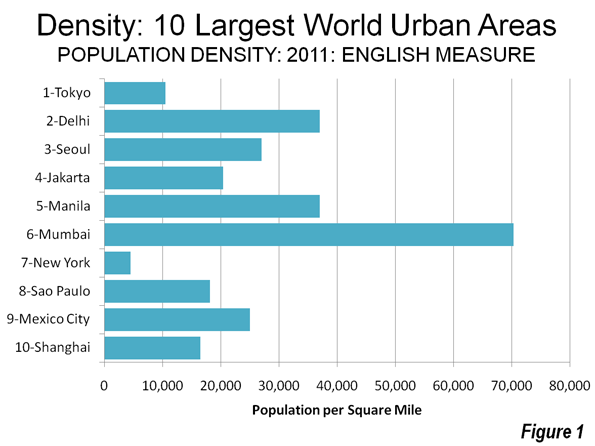
    The Largest Urban Areas: For years, demographers have been watching Mumbai on the assumption that it might eventually emerge as the largest urban area outside Tokyo – Yokohama. However, Mumbai, at 21.3 million, has fallen behind faster growing Delhi and now ranks as the sixth largest urban area in the world. Seoul-Incheon, in Korea, has emerged as the number three urban area, based upon higher than anticipated  suburban growth registered in the 2010 census and now shows a population of 22.5 million. Jakarta, Indonesia’s capital, now stands as number four, with a population of 22.2 million, followed by number five Manila at 21.3 million (Note 2). The next three largest world urban areas are in the Americas with New York at 20.7 million, Sao Paulo at 20.4 million and Mexico City at 19.6 million. The world’s 10th largest urban area is Shanghai (18.7 million), which experienced larger than anticipated growth toward the end of the decade (Table).

    10 Largest Urban Areas in the World: 2011
    Rank
    Geography Urban Area
    Current Year Population Estimate
    Land Area: Square Miles
    Density
    Land Area: Km2
    Density
    Density Year
    1 Japan Tokyo-Yokohama
    36,690,000
    3,500
    10,500
    9,065
    4,000
    2011
    2 India Delhi, DL-HAR-UP
    22,630,000
    605
    37,000
    1,567
    14,300
    2011
    3 South Korea Seoul-Incheon
    22,525,000
    835
    27,000
    2,163
    10,400
    2011
    4 Indonesia Jakarta
    22,245,000
    1,075
    20,400
    2,784
    7,900
    2011
    5 Philippines Manila
    21,295,000
    550
    37,000
    1,425
    14,300
    2009
    6 India Mumbai, MAH
    21,290,000
    300
    70,300
    777
    27,100
    2011
    7 United States New York, NY-NJ-CT
    20,710,000
    4,349
    4,500
    11,264
    1,800
    2000
    8 Brazil Sao Paulo
    20,395,000
    1,125
    18,100
    2,914
    7,000
    2011
    9 Mexico Mexico City
    19,565,000
    780
    25,000
    2,020
    9,700
    2011
    10 China Shanghai
    18,665,000
    1,125
    16,500
    2,914
    6,400
    2011


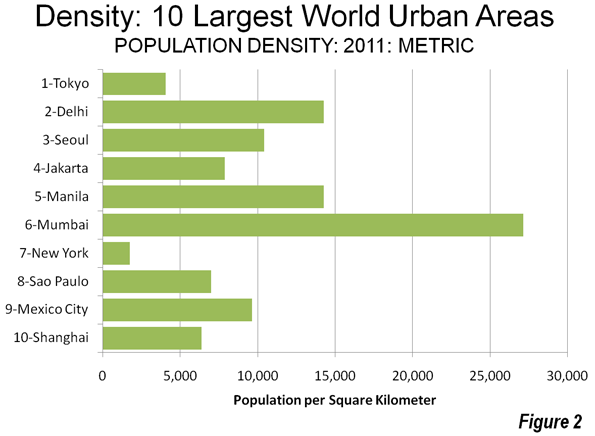
    Among the top ten urban areas, New York is by far the least dense, followed by Tokyo-Yokohama. They are also the most affluent, with seven of the remaining 10 far more dense and located in lower income countries, while Seoul-Incheon is more dense, but in a nation that is among the latest entrants to higher income status (Figures 1 & 2).


    Highest Population Densities: Dhaka, the capital of Bangladesh is the most dense with 90,600 persons per square mile or 35,000 per square kilometer. Dhaka ranks 24th in population in the world and crowds its approximately 11.5 million residents into 125 square miles or 325 square kilometers (less than the land area of the municipality of Portland, Oregon). Mumbai ranks second in population density, with 70,300 per square mile or 27,100 percent per square kilometer. Among high income urban areas, Macau is the most dense, at 70,000 per square mile or 27,000 per square kilometer, slightly ahead of its neighbor across the Pearl River, Hong Kong, which is estimated to have 66,100 residents per square mile or 25,500 per square kilometer. Of course, both Hong Kong and Macau have artificially high densities, driven by their enclave status. Comparatively few urban areas in the high income world exceed 15,000 per square mile (6,000 per square kilometer).

    Largest Urban Land Area: Although we commonly identify Gotham with the density of high-rise Manhattan, New York sprawls more than any of the top urban areas. Its urban area contains far the largest  land area, stretching to cover 4,350 square miles or 11,300 square kilometers. Los Angeles, more noted for its physical expanse, has approximately one-half the land area of New York and it extends less than both Tokyo – Yokohama and Chicago. Perhaps astonishingly, the Boston urban area covers approximately 95 percent of the land area of Los Angeles, though with only one-third the population.

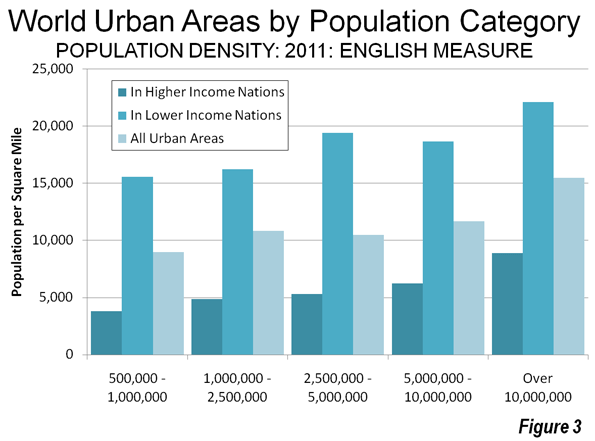
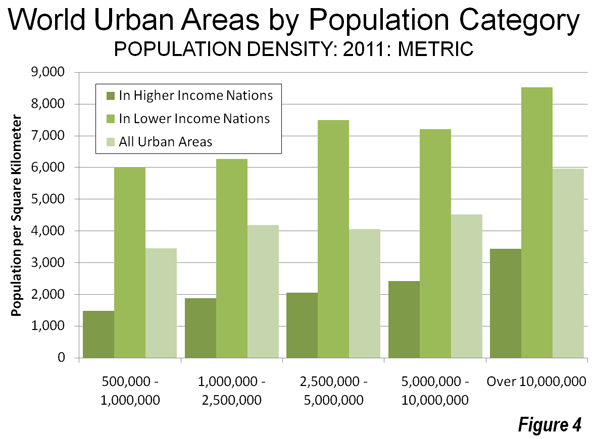
    Larger Urban Areas, Higher Density: As urban areas become larger, their population densities also increase. Moreover, as in the top 10 urban areas, lower income nations tend to have far higher densities than the urban areas located in the higher income nations(Figures 3 & 4).


    • Overall urban densities are approximately 9,000 per square mile (3,500 per square kilometer) in urban areas with between 500,000 and 1 million population and rise to 15,500 per square mile (6,000 per square kilometer) among urban areas with more than 10 million population.
    • Urban areas in higher income nations range from a population density of 3,800 per square mile (1,500 per square kilometer) among urban areas with from 500,000 to 1,000,000 population. Larger urban areas with more than 10 million population average o 8,900 per square mile (3,400 per square kilometer).
    • The urban areas located in lower income nations have far higher densities densities, ranging from 15,100 per square mile (6,000 per square kilometer) in the 500,000 to 1,000,000 population category and up to 22,100 residents per square mile (8,500 per square kilometer) in the over 10 million population category.           


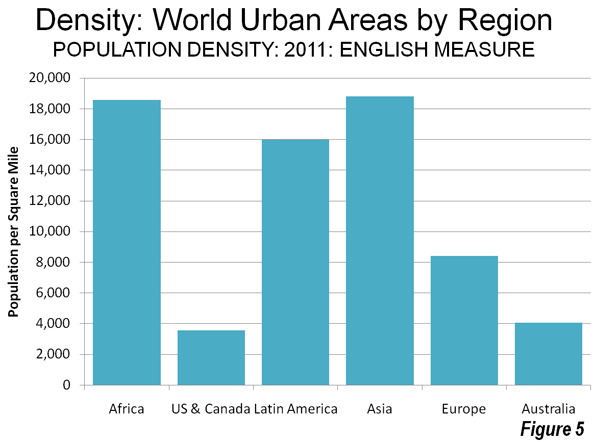
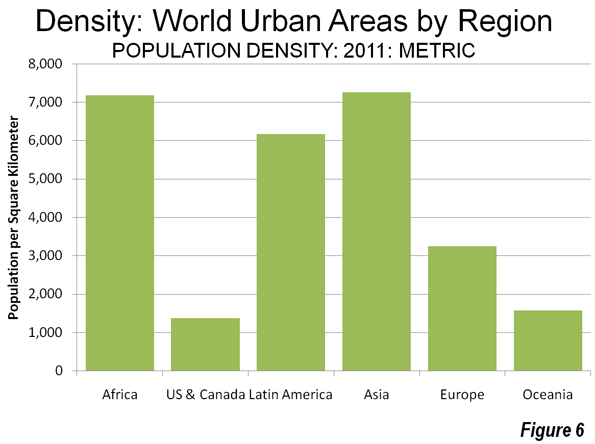
    Population Density by  Region: There is also considerable variation in urban population densities between the regions of the world (Figures 5 & 6).


    The lowest densities are in affluent areas. The United States and Canada, at 3,600 per square mile (1,400 per square kilometer), Oceania at 4,100 per square mile (1,600 per square kilometer) and Europe at 8,400 per square mile (3,200 per square kilometer). Latin American urban densities are 15,900 per square mile (6,200 per square kilometer), followed by Africa at 18,600 per square mile (7,200 per square kilometer) and Asia, at 18,800 per square mile (7,300 per square kilometer).

    The overall population density of urban areas with more than 500,000 residents in India is estimated at 37,000 per square mile (14,400 per square kilometer), which is more than double that of China, at 17,000 per square mile (6,700 per square kilometer).

    A Smaller Urban World? A review of the size of the world urban areas shows the planet to be made up principally of rural areas and towns and cities with less than 500,000 population. In 2011, approximately 51 percent of the world is urban and 49 percent is rural. Urban areas ranging from just a few thousand residents to under 500,000 residents account for 27 percent of the world’s population, which constitutes a majority of its urban population. Among the larger urban areas, megacities (10,000,000 and larger) and the urban areas with between 1 million people and 2.5 million people each for approximately 6 percent of the world population. The other larger categories of urban areas each account for approximately 4 percent of the world’s population (Figure 5).

    The McKinsey Global Institute recently reported that the world’s megacities were growing less quickly than the other large urban areas. This development, along with the distribution of world urban population may indicate that world’s largest urban areas, especially the megacities, may not be the wave of the future; instead it may be smaller urbanized regions between 500,000 and 10 million.  These regions, with three times the population of the megacities, will likely shape urbanity over the next few decades.

    —————-

    Note 1: An urban area is an urban agglomeration or an urban footprint (area of continuous development). An urban area is the organism of the “city” in its spatial dimension. Census authorities in a number of nations have adopted similar definitions for urban areas (Examples are United States, Canada, United Kingdom, France, Norway, Sweden and Australia). Demographia World Urban Areas uses national census bureau data for both population and land area estimates where it is available and estimates urban land area from satellite imagery for all others.

    Note 2: for the purposes of this analysis, higher income urban areas are generally in nations with a gross domestic product of $20,000 per capita, purchasing power parity.

    Note 3: The urban area population estimates of Seoul-Incheon, Jakarta and Manila are considerably of love those reported by the United Nations. The United Nations data for these urban areas is based upon a far smaller definition of urbanization than is used in other urban areas. As additional explanatory notes are found in Demographia World Urban Areas.

    Photo: India Gate, Delhi (by author)

    Wendell Cox is a Visiting Professor, Conservatoire National des Arts et Metiers, Paris and the author of “War on the Dream: How Anti-Sprawl Policy Threatens the Quality of Life

  • Is The Information Industry Reviving Economies?

    For nearly a generation, the information sector, which comprises everything from media and data processing to internet-related businesses, has been ballyhooed as a key driver for both national and regional economic growth. In the 1990s economist Michael Mandell predicted cutting-edge industries like high-tech would create 2.8 million new jobs over 10 years.  This turned out to be something of a pipe dream. According to a recent 2010 New America Foundation report, the information industry shed 68,000 jobs in the past decade.

    Yet this year, information-related employment finally appears to be on the upswing, according to statistics compiled by Pepperdine University economist Michael Shires. The impact of this growth is particularly marked in such long-time tech hot beds as Huntsville, Ala., Madison, Wis., and San Jose-Sunnyvale-Santa Clara, Calif., in the heart of Silicon Valley, all of which have relatively high concentrations of such jobs.

    The San Jose area, home of Silicon Valley, arguably has benefited the most from the  information job surge. Much of this gain can be traced to the increase in social networking sites such as Facebook, LinkedIn and Twitter, all of which have been incubated in the Valley. Good times among corporations  have led many to invest heavily in software productivity tools, while those marketing consumer goods have boosted spending for software and internet-related advertising.

    The 5,000 mostly well-paying information jobs added this year was enough to boost San Jose’s standing overall among all big metros 20 places to a healthy No. 27 in our ranking of the best cities for jobs.

    But as economists enthuse over the tech surge, we need to note the limitations of information jobs even in the Valley. Software and internet jobs, which have increased 40% over the past decade, have not come close to making up for the region’s large declines in other fields, notably manufacturing, construction, business and financial services. Overall, the region has lost 18% of its jobs in the past decade — about 190,000 — the second-worst performance, after Detroit, among the nation’s largest metros. It still suffers unemployment of close to 10%, well above the national average of 9.0%.

    This dual reality can also be seen in the local real estate industry. Office vacancies may be back in the low single digits in some markets popular with social networking firms, such as Mountain View, but they remain around 14 or higher throughout the region — 40% higher than in 2008. No matter how impressive reporters find a new headquarters for high-fliers like Facebook, the surplus of redundant space, particularly in the southern parts of the Valley, suggest we are still far from a 1990s style boom.

    Some observers also warn that the long-term prospects for the Valley may not be as good as local boosters assume.  Analyst Tamara Carleton cites many long-term factors — like the financial condition of local cities and diminishing prospects for less skilled workers — that make it tougher on those who live below the higher elevations of the information economy. She also says that a precipitous decline in foreign immigration could slow future innovation.

    This dichotomy is even more evident in the other big information gainer among our large cities, Los Angeles. Although it is little known by the media or pundit class, the Big Orange actually boasts the nation’s single largest number of information jobs. Its over 5% growth in information jobs translates to roughly 10,000 new positions over the past year. In LA, the big sector for information jobs is likely not social media but traditional entertainment, one of the area’s core industries.

    Yet information growth clearly is not bailing out the overall economy. Other much larger sectors, such as manufacturing and business services, continue to shrink. The area still suffers from an unemployment rate of roughly 12%.

    Other information winners among our large metros include Boston and Seattle, both traditional centers for software-related jobs. These areas have not been as hard-hit by the real estate and industrial declines as their California counterparts, so increasing information employment does not constitute the outlier that we see in the Golden State.

    Less expected gains were notched by some of our other big information sector winners. One big surprise was New Orleans-Metairie-Kenner, whose information sector, including a growing film and television industry, expanded almost 39% in past year. As is the case with its strong overall rankings in our best cities survey, the Big Easy’s comeback from the devastation of Katrina is heartening. But we must curb our enthusiasm by pointing out that total regional employment remains 100,000 less than it was before the hurricane.

    Equally intriguing has been the strong performance of Warren-Troy-Farmington, Hills, Mich., and Detroit-Livonia, each of which has benefited from the resurgence of the American auto industry. In these areas, information jobs tend to be tied to the needs of large industrial companies. The state has also waged a major campaign for film and television jobs, as part of an attempt to diversify its economy.

    Yet for all the hype that surrounds industries like media and software, it’s critical to point out that overall this is not a huge employment sector. Even in Seattle — home to Microsoft, Amazon and other software based companies — information jobs account for barely 6% of the total. In Los Angeles, it’s 5%, compared with 10% each for manufacturing and hospitality. In media-centric New York, information accounts for barely 4% of jobs, less than half that of financial services and one-third that of the huge business service sector.

    In most other areas, including those experiencing strong growth, information jobs constitute an even smaller part of the economy. In New Orleans, Warren, Mich., and Detroit, such jobs account for less than 2% of employment . Still, the growth of this sector is a promising one for  economies that have long been dominated, like New Orleans, by the generally low-paying hospitality industry, or in the case of the Michigan cities, the volatile and often chronically hurting manufacturing sector.

    The increase in information jobs, however welcome, should not be sold as a universal elixir for  creating widespread prosperity. Over time, strong regional economies are those that rely on diverse employment sources rather than one.  Growth in high-tech and media jobs can wow impressionable reporters and earn economic developers bragging reights, but they can do only so much to lessen the recession’s impact on the vast majority of workers and the broader regional economy.

    Top Cities for Information Job Growth, 2009-2010
    New Orleans-Metairie-Kenner, LA 38.86%
    Honolulu, HI 25.11%
    Shreveport-Bossier City, LA 18.85%
    Huntsville, AL 14.71%
    Leominster-Fitchburg-Gardner, MA  13.33%
    Redding, CA 10.53%
    Madison, WI 10.20%
    San Jose-Sunnyvale-Santa Clara, CA 10.01%
    Grand Rapids-Wyoming, MI 7.63%
    Providence-Fall River-Warwick, RI-MA 6.33%
    Top Big Cities for Information Job Growth, 2009-2010
    New Orleans-Metairie-Kenner, LA 38.86%
    San Jose-Sunnyvale-Santa Clara, CA 10.01%
    Providence-Fall River-Warwick, RI-MA 6.33%
    Los Angeles-Long Beach-Glendale, CA  5.08%
    Warren-Troy-Farmington Hills, MI  3.97%
    Boston-Cambridge-Quincy, MA  3.54%
    Riverside-San Bernardino-Ontario, CA 3.46%
    Charlotte-Gastonia-Rock Hill, NC-SC 3.02%
    Detroit-Livonia-Dearborn, MI  2.48%
    Seattle-Bellevue-Everett, WA  1.47%

    Joel Kotkin is executive editor of NewGeography.com and is a distinguished presidential fellow in urban futures at Chapman University, and an adjunct fellow of the Legatum Institute in London. He is author of The City: A Global History. His newest book is The Next Hundred Million: America in 2050, released in February, 2010.
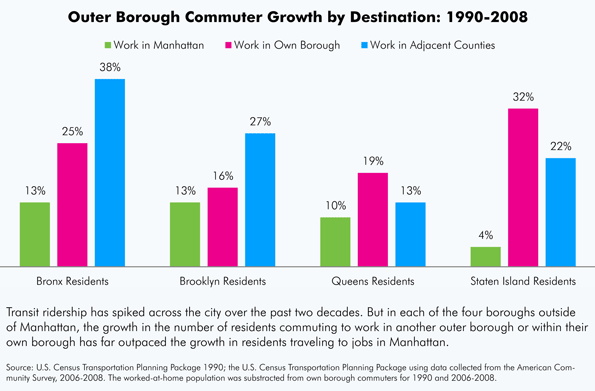
    Photo by Angelo Amboldi

  • Can the Winnipeg Model Save Detroit?

    Detroit, not only in the US but across the globe, has become the poster child for urban decay.  The city lost 25% of its population between 2000-2010, and over half its population since 1950.  Over 90,000 houses stand empty, and many neighborhoods have been completely abandoned. 

    The burden of maintaining infrastructure and law enforcement in a city with an eroding tax base and sparse population has lead to attempts to “shrink” the city.  This means bulldozing several areas of the city, and relocating existing residents.  Current Mayor Dave Bing realizes this, and has pledged to knock down a staggering 10,000 structures during his first term.  In the past such slum clearances lead to vigorous opposition from urbanists like Jane Jacobs, who argued that top down approaches to urban redevelopment would cause a great deal of pain, for little to no benefit.  Yet despite the fact that Jacobs is widely admired by planners, the plan to shrink the city has met with little opposition in Detroit.  Frankly, unless Detroit sees a major population surge, shrinking the city may sadly be necessary.  

    Last week, New York Mayor Michael Bloomberg appeared on NBC’s Meet the Press, and at one point mused about using immigration policy to repopulate the city.   Bloomberg didn’t offer a substantive policy proposal, but the premise makes perfect sense.  Most of Detroit’s problems stem from the fact that fewer and fewer people are working and paying taxes in the city.  There is more infrastructure than people need or the city can afford. 

    Ultimately the issue then is getting people to live in Detroit. But the biggest problem, even with a mild resurgence in the auto sector, is that Americans, and even most Michiganders, don’t want to live in Detroit, even with jobs.

    But for many immigrants, Detroit would seem like a major upgrade over their current living situation. This is not as far-fetched a notion as some may believe. Here’s a proposal for Detroit based on an unlikely Canadian immigration success story: Winnipeg.

    Learning from Winnipeg

    When Americans think of Winnipeg, they think of white guys wearing earmuffs in July, speaking with the kind of Canadian accents typically ridiculed on American sitcoms.  When Canadians from outside of Manitoba think of Winnipeg, they think of a former industrial city that is hardly a draw to the much sought after “creative class” even though  the city has the nation’s lowest housing cost.  What no one from outside the city associates with Winnipeg is immigration.

    Winnipeg’s immigration success is not well known outside of the province, but it is hard to dispute the facts.  Smart immigration policies have helped Winnipeg stabilize its population and reverse the city’s decline.

    Between 1971-1996, the city of Winnipeg grew by just under 16%, or roughly 0.6% per year.  Like many North American cities, all of the growth was taking place in the suburbs.  In fact, the population of Downtown Winnipeg shrunk by 23.25% during that period.  Though the rate of decline is nowhere near that of Detroit, the causes and effects are similar.  Manufacturing declined; people moved to the suburbs, aided by highway expansions and low cost automobiles; residents moved to more entrepreneurial cities, such as Calgary; ensuing job and population decline lead to a decline in safety.  The most notable difference is that racial tensions in Detroit exacerbated suburban flight.  But the similarities are sufficient to use Winnipeg as a model.

    Using immigration to reverse population decline in Manitoba

    In 1998, the Province of Manitoba introduced the Provincial Nominee Program, which gave the province the ability to recruit immigrants over and above federal immigration quotas.  Since Manitoba was not seen as the most attractive place for new immigrants to settle, only 1.8% of immigrants to Canada settled in the province between 1996-2000 (Note 1).  Since the introduction of the nominee program, immigration to the province has increased by 250%.  The increase in the City of Winnipeg has been staggering.  In the years 1996-2000, the city saw 15,809 new immigrants.  In just one year, 2007-2008, the city attracted 16,585 immigrants.  Equally as important, 78% of Manitoba immigrants stay in the province, which is a significant improvement over the 1980s, when they had a retention rate of less than 50%.  Increased immigration ended Manitoba’s population stagnation, and the province now enjoys consistently positive net migration.

    Economic outcomes of Manitoba immigrants

    A survey of immigrants who migrated to Manitoba through the provincial nominee program shows promising results.  Three quarters of participants surveyed have never experienced involuntary unemployment.  Of those surveyed, 85% were employed, and 7% were in school.  While the average annual household income of $49,066 for participants is lower than the provincial average of $60,242, they are generally making enough money to live reasonably well, contributing to the provincial and municipal tax bases. 

    Reasons for the program’s success

    Of course, mass immigration often creates challenges for recipient regions.  Aside from the need for immigrants to find jobs, they also often require language training, and educational upgrading to meet certification levels for their professions. However, the success of the program shows that participants were by and large able to overcome these difficulties.  Some of this can likely be attributed to the fact that immigrants of similar backgrounds tended to cluster together, some integrating into communities with existing settlers of similar backgrounds.  The primary examples of these two patterns are the concentration of Filipino immigrants in Winnipeg, and the large number of Mennonites from Germany, Mexico, and South America who integrated into existing Mennonite communities.  This can be important, since it allows for them to develop, or take advantage of informal support networks.  Living in a community with speakers of the same language makes it easier for immigrants whose first language is not English to integrate into the community, and can help with finding employment. 

    Benefits of targeted immigration to Detroit

    Immigration is often a source of innovation and entrepreneurship.  Recent studies have shown that immigrant entrepreneurs in America have created more jobs for existing Americans than  for other    immigrants.  More people moving to Detroit would also mean more customers for the service industry in the city.  And by paying property taxes, they would help to keep the city government afloat.  Perhaps the most important benefit would be that more people generally would make the city safer.  Criminals, after all, hate witnesses. 

    Hopeful signs from recent immigration to Detroit

    Recently, Detroit has experienced an influx of Latino and Muslim immigration.  Despite the stigma attached to these groups by many Americans, anecdotal evidence suggests that these newcomers have been a boon to the city.  According to the Immigration Policy Center, Arab American employment now contributes $7.7 billion to the Detroit metro economy, and provides $544 million in tax revenue to the state.  They now support over 140,000 jobs in the city.  Latino immigrants are being credited with helping to revitalize Southwest Detroit, which saw $200 million of investments between 1993-2008, and the area’s population grew by nearly 7% between 1990-2000 even as most of the city declined.  The City is now home to nearly 50,000 Latinos, up from under 20,000 in 1990.    

    And for those who claim immigrants take American jobs, the evidence suggests the opposite.  Despite the fact that immigrants have lower average wages than non-immigrants, they manage to have a disproportionate economic impact in many cities, Detroit being one of the best examples.  According to the Fiscal Policy Institute, immigrants contribute 1.3 times as much to the economy per capita as non-immigrants in Detroit.  This means, among other things, they disproportionately create jobs and contribute to the tax base.    

    Policy recommendations

    Creating a targeted immigration program would require co-operation between municipal, state and federal governments.  The policies recommended here are one set of options among many.

    • The federal government should create an ”urban revitalization” visa category to allow for municipalities with severe demographic declines to accept immigrants without counting them towards immigration quotas.
    • The state of Michigan, or other similarly challenged states, should create a specific program modeled on Manitoba’s provincial nominee program.
    • Immigrants should be required to prove that they have the financial means to support themselves for a specified amount of time in the absence of income.  This would ensure that they didn’t burden the existing welfare system.
    • Participants in the program could be required to undertake language training at their own expense, or to prove a basic competence in English. 
    • The City of Detroit should move more aggressively towards allocating abandoned buildings to provide housing or places for businesses of immigrants, or anyone else who wants to occupy them for that matter.  Filling buildings means more property taxes.
    • The City should concentrate on settling new immigrants of similar ethno-linguistic backgrounds into specific underpopulated areas.  Rather than simply allowing a certain number of immigrants into the city, they could create zones with high vacancy levels, and allow immigrants who apply to the program to move into these zones initially.  The aim should be to populate one neighborhood every two years to fill current vacancies.
    • Instead of punitive measures to force immigrants to stay in Detroit, the city should provide incentives to stay.  This could include requiring immigrants under this program to sign long term leases with large deposits, or to purchase property.  This is preferable to attempting to monitor the movement of immigrants. 
    • The city and state should attempt to partner with businesses, who may be interested in opening operations in the city due to the influx of immigrant labor.  This could help to give further incentives for new immigrants to stay, and create jobs for existing unemployed residents.

    Many of these recommendations require more micromanagement than I’d personally prefer, but address political and economic realities.  Simply allowing anyone and everyone to immigrate to Detroit or anywhere else in America is a political non-starter.  Also, the dire budgetary situation facing the City of Detroit and the state of Michigan means that neither can afford to allow new immigrants to become economic liabilities.  After all, the justification for this program is to replace the tax base and reduce crime, not to create a new underclass.  Though there would certainly be some hiccups, evidence in Winnipeg and Manitoba could help to revitalize both Detroit and much of the state of Michigan.  Failure to undertake an aggressive revitalization strategy will make an aggressive shrinking strategy inevitable.  Given the two choices, revitalization seems vastly preferable.

    Note 1: Unless otherwise noted, data on the Manitoba Provincial Nominees Program is based on http://www2.immigratemanitoba.com/asset_library/en/resources/pdf/pnp-manitoba-provincial-nominee-program-tom-carter-report-2009.pdf


    Steve Lafleur is a public policy analyst and political consultant based out of Calgary, Alberta. For more detail, see his blog.

    Photo by Arlo Bates