Category: Urban Issues

  • Fifty Years of Population Change in the US: 1960-2010

    A new census leads us to ask how population has changed, but usually discussion is focused on changes since the last census. But even more interesting is to appreciate the vaster changes over a greater sweep of time, for example: the fifty years since 1960, when the United States had 179 million people, toward the end of the post-war Baby Boom.

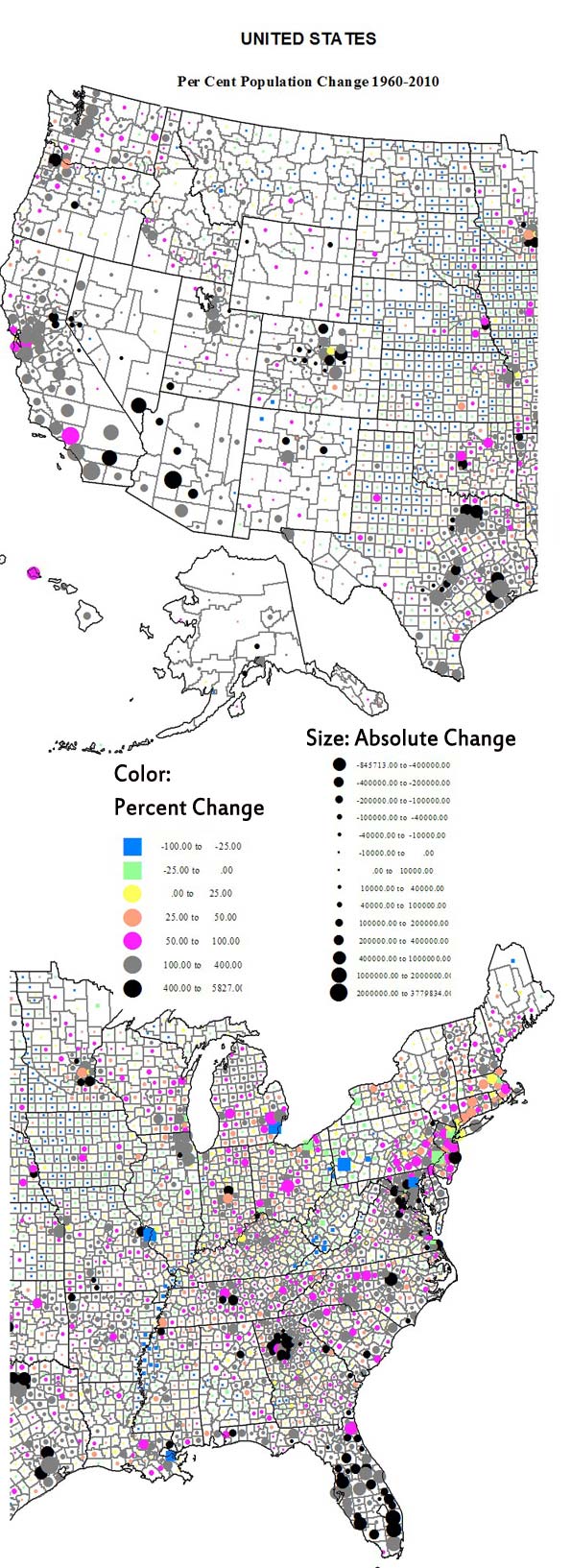
    Over this fifty year period, the country experienced a tremendous economic expansion and metropolitan growth. The attatched maps and charts display these changes, both in the greatest absolute and relative (percentage) losses and gains. We can then assess areas and regions that changed the most – or the least – and how this pattern differs from the most recent decade.

    Looking at both the maps and the tables, high absolute losses are in large northeastern metropolitan counties, plus, because of Katrina, Orleans (New Orleans).  Next most prominent in terms of losses are mining and small industrial counties in Appalachia as well as the largely rural Black majority counties in the Mississippi delta (Arkansas and Mississippi). Far more widespread in terms of space are small absolutely but often high percentage losses across the Great Plains, the rural small town heartland of the country. Losses do extend to the west, in a few mining and farming counties, as in MT, ID, OR and WA, as well as a few Native American reservation areas. 

    From Table 1 (below), 12 counties lost more than 100,000 people since 1960, most in the northeastern historic urban industrial core, including two New York City boroughs. The bigger loser by far, however, was Wayne (Detroit) . Next were Philadelphia, which lost 477,000 and St. Louis, falling 57 percent from 750,000 to 319,000.   Among non-metropolitan counties, the largest absolute losses were in West Virginia, Kentucky and Pennsylvania (mining), and Arkansas and Mississippi (high Black population).

    High relative losses (table 2) of over 50 percent beset 69 counties, all non-metropolitan   except one: St Louis. States with the greatest number of declining counties included North Dakota, 19; Texas, 16; South Dakota, 6, Kansas, Montana and Nebraska, 4; Arkansas, 3; and Missouri, 2. Most were in the Plains states. It is also clear that a high proportion of counties – both metropolitan and non metropolitan – with high Black populations have experienced losses, a sad commentary on disinvestment in areas with high African-American shares.

    In contrast, the pattern of gains is more complex.  Overwhelmingly, the highest absolute amounts (table 3) – and often percentage gains (table 4) – are in mostly larger metropolitan complexes. For the largest areas, the core counties often had lesser rates of growth, even if the absolute amounts were very large (e.g., Los Angeles, Cook, Dallas-Fort Worth, Houston). In contrast the highest rates of growth, often over 400 percent, took place in their satellite or suburban counties. Most obvious are greater Los Angeles and San Francisco, Denver, the large Texas metropolitan areas, Minneapolis, Chicago-Milwaukee, Atlanta, Indianapolis, Seattle, Portland and Washington, DC.  More recent, less suburban (at least in terms of jurisdiction) dominated areas, often in the Sunbelt, include especially Maricopa (Phoenix), Las Vegas, Salt Lake, Nashville, Charlotte, Raleigh, and Richmond.

    This leaves perhaps the two most spectacular (along with California, obviously: the northeastern Megalopolis and Florida. Florida clearly has the highest overall rate of change over this period. The northeastern Megalopolis is highly varied, but overall now spreading from Richmond, Virginia to Portland, Maine. It has developed into an astounding agglomeration of growth, with the locus of fastest absolute as well as percentage growth in its suburban and exurban portions.

    Growth was also often substantial in non-metropolitan or now small metropolitan areas in many parts of the country. An especially remarkable belt of growth – including small towns – extends from Memphis across Tennessee and North Carolina. Another span of significant growth – despite decline or slower growth in the recent past – lies in the Midwest (Indiana, Ohio, Michigan, Wisconsin and Minnesota). Belts of growth follow the I-5 corridor from California to Canada, the corridor from Tulsa through Fayetteville and Springfield to St Louis, and the I95 coastal south Atlantic strip.

    Sixteen counties gained a million or more: Los Angeles, Orange, San Diego, Riverside and San Bernardino, a southwestern megalopolis; Santa Clara (San Jose); Harris (Houston); Dallas and Fort Worth (Tarrant) and Bexar (San Antonio) in Texas; Miami, Ft. Lauderdale (Broward) and Palm Beach, Florida; Clark (Las Vegas); King (Seattle); and Maricopa (Phoenix).

    Finally the counties which grew at the fastest rate over the 50 years include some 118 that grew by 400 percent or more, and 27 that expanded more than ten-fold. States with the most such counties (400 to 1000 % ) include Florida, 15; Georgia, 11; Colorado, 8; Texas, 6; Virginia 6; California, 4; AZ,MN, MO, NC, and NV, 3 each; MD, NM, OR, TN, WY, 2 each; with 1 each in AL, AR, AK, IL, IN, KY, LA, MS, NE, OK, PA,  SC, UT and WA. Among the over 1000 percent growth, AK and AZ, 1; CO, 3; FL, 8; GA, 4; NV, 2; TX, 6; UT, 1; and VA, 1. 

    Types of counties with over 400 percent growth include 3 core metropolitan, 69 suburban, 44 environmental, and 2 others, often resource development. The fastest growth county was Douglas in suburban Denver, followed by environmentally attractive Mohave, AZ, and Flagler and Collier, FL, followed by Dallas suburb, Collin, and Atlanta suburb Gwinnett.

    Conclusion
    People continue to come to the US in large numbers, and people move from place to place in remarkable numbers.  Don’t count on the current pattern of population to remain very stable, just as the last fifty years have not been.  For example, while the northeastern “Rustbelt” seems in trouble, it is a region of vast plant capacity, superior universities, and a high quality labor force. A reaction to the high cost of excessive outsourcing, and even  some shifts from the “new South” could bring about a surprising restoration.

    Table 1: Largest Absolute Losses, 1960-2010
    Name
    1900
    1960
    2000
    2010
    Change 1960-2010
    Percent Change, 1960-2010
    MI Wayne County 348,793 2,666,297 2,061,162 1,820,584 -845,713 -31.7%
    PA Philadelphia County 1,293,697 2,002,512 1,517,550 1,526,006 -476,506 -23.8%
    MO St. Louis city 575,238 750,026 348,189 319,294 -430,732 -57.4%
    PA Allegheny County 775,058 1,628,587 1,281,666 1,223,348 -405,239 -24.9%
    OH Cuyahoga County 439,120 1,647,895 1,393,978 1,280,122 -367,773 -22.3%
    MD Baltimore city 508,957 939,024 651,154 620,961 -318,063 -33.9%
    LA Orleans Parish 287,104 627,525 484,674 343,829 -283,696 -45.2%
    DC District of Columbia 278,718 763,956 572,059 601,723 -162,233 -21.2%
    NY Erie County 433,686 1,064,688 950,265 919,040 -145,648 -13.7%
    NJ Essex County 359,053 923,545 793,633 783,969 -139,576 -15.1%
    NY Kings County 1,166,582 2,627,319 2,465,326 2,504,700 -122,619 -4.7%
    NY New York County 2,050,600 1,698,281 1,537,195 1,585,873 -112,408 -6.6%
    WI Milwaukee County 330,017 1,036,041 940,164 947,735 -88,306 -8.5%
    MA Suffolk County 611,417 791,329 689,807 722,023 -69,306 -8.8%
    VA Norfolk city 46,624 305,872 234,403 242,803 -63,069 -20.6%
    OH Hamilton County 409,479 864,121 845,303 802,374 -61,747 -7.1%
    OH Mahoning County 70,134 300,480 257,555 238,823 -61,657 -20.5%
    WV Kanawha County 54,696 252,925 200,073 193,063 -59,862 -23.7%
    PA Cambria County 104,837 203,283 152,598 143,679 -59,604 -29.3%
    Table 2: Greatest Relative Losses 1960-2010
    Name
    1900
    1960
    2000
    2010
    Change 1960-2010
    Percent Change, 1960-2010
    ND Sheridan County 4,350 1,710 1,321 -3,029 -69.6%
    WV McDowell County 18,747 71,359 27,329 22,113 -49,246 -69.0%
    HI Kalawao County 1,177 279 147 90 -189 -67.7%
    ND Burke County 5,886 2,242 1,968 -3,918 -66.6%
    TX Cottle County 1,002 4,207 1,904 1,505 -2,702 -64.2%
    TX Loving County 33 226 67 82 -144 -63.7%
    ND Logan County 1,625 5,369 2,308 1,990 -3,379 -62.9%
    NM Harding County 1,874 810 695 -1,179 -62.9%
    ND Divide County 5,566 2,283 2,071 -3,495 -62.8%
    TX Terrell County 2,600 1,081 984 -1,616 -62.2%
    CO La Plata County 7,016 19,225 43,941 7,310 -11,915 -62.0%
    ND Grant County 6,248 2,841 2,394 -3,854 -61.7%
    ND Slope County 1,893 767 727 -1,166 -61.6%
    MS Quitman County 5,435 21,019 10,117 8,223 -12,796 -60.9%
    ND Hettinger County 6,317 2,715 2,477 -3,840 -60.8%
    MS Issaquena County 10,400 3,576 2,274 1,406 -2,170 -60.7%
    ND Cavalier County 12,580 10,064 4,831 3,993 -6,071 -60.3%
    ND Towner County 6,491 5,624 2,876 2,246 -3,378 -60.1%
    SD Campbell County 4,527 3,531 1,782 1,466 -2,065 -58.5%
    ND Steele County 5,888 4,719 2,258 1,975 -2,744 -58.1%
    ND McIntosh County 4,818 6,702 3,390 2,809 -3,893 -58.1%
    ND Emmons County 4,349 8,462 4,331 3,550 -4,912 -58.0%
    TX Motley County 1,257 2,870 1,426 1,210 -1,660 -57.8%
    SD McPherson County 6,327 5,821 2,904 2,459 -3,362 -57.8%
    MO St. Louis city 575,238 750,026 348,189 319,294 -430,732 -57.4%
    Table 3: Largest Absolute Gains, 1960-2010
    Name
    1900
    1960
    2000
    2010
    Change 1960-2010
    Percent Change, 1960-2010
    CA Los Angeles County 170,298 6,038,771 9,519,338 9,818,605 3,779,834 63%
    AZ Maricopa County 20,457 663,510 3,072,149 3,817,117 3,153,607 475%
    TX Harris County 63,786 1,243,158 3,400,578 4,092,459 2,849,301 229%
    CA Orange County 19,696 703,925 2,846,289 3,010,232 2,306,307 328%
    CA San Diego County 35,090 1,033,011 2,813,833 3,095,313 2,062,302 200%
    CA Riverside County 17,897 306,191 1,545,387 2,189,641 1,883,450 615%
    NV Clark County 127,016 1,375,765 1,951,269 1,824,253 1436%
    FL Dade County 4,955 935,047 2,253,362 2,496,435 1,561,388 167%
    CA San Bernardino County 27,929 503,591 1,709,434 2,035,210 1,531,619 304%
    TX Dallas County 82,726 951,527 2,218,899 2,368,139 1,416,612 149%
    FL Broward County 333,946 1,623,018 1,748,066 1,414,120 423%
    TX Tarrant County 52,376 538,495 1,446,219 1,809,034 1,270,539 236%
    CA Santa Clara County 60,216 642,315 1,682,585 1,781,642 1,139,327 177%
    FL Palm Beach County 228,106 1,131,184 1,320,134 1,092,028 479%
    TX Bexar County 69,422 687,151 1,392,931 1,714,773 1,027,622 150%
    WA King County 110,053 935,014 1,737,034 1,931,249 996,235 107%
    CA Sacramento County 45,915 502,778 1,223,499 1,418,788 916,010 182%
    FL Orange County 11,374 263,540 896,344 1,145,956 882,416 335%
    FL Hillsborough County 36,013 397,788 998,948 1,229,226 831,438 209%
    NY Suffolk County 77,582 666,784 1,419,369 1,493,350 826,566 124%
    TX Travis County 47,386 212,136 812,280 1,024,266 812,130 383%
    VA Fairfax County 18,580 275,002 969,749 1,081,726 806,724 293%
    GA Gwinnett County 25,585 43,541 588,448 805,321 761,780 1750%
    TX Collin County 50,087 41,247 491,675 782,341 741,094 1797%
    NC Wake County 54,626 169,082 627,846 900,993 731,911 433%
    AZ Pima County 14,689 265,660 843,746 980,263 714,603 269%
    NC Mecklenburg County 55,268 272,111 695,454 919,628 647,517 238%
    UT Salt Lake County 77,725 383,035 898,387 1,029,655 646,620 169%
    Table 4: Largest Relative Gains, 1960-2010
    Name
    1900
    1960
    2000
    2010
    Change 1960-2010
    Percent Change, 1960-2010
    CO Douglas County 3,120 4,816 175,766 285,465 280,649 5827%
    AZ Mohave County 3,426 7,736 155,032 200,186 192,450 2488%
    FL Flagler County 4,566 49,832 95,696 91,130 1996%
    FL Collier County 15,753 251,377 321,520 305,767 1941%
    TX Collin County 50,087 41,247 491,675 782,341 741,094 1797%
    GA Gwinnett County 25,585 43,541 588,448 805,321 761,780 1750%
    AK Matanuska-Susitna Borough 5,188 59,322 88,995 83,807 1615%
    TX Montgomery County 17,067 26,839 293,768 455,746 428,907 1598%
    FL Hernando County 3,638 11,205 130,802 172,778 161,573 1442%
    NV Clark County 127,016 1,375,765 1,951,269 1,824,253 1436%
    FL Citrus County 5,391 9,268 118,085 141,236 131,968 1424%
    TX Fort Bend County 16,538 40,527 354,452 585,375 544,848 1344%
    GA Forsyth County 11,550 12,170 98,407 175,511 163,341 1342%
    FL Osceola County 3,444 19,029 172,493 268,685 249,656 1312%
    TX Denton County 28,318 47,432 432,976 662,614 615,182 1297%
    CO Summit County 2,744 2,073 23,548 27,994 25,921 1250%
    NV Douglas County 1,534 3,481 41,259 46,997 43,516 1250%
    UT Washington County 4,612 10,271 90,354 138,115 127,844 1245%
    TX Rockwall County 8,531 5,878 43,080 78,337 72,459 1233%
    GA Fayette County 10,114 8,199 91,263 106,567 98,368 1200%
    VA Loudoun County 21,948 24,549 169,599 312,311 287,762 1172%
    FL Charlotte County 12,594 141,627 159,978 147,384 1170%
    FL Pasco County 6,054 36,785 344,765 464,697 427,912 1163%
    TX Williamson County 38,072 35,044 249,967 422,679 387,635 1106%
    GA Henry County 18,602 17,619 119,341 203,922 186,303 1057%
    FL Lee County 3,071 54,539 440,888 618,754 564,215 1035%

    Richard Morrill is Professor Emeritus of Geography and Environmental Studies, University of Washington. His research interests include: political geography (voting behavior, redistricting, local governance), population/demography/settlement/migration, urban geography and planning, urban transportation (i.e., old fashioned generalist).
  • Queens, New York: Mr Bornstein’s Neighborhood

    Beauty is in the eye of the beholder. And most people who drive through blocks of industrial urban neighborhoods in Queens County, New York find them ugly, depressing, and sometimes dangerous. I spend a great deal of time in these kinds of neighborhoods, and to the shock and surprise of many – especially my close friends and family – I find them just as interesting and usually more exotic than the overly-planned communities touting the new urbanism popping up all over the country.

    Queens is the second largest borough of New York City. With a population that is arguably the most diverse in the world – 165 languages and counting – it is more than a melting pot. It is what’s in store for counties the world over. Before the word “globalization” hit the Economics 101 textbooks, trading and sharing by people from all over the world was already underway in the 50+ neighborhoods of Queens.

    While I always knew this on an instinctive level, it was brought home to me over the past year. In January 2011, the Queens Economic Development Corporation took over a former union-operated job training facility/commercial kitchen and transformed it into an incubator for start up food and other small businesses. Located on 37th Street in Long Island City, just over the Queensborough Bridge from midtown Manhattan, it is literally ten minutes away from the glamor of midtown sophistication.

    But that ten minute drive demonstrates how fast urban landscapes can change.

    At one time, Long Island City was one of the great manufacturing hubs of the metropolitan region. Any late 1800’s through the mid 20th century photo of the east side of New York City showed belching smokestacks in the background, across the East River. Driving from Manhattan into Queens over the Queensborough Bridge, one would see a giant neon stapler jumping up and down atop the Swingline factory. Above the Eagle Electric plant another neon sign would remind us that ‘Perfection Is Not An Accident.” A few blocks away, Chiclets, Sunshine Biscuits and Silvercup Bakery employed thousands. Those large manufacturers are now history. Long Island City has been transformed; sleek residential and office towers are the new landmarks.

    The streets are now largely populated by office workers and residents who no doubt shop in the posh Manhattan emporiums, though there are more than just a few traces of the area’s industrial past. While large swaths of the community have been rezoned to allow new uses, there are still manufacturing and service areas protected by the zoning codes.

    These blocks are not on the New York City tourist trail. But they are the heart and guts of the city. Just like those internal organs, they are not pretty to look at, but are essential to the life of our city. Though the great manufacturing operations are gone, there are still thousands of small workshops and factories that, when aggregated, are viable economic engines.

    On these streets, the Queens Economic Development Corporation has opened a new center to accelerate small business development. The Entrepreneur’s Space: An Incubator for Food & Business is home to 5,000 square feet of kitchens and 2,000 square feet of small office space and classrooms. Over 100 clients represent the diverse population of New York City. They turn out French pastries, Finnish breads, Indian candies, Mexican salsas, and Caribbean specialties, in addition to vegan cupcakes, granola bars, and exotic artisan chocolates. All clients are provided with business consultations. Our goal is to nurture growing businesses, and, when they are ready, send them out into the world.

    The press has taken notice: a front page story in the New York Times>, plus Fox Business Channel, BBC, and others. In a period when most small business news is negative, stories about The Entrepreneur’s Space have been positive, with one exception: Inevitably, our location on this block of 37th Street is referred to as “a gritty industrial zone,” “a street with repair shops,” and, most hurtful to me, “unattractive.”

    This one square block is home to over 40 businesses, an eclectic mix that includes a family-owned plumbing company that has been around for 50 years, an immigrant-owned commercial laundry, a repair shop for food vending carts, a lighting-equipment business for the film industry, a day treatment program for the disabled, and a coffee shop, among many others.

    This block is a village.

    While it is not considered pretty (not many Bloomingdale’s-clad folks strolling the streets), it is certainly neighborly. Just as in small town America, residents help each other out. Last winter we split the cost of a snow blower with the electric company next door, least we both end up with violations for not clearing our sidewalks during the snowiest winter in memory. The disabled folks in the day treatment program down the block are probably more welcome here than they would be in many residential areas. And, at the coffee shop on the corner — 90 cents a cup and served in nanoseconds — the counterman knows how every one likes their coffee.

    Our block employs about 400 people ranging from the highly skilled and highly paid to those recently released from incarceration and rehab programs and earning the minimum wage. Combined, it probably has a payroll of a few million dollars, and generates enough in property and sales taxes to pave a lot of streets and pay the salaries of all the teachers in the nearby public school. Many of the 100 clients in the Entrepreneur’s Space were cooking and baking in home kitchens prior to signing up with us. Aside from the fact that it is illegal to cook at home and sell commercially, these clients understood that if they wanted their businesses to grow they had to find suitable accommodations. I think of the Entrepreneur’s Space as a “halfway house” between life in a tiny New York residential kitchen and a slick commercial kitchen with gleaming industrial equipment.

    But until then, the Entrepreneur’s Space clients are just like the rest of the occupants of the neighborhood, working hard to develop their businesses. They’ve created new occupations for themselves, and many have even begun to hire part time assistants.

    No business on 37th Street is a Fortune 500 company or listed on a stock exchange. The block is like so many in the industrial neighborhoods of New York’s boroughs: not very pretty to look at, but a solid community, diverse in every sense of the word. These neighborhoods are home to thousands of jobs throughout our city… and the jobs they create are truly beautiful.

    Seth Bornstein is the Executive Director of the Queens Economic Development Corporation, a non-profit organization that helps to create and retain jobs through neighborhood development, entrepreneurial assistance and business and tourism attraction programs. The Entrepreneur’s Space: An Incubator for Food & Business is their newest program. A native New Yorker, he lives in Forest Hills, Queens.

    Photo: Fanny Reboul and Victoria Khaydakova of Entrepreneur’s Space Zoj Granola.

  • Japan’s 2010 Census: Moving to Tokyo

    For years, demographers have been predicting that the population of Japan would begin to decline. The  census of Japan, conducted every five years, however, still continues to show slight population growth, with 288,000 people having been added between 2005 and 2010. This growth was so small that the nation of Japan added fewer people than seven US metropolitan areas (Dallas-Fort Worth, Houston, Washington, Atlanta, Riverside-San Bernardino, Phoenix and Raleigh) and less than the Toronto metropolitan area over the same period of time.

    A Less Populous Future: However, the 2010 census figure was higher than the estimates predicted. Still, longer-term projections indicate a substantial population decline. According to the 2010 census, Japan had approximately 128 million people. United Nations projections indicate that by 2050, Japan’s population will fall to 102 million. Although  the extent of urbanization is expected to increase from 68 percent to 80 percent, the overall urban population is expected to decline. This is an astonishing development, in light of the fact that the world urban population is expected to increase by nearly 3 billion over the same period.

    The Falling Growth Rate: The decline in Japan’s population growth rate has been precipitous. Between 1970 and 1975, Japan experienced an annual population growth rate of 1.53 percent. This was the fastest growth rate experienced by the nation since 1900, with the exception of the strong growth   immediately after World War II, from 1945 to 1950. After 1975, however growth declined significantly, dropping to 0.89 percent annually between 1975 and 1980 and finally dropping to 0.05 percent annually between 2005 and 2010 (Figure 1).

    Tohoku: Population Loss, Earthquake and Tsunami: The largest population losses were in the Tohoku region of northeast Honshu, which is the largest and most highly populated island (more than 80 percent of the population). The population declined there by more than three percent..   However, one of Tohoku’s prefectures, Miyagi, has grown strongly, adding 29 percent to its population since 1970, more than any prefecture outside the Tokyo-Yokohama, Nagoya and Osaka-Kobe-Kyoto areas. All of this, of course, was before the great earthquake and tsunami of March 11, 2011 which severely damaged many communities in Tohoku and took an especially severe toll in Miyagi and its capital, Sendai.

    All but two of Japan’s other regions experienced losses between 2000 and 2005, with growth only in Kanto (the broader Tokyo region, consisting of seven prefectures) and the island region (and prefecture) of Okinawa.

    Only the prefecture of Aichi  and four prefectures in the Tokyo – Yokohama area added more than 100,000 people. Nagoya is the capital of Aichi prefecture and forms the core of Japan’s third largest urban area. Small gains were also experienced in Osaka Prefecture (capital Osaka), at the core of the Osaka – Kobe – Kyoto urban area, the world’s 12th largest, with a population of 17 million. Shiga prefecture, halfway between Nagoya and Osaka grew slightly, as did Fukuoka prefecture, home of the Fukuoka and Kitakyushu urban areas.

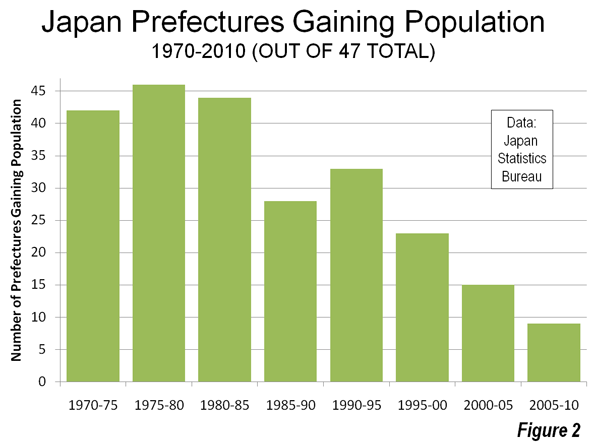
    Population losses were sustained in 38 of Japan’s 47 prefectures between 2005 and 2010 (Table). In contrast, during the much faster growing period of 1975 to 1980, 46 of Japan’s 47 prefectures gained   (Figure 2). Indeed, the only prefecture losing population during that period was Tokyo (includes the 23 wards of the former city of Tokyo and the "tama" suburbs), which was the nation’s fastest-growing prefecture during the last census period.

    Japan Population Trends by Region and Prefecture, 1970-2010
     
    1970 2000 2005 2010 Change Change from 2005 Share of Growth from 1970 Change from 1970
    JAPAN 104,663 126,926 127,768 128,056 288 0.2% 100.0% 22.4%
    REGION:Prefecture
    HOKKAIDO 5,184 5,683 5,628 5,507 -120 -2.1% 1.4% 6.2%
    Hokkaido 5,184 5,683 5,628 5,507 -120 -2.1% 1.4% 6.2%
    TOHOKU 9,031 9,818 9,635 9,335 -300 -3.1% 1.3% 3.4%
    Aomori 1,428 1,476 1,437 1,373 -63 -4.4% -0.2% -3.8%
    Iwate 1,371 1,416 1,385 1,331 -55 -3.9% -0.2% -3.0%
    Miyagi 1,819 2,365 2,360 2,348 -12 -0.5% 2.3% 29.1%
    Akita 1,241 1,189 1,146 1,086 -60 -5.2% -0.7% -12.5%
    Yamagata 1,226 1,244 1,216 1,169 -47 -3.9% -0.2% -4.7%
    Fukushima 1,946 2,127 2,091 2,029 -63 -3.0% 0.4% 4.3%
    KANTO 29,496 40,434 41,495 42,607 1,113 2.7% 56.0% 44.5%
    Ibaraki 2,144 2,986 2,975 2,969 -6 -0.2% 3.5% 38.5%
    Tochigi 1,580 2,005 2,017 2,007 -10 -0.5% 1.8% 27.0%
    Gumma 1,659 2,025 2,024 2,008 -16 -0.8% 1.5% 21.0%
    Saitama 3,866 6,938 7,054 7,195 141 2.0% 14.2% 86.1%
    Chiba 3,367 5,926 6,056 6,217 161 2.7% 12.2% 84.6%
    Tokyo 11,408 12,064 12,577 13,162 585 4.7% 7.5% 15.4%
    Kanagawa 5,472 8,490 8,792 9,050 258 2.9% 15.3% 65.4%
    CHUBU 18,091 21,628 21,774 21,715 -59 -0.3% 15.5% 20.0%
    Niigata 2,361 2,476 2,431 2,375 -57 -2.3% 0.1% 0.6%
    Toyama 1,030 1,121 1,112 1,093 -18 -1.7% 0.3% 6.2%
    Ishikawa 1,002 1,181 1,174 1,170 -4 -0.3% 0.7% 16.8%
    Fukui 744 829 822 806 -15 -1.8% 0.3% 8.4%
    Yamanashi 762 888 885 863 -22 -2.5% 0.4% 13.2%
    Nagano 1,957 2,215 2,196 2,153 -43 -2.0% 0.8% 10.0%
    Gifu 1,759 2,108 2,107 2,081 -26 -1.2% 1.4% 18.3%
    Shizuoka 3,090 3,767 3,792 3,765 -27 -0.7% 2.9% 21.8%
    Aichi 5,386 7,043 7,255 7,408 154 2.1% 8.6% 37.6%
    KANSAI 18,944 22,713 22,760 22,755 -5 0.0% 16.3% 20.1%
    Mie 1,543 1,857 1,867 1,855 -12 -0.7% 1.3% 20.2%
    Shiga 890 1,343 1,380 1,410 30 2.2% 2.2% 58.5%
    Kyoto 2,250 2,644 2,648 2,637 -11 -0.4% 1.7% 17.2%
    Osaka 7,620 8,805 8,817 8,863 46 0.5% 5.3% 16.3%
    Hyogo 4,668 5,551 5,591 5,589 -1 0.0% 3.9% 19.7%
    Nara 930 1,443 1,421 1,400 -21 -1.5% 2.0% 50.5%
    Wakayama 1,043 1,070 1,036 1,001 -35 -3.4% -0.2% -4.0%
    CHUGOKU 6,997 7,732 7,676 7,562 -114 -1.5% 2.4% 8.1%
    Tottori 569 613 607 588 -19 -3.1% 0.1% 3.4%
    Shimane 774 762 742 716 -26 -3.5% -0.2% -7.4%
    Okayama 1,707 1,951 1,957 1,945 -12 -0.6% 1.0% 13.9%
    Hiroshima 2,436 2,879 2,877 2,861 -16 -0.6% 1.8% 17.4%
    Yamaguchi 1,511 1,528 1,493 1,451 -41 -2.8% -0.3% -3.9%
    SHIKOKU 3,904 4,154 4,086 3,977 -109 -2.7% 0.3% 1.9%
    Tokushima 791 824 810 786 -24 -3.0% 0.0% -0.6%
    Kagawa 908 1,023 1,012 996 -17 -1.6% 0.4% 9.7%
    Ehime 1,418 1,493 1,468 1,431 -37 -2.5% 0.1% 0.9%
    Kochi 787 814 796 765 -32 -4.0% -0.1% -2.8%
    KYUSHU 12,071 13,446 13,353 13,204 -148 -1.1% 4.8% 9.4%
    Fukuoka 4,027 5,016 5,050 5,073 23 0.5% 4.5% 26.0%
    Saga 838 877 866 850 -17 -1.9% 0.1% 1.4%
    Nagasaki 1,570 1,517 1,479 1,427 -52 -3.5% -0.6% -9.1%
    Kumamoto 1,700 1,859 1,842 1,817 -25 -1.3% 0.5% 6.9%
    Oita 1,156 1,221 1,210 1,196 -13 -1.1% 0.2% 3.5%
    Miyazaki 1,051 1,170 1,153 1,135 -18 -1.6% 0.4% 8.0%
    Kagoshima 1,729 1,786 1,753 1,706 -47 -2.7% -0.1% -1.3%
    OKINAWA 945 1,318 1,362 1,393 31 2.3% 1.9% 47.4%
    Okinawa 945 1,318 1,362 1,393 31 2.3% 1.9% 47.4%
    In thousands
    Data from Japan Statistics Bureau


    Moving to Tokyo: Since 1970, 56 percent of Japan’s growth has been in the Kanto region, which includes Tokyo. During the last five years, all of Japan’s growth took place in the core of the Tokyo – Yokohama region. This includes the suburban prefectures of Chiba, Kanagawa and Saitama, along with the prefecture of Tokyo.  These four prefectures added 1.14 million people, nearly 4 times the population gain of the entire country. Tokyo is the national capital and forms the world’s largest urban area, with 37 million people.  

    Different Urban Areas: Different Fates: The fortunes of the prefectures in Japan’s two largest urban areas could hardly be more different. The four prefectures of the Tokyo – Yokohama area had added approximately 3,000,000 people in each five-year period until 1975. Since that time, growth has been slower, but the area has added 1 million or more people each five years from 1975 to 2010. On the other hand, the Osaka – Kobe – Kyoto area (Osaka, Hyogo, Kyoto and Nara prefectures), which also experienced strong growth after World War II, adding between one and two million people in each five year period until 1975, has seen its growth come to a virtual standstill. Over the past five years, Osaka – Kobe – Kyoto added only 12,000 people (Figure 3). As a result, Osaka – Kobe – Kyoto is easily the slowest growing mega-city in the world, by far.   Osaka – Kobe – Kyoto seems destined to fall substantially in world urban area rankings in the years to come. Tokyo – Yokohama, however, remains at least 14 million larger than any other urban area in the world, a margin that seems likely to be secure for decades to come.

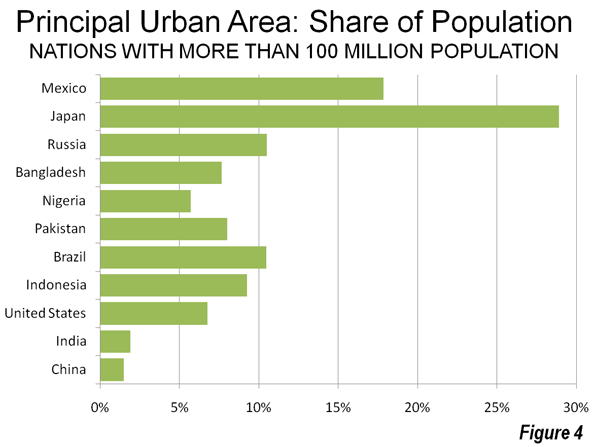
    The Impetus for Decentralization: These numbers suggest there is ample reason to worry about the concentration of population and power in the Tokyo – Yokohama area, which now contains nearly 30 percent of the nation’s population. None of the world’s largest nations, outside of Korea (which ranks 25th in population), are so concentrated in one urban area. Among other nations with more than 100 million the greatest concentration is in Mexico, where Mexico City accounts for less than 20 percent of the population. The largest urban areas in Brazil (Sao Paulo) and Russia (Moscow) have little more than 10 percent of the population. The largest urban area in the United States, New York, accounts for less than seven percent of the population, while in China (Shanghai) and India (Delhi), the largest urban areas house less than two percent of the population (Figure 4). Paris, the beneficiary of centuries of centralization, has less than 20 percent of the population.  

    Moving Away from Tokyo? There had long been proposals to move the national capital, but were not implemented, at least in partly because of Japan’s two decade-long economic difficulties. However, after the great earthquake and tsunami, these calls have been revived. One proposal would establish a series of auxiliary capitals around the nation, rather than simply moving the capital from Tokyo. Proponents have indicated concern that a major earthquake and tsunami in the Tokyo – Yokohama area could be far more damaging than the recent disaster in Tohoku. A recent proposal by former Japanese Chief Cabinet Secretary Yasuhisa Shiozaki (formerly the second ranking official in the national government) called on Japan to move parliament (the Diet) to the Fukushima area, near the damaged nuclear power plant as a part of a decentralization strategy.

    Despite these concerns, decentralization will be no easy matter. Moving the government would require a huge political shift, and that would just be the beginning. Shifting the commercial base and the population could well prove impossible.

    Nonetheless, the results of the 2010 census provide strong support for decentralization, a message that has been telegraphed by the earthquake and tsunami of March 11.

    Photo: Kyoto (by Jean Love)

    Wendell Cox is a Visiting Professor, Conservatoire National des Arts et Metiers, Paris and the author of “War on the Dream: How Anti-Sprawl Policy Threatens the Quality of Life

  • Manufacturing Stages A Comeback

    This year’s survey of the best cities for jobs contains one particularly promising piece of news: the revival of the country’s long distressed industrial sector and those regions most dependent on it. Manufacturing has grown consistently over the past 21 months, and now, for the first time in years, according to data mined by Pepperdine University’s Michael Shires, manufacturing regions are beginning to move up on our list of best cities for jobs.

    The fastest-growing industrial areas include four long-suffering Rust Belt cities Anderson, Ind. (No. 4), Youngstown, Ohio (No. 5), Lansing, Mich. (No. 9) and Elkhart-Goshen, Ind. (No. 10). The growth in these and other industrial areas influenced, often dramatically, their overall job rankings. Elkhart, for example, rose 137 places, on our best cities for jobs list; and Lansing moved up 155. Other industrial areas showing huge gains include Niles-Benton Harbor, Mich., up 242 places, Holland-Grand Haven, Mich., (up 172),  Grand Rapids, Mich., (up 167)   Kokomo Ind., (up 177) ; and Sandusky, Ohio, (up 128).

    Industrial growth also affected some of the largest metros, whose economies in other areas, such as business services, often depend on customers from the industrial sector. Economist Hank Robison, co-founder of the forecasting firm EMSI, points out that manufacturing jobs — along with those in the information sector — are unique in creating high levels of value and jobs across other sectors in the economy.  They constitute a foundation upon which other sectors, like retail and government, depend on.

    Take the case of Milwaukee. The Wisconsin city rode a nearly 3% boost in industrial employment to increase its ranking among the best large metros for jobs: It rose from a near-bottom No. 49 (out of 65) to a healthy No. 23. As manufacturing employment surged, others sectors, notably business services, warehousing and hospitality, showed solid increases after years of slow or even negative growth.

    Milwaukee’s growth reflects some of the greater trends affecting the industrial sector, whose overall income is up 21% since mid-2009.  The Fed’s monetary policy, combined with deficit-related concerns, has certainly helped by depressing the value of the dollar, keeping American prices more competitive with foreign producers. Low prices have helped U.S. industrial exporters gain sales, much as it has boosted agricultural commodity producers to sell their goods to growing countries like China, India and Brazil. Exports now account for 12.8% of all U.S. output, the largest percentage since the Commerce Department starting tracking in 1929.

    These new markets are particularly strategic to regions like Milwaukee and other parts of the Great Lakes. Despite the industry’s massive shrinkage of the past decade, these areas retain significant specialized skills in fields like machine tools, automotive parts and temperature controls, which are all in demand in the developing world as well as at locally based firms, many of which are enjoying high profits. Allen-Edmunds, a high-end shoe maker based in the region, has seen export business surge.

    Similarly Peoria, Ill., has benefited from a boom in overseas orders for heavy equipment from Caterpillar, its dominant industrial company. Caterpillar sells the kind of heavy moving and mining machinery now in great demand, particularly in developing countries.

    One big driver of industrial growth has come from the source of so much pain in the past: the auto industry. Although production remains 25% below its 2007 peak, the industry, which accounts for roughly one-fifth of the nation’s industrial output, is on the rebound.  Ford Motor is achieving its best profits in over a decade, and both Chrysler and General Motors are officially in the black.

    Long-depressed industry center Warren-Troy-Farmington Hills, Mich., topped our list of manufacturing job-creators, with an impressive 8.2% increase. Second place went to the Detroit-Livonia-Dearborn area, which experienced 3.5% growth. Of course this recent expansion hardly makes up for decades of decline — auto industry employment, for example, is still down over 34% from its 2005 peak. But industrial expansion has clearly improved job prospects across the board; over the past year, for example, Warren experienced healthy growth in its information, business services and wholesale trade sectors.

    Of course, not all the big gainers in the industrial sphere are located in Great Lakes. The movement of manufacturing to other parts of the country, particularly to Texas and the Southeast means a better industrial climate helps those regions as well.  The list of fastest-growing industrial areas among our big metros includes San Antonio, Texas (No. 3); Atlanta (No. 7); Oklahoma City (No. 8) and Austin-Roundrock, Texas (No. 10) — all of which did very well in our overall jobs survey. Many of these areas are business-friendly, have low housing costs, reasonable taxation and business-friendly regulatory environments that induce industrial expansions.

    Another contributing factor to industrial growth in places like Austin is high-tech manufacturing. Covering everything from servers to specialized production equipments, the expansion of this sector accounts for a healthy 1.7% upturn in San Jose, No. 6 among our large metro regions, a welcome turnaround for an area that shed some 17% of its industrial jobs over the past decade.

    But some of the best progress took place in smaller communities spread across the country. Take Yakima, Wash., which came out first on our manufacturing job growth list with a heady 19% growth in industrial jobs.  Metal fabrication plants companies such as Canam Steel have led the way, with some of the new demand coming from Canadian sources.

    Other strong performers included Midland, Texas, which ranked sixth in our industrial rankings — fifth  among the smaller cities. Here an expanding oil and gas sector has sparked a strong revival not only in manufacturing but also in business services and finance.

    If manufacturing growth has become a new shaper of overall job growth, some regions may need to move beyond the post-industrial mindset that dominates so much of regional e development orthodoxy. Take the coastal areas in California: Los Angeles-Long Beach, which has the nation’s largest industrial base and high unemployment, continues to lose manufacturing jobs – over 28% gone over the past decade — in part due to strict regulatory controls and a basic inattention to this sector by government officials.

    In contrast, some hard-hit economic regions like Modesto, in California’s Central Valley, have promoted industrial growth. Last year, a nearly 14% increase in manufacturing jobs — much of it food related — helped the area gain some 92 places on our survey . They have not exactly won a gold medal, but certainly the improvement amount to  more than chopped liver.

    To be sure, cities can grow without robust manufacturing. Take financial centers like New York, university towns or Washington, D.C., where paper-pushing remains the core competency. But for many areas, particularly those beyond the urban “glamour zone,” getting down and dirty at the factory represents a solid economic strategy. In fact, it may be one of the best way to nurture your region back to health.

    Top Cities for Manufacturing Job Growth, 2009-2010
    Yakima, WA 19.0%
    Sebastian-Vero Beach, FL 17.4%
    Palm Coast, FL 16.7%
    Anderson, IN 14.3%
    Youngstown-Warren-Boardman, OH-PA 13.2%
    Midland, TX 13.0%
    Modesto, CA 12.0%
    Yuma, AZ 9.8%
    Lansing-East Lansing, MI 9.3%
    Elkhart-Goshen, IN 9.3%
    Top Big Cities for Manufacturing Job Growth, 2009-2010
    Warren-Troy-Farmington Hills, MI 8.2%
    Detroit-Livonia-Dearborn, MI  3.5%
    San Antonio-New Braunfels, TX 3.2%
    Milwaukee-Waukesha-West Allis, WI 2.9%
    Louisville-Jefferson County, KY-IN 2.0%
    San Jose-Sunnyvale-Santa Clara, CA 1.7%
    Atlanta-Sandy Springs-Marietta, GA 1.7%
    Oklahoma City, OK 1.6%
    Pittsburgh, PA 1.6%
    Austin-Round Rock-San Marcos, TX 1.5%

    This piece originally appeared in Forbes.com

    Joel Kotkin is executive editor of NewGeography.com and is a distinguished presidential fellow in urban futures at Chapman University, and an adjunct fellow of the Legatum Institute in London. He is author of The City: A Global History. His newest book is The Next Hundred Million: America in 2050, released in February, 2010.

    Photo by bobengland

  • The New Geography of Population Loss and Gain

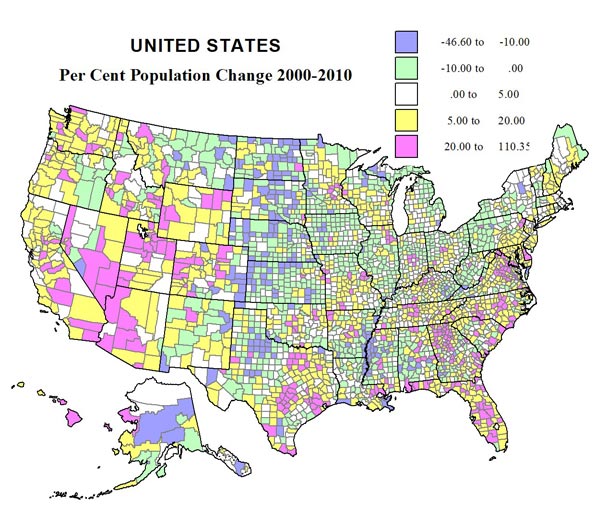
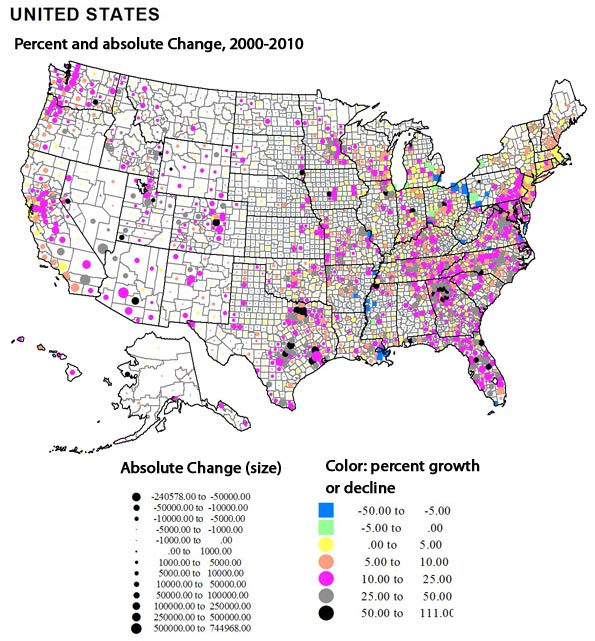
    Dramatic shifts in population growth across the United States in the last decade should surprise no one. Some patterns are continuing trends of earlier decades, but other patterns show substantial change.  I show these changes in three ways, first a conventional choropleth map coloring counties by broad classes from high losses to moderate and high percent gain, second a map in which absolute gains and losses are depicted by proportional symbols, with colors showing the rate of change, and third, a look a counties that experienced either extreme loss and gain. 

    There are four major regions that experienced population loss. The largest covers the rural high plains from Texas to Canada, and most marked in Kansas, Nebraska, Iowa, North and South Dakota, and eastern Montana in a continuation of at least 60 years, and no surprise, as farms get larger and more mechanized, small towns decline. Yet these losses are less pervasive than earlier, especially due to energy development in Wyoming, North and South Dakota and Montana, and energy and agricultural change in Oklahoma and Texas. 


    The second area of decline, also continuing a long historic trend, can be seen in the heavily African-American dominated areas in the Mississippi Delta, in Arkansas, Louisiana and Mississippi, and across the Black belt, Alabama, Georgia, and South Carolina, where significant development investment simply did not occur—race matters.

    Third, we see continued population reductions  across Appalachia from eastern Kentucky, through West Virginia, but this loss has now taken gotten more severe in western Pennsylvania and New York, largely due reductions in  mining and manufacturing as well as a dearth  of new investment.

    Fourth is decline across many urban as well as rural counties in the upper Midwest, in Illinois, Indiana, Ohio and Michigan, due to a complex mix of deindustrialization and related forces.

    Looking at losses from the map emphasizing absolute number of population change reduces the significance of the losses in the Plains, as most were small, reveals somewhat larger absolute losses in the Mississippi delta, and the specific Katrina-led losses in greater New Orleans. It highlights the concentration of larger losses in core metropolitan counties, not only in northern Appalachia and the upper Midwest, particularly in Ohio, Pennsylvania and Michigan, but also in other large cities, as St. Louis and Chicago.


    At least eight regions of significant growth can be described. Territorially, the most obvious can be seen in the Mountain stares, from Arizona, through Utah and much of Colorado, Wyoming into parts of Idaho and Montana. The reasons vary, from energy in Wyoming, to more amenity based growth in western Colorado and Montana, to broader, across the board expansions in Arizona, Utah and Idaho. The high fertility in the Mormon realm also played a role. Nevada is, well, Nevada.

    A second area of continuing growth is across the Pacific coast, but especially the entire I-5 corridor, the spillover counties surrounding Los Angeles, California’s Central valley, largely due to high Latino growth (which was a major factor way to the north in Washington state).

    Third is the continuing and large scale boom in and around the largest Texas cities, Dallas, Houston, Austin and San Antonio. All have enjoyed a combination of population and economic growth.

    Fourth is a pickup in growth from Oklahoma across the Ozarks, through northwestern Arkansas and across southern Missouri, from a mixture of industrial development and amenity migration.

    Fifth is a less expected belt of growth from the Chicago suburbs, across western Wisconsin, and Minnesota (especially northern), to Fargo, ND.

    Sixth is the never ending growth of Florida. Seventh is the continuing significant urban and industrial based growth in the middle South, from Tennessee and Kentucky, northern Georgia, through South and North Carolina, into Virginia. Then, eighth, is the high level of growth over what we might call the outer, exurban edges of Megalopolis, from Richmond, Virginia, to southern Maine.

    Looking at absolute gains from the second map shows a quite widespread geography of growth, many micropolitan and small metropolitan counties across the west registered  the highest rates of gain. Similarly across the Plains, while the greatest growth is in suburban counties around the Texas giants, growth was robust in many smaller metropolitan areas and cities, from the Mexican border up to Canada.  Likewise, in the upper Midwest, despite problem in the declining big city cores, growth was stronger in exurban and small metropolitan areas. Across the southeast, despite the stupendous growth around Atlanta, Nashville, Raleigh and Washington DC, the significant pattern is how widespread growth was across much of the region. Florida, too, perhaps grew less fast in its long time biggest cities, but is now filling up the remaining space!

    Finally Megalapolis is far from dormant. The old cores of Baltimore, Philadelphia, New York and Boston may be slow growing or even declining a little,but  the satellite and exurban belt show remarkable gains, especially in Maryland, Delaware and eastern Pennsylvania, in a kind of spillover of investment and residence to its outer limits.

    The Biggest Losers and Gainers

    Absolute losses: The largest loss numbers are in core counties of de-industrializing metropolitan areas in the north. Among just the 21 counties losing more than 10,000, Michigan has 3 for a loss of 260,000, Ohio, 6, for a loss of 228,000, and Pennsylvania 3, for a loss of 81,000. Others include Cook county (Chicago), St Louis city and county, Erie (Buffalo), and Baltimore. Greater New Orleans includes three counties, with a loss of 195,000. The one non-metropolitan county is highly African-American Washington County, MS (Greenville). Indeed, high Black concentration is a common denominator among all these areas.  Race continues to rule demography in much of the south.

    Relative losses:  Most of the counties with the highest loss rate (48 counties with over a 17 percent loss) are rural or small town. The only exceptions are Orleans and St. Bernard (New Orleans). States with high rate loss counties include Texas (7), Mississippi and North Dakota (6), Louisiana (5) Arkansas and Kansas (4), South Dakota, Nebraska, Montana and Alaska (2), and one each in Colorado, Minnesota, Nevada, New Mexico, Oklahoma and West Virginia.  The AR, LA and MS counties are heavily African American.

    Absolute Gains

    51 counties gained more than 100,000 residents. The top 11 are
    Wake, NC :: 273,000
    San Diego :: 281,000
    Collin, TX (Dallas suburb) :: 291,000
    Los Angeles :: 299,000
    Bexar (San Antonio :: 322,000
    San Bernardino :: 326,000
    Tarrant (Ft. Worth) :: 363,000
    Clark, NV (Las Vegas) :: 576,000
    Riverside :: 644,000
    Harris (Houston) :: 692,000
    Maricopa (Phoenix) :: 745,000

    Of the 51 big gainers, ALL are metropolitan, as the 12 in Texas gained 3,171,000, the 12 in California 2,640,000, 7 in Florida 1,335,000, two in North Carolina 497,000, three in Virginia 384,000, and two in Georgia 332000. Many of these counties are Sunbelt core counties, or satellite or spillover counties. Many are suburbs of large metropolitan centers. Of the 51, only 8 are in the “north” of the country (Illinois, Utah, Washington and northern California).

    Relative Gains

    The eight counties gaining more than 75% are
    Sumter, FL :: 75%
    Forsyth GA  ::  78
    Rockwall, TX :: 82
    Loudon, VA :: 84
    Lincoln, WY  :: 86
    Flagler, FL :: 92
    Pinal, AZ :: 109
    Kendall, IL :: 110

    Of the top 35 counties, gaining over 50 percent, Texas had seven, Georgia, six, Florida four, Utah 2, with one each in AK, AZ, CO,ID, IL, IN, IA, MS, NV,NC, OH, PA, SD, VA, WA and WY. Twenty-eight are metropolitan suburbs, three are new small metropolitan areas (FL UT), two are energy development areas (SD, WY) and two more environmental (PA, ID). Finally of the 35, 11 are in the North, 24 in the South.  Eight counties are in both the highest absolute and highest relative lists—Pinal, AZ, Douglas, CO, Loudon, VA, and five in Texas, Collin, Denton, Montgomery, Ft. Bend, and Williamson. Overall, in terms of growth, Texas wins.

    Conclusion

    I know a lot about population in the US, but still I’m glad I didn’t venture predictions ten years ago, as population change is more than a little unpredictable. Yes, Sunbelt growth was expected, but the details were sometimes as expected but there were unusual gains and losses. The data reviewed here are just the totals for redistricting, so no attempt was made to relate population change to economic change. Still, while some of the redistribution to the Sunbelt, or to the Mountain states was amenity or retirement driven, much more seems to be a consequence of massive shifts of industry and services from the higher cost north to the lower cost south. But there is a vast amount of talent and physical plant in these areas so I would not dare to predict that 2020 would be a simple continuation of the last decade.

    Richard Morrill is Professor Emeritus of Geography and Environmental Studies, University of Washington. His research interests include: political geography (voting behavior, redistricting, local governance), population/demography/settlement/migration, urban geography and planning, urban transportation (i.e., old fashioned generalist).
  • Why Outsiders Have Wound Up Running So Much of L.A.

    When I was young and my brother was a little older, we would be in bed before dark on mid-summer evenings. (The times were different then.) We would lay in our separate beds, but only an arm’s length apart as shadows lengthened up the far wall of our room, until the dial of the Zenith radio on top of the dresser was the only light left. The Dodgers’ game would be on. Vin Scully was calling the plays.

    The consolations in the tenor murmur of that voice came with a price. But my brother and I did not know it. We knew vaguely that the Dodgers had broken Brooklyn hearts, but we believed, as we drifted between the last pitch and sleep, that the Dodgers could never again break other boys’ hearts so deliberately. The Dodgers had come here, to this almost perfect place, to be with us.

    My brother and I were wrong. The Dodgers’ arrival in Los Angeles in 1958 was a historic break in the way sports loyalties worked. Until then, a baseball team and most of its fans expected to share a highly specific sense of place. After that – and with increasing callousness – a team’s connection to a place would lag behind corporate values. My brother and I listened to Vin as a boyhood gift, but his voice was (and is) just another opportunity for branding a commodity. From the beginning, the Dodgers’ arrival in L.A. wasn’t an embrace. It was a deal.

    The sale of the team in 1998 to Fox Entertainment Group, owned by Rupert Murdoch’s Australia-based News Corp., was a $311-million deal Murdoch needed to anchor Fox’s cable sports network. It was equally a deal that team owner Peter O’Malley needed to manage the tax implications of inheriting the Dodgers. When Fox sold the team to Boston parking lot entrepreneurs Frank and Jamie McCourt in 2004 for $420 million, the deal was eagerly blessed by MLB Commissioner Bud Selig as a business favor to Fox, holder of baseball’s television broadcast rights. Apparently, everyone inside baseball knew how much that deal stank, how overleveraged the McCourts really were. By taking the Dodgers into receivership last week, Selig is trying to engineer another deal. That probably won’t have much to do with us or Los Angeles either.

    When I was young, on the morning after a game, over the plate of two fried eggs and four strips of bacon my mother made us every school day, I would read Jim Murray’s column in the sports section of the Los Angeles Times, but not for his thoughts on the Dodgers. I read Murray for the sound of the voice in his columns, the same way I read Matt Weinstock, Jack Smith, Art Seidenbaum, and Charles Champlin in the Times. I learned from all of them the centrality of place in an imaginative life, a hunger for the stories, and the power of having a voice. But those are boyhood values that are gone for deals, too.

    Like the arrival of the Dodgers in Los Angeles, the sale of the Times to the Chicago-based Tribune Company in 2000 was a deal that sounded good to Angeleños. Instead of bitter Chandler family members, real journalists would run the paper, even if nearly all of them were out of town. And like the sale of the Dodgers to the McCourts, which floated on so much borrowed money that the franchise is now $525 million in debt, the leveraged sale of the Tribune Company in 2007 to developer Sam Zell turned out to be a cynical farce. Another fast-talking out-of-towner took control of an iconic L.A. institution for cents on the dollar and with no idea of Los Angeles. What mattered was getting the deals done. The deals had nothing to do with this place or our story.

    The deals still do not. The Delaware bankruptcy court overseeing the dismantling of Zell’s empire of paper is only interested in getting its assets sold. Commissioner Selig’s takeover of the Dodgers was only a last-ditch maneuver to prevent the McCourts from saving their borrowed lifestyle by mortgaging the Dodgers’ future broadcast rights.

    Something narrow and coarse in the imaginations of the McCourts and Zell and Selig and their business partners squeezed out any moral dimension to their deals or any feeling for Los Angeles. But to question how they acquired so much of our place so cheaply is uncomfortable for Angeleños. Better to grumble about indifferent outsiders. Seen from their perspective, Los Angeles has only market value, the sort of value that sold Los Angeles to the world as one of the most successful lifestyle products of the 20th century.

    Not anymore. Too many deals have soured; too much of the city has been taken into receivership. Even our citizenship – already problematic – has been foreclosed. Deals under duress have taken too many of our civic institutions from local control and put them in the hands of monitors and special masters, raising another question we would prefer to duck: Do we have the capacity to govern ourselves?

    In 1992, retired Superior Court Judge James Kolts, picked by the county Board of Supervisors to investigate systemic abuses in the Los Angeles Sheriff’s Department, hired attorney Merrick Bobb to review excessive force complaints against deputies. Bobb continues to monitor the LASD’s performance.

    From 1996 to 2006, the Metropolitan Transportation Authority operated under federal supervision, after religious and civil rights organizations charged the MTA with “transit racism.” A special master was appointed by the federal court to oversee the MTA’s bus service under a consent decree to insure that buses would meet demand in low-income neighborhoods.

    Complaints in the early 1990s that special education students were being systematically underserved by the Los Angeles Unified School District led to a civil rights suit and another consent decree under which an Office of the Independent Monitor evaluates the district’s compliance with court orders and federal law. The OIM was supposed to complete its work by 2006, but the district has yet to meet all twelve of the goals set by the consent decree.

    In the aftermath of the Rampart CRASH scandal, in which members of an anti-gang police unit were charged with widespread corruption and unprovoked violence in late 2000, the Los Angeles Police Department entered into a consent decree that made the federal Department of Justice arbiter of virtually every aspect of the department, its officers, and their interactions with suspects. The consent decree ended in 2009 – after the department was turned around by a police chief imported from New York – but a transition agreement compels the LAPD to continue demonstrating compliance to the DOJ.

    Grudging compliance to special masters and appointed monitors may be the best we have to give in a city fragmented by institutional barriers and so distracted from civic concerns. Few of us want to see Los Angeles as it is or what it should be; we’ve let others do it for us. This city’s unaccountable political structure, its conception of power merely as the means to another deal, and the city’s air of disconnected neutrality have let thugs police its streets, unfeeling technocrats run its services, and the McCourts loot its most-loved institution. And when those faults became intolerable, others – not us – imposed their solutions. We’ve come to expect this – and worse – from Los Angeles and ourselves. “Forget it, Jake. It’s Chinatown.” might as well be the motto on the city seal.

    Los Angeles succeeded once, less as a place and more as a succession of slick real estate deals that have reached the limits of our landscape. Truthfully, we never needed a shared moral imagination until now, when so many desertions from the common good have shown us how little loyalty the once powerful had for this place. And no deal, no special master, no court-ordered monitor can supply what we lack.

    D. J. Waldie is a contributing editor at the Los Angeles Times and a contributing writer for Los Angeles magazine. He is the author most recently of California Romantica with Diane Keaton. He blogs for KCET TV at http://www.kcet.org/user/profile/djwaldie.

    Photo by johnwilliamsphd

  • The Dispersionist Manifesto

    We live in an era of the heady drumbeat of urban triumphalism. In a world that is now, by some measures, predominately urban, observers like historian Peter Hall envision a “coming golden age” of great cities. It is time to look at such claims more closely, replacing celebratory urban legends with careful analysis. Although the percentage of people living in cities is certain to grow, much of this growth will be in smaller cities, suburbs and towns. And it is unclear whether extreme centralization and densification are either inevitable or desirable, for as cities get larger—both in the developed and developing world—they display a tendency to become increasingly congested, bifurcated by class and economically inflexible.

    It may be time to propose a less gargantuan vision that is more humane for the vast majority of people. This alternative view embraces not cramming and concentration— the favored strategies of most planners, pundits, architectural stars and their urban land-owner enablers—but the protean development of more dispersed and less concentrated cities and suburbs. This is what is happening in most cities in the world today, and has been the pattern of urban areas throughout history.

    There are numerous signs that this reality is taking root, both in the developing world and in high-income countries. Shlomo Angel, a lecturer at the Woodrow Wilson School at Princeton, has shown that as the world’s urban population has grown, the percentage living in the 100 largest cities has declined. Between 1960 and 2000, the share of the largest cities declined from nearly 30 percent to closer to 25 percent. Since the nineteenth century, notes Angel, urban population densities have declined, as people have sought out less dense, more appealing, and usually less costly locations on the periphery. This is true, he points out, in London and even to some extent Mumbai, as well as in the United States. As the World Bank has noted: “Cities became more packed and more sprawling at the same time.”

    What may be best is to forge not an agenda for centralization, but policies that promote both smaller cities and villages. This, notes Ashok R. Datar, chairman of the Mumbai Environmental Social Network and a long-time advisor to the Ambani corporate group, may represent the most practicable strategy for relieving the unbearable congestion that threatens so many mega-city environments.

    Down from the Commanding Heights

    The dispersionist viewpoint challenges the assumption that the bigger, more densely packed a city is, the better. This approach appeals to prominent urbanists, such as the University of Chicago’s Saskia Sassen, who see such places as the inevitable occupiers of the (Leninist) “commanding heights” of the global economy. To spread out economic growth, a World Bank report asserts, is to discourage it.

    The dispersionist view begs to differ. In many important ways, the largest urban agglomerations can also be seen as gradually losing their edge to more smaller cities. One of the ironies of this Age of Cities lies in the fact that relative size is no longer the overwhelming critical advantage as was the case in the less urbanized past. Before the late twentieth century, big cities were efficient and economically viable. The greatest urban centers of history—Babylon, Rome, Constantinople, Paris, London, Kaifeng, Baghdad, New York, Tokyo—grew in part because concentration provided the best, and sometimes only, way to support the basic infrastructure for commerce, cultural development, state religion or the exercise of power. But increasingly size not only matters less, but actually can be seen as a detriment to efficient, sustainable urbanism. This is particularly evident in the developing world where urbanization is spreading most rapidly. With the exception of Tokyo, the world’s most populous urban agglomerations—Delhi, Mumbai, São Paulo, Mexico City—have evolved into almost unspeakably congested leviathans, plagued by both deepening class divides and environmental problems.

    By 2025, cities in developing countries are projected to account for eight of the ten world’s largest cities. Four will be located in the Indian subcontinent alone, and each will accommodate twenty million or more residents. They may be seen as “colorful” by what one writer calls “slumdog tourists,” and “exciting” for those working within the confines of their “glamour zones,” but for most of their citizens life will be very difficult, and better only compared to what are even more dismal conditions in the countryside.

    Over the past forty years, the percentage of Mumbai’s population living in slums has grown from one in six to a majority. One indicator of the conditions there: the average Mumbaiker’s lifespan is now seven years less than the national average. This is all the more remarkable since most Indians still live in villages with very limited sanitation and even less access to quality health care. Concentrating more people in Mumbai or other developing mega-cities represents a form of lunacy. Much the same can be said for Kolkata, Manila, Cairo, Mexico City, and Lagos.

    On the other hand, the dispersionist notion emphasizes second and third tier city development. Already many Indian businesses and skilled workers are moving to smaller, less congested, often better-run cities such as Bangalore, whose density is roughly one-fourth of Mumbai’s, or Ahmadabad in the state of Gujarat. Much of this new growth takes place in campuslike settings on the edge of the city that take advantage of newer infrastructure and offer workers a less harried way of life. Many of India’s key industries—auto manufacturing, software and entertainment— are establishing themselves in such smaller cities, which are far less dense and less populated than Mumbai or Kolkata.

    In a more planned fashion, China is embracing decentralization, encouraging growth in smaller interior cities such as Chengdu, Wuhan and Xi’an. Such cities, notes Chengdu-based architect Adam Mayer, offer a healthy alternative to the coastal megacities of Shanghai, Hong Kong, Shenzhen, and Guangzhou. China’s bold urban diversification strategy hinges both on forging new transportation links and on nurturing businesses in these interior cities.

    Such commitment, and the resources to fund it, are lacking in much of the developing world. Africa, for example, now boasts many huge, and rapidly growing, cities, but it is hard to describe Lagos in Nigeria, Luanda in Angola, and Kinshasa in the Democratic Republic of the Congo as places with particularly bright prospects. One exception may be Capetown, the beautiful South African coastal city that shone so well during the recent World Cup. Latin America, too, has a plethora of huge and growing cities, but it is hard to imagine Mexico City and São Paulo as likely hot-spots for future economic growth. Instead the best prospects lie in smaller cities like Santiago, the capital of resource-rich Chile, or Campinas, a growing smaller Brazilian city with three million residents that lies outside the congested São Paolo region.

    This shift to smaller cities, as Michigan State’s Zachary Neal points out, has been conditioned by rapid improvements in telecommunications and transportation infrastructure. But perhaps the most conclusive evidence that smaller can be better and more efficient can be found in other parts of the developing world. Cairo, Baghdad, and Tehran are the biggest cities in the Middle East, but they are hardly economic successes. In contrast, Tel Aviv, whose total metropolitan population is only three million, has emerged as a major center for technology as well as one of the world’s premier diamond centers. The other leading candidates in the region hail from the United Arab Emirates, notably oil-rich Abu Dhabi and perhaps also its now financially weakened neighbor, Dubai.

    No place illustrates the principle that smaller can be better as well as Singapore. With roughly four million residents, Singapore ranks only sixtieth in terms of population among the world’s cities. But its economy clocks in at twenty-seventh, ahead of much larger Mumbai. In per capita terms, by purchasing power parity, it boasts an income of $62,200, one of the highest in the world, and behind only Liechtenstein, Luxembourg, Bermuda, and Qatar (and roughly the same as the United States). This is a remarkable achievement for a city-state whose per capita income at the time of its independence in 1965 was equal to those of other developing countries. Today Singapore boasts one of the world’s largest ports, a highly efficient subway system, and among the world’s most impressive skylines. It is easily the cleanest, most efficient big city in all of Asia. It is noteworthy that Singapore has employed its collective intelligence to develop a socially, economically and increasingly environmentally viable city in a space of only 268 square miles.

    The High-Income World

    The dispersionist reality is also evident in the high-income world. Even though some city cores have improved markedly, the largest and densest urban regions have performed somewhat worse than newer, smaller and often less compact urban areas. This decentralizing trend can also be seen in the western United States. In 1965, New York presided over the American economy like a colossus, accounting for more than 150 of the nation’s 500 largest companies; today that number is fewer than fifty. Not far behind New York are Los Angeles and Chicago, which also claim the coveted status of “world city.” In the meantime, a host of smaller and far more dispersed Texas cities have come to the fore. Houston, Dallas, San Antonio, and Austin enjoy the most rapid job and population growth of the nation’s largest metropolitan regions. Houston, which replaced New York as the center of the global energy industry, now has more Fortune 500 companies than Chicago. Together, the four Texas cities boast more large company headquarters than greater New York.

    But this movement from large dense cities to less dense ones represents only part of the dispersionist trend. A more critical one involves the movement from larger cities to smaller ones. In fact, between 2000 and 2008, notes demographer Wendell Cox, regions of more than ten million suffered a 10 percent rate of net outmigration. The big gainers were cities between 100,000 and 2.5 million residents. The winners included not only cities in Texas, but also southern urban regions such as Raleigh-Durham, now the fastest growing metro area over one million in the nation, and Nashville, and rising Heartland cities such as Columbus, Indianapolis, Des Moines, Omaha, Sioux Falls, and Fargo. Among urban areas of over one million, Columbus, Raleigh, Indianapolis, Denver and Kansas City all rank considerably ahead (in terms of growth of educated migrants between 2007 and 2009) of megacities such as New York, Los Angeles and San Francisco, according to the most recent American Community survey. One key advantage for these smaller cities is the price of housing. Even after the real estate bust, according to the National Association of Home Builders, barely one in three Los Angeles median-income households can afford a median-priced house; in New York, that ratio falls to one in four. In contrast, in regions such as Raleigh, Austin, San Antonio and Indianapolis, between two in three or four in five can afford the American dream. Advocates of dense cities mega-regions often point out that many poorer places, including old Rustbelt cities, enjoy high levels of affordability while regions such as New York do not. But that does not mean that affordability itself is a problem; areas with the lowest affordability, including New York, also have suffered among the high rates of domestic outmigration. The formula for a dynamic region mixes affordability with a growing economy.

    The smaller cities also are often easier for workers and entrepreneurs in which to do business. Despite the presence of the nation’s best developed mass transit system, the New York area has the longest commuting travel times; the worst are in Queens and Staten Island. As a general rule, average commuting time also tends to be longest in some of the biggest denser cities, notably New York, Chicago, and Washington, D.C. In contrast, the average commutes in places like Salt Lake City and Kansas City are slightly above twenty minutes. Over a year, moving to these smaller cities can save roughly 70 hours a week in commuting time.

    Finally there is the critical social issue. The largest cities such as New York and Los Angeles also tend to suffer the most extreme polarization of incomes. New York, for example, now has a distribution of wealth roughly twice as concentrated at the top than the national average. In 1980 Manhattan ranked seventeenth among the nation’s counties for social inequality; by 2007 it ranked first, with the top fifth of wage earners earning fifty-two times that of the lowest fifth, a disparity roughly comparable to that of Namibia. This is not only an American phenomenon. A study of the core city of Toronto, for example, found that between 1970 and 2001 the portion of middle-income neighborhoods in the city had dropped from two thirds to one third, while poor districts had more than doubled to 40 percent. By 2020, according to the University of Toronto researchers, middle-class neighborhoods could fall to barely less than 10 percent, with the balance made up of affluent and poor residents.

    Increasingly, one sees income gaps in high-income country megacities that one normally associates with developing countries. This is particularly true in expensive megacities whose finance-driven economies create high costs but lesser opportunities for middle and working class families. Once cost of living is factored in, more than half the children in inner London live in poverty, the highest level in Great Britain. More than one million Londoners were on public support in 2002.

    The Triumph of Suburbia

    We can see the impact of dispersion not only in the movement between cities but also in population shifts within them. Even the great metropolitan areas are, for the most part, de-concentrating. They increasingly boast not one center but a series of smaller ones, some far from the urban core. This can also be seen in both developing and high-income cities. The new business center of Mexico City, for example, is located in suburban Santa Fe and not the historic core. Much of the Mumbai entertainment complex known as Bollywood long ago migrated to the northern suburbs, with their malls and less dense neighborhoods.

    This pattern can be seen even more in the high-income countries. In virtually every major city in Europe, the urban core now represents a smaller percentage of the metropolitan population than two decades ago. Cities such as London, Paris, Frankfurt and Madrid, despite the presence of excellent mass transit, are far more suburbanized and decentralized than they were two decades ago. Since 1965, virtually all European major metropolitan area growth has been in the suburbs. Indeed, the share of the metropolitan area population gains in the suburbs has been greater in Western Europe than in the United States. As in the United States, this reflects in part the shift of technology industries into suburban areas. The reasons for this may have much to do with the family-oriented nature of many engineers and scientists, and their preference for campus-like settings. This is true both in the Grande Couronne around Paris, where many French tech firms cluster, and in Great Britain. The dynamic growth in fields such as technology and high-value-added and design-led manufacturing are concentrated not in the core, or even the surrounding suburbs, but in the outer reaches of the Thames Valley and around Cambridge. New home-work opportunities and attractive housing concentrates workers in such places, as well as in cities such as Bath and Taunton. “Cities,” concluded one recent report by the British Urban Regeneration Association, “are no longer the main source of new enterprises.”

    This statement will be familiar to people who study North America. For all the talk about new media and other tech related fields clustering in “hip and cool” urban cores, the greatest concentrations of technology industries are in predominately suburban areas, such as those on the periphery of Ottawa, Montreal, and Toronto, or Route 128 around Boston, Orange County, California and the hill country around Austin, Texas. One reason is that the brain power is there. According to the United States Census, eighteen of the nation’s twenty counties with the highest percentage of college-educated people over twenty-five are in either suburban or small cities.

    Silicon Valley, the world’s predominant high-tech concentration, remains to a large extent a vast suburb. The headquarters of such firms such as Intel, Apple, and Google are not in urbanized, transit-oriented San Francisco, but in sprawling, car-dominated places like Santa Clara, Cupertino and Mountain View. Although there are some pockets of density, the Valley essentially functions along suburban lines with no significant real urban core. Transit ridership in the Valley now stands at 3 percent, closer to a Phoenix or Houston than a New York or San Francisco.

    These economic trends are also reflected in demographics. Nationwide, over the past decade, suburbs have accounted for 85 percent of all metropolitan growth. Over the past decade, out of the forty-eight metropolitan areas, suburban counties gained more migrants than core counties in forty two cases; virtually all the fastest-growing communities in the country over the past decade have been located on the suburban fringe. Another indicator: Despite all the talk of people moving “back to the city” to experience the joys of density, between 2000 and 2008, the share of households living in detached housing rose from 61.4 percent to 63.5 percent.

    The Urban Future

    Whether in the high income or developing world, the evidence suggests our urban future will be more diverse—and dispersed—than commonly assumed. Like the housing around some suburban areas, there has also been a crash in many inner city markets.

    As a result of overestimating the demand for high density, there are sad stretches of abandoned or drastically devalued highrise and mixed-use areas in Miami, Kansas City, Chicago, Los Angeles and even the core of Portland, where condo prices have tumbled by at least 30 percent since 2007.

    Rather than force a density agenda on a largely unwilling population, it is better to consider how to make the more dispersed urban future more workable and sustainable. In the developing world, this might include the development of regional employment centers to reduce the often unbearable congestion of the urban core. At the same time, more thought should be given to allowing for houses on small lots, which could serve as gardens or placing for small household industry. In the high-income countries, there will be new opportunities in what may have once been considered second-tier markets to develop new urban amenities. There will be similar openings in the suburbs and even exurbs. Although these areas will not become densely packed, they will become more urban in many ways.

    Much also can be done to make our dispersing geography more environmentally friendly. Recent studies by environmental scientists in Australia suggest that the carbon footprint of high-rise urban residents, contrary to the conventional wisdom, is higher than that of medium and low-density suburban homes, due to the cost of heating common areas such as parking garages, and the highly consumptive lifestyles of more affluent urbanites, a considerable number of whom own second residences in the countryside. Even if these claims are exaggerated, there is no question suburbs and lower-density cities can be made more environmentally sustainable by such relative low-cost, relatively unobtrusive steps, these including insulation and tree-planting as well as the adoption of more fuel-efficient automobiles and a greater embrace of telecommuting, which is by far the fastest form of commute to work.

    Instead of clinging to the idea that density and concentration are best, planners, architects and developers would do better to focus what appeals to the vast majority of the population, particularly the middle and working classes. Nurturing smaller, more efficient cities, as well as expansive suburbs and revived small towns, may prove far more practical and beneficial to society than imposing the manic agenda among planners, pundits and urban land speculators for relentless centralization.

    This piece originally appeared in Wharton Real Estate Review.

    Joel Kotkin is executive editor of NewGeography.com and is a distinguished presidential fellow in urban futures at Chapman University, and an adjunct fellow of the Legatum Institute in London. He is author of The City: A Global History. His newest book is The Next Hundred Million: America in 2050, released in February, 2010.

    Photo by Paul Sapiano

  • Stories from the 2010 Census: Race and Ethnic Change in Washington State

    The city of Seattle is an exceptional place. The 2010 census figures on race, ethnicity and age confirm this reputation. The main story from the census findings is the continued gentrification of Seattle, with displacement of minorities and the less affluent out of the center of the city, especially to south King county and Pierce county. The city core is becoming whiter, while the edges and suburbs, north and east as well as south are becoming far more diverse.

    A second part of the story is the overall increase in the minority population, both statewide and in central Puget Sound. I present six maps, the first four showing the census tracts with the highest shares of Black, Asian, Native American, Latino, and those with two or more races. The last two show change in the share of all minorities (or of whites, looking at it from that point of view) for the state and for the greater Seattle area, a remarkable summary of the new face of the metropolis.

    The Black share of the population, which did grow substantially in the decade, grew mainly in the very south end  of Seattle, south to Tukwila, a smaller area in south Tacoma, with belts over 10 percent Black covering much of central and south Seattle, south King county and much of Tacoma and Lakewood. Unlike the 1960s through 1980s, there is NO tract over half Black (the highest is 41 percent). Shares in most of the region remain well below 5 percent, rural small town areas below one percent.  Blacks and Asians are not well represented outside greater Seattle.

    The Asian population is much larger than the Black total, and higher shares are far more widespread. Unlike the concentration that has long existed on south Seattle’s Beacon Hill , the 2010 map shows equally high shares in many parts of the eastside, especially Bellevue and Redmond and Sammamish, and smaller areas in south King county and south Everett. The newer areas are also areas of high foreign born and immigration of professionals from Asia.

    Unlike the Black and Asian populations, the Native American and Latino populations are more prevalent outside the metropolitan Seattle core.  The Native American population resides mainly on official reservations, often dominating their census tracts. The largest area and population is associated with the Yakama nation in central Washington. The Latino population of the state increased 71 percent to 756,000 in 2010.  From the map, it’s clear that the Latino population follows the irrigated agriculture of the Columbia basin, including the small metropolitan areas of the Tri Cities (Kennewick-Richland-Pasco) and Yakima.

    The highest Latino shares in the metropolis are in south King county and Pierce county, rather similar to the pattern for African-Americans, but with a more westerly orientation in south Seattle  and Renton.  Native American populations remain quite concentrated in the recognized reservations, quite urban in Tacoma (Puyallup), suburban in Snohomish and King counties, and exurban in Kitsap county. About five percent of Washingtonians identify as of two or more races, a remarkable 47 percent increase. The main areas are most associated with the major military reservation , Ft. Lewis-Mc Chord in Pierce county, with lesser shares in highly diverse south Seattle and south King county.


    A map of all minorities would attest to the diversification of two parts of the state, the Columbia basin in eastern Washington, and the greater Seattle area, with up to half the urban footprint showing shares over 35 percent non-white, and with much of south King county and south Tacoma, and parts of Bellevue-Redmond now over 50 percent. This is a remarkable shift from an overwhelmingly white suburbia of 20 years earlier.

    Perhaps even more revealing has been the low share of minorities in professional, affluent, highly educated parts of Seattle— what analyst Aaron Renn has dubbed “the white city”.  Homogeneity also prevailed in far suburban, exurban and rural areas but these areas rarely lay much claim to be “multicultural.”

    The change in greater Seattle’s Black population reveals its continuing exodus/displacement from Seattle, and its continuing suburbanization.  Asians too experienced tremendous growth in the suburbs, especially in eastern King county and suburban Snohomish county. Change in the Latino population, like that of the Black population, is greatest in south King county, into south Tacoma, but also in the SR99 corridor in Snohomish county. Growth in both the Black and Latino populations follows that of less affluent housing markets than is evident in the areas with expanding Asian populations.

    The map of minority population change for the Seattle region highlights the exceptionalism of the city of Seattle.  Most observers would probably be drawn to the dramatic and obvious diversification of suburbia, in all directions, north, east and south of Seattle. But as a 55 year resident of Seattle, the most dramatic feature is that much of Seattle has become whiter or only slightly more diverse. In contrast  the bulk of the region has become more ethnically and racially complex . 

    The reasons for this redistribution are complex, but we know that the popularity of living in Seattle on the part of younger, less familial and more professional households, together with shifts in the housing stock away from family housing, was critical in making the central city less diverse and the rest of the region, and much of the state, more so.

    Diversity

    How can we measure diversity?. Usually it is  measured as the degree to which the shares of major racial and ethnic groups are equal. So maximum diversity for six groups (Blacks, Native Americans, Asians, Latinos, Whites, and those of two or more races, would be .167, if each group were one sixth. An area 100 percent of one race would have zero diversity or an index of 1.


    Viewed this way, the  2010 census may surprise the reader. Seattle has long been the most or among the few most diverse places in the state and many people probably believe it still is. But according to the 2010 census Seattle has been displaced by dozens of places in its own region! It has become slightly more diverse, as suburban cities, mainly but not only to the south have become markedly more diverse.  Many might also think eastern Washington, with its increasing Latino population, must be highly diverse. But no, the hotbed of diversity is from the southern part of Seattle, through south King County, to and beyond Tacoma.  Table 1 lists the most diverse places. The top six most diverse places are  just beyond the city of Seattle, and their diversity is amazingly high.  In Pierce County a belt of high diversity extends from Fife and the Puyallup reservation across south Tacoma to Lakewood, Parkland, Spanaway and Ft.Lewis-McChord.  This is truly a remarkable transformation.

    Most Diverse Urban Places in Washington
    Rank Place Diversity
    1 Tukwila 0.241
    2 Sea Tac 0.247
    3 BrynMawr-Skyway 0.249
    4 Boulevard Park 0.259
    5 White Center 0.264
    6 Riverton 0.273
    7 Fife 0.295
    8 Kent 0.312
    9 Renton 0.319
    10 Federal Way 0.324
    22 Tacoma 0.401
    40 Seattle 0.471

    Washington state and even greater Seattle are still much “whiter” than most other larger states. The exception has been a relatively high share of Asian people, due to our port of entry position from Asia.  But the last decade has been one of increasing diversity, especially in metropolitan suburbs and in eastern Washington.


    Richard Morrill is Professor Emeritus of Geography and Environmental Studies, University of Washington. His research interests include: political geography (voting behavior, redistricting, local governance), population/demography/settlement/migration, urban geography and planning, urban transportation (i.e., old fashioned generalist).
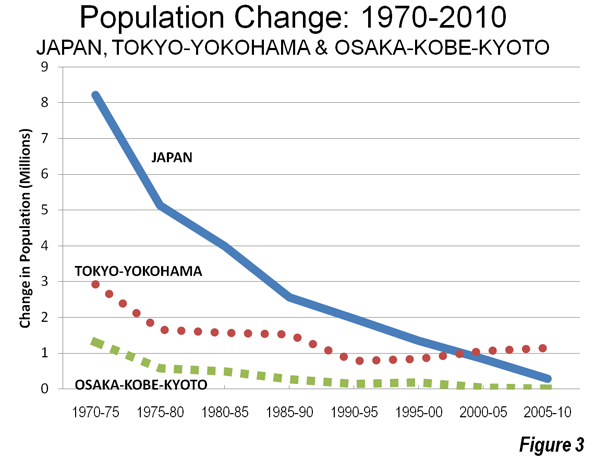
  • China: Urbanizing and Moving East: 2010 Census

    The National Bureau of Statistics of China has just released the first results of the 2010 census. The new figures portray a radically reduced population growth rate, rapid urbanization and an unprecedented domination of population growth by the East Coast.

    Slowing Population Growth: China, the world’s most populous nation, grew rapidly until the early 1980s. The strongest growth since 1950 was in the 1964 to 1982 census period, during which the annual growth rate exceeded two percent. By the 1990 to 2000 period, the annual rate had fallen to 1.1 percent and then dropped in half to approximately 0.6 percent between 2000 and 2010 (Figure 1). The nation’s total population growth between 2000 and 2010 was approximately 75 million. In contrast, the 1964 to 1982 rate would have produced a population increase of 300 million people. Two key factors have   influenced this drop in population growth rate. The first is rapidly improving affluence, a factor routinely associated with lower birth rates around the world. The second factor is China’s one child policy, which is contributing to an aging of the population and has been associated with an increasing male to female birth ratio.

    Accelerating Urbanization: Between 2000 and 2010, China continued to urbanize at a pace and scale never seen before in world history (Figure 2).  China added approximately 205 million urban residents over 10 years, more urban residents than live in any country except for India and the United States. China’s urban population expansion was 2.5 times the estimated increase in rapidly urbanizing India. In 2010, nearly 50 percent of the population lived in urban areas, compared to 37 percent in 2000. This increase is well above expectations. The United Nations had projected an urbanization share of 47 percent, which would have converted to approximately 50 million fewer urban residents.

    A large share of the increase in urban population was from the nation’s large migrant population, which lacks registration (hukou status) at its current, generally urban place of residence. A floating population, this group rose from 120 million in 2000 to 220 million in 2010. This movement of 100 million people dwarfs the national population increase of 75 million. Previous data indicated that virtually all of Shanghai’s population growth was due to migration of (principally poorer) people from elsewhere, as has occurred elsewhere in the nation.

    Moving East: For the first time since 1950, one region of the nation was dominant (Figure 3), with 83 percent of growth on the already heavily urbanized East Coast. In contrast, the center (East Central and West Central regions) combined for only eight percent of the growth, which is down from 41 percent between 1990 and 2000 and 56 percent between 1964 and 1982 (Note 1) Regional and provincial level population trends are indicated in the table below (link to provincial level map).

    China Population Trends by Region & Province
    1990-2010
    1990 2000 2010 1990-2000 Change 2000-2010 Change Share of Growth: 1990-2000 Share of Growth: 2000-2010
    CHINA    1,130.49    1,262.28       1,332.77 11.7% 5.6% 100.0% 100.0%
    EAST COAST 428.61 493.84 552.20 15.2% 11.8% 49.5% 82.8%
    NORTH 165.08 182.06 200.20 10.3% 10.0% 12.9% 25.7%
      Beijing        10.82 13.82 19.61 27.7% 41.9% 2.3% 8.2%
      Hebei          61.08 67.44 71.85 10.4% 6.5% 4.8% 6.3%
      Shandong       84.39 90.79 95.79 7.6% 5.5% 4.9% 7.1%
      Tianjin        8.79 10.01 12.94 13.9% 29.3% 0.9% 4.2%
    CENTRAL 151.89 172.60 193.00 13.6% 11.8% 15.7% 28.9%
      Fujian         30.05 34.71 36.89 15.5% 6.3% 3.5% 3.1%
      Jiangsu        67.06 74.38 78.66 10.9% 5.8% 5.6% 6.1%
      Shanghai       13.34 16.74 23.02 25.5% 37.5% 2.6% 8.9%
      Zhejiang       41.45 46.77 54.43 12.8% 16.4% 4.0% 10.9%
    SOUTH 111.63 139.18 159.00 24.7% 14.2% 20.9% 28.1%
      Guangdong      62.83 86.42 104.30 37.5% 20.7% 17.9% 25.4%
      Guangxi        42.25 44.89 46.03 6.3% 2.5% 2.0% 1.6%
      Hainan         6.56 7.87 8.67 20.0% 10.2% 1.0% 1.1%
    NORTH EAST 99.33 106.55 109.52 7.3% 2.8% 5.5% 4.2%
      Heilongjiang   35.21 36.89 38.31 4.8% 3.9% 1.3% 2.0%
      Jilin          24.66 27.28 27.46 10.6% 0.7% 2.0% 0.3%
      Liaoning       39.46 42.38 43.75 7.4% 3.2% 2.2% 1.9%
    EAST CENTRAL 344.25 375.23 381.43 9.0% 1.7% 23.5% 8.8%
    NORTH 106.40 116.59 119.92 9.6% 2.9% 7.7% 4.7%
      Anhui          56.18 59.86 59.50 6.5% -0.6% 2.8% -0.5%
      Inner Mongolia 21.46 23.76 24.71 10.7% 4.0% 1.7% 1.3%
      Shanxi         28.76 32.97 35.71 14.6% 8.3% 3.2% 3.9%
    SOUTH 237.85 258.64 261.51 8.7% 1.1% 15.8% 4.1%
      Henan          85.51 92.56 94.02 8.2% 1.6% 5.3% 2.1%
      Hubei          53.97 60.28 57.24 11.7% -5.0% 4.8% -4.3%
      Hunan          60.66 64.40 65.68 6.2% 2.0% 2.8% 1.8%
      Jiangxi        37.71 41.40 44.57 9.8% 7.7% 2.8% 4.5%
    WEST CENTRAL 236.49 259.61 259.18 9.8% -0.2% 17.5% -0.6%
    NORTH 59.91 67.29 69.20 12.3% 2.8% 5.6% 2.7%
      Gansu          22.37 25.62 25.58 14.5% -0.2% 2.5% -0.1%
      Ningxia        4.66 5.62 6.30 20.7% 12.1% 0.7% 1.0%
      Shaanxi        32.88 36.05 37.33 9.6% 3.5% 2.4% 1.8%
    SOUTH 176.58 192.32 189.98 8.9% -1.2% 11.9% -3.3%
      Chongqing      28.86 30.90 28.85 7.1% -6.6% 1.5% -2.9%
      Guizhou        32.39 35.25 34.75 8.8% -1.4% 2.2% -0.7%
      Sichuan        78.36 83.29 80.42 6.3% -3.4% 3.7% -4.1%
      Yunnan         36.97 42.88 45.97 16.0% 7.2% 4.5% 4.4%
    FAR WEST 21.81 27.05 30.44 24.0% 12.5% 4.0% 4.8%
      Qinghai        4.46 5.18 5.63 16.2% 8.6% 0.5% 0.6%
      Tibet          2.20 2.62 3.00 19.3% 14.6% 0.3% 0.5%
      Xinjiang       15.16 19.25 21.81 27.0% 13.3% 3.1% 3.6%

    East Coast: The East Coast growth share of 83 percent is far higher than in previous census periods, which reached a high at 49 percent between 1990 and 2000. The share of growth was consistent within the sub-regions of the East Coast. The North, surrounding Beijing and the Yellow River (Huang He) Delta, accounted for 26 percent of the growth. The Central East Coast, with Shanghai and the Yangtze River (Changjiang) Delta at its core, captured 29 percent of the growth. The South, centering on the Pearl River Delta, and the megacities of Guangzhou, Shenzhen and Dongguan, accounted for 28 percent of the growth (Note 2).

    All of the 11 provincial level jurisdictions (Note 3) on the East Coast all except for Guangxi grew at least as fast as the nation. The fastest growth in the nation was in the three provincial level municipalities: Beijing, where the population increased 42 percent, Shanghai at 38 percent and Tianjin at 29 percent. Even so, Beijing’s population was a full two million less than some estimates, while Shanghai’s was nearly one million more than current city estimates.

    Outside the provincial level municipalities, Guangdong was the fastest growing in the nation, adding 21 percent. Guangdong became the nation’s largest provincial level jurisdiction, reaching 104 million and adding 18 million new residents. The Guangdong count was particularly surprising, roughly 7 million higher than would have been expected based upon 2009 population estimates. Zhejiang, adjacent to Shanghai grew 16 percent. Hainan, an island province carved from Guangdong in the 1980s, grew 10 percent.

    North East: The North East ("Manchuria" or "Dong Bei") accounted for only four percent of the nation’s growth, down significantly from previous census periods.  All three provinces grew at lower rates than the nation. These are traditional manufacturing areas that have not seen the sort of investment seen further south.

    East Central: The East Central provinces accounted for eight percent of the nation’s growth, down from 23 percent between 1990 and 2000. Among the seven provinces, only Shanxi and Jiangxi grew faster than the national rate. Hubei, home of Wuhan, one of the nation’s largest urban areas, experienced a loss of more five percent, the second largest population decline in the nation after Chongqing. The northern East Central jurisdictions grew at approximately one half the national rate, while the south grew at approximately one fifth the national rate.

    West Central: The seven West Central provincial level jurisdictions lost population in an amount equal to -0.6 percent of the national growth. This compares to an18 percent share of national growth between 1990 and 2000. The provincial level municipality of Chongqing experienced the largest rate of population loss in the nation at seven percent. Sichuan, from which Chongqing was carved in the 1990s, lost three percent of its population. Nonetheless, two provincial level jurisdictions in the West Central grew faster than the national rate, Ningxia and Yunnan. As in the East Central, the North grew at approximately one half the national rate. The South experienced heavy rural population losses, even as large urban areas, such as Chongqing and Chengdu experienced strong population gains.

    Far West: The jurisdictions of the Far West captured five percent of the national growth. The Far West grew the fastest among the regions, at 12.5 percent compared to 11.8 percent on the East Coast.  Each of the jurisdictions, Xinjiang, Tibet and Qinghai grew more quickly than the national rate. Nonetheless, with such a small population (30 million), the population growth in the Far West was barely one-half that of Beijing or Shanghai and little more than Tianjin.

    Provincial Losses, Urban Gains: Despite the uneven concentration of growth on the East Coast, the larger increase in (100 million) in migration from rural to urban areas led to a less uneven distribution of urban growth. The slow growth and even the population losses occurring in the interior mask huge growth in major urban areas of the same provincial level jurisdictions.

    Based upon 2009 estimates (provincial level urban data has not yet been released for 2010), the provincial level municipality of Chongqing gained 4.5 million urban residents (more than the population of Berlin), while the overall provincial level population loss was 2 million from 2000 to 2010. This illustrates one of the principal dynamic of population trends in China, as the countryside loses population to urban areas not only on the East Coast but also in the same general areas. The rural areas of Chongqing, which accounted for two-thirds of the population, lost more than 6 million residents, principally to the nearby Chongqing urban area as well as to other urban areas of the nation.

    In Sichuan, with its large and fast growing capital Chengdu, the urban population grew nearly 10 million, while  the provincial population was declining 3 million, indicating a rural loss of 13 million. Thus, while the East Coast accounted for 83 percent of the overall population growth, government estimates through 2009 indicate that only 47 percent of the urban population growth was on the East Coast (Figure 4). 

    Challenges: China faces no shortage of demographic challenges. An aging population will impose significant financial burdens on the generations to come, as is already happening in more affluent nations. The ratio of female to male births needs to be improved or social stability could be difficult to maintain in the decades ahead. The role of China’s one-child policy in these issues is now being debated and reviewed.

    The strong trend toward urbanization will continue for decades. The United Nations estimates that China will be nearly 75 percent urbanized in 2050 compared to the current 50 percent. The nation is expected to add 70 million residents, with an increase of 400 million in urban areas and a loss of 330 million in rural areas. Should these projections be reached, China’s rate of urbanization will be near the current levels in the affluent West. Even with more than one-half of urban growth now occurring outside the East Coast, there is a need to decentralize more of the growth to the emerging urban areas of the interior. This is something now widely recognized within Chinese planning and government circles.

    —–

    Photo: Wuhan (capital of Hubei) By author

    Note 1: There are various methods to categorize the regions of China. This classification is used to illustrate the differences in regional growth rates in the census periods since 1950. The provincial level municipality of Beijing is classified as East Coast because it is surrounded by provincial level jurisdictions (Hebei and Tianjin) which are coastal. Inner Mongolia, which stretches across the entire center of the nation is classified in the East Central because its population is more concentrated in that area. The regional population change between 1953 and 1964 includes an estimated allocation of population to provincial level jurisdictions into which abolished provinces (Rehe, or Jehol and Xikang) were merged during the period.

    Note 2: The Hong Kong and Macao Special Administrative Regions are also in the south, but are not included in the 2010 census data.

    Note 3: There are three types of provincial level jurisdictions in China, provinces, provincial level municipalities and autonomous regions.

    Wendell Cox is a Visiting Professor, Conservatoire National des Arts et Metiers, Paris and the author of “War on the Dream: How Anti-Sprawl Policy Threatens the Quality of Life

  • The Public Transport Revolution – Why does it never Arrive?

    Since the oil spike in the early seventies, enthusiasts for public transport have predicted that high prices for petrol would trigger a public transport revolution as people finally broke their “addiction” to the motor car and changed their travel mode to buses and trains.

    Since then, price bubbles have increased public transport use, and lowered car miles traveled. But these changes have proved to be short-lived. More drive more.

    Yet standard theory says that people respond to prices. Surely people should respond to increased petrol prices by changing their mode of travel.  But why hasn’t it happened in the past? More importantly, will it magically happen in the future?

    The answer is that most drivers do respond to increased oil prices but they have many choices as to how to respond..  You may switch to public transport provided it takes you where you want to go at a reasonable price. The problem is that part of the “reasonable price” includes the price of the increased time it takes to get to the final destination. Also, surveys reveal that when people climb into their car at the end of the day they feel they have actually arrived at “home.” Bus and train travel significantly defers their arrival in their own private space.

    So, given time, people change their behaviour in many ways, so as to maintain the comfort, convenience, and overall efficiency of the car. For example:

    1. They may decide to buy a smaller or more fuel-efficient car.
    2. They may relocate either their home or their job to reduce travel costs and times – provided the land market is flexible.
    3. If the local land-market is inflexible they may move to another town, or another country.
    4. They may modify all their travel behaviour by better trip planning, commuter car-pooling (with prioritized parking) and general ride and task sharing.
    5. They may choose to telecommute, car-pool, park-share, and ride-share.

    Fuel costs are only a small component of total motoring costs. Cars today are lasting longer, are more reliable, are cheaper to run, and are kept in use longer. When oil was cheaper total costs of motoring were higher. That’s one reason why we are driving more.

    Sudden spikes in petrol prices do affect the transportation modal split, but these spikes carry less significance than media reports would suggest, and tend to be of much shorter duration than the advocates of transportation revolution predict. People know how they want to live and they value their personal mobility.

    This is not a trivial issue because councils – and the Auckland Council for example – are demanding that Government funds massive investments in public transport because of the current oil spike, the upward blip in public transport use, and of course “Peak Oil.”

    The Peak Oil pessimists seem to believe no alternative to the petrol driven car exists. They also seem to ignore the increasing evidence of vast oil and gas reserves being discovered from everywhere the eastern Mediterranean to the shores off Brazil and the American Great Plains.

    A host of emerging technologies will more than compensate for any increase in the price of oil-based fuels – even for vehicles that continue to run on fossil fuels. Think of the hybrid car topping up the batteries from solar panels in the roof. Robot cars and electronically convoyed trucks hugely increase lane capacity. There are so many it would need another column to list them. The pessimists complain that it will take far too long to ring such changes in the vehicle fleet. In the next breath they talk about reshaping the urban-form, mainly by the densification of our major cities. Short of another Luftwaffe arriving on the scene, such urban renewal is hardly likely to happen overnight. Technology churns faster than cities. Try buying a Gestetner, a Telex machine, a slide rule, or a film for your camera.

    Urban economist, Anthony Downs, writing in “Still Stuck in Traffic?” reminds us:

    "….trying to decrease traffic congestion by raising residential densities is like trying to improve the position of a painting hung too high on the living room wall by jacking up the ceiling instead of moving the painting.”

    Yet the Auckland Council, like their counterparts throughout the affluent world, seems determined to raise the ceilings – with no regard for costs.

    One of the arguments used against building more roads – and especially against more motorways – is that as soon as they are built they become congested again because of “induced demand.” Such “induced demand” is surely the natural expression of suppressed demand. It seems unlikely that motorists will mindlessly drive between different destinations for no other reason than they can.

    However, let us accept for a moment that “induced demand” is real, and suggests that improving the road network is a fruitless exercise. Advocates of expensive rail networks claim they will reduce congestion on the roads and improve the lot of private vehicle users as a consequence.

    But surely, if the construction of an expensive rail network does reduce congestion on the roads then induced demand will rapidly restore the status quo. Maybe the theory is sound after all. It would explain why no retrofitted rail networks have anywhere resulted in reduced congestion.

    This is the time to invest in an enhanced roading network while making incremental investments in flexible public transport. Roads can be shared by buses, trucks, vans, cars, taxis, shuttle-buses, motor-cycles and cyclists – unless compulsive regulators say they are for buses only. Railway lines can be used only by trains and if we build them in the wrong place they soon run empty. The Romans built roads and we still use them.

    In a techno-novel published in 1992, Michael Crichton pauses in his narrative to explain what an email is. That’s not long ago.

    The one certainty is that the internet/computer world will have the same impact on transport as it has already had on communications. Transport deals with bits while communication deals with bytes.

    The end result will be a similar blurring of the line between public and private transport that has already happened between public and private communication. The outcomes are beyond our imagination.

    We should get used to it, and realise that making cities more expensive and harder to get around in does not make them more liveable.

    Owen McShane is Director of the Centre for Resource Management Studies, New Zealand.

    Photo by Mark Derricutt