Category: Urban Issues

  • A Leg Up: World’s Largest Cities No Longer Homes of Upward Mobility

    Throughout much of history, cities have served as incubators for upward mobility. A great city, wrote René Descartes in the 17th century, was “an inventory of the possible,” a place where people could lift their families out of poverty and create new futures. In his time, Amsterdam was that city, not just for ambitious Dutch peasants and artisans but for people from all over Europe. Today, many of the world’s largest cities, in both the developed and the developing world, are failing to serve this aspirational function.

    Though leading urban theorists love to celebrate the most rarified parts of the city economy—Saskia Sassen refers to “urban glamour zones” that thrive in what New York Mayor Michael Bloomberg proudly calls the “luxury city”—they tend to forget about working- and middle-class residents. Unfortunately, these urban ideas appear to be contagious, as they’re being applied to the expanding cities of Asia and other developing regions. A recent World Bank report argued that large urban concentrations—the denser, the better—are the most prodigious creators of opportunity and wealth. “To spread out economic growth,” the report claimed, is to discourage it.

    A closer look, however, suggests a more nuanced reality. Cities in the developing world are growing, but largely because they’re the only alternative to poverty and even starvation in the countryside. These cities are not only failing to provide opportunities for upward mobility; they’re producing the class inequalities found in “luxury cities” such as London and New York.

    Once rigidly egalitarian, China now has some of the world’s highest rates of income inequality. The central cores of Beijing and Shanghai employ legions of well-paid European and American architects and planners, but few concern themselves with the camps inhabited by poor, often temporary workers, who constitute roughly one-fifth of the population and live in conditions more reminiscent of a Brazilian favela than an “urban glamour zone.”

    This same stratification is also happening in India. Mumbai, one of the fastest-growing cities, is creating wealth at the top of the economic spectrum but leaving millions of others scrambling for mere subsistence. The New York–based author Suketu Mehta has described his hometown of Mumbai (formerly known as Bombay) as “an urban catastrophe,” an example of the mounting woes of rapidly expanding cities in the developing world. “Bombay is the future of urban civilization on the planet,” he wrote. “God help us.”

    A majority of Mumbai’s population now lives in slums, up from one-sixth in 1971—a statistic that reflects a lack of decent affordable housing, even for those gainfully employed. Congested, overcrowded, and polluted, Mumbai has become a difficult place to live. The life expectancy of a Mumbaikar is now seven years shorter than an average Indian’s, a remarkable statistic in a country still populated by poor villagers with little or no access to health care.

    In spite of World Bank proclamations, the most rapid urban growth in India is actually occurring in smaller, less dense cities, such as Bangalore and Ahmedabad, places with lower living costs and more business friendly governments. This mirrors a trend occurring in the United States. In the last decade, middle-income people have been moving out of our megacities. Between 2000 and 2008, according to the demographer Wendell Cox, regions of more than ten million people suffered a 10 percent rate of net domestic out-migration. (Often the only reason for population growth in these cities was immigration.) The big gainers were cities between 100,000 and 2.5 million residents: the business-friendly Texas cities Dallas, Houston, and San Antonio; Raleigh and Durham, North Carolina, which now form the fastest-growing metro area in the nation; and the heartland cities of Columbus, Indianapolis, Des Moines, Omaha, Sioux Falls, and Fargo.

    One reason for this movement has been the shift of jobs away from the coasts to lower-cost, less dense cities. The fastest growth in middle-income jobs has been concentrated in many of the places listed above: Houston, Dallas, Austin, Raleigh-Durham, and Salt Lake City. This pattern also includes high-tech, science-oriented employment. In contrast, those jobs have been stagnant or shrinking in such cities as New York, Los Angeles, San Francisco, and Chicago.

    As a result, America’s largest cities are increasingly divided into three classes: the affluent, the poor, and the nomadic class of young people who generally come to the city for a relatively brief period and then leave. New York, the aspirational city of my grandparents, now has the smallest share of middle-income families in the nation, according to a recent Brookings Institution study, with Los Angeles and San Francisco not far behind. In 1980 Manhattan, New York’s wealthiest borough, ranked 17th among U.S. counties for social inequality; by 2007 Bloomberg’s “luxury city” was first, with the top fifth earning 52 times the income of the lowest fifth, a disparity roughly comparable to that of Namibia.

    Similar patterns can be found in Europe, despite its countries’ more developed welfare states. The U.K. has witnessed a relentless centralization of urban functions in London, as once proud cities such as Manchester, Liverpool, Glasgow, and Birmingham have continued their long slide into obscurity and irrelevance. The bulk of London’s growth, however, has not taken place in the central core but in what the historian James Heartfield calls “the greater southeast.” This vast “conurbation” stretches from west of Heathrow Airport to the booming coastal city of Brighton, roughly an hour’s train ride from the“ city center.

    As the middle class has decamped, central London has become more stratified. Residents and workers there and in the West End account for some of the most concentrated wealth on the planet. At the same time, prospects for London’s middle class have weakened, with many fleeing to the suburbs or even leaving the country. (Britain remains a large exporter of educated workers to the rest of the world.) The major issue here is the high cost of housing. Even in its poorest neighborhoods, London now ranks as one of the most unaffordable places for middle-income people to buy a home.

    Still, life is much tougher for the city’s poor, many of whom live less than an hour’s walk from the wealthiest neighborhoods. Take a stroll just a mile or two from the Thames and you enter a very different London. It is here where you’ll see why the financial capital of the European Union also has the highest incidence of child poverty in Great Britain (more even than in the beleaguered North East). Thirty-six percent of children in London live in poverty, a figure that rises to more than one-half when the city’s housing costs are factored in.

    The same split has emerged in other countries considered far more open than class stratified Britain. A recent University of Toronto study found that between 1970 and 2001, the portion of middle-income neighborhoods in the city had dropped from two-thirds to one-third; poor districts had more than doubled to 40 percent. By 2020, middle-class neighborhoods could fall to less than 10 percent, with the balance made up of poor and affluent residents.

    Much the same can be seen in continental Europe, a trend greatly exacerbated by the growth of immigration. Unlike Amsterdam in Descartes’s time, Europe’s great cities are failing in their historic mission of incorporating newcomers, as German Chancellor Angela Merkel recently conceded. In Berlin, one fourth of the workforce earns less than 900 euros a month, while 36 percent of children are poor. The city once known as “Red Berlin” has emerged as “the capital of poverty and the ‘working poor’ in Germany,” Emma Bode, a left-wing journalist, wrote in 2008.

    Given these global realities, it might be time for our urban boosters to curb their enthusiasm for the “luxury city” and refocus on how to meet the aspirations of their middle- and working-class residents. If they don’t, lack of opportunity will drive more and more of this crucial aspirational class farther and farther away, mostly to smaller cities and suburbs that still offer “an inventory of the possible.”

    This piece originally appeared in Metropolis Magazine.

    Joel Kotkin is executive editor of NewGeography.com and is a distinguished presidential fellow in urban futures at Chapman University, and an adjunct fellow of the Legatum Institute in London. He is author of The City: A Global History. His newest book is The Next Hundred Million: America in 2050, released in February, 2010.

    Photo by Premshree Pillai

  • China Housing Market More Stable Than You May Think

    The sensationalist reporting of rising China tends to celebrate the country’s ascent. But there is one area where both economists and casual observers see a potential disaster: the real estate market.  Media reports of skyrocketing housing prices in first tier cities like Beijing and Shanghai and photo essays of Chinese ‘ghost cities’ inject sober skepticism into the otherwise bewildering reality of rapid growth.

    The claims about real estate, however, are as exaggerated as the breathless accounts of the country’s path towards world economic domination. It is absurd to argue that all it will take for China to fall would be a bust in the housing market. In reality, the country has too many economic fundamentals working for this one sector to wreak too much havoc.   

    Above everything, China remains a manufacturing powerhouse, providing the developed world with everything from children’s toys and athletic shoes to iPads and other electronic devices. Yes, the Great Recession did have a negative impact on China’s export business; this is why the Central Government took steps to direct massive amounts stimulus money towards infrastructure and real estate development.

    Far from being limited by exports, China is just beginning to unleash the power of its domestic consumer market. Imported goods (in reality, foreign brands, even if they are manufactured within China) are highly taxed, encouraging Chinese consumers to spend money on cheaper, local brands, thus keeping the money supply circulating through the domestic market.

    Yet this does leave China somewhat subject to real estate speculation. With   limited channels for investment, a risky domestic stock market, and little-to-no interest accrued by holding money in Chinese bank savings accounts, there is, for many individuals, nowhere else to spend their money but in the housing market.

    There are a few other forces at work here as well. Since the Chinese government still technically owns all of the land in the country, real estate developers are given the right to develop land based on a bidding process, with the rights going to the highest bidder. Auctioning of land for development typically happens at the municipal level. Once a developer is awarded the right to develop a piece of land, there is a time limit (usually no more than a few years) before it returns to the hands of the government.

    The purpose of this is two-fold: one is to manage the urban influx of new migrants and also to discourage land speculation by developers. As you can imagine, savvy developers often wait until the last minute to build a project to get the maximum profits from their projects.

    Since income taxes are low by international standards (and easily evaded through the preponderance of ‘grey money’ or hidden income) and property taxes are virtually nonexistent (up until recently at least), land auctioning is by far the largest source of income for local governments. This becomes the main way these governments fund infrastructure and public works projects.

    This same process is happening in cities across China. Why? Quite simply, the demand is there. The booming housing market is a revolution of sorts. This is really the reflection of the emergence of a true Chinese middle-class. The U.S. media, on the other hand, tends to remain focused on a massive China real estate bubble, perhaps as a projection of America’s own recent experience of real estate exuberance.

    Yet there are some major differences. For example, few Chinese purchase homes with little or no money down. Banks are not lending ‘creative mortgages’ such as ARMs to homebuyers. Government measures seek to discourage speculation.

    For instance, Chinese home buyers are limited to purchasing 2 homes and must put at least 30% down for the first home and 60% down for the second home. Investment by foreigners into the real estate market is strictly regulated in order to reduce the amount of ‘hot money’ coming into the country. Non-Chinese citizens are limited to purchase one home only and must hold onto it for 5 years before being allowed to resell it.

    Due to the massive size of China’s population, the majority of homes being purchased are flats in newly-built residential high-rise compounds. The size of these units might be a little too cozy for Americans or even Europeans, but to young Chinese homebuyers (of which most are first-time buyers), it represents an aspiration unimaginable only a few years ago.

    Take 26 year old Mei Li for example: late last year she, an administrative assistant at a construction company, and her husband, an IT professional, bought a home in the fast growing western district of Chengdu, between the 2nd and 3rd Ring Roads. The young couple put a 30% down payment on a 2-bedroom, 80 m² (860 ft²) flat on the 23rd floor of a tower that is part of a brand new residential development.

    At RMB 7,500/m², the total cost of their flat was RMB 600,000 (about $91,000 USD). As required, and with some help from their parents, Ms. Li and her husband put a down payment of 30%, or RMB 180,000, and qualified for a 30-year, 6% fixed-interest home loan from Bank of China. With a combined income ranging from about RMB 8,000-10,000 ($1,200 USD – $1,500 USD) per month, their monthly mortgage payment of RMB 2,500 ($380 USD) is easily manageable.

    Ms. Li and her husband are glad they got in when they did. Even though their new unit won’t be ready for move-in until the end of this year, they have already seen the value of their investment increase by 10%. Located adjacent to a planned stop for an underground metro line currently under construction, the value of their investment is bound to further increase due to its convenient access to public transportation. In the future, taking the subway will be just one of their transportation options as Ms. Li and her husband plan to buy their first car by the end of this year.

    Multiply Mei Li and her husband’s story by the millions and you have a better idea of what is really behind the China housing boom. To be sure, speculation certainly exists, but predominately it is middle-class aspiration that is fueling urbanization.

    In Chinese, the word for ‘family’ and ‘home’ are the same: jia (家). The family is the critical unit of Chinese culture, making ownership of a home a critical priority. For the world, middle-class home-ownership also promotes peace and stability in China, providing the basis for the evolution of a more consumer oriented, less predatory Chinese economy.

    Adam Nathaniel Mayer is an American architectural design professional currently living in China. In addition to his job designing buildings he writes the China Urban Development Blog.

  • Regional Efficiency: The Swiss Model?

    Given that no one likes Switzerland’s banks, coo-coo clocks, high prices, smugness, dull cities, cheesy foods, or yodeling, I realize that it is too early to speak politically about “the Swiss Model.” But it needs to be pointed out that while the European Union evaporates and Homeland America goes for broke, the world’s second oldest democracy (1291) has trade and budget surpluses, a multi-lingual population, a green network of trains and buses to every village, excellent public schools, and a federal-style government that is closer to Thomas Jefferson’s America than the bureaucratic monarchy that gives the king’s speeches in Washington.

    Yes, the Swiss recently voted against the construction of minarets (NIMCP or “not in my cow pasture”) and for the eviction of immigrants convicted of serious crimes. (Would you vote “for” protecting the immigration rights of the rapist next door?) But a quarter of the students in Geneva’s public schools are foreign, and—in the age of focus groups and slick pollsters—the democracy remains in the hands of its citizenry, for better or for worse, which every two months votes on the referendums of the critical issues. On this month’s ballot is gun control.

    A mythical Swiss story involves a man on a morning bus, chatting with someone standing near him, exchanging pleasantries about work and the weather, and discovering that his commuting friend is also the president of the Swiss confederation.

    I had a similar experience. I had arrived at the Geneva Press Club on my bike, and discovered that the woman sitting near me was also the president, Micheline Calmy-Rey. To be clear, she was at the front of the room, and I was in the audience. But her unassuming manner was that of a bus commuter, and had she walked into the room unescorted, I would not have marked her as the leader of the country.

    In a way, she is not. To be president of Switzerland is to be the head of a seven person federal council, whose members are apportioned according to the political parties in the parliament. Real power in the country remains vested in the villages and in the twenty-six cantons. Think of the Swiss president as the unlucky committee person who has to keep the minutes.

    After the European revolutions of 1848, Switzerland adopted a federal constitution, in part modeled on the American system, although instead of the imperial presidency (which Jefferson called “a bad edition” of the Polish king), the Swiss went for an executive council. Benjamin Franklin had the same idea earlier for the U.S., but lost out to the more presidential Adams and Madison.

    Each year, the members of Switzerland’s federal council draw straws for the presidency and the other executive offices, such as the portfolios for justice, sport, and economics. Technically, the chief executive is composed of the entire collective.

    Recent presidents include Hans-Rudolph Merz and Doris Leuthard (often the Swiss president is a woman). The Merz administration, however, proved the limits of a referendum democracy in the fast-paced, somewhat dictatorial age of globalization.

    From the German-speaking part of the country, and regarded by his critics as a small town politician, Merz had the misfortune to horse trade with Libya’s Muammar el-Qaddafi. The diplomatic row began when Hannibal, the son of the Libyan president, was arrested in a Geneva hotel for having mistreated his servants.

    No one in Geneva doubts that Hannibal Qaddafi’s servants were treated little better than Arab slaves. The staff at the posh hotel reluctantly called the police to intervene. Warming to the Ali Baba-like themes of the crime, the local press published Hannibal’s mug shot, and the crisis was off to the camel races.

    After picking up two Swiss businessmen in Tripoli with expired visas, Father Muammar — Qaddafi, that is — threw them into solitary confinement and vowed to release them only if the Swiss punished the Geneva police, apologized to Hannibal, and groveled inside the colonel’s tent.

    Agreeing to Qaddafi’s terms, because the great Swiss trait is accommodation, Merz flew to Tripoli, thinking he had a Clintonian deal to return triumphantly to Bern with the Swiss hostages.

    Instead, the colonel-for-life lectured Merz on the finer points of visa legislation, and the Swiss president flew back to Bern with only the hostages’ luggage, which had been loaded onto the presidential executive jet. The hostages had to serve humiliating prison terms, and a grateful nation watched Merz retire at the end of 2009. A government of “sapeur pompiers” (volunteer firemen) is not without its comic charms.

    As she was then minister of foreign affairs, Calmy-Rey was not blameless in what the press calls the “Affaire Qaddafi,” but that didn’t prevent her from becoming president this year, her second time in the position.

    At a press conference, she admitted, in so many words, that a rotating federal council perhaps wasn’t the best way to deal with erratic strongmen. Her actual words were much more diplomatic; she suggested that the council had lacked the “resources” to manage the crisis.

    In person, I liked Calmy-Rey much more than I expected. Her image in the press is as a glad-hander, someone unwilling to tell Swiss detractors to stick it. She wore a head scarf to meet Iranian president Mahmoud Ahmadinejad.

    In person she’s thoughtful, well spoken, conversationally direct, up on the details of government, ever-so-slightly humorous, and modest, as if she were mayor of a small commune, which is another way to understand Switzerland.

    I have been in Washington press conferences, and they are like a Versailles levée compared with a Swiss question-and-answer session. Calmy-Rey shared the modest dais with two officials and the head of the press club, as if they were panelists at a Rotary meeting.

    Her formal remarks were confined to a budgetary review of the pluses and minuses of supporting “international Geneva,” the sprawling network of UN-related organizations that have come to roost in the city. At the cost of billions, laid on in office infrastructure and tram lines, the hope is that peace becomes part of the Swiss brand.

    Everyone in the room who wanted to ask a question did, and Calmy-Rey stayed as long as it took to recite the liturgy on Brazilian floods, Middle East protest riots, banking secrecy, bilateral relations with the European Union, Kosovo’s future, nuclear Iran, building plans at the United Nations, Armenia and Turkey, the surplus of the federal budget, and more, until the room felt like a class eager for the break.

    The conference hardly made the daily papers. The only sound bite was her answer to a question about whether the Swiss were prepared to give asylum to the WikiLeaks founder and publisher, Julian Assange. Calmy-Rey gave a broad, politically evasive smile, and said, in somewhat fractured English, “We cannot give what we have not been asked to give.”

    Meaning: Neither Assange personally, nor any government, had approached the Swiss to grant him asylum. If I had to guess, I would say the Swiss would pass on granting asylum to Assange, just to avoid more aggravation with the Americans, who routinely use the Swiss as punching bags on banking secrecy and their nonaligned status in world affairs. In another context Calmy-Rey said, “We know we’re alone,” and that was a weakness in dealing with Qaddafi.

    I found Calmy-Rey realistic and self-effacing on Switzerland’s diplomatic nether world. The country has to straddle “international Geneva” and its many world agencies with another Swiss impulse, which, in the words of George Washington, is to avoid “foreign entanglements.”

    Switzerland has come through the recent economic horrors with its budget in surplus ($3 billion), and without any of the Euro debts that followed the long weekends in Ireland and Greece. Power remains in the cantons and the communes, which decide what to teach in the schools, how much tax to collect, and who lives in the villages.

    Refreshing, as well, is that the Swiss president can travel in a motorcade of one (I noticed that her driver is a woman), if not on the bus. When Calmy-Rey was in her first term as president, my daughter Laura was in high school. One night at dinner she described shopping after school in a discount department store. In the checkout line she stood next to Calmy-Rey, who, by herself, was buying a blouse.

    Photo by Juerg Vollmer; Micheline Calmy-Rey, Zuerich, 2009

    Matthew Stevenson is the author of Remembering the Twentieth Century Limited, a collection of historical essays. He is also editor of Rules of the Game: The Best Sports Writing from Harper’s Magazine. He lives in Switzerland.

  • Why Duany is Wrong About the Importance of Public Participation

    One of the news stories circling lately is an interview with Andres Duany where he asserts that public participation requirements are too onerous to enable great work to be done.   Early in my career I worked as a public historian and historic preservation specialist, so rather than launch immediately into my opinion, let me tell you a true story.

    In the 1950s, business owners in downtowns across the country became agitated over the fact that their central business districts were facing a double challenge: increasing amounts of traffic congestion and increasing competition from new suburban shopping centers.  One of the towns feeling these challenges was Green Bay, Wisconsin, which had a very energetic and forward-thinking business leadership circle. 

    The good men of Green Bay did what most forward-thinking leaders do when faced with a fearful challenge on the horizon: they hired a consultant.  The consultant they chose was Victor Gruen, an architect who had recently gained fame designing the nation’s first enclosed shopping mall, in Edina, Minnesota.  In the couple of years that had lapsed since the Southland Mall plans hit the streets, Gruen had become a celebrity – the Andres Duany of his day. 

    In a 2006 article for the New Yorker, Malcolm Gladwell described Gruen as “short, stout, and unstoppable, with a wild head of hair and eyebrows like unpruned hedgerows.” Gladwell summed up Gruen’s impact pretty succinctly:

    Victor Gruen didn’t design a building; he designed an archetype. For a decade, he gave speeches about it and wrote books and met with one developer after another and waved his hands in the air excitedly, and over the past half century that archetype has been reproduced so faithfully on so many thousands of occasions that today virtually every suburban American goes shopping or wanders around or hangs out in a Southdale facsimile at least once or twice a month. Victor Gruen may well have been the most influential architect of the twentieth century. He invented the mall.

    Gruen asserted in Green Bay, as he did in dozens of other cities in the 1950s and 1960s, that the key to solving downtown’s competition challenge was to completely separate vehicular traffic from pedestrians.  By massively widening Main Street at the north end of the commercial district and completely enclosing the core of the existing commercial district, all of downtown’s problems would be solved.  All the plan required was money and a willingness to be unsentimental and practical.

    You don’t have to be Duany to understand what happened.  It took 20 years for Gruen’s vision to become some form of reality, and during that time the City’s business and political leadership –and its planning staff – stuck to Gruen’s plan as diligently as the real world constraints of financing and private development would allow.  

    By the time it opened in 1977, the new Port Plaza Mall and associated parking lots and garages had obliterated acres of downtown buildings, dislocated a hundred residents.  It sent dozens of businesses to liquidation or to the far edges of the newly-sprawling city where many of them are located today.  If Gruen considered the collateral damage of grand ideas at all, I wager he simply viewed them as the price of progress. 

    All of this might be tolerable from a strict economic standpoint if Gruen’s grand plan had worked.  It didn’t.  Port Plaza Mall was a money-loser from virtually day one.  By the early 1980s, Port Plaza was doing so poorly that the City took the advice of another consultant and bulldozed another full block of buildings to add the magic third anchor, which they were assured was the way to fix the mall’s ails.  By the early 2000s, that anchor was gone. 

    Green Bay, like many other cities that drank the downtown mall Kool-Aid, continues to struggle with a downtown that is dominated by a windowless, dispiriting, too-vacant hulk where its heart should be.  Meanwhile, the region’s former skid row, right across the Fox River within eyesight of the mall, has become the hottest urban neighborhood in the region, and the winner of a Great American Main Street Award. 

    This isn’t simply a story about the virtues of historic preservation.  Gruen’s idea didn’t fail because Green Bay wanted old buildings or because the people who lived and worked in those old downtown buildings did something to undermine the plan.  Like most people of that era, the majority of the City’s leadership and residents placed their faith in the expert and in the concept of progress.  Any gut misgivings they may have had were pushed aside.  The plan was made by a national expert, right?

    Gruen’s mall failed because he envisioned and sold an ideal solution without giving any attention to economic realities, and without consideration of the myriad of unforeseen factors and unintended consequences that could, and did, develop.  Gruen stood at the beginning of an era, and there was no way anyone could anticipate how the world would change in a few short decades.

    The greatest failure of Gruen’s plan was that he did not recognize or acknowledge that his Grand Vision could very well turn out all wrong.     

    We should have learned by now that our Grand Visionary Designers are not infallible. Our landscapes are littered with Grand Visionary Architecture that was supposed to fix something, or create Something Big. And so few of those grand visions ever came out the way they were promised, or managed not to create a new set of problems.  Never heard of Port Plaza?  That’s because there are Port Plazas of one flavor or another in virtually every city in the country.  Some are malls, some are stadiums, some are brutalistic, forsaken parks.  You can pick them out easily by their Grand Design ambitions and their total lack of life. 

    Our failure to learn this lesson is a blot on architecture and planning.

    This history is exactly why Duany is wrong about the importance of public participation.  Public participation is important not just to try to get people to go along with our vision, to give us a chance to yell loud enough to drown them out, or to allow us to demonstrate the superiority of our Grand Vision over their piddling little concerns.  When residents resist a new development  – even when they supposedly “don’t like change” – it doesn’t take many questions or much effort to develop a real understanding of their concerns and their point of view.   

    We fail consistently to realize that the locals are there every day and we are not. Local residents have a level of detail and a critical perspective that can make the difference between whether a proposed project supports the health of the community or creates a new burden.   Much of the time, the real concerns of the residents of an area have to do with nuts and bolts issues that can be fixed with relatively little effort or accommodation.  It’s possible that local resistors might have good reasons why the proposed change is a bad idea.  If we don’t enable and empower them to speak, we have made the same mistake as Gruen and we are likely to create a similar legacy.

    Understanding the real reasons why people oppose a project requires the willingness to do so, the humility to listen, and the internal fortitude and self-assurance to admit that possibly, oh just possibly, we don’t know everything that there is to know.   That is the real mark of wisdom.

    Duany and other marquee designer types have the privilege of maintaining a distance from the dirty work of making a project functional in real life. Don’t overlook the work of the nameless landscape architects and architects who are hired by the developers after the big name architects are paid, have gathered their glory, taken their big checks and left.  It is those highly competent, highly talented professionals who deal with the Grand Architect’s ignored steep slope under that proposed building or those planting beds that will block other drivers’ vision of the charming landscaped driveway emptying out onto a major intersection.  

    Ah, little stuff. Who cares?

    If the people who live around a proposed development oppose a development, chances are those people know something that is important to the health of their neighborhood and the larger community. If we think that we know more than to have to listen to them, then we are no better than little Napoleons in big capes, creating monuments to our hubris that our children and grandchildren will have to clean up. The lessons of the damage caused by our ignorance are all around us.

    Photo by Jeanette Runyon

    This piece originally appeared in Forbes.

    Joel Kotkin is executive editor of NewGeography.com and is a distinguished presidential fellow in urban futures at Chapman University, and an adjunct fellow of the Legatum Institute in London. He is author of The City: A Global History. His newest book is The Next Hundred Million: America in 2050, released in February, 2010.

  • Australia’s Housing Affordability “Outrage”

    There is mounting concern in Australia about the nature and extent of country’s housing affordability crisis. Expressions of distress are not limited to the middle income households who are locked out of the Great Australian Dream of home ownership. There is heightened interest from advocates of low income households and an opposition political party. Moreover, Australia’s overvalued housing is receiving renewed attention in international circles.

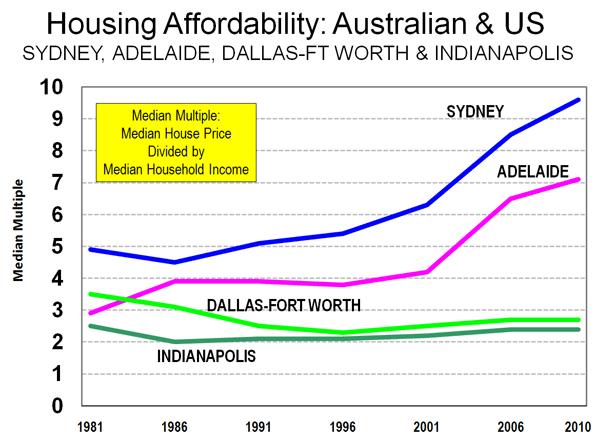
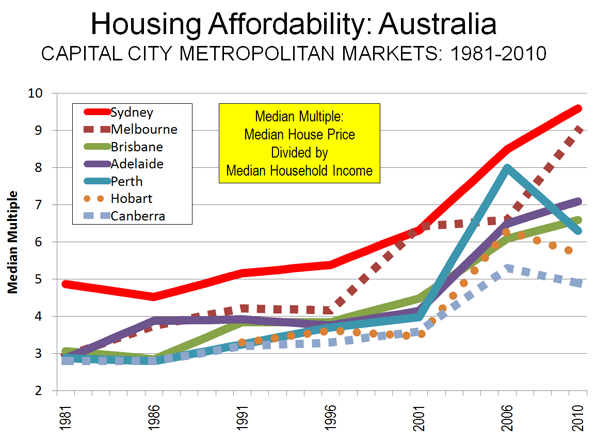
    Part of this attention is attributable to the 7th Annual Demographia International Housing Affordability Survey, which was released in late January. The Demographia Survey, which I co-author with Hugh Pavletich of Performance Urban Planning in Christchurch (New Zealand) covered 325 Metropolitan markets in seven nations (United States, United Kingdom, Canada, Australia, Ireland, New Zealand and Hong Kong, in China). The Survey assesses housing affordability using the United Nations and World Bank recommended measure of median house price divided by median household income (the Median Multiple). The data shows housing to be severely unaffordable in Australia, which was the most unaffordable nation included in the survey.

    In response, Michael Perusco of Melbourne’s Sacred Heart Mission and chairman of the Council to Homeless Persons called the affordability statistics "alarming.“ He added he was not surprised by the housing affordability data, noting the stress on the people he serves caused by inflated prices.

    Kirsten Moore recently reported in these pages on the statement by the Australian Green party. Senator Scott Ludlam, the party’s shadow minister (spokesperson) for housing called Australia’s housing affordability a "world-class outrage." He went on to say "When a family or an individual has to spend so much of their income on paying their mortgage, it has a seriously adverse affect on their education and training opportunities, on their investment opportunities and on their ability to pay for services like health care and child care."

    The real estate industry also expressed concern. David Airey, president of the Real Estate Industry Association of Australia issued a statement in response to the Demographia Survey, saying that: "for the majority of Australian families the difference between household income and loan payments is narrowing quickly."

    Various measures indicate that households with mortgage payments equaling 30 to 35 percent or more of their gross annual income on mortgage suffer from “mortgage stress." Mortgage stress has been spreading around Australia like invasive species. Last year’s Demographia Survey showed that the median income household in Sydney would pay 57 percent of its income for a mortgage if it bought a median priced house in the current market. In Adelaide, the figure would have been 47 percent. Over the last year things have only gotten worse.

    This is not merely a response to growth, or economic vitality. The median income household in the vibrant Dallas-Fort Worth region, for example, (larger than Sydney) would pay approximately 17 percent of their incomes for a mortgage on the median priced house. This is despite the fact that population growth and the demand for housing has been much greater in Dallas-Fort Worth than in Sydney (Figure 1).


    In Indianapolis, similarly sized to Adelaide and growing faster, the median income household would pay 14 percent of their income for a mortgage on the median priced house. House prices have risen more than 130 percent relative to incomes over the last three decades in Australia’s major metropolitan areas (Figure 2). By comparison, the increase has been only one-eighth as much (16 percent) in the United States.

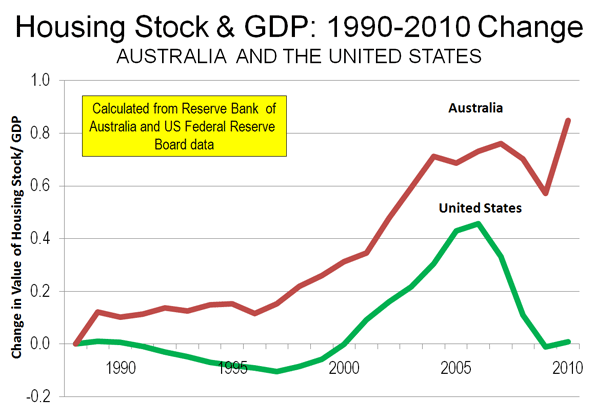
    The extent of the house price increases is starkly illustrated by comparing the value of the own housing stock to the gross domestic products of Australia and the United States since 1988 (the first year for which Australian house value data is readily available).

    According to data from the United States Federal Reserve Board, the value of the US stock of owned housing in 2010 was approximately the same in relation to the Gross Domestic Product as it was in 1990. On the other hand data from the Reserve Bank of Australia indicates that the value of the own housing stock in Australia was 85 percent higher relative to the Gross Domestic Product than in 1990. Thus, the value of the owned housing stock in Australia is today at least $1.9 trillion greater than it would have been if the 1990 ratio had been retained (Figure 3).

    Of course, part, although far from all of the United States experienced a severe housing bubble that burst in 2007. Even so, the increase in gross house values relative to the gross domestic product in the United States  never approached the massive increase in valuation that has occurred in Australia.

    The Green Party statement rightly blamed "Government’s actions that provide incentives designed to benefit investors and speculators and to keep house prices going up." The price rises have been principally the result of state government policies banning most development on the urban fringe and created a severe shortage of competitively priced land for development. It is an established economic fact of life that, all things being equal, the prices of goods and services tend to rise where there are serious limitations on supply, whether land, petroleum or bananas (as in the case of Typhoon Larry in Queensland in 2006).

    The effects of such policies is to telegraph to investors both in Australia and around the world the potential for speculative gain in a housing market.   The biggest losers come largely from the ranks of younger middle income Australians, including many immigrants, who would like to own their own homes. It is astounding that in egalitarian Australia, which has an enviable historic record of concern for lower and middle income households, is being transformed into a country where   inheritance or access to foreign capital will be a prerequisite for home ownership for middle income people.   

    The Organization for Economic Cooperation and Development (OECD) has raised concerns about the role of restrictive land use regulations in Australia (as well as the United Kingdom, which is also covered in the Demographia Survey).  OECD has recommended that Australia ease land supply constraints by streamlining planning and zoning regulations.

    The experience of Australia, along with a number of other markets covered in the Demographia Survey demonstrates that severe restrictions on the supply of land for development remain fundamentally incompatible with both housing affordability and the aspirations of lower and middle income citizens.

    Photograph: New "detached" housing in Perth (by author).

    Wendell Cox is a Visiting Professor, Conservatoire National des Arts et Metiers, Paris and the author of “War on the Dream: How Anti-Sprawl Policy Threatens the Quality of Life

  • Super Bowl XLV: The $10 Billion Bag of Chips

    I am raining on the big parade by equating the Super Bowl with trade deficits, budget shortfalls, state bonds on the edge of default, and unemployment close to ten percent. But if thirty-second ads that cost $2.7 million or The Black Eyed Peas at halftime can’t lift the economy out of its doldrums, how can we expect the same miracles from Troy Polamalu or Aaron Rodgers?

    From the perch of anyone staring at a TV or looking down from a skybox, what industry could be more bullish for America than the National Football League? Revenue for this year will top out between eight and nine billion dollars, which is roughly shared among the thirty-two professional teams. Does it not speak of economic recovery when even the fan-owned Green Bay Packers, with their retro stadium and rust-belt market, are given a market valuation in Forbes Magazine at more than $1 billion?

    How can it be fourth-and-long for America if, at the Super Bowl, tickets on the thirty yard line cost $10,366? Or if half of a sky box is fetching $384,993 at the Dallas stadium, which itself cost $1.5 billion to build?

    For the partners in what Theodore Roosevelt might have called “the football trust,” the economics of the game puts every NFL team owner in the Super Bowl. That the Buffalo Bills chose to pocket their subsidies instead of investing in a quarterback who didn’t graduate from Harvard is their business, and a good one at that. In 2009, they earned $28 million while the New York Giants, fresh from a Super Bowl win, only made $2 million.

    A closer look at football economics, however, makes the touchdown business a perfect metaphor for an industry—not unlike the nation—that talks up competition, “good conduct”, fair play, and free enterprise, but then goes to the subprime bank with hand-offs from sweetheart contracts, congressional subsidies, tax breaks, restrictive labor agreements, and underwater municipal bonds.

    Twenty-eight of the thirty-two NFL stadiums were financed with some public money, and eleven were built entirely on the dole. The NFL has enjoyed something like $10 billion in stadium subsidies in recent years. I wonder how many depleted state and city governments (Cincinnati gave the Bengals $450 million for their stadium) wish that a financial booth review could challenge the ruling on the field. As China built steel mills and high-speed rail, American cities went with skyboxes and entertainment venues that are used on about twelve days a year.

    The MVP of subsidies for the NFL is its antitrust exemption, which limits the number of teams at the professional level. Were free enterprise to govern the sport, instead of a medieval guild, anyone could put together a club.

    The NFL would simply be the best thirty-two teams in any given year. Teams that were improving would move up; bad teams, like the Browns, would be relegated to lesser leagues. Golf is played by this principle. Every town and city in America could compete.

    With Congress stuffing the competition at the line, the NFL enjoys a football monopoly, which allows it to dictate the prices of everything from official jerseys to cable subscriptions. “You want the NFL?….Go to the NFL…with about ten grand for an upper deck seat.”

    To be sure, the NFL has an engaging product and, if you can sit through the hours of time-outs and commercials, even some exciting games. But given that football is staged to sell things, what trots out on the field at the Super Bowl has more in common with billboards or beach banners than with sport.

    The advertisers at this year’s Super Bowl, paying $90,000 a second, include Volkswagen, Bud Light, Cars.com, Mars, Pepsi, Pizza Hut, CareerBuilder, Coca-Cola, and no doubt the knowing leer of the Viagra man, looking over his wife as if she were a Dallas Cowboys cheerleader.

    Their products will be seen in forty-eight million homes and by almost 100 million Americans. Fifty million Americans, myself among them, watched the first Super Bowl in 1967, in which a hung-over Max McGee twice took it to the house against the Kansas City Chiefs. The networks thought so little of the spectacle that no videotape of the game remains.

    The Super Bowl is a windfall for caterers, pizza joints that deliver, beer distributors, and guacamole middle men, not to mention the Dallas escorts who are charging $24,000 for a week of bump-and-run. But does it not also suggest a spectator nation, day dreaming about cars, sex, and getting a job?

    Under the current NFL contract, which expires March 3, the salary cap for each team is between 56 and 60 percent of the league’s revenues. The fans are told that the cap is to insure parity in the league, so that on any give Sunday the Panthers might not lose by more than twenty points. The salary cap also keeps the word “free” out of the enterprise, and fixes the game to insure a profit for every team owner (except maybe the Lions).

    Few NFL player contracts have much in the way of long-term financial guarantees, and teams can cut veterans, even those who have sustained serious injuries, to clear “space” from their cap.

    Very much in the spirit of earlier monopolists, NFL owners are not content with their billion dollar team valuations, subsidized stadiums, cozy TV contracts, and parking lot rebates.

    Now owners are asking the players’ association to accept an 18 percent pay cut in the next Collective Bargaining Agreement. Among the owners’ negotiating demands are a reduction in player salaries, especially for rookies, and an addition of two more games to the schedule.

    Owners are threatening to lockout the players (as if they were Pullman workers) and suspend football for next year. Or the games could be played with scabs, as happened in 1987. Shutdown losses would run into the billions.

    Fans can only hope that Taft-Hartley would be invoked to keep the Oakland Raiders on the field, or that President Obama would pass a Football Recovery and Mall Consumption Act to rush stimulus money into the red zone.

    After such a diatribe, will I be watching Super Bowl XLV? Of course I will. From the first Super Bowl (which was really an exhibition game at which tickets were $12) onward, I have seen some or all of the other forty-three games. Along with cheering McGee, I have seen the Packers’ Donny Anderson knock out the Chiefs’ Fred Williamson (aka “The Hammer”), the reigns of Terry Bradshaw and Joe Montana, and even those four terrible Super Bowls that the Buffalo Bills lost in a row.

    As a fan of the New York Jets, I remember Super Bowl III more clearly than some others. (As Joe Namath said, “I never drink at halftime.”) But I know where I was when the “Refrigerator” (William Perry) scored in Super Bowl XX, and I cannot read anything about Armenia without thinking about Miami Dolphin kicker Garo Yepremian and that absurd pass.

    Despite my institutional memory for the Super Bowl, I wonder whether it makes sense to elevate a sporting event into a national consumer revival meeting (“brought to you by Cialis…when shopping isn’t enough”). Nor do I think that the hoopla fulfills Vince Lombardi’s dreams, unless they involved Janet Jackson.

    Although he wasn’t speaking about economic competitiveness, former Washington Redskin and current TV announcer Joe Theismann revealed a truth about the big game when he said, “Nobody in football should be called a genius. A genius is a guy like Norman Einstein.”

    Photo by americanistadechiapas

    Matthew Stevenson is the author of Remembering the Twentieth Century Limited, a collection of historical essays. He is also editor of Rules of the Game: The Best Sports Writing from Harper’s Magazine.

  • Orange County Vantage Point: One Eye on Egypt as Little Saigon Rebrands Tet

    Scenes from Egypt, Tunisia and other places in the Middle East provide a stark reminder of the chaos that can consume entire nations. The scene on Bolsa Avenue in Little Saigon last week offered evidence that chaos can be overcome.

    Don’t get me wrong—chaos had a place along Bolsa as streams of drivers sought rare parking spaces, crowds gathered around impromptu fireworks displays on the streets, and shoppers elbowed their way among dozens of flower merchants who set up shop in parking lots.

    The buzz came in advance of Tet, the Vietnamese New Year celebration. Flowers are a big part of the tradition, and peddlers offered their best orchids and other selections.
    Restaurants and ad hoc vendors of various goods also aimed for some business, with everything from silk fabrics to baked goods on sale.

    The jumble of commerce, tradition and celebration that made parking so hard in Little Saigon was a relatively nice sort of problem for all involved. It was certainly nicer than the American experience in the Vietnam War, which ended in utter chaos.

    Many historians say the end started with the Tet Offensive in 1968. Vietcong forces picked the New Year holiday to unleash a campaign of attacks that sowed chaos throughout South Vietnam.

    The Tet Offensive failed to score any military victories by standard measures. Yet it succeeded in fostering a perception of chaos that struck a significant blow against the South Vietnamese government, which stumbled along with U.S. aid for another seven years.

    The chaos that started with the Tet Offensive and ended with crammed refugee boats fleeing Vietnam also led to the creation of Little Saigon. It’s a sprawling district that takes in parts of five cities in Orange County, just south of Los Angeles.

    Little Saigon is now home to the largest concentration of ethnic Vietnamese outside of Vietnam itself. It’s where refugees staked a claim to something more than—better than—the chaos they faced as their native country crumbled.

    What better place to rebrand Tet by reclaiming the celebratory sense of a new year and laying to rest darker images tied to yesteryear’s misfortunes? There are no doubt many who continue think of the Vietnam War when they hear the word Tet.

    Little Saigon’s recent hustle and bustle built around flower peddlers indicates another view, though. It shows that many others have remembered that the holiday existed before war and survived combat. They do not ignore history by considering Tet’s traditional meaning. They allow room for a larger view and an eye on the future.

    Jim Schlusemeyer, owner of Tuyet’s Orchid, is a good example. He sells his flowers to retailers and the general public, working the weekly swap meet at the Orange County Fairgrounds in Costa Mesa.

    Schlusemeyer was born in Vietnam and came here as a refugee, eventually taking the last name of his stepfather. He’s a competitive businessman who needs unique product, so he breeds his own orchids. Land in Orange County is either too expensive to make commercial flower growing worthwhile or too far inland to provide the cooler atmosphere that orchids require. So he breeds small lots of hybrids here and leases space at growing operations in Northern California for commercial production.

    Schlusemeyer enjoyed the big crowd in Little Saigon in the days leading up to Tet. His business has taken hits along with most others the past few years. The holiday and its call for flowers is a nice spike.

    Schlusemeyer says Tet sales get helped along each year by growing numbers of whites and Latinos who come to Little Saigon. Word has gotten around that the Tet holiday brings out the best orchids. There still aren’t a lot of shoppers from outside the local Vietnamese community, but the numbers are rising and appreciated.

    Not bad for a holiday that bears a name once firmly associated with one of the most frustrating and fractious periods in American history.

    Rather impressive for a community of refugees who only recently carved a new life for themselves as Americans.

    Any doubts about the rebranding of Tet were answered by a small booth set up amid the flower peddlers on Bolsa. It was sponsored by Sam’s Club—a division of retail giant Wal-Mart Stores Inc. A salesperson pitched the crowd on home improvements looking to sell everything from patio covers to vinyl fencing.

    You’d be hard-pressed to come up with a better example of putting the hyphen in Vietnamese-American. Keep those hyphens handy considering events in the Middle East. There’s a neighborhood known as Little Arabia just a few miles away from Little Saigon.

    Jerry Sullivan is a contributing editor to New Geography and managing editor of the Orange County Business Journal.

  • The Death of Earmarks

    Record deficit spending in Washington has many faces: Defense, Medicare, Social Security. But none has received more criticism in recent months than the infamous and notorious earmark. Conjuring up images of “Bridges to Nowhere” or “Teapot Museums”, earmarks, or Congressionally Directed Funding, have become the poster child for irresponsible, out of control, big government spending. But is the earmarking practice by Congressional representatives really pushing our country to the brink of bankruptcy? That is what many critics would have the public believe. By playing on the public’s disgust with overspending and sensationalizing it with examples of wasteful projects that abuse the system, earmarks have been turned into a proverbial whipping boy for all forms of government spending.

    Sources of criticism are not limited to the media or political newcomers trying to make a name by misdirecting supporters from the true causes of our spending crisis. President Obama has recently come out in strong opposition to the earmarking process. During the State of the Union speech, he called for a ban of all earmarks and has threatened to veto any bill that contains them.

    Senator Daniel Inouye (HI), Chairman of the Senate Appropriations Committee, issued a statement on February 1 announcing the Committee will place a moratorium on earmarks for the current session of Congress. Yet he does not concede and end the war on earmarks, later committing to revisiting the issue once “the consequences of the decision are fully understood”. I think that what Senator Inouye is trying to say is be careful what you wish for because you just might get it.

    Certainly, I am not suggesting that the current level of our federal expenditures is acceptable. But it seems a bit disingenuous to target a spending practice that makes up three tenths of one percent of our federal budget. By comparison, Social Security and Defense spending make up 21 and 20 percent of the federal budget, respectively. Much of the political grandstanding to abolish earmarks is merely distraction from the real cause of damage.

    Eliminating earmarks does not actually curb spending at all. It merely moves the decision of which projects get funded from Congressional members to the administrators of federal agencies. By the time earmarking occurs through the appropriations process, the budgets of the federal agencies have already been authorized. Earmarks merely provide legislators the ability to further divvy up a very small portion of those budgets to meet local needs of those they represent.

    The good projects that benefit our nation and local communities are often overshadowed by the abuses and frivolous projects of a few. But for every “Bridge to Nowhere” there are examples of projects and program that fulfill a specific national interest and uplift local economies. Unfortunately, the examples of money well spent do not garner as much attention as the more rare occasions when taxpayer dollars are frivolously wasted on pet projects.

    Forget about funding directed for regions in need of important flood control projects or high tech vaccine research and development to create life-saving Staph vaccines (the number one killer of wounded soldiers in the battlefield) for the military. These things are not important as long as an abomination like the “Bridge to Nowhere” has been perpetrated upon the taxpaying public. Small businesses and startup companies capable of producing high tech products that the government wants will now suffer as large corporate interests with unfair advantages deploy extensive resources to access fresh funding that now flows through federal agencies located far from Middle America.

    It’s terrible timing for small business. Whispers in the U.S. House of Representatives of the impending doom of the federal Small Business Innovation Research Program could be a double gut punch for small research and manufacturing companies. Small companies get only 4.3% of federal research dollars, but produce five times as many patents per dollar as large companies and 20 times as many as universities.

    What does this mean for local community leaders? Communities and small businesses must become more competitive. With the departure of earmarking, much of this funding will be redirected through agency grant programs. Unfortunately, the pool of recipients is often smaller and is more concentrated in large east and west coast interests. How do small interests compete? Companies may need to invest more time and money into pursuing procurement and contracting opportunities with the federal government. They may need to consider hiring experts to write grants, monitor agency program funding, or hire consultants to broker connections with program directors, contract managers, and decision makers within federal agencies. Often times, half the battle can be won by conveying your message to the proper audience.

    If beauty is in the eye of the beholder, then I would suggest that wasteful spending is in the eye of those not receiving it. It has been my experience that the same people denouncing earmarks and government spending are the first ones with their hands out when they catch the slightest whiff of federal funding that may benefit their own interests. “It is not wasteful spending until it goes to someone who isn’t me”.

    The future of earmarks remains an uncertain one. What is certain, however, is that the debate will rage on and good projects, small business and high tech startups will bear the consequences of tired rhetoric and political showmanship.

    Ryan Aasheim is an Associate with Praxis Strategy Group where he works extensively with the Red River Valley Research Corridor technology-based economic development initiative. He was formerly Economic Development Director for U.S. Senator Byron Dorgan.

    Photo by Nick Ares

  • The Midwest: Coming Back?

    Oh my name it is nothing
    My age it is less
    The country I come from
    Is called the Midwest

    –Bob Dylan, “With God on Our Side,” 1964

    For nearly a half century since the Minnesota-raised Robert Zimmerman wrote those lines, the American Midwest has widely been seen as a “loser” region–a place from which talented people have fled for better opportunities. Those Midwesterners seeking greater, glitzier futures historically have headed to the great coastal cities of Miami, New York, San Diego or Seattle, leaving behind the flat expanses of the nation’s mid-section for the slower-witted, or at least less imaginative.

    Today that reality may be shifting. While some parts of the heartland, particularly around Detroit, remain deeply troubled, the Midwest boasts some of the lowest unemployment rates in the country, luring back its native sons and daughters while attracting new residents from all over the country.

    For example, Des Moines, Omaha, Kansas City, Columbus, Minneapolis, Milwaukee and Madison have all kept their unemployment rates lower than the national average, according to a recent Brookings survey. They are also among the regions that have been able to cut their jobless rates the most over the past three years.

    This contrasts sharply with the travails of the metropolitan economies of the Southeast, Nevada, Arizona and California. Of course, other regions are doing better than the Sun Belt sad sacks. The stimulus and TARP benefited some parts of the Northeast, but even those areas haven’t performed as well as the nation’s mid-section. The only other arc of prosperity has grown around the Washington leviathan, largely a product of an expanded government paid for by the rest of the country.

    In contrast, the relative prosperity in parts of the Midwest largely stems from the private sector. Take the rise in the price for agricultural commodities, global energy demand, greater home affordability and a  slow but perceptible pickup in domestic manufacturing. According to University of Iowa researcher Jacob Langenfeld, these factors suggest that it’s time to stop seeing the Heartland as a perennial loser and to start seeing it as a “[model] for effective economic development.”

    The new reality is reflected in several ways.  In terms of personal-income growth last decade, several Midwest regions ranked  among the top ten in the U.S., including Milwaukee, Cleveland, Kansas City and Cincinnati.

    These cities all performed better than Seattle, Denver or Portland. San Jose and San Francisco, those perennial darlings of the information age,  sat around the bottom of the list. The mid-section also boasts many of the nation’s healthiest real estate markets, according to Realtor.com. Three of the top five markets–Kansas City, Kansas, Omaha and Fargo–are located in the region

    An analysis of shifting migration patterns provides even more intriguing evidence. Over the past century the Midwest’s share of the nation’s population fell from nearly 35% of the total to barely 21%. Only the Northeast, now less than a fifth of the population, has experienced a similar decline, while the West and South have registered impressive gains.

    Now some of the very regions that experienced losses over the past few decades, such as St. Louis, suffer much lower rates of out-migration than a similarly sized area like San Diego. Others, such as Indianapolis, Columbus, Madison and Kansas City, have enjoyed strong rates of domestic migration. In sharp contrast, coastal giants like metropolitan Los Angeles or New York have worse domestic out-migration rates than Detroit.

    The outcome of the recent midterm elections means that political changes may further propel the Midwest express. The new Congress is largely dominated by representatives of the heartland such as Speaker John Boehner of Ohio and Budget Committee Chairman Paul Ryan of Wisconsin. This marks a powerful shift from the previous Congress, controlled by iron-fisted coastal Democrats like former Speaker Nancy Pelosi of San Francisco.

    We can expect the new Congress to adhere more closely to Midwestern interests on a host of issues. Energy legislation will now reflect the interests of Midwestern states, which depend heavily on coal, rather than the renewable dreams of the coastal big cities. In transportation we may see a shift in priorities from high-speed rail to such mundane things as roads and bridges.

    More important still may be changes at the local level. For decades Midwestern governors and mayors tried to emulate the Northeast and West Coast. Historian John Teaford observed that the struggling Midwestern cities in the 1960s and 1970 employed “cookie cutter” redevelopment in a vain effort to replicate the great coastal cities. Ultimately the building of “international style” towers, sports stadia and cultural palaces did little to restore places whose economies had become increasingly uncompetitive.

    In recent years, the most risible example of coastal aping could be found in Michigan, the nation’s most economically ravaged state. Under Gov. Jennifer Granholm Michigan focused on a strategy of promoting “cool cities” to lure the young entrepreneurial hipsters away from the coasts. Like California, Michigan placed huge bets on renewable fuels and other green industries.

    By the end of Granholm’s term this winter the state suffered one the country’s highest unemployment rates, a falling population and epic out-migration. She has been replaced by a pragmatic pro-business conservative, Rick Snyder, who is focused on a practical economic-development agenda. Similar shifts have taken place in Ohio and Wisconsin.

    The new brand of Midwestern realism has been embraced for years by some regions. For example, non-partisan business and civic leaders in Kalamazoo, Mich., have pushed both educational reform and economic diversification. The region, though hardly booming, has done better than the state overall and is experiencing an entrepreneurial and community renaissance.

    Kalamazoo entrepreneurs tend to understand that the key to Midwestern renewal lies with the region’s core competencies and attractions. David Zimmermann, founder of Kalexsyn, a flourishing biotech company, identifies these assets:  Michigan’s resident pool of skilled labor, a low cost of living and a generally community-oriented, family-friendly atmosphere.

    Zimmermann says his company, which now employs 30 workers and has revenues of $5.4 million, has surprisingly little trouble attracting younger skilled workers. The median age at the company, he notes, is only 36, and many have come to Kalamazoo from traditional coastal biotech hot spots. This includes several researchers some who originally left the Midwest in their teens and twenties.

    “People are looking at the Midwest and crunching the numbers,” Zimmermann says. “Maybe you take a 20% pay cut from San Francisco but you buy a nice house for $200,000. You come out way ahead. We think this a very strong advantage.”

    Such a newfound appreciation for the Midwest represents a critical element in expanding the region’s turnaround. With enhanced power in Washington and more common sense government at home, the Midwest could be poised to regain a competitive advantage that has been missing for several generations.

    This piece originally appeared in Forbes.

    Joel Kotkin is executive editor of NewGeography.com and is a distinguished presidential fellow in urban futures at Chapman University, and an adjunct fellow of the Legatum Institute in London. He is author of The City: A Global History. His newest book is The Next Hundred Million: America in 2050, released in February, 2010.

    Photo by Paladin27