Category: Urban Issues

  • Regional Exchange Rates: The Cost of Living in US Metropolitan Areas

    International travelers and expatriates have long known that currency exchange rates are not reliable indicators of purchasing power. For example, a traveler to France or Germany will notice that the dollar equivalent in Euros cannot buy as much as at home. Conversely, the traveler to China will note that the dollar equivalent in Yuan will buy more.

    Economists have attempted to solve this problem by developing "purchasing power parities," which are used to estimate currency conversion rates that equalize values based upon prices (Note 1). This helps establish the real value of money in a particular place.

    When people move from one region of the United States to another they can encounter a similar phenomenon. For example, a dollar is not worth as much in San Jose as it is in St. Louis. Research by the US Department of Commerce Bureau of Economic Analysis (BEA), for example, found that in 2006 a dollar purchased roughly 35 cents less in San Jose than in St. Louis. BEA researchers estimated "regional price parities" for states and the District of Columbia and for all of the nation’s metropolitan areas (Note 2). Regional price parities can be thought of as the equivalent of regional (state or metropolitan area) exchange rates. This research was covered in previous newgeography.com articles by Eamon Moynihan and this author.

    This article uses Department of Labor, Bureau of Labor Statistics metropolitan area consumer price indexes to estimate the 2009 cost of living and per capita personal income adjusted for the cost of living.

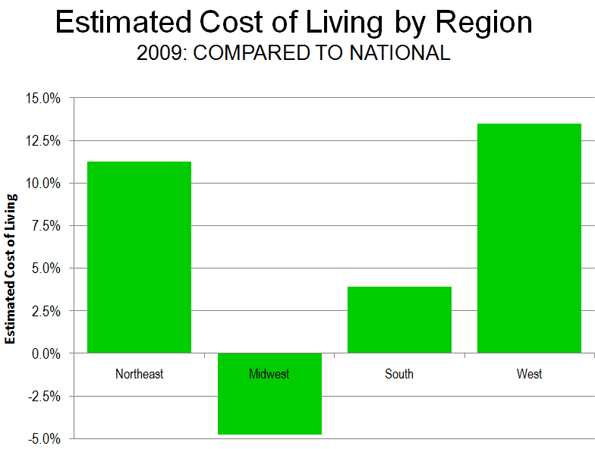
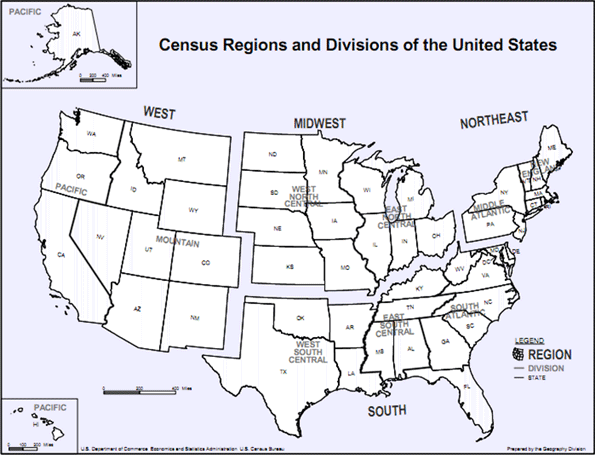
    Cost of Living: At the regional level (See Census Region Map, Figure 1), there are substantial differences in the cost of living (Figure 2). The lowest cost of living is in the Midwest, at 4.8 percent below the nation. The South has the second lowest cost of living at 3.9 percent above the national level. The West is the most expensive area, 13.5 percent above the national cost-of-living, while the Northeast’s cost-of-living stands 11.3 percent above the national rate.

    The cost of living in the South may seem higher than expected. But if the higher cost metropolitan areas of Washington, Baltimore and Miami are excluded, the cost of living in the South falls to 1.5 percent below the national rate. If the California metropolitan areas are excluded from the West, the cost of living still remains 4.0 percent above the national rate.

    Per Capita Income: The highest unadjusted per capita incomes are in the Northeast, followed by the West, the South and the Midwest. Yet when metropolitan area exchange rates are taken into consideration, the order changes significantly. The Northeast remains the most affluent, and the Midwest moves from last place to second place. The South is in third place, the same as its income rating, while the West falls from second place to fourth place (Figure 3).

    Cost of Living: Variations in the cost of living, which is reflected by the metropolitan area exchange rates, remains similar in 2009 to the 2006 rankings.

    The Top Ten: The lowest costs of living were in (Table 1):

    1. St. Louis, where $0.891 purchased $1.00 in value at the national average.
    2. Kansas City, where $0.903 purchased $1.00 in value at the national average.
    3. Cleveland, where $0.921 purchased $1.00 in value at the national average.
    4. Pittsburgh, where $0.941 purchased $1.00 in value at the national average.
    5. Cincinnati, where $0.944 purchased $1.00 in value at the national average.

    Rounding out the most affordable 10 are two metropolitan areas in the South (Atlanta and Dallas-Fort Worth), two in the Midwest (Detroit and Milwaukee) and one in the West (Denver). No Northeastern metropolitan area was ranked in the top 10.

    Table 1
    Estimated Cost of Living: 2009
    Metropolitan Areas over 1,000,000 with Local CPIs
    Rank Metropolitan Area
    Metropolitan Exchange Rate: to Purchase $1.00 at National Average
    Compared to Lowest Cost of Living
    1
    St. Louis, MO-IL
    $0.891
    0%
    2
    Kansas City, MO-KS
    $0.903
    1%
    3
    Cleveland, OH
    $0.921
    3%
    4
    Pittsburgh. PA
    $0.941
    6%
    5
    Cincinnati, OH-KY-IN
    $0.944
    6%
    6
    Atlanta. GA
    $0.958
    8%
    7
    Detroit. MI
    $0.959
    8%
    8
    Milwaukee. WI
    $0.959
    8%
    9
    Dallas-Fort Worth, TX
    $0.976
    10%
    10
    Denver, CO
    $0.996
    12%
    11
    Minneapolis-St. Paul, MN-WI
    $1.000
    12%
    12
    Houston, TX
    $1.000
    12%
    13
    Tampa-St. Petersburg, FL
    $1.006
    13%
    14
    Phoenix, AZ
    $1.011
    14%
    15
    Portland, OR-WA
    $1.034
    16%
    16
    Chicago, IL-IN-WI
    $1.041
    17%
    17
    Philadelphia, PA-NJ-DE-MD
    $1.054
    18%
    18
    Baltimore, MD
    $1.068
    20%
    19
    Riverside-San Bernardino, CA
    $1.078
    21%
    20
    Miami-West Palm Beach, FL
    $1.085
    22%
    21
    Seattle, WA
    $1.120
    26%
    22
    San Diego, CA
    $1.151
    29%
    23
    Boston, MA
    $1.175
    32%
    24
    Washington, DC-VA-MD-WV
    $1.181
    33%
    25
    Los Angeles, CA
    $1.222
    37%
    26
    San Francisco-Oakland, CA
    $1.258
    41%
    27
    New York, NY-NJ-PA
    $1.281
    44%
    28
    San Jose, CA
    $1.343
    51%
    Estimated from BEA 2006 data, adjusted by local Consumer Price Index for 2006-2009


    The Bottom Ten: The most expensive metropolitan areas were:

    28. San Jose, where $1.343 purchased $1.00 in value at the national average.
    27. New York, where $1.281 purchased $1.00 in value at the national average.
    26. San Francisco, where $1.268 purchased $1.00 in value at the national average.
    25. Los Angeles, where $1.222 purchased $1.00 in value at the national average.
    24. Washington, where $1.181 purchased $1.00 in value at the national average.

    The bottom ten also included three metropolitan areas in the West (Riverside-San Bernardino, San Diego and Seattle), one in the Northeast (Boston) and one in the South (Miami). There were no Midwestern metropolitan areas in the bottom 10.

    Per Capita Income: Per capita income in 2009 was then adjusted for the cost of living.

    Top Ten:Washington has the highest per capita income, adjusted for the cost of living, at $47,800. San Francisco placed second at $47,500. Denver ranked third at $46,200, while the cost-of-living adjusted income in Minneapolis-St. Paul was $45,800 and $45,700 in Boston. The top 10 also included two Midwestern metropolitan areas (St. Louis and Kansas City), two from the Northeast (Baltimore and Pittsburgh) and one from the West (Seattle).

    Bottom Ten: The least affluent metropolitan area was Riverside-San Bernardino, with a per capita income of $27,800. Phoenix was second least affluent at $33,900 while Los Angeles was third least affluent at $35,000. The fourth least affluent metropolitan area was Tampa-St. Petersburg at $36,600 and the fifth least affluent metropolitan area was Portland at $37,400. The bottom 10 also included two metropolitan areas from the South (Atlanta and Miami), two from the Midwest (Cincinnati and Detroit) and one from the West (San Diego).

    The cost of living adjusted income data includes surprises. New York, commonly considered a particularly affluent metropolitan area, ranked 17th in cost-of-living adjusted income, and below such seemingly unlikely metropolitan areas as Pittsburgh, Kansas City, Cleveland, St. Louis and Milwaukee. These metropolitan areas also ranked above San Jose, which ranked first in unadjusted income in 2000, but now ranks 16th in cost of living adjusted income (Table 2).

    Table 2
    Personal Income Per Capita Adjusted for  the Cost of Liviing
    Metropolitan Areas over 1,000,000 with Local CPIs
    Rank (Cost of Living Adjusted)
    Rank (Unadjusted Income)
    Metropolitan Area
    Per Capita Income 2009: Adjusted for Cost of Living
    Per Capita Income 2009: Unadjusted
    1
    2
    Washington, DC-VA-MD-WV
    $47,780
    $56,442
    2
    1
    San Francisco-Oakland, CA
    $47,462
    $59,696
    3
    8
    Denver, CO
    $46,172
    $45,982
    4
    9
    Minneapolis-St. Paul, MN-WI
    $45,772
    $45,750
    5
    4
    Boston, MA
    $45,707
    $53,713
    6
    18
    St. Louis, MO-IL
    $45,288
    $40,342
    7
    7
    Baltimore, MD
    $44,908
    $47,962
    8
    15
    Pittsburgh. PA
    $44,848
    $42,216
    9
    19
    Kansas City, MO-KS
    $43,862
    $39,619
    10
    6
    Seattle, WA
    $43,730
    $48,976
    11
    13
    Houston, TX
    $43,581
    $43,568
    12
    16
    Milwaukee. WI
    $43,477
    $41,696
    13
    11
    Philadelphia, PA-NJ-DE-MD
    $43,247
    $45,565
    14
    21
    Cleveland, OH
    $42,734
    $39,348
    15
    12
    Chicago, IL-IN-WI
    $41,990
    $43,727
    16
    3
    San Jose, CA
    $41,255
    $55,404
    17
    5
    New York, NY-NJ-PA
    $40,893
    $52,375
    18
    20
    Dallas-Fort Worth, TX
    $40,494
    $39,514
    19
    23
    Cincinnati, OH-KY-IN
    $40,437
    $38,168
    20
    10
    San Diego, CA
    $39,647
    $45,630
    21
    24
    Detroit. MI
    $39,147
    $37,541
    22
    17
    Miami-West Palm Beach, FL
    $38,124
    $41,352
    23
    26
    Atlanta. GA
    $38,081
    $36,482
    24
    22
    Portland, OR-WA
    $37,446
    $38,728
    25
    25
    Tampa-St. Petersburg, FL
    $36,561
    $36,780
    26
    14
    Los Angeles, CA
    $35,045
    $42,818
    27
    27
    Phoenix, AZ
    $33,897
    $34,282
    28
    28
    Riverside-San Bernardino, CA
    $27,767
    $29,930
    Estimated from BEA 2009 income data and 2006 regional price parity data, adjusted by local Consumer Price Index for 2006-2009


    Some expensive metropolitan areas such as Washington, San Francisco and Boston ranked at or near the top, but their cost-of-living adjusted incomes were considerably less than the unadjusted incomes. On average, it took $1.20 to purchase $1.00 of value at national rates in these three metropolitan areas. Washington’s unadjusted per capita income was 40 percent ($16,100) higher than that of St. Louis, however when the cost of living is factored in, Washington’s advantage drops to 6 percent ($2,500).

    Caveats: The analysis above does not consider cost-of-living differentials within metropolitan areas. For example, data from the ACCRA cost of living index indicates generally higher prices in the cores of the largest metropolitan areas, such as New York (especially Manhattan), Chicago and San Francisco. Further, these data make no adjustment for relative levels of taxation. A cost of living analysis using disposable income would produce different results, dropping higher taxed metropolitan areas to lower rankings and raising lower taxed metropolitan areas higher.

    Cost of Living Differences: Will They Continue? The spread in cost-of-living between metropolitan areas have been driven wider over the last decade by the relative escalation of house prices in some metropolitan areas in the West, Florida and the Northeast. Whether these shifts in cost of living will be reflected in migration patterns will be one of the things to look for in the new Census.

    ———

    Note 1: Purchasing power parity data is published by the World Bank, the International Monetary Fund (IMF) and the Organization for Economic Cooperation and Development (OECD).

    Note 2: The BEA research applied regional price parity factors only to employee compensation and excluded other income. It is possible that, had the analysis been expanded to these other forms of income, the differences in cost of living would have been greater.

    Photo: Rosslyn, VA business district, Washington (by author)

    Wendell Cox is a Visiting Professor, Conservatoire National des Arts et Metiers, Paris and the author of “War on the Dream: How Anti-Sprawl Policy Threatens the Quality of Life

  • Pimp My Stripmall, Please!

    If anything characterizes the face of Florida’s landscape, it is the proliferation of shopping malls of all types. Generation by generation, as population swelled, country roads widened into highways and each intersection seemed to blossom into four parking lots framed by strip centers decorated with small, freestanding stores and restaurants. These malls represented the prosperity of the American middle class. Now that consumerism has slowed and been rechanneled online, new malls aren’t being built and the existing ones are looking a bit dog-eared, with shuttered stores, empty parking lots, and aging facades. Repurposing the American mall is a huge opportunity waiting for the right moment, and represents an opportunity to heal much of Florida’s economic stagnation.

    As the car culture rose after World War II, malls – convenient places that fit our newly prosperous lifestyle — rose as well. Thinkers, sentimental about the hard work that went into an organic, localized Main Street were largely horrified at its replacement by strip shopping centers and regional shopping malls. Yet this growth continued unabated, and while the debate over the mall’s moral stance raged, the building type continued to be a popular investment vehicle. It became codified and regulated into a more and more complex, layered experience, dominated by traffic and parking, manipulated by industrial psychologists, and fine-tuned by mall managers so that the best possible presentation of goods was made to the consumer.

    The consumer was unsentimental about the architectural debris that was left in the wake of the flight to the suburbs. As old village streets saw local businesses shuttered, cries of “Too hard to find parking” and “Why are your prices so high?” echoed on their sidewalks. Purposeless old Main Street: The lucky ones became tourist destinations, filled with chocolate shops and art galleries. Here in Central Florida, the lucky ones include Mount Dora, Sanford, and Ybor City, where parking lots and garages have been surgically inserted into the back alleys, a rigorous code enforces the form, and hand built architectural details from America’s Victorian era still surprise and delight.

    The consumer will continue to be a strong component of the American middle class, and no doubt many malls will continue to thrive. Florida’s oversupply has attracted tremendous attention, and repurposing raw space could become a creative new way that cities will grow. Winter Park Village, a 1960s indoor regional shopping mall, was cut open and now features a mixed-use shopping, dining, entertainment, and residential space barely resembling its former self. Metro Church in Winter Springs occupies a former Belk-Lindsey department store, with church-related functions occupying what was once a general lease area. Full Sail University in Winter Park is largely housed in converted strip centers as well. These conversions are not unique to Central Florida, and will likely continue into the future.

    The biggest opportunity, however, seems untried as of yet in America: manufacturing in a mall. Production, much more than consumption, creates jobs, and the raw open space of old retail sites can be easily converted into industrial uses. Geography is in their favor. Malls were typically built if at least 3,000 surrounding households could be found to support them; today these households could provide labor, instead of cash, to the right investor looking to onshore a product.

    Aligning industry with opportunity seems difficult on the surface. Manufacturing investment abounds in relatively unregulated India, but with the huge sunk costs that American industry already has, startups and expansions seem to be nonexistent. Turning this around would require a fundamental shift in American culture, allowing us to think of ourselves as producers once again. American know-how hasn’t vanished; rather, it lies dormant underneath the heavy regulatory burden, and under the high barriers to entry that our manufacturers created in their quest to be the largest and to shut out competition.

    New products are being created every day… overseas. If investment isn’t coming from within America, perhaps the right NGO sponsoring microloans could be tapped to consider the broken, declining landscape of suburban America to reinvigorate our natural American creativity and give small scale capital access to startups. Selecting the industries that we want to have, re-onshoring them, and producing things people need would once again provide jobs, diversify the local economy, and create the kind of upward mobility we once counted on for the American Dream.

    And the physical plant – one of the biggest investments that a producer makes – is already there. The regulatory burden of redevelopment, shouldered by the initial developer, should be minor at best, depending on the quality of the infrastructure, which would speed a conversion into reality. At a time in Florida when growth is on pause, the redevelopment of existing assets is likely the most favored way to provide economic expansion and pull Florida out of its nosedive.

    Mall redevelopment would please the environmental movement, as well. Huge swaths were cut into the Florida wilderness to make way for retail, with nary a peep from environmentalists in the eighties and nineties. One of the tenets of sustainable development is to confine construction to areas that are already strongly modified by human activities, and repurposing abandoned space fits this mandate to a tee.

    Florida, with its abundance of unused retail space, has an opportunity to become a leader if it can attract the right kind of investor. India, with all its problems including ethnic strife and the lingering caste system, is certainly not waiting for opportunity to create its own future. China, with its authoritarian regime, has surged ahead in terms of entrepreneurial spirit that seems sorely lacking in America at the present moment. Seeing gold in a dead strip mall may seem farfetched, but out of opportunities like this we can reinvent our own future and fuel a renaissance of the American dream, one mall at a time.

    Richard Reep is an Architect and artist living in Winter Park, Florida. His practice has centered around hospitality-driven mixed use, and has contributed in various capacities to urban mixed-use projects, both nationally and internationally, for the last 25 years.

    Photo by Clinton Steeds: Phoenix Village Mall, Ft. Smith – Bench at Back Entrance. The photographer writes that it was the first mall in Arkansas when it opened in 1970, adding, “It has so far failed to live up to the “Phoenix” part of its name”.

  • Shrinking City, Flourishing Region: St. Louis Region

    Throughout the high income world, in this age of cities, many urban centers continue to shrink. This is particularly true in municipalities that have been unable either to expand their boundaries or to combine with another jurisdiction, subsequently running out of new developable land.

    For example, the city of Paris (as opposed to the metropolitan area or urban area, see Note) lost a quarter of its population between 1954 and 1999, while the loss in some core districts (arrondissements) was 75 percent. Copenhagen, which is often considered one of Europe’s most vibrant municipalities lost more than one-third of its population between 1950 and 2000. Other core municipalities have lost more than one-half million people, such as, London, Seoul, Glasgow, Berlin, Osaka, Chicago, Detroit, Philadelphia and St. Louis.

    City of St. Louis Population Loss: Yet no city which achieved the scale of a half million residents has lost a larger percentage of its population in peacetime than St. Louis. To some extent, this is a very old problem for a city that was once the largest in the Midwest but was passed in 1880 by Chicago.

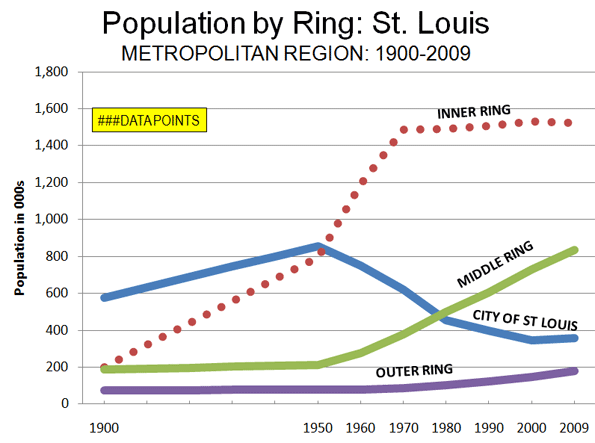
    In 1950 the city population peak at 857,000 people and ranked 8th among the nation’s municipalities. By 2009, the latest estimates, the population was 357,000 (ranked 48th in the nation), a decline of nearly 60 percent from the peak.

    Metropolitan Population Gain: But as is the case for many “shrinking cities,” the region outside the municipal boundaries has continued to grow. In1950, the population of the metropolitan region (as currently defined) was 1,940,000. By 2009, the metropolitan region had grown to 2,890,000, for a population increase of nearly 1,000,000 (more than a 50 percent increase). St. Louis is a bi-state metropolitan area, with three quarters of the population living in Missouri and the balance in Illinois, a ratio than has been largely unchanged since 1900.

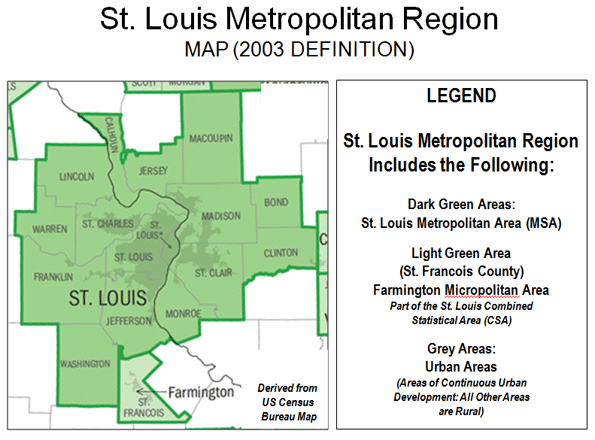
    The metropolitan region (or combined statistical area) includes the city of St. Louis, (a county equivalent jurisdiction), 8 counties in Missouri and 8 counties in Illinois. The St. Louis metropolitan region covers approximately 9,100 square miles (Figure 1), of which the principal urban area (area of continuous urbanization) covered 829 square miles (9 percent of the metropolitan region).

    As in the case of virtually all large high-income world metropolitan areas, population growth has principally occurred on the suburban fringe. For example, from 1965 to 2000, 110 percent of the growth in major metropolitan areas of Western Europe was in the suburbs, more than in the United States (90 percent since 1950).

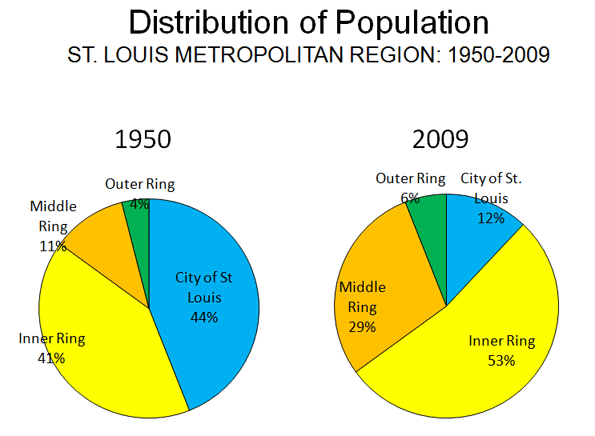
    Distribution of Population: Even by these standards, St. Louis may be an extreme case. In 1950, 44% of the region’s population was in the city of St. Louis. The inner ring the counties of St. Louis, St. Clair (Illinois) and Madison (Illinois), accounted for another 41% of the population. Thus 85% of the metropolitan region’s population lived in the city or the inner ring counties. The other 15% lived in middle ring and outer ring counties.

    By 2009 the population of the city and the inner ring counties had fallen to 65% of the region. The city and county of St. Louis (which were combined until 1876), reached a combined population peak in 1970 and has lost 225,000 people since that time, falling below the 1960 census total.

    The middle ring counties represented 29% of the population while the outer ring counties had 6% of the population (Figure 2) in 2009. During the 2000s, the middle ring counties added more than 130,000 residents, while the city added 10,000.

    Consistent with the trend since the late 1950s, nearly all of the metropolitan region growth occurred outside the city and the inner ring between 2000 and 2009. The city is estimated to have accounted for 7% of the region’s growth. The inner ring counties actually shrank while the middle ring counties accounted for 76% and the outer ring counties 22% of the growth (Table 1 and Figure 3) for the region.

    Table 1
    St. Louis Metropolitan Region: Population Trend
    1900-2009
    Sector
    1900
    1950
    2000
    2009
     METROPOLITAN REGION (CA) 
    1,039,543
    1,942,848
    2,757,377
    2,892,874
     HISTORIC CORE 
    575,238
    856,796
    346,904
    356,587
     City of St. Louis 
    575,238
    856,796
    346,904
    356,587
     INNER RING 
    201,419
    794,651
    1,531,692
    1,524,482
     St. Louis Co. 
    50,040
    406,349
    1,016,364
    992,408
     Madison Co. (IL) 
    64,694
    182,307
    259,120
    268,457
     St. Clair Co. (IL) 
    86,685
    205,995
    256,208
    263,617
     MIDDLE RING 
    187,384
    213,394
    730,563
    833,706
     Franklin Co. (MO) 
    30,581
    36,046
    94,059
    101,263
     Jefferson Co. (MO) 
    25,712
    38,007
    198,740
    219,046
     St. Charles Co. (MO) 
    24,474
    29,834
    286,171
    355,367
     Bond Co. (IL) 
    16,078
    14,157
    17,650
    18,103
     Clinton Co. (IL) 
    19,824
    22,594
    35,536
    36,368
     Jersey Co. (IL) 
    14,612
    15,264
    21,655
    22,549
     Macoupin Co. (IL) 
    42,256
    44,210
    48,989
    47,774
     Monroe Co. (IL) 
    13,847
    13,282
    27,763
    33,236
     OUTER RING 
    75,502
    78,007
    148,218
    178,099
     Lincoln Co. (MO) 
    18,352
    13,478
    39,254
    53,311
     St. Francois Co. (MO) 
    24,051
    35,276
    55,743
    63,884
     Warren Co. (MO) 
    9,919
    7,666
    24,721
    31,485
     Washington Co. (MO) 
    14,263
    14,689
    23,410
    24,400
     Calhoun Co. (IL) 
    8,917
    6,898
    5,090
    5,019
     Metropolitan Region: Combined Statistical Area (2009 Definition) 

    Despite often well-orchestrated impressions to the contrary, the continuing dominance of suburban population growth in the St. Louis metropolitan region mirrors the experience in other major metropolitan areas across the nation.. This growth has not been, as is often supposed, at the expense of the city. Over the past sixty years suburban growth was actually three times the total net loss suffered by the city. Increasingly when people move to St. Louis, they actually mean that they are coming to the suburban periphery.

    Domestic Migration: Overall in the past decade, the St. Louis metropolitan region experienced only a modest domestic migration loss – far less than many other regions . Approximately 1.3 percent of the 2000 population, or 35,000 people moved from St. Louis to other parts of the nation. By comparison, in similar sized and sunny San Diego, the domestic migration loss was 127,000, with a percentage loss more than three times that of St. Louis. Who could have imagined that in a decade, Los Angeles would lose 1.3 million more domestic migrants than St. Louis and New York 2 million more (granted, from much larger bases).

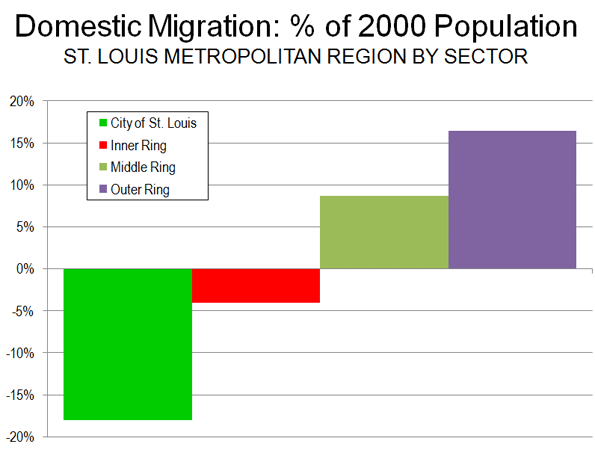
    During the 2000s, the domestic migration trends within the St. Louis metropolitan region reflected the national trend of migration from core areas to the suburbs. According to US Census Bureau estimates, the 2000 to 2009 in domestic migration loss in the St. Louis metropolitan region was distributed as follows (Figure 4):

    • The city of St. Louis has lost a net 63,000 domestic migrants (18.0 percent of its 2000 population)
    • The inner ring counties have lost a net 59,000 domestic migrants(4.0 percent of the 2000 population), 57,000 of which were lost in St. Louis County
    • The middle ring counties gained a net 64,000 domestic migrants with a gain of 45,000 in St. Charles County (8.7 percent of the 2000 population).
    • The outer ring counties gained a net 24,000 domestic migrants (16.4 percent of the 2000 population) with nearly one half of the gain (11,000) in Lincoln County.

    Net international in-migration was the one bright spot for the city and inner suburbs, which gained the bulk of the 30,000 immigrants who came to region over the past decade (Table 2). But this was not nearly enough to balance the losses from domestic migration.

    Ultimately the St. Louis story reflects the deeper reality seen across the high-income (and even in some low and lower income world metropolitan areas, as future installments will indicate), albeit somewhat more exaggerated. Many core cities continue to stagnate or even shrink, but their regions remain vibrant, expressing a form of urbanism that, while often unappreciated, remains vital and expansive.

    ——–

    Note: Metropolitan areas are composed (outside New England) of complete counties or county equivalent jurisdictions. They include substantial rural expanses, which are economically tied to the principal urban area (the largest urban area in the metropolitan area). An urban area is an expanse of continuous urbanization, and contains no rural territory.

    Photo: St. Louis skyline (by author)

    Wendell Cox is a Visiting Professor, Conservatoire National des Arts et Metiers, Paris and the author of “War on the Dream: How Anti-Sprawl Policy Threatens the Quality of Life

  • Chicago: The Cost of Clout

    The Chicago Tribune has been running a series on the challenges facing the next mayor. One entry was about the Chicago economy. It described the sad reality of how Chicago’s economy is in the tank, and has been underperforming the nation for the last few years. I’ll highlight the part about challenges building an innovation and tech economy in Chicago:

    The region also has lagged in innovation, firm creation and growth in productivity and gross metropolitan product over the past decade, according to economic development consultant Robert Weissbourd, president of RW Ventures LLC. Daley’s two long-held dreams of Chicago emerging as a high-tech center and a global business center remain just out of reach… “We haven’t made the real global jump yet, and we have not made the tech jump either, but we are finally poised,” said Paul O’Connor, who for many years ran World Business Chicago, the city’s economic development affiliate. “We are still a major contender, but, yeah, we can blow it.” Or, as [Chicago Fed Economist William] Testa put it, “Given the poor performance of this decade, we need to rethink the challenges for Chicago.”

    “If I could wave a magic wand, I would get government to start thinking differently about … what are the levers that we need to push, away from the traditional (tax increment finance district) thinking and away from the traditional thinking of, ‘Let’s just get a big company to move here,’ and toward thinking about how to foster innovation and creativity,” Christie Hefner, former chairman and chief executive of Playboy Enterprises Inc., said at a recent economic forum.

    It has been extremely rare to see people with establishment positions ever say a discouraging word about the city. Most honest observers would have to rate Daley highly has a leader, but certainly not perfect. Yet any criticism at all of him (directly or implicitly by that of the city he runs) has been studiously avoided by most. They are terrified of being excommunicated or broken on the wheel if they deviate from the script. To have corporate executives asking tough questions is unusual, and hopefully an example of a forthcoming “Great Thaw” we need to have here in the wake of Daley’s retirement.

    Chicago’s inability to build an innovation/tech economy is pretty remarkable if you think about it. Here’s third largest city in the country, one with enormous human capital, tremendous wealth, incredible academic institutions, and above all an ability to execute that far outclasses virtually any city I know. How is it then that Chicago has been unable to execute on this?

    Believe it or not, a lot of it goes back to that bane of Chicago politics: Clout. People in Chicago tend to write off clout and political corruption in Chicago with a shrug, as a unique or even amusing local affectation, or just part of the character of purely political life of the city, but one that doesn’t fundamentally change its status as the “City That Works.” But nothing could be further from the truth. Chicago’s culture of clout is a key, perhaps the key, factor holding the city back economically.

    Chicago’s Ambition: Clout

    In Paul Graham’s essay Cities and Ambition, he writes about the subtle messages cities send about what you should try to achieve, and how that shapes their fortunes:

    “Great cities attract ambitious people. You can sense it when you walk around one. In a hundred subtle ways, the city sends you a message: you could do more; you should try harder. The surprising thing is how different these messages can be. New York tells you, above all: you should make more money. There are other messages too, of course. You should be hipper. You should be better looking. But the clearest message is that you should be richer.

    What I like about Boston (or rather Cambridge) is that the message there is: you should be smarter. You really should get around to reading all those books you’ve been meaning to. When you ask what message a city sends, you sometimes get surprising answers. As much as they respect brains in Silicon Valley, the message the Valley sends is: you should be more powerful.

    How much does it matter what message a city sends? Empirically, the answer seems to be: a lot. You might think that if you had enough strength of mind to do great things, you’d be able to transcend your environment. Where you live should make at most a couple percent difference. But if you look at the historical evidence, it seems to matter more than that.

    Chicago’s ambition, the message it sends is: “You should have more clout.” Does that matter? You bet it does.

    What Is Clout?

    Clout is a term of art in Chicago that normally refers to the ability to use connections to obtain jobs, contracts, subsidies or other favors from government. But more broadly, we can think of clout as the ability to influence organizational action within the context of a particular power structure.

    But if that’s the definition, isn’t saying you should have clout the same thing as saying you should have power like Graham said of Silicon Valley? No. Having power, like that held by Mark Zuckerberg or Larry Page and Sergey Brin, is about being autocephalous. It’s about have an independent base of authority or ability to act others are forced to respect. Clout, by contrast is all about petty privileges. Clout can be given, but it can also be taken away. That’s what makes it so corrupting. Tellingly, no one ever talks about Mayor Daley as having clout. That’s because he has real power instead. Having power is like being a king or a duke or a baron. Clout is all about being a courtier.

    To see this in action, just contrast Jesse Jackson with Al Sharpton. Both are prominent national civil rights leaders and black ministers. But Jackson rarely goes hard after anyone in Chicago, at least not anymore. Jackson has clout. One son is a congressman. Another somehow managed to acquire ownership of a lucrative beer distributorship. Jackson bought into the system in Chicago.

    By contrast, Sharpton wants to be a power player in New York, to be someone to whom even a would-be mayor has to come visit and, as they say, kiss the ring. He’s not interested in being bought off. Sure, he’ll make alliances. But he’ll never give up his independent base of power that makes him someone to be reckoned with. That’s the difference between power and clout.

    The Chicago Nexus

    John Kass likes to talk about clout in terms of the “the Combine,” or the bi-partisan system in Illinois in which the Democrats and Republicans have often proven less rivals than partners in crime, sometimes literally. But I prefer to think of “the Nexus” – a unitary social structure that pretty much everyone who’s anyone in Chicago is part of, one that goes far beyond the world of politics.

    Ramsin Canon had a good illustration of the Nexus in a piece he wrote over at Gapers Block:

    With big city economies cratering all around him, the Mayor was able to raise in the neighborhood of $70 million dollars to fund the Olympic Bid. At the same time he was able to get everybody that mattered–everybody–on board behind the push for the Olympics. Nobody, from the largest, most conservative institutions to the most active progressive advocacy group, was willing to step out against him on that issue.

    The list of big donors to the Chicago 2016 bid committee is a comprehensive list of powerful Chicago institutions. I mean, it’s exhaustive. Economy be damned, when the Mayor called, they listened. Why? What did those conversations sound like? And do we believe that the Mayor is so powerful–or that their relationship with him is so close–that they must obey him? Or–more likely–is it a mutual back-scratching club with an incentive to protect the status quo? Chicago’s political infrastructure isn’t about the Democratic Party or “the Machine” or special interest groups or labor unions. Those are elements of varying importance. It’s real power lives in the networks that tie that list together.


    Replace the man on the Fifth Floor–Bureaucracy Man, the superhero who keeps our alleys clear–and will these networks evaporate? Will they just disappear? How long would it take them to reorganize around the new personalities that moved in there?

    All cities have elite networks, but I have never seen a city that has a unitary power nexus to the extent Chicago does. I believe the Nexus resulted from the culture of clout combined with the fact that, with the exception of the interregnum between Daley pere and fils, power has been centralized on the 5th floor of city hall for decades. The Nexus may have come into being around the mayor, but now it has become a feature of civic life, one that practically longs for what Greg Hinz has labeled a “Big Daddy” style leader to sustain the system.

    Clout’s Effect on the Culture of Chicago

    The emergence of the Nexus is one of the key cultural impacts of clout in Chicago. If clout is only effective within a given power structure, then clearly the clouted want to see their power structure expand. The ultimate dream of the clout seeker is a centralized unitary state like Louis XIV’s France. In Chicago, we’ve come amazingly close to achieving it. It’s not that there’s no conflict, but it is all of the palace intrigue variety, not true conflicts between rival power centers. Without centralized political power and a tradition of clout, the Nexus would never have come into being.

    There are many other cultural impacts as well. As Douglas and Wildavsky note in Risk and Culture, “An individual who passes his life exclusively in one or another such social environment internalizes its values and bears its marks on his personality.”

    People are bought into and defend the system. They mapped these social environments along the axes of “grid” and “group” – the degree of hierarchy in the system and the degree of group cohesion. The Chicago Nexus is a high-grid, high-group structure, or collective hierarchy, with centralized decision making and a high cost of defection. Even groups that in other cities tend to be more oppositional to government will say something like, “Decisions get made in the mayor’s office here, so we have to play that game” and buy into the system. I’ve lost track of the number of times I’ve heard, “That’s just how it works here.” Of course, this means the basis of their own ability to make things happen then becomes influence – clout – within the Nexus. Thus they defend the system, because if it went away, so would their ability to make things happen because they’ve cultivated no alternative vectors for action. Also, the Council Wars period of the 1980’s still looms large in many leaders’ minds. Chicago remains heavily segregated and racially balkanized, as the recent quest for a single black mayoral candidate illustrates. There’s a lot of worry about what might happen if the current system breaks down.

    Conservatism and favoring of the establishment. Following on from that, the system fosters a sort of generalized conservatism, one dominated by a desire for institutional stability. It takes a heavy hitter to get the mayor’s attention or even access to the mayor, which reinforces establishment control, an inherently conservative model. This conservatism is even visible the realm of public design, as I’ve noted in discussion the retro-nostalgia design of the city’s streetlights and other streetscape elements. The evidence of clout-fed conservatism is literally graven in into the very streets of the city.

    Parochialism. Though fancying itself a cosmopolitan burg, I don’t see that Chicago is that much less parochial than most other Midwest cities. You see this in a thousand little ways. For example, in the way beloved long time personalities dominate the local airwaves. As the New York Times noted about turmoil at long time ratings leader WGN-AM, “Chicago tends to be unforgiving to newcomers. And with WGN pulling in the second- most radio revenue in the market behind WBBM, its moves are fraught with risk. ‘It was always difficult to bring someone in from out of town,’ said Bob Sirott, a longtime Chicago broadcaster.” (Longevity seems particularly prized here generally, as unless you are fortunately enough to be born to the right family or in the right parish, it takes time to accumulate clout). Or in the focus on local and hyper-local news in the local internet journalism community.

    Fear. As a high-group social structure, people are terrified of being kicked out of the club. Hence the unwillingness to cross the party line on almost any issue. As Tocqueville put it: “That which most vividly stirs the human heart is not the quiet possession of something precious, but rather the imperfectly satisfied desire to have it and the continual fear of losing it again.” People are even afraid of collateral damage if others near them cross the line. As Mike Doyle said, “In systems like Chicago’s, people don’t just refrain from rocking the boat, they do their best to keep anyone else from rocking it either.”

    Total Rejection of the Other. Anyone who exists outside the structure is a potential threat. Hence they are either co-opted or marginalized. The best illustration of this is the very title of that wonderful book on Chicago politics, We Don’t Want Nobody Nobody Sent. Or as Steve Rhodes said to me:

    One of the bartenders at the Beachwood says it took her awhile to figure this city out. In other cities you apply for a job with a resume, talk about your experience, etc. Here they just want to know who you know, who sent you – even at the bartender level….I’m not naive enough to believe this doesn’t happen elsewhere, but nowhere near as it does here, where it’s in the DNA. …Here, merit counts for next to nothing…In New York, everyone wants to know: “What do you do?” In Chicago, everyone wants to know: “Who do you know?”

    Why Clout Is Toxic to the Innovation Economy

    When you think about these cultural impacts of clout on Chicago, it becomes obvious why the city has failed to build an innovation economy. Innovation is fundamentally about new ideas, new ways of doing things, new players in the game, those from the outside, about merit, about dynamism. Clout is about what happened yesterday, the fruits of long years of efforts, and the same old – sometimes really old – players, about insiders, about connections, about stasis. As Jane Jacobs noted, “Economic development, no matter when or where it occurs, is profoundly subversive of the status quo.” Innovation driven economic development is fundamentally about disrupting the status quo. Clout is all about preserving it. Innovation welcomes the outsider, the clout-fueled Nexus abhors the Other. Innovation and clout are enemies.

    Think about the innovation hubs in America. They are all places that welcome the new. Not that it’s easy to make it in them. In fact, these place are often brutally competitive. And of course they have elite networks where the scions of the rich and powerful have a leg up and such. But the new is an important part of what makes them tick. In Silicon Valley, they are always looking for the tomorrow’s HP, Apple, Cisco, Google, Facebook, or Twitter, not just celebrating the past. They know that success today is ephemeral and, as Andy Grove put it, “only the paranoid survive.” DC loves its establishment, but the very nature of the place assures there will always be new players in the game. President Obama comes out of nowhere to gain the White House. But two years later it is the upstart Tea Party’s turn. Possibly because of their entertainment industry clusters, NYC and LA are always on the lookout for the fresh face and the next big thing.

    But Chicago? What do you think is going to happen when an ambitious 20-something with a great idea for a new business but no clout shows up in Chicago trying to make it happen and knocks on the door?

    I may not be 20 anymore, but at the risk of making this post sound like merely a bit of personal pique, I’ll share a true personal story to illustrate one example of how this plays out in real life in Chicago. In 2009 I received an award from the Chicagoland Chamber of Commerce for innovative thinking on public transit, winning first prize in a global competition they ran to solicit ideas for boosting public transit ridership in Chicago.

    I was thinking at the time that I might want to do something more entrepreneurial. I knew that the Chamber ran a sister organization called the Chicagoland Entrepreneurship Center chartered with boosting startups in Chicago. In the wake of my award I decided to check them out and see how they might be able to help me.

    There was just one problem: they wouldn’t return my phone calls. I made many attempts to get in touch with them by phone and email, and couldn’t even get them to give me a “No Thanks” or pawn me off on a peon. Now I’m a guy who a) had significant business experience, who b) built up one of America’s top urbanist sites from scratch, an inherently entrepreneurial act, and a successful one, if you think about it, and c) just got an award for innovation from the Chamber itself. Yet they wouldn’t even give me the time of day.

    What’s more, the Chamber mothership never showed any interest in engaging with me post-competition either. It was clearly just a PR exercise for them. Now don’t get me wrong, I’m delighted to report it was a very successful one. I got my picture on the front page of the Chicago Tribune above the fold. It exceeded my wildest expectations. I think the folks at the Chamber are nice people and I was extremely pleased with how it went. But clearly from their perspective, that’s where it ended. Actually uncovering innovators or something was not part of the agenda.

    From standpoint of the the Chicago system, this experience actually makes perfect sense, as I don’t have clout, nor can I bestow it on anyone. So why burn cycles on me?

    If you think about my profile and the treatment I got, can you imagine what a 23 year old armed with nothing but a crazy idea would get? A lot of ink has been dedicated to talking about how far Chicago and Illinois have come since they days when Mark Andreesen was actively harassed while trying to commercialize his web browser, then run out of town on a rail. But there is no doubt in my mind that if the next the next Andreesen showed up today, he’d get the exact same treatment. (I’m not familiar enough with Andrew Mason’s history to know how he was treated pre-Groupon, and pre-his association with the likes of big money Eric Lefkofsky. It would make an interesting case study to look at the history there – though he is a possible exception. I don’t know. In any case, his major local profile came after Groupon was already a huge success).

    This is what clout in Chicago hath wrought. The culture of the establishment Chicago is simply incompatible with an innovation economy. It’s not just about money or resources. It’s about respect. It’s about what this town respects, and more importantly what it doesn’t. It’s about what Chicago whispers to you about what you should aspire to achieve, what success means in this city, and the subtle – and not so subtle – messages about how you get ahead here.

    Until you’ve already made your millions or somehow wormed your way into connections or up through the hierarchy, establishment Chicago has no use for you in its economic plans, no matter what talent, ideas, or ambitions you might harbor. (Ironically, the biggest exception is Daley himself, who was famous for seeking out and rapidly promoting young talent like Ron Huberman and Richard Rodriguez. That’s another example of how he is head and shoulders above your average leader).

    By contrast, the local entrepreneurial tech community gets it, is energized, knows where the city is and where it needs to be, and is working hard to make progress with a sense of legitimate optimism backed up by recent good news. Grass roots and “by tech for tech” institutions ranging from Technori, to the Chicago Lean Startup Circle, to the folks at Groupon – which is a huge, inspirational success story, with people who get it and are committed to trying to build up Chicago’s tech scene – are hugely supportive of anyone trying to make a go at it no matter what stage they are in, and providing legitimately useful info and help along the way. Every single person in this group I’ve talked to has been more that willing to do anything to try to help me out, sometimes even more than I’d hoped or asked for – 100% of them. (Yes, this does mean I am starting an internet business myself – watch this space).

    I’ve long said Chicago isn’t going to be the next Silicon Valley and should seek only to get its “fair share” of tech. Having said that, as the third largest city in America, a fair share is still pretty big. If Chicago’s going to make it, this collaborative effort by the local tech community is what is going to get it there – not the Nexus.

    The Way Forward

    Pretty much every report out of officialdom – from Gov. Quinn’s Illinois Economic Recovery Commission Report to CMAP’s Go To 2040 Plan – suggests the public and quasi-public sectors need to do more to boost innovation. But what’s really needed is cultural change in the establishment. Until that happens, I’d suggest that what’s really needed is to take a page from the Getting Real playbook and for them to do less.

    Think about it. If Joe Investor shoots you down, you know the odds were probably long in the first place. While you might not come away feeling good about him, you probably don’t feel any worse about Chicago. But if you approach an official or quasi-official organization chartered with promoting “innovation”, “entrepreneurship”, “clusters”, “technology” or whatever in Chicago and they shoot you down, it’s not just them but your city you feel has rejected you. It’s one thing to generate a negative interaction with a private entity, but with an official entities that hurts the very thing they’re trying to promote. If an official or quasi-official organization can’t say Yes, or at least make sure that well over 50% of the people it says No to feel good about the experience, it should be shut down, because it’s doing more harm than good.

    What’s more, these organizations and leaders glom on to these hot phrases du jour and, as someone put it, “suck the oxygen out of the room.” They hog the microphone and the real stories and the real discussion that need to happen out there don’t get told in the press because big names are the default easy answer for reporters. Just look at the number of big titled civic folks and such quoted in the Tribune piece, for example. Startup blog Technori has already told me more in two months about things that matter in tech than the Tribune and the Sun-Times combined did all last year. As Mike Madison said of Pittsburgh:

    Tech-based economic development is not something that can be conjured in  meetings of mayors and CEOs.   That’s top-down, old-school, clear-the-skies, ACCD thinking.  In fact, I would guess that the more that the Downtown Duquesne Club crew gets in the middle of this process, the more the real entrepreneurs and innovators and risk-capital investors get turned off.

    Or as Paul O’Connor put it in that Tribune piece I led off with:

    “What we have now, to some extent, is a stodgy Midwest establishment, and underneath them are the kids who moved here, some of them in their 30s now,” he said. “They get it; they know how to do it. … We either give them permission and invite them to the table, which the next mayor should do and which Mayor Daley has begun to do a little bit lately, or we let them do it themselves.”

    Blowing Up the Culture of Clout

    Clout is so persistent in Chicago not just because of the people who personally benefit from it, but because there’s little perception of the ways the culture of clout affects Chicago outside the political realm. Indeed, to the extent people regard the Chicago Way at all, it’s often positively, because it enabled the city to “get things done.” It’s the same thing that causes Thomas Friedman to have his schoolgirl crush on China.

    But unfortunately for Chicago (and likely China too down the road) it doesn’t just matter if you can get things done, it matters what it is you do. And it also matters how you do it and who is involved. Until people understand the linkage between clout and other parts of the city like its economic under-performance, and care enough to change it, the non-political members of the Chicago Nexus are not going to feel the need to change the way things are done here. It’s not that these folks are corrupt by any means. Far from it. I believe they are completely sincere in their desire to better the city. But they don’t perceive the issue at the level that will collectively move them to action, or else feel the status quo is better for their institutional interests.

    Changing the culture is mission critical to Chicago realizing its ambitions as a global city and a center of the innovation economy, and a lot of other things too. The notion that you can have a centralized, top-down, clout driven Nexus infusing your civic culture but that somehow you’ll have an innovation driven economic culture – that’s just impossible. The attempt to fix and transform Chicago’s economy with a bunch of behind the scenes maneuvering and initiatives by a few heavy hitters has failed. We need to try a different way. That doesn’t mean Chicago has to become paralyzed with dysfunction of in-fighting or civic anarchy. But there need to be multiple power centers and a receptivity to everything innovation is all about. And it will be a bit messier. I think that’s a good thing. There’s no doubt Chicago is a great city with incredible assets and capabilities. There’s no reason it can’t join the ranks of the innovation elite – if it’s willing to start jettisoning the culture of clout the so hobbles its ambitions and embracing a more dynamic future for the city. What will it be, Chicago?

    Aaron M. Renn is an independent writer on urban affairs based in the Midwest. His writings appear at The Urbanophile, where this piece originally appeared.

    Photo by Bryce Edwards
  • Forged in Pittsburgh: The Football Industry & The Steelers

    When will the Labor Department come up with a statistic (GEP or Gross Entertainment Product) to measure to extent to which the economy is dependent on fun? The Pittsburgh Steelers are, at the very least, the emotional heart of Pittsburgh. In season on Sundays, the faithful wear their jerseys to church, and the city takes a reverential pause during the games, as it did during last Sunday’s AFC championship competition. Football wins in Pittsburgh are best understood as divine rapture, delivered by Steelers quarterback Ben Roethlisberger, despite his pre-season time in purgatory.

    The football industry has its factory lines across the river from downtown Pittsburgh. A joint venture between the Pittsburgh Steelers, the University of Pittsburgh, and local government accounted for the financial package that replaced Three Rivers Stadium with Heinz Field, a hulking monolith that, instead of producing steel by night, hosts football games on about twenty days a year.

    At the same time, the city replaced the baseball stadium and added on to the convention center, for a total expenditure of $809 million. Costs allocated to Heinz Field are estimated to be $281 million, although the accounting is more impenetrable than the Steel Curtain.

    Why would a city struggling to replace jobs lost to Asia put millions into two stadiums that are little more productive than Crusader fortresses in the Levant?

    Some answers might be found in the Obama appointment of the Steelers’ owner, Dan Rooney, as U.S. ambassador to Ireland. Presumably, Rooney and some local unions had delivered Pennsylvania to the Democrats over the course of many elections, and their reward was a sweetheart contract to build a football stadium and an ambassadorship.

    The arrangement casts professional football in the guise of a protected guild, although perhaps one as vulnerable as steel tubing is to competitive destruction.

    Were professional football not to enjoy an antitrust exemption, the Koreans and the Chinese might be supplying games for costs far less than those requiring a publicly funded stadium ($158 million directly) in which the Rooneys pocket the $125,000 per year from each of the high-end sky boxes.

    The first time I went to Pittsburgh, in 1972, I came up the Ohio Valley on a series of buses that stopped in places like Moundsville, Wheeling, Steubenville, and Weirton. Pittsburgh was an iron and steel city, although the London fog of soot no longer hung over the downtown. Still, it looked more like the past than the future, with the riverbanks lined with rusting barges and empty steel mills as forlorn as an Edward Hopper painting. The trip came after two weeks in Appalachia, studying coal mining for a High School project, together with my friend and classmate, Kevin Glynn.

    Approached from the south, Pittsburgh felt like the coal and iron ore capital of America, where train, road, and river traffic came together to form the crossroads of the carbon revolution. Opposition to cap-and-trade explains why Pennsylvania recently voted Republican.

    As we made our way up the Ohio Valley, Kevin and I went by car plants, rail yards, smelters, and gas flares, which, had I known more about economics, I might have recognized as the eternal flame of industrial America. Heavy industry was then moving to the Far East, which left downtown Pittsburgh with the air of a frontier settlement in which the saloon and the company store had closed.

    We stayed in a shabby hotel, went to a baseball game, and caught a night train home to New York, having liked Pittsburgh more than we expected. After the narrow valleys of West Virginia and claustrophobia of the fading coal mines, Pittsburgh had felt expansive, and the three rivers that converged off Fort Pitt suggested that the city had currents to wider worlds, as Abraham Lincoln found when he drifted from Kentucky to New Orleans.

    Thirty-eight years after my first visit, I recently came back to Pittsburgh, this time on the aft, open deck of a private railroad car, as if whistle-stopping in a political campaign.

    Although the private rail car offered excellent food, wine tasting, and good company, what interested me most was to see how Pittsburgh had changed since 1972. A friend who owns the car, New York Central 3, invited me to join him, and the excursion gave me the feeling that I was touring Rust Belt America in a steel gondola.

    I made much of the trip west on an outdoor folding chair that gave me a box seat as the train crossed the Alleghenies and moved toward Pittsburgh through the historically drenched valleys around Conemaugh and Johnstown, site of the flood, nature’s 9/11. At each stop I wondered the extent to which Smokestack American was underwater.

    In 1889 the dam of the South Fork Fishing and Hunting Club, above Johnstown, is said to have contained 20,000,000 tons of water before it broke, equivalent to the amount that goes over Niagara Falls in 36 minutes. A wind tunnel preceded the wall of water that killed 2,000. Another kind of tsunami has since swept over the modern American steel industry.

    Along the banks of the Monongahela and Allegheny rivers, the Pittsburgh steel mills that once belched fire are gone, replaced by highways, empty spaces, apartment blocks, and hotels. Much of the local steel production has been outsourced to Eastern Europe, reminding me that I had seen a train emblazoned “US Steel Serbia,” on a trip to the Balkans.

    The extent to which Pittsburgh has shifted into the service economy was clear, with universities, hospitals, government office buildings, and sports complexes accounting for the local growth industries.

    At the Western Pennsylvania Sports Museum, I collected some notes on the extent to which football is among the region’s thriving investments. A wall map shows the location of the many local quarterbacks exported to the professional ranks. I marveled at finding names like Dan Marino, George Blanda, Joe Montana, and Jim Kelly in places that once produced things like barbed wire.

    My Pittsburgh touring ended in nearby Beaver Falls, Pennsylvania, in homage to quarterback Joe Namath (of the New York Jets), who grew up on several of its gritty streets. A steel products company still operated in the town, but the mill appeared to be closed. Beaver Falls lives on the fumes of a community college and its sporting legends. In his memoirs, Namath writes that the area is “the home of more All-Americans per square mile, I’ll bet, than any other section of the country.”

    I found the houses where Joe Willie grew up, including rooms over a bar & grill then called the 1223 Club, which may explain Joe’s remark that he liked his girls blond and his Johnny Walker Red. Inside the bar both are still available.

    On the way back to the station, I drove past the location of Fort Pitt, the battles for which, as Fort Duquesne, had ignited the global Seven Years War (1756 – 1763) between the English and the French. A young officer, George Washington, conducted a blundering campaign against the then-French held fort, but his reputation survived.

    In the 1750s, Pittsburgh was the heart of the New World, as it was later the industrial capital of an industrial nation. Today, the only wars being fought around the Ohio Valley relate to foreign trade and the Super Bowl.

    Pittsburgh Steelers Photo by pitt6rng

    Matthew Stevenson is the author of Remembering the Twentieth Century Limited, a collection of historical essays. He is also editor of Rules of the Game: The Best Sports Writing from Harper’s Magazine.

  • Why Affordable Housing Matters

    Economists, planners and the media often focus on the extremes of real estate — the high-end properties or the foreclosed deserts, particularly in the suburban fringe. Yet to a large extent, they ignore what is arguably the most critical issue: affordability.

    This problem is the focus of an important new study by Demographia. The study, which focuses largely on English-speaking countries, looks at the price of housing relative to household income. It essentially benchmarks the number of years of a region’s household income required to purchase a median-priced house.

    Overall, the results are rather dismal in terms of affordability, particularly in what Wharton’s Joe Gyourko dubs “superstar cities.” These places — such as London, New York, Sydney, Toronto and Los Angeles — generally tend to be more expensive than second-tier regions commonly found in the American South and heartland.

    Even with their usually higher incomes, these regions, for the most part, still have a ratio of five years median income to median house price; this is far higher than the historical ratio of three. In some areas the ratios are even more stratospheric. Sydney and Melbourne, for example, have ratios over nine; London, New York, San Jose and Los Angeles approach six or more.

    Urbanists often assume that these high prices — unprecedented in a tepid economy — reflect the greater attractiveness of these regions. This is somewhat true, particularly for parts of London and New York, which can survive high ratios because their markets are less national and middle-income and more tied to the global upper classes.

    In places like Mayfair or New York’s Upper East Side, the buying “public” extends beyond the local market to high-income markets in places like the United Arab Emirates, Moscow, Shanghai, Singapore or Tokyo. Many owners are not full-time residents and consider a home in such places as just another expression of their wealth and privilege.

    Yet such markets are exceptional. In most regions, the vast preponderance of homebuyers are either natives or long-term migrants. Their less glamorous tastes — notably access to affordable single-family dwellings — drives migration  from one region to another. Over the past decade, and even since the crash, this has meant a general trend of migration from high-end, unaffordable markets to less expensive regions. In the U.S., for example, people have been flocking to the South, particularly the large metropolitan areas of Texas.

    One factor driving this migration, the Demographia study reveals, is differing levels of regulation of land use between regions. In many markets advocacy for “smart growth,” with tight restrictions on development on the urban fringe, has tended to drive up prices even in places like Australia, despite the relatively plentiful supply of land near its major cities.

    More recently, “smart growth” has been bolstered by claims, not always well founded, that high-density development is better for the environment, particularly in terms of limiting greenhouse gases. Fighting climate change (aka global warming) has given planning advocates, politicians and their developer allies a new rationale for “cramming” people into more dense housing, even though most surveys show an overwhelming preference for less dense, single-family houses in most major markets across the English-speaking world.

    Limits on the kind of residential living most people prefer inevitably raises prices. As the Demographia study shows, the highest rise in prices relative to incomes generally has taken place in wherever strong growth controls have been imposed by local authorities.

    Perhaps the poster child for “smart growth” has been the U.K. Long before the climate change debate, both of England’s major parties embraced the notion of strict constraints on suburban development — not only in London, but across the country. As a result, even places with weak economies are not as affordable as they should be. Liverpool, Newcastle and the Midlands have affordability rates higher than Toronto, Boston, Miami and Portland — and not much lower than those of New York or Los Angeles.

    But the most remarkable impact of “smart growth” policies has been in Australia, which once had among the most affordable housing prices in the English-speaking world. Houses in Sydney and Melbourne, for example, are now less affordable than in London or San Francisco.  Even secondary markets like Adelaide and Perth are more expensive than Toronto, New York, Los Angeles or Chicago. Most recently these policies have even caught the attention of the OECD, which linked overly regulated housing markets not only to the Great Recession, but to a continued slow economic recovery.

    Compared with the U.K. and Australia, the U.S. housing market is more hopeful, with a host of regions — notably Houston, Dallas, Austin, San Antonio, Phoenix and Kansas City — with affordability rates around three and under. Low prices by themselves, of course, are no guarantor of success; in economically challenged places like Detroit and Cleveland, out-migration and high unemployment have driven prices down.

    But in many, if not most, cases affordability has promoted economic and demographic growth.  Generally speaking, affordable markets tend to draw migrants from overpriced ones, for example to Houston or Austin from Los Angeles or New York.

    Nor is this necessarily a case of “smart” people heading to dense, expensive cities while the less cognitively gifted head to the low-cost regions — as news outlets like The Atlantic have claimed. In fact, the American Community Survey reveals that between 2007 and 2009 college graduates generally gravitated toward lower-cost, less dense markets — such as Austin, Houston and Nashville — than to the highly constrained, denser ones. Overall  growth in affordable markets — with a ratio of three or four — among college graduates was roughly 5%; in the more expensive places , it was barely 3%.

    How could this be, if everyone with an above-a-room-temperature IQ supposedly favors hip, cool, dense cities? Perhaps it’s because of factors often too small or mundane for urban pundits to acknowledge. Most people, particularly as they enter their 30s, aspire to a middle-class lifestyle — and being able to afford a house constitutes a large part of that.

    So what does this tell us about future growth? Clearly affordability matters. Areas that combine strong income and job growth, along with affordable housing, are poised to do best. This will be particularly true once the economy recovers and a new generation of millennial buyers, entering their 30s in huge numbers over the next decade, start their search for a place where they can settle down and start raising families.

    This piece originally appeared in Forbes.

    Joel Kotkin is executive editor of NewGeography.com and is a distinguished presidential fellow in urban futures at Chapman University, and an adjunct fellow of the Legatum Institute in London. He is author of The City: A Global History. His newest book is The Next Hundred Million: America in 2050, released in February, 2010.

    Photo by Je Kemp

  • Personal Income in the 2000s: Top and Bottom Ten Metropolitan Areas

    The first decade of the new millennium was particularly hard on the US economy. First, there was the recession that followed the attacks of 9/11. That was followed by the housing bust and the resulting Great Financial Crisis, which was the most severe economic decline since the Great Depression.

    Per capita personal incomes in America’s major metropolitan areas vary widely. Moreover, the changes in per capita incomes from 2000 to 2009 have also varied. The differences are particularly obvious when average incomes are adjusted for metropolitan area Consumer Price Indexes. The US Bureau of Labor statistics produces a Consumer Price Index for nearly 30 metropolitan areas. Among these, 28 metropolitan areas are covered by these local Consumer Price Indexes.

    While overall national inflation was approximately 25 percent between 2000 and 2009, the metropolitan area inflation indexes ranged from 16 percent in Phoenix to more than 32 percent in San Diego. Five additional metropolitan areas had 2000 to 2009 inflation of more than 30 percent, including Los Angeles, Riverside-San Bernardino, Miami, Tampa-St. Petersburg and San Diego. Four metropolitan areas experienced inflation of less than 20 percent, including Atlanta, Detroit and Cleveland and Phoenix.

    Overall, the 28 metropolitan areas covered by metropolitan inflation indexes averaged a per capita income decrease of 0.1 percent, after adjustment for inflation. Increases were achieved in 18 metropolitan areas, while decreases occurred in 10. The overall average declines occurred because the steepest loss (19 percent in San Jose), was far outside the plus 10 percent to minus 8 percent range of the other 27 metropolitan areas (Table).

    Metropolitan Area: Per Capita Income
    Metropolitan Areas Covered by Metropolitan Consumer Price Indexes
    Inflation Adjusted
    Rank Metropolitan Area
    2000 in 2009$
    2009
    Change
    1 Baltimore
    $    43,729
    $    47,962
    9.7%
    2 Pittsburgh
    $    39,024
    $    42,216
    8.2%
    3 Washington
    $    53,753
    $    56,442
    5.0%
    4 Philadelphia
    $    43,572
    $    45,565
    4.6%
    5 St. Louis
    $    38,636
    $    40,342
    4.4%
    6 Milwaukee
    $    40,028
    $    41,696
    4.2%
    7 Los Angeles
    $    41,382
    $    42,818
    3.5%
    8 Houston
    $    42,232
    $    43,568
    3.2%
    9 Cleveland
    $    38,396
    $    39,348
    2.5%
    10 Chicago
    $    42,761
    $    43,727
    2.3%
    11 Phoenix
    $    33,594
    $    34,282
    2.0%
    12 San Diego
    $    44,812
    $    45,630
    1.8%
    13 Kansas City
    $    39,020
    $    39,619
    1.5%
    14 New York
    $    51,638
    $    52,375
    1.4%
    15 Cincinnati
    $    37,852
    $    38,168
    0.8%
    16 Seattle
    $    48,651
    $    48,976
    0.7%
    17 Boston
    $    53,396
    $    53,713
    0.6%
    18 Minneapolis-St. Paul
    $    45,690
    $    45,750
    0.1%
    19 Denver
    $    46,205
    $    45,982
    -0.5%
    20 Miami-West Pallm Beach
    $    41,937
    $    41,352
    -1.4%
    21 Riverside-San Bernardino
    $    30,600
    $    29,930
    -2.2%
    22 Portland
    $    39,703
    $    38,728
    -2.5%
    23 Tampa-St. Petersburg
    $    38,048
    $    36,780
    -3.3%
    24 San Francico
    $    61,831
    $    59,696
    -3.5%
    25 Dallas-Fort Worth
    $    41,575
    $    39,514
    -5.0%
    26 Detroit
    $    40,412
    $    37,541
    -7.1%
    27 Atlanta
    $    39,775
    $    36,482
    -8.3%
    28 San Jose
    $    68,185
    $    55,404
    -18.7%
    Unweighted Average
    $    43,801
    $    43,700
    -0.2%

    The Top Ten: The strongest per capita personal income growth between 2000 and 2009 was in Baltimore, which had an inflation adjusted increase of 9.7 percent. This strong performance is not surprising due to Baltimore’s proximity to Washington and the federal government’s high paying jobs. It also receives spillover lucrative employment from federal contracts to health, defense and security companies. In fact, Baltimore did better than Washington. Washington, which extends from the District of Columbia and into Maryland, Virginia and West Virginia. Not that DC did badly; it boasted the third highest income growth, and 5.0 percent.

    However, perhaps the biggest surprise is the metropolitan area that slipped into the number two position between Baltimore and Washington. The Pittsburgh metropolitan area, which may have faced the most severe economic challenges of any major metropolitan area over the past 40 years, achieved per capita personal income growth of 8.2 percent. The Pittsburgh gain is all the more significant in view of the local financing difficulties which placed the city of Pittsburgh in the near equivalent of bankruptcy under Pennsylvania’s Act 47. However, as is the case in on number of metropolitan areas, the central city has become much less dominant and no longer seals the fate of the larger metropolitan area. Today, the city of Pittsburgh accounts for only 15 percent of the metropolitan area population.

    Philadelphia, the other long troubled region across the state, constitutes another surprise. Philadelphia placed fourth in per capita income growth at 4.6 percent only slightly behind Washington. The Philadelphia metropolitan area borders on that of Baltimore, stretching from Pennsylvania into New Jersey, Delaware and Maryland. Together with Washington and Baltimore, Philadelphia anchors the northern end of a corridor of comparative prosperity.

    Four of the next six positions are occupied by Midwest metropolitan areas. This may be unexpected because of the significant job losses sustained in this area since 2000. St. Louis, which stretches from Missouri into Illinois, ranked fifth in per capita income growth, at 4.4 percent. Milwaukee ranked sixth in its per capita income growth at 4.2 percent. Cleveland ranked ninth with per capita income growth of 2.5 percent, while Chicago placed 10th, with a gain of 2.3 percent in per capita personal income.

    Los Angeles was the only metropolitan area in the West to place in the top 10 in per capita income growth. Los Angeles ranked seventh growth of 3.5 percent. Houston replaced eighth with personal income growth of 3.2 percent.

    Overall, the East and Midwest captured six of the top ten income positions, while the South and West occupied four of the top ten positions.

    The Bottom 10: If the top 10 contained surprises, the bottom 10 could be even more surprising. Last place (28th) was occupied by San Jose, which experienced a stunning 18.7 percent decline in per capita inflation adjusted income between 2000 and 2009. This income loss is more than double that of the second-worst performing metropolitan area and more than triples that of all but two other metropolitan areas.

    The second worst position (27th) also contained a surprise, in Atlanta, which has enjoyed decades of unbridled growth. Yet, Atlanta experienced a per capita income loss of 8.3 percent. There was no surprise in the third to the last ranking (26th) of Detroit, with its automobile industry employment losses and the physical deterioration of its central city, which may be unprecedented in modern peace-time. Per capita incomes declined 7.1 percent in Detroit.

    Dallas-Fort Worth, which has also experienced strong growth in the past, posted a surprising fourth worst, with a per capita income decline of 5.0 percent. San Francisco, which has now replaced San Jose as the metropolitan area with the highest per capita income, ranked fifth worst and experienced a decline of 3.5 percent.

    All of the remaining bottom 10 positions were occupied by metropolitan areas that have developed a reputation for strong growth. Tampa St. Petersburg ranked 6th worst, with a per capita income loss of 3.3 percent. Portland (Oregon) ranked 7th worst with a personal income loss of 2.5 percent. Riverside San Bernardino, with the lowest per capita income ranking out of the 28 metropolitan areas, ranked 8th worst with a per capita income drop of 2.2 percent.

    The Miami (to West Palm Beach) metropolitan area ranked 9th in personal income growth with a loss of 1.4 percent from 2000 to 2009, while Denver topped out the bottom 10, ranking, with a per capita income loss of 0.5 percent

    Overall, the South and the West captured nine of the bottom ten positions, while only one Midwestern metropolitan area, Detroit, broke into the bottom ten.

    Of course, the 2000s certainly were an unusual time. But it does suggest that the dogma about the geography of regional prosperity needs to be challenged and perhaps thoroughly revised.

    Photo: Pittsburgh: Second Fastest Growing Income per Capita 2000-2009 (photo by author)

    Wendell Cox is a Visiting Professor, Conservatoire National des Arts et Metiers, Paris and the author of “War on the Dream: How Anti-Sprawl Policy Threatens the Quality of Life

  • Irvine, by Design

    Different is not necessarily better or worse. I took notice of this upon moving from the Echo Park district of Los Angeles to Irvine. Some acquaintances and casual observers viewed it as a shift from ground zero of hipster chic to the center of conformity. Neither comes close to capturing the truth about either place.

    Irvine is very different from Echo Park—not necessarily better or worse. That’s my point of view as a resident who appreciates aspects of both places.

    Here’s a viewpoint from a broader perspective: I can see why a lot of observers and even some residents of Irvine see the city as a paean to conformity. The cityscape obviously conforms to any number of standards, some of which seem to be downright capricious. Must earth tones dominate the palette of the entire city? Must opportunities for legal U-turns be so rare?

    There’s no denying that anyone who’s unfamiliar gets little help from landmarks as they find their way around Irvine. A lot of the streets have a similar look and feel. Many are bigger and busier than they seem at first glance. Cars are the boss, and it can take a while to get one’s bearings amid the slight distinctions of streetscape and zippy pace of traffic.

    It’s taking me awhile, but a few things are coming into focus. I find it helps to think of the city as a canvas and to get to know its brush strokes.

    There is a street grid, with major thoroughfares generally oriented on north to south and east to west. It helps to think of them as freeways. The housing subdivisions are like small towns. The shopping centers are downtown commercial districts.

    Get that in mind and it helps put the city in perspective. Once you put Irvine in perspective you begin to realize its design.

    Yes, the city is designed to a T—so much so that the “conformity” tag gets affixed by critics in gentrified neighborhoods filled with hipsters, including many who don’t realize that they themselves have gotten comfortable with uniformity.

    Listen closely to those same critics and you’ll realize they actually crave the sort of design that defines Irvine. Go to a community meeting in a gentrified neighborhood and you’ll likely hear all sorts of calls for strict design standards on everything from signs for mom-and-pop stores to street lights and dog parks.

    The difference between the design-obsessed enclaves of inner cities and Irvine owes to Donald Bren.

    His Irvine Company shares its name with the city. He grew it out of acreage that had been the historic Irvine Ranch. Bren’s vast landholdings have given him an unusual scope of control over how Irvine has taken shape.

    Bren is apparently obsessed with design. It’s also apparent, however, that his obsession works toward a clear purpose. He seeks a profit in the marketplace.

    The same hipsters who knock Irvine for conformity should appreciate the profit motive. Many of them look back fondly on pages of history that tell the stories of captains of industry who built company headquarters, stores and even factories as monuments and legacies.

    Ask a hipster about the Chrysler Building in New York or the Wrigley Building in Chicago. Get ready for a stream-of-conscious review of the elegance of those structures. You’ll hear about the glory days of magnates who were not beholden to quarterly profit reports and could freely direct their wealth to aesthetic pleasures for public view without questions from shareholders.

    You won’t hear Bren mentioned, but he should be.

    I know this much from my brief time in Irvine: The place is a big canvas, and much of it has been filled by Bren. The conformity that critics see actually is design. It just happens to be on such a grand scale that it requires a broader perspective than can be gained with drive through and a look around. You have to live with it awhile—or perhaps take it in from several thousand feet in the air.

    Nobody has to like Bren’s design. Fair is fair, though, and it should be understood that nothing of the scale and scope of what Bren has created can be fairly called conformity.

    Sullivan is managing editor of the Orange County Business Journal (ocbj.com), where this column originally appeared.

    Photo by maziar hooshmand

  • The Next Urban Challenge — And Opportunity

    In the next two years, America’s large cities will face the greatest existential crisis in a generation. Municipal bonds are in the tank, having just suffered the worst quarterly performance in more than 16 years, a sign of flagging interest in urban debt.

    Things may get worse. The website Business Insider calculates that as many as 16 major cities — including New York, Los Angeles, Chicago and San Francisco — could face bankruptcy in the next year without major revenue increases or drastic budget cuts. JPMorgan Chase’s Jamie Dimon notes that there have already been six municipal bankruptcies and predicts that we “will see more.”

    Big cities face particularly steep challenges. Many, notes the Manhattan Institute’s Steve Malanga, have extraordinarily generous compensation systems for their public employees. New York City, for example, owes nearly $65 billion in municipal debt, as well as a remarkable $122 billion for unfunded pension obligations.  President Barack Obama’s hometown of Chicago has it even worse: Its total public pension liability adds up to roughly $42,000 per household.

    This all should give some pause to the relentless hoopla about the country’s supposed “urban renaissance.” The roots of the current economic crisis lie deep in urban economies, where employment growth that has lagged even in good times.  During the last economic expansion, urban job growth was roughly one-sixth that of suburbs and one-third that of smaller communities.

    Population flows are also less favorable than commonly perceived.  Even since the onset of the Great Recession, the vast majority of urban regions have seen population continue to grow more robustly in the suburbs than in the urban core. Similarly, the largest increases in the much-coveted educated population continue to be in smaller, less dense urban areas such as Raleigh-Durham, Austin and Nashville and away from the largest, densest regions such as New York or Los Angeles.

    True, many cities now boast more residential complexes, often built from abandoned office and industrial space, but there are few new office towers outside the public sector. Stadiums, convention centers, luxury hotels and other ephemera may gain public notoriety, but they have done little to boost the private sector economic base  as can be seen in the lack of growth in places like downtown Cleveland, Detroit and Baltimore. In contrast, job growth has flourished  in low-density regions in suburban rings, particularly in fast-growing metropolitan regions of the South , particularly in Texas and Intermountain West locales such as Salt Lake City.

    Initially, the Great Recession was widely held to have reversed this pattern. As private sector growth retrenched, companies pulled out of newer offices in suburbia, sometimes consolidating in downtown office. The Bush-Obama stimulus also bailed out the two sectors — finance and government — that drive employment in most inner cities. Meanwhile, suburbs, with their collections of small companies that have little political heft and depend more on home construction, suffered greater drops in occupancies.

    This urban tilt was, until recently, reinforced by political trends. After the 2008 election urban interests had secured a degree of political power unprecedented in recent history. The White House was occupied by a confirmed urbanite who found suburbs “boring” and had little connection with small town residents. The president stocked his EPA, Housing, Transportation and Education bureaucracies with pro-urban advocates who shared his vision to re-densify a country that has been steadily dispersing for half a century.

    At the start of the Obama presidency virtually every critical committee post in the House was controlled by urban Democrats led by Speaker Nancy Pelosi — such old lions as Henry Waxman, Barney Frank and Charles Rangel. In concert with an urban-focused White House, they constructed a stimulus tilted toward key urban interests: public employees, large universities, mass transit and high-speed rail systems.

    Now the cities’ political ascendency has come to an end. Suburban and small town voters, who represented a large majority of the electorate, shifted heavily the November toward the GOP. Unlike the city-focused old Congress, the new GOP dominated House’s primary loyalty is to the metropolitan periphery as well as smaller cities and towns.

    This shift will affect big cities across the country. Urban land speculators counting on a national  high-speed rail speed  and expanded rail transit networks to boost central cores now face a Congress more concerned with roads than ultra-expensive new trains. You can also forget the hundreds of millions ascribed for “smart growth” plans, which, in essence, seek to direct development and housing towards high-density urban areas.

    Even more serious for cities will be the fiscal fallout from the new order in Washington. Pushed by the Tea Party base, the GOP-led Congress will unlikely provide bailouts to fiscally challenged states and cities. This will hit those big cities — New York, Los Angeles, San Francisco and Chicago, –  located in heavily indebted states — New York, California and, arguably the worst of the pack, Illinois — the hardest.

    There is widespread concern, bordering on panic, about how potential cutbacks in state spending could further savage already strapped city budgets. In California, for example, Governor Jerry Brown’s proposed scaling back of state redevelopment funds was described in the Los Angeles Downtown News as a “budget bomb” for the city’s widely hyped but already tottering downtown renaissance.

    Yet these challenges also present an opportunity for cities. As one prominent urban booster, Brookings’ Chris Leinberger, has pointed out in a recent radio interview (KPCC-FM-NPR), many of the nation’s cities no longer require the assistance deemed necessary back in the ’60s and ’70s. As they have developed somewhat stronger downtown cores, lowered crime rates and reduced “white flight,” the stronger urban cores are better positioned now, though perhaps less so than the boosters believe,  to succeed on a market-oriented basis.

    Even setbacks, like the largely failed condo boom, can turn into an advantage. No longer commanding high prices from the never-quite-materialized hordes of affluent “empty nesters,” the new units could provide a stock of lower-cost housing for the younger, educated and childless demographic attracted to urban core. Although most millennials consider suburbs their ultimate destination, a sizable number, roughly one in five, rank an urban center as their “ideal” location.

    Cities need to break their reliance on outside help from a country that is, for the most part, not dense or urban. Future urban progress cannot rely on Washington’s largesse or diktats. Instead cities need to focus on how to create a greater competitive advantage in the demographic and employment marketplace. Rather than obsessing over government-driven employment, they have to create conditions that will lead to job creation in the private sector, particularly from the oft-neglected and usually politically impotent small business sector.  These include such things as relaxing some regulations, including taxes on home-based businesses, incubator centers and more consistent standards on building construction.

    City governments will need to shift their priorities away from ephemera and concentrate on such basics as improving schools, promoting entrepreneurial growth and nurturing sustainable middle class neighborhoods. The current shift in political power away from cities may be painful at first, but it could prove the elixir that will turn the urban renaissance fantasy into something closer to reality.

    This piece originally appeared in Forbes.

    Joel Kotkin is executive editor of NewGeography.com and is a distinguished presidential fellow in urban futures at Chapman University, and an adjunct fellow of the Legatum Institute in London. He is author of The City: A Global History. His newest book is The Next Hundred Million: America in 2050, released in February, 2010.

    Photo by asterix611

  • Tampa to Orlando High-Speed Rail: Keeping Promises to Taxpayers?

    Florida’s Tampa to Orlando high-speed rail project could be barreling down the tracks toward taxpayer obligations many times the $280 million currently advertised. That is the conclusion of my Reason Foundation report, The Tampa to Orlando High-Speed Rail Project: Florida Taxpayer Risk Assessment.

    The 84 mile, purportedly $2.7 billion project is administered by Florida Rail Enterprise (a part of the Florida Department of Transportation) and would be built by a private builder/operator selected through a competitive process. There are a number of reasons to believe that there is slim prospect of limiting the obligation of Florida taxpayer to the promised $280 million.

    Capital Cost Overruns: The International Experience

    The international experience indicates that Florida taxpayers will indeed be fortunate if the bill is only $280 million. A team led by Oxford University professor Bengt Flyvbjerg found that passenger rail systems typically have cost overruns of 45 percent. Such a cost overrun would increase the bill for Florida taxpayers to $1.5 billion.

    Capital Cost Comparison to California

    However, the capital cost overrun could be even greater. The Tampa to Orlando line cost per mile is less than half that of the first segment of the California high-speed rail line, despite factors that should make the Florida line more expensive..

    In California, there is a concern that the eventual $45 billion or more required to complete the 500 mile route may not be obtained. As a result, the first segment (Borden to Corcoran in the agricultural San Joaquin Valley) is being built so that it can be used by the existing Amtrak service should the high-speed rail line not be fully completed.

    Thus the shorter $4.2 billion California segment excludes various elements that will need to be upgraded later for high-speed rail trains to operate. The $4.2 billion does not include the funding for trains, electric power infrastructure, train yards, train maintenance facilities and administrative facilities. More of the construction will be in agricultural and rural areas than in Florida which will tend to make the California project less costly. There will be only two “Amtrak” quality stations, as opposed to the five far more expensive high-speed rail stations on the Tampa to Orlando line.

    For example, Florida Rail Enterprise characterizes the potential Tampa station as having the “potential to be one of the most visible, dominant and iconic architectural features of the city.” This hardly suggests a process driven by cost control.

    The Tampa to Orlando line does have two cost advantages relative to the California line, including that right-of-way has largely already been obtained and that there will be less construction on viaducts. These factors however, seem unlikely to compensate for the elements that are excluded from the California costs.

    The Tampa Orlando high-speed rail line would cost $3 billion more if its cost per mile equals that of the California segment. All of these additional costs would be the responsibility Florida taxpayers and would raise their bill to nearly $3.3 billion (Figure).

    International Research: Subsidizing Operating Losses

    There is reason to believe that the line will suffer day to day operating losses, despite claims of Florida Rail Enterprise to the contrary.

    Just as the international research indicates costs are often understated, ridership and revenue is often overstated. Flyvbjerg’s team found that projections were, on average, 65% higher than the eventual actual ridership. If the Tampa to Orlando line were to match this average, Florida taxpayers would have pay $300 million more just over the first 10 years of operation to make up for operating losses. This would raise the bill for Florida taxpayers to $3.6 billion ($3.3 billion plus $300 million) with more likely after 10 years.

    The Tampa to Orlando Market: Operating Losses

    The Tampa to Orlando high speed rail line may not achieve even the already discounted average ridership performance evident in the international research. This would mean an even greater revenue shortfall and more in bills for Florida taxpayers.

    The Tampa to Orlando line will provide virtually no intercity travel time advantage compared to the car. It will, in fact, cost more than driving. It will cost a lot more in the likely event that an expensive taxi ride or a car rental at is required the destination. Even so, the ridership projections can be characterized as stratospheric. Florida Rail Enterprise assumes two thirds of the ridership of Amtrak’s Acela Express on the Northeast Corridor, despite the fact that the Acela market has eight times the population of the Tampa to Orlando market.

    Moreover, the Tampa to Orlando line will operate at average speeds 34 to 70 percent below that of high-speed rail trains in China, Japan and France. This is because the train will operate as a local shuttle between the Orlando International Airport, International Drive and Walt Disney World.

    The Bottom Line

    These risks combine to threaten Florida taxpayers with many times the claimed $280 million cost, like Massachusetts taxpayers, who were forced to pay much of the $16 billion in cost overruns on the “Big Dig” highway project. The risk to Florida taxpayers would be in contrast to the billions Governor Christie is saving New Jersey taxpayers by cancelling the “Access to the Regional Core” Hudson River tunnel for which costs were spiraling, consistent with the international research.

    Choices

    This would seem to be no time to saddle already overburdened taxpayers with additional and predictable obligations. Obviously, Florida taxpayers could be spared these risks by canceling the project.

    However, the lure federal funding could prove to be irresistible. If so, the state should provide ironclad provisions to limit taxpayer subsidies to the promised $280 million. The builder/operator should assume all financial risks and there should be no state financial guarantees. Further, megaprojects like the Tampa to Orlando line can be “too big to fail,” and it could be nearly impossible to stop construction once it is started, even as costs balloon. Thus, only the independently operable Orlando tourist shuttle segment (Orlando International Airport to International Drive and Walt Disney World) should be initially built. The extension to Tampa could be built later in the unlikely event that there is enough left of the $2.7 billion.

    Keeping Promises

    These decisions will soon be made by newly elected Governor Rick Scott, whose has stated that his evaluation will be driven by the impact on Florida taxpayers.

    Doc Dockery, former chairman of the now-defunct Florida High Speed Rail Authority and financier of a now repealed constitutional amendment that required building high speed rail has “pooh-poohed” the risk of cost overruns, noting that the Florida Department of Transportation “has said repeatedly” that any bidder must “give a fixed price. This means no cost overruns.” He continues, “how can this be more plainly stated?” Regrettably, the experience reveals the rhetoric to fall far short of what is required to protect taxpayers.

    If construction proceeds, the Governor and state will be exposed to an over-whelming challenge to keep the $280 million promise to taxpayers. If they succeed, it will be a first. Chances are they won’t.

    Photo: Concept for “iconic” Tampa station. Available at floridahighspeedrail.org.

    Wendell Cox is a Visiting Professor, Conservatoire National des Arts et Metiers, Paris and the author of “War on the Dream: How Anti-Sprawl Policy Threatens the Quality of Life