Category: Urban Issues

  • Holiday Greetings from New Geography

    Here’s to the end of our 31st month publishing NewGeography.com. It’s been another good year of steady growth. Thanks for reading, for the good natured arguments, and your submissions. We hope your holiday season is relaxing and safe (for me it’s a 350 mile drive across the frozen tundra.)

    Here’s a look at of some of our most popular pieces over the past year.

    January
    The War Against Suburbia
    Reducing Travel Congestion and Improving Travel Options in Los Angeles
    Housing Affordability as Public Policy: The New Demographia International Housing Affordability Survey
    Beyond Neo-Victorianism: A Call for Design Diversity

    February
    America on the Rise
    A Race of Races

    March
    What American Demographics Will Look Like in 2050
    Midwest Success Stories
    New Traffic Scorecard Reinforces Density-Traffic Congestion Nexus
    Let’s Not Fool Ourselves On Urban Growth

    April
    Best Cities Rankings
    Finding Good in this Bad Time

    May
    Is it Game Over for Atlanta?
    Bungled Parliament: The Price of Pursuing Safe Society Over Growth and Opportunity
    Shanghai: The Rise of the Global City

    June
    The Future of America’s Working Class
    Time to Dismantle the American Dream?
    The Suburban Exodous, Are We There Yet?

    July
    How Texas Avoided the Great Recession
    ”James Drain” Hits Cleveland
    Civic Choices: The Quality Vs. Quantity Dilemma

    August
    The Golden State’s War on Itself
    The Beginning of the Great Deconstruction
    Urban Legends, Why Suburbs Not Dense Cities are the Future
    City Thinking is Stuck in the 90s
    Can the Suburban Fringe be Downtown-Adjacent?

    September
    The New World Order
    City Size Does Not Matter Much Anymore

    October
    The Smackdown of the Creative Class
    Greetings from Recoveryland, Ten Places to Watch Coming out of the Great Recession
    The World’s Fastest Growing Cities
    The Privitization-Industrial Complex

    November
    I Opt Out of California
    The Rise of the Efficient City
    The Other Chambers of Commerce

    December
    Hasta La Vista, Failure
    If California is so Great, Why are So Many Leaving?
    Cities that Prosper, Cool or Not

    Photo by Fusionpanda

  • A New Era For The City-state? The New World Order

    The city-state, a relic dating back to Classical or Renaissance times, is making a comeback. Driven by massive growth in global trade, shifts in economic power and the rise of emerging ethnic groups, today’s new independent cities have witnessed rapid, often startling, economic growth over the past decade.

    The contemporary city-state has flourished primarily in two regions: the Persian Gulf and Southeast Asia. The development of Hong Kong and Singapore provided a critical stage for Southeast Asia, which has been home to the world’s the greatest economic expansion. Hong Kong, now a quasi-independent part of China, competes with London’s West End as the world’s most expensive office market. By one account, it is experiencing the fastest growth in rents of major office markets in the past year. Once known for their poverty and destitution, these Asian city-states now boast incomes comparable to many European and North American cities.

    The Persian (or, as some like to call it, Arabian) Gulf constitutes the other hot bed for 21st Century city-states. Over the past decade, a string of once obscure cities from Dubai and Abu Dhabi to Qatar and Bahrain have risen to positions of global significance. Qatar, a tiny emirate with roughly 1.7 million people, will host the 2022 World Cup–an announcement that surprised nearly everyone. Abu Dhabi, a desert metropolis of some 2 million people, is undergoing the largest cultural development project on the planet, financed by the emirate’s huge oil wealth. This includes three massive museums: an outpost of the Louvre, a branch of the Guggenheim 12 times the size of the New York original, and a museum on maritime history.

    These city-states may share religious and political affiliations, but like their Phoenician, Greek and Renaissance forebears, they compete ferociously with one another. Today Dubai, which like Abu Dhabi is part of the United Arab Emirates, easily represents the most evolved expression of the modern Gulf city-state. Not much more than a tiny fishing and pirate haven until modern times, the city had less than 400,000 residents in 1985; it now has close to 2 million. In the past decade Dubai has become a city of superlatives: the world’s largest office tower; the Middle East’s largest port, airport and financial center.

    In many ways Dubai’s strengths are those of traditional city-states. Unlike other Gulf Arabs, the Dubai Emiratis have depended more on trade than oil for their wealth. Highly anxious to seize one of the most critical corridors of world trade, they have built the Middle East’s largest port at Jeber Ali and the massive Dubai International Airport, one of the largest and best-run on the planet.

    And to an extent largely unmatched in the Arab world, Dubai and its ruler, Mohammed bin Rashid Al Maktoum, have fostered an environment well-suited for global trade. Muslim cultural tendencies (like Friday holidays and largely halal food) are gently followed, but there’s room for a great deal of flexibility for expatriates.

    Inside the financial towers, it’s not unusual to see people dressed as they would in London or Wall Street–men in smart suits and women in knee-length skirts. Alcohol is readily available in the hotel restaurants, and the cab drivers are as likely to be Hindus from India as Muslims from an Arab country. Restaurants tend to be Lebanese, Persian or Western; there are karaoke clubs, bars and pubs across the city. Business in Dubai is conducted in many languages among a plethora of ethnic groups ranging from Americans and Brits to Indians, Russians, Pakistanis, Koreans and Lebanese, among others.

    “Funny” business, as in most trading cities, also fuels the Dubai’s dynamism. The city-state has been a convenient laudromat for money out of sanctioned Iran. Indeed, the Dubai Creek area near the souk is crowded with dhows being packed with crates ready to ship across the Gulf to the Islamic Republic. These can include some relatively harmless consumer goods like televisions, but some allege that some of the cargo includes materials for Iran’s nuclear program.

    Then there are the corrupt south Asian politicians, Russian Mafiosi or Southeast Asian drug dealers, who reside part time in the city and also deposit their cash there. Included in this cash in-flow, according to Wikileaks, are many millions of U.S. and other NATO aid dollars skimmed off by our wonderful Afghan allies. (Your tax dollars at work!)

    Both the predominate legitimate business and, probably, the thieves see much benefit in Dubai’s largely efficient authoritarian order. There are incidents of violence on occasion, but nothing on the scale of Karachi or Juarez, Mexico, gang wars. A safe place attracts all kinds of business, as was true back in the days when the Doges ran Venice.  Backed both by social order and monumental  infrastructure investments and high social order, Dubai now boasts the fourth most office space per capita of any large city on the planet–behind only New York, Paris and London.

    Since the 2008 financial crisis the office market has become severely overbuilt, transforming Dubai from one of the world’s hottest commercial markets to one of the sickest. Estimates of actual office vacancy rates start at 15% but could rise to 25% or even 50%, according to a recent Jones Lang estimate. However, a walk through the massive new “Business Bay” development–planned as 64 million square feet of office, commercial and residential space–resembles a walk through the real estate landscape left from a neutron bomb. You don’t see much in the way of people except   security guards and occasional day laborer. Even optimists, counting on a renewal of global economic growth, do not expect a major improvement in the overall property market until 2013 or 2014.

    A more serious and long-term problem may prove political. Unlike Singapore and Hong Kong, where most work is done by citizens, Dubai and the other gulf city-states rely almost completely on imported labor. Expatriates seem to do almost everything from city planning and administration work to running the hotels and basic infrastructure maintenance. This is not surprising as less than 1 in 5 residents is an Emirati.

    Some foreign residents live luxuriously, in communities like the Palm that look more like Newport Beach, Calif., than parts of the developing world. Many others inhabit dismal labor camps that are collections of cinderblocks in the desert. These camps, notes Kevin Phillips, a local evangelical missionary who works in Dubai, are plagued with problems typical of any settlement made up of young, temporary males workers: crime, drugs, fist-fights and prostitution.

    But arguably the biggest danger to Dubai–and to other Gulf city states–lies in the numbers of Arabic speaking workers and professionals who, despite sharing a language and religion with the Emiratis,  often feel only a tenuous stake in the city’s success. Unlike their counterparts in Singapore, they have virtually no chance to become citizens. Commitment to the long-term health of the city is not always evident among people who consider themselves mere sojourners.

    Yet for all these problems, one should not rule out Dubai or other Gulf urban areas like Abu Dhabi and Qatar as potential future great city-states. In a world where cross-cultural trade remains an ascendant phenomenon, we are likely to see the emergence of an expanding number of city-states over the coming years. Athens, Carthage or Venice may have constituted the great city-states of the past, but the 21st century is likely to  create its own batch  of luxuriant successors.

    This article originally appeared at Forbes.com

    Joel Kotkin is executive editor of NewGeography.com and is a distinguished presidential fellow in urban futures at Chapman University, and an adjunct fellow of the Legatum Institute in London. He is author of The City: A Global History. His newest book is The Next Hundred Million: America in 2050, released in February, 2010.

    Photo by *Crazy Diamond*

  • Toward a Continental Growth Strategy

    North America remains easily the most favored continent both by demography and resources. The political party that harnesses this reality will own the political future.

    America cannot afford a prolonged period of slow economic growth. But neither Democrats nor Republicans are prepared to offer a robust growth agenda. Regardless of what happened in the November midterm elections, the party that can outline an economic expansion strategy suitable to this enormous continental nation will own the political future.

    Economic expansion that barely exceeds the current 2 percent or less is woefully insufficient for the United States. Such meager growth could perhaps work in countries with very low birthrates and limited immigration, such as in much of Europe and Japan, but not in the demographically vibrant United States.

    In the years between 2000 and 2050, Europe’s workforce will decline by 25 percent; Japan’s by 44 percent; China’s by 10 percent. In contrast, America’s workforce is expected to expand by more than 40 percent, adding millions of new entrants from an increasingly diverse population.

    Given the growth in workforce, it is impossible to see how the country succeeds without rapid expansion not only of employment but also a broad-based wealth creation. Despite conservative attempts to dress up the numbers, the vast bulk of all the gains in wealth since 2000 have been achieved by the relatively small number of Americans with incomes significantly above the poverty level. Meantime many middle-tier educated and skilled workers have lost ground while the rate of upward mobility has stagnated.

    The collapse of the housing bubble has eliminated the one way that middle class families took advantage of economic growth during the Bush years. Under Obama, virtually all the gains have been to the stock market (up 30 percent) and corporate profits (42 percent). Meanwhile, weekly earnings, jobs, and home sales price all stagnated or declined. But the biggest price may be paid by young people; even those with degrees have lagged behind in wage growth as they crowd into a labor market potentially far tougher than the one their boomer parents faced.

    All this suggests an emerging “aspiration gap” that could define our politics for much of the next few decades. Today, belief in the achievability of the “American dream,” according to a recent survey by Strategy One, has dropped to the low 40s. Americans may still overwhelmingly believe in the ideal of upward mobility but, as individuals, now only a minority feel they can achieve it themselves.

    The “aspiration gap” fundamentally does not advantage either party at the moment. Democrats are set for large losses in the 2010 election. But party identification and approval for the GOP remain low, particularly among the rising minority and millennial constituencies. Even in suburbia, amid rapidly rising middle class angst, the Republicans, according to a recent Hofstra University poll, have lost more support than the Democrats since 2008. Independents have been the big winner and constitute the largest faction of suburbanites—more than 36 percent, compared to just 30 percent two years ago.

    Our Failing Parties: The Democrats

    Let’s start with the Obamacized Democratic Party. Up through the 1990s, the Democrats still maintained strong links to small businesses, private sector unions, and the old Midwest industrial economy. This gave them reasons to favor growth-inducing policies that could close the “aspiration gap.”

    But today the party has become captured largely by the coastally oriented alliance of public employees, their charges, greens, and the professiorate—what Fred Siegel calls an alliance of the “overeducated and the undereducated.” For the most part, these constituencies are largely detached from the private sector, and thus only tangentially interested in economic growth. Even high unemployment, unsurprisingly, was not the primary concern for an administration dominated by longtime public servants and tenured professors—people who rarely lose their jobs.

    This indifference stems not so much from a traditional socialist agenda, as imagined by some conservatives, but by the nature of the party’s constituencies. It is more a dictatorship of the professoriate than that of the proletariat.

    Further obscuring the growth agenda is the fact that some key advisors consider growth itself inherently evil. Take for instance the president’s science advisor John Holdren. A protégé of the Malthusian Paul Ehrlich, Holdren long has favored the planned “de-development” of Western economies in order to reduce consumption.

    The “de-development” agenda has been bolstered by the growth of the climate change industry. Proposals for “cap and trade” rules or Environmental Protection Agency regulations on greenhouse gases represent profound threats to basic industries like manufacturing, housing, and agriculture. In contrast, they have proven boffo for university research grant-seekers and Silicon Valley venture capitalists, who increasingly focus on “clean” technologies subsidized by government grants and edicts favoring their technologies.

    The climate change agenda also distorts the administration’s approach to infrastructure. Instead of focusing on transportation bottlenecks effecting companies and commuters on a daily basis, the administration has favored massive boondoggles such as high-speed rail or sometimes poorly conceived light-rail systems. These are often too expensive compared to alternatives, and not well-suited to the needs of most American communities or companies.

    Our Failing Parties: The Republicans

    Today, with as many as 25 million Americans unemployed or underemployed, the Democratic Party still seems to be missing a coherent program to put them back to work. Sadly, much the same can be said of the Republicans, who benefit from populist outrage about the stimulus, but also lack an answer to the deepening aspirational gap.

    The fundamental problem is obvious at the level of the Tea Party, the grassroots driving force behind today’s GOP. Tea partiers know what they are against—higher taxes and government spending—but have not developed much in the way of approaches to spur growth.

    This is epitomized by the career of the movement’s patron saint, Sarah Palin. Celebrated by many in the “lower 48,” Palin is widely seen among Alaska’s predominately Republican business community as indifferent to economic growth. As governor, they maintain, she proved more interested in redistribution to the middle class—through larger checks from the state’s energy fund—than in investing in things like new infrastructure.

    “She epitomizes the whole idea of we get a piece and no sense of planning for the future, about thinking about what we need to do,” notes Jim Egan executive director of Commonwealth North, a local think tank.

    Long-term growth, in Alaska and elsewhere, Egan suggests, needs government to play a critical supporting role. The fact that the Obama administration missed its opportunity to focus on basic infrastructure in its bungled, politically driven stimulus does not mean that investing in the future is an inherently bad idea.

    The Republican embrace of austerity represents good policy when it comes to reducing wasteful spending, notably on public employee pensions. But knee-jerk resistance to any government spending could prove detrimental in an increasingly competitive world.

    Needed: A Continental Strategy

    To promote economic growth, the country needs to develop a new national consensus around which I call “a continental strategy.” This would focus on taking advantage of the unique demographic and resource assets of this country as well as its North American neighbors, Mexico and Canada.

    Today the United States faces formidable competitors, notably from China, India, and Brazil. These are proud, vast countries with considerable resources and an expanding middle class population. At least in the short run, they suffer neither the ruinous demography of Japan nor the elaborate welfare burdens of Western Europe.

    Already these countries are investing in their basic infrastructure so that they can tie their vast landmass together and profit from it.

    Hard as it is to imagine amid the wreckage of the stimulus, American history is replete with examples of how government can actually do good things. The public support for canals, railway lines, the New Deal engineering and construction projects, the Interstate Highway, and space programs all greatly benefited the country’s economy. They underpinned first American leadership in the industrial age, and then in the information economy. In recent decades, public investment in basic infrastructure construction and maintenance has declined, even in the face of considerable population growth.

    “One looks back at that map ‘Landscape by Moses,’” writes the sociologist Nathan Glazer, about the legacy of New York City’s “master builder” Robert Moses, “and if one asks what has been added in the 50 years since Moses lost power, one has to say astonishingly: almost nothing.”

    Restoring our priority towards binding together and improving our continental infrastructure remains critical to achieving greater economic growth. Rather than a policy of retrenchment, it would represent a return to an approach that sparked our original ascendency and could gain broad bipartisan support.

    Even today, what makes a continental strategy so compelling lies with this often overlooked reality: North America remains easily the most favored continent both by demography and resources. It possesses the world’s second-largest oil reserves and massive, still largely untapped natural gas supplies.

    North America also constitutes by far the world’s richest agricultural area, with the most arable land. This is a huge advantage as global food demands grow over the next few decades. Critically, the continent also boasts more than four times as much water per capita as either Asia or Europe.

    Most important still, North America retains a unique demographic vitality among all advanced countries. It continues to lure upwardly mobile people from around the world: roughly half of the world’s educated migrants come to America, and a considerable number also head for Canada.

    Ultimately a continental strategy meets the needs of large segments of the country—ranging from immigrants and their children to millennials—who will dominate our emerging job market. These same groups in the coming decades will also shape our political future.

    The party that offers these new voters the greatest opportunities for work, raising a family, and buying a house will be the one that dominates the political future. As generational chroniclers Mike Hais and Morley Winograd, both committed Democrats, have pointed out, millennials are essentially nonideological; they will be attracted to those policies that work, both for society and for their young families.

    Although this year’s political results may please conservative ideologues, they should recognize that this represents only the defeat of poorly executed Obamian statism. The future belongs to whichever party emerges as the true party of growth.

    This article originally appeared at The American.

    Joel Kotkin is executive editor of NewGeography.com and is a distinguished presidential fellow in urban futures at Chapman University. He is author of The City: A Global History. His newest book is The Next Hundred Million: America in 2050, released in February, 2010.

    Photo by IronRodArt – Royce Bair

  • Pittsburgh’s Tunnel of LOV

    Before Pittsburgh’s light-rail “Tunnel to Nowhere” under the Allegheny River came along, my favorite Port Authority boondoggle was the Wabash Tunnel under Mt. Washington.

    Most Pittsburghers know all they need to know about the notorious “Tunnel to Nowhere.”

    Still under construction and still disrupting downtown Pittsburgh after three years, it’s the 1.2-mile, $528 million extension of “The T” (Pittsburgh’s light-rail line to the South Hills suburbs) from Gateway Center under the Allegheny River to the North Shore (where the Steelers’ and Pirates’ subsidized playpens are).

    The “Tunnel to Nowhere’s” humorless fathers and mothers at the Port Authority of Allegheny County, the local Big Transit franchise, prefer to call it “The North Shore Connector.”

    But whatever they call it, their baby is still probably going to cost upwards of $.7 billion by the time it’s done in 2012. That’s when it will begin providing desperately needed cheap public transportation to its key customer base — Steeler and Pirates fans too lazy to walk across one of four bridges that already connect downtown and the ballparks.

    As for the humble Wabash Tunnel, most Pittsburghers have never heard of it and it’s a statistical certainty that most of them have never passed through its innards since it quietly opened in early 2005.

    Originally part of the grandiose “Airport Busway” plan, the tunnel’s rebirth is a textbook case of the confluence of dumb federal regulations, “free” federal transportation money, and criminally stupid local transit officials. As a local historian nicely explains and illustrates in “Pittsburgh’s Money Pit,” the tunnel has a long, sad and bankrupt life.

    To turn it into the Wabash HOV and make it suitable for car traffic, the Port Authority had to pour about $40 million in federal, state and local tax money into it. The ramps from the tunnel portals on each side of the hill to the existing road levels were about $10 million.

    Even if it had connected to an underused $326 million busway as planned, the Wabash would have been a waste of everyone’s money. As a stand-alone tunnel for cars under Mt. Washington, the hill that separates Downtown Pittsburgh from the city’s southern suburbs, it was and still is worthless.

    Paul Skoutelas, in 2005 the Port Authority’s Chief Exaggerating Officer, tried to justify the 3,600-foot tunnel by saying the Wabash HOV would alleviate commuter congestion on the Fort Pitt and Liberty bridges, the two main arteries into downtown from the south.

    That claim was always an absurdity bordering on a lie, since 200,000 vehicles a day used the two bridges in 2005 and the Wabash was projected at its peak – in 2015 — to handle a whopping 4,500 vehicles a day.

    That 4,500-car projection – a typical example of the phony projections Big Transit monopolies make when they justify their future fiascos – will only materialize if an earthquake closes off every other route from the south to downtown.

    Five years after it opened, the Wabash is what everyone knew it would be – a $40 million low-occupancy joke that costs the Port Authority of Allegheny County hundreds of thousands of dollars a year to maintain.

    When I drove through the Wabash LOV Friday, Dec. 3, during rush hour, I found myself riding in the only car in the tunnel. It was so lonely in that yellow tube at 6 p.m. that I decided to stop midway, jump out and take the picture at the top of the page.

    Back in 2007, the number of cars using the Wabash LOV tunnel every day was about 150 – a cost per trip to taxpayers of about $12, according to a local think tank. In the upside-down world of Big Transit accounting, that’s probably a bargain.

    For some strange reason, the Port Authority doesn’t bother to keep track of the number of vehicles using the Wabash each day on its otherwise statistic-filled Web site. I’ve got a couple of calls into my friends who do the PR for the Port Authority.

    They’ll eventually call me back with the official figures. But even if they don’t, it’s safe to assume that the Port Authority’s tunnel of LOV is still a long way from hitting that phony 4,500 projection.

    Bill Steigerwald, a free-lance libertarian writer who recently retired from daily newspaper journalism, loves his native Pittsburgh but hates the political and corporate power brokers who’ve been damaging the city for 60 years. His columns are archived at the Pittsburgh Tribune-Review and his 2000 article for Reason magazine on the city’s abuse of eminent domain powers is here.

    Photo: Evening rush hour in the Wabash LOV Tunnel at 6 p.m. Dec. 3, by author.

  • Dallas: Building America’s Largest Urban Park on the Trinity Riverside

    A flood protection site in Dallas is being transformed into America’s largest urban park. The economic and ecological benefits of conserving this slice of North Texas are destined to reverberate well beyond the city limits. Blackland Prairie is the most endangered large ecosystem in North America. The development that is underway —thankfully — to preserve this remnant of our past will also shore up our natural assets for the future.

    The Trinity River Corridor Project aims to restore or develop a total of 10,000 acres, including 6,000 acres of forest, 2,000 acres along the river’s Elm Fork, and a 2,000-acre floodway extension, which alone will be three times the size of Central Park. Over eighty percent of it will comprise natural landscape, much of it Blackland Prairie ecology. In 1998, a $246 million bond was passed to establish the ambitious public works project, which will also preserve the Great Trinity Forest, the largest urban bottomland hardwood forest in North America.

    What It Means For Dallas
    After plans to turn the 715-mile Trinity River into a shipping channel were scrapped, the value of the Trinity River and its surrounding environs was re-evaluated. At the 21st Century City conference, Ignacio Bunster-Ossa, a principal with Philadelphia-based Wallace, Roberts & Todd, calculated benefits that included 19,000 new trees to absorb approximately 380 tons of CO2 – the equivalent of 750,000 miles traveled by automobile; 300 acres of wetlands to sequester 3,000-4,000 tons of CO2; and $8.8 billon in development value to boost the local economy.

    Estimated at around $2.2 billion, the Trinity River Corridor Project also allocates a portion of the land use for recreational amenities including an equestrian center, sports fields, trails, and a “nature interpretative center.” International regattas, fireworks, concerts…these are promises for the future, although at present, the nature interpretive center is the only part of the plan that has been completed.

    Trinity River Audubon Center: A Glimpse
    Trinity River Audubon Center is a 21,000 square foot LEED-certified nature education facility . The view from the window of TRAC Executive Director Chris Culak’s office is vintage Old West: fertile soil, coneflowers, Lemon Beebalm, Black-bellied Whistling Ducks, and a vast many other flora and fauna that have sprung up in this nexus of Cross Timbers, grasslands, and wetlands.

    “The property started out as a quarry in the 1940s,” explains Chris. “Since the mid-60s it has been a dump. The guy who ran it was fined repeatedly. The dump caught fire twice— in 1988 at 1997— and the second time it burned for two months, primarily due to the construction debris. Bulldozers had to roll in to make room for the fire trucks.” Ultimately, stakeholders organized and sued the City.

    The City of Dallas estimated it would cost $107-110 million to clean it up, and would take at least 10 years. In 2000, it resolved the matter by doing a $25 million landfill instead, which was completed in record time. Its partnership with the National Audubon Society to develop a nature center within this property demonstrates how a municipal liability can be transformed into a major asset.

    Today, the Trinity River Audubon Center is the gateway to remarkable biodiversity that blossoms across 120 acres, including four miles of meandering trails. Since opening in October 2008, more than 85,000 people have come through the Center, 30,000 of whom are students. Reflecting the National Audubon Society’s mission to connect people to the outdoors, TRAC is fostering a conservation ethos in children who may not get it elsewhere.

    Getting Down to Brass Tax
    The Trinity River Audubon Center presents a great example of the economic development potential in public-private partnerships. The $15 million TRAC building was jointly paid for by the City of Dallas, which contributed $13.5 million and the National Audubon Society, which covered the rest. Additional funds are appropriations from the federal government for flood control, and from state, county, city, and private funds.

    The City’s return on its initial investment is a restoration project that totals $37 million in capital improvements. As with other public-private partnerships for cultural centers such as the Dallas Museum of Art and the Nasher Sculpture Garden, the City maintains ownership, but only pays a small stipend. Beyond that, these entities must raise their own money.

    “People sometimes say that if it’s worth so much, then private interests will develop it,” says TRAC’s Culak, “but without the vision for implementation and municipal support, you can’t get that kind of development in here.” He added, “The economic benefit will be tenfold, but we’re going to have to put something into it to get as much out of it.”

    Fortunately, Dallas has tremendous resources within its philanthropic community. A core group of visionaries have been keepers of the dream, including Gail Thomas, Ph.D., the president of The Trinity Trust. “The average citizen in Dallas doesn’t have a clue about the marvelous, dramatic changes that will take place in their lives,” says Gail.

    Renewal Takes Awhile
    “In the 20th century we created our cities to move as quickly as we could from one place to another,” explains Gail. “We built these cities in the fast lane, for connectivity. In the midst of building airports, railroads, and highways we forgot the importance of walking, of having our human senses activated by our environment. Consequently, our 20th century cities have been rather cruel to human sensibilities. We seek a more humane city, one that allows for the complexities of diverse lifestyles while offering serene and quiet places that feed the soul.”

    To get to this vision will require a significant amount of development, over the next decade and beyond. Says Culak, “This is on the same order as building DFW Airport was over 50 years ago. Any resistance we have to it is just like it was then.” He continues, “People want things instantly. They are still asking, ‘What’s in it for me?’ Unless you go on vacation to Indianapolis, Pittsburgh or Vancouver, you don’t necessarily know what other cities are doing. For Dallas, this is it. It’s a city built on a prairie next to a river. The Trinity River is the only natural resource we have. You’ve got to use what you have.”

    Dallasites are in for a surprise when they discover that what we do have is a river made for kayaking. The standing wave, a practice whitewater feature, will open this spring, the horse park will open its first barns this coming year, and the first of two Calatrava bridges will open in October 2011.

    Such events represent a great thrust forward for a project that is still a mystery to many in this community. “There have been a lot of naysayers,” says Gail, “but we think we’ll have the last laugh.”

    Photo of Trinity River near Dallas by gurdonark — Robert Nunnally

    Anna Clark is the author of Green, American Style and the president of EarthPeople. She lives in one of Dallas’ first residences to earn a Platinum-LEED certification from the U.S. Green Building Council.

  • If California Is Doing So Great, Why Are So Many Leaving?

    Superficially at least, California’s problems are well known. Are they well understood? Apparently not.

    About a year ago Time ran an article, “Why California is Still America’s future,” touting California’s future, a future that includes gold-rush-like prosperity in an environmentally pure little piece of heaven, brought to us by “public-sector foresight.”

    More recently, Brett Arends’ piece at Market Watch, “The Truth About California,” is more of the same. California’s governor elect, Jerry Brown, liked this piece so much that he tweeted a link to it.

    The optimist’s argument about California’s future ultimately hinges on the creativity of the state’s vaunted tech sector, in large part driven by regulation promulgated by an enlightened political class and funded by a powerful venture capital sector.

    No fundamentalist evangelical speaks with more conviction or faith than a California cheerleader expounding on the economic benefits of environmental purity brought about by command and control regulation.

    The more honest cheerleaders acknowledge that California has challenges, including persistent budget problems. Arends denies even the existence of a budget problem, demanding “Er, no, actually. It’s your assertion. You do the math.” Let me help you, Brett. The non-partisan California Legislative Analyst’s Office has done the math. You can find it here. They expect budget shortfalls in excess of $20 billion a year throughout their forecast horizon. This is on annual revenues of less than $100 billion.

    Last week the numbers got even worse, as the Governor-elect, Jerry Brown, acknowledged. The deficit may now be as much as $28 billion this year, and over $20 billion for the foreseeable future. This is more than a nuisance. There’s a reason, after all, why California has among the worst credit ratings of any state.

    Most people outside of California haven’t drank from this vat of the economic equivalent of LSD-laced Kool-Aid. People know that a state is in trouble when it has persistent intractable budget deficits, chronic domestic net out-migration, and 30 percent higher unemployment than the national average. Indeed, California’s joblessness, chronic budget deficits, governors, and credit rating have made the state the butt of jokes worldwide.

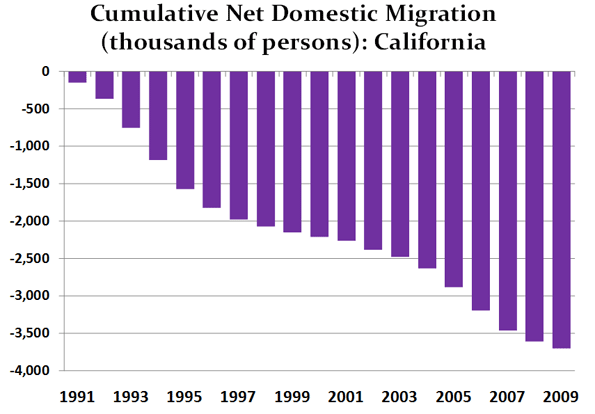
    How bad are things in California? California’s domestic migration has been negative every year since at least 1990. In fact, since 1990, according to the U.S. Census, 3,642,490 people, net, have left California. If they were in one city, it would be the third largest city in America, with a population 800,000 more than Chicago and within 200,000 of Los Angeles’ population.

    We’re seeing a reversal of the depression-era migration from the Dust Bowl to California. While California has seen 3.6 million people leave, Texas has received over 1.4 million domestic migrants. Even Oklahoma and Arkansas have had net-positive domestic migration trends from California.

    Those ultimate canaries in the coal mine, illegal immigrants, recognize California’s problems. Twenty years ago, about half of all United States illegal immigrants went to California. Today, that’s down to about one in four.

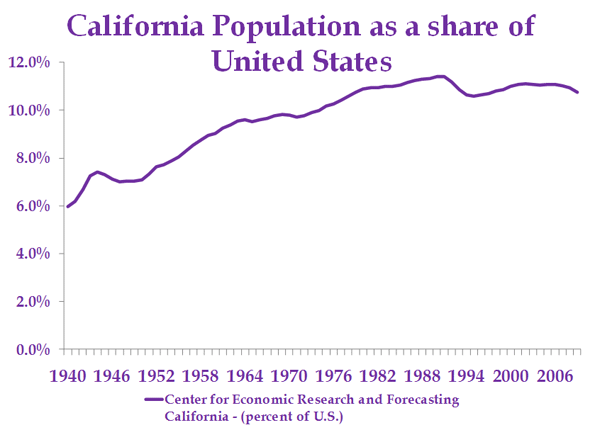
    The result of these migration trends is that California’s share of the United States population has been declining.

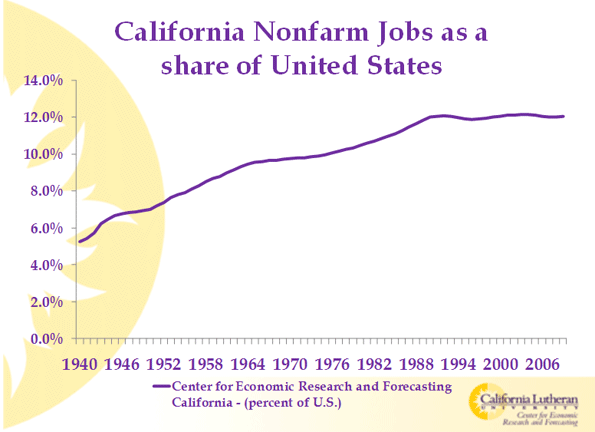
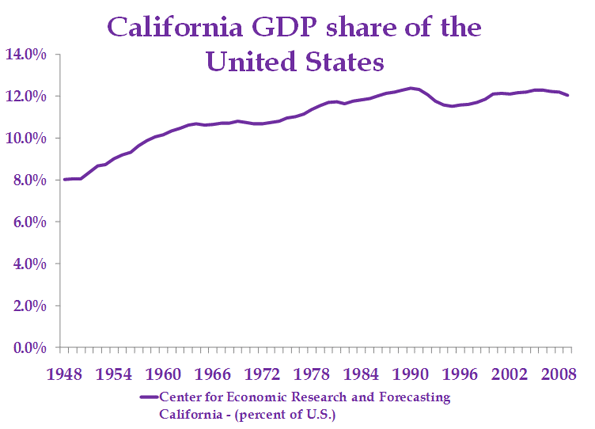
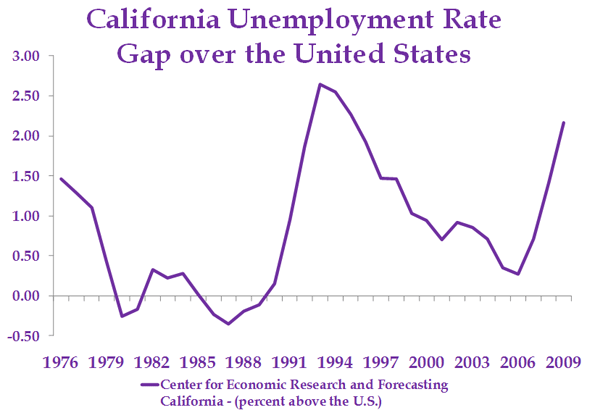
    What do these migrants see that so many of California’s political class do not see? They see a lack of opportunity. California’s share of United States jobs and output has declined since 1990, and its unemployment rate has remained persistently above the United States Average, only approaching the average during the housing boom.

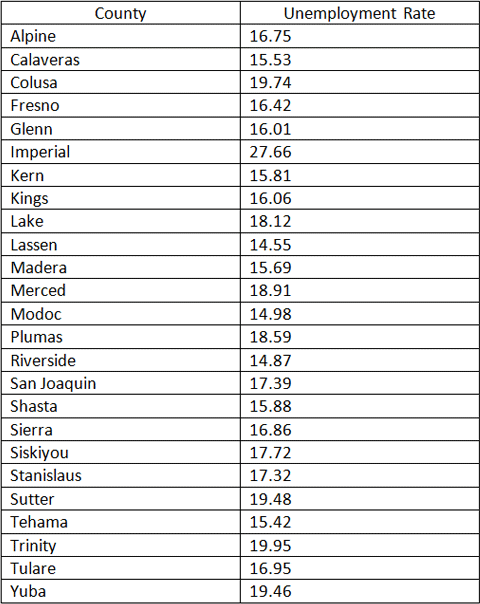
    California’s unemployment is particularly troubling. As of October 2010, only two states, Nevada at 14.2 percent and Michigan at 12.8 percent, had higher unemployment rates than California’s 12.4 percent. California’s unemployment problem is particularly severe in its more rural counties. Twenty-five of California’s 58 counties have unemployment rates higher than Nevada’s:


    These unemployment rates approach depression levels. Some will excuse many of them because they are in agricultural areas, but many assert that low Midwest unemployment rates are due to a booming agricultural sector. Which one is it?

    California’s unemployment problems are not limited to rural and agricultural areas. Most of Riverside County’s population is very urban, yet the County’s unemployment rate is 14.87 percent. On December 7th, the Wall Street Journal listed the unemployment rates for 49 of America’s largest urban regions. California had six of the 19 metro areas with double-digit unemployment. These include such major cities San Diego, San Jose, and Los Angeles.

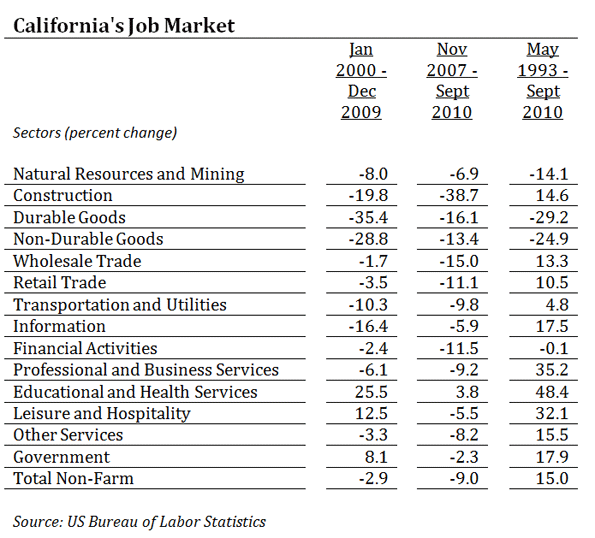
    Just as rural areas are not California’s only depressed areas, agriculture is not California’s only ailing sector. From 2000 to 2009, the only California sectors to gain jobs were government, education and health services, and leisure and hospitality.

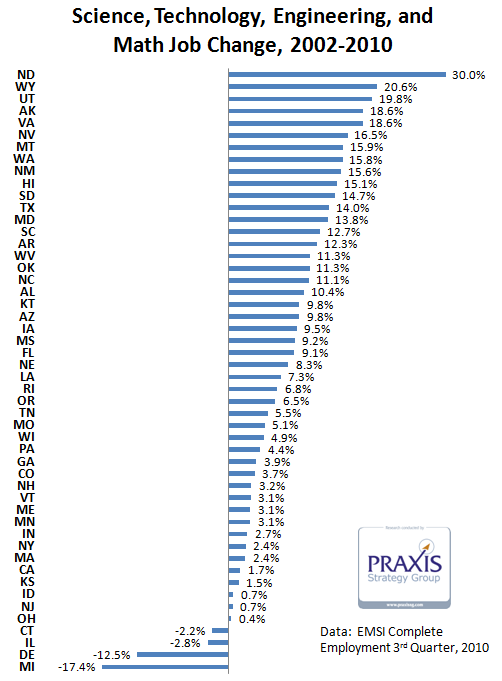
    California’s cheerleaders claim that the state’s future is assured by a vibrant tech sector, but the data do not support that assertion. North Dakota’s Praxis Strategy Group has performed analysis by job skills. They compare Scientific, Technical, Engineering, and Math (STEM) jobs across states. Their analysis shows that California is the Nation’s ninth worst state in creating STEM jobs in post dot-com-bust years. It has produced far fewer new tech jobs than Texas, and far less on average, than the country over the past decade:


    In this respect, California’s precipitous decline is really quite shocking. In just a couple of decades, California has gone from being America’s economic star, a destination for ambitious people from around the world and abundant with opportunity, to home of some of America’s most distressed communities. It has been a man-made, slow motion tragedy perpetuated by a political class that is largely deluded.

    The cheerleader’s faith in command and control regulation and environmental purity is so strong they cannot see anything that contradicts that faith.

    But that faith is misplaced. Joel Kotkin, Zina Klapper, and I performed an extensive review of the economic impacts of one of California’s most important greenhouse gas regulation, AB 32, and found that command and control regulation in general and AB 32 in particular is inefficient, cost jobs, and depress economic activity. California’s Legislative Analyst’s Office agrees, as evidenced by this report.

    More depressing still are the growing ranks of what could be called “the resigned”. They simply have given up. These include a business leadership that is more interested in survival and accommodation than pushing an agenda for growth. Easier to get along here, and expand jobs and opportunities elsewhere, whether in other states or overseas.

    Yet ultimately California’s future is what Californians make of it. No place on Earth has more natural amenities or a more benevolent climate. No place has a location more amenable to prosperity, located between thriving Pacific Rim economies and the entire North American market. No place has more economic potential.

    But unless policy is changed, California’s future is dismal, with the specter of stubbornly high unemployment, limited opportunity, and the continued exodus of the middle class. California’s political class needs first to confront reality before we can hope to avoid a dismal future.

    Bill Watkins is a professor at California Lutheran University and runs the Center for Economic Research and Forecasting, which can be found at clucerf.org.

    Photo by Stuck in Customs

  • Are Developers Greedy, Or Just Misunderstood?

    Construction starts in Australia, like much of the English-speaking world, are falling across a spectrum from commercial to retail, industrial and housing. Construction industry jobs – one of the few sources for well compensated blue collar employment – are going with them. Yet developers, the very group who would create these jobs, continue to suffer a poor public image. Why, and can it ever be improved?

    The Reserve Bank of Australia’s recent move to increase interest rates was not well received by the development and construction industry. Housing and non-residential approvals are in a general slide and a widely reported lack of new supply in housing is compounded by private sector commercial development at a virtual standstill, with development finance the most widely cited culprit. According to the UDIA, construction industry jobs are down by around 25,000 in just one Australian state, the formerly booming Queensland. That’s a lot of incomes not being spent in the economy.

    Yet despite these problems, developers aren’t exactly being courted by policy makers or regulators. Quite the opposite – politicians still regularly throw the mud at the very industry which holds a key to improving housing supply and construction industry jobs. “I won’t stand by and let greedy developers get away with … blah blah blah.” You’ve all heard it before. Denial, pass the buck and shoot the messenger continue to be preferred defensive tactics of politicians responding to industry complaints of excessive regulation. Labeling all developers “greedy has about as much validity as suggesting all politicians are corrupt simply because a handful break the law, but the latter (politicians) continue to target the former (developers) – and get away with it.

    It’s not just the politicians of course. Many regulators and planners, if you believe the horror stories, have taken an adversarial stance to development assessment whereby the developer is regarded with suspicion from the outset. The regulators don’t see themselves as facilitators of new activity but as ‘growth managers’ exercising every precautionary principle known in a bid to slow, curtail, check and re-check the consequences (real or imagined) of a proposal.

    Then there’s community opinion, which puts developers and real estate agents and used car dealers into the same category. Development proposals that align with local or state planning schemes, and which may have already jumped through several hoops before a public airing, are often widely rejected via the pages of the local press. This isn’t just NIMBYism, because the target of hostile public complaint isn’t the planning scheme or the local or state politician who endorsed it, but the developer applicant who is simply complying with the scheme’s intent. Irrespective of how green, how sustainable, how rational or how much needed the proposal may be in community or economic terms, it’s the developer who gets the bad press.

    Why is it that developers just can’t win?

    I’ll venture a theory that many readers won’t like. Developers are too meek, too obsequious, too prepared to be thrashed with a wet lettuce and succumb. With rare exceptions (Stockland’s Matthew Quinn is one) developers rarely comment publicly about the problems imposed on the industry by excessive and growing regulatory burdens. The allegations of land banking, of profiteering, greed, opportunism, social irresponsibility and environmental vandalism are too infrequently challenged in the public domain.

    Some blame no doubt lies in the politicization of development assessment: development is no longer an exercise in market and land economics, but a political game. Political intervention in planning schemes and the ability to kybosh proposals means that developers need to be acutely sensitive to political trends. Throwing back the facts and arguing the case publicly may not win political friends, and developers certainly don’t need any more political enemies. But what that means is that as more mud is thrown, more mud sticks.

    It’s true that industry groups have their role to play in advocating development industry positions and promoting the benefits the industry brings, and by and large do a good job with the resources available. But is it also true that developers themselves tend to hide behind their industry groups in a sort of ‘good guy, bad guy’ act where industry group executives are left to do the sledging while developers do the schmoozing?

    I recall a meeting with a Government Minister some years ago, dealing with a mounting problem in the Minister’s Department which threatened to cost the industry dearly. The meeting was civil but the issues weren’t danced around – “a full and frank discussion” might be its best description. The Minister was getting the message, loud and clear. But then, at the close of the meeting, the developer representative left the Minister with the comment that “Minister, thanks for your time and we want you to know you’re doing a great job.” Bang, pop – the pressure was instantly deflated. That Minister no doubt reported to their colleagues that the industry was pretty put off but didn’t present a political problem.

    Perhaps asking individual developers to publicly challenge the opprobrium being thrown at them and defend themselves more aggressively is akin to asking them to paint a target on their forehead saying ‘shoot me’ But perhaps they can take a hint from Australian farmers. Farmers, thanks to aggressive environmental politics, were copping all the bad press from tree clearing and land erosion to fertilizer and herbicide runoff. Somehow the community was allowed to forget that without farmers we don’t eat, they responded. The ‘Every Family Needs a Farmer’ campaign was a defensive community education campaign, designed to build more empathy amongst urban consumers of the issues faced by farming communities. The campaign has run through several incarnations over several years, and was no knee-jerk, one-off exercise.

    Now if Australian entrepreneur Dick Smith can fund a TV documentary and anti-growth campaign single handed, you’d think the entire development industry could manage something in its own interests, especially when those interests are closely aligned to the interests of the community. You wouldn’t call it ‘Every Family Needs a Developer’ but you could start with a few things that the community as a whole seems to have forgotten:

    • Almost every street and the houses in it, in every neighborhood, is the result of a developer at some stage taking a risk.
    • Every shop in every high street, and every shopping mall your family visits, is the result of some developer at some stage, taking a risk.
    • Almost every workplace, whether it’s a medical centre, a factory, or an office building, is the result at some stage of a developer taking a risk.
    • Increasingly, many of the schools, roads and community facilities that we enjoy are funded through the activity of developers.

    The homes we will need so that people aren’t sleeping on the streets won’t be provided by governments, or politicians, but by developers. The economy that we need to feed our families and support our aged and infirm, relies heavily on developers and the construction jobs that flow from them.

    Many developers go broke trying, and in doing so they lose their own money, not public money. It’s a high risk venture where certainty is essential. It’s not an industry where the public sector has ever shown much of a track record – witness the billions squandered on public housing programs which produce very few roofs.

    Developers have legitimate concerns about the cost of doing business. It means their costs to the consumer,in the form of houses young people can’t afford, or rents that businesses struggle to pay, are higher than they need to be. It’s not developers making this happen; it’s regulation.

    At the end of the day, developers can sit back and wait for more mud to be thrown, or begin to defend their reputation, and to defend the need for growth.

    Is there anything to be lost by trying?

    Ross Elliott has more than 20 years experience in property and public policy. His past roles have included stints in urban economics, national and state roles with the Property Council, and in destination marketing. He has written extensively on a range of public policy issues centering around urban issues, and continues to maintain his recreational interest in public policy through ongoing contributions such as this or via his monthly blog The Pulse.

    Photo by Scorpions and Centaurs

  • Building the Train to Nowhere

    The California High Speed Rail Authority has approved building its first 54 miles in the San Joaquin Valley. A somewhat longer route, 65 miles, has been indicated in a number of press reports, but Authority documents indicate that only 54 miles of high speed rail track will be built. The route would start in Corcoran, and go through Fresno to Borden, a small, unincorporated community south of Madera. All of this would cost $4.15 billion. The route would include two stations, in Fresno and Hanford/Visalia.

    The segment was adopted under pressure by the United States Department of Transportation, which was interested in ensuring that the line would be usable (have “independent utility”) by Amtrak should the high speed rail project be cancelled due to lack of funds. The first section of the California high speed rail line would instead be a somewhat incongruously high-tech Corcoran to Borden spur, or perhaps more accurately stub to the region’s rather sparse conventional rail services.

    There are appear to have been concerns that growing opposition movements in the San Francisco and Los Angeles areas could have delayed construction, which could have put the federal money at risk. The Sacramento Bee’s Dan Walters, perhaps the leading political columnist in the state implied an ulterior motive:

    “You’d have to be terminally naive not to believe that the splashy announcement, made personally by an Obama administration official in Fresno, was to help an embattled local congressman, Democrat Jim Costa, stave off a very stiff Republican challenge.”

    Officials representing communities – many of them with high levels of unemployment – on the segment itself were elated, as any would be at the prospect of a rush of new construction jobs, regardless of what was being built. But, most everywhere else the reaction to the selection largely has been negative. Walters labeled it the “train to nowhere” in a November 29 commentary. State Senator Alan Lowenthal, who chairs the legislative committee overseeing the high speed rail project said that the Authority “could be creating an ‘orphan’ stretch of track, that will never be used by high-speed trains.”

    Richard Tolmach, president of the California Rail Foundation, an intercity rail advocacy organization, told Authority members ” It’s a crazy idea. He went on to say that “You guys are gonna be a laughingstock in Congress.”

    Already, problems are building in the now more decidedly more conservative Congress. California Republican Congressman Jerry Lewis and 27 colleagues have introduced the “American Recovery and Reinvestment Rescission Act,” which would apply unspent stimulus money to the deficit, including $2 billion that has been promised to the California high speed rail line.

    Batteries (and Trains) Not Included: Even after the $4.15 billion has been spent, the Corcoran to Borden rail stub will be incomplete. The Authority’s plan includes only the building of the rail bed and the necessary viaducts. There is no money for trains. There is no money for the electrical infrastructure necessary to power the trains. Trains and electricity infrastructure would add at least 15 percent to the bill, based upon previous California High Speed Rail reports. Thus, when and if completed, the trains and electrification would lift the cost of the Corcoran to Borden high speed rail stub to at least $4.8 billion.

    Bare Bones Stations: The plan calls for building only “basic” stations, with two tracks (one in each direction). That is fine if the line is serving Amtrak and there are only a few trains per day. But the high speed rail plan assumes frequent trains, including some that stop at all stations, some express trains that skip some stations and some express trains running non-stop from the Transbay Terminal in San Francisco to Union Station in Los Angeles. The only place that an express train can pass a slower train is at a station. That means that passing tracks must be built at virtually all stations. The passing tracks (two interior tracks in addition to the two tracks for stopped trains) required in stations are illustrated in this California High Speed Rail illustration (also above).

    The full system, or (perhaps the more likely outcome) a truncated San Jose to Palmdale line (with slower running lines over the commuter rail tracks into San Francisco and Los Angeles), would require passing tracks at the Fresno and Hanford/Visalia stations. Rebuilding these stations would increase the cost above the $4.8 billion, and that’s before the seemingly inevitable cost escalation.

    Indeed, the Corcoran to Borden stub entails a potentially large cost increase compared to previous California High Speed Rail Authority documents. After making all of the necessary adjustments to update the last available segment costs to the cost accounting method (“year of expenditure” dollars), the cost of the Corcoran to Borden stub could be at least 30 percent higher than would have been expected in the present $43 billion San Francisco to Anaheim cost.

    Applied to the entire line, a 30 percent cost escalation could take the price of the San Francisco to Anaheim line to more than $55 billion. Based upon cost ratios released by the Authority in 2008, the later extensions to Sacramento and San Diego would lift the bill to more than staggering $80 billion. Even that does not pay the entire bill, because promises have been made in state legislation for improvements across Altamont pass from Stockton to the East Bay and Oakland.

    Not that coming up with any of this money will be easy, particularly with a more deficit conscious Congress. Congressman John Mica of Florida, who will likely lead the House of Representatives Transportation and Infrastructure Committee has promised a review of all federal high speed rail grants. The Authority expects to obtain funding from local governments in California, a number of which are teetering toward financial insolvency.

    The Authority expects between $10 and $12 billion from private investors. These potential investors will all be aware of the fact that virtually every dollar of private investment in new high-speed rail lines has been lost or required a government bailout. They will not participate without subsidies, which are prohibited by California law. Finally, all these elements of the financing plan will be made even more problematic if the first phase of the project continues to rise from $43 billion to $55 billion.

    Washington analyst C. Kenneth Orski noted that the Corcoran to Borden stub could “become a huge embarrassment for the Administration” and that by its train to nowhere ”casts doubt on the soundness of the entire federal high-speed rail program and its decision-making process.”

    Then, even if California gets to keep the federal money, there are still formidable financial barriers. A likely result is high speed rail in Amtrak mode which probably won’t make much difference to passengers riding the infrequent San Joaquin service. After the Authority action, Bill Bronte, who heads the rail division of the California Department of Transportation said that “The improvements in performance might be less than one would expect.” But that might not bother contractors and consultants who can feast on what might prove to be the most expensive conventional intercity train project in history.

    Wendell Cox is a Visiting Professor, Conservatoire National des Arts et Metiers, Paris and the author of “War on the Dream: How Anti-Sprawl Policy Threatens the Quality of Life

  • Cities That Prosper, Cool or Not

    Over the past few years, the raging debate in economic development has been over whether cities should be cool or uncool. Should cities pursue “the creative economy” by going after arts, culture, creative research & development, and innovation? Or should they focus on the bread-and-butter economy: hard infrastructure, traditional industries like manufacturing, and blue-collar jobs?

    Usually a raging debate is an indication that the wrong question is being asked, and that’s the case here. The question is not whether cities must be cool or uncool in order to prosper. Clearly, there are some cities in each camp that prosper, and some cities in each camp that do not. The question is deeper: In both cool and uncool cities, what is the underlying nature of the economy? Does the city simply import money from other places, or does it export goods and services to other places? Because it is this distinction – not cool or uncool – that serves as the dividing line between prosperity that is real and prosperity that is illusory.

    Not long ago, I was interviewing a retired politician in a fast-growing Southern metropolis. Even though he was a good ol’ boy who had never left home, he bore no resentment for the retired Yankees who flooded his town. In fact, he attributed the whole area’s prosperity to them. A retirement community, he said, “is like a high-wage factory. You build 1,000 houses, you have 1,000 households making $90,000 a year. A high-wage factory without the factory.”

    I grew up in a factory town, and this got me thinking about a factory’s huge and multi-faceted contribution to a region’s economy. But is a retirement community really similar?

    In some ways the answer is yes — and that’s a good thing. The most obvious similarity, as my politician friend pointed out, is that the residents live in town, get steady paychecks to spend locally, and become involved in local life. Like factory workers, retirees can support a whole service economy with their local spending.

    But there’s more to a factory-town economy than simply Saturday grocery shopping by the workers. Factories are in the export business, while retirement communities are in the import business. An export economy spins off all kinds of economic benefits that you don’t get from an import economy. A big factory requires lots of suppliers, and tends to stimulate the creation of an economic cluster — a group of businesses that feed off each other and, in time, find new customers outside the region.

    A retirement community creates a cluster of suppliers, too. But this cluster tends to be composed of local service-sector businesses that create low-wage jobs and aren’t interested in repackaging their services for export outside the region — retailers, contractors, landscapers and pool-maintenance companies.

    There’s also a psychological difference. Factory workers are connected to the local economy in a way that retirees are not. If orders fall off, they might get laid off for a while, switch jobs and go to work over at a supplier, sometimes for more money, sometimes for less. But the point is that they have a stake in the regional economy. Factory workers don’t like traffic jams anymore than the rest of us, but they see the value of an expanding economy. They see how growth can be good as well as bad.

    Retirees see no such thing. They are tied to the global economic system in which their investments are based, or else to the economic fortunes of, say, a government pension system in another part of the country. They might want tax revenue to flow into public coffers in New York or Ohio to protect their public pensions, or they might want interest rates to go up so that their incomes rise.

    But they see no benefit in an expanding local economy. If a bunch of factory workers get laid off, the retirees don’t need to worry, in fact, they might actually benefit because local prices might fall. If business is booming and people are employed and labor rates are going up, they don’t have to worry about that, either. They might even be harmed by it, because their incomes are fixed — not tied to the local economy — and prices will go up.

    A retirement community is not the only type of place that operates this way. Tourist towns and bedroom suburbs function pretty much the same way. All are in the business of importing money from somewhere else, rather than exporting goods and services. And the recession has shown, once again, how fragile import-based economies are. A few years ago, Las Vegas was the biggest boomtown in America. Today, it’s become crash city, largely because the two-tier economy tied to tourism — a few wealthy casino owners and managers, a vast number of low-paid hotel service workers — couldn’t sustain the huge increase in home prices that occurred during the housing bubble.

    There’s nothing new in this distinction between import and export economies. Jane Jacobs laid out the thesis magnificently, almost 30 years ago, in Cities and the Wealth of Nations. But it’s become more relevant in the last couple of years, as the cool v. uncool cities debate has heated up.

    The argument that cool cities are involved in fluff, and therefore aren’t creating real economic growth, is based on the perception that cool cities are in the import business. If you build arts centers and sports stadiums and convention centers and subsidize lofts for artists, you’re not really creating any wealth… or so the argument goes. All you’re really doing is drawing people to your city so you can empty their pockets while they are having a good time; the classic import economy.

    That’s true sometimes, but not always. At its best, a creative economy is generating innovations that turn into products that get exported elsewhere, whether those innovations are fashion trends or software applications or biotech breakthroughs. And in many cases, a more plodding blue-collar economy requires fluffy arts stuff to create the quality of life that will attract top people. My grandfather left the Cornell faculty to run the research lab of a rope manufacturing company in my hometown in upstate New York, but I’m pretty sure one of the attractions was a symphony orchestra that my grandmother, a concert pianist, could perform with now and then.

    Similarly, just because a city is a lunch-bucket town doesn’t mean it’s sending goods and services out into the world and truly creating a lot of wealth. Here again, Las Vegas is a great example. Despite the glitz, Vegas is basically a blue-collar town. It’s job-rich, and workers traditionally didn’t need a lot of education or a high skill level to succeed, they just needed drive. Yet, by and large, the jobs created in Vegas aren’t very good. They’re relatively low-wage service jobs, and they come and go depending on the economy. Vegas’ business leaders are accumulating wealth quickly, and maybe eventually it will become an export economy. But for now, like the retirement community in the South that I mentioned, it depends entirely on importing money.

    It’s time to stop talking about whether towns should be cool or uncool. What really matters is what they are producing. If all they’re producing is some kind of experience that induces people to come to town and spend money, it doesn’t matter how cool the town is; it’s probably not sustainable economically. If, on the other hand, the city is creating and exporting something the world needs – whether that product is cool or uncool – it’s a good bet that both the city and its people will do pretty well for a long time.

    Photo by Stuck in Customs/Trey Ratcliff. Prosperity, or just an illusion? Building 43 at Google.

    William Fulton is a principal at Design, Community & Environment (dceplanning.com) and mayor of Ventura, California. This article is adapted from his new book, Romancing the Smokestack: How Cities and States Pursue Prosperity.

  • Education Wars: The New Battle For Brains

    The end of stimulus — as well as the power shift in Congress — will have a profound effect on which regions and states can position themselves for the longer-term recovery. Nowhere will this be more critical than in the battle for brains.

    In the past, and the present, places have competed for smart, high-skilled newcomers by building impressive physical infrastructure and offering incentives and inducements for companies or individuals. But the battle for the brains — and for long-term growth — is increasingly tied to whether a state can maintain or expand its state-supported higher education. This is particularly critical given the growing student debt crisis, which may make public institutions even more attractive to top students.

    The great role model for higher-education-driven growth has been California. The Golden State’s master plan for education — developed under Pat Brown in 1960 — created an elaborate multi-tiered public system that offered students a low-cost and generally high-quality alternative education. Over the next half century, California became, in historian Kevin Starr’s phrase, a “utopia for higher education,” as well as a model for other states and much of the world.

    Today many of the states that copied California’s model — notably North Carolina, Texas and Virginia- — threaten to upend the Golden State’s dominance of public higher education. These states now all spend far more than traditional leader California when you look at percentage of state expenditures; Virginia, for example, spends twice as much of its state budget on higher ed than California does. New York and Illinois spend an even a smaller percentage.

    The combination of fiscal woes and misplaced priorities has engendered spending cuts in California. Tuitions for higher public education have soared: In 2009 they were raised 30%, and they have been raised over 100% over the past decade.

    To be sure, the University of California (disclaimer: I attended the Berkeley campus) retains a huge reservoir of talent, with courses taught by 111 Nobel Laureates. It still dominates lists of top public universities;  six of the top 14 schools in the US News and World Report 2010 rankings are UC schools.  But the signs of relative decline are clear. In 2004, for example, the London-based Times Higher Education ranked UC Berkeley the second leading research university in the world, just behind Harvard; in 2009, that ranking, due largely to an expanding student-to-faculty ratio, had tumbled to 39th place.

    Other states are now looking to knock California further off its perch. In 2009 alone the University of Texas lured three senior faculty members from UC. As departments shrink at places like Berkeley, those in schools such as the University of Texas at Austin, Texas A&M and Texas Tech have expanded rapidly, adding students and buildings.

    Of course, these schools also have budget problems, and they have increased tuition too–albeit at a significantly lower rate. But for the most part, these up-and-coming state systems are more focused on expansion than on retrenching and survival. While some in California question the viability of some of the newer UC campuses, Texas is busily expanding its roster of tier-one, public research universities, seeking to add the University of Houston as well as UT campuses in north Texas, Arlington, Dallas, El Paso and San Antonio to the ranks of UT Austin, Texas A&M and Rice, a private school in Houston.

    Texas Tech,  best known for its engineering and agriculture-oriented programs, for example, is thriving. Located on the windy Great Plains on the western side of the state, it is far from the state’s major metropolitan areas, and its home town of Lubbock (population: 225,000) is likely not high on anyone’s list of hip and cool college towns. Yet the school, which enjoys strong alumni and business support, is in the midst of a major building boom and a $1 billion capital campaign. When I visited there earlier this month, the campus was full of construction crews; Texas Tech has added over 3000 students in the past two years and now has over 31,000 students.

    Other unlikely upstarts include the University of North Dakota, which has boosted spending by 18.5% in 2009, a luxury afforded by the state’s booming energy, agriculture and increasingly high-tech economy. North Dakota, which historically has suffered significant loss of young talent, has set a goal to rank No. 1 in the average education of its population. Today it already ranks No. 3 in terms of college-educated residents between the ages of 25 and 34.

    These shifts could presage — and to some degree enhance — what is already a powerful trend toward states that, in the past, have been educational also-rans. Although Texas also faces budgetary constraints, its annualized $9 billion deficit is dwarfed by those of California, Illinois and New York. And those bluish states already have much higher tax rates, which leave less room for revenue increases. Texas also has the luxury of an $8.2 billion “rainy day” fund, as well as a more vibrant economy.

    More important still, states like North Carolina, Virginia and Texas continue to grow more rapidly than the older brain-center states. This is particularly true in terms of the high-tech jobs many graduates would likely seek.  Indeed since 2002 these states have all enjoyed far greater growth rates in high-tech employment than California, Illinois, Michigan or New York. They also have added more new tech jobs in actual numbers than California–despite their significantly smaller size.

    Migration patterns are also changing among college-educated workers. Between 2005 and 2007, Texas, Virginia and North Carolina already enjoy higher rates per capita of net migration of educated workers between the ages of 22 and 39 than California, New York or Massachusetts.

    This advantage could expand as the upcoming states increase their educational offerings along with employment opportunities. Students may end up tempted to attend schools closer to where there is job growth. Unlike Austin and Raleigh-Durham, which have rapidly expanded tech employment, Silicon Valley has produced virtually no new net tech jobs for the past decade.

    The second impact may  be more subtle, as declining revenues from businesses and individuals reduces the opportunity to boost education spending. As the country stumbles into this recovery, the greatest advantage will fall not only to states with the most natural resources, but those with the best-educated human resources. For a half century this is a game that states like California have played to perfection, but it is one in which other places are likely to catch up, and perhaps even pass. The long-term implications for the nation’s economic geography could prove profound.

    Joel Kotkin is executive editor of NewGeography.com and is a distinguished presidential fellow in urban futures at Chapman University. He is author of The City: A Global History. His newest book is The Next Hundred Million: America in 2050, released in February, 2010.

    Photo by Luca Zappa