Category: Urban Issues

  • I Opt-out of California

    Like the harried traveler who made famous the expression, “Don’t touch my junk”, I have elected my own personal protest, California style. I have decided to OPT-OUT of California to protest my overgrown state government. I am tired of California legislators sticking their hands in my pants to pay for the European style social welfare state they have created. My work, my earnings and my taxes will go elsewhere.

    I am one of those evil “high-earners” in California with income over $200,000 per year. It is unimportant to state legislators that we high-earners pay most of California’s taxes. According to the Franchise Tax Board, in 2007 more than 87 percent of California capital gains taxes came from taxpayers with adjusted incomes of more than $200,000. Residents with incomes over $200,000 pay 66 percent of its income taxes even though earn just 39 percent of the state’s income. More important to California’s future, most of us are small businesses, which account for 65 percent of new job growth in the state.

    When I moved to California in 1981, California was truly the Golden State. Its budget revenues of $22.1 billion levied just $920 per person from its population of 24 million. It had great freeways, great schools and its inexpensive college/university system was the envy of the planet. By 2009, the budget revenues had grown to $86 billion, or $2,324 per person from each of its 37 million residents. But California has a $25.4 billion deficit, which means the aging “movement” activists who govern this state are spending $114 billion or $3,081 per resident. Spending is up 520% from 1981.

    The $86 billion in revenues California collected from capital gains and income taxes is not the only tax that has increased. Despite Prop 13 that capped property taxes at 1%, property taxes expanded from $6.36 billion from 1980-1981 to $43.16 billion in 2006-2007, an increase of 579%. For point of reference the CPI index increased just 133%, from 88 in 1980-1981 to 202.4 in 2006-2007.

    The Legislative Analyst’s Office says California will have an additional $6.1 billion shortfall in the current fiscal year reaching $25.4 billion next year. Legislative Analyst Mac Taylor says the state faces deficits of $20 billion each year through 2015.

    “Unless plans are put in place to begin tackling the ongoing budget problem, it will continue to be difficult for the state to address fundamental public-sector goals — such as rebuilding aging infrastructure, addressing massive retirement liabilities, maintaining service levels of high-priority government programs and improving the state’s tax system,” the report said.

    How did California voters respond to this fiscal irresponsibility in November? They rewarded the Democratic Party with every elected office from Governor to Insurance Commissioner, and returned Barbara Boxer to the US Senate. I guess California voters did not get the Tea Party memo that resulted in a “shellacking” of 64 Democrat Congressional seats in the rest of the nation. The political tsunami that hit even parts of the Eastern seaboard in 2010 totally missed California. Perhaps it ended somewhere in Nevada with the re-election of Harry Reid.

    So, in protest to the insensitive indulgent big-spenders that run Sacramento, I say, “Don’t touch my junk!!!” My beautiful California home is now on the market for $2,000,000. My next home will be in a no state income tax state like Texas or Nevada. I will not buy that new Jaguar that I was planning to purchase for $75,000. I will keep my old Cadillac and deprive Sacramento of $6,562 from its 8.75% sales tax. My next purchase for my real estate business will be an office building in Prague in the Czech Republic, a democracy that has lower taxes and fewer regulations. My income will remain either offshore or in a state that does not confiscate like the money grubbers in Sacramento. And, I will not be investing my capital to create any new jobs in California. In the digital age, my staff will be located in states that are a little more business friendly.

    Apparently, I am not alone. Migration out of California exceeds the rate of almost every other state. Why are my fellow “high-earners” leaving the Golden State? Maybe it is because California ranks nationally in the bottom two for business friendliness while placing third in state income taxes.

    We have Jerry Brown as our Governor again, meaning that he will live his entire life without a real job. The Central Valley, once agricultural wonderland of America, has Depression era unemployment, this as a result of a green-inspired court water shut-off designed to protect an Anchovy sized piece of bait called the Delta Smelt. And, our brilliant voters – including those working class voters most impacted – rejected Prop 23. That means that on January 1, 2011, California must begin to reduce our greenhouse gases by 40%. To achieve this noble goal, we seem certain to make ourselves even more uncompetitive with other countries and other states.

    If that was not enough, voters also approved Prop 25 which allows the public union dominated Democrats to pass its budget with a simple majority. They did such a good job ($20 billion shortfalls) when they were forced to obtain a 2/3rds vote for approval. They no longer will need a single Republican vote to pass their budgets.

    Margaret Thatcher remarked to Parliament on February 22, 1990, “The trouble with socialism is that you eventually run out of other people’s money.” Such will be the fate of the failed state of California and its free spending legislators, when high-earners like myself vote with their feet, and their wallets, and take their earnings elsewhere.

    **************************

    Robert J Cristiano PhD is the Real Estate Professional in Residence at Chapman University in Orange, CA and Head of Real Estate for the international investment firm, L88 Investments LLC. He has been a successful real estate developer in Newport Beach California for twenty-nine years.

    Photo by ASurroca

  • Retro Rail Alert

    The New Zealand Government recently decided to follow the example of Montreal and Toronto by amalgamating the six City councils and the single Regional Council of the Auckland Region to create a united “Super City” of 1.4 million people.

    Like similar amalgamated bodies, the new Auckland Council, which came into being on the 1st November, 2010, has fallen for the notion of regionally determined smart growth built around a huge investment in heavy rail.

    Backed by a Regional Council totally committed to Smart Growth, every decision was driven by the need to “get people out of their cars” rather than to improve mobility. Since the 1990s they have fought for densification as a means of enabling more public transport. The bus lanes linking the north shore to the CBD are for buses only. HOVs are not allowed on and nor are shuttle buses. The planners openly argue that the near empty lane is to encourage people to get out of their cars on the congested motor way lanes and take the bus. Also they are inserting bus only lanes into our already narrow urban streets. Cars are just being crowded off the streets.

    Consequently, congestion has grown progressively worse, but this was seen as only further evidence of the need to invest in rail.

    Many of us thought that the election which replaced the Labour Government with a coalition of National and Act, two conservative-leaning m parties of the Right, would put an end to this “trip backwards to the future”.

    But, as has happened elsewhere, the Right adopted the policy while the Chambers of Commerce and similar groups championed the mega-amalgamation on the grounds of efficiency. They saw huge savings to be made in having only one Mayor and one council, and one plan, and one rate, and indeed, ideally only “one of everything”.

    Yet instead of searching for a new, modern way to develop this region, Len Brown, the left of center first Mayor of the Auckland Council has backed a “Vision for Auckland” built around an extensive rail network – including a rail link to the Airport, a CBD rail loop, light rail on the surface streets, and a rail tunnel under the Waitemata harbour.

    Residents of surrounding areas may not share this Vision – especially if they have to share the costs. This is the kind of division that led to Montreal’s recent de-amalgamation.

    The Mayor supports his Vision with claims that professional analysis and expert advice will show that these projects are viable and necessary and that Government must fund them.

    One has to wonder where he gets his advice from.

    No investment in rail in New World cities since the 1980s has resulted in a reduction in congestion. In most cases congestion has increased and public transport market share has diminished because the investment into rail has diminished funds for roads, buses and High Occupancy Toll lanes, measures that actually work to increase mobility

    The Government should also be aware that the international engineering firms at come in behind these proposals for rail investment (and similar major project works) have a proven expertise in getting a foot in the door with low bids then cranking up the costs afterwards. These projects routinely come in over budget.

    Furthermore, some research reveals that Heavy Rail (as is proposed for the Auckland network) has a worse record for cost overuns than Light Rail projects. Early projects have a worse record than more recent projects, possibly because the tendering firms have gained experience over time in how to fool the public, and the population with low ball estimates of cost and exaggerated estimates of ridership.

    Megaprojects and Risks: and anatomy of ambition.” (Click on the link to read the Public Purpose review.)

    This has become a clearer pattern, as seen in projects as diverse as the English Channel Tunnel, the Great Belt rail-road bridge between Zealand and the Jutland Peninsula, and the Oresund road-rail bridge between Copenhagen and Malmo, Sweden.

    So this is not just an American problem.

    The “Chunnel” trains, for example, were projected to carry 15.9 million passengers in the first year of operation (1995) but by the sixth year (2001) ridership was 57% lower at 6.9 million. The cost overrun was 79%.

    The Flyvbjerg data set of international studies, including rail and road schemes, contained 258 projects.

    • 90% had significant overrun of costs.
    • Rail projects had the highest cost escalation (45% over)
    • Road projects had the lowest escalation (20% over)
    • The average ridership was 61% of forecast and the average cost overrun was 28%.

    The figures for rail alone were worse.

    An even more pessimistic summary of performance is contained in a power-point presentation by Lewis Workman of the Asia Development Bank, Predicted vs. Actual costs and Ridership – Urban Transport Projects, May 2010.

    This presentation notes that the problem is actually worse in developing countries. The Bangkok metro “actual ridership” fell short of the projections by 55%. The authors ask the question “Lies or Incompetence?” and their answer is “Probably Both.”

    New Zealand’s Minister of Transport, Stephen Joyce is well prepared to shout louder than the “one voice” of the new Auckland Council. In September 2009 he warned that the Government is committed to spending NZ$500m on the city’s rail electrification projects – but funding cost over-runs is not an option.

    His officials have identified up to $200m of potential cost over-runs in the NZ$1.6bn project, which is still on the drawing board.

    One of the first rail upgrade contracts demonstrates his concerns are justified.

    The Manukau Rail Link was initially estimated to cost NZ$40 million [2006] which subsequently rose to NZ$72 million [2008] and the latest figure is NZ$98 million. This is for a 1.8k link and station southwest of Manukau CBD.

    The Minister should hold fast to this position. But maybe he should also hold fast to the position that Auckland Council will not be compensated for any revenue shortfalls on account of lower than projected ridership.

    Maybe the Auckland Council would then take on board the remedies for these “foot in the door” feasibility studies, or get those who make the studies to stand behind them with some form of guarantees backed up by insurance.

    The recent experience with BART suggests that US politicians should learn to play equal hard-ball.

    Similarly the 5 km BART connection to the Oakland Airport (on the East Bay) was originally projected to cost $130 million and cater to more than 13,000 passengers daily. However, after a decade of delays, those forecasts have been changed to $484 million – a cost increase of say 250%, and 4,350 passengers a day – a ridership shortfall of say 60%.

    The crystal balls are not getting any clearer.

    Consequently, according to a study by transport planners Kittelson and Associates, each new passenger who uses the system during its estimated 35-year lifespan will be supported by a subsidy of $102 – on top of the fares they pay. This is more than 10 times the original projected subsidy of $9 per new passenger. This combination of cost overrun and ridership shortfall has had a catastrophic effect on the viability of such projects.

    But the boosters are not deterred. They say it should be built because “the community wants it”, which sounds familiar.

    The table below shows this the Oakland Airport rail link is clearly a project that should never be started. Even the “rapid transit” speed will not be delivered.

    Politicians’ Visions reward the citizens with nightmares.

    These large multi-national engineering consulting firms have become accustomed to treating Governments – both Central and Local – as giant ATM machines.

    It’s time to take away their plastic.

    Owen McShane is Director of the Centre for Resource Management Studies, New Zealand.

    Photo by bcran

  • Florida Goes Underground

    By Richard Reep

    Last year’s report that Florida had lost people marked a new low in our state’s boom-and-bust history. But this autumn’s news seems to surpass even that sorry milestone with a combination of sluggish tourism, empty state coffers, and a reputation as one of the top real estate foreclosure states. Florida just can’t seem to get out of its own way, and with the fourth highest population in the country, it could have competed with Texas to replace California as one of the best business climates in the nation. Instead, Florida, which boasts one of the lowest tax rates in the nation, continues to see businesses and citizens depart, with newly elected governor Rick Scott recommending even lower taxes as the best solution. Instead, it is high time that Florida fix its real problems of economic monoculturalism and anti-education policies that drive it further and further away from America’s future potential.

    It is no secret by now that a diverse income source is the only way to survive the Millenial Depression. States that have more than one income source, like Texas, were able to adapt policies to favor resilient businesses and industries. In Florida, despite loud and clear input to the state legislature, no change in state policies have been effected this year, once again making tourism and construction growth the focus of job creation.

    The tourism industry knows well its position as “first in, last out” when a recession hits, diversifying its products and geography, enabling at least something to run while everything else stands idle. Thus Marriott International, in the late nineteen eighties, invested in senior living facilities, which bore well through the 1990-93 recession. Regulatory burdens on this market segment eventually caused Marriott to focus on other, less regulated markets, and today its global diversity has caused the company to remain economically sustainable. Florida, with so much sunk cost in tourism, seems unaware that its former tourism dominance has been quietly replaced by such glittering destinations as Brazil, Dubai, and China.

    Agriculture is, of course, Florida’s economic mainstay: even in a recession, people must eat. This industry, however, employs a whopping 44,000 farmers, about a month’s worth of laid-off Florida workers. Clearly, the state should be looking elsewhere to create jobs.

    Governor-elect Scott’s vague promise to increase state venture capital spending while cutting taxes is amusing, in light of similar promises from past politicians. While the state’s Capital Formation Act has attracted investment in biomedical clusters, it takes a great deal of spending to sustain this fund. Similar promises created tax incentives for the film industry, which built studios in the nineteen nineties. Then, when the going got rough, these subsidies evaporated, and the studios promptly moved to New Mexico.

    The money for such schemes comes from the same place that Florida politicians seem to always find money: the education system. Florida, after struggling to get up to 27th in spending per pupil, seems about to find out what it is like to be 50th. And this is a last place finish the state should avoid.

    An educated population can adapt more easily to the changing times, can more competently choose its leaders, and can create wealth for itself. None of these qualities have been demonstrated by Floridians in recent years (think of the 2000 election) and, if the newly elected leadership has its way, none are likely to spring forth in the near future either.

    Florida’s two best hopes are to invest more in its public education system, not less, and to diversify its economy. Recent immigrants from states like Wisconsin and New Jersey, where schools are well funded and taken seriously, express shock and dismay at the public schools in Florida. While states like New York debate the worth of comprehensive assessment tests, Florida has been busy distilling its education system down to a teaching-the-test model, producing little else but test results. Regaining an educated, aware citizenry is critical if the state is to see a future as a contributor to the nation’s recovery.

    The potential to diversify its economy remains strong in Florida. Instead of lowering taxes, however, the new state leadership would do well to consider a more guided regulatory approach that favors a diverse economy. Come and gone are many industries which could return with the right incentives: aviation training, movies and television, solar energy research, and the space program. Research, manufacturing, and commercial jobs in all of these industries could contribute to a rebirth of Florida and spark investment that would produce lasting results.

    Florida’s tax climate favors business, but is oddly mismatched by its regulatory climate. The dodged a bullet with the failure of Amendment 4 – a proposal that all new development would have to face a public vote – and the state’s development industry congratulated itself heartily on this success. This proposal made the ballot because of the cumbersome development process regulated by the state’s Department of Community Affairs, which has widely been perceived to fail at its task, protecting neither nature nor the quality of life for its citizens. Whether or not the new governor gets his wish to eliminate this bloated state bureaucracy remains to be seen, but regulatory reform in the state’s development codes needs to be in the works.

    And tourism, which has been a great economic engine, has a chance to come back. Florida will always be a destination, and while other world places have leapfrogged ahead, tourism is highly competitive, as destinations age rapidly. The enduring romance with Florida will continue, but its famous beaches and theme parks will need to reinvent themselves bigger and better than ever. With a new Legoland in the design phase, and redevelopment at some of the world’s most hallowed ground in the Magic Kingdom, tourism’s long-term future bodes well.

    The smoke has cleared from the election battles. Now, more than ever, Florida’s leadership should be nurturing a more educated citizenry and reforming its regulatory system, rather than keep its tax system at ultra-low levels, to pull itself out of this nosedive. Florida’s natural advantages in climate and accessibility make it ideal for such a wide variety of businesses that very little should stand in its way to diversify the economy and create a productive, vibrant, educated workforce.

    Richard Reep is an Architect and artist living in Winter Park, Florida. His practice has centered around hospitality-driven mixed use, and has contributed in various capacities to urban mixed-use projects, both nationally and internationally, for the last 25 years.

    Photo by Captain Kimo

  • Could the Dallas Way be the Right Way?

    Dallas was George W. Bush’s first choice for a retirement destination but it gets low approval ratings elsewhere. A recent poll of readers of American Style magazine rated Dallas only 24th out of 25 large American cities as an arts destination. It came in immediately behind those well-known cultural magnets Milwaukee and Las Vegas, and ahead of only Jacksonville FL, even though it dwarfs all three places in terms of population, arts institutions and urban amenities. An apparently typical assessment residing in the blogosphere states flatly “God I hate Dallas. Everything about it. Especially the airport. Which is the only part of Dallas I’ve ever been in.”

    There has always been urban rivalry, going back at least to the days of the Greek city-states. When Phoenix overtook Philadelphia in the census rankings some years ago, the local newspapers delighted in printing unflattering pieces about the other and extolling their own virtues.

    Increasingly, this rivalry goes beyond traditional boosterism. Cities used to be places where one lived, but they have become metaphors about lifestyle and identity, and the personal has become increasingly highly political.

    In the last presidential election, the former mayor of Wasilla, Alaska seemed to argue that small towns were the keepers of the true American flame, which upset quite a few urbanites. But not all cities are created equal. The creative class thesis suggests that, like high school, there is cool and there is un-cool. This gets complicated when the nerds decide the cool places are. Cities that are designated as cool, like Portland, also tend to be among the least ethnically diverse.

    In short, we are now quarrelling about which cities are the coolest, based upon the extent to which they serve as extensions of our personalities and manifestations of our identities. This has always existed in terms of local rivalries—New York and New Jersey, Minneapolis and St. Paul—but now it is taking on the characteristics of cultural civil war.

    In this scheme of things, Dallas ranks among the totally uncool, which is probably one of the reasons George Bush chose it. But reputation is not necessarily its reality, as visitors to the city can find out for themselves. On a recent Friday afternoon downtown, I saw a line of school buses jostling to drop off and pick up their passengers ranging from young children to strapping adolescents. Every ethnicity seemed to be represented. They were not going to a sports event represented but regular traffic to the Dallas Arts District, a contiguous area amid the high rises that covers 68 acres and contains a broad array of theatres, museums and the city’s Arts Magnet school.

    Texas is hardly short of arts destinations: San Antonio ranked high in the American Style poll, as did Austin, which is known for its South by Southwest and Austin City Limits music festivals. Although Dallas does not automatically come to mind when thinking about highbrow culture, its Arts District is not just a vanity project, but is part of a restructuring of the city’s image taking shape for over three decades. The Arts District was anchored by the opening of the Dallas Museum of Art in 1984; this was followed by the Myerson Symphony Center [designed by I.M. Pei], the Crow Collection of Asian Art, the Nasher Sculpture Center, and the renovation of the Booker T. Washington High School for the Performing and Visual Arts [Norah Jones is an alumna]. Most recent to open is the AT&T Performing Arts Center, the fourth of the cultural buildings to be designed by a prize-winning architect.

    Most metro areas would delight in this kind of enhancement. Yet Harvey Graff, in his book “The Dallas Myth” suggests the city has grown by “brash boosterism”. He argues the ‘Dallas Way’ of getting things done involves an existential denial of the past [especially negative events, notably the Kennedy Assassination] and an equally strong denial of any limits to the future.

    Graff believes that the Dallas Way fails its residents. He argues little, if anything, has been done for poorer neighborhoods. There is substance to this of course: all American cities reflect the inequalities of our society

    Yet what Dallas is doing is still remarkable. In addition to the Arts District, it is pursuing costly projects such as the DART light rail network, which is connecting formerly neglected neighborhoods [now reviving to create a new Uptown] and reaching out to middle suburbia, where whole plazas are sprouting Asian stores and restaurants. No-one is going to be confusing it with New York any time soon, but it does seem that the Dallas Way also has things to recommend it. House prices have not cratered; the Metroplex is not in the fifth circuit of foreclosure hell like Phoenix or Las Vegas.

    Of course, this comes at a literal price, and a figurative one. Reviving some neighborhoods means gentrification. Spending on light rail tends to support young adults rather than children needing kindergartens. Stable house prices in some Dallas neighborhoods can mean modest homes costing more than a half million dollars, the antithesis of affordability.

    Yet the growth machine worked in the past and helped Dallas become a leading producer of higher end jobs and a high degree of home ownership. In many ways Dallas works better for its diverse residents than many urban aesthetes might suggest.

    This leaves unanswered the question of the aspirations of a city like Dallas to be taken seriously by the urban tastemakers. In the current climate, that seems unlikely. Cool is going to beat out the rest—except in the contexts of jobs and incomes, which is the world in which most people operate. Economic growth in Dallas and Houston gets little attention in the chat rooms where the defenders of Portland and its counterparts congregate. But as for me, I’m thinking that for the very first time, George Bush might actually be right.

    Andrew Kirby has been associated with the journal *Cities* for nearly thirty years. He is based in Arizona.

    Photo by purpletwinkie

  • China’s Urbanization: It Has Only Just Begun

    In May, disgruntled workers of Honda factories in Zhongshan, southern China, went on strike at the Honda Lock auto parts factory and started posting accounts of the walkout online, spreading word among themselves and to workers elsewhere in China.

    In June, Bloomberg reported that China, “once an abundant provider of low-cost workers, is heading for the so-called Lewis turning point, when surplus labor evaporates, pushing up wages, consumption and inflation.” China had depleted its surplus labor; the period of cheap labor was over.

    In the subsequent debate, some observers concurred with the observation that a turning point had arrived in China. Others noted that the conclusion is too simplistic because it does not fit into the big picture of China’s demography.

    With the gloomy economic prospects in the advanced economies and relatively strong recovery in the large emerging economies, the debate is about to resurface.

    Eclipse of “Unlimited Supplies of Labor”

    In 1954 Arthur Lewis published one of the most influential development economics articles, “Economic Development with Unlimited Supplies of Labor,” which contributed to his Nobel Prize a quarter of a century later. In this paper, Lewis sought to provide a broad portrayal of the development process, based on the current state of the developing countries, the historical experience of developed countries, and some central ideas of the classical economists.

    In the Lewis story a “capitalist” sector develops by taking labor from a non-capitalist backward “subsistence” sector. At an early stage of development, there would be “unlimited” supplies of labor from the subsistence economy, which means that the capitalist sector can expand without the need to raise wages. The implication is that industrial wages in developing countries begin to rise quickly at the point when the supply of surplus labor from the countryside tapers off.

    Lewis likely would have recognized the validity of his tipping point in the more prosperous first-tier cities of China where there clearly are increasing labor shortages and which thus reflect the world of classical economics. However, had he taken a tour in China’s smaller cities, or ventured into the countryside, he would have recognized there still remains “unlimited supplies of labor” – the world portrayed by the classical political economists, including David Ricardo, Adam Smith, and Karl Marx.

    So has China reached the Lewisian tipping point? The answer is yes and no: in some regions yes, but in all of China, emphatically n no.

    Urbanization and Growth through Tiered Cities

    Starting in the 1980s, China’s reform and opening up were initiated by the creation of the coastal special economic zones (SEZs), initially in the southern province of Guangdong, close to Hong Kong and Macao. Soon the reform extended from urban agglomerations such as Shenzhen and Guangzhou to other primary cities, from Beijing to Shanghai – thanks to the colossal investment projects in Pudong which turned the swampland into an emerging global financial hub.

    During the past decade, the economic success of these megacities has been spilling over into other tiers of Chinese cities. Even before the onset of the global financial crisis, second-tier cities – such as Suzhou, Tianjin, Shenyang, Chengdu, Dalian and Chongqing – had already attracted significant attention with investments from global corporate giants.

    At the same time, third-tier cities, from Ningbo and Fuzhou to Wuxi and Harbin, have been following in the footprints of first- and second-tier cities. Behind these three tiers of rapidly-growing urban agglomerations, there are still others such as Kunming and Hefei, seeking to take advantage of the urban growth trajectories.

    Some 60 years ago, Lewis saw something similar in several developing countries, with their polar opposites, vibrant and modern cities, and sleepy and traditional rural villages. “There are one or two modern towns, with the finest architecture, water supplies, communications and the like, into which people drift from other towns and villages which might almost belong to another planet.”

    Migration and the Turning Point

    Paced by strong economic growth, China’s leading megapolises are also evolving very fast. The urbanization that took almost a century in the West is occurring in a decade or two in China. In 1979, Shenzhen was still a poor fishing village with some 20,000 inhabitants. In 2009, it had a population of 9 million, and income per capita exceeded $13,600, only $3,000 less than in Taiwan or South Korea. Now Shenzhen plans to achieve an average GDP per capita of $20,000 by 2015, the level of European countries, such as Portugal and Slovenia. In the latter, the real GDP growth will be more subdued in the coming years, at best. In Shenzhen and China’s other megacities, it will be around 10%.

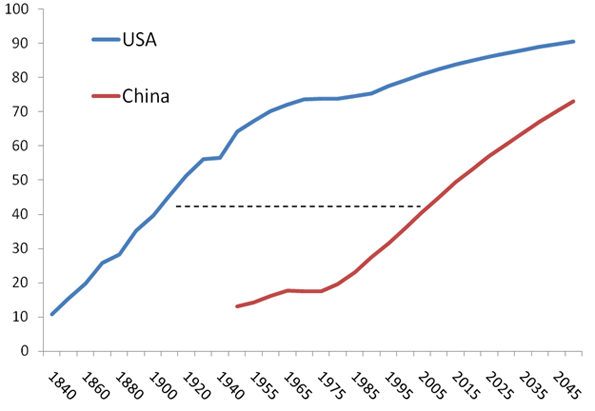
    Yet, despite these colossal shifts, China’s urbanization still has a long way to go. In 1980, the U.S. urban population was 74% of the total; China’s comparable figure was only 19%. Today, America’s urban share of the population is more than 80%, whereas China’s remains less than 50%. Taken into consideration China’s colossal size and development level, this gap suggests extraordinary potential. In 2025, America will have two cities (New York and Los Angeles) with more than 10 million people, three with 5-10 million and 37 with more than a million. By then, China will have five cities with more than 10 million people, 9 with 5-10 million, and almost 130 with more than a million. Viewed this way, China’s urbanization has barely begun (Figure 1).

    Figure 1: Percentage of Urban Population: United States and China
    Winning China’s West
    If Lewis had spent even some time in the rural China or the emerging new tiers of cities, he would have associated them with the world of “unlimited supply of labor”.

    During the past three decades, migrant laborers have played a key role in China’s economic growth in the first-tier cities. Now as living costs rise fast in Beijing, Guangdong, and the Yangtze River Delta region, employment prospects are improving in the inland cities and the West.

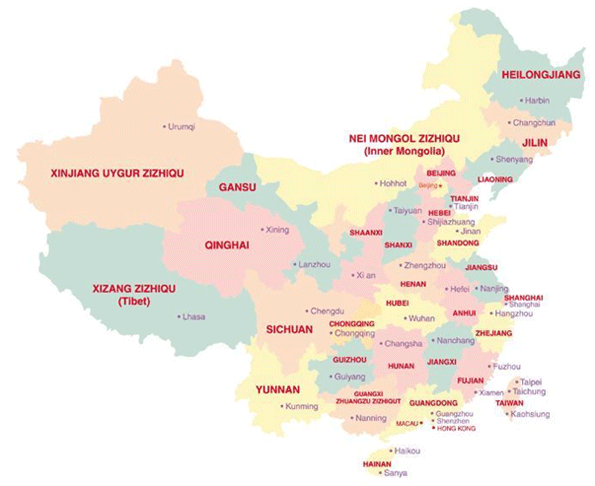
    Since the early 2000s, the new “Go West” policy covered the huge municipality of Chongqing, six provinces, from Gansu to Sichuan and Yunnan, and five autonomous regions. At the time, this region accounted for almost 30 percent of China’s population, but less than 17 percent of its GDP. Initially, the policy focused on the development of infrastructure (transport, hydropower plants, and energy and telecom establishments). But it is the new stage of development in eastern China that is now dramatically accelerating growth in the West.

    Even before the global financial crisis, the Ministry of Commerce designated more than 30 “priority relocation destinations” in China’s inland to increase the share in the processing industry in central and western areas, especially in labor-intensive manufacturing.

    In the future, China’s West hopes to catch up with its East through domestic consumption, cost advantage, investment policies and infrastructure, which has been boosted by the nation’s stimulus policies. China’s West is about to experience a revolution in durable consumer goods, from color TV sets to refrigerators. True, the volume of retail sales remains higher in China’s East, but sales growth is stronger in the non-coastal areas.

    As costs have risen, China has lost some jobs to Bangladesh, Vietnam and Cambodia, primarily for cheaper, labor-intensive goods like textiles, simple electronics, and toys. Yet, China’s West still offers many of the comparable benefits and an emerging infrastructure.

    The Decades to Come

    In the next two decades, China’s urbanization is expected to boost domestic demand by $4.5 trillion, which should assure a stable economic development even if exports decline. In effect, the urban migrants’ demand for housing is likely to become the largest driving force for China’s economic growth in the future.

    During the past three decades, the share of China’s city dwellers has more than doubled to 45 percent. And by 2040, the urbanization rate is expected to be close to 67 percent. In the next three decades, the number of China’s urban residents is expected to grow by 360 million people to 970 million. In terms of current urban populations, this is the same as creating city space for entire urban America (260 million), Japan (85 million) and another 15 million people – within one generation.

    This great transformation, however, is predicated on sustained economic growth and a stable international environment. China’s first-tier cities are now coping with the coming of the Lewisian turning point/ The big story in the coming decades, will be the takeoff in the west and among many once peripheral cities. Due to China’s sui generis magnitude, this process will take another decade or two.

    Dan Steinbock is Research Director of International Business at India China and America Institute (USA), and Visiting Fellow at Shanghai Institutes for International Studies (China).

    China’s Provinces and Cities
    References

    1 Hamlin, K. et al. (2010), “China Reaches Turning Point as Inflation Overtakes Labor,” Bloomberg News, June 11.

    2 On the argument that China is coping with the Lewisian turning point, see Cai, Fang, Wang, Meiyan, 2008. A counterfactual analysis on unlimited surplus labor in rural China. China & World Economy 6 (1), 51–65.; Fang Cai, Meiyan Wang (2010), “Growth and structural changes in employment in transition China,” Journal of Comparative Economics 38 (2010) 71–81. On the argument that Lewisian turning point is years away, see Yang Yao (2010), “No, the Lewisian turning point has not yet arrived,” Economist, July 16, 2010; Roach, S. (2010), “ Chinese wage convergence has a long way to go,” Economist, July 18.

    3 Lewis, W. Arthur (1954). “Economic Development with Unlimited Supplies of Labor,” Manchester School of Economic and Social Studies, Vol. 22, pp. 139-91

    4 Steinbock, D. (2010),” Legacy of Globalization: Shanghai and Hong Kong as China’s Emerging Financial Hubs,” Policy Brief, Shanghai Institutes for International Studies, January 2010.

    5 These tiers of cities are evolving dynamically and through a national plan. With its more than 31 million people, Chongqing, for instance, is already one of China’s five national central cities. National central cities have a great impact around the surrounding cities on integrating services in infrastructure, finance, public education, social welfare, sanitation, business licensing and urban planning.

    6 In fact, Lewis’s classic article offers also another clue to assess China’s stages of growth. As far as he is concerned, small migrations explain little. In the 1950s, he noted, 100,000 Puerto Ricans emigrate to the United States every year. Still, it is Puerto Rican wages which are pulled up to the U.S. level. Mass immigration is quite a different kettle of fish. “If there were free immigration from India and China to the U.S.A., the wage level of the U.S.A. would certainly be pulled down towards the Indian and Chinese levels,” Lewis argued. In China’s economic development, the tens of millions of migrant workers have played the comparable role of pulling down the national wage level.

    7 In the beginning of the “Go West” program, the largest proportion of the West’s total fixed asset investment was in infrastructure. And almost half of China’s huge stimulus of $586 billion was earmarked for transportation, infrastructure and power grids. These, in turn, facilitate the exploitation of minerals, natural gas and oil in China’s West. In addition to the stimulation of domestic demand, the government’s strategy is to “cultivate areas of high consumer demand and expand consumption in new areas”.

    8 “China’s urbanization to fuel domestic demand,” China Daily, November 15, 2010.

    9 Steinbock, D. (2010), “Growth fueled by urban investment,” China Daily, February 25, 2010.

    10 On the international relations dimensions of China’s stages of growth, see Steinbock, D. (2010), “China’s Next Stage of Growth: Reassessing U.S. Policy toward China,” American Foreign Policy Interests, No 6, December 2010.

  • Looking Down Under for a California Turnaround

    At a time when government in California faces an existential crisis, it’s telling to observe a starkly different picture in Australia. Forty years ago, local officials in fast-growing suburban communities in Queensland, Australia looked to their colleagues in fast-growing suburban communities in California as kindred spirits. They began a tradition of trading annual exchange visits to compare notes. Last month I had the opportunity to participate in that exchange. This year’s gathering took place on the “Sunshine Coast” north of Brisbane. While California government seems paralyzed by the strains of the economic crisis, local government Down Under is leading constructive change.

    Fiscal crisis is so pervasive in California that some have questioned whether the nation’s largest state and the world’s eighth largest economy remains “governable.” Every year our state budget is held hostage to interminable partisan bickering. This year, a patently bogus deal was cut that left an estimated $25 billion gap over the next 19 months.

    Until recently, non-partisan local government maintained greater credibility. But with the City of Vallejo declaring bankruptcy, Maywood firing its entire workforce and Bell embroiled in a grotesque corruption scandal, most Californians fear the eclipse of the “California Dream.” Widespread unemployment, home foreclosures, budget meltdowns and severe cuts in government services are the most obvious symptoms. But there’s a growing disconnect between angry voters and their government.

    Yet in Australia, the unofficial national motto is “no worries, mate.” It’s not an excuse for complacency. Australians seem to recognize that innovation is key to continued success. Where California politics has become gridlocked, local government in Queensland plows forward with reorganization and strategic visioning.

    At the annual conference of the Local Government Managers Association in Queensland, the most glaring distinction I viewed was the Australian embrace of “amalgamation.” Beginning a decade ago, state governments in Australia have pushed consolidation of smaller towns into larger and more efficient regional groupings. In Queensland, that process has reduced the number of local governments from 157 to 72. While local officials may have questioned the mandate, they approached the challenge with brisk efficiency. Three years on, Queensland local government officials look forward confidently instead of backward nostalgically.

    After the conference I spent five days with the Central Highlands Regional Council, gaining direct experience with current Australian local government. I was particularly impressed by the Central Highlands motto of “one region, one council”, to underscore their commitment to regional unity and equity.

    In contrast, local officials in California have an almost pathological hostility to State government (not without justification.) California’s 488 cities are part of a confusing jumble of 5,000 overlapping government entities in our state. Californians elect separate boards for schools, colleges, and innumerable water, library, sanitation, transportation and other “special district” agencies. It’s been forty years since the state has done anything to rationalize this fragmented and multilayered governance, despite the glaring meltdown of dysfunctional cities like Bell, Vernon and Maywood.

    Queensland’s appetite for challenges is by no means confined to amalgamation. The conference was dominated by talk of innovation in everything from library services to “reinventing government.”

    Before the housing meltdown, many California cities built new library buildings without rethinking the role of public libraries in the digital age. In contrast, I was captivated by vision I heard from Ross Duncan, Director of Learning Communities on the Sunshine Coast. Infusing their 10 branch library system with a focus on “changing the world,” he’s created a family university offering more than 4500 activities, workshops and events that bring together their 120,000 members in a shared journey toward a “learning community.”

    The vision of the City Council and community in the Sunshine Coast is to create “Australia’s most sustainable region, one that is vibrant, green and diverse.” The library’s role is to promote that through learning. That means that every library is a wireless hotspot which offers a kaleidoscope of classes and seminars on everything from worm farming to support groups for parents of autistic children. The libraries offer a “book a brain” service that allows you to reserve time with a retired business executive or professor to offer advice for your business or community group. Duncan is constantly pushing to “think outside the square,” seeking partners to underwrite new efforts to make learning accessible and attractive, and to make libraries “the key community hub to bring the community together, breaking down barriers of age, income and geography.”

    That pioneering spirit is evident on the larger challenge of “reinventing government.” Professor Ken Wiltshire, head of public administration at the University of Queensland Business School, posed two key questions as challenges for each manager:
    • “If your organization were to be abolished, would it be missed?”
    • “If your organization was privatized, would anyone invest in it?”
    Despite California’s dire crisis, few public organizations are facing those challenges. We are mainly engaged in trimming or chopping existing functions and services, instead of re-organizing for success in the “new normal.”

    At a time of deep distrust and discontent with public institutions, I return to the Golden State buoyed by the professional pride I saw in Queensland local government. Professor Wiltshire illustrated the value of local leaders in shaping and leading change. “Today . . . our work focuses on the ‘transformational’ aspect of leadership, the role of empowering, challenging, inspiring, celebrating and encouraging others to make powerful and enduring changes.”

    That audacious spirit is sorely needed – and missing – in the Golden State. At a time when our crisis calls out for making powerful and enduring changes, we lack the transformational leadership to shape and lead those changes. We might look Down Under for both the hope and example we need to turn California around.

    Photo by mi..chael: Wheel along the Brisbane river in South Bank, Brisbane, Queensland, Australia.

    Rick Cole is city manager of Ventura, California, and 2009 recipient of the Municipal Management Association of Southern California’s Excellence in Government Award. He can be reached at RCole@ci.ventura.ca.us

  • Stuck in the Station: The High-Speed Rail “Low Ball Express”

    You know that something is up when a Washington Post editorial advises that the Obama Administration do a “reality check” on its plans for high speed rail. From the beginning, there was more slow-speed than high speed rail, however both components of the plan could be in trouble. The Onion joined the issue with a satirical video announcing a federal “high-speed bus” program that would replace the high-speed rail plans.

    The Post criticized Secretary of Transportation Ray LaHood for not allowing Wisconsin and Ohio to use the federal money to make needed highway improvements instead:

    “This blunt refusal to heed the fresh mandate of Ohio and Wisconsin’s voters seems hard to justify – especially since using the money for other infrastructure would have created jobs, just as building trains would have.”

    Wisconsin and Ohio: This is vividly illustrated by recent election results, when successful gubernatorial candidates in two states vowed to kill two of the slower lines that had already received substantial federal funding. Wisconsin’s Scott Walker took aim at the Milwaukee to Madison line, which would average less than 60 miles per hour, despite reaching speeds of 110. Ohio’s John Kasich says that Ohio’s Cincinnati to Cleveland train is “dead” It could have been named the “Ohio Fast Mail,” because it would have averaged 50 miles per hour, about the same as the Fast Mail over the longer New York and Niagara Falls route — in 1877! These trains would have operated at average speeds from one-third to one-fourth those achieved by the Wuhan to Guangzhou trains in China.

    Illinois: There are also problems in Illinois. That state received $1.1 billion from the federal government to ramp up Chicago to St. Louis speeds to 110 miles per hour and to make the trip in four hours. Yet, the state received only about one-third of the requested $3 billion from the federal government for this project. It is a fair question where the rest of the money is coming from. Illinois had proposed to contribute only one percent of the cost ($4 million), leaving the project still nearly $2 billion short, before the seemingly inevitable cost overruns (which are already an inflation adjusted 8 times earlier projections). Illinois, which by some accounts is in as bad shape fiscally as California, simply does not have the money to complete the job.

    Incremental High Speed Rail? One of the most cynical myths about slower speed rail is that it is a “stepping stone” to genuine high speed rail, which is now being built in some countries to operate from 200 to 220 miles per hour. Such claims are patently misleading. The slower speed 110 mile per hour trains will run on tracks shared with freight trains and there will be some grade crossings (intersections with roads where trains, trucks and cars could conceivably collide). Genuine high speed rail requires starting all over.

    Illinois provides an example. The unfunded $3 billion slower speed line is not enough. The state has also sought federal funding to plan a genuine high speed rail line that would cost an additional $12 billion, according to a Midwest High Speed Association report. However, this amount would rise substantially, since it does not include rail-cars, maintenance facilities, stations and, of course, cost overruns. There is nothing incremental about building one line and then abandoning it to build another.

    California and Genuine High Speed Rail? Maybe Not: Meanwhile, the news is not encouraging to proponents of the nation’s two genuine high speed rail lines, in California and Florida.

    For two years, the California High Speed Rail Authority has been concentrating its attention on planning for the two most expensive sections of its proposed $43 billion (before cost-overruns) line from Los Angeles (Anaheim) to San Francisco. Plans that some claim would create a Berlin Wall across the largely affluent cites of the Peninsula led to a “boondoggle rally” attended by 500 people in Palo Alto. Community concerns have also been raised about the line through Orange County and southeastern Los Angeles County.

    Now, however, the federal government has virtually steered all of promised money to the San Joaquin Valley, requiring that it be spent between Merced and Bakersfield. The provisions of the high speed bond issue will require that state funding to be spent where the federal money is spent.

    The federal department of transportation has not indicated its rationale for this decision, but the new strategy could indicate that a modicum of sanity may be at work. Clearly the state of California does not have the money to build the system. Joe Vranich and I raised this issue in our Due Diligence report on the system, published by the Reason Foundation. We noted that the proposed 2:40 travel time from San Francisco to Los Angeles Union Station would more likely erode to 3:40, because the trains will not be able to travel as fast as planned in the urban areas, and they are not likely to attain their aggressive planned speeds on other portions of the route. We also suggested the likelihood that only part of the system would be built, with trains operating at conventional speeds over conventional tracks for the final 60 or more miles into San Francisco and Los Angeles. With insufficient money, there could be pressure to cut the genuine high speed rail portion of the system back even more than that, given the federal requirement for confining construction to the San Joaquin Valley, which now barely supports minimal air service and has largely traffic-free freeways.

    Proponents have been mouthing fairy tales about French, Chinese or Japanese investment in the system. Can they be so naive to believe that French or Japanese taxpayers will pay for high speed rail system in California? In fact, any such “investment” would be loans and would have to be paid back. Around the world, virtually all private investment for high speed rail has been either lost or bailed out by taxpayers.

    Perhaps the best that proponents can hope for is that some 220 mile per hour track will be built on the flat-as-Kansas agricultural land in the San Joaquin Valley. Trains could continue from the northern terminus (Merced) to San Francisco and from the southern terminus (Bakersfield) to Los Angeles and Anaheim on upgraded conventional rail tracks. This would bring the now discarded slower speed rail vision of Ohio and Wisconsin to California. Trains might well average 70 miles per hour or somewhat more.

    It could be even worse. Californians Advocating Responsible Rail Design (CARRD) reveals that the California High Speed Rail Authority has revealed “Plan B.” Its October 2009 application to the US Department of Transportation indicated that “In the event of significant delays or abandonment of the HST program, the Merced/Fresno Program would have created rail crossing benefits, as well as provided the potential for significant improvement to the existing San Joaquin intercity passenger service operated by Amtrak and underwritten in part by the state.”

    Florida: People were also having second thoughts about the genuine high-speed line between Orlando and Tampa. The two cities are so close together than even if the train reached the speed of light, given waiting in a rental car line and driving to and from the stations, car travel could be faster.

    Congressman John Mica, who seems likely to be Chair of the House Infrastructure and Public Works Committee in the next congress, has suggested that the line be truncated to a local operation between Orlando International Airport and Disneyworld. Governor Elect Rick Scott is now reviewing the project.

    International: The international news is barely any better. The Chinese government is now reviewing the wisdom of its huge expenditures on high speed rail, as a result of a critical report from the Chinese Academy of Sciences. And, as in California, communities are resisting along a proposed high speed rail line in England. Moreover, cost overruns have been routine, as have been revenue and ridership shortfalls relative to the always rosy projections.

    At least in the United States, the high-speed rail “low-ball express” remains stuck in the station. The actual costs, however, will certainly rise well above the low-ball estimates.

    Photo: The Fast Mail (1877 Average Speed Equal to Cancelled Ohio High Speed Rail Train): Harper’s Weekly, 1877.

    Wendell Cox is a Visiting Professor, Conservatoire National des Arts et Metiers, Paris and the author of “War on the Dream: How Anti-Sprawl Policy Threatens the Quality of Life

  • Love and the City

    It has been said that the modern city is soulless, that it is heartless, and that it is brutal. The modern city represents in its scale and complexity one of the most extraordinary of human inventions, but there is also no doubt that everywhere in the world it is also one of our biggest failures.

    The dysfunction of a city in the past was an inconvenience. The dysfunction of a city in the future will be a profound disaster for that city and, ironically, a profound opportunity for another city, of a smarter city. It will be an opportunity for a city that has found out how to position itself better in the world of cities, but more importantly in the eyes and hearts of its citizens.

    All over the world, there is a growing recognition that this brutality must stop; we have to imagine a different kind of city which addresses human needs and that puts the soul back into the city. This is essential to the survival of the city. Put another way, there is a growing understanding that it is actually “love” that will be the prime force in the future economy of successful 21st century cities.

    Who would have thought in the last generation that “love” might become a meaningful topic in a discussion about urban economies, much less a prime force of those economies?

    One important reason for creating a love-based city grows from the struggle today among cities for hegemony. We read all the time about “alpha-cities” and “delta-cities”: the “alphas” enjoy the fruits of labour and the “deltas” just do the labour – they just exist. And why is this?

    Well, it’s because the dynamics of urban growth and competition have fundamentally changed in the last quarter century. The world has become footloose, with people and capital moving at will: business can be done anywhere. Other aspects of life are more important than one’s livelihood and where people choose to settle is not tied down the way it used to be. We can do and be almost anything anywhere.

    The result is a new kind of economic base for our cities, augmenting the traditional economic activities holding our cities together. This is the ideas and service economy and it opens up the imperative to create a city of beauty and quality liveability and style. This is an economy driven by people, their direct needs, their preferences and their day-to-day experiences.

    This ideas and service economy quickly becomes an economy involving almost everyone. If you live in a core city, have you ever tried to get a gardener or a plumber? But, even beyond that, you have to think about all of the professions and vocations that can now demand an enjoyable as well as functioning city.

    We’re not just talking about the service sector or the ‘creatives’, we’re talking about almost everybody. We have to focus the discussion on a city that is liveable for a broad array of its population.

    I worry that in all our creative thinking about sustainable technologies and sustainable urban forms, there may be some strong denial going on about people and their inclinations, denial that will block the way towards sustainability.

    Take the fashion that insists on the primacy of density and mixed use and diversity and sustainable transportation. Sadly, most consumers in the English speaking world, except in a very few of our older gracious places, have shown very little interest in being a part of that kind of city. In my country, two-thirds of Canadians live in auto-dominated suburbs that boast none of these qualities – and that proportion is even higher in America.

    Let’s be blunt: most people hate density because most of it has been so bad; they think of mixed use as probably hitting them negatively and transit is not even in most people’s vocabulary. The ideal of most people is some sort of rural “garden of Eden” that they want to escape to from the city – even if that ends up being an illusory goal.

    I sympathize. The cities we have been building since the War have very seldom offered anything very appealing at almost any density. Who can really fall in love with brutal concrete canyons or anonymous strip malls or wind-swept roads?

    If cities want to offer an alternative, they must change and bring back the human touch – we have to bring placemaking to the very heart of the civic agenda. We have to stop trading away the urban qualities we care about for the urgencies of the moment of modern life.

    We must start to build places that truly appeal to people – yes, places that are sustainable, but also places that are so good that people will choose them. These cities have to have all the human services and they have to have beauty and they have to be gentle. Only then will they become attractive to a wide range of people.

    I call this “Experiential Planning” – learning about and then carefully making the city deliver the experiences people tell us they want in their lives for their families and children.

    Experiential planning looks beyond land-use and transportation patterns to things like character and comfort and health and convenience and the visceral response of the senses and caprice: things that simply make people happy. Happiness is the applied side of love.

    People want all of the efficiencies and choices but they also want more. They want to feel the unique, special spirit of a place as a real thing, not a marketing gimmick. They want their habitat to have a “buzz” that makes them feel good. They want their day-to-day living environment to foster social engagement and neighbourliness not isolation. That is what the contemporary city has often been missing.

    For as long as anyone can remember, modern cities, with very few exceptions, have been shaped by economic activity and politics and the shifting of social groups: the city exploited as a commodity. But that doesn’t have to be the case. We can actually design our cities as an explicit act of creation – grand civic design with the whole city as a canvas. And every city has to find its own way: they should not accept cookie-cutter replications of what’s being done everywhere else.

    To start, every city needs to perform a ritual burning of these outdated and single-purpose rules. Now I am not talking about de-regulation. The city of the future will have to have strong regulations because the possibilities out there for development are just too diverse and the private interests in development too strong. There must be a clear expression of the public interest and public needs to match that of the private sector.

    Also, I want to be clear that this is not a “top-down” agenda. Experiential planning requires an aggressive and diverse engagement of the public at every step along the way to articulate the public perspective and to insure public buy-in and ownership. The general public needs to discuss and debate an overall civic vision and all aspects of urban design.

    In this experiential-based city there will be an alignment of profitability and community building. We will also see people coming back to live in the core city and to suburbs transformed through natural choice and preference. There will be an alignment of consumer selection and sustainable practice. This will include all kinds of people but especially families with children.

    But none of this will happen by accident. We have to make it happen and bring along individual values through a careful process of reconciliation.

    Tomorrow’s city must meet the environmental test and the economic test but it must also meet the experiential test; and that is the test of love; that is the test of soul. It must be beautiful and joyful and sociable and humane and offer a complete rich community life – with all the subtleties of human occupation. That is the real power of an urban love affair.

    Larry Beasley is the retired Director of Planning for the City of Vancouver in Canada. He is now the “Distinguished Practice Professor of Planning” at the University of British Columbia and the founding principal of Beasley and Associates, an international planning consultancy. He chairs the ‘National Advisory Committee on Planning, Design and Realty’ of Ottawa’s National Capital Commission; he is the Chief Advisor on Urban Design for the City of Dallas, Texas; he is on the International Economic Development Advisory Board of Rotterdam in The Netherlands; and he is the Special Advisor on City Planning to the Government of Abu Dhabi in the United Arab Emirates.

    Photo by ecstaticist

  • The Rise of the Efficient City

    Smaller, more nimble urban regions promise a better life than the congested megalopolis.

    Most of the world’s population now lives in cities. To many academics, planners and developers, that means that the future will be dominated by what urban theorist Saskia Sassen calls “new geographies of centrality.” According to this view, dense, urban centers with populations in excess of 20 million—such as metropolitan Tokyo, New Delhi, Sao Paolo and New York—are best suited to control the commanding heights of global economics and culture in the coming epoch.

    In fact, the era of bigger-is-better is passing as smaller, more nimble urban regions are emerging. These efficient cities, as I call them, provide the amenities of megacities—airports, mass communication, reservoirs of talent—without their grinding congestion, severe social conflicts and other diseconomies of scale.

    Megacities such as New Delhi, Mumbai, Sao Paolo and Mexico City have become almost unspeakably congested leviathans. They may be seen as “colorful” by those engaging what writer Kennedy Odede calls “Slumdog tourism.” They may also be exciting for those working within the confines of “glamour zones” with high-rise office towers, elegant malls, art galleries and fancy restaurants. But most denizens eke out a meager existence, attractive only compared to even more dismal prospects in the countryside.

    Consider Mumbai, with a population just under 20 million. Over the past 40 years, the proportion of its citizens living in slums has grown from one in six to more than half. Mumbai’s brutal traffic stems from a population density of more than 64,000 per square mile, fourth-highest of any city in the world, according to the website Demographia.

    Many businesses and skilled workers already are moving to smaller, less congested, often better run cities such as Bangalore, where density is less than half that of Mumbai. Much of this new growth takes place in campus-like settings on the edge of town that take advantage of newer roads, better sanitation systems and sometimes easier access to airports. Companies like Alcatel-Lucent and Infosys offer their employees facilities more similar to those of Silicon Valley or suburban Austin than to Mumbai or Kolkata (formerly Calcutta).

    Consider also Singapore and Tel Aviv, which are among the best models for the efficient cities of the future. At its founding in 1965 after independence from Malaysia, Singapore’s per capita GDP was about that of Guatemala and well below that of Venezuela and Iraq. Today it equals, on a purchasing power basis, that of most Western cities including London, Sydney and Miami.

    The city-state bears no resemblance to the typical unsanitary and disorderly tropical metropolis. Singapore’s roughly five million citizens live under efficient (if heavy handed) government. With its modern port, airport and excellent transport network, Singapore consistently ranks as the No. 1 locale for ease of doing business by the World Bank. Over 6,000 multinational corporations including Seagate, IBM and Microsoft have a large presence in Singapore.

    Tel Aviv represents a decidedly different approach to building the efficient city. With roughly two million people in its metropolitan area, this little dynamo produces the vast majority of Israel’s soaring high-tech exports, is home to a preponderance of the country’s financial institutions and has established itself as the global center of the diamond industry. Incomes in the region are as much as 50% above Israel’s national average.

    Tel Aviv’s pleasure-loving denizens may differ markedly from more controlled Singaporeans—or the usually more religious citizens of Jerusalem—but they employ many of the key efficient city advantages: a sharp focus on business, a well-developed sense of place and a first-class communications infrastructure. The city’s tech industry includes firms such as Microsoft, Cisco, Google and IBM. It is home to Israel’s only stock exchange and most of the country’s resident billionaires.

    The U.S. is also embracing the efficient city. Between 2000 and 2008, notes demographer Wendell Cox, metropolitan areas of more than 10 million suffered a 10% rate of net outmigration. The big gainers were generally cities with 100,000 to 2.5 million residents. The winners included business-friendly Texas cities and other Southern locales like Raleigh-Durham, now the nation’s fastest-growing metro area with over one million people. You can add rising heartland cities like Columbus, Indianapolis, Des Moines, Omaha, Sioux Falls, Oklahoma City and Fargo.

    Some of these—such as Austin, Columbus, Raleigh-Durham and Fargo—thrive in part by being college towns. Others like Houston, Charlotte and Dallas have evolved into major corporate centers with burgeoning immigrant populations. But they thrive because they are better places for most to live and do business.

    Take the critical issue of getting to work. According to the American Community Survey, the average New Yorker’s daily trip to work takes 35 minutes; the average resident of the Kansas City or Indianapolis region gets to the office in less than 13 minutes. That adds up in time and energy saved, and frustration avoided.

    The largest American cities—notably New York, Los Angeles and Chicago—also show the most rapid decline in middle-class jobs and neighborhoods, with a growing bifurcation between the affluent and poor. In these megacities, high property prices tend to drive out employers and middle-income residents. By contrast, efficient cities are where most middle- and working-class Americans, and their counterparts around the world, will find the best places to achieve their aspirations.

    This article originally appeared at the Wall Street Journal.

    Joel Kotkin is executive editor of NewGeography.com and is a distinguished presidential fellow in urban futures at Chapman University. He is author of The City: A Global History. His newest book is The Next Hundred Million: America in 2050, released in February, 2010.

    Photo by wili_hybrid

  • Toronto Election Highlights Failure of Amalgamation

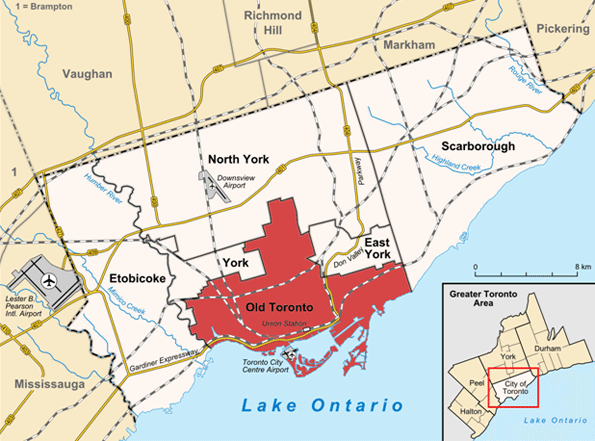
    In my pre-election piece on the Toronto election, I discussed the city’s lingering malaise. It developed slowly but its roots can be traced to the 1998 amalgamation that swallowed up five suburban municipalities. This led to a six folds expansion of city boundaries and a tripling the population base. This amalgamation was initiated by the province of Ontario as a cost saving measure and faced major local opposition. Citizens and politicians were concerned that the benefits of the alleged efficiency saving would be outweighed by the negative impact of losing local decision making powers. The recent Toronto municipal election bore out this concern.

    In the October 25th election, Torontonians were presented with two dramatically different visions. The first vision was presented by former Liberal Ontario cabinet minister George Smitherman. A self-described progressive, Smitherman appealed mainly to voters in the downtown core of Old Toronto. He stood for issues such as improved bicycle lanes, renewal of the downtown waterfront, and improving social housing conditions. The second version was presented by maverick councilor Rob Ford, who represented a ward in the former City of Etobicoke. Ford’s message was simple: it’s time to stop the “gravy train” at City Hall. While he had elaborate platforms on many issues, cutting waste at City Hall was his ubiquitous message.

    Despite Toronto’s social democratic image, Rob Ford won a crushing victory. Ford earned 47% of the vote, while Smitherman ended up with 35%. Far left candidate Joe Pantalone (known primarily for attempting to stop businesses from opening in his own ward) managed to capture 12% of the vote.

    Aside from the shock that a partisan conservative won in Toronto, there are two other significant developments. Both front runners were significantly more fiscally conservative than the current administration. Ford and Smitherman represented constituencies desperately seeking change. Smitherman’s base was frustrated with the inability of the city to provide the services that they want efficiently. Ford’s base was angry that the city is providing many of these services in the first place.

    Not surprisingly the results broke down along specific geographic lines. Ford won an outright majority of votes in every single ward outside of Old Toronto. Within the old boundaries, Smitherman won 13 of the 16 wards. The three Old Toronto wards Ford won are all on the fringes of the Old City.

    In 1997, the newly amalgamated city went to the polls for the first time. Conservative former North York Mayor Mel Lastman narrowly defeated social democratic former Old Toronto Mayor Barbara Hall. Since then, downtown oriented social democrats have controlled the city ever since.

    Clearly this result shows that the concerns expressed by the opponents of amalgamation were largely valid. Amalgamation failed to create cost savings, and has created a dysfunctional megacity. Rather than having six municipalities where voters are focusing on solving local problems, we have one gigantic city with the core and the suburbs fighting for their share of the public purse. This leads to the schizophrenic policy decisions we see today.

    Before amalgamation, there were six different versions of Toronto life that one could choose from. If you didn’t like living in high tax Toronto, you could live in Etobicoke. If Etobicoke’s bylaws and business taxes were hurting your business, you could move to North York. Now all people in the Toronto area can do is vote the bums out on election day, or get out of the area altogether. This isn’t a viable long-term solution.

    The problems are systemic, and cannot be solved so long as the megacity exists. This extends beyond the fact of the impossibility of satisfying the core and the suburbs at the same time. The megacity allows public sector unions to literally hold 2.5 million people hostage whenever they feel like it. A notorious strike last summer lead to a month without garbage collection in the entire city. The 24,000 strikers also shut down parks and recreation services, daycare, provision of municipal licenses, health inspections, animal services, and forced a 25% reduction in ambulance services. In 2008, the transit union called a last minute strike at midnight on a Friday night, grinding the city to a halt. These are just two examples of how powerful Toronto public sector unions have become. The only reason strikes aren’t more frequent is that the city typically gives them whatever they want in order to avoid chaotic strikes. De-amalgamation would not only allow more local control over policy, but would help fray the noose that the unions have tied around the city’s neck.

    Downtown progressives gripe over how Rob Ford is going to destroy their city, but they should take a minute to think about what some of their policies have been doing to suburbanites for years. They have imposed high taxes, and burdensome regulations on the amalgamated cities, as well as a myriad of new bylaws. Some of these policies make sense in Old Toronto. For instance, dissuading automobile usage in the congested core makes sense. Doing so in the suburbs does not. It might make sense to regulate trees on private property in a crowded downtown neighborhood. Not so much in a new subdivision. One-size-fits-all policies don’t work across a city as large and diverse as Metropolitan Toronto.

    Now that the suburbs have wrought their revenge on the old city, progressives need to recognize that de-amalgamation is not just a fantasy of libertarians and angry suburbanites. It is a prerequisite to restoring sound public policy reflecting the preferences of individual communities. Railing against Rob Ford won’t fix the problem. Rob Ford is what the suburbs want. As long as the megacity lives, Toronto will elect a Rob Ford type every now and then.

    The only way to stop this pattern of alternating, divergent visions is by de-amalgamation. Critics will use metaphors such as ‘unscrambling an egg’ to illustrate the difficulties of de-amalgamation. No one should believe that de-amalgamation would be easy. But there will never be a better time than now to take the necessary step of de-amalgamation. A few years of chaotic governance would be worth the long run benefit of restoring local control.

    Downtown Toronto photo by Astro Guy

    Steve Lafleur is a public policy analyst and political consultant based out of Calgary, Alberta. For more detail, see his blog.