Category: Urban Issues

  • The New World Order

    Tribal ties—race, ethnicity, and religion—are becoming more important than borders.

    For centuries we have used maps to delineate borders that have been defined by politics. But it may be time to chuck many of our notions about how humanity organizes itself. Across the world a resurgence of tribal ties is creating more complex global alliances. Where once diplomacy defined borders, now history, race, ethnicity, religion, and culture are dividing humanity into dynamic new groupings.

    Broad concepts—green, socialist, or market-capitalist ideology—may animate cosmopolitan elites, but they generally do not motivate most people. Instead, the “tribe” is valued far more than any universal ideology. As the great Arab historian Ibn Khaldun observed: “Only Tribes held together by a group feeling can survive in a desert.”

    Although tribal connections are as old as history, political upheaval and globalization are magnifying their impact. The world’s new contours began to emerge with the end of the Cold War. Maps designating separate blocs aligned to the United States or the Soviet Union were suddenly irrelevant. More recently, the notion of a united Third World has been supplanted by the rise of China and India. And newer concepts like the BRIC nations (Brazil, Russia, India, and China) are undermined by the fact that these countries have vastly different histories and cultures.

    The borders of this new world will remain protean, subject to change over time. Some places do not fit easily into wide categories—take that peculiar place called France—so we’ve defined them as Stand-Alones. And there are the successors to the great city-states of the Renaissance—places like London and Singapore. What unites them all are ties defined by affinity, not geography.

    1. New Hansa

    Denmark, Finland, Germany, Netherlands, Norway, Sweden

    In the 13th century, an alliance of Northern European towns called the Hanseatic League created what historian Fernand Braudel called a “common civilization created by trading.” Today’s expanded list of Hansa states share Germanic cultural roots, and they have found their niche by selling high-value goods to developed nations, as well as to burgeoning markets in Russia, China, and India. Widely admired for their generous welfare systems, most of these countries have liberalized their economies in recent years. They account for six of the top eight countries on the Legatum Prosperity Index and boast some of the world’s highest savings rates (25 percent or more), as well as impressive levels of employment, education, and technological innovation.

    2. The Border Areas

    Belgium, Czech Republic, Estonia, Hungary, Iceland, Ireland, Latvia, Lithuania, Poland, Romania, Slovakia, U.K.

    These countries are seeking to find their place in the new tribal world. Many of them, including Romania and Belgium, are a cultural mishmash. They can be volatile; Ireland has gone from being a “Celtic tiger” to a financial basket case. In the past, these states were often overrun by the armies of powerful neighbors; in the future, they may be fighting for their autonomy against competing zones of influence.

    3. Olive Republics

    Bulgaria, Croatia, Greece, Italy, Kosovo, Macedonia, Montenegro, Portugal, Slovenia, Spain

    With roots in Greek and Roman antiquity, these lands of olives and wine lag behind their Nordic counterparts in virtually every category: poverty rates are almost twice as high, labor participation is 10 to 20 percent lower. Almost all the Olive Republics—led by Greece, Spain, and Portugal—have huge government debt compared with most Hansa countries. They also have among the lowest birthrates: Italy is vying with Japan to be the country with the world’s oldest population.

    4. City-States

    London

    It’s a center for finance and media, but London may be best understood as a world-class city in a second-rate country.

    Paris

    Accounts for nearly 25 percent of France’s GDP and is home to many of its global companies. It’s not as important as London, but there will always be a market for this most beautiful of cities.

    Singapore

    In a world increasingly shaped by Asia, its location between the Pacific and Indian oceans may be the best on the planet. With one of the world’s great ports, and high levels of income and education, it is a great urban success story.

    Tel Aviv

    While much of nationalist-religious Israel is a heavily guarded borderland, Tel Aviv is a secular city with a burgeoning economy. It accounts for the majority of Israel’s high-tech exports; its per capita income is estimated to be 50 percent above the national average, and four of Israel’s nine billionaires live in the city or its suburbs.

    5. North American Alliance

    Canada, United States

    These two countries are joined at the hip in terms of their economies, demographics, and culture, with each easily being the other’s largest trade partner. Many pundits see this vast region in the grip of inexorable decline. They’re wrong, at least for now. North America boasts many world-class cities, led by New York; the world’s largest high-tech economy; the most agricultural production; and four times as much fresh water per capita as either Europe or Asia.

    6. Liberalistas

    Chile, Colombia, Costa Rica, Mexico, Peru

    These countries are the standard–bearers of democracy and capitalism in Latin America. Still suffering low household income and high poverty rates, they are trying to join the ranks of the fast-growing economies, such as China’s. But the notion of breaking with the U.S.—the traditionally dominant economic force in the region—would seem improbable for some of them, notably Mexico, with its close geographic and ethnic ties. Yet the future of these economies is uncertain; will they become more state–oriented or pursue economic liberalism?

    7. Bolivarian Republics

    Argentina, Bolivia, Cuba, Ecuador, Nicaragua, Venezuela

    Led by Venezuela’s Hugo Chávez, large parts of Latin America are swinging back toward dictatorship and following the pattern of Peronism, with its historical antipathy toward America and capitalism. The Chávez-influenced states are largely poor; the percentage of people living in poverty is more than 60 percent in Bolivia. With their anti-gringo mindset, mineral wealth, and energy reserves, they are tempting targets for rising powers like China and Russia.

    8. Stand-Alones

    Brazil

    South America’s largest economy, Brazil straddles the ground between the Bolivarians and the liberal republics of the region. Its resources, including offshore oil, and industrial prowess make it a second-tier superpower (after North America, Greater India, and the Middle Kingdom). But huge social problems, notably crime and poverty, fester. Brazil recently has edged away from its embrace of North America and sought out new allies, notably China and Iran.

    France

    France remains an advanced, cultured place that tries to resist Anglo-American culture and the shrinking relevance of the EU. No longer a great power, it is more consequential than an Olive Republic but not as strong as the Hansa.

    Greater India

    India has one of the world’s fastest-growing economies, but its household income remains roughly a third less than that of China. At least a quarter of its 1.3 billion people live in poverty, and its growing megacities, notably Mumbai and Kolkata, are home to some of the world’s largest slums. But it’s also forging ahead in everything from auto manufacturing to software production.

    Japan

    With its financial resources and engineering savvy, Japan remains a world power. But it has been replaced by China as the world’s No. 2 economy. In part because of its resistance to immigration, by 2050 upwards of 35 percent of the population could be over 60. At the same time, its technological edge is being eroded by South Korea, China, India, and the U.S.

    South Korea

    South Korea has become a true technological power. Forty years ago its per capita income was roughly comparable to that of Ghana; today it is 15 times larger, and Korean median household income is roughly the same as Japan’s. It has bounced back brilliantly from the global recession but must be careful to avoid being sucked into the engines of an expanding China.

    Switzerland

    It’s essentially a city-state connected to the world not by sea lanes but by wire transfers and airplanes. It enjoys prosperity, ample water supplies, and an excellent business climate.

    9. Russian Empire

    Armenia, Belarus, Moldova, Russian Federation, Ukraine

    Russia has enormous natural resources, considerable scientific-technological capacity, and a powerful military. As China waxes, Russia is trying to assert itself in Ukraine, Georgia, and Central Asia. Like the old tsarist version, the new Russian empire relies on the strong ties of the Russian Slavic identity, an ethnic group that accounts for roughly four fifths of its 140 million people. It is a middling country in terms of household income—roughly half of Italy’s—and also faces a rapidly aging population.

    10. The Wild East

    Afghanistan, Azerbaijan, Kazakhstan, Kyrgyzstan, Pakistan, Tajikistan

    This part of the world will remain a center of contention between competing regions, including China, India, Turkey, Russia, and North America.

    11. Iranistan

    Bahrain, Gaza Strip, Iran, Iraq, Lebanon, Syria

    With oil reserves, relatively high levels of education, and an economy roughly the size of Turkey’s, Iran should be a rising superpower. But its full influence has been curbed by its extremist ideology, which conflicts not only with Western countries but also with Greater Arabia. A poorly managed economy has turned the region into a net importer of consumer goods, high-tech equipment, food, and even refined petroleum.

    12. Greater Arabia

    Egypt, Jordan, Kuwait, Palestinian Territories, Saudi Arabia, United Arab Emirates, Yemen

    This region’s oil resources make it a key political and financial player. But there’s a huge gap between the Persian Gulf states like Saudi Arabia and the United Arab Emirates and the more impoverished states. Abu Dhabi has a per capita income of roughly $40,000, while Yemen suffers along with as little as 5 percent of that number. A powerful cultural bond—religion and race—ties this area together but makes relations with the rest of the world problematic.

    13. The New Ottomans

    Turkey, Turkmenistan, Uzbekistan

    Turkey epitomizes the current reversion to tribe, focusing less on Europe than on its eastern front. Although ties to the EU remain its economic linchpin, the country has shifted economic and foreign policy toward its old Ottoman holdings in the Mideast and ethnic brethren in Central Asia. Trade with both Russia and China is also on the rise.

    14. South African Empire

    Botswana, Lesotho, Namibia, South Africa, Swaziland, Zimbabwe

    South Africa’s economy is by far the largest and most diversified in Africa. It has good infrastructure, mineral resources, fertile land, and a strong industrial base. Per capita income of $10,000 makes it relatively wealthy by African standards. It has strong cultural ties with its neighbors, Lesotho, Botswana, and Namibia, which are also primarily Christian.

    15. Sub-Saharan Africa

    Angola, Cameroon, Central African Republic, Congo-Kinshasa, Ethiopia, Ghana, Kenya, Liberia, Malawi, Mali, Mozambique, Nigeria, Senegal, Sierra Leone, Sudan, Tanzania, Togo, Uganda, Zambia

    Mostly former British or French colonies, these countries are divided between Muslim and Christian, French and English speakers, and lack cultural cohesion. A combination of natural resources and poverty rates of 70 or 80 percent all but assure that cash-rich players like China, India, and North America will seek to exploit the region.

    16. Maghrebian Belt

    Algeria, Libya, Mauritania, Morocco, Tunisia

    In this region, spanning the African coast of the Mediterranean, there are glimmers of progress in relatively affluent countries like Libya and Tunisia. But they sit amid great concentrations of poverty.

    17. Middle Kingdom

    China, Hong Kong, Taiwan

    China may not, as the IMF recently predicted, pass the U.S. in GDP within a decade or so, but it’s undoubtedly the world’s emerging superpower. Its ethnic solidarity and sense of historical superiority remain remarkable. Han Chinese account for more than 90 percent of the population and constitute the world’s single largest racial-cultural group. This national cultural cohesion, many foreign companies are learning, makes penetrating this huge market even more difficult. China’s growing need for resources can be seen in its economic expansion in Africa, the Bolivarian Republics, and the Wild East. Its problems, however, are legion: a deeply authoritarian regime, a growing gulf between rich and poor, and environmental degradation. Its population is rapidly aging, which looms as a major problem over the next 30 years.

    18. The Rubber Belt

    Cambodia, Indonesia, Laos, Malaysia, Philippines, Thailand, Vietnam

    These countries are rich in minerals, fresh water, rubber, and a variety of foodstuffs but suffer varying degrees of political instability. All are trying to industrialize and diversify their economies. Apart from Malaysia, household incomes remain relatively low, but these states could emerge as the next high-growth region.

    19. Lucky Countries

    Australia, New Zealand

    Household incomes are similar to those in North America, although these economies are far less diversified. Immigration and a common Anglo-Saxon heritage tie them culturally to North America and the United Kingdom. But location and commodity-based economies mean China and perhaps India are likely to be dominant trading partners in the future.

    This article originally appeared in Newsweek.

    Legatum Institute provided research for this article.

    Joel Kotkin is executive editor of NewGeography.com and is a distinguished presidential fellow in urban futures at Chapman University and an adjunct fellow with the Legatum Institute in London. He is author of The City: A Global History. His newest book is The Next Hundred Million: America in 2050, released in February, 2010.

    Illustration by Bryan Christie, Newsweek

  • China Development: Go West, Young Comrade

    Deng Xiaoping, the pragmatic leader who orchestrated China’s ‘reform and opening-up’ 30 years ago, once said that “some areas must get rich before others.” Deng was alluding to his notion that, due to the country’s massive scale, economic development could not happen all at once across China. Planning and implementation of such an economy would take years, even decades, and some areas would inevitably be developed before others.

    The logical place to start was the coastal regions of China, with the natural advantage of access to Asian and overseas markets via the South China Sea and Pacific Ocean. Not surprising then that the two areas that benefited most after initial economic reforms were the Yangtze River Delta region in the east and Pearl River Delta region in the south. Both places became international manufacturing centers with numerous factories and busy seaports.

    Today, the prosperity of the Yangtze River Delta can be experienced in Shanghai, ‘the Pearl of the Orient’- undoubtedly China’s most modern and cosmopolitan city. Down south in the Pearl River Delta, the city of Shenzhen, chosen by the Central Government as a ‘Special Economic Zone’ in 1980, transformed from a small fishing village to a bustling metropolis of nearly 10 million people in a mere 30 years. Both places best represent China’s economic achievements of the recent past.

    Although China’s coastal regions continue to develop, the initial boom has already slowed. Furthermore, foreign investors are beginning to grow weary by the increasing costs of doing business in cities like Shanghai and Shenzhen. Now both international and domestic businesses have their eyes looking towards the interior of the country, where overhead costs are lower and the cities are building the necessary infrastructure to support growth.

    China’s vast western region will be perhaps the most exciting economic development story of the next decade. The country’s west includes 6 provinces, 5 autonomous regions and 1 municipality. Overall the entire region comprises a whopping 70% of China’s landmass and 28% of its population. It also currently accounts for 17% of the country’s GDP, but that is set to change for the better.

    In 2001, the Chinese government implemented its Western Development Strategy also known as the ‘Go West’ campaign. The lagging economic progress of the region prompted the Central Government to offer incentives for business development, including a 10% corporate income tax reduction. The plan also calls for massive infrastructure development both in urban and rural areas.

    Nearly 10 years after the beginning Western Development Strategy, the positive effects are evident in the region’s largest cities. The key cities that have benefitted most so far are Xi’an (capital of Shaanxi Province), Chengdu (capital of Sichuan Province), Kunming (capital of Yunnan Province) and Chongqing (a direct-controlled municipality). These cities form a tight bond, and despite each being within a less than 2 hour flight from one another, each is unique in character and culture.

    At the center of this prosperity is the Chengdu-Chongqing Megaregion. About 200 miles apart from each other, the two cities form a combined urban population of about 10 million people. Chengdu and Chongqing are the principal economic, government, and cultural centers that serve a regional population of nearly 110 million (the combined population of Sichuan Province and Chongqing Municipality). Given these demographics, the potential for growth in these two cities is enormous.

    In the past, like the ambitious living in our own heartland, those from China’s interior were forced to leave home for the far-off coastal regions to benefit from the country’s economic growth. Migrant workers from Sichuan had it especially difficult, facing employment discrimination due to their strong local accent (seen as low-class by the eastern cosmopolitans) and the misperception that they are lazy workers. Today, the rise of Chengdu-Chongqing Megaregion means that workers from Sichuan need not go far from home in order to find opportunity. This is a considerable departure from China’s migrant worker narrative of the past 30 years.

    Increasingly what you see today is a reversal of past emigration trends, as not only young people from the Chengdu-Chongqing Megaregion opt to stay close to home but people from other regions relocate to the interior to take advantage of the growth.

    There is a bit of a rivalry between the cities of Chengdu and Chongqing, with much talk about which of the two will become western China’s most important city. In reality they are more like ‘sisters’ as both cities stand to benefit. As my American friend who lived in the area for over 10 years described the relationship, “Chengdu is the fat provincial nobleman to Chongqing’s beer and hot pot steel worker.”

    In the case of Chongqing, he is referring to the importance of the city as an industrial center, both in metal manufacturing and natural resource mining (the surrounding area is rich in coal and natural gas). In contrast, Chengdu is quickly becoming a major player in China’s information technology sector.

    Much of this has to do with Chengdu’s advantageous geography. Whereas the surrounding terrain in Sichuan and Chongqing is mountainous and hilly, Chengdu lies in a flat, fertile basin, allowing the city to sprawl out. Dubbed the ‘Land of Abundance’ for its long history of agricultural prosperity, Chengdu is today abounding in domestic and foreign investment in high-tech.

    The local government has set up the ‘Chengdu Hi-Tech Industrial Development Zone (CDHT)’ with 2 locations: the South Park and the West Park. Both areas lie outside the historical city center and are being built on previously undeveloped land. The character of the CDHT is not the dense urban forest of supertall skyscrapers that characterizes other Chinese cities. Rather, a series of modern low-rise office parks can be seen popping up in the CDHT, not dissimilar from what can be found close to where I grew up in Silicon Valley.

    Already, international IT behemoths like Intel have established operations in the CDHT, having opened semiconductor assembly and testing facilities. Other American companies look to expand in the CDHT. Just a few days ago Dell Computer announced it would open an operations center in Chengdu, creating 3,000 new jobs. Cisco Systems has also been involved in Chengdu, collaborating with local institutions like the University of Electronic Science and Technology of China in research and development.

    Chengdu attracts foreign investment not only because of its lower cost-value compared to other cities in China but because of its efficient infrastructure and logistics. Chengdu’s Shuangliu Airport is national airline Air China’s third major traffic hub after Beijing and Shanghai. The city is also undergoing the construction of a comprehensive subway system with the first line scheduled to open in on October 1st. This line, Line 1, will connect the historic center of the city with the South Park area of the CDHT- making commuting for IT workers who live in the city more reasonable.

    Most interestingly, Chengdu is also promoting quality of life when courting business investment. The local government has established what is called a ‘Modern Garden City’ to keep in line with the city’s history as an agricultural base. The sense of the past is strong with locals, and Chengdu is doing everything to preserve this despite the development.

    If Deng Xiaoping were still alive today, he would probably be proud to see Sichuan flourishing- after all it is the patient pragmatist’s native region.

    Adam Nathaniel Mayer is an American architectural design professional currently living in China. In addition to his job designing buildings he writes the China Urban Development Blog.

    Photo by Toby Simkin

  • Light Rail & Left Turns

    Imagine that you own a service station that supplies fuel to the surrounding community, and you specialize in automotive repair. You’re proud that your reputation for service attracts vintage Corvette owners. You worked hard all of your life, and your shop is your equity for retirement. Your business is entirely dependent on customers who enter via a left turn from Boone Avenue, a low traffic street, because drivers cannot get direct access to you from Highway 55, just south of your business.

    One fateful day, a traffic engineer decides that the street serving as access to your station is to be cut off with a concrete median. This leaves no convenient access to your business; no left turn for your customers. Perhaps it was not intentional, but a lower level draftsman at a highway department, or an engineering consultant who never met you and only saw your business from a MapQuest image, decided that this concrete barrier was needed for some unknown-to-you reason. In what seemed like a blink of an eye, the business that you worked so hard all of your life to build was cut off.

    Your income, as well as the value of your business, plummets. Traffic engineers who have never met you have essentially destroyed your life’s earnings, as they drew a squiggle on a plan. Meanwhile the BP Station across the street is maintaining convenient access and flourishing.
    This is a true story. The barrier was installed, and what has remained for years since the business failed and was bull-dozed. It’s a vacant field in what would have otherwise been considered prime real estate.

    This video is an extremely well done representation of the new light rail that connects downtown Minneapolis with downtown St. Paul, right in the center of University Avenue, which is currently lined with hundreds of small businesses, including many small restaurants that are easily accessible from University Avenue by a left turn from half of the passing vehicles. While watching the video, did you notice that the light-rail in the street center eliminates left turns into businesses that are not at the few major intersections between Minneapolis and St. Paul?

    I admit that I’m no traffic engineer, and perhaps I’m not seeing the big picture, so please bear with my opinions, which I hope are based on common sense; you be the judge.

    Opinion #1: Build the light-rail and people will walk instead of driving their cars? Yes, in theory, people may use this new light-rail (based on old technology), and those people will surely choose walking over driving. But theory often conflicts with common sense. This “walkable” theory might work well in San Diego where every day has heaven sent weather. But in this region, there could be a month where 10 degrees below zero is the normal high temperature. Anyone ready for a leisurely stroll in that weather? Yes, there are many Minnesotans who do weather the weather, but many cannot. Going from a warm cozy home to the garage and leaving in the comfort of a car that heats up to toasty within minutes, and then parking close to a destination (in the cold winter or the sweltering summer) is hard to compete with.

    Opinion #2: Building a barrier down the center of a street cannot be good for business. When driving, the only way to access the vast majority of the businesses on the opposite side of the street is to drive a distance to the next major intersection, then make a (probably illegal) u-turn and drive all the way back. Given this choice, most potential customers will bypass the business, and some may choose to stop at the competition on the convenient side of the street.

    Opinion #3: The light rail will result in a considerable increase in fuel usage. Let’s not touch on the logic, argued by some, that the light rail saves energy because people are not in their cars, but instead concentrate just on how residents will get to and from their homes when they are driving. Assuming that the route by car will use University Avenue, which is based in a tight old urbanist (just like new urbanist) grid pattern, it is quite easy and convenient to get home, which is possibly a reason that so many like to live in these areas. Alas, no more of that convenience after the light rail bisects University Avenue. The likely scenario is that you make the left turn and then continue on the high density grid streets to your home. If you live closer to the next intersection, you are likely to continue at a higher speed along University Avenue and then make two left turns to get home. Ultimately, in both cases you will encounter more intersections, which means more accelerate-slow-stop cycles that consume energy and time, and increased distances, which also mean more time and energy. Whatever savings result from the light-rail in the middle of the street are not close to the extra energy consumed by the newly inconvenient vehicle routes.

    Opinion #4: Pedestrians are more endangered by the newly-complex train and traffic scenario. Do all drivers on busy streets stop for the pedestrian in the cross-walk? This one comes close to home. We have a cross-walk between our home in St. Louis Park the coffee shop on Minnetonka Boulevard, a street with much less traffic than University Avenue. My wife insists that we should simply walk across when cars are zooming past, telling me that it’s the law, they must stop. Well, they don’t always. Sometimes a driver in a left lane stops, but the right lane drivers do not see the pedestrian until it’s too late. The video (linked above), shows cars slowing down and stopping at the cross-walks for pedestrians to enter the train station. I’m not so sure that will work out as well on a busy street that’s been made slightly more complex by the light-rail smack in the middle.

    Opinion #5: Pedestrians are about to have a much longer walk. Let’s say you live south of the Light Rail line, between two major intersections, and want to walk across University Avenue to a restaurant on the north side for that delicious Pad Thai you have enjoyed so much for the past 15 years, just a block away. It is a typical January evening, dark, and 25 degrees BELOW zero. Huh, that Light Rail line does not allow you to cross the street, so you go that one block to University, and just 150 feet away is the restaurant – you can taste the Pad Thai! You venture ¼ mile to the next cross walk, cross University, and tread another ¼ mile back to the restaurant. You stop shivering about the time dinner is served. After the meal the wind picks up and the wind chill is 40 below zero. By the time you get home, you cross your favorite restaurant off your list of regular visits. You no longer even think about that side of the street if it is icy; one slip and brittle bones shatter. While this can happen anywhere, creating longer walking distances instead of shorter ones will surely increase the risk.

    A related problem: If you Google Map University Avenue today you will notice parallel parking along both sides of University Avenue in much of its business district. In the video, those spaces are eliminated. This means that all drivers will become pedestrians, trekking longer distances to the businesses. The driving customers must park somewhere… how does that work?

    Opinion #6: Eliminate the light-rail and replace it with a PRT (Personal Rapid Transit) or elevated rail. An elevated PRT or rail system would not require the current vehicular system to change much, it might be able to be built with little interruption to businesses, and certainly the business along both sides of University Avenue will continue apace. Snow? No problem with an elevated system . Of course an elevated system does not interfere with vehicular traffic, and as such would still promote driving. Was the “driving” force behind the ground-based design for the light-rail intended to disrupt cars? Logic suggests that this might be the case.
    Why do we still, in 2010, continue to build transportation systems that have their basis in century old technology? If Dr. Spock from StarTrek was in charge at the DOT, he would certainly find this illogical. And Captain Kirk would surely want elevated systems to zip us off to our destinations at warp speed – don’t you think?

    I’m not convinced that our traffic engineers are as dedicated to a roundabout (see http://www.rhsdplanning.com/roundabout/roundabouts.swf) and light- rail path as our politicians are. I have talked to many engineers over the years that do not seem to be “all on board”.

    If the vision in the video is an accurate representation of how our future will look, Ford Motor Company will be the major winner in this deal. Check it out: It sure looks like the vast majority of cars driving along University Avenue in the future will be new Silver Mustangs – better buy yours today!

    Photo: ‘Go West Young Man’ by TheeErin

    Rick Harrison is President of Rick Harrison Site Design Studio and Neighborhood Innovations, LLC. He is author of Prefurbia: Reinventing The Suburbs From Disdainable To Sustainable and creator of Performance Planning System. His websites are rhsdplanning.com and performanceplanningsystem.com.

  • Suburbia Evolved: Glendale Then and Now

    The classic picture of suburbia is that of white picket fences, the family Chevy in the driveway, and Mom in an apron beckoning her children to abandon the baseball and glove for a home-cooked dinner. Of course, there is nothing wrong with this picture, per se. Nothing wrong except for the fact that it is now becoming more of the exception than the rule among American suburban communities, memorialized best in cultural artifacts like reruns of “Leave It to Beaver.”

    Over the past sixty years, the idealization of this traditional, Rockwell-esque habitat has slowly eroded, leaving only structural-skeletal remains of that old community – the single-family houses, the neighborhood streets, the shopping malls.

    In southern California these remains exist where one might least expect them: eight miles from downtown Los Angeles. The town is Glendale, California, and it’s not what you would imagine, both currently and throughout its history. It is here where you see the fusion of the new suburbia; a new blended reality, part suburb, part city.

    Glendale started out as a farming community, much like the rest of Los Angeles, writes Juliet M. Arroyo in her book Early Glendale. However, it experienced an economic boom in the ’20s with neighboring LA, becoming a bedroom community in the utmost sense of the term. Yet as the town grew, more people lived but also worked in Glendale, creating a relatively independent suburb.
    This independence differentiated it from its neighbors in both lifestyle and demographics. By the time the Civil Rights Movement was beginning its upswing in the late ’50s and early ’60s, some strong and distasteful local reaction resulted. “I heard legends of Nazi factions camped out on the streets leading into [Glendale], oh yes. They made their presence known on Colorado Boulevard, where they had a sort of pseudo-headquarters across from the landmark Bob’s Big Boy restaurant, ” recalls a forty-seven year resident. This intimidation created a de facto boundary between the urban and suburban.

    Over time such extreme behaviors diminished here as they did in much of the rest of the country. Yet even until the early 1990s, Glendale remained a predominantly WASP middle class community, a Republican stronghold in the House of Representatives, maintaining a picture of that comfortable American lifestyle, complete with 75 year-old camphor trees lining side streets.

    Demographic changes in the ’90s played a substantial role in transforming this traditional town that had remained static for so long. A major increase in Hispanics and Asians, but chiefly peoples of the former Soviet Union – Armenians in particular – have risen to take central stage in Glendale’s recent history.

    After the dissolution of the USSR, many Armenians sought refuge in the United States, and a prominent section of their population made their way to Glendale. With three foreign cultures now robustly represented (Armenians, Russian-Armenians, and Iranian-Armenians), the city was transformed. The city’s Armenian population surged, noted the Daily News, by 65 percent between 1990 and 2000, with more than one in four of Glendale’s residents now claiming Armenian descent.

    A new set of challenges emerged with this change. The immigrant groups impacted the community economically, as lower incomes and more people per housing unit (apartments, houses) lowered tax revenues, while increasing demands on public services like the school district. During this time, many of the older residents began to move to Orange County and the Santa Clarita Valley, northwest of the city, following children and grandchildren to areas offering a lower price per square foot. In many cases, they were replaced a third type of resident: the urban commuter.

    Los Angeles had always been nearby, of course, but remained a somewhat distant, urbanized neighbor. Glendale saw low turnover rates in its housing market as original owners held onto their properties. “They liked the community, and didn’t want to leave,” claims longtime Glendale real estate agent Phyllis Cotton. She recalls that the mid-1990s saw a boom in home sales and prices. An attractive feature unique to this market is the existence of “character homes” as opposed to the “cookie-cutters” found in housing tracts in the suburbs further removed from LA. The intrinsic value of these unique homes built in the ’30s is due to the fact that they were usually well-maintained (often sold by the original owner), and situated just minutes from the job markets of Los Angeles and Burbank.

    The local market’s boom attracted a more affluent resident. The neighborhoods where these character homes existed now had three primary types of residents: the remaining original owners or their offspring, immigrant families making their way up the economic ladder, and young(er) professionals looking for a slower paced, more suburban quality of life.

    Yet as the town comes into its own in the 21st century, it offers a lifestyle that is almost anything but quiet and relaxed. Today, Glendale is becoming increasingly reminiscent of an urban center itself than the tranquil suburb it once was. Brand Boulevard, one of its main streets, is lined with local hotspots such as the historic Alex Theater, Porto’s Bakery with its patio chock-full of patrons from all over Los Angeles, as well as the newly minted Americana at Brand. This development is a multi-use property of trendy stores, upscale restaurants, and luxury apartment and condominium residences. With dancing fountains similar to those at the Bellagio in Las Vegas (though admittedly on a much smaller scale), the Americana relates more to the more diverse, younger, affluent population than the profile of Glendale’s original residents.

    Today there is room for just about every type of person in the new Glendale – those seeking both a more urban experience and the more traditional suburban one. “Buyers and sellers are still confident in this market,” asserts Phyllis Cotton, previously introduced above. Homes are retaining their values better than those in other suburbs of Los Angeles. Also, the city’s website reports higher test scores, higher per capita incomes, and lower crime rates than all of its closest neighbors – Burbank, Pasadena, and Los Angeles proper.

    Still, recent growth and its proximity to Los Angeles leads to one important question: when will the line between urban and suburban become so blurred that the two become indistinguishable? If Glendale is the case study, it may be impossible to tell. What we are seeing is something new: an urbanized suburb that offers the diversity and tempo of the big city alongside good schools, safe streets, and single-family homes on relatively large lots. But this transformation may not yet be complete. The challenge for the future may be maintaining Glendale’s character despite the growing urban influence.

    Laura Jean Berger is a senior at Chapman University studying Political Science and Communication Studies. A lifelong resident of Glendale, she is an avid classical pianist and a self-diagnosed political junkie.

    Photo by Renee Silverman

  • Iowa’s Agro-Metro Future

    When Brent Richardson, a field rep for Cadillac, was told he’d been transferred to Des Moines, he assumed he’d be spending the next year in a small town environment. Des Moines turned out to have much more bustle than he expected. The city had a robust insurance sector among its diverse industries. And the lifestyle was very similar to what he was able to live in big city suburbs like Naperville, Illinois or Bellingham, Massachusetts. Steeped in a decade of Farm Aid concerts, he also expected the surrounding rural areas to be populated with hardscrabble homesteaders struggling to hang on. Instead, he discovered that farming was big business – and, these days in particular, reasonably profitable. And some of those Iowa farmers turned out to be Cadillac buyers.

    Richardson’s outsider view of Iowa is typical. Few people give it much thought, and those who do conjure up visions of cornfields and American Gothic. There’s some truth to that, but the real Iowa today is much more than that. A resurgent but industrialized agriculture sector and thriving cities give the state a 1-2 “agro-metro” punch, although large areas of the state still struggle.

    Straddling the Midwest and the Great Plains, Iowa is in a region known for trouble. But the state has managed to pile up impressive statistics. Iowa lost fewer jobs than the nation in the last decade, and has consistently maintained a lower unemployment rate. In 2009, Iowa’s unemployment was only 6.0% compared to a national average of 9.3%, a huge differential. Its agricultural sector is booming. So far this year US farm cash incomes were up 23%. That’s increasingly driven by large farm operations, as 75% of farm output comes from just 12% of farms. Iowa is right in the middle of this.

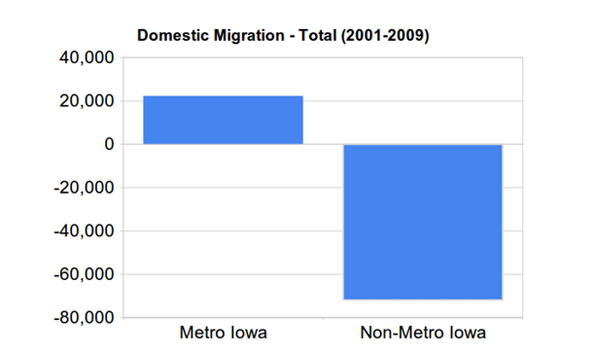
    But if the state as a whole looks reasonably healthy, this obscures its unevenness. Des Moines and big farms are doing well, but many rural and manufacturing communities are not. This is best illustrated by a map of domestic migration over the last decade.

    Net Domestic Migration, 2000-2009, in-migration in gray, out-migration in red. Darker shading denotes intensity.

    This shows net in-migration in grays and net-outmigration in pinks. The darker gray areas are clustered in metro Iowa, which is showing incredible growth, particularly around Des Moines. Des Moines population is actually up 16.5% in the last decade, about double the national average growth rate. In a decade where the US as a whole didn’t add any jobs, Des Moines powered ahead on employment by 9.3%. It’s GDP per capita is actually 12% higher than Chicago’s.

    Many other Iowa metros are likewise doing well. Dubuque recently landed a 1,000 job operation from IBM and grew its employment by over 3% last decade. Dubuque, along with other Iowa metros like Ames and Sioux Falls, grew economic output per capita faster than the average for the rest of America’s cities.

    But for non-metro Iowa, it can be a different story. Some big farmers are doing well, but many places are living up to their Great Plains reputation; they are simply drying up and emptying out. They are too remote, too sparsely populated, too lacking in talent concentrations, and ill prepared for the demands of the global economy.

    As farming transforms, cities thrive, and other areas shrivel, Iowa in changing, splitting into two states as its regions diverge, and becoming increasingly metropolitan in character.

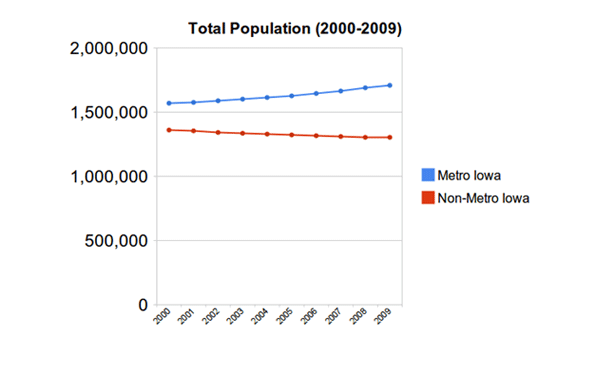
    This divergence is most easily illustrated by a chart of population:

    There are already more people living in metro areas than non-metro areas in Iowa, and the gap is only getting wider. Non-metro Iowa is actually shrinking as people leave and the population re-orders itself in the state:

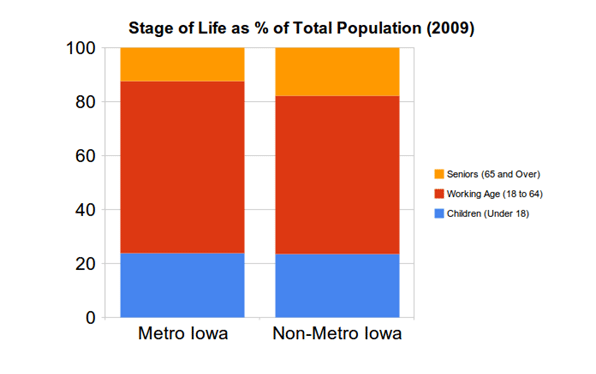
    Non-metro Iowa also has a larger senior population and lower population of working age. Generational turnover will drive even further population declines over time:

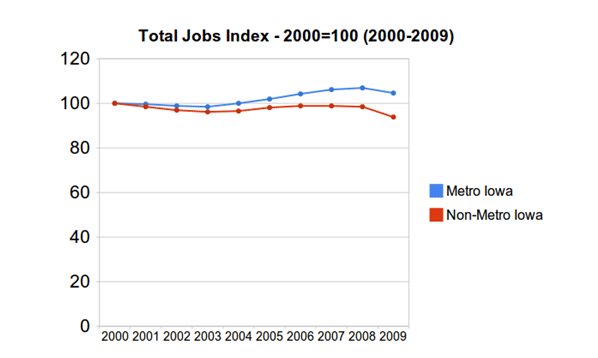
    And of course, these demographic trends are reflected in employment numbers as well, with metro Iowa adding jobs even in the last decade while non-metro Iowa is losing them.

    People’s opinions of Iowa are largely shaped by which of these two states they are looking at. More people tend to think about the struggling parts because that fits the traditional coastal media narrative and those places look big on a map. Iowa’s thriving metro regions are often overlooked because they are smaller and don’t fit the mold espoused by big city urbanists. Des Moines might not look like a Boston or Chicago, but that doesn’t mean it isn’t prosperous – and growing at almost Sunbelt rates.

    Like all of America, Iowa is a state in transition. And while it faces challenges to be sure, it’s managing that change better than most. Iowa’s future is likely to be very different from its small town past. It will be a more urban state, with several thriving metro regions. Farming will remain important, but will increasingly as a big business operation. Iowa’s future will be neither small town nor “hip cool” big city; it will represent the kind of agro-metro future that is emerging across wide swaths of America’s heartland.

    Aaron M. Renn is an independent writer on urban affairs based in the Midwest. His writings appear at The Urbanophile.

    Photo by Pete Zarria

  • Why Housing Will Come Back

    Few icons of the American way of life have suffered more in recent years than  homeownership. Since the bursting of the housing bubble, there has been a steady drumbeat from the factories of futurist punditry that the notion of owning a home will, and, more importantly, should become out of reach for most Americans.

    Before jumping on this bandwagon, perhaps we would do well to understand the role that homeownership and the diffusion of property plays in a democracy. From Madison and Jefferson through Lincoln’s Homestead Act, the most enduring and radical notion of American political economy has been the diffusion of property.

    Like small farmers in the 19th century, homeowners–and equally important, aspiring homeowners–now represent the core of our economy without which a strong recovery is likely impossible.  Houses remain as a financial bulwark for a large percentage of families, the anchor of communities, and, increasingly, home-based businesses.

    The reasons given for abandoning the homeownership ideal are diverse.  Conservatives rightfully look to diminish the outsized role of government in promoting homeownership.  Some suggest  that Americans would be better off  putting their money into things like the stock market or boosting consumer purchases.

    New-urbanist intellectuals like the University of Utah’s  Chris Nelson predict  aging demographics will lead masses to abandon their homes for retiree communities and nursing homes.   The respected futurist Paul Saffo predicts that as skilled laborers move from Singapore to San Francisco to New York and London, there is little need to “own” a permanent place. In the brave new future, he suggests, we will prefer time-sharing residences  as we flit from job to job across the global economy.

    Some of the greatest hostility towards homeownership increasingly comes from the progressive left, some of whom are calling for the total elimination of the homeowner mortgage interest deduction.  “The Case Against Homeownership,” recently published in Time,  encapsulates the current establishment’s  conventional wisdom: that homeownership is by nature exclusionist, “sprawl” promoting and responsible for “America’s overuse of energy and oil.”

    Yet for all the problems facing the housing market, homeownership–not exclusively single-family houses–is not likely to fade dramatically for the foreseeable future. The most compelling reason has to do with continued public preference for single-family homes, suburbs and the notion of owning a “piece” of the American dream.   This is why that four out of every five homes built in America over the past few decades, notes urban historian Witold Rybczynski, have less to do with government policy than “with buyers’ preferences, that is, What People Want.”

    What we are going through now is not a sea change but a correction from insane government and business practices.   The rise in homeownership from 44% in 1944 to nearly 70% at the height of the bubble reflected a great social democratic achievement. But by the mid-2000s government attempts to expand ownership–eagerly embraced by Wall Street speculators–brought in buyers who would have historically been disqualified.

    In some markets, prices exploded as people moved up too quickly into ever more expensive housing. Housing inflation was further exacerbated by “smart growth” policies, which limited new home construction in suburban areas and instead promoted dense, “transit oriented” housing with limited market appeal and economic logic.

    Rather than artificially constraining supply and protecting irresponsible borrowers,   we should let nature take its course. Home values need to readjust historic balance between incomes and prices. Over the past 60 years, notes demographer Wendell Cox, it took two to three years or less of median household income to purchase a median-priced home. At the peak of the boom, that ratio had ballooned to 4.6.

    The disequilibrium was the worst in regions like Los Angeles, Las Vegas, San Bernardino-Riverside and Miami. At the peak of the bubble, between 2006 and 2008, according to the National Homebuilders Association- Wells Fargo “Housing Opportunity Index,” barely 2% of families with a median income households in Los Angeles could afford to buy a median priced home; even in the traditionally affordable Riverside area, the number was roughly 7%. In Miami, barely 10% could afford such a purchase; in Las Vegas, often seen as one of the cheaper markets, only 15%.

    What a difference a market correction makes. The affordability number for Los Angeles is now 34%, 17 times better than two years ago, while Riverside is now near 70%. Miami’s affordability picture has improved to over 60% while in Las Vegas, it’s back over 80%.

    These lower prices–not Wall Street or federal gimmickry–will lure new buyers to the places that some new urbanists   have predicted will be “the next slums.” Already there’s evidence in places like Miami of a renewed interest in now-affordable suburban single-family homes while condos stay empty  or become rentals.

    Of course without a return to robust job growth, particularly in the private sector, the home market– and pretty much all mainstream consumer purchases–will remain weak. No matter how low prices get, people worried about losing employment do not constitute a promising new market for homes.

    But over the longer run most Americans will seek to purchase homes –whatever the geography. Increasingly this will be less a casino gamble, and more  a long-term lifestyle choice.  As America adds upwards of 100 million more Americans by 2050, the demand will stare us in the face.

    As boomers age, the two big groups that will drive housing will be the young Millenial generation born after 1983 as well as immigrants and their offspring. Sixty million strong, the millenials are just now entering their late 20s. They are just beginning to start hunting for houses and places to establish roots. Generational chroniclers  Morley Winograd and Mike Hais, describe millenials in their surveys as family-oriented young people who value homeownership even more than their boomer parents. They also are somewhat more likely to choose suburbia as their “ideal place to live” than the previous generation.

    These tendencies are even more marked among immigrants and their children. Already a majority of immigrants live in suburbia, up from 40% in the 1970s. They are attracted in many cases by both jobs and the opportunity to buy a single-family home. For an immigrant from Mumbai, Hong Kong or Mexico City, the “American dream” is rarely living in high density surrounded by concrete; if they wanted that, they could have stayed home.

    Over coming generations, changes in family and work life will make single-family homes, townhouses and other moderate-to-low density housing more attractive.  Contrary to the anonymity predicted by most futurists, your chosen place is becoming more important, as evidenced by numerous suburban and small town downtown revivals as well as growing local volunteerism.

    Equally important, multi-generational households are on the rise back to 1950s levels–in part due to immigrant lifestyle preferences. People are staying put; even before the bubble burst, mobility had dropped to the lowest level in over a half century. With the rise of new technologies allowing for dispersed work, the single family home increasingly houses not only residents, but part and full-time offices.

    Barring a long-term permanent recession or a national planning regime aimed at curbing single-family home construction, these factors should lead to a new surge in home buying starting later this decade. It may be too late to save many who overextended themselves in the bubble, but this resurgence could do much to propel our anemic economy, restoring the home to its rightful place one of the cornerstone not only of the American dream, but of our democracy.

    This article originally appeared at Forbes.com.

    Joel Kotkin is executive editor of NewGeography.com and is a distinguished presidential fellow in urban futures at Chapman University. He is author of The City: A Global History. His newest book is The Next Hundred Million: America in 2050, released in February, 2010.

    Photo by Wootang01

  • Unmanageable Jakarta Soon To Lose National Capital?

    Jakarta is the world’s third largest urban area with 22 million people (Note 1) and the second largest metropolitan area with 26.6 million people (Note 2). Jakarta is the capital of the world’s fourth most populous country, the Republic of Indonesia, which has 240 million people (following China, India and the United States). Jakarta is located on the island of Java, which covers slightly more land area than the state of New York and has 8 times the people (135 million). There is probably no smaller piece of real estate in the world that houses so many people.

    A Unique Metropolitan Name: Jakarta is the only megacity (urban area with more than 10 million people) in the world that has adopted a new name for its urban and metropolitan area: Jabotabek, which combines the beginning letters of Jakarta and the suburban jurisdictions of Bogor, Tangerang and Bekasi.

    Jabotabek is also one of the world’s fastest growing urban areas and the prospects are for even stronger growth. The United Nations expects Indonesia to add 90 million people to its urban areas over the next 40 years. If Jabotabek gets its present share of Indonesian urbanization, its population would double.

    Jabotabek’s Unmanageable Problems: For already crowded Jabotabek and its even more crowded core of Jakarta, this is bad news. Jabotabek covers nearly the same land area as Paris (more than 1,000 square miles), but has more than twice the population. And unlike Paris, with its well-planned streets and multi-story buildings, much of Jabotek is made up of low-slung, terribly crowded makeshift slums.

    Jabotabek may have the most intense traffic congestion in the world. One report says road speeds average little more than 5 miles per hour. The government has plans to expand the freeway system, which is already extensive for a developing world megacity. But, Jabotabek’s density is already far above the critical mass of dispersion required for automobiles to serve efficiently, especially in the longer run. Automobile ownership is reportedly rising as much as 15% annually.

    Of course, every public official’s answer seems to be transit. Sadly, Jabotabek has anything but a transit friendly urban form, despite its high population density. Jabotabek may be the ultimate, dispersed Asian urban area, with little of a commercial core (though larger Delhi has even less) and even that is spread out. There’s no concentration of buildings, for example, as dense as downtown San Diego. Thus, building the kind of hub and spoke transit system that could effectively serve a dense commercial core makes no sense since economic activity is already so dispersed.

    Exclusive busways have been built. But the construction of two monorails has been suspended and there are plans to build a metro (subway). Given Jabotabek’s commercial dispersion, nothing short of an 800 meter rapid transit grid could possibly make a difference. This would bring everyone within the international transit standard of 400 meters, which given Jakarta’s dispersion is the only way a rapid transit system would work.

    That would cost far more than all of the personal income in the area each year in capital and operating expense. Jabotabek falls short of the critical mass needed in a commercial or even a residential core to make transit a viable solution.

    Thus, Jabotabek sits in the broad no-man’s land ill suited for transit and too dense for cars. However, in Jabotabek, as in Mumbai and Bangkok, having the choice between a transit system that cannot get you where you need to go and being stuck in traffic, people opt for the traffic as soon as they can afford it.

    There are other massive problems. Jakarta city is on a lowland on the Java Sea and has severe drainage and flooding problems. Rising sea levels could make things even worse. Urban planner Yayat Supriyatna says that the present core of Jakarta should halve its present population of over 9 million.

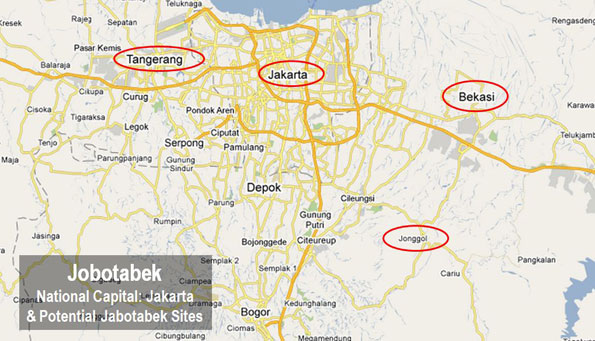
    Move the Capital? The nation’s leaders think they have an answer: move the capital. President Susilo Bambang Yudhoyono has called upon the government to prepare a study of the options. The entire national government could be moved completely out of Jakarta, or most of the government functions could be moved to another part of Jabotabek. Traffic is high on the list of ills that the President justifiably cites.

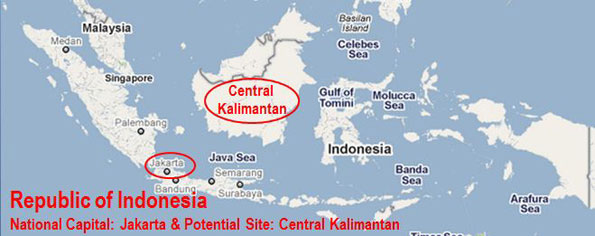
    Others, such as Siti Zuhro of the Indonesian Institute of Sciences are concerned that the capital needs to be moved away from Jabotabek altogether, to escape its problems. Speaker of the House of Representatives Marzuki Alie has suggested moving the capital to Central Kalimantan province, on the island of Borneo (Figure 1). This location has the advantage of being centrally located geographically to the nation. It is also conveniently accessible to komodo dragons, but far away from the population center of Java. A 1.5 hour flight would be required, or a far longer ferry ride. Neither travel option seems likely to facilitate the effective operation of democratic institutions in a low income nation.

    The president has expressed doubts about moving the capital to Borneo. He has suggested locations within Jabotabek, such as to Jonggol, which is 30 miles southeast of Jakarta city in Bogor regency. Indeed, fifteen years ago, planning was well along for moving the capital to Jonggol, That move was cancelled because of the east Asian financial crisis in the late 1990s. Others have mentioned moving the capital the adjacent suburbs of Bekasi or Tangerang (Figure 2), the latter of which has the advantage proximity to Sukarno-Hatta International Airport (one of the most modern in the world).

    Learning From Others? There are no easy answers, and the record of national capital relocations provides little guidance.

    Brazil moved its capital to Brasilia in 1960 to honor a 70 year old provision for internal development in its constitution. Since that time, former capital Rio de Janeiro has nearly tripled in population and spread to occupy the flats beyond the mountains that used to constrain it. Pakistan’s relocated capital at Islamabad has considerable advantages over former capital and megacity Karachi. Yet, Karachi has added more than 10 million people since the government moved. National capitals can be moved from megacities, but that may not slow down megacity growth. Moreover, given Jabotabek’s dominance (6 times as large as second ranked Bandung), it seems inconceivable that the commercial heart of the nation would move or that rural migrants would stream into smaller urban areas, where incomes seem likely to remain lower.

    Some have suggested copying the Malaysian model of government offices to the suburbs (like Jabotabek’s Jonggol). However, Putrajaya was quickly engulfed by the urbanization of Kuala Lumpur. Strategies that might work on the urban fringe of a much smaller, slower growing, more affluent and more manageable urban area of 6 million people (Kuala Lumpur) may not be appropriate for an urban area adding the equivalent of a Kuala Lumpur every decade. Given Jabotabek’s explosive growth, any new government center would be quickly surrounded and many of Jakarta city’s problems would be replicated.

    Jabotabek: The Dimensions of Expansion: Jabotabek continues to grow and is on course to become the world’s largest urban area and metropolitan area by 2030.

    Meanwhile, Jabotabek is not only expanding its population and land area, it’s adding to its name. Many now refer to it as Jabodetabek, adding extra letters for the suburb of Depok. Recently, a new city was carved out of Tangerang regency, South Tangerang. Jabotabek’s continuous urbanization has now stretched eastward into Karawang regency.

    Jabotabek the unmanageable could become Jabodetasokabek the unpronounceable.

    —–

    Note 1: The most recent edition (July 2010) of Demographia World Urban Areas and Population Projections lists Jakarta as the second largest urban area in the world (July 2010). New United Nations data now shows Delhi to have risen above Jakarta, with a population of more than 22,100,000. The Jabotabek urban area (like the Manila urban area) is routinely shown by international sources to have a far smaller population, however such estimates exclude huge populations in continuous urbanization in suburban jurisdictions.

    Note 2: While there are no international metropolitan area standards, it is generally agreed that the Jabotabek metropolitan area is second in size only to the Tokyo metropolitan area. If Karawang Regency is included (into which Jabotabek’s continuous urbanization stretches), Jabotabek’s metropolitan population in 2010 rises to 28.7 million, approximately 50% more than that of New York. Metropolitan areas and urban areas are often confused. Unlike urban areas, metropolitan areas include rural areas from which people commute into the urban area for employment, while urban areas are limited to the continuous urbanization (development) within metropolitan areas. See Urban Terms Defined.

    —–

    Wendell Cox is a Visiting Professor, Conservatoire National des Arts et Metiers, Paris and the author of “War on the Dream: How Anti-Sprawl Policy Threatens the Quality of Life

    Photograph: Jakarta (photograph by author)

  • Urban Plight: Vanishing Upward Mobility

    Since the beginnings of civilization, cities have been crucibles of progress both for societies and individuals. A great city, wrote Rene Descartes in the seventeenth century, represented “an inventory of the possible,” a place where people could create their own futures and lift up their families.

    What characterized great cities such as Amsterdam—and, later, places such as London, New York , Chicago, and Tokyo—was the size of their property-owning middle class. This was a class whose roots, for the most part, lay in the peasantry or artisan class, and later among industrial workers. Their ascension into the ranks of the bourgeoisie, petit or haute, epitomized the opportunities for social advancement created uniquely by cities.

    In the twenty-first century—the first in which the majority of people will live in cities—this unique link between urbanism and upward mobility is under threat. Urban boosters still maintain that big cities remain unique centers for social uplift, but evidence suggests this is increasingly no longer the case.

    This process reflects a shift in economic and social realities over the past few decades. For example, according to a recent Brookings Institution study, New York and Los Angeles have, among all U.S. cities, the smallest share of middle-income neighborhoods. In 1980, Manhattan ranked 17th among the nation’s counties for social inequality; by 2007 it ranked first, with the top fifth earning 52 times that of the lowest fifth, a disparity roughly comparable to that of Namibia.

    President Obama’s hometown of Chicago shows much the same pattern, according to a recent survey by Crain’s Chicago Business. Conditions have improved for a relative handful of neighborhoods close to the highly globalized central businesses. But for many neighborhoods things have not improved, and in some cases have deteriorated. Even before the recession there were fewer jobs than in 1989 and fewer opportunities for the middle class, many of whom—including more than 100,000 African-Americans—have left the city over the past decade.

    This pattern does not reflect perverse conditions unique to the United States, as many academics and progressive pundits often suggest. Between 1970 and 2001, the percentage of middle-income neighborhoods in Toronto dropped from two-thirds to one-third, while poor districts had more than doubled to 41 percent. According to the University of Toronto, by 2020, middle-class neighborhoods could account for barely less than 10 percent of the population, with the balance made up of both affluent and poor residents.

    Similarly, Tokyo, once widely seen as an exemplar of egalitarianism, is transforming. The city’s post–World War II boom yielded a thriving middle class and remarkable social mobility. That is now giving way to a society where wealth is increasingly concentrated. The poverty rate, including some 15,000 homeless people, has risen steadily to the highest level in decades.

    Much the same process can be seen in great social democratic havens of Europe. In Berlin, Germany’s largest city, unemployment has remained far higher than the national average, with rates at around 15 percent. Some 36 percent of children are poor; many of them are from other countries. The city, notes one left-wing activist, has emerged as “the capital of poverty and the working poor in Germany.”

    To a large extent, urban poverty in Berlin and other European megacities is concentrated among Muslim immigrants. Muslims constitute at least 25 percent of the population of Marseilles and Rotterdam, 20 percent of Malmo, 15 percent of Birmingham, and 10 percent or more of London, Paris, and Copenhagen. Over the next few decades, according to a recent Pew Research Center study, Muslims will constitute a majority of the population in several of these European cities.

    The Case of London

    Perhaps nowhere is the growing class divide more evident than in London, perhaps the world’s most important megacity. Despite a massive expansion of Britain’s huge welfare state, the ladder for upward mobility seems broken, especially in London. This represents a dramatic shift from the period after World War II. In the ensuing decades, incomes for most Londoners grew, access to education expanded, and the sharply drawn and notorious class lines began to blur.

    But contemporary London’s emergence as the headquarters of globalization has had widely differentiated impacts on class. On the one hand, it has paced the emergence of the West End. Many once hardscrabble neighborhoods—including Shoreditch, Islington, and Putney—have gentrified. Yet walk a bare half mile or less from the Thames River, particularly to the south, and you encounter many marginal, and often dismal, districts. These areas have not much benefited from the global economy and are inhabited largely by those who survive at the expanding bottom of the wage profile.

    Equally troubling, globalization’s benefits have disproportionately accrued to those already possessing considerable means; the ranks of top professionals, according to a 2009 report by the British government’s social mobility task force, have been increasingly dominated by the children of the wealthiest families.

    Even less noted has been London’s deepening concentration of poverty. Today more than one-third of the children in inner London are living in poverty, as are one in five in the outer ring communities. London has the highest incidence of child poverty in Great Britain, even more than the beleaguered Northeast.

    Poverty also affects 30 percent of working-age adults, more than one-third of pensioners in inner London, and roughly one in five in outer London. The inner London rates are the worst in Britain. More than 1 million Londoners were on public support in 2002. These figures are certain to become worse as a result of the recession that began in 2008.

    The conditions are certainly not as extreme as those recorded in Friedrich Engels’s searing 1844 tome, The Condition of the Working Class in England, but there remains a macabre relationship between mortality and geography. Steve Norris, a former Conservative Party chairman and onetime head of London Transport, notes that public health data published by the King’s Fund demonstrates that life expectancy in the poorer parts of east London is 4.5 years lower than in West London. That’s six months for every station east of Waterloo on the Jubilee Line. This poverty, Norris adds, extends to many white Londoners. They often live cheek to jowl with immigrants, and feel themselves competing for housing, jobs, and government services. The rich, Norris adds, “Buy their way out of poor quality education and healthcare” while the working and middle classes “queue for public housing for themselves and their children.”

    Of note is the rise of the phenomena among the white working class described as “yobbism.” Large parts of Britain—including less fashionable corners of London—suffer among the highest rates of alcohol consumption in the advanced industrial world. London School of Economics scholar Dick Hobbs, who grew up in a hardscrabble section of east London, traces this largely to the decline of the blue-collar economy in London. Over the past decade, job gains in Britain, like those in the United States, have been concentrated at the top and bottom of the wage profile. The growth in real earnings for blue-collar professions—in industry, warehousing, and construction—generally has lagged those of white-collar workers.

    One other thing is clear: the welfare state has not reversed the growing class divide. Despite its proletarian roots, New Labour, as London Mayor Boris Johnson acidly notes, has presided over what has become the most socially immobile society in Europe.

    The Role of Housing and ‘the Green Factor’

    Housing costs have exacerbated these conditions. Due largely to restrictions on new housing on the periphery, London now ranks, next to Vancouver, as the most expensive city to buy a house in the English-speaking world. Estimates by the Centre for Social Justice finds that unaffordability for first-time buyers doubled between 1997 and 2007. This has led to a surge in waiting lists for government-funded “social housing”; by mid-2008, some 2 million households (5 million people) were on the waiting list for such housing. In London, this number reached one in ten in 2008.

    Broad-based economic growth might seem the most logical solution to this dilemma. In the past, socialists, liberals, and conservatives might vigorously have debated various approaches, but generally agreed about the desired end result: shrinking slums and expanding opportunity for the middle or working class. Today, however, many urban “progressives” do not trouble themselves overmuch about the hoi polloi. Instead, they are more likely to devise policies to lure the much-ballyhooed “creative class” of well-educated, often childless, high-end workers to their cities. This goes along as well with an increased focus on aesthetic and “green” issues.

    In many ways, these approaches actually work at cross-purposes with upward mobility. Green-oriented policies are often hostile to “carbon intensive” industries such as manufacturing, warehousing, or construction that employ middle-income workers. Green policies implicitly tilt towards industries such as media, entertainment, and finance that employ the best-situated social classes.

    Indeed, some climate change enthusiasts, such as The Guardian’s George Monbiot, see their cause in quasi-religious terms. In Monbiot’s words, he is waging “a battle to redefine humanity.” In his view, we must terminate the economic “age of heroism,” supplanting the “expanders” with anti-growth “restrainers.”

    This is not just the latest edition of British “loony Left” thinking. President Obama’s own science advisor, John Holdren, long has embraced the notion of what he calls “de-development” of Western economies to a lower level of affluence. Such approaches impose enormous costs on both the middle and working classes in European and North American cities, particularly given the unlikelihood of similar restrictions on competitors in China, India, Russia, and other countries. A huge shift to renewable fuels, for example, could quadruple the cost of energy in Britain, forcing a large percentage of the population into “fuel poverty.”

    Key Focus: Economic Growth

    The emerging class conflict in the great global cities ultimately could have many ill effects. Persistently high unemployment and underemployment in British metropolitan areas, for example, has spurred nativist sentiment and intolerance towards immigrants. This is true in America today as well. But views towards immigrants generally soften as an economy improves. Broad-based prosperity is a good antidote for intolerance.

    Attacking the class gap requires a redefinition of current views about the overused term “sustainability.” This concept needs to be expanded beyond its conventional environmental definition to reflect broader social and economic values as well. It is one thing to consider how, in an era dominated by dispersed work, core cities might still attract those elite workers needing direct “face-to-face contact.” It is quite another to develop strategies so that the vast majority will be able to find work doing anything other than servicing the needs of the upper echelons.

    In turning away from the fundamental issues of economic growth and upward mobility, these cities are in danger of permanently undermining the very thing that has made great cities so attractive over the centuries. The ultimate worth of urbanity lies in its ability to deliver a better life, not only to the established affluent and the most skilled, but to that broader population who, like others over the millennia, come to a big city to create a better life.

    This article originally appeared at The American.

    Joel Kotkin is executive editor of NewGeography.com and is a distinguished presidential fellow in urban futures at Chapman University. He is author of The City: A Global History. His newest book is The Next Hundred Million: America in 2050, released in February, 2010.

    Photo by ecstaticist

  • Fortress Australia: Groundhog Day

    A decade ago, politics in Australia lurched to embrace all things rural, happily demonizing urban interests. This happened in response to a renegade Politician – Pauline Hanson – who for a time captured public sympathy with populist anti-immigration sentiments, threatening to unseat entire governments in the process.

    Now the result of the recent National Election in Australia has seen not only the return of anti immigration sentiments, but the ascendency of anti-growth statements in mainstream politics. For a large country with only 24 million people, it’s a dangerous development.

    Two things are shaping in the aftermath of the 2010 Federal Election as portents of things to come for our economic future. One is the rise of an increasingly orthodox view that Australia at 24 million people is reaching its maximum sustainable population. The second is toward appeasing the agrarian socialism and social conservatism of rural politics. Together, this could mean we are about to usher in an era of low growth, high protection policies. Fortress Australia could easily become a reality no matter which side ultimately claims the keys to the Government benches.

    Prior to the recent Federal Election (August 2010) both major political parties have become shy of the country’s long term population growth patterns. In September 2009, Federal Treasurer Wayne Swan released some early findings of the Intergenerational Report, which predicted Australia could reach 35 million by 2050. Although this rate of growth was pretty much the same as the preceding 40 years, the figure was greeted with alarm by media, the community, and much of the political herd. ‘Australia Explodes’ went the headlines and the lemmings followed over an ideological cliff. (See this blog post from a year ago).

    A month later, then Prime Minister Kevin Rudd was proclaiming that he believed in ‘a big Australia’ but by mid 2010 his later nemesis Deputy Prime Minister Julia Gillard was proclaiming she ‘did not believe in a big Australia.’ Gillard replaced Rudd in a Labor Party coup, and then as Prime Minister declared we shouldn’t ‘hurtle’ toward 36 million but instead plan for a ‘sustainable’ population, renaming the recently created portfolio of ‘Population Minister’ the ‘Sustainable Population Minister’ in the process. The word ‘sustainable’ in this context stands for ‘slow down or stop.’

    Then came the election campaign with Opposition Leader Tony Abbot promising to ‘slash’ the ‘unsustainable’ immigration numbers (that his mentor John Howard had been responsible for as conservative Prime Minister for over a decade) and to ‘turn back the boats’ of illegal immigrants and asylum seekers, mainly from south east Asia or Afghanistan. Population growth was to be cut to 1.4% (a long term trend anyway) and migrants potentially forced to settle in rural areas (some dodgy form of zipcode migration policy).

    The message from both political leaders was clear: support for a ‘big Australia’ (35 million population by 2050 or the same rate of growth we’d seen in the last 40 years) was gone.

    Add to that the quixotic Australian entrepreneur Dick Smith and his population TV documentary ‘The Population Puzzle’ where he alleged Australia was at risk of running out of food, out of space and out of control, comparing us (oddly) with places like tiny Bangladesh (population 160 million). Smith might be mad but you can’t discount the impact he has on Australian popular opinion. People believe him, politicians included.

    Could it get any worse for the prospects of maintaining even modest levels of population growth in Australia? The last election outcome means the answer is yes. The balance of power in the Senate of the Australian Parliament will now be controlled by ‘The Greens’ (a left wing environmental party). The Greens’ view on population growth is clear: they don’t support it (unless oddly if you’ve arrived illegally, by boat). “This population boom is not economic wisdom, it is a recipe for planetary exhaustion and great human tragedy” said Greens leader Bob Brown when the Intergenerational Report was released last year.

    In the House of Representatives, the balance of power is now held by a handful of independents, representing rural seats. Socially conservative but economically protectionist, the independents’ views on population suggest they would lean toward the Abbot view: turn back the boats, and slow the overall rate of growth. They are quite likely to also push for a redistribution of economic riches to a range of projects for rural and regional areas. The irony that the election result hinged on big swings in urban seats but that a handful of rural independents are now trying to call the shots shouldn’t be lost on anyone.

    Joining the growing chorus of slow or no growth chants is municipal government. The Local Government Association of Queensland’s annual conference this year talked of limits on population growth unless bountiful riches are showered on local governments to cope with ‘unsustainable’ rates of growth. Association President Paul Bell says “councils cannot let population growth exceed infrastructure needs.”

    “Where we find water supplies no longer match the size of the community, where we find roads are congested, where we’re seeing other infrastructure whether it be health or education are falling behind,” he said, population growth was by implication to blame.

    The bottom line? Population growth is now a dirty word in politics and for any business which relies on growth for its prosperity, this is not good news. Everything from airports to property to construction to farming to retailers, manufacturers and tourism will be affected by slowing growth.

    Even social services could suffer if growth is deliberately slowed. Why? Because in 50 years time, without migration or natural growth, the ageing bubble of post-war baby boomers may mean there are two working adults for every five retired. You wouldn’t want to be one of those two and paying their tax bill in 50 years’ time or dependent on the kindness of those workers.

    How has this come about? The answer is simple: growth itself has never been the problem. Instead, it’s been a notoriously inefficient planning approach which has misdirected precious infrastructure spending, pushed up housing prices through artificial restraint on supply combined with usurious upfront levies, which now average $50,000 per dwelling in Queensland (often more) and considerably more in NSW.

    In the last decade, can anyone honestly claim that our planning schemes are now more efficient and quicker, or more easily understood, or better targeted, than a decade ago? I doubt it.

    Would it be too much to ask for a sensible, evidence-based approach that ties population growth to urban and regional strategies, which emphasises economic progress while maintaining lifestyle and environmental standards? How about some decent plans to link regional urban centres to major cities, based not on pork barrels to influential independents but based only on the business case and community mutual benefit? Or how about putting the ‘growth’ back into smart growth, with policies that allow our urban areas to expand in line with demand matched to infrastructure spending, rather than policy dogma?

    Those same questions were being asked a decade ago. Welcome to ground hog day.

    For those interested, here’s a couple of yarns from 10 years ago:
    Slicker Cities for City Slickers. October 1999.
    Nation Building and a National Urban Strategy. May 2001.

    Ross Elliott has more than 20 years experience in property and public policy. His past roles have included stints in urban economics, national and state roles with the Property Council, and in destination marketing. He has written extensively on a range of public policy issues centering around urban issues, and continues to maintain his recreational interest in public policy through ongoing contributions such as this or via his monthly blog The Pulse.

    Photo by Linh_rOm

  • Time to Hate Those HOAs (again).

    The foreclosure crisis has been devastating for millions of Americans, but it has also impacted many still working as before and holding on to their homes. Even a couple of empty dwellings on a street can very quickly deteriorate and become a negative presence in the neighborhood, at the least driving down prices further, sometimes attracting crime. Untended pools can allow pests to breed. Many animals have been abandoned and shelters report overflowing traffic. The resulting impacts on local governments have been particularly visible, as property tax assessments have fallen and revenues have also gone south.

    Less obvious is the impacts on home owner associations [HOAs], whose revenues have also taken a hit, albeit for rather different reasons. For the most part, HOA dues are not a function of the value of the home but rather the need to cover the costs of maintaining the common interests of the association: landscaping, security and so forth. These tend to be fixed, even if the values of the homes collapse, and may even rise if dwellings are empty and untended.

    Many HOAs, especially in the newer metropolitan areas like Phoenix and Las Vegas where foreclosures have been most concentrated, have taken a beating because the number of households paying into the association has been depleted, quite badly in some instances. The problem seems, from press reports, to cover the economic spectrum. Low-income first-time buyers may stop paying their dues as an economy measure, while more affluent owners are more likely to have pulled cash from their home and are walking away from their debts. There are also thousands of empty homes that were purchased as investments at the height of the boom and may have never even been occupied.

    The foreclosure debacle is now old news, but the HOA situation is receiving attention because association boards are now aggressively trying to recoup their debts, even from those who have walked away from their mortgages. The debt, they argue, is attached to the individual, not to the dwelling, and is being turned over to collection agencies. Now, this is hardly a novelty. Municipalities have been turning household utility debts over to third parties for years, often with some success, and without a murmur of protest. So why is it different if HOAs do it?

    The answer is that HOAs are extremely unpopular with two vocal constituencies. The first is the academic community, and its hostility is part of the professional opprobrium that is heaped on gated communities, privatization and pretty much anything connected with suburban development. Interestingly, while the design aspects of gated communities have caught the attention of planners and urbanists, relatively few have focused on the dimension of governance. Those that have written on the topic have tended to be critical of private clubs that are seen to exist at the expense of the municipal collective. For what its worth, I don’t think I’ve ever known of an academic colleague who lived in an HOA, in contrast to the bulk of my students, who live in one or grew up there.

    The second constituency is more rowdy. Academics just disdain HOAs, but this group is committed to exposing them as a vast conspiracy to subvert the American way of life. This may sound like another version of contemporary “Teamania” but it is has been around for at least the past decade, during which time I’ve been monitoring Internet posts and the like. To this group, any restriction on personal freedom — from the color of one’s drapes or exterior paintwork through the display of the national flag — is clearly anathema.

    Early this year, my research on neighborliness in HOAs was covered in the local paper, and by the end of the day there were dozens of online posts. In response to the basic finding — that there is little fundamental difference between HOA and traditional neighborhoods — we received a torrent of angry responses. With a single exception, they all dismissed the findings out of hand, using an example of someone’s experience (rarely their own) to prove the point, at least to their satisfaction. One reader even tracked down my email address in order to demand an assurance that no public funds were used to promote this nonsense.

    Like much in contemporary American politics, this leaves me confused. I don’t understand why an exclusive residential association, freely entered into, with explicit rules that are presented at the outset, offering services-for-cash, is un-American. After all, this is in contrast to a municipality that levies taxes for services from which one cannot opt out (if one has no children in the schools, for instance) and which may not be available to all (such as public transport), and which could easily be seen as a redistributive institution, an example of that socialism we keep hearing so much about.

    For the record, I am happy to pay my property taxes for services I don’t receive — its just part of the social contract. Nor do I live in an HOA. But I can understand why our research indicates that most people who live in them do prefer them (and, for example, often move from one HOA to another). Rather than displaying the angst of those who seem to get nervous if anyone tries to step on their toes, these residents embrace belonging to a small polity in which they have a voice. And we should remember that rules, like fences, make good neighbors. As these neighborhoods become more diverse, traditional and non-traditional households alike can find reassurance in the behavioral conformity demanded of neighbors by an HOA.

    This brings us back to the recent stories about management boards ‘hounding’ those who have not paid their dues. Similar accounts have shown up for years, and the thrust is always the same: punitive, out-of-control boards attack those already in financial distress. There is clearly a lot of the latter to go round, but it’s hard to see why HOAs are much different than any other organization that is looking at a handful of bad debts. Are the HOAs the victims here? Absolutely not. Many embraced the housing bubble, and permitted speculators to buy in, even though they had no intention of living in the properties. At the height of the madness, up to one third of all housing transactions in Phoenix were initiated by out-of-state buyers who drove up home prices precipitately, and eventually caused the median house price to double. This has since corrected. All CC&Rs (the rules of the HOA) that I have seen dictate however that the purchaser must live in the property and that rental units are not permissible. So, like all the other players, the HOA boards liked the price increases so much that they ignored their own rules and looked the other way, a lapse for which they are now paying the price.

    Still, it would be a mistake compounding a mistake to climb on the anti-HOA bandwagon, now joined by the ACLU, which has recently joined the fray over a fight about a homeowner’s right to fly the Gadsden flag (motto: “Don’t step on me”). Libertarians should recognize that no-one has ever been forced to live in an association and that whipping up the wrath of state legislatures to control HOAs is a bad idea: it encourages even more government intervention, and it messes with the neighborhood, a form of governance that the vast majority rightly supports, even in HOAs.

    Andrew Kirby has written about HOAs on several occasions, including the 2003 edited volume “Spaces of Hate”. He most recently wrote about ‘The Suburban Question’ on this site in February.

    Photo by monkiemag