Category: Urban Issues

  • “James Drain” Hits Cleveland

    The ten story of mural of LeBron James is coming down in Cleveland. This one hurts. James wasn’t just the latest embodiment of Cleveland’s hopes, he was a local kid who, unlike so many, had stayed home in Northeast Ohio. His joining of the Cleveland exodus at a time of severe economic distress prompted Cavaliers owner Dan Gilbert to pen a now infamous open letter to fans:

    As you now know, our former hero, who grew up in the very region that he deserted this evening, is no longer a Cleveland Cavalier…..The good news is that the ownership team and the rest of the hard-working, loyal, and driven staff over here at your hometown Cavaliers have not betrayed you nor NEVER will betray you….This shocking act of disloyalty from our home grown “chosen one” sends the exact opposite lesson of what we would want our children to learn. And “who” we would want them to grow-up to become….

    Forty years of frustration boiled over in that letter. Gilbert is from Detroit, but perhaps that’s why he too shares these feelings so viscerally.

    Cleveland’s “Big Thing Theory”

    In a sense though, Cleveland’s disappointment was inevitable. LeBron James was never going to turn around the city. No one person or one thing can. Unfortunately, Cleveland has continually pinned its hopes on a never-ending cycle of “next big things” to reverse decline. This will never work. As local economic development guru Ed Morrison put it, “Overwhelmingly, the strategy is now driven by individual projects….This leads to the ‘Big Thing Theory’ of economic development: Prosperity results from building one more big thing.”

    These have all failed, now even “King James”. The trend lines haven’t changed, even where the individual projects have done well. But often even that hasn’t happened. For example, the Flats, a once-thriving entertainment district in an old warehouse district, now resembles, as one local comedian put it, a “Scooby Doo ghost town.”

    Combating “James Drain”

    James’ departure also fits the narrative of generalized anxiety around “brain drain” and cities losing their best and brightest of each generation. As lots of people really have left Cleveland, this is understandable. But the real story is much more complex. A look at IRS tax return data shows that in reality Cleveland doesn’t have especially high out-migration. Its metro out-migration rate* in 2008 was 28.02. Miami’s was 40.34 and for even the boomtown of Atlanta it was 38.95. Not only is Cleveland not losing an especially high number of people, you can actually argue it is losing too few. A big part of the problem in Cleveland’s economy is that too many people are stuck there.

    Conversely, a real migration problem is that too few people are moving in. As local attorney Richard Herman noted, “New York City and Chicago, like most major cities, see significant out-migration of their existing residents each year. What is atypical is that Cleveland does not enjoy the energy of new people moving in.” The Cleveland metro in-migration rate was only 22.19. Miami’s was 30.36 and Atlanta’s a robust 51.91.

    Cities need new blood. Cleveland isn’t getting it. Its circulatory system is shut down. Cleveland needs more natives to leave and more newcomers to arrive. Both sides win. Those Cleveland departees will move on to be part of the new energy other cities so desperately need. James is going to get to live the high life he wants in South Beach, but somebody else will be fired up to get the opportunity to play in Cleveland.

    Selling Cleveland

    But that begs the question, what’s going to get more people to move to Cleveland? The fact is, James wasn’t getting the job done, and never would. Nor will amenities like the Cleveland Orchestra or the Rock and Roll Hall of Fame Museum.

    The mistake Cleveland and other Rust Belt cities make is that they are too worried about the likes of LeBron James moving to Miami. For people with the means and the desire to choose a place like South Beach, Cleveland simply can’t compete. And let’s not forget, James snubbed Chicago, New York, and Los Angeles too.

    Rather than trying to take on the Chicagos, Miamis, and New Yorks of this world at their strongest points, Cleveland would be far better served ceding that market and fighting where it can best compete. Believe it or not, not everyone wants to live in a huge global city. There are plenty of people who might choose to live in Cleveland, if the city focused on the basic blocking and tackling of city services, quality of life, and business climate instead of splashy grands projets. As Anthony Bourdain said this week:

    I think that troubled cities often tragically misinterpret what’s coolest about themselves. They scramble for cure-alls, something that will “attract business”, always one convention center, one pedestrian mall or restaurant district away from revival. They miss their biggest, best and probably most marketable asset: their unique and slightly off-center character….Cleveland is one of my favorite cities. I don’t arrive there with a smile on my face every time because of the Cleveland Philharmonic.

    In short, Cleveland needs less South Beach, less Chicago Loop, and more American Splendor. Ultimately, my bet is Cleveland will end up missing Harvey Pekar a lot more than it will any multi-millionaire sports star.

    Shooting the Messenger

    Who is going to get that message out about Cleveland? After that sendoff, it sure won’t be LeBron James. That’s a shame. As Jim Russell has richly illustrated, people make migration – and investment – decisions based on knowledge, not just information. Nobody picks a city to live in by entering reams to statistics into a sixteen tab spreadsheet. They’re more likely to move to be near family, friends, or places they know. That knowledge comes from first hand experience – and trusted recommendations.

    Until the switch flips on Cleveland’s brand, it needs to be out earning that trust of prospective residents. The people who’ve left aren’t Judases, they’re your field sales force – or at least they should be. James could have been a missionary “Witness” for Cleveland in a foreign land. Instead, Cleveland blew an enormous opportunity, and left itself with little more than soured memories and a partially demolished mural as an ephemeral reminder of yet another failed Next Big Thing.

    * Tax return exemptions migrating per 1000 overall tax return exemptions in the base year.

    Aaron M. Renn is an independent writer on urban affairs based in the Midwest. His writings appear at The Urbanophile.

    Photo by alexabboud

  • SPECIAL REPORT: Move to Suburbs (and Beyond) Continues

    Anyone who challenges the notion that the long predicted exodus of people from the suburbs to the city has been wildly overstated is sure to generate some backlash from urban boosters. Alan Berube of the Brookings Institution contends in a New Republic column that “head counts” better reveal city trends than property trends or the massive condo bust. He points to a Brookings Institution analysis by Bill Frey, entitled “Texas Gains, Suburbs Lose in 2010 Census Review,” which compares trends in major cities and suburbs, but offers not a sentence demonstrating any actual population “loss” in suburbs (his point is that their growth rates have declined).

    However, Berube has a point. Head counts are the issue. The annual Bureau of the Census “head count” of domestic migration reveals that the suburban to urban core exodus is as elusive as it has ever been. Gross population totals reveal nothing with respect to movements between the suburbs and the core. There is no doubt that core city population trends have improved, and this is a good thing. However, there is not a shred of evidence that suburbanites are picking up and moving to the cores.

    Domestic Migration: This is indicated by a “head count” of migration trends during the decade and during the last year. Each year, the Bureau of the Census estimates the number of people who move between counties (domestic migration) and the number of people who move into metropolitan areas from outside the nation (international migration). The data is estimated at the county (equivalent) level, which means that, except where cities are counties (such as Baltimore, San Francisco and others), individual core city data is not available. Thus, the analysis has to rely on core versus suburban counties in metropolitan areas (Note 1).

    In short, the nation’s urban cores continue to lose domestic migrants with a vengeance, however are doing quite well at attracting international migration. Thus, core growth is not resulting from migration from suburbs or any other part of the nation, but is driven by international migration.

    The following analysis covers all but four (48) metropolitan areas with more than 1,000,000 population as of 2009. San Diego, Las Vegas and Tucson are excluded because they include only one county, so there is only a core county and no suburban county. New Orleans is excluded due to the special circumstances of the huge population losses from Hurricane Katrina.

    Generally, domestic migrants are leaving the nation’s largest metropolitan areas. Between 2000 and 2009, a net 1,900,000 domestic migrants moved to areas of the nation outside the largest metropolitan areas (Table 1). Domestic migration losses occurred 24 of the 48 metropolitan areas. In the last year (2008-2009), the net domestic out-migration for all 48 regions in total was 22,000, 90% below the 2000-2008 annual rate. A somewhat smaller number of metropolitan areas, 22, experienced domestic migration losses in the last year. Most observers, including Berube, trace this diminishing loss to the recession, which has made movement in any direction more difficult over the past two years.

    Table 1
    Domestic Migration: Major Metropolitan Areas
    2000-2009
    2008-2009
    Core County Classification
    Metropolitan Area
    Metropolitan Area
    Core
    Suburban
    Metropolitan Area
    Core
    Suburban
    1
    New York   (1,920,745)   (1,222,290)     (698,455)       (110,278)     (77,381)    (32,897)
    3
    Los Angeles   (1,337,522)   (1,102,202)     (235,320)         (79,900)     (76,674)      (3,226)
    2
    Chicago       (547,430)      (705,403)      157,973         (40,389)     (31,114)      (9,275)
    4
    Dallas-Fort Worth        307,907      (262,982)      570,889           45,241       (7,494)      52,735
    1
    Philadelphia       (112,071)      (154,338)         42,267           (7,577)       (5,496)      (2,081)
    4
    Houston        242,573        (69,736)      312,309           49,662       19,002      30,660
    4
    Miami-West Palm Beach       (284,860)      (297,637)         12,777         (29,321)     (25,142)      (4,179)
    1
    Washington       (110,775)        (39,814)       (70,961)           18,189         4,454      13,735
    3
    Atlanta        412,832            3,243      409,589           17,479         7,579        9,900
    1
    Boston       (232,984)      (100,485)     (132,499)             6,813             (32)        6,845
    2
    Detroit       (361,632)      (306,467)       (55,165)         (45,488)     (34,794)    (10,694)
    4
    Phoenix        530,579        404,840      125,739           12,441         4,651        7,790
    2
    San Francisco-Oakland       (343,834)      (245,796)       (98,038)             7,977           (207)        8,184
    4
    Riverside-San Bernardino        457,430        375,055         82,375               (616)       13,174    (13,790)
    3
    Seattle           42,424        (27,407)         69,831           17,035       11,053        5,982
    2
    Minneapolis-St. Paul         (22,865)      (138,395)      115,530           (2,503)       (1,989)          (514)
    1
    St. Louis         (42,151)        (62,990)         20,839           (4,532)       (3,197)      (1,335)
    4
    Tampa-St. Petersburg        254,650          89,385      165,265             4,663         2,630        2,033
    1
    Baltimore         (35,938)        (74,328)         38,390           (3,687)       (4,883)        1,196
    2
    Denver           61,108        (44,839)      105,947           19,831         6,369      13,462
    2
    Pittsburgh         (49,438)        (57,532)           8,094             1,144            401           743
    2
    Portland        120,437            3,811      116,626           16,320         7,053        9,267
    2
    Cincinnati         (18,313)        (87,976)         69,663               (384)       (2,833)        2,449
    4
    Sacramento        135,038          32,369      102,669             4,733       (1,185)        5,918
    2
    Cleveland       (133,679)      (151,448)         17,769         (10,191)     (10,875)           684
    4
    Orlando        218,108          46,341      171,767           (4,279)       (6,275)        1,996
    4
    San Antonio        175,552          96,856         78,696           18,984       10,797        8,187
    3
    Kansas City           30,181        (33,910)         64,091             3,929           (417)        4,346
    4
    San Jose       (233,133)      (226,545)         (6,588)           (5,361)       (4,829)          (532)
    3
    Columbus           32,087        (36,024)         68,111             5,018         1,907        3,111
    4
    Charlotte        243,399        104,402      138,997           19,211         8,299      10,912
    3
    Indianapolis           70,271        (53,039)      123,310             7,034       (1,209)        8,243
    4
    Austin        224,227          52,842      171,385           25,654       10,484      15,170
    2
    Norfolk-Virginia Beach         (19,172)        (19,391)              219           (8,052)       (3,559)      (4,493)
    2
    Providence         (50,151)        (38,129)       (12,022)           (6,736)       (4,939)      (1,797)
    3
    Nashville        120,684        (20,101)      140,785           10,826            128      10,698
    2
    Milwaukee         (72,668)        (89,476)         16,808           (2,336)       (3,585)        1,249
    4
    Jacksonville        125,881          17,866      108,015             1,758       (3,415)        5,173
    4
    Memphis           (8,834)        (61,325)         52,491           (5,276)       (7,867)        2,591
    3
    Louisville           33,700           (7,692)         41,392             2,122            262        1,860
    2
    Richmond           74,650           (4,839)         79,489             2,751                 3        2,748
    3
    Oklahoma City           41,523           (8,164)         49,687             8,798         3,236        5,562
    3
    Hartford           (9,385)        (22,089)         12,704           (1,847)       (1,949)           102
    3
    Birmingham           26,420        (26,550)         52,970             2,418       (1,424)        3,842
    3
    Salt Lake City         (32,760)        (43,779)         11,019               (164)           (911)           747
    4
    Raleigh        190,438        150,583         39,855           20,095       16,070        4,025
    2
    Buffalo         (53,191)        (47,780)         (5,411)           (1,711)       (1,806)              95
    2
    Rochester         (42,163)        (35,354)         (6,809)           (1,937)       (1,224)          (713)
    Total   (1,903,595)   (4,548,659)   2,645,064         (22,439)   (199,153)   176,714
    Major metropolitan areas: Population over 1,000,000 in 2009
    Core county classifications: See Table 2

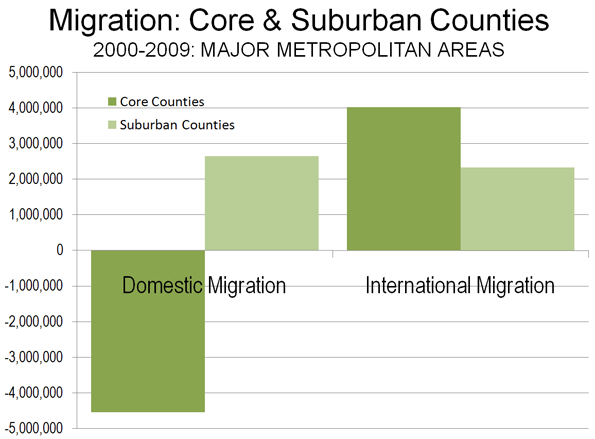
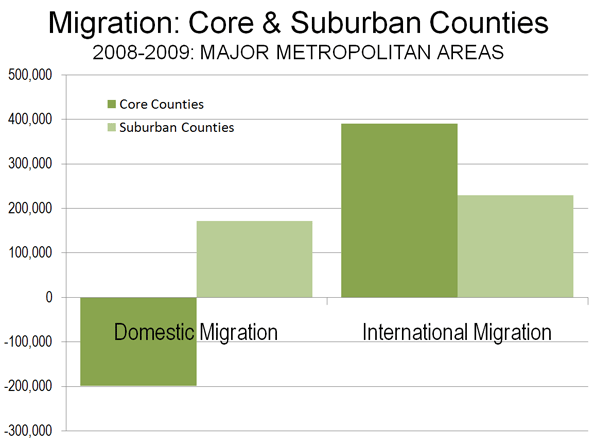
    The core counties lost domestic migrants, often at very high rates. Between 2000 and 2009, more than 4,500,000 people moved out of the core counties. This is more people than live in the cities of Los Angeles and Washington, DC combined. The suburban counties did substantially better gaining more than 2,600,000 domestic migrants (nearly as many people as live in the city of Chicago), but not enough to negate the core losses. Over the past year, the core counties lost 200,000 domestic migrants, an annual rate approximately two-thirds less than the rate from 2000 to 2008. Suburban counties gained 175,000, a more than 40% reduction from the 2000-2008 annual rate. All of these rate changes are consistent with expectations in a recession, as fewer people move.

    If anything, the trends of the past decade indicate a further dispersal of America’s metropolitan population, with an additional 200,000 domestic migrants moving to the exurban counties adjacent to and beyond the major metropolitan areas (Note 2). Reflecting the effects of the recession, exurban areas lost 4,000 domestic migrants in the last year. This one year loss rate is less than 1/10th of the core county domestic migration loss rate over the same period. Another nearly 1.7 million domestic migrants left the major metropolitan areas and their exurbs altogether, moving to smaller metropolitan areas, smaller urban areas and rural areas.

    Between 2000 and 2008, 36 cores experienced domestic migration losses, compared to 10 suburban areas. The cores did better in the last year, with 29 losing domestic migrants, while 13 suburban areas lost domestic migrants. Further, more people moved into (or fewer moved out of) the suburbs from other parts of the country than to the cores in 42 of the 48 metropolitan areas between 2000 and 2009 and in 2008-2009.

    Moreover, not all urban cores are the same. Some, including most of the fast growing areas, are far more suburban than others. This is illustrated by a classification of core counties (Table 2) based upon the share of owner occupant housing built after 1949 (For for statistical purposes the beginning of automobile oriented suburbanization was with the census of 1950).

    Table 2
    Core County Classifications (Extent of Suburbanization)
    Core County Classification
    Share of Owner-Occupied Houses Built After 1949
      Dominant Urban Cores
    Less than 50%
      Moderately Suburban
    50% = <75%
      Substantially Suburban
    70% = <85%
      Predominantly Suburban
    85% & Over
    Data from 2000 US Census

    For example, in the core counties of the St. Louis and Boston metropolitan areas, there is little suburbanization, with more than 70% of houses having been built before 1950. Their growth truly reflects the attractiveness of traditional, relatively dense urban living. On the other hand, in the core county of the Austin metropolitan area, less than 10% of the houses were built before 1950, while in Phoenix, the figure is 3%. In these and other core counties that encompass large suburban areas, the vast majority of “urban” growth follows a highly suburbanized, auto-oriented model.

    The domestic migration results by core county classification are as follows:

    • Dominant Urban Core Central Counties (less than 50% of the housing stock built after 1949) lost 1.650 million domestic migrants, or 14.0% of their 2000 population. In the last year, the loss was 87,000.
    • Moderately Suburban Core Central Counties (50% to 69% of the housing stock built after 1949) lost 1.970 million domestic migrants, or 10.0% of their 2000 population. In the last year, the loss was 83,000.
    • Substantially Suburban Core Central Counties (70% to 84% of the housing stock built after 1949) lost 1.380 million domestic migrants, or 7.2% of their 2000 population. In the last year, the loss was 58,000.
    • Predominantly Suburban Core Central Counties (85% and more of the housing stock built after 1949) gained 450 thousand domestic migrants, or 2.0% of their 2000 population. In the last year, the gain was 29,000.

    By no stretch of the imagination, then, can it be validly claimed that the overall trend is people moving from the suburbs to the core. The evidence suggests that the more urban the core county, the greater are the domestic migration losses.
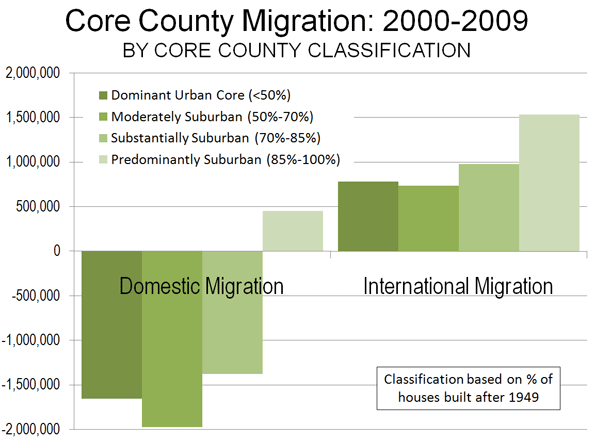
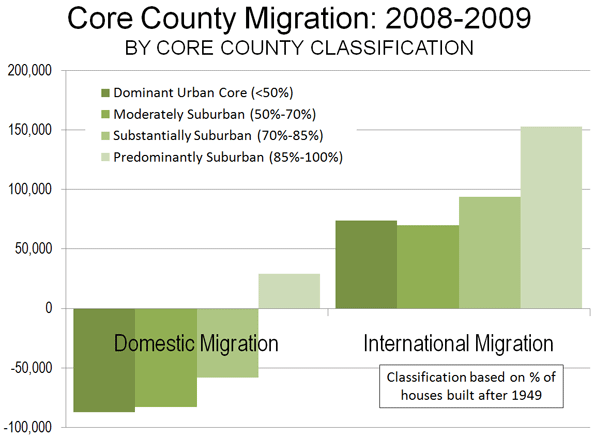
    International Migration: The real story with respect to core growth is international migration. The 48 metropolitan areas gained 6.4 million international migrants from 2000 to 2009 and 620,000 in 2008-2009. International migration, also impacted by recession, dropped by nearly a 15% drop from the 2000-2008 annual rate (Table 3).

    Table 3
    International Migration: Major Metropolitan Areas
    2000-2009
    2008-2009
    Core County Classification
    Metropolitan Area
    Metropolitan Area
    Core
    Suburban
    Metropolitan Area
    Core
    Suburban
    1
    New York     1,075,016      622,538      452,478        100,669     57,674      42,995
    3
    Los Angeles        803,614      628,303      175,311           75,062     58,557      16,505
    2
    Chicago        363,134      265,156         97,978           33,363     24,236        9,127
    4
    Dallas-Fort Worth        323,941      203,732      120,209           31,571     19,785      11,786
    1
    Philadelphia        122,733         50,761         71,972           12,944        5,560        7,384
    4
    Houston        289,648      252,098         37,550           27,996     24,371        3,625
    4
    Miami-West Palm Beach        506,423      318,888      187,535           51,548     32,380      19,168
    1
    Washington        310,222         23,112      287,110           31,904        2,096      29,808
    3
    Atlanta        207,238         42,082      165,156           20,288        4,093      16,195
    1
    Boston        191,014         64,359      126,655           19,250        6,522      12,728
    2
    Detroit           93,625         44,177         49,448             8,723        4,132        4,591
    4
    Phoenix        214,067      209,326           4,741           21,833     21,364           469
    2
    San Francisco-Oakland        257,318      161,324         95,994           24,376     15,373        9,003
    4
    Riverside-San Bernardino           90,652         46,829         43,823             8,464        4,313        4,151
    3
    Seattle        126,973         98,983         27,990           12,919        9,971        2,948
    2
    Minneapolis-St. Paul           84,440         69,262         15,178             8,234        6,756        1,478
    1
    St. Louis           29,782         11,794         17,988             2,928        1,112        1,816
    4
    Tampa-St. Petersburg           74,173         42,568         31,605             8,045        4,762        3,283
    1
    Baltimore           43,949         10,852         33,097             4,604        1,125        3,479
    2
    Denver           93,916         45,338         48,578             8,738        4,251        4,487
    2
    Pittsburgh           19,225         16,326           2,899             1,901        1,596           305
    2
    Portland           70,901         28,755         42,146             6,680        2,677        4,003
    2
    Cincinnati           22,364         12,754           9,610             2,245        1,260           985
    4
    Sacramento           64,275         47,169         17,106             6,056        4,420        1,636
    2
    Cleveland           28,002         20,168           7,834             2,826        1,987           839
    4
    Orlando           95,500         61,171         34,329           11,720        7,381        4,339
    4
    San Antonio           31,595         28,157           3,438             3,303        2,940           363
    3
    Kansas City           34,339         12,613         21,726             3,404        1,262        2,142
    4
    San Jose        170,452      168,009           2,443           16,347     16,116           231
    3
    Columbus           39,755         38,261           1,494             4,063        3,915           148
    4
    Charlotte           48,176         34,522         13,654             4,678        3,332        1,346
    3
    Indianapolis           27,676         22,058           5,618             2,809        2,239           570
    4
    Austin           65,958         56,828           9,130             6,406        5,516           890
    2
    Norfolk-Virginia Beach                421         (1,546)           1,967                867             81           786
    2
    Providence           34,926         25,547           9,379             3,753        2,741        1,012
    3
    Nashville           36,570         26,208         10,362             3,850        2,760        1,090
    2
    Milwaukee           26,814         22,612           4,202             2,706        2,292           414
    4
    Jacksonville           15,066         12,046           3,020             1,760        1,397           363
    4
    Memphis           19,845         17,801           2,044             2,093        1,874           219
    3
    Louisville           16,437         12,778           3,659             1,685        1,291           394
    2
    Richmond           17,061           4,161         12,900             1,805           440        1,365
    3
    Oklahoma City           23,717         18,698           5,019             2,394        1,878           516
    3
    Hartford           30,266         25,871           4,395             3,230        2,784           446
    3
    Birmingham           14,485         10,644           3,841             1,557        1,151           406
    3
    Salt Lake City           41,216         39,416           1,800             3,855        3,684           171
    4
    Raleigh           36,923         32,141           4,782             3,560        3,103           457
    2
    Buffalo             9,671           8,387           1,284                940           814           126
    2
    Rochester           12,796         11,657           1,139             1,243        1,123           120
    Total     6,356,310   4,024,694   2,331,616        621,195   390,487   230,708
    Major metropolitan areas: Population over 1,000,000 in 2009
    Core county classifications: See Table 2

    The core counties gained 4.0 million net international migrants between 2000 and 2009. The international migration gains in the dominant urban and moderately suburban core counties were not sufficient to compensate for the domestic migration losses (Figure 3). Surprisingly, the strongest gain in international migration from 2000 to 2009 was not in the more urban core counties, but rather was in the predominantly suburban core counties, at a 6.8% rate compared to 2000 populations.
    In 2008-2009, the core county gain was 390,000, approximately 15% below the 2000-2008 annual rate (Figure 4). The suburban counties gained international migrants, though fewer than the cores, adding a net 2.3 million between 2000 and 2009. Between 2008 and 2009, the suburbs added a net 230,000 international migrants, a 12% decline from the 2000-2008 annual rate.
    This of course measures only initial international migration. Over time many immigrants likely will head for the suburbs, which now are home to a majority. Core cities may be playing more of a “revolving door” role where they take in immigrants (and young people) for several years, then lose them, but replace the loss with newcomers.

    The Exodus: Elusive as Ever: The much ballyhooed suburban hegira has not begun, despite it having been announced repeatedly (Table 4). There is no doubt that the cores are doing better than in recent decades, particularly since the deep recession began. But the relative better urban performance may have more to do with stagnation than anything endlessly alluring about inner city life.

    Table 4
    Domestic, International & Total Migration: Major Metropolitan Areas
    PERSONS
    Net Domestic Migration: 2000-2009
    Net Domestic Migration: 2008-2009
    Net International Migration: 2000-2009
    Net International Migration: 2008-2009
    Net Total Migration: 2000-2009
    Net Total Migration: 2008-2009
    Core Counties (Share of Post-1949 Housing)   (4,548,659)     (199,153)      4,024,694         390,487        (523,965)     191,334
      Dominant Urban Core (Less than 50%)  (1,654,245)      (86,535)        783,416          74,089       (870,829)     (12,446)
      Moderately Suburban (50%-69%  (1,969,014)      (83,099)        734,078          69,759    (1,234,936)     (13,340)
      Substantially Suburban (70%-84%)  (1,377,714)      (58,419)        975,915          93,585       (401,799)       35,166
      Predominantly Suburban (85% & Over)       452,314        28,900     1,531,285        153,054     1,983,599    181,954
    Suburban Counties     2,645,064       176,714      2,331,616         230,708      4,976,680     407,422
    48 Major Metropolitan Areas   (1,903,595)       (22,439)      6,356,310         621,195      4,452,715     598,756
    Exurban Counties        198,294          (4,053)         364,498           36,740          562,792        32,687
    48 Metropolitan Areas & All Exurban Counties   (1,705,301)       (26,492)      6,720,808         657,935      5,015,507     631,443
    4 Excluded Metropolitan Areas          19,958         14,553         225,767           23,400          245,725        37,953
    All (52) Major Metropolitan Areas & Exurban Counties   (1,685,343)       (11,939)      6,946,575         681,335      5,261,232     669,396
    Smaller Metropolitan & Rural     1,685,343         11,939      1,678,369         173,570      3,363,712     185,509
    United States 0 0      8,624,944         854,905      8,624,944     854,905
    Major metropolitan areas: Population over 1,000,000 in 2009
    Excluded metropolitan areas: San Diego, Las Vegas & Tucson (no suburban county) and New Orleans (due to Hurricane Katrina)
    Exurban counties of excluded metropolitan areas are included (Las Vegas and New Orleans)

    As in Europe, people are moving to the urban cores. But also, as in Europe, they are moving there from across national borders, rather than from the suburbs (Figures 3 & 4). This will surprise urbanites who cannot imagine meaningful lives in the suburbs, but will not shock the many millions more suburban residents content enough not to move. The exodus from the suburbs to the core will not have begun until more moving vans head away from the suburbs than to them. To this point, this is simply not occurring. And when the economy recovers, history suggests that the gap between suburban and core growth rates may begin expanding again.


    Note: There is one core county in each metropolitan area, which is the county containing the first named city, except for in New York, where all five counties (boroughs) are included, in San Francisco-Oakland, where Alameda County (Oakland) is also included and in Minneapolis-St. Paul, where Ramsey County (St. Paul) is also included.

    Note: The exurban counties are those included in combined statistical areas (as designated by the Bureau of the Census), which have major metropolitan areas as their core.

    Photo: Suburban Minneapolis-St. Paul

    Wendell Cox is a Visiting Professor, Conservatoire National des Arts et Metiers, Paris. He was born in Los Angeles and was appointed to three terms on the Los Angeles County Transportation Commission by Mayor Tom Bradley. He is the author of “War on the Dream: How Anti-Sprawl Policy Threatens the Quality of Life.

  • Stagnation in the City of Angels: Whatever Happened to Ideas?

    It’s only been a couple of years since a red-hot real estate market had our city riding high. The market turned out to be a bubble, of course, and it eventually burst. Gone is the giddiness that comes when folks convince themselves that real estate or high tech stocks or any other trend or commodity can defy gravity and continue upward forever.

    Yet giddiness isn’t the only thing that’s been lost. Ideas have disappeared from the political landscape of Los Angeles.

    That’s particularly unfortunate because there’s plenty of work to be done after bubbles burst—everything from big efforts on the macro-economic level to the everyday challenges of mending lives torn asunder by financial strains. Local government can play a key role in such efforts. That means that politics is part of the picture—and that means that our city’s politicians have a chance to help by coming up with new ideas on how to spur a recovery.

    Yet our recovery is dragging along in Los Angeles. The federal government’s own struggles and the dire straits faced by state officials surely complicate the job at the local level, but those don’t fully explain the malaise we’re living through right now.

    It’s more likely that our city suffers from a dearth of ideas because our politicians became addicted to the red-hot real estate market. It’s looking more and more as though that became their one and only idea. They skimmed off the rising tide of real estate, used the money to buy political points, and stopped thinking about any new ideas.

    It worked for 10 years or so. The values of homes and other properties went up, and so did the city’s revenue. Developers paid fees to build residential and commercial units, buyers paid higher property taxes in the rising market, homeowners borrowed against their houses and spent freely, paying sales taxes along the way.

    All of the action sent streams of revenue to various levels of government, and much of the money found its way to the city’s coffers. Local politicians used the money to take care of donors with favorable deals, satisfy labor unions by expanding payrolls and paychecks for city employees, and provide basic services to enough voters to maintain the status quo.

    Now the revenue streams have dwindled, and there’s not enough for our politicians to finance their old scheme.

    There have been many reactions to our city’s challenges, but not much in the way of ideas. Our politicians have jumped from budget projection to budget projection, cutting here, threatening to cut there. Outside City Hall is a different story, as the populace begins to sense that this is all reaction with no basic idea. Whatever happened last week means nothing this week because the next budget report could prompt any sort of reaction from the politicians. There are no guiding principles or declared values—no ideas—for our city.

    This became clear to me when I realized that our City Councilmembers and our mayor used to send out all sorts of press releases back in the days of the real estate boom. There were notices that some project had been completed or another had just started. They almost always involved the expenditure of city funds, and went on about the politician who flipped whatever switches made the money flow.

    Now the money has dried up, and press releases are few and far between.

    That makes sense—if you accept the premise that spending money is the basis of any and all ideas when it comes to public policy.

    The truth is that more ideas are needed when there’s no money to spend. Yet I can’t remember the last time I saw a press release about an idea from the mayor or a City Councilmember on how to save money without cutting jobs or programs. I don’t recall any notices of a new idea that will maintain services without adding costs. I haven’t seen any communications that indicate our politicians have come up with any new ideas to meet the challenges our city now faces.

    It appears that we have an entire generation of politicians who see spending money as the whole idea of government.

    Well, we’re out of money.

    We need to know if our politicians have any other ideas.

    And they shouldn’t worry if they’re all out—voters are getting a few ideas of their own.

    Jerry Sullivan is the Editor & Publisher of the Los Angeles Garment & Citizen, a weekly community newspaper that covers Downtown Los Angeles and surrounding districts (www.garmentandcitizen.com).

    Photo by: AndrewGorden

  • The Need to Expand Personal Mobility

    Few books in recent memory have started from as optimistic or solid a foundation as Reinventing the Automobile: Personal Urban Mobility for the 21st Century. Reinventing the Automobile conveys a strong message that improved personal mobility is necessary and desirable:

    “Have we reached the point where we now must seriously consider trading off the personal mobility and economic prosperity enabled by automobile transportation to mitigate its negative side effects? Or, can we take advantage of converging 21st century technologies and fresh design approaches to diminish those side effects sufficiently while preserving and enhancing our freedom to move about and interact? This book concludes the latter.”

    The authors include William J. Mitchell, Professor of Architecture, and Media Arts and Sciences at the Massachusetts Institute of Technology directs the Smart Cities research group at the MIT Media Lab, Christopher Boroni-Bird, Director of Advance technology Vehicle Concepts at General Motors and Lawrence D. Burns, who consults on transportation, energy and communications systems and technology. The book is published by the MIT Press.

    Getting Urban Economics Right

    The authors start with getting the urban economics right. They recognize that the “freedom and prosperity benefits” of the automobile “have been substantial.” They note that the automobile industry “set the stage for the growth of the middle class,” something that has been labeled the “democratization of prosperity.” The authors say that the car “enabled modern suburbia” and “powered a century of economic prosperity.” This refreshing treatment is consistent with the overwhelming economic evidence that links personal mobility with prosperity, such as by Remy Prud’homme and Chang-Wong Lee, David Hartgen and M. Gregory Fields and others. It is also at considerable odds with the widely accepted, somewhat nostalgic planning orthodoxy that rejects private automotive transport as “unsustainable”, unaesthetic and anti-social. This ideology embraces the illusion that forcing people to travel longer, with less personal flexibility somehow will improve the economy and raise the standard of living.

    The Future of the Automobile?

    The authors envision a automobile characterized by a new “DNA.” It starts with smaller cars, fueled by electricity and hydrogen (fuel cell technology). It also begins with an understanding that the cars used in many mundane urban operations today – for example getting to the market or pick up the kids at school – are over-engineered. They are far larger than is needed for most trips, their capacity for speed exceeds urban requirements and their range between refueling is also more than needed.

    The authors would re-engineer urban vehicle to the needs of metropolitan dwellers, an “ultra-small vehicle” (USV). The designs proposed include far lighter cars that can be easily “folded” up to minimize parking space requirements. Cars would be connected to one another by wireless technology, all but eliminating the possibility of collisions. The cars would be small enough that they could be assigned special dedicated lanes on current freeways and streets. Travel would be less congested because the dedicated lanes would have a far higher vehicle capacity, while the interconnectedness would allow cars to safely operate closer to one another.

    The combination of electricity, hydrogen, wireless technology and the USV would bring additional benefits. This would permit improved vehicle routing, as drivers would be advised take alternate less congested routes. This would also, in time, lead to self-drive cars, about which Randal O’Toole has recently written, made possible by the use of wireless technology and that dedicated lanes would make possible.

    Empowering Transit Riders through Car Sharing

    Car sharing is an important part of this future, for dwellers of dense urban cores, according to Reinventing the Automobile. The author’s note that car sharing can solve the “first mile-last mile” problem making it possible for transit users to speed up their trips by not having to walk long distances to and from transit stops. Indeed, car sharing programs are set to be adopted in urban cores with some of the world’s best transit systems, such as Paris, and London. Privately operated car sharing systems have been established in a number of US metropolitan areas, such as Atlanta, Denver and San Francisco.

    Progress with Conventional Strategies

    The longer term vision of the MIT Press authors may take a while to unfold, but we can already see potential for progress. Just this week, “super-car” developer Gordon Murray announced development of an urban car (the T25), smaller than the “Smart,” which would achieve nearly 60 miles per gallon, with plans for marketing within two years. Volkswagen has developed a “1-litre” car, which would achieve 235 miles per gallon on diesel fuel. All of this makes the 51 mile per gallon Toyota Prius seem gluttonous by comparison

    These developments and the Reinventing the Automobile vision show that it is unnecessary to tell people in America (or Europe or the developiung world) that they must give up their automobiles. That is good news. The social engineering approaches requiring people to move from the suburbs to dense urban cores and travel by slower, less frequent transit are incapable of achieving serious environmental gains (see below) and can not seriously be considered progress or desirable by most people in advanced countries.

    The Superiority of Technology

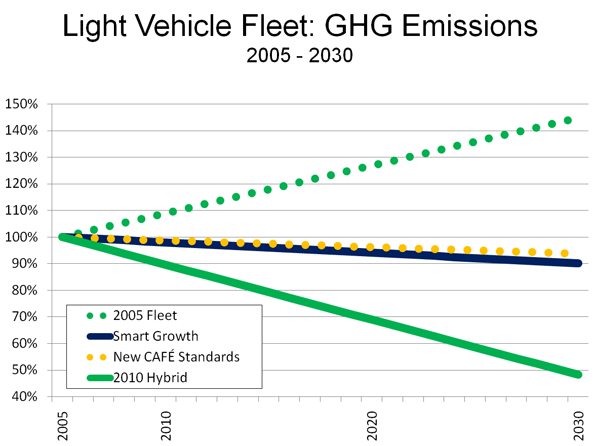
    This is illustrated by recent developments in automobile technology and research (Figure).

    • Before the adoption of the new 2020 and 2016 new car fuel economy standards, the US light vehicle fleet was on track to increase its greenhouse gas (GHG) emissions nearly 50% from 2005 to 2030 (the green dotted line in the figure).
    • As a result of the new fuel economy standards, Department of Energy projections indicate that greenhouse gas emissions from light vehicles will be one-third less by 2030 compared to the 2005 fleet (the yellow dotted line), and this is at the standard projected driving increase rates that could well be high.
    • The smart growth strategies of land rationing, densification and discouraging driving would produce, at best, a marginal reduction in GHG emissions, using the mid-point of the recent proponent research (Moving Cooler), indicated by the solid blue line. Actually, this overstates the impact of smart growth, since it discounts the substantial GHG emissions gains that result from higher fuel consumption in more congested traffic produced by densification.
    • The potential for technological advance is illustrated by the green solid line, which estimates the GHG emissions from light vehicles in 2030 if the average fuel economy were equal to today’s best hybrid technology.

    Overall auto-centered technology-based strategies – such as the improved fuel economy standards and the hybrid fuel economy – would each produce about 15 times as much benefit as the smart growth strategies proposed by such studies as Moving Cooler. This approach would not only be far more productive in terms of environmental improvement but would not require interfering with people’s lives in ways that would require longer trips times, less convenience, seriously retarded job access and, inevitably, fewer jobs and lower levels of economic growth.

    Technology: The Only Way

    It would be a mistake – and likely political folly – to force a re-engineering our way of life in order to enact strategies with dubious environmental benefits. In the final analysis, personal mobility must be retained and expanded, because there is no alternative that is acceptable to people, whatever system of government they happen to live under. Reinventing the Automobile paints the most optimistic picture to date and, if given due serious treatment, could prove a debate changer.

    Photograph: Manila suburbs

    Wendell Cox is a Visiting Professor, Conservatoire National des Arts et Metiers, Paris. He was born in Los Angeles and was appointed to three terms on the Los Angeles County Transportation Commission by Mayor Tom Bradley. He is the author of “War on the Dream: How Anti-Sprawl Policy Threatens the Quality of Life.

  • Singapore’s Demographic Winter

    Over the past half century arguably no place on earth has progressed more than the tiny island state of Singapore. A once impoverished, tropical powder keg packed into 268 square miles at the foot of the Malay Peninsula, the Mandarin-led republic has ascended from its difficult founding in 1965 to one of the richest economies on the planet. Today, in terms of purchasing power, its per capita income stands higher than most European countries’ or Japan’s and is roughly equal to that of the U.S.

    But a catastrophic plunge in the country’s birthrate–a problem plaguing many of the world’s affluent economies–could undermine Singapore’s success. In 1965 Singapore’s leaders feared it could not survive an unsustainable fertility rate above 3.5 and embarked on a campaign encouraging citizens to have smaller families. Today the country’s fertility rate–the number of children per female–has sunk to roughly 1.2 , a rate lower than all but a handful of countries and well below replacement level.

    This pattern poses a threat to the republic’s continued progress over the coming decades. The dependency ratio between retired persons and those 15 to 64–far lower than Europe, America or Japan in the 1970s–will reach the unsustainable levels of places like Japan, Germany and Italy by 2030. By then there could well be more people over 65 than under 15.

    This shift in demographics is a common challenge for almost all advanced countries–even the U.S., which enjoys the healthiest demography of any major wealthy nation. In Europe and particularly Asia, once challenged by overpopulation, there is the looming prospect of what a new documentary calls the “demographic winter.”

    Of course, not everyone finds this “winter” a chilling thought. A growing chorus of environmentalists, particularly in Europe and the U.S., sees the shrinking numbers of “little monsters” a boon for the planet.

    Peter Kareiva, the chief scientist at the Nature Conservancy, one of the more levelheaded environmental organizations, has concluded that not having children is the most effective way of reducing “carbon scenarios” and becoming an “eco hero.” Meanwhile the more extremist Voluntary Human Extinction Movement promotes the lovely notion of terminating the species through voluntary childlessness.

    For their part, Singapore’s leaders have focused on providing parkland, building a functioning subway and recycling city wastes. But these pragmatists show little tolerance for such Western-style species self-hatred. A society proud of its accomplishments, its agglomerated cultures–Chinese, Indian, Malay–continue to value family as the supreme societal unit.

    At the same time, many leaders trace the depth of their demographic problem to their own campaign to limit families back in the 1970s. “We have been very successful in reducing the birthrate,” observes Lui Pao Chuen, adviser to the National Research Foundation and a prime architect of Singapore’s defense systems. “The society will die if it goes on like this. We want our society to live on.”

    In the past decade Singapore’s leaders have tried to change course, attempting to raise the birth rate by offering generous cash incentives and other inducements for baby-making. But so far, they admit, these efforts have had little effect.

    Part of the problem may lie with high densities, an inescapable reality in a city-state with literally no suburban periphery. Singapore’s public housing–80% of citizens live in government flats–is generally better and larger than those in other Asian countries. Still the prospect of raising children in a 1,000-square-foot, two-bedroom flat may seem less appealing than doing so, say, in a suburban housing estate in Australia, New Zealand, California or Texas.

    Equally intractable may be the very competitive spirit at the heart of the republic’s success. Singapore possesses two great natural advantages: a strategic location between the Pacific and Indian Oceans and a motivated population. The city’s leaders have done a brilliant job of capitalizing on both, developing one of the world’s largest ports and one of Asia’s best-educated, hardest-working populations.

    This in turn has created a population that often places education and career advancement over child-raising, marriage and even dating. Some 85% of singles still express a desire to get married, and nearly 80% want two or three children. But the pressure to succeed often prevails. “The pace of life has people putting things on hold,” admits NG Mie Ling, coordinating director for the government’s Family Development Group.

    Despite these challenges, Singapore may not be doomed to follow Europe and other advanced east Asian nations into the demographic dustbin. For one thing, the city’s bureaucracy is cleverer than most and may be able to change some policies–placing more emphasis on leisure time for mate-chasing and child-raising to building larger apartments–to reverse the current birth dearth.

    Singapore’s unique ethnic and national identity may prove an even bigger asset. Unlike its Asian rivals, Singapore–though mainly Chinese–remains a truly multiracial society. Like America, it is a nation of immigrants. Few can trace their local roots there more than two or three generations. This makes the Republic more suited for accommodating newcomers from China, India and Malaysia, as well as from countries like the Philippines or Vietnam.

    Newcomers can find a kindred ethnic or religious community. Many also intermarry with Singaporeans; over 40% of all marriages are between citizens and noncitizens, up from only 30% a decade ago. Interracial marriages are also increasingly common. Whereas it is virtually impossible to become Japanese or Korean, one can become a Singaporean.

    Immigration allows Singapore’s population and skilled workforce to grow at a healthy clip despite the low birth rate. Today barely 3.2 million of the current nearly 5 million Singaporeans are citizens; many others immigrate to enjoy the excellent schools, the high degree of safety and cleanliness and a political stability that is rare in the region. Last year 60,000 people were granted permanent residency and nearly 20,000 became citizens.

    “We are still trying to figure out what it is to be a Singaporean,” observes Calvin Soh, chief creative officer in Asia for the Publicis advertising company. This evolving identity may not be obvious in the city’s impressive but hardly unique office, hotel and condo complexes. It is best illustrated in the city’s remarkable neighborhoods with their open air markets and a strikingly diverse food culture flourishing both in small, family-owned restaurants and hawker stalls.

    The city’s internationally recognized food scene, Soh believes, could serve as a model for other cultural products, from media and fashion to product design. Ideally suited to serve as the crossroads culture of 21st-century Asia , Singapore can emerge like 14th-century Venice, which flourished by connecting Europe with the civilizations further to the east.

    Like their counterparts in other successful countries, Singapore’s executives and administrators face enormous demographic challenges. But if any Asian society can confront, or at least ameliorate, the great fertility crisis, it is this tiny island country with a track record of solving seemingly insurmountable problems.

    This article originally appeared in Forbes.com.

    Joel Kotkin is executive editor of NewGeography.com and is a distinguished presidential fellow in urban futures at Chapman University. He is author of The City: A Global History. His newest book is The Next Hundred Million: America in 2050, released in Febuary, 2010.

    Photo by FeebleOldMan

  • The Myth of the Back-to-the-City Migration

    Pundits, planners and urban visionaries—citing everything from changing demographics, soaring energy prices, the rise of the so-called “creative class,” and the need to battle global warming—have been predicting for years that America’s love affair with the suburbs will soon be over. Their voices have grown louder since the onset of the housing crisis. Suburban neighborhoods, as the Atlantic magazine put it in March 2008, would morph into “the new slums” as people trek back to dense urban spaces.

    But the great migration back to the city hasn’t occurred. Over the past decade the percentage of Americans living in suburbs and single-family homes has increased. Meanwhile, demographer Wendell Cox’s analysis of census figures show that a much-celebrated rise in the percentage of multifamily housing peaked at 40% of all new housing permits in 2008, and it has since fallen to below 20% of the total, slightly lower than in 2000.

    Housing prices in and around the nation’s urban cores is clear evidence that the back-to-the-city movement is wishful thinking. Despite cheerleading from individuals such as University of Toronto Professor Richard Florida, and Carole Coletta, president of CEOs for Cities and the Urban Land Institute, this movement has crashed in ways that match—and in some cases exceed—the losses suffered in suburban and even exurban locations. Condos in particular are a bellwether: Downtown areas, stuffed with new condos, have suffered some of the worst housing busts in the nation.

    Take Miami, once a poster child for urban revitalization. According to National Association of Realtors data, the median condominium price in the Miami metropolitan area has dropped 75% from its 2007 peak, far worse than 50% decline suffered in the market for single family homes.

    Then there’s Los Angeles. Over the last year, according to the real estate website Zillow.com, single-family home prices in the Los Angeles region have rebounded by a modest 10%. But the downtown condo market has lost over 18% of its value. Many ambitious new projects, like Eli Broad’s grandiose Grand Avenue Development, remain on long-term hold.

    The story in downtown Las Vegas is massive overbuilding and vacancies. The Review Journal recently reported a nearly 21-year supply of unsold condominium units. MGM City Center developer Larry Murren stated this spring that he wished he had built half as many units. Mr. Murren cites a seminar on mixed-use development—a commonplace event in many cities over the past few years—as sparking his overenthusiasm. He’s not the only developer who has admitted being misled.

    Behind the condo bust is a simple error: people’s stated preferences. Virtually every survey of opinion, including a 2004 poll co-sponsored by Smart Growth America, a group dedicated to promoting urban density, found that roughly 13% of Americans prefer to live in an urban environment while 33% prefer suburbs, and another 18% like exurbs. These patterns have been fairly consistent over the last several decades.

    Demographic trends, including an oft-predicted tsunami of Baby Boom “empty nesters” to urban cores, have been misread. True, some wealthy individuals have moved to downtown lofts. But roughly three quarters of retirees in the first bloc of retiring baby boomers are sticking pretty close to the suburbs, where the vast majority now reside. Those that do migrate, notes University of Arizona Urban Planning Professor Sandi Rosenbloom, tend to head further out into the suburban periphery. “Everybody in this business wants to talk about the odd person who moves downtown, but it’s basically a ‘man bites dog story,’” she says. “Most retire in place.”

    Historically, immigrants have helped prop up urban markets. But since 1980 the percentage who settle in urban areas has dropped to 34% from 41%. Some 52% are now living in suburbs, up from 44% 30 years ago. This has turned places such as Bergen County, N.J., Fort Bend County, Texas, and the San Gabriel Valley east of Los Angeles into the ultimate exemplars of multicultural America.

    What about the “millennials”—the generation born after 1983? Research by analysts Morley Winograd and Mike Hais, authors of the ground-breaking “Millennial Makeover,” indicates this group is even more suburban-centric than their boomer parents. Urban areas do exercise great allure to well-educated younger people, particularly in their 20s and early 30s. But what about when they marry and have families, as four in five intend? A recent survey of millennials by Frank Magid and Associates, a major survey research firm, found that although roughly 18% consider the city “an ideal place to live,” some 43% envision the suburbs as their preferred long-term destination.

    Urban centers will continue to represent an important, if comparatively small, part of the rapidly evolving American landscape. With as many as 100 million more Americans by 2050, they could enjoy a growth of somewhere between 10 million and 20 million more people. And in the short run, the collapse of the high-end condo market could provide opportunity for young and unmarried people to move into luxurious urban housing at bargain rates.

    But lower prices, or a shift to rentals, could prove financially devastating for urban developers and their investors, who now may be slow to re-enter the market. And for many cities, the bust could represent a punishing fiscal blow, given the subsidies lavished on many projects during the era of urbanist frenzy.

    The condo bust should provide a cautionary tale for developers, planners and the urban political class, particularly those political “progressives” who favor using regulatory and fiscal tools to promote urban densification. It is simply delusional to try forcing a market beyond proven demand.

    Rather than ignore consumer choice, cities and suburbs need to focus on basic tasks like creating jobs, improving schools, developing cultural amenities and promoting public safety. It is these more mundane steps—not utopian theory or regulatory diktats—that ultimately make successful communities.

    This article originally appeared in the Wall Street Journal.

    Joel Kotkin is executive editor of NewGeography.com and is a distinguished presidential fellow in urban futures at Chapman University. He is author of The City: A Global History. His newest book is The Next Hundred Million: America in 2050, released in Febuary, 2010.

    Photo by miamism

  • The Economic Significance of Village Markets

    Flea markets and garage sales have been around for years. But for most New Zealanders, produce markets have been associated with old European villages, or the ethnic markets of Hong Kong and other exotic locations. Village markets focus on locally made crafts, while Flea Markets are essentially centralized garage sales.

    At the true Farmers’ Market vendors may sell only what they grow, farm, pickle, preserve, bake, smoke, or catch themselves from a defined area. There are now over 50 “official” Farmers’ Markets in New Zealand. But when all the flea markets, village markets, and less formal markets are tallied up there must be hundreds throughout New Zealand.

    When I grew up they simply didn’t exist – unless we count the school “Bring and Buy” and Church fétes. We simply shopped in shops. Why is this? Why did my parents feel no need for such markets? I suspect my parents would have regarded such markets as somewhat old-fashioned and even primitive. This was the sort of thing our forebears left behind in Ireland in the 1830s.

    However, they are now a part of our lives. For the last few years I have routinely – effectively every Saturday Morning – shopped at our local market at Mangawhai, a nearby coastal village in Northland. It’s where people sell their own produce, but also sell books, bric-a-brac, power-tools, and other bits and pieces. The market works for me because it is just across the road from my excellent butcher, and next door to the local lending library.

    So what’s the new appeal? The conventional theory is that the rise of these markets reflects a desire for fresh healthy food, and fruit and vegetables grown locally, and in-season rather than imported from far away. It’s also considered green to buy local and support local cultivars, and growers of eco-sourced native plants and so on.

    These markets are also a good place to meet for a chat, and they also provide a convenient means of selling off numerous “priceless objects” now growing mould in the garage.

    Indeed, last weekend, my wife and I decided to win back some space and earn some ready cash. Setting up a stall at the Mangawhai market was easy. We simply phoned the market organizer (from the local Cheese Shop) and booked a trestle table.

    We thought our real cash-cow would be the plants and seedlings but the biggest and most regular seller was our collection of vinyl records dating from US pressings of jazz giants from the sixties. Our first major sale was a high-quality Akai turntable. It was fun to see grandmotherly types shuffle up to the table and enthuse over early discs by Oscar Peterson, Miles Davis, and Billie Holliday. As a bonus we gave the turntable buyer a 1950s 10 inch LP of Bill Hayley and his Comets – Don’t Knock the Rock.

    The last time I thought about these markets was two weeks ago when I wrote the sad story of the urban Onehunga Market that had to close because Auckland City demanded a resource consent that would have cost maybe $30,000 dollars.

    I presume our Mangawhai market operates without such costs because it is housed in the Village Hall, on public ground, shared with the Library and the Museum. Consequently our stall space and trestle cost us only $10 for the morning. But if the Council had demanded say $30,000 for a land use consent, then a twenty-trestle market at $10 a trestle would take 150 weeks to recover just the consenting cost. Obviously, there would have to be many more spaces, or the rental would have to be much higher.

    On our first morning we netted only about $80. (Being newcomers, we were outside and it rained) But even this represented about $20 dollars an hour – not huge but better than the minimum wage. On the other hand it was an $80 dollar return on our $10 dollar capital investment (using simple “homespun” economics). Remember the stuff we were selling had negative value, and I drive back and forth from the village every Saturday anyhow.
    And it was fun. But could such markets become an endangered species? As in so many areas, the culprit is heavy-handed regulation. The high costs of land and development, and the burden of consenting and development contributions already make it nearly impossible for small corner stores to make any return on capital.

    Yet, the stall renter’s capital-productivity is massive. But many regulators cannot stand to see such an opportunity slip from their grasp. So the Onehunga market had to close.

    These village markets remind us of the “power of markets”. As the heavy-handed regulators drive down capital productivity, entrepreneurs have responded by rediscovering the outdoor markets of much earlier times when capital was scarce and labour was plentiful. Market economies are like water-beds – push down on one corner and they bounce up in another.

    We are beginning to see similarly ad hoc responses in the residential and commercial property markets. The regulators have so severely constrained the supply of coastal land in New Zealand that people like my parents, who bought a batch at on the coast at Tairua out of their working class income, no longer have a hope of enjoying the sprint from the Kiwi bach straight into the sea.

    Those who have generated this scarcity then complain that only foreigners can afford to buy our coastal land. But many of us really do want to occupy a beach side property for the best weeks of summer, and then return home to our rural dwellings in the regional towns and villages. Enter the motor home.

    As farmers become more and more regulated by central planners who know nothing about agricultural economics but instead are determined to ‘save the planet’, enterprising farmers will look for new ways to supplement their incomes.

    Well, here’s one way we can solve our mutual problem. First, buy a quality self-contained motor home. Then use Google Maps to find what looks like an ideal bay, with a farm track connecting the main road to the beach.

    Then approach the farmer and negotiate a “right to occupy” this little patch of heaven. It could be no more than the right to park on the spot for perhaps eight weeks a year, but could include an obligation to fence off the area to contain any children or pets. No resource consent, no title, no lease – just a right to drive on to the farm, park on the spot, and drive away if it rains.

    Farmers supplement their income and Kiwis reclaim the low cost beach. The Environmental Puritans will gnash their teeth at the prospect of so many people having fun – but this time we might be ready for them. Markets and human ingenuity can still win in the long run.

    Owen McShane is Director of the Centre for Resource Management Studies, New Zealand.

    Photo of Mangawhai Village Saturday Market by Sids1

  • Sponge Cities on the Great Plains

    “Sponge cities” is an apt metaphor to describe urban communities in rural states like North Dakota which grow soaking up the residents of surrounding small towns, farms and ranches. North Dakota’s four largest cities, Fargo, Bismarck, Grand Forks and Minot, are growing in large part due to the young adults who for decades gone elsewhere to other regions. In the process, rural North Dakota is facing a protracted population crisis as significant numbers of its small communities are on a slow slide to extinction. This migration pattern is not new, nor is it unique to North Dakota. Historically, one of the most significant demographic trends in the United States has been the movement of people from rural to urban areas. In 1915 sociologist E.A. Ross declared that small Midwestern towns reminded him of “fished out ponds populated chiefly by bullheads and suckers.”

    Beginning in the 1920s, North Dakota and South Dakota youth stopped wanting to step into their parents’ worlds. According to the Department of Rural Sociology, in 1927 more than 87 percent of farmers encouraged their children to go into farming, but by 1938 less than half of Dakota high schoolers were taking that advice.

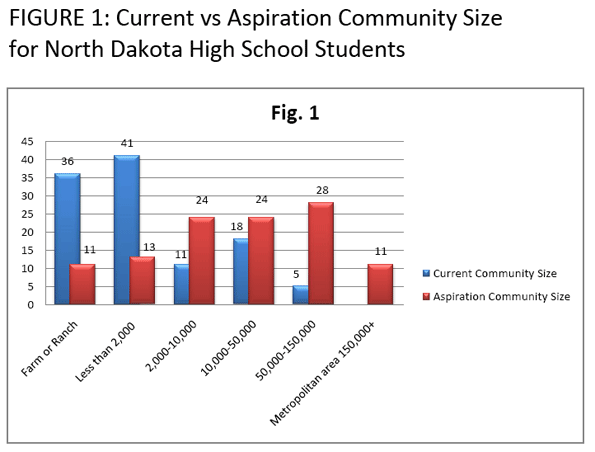
    A June 2010 survey of 111 North Dakota high school juniors and seniors offers a glimpse into the minds of the state’s young adults as they stand on the precipice of adulthood. They were asked to choose the size of community in which they aspire to live and work. Although roughly four in ten were raised in communities of fewer than 2,000 residents, out of the over 100 students surveyed, only six wished to live their adult lives in the a town of fewer than 2,000. Overall, 70 percent aspired to live in larger communities than those of their childhood (see Figure 1).

    Small towns struggle to provide urban amenities that can match the sponge cities’ bustling malls, skateboarding parks, concert venues and Olive Gardens. While the serene, friendly, stable rural communities, farms and ranches reflect the way that “life is supposed to be” in the minds of many outside the region, young adults often view that way of life as dull and sluggish. City life—albiet small scale by national standards—is perceived as fun, fast and fashionable; jobs pay better and there are more of them.

    There has always been a desire among young adults to experience life outside of where they grew up. Experts believe that economics and quality of life are the two dominant motivations people have for moving from rural areas into cities. Mark Stephens, a young college graduate who left his small town of under 400 for Fargo, with a metropolitan population pushing 200,000, the largest city in the state, said “The first thing people throw out as an excuse is increased opportunity, but let’s face it, 18- to 20-something adults are not thinking long term. For the most part, kids in that age group are really pretty shallow. In truth, I think it comes down to one word: Jealousy. They are walking down a gravel road in their tiny town with a link to massive amounts of media right in their back pockets. It’s no different than when they were little kids—they see someone with ice cream and they want some too.”

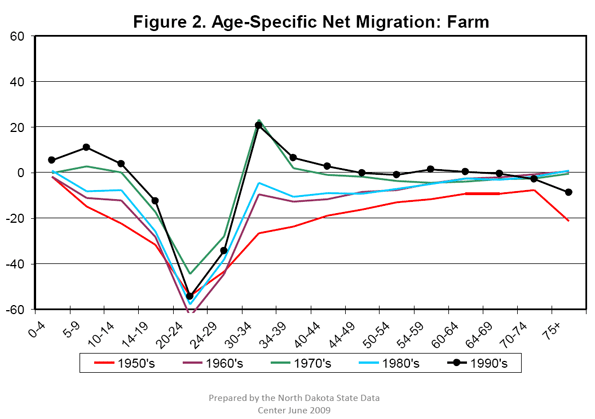
    Richard Rathke, director of the North Dakota State Dakota Center, notes that aggregate data demonstrate the movement of young adults to larger cities in the Great Plains The young adult population (age 20-30) has been inmigrating to metro areas each decade since 1950 while in the farm dependent rural counties, they are outmigrating in sizeable numbers (see Figure 2).

    A dozen young adults moving from Edgeley, North Dakota (population 637) to Fargo is irrelevant to Fargo as it absorbs the new residents with barely a nod, but to Edgeley, the shift represents significant and chilling loss of young, skilled, educated workers that will have a detrimental impact on the town’s future prosperity or even survival. Some predict that once Fargo has soaked up all the smaller communities, young professionals will then abandon Fargo for the more illustrious Minneapolis. North Dakota is touted in nationwide polls as one of the friendliest states in the nation, but schadenfreude flourishes on the Plains. Mayors of small towns that have lost their young people to growing population hubs have been known to remark, “Just wait until all of their kids move to Minneapolis.”

    Perhaps metropolises like Minneapolis or New York will not be the ultimate sponge cities. Indeed, Minneapolis has experienced a 1.4 percent drop in population since 2000. Demographers are beginning to observe that for many of us there is a point where diseconomy of size becomes real. Traffic, congestion, housing prices, crime and pollution levels may already be curtailing inmigration to the nation’s major metropolitan cities.

    The phenomenon of sponge cities will change the nature of states like North Dakota. At the turn of the twentieth century a mere 7 percent of North Dakotans were urban, by 1980 one out of every three residents was urban and in 2010 the state is projected to be 50 percent urban and 50 percent rural, a loss of nearly 88,000 rural residents in a state whose total population has remained stagnant, hovering between 600,000 to 650,000 for over a century.

    A legitimate reaction to the entrenched loss of people from rural areas of North Dakota might be, “So what?” What does a state or nation have at stake in the health of a small town like Edgeley? After all, one community’s loss is another community’s gain. Migratory patterns are simply indicative of an efficient labor market; employers discover employees and employees find jobs that fit their skills, interests and education. Thus, one might conclude that is does not really matter if a significant percentage of rural Americans move to more urban areas. In fact, what some perceive as a seemingly endless stream of discouraging census data may actually be a positive indicator. Robert E. Lucas, Jr., University of Chicago economist and winner of the 1995 Nobel Prize in Economics, believes that a region’s successful transformation from traditional agriculture to a modern, growing economy depends on talent clustering—an accumulation of human capital that sponge cities are performing. The future may not be rural, but sponge cities could make traditional rural states like North Dakota very viable.

    Wayne Sanstead, North Dakota’s State Superintendent of Public Schools and former lieutenant governor, has for decades watched rural schools close their doors. “We want the small communities to be a part of the state’s economic and social future, but we have to face reality and focus on retaining young adults within the state.” This may be the new reality. In large part due to the state’s booming economy, Sanstead asserts that in his 25 years as a state superintendent he has never seen a better opportunity then today for the state to retain its young people.

    Deb Kantrud, Executive Director of the South Central Regional Council in Jamestown, North Dakota, has spent her entire career as a community developer. She noted that if small town residents stay behind after high school graduation, they aren’t considered as successful as those who relocate. We need to figure out a way to keep some smaller communities viable—turning them into sponge cities—while acknowledging that some smaller communities may not be part of the brighter future that awaits our reviving state.
    Debora Dragseth, Ph.D. is an associate professor of business at Dickinson State University in Dickinson, North Dakota. She trains and develops leadership curriculum for CHS, Inc. a diversified energy, grains and foods company. The Fortune 100 company is the largest cooperative in the United States. Dragseth’s research interests include Generation Y, outmigration and entrepreneurship.

  • Why the Great Plains are Great Once Again

    On a drizzly, warm June night, the bars, galleries, and restaurants along Broadway are packed with young revelers. Traffic moves slowly, as drivers look for parking. The bar at the Donaldson, a boutique hotel, is so packed with stylish patrons that I can’t get a drink. My friend, a local, and I head over to Monte’s, a trendy Italian place down the street. We watch a group of attractive 30-something blondes share a table and gossip. They look like the cast of the latest Housewives series.

    It might sound like an evening in the Big Apple, but this Broadway runs through downtown Fargo, N.D. A decade ago, this same street was just another unremarkable central district in a Midwestern town: bland restaurants, adequate hotels, no decent coffee. After the local stores closed for the day, the street was mostly populated by a few hard-drinking louts.

    That has all changed, part of a transformation that foreshadows the growth of the vast Great Plains region. “I come from a big city, but I like the lifestyle here,” says Marshall Johnson, an African-American who played football for the nearby University of Minnesota, Crookston, and now works for the local Audubon Society. “In a decade this place will be a small Minneapolis. Everyone sees a bright future ahead.”

    Johnson may be an anomaly in this still homogeneous state—the population is more than 90 percent white, and Native Americans constitute the largest minority by far—but he senses something very real. Throughout the good times and, more important, the bad of this new millennium, the cities of the plains—from Dallas in the south through Omaha, Des Moines, and north to Fargo—have enjoyed strong job growth and in-migration from the rest of the country. North Dakota boasts the nation’s lowest unemployment rate—3.6 percent, compared with the national average of 9.7—with South Dakota and Nebraska right behind it.

    The trend has been particularly strong in urban areas. Based on employment growth over the last decade, the North Dakota cities of Bismarck and Fargo rank in the top 10 of nearly 400 metropolitan areas, according to data analyzed by economist Michael Shires for Forbes and NewGeography.com. Much of that growth has come in high-wage jobs. In Bismarck, the number of high-paying energy jobs has increased by 23 percent since 2003, while jobs in professional and business services have shot up 40 percent.

    That’s not bad for a region best known by East Coast pundits for the movie Fargo. It got so bad a decade ago that even local boosters suggested North Dakota jettison the “North” to make the place seem less forbidding. Two Eastern academics, Frank J. Popper and Deborah Popper, predicted that the region would, in a generation, become almost totally depopulated, and proposed that Washington speed things along and create “the ultimate national park.” Their suggestion: restock the buffalo.

    Certainly, many small towns across the plains—such places as Reeder, N.D., which lost its only school, or Mott, N.D., with its struggling downtown—have withered. Others are likely to disappear altogether. But growth has rebounded in larger towns, according to Debora Dragseth, an associate professor of business at Dickinson State University. She describes places like Fargo—with a population approaching 200,000—as “sponge cities,” absorbing population from rural areas. Just a decade ago, those people fled the region entirely.

    The primary drivers of this new growth, says Dragseth, are basic industries like agriculture and energy. Salaries may be low by coastal standards, but so are living costs. And the prices of commodities like beef, soybeans, and grains have generally continued to rise, due in large part to growing demand from China, India, and other developing countries.

    But the biggest play by far is in energy, including coal, natural gas, and oil, which exist in prodigious quantities from Texas to the Canadian border. Besides the vast reserves of oil that have made it the country’s fourth-largest producer, North Dakota possesses significant deposits of natural gas and coal, as well as huge potential for wind power and biofuels. These industries are drawing hundreds of skilled workers from places like California and Michigan, who are moving into Bismarck, the state’s capital, and towns to the west.

    The energy boom has placed states like the Dakotas and Texas in an enviable fiscal situation. Oil and gas revenues are filling up their coffers, allowing them to eschew the painful cutbacks affecting most coastal states. North Dakota has a $500 million surplus, and next year the cash gusher could rise to more than $1 billion, estimates Dragseth. That could go a long way in a state with barely 600,000 people.

    Of course, the people of the plains have seen booms before—commodity prices soared early in the last century, and there was an oil-fired boom back in the 1970s. But growing demand in developing countries could sustain long-term increases of energy and agricultural products. Niles Hushka, CEO of Kadrmas, Lee & Jackson, a growing engineering firm active in Bismarck, sees other factors working for the plains. The public schools are excellent; the Dakotas, Iowa, Minnesota, Nebraska, and Kansas enjoy among the highest graduation rates in the country. North Dakota itself ranks third and Minnesota fourth (after Washington, D.C., and Massachusetts) in the percentage of residents between 25 and 34 with college degrees.

    Nowhere is this potential clearer than in Fargo, which is emerging as a high-tech hub. Doug Burgum, from nearby Arthur, N.D., founded Great Plains Software in the mid-1980s. Burgum says he saw potential in the engineering grads pumped out by North Dakota State University, many of whom worked in Fargo’s large and expanding specialty-farm-equipment industry. “My business strategy is to be close to the source of supply,” says Burgum. “North Dakota gave us access to the raw material of college students.”

    Microsoft bought Great Plains for a reported $1.1 billion in 2001, establishing Fargo as the headquarters for its business-systems division, which now employs more than 1,000 workers. The tech boom started by Burgum has spawned both startups and spin-offs in everything from information technology to biomedicine. Science and engineering employment statewide has grown by 31 percent since 2002, the highest rate of any state.

    These jobs, and the people they attract, shower cash on Broadway’s busy bars and dining establishments. Both Burgum and his ex-wife, Karen, have been driving forces in this restoration. Karen led the effort to convert the once seedy Donaldson into a stylish downtown hotspot, featuring the work of local artists on the walls and bison on the menu. “People thought I should be put in a padded cell for doing this,” she says. Of course, entrepreneurs like the Burgums will continue to face big challenges to lure customers and workers—cold weather, isolation, and competition from more urban places. But for the first time in generations, parts of the Great Plains have a chance to be great again.

    This article originally appeared in Newsweek.

    Joel Kotkin is executive editor of NewGeography.com and is a distinguished presidential fellow in urban futures at Chapman University. He is author of The City: A Global History. His newest book is The Next Hundred Million: America in 2050, released in Febuary, 2010.

    Hotel Donaldson photo By jeffreykreger

  • Salt Lake City’s Sacred Space

    Amid a devastating condo crash and high office vacancies across the U.S., one of the country’s largest downtown development projects is taking shape in Salt Lake City. The city’s center displays a landscape of cranes, cement-mixers and hard-hats–something all too rare in these tough times.

    Over the next few years, with an investment estimated locally at $2 billion, developers hope to transform a 20-acre swath of the city’s now-uninspired central core. By 2012 they hope to create a model downtown district with a whole new array of retail shops and residential towers accommodating some 700 units.

    On the surface, Salt Lake City , America’s 38th largest central business district , would seem an unlikely place for such an ambitious development. The city’s population growth–it is home to fewer than 200,000 of the region’s 1.2 million people–has been meager, particularly compared with the surrounding suburbs. The central business district represents less than ten percent of the region’s total employment.

    The driving force here is not economics, but the desire of Salt Lake’s most powerful institution, the Church of Jesus Christ of Latter Day Saints, to salvage its immediate neighborhoods. “The church’s primary notion is to protect the Temple Square and the headquarters of the Church,” explains Mark Gibbons, president of City Creek Reserve, the church’s development arm. “That’s first and foremost. This development would not have been done just on a financial basis, I can tell you that.”

    This motivation deviates from what we see now in most cities. For one thing, this does not reflect rent-seeking by real estate interests–there are no public subsidies, for example. Instead the City Creek project represents the ultimate in back-to-the-future city planning, a reversion to the ancient ideal of building a city around its essential “sacred space.”

    It’s all the more remarkable at a time when churches being converted into yuppie housing, discos or carpet stores is celebrated by the decidedly secular caste of urbanists. Of course, not everyone loves this approach. One former Salt Lake City planning official, a non-Mormon, has expressed fears about the “Vaticanization” of the area.

    Yet to date the traditional urban approach–museums, light rail development, downtown malls–has been far from a shining success. Salt Lake’s greatest remaining asset remains the Church, its great central Temple and the surrounding infrastructure of office, museums and genealogical agencies .

    Mormonism, in a sense, has to be thought of as a growth industry for downtown. Since 1960, church membership has surged from 2 million worldwide to nearly 14 million. Although Utah remains the church’s central base–over 70% of the state population is Mormon–the biggest increase has been outside the U.S., predominately in Latin America and parts of east Asia. This reality is reflected in Salt Lake itself; once overwhelmingly white, its population is now some 30% minority, much of it Latino.

    As an anchor tenant, the Church provides the ultimate raison d’etre for the surrounding area. The Temple Square remains the state’s largest tourist attraction. Church members from around the world come to the city for conferences and to consult with church records and officials.

    Of course, the fundamentally ecclesiastical logic diverges wildly from urbanist conventional wisdom. In most cities, planners embrace the idea of building the city core around singles, or “empty nesters.” The nurturing of a “bohemian” culture–hopefully of the free-spending bourgeois variety–is seen as providing a spur to art galleries, bars, clubs and high-end restaurants.

    Salt Lake’s developers wish to improve the amenity structure too, but in ways that would appeal to the middle-class families who dominate the region. Mormons, who make up half of the city population and the vast majority of those in the surrounding suburbs, average three to four children per family. Overall, the area has one of the youngest populations of any metropolitan region in the country.

    “The idea of having a sacred center is to create a space–like a campus–that’s decent, clean and upscale in a design sense, but accessible to families, ” observes Joe Cannon, editor of the church-owned local paper, The Deseret News. Without drawing in people from the predominately family-oriented suburbs, he says, the downtown would lack the base to rebound from a generation of neglect and decline.

    The church focus also makes sense, Cannon notes, when you take into account the unique history of the place. Unlike most American cities, Salt Lake was born primarily through the religious vision of the Mormon Church and in particular its great visionary leader, Brigham Young.

    The Mormons came to Salt Lake as part of their search for a sacred space. Such ideas led some to regard the Mormon as cult-like sect, dangerous to the nation. They came to Salt Lake only after attempting to settle down in Ohio, Illinois and Missouri–an action that often led. They often were booted out courtesy of bloodshed inflicted on them by more-traditional Christians.

    Although successful in a capitalist sense, Salt Lake’s urban culture reflected what Mormon historian Leonard Arrington describes as “Jacksonian communalism.” For many years, the Church controlled Zion’s Bank, the largest in the region, and promoted commercial development. Critically, Mormon charities and organizations brought in new settlers, mostly from England and Scandinavia.

    By the 1960s the downtown began to decay as Mormons, as well as non-Mormon “Gentiles,” moved en masse to the suburbs. The area around the Temple became increasingly seedy and rundown. This has led to the current effort to revive the city through the efforts of the Church–the institution with the greatest stake in the central core.

    Over the next decade, the Church’s effort could represent something unique in an urban America increasingly obsessed with the ephemeral. “We are not trying to build a ‘faux city,’” notes Mark Gibbons. “We are trying to build something that will last a hundred years or more.”

    In following that strategy, Salt Lake is trying to recover some of the very things that have sustained cities over time. It will be fascinating to see how their approach–based on the most ancient of city-building strategies–fares compared with those applied by their more decidedly secular rivals.

    This article originally appeared in Forbes.com.

    Joel Kotkin is executive editor of NewGeography.com and is a distinguished presidential fellow in urban futures at Chapman University. He is author of The City: A Global History. His newest book is The Next Hundred Million: America in 2050, released in Febuary, 2010.

    Photo by Edgar Zuniga Jr.