Category: Urban Issues

  • An Awakening: The Beginning of the Great Deconstruction

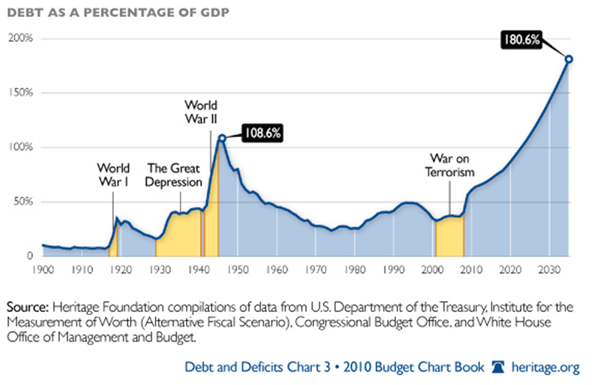
    The federal debt climbed above $13 trillion this month. An easier way to define the national debt is to comprehend that we each owe more than $39,000 to the Chinese, Japanese, and Arabs of the Persian Gulf. The budget deficit will exceed $1.5 trillion this year and forty-seven states are running deficits. California has a $19 billion deficit and its legislature’s landmark response was to pass a law banning plastic bags. Our cities are in worse shape. The former mayor of Los Angeles, Richard Riordan, says that a bankruptcy by that city is inevitable. At the same time, the United States’ Congress voted themselves a 5.8% pay increase. It is no wonder why Americans are nervous.

    Americans are stressed out because of debt, according to an Associated Press-GfK poll. They are trimming their debt at the fastest rate in more than six decades, according to the Federal Reserve. The average amount owed on credit cards is $3,900, the poll said. That’s down from $5,600 last fall and $4,900 last spring. Household debt fell 1.7 percent last year to $13.5 trillion, according to the Fed. It was the first annual drop, based on records going back to 1945. As Americans get their own house in order, the approval rating for Congress has fallen to an all time low. The public will likely make them pay for their angst in November.

    The American people are about a year ahead of the politicians. The spending by Washington, Sacramento, Los Angeles, and by politicians in general, is unsustainable. The people understand that it must be changed. As Senator Tom Coburn (OK) told me last week, either we change our ways or they will be changed for us. Leaders like Senator Coburn will begin The Great Deconstruction. The nation can no longer afford the government it has created.

    The Department of Energy was created by President Carter in 1977 after an OPEC embargo caused gas lines and rationing. In 1977, America imported 33% of its oil. The DoE’s goal was to eliminate our dependence on imported oil. The DoE budget for 2010 was $26.4 billion. It employs 116,000 workers. We now import 66% of our oil. America can no longer afford such an inefficient bureaucracy. Bureaucracies like the DoE that have lost sight of their purpose must be deconstructed.

    Senator Coburn is preparing legislation to rescind $120 billion in 2010 spending by rescinding 2010 budget increases, consolidating 640 duplicative governmental agencies, returning unspent appropriations and cutting wasteful spending. A few examples:

    • Congress has a discretionary budget of $4.7 billion per year. They voted themselves a 6% increase in 2010. Coburn wants this increase rescinded for a saving of $250 million.
    • The Department of Education spends $64.2 billion per year. They spend $1 billion each year administering 207 separate programs at 13 different federal agencies to “encourage” students to take math and science.
    • The Department of Agriculture owns 57,523 buildings. More than 4,700, valued at $900 million, are vacant. Despite this vacant space they spend $193 million per year renting an additional 11 million square feet.

Our politicians have perfected the art of spending money, or as we now know, wasting money. Last year, they loaded spending bills with $11 billion of earmarks – after spending $860 billion on a Stimulus Bill. A new breed of politician, like Senator Coburn, will begin the long process of deconstruction.

There is precedent for deconstruction. In 1945, federal spending ballooned to $106 billion, $93 billion of which was for defense. The deficit jumped from $40 billion in 1938 to $253 billion in 1945. A Democrat President and a Republican Congress established the Commission on Organization of the Executive Branch of the Government in 1947. President Truman put a former Republican President, Herbert Hoover, in charge. It became known as the Hoover Commission. It created the structure of government that exists today and generated savings of $7 billion at the time. A total of 273 recommendations were presented to Congress in a series of nineteen separate reports. A 1955 study concluded that 116 of the 273 recommendations were fully implemented and that another 80 were mostly or partly implemented. By 1949, the federal budget had fallen to $40 billion.

It will come to be known as The Great Deconstruction because it must occur at every level of government. Federal spending is unsustainable. Moody’s is already speculating that we may lose our AAA rating. The states are in crisis with 46 in deficit. The press is referring the California as a “failed state” and “our Greece”. The $860 billion Stimulus Bill sent approximately 30% to the states to support their public employees. But it was a one-year fix. This year, the states are burning through their reserves and next year, they will be forced to cut services, raise taxes, or both. Connecticut, the wealthiest state on a per capita basis with personal income of $54,397 in 2009 (Department of Commerce) saw its Fitch rating lowered from AA+ to AA. Connecticut needs to borrow $956 million to close a budget gap this fiscal year and it borrowed $947.6 millionto cover last year’s deficit.

The cities are no better off with many states raiding their reserves. Many cities are exploring municipal bankruptcy, Chapter 9, as a way out of unsustainable contracts. The Great Deconstruction will take a decade or more. Like the Hoover Commission before it, this process will transform the role of government, and the image of government as it transforms the cost of the people’s business.

***************************************************

The Great Deconstruction is a series written exclusively for New Geography. Future articles will address the impact of The Great Deconstruction at the national, state, county and local levels.

Robert J. Cristiano PhD is the Real Estate Professional in Residence at Chapman University in Orange County, CA and Director of Special Projects at the Hoag Center for Real Estate & Finance. He has been a successful real estate developer in Newport Beach California for twenty-nine years.


Other works in The Great Deconstruction series for New Geography

The Great Deconstruction :An American History Post 2010 – June 1, 2010
The Great Deconstruction – First in a New Series – April 11, 2010
Deconstruction: The Fate of America? – March 2010

  • The Declining Human Footprint

    There are few more bankrupt arguments against suburbanization than the claim that it consumes too much agricultural land. The data is so compelling that even the United States Department of Agriculture says that “our Nation’s ability to produce food and fiber is not threatened” by urbanization. There is no doubt that agricultural production takes up less of the country’s land than it did before. But urban “sprawl” is not the primary cause. The real reason lies in the growing productivity of American farms.

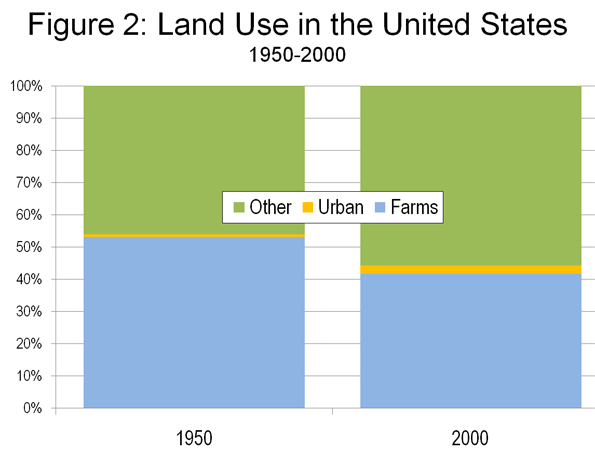
    Since 1950, an area the size of Texas plus Oklahoma (or an area almost as large as France plus Great Britain) has been taken out of agricultural production in the United States, not including any agricultural land taken by new urbanization (Note 1). That is enough land to house all of the world’s urban population at the urban density level of the United Kingdom.

    America’s Spectacular Agricultural Productivity

    Even with less land, agriculture’s performance has been stunning. According to US Department of Agriculture data, US farm output rose 160% between 1950 and 2008. Productivity per acre rose 260%. In particular , California’s farms – often cited as victims of sprawl – have done quite well. Between 1960 and 2004 (Note 2), the state’s agricultural productivity rose 2.3% annually and 3.0% per acre. By comparison national agricultural productivity rose less over the same period at 1.7% overall and 2.2% per acre.

    According to the United States Department of Agriculture, from 1990 to 2004 (latest data), California’s agricultural production rose 32% and on less farm land.

    Of course, there has been substantial reduction of farmland close to some metropolitan areas, but overall the impact of urbanization nationally has not been substantial. For example, since 1950:

    In addition, the nation’s agriculture is subsidized to the tune of more than $15 billion annually, which is strong evidence that more land is being farmed than is required. Subsidies increase the supply of virtually anything beyond its underlying demand. This can be illustrated by imagining how much less transit service there would be if it were not 80% subsidized. Suffice it to say, America is not threatened by “disappearing farmland.”

    America has less farmland because it has not needed as much as before to serve its customers. Thus, considerable farmland has been returned to a more natural state. Generally, this has got to be good for the environment. Land that is left to nature does not require fertilization, for example. The same interests that have frequently claimed that farmland has been disappearing also decry the loss of open space. In fact, the withdrawal of redundant farmland has produced considerable open space – call it open space sprawl.

    Repeat it Often Enough….

    None of this has kept “disappearing farmland” from being a rallying cry among those who would construct Berlin Walls around the nation’s urban areas. Yet the extent to which Bonnie Erbe of Politics Daily and National Public Radio embraced the fiction was surprising. Her “Vanishing Farmland: How It’s Destabilizing America’s Food Supply,” was accompanied by “meant to indict” photograph of farm equipment next to new suburban housing.

    Ms. Erbe’s principal source was a web page from the American Farmland Trust, which seeks to conserve farm land. In its California Agricultural Land Loss & Conservation: The Basic Facts, the American Farmland Trust argues for more “efficient” (i.e. denser) urbanization and claims that, “One-sixth…” (17%) “… of the land urbanized since the Gold Rush … has been developed since 1990.” That might be an impressive figure, if it were not that the state has added 7 million urban residents since 1990, which is one-fourth (25%) of all the urban population added since the Gold Rush and equal to the 1990 population of New York City.

    It is worth noting that California has agricultural preservation measures already in place for farm owners and, finally, that no one can compel an unwilling farm owner to sell their land to a developer or anyone else (except perhaps a government agency through eminent domain).

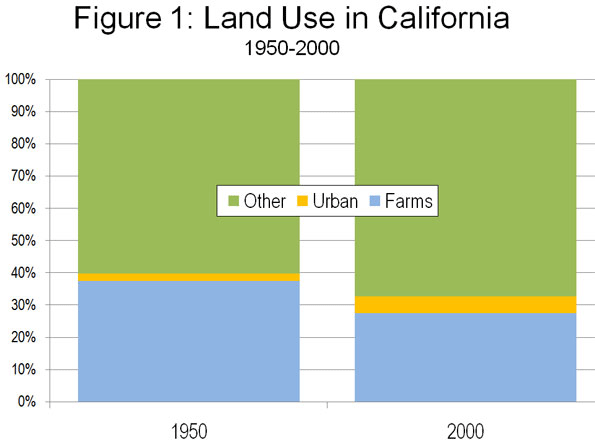
    In California, as elsewhere in the nation, urbanization has not been the principal cause of farm land reduction. According to the US Census of Agriculture, farmland declined in California from 2002 to 2007 by 2.2 million acres. That 5 year reduction in farmland is approximately equal to the expansion of all California urban areas over the 50 years between 1950 and 2000.

    Most Development is Not Urban

    In the same document, the American Farmland Trust indicates support for the radical urban land regulations. Policies such as in Sacramento’s Blueprint that raise significantly inflate the price of land, make housing less affordable. The agricultural, property and urban planning interests who would ration land for people and their houses have missed a larger targets such as ultra-low density “ranchettes” favored by a small wealthy minority who live in the country, but are not farmers.
    According to the US Department of Agriculture, rural, large lot residential development (non-agricultural) covered 40% more land than all of the nation’s urbanization in 2000. These parcels represent “scattered single houses on large parcels, often 10 or more acres in size.” Further, since 1980, the increase in this rural residential development has been one-third greater than the land area occupied by all of the urban areas in the nation with more than 1,000,000 population.

    Finally, if there is a serious threat to agriculture, it is from over-zealous regulation that has put farmers at risk. Water reductions in the San Joaquin Valley – mostly the result of environmental demands – likely have taken more land out of production than any sprawl-happy developer.

    Declining Human Footprint: An International Phenomenon

    The human footprint, as measured by the total urban and agricultural land has been declining for decades, both in the nation and California, where the greatest growth has occurred (Figure 1 & 2). The same is also true of Europe (EU-15), Canada and Australia, where all of the urbanization since the beginning of time does not equal the agricultural land recently taken out of production. Even in Japan, the human footprint has been reduced. It may be surprising, but human habitation and food production has returned considerable amounts of land to a more natural state in recent decades, while America’s urban areas were welcoming 99% of all growth since 1950.


    Note 1: This assumption represents the worst case, since not all land on which new urbanization was developed had previously been farmed.

    Note 2: State data is available only between 1960 and 2004.

    Photograph: Metropolitan Chicago, 2007 (Grundy County)

    Wendell Cox is a Visiting Professor, Conservatoire National des Arts et Metiers, Paris. He was born in Los Angeles and was appointed to three terms on the Los Angeles County Transportation Commission by Mayor Tom Bradley. He is the author of “War on the Dream: How Anti-Sprawl Policy Threatens the Quality of Life.

  • Dhaka’s Dangerous Development

    It has been a horrendous week in Dhaka, the capital of Bangladesh and the world’s most dense urban area (104,000 population per square mile/40,000 per square kilometer). On Tuesday, a five story residential building collapsed, killing 23 people in the building and in other structures in the path of the collapse. Then, on Thursday evening, a fire started on the lower floors of an 8-story residential building in the old town section of Dhaka. By the time it was controlled, 117 people had died and 8 buildings had been destroyed (link to Daily Star photo).

    Disastrous fires are an unfortunate fact of life in the hyper-dense informal settlements (shantytowns) that pervade large urban areas in developing countries. In April, 7,000 people were left homeless in a Manila shantytown fire (photo), while the homes of 4,000 families were destroyed in another Manila fire just three weeks later.

    While Dhaka has no shortage of shantytowns, this was not a shantytown fire. The bigger risk is the sprawl of high rise buildings (5 stories to 20 or more), which are home to most of the people who do not live in shantytowns. The Daily Star now reports in an article entitled, “Filled-up, Full of Risk” that much of the land is “reclaimed” and “marshy” in Dhaka and not suitable for multi-story buildings. Recent heavy rains have made the situation worse, and at least three additional buildings have begun to tilt since Tuesday’s collapse.

    Dhaka is built on one of the most challenging sites for an urban area. It sits on one of the world’s largest river deltas (the Ganges-Brahmaputra). The combined river course (called the Padma) is only miles to the west. Only 200 years ago, the Brahmaputra itself ran to the east of Dhaka and then changed course. This illustrates the instability of the riverine system, which completely surrounds the urban area with tributaries and river channels.

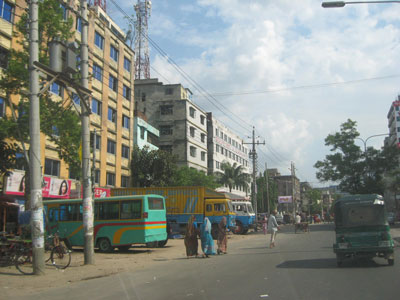
    A map produced in the Daily Star, illustrates the problem. The red areas are considered safe for building multi-story buildings. Virtually all of these areas are now developed. However, large sections of high rise buildings have been developed outside the red areas (see photo), especially between Mirpur and Gulshan. Virtually all of the areas that can be developed are unsuitable for high rises. With a population expected to rise from the current 10 million to 16 million by 2025, Dhaka needs room to grow. It will not be easy.

    Photo: Multi-story buildings between Mirpur and Gulshan

  • Toronto’s G-20 Conference: Financial Boon or Boondoggle?

    Ever since the ill fated 1999 WTO meeting in Seattle, there has been some debate over the merits of hosting meetings of international organizations in major cities. Some argue that there are economic spin offs from the tourism generated by these conferences, but others argue that the security costs far outweigh the benefits. In the lead up to the G-20 meeting in Toronto, scheduled for June 26-27, there has been a flurry of controversy over the price tag for conference security. The combined security tab for the G-8 and G-20 could end up as high as $900 million dollars (Canadian). The tourism industry does have the potential to reap some gains from the G20.

    The best case scenario for the industry would see 50,000 rooms booked for the conference. Unsurprisingly, Greater Toronto Hotel Association’s Terry Mundell is excited. “It’s a good news story for us,” he claims. If we assume (optimistically) that each room goes for $300/night, the hotel industry could make $30 million out of the deal. On top of this, people will obviously be spending money while they’re in town. Let’s assume that these 50 thousand people consume 4 meals/day at $100/person. This would be a cool $40 million for the restaurant industry. Maybe these folks will have a few drinks. Let’s budget in $100/night. After all, these are affluent folks. That’s $10 million for the bars. Maybe a few souvenirs to bring back for the kids? Let’s say another $10 million. And what if they need some Tylenol? Toothbrushes? Toss in another $10 million. We’re up to about $100 million in direct economic benefits. But wait, people need to get to Toronto, and to get around the city. We’ll be generous and throw in $100 million for airfare, though the benefits of this are not entirely injected into the Canadian economy. Add to that $100/day in cabs, and we have another $10 million. This brings the grand total to $210 million. Far from negligible. Unfortunately, that’s about double the official estimate of $100 million. Like I said, this is a best case scenario.

    On the cost side of the ledger, it is important to note that the costs will be divided between the G-20 Conference in Toronto, and the G-8 conference in Huntsville, 2 ½ hours north of the city. Let’s be extremely generous and assume it is an even split. Of the $833 million already announced, we’ll say $400 million is going to the Toronto conference. This still leaves us with a shortfall of $190 million, even under an extremely optimistic scenario.

    Here’s the bad news: even under the optimistic scenario, we still haven’t factored in opportunity costs. So far it has been confirmed that three Blue Jays games will be moved to Philadelphia, and the University of Toronto will shut down during the conference. In anticipation of former Jays star pitcher Roy Halliday’s first return to Toronto, the team had budgeted for 90,000 fans to attend. At an average revenue of $39/fan, that’s a loss of $3.5 million dollars. It’s hard to say how many fans would have come into the city from out of town, but it wouldn’t be at all unrealistic to say that the city is going to lose at very least another $3.5 million in spin offs.

    Even without any similar cancellations, Seattle business managed to lose at least $10 million in revenue as a result of the WTO meeting in 1999 (not to mention the $2 million in property damage). Furthermore, if the G-20 wasn’t going to be in Toronto, we don’t know how many hotel rooms would have been rented out for other events, or whether the conference goers will crowd out other patrons from restaurants. This is the difficulty with these types of estimates. They take into account the benefits that we see, but not the unseen opportunity costs. It’s hard to count a family that decided not to to Toronto for recreation or a cultural event because they want to avioid crowds or inflated room rates.

    One might argue that the short term costs will be mitigated by long term benefits. After all, some people might like the city so much that they’ll want to visit again. Perhaps some number of people will even want to move to the city. I had a similar experience during the G-20 in Pittsburgh last year (though haven’t followed through). If we look at it this way, any shortfall could be seen as a tourism advertising expense. Will this pay off in the long run? Unfortunately it is impossible to tell.

    So let’s assume that the shortfall for the conference is $200 million dollars. That seems pretty reasonable at this point. Let’s further assume that there will be a non-trivial long term tourism benefit to the city. In fact, let’s assume they make it all back. I still don’t buy into the idea of holding major international political conferences in major cities.

    Here’s why. There is an enormous inconvenience to city residents, which will likely include many people being caught up in violent protests and police retaliation. No one should have to get tear gassed in the name of boosting tourism. I was in Pittsburgh during the last G-20 meeting when stores were being smashed in, and the police were gassing protesters. Given that I was wise enough to stay away from the protests, I didn’t personally witness the chaos. Having said that, there is plenty of footage showing the violent clashes between protesters and police. After Seattle, London, Pittsburgh, and many other cities have endured chaos during these conferences, politicians should have learned their lesson. Forget tourism dollars. These conferences are about solving major economic problems. The G-8 meeting is being held in tiny Huntsville, where the G-20 originally was supposed to be held. That’s how it should be.

    It’s easier to import police to a small town than evacuate the downtown of a major city. Unfortunately, governments have not learned from history They seem determined to let their citizens pay the price for their cherished few days in the sun.

    Steve Lafleur is a public policy analyst and political consultant based out of Calgary, Alberta.

    Photo by Sweet One

  • Can Europe’s Economy Turn Around If Its Great Cities Continue To Wither?

    Europe’s Greece crisis has turned the world’s attention to the continent’s fundamental flaw: burgeoning public spending and sluggish growth in some of its national economies.

    To the extent that Europe’s more economically fragile countries cannot fix this flaw, Europe poses a global financial risk as toppling EU countries cannot meet their obligations and those left standing cannot prop them up. Only fiscal discipline and boosting growth can save Europe in the long-run.

    And for this reason, we ought to worry about Europe’s cities. Why? Because as large cities increasingly drive national economies in our rapidly urbanizing global community, Europe’s urban growth patterns look alarmingly tepid.

    Around the world, people are clustering together faster than ever at a time when it seems technology should allow them to disperse more easily than ever. As it turns out, innovation and a growing services sector flourish best when lots of people and firms are geographically proximate. Ideas, knowledge and valuable skills are transferred more easily in denser areas.

    There is a direct relationship between economic competitiveness in the 21st century and the growth of metropolitan areas. But Europe’s cities show signs of trouble. They have almost entirely lost the momentum that has driven European pre-eminence for the past 200 years.

    In 1800, only 3% of the world’s population lived in urban areas, and the only Western cities among the world’s 10 largest urban areas were London and Paris. Neither had a population greater than 1 million. Just 100 years later, though, nine of the world’s 10 largest cities were in the West — with four of the top six located in Europe, propelled by their economic predominance through industrialization.

    Other countries followed the model. By the mid-20th century, 30% of the world’s population lived in urban areas, a considerable increase since 1800. But that was only the beginning of an explosive era in urbanization. Between 1960 and 2000, the number of people living in cities worldwide skyrocketed to 3 billion from 750 million.

    Currently, the world’s largest 100 cities generate 25% of global GDP, a figure that will continue to rise over the next few decades — and which will increasingly exclude Europe’s cities.

    Asia and Africa, often regarded poetically as agrarian societies, are leading the global urbanization boom. Today, London is the only European city among the world’s largest 20 metropolitan areas. Paris is 22nd. Among the top 25 cities, they are two of the three slowest-growing areas.

    Late-20th century growth has been driven almost entirely by suburban expansion around core cities. Nevertheless, central cities worldwide have added population on average over the past half century — except in Europe. It is the only continent where core cities have lost population over the past 45 years. While its suburban growth has kept its metropolitan areas growing overall, its net urbanization rate since 1965 is the slowest worldwide.

    Because developed countries are already highly urbanized, their metropolitan areas grow more slowly than those in emerging economies. But Europe’s rate is unusually slow compared to its peer group of developed nations.

    Europe’s main metropolitan areas grew just 28% since 1965, a period during which the United States essentially doubled its urban population. Australia and New Zealand have seen urbanization rates of 90% during the same period. Worldwide, the growth average in urban areas has been 135% since 1965.

    Europe is the only continent with cities growing at less than 1% annually. In Eastern Europe, the growth rate is actually negative. Some cities, such as Munich and Warsaw, have grown at respectable rates and mitigate Europe’s well-known population decline problems. For instance, each city grew between 2000 and 2010, while Germany and Poland each contracted as a whole.

    However, urban growth rates in Europe will likely stay low in coming years, which raises questions about whether Europe’s economy will continue to grow enough to help the continent out of its present troubles.

    European leaders’ disconnect with this important reality was on display several weeks ago when the European Commission chose to announce major carbon emissions in 500 cities at the same time its finance ministers were structuring the massive Greece bailout.

    However important greening urban areas may be, if Europe should be doing anything with its cities these days, it should be figuring out how to put them at the forefront of its economic recovery. The European habit of implementing growth-inhibiting policies — especially in its cities — has to change if the continent hopes to have a prosperous future.

    Given the increasingly metropolitan nature of economic growth around the globe, the health and vitality of Europe’s cities will be key to the continent’s future prosperity. Policymakers need now more than ever to ask serious questions about the origins of future growth. To answer those questions, they need to pay serious attention to their cities.

    This article first appeared at Investors Business Daily.

    Ryan Streeter is a senior fellow at the London-based Legatum Institute, an independent, nonpartisan organization that researches and advocates an expansive understanding of global prosperity.

  • The Suburban Exodus: Are We There Yet?

    For many years, critics of the suburban lifestyles that most Americans (not to mention Europeans, Japanese, Canadians and Australians) prefer have claimed that high-density housing is under-supplied by the market. This based on an implication that the people increasingly seek to abandon detached suburban housing for higher density multi-family housing.

    The Suburbs: Slums of the Future?

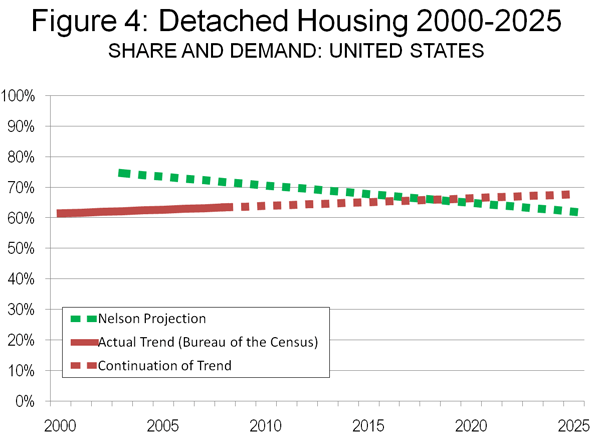
    The University of Utah’s Arthur C. (Chris) Nelson, indicated in an article (entitled “Leadership in a New Era“) in the Journal of the American Planning Association. that in 2003, 75% of the housing stock was detached and 25% was attached, including townhouses, apartments, and condominiums. By 2025 he predicts that only 62% of consumer will favor detached homes, (Note 1). He also predicts a major shift in consumer preferences from housing on large lots (defined as greater than 1/6th of an acre) to smaller lots (Note 2). This, he suggests, would create a surplus of 22 million detached houses on large lots.

    This predication is largely made on the basis of “stated preference” surveys which the author, Dr. Emil Malizia of the University of North Carolina (commenting on the article in the same issue), and others indicate may not accurately reflect the choices that consumers will actually make. Dr. Nelson’s article has been widely quoted, both in the popular press and in academic circles. It has led some well-respected figures such as urbanist and developer Christopher Leinberger to suggest in an Atlantic Monthly article that “many low-density suburbs and McMansion subdivisions, including some that are lovely and affluent today, may become what inner cities became in the 1960s and ’70s—slums characterized by poverty, crime, and decay.”

    The Condo Market Goes Crazy

    Misleading ideas sometimes have bad consequences. The notion that suburbanites were afflicted with urban envy led many developers to throw up high-rise condominiums in urban districts across the country. Sadly for these developers, the Suburban Exodus never materialized, never occurred. As a result, developers have lost hundreds of millions, if not billions of dollars and taxpayers or holders of publicly issued bonds could be left “holding the bag” (see discussion of Portland, below).

    This weakness has been seen even in the nation’s strongest condominium market, New York City, where one developer offered to pay purchaser’s mortgages, condominium fees and real estate taxes for a year as well as closing costs.

    But the damage is arguably worse in other major markets which lack the amenities and advantages of New York.

    Take, for example, Raleigh (North Carolina), where low density living is the rule (the Raleigh urban area is less dense than Atlanta). The News and Observer reports that the largest downtown condominium building (the Hue) “considered a bold symbol of downtown Raleigh’s revitalization,” has closed its sales office and halted all marketing efforts. The development’s offer of a free washing machine, dryer, refrigerator, and parking space were not enough to entice suburbanites away from the neighborhoods they were said to be so eager to leave.

    This is not an isolated instance. Around the nation, condominium prices have been reduced steeply to attract buyers. New buildings have gone rental, because no one wanted to buy them. Other buildings have been foreclosed upon by banks; and units have been auctioned. Planned developments have been put on indefinite hold or cancelled.

    Miami: Of Little Dubai and Cadavers

    Miami’s core neighborhood (downtown and Brickell, immediately to the south) has experienced one of the nation’s most robust condominium building booms. More than 22,000 condominium high rise units were built between 2003 and 2008. Miami could well have more 50-plus story condominium towers than any place outside Dubai.

    As a result, Miami has suffered perhaps the most severe condominium bust in the nation. According to National Association of Realtors data, the median condominium price in the Miami metropolitan area has dropped 75% from peak levels (2007, 2nd Quarter). By comparison, the detached housing decline in the metropolitan area was 50%; the greatest detached housing price decreases among major metropolitan areas were from 52% to 58% (Riverside-San Bernardino, Sacramento, San Francisco and Phoenix).

    The most recent report by the Miami Downtown Development Authority indicates that 7,000 units still remain unsold. The Brickell area is home to the greatest concentration and largest buildings and has the highest ratio of unsold units at 40%.

    Icon Brickell (see photograph above) may be the largest development in the core. Icon Brickell consists of three towers, at 58, 58 and 50 floors and a total of nearly 1,800 units. Despite opening in 2008 and offering discounts of up to 50%, barely one-third (approximately 620) of the units have been sold, according to the Daily Business Review, which also reported on May 13 that the developer had transferred control of two of the towers to construction lenders.

    One building, Paramount Bay, was referred to by The New York Times as a “47-story steel and glass cadaver” with a lobby “like a mortuary.” A real estate site indicates that only one of the buildings 350 units has been sold.

    More recently sales have inched up in the core but due not to any suburban exodus. According to The Miami Herald, huge discounts that have lured Europeans, Canadians, and Latin Americans to the core. The real estate and consulting firm Condo Vultures notes that more than 1,000 of the sales are to a few bulk buyers, a market segment some might refer to as “speculators.”

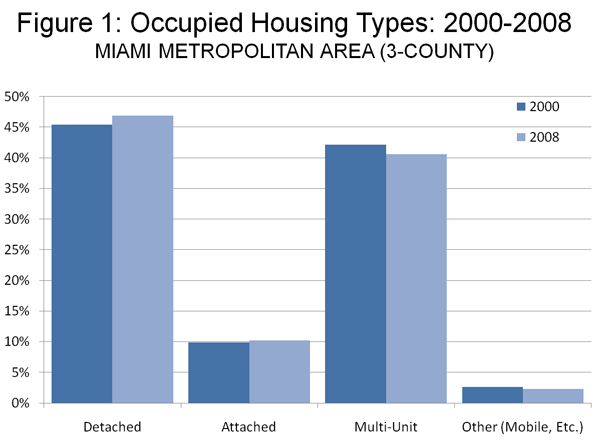
    The latest data from the US Bureau of the Census confirms that there is no fundamental shift away from detached housing in the Miami area, as housing trends point toward more detached housing. In 2000, 48.1% of residents in the Miami metropolitan area lived in detached housing. By 2008, the figure had risen to 49.2% (Figure 1). Essentially, the Suburban Exodus remains a mirage.
    Portland: Gift Certificates for Distressed Developers

    If developer greed was the motive in Miami, government subsidies have been the driving force in Portland. The city of Portland will soon have issued nearly $450 million in urban renewal bonds, provides 10-year tax property tax forgiveness, and reduced development fees, which the Portland Development Commission (PDC) has called “gift certificates” for developers (Note 3).

    Gift certificates have not been enough to cure Portland’s sickly downtown condominium market. The Oregonian reported that prices were down, on average, 30% over the year ended the first quarter of 2010. Remarkably prices in the much ballyhooed Pearl District are plummeting even more than those in the rest of the Portland area. According to DQ News, the median sale price of a house in the Pearl District dropped four times the average in Multnomah County and an even greater six times decline relative to suburban counties over the past year.

    There is more. Just this year, the Pearl District has seen its Eddie Bauer, Adidas, and Puma stores close.

    One condominium building the Encore, is reported to have sold only 17 of 177 units. A recent auction of units at the largest building in the city, the John Ross brought prices “far below the replacement cost” according to The Oregonian’s Ryan Frank, who noted that “it will likely be years before there’s a new high-rise condo built.” Late last year, the Pearl District’s Waterfront Pearl was reported to have sold only 31% of its units and had not sold a unit for a year.

    The Portland Development Commission itself has become part of the condominium bust story. PDC had indicated it was considering relocating its offices to a new 32-story mixed use tower (Park Avenue West), which was to have included condominiums, offices, and retail stores. For more than a year, the proposed 32-story tower has been an unsightly hole in the ground, with construction suspended. PDC decided to stay put in its older, less expensive offices. Even before PDC decided not to locate in Park Avenue West, the developers eliminated the plans for 10 floors of condominiums, doubtless because it made no economic sense to add to an already flooded market.

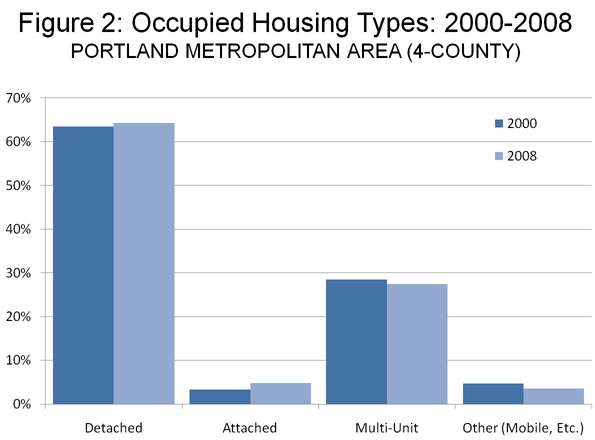
    In Portland, like in Miami, the fact remains that suburbia has not been abandoned. Despite the high density over-building in the Pearl District and elsewhere in the core, detached housing has become even more popular in the region. According to data from the Bureau of the Census, the share of households living in detached housing in the Portland metropolitan area rose from 63.7% in 2000 to 64.5% in 2008 (Figure 2).
    High-Rise Condos: Slums of the Future?

    To say that the high-rise condominium market has fallen on hard times would be an understatement. The condo bust in New York has become so acute that Right to the City, a coalition of community organizations has called upon “the City to acquire the tax delinquent buildings through tax foreclosure and convert vacant units into permanently affordable housing for low-income New Yorkers.” In a report entitled People without Homes and Homes without People: A Count of Vacant Condos in Select NYC Neighborhoods, Right to the City points out that there are more than 4,000 empty condo units in 138 buildings, with owners delinquent on nearly $4 million in taxes to the city.

    Owners of new condominiums around the nation who paid pre-bust prices for their units may not be inclined to stay around if they are surrounded by less affluent renters who have been attracted by desperate building owners and lenders.

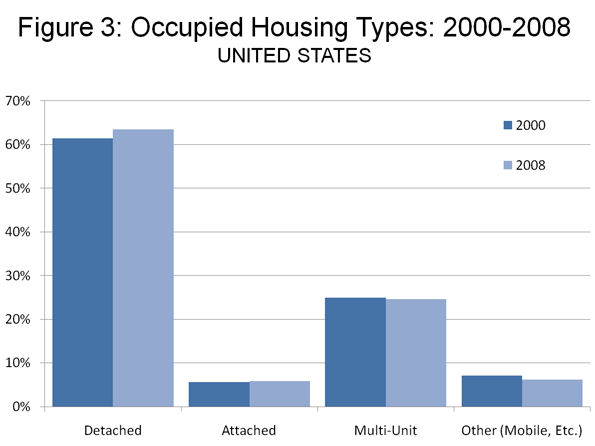
    Are these dark towers of discounting the slums of tomorrow? Only the data and time will tell and it’s too early to know, but preliminary findings show little of the predicted shift toward higher density living (Figure 3). Certainly national data indicates, if anything, a slightly strengthening market for detached, rather than attached housing (Figure 4).

    • Between 2000 and 2008, the share of households living in detached housing rose from 61.4% to 63.5%.

    • A similar trend is shown by the national building permits data. Between 2000 and 2009, 75.2% of residential building permits in the United States were for detached housing. This is up strongly from 69.6% in the 1990s and nearly equals the highest on record (the 1960s), when 77.7% of residential building permits (housing units) were detached houses.
    Looking at the data, there remains little evidence that the stated preferences on which the predictions relied have been translated into the reality of a shift in preferences toward smaller lots in cores or inner ring suburbs. Domestic migration continues to be strongly away from core counties to more suburban counties. Core cities are growing less quickly than suburban areas. Exurban areas are growing faster than central areas, including inner suburbs.

    Clearly, the Suburban Exodus has not begun and there is little reason to believe that it will anytime soon.


    Note 1: In estimating the 2003 share of detached housing (75%), Dr. Nelson uses “one-unit structures” data from the 2003 American Housing Survey Table 2-3. US Bureau of the Census American Housing Survey personnel responded to my request for clarification, indicating that “one-unit structures” includes … single detached housing units, mobile homes, and single attached housing units (such as a townhouse).” Thus the 75% detached estimate is high because it includes mobile homes and single attached housing. As is indicated above, data from the US Bureau of the Census data indicates that the share of detached housing of detached plus attached housing in 2000 was 61.4%. This figure, coincidentally, is virtually the same as the 62% Dr. Nelson predicts for 2025.

    Note 2: The assumption that consumers prefer small lot detached housing may not be sufficiently robust and may even be exaggerated. Dr. Nelson appears to principally rely on research by Myers and Gearin (2001) (in the journal Housing Policy Debate) for concluding that consumers prefer small lot rather than larger lot detached housing, defining small lot development as 1/6th of an acre or less or less than 7,000 square feet. Yet neither figure appears in Myers and Gearin. Moreover, a National Association of Home Builders commenter (also in Housing Policy Debate) questions how its data was characterized by Myers and Gearin in justifying a finding of preference for smaller lots (the survey is unpublished). Without access to the original surveys referenced in Myers and Gearin, it is impossible to judge what respondents may have had in mind as the dividing line between large lots and small lots.

    Note 3: This characterization was on the Portland Development Commission website (accessed January 2, 2007). It was cited in our report, Zero Sum Game: The Austin Streetcar and Development and subsequently removed from the website. A large share of Portland’s urban renewal bonds are insured by Ambac Financial Corporation, which has reported losses exceeding $1 billion in the last two quarters. Ambac indicated that it has “insufficient capital to finance its debt service and operating expense requirements beyond the second quarter of 2011 and may need to seek bankruptcy protection.” Ambac was the insurer of State of Nevada bonds to build the Las Vegas Monorail, which has already entered bankruptcy and is unable to pay its bonds.

    Wendell Cox is a Visiting Professor, Conservatoire National des Arts et Metiers, Paris. He was born in Los Angeles and was appointed to three terms on the Los Angeles County Transportation Commission by Mayor Tom Bradley. He is the author of “War on the Dream: How Anti-Sprawl Policy Threatens the Quality of Life.

    Photo: Icon Brickell, Miami

  • The Future Of America’s Working Class

    Watford, England, sits at the end of a spur on the London tube’s Metropolitan line, a somewhat dreary city of some 80,000 rising amid the pleasant green Hertfordshire countryside. Although not utterly destitute like parts of south or east London, its shabby High Street reflects a now-diminished British dream of class mobility. It also stands as a potential warning to the U.S., where working-class, blue-collar white Americans have been among the biggest losers in the country’s deep, persistent recession.

    As you walk through Watford, midday drinkers linger outside the One Bell pub near the center of town. Many of these might be considered “yobs,” a term applied to youthful, largely white, working-class youths, many of whom work only occasionally or not at all. In the British press yobs are frequently linked to petty crime and violent behavior–including a recent stabbing outside another Watford pub, and soccer-related hooliganism.

    In Britain alcoholism among the disaffected youth has reached epidemic proportions. Britain now suffers among the highest rates of alcohol consumption in the advanced industrial world, and unlike in most countries, boozing is on the upswing.

    Some in the media, particularly on the left, decry unflattering descriptions of Britain’s young white working class as “demonizing a whole generation.” But many others see yobism as the natural product of decades of neglect from the country’s three main political parties.

    In Britain today white, working-class children now seem to do worse in school than immigrants. A 2003 Home Office study found white men more likely to admit breaking the law than racial minorities; they are also more likely to take dangerous drugs. London School of Economics scholar Dick Hobbs, who grew in a hardscabble section of east London, traces yobism in large part to the decline of blue-collar opportunities throughout Britain. “The social capital that was there went [away],” he suggests. “And so did the power of the labor force. People lost their confidence and never got it back.”

    Over the past decade, job gains in Britain, like those in the United States, have been concentrated at the top and bottom of the wage profile. The growth in real earnings for blue-collar professions–industry, warehousing and construction–have generally lagged those of white-collar workers.

    Tony Blair’s “cool Britannia,”epitomized by hedge fund managers, Russian oligarchs and media stars, offered little to the working and middle classes. Despite its proletarian roots, New Labour, as London Mayor Boris Johnson acidly notes, has presided over that which has become the most socially immobile society in Europe.

    This occurred despite a huge expansion of Britain’s welfare state, which now accounts for nearly one-third of government spending. For one thing the expansion of the welfare state apparatus may have done more for high-skilled professionals, who ended up nearly twice as likely to benefit from public employment than the average worker. Nearly one-fifth of young people ages 16 to 24 were out of education, work or training in 1997; after a decade of economic growth that proportion remained the same.

    Some people, such as The Times’ Camilla Cavendish, even blame the expanding welfare state for helping to create an overlooked generation of “useless, jobless men–the social blight of our age.” These males generally do not include immigrants, who by some estimates took more than 70% of the jobs created between 1997 and 2007 in the U.K.

    Immigrants, notes Steve Norris, a former member of Parliament from northeastern London and onetime chairman of the Conservative Party, tend to be more economically active than working-class white Britons, who often fear employment might cut into their benefits. “It is mainly U.K. citizens who sit at home watching daytime television complaining about immigrants doing their jobs,” asserts Norris, a native of Liverpool.

    The results can be seen in places like Watford and throughout large, unfashionable swaths of Essex, south and east London, as well as in perpetually depressed Scotland, the Midlands and north country. Rising housing prices, driven in part by “green” restrictions on new suburban developments, have further depressed the prospects for upward mobility. The gap between the average London house and the ability of a Londoner to afford it now stands among the highest in the advanced world.

    Indeed, according to the most recent survey by demographia.com, it takes nearly 7.1 years at the median income to afford a median family home in greater London. Prices in the inner-ring communities often are even higher. According to estimates by the Centre for Social Justice, unaffordability for first-time London home buyers doubled between 1997 and 2007. This has led to a surge in waiting lists for “social housing”; soon there are expected by to be some 2 million households–5 million people–on the waiting list for such housing.

    With better-paid jobs disappearing and the prospects for home ownership diminished, the traditional culture of hard work has been replaced increasingly by what Dick Hobbs describes as the “violent potential and instrumental physicality.” Urban progress, he notes, has been confused with the apparent vitality of a rollicking night scene: “There are parts of London where the pubs are the only economy.”

    London, notes the LSE’s Tony Travers, is becoming “a First World core surrounded by what seems to be going from a second to a Third World population.” This bifurcation appears to be a reversion back to the class conflicts that initially drove so many to traditionally more mobile societies, such as the U.S., Australia and Canada.

    Over the past decade, according to a survey by IPSOS Mori, the percentage of people who identify with a particular class has grown from 31% to 38%. Looking into the future, IPSOS Mori concludes, “social class may become more rather than less salient to people’s future.”

    Britain’s present situation should represent a warning about America’s future as well. Of course there have always been pockets of white poverty in the U.S., particularly in places like Appalachia, but generally the country has been shaped by a belief in class mobility.

    But the current recession, and the lack of effective political response addressing the working class’ needs, threatens to reverse this trend.

    More recently middle- and working-class family incomes, stagnant since the 1970s, have been further depressed by a downturn that has been particularly brutal to the warehousing, construction and manufacturing economies. White unemployment has now edged to 9%, higher among those with less than a college education. And poverty is actually rising among whites more rapidly than among blacks, according to the left-leaning Economic Policy Institute.

    You can see the repeat here of some of the factors paralleling the development of British yobism: longer-term unemployment; the growing threat of meth labs in hard-hit cities and small towns; and, most particularly, a 20% unemployment rate for workers under age 25. Amazingly barely one in three white teenagers, according to a recent Hamilton College poll, thinks his standard of living will be better than his parents’.

    It’s no surprise then that Democrats are losing support among working-class whites, much like the now-destitute British Labour Party. But the potential yobization of the American working class represents far more than a political issue. It threatens the very essence of what has made the U.S. unique and different from its mother country.

    This article originally appeared in Forbes.com.

    Joel Kotkin is executive editor of NewGeography.com and is a distinguished presidential fellow in urban futures at Chapman University. He is author of The City: A Global History. His newest book is The Next Hundred Million: America in 2050, released in Febuary, 2010.

    Photo by MonkeyBoy69

  • Racing China: The Australia Housing Bubble

    “The writing is on the wall for the Australian dream,” according to Professor Joe Flood at the Flinders University Institute for Housing, Urban and Regional Research. That was before recent predictions that Australia’s overheated housing market may be headed for even higher prices. Real estate experts have recently predicted a doubling of house prices in all five of the largest metropolitan areas over the next decade.

    Sydney, the largest metropolitan area, according to Australian Property Monitors (APM), can be expected by 2019 to experience a median house price increase to $1.124 million in 2019. This would double the 2009 figure of $569,000 (Note). Sydney is already the second most unaffordable metropolitan area in the English speaking world , according to our Demographia International Housing Affordability Survey, with a Median Multiple (median house price divided by median household income) of 9.1, trailing only Vancouver. Sydney’s higher priced housing has been blamed for stunting economic growth and job creation and appears to be a major factor in the continuing migration out of the state of New South Wales. One of Australia’s leading demographers, Bernard Salt, has projected that Sydney could fall to second largest in the nation, behind Melbourne in less than 20 years.

    Melbourne median house prices are also expected to rise above $1.1 million according to projections by property expert Michael Yardney. This would represent more than twice the $480,000 price in 2009.

    Brisbane, which has generally been less unaffordable than Sydney, would have a median house price equal to that of Sydney by 2019. This is more than double the 2009 price of $430,000.

    Perth would experience the greatest house price inflation, also rising to above $1 million, compared to the 2009 figure of $460,000.

    Adelaide would also see house prices rise to more than $1.2 million, according to APM. In 2009, the median house price in Adelaide was $370,000.

    Australia’s Race with China: Recent data indicates that prices are rising furiously toward the doubling the experts have projected. The Australian Bureau of Statistics (ABS) House Price Index indicates that prices have risen 20% over the past year. This is more than 1.5 times the 12% annual rate posted in China’s house price bubble that has its government and so many of the world’s leading economists so concerned.

    As of the 1st quarter, the greatest annual price inflation was in Melbourne, at 28%, a rate that would place it 3rd out of 70 metropolitan areas if it were in China. Prices in Sydney were up 21% from a year ago, which would also rank it 3rd out of 70 in China. At this rate, Sydney could become less affordable than Vancouver within six months and could even surpass high-priced Hong Kong. Brisbane, Adelaide and Perth all experienced price increases between 10% and 15%, and would all place in the top 20 out of 70 Chinese metropolitan areas.

    ABS indicated that the house prices increased more than in any other annual period in the 8 year history of its House Price Index. According to the Wall Street Journal’s Marketwatch, Economist Glenn Maguire of SocGen Asia Pacific in Hong Kong said “These are bubble like numbers … It’s the type of return that basically encourages speculation.” Marketwatch also predicted, on the basis of the house price trend, that the Reserve Bank of Australia (RBA) would raise interest rates, which it did a day later.

    Working for the Mortgage: Meanwhile, because variable rate mortgage loans predominate in Australia, the interest rate increase places an immediate burden on thousands of Australian households. The Housing Industry Association indicates that interest rate increases over the past six months will result in a first-home buyer mortgage payment increase of more than $300 per month.

    This is not good news for the large numbers of households already in mortgage stress, defined by the government when 35% or more of the budget goes to housing expenses. Just six months ago, a median income household purchasing the median income house in Sydney or Melbourne would have had mortgage payments that consumed 50% to 57% of their gross income. Now, the figure would be 60% to 67%. Needless to say, the median priced house is well beyond the means of the median income household. By contrast, if Melbourne and Sydney had the same housing affordability as faster growing Atlanta and Dallas-Fort Worth, the median income household would pay at least $25,000 less in annual mortgage payments for the median priced house.

    Rigging the Market: The housing affordability crisis is the direct result of excessive land use regulations that have artificially limited the supply of land, driving up house prices and fostering speculation. Before these regulations (called “urban consolidation” or “smart growth”) were adopted, housing was as affordable in Australia as in Atlanta or Dallas-Fort Worth. Median Multiples across the nation were 3.0 or below. Now the Median Multiple is between 6.7 and 9.1 in the five largest metropolitan areas. Analysts often suggest that Australia’s population growth rate is driving up prices. While Australia is growing, it grew faster over the 20 years following World War II, and still accommodated a quickly increasing home ownership share. Further, much faster population growth in Dallas-Fort Worth and Atlanta has not driven prices up. Since 2000, these two American metropolitan areas added 40% more population than the five largest Australian metropolitan regions, despite having a smaller combined population.

    This also impacts the other side of the housing equation, the ability of consumers to afford mortgages. The Urban Task Force says that Sydney’s especially onerous regulations have driven up the price of consumer goods while dampening income and employment growth. Australian Property Monitors economist Matthew Bell says that the answer to the housing affordability problem is to increase the supply of housing, a view shared by the Reserve Bank of Australia. The political reality, however, suggests that “The shortages are going to get much, much worse in Sydney” as Jason Anderson, a senior economist with BIS Shrapnel told Agence France-Presse.

    Professor Flood noted that “The country that promised limitless land, cheap housing and near universal home ownership to all comers now has the most expensive housing in the world amid very tight housing and land markets and little prospect of restoring the balance.” Flood’s research indicates a dramatic decrease in home ownership among younger households over the past 20 years.

    Alternate Futures

    Not everyone thinks that house prices can continue their stratospheric rise. US investment expert Edward Chancellor believes that the housing market is overdue for a price collapse, noting that house prices are well above historic measures. Chancellor won the George Polk award for his 2007 article Ponzi Nation, which warned of the housing collapse in the United States and the international damage that could follow. Of course, a housing collapse in Australia would have much less impact on international markets than the one that rocked the much larger US economy, but could do great damage at home.

    The good news is that house prices could be brought under control if there was a change in policy. The state government of Victoria (Melbourne is the capital) is about to significantly expand its “urban growth boundary, allowing more house construction and lower new house prices. Policies such as these could provide a preferable soft landing for the housing market. But this would require state and local governments finally to turn their backs on 20 years of devastating social engineering.


    Note: The Australian dollar is currently worth about US$0.90. The latest (2008) data indicates that Australia had a gross domestic product of $37,400 per capita (purchasing power parity), which compares to $46,500 in the United States, according to the OECD.

    Wendell Cox is a Visiting Professor, Conservatoire National des Arts et Metiers, Paris. He was born in Los Angeles and was appointed to three terms on the Los Angeles County Transportation Commission by Mayor Tom Bradley. He is the author of “War on the Dream: How Anti-Sprawl Policy Threatens the Quality of Life.

    Photograph: Detached housing conforming to plan in suburban Perth

  • Twenty-first Century Electorate’s Heart is in the Suburbs

    Even as the nation conducts its critically important decennial census, a demographic picture of the rapidly changing population of the United States is emerging. It underlines how suburban living has become the dominant experience for all key groups in America’s 21st Century Electorate.

    While suburban living was once seen as the almost exclusive preserve of the white upper-middle class, a majority of all major American racial and ethnic groups now live in suburbia, according to the newest report on the state of metropolitan America from the Brookings Institute. Slightly more than half of African-Americans now live in large metropolitan suburbs, as do 59% of Hispanics, almost 62% of Asian-Americans, and 78% of whites. As a result the country is closer than ever to achieving a goal that many thought would never be achieved: city/suburban racial/ethnic integration. This is particularly so in the faster growing metropolitan areas of the South and West.

    The trend is likely to continue for the foreseeable future. A majority of Millennials live in the suburbs and 43% of them, a portion higher than for any other generation, describe suburbs as their “ideal place to live.”

    The nation’s one hundred largest metropolitan areas have grown twice as fast as the rest of the country in the last decade. That growth was heavily concentrated in lower density suburbs, which grew at three times the rate of cities or inner ring suburbs. At the same time, one third of the nation’s overall population growth was due to immigration. As a result about one-quarter of all children in the United States have at least one immigrant parent. In 2008, non whites became a majority of Americans less than eighteen years old, a demographic milestone that underlines just how fast and how dramatically the country is changing. Any political party that wants to build a lasting electoral majority must align its policy prescriptions with these new demographic realities to attract the votes of a younger, more ethnically diverse population, most of which now lives in the suburbs.

    Economic opportunity continues to be the major driver in determining where people want to live and work. Five of the six fastest growing metropolitan areas in the last decade were also among the top six in job growth according to data from the Census and the Bureau of Labor Statistics analyzed by the Praxis Strategy Group. The same five metropolitan areas – Phoenix, Riverside (CA), Dallas, Houston and Washington, D.C – also ranked high in the diversity of their population, differing only in the degree of educational attainment their residents have achieved.

    With America experiencing the first decade since the 1930s in which inflation adjusted median income declined and job creation slowed to levels not seen in decades, this movement to where the jobs are located is likely to intensify, as current migration to economically buoyant Texas cities and Washington, DC suggests. This crucial factor is often overlooked by urban planners who argue that cultural amenities and sport complexes are the key to attracting new residents. In fact, metropolitan areas that focus on job creation for Millennials (young Americans born 1982-2003) and minorities have the best chance of gaining population in the next decade.

    Clearly providing higher quality public education experiences is a key part of any such economic strategy. The arrival of stealth fighter parents at local school district meetings across the country only reflects the passion among young families about the quality of education their children receive. They are unwilling to allow Boomer ideological debates to delay the changes needed to properly prepare their children for a higher educational experience that increases the odds of economic success. The traditional separation between municipal partisan politics and nominally non-partisan schools is increasingly outdated when so much of a city’s economic success depends on the quality of the education its residents receive.

    Safe neighborhoods of single family dwellings with a surrounding patch of land continue to attract families of every background to the nation’s suburbs. Metropolitan areas that provide such an environment to all of their residents are the furthest along in achieving a more integrated society. Los Angeles, for instance, which is often decried by non-residents as simply an aggregation of suburbs with no central core, has a suburban population whose demographic profile almost exactly matches the city’s population. The fact that most of its housing reflects the tract developments of the 50s and 60s, as well as the city’s low crime rates – down to levels not seen in five decades – are two key reasons for this polyglot profile.

    Rather than fighting this desire on the part of America’s 21st Century Electorate to live comfortably in the suburbs, politicians of all stripes should find ways to embrace it and advocate policies that reflect our new economic realities. For instance, rather than insisting on higher density housing and light rail systems as the only answer to the nation’s appetite for foreign oil, the federal government should adopt tax incentives that encourage telecommuting and continue policies to foster more energy efficient automobiles. If all Americans worked from home, as many Millennials prefer to do, just two days a week, it would cut that portion of our nation’s gas consumption by more than a third. The FCC’s recently announced broadband policy will help put in place the infrastructure required to make such a lifestyle possible and even more productive.

    Three out of four commuting trips involve a single individual driving their car to work and this isn’t likely to change in the foreseeable future. But putting as much emphasis on making our nation’s highways “smart” as in creating a smart electrical grid would make it possible for the existing highway system to shorten commuting time and reduce the quantity of fuel used in such trips. Recent developments in mobile technology makes this a practical, near term solution if state and local governments are prepared to invest in upgrading an infrastructure that is already designed and deployed to connect people’s homes to their workplace.

    Aligning the message at the heart of a party’s programs with the values and behaviors of America’s 21st Century Electorate is the best road towards achieving political victory –for either party – or years to come.

    Morley Winograd and Michael D. Hais are fellows of the New Democrat Network and the New Policy Institute and co-authors of Millennial Makeover: MySpace, YouTube, and the Future of American Politics (Rutgers University Press: 2008), named one of the 10 favorite books by the New York Times in 2008.
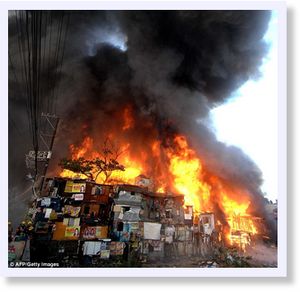
    Photo by delbz

  • The Broken Ladder: The Threat to Upward Mobility in the Global City

    Since the beginnings of civilization, cities have been the crucibles of progress both for societies and individuals. A great city, wrote Rene Descartes in the 17th Century, represented “an inventory of the possible”, a place where people could create their own futures and lift up their families.

    In the 21st Century – the first in which the majority of people will live in cities – this unique link between urbanism and upward mobility will become ever more critical. Cities have become much larger. In 1900 London was the world’s largest urban center with seven million people. Today there are three dozen cities with larger populations.

    No longer do a handful of western cities represent the only, or even the most critical, front in the battle for social progress. Mexico City and Mumbai, two cities we have studied, have three times London’s 1900 population. Indeed, of the world’s twenty most populous regions, the preponderance are located in third world or developing countries. The urban drama will play out on a truly global stage, with the most decisive developments taking place in the growing mega-cities of the developing world.

    It is first and foremost in these great cities of the human future that upward mobility must be most accelerated. Urban agglomerations such as Beijing, Shanghai, New Delhi, Sao Paulo, Mumbai, and Mexico City daily stand witness to one of the most rapid expansions of prosperity in history, as well as to wrenching examples of deep seated misery.

    Urbanity in the advanced industrial world is an increasingly interdependent system. The established centers of the global urban culture – New York, Los Angeles, London, Paris, Tokyo, Berlin – provide the critical markets, capital, and technological assistance that drive economic growth in the developing countries, whose growth in turn provides new opportunities for the citizens of the advanced cities.

    These established centers are often seen as occupying the Leninist “commanding heights” of the global economy. Is the kind of centralization we see in these cities, and in other mega-cities around the world, truly inevitable? And is their growth universally desirable? The answers to these questions are vital, notably because it is particularly in these locations that upward mobility now appears to be increasingly stalled. The stasis is reflected in both income trends and popular opinion in the leading centers of advanced world, including the United States, Japan and the United Kingdom.

    Optimists like historian Peter Hall believe that “neither western civilization, nor the western city, shows any sign of decay”. A recent World Bank report insists that large urban concentrations – the more dense the better – are the harbingers of opportunity and wealth creation. “To spread out economic growth”, it argues, is to discourage it. And it is certainly true that as countries modernize, they also urbanize, often quite rapidly. As a result, cities in the developing world – which also receive a great deal of international investment and aid – tend to be growing far more quickly than peripheral regions.

    Yet, in the longer term, the impacts of dense urbanization may not be universally useful at promoting either poverty alleviation or upward mobility. In advanced countries, this is already evident in large urban areas. Indeed, even the strongly pro-urbanist World Bank report acknowledges that as societies reach certain affluence levels, they begin to deconcentrate, with the middle classes in particular moving to the periphery.

    This process reflects a shift in economic and social realities over the past few decades. After nearly a half century of sustained social progress in most advanced countries, income growth for the middle class, even among the best-educated, has slowed considerably, and by some measurements has even turned negative. As we will see, the effects have been particularly tough on the urban middle and working classes in cities as diverse as Toronto, Los Angeles, Tokyo and London.

    Such concerns have been heightened by the current deep recession, which has caused wages to fall in both developing and developed countries. Yet concern over upward mobility was developing even in the relative “boom” times of the recent past, particularly in the advanced western countries, but also in the developing ones. Since 1973, for example, the rate of growth of the “typical family’s income” in the United States has slowed dramatically, and for males has actually gone backwards when adjusted for inflation. This diminishment has been particularly marked in major urban centers such as New York, Chicago, San Francisco and Los Angeles.

    Similar developments can be seen in a host of European cities, including London and Berlin, and even in Tokyo, which long has been seen as distinctly middle class. In all these cities, the middle class appears to be diminishing, while the population living in poverty has increased.

    The reasons for this trend include the impact of technology, aging demographics, globalization, and greater government indebtedness. A critical factor may also be opposition to the very idea of economic growth, something first seen in the 1970s and now increasingly persuasive, at least within large portions of academia, the media, and even parts of the financial community. This attitude is vividly and forcefully expressed, for example, within sectors of the ecology movement.

    Polls of popular opinion in the United States and the United Kingdom find ecological concerns well down the list, behind such issues as the economy, immigration, crime, unemployment and even the state of morality. Yet the agenda to address anthropogenic global warming promotes policies that seem likely to depress economic growth, particularly in cities, through further declines of productive industry, unaffordable housing prices and high levels of taxation.

    As recently seen at the global climate change conference in Copenhagen, few governments in the developing world are anxious to adopt any policy that weakens their ability to spark income and job growth in the near future. The pressing concerns of these cities remain focused on basic issues: sanitation, alleviation of poverty, industrial growth, infrastructure development and employment.

    Policies that prolong poverty and depress mobility seem likely to delay the necessary social consensus needed to enact long-term environmental improvements. When concern for the sustenance of families grows, focus on environmental issues tends to decline, as is already clear in recent surveys in the advanced countries. The much overworked term “sustainability” needs to include both economic and social components, as opposed to strictly ecological ones.

    Within the developing world, as the focus remains on basic economic issues, middle class residents of noted megacities appear to be more optimistic about personal advancement than their counterparts in the advanced countries. This may reflect the fact that countries such as India, China and Brazil have experienced rapid economic growth over the past decade, and expect more of the same in the decades ahead.

    Yet this does not suggest that the rising cities of the Second and Third World are growing in ways that do not deepen inequality. With rapid economic growth, these locations have seen considerable expansion of gaps between rich and poor, particularly with the decline of socialist institutions. Similarly, in some developing cities – Mumbai, Bogota and Sao Paulo, for example – there may be a widening gap between economic success and population density, as growth shifts to places with better infrastructure, less congestion, and less crime.

    In order to look in depth at differing attitudes among urban dwellers, we have focused our research on three megacities that represent different stages of economic development. We start with London, arguably the world’s most important global city, and explore the prospects for upward mobility there.

    Then we look at Mexico City, a city that represents the broad “Second World” of urban centers that have enjoyed some rapid growth but now face increased competition from China and other ascendant locations. Mexico City represents some of the realities that emerging urban centers in the Third World will face as they achieve higher levels of economic development.

    Third, we focus on Mumbai, India’s premier commercial city and financial center. Mumbai reflects the dichotomy of a rapidly growing city in the developing world: increasing wealth and rising expectations among its expanding middle class, with the continued creation of huge populations of destitute slum-dwellers.
    Yet for all the differences between these three great cities, we also find some commonalities. First, their future vitality depends largely on the future of their middle classes. Second, the critical issue for all these places remains how to sustain economic growth to meet the needs and aspirations of their citizens.

    Finally, they share the challenges of the current great economic revolution – what has been called the “post-industrial” era by Daniel Bell or the “third wave” by Alvin Toffler – on the nature of class. The increasing primacy of technology and education, once seen as liberating, could make widespread class mobility far more difficult than in the past.

    As occurred in the early stages of the industrial revolution, the current economic transformation threatens massive displacement of existing classes. Just as the machine age undermined the status of weavers, artisans and small farmers, the current technological epoch could well have similar impacts on not only industrial workers, particularly in the West, but on the supposedly ascendant educated middle class as well.

    This leads us to suggest a primary focus by all great cities on basic economic issues. Current concerns among the dominant cognitive classes in the media, the academic world, and the policy elites, particularly in the First World, have tended to center on aesthetics and “green” issues, as well as on who can draw ‘the best and the brightest”, rather than on how to employ the vast middle or working classes.

    We will explore some of the common challenges that will face all mega-cities as they evolve. Increasingly, they may find that their scale, long seen as an advantage, also produces inherent problems. In a globally interconnected urban environment, they must successfully compete not only with each other, but with smaller scale, and often more efficiently organized, urban areas throughout both the advanced and developing world.