Category: Urban Issues

  • Housing Unaffordability as Public Policy: The New Demographia International Housing Affordability Survey

    The just released 6th Annual Demographia International Housing Affordability Survey shows some improvement in housing affordability, especially in the United States and Ireland but a continuing loss of housing affordability, especially in Australia.

    The Survey, co-authored by Hugh Pavletich of Performance Urban Planning, covers 272 metropolitan markets in 6 nations (the United States, the United Kingdom, Canada, Australia, Ireland and New Zealand). The Survey estimates housing affordability using the “Median Multiple,” which is the median house price divided by the median household income. As recently as the late 1980s, the Median Multiple virtually everywhere was 3.0 or below. Over the past 10 to 20 years, however, the Median Multiple has risen worryingly in all major markets of the United Kingdom, Australia, New Zealand and Ireland and in some markets in the United States and Canada.

    Housing affordability is rated on a four category scale, from “affordable” to “severely unaffordable” (Table 1).

    Table 1
    Demographia Housing Affordability Rating Categories

    Housing Affordability Rating

    Median Multiple

    Severely Unaffordable

    5.1 & Over

    Seriously Unaffordable

    4.1 to 5.0

    Moderately Unaffordable

    3.1 to 4.0

    Affordable

    3.0 or Less

    Affordable Markets: The Survey found affordable markets in both the United States and Canada. This included fast-growing markets, such as Atlanta, Dallas-Fort Worth and Houston, which have had the highest underlying demand of any metropolitan areas with more than 5,000,000 population in the high-income world. It also includes the “Rust Belt” metropolitan areas, such as Detroit, which has experienced severe declines in demand in the Great Recession. There were also a number of additional metropolitan areas that are neither fast growing nor in dire economic straits, such as Indianapolis, Kansas City and Cincinnati (Table 2).

    Table 2
    Affordable Major Markets: 2009: Third Quarter
    Affordability Rank Nation Market Median Multiple
    1 United States Detroit, MI 1.6
    2 United States Atlanta, GA 2.1
    3 United States Indianapolis, IN 2.2
    4 United States Rochester, NY 2.3
    5 United States Cincinnati, OH-KY-IN 2.4
    5 United States Cleveland, OH 2.4
    5 United States Las Vegas, NV 2.4
    8 United States Buffalo, NY 2.5
    9 United States Columbus, OH 2.6
    9 United States Kansas City, MO-KS 2.6
    9 United States Phoenix, AZ 2.6
    9 United States Pittsburgh, PA 2.6
    9 United States St. Louis, MO-IL 2.6
    14 United States Dallas-Fort Worth, TX 2.7
    14 United States Jacksonville, FL 2.7
    16 United States Memphis, TN-AR-MS 2.8
    16 United States Minneapolis-St. Paul, MN-WI 2.8
    16 United States Louisville, KY-IN 2.8
    19 United States Houston, TX 2.9
    20 United States Oklahoma City, OK 3.0
    20 United States Riverside-San Bernardino, CA 3.0
    20 United States Tampa-St. Petersburg, FL 3.0

    Severely Unaffordable Markets: There were also 18 severely unaffordable markets, in five nations. The least unaffordable market was Vancouver (Canada), with a Median Multiple of 9.3. Sydney (Australia) was the second least affordable market (9.1), followed by Melbourne (8.0) and Adelaide (7.4). The most unaffordable markets also London (GLA or inside the greenbelt), with a Median Multiple of 7.1, San Francisco (7.0), New York (7.0), Perth, Australia (6.9), Brisbane, Australia (6.7), Auckland, New Zealand (6.7) and the London Exurbs (outside the greenbelt), at 6.7. Los Angeles-Orange County, which was the most unaffordable metropolitan area in the first four Surveys, remained severely unaffordable, at 5.7 (Table 3).

    Table 3
    Severely Unffordable Major Markets: Third Quarter: 2009
    Unaffordability Rank Nation Market Median Multiple
    1 Canada Vancouver 9.3
    2 Australia Sydney 9.1
    3 Australia Melbourne 8.0
    4 Australia Adelaide 7.4
    5 United Kingdom London (GLA) 7.1
    6 United States New York, NY-NJ,-CT-PA 7.0
    6 United States San Francisco, CA 7.0
    8 Australia Perth 6.9
    9 Australia Brisbane 6.7
    9 New Zealand Auckland 6.7
    9 United Kingdom London Exurbs 6.7
    12 United States San Jose, CA 6.4
    13 United Kingdom Bristol-Bath 6.1
    14 United States San Diego, CA 6.0
    15 United States Los Angeles-Orange County, CA 5.7
    16 United Kingdom Stoke on Trent & Staffordshire 5.3
    17 Canada Toronto 5.2
    18 United Kingdom Newcastle & Tyneside 5.1

    Severely Unaffordable Markets: There were also 18 severely unaffordable markets, in five nations. The least unaffordable market was Vancouver (Canada), with a Median Multiple of 9.3. Sydney (Australia) was the second least affordable market (9.1), followed by Melbourne (8.0) and Adelaide (7.4). The most unaffordable markets also London (GLA or inside the greenbelt), with a Median Multiple of 7.1, San Francisco (7.0), New York (7.0), Perth, Australia (6.9), Brisbane, Australia (6.7), Auckland, New Zealand (6.7) and the London Exurbs (outside the greenbelt), at 6.7. Los Angeles-Orange County, which was the most unaffordable metropolitan area in the first four Surveys, remained severely unaffordable, at 5.7 (Table 3).

    Summary by Nation: As in the five previous Surveys, there is a close relationship between housing unaffordability and categories of land use regulation. Virtually all severely unaffordable markets are characterized by “more prescriptive” land use regulation policies (also called “compact city,” “urban consolidation,” “growth management,” or “smart growth”). At the same time, the affordable markets overwhelmingly have “more responsive” land use regulation, in which new residential development is demand driven.

    Australia: The most extreme housing unaffordability has evolved in Australia. Australia’s overall Median Multiple was 6.8, with a housing affordability rating of severely unaffordable. A recent Bank West report also noted the deteriorating housing affordability and indicated housing affordability was a thing of the past for “key workers.” This is a dramatic turnaround; housing had been affordable widely in Australia in the late 1980s, with a Median Multiple of under 3.0 and remained under 3.5 until the late 1990s. All but one of Australia’s 23 markets were severely unaffordable, with one being seriously unaffordable. All of Australia’s major markets (over 1,000,000 population) have strong “urban consolidation” policies that have resulted in unaffordable land on the urban fringe and a substantial decline in house construction, despite the highest national population growth rate among the surveyed nations.

    Canada: Canada has an overall Median Multiple of 3.7 and is thus rated moderately unaffordable. Housing had been affordable in Canada in the late 1990s, with a Median Multiple of 3.0. Canada has 5 affordable markets and 4 severely unaffordable markets. Thirteen markets were rated moderately unaffordable, while 6 were rated seriously unaffordable. Like the United States, land use regulation is under the control of sub-national governments and thus ranges from demand driven to plan driven regimes.

    Ireland: Ireland has experienced a substantial improvement in its housing affordability. Ireland has a Median Multiple of 3.7, and is rated moderately unaffordable. Housing had been affordable as late as the middle 1990s, with a Median Multiple below 3.0.

    New Zealand: New Zealand’s overall Median Multiple was 5.7, for a severely unaffordable rating. Housing had been affordable in the early 1990s, with a Median Multiple of under 3.0. Five of the 8 markets were rated severely unaffordable, while 3 markets were seriously unaffordable. As in Australia, more prescriptive land use regulation is pervasive.

    United Kingdom: The overall Median Multiple in the United Kingdom was 5.1, for a severely unaffordable rating. Housing had been affordable in the late 1990s, with a Median Multiple of under 3.0. Despite the recent house price declines, 19 of the 33 surveyed markets were rated severely unaffordable and 14 were rated seriously unaffordable. The connection between the UK’s housing unaffordability and its plan-driven regulation has been documented in Labour government commissioned report by Kate Barker, a member of the Monetary Policy Committee of the Bank of England.

    United States: The United States is the first nation in Survey history to have achieved an overall affordable rating, with a Median Multiple of 2.9. The recent house price declines have restored national housing affordability to the below 3.0 historic norm (last achieved in the early 2000s), as the price bubble burst in many markets. There were 98 affordable markets, most of which experienced an increase in demand. There were also 58 moderately affordable markets. Even with the price decreases, however, house prices remain far above historic norms in some markets. Eight of the markets were seriously unaffordable, while 11 were severely unaffordable. Plan-driven land use regulation is in place in all of the major markets with severely unaffordable housing affordability.

    Comparing Sydney, Melbourne, Dallas-Fort Worth and Atlanta

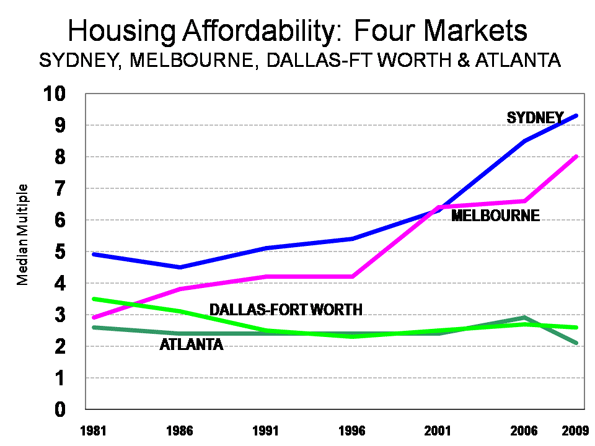
    Australia: A Nation in Mortgage Stress: The Survey includes a comparison of four similar markets, Sydney and Melbourne in Australia to Dallas-Fort Worth and Atlanta in the United States. In the early 1980s, Sydney had a higher population than Dallas-Fort Worth and Melbourne had a higher population than Atlanta. Since that time, the two US metropolitan areas have passed the Australian metropolitan areas in population, having added more people than Australia’s five largest metropolitan areas combined (Sydney, Melbourne, Brisbane, Perth and Adelaide). At the same time, despite their far higher demand, housing affordability has improved in Dallas-Fort Worth and Atlanta, while it has deteriorated markedly in Sydney and Melbourne (Figure 1). During this period, “plan driven” or more prescriptive land use policies were strongly enforced in Sydney and Melbourne in contrast to the “demand driven” land use policies in place in both Atlanta and Dallas-Fort Worth.

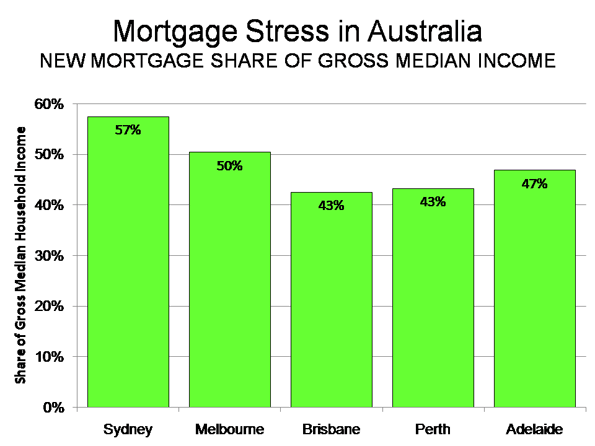
    Australian government agencies consider any household paying more than 30% of its gross income for housing to be in “housing stress.” At this point, a median income household in Sydney or Melbourne would pay more 50% or more of its gross income annually for a new mortgage on a median priced house. In Brisbane, Perth and Adelaide, the figure is above 40%. (Figure 2). By comparison, in Dallas-Fort Worth and Atlanta, however, the median income household would pay less than 20% of its income for the mortgage. Not surprising then is the huge loss in housing affordability in Australia, and a decline in home ownership rates from 72% to 68% between 1995 and 2008.

    Unaffordable Housing as Public Policy: It is clear that much of the cause for the differences in affordability lies with contrasting public policy approaches. The strong intervention in land markets under plan-driven regulation raises the price of land inordinately. Governments appear to have, however unwittingly, established unaffordable housing as an objective of public policy. Yet despite this, there is pressure – including from the US Obama administration, to adopt plan-driven regulation throughout the United States, despite the substantial economic disruption that such policies produced in the US bubble markets. Besides making houses unaffordable for many households, this could set the stage for even more housing bubbles in the future.

    If this trend continues, future generations will pay far more for their housing than did their parents. This seems likely to stunt economic growth and job creation, while facilitating higher levels of poverty and class stratification throughout the English speaking world.

    Wendell Cox is a Visiting Professor, Conservatoire National des Arts et Metiers, Paris. He was born in Los Angeles and was appointed to three terms on the Los Angeles County Transportation Commission by Mayor Tom Bradley. He is the author of “War on the Dream: How Anti-Sprawl Policy Threatens the Quality of Life.

  • Phoenix, Put Aside Dreams of Gotham

    Now that Phoenix’s ascendancy has been at least momentarily suspended, its residents are no doubt wondering what comes next. One tendency is to say the city needs to grow up and become more like East Coast cities or Portland, Ore., with dense urban cores and well-developed rail transit. The other ready option is always inertia – a tendency to wait for things to come back the way they were.

    Neither approach will work in the long run. Over the coming decade, Phoenix has to recalibrate its economy into something based on more than being a second option for Californians and speculative real-estate investment. Instead, it needs to focus laserlike on economic diversity and creating good jobs.

    The model here for Phoenix is not New York or San Francisco. Phoenix can’t rival these cities for their 19th-century charm or early 20th-century infrastructure. As we would say back in New York (my hometown): fuggedaboutit.

    Instead of dreaming about Gotham, Phoenix should think more about Houston. Like the Texas megacity, Phoenix is the ultimate late 20th-century town, dependent on air-conditioning, ample freeway space and a wide-open business culture.

    A century away from becoming “quaint,” Phoenix needs to follow Houston’s example of relentless economic diversification: in Phoenix’s case, away from dependence on tourism and construction. Houston has done this by focusing beyond its core energy sector to fields like international trade, manufacturing and medical services.

    Phoenix’s opportunities may lie elsewhere but may include some of these same industries. The idea is that the region needs to heal its job problem. Only then can the real-estate market rebound on a solid basis.

    This employment focus must replace the current obsession with changing the city’s urban form. Despite the current problems, Phoenix has performed pretty well over the past decade, creating more new jobs than most Sun Belt cities, not to mention job losers like San Francisco, Chicago, Los Angeles and New York. Equally important, it still leads the nation over the past decade in net in-migration among the largest cities

    Unfortunately, some in Phoenix still suffer horribly from Manhattan envy. One prominent Phoenix consultant describes the downtown as “the glorious goose that’s laying the gilded egg” that will turn the city into a dynamic trend-setter of a new urban paradigm. Phoenix, he opined, “won’t be a place of renown till it has the Big It.” In other words, Phoenix will not be a true metropolis until it has its own Times Square, Eiffel Tower, Space Needle or other grand attraction.

    Yet in newer cities like Phoenix, the quest for the “Big It” is often delusional. In Phoenix, the vast majority of the population moved in decades after the original downtown lost its primacy. People have their own notion of what “it” is, and many times, “it” could be in a different center or in more than one center – think Scottsdale, Tempe, Mesa, the Camelback Corridor, or a host of other communities.

    The Valley’s $1.4 billion transit system carries barely 15,000 round trips daily – a microscopic proportion of the region’s trips – with the biggest traffic on weekends. Sounds more like Disneyland than New York.

    Nor does the high-end condo, art-museum, convention-center thing seem to be working so well. Too bad the extra $1.5 billion spent sprucing up the area could not have been spent more usefully for less critical things, like police and fire, or better roads and schools.

    Rather than focus on emulating the urban father figures from the past, Phoenix’s best bet lies with its best assets: being reasonably priced, professionally managed and, well, warm and lovely in December. Shedding its real-estate-obsessed cocoon, Phoenix should focus on creating jobs for both present and future residents. That’s how you can grow up and find your own way.

    This article first appeared at The Arizona Republic.

    Joel Kotkin is executive editor of NewGeography.com and is a distinguished presidential fellow in urban futures at Chapman University. He is author of The City: A Global History. His next book, The Next Hundred Million: America in 2050, will be published by Penguin Press February 4th.

    Photo: robotography

  • The War Against Suburbia

    A year into the Obama administration, America’s dominant geography, suburbia, is now in open revolt against an urban-centric regime that many perceive threatens their way of life, values, and economic future. Scott Brown’s huge upset victory by 5 percent in Massachusetts, which supported Obama by 26 percentage points in 2008, largely was propelled by a wave of support from middle-income suburbs all around Boston. The contrast with 2008 could not be plainer.

    Browns’s triumph followed similar wins by Republican gubernatorial contenders last November in Virginia and New Jersey. In those races suburban voters in places like Middlesex County, New Jersey and Loudoun County, Virginia—which had supported President Obama just a year earlier—deserted the Democats in droves. Also in November, voters in Nassau County, New York upset Nassau County Executive Thomas Suozzi, an attractive Democrat who had carefully cultivated suburban voters.

    The lesson here is that political movements ignore suburbanites at their peril. For the better part of a century, Americans have been voting with their feet, moving inexorably away from the central cities and towards the suburban periphery. Today a solid majority of Americans live in suburbs and exurbs, more than countryside residents and urbanites combined.

    As a result, suburban voters have become the critical determinants of our national politics, culture, and economy. The rise of the Republican majority after 1966 was largely a suburban phenomenon. When Democrats have resurged—as they did under Bill Clinton and again in 2006 and 2008—it was when they came close to splitting the suburban vote.

    But now, once again, things have changed. For the first time in memory, the suburbs are under a conscious and sustained attack from Washington. Little that the administration has pushed—from the Wall Street bailouts to the proposed “cap and trade” policies—offers much to predominately middle-income oriented suburbanites and instead appears to have worked to alienate them.

    And then there are the policies that seem targeted against suburbs. In everything from land use and transportation to “green” energy policy, the Obama administration has been pushing an agenda that seeks to move Americans out of their preferred suburban locales and into the dense, transit-dependent locales they have eschewed for generations.

    As in so many areas, this stance reflects the surprising power of the party’s urban core and the “green” lobby associated with it. Yet, from a political point of view, the anti-suburban stance seems odd given that Democrats’ recent electoral ascendency stemmed in great part from gains among suburbanites. Certainly this is an overt stance that neither Bill nor Hillary Clinton would likely have countenanced.

    Whenever possible, the Clintons expressed empathy with suburban and small-town voters. In contrast, the Obama administration seems almost willfully city-centric. Few top appointees have come from either red states or suburbs; the top echelons of the administration draw almost completely on big city urbanites—most notably from Chicago, New York, Los Angeles, and San Francisco. They sometimes don’t even seem to understand why people move to suburbs.

    Many Obama appointees—such as at the Departments of Transportation and of Housing and Urban Development (HUD) and at the Environmental Protection Agency (EPA)—favor a policy agenda that would drive more Americans to live in central cities. And the president himself seems to embrace this approach, declaring in February that “the days of building sprawl” were, in his words, “over.”

    Not surprisingly, belief in “smart growth,” a policy that seeks to force densification of communities and returning people to core cities, animates many top administration officials. This includes both HUD Secretary Shaun Donovan and Undersecretary Ron Sims, Transportation undersecretary for policy Roy Kienitz, and the EPA’s John Frece.

    Transportation Secretary Ray LaHood revealed the new ideology when he famously declared the administration’s intention to “coerce” Americans out of their cars and into transit. In Congress, the president’s allies, including Minnesota Congressman James Oberstar, have advocated shifting a larger chunk of gas tax funds collected from drivers to rail and other transit.

    In addition, the president’s stimulus—with its $8 billion allocation for high-speed rail and proposed giant increases in mass transit—offers little to anyone who lives outside a handful of large metropolitan cores. Economics writer Robert Samuelson, among others, has denounced the high-speed rail idea as “a boondoggle” not well-suited to a huge, multi-centered country like the United States. Green job schemes also seem more suited to boost employment for university researchers and inner-city residents than middle-income suburbanites.

    Suburbanites may not yet be conscious of the anti-suburban stance of the Obama team, but perhaps they can read the body language. Administration officials have also started handing out $300 million stimulus-funded grants to cities that follow “smart growth principles.” Grants for cities to adopt “sustainability” oriented development will reward those communities with the proper planning orientation. There is precious little that will benefit suburbanites, such as improved roads or investment in other basic infrastructure.

    But ultimately it will be sticks and not carrots that planners hope to use to drive de-suburbanization. Perhaps the most significant will be new draconian controls over land use. Administration officials, particularly from the EPA, participated in the drafting of the recent “Moving Cooler” report, which suggested such policies as charging tolls on the Interstate Highway System, charging people to park in front of their homes, and steering some 90 percent of all future development into the most dense portions of already existing urban development.

    Of course, such policies have little or no chance of being passed by Congress. Too many representatives come from suburban or rural districts to back policies that would penalize a population that uses automobiles for upwards of 98 percent of their transportation and account for 95 percent of all work trips.

    But the president’s cadres may find other ways to impose their agenda. New controls, for example, may be enacted through the courts and regulatory action. There is already precedence for this: As EPA director under Clinton, current climate czar Carole Browner threatened to block federal funds for the Atlanta region due to their lack of compliance with clear air rules.

    Such threats will become more commonplace as regulating greenhouse gases fall under administrative scrutiny. As can already be seen in California, regulators can use the threat of climate change as a rationale to stop funding—and permitting—for even well-conceived residential, commercial, or industrial projects construed as likely to generate excess greenhouse gases.

    These efforts will be supported by an elaborate coalition of new urbanist and environmental groups. At the same time, a powerful urban land interest, including many close to the Democratic Party, would also support steps that thwart suburban growth and give them a near monopoly on future development over the coming decades.

    Glimpse the Future

    One can glimpse this future by observing what takes place in most European countries, including the United Kingdom, where land use is controlled from the center. For decades options for new development have been sharply circumscribed, with mandates for ever-smaller lots and smaller homes more the norm for single-family residences.

    In Britain the dominant planning model is widely known as “cramming,” meaning forced densification into smaller geographic areas. Over the past generation, this has spurred a rapid shrinking of house sizes. Today the average new British “hobbit” house, although quite expensive, covers barely 800 square feet, roughly one-third that of the average American residence. Even in quite distant suburbia many of the features widely enjoyed here—sizable backyards, spare bedrooms, home office space—are disappearing.

    But these suburban hobbits will be living large compared to the sardines who would be forced to move into inner cities. In London, already a densely packed city, planners are calling for denser apartment blocks and congested neighborhoods.

    This top-driven scenario may be playing soon in America. Following the proposed edicts of “Moving Cooler,” the urban option increasingly would become almost the only choice other than the countryside. Unlike their baby boomer parents, the next generation would have few affordable choices in comfortable, low- and medium-density suburbs and single-family homes.

    Ownership of a single-family home would become increasingly the province only of the highly affluent or those living on the fringes of second-tier American cities. Due to the very high costs of construction for multi-family apartments in inner cities, most prospective homeowners would also be forced to remain renters. Although widely hailed as “progressive,” these policies would herald a return to the kind of crowded renter-dominated metropolis that existed prior to the Second World War.

    Are Suburbs Doomed?

    The anti-suburban impulse is nothing new. Suburbs have rarely been popular among academics, planners, and the punditry. The suburbanite displeased “the professional planner and the intellectual defender of cosmopolitan culture,” noted sociologist Herbert Gans. The 1960s counterculture expanded this critique, viewing suburbia as one of many “tasteless travesties of mass society,” along with fast and processed food, plastics, and large cars. Suburban life represented the opposite of the cosmopolitan urban scene; one critic termed it “vulgaria.”

    Liberals also castigated suburbs as the racist spawn of “white flight.” But more recently, environmental causes—particularly greenhouse gas emissions as well as dire warning about the prospects for “peak oil”—now drive much of the argument against suburbanization.

    The housing crash that began in 2007 added grist to the contention that the age of suburban growth has come to an end. To be sure, the early phases of the subprime mortgage bust were heavily concentrated in newer developments in the outer fringes. In part due to rising home prices, a disproportionate number of new buyers were forced to resort to sub-prime and other unconventional mortgages.

    The outer suburban distress attracted much media attention and delighted many who had long detested suburbs. One leading new urbanist, Chris Leinberger, actually described suburban sprawl as “the root cause of the financial crisis.” Leinberger and other critics have described suburbia as the home of the nation’s future “slums.” The favorite images have included McMansions being taken over by impoverished gang-bangers and other undesirables once associated with the now pristine inner city.

    Others portray future suburbs as serving at best as backwaters in a society dominated by urbanites. In contrast to a brave new era for “the gospel of urbanism,” the suburbs are expected to contract and even wither away. According to planner Arthur C. Nelson’s estimate, by 2025 the United States will have a “likely surplus of 22 million large lot homes”—that is, residences on more than one sixth of an acre.

    City boosters, however, largely ignore the real-estate crisis impact on urban condo markets throughout the country. Like the new developments on the fringe, the much hyped apartment complexes in central cities such as New York, Miami, Los Angeles, Chicago, and Denver came on line precisely as the housing market crashed, with similar devastating effects. Many remain unoccupied and others have been converted from high-end condos to more modest rentals.

    Yet fundamentally the attack on suburbia has less to do with market trends or the environment than with a deep-seated desire to change the way Americans live. For years urban boosters have proposed that more Americans should reside in what they deemed “more livable,” denser, transit-oriented communities for their own good. One recent example, David Owens’ Green Metropolis, supports the notion that Americans should be encouraged to embrace “extreme compactness”—using Manhattan as the model.

    Convinced Manhattanization is our future, some “progressives” are already postulating what to do with the remnants of our future abandoned. Grist, for example, recently held a competition about what to do with dying suburbs that included ideas such as turning them into farms, bio-fuel generators, and water treatment plants.

    What Do the Suburbanites Want?

    In their assessments, few density advocates bother to consider whether most suburbanites would like to give up their leafy backyards for dense apartment blocks. Many urban boosters simply could not believe that, once given an urban option, anyone would choose to live in suburbia.

    Jane Jacobs, for example, believed that “suburbs must be a difficult place to raise children.” Yet had Jacobs paid as much attention to suburbs as she did to her beloved Greenwich Village, she would have discovered that they possess their own considerable appeal, most particularly for people with children. “If suburban life is undesirable,” noted Gans in 1969, “the suburbanites themselves seem blissfully unaware of it.”

    Contrary to much of the current media hype, most Americans continue to prefer suburban living. Indeed for four decades, according to numerous surveys, the portion of the population that prefers to live in a big city has consistently been in the 10 to 20 percent range, while roughly 50 percent or more opt for suburbs or exurbs. The reasons? The simple desire for privacy, quiet, safety, good schools, and closer-knit communities. The single-family house, detested by many urbanists, also exercises a considerable pull. Surveys by the National Association of Realtors and the National Association of Home Builders find that some 83 percent of potential buyers prefer this kind of dwelling over a townhouse or apartment.

    In other words, suburbs have expanded because people like them. A 2008 Pew study revealed that suburbanites displayed the highest degree of satisfaction with where they lived compared to those who lived in cities, small towns, and the countryside. This contradicts another of the great urban legends of the 20th century—espoused by urbanists, planning professors, and pundits and portrayed in Hollywood movies—that suburbanites are alienated, autonomous individuals, while city dwellers have a deep sense of belonging and connection to their neighborhoods.

    Indeed on virtually every measurement—from jobs and environment to families—suburban residents express a stronger sense of identity and civic involvement with their communities than those living in cities. One recent University of California at Irvine study found that density does not, as is often assumed, increase social contact between neighbors or raise overall social involvement. For every 10 percent reduction in density, the chances of people talking to their neighbors increases by 10 percent, and their likelihood of belonging to a local club by 15 percent.

    These preferences have helped make suburbanization the predominant trend in virtually every region of the country. Even in Portland, Oregon, a city renowned for its urban-oriented policy, barely 10 percent of all population growth this decade has occurred within the city limits, while more than 90 percent has taken place in the suburbs over the past decade. Ironically, one contributing factor has been the demands of urbanites themselves, who want to preserve historic structures and maintain relatively modest densities in their neighborhoods.

    Multicultural Flight

    Perhaps nothing reflects the universal appeal of suburban lifestyles more than its growing ethnic diversity. In 1970 nearly 95 percent of suburbanites were white. Today many of these same communities have emerged as the new melting pots of American society. Along with immigrants, African-Americans have moved to the suburbs in huge numbers: between 1970 and 2009, the proportion of African-Americans living in the periphery grew from less than one-sixth to 40 percent.

    Today minorities constitute over 27 percent of the nation’s suburbanites. In fast-growing Gwinett County outside Atlanta, minorities made up less than 10 percent of the population in 1980; by 2006 the county was on the verge of becoming “majority minority.” In greater Washington, D.C., the Northeast’s most dynamic region in economic and demographic terms, 87 percent of foreign migrants live in the suburbs, while less than 13 percent live in the district, according to a 2001 Brookings Institution study.

    Perhaps most intriguingly, this diversity is itself diverse, including not only African-Americans but also Latinos and Asians. Suburban areas such as Fort Bend county, Texas, and the city of Walnut, in the San Gabriel Valley east of Los Angeles, already have among the most diverse populations in the nation. And this is not merely a California phenomenon: Aurora (outside Denver), Bellevue (the Seattle suburb), and Blaine (outside Minneapolis) are becoming ever-more diverse even as the nearby city centers become less so. By 2000 well over half of mixed-race households were in the suburbs, a percentage that continues to grow.

    Today the most likely locale for America’s new ethnic shopping centers, Hindu temples, and new mosques are not in the teeming cities but in the outer suburbs of Los Angeles, New York, and Houston. “If a multiethnic society is working out in America,” suggests California demographer James Allen, “it will be worked out in [these] places  . . . The future of America is in the suburbs.”

    A War Not Worth Fighting

    If most Americans clearly prefer suburbs then why would our elected representatives choose to pick a fight with them? Perhaps the most widely used explanation lies with densification as a means of reducing greenhouse gases. But this rationale itself seems flawed, and could reflect more long-standing prejudice than proven science.

    For example, a recent study by the National Academy of Sciences found that a nationally imposed densification policy would at best cut greenhouse gas emissions between less than 1 and 11 percent by 2050. Other research suggests that, by some measurements, low-density development can use less energy than denser urban forms.

    Although automobile commuting now consumes more energy resources than well-traveled traditional urban rail systems, the future generation of low-mileage cars may prove more efficient than often underutilized rail systems that are now seen as critical elements of fighting climate change. A public system running at low capacity—commonplace in many regions—may actually produce more emissions than the coming generation of personal vehicles.

    Moreover, tall buildings may not be as green as some advocates suggest. Recent studies out of Australia show that townhouses, small condos, and even single-family homes generate far less heat per capita than the supposedly environmentally superior residential towers, particularly when one takes into account the cost of heating common areas and the highly consumptive lifestyle of affluent urbanites (with their country homes, vacations, and frequent flying). In terms of energy conservation, the easiest and least expensive option may be to retrofit single-family houses and wood-shaded townhouses.

    Two- or three-story homes or townhouses often require only double-paned windows and natural shading to reduce their energy consumption; one Los Angeles study found that white roofs and shade trees can reduce suburban air conditioning by 18 percent. Such structures are particularly ideal for using the heat- and water-saving elements of landscaping: after all, a nice maple can cool a two-story house more efficiently than it can a ten-story apartment.

    Of course, density advocates can and do produce their own studies to justify their agenda. But there seems enough reasonable doubt to focus on more efficient, and less intrusive, ways to create greener communities by improving energy efficiency of automobiles and changing the way suburbs fit into metropolitan systems.

    Turning Deadwood into Greenurbia

    The “green” assault on suburbia also largely ignores changes already taking place across the suburban landscape. In a historical context, the latest suburban “sprawl” may be compared to Deadwood. That rough-and-ready mining town on the Dakota frontier was developed quickly for the narrow purpose of being close to a vein of gold. But over time these towns developed respectable shopping streets, theaters, and other community institutions.

    One change already evident can be seen in commuting patterns. Density advocates and the media often characterize suburbanites as people who generally take long commutes to work compared to the shorter rides enjoyed by city-dwellers. But with the continuing dispersion of work to the suburbs over the past two decades, suburban work locations actually enjoyed shorter commutes than their inner city counterparts in virtually all the largest metropolitan areas.

    This is true even in New York. Although Manhattanites enjoy short commutes and can even walk to work, most people who live in New York City and work in Manhattan suffer among the longest commutes in the nation. In fact, residents of Queens and Staten Island spend the most time getting to work of all metropolitan counties. Residents in suburbs and particularly exurbs actually endure generally shorter commutes, in large part because of less congestion and closer proximity to employment.

    Such pairing of jobs and housing will shape the suburban future and represents among the easiest ways to cut transportation-related emissions. Even more promising has been the continuing rise in home-based employment. According to Forrester Research, roughly 34 million Americans now commute at least part time from home; by 2016 these numbers are predicted to swell upwards to 63 million.

    Oddly, despite these tremendous potential environmental benefits, the shift toward cyberspace has elicited little support from smart-growth advocates. Indeed most reports on density and greenhouse gases virtually ignore the consideration of telecommuting and dispersed work.

    One reason may be that telecommuting breaks with the prevailing planning and green narratives by making dispersion more feasible. The ability to work full time or part time from home, notes one planning expert, expands metropolitan “commuter sheds” to areas well outside their traditional limits. In exchange for a rural or exurban lifestyle, this new commuter—who may go in to “work” only one or two days a week—will endure the periodic extra long trip to the office.

    Yet although it may offend planning sensibilities, the potential energy savings—particularly in vehicle miles traveled—could be enormous. Telecommuters drive less, naturally; on telecommuting days, average vehicle miles are between 53 percent and 77 percent lower. Overall a 10 percent increase in telecommuting over the next decade will reduce 45 million tons of greenhouse gases, while also dramatically cutting office construction and energy use. Only an almost impossibly large shift to mass transit could produce comparable savings.

    Ultimately, technology will undermine much of the green case against suburbia. If we really want to bring about a greener era, focusing attention on low-density enclaves would bring change that conforms to the preferences of the vast majority of people.

    Think Twice Before You Act

    Ultimately, the war against suburbia reflects a radical new vision of American life which, in the name of community and green values, would reverse the democratizing of the landscape that has characterized much of the past 50 years. It would replace a political economy based on individual aspiration and association in small communities, with a more highly organized, bureaucratic, and hierarchical form of social organization.

    In some ways we could say forced densification could augur in a kind of new feudalism, where questions of land ownership and decision making would be shifted away from citizens, neighbors, or markets, and left in the hands of self-appointed “betters.” This seems strange for an administration—and a party—whose raison d’être ostensibly has been to widen opportunities rather than constrict them.

    Indeed it is one of the oddest aspects of contemporary “progressive” thought that it seeks to undermine even modest middle class aspirations such as living in a quiet neighborhood or a single-family house. This does not seem a winning way to build political support across a broad spectrum of the populace.

    Of course suburbia is not and will not be the option for everyone. There will continue to be a significant, perhaps even growing, segment of the population which opts for a dense urban lifestyle or, for that matter, to live further in the countryside. But unless we see a radical change in human behavior and social organization, the majority will likely settle for a suburban or exurban existence.

    Given these realities, it seems more practical not to work against such aspirations but instead to evolve intelligent policies that would reconcile them with our long-term environmental needs. Suburbanites like their suburbs but would also like to find a way to make them greener as well as more economically and socially viable. Right now neither party has developed such an agenda, and so the suburbs, now clearly leaning right, remain up for grabs. To win suburbanites over, politicians first have to respect the basic preferences while offering a realistic program for improvement. This remains a key to building a sustainable electoral majority, not just for the next election, but for the decades to come.

    This article first appeared at The American.

    Joel Kotkin is executive editor of NewGeography.com and is a distinguished presidential fellow in urban futures at Chapman University. He is author of The City: A Global History. His newest book is The Next Hundred Million: America in 2050, released in Febuary, 2010.

  • “First” vs. “Worst”

    Taking on the Portland mystique is not easy – and likely I’ll find out again with my most recent piece: Picture-perfect Portland?

    But I’d also like to take a Midwest perspective that shows some surprising things. Let’s compare Portland to a similarly sized and less acclaimed Midwest city, Indianapolis. You can think of Portland as being in “first place” from a policy perspective by popular acclaim. It has an urban growth boundary, extensive transit, excellent urban density, a strong biking culture, a strong culture of civic engagement, the most microbreweries per capita, and on down the line. It is a place people want to live in so badly that they will move there with no job in hand and would be one of the cities that comes to mind among similar sized metros as a talent hub.

    If Portland is first, then you’d have to characterize Indianapolis as “worst”. Indianapolis is surrounded by expanding suburbia with very pro-sprawl policies on all four sides. It is one of the least dense cities in America. It has no rail transit and only the 99th largest bus system, along with one of the lowest transit market shares in the country. It is currently in the middle of a multi-billion program to widen about 60 miles of freeway. It just recently put in its very first bike lanes and scores near the bottom in green measures of sustainability. Its brand image also is hardly the best. You don’t hear too many people around the country going, “Man, I’ve gotta get me to Indianapolis.”

    But let’s look at how these cities compare on various quantitative measures of urban performance.


    Portland

    Indianapolis

    Population Growth (2000-2008)

    14.5%

    12.5%

    Domestic In-Migration (2000-2008)

    5.4%

    4.2%

    International In-Migration (2000-2008)

    3.7%

    1.4%

    Job Growth 2001-2009 (QCEW)

    10,300 (1.1%)

    17,100 (2.1%)

    Job Growth 2001-2009 (CES)

    23,800 (2.4%)

    31,000 (3.6%)

    Unemployment Rate (Nov 2009)

    10.8%

    8.2%

    Per Capita GMP (2008)

    47,811

    46,450

    Per Capital GMP Growth (2001-2008)

    22.4%

    1.7%

    Median Household Income (ACS 2008)

    $58,758

    $53,671

    Median Monthly Housing Cost (ACS 2008)

    $1,522

    $1,125

    College Degree Attainment (ACS 2008)

    33.3%

    31.8%

    Travel Time Index (Texas A&M)

    1.28

    1.21

    Now in most of these Portland does beat Indy, but not by a lot. In job growth and unemployment – two big factors in today’s economy – Indy actually does better. Portland’s higher incomes are offset by higher housing costs. There are only two stats – international migration and GMP per capita growth – where Portland has a big lead.

    Given the wide difference in their policies, it is striking to see these cities so close. By rights, it should be total world domination by Portland – but it isn’t.

    Now obviously these aren’t the only statistics to measure a city by. Portland residents would no doubt tout their many livability advantages. Yet at some point isn’t livability supposed to translate into superior demographic and economic performance? Isn’t it supposed to make a city attractive to the talent pool needed to thrive in the 21st century? And isn’t that talent supposed to power the economy? I was particularly struck by how close the cities were on college degree attainment. While I called Portland a talent hub, perhaps I spoke too soon. Contrast with Boston, which has 41.9% of its over 25 population with a bachelors degree or better.

    It may be that policy changes act with a lag. But Portland has been at this a long time. The UGB dates to 1973 and the light rail system started construction in the early 80s, for example. Perhaps other factors play a bigger role than many imagine. Land use and transportation policies might provide benefits to cities, but they do not, by themselves, create an economic dynamo.

  • High-Speed Rail: Toward Least Worst Projections

    It comes as welcome news that the United States Department of Transportation Inspector General is concerned about the integrity of high-speed rail projections, “including ridership, costs, revenues and associated public benefits.” The issue has become ripe as a result of the $8 billion for high speed rail that the Obama Administration slipped into the economic stimulus bill early in 2009.

    The response was more than 250 applications from 30 states totaling $57 billion. It is easy to understand the Inspector General’s concern, though no-one should be surprised that the demand for free money outstrips the supply. Applicants range from the huge California High Speed Rail proposal, to a greenhouse gas belching magnetic levitation (maglev) line in population-losing Pittsburgh, to comparatively modest railroad grade crossings that could improve both railroad and highway safety.

    In a January 4 letter to the Federal Railroad Administrator, Inspector General Mitchel Behm announced an evaluation of “best practices” with respect to high-speed rail forecasts, noting that “it is of critical importance that the Federal investments are directed to the most worthy projects.” For starters, the Inspector General needs to understand that there are is no such thing as “best practices” in high-speed rail forecasts. Best practices and high speed rail in the same sentence sounds like a line from a comedy routine. The record of ridership, revenue and cost projections in high speed rail projects is abysmal.

    An Object Lesson: The Las Vegas Monorail Default: This was brought home earlier this week, when the privately financed Las Vegas Monorail defaulted on its bonds, principally because its ridership was absurdly over-projected. Even before the economic implosion (2007), the Las Vegas Monorail was carrying only 21,000 riders per day, far below the 53,500 riders that had been predicted for 2004 by the world-class planning firm retained by the promoters. In 2000 we produced a report predicting that the Monorail would carry between 16,900 and 25,400 daily riders. The reality was in the middle of that range. Of course, no venture could survive with consumer demand 60 percent below projections and default was inevitable, as we predicted. People who purchased the bonds may have overlooked the shaky foundations of the project, assuming that the state required bond insurance would make them whole. It did for the first defaulted payment, however the bond insurer, Ambac, itself is also in financial difficulty. Abmac has been characterized as “a borderline insolvent bond insurer.” Following Ambac’s debt payment, the Las Vegas Monorail filed for bankruptcy improbably claiming that it was necessary to permit expansion to the airport.

    High Speed Rail Follies: Of course, the Las Vegas Monorail is not a high-speed rail line, but high-speed rail projects are subject to the same risk of absurdly inaccurate projections of ridership, revenue and costs.

    High speed rail has often been touted by proponents as being profitable. However, they usually exclude such basic costs building the system and buying the trains. This is like a household that claims to be saving, but does not pay the mortgage. Proponents routinely repeat claims of profitability for one line or the other, without the slightest concept of reality. Indeed no less than Iñaki Barrón de Angoiti, director of high-speed rail at the International Union of Railways in Paris, said that high speed rail is not a profitable business and said that short Paris-Lyon and Tokyo-Osaka routes are the only ones in the world that have “broken even.”

    The California proposal, in particular, anticipates substantial private investment. Anyone courageous enough to invest will want due diligence performed by consultants other than those who produced the numbers to support the Las Vegas Monorail bond issue.

    Within the past few days, the non-partisan California Legislative Analyst’s office issued a critical report of the new California High Speed Rail business plan. The most damning criticism was that the plan “appears to violate law, because it assumed operating subsidies, which were prohibited by the bond issue passed by the voters of the state. This is particularly relevant to the USDOT Inspector General’s inquiry, since the California High Speed Rail Authority has been claiming for years that the project would not require operating subsidies. California, needless to say, is not in a position to be offering subsidies of any kind.

    Cheerleader Projections: There is plenty of reason for concern:

    Taiwan’s high-speed rail line, the only fully privately financed line in the world, has attracted approximately one-half of its projected ridership and has suffered considerable construction cost overruns. During its first few years of operations, its debt has been restructured, its bonds downgraded, expansion plans have been suspended and the Taiwan government has now taken majority control of the board. It should not be long before Taiwan taxpayers will be footing the bill.

    The new high-speed rail line in Korea is attracting approximately one-half of its projected ridership, while its costs were three to four times the projected level.

    This problem is all documented in Megaprojects and Risks: An Anatomy of Ambition, by Bent Flyvbjerg of Oxford University, Nils Bruzelius of and Werner Rothenberger of the University of Karlsruhe and former chairman of the World Conference on Transport Research. The authors examined decades of major transportation projects in Europe and North America and identified a general pattern of projection inaccuracy. With respect to the systematic cost projection errors, Professor Flyvbjerg says: “Underestimation cannot be explained by error and is best explained by strategic misrepresentation, that is, lying.” He further notes that “The policy implications are clear: legislators, administrators, investors, media representatives, and members of the public who value honest numbers should not trust cost estimates and cost-benefit analyses produced by project promoters and their analysts.”

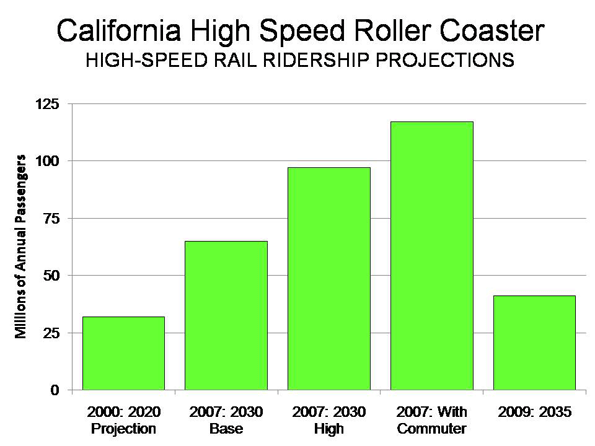
    The California High Speed Roller Coaster: The proposed California High Speed Rail system seems poised to break “lower the bar” even further with respect to performance relative to projections. The ridership projections have been like a roller coaster. In 2000, the California High Speed Rail Authority’s modelers predicted, in an “investment grade projection” that the system would carry 32 million riders a year by 2020. Then, in 2007, the projection gurus raised the “base” number to 69 million by 2030 and added a “high” number of 97 million. By the time the high speed rail bond election was underway, some Authority board members went around the state citing a number of 117 million riders that included commuter ridership.

    Within the last month, the Authority has released a new plan indicating that ridership will be 41 million in 2035 (See Figure). If the 2000 ridership projections were “investment grade” then the subsequent projections have been “junk bond grade.”

    Joseph Vranich and I projected annual ridership of 23 million to 31 million for 2030 in a report published by the Reason Foundation (The California High Speed Rail Proposal: A Due Diligence Report). We also predicted, based upon our analysis of high speed rail systems worldwide, that the costs will rise by as much as another 70 percent to cover the usual cost overruns and to build portions of the system not included in the projections.

    The erratic ridership projections are just the beginning. We also found the proposed fare structure to be far too optimistic (fares far too low). Apparently the California High Speed Rail Authority agrees, because it has doubled its proposed fare levels. Meanwhile, its costs continue to rise, despite having risen by half from 2000 to 2008 (inflation adjusted), at the same time that the size of the proposed system was shrinking.

    Perverse Incentives: Part of the problem here lies with incentives. The “world class“ consulting firms have no incentive to produce reasonable numbers. Indeed, some actually participate in later stages of the projects and as a result have exactly the opposite incentive – an interest in projections being optimistic enough that the project gets approved.

    Solutions: The Inspector General might look at removing the incentive for misrepresentations and exaggeration, by prohibiting the participation of planning consultants in the implementation phase of high speed rail projects. Another modest proposal could revolutionize major project projections. Perhaps the world class consulting firms should be required to guarantee their projections financially.

    We certainly wish the Inspector General the best, though he has certainly set a standard (“best practices”) not likely to be achieved. But perhaps he can move the industry from absurdity to least worst projections.

    Wendell Cox is a Visiting Professor, Conservatoire National des Arts et Metiers, Paris. He was born in Los Angeles and was appointed to three terms on the Los Angeles County Transportation Commission by Mayor Tom Bradley. He is the author of “War on the Dream: How Anti-Sprawl Policy Threatens the Quality of Life.

  • Municipal Budget Mess

    A recent report from the National League of Cities projects a grim financial situation for many municipal governments during the next three years. According to the report the municipal sector “likely faces a combined, estimated shortfall of anywhere from $56 billion to $83 billion from 2010-2012.” Such shortfalls will be “driven by declining tax revenues, ongoing service demands and cuts in state revenues”. Facing large deficits, cities around the nation may be forced to “cure revenue declines and spending pressures with higher service fees, layoffs, unpaid furloughs, and drawing on reserves or canceling infrastructure projects”.

    The process of belt tightening has already begun in cities across the nation. In Michigan, the city of Jackson is asking municipal workers to take pay cuts to help close a $900,000 budget deficit. Toledo, Ohio, another rust belt city hard hit by the recession, may face a deficit of up to $44 million, and is being forced to consider “mid-contract union concessions, cutting city spending, and possibly asking the voters to increase the city’s 2.25 percent income tax.”

    In California, already challenged by record state deficits, the city of Los Angeles may have a budget shortfall of $1 billion by 2013, “driven primarily by escalating employee pension costs and stagnant tax revenues”. For the current fiscal year the city faces a deficit of $98 million. Under such budget conditions, the city’s administrative officer projects substantial cuts to city services will be “unavoidable”.

    With states already facing their own set of budget challenges, the League of Cities is calling on the federal government to intercede. According to the League, “in the absence of additional federal intervention, a deepening local fiscal crisis could hobble the nation’s incipient recovery with more layoffs, furloughs, cancelled infrastructure projects, and reduced services.” However, with an exploding federal debt load and federal budget deficits running at all time highs, municipal cries for increased aid may face a lukewarm reception in Washington, DC. Support for expanded stimulus efforts might prove lacking, with signs beginning to emerge that a mild economic recovery is underway, and many of the already passed stimulus dollars yet to be spent.

    For now, cities facing deficits will have to find ways to solve the shortfall on their own. If they are unable to bridge the gap, municipalities may find themselves forced, like the city of Vallejo, California,to file for Chapter 9 bankruptcy protection.

  • Las Vegas: The Boom – Bust Bender

    It’s delightfully easy to blast Las Vegas… or simply to make fun of it. It is the world capital of shamelessness, so it is more or less beside the point to criticize. Yet with the debut of the colossal $8.5 billion CityCenter, Vegas makes pretension to “sustainable urbanism.” Even by Vegas standards of hype, this is mendacity at a colossal scale.

    CityCenter describes itself as “a collection of spectacular hotels and residences, sensational spas, astonishing dining and extraordinary shopping.” But MGM Mirage CEO Jim Murren asserts higher aspirations for the largest private development in U.S. history, saying he aimed to create “something with expert urban planners” that would “put world-class architects into the mix” in order to “stretch the boundaries of our knowledge and create something that would be a gift, a resource to the community that we could make a lot of money on.” CityCenter’s developers claim that it is “one of the largest sustainable developments in the world, with six Gold LEED certifications from the U.S. Green Building Council.”

    The distinction says more about the shallowness of LEED scoring than about the depth of CityCenter’s commitment to sustainability. Although the buildings employ state-of-the-art energy saving (hence money saving) technology, the gold ratings are based in part on pure gimmickry, like “the world’s first fleet of stretch limos powered by clean-burning compressed natural gas.” A mecca for gambling, shopping and recreation built in a desert climate is, by definition, unsustainable.

    And not just environmentally. The project only averted bankruptcy this spring when MGM paid $100 million in debt service owed by its partner, Dubai World. Dubai World, of course, is the company that recently rocked markets across the globe by asking to postpone its gazillions in debt.

    L.A. Times architecture writer Christopher Hawthorne calls City Center “a final bender for Wall Street’s decade of unreason.” Is it too much to hope that this glitzy fiasco will permanently discredit the blend of leveraged debt, “starchitecture,” and headlong consumerism that has spread around the world with ever taller and more fanciful towers and ever more grandiose claims to represent a glorious future?

    Megaprojects are the product of meglomania, whether in Las Vegas, Shanghai, Dubai, Universal Studios or downtown Los Angeles. No amount of solar-paneled green cladding can disguise their fundamental flaw: Bigness dwarfs and often destroys the human scale that great places have in common.

    It is hard not to admire the audacity, the “make no little plans” grandeur of big visions. The Greeks, however, had a name for such delusions: hubris. When Icarus climbed too close to the sun his wings melted and he plunged into the sea.

    In the case of giant real estate “projects,” it is not only the promoters who get taken down.

    We Americans have our own parable of urban hubris in the saga of Robert Moses. Yet no matter how often the story is told (including the latest book on his nemesis, Jane Jacobs, Wrestling with Moses), public officials continue to be particularly prone to the siren song of megadevelopments. Grand Avenue in Los Angeles; Ground Zero in Manhattan; Atlantic Yards in Brooklyn; Hunters Point in San Francisco… the list of recent “public-private partnerships” to remake cities on a grandiose scale could fill a page.
    The invariable promises of investment returns commensurate with the project’s size invariably disappoint. No one is that smart, it turns out. Sustainable urbanism comes in small doses, crafted to the climate and history of real places. It comes from new building that respects human scale and the fabric of organic towns and cities. It emerges from the efforts of property owners, investors, designers and craftspeople understanding and applying timeless principles to the needs of our time.

    Sustainable urbanism doesn’t have to carry the weight of the overhead and egos of mega developers, starchitects, and all the myriad fixers — lobbyists, lawyers, flacks, event planners, consultants etc — that live off their wake . It doesn’t put the public purse at risk on speculative real estate ventures. The public isn’t jolted with yet another over-the-top effort to shock and awe them with ever-larger and more lavish excess. Instead, sustainable urbanism thrives off both the synergy and the competition that comes from appropriately sized and scaled additions to the cityscape.

    That is not to say that urban interventions must be tiny – only that they not be bloated and autonomous. When the 104 acre Villa Italia Mall in Lakewood, Colorado was taken down, its redevelopment into the mixed-use downtown of Belmar was certainly a big project. Moreover, it shares many of the downsides of megaprojects, including public sector financial subsidies and risk as well as relatively bland, homogenous design and development, particularly in the tilt toward corporate retail tenants. Yet obviously there was no “organic” way to transform a dead mall.

    Similarly, the redevelopment of the thirty-four acre Burlington Northern Railyard on the northern edge of the Pearl District in Portland, Oregon is the product of a single developer. The construction of more than 2500 midrise housing units, 90,000 square feet of retail space, and two major urban parks is a big development by any standards. Yet it differs sharply from the megaprojects in its faithful extension of the famous Portland block pattern over the grayfield site. It may be large, but it is the antithesis of the self-contained and almost invariably anti-urban design of megaprojects. It is simply several more well-executed blocks of the Pearl District, rather than a place unto itself.

    These comparably large projects stretch the limit of scale on place-making, financial risk and social and economic diversity. One of the best designed and intentioned megaprojects of our time, the redevelopment of Denver’s Stapleton Airport, demonstrates that once projects cross the threshold of counting square feet in the millions it becomes essentially impossible to be successful, if success is defined as creating prosperous, human-scale urban fabric. Certainly, Forest City’s Stapleton is an exemplary model for trying to faithfully execute urbanism on a mega-scale (as distinguished from the botch made of Playa Vista in Los Angeles). But even there, the power centers, office park and suburban subdivision elements undercut their claims to authentic sustainability of real urbanism.

    Nor is real urbanism simply an academic conceit or an elitist niche. On the contrary, it is the only proven model for successful civilizations, prosperous regions, environmental staying power and decent living standards for working people. The modern real estate industry’s products, of which megaprojects are simply the reductio ad absurdum examples, have yet to pass the test of surviving in geographies and economic eras not characterized by cheap oil and cheap money. The current economic reckoning is a warning that, like the dinosaurs, megaprojects are highly vulnerable to any change in the climate.

    The counter argument is, of course, that no one knows if they will stand the test of time and “if you build it they will come.” Megaprojects may be forlorn or unloved by urbanists now, but when we have four billion more people on the planet, at least some of these projects will be cherished cornerstone investments in the cities of the future. The optimistic proponents of this view predict “this too shall pass” and, just as Rockefeller Center emerged triumphant from the Depression, CityCenter and its cousins will be vindicated as a form of visionary city building that was simply ahead of its time.

    This view certainly has a well-funded lobby and fawning fans in the media, ever impressed by record-breaking spectacle. But common sense ought to prevail. Megaprojects are bad bets, even in Las Vegas. In almost every regard, giant projects crush the essential elements of diversity, flexibility and intimacy necessary to making – and sustaining – great places.

    Instead of CityCenter, imagine something on its scale broken up into 1500 more modest projects across America; each significant enough to make a mark, yet restrained enough to strengthen the city instead of overwhelm it. Not only would the investment have made a far better contribution to the goal of sustainable urbanism, it would have been far less recklessly risky. As Jane Jacobs warned nearly 50 years ago, “the forms in which money is used must be converted to instruments of regeneration — from instruments buying violent cataclysms to instruments buying continual, gradual, complex and gentler change.”

    Rick Cole is city manager of Ventura, California, and recipient of the Municipal Management Association of Southern California’s Excellence in Government Award. He can be reached at RCole@ci.ventura.ca.us

  • High Tech Won’t Save California’s Economy

    Much has been made of California’s struggles, but some still say California’s best days are ahead of it. In this calculus, innovation in high tech, biotech, green tech, clean tech, any tech will ultimately pull the state out of its current funk and to even greater success tomorrow. Promoters of this view cite an impressive roster of statistics around venture capital, patents, new business formation, etc., along with obligatory anecdotes of ambitious new startups with world changing products (coming soon) and their slick, dynamic founders. This view reached its apotheosis in a Time magazine cover story called “Why California Is Still America’s Future”.

    This view of the world is correct – but incomplete in a fundamental way. These emerging industries are in many ways the future of America, and they all have their creative epicenter in California. But they aren’t generating many net new jobs there.

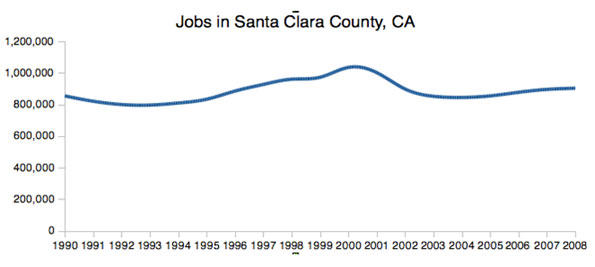
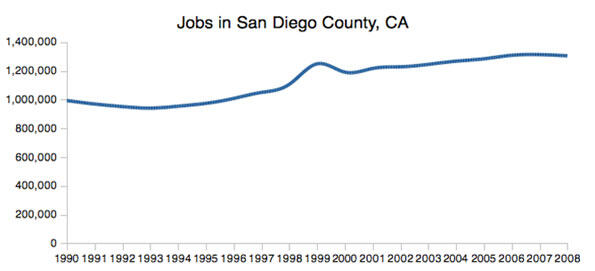
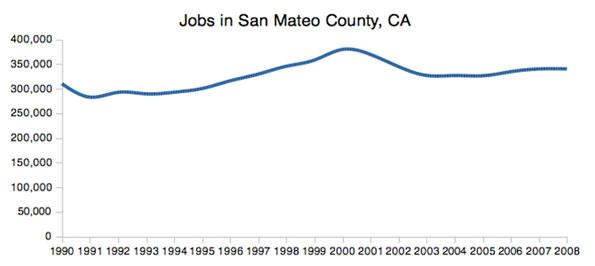
    Let’s consider the counties that make up the heart of these industries. Silicon Valley’s San Mateo and Santa Clara Counties both experienced slow job growth between 1990 and 2009. San Mateo County only added 30,000 net jobs, an average of less than 1,700 new jobs per year, or a compound annual growth rate of 0.5%.

    Santa Clara County added around 50,000 jobs over that 18 year period – about 2,700 jobs per year, but only a CAGR of only 0.3%.

    Both counties added significant new jobs in the late 90s, but these were lost when the dotcom bubble collapsed. The recovery from that decline only reached back to the levels just before the early 90s recession, continuing the long running Silicon Valley boom-bust cycle. Silicon Valley actually added jobs at a slower rate than California as a whole during this period.

    You can see the employment impacts just driving down the 101 freeway; there are more than 43 million square feet of unoccupied space, the equivalent of 15 Empire State Buildings. Twenty one percent of “Class A” space and low rise flex space – used for high-tech research and development – is empty. Unemployment overall in Santa Clara county hovers around 12%, substantially over the national average.

    San Diego County, one of the key centers of the biotech industry, did much better, adding 310,000 jobs over the same timeframe. This is over 17,000 jobs per year, or a CAGR of 1.53%, much better than Silicon Valley, but hardly enough to reflate California’s job market. For example, Los Angeles County added almost a million people during this time, but actually lost jobs.

    A critical consideration may well be that the future could be different from the past for these industries, and that over the next 20 years they will generate far more jobs than in the previous. But the evidence seems to be the other direction.

    California clearly has no shortage of dynamism in high-end economic sectors. There are still plenty of new innovative firms being founded in California or even moving there. And it seems likely these firms will continue to generate significant wealth for the state in the future. Given its current tax structure, the state treasury has significant “operational leverage” to the upside here. Another strong recovery cycle might even replenish the state’s coffers, though won’t offer solace for some time at least.

    But these industries won’t generate many net new jobs. And that is becoming the problem in both Silicon Valley and the state.

    Therein lies California’s dilemma. The ability to generate large amounts of wealth on a narrow job base isn’t enough to support a state of 37 million people. Brazil generates enormous wealth too, and supports lavish stores like Daslu, where you can’t walk in off the street, but there’s a helipad on the roof – and a favela just down the street. But Brazil doesn’t have a middle class economy.

    With innovation the watchword of the day, and no other realistic prospects available in the near term, it is easy to see why places from California to Michigan are placing their hopes on such high end information age jobs. Unlike most, California is already winning the war for the highest value jobs and talent in the space. The headquarters, R&D, core software development, design, and prototyping will be done in California. But it is unlikely to be where the manufacturing, customer support, sales, warehousing, back office support, and other core functions get done. And those are where the jobs are. The back of the iPhone says everything we need to know. “Designed by Apple in California. Assembled in China.”

    California is clearly right to make these industries a priority. The danger is that it comes to focus on them so exclusively that it implements policies that are overly favorable to those select functions, but hostile to everything else. California needs to make sure it has a strategy for middle class and working class jobs beyond the low end service sector. That’s a much harder problem than maintaining Silicon Valley’s dominance, but it’s clearly at least equally as important. The high end portion of various “tech” sectors alone are never going to provide enough jobs to secure a prosperous future for the vast majority of Californians.

    Aaron M. Renn is an independent writer on urban affairs based in the Midwest. His writings appear at The Urbanophile.

  • Move the United Nations to Dubai

    The opening last week of the world’s tallest building, the half-mile-high Burj Dubai, has largely been greeted with guffaws and groans. The Daily Telegraph labeled it “the new pinnacle of vanity”–“a purposeless monument to the subprime era.” The Wall Street Journal compared it to the Tower of Babel. (When the Empire State Building was completed in 1931, in the throes of the greatest financial crisis of the 20th century, it was met with similar jeers. The then-tallest building in the world was called the Empty State Building, and it remained vacant for several years.)

    Yet the Burj’s completion–indeed the whole wild enterprise known as Dubai–could signal a potential opportunity to the global community: turning the place into the headquarters for that other misguided ship, the United Nations.

    Let’s spell out the logic. The United Nations is a pain in the butt. It pays no taxes and annoys hard-working New Yorkers with its sloth, pretensions and cavalier disregard for traffic laws. The place is a sinkhole dominated by anti-American, anti-Semitic and authoritarian fantasies. It is far from the elegant crown jewel that celebrated the U.S.’s global ascendancy after the Second World War.

    Today the U.N. building is a mostly empty shell–water dripping through its roof, asbestos lining its ceiling and an erratic heating and cooling system have forced most UN workers to new facilities. The building is in the midst of a $1.87 billion overhaul–of which the U.S., which could use the cash for myriad other things, would be on the hook for $437 million.

    And the U.N. may be leaving anyway. A relocation committee has recommended that the organization move temporarily to Singapore by 2015. It will be hard to vacate Asia again for New York, which is far away from the bulk of the world’s largest population centers.

    Singapore might make a fine world capital, since it does work like a fine watch. But it’s already crowded, expensive and highly regulated. You have to wonder if hard-working, rational Singaporeans would want to drive up costs and lose their ability to run things as they see fit to accommodate the U.N. bureaucracy.

    In contrast, the al-Maktoum family has transformed a once vast, empty landscape into a Star Wars-like capital city of the future. There is no skyline more arresting than the one built over the past 15 years by Sheikh Mohammed bin Rashid Al Maktoum, the Absolute Ruler of the tiny Emirate. In just 500 square miles, about half the size of Orange County, Calif., the sheikh has created a monument to modern architectural engineering.

    Sheikh Mohammed could offer to build a United Nations City to house the U.N. in any number of vacant office towers. Business Bay has 65 million square feet of office space under construction in more than 200 high-rises. Dubai already has thousands of newly constructed apartments that await the international delegates. More than 2 billion people in Africa, Europe and Asia are within a six-hour flight from Dubai. Travel connections through the world’s largest airport would be a breeze. Dubai has 55 five-star hotels to accommodate every regal and royal delegation, as well as the Harvard Medical School Dubai Center, a $1,400,000,000 facility branded with the Harvard crest, just in case one of the U.N.’s elite workers breaks a gasket.

    Questions of taste and timing aside, you have to admire the sheikh’s chutzpah. The al-Maktoums, descendants of the Bani Yas clan, have ruled Dubai since 1833, first under the protection of the British. The United Arab Emirates was founded in 1971 with big brother Abu Dhabi, the emirate with 96% of the confederation’s oil reserves.

    Like New York, Dubai aimed first to be a capital of capital. Recognizing that oil revenues at $70 a barrel brought immense cash flow to the Persian Gulf, Sheikh Mohammed set out to create a setting where Arab pride and excess oil revenues could be comfortably parked. His boldness caught the attention of the world financial community and soon the tiny emirate employed more construction cranes than any site on Earth.

    For now flying so close to the sun has resulted in a painful and somewhat humiliating fall. With the financial market collapse of 2008 to 2009 international buyers disappeared and property values plummeted. Half of the $300 billion in construction projects screeched to a halt. The Dubai government, with $80 billion to $100 billion of debt, was in trouble, and Dubai World, its investment arm, announced suspension of interest payments on its loans. Enter Abu Dhabi. The neighboring emirate wrote kid brother Dubai a check for $25 billion. What does $25 billion get you in 2010? On Jan. 4, at the grand opening of the Burj Dubai, Sheikh Mohammed announced that the tower would forever be known as Burj Khalifa, named after the Emir of Abu Dhabi.

    Let’s look a bit longer term. Right now there’s 33.6 million square feet of mostly state-of-the-art office space in Dubai. More than 8 million square feet is vacant with millions more in the pipeline. There’s a great airport–as opposed to that aerial dumpster, JFK–that is hours closer to the emerging economic powers of the new century, notably the oil states, India and China. The workforce is skilled and open to foreigners, since the vast majority are foreigners. In Dubai 83% of the 2.2 million residents are from somewhere else. Talk about cosmopolitan.

    But how about New York? “Moving the U.N. to Dubai would be a boon for New Yorkers who have to put up with traffic jams created by the likes of Colonel Qaddafi, scofflaws protected by diplomatic immunity and the loss of real estate revenue they would gain if the U.N. building were turned into something far more useful–condos with a view,” suggests urban historian Fred Siegel, a visiting professor at Saint Francis College in Brooklyn and a fellow at New York’s Manhattan Institute.

    Liberating New York from the United Nations, in fact, would open up some of the best situated real estate in the world. A treasure trove of great apartments and offices right along the East River would suddenly become available, bringing a potential revenue windfall to New York City, which could use it. None of this would threaten the city’s—or the country’s–economic and political status. That grows out of economic and military power, which the U.N. does little or nothing to augment.

    What would Dubai get? It’s an ideal opportunity to refurbish its tarnished image on the world stage in a way that plays to its infrastructural and geographical advantages. The Arabian Sea and the Indian Ocean are increasingly the focal point of the world economic and political systems. Some of the biggest challenges facing the U.N. are concentrated in the south in Somalia and Yemen, to the west in Israel and Palestine, and to nearby Iran and Pakistan. Dubai would have to reconcile itself to a permanent Israeli presence, but that may not be as difficult as many think. Jews, and even Israelis, do business today in Dubai with perhaps less worry about running into manifestations of anti-Semitism than in London or Paris.

    Bringing the United Nations to Dubai makes sense. New York gets rid of one of its worst welfare cheats, and Dubai finds new tenants to fill its vacant towers. Dubai has already built something that looks the part of a 21st-century world capital. Let it get a cast appropriate for its glittering set.

    This article originally appeared at Forbes.com.

    Joel Kotkin is executive editor of NewGeography.com and is a distinguished presidential fellow in urban futures at Chapman University. He is author of The City: A Global History. His next book, The Next Hundred Million: America in 2050, will be published by Penguin Press February 4th, 2010. Coauthor Robert J. Cristiano Ph.D. is a successful real estate developer and the Real Estate Professional in Residence at Chapman University in Orange, Calif.

    Photo:

  • Beyond Neo-Victorianism: A Call for Design Diversity

    By Richard Reep

    Investment in commercial development may be in long hibernation, but eventually the pause will create a pent-up demand. When investment returns, intelligent growth must be informed by practical, organic, time-tested models that work. Here’s one candidate for examination proposed as an alternative to the current model being toyed with by planners and developers nationwide.

    Cities, in the first decade of this millennium, seem to be infected with a sort of self-hatred over their city form, looking backward to an imagined “golden era”. The most common notion is to recapture some of the glory of the last great consumerist period, the Victorians. During this time, from the 1870s to the early 1900s, many American towns and cities were formed around the horse-drawn wagon and the pedestrian. This created cities with enclaves of single-family homes and suburbs that seem quaint and tiny in retrospect to today’s mega-scale subdivisions and eight-lane commercial strips.

    One bible for the neo-Victorians was “Suburban Nation,” a 2000 publication seething with loathing and anger over urban ugliness. In a noble and earnest effort to repair some of the aesthetic damage, the writers proposed a grand solution. Their goal was essentially to swing the development model back to the era of the streetcar and the alleyway, the era when cars were not dominant form-givers and families lived in higher density and closer proximity.

    In the last decade, this movement gained traction with hapless city officials often tired of hearing nothing from their citizens but complaints over traffic and congestion. They embraced the New Urbanist movement which promised to turn the clock back to an era of walkable live/work/play environment of mixed neighborhoods. In the new model, the car would at last be tamed.

    Yet, looking at most of these communities, the past has not created a better future. More often they have created something more like the simulated towns lampooned by “The Truman Show”. These neo-Victorian communities ended up with some of the form of that era, but devoid of employment and sacred space. They also created social schisms of low-wage, in-town employers and high-salary, bedroom community lifestyles marking not the dawn of a new era but the twilight of late capitalism as the service workers commute into New Urbanist villages while the residents commute out.

    Meanwhile, planners who believe that practical design solutions and the vast quantity of remnants from the tailfin era are “almost all right” have remained quietly on the sidelines. This silent retreat, a natural reaction, now puts many good places in jeopardy as the activist planners try to “fix” neighborhoods and districts that were not broken to begin with. We risk losing some of the important postwar building form that well serves the needs of its users and, rather than being blacklisted, should be held up as a valid, comparative model for use by developers seeking to build good city form when the pent-up development demand returns.

    It is time to hit back. Midcentury modern – the era from about 1945 to 1955 – has become a darling style of the interior design world, has yet to be recognized as a valid model for urban development. For too long, neighborhoods built in this era have been treated poorly by the planning community. Yet this period created a critical transition between the archaic beloved streetcar suburbs and the 1980s commercial car-must-win planning. They provide a valuable, forgotten lesson when the middle class’s newfound prosperity was expressed by low-density, car-oriented mixed-use districts that were still walkable and expressed through their form a certain heroic optimism about the future.

    With building fronts set back just enough for parking, yet still close together to give a pleasant pedestrian scale, these little districts remain abundant in the landscape of our towns and cities – nearly forgotten in the fight over form, perhaps because they are doing just fine. They were built when everyone was encouraged to get a car, but before the car became a caveman club pounding our suburban form into big box “power centers” and endless, eight-lane superhighways of ever-receding building facades. These districts were developed before the local hardware store was replaced by Home Depot and many remain intact, thriving, and chock-full of independent business owners. Many of these are true mixed-use districts – with light industrial, second floor apartments, retail and other uses peacefully coexisting.

    In small commercial districts developed in the late 1940s and early 1950s, a balance was struck between the traditional town form and the car, a balance that has been forgotten in the planning war being waged today. This era produced many neighborhoods and districts that are “almost all right”, in the words of noted Philadelphia architect and thinker Robert Venturi, when defending Las Vegas to the prissy academic community.

    To go right to a case study, take the Audubon Park Garden District in Orlando, Florida. Adjacent to Baldwin Park, a Pritzker-funded New-Urbanist darling of 2002, this district is a vintage collection of mixed-use commercial, residential, and industrial buildings constructed in the 1950s. Set back from the curb approximately 42 feet, the mostly one-story storefronts allow parking in front yet are visible and accessible to pedestrians. The car is accommodated in the front of the store, making access easy and convenient, yet the pedestrian can walk also from place to place without long, hot trudges. Drivers see the storefronts. Scale is preserved. (See attached file for street elevations).


    View Larger Map

    The architecture, instead of recalling nostalgic, Victorian styles, is influenced by the art deco and populuxe styles of the Truman era, when America was united, self confident, and victorious. And the businesses reflect an organic mix serving neighborhood needs, their storefronts and facades created by themselves, not by some Master Planner, theming consultant, or fussy formgiving designer. Here, one finds customers in dialogue with shopkeepers, blue collar and creative class mixed together, a few apartments over their stores, and a localism that has endured for fifty-odd years, largely forgotten because it works.

    Places like this three-block district, and others like it, need to be championed. Decoding just what works here, and how it elegantly accommodates the car and the pedestrian, is critical to counterbalance the coercive impact of the New Urbanist movement and present a working model to future developers.

    When New Urbanism was a fledgling movement, it represented a necessary alternative to car-dominated planning principles, and offered a choice where there previously was none. Today, the rhetoric of this movement has sadly forced out all other choices and emphasized one form – that of the streetcar era – over all others. This increasingly authoritarian movement shuts out all other choices today, and now threatens places like Audubon Park with its singular vision by sending in planners to “workshop” an ideal, Victorian makeover. Such actions, if implemented, will destroy the healthy, functioning connective tissue that makes up vast portions of our urban environment for the sake of a romantic notion of form over substance.

    Instead of enforced, and often overpriced, nostalgia, we would do better to seek out districts planned after the car and have worked through time, and hold them up as valid choices to implement when planners are considering a development. These districts, whether a single building, a collection, or a whole community, will become important models as the pendulum swings back from the extremes that it reached by 2007 and 2008.

    For too long, planners and developers have chosen to be silent in the face of the often strident rhetoric espoused by “smart growth” and New Urbanist ideologues. Meanwhile, a tough analysis of New Urbanism’s successes has yet to be seriously undertaken, and alternative models presented. Cities across the nation are considering a move to form-based codes which would lock out districts like Audubon Park and doom existing ones to Victorian makeovers. Useful, diverse and workable places will be destroyed to fit a “one size fits all” ideology.

    So before midcentury modern becomes just another furniture style, a window of opportunity exists to fight back. These kinds of districts dot the cities and towns of America and deserve to be held up as alternative models for new development. Instead of a dogmatic slavishness to nostalgia, planners and developers need to stand up to the preachers of preapproved form, and look for multiple solutions for future urban form. Smart growth should not supersede the arrival of a more flexible, diverse approach of intelligent growth.

    Richard Reep is an Architect and artist living in Winter Park, Florida. His practice has centered around hospitality-driven mixed use, and has contributed in various capacities to urban mixed-use projects, both nationally and internationally, for the last 25 years.