Category: Urban Issues

  • Counting Counties

    I was about seven years old when I got my first copy of the Rand McNally Road Atlas (RMRA), and I’ve rarely been more than 50 feet away from one ever since. Unless I was out of the country, there has probably never been a day when I haven’t looked at it at least once.

    The obvious question that a kid would ask is: What is the smallest county in the United States? In those days, RMRA alphabetized counties separately from cities and towns in the index, so it was a simple matter to go through and search for the smallest one. But I didn’t have the patience to sort through all 50 states; instead I tried to use some cleverness.

    I assumed that the smallest county would not be in populous states, so I excluded places like California and New York. Further, the RMRA didn’t list any counties for Alaska (nor does it today), so that state didn’t count. Thus the logical choice (for a kid) was Wyoming – the least populous state in the union (then excluding Alaska). But I soon noticed that Wyoming only had 23 counties – so despite the small overall population, it seemed unlikely that any of them were very small. Indeed, Wyoming has no counties with fewer than 1000 people.

    So the trick was not only to find a sparsely populated state, but also one with a lot of counties. North Dakota, with less than 700,000 people but with 53 counties, fits the bill. And indeed, I came across Arthur County, population 444, which seemed a likely candidate.

    But South Dakota has 66 counties and Nebraska 93, so it is possible that a smaller county existed in one of those two states. No joy – Arthur was smaller than any of those 159.

    I confidently went out into the world thinking Arthur County, ND was the smallest county in the United States.

    But then it dawned on me that Texas had 254 counties. In those days it wasn’t the population behemoth that it is today, and with only 269,000 square miles, a lot of those counties had to be pretty small.

    And so I found it – Loving County – population 67. That’s its population today; I can’t recall the number from the 1950 census (which would have been the number I found), but I think it was very close to that. And Loving County really is the smallest county (by population) in the United States even now.

    So am I telling you anything you didn’t already know? Probably not – I’m guessing most readers of this blog have long since learned this little bit of trivia. And you learned it from Wikipedia, here. You will also discover that Arthur County is only fifth on the list, bigger than three counties in Texas.

    Wikipedia makes it just much too easy! Imagine, if you will, that I’d had Wikipedia as a child. Think of all the articles I could write for this blog containing utterly useless information about everything. No more cleverness or labor required – all data is right there at your fingertips.

    Now maybe I can play one-up-man-ship with Wikipedia? Through careful study of the RMRA, I discovered three states that have exclaves: New York, Kentucky and Hawaii.

    * Liberty Island and the parts of Ellis Island that belong to New York are surrounded by New Jersey. These are also exclaves of New York County (Manhattan).
    * The westernmost part of Kentucky (part of Fulton County) cannot be reached without crossing Missouri or Tennessee.
    * Oahu and Kauai are separated by more than 24 miles, which means that one has to cross international waters to get from one to the other. (But since they are different counties, neither Honolulu nor Kauai counties have exclaves.)

    I also note that Brookline, MA is in Norfolk County, separated from the rest of the county by Middlesex and Somerset counties.

    So there, Wikipedia! Oh – alright – not so fast. See here. I haven’t had the courage to go through it all and see what I’m missing. Why bother?

    There are some questions for which the RMRA is not especially useful. For example, what are the largest and smallest counties by land area? Excluding Alaska (and by all means, let’s exclude Alaska), then simply by inspection any kid will tell you that San Bernardino, CA, is the biggest county in the country. At 20,000 square miles, it is almost as big as West Virginia.

    What is the smallest county? Before resorting to Wikipedia, I spent a sleepless night pondering this problem. I thought Hawaii’s Kalawao County might fit the bill. Boy was I wrong!

    Kalawao County is what’s left over from Father Damien’s leper colony on the north coast of Molokai. At midnight, I thought it was just the famous little peninsula that juts offshore. However my American Road Atlas (published by Langenscheidt, and nicer but considerably pricier than the RMRA) shows the county is considerably bigger than that – by about 2 or 3 times.

    And what about RMRA? Shockingly, it doesn’t show Kalawao County at all, neither on the map nor in the index! I don’t think it ever has. I find this bothersome.

    Nevertheless, neither atlas cites areas of any county, so it really is necessary to turn to Wikipedia. Wonderfully enough, Wikipedia does not have a list of the smallest counties by area – they only list the smallest county in each state – and then you have to look at a state list. Now there’s a good job here for some kid!

    The matter is complicated because Virginia has a series of independent cities – the smallest of which is Falls Church. At 2.2 square miles, this is the smallest county-like subdivision in the US. But it isn’t a county. The smallest actual county is Arlington County, VA, at 26 square miles (compared to Kalawao’s 52).

    Now what subtle distinction in local governance disqualifies Falls Church, and grants Arlington the status of smallest county? I have no idea.

    A county that I’ve never heard of – Colorado’s Broomfield County – has only 28 square miles. It surrounds a suburb of Denver by the same name – how it got to be its own county I have no idea. And Bristol County, RI, clocks in at 45.

    But this is not the worst. I can surely be forgiven for overlooking city-states in Virginia or anomalies in Colorado. What is harder to understand is how I missed Manhattan! New York County (which includes Manhattan, some smaller islands, and Marble Hill) comes in at 34 square miles. This, surely, would have been a better midnight guess for the smallest county in the country.

    Wikipedia makes me feel old, rendering the skills of a lifetime obsolete. Just the other week my daughter suggested I needed to buy a GPS.

    Never!

    Daniel Jelski is Dean of Science & Engineering State University of New York at New Paltz.
  • China’s Heartland Capital: Chengdu, Sichuan

    On May 12, 2008, Chinese architect Stepp Lin was focusing intensely on his professional licensing exam in a testing center in central Chengdu when suddenly he felt someone bumping his desk. By the time he looked up to see what it was, most of the other exam takers were frantically fleeing for the exit. It turns out that what he was feeling were the tremors of what was to be the most devastating earthquake to hit China in recent memory.

    China’s heartland province of Sichuan was overtaken by an 8.0 earthquake that rocked the region that day. The quake was so powerful that it was felt as far away as Beijing. Graphic images broadcast around the world showed the devastation caused by the powerful tremor. All in all, it is estimated that more than 60,000 people perished in the Sichuan earthquake.

    During the aftermath, the response from both within China and abroad in terms of aid was highly encouraging. Unfortunately, the footage of primary schools reduced to rubble resulting in the deaths of thousands of children and the subsequent scandals regarding culpability denial and cover-up did not bode well for China’s new image.

    Surprisingly, Sichuan’s capital and largest city, Chengdu, escaped from the earthquake largely unscathed. Most of the serious damage took place in rural areas where buildings, due to lack of sufficient funding and regulation, had not been constructed to safety standards. Building safety codes have since been updated and are now rigorously enforced.

    Perhaps more importantly, the 2008 Sichuan earthquake managed to highlight the growing disparity between the rich and poor, urban and rural areas of China.
    Unlike the United States, where suburbanization has managed to blur the line between rural and urban, the contrast remains stark in the Middle Kingdom.

    It is no secret that within the framework of rapid development, China is urbanizing at unprecedented rates. Beijing and Shanghai continue to lead the country politically and economically, but a group of ‘second tier’ cities is now being targeted by China’s planners for increased new investment. Included in this group are up-and-coming cities like Nanjing, Dalian, Tianjin and Chongqing.

    Yet perhaps no other second tier city represents the future of China more than Chengdu (pronounced chung-doo). Strategically located at the geographic heart of China, Chengdu bridges the gap between the country’s booming eastern seaboard and the still largely mysterious far west.

    Chengdu is one of China’s oldest cities, with continuous settlement dating back to the ancient Kingdom of Shu. Today, the city is renowned for its local spicy cuisine and famous Panda Breeding Center. It is also a popular launching-off point for international trekkers heading onto Tibet. Within China, Chengdu is reputed for its leisurely atmosphere where friendly locals often take off work early to sip tea and relax over a game of mahjong.

    Sitting at an elevation of about 1,600 feet on the western portion of the Sichuan Basin, Chengdu’s climate is mildly humid-neither too hot in the summer nor too cold in the winter. Yet one drawback is the presence of the pervasive fog that hovers low in the sky year-round, making Chengdu one of least-sunny cities in China.

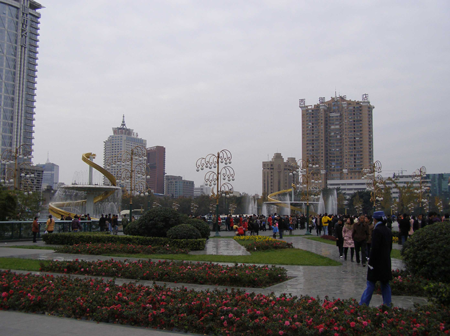
    Similar to Beijing, Chengdu is concentrically organized with ring roads circling the city. At the center of the city is Tianfu Square-a pleasant public space featuring larger-than-life water fountains and a large statue of Chairman Mao. Nearby is the Jin River, which flows through the middle of the city, dividing it in half.

    Despite the slower pace of life, at least in comparison with the rest of China’s hyper urbanity, the Central Government has recognized the city’s advantages. Being the western-most big city in China, Chengdu is China’s gateway to central Asia. As such, the city has been identified as an air traffic hub. Already, Chengdu International airport is one of the busiest in the mainland. Next year, Air China inaugurates its new Chengdu-Los Angeles route: the first direct flight from the city to the United States.

    The new Air China route to LA reflects the growing presence of U.S. firms in the area. Technology companies like Microsoft and Intel have realized the competitive advantages of opening research and development facilities in an area of the country where the cost of doing business is still relatively low. These firms have located their offices in an area in the south of Chengdu that has been designated as the ‘Hi-Tech Zone’ by China’s Ministry of Science and Technology.

    Along with becoming western China’s high tech center, the city is grabbing a foothold on the country’s aviation industry. Chengdu Aircraft Industrial Group (CAC), which was contracted out by Dallas-based Vought Aircraft, supplied the rudder for Boeing’s new 787 ‘Dreamliner’ jet. CAC also supplies parts for Boeing’s 757 series.

    To accommodate the new business, the city is going through a construction boom. Although Chengdu had a late start on its eastern counterparts, the city is attracting high-profile developers like New York-based Tishman Speyer and Singapore’s CapitaLand – both of whom currently have large-scale commercial and retail projects being built in the city. Chengdu has even recruited Hong Kong businessman Allan Zeman to develop a version of Hong Kong’s popular nightlife district, Lan Kwai Fong, scheduled to open in March.

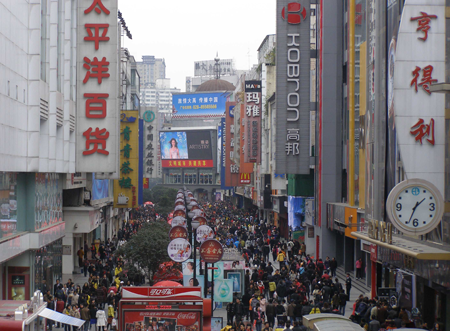
    The city’s development would not be complete without an overhaul of its transportation system. One word summarizes the current state of Chengdu’s roads: chaos. The traffic on the streets remains an assortment of bicycles, motorbikes, automobiles and buses. Yet, as incomes rise and more people purchase cars, the congestion on the streets is becoming unbearable. Furthermore, the fact that the streets do not follow a formal grid pattern, but rather array out from the center of the city, adds another degree of complexity to Chengdu’s traffic dilemma.

    Thankfully, the city’s first subway line is slated to open in 2010. As additional underground lines become operable, it will also give the city a better sense of cohesiveness as the limited number of surface level crossings of the Jin River currently contributes to both a physical and psychological divisiveness.

    In discussing the rise of Chengdu as a hotbed of economic activity, it is worth mentioning the city’s relationship with its closest rival, Chongqing. Chongqing, which was separated from Sichuan Province in 1997 to become an autonomous provincial-level municipality, lies just over 200 miles to the east. The city has the advantage of direct access to the Yangtze River, providing a strategic connection to the river’s terminus of Shanghai.

    Chongqing’s urban development is limited by the surrounding mountainous terrain-thus the reason for the dense high-rise jungle rising in the skyline. Chengdu, in contrast, has an abundance of land for growth and is more likely to sustain long-term development. Also, the fact that Chongqing has been plagued by corruption and local mafia activity in recent years means that foreign firms may be more attracted to safer Chengdu.

    That is not to say that there is not room for both cities in China’s future. In fact, the two cities are likely to form what will become the Chengdu-Chongqing mega-region – the economic powerhouse of western China. Already, other mega-regions in China like the Bohai Bay Rim (Beijing, Tianjin and Dalian), the Yangtze River Delta (Shanghai, Hangzhou, Nanjing and Suzhou) and the Pearl River Delta (Guangzhou, Dongguan, Shenzhen, and Hong Kong) are setting groundbreaking standards in the history of global urbanization.

    The Sichuan earthquake of 2008 managed to bring about an awareness of the major issues still facing China. In stark contrast to the days of the Cultural Revolution when urban areas were viewed as pariahs, the Sichuan quake solidified the triumph of the city over the countryside. As the city on the frontier, Chengdu is likely to become a key player as thousands of migrants arrive from Sichuan and adjacent provinces. How these newcomers are incorporated represents a great challenge for China as it shifts from a largely rural to a predominately urban country.

    Adam Nathaniel Mayer is a native of California. Raised in Silicon Valley, he developed a keen interest in the importance of place within the framework of a highly globalized economy. Adam attended the University of Southern California in Los Angeles where he earned a Bachelor of Architecture degree. He currently lives in China where he works in the architecture profession.

  • Reducing Traffic Congestion and Improving Travel Options in Los Angeles

    While traffic congestion plagues many cities, Los Angeles stands apart. The Texas Transportation Institute tracks congestion statistics for U.S. metropolitan areas on an annual basis, and Los Angeles routinely ranks first for both total and per-capita congestion delays. Considering the value of wasted time and fuel, TTI estimates the annual cost of traffic congestion in greater Los Angeles at close to $10 billion.

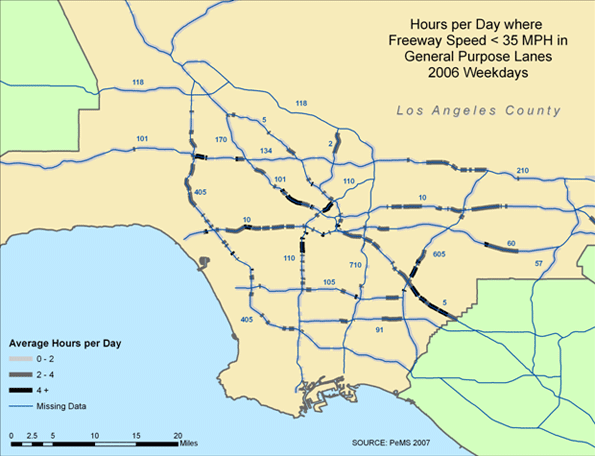
    The map in Figure 1, based on 2006 Caltrans sensor data, illustrates the weekday pattern of traffic congestion on the LA freeway network. Congestion is pervasive throughout much of the county; most freeways have segments on which traffic averages less than 35 mph at least two hours per day, and many bottlenecks are congested at least four hours per day.

    Figure 1. Traffic Conditions on the LA Freeway Network

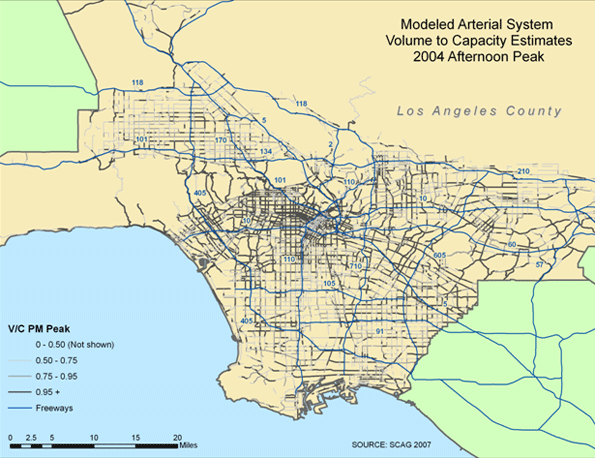
    Conditions on the surface streets are not much better. The map in Figure 2, based on 2004 volume-to-capacity (V/C) estimates from SCAG, depicts the pattern of afternoon traffic congestion on the county’s largest arterials. Here again it is evident that traffic congestion is broadly dispersed, yet the pattern is particularly intense between downtown Los Angeles and the Westside.

    Figure 2. Traffic Conditions on LA Surface Streets

    With the recent run-up in fuel prices followed by a severe recession, total travel in Los Angeles has declined over the past two years, and congestion has correspondingly eased. Yet if past trends hold, this reprieve is likely to be fleeting. Should the region’s economy and population grow in the coming decades, as some forecasts predict, the probable outcome is even more vehicle travel and in turn more intense congestion.

    Controversial Solutions for a Daunting Problem
    Researchers at the RAND Corporation were asked to recommend strategies capable of reducing LA traffic within five years or less (the short timeframe rules out land-use reforms along with major infrastructure investments). The resulting report, Moving Los Angeles: Short-Term Policy Options for Improving Transportation, offers recommendations at once controversial and likely inescapable. To achieve lasting traffic relief, it will be necessary to manage the demand for travel through pricing reforms (e.g., congestion tolls) that increase the cost of driving and parking in the busiest corridors and areas during peak travel hours. Other measures—better transit service, ridesharing programs, traffic signal synchronization, and the like—can complement pricing, but are not on their own sufficient to stem current and projected future traffic congestion.

    Few Strategies Offer Much Promise
    Just why should this be so? Consider, first, that traffic congestion results from an imbalance between the supply of roads and peak-hour automotive travel. In fact, congestion can be viewed as a solution (though an unpleasant one) to this imbalance; when demand exceeds supply, congestion makes us wait our turn for available road space to balance the equation. Over the past several decades, the gap between supply and demand has widened considerably; population growth, economic expansion, and rising incomes have fueled the demand for more vehicle travel, while road construction has stagnated. We have therefore been relying, more and more, on congestion to resolve this imbalance.

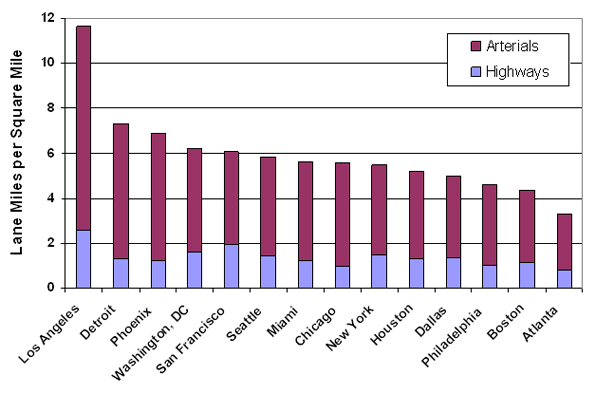
    One response would be to build or expand more roads to accommodate additional vehicle travel. Setting aside policy concerns related to greenhouse gas emissions and energy security, the prospects for “building our way out of congestion” are limited. To begin with, there simply isn’t much space to build new roads in Los Angeles, particularly in the most densely developed urban areas. As shown in Figure 3, the density of the road network in the greater Los Angeles region, measured in lane miles per square mile, is already far greater than in any other large metropolitan area in the country.

    Figure 3. Road Network Density in Major Metropolitan Areas

    We also lack the resources to engage in an extensive road building spree. In recent decades, federal and state elected officials have failed to increase fuel taxes enough to offset the effects of inflation and improved fuel economy, thus hobbling the major source of funding for road construction and repairs.

    Even if we could expand the road network, though, the benefits would be limited by a phenomenon described as “triple convergence.” Congestion has been a problem for years, and many individuals deliberately alter their travel patterns to avoid severe traffic. When an investment in road capacity reduces peak-hour congestion, many will conclude that they no longer need to go out of their way to avoid congestion delays and will thus “converge” on the improvement from (a) other times, (b) other routes, or (c) other modes of travel. The net effect is that the initial traffic-reduction benefits will usually not last over time. This is why we often see, for instance, that the improved traffic flow resulting from a new freeway lane does not last for more than a couple of years.

    If supply-side remedies do not create sustainable reductions in traffic, it becomes necessary to examine ways of reducing peak-hour travel demand. Commonly employed options include improved transit service, voluntary ridesharing programs, flexible work hours, and telecommuting. Unfortunately, the congestion-reduction benefits of these strategies are likewise undermined by triple convergence. If a new subway line induces some peak-hour drivers to switch to transit, other drivers will soon converge on more freely flowing roads to take their place. Indeed, the effects of triple convergence explain why traffic congestion has grown steadily worse despite considerable state and local investment in a broad range of congestion-reduction strategies.

    Only Pricing Strategies Promise Sustainable Reductions in Traffic Congestion
    This brings us to the rationale for pricing strategies. Among the many possible options for reducing traffic congestion, only pricing resist the effects of triple convergence. By increasing the cost of driving or parking in the busiest areas or corridors during the busiest times of day, pricing measures manage the demand for peak-hour travel, in turn reducing congestion. Once traffic flow improves, the prices remain in place, thus deterring excessive convergence on the newly freed capacity.

    Pricing strategies offer two additional benefits. First, pricing generates revenue to support needed transportation investments. And in comparison to sales taxes, a common option for raising local transportation revenue, pricing has been shown to reduce the relative tax burden on lower income groups (though wealthier individuals consume more taxable goods than their less-affluent counterparts, to an even greater extent they (a) drive more, (b) are more likely to travel during peak hours, and (c) are more likely to pay peak-hour tolls rather than alter their travel choices). Second, pricing enables more efficient use of the road capacity that we already have, because roads on which traffic flows smoothly (at roughly 40 mph or higher) can carry far more vehicles per lane per hour than roads snarled in stop-and-go congestion. Paradoxically, then, we see that the introduction of pricing enables roads to accommodate more peak-hour trips. It is therefore useful to think of pricing as a means of managing peak-hour travel demand rather than reducing it.

    Pricing Strategies Will Be Particularly Valuable in Los Angeles
    Pricing holds promise for most major cities, but the case in Los Angeles is especially compelling. To understand why, it is necessary to consider the interactions between population density and travel behavior, factors that help to explain the severity of LA traffic.

    Contrary to its reputation for sprawl, Los Angeles is quite densely populated when viewed at the regional scale. Downtown Los Angeles isn’t as dense as, say, Manhattan or central Chicago, but the suburbs surrounding Los Angeles are much denser than the typical suburb, leading to high aggregate density on a regional basis.

    As population density increases, individuals tend to drive less on a per-capita basis. Trip origins and destinations are closer together, leading to shorter car trips, and in dense neighborhoods people can rely on alternatives such as walking, biking, or transit for a larger share of trips. Yet this can be overwhelmed by the fact that there are also more drivers competing for the same road space within a given area, thus intensifying traffic congestion. The net effect is that greater population density tends to exacerbate congestion—think downtown Manhattan.

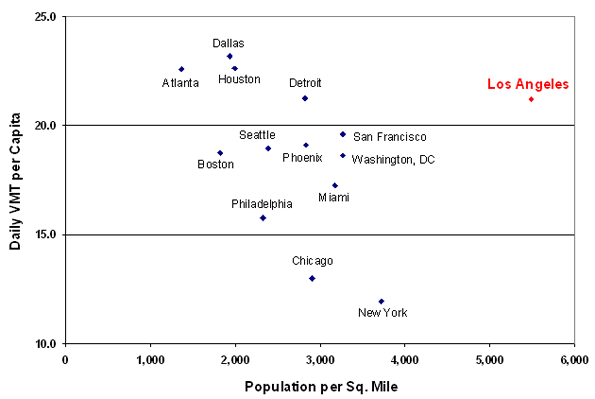
    LA traffic congestion is further exacerbated by the fact that Angelinos do not curtail their driving as much as one would expect in response to higher population density. Figure 4 compares per-capita vehicle miles of travel (VMT) and population density for the 14 largest metropolitan regions in the country.

    Figure 4. Population Density vs. Per-Capita VMT for the 14 Largest U.S. Metropolitan Regions

    Looking across the different regions, there is a fairly consistent relationship in which per-capita VMT declines with regional density. Los Angeles, though, bucks this trend. The only other metropolitan regions with higher per-capita VMT (Atlanta, Dallas, Houston, and Detroit) are all much less dense than Los Angeles. For regions in which the level of density approaches that of Los Angeles (San Francisco, Washington D.C., and New York), per-capita VMT is much lower.

    In short, we see a confluence of three density-related factors that combine to explain the severity of congestion in Los Angeles: (1) congestion is likely to rise with increased population density; (2) Los Angeles is much denser than its peers at the regional level; and (3) Los Angeles exhibits a surprisingly high level of per-capita VMT relative to its density. The third of these underscores the importance of pricing strategies as a means of managing the demand for automotive travel in Los Angeles.

    In the end only pricing strategies promise sustainable reductions in traffic congestion. Other measures – including improvements in alternative transportation modes – can be beneficial, but none will be nearly as effective as pricing. This recommendation will no doubt stir controversy, but pricing offers the only realistic prospects for managing peak-hour travel demand in the most traffic-choked of American metropolises.

    Dr. Paul Sorensen is an operations researcher at the RAND Corporation, wherehe serves as Associate Director of the Transportation, Space, and Technology program. Dr. Sorensen has published peer-reviewed studies in the areas of geographic information analysis, location optimization modeling, emergency response logistics, and transportation finance policy, and he also holds aU.S. patent on a methodology for forecasting the demand for ambulance services. Dr. Sorensen received a BA in computer science from Dartmouth College, an MA in urban planning from UCLA, and a PhD in geography from UCSB.

  • Housing: Density & Desire

    Density — the number of units per acre on a proposed site plan — is at the heart of the developer’s mantra: More density, more profit. Meanwhile, environmentalists and many planners preach high density as the promise for a better future. The compression of families is an attempt to curb sprawl and reduce transportation energy consumption. For these reasons, many Green programs demand a minimum density to qualify for certification. Those who sit on suburban city councils and planning commissions fear over-densification, and typical suburban ordinances are written to oppose density.

    Who’s right? Nobody. There is no ideal density number in planning or development. Forget the search for a numerical value. Instead, concentrate on livability.

    Ordinances throughout the world state minimal dimension requirements. Some suburban ordinances, but not most, specify density maximums. But density alone cannot determine the most important issue in any development: Is it a great place to live? If both environmental impact and affordability were added to the mix, then you could equate livability with sustainability.

    Suburban Settings: The term ‘sprawl’ is recklessly used to describe all new suburban development, as if every new suburb was composed of massive lots with McMansions. Want proof that it’s not so? Take a tour of a suburb near a major city that was developed this past decade. In most, you will find smaller lots with homes compressed close together, often with less open space than older, large lot developments. Many of the new suburban developments that are close to major cities approach New Urbanism in density. There are some large lot developments for large residential estates, which are frowned upon as if achievement has become evil.

    The opponents of suburbia often don’t factor in the changes that have come about in environmental regulations. When urban areas of the past were built, wetlands (previously known as “swamps”) were simply filled in for development. Wooded areas were clear cut for the new city to be built. Today, we cannot fill in wetlands that in some places constitute vast areas within suburban communities. Many suburban cities have tree preservation and slope restrictions that also result in large open spaces. Because land that developers in the past simply built over is now set aside for preservation, today’s suburbs are going to naturally appear much less “dense” than existing suburban areas. Should a new “urban” city sprout today, as a result of these same protections it too may appear far less dense.

    Higher density can drive up raw land value. Developers who can place four homes on each acre are willing to pay much more than they would have a decade ago for the same land, when each acre could yield only two homes or less. The consumer ultimately pays the same (or more) for a much smaller lot, so density does not deliver affordability.

    Ordinances typically do not deliver livability. When we provide amenities that are not required in ordinances such as an architectural theme, or parks, walks, trails, destination places, and then add sustainability elements such as low impact storm drainage, green building, engineering, and landscaping…what keeps all of this affordable? Increased density helps when the original plan is for large lots. But we can only push density increases to a limit that preserves the sense of space that suburban home buyers expect. Cities that have already reduced minimum lots from, say, 10,000 square feet to 5,000 gave up all of their spare space long ago. Reducing lot size on an already small space can destroy livability. When lots were larger, there was negotiating power: Want smaller lots and more density? Then we’ll build a sustainable neighborhood, not a subdivision. With a small lot that negotiating power vanishes.

    Livability results from a balance of the hundreds of elements that must be taken into consideration when planning, engineering and constructing a neighborhood. A density goal can easily tip that balance in the wrong direction.

    I was trained on how to abuse the regulatory system. In the early 1970s, I was on top of the planning game as a master at manipulating regulations. I was able to find holes in the regulations to legally justify cramming units together. I felt victorious when I gained density. After driving through many of the neighborhoods that were eventually built, pride turned into shame. They were nothing special. I created developments that would do nothing to enhance the living standards of the residents; instead, they made the developer (who was now long gone) more profit. I vowed to never again use increased density as a goal, but rather to use balanced design practices as the driving force of all my neighborhood plans.

    Urban Settings: It is expected that density will be higher in urban areas. We recently did a proposal on a four acre infill site in Minneapolis. We pushed the density on one proposal to 111 units. Our goal was to produce an affordable (i.e. low income), environmentally sound development that would provide a sense of space and accomplishment (pride) for the residents. In low income neighborhoods it is important to hide parked cars as they can be an eyesore that can have a negative visual impact. All parked cars were to be hidden in underground parking areas or in the rear of a home.
    Utilizing new architectural design practice, we provided panoramic views of landscaped spaces using the kitchen as the focal spot for every unit. In this new era, which we call Prefurbia, one goal is to make the interior floor plan an integral component of the overall neighborhood design; we break up the architecture to create that all important curb appeal and eliminate the monotony so common in urban settings, especially lower-income ones. Density was also limited because we wanted to keep each unit at a minimum of 900 square feet. Every home was tied to a meandering walk system leading to a central aquatic garden in a 0.7 acre park. A truly wonderful place to live, at any income level.

    Yet when we presented the development plan we were told that the density goal was 120 units. When we asked where that number came from, we were told it was the minimum that was needed for LEED-ND standards. Jamming another 10% of density would bring the proposal out of balance – something would need to be sacrificed. We could eliminate the central park focus, or perhaps throw the parked cars in the open, or make the small units even smaller. We could eliminate the tie between the floor plans and the neighborhood. Going up another floor would just make the parking situation worse, as we would then have no room to hide the cars underneath the apartments. Demanding a minimum density does nothing to assure good development. If anything, it provides another target that detracts from creating a well balanced neighborhood that is a pleasure to live within.

    Density Instead of Profitability: When I began to plan developments for a nationally recognized firm, we achieved the density goals, but had no clue as to the actual costs of constructing a neighborhood. We would cross a creek to reach isolated corners of a site and gain a few lots, never realizing that a bridge costs much more than the profits gained in those few units. Using geometry instead of smart design practices, we stretched the length of streets, never realizing that streets cost about $300 (today’s dollars) for each extra foot. In the end we did get to the desired density ratio, but at what cost? Smarter design would have been to balance the infrastructure needs against the density goals. That was 40 years ago. Unfortunately those regulating and planning many of today’s new developments and redevelopments still look only to density, not to other costs.

    Density And The Environment: Planners assume that if we increase density in one place then we will not need to build somewhere else, and the end result will be that we will be left with vast, natural open spaces. This fantasy can only become a reality if the additional density achieved on a site corresponds with the dedication of a permanent preserve of open space elsewhere in the same city.

    Want to make this a better world to live in? Forget trying to justify a particular number of units per acre. I was guilty of this approach at one time. There is actually a term for the attitude: it’s defined as “difficult to understand or follow because of being closely packed with ideas or complexities of style”…and that word is “Dense”!

    Rick Harrison is President of Rick Harrison Site Design Studio and author of Prefurbia: Reinventing The Suburbs From Disdainable To Sustainable. His website is rhsdplanning.com.

  • Will Anyone Stand Up for American Industry?

    “Esau for one morsel of meat sold his birthright. For ye know how that afterward, when he would have inherited the blessing, he was rejected: for he found no place of repentance, though he sought it carefully with tears.” – Hebrews 12:16-17

    Built from 1933-1936, the Bay Bridge linking San Francisco to Oakland was an engineering marvel of its day. A complex series of multiple spans, when it opened – six months ahead of the more famous Golden Gate Bridge – it was both the longest suspended bridge deck in the world and the longest cantilever bridge in the world. The western suspension bridge section, technically two bridges in one, had to settle for being only the second and third longest suspension bridges in the world.

    The 1989 Loma Prieta earthquake badly damaged the Bay Bridge. The iconic western suspension span was seismically reinforced, but the eastern steel truss section required replacement. San Francisco wanted another iconic span, not just a functional one. A striking self-anchored suspension structure was selected and is under construction.

    The dubious part of this new span isn’t the usual matter of being way late and massively over budget – though it is – but where it’s being made. The steel for the bridge is not being built in America but in China.

    Why is this bridge being fabricated in China? The troubling answer, according to a lengthy article in the SF Public Press, is that no American company can do the job. America, a country that once pulled off the most audacious of engineering projects with panache, one that put a man on the moon in the 1960s, now can’t even build a bridge to replace one it constructed with ease in the 1930s.

    What’s more disturbing, is that China can’t really build it either – but we are teaching them, and paying for them to learn how.

    When you drive across that new Bay Bridge, your tolls will literally be helping to finance the advancement of China’s industrial base and the evisceration of America’s.

    I believe in free trade, strongly. I believe America can compete in a free market. But the United States is a country curiously uncommitted to industry. Other countries build, promote and protect industrial champions. They blockade their markets against American competitors. India freely sells us software and BPO, but passes laws to hamper Wal-Mart and other American firms. China demands many foreign companies do business there only through joint ventures, and transfer technology to local partners. It also intervenes to keep its currency artificially low. Many countries outright ban foreign involvement in many sectors such as energy. They view even their privately owned firms, many of which have close and corrupt ties to the state, as instruments of national and foreign policy.

    These places see Japan as a model to follow, a country that used its closed market to build industrial champions, even in high technology markets. Perhaps in time the same problems that hobbled Japan – asset bubbles, debt, demographic collapse, or an inflexible economy – will similarly afflict these emerging markets. But by that time it might be too late for American industry. And those problems are just as likely to affect us as them.

    This raises difficult questions about the future of America. Can we thrive as a purely post-industrial economy? Can we have a long term prosperous society built on little more than selling each other ever more exotic pieces of financial paper, creative consultancies, typing away at computers, serving up caffe lattes, and the like? Can we have a just social order as a two-tier society of only highly-paid elite knowledge workers and a low end service class, but not the robust middle class a manufacturing economy – along with agriculture and energy – supported?

    Can America even retain its military industrial strength under such conditions? In the past, military technologies launched spin-offs to the commercial world. Today, the reverse is as likely to happen. Already the only major ship builders left in America are captive suppliers to the US Navy. Only the anomalous Jones Act has kept a tradition of small and medium sized commercial shipbuilding alive.

    There’s a positive reinforcement cycle at work. The less we manufacture, the less we can manufacture. We slowly lose the skills, the facilities, the institutions, and the culture that enable a robust manufacturing economy to thrive. Eventually, we won’t be able to recover.

    Maybe we won’t even want to. The less we make, the less we want to make. As we become unmoored from our agro-industrial roots, we fail to see them as central to our national identity and frequently treat them with hostility. As Douglas and Wildavsky put it in Risk and Culture (1982):

    A larger proportion of the population of working age was disengaged from the production process than had been before. The economic boom and educational boom together produced a cohort of articulate, critical people with no commitment to commerce and industry.

    Increasingly, Americans have no personal experience with industry, and even no family experience with it. What was once common is just another niche, much like military service has become. This means most people have little familiarity or affection for industry, agriculture, or energy production. Many, especially urban dwellers, view most productive industry as a negative, as a source of blight where once others saw jobs and a strong tax base.

    Portland provides the perfect example. It views its waterfront as prime territory for residences and recreation, but not for industry. As the Oregonian reports:

    The question makes Jay Zidell uncomfortable. When will he stop building barges on the waterfront and start building high-rises? The room goes silent….Oregon power brokers have nudged the Zidell family for decades to do more with their prime Portland real estate…In the 1970s, Gov. Tom McCall called Jay Zidell’s late father, Emery, to suggest he stop adding industrial buildings. As Jay Zidell has told the story, McCall said: “We have big plans for the waterfront.”

    Those big plans don’t include manufacturing. Portland is the perfect example of where America is heading. It’s a place where thousands of highly educated but often underemployed young people sip lattes by the light rail while on the waiting list for a job at Starbucks. Meanwhile people in third world countries, hungry for more, hustle to build an ambitious future for themselves and their nation. Americans increasingly view manufacturing as an undesirable activity, particularly in an urban context, when in fact we should be looking to build new industrial cities – updated, re-imagined, and re-designed for a 21st century economy.

    Also, too often industry is viewed only as a source of pollution. Many industrial expansions are opposed on environmental grounds. But from a global, not local perspective, an ever stricter regime of regulation is sending firms offshore where pollution standards are usually far laxer. Corporations put a green gloss on their branding campaigns while building their products in China, where they get electricity from one of the new coal fired power plants that open at a rate of more than one per week. They also escape independent unions, anything like the Environment Impact Statement process in the US, and operate in a regime of weak property rights, questionable worker health and safety conditions, and a limited ability for the public to dissent. It’s not just cheap labor, it’s regulatory arbitrage. It’s like inverse colonialism, only this time the joke’s on the West. And the end result is a global environment that ends up worse, not better.

    To really protect the environment, we should be doing more manufacturing at home, where we can keep an eye on it and prevent the worst abuses. It’s like the Steak ‘n Shake boast about their open kitchens: “In sight, it must be right”.

    The sometimes exception to this negative take on manufacturing is, of course, “green” industry, notwithstanding that the concept does not exist except as a transitory state. In a decade there will just be “manufacturing”, and virtually all will adhere to green standards. But if America can’t succeed at traditional manufacturing, why would anyone think it will be different with green manufacturing? Even if so, by then there might not be many major American producers left to succeed.

    American firms and labor have made many mistakes over the years, but more often today they are adopting the new approaches needed to compete in tomorrow’s world. American labor can compete, even against cheap foreign workers, since it is the best and most productive workforce in the world. But not when public policy implicitly favors shipping manufacturing overseas.

    The answer is not protectionism, it’s freeing American labor to compete and developing policies designed to advance American manufacturing interests. Alexis de Tocqueville talked about Americans knowing the difference between raw, naked self interest, and “self-interest well-understood”. Likewise, we need to find a new approach to create “free trade, well understood”, a modern day trade equivalent of speaking softly, but carrying a big stick. Billions for American infrastructure, but not one $4 Bay Bridge toll to finance China’s technology ambitions.

    Alas, this seems unlikely. American industry is trapped between a political right that can’t see beyond instinctive anti-federalism and an overly ideological vision of free trade, and a political left that, while paying lip service to labor interests, no longer embraces industry. Almost alone among nations, America today lacks political champions for its industry. That, more than anything, is why it is being left to wither. Will anyone stand up and be counted before it’s too late?

    Aaron M. Renn is an independent writer on urban affairs based in the Midwest. His writings appear at The Urbanophile.

  • The Limits Of Politics

    Reversing the general course of history, economics or demography is never easy, despite even the most dogged efforts of the best-connected political operatives working today.

    Since the 2006 elections – and even more so after 2008 – blue-state politicians have enjoyed a monopoly of power unprecedented in recent history. Hardcore blue staters control virtually every major Congressional committee, as well as the House Speakership and the White House. Yet they still have proved incapable of reversing the demographic and economic decline in the nation’s most “progressive” cities and states.

    Obama and his congressional allies have worked overtime in favor of urban blue-state constituencies in everything from transportation funding and energy policies to the Wall Street bailouts and massive transfers of private wealth to powerful public-employee unions. Yet these areas continue suffering from net outmigration and stubbornly high job losses – as well as from some of the most severe fiscal imbalances in the nation.

    Nowhere is this more evident than in the president’s hometown of Chicago. The Windy City has suffered a very bad recession and may have fallen to its worst relative position since the Daley reconquista in 1989. As Chicago blogger Steve Bartin points out, even the presence of a Daley operative in the White House has failed to prevent the city from falling “in a funk.” He writes that even a reliable booster, columnist Mary Schmich of the Chicago Tribune, has lately described the city “as edgy, a little sullen and scared, verging on depressed.”

    There’s plenty reason for feeling low, well beyond the humiliating loss of the Obama-backed Olympics bid last year. For example, Oprah Winfrey, the city’s one bona fide A-list celebrity, is retiring her talk show in 2011. She is also reportedly shifting much of her media empire to Southern California, which, for all its admitted problems, has gads of celebrities and much better weather.

    Chicago’s most serious concern, however, revolves around the economy. In June, its unemployment rate peaked at 11.3%, far outpacing the national unemployment rate of 10%. Since 2007, the region has lost more jobs than Detroit, and more than twice as many as New York. Chicago’s total loss over the entire decade is greater than any region outside Detroit: about 250,000 positions, which is about the amount its emerging mid-American rival Houston has gained. In hard times businesses tend to look for places with a friendly environment for their enterprise. They avoid high taxes, political payoffs and inflated public employee salaries – all well-known Chicago specialties. These costs are undermining the city’s competitive position in, for example, the convention business, among others.

    Other key sectors are also flailing. Political influence in Washington will not stem the flow of high-wage trading jobs away from the Mercantile Exchange to decentralized electronic exchanges. Nor can it reverse the deteriorating state fiscal crisis caused by weak economies and exacerbated by insanely high pensions and out of control spending policies. Late last month Moody’s and S&P downgraded the debt ranking for the State of Illinois. Of course, such fiscal malaise is not limited to Chicago or Illinois. True blue California has an even worse debt rating. New York, another blue bastion, is also just about out of cash.

    To be sure, the recession has not hurt New York as much as Chicago, but the Big Apple has lost heavily , including 50,000 financial sector jobs since 2007. The outrageous bonuses to a few well-placed financial types will cushion but not deflect the influence of declining high-wage jobs. This can be seen in the striking weakness in the once seemingly unstoppable high-end condominium market. Particularly hard hit have been recent gentrified neighborhoods like Williamsburg in Brooklyn, N.Y., much like the hard-hit, newly developed areas along the Chicago lakefront.

    Other blue bastions have been shedding jobs as well, both during the recession and over the whole decade. Beyond Chicago and Detroit, the biggest losses among the mega-regions have taken place in the San Francisco Bay Area, Los Angeles-Long Beach and Boston. Big money can still be made in Silicon Valley, Hollywood or around the academic economy of Boston, but in terms of overall jobs, the past decade has been dismal for these regions. Meanwhile, the consistent big gainers have been – besides Houston – Dallas and Washington, D.C., the one place money really does seem to grow on trees. Even Miami, Phoenix and San Bernardino-Riverside, in California, boast more jobs today than in 2000, despite significant setbacks in the recent recession.

    These trends coincide with continuing shifts in demographics. The recession may have slowed the pace of net migration, but the essential pattern has remained in place. People continue to leave places like New York, Chicago, San Francisco and Los Angeles for more affordable, economically viable regions like Houston, Dallas, Austin and San Antonio. Overall, the big winners in net migration have been predominately conservative states like Texas – with over 800,000 net new migrants – notes demographer Wendell Cox. In what Cox calls “the decade of the South,” 90% of all net migration went to southern states.

    Utah, Colorado and the Pacific Northwest have also experienced positive flows – but perhaps most striking have been the migration gains, albeit modest, in Great Plains states such as Oklahoma and South Dakota as well as Appalachian Kentucky and West Virginia. Historically these places shipped many of their people to cities of the industrial Midwest, the eastern seaboard and California; that is no longer the case.

    Ultimately these shifts could undermine the true blue political strategy, perhaps as early as the 2010 congressional and state elections, and certainly after reapportionment. By 2012, the census will likely take seats from New York, Michigan, Pennsylvania and Ohio, handing them over to Texas, North Carolina, Georgia and Utah. Perhaps nothing will epitomize the new reality more than the fact that California, now among the most extreme blue states in terms of governance, will not gain a Congressional seat for the first time since the 1860s.

    These trends suggest that the current administration and the majority party in Congress must adjust their strategy. Further attempts to push a radical “progressive” agenda – expansive public employee bailouts, higher taxes and radical measures to combat “climate change” and suburban development – might please their current core constituencies, but they have the perverse effect of driving even more people and jobs out of these regions.

    All these underlying trends appear a boon to Republicans. But Democrats could counter the emerging GOP edge by appealing to the needs of these ascendant regions. By their very nature, growth states have the most urgent need for government investments in basic infrastructure, something traditional Democrats long have espoused. Moreover, such areas tend to become more tolerant as they welcome outsiders, and could be turned off to excessive Republican social conservatism.

    For any of this to work, however, Democrats must first abandon their current narrow, urban-centric blue-state strategy. They must learn to adjust their appeal to regions on the upswing, or things could turn out very badly for them very soon.

    This article originally appeared at Forbes.com.

    Joel Kotkin is executive editor of NewGeography.com and is a distinguished presidential fellow in urban futures at Chapman University. He is author of The City: A Global History. His next book, The Next Hundred Million: America in 2050, will be published by Penguin Press early next year.
  • Urbanity Drives Gay Rights Victory in Washington

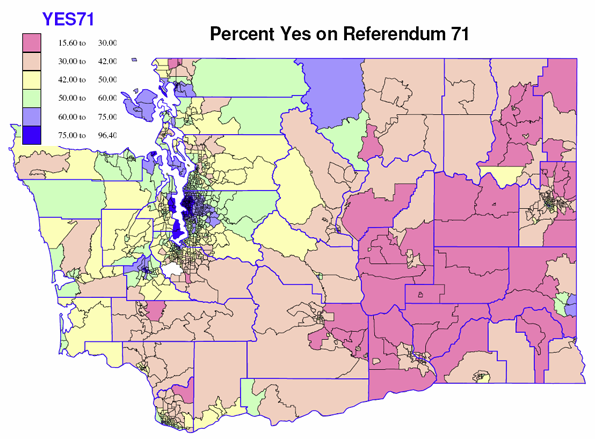
    If anyone were to doubt that there really are two Washingtons, that the Seattle metropolitan core (and its playgrounds) are another world from most rural to small city Washington (especially east of the Cascade crest), a look at the maps for the vote on Referendum 71 last November should be persuasive. These are not subtle, marginal differences, but indisputable polarization in what political and cultural researchers may call the modernist-traditional divide.

    Referendum 71 passed by a 53 to 47 percent vote, and revealing the power of the King County electorate, which alone provided a margin of 204,000, compared to a statewide margin of 113,000! To overcome the problem of variable size of precincts, and the need to suppress too small numbers, I aggregated precincts to census tracts, which have the added advantage of permitting comparison of electoral results with social and economic data from the census.

    Looking at the statewide map, about 85 percent of the territory of the state (95 % in Eastern WA, 70 % in western WA) voted NO. But the strong no vote came from overwhelmingly rural areas and small towns. The only core metropolitan census tracts that voted a majority no were in Richland-Kennewick area, Yakima and Longview. The heart of traditionalist, and arguably, of anti-gay sentiment lies in the farm country of eastern Washington, especially wheat and ranching areas in Adams, Douglas, Garfield, Lincoln, Walla Walla and Whitman counties, but extending also to the rich irrigated farmlands of Grant, Franklin, Benton and Yakima counties. The highest no votes in western Washington were far rural stretches, and most interesting, Lynden, home to many Dutch descendants, members of the conservative Christian Reformed Church. Not surprisingly the census tracts in eastern Washington which supported Referendum 71 were the tracts dominated by Washington State University in Pullman, around Central Washington university in Ellensburg, the mountain resorts tracts in western Okanogan (Mazama, Twisp), and a few tracts in the core of the city of Spokane.

    Across western Washington majorities against Ref 71 prevailed over a sizeable contiguous southeastern area, from northern Clark and Skamania through urban as well as rural Lewis county (reinforcing the county’s reputation of being the anti-Seattle!) into much of southeastern Pierce county. A lesser vote against 71 occurred in the rest of rural small town western Washington, including most of rural Snohomish county.

    The zone of strong support, voting over 60 percent in favor, flowed largely from Seattle and its inner commuting zone, its spillover playgrounds and retirement areas of Port Townsend and the San Juans, and college and university dominated tracts around Western Washington in Bellingham, the Evergreen State College, Olympia, plus the downtown cores of Vancouver, Tacoma and Everett. Weaker but still supportive were rural spillover, retirement and resort tracts, often in coastal or mountain areas of Pacific, Grays Harbor, Jefferson, Clallam, Skagit and Whatcom counties.

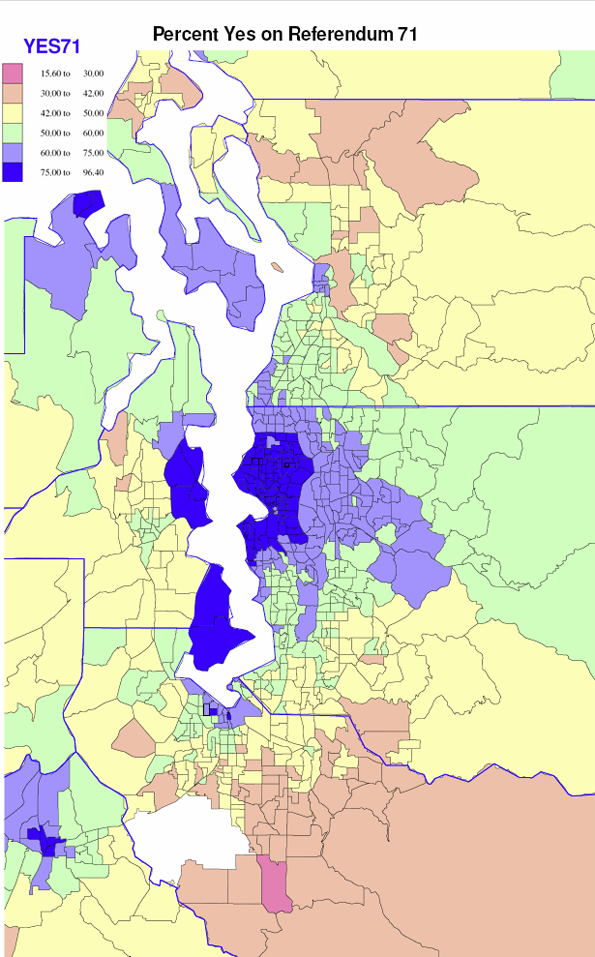
    Looking at the detailed map of central Puget Sound, we can see revealing contrasts between the two camps. Support levels of over 75 percent almost coincides with the city of Seattle boundaries (not quite so high in the far south end), and its professional commuting outliers of Bainbridge and Vashon, plus the downtown government core of Olympia and tracts around the University of Puget Sound and the UW Tacoma.

    Moderately high support (60 to 75 percent) surrounds the core area of highest support, most dominantly in the more affluent and professional areas north of Seattle through Edmonds and east to Redmond, Issaquah and Sammamish (Microsoft land). Weak but still positive votes occurred in the next tier of tracts, around Olympia, north and west of inner Tacoma, most of urban southwest Snohomish county and much of exurban and rural King county (quite unlike most rural areas). But on the contrary, the shift to opposition is remarkably quick and strong in southeastern King and especially in Pierce county, in northern and eastern Snohomish county, and, not surprisingly, in military dominated parts of Kitsap county (e.g., Bangor) and Pierce (Fort Lewis).

    The temptation to compare the voting levels of census tracts with social and economic conditions of those tracts is too great to resist. Here are the strongest correlations (statewide).

    Washington State Correlations with voting in favor of Ref 71
    % Use transit 0.75 %  Drive SOV -0.54
    % Non-family HH 0.65 % HW families -0.45
    % Single 0.48 Average HH size -0.53
    % Same sex HH 0.57
    % aged 20—39 0.43 %  under 20 -0.55
    % foreign born 0.28 % Born in Wash. -0.4
    % College grad 0.65 % HS only -0.62
    % Black 0.27 % white -0.13
    % Asian 0.42 % Hispanic -0.22
    Manager-Profess 0.53 % Craft occup -0.46
    % in FIRE 0.34 % laboring occup -0.47

    These statistics reflect the profound Red-Blue division of the American electorate, in both the geographic differences (large metropolitan versus rural and small town), as well as the modern versus traditional dimension (socially liberal or conservative). The strongest single variable is not behavioral, but transit use is a surrogate for the metropolitan/non-metropolitan split. The critical social characteristic lies in the nature of households: the traditional family versus non-families (partners, roommates, singles). This is a powerful tendency, and useful to describe differences in areas, but of course many in families – often more educated and professional – support Ref 71, and many singles – often elderly, or opposite sex partners – opposed it, especially in more conservative parts of the state.

    The next strongest set of variables, clearly visual from the maps, lay in the strong split of the electorate according to the predominant educational level of the tracts. The tendency of the more educated to support 71 represents the key statistic of the “modern” vs “Traditional” dimension, and is closely related to the differences by occupation and industry. Managers and professionals, and those working in finance, and information sectors tended to be supportive of 71, while those in laboring and craft occupations, and in manufacturing, transport and utilities, tended to oppose. (South King county and much of Pierce county have high shares of blue collar jobs).

    Finally differences by race exist, but are not so strong as, say, in the presidential election in 2008 (although the correlation of the percent for Ref 71 and for Obama was .90).

    Yes, greater Seattle is indeed very different than the rest of Washington and much of America as well.

    Richard Morrill is Professor Emeritus of Geography and Environmental Studies, University of Washington. His research interests include: political geography (voting behavior, redistricting, local governance), population/demography/settlement/migration, urban geography and planning, urban transportation (i.e., old fashioned generalist).

  • Why New York City Needs a New Economic Strategy

    When Michael Bloomberg stood on the steps of City Hall last week to be sworn in for a third term as New York City’s mayor, he spoke in upbeat terms about the challenges ahead. The situation, however, is far more difficult than he portrays it. American financial power has shifted from New York to Washington, while global clout moves toward Singapore, Hong Kong, and Shanghai. Even if the local economy rebounds, the traditional media industries that employ many of Bloomberg’s influential constituents likely will continue to decline. New Yorkers have long had an outsize view of their city; historically, its mayors have touted mottos that encouraged that view, from Rudy Giuliani’s “capital of the world” to Mike Bloomberg’s “luxury city.” But as Bloomberg begins his new term, New York needs to reexamine its core economic strategy.

    A good first step would be to recognize that the world owes New York nothing. The city cannot simply rely on inertia and the disbursements of Wall Street megabonuses to save its economy. Instead, it needs to rebuild its middle-class neighborhoods and diversify toward a wide range of industries that can capitalize on the city’s unique advantages—including its appeal to immigrants; the port; and its leadership in design, culture, and high-end professional services.

    It’s also time to get rid of the Sex and the City image and start making New York a city where people can have both sex and children. This will become more important as the millennial generation enters its late 20s and early 30s later this decade. This is when many young migrants to the city, including upwardly mobile immigrants, typically become ex–New Yorkers.

    Despite all the “back to the city” hype, New York over the past decade suffered one of the highest rates of out-migration of any region in the country. Young singles may come to New York, but many leave as they get older and have families. An analysis by the city controller’s office in 2005 found that people leaving the city were three times more likely to have children than those arriving.

    If New York is to thrive, it will need to keep more of these largely middle-class families. To do that, it needs to diversify its economy beyond Wall Street, which in 2007 provided roughly 35 percent of all income earned in the city. Since the recession, the city has lost 40,000 financial-service jobs, but the industry has been quietly downsizing for years: over the past two decades, more than 100,000 financial-services jobs have disappeared from New York. In good years, financial services provided an enormous cash engine, but it can no longer provide enough jobs. According to an analysis by the Praxis Strategy Group, finance now accounts for barely one in eight jobs in New York City. Most job growth has come instead in lower-paying professions like health care and tourism.

    To become economically sustainable, New York needs to create policies that help encourage development in areas where its less wealthy citizens live. Most outsiders identify New York almost exclusively with Manhattan, yet roughly three out of four New Yorkers actually live in the outer boroughs: Queens, Brooklyn, Staten Island, and the Bronx. Neighborhoods like Bay Ridge, Whitestone, Flatbush, Howard Beach, and Middle Village are really New York’s middle-class bastions.

    Over the past decade, these communities have provided a critical middle ground between the bifurcated Bloombergian “luxury city” with its high-end enclaves and the many distressed neighborhoods throughout the city. Although the mayor, some urbanists, and many developers would like to make these middle-class enclaves ever denser, their very appeal often lies in their moderate scale, proximity to work areas, decent schools, and parks. Those attributes hold sway, even in a recession. “Brand- new and expensive places have not held up as well as the established family neighborhoods,” says Jonathan Bowles, director of the New York–based Center for an Urban Future.

    Nurturing these neighborhoods will require a distinct shift in public policy. During the Bloomberg years the big subsidies have gone to luxury condo megadevelopments, sports stadiums, or huge office complexes. Consider the 22-acre Atlantic Yards project in downtown Brooklyn, which will include luxury housing and a new arena for the NBA’s Nets; one recent report by the city’s Independent Budget Office put the total subsidies provided by the city, New York state, and the transit authority at $726 million and estimated the project will hurt, not help, the city’s economy over time.

    More than anything, the plain-vanilla neighborhoods that represent New York’s real future will require policies that create a broad array of economic opportunities. Right now New York is so overregulated and highly taxed that only the most high-end business, such as big media and financial firms, can possibly thrive. The city has neglected its smaller firms, typically engaged in such activities as food processing, furniture making, and garment production. Traditionally these industries were run by Russian, German, Polish, and Italian immigrants; West Indians, Latinos, Koreans, Chinese, and South Asians do much of this work today. Over the past decade, the number of self-employed immigrants in New York has grown even as the number of self-employed among the native-born has dropped.

    Earlier generations of urban residents as well as many immigrants today stay in the city to be close to their communities and industries dominated by them. These days many others stay in the city largely because of its cultural attributes and quality of life. This doesn’t mean these workers remain unreconstructed bohemians forever. Their priorities often change as they age, start businesses, and raise families. Different, more mundane issues—stable employment, taxes, safety, schools, and housing affordability—often determine whether they stay in the city. “It’s easy to name the things that attracted us—the neighbors, the moderate density,” says Nelson Ryland, a film editor with two children who works in his sprawling home in Brooklyn’s Flatbush neighborhood. “More than anything it’s the sense of the community. That’s the great thing that keeps people like us here.”

    Technology will boost this sense of community. Online groups like the Flatbush Family Network can facilitate contact in different parts of a city among artists, families, and neighborhood groups, supplementing the traditional community adhesives of schools, churches, synagogues, and clubs. These new online institutions can perform some of the functions that urbanist Jane Jacobs’s “eyes on the street” did in the old, cohesive city neighborhood. Information about the arrival of a promising new store or restaurant, or the unwelcome appearance of a possible child molester, travels through these community networks much as it did when mothers spoke over the washing, men went to the pool hall, or kids hung out at the candy store.

    Bloomberg has built on many of the achievements of his predecessor during his eight years in City Hall. This, combined with huge campaign spending from his personal fortune, is why voters sent him back for a third term. To position the city for prosperity in an economy that’s no longer overly dominated by Wall Street, he’d be wise to spend his final term focused on making new opportunities for people who live far from his own Upper East Side neighborhood—the people who represent the real future of New York.

    This article originally appeared at Newsweek.

    Joel Kotkin is executive editor of NewGeography.com and is a distinguished presidential fellow in urban futures at Chapman University. He is author of The City: A Global History. His next book, The Next Hundred Million: America in 2050, will be published by Penguin Press early next year.

  • The Football Franchise Hustle: Financing the NFL

    The economics of professional football bring more than a few words to mind: scam, hoax, boondoggle, rip-off, racket, con, scheme, fix, subsidy, loophole, ruse, handout, set up, monopoly, and — well, why not — Jimmy Hoffa who, according to urban legend, was interred in the end zone in Giants Stadium.

    An insider trading scheme dressed up as a professional sport, pro football finance incorporates everything fishy in the worlds of municipal finance, urban planning, government subsidies, cable television, and, even sometimes, sports.

    Let’s move past the idea that professional football is a game played between rival clubs, to test which team is the best over the course of a season. Football may have been that in the 1930s when the Decatur Staleys (later known as the Chicago Bears) were playing the Dayton Triangles. But more recently it has become a hostage to the fortunes of the advertising and investment banking industries, a spectacle put together to sell beer on television or to justify bogus adventures in the bond business.

    The evolution from sandlot sport to price-rigged contracts began roughly when its team owners figured out that they all had shares in what Theodore Roosevelt would have called “the football trust.”

    Under this cozy arrangement, and with a 1960s anti-trust exemption from the Congress (as if football were as vital to the national interest as bomber production), football owners have parlayed collective television contracts into billions. The next goal was to dress up their new stadiums, largely paid for with public money, as civic virtues.

    For a league that prides itself on competition, there is little rivalry tolerated when it comes passing around the money, which amounts to about $8 billion in annual sales. About seventy percent of the television revenue, which amounts to about $4 billion annually, is doled out equally among the thirty-two professional teams, which are best understood as a medieval guild.

    In theory, revenue sharing allows the NFL to maintain its competitive balance, so that “on any given Sunday,” one team is capable of beating any other.

    Yes, occasionally the Raiders beat the Patriots, but the real advantage of revenue sharing is that it funds an oligopoly of like-minded and greedy owners, who would become small-time operators “on any given Sunday,” were there free enterprise.

    If football games were really a sport, and thus closer to a news event, any network with a camera would be allowed to cover any game. The government would be out of the business of regulating sports broadcasts, where permission to broadcast has become simply one more license to be auctioned to congressional and state legislature cronies.

    Television revenue also allows team owners to borrow money to build Nuremberg-like stadiums, which can now be seen looming over the warehouse districts in many cities, gothic reminders that team owners are not like you and me.

    The boondoggle begins when the franchise owner, protected by his anti-trust herald, says to the city where the team plays that unless he gets a new stadium, the franchise will move elsewhere. Terrified about losing a team more popular than any mayor or council member, the city then condemns prime land for the new construction and authorizes the team’s owner to issue municipal bonds to pay for the new arena.

    Many new stadiums, like the retractable-roof mausoleum built near Dallas, cost more than $1 billion, figures that equate professional football economics to the oil depletion allowance, if not the Texas Railroad Commission. On average, taxpayers fund 60 percent of new stadium costs. In the last twenty years, the NFL’s take of taxpayer subsidies has amounted to $17 billion.

    Bonds for new stadiums are given tax-exempt status, a folly based on the false premise that these new ballparks are “good for local business.” In truth, they bring in little more than sweetheart construction contracts and the revenue from nearby parking lots. Have a look at what Detroit got for the Silverdome. Hint: it was sold at auction for $583,000, after Detroit dropped in about $200 million in present-value dollars.) The real money goes to the team owner, that beacon of urban renewal.

    In some cases, local sales taxes are increased so that stadiums can be financed. But that doesn’t mean consumers get to share in skybox revenues, which the owner keeps for himself and his uptown pals.

    Skyboxes, which can cost up to $500,000 per season, are rented to corporations, who use them for tax-deductible wining and dining. “Lucky” fans get to subscribe to “personal seat licenses,” which cost anywhere from $4,000 to $30,000 per seat so that fans then have the “right” to buy season tickets, which might cost another $500 a game.

    Given all the money washing around the closed-shop of the NFL, it is little wonder that the value of most franchises is approaching $1 billion, even for hopeless teams like the Tampa Bay Buccaneers. Forbes estimates their worth at $1.1 billion, about four times their revenue, and a nearly infinite multiple of their recent wins.

    What do the players get from these financial bubbles? To be sure, some of the stars get millions in guaranteed money on multi-year contracts. The rest can be cut at the whim of the owners (“to clear cap space”), with little to show for their prime-time performances except crippling injuries, addiction to pain killers, and very possibly early dementia.

    Thanks to a $127 million salary cap (dressed up to trumpet “fair competition”), player salaries will never be more than shared TV revenues. This arrangement makes the league immune from team failures and gives teams like the Buffalo Bills an incentive to lose gracefully and cheaply.

    In 2008, Buffalo earned $40 million, while the Dallas Cowboys reported only $9 million. Average team revenue in the league was $237 million, and average net profit was $32 million per team.

    Will professional football’s wheel of fortune spin forever? Will someday soon every team have a billion dollar stadium, upholstered skyboxes, fat television revenue sharing, tax-exempt debt, and fixed costs for its players, who stay on the job for less time than migrant workers?

    Maybe, but here’s how I think the free market will take “the football trust” to the house, if not the cleaners.

    One of these days television revenue will decline, when networks can no longer afford the billion dollar contracts; their advertisers will have departed to other fields of plenty. Would you want CBS and NBC as your biggest source of revenue? At the same time, voters will wake up to find that their municipalities have gone broke and that much local interest is due on behalf of behemoth stadiums — often named after get-out-of-town-quick companies, like Enron — that most voters cannot afford to visit.

    Like a number of monopolies, the NFL might find itself under pressure in the courts, and the league could lose some of the pricing power that comes from the protectionism that is courtesy of the cable owners, the municipal bond fixers, and the Congress.

    If any city in the country could field a professional team, and if any broadcaster was free to show the games, would cities be building new stadiums that cost $1 billion and would the woeful Washington Redskins be worth $1.5 billion? I don’t think so. But right now the NFL is the only game in town.

    Matthew Stevenson is author of An April Across America and the soon to be published Remembering the Twentieth Century Limited.

  • New Geography Top Stories of 2009

    As we bring to a close our first full calendar year at NewGeography.com, we thought readers may be interested in which articles out of more than 350 published enjoyed the widest readership. It’s been a solid year of growth for the site; visits to the site over the past six months have more than tripled over last year and subscribers have increased by a factor of six. The list of popular articles is based both on.readership online and via RSS.

    15. Joel Kotkin’s piece, Numbers Don’t Support Migration Exodus to “Cool Cities”, makes the case that places considered “cool” by many in media and economic development circles are actually losing net migrants to other U.S. regions. In almost every case, he argues, your local resources are better spent focused on skills upgrades for your local residents or hard and soft infrastructure upgrades for industries already successful in your region. This article originally appeared on Forbes.com

    14. The British Labour Party is no example for American Progressives. Legatum Institute Senior Fellow Ryan Streeter’s piece just in time for the 4th of July, View from the UK: The Progressive’s Dilemma, dissects Britain’s high social spending, increasing debt load. Streeter contends that the UK is danger of mortgaging its future.

    13. Breaking down Obama’s first year and looking forward. In two equally popular pieces from this fall, Joel Kotkin outlines a five point plan to improve Obama’s presidency (Obama Still Can Save His Presidency which originally appeared in Forbes.com. In the second piece he takes encouragement from signs that the President may be retuning his policy back towards America – “a big, amazingly diverse country with an expanding population” – and away from the “Scandinavian Consensus” model (Is Obama Separating from His Scandinavian Muse?) . This article originally appeared on Politico.com.

    12. State of the economy June 2009. Susanne Trimbath says it may be a while before the average citizen will actually see tangible improvements in the economy. As is often the case, Susanne’s predictions have turned out so far to be all too accurate.

    11. Questioning the stimulus plan. In February’sStimulus Plan Caters to the Privileged Public Sector, Joel Kotkin calls the stimulus plan “a massive bailout and expansion of the public-sector workforce as well as quasi-government workers in fields like health and education” yet “as little as 5% of the money is going toward making the country more productive in the longer run – toward such things as new roads, bridges, improved rail and significant new electrical generation.” This article originally appeared in Forbes.com

    10. Is California’s economic malaise leaking into Oregon? After years of strong migration flows of former Californians heading to Oregon, Joel Kotkin and California Lutheran University economist Bill Watkins point out that the state’s oppressive tax policies and red tape may be leaking into Oregon as well in California Disease: Oregon at Risk of Economic Malady. The article originally appeared in The Portland Oregonian.

    9. Tracking housing decline. Wendell Cox broke down the comparative national housing market in two widely read pieces. In the first he points out that the downturn can be broken into two phases, one mirroring the explosive growth in many overvalued markets, and another second phase were markets are declining across the board: Housing Downturn Moves Into Phase II. In the second, Wendell uses his median multiple calculation for the 49 largest metropolitan regions to show that prices in many place still have much farther to fall to reach historic norms: Housing Downturn Update: We May Have Reached Bottom, But Not Everywhere.

    8. Public debt is looming. Susanne Trimbath lists public debt levels of the most highly leveraged sovereign nations and explains why this debt and the credit default swaps purchased against it could create a looming public catastrophe: The Next Global Financial Crisis: Public Debt.

    7. Washington, DC is flourishing in the recession. NYU Professor and urban commentator Mitchell Moss explains how Washington is the one city benefiting from the government stimulus. He argues this is stimulating the DC economy, from increased lobbyist activity to web designers benefiting from the government’s new interest in digital communications: Washington, DC: The Real Winner in this Recession.

    6. Californa’s Decline. Three equally widely read pieces track the drastic shift in California from economic vibrancy to stagnancy: Kotkin’s “Death of the California Dream which ran first in Newsweek and The Decline of Los Angeles from February on Forbes.com. The third piece by economist Bill Watkins examines California’s domestic migration net losses using an old coal mining metaphor: In California, the Canary is Dead.

    5. Housing Affordability Rankings. The most read housing piece this year was Wendell Cox’s release of his annual housing affordability rankings based on median multiple calculations (ratio of median housing price to median household income in a given market). “Housing Prices Will Continue to Fall, Especially in California” lists median multiple calculations for each metropolitan region in the U.S. of more than 1,000,000 population.

    4. Detroit as a model for urban renewal. In a widely linked piece across the blogosphere, Aaron Renn points out that the decline in Detroit could be a platform for residents to get creative with urban re-development. This piece is full of stunning imagery of formerly dense neighborhoods now full of greenspace that sent me on a two hour Google Earth binge exploring the area. Detroit: Urban Laboratory and the New American Frontier.

    3. ”Alternative” Geography. New Geography publisher Delore Zimmerman’s run down of odd and quirky maps that redefine borders of the U.S. proved very popular on social bookmarking sites. “Borderline Reality”: “Sometimes maps can inspire and motivate us by helping to more fully understand the geography of our economic and demographic challenges and opportunities. Perhaps most importantly thematic maps tell a story about places.”

    2. Portland isn’t a model for every community. Easily our most widely discussed, shared, and linked piece this year was Aaron Renn’s “The White City.” The piece sparked a fair amount of criticism with some looking to poke holes in the racial breakdowns and others taking the piece as an affront to liberal politics instead of an examination of urban planning policy. Many of the most vehement critics failed to address the central point of the piece: Portland is a unique place with a unique disposition and composition, yet it is held up by many community leaders in other regions as the ultimate in public policy. Instead of holding up Portland as a model, cities and regions need to do a better job of looking at themselves and defining policy based upon local community identity. Be who you are.

    1. Best Cities Rankings. Overall, our most read content at New Geography this year was the Best Cities Rankings, released in April with Forbes. Our rankings are purposefully focused just on a combination of measures of one metric, employment change. We leave out all of the more qualitative measures thinking that all contribute to the output of a shifting employment landscape.

    Where are the Best Cities for Job Growth? (Summary Piece)
    2009 How We Pick the Best Cities for Job Growth
    All Cities Rankings – 2009 New Geography Best Cities for Job Growth

    It’s been a good year at New Geography, one of steady growth and, we believe, increased influence. We welcome your comments, participation, and submissions. Thanks for reading.