Category: Urban Issues

  • The Crisis Next Time: Public Finance

    The financial crisis of 2008 paved the way for the employment crisis of 2009, which has now paved the way for the upcoming public finance crisis of 2010. Most federal, state and municipal budgets are strained to the breaking point while the economy still has not found its footing. Meanwhile our national politics is obsessed with expensive overhauls of environmental policy and healthcare reform. Our latest policy strategy is an attempt to borrow and spend our way to prosperity, ala Japan of the past twenty years.

    It’s tempting to point to a few simple causes of these economic misfortunes, such as mortgage subsidies, loose credit standards, or excess financial leverage, but the truth is that we are experiencing the fallout of a failed policy paradigm.

    This paradigm was rooted in the past century with the creation of the Federal Reserve in 1913, the Employment Act of 1946 and the Humphrey-Hawkins Full Employment and Stabilization Act of 1978. It’s a paradigm dependent on many admittedly useful policy tools, including both Keynesian demand stimulus and the Austrian school’s theory of money and credit, the monetarism of Friedman, as well as the supply-siders of the 1980s.

    So, in what ways have these approaches failed?

    The policy goals are clearly stated: stable GDP growth and full employment. But the economic results have been decidedly mixed: the growth of real incomes laden with an exploding entitlement state, structural budget crises, widening wealth disparities, a catastrophe-prone banking system, and volatile asset markets. We’ve heard the term “systemic risk” bandied about the recent financial crisis, but this report card captures the true risks of the system we’ve created.

    Politically and socially, Americans clearly want a society where a growing middle class thrives, opportunity exists for individual success and advancement, and a prosperous elite accepts the responsibilities of power not to exploit the weak and disadvantaged. Instead, our political economy is hollowing out the middle class, creating more dependency among the poor, and fostering a culture of corruption and irresponsibility among the elites. Elsewhere I’ve characterized this current state of affairs as Casino Capitalism and Crapshoot Politics.

    Second question: why has our democratic politics failed to deliver? The short answer: Our government is doing too much of what it shouldn’t be doing and not enough of what it should.

    Free market economies are very good at producing wealth by harnessing the incentives of market participants. Market prices are valuable information signals that tell everyone how much of each good to produce. Governments, however, no matter how enlightened, cannot attain this efficiency. But, due to the political imperative to “do something” in response to countless demands, they feel compelled to try. Thus the focus on “growing the economy” and “creating jobs.”

    Unfortunately, these goals often demand incompatible policies, highlighting the differences between the private and public sectors. Private firms earn profits (i.e., create wealth) by increasing productivity, often by reducing labor costs. However, the public sector follows no profit criteria, so the government increases employment without attention to productivity. Thus, with more public sector jobs we create more employment while producing less. At the same time, the growth of the public sector empowers a politically powerful public union interest in its continued expansion. This is no way for a nation to grow rich.

    When we peel away the logic we find the true goal of public sector job creation: political redistribution of the economy’s wealth-creating capacity in order to mitigate the effects of markets. This is not an unworthy societal goal, but our public policies adopt counterproductive means to achieve it.

    To be fair, the political problem arises because private markets are agnostic towards the distributional effects of their success. Inequality, poverty, pollution, environmental degradation, the concentration of economic and political power – all these are unfavorable distributional effects of markets that give rise to political demands. The question is over how government should meet these demands.

    The 20th century attempt to tax and redistribute wealth has landed the modern welfare state in a cul-de-sac of exploding budgets, rising costs of living, slower economic growth and structural unemployment. We’re robbing Peter to pay Paul and neither – except for a relative handful of bureaucrats and rent-seeking capitalists – is better off for it. This adds up to less opportunity all around. Again, the problem is with our failed paradigm. We need to align our policies with behavioral incentives without surrendering our policy goals to an agnostic market mechanism.

    To construct a new paradigm we might do best to return to first principles of what Americans want: freedom, opportunity and justice. In order to enjoy these principles, citizens need to be empowered with choice, autonomy, and protection from unmanageable risks. Only functioning free and competitive markets can provide the necessary resources.

    So, what should be the proper role for government?

    The maldistribution of resources can be mitigated if citizens participate in the wealth creating process as more than an input labor cost. Public policy should cease deficit spending to promote employment and instead look to creating the necessary environment for private risk-taking, saving, investment, and production. This includes insuring market competition and mitigating the effects of economic risk and uncertainty. Tax and regulatory policies should promote the widespread accumulation, diversification, and access to capital to empower individuals and families with the necessary resources to build wealth and insure themselves against uncertainty. Where private insurance markets are incomplete, there is a role for limited social insurance to fill the gap.

    Numerous specific policies flow from this general paradigm shift, for example, we can stop penalizing savings through overly loose credit and onerous tax policies on interest and dividend income. There is no reason not to have a tax-free threshold for capital income that reflects the desired savings level of the median annual income household.

    Why have we stuck with a failed policy paradigm? Part of the answer is the Kuhnian nature of scientific revolutions, but the pursuit of power and influence by narrow interests is certainly a determinant factor. Economically and socially, we know where we need to go. Getting there politically is another matter. Our present political leadership (of both parties) certainly is not taking us in that direction.

    Michael Harrington is a policy analyst and writer with a multidisciplinary background in economics, finance and political science. His specialties are international capital markets, trade, and social insurance. He has taught political science at UCLA and conducted economic research for The Reason Foundation, The Milken Institute and the US Chamber of Commerce. His published writings and opinions have appeared in numerous business journals, including the Wall Street Journal, Barron’s, BusinessWeek, the Economist, the Christian Science Monitor and the Los Angeles Times.

  • The Good News in Florida’s Bad Times

    By Richard Reep

    2009 was ugly. A swirl of dispiriting events stalled over much of the world this year, and Florida was no exception: state depopulation and tourism decline hit the state’s only two legitimate growth industries.

    Yet the bad times contain within them some good news. This end of an era meant that economic planners might finally turn to productive industries to generate jobs and revenue, just like the rest of the nation.

    First the bad news. For the first time since Florida became a state in 1845, more people moved out of the state than in, as reported by the University of Florida Bureau of Economic Research in August. In other states, this might not be news, but in Florida this has been viewed as nothing short of catastrophic. Growth is one of the state’s two primary industries, and with the last 163 years, growth was taken for granted (1945 saw depopulation as military personnel went home).

    Florida’s other traditional support, tourism, collapsed in 2009, as jittery tourists stayed close to home or went elsewhere in search of vacation. Since growth and tourism were the state’s only economic activity, this pretty much tanked it for the year; without a state income tax, the government is starved for tax money and is taking a hatchet to basic services in an effort to stay afloat. Meanwhile, it’s easy to get a parking space at the beach, hotel rooms are cheap and plentiful for a change, and the weather is as beautiful as ever.

    With private development dead, government desperate for income, and the professional class seeking jobs elsewhere, it will be easy for outsiders to write off the future prospects for the Sunshine State’s towns and cities. On the ground, however, a slightly different story emerges, a stoic sort of acceptance and the glimmerings of a change or two in the individual outlooks of citizens who stay. A few foreboding trends also cloud the horizon.

    Miami, a city not known to shy away from risks, this year replaced its Euclidean zoning code with a form-based code in a grand experiment with the public process. Voters who had enough of corruption and greed decided to endorse a visually appealing future of their city. Whether or not the outcome produces a better city, the 500+ public meetings did spark a badly needed public/private dialogue that should help Miami reshape itself into its new vision.

    Those who do stay in Florida and stick it out are getting more involved. As the outside world stopped supplying capital and residents, a sense of new localism sprang up almost overnight, with people gravitating away from the big brands and status symbols of a once-proud consumerist lifestyle. Sure, many turned to global brands like Wal-mart, but many more are supporting local food co-ops, farmer’s markets, independent eateries, and home industries in an effort to beat the system.

    If restlessness and discontent are the first necessities of progress (as stated by Thomas Edison), citizens of Florida cities like Tampa, Jacksonville, Orlando and Miami are ripe for progress. Consumer culture took a pause, but people still need to eat. Like the rest of the nation, this rediscovery of local goods and services has flowered, upon which a newfound sense of identity is being built through face-to-face exchange without the invisible army of middlemen that our commercial culture has spawned.

    With earnest public debate about the urban future in one of our nation’s largest cities, we can be assured that Florida citizens do care about the quality of life in their community. With neighborhoods spawning local markets and co-ops, we can be assured that urbanites do care about their local producers – and know a bargain when they see one. Both factors will contribute to a citizenry emerging stronger out of the state’s economic turmoil.

    Left to its own devices, Florida may sort itself out. Agriculture and manufacturing, two key industries faintly alive in Florida, have a chance to come back. Affordability and quality of life could lure the right kind of talent and encourage local entrepreneurs. Florida is poised to develop industries with health research and digital media where our lower costs and attractive climate could prove decisive.

    Yet this localist trend and greater attention to fundamentals could be altered by more meddling from Washington. The state returned Washington’s check for a train set not once, but twice, causing a concerned Secretary Ray LaHood to make a personal visit to see what was wrong. After some gentle persuasion – after all, Obama’s nationwide high speed rail vision could easily bypass this state with jobs and cash – Florida’s elected officials quickly jumped back to the politically correct side of the fence, and passed a bill to bring commuter rail to Central Florida. Now LaHood must deliver on the promise to prioritize Florida’s high speed rail construction.

    For the future, if the past is any guide, the upcoming war with Afghanistan could prove a boon to Florida. World War 2 saw an influx of servicemen and women, and the opening of multiple military bases, supply depots, and runways, partly due to its mild weather and partly due to its political stature. By adding this industry to offset its growth and tourism losses, Florida can benefit from the fulfillment of arguably President Obama’s most dangerous campaign promise.

    Doubts about these guns and trains leave more than a few Floridians worried about the strings attached to big brother’s largesse. It would be far more constructive to place more faith on the citizen’s renewed interest in the public process and the individual’s support of localism, two trends that seem destined to stay and become ingrained in our lifestyles. If Florida must accept Washington’s command economy for now, then at least the state will be left with increased transportation options and more exposure to service personnel who just might want to come back to stay after the war is over.

    But the more important work will, in the end, be done locally. If Floridians can capitalize on genuine public/private dialogue, such as happened in Miami 21, then there is a chance the state can pull from behind and surge ahead as a place where the future can still be sunny.

    Richard Reep is an Architect and artist living in Winter Park, Florida. His practice has centered around hospitality-driven mixed use, and has contributed in various capacities to urban mixed-use projects, both nationally and internationally, for the last 25 years.

    Photo:

  • The Suburbs are Sexy

    The Administration’s Anti-Suburban Agenda: Nearly since inauguration, the Administration has embarked upon a campaign against suburban development, seeking to force most future urban development into far more dense areas. The President set the stage early, telling a Florida town hall meeting that the days of building “sprawl” (pejorative for “suburbanization”) forever were over. Further, a number of bills have been introduced in the Congress that would attempt to discourage suburban development, some under the moniker of “livability,” which promises to improve people’s lives by enforcing planner-preferred density. The war against the suburbs is by no means new, but the Administration and some members of Congress have proposed their own “surge” in hopes of suppressing them permanently.

    The Mythical “Demise” of the Suburbs: Nearly since the pace of suburbanization increased, following World War II, critics have been foretelling the demise of the suburbs. During the 1950s and 1960s, some planning “visionaries” such as Peter Blake were predicting widespread municipal bankruptcies in the suburbs and for residents. This was occurring even as other urban planners were tearing up cities with urban renewal projects and freeways, setting the stage for “block-busting” and an ever-widening racial divide. The early criticisms have been repeated through the years, justifying a paraphrase of the old saw about Brazil (“Brazil is the country of the future and always will be”): “The suburbs are the wasteland of tomorrow and always will be.”
    The Real Decline of the Cities: In fact, it has more generally been the central cities that nearly went bankrupt, not the suburbs. Examples include New York, Philadelphia, Pittsburgh, Cleveland and that jewel of municipal consolidation, Indianapolis, rescued last year by $1 billion in state taxpayer funds. There are hopeful signs of a renaissance in most central cities, however their financial difficulties remain intractable and large swaths of their land area remain desolate. Meanwhile, the lawns were mowed in the suburbs, the houses painted and a strong sense of community developed among residents that was far too subtle for the prophets of suburban doom to perceive.

    Greenhouse Gas Emissions: More recently, the effort to reduce greenhouse gas (GHG) emissions has given suburban critics new ammunition. A simple mantra was dictated by “planning common sense.” Cars produce greenhouse gases, therefore people must get out of cars and live in more dense conditions, where they will not need to drive as much. Further, they will live in smaller, multi-family dwellings, which planning common sense teaches are more GHG friendly than the despised – except by those who choose to live in them – detached housing in the suburbs.

    But a funny thing happened on the way toward GHG inspired desurburbanization. Some academics actually began looking at data. The reality of the suburbs turned out to be rather different from that portrayed by the conventional wisdom of the planners. The most comprehensive research comes from Australia, some of which has been previously covered here.

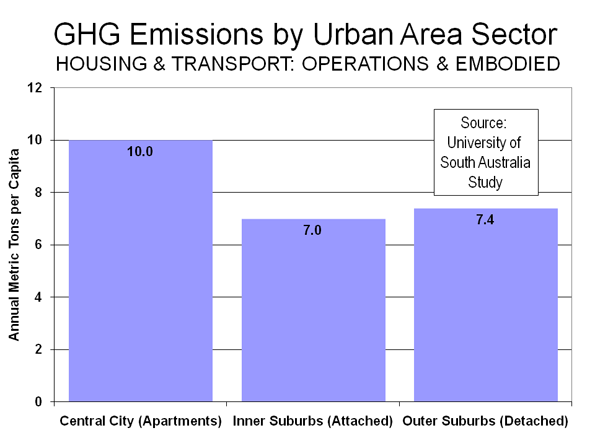
    University of South Australia: The most recent (and new) offering comes from a University of South Australia report thatallocates transportation and residential energy produced GHGs by location and housing type in the Adelaide area. The researchers found that the most GHG friendly sector of the urban area was the inner suburbs, which are dominated by single-family attached housing. GHG emissions per capita from housing and transportation were estimated at 7.0 metric tons of GHG emissions per capita annually.

    However, the outer suburbs, principally with detached housing, were not far behind at 7.4 tons GHG emissions per capita. The highest GHG emissions per capita, by far, were in the central area, with its predominance of multi-unit housing. There the annual GHG emissions were estimated at 10.0 tons per capita (See Figure). The University of South Australia study includes an element missing from virtually all other examinations of transportation and residential GHG emissions: “embodied emissions.” Embodied emissions are the GHGs from construction or manufacturing materials, and from building cars, transit vehicles and buildings. Embodied GHG emissions are ignored by much research, but are a significant factor in GHG emissions. For example, multi-unit housing, with higher use of concrete and more complex construction methods, tends to be substantially more GHG intensive than building detached housing or townhouses.

    GHGs from Common Energy: Previous work by Sydney researchers reached similar results – townhouse development was the most GHG friendly, followed closely by detached housing. Both were substantially less GHG intensive than high-rise condominium development. A principal reason for this conclusion stems in part from the fact that this research included GHGs from common energy, such as the electricity used to power elevators, parking lot and common area lighting, building-provided heating, air conditioning and water heating. American and Canadian research attempting to quantify GHG emissions by residential building type generally has not accounted for common energy and its GHG emission. Yet a gram of GHG from a residential elevator has the same impact as one produced by driving to the local Target store.

    GHG Friendly Suburbs: The most comprehensive research was conducted by the Australian Conservation Foundation. This was not the typical, incomplete or theoretical study of greenhouse gas emissions. The study included virtually every gram of greenhouse gas emissions in Australia and allocated them to consuming households in small residential zones within urban areas and around the nation. Suburban locations, with their greater use of cars and higher percentage of low density detached housing, had lower GHG emissions per capita than the core areas, with their greater use of transit and walking and their high-rise multi-unit housing.

    Compact Development: These findings provided the impetus to review the potential impact of compact development policies. Compact development policies (also called “smart growth” or “growth management”) generally seek to densify urban areas, by drawing urban growth boundaries, outside of which development is prohibited, and by trying to force people to drive less and to use transit more. Again, “planning common sense” clearly indicated to planners that compact development would yield substantial benefits in GHG emissions, principally because people would drive less.

    Yet the more recent research on compact development finds something much different. Densification scenarios from two recent reports, the congressionally mandated Driving and the Built Environment and a smart growth coalition’s Moving Cooler, showed that by 2050, compact development could reduce GHG emissions from driving by only 1% to 9%. At the high end of the range, the most new development would be directed to only a small part of present urban footprints, a policy outcome less believable than a balanced federal budget next year.

    Moreover, these projections have to be considered overly optimistic, because they make no allowance for the higher GHG emissions that occur as traffic slows and stops more in higher density conditions.

    The President Discovers the Suburbs? Meanwhile, on December 15, President Obama took the opportunity to visit a suburban Washington Home Depot, a chain that is a very symbol of American suburbanization. The President could have taken the opportunity to orate further against the suburbs in the insulation aisle, urging households to abandon the suburbs and move to high rise condominiums in the city.

    That was not to be. The President instead proposed providing incentives to people to make their houses more energy efficient, which would reduce greenhouse gas emissions and save money on consumer energy bills. In particular, he cited insulation, saying that “insulation is sexy”. It is worth noting that the Home Depot’s insulation is principally sold to suburban homeowners who can readily arrange for its installation. Residents of high-rise condominiums must rely on their building managers, who tend to purchase their insulation from wholesalers, rather than retailers like Home Depot and Lowes.

    The President explained why insulation was sexy, noting that saving money is sexy. Indeed, saving money is what the suburbs are about. The economic research is clear that housing costs are far less where suburban development is not limited by the compact development strategies that artificially create land scarcity. That’s why places like Dallas-Fort Worth, Atlanta and Houston, without compact development, had little, if any housing bubble, while housing bubbles of economy-wrecking proportions occurred in California and Florida, with their compact development.

    Yes, Mr. President, insulation is sexy. Saving money is sexy. And, the suburbs are sexy.

    Wendell Cox is a Visiting Professor, Conservatoire National des Arts et Metiers, Paris. He was born in Los Angeles and was appointed to three terms on the Los Angeles County Transportation Commission by Mayor Tom Bradley. He is the author of “War on the Dream: How Anti-Sprawl Policy Threatens the Quality of Life.

  • The Economic Fallout of the Chicago Way

    Many large American cities are hurting from the recent recession. Unrealistic revenue assumptions based on ever higher real estate prices and sales tax receipts have left cities unable to pay their basic bills. As asset and consumer prices deflate, from a lack of demand, those cities with “sticky” costs – the result of overly powerful unions and excessive business regulations – are stuck in an economic quagmire.

    Chicago has become a leading poster child for recent urban economic malaise. With the election of Barack Obama, 2009 was supposed to be a year in which the Windy City basked in glory. The world was supposed to see the benefits of an administration run by Chicago Machine operatives such as David Axelrod, Rahm Emanuel, Valeria Jarret and Desiree Rogers.

    Yet despite the new power in Washington, the Chicago Way has not turned out well back home. A series of events has put Chicago in a funk, along with structural economic problems. In June, Chicago’s unemployment rate peaked at 11.3%, far outpacing the national unemployment rate.

    Since 2007 the region has lost more jobs than Detroit, and more than twice as many as New York. Over the decade that is about to end Chicagoland’s total loss was greater than any region outside Detroit. It has lost about as many jobs – 250,000 – as up and comer Houston has gained.

    Columnist Mary Schmich of the Chicago Tribune, usually a reliable booster, has described the situation:

    Chicago has a mood problem.

    It seems edgy lately, a little sullen and scared, verging on depressed. Some days, it feels more like the angry, confused place I moved to in 1985 than the exuberant city that has swaggered through the past two decades.

    One can question Schmich’s past description of Chicago as “exuberant”. But recently there’s been many Chicago problems.

    Chicago’s bid for the 2016 Olympics failed. Even with Chicago’s most prominent citizens, President Obama and Oprah Winfrey, making a pitch to the International Olympic Committee, the Windy City came up short, behind all the finalists.

    Oprah’s recent announcement that she’s ending her long run talk show will end Chicago’s most visible export. It appears much of the Oprah’s empire is moving to California to be closer to America’s entertainment capital, more celebrities and, of course, better weather.

    On a more serious note, Chicago also has had to deal with two high profile political suicides. Chicago Board of Education President Michael Scott committed suicide in November. Scott was subpoenaed before a federal grand jury that was investigating the sale of admissions to magnet schools.

    In September, a prolific Chicago fundraiser, Chris Kelley, committed suicide after pleading guilty to felony charges concerning the Blagojevich federal case. Kelly’s death was another reminder of the fallout of Chicago corruption.

    But it’s just the top of the social heap that’s hurting. The national recession also has been particularly harsh for union-dominated Chicago. The loss of employment has put pressure on Chicago’s politicians to allow Wal-Mart to expand their number of stores in the city. With only one Wal-Mart store in the city, the thousands of potential new jobs could be just what Chicago needs right now. Mayor Daley wants to let Wal-Mart open several more stores but faces stiff opposition in City Council. Alderman Burke, the Chairman of the Finance Committee, is the key decision maker concerning Wal-Mart, whose local expansion is anathema to the unions. Mayor Daley said this concerning when Alderman Burke is going to hold hearings on Wal-Mart:

    “That’s up to him. He could have had it six months ago or two months ago.”

    The other big union problem can be found in Chicago’s fast-eroding convention business. The union run McCormick Place has been making big news lately because of its loss of three major conventions. In November when two major conventions announced they were leaving Chicago, Crain’s Chicago Business made this stunning indictment:

    The chief executive officer won his post after raising campaign cash for disgraced Gov. Rod Blagojevich. The just-departed human resources director owed her job to a powerful state senator. Other top executives have long ties to Mayor Richard M. Daley’s political machine.

    That’s what clout looks like at the Metropolitan Pier and Exposition Authority, known as McPier, a little-understood government entity that operates the city’s primary convention venue, the vast McCormick Place complex; the adjacent McCormick Hyatt Regency Hotel, and the lakefront tourist center Navy Pier.

    The loss of two major trade shows this month and a deepening financial crisis raise questions of how the Chicago Way can compete with more efficient, warm-weather convention centers such as Orlando, Fla., and Las Vegas.

    With labor costs much cheaper in other venues, competing becomes very difficult, particularly in tough times.

    Fiscal incompetence has made the problems worse. To help with Chicago’s downturn a “rainy day” fund was set up by leasing major city assets. Chicago leased its parking meters to a private company. This controversial move was supposed to yield generous revenue up front. When Chicago recently passed the new city budget, the Chicago Sun-Times reported:

    Chicago’s 75-year, $1.15 billion parking meter windfall would be nearly drained in just one year to provide token property tax relief and stave off tax increases, thanks to a $6.1 billion 2010 budget approved Wednesday.

    Despite complaints that Chicago’s future was being mortgaged, the City Council voted 38-to-12 to approve Mayor Daley’s plan to drain reserves generated by asset sales to solve the city’s worst budget crisis in modern history.

    Chicago’s recent economic decline is also affecting the state of Illinois’ budget. It may be unfair to blame the Chicago Machine for Illinois’ budget situation, but they certainly have played their role. Just days ago Moody’s and S&P downgraded the state of Illinois debt. Only California now has a lower debt rating.

    Worse may be in the offing. Chicago’s recent economic malaise has been revealed in the stunning new documentary on the coming elimination of futures floor trading:

    The exchange, a critical element of Chicago’s economy, may be on the way to downsizing if not oblivion. That’s more bad news for a city that seems to be falling apart even as its operatives try to run the country.

    Steve Bartin is a resident of Cook County and native who blogs regularly about urban affairs at http://nalert.blogspot.com. He works in Internet sales.

  • Memo to Big City Pols: Voters’ Suspicions on Influence Peddling Is Far Cry From Stupidity

    A significant clue on why the City of Los Angeles is facing budget deficits of hundreds of million annually for the foreseeable future can be found in the relationship between elected officials and AEG, the company that’s controlled by Denver-based multi-billionaire Philip Anschutz.

    AEG owns the Staples Center and the adjacent L.A. Live, which includes shops and restaurants to go with one nice hotel and another luxurious establishment that will be topped by high-priced condominiums when completed.

    AEG has a prime a seat on a gravy train of benefits ladled out by our city and state governments. Those hotels came with a tax break that is expected to amount to tens of millions of dollars over coming years. The city also provided attractive terms on a $70 million loan for the project. State legislators have passed laws that appear to many rational observers to have been crafted specifically to steer tens of millions of dollars worth of benefits to AEG.

    Some politicians like to say that AEG is deserving of such largesse because it has brought development and jobs to the city’s center. That’s appreciated, but let’s not forget that AEG is a private enterprise that’s in the business of making money. The company had to develop some land and hire some workers to make money on its plans Downtown. It would be nice to see the company’s investment earn a tidy profit, but there’s no case for sainthood in any of the business plan.

    Meanwhile, AEG has been a patron saint of sorts when it comes to local politics, giving hundreds of thousands of dollars to various candidates and campaigns. The company even pitched in with $137,000 – the largest of all contributors – to a ballot measure that extended term limits for members of the City Council.

    Do you see some possible connection there? Is there a chance that some corporate executives have used money to gain influence over public officials?

    Ask around and you’ll find that most everyday, working voters see a connection – or at least the possibility of one.

    And here’s where we get to the explanation on the hundreds of millions of dollars in budget deficits: It seems that members of the political class don’t ask around – and they don’t think regular folks are smart enough to call elected officials to account.

    What else to make of recent comments by 9th District City Councilmember Jan Perry, who represents most of Downtown. Perry has looked like AEG’s personal body guard during the recent fan dance over suggestions that the company should pay some re-imbursement for public services dedicated to the memorial service for Michael Jackson earlier this year, a tab that came to approximately $3.2 million. Some say that AEG should pay up because the company benefited from the spectacle surrounding the singer’s death by selling rights to film footage from his final days, when he used the Staples Center for preparations on what was to be a global tour.

    Perry recently took the opportunity of the flap to dismiss concerns that AEG uses political donations to exercise undue influence over city officials.

    “AEG doesn’t own the place,” said Perry, referring to City Hall in a recent story in the Los Angeles Times. “I think that’s a really stupid way to think.”

    Perry got away with an old political trick there, putting over-the-top words in the mouths of any mere taxpayers who might have questions about the relationship between AEG and elected officials. She ramped up the charges in a pre-emptive logical fallacy that dismisses anyone with suspicions of influence peddling as unworthy of an opinion on the matter.

    Perry must think that anyone outside of City Hall is stupid, indeed. Stupid enough to fall for that verbal twist. Stupid enough to think that there’s nothing to any suspicions unless it can be proved that AEG actually holds a mortgage on City Hall.

    The people are not stupid, though. Voters know that influence peddling is a shadowy business, and that big corporations and the executives who run them are careful about the legalities and perceptions that come with the flexing of their political muscles.

    You’d think a politician with Perry’s experience would be just as careful about calling voters stupid. After all, they’re smart enough to pay for all of those breaks for AEG – not to mention her salary.

    Jerry Sullivan is the Editor & Publisher of the Los Angeles Garment & Citizen, a weekly community newspaper that covers Downtown Los Angeles and surrounding districts (www.garmentandcitizen.com)

    Photo:

  • Road Decay

    These days, you’ll have to get your kicks on Interstate 44.

    US Route 66 – that road of legend and lore – exists mostly as a memory. Only in Oklahoma is the number posted intermittently along a road parallel to the interstate.

    Now I’m not especially sentimental, and I’m a generation too young to have really gotten into the Route 66 shtick. As the older folks pass away, Route 66 will decay entirely.

    There is something evocative about highways in this country. In the original incarnation, highways had names. Terre Haute, IN, for example, sat at the intersection of The National Road and the Dixie Bee Highway – or at least did until the federal government assigned numbers back in the 1920s. Now it’s at the junction of US Routes 40 & 41.

    Still, it doesn’t take much tradition for numbers to be almost as meaningful as names. The words “101” and “Pacific Coast Highway” are interchangeable. Florida’s wonderfully-numbered “A1A” is a fantastic drive. And what truck driver doesn’t know that Interstate 80 goes from the George Washington Bridge to the San Francisco Bay Bridge?

    A great road trip is to pick an appropriate highway and just follow it across the country. I did that with US 2, which runs from Michigan to Washington State along the Canadian border. I started at Duluth and headed west, through North Dakota, Glacier National Park, and into Washington State. I also once drove US 20 from Chicago all the way out to Oregon, via the Grand Tetons. These roads are healthy, being great tourist routes unaffected by interstates.

    A road I would love to drive is US 52 – surely one of the oddest routes in the country. It starts in Charleston, SC, and heads due north(!) into North Carolina and Virginia, and on into West Virginia. There it parallels the Kentucky border to Huntington, where it crosses the Ohio River.

    Then heading west along the river to Cincinnati, and hence to Indianapolis, it becomes the major road to Lafayette. Skirting the southern Chicago suburbs through Joliet, it crosses the Mississippi River at Savanna, IL. Onwards to Dubuque, Rochester, MN and Minneapolis.

    Then it gets boring, sharing I-94 all the way through Fargo, and further west to Jamestown, ND. There it finally leaves the interstate and is the main road northwest to Minot. It continues northwest along the Des Lacs river, and finally ends at the Saskatchewan border at Portal, ND.

    From South Carolina to North Dakota! Did somebody have a sense of humor? Or just a very fertile imagination? US 52 doesn’t follow any logical migration path, trade route, or compass direction. It’s useless for commerce – but it’s a fantastic tourist road. I’ll drive it myself someday (though not along the interstate: Minnesota needs to separate it from I-94).

    A less happy example is US 40, previously known as The National Road that once extended from Washington, DC, to San Francisco. Today it goes from Baltimore to (almost) Salt Lake City, the interstate having displaced it west of there. But that’s not the worst of it. For much of the route in Indiana and Illinois, traffic has mostly been diverted onto I-70. Many Illinois towns – Marshall, Casey, Greenup, and even the former state capital, Vandalia – were once bustling stops along US 40. Today they are nearly ghost towns. US 40 has become a little country road with very little traffic – pretty, but somehow depressing.

    An exception is Effingham, at the junction of US Routes 40 & 45. Of course that’s not important: it is also where I-57 and I-70 meet. For about six miles around town they share the same road. This is Truck Stop Alley, and travelers of a certain age will remember the now defunct Dixie Trucker’s Home. Effingham (when I was last there in 2007) is a thriving little place.

    US 40 – at least in Illinois – exists in name only, which I guess is an improvement over US 66.

    The US highway system has faded in large part because of the interstates. When first built, the interstate highway system seemed very rational. Major N-S routes were 5, 15, 25, 35, 55, 65, 75, and 95. E-W roads were 10, 20, 40, 70, 80, 90, and 94. In those days I could have drawn a free-hand map of all major interstate highways.

    The real I-80 went to San Francisco, but they built a spur from Salt Lake City to Portland, OR, calling it I-80N, and Portland was proud to be on I-80. Of course it made no sense, and at some point the road was renumbered as I-84.

    Then they built a route around New York City, from Scranton to Boston – also I-84. And let’s not forget I-86 that extends for about 50 miles in Idaho. Or I-82 in Washington State. Or I-39 from Bloomington, IL, to Wausau, WI – not to be confused with I-43 from Beloit to Green Bay, WI. And then there’s I-99, a monument to pork in Pennsylvania, and I-88 in Illinois.

    You get the idea: whatever logic lies behind the interstate numbering system has descended into chaos. Nobody can keep track of this anymore. I blame most of this on federal highway rules, more lenient speed limits on roads with interstate designation, and further, federal tax dollars to help build interstate highways. But this has perverse consequences.

    Consider State Route 17. Mostly I mean New York State 17, but the road extended with the same number from near Erie, PA to Kearney, NJ. In New York it is known as the Southern Tier Expressway.

    This is another great tourist route: the wine country along the Lake Erie shore, across Lake Chautauqua near the Chautauqua Institution, around Allegany State Park, through wild Cattaraugus and Allegany counties, past Elmira, birthplace of Mark Twain, the Corning Glass plant, the Woodstock Concert site, the Hudson Highlands, and that beautiful shopping mall: the Garden State Plaza. It’s all been known as Route 17 for generations.

    No more.

    From Erie to Binghamton it’s now designated I-86 – same as that little blip of a road in Idaho.

    Were I Federal Geography Czar, I’d restore Route 17. And more: I’d push it through the Holland Tunnel and the Brooklyn-Battery Tunnel, and then replace current NYS 27 all the way out to Montauk, at the eastern tip of Long Island. Now THAT would be a road worth driving.

    Daniel Jelski is Dean of Science & Engineering State University of New York at New Paltz.

  • The Urbanophile Plan for Detroit

    If Brookings’ plan for Detroit isn’t enough to get the job done, what is?

    Turning around Detroit means facing head on the core problems that hobble the region, notably:

    • America’s worst big city race relations
    • A population that is too big for current economic reality
    • A management and labor culture rooted in an era that no longer exists and is unsuited to the modern economy
    • A tax, regulatory, and political system toxic to business

    A robust plan for renewal in Detroit will tackle these problems, recognizing that matters like improving race relations and cultural change need indigenous solutions from courageous local leaders. Then mix this with best practices from elsewhere and innovative, unique to Detroit solutions. And be patient, knowing the turnaround won’t be a short journey.

    1. Repair race relations. The city-suburb divide in Detroit, to an extent far greater than elsewhere, is a matter of black and white. Bringing racial rapprochement won’t be easy, but it is an absolute imperative for future regional success. Perhaps a newly shared sense of economic pain can foster this, along with grass roots connections such as white urban gardeners making common cause with black ones seeking better access to fresh foods.

    2. Active shrinkage. Many recognize the need for Detroit to “right size” to its reduced population and for federal help doing so. But beyond adjusting to the city’s decline, the region remains too big. Detroit no longer needs large armies of unskilled and even skilled laborers in its factories. There is simply no economic raison d’etre for a region the size of Detroit in that location today. A lot more people need to leave Detroit. Many already would like to but can’t because they can’t sell their house or afford to move. Serious consideration should be given to a federally assisted voluntary relocation program when the national economy recovers to help Detroiters move to Texas or other places with strong jobs growth if they want to. Detroit should also engage with those who did move away to create an urban alumni network. In a globalized economy, those Michigan expatriates can serve as a sort of field sales force for the city.

    3. Improve the Business Climate. Michigan’s government needs to be downsized to match a downsized state. Dubious programs of all types, from film industry subsidies to “cool cities” initiatives need to be scaled back or eliminated. The criminal justice system should be reformed to stop over-incarcerating non-violent offenders. Streamline or eliminate regulation wherever possible, and make those that remain operate swiftly and predictably. Eliminate or merge overlapping jurisdictions, and especially non-general purpose entities that are too often patronage dumps operating out of the public eye. Reduce taxes on business, especially small business.

    4. Change the culture. Michigan’s social and business approach, its labor and management culture and business practices were designed for a stable industrial age dominated by a limited number of large and vertically integrated corporations. Today’s economy is based around smaller, more innovative, nimble firms, virtual networks of people and collaborative business relationships, rapid change, and a competitive global environment. This sort of change has to come from the inside. No one can just tell Detroit how to do it.

    5. Renew Brand Detroit. How does Detroit want to be known in the world and how can it make itself known? Within a framework of shrinkage, Detroit needs to become attractive to the right new talent and new businesses. It needs an aspirational narrative that is authentically Detroit in a way “cool cities” will never be. Cool, No – but edgy? Definitely. Think of Detroit as the new American frontier, a blank canvas where anything is possible, and the ultimate arena in which to pursue alternative visions of urban life. A place where you can pursue a personal urban vision without getting tortured by a Byzantine blizzard of bureaucracy. This should be nourished – and preserved – by maintaining a “light touch” approach to regulation in the city proper. The region is well positioned to attract new urban pioneers and homesteaders, and to leverage its reputation as both a black city and large Arab population center. Detroit should stand proud as “Detroit”. It shouldn’t hide behind euphemisms like “Southeastern Michigan” or “The Big D” – as if that fools anybody. Detroit is a name with international recognition and resonance. Wear it with pride.

    6. Pursue Targeted Industry Clusters. The auto industry will remain a mainstay in Detroit, particularly management and R&D, though a lot smaller after a federally assisted restructuring. But the city should be wary of overly pursuing “me-too” industries like life sciences without distinctive advantages. Instead, Detroit should look to get its “fair share” of those, then look for where it is positioned to uniquely excel and try to create the environment favorable for investment. Potential targets include:

    • A lead role in international trade with Canada.
    • Dominating and expanding non-energy/non-financial trade and relations with the Middle East and Muslim world. With America’s largest Arab population, Detroit is positioned to be the American gateway to that ever more important part of the globe the way Miami is to Latin America.
    • Music. Detroit has one of America’s richest and most innovative musical legacies, from Motown to electronica to hip hop. But it hasn’t profited from it. Detroit needs to take a page from Nashville and figure out how.
    • Realize the Detroit Aerotropolis plan.
    • Alternative urban visions. The recipe for grass roots neighborhood renewal in the city, and a potential innovation cluster for any new Detroit ideas that gain widespread adoption.

    7. Rationalize Regional Governance and Infrastructure Investment. Detroit should seriously question any expansion of infrastructure when shrinking in regional population. All subsidized infrastructure expansion outside of currently fully urbanized areas should be terminated. It makes no sense to be widening streets on the fringes when you are ripping them out in the city. In this context, the kind of fixed rail investments advocated by Brookings and other “me too” urban boosters should be avoided in this highly decentralized region. Rather, the central city should start with a quality bus network, with rail added later if and only if existing ridership justifies it.

    8. Secure Irreplaceable Assets. Detroit built amazing treasures during its golden age, many of them lost or threatened. Detroit has one of the largest collection of pre-War high rises in America. Yet many of them stand vacant. Another gem, the Lafayette Building, is about to be demolished because it is so badly deteriorated, with trees growing on the roof. Some funds need to be earmarked for securing and and supporting basic maintenance such as roof integrity. While there may not be demand to reuse these structures now, they are irreplaceable and should be saved for future generations. On the cultural side, Detroit needs to ask itself tough questions about institutions like the Detroit Institute of the Arts and the Detroit Symphony Orchestra that are bleeding red ink.

    The road back for Detroit won’t be short or easy. It will certainly not be back as the colossus of its past. But Detroit can grasp a more successful future if it finds the courage and the leadership to change, and to find a unique path forward for a city that is simply not like anyplace else in the world. Conventional wisdom solutions are just not enough. It will take radical change, new attitudes and an ability to think independently about what’s best for the region.


    The Brookings Plan

    The Urbanophile Plan

    Race Relations

    Segregation is acknowledged

    Improving race relations is a top imperative

    Regional Governance

    Strong Regionalism Featuring:
    – Council of Mayors
    – Regional transportation and land use management
    – Potential tax sharing
    – Receivership for failed government entities

    Adopt Brookings Plan

    Brand Positioning

    N/A

    – “The New American Frontier”, the land of possibility, a blank canvas, and the ultimate arena in which to realize alternative and new visions of urban life.
    – “Detroit”, NOT “Southeast Michigan”, “The D”, etc.

    Economic Development Paradigm

    Government industrial policy

    Improve the business climate

    Fiscal Policy

    N/A

    – Downsize all level of government to match a downsized Michigan and Detroit
    – Eliminate dubious programs (e.g., film industry subsidies and “cool cities” initiatives)
    – Merge or eliminate overlapping obsolete jurisdictions
    – Cut taxes on business, especially small businesses

    Regulatory Reform

    N/A

    – Seek out and eliminate rules without a clear rationale and net benefits, esp. ones that negatively affect the business climate
    – Make remaining regulations operate swiftly and predictably
    – Reform a criminal justice system that over-incarcerates for non-violent offenses
    – Maintain “Light Touch” Regulation in the City of Detroit to Sustain Frontier Appeal

    Target Economic Sectors

    – Advanced Manufacturing / Auto-Related R&D
    – Green Industry
    – Life Sciences
    – University Spin-Offs

    – Advanced Manufacturing / Auto-Related R&D
    – International Trade with Canada
    – Non-Energy/Non-Financial Trade with the Arab and Muslim World.
    – Music-Related Development
    – Aerotropolis Industry
    – Alternative Urban Visions (e.g., urban agriculture, urban decay tourism)
    – “Fair Share” of Green Industry, Life Sciences, and University Spin-Offs

    Auto Industry Future

    Federally assisted restructuring

    Adopt Brookings Plan

    Management & Labor Culture; Regional Business Practices

    N/A

    Urgent change is prerequisite to success

    Human Capital Targets

    N/A

    – New Urban Pioneers
    – African Americans
    – People of Middle Eastern or Muslim Origin
    – Musicians and Musical Acts

    Adjusting to Population Loss

    – Government sponsored footprint shrinkage
    – Brownfield remediation

    Adopt Brookings Plan and Supplement With
    – A federally-assisted voluntary relocation program
    – Creation of a “Detroit Alumni Network”

    Transportation

    Rail transit

    – Terminate highway and other infrastructure expansion outside of fully developed areas
    – Build privately funded Woodward light rail, then avoid further rail investments
    – Improve the urban bus network
    – Build new bridge crossings to Canada
    – Support improvements to entire 401/I-75 corridor for freight growth

    Historic Preservation

    N/A

    – Inventory and invest to secure and “mothball” key historic structures, esp. pre-War downtown high rises

    Aaron M. Renn is an independent writer on urban affairs based in the Midwest. His writings appear at The Urbanophile.

  • Detroit Needs a Bolder Plan

    The Brookings Institution recently unveiled “The Detroit Project”, a plan to revive Detroit, in the New Republic. Brookings’ plan has good elements and recognizes some important realities, but also has key gaps. It relies excessively on industrial policy and conventional approaches that are unlikely to drive a real turnaround in America’s most troubled big city.

    On the plus side, Brookings does a great job stating why Detroit’s fortunes will take a long time to reverse, possibly a generation or more. As they note, “Detroit’s leaders must manage expectations. It took half a century for the city to get this low. It won’t turn around in a four-year political cycle.” Authors as prescient as Jane Jacobs and as conventional as Time were talking about Detroit’s decline as far back as the early 60s. Turnaround won’t happen in six months or even six years. Given the political preference for election-cycle results, this means strong and courageous leadership will be needed, a point they also stress. Sadly, that’s a commodity that has long been in short supply in Detroit.

    Brookings is known for their promotion of regionalism, and this plan predictably follows that prescription. Clearly, rationalization of investment policy on a regional basis is needed. The Detroit region is losing population, yet the long range transportation plan calls for huge amounts of spending to widen roads on the fringes. That makes no sense. People and businesses in Detroit keep moving out as the cities and suburbs they once inhabited fall into ruin under a regime of failed stewardship and the endless search for new greenfields to exploit. It’s like prospectors skipping from one clapped out mining town to the next. If they want to do that, they shouldn’t expect the rest of us to pay for it via federal funds – either to build the new or to clean up the mess in the ghost towns they leave behind.

    They also recognize the need for improved governance, including potentially state receivership for failed institutions. (They did not, however, give due credit to new Mayor Bing for the change and new leadership attitude he has already brought to the table). Suggestions like a focus on brownfield remediation and managed shrinkage were on point, as was the recognition that significant federal assistance will be required. Given the depths of the problems in Detroit and Michigan, the city and state are not going to be able to do it alone.

    The plan also rightly notes that “Detroit will have to become a different kind of city, one that challenges our idea of what a city is supposed to look like, and what happens within its boundaries.” Very true. Unfortunately, much of the rest of the Brookings prescription failed to meet that challenge.

    Brookings’ plan relies heavily on analogy to other post-industrial cities, especially in Europe, which makes it difficult to be sure exactly what they are recommending at times. Even to casual observers, these cities are far different from Detroit. For one thing, Detroit is huge. The region, if one includes Ann Arbor and Windsor, Canada, is over five million in population – more than double the size of Brookings comparison areas.

    Places like Turin and Bilbao also have radically different built forms, history, culture, and are virtually racially and ethnically homogeneous compared to Detroit. Even the measurements of European success need to be redone. Neither Italy nor Spain represent role models since both have fared worse than America in the current downturn. These countries (and cities) are aging rapidly, with some of the world’s lowest birthrates.

    Their US examples of Toledo and Akron (i.e., greater Cleveland) are hardly bright and shining lights of economic or demographic success. Since 2000, Akron has lost nearly 10,000 people and Toledo over 20,000. Toledo’s 11.4% unemployment rate exceeds the nation’s. These aren’t even Ohio’s biggest cities, much less dominating the state’s economy the way Detroit does Michigan.

    Brookings also all but ignores a lot of the root issues of Detroit’s problem. Firstly, they fail to make a point about healing America’s most poisoned race relations, arguably the signature issue of Detroit. Racial tensions and inequity have perpetually bedeviled America. Making progress in Detroit won’t be easy, but is an absolute prerequisite to progress. Perhaps shared economic struggles will finally provide a common interest around which to build some form of racial rapprochement.

    Most glaringly, Brookings has nothing at all to say about Detroit and Michigan’s tax and regulatory regime, its failed management and labor cultures, or its dysfunctional state politics. Brookings’ desire to stay on good terms with the establishment might inhibit their ability to speak freely, but these problems must be confronted.

    It is impossible to ignore this witch’s brew of policies and attitudes that is totally toxic to economic development. It’s a classic case of ignoring the elephant in the room. Until these blocking and tackling matters are addressed, Detroit is going to remain kryptonite to business expansion. In Forbes 2009 list of the best states for business, Michigan ranked 49th.

    Instead of improving the terrible business climate, Brookings proposes a top-down industrial policy, explicitly stating “local government (or NGOs, even) can play the role of industrial planner. That is, they can look across the map and find instances where research institutions and manufacturers should collaborate on new ventures.” And they say “public money” is needed to retool old industries and advance new ones. The government in Detroit can’t even manage the delivery of basic city services. None of the region’s levels of government have performed well on their core competency, so why would we believe these entities would be effective venture capitalists or industrial planners? This is a recipe for epic rent seeking and an economic Waterloo on a grand scale.

    Their suggested industries for Detroit are a tired looking roster of the same ones everyplace else is chasing: green industry, life sciences, advanced manufacturing, and university technology spin-offs. With such a crowded playing field – 49 out of 50 states are chasing life sciences, for example – it is hard to discern the Detroit region’s distinctive capabilities in any of these areas apart from automotive related R&D and manufacturing. Sure, they’ll get some slice of the pie in these growing markets, but unlikely enough to turn the ship around or create a true innovation cluster.

    Public-private partnerships do have a strong role to play in Detroit’s economic development. This includes looking for sectors where it can realistically compete and win, and looking to create the infrastructure and conditions necessary for them to flourish in terms of facilities, talent attraction, legal and regulatory frameworks, regional business culture and practices, and more. It’s about creating fertile soil, not picking winners.

    However, assistance to the restructuring auto industry was clearly required. Without federal aid, GM and Chrysler would have been liquidated. They still might, but given the importance of that industry to our economy, it is probably worth doing what we have to do for now. But we should recognize that getting in was a lot easier than getting out will be, and that the end result might still be failure or Soviet style zombie companies that survive only as wards of the state.

    Lastly, the praise of rail transit by Brookings – the cook book solution du jour for cities – is puzzling. Again, Detroit is shrinking and needs to shrink more. Trains work best when people are commuting to a central point, but jobs have been disappearing from the core of Detroit for generations. Today barely 4.5 percent of area employment takes place in the urban core, among the lowest percentages among the nation’s top 50 cities.

    As with fringe highway expansion, the last thing Detroit needs is even more infrastructure. It has too much already that it can’t afford to maintain. Taking on a costly new rail transit system with both high capital expenditures and significant ongoing operations and maintenance costs is a dubious proposition – particularly when the existing bus network is on the verge of a near shutdown. The biggest game changer from an infrastructure perspective – new highway crossings to Canada to strengthen Detroit as the premier gateway to Canadian international trade – is not mentioned.

    So while Brookings gets a few key pieces of the puzzle right, ultimately their solution is too standard issue and lacks the boldness and innovative thinking needed to tackle the core problems and create a realistic prospect for renewal.

    In the next installment tomorrow: a better plan for Detroit.

    Aaron M. Renn is an independent writer on urban affairs based in the Midwest. His writings appear at The Urbanophile.

  • What Happens When California Defaults?

    The California Legislative Analyst’s Office recently reported that the State faces a $21 billion shortfall in the current as well as the next fiscal year. That’s a problem, a really big problem. My young son would say it was a ginormous problem. In fact, it may be an insurmountable problem.

    Our governor and legislature used every trick in their books when they created the most recent budget. They even resorted to mandatory interest-free loans from the taxpayers. Now, they have no idea where to go. The Democrats have declared that they will not allow budget cuts. The Republicans will not allow tax increases. They have probably run out of smoke and mirrors, although their ability to engage in budget gimmickry is enough to make an Enron accountant blush. No one is considering raising revenues by increasing economic activity.

    In my opinion, California is now more likely to default than it is to not default. It is not a certainty, but it is a possibility that is increasingly likely.

    Then what?

    Ideally, we’d see a court-supervised, orderly bankruptcy similar to what we see when a company defaults. All creditors, including direct lenders, vendors, employees, pensioners, and more would share in the losses based on established precedent and law. Perhaps salaries would be reduced. Some programs could see significant changes. This is distressing, but it is better than other options.

    Unfortunately, a formal bankruptcy is not the likely scenario. There is no provision for it in the law. Consequently, absent framework and rules of bankruptcy, the eventual default is likely to be very messy, contentious and political.

    Other states have defaulted. Nine states defaulted on credit obligations in the 1840s. Most of those states eventually repaid all of their creditors (see William E. English “Understanding the Costs of Sovereign Default: U.S. State Debts in the 1840s,” American Economic Review, vol. 86 (March 1996), pp. 259-75.) Unfortunately, the examples in the 1840s are not much help in anticipating the impacts of a modern default. Circumstances are different, and things have changed, a lot.

    We’re left with the question: what happens when California defaults?

    The worst case would be the mother of all financial crises. According to the California State Treasurer’s office, California has over $68 billion in public debt, but the Sacramento Bee’s Dan Walters has tried to count total California public debt, including that of local municipalities, and his total reaches $500 billion. Whatever the amount, the impact of default could be larger than the debt amount would imply. Other states – New York, Illinois, New Jersey, for example – are in almost as bad shape as California, and they could follow California’s example. The realization that a state could default would shock markets every bit as much as when Lehman Brothers failed. Given the precarious state of our economy and the financial sector, another fiscal crisis would be disastrous, with impacts far beyond California’s borders.

    What would a California default look like? In a sense, we’ve already seen California default, when that state issued vouchers. If any company tried that, they would be in bankruptcy court in days. Issuing vouchers didn’t trigger a California crisis because banks were willing to honor the vouchers. If banks refuse to honor the vouchers next time, employees and vendors won’t be paid, and state operations will come to a halt. This could happen if our legislature locks up and is unable to act on the current $21 billion problem.

    Another possible California scenario is that the State will try to sell or roll over some debt, and no one buys it. Already, we’ve seen California officials surprised with the interest rates they have had to pay. What happens if no one buys California’s debt? We saw last September what happens when lenders refuse to lend to large creditors.

    If we continue on the current path, the worst case is also the more likely case. Bad news keeps dribbling out. One day we find we are paying 30-percent-higher-than-anticipated interest on a bond issue. A few days later, we find the budget shortfall is billions of dollars higher than projected just a short time ago. Every month brings new bad news. The risk that one of those news events triggers a crisis grows with every news event.

    Given California’s recent history, it is difficult to believe that the people with the authority and responsibility for California’s finances can act responsibly, but that is what we need. Responsible action would be creating a gimmick-free budget that places California finances on a sustainable path, and provides an environment that allows for opportunity and job creation. But, sadly, Sacramento probably cannot draft an honest balanced budget, and will thus need to plan for California’s eventual default. They need to work with Federal Government and Federal Reserve Bank officials to insure a coordinated plan to limit damage to financial markets. That plan needs to be ready to release when markets go crazy, which is exactly what could happen when participants realize that default is possible. It could be needed sooner than they think.

    Bill Watkins is a professor at California Lutheran University and runs the Center for Economic Research and Forecasting, which can be found at clucerf.org.

  • Nurturing Employment Recovery

    President Obama’s quick exit from Oslo and late arrival in Copenhagen suggest he’s finally ready to shift focus from Nordic adulation and fighting climate change and diplomacy to fixing the American economy. About time. As former Clinton adviser Bill Galston observed recently, the president needs “to pivot and make 2010 the year of jobs.”

    White House operatives, as well as the Democrats in Congress, know high unemployment could bring big political trouble next year. But in their rush to create new jobs, policy makers would do well to focus on the quality of jobs created over the next year and beyond.

    On this score, the slight improvements in the job picture are far from sufficient. The most recent analysis of employment over the past year by the Web site JobBait shows that almost all the growth has occurred in three fields–government, education and health care.

    The problem: All these fields are financed by taxpayers or through transfer payments. They do little to expand our exports, and they employ few of the blue- collar male workers who have been hardest hit by the “hecession.”

    Unemployment for men is over 2.5% higher than for women, the largest gap in history. In all but a handful of states, male-dominated fields such as transportation, mining and logging, manufacturing and warehousing have declined rapidly over the past year. The only states to experience gains were North Dakota, Montana and West Virginia.

    This reflects the critical weakness in the stimulus package. The stimulus focused on government bailouts and transfers of research funds to universities, while less than 5% went to basic infrastructure. But a greater emphasis on infrastructure would not only have created large numbers of construction jobs, it would have boosted our industrial competitiveness by eliminating bottlenecks in our transportation system.

    The only big regional beneficiary of expanding government employment has been, unsurprisingly, the Washington Beltway. Indeed, the number of federal bureaucrats making $100,000 or more jumped from 14% to 19% since the recession–and that’s $100,000 before overtime and bonuses.

    Elsewhere, the surge of government employment is petering out, particularly on the state and municipal levels. These jurisdictions are running out of money, since they are unable to print their own. Over the past year government jobs contracted in financially strapped states like California, Oregon, Michigan and Florida, as well as throughout the Northeast and New England. There’s little hope for much improvement in 2010.

    The other two sectors to enjoy significant growth have been education and health. Yet these fields do not seem to generate the broad-based economic growth needed to boost the overall economy. The region most often favorably linked with the “eds and meds” economy, Pittsburgh, has produced only modest, below-average job growth over the past generation. In fact, Pittsburgh has looked successful largely because the region has continued to hemorrhage its population to other regions, and it attracts few foreign immigrants.

    Yet the fiscal damage from dependence on public and nonprofit employment has been enormous. The city suffers a billion-dollar unfunded pension liability, among the highest in the nation on a per-capita basis. Due to the heavy local presence of institutions of higher education, nonprofits and hospitals, who keep about 40% of Pittsburgh’s property remains tax-exempt. In a sign of desperation Mayor Luke Ravenstahl recently proposed taxing tuition at local colleges and universities, eliciting outrage from the academic world.

    More important, the Pittsburgh “eds and meds” model can’t really be applied to a country whose workforce will expand by roughly 1 million annually over the next decade. The country now has fewer jobs than it had in March 2000, even though the labor force has grown by 12.1 million workers. There is no way we can produce enough growth depending on sectors that feed off taxpayers and private enterprise.

    This shortfall will be particularly tough on millenials as they enter their 20s and 30s. Already those 18 to 24 now have an unemployment rate over 18%. Not surprisingly, as Morley Winograd and Mike Hais observe, lack of jobs now stands as the No. 1 concern for those under 30.

    Another problem: We are now producing many more educated workers than we can gainfully employ. Information jobs may not be disappearing at the rate of industrial ones, but they have lost nearly 3 million positions since 1999. One likely result has been that returns to education–hyped by academics and “progressive” economists–have been dropping, particularly for younger workers. The unemployment rate for recent college grads is currently 10.6%, a record high.

    So, how to create opportunities that pay well? Some place their hopes in either the “green” or “creative” economies. But the green sector has been notably ineffective in sparking growth across other parts of the economy. A much-hyped report issued by California green-boosters bragged “green jobs”–which included everything from public relations representatives to marketing managers, accountants and brick-layers–account for something like 1% of employment. Even with heavy subsidies by taxpayers, the “green” sector seems unlikely to rescue an economy with 12.5% unemployment.

    Many politicians, particularly California’s increasingly delusional governor, also fail to recognize the cost that the “green agenda” exacts on a struggling economy. A draft report by a state advisory committee estimates California’s new draconian greenhouse gas laws could cost the state economy over $143 billion over the next decade. Efforts to spread this kind of regulation–either through federal legislation or EPA directives–would inflict similar pain to economies beyond the Sierra Nevada.

    As for the much ballyhooed “creative” sector, video producers, financial analysts, architects and other workers in the non-tangible economy are less susceptible to green pressures than factory workers, truckers or farmers. Yet as the JobBait report shows, information, business and professional services haven’t fared well over the past year. So far the only winners in professional and business services are in small states: New Mexico, Utah, South Carolina and, once again, West Virginia.

    Perhaps it’s time to abandon the notion that the U.S. can rely on preferred sectors–“green”, creative or “eds or meds”–to turn around our vast economy. Theorists often forget the essential ties that exist between tangible and intangible sectors. The strongest growth in high-end services are usually propelled by growth in tangible industries, such as energy, agriculture or manufacturing. When those industries tank, as in much of the upper Midwest, high-end services decline with them.

    Green jobs, too, require a strong economy. It is not by mistake that the big cities with the largest numbers of new “green” construction projects are not in Portland, San Francisco or other eco-capitals, but in more robust, if less organically obsessed places like Dallas and Houston. To create green jobs, you need to have growth, particularly in “hard” industries like construction and manufacturing.

    Instead of favoring certain sectors, the administration’s job “pivot” needs to focus across all economic sectors. This can be done in a pragmatic non-ideological manner. It could combine the increase in infrastructure and scientific research spending favored by many on the left with more market-friendly approaches–industrial tax credits and streamlining some regulatory standards–associated with conservatives.

    In the end the goal of policy should not be just to create more jobs, but to nurture employment that will make our economy stronger and more competitive over time. Until that happens, the recovery will create an economy fundamentally unable to sustain itself in an ever more competitive global environment.

    This article originally appeared at Forbes.com.

    Joel Kotkin is executive editor of NewGeography.com and is a distinguished presidential fellow in urban futures at Chapman University. He is author of The City: A Global History. His next book, The Next Hundred Million: America in 2050, will be published by Penguin Press early next year.