Category: Urban Issues

  • What To Look For In Healthcare Reform: Location, Location, Location

    A Reuters article that was widely picked up around the globe recently raised the question, Are Doctors What Ails US Healthcare? Comparing the New York suburb of White Plains to Bakersfield, California, the article uses the evergreen two-Americas paradigm to discuss disparities in health care. Drawing heavily on the Dartmouth Atlas of Healthcare, it highlights a sad but inescapable fact: doctors want to live in some places and not in others, giving the “have” populations more intensive medical care which they might or might not need, while have-nots, who tend to be older, sicker and poorer, get health care to match. The article asserts that there’s nothing in current health care reform legislation that will do anything to address the disparities.

    I agree. But then, what should we expect? The legislation, which I find marginally more desirable than doing nothing at all, is largely about insurance, not about health care. This is what happens when we emphasize how we pay for something, rather than what we are paying for. Are doctors what ails U.S. health care? Only in the sense that they are operating on the same basis as everyone else in the health care market: every man for himself.

    You don’t have to make bi-coastal comparisons to find the disparities highlighted in the Reuters article. My own Hudson Valley not-for-profit insurance company faces them every day. We cover the Medicaid populations from the aforementioned White Plains, NY, to the South, to the blighted economies of the Catskills to the North and West. The distance involved is only about 150 miles, but day in, day out it might as well be 1500. And socially, it might as well be 150 years. Sullivan County is still organized geographically the way it developed in the eighteenth and nineteenth centuries — farms, woods, and mills, only without the mill jobs.

    There was a brief shining moment (well, half a century) when urban Jews and other vacationers formed the basis of a thriving tourist trade in the “Borscht Belt” resorts of Monticello, Sullivan County’s hot spot. When they closed, they provided ideal settings for residential drug and alcohol rehab for poor people from New York City, but those aren’t exactly the foundation for high-quality community health care. When we initially started offering state-sponsored insurance to the poor of Sullivan County, the historical dearth of specialists made it a laboratory for what a free market looks like when there’s no competition. (Do I hear the words “strong public option”?) Because New York State requires us to have a decent network of contracted doctors for our enrollees, the sole cosmetic surgeon – for example – could extract pretty much any fee he wanted from us in exchange for seeing a patient who needed emergency reconstructive surgery.

    Your tax dollars meet supply and demand and a mandate to pay within a private market.

    I don’t blame the specialists. They are highly trained and skilled, and have paid their dues. If I blame anyone, it’s the system that sets the dues so high, in the form of college and medical school loans and years of fellowships that leave well-meaning doctors feeling that they deserve all that money, just like corporate farmers and hedge fund managers.

    It’s also not the doctors’ fault that they want good schools and cultural amenities. I haven’t seen much of Bakersfield, but I know that schools in and around White Plains have good reputations and are just twenty miles from Broadway and the Metropolitan Museum (and ten miles from my Tarrytown office). Maybe we can fix schools and reinvigorate the National Endowment for the Arts to make every remote locale more like Westchester, but that would be socialism.

    Dartmouth Atlas data is easily available online, and well worth spending some time with. You can use it to create all kinds of two-America scenarios that provide instant object lessons in our health care inequities. My personal favorite is that health care spending in Miami, Florida for Medicare patients in the last two years of life (highest in the nation) is exactly twice that in Portland, Oregon (lowest of the regions studied), with commensurate volumes of appointments, referrals, tests and hospitalizations, and no better outcomes. Here we see the same dynamics that make pawnshops spring up around gambling casinos and candy stores near public schools. Doctors go where the customers are, and once they arrive they maximize their revenues and measure success by volume, not outcomes.

    Why should we expect anything different, when reform legislation is captive to the same kind of have/have not dichotomy that shapes health care delivery itself? Senators Max Baucus of Montana and Kent Conrad of North Dakota are two of the pillars of the anti-public option caucus. They come from states with small populations, and both take barrels of money from the health insurance industry because they can’t raise it locally. If they play their cards right, who knows? They could leave Congress and become haves themselves, like Billy Tauzin, who is now Big Pharma’s man in Washington, having engineered the passage of Medicare Part D, or Tom Daschle, once a champion of single payer, who now plays both sides of the street with special interest money.

    Are Doctors What Ails US Healthcare? quotes David Goodman, Director of Health Policy Research at the Dartmouth Institute for Health Policy and Clinical Practice, who says there’s an “irrational distribution” of the most valuable and expensive U.S. health care resources. I would say that the distribution is entirely rational given the insanity of the larger situation.

    If we’re ever going to find our way out of this mess, we’re going to have to do for these health care backwaters, both rural and urban, what we used to do when private capital wouldn’t do the job. Set goals and build the infrastructure to serve them, because the market won’t do it. Want to electrify Appalachia? You need the TVA. Want to make the desert bloom? Build dams and aqueducts. Want to open up the interior of the country? Build an Interstate Highway system. Want doctors to practice in unattractive markets? Create an MD Bill for doctors like the old GI Bill for veterans, so that doctors emerge from training feeling more like public servants and less like indentured servants.

    I attended a discussion of health care reform not long ago at the Yale School of Public Health. The representative of the private health insurance industry put the issues in a compelling perspective, although not, perhaps, for the reasons he cited.

    His arguments were three: First, we require automobile owners to carry insurance, so requiring everyone to carry health insurance shouldn’t be a problem (I know that President Obama made this point, too, and I hated him for it). Second, do you want a health care system that runs like the Post Office, or one that runs like Federal Express? And third, the health insurance industry is really a jobs program, and do we really want to put all those people out of work?

    These are shallow arguments. Car insurance? There’s no law that says you have to own a car, but everyone needs health care. A health insurance mandate is more like forcing every American to buy a new car and giving them a choice between Ford or GM. Post Office and FedEx? A company that can’t send a package overnight from suburban Tarrytown into New York City without round-trip flights to Memphis and back is no model for health care delivery, and besides, I’d like to see what FedEx can do for the price of first class postage. Jobs? A dynamic economy finds ways of redeploying redundant workers in more significant jobs. Wouldn’t those actuaries make good math teachers?

    The arguments were so hollow that no one bothered to argue, and the insurance rep was undoubtedly relieved. A fellow panelist who practices medicine in Cambridge, Dr. David Himmelstein of Harvard, said simply, “My practice would have no trouble making money on Medicare, single-payer reimbursement rates if we didn’t have to pay so many people to argue with insurance companies.”

    Unfortunately, the larger discussion is still stuck on insurance, and as long as it is, the two health care Americas will never become one.

    Georganne Chapin is President and CEO of Hudson Health Plan, a not-for-profit Medicaid managed care organization, and the Hudson Center for Health Equity & Quality, an independent not-for-profit that promotes universal access and quality in health care through streamlining. Both organizations are based in Tarrytown, New York.
  • Demographics May Be Destiny, but Mind the Assumptions

    Demographic projections have become an essential tool of national, state and local governments, international agencies, and private businesses. The first step in planning for the future is to get a picture of what the terrain is going to look like when you get there. That’s mainly what I do for clients, audiences and subscribers, and demographics provide the frame (like assembling all the straight-edge pieces of a jigsaw puzzle first). But here’s the thing about projections: a small change at an inflection point, or the inclusion (or exclusion) of salient variables, can result in big changes to the future you are trying to describe. So like all treatments of the future, everything depends on the underlying assumptions, and the salience of the variables chosen for inclusion.

    Demographics and Depression?
    For example, a couple of recent essays on demographic trends start with different assumptions, consider different variables, and come to wildly divergent conclusions. David Goldman, associate editor at First Things, says the housing market has collapsed, and will remain in depression, because of the dearth of two-parent families with children.

    Goldman asserts that only a a policy to restore the traditional family to a central position in American life can work to save the housing market. Without this, he says, ”we cannot expect to return to the kind of wealth accumulation that characterized the 1980s and 1990s.“

    Goldman’s argument centers on the idea that the US housing market is driven by one variable: two-parent families with children. And since that variable has not been growing, neither can housing demand. Yet, obviously, other household types besides two-parent families with children desire, can afford, and live in detached houses. Indeed, 55.2% of all single-person households owned homes in 2007, up from 49% in 1990.

    There is also a large population of empty-nest households (people who have already raised their kids), but who choose to continue to live in houses. Other demographic trends that will contribute to the continued preference for detached houses: increased longevity, better health, later childbearing, more home-based businesses, the presence of “delayed launch” kids (or those who boomerang to live at home before “final launch”), or a desire to have room for grandkids to visit. There is also the reality that many people will not want to move because of proximity of neighbors, churches, clubs and work.

    One must also note that foreign immigration and domestic migration, even under lowest-variable projections, will still be substantial in coming decades, fueling housing demand.

    In addition, other demographic trends suggest family and household formations will, once employment and income conditions improve, again provide a demand for houses. For example, there are more people entering their 20s now than in any time since the 1960s and early 1970s. True, we have just passed through a period of slow growth in family-age household formation, but once this Millennial generation start making money in an improving economy, they will start forming families and households, and will start buying houses.

    The World’s New Numbers
    Another recent essay on demographic projections starts with different assumptions, looks at different variables, and comes to different conclusions. Martin Walker, writing in The Wilson Quarterly, notes that something dramatic has happened to the world’s birthrates: they are up in developed countries, and down in developing countries (the opposite of what most dire forecasts project).

    Walker starts by debunking the assumption that mass migration and low birthrates are transforming the ethnic, cultural and religious identity of Europe. He notes the decline of Muslim birthrates across the globe, and rising birth rates in Western Europe – albeit from very low levels – and consistently higher rates in the United States. He then explains that aging populations in Europe and the US will not place intolerable demands on governments’ pension and health systems, if we are willing and able to both raise the retirement age and increase the workforce participation rate.

    These two steps (not easily achieved, but simple in conception) will result in a very manageable dependency ratio, similar to those of the 1960s, writes Walker. In the United States, the most onerous year for dependency was 1965, when there were 95 dependents for every 100 adults between the ages of 20 and 64 (“dependents” include people both younger and older than working age). By 2002, there were only 49 dependents for every 100 working-age Americans. By 2025 there are projected to be 80, still well below the peak of 1965. The difference is that while most dependents in the 1960s were young, most of the dependents of 2009 and beyond are older. But the point is that there is nothing outlandish about having almost as many dependents as working adults.

    The assumption underlying this more favorable scenario is that given freedom and information, that is to say, given the choice, the continuum of progress and development is uniform and universal: people in all places and of all backgrounds desire middle-class lifestyles (which include single-family detached houses, by the way). And while the planet’s population is expected to grow by about one billion people by 2020, the global middle class will swell by as many as 1.8 billion, with a third of this number residing in China. The global economic recession will retard but not halt the expansion of the middle class.

    The economic transition that development brings is accompanied by the demographic transition to lower birth and death rates (social, cultural and political transitions then occur too). Industrialization, urbanization, suburbanization: that is the pattern of how middle-classes grow. First-world countries have traversed this path, and now emerging countries are following.

    Trends can and do change. In fact, it may even be said that every trend sows the seeds of its own reversal. But it has always been my goal to identify the constants across history, as a way to establish a baseline for evaluating the likelihood of future scenarios (again, the straight-edged pieces). I believe the “aspirational model” to be one of these constants.

    Dr. Roger Selbert is a trend analyst, researcher, writer and speaker. Growth Strategies is his newsletter on economic, social and demographic trends. Roger is economic analyst, North American representative and Principal for the US Consumer Demand Index, a monthly survey of American households’ buying intentions.

  • There is no “Free Market” Housing Solution

    The common line used by advocates of housing affordability has been that the solution lies in “free markets”. Yet this “free market” solution does not address the fundamental problem which is really a political one.

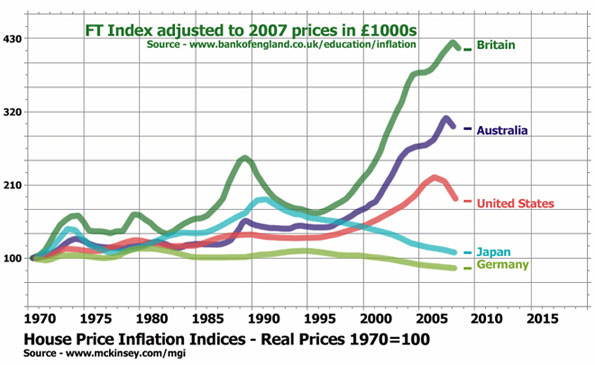
    This true fundamental problem is particularly evident here in Britain, the leader in house price inflation and housing financial bubbles since the 1970s. In their recent report Global capital markets, the McKinsey Global Institute has confirmed what has been shown in recent Demographia surveys.

    The root of this problem lies with an elite agenda that is highly ideological. The ideology at work is environmentalism, making a moral virtue of the retreat of political and commercial elites from the industrial production of housing.

    The preference is for interest payments on a fund of mortgage debt rather than the effort of turning a profit from development, let alone construction. Professionals like estate agents, planners, architects, and bankers are certainly in collusion with that elite ideology.

    That is not to say there is a conspiracy to plan a housing bubble. That is too crude. There is clearly regulation and legislation. On 24 November 2009 the Housing Minister John Healey confirmed that Britain will be the first country in the world to require zero carbon homes as a matter of law from 2016. Britain is the world leader in green ideology.

    John Healey
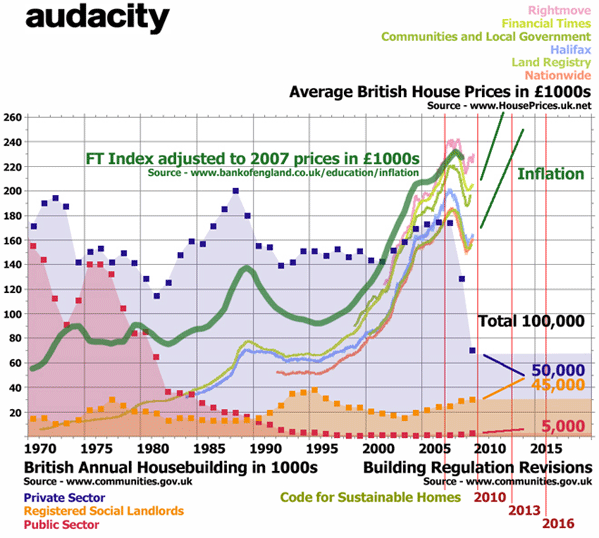
    All of the newly built British housing will have much better insulated walls, windows, roofs and floors. The clear aim of the government is to keep reducing the energy consumption of all new homes to be measured in kilowatt-hours per square metre of floor area per year. New Labour hope to make it law that total energy consumption is no more than 46 kWh/m2/year for semi-detached and detached homes, and then no more than 39 kWh/m2/year for all other homes. The energy efficiency standards will be applied from 2016, subject to yet another consultation on the Code for Sustainable Homes, announced at the end of 2006, and technically published for use on a voluntary basis in 2007. The building regulations get revised in 2010, 2013, and 2016 leading to this legal requirement for maximum energy consumption in all new homes.

    Healey says that “zero carbon” is a concept that will apply to a new home at the “point of build”. ‘We are not going to regulate through this policy how occupants live in them,’ he says. However the Code for Sustainable Homes assumes patterns of behaviour. Environmentalists within and without government will argue that behaviour needs to change. They will be suggesting all sorts of intrusions into daily life.

    British environmentalism couldn’t be more ideological, and more of a barrier to the production of affordable housing. The planning system has been “greened”. The mood is against development, and planning approvals for new land for new housing are hard to obtain. The zero carbon requirement will only apply to around the 100,000 new homes that will be built annually, while the existing stock is around 26 million homes. Healey is also going to regulate existing housing, and is not just looking at the residential sector.

    I am sure politicians like Healey don’t want their pursuit of “zero carbon” buildings to mean that fewer buildings are built. I am sure there are some environmentalists who will be pleased that building activity is in decline. The logic of green thinking entails that the most energy efficient thing to do is not to build more buildings at all.

    It is green not to build new homes to meet demographic demand. Let people modify their behaviour, say the environmentalists, and live together in as much of the existing stock as can be refurbished. It also happens that the existing stock is highly mortgaged, and the vast majority doesn’t want their homes to fall in value. An indefinite policy of green refurbishment of the homes that already exist and a future of house price inflation are highly compatible. That suits the mortgage lenders and the government. The commitment to “zero carbon” allows government to appear virtuous in its legislation for the new build sector.

    This suits the financial markets as well, since it guarantees house price inflation by making it difficult to meet the demographic demand for homes. Environmentalism offers more and more reasons not to build. Green thinking ensures that house price inflation can be sustained through a bubble, and projected beyond the bursting of that period of financialisation into the next.

    As capitalism ”greens” itself, capitalists continue to profit, while not meeting the fundamental demands of the people for housing. But simply restoring “the free market” will not solve the problem. In an old industrial country like Britain, there are ever more people who don’t earn enough to buy a home even at the “affordable” price of two and a half times their gross annual household income, which is the Demographia measure of affordability.

    This reality has a great appeal to what Robert Bruegmann refers to as “the incumbents club” – established homeowners, increasingly older, and those with inherited money. That majority want homes to be an appreciating asset, not a depreciating utility, like a pair of trousers, or a car. They want their home to appreciate in value, and they want to be green. Most people want to be greener and better off.

    Being anti-development for green reasons allows the incumbents to preserve their wealth, while making mundane opposition to new house building, or the attempt to constrain “sprawl”, seem virtuous. People don’t wake up thinking that they will inflate the value of their home by resisting sprawl in principle. Instead they oppose new development in the mistaken belief that Climate Change is caused by sprawling development. It is common for people to think that sprawl is bad for the planet, even while living, mostly with a mistaken sense of guilt, in the sprawl.

    By hoping for a “free market” solution to the problem of unaffordability, Hugh Pavletich of Demographia assumes that it is politicians, businessmen, and professionals who have distorted the market for reasons of narrow and immediate self-interest. Yet that is not how people think: they believe their environmentalism is morally above self-interest. They are saving the planet in their minds by blocking new building, and by their opposition to sprawl. The incumbents’ club members can feel virtuous at little cost to themselves and don’t worry too much about house price inflation. Of course there is no actual Club. There is no conspiracy. Homeowners simply share a self-interest in raising the value of their home, and tend to also want to show how selflessly green they are.

    This all has had the effect of making the lending of mortgages on inflated land values a much larger business than the construction of homes. No-one planned to cause a sequence of bubbles, but Britain’s desperate social dependence on sustained house price inflation can’t be brought to an end easily.

    The only way to stop national or regional housing bubbles recurring is the establishment of the freedom for everyone to build a home on cheap agricultural land without any government or professional hindrance except in matters of technical building regulations. Fire should not spread, and buildings should not fall down. But even building regulations can become ideological rather than technical. The British building regulations, as Healey has made clear, will also push energy efficiency standards to illogical extremes of peak performance in an attempt to address Climate Change. Even while the supply of new homes reduces

    The political freedom to build wouldn’t be a “free market” because not everyone is able to raise the finance to buy cheap land and pay for construction. The idea of a “free market” is a long running ideological myth. But the universal freedom to build would mean people are free to attempt to raise the finance to buy land and build.

    More importantly, the freedom to build would undermine the financialisation of the housing market. If everyone was free to build on cheap land the incumbents’ club would have to compare the value of their existing home to the cost of building a new one. Mortgage lenders would not be able to lend over the cost of construction unless they felt secure in doing so. The security of the 1947 Town and Country Planning Act would be removed for financiers. Government, the finance system, planners, or the incumbents’ club will be ideologically opposed to that for a host of environmental reasons. Britains mostly want to be greener but with renewed house price inflation, while no-one wants to make an argument explicitly for un-affordability. This may be confused and deluded, but it is an ideology promoted by the British government.

    However, ideas can be challenged and changed. One step is to understand that there is no “free market” housing solution. Getting rid of the 1947 denial of the freedom to build doesn’t mean an end to planning. Homes will still need to be planned, just as they were before 1947. But planners will not have the power to stop people from building. There is a need to politically end the environmentalist denial of the freedom to build in an industrial democracy. With a population free to build the finance system would be more interested in cheapening new construction on lower cost land, and not preoccupied with securing the financialisation of periodic but persistent house price inflation. A freedom to build is very much not a right to a home. It is a freedom from the obstructions of planners, with the weight of government legislation behind them. A freedom that is denied to protect the environment, a denial that sustains house price inflation.

    The market is not capable of being a “free market”. Capitalism is a system of control by political and commercial elites, and their professional employees. British capitalists tend to be less interested in industry, which is held to have caused Climate Change, and more interested in finance these days. What is precisely missing in the face of the morally selfless capitalist ideology of environmentalism is an ideology in favour of raising the productive capacity of the construction industry based on a universal sense of immediate and material self-interest. Getting rid of the 1947 planning legislation is a limited attempt to reconnect house building with the cost of construction and household incomes by removing the means by which house price inflation is sustained. Homes would be more of a utility than an investment in Britain, and we would cease to be world leaders in housing based financial bubbles.

    To do that requires us to oppose those who would be world leaders in the environmental ideology that industrial production is a problem for the planet. In Britain we need to set people free to build housing to the best of their abilities within a capitalist planning system stripped of the legal powers it gained in 1947. Innovative in their day, British planning now only sustains housing bubbles and restricts people’s opportunity for decent housing.

    Ian Abley, Project Manager for audacity, an experienced site Architect, and a Research Engineer at the Centre for Innovative and Collaborative Engineering, Loughborough University. He is co-author of Why is construction so backward? (2004) and co-editor of Manmade Modular Megastructures. (2006) He is planning 250 new British towns.

  • Will New Urbanists Deliver A Home-Win With Miami 21?

    By Richard Reep

    “A walkable city, more like… Manhattan, Chicago, or San Francisco,” is how The Miami Herald characterizes the future of Miami under Miami 21, the new form-based code adopted on October 22nd by the Miami City Commission. This seems to be the hot new dream not just of Miami, but of all cities struggling under corruption and greed, codes and regulations, with an imagined underground urbanity, yearning to breathe free. Citizens may now expect to see Miami remodeled after cities that grew before the car came, but the lyrics to The Who’s “Won’t Get Fooled Again” echo in the minds of some: “Meet the new boss…same as the old boss.”

    Miami 21, controversial for nearly four years and over 500 public meetings, met a critical need for citizens who were tired of the corruption and greed that seemed to result in an increasingly ugly, congested quasi-urban nightmare. Planning and zoning regulations, which were originally designed to protect property values, could be reinvented when enough power and money was at stake, and the code enforcers allowed more and more bizarre juxtapositions of high rises among low-scale residential neighborhoods. During the recent condo boom, variances became business as usual for the Miami City Commission and the Mayor. Now that the condo boom is over, it appears that both are rushing in to make amends to voters by passing this new form-based code.

    The code places height limits on neighborhoods similar to the old, Euclidean code, ominously named 11000. But this time around, uses are not segregated; instead, a mix of retail and other uses is intended to encourage increased pedestrian activity and a taking back of some of the city from the car. For citizens, there has been much to like about the arguments in favor of this code. As a result of the change, the pleasant weather that drew so many to the city will now perhaps be enjoyed on the boulevard; fear of shadows from looming high-rises will, according to the plan, now recede a bit. And a more organized, easy-to-understand building pattern should replace the Rube Goldberg-like zoning code full of special exceptions, arcane “bonus” rules, and a process all too easily subverted by tax-hungry politicians.

    With private development comatose, it is a perfect time for many jurisdictions to perform a much-needed overhaul of their development regulations. In the boom-bust atmosphere of Florida, most of the development industry sees this cease-fire as simply a pause to reload, and the Department of Community Affairs – Tallahassee’s growth management gatekeeper – is busy helping developers get ready for the next boom by making the Rural Land Stewardship Areas, a regulation designed to protect rural areas from development, officially optional.

    The American Institute of Architects chapter in Miami proposed to reform the old code, rather than start from scratch, arguing that the new code is complicated, fussy, and inhibiting. Reform of the existing 11000 code never seemed to be an option, and instead the Miami 21 code, written by New Urbanist gurus Andres Duany and Elizabeth Plater-Zyberg of DPZ, replaces the old code. Citizens of Miami, when presented with this new code, seemed ready for a change.

    This was an important home-win for DPZ and for New Urbanism in general. Increasingly associated with greenfield prettyboys like Celebration and Seaside, New Urbanism seemed to be losing ground and losing relevance at solving real-city problems. With the support of a massive public relations campaign, New Urbanism has now been given a chance to deliver on its promises of a “a clear vision for the City that will be supported by specific guidelines and regulations so that future generations will reap the benefits of well-balanced neighborhoods and rich quality of life.”

    Arcane spreadsheets, full of formulae and footnotes, have been replaced by transects. These silhouettes of buildings and streets – a sort of cross-section through the city – begin with the way a natural, un-built environment might look, progress to how a rural road looks, and go all the way up to how high-rise canyons might look. Patterning a city on a consensual, pre-approved notion of order is what New Urbanism is all about. There are no surprises – no high-rises in your backyard – but, as some local architects worry, there’s no spontaneity either.

    Walkability is another promise of the new code. Ideas such as transforming blank walls, promoting urban infill development, and lining parking garages with retailers, are all illustrated with magical dissolve images that change ugly parking garages into charming shopping districts. If it were only that easy.

    Transit-oriented development is a strategic goal of the code, creating density clusters that get people out of their cars and into alternative forms of transportation. Buses, bicycles, vanpools, and Miami’s Metrorail are closely interlinked with Miami 21.

    The marketing website for Miami 21 makes it impossible to be against the code. Opposing Miami 21 would be like opposing lifesaving drugs or opposing the blue sky. New Urbanism won this victory because there weren’t any compelling counter-arguments to their basic argument for urban hygiene. And Miami 21 comes at a time when the city has been egregiously abused at the hands of the free market; its citizens disenfranchised and suffering from an environment of ugliness, traffic and congestion.

    As noble as Miami 21’s goals are, however, they are only as good as the politicians in whose hands they will be used. Making new laws, rather than enforcing the old laws, is a favorite activity of politicians who, backed against the wall by irate voters, seek a grand solution. Much harder work will come when developers try to seek waivers against Miami 21, and if the history of Florida is any guide, it is not likely things will change much. For Miami 21 has some inherent costs that will split the haves and the have-nots of Miami-Dade County even further apart than they are now.

    For the haves, the higher cost of development under Miami 21 is already a concerning factor. The code promises increased regulation, and the density transects favor already high-value districts. At the last minute, for example, City Commissioner Marc Sarnoff switched his support to be in favor of a 35-foot height limit in Miami’s MiMo historic district, to the chagrin of property owners seeking higher buildings. Whether he stays on one side of the fence, or switches back at the behest of a developer, remains to be seen.

    In Miami, the validity of New Urbanism’s principles of how cities are regulated will finally be put to the test. By spelling out the city’s form in detail, through technical images, watercolor perspectives, and mock-historical drawings, Miami 21 is illustrating a preordained vision of itself. The public’s trust in its elected officials has been so broken by the recent capitalistic building frenzy that, by consensus, an agreed-upon “ideal city” has been created on paper. Now it is up to the building officials to deliver this vision when the next building boom hits.

    Instead of exploring how to improve the planning process, as AIA Miami suggested, Miami 21 seems to have avoided confronting the planning and process issues that no one seems to know how to solve. Have our cities become so complex that we are unable to manage their growth through the traditional public planning process? An even bigger question is whether the village-planning model at the core of New Urbanism is a valid model? Will it achieve the lofty goals that have been promised?

    Miami 21 will be a fascinating experiment to watch during the coming years. Miami is already known for taking risks: it built an elevated rail system in a suburban, multipolar city and encouraged an international development binge that resulted in a dozen or two empty skyscrapers. Now it has added formal prototyping to its use regulations. As Miami 21 is implemented and tested, other cities like St. Petersburg, Denver, and Philadelphia are following suit, hoping that the increased regulations will be the quick fix needed to assure the public that the civic realm is being cared for.

    Richard Reep is an Architect and artist living in Winter Park, Florida. His practice has centered around hospitality-driven mixed use, and has contributed in various capacities to urban mixed-use projects, both nationally and internationally, for the last 25 years.

  • DUBAI: A High Stakes Bet on the Future

    I picked up a copy of The Wall Street Journal-Europe on the concourse while boarding my Emirates Air flight from Paris to Dubai. The lead story provided an unexpected relevance to the trip – my first to Dubai. Dubai World, owned by the Dubai government, had announced a 6-month moratorium on payments of some of its $60 billion in debt. Since the announcement, stock markets have been dropping and recovering, company officials have attempted to calm borrowers and government officials have provided considerably less assurance than Dubai’s investors would have preferred.

    Here’s a brief guide to Dubai and some thoughts about its future.

    The United Arab Emirates: Dubai is one of the seven emirates of the United Arab Emirates (UAE), which like the United States and Canada is a federation. Broadly speaking, the emirates represent states or provinces. By far the richest is Abu Dhabi, with something like 10% of the world’s oil reserves. Just 100 miles up the eight-lane freeway is Dubai, with little in oil reserves, but which has used its previous income and massive borrowings to create one of the most spectacular urban environments in the world.

    An Architectural Feast: Dubai is a feast of modern high-rise architecture on shore, off shore and in man-made islands shaped like palms and a map of the world. A tour of the world’s most spectacular modern high-rise architecture could take many trips to China, including Shanghai’s Pudong, the developing western downtown of Beijing, the transforming core of Nanjing, around north station in Shenyang and the world’s largest boom-town, Shenzhen. But Dubai provides nearly as impressive a list of attractions within a comparatively few square miles.

    The Burj: Soon, the new world’s tallest building will open in Dubai. The Burj is virtually complete, with 160 floors and rising nearly 2,700 feet or more than 800 meters. The Burj is more than twice the height of the Empire State Building and a full 60% higher than the previous world record holder, Taipei 101. Adjacent to the Burj is Dubai Mall, which when completed will be the largest in the world. Another Mall, Emirates Mall, has an indoor ski area, a rather unique feature for the desert.

    The Main Street Freeway: The main thoroughfare in Dubai is Sheikh Zayad Road, a 12-14 lane freeway, with additional service lanes on both sides. On either side, there is a row of some of the world’s tallest buildings, often not more than a few feet apart. Except in the Burj area, the tall buildings tend to be in single rows, with low rise development beginning virtually at the rear lot lines.

    Dubai’s Upper North and South Sides: Manhattan has its upper east and west sides, while Dubai has its upper north and south sides. It is an open question which is more impressive, but if all of the planned construction is completed, Dubai’s skyline will overshadow that of New York. On the north side of Sheikh Zayed Road, there is the Dubai Marina, which played prominently in press reports expressing concern about the debt moratorium. Much of the Dubai Marina is still under construction. On the north side of Sheikh Zayed Road there is another development that appears to be at least as large as Dubai Marina, Jumeirah Towers, with many buildings still under construction. These two developments line the freeway for two miles and stretch at least 0.5 miles in each direction from the freeway. There are twin towers that appear to be generally modeled on New York’s classic Chrysler Building just to the east of the Marina on Sheikh Zayed Road. However, uncharacteristically for Dubai, they are not as tall.

    The Palms and the World: Some of the most spectacular architecture is just to the west of the Marina, in and around the Palm Jumeirah Island (actually four islands). The Palm Jumeirah is home to the Atlantis Hotel, which would be the talk of any town in the world, except Dubai, that is. The Jumerirah Palm island includes single family housing on its “fronds” and high rise condominiums at the entrance. A monorail operates, largely empty, to the Atlantis Hotel from the mainland, though does not connect to the Dubai Metro.

    The developer of the Palms and a group of islands called “The World” (in a shape somewhat like the world) is Nakheel, a subsidiary of Dubai World. This subsidiary was the unit that first indicated it would not be able to meet its financial obligations on time

    Burj Al Arab Hotel: Just to the east of Jumeirah Palm is one of Dubai’s oldest and best known architectural masterpieces, the Burj Al Arab Hotel, which sits offshore, though not at the distance many of the publicity photos suggest. This is a prehistoric structure by Dubai standards, having opened in 1999.

    Ring Roads and the Silicon Oasis: Dubai has two incomplete ring roads. The inner ring (Route 311 or “Emirates Road”), 12 lanes, runs through partially developed desert. The outer ring (Route 611), which is up to 10 lanes, runs through even less developed desert. There are, nonetheless, interesting projects along both roads. Dubai’s Silicon Oasis contains massive commercial buildings, still under construction, high rise condominium buildings and single family housing, which is behind security. This impressive development would be illegal in virtually all Australian urban areas, all of the UK and some US urban areas, because it would lie outside the urban growth boundaries that have been imposed by planners in those places.

    Academic City: On the edge of Silicon Oasis lies the Academic City, which contains branches of universities such as Murdoch (Perth, Australia) and Michigan State. Perhaps someday there will be an annual gridiron or soccer match played between the two in the nearby new Cricket Stadium nearby the Academic City.

    The Urban Area: The Emriate of Sharjah is to the immediate east of Dubai and continues the urbanization for many miles. The urban area (containing both Dubai and Sharjah) has approximately 2 million people. This is a very small population (less than that of Sacramento or Portland) for an urban area of such world significance and monumental architecture.

    The Dominant Ethnic Minority: The native or citizen population of “Emiratis” is much smaller, estimated at under 20%. The balance of the population is primarily expatriate workers who are in Dubai on temporary visas. So long as the hundreds of thousands of Indians, Pakistanis and others have employment, they can stay.

    Future Plans: Dubai has every intention of continuing its building binge. Already, a huge new international airport is under construction, which will have an annual capacity as much as 50% greater than the world’s largest airport (Atlanta). Unbelievably, the present airport, which has had significant recent expansion, would remain open. The two airports together would provide Dubai with more passenger capacity than the five airports of Los Angeles (with its 18 million consolidated metropolitan area population). There are many more hotels, large condominium and residential projects on the drawing boards. There are plans for a luxury hotel under water.

    Projects on Hold: However, Dubai may not be the master of its own fate. The UAE and the Emirate of Abu Dhabi, both with much more in financial resources, are expected to provide Dubai some relief. However, any assistance will come at a price. Control of crown jewel “Emirates Airlines” could be lost. The new international airport could be put off, particularly with nearby Abu Dhabi also expanding its airport

    The question is whether Dubai can rebound. There are plenty of uncompleted projects like the “City of Arabia” development along the Emirates Ring Road, far from the core. The project’s website says it will be completed in 2008. It is nearly 2010, and to put it mildly, from Emirates Road, the project appears to be a bit behind schedule.

    The undersea hotel project also appears to be on hold. The proposed Nakheel Tower could rise to over 4,000 feet and would be located just to the east of Jumeirah Towers. It was, however, put on hold in early 2009. Nakheel, of course, is at the heart of the Dubai financial crisis. Construction has apparently stopped on Nakheel’s Deira Palm (the largest of the palms) and the World.

    Of course, Dubai is not the only place where financial difficulties have put buildings on hold. Chicago’s “Spire” is little more than a circular hole next to Lake Shore Drive, rather than a rapidly rising edifice that would have been the world’s second tallest tower, after Dubai’s Burj.

    Whither Dubai? It seems fair to ask what Dubai was seeking to accomplish. On one hand, there was an interest in developing a strong tourism base, and tourism has increased over the past decade. Yet, Dubai attracts only 1/10th of tourism of Las Vegas, while having more than one-half the hotel rooms. One challenge is that what has been built may already be too large to be supported by the permanent population, Emirati or expatriate.

    But the real question is where Dubai goes from here. Late reports indicate that Dubai World intends to restructure nearly one-half of its debt. Creditors had hoped that the richer Emirate of Abu Dhabi would bail out Dubai, not much different from Texas bailing out a virtually bankrupt California. The more likely possibility could be that the UAE federal government itself might guarantee some debts but neither seem in any hurry to provide blanket relief. This could be reflective of the growing revulsion to the massive government bailouts from the Great Recession.

    At this point, the international repercussions appear unlikely to be large enough to start phase II of the Great Recession. Yet the notion of providing a safe “haven” in a tough neighborhood could still pay off in the long run as it has for cities like Singapore. It may not be conventional wisdom to say this, but the Emiratis could end up with the last laugh.

    Top photograph: Dubai Silicon Oasis
    Second Photograph: The Burj (November 27, 2009)

    Wendell Cox is a Visiting Professor, Conservatoire National des Arts et Metiers, Paris. He was born in Los Angeles and was appointed to three terms on the Los Angeles County Transportation Commission by Mayor Tom Bradley. He is the author of “War on the Dream: How Anti-Sprawl Policy Threatens the Quality of Life.

  • Growing Today’s Green Jobs Requires Solid Economic Development Policy

    I was hired for my first Green Job, thirty-four years ago, shoveling horse stalls for a barn full of Tennessee Walking Horses. The droppings and bedding that was removed from the stables was then composted and applied to my employer’s crops in lieu of chemical fertilizers. You don’t get much greener than that!

    Now don’t get me wrong, I am not bragging about holding such a lucrative job because the 75 cents an hour they paid me made this Ozark, Missouri boy feel rich. Actually, I am bragging that I learned the value of environmental stewardship and the interdependence of our economy at an early age. For our community, no horses meant no corn.

    My employer, a local auto dealer who owned the farm, created these value-added “green jobs” without any subsidy from the government or without a governmental policy forcing his customers to pay him a subsidy. But I guess that is the good old days. So much for market forces and producing a product that customers will pay for.

    I have spent more than 25 years in the profession of economic development serving at the community and state levels. I have worked with hundreds of companies to create tens of thousands of jobs. In that time, I have seen more “silver bullets” than the Lone Ranger ever gave away. These have included the following “you must have” edicts: four lanes/interstate highway; a new airport terminal; micro chips; nanotechnology; aqua culture; speculative buildings; a Super Bowl; a bohemian bastion; or a biotech cluster. Now, it’s environmentally friendly “green” businesses like wind farms and solar fields that are calling for precious public resources.

    Yet in reality, these silver bullets usually work only for a few places and certainly do not constitute a national strategy for job creation. Some places may benefit from the rush to wind and solar energy, although the benefits may well diminish if the panels or turbines are made elsewhere. There are not too many industries that have such a large profit margin that they can afford to pay double or triple their existing electric rates.

    In fact, the answer to job creation is definitely not financially supported and government-mandated green energy policy that focuses its efforts on wind and sun. The reasons why that policy won’t work include:

    1. A quick review of a recent issue of a national economic development trade publication featured ads by 32 states that claim to be the next green energy place, although they only focus on wind and solar. Maybe it is because the public is being coerced into subsidizing these industries. But at the end of the day there will NOT be 32 places nationwide that are green energy centers of excellence, but more likely a dozen or so globally.
    2. Most of these green initiatives rely on nature. Nature is not constant – that is what makes it “natural.” Wind may be a suitable form of power off the ocean on Monday, Tuesday and Wednesday evenings but what happens when it quits blowing? Not only are the resources stranded and not providing a return on investment but no power is being generated.
      Now don’t get me wrong, wind power has worked for years. Farmers have been using it to fill up water tanks for their animals for hundreds of years. But as all farmers know, if the wind quits for long enough, the animals die. Are we to bet our economies and our lives on the hope that maybe someone can develop a storage tank for electricity generated by the wind even if it quits?

    3. Solar power is great. But let’s be realistic. How are we ever going to get solar panels on the roof of every home – at a cost of $60,000 or more – in America when some people don’t even have cable television or broadband access yet? And what about the heat radiated from the panels themselves? And, solar power still has the same storage and reliability issues that come with wind power.

    Let’s be clear that here are two very clear outcomes we, as a nation, must strive to achieve: low cost, environmentally sensitive energy independence and job creation. These are not mutually exclusive goals.

    Energy independence will never come from wind and solar power; neither is dependable or manageable enough to meet our needs. Compound this with artificially mandated requirements and the hidden taxes that go with them and we are facing higher energy prices which will cripple the economy.

    When it comes to jobs, we must embrace the age-old adage: Be yourself but be great. We call this model Community Capitalism. In short, Community Capitalism is focused and organized philanthropy and business investment occurring simultaneously in five strategic areas based upon historical and geographical advantages in order to create jobs and wealth.

    I am blessed to live in a place, Kalamazoo, Michigan, that has embraced the fundamentals of Community Capitalism for more than 100 years. Kalamazoo is the place where the friable pill, a pill easily dissolved when ingested, was invented; where Dr. Homer Stryker invented the oscillating device that cuts casts off; where the yellow-checkered cab was invented; where most of the nation’s corsets and paper were once produced, and home of the Kalamazoo sled, the direct-to-you-from Kalamazoo Stove, Shakespeare Rod & Reel and Gibson Guitars.

    So what are we great at? We are one of only a few places globally where a drug can move from concept through trials to market. We are centrally located, a short drive to the logistical hub of Chicago. We can staff a call center or customer care center with the speed of light. We will leave the micro chips to Boise, the film industry to Hollywood, the Country music business to Nashville, the financial district to Manhattan; and telecommunications to Dallas. Not to say we won’t welcome a few of their companies. But they are great at those things; we will be good at best.

    So how do we create jobs using the five precepts of Community Capitalism: place, capital, infrastructure, talent and education? The same way communities have grown for hundreds of years.

    First is the concept of place. Great economic regions know who they are and that sense of identity ensures people are not only comfortable within the environment but can nurture their personal and professional growth. Think about places that do this really well and where place has become their brand – like Boise, Idaho; Austin, Texas; Melbourne, Australia and Gorongosa in Africa.

    Capital is critical to spur innovation and entrepreneurship. In the case of Kalamazoo, we established in 2005 a limited partnership venture fund to invest in early-stage life science companies. The $100 million Southwest Michigan First Life Science Fund is believed to be the largest sum of community-based private capital ever to be raised and managed by an economic development organization. Other communities have focused on angel networks, revolving loan funds or even micro lending. But whatever the source, we know that companies cannot grow without the capital to grow a business.

    Great communities understand that great minds need the right place to make things happen and are committed to providing the necessary infrastructure. For example, when we saw the need to create a place for local talent to incubate biotech concepts, we created a 69,000-square-foot accelerator to do just that. This same catalyst served the Palm Beach, Florida region’s desire to grow life science research when Scripps Research Institute decided to locate there and mix its DNA with the local biotech economy. It also worked for Corpus Christi, Texas when the Harte Research Institute was built to chart the future of the Gulf of Mexico.

    Communities cannot be great if they lack a long-term, funded commitment to education and academic excellence. Our legacy in life science and manufacturing prominence has resulted in an indigenous cluster of highly educated people. And we realize that educated people seek out strong education for their families which in turn produces a high-performance workforce.

    We are home to the world-renowned Kalamazoo Promise college scholarship program which provides free scholarships to every child that graduates from the Kalamazoo Public school system. In fact, Southwest Michigan’s diversified workforce is highly educated and boasts one of the nation’s highest concentrations of Ph.D.’s (1.84%), more than two times the national average per capita (0.81 %).

    Other economic regions have used “education” to make a difference. For example, the African Children’s Choir uses its funds to build schools, provide medical care and fund community development projects in the villages from which its young members come from. Oprah Winfrey’s Leadership Academy for Girls in South Africa looks to instill change for young girls in a place where almost a third of all pregnant women are afflicted with HIV.

    Finally, we recognize that a community needs to embrace talent. Kalamazoo is home to the Stryker Corporation, which is the only publicly traded company to achieve double-digit growth every year over a twenty-year period due to its commitment to putting the right people in the right place at the right time.

    I understand that none of these five things is as easy as the Lone Ranger’s silver bullet. It is much harder to raise capital to grow companies than it is to get your congressman to earmark dollars for highways or build a speculative building in a corn field. But if we are to truly build a sustainable economy that grows jobs and wealth, we must invest in Community Capitalism while limiting artificial governmental manipulations of the economy.

    Ron Kitchens serves as the Chief Executive Officer of Southwest Michigan First, as well as the General Partner of the Southwest Michigan First Life Science Fund. Ron has worked with more than 200 Fortune 500 corporations as a Certified Economic Developer in addition to starting multiple privately held companies and serving as a city administrator, elected official and staff member to United States Senator John Danforth.

  • The World’s Smartest Cities

    In today’s parlance a “smart” city often refers to a place with a “green” sustainable agenda. Yet this narrow definition of intelligence ignores many other factors–notably upward mobility and economic progress–that have characterized successful cities in the past.

    The green-only litmus test dictates cities should emulate either places with less-than-dynamic economies, like Portland, Ore., or Honolulu, or one of the rather homogeneous and staid Scandinavian capitals. In contrast, I have determined my “smartest” cities not only by looking at infrastructure and livability, but also economic fundamentals.

    These criteria unfortunately exclude mega-cities like New York, Mexico City, Tokyo or Sao Paulo, which suffer from congenital congestion, out-of-control real estate prices and expanding income disparities–symptoms of what urban historian Lewis Mumford described as “megalopolitan elephantiasis.”

    Instead, today’s “smart” cities tend to be smaller, compact and more efficient: places like Amsterdam; Seattle; Singapore; Curitiba, Brazil; and Monterrey, Mexico. This is not an entirely new notion: Between the 14th and 18th centuries, modest-sized cities like Venice, Italy; Antwerp, Belgium; and Amsterdam nurtured modern capitalism and created canals and vibrant urban quarters that remain wonders even today.

    In the Pacific-centric modern era, smart commercial cities are increasingly found outside Europe. Indeed, the most likely 21st-century successor to 15th-century Venice is Singapore, a commercially minded island nation that, like its forebear, is run by an often enlightened authoritarian regime.

    When it first achieved independence in 1965, Singapore’s condition was comparable to other developing cities like Bombay, Cairo, Lagos or Calcutta. The island city’s neighbors included unstable countries like Vietnam, Malaysia and Thailand. Its GDP per capita ranked well below those of Argentina, Trinidad, Greece or Mexico.

    The country’s first prime minister and current eminence grise, Lee Kuan Yew, was determined to change reality. Today, Singapore, with a population of less than 5 million, boasts an income level close to the wealthiest Western countries and a per-capita GDP ahead of most of Europe and all of Latin America. Once largely semi-literate, its population is now among the best-educated in Asia.

    To be sure, this enviable achievement was accomplished in an authoritarian fashion, but much of what Singapore has done must be considered “smart” by any reasonable accounting. Strategic investments taking advantage of its location between the Indian and Pacific Oceans have paid off handsomely: Today Singapore Airport is Asia’s fifth largest, and the city’s port ranks as the largest container entrepôt and is the second biggest, after Shanghai, in terms of cargo volume in the world.

    All this has made Singapore a huge lure for foreign companies, with over 6000 multinationals, including 3600 regional headquarters, now located there. For foreign managers, engineers and scientists, largely English-speaking Singapore offers a pleasant and predictable environment, particularly compared with other Asian centers.

    At least one recent survey by the World Bank’s International Finance Corporation rates Singapore No. 1 in the world for ease of doing business. Although its growth has been slowed by the recession, the city’s close ties to the resurging economies of Southeast Asia, China and India lead many forecasters to predict a strong recovery over the next year.

    Hong Kong, yet another outpost of British imperialism, has also performed well. Last year the World Bank ranked the area No. 3 for ease of doing business, compared with No. 89 for the rest of China. As long as Chinese Communists allow wider freedoms in Hong Kong than in the mainland, the area should continue to take advantage of its basic assets, including the world’s third-largest container port, an excellent airport and a highly skilled entrepreneurial population.

    The continuing appeal of Hong Kong was vindicated by the recent decision of Hong Kong Shanghai Bank Chief executive George Geoghegan to relocate there from London. As the center of the world economy continues to shift to Asia while Europe and America struggle, he is likely to find more company.

    Not all the world’s “smart” cities are trading giants like Hong Kong and Singapore. They also include well-run metropolises, such as the city of Curitiba. The south Brazilian city is regarded as an innovator in everything from bus-based rapid transit, used by some 70% of residents, and its balanced, diverse economic development strategy.

    With a population of 3.5 million, Curitiba demonstrates how to achieve the evolving Brazilian dream without the mass violence, transportation dysfunction and ubiquitous grinding poverty that plague many other Latin American metro areas. The city’s program of building “lighthouses”–essentially electronic libraries–for poorer residents has become a model for developing cities world wide. These are among the reasons Reader’s Digest recently named Curitiba the best place to live in Brazil.

    Another similarly “smart” city in the developing world is Monterrey, Mexico, which has emerged from relative obscurity and turned itself into a major industrial and engineering center over the past few decades. The city of 3.5 million sits adjacent to the dynamic U.S.-Mexico border region and has 57 industrial parks specializing in everything from chemicals and cement to telecommunications and industrial machinery.

    Over the last decade, the area has consistently grown at a faster rate than the rest of Mexico–or, for that matter, the United States. Monterrey and its surrounding state, Nuevo Leon, now boast per-capita GDP roughly twice that of the rest of Mexico.

    Although hard-hit by the current recession, Monterrey seems poised for an eventual recovery. Dominated by powerful industrial families, the area has long been business-friendly. It has also become a major education center, with over 82 institutions of higher learning and 125,000 students, led by the Instituto Technologico de Monterey, considered by some Mexico’s equivalent of MIT or Cal Tech.

    Of course, “smart” cities also exist in the advanced industrial world. Amsterdam, a longstanding financial and trading capital, is home to seven of the world’s top 500 companies, including Philips and ING. Relatively low corporate taxes and income taxes on foreign workers attract individuals and companies, one reason why, in 2008, the Netherlands was largest recipient of American investment in Europe. Amsterdam’s advantages include a well-educated, multilingual population and a lack of political corruption.

    Amsterdam’s relatively small size–740,000 in the city and 1.2 million for the entire metropolitan area–belies its strategic location in the heart of Europe and proximity to the continent’s dominant port, Rotterdam. The city’s Schiphol airport, Europe’s third-busiest, is only 20 minutes from the center of Amsterdam, a mere jaunt compared with commutes to the major London or Paris airports. Schipol has also spawned a series of economically vibrant “edge cities” that appear like more transit-friendly versions of Houston or Orange County, Calif.

    North America also has its share of smart cities. Although self-obsessed greens might see their policies as the key to the area’s success, Seattle’s growth really stems more from economic reality. In this sense, Seattle’s boom has a lot to do with luck–it’s the closest major U.S. port to the Asian Pacific, which has allowed it to foster growing trade with Asia.

    Furthermore, Seattle’s proximity to Washington state’s vast hydropower generation resources–ironically the legacy of the pre-green era–assures access to affordable, stable electricity. The area also serves as a conduit for many of the exportable agricultural and industrial products produced both in the Pacific Northwest and in the vast, resource-rich northern Great Plains, linked to the region by highways and freight rails.

    As North America’s economy shifts from import and consumption toward export and production, Seattle’s rise will be a model for other business-savvy cities in the West and South. Houston’s close tie to the Caribbean, as well as its dominant global energy industry, thriving industrial base, huge Texas Medical Center complex and first-rate airport, all work to its long-term advantage. Arguably the healthiest economically of America’s big cities, Houston is also investing in–not just talking about–its green future; last year it was the nation’s largest municipal purchaser of wind energy.

    Another smart town poised to take advantage of an industrial expansion is Charleston, S.C., which has expanded its port and manufacturing base while preserving its lovely historic core. Once an industrial backwater, Charleston now seems set to emerge as a major aerospace center with a new Boeing 787 assembly plant, which will bring upward of 12,000 well-paying jobs to the region.

    Further inland, Huntsville, Ala., has long had a “smart” core to its economy–a legacy of its critical role in the NASA ballistic missile program. Today the area’s traditional emphasis on aerospace has been joined by bold moves into such fields as biotechnology. Kiplinger recently ranked the area’s economy No. 1 in the nation.

    With the likely rise in commodity prices over the next decade, Canada also seems likely to produce several successful cities. Perhaps the best positioned is Calgary, Alberta. Over the past two decades, the city’s share of corporate headquarters has doubled to 15%, the largest percentage of main offices per capita in Canada.

    Although last year’s plunge in oil prices hit hard, rising demand for commodities in Asia should help revive the Albertan economy by next year.

    In their press releases, all these cities make a point of bragging about being green and environmentally conscious. Yet they have demonstrated their “intelligence” in other ways–by exploiting their locations and resources to make savvy business and development decisions. At the end of the day, it will not be their clean air but their commercial prowess–as has been the case in history–that will sustain their success in the decades ahead.

    List of the World’s Smartest Cities

    1. Singapore The 21st-century successor to 15th-century Venice, this once-impoverished island nation now boasts an income level comparable to the wealthiest Western countries, with a per-capita GDP ahead of most of Europe and Latin America. Singapore Airport is Asia’s fifth-largest, and the city’s port ranks as the largest container entrepot in the world. Over 6,000 multinational corporations, including 3,600 regional headquarters, are located there, and it was recently ranked No. 1 for ease of doing business.
    2. Hong Kong As the center of the world economy continues to shift from West to East, Hong Kong is certainly reaping the benefits. Hong Kong Shanghai Bank’s chief executive recently relocated there from London. Its per-capita GDP is ranked 15th in the world. The Heritage Foundation and The Wall Street Journal have ranked Hong Kong the freest economy in the world.
    3. Curitiba, Brazil This well-run metropolis in southern Brazil is famous for its rapid bus-based transit, used by 70% of its residents, and its balanced, diverse economic development strategy. The city’s program of building “lighthouses”–essentially electronic libraries–for poorer residents has become a model for developing cities worldwide. Environmental site Grist recently ranked Curitiba the third “greenest” city in the world.
    4. Monterrey, Mexico Over the past few decades Monterrey has emerged from relative obscurity into a major industrial and engineering center. The city of 3.5 million has 57 industrial parks, specializing in everything from chemicals and cement to telecommunications and industrial machinery. Monterrey and its surrounding state, Nuevo Leon, boast a per-capita GDP roughly twice that of the rest of Mexico.
    5. Amsterdam This longstanding financial and trading capital is home to seven of the world’s top 500 companies, including Philips and ING. Relatively low corporate taxes and income taxes on foreign workers attract companies and individuals. Amsterdam’s advantages include a well-educated, multilingual population and a lack of political corruption, as well as its location–in the heart of Europe, close to a major international airport and a short train trip to Rotterdam, the continent’s dominant port.
    6. Seattle, Wash. Seattle’s location close to the Pacific Ocean has nurtured trade with Asia, and its proximity to Washington state’s vast hydro-power generation station assures access to affordable, stable clean electricity. The area also serves as the conduit for many of the exportable agricultural and industrial products produced both in the Pacific Northwest and in the vast, resource-rich northern Great Plains, closely linked to the region by highways and freight trains.
    7. Houston, Texas Houston’s close tie to the Caribbean, as well as its dominant global energy industry, thriving industrial base, huge Texas Medical Center complex and first-rate airport all work to its long-term advantage. Arguably the big city in the U.S. with the healthiest economy, Houston is also investing in a “green” future; last year it was the nation’s largest municipal purchaser of wind energy.
    8. Charleston, S.C. Charleston has expanded its port and manufacturing base while preserving its lovely historic core. Once an industrial backwater, Charleston now seems poised to emerge as a major aerospace center, with the location of a new Boeing 787 assembly plant there, which will bring upward of 12,000 well-paying jobs to the region.
    9. Huntsville, Ala. This southern city has long had a “smart” core to its economy, a legacy of its critical role in the NASA ballistic missile program. Today the area’s traditional emphasis on aerospace has been joined by bold moves into such fields as biotechnology. Kiplinger recently ranked the area’s economy No. 1 in the nation.
    10. Calgary, Alberta With the likely rise in commodity prices over the next decade, Canada seems likely to produce several successful cities. Over the past two decades, Calgary’s share of corporate headquarters has doubled to 15%, the largest percentage of main offices per capita in Canada. Although the plunge in oil prices hit hard, rising demand for commodities in Asia should help revive the Albertan economy by next year.

    This article originally appeared at Forbes.com.

    Joel Kotkin is executive editor of NewGeography.com and is a distinguished presidential fellow in urban futures at Chapman University. He is author of The City: A Global History. His next book, The Next Hundred Million: America in 2050, will be published by Penguin Press early next year.

  • When Granny Comes Marching Home Again… Multi-Generational Housing

    During the first ten days of October 2008, the Dow Jones dropped 2,399.47 points, losing 22.11% of its value and trillions of investor equity. The Federal Government pushed a $700 billion bail-out through Congress to rescue the beleaguered financial institutions. The collapse of the financial system in the fall of 2008 was likened to an earthquake. In reality, what happened was more like a shift of tectonic plates.

    *******************************************

    The driveway tells the story. The traditional two-story 2,200 square foot suburban home has a two-car attached garage. Today’s multi-generational families fill the garage, the driveway and often also occupy the curb in front of the home. The economic crisis that is transforming America is also changing the way we live. The outcome will change the way America views its housing needs for the balance of the 21st Century.

    As is often the case, we can more clearly see the future by looking into our past. That is because time and time again America has reverted to its roots when confronted with a challenge. The root of the American family is the home. A century ago, America was an agrarian nation. Most Americans grew up on the farm or in a small town often tied to agriculture. A century ago, our census was 92,000,000, less than one-third of today’s population. Los Angeles was a city of 319,000. Cleveland was the fifth largest city with 560,000. The tenth largest city in 1910 was Buffalo NY with 423,000 souls.

    A century ago, parents, children, grown children, and grandparents lived together in America’s homes. In 1910, the vast majority of kids did not go off to college. They stayed home and worked the farm. Mom certainly did not drive and usually she did not work outside the home. Grandma – who then as now usually outlived grandpa – did not go off to an active senior housing project or nursing home at age 55. With the average life expectancy at just 49 years, there was little market for such facilities. A young Grandma lived in the family home and helped with the cooking, the sewing and the child rearing.

    Along the way, we fought in two world wars, America industrialized and the great Middle Class exploded. Our children went off to college and did not return. Our cities exploded. By the end of the century, Los Angeles grew to 3,700,000. The tenth largest city was Detroit with 1,000,000. Children were expected to leave the home shortly after high school and never come back, except to visit.

    Big changes occurred on the other end of the demographic curve. As life expectancy grew to 75. Grandma had her choice of active senior living, congregate care or a skilled nursing facility when she hit 70 and slowed down.

    The expectations of greater family dispersion – with young people leaving home early and grandparents on their own – drove much of real estate thinking at the end of the 20th Century. With empty-nesters and young people both heading back to the city, urban planners were focusing on high-rise apartments and condominiums in dense urban areas. Many eagerly anticipated the death of the suburbs since the number of young families declined. Across the country, and even in suburban areas like the City of Irvine, CA brilliant urban planners began rezoning industrial land into high density housing. The face of America was thought to be changing in predictable ways.

    Then, along came 2008 and the economic crisis. The plates under our feet began to shift. The mass migration to dense urban living evaporated as people stayed put and speculating in condos lost all economic logic. The shiny new urban corridor in Irvine now lined with high rise housing sits empty, with many units vacant and foreclosed. In nearby Santa Ana, twin 25-story residential towers sit eerily vacant with not a single unit sold or occupied. Central Park, a giant new urban project in Irvine that boasted dense high-rise, townhouse and mid-rise units, sits vacant behind green security fences.

    Where did the buyers go? Many young people moved back home with their parents when their high paying jobs in real estate or mortgage brokerage disappeared. With their jobs and income gone, they sought refuge in the safety of their childhood homes. Their parents ended any speculation of selling and down-sizing when their children returned. With job creation non-existent, they do not plan on leaving anytime soon. In one recent Pew study, 13 percent of parents with grown children reported one of their adult offspring had moved back home in the past year. Roughly half of the population 18 to 24 still lives with their parents.

    This stay-at-home trend predates even the recession. According to the U.S. Census Bureau, the national relocation rate in 2008 was the lowest since the agency started tracking the data in 1948. The rate was 11.9 percent in 2008, a decline from 13.2 percent in 2007. The 2008 figure represents 35.2 million people, which is the smallest number of residents to move since 1962. The number was 38.7 million in 2007.

    What about Grandma and, increasingly, even Grandpa? Our parents, thanks to the miracle of modern medicine, are living longer than ever. If she has reached age 65, she can expect to live another 20 years. Unfortunately, her retirement account and savings plan may not. Many Americans are living well into their 90s and we will see the first wave of centurions in our lifetime. No one expected this to happen and we are unprepared for it. Grandma will not be able to afford the $3,000 to $4,000 a month expense of a quality retirement facility – for 20 years.

    This changing dynamic will alter movement of Americans, which has now been slowing down for a generation. In 1970, nearly 20 percent of Americans changed their place of residence every year. But by 2004, that figure had dropped to 14 percent, the lowest level since 1950. The tough economy and aging demographics will slow migration down even more. Mom and Dad will not find it easy to take that new position in another city with the kids at home and now Grandma, and even Grandpa, too.

    This will have profound impact on the kind of housing Americans will want. Homebuilders may find lower demand for single family houses as America doubles up but it will be the much ballyhooed drive to urbanize America with dense high-rise units that is most in danger.

    Extended families will want larger – not smaller – houses. They may not be able to afford McMansions, but conventional suburban houses will be changed to meet the demands of extended families. Granny flats, consisting of self contained ground floor units, will be in demand as the baby boomer generation moves into retirement. Smaller single floor homes called Casitas will need to be mixed into planned developments so that the Grandparents can live closer to the children.

    City staff and urban planners, already grappling with a mandate to accommodate global warming and carbon footprints, will have to rethink existing zoning rules which have not yet responded to the new reality. This reality will be driven by aging demographics, diminished capital and the shifting plates of our economy. The baby boomer “bubble” that is now beginning to retire is a well established fact. Lesser known is the impact of the financial crisis on young workers who simply have been priced out of the housing market. Along the pricier coasts and Northeastern cities, they will need the down payment from their parents – who in exchange will live with their kids – to purchase their own home.

    The kids have already come home. Like the financial downturn, they will not be leaving anytime soon. Grandma is next in line. When she comes home, the circle will be complete, with consequences few in the real estate industry have yet to contemplate seriously.

    **********************************
    This is the sixth in a series on The Changing Landscape of America. Future articles will discuss real estate, politics, and other aspects of our economy and our society.

    Robert J. Cristiano PhD is a successful real estate developer and the Real Estate Professional in Residence at Chapman University in Orange, CA.

    PART ONE – THE AUTOMOBILE INDUSTRY (May 2009)
    PART TWO – THE HOME BUILDING INDUSTRY (June 2009)
    PART THREE – THE ENERGY INDUSTRY (July 2009)
    PART FOUR – THE ROLLER COASTER RECESSION (September 2009)
    PART FIVE – THE STATE OF COMMERCIAL REAL ESTATE (October 2009)

  • A Return to the City or a New Divide in the Nation’s Capital Region?

    Census data continue to suggest that fringe areas still grow faster than cities, but some have continued to argue that the flight to the suburbs has ended, or at least slowed, and that we are experiencing a resurgence of urban living. In a 2005 article for the Journal of the American Planning Association, Robert Fishman predicts a new pattern of migration – a so-called Fifth Migration – that will revitalize inner core neighborhoods that were depopulated through decades of suburbanization. In a 2004 study of the New York region, James W. Hughes and Joseph J. Seneca contemplate the beginning of a “third transformation,” or a post-suburban regional geography, characterized by the end of population dispersion and the beginning of recentralization.

    Anecdotes, rather than hard data, have tended to drive the back to the city case. Data brought to bear on the issue usually shows the suburbs are still going strong. Yet it also appears that all suburbs are not created equal and population data may be missing subtle population shifts within a metropolitan area. The flow of households within a metropolitan area can show early signs of a change in a region.

    This analysis considers the extent to which there is the beginning of a back to the city movement in the Washington DC metropolitan area using county-to-county migration data from the Internal Revenue Service. We must start with the assumption that the Washington area is unique among American metropolitan areas. The presence of the national government largely shapes the structure and geography of the regional economy. A large share of the region’s jobs is concentrated in the core, due to the role of the Federal government in the region. However, in addition to being the seat of the Federal government, the Washington DC metropolitan area also serves a varied set of private sector employers, and is home to a diverse population with growing suburban and city neighborhoods.

    The metro area is defined by 22 counties and cities in the states of Maryland, Virginia and West Virginia and has at its center city the District of Columbia. For this analysis, the Washington DC metropolitan area is divided into five sub regions: Center City, Inner Core, Inner Suburbs, Outer Suburbs and Far Flung Suburbs (see Map 1). According to Census Bureau population estimates, between 1987 and 2007 the population of the Washington DC metropolitan area grew from 3.92 million to 5.31 million people, an increase of about 35.5 percent. The population growth rates over this period varied considerably within the metropolitan area. The Center City experienced a 7.6 percent population decline between 1987 and 2007 while all of the other subregions in the metropolitan area grew. The fastest growing subregion was the Outer Suburbs, where the population grew by 109.6 percent over the 20-year period, followed by the Far Flung Suburbs (80.0%), Inner Suburbs (27.4%) and Inner Core (23.7%).

    Figure 1 shows that the subregions furthest from the region’s core, the Outer Suburbs and Far Flung Suburbs, consistently have the highest rates of net migration, which indicate that they have been net gainers of households from other parts of the metropolitan area over the past 20 years. For the Inner Suburbs, net migration is positive (but small) until 1998 when it becomes negative. Both the Inner Core and Center City have negative net migration over the entire period, reflecting losses of households to the rest (i.e. the suburban portions) of the metropolitan area.

    Looking at the entire 20-year period suggests that the suburbs of the Washington DC metropolitan area have gained population at the expense of the closer-in jurisdictions. However, in the last few years, since 2005, the net migration rates for the Outer Suburbs and Far Flung Suburbs have declined while the rates for the Inner Core and Center City have become less negative. These three years of data suggest that the more distant suburbs have started gaining households more slowly while the closer-in jurisdictions have lost households more slowly with net migration rates moving towards zero. While three years do not necessarily constitute a trend, this analysis suggests the possible beginning of a modest back to the city movement in the Washington DC area.

    However, household gains (or a slowdown in losses) in the inner jurisdictions may be coming more at the expense of the Inner Suburbs as opposed to the more distant suburban jurisdictions. The Inner Suburbs subregion is continuing the downward trend in net migration rates that began in the late 1990s, losing households to both the outer suburban and core jurisdictions. If this trend continues, the Washington DC metropolitan area may experience a relative population decline of its Inner Suburbs, while the more far flung suburbs continue to grow (albeit more slowly) and the population of the inner jurisdictions stabilizes or even grows slowly.

    Despite the beginning of a small back to the core movement, the suburbs of the national capital region will continue to gather most future growth, and that suburban growth will be even further out. Over the last three decades, jobs have followed people into suburban communities; a place like Tyson’s Corner in Fairfax County now has almost as many jobs as Washington’s downtown business district. Workers can live in the Outer Suburbs and Far Flung Suburbs, benefiting from the relatively lower housing costs and commute with relative ease to jobs in these suburban employment centers. Some share of the population will choose to move back to the city, but there will always be demand for suburban life.

    The Inner Suburbs are caught in the middle of population moving in and moving out. The Inner Suburbs have become more urban and congested, as well as more racially and ethnically diverse. These changes may cause some households – including both native born persons and upwardly mobile immigrants — to look even further out for a traditional suburban lifestyle. A younger metropolitan area, the result of the large millennial or “echo boom” generation, may lead to more people moving out of the congested Inner Suburbs to a “real” urban neighborhood in the core, which is also crowded, but has public transit and walkable communities. This trend, however, may well be short-lived if, when this generation hits their mid-30s by 2015, it acts like previous generations, starting to raise families and move again to suburbs, most likely in the further periphery.

    All this suggests, for the short run at least, a possibility that this new pattern of household redistribution could create a new divide in the national capital region. Different from the well-documented east-west divide, the emerging divide will be between the “urbanites” and the “far flungs.” The divide will be demographic, economic and political and will characterize the future challenges to forming transportation, housing and other regional policies.

    Lisa Sturtevant is an Assistant Research Professor at George Mason University School of Public Policy, Center for Regional Analysis.

  • The Infrastructure Canard

    One of the principal arguments used against suburbanization is that its infrastructure is too expensive to provide. As a result, planners around the high income world have sought to draw boundaries around growing urban areas, claiming that this approach is less costly and that it allows current infrastructure to be more efficiently used.

    Like so many of the arguments (a more appropriate term would be “excuse”) used to frustrate the clear preferences about where people want to live and work, the infrastructure canard holds little water upon examination.

    Becoming Less Affordable as Demand Declines: Within the new world high-income nations, there was considerable urban growth between World War II and 1980. Nearly all of this growth was in the suburbs, where infrastructure was provided through borrowing, taxation and utility user fees. Yet, even as population growth has slowed, the diminished bill has been declared beyond the capability of governments which have often opted for what is seen as more affordable compact development (smart growth).

    Estimating the Cost of Suburban Infrastructure: The seminal volume Costs of Sprawl – 2000 projected a need for $225 billion more in costs from 2000 to 2025 for expanding suburban infrastructure than would be required for more compact development. This superficially large number melts down to $30 per capita on an annual basis. This is hardly the kind of expenditure increase that brings bankruptcy to local governments, even if it were not disputable.

    Higher Cost Infill Infrastructure: Costs of Sprawl – 2000 and other analyses generally rely upon a “build up” of infrastructure costs, which is then extrapolated to develop overall estimates. These estimates are rarely, if ever, calibrated for consistency with actual experience as reported in government financial sources. Moreover, they generally assume that the cost of building comparable lengths of sewer, water or roads are equal throughout the urban area. They are not. Generally, costs are far higher in infill areas, for a variety of reasons, especially higher labor costs.

    Public and Private Costs: Further, many of the infrastructure costs decried in Costs of Sprawl – 2000 and other sources, are not government costs at all but incurred by private companies. Virtually all local roads and some arterials are built and paid for by developers, with the costs passed on to homeowners. Sewer and water expenditures are usually financed by user fees, either paid to private companies or municipally owned utilities.

    Cost Differences are Minimal: Moreover, my analysis with Joshua Utt of municipal water and sewer user fees from all reporting jurisdictions in 2000 indicated a 1,000 increase in population per square mile is associated with a $10 reduction per capita, a figure that does not justify strong-armed land use regulation.

    The High Cost of Infill Infrastructure: Proponents fail to account for the fact that infill development also requires more infrastructure. The existing water and sewer systems in densifying areas are likely to require upgrades, now or later. In many older cities, these systems are older, even obsolete and may not have the capacity to meet the increased demand. Constructing these upgrades will generally be far more expensive in an already developed area than building new, state of the art facilities in greenfield areas.

    Building Gridlock: The proponents virtually never propose expansion of roads to deal with the increased traffic that occurs in densifying conditions. Yet, the national and international evidence is clear: higher densities produce more traffic. Without more capacity, this means slower speeds, more intense pollution and more greenhouse gas emissions.

    There is no point in imagining that it can be any different. For example, the most dense part of the nation is New York’s Manhattan. It is served by a rail system that is far more comprehensive than any other place in the nation. Yet, traffic volumes (total vehicle miles) per square mile in Manhattan are more than 3.5 times that of the nation’s most congested urban area, Los Angeles, and 12 times that of the nation’s least dense major urban area, Atlanta.

    Thus, any savings that might be obtained from not expanding roads to meet demand is achieved by retarding service levels. Further, the longer travel times would stunt economic growth.

    The Transit Infrastructure Canard in Australia: One of the more ludicrous features of the infrastructure canard in Australia is the fixation with rail transit, which planners frequently justify to ban or limit suburban expansion. This is a Neanderthal view that fails to recognize that only a small portion of urban fringe dwellers work in the downtown areas, which are the only employment centers effectively served by rail. The minute roads are opened, the infrastructure for transit is in place. Bus service can quickly and efficiently be established to downtown, local employment poles, or the nearest rail station for those few outer suburbanites who can get to work more conveniently by transit than by their cars. Overall, less than 20% of commuters work downtown in Australian urban areas, and the farther out they live, the less likely they are to commute downtown.

    Operating Costs are the Problem: Moreover, the focus on construction of new facilities is misplaced, because, construction costs are not the principal driver of public expenditures. Less than 20% of local government expenditures are for construction, while more than 80% covers day to day operations. New population, or the same population in a larger area will require similar government operating expenditures. It is likely that compact development will require just as many teachers and just as many public servants. Moreover, they will probably be paid more, since older, more dense communities have significantly higher government employee wages and salaries per capita than average.

    Cost Consequences of the Infrastructure Canard: More importantly, the infrastructure canard imposes far greater costs on society than any savings even its most ardent proponents can imagine. This is because compact development materially increases housing costs.

    Destroying Housing Affordability in Australia: There’s ample evidence of this down under. Planners have tied a noose around all Australian urban areas which virtually outlaws development on or beyond the urban fringe. As economics would predict, land for development has become scarce, which in turn has increased its price. Once known for its affordable housing, most Australian areas have seen the price of homes relative to incomes double or triple since the new policies were enacted. Nearly all of this increase has been in the price of the land, not in the house construction (inflation adjusted). Land for development is so scarce in this less than 0.5% developed nation that its urban areas are likely to be buried by blizzards before housing affordability returns.

    Destroying Housing Affordability in the United States: In the United States, compact development polices have also increased house prices. For example, even after hitting bottom earlier this year, house prices in compact development markets such as California, Seattle and Portland remained as much as twice as expensive related to income than in less strongly regulated markets. The annual US infrastructure savings suggested in the Costs of Sprawl – 2000 are so small that they would pay less than one-third of the excess higher annual mortgage payments in California attributable to compact development (Note).

    Fastest Growing Metropolitan Areas: Doing the Impossible: While planners in California, Portland, Seattle and elsewhere delude the public and elected officials into believing that suburban infrastructure is unaffordable, faster growing metropolitan areas found the opposite. Atlanta, Dallas-Fort Worth and Houston are the three fastest growing metropolitan areas with more than 5,000,000 population in the high income world. Rather than restraining suburbanization, these metropolitan areas allowed it to continue. Their reward was not only delightful communities (despite their being despised by the planners), but also the retention of housing affordability. None of this has slowed some positive inner-ring development, particularly in Houston, to meet that niche demand.

    A Matter of Will: The fast growing metropolitan areas demonstrate that suburban infrastructure can still be provided without a material financial burden to the community. Indeed, given the house price escalating effects of compact development, the cost of living will be lower where suburban expansion is allowed. It is not a matter of suburban infrastructure being too expensive but the resistance of planners and urban land autocrats to crafting policies that actually reflect the desires of the vast majority of people in most advanced countries.


    Note: Estimated based upon the approximate 50% house price premium compared to metropolitan areas without compact development, assuming the average house price, a mortgage of 90% of the house value, amortized over 30 years at 5% and applied to the approximately 75% of houses that are mortgaged.

    Wendell Cox is a Visiting Professor, Conservatoire National des Arts et Metiers, Paris. He was born in Los Angeles and was appointed to three terms on the Los Angeles County Transportation Commission by Mayor Tom Bradley. He is the author of “War on the Dream: How Anti-Sprawl Policy Threatens the Quality of Life.