Category: Urban Issues

  • Eros Triumphs…At Least in Some Places, Mapping Natural Population Increases

    As with other advanced capitalist societies, the US population is aging. About 30 percent of US counties experienced natural decrease – more deaths than births – in the 2000-2007 period.

    Nevertheless, the most exceptional feature of the United States remains its unusually high level of natural increase, and significant degree of population growth. This is often attributed to the high level of immigration, especially from Mexico, illegal as well as legal, and their high fertility. This process is indeed critical, even though most of the migration is in fact legal, and the share from Mexico is not as high as commonly perceived. Also most of the Hispanic population in the United States is native, not immigrant.

    Perhaps a more important feature of US society contributing to a smaller decline in fertility than in most other advanced countries is the extraordinary cultural traditionalism of perhaps half the American population. This is reflected in the so-called “culture wars”: a more educated modernism, pejoratively dubbed as “secular humanist,” versus a more traditional, religion-observing “moral majority.”

    Conservatives campaign against abortion and even contraception, and maintain an amazingly high level of religiosity and skepticism of science, creating a climate favorable to a level of fertility above replacement levels (2.1 per female). The super pro-child Mormon Church alone claims millions of members, and evangelical groups boast even more. This creates a fascinating, future-influencing tension between a younger-growing, more educated population choosing lower fertility on average, and a more traditional population more successful at reproducing themselves!

    Natural increase, then, can be expected in the following kinds of areas. One is heavily Hispanic areas. Those with more recent immigrant stock have higher fertility, but above replacement fertility seems to persist for several generations. Another lies in Native American Indian areas. The explanation here is controversial, but there is perhaps a sense of the need for more children as a reaction to a perceived threat of loss of identity.

    For areas with more vibrant economic growth, attracting and maintaining young workers constitute another focal point for natural increase. These are overwhelmingly urban, even metropolitan. Note that these areas may not have above replacement fertility, but will have natural increase, simply because of the younger age structure of the population.

    Other strong candidates for natural increase include military base areas, because of the prevalence of young families. Likewise Mormon areas, and fundamentalist religion areas, at least where there remain sufficiently young populations.

    Seventy percent of counties had natural increase, differing from counties with natural decrease by higher immigration, much higher levels of urban population, a much younger population, and far higher levels of racial and ethnic minorities, especially Hispanics.

    A little more than half (1193) of counties with natural increase had net domestic out-migration – more people leaving than moving into the county, and of these the majority (702) lost population, while in the other 492 natural increase was greater than the out-migration loss, resulting in population gains. Out migration counties differ from in-migration counties ONLY because of the markedly higher ethnic and racial minority shares, obviously reflecting much weaker economic performances. The population losing counties had especially high African American population shares and were more rural.

    The net in-migration counties (1093) are usefully separated into those in which natural increase exceeded the net in-migration (only 272 counties) and those in which net in-migration was dominant (821). The former had slightly higher minority shares, and were somewhat more urban.

    Geography of Natural Increase

    Figure 1 maps natural increase by five levels, with cooler colors having a small natural increase (here in the simple sense of the excess of births over deaths as a share of the base population), and warm colors indicated high levels of natural increase. Rates of over 10 percent are really startlingly high.
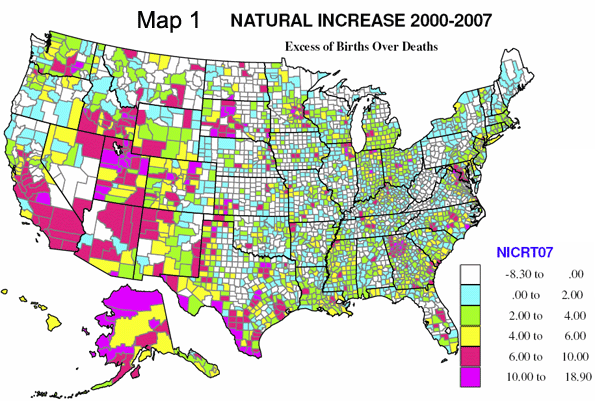
    Natural increase prevails over much of the country, with the exception of much of the Great Plains, from Texas to Canada, and northern Appalachia. High levels of natural increase, over 6 percent (orange and magenta on Map 1) occur in five kinds of areas that are really highly predictable.

    • First, areas of high Hispanic population, mainly from Texas to southern and central California, but also in parts of eastern Washington and southwestern Kansas.
    • Second, Native American Indian reservation areas, most obviously in Alaska, New Mexico, South Dakota, Arizona but also Montana and North Dakota.
    • Third, the Mormon “culture belt,” spreading from the “Zion” of Utah to Idaho, Nevada and Wyoming.
    • Fourth, rapidly growing suburban and exurban counties, most notably around Houston, Dallas, San Antonio, Austin, Atlanta, Washington DC, Chicago, Minneapolis, Charlotte and Denver, and
    • fifth, in counties with military bases, for example, in North Carolina, Georgia, Kansas, Oklahoma and several other states.

    Above average natural increase, from 4 to 6 percent, is typical of many modestly growing metropolitan areas, both central and suburban and exurban counties, and in a scattering of rural-small town counties, especially in the west (western Colorado is notable). Low natural increase, under 2 percent, is very widespread across both urban and rural areas, and is often indicative of slow-growing economies with out-migration (please see Map 2), and in areas moderately attractive to older migrants, thus depressing births, but not enough to cause natural decrease.
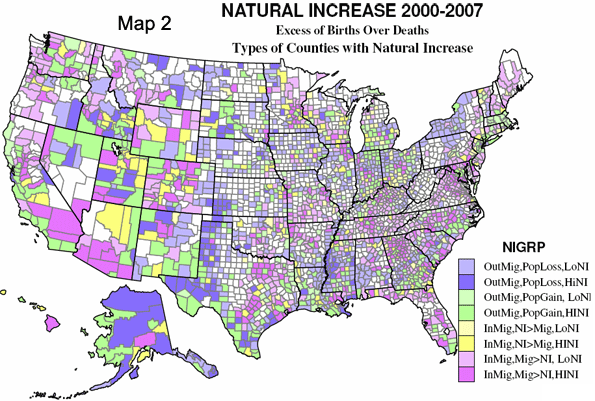
    Map 2 sorts counties according to in or out migration, population gain or loss, and the role of natural increase versus net in-migration. Four basic types are mapped, but then divided into high or low natural increase. Rapidly growing counties with net in-migration even greater than high natural increase (dark pink) are especially typical of suburban and exurban counties of large metropolises, and of fast-growing smaller metropolitan areas. Lower natural increase is more common for rural and small town amenity areas, as well as far exurban counties. Natural increase greater than in-migration (yellow) is not very common, and tends to occur in rural-small town counties, including several counties with high Mormon shares. Counties with out-migration but enough natural increase to permit overall population growth (green) are common in three kinds of areas. First are large central metropolitan counties – such as those containing Los Angeles, Houston, Dallas, and Miami – with high non-Hispanic white out-migration, but high Hispanic in-migration. The second type are border region counties with high Mexican in-migration, and the third are Native American Indian areas. Those counties experiencing population loss (purple) are much more like counties with natural decrease: dominantly rural or declining rust belt metropolitan areas.

    Finally, what areas have the highest rates of natural increase? These see increases of 16 to 19 percent from the base population. They are Wade-Hampton, Alaska (west of Bethel); Webb, Texas (Laredo); Utah (Provo); Hidalgo, Texas (McAllen); Loudoun, Virginia (Leesburg, northwest of Washington DC); Starr, Texas (Rio Grande City); and Madison, Idaho (Rexburg). Three are Hispanic, two Mormon, one Alaska native, and one fast growing suburban.

    Natural increase has remained higher than forecast 40 years ago due to far higher immigration, above replacement fertility even among the affluent and educated, and high teenage pregnancy in connection with constraints on abortion – i.e., America’s very high religious traditionalism. The unknowns ahead include the rate of future immigration, whether 2nd and 3rd generation Hispanics will reduce fertility markedly and whether education and modernism will reduce the power of tradition.

    See Richard’s similar piece on natural decreases in US population.

    Richard Morrill is Professor Emeritus of Geography and Environmental Studies, University of Washington. His research interests include: political geography (voting behavior, redistricting, local governance), population/demography/settlement/migration, urban geography and planning, urban transportation (i.e., old fashioned generalist)
  • Go to Middle America, Young Men & Women

    A few weeks ago, Eamon Moynihan reviewed economic research on cost of living by state in a newgeography.com article. The results may seem surprising, given that some of the states with the highest median incomes rated far lower once prices were taken into consideration. The dynamic extends to the nation’s 51 metropolitan areas with more than 1,000,000 population (See Table).

    There is a general perception that the most affluent metropolitan areas are on the east coast and the west coast. Indeed, 8 of the 10 metropolitan areas with the highest nominal per capita income in 2006 were on the two coasts. These included San Francisco, San Jose and Seattle on the west coast and Washington, Boston, New York, Hartford and Philadelphia on the east coast. Middle-America is represented by Denver and Minneapolis-St. Paul. However, as anyone who has lived on the coasts and Middle America knows, a dollar in New York or San Francisco does not buy nearly as much as a dollar in Dallas-Fort Worth or Cincinnati.

    Per Capita Income: Purchasing Power Parity
    US Metropolitan Areas over 1,000,000 Population
        2006 Per Capita Income  
    Rank Metroplitan Area Purchasing Power Adjusted Nominal Nominal Rank
    1 San Francisco $46,287 $57,747 1
    2 Washington $45,178 $51,868 3
    3 Denver $44,798 $44,691 8
    4 Minneapolis-St. Paul $44,326 $44,237 9
    5 Houston $42,815 $43,174 11
    6 Boston $42,571 $50,542 4
    7 Pittsburgh $41,716 $38,550 20
    8 St. Louis $41,613 $37,652 27
    9 Milwaukee $41,572 $39,536 19
    10 Baltimore $41,451 $43,026 12
    11 Seattle $41,448 $45,369 6
    12 Kansas City $41,329 $37,566 28
    13 Hartford $41,104 $44,835 7
    14 New Orleans $40,935 $40,211 16
    15 Philadelphia $40,725 $43,364 10
    16 Dallas-Fort Worth $40,643 $39,924 17
    17 Cleveland $39,997 $37,406 30
    18 Indianapolis $39,843 $37,735 26
    19 Chicago $39,752 $41,591 14
    20 Richmond $39,282 $38,233 22
    21 New York $39,201 $49,789 5
    22 Birmingham $39,057 $37,331 31
    23 Cincinnati $38,691 $36,650 36
    24 Nashville $38,680 $37,758 25
    25 Detroit $38,670 $38,119 24
    26 Charlotte $38,632 $38,164 23
    27 Miami $38,555 $40,737 15
    28 San Jose $38,505 $55,020 2
    29 Jacksonville $38,413 $37,519 29
    30 Louisville $38,262 $36,000 41
    31 Oklahoma City $38,156 $35,637 42
    32 Las Vegas $37,691 $38,281 21
    33 Salt Lake City $37,381 $35,145 45
    34 San Diego $37,358 $42,801 13
    35 Rochester $37,066 $36,179 38
    36 Columbus $37,058 $36,110 39
    37 Atlanta $36,691 $36,060 40
    38 Memphis $36,501 $35,470 44
    39 Tampa-St. Petersburg $36,260 $35,541 43
    40 Portland $36,131 $36,845 35
    41 Buffalo $36,091 $33,803 48
    42 Norfolk (Virginia Beach metropolitan area) $35,418 $34,858 46
    43 Raleigh $35,087 $37,221 32
    44 San Antonio $34,913 $32,810 50
    45 Providence $34,690 $37,040 34
    46 Austin $33,832 $36,328 37
    47 Phoenix $33,809 $34,215 47
    48 Sacramento $32,750 $37,078 33
    49 Los Angeles $32,544 $39,880 18
    50 Orlando $32,095 $33,092 49
    51 Riverside-San Bernardino $25,840 $27,936 51
    Source:        
    http://www.bea.gov/scb/pdf/2008/11%20November/1108_spotlight_parities.pdf

    Purchasing Power Parity: Things change rather dramatically when purchasing power is factored in. Some years ago, international economic organizations, such as the Organization for Economic Cooperation and Development, the World Bank and the International Monetary Fund began using costs of living by nation to compare national economic performance, rather than currency exchange rate. This practice, called “purchasing power parity” is based upon the recognition that there may be substantial differences in the cost of living between nations.

    This can be illustrated by comparing Switzerland and the United States. For years, Switzerland has had a higher per capita GDP than the United States on an exchange rate basis. Switzerland’s gross domestic product per capita was $53,300 in 2006, nearly 30% above that of the United States ($42,000). However price levels in Switzerland are so high that incomes do not go nearly as far as the exchange rate would suggest. Once adjusted for purchasing power parity, the Swiss GDP per capita in 2006 drops to $39,000, well below that of the United States. Much of the difference has to do with regulation. The more liberal economy of the United States produces a lower cost economy than in Switzerland, or for that matter most of Western Europe. The US economic advantage would be even greater measured on a household basis, since US households include nearly 10% more members (generally children) than those in Western Europe.

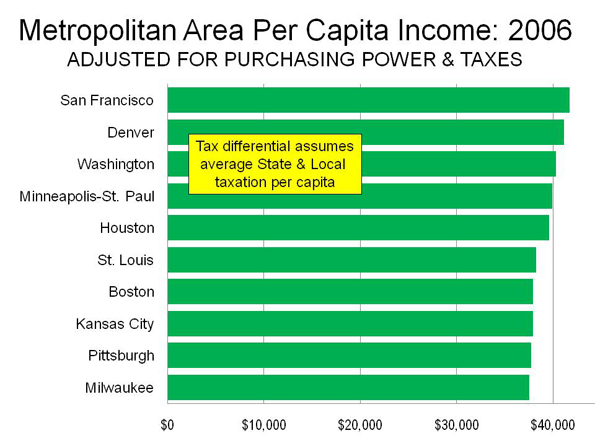
    The same concept was applied by the Department of Commerce Bureau of Economic Analysis researchers in their review of purchasing power parities between US metropolitan areas in 2006. When purchasing power is factored in, five of the top metropolitan areas in nominal per capita income (not adjusted for purchasing power) drop out and are replaced by other metropolitan areas rarely thought of as among the nation’s most affluent.

    Among the three west coast nominal leaders, San Francisco remains as #1, in both nominal and purchasing power adjusted per capita income. Seattle dropped from 6th to 11th position. However, the real surprise is San Jose, which dropped from 2nd position to 28th.

    The east coast regions ranked among the top 10 metropolitan areas in nominal income also were decimated by their high costs, with only Washington (which rose from 3rd to 2nd) and Boston (which fell from 4th to 6th) remaining. New York fell from 5th to 21st, Hartford from 7th to 13th and Philadelphia from 10th to 16th.

    The two non-coastal metropolitan areas in the nominal top 10 remain, with Denver rising from to 3rd and Minneapolis-St. Paul rising from 9th to 4th.

    It can be argued that Middle-America replaced the five metropolitan areas dropping out of the top ten. Houston, long one of the most disparaged metropolitan areas among urbanists, occupies the 5th position (compared to its 11th ranking in the nominal list). Three of the new entrants are confirmed members of the Rust Belt: Pittsburgh (7th), St. Louis (8th) and Milwaukee (9th). Finally, there is a new east coast entrant, blue-collar Baltimore (10th).

    The Impact of Taxes: But that is just the beginning. Taxes also diminish the purchasing power of households. Unfortunately, there is virtually no readily available information on state and local taxation by metropolitan area. There is, however state and local government taxation data at the state level. If it is assumed that this data is representative of metropolitan differences (weighted proportionately by state in multi-state metropolitan areas), there would be changes in rank among the top 10. Denver would displace Washington in the number two position, closing more than one-half the gap with San Francisco. Even more surprisingly, St. Louis would move ahead of both Boston and Pittsburgh to rank 6th. Kansas City would leap over #11 Seattle, Baltimore, Milwaukee and Pittsburgh to rank 8th, trailing #7 Boston by $25, not much more than the price of a Red Sox standing room ticket. Pittsburgh would occupy the #9 position and Milwaukee #10 (See Figure).

    More than Housing: The largest differences in purchasing power stem from housing, with east coast and west coast metropolitan areas having generally higher housing costs. As a result of the housing bust and the larger house price drops in those areas, purchasing power adjusted incomes could recover relative to those of Middle America. However, the high cost of living on the east and west coasts extend to more than housing prices. Generally, according to proprietary (and for sale) ACCRA cost of living data, the west coast and east coast metropolitan areas have higher costs of living even without housing. These differences are largely in grocery costs, which probably reflects the anti-big box store planning regulations and politics that exist in many of these areas. Grocery costs in the more affluent middle-American metropolitan areas tend to be lower.

    Other Surprises: Outside the top 10 most affluent metropolitan areas, there are other surprises. Urban planning favorite Portland ranks 40th, just above Buffalo. Rust Belt Cleveland ranks 17th, a few positions above New York. Kansas City, with its highly decentralized civic architecture, ranks 12th, just behind Seattle. Indianapolis (17th) is more affluent than Chicago (18th) and both are more affluent than New York.

    Five of the bottom 10 metropolitan areas are in the south, including Virginia Beach, Raleigh, Austin, San Antonio and Orlando. But perhaps the biggest surprise of all is that four of the five lowest ranking metropolitan areas are in the southwest: Phoenix (47th), Sacramento (48th), Los Angeles (49th) and Riverside-San Bernardino (51st).

    The Dominance of Middle America: But among the 10 most affluent metropolitan areas in the nation, six or seven may be counted as Middle-America (depending on how Baltimore is classified). Only three are from the original group that supplies 8 of the top metropolitan areas when purchasing power is not considered.


    Related articles:
    Gross Domestic Product per Capita, PPP: World Metropolitan Regions
    Gross Domestic Product per Capita, PPP: China Metropolitan Regions

    Photograph: Pittsburgh

    Wendell Cox is a Visiting Professor, Conservatoire National des Arts et Metiers, Paris. He was born in Los Angeles and was appointed to three terms on the Los Angeles County Transportation Commission by Mayor Tom Bradley. He is the author of “War on the Dream: How Anti-Sprawl Policy Threatens the Quality of Life.

  • Obama’s Home Town

    Hyde Park, in Chicago, is where President Obama called home before moving to Pennsylvania Avenue.

    I once called 5118 S. Dorchester home.

    Hyde Park is a college town surrounded by – but not really part of – a big city. The University of Chicago, founded in 1890, is the heart of the community. The campus was built of Indiana limestone, fake Gothic, and made to look old from its very inception. Some people like it.

    In 1893, Hyde Park hosted the World’s Columbian Exhibition (a year late). This showcased the new campus, and also what is now the Museum of Science & Industry, at the northern edge of Jackson Park. The Midway Plaisance – as in carnival midway – then a canal traversed by Venetian gondolas, now marks the southern boundary of Hyde Park.

    The tradition continued with Robert Maynard Hutchins and Mortimer Adler – the latter founder of Encyclopedia Britannica, and both authors of the Great Books model of liberal arts education. Subsequent residents have included Muhammad Ali, William Ayers, Saul Bellow, and Barack Obama.

    The community is bordered on the east by Lake Michigan, on the west by Washington Park (as in green grass – where few white residents dare to picnic), on the south by the ghetto community of Woodlawn, and to the north by Kenwood – also mostly a ghetto. The formal northern boundary is Hyde Park Blvd (51st St.), but really the neighborhood extends a couple of blocks north into Kenwood. Including this (say to 49th St.), Hyde Park is less than two square miles, and has about 30,000 people.

    To preserve its integrity as a college town, the area is separated as much as possible from the surrounding ghetto. As a result, public transportation to and from Hyde Park is poor to anyplace besides the Loop. It is difficult to get to Hyde Park from nearby communities. This is what gives it the feel of a separate village. It takes half an hour to get to the rest of Chicago.

    The Illinois Central tracks bisect Hyde Park along Lake Park Ave. East of the tracks is a lakeshore community, traditionally Jewish. Here are high-rise condos such as one would find on the North Side. The famous and impressive Shoreland Hotel has become a college dormitory. Hyde Park Blvd. turns south, east of the tracks, and is a very impressive avenue leading to the Museum of Science & Industry. A pedestrian tunnel leads under Lakeshore Drive to the marvelous Hyde Park Point – a peninsula jutting out into the lake. This offers the very best view of the Chicago skyline from anywhere in the city. Drive to the very end of 55th St. and you’re there.

    The town-gown divide runs right along 55th Street: south is gown (and mostly white), north is town (and majority Black). The entire community is racially integrated – one of the defining features of Hyde Park. Nevertheless, east of Woodlawn and south of 55th Street is mostly faculty and graduate student housing. Conversely, the northwest part of town is predominantly Black.

    55th Street itself is very boring – the victim of urban renewal in the 60’s and 70’s. The only interesting place is the Lutheran School of Theology at Chicago, a modern but very satisfying building. (On my last visit the building looked to be in disrepair).

    The commercial main street is 53rd Street from Woodlawn to Lake Park. I am pleased to say that while individual businesses have come and gone, the character of this street is mostly unchanged over the past 30 years. Half white and half Black, half university and half blue-collar, the street is a great place for people-watching. The center is a small shopping area known as Harper Court. When I last visited, the Valois Cafeteria (53rd and Blackstone) was still there – great place!

    Four blocks south is 57th Street, the main street of the campus neighborhood. This used to be justly famous for fantastic bookstores, and probably still is. Please visit the Seminary Co-op Bookstore at the corner of 58th and Woodlawn. (It’s inside the Chicago Theological Seminary building, in the basement; there are small signs.) A less interesting branch is along 57th Street. A small used bookstore on 57th Street just before the tracks is still there (called Powell’s, but probably unrelated to the Portland store). I’m certain all the other independent bookstores are gone.

    The university proper starts at Woodlawn and extends west. The impressive Rockefeller Chapel is on Woodlawn south of 58th Street. Frank Lloyd Wright’s justly famous Robie House is at 58th and Woodlawn. The main quad of the university extends from 57th and University all the way to 59th and Ellis. It is well worth exploring. If you can, go into the Harper Library. And walk past the Divinity School. The unforgivably ugly Regenstein Library is across 57th Street – classic brutalism.

    West of Ellis is a huge medical complex: the University of Chicago hospitals. This neighborhood is very different still, as neither nurses nor patients live in Hyde Park. The academic core of the university extends west of Ellis as well, and now includes a Science Quad.

    By the time one gets to Cottage Grove – the western boundary of Hyde Park and the eastern limit of Washington Park – one is actually in the ghetto. I never felt safe walking along Cottage Grove. Indeed, except for the university campus, I rarely ventured west of Ellis. Otherwise I walked around town at all hours of the day or night.

    The campus has crossed the Midway Plaisance, and now includes a row of large buildings along 60th Street – notably the law school. This is a wall against impoverished (and increasingly uninhabited) Woodlawn.

    I understand that one additional building needs to be built in Hyde Park: the Obama Presidential Library. Please let the White House know where you think they should put it. The matter is of some urgency.

    I’m hoping they can start construction no later than 2013.

    Daniel Jelski is Dean of Science & Engineering State University of New York at New Paltz.

  • There’s No Place Like Home, Americans are Returning to Localism

    On almost any night of the week, Churchill’s Restaurant is hopping. The 10-year-old hot spot in Rockville Centre, Long Island, is packed with locals drinking beer and eating burgers, with some customers spilling over onto the street. “We have lots of regulars—people who are recognized when they come in,” says co-owner Kevin Culhane. In fact, regulars make up more than 80 percent of the restaurant’s customers. “People feel comfortable and safe here,” Culhane says. “This is their place.”

    Thriving neighborhood restaurants are one small data point in a larger trend I call the new localism. The basic premise: the longer people stay in their homes and communities, the more they identify with those places, and the greater their commitment to helping local businesses and institutions thrive, even in a downturn. Several factors are driving this process, including an aging population, suburbanization, the Internet, and an increased focus on family life. And even as the recession has begun to yield to recovery, our commitment to our local roots is only going to grow more profound. Evident before the recession, the new localism will shape how we live and work in the coming decades, and may even influence the course of our future politics.

    Perhaps nothing will be as surprising about 21st-century America as its settledness. For more than a generation Americans have believed that “spatial mobility” would increase, and, as it did, feed an inexorable trend toward rootlessness and anomie. This vision of social disintegration was perhaps best epitomized in Vance Packard’s 1972 bestseller A Nation of Strangers, with its vision of America becoming “a society coming apart at the seams.” In 2000, Harvard’s Robert Putnam made a similar point, albeit less hyperbolically, in Bowling Alone, in which he wrote about the “civic malaise” he saw gripping the country. In Putnam’s view, society was being undermined, largely due to suburbanization and what he called “the growth of mobility.”

    Yet in reality Americans actually are becoming less nomadic. As recently as the 1970s as many as one in five people moved annually; by 2006, long before the current recession took hold, that number was 14 percent, the lowest rate since the census starting following movement in 1940. Since then tougher times have accelerated these trends, in large part because opportunities to sell houses and find new employment have dried up. In 2008, the total number of people changing residences was less than those who did so in 1962, when the country had 120 million fewer people. The stay-at-home trend appears particularly strong among aging boomers, who are largely eschewing Sunbelt retirement condos to stay tethered to their suburban homes—close to family, friends, clubs, churches, and familiar surroundings.

    The trend will not bring back the corner grocery stores and the declining organizations—bowling leagues, Boy Scouts, and such—cited by Putnam and others as the traditional glue of American communities. Nor will our car-oriented suburbs replicate the close neighborhood feel so celebrated by romantic urbanists like the late Jane Jacobs. Instead, we’re evolving in ways congruent with a postindustrial society. It will not spell the demise of Wal-Mart or Costco, but will express itself in scores of alternative institutions, such as thriving local weekly newspapers, a niche that has withstood the shift to the Internet far better than big-city dailies.

    Our less mobile nature is already reshaping the corporate world. The kind of corporate nomadism described in Peter Kilborn’s recent book, Next Stop, Reloville: Life Inside America’s Rootless Professional Class, in which families relocate every couple of years so the breadwinner can reach the next rung on the managerial ladder, will become less common in years ahead. A smaller cadre of corporate executives may still move from place to place, but surveys reveal many executives are now unwilling to move even for a good promotion. Why? Family and technology are two key factors working against nomadism, in the workplace and elsewhere.

    Family, as one Pew researcher notes, “trumps money when people make decisions about where to live.” Interdependence is replacing independence. More parents are helping their children financially well into their 30s and 40s; the numbers of “boomerang kids” moving back home with their parents, has also been growing as job options and the ability to buy houses has decreased for the young. Recent surveys of the emerging millennial generation suggest this family-centric focus will last well into the coming decades.

    Nothing allows for geographic choice more than the ability to work at home. By 2015, suggests demographer Wendell Cox, there will be more people working electronically at home full time than taking mass transit, making it the largest potential source of energy savings on transportation. In the San Francisco Bay Area and Los Angeles, almost one in 10 workers is a part-time telecommuter. Some studies indicate that more than one quarter of the U.S. workforce could eventually participate in this new work pattern. Even IBM, whose initials were once jokingly said to stand for “I’ve Been Moved,” has changed its approach. Roughly 40 percent of the company’s workers now labor at home or remotely from a client’s location.

    These home-based workers become critical to the localist economy. They will eat in local restaurants, attend fairs and festivals, take their kids to soccer practices, ballet lessons, or religious youth-group meetings. This is not merely a suburban phenomenon; localism also means a stronger sense of identity for urban neighborhoods as well as smaller towns.

    Could the new localism also affect our future politics? Ever greater concentration of power in Washington may now be all the rage as the federal government intervenes, albeit often ineffectively, to revive the economy. But throughout our history, we have always preferred our politics more on the home-cooked side. On his visit to America in the early 1830s, Alexis de Tocqueville was struck by the de-centralized nature of the country. “The intelligence and the power are dispersed abroad,” he wrote, “and instead of radiating from a point, they cross each other in every direction.”

    This is much the same today. The majority of Americans still live in a patchwork of smaller towns and cities, including many suburban towns within large metropolitan regions. There are well over 65,000 general-purpose governments, and with so many “small towns,” the average local jurisdiction population in the United States is 6,200, small enough to allow nonprofessional politicians to have a serious impact.

    After decades of frantic mobility and homogenization, we are seeing a return to placeness, along with more choices for individuals, families, and communities. For entrepreneurs like Kevin Culhane and his workers at Churchill’s, it’s a phenomenon that may also offer a lease on years of new profits. “We’re holding our own in these times because we appeal to the people around here,” Culhane says. And as places like Long Island become less bedroom community and more round-the-clock locale for work and play, he’s likely to have plenty of hungry customers.

    This article originally appeared in Newsweek.

    Joel Kotkin is executive editor of NewGeography.com and is a distinguished presidential fellow in urban futures at Chapman University. He is author of The City: A Global History. His next book, The Next Hundred Million: America in 2050, will be published by Penguin Press early next year.
  • Can Silicon Valley Attract the Right Workforce for its Next Turnaround?

    In less than 30 years, Silicon Valley has rocketed to celebrity status. The region serves as the top magnet for innovation, often occupying the coveted #1 position of global hot spot rankings. More of an informal shared experience than a physical place, Silicon Valley capitalizes on being centrally located in the San Francisco Bay Area, a broader regional zone that is an economic powerhouse.

    Keeping this leadership position requires constant transformation. The region has weathered and reinvented itself through previous downturns. These next few years, in the wake of what some have termed the Great Recession, will provide another test of economic recovery and relevance.

    Based on a recent in-depth research study of global innovation networks, several elements will be essential to the future success of the Bay Area. Two critical but often overlooked factors are specifically community colleges and local demographics. Both are tied directly to people.

    Almost any conversation of innovation assumes that the top research institutions are prerequisites. Boston has MIT and Harvard; the Bay Area has Stanford University and the University of California at Berkeley. One university professor said frankly, “Stanford is part of what the outside world sees as part of the Silicon Valley secret.”

    These tier-one universities do play a critical role within the local economy, receiving the greatest doses of federal research dollars and enjoying their pick of top young talent. They also soak up the spotlight, so much so that the tiers below them are often ignored by local policymakers.

    This elitist mentality dominates the top of the Bay Area food chain. An eminent faculty leader of a biotech institute was astounded when asked about the role of the other local schools for regional growth. He remarked, “We are more focused on the entrepreneurs than the foot soldiers. We kind of believe that [latter] part will take care of itself.”

    This kind of thinking is delusional. In truth, community colleges provide the bedrock for the region’s university ecosystem. They channel bright students up the local educational chain, helping train and transfer them to the upper tiers. Within the Bay Area, the Foothill-De Anza Community College has served a diverse student body, which includes a combination of younger, older, and re-entry students, for over 50 years.

    In particular, community colleges serve as a gateway to ambitious foreign-born talent. Foothill-De Anza admits more international students than any other community college in the U.S., notes Peter Murray, Foothill’s Dean of Physical Sciences, Mathematics and Engineering. Many of these students from outside the U.S. seek a natural entry to Silicon Valley. Once on a student visa, they aggressively pursue their career interests, often transferring to another state school, such as Stanford or the University of California system, to finish their degrees and join the local workforce. Others gain critical technical skills – such as in database management or bioinformatics – critical to operating sophisticated, technology-based companies.

    The community colleges also learn to do more with less. Although state-assisted, Foothill-De Anza funds students at a relatively low rate of $4019 per student, even compared to other national community colleges that average $8041 per student, according to Community College League of California statistics. This is far below what it costs to send students to Berkeley or Stanford.

    Most recently, the school’s administration has faced painfully deep state budget cuts, re-juggling curriculum priorities and teaching staff loads. They adjust by being flexible. The community college system recently announced a partnership with the University of California at Santa Cruz with ambitious plans to build a new billion-dollar multi-university campus at the NASA Ames Research Center. Carnegie-Mellon University in Pittsburgh and San Jose State University in San Jose, Calif., have joined the unique venture that mixes private, public, and industry spheres.

    The new campus will include a new School of Management, major science laboratories, engineering facilities, classrooms, and homes for 3,000 people on 75 acres. The backers are hopeful that this will lead to a “sustainable community for education and research.” If all goes accordingly to plan, this university will offer a new model of education that combines the best of a local community college, local metropolitan school, two universities at a distance, and a strong industry partner.

    Education constitutes only one part of the region’s human capital outlook. Local population trends can reflect the overall strength of the workforce and its ability for continued growth. On a more fundamental level, innovation efforts rest on people who start and grow new ventures. By understanding current demographics, you garner strong hints for future gaps and issues.

    Looking just at Silicon Valley, the area’s population grew modestly by 1.6% to a total of 2.6 million residents for 2008, according to the latest Silicon Valley Index. Compared to California and the U.S., Silicon Valley’s population consists of fewer children and more people between working ages (25–64). This combination bodes well for work productivity, but also indicates that many who start families soon drift to other states to raise the next set of young workers.

    Silicon Valley does better attracting and retaining foreign talent, who seek new opportunity and prosperity. AnnaLee Saxenian, a dean at the University of California at Berkeley, considers this global migration and circulation to be critical in maintaining regional advantage. Foreign immigration has driven Silicon Valley’s population growth. Looking solely at U.S. Census data estimates for the period of 2000 and 2003, foreign migration to the metropolitan cluster of San Francisco, Oakland, and Fremont rose by 10 percent each year, while domestic migration dropped by nearly 14 percent on average.

    Another good sign is that foreign students, particularly those receiving degrees in science and engineering, continue to stay higher in Silicon Valley than other U.S. regions. Unfortunately, when the student visas end, many of these bright workers, who would otherwise stay in the area, take their skills and dreams back home.

    More worrying, college graduates – both foreign and domestic – are leaving the region on their own volition. No city in the greater Bay Area sits in the top 20 list of places to work after college. If American youth are relocating to other areas, then the region may be destined to simply age in place. Local parents in my recent research study simply did not make the connection that nearly all their grown children lived elsewhere – and what that implication entailed for long-term regional vitality.

    Part of this difference in understanding can be explained by generational biases. Each generation brings a dominant set of traits that shape the tone and direction for local innovation. Baby Boomers (born 1943–1960) are focused on their own pursuits. Even when retired, Boomers stay active as consultants and independent contractors, partly to offset decreased life savings as well as enjoy a self-sufficient lifestyle. Often criticized for being narcissistic, they can help to influence innovation activities for others through policy and funding decisions. A senior research policymaker said emphatically, “What are we going to do for the generations out ahead of us? That’s what I care more about than anything.”

    Generation X (born 1961–1981) is the most entrepreneurial generation in U.S. history, but the smallest in size, so policymakers easily overlook them. Certain tensions exist with the prior generation. Research from Neil Howe and William Strauss show that the Boomers are increasingly resisting the decisions made by Gen X to the point of overlooking their contributions in favor of the next generation.

    This is a drastic mistake for two reasons. First, the average age for a U.S.-born technology entrepreneur to start a company is 39, which sits squarely in Gen X. This generation has already become the primary engine for Silicon Valley. Second, this generation has the best academic training and international experience in American history. They may be small in their weight class, but Gen X packs a hefty punch overall. The challenge will be for the Bay Area to retain this population group, as their family and career needs shift.

    In contrast, the Millennials (born 1982–2005) are generally focused on social bonding, authority approval, and civic duty – attributes that may make parents happy, but do not usually drive new economic growth. As the largest generation in American history, they are proving to be massive consumers of technology and social advocates. By and large, Millennials steer away from high-risk ventures, preferring community-oriented activities, and they bring a different set of demands to the Bay Area.

    In the innovation lifecycle, if Boomers serve as advisors and Gen Xers as the entrepreneurs, then the Millennials could provide potent networkers. Each plays an essential role in regional growth, and all frequently vote with their feet. The critical question is whether the Bay Area is positioned to retain the right workforce mix to harness its next turnaround, or whether the dynamism will shift to other regions both in America and abroad.

    Tamara Carleton is a doctoral student at Stanford University, studying innovation culture and technology visions. She is also a Fellow of the Foundation for Enterprise Development and the Bay Area Science and Innovation Consortium.

  • Mexico’s Real War: It’s Not Drugs

    Balding, affable and passionate, Uranio Adolfo Arrendondo may not be a general or political leader, but he stands on the front lines of a critical battle facing Mexico in the coming decade. This struggle is not primarily about the drug wars, which dominate the media coverage–and thus our perceptions–of our southern neighbor. It concerns the economic and political forces stunting the aspirations of its people.

    For the past 36 years, Arrendondo’s small family-owned school, Liceo Reforma Educativa, where he is principal, has served as an incubator for Mexico City’s aspiring middle class. Modest and reasonably priced, the school has offered small-business owners, professionals and mid-level managers a way to propel their children up the economic ladder.

    Yet today Arrendondo finds many parents lacking the resources for even a modest alternative to Mexico’s troubled state-run schools. “The middle class in Mexico is going down,” Arendondo told me in his office by the courtyard of the brightly painted school in the largely lower-middle-class Iztacalco, one of Mexico City’s 16 diverse delegaciones, or boroughs. “The middle class is predated by both the super-rich and the criminal poor. We are squeezed in the middle of the sandwich.”

    This predicament is not unique to Liceo Reforma, which has some 245 students. Data from the Asociacion Nacional de Escuelas Particulares estimate that as many as 400,000 people have pulled their children out of small private schools over the last few years, placing them instead in the generally much inferior public ones.

    This is just one sign of a worrisome trend toward downward mobility, greatly exacerbated by the economic crisis. And it is all the more painful, as it represents a reversal of progress toward an expanding middle class in the 1970s and 1980s. In those decades, Mexico–spurred by its energy wealth and an expanding industrial base–was finally beginning to break away from its age-old pattern of being a society dominated by a few rich and many very poor.

    To be sure, Mexico City’s sprawling expanse still exhibits this legacy of upward mobility. A good number of the capital’s 20 million people can be seen crowding elegant shopping centers, driving late model cars and eating in crowded restaurants. With the elegant Polanco, not far from the central district, lovely Lomas de Chapultepec, or sprawling, ultra-modern Santa Fe, Mexico City can seem very much a first-world city.

    At the same time, however, much of it–including lower-middle class Iztacalco–needs considerable repair. The root of the problem lies in demographics. Although Mexico’s population growth has slowed, labor-force growth still outpaces economic fecundity. Victor Manuel, director general of a leading high-tech institute in Mexico City, estimates the country’s gross domestic product needs to grow at 7% annually to produce the 2 million new jobs needed each year to keep up with labor-force growth. Over the past decade, that growth has been roughly 3%, and last year declined by as much as 7%.

    In the immediate future, many economists expect Mexico’s recovery to lag that of both the U.S. and its Latin neighbors, particularly Brazil and Peru. The most recent survey of expectations among industrialists conducted by Canacintra, a leading national business chamber of manufacturers, found more than half expected conditions to get worse, 10 times as many who expressed optimism.

    The sluggish economy has had its most dramatic impact on the poor, who constitute upward of 25% to 30% of the population. In contrast to earlier decades, their ranks may now be growing, suggests Alfonso Celestino, a social scientist who works for the government of the sprawling Districto Federal, which includes Mexico City. “Mexico is a first-world city, but large parts are like third-world African cities,” he asserts

    Particularly notable has been the growth of the so called “misery suburbs” or pueblos nuevos, sprouting in the outer periphery of the city. In these areas, as well as poor inner city neighborhoods, unemployed young people are being “absorbed,” as Celestino puts it, into the illicit economy. This burgeoning criminal infrastructure preys directly on the super-rich through kidnappings and their bloody feuds that discourage both investors and tourists.

    Yet it is perhaps more dangerous, as violence has grown and poverty increased, that the middle class has begun to recede. Unlike the very poor and the elderly, such families receive little public assistance and often make do by working in the massive “informal economy” that, by some estimates, constitutes as much as 40% of the entire country’s gross product.

    Even before the economic crash in 2007, large percentages of educated Mexican workers were finding it difficult to get placed in high-skilled jobs. Miguel Angel Juarez Noguez, a junior-high math instructor, graduated with a degree in computer science in 2006, but says few of his friends have found employment inside the information sector.

    He believes his parents, both mathematics instructors, enjoyed far better prospects than he and his family–including two children–now face due to a weak job market and rising cost of living. “Today” he suggests, “you need more education to get less.”

    These problems have been exacerbated by the deep recession in the U.S., whose market created many relatively high-paying industrial and technical jobs. Meanwhile, workers remittances from Mexicans in the U.S., the second-largest source of income for the country after oil, have begun to dry up.

    Many discouraged Mexican immigrants have returned home, notes Celestino, but they find few employment opportunities. And Mexico’s border boomtowns, which once offered considerable opportunity, are now suffering not only from the American recession but from the shift of production to China. Coastal communities have been decimated by a decline in tourism, a result not only of the recession but also of concerns over violence and swine flu epidemic.

    Ultimately, many concede that the basic problem lies not in the outside world but in Mexico itself. Although much can be said for greater transparency and economic liberalism under the current PAN government, most believe the entrenched system of crony capitalism has been barely affected by the political change.

    This system–where bribery is commonplace and connections are necessary to build even a small business–stymies growth by undermining innovation, notes technology entrepreneur Victor Manuel. “People come back from schools, or from the United States, with all sorts of skills and money,” he notes, “but there’s no system here to create an economy they can contribute to.”

    Such frustrations are heightened by a sense that other countries–notably the BRIC nations of Brazil, Russia, India and China–are rushing ahead while the once-promising Mexico falls behind. These countries appear to be tapping their human and material resources more efficiently and strategically than Mexico. “There is no vision from the state,” Manuel says, echoing a common refrain.

    Edgar Moreno, a 37-year-old M.B.A. who currently works for Hewlett-Packard at the ultra-modern Santa Fe district southeast of the city, agrees that political dysfunction is the main impediment to progress. Corruption and inefficiency hamper the development of the nation’s potentially huge energy resource, and that’s one reason why Mexico lacks the capital to develop new enterprises. Real interest rates for entrepreneurial ventures start at 12%.

    Moreno’s own ambition, to develop renewable fuels based on sugar, corn and other crops, is also held back by bureaucratic obstacles that discourage such ventures. “It’s not the location of the country that keeps us from developing the way we should,” he points out. “It’s the laws, the framework, how the government does things. Mexicans have lots of ideas and a lot of interests, but the system is stacked against us.”

    The surge in drug violence–over 7,000 died just last year–adds to the perception that Mexico may be on the verge of becoming a “failed state.” Mexican author Enrique Krauze believes the crime wave constitutes Mexico’s “most serious crisis” since the bloody 1910 Revolution, an upheaval that cost more than 2 million deaths.

    Yet, however terrible the violence, Arrendondo believes the decline of the middle class and upward mobility presents Mexico with a more lethal, long-term threat. The parents of the Liceo’s students, he argues, may not “take up a pistol” like their forebears a century ago but might embrace a return to the anti-American authoritarianism and protectionism of the past.

    This would not be good news for America. Mexico stands as our second export market, well ahead of China. Mexicans are also our closest cousins in terms of blood–four in 10 claim to have relatives in the U.S.–and our tastes in food, music and culture increasingly converge.

    This suggests that what happens to the kids and their parents at Liceo Reforma Educativa matters to us as well. A thriving Mexico would need to send us less of their poor and could buy more of what we produce. Mexico’s fate has at least as much relevance to our future as developments in Iraq, Afghanistan, Europe or even China, where our media and politics focus most of their attention.

    “These kids’ parents are struggling with opportunities lost and destroyed,” Arrendondo told me. “We have to change that. Mexico has to become a place where opportunities are created for kids like these. That’s the most important thing to determine the future.”

    This article originally appeared at Forbes.com.

    Joel Kotkin is executive editor of NewGeography.com and is a distinguished presidential fellow in urban futures at Chapman University. He is author of The City: A Global History. His next book, The Next Hundred Million: America in 2050, will be published by Penguin Press early next year.

  • On Cities, GHG Emissions, Apples & Oranges

    Every day or so a new greenhouse gas emission report crosses my desk. Often these reports are very useful, other times they add little of value to the subject. The problem is separating the “wheat” from the “chaff.”

    This dilemma is well illustrated by a paper called “Greenhouse Gas Emissions from Global Cities,” authored by 10 academics. I had received notification of the paper from Science Daily, a useful website that provides notification of new research on a wide range of scientific subjects.

    The Science Daily article indicated that Denver produces the most greenhouse gases per capita annually, while Barcelona produces the least. I am always interested in reports that compare the performance of “cities,” both out of general interest and because of the gross errors that often are the result of invalid comparisons. So, immediately I ran down the report, and to my surprise the report dealt with only 10 “cities.” This seems rather a small number, since the smallest in the sample, Geneva, is not even among the top 700 urban areas in the world. This seems to be a rather incomplete sample: 10 out of more than 700.

    That was just the beginning. There were serious problems of comparison between the 10 “cities.” Whenever someone starts talking about “cities,” it is best to ask what they mean. The word “cities” has so many meanings and is subject to such confusion that I generally avoid using it.

    “Cities” might be municipalities, such as the city of New York or the ville de Paris.

    Cities could be urban areas (urbanized areas or urban agglomerations), which are the urban footprints one observes from an airplane on a clear night.

    “Cities” could be metropolitan areas, which are labor markets and are generally larger than urban areas, because people commute from rural areas (outside the urban footprint) to work in the urban area.

    In nearly the entire world, with the exception of China, urban areas and metropolitan areas are larger than municipalities.

    Or, “cities” could be used in the sense of Chinese prefectural, sub-provincial or provincial level cities, which tend to be far larger than any reasonable definition of a metropolitan area. Nearly all of China is divided into cities, in the same way that most of the United States is divided into counties.

    These Chinese “cities” themselves often contain county level “cities” that are separate from the principal urban areas.

    These differing definitions of municipalities make any international comparison of these entities difficult and often misleading. The ville de Paris represents barely 20 percent of the Paris region. The “city” of Atlanta represents barely 10 percent of its metropolitan area. The “city” of Melbourne represents only 5 percent of its metropolitan area. Yet, other “cities” are larger than their metropolitan areas, such as Chongqing, China, which has at least five times the population of its genuine metropolitan area (the “city” covers an area the size of Austria or Indiana). The city of San Antonio, with its vast stretches of suburbanization is surely not comparable to the city of Hartford, which is dominated by an urban core.

    Any genuine comparison of “cities” must be at the metropolitan area or urban area level. These definitions both represent the city as the organism it is, rather than simply the happenstance of municipal boundaries. Of course, comparisons must be either between metropolitan areas or urban areas to be valid. It will not do to compare metropolitan areas with urban areas; they are as apples and oranges. Moreover, there are no international standards for delineation of metropolitan areas, which makes metropolitan comparisons more complex.

    All of this raises the principal problem with the “Global Cities” paper. There is no consistency to the city definitions the paper uses and its results are thus meaningless (though “headline grabbing”). For example, “Global Cities” uses the geographic areas of the following barely comparable “cities”:

    The municipality of Barcelona, which represents less than one half of the urban area and excludes the expansive suburbs that stretch in every direction but the Mediterranean.

    The municipalities of Bangkok, Denver and New York, which are only parts of their respective metropolitan or urban areas.

    The municipality of Cape Town, which could be considered a metropolitan area because of the large expanse of rural area under its jurisdiction.

    The canton (province) of Geneva might probably qualify as a metropolitan area, except that it excludes the suburbs in France, from which virtually free movement of labor is permitted.

    The Greater London Authority which is nearly co-existent with the London urban area, while Prague as the report defines it is somewhat larger than its urban area.

    The Greater Toronto Area which meets none of the “city” definitions above and is larger than both the metropolitan area and the urban area as defined by Statistics Canada.

    Los Angeles County, which meets none of the “city” definitions and is part of the larger Los Angeles-Orange County metropolitan area.

    All in all, as charitably as it can be put, the “Global City” compares four municipalities, three metropolitan areas, two urban areas, one area larger than a metropolitan area and one that is part of a metropolitan area. Put another way, it tries to make comparisons between four apples, three oranges, two peaches, one banana and one sweet potato.

    Granted, the paper indicates the geographical definitions it uses. That, does not, however, change the fact that treating apples and oranges as comparable is simply invalid.

    There are other problems with the “Global Cities” paper, but one more is enough. In the obligatory fashion, the authors stress how important it is to adopt “smart growth” policies in North America. They cite a US Department of Transportation study to indicate that a doubling of density reduces vehicle miles traveled by 40 percent.

    A bit closer reading would have indicated that the study says doubling density would reduce new vehicle miles by 40 percent, where population densities are already 6,000 to 7,000 per square mile. Only two large urban areas in the United States have densities that high, San Francisco and Los Angeles (which the authors characterize as having urban densities at least 40 percent below the US Bureau of the Census number for the Los Angeles urban area). A 40 percent reduction in “new” vehicle miles means that overall vehicle miles traveled increase 60 percent when the population is doubled, rather than 100 percent. Thus, even with the high density qualification in the US Department of Transportation study, vehicle miles would increase 60 percent as population densities double.

    Maybe tomorrow will bring a better report. One can always hope.

    Photograph: The “city” of Chongqing (part of its vast rural countryside)

    Wendell Cox is a Visiting Professor, Conservatoire National des Arts et Metiers, Paris. He was born in Los Angeles and was appointed to three terms on the Los Angeles County Transportation Commission by Mayor Tom Bradley. He is the author of “War on the Dream: How Anti-Sprawl Policy Threatens the Quality of Life.

  • How Smart Growth Disadvantages African-Americans & Hispanics

    It was more than 45 years ago that Dr. Martin Luther King, Jr. enunciated his “Dream” to a huge throng on the Capitol Mall. There is no doubt that substantial progress toward ethnic equality has been achieved since that time, even to the point of having elected a Black US President.

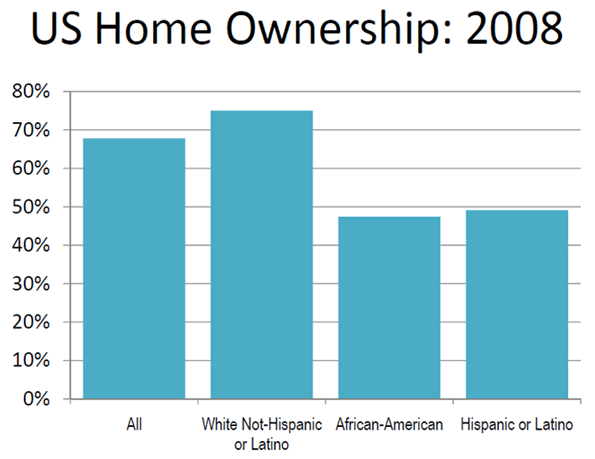
    The Minority Home Ownership Gap: But there is some way to go. Home ownership represents the core of the “American Dream” that was certainly a part of Dr. King’s vision. Yet, there remain significant gap in homeownership by ethnicity. Rather than a matter of discrimination, this largely reflects differing income levels between White-Non-Hispanics, African-Americans and Hispanics or Latinos. Today, approximately 75% of white households own their own homes. Whites have a home ownership rate fully one-half higher than that of African-Americans and Hispanics or Latinos at 47% and 49% (See Figure).

    Setting the Gap in Stone: A key to redressing this difficulty will be convergence of minority household incomes with those of whites, and that is surely likely to happen. However, there is another important dynamic in operation: house prices in some areas have risen well in advance of incomes, so that convergence alone can not narrow the home ownership gap in a corresponding manner. It is an outrage for public policy to force housing prices materially higher so long as home ownership remains beyond the incomes of so many, especially minorities.

    The Problem: Land Use Regulation: The problem is land use regulation. The economic evidence is clear: more restrictive land use regulation raises house prices relative to household incomes. This can be seen with a vengeance in the house price increases that occurred during the housing bubble. As we have previously described, metropolitan markets with more restrictive land use regulation (principally the more radical “smart growth” policies) experienced house price escalation out of all proportion to other areas in the nation. In some cases, they topped out at nearly four times historical norms. On the other hand, in the one-half of major metropolitan area markets where land use regulations were less severe, house prices tended to increase to little more than historic norms, at the most.

    How Smart Growth Destroys Housing Affordability: This difference is principally due to the price of land, which is forced upward when the amount of land available for building is artificially limited, as is the case in smart growth markets. At the peak of the bubble, there was comparatively little difference in house construction costs per square foot in either smart growth or less restrictive markets. However, the far higher land prices drove house prices in smart growth markets far above those in less restrictively regulated markets. Where house prices rise faster than incomes, housing affordability drops as prices rise at escalated rates.

    Wishing Away Reality: It is not surprising that the proponents of smart growth undertake Herculean efforts to deflect attention away from this issue. Usually they pretend there is no problem. Sometimes they produce studies to indicate that limiting the supply of land and housing does not impact housing affordability, which is akin to arguing that the sun rises in the West. Even the proponents, however, cannot “walk a straight line” on this issue, noting in their most important advocacy piece (Costs of Sprawl – 2000) that their more important strategies have the potential to increase the cost of housing.

    The Assault on Home Ownership: Worse, well connected Washington interest groups (such as the Moving Cooler coalition) and some members of Congress seek to universalize smart growth land rationing throughout the nation, which would cause massive supply problems and housing price inflation that occurred in some markets between 2000 and 2007. Even after the crash, these markets experienced generally higher house prices relative to incomes in smart growth markets than in traditionally regulated markets.

    House Price Increases and Minorities: House price increases relative to incomes weigh most heavily on ethnic minority households, because their incomes tend to be lower. This is illustrated by an examination of the 2007 data from the American Community Survey, in our special report entitled US Metropolitan Area Housing Affordability Indicators by Ethnicity: 2007. The year 2007 was the peak of the housing bubble, but represents a useful point of reference for when future “smart growth” policies were imposed nationwide.

    Median Priced Housing: The data (Table) indicates that median house prices were 75% or more higher for African-Americans than Whites, however that African-Americans in smart growth markets require 84% more to buy the median priced house. The situation was slightly better for Hispanics or Latinos with median house prices at least 50% more relative to incomes than for Whites. House prices relative to Hispanic or Latino median household incomes were 86% higher in smart growth markets than in less restrictively regulated markets.

    SUMMARY OF HOUSING INDICATORS BY
    LAND USE REGULATION CATEGORY
    Metropolitan Areas over 1,000,000 Population: 2007
    HOUSING INDICATOR Less Restrictive Land Use Regulation Markets More Restrictive Land Use Regulation Markets All Markets More Restrictive Markets Compared to Less Restrictive Markets
    MEDIAN VALUE MULTIPLE        
    All 3.1 5.8 4.5 1.89
    White Non-Hispanic or Latino 2.7 5.1 3.9 1.90
    African-American 4.9 8.9 6.9 1.84
    Hispanic or Latino 4.2 7.9 6.1 1.86
    LOWEST QUARTILE VALUE MULTIPLE      
    All 2.1 4.2 3.2 2.01
    White Non-Hispanic or Latino 1.8 3.7 2.8 2.01
    African-American 3.3 6.5 5.0 1.95
    Hispanic or Latino 2.9 5.7 4.4 1.98
    MEDIAN RENT/MEDIAN HOUSEHOLD INCOME      
    All 13.8% 17.1% 15.5% 1.24
    White Non-Hispanic or Latino 12.1% 15.1% 13.6% 1.25
    African-American 21.9% 26.1% 24.0% 1.19
    Hispanic or Latino 19.1% 23.0% 21.1% 1.20
    LOWER QUARTILE RENT/MEDIAN HOUSEHOLD INCOME    
    All 10.8% 13.1% 12.0% 1.22
    White Non-Hispanic or Latino 9.4% 11.6% 10.5% 1.23
    African-American 17.0% 20.0% 18.5% 1.17
    Hispanic or Latino 14.9% 17.5% 16.2% 1.18
    NOTES        
    Median Value Multiple: Median House Value divided by Median Household Income
    Low Quartile Value Multiple: Low Quartile House Value divided by Median Household Income
    2007 Data
    Calculated from American Community Survey (US Bureau of the Census) Data
    “More restrictive” land use regulation markets (generally "smart growth") include those classified as "growth management," "growth control," "containment" and "contain-lite" and "exclusions: in "From Traditional to Reformed A Review of the Land Use Regulations in the Nation’s 50 largest Metropolitan Areas" (Brookings Institution, 2006) and markets with significant large lot zoning and land preservation restrictions (New York, Chicago, Hartford, Milwaukee, Minneapolis-St. Paul, and Virginia Beach). Less restrictive" land use regulation markets (generally "traditional") include all others, except for Memphis, where urban growth boundaries have been drawn far enough from the urban area to have no perceivable impact on land prices and Nashville, where the core county is exempt from the urban growth boundary requirement in state law.

    Lower Priced Housing (Lowest Quartile): I recall being told by a participant at a University of California–Santa Barbara economic forum organized by newgeography.com contributor Bill Watkins that, yes, smart growth increases house prices, but not for lower income residents. My challenger went so far as to say that lower income households were aided economically by smart growth. The facts are precisely the opposite. Comparing the lowest quintile (lowest 25%) house price to median household incomes indicates that minorities pay even a higher portion of their incomes for lowest quintile priced houses than the median priced house. African-Americans in smart growth markets needed 95% more relative to incomes to afford the lowest quartile house. Hispanics or Latinos needed 98% more.

    Rental Housing: The problem carries through to rental housing. There is a general relationship between rental prices and house prices, though rental prices tend to “lag” house price increases. In the smart growth markets, minorities must pay approximately 20% more of their income for the median contract rental in smart growth metropolitan areas than in less restrictively regulated markets. Similar results are obtained when comparing minority household median incomes with lowest quintile contract rents, with African-Americans paying 17% more of their incomes in smart growth markets and Hispanics or Latinos paying 18% more.

    Moreover, it is important to recognize that all of the above data is relative, based on shares or percentages of incomes. Varying income levels are thus factored out. Minority and other households in smart growth markets face costs of living that are approximately 30% higher than in less restrictively regulated markets, according to analysis by US Department of Commerce Bureau of Economic Analysis economists. Some, but not all of the difference is in higher housing costs.

    Social Costs of Smart Growth: In 2004, the Tomas Rivera Policy Institute, which focuses on Latino issues, noted concern about the homeownership gap in California, which has been ground zero for land use regulation driven house price increases for decades:

    Whether the Latino homeownership gap can be closed, or projected demand for homeownership in 2020 be met, will depend not only on the growth of incomes and availability of mortgage money, but also on how decisively California moves to dismantle regulatory barriers that hinder the production of affordable housing. Far from helping, they are making it particularly difficult for Latino and African American households to own a home.

    Examples of the restrictions cited by the Tomas Rivera Policy Institute are restrictions on the supply of land, high development impact fees and growth controls.

    California has acted decisively, but against the interests of African-Americans and Hispanics or Latinos. The state enacted Senate Bill 375 in 2008, which will impose far stronger state regulations on residential development, increasing the likelihood that minorities in California will always be disadvantaged relative to White-Non-Hispanics. At the same time, State Attorney General Jerry Brown has forced some counties to adopt more restrictive land use regulations through legal actions. California, which had for decades been considered a state of opportunity, is making home ownership and the pursuit of the “American Dream” far more difficult, particularly for its ever more diverse population.

    Stopping the Plague: In California, the hope to increase African-American and Latino home ownership rates to match those of white-non-Hispanics may already be beyond reach due to the that state’s every intensifying radical smart growth policies. However, the “Dream” continues to “hang on” in many metropolitan markets. Hopefully Washington will not put a barrier in the way of African-Americans and Hispanics or Latinos that live elsewhere in the nation.

    US Metropolitan Area Housing Affordability Indicators by Ethnicity: 2007 includes tables with data for each major metropolitan area in the United States

    Photo: Starter house in Atlanta suburbs (by the author)

    Wendell Cox is a Visiting Professor, Conservatoire National des Arts et Metiers, Paris. He was born in Los Angeles and was appointed to three terms on the Los Angeles County Transportation Commission by Mayor Tom Bradley. He is the author of “War on the Dream: How Anti-Sprawl Policy Threatens the Quality of Life.

  • The Crisis of Academic Urban Planning

    A wide gulf has opened up between mainstream Australian values and the prescriptions of our urban planning academics. So much so that the latter are at risk of degenerating into a cult. While it’s usually unfair to criticise a group in generalised terms, there are ample grounds in this case. Anyone who doubts the existence of an urban planning “establishment” in and around the Australian university system, and that it’s in thrall to ultra-green groupthink, should revisit some recent correspondence to our newspapers.

    A perfect example appeared in the Australian Financial Review of 31 July 2009. On that day, the paper carried a joint missive penned by no less than eight leading-lights from various urban and planning related faculties, along with two others from like-minded institutions.

    Stirred by the perennial bugbear of residential development on the urban fringe, the authors wrote to denounce the Victorian Government’s plans to develop 40,000 hectares of new suburbs.

    The signatories included the Dean and the Chair of Melbourne University’s architecture faculty, leaders of the university’s Nossal Institute for Global Health and Eco-Innovation Lab, the Director of Curtin University’s Sustainability Policy Institute, a Professor of Planning and the Dean of Global Studies at Royal Melbourne Institute of Technology (RMIT), and the Director of Urban Research at Griffith University.

    They were joined by two holders of non-academic posts, one in the City of Melbourne’s Design and Urban Environment Department, the other at the Melbourne Sustainable Society Institute.

    Since they’re all attracted to some variant of the command economy, let’s call them “the ten commandants”.

    Their letter opens with the standard formula of green urbanism. The Victorian Government’s plans are “unsustainable – environmentally, economically and socially”. This highly abstract phrase, a mainstay of the urban planning literature, implies a seamless and mutually reinforcing compatibility amongst the three dimensions of sustainability. In the real world things aren’t so simple.

    The formula conceals far more than it reveals. It’s not at all clear that environmental sustainability, as conceived by the commandants, is compatible with economic sustainability. More than likely, it isn’t. As most prescriptions for environmental sustainability include measures to suppress economic activity, including regulations and cost imposts, the more likely outcome is economic stagnation.

    Economic stagnation may well be compatible with environmental sustainability, at least in the eyes of ultra-green academics, but it’s hardly compatible with social sustainability. A society without economic opportunities will descend into division and conflict.

    In this regard the commandants’ agenda is ominous. “[W]e will have these [new fringe suburbs] to deal with”, they complain, “when we finally commit to a low carbon economy”.

    This paternalistic tone pervades the whole letter, even when the public are offered apparent choices. Having spilt a lot of ink on how, in the sustainable future, “developments will be denser than the surrounding suburbs”, the commandants still claim “we will live with … more choice of housing type”. And the false choices keep coming. Consider this intriguing paragraph: “Not everyone wants or needs to live in an activity centre or on the tramline, but a sustainable city is one where you can get there without a car”. You can live wherever you like, as long as you don’t need a car. Plenty of choice there.

    “This is a future”, they say of their vision, “where we will be fitter rather than fatter”. This is a future, more accurately, where intellectuals treat people like laboratory rats.

    What it all means, of course, is that the public won’t have a say, let alone a choice. “The fear of a suburban backlash is unfounded”, say the commandants, “and attitudes will become more supportive when imaginative design visions and construction projects demonstrate what is possible”. Behind the condescending verbiage lurks a strategy of imposing a fait accompli. Indeed, they end up hoping that the federal government will intervene.

    There’s one good thing about the letter. It concedes that releasing more land does improve housing affordability. Planners have tended to argue that it doesn’t work, since nobody wants to live on the fringe. Still, the commandants question the benefits, arguing these are “short term” and “outweighed by the long-term costs in capital expenditure and car-dependency”. Such criticisms underestimate the substantial and positive ripple effects of affordable housing on disposable incomes, consumer demand, job creation and ultimately state revenues.

    Green platitudes usually get a pass in the media, but on 3 August the AFR published a valiant letter in reply from Alan Moran of the Institute of Public Affairs, aptly titled “Planners’ patrician arrogance”.

    Moran makes two powerful points. First, had the commandants bothered to canvass public opinion, they would have discovered that “consumers around the world overwhelmingly prefer [separate houses to apartments] … One United Kingdom survey showed that only 2 per cent of people prefer to live in apartments”. Second, despite all the guff about the “sustainability” of denser development, the Australian Conservation Foundation found that “emissions from inner city households are a third greater than those on the fringe”.

    Leading up to the global financial crisis, demand for residential property was subdued, especially in Sydney. Buyers baulked at the combination of rising interest rates and developer costs, together with inflated prices linked to stymied land supply. Commentators speculated about a cultural shift away from outer suburbia. But things changed.

    Since the crisis, plummeting interest rates and government incentives have unleashed a new wave of demand. Buyers, including a substantial proportion of first home buyers, have flocked to new fringe suburbs. According to one report “[p]roject-home builders are reporting a boom in new house sales in parts of Sydney that were until recently green pasture.” NSW Department of Planning figures show that in the current financial year building on Sydney’s fringe made up just under 20 per cent of all construction, compared with 10 per cent in 2005-06.

    Things are no different in Melbourne. The city’s fastest growing area is the outer western suburb of Werribee.

    Where does that leave the commandants? They would agree that urban planning should alleviate socio-economic disadvantage. If so, they and the planning establishment need to acknowledge that most low to middle income Australians reject their vision of a compact ecopolis. These Australians cherish their lifestyle, and sense that the social and economic costs of planning fetters will far outweigh the environmental benefits.

    The suburbs have spoken. Unless planners ditch their utopian dreams and integrate academic research with social reality, they face increasing alienation from the policymaking process.

    This article first apeared at The New City Journal

  • Pittsburgh Renaissance?

    In the third of a three part New Geography series on Pittsburgh for the G-20 summit, Aaron Renn assesses Pittsburgh’s value as a model region for other cities suffering decline.

    As the G-20 leaders prepare to convene in Pittsburgh, expect the recent chorus of praise for that city’s transformation to reach a crescendo. Pittsburgh, once the poster child for industrial decline and devastation, is now the media darling as an exemplar of how to turn it around. The New York Times talks about how “Pittsburgh Thrives After Casting Steel Aside” while the New York Post informs us that “Summer in Pittsburgh Rocks”. The Economist named Pittsburgh America’s most livable city. This emerging reputation for cracking the code on revitalization is prompting struggling burgs like Cleveland and Detroit to ask what lessons the Steel City holds for them.

    But does reality live up to the hype? Has Pittsburgh really turned the corner? For the most part, a look at the data suggests otherwise:

    1. Population Is Shrinking. The city of Pittsburgh has lost over 50% of its population since its peak and it is still declining. Just since the 2000 census Pittsburgh has lost nearly 25,000 people – over 7% of its population. The metro area is shrinking too, making Pittsburgh one of only a handful of large metro areas with the dubious distinction of population decline. Others on that list: Buffalo, Cleveland, Detroit, and New Orleans. Since 2000, metro Pittsburgh has actually lost a greater percentage of its population than metro Detroit.
    2. People Are Leaving. Part of Pittsburgh’s population loss is a result of a rare case of more deaths than births. But the region has net outmigration too. Few other stats are so telling about a city. Is this a place people are voting with their feet to move to or leave from? They may come to school or an internship at a local hospital, but, more often than not, they are not putting down roots. With more people moving out than moving in, Pittsburgh is clearly not a destination city
    3. International Immigrants Are Staying Away. Metro Pittsburgh’s foreign born population percentage was 2.6% in 2000 – very low. The Pittsburgh Technology Council summed it up best when it said, “Our region has negligibly grown its foreign born population.” Contrast Pittsburgh with the national average for foreign born population of 5.7%, and regions like Boston (11.2%), Denver (9.3%), and even Detroit (6.1%).
    4. Poverty Is High. Pittsburgh’s economic area poverty rate is worse than all cities benchmarked against it by Pittsburgh Today at 11.6% versus 9.3% in Milwaukee, 9.9% in Cincinnati, and 10.5% in Cleveland among 14 comparison cities.
    5. The City Is in Debt – Bigtime. Pittsburgh is buried under a mountain of liabilities. Its unfunded pension liability is over $1 billion. Its annual interest on its debt is $352 per capita, far higher than peer cities. Pittsburgh Quarterly is very direct: “Put simply, compared with all the benchmark regions, Pittsburghers have been saddled by their governments with relatively huge amounts of public debt.”

    Still, by other measures Pittsburgh is, if not thriving, certainly outperforming both the Rust Belt and the nation as a whole. Its July metro unemployment rate of 7.8% is well below the national average. In the last 12 months, Pittsburgh lost 2.8% of its jobs, which is a much better performance than regions like Chicago (-4.5%), Atlanta (-4.9%), and Portland (-5.8%). Its housing market, having never boomed to begin with, has not experienced the declines of most of the rest of the country, making it a Rust Belt outpost of the “zone of sanity”.

    Pittsburgh has a large “eds and meds” sector, led by the University of Pittsburgh, whose medical center employs over 25,000 people, and Carnegie-Mellon University. Pittsburgh was early to the game in this approach, with steel fortunes powering the development of these institutions starting in the 1950s. There are now seven universities within a five mile radius of downtown.

    Eds and meds employment is quasi-public sector. It can be a source of stability, but it’s not proved to be the source of dynamism that you see in Silicon Valley, around Boston or even Madison. Sure, there have been some high tech successes in Pittsburgh, but the city is far from a hub of the innovation economy.

    Pittsburgh’s downtown remains an employment center with a density uncommon in a Rust Belt full of cores defined more by parking lots than vital streetscapes. Pittsburgh has long had a rich fabric of dense, urban neighborhoods, and many of those are strengthening. The city’s geography retains its charm, and a lot of former industrial areas along the three rivers have been repurposed for recreational use.

    The truth is that the Pittsburgh story is still being written. It’s still more “green shoots” than a true renaissance so far. Until its migration statistics change course, and it demonstrates sustained and growing economic dynamism, the city cannot claim to have truly turned itself around. Still, the signs of progress are better than in places like Cleveland and Detroit.

    What accounts for this? A few success factors come to mind:

    1. Passion for the City. Older river cities like Cincinnati and New Orleans tend to have strong provincial cultures, with all the good and bad that implies. You see this in Pittsburgh in the unique local “yinzer” dialect, traditions like the cookie table at weddings, and of course the Steeler Nation. There’s a strong attachment to the native soil in Pittsburgh, even for those who left.
    2. Starting Early Into the Cycle. Jane Jacobs pegged Pittsburgh’s economic stagnation to 1910. The steel industry collapsed decades ago. Pittsburgh had troubles before other cities, so it is figuring out how to deal with them before other cities. It takes a long time to recover from a hundred years of status quo thinking.
    3. Shrinkage. There’s no longer a need for a Fort Pitt to project military power. The steel industry is gone and with it the need for thousands of steelworkers. Part of the issue in the Rust Belt is that there is no longer any economic raison d’etre for some of these big cities. Pittsburgh long was too big for its role in today’s economy, so shrinkage was good. This also created the rather unique institution of the Pittsburgh diaspora, best known through the Steeler Nation. Like the Indian and Chinese diasporas, it’s a network of people who went out, made connections in the world, built new skills, etc. that Pittsburgh can now tap into, as tirelessly documented by Jim Russell.
    4. The Totality of the Collapse. On Wall Street they call it “capitulation”, where the markets hit bottom and there is no positive sentiment. You have to hit that bottom to start back up. Pittsburgh went through a civic devastation when the steel industry collapsed the likes of which few American cities have seen. This shock to the system created the conditions necessary for change that a more gradual decline would not have.
    5. Dramatic Educational Improvements. The Chicago Fed reported that Pittsburgh’s national rank for percentage of adults who were high school grads went from 55th to 3rd. And for college grads it went from 69 to 37. These are amazing numbers.

    Is the Pittsburgh model transplantable elsewhere in the Rust Belt? In the short term, no. Pittsburgh’s successes of today are rooted in 30 years of steel industry collapse, shrinkage, and boosting its brain power. The auto industry restructuring eventually might bring a needed jolt to Detroit and other Rust Belt cities, but recovery is a long term game that requires sustained commitment over many years to things like education. Pittsburgh has achieved some of this, perhaps not as spectacularly as the media suggests, but in ways that are still useful for other Rust Belt cities to ponder.

    Aaron M. Renn is an independent writer on urban affairs based in the Midwest. His writings appear at The Urbanophile.