Category: Urban Issues

  • Pittsburgh Didn’t Volunteer for G20

    As host of the G-20 summit, Pittsburgh briefly will sit in the global spotlight. With this article by longtime Pittsburgh resident and columnist Bill Steigerwald, New Geography opens a three part series looking at this intriguing metropolis from the point of view of planning, demography and economic performance.

    Pittsburgh didn’t volunteer to host the G-20 Summit that is coming here next week to inflict so much civic pain and disruption.

    It was entirely President Obama’s call. He apparently thought it would be a good idea to have the finance ministers and central bankers of the world’s top 20 economies hold one of their city-disrupting conferences in downtown Pittsburgh on Sept. 24-25.

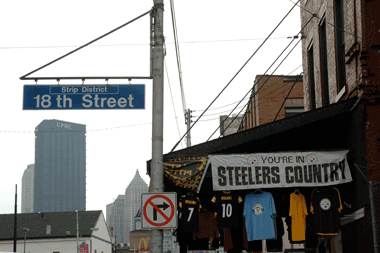
    Perhaps Mr. Obama, who will chair the G-20, thought he was doing the financially strapped city of Pittsburgh a favor by sending 4,000 foreign bureaucrats and media folk here to spend their Euros and Yen on Steelers T-shirts and game jerseys.
    Maybe he thought placing the G-20 meeting in Western Pennsylvania – a disproportionately Caucasian and socially conservative corner of America where his 2008 vote totals were disappointing – would pay him political dividends in the 2012 election.

    In either case, the president was sadly mistaken.
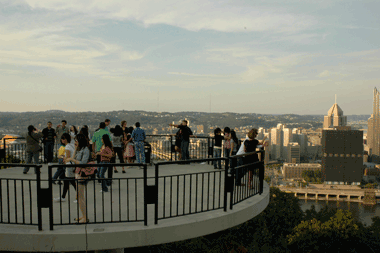
    Except for the local booster & tourism sector – who’d welcome a Category 8 hurricane to Pittsburgh as long as the international media covered it and said nice things about their no-longer smoky city – it’s safe to say everyone in this town who doesn’t work in the homeland security industry wishes they had never heard of the G-20.

    As months of local media stories have made plain, the conference is not only going to be a huge public annoyance, it’s going to be a lose-lose situation for everyone – especially the city government.

    Any economic benefits to the local GDP from the arrival of 4,000 visitors with fat expense accounts will be outweighed by the cost of protecting property from the tens of thousands of leftist protestors, angry anarchists and professional window-breakers who stalk G-20 meetings around the world.

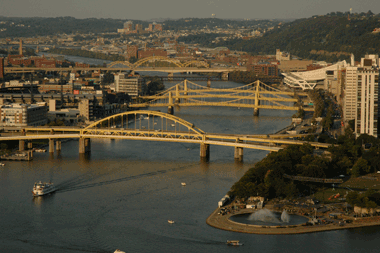
    To maximize security and minimize destruction, the Secret Service and local authorities will fortify most of the Golden Triangle, the photogenic downtown business district squeezed between the Allegheny and Monongahela rivers as they meet to create the Ohio River.
    Barricades will be erected. Cars and mass transit will be diverted. Several major construction sites will be sealed off to deny protestors dangerous things to throw. Most downtown businesses probably will close. City schools and colleges will shut down.

    The predicted cost to local public coffers for hiring, feeding and equipping additional police and paying overtime will be at least $20 million, most of which will be reimbursed by the federal government.

    Whatever the final bill is, hosting the G-20 is an “honor” the city of Pittsburgh and its taxpayers didn’t need and can’t afford. The city is already bankrupt and in state receivership because of the generous pension deals it’s promised but won’t be able to pay for.

    The city of Pittsburgh looks fabulous and robust when its skyline and riverbanks are shown on TV during Steelers home games. But it’s really the capital city of an economically stagnant, over-taxed, over-regulated, steadily depopulating metropolitan region that has been horribly governed for 60 years.

    The private-public power-brokers who’ve run the city have wasted billions on a never-ending series of destructive urban renewal projects, redevelopment boondoggles and wasteful mass-transit projects.

    Almost nothing has been built in downtown Pittsburgh or on its riverbanks in the last 20 years without being handed millions in public subsidies – whether it was PNC Financial Service’s almost completed downtown skyscraper, a gorgeous Lazarus department store that went bust in the ‘90s or the shiny new homes for the Pirates, Steelers and (soon) the Penguins.

    If curious G-20 attendees have time to stroll around the city’s abandoned downtown streets on Thursday and Friday, they will have no trouble finding evidence of City Hall’s current crop of fiascoes-in-the making.

    Right in front of fancy Fifth Avenue Place, for example, is a deep trench where busy Stanwix Street should be.
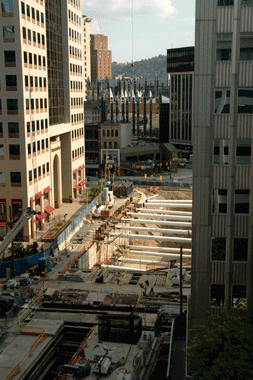
    It’s not where a Scud missile hit during the first Gulf war. It’s the construction zone of one end of the local mass transit system’s infamous “Tunnel to Nowhere.”

    The 1.2-mile light-rail extension goes from Gateway Center downtown under the Allegheny River to the North Shore, where its other end has been tearing asunder the wasteland of former parking lots between the subsidized new homes of the Steelers and Pirates for several years.

    The twin light-rail tunnel – cleverly built under a river in the “City of Bridges” so as to maximize the cost and provide unions and construction companies with six or seven years of high-paid make-work – will allegedly carry 4.2 million riders a year in the distant transit future.

    That impressive but fraudulent projection comes out to about 11,000 “riders” a day – which actually represents only 5,500 human commuters making a (two-ride) round trip commute. A large proportion of those annual riders, by the way, will be baseball or football fans.

    All that socially correct “mass transit” will end up costing at least $650 million, with federal and state taxpayers picking up about 97 percent of the tab. Except for yours truly and the conservatives on the Pittsburgh Tribune-Review’s editorial page, virtually no one in local politics or the media questioned or challenged the lunacy of building the transit tunnel.
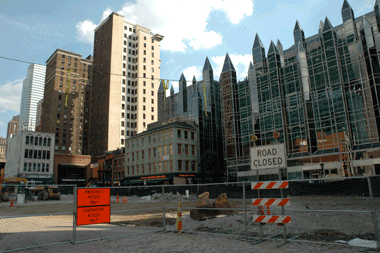
    Another wasteland in the middle of downtown that G-20-goers might visit is the flattened construction site that used to be Market Square.

    Once upon a time, before City Hall planners began demolishing and rebuilding huge chunks of downtown in the 1950s; it was what urbanists are supposed to encourage: an actual square with markets.

    Then, in the 1960s, the city took it over and transformed it into a poorly designed, commerce-free urban park with trees, grass and heavy city bus traffic. The public space delighted crowds of lunching office workers at midday but the rest of the time it was a lawless playpen for about 100 homeless people, drunks and drug pushers.
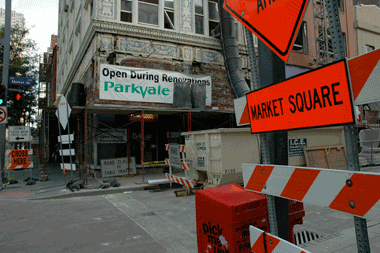
    Today the area around Market Square, last refurbished in the 1990s, hardly has a live store or restaurant left standing. It is waiting to be turned into its next reincarnation – a $5 million European-style piazza with no vehicles piercing its heart and no low walls and green spaces for social misfits to reside.

    On one edge of battered Market Square is Fifth Avenue, which has been tortured constantly by City Hall for about 25 years.

    In the early 1980s, its street surface was torn up for several years so the city’s rinky-dink light-rail subway could be built beneath it. Not long after that, Fifth Avenue was rendered virtually impassable to shoppers for a couple years while the city slowly redid its sidewalks and curbs.

    Then, in the late 1990s, Fifth was targeted by City Hall for a preposterously stupid and destructive redevelopment scheme.

    The crude 1960s-style renewal project would have misused eminent domain power to clear-cut Fifth Avenue and Forbes Avenue, wipe out nearly 100 businesses and build what amounted to an outdoor suburban mall anchored by a Nordstrom store.

    Fortunately, that plan was miraculously stopped by an alliance of preservationists and property rights defenders. But is it any wonder that after a quarter century of torture by city planners Fifth Avenue became “dilapidated” and in need of serious redevelopment?

    As G-20 attendees will learn if they bother to walk a few moments from their hotels, the nightmare on Fifth Avenue continues. Its northern end is currently being torn down, fixed up, blocked to pedestrians or under construction.

    PNC Financial is putting the final touches on its new 23-story, $178 million headquarters – which received $48 million in state and local subsidies and wiped out half a block of retail storefronts. Meanwhile, up the street, the lovely stone tomb the city erected in the late 1990s for Lazarus has been all but given away to a local developer who’s converted it into a pricy condo and office space that still has 32 of its 65 units to sell.

    Whenever the national media rediscover the glories of Pittsburgh’s clear skies and affordable livability, which they seem to do every four years, they never stick around long enough to note the failings of its governments and politicians.

    Taxes on property and people and businesses are too high. The city schools are absurdly expensive and ineffective. The roads and 1950s parkways are old, narrow and crumbling. Public services are often poor or costly. Unions and Democrats wield the sort of uncontested political power that’s never good for a municipality.

    Yes, it is still true, as the national media and local booster sector never tire of repeating, that the “City of Champions” and its suburbs are a great place in which to live, raise a family, grow old and die peacefully.

    With its famous three rivers and hills and bridges and skyscrapers and hillside homes and urban neighborhoods and spectacular views and historic downtown buildings, Pittsburgh is rich in natural and man-made charm.

    Toss in a cost of living 17 percent below the national average and low crime rates, lots of good affordable housing, major-league super-teams like the Steelers and Penguins, great museums like the Carnegie and top universities like Carnegie Mellon and Pitt – Pittsburgh does deserve to be ranked highly on those meaningless most-livable city lists.

    It’s also true – as some in the national media latched on to earlier this year – that compared with many other parts of the country, Pittsburgh has not suffered greatly in the current recession.

    Pittsburgh has an unemployment figure lower than the national average, a very low home-foreclosure rate and stable-to-slightly-rising housing prices.

    But Pittsburgh’s good fortune was not, as out-of-town media claimed, because its wise leaders had figured out how to dodge a severe economic downturn. Or because – as President Obama has been led to believe – the region’s post-industrial “eds and meds” service economy is particularly healthy or even resilient.

    Pittsburgh’s relatively impressive economic statistics are pretty much the 30-year norm for Pittsburgh – in times of national booms or busts. They probably won’t change for the better unless the spectacularly rich Marcellus shale natural gas deposits lying underneath western Pennsylvania are exploited, which may not happen for decades or ever happen at all.

    There’s one thing about Pittsburgh’s future that is a near certainty: It’s going to have fewer residents next year than it has today.

    Since the mid-1990s, Pittsburgh has had more deaths than births each year. Between 2000 and 2006, in fact, it had 21,045 more deaths than births, earning it the distinction of being the largest metropolitan area where deaths outnumber births.

    That negative ratio wouldn’t be so bad if immigrants from anywhere else were flocking to Pittsburgh. But they aren’t. Metro Pittsburgh has the lowest percentage of foreign-born residents of any major city – 3 percent – compared to 12.5 percent nationally.
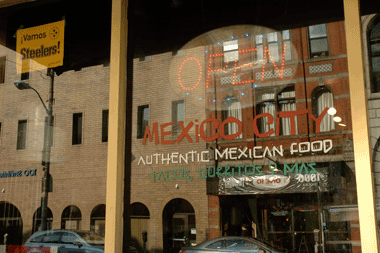
    Pittsburgh has only about 7,000 immigrants from Latin America – second to the 7,800 who hail from India. Only 16,000 international immigrants arrived in metro Pittsburgh between 2000 and 2006, dead last among the 25 largest cities.

    Post-industrial decline, out-migration, too many older people, more deaths than births, too few immigrants from Mexico and Georgia – they’ve all contributed to Pittsburgh’s incredible six-decade population decline.

    In 1950, Pittsburgh was the country’s 12th biggest city. It had 676,806 citizens in a metropolitan area of about 2.5 million.

    Today the metro population, ranked 22nd, is down to 2.35 million and Pittsburgh’s surviving population of 310,000 live in the country’s 59th biggest city – right behind Aurora, Colo., a growing municipality that will never have to worry about getting stuck with hosting a G-20 summit.

    Photos by Bill Steigerwald.

    Bill Steigerwald, a free-lance libertarian writer who recently retired from daily newspaper journalism, loves his native Pittsburgh but hates the political and corporate power brokers who’ve been damaging the city for 60 years. His columns are archived at the Pittsburgh Tribune-Review and his 2000 article for Reason magazine on the city’s abuse of eminent domain powers is here.

  • Baseball Goes For Broke

    Other than the banking business, is there an industry more dependent on government handouts, sweetheart tax breaks, and accounting gimmicks than major league baseball?

    What other than a baseball depletion allowance explains the economics of a team like the New York Yankees, which is paying Alex Rodriguez $275 million over ten years while building a new $1.3 billion stadium and charging front row season tickets holders $800,000 for a box of four seats?

    If the rules of baseball included free enterprise, the Yankees would be playing on a diamond in Central Park, and skyboxes (which would not be deductible business expenses) would be limited to nearby apartment buildings.

    What accounts for all the growth in baseball economics — the salaries, the extortionate ticket prices, the new stadiums — is that the game varies little from some nineteenth century oligopoly trust, not unlike J.P. Morgan’s railroads or Andrew Carnegie’s steel mills.

    Let’s start with the basics: Since 1922, baseball has enjoyed anti-trust exemption, which means that league owners (best understood as robber barons) cannot move teams about willy-nilly. At the same time, the law makes it nearly impossible for competitors to establish rival competing franchises.

    The Yankees coughed up $1.3 billion for their new Yankee Stadium (of which local and state government are in for about $520 million) with the knowledge that neither the Royals nor the Pirates are allowed to move their home games to the Bronx or Brooklyn.

    The reason state and municipal governments — not just in New York, but all over the country — put taxpayer money into stadium white elephants is because voters identify more passionately with their professional teams than they do with their local politicians. Imagine the vote in New York if the choice was between Derek Jeter and Governor David Patterson?

    Just because modern baseball is fixed with more precision than the 1919 World Series was does not mean that the game (or at least a number of its teams) will not someday go bankrupt.

    Anti-trust exemptions, Tammany Hall municipal bond financings, and incestuous cable franchise awards may explain why teams like the New York Mets feel that they can spend $12 million a year on pitcher Oliver Perez. But it does not mean that they will be able to cover their obligations when the economy goes O-for-August (as once happened to Darryl Strawberry).

    To best understand baseball economics, think of the sport as similar to the investment banking business: a few large market firms (that have monopoly pricing power and cozy government relations) and then a lot of boutique establishments betting the franchise on some out-of-the-money option (Milton Bradley, Alfonso Soriano, and Alex Rios come to mind). The 2009 payroll for the Yankees is $201 million; for the Florida Marlins, it’s $36 million.

    To close the gap between rich and poor teams, municipalities from Philadelphia ($173 million) to Seattle ($392 million) have subsidized new stadiums, on the hope that sky-boxed, sellout crowds will allow team owners, usually mayoral pals, to pay for free agents. In turn, winning teams are to do for the local economy what the stimulus money may fail to achieve, namely, provide faith in the political system and interest cover for outstanding municipal bonds.

    Keep in mind that the baseball season is shorter than that for gladiolas. Many teams are out of the playoffs by July 4th, which means that the big, revenue-paying crowds must be attracted in the first three months of the season…when Kansas City fans still believe that they have a chance. Not long ago a double header between the Reds and Pirates started and ended with about seventy-five, yes that’s 75, fans in the stadium.

    Is it any wonder that the players union and many team managements, the Yankees included, turned a blind eye to steroids in order to pump up their products? In banking, executives went into sub-prime, hedge funds, and pyramid schemes to cover their bonuses. In baseball, the clear and the cream explain how the owners figured they would be able to afford the likes of Manny Ramirez.

    No one quite knows the precise debt figures of major league baseball, but the liability side of the balance sheet looks something like this: the league itself funds money-losing teams with a revolving line of credit, drawn against anticipated television rights. That’s like borrowing against next year’s equity in a house that has yet to be built.

    As for team debts, some franchises backload free agent contracts in order to defer liabilities until a new general manager may be on the job or the team has won a wild card game. Plus many teams have huge debts on new stadiums and skyrocketing payrolls. Even the Detroit Tigers, who play in a ghost town, run up $115 million per year.

    By my calculations, the Tigers would have to attract an average of about 40,000 fans per game, paying $35 a ticket, just to break even. In 2008, they averaged 25,000 fans a game, and I bet a lot of the unemployed autoworkers who attended didn’t pay $35 a ticket. Some of the debt service for the new Detroit stadium needs to be covered with casino money from an Indian reservation. (Pete Rose’s problem was that he played in casinos but did not own one.)

    To be sure, the plug figures in major league baseball’s finances are the local and national television contracts, not to mention the intramural luxury tax that has rich teams helping out the poor. National television revenue amounts to about $400 million per year, much of which is shared with the teams. That’s another attraction of anti-trust exemption; it limits supply. Why share the pie with, say, a hundred owners?

    Total revenue in the sport is about $6 billion, or an average of $200 million per major league team. Overall, baseball economics would work only if fans were prepared to spend $200 per game on warm beer and cold hot dogs, and renew cable television subscriptions to get games that have little meaning after July.

    The model is also predicated on the assumption that corporations can write off $800,000 in season ticket subscriptions, that the Internet does not blow away TV ads, and that Mariners fans will show up in September to watch their $99 million team wallow 10 games out of first place.

    If I had to bet on an MLB franchise going broke, my action would be on the Mets, who after all play in the House That Sub-prime Built, “Citi Field.”

    Not only did the owners, the Wilpon family, bet the ranch with Bernie Madoff, but they also spent $850 million on the new ballpark, and $25 million (over four years) on the likes of second baseman Luis Castillo. Attendance is down about 20 percent from 2008, and that’s before the team collapsed in the standings or bankrupt ex-Met Lenny Dykstra started sleeping in his car.

    Of course, baseball is no more exposed to the vagaries of the free market than is the banking business. Federally-funded banks, for example, can discount government-granted cable contracts, and pump money into the sport. Or a city like Washington can bailout another failing franchise, as it did with the Expos, and tax dollars can build a second $611 million stadium near the Potomac.

    Anti-trust exempted owners can even mothball a few teams (as they tried to do to the Twins a few years back), and boost the revenue share in that manner. Think of Commissioner Bud Selig’s office as a variant on the Texas Railroad Commission.

    Nevertheless, financial failure is nothing for baseball to dread. The only reason the Yankees could acquire Babe Ruth from the Red Sox in 1919 is because the Boston owner needed cash to invest in the Broadway show, “No, No, Nanette.” Maybe if they are squeezed, the Wilpons can swap Oliver Perez for some of their Madoff paper? At the very least they could get behind the sure hit, “Bye, Bye, Bernie.”

    Matthew Stevenson was born in New York, but has lived in Switzerland since 1991. He is the author of, among other books, Letters of Transit: Essays on Travel, History, Politics, and Family Life Abroad. His most recent book is An April Across America. In addition to their availability on Amazon, they can be ordered at Odysseus Books, or located toll-free at 1-800-345-6665. He may be contacted at matthewstevenson@sunrise.ch.

  • Losing Touch With the Changing Definition of “Community”

    Mathew Taunton opens his review of “The Future of Community – Reports of a Death Greatly Exaggerated” (Note 1) with the observation that:

    “Community is one of the most powerful words in the language, and perhaps because of this it is frequently misused. A profoundly emotive word, it is also a coercive one, and a key political buzzword in modern times. That community is being eroded in modern Britain is a matter of cross-party consensus, and it is also widely agreed that one of the state’s roles is to devise means of counteracting the decline of communities.”

    It is refreshing to see a writer prepared to use ‘community’ and ‘coercive’ in the same sentence. Taunton reminds us that practically all urban architecture now attempts to force social solidarity into existence, and, by definition, condemns those who do not conform for daring to exercise their choice.

    Unfortunately many of these attempts to coerce community into existence tend to repress or subvert the informal processes through which people interact of their own free will.

    So why do so many influential people in the UK, the United States, and other countries of the New World, hold this ‘consensus’ that communities, like morality, are in decline, requiring government interventions to restore them to good health, within some reborn urban village?

    In the past, communities were primarily place-based, if only because people could not travel very far or communicate over any great distance. But as civilizations have developed, this interaction between transport and communication has reshaped the prevailing structure and meaning of communities, as each reacts with each other. The printing presses of Renaissance Europe enabled the development of scientific and religious communities, as well as a host of “communities of ideas” both conservative and revolutionary.

    Last century the establishment of national broadcast networks and television helped constitute national communities of listeners or viewers, which in turn reinforced the communities of “us” and “them” through the great global conflicts of that century.

    The Internet has now created a whole new class of virtual communities or tribes. Many wage their tribal wars with considerable venom.

    However, these internet tribes, too, simply build on the superior transportation technologies that have enabled us to physically flee to find more friendly groupings of associates, or to avoid the ‘neighbours from hell’. Of course, place remains important to communities based on activity – people continue to visit their golf course, football field, church, beach, or shopping mall. Modern transport has gifted us with ready access to them all.

    Similarly, communications technology plays an important role in communities of shared interests or ideas – the blog site, the book club, talk-back radio, and the specialist channels on cable TV or YouTube.

    However, rigidly place-based communities can also be coercive traps.

    In the late sixties I wrote a paper at U.C Berkeley drawing on surveys that showed that “neighboring” was more intensive in mobile-home parks than in most suburbs or inner city areas, precisely because the residents felt that if they fell out with their neighbors they could always move on. Neighboring is not without risk.

    Similarly, people in camping grounds felt free to share coffee, drinks and dinners around the barbecue, precisely because they know they need not meet again.

    Many retirees have discovered the pleasures of the summer nomadic lifestyle spent driving from location to location in a well-appointed motor-home.

    One retired couple (my American god-parents) were keen “rock-hounds” during the seventies and spent their summers driving their motor-home from one rock-rich territory to another, attending gatherings of rock-hounds along the way. They combined technological mobility, with place-based communities, and communities of common interests within the one retirement experience.

    However, these contemporary communities, no matter how plentiful and rewarding, fail to meet the expectations of urban planners trapped within their general theory of architectural or spatial determinism. They remain convinced that urban form and places determine our behaviour. Yet in reality, our behaviour and preferences actually determine how and where we chose to live, work and play.

    They may also be responding, in their reflexive way, to a genuine loss of sense of political community, a loss that may be more deeply felt that we think.

    For the last forty or fifty years, through most of the New World jurisdictions, ‘reform’ of Local Government has meant ‘amalgamation’ on the presumption that ‘bigger is better’, probably because this coincided with the management theories of the sixties, which presumed conglomerates were the way of the future, and that all corporate mergers would benefit the shareholders and customers alike.

    The track record of such local government ‘reform’ has given scant support to the theory. Forced amalgamations in particular have proved to be disastrous. And many of the voluntary ones – i.e. those driven from the bottom up – have fared little better.

    These reform programs have generally been prepared to dilute or even ignore the traditional emphasis on ‘community of interest’ in favor of ‘economies of scale’ or the benefits of ‘regional integrated planning.’ In the end citizens have generally, and genuinely, lost contact with their Mayors and Councilors. They used to meet the Mayor in the street and have a chat about their concerns. Now they have to phone, leave voice messages and wait for the return call that never comes.

    Political authority, now often housed in some distant place, is more remote than ever. You can’t meet it, let alone beat it.

    Citizens may know their ward councilor but their ward councilors explain they are always outvoted by a majority who has no interest in any ward but their own. This is why large councils are actually less effective at delivering satisfaction than small ones. A small council is likely to be serving a single community of interest. But if one neighborhood wants to build a municipal swimming pool, all those who live more than an hour’s drive away understandably wonder why they should pay for a pool they will never use.

    This bias towards larger and larger local bodies – enhanced by the rapid population growth in many peripheral areas and regional towns – has been given a massive boost in recent times by ‘Smart Growth’ planning theory. This approach necessitates large areas of regional governance so that people cannot escape from the planned densification that most independent areas would likely reject.

    The Metro planners also often seek to extend their boundaries into the rural areas so as to prevent people and businesses locating where they prefer. Instead it is all determined by where the planners say people and business should go – for their own good, of course.

    It may well be that when the central planners try to create “place-based communities” they are responding to a genuine problem, but have chosen the wrong tool-box to fix it. Community can not be imposed from above and large government is clearly the wrong way to nurture it.

    A better approach may be to create a new system of local governance controlled by smaller, truly local councils, based on identifiable communities of interest, which are able to freely associate with other organizations if they believe it will provide services and infrastructure beyond their financial means.

    We should learn to define the services we need, and then match them to the appropriate organization, rather than trying to find the one or two magic sizes that can cope with all our needs.

    We no longer need to accept being re-organized from above; the internet allows even smaller units access to sophisticated information. We have a wonderful opportunity to take control of our destiny through a new world of local government in which the people themselves decide on their common communities of interest and set up novel and innovative joint-management entities where economic efficiency and common sense demand such arrangements.


    Note 1: The Times Literary Supplement, July 31, Mathew Taunton’s review of a collection of essays “The Future of Community – Reports of a Death Greatly Exaggerated”, by Clements, Donald, Earnshaw and Williams, Editors.


    Owen McShane is Director of the Centre for Resource Management Studies, New Zealand.

  • Traffic Congestion, Time, Money & Productivity

    It is an old saying, but true as ever: “Time is money.” A company that can produce quality products in less time than its competitors is likely to be more profitable and productive. An urban area where employees travel less time to get to work is likely to be more productive than one where travel times are longer, all things being equal. Productivity is a principal aim of economic policy. Productivity means greater economic growth, greater job creation and less poverty.

    Congestion Costs: This is why such serious attention is paid to the Texas Transportation Institute’s (TTI) Annual Mobility Report, which estimates the costs of traffic congestion, principally the value of lost time as well as excess fuel costs. The fundamental premise, long a principle of transportation planning and policy, holds that more time spent traveling costs money, to employers, employees and shippers.

    Mobility & Productivity: Groundbreaking Research: Yet, until fairly recently, very little research was available to document the connection between travel times and the productivity of urban areas. The pioneering work has now been done by Remy Prud’homme and Chang-Woon Lee at the University of Paris. From reviewing French and Korean urban areas, they showed that productivity improves as the number of jobs that can be reached by employees in a particular period of time (such as 30 minutes) increases.

    Focused US Research: US reports on mobility’s role in reducing poverty came to similar conclusions. A middle 1990s report for the Federal Transit Administration found that low income households in inner city Boston were at a particular disadvantage in obtaining jobs in the fast growing suburbs because transit service was either spotty or non-existent. Margy Waller and Mark Allen Hughes noted in a report for the Progressive Policy Institute that “In most cases, the shortest distance between a poor person and a job is along a line driven in a car”. Steven Raphael and Michael Stoll at the University of California found that access to an automobile nearly halved the difference between African American unemployment and that of non-Hispanic Whites.

    New, Comprehensive US Research: But it was only last month that the Prud’homme-Chang research was broadly replicated in the United States. The Reason Foundation published “Gridlock and Growth: The Effect of Traffic Congestion on Regional Economic Performance” by David Hartgen and M. Gregory Fields, which looked at job accessibility in 8 US urban areas (Atlanta, Charlotte, Dallas, Denver, Detroit, Salt Lake City, San Francisco and Seattle, ). Hartgen and Fields chose a 25 minute commute period (the approximate national average one-way work trip) to evaluate accessibility and found, generally, that each 10 percent increase in the number of jobs accessible in that period resulted in a 1 percent increase in productivity, as measured by the Gross Domestic Product of the urban area. They also found that if free-flow traffic conditions could be established, considerable improvements in urban productivity would be achieved, because employees could get to more jobs in less time. At the same time, they show that traffic congestion will worsen considerably by 2030 under present plans as adopted by metropolitan planning organizations.

    Hartgen and Lee looked at five sample work destinations in each urban area, the central business district, the airport, a university, a mall and a major suburb. The results by sub region were surprising:

    “Contrary to conventional planning wisdom, the research suggests that regional economies might be more dependent on access to major suburbs, malls and universities than on access to downtowns or airports. Not only are models of productivity somewhat stronger for these sites than for CBD accessibility, but access to them has a stronger effect on regional productivity.”

    The research indicates that achieving free flow traffic conditions to major suburbs, universities and malls would increase gross domestic products by from 6 to 30 percent. The gain in central business districts would be between 4 and 10 percent, while airports showed the least potential for adding to urban productivity, at 2 to 8 percent. These productivity gains are far from unachievable. Hartgen and Fields find that there is more than enough transportation funding in each of the urban areas to remove severe traffic congestion by 2030. These conclusions find fault with the growing emphasis by many in Washington to force people out of cars and into transit. Transit is simply not viable for the non-downtown markets, which have the greatest potential for improving job creation and economic growth.

    Hartgen and Fields also show that achieving free flow operations in the studied urban areas would generally produce more in increased tax revenues by 2030 than the costs associated with reducing it.

    American Urban Areas: Superior Productivity and Mobility: American urban areas are among the most mobile in the world. When compared to international urban areas of similar size, work trip travel times in the United States tend to be less. That is one of the reasons that US metropolitan areas are the most productive in the world.

    For example, the Japanese megacity of Osaka-Kobe-Kyoto has somewhat fewer people than the New York consolidated (metropolitan) area and slightly more than the Los Angeles-Riverside consolidated area. Osaka-Kobe-Kyoto has perhaps the world’s second most heavily patronized transit system (after Tokyo), which carries at least 50% as many riders on its rail lines alone as all of the transit systems in the United States. Yet, in Osaka-Kobe-Kyoto, workers spend 20 percent more time traveling between work and home each year as New Yorkers. They spend 40 percent more time commuting than workers in Los Angeles, despite its having the worst traffic congestion in the nation. The difference between Osaka-Kobe-Kyoto and New York and Los Angeles lies in the fact that in the two American metropolitan areas, most workers travel to work by car, to destinations throughout the areas (Note 1).

    Naïve Proponents of Poverty: However, not everyone understands that time is money. Some members of the US Senate and House of Representatives and Washington special interests would seek to restrict highway funding, making traffic congestion even worse. They would seek to reduce the number of miles that Americans travel by car in an attempt to achieve marginal greenhouse gas emission reductions (that is before the higher greenhouse gas emissions that occur in slower, more congested traffic is factored in). Secretary of Transportation Ray LaHood has indicated a desire to coerce people out of their cars.

    Transit: Inherently Less Productive and Expensive: One common claim is that transit will provide alternative mobility. However, transit trips tend to be twice as long as car trips and no transit vision has ever been put forward that would replicate the efficiency of the automobile. There is good reason for this, since such a transit system would cost on the order of a metropolitan area’s entire income, each year, to operate and amortize. And, transit is expensive. The recent compact cities policy lobbying paper, Moving Cooler, shows that transit is far from a cost effective means for reducing greenhouse gas emissions, costing 20 times the maximum $50 per ton guideline as established by the United Nations Intergovernmental Panel on Climate Change.

    None of this is to deny the inestimable value of transit in serving the nation’s largest downtown areas (such as Manhattan, Brooklyn, Boston, Philadelphia, Chicago and San Francisco). However these locations are commercial hyper-density aberrations in much larger low-density seas and are exceptional among America’s more diffuse metropolitan areas. Rather, the problem is overselling transit in markets that it cannot competitively serve. Disinvesting in highways (forcing people into transit) makes no more sense than to require the injection of blood clots into the bloodstreams of patients under the guise of improving the health and livability of patients.

    It’s the Economy, Stupid: The United States has had enough recent experience with rising unemployment and falling economic performance. It hardly needs public policies that would increase travel time, reduce productivity and increase poverty, no matter how fervently and sincerely held are the misconceptions of the proponents. Hartgen and Fields have provided an invaluable work that could not have come at a better time.


    Note 1: Calculated from United States Bureau of the Census American Community Survey and Japan Statistics Bureau data.


    Wendell Cox is a Visiting Professor, Conservatoire National des Arts et Metiers, Paris. He was born in Los Angeles and was appointed to three terms on the Los Angeles County Transportation Commission by Mayor Tom Bradley. He is the author of “War on the Dream: How Anti-Sprawl Policy Threatens the Quality of Life.

  • California Golden Dreams

    California may yet be a civilization that is too young to have produced its Thucydides or Edward Gibbon, but if it has, the leading candidate would be Kevin Starr. His eight-part “Dream” series on the evolution of the Golden State stands alone as the basic comprehensive work on California. Nothing else comes remotely close.

    His most recent volume, “Golden Dreams: California in an Age of Abundance, 1950-1963,” covers what might be seen as the state’s true Golden Age. To be sure, there is some intriguing history before—the evolution of Hollywood in the 1920s, the reaction to the Depression and the fevered buildup during the Second World War—but this was California’s great moment, its Periclean peak or Augustan age.

    “It was a time of growth and abundance,” Starr writes in his preface, and provides the numbers to prove it. In 1950, California was home to 10.7 million, making it a large state to be sure, but hardly a dominant one. By the early 1960s, the population passed 16 million, slipping by New York state in population.

    Yet it was not a mere matter of numbers that made California so appealing or important. It was the idea of California as not only a part of America, but also something more. To millions in America and around the world, California grew to mean opportunity, sunshine and innovation.

    The state’s business elite, for example, did not identify with the button-down hierarchy that sat atop teeming New York, and its second-tier competitors like Chicago. The leaders of Los Angeles would never consider it a second city, but simply a different, and generally, better one. There was no need for the excessive Manhattan penis envy that led Chicago to keep trying to build higher buildings than Gotham.

    In a different way, San Francisco’s top executives also did not crave that their city be New York—it was always more beautiful, nuttier, freer and more creative than Gotham. What they shared with their downstate rivals was a sense of superiority over the old part of the country. If anything, they felt a mixture of contempt—particularly the conservatives—and condescension about an older, decaying society that fixated on tradition, order and breeding.

    “California,” Cyril Magnin, scion of one of San Francisco’s great families, told me back in the late 1970s, “has recaptured what America once had—the spirit of pioneering. People in business out here are creative; they’re willing to take risks.”

    Geography also plays a role here. Leaders in California, starting at least by the turn of the last century, looked out across the Pacific and saw themselves as part of an emerging shift from Europe to Asia, a process that continues and will dominate the rest of this century. This connection, suggested Pete Hannaford, a public relations executive and partner of Ronald Reagan’s Svengali, Michael Deaver, took on an almost Spenglerian inevitability. “Out here there’s a sense of being where the action is,” Hannaford believed, “with Japan and the Pacific.”

    Starr captures these attitudes, which already had become deeply entrenched by the late 1950s and early 1960s. There was, as he writes, “a conviction that California was the best place to seek and attain a better American life.” However, it was more than money or power. It was about the quality of life. Success in California was not a matter of living by the rules, sheltered in a dark Manhattan apartment, but about the seduction of the physical world. In California, Starr writes, “Eros vanquished Thanatos.”

    Yet Starr’s book is not merely about the rich, the powerful, and even the culturally influential. He finds his primary muse not in the Bohemian realms of San Francisco or the mansions of Beverly Hills, but in that most democratic of everyman’s places, the San Fernando Valley, the place author Kevin Roderick aptly dubbed “America’s Suburb.”

    To see long excerpts from “Golden Dreams,” click here.

    “The Valley” lies over the Santa Monica Mountains from the Los Angeles Basin. As late as the 1930s, it was largely an arid district of ranches, citrus orchards and chicken farms. The area’s postwar expansion was rapid, even by California standards. Between 1945 and 1950 alone, the Valley’s population more than doubled to nearly 500,000. By 1960, it had doubled again.

    This growth was far more than the mindless bedroom sprawl often depicted by aesthetes and urban intellectuals. People in the Valley did not depend largely on the old part of Los Angeles the way, for example, Long Island lived off Manhattan. Most of the Valley’s growth was homegrown—driven by local industry such as aerospace, entertainment, electronics and until the 1960s automobiles.

    Even today, the Valley has very much its own economy and sense of separation from Los Angeles. However, more important, the Valley was, first, a middle-class phenomenon. A cosmopolitan of the first order, Starr manages to chronicle California’s artistic and literary elites, but does not see in them the essence of the state’s appeal. Instead, he explores the everyday wonders of the Valley’s families, single-family homes and swimming pools—6,000 permitted in one year, between 1959 and 1960!

    As a Valley resident myself, I can still see the basic imprint of that culture, what Starr calls its “way of life.” Compared to the tony Westside and hardscrabble east and southside of Los Angeles, the Valley has remained a relatively safe “child-oriented” society, with a big emphasis on restaurants, malls, ball fields, churches and synagogues.

    The single-family tracts, of course, have changed hands, and the majority of the owners have changed. The primarily WASP and second-generation Eastern European Jews are still there, but they have steadily been augmented, and sometimes outnumbered, by others—Armenians, Orthodox Jews, Israelis, Persians, Thais, Chinese, Mexicans, Salvadorans, African-Americans and at least 10 groups I somehow will neglect and no doubt offend.

    Yet the essential way of life forged in the 1950s and 1960s has remained a constant, and that remains the source of California’s attraction. Of course, it is no longer just a “Valley” phenomenon. As California has grown, there are many such places, outside San Diego, in Orange County, the Inland Empire, outside Sacramento, Fresno and scores of other towns. Almost all have the same imprint—an auto-dominated culture, dispersed workplaces, pools and a culture of aspiration.

    In the ensuing decades, perhaps to be covered in Starr’s next book, this archetype evolved mightily. The San Gabriel Valley, once a plain vanilla suburban appendage, has morphed into the country’s largest Asian suburbia, complete with a shopping center jokingly referred to as “the Great Mall of China.” The often-monotonous housing tracts between San Jose and Palo Alto, on the San Francisco Peninsula, also attracted hundreds of thousands of Asians but also produced something equally astounding—the Silicon Valley, the world’s leading center for technology.

    These suburban developments long ago surpassed in importance the urban roots of California metropolises. A serious corporate center during the time covered by Starr’s volume, San Francisco has devolved in a ultra-politically correct, hip and cool urban Disneyland for Silicon Valley, providing good restaurants and housing for those still too young to crave a house on the Peninsula. The San Gabriel Chinatown long ago replaced the older one in downtown Los Angeles as the center of Asian culture and cuisine.

    These places grew before the current malaise infected the state. As Starr points out, California based its ascendancy on two seemingly contradictory principles: entrepreneurship and activist government. Under Gov. Earl Warren, but also Goodwin Knight and finally Pat Brown, the state made a commitment both to basic infrastructure—energy, water, roads, schools, parks—and expanding its economy.

    By the early 1960s, this system was hitting on all cylinders. New roads, power plants and water systems opened lands for development for farms, subdivisions, factories. Ever expanding and improving schools produced a work force capable of performing higher-end tasks, and capable of earning higher wages. New parks preserved at least some of the landscape, and gave families a place to recreate.

    For Pat Brown, arguably the greatest governor in American history, this was all part of California’s “destiny.” Starr describes Brown’s California as “a modernist commonwealth, a triumph of engineering, a megastate committed to growth as its first premise.” Yet within this great modernist project was also stirring opposition, on both left and right, that would soon place this Golden Age at its end.

    Many of the objections were legitimate. The Sierra Club and its many spinoffs rightfully saw the Brown development machine as threatening California’s landscape, wildlife and, in important ways, the appeal of its way of life. More careful controls on growth clearly were needed. The battle over the nature of those controls continues to this day.

    Some more angry voices, then as now, targeted the very existence of suburbia, the dominant form of the state’s growth, and eventually sought its eradication. This struggle goes on to this day with a religious fervor, led, ironically, by the former and perhaps future governor, Jerry Brown, currently attorney general and leading Torquemada of the greens.

    Minorities also began to stir amid the celebrations of the 1950s and early 1960s. Woefully underrepresented in the halls of power and the corridors of business, Asians and Latinos remained largely passive politically. However, by the early 1960s acceptance of exclusion was giving way to more assertive attitudes. Ultimately the massive immigration that swelled both their numbers in the 1970s and beyond would ensure these groups far more influence both on the politics and in the economy of the state.

    Yet it was the African-American who would really upset the balance of the golden era. Never discriminated against as in the South, black Californians felt the lash of a thousand, often-informal exclusions. As the civil rights movement grew, with it less deferential attitudes, particularly toward the police, a powder keg was building. In 1964, the first year after the era chronicled in “Golden Dreams,” Watts blew up, shattering the comfortable assumptions of a progressive, post-racial state.

    Finally, as Starr reports, there was mounting thunder on the right. The business elite and the middle class were financing the ever-expanding California state. They saw their money go to the poor, to minorities and state employees. Particularly annoying were the university students, many of whom were in open revolt against the state, in the mind of much of the public that had nurtured them.

    By the early 1960s many of these latter Californians also were angry, but their rage would express itself not in riots, but at the ballot box, ushering in the age of Ronald Reagan. The period that follows “Golden Dreams” emerges as one of conflicting visions, between greens, students and minorities, on the one hand, and largely suburban middle-class workers and business owners on the other.

    These two groups would battle over the next generation, with the advantage oscillating over time. Today the heirs of the protesters—greens, minority activists and former ’60s radicals—hold the political advantage, although the state they dominate has fallen on parlous times.

    In retrospect, the golden era before these conflicts does indeed seem like a high point. The question now is whether California, down on its luck, will find a way to rebound, much as imperial Rome did after the demise of the Julian dynasty, or fall, like Athens, into ever more squalid decline. Does the state have a bright “destiny” ahead or only more ruin?

    This, of course, will be the basis for another historical epoch. Let us hope Kevin Starr be around to chronicle it for the rest of us.

    This piece originally appeared at Truthdig.com

    Golden Dreams: California in an Age of Abundance, 1950-1963 at Amazon.com.

    Joel Kotkin is executive editor of NewGeography.com and is a distinguished presidential fellow in urban futures at Chapman University. He is author of The City: A Global History. His next book, The Next Hundred Million: America in 2050, will be published by Penguin Press early next year.

  • Olympics the Chicago Way

    Most American cities chose not to bid on the 2016 summer Olympics and with good reason. With the exception of the 1984 Los Angeles games, the Olympics has proved a big time money loser in city after city. More often than not, it has been staged more for the prestige – think of Berlin in 1936 or China in 2008 – it brings to regimes, particularly autocratic ones.

    In Chicago, prestige is important, but graft is the real king. In Chicago, one of the most corrupt big cities, the Olympics represents, more than anything, a grand chance for a giant heist.

    Economists have a technical term for profiting from the political process: it’s called rent-seeking. Chicago’s politically favored businesses, unions, and insiders with ties to Mayor Daley and Alderman Burke have perfected this activity. The Olympics just provide another opportunity to clean up at the public expense.

    This is how it works. On Chicago public works projects, those on the inside hope to get overpaid at the expense of Illinois and federal taxpayers. Now throw in the Olympics where opportunities for such activities have long been rife with corruption and you can understand the glee in the Chicago machine’s eyes.

    Right now there isn’t any financial guarantee from the federal government. But Chicago’s power elite hopes Rahm Emanuel, Valerie Jarrett, David Axelrod, and others can convince the Congress at some point to help with Chicago’s Olympic sized costs if they get the 2016 games. They can always call it a “stimulus”!

    Yet is the average Chicagoan thrilled at this prospect to get reamed? A recent Chicago Tribune/WGN poll shows a slide in public support:

    Nearly as many city residents oppose Mayor Richard Daley’s Olympic plans, 45 percent, as support them, 47 percent. And residents increasingly and overwhelmingly oppose using tax dollars to cover any financial shortfalls for the Games, with 84 percent disapproving of the use of public money.

    The poll comes a month before the International Olympic Committee selects the host city for the 2016 Olympics. Chicago is competing against Tokyo, Madrid and Rio de Janeiro.

    The new results show slippage from the 2-to-1 support found in a Tribune poll in February, and experts said the findings could hurt Chicago’s chances.

    But fading public support in Chicago could be overwhelmed by political factors. With 107 votes on the International Olympic Committee(IOC), the African votes are considered the swing votes. President Obama made a special appeal to the African IOC voters. WLS TV reported:

    European IOC members may be inclined to support Madrid. Asian members may back Tokyo. There is one continent whose members are not aligned: Africa. Chicago’s bid team traveled to Abuja, Nigeria, to meet with Africa’s 16 IOC members, who may hold the swing votes.

    The fear of cost overruns, a history of bloated union contracts, and fraud has tempered enthusiasm for the Olympics. Mayor Daley has had to promise tighter oversight on the whole Olympics process. Yet this has not prevented an effective grass roots opposition organization from springing up. No Games Chicago has been instrumental at raising questions of money and accountability, dampening public support for the games. No Games Chicago spokesman Thomas Tesser explains:

    The City Council voted to give oversight of the City’s Olympic commitments to Ald. Ed Burke, chairman of the Finance Committee. This is the final cruel joke played by the Council on the taxpayers. Burke has become a millionaire doing deals with firms that have business with the city and has collected millions in campaign contributions from firms doing business with the city. Pat Ryan, the chairman of the 2016 effort, contributed $3,000 to Burke. Burke didn’t mention that he has ten clients who are major donors to the 2016 Committee, giving a total of at least $1 million in cash and services, and likely much, much more.

    But, Alderman Burke isn’t the only insider benefiting from the Olympics. Real Estate developer Michael Scott also stands to gain. The Chicago Tribune reports of Scott: “A member of Mayor Richard Daley’s team working to bring the Olympics to Chicago has quietly arranged to develop city-owned land near a park that would be transformed for the 2016 Summer Games, potentially positioning himself to cash in if the Games come here.”

    Michael Scott is also President of the Chicago Public School board. The Chicago Sun-Times reported that Scott

    has been subpoenaed to testify before a federal grand jury investigating how students are chosen for admission to some of the city’s most elite public schools.

    This new scandal might put in to question Secretary of Education Arne Duncan’s leadership as CEO of the Chicago Public School system.

    All the recent skepticism of the cost of the games couldn’t stop Chicago insiders from getting the stunning vote of support from Chicago’s City Council. This is still a one-party, all-machine, all-the-time town. In a vote of 49-0, the City Council showed that there is not a single vote to back the nearly fifty percent who oppose Mayor Daley’s plans.

    Michelle Obama will lead a Chicago delegation for the last pitch for the games in Copenhagen next month. Some speculate that President Obama will make a dramatic last minute appearance to make Chicago’s case in front of the International Olympic Committee. No one knows for sure whether Chicago will get the 2016 games but if it does, it will be a grand feeding time at the trough for the insiders and ever bigger burdens on the less well-connected businesses and individuals who inhabit Chicago.

    Steve Bartin is a resident of Cook County and native who blogs regularly about urban affairs at http://nalert.blogspot.com. He works in Internet sales.

  • Cap And Trade And The Smog Market Ripoff

    Now that Senators have reconvened from summer hiatus, one of their first tasks will be to contemplate the greenhouse-gas cap-and-trade carbon market that President Obama would like to institute to blunt global warming. Their necks better be limber. Partisans of Keynesian, market-based regulations will undoubtedly point to the Midwest’s federally run “acid rain” program to reduce harmful power-plant emissions as proof that giving industry profit incentives in cleaning up their operations can be successful. Regulation skeptics will wave that example off dismissively, urging Senators to swivel their heads for a look across the Atlantic, where the European Union’s Emissions Trading System has registered lousy results.

    Whatever those markets do or don’t foreshadow, if the American Clean Energy and Security Act of 2009 and its mandated cap-and-trade become law, a glimpse of an unintended — and unsavory — future may reside in the tale of the inscrutable businesswoman from smog-bound Southern California who scammed the area’s pollution exchange…twice (see my site, www.chipjacobs.com, for the newest revelations of a second scam). Rather than a tale of a dreamer’s demise, Anne Sholtz’s story is a bracing reminder that to create a market, no matter its aim, is also to inspire a class of people determined to game it.

    If Wall Street traders can commodify sub-prime mortgages with impunity, and the Enrons of the world can manipulate energy markets like a pinball machine, imagine a future when tradeable permits for carbon dioxide and other heat-trapping gases are auctioned and swapped over the public’s head. A Heritage Foundation economist expects the action to hit $5.7 trillion in value, and many experts say it all adds up to an irresistible buffet for chicanery.

    Few in Washington ever heard of Sholtz, 44, before last spring, when the former Caltech economist was sentenced in federal court to a year of home-detention and five years of probation for defrauding the nation’s first air pollution cap-and-trade market. Sholtz was cozy with the RECLAIM program and the bureaucrats who run it at the South Coast Air Quality Management District (AQMD). That’s because in the early-1990s she had helped design the concept as an adviser.

    Her know-how proved dangerous. Between November 2000 and April 2001, Sholtz tried fooling one of her clients, a New York-based energy trader, into believing she could complete a fat, multimillion-dollar deal with what is now ExxonMobil Corp. when in fact she could not. Stringing executives at the client company along until she could reactivate a transaction, she emailed and faxed falsified sales documents, including phony invoices.

    Pleasant, brainy and ever-hustling, Anne Sholtz was not somebody folks expected to see handcuffed. Her 2004-arrest by EPA agents on white-collar fraud charges shocked and mystified local environmental circles. She and her companies, Automated Credit Exchange and EonXchange, had boasted a heavyweight list of clients and financial partners, and had worked with the Dutch government on an emissions test-market. As one of California’s rising green-entrepreneurs, Sholtz was a niche-celebrity with access to powerful politicians and regulators, and a hillside mansion, fine cars and whatnot to show for her ingenuity.

    For our purposes, the reasons she’d risk all that matters less than the fact she was able to do so undetected. (You can read the entire expose here.) And that Obama’s proposed carbon market would look a lot like L.A.’s now 15-year-old smog bazaar. RECLAIM sets progressively lower emissions’ limits for roughly 330 of the Southland’s largest oil refineries, power plants and other manufacturers, and allocates credits calculated for each one. Companies that install new particle-trapping equipment or develop cleaner operations in other ways to reduce oxides of nitrogen and sulfur can sell their unused credits to peers who may exceed their allotment. Since 1994, there have been about $1 billion in trades, which brokers help negotiate, and about 40-million pounds of smog chemicals transacted.

    AQMD contends that, after a languid start, its regimen has achieved its emission-cutting goals. At first, an over-allocation of credits to ease industry into the new system simply encouraged many companies to delay purchasing greener equipment. (Using the same logic, the current Obama-backed energy bill, sponsored by House Democrats Henry Waxman of California and Edward Markey of Massachusetts, would initially give away an eye-popping 85 percent of greenhouse-gas credits to cushion carbon-dependent states. This means dramatic emission reductions likely won’t happen for years.)

    RECLAIM added another bold move to Southern California’s environmental pedigree, a change that industry actually wanted. But in developing such an open-ended, boutique market officials essentially flaunted their gullibility to cheaters, scammers and profiteers. It took AQMD several years to learn of Sholtz’s deceit, and only then after nine of her clients complained about being cheated.

    A year before that, in 2001, the air district had been blindsided by California’s electricity crisis, and the subsequent order by then-Gov. Gray Davis that power-plants run nonstop to prevent rolling brownouts. Speculators from Texas to New York with no industrial operations in the South Coast basin hoarded RECLAIM credits they knew utilities needed, later reselling them at huge markups. The market teetered near meltdown, and district brass had to yank power companies from the market.

    Ironically, one reason AQMD officials were oblivious to Sholtz’s actions was because they’d nixed her very own recommendation during RECLAIM’s design phase to stamp each credit with identifying marks, somewhat akin to a bar code. Loose trade-reporting requirements added more vulnerability. As California’s experience makes clear, building an incorruptible greenhouse-gas market may not be just formidable, it may be impossible, because the money and opportunities for deception are so tantalizing.

    This May, two Republican congressmen skeptical of Obama’s cap-and-trade plan, Joe Barton of Texas and Greg Walden of Oregon demanded extensive answers from the EPA about the Sholtz case. Why, they asked, were so many case documents still sealed by the Justice Department? How could this have happened on regulators’ watch, and what does it portend for a greenhouse-gas market?

    On their heels, AQMD executive officer Barry Wallerstein defended his market as virtually bulletproof to further criminality, while the EPA downplayed the matter as an isolated case. Those declarations occurred before documents emerged showing that Sholtz had told prosecutors during her 2005 settlement plea about “rampant” violations and graft by AQMD executives administering the market.

    All of which is to say Senators should look straight forward with furrowed, “prove-it” brows when fellow members and environmental glitterati pronounce that a greenhouse gas market will operate cleanly because really smart people with nifty technology will be policing it. As the Waxman-Markey legislation stands, the Federal Energy Regulatory Commission, the EPA, and perhaps several more agencies will be patrolling for fraud, speculation, price manipulation and so-forth. Other enforcement details are hazy.

    Chip Jacobs is the co-author, with William J. Kelly, of Smogtown: The Lung-Burning History of Pollution in Los Angeles. Jacobs can be reached at chip@chipjacobs.com

  • Vertical Urban Farming? Pull Your Head from the Clouds

    Dickson D. Desposmmier, in a recent op-ed in the New York Times, argues that the world, faced with increasing billions of mouths to feed, will soon run out of land. According to Mr. Despommier, “the traditional soil-based farming model developed over the last 12,000 years will no longer be a sustainable option.”

    Despommier’s answer to this ‘problem’: “move most farming into cities, and grow crops in tall, specially constructed buildings.” Such vertical farms, argues Despommier, would “revolutionize and improve urban life,” while also addressing issues such as agricultural runoff, air pollution, and carbon emissions.

    To sophisticated urbanites with little or no exposure to agriculture, vertical farming may seem to present a sort of utopian panacea. But first one must look at the underlying problem Mr. Despommier claims to address: land shortages.

    In this case, Despommier fails to show that land shortages will be a debilitating issue, rather than a manageable challenge. Desposmmier presents figures from the UN showing that the amount of arable land per person has dropped from one acre per person in 1970 to about half an acre in 2000, and may drop toward a third of an acre per person by 2050. This simply means that future generations will have less land available per person. But, does this necessarily translate into impending, persistent, worldwide food shortages?

    Even prior to the time of Thomas Malthus, there have been voices warning of disaster lying just around the bend with regards to food production and consumption. Yet, over the past two centuries, those tilling the soil (full disclosure: the author comes from a long line of family farmers, and has, from time to time, taken part in some ‘soil tilling’ of his own) have continued to keep pace with ever-increasing demands for food. True, the equitable distribution of this increased productivity sometimes leaves something to be desired (often for reasons of politics, not of production), but one cannot dispute the fact that farmers worldwide have made massive leaps and bounds in productivity.

    In the face of less acreage per human, the UN’s Food and Agriculture Organization continues to track increasing output per capita, and projections for the future show production levels able to meet increasing demand. One notable Dutch study showed the world’s farmers, using existing land resources, capable of feeding up to 10 billion people at least a “moderate diet,” if not an affluent one. Such projections have been supported by a “sizable literature,” some of which argues that future production of food will not be an overwhelming challenge, even at populations up to 12 billion. Between 1960 and 2000, the world’s farmers were able to increase food produced per capita, while the world’s population nearly doubled. We have now reached a point where Americans throw away around 14% of the food they buy.
    Making better use of the food we already produce, including gleaning of wasted food, and shifting land away from production of non-food crops, would be common-sense steps towards combating current and future food insecurity. Making better, more efficient use of our existing arable land makes more sense, both now, and in the future.

    High-rise urban farming, however, is not the solution. Even if we assume that the world will, as Despommier fears, face potential shortages of arable land in the future, the solution he proposes is far from the most feasible initial solution. In his piece, Mr. Despommier states that a prototype farm, covering one eighth of a city block and consisting of 5 stories, would cost around 20 to 30 million dollars to construct. A vertical farm of such size might mean around five acres of indoor production space (city blocks vary in size from place to place). Despommier states that one indoor acre might be able to replace 20 acres of outdoor farmland. So, giving the benefit of the doubt on cost to Despommier, for 20 million dollars his vertical farm might be able to match 100 acres of outdoor production: a cost per acre of around 200,000 dollars.

    For that same 20 million dollars, Despommier could purchase nearly 7,500 acres of productive, existing farmland in a state such as Minnesota or North Dakota, (the national average cost for an acre of farmland is about $2,600) and farm it with the latest in sustainable, organic, and/or low or no-till methods, already being implemented by many American farmers. Such practices can minimize or eliminate chemical use, reduce fossil fuel use, and help prevent erosion of valuable soil. In order to match his indoor production, financed at massive cost, Despommier would only need to find a way to increase the outdoor output by very small percentages, using land that is far less costly and readily available. As an added benefit, he’d have the opportunity to protect and preserve the very land he sees as under threat.

    Potentially more valuable still would be aiding farmers worldwide in the use of the most modern, sustainable, and environmentally-friendly practices in areas facing severe underutilization and degradation of valuable arable land resources. Since 1961 farmers in Asia have been able to increase their output by nearly threefold, while yields per acre in Africa have remained stagnant. Investing more resources in agricultural extension services to educate and empower local farmers in soil conservation, land stewardship and sustainable production techniques would be a common sense step towards addressing such challenges that would not require the construction of expensive towers, and would allow farmers to protect and preserve the world’s existing arable land while battling local food insecurity. In fact, according to one prominent soil scientist, protecting and restoring soil, the “most basic of resources,” offers “the chance not only to fight hunger but also to attack problems like water scarcity and even global warming.”

    Unfortunately, investing resources in such plans, using existing, tenable resources, might preclude Mr. Despommier from building a shiny new building in New York City, where “everyone” could see it. The more cynical observer might also point out that it could cut off a potential revenue stream for his new vertical farm business, which he envisions being financed by “venture-capital funds.”

    While vertical farms might be an interesting topic for light-hearted discussion, there is a reason we don’t farm intensively in urban areas: the land is too expensive, with costs that rise even higher building towering structures. That said, encouraging use of local agricultural products, even adjacent to or within urban areas, is a laudable goal. This supports the sort of family farmers that serve as good stewards of the land Despommier sees as under threat. Mr. Despommier need look no farther than his employer’s own Columbia University Greenmarket to find a farmer’s market supplying the very sort of agricultural product he extols and desires. Encouraging urban gardening is also a great idea, allowing people to take an active role in providing some of their own food, while making use of potentially underutilized spaces, at much less cost than “building up.”

    There are, to be sure, challenges to be faced moving forward: recent commodity price spikes (which have since abated) inflicted increased food insecurity on the world’s poor. However, such populations are the least likely to be able to afford the gleaming towers of Despommier’s dreams. Despommier and those interested in sustainable agriculture, including many farmers, will be better off trying to protect our existing farmland from urban sprawl, and supporting the use of the latest in sustainable agricultural practices worldwide, to better use and protect the farmland we already possess.

    On the other hand, promoting wildly expensive, Buckminster Fulleresque “leaps of faith”, while neglecting existing resources, is not the path towards long-term agricultural sustainability. Instead of pouring limited financial resources into building fields in the sky to serve as playthings for the urban elite and venture capitalists, farmers, governments and investors worldwide would be better served by plowing resources into making better, more sustainable use of the land that already exists, for the benefit of all.

    Matthew is a Research and Development Analyst for Praxis Strategy Group, and a native of Crary, ND.

  • Hard Times In The High Desert

    The High Desert region north and east of Los Angeles sits 3,000 feet above sea level. A rough, often starkly beautiful region of scrubby trees, wide vistas and brooding brown mountains, the region seems like a perfect setting for an old Western shoot ’em up.

    Today, it’s the stage for a different kind of battle, one that involves a struggle over preserving the American dream. For years, the towns of the High Desert–places like Victorville, Adelanto, Hesperia, Barstow and Apple Valley–have lured thousands of working- and middle-class Californians looking for affordable homes.

    Now, like other exurbs in the U.S., the area suffers from sky-high foreclosure and unemployment rates. Rather than elicit sympathy, however, these hardships have delighted a growing chorus of planners, environmentalists and urbanists who believe that such far outer-ring communities are doomed to becoming America’s “next slums.”

    Such dismal future prospects have gained an air of plausibility with devastating speed. For much of the past century, the High Desert was a rough-hewn region of small farms and mines, its economy largely dependent on military bases.

    But since the 1980s, the area has flourished, adding over 120,000 people in the first seven years of the decade. Most people came because of housing costs–as much as a third less than those closer to the coast. Today the largely middle and working class population stands at over 350,000.

    You don’t hear much good about people in places like the High Desert. Like many exurbanites, they do not fit the hip categories of “knowledge workers” or “creative class.” They work with their hands–in construction, driving trucks, in factories and mines–or run small retail businesses. In the High Desert, 60% of residents have never attended college. Many commute over the 4,100-foot Cajon Pass to blue- and pink-collar jobs as far as Los Angeles, more than an hour and a half away.

    “This is one of those places where the women have more tattoos than the men,” joked one long-time resident over drinks at Chateau Chang, a well-appointed local hangout owned by Chinese immigrants.

    For many, the rapid decline of housing prices since 2007 has been devastating. Newcomers bought homes at the top of the market, when median prices scaled over $300,000. Some did so with adjustable-rate mortgages. Today, the median price is closer to $100,000, leaving a large percentage of homes underwater.

    The real estate collapse has also hurt employment. Construction, warehousing and manufacturing–linchpins of the local economy–all have been pummeled by the recession. Unemployment now stands over 16%.

    Similarly bleak conditions plague exurbs throughout the country–from central Florida to the outskirts of Phoenix, Las Vegas, Sacramento and scores of other onetime boomtowns. Shuttered factories, empty stores and abandoned lots contribute to an often depressing landscape.

    These reverses have led some pundits to assert it’s time to let such places die–and the sooner the better. Greensheet Grist recently held a competition about what to do with dying suburbs that included ideas such as turning them into farms, bio-fuel generators and water treatment plants.

    Such post-apocalyptic views are popular with architects, planners and environmentalists, as well as in the mainstream media. But these people never liked conventional suburbs much; many considered exurbs atrocities whose residents indulged in unspeakable acts of overconsumption.

    Yet what about the residents of these places–and the many who likely would care to join them? The fact is exurbs are popular: Between 2000 and 2007, 3 million Americans moved to exurbs, and while the recession has slowed this growth, it has not stopped it. Indeed, now that housing prices have fallen, home sales have skyrocketed in some areas. In the High Desert, for example, existing-home sales more than tripled in the past year, to the highest level ever.

    Most demographic estimates suggest this exurban population growth will continue; the High Desert is expected to receive another 200,000 residents by 2025. The key driving force, notes Redlands, Calif.-based economist John Husing, remains the deep-seated desire to own a small piece of ground and enjoy some privacy and a middle-class way of life that is no longer affordable closer to the urban center.

    For most exurbanites, moving back to the city–the preferred option of planners and urban boosters–is not an attractive option. These people could never afford a charming townhouse in Portland’s Pearl District or a loft in New York’s SoHo. For them, the “urban option” means the prospect of a dreary blocky apartment complex in a noisy, crowded, less-than-genteel section of Los Angeles or another large city.

    This preference should not be confused with racism, as is sometimes alleged. Like many exurbs, the High Desert has become increasingly multi-racial. Over half of the 23,000 students at the sprawling Victor Valley College, for example, are minorities–nearly 30% are Hispanic. Cruise the shopping center, and you are as likely to find a family-owned Mexican, Vietnamese or Korean restaurant as you would a hamburger chain or pizza shop.

    To my mind, harboring ill will toward the aspirations of exurbanites is hardly “progressive,” at least from a social democratic point of view. Yet many on the so-called left feel that what is generally considered upward mobility needs to be curbed so that the hoi polloi can better live according to the prescriptions of their more enlightened, usually higher-educated and more affluent “betters.”

    In contrast, a more humane, and fundamentally democratic, approach would be to find ways to help these communities thrive. The first step: local job creation. Even without the excessive prices associated with “peak oil” theories, gas prices and car expenses do place a considerable burden on many exurbanites. Developing more economic opportunities closer to these communities would relieve this financial burden, while also cutting energy consumption.

    Experience shows that suburbs that develop their own economies have suffered far less from the recession than those that depend on long-distance commuters. Ontario, a suburb 40 miles east of Los Angeles where I have worked as a consultant, for example, has developed a strong airport, industrial and office economy and a thriving locally based retail sector. Average commutes there are roughly parallel to those in neighborhoods close to downtown Los Angeles.

    Although hit hard by the recession, Ontario suffers a foreclosure rate that is one-third of the High Desert’s. It continues to attract businesses from Los Angeles and the rest of the world by offering a more enterprise-friendly environment and a well-maintained infrastructure.

    Places like Ontario could provide something of a role model for places like the High Desert, notes local real estate investor Joe Brady. Like many other local leaders, he recognizes that basic job creation–not real estate speculation–holds the key to the region’s future.

    But it’s not all doom and gloom for the High Desert. Some prospective new industrial investment has come to the area. And Husing believes the High Desert will play an expanding role as a warehouse area for products shipped from the massive Los Angeles port complex. The converted former George Air Force Base, now the Southern California Logistics Airport, has created 2,500 jobs and could generate another 35,000 within the decade.

    Yet creating many more jobs in the High Desert will not be easy. Though most local cities are pro-business, business consultant Larry Kosmont notes they are still saddled with regulations imposed by the state of California. These could discourage business attraction and development.

    There’s a bit of an irony here. Local job growth would save energy and cut emissions by reducing commutes and making these communities more environmentally sustainable. But some coastal “progressives” may discourage new industrial or warehouse facilities for emitting too much greenhouse-gas.

    In the end, only fostering a strong locally based economy can make these places economically viable. Whatever their aesthetic and design problems, exurbs will continue to appeal to millions of Americans searching for what they define as a better way of life. That alone should make them intrinsically valuable, and definitively worth saving.

    This article originally appeared at Forbes.

    Joel Kotkin is executive editor of NewGeography.com and is a distinguished presidential fellow in urban futures at Chapman University. He is author of The City: A Global History. His next book, The Next Hundred Million: America in 2050, will be published by Penguin Press early next year.

  • Smart Growth Must Not Ignore Drivers

    For the time being, battles over health care and energy seem likely to occupy the attention of both the Obama administration and its critics. Yet although now barely on the radar, there may be another, equally critical conflict developing over how Americans live and travel.

    Right now this potential flash point has been relegated to the back burner, as Congress is likely to put any major transportation spending initiative on hold for at least a year, and perhaps longer. This also may be a symptom of mounting concerns over the deficit. Financing major changes in transportation, for example, would probably require higher federal fuel taxes, which would not fly amid a weak economy.

    These delays could prove a blessing to the administration, providing a pause from indulging in yet another policy lurch that might thrill the “progressive” urban left but infuriate much of the country. Initial House proposals on transportation have sought to cut dramatically the share of federal gas taxes — paid by drivers — going to roads while sending more to already heavily subsidized transit. Another large chunk of transport spending would go to a very expensive, and geographically limited, high-speed-rail network.

    This kind of radical shift reflects the preferences of ideologues within the administration. President Barack Obama has clustered an impressive array of “smart growth” devotees around him, including Housing and Urban Development Undersecretary Ron Sims, an early climate change “evangelist,” Transportation Undersecretary for Policy Roy Kienitz and the Environmental Protection Agency’s John Frece. Their priority is not better roads for suburbanites but, as Transportation Secretary Ray LaHood put it, to “coerce” Americans out of their cars and into a denser, more transit-dominated future.

    This approach can expect strong support from the influential “green team” in the administration, including climate czar Carol Browner and science adviser John Holdren. Browner’s hand was shown during the Clinton years when as head of the Environmental Protection Agency she threatened to cut transportation funds for the Atlanta region unless it adopted a smart-growth policy. The threats became moot after the change of administration in 2001.

    It is not difficult to imagine such bureaucrats intruding on how communities and families function on the most basic levels. Traditions governing local land use that have existed since the beginning of the republic would be overturned. The preferred lifestyles of most Americans would come under siege.

    This agenda has been widely promoted for decades, first by the Carter administration and, more recently, by both environmentalists and new urbanists. The recent concerns over global warming have provided an additional raison d’être for a policy promoting both higher transit use and denser housing patterns. The president himself has embraced this agenda, declaring in February that “the days of building sprawl” were, in his words, “over.”

    The administration can expect strong support for such policies in the mainstream media concentrated in New York and Washington. These areas boast both the highest proportion of transit riders and the largest percentages working in the central core. Many among the young, single and childless couples working in media in these communities see no reason why other Americans should not live similarly.

    Politically, such a remaking of America may prove difficult to pull off. Overall less than 6 percent of Americans ride public transit, a percentage that has barely changed for decades. In many states, the transit share is only 1 percent. It’s difficult to imagine a policy that disses roads, small towns and suburbs could pass Congress, 80 percent or so of whose constituents don’t live in the favored dense urban environments. And what about the 95 percent or so of Americans who get around by car? More likely, any spate of new transit and land-use regulations will be enforced through the apparat. In one scenario, administrators at the EPA could simply oppose any transport project — for example, new roads — on the basis of carbon emissions and potential pollution. States and cities with projects not deemed “smart” enough by administrators at the Department of Transportation or HUD might be threatened with loss of funding.

    Yet even this approach risks engendering a backlash. Once again, the administration could be seen as imposing a true-blue policy on a largely red, or at least purple, nation. To be successful, the administration needs to address the needs of suburban, small-city and rural residents as well as those of big-city denizens.

    This is not to say the administration should not address pollution and congestion concerns head-on. But this needs to be done in ways that make both political and practical sense. Mileage requirements on cars are an excellent first step that follows this playbook, getting results without trying to remake a car-driving electorate.

    In addition, the government could develop incentives for increased telecommuting and more flexible work schedules in order to reduce unnecessary driving to work. There is also room for expanded, more economical bus and jitney services that could work in some suburban and small-town locations. Instead of building light rail systems that will never get large ridership, mass transit funding should flow to successful existing systems or to a handful of dense corridors emerging in places like Houston.

    All this speaks to a kind of pragmatism that may not please either the road-building zealots or the smart-growth aficionados. Such an approach would be far preferable — and more politically sustainable — than the current attempt to drive a 21st-century country back to a transportation model more appropriate for the 19th.

    This article originally appeared at Politico.com.

    Joel Kotkin is executive editor of NewGeography.com and is a distinguished presidential fellow in urban futures at Chapman University. He is author of The City: A Global History. His next book, The Next Hundred Million: America in 2050, will be published by Penguin Press early next year.