Category: Urban Issues

  • The Suburban Economy and its Enemies

    Treasury Secretary Ken Henry’s recent address to business economists was an apt prism through which to survey Sydney’s immediate past and distant future. According to reports, he said ‘the [Chinese] resources boom had produced a “two-speed” economy, with unemployment rising in the south-eastern states but falling in the west and north’. Dr Henry is reported to have told his Sydney audience, ‘I don’t think everybody in this room should be moving to Perth. But let me make this prediction: some of you will’.

    These comments serve as a reminder of how quickly the ground shifts in an open and dynamic economy. It wasn’t so long ago that New South Wales, dominated by Sydney, was dubbed the powerhouse of Australia’s extended boom.

    Even the most elaborate attempts at urban planning can be superseded by events. After all, modern Sydney was itself, until recently, shaped by forces that outpaced the bureaucrats and planners. These forces are assuming a new dynamic in the conditions described by Dr Henry. Competition from the interstate resources boom is a now major factor driving state politics, together with slowing jobs and property markets and nagging infrastructure constraints. All are feeding the momentum for revitalization – for a new phase of urban growth that will push the limits advocated by planners, environmentalists and others campaigning to turn the city’s socio-economic tide.

    The suburban economy

    There is surprisingly little acknowledgement that, overall, the transformation of suburban Sydney in the wake of globalisation has been a success story. Over the last twenty years, the middle to outer suburbs adapted to volatile domestic and international environments, as well as technological change at breakneck speed, with an effective model of economic development. The key point is that this had more to do with the interplay of space and mobility than good planning.

    By no means was this inevitable. Sydney could have succumbed to the downside of what urban theorists call the ‘world city’ phenomenon. According to the research group Globalisation and World Cities (GaWC), world cities are major international hubs with stronger ties to the global economy in terms of capital flows, trade and movement of people and information than to their own hinterlands. GaWC ranks Sydney in the second or ‘beta’ echelon of world cities, along with places like San Francisco and Mexico City (Melbourne is ranked in the third or ‘gamma’ echelon). Hence Sydney’s ‘global arc corridor’, which stretches from Macquarie Park south to the CBD’s gleaming towers and onto Sydney Airport and Port Botany, hosts the cream of the country’s finance, legal and business services, information technology, engineering and marketing industries.

    Some world cities are distinguished by vast disparities in wealth and economic opportunity – between such globally oriented zones, sucking up the region’s capital, infrastructure capacity, skills base and government services, and stagnant hinterlands inhabited by struggling workers in declining, marginal industries or masses of unemployed. But that was not Sydney’s fate.

    Why and how did a viable economy develop in the middle to outer suburbs of the city? To answer this question it is necessary to recall some of the constants of Sydney’s recent history. The gradual emergence of global Sydney generated higher land values throughout the inner-city. Consequently, many inner-city land uses associated with nineteenth century transport nodes, such as the light industrial plants, depots and warehouses clustered near the railway junction south of the CBD or along the harbour foreshores of the inner-west were no longer sustainable in the face of escalating demands for office space and gentrification.

    Combined with the growth of motor vehicle mobility for passenger and freight transport, particularly since the 1950s, this led to the transfer of many industrial, transport and warehousing activities to cheaper land on the western and south-western fringes. At that stage of the city’s evolution, there were relatively few restrictions on the acquisition of space for these and related purposes. And the growth of road transport relative to maritime and rail sealed the necessary links to international gateways on the eastern seaboard, like Sydney Harbour, Port Botany and the airport.

    These trends were intensified by the construction of a road network to service the interstices of Sydney’s nineteenth century ‘hub-and-spokes’ or radial railway lines, culminating in the orbital motorway network (the dreaded ‘tollways’). Not only did motor vehicle mobility facilitate industrial dispersion, but also residential settlement adjacent to the new industrial jobs. The radial railway lines were Sydney’s nineteenth and early twentieth century template; the orbital motorway is the city’s contemporary template.

    As in the case of industrial relocation, there were fewer restrictions on residential development for the workers employed in these dispersed industries (this began to change by the mid-1990s). Inexpensive housing, a mild climate, out-door lifestyles and a preference for detached houses on sizeable blocks were also attractions. Over time western Sydney achieved 75 per cent regional employment self-containment, and key travel patterns are now intra-regional.

    Later phases of globalisation reinforced this spatial pattern. The rise of global Sydney was a major driver, at least since the early 1980s, of economic policies that favoured the liberalisation of economic activity. Naturally, this had repercussions across the rest of the city. One fundamental outcome was the expansion of services – such as retail – relative to manufacturing and commodities as a proportion of the national economy. The appearance of diverse service industries in the outer suburbs was yet another function of space and mobility. In western Sydney, this was closely associated with the region’s booming population growth. From the 1970s to recent times, western Sydney’s population growth outstripped the rest of the city and country.

    By the early 1990s, market oriented reform had ushered in a period of low inflation, interest rates and input costs, the latter having been wrung from difficult reforms to energy and other public utilities. The interaction of steady economic and population growth powered a strong consumer economy linked to settlement of the fringe suburbs. Such areas experienced a boom in residential and commercial construction, and the related demand for household fixtures, appliances and goods.

    These conditions unleashed a thriving small business sector in services, operating in a competitive market characterised by low entry barriers (low costs and overheads) and narrow profit margins. This, too, was a by-product of globalisation, as SGS Economics and Planning explain: ‘The concentration of small business activity in NSW (and Sydney) and the more rapid growth in the share of employment in this sector compared with other parts of Australia may reflect the tendency for heightened fragmentation of supply chains in globally engaged economic regions’. Presumably, this is why Mark Latham harped on about ‘the small business-people, the contractors, franchisees and consultants of the new economy’.

    While market pressures caused the ‘unbundling’ of service providers, advanced information and communications technologies were integrating head office, back office, manufacturing and distribution activities in land extensive facilities like the 50,000 plus square metre Coles Myer and Coca Cola distribution centres at Eastern Creek, and, in a different way, cutting-edge business and technology parks like Norwest and Macquarie Park. These facilities, contiguous with the orbital motorway, are creatures of space and motor vehicle mobility, and always will be.

    That is why the best elements of the NSW government’s City of Cities plan represent responsive rather than prescriptive planning; they reinforce successful trends emerging from the interplay of market forces. Plans for intensive commercial development along orbital motorway corridors, such as the M7 and particularly at its intersection with the M4, dubbed ‘the western Sydney employment hub’, the refocus on important western centres like Parramatta, Liverpool and Penrith as ‘regional cities’, and the series of road-rail transport interchanges (also land extensive) are prime examples.

    Its enemies

    This vibrant though vulnerable web of socio-economic connections is always at the mercy of global conditions – witness the impact of petrol prices – but also increasingly under challenge from domestic political actors, principally environmentalists, urban planners, some property developers and opinion makers. Their determination to freeze urban boundaries and, as far as possible, reduce mobility to public transport capacity, particularly rail, is hurting Sydney. Hopefully, their influence is gradually receding under Morris Iemma’s leadership.

    Environmentalists and planners – two increasingly interchangeable categories – are oblivious to the prospect that their creeping regulations and imposts, and misallocated resources, could unravel the suburban economy. Yet they will always struggle to mobilise public opinion. Their all-purpose pretext, the climate change hypothesis, relies on aggregated data which can’t be used to argue particular cases. Take the NSW government’s recent decision to review the costly ‘energy efficiency building sustainability’ rules. While the Housing Industry Association came to the issue armed with a raft of statistics about price impacts and falling housing starts, green outfits like the Total Environment Centre could do little but sputter the magic words ‘greenhouse’ and ‘global warming’. They were not in a position to show why, how and to what extent this particular decision would exacerbate climate change.

    Their other weapon is the peculiar concept of ecological or urban ‘footprint’. This purports to measure how much productive land and water an individual, a city, a country, or humanity requires to produce all the resources it consumes. On this measure, Sydney has a footprint that covers 49 per cent of NSW or 150 times its actual size, so its expansion must be constrained. The notion that wealth can be equated to an amount of land, however, is a throwback to pre-modern times. In advanced economies, wealth creation has more to do with the elaborate transformation of natural inputs, capital accumulation, forms of business organisation and services. And as one scathing writer points out, the concept fails to acknowledge that a stretch of land can be used for several different purposes simultaneously. Nevertheless, this absurd idea continues to pass unmolested into almost every discussion of urban planning, including City of Cities.

    If environmentalists are taken seriously at all, it is because they ride on the back of vested interests who benefit from artificially inflated land values, since this is the inevitable consequence of restricting new releases. Alan Moran of the Institute of Public Affairs argues that the reluctance of governments to burst the bubble of housing unaffordability by releasing more land for development can be traced to the undue influence of existing property owners, including powerful developers, who stand to suffer a capital loss if the scarcity value of land is diminished. It is a case of the ‘haves’ depriving the ‘have nots’, such as low income earners and young first home buyers.

    Then there are the progressive academics and commentators who insist the suburbs are zones of social alienation, inimical to personal contentment and well-being. Consider the Australian Financial Review’s property writer Tina Perinotto, who opposes sprawl because we can’t afford the ‘psychologists to deal with people who end up in the lonely greenfield sites’, or left-wing writer Natasha Cica, who raves about ‘the aesthetic and ethical slums of McMansion affluenza’, or Sydney Morning Herald planning and architecture writer Elizabeth Farrelly, who calls suburbanisation ‘total-indulgence parenting’, or urban policy academic Brendan Gleeson, who believes ‘shadows of fear and antipathy are spreading across’ the suburbs.

    Progressives clearly feel a need to delegitimise suburban life. This stems from their barely suppressed rage against people they can’t control. Like Kurtz in Joseph Conrad’s Heart of Darkness, suburban people have strayed too far from civilisation, they contend, and will lose their minds. Yet they fail to explain why surveys indicate an overwhelming preference for detached housing on sizeable blocks, or why the latest Australian Unity Wellbeing Index registers higher rates of happiness amongst suburban people than their inner-city counterparts.

    The left’s new poster-boy of urbanism, Gleeson, in particular, leads a tortured existence: he idealises suburbs as the nation’s ‘heartlands’ while hating almost everything about them. Gleeson has latched on to the emergence of so-called ‘gated’ communities as ‘harmful to collective democratic purpose’. This sort of socio-economic segregation is a recognised downside of the ‘world city’ scenario, especially in developing countries. In Sydney, however, it is more likely to mark a transitional stage of historically disadvantaged areas attracting more prosperous residents, eager to replicate the superior amenity of affluent suburbs. To the extent that it heralds the arrival of generally higher living standards in these localities, it is not necessarily the evil denounced by Gleeson.

    Of course, the enemies of growth don’t give a damn about the storm clouds perceived by Dr Henry. Sooner or later, however, they will bow to the inevitable: space and mobility made Sydney’s past; they will make the city’s future, if it is to be a future worth having.

    This article originally appeared at The New City Journal

  • Why Attitude Matters: How Nebraska is Reaping the Stimulus

    In what are tough times for most states, conditions for business remain surprisingly good in Nebraska. Like other states in the “zone of sanity” Nebraska is especially supportive of small businesses.

    Nebraska is one of a series out of mid-American outliers. In 2008 – a year of a severe national contraction – the state experienced a 3.6 percent growth in gross domestic product. Its current unemployment rate of just 4.4 percent stands at less than half the U.S. rate of 9.4 percent (latest available from Bureau of Labor Statistics).

    The state itself is in good financial shape, with a cash reserve over $500 million (including a $20 million to $30 million operating surplus every year since 2001). I believe there are two important factors fundamental to Nebraska’s health. The first lies in cooperation across levels and borders – which was described in my piece on regional cooperation in the Omaha World-Herald. This positive attitude toward growth and economic development in Nebraska extends through every level – you find it at the state, regional, county and city level. A supportive attitude toward development plays an important role in making things work.

    The second and perhaps more important factor critical to fostering an environment supportive of growth and prosperity lies with a broad acceptance of the benefits of on-going economic development as a source of continued quality of life. This attitude can be described – as opposed to the traditional NIMBYism seen so often in more crowded, coastal states – as “Yes, In My BackYard” or YIMBYism. Nebraska has pockets of pro-development populations, like Sarpy County, on the southern border of the city of Omaha.

    Before moving to Omaha, my business was based in Santa Monica, California. With a population of about 89,000, Santa Monica is a beautiful city consisting of smart people who often make foolish choices. Many residents in Santa Monica, like those in Portland and other NIMBY-areas of the country, oppose development in their neighborhoods.

    Many who live in million-dollar single-family homes in Santa Monica were opposed to building new middle-class jobs and homes in their neighborhood, although they often favor building homes for the poor, albeit somewhere not in their bailiwick. This promotes a “haves versus have-nots” social order, and also doesn’t make sense from a personal point of view. Whenever the growth debate was on the table (which it often is in Santa Monica), I would tell people, “Wouldn’t you like to build jobs and housing so your children can work and live in Santa Monica, too? Do you want your grandchildren to move to Texas? Because I assure you they are building middle-class jobs and housing in Texas.”

    In contrast I’ve found some pro-growth Nebraskans who relentlessly seek making development happen. For the mayors of the United Cities of Sarpy County, the emphasis is on cooperation as a path to success. Recent developments around my adopted hometown of Bellevue, Nebraska – home to Offutt Air Force Base and U.S. Strategic Command – provide a simple, straight-forward example of how YIMBYism works in practice.

    About seven years ago, the City of Bellevue, along with the Bellevue Chamber of Commerce, funded an economic development plan that could be used to set a community agenda for growth. The resulting plan highlighted several locations where development was feasible, desirable and likely to lead to greater growth. One of the initial designated areas is a 6.5 mile corridor along Fort Crook Road. “Fort Crook Road,” says Megan Lucas, President of the Bellevue Chamber of Commerce, “is the spine of Bellevue. Other nodes of economic development will fill-in around Fort Crook when it is ready to move forward.”

    The City and the Chamber then devised a development plan specific for the Fort Crook Road Corridor. The Fort Crook Road Plan was approved as part of a new comprehensive plan for City development – with zoning updated to accommodate retail development along the entire length. The long-range plan is to shift the road west, closer to an existing active railroad line, and to create a linear park along the median strip to connect two existing trail systems – the Lewis & Clark in the north and the Bellevue Loop of the Keystone Trail on south end.

    Two points make this specific example interesting. The foresight in developing the comprehensive plans for the area positioned it perfectly for the current environment. A good chunk of the Fort Crook Road Corridor is currently occupied by an abandoned concrete production facility. These blighted structures need to be demolished to get the property ready for development. But since the City already owns the property and a comprehensive development plan is in place, the project is “shovel ready” – those magic words that qualify any development project for federal stimulus funding under the American Recovery and Reinvestment Act of 2009.

    In contrast, there are hundreds of worthy projects in every state that will not qualify for Stimulus money because they fail to meet the “shovel ready” requirement. Part of the Fort Crook Road Plan made it through the initial review stages for stimulus funding in Nebraska. The project ranked in the top three in the state for eligibility and suitability. According to Mayor Ed Babbitt, some stimulus funding has been allocated to revise traffic signals in the corridor; funding to remove blighted structures will likely come later this year from an environmental clean-up fund.

    The second point that makes the Fort Crook Road Corridor an interesting example is that one of its biggest proponents – Megan Lucas – lives in the Corridor. The development and expansion of Fort Crook Road is in her backyard. She and many other residents in Bellevue are saying, “Yes, In My Backyard.” Even more recently, three cities in Sarpy County vied to be the location of a Triple-A ballpark to be built in cooperation with the Omaha Royals of the Pacific Coast League. YIMBY-ite residents far out-numbered the NIMBY-ites at every public forum on the choice of location. A positive attitude toward economic development has emerged as a major factor in getting ready for the stimulus – something many in the Obama bastions in the blue states might want to consider.

    Susanne Trimbath, Ph.D. is CEO and Chief Economist of STP Advisory Services. Her training in finance and economics began with editing briefing documents for the Economic Research Department of the Federal Reserve Bank of San Francisco. She worked in operations at depository trust and clearing corporations in San Francisco and New York, including Depository Trust Company, a subsidiary of DTCC; formerly, she was a Senior Research Economist studying capital markets at the Milken Institute. Her PhD in economics is from New York University. In addition to teaching economics and finance at New York University and University of Southern California (Marshall School of Business), Trimbath is co-author of Beyond Junk Bonds: Expanding High Yield Markets.

  • Exurban Growth Greater than Central Growth: Census Bureau

    The US Bureau of the Census has just released an analysis of suburbanization showing that the nation continues to suburbanize, despite the consistent media “spin” that people are leaving the suburbs to move to core cities.

    The report, Population Change in Central and Outlying Counties of Metropolitan Statistical Areas: 2000 to 2007, goes further than our previous 2000 to 2008 analysis that showed strong domestic outmigration from central counties to suburban counties and beyond.

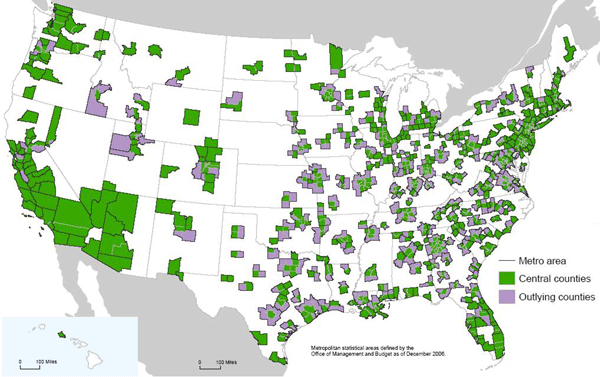
    Our report compared trends between the core county (such as the 5 county New York City core) of each major metropolitan area. The new report compares population trends between what it terms “central counties” and outlying counties. The Bureau of the Census considers any county in the metropolitan area that is generally beyond the urban area (urban footprint) to be outlying. Thus, in Chicago, the report considers not only the core county of Cook, but also 9 additional counties as around it as central (Figure 1). Not surprisingly this means the bulk of the metropolitan area population is in the central counties (92%), however there is rapid movement even further out to the outlying counties.

    This Bureau of the Census report tells us more about exurbanization than suburbanization. Exurbanization might be thought of growth that occurs outside the urban area, including its historic suburban periphery. It represents, if you will, “sprawl beyond sprawl”. You usually can tell when you are in an exurb because you have to drive through countryside to get to the “city” (For definition of urban terms, such as metropolitan area, urban area and city, see this document).

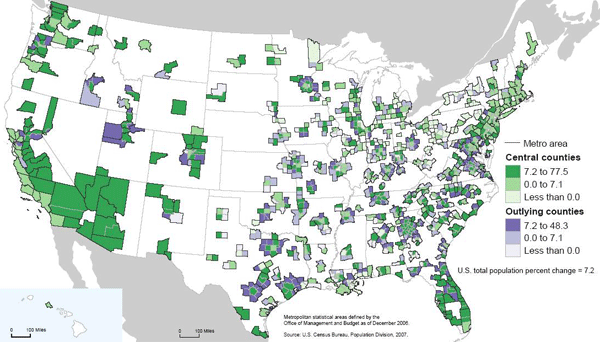
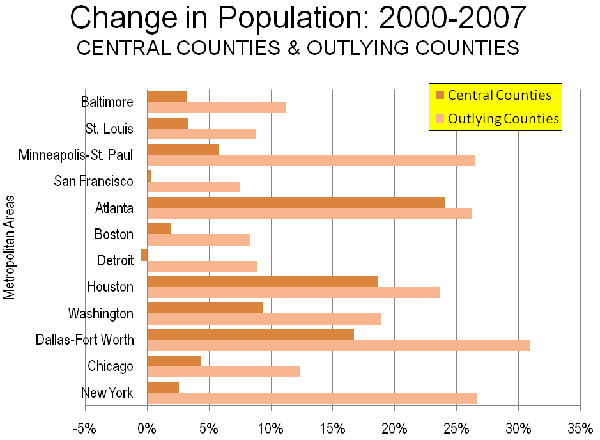
    Between 2000 and 2007, these outlying counties grew 13.1 percent, nearly double that of the central counties, which includes the suburbs, at 7.8 percent (Figure 2). The report goes on to compare detailed results for the 12 metropolitan areas with more than 2,500,000 population that have outlying counties. In every case, the outlying counties grew faster than the central counties. On average, the outlying counties grew at 2.3 times the rate of the central counties (Figure 3).

    • In San Francisco, the outlying county growth was 25 times that of the central counties.
    • In New York, the outlying county growth was 10 times that of the central counties.
    • In Boston and Minneapolis-St. Paul, the outlying country growth was between four and five times the growth in the central counties.
    • In Baltimore, the outlying county growth was 3.5 times the growth in the central counties.
    • In St. Louis, Washington (DC) and Chicago, the country growth was between two and three times the growth in the central counties.

    The strongest central county performance occurred not in the much ballyhooed “cool” dense urban areas of the Northeast or Pacific Coast but in the largest metropolitan areas of the south, Atlanta, Houston and Dallas-Fort Worth.

    • In Dallas-Fort Worth the outlying county growth was 1.9 times the growth in the central counties.
    • In Houston the outlying county growth was 1.3 times the growth in the central counties.
    • In Atlanta, the outlying county growth was 1.1 times the growth in the central counties.

    The worst central county performance occurred in Detroit, where there was a net population loss. The outlying counties grew nearly 9 percent.

    It may seem surprising that the Bureau of the Census analyzed only 12 metropolitan areas. Regrettably, Census metropolitan area definitions makes a broader analysis virtually impossible. Many metropolitan areas do not have outlying counties. That does not mean they do not have outlying or exurban areas. Riverside-San Bernardino is a good example. At the eastern end of this metropolitan area, a recluse might live less than 40 miles from the Las Vegas strip, yet be separated by 175 miles of desert and mountains from the edge of the Riverside-San Bernardino metropolitan area. The problem is that most metropolitan areas are defined by counties, and some counties contain much more area than can reasonably be considered as part of the labor market.

    This fixation with county boundaries is unnecessary. Decades ago Statistics Canada figured out how to define metropolitan areas below the county level. The Bureau of the Census approach tends to obscure the growth of outlying areas, particularly in the largest counties. This is illustrated by our analysis of the Riverside-San Bernardino area from 2000 to 2006, which showed outlying areas to be growing at 2.5 times the rate of the core urban area.

    Nonetheless, the conclusion of the new report is clear. The nation’s most remote suburbs – its exurbs – are growing much faster than the central counties. Whether this trend will now reverse, of course, is up to debate. Perhaps demographic changes and higher energy costs will slow expansion on the outer fringes. More likely, the current recession may well lead to less exurban growth, but history suggests this may prove only a short-lived trend.

    Wendell Cox is a Visiting Professor, Conservatoire National des Arts et Metiers, Paris. He was born in Los Angeles and was appointed to three terms on the Los Angeles County Transportation Commission by Mayor Tom Bradley. He is the author of “War on the Dream: How Anti-Sprawl Policy Threatens the Quality of Life.

  • How Phoenix Will Come Back

    I have heard Paul Krugman say that ‘the end is nigh’ so many times that it seemed like the only sensible way to think about the housing market. It was identified as a bubble, and that could only mean that it would eventually burst. A steady diet of NYT editorials and Economist charts leave you with one conclusion — this is not going to end well.

    This certainly seems to be true in Phoenix. Even though I’ve lectured for years about ‘the growth machine’, how the economy in a city like Phoenix depends on building more homes, I did not expect the whole thing to collapse quite so precipitately, and with so many repercussions. The number of passengers going through the airport here is down 10% from last year; numerous restaurants, stores and other services have gone out of business, the State is trying to stare down a $3 billion deficit, the universities have fired hundreds of people—so the cycle keeps spreading like a slow motion disaster.

    Also predictable is the response. Local politicians are planning to slash the State budget and get government off people’s backs, once and for all. If we used foreign phrases such as ‘chutzpah’ around here, that would have to qualify. After all, it takes balls to watch the market behave like a bunch of drunks kicking Humpty Dumpty about, and then blame government for trying to put him back together again.

    Yet, at least here in Phoenix, it turns out that Professor Krugman hadn’t really got it figured out after all. As a rational man, he was distracted by the irrational exuberance of the market, the unsupportable ramping up of property prices, the NINJA loans, and the cynical exploitation of those arriving late to the party, those doomed to buy at the top of the market and be left holding fake mortgages on homes with phony values. The solutions seem simple. More oversight from Big Brother and everything can be fixed. Or, if you prefer to listen to the bizarro-world script over on AM radio, the black helicopters are about to start landing on Wall Street as the UN takes over to install European-style socialism.

    Yet much of this commentary is laughably wrong. The housing market debacle was not just predictable but actually utterly unavoidable. Some of this is simply a matter of money circulating around, which as Niall Ferguson’s book The Ascent of Money makes clear, this is as old as capitalism itself. The difference now is that digital technologies have made the speed of trading and transfer shift. The same rules apply, except that everyone must work harder to keep that cash flowing.

    What I now realize is that the entire economic system is based upon finding more risk. Without more risk in which to invest, the economy can’t keep moving. In other words, this wasn’t a series of calamities or errors or criminal mistakes — it is the market at work, no more, no less. And that is not going to change.

    What I thought I knew is not really so. I thought a bigger banking sector was not just more mysterious but was somehow more efficient and therefore safer; after all, health insurance works best if the risks are spread across larger and larger groups. Yet in reality finance is more like a vast Ponzi scheme. We should, in fact, let Mr. Madoff out of jail, as he was doing nothing particularly wrong — his only crime was that he wasn’t being clever enough in hiding his scheme in sufficiently obscure mathematics.

    What happens to the cities, towns and suburbs left devasted by the financial schemers? As James Surowiecki recently observed in the New Yorker, “banking grew bigger and more profitable but all we got in exchange was acres of empty houses in Phoenix.” So? Isn’t that a small price to pay? Given a choice, what would we rather have: a buoyant capital market and a few distant suburbs and downtown condos without any residents, or what we have today in some cities — double digit unemployment?

    There are real policy issues at work here. We were taught years ago, by the Marxists no less, that the purpose of a capitalist economy is to reproduce itself and the purpose of governments is to make sure that happens. So we make credit available to people; first to buy Model Ts, then to live in Levittown, then to play golf in Cancun, and so forth. And for this to work there has to be more risk in which to invest, an endless supply of new things. Housing has served us well in this regard; people live in condos and McMansions, people sell them, people build them, people manufacture the fixtures and fittings. This is how the growth machine, particularly in places like Phoenix, works.

    An economy like Phoenix is like a shark – it can’t stop, it can’t even run slow. We have to find more buyers — or perhaps we just build the homes now and fill them in the future when the population increases. Or, in line with a previous posting, we should have solved the immigration problem, and the need to sell more homes, by legalizing the Latino population and making them creditworthy.

    In this sense, maybe all this focus on the Valley’s 65,000 foreclosures is a mistake. As I argued last year, perhaps they should just be turned over to rentals and let the market sort it all out; predictably, rents are now coming down in apartment complexes as more families find affordable homes to rent.

    What we need is not to stop the market from repairing itself but we need to do it in a more creative way. Some of those suburbs are looking a bit down at heel, and the homes weren’t that sturdy to begin with — so let’s bulldoze them and do some serious brownfield redevelopment. Perhaps build them right, more sustainably, and less dependent on distant employment centers

    We can all get back to work, we can all feel virtuous as no new desert is being bladed, the infrastructure is already paid for, the journey to work costs will be less, the density perhaps a little higher with more jobs, offices and retail located closer to the houses.

    This approach will let us build more homes and get some more risk back into that market. Let’s repurpose the land. Then we can go back to business as usual, and if I was a betting man, that’s exactly what we are going to do.

    Andrew Kirby is the editor of the interdisciplinary Elsevier journal “Cities.”This is his 20th year as a resident of Arizona.

  • On Our Knees: Prince Charles vs. Lord Rogers

    It is no wonder that architect Richard Rogers is feeling a bit peeved at Prince Charles. This month, the heir to the British throne scuppered plans for a £1 billion development putting 552 apartments on the 12.8-acre site of the old Chelsea Barracks. Rogers was most offended that the Prince used his Royalty to by-pass the usual planning law consultation, by speaking direct to the Qatari royalty who owned the site.

    This is not the first time the heir to the throne has acted as Lord High Planner. Twenty five years ago, he threw a hissy fit about a modernist, hi-tech tower development planned on the national gallery. It was created by the firm Ahrends, Burton and Koralek – but inspired by a Rogers’ design. His sub-majesty called it a ‘monstrous carbuncle’ on the face of a much loved and elegant friend (his ancestor predecessor William IV had a lower opinion of William Wilkins late classical design – ‘a nasty pokey little hole’). He got his way, then, and a pseudo-classical outgrowth was manufactured by Robert Venturi.

    Just a month ago, Charles was asked back to the Royal Institute of British Architects, where he first made the ‘carbuncle’ attack, and even apologised, half-jokingly, promising not to set off another debate about modernist versus traditional architecture. But word had already got out that he was going to sabotage the Chelsea Barracks development.

    Charles’ has been dogged, or perhaps the word is better dogmatic, in his interest in architecture and planning. Out in Dorchester, on land owned by the Duchy of Lancaster (that’s Prince Charles, to you and me) he constructed a weird dreamscape of a village called Poundbury, wholly built according to the Prince’s own ideals, of tradition, community and high density dwellings, designed by the new urbanist Leon Krier. It is full of desperately traditional motifs, like a film set, and it is supposed to be built to dissuade car use (though according to a recent survey, resident are above average car users).

    Richard Rogers has dared break ranks with the Prince publicly over his busy bodying. Rogers makes some excellent points. The Prince is but a man, amongst many: why should he have more say so than anyone else? The Prince will not debate his views, so why should he be allowed this influence on political choices? Even moderate constitutionalists agree that the Royalty enjoys its formal position as head of state (which Charles will become, if his mother Queen Elizabeth dies) on the condition that they keep out of day-to-day politics.

    One person who put some real flesh on the bones of Rogers’ complaints has been Vicky Richardson, the editor of the architecture magazine Blueprint. When Charles stood to address the Royal Institute of British Architects, she shouted out ‘abolish the monarchy’, a cry that was perhaps a bit too plebeian for Richard Rogers.

    Rogers is the last person to be telling us that we should not fawn to established authority. Let me spell it out for you. This is no plebe; it’s Sir Richard Rogers, Baron Rogers of Riverside, a peer of the realm. In 1991, Rogers, in an act of fealty, bent down on one knee before the Queen, to be made a knight. In 1996, he was made a Baron, and sits in the unelected House of Lords (on the Labour benches). Quite why Rogers thinks he is free of the oaths he made to protect the Queen – and consequently her progeny – is not clear.

    Richard Rogers’ leaning on the Royal brand when it suits him is not the end of his fixation with authority over the common people. Though he pressed a few demotic buttons when he turned on Prince Charles, there was a weird undercurrent of superiority in his complaints. Prince Charles is not an expert he was keen to say. Charles has no expertise in architecture … unlike Richard Rogers. It was quite a snooty put down to place on a soon-to-be King.

    Rogers went further, asking whether things ought to be changed, so that the unspoken rule that the monarchy stay out of everyday politics might be shored up. Indeed, Richard Rogers called for a panel of constitutional experts to re-examine the Prince’s powers. ‘A panel of constitutional experts’? Who are these ‘experts’ that know better than the rest of us how the United Kingdom ought to be run? A committee of the House of Lords, perhaps?

    At the heart of Richard Rogers case against the monarchy is not an argument for the people against entrenched authority. Rather, it is an argument for a new elite to take over – ‘experts’ (so-called), technocrats, people like Rogers himself, who know better than the rest of us how we should live.

    In real fact, Rogers may be even more a throwback to medievalism than the Prince. Rogers’s Chelsea Barracks development has been attacked for being too ‘modern’. But the row is cast in terms of traditional versus modern, because in many ways, Rogers plans are more backward looking that Charles’s.

    One feature that lies behind the many complaints that preceded Charles’ intervention is the density of the development. Originally planned for 638 flats, the developers were persuaded to reduce the number and increase the open space from two to 6.2 acres.

    Local people resent more bodies being crammed into an already overcrowded, teeming and increasingly dehumanized London. In this process, Rogers is far more a villain than the unlikable Prince. In 1998 his government appointed Urban Task Force saddled planning authorities with the principle that most new development would take place on ‘brownfield’, that is previously built-upon land, not newer greenfield sites out in the country.

    This is almost something out of apartheid or the 19th Century enclosure acts. The policy is to keep Londoners kettled up behind the Green Belt, telling local authorities to keep filling in every patch of land that becomes available with extra housing, densifying the city. Ironically, the Prince entirely agrees with Rogers on the need for densification – but at least he prefers something more humane, like a nice cottagey feel, and some old stonework.

    The ‘urban nimbys’ who objected to the Chelsea barrack development are a new thing. In north London, residents protested against an apartment block squeezed into a space that used to be garages at Pilgrims Way. Under the regional plan, drawn up on rules laid out by Baron Rogers, local objections have no purchase, because the overriding goal is cramming: forcing ever more people in a fixed amount of space. That is why Rogers is so angry with the Prince. Rogers has the planning approval all sewn up. Because his development offers the highest density, it ticks all the right boxes as far as the planners are concerned. But for residents, looking at results of cramming on their already limited space, 500 new flats squeezed in does not look so good. They have a right to object, but the plan – blessed by the experts, knighted and not – trumps their objections.

    Rogers objects that the Prince is using his hereditary power. But what makes Rogers so cross is that he is accustomed to exercising unchecked and undemocratic power to get his own way. He cannot quite believe that there might be a greater unelected power in the land than his own.

    The fact is the so-called great are only great because we are on our knees, said the Irish rebel James Connolly. It is time the British stood up and kicked both of these unelected overlords out, whether to the manor born or entitled by their “expertise”.

    James Heartfield is author of Let’s Build! Why we need five million homes in the next ten years, and a director of www.Audacity.org.

    Image courtesy of Henry Bloomfield

  • How Can Cities with Unaffordable Housing be Ranked Among the Most Livable Cities in the World?

    The Economist magazine’s “Economic Intelligence Unit” (EIU) has published its most recent survey of the most livable cities in the world.

    Vancouver, Canada, ranks number one, Vienna, Austria number two, Perth, Australia number five, Geneva number 8, Zurich, number 9, (both in Switzerland) and Auckland, New Zealand, number twelve.

    The comments on the EIU web page are plentiful and outspoken, most of them from people living in the ‘top-ranked’ cities explaining why the survey has got things ‘so wrong’ – or ‘so absolutely right’. Many point out that Vancouver, like so many of the top-rated cities, has severely unaffordable housing.

    Many also have high taxes, and some, like Auckland, have low wages by world standards. For most people, high wages, low taxes and affordable housing make a major contribution to livability.

    Anyone familiar with Zurich and Geneva knows that one has to be very wealthy to live there. For most of us, such cities are quite ‘unlivable’.

    However, the EIU is probably providing its customers with the right answers (or as right as such surveys can be) because their experts are ranking these cities according to their attractiveness to expatriate executives.

    Executives posted from New York to Vancouver or Sydney are unlikely to be concerned with the cost of housing because their housing will be provided free of charge, or subsidized by accommodation allowances. These rankings are not established by interviewing a random sample of residents, but are generated by a team of experts trying to assess these cities through the eyes of transferred executives setting up homes in new countries.

    This introduces another set of biases because even expert visitors have different priorities and preferences to long-term residents.

    Visitors to cities use public transport – especially shuttles, taxis and trains – if only because they do not carry their cars in their suitcase. Again, the comments on the EIU web page demonstrate that the public transport that serves visitors well may not be so impressive to the long term residents.

    Similarly, the Mercer Consulting’s Quality of Living survey ranks Auckland fourth, equal with Vancouver. Vienna, Zurich and Geneva are their top three, with Vancouver and Auckland fourth equal. Again, the Mercer ranking is designed “to help governments and major companies place employees on international assignments”. So housing affordability is not an issue. These are the best cities for ‘top’ people – and for government officials in particular.

    So, when pondering the rankings of these cities, we should understand they have been ranked according to the preferences of a high income, highly mobile, urban elite. This probably reduces their utility as a guide to overall public policy.

    Once we understand this perspective the rankings make much more sense. Whether this makes sense to people starting a career, or trying to raise a family on a middle or even upper middle class income, is dubious at best.

    Of course some will no doubt hail such surveys because they emphasize such things as physical beauty or cultural offerings. Yet they have precious little to do with what matters most, notably affordability of decent housing. For most migrants to these cities, the prospects of upward mobility – something not discussed or even considered – are probably less optimal than in places like Houston, Atlanta, and even New York.

    After all, for most people, the cost of housing is important in making location decisions, whether within their own countries or when considering migration to other lands.

    The 5th Annual Demographia International Housing Affordability Survey (2009) surveyed the Metropolitan Housing Markets of Australia, Canada, the Republic of Ireland, New Zealand, the United Kingdom, and the United States, so does not include the housing markets the EIU ranked in Europe, and elsewhere in the world.

    Even so, the list below shows that six of the ‘top twelve’ most livable cities prove to be ‘severely unaffordable’ as measured by Demographia’s Median Multiple Index. (Median house price divided by median household income.) A further two of the twelve, Toronto, ranked 4th, and Calgary, ranked fifth equal with Perth, are both ‘seriously unaffordable’.

    Most of us would expect housing affordability to be a key ingredient of livability. The list below included the eight EIU ranked cities (from top ranking Vancouver to 12th ranking Auckland) which were also surveyed for housing affordability by Demographia.

    1. Vancouver – 4th least affordable of all the severely unaffordable markets with a Median Multiple Index (MMI) of 8.4.
    3. Melbourne – Severely unaffordable; MMI of 7.1
    4. Toronto – Seriously unaffordable; MMI of 4.8.
    5. Perth – Severely unaffordable; MMI of 6.4
    5. Calgary – Seriously unaffordable; MMI of 4.8
    9. Sydney – 5th least affordable of all severely unaffordable markets; MMI of 8.3
    11. Adelaide – Severely unaffordable; MMI of 7.1
    12. Auckland – Severely unaffordable; MMI of 6.4.

    A survey that included housing affordability, per capita income, tax rates (central and local), and average drive-time to work, would almost certainly generate quite different rankings. Perhaps what has been missing is this acknowledgement that different factors motivate different kinds of people. The urban elite is very different from the middle class in its concerns. Pundits and planners would be well-served to note these differences before using such surveys as the basis for sound public policy.

    Owen McShane is Director of the Centre for Resource Management Studies, New Zealand.

  • Sustaining Localism in the English Suburban Context

    Localism, a longstanding agenda of the Green Party in the context of the UK economy, is gaining ground in the current economic crisis. In a recent edition of the London-based Daily Telegraph, a striking contrast is made between Chester in north-west England – which is suffering from the decline of its relatively narrow economic base and Totnes in south-west England, which with its longstanding interest in alternative living, and more localised economy, seems to be weathering the situation much better. The underlying message from the article is that small is good – particularly for businesses not overextended in their borrowing, and familiar enough with their immediate context to be able to adapt to a changing economy.

    The New Economics Foundation think-tank, has been for several years campaigning against Clone Town Britain (namely, the over preponderance of chain stores at the expense of small chains and independent stores). Past criticism of the foundation for having an overly romantic notion of what constitutes a successful town centre may still continue, but there may also be some economic logic to a more locally oriented town centre strategy.

    Perhaps the best approach is to avoid either free-market efficiency ideology, on the one hand, or a strict local-only approach. It seems clear from other recent research into successful suburban town centres that a combination of national chains and good quality independents makes for the best mix to ensure long-term economic sustainability.

    This issue, like perhaps too much else in Britain, is currently subject to government action. The new Sustainable Communities Act now makes it mandatory for the UK government to assist local councils and community ‘stakeholders’ in drawing up local sustainability strategies for enabling independent businesses to survive in the increasingly cut-throat high street (the equivalent of the US ‘main street’).

    Yet as usual the government seems to overlook where most people live: the word suburb or suburban is nowhere in the Act. Possibly this is not surprising as the main focus is on large scale, infrastructure projects, but the continuing lack of attention in policy terms to the suburbs should be a matter of concern to those who believe a diffuse network of connections is essential to the continuing sustainability of the economy.

    It is equally worrying to see that the influential group set up by London’s Mayor Boris Johnson to focus on the outer London suburbs (which are cited as being his main source of political support in the mayoral elections) continues the pattern of focusing on the larger metropolitan centres at the expense of the smaller suburban centres in the capital. At an ‘Outer London Summit’ held on 11th June, Mayor Johnson made it clear that the policy focus continues to be on strengthening a constellation of “growth hubs” of economic activity, such as the metropolitan centre of Croydon in south London, despite the clear evidence demonstrating how smaller centres have an important role in making suburbs more sustainable.

    Within the next 20 years, most housing growth in England and Wales is predicted to occur in suburban settlements. This development is expected to be sustainable economically and environmentally, which means that suburbs will increasingly be required to provide local economic activities in order to minimise travel and to support cohesive and vibrant communities.

    The Towards Successful Suburban Town Centres research project at University College London has investigated the strategic contribution of Greater London’s smaller and district centres to the sustainability of the metropolitan region. ‘Sustainability’ in interpreted by the project team as referring to conditions favourable to local concentrations of long-lasting socio-economic and cultural activity.

    The research also has found that the widespread perception of suburbia as synonymous with social and architectural homogeneity belies its spatial, social, ethnic and economic diversity. With pressure to build large numbers of new homes increasing, there is a real danger that such perceptions become self-fulfilling.

    Initial findings suggest the success of local centres depends on the ability of their built environments to adapt to social and economic change by allowing pedestrian movement around an extended central area, balanced with accessibility to vehicular and public transport at larger scales of movement. Centres that support a wide range of locally generated activity are likely to be more resilient in the face of change than retail or purely residential monocultures. The results show that spatial variety and economic adaptability are both crucial to economic sustainability.

    This adaptability inherent to the suburban built environment needs to be more widely understood and promoted. The Towards Successful Suburban Town Centres project has found that where the town centre supports a diverse range of activities it benefits from increased by-product movement, where people do more than what they deliberately came to do during their visit to the centre. People visiting local town centres such as Surbiton (made famous by the 1970s BBC sitcom The Good Life), are not like shoppers at a ‘power centre’ dominated by a Wal-Mart. They don’t just shop for a specific item; they linger, eat lunch, drink coffee, research local cultural activities and indeed might be there for a business meeting. Surbiton, like many of London’s smaller town centres, has close links to larger centres such as Kingston, which alongside retail, offices and a university, boasts the new Rose Theatre led by Sir Peter Hall.

    The benefits here go well beyond the strictly economic. More time spent locally leads to a more vibrant mix of people on the streets and helps enliven the town centre throughout the day. This street network potential provides a critical element for sustaining the vitality of suburban and small town centres. The extensive and varied activity in lively areas enables complex routine daily and weekly movement patterns to emerge, thereby furthering the engagement of individuals with their locality.

    With the closure of chains such as Woolworths, however tragic for long-time customers and employers, the economic downturn also opens up opportunities for alternative high street activities. In one example, Art Space + Nature, an avant-garde Scottish art collective, have produced plans to bring new activities to empty shop fronts by putting on art exhibitions. The Institute of Community Cohesion is working on plans to create new indoor markets for local communities in closed business units.

    These and many other grassroots initiatives are localist at heart. The key may be in making sure that these attempts remain grassroots, and not too impacted by either large governmental units or major non-profits. To succeed, localism must be properly bedded in the community. Economic trends, as well as history, demonstrate that a bottom-up approach to creating lasting viable communities works not only in cities, but in suburbs as well.

    Laura Vaughan is a Senior Lecturer in Urban and Suburban Settlement Patterns and the Director of the MSc in Advanced Architectural Studies at the Bartlett, University College London and a member of UCL’s Space research group.

  • The Geography of Class in Greater Seattle

    Most readers may not be initially very interested in the detailed geography of “class” in Seattle, but it actually matters not only for our area but for the whole debate over the shape of the urban future. Academics, perhaps Americans in general, are loath to admit to class differences, yet they remain very crucial to the understanding of how cities and regions evolve.

    Seattle is a great example of the transformation of a 20th century model of the American metropolis to a 21st century-cum-19th century “old World” model of metropolis. It is often held up as one of the role models for other cities, so its experiences should be considered seriously not only for American cities but for regions throughout the advanced world.

    Many readers, including those afflicted with political correctness, probably many upper and lower class folk uncomfortable with their home areas being labeled as of a particular class, or others, might feel that class is an obsolete Marxist term. They may prefer I use the safer term “socio-economic status” rather than “class.” Let’s admit it: “class” is used widely, as in “the middle class is getting squeezed” or the “tax burden on the lower classes.” As it has been for hundreds of years, class remains a meaningful descriptor of areas of obviously differing well-being.

    We should understand by identifying upper or middle or lower classes this does not imply “better than.” Class simply reflects the mix of inheritance, education, biology, experience, discrimination, and life events that lead to variability in economic well-being. Class is real. But there is certainly a legitimate concern with the identification of heterogeneous areas like census tracts as of a particular class, based on average or median values for the in fact diverse households in a tract. This method is far from perfect but nevertheless we and others find such generalization common, meaningful and useful.

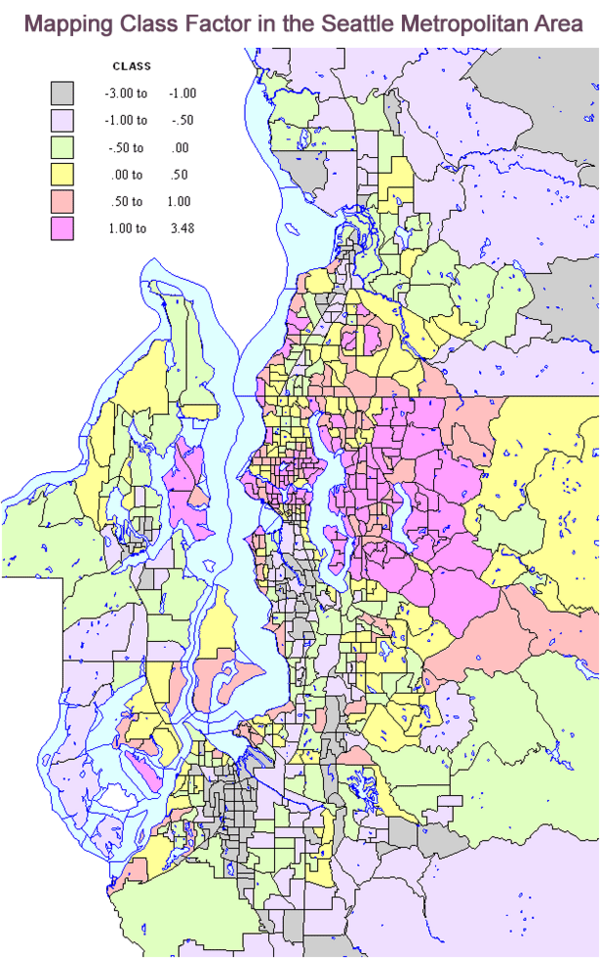
    This map plots “factor scores,” a statistically constructed variable or index divided into six levels of “class:” two upper, two middle and two lower. It is timely to do this, since it was 50 years ago when Calvin Schmid, demographer in Sociology at the University of Washington, and my early mentor, performed a pioneering factor analysis of crime in Seattle – and this was before modern computers! The derived scores most reflect high weighting of the variables: percent of adults with a BA or more, percent in professional versus laboring occupations, median house value and median household income.

    As you look at the map, it’s clear how Seattle reflects very strongly what is generally described as gentrification. This means the reclaiming of the central core by the highly educated and professional, eschewing the suburban metaphorical desert. In the case of Seattle, this process occurring between 1985-2005 resulted in the displacement of over 50,000 less affluent and often minority households to south King county. The city begins to resemble the historic pattern of the rich and important occupying the vibrant core of the city, relegating the working poor to the suburbs, with poor access and inadequate services. Indeed, even now I am involved in a project to assess the lack of access of poor children, often minority or foreign born, to health care in south King county.

    The dominant “upper class” area is the Eastside, east of Lake Washington, and location of the affluent “edge city” of Bellevue, home of the Microsoft campus. A second set of upper class areas are waterfront and view neighborhoods, taking advantage of the Seattle area’s broken topography. The third is simply the University of Washington immediate hinterland. I suspect the location of a large research university with 42,000 students and 22,000 staff increasingly propels Seattle’s unusually high status, income and popularity. I think this is increasingly more important a factor than the presence of an increasingly less important downtown Seattle business center.

    Conversely, lower class areas include traditional zones of mixed housing, industry and transport, such as south Seattle, the older satellite cities of Everett (north), Bremerton (west), and especially Tacoma (south). The largest area of lower class neighborhoods extends from south Seattle through south King county to Tacoma, marked by historical development, displacement from Seattle and high minority population. The second large zone of lower class settlement is the rural fringe, especially in Pierce (south) and Snohomish (north) counties, and may surprise those who think all rural areas are the home of rich estates.

    Then there is the middle class. This is where the suburbs matter most. On the map, middle class areas (yellow and green) are intermediate in location as well and dominate the outer suburban areas as well as some older inner neighborhoods of Seattle and Tacoma. It is unfortunately true that race, ethnicity and class remain highly correlated especially within the core cities of Seattle and Tacoma, reflecting the continuing history of unequal education and job preparation and prospects.

    This analysis suggests one possible future of urban development following something of a European model, with most middle class people in the suburbs, while the rich and poor concentrate either in the urban core or in selected locales in the periphery. As for the city itself, it’s clear that the total landscape is not simply becoming wealthier but increasingly bifurcated between the affluent and the long-term poverty population. And suburbia, home to the vast majority of the region’s population remains the predominant home of the middle and working classes, with pockets of both wealth and poverty.

    Richard Morrill is Professor Emeritus of Geography and Environmental Studies, University of Washington. His research interests include: political geography (voting behavior, redistricting, local governance), population/demography/settlement/migration, urban geography and planning, urban transportation (i.e., old fashioned generalist)

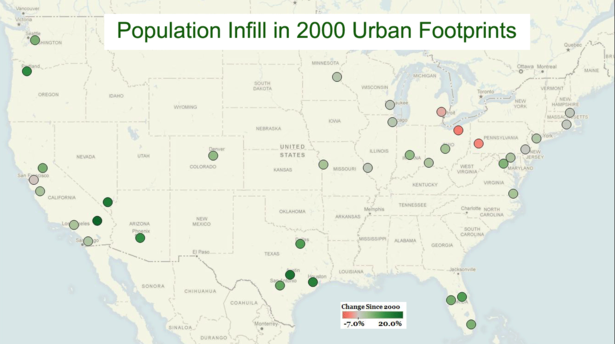
  • Special Report: Infill in US Urban Areas

    One of the favored strategies of current urban planning is “infill” development. This is development that occurs within the existing urban footprint, as opposed that taking place on the fringe of the urban footprint (suburbanization). For the first time, the United States Bureau of the Census is producing data that readily reveals infill, as measured by population growth, in the nation’s urban areas.

    2000 Urban Footprint Populations

    The new 2007 estimates relate to urban areas or urban footprints as defined in 2000 and are produced by the American Community Survey program of the Bureau of the Census. Urban areas are the continuous urbanization that one would observe as the lights of a “city” on a clear night from an airplane. It is the extent of development from one side of the urban form to the other. Further, urban areas are not metropolitan areas, which are always larger and are defined by work trip travel patterns. Metropolitan areas always include adjacent rural areas, while urban areas never do.

    The Process of Infill

    Although embraced with often religious passion within the urban planning community, infill is neither good nor bad in terms of social or environmental impact. Infill always increases population densities and that means more traffic. If road capacity is increased sufficiently, traffic congestion can be kept at previous levels. If on the other hand, nothing is done, traffic congestion is likely to increase along with population. This means slower traffic and more stop and go operations, which inevitably increases the intensity of air pollution with the potential to cancel out any reductions in greenhouse gas emissions (GHG) that might occur if average car trip lengths decline. Similar difficulties can occur with respect to other infrastructure systems, such as sewer and water. Expanding roads, sewer and water systems in already developed areas can be far more expensive than new systems on greenfield sites. Regrettably, boosters of infill routinely ignore these issues.

    But infill has been going on for years, along with suburbanization, both in the United States and in other first world nations. This is indicated by the general densification trend that occurred in US urban areas between 1990 and 2000 and the longer term densification trends that occurred in a number of southwestern urban areas, such as Los Angeles, San Jose, Riverside-San Bernardino, Phoenix, Dallas-Fort Worth and Las Vegas. All these traditionally “sprawling” areas have, in fact, been densifying since 1960 or before. Since 2000, 33 of the nation’s 37 urban areas with a population exceeding 1,000,000 population experienced population infill to their 2000 urban footprints.

    Infill in Traditionally Regulated Markets (More Responsive Markets)

    Infill is a natural consequence of the traditional post-World War II land use regulation, which tends towards accommodating both demographic growth and market forces. This has been replaced by more prescriptive (often called “smart growth”) land use regulation in some urban areas. Under traditional regulation, suburban development followed a “leap frog” process, moving ever further out. This is roundly condemned in today’s planning literature and among leading academics and policy makers.

    Leap frog development occurs where urban development skips over empty land and creates a less continuous urban fabric. Land is developed based upon the interplay between sellers and buyers. Due to fewer planning restrictions, no seller can be sure that their land will be purchased since there is always plenty of land that buyers can otherwise purchase. This keeps land prices down. In the more responsive markets, it is typical for land and site infrastructure costs to be 20 percent of the total price land and house price.

    Infill occurs as land that has been “leaped” over is subsequently purchased for development. Again, because buyers have plenty of choices, prices of the infill land remains low, so that land and infrastructure costs remain relatively affordable in relationship to the overall new house purchase price.

    The result is an urban area that is generally continuous, though with a transitional “ragged edge.” The ragged edge enabled the broad expansion of home ownership that occurred in the decades following World War II by keeping house prices low.

    Infill in More Prescriptive Markets (Smart Growth)

    The infill process is quite dramatically different in more prescriptive markets. Infill might be mandated as a percentage of total development or by severely limiting the development allowed to occur closer to the urban fringe. Sellers of land on which development is permitted have disproportionate power to charge higher prices because the planning regime seriously limits the availability of alternative sites for buyers. This, of course, flows through to house prices. The share of land and site infrastructure can rise to two-thirds of the house and land cost. The urban area may have a “clearer” edge, but at a significant loss in housing affordability.

    Infill Trends in the 2000s

    The new infill estimates indicate that American urban areas continue to densify. Between 2000 and 2007, the 33 of the 37 urban areas of more than 1,000,000 population experienced densification in their 2000 urban footprints. The average population infill increase was 5.6 percent (See Table the following table).

    Population Infill in 2000 Urban Footprints
    2000-2007
      Population Change: 2000 Urban Footprint Population Density of 2000 Urban Footprint in 2007  
    Urban Area 2000 Census 2007 Estimate Change % Rank Rank
    Riverside–San Bernardino, CA       1,506,816      1,800,117     293,301 19.5% 1         4,110 8
    Atlanta, GA       3,499,840      4,118,485     618,645 17.7% 2         2,100 36
    Austin, TX         901,920      1,051,962     150,042 16.6% 3         3,308 17
    Las Vegas, NV       1,314,357      1,518,835     204,478 15.6% 4         5,311 5
    Houston, TX       3,822,509      4,370,475     547,966 14.3% 5         3,377 16
    Portland, OR–WA       1,583,138      1,779,705     196,567 12.4% 6         3,755 12
    Phoenix, AZ       2,907,049      3,254,634     347,585 12.0% 7         4,078 9
    Dallas–Fort Worth, TX       4,145,659      4,549,281     403,622 9.7% 8         3,236 18
    Orlando, FL       1,157,431      1,267,976     110,545 9.6% 9         2,799 24
    San Antonio, TX       1,327,554      1,440,794     113,240 8.5% 10         3,540 14
    Tampa–St. Petersburg, FL       2,062,339      2,209,067     146,728 7.1% 11         2,754 25
    Sacramento, CA       1,393,498      1,488,647       95,149 6.8% 12         4,034 10
    Seattle, WA       2,712,205      2,896,844     184,639 6.8% 13         3,040 21
    Miami, FL       4,919,036      5,243,679     324,643 6.6% 14         4,703 6
    Washington, DC–VA–MD       3,933,920      4,174,187     240,267 6.1% 15         3,611 13
    Denver, CO       1,984,887      2,087,803     102,916 5.2% 16         4,192 7
    Indianapolis, IN       1,218,919      1,278,687       59,768 4.9% 17         2,316 34
    Columbus, OH       1,133,193      1,175,132       41,939 3.7% 18         2,960 22
    Kansas City, MO–KS       1,361,744      1,408,900       47,156 3.5% 19         2,413 31
    Virginia Beach, VA       1,394,439      1,442,494       48,055 3.4% 20         2,742 26
    San Jose, CA       1,538,312      1,588,544       50,232 3.3% 21         6,110 2
    Los Angeles, CA     11,789,487    12,171,625     382,138 3.2% 22         7,302 1
    Cincinnati, OH–KY–IN       1,503,262      1,546,730       43,468 2.9% 23         2,305 35
    Baltimore, MD       2,076,354      2,133,371       57,017 2.7% 24         3,128 19
    San Diego, CA       2,674,436      2,747,620       73,184 2.7% 25         3,514 15
    New York, NY–NJ–CT     17,799,861    18,223,567     423,706 2.4% 26         5,440 4
    Minneapolis–St. Paul, MN       2,388,593      2,438,359       49,766 2.1% 27         2,727 27
    Chicago, IL–IN       8,307,904      8,467,804     159,900 1.9% 28         3,992 11
    St. Louis, MO–IL       2,077,662      2,103,040       25,378 1.2% 29         2,540 30
    Milwaukee, WI       1,308,913      1,324,365       15,452 1.2% 30         2,719 28
    Boston, MA–NH–RI       4,032,484      4,077,659       45,175 1.1% 31         2,350 33
    Providence, RI–MA       1,174,548      1,183,622        9,074 0.8% 32         2,353 32
    Philadelphia, PA–NJ–DE–MD       5,149,079      5,178,918       29,839 0.6% 33         2,880 23
    San Francisco, CA       3,228,605      3,214,137      (14,468) -0.4% 34         6,099 3
    Detroit, MI       3,903,377      3,831,575      (71,802) -1.8% 35         3,041 20
    Pittsburgh, PA       1,753,136      1,687,509      (65,627) -3.7% 36         1,981 37
    Cleveland, OH       1,786,647      1,705,917      (80,730) -4.5% 37         2,641 29
    Total  116,773,113  122,182,066  5,408,953 5.6%
    Data from US Bureau of the Census

    Riverside-San Bernardino, long castigated as a “sprawl” market, had the largest population infill, at 19.5 percent. Atlanta ranked number two, at 17.7 percent. This is a real surprise, since Atlanta was the least dense major urban area in the world in 2000, ranked second in 2000s infill. As a result, it is likely that Pittsburgh- often held up as a model of urban regeneration – is now the world’s least dense major urban area. On the other hand, if Atlanta’s infill rate continues, its 2000 urban footprint will be more dense than that of Boston by 2015.

    Austin ranked third, adding 16.6 percent population to its 2000 urban footprint. Las Vegas ranked fourth, with a 15.6 percent increase in its 2000 urban footprint. The density of Las Vegas is increasing so rapidly that by the 2010 census its 2000 urban footprint will be more dense than the 2000 New York urban footprint, should the current rates continue.

    Perhaps most surprising of all is that Houston ranked fifth, added 14.3 percent to its 2000 urban footprint. This may surprise those who have denounced Houston’s largely deregulated regulatory environment, both in the city and in unincorporated county areas in the suburbs. Yet overall Houston’s infill exceeded that of smart growth model Portland. The Rose City stood at sixth, adding 12.4 percent to its 2000 urban footprint.

    Perhaps equally surprising, Portland remains less dense than average for a western urban area. Its 2000 urban footprint density trailing Los Angeles, San Jose, San Francisco, Las Vegas, Denver, Riverside-San Bernardino, Phoenix and Sacramento, while leading only San Diego and Seattle.

    The top ten were rounded out by Phoenix (7th), Dallas-Fort Worth (8th), Orlando (9th) and San Antonio (10th). It is worth noting that like Houston, the unincorporated suburbs of Austin, Dallas-Fort Worth and San Antonio have largely deregulated land use regulation, yet these urban areas ranked high in infill.

    Interestingly some of the greatest infill growth also took place in the fastest growing, traditionally “sprawling” cities. Atlanta also had the largest numeric increase in the population of its 2000 urban footprint, at more than 600,000. Houston was a close second, at nearly 550,000.

    In contrast, population losses since 2000 in the urban footprints of Cleveland, Pittsburgh, Detroit and San Francisco, means these urban areas experienced no population infill. San Francisco’s loss enabled San Jose to move into second position nationally after Los Angeles in the population density of its 2000 urban footprint.

    How the Core Cities Fared

    The core cities (municipalities) attracted, on average, their population share. Approximately 30 percent of the infill growth occurred inside the core cities. Even this figure may be a bit high, due to the impacts of annexation

    All of the infill in Philadelphia, Baltimore, Chicago, Providence and Minneapolis-St. Paul occurred outside the core cities. The city of Portland attracted barely 10 percent of its urban area infill, despite highly publicized (and subsidized) infill projects such as the Pearl District. Core cities attracted the largest share of infill growth in such diverse cities as San Antonio, San Jose, Columbus, Phoenix and New York.

    Note: Additional information available at http://www.demographia.com/db-uzafoot2007.pdf

    Wendell Cox is a Visiting Professor, Conservatoire National des Arts et Metiers, Paris. He was born in Los Angeles and was appointed to three terms on the Los Angeles County Transportation Commission by Mayor Tom Bradley. He is the author of “War on the Dream: How Anti-Sprawl Policy Threatens the Quality of Life.

  • Kauai, Hawaii: Local Merchants Make Waves

    Many have by now heard or read the story of the plucky group of Hawaiians on the island of Kauai who, when faced with the loss of their businesses due to the state government’s inability to open park roads to a popular beach and camping area, took care of it themselves for a fraction of the cost and in a fraction of the time. How very Tocquevellian. Or, better, how very American. The story brings a reflexive smile to everyone who hears it, but the events cast a spotlight on the way governments at all levels interact with their communities, and how, in light of significant budget cutbacks, roles are changing.

    In his magisterial commentary on 19th century democratic culture, Democracy in America, Alexis de Tocqueville compared the initial sources of public action in European countries with the United States: “Everywhere that, at the head of a new undertaking, you see the government in France and a great lord in England, count on it that you will perceive an association in the United States.”

    De Tocqueville was overwhelmed at this penchant of Americans to collaborate in common effort. The Frenchman attributed this unique, awe-inspiring American quality to the absence of a large government or aristocratic structure. “They can do almost nothing by themselves,” he wrote, “and none of them can oblige those like themselves to lend them their cooperation. They therefore all fall into impotence if they do not learn to aid each other freely.”

    After December floods washed out the park roads, bridges, and facilities at the Polihale State Park, Hawaii’s Department of Land and Natural Resources (DLNR) studied the damage and released a statement two months later, declaring, “We know that people are anxious to get to the beach. However, the preliminary cost estimate of repairs is $4 million.” An original timeline for the work was set for late summer, but, commented local resident and surfer, Bruce Pleas, “It would not have been open this summer, and it probably wouldn’t be open next summer.”

    The DLNR’s natural response to this natural disaster was to go inward (look to its own capabilities) and upward (look for more State or Federal funds). The public’s role – if there was to be any – was to leave them alone to do the first task, and help them achieve the second; specifically, the main objective was to grab a fee-generated windfall for the department, ironically entitled the “Recreational Renaissance” fund. In February, DLNR’s Chair, Laura Thielen, pleaded, “We are asking for the public’s patience and cooperation to help protect the park’s resources during this closure, and for their support of the ‘Recreational Renaissance’ so we can better serve them and better care for these important places.” The department convened an “information meeting” in March to discuss… how residents could work with the department to open the roads? No, only to provide information on how to lobby the state for more funding.

    This approach did not sit well with area residents who depend on the park for their livelihood. It was reported that Ivan Slack, owner of Na Pali Kayaks, which operates from the beach in Polihale, summed up the community’s frustration: “We can wait around for the state or federal government to make this move, or we can go out and do our part.” Beginning in late March, business leaders and local residents organized — “associated” — to take the situation into their own hands. From food donated by local restaurants to heavy machinery offered by local construction companies, a project that was originally forecast to cost millions and take months (if not years) was nearly completed in a matter of weeks, all with donated funds, manpower, and equipment. As Troy Martin from Martin Steel, which provided machinery and five tons of steel at no charge, put it, “We shouldn’t have to do this, but when it gets to a state level, it just gets so bureaucratic; something that took us eight days would have taken them years. So we got together — the community — and we got it done.”

    This was not just a park clean-up, but a significant undertaking involving bridge-building, reconstructing rest rooms, and use of heavy equipment to clear miles of flood-damaged roadways.

    While unique in its scope, what is happening on the southwestern coast of Kauai is not completely anomalous. Due to the national budget crisis, states and cities around the country are having to take a hard look at the services they offer and find new ways to involve civil society. The organization I head up, California Common Sense, is working with cities and school districts that have to chart this new course. The failure of several revenue-raising ballot initiatives here in the Golden State has provided even more impetus to practice this outward-focused governance.

    In some respects, governments themselves are to blame for setting the service expectations of the past decades. Beginning in the mid-1980s, the “TQM” (Total Quality Management) craze in private industry found its way into the public sector, and a new language of “service provider” (government) and “customer” (citizen) followed. Government no longer was something to participate in, but something to pay for. Later in this transition, scholars like Northwestern University’s John McKnight could see that the results of this new relationship were heading towards a precipice. In an essay for The Essential Civil Society Reader, McKnight commented on this situation in terms reminiscent of de Tocqueville’s fears almost two centuries earlier: “The service ideology [in governments] will be consummated when citizens believe that they cannot know whether they have a need, cannot know what that remedy is, [and] cannot understand the process that purports to meet the need.” This, thankfully, is not the situation in Kauai.

    But we, as citizens, don’t get off the hook that easily. Certainly, we have too often taken on this role as “customer,” believing our taxes are just the prices we pay for the services we desire, from filling potholes to teaching our children. When government does not perform up to our expectations the usual response is either to decry its wastefulness or to acquiesce to higher taxes. These often unproductive reactions come from both the left and right on the ideological spectrum.

    The story in Kauai, and others bubbling up around the country, demonstrate that there is a “third way”: get some friends and pick up a shovel when the government can’t or won’t. Governments on the other side of this equation need to be open to this kind of direct participation; in fact, they should encourage it. What is happening in Polihale is not a syrupy, Rockwellian portrait. It is doubtful that this dramatic participation would have occurred without the dire financial consequences that loomed for many of the residents and businesses involved. It is a manifestation of de Tocqueville’s “self-interest rightly understood”.

    “All feel themselves to be subject to the same weakness and the same dangers,” De Tocqueville wrote, “and their interest as well as their sympathy makes it a law for them to lend each other mutual assistance when in need.” Ray Ishihara, manager of the local Ishihara Market, which has donated food for the volunteers, puts this in more concrete terms: “I think it’s great. Everybody needs help these days in this economy.”

    It is ironic that this should all be taking place in President Obama’s home state. The usually articulate Obama has sounded uncomfortable when attempting to define how he expects Americans to “sacrifice” during this financial crisis. From a policy perspective, the Administration’s only responses appear to be raising taxes on our wealthiest 5%, and, interestingly, increasing Federal funding for volunteer programs.

    One thing the President could do is travel out Kauai’s Route 50 to Polihale State Park during his next trip to Hawaii. There, he could see and celebrate what everyday Americans do when they gather in common purpose. Thanks to their hard work and sacrifice, surf’s up.

    Pete Peterson is executive director of Common Sense California, a multi-partisan organization that supports citizen participation in policymaking (his views do not necessarily represent those of CSC). He also lectures on State & Local Governance at Pepperdine’s School of Public Policy. An earlier version of this article appeared in City Journal.