Category: Urban Issues

  • The Fate of America’s Homebuilders: The Changing Landscape of America

    During the first ten days of October 2008, the Dow Jones dropped 2,399.47 points, losing 22.11% of its value and trillions of investor equity. The Federal Government pushed a $700 billion bail-out through Congress to rescue the beleaguered financial institutions. The collapse of the financial system in the fall of 2008 was likened to an earthquake. In reality, what happened was more like a shift of tectonic plates.

    History will record that the tectonic plates of our financial world began to drift apart in the fall of 2008. The scale of this change may be most evident in housing.

    PART TWO – THE HOME BUILDERS

    For decades, home ownership epitomized the American dream. For years, Americans saved their money for the required 20% down payment to purchase their dream home and become part of the great American Middle Class. They saved their money in a special account at the local savings & loan that paid a little more interest than the banks. Interest rates were fixed by law. A typical mortgage was written at a fixed rate for 30 years. Most American home owners stayed in their homes and celebrated the pay-off with a mortgage burning party.

    In this arrangement, it was understood that the savings & loans were allowed to pay more interest because they provided long term home mortgages. They paid depositors 4 – 5% and lent money at 6% making a little profit on the arbitrage for their risk. With a 20% down payment, there was little risk. Mortgage bankers knew the homes they lent money on and more importantly, they knew their clients. The mortgage stayed on the books at the local savings & loan until paid.

    In this time, home builders were mostly small local shops known by their customers and the lenders. For decades the industry was quite stable. Homes averaged 1,400 square feet in 1970 according to the National Association of Homebuilders. A quality home could be purchased for under $20,000. Not everyone could afford to buy a home but almost everyone aspired to this. Savings & loans provided 60% of all home mortgages.

    The first crack in the dam appeared in the late 1970s. Under President Jimmy Carter, America suffered double-digit inflation. As the value of the dollar eroded, Americans sought investments that could protect their dollars from the ravages of inflation. Regulation D prohibited banks from paying interest on checking accounts. A tiny bank in Massachusetts, the Consumers Savings Bank of Worcester, Massachusetts introduced the NOW Account (Negotiable Order of Withdrawal) and began paying a higher rate of interest than the savings & loans. Money flooded into the bank.

    The Depository Institutions Deregulation and Monetary Control Act of 1980 began the six-year process of phasing out limits on interest rate. Money flowed out of savings & loans and into NOW accounts and MMDA accounts (Money Market Depository Accounts). The S&Ls, with long term fixed loans on their books and short term money leaving for higher rates at the banks, never fully recovered. The primary source of funding for America’s home building industry was changed forever.

    In the late 1980s the S&L industry attempt to recapture market share by entering the equity side of real estate development with disastrous consequences. The government was forced to seize most of the S&Ls and sell off their assets through the Resolution Trust Company (RTC). In 1989, Congress passed TEFRA, the Tax Equity and Fiscal Responsibility Act that effectively outlawed direct ownership of property by S&Ls. It was a death blow to the industry and the end of the 30-year home mortgage as we knew it.

    This is where the seeds of the current housing disaster and financial meltdown were sown. Wall Street and politics entered the financial vacuum left by the demise of the savings & loan industry. The Garn-St Germain Depository Institutions Act of 1982 introduced the ARM (adjustable rate mortgage) which allowed rates paid to depositors to balance rates charged to borrowers. Our politicians, filled with good intentions, began down an irreversible path of using the home mortgage for social engineering.

    Seeking to increase homeownership, Congress began to unwind the financial safety net that protected the American dream for nearly 100 years. An ugly brew was concocted with the marriage of too much money and too much power. Congress began to consider housing as a right instead of a privilege.

    Over the ensuing quarter century, Wall Street and Congress conspired to turn the traditional 20% down, fixed 30 year mortgage on its ear. In 1977, they passed the Community Reinvestment Act that outlawed red-lining and forced lenders to make loans to poor neighborhoods. In 1982, they passed the Alternative Mortgage Transactions Parity Act (AMTPA) that expanded the funding and powers of Fannie Mae and Freddie Mac by lifting the restrictions on adjustable rate mortgages (ARM), balloon payment mortgages and the Option ARM (negative amortization loan). When a savings & loan made a mortgage in the past, they held it for 30 years or until paid. Freddie and Fannie became the new absentee owner of the majority of mortgages by purchasing them from the originators in the secondary market.

    Thus the die was cast. Mortgage bankers and brokers became salesman and paper pushers packaging applications for the secondary market and financial investors who never saw the asset they lent money against or met the borrowers for whom they made the loan. But this was not enough to satisfy the greed of Wall Street which invented the CMBS (commercial mortgage backed security) in 1991. This was nothing more than a private label pool of mortgages that they sold off to equally unconnected financial investors in their own secondary market. Home mortgage lending by commercial banks went from nothing to 40% of the market in a matter of years.

    The market could have possibly tolerated this bastardization of the conventional mortgage but neither Congress nor Wall Street could control themselves. There was simply too much money to be made. Congress determined that the credit score was discriminatory and violated the rights of the poor and minorities. In 1994, Congress approved the formation of the Home Loan Secondary Market Program by a group called the Self-Help Credit Union. They asked for and received the right to offer loans to first time homebuyers who did not have credit or assets to qualify for conventional loans. Conventional 80% financing was replaced with 90% loans and then 95% and finally 100% financing that allowed a home buyer to purchase a home with no down payment. The frenzy climaxed with negative amortization loans that actually allowed homes to be purchased with 105% financing.

    In June of 1995, President Clinton, Vice President Gore, and Secretary Cisneros announced a new strategy to raise home-ownership to an all-time high. Clinton stated: “Our homeownership strategy will not cost the taxpayers one extra cent. It will not require legislation.” Clinton intended to use an informal partnership between Fannie and Freddie and community activist groups like ACORN to make mortgages available to those “who have historically been excluded from homeownership.”

    Historically, a good credit score was essential to receive a conventional mortgage. Under pressure from the politicians, lenders created a new class of lending called “sub-prime” and as these new borrowers flooded the market, housing prices rose. Lenders used “teaser rates”, a form of loss leader, to help the least credit worthy to qualify for loans.

    Congress instructed Fannie and Freddie to purchase mortgages even though there was no down payment and no proof of earnings by the applicant. An applicant could “state” his or her income and provide no proof of employment. Stated income loans eventually became known as “liar loans”. Sub-prime loans grew from 41% to 76% of the market between 2003 and 2005.

    This devilish brew caused a record 7,000,000 home sales in 2005, including more than 2,000,000 new homes and condominiums. Mortgage lending jumped from $150 billion in 2000 to $650 billion in 2005. Prices rose relentlessly, pushed by more and more buyers entering the market. The top 10 builders in the United States in 2005 were:

    1. D.R. Horton – 51,383 Homes Built
    2. Pulte Homes – 45,630 Homes Built
    3. Lennar Corp. – 42,359 Homes Built
    4. Centex Corp. – 37,022 Homes Built
    5. KB Homes – 31,009 Homes Built
    6. Beazer Homes – 18,401 Homes Built
    7. Hovnanian Enterprises –17,783 Homes Built
    8. Ryland Group – 16,673 Homes Built
    9. M.D.C. Holdings – 15,307 Homes Built
    10. NVR – 13,787 Homes Built

    Economists and pundits eventually began to identify the phenomenon as the housing bubble. And, bubbles burst. But Congress was not ready to confront reality. Rep. Barney Frank testified he “saw nothing that questioned the safety and soundness of Fannie and Freddie”. Fannie Mae Chairman Franklin Raines was paid $91.1 million in salary and bonuses between 1998 and 2004. In 1998 Fannie’s stock was $75/share. Today it is 67 cents.

    In 2007 as prices stopped rising, the flood of buyers entering the market ceased putting market values into a free-fall. Home building is not a nimble industry. It takes years of planning and development to bring a project to market. America’s homebuilders had hundreds of thousands of homes and condos under construction when the housing market came to a crashing halt in the fall of 2008. New home sales, which topped 2,000,000 units per year in 2005, fell to an annual level of under 400,000 units in early 2009. Prices have retreated to 2003 levels and in some markets even lower.
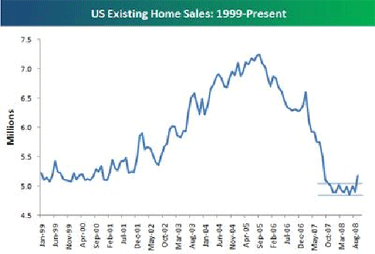

    What happens to America’s home builders? Do they follow General Motors and Chrysler into bankruptcy? Can they survive? New home sales are down 80% since 2005 – doing worse even than automobile sales. The tectonic plates of the housing industry are shifting rapidly and have not settled into any discernible pattern.

    Residential land has dropped precipitously in value but a case can be made that raw residential land now has a “negative residual value”. There are hundreds of thousands of completed but unsold, foreclosed, and vacant, homes littering the countryside. The chart above demonstrates how dramatically sales have fallen since their peak in 2005. This “overhand” inventory must be cleared out before any recovery can ensue. The prices of these units must be cut by draconian margins to attract the bottom fishers and speculators who will take the risk from the home builders and purchase the outstanding inventory. This will not happen quickly. This is not a market that can generate an early rebound.

    Has Congress learned from its mistakes? Apparently not. In March 2009, Democratic Representatives Green, Wexler and Waters introduced HR600 entitled “Seller Assisted Down Payments” that instructs FHA to accept 100% financing from those who cannot fund the required 3.5% down payment.

    A year from now the landscape of America will be forever changed. Five years from now, will American ingenuity have revolutionized the home building industry? The imperative is to find homebuilders who can speed production and lower costs. And government needs to learn from its own mistakes and realize that a successful housing sector depends on solid market fundamentals as opposed to pursuing an agenda of social engineering.

    ***********************************

    This is the second in a series on The Changing Landscape of America. Future articles will discuss real estate, politics, healthcare and other aspects of our economy and our society. Robert J. Cristiano PhD is a successful real estate developer and the Real Estate Professional in Residence at Chapman University in Orange, CA.
    PART ONE – THE AUTOMOBILE INDUSTRY (May 2009)

  • Britain’s Labour Lessons For Obama

    LONDON – The thrashing of Britain’s New Labour Party – which came in a weak third in local and European Parliament elections this week – may seem a minor event compared to Barack Obama’s triumphal overseas tour. Yet in many ways the humiliation of New Labour should send some potential warning shots across the bow of the good ship Obama.

    Labour’s defeat, of course, stemmed in part from local conditions, notably a cascading Parliamentary expense scandal that appears most damaging to the party in power. Yet beyond those sordid details lies a more grave tale – of the possible decline of the phenomenon I describe as gentry liberalism.

    Gentry liberalism – which reached its height in Britain earlier this decade and is currently peaking in the U.S. – melded traditional left-of-center constituencies, such as organized labor and ethnic minorities, with an expanding class of upper-class professionals from field like media, finance and technology.

    Under the telegenic Tony Blair, an Obama before his time, this coalition extended well into the middle-class suburbs. It made for an unbeatable electoral juggernaut.

    But today, this broad coalition lies in ruins. An urban expert at the London School of Economics, Tony Travers, suggests that New Labour’s biggest loss is due to the erosion of middle-class suburban support. The party also appears to be shedding significant parts of its historic working-class base, particularly those constituents who aren’t members of the public employee unions.

    Even some longstanding ethnic minorities, most notably the highly entrepreneurial South Asians, also show signs of drifting away from Labour. The only Labour supporters left, then, are the liberal gentry, the government apparatus and the most aggrieved minorities.

    This process started before the Parliamentary scandals, Travers adds. Last year a Conservative, Boris Johnson, was able to unseat the sitting Labour-ite mayor of London, Ken Livingstone, largely due to votes from the outer boroughs of the city.

    The shift reveals the weakening hold of gentry liberalism. At its core, gentry liberalism depends on massive profits in key sectors – largely finance and real estate – to maintain its affluence while servicing both its environmentally friendly priorities and redistributing wealth to the long-term poor.

    This has also allowed for a massive expansion of both the scope and size of government. Today government-funded projects account for close to half of Britain’s gross domestic product (GDP), and this share is heading toward its highest level since the late 1940s. In some depressed parts of country, like in the north of England, it stands at over 60%.

    As long as the City of London was minting money – much of it recycled from abroad – the government could afford to pay its bills. But with the economy in a deep recession, Labour can no longer count on the same sources to finance expanding government.

    Although the liberal gentry are not much affected by diminished job opportunities, higher taxes or reduced services, those problems do afflict the tax-paying working and lower middle classes who dominate suburban areas. “We are not [just] dealing with upward mobility,” notes Shamit Saggar, a University of Sussex social scientist with close ties to the Labour Party, “but also the prospect of downward mobility.”

    Both in Britain and America, these middle-income suburban voters remain by far the largest electoral bloc. Last year they divided their votes about evenly between Obama and John McCain, which helped the Democrats, along with the huge supermajorities Obama racked up in the urban core, forge an easy victory.

    In Britain, however, now these suburban as well as small-town voters are tilting to the right, notes Sarah Castells of the Ipsos-Mori survey organization. This is in large part because they no longer believe the Labour Party supports their aspirations. “This is where we see a shift to the Tories,” Castells explains.

    The now-diminished Labour base of public employees, minorities and these gentry liberals is not a sustainable electoral coalition. In total, Labour can’t count for more than one-quarter of the electorate.

    Although vastly different in their class status, these groups share a common interest in an ever-more-expansive state. For public sector workers and the welfare-dependent poor, there is the reasonable motive of self-interest. In contrast, the liberal gentry’s enthusiasm for expanded government stems increasingly from their embrace of environmental regulation, which has become something of a religion among this set.

    You have to wonder what average Brits must make of the likes of Jonathon Porritt, the head of the government’s Sustainable Development Commission – a member of the gentry in both attitude and lineage. The Eton-educated Porritt’s recent pronouncements include such gems as a call to restrict the number of children per family to two to reduce Britain’s population from 60 to 30 million. He also has scolded overweight people for causing climate change.

    These do not seem like sure electoral winners. Today extreme green policies that were once merely odd or eccentric are becoming increasingly oppressive, leading to even more actions that disadvantage suburban lifestyles. Environmental activists’ solution for the country’s severe housing shortage – particularly in the London region – is to cram the working and middle classes into dense urban units resembling sardine cans and force even more suburbanites off the road.

    Even so, large-scale house production over the past decade has lagged behind demand and, as a result, the tidy single-family home with a nice back garden so beloved by the British public may soon be attainable only by the highly affluent – and, ironically, that includes much of the gentry. What an odd posture for a party supposedly built around working-class aspirations.

    “New Labour has brought in ‘New Urbanism,’ and the results are not pretty,” suggests University of Westminster social historian Mark Clapson, as he showed me some particularly tiny, surprisingly expensive new houses outside of London.

    This kind of approach has gained some proponents among the Obama crowd. Recent administration pronouncements endorse such things as “coercing” Americans from their cars, fighting suburban “sprawl” and even imposing restrictions on how much they can drive. It makes you wonder what future they have in mind for our recently bailed-out auto companies.

    It’s possible that America’s middle-income voters will eventually be turned off by such policies, as is the case in Britain. President Obama’s remarkable genius for political theater may insulate him now, but it won’t for eternity. Over time, some of the Democrats’ hard-won, suburban middle-class support could erode.

    The key here may be the quality of the opposition. In Britain, the Conservatives may have found at least an adequate leader in David Cameron. People see him as a viable prime minister. Right now, the Republicans have no such figure, allowing themselves to be led by gargoyles like Rush Limbaugh and Newt Gingrich.

    Yet the president cannot count on Republicans’ continued ineptitude. There’s only so much tolerance in the U.S. – both for cascading public debt and ever-expanding government regulation.

    Of course, Obama still has time to get it right. But if he remains the prisoner of the gentry, he and his party could experience some of the pain now being inflicted upon their ideological counterparts across the pond.

    This article originally appeared at Forbes.

    Joel Kotkin is executive editor of NewGeography.com and is a presidential fellow in urban futures at Chapman University. He is author of The City: A Global History. His next book, The Next Hundred Million: America in 2050, will be published by Penguin early next year.

  • The Gambler King of Clark Street, the Origin of Chicago’s Political Machine

    Long before Chicago sold off its assets, made plastic cows parade and outlawed goose guts, there was Michael Cassius McDonald, Big Mike. Where the Chicago Machine now grinds the citizen with Progressive idiocies, Mike McDonald and other Machine Mavericks like the Lords of the Levee appeared to actually help people. Vice and Government have gone hand-in-hand since Solon tried to reason with Croesus – Hesiod tells us that political corruption sparks political thought. The life of Michael Cassius McDonald was active and thought-provoking. Big Mike sleeps with counselors and kings a few hundred yards from my raised ranch along the tracks on Rockwell Street in the Morgan Park neighborhood of Chicago.

    Big Mike’s massive mausoleum dominates the entrance to Mount Olivet Catholic Cemetery on 111th street, situated between the railroad tracks that once served the Chicago Stockyards and the ones that connected to the steel mills of Indiana. Chicago workingmen had their pockets looted by Big Mike during the 19th Century, particularly those who were given to vice gambling, booze and broads. More importantly Michael Cassius McDonald was the architect of the Chicago Democratic Machine.

    Chicago journalist, lecturer, author and frequent guest contributor on the History Channel, Richard C. Lindberg has written a wonderful parallel to our current political situation. The Gambler King of Clark Street: Michael C. McDonald and the Rise of Chicago’s Democratic Machine – Southern Illinois University Press studies the life of this remarkable, energetic, romantic and larcenous Chicagoan.

    The flabby accolades and acclimations directed at Jane Addams by the PC crowd are all too tiresomely trumpeted. Socialist Sapphist has her own expressway, but most of Addams’ storied good works are more flatulence than wholesome air. In reality, her arch-nemesis 19th Ward Alderman John Powers did more for starving Greek, Italian, and Jewish families (while taking more than few spondulix for himself) than crop-haired Addams, whom Powers appointed to public office only to have Addams scream for his indictment. It is amazing, that, once one takes the time to read contemporary accounts from the archives, that iconic Harpies like Jane Addams emerge in the flesh. Likewise, traditional villains seem to have the scales of their sins drop like cotton-wood puffs. While doing some research on 1904 Stockyard Strike, I learned that Addams and her crowd seemed to sell out the strikers. Historians can deal with that, I guess. In the mean time Richard Lindberg casts a cold eye on history.

    Richard Lindberg studies Big Mike McDonald in the cold light of historical reality. This from the Amazon Product description:

    “Twenty-five years before Al Capone’s birth, Michael McDonald was building the foundations of the modern Chicago Democratic machine. By marshaling control of and suborning a complex web of precinct workers, ward and county bosses, justices of the peace, police captains, contractors, suppliers, and spoils-men, the undisputed master of the gambling syndicates could elect mayoral candidates, finagle key appointments for political operatives willing to carry out his mandates, and coerce law enforcement and the judiciary. The resulting machine was dedicated to the supremacy of the city’s gambling, vice, and liquor rackets during the waning years of the Gilded Age.

    McDonald was warmly welcomed into the White House by two sitting presidents who recognized him for what he was: the reigning “boss” of Chicago. In a colorful and often riotous life, McDonald seemed to control everything around him—everything that is, except events in his personal life. His first wife, the fiery Mary Noonan McDonald, ran off with a Catholic priest. The second, Dora Feldman, twenty-five years his junior, murdered her teenaged lover in a sensational 1907 scandal that broke Mike’s heart and drove him to an early grave.”

    I had the pleasure of chatting with Mr. Lindberg about his book that traces Illinois political corruption to the Chicago King of Vice in the 19th Century. Richard Lindberg traces the lineage of the modern machine and “boss rule” back to the 1870s – Big Mike was the uncrowned “boss” of the Democratic Party, controlling patronage, the gambling action, the Cook County Board, the neighborhood saloon bosses he anointed to aldermen and a bewildering array of contractors and spoilsmen not unlike the same kind of folks who cut the inside deals today. Rich moves the story forward to the 1890s and early 1900s when Mike relinquished his rule to younger up-and-comers. As the 19th Century rolled over and we move forward into the Cermak-Kelly-Daley years, the names become more familiar to us. After Mike settled in for a bitter and unhappy retirement having to contend with an unfaithful wife who ultimately drove him into the grave, the “impresarios of Democratic graft, clout and patronage” take over – James “Hot Stove” Quinn and Robert Emmet “Bobby” Burke (indicted); Roger C. Sullivan (who tried to ramrod through the Council the Ogden Gas Monopoly in the 1890s); George “Boss” Brennan, who mentored “Pushcart” Tony Cermak; the Pat Nash-Jake Arvey-Ed Kelly triumvirate through Depression and War; continuing on through the Daley Dynasty, the final destruction of Chicago’s Republican Party and the modern day notions of political correctness foisted on us that disguise a mountain of political malfeasance in good ole’ Crook County.

    There’s never been a book-length biography of McDonald written before – and Rich, the author of 14 books about his ‘ole home town, is contemplating making this Volume One of a three-volume history of Machine graft. The story is an eye-opener, but as Rich reminded me, the lakefront liberals who castigated John McCain and the GOP so savagely last Fall, turn a blind eye and say nothing about the 130 years of non-stop corruption in the City of Chicago – most of it perpetrated by the Lords of the Machine, of which Mike McDonald was its founding father. The shady history of the “Copperhead” Democrats of the Civil War, the 27 aldermen indicted since 1970 – none of that counts in this one-party, one-rule town championed by the Chicago Sun-Times (the Obama Times) when you get down to it, and that is the sad and sordid legacy of our past.

    This article is courtesy of the Chicago Daily Observer.

    Pat Hickey is an author, blogger, and regular columnist for the Chicago Daily Observer.

    You can buy Rich Lindberg’s book The Gambler King of Clark Street: Michael C. McDonald and the Rise of Chicago’s Democratic Machine here.

  • The Real Mayor of Chicago

    Most Americans living outside the Chicago area identify the city with Oprah, Obama, or Michael Jordan. When the subject of who really runs Chicago comes up, most people would say Mayor Daley. Chicago’s lack of term limits and persistent political machine have kept Mayor Daley in office for over 20 years.

    Those who know Chicago politics know there’s one man who’s more powerful than Mayor Daley, Alderman Ed Burke. Mayor Daley may be the identifiable public face of Chicago’s political system and act as a lightning rod for criticism, but the lower profile Alderman Burke wields the real power.

    Chicago’s City Council recently celebrated Alderman Burke’s record-breaking 40 years in office. No Chicago Alderman has served so long or accumulated so much power. No man represents Chicago’s political system better and all that is wrong with it. Only in a city that is hostile to checks and balances could a politician achieve what Alderman Burke has done. Since joining City Council in 1969, Alderman Burke has amassed a portfolio of positions to be the Machine’s top boss. Alderman Burke not only represents the 14th Ward but also serves as Chairman of the Finance Committee. The city of Chicago’s own website is quite honest about exactly who’s in charge:

    As Chairman of the City Council’s powerful Committee on Finance, Alderman Burke holds the city’s purse strings and is responsible for all legislative matters pertaining to the city’s finances, including municipal bonds, taxes and revenue matters. Alderman Burke became Chairman for the second time in 1989. He previously served from 1983 to 1987. He also serves as a member of the Chicago Plan Commission.

    One of the Finance Committee’s responsibilities is dealing with workers compensation claims. A few years ago, the Chicago Sun-Times explained Chicago’s system: “When city workers get hurt on the job, they usually turn to a handful of lawyers tied to City Hall. And the city often fights back by hiring lawyers with ties to Ald. Edward M. Burke, chairman of the City Council Finance Committee, which has sole authority to settle workers compensation claims against the city.”

    But, Alderman Burke’s control of Chicago’s financial purse strings isn’t his only lever of power. Cook County has the largest unified court system in America. In heavily Democratic Cook County, 100% of all of the judges are Democrats. The Chairman of the Democratic Party Judicial Slating Committee is none other than Alderman Burke.The Chicago Reader astutely observed Burke’s “Seat on the Democratic Party judicial slate-making committee ensures that Cook County judges owe him their jobs.” Alderman Burke’s influence goes beyond the Cook County level: his wife Anne is a justice on the Illinois Supreme Court.

    Along with all of Alderman Burke’s power to control Chicago’s tax code and Cook County’s judicial system comes campaign contributions. Alderman Burke doesn’t represent a wealthy ward, nor has he ever faced a serious political opponent, but he still has amassed an eye popping campaign fund. The Chicago Tribune explains:

    But the state’s richest political family was Ald. Edward Burke (14th) and his wife, Illinois Supreme Court Justice Anne Burke. Together, their political committees held $8.3 million in cash. The Tribune reported Monday that Anne Burke’s campaign was returning a large portion of her cash to donors because she is running unopposed in the Democratic primary.

    Mayor Richard M. Daley, who traditionally ceases fundraising after elections, raised just $43,000 in the last six months, but had $3.1 million in cash on hand.

    In terms of cash at the very least, Burke is already more potent not only than Daley but has more in his coffers than Daley and all 49 Aldermen combined. But, the ever active Alderman Burke is also a businessman, not surprisingly a rather successful one.

    The state of Illinois has rather lax ethics laws, and since being an Alderman is a “part time” job, Alderman Burke has outside employment. Burke runs a successful property tax appeals business. Burke’s latest ethics form filed with the city of Chicago shows his impressive list of clients. Such big corporations as AT&T, American Airlines, Bank of America, Northern Trust, Harris Bank, T Mobile and many others have done at least $5000 in legal business with Alderman Burke’s law firm in the last year. They also – I am sure readers will be shocked – do business with the city of Chicago. WBBM, the local CBS affiliate, even has Alderman Burke handle some of its legal business.

    Occasionally, Alderman Burke’s conflicts get reported on. When Obama ally and Blagojevich influence peddler Tony Rezko was looking to get his taxes cut on a big land deal the Chicago Sun-Times explained:

    Why did Ald. Edward M. Burke vote to approve Tony Rezko’s plans to develop the South Loop’s biggest piece of vacant land even as he was working for Rezko on that same deal?

    Burke says: I forgot to abstain.

    When Rod Blagojevich first decided to run for Governor in 2001, he got important backing from Burke. Blago’s father in law, by the way, is Alderman Dick Mell, a colleague of Alderman Burke’s who got the ball rolling.The Daily Herald unearthed this revealing statement from Alderman Burke in 2001 concerning Blago:

    “I am with Rod 100% because he has what it takes to win – money, message and an army of supporters,” said Burke, referring to a rousing announcement speech given by Blagojevich to a reported throng of 10,000 people on August 12. Burke also mentioned filings with election officials that show Blagojevich with over $3 million in his campaign fund, double the amount of cash on hand of all of his potential Democratic opponents combined.

    In the coming years, as Chicago style politics seeps into America’s mainstream, remember Alderman Burke. Thirty of Burke’s colleagues on Chicago’s City Council went on to become convicted felons since 1970. But Alderman Burke is still standing, and still dominating in the shadows, atop much of what happens in the Windy City.

    Steve Bartin is a resident of Cook County and native who blogs regularly about urban affairs at http://nalert.blogspot.com. He works in Internet sales.

  • Salinas and Self-Governance

    “Man is the only kind of varmint who sets his own trap, baits it, then steps in it.” — John Steinbeck

    Though probably not intended as a political commentary, Steinbeck’s utterance perfectly describes the current California budget crisis. And, given the revenue and service delivery relationship between cities and the state, traps can be set and baited in Sacramento, leaving mayors, city councils and city managers to step in them.

    This is what is happening today in Steinbeck’s hometown of Salinas (his childhood home is pictured), where the city faces a structural deficit of nearly $20 million, out of a $97 million general budget. Given the dramatic scope of the decisions it faces, the city government is taking a unique approach to finding solutions: gathering residents together in a series of facilitated discussions about the budget crisis. I attended one of these workshops in early April, where I watched around a hundred Salinas residents participate in a three-hour dialogue, and learned anew the challenges to self-governance, and its power.

    The first hurdle attendees encountered was informational. From the size of the deficit, to utility users’ tax revenues, to what portion of the budget is spent on cops versus parks, it was evident that most attendees had little understanding about how their city government actually functions. This is not to cast aspersions on Salinas: lack of basic civic knowledge, especially of local government, is a national tragedy, contributing to uninformed discussions that easily turn partisan. Several participants came to the workshop with single-issue views about the police chief’s salary, or the amount spent on maintenance, but when faced with the full budget picture, and other residents with contrary opinions, they soon moderated their judgments.

    Participants were forced to wrestle with the same difficult trade-offs as their elected representatives, and in so doing, learned that governing – even at the local level – is a complex process of moving interlocking levers. Using a program template developed by San Diego’s Viewpoint Learning, participants were presented with a set of three “visions” of Salinas, each with related service and revenue frameworks. A budget cut in a certain area has specific ramifications, as do tax and fee increases, but rarely do any of us participate in conversations where we have to confront such decisions. As Mayor of Salinas Dennis Donohue told me, “The gap between service expectations by the public and the public sector’s inability to deliver those services needs to be bridged.” This can only happen effectively when the public both understands and legitimately weighs its options.

    Finally, as the dialogues reached the final hour, I began to sense a change in the attitude of those hundred or so Salinans gathered in a community college cafeteria. What began as a crash course in local government civics, and moved to the plate-balancing act that is a budget process, concluded with participants taking ownership of their city. A debate at one table about a sales tax increase moved into a discussion of, “What can we do to keep our young people from moving out of Salinas after High School?” When presented to the full group, this thought was echoed, with others extolling “What it is that’s great about Salinas,” wondering how this could be communicated, and what role they might play in improving their community.

    Salinas is one of several cities around California, and around the country, employing this “participatory budgeting” process in response to painful fiscal decisions. Even cities as large as Philadelphia, with its “Tight Times, Tough Choices” project, involved over 4,000 residents in budget deliberations. Each has different elements depending on the size of the city and scope of the budget challenge, but those with the greatest impact do the following: accurately inform the public, engage them in a conversation that involves having to make legitimate trade-offs, and create a space in which residents can not only offer informed opinions, but actually participate in the building of their city.

    It seems that budget deficits are yielding surpluses in local involvement.

    Pete Peterson is Executive Director of Common Sense California, a multi-partisan non-profit organization that supports civic participation around California. He also lectures on civic engagement at Pepperdine’s School of Public Policy.

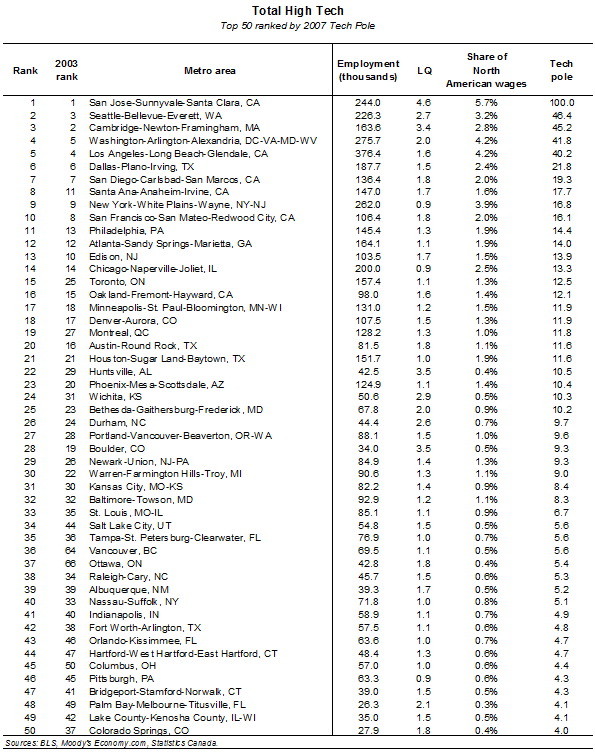
  • North America’s High Tech Economy: The Geography of Knowledge-Based Industries

    Almost ten-years ago, the Milken Institute first released America’s High-Tech Economy which cataloged technology’s central role in propelling economic growth in high-wage jobs and value-added economic activity. Shortly thereafter, the dot-com and high-tech bubbles popped, leading many to conclude that the era of tech-driven economic development was over.

    But the pessimists were wrong. A recovery in high-tech began in 2003 and served as an engine of regional growth through most of 2008. Communities with concentrations of knowledge-based industries – everything from information technology to biopharmaceuticals – have been able to create and retain high-paying jobs. And when economic growth returns, these industries will once again be at the forefront.

    In the full study, we explain the patterns of growth in 19 high tech-categories. In each category, individual metro areas are ranked according to their performance as “tech poles.” The entire study and a complete explanation of our methodology can be found in the full report, downloadable from milkeninstitute.org.

    This time around, we extended the study to include Canada and Mexico, whose economies have become ever more intertwined with that of the United States, including the high-tech sector.

    Top-Performing U.S. and Canadian Metros

    1. Silicon Valley (the San Jose–Sunnyvale–Santa Clara, California metro area) remains the preeminent high-tech cluster in North America (and the world), although it’s once seemingly enormous lead over other regions has diminished somewhat. Even so, it retains an unrivaled capacity to capture locally generated intellectual property and to convert it into economically viable businesses. Its firms regard R&D as part of their very DNA; they see innovation as their core business mission rather than as a necessity that can be given short shrift when times during recessionary time.

    In recent years, Silicon Valley has had to restructure its operations. Businesses are now more cost-conscious, outsourcing lower value-added functions while retaining the highest-valued and most creative elements. Manufacturing – in particular, manufacturing of heavily commoditized products – have been relocated. Thousands of jobs were lost, considerably more than were recovered over the past ten years.

    The Valley’s famed Sand Hill Road venture capitalists are now more inclined to go abroad to India, China and Israel to fund new enterprises and to seek partners for their portfolios of start-ups. Many foreign-born engineers, software developers and tech-savvy entrepreneurs have left the area to lead a wave of technology entrepreneurship back home. This process is better termed “brain circulation” than brain drain, as these innovators are inclined to retain strong ties to former colleagues in Silicon Valley.

    Still, Silicon Valley still ranks as first or second in six industry categories; it places among the top ten in 12 categories. Overall, its high-tech employment concentration is four-and-a-half times the metro average for North America. The San Jose metro may not dominate the technology landscape as fully as it did ten years ago, but its position is still unique.

    2. Seattle-Bellevue-Everett’s second-place position on the tech pole index should be no surprise. The metro area employed 226,300 high-tech workers in 2007, just 17,700 fewer than San Jose. Seattle owes most of its stellar ranking, of course, to software, mainly Microsoft and its spinoffs, as well as aerospace.

    Microsoft alone employs more than 33,000 workers in the metro, giving it first place on the tech pole index in software publishing. Seattle’s doesn’t just lead in software, it dominates the software landscape with a tech-pole score of 100, five times that of Cambridge. More than 23 percent of wages in North America’s software industry are paid to workers in the metro.

    In addition, although no longer the headquarters town for Boeing, much of the firm’s operations remain in Seattle along with a bevy of aerospace sub-contractors. Altogether, Seattle employed 76,100 in aerospace products and parts manufacturing in 2007. Only Wichita, Kansas, has a higher concentration in aerospace. Seattle also ranks among the top ten tech poles in telecommunications and other information services.

    3. The Massachusetts metro combining Cambridge,Newton and Framingham, is third on the tech pole index. Home to world-class research universities including Harvard and MIT, and the global leader in commercializing and transferring university research to the private sector, the metro area has an ecosystem of technology entrepreneurship that rivals Silicon Valley’s. The research intensity in the area has enabled it to be among the elite in generating and growing biotech start-ups, as well as attracting the research divisions of large pharmaceutical and biotech firms.

    Particularly notable has been the Cambridge metro which stands as the top-ranked tech pole in scientific R&D services, a category that captures much of its biotech research. Scientific R&D employed 26,000 locally in 2007; these activities are nearly eight times more concentrated in the Cambridge area than in North America overall Cambridge also ranks second on the software index, and it makes the top ten in a total of nine categories.

    4. Washington-Arlington-Alexandria is fourth among tech poles. The capital area is the North American leader in high-tech services, placing in the top ten in six out of eight high-tech service categories. Overall, firms in the Washington metro employed 275,700 high-tech workers in 2007, double the average concentration in North America.

    The presence of much of the federal government in DC generates the need for massive data-processing support and attracts defense and aerospace contractors. By no coincidence, the metro Washington leads in computer systems design and related services, where it has more than five times the average concentration found in North America. In this sector it dominates other tech poles, with twice the score of second-place San Jose. The National Institutes of Health (NIH) and its spin-offs in the biotech area aid the metro area’s performance.

    5. Los Angeles–Long Beach–Glendale ranks fifth thanks to its still-vast aerospace footprint and the emergence of the technology-intensive segment of the motion picture industry. The area has a large university research base, with world-class institutions including Cal Tech, UCLA, and USC. They provide great depth in medical research, especially in the biotech area.

    Los Angeles is the top tech pole in navigational, measuring, electromedical and control instruments manufacturing. This sector employed 36,200 local workers in 2007. Los Angeles is the headquarters of Northrop Grumman, and Boeing retains major operations in the area, making it fifth in aerospace products and parts manufacturing, with 38,000 jobs. Clearly, the inclusion of motion picture and video in our definition of high-tech industries boosts LA’s position in the rankings, but this decision makes sense in light of the field’s growing importance as a generator of value-added in high technology. Los Angeles has 32 percent of North American employment in motion pictures.

    6. The Dallas-Plano-Irving, Texas, metro division is sixth on the tech pole index. Its strengths lie in information and communications technology hardware and data processing services. Overall, high tech employed 187,700 workers in 2007, for a concentration 50 percent above the North American average.

    Dallas ranks second in telecom, and places third in communications equipment manufacturing. The metro is renowned for its Dallas-Richardson telecom corridor. And with Texas Instruments as its anchor, the metro places sixth on the semiconductor and other electronic component manufacturing tech pole index. The Dallas campus of the University of Texas has an outstanding engineering program that provides homegrown talent to local industry. Since 2003 Dallas has jumped a spot (to second place) in data processing, hosting and related services. A number of data processing centers are located here, with Electronic Data Systems as the anchor.

    7. San Diego–Carlsbad–San Marcos is home to the world’s most geographically dense biotech cluster, with a strong position in telecom hardware and services and several other fields. San Diego employed 136,400 in high-tech sectors in 2007, 80 percent above the average North American concentration. The metro area placed in the top ten in a total of four high-tech sectors.

    San Diego’s biotech network is anchored by the Scripps Research Institute, the Salk Institute for Biomedical Sciences, the Burnham Institute and the University of California at San Diego as well as dozens of mid-sized biotech firms and uncounted start-ups are located here, too. Qualcomm is the major player in the communication chips, while AT&T gives San Diego a presence in telecommunications.

    8. San Diego’s neighbor to the north, Santa Ana–Anaheim-Irvine (Orange County) is eighth on the tech pole index, a jump of three places since 2003. High tech in the area is driven largely by medical equipment manufacturing, medical and diagnostic labs as well as measuring, electro-medical and control instruments manufacturing. But the presence of Broadcom makes it a key player in communication chips, too. Orange County ranks among the top ten in seven categories and exceeds the North American concentration in a remarkable 16 categories.

    9. Part of the greater New York City area, the metro division of New York–White Plains–Wayne places ninth on the overall tech pole list. While the area is not particularly known for high-technology, it does employ 262,000 high-tech workers – tens of thousands more than Seattle. New York is second only to Los Angeles in motion pictures and video industries. It is also a key location for Internet portals, placing the area third in other information services.

    10. San Francisco–San Mateo–Redwood City just made it the top ten in 2007, slipping from eighth in 2003. The dot-com bust hit San Francisco harder than any other tech-pole. However, the creativity of its entrepreneurs and high-skill level of its workforce give the metro the capacity to constantly reinvent itself. Biotech heavyweight Genentech was initially built around local university research. It ranks fifth among software publishers with major operations of Electronic Arts and Oracle. San Francisco is a major hub of data processing, hosting, and related services, where it ranks seventh. And it ranks just behind the DC metro in high-tech services.

    11. The Philadelphia, Pennsylvania metro area was eleventh on the tech pole index in 2007, up two slots from 2003. The area hosts a number of pharmaceutical companies including Merck, Wyeth, and GlaxoSmithKline, as well as biotech firms including Cephalon. Philadelphia ranked seventh in scientific R&D services, up from 14th in 2003 thanks to biotech’s rising star. Philadelphia is strong in medical devices as well.

    12. Atlanta–Sandy Springs–Marietta’s ranking is due largely from its first-place ranking in telecommunications. AT&T’s Mobility division is the biggest local player in telecom; overall the sector employs 37,900 workers in Atlanta.

    13. Edison, New Jersey, placed third in pharmaceutical and medicine manufacturing, with 16,800 workers. Major players include Bristol-Myers Squibb and Johnson & Johnson. Edison is a top-ten performer in telecommunications as well.

    14. The Chicago, Illinois portion of the Greater Chicago metro ranks among the top ten in telecom and computer systems design and related services. Altogether, some 200,000 local workers were employed in high-tech industries in 2007. The two biggest high-tech firms: Motorola and Abbott Labs.

    15. Toronto is Canada’s highest-ranking tech center, coming in 15th in North America.. And with 157,400 high-tech sector jobs it ranks tenth in terms of absolute size. Private-public research collaborations involving the University of Toronto and McMaster University have propelled the metro’s emergence as an attractive place for biopharmaceutical firms. Major players include GlaxoSmithKline and Apotex. Toronto is Canada’s leading center of computer systems design and related services, a category in which it ranks eighth in North America. The metro area has nurtured a thriving film cluster as well.

    16. Oakland-Fremont-Haywood isn’t in the top ten finish in any of the 19 categories, it exceeds the average high-tech job concentration in 16 of them. Major tech employers include Oracle and Sybase.

    17. Minneapolis–St. Paul–Bloomington owes its position to medical devices giants Medtronics and Boston Scientific. Overall, Minneapolis has a higher than average concentration of high-tech jobs in nine categories.

    18. Denver-Aurora ranking comes in large part to its fourth-place finish in telecom. Qwest Communications is the largest employer in the metro area.

    19. Montréal is Canada’s second metro to make the top twenty, and it’s up eight spots since 2003. Montréal boasts more than 127,000 high-tech jobs, with aerospace as a primary driver. Bombardier is headquartered here, contributing nearly 21,000 aerospace-related jobs, but Pratt & Whitney also has a large presence. Montréal’s aerospace cluster is supported by its formidable research capacity, a mix of four major universities and 197 research centers.

    20. Austin–Round Rock, arguably the quintessential 21st-century knowledge-based community, rounds out the top twenty. Among high-tech industries, its highest concentration is in computer and electronic product manufacturing. Dell is headquartered here. But it is also favored by major presences of IBM, Applied Materials, Advanced Micro Devices, Flextronics and Samsung Austin Semiconductor.

    Mexican States
    To create a set of North American rankings that included Mexico, we had to utilize data at the state level rather than the metro level. Mexican data was only available through 2003, so we include it in the North American rankings only for that year. Note that use of state-level data pushes up total employment and wages, but also reduces the overall concentration of jobs in each sector.

    Baja California, the state that makes up the northern half of the Baja California Peninsula and include the cities of Tijuana, Mexicali and Ensenada, is the top-ranking Mexican state in the tech pole index. Placing 15th in North America (in 2003), it employed 104,000 in high-tech sectors.

    Foreign firms have been attracted by the Maquiladora Decree of 1989 that granted them a variety of incentives to manufacture in border areas for the purposes of export. Most products from these factories are intended for export to the United States or Canada so they are located in zones close to the U.S. border . The region was the top tech pole in audio and video equipment manufacturing.

    Baja’s concentration of employment in electronic components actually exceeds that of San Jose, although it is largely made up of lower-wage production line jobs. This may also be the case in medical equipment and supplies manufacturing, where Baja leads North America in with 22,200 jobs, 16 times the average concentration. Overall, Baja California has more than three times the average North American job concentration in high-tech industries.

    The Distrito Federal or DF which encompasses Mexico City and its immediate surrounding area, was the second-ranking Mexican state, placing 20th overall in North America in 2003. The DF was the top tech pole for telecommunications in North America in 2003, thanks largely to the location of giant Telefónicas de México (Telmex). The concentration of telecommunications in the region is nearly three-and-one-half times greater than average in North America and telecom employment (82,100) was nearly double that of second-ranking Atlanta.

    The DF ranked sixth in pharmaceutical and medicine manufacturing in North America, with 33,700 local workers – 13,000 more than the second-highest ranking North American metro.The ability to export Mexican film and television products to other parts of Latin America as well as a large home market has given the industry cluster around Mexico City a comparative advantage. Employment is actually the third largest of any of the locations on the list. Total high-tech employment in the DF is 17 percent more concentrated than the North American average.

    Ross C. DeVol is Director of Regional Economics and the Center for Health Economics at the Milken Institute. He oversees the Institute’s research efforts on the dynamics of comparative regional growth performance.

  • Is Your City Safe From The Tech Bust?

    A decade ago, the path to a successful future seemed sure. Secure a foothold in the emerging information economy, and your city or region was destined to boom.

    That belief, as it turned out, was misguided.

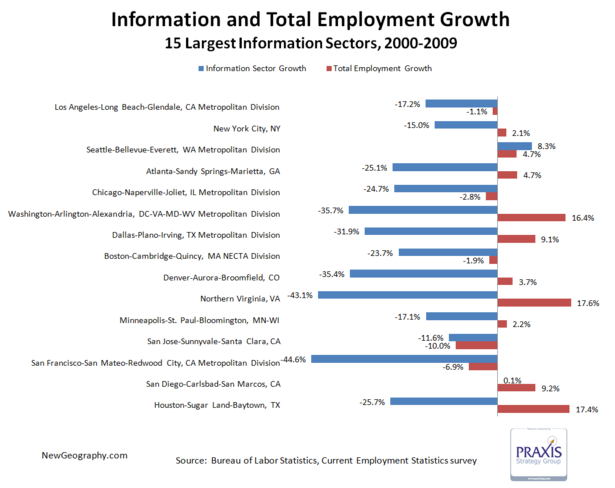
    In the decade between 1997 and 2007, the information sector–which includes jobs in fields from media, publishing and broadcasting to computer programming, data processing, telecommunications and Internet publishing–has barely created a single new net job, while some 16,000,000 were created in other fields.

    The biggest losses have been in the telecommunications sub-field, which has shed 400,000 jobs nationwide since its peak in 2000. Not surprisingly the media and publishing industries have also lost ground, while employment in other arenas such as motion pictures, software and data-processing have remained stagnant for much of the decade.

    Equally critical, it seems clear that simply being a high-tech magnet does not make a region a prodigious job creator. The San Jose metropolitan area, better known as the heart of Silicon Valley, boasted over 960,000 jobs in 1997. Last year, even after the ballyhooed Version 2.0 of the dot-com boom, that number had actually declined–to barely 900,000. According to figures from economic-strategy firm Praxis Strategy Group, other traditionally tech-heavy areas, including San Francisco and Boston, also did poorly in terms of growth through the balance of this decade.

    Perhaps most disturbing, many areas are also losing their share of the information industry. For example, the information-sector job count, notes the Public Policy Institute of New York, has actually been stagnant or in decline in places like New Jersey, Connecticut, Illinois, Massachusetts, Minnesota and New York.

    The same pattern also affects so-called “cool” cities that were supposed to be ideal for high-tech jobs, according to a recent study by my colleagues at Praxis. The biggest declines in information jobs since 2000 have occurred in San Francisco (which lost 31,800 jobs), Northern Virginia (35,200) and Washington, D.C. (40,700).

    Silicon Valley dropped 5,400 positions since 2000, which amounts to 11.6% of all its information-sector jobs. The only bright spot for blue states is in Washington, where growth is driven by big employers Microsoft and Boeing. Los Angeles, buoyed by the relatively stable entertainment sector, has also managed to hold its own.

    Faced with all these cities that are merely struggling not to lose any jobs, just where is the tech-sector growth? It’s in less-celebrated areas of the country, like Idaho, New Mexico, North Carolina, Nevada–and in parts of Florida, South Dakota and South Carolina. By region, the fastest gainers turned out to be places like Orlando, Fla. (with 2,176 new information jobs since 2000), Madison, Wis. (2,400), Boise, Idaho (1,500), Wilmington, N.C. (1,267) and Charleston, S.C. (1,033).

    What distinguish most of these places are factors beyond prominent employers. These could include such prosaic things as tax rates (particularly on incomes), the cost of housing and the overall climate toward business. Information-sector jobs, it turns out, follow the basic rules of economic development seen in other industries.

    Of course, this is not to say tech jobs don’t matter. As the Milken Institute’s Ross DeVol argues in his new study of high-tech centers, technology jobs pay better than most, and their presence can boost other parts of local economies. And although they may not be multiplying fast, in some centers, like Silicon Valley, Boston and Southern California, whatever employment already exists has enough inertia to allow them to remain the largest tech centers in the country.

    Yet the problem is that the information economy, by itself, simply doesn’t reliably spur broader economic growth. That may be due to changes within the sector itself. From the 1980s to the mid-1990s, tech firms largely focused on creating productivity-enhancing products. Many of them also used on-shore manufacturing. Aerospace was a smaller industry, but it was still vital.

    These catalysts helped create dynamic companies that both employed large numbers of people directly and used contractors (whose numbers increased). The Silicon Valley I reported on in the mid-1980s housed an essentially industrial economy with many good jobs for middle- and working-class people. It was both a hotbed for pioneering entrepreneurs and a society that offered and encouraged opportunity.

    Today, however, tech has become increasingly software- and media-oriented. New companies tend to emerge from a small pool, and they are financed by a relative handful of local venture capitalists. Once launched, they may conduct some research and development at home, but marketing and customer service are either off-shored or moved to remote locations like the Great Plains or the “Intermountain West,” between the Cascades and the Rockies.

    As a result, even star companies like Google create a far smaller number of jobs than predecessor firms like Hewlett Packard, Intel or IBM. And even newer companies like venture darling San Francisco-based Twitter may go public, valued at $250 million or more, with only 45 employees.

    This, of course, represents very good news for a select few: investors and a handful of highly educated software engineers. But the Bay region’s broader economy and society isn’t as lucky.

    That’s because most segments of the information sector that do create lots of jobs tend to take place elsewhere. For example, when Intel considers opening a new chip plant, which could open up 7,000 new positions, it won’t build it in the Valley of its birth but rather in farther-flung locales like Oregon, Arizona and New Mexico. California has become too expensive; businesses there are heavily regulated and taxed for most industrial activity.

    So maybe it’s time to unlearn some of the assumptions we developed during the first tech boom. In the 1990s and early 2000s, many held that the information revolution would tame the business cycle, guarantee constant high returns and create widespread prosperity. Now we know better.

    The model of Silicon Valley, as DeVol suggests, cannot be easily duplicated. Another well-promoted formula, linking great universities to up-and-coming hip cities for the so-called “creative class,” has proved very limited when it comes to creating new jobs. And, anyway, trends in tech growth suggest that basic economic conditions like general affordability, taxes and the regulatory environment play an important role.

    Just as troubling may be the class divisions on display in places like Silicon Valley. As manufacturing and middle management jobs have fled, its capital, San Jose, has become more of a backwater. As local blogger Adam Mayer has pointed out, San Jose increasingly serves as a dormitory for the bottom-feeders of the Silicon Valley food chain.

    In contrast, tech power and influence is shifting to those areas that have always been well-to-do and are likely to stay that way–academically-oriented places like Cambridge, Palo Alto and San Francisco. They are becoming ever-more-exclusive reserves for the restless young and those with the greatest talent within the media and software industries. Meanwhile, the service class commutes in from the surrounding periphery to tidy up and run restaurants, while high housing costs and an overall lack of opportunities for other kinds of workers drive away much of the middle class, particularly families.

    In geographic terms, the real losers in this brave new tech world may be the communities on the fringes of those high-end tech areas. Take Lowell, Mass. Lowell, a former mill town widely celebrated for its tech-led revival in the 1980s, has seen little job growth since the late 1990s. But why pick Lowell, when it’s far cheaper and easier to expand in Boise or, even better, Bangalore, India?

    The time has come to let go of vintage fantasies about tech that date from the 1990s. Key regions–and the country as a whole–need to understand that the information sector is best seen not as an end in itself but as an industry that derives its value from how it works with other parts of the economy, such as finance and business services, agriculture, energy, manufacturing, warehousing and engineering. (Manufacturing alone employs 25% of the U.S.’s scientists and 40% of its engineers–and their related technicians.) We have to nurture a broad industrial base so that innovations in this sector do not simply end up boosting off-shore industry.

    Techies won’t save us from the folly of deindustrialization; in essence, we can no longer believe that it’s possible to Google our way to prosperity.

    This article originally appeared at Forbes.

    Joel Kotkin is executive editor of NewGeography.com and is a presidential fellow in urban futures at Chapman University. He is author of The City: A Global History and is finishing a book on the American future.

  • San Jose, California: Bustling Metropolis or Bedroom Community?

    Dionne Warwick posed the question more than 40 years ago, yet most Americans still don’t know ‘The way to San Jose’. Possessing neither the international cachet of San Francisco nor the notoriety of Oakland, San Jose continues to fly under the national radar in comparison to its Bay Area compatriots. Even with its self-proclaimed status as the ‘Heart of Silicon Valley’, many would be hard pressed to locate San Jose on a map of California.

    More well-known American cities may try to gain population by branding themselves as interesting places, but San Jose does not struggle to attract newcomers. Sprawling over 178 square miles, San Jose sits at the southern end of the San Francisco Bay. This year the city exceeded the 1 million population mark for the first time.

    So what makes this city, the 10th-largest in the United States, appealing? Unlike its precious neighbor 50 miles to the north, San Francisco, people move to San Jose primarily for jobs – especially those related to the coveted technology sector. Whereas San Francisco balances its role as playground for the independently wealthy and welfare state for the lumpenproletariat, San Jose remains favored among families and those looking for a safe environment in which to raise children – not to mention, the weather is better.

    San Jose does not stimulate a sense of urban exaltation. Aside from a commercial downtown core with a collection of mediocre high-rises (limited in height due to do downtown’s adjacency to the San Jose Airport), the city is unapologetically suburban in a character.

    San Jose’s pattern of development can be traced back to its origins as an agricultural community supporting early Spanish settlers who chose to settle in the fertile Santa Clara Valley. It remained a modest-size agrarian community until the end of World War II when it underwent a period of rapid expansion-not unlike that of Los Angeles to the south. During the 1950s, with the emergence of semiconductor technology derived from silicon, San Jose and the greater Santa Clara Valley exploded into a center for the evolution of computer technology.

    Today, San Jose can best be understood by its ambivalent relationship with neighboring Silicon Valley cities. Mid-size suburbs such as Cupertino, Sunnyvale, Mountain View and Palo Alto, all located west/northwest of San Jose as one travels up the peninsula towards San Francisco, are very distinct and separate entities. Home to some of Silicon Valley’s heaviest hitters (Cupertino has Apple, Sunnyvale has Yahoo!, Mountain View has Google, Palo Alto has Hewlett-Packard, Facebook and Stanford University), these cities largely define the technology-focused region. To be sure, San Jose’s has its share of big players, including eBay and Adobe as well as the ‘Innovation Triangle’, an industrial area of north San Jose, home to the headquarters of large companies like Cisco Systems and Cypress Semiconductor.

    Yet, despite the presence of these firms, San Jose has become ever more a residential community, with among the worst jobs to housing balances in the region. Furthermore, a whopping 59% of the city’s developed land constitutes residential use – 78% of that being single-family detached housing. In this sense, despite being the largest city, San Jose essentially serves as a ‘bedroom community’ for the rest of Silicon Valley.

    This has been a burden for the city, which, unlike its neighbors, lacks enough large information technology companies to help fill their tax coffers. In contrast job rich ‘green’ cities like Palo Alto have remained staunchly ‘anti-growth’ regarding residential development and consequently have very high housing prices.

    This pattern poses fiscal problems for San Jose. City officials have long been aware of the need to stimulate economic development instead of continuing to lose out to its neighbors but the city seems determined to increase further its role as dormitory for its neighbors. Indeed, amazingly the city’s development agenda has in recent years shifted to a relentless focus on high-density, multi-family residential in the downtown core and along transit corridors. In 2007, 79% of all new housing built in San Jose was multi-family – a staggering deviation from its history of low density development.

    Though well-intentioned, the slant towards densification has yielded a glut of empty condo units throughout the city. Those that have purchased units in new developments often find themselves with underwater mortgages. During a recent visit to one the flashy new downtown condo buildings, The 88, I entered a desolate sales office and was greeted by a skittish sales agent. When asked how sales were, my question was deferred without a direct answer in an act of not-so-quiet desperation.

    Although it’s clear most people in San Jose prefer lower density living, the city government continues hedging tax dollars against a future in which newcomers will want to live in a high-density setting. Outside of downtown, low to mid-rise multi-family housing has been built along the city’s light-rail lines in what are conceived to be ‘transit villages’. The popularity for such a lifestyle is questionable given the high price point and unreasonable HOA dues of these condo units, particularly when single-family detached houses can be purchased at comparable prices.

    Despite these issues, San Jose seems hell-bent on its path towards densification. The city has major plans to develop the area around its Diridon Train Station, just west of downtown, as California High-Speed Rail and BART are projected to make their way to San Jose. Furthermore, the city government is counting on the Oakland A’s baseball team making a move to San Jose.

    From the Champs-Élysées to Tiananmen Square, grand urban visions are what have defined cities historically. As a product of the Silicon Valley ethos as well as an observer of planning trends, I would argue that this is no longer valid – especially for any city with the hopes of a prosperous future. Rather, in democratic societies, it will be the idiosyncrasies of individual actors and the prospect of upward mobility that will define a sense of place.

    Obsessed with density and urban form, planners don’t seem to grasp the chicken and egg conundrum – the notion that lifestyle amenities follow on the heels of economic opportunity. San Jose needs to cast its future on nurturing its entrepreneurs instead of trying to become something it is not yet ready to become.

    Adam Nathaniel Mayer is a native of the San Francisco Bay Area. Raised in the town of Los Gatos, on the edge of Silicon Valley, Adam developed a keen interest in the importance of place within the framework of a highly globalized economy. He currently lives in San Francisco where he works in the architecture profession.

  • Project Development: Regulation and Roulette

    The site plan logically should be the key to approval of a development project. Yet in reality, the plan is secondary to the presentation. My conclusions are based upon experience with well over a thousand developments over four decades, most in the mainland USA. And what I’ve observed is that the best site plan is only as good as the presentation that will convince the council or planning commission to vote “Yes” on it. No “yes” vote, no deal, no development.

    Each presenter deals with the dog-and-pony show in his own way. There’s an endless variety of styles (or lack of styles). All of these public meetings have one thing in common: The neighbors (if there are any) will be there to oppose the new development.

    Not Too Long Ago…
    In the old days there were three factions: The developer presenting the plan, the neighbors opposing the plan, and the council listening to both sides. If the development was high profile, someone from the local press might also show up. The planning commission and council are fully aware that all plans will be met with neighborhood opposition, and they will have to listen to lengthy complaints along the route to approving (possibly) the plan.

    In the past, the citizens sitting on these boards would most likely dismiss Elwood and Betsy Smith’s complaint about how a development in their back yard would invade their privacy, and would vote in favor of the new master planned community instead.

    How It’s Different Today
    Today there is often an additional audience. Televised meetings provide an entire region of neighbors. The on-screen council listens to the neighbor’s objections, no matter how absurd they may be, then answers directly to the camera, showing the general community watching at home that they really care about every citizen’s opinion. The council member must never appear too much in favor of the developer, as that could be misconstrued as not caring about the citizens he or she represents. A televised Council member hears the Smith’s complaint with a very concerned on-camera look, explains how maybe we have too many new homes in this town, and proceeds to tell viewers that the developer might want to consider a buffer and a drop in density. Concerns have changed from developing economically sensible neighborhoods to “please elect me Mayor when I’m on the ballot”.

    Planning Outside The USA
    Our first large site plan done outside the States was in Freeport, Bahamas. In 2000, when we were first contacted to design Heritage Village, we asked about doing presentations to the city council and planning commission to help move the approval process along. We were told that the development company and the regulating entity were the same, and if they liked the plan it would be built! That is exactly what had happened.

    Our next attempt outside the USA was not so easy. In Mexico City when we asked to sit down with government officials to change policy to create better neighborhoods, the developer said… No. At the time, we did not understand why it was so critical that we were not to suggest changes.

    We Discover A Superior Foreign System
    We wrongly assumed that all planning outside the USA could have similar problems, with restrictions that were absurdly prohibitive for designing great neighborhoods. It was only when we worked in Bogota, Columbia last year that we had the opportunity to work within a system that may not be so backwards after all. Our request to meet with the authorities to show them new ways to design neighborhoods was met, as it had been in Mexico City, with an absolute… No.

    We then asked for an opportunity to present the plan, and were told that was not necessary. Being that it was Columbia you can imagine our first thoughts. Cartels? Maybe corruption? The reality was much simpler. Since our plans met the minimums (they actually exceeded them), they were automatically considered approved. Imagine that – no neighbors to complain! If everything conforms, it should be approved … right? Just plain common sense.

    Zoning-Compliant Projects Should Be Exempt From Public Meetings
    When you think about it, why wouldn’t this work in the USA? if the development plan being submitted meets or exceeds the zoning and the subdivision regulation minimums, why does it need to go through any public approvals at all? The American developer often faces months or years of delays, enormous interest payments, and tens or perhaps hundreds of thousands of dollars spent on consultants and legal help to re-create plans that conform. Those massive sums could go towards making better neighborhoods, better architecture, better landscaping, less environmental impacts, and more affordable housing.

    We’d Still Need Public Meetings
    The public would still have plenty of input on regulation and zoning exemptions, where public citizen input is valuable. If a developer is proposing something that goes below minimums or does not conform to zoning regulations, then it is reasonable to go through the more time consuming process that we currently have. This brings up the question of how the developer would introduce something different to the written law. This could be a problem under typical PUD (Planned Unit Development) regulations, which typically allow blanket changes to the minimums when alternative designs are not covered by typical zoning.

    This PUD Pandora’s box, once opened, can have devastating results if the regulators and the neighbors both agree that the plan is simply not good enough. The developer thinks the plan is just dandy as is, but in reality most PUD proposals are simply too vague to be functional. A battle of wills that can last years often ensues.
    In the end , these expensive delays increase lot costs, and the home buyer ultimately pays. If a special ordinance such as PUD, Cluster Conservation, or Coving was specifically spelled out in a rewards-based — instead of a minimums-based — system, developers could get benefits for great plans complete with open space and connectivity, typically density and setback relaxations.

    While writing Prefurbia, we began to ask ourselves, how did we take something so simple and let it get so out of control? The third world countries are progressive enough to actually allow developers who comply with the rules to quickly build their neighborhood. Maybe they are not so far behind us after all.

    Perhaps our regulations and planning approach is intended to keep the system “busy” with billable hours. Imagine if we could get a conforming plan stamped, and the next day construction could begin. How many billable hours would be eliminated, how much construction cost and land holding interest saved? That would be very hard to calculate, but it’s likely significant.

    “It is difficult to get a man to understand something when his salary depends upon his not understanding it…” Al Gore, An Inconvenient Truth

    The inconvenient truth won’t win us many friends in the consulting industry whose incomes depend upon generating billing time in meetings. But can we afford to continue down the path we are presently on? We need to take a hard look at the regulations. Are they written solely to provide the highest living standards? Or do they generate the highest billable hours for the consultants who propose them?

    Rick Harrison is President of Rick Harrison Site Design Studio and author of Prefurbia: Reinventing The Suburbs From Disdainable To Sustainable. His websites are rhsdplanning and prefurbia.com.

  • The Changing Landscape of America: The Fate of Detroit

    INTRODUCTION

    During the first ten days of October 2008, the Dow Jones dropped 2399.47 points, losing 22.11% of its value and trillions of investor equity. The Federal Government pushed a $700 billion bail-out through Congress to rescue the beleaguered financial institutions. The collapse of the financial system in the fall of 2008 was likened to an earthquake. In reality, what happened was more like a shift of tectonic plates.

    In 1912 a German scientist, Alfred Wegener, proposed that the continents were once joined together as one giant land mass called Pangea.

    About 200 million years ago the continents began to drift apart as the globe separated into eight distinct tectonic plates. History will record that the financial tectonic plates of our world began to drift apart in the fall of 2008. They have not stopped moving and the outcome of where they will end up remains uncertain.
    PART ONE – THE AUTOMOBILE INDUSTRY

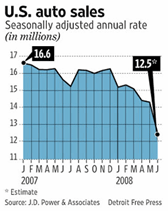
    Edsel, Packer, Studebaker, Hudson, Nash, AMC – the demise of these brands may have seemed tragic at the time, but were actually a sign of industrial health. In contrast, for the last fifty years the American automobile industry has been static. Despite the proliferation of Japanese, Korean and German imports, General Motors, Ford and Chrysler managed to hold on to a majority of the domestic market, with a dizzying stable of makes and models that grew to near 17 million new car sales in 2007. That epoch is now over. The tectonic plates have shifted under the automotive business and a year from now, the industry will bear little resemblance to the static structure of the last fifty years.

    Fifty years ago General Motors owned more than 50% of the American market and automobile jobs made up one seventh of the US workforce. It was said that when GM sneezed the US economy caught a cold. GM shares now sell for less than a cup of coffee at Starbucks. Now GM is about to enter bankruptcy.

    The brands are dissolving, Oldsmobile was the first casualty. Pontiac and Hummer have been discontinued. When they reorganize, eleven hundred dealers will be terminated. General Motors will close all its plants for three months this summer. Many will never reopen. The New GM, to be known as Government Motors, will be owned by the UAW (20%) and the Federal Government (70%). Twenty billion of tax-payer loans will be converted to ownership to make the UAW pensions liquid. The debt holders will see their senior $27 billion investment converted into just 10% of stock. The shareholders will be wiped out.

    The New GM will become the platform for small fuel efficient cars, hybrids, electric vehicles and experimental technologies mandated by an ever demanding government. Its shareholders vanquished, The New GM will bear no resemblance to the car company that we have known for the last 50 years. Can the Chevy Volt rescue GM? The answer is no.

    GM will continue to shrink as their SAAB and Saturn franchises are sold off to the Chinese. China’s automobile sales are up 10% this year versus declines of 23% in the US and 15% in Europe. Chinese automobile manufacturers are grabbing market share, 30% this year versus 26% in 2008, while their competitors are distracted. Chinese companies unknown to Americans like Geely Motors, Chery Automobiles or BYD Co. will buy SAAB or Saturn for their dealer network. Warren Buffett invested $230 million into BYD, a firm that has been manufacturing cars for just six years. They already provide batteries to Ford and GM and soon will be building the world’s least expensive mass produced hybrid and electric vehicles. Geely plans to triple its domestic sales to 700,000 by 2015 and Chery plans to introduce 36 new models over the next two years.

    Chrysler is in far worse shape and will likely never recover. The Federal Government already forced it into bankruptcy. Seven hundred and eighty nine dealers have been told that their franchises are terminated. Its shotgun marriage to Fiat will look more like a surgical amputation of unnecessary body parts than a marriage. If Fiat remains in the game, they will do so for the Jeep brand and a portion of the dealer network. Like Oldsmobile and Pontiac, Plymouth and Dodge brands are doomed as well as most of the Chrysler line. No one will mourn the demise of the Crossfire, Pacifica, Sebring, or the PT Cruiser. Fiat should keep the new Chrysler 300, a beautiful design that deserves to be built. Chrysler has not produced many stars in the last few decades. The trail blazing design of the 300 brought the full size sedan back from the dead.

    Chrysler will jettison the weakest of its dealers in bankruptcy. Fiat will retain the big dealers in the network. They will bring the stunning and iconic Fiat 500 to America, a fuel efficient small car that will enjoy the same success as Volkswagen’s retro Beetle. Fiat will also use the dealer network to bring the Alfa-Romeo back to America. The Fiat-Jeep-Alfa dealer of the future will bear no resemblance to the staid Chrysler-Dodge-Plymouth dealer of today.

    The surprising winner among the American troika of manufacturers is the Ford Motor Company. Ford and Lincoln will survive because they took no government bail-out money. Mercury may not survive but Ford and Lincoln should make it through the transition. The new Ford-Lincoln will be the refuge for auto enthusiasts who want attractive fast and powerful cars. Ford will become the Apple of the auto business, doing its own thing and flaunting political correctness and conventional wisdom. Ford’s namesake CEO has been an environmentalist for many years so Ford was well into fuel economy and hybrids before the tectonic plates began to move last fall. At just $5.00 per share, Ford is a tantalizing buy for the long term.

    One can no longer call Mercedes, BMW, Toyota and Honda imports as many of their cars are made entirely in the U.S. The Japanese system is different than the American counterpart although we are drifting toward their model. The Japanese government plays a heavy hand in their industry, subsidizing the encroachment into new markets until the brands have stabilized market share. But they are not immune. Toyota lost $7.7 billion in the last quarter – even more than GM.

    True imports like Volkswagen will weather the storm because they were well positioned with small fuel efficient cars long before the tectonic plates began to shift. VW is making a huge bet that oil will top $100/barrel again soon and their fuel efficient and clean diesels will be accepted by American drivers.

    The biggest winner is obviously the UAW and their pensions which have been bailed out with tax payer money by an administration beholden to its labor supporters. Who will be the biggest loser? Clearly, it will be America’s small towns. Our small towns will lose their local dealer and their choice in automobiles. They will be forced to buy the brand that remains in town or drive scores of miles to the next closest dealer for service. Most small town auto dealers were also the most generous members of the community. Charitable giving and support will wither as will local sales tax revenues when the big ticket automobile sales tax revenues disappear. Ironically, as the plates continue to shift, America’s small towns could be decimated by the changes in the automobile industry as they were one hundred years ago when the automobile shifted millions from rural communities to the cities.

    A year from now the landscape of America will be forever changed but the plates will continue to shift. Five years from now, will American ingenuity bring about a renaissance of the American automobile industry? Or, will what is left of this industry be gobbled up by the Chinese and the Korean manufacturers as the Japanese did in the 70s and 80s? The key issue may be what role the government will play. Will Americans buy cars designed by government bureaucrats and built by the unions that own the factories? Will an administration devoted to “coercing” Americans out of their cars be able to simultaneously save the auto industry?

    ***********************************

    This is the first in a series on the Changing Landscape of America. Future articles will discuss real estate, politics, healthcare and other aspects of our economy and our society. Robert J. Cristiano PhD is a successful real estate developer and the Real Estate Professional in Residence at Chapman University in Orange, CA.