Category: Urban Issues

  • Honolulu Rail: From $4.6 B to $8.6 B in Eight Years. Now What?

    With its official cost now having risen to $8.6 billion and a funding gap of $1.8 billion, both of which are certain to rise, Honolulu’s rail project will run out of money before construction reaches the downtown area, perhaps even before it reaches Middle Street.

    The Federal Transit Administration says it will demand a return of all federal money if rail does not reach Ala Moana Center, which is possible only if the state Legislature or Honolulu City Council increase taxes dramatically:  An average family of five would have to pay more than $1,000 per year just to complete rail, according to the Tax Foundation of Hawaii. Once completed, the annual cost of operating and maintaining a safe and reliable rail system would require comparable tax payments each year for the lifetime of the rail system.

    State and city lawmakers are reluctant to raise taxes so dramatically, but abandoning the project at this late date would make those who had been supporting it look like idiots.  They must be asking themselves, “How did we get ourselves into this mess?”

    Almost immediately after being elected in 2004, Mayor Mufi Hannemann announced that he wanted a steel-on-steel rail system rather than the bus rapid transit (BRT) that his predecessor had proposed. Hannemann envisioned a 34-mile route that would cost $2.7 billion. By the time it was put to a vote in 2008, the route had shrunk to 20 miles and the projected cost was up to $4.28 billion.

    Some of the 50.6% of voters in that election who authorized the city to build a steel-on-steel system might have been influenced by claims that two-thirds of the $4.28 billion construction budget would be paid by tourists and the federal government; that rail construction would create 10,000 new jobs for local residents; and that traffic congestion would be significantly reduced once rail was operational.

    Though HART’s latest official cost estimate is “only” $8.6 billion, construction costs are expected to skyrocket to upward of $10.8 billion; local residents will end up paying more than two-thirds of total construction costs; the actual number of good jobs for local residents was a tin percentage of the promised number; and that the impact of rail on traffic congestion will be similarly miniscule.

    Had it not been for the media, the public would still be in the dark about the massive cost overruns. According to the Honolulu Authority for Rapid Transportation website, the cost overrun is a myth:

    “It’s important to understand that HART’s existing contracts are on budget and we continue to have a healthy contingency fund of more than $500 million. So far, about 60% of HART’s contracts have been awarded. The construction of the first 10 miles of guideway is underway, the Rail Operations Center is about 70% complete, and HART’s fleet of 80 rail cars is under production and the first cars are expected to arrive here in early 2016.”

    The kindest word we can think of for that explanation is propaganda.

    That so much money has already been spent is reason enough to keep going, according to HART and other rail supporters: If construction stopped now, all that money would have been wasted! 

    They think the funding problem can be solved quickly and easily by the Legislature extending the 0.5% rail surcharge one more time. That would cost island residents a mere “half a penny on each dollar spent,” according to HART.

    This kind of thinking is muddled, at best.

    The Honest Way to Approach Rail

    The rational way to approach the rail question begins with three simple questions:

    • How much more money would local taxpayers have to pay to construct and maintain a safe and reliable rail system?
    • What would be the benefit of having such a system?
    • What alternatives could be pursued if we were to stop rail now, and what would be the benefit of those alternatives?

    Honesty should be presumed only if the factual inquiry and decision-making processes are transparent so the public can see how the answers were reached.

    The $3.5 billion spent thus far is gone under any circumstance. If construction is continued, the total construction cost could reach $10.8 billion, according to the Federal Transit Administration. Although no one knows what the total actual cost would be, there is no rational basis for starting the decision-making process with an optimistic projection.

    If rail is completed, the annual operating cost will exceed $100 million. A comparable amount would also need to be set aside each year to ensure that the system remains safe and reliable. Based on the average life of system components elsewhere, the combined amount would be at least $200 million per year.

    Even if that kind of money were readily available, one wonders exactly what the benefit of rail would be. City and HART officials now acknowledge that traffic congestion would be “worse in the future with rail than what it is today without rail.” That quote comes from the Final Environmental Impact Statement and a letter from the city’s transportation director.

    City and HART officials will quickly add that traffic in the future with rail would be better than traffic in the future without rail, which is necessarily true only if one assumes, as they do, that the alternative to building rail is do nothing (the so-called no-build option). That is a false choice, intended to obfuscate rather than illuminate.

    There are ways to reduce today’s level of traffic congestion, such as by aggressively adding new traffic lanes to existing roads, as has already been done successfully on each side of the central part of H-1 freeway. Installing flyovers and bypasses in chokepoint areas like the Middle Street merge and adding new contra-flow and bus-on-shoulder options would also make a major difference.

    Each of these is a proven strategy that, unlike rail, would directly benefit all commuters.

    Major improvements could also be made to Honolulu’s award-winning bus system. This includes increasing the number of express buses that go where commuters want to go, rather than eliminating most of them, as is part of the rail plan.

    All of these strategies could be accomplished for less than half the money saved by terminating rail now. Rail supporters point out that the above strategies could be pursued along with rail, but that assumes a tax base that never goes dry. The cost of living in Hawaii is already exceptionally high and there’s a limit to how hard island taxpayers can be squeezed.

    Rail Surcharge Burdens Island Residents

    Hawaii’s general excise tax is a tax on sellers of just about everything in this state, including groceries, services, and business-to-business transactions. Consumers are generally aware of only the portion that is shifted to them at the point of sale. A much larger portion is invisible to consumers but is borne by them anyway because it gets up embedded in the price of things consumers have to buy in Hawaii.

    This hidden portion of the excise tax burden is surprisingly large for several reasons, including that taxes paid on business-to-business transactions pyramid. A national expert wrote in the first Price of Paradise book that it would take a sales tax rate of up to 16% to replace the revenue generated by the 4% excise tax at that time.

    Because of subsequent changes in the taxation of business-to-business transactions, the current equivalent rate is roughly 11%. The point is that Hawaii’s general excise tax is quite different from conventional sales tax systems, which is why the above-mentioned expert cautioned that comparing a conventional sales tax to Hawaii’s general excise tax is like comparing a firecracker to a hand grenade.

    The point that needs highlighting is that the burden of Hawaii’s general excise tax is largely hidden from view.  Consumers pay it in the form of higher prices on virtually everything they have to buy in Hawaii.

    The 0.5% rail surcharge currently raises about $250 million each year. According to data from the tourist agency, slightly less than 15% of that amount is being paid directly by tourists. The remaining 85% averages out to $212 per man, woman and child on Oahu, which is slightly more than $1,000 each year from an average family of five.

    HART calls this number a “myth.” It contends that the average cost to each local resident is much less, but does so on the unspoken assumption that consumers bear the burden of the rail surcharge only when it is identified at the point of a purchase, and that the rest of the rail surcharge is never borne by consumers. This approach is intellectually dishonest.

    Any form of rail tax that extracts a quarter-billion dollars from our local community each year (as does the current rail surcharge) creates a quarter-billion-dollar burden. In this case it would be a quarter-billion dollars each year to build the rail, and then nearly that much each year — forever — to operate and maintain a safe and reliable system, including the cost of major rehabilitation every decade.

    In addition to being borne by consumers, the general excise tax is notoriously regressive — that is, disproportionately burdensome to people with relatively low incomes. The concept of regressivity is not simple, but anyone who contends that Hawaii’s general excise tax is not regressive, or that a regressive tax is not disproportionately burdensome to people with relatively low incomes, is either ill-informed or dishonest.

    Pro-rail supporters have argued that a general excise tax surcharge is the best way to fund rail despite being regressive, because a third of it is borne by tourists. Studies differ on the exact percentage of excise taxes ultimately borne by tourists (including by purchasing things made more expensive because of unstated excise taxes), but they generally agree that the share of the burden borne by tourists would be roughly the same, perhaps even greater, if the property tax were used to fund rail, rather than the excise tax. They also show that the property tax is significantly less regressive than is the general excise tax.

    Our elected officials should be honest about this:  General excise taxes rather than property taxes are being used to fund rail simply because they are less noticeable. It would take a 29% increase in everyone’s property taxes to replace the revenue generated by the 0.5% rail surcharge. The political fallout from such an increase would be dramatic.

    We doubt that an average family of five would quietly continue paying $1,000 per year for the rest of their lives for a non-solution to an obvious traffic-congestion problem.

    Members of the state Legislature could stop the madness by repealing the 0.5% rail surcharge, which would put members of the City Council to the test: Do they want rail badly enough to take the political heat for imposing an immediate and permanent 29% increase in property taxes?

    Because candidates for the Legislature and Honolulu City Council are currently seeking political support, now is a perfect time to ask them these questions:

    • Will a particular candidate for the Legislature vote to end the rail surcharge?
    • Will a particular candidate for the City Council vote to replace any such lost revenue by raising property taxes by 29%?

    There’s one additional question for the media: Why not publish every candidate’s position on the funding of rail? After all, rail was by far the largest public works project in the state’s history even before the costs skyrocketed.

    A version of this story originally appeared at Civil Beat.

    About the Authors
    Cliff Slater  Cliff Slater is a businessman who founded Maui Divers. He was a plaintiff in a federal lawsuit challenging the process by which the city selected elevated heavy rail.
    Randall Roth  Randall Roth is a professor at the William S. Richardson School of Law whose areas of expertise include taxation and professional responsibility.  He co-authored Broken Trust and was a plaintiff in above-mentioned lawsuit.
    Panos Prevedouros  Panos Prevedouros is a University of Hawaii professor and chairman of the department of civil and environmental engineering. He has twice run for Honolulu mayor.

    Photo by Musashi1600 (Own work) [CC BY 3.0 us], via Wikimedia Commons

  • Carnegie Deli and Other Bad New York Restaurants

    When you’re a kid, there are certain cartoons you just love. That love remains over time as your warmly think back on childhood memories. It lasts, that is, until you foolishly go back and watch an episode of two of a favorite show, what which point you say, “Holy cow! That show is terrible.”

    I was thinking of this as I read the surprisingly large press that greeted the news that New York’s Carnegie Deli will be closing. It even made the front page of the Financial Times print edition this weekend.

    About 10 or 15 years ago I decided to go check Carnegie Deli out. The food was awful.

    I couldn’t finish my sandwich – not because it was so big, but because it was so bad.

    As all these old line NYC businesses go under one by one, replaced by something suitably gentrified, everybody is bemoaning the loss of places they used to patronize over the years.

    What you don’t get from reading these is just how terrible most of these businesses actually were.

    Carnegie Deli was a case in point. When’s the last time your average New Yorker actually ate there? How much of this sentimental attachment to these places comes from people who used to go them long ago but never patronize them anymore building them up in their minds the way we build up our childhood cartoons? A lot, I suspect.

    Not every genre of old-school NYC business is bad. The hardware stores I’ve been in have been solid. But restaurants in particular are mostly awful.

    Crain’s New York did a big piece on the disappearance of the New York diner. There’s a reason for this. Diners in New York are horrible, at least the ones in Manhattan. I’ve never once been to a good one – and I keep trying new ones. My benchmark dish is the turkey club. In Manhattan the turkey is invariably so dry I can’t finish it, even with a glass or two of water. (The outer boroughs may fare better. I’ve had great diner food on Staten Island, for example).

    I don’t have the sentimental attachment to these places because I’m a newcomer to the city. I would still love to see places like Carnegie Deli survive, but ultimately the quality is just not there.

    These places are failing the marketplace test, not just because of rising rents, but because they are selling a product that might have worked in the 1970s but is no longer up to par in the 21st century.

    Aaron M. Renn is a senior fellow at the Manhattan Institute, a contributing editor of City Journal, and an economic development columnist for Governing magazine. He focuses on ways to help America’s cities thrive in an ever more complex, competitive, globalized, and diverse twenty-first century. During Renn’s 15-year career in management and technology consulting, he was a partner at Accenture and held several technology strategy roles and directed multimillion-dollar global technology implementations. He has contributed to The Guardian, Forbes.com, and numerous other publications. Renn holds a B.S. from Indiana University, where he coauthored an early social-networking platform in 1991.

    Photo Credit: Jtmichcock CC BY-SA 3.0

  • Urban Containment, Endangered Working Families and Beleaguered Minorities

    Working families and the middle class are becoming an increasingly endangered species in   many parts of United States. Median household income remains below its 1999 peak (inflation adjusted). But the problem is not just stagnant incomes. Expenses are also rising, especially the costs of housing in some cities. As a result, it is becoming more and more difficult to make ends meet.

    Much of this has to do, as explained below, with attempts to stop development on the urban periphery which is indispensable to keeping housing affordable. Such prohibitions have been widely advocated by the  planning establishment. Moreover, a new White House Housing Development Toolkit,  rightly identifies housing unaffordability as an important issue but does not mention the important role of greenfield development in keeping costs down.

    Housing Affordability Problem

    Housing costs are generally responsible for the difference in cost of living between US cities (metropolitan areas). The range between cities in the Bureau of Economic Analysis (BEA) cost of living index (Regional Price Parities) in housing cost is far greater than that of its other two elements — 13 times goods and eight times services other than rents. It is no wonder that households are moving to affordable markets.

    Excessive land use regulation is a major cause of seriously unaffordable housing. Usually, these regulations include urban containment policy, which restricts or even prohibits building middle income detached housing on the urban fringe. As sure as OPEC cutbacks drive up the price of gasoline, urban planning land cutbacks drive up house prices. There is plenty of evidence that the law of supply and demand operates in urban land markets — that restricting the availability of land for development pushes land (Figure 1) and house prices up (See: A Question of Values: Middle-Income Housing Affordability).

    By definition, housing affordability must be measured in relation to incomes. It should also be compared to trends over time both within the metropolitan area (housing market) and between metropolitan areas (See Canada’s Middle-Income Housing Affordability Crisis).

    The most acute problem is in California, where house prices are up to four times those in liberally regulated US metropolitan areas. Before excessive land use regulations were imposed, housing affordability in California, prices relative to incomes, were similar to the rest of the nation, rarely exceeding 3.0 (measured by the “median multiple,” the median house price divided by the median household income).

    There is little comprehension of the seriousness of the housing affordability problem. With serious concerns being raised about income inequality, housing affordability represents one of the most important threats both to the well-being of middle-income households and poverty reduction. More than anywhere in the country, the price of middle income housing is beyond the reach of most middle income California households, including  those who would easily qualify in liberally regulated markets.

    At the same time, middle-income households in other excessively regulated markets, like Seattle, Portland, Denver, Miami, Boston and New York have seen their house prices double (or more) as regulations have been stiffened.  Finally, all of this increases the demand for subsidized housing. While there is plenty of rhetoric about affordable housing for lower income households, there is not and there is not likely to ever be enough money.

    The key issue is the cost of residential land under the house. Average residential land values are at least 75 percent of the house and land value in San Jose and San Francisco (Note 1), 70 percent in Los Angeles and 65 percent in San Diego. Our analysis of Lincoln Institute of Land Policy data indicates that the average house structure in the four California metropolitan areas had an average value is only 25 percent higher than that of the other major metropolitan areas. By contrast, the land value was more than 650 percent higher. It would be too expensive for middle income households to buy vacant residential lots, even if they intended living in tents.

    With such expensive land, there is virtually no hope to restore housing affordability without tackling the issue of land head on. In the meantime, house prices weigh heavily on all households, and many are leaving California, particularly in their mid-thirties and above.

    Lower Income Minorities: African Americans and Hispanics

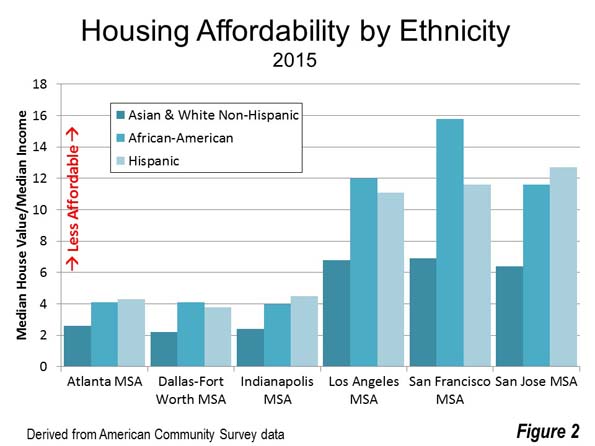
    The situation for housing is far worse for ethnic groups with lower incomes. The maximum housing affordability disadvantage faced by African Americans and Hispanics is illustrated in the following examples. In the San Francisco MSA, the median value house would cost the equivalent of 9 more years of median African-American income than for Asian or White-Non-Hispanics. This has escalated from 1.3 years before regulations were strengthened. An Hispanic household would need six more years of median income to pay for the median valued house in the San Jose MSA. There also large spreads, both for African-American and Hispanic households in other highly regulated metropolitan areas, such as Los Angeles, San Diego, Portland, Boston and New York (See Figure 2 and Table: Housing Affordability: Overall and by Ethnicity).

    Planning’s “Killer App”

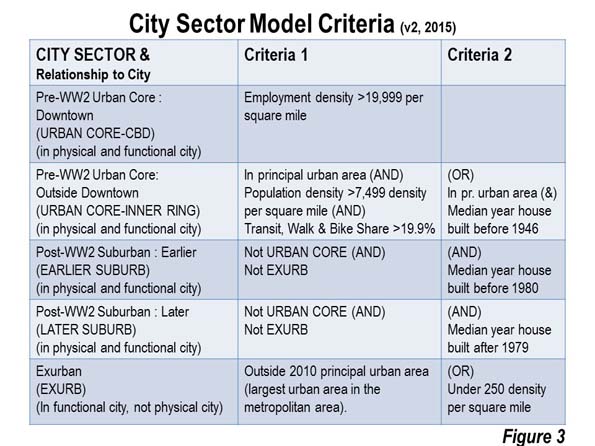
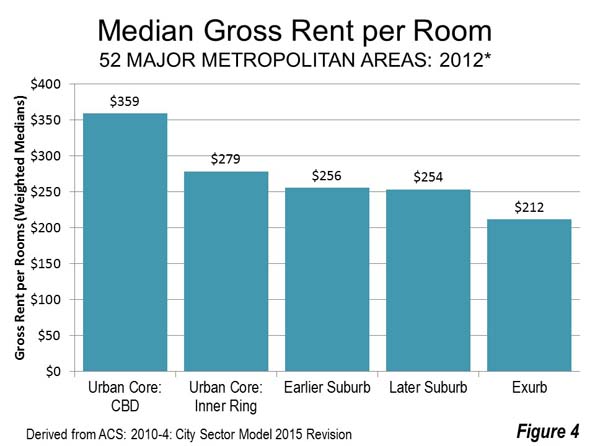
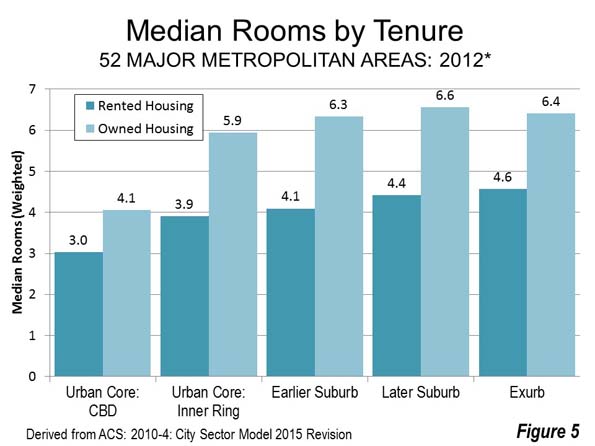
    It is popular to contend that housing affordability can be restored through   building higher densities. There are no examples of restoring metropolitan area housing affordability through intensification. A principal problem is higher prices. A City Sector Model (Figure 3) analysis indicates that the urban core rents per room are well above that of the suburbs (Figure 4). The differences are even greater in cities with the more aggressive intensification programs, such as Portland, Seattle and Los Angeles (Note 3).  Housing units are also smaller (Figure 5). “Granny flats,” basements and apartments are too small for many middle-income households. Forced intensification impairs the quality of life for many people, particularly families (Note 4)

    These policies also have the effect of widening economic divisions. Matthew Rognlie of the Massachusetts Institute of Technology examined French economist Thomas Piketty’s research on rising inequality and concluded that much of the observed inequality stems from housing. He went on to suggest re-examining the land use regulations that create scarcity, toward the end of increasing housing supply. My colleague Hugh Pavletich, co-author of Demographia International Housing Affordability Survey argues that without the “safety valve” of greenfield development, because housing cannot be kept affordable since urban containment destroys the competitive market for land.

    New Zealand consultant Phil Hayward observes: “There might be other policy mixes by which housing supply within a growth boundary could be made the means of keeping housing affordable, but publicly and politically, the debate is nowhere near tackling the complexities involved” (See The Myth of Affordable Intensification).

    Further, large lot or rural zoning is frequently cited as an impediment to housing affordability. This is consistent with economic theory, but its influence is miniscule compared to urban containment (Note 5). The metropolitan areas with substantial large lot zoning had an average price-to-income ratio of 3.0 in 2014, at the upper bound of affordability. This is in contrast with the seriously unaffordable price-to-income ratios (from 5.1 to 9.7) that have urban containment policy . The highest price-to-income ratios are in California’s large metropolitan areas, where there are smaller lot sizes.

    Based on the unparalleled damage they do to housing affordability, urban containment boundaries may be planning’s “killer app.” A principal objective of urban containment policy is to curb the outward expansion of cities (“urban sprawl”). But the “medicine” is far worse than the “cure” — lower standards of living and greater poverty, inflicting particular harm to lower income minorities.

    Necessary Reforms

    Unfortunately, housing affordability has not become an issue in this election year. Yet, policy reforms are appropriate:

    1. Urban containment policy should not be implemented where it has not been adopted.
    2. In urban containment metropolitan areas, improved housing affordability targets should be adopted (price to income ratios), with “event triggered” liberalization of urban fringe land use if the targets are not met. Similar reforms have been proposed in New Zealand and by Paul C. Cheshire, Max Nathan and Henry G. Overman of the London School of Economics.
    Housing Affordability: Overall and By Ethnicity
    Major Metropolitan Areas
    Median Multiple (Years of Median Income Needed to Buy the Median Priced House)
    Additional Years Requried
    All Asians and White Non-Hispanics African Americans Hispanic African Americans Hispanic
    United States 3.5 3.1 5.3 4.3 2.2 1.2
    Atlanta, GA 3.1 2.6 4.1 4.3 1.5 1.8
    Austin, TX 3.6 3.0 4.9 5.0 1.9 2.0
    Baltimore, MD 4.0 3.4 5.7 4.3 2.3 1.0
    Birmingham, AL 3.0 2.6 4.6 3.8 2.0 1.2
    Boston, MA-NH 5.0 4.5 9.3 9.2 4.8 4.7
    Buffalo, NY 2.6 2.3 5.1 5.3 2.8 3.0
    Charlotte, NC-SC 3.2 2.7 4.8 4.3 2.1 1.5
    Chicago, IL-IN-WI 3.6 2.9 6.4 4.5 3.5 1.6
    Cincinnati, OH-KY-IN 2.8 2.6 5.3 3.7 2.8 1.2
    Cleveland, OH 2.8 2.4 4.9 3.9 2.5 1.5
    Columbus, OH 2.9 2.6 4.6 3.7 2.0 1.1
    Dallas-Fort Worth, TX 2.8 2.2 4.1 3.8 1.8 1.5
    Denver, CO 4.5 4.0 7.4 6.3 3.3 2.3
    Detroit,  MI 2.8 2.4 4.7 3.6 2.3 1.2
    Grand Rapids, MI 2.7 2.6 5.2 3.7 2.7 1.1
    Hartford, CT 3.4 3.0 5.4 6.5 2.4 3.6
    Houston, TX 2.7 2.0 4.0 3.6 2.0 1.6
    Indianapolis. IN 2.7 2.4 4.5 4.0 2.1 1.6
    Jacksonville, FL 3.2 2.9 4.8 3.7 2.0 0.9
    Kansas City, MO-KS 2.7 2.5 4.5 3.7 2.0 1.2
    Las Vegas, NV 4.2 3.7 6.0 4.9 2.3 1.2
    Los Angeles, CA 8.6 6.8 12.0 11.1 5.2 4.2
    Louisville, KY-IN 2.9 2.7 4.9 3.4 2.3 0.7
    Memphis, TN-MS-AR 2.9 2.1 4.1 3.5 2.0 1.4
    Miami, FL 4.8 3.8 6.2 5.5 2.4 1.8
    Milwaukee,WI 3.5 3.0 6.9 5.0 3.9 2.0
    Minneapolis-St. Paul, MN-WI 3.3 3.0 7.3 5.1 4.3 2.1
    Nashville, TN 3.3 3.0 5.2 4.2 2.2 1.2
    New Orleans. LA 3.9 3.1 6.0 4.5 3.0 1.5
    New York, NY-NJ-PA 6.0 4.8 8.8 9.2 4.0 4.4
    Oklahoma City, OK 2.8 2.5 4.5 3.4 2.0 0.9
    Orlando, FL 3.4 2.9 4.4 4.3 1.5 1.4
    Philadelphia, PA-NJ-DE-MD 3.7 3.1 6.2 5.8 3.1 2.8
    Phoenix, AZ 3.9 3.5 5.4 5.2 1.9 1.7
    Pittsburgh, PA 2.6 2.5 5.4 3.4 2.9 0.9
    Portland, OR-WA 4.7 4.5 8.7 6.0 4.2 1.5
    Providence, RI-MA 4.3 4.0 6.7 7.6 2.7 3.7
    Raleigh, NC 3.4 2.9 5.1 5.7 2.1 2.7
    Richmond, VA 3.6 3.0 5.4 4.1 2.4 1.1
    Riverside-San Bernardino, CA 5.3 4.7 6.6 6.0 1.8 1.3
    Rochester, NY 2.6 2.3 4.6 4.5 2.3 2.2
    Sacramento, CA 5.4 4.9 8.4 6.8 3.6 1.9
    St. Louis,, MO-IL 2.9 2.6 4.9 3.5 2.3 0.9
    Salt Lake City, UT 3.8 3.6 6.2 5.3 2.6 1.7
    San Antonio, TX 2.7 2.2 3.1 3.3 0.9 1.1
    San Diego, CA 7.2 6.2 9.3 9.5 3.1 3.3
    San Francisco, CA 8.1 6.9 15.8 11.6 8.8 4.7
    San Jose, CA 8.1 6.9 11.6 12.7 4.7 5.8
    Seattle, WA 4.8 4.4 7.8 7.0 3.4 2.6
    Tampa-St. Petersburg, FL 3.4 3.2 4.7 4.0 1.5 0.8
    Tucson, AZ 3.5 3.1 5.0 4.2 1.8 1.1
    Virginia Beach-Norfolk, VA-NC 3.9 3.4 5.7 4.7 2.3 1.3
    Washington, DC-VA-MD-WV 4.3 3.6 5.9 5.8 2.3 2.2
    Data from American Community Survey: 2015
    AFFORDABILITY RATINGS    
    Affordable 3.0 or below
    Moderately Unaffordable 3.1 to 4.0
    Seriously Unaffordable 4.1 to 5.0
    Severely Unaffordable   5.1 and over


    Note 1: Commentators sometimes suggest the high housing prices in the San Francisco Bay Area are the result of land shortages created by topographic constraints, such as bodies of water and mountains. In fact, there is plenty of developable land in the Bay Area, which includes both the San Francisco and San Jose MSAs (See: The Incompatibility of Forced Densification and Housing Affordability).

    Note 2: This is without considering subsidies and tax breaks that can reduce some rents below market levels.

    Note 3: African American 1969 median household is estimated based on the variation in African American median family income from the overall median in that year. Median household income data was not published for ethnicities in the 1970 census. 

    Note 4: The planning establishment sometimes glosses over the reduced quality of life entailed in its efforts to discourage detached housing and force people into higher density housing. This is not their job. The quality of life can only be judged by households themselves.

    Note 5: Boston is an exception, which is the only seriously unaffordable major metropolitan area without urban containment policy. Boston has large lot zoning so expansive that it has created a severe shortage of land for development, with urban containment-like effects on house prices. Boston’s urbanization covers nearly as much land area as the Tokyo urban area, despite having only one-seventh the population. (See: The Evolving Urban Form: Sprawling Boston).

    Photo: Market Street, San Francisco, looking toward the Ferry Building (by author)

    Wendell Cox is principal of Demographia, an international pubilc policy and demographics firm. He is a Senior Fellow of the Center for Opportunity Urbanism (US), Senior Fellow for Housing Affordability and Municipal Policy for the Frontier Centre for Public Policy (Canada), and a member of the Board of Advisors of the Center for Demographics and Policy at Chapman University (California). He is co-author of the “Demographia International Housing Affordability Survey” and author of “Demographia World Urban Areas” and “War on the Dream: How Anti-Sprawl Policy Threatens the Quality of Life.” He was appointed to three terms on the Los Angeles County Transportation Commission, where he served with the leading city and county leadership as the only non-elected member. He served as a visiting professor at the Conservatoire National des Arts et Metiers, a national university in Paris.

  • OC Model: A Vision for Orange County’s Future

    This is the introduction to a new report on Orange County published by the Chapman University Center for Demographics and Policy titled, "OC Model: A Vision for Orange County’s Future." Read the full report (pdf) here.

    Blessed by a great climate and a highly skilled workforce, Orange County should be at the forefront of creating high wage jobs. The fact that it is not should be a worrying sign to the area’s business, academic, political and media leaders. Despite some signs of recovery in OC, long-term trends, such as a dependence on asset inflation and low wage employment, seem fundamentally incompatible with sustainable and enduring growth in the County.

    To be sure, asset inflation benefits established property owners, and those who work in the real estate sector, but the surge in property prices and an ever increasing number of touristic venues does not provide enough of a viable base for coming generations. Given the area’s high costs — which can at best be mollified — the area’s prosperity depends on building up its cadre of well-paying high value jobs in promising fields as professional business services, technology and design-oriented cultural industries.

    The good news: the county retains some strength in all these fields. But many long-term trends, as we will demonstrate below, are not encouraging. Once one of the nation’s most powerful high-end economies, the county is in danger of losing momentum to other markets.

    Reversing this trend will require a more holistic assessment of current realities. It also requires a strong, coherent strategy targeted to high-wage growth sectors. Instead of the current obsession with real estate and tourism projects, the County needs to focus more on what professional business services, technology, finance and science-based companies need in order to succeed.

    This necessitates a conscious effort, led by the business community, to develop a strategic direction for Orange County. There are a number of models to choose from, ranging from the most successful, Silicon Valley to greater Boston to the North Carolina Research Triangle, and many more. In each case, the growth from established university research centers — Stanford, MIT, Harvard, as well as the University of North Carolina, Duke and North Carolina state — extended from the university’s base to its periphery. This strong cooperation among universities, government and the private sector is critical to the emerging tech and business service corridor developing between the Texas cities of Austin and San Antonio.

    Read the full report (pdf) here.

  • Transit: About Downtown and the Core

    Transit best serves commuting destinations that have high concentrations of employment. For the most part, this means downtowns, or central business districts (CBDs). This is where transit lives up to its “mass transit" name, carrying many people concurrently and efficiently to concentrated destinations. When the same people return home, the “mass” is at the origin, and destinations are dispersed throughout the metropolitan area outside of downtowns, much of transit service is anything but mass, as residents of suburban and other communities frequently note “all the empty buses.”

    According to the City Sector Model, high density downtowns have an average of more than 23,000 jobs per square mile, 30 times the major metropolitan area average. CBD densities rise above 100,000 per square mile in New York and Chicago.  

    This article analyzes transit commuting destinations in the 53 major metropolitan areas (1,000,000 or more residents in 2014). The data is all taken from the 2006-2010, which has been developed by the ASHTO Census Transportation Planning Package from the ACS data and is the latest available for detailed employment locations. We used this data to develop Demographia United States Central Business Districts, which is described in this previous post.

    Summary of Transit Commuting

    CBD’s typically have the most important concentration of tall buildings in metropolitan areas, and typically the tallest buildings. The strongest CBDs were established before the automobile became dominant, and mechanized transport, in the form of transit, was radially oriented toward downtown. To this day, many people, including some in the press and urban planning perceive downtown to be where most of the jobs are.  Yet, the high density CBD’s (over 20,000 jobs per square mile) account for only eight percent of the employment in the 53 major metropolitan areas, and far less in many.

    As an example, the Chicago CBD, including the Chicago Loop (photo at the top of the article) includes some of the tallest buildings in the United States and 500,000 jobs, yet accounts for only 11 percent of the metropolitan area employment. These jobs are concentrated in an area of only 3.4 square miles (8.8 square kilometers). By contrast, the built up urban area is 2,700 square miles (7,000 square miles) and the metropolitan area covers 7,200 square miles (18,500 square kilometers). This concentration of so many jobs in such a small area contributes to some the nation’s worst traffic congestion, even with a high transit market share.

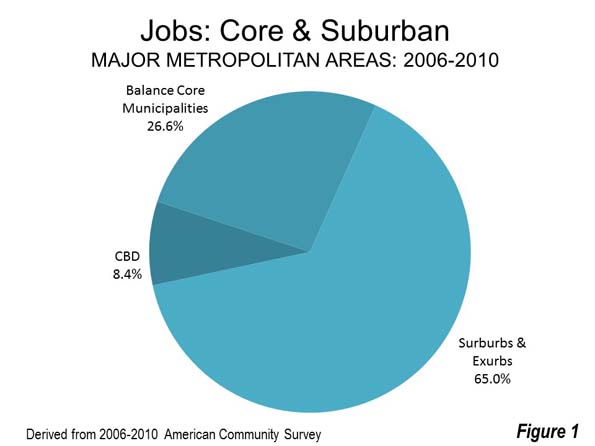
    The suburbs and exurbs dominate metropolitan employment, containing 65 percent of the jobs in the major metropolitan areas. The balance of the jobs (27 percent) are in the historical core municipalities, but outside the CBD (Figure 1)

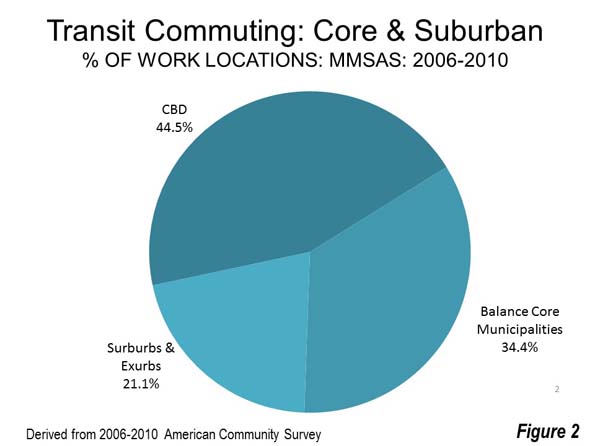
    These highest CBD densities can attract very high levels of transit usage. Despite their small share of metropolitan employment, the CBDs dominate transit commuting. Approximately 45 percent of transit commuters work in the CBDs. Another 34 percent work in the balance of the core municipalities. Finally, only 21 percent were in the suburbs and exurbs, where the 65 percent employment market share is more than triple (Figure 2).

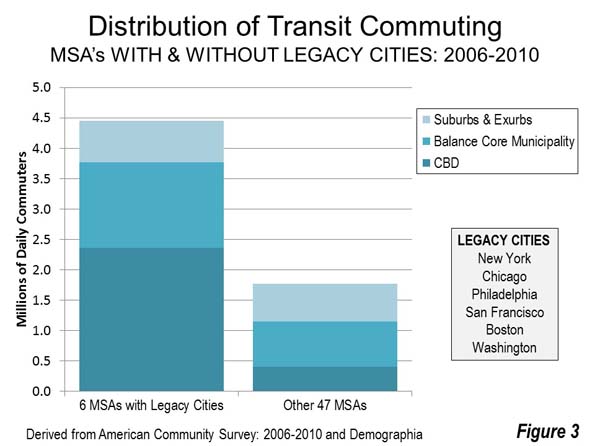
    Six transit legacy cities (historical core municipalities, including New York, Chicago, Philadelphia, San Francisco, Boston and Washington) within metropolitan areas dominate transit commuting, accounting for 72 percent of work trip destinations in the major metropolitan areas and 55 percent in the nation as a whole. These municipalities are also home to the six largest CBDs. New York dominates the legacy cities, with 60 percent of the transit commuting. This is to be expected, since New York is far more dense and has by far the largest CBD.

    By contrast the six legacy cities have only about 10 percent of the jobs in the major metropolitan areas, and only six percent of the jobs in the nation. Indeed, downtown commuting in the legacy cities exceeds all commuting in the 47 other metropolitan areas (Figure 3). This is despite the fact that the population of the 47 other metropolitan areas is nearly 2.5 times of the metropolitan areas with legacy cities.

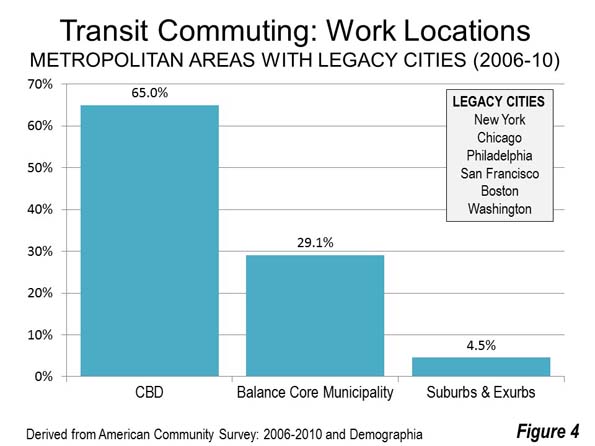
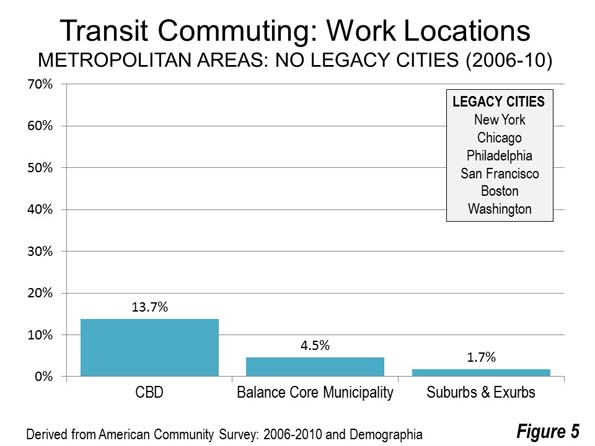
    Transit commuting is heavily skewed toward CBDs in the metropolitan areas with legacy cities, and are also the highest in other metropolitan areas. However, transit market shares to work locations in the suburbs are small, even in legacy cities (Figures 4 and 5).


    Central Business District

    Overall 41.4 percent of major metropolitan CBD commuters accessed work by transit.

    In the legacy cities, 64 percent of work access is by transit and 13 percent in the other 47 metropolitan areas.

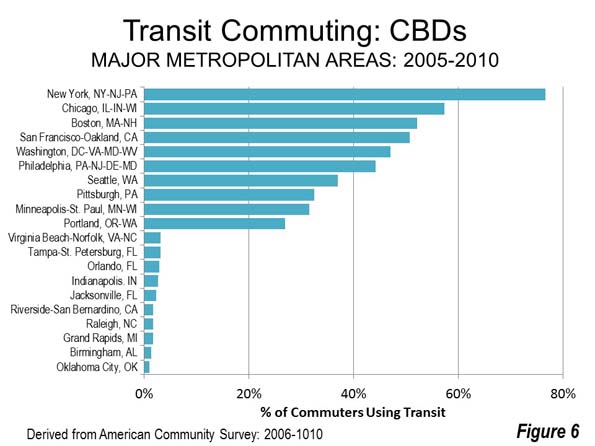
    The nation’s six largest CBDs, not surprisingly, had the largest transit market shares. In New York, south of 59th Street, transit’s market share is approximately 77 percent. In Chicago, transit share to the CBD is 57 percent, in Boston 52 percent, in San Francisco 51 percent and between 40 percent and 50 percent in Philadelphia and Washington. Seattle, Pittsburgh and Minneapolis-St. Paul followed at between 30 percent and 40 percent. Portland ranked 10th at 27 percent.

    At the other end of the scale, the numbers are very modest. The bottom 10 in CBD market share all have three percent or fewer of their commuters using transit. The lowest figures are in Oklahoma City, at 0.9 percent, and Birmingham, at 1.3 percent (Figure 6).

    Outside the CBD in the Core Municipalities

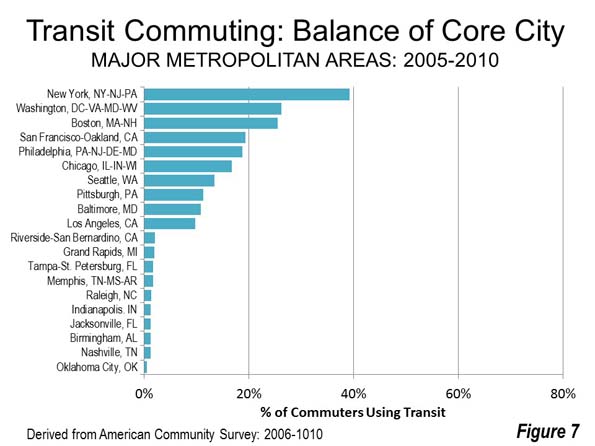
    In the core municipalities and outside the CBDs, the overall transit market share was 10.5 percent. This was a much higher 29.5 percent in the metropolitan areas with legacy cities and a very small 4.5 percent in the other 47 metropolitan areas.

    Some legacy cities have relatively high transit market shares outside the CBDs. As in its CBD transit market share, New York stands well above the others, at 39 percent. New York is joined by the other five legacy city metropolitan areas, with Washington and Boston having 25 to 30 percent transit market shares in the core municipalities outside the CBDs.

    The bottom 10 in the core municipality outside the CBD category all have two percent or smaller transit shares. Again, Oklahoma City ranks last, at 0.6 percent (Figure 7).

    In addition, there are secondary central business districts with large transit market shares in some metropolitan areas. In New York, Brooklyn, which had a transit work trip market share of 60 percent, higher than second ranking Chicago and second only to New York’s principal central business district in Manhattan. Another New York secondary central business district, the Jersey City Waterfront, across the Hudson River from Lower Manhattan, has a 51 percent transit commuting share, while 26 percent of downtown Newark’s commuters used transit. In Washington, Rosslyn attracts 23 percent of its commuters by transit.

    Suburbs and Exurbs

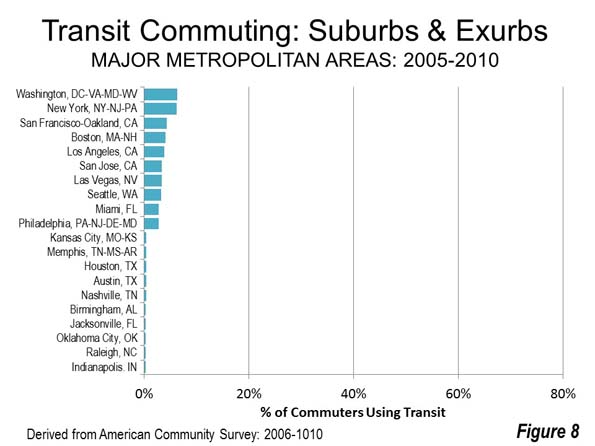
    Perhaps the most surprising finding is the very low transit work location market shares in the suburbs and exurbs (the metropolitan area outside the core municipalities), even in the metropolitan areas with legacy cities. Only 4.5 percent of commuters used transit even in the metropolitan areas with legacy cities. In the other 47 metropolitan areas, the figure was 1.7 percent. Overall the suburban and exurban transit work at market share was 2.5 percent. Employment in the suburbs of even the legacy city metropolitan areas is more similar to the post-World War II automobile urban form than the core cities in the same metropolitan areas.

    The highest suburban and exurban transit market shares were in Washington, at 6.3 percent and New York, in a near statistical tie. Legacy city metropolitan areas San Francisco and Philadelphia ranked third and 10th. Legacy city metropolitan area Chicago did not make the top 10.

    The 10 lowest suburban and exurban market shares were all 0.4 percent or less. Four metropolitan areas congregated at the bottom at near three percent, including Jacksonville, Oklahoma City, Raleigh and last-place Indianapolis (Figure 8).


    The table below contains market share for each of the 53 metropolitan areas, including CBDs, the balance of core municipalities, the suburbs and exurbs and totals.

    Transit is About Downtown and the Core

    The concentration of transit commuting destinations in the legacy cities and in the historical core municipalities that surround them illustrates where transit can play a significant role in mobility and access. At the same time, the small transit share elsewhere shows transit’s very limited potential (both in metropolitan areas outside the legacy cities and the 47 other metropolitan areas). This reality is confirmed by the losses and small gains in transit market share from the nation’s newer rail transit systems, which have largely been constructed outside the legacy cities. Transit is fundamentally about downtown and the core.

    Transit Work Trip Market Share by Work Location
    2006-2010
    Metropolitan Area CBD Balance: Core Municipality Suburbs & Exurbs Total
    Atlanta, GA 14.18% 7.35% 1.76% 3.31%
    Austin, TX 5.12% 3.42% 0.41% 2.56%
    Baltimore, MD 17.72% 10.79% 2.34% 5.26%
    Birmingham, AL 1.32% 1.26% 0.35% 0.69%
    Boston, MA-NH 52.18% 25.52% 4.13% 11.66%
    Buffalo, NY 11.52% 7.13% 1.74% 3.60%
    Charlotte, NC-SC 8.77% 2.22% 0.47% 1.93%
    Chicago, IL-IN-WI 57.40% 16.76% 2.13% 11.32%
    Cincinnati, OH-KY-IN 13.25% 4.76% 0.95% 2.43%
    Cleveland, OH 15.09% 6.20% 1.74% 3.70%
    Columbus, OH 4.89% 2.15% 0.55% 1.59%
    Dallas-Fort Worth, TX 14.04% 3.00% 0.66% 1.54%
    Denver, CO 19.79% 5.22% 2.19% 4.68%
    Detroit,  MI 7.48% 4.79% 0.74% 1.45%
    Grand Rapids, MI 1.72% 1.95% 0.67% 1.06%
    Hartford, CT 8.13% 5.71% 1.61% 2.57%
    Houston, TX 13.15% 3.00% 0.41% 2.56%
    Indianapolis. IN 2.64% 1.29% 0.26% 1.00%
    Jacksonville, FL 2.33% 1.27% 0.30% 1.09%
    Kansas City, MO-KS 7.00% 2.45% 0.44% 1.23%
    Las Vegas, NV 5.61% 3.78% 3.37% 3.56%
    Los Angeles, CA 22.48% 9.74% 3.85% 6.01%
    Louisville, KY-IN 6.47% 2.71% 0.78% 2.19%
    Memphis, TN-MS-AR 3.52% 1.69% 0.43% 1.32%
    Miami, FL 9.35% 7.37% 2.82% 3.59%
    Milwaukee,WI 11.05% 5.97% 1.43% 3.43%
    Minneapolis-St. Paul, MN-WI 31.54% 7.75% 1.35% 4.52%
    Nashville, TN 3.58% 1.20% 0.36% 0.95%
    New Orleans. LA 6.69% 4.93% 0.81% 2.44%
    New York, NY-NJ-PA 76.60% 39.22% 6.25% 30.40%
    Oklahoma City, OK 0.95% 0.57% 0.30% 0.48%
    Orlando, FL 2.91% 3.06% 1.10% 1.65%
    Philadelphia, PA-NJ-DE-MD 44.18% 18.72% 2.76% 9.14%
    Phoenix, AZ 11.82% 2.95% 1.37% 2.19%
    Pittsburgh, PA 32.52% 11.33% 1.37% 5.75%
    Portland, OR-WA 26.96% 7.95% 2.38% 6.12%
    Providence, RI-MA 10.47% 4.00% 1.04% 1.74%
    Raleigh, NC 1.75% 1.42% 0.27% 0.88%
    Richmond, VA 4.93% 4.26% 0.80% 1.77%
    Riverside-San Bernardino, CA 1.75% 2.04% 1.14% 1.19%
    Rochester, NY 6.55% 2.04% 1.22% 2.00%
    Sacramento, CA 12.97% 2.87% 1.34% 2.66%
    St. Louis,, MO-IL 11.24% 6.51% 1.32% 2.53%
    Salt Lake City, UT 12.18% 5.26% 1.67% 3.64%
    San Antonio, TX 6.44% 2.49% 0.66% 2.27%
    San Diego, CA 10.22% 3.44% 2.16% 3.19%
    San Francisco-Oakland, CA 50.68% 19.32% 4.35% 14.22%
    San Jose, CA 8.39% 2.88% 3.38% 3.36%
    Seattle, WA 36.99% 13.46% 3.22% 8.37%
    Tampa-St. Petersburg, FL 3.10% 1.76% 1.18% 1.36%
    Tucson, AZ 6.05% 2.88% 1.30% 2.48%
    Virginia Beach-Norfolk, VA-NC 3.17% 2.34% 1.45% 1.67%
    Washington, DC-VA-MD-WV 47.07% 26.26% 6.30% 13.85%
    Sources: 2006-2010 ACS & Demographia Central Business Districts

    Wendell Cox is principal of Demographia, an international pubilc policy and demographics firm. He is a Senior Fellow of the Center for Opportunity Urbanism (US), Senior Fellow for Housing Affordability and Municipal Policy for the Frontier Centre for Public Policy (Canada), and a member of the Board of Advisors of the Center for Demographics and Policy at Chapman University (California). He is co-author of the “Demographia International Housing Affordability Survey” and author of “Demographia World Urban Areas” and “War on the Dream: How Anti-Sprawl Policy Threatens the Quality of Life.” He was appointed to three terms on the Los Angeles County Transportation Commission, where he served with the leading city and county leadership as the only non-elected member. He served as a visiting professor at the Conservatoire National des Arts et Metiers, a national university in Paris.

    Photo: Chicago CBD, with 11 percent of metropolitan employment, with the balance of the city of Chicago and the expansive suburbs beyond (by author).

  • Is Peter Thiel Right About Chicago?

    Peter Thiel recently made one of his trademark provocative statements by saying, “If you are a very talented person, you have a choice: You either go to New York or you go to Silicon Valley.”

    The problem for Thiel was that he said this while speaking at an event in Chicago. No surprise, it didn’t go over well. An enquiring questioner wanted to know, “Who comes to Chicago if first-rate people go to New York or Silicon Valley?”

    Thiel sputtered a bit and suggested he was employing hyperbole, but said “It’s an extremely important question, and it’s the type of question that we don’t ask enough,” though admitting he isn’t sure “exactly what Chicago should be doing right now.”

    After being initially reported by the Chicago Tribune, the story was picked up by Vanity FairChicagoist, and Crain’s. A blogger named John Carpenter posted a sharp retort at Forbes.

    Having lived nearly 20 years in Chicago and now two in New York, I’ve had a few observations about the differences between the two cities that I’ve resisted posting because it would inevitably be seen as taking a cheap shot at a city I chose to leave. But given the hook of Thiel’s comments, I decided to take the plunge.

    Is Thiel right? Factually speaking, no. Obviously there are first-rate people in places other than San Francisco or New York. Given its size, history, status, etc. Chicago has a number of them.

    But Thiel is highlighting something real with uncomfortable implications for the Windy City.

    Cities of Ambition

    Let’s rephrase Thiel slightly and we’ll get a stronger statement: if you’re a person with global-scale ambition, you move to either New York or Silicon Valley.

    There’s a lot of truth to this version of the statement. Think about the egos and the ambition of the people in Silicon Valley. People like Thiel (Paypal, Palantir, others), Mark Zuckerberg (Facebook), and Travis Kalanick (Uber) practically define Silicon Valley. In New York, think about the incredible ambition of a Michael Bloomberg or a Donald Trump – two radically different people to be sure, but both extremely ambitious.

    How many of these kinds of people live anywhere in the US outside those two cities? A few. You can think of Bill Gates (Microsoft) and Jeff Bezos (Amazon) in Seattle. Or Elon Musk (Tesla, Space X, et. al) who lives in LA. But there aren’t many. It’s telling that Mark Zuckerberg started at Harvard and moved to the Valley. It’s similar for Mark Andreesen (Netscape) and many others before them.

    The bottom line is that the ambition level in Silicon Valley and New York is simply off the charts. That kind of ambition is not what you find in Chicago (or pretty much anywhere else). It can exist from time to time – think Barack Obama – but is a big anomaly.

    If you are someone who is dreaming big – really big – it helps to be in an environment where other people are dreaming big. That means NYC or SF.

    America’s New Upper Class Elite

    Charles Murray’s book Coming Apart charted the rise of a new upper class, an elite – the people who really call or influence the shots in American business, politics, culture, etc – that increasingly lives in self-segregated bubbles of others just like them.

    These bubbles of the American elite are heavily concentrated in four coastal cities:

    [I]t is difficult to hold a nationally influential job in politics, public policy, finance, business, academia, information technology, or the media and not live in the areas surrounding New York, Washington, Los Angeles, or San Francisco. In a few cases, it can be done by living in Boston, Chicago, Atlanta, Seattle, Dallas, or Houston—and Bentonville, Arkansas—but not many other places.

    Murray here puts Chicago in a special class; it’s one of the handful of cities outside the Big Four where it’s possible to be part of the national elite. That’s not nothing. But clearly there’s a big gap in there.

    Murray undertook a variety of quantitative analyses to try to sleuth out the geography of the new elite. One of them was to look at where the graduates of elite schools lived, particularly the Big Three of Harvard, Princeton, and Yale (HPY). Here is what he found:

    As mature adults, fully a quarter of the HPY graduates were living in New York City or its surrounding suburbs. Another quarter lived in just three additional metropolitan areas: Boston (10 percent), Washington (8 percent), and San Francisco (7 percent). Relative to the size of their populations, the Los Angeles and Chicago areas got few HPY graduates—just 5 percent and 3 percent, respectively. Except for the Philadelphia and Seattle areas, no other metropolitan area got more than 1 percent.

    There’s an East Coast bias to these schools as we might expect, but New York has over eight times as many HPY grads as Chicago. San Francisco has over two times as many, and notably has more than much larger Los Angeles. This is pretty remarkable given that the region’s focus is technology, not exactly what comes to mind when you think HPY (although Gates and Zuckerberg tell a different tale, even if not actually graduates).

    So Murray’s research also foots to Thiel’s observation in a generalized sense.

    Personal Observations

    I had four of my own previous observations.  First a pre-observation: I never noticed any difference between the caliber of Accenture people in Chicago vs. New York. (It generally seemed to me that in the consulting space, the talent level of Accenture employees was pretty consistent across geographies). Obviously I had a network that included a lot of Accenture type corporate people in Chicago, whereas in New York my network is more skewed to policy, media, finance, and startups (though includes quite a few Accenture people too).  These network differences obviously shape my personal experiences, but my observations are consistent with Murray and with some others who lived in both cities and with whom I’ve compared notes.

    With that, my observations are:

    1. New York has a higher horsepower rating. Growing up in Laconia, I was a straight-A student and valedictorian of my high school without studying. Similarly, I was simply smarter than most people in college. As I moved up in life, the competition got tougher, obviously, but even at Accenture I basically just had more horsepower to throw at problems than most. (You may recall that I was also somewhat lazy during this period). In New York, that’s just not true. I am constantly around people who are at least as smart as I am, if not smarter. You can’t just think you can get ahead here by throwing more MIPS at the problem than the next guy, because he’s just as good as you or more so.
    2. New Yorkers have incredibly vast and wide-ranging knowledge. That famous New Yorker cover portrays NYC as an incredibly provincial place. And it is. But I continue to be astonished about how much New Yorkers know about what’s going, not just around the world but across the country. A couple years before moving there I was visiting the city and had dinner with Fred Siegel in Brooklyn. When I mentioned Indianapolis, he proceeded to provide a number of extremely accurate and insightful comments about the city. I was taken aback. What were the odds he would know anything about Indianapolis? I’ve since come to see that kind of encyclopedic knowledge as commonplace. People in NYC are connected to networks and have their fingers on the pulse of what is going on all over the country and the world. I’ve similarly ceased to be amazed every time I run into someone with a vast array of cultural knowledge. People here are just like that. This is a world away from the much less connected and more limited expanse of knowledge in Chicago.
    3. Chicago is Big Ten, New York is the Ivy League. The numbers above illustrate this well. Chicago is dominated by Big Ten grads and Notre Damers. New York has a vast seat of Ivy League and other elite school grades.  This is well attested above, so no more on that.
    4. New Yorkers are connected to the highest levels of politics, business, media, and culture. This is almost a truism, but it’s remarkable when you actually experience it. This is where the sausage is made. (I suspect one can get a similar feeling in DC, or in SF for tech, or Houston for energy). A friend of mine who was also a long time Chicago area resident that now lives in Philadelphia observed, “Chicago doesn’t know they’re not in the game. They’re in a game, but they’re not in the game.”

    None of these is probably news in a sense. They were things I could have probably told you before. But intellectual awareness of truth is one thing, visceral experience of it is another.

    The Draw of New York and San Francisco

    Now, none of this is to say one must live in NYC. I love it, but when I was two years into living in Chicago, I loved that city even more.  Some people have a transformational experience in college as they are exposed to new experiences, ideas, people, etc. That wasn’t the case for me. But I did have that in Chicago. Moving to Chicago was personally transformational for me in a way that moving to New York was not. (Of course, I was much younger then too). And there are lots of places in America that I think I could enjoy living in. Let’s not invest too much in NYC and SF.

    On the other hand, let’s not invest too little either. It’s clear that Greater Greater New York, and the Bay Area, are uniquely dominant and have a unique draw. It’s the same with London in Europe. (No surprise that the top overseas expansion destination for Chicago based firms is London. Boeing has 2,000 people in London – four times as many as at its Chicago HQ – and plans to double that. Where do you think the top intercontinental investment location for London firms is?)

    If you want to get a sense of this, just read Ted Gioia’s piece in the latest City Journal abouthow New York became the capital of jazz, displacing New Orleans and Chicago, and beating back a midcentury challenge from LA.  And Michael Agovino’s piece in the Village Voice, “Almost Famous, Almost Broke: How Does a Jazz Musician Make It in New York Now?”  As Gioia puts it,

    Jazz has gone global. Just like your job, your mortgage, and the cost of gas at the pump, the music now responds to global forces. As a jazz critic, I now need to pay attention to the talent coming out of New Zealand, Indonesia, Lebanon, Chile, and other places previously outside my purview. Almost every major city on the planet now has homegrown talent worthy of a worldwide audience.

    Yet one thing hasn’t changed on the jazz scene: New York still sits on top of the heap. Great jazz artists often don’t come from Manhattan, but they struggle to build a reputation and gain career traction if they don’t come to Manhattan. The recent sensation over Indonesian jazz prodigy Joey Alexander is a case in point. At age eight, this formidable youngster had already caught the attention of jazz icon Herbie Hancock, and at nine, he beat out 43 musicians (of all ages) from 17 countries to win a prestigious European competition. A year later, Alexander’s parents moved to New York, realizing that even the greatest prodigy in jazz needed what only that city could offer.

    And as Joel Kotkin, who frequently speaks to audiences full of civic leaders around the country, told me, “No matter where I go, invariably the richest guy in the room has a kid in either New York or San Francisco.”

    Chicago: The Semi-Elite City

    This problematic status of Chicago as “semi-elite” is really at the root of many of its problems. It’s something I’ve talked about before, such as by noting its global city functions are weaker, and resultantly it spins off far less wealth and tax revenue. Or my notion that it’s the duck-billed platypus of cities.

    This isn’t unique to Chicago. It affects other cities like Amsterdam. Simon Kuper of the Financial Times wrote a column on the rise of the global capital about how young up and comers in the Netherlands had their sights set on London, not Amsterdam. As he put it, “Many ambitious Dutch people no longer want to join the Dutch elite. They want to join the global elite.”

    As with Thiel, I don’t have the answer to this problem, but he’s absolutely right that it’s one that’s too seldom asked, but which needs to be squarely faced. Studying and comparing notes with these other cities like Amsterdam and how they are coping with this problem might be a good start.

    In the meantime, to end on a positive note, I do think there are fields where one could unquestionably have top level talent and ambition, and move to Chicago in search of success.  I would include aspiring comedians, chefs, architects, and indie rockers in this list. There may be others. Protecting and building on these while finding a strategic response may be another good place to start.

    Aaron M. Renn is a senior fellow at the Manhattan Institute, a contributing editor of City Journal, and an economic development columnist for Governing magazine. He focuses on ways to help America’s cities thrive in an ever more complex, competitive, globalized, and diverse twenty-first century. During Renn’s 15-year career in management and technology consulting, he was a partner at Accenture and held several technology strategy roles and directed multimillion-dollar global technology implementations. He has contributed to The Guardian, Forbes.com, and numerous other publications. Renn holds a B.S. from Indiana University, where he coauthored an early social-networking platform in 1991.

    Photo Credit: Berlin, Germany, March 19, 2014. Hy! Summit – Image by Dan Taylor. www.heisenbergmedia.com

  • New York, Two States of Mind

    Is New York City helping or holding back Upstate New York?

    Towards the end of times, when all of mankind congregates in a final purgatory to draw the main lessons of this grand adventure called Life, there will be special attention paid to the centuries’ long efforts at harmonizing individual happiness with the needs of the collective. There will be seminars on leadership and war. There will be a thick chapter on the blessings and dangers of science. There will be a long section, co-written by poets and undertakers, on the success of freedom and the failure of tyranny. There will be wonder and consternation about religion and the nature of the universe. And there will be, inevitably, extensive reporting on economic ideology.

    Here, a slim primer on laissez-faire will easily outshine ponderous encyclopedic tomes on communism, socialism and other failed -isms. Capitalism, the word and the theory, will be presented as a zealous and perhaps unnecessary attempt at creating a code for laissez-faire, something that occurs naturally. Cronyism will be understood as the corruption and distortion of laissez-faire and the phrase crony capitalism will be dismissed as an oxymoron and an unwarranted amalgamation.

    Finally, there will be a footnote on dirigisme, or the state’s effort at orchestrating and controlling economic growth by directing public and private funds towards its own selection of industries and businesses. Some will call it national industrial policy, or picking winners and losers. Others will deride it as a pretext for cronyism to assert itself under the guise of policy. There will be references to its various forms and intensities in France under De Gaulle, in Japan with MITI and in many other places.

    It will be mentioned in passing by bemused Americans that it was also tried once upon a time in New York State and that it led to the same dead end of wasted resources and corruption. Among the evidence presented will be reports of public/private investments organized by the state’s government in the early 2000s and the uncovering of a scandal in 2016.

    New York, Two States of Mind

    Meanwhile, if we rewind and zoom in on present day New York, it is clear that there is no other state in the nation like the Empire State. It has New York City, a dynamic universal metropolis, and it has a huge land area Upstate that is demographically and economically stagnant. No other state is so economically polarized. In California, Texas and Florida, the population and wealth are less geographically concentrated.

    On many measures, New York City and State have little in common. Consider the following:

    New York City covers less than 1% of New York State’s land area and is home to 43% of the State’s population. Including downstate suburbs, the New York City metro area adds up to 65% of the state’s population.

    In the City, 53% of people are white (including hispanics) and 37% are foreign-born. Outside the City, 83% are white and 11% foreign-born. If you exclude seven downstate counties that are near the City (see tables), the percentage of the Upstate population who are foreign-born drops to 5%. By way of comparison, the entire US population is 77% white and 13% foreign-born. So New York City is less white and much more foreign-born than the United States. And New York State is more white and much less foreign-born.

    Because there is a higher percentage of poor people in the City, notably in the Bronx, the median household income at $52,737 is lower than the $58,687 for the state overall. However the average income is much higher in the City due to its high-paying jobs in law, media, finance and health care. The weight of the 1% or 5% highest earners would be more visible in the average than in the median. As shown in the table, the median income in the downstate suburbs is significantly higher than in the City or Upstate. The median household income in the United States is $53,482.

    screen-shot-2016-09-19-at-3-01-43-pm-2


    Home values are much higher in the City and surrounding counties than in the rest of the state. In the City, the median home value is $491,000 whereas a median home can be obtained in most counties Upstate for less than $200,000. The higher ratio of median home value to median income underlines the greater income disparity in the City.

    In New York county (Manhattan), the median home value is $838,000 or 12 times the median household income of $72,000. This would be unsustainable if the average income did not deviate significantly from the median, or in other words, if there was not a small percentage of people earning large and very large incomes every year. In Manhattan, the average income of the top 1% is $8.1 million. And the average income of the bottom 99% is $70,468. The ratio of the first to the second is 116. (sources: Economic Policy Institutehowmuch.net).

    By contrast, in Allegany county for example, the median home value is only 1.6 times the median income. The average income of the top 1% is $358,554 million and that of the bottom 99% is $25,595. The ratio of the first to the second is 14.

    In the United States overall, the median home value is $175,500, or 3.3 times the median income. In 2013, the average income of the top 1% was $1.1 million and that of the bottom 99% was $45,567, resulting in a ratio of 25.

    screen-shot-2016-09-19-at-3-01-38-pm-2


    It is tempting to conclude from these figures that New York City is doing very well and that New York State is doing, depending on one’s perspective, as well or as poorly as the rest of the country. But on closer scrutiny, both the City and the state face some challenges that are unique to New York.

    Stagnant Demographics

    The most obvious is the fact that the size of New York’s population has barely budged in the past forty-five years except for getting older. In 1970, there were 18.2 million people in New York State and in 2015 only 19.8 million. This change amounts to an 8% cumulative increase over 45 years, a very low figure compared to the 58% growth in the US population over the same period.

    screen-shot-2016-09-19-at-11-16-10-am-2


    If there had been instead a modest annual population growth rate of 0.5% due to new births, the cumulative growth over 45 years would have come to 25%. Further, because New York City is a magnet for new immigrant arrivals, one would expect that cumulative growth to have exceeded 25%. Instead, the 8% figure over 45 years means that there has been a steady large migration of New Yorkers towards other states.

    New York State had 9% of the country’s population in 1970 and 6.2% in 2015. The state and City have not been choice destinations except for people seeking employment in specific industries or for recent immigrants looking for a social gateway into the United States via their own national communities.

    Also worth noting is the fact that the state’s entire population growth (800,000 people) since 2000 has been concentrated in the City and downstate suburbs. The size of the population Upstate has flatlined for years while getting older.

    Of course, this stagnation is partly explained by the large migration over several decades of Americans heading to sun belt and mountain states in the West, South and Southwest. No doubt the invention of affordable air conditioning and the expansion of the interstate highway network facilitated this exodus from North to South.

    Other legacy large industrial states like Pennsylvania and Ohio also show weak single digit growth in the period 1970 to 2015. But neither has a large universal metropolis like New York City and neither shows as great a divide between its largest city and Upstate region. Meanwhile the populations of California, Colorado, Texas and Utah have doubled or more than doubled in 1970-2015, as have those of Southeastern states like Florida, Georgia and the Carolinas. Arizona has quadrupled and Nevada grown six fold, albeit from a low base in both cases.

    A closer to home comparison is only marginally more comforting. If New York State was a state on its own today, its demographics would compare poorly to those of its neighbors. Next door Vermont and New Hampshire have both grown smartly despite lacking a significant industrial base and large metro areas. The largest employers in both states are IBM and a collection of ski resorts, hospitals, colleges, retail stores and insurers/banks/asset managers. New Hampshire has also benefited from its proximity to Boston, with some tax-minded commuters choosing to declare residence in the southeastern corner.

    Part of this may be a public relations issue. Both New England states have done a better job than New York in associating their names with autumn foliage, winter sports and summer boating even though New York has similar colors, ski areas and lakes.

    pictures-126

    Vermont or Upstate New York?

    And compared to New England, Upstate is rarely showcased in movies. Wikipedia has long lists of movies set in New England and in New York City but no such list for New York State. In the 1987 movie Baby Boom, management consultant J. C. Wiatt (Diane Keaton) escapes New York City’s chaos and complexity, and dumps New York State without a thought on her way to a simpler life in Vermont that ends up delivering not only space, beauty and peace but also greater wealth and even romance.

    Weather can also be an important factor. Some parts of New York State get much more snow and have many more overcast days every year than do Vermont, New Hampshire, Pennsylvania and Ohio.

    Policies for Upstate

    Nonetheless, if weather is the work of Providence, government policy is very much man-made and should be designed to capitalize on the state’s assets and to mitigate its handicaps. The empirical evidence so far is that policy has not done enough to improve conditions Upstate.

    To the South and West, both Pennsylvania and Ohio have enjoyed a better economy than Upstate thanks in part to the shale energy boom while New York maintains a ban on fracking. It can afford to do so thanks to its large tax revenues coming from the City. According to a 2011 Rockefeller Institute study, in 2010 New York City contributed 48.7% of the state’s tax revenues. The downstate suburbs contributed an additional 23.6%, leaving a modest 27.7% coming from the rest of Upstate.

    These revenue percentages don’t deviate significantly from the weight of the population in the various regions. But the same Rockefeller Institute study showed that expenditures are more favorably weighted towards Upstate which received 42.2% of the state’s spending while the City and downstate suburbs received 40% and 17.7% respectively. In other words, Upstate has not been self-sufficient in terms of tax expenditures vs. tax receipts and has been receiving funds from the metro area.

    Some will allege that this is how a state should operate. Less productive areas receive assistance from more productive ones. But New York State could do better by making itself more tax-friendly to businesses and households. Our populyst state-by-state analysis shows that a median household in New York keeps 82.5% of its income after taxes, a percentage that places the state in the lowest quintile of all states on this measure. By contrast, a median household in Florida, Tennessee, Nevada, Texas or Washington State keeps over 88% of its income. The difference in after-tax take-home incomes would be even greater for higher earning households.

    The table below shows total and per capita state government tax collections for fiscal year 2013. On a per capita basis, New York State is in the first highest quintile for all state taxes, and second only to Connecticut for individual and corporate income state taxes. Among states with large populations, it is comfortably first in both categories, higher than California, Illinois, Pennsylvania and Ohio, and much higher than low-tax Texas and Florida.


    None of this may be a surprise, given that New York routinely ranks among the highest-tax states in the country. But instead of cutting taxes across the board and letting the market work its magic, the state has opted to launch a number of targeted public and public/private initiatives to reenergize the economy Upstate.

    Start-Up NY offers tax free zones to research-oriented businesses. In order to qualify, a business must partner with a university and must operate in one of the sectors targeted by the program.

    Judging by this recent announcement, the impact so far has been helpful on a local level but negligible in improving the state’s overall condition:

    Governor Andrew M. Cuomo today announced that 18 new businesses will join START-UP NY, relocating or expanding their operations across the state through innovative tax-free zones associated with public colleges and universities. These 18 businesses have committed to create at least 135 new jobs and invest nearly $10 million over the next five years in Western New York, the Southern Tier, Central New York, the Capital District, New York City and Long Island.

    and further:

    START-UP NY now has commitments from 172 companies to create at least 4,175 new jobs and invest more than $229.2 million over the next five years in New York State.

    That comes to  an average of 24 jobs and an investment of $1.33 million per company, small figures in a state of 19 million people and a GDP of $1.4 trillion. Perhaps the choice of a few sectors and the required linkage to a college should be removed and a tax abatement should be offered to all startups.

    Though its impact is small, Start-Up NY at least has the distinction of a hip dynamic name. By contrast, other initiatives that have a greater immediate dollar impact are encumbered by vaguely Soviet-sounding names such as the Regional Economic Development Council Initiative and the Upstate Revitalization Initiative.

    In both of these initiatives, development funds are allocated to New York’s ten regions through a process of competitive applications. From the former’s website:

    This year, the 10 Regional Councils once again competed for funding and assistance from up to $750 million in state economic development resources as part of Round V of the REDC competition. Additionally, the Governor established a new competition in 2015 – the Upstate Revitalization Initiative – to award a total of $1.5 billion to three regions, which will help to transform local economies by providing $500 million over the next five years to support projects and strategies that create jobs, strengthen and diversify economies, and generate economic opportunity within the region. Of the state’s 10 regions, seven were eligible for the URI competition: Finger Lakes, Southern Tier, Central New York, Mohawk Valley, North Country, Capital District, and Mid-Hudson.

    quick scan of the dollars awarded in these initiatives shows that many, though not all, are earmarked for marginal improvements or investments and are unlikely to lead to large economic returns.

    The Inevitable

    If this was the only problem with dirigisme, we might simply lament it as a well-intentioned but wasteful approach to economic growth. However, it is usually accompanied by an increase in cronyism and corruption. The fact that the state has been collecting a tax surplus in the City and diverting it Upstate created an opportunity for administrators to play favorites in awarding contracts and to contravene the rules of competition that usually prevail in a free market. When this kind of opportunity emerges, it is inevitable that someone will seize on it.

    And so the scandal that has just broken with the charging of nine people in Governor Cuomo’s entourage should not come as a surprise. City Journal takes a similar view:

    Eager to revive the depressed counties of New York’s heartland and Southern Tier, Cuomo lacked the courage to use his considerable influence with the Albany legislature to prune taxes and pare regulation. His solution was to bury the problem in tax dollars. This approach isn’t intrinsically criminal, but it does attract people of low degree, some of whom have recently been posting bail. And it betrays poor judgment on Cuomo’s part—in the policies he pursues, in the people he trusts, and in the electorate at large.

    The New York Post is equally skeptical of government-orchestrated public-private investments:

    The cloud of alleged corruption now surrounding billions of dollars in state economic development investments is an outgrowth of Cuomo’s highly secretive and centralized management style.

    Compared to previous Albany-directed corporate-welfare binges, Cuomo’s approach has featured a uniquely close intertwining of government and corporate interests — complete with state ownership of the means of production.

    To an outside observer, it may have seemed curious that development of a solar-panel factory in Buffalo [the case being investigated] was being guided by a state college administrator in Albany.

    This free market distortion is primarily systemic at its root. It grows naturally from the state’s involvement in the economy. As noted by City Journal, bad systems have a way of empowering bad actors. It is likely therefore that more revelations will surface about more malpractice elsewhere in the state’s initiatives.

    Now would be a good time to re-evaluate the overriding economic strategy. So far, the state’s initiatives have weighed in favor of a top-down set of targeted solutions instead of a blanket laissez-faire approach that would foster growth from genuine grassroots entrepreneurship. But this experiment with dirigisme has led to the usual distortions of cronyism and wasted or misallocated resources. The state should consider stepping back from its deeper involvement and instead moving forward with lower tax rates for middle-income households and with lower regulation for businesses.

    New York City’s high paying jobs generate the tax receipts needed to meet spending needs in the rest of the state. But the surplus from City tax revenues can also be seen as the enabler of bad policy and as the reason why the state has not implemented the fiscal policies needed Upstate. The City is a huge asset for the state but it may be holding back the measures needed to reignite a demographic and economic revival in all of New York.

    This at least could be the conclusion drawn when we look back from the future at our present predicament. But so far, the Governor has shown no inclination of changing course, stating after the charges surfaced:

    I am more committed to western New York’s revitalization than ever before… We are not going to miss a beat.

    Note: The dependency ratio in the tables is calculated as the sum of people aged less than eighteen and more than 65, divided by the number of people aged 18-65.

    This piece first appeared at Populyst.net.

    Sami Karam is the founder and editor of populyst.net and the creator of the populyst index™. populyst is about innovation, demography and society. Before populyst, he was the founder and manager of the Seven Global funds and a fund manager at leading asset managers in Boston and New York. In addition to a finance MBA from the Wharton School, he holds a Master’s in Civil Engineering from Cornell and a Bachelor of Architecture from UT Austin.

  • Urbanism, Texas-Style

    Cities, noted René Descartes, should provide “an inventory of the possible,” a transformative experience—and a better life—for those who migrate to them. This was certainly true of seventeenth-century Amsterdam, about which the French philosopher was speaking. And it’s increasingly true of Texas’s fast-growing metropolises—Houston, Dallas–Fort Worth, Austin, and San Antonio. In the last decade, these booming cities have created jobs and attracted new residents—especially young families and immigrants—at rates unmatched by coastal metropolitan areas. Approximately 80 percent of all population growth in the Lone Star State has been in the four large metropolitan areas since 2000. Texas now boasts two of the nation’s five largest metros, the first time any state has enjoyed that distinction. At its current rate of growth, Houston could replace Chicago as the nation’s third-largest city by 2030, and the Dallas–Fort Worth region could surpass Chicagoland as the nation’s third-largest metropolitan area by the 2040s.

    Historically, those who think and write about urban living have regarded Texas cities with disdain. The midcentury journalist John Gunther dismissed Houston, now the state’s largest city, as a place “where few people think about anything but money.” Gunther predicted that the area’s population would eventually grow to a measly 1 million people. He was off by a bit: close to 7 million people now call the Houston metropolitan area home. Houston and the other flourishing Texas metros are neither downtown-focused like New York nor highly regulated and densely packed like Los Angeles. They aren’t disproportionately brain-intensive or tech-oriented; and they aren’t dominated by green politics and, generally speaking, strict planning. Though booming, they have kept living costs down. In all this, they differ from San Francisco, Seattle, Portland, Los Angeles, and Boston—places that may continue to thrive in the future but that show little interest in creating the economic opportunity and affordability that attracts aspirational middle- and working-class families. In short, Texas’s cities are reshaping urbanism in America, albeit in ways few scholars or planners seem to appreciate.

    Though some east/west coastal cities—notably, San Francisco—have enjoyed vigorous growth of late, none has been nearly as proficient in creating jobs in the new millennium as Texas’s four leading metros. Overall, Dallas–Fort Worth and Houston have emerged as the nation’s fastest-expanding big-city economies. Between 2000 and 2015, Dallas–Fort Worth boosted its net job numbers by 22.7 percent, and Houston expanded them by an even better 31.2 percent. Smaller Austin (38.2 percent job-base increase) and once-sleepy San Antonio (31.4 percent) have done just as well. New York, by way of comparison, increased its number of jobs in those years by just 10 percent, Los Angeles by 6.5 percent, and San Francisco by 5.2 percent, while Chicago actually lost net employment. And the Texas jobs are not just low-wage employment. Middle-class positions—those paying between 80 percent and 200 percent of the national median wage—have expanded 39 percent in Austin, 26 percent in Houston, and 21 percent in Dallas since 2001. These percentages far outpace the rate of middle-class job creation in San Francisco (6 percent), New York and Los Angeles (little progress), and Chicago (down 3 percent) over the same period.

    The energy industry can take some credit for Texas’s impressive numbers, but only some. In fact, despite assertions that dense coastal cities are the natural incubators of innovative tech firms, an analysis of the last decade and a half shows that Texas’s sprawling metropoles are growing Science, Technology, Engineering, and Math (STEM) jobs more rapidly than the Bay Area—and far faster than New York, Los Angeles, and Chicago. Since 2001, STEM employment in Austin is up 35 percent, while Houston has increased these desirable positions by 22 percent and Dallas by 17 percent. STEM jobs have increased 6 percent in San Jose and 2 percent in New York over this same period. L.A. has seen no STEM growth; Chicago has lost 3 percent of such positions.

    Recent Pew Research Center data give further evidence of the Texas urban boom. Among 52 American metropolitan areas with more than 1 million residents, San Antonio had the largest gain in its share of middle- and upper-income households—that is, the percentage of households in the lower-income category in the city actually dropped—from 2000 to 2014. Houston ranked sixth, Austin 13th, and Dallas–Fort Worth 25th in the Pew survey. The performance is even more impressive, given Texas’s absorption of 1.6 million foreign-born residents since 2000, a 60 percent larger intake than California’s, proportionate to the two states’ populations.

    All this dynamism reflects Texas urbanism’s remarkable culture of opportunity. These are business-friendly cities. According to Site Selection magazine, executives consistently rank Texas as the best or second-best locale to do business in the United States. Taxes are among the lowest in the country. (New York has the heaviest tax burden; California isn’t far behind and seems determined to catch up.) Regulations are light. Coastal urban areas often impose draconian climate-change rules or favor high density, thus discouraging industries like manufacturing, logistics, and home construction—all thriving under Texas urbanism’s market-friendly reign.

    “The consensus in San Antonio,” observes former mayor and longtime Democrat Henry Cisneros, “is all about jobs. Everything is driven by that.” One can say the same about the other big Texas metros. The jobs focus can be seen in the many corporate relocations and expansions in Texas, which are often large-scale, employing many middle managers—unlike highly publicized relocations of “executive headquarters” in cities such as Chicago, which frequently employ, at most, several hundred people. The recent movement of Occidental Petroleum from Los Angeles to Houston as well as transfers of jobs from Chevron—still headquartered in the San Francisco Bay Area, at least for now—alone represented some 2,000 jobs.

    A key part of this opportunity culture rests on housing affordability. Property inflation plagues east/west coastal cities, largely because of restrictive planning policies that slow development, making the cost of living exorbitant. Texas cities are instead pro-development—“self-organizing,” in the words of Rice University’s Lars Lerup—and, as they happily expand their peripheries, they encourage a healthy supply of housing at all income levels. The inexpensive housing, a major draw for those relocating firms, has helped shift a long-standing migration pattern of jobs and people. In the last tech boom, more people moved from Texas to the Bay Area; in this one, it’s the other way around. Last year, at least three dozen companies either expanded away from or moved out of Santa Clara, San Francisco, and San Mateo Counties—ten of them to Texas, according to a recent report by Spectrum Location Solutions, an Irvine business-consulting firm that tracks corporate “divestment” from California. When Toyota recently moved its headquarters from Los Angeles County to the Dallas area, for example, executives said that the L.A. area’s rising housing prices—roughly three times what they are in Dallas–Fort Worth, adjusted for income—had much to do with it.

    Dallas–Fort Worth might be the big metro that benefits most from this movement. The typical corporate expansions in the Dallas area—not just Toyota but also State Farm, Liberty Mutual, and Amazon—have included headquarters and back-office centers in the area’s northern suburbs, creating thousands of jobs. As Southern Methodist University scholars Klaus Desmet and Cullum Clark found in a soon-to-be-published study, jobs are shifting from Chicago and surrounding areas to Dallas–Fort Worth in such numbers that the Texas city is increasingly poised to replace the Windy City as the business center of the mid-U.S.

    People are coming in droves. “Gone to Texas” or “GTT”: the phrase became famous during the nineteenth century as Americans fleeing debts (especially after the Panic of 1837) headed to the Lone Star State to escape impoverishment or even prison. Texas also attracted the ambitious, the desperate, and, in some cases, the downright dishonest. The phrase may become popular again. Over the last decade and a half, Texas’s four major cities ranked among the nation’s ten fastest-growing large metropolitan areas. Since 2000, Dallas–Fort Worth has boosted its population by 33.6 percent; Houston did even better, expanding 38 percent. Boston, Chicago, Los Angeles, and New York, by comparison, grew less than 10 percent over that period. Last year, Houston and Dallas–Fort Worth each gained more people than New York or L.A.

    The domestic migration numbers are truly striking. Over the past 15 years, Houston and Dallas–Fort Worth have gained an estimated 1 million domestic migrants, even as New York lost more than 2.4 million net migrants, L.A. bled 1.5 million, and Chicago 800,000. As a percentage of the population, the Texas cities averaged a 1 percent net migration gain annually; Chicago, L.A., New York, and San Francisco have seen strong net losses annually. San Antonio and Austin have also been gaining migrants at a rapid rate. In fact, Austin has attracted more newcomers as a percentage of its population than any major metropolitan area in the country since 2000. Texas Monthly calls it “the city of the eternal boom.”

    Many of the new Texas urbanites are arriving from places—above all, California—to which Texans had once migrated. Between 2001 and 2013, more than 145,000 people, net, have moved from the greater Los Angeles area to Texas cities, while more than 90,000 have come from New York and nearly 80,000 from Chicago. The newcomers are better educated than the average Texan, and they elevate the quality of the workforce, observes Dallas Morning News columnist Mitchell Schnurman. “If oil prices don’t go up, Texas can always count on California—and New York, Florida, Illinois, and New Jersey.”

    The domestic migrants’ numbers include many blue-collar workers seeking a better future, so the migrants’ average education level falls slightly below that of people moving, say, to Boston or San Francisco. But the Texas metropoles are increasingly attractive to the young, educated workers who often flock to those coastal cities. According to a recent Cleveland Foundation study, three of the four major Texas cities ranked among the top-ten regions nationally in the growth in educated residents aged 25 to 34. The migrants’ imprint is evident in the expanding urban amenities of Texas cities, including a vibrant restaurant scene and innovation in the arts.

    Affordability is a major draw for these younger newcomers. The ten regions losing the most millennials last year, according to Trulia, include Chicago, New York, Washington, and the area along California’s coast—all much pricier than the Lone Star State. More than 30 percent of millennials still live at home in Los Angeles and New York City, according to Zillow data, more than one-third higher than the rate in Dallas and Houston.

    Texas is also drawing massive migration from overseas. Like the young migrants crowding the clubs and hip eateries of the Texas boomtowns, the foreign-born are, in their own ways, transforming the economy and culture of the state. Asian immigrants, barely present before 2000, have been the fastest-growing group. Over the last decade, Houston and Dallas–Fort Worth had a larger increase in their Asian populations (including Chinese, Indians, Vietnamese, and Koreans) than all but three American cities—New York, Los Angeles, and San Francisco. Houston now has the fifth-largest Asian population among the nation’s major metropolitan areas.

    Much of this growth isn’t taking place in traditional “Chinatowns” or even in core cities but instead in the less expensive suburban and even exurban areas. More than 95 percent of the expansion of Dallas–Fort Worth’s Asian population and 85 percent of Houston’s, for instance, has occurred in the suburbs. A Rice University study found Fort Bend County, southwest of Houston, the most ethnically diverse county in the nation: 36 percent white, 24 percent Latino, and more than one-fifth black, Asian, or other ethnicity. The county is home to one of the largest Hindu temples in America.

    In fast-growing Cinco Ranch, a suburb built on an expanse of Texas prairie 31 miles west of Houston, one in five residents is foreign-born, well above the Texas average. “We have lived in other places since we came to America ten years ago,” says Indian immigrant Pria Kothari, who moved to Cinco with her husband and two children in 2013. “We lived in apartments elsewhere in big cities, but here we found a place where we could put our roots down. It has a community feel. You walk around and see all the families. There’s room for bikes—that’s great for the kids.”

    Over the last two decades, Texas’s big cities have also received a huge infusion of immigrants from Latin America. Between 2000 and 2014, the Latino population of Dallas–Fort Worth grew 39 percent, while Houston’s expanded 42 percent, Austin’s 60 percent, and San Antonio’s 39 percent. Texas’s population is already nearly 40 percent Latino, a percentage likely to increase in the years ahead.

    Much of this rapid demographic shift stems from, again, Texas’s opportunity urbanism. Though many of the newcomers—along with “Tejanos,” native Texas Latinos—are poor and often not well educated, they’re much better off economically than their counterparts in New York, Los Angeles, or Miami. Texas’s vibrant industrial and construction sectors, in particular, have provided abundant jobs for Latinos. In 2015, unemployment among Texas’s Hispanic population reached just 4.9 percent, the lowest for Latinos in the country—California’s rate tops 7 percent—and below the national average of 5.3 percent.

    Texas Latinos show an entrepreneurial streak. In a recent survey of the 150 best cities for Latino business owners, Texas accounted for 17 of the top 50 locations; Boston, New York, L.A., and San Francisco were all in the bottom third of the ranking. In a census measurement, San Antonio and Houston boasted far larger shares of Latino-owned firms than did heavily Hispanic L.A.

    In Texas, Hispanics are becoming homeowners, a traditional means of entering the middle class. In New York, barely a quarter of Latino households own their own homes, while in Los Angeles, 38 percent do. In Houston, by contrast, 52 percent of Hispanic households own homes, and in San Antonio, it’s 57 percent—matching the Latino homeownership rate for Texas as a whole. That’s well above the 46 percent national rate for Hispanics—and above the rate for allCalifornia households. (The same encouraging pattern exists for Texas’s African-Americans.)

    California and Texas, the nation’s most populous states, are often compared. Both have large Latino populations, for instance, but make no mistake: Texas’s, especially in large urban areas, is doing much better, and not just economically. Texas public schools could certainly be improved, but according to the 2015 National Assessment of Educational Progress—a high-quality assessment—Texas fourth- and eighth-graders scored equal to or better than California kids, including Hispanics, in math and reading. In Texas, the educational gap between Hispanics and white non-Hispanics was equal to or lower than it was in California in all cases.

    Though California, with 12 percent of the American population, has more than 35 percent of the nation’s Temporary Assistance for Needy Families welfare caseload—with Latinos constituting nearly half the adult rolls in the state—Texas, with under 9 percent of the country’s population, has less than 1 percent of the national welfare caseload. Further, according to the 2014 American Community Survey, Texas Hispanics had a significantly lower rate of out-of-wedlock births and a higher marriage rate than California Hispanics.

    In California, Latino politics increasingly revolves around ethnic identity and lobbying for government subsidies and benefits. In Texas, the goal is upward mobility through work. “There is more of an accommodationist spirit here,” says Rodrigo Saenz, an expert on Latino demographics and politics at the University of Texas at San Antonio, where the student body is 50 percent Hispanic. It’s obvious which model best encourages economic opportunity.

    Texas urbanism is also producing the next generation of urbanites. Increasingly, the dense urban cores of America’s favored cities—New York, San Francisco, Seattle, Los Angeles, and so on—are becoming child-free, or child-scarce, zones. (See “The Childless City,” Summer 2013.) The trend is powerfully visible in San Francisco, a city with reportedly 80,000 more dogs than kids.

    In Texas cities, the situation is strikingly different. According to American Community Survey data, the four big Texas cities all rank above the national average and in the top 15 of the 50 major American metropolitan areas in children per household. Houston ranks third, Dallas–Fort Worth fourth, San Antonio fifth, and Austin sixth. New York is 31st and San Francisco 45th. Like cities throughout history—think of the Chicago described in Saul Bellow’sAdventures of Augie March—Texas cities appeal to people at every stage of their lives, not just when they’re young and unencumbered.

    By allowing the market to work, these expanding urban areas offer vibrant inner cities, where young singles and couples can congregate, as well as affordable nearby neighborhoods for families and the middle-aged and elderly. A Texas urbanite doesn’t have to contemplate the choice of staying in the city that he or she loves or having a family. How many San Franciscans or New Yorkers can say the same?

    In part because of their rapid growth, Texas’s cities face numerous challenges. One is worn-out infrastructure, as seen in recent Houston flooding. Poverty levels for Hispanics and blacks are still high in the Texas boomtowns. Urban schools in Texas require major redress. Municipal debt, particularly in the core cities, is mounting.

    The biggest threat, however, is that Texans will decide—particularly as more residents arrive from the liberal coastal cities—to abandon the culture of opportunity behind their cities’ remarkable success. Market-oriented zoning policies and pro-business regulatory and tax environments are part of what has made Texas’s urban areas private-sector dynamos and magnets for the aspirational. If Texas stays true to what has made it great, Lone Star cities will continue to shine as the new exemplars of American urbanism.

    This piece is part of The City Journal’s special Texas issue. Check it out here.

    Joel Kotkin is executive editor of NewGeography.com. He is the Roger Hobbs Distinguished Fellow in Urban Studies at Chapman University and executive director of the Houston-based Center for Opportunity Urbanism. His newest book, The Human City: Urbanism for the rest of us, will be published in April by Agate. He is also author of The New Class ConflictThe City: A Global History, and The Next Hundred Million: America in 2050. He lives in Orange County, CA.

    Wendell Cox is principal of Demographia, an international pubilc policy and demographics firm. He is a Senior Fellow of the Center for Opportunity Urbanism (US), Senior Fellow for Housing Affordability and Municipal Policy for the Frontier Centre for Public Policy (Canada), and a member of the Board of Advisors of the Center for Demographics and Policy at Chapman University (California). He is co-author of the “Demographia International Housing Affordability Survey” and author of “Demographia World Urban Areas” and “War on the Dream: How Anti-Sprawl Policy Threatens the Quality of Life.” He was appointed to three terms on the Los Angeles County Transportation Commission, where he served with the leading city and county leadership as the only non-elected member. He served as a visiting professor at the Conservatoire National des Arts et Metiers, a national university in Paris.

    Dallas photo by Bigstock.

  • Palo Alto and the Tech Shop of Horrors

    This piece by Zelda Bronstein (original to 48hills.org) goes behind the story of the Peninsula planning commissioner who made national news by saying she had to leave town to buy a house for her family.

    On August 10, Kate Vershov Downing, a 31-year-old intellectual-property lawyer, set the media aflutter when she posted on Medium a letter to the Palo Alto City Council stating that she was resigning from the city’s Planning Commission because she was moving to Santa Cruz. The reason for her move: She and her 33-year-old husband Steven, a software engineer, couldn’t find a house they could afford to buy in Palo Alto. Downing said that they currently rented a place with another couple for $6,200 a month, and that if they “wanted to buy the same house and share it with children and not roommates, it would cost $2M.”

    She reasoned that “if professionals like me cannot raise a family here, then all of our teachers, first responders, and service workers are in dire straits.” The fault, Downing wrote, lies with the Palo Alto council, which “ignores the majority of residents,” who have asked that housing be the city’s “top priority.” Instead, the council approves “more offices” and “a nominal amount of housing,” while paying “lip service to preserving retail that simply has no reason to keep serving the average Joe when the city is affordable only to Joe Millionaires.”

    The upshot is a place “where young families have no hope of ever putting down roots” and civic culture is on the decline, thanks to the onslaught of “middle-aged jet-setting executives and investors who are hardly the sort to be personally volunteering for neighborhood block parties, earthquake preparedness responsibilities, and neighborhood watch.”

    Downing’s post went viral. Within a week, her story had been picked up by media ranging from the San Francisco Business Times, the Huffington Post, and Curbed to the Washington Post, the L.A. Times, and the Guardian (UK). Thomas Fuller, the San Francisco bureau chief of the New York Times, did an extensive video interview of the Downings in front of their about-to-be-former Palo Alto residence followed by a driving tour of the town. Last week she appeared live on Bloomberg News.

    I’d hoped to talk to Kate Downing myself. We’d exchanged emails in February 2015, when I was working on a story about the inaugural forum of SFBARF (San Francisco Bay Area Renters Federation), in which she’d participated as a panelist representing Palo Alto Forward, the pro-development, smart-growth group she co-founded in August 2014.

    This time Downing she failed to respond to my repeated requests for an interview. I wonder if her reticence indicated an expectation that I would ask some hard questions.

    If so, she was right. Her statements to a generally credulous press and her posts on Medium contain a few good points buried in a jumble of obfuscation, neoliberal dogma, and startling ignorance.

    Far more troubling is the generally credulous reception she’s gotten from the media. Only Curbed, the Stanford Political Journal, and the New York Times bothered to interview a member of the Palo Alto council, Mayor Pat Burt. With the Times’ Fuller, Burt rated only a two-sentence quote (no driving tour). Bloomberg News displayed a quotation from Burt stating that the city was “looking to increase the rate of housing growth but decrease the rate of job growth” and then asked Downing if that was “reasonable.” None of her interviewers contacted members of the community who hold opposing views, in particular representatives of the slow-growth group Palo Altans for Sensible Zoning.

    Given that Downing appears to have become a prominent spokesperson for millenial market fundamentalism, her ideas and her actions deserve scrutiny. Here’s a start.

    Are four bedrooms and two-plus baths necessary to raise a family?

    Citing the price of housing, Downing asserted that “professionals like me cannot raise a family” in Palo Alto.

    Curbed reporter Adam Brinklow asked: “Why not buy a cheaper place? There are some cheaper places.”

    Downing dodged the question. “Sure,” she said, “we could move half an hour away. But if I can afford to move half an hour away to San Mateo, what happens to the people who have to move out of San Mateo?”

    Brinklow tried again: “I don’t mean half an hour away, I mean right in Palo Alto. There are cheaper homes. Not very cheap, but not $2.7 million either?

    Another dodge: “Well, that comment about the price of the house was really just an anchor for reference. But even if I found a cheaper home, even $2 million is more than I have to spend, and anything less is usually a project. Remember, you can’t take out a loan for construction.”

    Okay, but there are non-fixer-uppers with two bedrooms in Palo Alto, presumably large enough for a budding family, that the Downings could afford—which is to say, places selling for what they paid for their new home in Santa Cruz: $1,550,000. The difference is that those places are condos and townhouses.

    What Downing didn’t tell Brinklow (and he didn’t ask) is that she and her husband wanted the same kind of house that they were renting in Palo Alto: a 4-bedroom, 3-bath detached house measuring 2,338 square feet.

    That’s what she got in Santa Cruz: a 2,751-square-foot, detached, single-family home with four bedrooms, two-and-a-half baths, and a two-car garage. In Palo Alto, that kind of house is indeed selling for over $2 million dollars. (Zillow suggests that it’s selling for the same price in Santa Cruz: the listing for the Downings’ new place said it was “$700-845k below active comparables.” Apparently they got a deal.)

    The irony is that Downing disparages Palo Altans who, she says, want to maintain the city’s suburban character, while she’s chosen to move to a suburb and to a house whose Walkscore is a “car-dependent” 39 out of 100.

    When a commenter on the Palo Alto Forward blog questioned her purchase of the Santa Cruz house, Downing dodged his question, too: “I’m making choices and trade-offs for my family, that I’m very privileged to be able to make,” she bristled. “The fact that we can afford to buy anything at all and that we have jobs that allow us flexibility is a giant privilege most working class people don’t have.”

    Nobody is questioning Downing’s privilege. It’s the discrepancy between her stated and evident motives for leaving Palo Alto that rankles.

    “Abusive” cities

    Downing’s disconnect aside, housing prices in Palo Alto really are insane. In July theaverage rent for a two-bedroom apartment was $3,806. The median home value is $2.486 million.

    Downing blames the eye-popping prices on the city’s gross jobs-housing imbalance, which she in turn attributes to the council’s having approved tons of office development but not the housing for all the people who would be working in those offices. As of 2014, Palo Alto had almost three times as many jobs (95,460) as employed residents (31,165).

    The upshot, she writes, is “the bizarre reverse commute in the Bay Area where more people live in San Francisco but work in Palo Alto or Mountain View.” In her view, the fault isn’t the companies that came to Silicon Valley.

    [T]hey were invited with open arms. Part of the reason it happened that way is that in the 70s [sic] San Francisco created a stringent cap on office expansion, and it’s one of the reasons why it’s the Peninsula that became Silicon Valley and not the city of San Francisco until maybe the last 7 years or so. Companies went to where they were wanted. It’s the cities which are abusive because they take all that tax revenue from those companies but then don’t shoulder any of the burden of housing the people that work there—claiming…that other cities should bear that burden instead.

    A good point (local jobs-housing imbalances stink)…

    Yes, Silicon Valley cities have been encouraging massive development without permitting housing commensurate with the number of new workers.

    The latest poster child for this sort of reckless behavior is not Palo Alto but rather the city of Santa Clara, which on June 29 approved Related Companies’ $6.5 billion, 9.7 million square-feet CityPlace project. To be built just north of Levi’s Stadium on 240 acres of city-owned land (a former landfill), CityPlace will include up to 5.7 million square feet of offices, 1.1 million square feet of retail, 700 hotel rooms, a 35-acre park, and up to a paltry 1,360 apartment units. It will create 25,000 new jobs.

    As reported in the Silicon Valley Business Journal by Nathan Donato-Weinstein:

    “This project, looking at the real estate side of it, and the fact that we own it, it’s whipped cream with a cherry on top,” said Mayor Lisa Gillmor prior to the vote. “Not only will we get the development that services our community, but also we’ll reap the financial benefits of having a cash flow into our general fund for generations to come.”

    On July 29 San Jose, where housing far outnumbers jobs, sued Santa Clara over the project, alleging that the huge gap between the number of new jobs City would generate and the housing it would provide contradicted Santa Clara’s General Plan and would have profound and unnecessary environmental impacts in the region. Land use anarchy, anyone?

    …and bad history (letting Stanford off the hook)

    San Francisco voters passed the city’s office cap in the mid-80s, not the 70s, a good two decades after the Peninsula became Silicon Valley. And the impetus for the Peninsula’s transformation did not come just from local governments but from the ambitions of a giant private landowner and developer: Stanford University.

    “Palo Alto city government,” Downing avers,

    openly and decisively created and embraced the Stanford Research Park which now houses many of the biggest technology companies in the world (VMware, Tesla, SAP, HP, etc.) and more than 100,000 workers. Stanford Research Park LONG predates the likes of Google and Facebook and Page and Zuckerberg — it was created in 1951.The city had to re-zone that space and specifically entice tech companies to come there.

    Palo Alto did not create the Stanford Research Park; Stanford did.

    University of Washington history professor Margaret O’Mara tells the story in her fascinating 2005 book Cities of Knowledge: Cold War Science and the Search for the Next Silicon Valley. Originally called Stanford Industrial Park, the project was the postwar brainchild of Stanford administrators, notably Provost Frederick Terman and President Wallace Sterling. They remade their rich but undistinguished school into a scientific research powerhouse and a vehicle of regional economic development by leveraging federal R&D monies, shrewdly exploiting Stanford’s extraordinary land holdings, and capitalizing on the area’s beauty and fine climate and California’s booming militarized economy. It was Stanford that enticed high-tech companies to come to the park, and the park’s 1960 expansion “grew out of the demands of its tenants for more space.”

    Nor, as Downing indicates, did the city of Palo Alto and its residents view Stanford’s development of its land with unconditional enthusiasm. Though encouraging high-tech industrial production was the major thrust of the university’s economic agenda, its to-do list also included building a mall, the Stanford Shopping Center. Palo Alto elected officials initially opposed the mall, fearing that it would drain revenue from the city’s downtown retail, and threatened “not to provide sewer service to the site.”

    They soon dropped their opposition. “Palo Alto readily agreed to incoporate the land developments into the city, thereby providing Stanford with public utilities and road upkeep (and providing the city with tax revenues.” Stanford doesn’t pay taxes, but the companies at Stanford Research Park and the Stanford Shopping Center do. The city “made no further efforts to control the path of development.”

    The city’s residents were not so easily pacified. When Stanford announced in 1960 that the Industrial Park would be expanded into the foothills, “neighborhood opposition…led to a fiercely fought ballot referendum campaign that President Sterling called ‘the Battle of the Hills.’” The university won that battle and proceeded with the expansion. In a public relations gesture, it replaced “Industrial” in the park’s name with “Research.”

    What Stanford did not do is change its suburban model of land use.

    A 1962 survey showed that the majority of the Park’s 10,500 employees did not live in the immediate area but commuted from communities south of Palo Alto (56 percent). Seven percent lived outside the ‘regional area’ of the Peninsula altogether. Palo Alto residents made up 21 percent of the workforce. Employees overwhelmingly depended on cars to get to work.

    And, O’Mara writes, Stanford came to be regarded as a “model city,” a prototype for regional economic development around the world—and on the Peninsula.

    [B]ecause of developments like the Industrial Park, the Peninsula was on the leading edge of the trend toward living in one suburb and working in another. The residential and commuting patterns seen in the Park in 1962 also presaged the later housing shortages that would face the Bay Area, particularly Palo Alto, where by the end of the twentieth century few professionals could find available and affordable places to live.

    In a post-resignation-announcement interview, Stanford Political Journal reporter Andrew Granato asked Downing, “What do you see as Stanford’s role in housing politics, and do you think it can or should do anything?”

    Downing equivocated, praising the university for “trying to add a certain amount of housing for its employees or students or faculty,” but subtly criticizing the school for not doing more:

    I think that Stanford has always tried very hard to be a good neighbor to Palo Alto. They’ve tried to be very friendly and supportive….[A]t the same time, Stanford has been relatively quiet about what’s going on in Palo Alto and the Bay Area in general with respect to housing.

    Far from being a good neighbor, Stanford has long been a major source of the jobs-housing imbalance that Downing deplores. Now, in its largest-ever off-campus expansion, the university is planning to build a $568 million office park that will accommodate 2,400 university employees on a 35-acre site in Redwood City. Stanford considered putting the project in Palo Alto but couldn’t find enough space.

    To be sure, as per Downing’s argument, like Palo Alto, Redwood City has given Stanford a go-ahead. The university got it in 2013, when Redwood City approved Stanford’s plan for the property in return for more than $15 million in public benefits, including bike lanes, a business boot camp for Redwood City residents, a free speakers series from the Graduate School of Business, and a free shuttle for its employees and members of the public from the Redwood City Caltrain station to the offices. In keeping with Stanford’s suburban commuter model, the complex will include a gym with a pool, cafes and a small park—but no new housing.

    “After the construction is completed,” wrote Chronicle reporter Wendy Lee, “Stanford is expected to become one of Redwood City’s largest employers.” Redwood City Economic Development Manager Catherine Ralston enthused: “ ‘It’s a really great opportunity for Redwood City. It’s going to bring a lots of jobs to the area.’”

    Redwood City Councilmember Jeff Gee told Chronicle reporter Wendy Lee that a Stanford survey found only 8 percent of its employees living in or near Redwood City. “The Redwood City council considered and rejected allowing housing on the site,” wrote Lee, stoking some residents’ fears that an influx of Stanford employees would further inflate already high rents.

    The Prop. 13 factor

    Why do cities pursue jobs and not housing? One reason is that new housing, especially housing for families with school-age children, requires many more municipal services than commercial development.

    Another is that Prop. 13 severely constrains property taxes by limiting annual increases to 2%; only when a parcel is sold or new construction occurs can a property’s value be re-assessed. The law favors parties that hold on to their property for a long time, above all big corporate landholders. It disproportionately burdens most homeowners, especially new ones, and new businesses. One study found that enacting a split-roll initiative that taxed corporations on the market value of their property would generate $8.2 to $10.2 billion in annual revenues for California.

    Downing’s position is confusing. She stands with the Evolve campaign to maintain current Prop. 13 protections for all residential property, provide an exemption for small businesses, and establish a regular, yearly reassessment of all non-residential property in California. “Corporations used to pay the bulk of property taxes, she writes, “but now 75% are paid by residential properties, and places like Disney literally pay as much in property taxes as a reasonably sized single-family home.”

    But she also embraces the argument that eliminating Prop.13 and allowing all property to be assessed every year would discourage Nimbyism and encourage development. As one of her correspondents on Medium, Eric Kingsburgy, wrote:

    NIMBYism is able to take hold in places like Palo Alto because [in a system where property taxes don’t change,] more development provides absolutely no benefit to incumbent property owners….More people only means more traffic, busier parks, and more crowded schools….

    A California without Proposition 13 would still face hurdles to development, and the abuse of land use regulations—no one likes crowded parks or traffic—but to a much lesser extent….Residential that bought $100,000 homes in Palo alto in the 1980s would have seen their property taxes skyrocket along with their property values, leaving them with two options: move to a lower cost area or push for measures that would make their property less valuable.

    Downing responds: “Agree with everything you’ve written!” And then she refers “folks who are interested in Prop. 13 reform” to the Evolve campaign. Go figure.

    The numbers game: how much of Palo Alto is zoned for single-family homes?

    By contrast, when it comes to property values, the housing crisis, and zoning, Downing is unequivocal: the way to lower housing prices is to loosen zoning laws that restrict development by imposing “an artificial constraint on supply.”

    Her reiterated example is Palo Alto’s zoning. “Only something like three percent of the city,” she told Brinklow, “is zoned for any sort of multi-family use. For most places it’s illegal to build a duplex.”

    Brinklow asked Mayor Burt: “Is it true that 97 percent of the city is zoned R-1?”

    Burt: “That is a misrepresentation.”

    Correct. According to the city’s Comprehensive Plan, 4% of Palo Alto’s 26 square miles is zoned for multiple-family dwellings, and 25% is zoned for single-family dwellings. (Forty percent of the city is zoned for parks and preserves, another fifteen percent is dedicated to agriculture and other open space.)

    But zoning doesn’t tell the entire story. The Plan also says that 38% of the housing stock is multiple-family units, and 62% is single-family. So single-family predominates, but not to the extent that Downing has implied.

    Downing supported Jerry Brown’s anti-democratic giveaway to the real estate industry

    In an interview with Los Angeles Times reporter Michael Hiltzik, Downing praised Jerry Brown’s controversial by-right housing legislation, Trailer Bill 707, declaring that it “does everything that needs to happen.”

    It’s a curious endorsement, because one thing Brown’s proposal doesn’t, or more precisely, didn’t—since it just died in the Legislature—do is the thing that, Downing thinks, needs to happen: relax residential zoning standards in Palo Alto or anywhere else in California.

    Trailer Bill 707 specified that if a project conformed to local zoning and contained 5-20% affordable housing, it would be permitted by right, meaning without any environmental or other public review. A draconian giveaway to the real estate industry, the measure was defeated by a statewide coalition of affordable housing advocates, environmentalists, and labor organizations.

    Given her concern about the lack of civic engagement in Palo Alto—in her words: “there’s maybe one thousand people who pay attention to city government….A minority of wealthy homeowners can create a network to get candidates elected very easily”—you might think Downing would have been put off by Trailer Bill 707’s hostility to local democracy.

    Instead, Downing shares that hostility. She favors a strong, centralized state. “Countries like Germany and Japan,” she writes,

    do not make planning decisions at the local level. They make them at the national level….They do what’s best for all the people, not just the people in one small city[,] and they do what’s best for the country’s economy as a whole…

    In good neoliberal fashion, she thinks planning is all about economics, and that what’s best for the economy is a state that vigorously intervenes in behalf of market freedom. At her last Planning Commission meeting, on July 27, she voted against raising the affordable housing development impact fee from $20.37 per square foot to $60, stating that the “massive and aggressive” increase would discourage the construction of affordable housing.

    I’m guessing, then, that Brown’s bill appealed to Downing because it drastically curtailed local say in development, to the fulsome benefit of property capital. “Capitalism and property ownership,” she writes,

    are enshrined in literally hundreds of thousands of laws on [sic] this country, including our constitution. For so long as the U.S. constitution still stands, this is the only system that we have and understanding its rules remains a critical element of making policy for the future.

    Perhaps Downing skipped constitutional law class; the U.S. constitution says nothing about capitalism.

    Given Downing’s outrage at the “astronomical” cost of housing in Palo Alto’s and her professed solicitude for “the average Joe,” you might also think that she would have deplored a bill that greased the permit process for projects with as much as 95% market-rate housing.

    Market-rate housing, however, is all that Downing wants to see built. Responding on Medium to a correspondent who doubted the superiority of “national zoning decision-making” and “centrally created affordable housing,” Downing wrote:

    I’m only talking about lifting zoning restrictions so that more market-rate housing is legally allowed to be built in the city. So I’m most definitely not talking about “centrally created affordable housing.” My goal and belief is that housing growth (market-rate) must keep up with job growth.

    She points to “places like Texas which have far fewer zoning restrictions (none at all in Houston).”

    [E]ven though they’re experiencing an unprecedented population boom, their prices aren’t soaring like California’s. And it’s because they have something much closer to a free market where people can supply enough housing to actually meet demand.

    Ahem. Prices in Texas, including Houston, have been soaring—not to the Bay Area’s catastrophic levels, but soaring (50% leap in 2010-15) nonetheless.

    But let’s talk about California, and specifically our region. Here the textbook theory of supply-and-demand—prices fall as supply increases—doesn’t apply. As I wrote in 48 hills last December:

    What’s making home prices soar in our region is the simultaneous incursion of hundreds of thousands of highly-paid tech workers and a flood of foreign investment. In June the Contra Costa Times reported that “[h]igh-tech employees make a yearly average of $124,000 in Santa Clara County, $107,000 in the San Francisco-San Mateo area, and $101,000 in the East Bay.” By contrast, wrote George Avalos, tech workers nationwide average about $84,000 a year. “This is a very, very hot area to live and work,” [demographer] Steve Levy told Avalos, “and the wage growth is pushing up housing prices.”

    (Levy, by the way, sits on the board of Downing’s Palo Alto Forward.)

    Downing presumably thinks that if enough market-rate housing were produced, housing prices would fall to affordable levels. I always like to ask someone who holds that view:  how much housing would it take? So far, the answer has been: I don’t really know. That’s what former Trulia Chief Economist Jed Kolko told me. Ditto for George Mason University Law Professor Ilya Somin, who wrote a Washington Post op-edpraising Downing’s attack on “restrictive land use regulations.” I bet Downing has no idea, either.

    In her case, further questions seem to be in order: how much and what kind of new housing would it take to lower the price of four-bedroom, two-plus bath single-family homes in Palo Alto from $2.6 to $1.55 million dollars?

    The Palantirization of downtown Palo Alto

    In Palo Alto, the tech tsunami hasn’t just driven up housing prices; it’s also decimated the city’s retail sector, which has been colonized by tech offices. Things got so bad that in May 2015 the council passed a 45-day urgency interim ordinance that prohibited the conversion of existing ground-floor retail to offices. A month later it extended the ban to April 30, 2017.

    As an employee of Peter Thiel’s Palantir Technologies who works in downtown Palo Alto, Downing’s husband Steven is implicated in the tech displacement of the city’s retail businesses.

    Palantir, wrote San Jose Mercury reporter Marisa Kendall in April, is “taking over” downtown Palo Alto. The secretive company rents at least nineteen properties comprising 250,000 square feet, or about 12 percent of all downtown’s commercial space downtown. Office rents have climbed accordingly. Now tech start-ups are having a hard time finding space that they can afford.

    Can a city have too many (tech) jobs?

    To Downing, only a maniac would entertain this question. Responding on Medium to an unnamed correspondent who apparently asked whether Palo Alto would try to shed some tech businesses, Downing wrote:

    I don’t think Palo Alto is going to choose to get rid of the companies. If they do, their tax base will shrivel and they’ll have a hard time paying city employees and paying off all the pensions they’re already obligated to fulfill…

    And…what kind of insanity is it to be trying to kill high paying jobs and forcing companies out of town when the rest of America is bending over backwards trying to attract those companies?….Everyone else in the world is looking at Palo Alto and scratching their heads at the thought of a city that thinks its grand solution is to slaughter the golden goose.

    Actually, the golden goose metaphor doesn’t work for the tech industry in the Bay Area today. As depicted by Aesop and other fabulists, that bird was killed by the greed of its owners, who forced it to lay more than its customary single egg a day.

    A better analogy is Audrey II, the man-and-woman-eating plant in film The Little Shop of Horrors, whose exponential growth drew customers to the shop but whose insatiable appetite threatened to destroy everything around it. When its owner, the unprepossessing Seymour, realizes that it cannot be appeased or controlled—indeed, that it’s about to eat him—he kills it.

    Like all metaphors, this one has its limitations. Unlike Audrey II (but like zoning), the tech industry is a human artifact and thus susceptible to human control. Accordingly, some Palo Altans are contemplating additional curbs on tech’s growth in their city—for example, Mayor Burt.

    “Palo Alto’s greatest problem right now,” the mayor told Brinklow,

    is the Bay Area’s massive job growth. Cities are still embracing huge commercial development with millions of square feet of office space they can’t support….[W]e have to do away with this notion that Silicon Valley must capture every job available to it….We’re looking to increase the rate of housing growth, but decrease the rate of job growth.

    Brinklow was incredulous: “You want fewer jobs?” [italics in original]

    Burt: “I know, it’s a strange idea to contend with. But this doesn’t mean we want no job growth….We want metered job growth and metered housing growth, in places where it will have the least impact on things like our transit infrastructure.”

    For a city official to espouse less job growth in his town is beyond strange; it’s unheard-of. As a challenge to the prevailing growth ideology, it’s on par with 48 hills editor Tim Redmond’s recent piece welcoming the drop in San Francisco land values that, according to the city’s Controller, would result from requiring twenty percent of the units in new apartment buildings to be below-market-rate. But you expect such radical pronouncements from Redmond, not from a mayor, especially the mayor of a Silicon Valley city who’s a tech executive to boot.

    Burt’s stated goal is to accommodate some growth and still maintain Palo Alto’s distinctive character. That means going slow, because, he contends, the rate of the region’s job growth

    is just not sustainable, if we’re going to keep [Palo Alto] similar to what it’s been historically. Of course we know that the community is going to evolve. But we don’t want it to be a radical departure….[W]e balance things….[W]e’re looking at increasing our developer fees and investing more in affordable housing. We have 2,500 units of BMR [below-market-rate] housing over the last decades, and a lot of hard work went into that.

    Improving transit, said Burt, is key: “The community would be more willing to embrace new development, even commercial development, if we could solve the transit problem….[J]ust in the last year, for the first time ever, I’ve become really confident that things will get better.”

    Brinklow: “Why?”

    Burt: “The single biggest thing is probably electrifying Caltrain.” He’s also encouraged by the extension of BART to San Jose, Palo Alto’s rideshare app, Scoop; the Palo Alto Transportation Management Association; and the advent of  “shared, autonomous vehicles powered by carbon-free electricity.”

    The real culprit: baby boomers “aging in place”

    To Downing, Burt epitomizes the chief culprit in the affordability crisis—not the “middle-aged, jet-setting executives and investors” named in her resignation letter but rather “older homeowners,” boomers who got into the housing market when the middle class could still buy a house in Palo Alto, and who are now, in her indelicate phrase, “aging in place.” She attributes their slow- or in her view, no-growth agenda—“they just plain don’t want to see more people in the city”—to two motives: maintaining or, better yet, increasing the values of their property; and preserving Palo Alto’s suburban character.

    What’s worse, she says, they’re elitist hypocrites. When Brinklow noted that the slow-growthers argue that the city’s transit infrastructure and water use should be limiting factors in development, Downing interjected:

    The exact same people who complain about infill housing will show up to complain when you want to expand transit….These people will say anything, but they don’t really care about congestion or water use. They care about keeping the town looking exactly the way it is….They think public transit is for the poor and apartments are for people on welfare.

    Brinklow: “You allege that all of these policy objections are just a cover for a personal agenda?”

    Downing: “Well, we know that.”

    Slow growth vs. smart growth

    I emailed Cheryl Lilienstein, the president of Palo Altans for Sensible Zoning, and another “older homeowner,” asking if her group opposed expanding transit in town. Lilienstein replied that it depended on the kind of transit.

    “For years and years,” Lilienstein emailed, “we’ve been asking for cross-town shuttles to take us to schools, large job centers, hospitals, and community services nowhere near El Camino.”

    Regarding high-density development around mass transit—for example, at the Caltrain stations, being pushed by Palo Alto Forward, the Santa Clara Valley Transportation Authority (VTA), the Silicon Valley Leadership Group, and ABAG—she wrote:

    We oppose it. VERY few residents now living in high density housing near transit use it. They live there because they want to live in Palo Alto, and they still use cars to get where they need to go, so it’s unrealistic to assert new high density development will be car-free. It won’t.

    By common consent, traffic congestion in Palo Alto is horrendous, due to the huge number of commuters driving into town. The question is, what to do about it? The issue is front and center in the current public process to update the Comprehensive Plan.

    PASZ’s basic position, set forth in its comments on the Draft EIR for the update, is that before increasing population, the city needs to do what it can to decrease traffic and the associated air pollution in accordance with “a set goal.” Only then, should the city “proceed with a slow housing program that prioritizes housing for those whose presence would provide diversity for an economy that serves all residents”—specifically:

    • People who under present conditions will never be able to buy here, typically defined as the middle class: clerical workers, city staff, middle management, tradespeople, low income workers, service workers, small business owners
    • Seniors living here who don’t own their houses or still have mortgages and want to retire
    • The homeless

    TKPASZ wants to maintain Palo Alto’s suburban character and still build housing that’s affordable to low-income people. From their Platform:

    Reduce the maximum development volume in certain zoning districts so that when state-mandated density bonuses are applied, the resulting volume matches what current zoning maximums would allow. In other words, state density bonuses for low income housing should not be used to produce buildings that are massive and out of scale with the surrounding neighborhoods.

    ….

    Development should be compatible with existing neighborhoods and take into account school impacts.

    I also asked Lilienstein what she thought of the transportation innovations that give the mayor hope.

    Burt,” she replied, ‘is overly confident, in my view, yet I wish his vision was possible.” Her top priority is “increas[ing] ease of movement INSIDE the city.” To that end, she wrote,

    I don’t see how electrifying CalTrain and increasing the ridership (both are good things) will do anything but increase crosstown gridlock for Palo Alto, since there is no grade separation” for the train tracks. The single greatest transformative investment would be to trench the tracks so there can be an increase in cross-town flow. Without, even the future promised technology improvements will be insignificant.

    If  BART is ever extended to San Jose, down the east side of the bay, how would that help us? The Transportation Management Association might put a dent in the traffic problem, but it’s basically underfunded and complicated/expensive to enforce. Scoop is a good idea, a good use of public money, but do Palo Alto worker actually use it?

    Downing, by contrast, thinks that “adding housing…is going to relieve a lot of the congestion we’re seeing” by allowing people “to live in the same community where they work. If you look at the people who actually live and work in Palo Alto,” she told Brinklow, “a substantial number…are walking or biking to work, so they’re not part of the traffic.” Now most of the in-commuters live far away.

    Palo Alto Forward’s website lists “five common-sense reforms that could remove barriers to housing”:

    • Encourage studio apartments and smaller units
    • Encourage residential units over ground-floor retail
    • Make it easier for homeowners to build second units
    • Allow car-light and car-free housing in walkable areas near transit
    • Facilitate new senior housing, including alternative models

    The underlying assumption is that growth is essential to economic health and hence must be accommodated. From its platform:

    On its current course, Palo Alto will continue to experience traffic and parking issues from denser uses of existing buildings, but it will have turned away new businesses and new workers who no longer have appropriate housing. The very economic growth that makes Silicon Valley a gem in America’s economic crown will slowly be chipped away, hurting local businesses, school funding, and employment rates alike.

    Dancing around the growth issue

    What the PAF platform never quite makes clear is whether the group can thinks the city should seek to accommodate as much growth as possible.

    Brinklow asked Downing: “What about people who argue that a city like Palo Alto just can’t ever build enough housing to really satisfy demand?”

    Downing: “I think it’s a misconception that you can never build up to demand. We have a pretty good idea what demand is: Every day, the effective population of the city [66,000] doubles from the number of people who come in just for work. That tells us something about how much housing we need. It’s not infinite.”

    But elsewhere, she indicates that growth per se is advantageous.  A member of the Bloomberg News team asked her if she thought “it’s fair for a community to collectively say, we don’t want to get any bigger, we don’t want to increase our population, we don’t want to live in a more dense area.” She replied: not if it’s a job hub. “As for these companies getting big,” she wrote in one of her Medium posts,

    —that’s something to celebrate and be happy about, not to lament. It means you live in a prosperous area with lots of high paying jobs and that your city is getting tons of tax revenue to support the sort of services and programs residents want to see. The response is to build out the necessary infrastructure to make sure your city can handle the growth and plan thoughtfully about how to grow in a way that will be beautiful and convenient. The response isn’t to murder the golden goose which is making your city so desirable in the first place.

    One of the qualities that made Palo Alto so “desirable in the first place” to the tech industry was the very thing that Downing would readily dispose of: the town’s suburban character. Paradoxically, that character is now jeopardized by the industry’s rampant growth. For Downing, however, nurturing that growth is paramount. Constraining it, she says, will lead to the decline of Silicon Valley.

    “[I]f [what Palo Alto is doing],” she tells Granato,

    continues this way, eventually we really are going to drive businesses and young people away. I mean it’s driving me away, right? And at that point, the locus of organization and development is going to shift; it’s going to go somewhere else. And I think that will be an extraordinarily painful thing for Stanford. It means less opportunities for its students, it means less collaboration between businesses and professors. I don’t think Stanford wants to be in a place that used to be the innovation capital of the world, but that’s kind of where we’re headed.

    Forbidden questions

    I’m no fan of Kate Vershov Downing—that’s been clear since the start of this story. I confess, however, that until recently, I shared Downing’s view that cities should strive to house the people who work in the businesses within their city limits, and that those who don’t should be judged harshly. Downing calls Palo Alto and other tech towns with jumbo job-housing imbalances “abusive,” referring to their unwillingness to house their tech workers. To me, the abusiveness involved dumping their housing and traffic issues on other cities—the sight of a “Google bus” parked in a Muni bus stop makes me scowl—and clogging the roads with long-distance commuters: when I left Palo Alto at 4 p.m. one afternoon last February, it took me two and a half hours to reach my north Berkeley home in my car, lurching forward in stop-and-go traffic all the way.

    Contemplating the fight over growth in Palo Alto has made me rethink my position. Pace Downing, the Bay Area’s tech sector seeks infinite expansion. A report released by the Silicon Valley Competitiveness and Innovation project last February found that for the first time since 2011, more residents—7,600—left Silicon Valley for other parts of the U.S.—Seattle, Austin, southern California—than arrived from other parts of the country. The area still had a positive net migration, but many of the new arrivals came from abroad. The American-born workers are headed to places where the cost of living is lower; the competition for jobs, space, and venture capital less intense; single-family homes more affordable; and traffic less daunting.

    In the report’s introduction, the sponsors of the project, the Silicon Valley Leadership Group and the Silicon Valley Community Foundation, called these numbers “warning signs” that “skyrocketing housing costs and increasing traffic congestion are eroding our quality of life” and making it hard to draw and retain sought-after employees.

    In response, the SVLG and the SVCF lay out much the same agenda as Kate Downing: sustain the local tech industry’s warp-speed job growth by building a commensurate amount of housing and expanding the region’s transit infrastructure accordingly. Just so, SVLG supported Brown’s by-right housing bill, though, in a move that I suspect Downing, with her opposition to “centrally controlled affordable housing,” would criticize, it also cheered the California Supreme Court’s decision that upheld San Jose’s inclusionary housing ordinance.

    Concentrated power undermines democracy. I’m talking about the economy, of course. Right now about a fifth of total jobs in the region—746,100—are in tech. The Bay Area’s appalling income inequality and its associated housing affordability crisis exist not in spite of but largely because of the high-rolling tech cataclysm.

    But democracy entails more than economic equality; it also involves political freedom. Money talks, and these days tech oligarchs are speaking much too loudly in our public life—think, for starters, Ron Conway and Airbnb.

    This quest for endless growth needs to be put on hold and replaced with a debate over the region’s carrying capacity and relevant public policy. How many jobs and people can the Bay Area support without further degrading the region’s quality of life, its cities’ distinctive characters, and the stability of their neighborhoods? Is it worth sacrificing these things for the sake of competitiveness? Who really benefits from the competitiveness race? Should a city’s receipt of a company’s taxes obligate that city to approve housing for the company’s workers? Do people have a right to live wherever they want? Barring prospective residents from your town on the basis of race or ethnicity or gender is wrong—and illegal. What about setting a limit on density or the size of a city’s population? And where’s the proof that people living in dense, transit-oriented development drive significantly less?

    For the region as a whole, the best thing that could come out of the Downing imbroglio is the expansion of the debate that’s roiling Palo Alto—not just to every city hall, but to every state and regional planning agency and legislative body. One point of universal agreement is that neither Palo Alto nor any other city can resolve the jobs-housing conundrum on its own. But today the growth ideology reigns supreme; no questions allowed. As long as that’s the case, the conundrum will persist and worsen.

    This piece originally appeared at 48hills.org.

    Zelda Bronstein, a journalist and a former chair of the Berkeley Planning Commission, writes about politics and culture in the Bay Area and beyond.

    For ongoing, in-depth coverage of Palo Alto’s land-use politics, see the reporting of Gennady Sheyner in the city’s alternative newspaper, the Palo Alto Weekly.
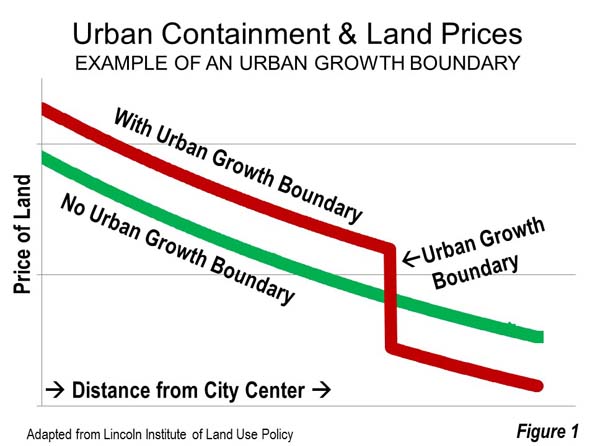
  • Biggest Income Gains In U.S. Accrue To Suburban Cities

    After a long period of  stagnation, last week’s announcement of the first substantial annual income gains since 2007 was certainly welcome. Predictably, analysts inclined toward a more favorable view of President Obama’s policies reacted favorably. Progressive icon Paul Krugman crowed that last year the “economy partied like it was 1999,” which he said validated the president’s “trickle up economics.”

    Equally predictably, conservative pundit Stephen Moore wrote that the stagnant longer-term numbers were actually a ”stinging indictment” of both the Obama and Bush records.

    The reality may be in between. The 5.2% increase over the past year was the largest in the nearly 50-year history of the Census Bureau’s Current Population Survey, and does represent some progress. Yet real incomes remain approximately 2.5% below the 1999 peak. This is an extraordinarily long time for incomes not to have risen, a decade longer than the previous modern record (1989 to 1995), according to the Federal Reserve Bank of St. Louis.

    And there are some reasons to be skeptical about the dramatic gains, as outlined in a virtually unprecedented report by the economist Gary Burtless of the generally left-leaning Brookings Institution. He suggests that the year-to-year increase may have been much less and that the CPS had been under-reporting annual income increases since 2003. John Crudelle of the right-leaning New York Post notes that recent CPS methodology changes could also have inflated the 2015 increase.

    To be sure, there are no signs of an economic boom that will sustain income gains — the 1.1% real GDP growth in the second quarter is no indication of a miraculous recovery.

    Nonetheless, real income gains were made last year, but they were not distributed evenly across the nation. We sought to assess the areas that did the best – and worst.

    The media has spun the story as further evidence of suburban decline and the resurgence of dense, hip cities. The Wall Street Journal went so far as to point to the migration of “highly educated millennials” to downtown areas as a factor, something that simply could not be deduced from the data that was reported.

    With more than 80% of millennials residing in the suburbs, this was heroic conjecture. Within metropolitan areas, CPS reports only “inside principal cities” and “outside principal cities.” The Census Bureau abandoned “central city” and “principal city” data more than a decade ago, in recognition of the fact that many suburban communities had become major employment hubs. As a result, principal cities include such low density, sprawling suburban behemoths as Mesa, Ariz. (Phoenix), Hillsboro, Ore. (Portland), Arlington, Texas (Dallas-Fort Worth), and, Anaheim, Calif. (Los Angeles). Simply put, the data does not support the assumption that hipster urbanism played a part in the one-year upsurge.

    The numbers suggest a more nuanced picture. For one thing, downtown residents represent little more than 1% of our metropolitan population, and less than 10% of the jobs. Nor did the biggest income gains occur in the metropolitan areas with the large, elite urban cores. Indeed, it is hard to imagine results more at odds with theme of dense urban core gain and suburban malaise.

    By far the largest gain was in Nashville, where household income rose 10.2% to $57,985. Nashville’s downtown is doing well, as is the case with many metropolitan areas. However, Nashville is hardly a model of the urban density planners would like to force around the nation. Its urban density is one-fourth that of nation-leading Los Angeles, a third that of New York and half that of Portland. The vast majority of its growth has taken place outside the core, and largely in the suburbs.

    Perhaps most surprising is second-ranked, Birmingham, Ala. It is harder to imagine a more poorly performing metropolitan area in the rapidly expanding South, but last year household income there grew 9.4% to $51,459, according to the CPS data. Just after World War II, Birmingham was a third smaller than Atlanta; now Atlanta is five times as large. Nor does Birmingham set any density records. No metropolitan area the world with a population over a million has a lower urban area density.

    Atlanta ranked third, with an increase of 7.2% to $60,219. The metropolitan area has the lowest population density among world urban areas with more than 2 million residents.

    Other metro areas with suburban core cities in the top 10 include No. 5 Kansas City; No.7 Memphis, which could be argued has performed as poorly as Birmingham in recent decades; and No. 8 Orlando. None of these has an urban density much higher than the national average, which includes urban areas as small as 2,500 population. In 10th-ranked San Jose, the core of Silicon Valley, household income rose 5.7% to $101,980, the highest of any metropolitan area in the nation. It is a virtually all suburban metro area, having developed almost entirely since World War II, and among the most automobile oriented, with a miniscule 4% of commuters using its bus, light rail and commuter rail services. Milwaukee, another metropolitan area that has lagged economically for years, ranked ninth.

    To be sure, the urban elites were not shut out. San Francisco, buoyed by spillover growth from suburban Silicon Valley, ranked fourth with a center that is the very definition of a dense urban core. Urban planning model Portland ranked sixth, yet it has an urban density 40% below that of all-suburban San Jose.

    The nation’s three largest metropolitan areas did poorly. New York, ranked 39th, with income growth of 2.5%, well below the 5.2% national gain. Los Angeles, the nation’s densest region, grew slightly better, at 3.4%, but still ranked only 32nd; Chicago, the nation’s third largest ranked just above New York at 38th.

    In last place is Oklahoma City, where, amid the oil and gas bust, household income dipped 0.4% to $52,221.

    Thus, the story is not about media-favorite cities or their favored urban core, as the progressive punditry may suggest. The one-year spike is perhaps the first long overdue indication that things could be getting better for the struggling working class. The biggest gains were in poorer metro areas. It could signal, to some extent, higher wages as employment tightens, particularly at the lower end of the job spectrum.

    Overall, it’s clear that even modest economic growth, sustained long enough, would bring some blessings to the poor, particularly in the inner cities. The question is whether these gains can be sustained in an economy where growth seems to trending slower still.

    This piece first appeared at Forbes.

    Joel Kotkin is executive editor of NewGeography.com. He is the Roger Hobbs Distinguished Fellow in Urban Studies at Chapman University and executive director of the Houston-based Center for Opportunity Urbanism. His newest book, The Human City: Urbanism for the rest of us, will be published in April by Agate. He is also author of The New Class ConflictThe City: A Global History, and The Next Hundred Million: America in 2050. He lives in Orange County, CA.

    Wendell Cox is principal of Demographia, an international pubilc policy and demographics firm. He is a Senior Fellow of the Center for Opportunity Urbanism (US), Senior Fellow for Housing Affordability and Municipal Policy for the Frontier Centre for Public Policy (Canada), and a member of the Board of Advisors of the Center for Demographics and Policy at Chapman University (California). He is co-author of the “Demographia International Housing Affordability Survey” and author of “Demographia World Urban Areas” and “War on the Dream: How Anti-Sprawl Policy Threatens the Quality of Life.” He was appointed to three terms on the Los Angeles County Transportation Commission, where he served with the leading city and county leadership as the only non-elected member. He served as a visiting professor at the Conservatoire National des Arts et Metiers, a national university in Paris.

    Photograph: Downtown Nashville from BigStockPhoto.com