Category: Urban Issues

  • Lessons from Chrysler and the Nationalized Economy

    Economists and accountants could very likely have told us six months ago that Chrysler was doomed as a business and that the likely best course of action would be Chapter 11 bankruptcy and restructuring. Doing this in a timely manner would have saved the taxpayers billions of dollars.

    But the politics were not right to permit this to happen at that time. So instead we invested billions of tax dollars to save it, only to find ourselves right back were we started. Except now the clock is striking twelve and it is the right time to reorganize the automaker – politically speaking.

    The politics has worked to “force” Daimler, Cerberus, Banks, UAW and the U.S. taxpayer to forgive nearly $17 billion in debt, and to transfer ownership to a consortium that includes Fiat, U.A.W., and the U.S. and Canadian governments. The same fate may soon await General Motors given the current political atmosphere.

    Government action is not driven so much by economics or accounting as it is by shifts and changes in public opinion and the political winds on Capitol Hill. Regardless of the problem and the consequences of delay, no issue will be dealt with until opinion has been properly shaped around it. This is inefficient by its nature, but government is not a business and cannot fail, so the consequences are never felt by government.

    This means government will often invest in what’s next and ignore what is needed in the present. Why? Because the public likes the new and the novel and grows weary of the old and tried and true. Transportation infrastructure is a great example. It is an accepted fact that our road and bridge infrastructure is failing and will require billions of additional dollars to rebuild and reform into a 21st century, integrated mobility network. Yet there is no political will to address an issue which could seriously undermine our economic competitiveness costing us countless jobs and businesses.

    Politicians know that a solution will require new revenues and very likely a new user fee to augment the current gas tax. Raising taxes is not good for the long term political health of our elected “leaders” because the public does not want to pay for things. So rather than solve a pressing need, government proposes borrowing $8 billion to spend on high speed rail projects like the one to connect Disneyland and Las Vegas. This project works politically because it is filled with perceived benefits and no one really has to pay for them – we can pass it all on to the next generation.

    As we move toward increasing the politicization of our economy where politicians replace CEOs, government becomes a major shareholder in corporations, and the metrics of elections replace standard accounting practices, we should remember the inherent and unintended consequences.

    Businesses succeed or fail based on markets. The government’s attempt to create a false housing market with its affordable housing initiative is arguably one of the major contributing factors to our current recession. They will likely assert their new power in the automobile industry to create “green” cars that may or may not sell. What if consumers choose to buy Japanese, Korean or German label cars made in Mississippi or Alabama, instead of UAW-built cars from Michigan?

    Markets work, and yet they are being ignored. The second most profound economic event of the past year (the collapse of the financial markets being the first) was when the price of gasoline moved above $4.00 a gallon in April of 2008. People drove less. Demand for SUVs plummeted. Ridership of public transportation increased dramatically. Many valued components of American way of life changed almost overnight.

    What is often missed is the fact that government was powerless to do anything about gas prices. Elected leaders looked for scapegoats in speculators and commanded the heads of the Big Oil companies pay homage at their feet. They attacked profits, demanded more drilling, put their environmental agenda on the back burner. The crisis showed them to be feckless on the horns of a dilemma. When prices retreated swiftly in August 2008 and public opinion cooled on the issue, drilling for new energy disappeared from the radar and everything was “green” again. The problem has not disappeared of course, but only public support for a solution. Is this any way to run an economy?

    Businesses concentrate on profit. Elected leaders focus on votes. Bad business decisions are unsustainable in a free market which metes out consequences with failure. Bad political decisions make an elected official unelectable, so it is always better to avoid conflict by putting off the really tough decisions for another day. This is not the way most Americans run their households, but it’s how politicians would run our economy – responding to opinion, not market conditions.

    There are some very difficult decisions as we move through this economic downturn. Do we want more and more of the political processes to be incorporated into our economy on a permanent basis? Banks and financial institutions have already seen first hand the consequences of getting into bed with government. Our automobile industry is next in line. Let’s hope it is the end of the line, but it probably won’t be.

    Dennis M. Powell is president and CEO of Massey Powell an issues management consulting company located in Plymouth Meeting, PA.

  • America’s (Sub)Urban Future

    Cities today have more political clout than at any time in a half century. Not only does an urbanite blessed by the Chicago machine sit in the White House, but Congress is now dominated by Democratic politicians hailing from either cities or inner-ring suburbs.

    Perhaps because of this representation, some are calling for the administration and Congress to “bail out” urban America. Yet there’s grave danger in heeding this call. Hope that “the urban president” will solve inner-city problems could end up diverting cities from the kind of radical reforms necessary to thrive in the coming decades.

    Demographics and economics make self-help a necessity. Despite the wishful thinking of urbanophile pundits and policymakers, central cities have little realistic chance to reclaim their pre-1950 role as the dominant arbiters of American life.

    Short of a catastrophic change, the country will remain predominately made up of suburban, exurban and small town residents. Since 2000, more than four-fifths of metropolitan growth has taken place in suburbs and exurbs. Economically, we see a similar pattern. According to a recent Brookings Institution study of 98 large metropolitan areas, only 21% of employees work within three miles of downtown. The report found that only three regions avoided the decentralizing trend.

    The Brookings report and many others decry all these trends as promoting “sprawl,” but name-calling will not assure that urban areas can impose their political hegemony over the long run. The Obama administration may try to boost cities by imposing barriers to suburban growth, but these seem doomed to failure given both the preference of most Americans for lower-density lifestyles and the president’s demonstrated ability to count votes.

    Rather than waiting for Barack, urban boosters should instead take up the New Testament injunction to “heal thyself.” Cities should have a chance to grow based on the roughly 10% to 20% of Americans who tell researchers they would like to live in a dense urban environment. With an extra 100 million Americans coming on line by 2050, cities could look forward to accommodating upwards of 20 million more people in the next few decades. As my grandmother would say, that’s not exactly chopped liver.

    Yet in order to enjoy this repast, cities will need to address three fundamental and inextricably related issues: public safety, business climate and political reform. Of these, public safety is the most critical. From the earliest times, security has represented a critical pre-condition for urban success. The huge surge in urban crime during the 1960s, for example, played an enormous role in the precipitous decline of cities in the ensuing decades.

    Conversely, improvements in public safety after 1990–notably in New York and Los Angeles but also in other large cities–helped slow the out-migration from urban cores and attract new residents, mostly young educated professionals and immigrants. Now urban crime may be on the rise, and could again threaten new growth.

    This is worrying because urban crime rates, notes demographer Wendell Cox, remain still three times higher than those of surrounding suburbs. Almost all the highest crime areas in America can be found in urban settings, while the safest places tend to be in suburban towns.

    Even the president’s much-celebrated hometown of Chicago suffered roughly a murder a day last year. On the city’s MTA trains, robbery soared 77% between 2006 and 2008. Now there’s also more than a stickup a day.

    Hard economic times may exacerbate these problems, with an estimated 250,000 more Chicagoans predicted to fall into poverty by the end of the year. More widely, unemployment among core urban populations–young people, minorities and immigrants–is on the rise, even more than in the general population. Indeed, for the first time since the mid-1990s, the foreign born now suffer a higher rate of joblessness than the native born.

    Yet even in the face of a tough economy, few cities seem to focus on long-term middle-class job creation. Most seem to prefer to indulge in marginally useful taxpayer-subsidized prestige projects like convention centers, arts complexes, ball parks and arenas. Meanwhile, the core issues stifling growth–high taxes, stiff regulatory burdens and sometimes corrupt governments–remain largely ignored.

    Recently while researching the middle class in New York, I met many otherwise committed urbanites considering leaving to less costly, lower-tax and more business-friendly locales. Up until recently, this problem was somewhat obscured by spectacular earnings on Wall Street, which engendered the growth of an extensive “luxury economy” largely insulated from high costs. But even Timothy Geithner won’t be able to bail out this favored segment of the economy ad infinitum.

    Instead cities, including New York, will have to diversify to less gilded industries. Increasingly cities will need to rely on small companies, micro-enterprises and self-employed high-tech artisans to drive their economies. To keep them there, they will need to attend to basic services–education, police and transportation–while managing to curb taxes and regulations.

    This will necessitate confronting the largest source of high city costs: public employee salaries and pensions. This problem is not unique to core cities, but tends to be more severe in urban areas where public employee unions often dominate local politics.

    Finally, cities need to address their educational systems. Despite all the talk of urban educational reform, the urban dropout rate, according to a recent study of the nation’s largest cities by America’s Promise Alliance remains around 50%, roughly 20 points higher than the rate for suburbs. Poor-quality urban schools drive out both the middle class and the most upwardly mobile segment of the working class.

    Even more money from Washington won’t solve this problem. Cleveland, with a 38% graduation rate, spent far more on students per capita than Ohio’s statewide averages. In contrast, the surrounding suburbs enjoyed an 80% graduation rate.

    Are cities capable of changing their governance for the better? In the 1990s, the emergence of tough, reform-minded mayors like New York’s Rudy Giuliani, Indianapolis’ innovative Steven Goldsmith, Richard Riordan in Los Angeles and Houston’s hard-driving Bob Lanier all sparked urban revivals in their cities.

    Today, however, there are few such personages; Houston’s Bill White is one glaring exception. Yet without an infusion of bold new leadership, the future of American cities, although not universally bleak, will not be nearly as bright as it should be. Rather than a constellation of strong, reviving cities, we can envision the emergence of a less promising set of scenarios.

    One archetype will be the Bloombergian “luxury city,” a very expensive urban area dominated by the wealthy and their servants, students and nomadic young workers as well as the poor. The affluent will drive this growth, but only in a relatively few neighborhoods in attractive places like New York, Chicago, Boston, Los Angeles, Seattle, Portland, Denver and Minneapolis.

    San Francisco may presage this urban form. Already middle-class families are becoming scarce in the city by the bay. The place seems increasingly something of a Disneyland for privileged adults, exempting of course the large homeless population. “A cross between Carmel and Calcutta,” jokes California historian and San Francisco native Kevin Starr.

    At the opposite end of the spectrum lie those cities consistently at the bottom of our Worst Cities For Jobs ranking. Despite some zones of gentrification, such once-great cities as Detroit, Cleveland, Memphis, Baltimore and Philadelphia could continue to suffer persistently high rates of poverty, diminished populations and high crime rates.

    Not that this has to be. These areas could stage a real resurgence if their governments determine to throttle criminals, improve basic services and nurture small businesses. Low housing prices, cheap land and, in some cases, strategic locations could attract businesses as well as some of the millions who will be seeking out an urban lifestyle in the coming decades.

    Currently the brightest hopes for America’s urban future lie with newer, “aspirational,” middle-class-oriented cities such as Houston, Dallas, Austin, Phoenix, Raleigh-Durham, Charlotte and Orlando. Although some are now suffering from the recession, these places will benefit from both lower costs and more business-friendly regimes. Primarily suburban in nature, many of these cities have worked to develop attractive dense urban districts, which could expand much further over the next few decades.

    There remains nothing pre-determined about the urban future. Some cities may surprise us by reviving strongly while others may continue to disappoint. Success will depend not on Washington, but on how each city addresses the basics of safety, economics and governance. Grasping this fundamental truth constitutes the first step towards creating a sustainable long-term urban resurgence.

    This article originally appeared at Forbes.

    Joel Kotkin is executive editor of NewGeography.com and is a presidential fellow in urban futures at Chapman University. He is author of The City: A Global History and is finishing a book on the American future.
  • How Austin’s Rise Became a Tale of Two Cities

    Austin has enjoyed healthy growth during its 150-year history. As a rule of thumb, its population doubles every 20 years, and has done so since it was founded. It continues to grow at a healthy clip: from a population of 345,000 in 1980 to 656,000 in 2000; the Census Bureau estimates it had nearly 750,000 residents in 2008.

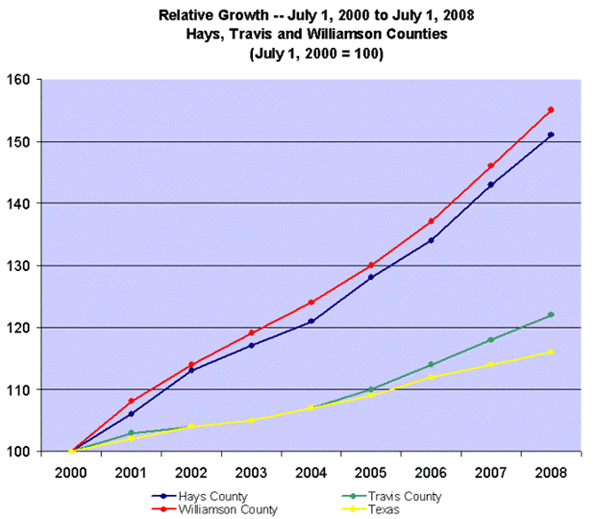
    But if the city of Austin has grown briskly, its suburbs have exploded. Williamson County to its north was the sixth fastest-growing county in the United States between July 1, 2007 and July 1, 2008. Hays County to the south was the tenth.

    This is not a recent development. Williamson and Hays Counties have outpaced Travis County (Austin) and Texas for years:

    The figures for individual suburbs reflect this spectacular growth:

    • Between 1990 and 2007, Round Rock, ten miles north of Austin and home to Dell Computers, tripled from 31,000 to almost 100,000; its population grew by 50% between 2000 and 2007 alone.
    • Pflugerville, just south of Round Rock, grew from a tiny village of 4,000 in 1990 to 34,000 in 2007.
    • Cedar Park and Leander grew tenfold and sevenfold, respectively, between 1990 and 2007.

    The scale of rapid growth is noteworthy, but the distribution of growth is hardly unique. After all, American cities have been suburbanizing for the last 60 years (and in some cities, for much longer). Austin’s suburbanizing growth merely mirrors the national trend.

    But Austin’s growth evinces another pattern. As Austin and its suburbs have grown, families with children have left central Austin for its fringes, ceding central Austin to singles and couples without children.

    Central Austin is typically defined as the area urbanized by 1970, delineated by a perimeter of highways and lakes. But there’s an alternative definition: Central Austin is where the families with children are not.

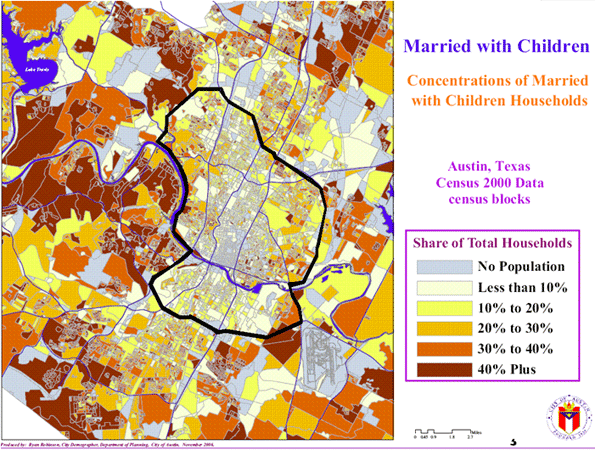
    The map below tells the story. It depicts, using 2000 Census data, the percentage of households consisting of married couples with children. Darkly-tinted regions have a relatively high percentage of such households; lightly-colored regions, relatively few. The area bounded by the heavy, black line – the lightly-tinted region in the center of the map – is central Austin.

    This map excludes the suburbs in Williamson and Hays Counties. Needless to say, these cities would also be colored brown and deep-orange. For example, 45% of Cedar Park’s households in 2000 consisted of married couples with children. In Pflugerville, the figure was 48%. Over the last few decades, Austin has sorted itself into two cities: suburbs populated by families with children, and a central core populated largely by singles and childless couples.

    Why?

    This might seem a trite question at first blush. This pattern has repeated itself in one American city after another for many decades.

    But Austin’s case is interesting because many standard explanations do not hold. Austin’s families have not had to flee the central city to escape crime, or dense, overcrowded neighborhoods, or failing schools, or the pollution and blight of old, abandoned industrial sites. Nor have they had to abandon the central city in search of jobs.

    Austin historically has had a low crime rate with one of the lowest homicide rates in the country. And many of those crimes occur outside the central city. Austin’s slums are not located in central Austin, but in the aging suburbs just north and southeast of the urban core. Central east Austin – where African Americans and Latinos were banished for much of Austin’s history – was, and to some extent remains, an exception. But even that area has gentrified rapidly in recent years. And, in any event, neither east Austin’s problems nor a racist desire to avoid people of color can explain the flight of families from the historically “whiter” parts of town.

    Central Austin certainly has plenty of bad schools. But it also has plenty of good schools, and a liberal transfer policy. Moreover, many of the central schools began to deteriorate after they were abandoned by middle-class families. Thanks to declining populations of children, the Austin school district has been forced to close several small, neighborhood elementary schools, even as it strains to add classrooms to the burgeoning suburbs. Austin includes many of its suburbs – it grows rapidly through annexation – and AISD covers these.

    Families also did not have to flee central Austin to escape dense, overcrowded neighborhoods. The typical central Austin neighborhood is no denser than a typical suburban neighborhood. Most central Austin neighborhoods consist almost entirely of single-family residences. Indeed, in some, nearly 90% of the residential acreage is set aside for single-family housing, with multi-family developments relegated to busy streets. And yard sizes in suburbs are frequently little larger than the yards in the central neighborhoods.

    Nor did families flee central Austin in a quest for green space. Austin’s great parks are concentrated in its core. These include Zilker Park – Austin’s equivalent of central park; Barton Springs, fed by springs bubbling up from the Edwards Aquifer; Lady Bird Lake, neé Town Lake; and more green belts than a die-hard hiker could cover in a summer.

    Central Austin has no pollution or industrial blight. Austin has never been a manufacturing town. Its employment base has always been the University of Texas, the state government and, more recently, high tech.

    The high-tech job growth has blossomed in Austin’s suburbs. Austin styles itself “Silicon Hills,” and virtually all high-tech jobs have spring up in the rolling country west and north of the downtown. But the addition of jobs to the periphery does not explain why families have been abandoning the central city. Austin’s core has not only retained its jobs, it has seen healthy growth. A recent Brookings study estimates that central Austin employment grew by almost 13% between 1998 and 2006 According to the Brookings study, the number of jobs more than 10 miles from the CBD increased by 77,523, or 62%. Obviously, this was incredible growth. But this does not explain why families abandoned the central core when it, too, was adding jobs.

    In the end the key reason people have been moving to the suburbs lies in a mundane reality. Austin families have been moving to the suburbs because the suburbs have bigger, better and cheaper houses.

    Austin’s inner neighborhoods may be packed with single-family housing, but they are small, old and increasingly expensive. The central neighborhoods were built before 1970 and, in most cases, before 1960. The houses are usually no more than 1200 or 1400 square feet. And these houses are expensive (for Austin) and often fixer-uppers to boot.

    By contrast, the suburban stock is much newer and larger. Between 2000 and 2006, for example, the average new home in Circle C, a prominent suburb to the south, had 3,965 square feet; the average new home in Steiner Ranch, a western suburb had 3,915 square feet. And these houses were and are much cheaper than central city houses. One might find a 3,000 square-foot home in the suburbs for $250,000. The same home in central Austin might cost $750,000. Many suburban subdivisions have much smaller homes, of course, but a middle class family only able to afford an 1,800 square foot house in the suburbs is not likely to pay $400,000 for a smaller house in central Austin.

    Families want space, and the central housing stock is either too small or too expensive. This basic reality has transformed Austin into essentially two largely successful cities: a central core left to small households and suburbs that offer either larger housing, or smaller housing at much cheaper prices.

    This trend may have been slower if developers had been allowed to continue replacing small bungalows with larger, more modern houses. But this trend prompted an outcry from central Austin residents, who pushed the city council to enact a “McMansion” ordinance to “protect” central Austin neighborhoods. The title was a clever bit of marketing. The word “McMansion” evokes an enormous, pretentious structure – and who wants that? But Austin’s stringent ordinance takes aim at much more modest homes. Depending on lot size, a home with an attached two-car garage may be limited to 2,000 square feet, smaller than the typical new American home. The ordinance imposes other complicated limitations, turning modest home additions into a complicated, extensive ordeal. A homeowner who wants to add a second story, for example, must ensure that the second story fits within an elaborate “building envelope” – a complicated calculation unless the addition is centered in the lot – and new setback lines calculated as a rolling average of neighboring setbacks. (Incidentally, the new setbacks and square-foot limitations have all but eliminated granny flats.) The only option for adding a significant amount of new space is often the construction of a basement buried completely below grade; basements do not count against the square footage limits.

    Austin’s McMansion ordinance will ensure that its central Austin neighborhoods remain the domain of small, aging bungalows – and people without children – for the foreseeable future. In this way, it will reflect the demographic realities of many prosperous, “hip” cities from San Francisco and Boston to Seattle and Portland.

    Yet there’s an ironic side to this. Alarmed by the decline of families in the city, the same city council that enacted the McMansion ordinance created a new task force a few months later to determine why central Austin has now so few families with children.

    Chris Bradford is a 1992 graduate of the Yale Law School, where he was an Olin Fellow in Law and Economics. He is an attorney at Clark, Thomas and Winters, P.C. in Austin, Texas. Visit Chris’s blog at austincontrarian.com

  • New Towns and New Lives in the Country

    Back in the 1950s when I was growing up, pundits worried a lot about automation and the problem of leisure in a post-industrial society. What were the American people going to do once machinery had relieved them of the daily burden of routine labor? Would they paint pictures and write poetry? Armchair intellectuals found it hard to imagine.

    It was the age of Ozzie and Harriet, when ordinary working and middle-class families could aspire to a house in the suburbs and a full-time Mom who stays at home with the kids. Today, of course, that popular version of the American dream is a thing of the past, especially the part about a full-time Mom who stays at home with the kids.

    Ironically it was washing machines and automatic dishwashers – automation – that brought this idyll to an end. These two labor saving devices made it possible for housewives to go out into the workforce and compete with their husbands. At first they did it because they were bored at home and wanted to earn extra money, if only to help pay for those new household appliances. Gradually, however, it became a matter of necessity as two-paycheck families bid down wages even as they jacked up the price of suburban real estate in areas where the schools were good and the neighborhoods safe. By the time you subtracted the costs of owning a second automobile and using professional child care services, the advantages of that extra paycheck had largely disappeared.

    The biggest surprise – to me as well – was that labor-saving technologies do not automatically redound to the benefit of labor. Other things being equal they reduce the demand for labor and hence its price in the marketplace. We saw this happen in the 19th century when modern agricultural machinery forced three-quarters of the population off their farms and into the cities, where they had to compete with immigrants and each other in the new industrial economy. Not until the Fair Labor Standards Act of 1937, which outlawed child labor and established the 40 hour work week, did the world of Ozzie-and-Harriet become a democratic possibility.

    But of course Modern Marvels never cease. Thanks to a never-ending supply of new labor-saving machinery, today’s industry employs only half as many people as it did in the 1950s when housewives first started entering the job market. Meanwhile medical science has greatly extended the average human lifespan, which has created a much larger pool of able-bodied adults who must either work or be supported by those who do. The Wal-Martization of retail and wholesale trade is yet a third development tending in the same direction.

    Given this trajectory, perhaps it is time to consider a further reduction of the standard work week and the creation of new forms of suburban development. The goal would be for ordinary working families to begin enjoying the fruit of fifty years of economic and technological progress.

    In particular let us consider the advantages of a program to build new towns in the exurban countryside in which people would be employed half-time (18-to-24 hours a week) outside the home, and in their free time would participate in the construction of their own houses, cultivate gardens, cook and eat at home, and look after their own children (and grandchildren) in traditional neighborhood settings close to village greens.

    Once work and leisure are integrated into the fabric of everyday life people will not feel the same need to retire they do today. Instead of retiring in their sixties seniors could take easier jobs as they grow older and continue working for as long as they are able and willing. The Social Security crunch could be relieved without having to raise taxes on the younger generation.

    We might even consider a return to the three-generation form of the family – except under two roofs instead of one, say, at opposite ends of the garden. Grandparents could use their savings to help their children with the initial purchase of their homesteads, while later on their children and grandchildren could help care for them in their old age, providing a more humane (and far more affordable) alternative to nursing homes and assisted-living arrangements.

    And instead of being designed around high-speed automobiles the new towns could be small enough (25,000 to 30,000 inhabitants) and be laid out in such a way that the residents could get around on foot, by bicycle, or in “neighborhood electric vehicles” (souped up golf carts) designed to go 30 mph. In other words, with careful planning the efficiencies of urban density could be realized without forcing people to move back into the dense centers of our cities and surrounding both privacy and space.

    I once hired the Gallup Organization to survey the American public about a lifestyle similar to this. The question asked was the following:

    “As a new way to live in America, it has been suggested that we build our factories in rural areas outside the cities and run them on part-time jobs. Under this arrangement both parents would work six hours a day and three-days a week and in their spare time would build their own houses, cultivate gardens, and pursue other leisure-time activities. How interested would you be in living this way?”

    Forty percent of the population said they would be either “definitely” or “probably” interested in the idea, with another 25 percent expressing possible interest. Included in these figures were two-thirds of those who had attended college, 60 percent of people with incomes in the top quartile, and 80 percent of African Americans.

    Industries might be interested in the idea because part-time workers can work faster and more efficiently than full-time workers, just as in track and field the short-distance runners always run faster than the long-distance runners. When I explained this in a letter to one of America’s leading industrial relocation firms, the executive vice-president flew down to Tennessee the very next day to discuss it with me. He assured me that this was “a doable idea” and not “pie in the sky.”

    Even so building New Towns in the Country is no easy task. It won’t happen spontaneously if for no other reason that people will not move to places where industry does not exist, and industry will not move to places where people do not live. It takes coordination, planning, organization, and investment in infrastructure.

    There is a movement afoot in America for a new nation-wide infrastructure spending program. This proposal could be one part of it. After all, our federal government in the past has done things for the people to create a better way of life: the trans-continental railroad, the Homestead Act, the Interstate Highway System, the Fair Labor Standards Act, and the FHA.

    New Towns in the Country and a much shorter work-week would work well together, even if the two things are impossible to achieve by themselves. We need to reorganize both time and space if we hope to create a healthy, productive way of life for tomorrow’s working families.

    Luke Lea is a retired landscape gardening contractor and one-time professional carpenter. A graduate of Reed College, he lives in the small town of Walden, Tennessee, near Chattanooga where he was born.

  • The Draw of Dhaka

    In recent centuries, the principal migration of the world’s population has been from rural areas to urban areas. As late as 1900, less than 20 percent of the world’s population lived in urban areas. That figure has now risen to more than 50 percent. Urbanization occurred earliest in the first world, as the increased wealth produced by the industrial revolution attracted people from the countryside. In 1900, 40 percent of the US population was urban, a figure that had risen to 80 percent by 2005. Trends in Europe, Japan and other first world nations are similar.

    The migration to cities has been slower to start in the less developed world. Only in 2005 did China achieve a 40 percent urbanization rate. Urbanization is expected to continue virtually everywhere, with the world rate increasing to 70 percent by 2050.

    Nowhere, however, are the trends starker than in Bangladesh and its capital, Dhaka, which I had the privilege of visiting a few weeks ago. Bangladesh is approaching 160 million people, despite having a land area less than that of Wisconsin. Its population density, rural and urban combined, is approximately 3,200 per square mile (1,250 per square kilometer) and is nearly equal to that of the Portland urban (urbanized) area, which had 3,300 per square mile. The nation’s population density is more than three times the minimum population density used by census authorities in the United States, France, the United Kingdom and Canada for definition of urban areas.

    However, most of Bangladesh is not urban. The United Nations puts the urban share of the Bangladesh population at 28 percent, barely two-thirds of the less developed world average. Even this is a stunning increase from the less than 5 percent of 1950. By 2050, the United Nations says that the urban areas of Bangladesh will add 97 million people, as the rural population declines, sending the urban population to roughly 60 percent of the total.

    Growing Dhaka: Dhaka is the world’s newest megacity, with an urban agglomeration just over 10 million population (based upon United Nations population growth rate projections). There are few urban areas in the world that are growing faster. Historically, nearly one-third of the urban population increase in Bangladesh has been in Dhaka. This seems likely to continue, since the nation has few other urban centers. The second largest, Chittagong, is just one-third the size of Dhaka. At projected urban population growth rates, Dhaka could have 40 million people by 2050.

    Dhaka’s Unfortunate Location: As difficult to imagine as this urban growth may seem, other emerging super-cities such as Shanghai can be imagined with 40 million people, with their plentiful supply of quality land for development. Things are much different in Dhaka. No rapidly expanding urban area (and no nation) faces greater locational challenges.

    Dhaka could be the most inconveniently placed urban area in the world, even worse than New Orleans. The urban area sits on the world’s largest river delta, the Ganges – Brahmaputra Delta (The Ganges is called the Padma River in Bangladesh). This Delta, nearly the size of Oregon, is more than 1.5 times the size of the nation, though not all of the nation is in the Delta.

    Dhaka itself is virtually surrounded by the rivers of the Ganges-Brahmaputra system, from which most of it is protected from routine and disastrous floods by floodwalls. The main channel of the Ganges is less than 20 miles distant the confluence with the Brahmaputra and is less than 50 miles away and the Indian Ocean (Bay of Bengal), barely 100 miles away. Dhaka lies at a low elevation, so rising sea levels could intensify the problem. The same river delta is also home to another megacity, Kolkata (India). However Kolkata’s geographical challenges are far less, with fewer Ganges outlet channels and less in wetlands, which has permitted it to develop at one-third the density of Dhaka.

    Dhaka’s Unprecedented Population Density: The urban area is the world’s most dense, having recently passed Hong Kong (based, again on United Nations estimates and projections). Covering a land area of little more than 100 square miles, Dhaka’s population density is now approaching in excess of 100,000 per square mile (40,000 per square kilometer). At that density, the New York urban area would accommodate all of the population of the United States and Mexico.

    Dhaka’s Impossible Traffic: The urban area is from five to seven miles wide and from 15 to 20 miles long, north to south. There is a single north to south thoroughfare through the whole urban area, which the Inspector General of Police estimates is blocked for 6 hours per day at railroad crossings. Needless to say, with its density inducing traffic congestion and insufficient road infrastructure, Dhaka’s traffic is horrific.

    The Poverty: There is, of course, the grinding poverty. Most recent estimates place the gross domestic product per capita of Bangladesh at under $1,500 annually (purchasing power parity). Dhaka is very likely the world’s poorest megacity. Progress is being made, principally from the fruits of globalization. There has been strong growth in garment production and huge numbers of jobs have been created. However, even this progress is threatened by inward-looking anti-trade movements in developed countries whose proponents ignore the likelihood that their policies would drive the poor of Dhaka into even greater decrepitude. Even if these selfish intentions fail, it will take decades for Bangladesh to join the ranks of middle income nations, much less high income nations. That, nonetheless, should be the objective.

    The Shantytowns: Various estimates indicate that up to one-quarter of Dhaka’s population lives in informal settlements (shantytowns, slums or favelas). These settlements tend to be “marbled” throughout the urban area, along the streams, railroads, lakes and ponds and in the drainage canals. However, none of the shantytowns are so expansive as those in Mumbai. Perhaps that is because commerce is decentralized in Dhaka, with garment factories spread throughout the urban area. People in the shantytowns have to work and many walk to their jobs, both factory and domestic. Their lives are precarious. Population densities in the slums have been reported as high as 4,200 per acre, which converts to more than 2,500,000 per square mile or more than 1,000,000 per square kilometer. At that density, the population of the world could be accommodated in the Tokyo-Yokohama urban area, leaving 10 percent of the land for open space.

    The Draw of Dhaka: Why do they come to Dhaka? What is the draw of a place that to western eyes could be dismissed as one of the least attractive urban environments in the world? It is the same incentives that drew people to Chicago from the farmlands of Poland, Italy or Iowa and to Sao Paulo from the sugar plantations. People routinely seek better lives. As in other cities in the developing world (or the developed world before), rural populations did not migrate to Dhaka because they were better off where they came from. Moreover, virtually all of the migrants from rural areas could return home tomorrow. Not surprisingly, few do.

    Moreover, there is progress, even in the shantytowns. Many residents “cook with gas” and have access to electricity, even if pirated from adjacent lines. There are schools where the children of the migrants are exposed to the foundation of literacy required for better lives in the future.

    Dhaka: City of Hope: Of course, it is all a matter of perspective. Dhaka may not look pleasing to affluent foreigners. Few residents of Portland, Paris or Perth would willingly embrace even a privileged lifestyle amidst the poverty of Dhaka. But despite the intense challenges, for the rural poor of Bangladesh, Dhaka remains very much a city of hope.


    Additional References:
    The Megacity Book: http://www.rentalcartours.net/megacity_book.pdf
    Dhaka Rental Car Tour: (soon to be published): http://www.rentalcartours.net/rac-dhaka.pdf

    Wendell Cox is a Visiting Professor, Conservatoire National des Arts et Metiers, Paris. He was born in Los Angeles and was appointed to three terms on the Los Angeles County Transportation Commission by Mayor Tom Bradley. He is the author of “War on the Dream: How Anti-Sprawl Policy Threatens the Quality of Life.

  • The Republican Party, Pennsylvania and Arlen Specter

    Senator Arlen Specter switched parties. A five term Senator switching parties is certainly news, but it also represents a far greater statement about the challenges facing the Republican Party in Pennsylvania going forward.

    Pennsylvania has been a dependable “Blue State” in presidential races since 1988. Currently, Democrats have a 1.2 million voter registration advantage. Less than a decade ago the margin was less than 500,000. What changed over the past decade?

    The changes in the political and demographic make-up of the five county Philadelphia region forced Specter’s flip. Specter’s base had been eroding as a result of other popular Democratic politicians seeking statewide and national offices and needing moderate Republicans to switch parties to support them in tough Primary Elections.

    It began with now Governor Ed Rendell who faced a fierce Primary Election in 2002 against Bob Casey, Jr. – the son of a former Pennsylvania Governor. The former Philadelphia Mayor needed a strong turnout in the Philadelphia area and he managed to flip more than one hundred thousand Republicans for the primary.

    Rendell defeated Casey by 162,648 votes statewide, but his victory total was 305,641 in the five county Philadelphia area where he won 81.3% of the vote and 56.5% of his total vote statewide.

    The 2002 primary proved the central role of the Philadelphia region, especially the suburbs. Rendell was able to win even while losing the total vote in the other 62 counties of Pennsylvania. The shift in moderate Republicans in the suburbs to Rendell was the critical factor.

    This was again the case in the general election; Rendell would carry this region by 515,000 votes on his way to winning his first term as Governor by 323,827.

    The 2002 election marked a turning point in Pennsylvania politics. From that point forward no candidate for statewide office could win without carrying at least one of the four suburban Philadelphia counties. All were becoming increasingly Democratic in voter registration.

    In the 2004 Primary, Arlen Specter faced conservative ex-Congressman Pat Toomey. Specter likely underestimated the impact of the change is southeast voting patterns. He was overconfident that his moderate Republican suburban base would carry the day. They did, but more narrowly than most suspected. Specter won the election by 17,146 votes statewide but he carried the southeast by 41,719 votes.

    Like Rendell in 2002, Specter lost the rest of the state but won in the five county region by enough of a margin to secure victory statewide. Unlike Rendell, his total in the southeast region only accounted for 31.4% of his statewide total votes as compared to Rendell’s 56.5%.

    Also, significant was the fact that he only defeated Toomey, who is far more conservative than former Senator Rick Santorum, by 34,669 votes in the four suburban counties. The moderate base was shifting to the Democrats, leaving the remnants of the GOP more conservative. This was a harbinger of Specter’s diminishing prospects as a Republican.

    Specter won the primary with 166,944 votes from the southeast region. Two years earlier in the primary, Mike Fisher, the Republican candidate from Pittsburgh who was running for Governor without opposition, won 161,103 Republican votes in this region. Fisher outpolled Specter’s 2004 vote in 2 of the 5 counties. It was only the last minute support Specter received from President George W. Bush and Senator Rick Santorum that saved Specter from defeat in 2004.

    In the General Election, Specter walloped his Democratic opponent Joe Hoeffel, a former southeast Congressman and Montgomery County Commissioner, by nearly 600,000. He would carry all five counties in the southeast by wide margins mainly because he had significant support from Democrats and Independents.

    The trend of greater Democratic power – and Specter’s dependence on them – continued to build. In 2006, Bob Casey defeated incumbent Senator Rick Santorum by 17.4 percentage points statewide despite the fact that Santorum would spend $31 million and was the number three in Republican Senate Leadership. Casey would carry all five counties in the southeast region proving that conservative Republicans could no longer win in this critical area in a contested General Election. By 2008, Barack Obama put the icing on the cake. The President racked up huge margins in the southeast repeating what Rendell had done in 2002. The change was now complete.

    It is safe to say that Arlen Specter simply could not win a Republican Primary Election in 2010. This said it is also safe to say that he would have likely won the General Election with relative ease regardless of who was the Democratic candidate. This is the dilemma that faced a Republican Party increasingly alienated from Specter, but facing increasingly stiff odds in its former suburban Philadelphia strongholds.

    The question now is will the Republican Party stand with conservative Pat Toomey to challenge Democrat Arlen Specter in the General Election? With promised support from President Obama, Vice President Biden and Governor Rendell the likelihood of a primary challenge for Specter is remote in his new party.

    Revenge is rarely as sweet as anticipated. It seems unlikely that a conservative Republican can win statewide without support in the Philadelphia suburbs. But data and history show that this is highly unlikely for a conservative Republican. There’s a cost to party purification. Unless the Republicans can find a way to appeal to the wayward suburban voters, it will take a major shift in the political dynamic – perhaps a more decided Democratic move to the left – to put Pennsylvania back in play.

    Dennis M. Powell is president and CEO of Massey Powell an issues management consulting company located in Plymouth Meeting, PA.

    Photo: KyleCassidy

  • Here in the Real World They’re Shutting Detroit Down

    Once upon a time, not so long ago, in a city at the heart of the American continent, General Motors produced cars, like Pontiac’s “Little GTO,” celebrated in Beach Boys songs that captured the thrill of driving Detroit’s latest creations. Today, as GM struggles to appease the government’s auditors just to stay alive, Kris Kristofferson, with a little help from Mickey Rourke, curses the financial wizards from Wall Street that are “Shutting Detroit Down” while “livin’ it up in that New York town.”

    Never has the inherent tension between the investor class and the country’s manufacturing sector been more pronounced or the stakes in this particular poker game higher for the future of America. Chrysler may be forced into bankruptcy first, but it’s GM’s downfall that represents the true mid-American earthquake.

    Back in the late 1950s, General Motors so dominated the American automobile market that its corporate goals were focused on achieving a 60% market share. The hubris of its executives led them to decide to pick up more and more costs for medical insurance, pensions and retiree benefits, beginning GM’s slide down a slippery slope of poor financial performance

    This posed a huge but not initially recognized risk to GM. By taking on these obligations that didn’t show up as a cost or balance-sheet liability until the government changed its accounting rules in 1992 and required companies to show the cost of “other post-employment benefits” (OPEB) on their books, General Motors lit a ticking time bomb that has now exploded in its face. In 1972, as GM came the closest it would ever come to achieving its sixty-percent market share goal, GM was paying the entire health insurance bill for its employees, survivors and retirees, and had agreed to “30 and out” early retirement that granted workers full pensions after 30 years on the job, regardless of age. Its world then began to come apart.

    In 1973, OPEC’s embargo tripled the price of oil. GM failed to respond quickly enough to the consumer’s sudden demand for fuel-efficient cars. At the same time, the Japanese with their then superior, lean manufacturing techniques stepped into the vacuum, gaining a foothold in the North American car market that they have continued to expand. Ironically, thirty years later the very same inability to shift product offerings during a spike in oil prices precipitated GM’s current difficulties.

    GM’s reluctance to go green is often cited by its new government owners as the reason it’s in so much trouble now, but the crux of GM’s problems really go back to those heady days of market domination and financial profligacy.

    In the 1960s GM’s annual operating margin (profits divided by revenues) averaged 8.7%. The turmoil of the seventies and the pressure from Japanese competition drove those average margins down to 5.5%. Margins fell by about half to an average of 3% in the 1980s, and about half again to 1.3% in the 1990s (not counting the $20 billion hit GM took when the new accounting rules for OPEB took effect.) Finally, in this decade the slide has actually taken the company into an average of negative margins. Now only the government’s suggested radical restructuring seems to offer a way to stop the bleeding.

    It is estimated that the cost of OPEB, essentially GM’s retiree pension and health care programs, have cost the company about $7 billion each year since 1993 and are probably around $10 billion per year now. The bargain auto company management made back in the 60s with labor to provide generous off the balance sheet benefits has now become an albatross that threatens the manufacturing jobs for the Big Three’s own current workers and suppliers across the Midwest. It’s the kind of problem only government can solve.

    But the Obama Administration’s early efforts to do so have been far from promising. First it selected Steve Rattner as its “car czar”, a politically well-connected private equity investor and turnaround artist from “that New York town,” someone with no significant automobile industry experience. In addition, the government’s demands that GM dismantle more brands and shut down more dealerships suggests the process may get a lot uglier by the May 31 decision deadline.

    Luckily the United Auto Workers remain on watch to try to ensure that whatever concessions are demanded of GM’s current and retired employees reflect an equitable shared sacrifice with the company’s bondholders and investors. The kind of GM that emerges from these negotiations will have a huge impact on these workers and on the many industrial towns that depend on the car business for their basic existence.

    Ultimately, the decision on how best to “rescue” GM may turn out to be the most difficult call President Obama will make in his first year in office. He will be pulled by pressures from the green gentry left to force GM’s future products to conform to a pre-determined environmental agenda. He also will face predictable Republican calls to let the market work its will, even if it means the end of the company.

    President Obama will need the wisdom of Solomon to recognize that today’s workers no more deserve to be punished for the mistakes of prior management than CIA agents do for carrying out the orders of their equally arrogant Republican counselors during George W. Bush’s administration. To paraphrase the President’s words, it’s “time to move on” and offer GM the support it needs to “Catch a Wave” and start producing more “Good Vibrations” for America’s hard pressed, but still very critical manufacturing sector.

    Morley Winograd and Michael D. Hais are fellows of the New Democrat Network and the New Policy Institute and co-authors of Millennial Makeover: MySpace, YouTube, and the Future of American Politics (Rutgers University Press: 2008), named one of the 10 favorite books by the New York Times in 2008.

  • The Worst Cities for Job Growth

    One of the saddest tasks in the annual survey of the best places to do business I conduct with Pepperdine University’s Michael Shires is examining the cities at the bottom of the list. Yet even in these nether regions there exists considerable diversity: Some places are likely to come back soon, while others have little immediate hope of moving up. (Please also see “Best Cities For Job Growth” for further analysis.)

    The study is based on job growth in 336 regions – called Metropolitan Statistical Areas by the Bureau of Labor Statistics, which provided the data – across the U.S. Our analysis looked not only at job growth in the last year but also at how employment figures have changed since 1996. This is because we are wary of overemphasizing recent data and strive to give a more complete picture of the potential a region has for job-seekers. (For the complete methodology, click here.)

    First let’s deal with the perennial losers, the sad sacks of the American economy. Mostly cities in the nation’s industrial heartland, these places have ranked toward the bottom of our list for much of the past five years. Eleven of the bottom 16 regions on our list are in two states, Ohio and Michigan. In fact, the Wolverine State alone accounts for the bottom four cities: Jackson, Detroit, Saginaw and Flint.

    Unfortunately, there’s not much in the way of short-term – or perhaps even medium- or long-term – hope for a strong rebound in those places. President Obama seems determined to give the automakers, for whom Michigan is home base, far rougher treatment than what he meted out to ailing companies in the financial sector.

    In addition, new environmental regulations may not help auto production, since it necessitates some carbon-spewing and therefore perhaps unacceptable levels of greenhouse gas emission.

    However, not all of Michigan’s problems stem from Washington or the marketplace. Many of the locations at the bottom of the list remain inhospitable to business. To be sure, housing is cheap – in Detroit, property values are fast plummeting toward zero – but running a business can be surprisingly expensive in these hard-pressed places.

    In fact, according to a recent survey by the Tax Foundation, Ohio has an average tax burden roughly similar to New York, California, Massachusetts and Connecticut. But while the others are comparatively high-income states, Ohio residents no longer enjoy that level of affluence.

    Can these places come back? It is un-American to abandon hope, but there needs to be a radical shift in strategy to focus on creating new middle-class jobs. Some Midwestern cities, like Kalamazoo and Indianapolis, have made some successful efforts to diversify their economies, encouraging start-ups and trying to be business-friendly.

    But those are exceptions. Cleveland, one of our worst big cities, could spark a renaissance by revamping its port and nearby industrial hinterland. Once the world economy improves, it could re-emerge – building on the existing knowledge and skills of its production- and design-savvy population – as a hub for manufacturing and exports.

    But right now, Cleveland does not seem to be pursuing such opportunities. As Purdue’s Ed Morrison has pointed out, local leaders there seem to “confuse real estate development with economic development.”

    So Cleveland will focus on inanities such as convention business and tourism, believing we all fantasize about a week enjoying the sights along Lake Erie. Yet even high-profile buildings like the Rock and Roll Hall of Fame and Museum, completed in 1986, have not transformed a gritty old industrial town into a beacon for the hip and cool.

    Old industrial cities like Cleveland are better off focusing on their locational advantages – access to roads, train lines and water routes – while offering a safe, inexpensive and friendly venue for ambitious young families, immigrants and entrepreneurs.

    Meanwhile, cities with formerly robust economies – like Reno, Nev., Las Vegas, Orlando, Fla., Tampa, Fla., Fort Lauderdale, Fla., West Palm Beach, Fla., Jacksonville, Fla., and Phoenix – are more likely to rebound. These areas topped our list for much of the 2000s; their success was driven first by surging population and job growth and later by escalating housing prices.

    But the collapse of the housing bubble and a drop in large-scale migration from other regions has weakened, often dramatically, these perennial successes. “We could rely on 1,000 people a week moving into the area,” notes one longtime official in central Florida. “These people needed services, houses and bought stuff. Now the growth is a 10th of that.”

    Instead of waiting for the real estate bubble to return, these areas should choose to focus on boosting employment in fields like medical services, business services and light manufacturing. In much of Florida and Nevada, there’s also a need to shift away from a reliance on tourism, an industry that pays poorly on average and is always subject to changes in consumer tastes.

    We can even be cautiously optimistic about some of these former superstars. After all, observes Phoenix-based economist Elliot Pollack, the existing reasons for moving to Arizona, Nevada or Florida – warm weather, relatively low taxes and generally pro-business governments – have not disappeared. “There’s no change in the fundamentals,” he argues. “It’s a transition. It’s ugly, and there’s pain, but it’s still a cycle that will turn.”

    Once the economy stabilizes, Pollack says he expects the flow of people and companies from the Northeast and California to Phoenix and other former hot spots will resume, once again lured by inexpensive real estate, better conditions for business and a generally more up-to-date infrastructure.

    The Problem with California
    So what about California? The economic well-being of many metropolitan areas in the Golden State has been sinking precipitously since 2006. This year, three California regions – Oakland, Sacramento and San Bernardino-Riverside – have sunk down into the bottom 10 on the large cities list. That’s a phenomenon we’ve never seen before – and never expected to see.

    Like other Sun Belt communities, California suffered disproportionately from the housing bubble’s bust, which has devastated both employment in construction-related industries as well as much of the finance sector. But some, like economist Esmael Adibi, director of the Anderson Center for Economic Research at Chapman University, where I teach, think a real estate turnaround may be imminent.

    Among the first to predict the potential for a real estate bubble back in 2005, these days Adibi is more upbeat, pointing to rising sales of single-family homes, particularly at the lower end of the market. California’s inventory of unsold homes is now down to about six months’ worth, a figure well below the national average of 9.6 months.

    It seems not everyone is ready to abandon the Golden State – but still, recovery in California may prove weaker than in surrounding states. One forecaster, Bill Watkins, even predicts unemployment could reach 15% next year, up from about 11% today. California, most likely, will see only an anemic recovery in 2010 even if growth picks up elsewhere.

    Much of the problem lies with the state’s notoriously inept government. The enormous budget deficit will almost certainly lead to tax increases, which will fall mostly on the state’s vaunted high-income entrepreneurial residents. Stimulus funds won’t do much good either, Adibi notes, since “the state is grabbing all of the federal stimulus money” to keep itself afloat.

    A draconian regulatory environment also could dim California’s prospects for growth. Despite double-digit unemployment, the state seems determined not only to raise taxes but also to tighten its regulatory stranglehold.

    This is a stark contrast to what happened in the 1990s during the last deep recession. At that time, leaders from both political parties pulled together to reform the state’s regulatory and tax environment. Almost everyone recognized the need to improve the economic climate.

    But an even deeper recession, it seems, hardly troubles today’s dominant players – public employees, environmental activists and gentry liberals who largely live along the coast. The state has recently passed a draconian Assembly bill aimed to offset global warming by capping greenhouse gas emissions – a measure that seems designed to discourage productive industry.

    “This is becoming a horrible place to produce anything,” says Watkins, who is executive director of the Economic Forecast Project at the University of California, Santa Barbara.

    California’s lawyers, though, might stay busy. Attorney General Jerry Brown has threatened to sue anyone who grows their business in unapproved, environment-threatening ways. To be sure, this promise may have relatively little impact on the more affluent, aging coastal communities – but it could wreak havoc on younger, less tony areas in the state’s interior. Many of the local economies there still rely on resource-dependent industries like oil, manufacturing and agriculture.

    It’s sad because California has the capacity to recover more quickly than the rest of the country if the state moderates its spending and stops regulating itself into oblivion. This current round of legislation is so dangerous precisely because it could eviscerate the heart of the economy by slowing down entrepreneurial growth, the state’s greatest asset.

    Even in hard times, there are people with innovative ideas trying to bring them to market – and not just in Hollywood- and Silicon Valley-based industries but in a broad range of fields, from garments to agriculture, aerospace and processed foods. The desire to increase regulation reflects a peculiar narcissism and arrogance of the state’s ruling elites, who believe the genius of San Francisco’s venture capitalists and Los Angeles’ image-makers alone are enough to spark a powerful recovery.

    This is delusional. True, California still has a lead in everything from farm products to films to high-tech manufacturers. But it has been slowly losing ground – to both other states and overseas competitors. CEOs and top management might stay in the Golden State, but they increasingly send outside its borders all jobs that don’t require access to the local market, genius scientists or talented entertainers.

    “There’s a feeling in California that we will come back, no matter what, because we are California,” Watkins says. “The leadership is swallowing Panglossian Kool-aid. Some very smart people, a beautiful climate and nice beaches is not enough to guarantee a strong recovery.”

    This article originally appeared at Forbes.

    Joel Kotkin is executive editor of NewGeography.com and is a presidential fellow in urban futures at Chapman University. He is author of The City: A Global History and is finishing a book on the American future.
  • Playing With Trains

    The Obama administration appears to have established the development of high speed rail (HSR) as the most important plank of its transportation strategy. The effort may be popular with the media and planners, but it’s being promoted largely on the basis of overstatement and even misinformation.

    I have had considerable experience evaluating high speed rail projects. Most recently, Joe Vranich (a former colleague on the Amtrak Reform Council) and I teamed to produce an extensive report on the subject, California High Speed Rail: A Due Diligence Report. The findings, based on information provided by the HSR promoters reveal the claims of the Administration to be highly questionable.

    Financing: It begins with understanding transportation financing in the United States. The Administration notes that far more money has been spent on highways and airports than on intercity rail. This is not in question. However, virtually all of the money spent to build the nation’s highway system and its major airports has been paid for by users of the system. Highway users have paid for intercity highways with their state and federal fuel taxes. Airport users have paid for the airports and the air traffic control system with taxes on their tickets. Put directly, if you don’t use the highway or airport system, you don’t pay. Indeed, not only do highway users pay for highways, but at the federal level, their funds provide 8 times as much revenue to transit per passenger mile as to highways.

    Passenger rail finance is another matter. Generally, users pay less than one-half the total costs of passenger rail. The rest comes from taxpayers. If passenger rail were financed the same way as highways and airports, it would be largely paid for – both capital and operating costs – by fares and by taxes on tickets. Of course that would not work, because passenger rail is far more costly than the highway and airport competition. Today, Amtrak fares per passenger mile are more than double that of the airlines per passenger mile, and that is before the heavy subsidies received by Amtrak.

    Indeed, the most recent data provided by the Department of Transportation indicates that the federal government made a profit of $1.00 per 1,000 passenger miles on the highway program while subsidizing passenger rail $210 and transit $159 per 1,000 passenger miles.

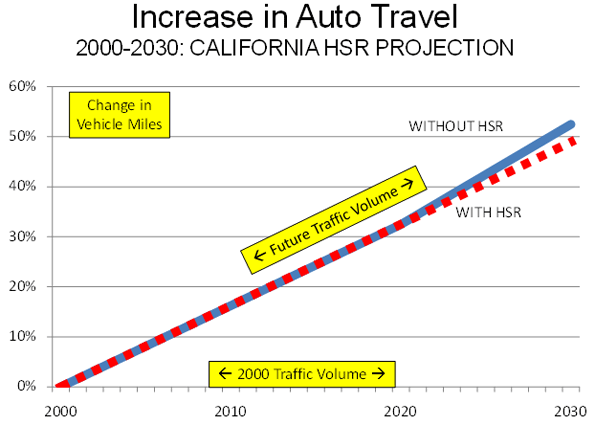
    Ridership and Relieving Congestion: High Speed Rail is also promoted by the Administration, which claims it will reduce traffic congestion. This claim is fraught with difficulty. First, highway traffic congestion is almost exclusively within urban areas, not between the urban areas that HSR would serve. Data from the California promoters indicates that traffic levels would rise nearly as much with HSR as without it. HSR is projected to reduce traffic by less than 3 percent once the system is complete. Without high speed rail, traffic volumes would increase 52 percent and without high speed rail, traffic volumes would increase 49 percent above 2000 levels (See Figure). In either case, things would be far worse in the future than they are today. And if HSR can make so little difference in congested California, it will surely do less in other parts of the country.

    Similarly, HSR will have little or no impact on the need to expand airports. For example, the Bay Area’s regional airport plan noted that high speed rail “would not divert enough passengers to make up for the shortfall in runway capacity.”

    In France and Japan, where travel is far more concentrated due to the linear location of major urban areas and the smaller number of large metropolitan centers, markets that are well served by HSR still have significant airline traffic (Tokyo to Osaka and Paris to Marseille). Also worth noting, both nations boasted pre-existing rail ridership levels that account for much of the HSR volumes. There is no such foundation in the United States. The ridership issue is particularly important, because of the miserable record of transportation ridership projections both in the United States and around the world. A most recent example is the Taiwan high speed rail system, which according to the early projections of promoters was to carry 180,000 passengers per day in its early operations. Yet in its second year of operation (2008), the average daily ridership was less than one-half that projection (84,000, calculated from Taiwan government data). This is telling in a country with notoriously congested traffic and very few major urban centers,

    This strategy of exaggerating ridership claims (and grossly under-estimating costs) is widespread in rail projects and has been extensively documented in Megaprojects and Risks: An Analysis of Ambition, by international scholars Bent Flyvbjerg, Nils Bruzelius and Werner Rothengatter (available from booksellers). The Taiwan and other international experiences suggest a major HSR investment would cost the taxpayers many additional billions and could bankrupt any private investors.

    Greenhouse Gas Emissions: But perhaps the most misleading claims are related to greenhouse gas (GHG) emissions. It starts with the marketing. The Administration’s press release indicates that building all of its routes would reduce GHG emissions by “six billion pounds” annually. This sounds like a big number. It is akin to my characterizing my weight as nearly 100,000 grams, instead of the pounds (200 in my case) that is customary in talking about weight. In GHG emissions, we do not talk about pounds, we talk about metric tons. Six billion pounds is only 2.7 million metric tons (2,205 pounds), which is an infinitesimal share of the GHG emissions from the nation’s passenger transportation. Indeed, given the propensity of the consultants to produce ridership projections less accurate than “Vietnam body counts,” the figure is probably less.

    The Administration falls into the usual trap of assuming that theoretical differences in GHG emissions can be turned into radical changes in travel patterns and behavior. The GHG emissions per passenger mile may be less (at least before the coming improvements in vehicle technology) but that does not mean that enough passenger miles can be moved from cars (and planes) to make a material difference. Our experience in high cost urban rail projects should have taught us this.

    Moreover, a mere reduction in GHG emissions is not sufficient to justify adoption of a strategy. Strategies must be prioritized based upon their effectiveness, and that is measured by cost. On this score, the California HSR system fails to a degree that is incomprehensible. The Intergovernmental Panel on Climate Change (IPCC) has indicated that the cost of GHG emission reduction should be no more than from $20 to $50 per ton. Even that may be too high. For example, Al Gore, Governor Schwarzenegger and Speaker of the House of Representatives Nancy Pelosi studiously buy carbon offsets for the tons of GHG that they produce flying around the country. The current market rate for such offsets is under $15.

    The California High Speed Rail Authority, whose leadership touts its GHG emissions reduction potential constantly, did not even bother to look at the cost of GHG emission removal in its thousands of pages of expensive, taxpayer financed reports. We looked at the issue, using California High Speed Rail Authority and California Air Resources Board assumptions and found that the cost per ton of GHG emission removal would be nearly $2,000, or 40 times the maximum figure used by the IPCC. To illustrate how extravagant a figure that is, if the nation were to reduce its GHG emissions by 80 percent (as proposed by the Administration) at the same rate, the annual cost would be more than 75 percent of the gross domestic product.

    But that assumes all of the rosy cost and ridership projections. The figure could be as high as $10,000 per GHG ton, if the consultants have exaggerated as much in California as elsewhere.

    Conclusion: It is likely that the same arguments can be made even more strongly in other proposed high speed rail markets. Yet, as costly as it is, HSR would be no more objectionable than building a new hardware store if it were paid for by its users. However, when taxpayers are asked to foot the bill, objective analysis of the claims, costs and benefits should at least have some priority. These are issues that an Administration committed to reducing GHG emissions by 80 percent has an interest in addressing. Relying on folklore rather than reality, as seems to be the present case, reflect an abject naivety at the least and incredible foolhardiness at the worst.

    Wendell Cox is a Visiting Professor, Conservatoire National des Arts et Metiers, Paris. He was born in Los Angeles and was appointed to three terms on the Los Angeles County Transportation Commission by Mayor Tom Bradley. He is the author of “War on the Dream: How Anti-Sprawl Policy Threatens the Quality of Life.

  • Can Eddie Mac Solve the Housing Crisis?

    Every downturn comes to an end. Recovery has followed every recession including the Great Depression. In 1932, John D. Rockefeller said, “These are days when many are discouraged. In the 93 years of my life, depressions have come and gone. Prosperity has always returned and will again.” The question is not ”IF”, rather it is “WHEN” recovery will begin. The age-old question remains: what can government do to get the nation out of recession?

    Government can act wisely. In the past, it used tax legislation (the mortgage interest deduction) to create the highest home ownership rate in the industrialized world. It can also act stupidly by promoting “Sub-Prime” mortgages, “105%” financing and the “No-Doc” loan that got us into this financial mess. As many as 4.4 million more Americans could lose their homes – unless drastic action is taken to stop the process.

    Much of this was built on good intentions. One example of poor planning can be seen in Department of Housing Development’s “Dollar Homes” program. The HUD website describes this as an altruistic program “to foster housing opportunities for low and moderate income families” by selling homes for $1 after the Federal Housing Authority has been unable to sell them after six months.

    This sounds like a good idea but the program has become consumed by fraud and waste and has delivered little benefit to the parties intended. First, the policy eliminated any ability to sell the properties at market since it is clear that the value will be marked down to $1 in six months. The result was massive losses to the government as previously saleable properties were re-priced to $1. Second, the homes were snatched up by businessmen and the cronies of politicians who knew how to game the system. These homes were then sold on the retail market for huge profits. Very few homes made it to the needy parties intended. This dumb legislation created and fed a lazy, corrupt, bloated, ineffective and expensive bureaucracy.

    In contrast, smart legislation can end the housing crisis that threatens to send our economy reeling into the next Great Depression. A simple but effective governmental action does not have to cost a lot of money and more importantly, does not require a new permanent and expensive bureaucracy. It can be a win-win-win for federal government, local government and working families. This smart legislation is called Eddie Mac, which stands for the Empower Direct Ownership Mortgage Corporation.

    The genesis of Eddie Mac comes from the “good old days” when home prices were high. The most common complaint heard from police, fire, teachers, nurses and municipal workers was that they could not afford to live in the very communities where they worked. The lower wages of these groups forced them onto the freeways to more affordable neighborhoods in distant suburbs. The commute of hundreds of thousands of city workers across the nation clogged our roads, added harmful emissions to our atmosphere and exacerbated our dependence on foreign oil.

    Simply stated, the Eddie Mac program allows local government to buy vacant foreclosed homes from the banks and institutions. Local government then stimulates the local economy by hiring local realtors, appraisers and contracting with local labor to fix up the deteriorated properties. It then leases the properties to police, fire, teachers, nurses and municipal workers who otherwise could not afford to live in their own communities. Local government enters into an “Empower Direct Ownership Lease Option” with their employees so that the employees have the right to purchase the homes in the future using their rental payments to build equity. The Empower Direct Ownership Lease Option allows the employee to acquire the home in five years for the original purchase price plus 50% of the appreciated value.

    Instead of concentrating power in Washington, Eddie Mac empowers local government to solve their own local real estate economy. Eddie would employ local realtors to identify vacant foreclosed properties qualified for the Eddie Mac program. Realtors would earn a 1% fee for identifying and assisting local government with the acquisition. The purchase price would be set by a local appraiser who would also earn an appraisal fee. Use of local appraisers avoids banks profiting unfairly from a government program. The free market system would set the value. The purchase price would include an estimate of costs to bring the home back to local standards, using local workers to fix up these properties. Local government would obtain 100% financing for the acquisition from Eddie Mac bonds that would be sold on Wall Street along side of Fannie Mae, Freddie Mac and Ginnie Mae guaranteed loans.

    A $200,000 home, foreclosed upon, vacant and allowed to deteriorate has likely deteriorated to just $120,000. Its actual value will be determined by appraisal. At $120,000, a 4% guaranteed Eddie Mac mortgage would cost local government just $4,800 per year. Local government would be able to rent that home for $400 per month making it affordable to police, fire, teachers, nurses and municipal workers.

    The Empower Direct Ownership Lease Option allows the employee to acquire the home in five years for the original purchase price plus 50% of the appreciated value. If the baseline value is $120,000 and the home appreciates at 5% per year, it will increase in value $6,000 per year or $33,153 over 5 years. The employee’s Empower Direct Ownership Lease Option allows them to acquire the home in five years for the original purchase price plus 50% of the appreciation or $136,577. The price is $16,577 below market price, creating equity for the home buyer of $16,577 which can be used as the future down payment to acquire the home.

    This is a win-win-win scenario. Stopping the slide in home values by buying up foreclosed homes with federally insured 4% bonds is a low tech, low cost effort to put the brakes on the recession. And it entails no new bureaucracy. The Federal government is the big winner because they would be footing the bill for the bail-out if the economy continued to unravel. Local government wins by solving an age old dilemma of how to house its local work force. The local economy wins as fresh stimulus is put into the economy to locate, appraise, acquire, insure, repair, repaint and refurbish these homes. The city/county/municipal workers win with an opportunity to enjoy the American dream of home ownership in the very communities where they work. The environment wins as we take commuters off the road and lessen the environmental impact of their commute. And, we help reduce our dependence on Middle East oil as the ripple effect of tens of thousands of Eddie Mac homes are leased to local employees who now live and work in their own communities.

    Eddie Mac can become the firebreak to the mortgage crisis, the game changer needed to change market momentum. The hundreds and thousands of vacant foreclosed home sales generated by the implementation of the Eddie Mac program would send a strong signal to the public that the market has bottomed and the recovery has begun. Vacant homes would be acquired, fixed up and occupied by stable, important and long-term members of our communities.

    John D. Rockefeller once stood on the floor of the New York Stock Exchange and quieted the panic by firmly proclaiming; “Buy” in the dark days of the 1929 collapse. Our government can help stop the slide in prices by standing with our local governments and firmly encouraging “Buy” in the local markets. Reckless government got us into this mess. Smart government can get us out.

    Robert J. Cristiano Ph.D. has more than 25 years experience in real estate development in Southern California. He is a resident of Newport Beach, CA.