Category: Urban Issues

  • Big Movers – Up and Down the 2009 Best Cities Rankings

    In a year when modest – if not negligible – growth could nudge a city toward the top of the Best Cities for Jobs rankings you would suspect there to be little opportunity for big leaps up the scale. On the other hand, one could easily expect that there would be some places whose economic fortunes would resemble a vertigo-inducing fall.

    A look at the 2009 rankings confirms that there are many cities whose job-creating engines have sputtered.

    Among 336 cities in the rankings 46 cities fell more than 100 places compared to their position in 2008. Below are seven places that took the biggest fall and plummeted more than 200 places compared to 2008.

    Seven Falling Stars: Ranking Fell More than 200 Places 2008-2009
    City 2008 2009 Rank Change
    Port St. Lucie, FL 88 290 -202
    Pensacola-Ferry Pass-Brent, FL 98 302 -204
    Reno-Sparks, NV 104 314 -210
    Myrtle Beach-North Myrtle Beach-Conway, SC 10 230 -220
    Prescott, AZ 26 252 -226
    Winchester, VA-WV 73 299 -226
    Yuma, AZ 33 266 -233


    The Big Downstroke
    Yuma, Arizona’s precipitous decline of 233 places is partly the result of its once envious position among the top ten percent of cities in 2008. It appears they came late to the economic wake that hit some towns with the collapse of the housing bubble in Arizona, Florida and Nevada as early as 2007 . In many communities in these states 2008 reflected things getting worse as commercial and industrial construction activity also dropped off.

    The good news for Yuma, according to Paul Shedal of Yumastats.com is that the “biggest economic pillars,” agriculture and government, have remained relatively unscathed by the recession providing a fallback point that other markets don’t have. This means that our worst case scenario for recession “harm” would be returning to our pre-boom level of economic sustainability rather than some depression abyss.”

    Another falling star, Winchester, Virginia, fell 226 places in the rankings, experiencing what some in northern Virginia have described as a dramatic turnaround. Manufacturing in this part of the Northern Shenandoah Valley is linked to housing and vehicles, two industries hard hit lately. American Woodmark, the third-largest kitchen and cabinetmaker in the U.S. scaled back production as sales to homebuilders continue to fall. The services sector, once a bright spot for the region, has been shedding jobs in the midst of the recession. And major retailers like Linens N’ Things and Circuit City recently closed.

    One bright spot in the Winchester area’s economy is the increase of jobs in the federal government sector, an advantage of its 75 mile proximity to the nation’s capitol. In 2008, the federal government added 400 jobs to the local economy at the Federal Emergency Management Agency offices in Stephenson and the FBI training and recruitment center in Winchester.

    Rising Stars
    Even in a troubled economy one expects that some places will thrive simply through determination and bold leadership moves, the foresight to have done the right things, or the luck of the draw. Everyone shares a hopeful optimism that a meteoric rise can offer a glimpse of things to come and perhaps offer a roadmap to a more prosperous future.

    Rising Stars: Top Five Rankings Climbers 2008-2009
    City 2008 2009 Rank Change
    Lafayette, IN 287 85 202
    Champaign-Urbana, IL 267 83 184
    Sioux City, IA-NE.-SD 253 80 173
    Lubbock, TX 242 74 168
    Wheeling, WV-OH 305 138 167


    This year’s rising star is without doubt Lafayette, Indiana with an astounding – and surprising given its Midwestern location – 202-place charge up the rankings from 2008. Like three of the other top five rising stars Lafayette came from a slightly above average position in 2008 to a respectable position in the top 100. These are by no means this year’s best places but their economies are defying the pervasive decline in the national economy.

    A visit to the Lafayette Commerce website succinctly tells the tale. “Greater Lafayette wrapped up 2008 with a strong showing.” For Lafayette 2008 was a good year with new capital investments of $600 million, new employment in life sciences industries associated with the Purdue Research Park, and a second new hospital on the way as Greater Lafayette expands its regional healthcare base.

    Equally important, Lafayette, like many university and college towns, benefits from the stabilizing presence of Purdue University, the area’s largest employer, which also serves as a force creating new economic opportunities through research, development and access to an educated workforce.

    The annual report from Lafayette Commerce concludes by focusing on two key elements of their success. “In Greater Lafayette, we’re choosing not to participate in the national recession by using this opportunity for workforce development and innovation. That’s not to say we have been immune to the troubles of the national economy, but on the whole our community is growing, it’s thriving and improving every day.”

    The Impending Future of Boom and Gloom

    Science fiction author William Gibson’s famous quip that “the future is already here – it’s just not equally distributed” could have some credence in this year’s rankings –both up and down the scale.

    The fastest rising cities boast stable employers in government and universities. They are leveraging this edge to create new opportunities in manufacturing, production agriculture and advanced producer services serving diverse sectors. Growth in health care services to the mixture, until recently one of the few remaining generators of new jobs, has also played a role.

    Rising stars like Lafayette have made significant investments in infrastructure and advanced infrasystems, enabling them to create jobs in higher-value, innovation-generating economic activities.

    This year’s cities that fell the furthest portend a return to pre-bubble growth patterns. As in the case of Yuma many places will refocus back on their historically strong core industries, like agriculture, and the economic activities that made them viable centers in the first place.

    For all cities the ability to innovate locally and take advantage of demonstrated areas of competence represent two key ingredients of success – for building on existing momentum or hitting the reset button for a more prosperous future.

    Delore Zimmerman is president and CEO of Praxis Strategy Group and publisher of Newgeography.com
  • Sydney: From World City to “Sick Man” of Australia

    Americans have their “American Dream” of home ownership. Australians go one step further. They have a “Great Australian Dream” of home ownership. This was all part of a culture that celebrated its egalitarian ethos. Yet, to an even greater degree than in the United States, the “Dream” is in the process of being extinguished. It all started and is the worst in Sydney.

    Sydney is Australia’s largest urban area, having passed Melbourne in the last half of the 19th century. With an urban area population of approximately 3.6 million, Sydney leads Melbourne by nearly 300,000.

    The “Great Australian Dream” in Sydney: Sydney incubated and perfected the Great Australian Dream. New housing was built in all directions from the central business district. The most expensive was built to the east and north, while the least expensive – the bungalows and other modest detached houses – rose principally to the west and the south. Western Sydney is the culmination of the Great Australian Dream for perhaps more middle and lower middle income households than any other place in the nation.

    Of course, Western Sydney was not planned in the radical sense of the word currently used by contemporary urbanists. In fact, most have little more regard for Western Sydney than for the shantytowns of Jakarta or Manila. Yet, the people of Western Sydney, like the people of countless modest suburban areas around the world, are proud of their communities and of their homes.

    Rationing Land, Blowing Out Land Prices: About three decades ago, Sydney embarked upon what was to become one of the world’s strongest “smart growth” programs (called “urban consolidation” in Australia). Aimed at concentrating population closer to the core, urban consolidation sought to restrict and even prohibit new housing on the urban fringe. Sydney developed its own equivalent of the famous Portland urban growth boundary. The result is that every land owner knows whether or not their property can be developed, and the favored understandably take advantage by charging whatever price the highly constrained market will bear.

    Reserve Bank of Australia research indicates that the price of raw land – Sydney urban fringe land for building a house that has not yet been fitted with infrastructure (sewers, water, streets, etc.) has now risen to a price of about $190,000 for a one-eighth acre lot. In the days before smart growth, the land would cost about $1,000. Needless to say, adding an unnecessary nearly $190,000 plus margins to the price of a house makes housing less affordable.

    But even where development is nominally allowed, government restrictions make building almost impossible. For years the state government has promised to “release” land for new housing on the western fringe. Yet despite announcement and re-announcement, there have been interminable delays.

    Destroying Housing Affordability: As a result, Sydney is now the second most expensive major housing market in the six nations in our Demographia International Housing Affordability Survey, trailing only Vancouver. Sydney’s Median Multiple (the median house price divided by the median household income) is now 8.3. It should be close to the historic norm of 3.0 or less. Indeed, if land prices had risen with inflation from before urban consolidation, Sydney’s Median Multiple would be less than 3.0. As a result, households entering the housing market can expect to pay nearly three times as much for their houses than was the case before. This will lead to an inevitably lower standard of living compared to what would have otherwise been.

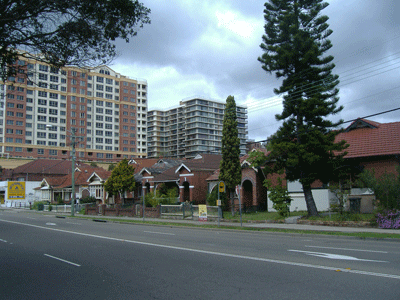
    Forcing Density: Urban consolidation is destroying not only housing affordability, but also the character of Sydney itself. Sydney is an urban area of low density suburbs. It is also an urban area of high rise living. These two housing forms have combined with one of the world’s most attractive geographical settings to create an attractive and livable urban area.

    The planners, empowered by the state of New South Wales government, are changing all of that. From the suburbs of Western Sydney to the attractive and more affluent North Shore suburbs, high-rise residential buildings are being thrust upon detached housing neighborhoods. One of Sydney’s great strengths is that the urban area has many local government areas (municipalities), empowering local democracy. These local governments have done their best to resist the state government densification mandates, in response to opposition from their citizens.

    Raw Exercise of Power: One of Sydney’s greatest weaknesses is that the state government exercises undue control over the municipalities and is using its power to “shoe-horn” high density into places where it makes no sense. High density is fine in the Toney Eastern suburbs, but has no place where detached housing is the rule. Unfortunately, the planners seem to presume communities with detached housing have no character worth salvaging.

    Urban Consolidation: Infrastructure Costs: Further, there is an inherent assumption that densification has no costs. The planners routinely exaggerate the cost of providing infrastructure on the urban fringes (failing, for example, to understand that much infrastructure is included in the price of the house, without government involvement). However, the infrastructure built for lower density detached housing is not sufficient for higher densities. As a result, there have been sewer overflows in densifying areas. Huge expenditures have been made for sewer upgrades. Tony Recsei, president of Save Our Suburbs, a community organization seeking to limit inappropriate densification, blamed recent power failures on an electricity infrastructure that was not built for high density in an April 7 Daily Telegraph letter, noting that “Cram in more people and overloading must result. That should not be too hard for people to understand.”

    Greater Traffic Congestion: And, of course, insufficient road expansion has been undertaken to accommodate the inevitable intensification of traffic congestion. The planners like to say that higher densities mean less traffic. In fact virtually all of the evidence, throughout the first world, indicates that more intense traffic congestion is associated with higher densities.

    Sydney is no exception. The average one-way work trip now takes 34 minutes, which equals that of America’s largest urban area, New York, which has more than five times the population and the land area as well as the longest travel time of any major urban area in the nation. Sydney’s planners delight in comparisons with Los Angeles, frequently suggesting that their regulations are necessary to ensure that Sydney does not “sprawl” as much as Los Angeles. Actually Sydney sprawls considerably more in relation to its population. The Los Angeles urban area is a full one-third more dense than the Sydney urban area. And despite the fact that nearly half of the planned Los Angeles freeway system was not built, Angelinos spend one hour less each week getting to work each than Sydneysiders. Even in Atlanta, with a pathetic freeway system little better than Sydney’s and one-third Sydney’s density, people spend an hour less commuting to and from work every two weeks and spend less total time traveling than in Sydney.

    The Economic Cost: There may also be an economic cost. Bernard Salt – perhaps Australia’s leading demographer – has predicted that Melbourne will overtake Sydney in population by 2028. Moreover, there has been substantial domestic migration from New South Wales to Queensland. At current growth rates this could lead the Brisbane-Gold Coast region being larger than Sydney by mid-century. Salt blames Sydney’s declining fortunes on its overly expensive housing.

    Sydney: World-Class City Status Threatened? Research in the United States has associated restrictive land use regulation with lower levels of employment growth in US metropolitan areas. In a more colorful finding, Australia’s Access Economics characterized the economy of New South as “so sick that it is at risk of adoption by Angelina Jolie.” A few decades ago, the English economy was referred to as the “sick man of Europe.” Sydney may well be on its way to becoming the “sick man of Australia.”

    Wendell Cox is a Visiting Professor, Conservatoire National des Arts et Metiers, Paris. He was born in Los Angeles and was appointed to three terms on the Los Angeles County Transportation Commission by Mayor Tom Bradley. He is the author of “War on the Dream: How Anti-Sprawl Policy Threatens the Quality of Life.

  • Planning: A Shout-Out For Local Players

    More than a century ago, Rudyard Kipling, in his American Notes, shared his views on the character of the US. Along with remarks about the American penchant for tobacco spitting, Kipling recounted the near heroic ability of Americans to govern themselves, especially in small cities and towns. Traveling through the town he called “Musquash” (a pseudonym for Beaver, Pennsylvania) in 1889, Kipling described “good citizens” who participated in “settling its own road-making, local cesses [taxes], town-lot arbitrations, and internal government.”

    Today, the pressures from state and federal governments on local planning have increased geometrically. But across America we are seeing a growing trend toward greater civic participation in land use decisions, as local residents seek to define their communities as unique.

    No longer a Deweyan dream, there are several practical reasons why city governments from Starksboro, Vermont to Hercules, California are involving their residents in important land use/planning decisions. Most important is the challenge presented to local governments by the internet, which provides elements that seriously confront even the most legitimate authority: information, and a place to gather. From city and developer websites to Google searches, research into upcoming housing projects or parks is only a few keystrokes away. At the same time, the web’s social networks offer easy and cheap places for residents to communicate with others (usually like-minded) both inside and outside the local community.

    As a result of single-issue local blogs, Facebook networks, and email campaigns, municipalities have had to become proactive in approaching their residents, including them in processes previously limited to a small group of “stakeholders.” Last year, a mid-sized city in the San Francisco Bay Area was considering the residential development of a significant land parcel, which was once commercial property. Not feeling involved in the early stages of the planning process, a localized environmental group used the internet to build a movement within the city, while it also connected with regional and national environmental organizations to find funding in support of an anti-development ballot proposition. After hundreds of thousands of dollars were spent, this “zoning by ballot” measure was defeated in November.

    A second factor that highlights the importance of intentionally involving citizens is the often-enormous financial cost of these projects for small to mid-sized cities. From land to EIRs, the costs of almost any project – especially those with a public purpose, where taxpayer dollars are on the line – have never been greater. Failing to include residents in these processes, while faster and less expensive in the initial stages, can easily end up costing more and adding months, if not years, to a timeline. In 2007, a Los Angeles-area school district had paid almost $5 million in site planning and architectural costs for a middle school building project. Upon learning that the development would demolish a local supermarket, area residents who had not been involved up to that point organized, and elected a representative to the school board on the promise that he would “stop the school.” He won, and he did, turning the multi-million dollar planning element into a sunk cost.

    This pragmatic reasoning behind civic engagement was recently supported in a 2008 study by the National Research Council. On the subject of government agencies that deal with environmental and planning issues, it concluded, “When done well, public participation improves the quality and legitimacy of a decision and builds the capacity of all involved to engage in the policy process. It can lead to better results in terms of environmental quality and other social objectives.”

    Finally, the pressures placed upon communities to grow, while at the same time control growth, have reached crisis levels in many cities. Here in California, even with the recent economic downturn, the state population is forecast to almost double from its current 34 million people by mid-century. Meanwhile, state-mandated land use legislation, like the recently passed SB 375, constricts the space available for residential development by attempting to control growth to major transportation corridors. Even before this bill passed, the battle here between open space advocates, developers and cities has made “putting a shovel in the ground” an excruciating experience. In San Mateo County (just south of San Francisco), less than 20% of the land mass is available for housing; twice that amount is designated for open space. A group of concerned citizens, including business owners, environmentalists and housing advocates, formed “Threshold 2008” to explore options for residential development. Creating a multi-stage process that has involved over 1,000 San Mateans in various online and face-to-face deliberations, leaders from the group are now working with city planners around the county to find solutions to shortages in affordable housing.

    State-level organizations like the one I work with here in the Golden State, Common Sense California, are supporting cities and towns as they try to involve their publics in these local decisions. We have found that the best engagement efforts invite the most diverse and representative group of residents possible, give them information from a variety of perspectives, and facilitate discussions in such a way that forces participants to wrestle with the issues in the same way planners, city managers, and city councils must.

    At their worst, such “participatory planning” campaigns are pre-ordained and, therefore, manipulative. Organizers can hold this control whether they’re inside government, or, like environmental groups and developers, outside of it. Explicit stakeholders, from developers to environmentalists to city officials, are most effectively engaged in the early stages, serving as an “advisory group”, helping to formulate the information packets and option sets that will be presented to the general public. Practitioners like the Orton Family Foundation and Viewpoint Learning are working with cities that are facing tough land use decisions. A growing number of planning and architectural firms are offering these services, but can be predisposed to certain planning outcomes depending on who hires them.

    Restrictions on local planning decisions made at the state level (and, someday, the Federal level?), combined with the homogenizing influences of web-based organizing supported by national organizations, have created a climate in which the challenges to cities seeking their own unique “personalities” have never been greater. Many cities and towns throughout America are discovering that the most creative solutions can be found by legitimately informing and involving local residents in these decisions.

    In this way, may there be more Musquashes.

    Pete Peterson is Executive Director of Common Sense California, a multi-partisan non-profit that consults on and supports civic engagement efforts throughout California. He also lectures on civic engagement at Pepperdine’s School of Public Policy. He can be reached at p.peterson@commonsenseca.org.

  • America’s Four Great Growth Waves and the World Cities They Produced

    There have been four great growth waves in American history. In each case, there was an attractive new frontier, which not only drew migrating waves of people seeking new opportunity, but also developed large new bases of industry, wealth, and power. These waves have also created top-tier world cities in their wake. The first three of these waves were:

    1. The Boston, New York, Philadelphia, Baltimore, Washington DC corridor was America’s original land of opportunity, industry, wealth, and power. New York was the big winner, and DC and Boston still do quite well.
    2. The rise of the agricultural and industrial Midwest, including Chicago, Detroit, Pittsburgh, Cleveland, and St. Louis. The fall here has been a hard one as manufacturing moved abroad, but Chicago still stands as a world-class city produced during the region’s heyday.
    3. The great westward migration, mostly focused on California, but with ancillary growth in adjacent and west coast states. This migration started well before World War 2, but really took off after the war, and produced two top-tier mega-metros – Los Angeles and the San Francisco Bay Area – and several successful second-tiers like Seattle, San Diego, Las Vegas, and Phoenix.

    These waves are not clearly distinct, but overlap each other. As one region matures and starts to level off, the next region starts its growth wave. And that’s the situation now as California shows clear signs of having peaked: gigantic tech and housing crashes plus economic and domestic outmigration as tax, cost-of-living, housing, and regulatory burdens rise and a dysfunctional government teeters towards financial collapse.

    The fourth wave is increasingly clear and follows the same California model of a single focus mega-state and an ancillary region: Texas and the new South.

    Just as California had its pre-war growth surge, Texas had its first real growth waves with the 20th-century post-Spindletop oil boom. California had the dust bowl migration of the 30s, and Texas the oil boom migration of the 70s. But the real super-surge has become clearer in the new century as California hands off the baton to Texas. This growth wave really covers much of the South, but Texas is the 800lb gorilla vs. states like Georgia and North Carolina, just as California dominates over Washington, Nevada, and Arizona. Texas even looms over Florida, which certainly has experienced incredible population growth to become the fourth-largest state, but has had considerably less success with building industry, wealth, and power. Florida’s wealth – like that of Arizona – comes in part from people who built wealth elsewhere but moved or bought a second home there. Neither place is home to many Fortune 500 headquarters, an area where Texas has excelled.

    California had its agriculture and oil barons before WW2, but the real story there was the post-war rise of the entertainment, defense, aerospace, biotech, trade and technology industries. In a similar way, Texas’ oil tycoons are just the tip of the coming surge of wealth and power in industries such as technology, health care, biotech, defense, trade, transportation, aerospace, finance, telecom, and alternative energy in addition to traditional oil and gas (in fact, Texas is the #1 wind power state).

    The great cities emerging from this new wave are Atlanta, Dallas-Ft.Worth, and Houston. They dominate the census growth stats (Houston story), and all indications are that Houston will pass Philadelphia in the 2010 census to join Dallas-Ft.Worth in the top 5 metros along with New York, Los Angeles, and Chicago. DFW and Houston are even approaching the combined San Francisco Bay Area population of 6.1 million, and Texas passed California and New York for the #1 ranking in the Fortune 500 HQ rankings last year.

    Want more evidence? Check out this impressive video on the DFW-Austin-San Antonio-Houston Texas Triangle with an overwhelming list of statistics that make the case. In the video, they refer to the region as the 18m-strong “Texaplex” – a play on the “Metroplex” nickname for Dallas-Ft. Worth. You can also see their Texaplex informational brochure here (pdf).

    When you look at it in this historical context, it’s clear Texas and the new South will be the focal point of America’s growth for at least the next few decades. History also says at least one, and possibly more, truly top-tier world cities will emerge from this wave – and it could be argued that some have already. It’s easy to get caught up in the day-to-day hubub and crisis-of-the-moment, but take a minute to stand back and see the big picture. Those living in or moving to Texas and the new South are part of a great historical wave that’s just starting to really take off, the same as being in Chicago at the turn of the 19th-century or in California after WW2. Pretty cool, eh?

    Tory Gattis is a Social Systems Architect, consultant and entrepreneur with a genuine love of his hometown Houston and its people. He covers a wide range of Houston topics at Houston Strategies – including transportation, transit, quality-of-life, city identity, and development and land-use regulations – and have published numerous Houston Chronicle op-eds on these topics.

  • Where are the Best Cities for Job Growth?

    Over the past five years, Michael Shires, associate professor in public policy at Pepperdine University, and I have been compiling a list of the best places to do business. The list, based on job growth in regions across the U.S. over the long, middle and short term, has changed over the years–but the employment landscape has never looked like this.

    In past iterations, we saw many fast-growing economies–some adding jobs at annual rates of 3% to 5%. Meanwhile, some grew more slowly, and others actually lost jobs. This year, however, you can barely find a fast-growing economy anywhere in this vast, diverse country. In 2008, 2% growth made a city a veritable boom town, and anything approaching 1% growth is, oddly, better than merely respectable.

    So this year perhaps we should call the rankings not the “best” places for jobs, but the “least worst.” But the least worst economies in America today largely mirror those that topped the list last year, even if these regions have recently experienced less growth than in prior years. Our No.1-ranked big city, Austin, for example, enjoyed growth of 1% in 2008–less than a third of its average since 2003.

    The study is based on job growth in 333 regions–called Metropolitan Statistical Areas by the Bureau of Labor Statistics, which provided the data–across the U.S. Our analysis looked not only at job growth in the last year but also at how employment figures have changed since 1996. This is because we are wary of overemphasizing recent data and strive to give a more complete picture of the potential a region has for job-seekers. (For the complete methodology, click here.)

    The top of the complete ranking–which, for ease, we have broken down into the two smaller lists, of the best big and small cities for jobs–is dominated by one state: Texas. The Lone Star State may have lost a powerful advocate in Washington, but it’s home to a remarkable eight of the top 20 cities on our list–including No. 1-ranked Odessa, a small city in the state’s northwestern region. Further, the top five large metropolitan areas for job growth–Austin, Houston, San Antonio, Ft. Worth and Dallas–are all in Texas’ “urban triangle.”

    The reasons for the state’s relative success are varied. A healthy energy industry is certainly one cause. Many Texas high-fliers, including Odessa, Longview, Dallas and Houston, are home to energy companies that employ hordes of people–and usually at fairly high salaries for both blue- and white-collar workers. In some places, these spurts represent a huge reversal from the late 1990s. Take Odessa’s remarkable 5.5% job growth in 2008, which followed a period of growth well under 1% from 1998 to 2002.

    Of course, not all the nation’s energy jobs are located in Texas, even if the state does play host to most of our major oil companies. The surge in energy prices in 2007 also boosted the performance of several other top-ranked locales such as Grand Junction, Colo., Houma-Bayou Cane-Thibodoux, La., Tulsa, Okla., Lafayette, La., and Bismarck, N.D.

    Looking at the energy sector’s hotbeds, however, doesn’t tell the whole story. Another major factor behind a city’s job offerings is how severely it experienced the housing crisis. There’s a “zone of sanity” across the middle of the country, including Kansas City, Mo., that largely avoided the real estate bubble and the subsequent foreclosure crisis.

    Still other factors correlating with job growth–as evidenced by Shires‘ and my current and past studies–are lower costs and taxes. For example, the area around Kennewick, Wash., is far less expensive than coastal communities in that same state, and residents and businesses there also enjoy cheap hydroelectric power. Compared with high-tech centers in California and the Northeast, such as San José and Boston, places like Austin offer both tax and housing-cost bargains, as do Fargo, N.D. and Durham-Chapel Hill, N.C.

    College towns also did well on our list, particularly those in states that are both less expensive and outside the Great Lakes. Although universities–and their endowments–are feeling the recession’s pinch, they continue to attract students. In fact, colleges saw a bumper crop of applicants this year, as members of the huge millennial generation, encompassing those born after 1983, reach that stage of life. More recently, college towns have emerged as incubators for new companies and as attractive places for retirees.

    Specifically, the college town winners include not only well-known places like Austin and Chapel Hill, but also less-hyped places like Athens, Ga., home of the University of Georgia; College Station, Texas, where 48,000-student Texas A&M University is located; Morgantown, W.Va., site of the University of West Virginia; and Fargo, the hub of North Dakota State University.

    Democratic states are glaringly absent from the top of the list. You don’t get to a traditionally blue state–in a departure from past years, Obama won North Carolina–until you get to Olympia, Wash., and Seattle, which ranked No. 6 among the large cities.

    But political changes afoot could affect the trajectory of many of our fast-growing communities–and not always in positive ways. It’s possible that the Obama administration’s new energy policies, which may discourage domestic fossil fuel production,could put a considerable damper on the still-robust parts of Texas and elsewhere where coal, oil and natural gas industries are still cornerstones of economic success.

    By contrast, the wind- and solar-power industries seem to be, as of now, relatively small job generators, and with energy prices low, endeavors in these areas are sustainable only with massive subsidies from Washington. But still, if these sectors grow in size and profitability, other locales that have not typically been seen as energy hubs over the past few decades may benefit–notably parts of California, although Texas and the Great Plains also seem positioned to profit from these developments.

    Another critical concern for some communities is the potential for major cutbacks on big-ticket defense spending. This would be of particular interest to communities in places like Texas, Oklahoma and Georgia where new aircraft are currently assembled. Over the years, blue states like California have seen their defense industry shrivel as the once-potent Texas Congressional delegation and the two Bushes tilted toward Lone Star State contractors.

    These days it’s big-city mayors and big blue-state governors who are looking for financial support from Obama. Northeast boosters are convinced more money on mass transit, inter-city rail lines and scientific research will rev up their economies. Boston–No. 16 on the list of large cities and a leading medical and scientific research center–could be a beneficiary of the new federal spending.

    The most obvious winner from the recent power shift should be Washington, D.C. The Obama-led stimulus, including the massive Treasury bailout, has transformed the town from merely the political capital into the de facto center of regular capital as well. Watch for D.C. and its environs to move up our list over the next year or two. Already the area boasts one of the few strong apartment markets among the big metropolitan areas in the country, which will only improve as job-seekers flock to the new Rome.

    Yet Washington is an anomaly, because most of the places that stand to benefit from this unforgiving economy are ones that are affordable and therefore friendly to business, reinforcing a key trend of the last decade. It also helps regions to have ties to core industries like energy and agriculture, a sector that has remained relatively strong and will strengthen again when global demand for food increases.

    Some areas have attracted new residents readily and continue to do so, albeit at a somewhat slower pace. Over time this migration could be good news for a handful of metropolitan areas like Salt Lake City, which ranks seventh among the big cities for job growth, and Raleigh-Cary, N.C., which was No. 1 among large cities last year and No. 8 this year. Over the last few years, these places have consistently appeared at the top of our rankings and are emerging as preferred sites for cutting-edge technology and manufacturing firms.

    Below these winners are a cluster of other promising places that have already managed to withstand the current downturn in decent shape and seem certain to rebound along with the overall economy. These include the largely suburban area around Kansas City, Kan., perennial high-flyer Coeur d’Alene, Idaho, and Greeley, Colo.–in part due to their ability to attract workers and businesses from bigger metropolitan centers nearby–as well as Huntsville, Ala., which has a strong concentration of workers in the government and high-tech sectors.

    In the end, most of the cities at the top of the lists–whether they are small, medium or large–have shown they have what it takes to survive in tough times. Less-stressed local governments will be able to construct needed infrastructure and attract new investors so that job growth can rise to the levels of past years. If better days are in the offing, these areas seem best positioned to be the next drivers of the economic expansion this nation sorely needs.

    This article originally appeared at Forbes.

    Joel Kotkin is executive editor of NewGeography.com and is a presidential fellow in urban futures at Chapman University. He is author of The City: A Global History and is finishing a book on the American future.

  • Millennials’ First Recession

    Each generation has been affected differently by the deepening global recession. Baby boomers have witnessed their retirement savings evaporate into oblivion. Generation X families who finally saved enough for a down payment on their first house find themselves deep underwater without SCUBA gear. And earnest Millennials fresh out of college are wondering where all those high-paying jobs promised by duplicitous corporate recruiters went.

    No doubt the economic collapse is most palpable for the Boomer generation. Closing in on retirement, many are now holding off on purchasing that winter home in Florida. Moreover, many Boomers have no other choice but to delay retirement (provided they have managed to keep a job) in order to maintain current lifestyles.

    Ironically, this may not be too much of a stretch for the ‘forever young’ generation who has come to define themselves by their occupations. Yet this does pose a problem from those who are actually young and currently entering the workforce.

    Over the past few months I have witnessed many of my 20-something peers lose their jobs – not to mention me as well. This contradicts the popular, yet flawed notion that ‘technologically savvy’ Millennials are rendering older workers obsolete. It is clear now that upper management at corporations across the country have opted for a more conservative approach to hunkering down. This includes letting go of those with less experience (low on the company ladder) and closing the door completely to new hires out of college.

    Justin Pope of the Associated Press has confirmed that college graduates face the worst job market in years. As is indicated in Pope’s article, employers plan to hire 22% fewer graduates this spring – an alarming statistic reported from a survey conducted by the National Association of Colleges and Employers.

    Perhaps one of the more unnerving new realities spawned by the recession is what appears to be the diminishing returns to education. Even those graduating with J.D. or M.B.A. degrees find themselves in panic mode. Traditionally, these prestigious degrees meant relatively high salaries right out of grad school. Yet with law firms laying off in droves and corporations slashing entry-level positions, not only do graduates with fresh Master’s degrees find themselves without any job prospects, many are stuck with exorbitantly high student loan bills.

    So what are Millennials doing to ride out the storm? Those who do have jobs are hanging on for dear life. Some are applying to graduate school with the hopes that the economic climate will be better by the time they graduate. Others, like 26 year-old Michael Kaainoni have opted to move back home.

    After graduating from Columbia University with a Masters in Architecture degree last year, Michael landed a job at a large international architecture firm in Manhattan. Only months later, he found himself caught in a wave of corporate downsizing. Rather than scrape by and continue to pay ridiculous New York City rents, Michael opted to move back to his hometown of Kailua, Hawaii. Now living back in Hawaii, he works for a local architecture office that gets steady commissions from the government.

    Michael’s story is not uncommon for young people these days. The Millennial generation does not share the same horror about moving back home as the rabidly ‘independent’ Boomers or Gen Xers. Rather than seeing a retreat back to the nest as taboo, many Millennials will tell you that this is just smart financial planning.

    In many ways the Millennials may be following not the boomers but the experience of immigrants. For decades strong family networks have allowed immigrants to the U.S. to become ‘upwardly mobile’ despite all sorts of disadvantages from lack of English fluency to discrimination. Now that this secret is out into the mainstream consciousness, the ‘going it alone’ mentality is rapidly disappearing. Familial and community support networks are making a strong comeback out of financial necessity – and probably for the better.

    Writer Tamara Draut focuses on the financial plight facing young people today in the book “Strapped: Why America’s 20- and 30-Somethings Can’t Get Ahead”. In her book, Draut explains why young people in the workforce might seem too eager to get ahead:

    “If today’s young adults can be accused of wanting it all too soon, the ‘it’ isn’t riches, gadgets, or luxury cars. The elusive ‘it’ that today’s twenty-somethings are after is financial independence, and then hopefully, financial security.”

    Derided as the ‘everyone gets a medal’ generation by cultural commentators who believe that young people today have a bloated sense of self-esteem, most Millennials just want to live secure, modest lifestyles. This observation goes against everything that civic boosters and urban real estate speculators have hoped for during the recent boom years.

    With the notion that lifestyle trumps employment, urban planners have been deluded into thinking that by turning cities into expensive playgrounds, they will attract the best and the brightest young workers. This was an idea touted by urban theorist Richard Florida in his highly influential book “The Rise of the Creative Class”. Florida claims that, according to his focus groups, young creative people do not want to live in places that “do not afford a variety of ‘scenes’”.
    The idea that young people can choose their city at will based on lifestyle preference does not make much sense given the current economic circumstances. Job opportunity and affordability, not to mention family ties, are more likely to dictate where young people end up settling now and in the immediate future.

    Furthermore, many of the ‘lifestyle amenities’ – such as cool coffee shops, farmer’s markets, and culturally diverse restaurants – desired by these young creatives can now be found in more affordable environments outside of the traditional urban core.

    By the time this recession is over, Millennials may have passed their ‘city phase’. This spells bad news for places that have banked on spurring a renaissance driven by young people who often like urban settings but can no longer afford the luxury. Neighborhoods like San Francisco’s SoMa or downtown Los Angeles could be the losers. Cities completely missed the boat by allowing greedy real estate developers to build expensive condos for a largely ephemeral surge of Boomer empty nesters while ignoring basic issues like quality of life, safety and affordability.

    Millennials will bounce back. As the youngest generation in the workforce, they will be defined by the experience of the current economic slump and take its lessons with them throughout their lives. Instead of greed and selfishness, which is likely to define the Boomer legacy, Millennials will more likely resemble that of their grandparents’ generation – one where family and frugality is valued over individuality and self-interest.

    Adam Nathaniel Mayer is a native of the San Francisco Bay Area. Raised in the town of Los Gatos, on the edge of Silicon Valley, Adam developed a keen interest in the importance of place within the framework of a highly globalized economy. He currently lives in San Francisco where he works in the architecture profession.

  • What Does Urban Success Look Like?

    What does urban success look like? Ask people around the country and they’ll probably say it looks something like Chicago.

    Arguably no American city over the past decade has experienced a greater urban core renaissance than Chicago. It is a city totally transformed. The skyline has been radically enhanced as dozens of skyscrapers were added to the greater downtown area. Millennium Park opened as a $475 million community showplace full of cutting edge contemporary architecture and art. There has been an explosion in upscale dining and shopping options, as well as large numbers of new art galleries, hotels, clubs and restaurants.

    But perhaps nothing shows the transformation of Chicago more than the huge condo boom, with thousands of new units coming online every year. This sent development waves rippling out from the Loop and North Lakefront, often into places that just a short time ago were no man’s lands. If you told someone 15 years ago you lived in the South Loop, they would have said, “Huh?” If you had told them you lived by the old Chicago Stadium, they would have thought you had lost your mind. These and other neighborhoods that were once derelict or dangerous, as well as some that were low key ethnic enclaves, have been transformed into bustling yuppie playgrounds for the new “creative class”.

    But there has been a downside to this for Chicago as well. The influx of the educated elite into the city has significantly raised housing prices in large parts of the city, rendering it unaffordable to others. Supporting the amenities demanded by the city’s new residents costs money, so taxes have gone up, doubling the squeeze on the city’s traditional residents, forcing many of them out.

    So in the end, despite its building boom, it is actually losing people. The Census Bureau estimates the city of Chicago’s population declined by about 60,000 people since 2000. That’s not much on a percentage basis, but, considering the urban core boom, it is telling. While Chicago’s metropolitan area continues to grow, it is doing so slower than the national average and has significant domestic out-migration. Chicago’s metropolitan area saw net domestic out-migration of 42,000 in 2008 and 57,000 in 2007. To put this in perspective, the poster child metro for urban decline, Detroit, Michigan, only lost 62,000 and 58,000 people in those years respectively. Only Chicago’s continued appeal as an immigrant magnet kept it from posting large overall migration losses as it had very high international in-migration.

    Chicago is an incredible urban success story, but only for some. International immigrants and the creative class are flocking, but everyone else is leaving.

    But there is another group of cities in the Midwest, much smaller cities, that are often overlooked, but which offer an alternative model. Places like Columbus, Indianapolis, and Kansas City provide a mirror image of Chicago. Their downtowns have resurged, if not from their glory days in the 1950s, then since their nadir in the 1970s. There is also significant condo construction in their cities. But, beyond these superficial similarities, they are nothing like Chicago. They lack the urban energy of that colossus, its huge inventory of swanky shops and high-end fine dining. They haven’t had a skyscraper boom. Most of their downtown development still requires significant tax subsidies. They feature largely vanilla brand images that don’t give them the coolness factor. And they continue to struggle in attracting top talent to live there.

    Yet in many ways these cities show signs of demographic and economic health that Chicago could only dream about. The Columbus, Indy, and KC regions are all growing faster than the national average in population and, unlike the vast bulk of the Midwest, have significant domestic in-migration. They are outperforming the nation in employment. In fact, it can be argued that they have as much in common with the Sun Belt as the Rust Belt. People are voting with their feet to move to these places. Between 2000 and 2005, about 7,000 net people moved from the Chicago metro area to Indianapolis, for example.

    One key to this lies in affordability. For years Indianapolis has been ranked as the least expensive major housing market in America. Blessed with few natural barriers and pro-private sector governments, housing supply in these cities has grown along with population. Yet at the same time the negative impacts of sprawl have been mitigated by their modest – compared say to Dallas, Phoenix or Houston – growth rates and relatively small size. This leaves them attractive, affordable, and offering a very high quality of life to people without elite professional incomes.

    In short, these cities are just as successful as Chicago; they just do it their own way and serve a different market.

    Indeed what we can see is that there are different forms of urban success. In an ever more diverse America, people define the good life differently. Too much urban policy is focused on one size fits all solutions that assume cities should look and function something like Chicago. But America’s cities are very diverse and require tailored policies to suit the local landscape, and the unique local geography, demography, history, culture, and values that our cities bring to the table. Great cities, like great wines, have to express their terroir.

    As with the consumer market, cities too need to recognize our increasingly complex and diverse population, and sharpen their strategic focus to the target segments they best serve. Chicago is tailoring its offerings to where it believes it can most effectively compete – new immigrants and world class talent. Places like Columbus, Indianapolis, and Kansas City are focusing on a broader middle class. Neither way is right or wrong. Both types of places, and others too, can all find success by offering unique places for people to realize their own personal American Dream.

    Aaron M. Renn is an independent writer on urban affairs based in the Midwest. His writings appear at The Urbanophile.

  • Can Sacred Space Revive the American City?

    By Richard Reep

    During most business downturns, nimble private business owners search for countercyclical industries to which they adapt. During this business downturn, the construction industry finds itself frantically looking for anything countercyclical. Private construction, almost completely driven by the credit market, has stopped, and public construction, driven by tax revenue, has also stalled. Religious institutions, however, seem to be continuing incremental growth and building programs, giving evidence to some people’s answers to spiritual questions being asked today.

    Christian congregations surged in the 1990s, building megachurches in mostly suburban neighborhoods throughout the country. In some cities, mostly in the South, the urban megachurch also became common. Fundraising for these followed patterns that made lending a fairly straightforward risk; many were financed by a combination of patron contributions and lending from local or regional banks. By the early part of this decade, the growth of megachurches was a well-established pattern, and had become a sophisticated niche within the booming development and construction industry, as reported by Forbes Magazine in 2003.

    Churches seem to remain one of the few work sectors for construction firms, architects and planners. This comes at a time when there appears to be very little new development, either private or public in Central Florida. Even small private projects that were funded by cash or private equity have been postponed or cancelled, as the money sits on the sidelines. Yet Christian churches continue to expand, forcing them to accommodate the needs of their worshippers.

    Unlike in the past decade, much of this expansion is taking place in smaller congregations, and is funded mostly by donations, pledges, and bequests. “Our church task force is looking at creative ways to raise money for facility expansion,” commented Scott Fetterhoff, President of Salem Lutheran Church. “We have to have faith however that our congregation, and those looking for spiritual growth in a society with eroding values, will support worthwhile causes.”

    Fetterhoff also displays a very worldly sense of pragmatism. ”Our expansion and outreach program will simply adjust to fit the available budget,” he adds. “On the bright side with a construction industry looking for work, that might allow us to do more for less.”

    This is one example of several recent interviews with local church leaders who are considering a construction project, and all are echoing similar themes. Salem’s expansion includes new classroom space which seems part of a growing interest to provide flexible multi-purpose space for church-based education and community use – largely in lieu of public education. No one in Florida can ignore the continuous stream of news reports of its legislature’s continued reduction of funds for Florida’s public education system, and many in Florida are trying to find alternatives for their children.

    Salem’s decision to expand is emblematic of other stories in the region. This incremental growth may signal a consolidation of sacred space into people’s lives, as we cope with the changes in our secular, consumer-driven culture. Salem Lutheran, and others like it, use the general uncertainty of our economic times to re-focus on faith based relationships. This is a true grass-roots trend.

    On a larger scale, the evangelical movement continues to encourage church construction on a more global, top-led basis, in what is termed “church planting” by its leadership. The surge of interest in nontraditional forms of churches in the Western Hemisphere is well-documented and remarkable, as this Christian movement is supplanting traditional denominations, particularly Catholicism. Religion remains formidable in America, but much of it reflects more of a shift from one form of Christianity to another.

    One organization, Capernaum Ministries, is developing a retreat for Christian pastors and ministers to provide leadership training to church leaders. Its founder, Jim Way, sees his mission as creating “a laboratory for building effective relationships between leaders of various denominations and independent ministries.” Way, a minister and founder of Capernaum Ministries, has affiliations with over 3,000 churches. “I see this as an opportunity to study, and solve, the problem of how the decline of the denominational church influence is affecting American culture”.

    As cities have grown in the past several decades, the well-documented lack of sacred space has been notable as governments meticulously avoid any tangible form of religious expression, and mainstream religions find themselves in retreat. While public space in American cities has always been constitutionally secular, sacred space usually evolved with the development of cities, towns and neighborhoods.

    Sadly, this has been missing from private development for some time. Church growth in the suburbs usually occurs after the fact, not as part of a planned community, for developers are loathe to forfeit profits on a choice parcel of land.

    Church building has historically been a narrow niche market avoided by most design and construction professionals who have preferred more lucrative building types, like hotels or hospitals. If one believes in the organic model of city growth and development, this has been a serious deficiency.

    But now, amidst lower costs for construction and more need for their services, some congregations seem to be taking stock, making plans, and acting. Salem Lutheran, like many, has members who come from the design and construction industries. These congregants know how to efficiently deliver a building, and are offering these skills to their congregations, while their regular businesses sit idle.

    Whether global or grass-roots, the development of sacred space will need to overcome the substantial obstacle of financing, difficult in the best of times, using new means and methods. Nontraditional means including volunteer labor, outright donations, in-kind donations, and bartering will bring costs down to more affordable levels. As projects are realized, alternative practices to achieve affordability could result in interesting innovations.

    If the current economic crisis begs some larger spiritual questions in people, then there may be a countercyclical trend towards investment in sacred space. Faced with lowered expectations and a lost sense of prosperity, people naturally long for some aspect of their lives that transcends the material. Church building, however incremental and small, demonstrates that sacred space is important to enough people to do something about it. Their actions speak loudly in these uncertain economic times.

    Richard Reep is an Architect and artist living in Winter Park, Florida. His practice has centered around hospitality-driven mixed use, and has contributed in various capacities to urban mixed-use projects, both nationally and internationally, for the last 25 years.

  • Greenhouse Gas Emissions and Reality: Residential Emissions

    In the quest to sufficiently reduce greenhouse gas (GHG) emissions, it is crucial to “get the numbers right.” Failure to do so would, in all probability, mean that the desired reductions will not be achieved. Regrettably, much of what is being proposed is not based upon any comprehensive quantitative analysis, but is rather rooted in anti-suburban dogma.

    Further, ideologically based approaches carry the risk of severe economic and social disruption, which could make it even more difficult, in a political world, to reach GHG emission reduction objectives. Unconsidered attacks on suburbs could also backfire, setting back more reasonable attempts to reduce emissions over time.

    For example, a recent New York Times blog entitled “The Only Solution is to Move” presumed it a necessity to (1) move from the suburbs to the city, where (2) “you are near everything you need” and to (3) abandon cars, which the author contends “cannot be reformed.” This screed provides an ideal point of reference. We start with the comparative GHG emissions efficiency of suburbs and deal with the other issues in future articles.

    The Need for Comprehensiveness: Any plausible attempt to reduce GHG emissions must start with a comprehensive understanding of the issue, including the comparative GHG intensity of various types of living and mobility patterns.

    This requires a “top down” analysis of GHG emissions by mode and locality. Such an analysis must start with the gross GHG emissions in a nation and allocate each gram to a consuming household. A household allocation is necessary, because businesses emit GHGs only to satisfy the immediate or eventual demand of consumers. “Top down” is required because that is the only way to make sure the analysis includes everything. The typical “bottom up” analysis runs the risk of missing large amounts of emissions as analysts highlight their own “hobby horse” sources, while excluding the inconvenient. This is why we have “double entry” bookkeeping – to make sure that the sums balance.

    “Top down” comprehensiveness has been best developed by the Australian Conservation Foundation (ACF) Consumption Atlas, which is the only study I have found that allocates every gram of GHG emissions in a nation to households. That is a minimum requirement.

    Residential GHG Emissions

    Having reviewed the need for comprehensiveness, the balance of this article will deal with residential GHG emissions. Despite all the airtime – and trees – sacrificed for lengthy columns on GHG emissions, it is clear that the state of the research in the United States remains abysmal.

    GHG Emissions: A Function of House Size: Research has been published that suggests the dominant suburban housing form (the detached single-family dwelling) is more GHG intensive than more urban, multi-unit and high-rise apartment and condominium housing forms. However, the entire supposed city versus suburbs advantage relates to house size. The Department of Energy’s Residential Energy Conservation Survey (RECS) data shows that the energy consumption per square foot is 70 percent higher in residential buildings with five or more units (the largest building size reported upon) than in detached houses. Full disclosure on the part of the anti-suburban crowd would require telling people that their conclusions would mean much smaller house sizes.

    Common Area GHG Emissions: There is, however, a far more fundamental problem. The databases usually relied upon (The Bureau of the Census’s PUMS and the Energy Department’s RCES), as cited in the USDOE 2008 Buildings Energy Data Book, do not provide sufficient information to demonstrate any high-density GHG emissions advantage.

    None of these data sources include the GHG emissions from “common” energy consumption in multi-unit residential buildings. Their information is limited to energy consumption as directly billed to consumers. Thus, in a high-rise building, common energy consumption sources such as elevators, common area lighting, parking lot lighting, swimming pool heating, common heating, common water heating, common air conditioning, etc. are not included. Detached housing generally does not have common energy consumption.

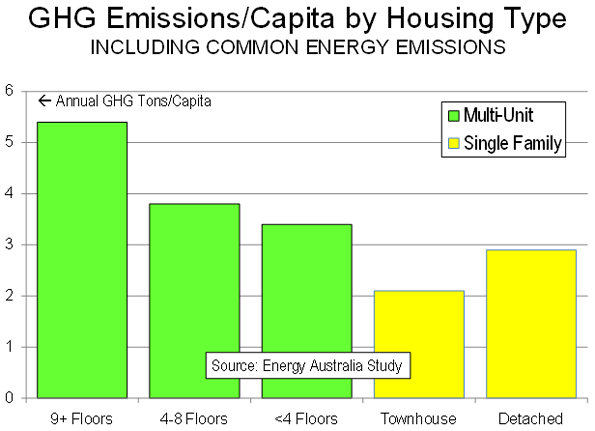
    The “common” consumption omission is serious. Other Australian research indicates how inaccurate consumer based inventories can be. Energy Australia has showed that, in the Sydney area, GHG emissions per capita, including common consumption, in high-rise residential buildings are 85 percent greater than in single family detached dwellings. Other multiple unit buildings are also more GHG intensive, while townhouses (row houses) are the best (see Figure).

    The inclusion of common consumption may be a principal reason why the ACF data associates lower GHG emissions with single family detached housing.

    Construction Materials: There is a further complicating factor. The materials that must be used to construct high-rise residential buildings, chiefly concrete and steel, are far more GHG intensive than the wood used in most single family dwelling construction. A 1997 Netherlands study indicates that the GHG emissions per square foot of high rise construction may be as much as five times that of a detached dwelling. In the newest energy efficient housing, the same study finds that the GHG emissions, over a building’s lifetime, can be greater than the emissions from day to day operation. The report notes that construction materials will become more important in residential GHG emissions, because improvements in routine energy consumption are likely to be more significant than those in building materials production.

    Then there is the issue of the GHG emissions in the construction process. It would not be surprising, for example, if heavy cranes could also tip the balance against high-rise towers.

    Dynamic Rather Than Static Analysis: Anyone who has studied economics understands the importance of “dynamic” versus “static” analysis. Dynamic analysis takes account of likely changes, while static analysis assumes that everything will continue to be as it is today. Much of the research on residential GHG emissions is based upon a static analysis. Yet, the housing stock (like the automobile stock) was largely produced during a time when there was little policy incentive to reduce GHG emissions. We are entering what may well be a very different policy environment. The comparatively recent emphasis on GHG emissions is producing a plethora of ideas, research and solutions. A recent Chicago Tribune article noted a surge in university graduates interested in research to reduce the GHG intensity of energy. The zero emission suburban house is on the horizon, which could take housing form “off the table” as a GHG emission issue and render static research to the internet equivalent of rarely accessed library stacks. Dynamic analysis asks “what can be,” not just “what is.”

    Cost per GHG Ton Reduced: All of this raises a question about how to identify policy strategies. The answer is to compare costs. The Intergovernmental Panel on Climate Change suggests that the maximum costs should be on the order of $20 to $50 per ton. McKinsey has published research indicating that steep reductions can be produced in the United States at less than $50 per ton.

    Yet, the costs of GHG emissions reduction are as absent from much of the present literature as the GHG emissions from elevators in high-rise towers. But costs are important. Economic and social disruption is likely to be greater to the extent that people are forced to change their lives. There is a big difference between requiring people to reduce their emissions where they live versus trying to uproot them – as well as their families and business – to urban cores. The former offers the hope of achieving sufficient GHG emission reductions, while the latter promises to incite a bitter fight between the bulk of the middle class and the regulatory apparatus. All this with a high probability that GHG emissions will not be sufficiently reduced.

    The Bottom Line: Outside some in the urban planning community, there is no lobby for reducing people’s standard of living. At least with respect to residential development and housing form, this does not appear to be necessary. The common area and construction GHG impacts of high-rise condominium buildings could well be greater both per capita and per square foot than those of detached housing. There is no need to force a move into a futuristic Corbusian landscape of skyscrapers. Indeed, it could even make things worse – for households, communities and even the environment.


    Previous posts on this subject:
    Regulating People or Regulating Greenhouse Gases?
    Greenhouse Gas Reduction Policy: From Rhetoric to Reason
    Enough “Cowboy” Greenhouse Gas Reduction Policies

  • The American Suburb Is Bouncing Back

    From the very inception of the current downturn, sprawling places like southeast California’s Inland Empire have been widely portrayed as the heart of darkness. Located on the vast flatlands east of Los Angeles, the region of roughly 3 million people has suffered one of the highest rates of foreclosures and surges in unemployment in the nation.

    Yet now George Guerrero, a top agent at Advantage Real Estate in Chino Hills, says he can see the light, with sales picking up and inventories finally beginning to drop. “There’s been a real surge in sales,” Guerrero says. “The market has come back to where it should be. I think we are ahead of the curve here of the overall recovery.”

    Of course, for the moment, much of this growth is concentrated in foreclosure sales. However, even developers of new properties, such as Brookfield Homes , also report a strong uptick in sales. In his new developments in the Inland Empire, notes Adrian Foley, head of Brookfield’s Los Angeles area office, sales are up 150% since six months ago.

    Although the economy is still hurting, the housing trend has become much more positive. Statewide, existing home sales have jumped 30% over the past year, taking the inventory from an estimated 16.7 months to less than seven months. In Chino Hills, it is down to six months.

    Most encouraging, this activity is taking place exactly where the market was hit hardest in the beginning – in the suburbs and at the lower end of the market, which in the Inland Empire means between $150,00 to $300,000. This could presage the resurgence of the suburbs and the prospects for the middle and working classes once again to purchase their piece of the American dream.

    Nor is this merely a Californian phenomenon. Nationwide, existing home sales – predominately in the suburbs – have been on the rise for the last few months. The strongest growth is occurring in Sunbelt markets in Arizona, Nevada and Florida, as well as in California. These places experienced some of the greatest surges in prices, which forced many buyers to turn to subprime and interest-only loans.

    These loans are largely not available today, Guerrero notes. Instead of financial quackery, lower prices – sometimes as much as 50% below peak – are allowing new buyers to buy affordably. In 2007, Inland Empire median house prices were roughly seven to 10 times the average annual income of potential buyers. Now they are settling close to the historic norm of three times.

    But not everyone will be happy to see life return to the suburban housing tracts. Indeed, for some self-proclaimed urbanists, planners and pundits, this development might seem almost nightmarish.

    Long the Rodney Dangerfield of American geographies, suburbs have never been popular with the country’s intellectuals, academics and planners. The destruction of community, racial segregation, expanding waistlines and a host of environmental sins – from consuming too much gas to helping create global warming – all have been blamed on the suburbs.

    When the mortgage crisis first hit, some urbanists, not surprisingly, were quick to blame the suburbs – instead of Wall Street – for the financial meltdown. With energy prices on the rise, they persuaded themselves and the ever-gullible mainstream media that the long-awaited “back to the city” jubilee was imminent.

    In contrast, the suburbs and exurbs, crowed Brookings’ Chris Leinberger, were soon to become “the new slums.” As the middle classes trudged their way back to Boston and other suitably dense big cities, James Howard Kunstler – the “shock jock” of the new urbanist movement and a leading apostle of the “peak oil” thesis – happily proclaimed, “Let the gloating begin.”

    Yet as George Guerrero could tell them, a dream is not a thing so easily destroyed. The American landscape continues to change, but perhaps not entirely in the ways so eagerly projected by urban boosters and their media claque.

    For one thing, even with the higher energy prices of last year, there seems to be, in fact, no notable shift of population to the urban core. Instead, as demographer Wendell Cox has pointed out, the recession may have slowed migration, but the trend toward the suburbs and sprawling Sunbelt cities has not ended or reversed.

    At the same time, the once-widely ballyhooed market for dense urban living has unraveled. The “gospel of urbanism” may be accepted as such by most of the mainstream press, most notably The New York Times and Atlantic Monthly, but on closer examination the new religion has limited numbers of converts. In many locales – from Massachusetts to Los Angeles – inner-city condominium projects are losing value at least as much or more than suburban single-family houses. In San Diego, for example, condo prices have dropped in some developments by 70% since 2007, twice the decline in the overall market.

    The problem has much to do with timing. In many areas, urban condominium developers continued to build even as the economy soured, largely due to the longer lead times and financing arrangements around such projects. Yet as the prices of houses have dropped many potential condominium dwellers have opted to purchase single-family homes – or are sitting anxiously on the sidelines waiting for prices to drop further.

    As a result, foreclosure rates for condominiums, according to the Federal Deposit Insurace Corp., are on average one-third higher than for single-family residences. You do not have to travel to the outer exurbs to find zones of foreclosures, bankruptcies and the turning of ownership properties to rentals. Towers are either unoccupied or have gone to rental in markets as diverse as Miami, central Atlanta and downtown L.A. Even Chicago, the poster child for urban gentrification, now suffers from abandoned “condo ghost towns.”

    Manhattan, too, which long saw itself as immune to the housing downturn, is now experiencing the most precipitous price decline since 1980. Big urban developers across North America are filing for bankruptcy, including the largest private landowner in downtown Los Angeles, just like suburban builders were last year.

    As someone who lives in – if you consider L.A. a city – and likes cities, I do not greet the urbanization of the housing crisis as an unalloyed positive. Yet one can hope that lower prices and interest rates – as well as the administration’s tax credits for up to $8,000 for first-time buyers – could allow more people to consider an urban option, if that’s what they want.

    However, this will not be where the bulk of the action will take place. Surveys consistently show that between 10% and 20% of people want to live in dense cities. In a country that will gain 100 million people over the next four decades, that’s 20 million, not exactly what you’d call chopped liver.

    But the bulk of growth will continue to be in the ‘burbs. The main reason is simple enough for almost anyone but a planning professor, architect or pundit to comprehend: preference. Virtually every survey reveals that the vast majority of Americans – and around 80% of Californians – prefer single-family homes that generally are affordable only in suburban areas. The fact that jobs have also continued to move inexorably to the periphery – as a newly released Brookings report demonstrates to liberal think tanks’ own undisguised horror – makes living in the ‘burbs even more attractive.

    These trends lead developers like Randall Lewis in Upland, Calif., who has suffered the downturn in the Inland Empire, not to dismiss the suburban future. He takes note of a recent 10% to 20% surge in sales among the 18 projects his company is now working on, all in suburban projects in California and neighboring states.

    “The basics of the suburbs are still there,” Lewis suggests. “Schools are important, but also people like the sense of place. But the basic amenities are children, grandchildren, where people go to church, where their work networks and friends are.”

    Lewis also rightly adds that a somewhat different suburbia will emerge from the crash. It will be a “melting pot,” he suggests, “not just by race, but by ages and lifestyle.” You will see more singles, empty-nesters and retirees as people choose to “age in place” close to where they have settled. There likely will be more smaller-lot, townhouse and other mixed-density developments closer to burgeoning suburban job centers.

    But even as they change, the allure of suburbs – and the single-family house – will not fade and could even grow as they develop more city-like amenities. The fundamental desire to own a place of your own, to possess some private space and a relatively quiet environment has not died. Nor is it likely to without the imposition of a draconian planning regime.

    For right now, it’s all enough to make George Guerrero a born-again optimist. “There’s something healthy just beginning to happen out here,” he says. “This time people with good credit are getting good deals at good prices. It’s a wonderful thing to see.”

    This article originally appeared at Forbes.

    Joel Kotkin is executive editor of NewGeography.com and is a presidential fellow in urban futures at Chapman University. He is author of The City: A Global History and is finishing a book on the American future.