Category: Urban Issues

  • Slumdog Entrepreneurship: Entrepreneurship Holds Key for India’s Slums

    The stealth Oscar winner Slumdog Millionaire, the Indian fable of love, heartbreak and overcoming the odds set against the backdrop of one of the world’s biggest urban slums has won fans all over the advanced industrial world – but may be less popular in India.

    One Indian film director who viewed the film at the Toronto Film Festival said flatly “All the Indian[s] hated it. The West loves to see us as a wasteland, filled with horror stories of exploitation and degradation.” One viewer in India claimed the film’s makers simply “cashed in on starvation, genocide, child prostitution, and overwhelming oppression.” Famed novelist Salman Rushdie panned the movie to an audience at Emory University after it won the Best Picture Academy Award for piling on “impossibility onto impossibility” to arrive at a contrived and implausible conclusion.

    The plot line — an “uneducated” slum dweller winning a million dollars on India’s version of the hit program “Who Wants to Be A Millioniare” — may well be unrealistic, but also obscures an important, often misunderstood point: the slums, themselves a product of heavy-handed land regulation and price controls, are centers of entrepreneurial activity and social stability.

    India’s urban slums are not just teeming masses of exploitation and degradation. The slums are populated by people that have real jobs and earn real income. They include white-collar workers, policemen, and even bureaucrats. They include tanneries, restaurants, makeshift pharmacies, tailors, cleaners, and hundreds of other micro businesses and entrepreneurs. Peeking inside one of those huts, typically less than the size of an American child’s bedroom, one will often find a small TV, radio or DVD player, purchased with legitimate income, although powered by illegal taps into the city electrical wires.

    The denizens of these slums are “quality of life poor, not cash poor,” as one World Bank official told me on a tour through Dharavi, perhaps the world’s largest urban slum. And this is where the story of Jamal, an orphan raised in the poverty, exploitation and harsh realities of India’s slums, tells a gripping story about India containing important lessons for the rest of the world.

    Unlike a generation ago, a smart orphan boy now can grow up and get a respectable job. If he (and increasingly she) is clever enough, he can run a business and even become rich. Unfortunately, this story is missing from Slumdog Millionaire.

    Upward mobility is not the first thing that comes to mind flying into Mumbai, India. The hills and gullies are thick with tin and wood shacks, sheltering thousands of men, women, and children. Many slum dwellers are recent immigrants from India’s hinterlands, but some have lived in these shacks for generations. Even an air-conditioned limo can’t keep the bracing poverty away from westerners ferried into the center of India’s most economically vibrant economic capital.

    Indeed, as soon as I left Mumbai’s airport in a local taxi, I was struck by the destitute poverty all around me. It was a visual reminder of the stories my grandmother used to tell of her travels to India as a tourist. She loved this nation and its people, but also recognized the dirt, grime, and poverty.

    But it would be a mistake to dismiss these areas as a “wasteland.”

    The slums also reflect what’s going on right in India in addition to the challenges that great nation still faces.

    Unfortunately, by ignoring the economic dynamism within an illegal city of one million people, the movie missed out on telling India’s truly remarkable story of growth and development.

    Many have heard the story of software giants like Infosys, the 1.5 billion dollar information technology business founded in 1981, or about the scores of U.S. and European firms investing in India. Microsoft not too long ago announced plans to invest $1.7 billion in India and create 3,000 new jobs over four years.

    But the real test of India’s economic rebound lies in the small business community, especially the ones that find their way in the mainstream economy. These small businesses, popping up spontaneously to meet global needs and demand, are the ones that will eventually determine whether India will become the next Asian Tiger.

    Deepak Parekh is the CEO of Sureprep of India and former senior accountant for a multinational corporation. Sureprep prepares U.S. personal income tax returns, processing more than 25,000 each year. Business is booming, and Parekh anticipates annual growth of 40 percent or more.

    “We did a pilot project in 2000,” Mr. Parekh says as he recalls the initial stages of the company’s founding. After all, why should an Indian firm prepare tax returns for Americans? U.S. trained accountants would seem to have a natural comparative advantage. Not so. “We looked hard at the quality numbers,” he says. “We found that Indians were among the top performers and dedicated workers, willing to work 24-7 to get the job done.” American accountants made more errors on average than Indians, but were paid more and expected more time off. Sureprep now employs more than 200 Indian accountants and software engineers.

    Sureprep’s success — and that of India’s service sector — came about in part, oddly enough, due to socialism. Once the poster child for post-World War II socialism in the developing world, India erected one of the most regulated and protected economies in the world.

    Yet this legacy did not impact much of the technology sector – which largely did not exist at the time of Independence — or the largely informal sector that thrives in places like Mumbai’s slums.

    Dharavi, located north of the central business district and east of the airport, squeezes 900,000 people on just 2 square kilometers. That’s ten times more dense than Manhattan. By most estimates, more than half of Bombay’s population lives in ramshackle slums such as Dharavi.

    Yet economic opportunity is thriving in India’s cities. The slums are large enough to have economies internal to themselves — maids, clothing repair, plastic recycling. Few are homeless.

    The lack of housing is evidence of a significant planning failure. Ramakrishan Nallathiga, a housing economist in Bombay, studied land use and regulation in the city’s 20 wards and found density restrictions were the strictest in the most dense parts of the city. This forced non-profit organizations to step in and build the housing themselves after securing special land development privileges from the local government where they could. However, most of the poor scramble for any sliver of land they can find to put together a makeshift home. Since private land is off limits, they settle on public land — parks, open space, railroad right of way.

    Meanwhile, Bombay’s population has skyrocketed 137% since 1975 to 17.1 million according to the United Nations. It’s now about the size of the New York urban area, but Bombay squeezes its metropolitan population onto about 8 percent of the space according to Demographia.com.

    The New York area only grew by 15 percent over the same period. The only U.S. metropolitan area among our top ten that grew near Bombay’s rate over the same period was Atlanta (188%). Miami and Houston, next in line in terms of growth, merely doubled their populations. In each of these cases, though, the metro population is less than one-third Mumbai’s.

    India has a lot further to go in areas other than housing as well. Many traditional industries are still shackled by labor rules that limit their ability to adapt. A World Bank analysis of the business environment found that managers reported spending 16 percent of their time with the bureaucracy in India compared to just 5 percent in Latin American countries and about 10 percent in post-Communist Eastern European countries.

    India’s economic future fundamentally lies in the entrepreneurial attitude of its citizens. A recent popular movie called Swapes, or “Foreign Land,” follows Mohan Bhargava, a young, talented Indian project manager for NASA who returns to rural India to build a hydroelectric power plant that provides electricity reliably 24-7. He uses the technology he developed and uses everyday to build critical infrastructure in some of the most remote areas of his native land. Our bright, talented Indian hero has the knowledge, brains, and technology to build a company in his homeland and compete with the big boys. And India’s making it a better and better place to do that everyday. And more and more Indians are willing to move back to their homeland to take advantage of these opportunities.

    Of course, India still has a long way to go. The Economic Freedom Index of the World published by the Frasier Institute in Canada still ranks India a paltry 67th. To move they will need to change in labor laws to weaken the power of the unions, continue efforts at tax reform, make India even more friendly to foreign investment while reducing regulation much, much more.

    With these changes, Mumbai could become the next Hong Kong or Shanghai. The hardy and remarkably able denizens of Mumbai’s slums do not need Western pity. On the contrary, they need the freedom to build their own lives and fashion economic opportunity out of little more than hard work and a clever turn at a business.

    Westerners need to scratch beyond the surface of the films and superficial criticism. They need to see the real stories of heartbreak, innovation, and perseverance that make these harsh and unbending slums potential incubators of economic dynamism — reflecting the very optimism that made Slumdog Millionaire such an attractive film.

    Samuel R. Staley, Ph.D. is director of urban policy at Reason Foundation (www.reason.org) and co-author of Mobility First: A New Vision for Transportation in a Globally Competitive Twenty-first Century (Rowman & Littlefield, 2008).
  • Move to Suburbs Continues in Western Europe

    Despite the assertions of some planners and urban boosters, urban core population loss has been the rule since mid-century throughout the metropolitan areas of Western Europe (see note below). For example, the ville de Paris lost a quarter of its population from 1954 to 1999, Copenhagen shrank 39 percent from 1950 to 1991, inner London (This includes the 13 inner boroughs and the “city” of London, which are roughly the former London County Council area) declined by a third from 1951 to 1991 while Milan‘s population declined by a quarter from 1971 to 2001.

    At the same time, widely ignored by many American observers, Western Europe has been suburbanizing strongly. Since 1965, virtually all major metropolitan area growth has been in the suburbs. Indeed the share of the metropolitan area population gains in the suburbs has been greater in Western Europe than in the United States.

    It is true, however, that there has been a generally modest turnaround in core population trends, with strong turnarounds in the “ancient” losers of Vienna (which peaked in 1911) and inner London (which peaked in 1901). It might be tempting to suggest – as is often done in the United States – that these reversals indicate that Europeans are moving back to the cities from the suburbs.

    To answer this question, we examined all of the available “components of population change” reported by the census authorities of Western European nations. Seven of the 17 (the European Union-15 plus Norway and Switzerland) produce such data at a geographical level that makes metropolitan analysis possible. A review of this data suggests that the new residents are largely international migrants and that the core cities generally continue to lose domestic migrants, while the suburban areas continue to perform better with respect to attracting domestic migrants. This parallels the experience in the United States.

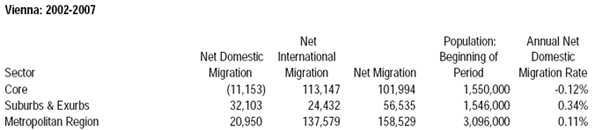
    Vienna: Vienna illustrates the trend. The city of Vienna increased its population from 1,550,000 to 1,656,000 between 2002 and 2007. This 7.3 percent gain is impressive but over the same period, a net 11,000 residents left the city. Virtually all of the population increase was the result of international migration, which accounted for 113,000 new residents. On the other hand, the suburbs of Vienna added 32,000 new domestic migrants and also added 23,000 international migrants. Vienna’s population turnaround can be fully attributed to immigration.

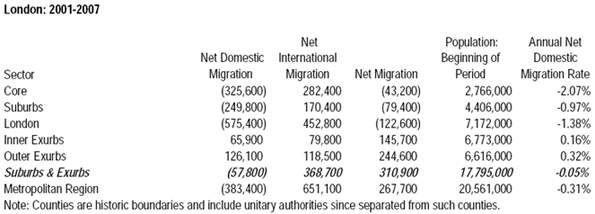
    Inner London and England: Like Vienna, inner London’s gains have not been the result of people moving from the suburbs to the city. Between 2001 and 2007, a net 326,000 people moved from inner London to other parts of England and Wales. The domestic migration losses were even larger than the gain of 282,000 from international migration. The inner suburbs (the outer boroughs added to the city in the 1960s) also lost domestic migrants, but at a rate half that of inner London. The exurbs (the two rings of counties outside the Green Belt) added 126,000 domestic migrants and a somewhat larger number of international migrants.

    Overall, the London metropolitan region experienced a net domestic migration loss of more than 383,000 between 2001 and 2007. However, there were strong international migration gains, in every sector of the metropolitan area.

    Thus, the data indicates that the recent inner London population growth is not the result of suburbanites moving to the city. Inner London’s population growth is being driven by international migration and the natural increase in population (births minus deaths).

    As with inner London, the cores of Birmingham, Manchester, Liverpool, Newcastle and Leeds-Bradford all lost domestic migrants from 2001 to 2007. Thus, despite the improved population performance of the largest metropolitan areas in the United Kingdom, people continue to move out of the cores, while people are generally moving to suburban areas.

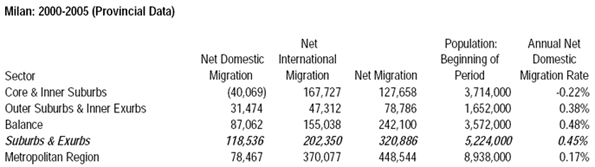
    Milan and Italy: The city of Milan, the core of Italy’s largest metropolitan area, has experienced one of Western Europe’s most significant population losses since the early 1970s. Yet, in the early years of the decade, Milan has experienced a turnaround, as the population has begun to grow. The pattern was much the same as seen in London, with a net 40,000 residents leaving Milan province to move to other parts of Italy. At the same time, there was a strong net international migration gain of 168,000. Suburban areas, on the other hand, attracted a net 119,000 domestic migrants as well as a strong component of international migration.

    A shorter data series is available for cities (communes) and shows net domestic migration losses in the central cities of Milan, Rome, Naples, Turin, Genoa, Palermo, Florence and Bologna. The suburbs, however, gained domestic migrants, with the exception of Naples. However, the Naples suburban losses were at a far lower rate than that of the city.

    It is thus evident that the core areas of the largest Italian metropolitan areas are not receiving net migration from their suburbs.

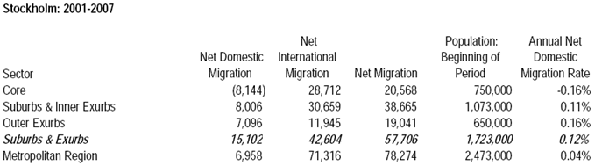
    Stockholm and Sweden: Similarly, the city of Stockholm’s recent gains have not been the result of migration from the suburbs. Between 2001 and 2007, the city lost a net 8,000 domestic migrants. This loss was more than made up by the international net migration of 29,000. At the same time, the suburbs and exurbs gained 15,000 domestic migrants.

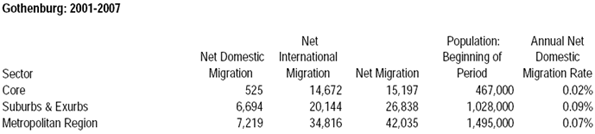
    Sweden’s second largest metropolitan area, Gothenburg, was one of only two of the 19 cases in which there was net domestic migration to the core (which had been enlarged in the 1990s to include many suburban areas). The city gained 500 domestic migrants and 15,000 international migrants. However, the suburbs gained approximately 13 times as many domestic migrants than the city, again indicating no trend of movement from the suburbs to the city.

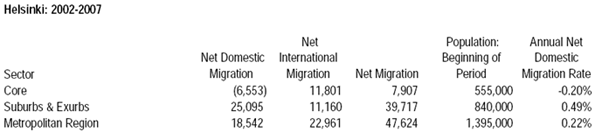
    Helsinki: Finland’s capital mirrors the general trend. The city of Helsinki lost 6,500 domestic migrants between 2002 and 2007, which was more than compensated for by an 11,800 net international migration gain. As in nearly all of the other cases, the suburbs and exurbs gained domestic migration, illustrating that there is not a movement from the suburbs to the city in Helsinki.

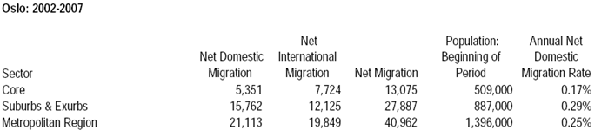
    Oslo: Norway’s capital was, with Gothenburg, the only core experiencing net domestic migration. Oslo County gained 5,400 domestic migrants. However, the suburbs and exurbs gained domestic migrants at a greater rate, adding 16,000. Thus, despite the core domestic migration gains, there is no evidence of a “return” from the suburbs and exurbs to the city in Oslo.

    Conclusion: The available data from national census authorities provides no evidence to suggest any sort of general movement of the population from suburban and exurban areas to the central cities of Western Europe. This mirrors the situation in the United States, where interests that hold the suburbs in contempt continue to declare their death, while the latest data continues to show the opposite – strong domestic migration losses in core areas and gains in the suburbs.

    There is one other key factor in the European case: the enlargement of the European Union in 2004, which increased the national membership from 15 to 25 (and subsequently to 27) and allowed for the mass migration of people from the east to the wealthier west. Whether the international financial crisis may reverse this trend, with many Eastern European residents moving back to their native countries, remains an open question.


    Note on European metropolitan areas: There is no European standard for determining metropolitan areas (which are labor markets). The European Audit’s “Larger Urban Zones” (LUZ) are the closest approximation, but are not consistently defined throughout the European Union. For example, the Naples LUZ includes only the core and inner suburbs, an area far smaller than the functional metropolitan area. Many other larger urban zones include suburban and exurban areas, consistent with the concept of a metropolitan area.

    Wendell Cox is a Visiting Professor, Conservatoire National des Arts et Metiers, Paris. He was born in Los Angeles and was appointed to three terms on the Los Angeles County Transportation Commission by Mayor Tom Bradley. He is the author of “War on the Dream: How Anti-Sprawl Policy Threatens the Quality of Life.

  • Chrysler: Detroit Loses Its Muscle

    With the clock finally running out for Chrysler, I was reminded of a theme that has run through most of my corporate work, namely that corporate culture is the element of any organization most resistant to change. As I have read (and written) many times, senior management and new management schemes come and go, but the prevalent attitude among the permanent work force is “this too shall pass.” The senior managers move on, and the culture reverts. It takes a “burning platform” to effect real change.

    When the corporate culture is aided and abetted by the national culture, as with the auto industry, the day of reckoning can be staved off indefinitely. Every time a structural threat to business as usual has arisen, the fix was in: Gas crisis? Whatever you do, don’t impose new fuel economy standards, and keep gas taxes low while you wait for oil prices to come back down again. Foreign competition? Import quotas. The political culture of Washington, regardless of who controlled the White House or Congress, was inseparable from the corporate culture of Detroit.

    This is unsurprising, since the car is so much a part of American culture. The romance of the car never dies, it just morphs into something else. What saved Chrysler when Lee Iacocca ran it? The minivan. Iacocca put a box on top of a passenger car frame just as baby boomers started their families. The ‘sixties VW bus, the counterculture’s vehicle of choice for magical mystery tours, was reincarnated for family life as the Dodge Caravan. New wealth in the ‘90s brought back the production muscle car, like a recessive gene that suddenly becomes manifest. Of course it never really went away.

    Woodstock has come and gone, but each summer suburban Detroit plays host to its own gathering of the tribes in a rite called American Iron. Loving owners and keepers of vintage GTOs, 442s (I confess, I talked my father into buying one of these when I was in high school, and he promptly sold it when he had to refill the gas tank about as often as Richard Nixon had to shave), and Corvettes park their cars on specific streets throughout the city, assigned according to make and model, where they throw open their hoods to reveal to their automotive kin lovingly restored and chromed vintage 7 liter engines. On schedule, the gentlemen will start their engines, shaking windows and rattling walls for miles around.

    I had one brief brush with Chrysler and Big 3 culture in the early 1990s when a PR firm hired me to fly to Detroit and write up a case study for its client, the consulting arm of accountants KPMG. KPMG was marketing a discipline it called Business Process Reengineering. Chrysler had applied this rigorous methodology to something they called the Wire-Housing Case. A wire housing is one of those brightly colored plastic sleeves with holes through which are threaded an assortment of wires, themselves wrapped in brightly colored plastic for easy color-coded connection to the appropriate circuitry.

    As I recall the numbers, each Chrysler vehicle contained seven wire housings, each of which was customized to particular electrical components of each model. Some would be used for only a couple of wires, and some many more. Each model had its own set of housings with its own specs written by dedicated teams of engineers, and produced by an extended family of suppliers.

    The KPMG BPR team had re-jiggered the design process to reduce the number of housings required for each vehicle from seven to only five, and in doing so realize savings to the company in the millions of dollars. Very impressive. The morning’s discussion was filled with the enormous gains that could accrue to the company if only it attacked each engineering problem with comparable rigor-for-hire courtesy of the firm’s consultants. When I asked the obvious questions, how long did it take to implement the change and how much money did they save in practice, the consultant and the accountant exchanged a look.

    In fact, they said, the change had never been implemented. Further questions elicited an impression that the automotive industry functioned internally with its own version of interest-group politics. Each system had its own web of constituencies—design teams, suppliers, brand managers, and so forth—and each thread needed to be appeased. There was no such thing as the greater good, any more than there is with health care reform, the F-22 fighter plane or, to use an example local to me, congestion pricing of traffic in New York City.

    The same tendency was on display more recently, and on a grander scale, after Chrysler was acquired by Daimler-Benz. The sages of Stuttgart had the bright idea that the company could save billions by mounting the American models on the frames and chassis of the Mercedes, and thus cut out redundant designers, engineers, and suppliers.

    This time, the Daimler engineers went into open revolt. Put those American pigs’ ears on our silk purses? Not on your life. And so another grand effort to rationalize the auto industry went by the boards. Daimler essentially sold the company to Cerberus Capital for parts.

    In the years since that visit to Detroit—I can easily place it in time because I also stopped in on an aunt in a nearby suburb who was glued to the O.J. Simpson trial—I have encountered a number of other consultants and their schemes to bring the automotive supply chain to heel. The companies would consolidate their supplier networks, sourcing more parts from fewer suppliers who would achieve economies of scale and provide lower unit costs in return for bigger orders. The suppliers, who simultaneously worked with the competition as well, would take over more of the basic engineering and design, usually with talent offloaded from the Big 3. Personnel and systems for both would be integrated into one another. Unlike the wire harness case, these changes were implemented. It’s not as though the Big Three have been doing nothing all these years, and still it’s not enough.

    Now Chrysler is being run by Bob Nardelli, once an also-ran at GE in the race to succeed Jack Welch, and then the overpaid, underachieving CEO of Home Depot. The New York Times March 16th profile of him is an oddly touching piece. Like Donald Rumsfeld and Ernest Hemingway, Nardelli works at his desk all day on his feet. He is pictured as a man on a mission, comparable to Iaccoca, who wants to rescue the whole cow, albeit a leaner version, not chops and steaks as had been expected when he took over. “It’s not about Bob… If I didn’t believe in [the rescue plan] I wouldn’t have put my name on it,” he told the Times. He has already cut 32,000 jobs, but even if it were possible to fix the wire harnesses or improve the fleet average all at once, he couldn’t sell the product, not in this market. On Monday, the Administration voted no confidence. Barring an 11th hour reprieve from Fiat, this is a death sentence.

    My aunt lives on the street that briefly each summer becomes known as Mustang Alley. She is anguished by the fate of her community, her immediate family, her friends and her business, all of which are suffering. Watching what is happening to New York as the banking crisis unfolds, I am just beginning to understand know how she feels. Her son-in-law is an engineer who worked for a supplier to the auto industry. On Sunday, he moved south to work for a company that builds windmills.

    Henry Ehrlich has written speeches as a freelancer for both the new, white-knight CEO of Fannie Mae and the former, disgraced CEO of Freddie Mac. He is author of Writing Effective Speeches and The Wiley Book of Business Quotations.

  • Kansas City and the Great Plains is a Zone of Sanity

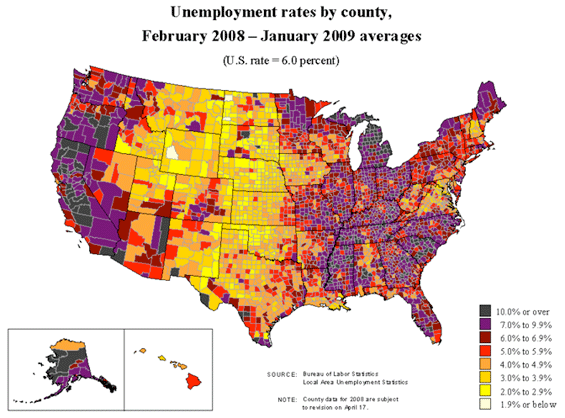
    Over the past year, coverage of the economy appears like a soap opera written by a manic-depressive. Yet once you get away from the coasts – where unemployment is skyrocketing and economies collapsing – you enter what may be best to call the zone of sanity.

    The zone starts somewhere in Texas and goes through much of the Great Plains all the way to the Mexican border. It covers a vast region where unemployment is relatively low, foreclosures still rare and much of the economy centers on the production of basic goods like foodstuffs, specialized equipment and energy.

    People and companies in the zone feel the recession, but they are not, to date, in anything like the tailspin seen in places like the upper Great Lakes auto-manufacturing zone, the Sunbelt boom towns or, increasingly, the finance-dependent Northeast. Last month, for example, New York City’s unemployment experienced the largest jump on record.

    “That whole swath from Texas and North Dakota did not see either the bump or the decline,” notes Dan Whitney, a principal at Landmarketing.com, a real estate research company based in Kansas City, Kan. “People have a more conservative nature here. It’s just saner.”

    The housing market is one indicator of greater sanity. Kansas City housing prices dropped 7% between 2006 and 2008, compared with 10% in Chicago, 15% in San Francisco, 20% in Washington, D.C., and over 30% in Los Angeles. Houston and Dallas, the Southern anchors of the zone, have seen little movement either way in prices.

    One key measurement is affordability. The median multiple for Kansas City housing – that is the number of years of income compared with a median-priced house – has remained remarkably stable at under 3.0. In contrast, notes demographer Wendell Cox, the ratio approached up to 10 in places like Los Angeles and San Francisco, as well as something close to 7 in New York and Miami.

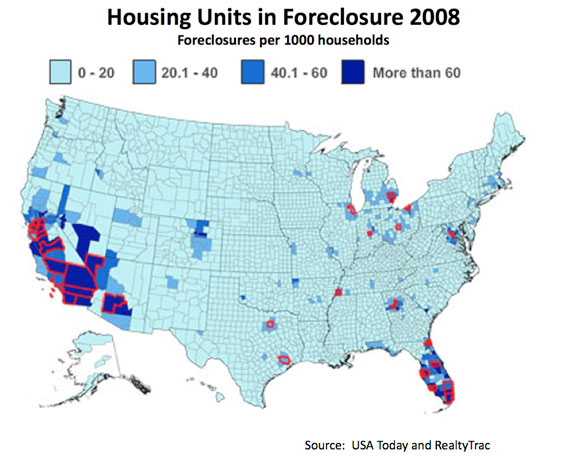
    The result has been that foreclosures – the key driver of many regional economic collapses – have been relatively scarce throughout the zone. This USA Today map reveals how the foreclosures are heavily concentrated in Florida, California, Arizona and Nevada, as well as parts of the old Industrial Belt of the Great Lakes.

    housing_foreclosure_565.jpg

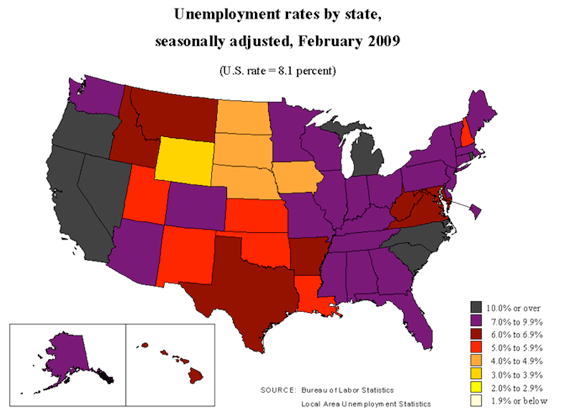
    Analysis by my colleagues at Praxis Strategy Group of the job market’s condition also reveals the divergence between the zone and the rest of the country. Regions from the Northeast, the Great Lakes and the Southeast all have seen significant job losses, and the damage is spreading to the Pacific Northwest, New York and New Jersey. In contrast, the Kansas City area and much of the zone of sanity has experienced only a ratcheting down of its generally steady growth rate. Things are not bustling, but there seem to be few signs of a basic economic collapse.

    unemployment_state_565.gif

    unemployment_country_565.gif

    Sanity, as Whitney put it, may constitute a critical part of the equation. If you discuss why people live in a place like Kansas City, people tend to speak about stability, family-friendliness and the basic ease of everyday life. Many executives, notes Phil DeNicola, who runs Strong Suit Relocation, initially resist a transfer to the region but quickly see the advantages.

    “It is attractive to be here,” notes DeNicola. “You don’t get a lot of highs and lows for years. There is stability instead, particularly for families. It all reduces your stress.”

    Of course, not everyone is satisfied with the status quo. As in many second-tier urban centers, many in Kansas City’s leadership crave being something other than pleasant, affordable and stable. Leaders in the city – home to roughly one in four of the region’s 2 million residents – have been particularly exercised to show that KC can be as hip and cool as New York, L.A. or, at the very least, Chicago.

    “There’s a real kind of self-loathing here,” notes Mary Cyr, a Harvard-trained architect, who works on projects throughout the region. “We feel less than what we are. We do not know what we are as a city. We don’t even realize what we have.”

    Hundreds of millions have been poured and continue to pour into the usual monuments favored by urban policymakers and subsidy-hungry developers – a sparkling new arena, plans for an expanded convention center and a massive entertainment complex called the Power and Light District. Yet at the same time, the city’s budget, like many others, is severely strapped, so much so that City Hall is considering not turning on the city’s iconic fountains this spring.

    Even worse, city and regional issues seem to result in plenty of money for new expressions of wannabe grandiosity. One notable example: plans to build a $700 million-plus light-rail line, the kind of thing that has become the sine qua non for the “monkey see, monkey do” school of urban policymakers across the country.

    This project makes little sense in a region with a well-below-average percentage of jobs in its downtown core – roughly around 7% – with one of the lowest shares of transit-riding residents in the nation. The relative lack of traffic makes a rail system less sensible than could be argued for higher-density urban corridors, where it at least can be imagined that many would give up their cars.

    Ultimately, none of this taxpayer largesse is likely to do much more than replicate the same kind of development that can be found in scores of cities – from St. Louis to Dallas – that have tried it. At best, you get a few blocks of activity but very little in terms of urban dynamism.

    “The growth of downtown is not at all organic – it’s kind of forced,” notes architect Cyr. “They build all those projects in there, and you end up with the huge monumental buildings and the Gap.”

    The problem for the downtown crowd is that Kansas City has remained a quintessential American city, most dynamic in places where private initiative leads the way. Typically the bulk of new growth has taken place in the suburban fringes, but there are several successful nodes within the city, particularly around the lovely, 1920s vintage, privately developed Country Club Plaza area, famous for being the world’s first modern shopping center.

    Similarly, the artist-inspired Crossroads district has also evolved – largely without government help – into a genuine bastion of bohemians, with small companies and locally owned restaurants. With its low-cost commercial and residential space, as opposed to government subsidies, many see the area as precisely the kind of grass-roots urban life with a future in a place like Kansas City.

    Such developments in the city, as well as outside, make it possible to project a very bright future for Kansas City – and across the zone of sanity. Unless there is a massive shift in conditions, the zone should see a return to prosperity earlier than places bogged down with excess foreclosures, shuttering industries, soaring taxes and ever-tightening regulation. Dan Whitney, for example, expects the local housing supply to run out soon – with “tremendous pent-up demand” by the end of the year. If credit conditions improve, new construction should resume within the next 18 months.

    This all reflects the essential attractiveness of cites like Kansas City. Overall, in fact, its rate of domestic in-migration has been higher than much-celebrated Seattle and only slightly below that of Denver. Indeed, since 2000, Kansas City’s regional population has grown 8.6%, more than twice as much as New York, Boston, San Francisco or Los Angeles.

    Unlike the national media, which rarely focus on mundane things that drive most people’s lives, some seem to get the appeal of lower prices, affordable housing options and a generally calm environment. Although never a beacon for newcomers, like Phoenix, Atlanta or Dallas, Kansas City has not suffered the massive out-migration seen in such big metropolitan regions as Los Angeles, San Francisco, Chicago or New York.

    In fact, Kansas City has enjoyed a slow but steady in-migration through the past decade. These newcomers could provide the energy, talent and initiative that a region, known for stability, needs to get to the next level. Attracting more of them – not new prestige projects or subsidized developments – remains the key to the region’s future.

    Instead of trying to duplicate growth patterns that are foundering on the coasts and in countless Rust Belt cities, the denizens of the zone of sanity need to learn how to build on their virtues of stability and affordability. Particularly in hard times, such things count for much more than many – both inside and outside the region – might imagine.

    This article originally appeared at Forbes.

    Joel Kotkin is executive editor of NewGeography.com and is a presidential fellow in urban futures at Chapman University. He is author of The City: A Global History and is finishing a book on the American future.


  • Whatever Happened to “The Vision Thing?”

    When I was in elementary school, I remember reading about the remarkable transformations that the future would bring: Flying cars, manned colonies on the moon, humanoid robotic servants. Almost half a century later, none of these promises of the future – and many, many more – have come to pass. Yet, in many respects, these visions from the future served their purpose in allowing us to imagine a world far more wondrous than the one we were in at the time, to aspire to something greater.

    I am reminded of these early childhood memories not because I lament the loss of my flying car (although it would come in handy every now-and-again in fighting the Washington, D.C. rush hour gridlock) but because, with all of the rhetoric about change and hope, the Obama Administration has failed to articulate a strong, singular vision for what the future of America and the world can and should be. While some would argue that now is not the time for grand visions for the future but, rather, for hunkering down and muddling through these desperate economic travails, the fact of the matter is that at least part of the cause of continuing economic decline in this country, and in many other developed nations as well, is a lack of confidence in the future.

    I was somewhat hopeful during his address to the joint session of Congress in early February – shortly after the passage of the economic stimulus bill – that President Obama was indeed starting down the path of articulating a new vision for America. He recalled in that speech great innovations that had been spurred by prior economic and other exigencies. In that speech he stated:

    “The weight of this crisis will not determine the destiny of this nation. The answers to our problems don’t lie beyond our reach. They exist in our laboratories and universities; in our fields and our factories; in the imaginations of our entrepreneurs and the pride of the hardest-working people on Earth. Those qualities that have made America the greatest force of progress and prosperity in human history we still possess in ample measure. What is required now is for this country to pull together, confront boldly the challenges we face, and take responsibility for our future once more.”

    And again, later in his address:

    “History reminds us that at every moment of economic upheaval and transformation, this nation has responded with bold action and big ideas. In the midst of civil war, we laid railroad tracks from one coast to another that spurred commerce and industry. From the turmoil of the Industrial Revolution came a system of public high schools that prepared our citizens for a new age. In the wake of war and depression, the GI Bill sent a generation to college and created the largest middle-class in history. And a twilight struggle for freedom led to a nation of highways, an American on the moon, and an explosion of technology that still shapes our world.”

    Bold action and big ideas: Yet the focus of all of the Administration’s efforts have been on specific “solutions” to the problem set with which our economy is now faced. Some are well-intentioned but arguably poorly executed by Congress while are others rolled out for public consumption with less than full baking time—without any suggestion about what our “brighter future” might look like and how these various solutions might be woven together to help realize a brighter and different future.

    We may indeed be on the cusp of something big: It may be tragic or triumphant depending upon how and how quickly we find our way out of the country’s current predicament.

    After Hurricane Katrina ravaged New Orleans and the Gulf Coast, some urban planners, architects, emergency management experts, and others were bold enough to suggest that maybe the Ninth Ward shouldn’t be rebuilt; perhaps nature never intended us to put so many homes and so many people below sea level, in harm’s way. Regrettably, that conversation was preempted as soon as it was started by the hundreds of displaced residents who, having been treated with what appeared to be utter disregard by their local, state, and federal government in the face of that tragedy as it unfolded, insisted that at least they deserved to be returned to their homes. Politics and pragmatics trumped bold and broad thinking that could have conjured a different outcome.

    There is so is so little new and dynamic mainstream discourse about where and how we live as individuals and in communities. There is no modern proxy for flying cars and colonies on the moon. And funding billions of dollars in support of “shovel-ready projects” will certainly do nothing to advance the cause of innovative thought about how we would like to see our current communities – urban, suburban, and exurban, and rural – evolve over the next twenty-five or fifty years. What could life be like in America in 2034 or 2059? We should not have to rely upon science fiction writers, futurists, and block-buster sci-fi movie producers to craft all of our visions of the future.

    So here’s an idea for our new President. Now that everyone is relatively comfortable with the notion of spending billions (and even trillions) of dollars, let’s spend a very small portion of that on our future, rather than focusing exclusively on our near-term economic salvation. Make $10 billion available to fund five pilot projects with $2 billion each. Think of is as the “X Prize” for Innovations in Livability. Invite communities throughout the country, without restriction as to size or location, without constraints on the marketplace of ideas, to bring together their best and brightest to craft implementable proposals for how they plan to evolve their community into an exemplar for the future: Then fund the five best proposals. Take the funding decisions out of the hands of elected officials and policy makers, and place it unfettered in the hands of a blue-ribbon panel of experts from a broad range of disciplines.

    Let all Americans and the world marvel at what will replace the flying cars of the 60s.

    Peter Smirniotopoulos, Vice President – Development of UniDev, LLC, is based in the company’s headquarters in Bethesda, Maryland, and works throughout the U.S. He is on the faculty of the Masters in Science in Real Estate program at Johns Hopkins University. The views expressed herein are solely his own.

  • Talkin’ Baseball – and Sub-Prime Mortgages

    I was thoroughly enjoying the broadcast of the March 23 final game of the recent World Baseball Classic at Dodger Stadium when I thought about steroids and sub-prime mortgages.

    A seemingly odd leap, I’ll grant you – but hang in there on this one.

    The thoughts had first stirred when I attended a semi-final game the prior Saturday, watching a South Korean team that counted just one player who’s on a big league roster here in the U.S. make hash of the Venezuelan squad. The Venezuelan team boasted plenty of players who make in living in the big leagues, including a number of All-Stars.

    Then I tuned in the next night to watch Japan do a similar number on Team USA. More of Japan’s ballplayers have made a mark in our big leagues compared to the South Korean squad, but their team still paled in comparison to the star power of the Americans.

    The Venezuelans and Americans didn’t just get beat in their semi-final games, by the way – they looked slow, lacking in the fundamentals of the game. The South Koreans and Japanese, on the other hand, looked quick and ever-alert. They pitched with heart, hit smartly, and fielded their positions with nimble dedication.

    That set up a South Korea-Japan final that proved to be one of the best ballgames I’ve ever seen, going all the way to extra innings in a performance that highlighted how the game should be played.

    None of the South Korean or Japanese ballplayers looked overly bulky. There were a few big fellas out there – but they were big like Babe Ruth or Frank Howard. They looked like naturally big guys who had learned to play baseball. No forearms that made you think of Popeye. No necklines from ears to shoulders.

    I thought about how the big leagues of the U.S. have only begun to admit to the recent steroid binge. It reminded me how obvious the trend had been. Anyone who couldn’t see the physical indicators in the players should have been able to get a good idea just by looking at the statistics piled up during the Steroid Era.

    Baseball fans looked past all of that, for the most part. So did players and team owners. Home runs are sure fun, after all.

    That’s where my thoughts turned to sub-prime mortgages – because we as a society did pretty much the same thing to our economy. We shot some concocted substance into our economic bloodstream, getting a short-term boost that didn’t require any real dedication to owning a home or building communities. We went for the shortcut – just like those big league ballplayers who decided to get their power from a syringe instead of dedication to the game.

    Folks all over the world joined us by directly or indirectly flexing the fake economic muscles engendered by the sub-prime mortgage mess. Yet a look at the World Baseball Classic shows that not everyone fell for the shortcut offered by steroids. Not everyone turned their backs on sportsmanship and fundamentals at the ball yard.

    So put love of the game alongside genuine community building on the back-to-basics list for our American Culture.

    We might as well make it a thorough housecleaning.

    Jerry Sullivan is the Editor & Publisher of the Los Angeles Garment & Citizen, a weekly community newspaper that covers Downtown Los Angeles and surrounding districts (www.garmentandcitizen.com)

  • Financial Crisis Boosts Local Markets

    By Richard Reep

    The current economic crisis has many mixed impacts, including the shift of grocery customers to low-cost companies like Wal-mart. Yet at the same time we see a shift to local, community markets in an effort to cope with the new economy. While the global players deliver discounts due to their enormous volume, local community markets offer low-priced produce, goods, and services due to their microscopic volume. This common ground between individual efforts and enormous buying machines yields an interesting treasure trove of passion and hope.

    As folks cope with financial turmoil, their choices for purchasing venues seem to be driven by the need for saving, as well as the need for a good experience. The middlemen, such as the regional and national chains, seem to be squeezed in between truly global players like Wal-mart, and the rising tide of localism appearing at a grass-roots level in so many communities.

    The rise of these small, open-air markets is an encouraging sign of authentic social interaction, after so many assaults upon our social network by the forces of the Old Economy. It suggests a new role for local entrepreneurs and for the revival of community spirit. At these local markets, producer and consumer traffic in direct interaction, without the army of marketing consultants, business analysts, merchandisers, industrial psychologists, and the rest of the hangers-on who have transformed the agora into an often dispiriting and uninteresting shopping experience.

    Now, with the Old Economy in shambles, the New Economy appears to be reviving the community element to our American commercial culture. Even a few years ago the Farmer’s Market was considered an anachronism, something found in rural areas and overlooked by cosmopolitan city dwellers. The fact that these are rising up in our urban and suburban culture speaks to our need for freshness, for authenticity, and for some spontaneity.

    In Central Florida, the Winter Park Farmer’s Market is perhaps the grandfather of the Central Florida market scene, having started sometime in the eighties. No one at the City could remember exactly when it started. Ron Moore, Parks and Recreation Assistant Director now manages the market, and he laughed when asked about its success in a recent interview. “Consulting to other municipalities who want to start up their own markets is a part-time job”, said Moore, his latest effort being Eatonville, whose inaugural Community Market was an exciting event.

    Markets on public property are an important trend in our cities, for they signal the revival of public space. All too often public space has been defined by soulless plazas, many of which are deserted most of the time. But, with the rise of the public market, the classic agora has been revived in Winter Park, Maitland, Downtown Orlando’s Lake Eola, Eatonville, and elsewhere in Central Florida.

    Mr. Moore stated that the Winter Park Farmer’s Market’s summer season is typically the slow time, but last summer was their best one ever, and this winter has been the highest attendance ever, with a waiting list of merchants to get in. He is fine-tuning the mix using common sense, watching people flow and traffic flow. This reflects a locally based entrepreneur who is all instinct and good listening skills; he is not a mall merchandiser using industrial psychology and the appeal of sameness to make sales.


    North of Orlando lays the town of Eatonville, America’s oldest African-American incorporated community, and it is sandwiched between the affluent Winter Park and Maitland areas. The Eatonville Market, for its part, is attracting produce, food items, and flowers, and is worth a visit on a Saturday morning. Complete with a stage, shoppers are treated to a vibrant music scene as well as a shopping venue, and as this market takes off, it will attract more and more people to this historically significant community.


    Public open markets are exciting, but perhaps an even more interesting trend is the private-run market. Organizers of private markets can have more authority over the vendors and their merchandise, and can give their markets more style to suit a specific audience. One of the area’s more interesting markets occurs at night – the Wednesday evening Audubon Community Market, occurring at Stardust Video and Coffee. Founded by Emily Rankin, the Community Market strives to bring items produced specifically in Audubon Park.

    This epitomizes the spirit of the new localism. The fact that it occurs at night makes the market scene unique. Ms. Rankin, in an interview, revealed that the Audubon Park Garden District, which she founded, now includes a network of vegetable gardens, and these are showcased at the market. Her cafe, Roots, serves food at this market, and it provides services, locally grown produce, art, music and other handmade items which rotate on a weekly basis.

    There are many advantages to privately run markets. The Winter Park Farmer’s Market has pages and pages of rules and forms. The private Audubon Community Market is direct, paperless, and quick: Ms. Rankin looks at your product and says, you are in or out. Her management of the market has sustained it through a change in location or two, and she is optimistic that the market will grow in popularity as people start looking locally for what they can’t find globally

    During times of financial stability, people often seek to reduce risk and experimentation, clinging to the tried and true. Certainly retail’s global players focus on cold calculation and maintaining shareholder value. Yet at the grassroots, individuals and families also seek a level of comfort and interaction. The consumer response to community markets suggests that there is a widely felt allegiance with these intrepid street vendors who brave the elements for a dollar’s worth of grapefruit. The shifting economy is allowing individual voices to speak and be heard by a wider audience. This is the coarse of true innovation. Those who persevere in the community market scene could well influence our commercial future for decades to come…

    Richard Reep is an Architect and artist living in Winter Park, Florida. His practice has centered around hospitality-driven mixed use, and has contributed in various capacities to urban mixed-use projects, both nationally and internationally, for the last 25 years.

  • While Fixing Housing, Fix the Regulations

    Everyone knows that subprime mortgages lie at the root of our current financial crisis. Lenders originated too many of them, they were securitized amidst an increasingly complex credit market, and the bubble popped. The rest is painful history.

    Most commentators have explained the source of the problem by pointing either to faulty federal housing policies – such as Fannie Mae’s affordable housing goals, the Fed’s easy money practices, and the Community Reinvestment Act – or to the imprudent zest for gain among investors who miscalculated risk and kept up the demand for bad mortgages. Both views are correct to varying degrees. These perceptions will shape the ongoing policy debate about needed reforms.

    But as this debate advances, we should not lose sight of another consequential, yet mundane, factor in the crisis: the way that regulations raised house prices and created conditions ripe for subprime loans. Regulations may be one of the least debated contributors to the current crisis, and yet their effect on the middle class’s ability to buy homes may arguably have been a key reason why subprime loans flourished in the first place.

    In the heated housing market before 2007, a median income family in the U.S. could only afford 40 percent of homes for sale across the country, compared to more than two-thirds of homes in 1997. Banks got creative and helped ordinary families buy overly expensive homes with risky mortgages. In a hot market, the risks seemed low. People never should have purchased homes they could not afford, but at the same time, rising prices were putting homeownership out of the reach of ordinary families such that unconventional loans seemed a convenient solution.

    Why were housing prices rising so rapidly? Observers have traditionally held that land scarcity drives up prices by preventing supply from meeting demand. But the more likely answer is that regulations on housing overly constricted supply in many parts of the U.S. Through the groundbreaking work of Wendell Cox at Demographia and scholars such as Ed Glaeser at Harvard and Joe Gyourko at the University of Pennsylvania, we have come to see that rules and regulations drive up housing prices much more than we had originally thought. Blaming supply problems on land scarcity has been a convenient excuse for too long for those who see hyper-regulation of housing as a good thing.

    Regulations often limit the number of housing units that can be built on a given lot, or they restrict the number of new home permits that can be issued in a given municipality, making supply a function of rules, not land scarcity. Restrictions to the property itself, such as environmental or design requirements, also raise the cost of construction (see Andres Duany’s thoughtful article on this issue here.).

    Increased regulation on housing has been a quiet, but disquieting, trend. For example, Glaeser has shown that only 50 percent of communities in greater Boston had restrictions on subdivisions in 1975, compared to nearly 100 percent today. Housing prices in the Boston area would have been between 23 and 36 percent lower on the eve of the crisis were it not for burdensome restrictions on housing. While the Boston area’s regulatory impulse may be excessive, it is nonetheless emblematic of a national trend. A recent U.S. Department of Housing and Urban Development has found that more than 90 percent of the subdivisions in a recent national study now have excessive restrictions.

    According to Harvard’s housing research center, the growing cost of regulations has edged smaller builders out of the construction market and increased the market share of the nation’s ten largest builders from 10 to 25 percent since the early 1990s. This doesn’t mean that the larger builders are happy about restrictions. Bob Toll, president of one of the nation’s largest builders, has said that his company quit building “starter homes” for young families years ago because the margins on small homes grew too narrow due to excessive regulations.

    How big is the problem? Most observers have typically agreed that housing regulations account for 15 to 35 percent of a median-priced home in the U.S. These percentages come from a 1991 federal housing commission, and they are likely to have increased considerably since then. If we conservatively use them to calculate the scope of regulations by the time the housing crisis began in earnest in 2007, they suggest that regulations accounted for between $35,850 and $83,650 of a median-priced home. Using the National Association of Homebuilders’ methodology for determining the impact of price increases on home affordability, we can say that regulatory restrictions priced at least 7 million – and as many as 18 million – families out of their local housing markets in 2007. As we have learned, families priced out of their markets still purchased homes – usually with unconventional, risky mortgages.

    Of course, not all housing regulations are bad, and zero regulation would introduce unnecessary risks to homeowners. But the increasing rate of regulation in the U.S. represents one of the nation’s larger assaults on the middle class that defenders of “working families” rarely talk about. Conservatives avoid the issue for federalism reasons, since any effective restraint on land-use planners will likely require the federal government’s involvement. And liberals hide from an honest debate about the effects of regulations for fear that it will derail their environmental agenda that relies up on regulations to limit the kind of housing most people want – such as single family homes.

    Now that there is an over-supply of housing in the U.S., the problem of housing regulations may seem moot. But if we do nothing about this issue, it will trip us up again in the future. While I served in the George W. Bush White House between 2005 and 2007, economists inside and outside the administration offered mixed – and sometimes completely contradictory – assessments of what was happening in the housing sector. We continued to work on our proposed reforms of Fannie and Freddie and the Federal Housing Administration in an effort to reduce the “systemic risk” but approached it more as a theoretical matter than as a perceived, impending crisis. We even had a HUD-based initiative on reducing regulatory barriers that quietly lumbered along but which we never elevated as a major policy issue. We now know that what we were grossly underestimating the scope of a potential crisis. We should have made housing sector reform a front burner issue.

    That is all behind us now, and we can see much more clearly what led to the crisis. We need to look at how rule-makers have for too long been making housing unnecessarily expensive for ordinary families. There is a limit to what the federal government can and should do about local housing regulations, but options exist for President Obama and Congress to consider.

    First of all, just as federal agencies are legally required to analyze the environmental impact of new regulations, Congress could require federal agencies to demonstrate the impact of new federal regulations on the cost of home construction. Federal agencies already have the personnel required for the task, and such a requirement would cost the taxpayer nothing extra. Second, Congress should consider new incentives in existing federal law, from highway construction to affordable housing, that would prompt states and municipalities to reduce burdensome regulations in exchange for federal resources. Third, President Obama could issue an executive order requiring federal agencies to amend regulations that have a negative effect on home construction costs. He could also use the same order to establish a task force whose job would be to identify the chief price-increasing regulations in use around the country to inform the legislative process.

    If we ignore the problem, as the housing market recovers, regulations will once again make housing more expensive than it should be. Unconventional mortgages will no longer be available due to the current crisis, and we will be back in a familiar debate about “affordable housing” in which the federal government is called upon to subsidize housing that others have made too expensive. In other words we return to the status quo in which we once again increase the role of a government that – under both Republican and Democratic administrations – has gotten ever bigger, more expensive and increasingly intrusive.

    Ryan Streeter is Senior Fellow at the London-based Legatum Institute and former special assistant to President George W. Bush for domestic policy.

  • Rust Belt Outliers

    What kind of migration patterns will emerge as a result of the current economic downturn? The recession is uneven; some places are much worse off than others. Those differences can give labor cause to move. Economic geographer Edward Glaeser thinks cities with marginal manufacturing legacies should attract a lot of people because the well-educated, living in dense urban environments, should get through the crisis relatively unscathed. If Glaeser is correct, then shrinking Rust Belt cities can expect more of the same even after the recovery begins in earnest. Pittsburgh brains should continue to drain.

    Ironically, the latest US Census data indicate that the population decline in the Rust Belt is slowing as a result of less out-migration. A contracting economy has, according to demographer William Frey, helped to stop the bleeding from cities such as “Buffalo, N.Y., Pittsburgh and Cleveland.” One of the cited factors for decreasing geographic mobility is the collapse of the real estate market. Job seekers are stuck in their current place of residence.

    Another pressure to stay put is the economic climate of typical Sun Belt destinations such as Charlotte, NC or Phoenix. Unemployment there might be much worse than what you are seeing in your current location. There is no reason to move because the situation is bad everywhere. The “pull” factors have all but disappeared.

    Of course, evaporating home equity and massive layoffs throughout the country are not mutually exclusive. These two forces could be working in concert to stem the tide from struggling Rust Belt cities and the explanation of the waning migration is quite reasonable. But I’m not so sure it makes sense in the case of Pittsburgh.

    During the mortgage meltdown, the Pittsburgh real estate market has remained remarkably resilient. While foreclosures have decimated Cleveland, Pittsburgh’s prudent financial industry stayed away from bad loans. Pittsburgh is now rated as one of the most stable real estate markets in the entire country. Home ownership isn’t holding back the out-migration of Pittsburghers.

    As for unemployment, the job market is much better in the Pittsburgh region than it is in Charlotte, NC. That’s why solvent financial institutions in Southwestern Pennsylvania are advertising employment opportunities in Pittsburgh South (a.k.a. Charlotte). For those with the ability to relocate, Pittsburgh has a much better job market than Charlotte.

    But if we are talking about Pittsburgh out-migration, we should mention Washington, DC, the #1 destination for those seeking better opportunities than they can find near home. Charlotte is pretty far down that list. Sun Belt economic distress is causing Pittsburghers not to migrate as much to the sunbelt, thus pinpointing the reason for the dramatically falling (from the 2005 peak) net out-migration. In contrast, DC is still a viable job market, with numbers trending towards population gains.

    Are more people moving to Pittsburgh? Few seem to consider the possibility. Perhaps William Frey has access to out-migration data that aren’t public, which is why he lumped Pittsburgh in with Cleveland and Buffalo. But less out-migration doesn’t mean that there isn’t more in-migration. Pittsburgh attracting more talent from other regions would be news.

    Despite the manufacturing legacy that Glaeser details, there are Rust Belt cities that have bucked the population trends. Chattanooga, historically an industrial river city much like Pittsburgh, has begun to grow again after decades of shrinking. Pittsburgh isn’t necessarily doomed to being a shadow of its former self and may well separate even more than it already has from the Rust Belt pack.

    Staying with Glaeser’s observations, the economic geography of Pittsburgh might help us understand why migration fueled growth is possible. Manufacturing cities tend to lack a critical mass of highly educated talent and economic activity is less concentrated. Among Midwestern cities, Pittsburgh’s gains in college attainment since 1970 “have been the most rapid.” Pittsburgh’s human capital assets are much improved. And despite the obvious sprawl, Pittsburgh also enjoys considerable economic density. Its college corridor is just five-miles long, connecting downtown with the University of Pittsburgh and Carnegie Mellon University. Internationally renowned research universities are located in close proximity to the central business district.

    Might the above assets translate into greater in-migration? Perhaps, but the odds are against it. However, something unusual is going on in Pittsburgh. Whether or not that will inform job growth and economic development remains to be seen.

    Read Jim Russell’s Rust Belt writings at Burgh Diaspora.

  • SPECIAL REPORT – Domestic Migration Bubble and Widening Dispersion: New Metropolitan Area Estimates

    Returning to Normalcy

    The Bureau of the Census has just released metropolitan and county population estimates for 2008, with estimates of the components of population change, including domestic migration. Consistent with the “mantra” of a perceived return to cities from the suburbs, some analysts have virtually declared the new data as indicating the trend that has been forecast for more than one-half a century. In fact, the new population and domestic migration data merely indicates the end of a domestic migration bubble, coinciding with the end of the housing bubble.

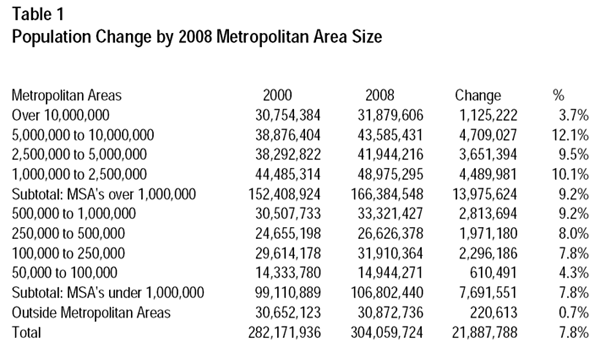
    Metropolitan Area Growth: As usual, the metropolitan areas with more than 1,000,000 population increased above the national rate of 7.8 percent, at 9.2 percent from 2000 to 2008. Smaller metropolitan areas (between 50,000 and 1,000,000 population) grew at the national rate of 7.8 percent. Also continuing a long-standing pattern, areas outside metropolitan areas (including rural areas) grew slower, at only 0.7 percent (Table 1).

    The overall trends, however, mask significant variations. The nation’s two metropolitan areas with more than 10,000,000 population are experiencing growth rates less than one-half the national average. New York grew only 3.6 percent, while Los Angeles – which for decades experienced above average growth, could manage only one-half the national average rate, at 3.8 percent. Indeed, Chicago grew faster, at 5.0 percent. If 2000s growth rates were to continue to 2050, Dallas-Fort Worth, Atlanta and Phoenix would exceed Los Angeles in population, while Houston would pass Los Angeles shortly thereafter. This is not a prediction – population growth in these fast growing areas will likely slow as they get larger – but is merely offered to show how moribund the Los Angeles growth rate has become.

    The strongest growth was among metropolitan areas with between 5,000,000 and 10,000,000 population, which added 12.1 percent to their populations. This was driven by gains of more than 1,000,000 in Dallas-Fort Worth and Atlanta, nearly 1,000,000 in Houston and over 500,000 in Washington (DC). Philadelphia’s growth rate, however, was even less than that of New York or Los Angeles, at 2.7 percent.

    There was also strong growth (9.5%) among the metropolitan areas with between 2,500,000 and 5,000,000 population. This was driven by an increase of more than 1,000,000 in Phoenix and more than 800,000 in Riverside-San Bernardino. San Francisco (3.3 percent) and Boston (2.7 percent) grew at less than one-half the national rate, while Detroit lost population.

    The metropolitan areas with between 1,000,000 and 2,500,000 population also grew more than the national average, at 10.5 percent. The strongest growth was in Las Vegas, which added nearly 475,000 residents. Charlotte, Sacramento and Austin also added more than 300,000. Providence, Milwaukee and Hartford all experienced growth at less than one-half the national rate; while Cleveland, Pittsburgh, Buffalo and Katrina ravaged New Orleans all lost population. Tucson became the nation’s 52nd metropolitan area with more than 1,000,000 population in 2008, having added nearly 20 percent to its population since 2000.

    The largest percentage growth (35.4%) among metropolitan areas over 1,000,000 population was in Raleigh, which added 284,000 new residents (This is not Raleigh-Durham, which the Bureau of the Census calls a combined statistical area, consisting of the Raleigh metropolitan area and the Durham metropolitan area). Raleigh displaced recent perennial growth leader Las Vegas, which experienced slower growth due to the collapse of the housing bubble.

    Domestic Migration

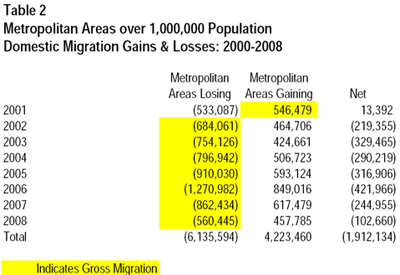
    Much has been made of the apparent recent slow-down in domestic migration (residents moving from one county to another) as indicated in the new data. In fact, however, domestic migration was greater in 2008 than it was in 2001. The slow-down should be more appropriately viewed as a return to more normal conditions.

    This can be illustrated by examining the gross domestic migration between metropolitan areas over 1,000,000 population. In 2008, gross migration in the metropolitan areas of more than 1,000,000 was 560,000. This is slightly more than the 546,000 in 2001. Gross migration increased after 2001, peaking at 1,270,000 in 2006. This fell to 862,000 in 2007 and then to 560,000 in 2008 (Table 2).

    The Domestic Migration Bubble

    The domestic migration bubble that developed from 2000 through 2007 coincided with the domestic housing bubble. This is not surprising, because housing consumes a major part of household expenditures. The differences in housing costs are much greater between metropolitan areas than any other major category of personal expenditure. For example, transportation, clothing and food have similar costs among the nation’s metropolitan areas. During the bubble, however house prices doubled and tripled in some metropolitan areas relative to incomes. The housing bubble appears to have sparked its own domestic migration bubble, as people moved from less affordable areas to more affordable areas.

    This is illustrated by examining domestic migration trends by housing affordability. The more affordable metropolitan areas had Median Multiples at the peak of the housing bubble of 4.0 or less (The “affordable” and “moderately unaffordable” categories from the Demographia International Housing Affordability Survey) and the less affordable metropolitan areas had Median Multiples of 4.1 or above (the “seriously unaffordable” and “severely unaffordable” categories from the Demographia International Housing Affordability Survey).

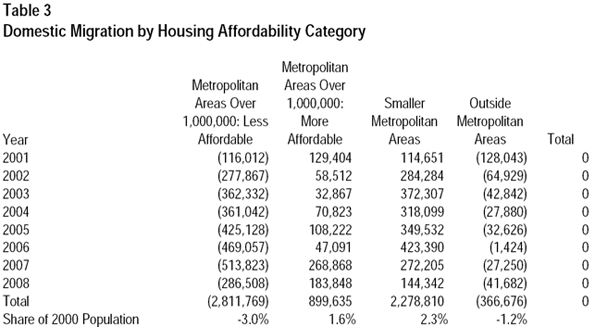
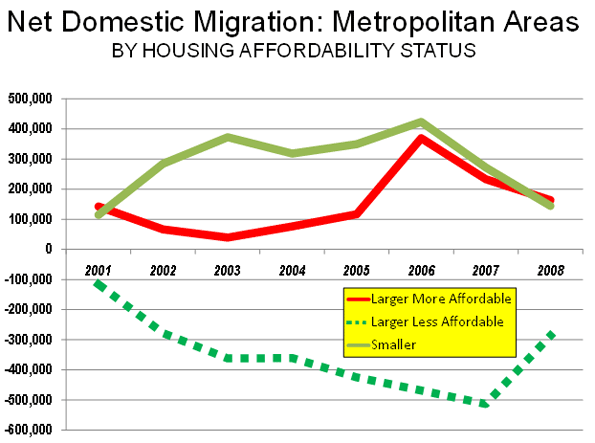
    The less affordable (higher cost) metropolitan areas experienced both the largest house price increases and a spike in net domestic migration losses. Overall, the less affordable metropolitan areas lost 2.8 million domestic migrants from 2000 to 2008 (Table 3 and Figure). This started in 2001 with a modest loss of 116,000, which ballooned to 514,000 by 2007. The loss dropped to 287,000 in 2008, a figure more than 2.5 times the 2001 net domestic migration loss.

    At the same time, the affordable metropolitan areas experienced substantially lower house price escalation, while gaining nearly 900,000 domestic migrants from 2000 to 2008. In 2001, the more affordable metropolitan areas experienced a net domestic migration gain of nearly 129,000. Domestic migration gains peaked in 2007, at 269,000. Domestic migration gains fell to 184,000 in 2008 in the more affordable metropolitan areas. However, this figure was still far higher than the numbers at the beginning of the decade.

    Suburbs Continue to Gain

    The data also shows that people continue to move to the suburbs and move away from core areas. This can be shown from the county data, which is generally the smallest geographic area for which migration data is produced. One caveat: because many core counties contain suburban areas as well as the historic core cities, a county based migration analysis usually understates the extent of both core losses and suburban gains.

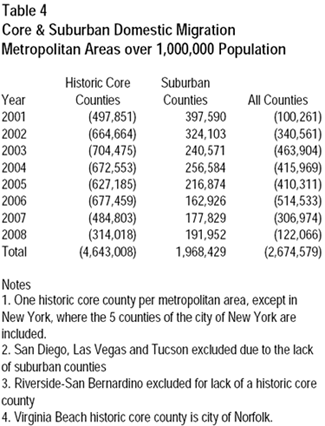
    The core counties improved their domestic migration performance in 2008, but continue to suffer losses. In 2008, the net domestic migration loss in core counties was 314,000, which compares to the 498,000 loss in 2001 and an annual average loss of 580,000 over the decade. Losses of this magnitude can hardly be characterized as a “turnaround.”

    Net domestic migration gains were down to 192,000 in the suburban counties from a 398,000 gain in 2001 and an average gain of 246,000 over the period. However, net suburban migration gains were up in 2008 from 2007 and 2006 (Table 4). Out of the 48 metropolitan areas, suburban counties performed better than core counties in net domestic migration in 42 cases, matching the figure for 2000-2008, the same as in 2007 and up from 38 in 2006. Among the six metropolitan areas where core net migration was greater than in the suburbs, core counties lost fewer domestic migrants than the suburbs (Washington and Virginia Beach), three were areas where the core county typically experiences higher net migration because of its population dominance (Phoenix, Raleigh and San Antonio) and the last was New Orleans, where the core county was much harder hit than the suburban counties by Hurricane Katrina related losses leading to greater gains in domestic migrants as it recovers (Orleans Parish, which is also the city of New Orleans). It is more than “a stretch” to interpret the new data to suggest any move to core areas from suburban areas.

    The 2008 domestic migration data does indicate a slow down or even a reversal in some more distant suburban and exurban areas. This was also to be expected because these areas had experienced a large increase in home ownership and a high volume of high risk sub-prime lending.

    As a result, exurban metropolitan areas like Riverside-San Bernardino, Stockton, Modesto and Merced experienced domestic migration reversals, while distant counties within metropolitan areas (such as Stafford County, Virginia in the Washington area and Pike County, Pennsylvania in the New York area) saw declines in their domestic migration. Much of the growth in such more distant areas occurred because of planning regulations in closer in areas made new development impossible or impossibly expensive. Thus, new housing construction was forced to “leap frog” over developable land, which also imposed higher transportation costs and longer commuting distances on the new home owners.

    At the same time, the better domestic migration performance in some core counties and “closer-in” counties occurred in large part because households no longer had a financial incentive to “cash-out” and move to lower cost areas, since they were often facing negative equity. This removed much of the incentive to move from San Francisco or Los Angeles to Las Vegas, Reno, Phoenix, Tucson or Portland, where prices were considerably lower (though still much higher than before).

    The Real Story: Widening Dispersion

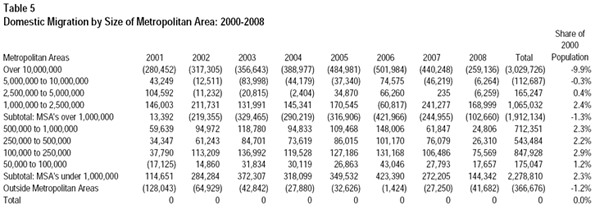
    Not only are people continuing to move from core areas to more suburban areas, but they are also moving from larger metropolitan areas to smaller metropolitan areas (Table 5). Since 2000, approximately 2,275,000 people have moved from large metropolitan areas and non-metropolitan areas to smaller metropolitan areas – those with populations of between 50,000 and 1,000,000. In 2001, the smaller metropolitan areas gained 115,000 domestic migrants. These net migration gains peaked in 2006, at 423,000. Following the national trend, net domestic migration to smaller metropolitan areas fell to 144,000 in 2008, still in excess of the 2001 number. Net domestic migration in the smaller metropolitan areas exceeded that of the larger less affordable metropolitan areas by 5.1 million over the period and exceeded that of the larger more affordable metropolitan areas by 1.4 million.

    Despite these trends, most metropolitan areas continue to add population. The domestic migration losses are more often than not made up by the natural increase in population (births minus deaths) and net international migration gains.

    However, households who already live here continue to exhibit a pattern of dispersion. Both within the same metropolitan area and between metropolitan areas, the latest Bureau of the Census data continues to show a clear trend of wider dispersal – from core counties to suburban counties and from larger metropolitan areas to smaller.

    References:Major Metropolitan Area Population & Domestic Migration 2000-2008: http://www.demographia.com/db-2008met.pdf

    Wendell Cox is a Visiting Professor, Conservatoire National des Arts et Metiers, Paris. He was born in Los Angeles and was appointed to three terms on the Los Angeles County Transportation Commission by Mayor Tom Bradley. He is the author of “War on the Dream: How Anti-Sprawl Policy Threatens the Quality of Life.