Category: Urban Issues

  • America Without Immigration 2015-50

    Be careful what you wish for, if that is what you wish for.

    Except for the oil shocks of the 1970s and a few other recessionary years, the US economy has generally been strong in the postwar era since 1945. Huge advances in technology and trade, a favorable business environment and strong demographics combined to create tens of trillions of dollars of new wealth in the US and around the world.

    The demographic component played an important supporting role. During the baby boom years, the number of Americans grew at an average annualized rate of 1.6% (see chart). In subsequent years starting in the mid 1960s, this growth faded to about 1% where it remained until 2007-08. Since then, it has fallen to 0.7% and, on current UN projections, it will continue to fall through 2050 when it may dip under 0.4%.

    Screen Shot 2016-08-01 at 11.00.53 AM

    Put another way, the population grew 1% per year on average in the years 1950-2015 and is expected to grow at half this rate, or 0.5% per year, from today to 2050. As a result, the US population will be at 356 million in 2030 and 389 million in 2050, equivalent to 18 million and 67 million fewer Americans in those years than if the growth rate had remained on its historic 1% trajectory.

    (In the charts below, ‘At 1% CAGR’ refers to the (not expected) continuation of the historic 1% trend; ‘Medium’ refers to current projections, including continued immigration; ‘Zero Migration’ refers to a scenario with no new immigrants starting in 2005-10.)

    Screen Shot 2016-07-30 at 7.36.15 AM

    Screen Shot 2016-07-30 at 7.37.01 AM

    What accounts for this slowdown? Mainly the boomer phenomenon. First, baby boomers had fewer children than their parents. The Total Fertility Rate (TFR = average children per woman) stood at near 2.0 in the 1980s and 1990s, compared to near 3.5 in the 1950s and early 1960s. Second, the number of US deaths will surge in 2025-45, echoing eighty years later the surge in births in 1945-65. Barring a leap in life expectancy, this death boom will put the brakes on demographic growth.

    So even before we start talking about immigration, the US population will be slowing down and slowing down by a big number, recording a shortfall or “deficit” of 67 million vs. the historic trend by 2050.

    Version 2

    Version 2

    In addition, the aging of the population will create another challenge with a rising dependency ratio (number of dependents per worker) reducing discretionary spending and investing, and straining pensions and entitlements. On current trends, the dependency ratio is expected to rise from 50.9 in 2015 to 65.8 in 2050. This ratio was at 66.5 in 1960 and its subsequent decline in four consecutive decades provided a big boost to the US economy.

    Screen Shot 2016-07-30 at 7.36.23 AM

    Adding immigration to the discussion further complicates the picture. If America had taken in no more immigrants starting in 2005-10, its population would be 48 million smaller (114.9 minus 66.9 in the table above) in 2050 than if it had remained on the present course and 115 million smaller than if it had remained on its historic trajectory. Further, the dependency ratio would climb to 69.6 in 2050. Note how the population would stop growing around 2035 because the number of deaths would roughly equal the number of births. (See also America Heading Towards Zero Population Growth?)

    It is important to highlight the demographic shortfall vs. the historic trajectory because some of today’s more extreme anti-immigration rhetoric is being presented as a promised return to the better economic conditions of the past. These conditions can be recovered through other paths but not through measures that exacerbate the population slowdown. Indeed if we judge by the figures above, it is clear that returning to the past is not in the realm of the possible, at least as far as demographics are concerned.

    In order for the US population to grow at 1% again without immigration, the birth rate would have to jump to levels not seen since the baby boom or higher. Even then, the dependency ratio would climb more steeply for two decades because of the millions of new babies.

    The US economy can and most likely will have a bright future but it cannot count on population growth to fulfill its historic supportive role. The economy benefited for decades from the demographic sweet spot of a rising population and a declining dependency ratio. Neither of these measures will be as supportive in the future. Instead greater gains will have to come from technology and automation and from investments in productivity and education.

    Related:

    This chart shows the number of Americans aged 20-64 and 30-59 under the Medium scenario. The working age population (20-64) is expected to remain flat for fifteen years and then to grow at a lower rate than in the past. This population would decline under a Zero Migration scenario. While it is true that automation will take over a number of functions and would dampen the impact of a stagnant or falling work force, demand for goods and services would certainly take a hit unless new export markets are opened up.

    Screen Shot 2016-03-10 at 2.58.14 PM (1)

    For more on the role of demographics in the economy, we suggest that you listen to this podcast.

    It should also be remembered that world demographics are far from standing still. See here and here or consult the Populyst demography archive.

    Sami Karam is the founder and editor of populyst.net and the creator of the populyst index™. populyst is about innovation, demography and society. Before populyst, he was the founder and manager of the Seven Global funds and a fund manager at leading asset managers in Boston and New York. In addition to a finance MBA from the Wharton School, he holds a Master’s in Civil Engineering from Cornell and a Bachelor of Architecture from UT Austin.

    Statue of Liberty photo, Public Domain via Wikimedia Commons

  • Zika, Rio And The Rising Health Hazards Of Megacities

    In 2009, when Rio de Janeiro was awarded the Summer Games, many saw it as a validation of Brazil’s ascension on the world stage. Yet seven years later, this estimation seems to have been a bit premature, as Rio and other Brazilian cities struggle to meet the basic needs of the Olympians.

    The biggest problem facing the Rio Games may not be the filthy venues for aquatic events, or even security concerns in one of the world’s highest crime cities, but basic public health. The fears of transmission of Zika virus may be overblown, given that it’s the winter in Brazil and mosquito populations will be lower, but travelers run a real risk of contracting food-borne illnesses and influenza, according to the European Center for Disease Prevention and Control.

    Rio, covering an urban area of over 11 million, belongs to a class of developing world megacities that, in too many cases, have become “a breeding ground for infectious diseases,” according to researcher Carl-Johan Neiderud, including another feared mosquito-born scourge, dengue.

    Dr. Seth Berkley, CEO of the vaccine alliance Gavi, points to the recent increase in the scale of densely populated urban areas, many without adequate sanitation, as turning containable illnesses like Zika and Ebola into pandemics. Dense urbanization may not have created Zika, which causes newborns to have unusually small heads, he notes, but it has accelerated its spread from a mere handful to a current tally of 1.5 million cases this year.

    Outbreaks of new pandemics have become increasingly common in the developing world, where urban growth is now three times faster in low-income countries than in their higher-income counterparts. Developing country megacities already represent the majority of the world’s 29 urban areas with over 10 million residents. The United Nations predicts 16 more megacities could emerge by 2030, all but one in the developing world.

    This is a problem not only for developing countries, but the health of the world. Zika, like dengue, may have proliferated in unsanitary, dense cities in the developing world, but it’s spreading to the United States. The FDA just called for Miami and Fort Lauderdale to halt blood donations due to cases discovered locally. The number of those infected is climbing in Puerto Rico as well. How long before other wet, hot parts of America — say east Texas and Louisiana – also report infections?

    Why is this happening? David Heymann, head of the center on global health security at Chatham House and a professor at the London School of Hygiene and Tropical Medicine, blames our interconnected world. Even megacities in the most impoverished countriesare just an airline trip away from the rest of the world. Once a disease starts in a developing country, he says, it’s likely to find its way into more prosperous ones as well.

    Historic Precedents

    Cities afflicted by massive poverty have long been primary breeders of disease. Plagues and pestilences were commonplace in the earliest urban centers, from ancient Greece and Rome to Baghdad, Beijing and Cairo. Cut off often from clean water, living cheek to jowl, large cities were often assaulted, and sometimes all but emptied, by waves of infectious diseases. Rome’s sewer system may have been well ahead of its time, but the higher floors in buildings lacked plumbing hookups, which made this system less than effective in stemming disease.

    Conditions got, if anything, worse when the Empire’s capital shifted to Constantinople. The largest city in the Mediterranean at the time, and one of greatest in the world, nearly half the population died from plague in the middle of the sixth century.

     Much the same process occurred in the great cities of the Muslim world. Cairo, which in the 14th century had a population of 400,000, or eight times that of contemporary London, was racked by repeated epidemics that forced rulers and high officials to escape to the countryside. So great were these plagues, the Arab historian Ibn Khaldun noted, buildings and even palaces were abandoned, and “the entire inhabited world changed.”

    Arguably, the industrial cities of the West provide the most compelling precursor of what is occurring in megacities today. London, in the 19th century the world’s largest city, suffered mortality rates higher than the countryside until the 1920s. Raw sewage ran down the streets of Berlin as late as the 1870s; only 8 percent of housing had toilets. Not surprisingly, as Berliners dumped their sewage into the river, there were recurrent outbreaks of cholera, typhus, and other devastating diseases. In St. Petersburg, at the dawn of the Russian Revolution, living conditions were even worse than Berlin’s; nearly half of all deaths in the city were traceable to infectious diseases.

    Time To Rethink Megacities?

    This sad history is repeating itself, in certain respects. We might think that city residents with access to healthcare would be healthier. In many places, that’s not the case. The average lifespan in Mumbai is 57 years, seven years short shorter then the Indian average. Gaps in life expectancy can be found in other developing world megacities, including Tehran and Cairo. “Megacity life,” notes Dr. Marc Reidl, a specialist in respiratory disease at UCLA, “is an unprecedented insult to the immune system.”

    Yet despite this, some Western pundits embrace “the inexorable logic of the mega-city” as a blessing for both their residents and the planet. A recent article in Foreign Policy was bizarrely titled “In Praise of Slums,” arguing that megacities are “a force for good” because they provide more opportunities than villages.

    Yet rather than accept misery common to such places, perhaps Westerners might think how to apply their past experience to solve megacities’ worst problems. It can be done. After all, Paris cleaned itself and became much healthier after Georges-Eugène Haussman’s renovation of Paris, commissioned by Napoléon III in the mid-1800s. Much can be accomplished by improving basic sanitation; in Dhaka for example, the sewer system covers barely 25 percent of the city, something that would seem strange to a denizen of imperial Rome, much less modern London or New York.

    In many countries, including in the United States and Great Britain, particularly in the 20th century, health conditions improved as inner cities depopulated and more people moved to the periphery. This was one of the prime objectives of Ebenezer Howard’s bold vision for the growth of “garden cities,” which greatly influenced town planning in many parts of the high-income world.

    Following Howard’s admonitions for the filthy cities of Edwardian England, perhaps we should be encouraging developing countries not to concentrate their people in megacities, but spread them out into more healthful environments. These ideas are not far-fetched. An impressive 2014 study by the McKinsey Global Institute, called “Mapping the Economic Power of Cities,” found that growth is already shifting to smaller cities.

    This decentralizing process, notes Singapore-based scholar Kris Hartley, could take advantage of a growing shift of industrial and even service businesses to more rural locales, particularly in Asia. As megacities become more crowded, congested and difficult to manage, Hartley suggests, companies are finding it more convenient, less costly and, critically, better for the families to locate farther from the giant cities.

    India, where some of the most impoverished megacities are located, is already experiencing a slowdown in megacity growth. The government of Prime Minister Narendra Modi has targeted small cities and villages for growth, rather than concentrating more people in larger cities.

    Rather than foster the creation of unhealthy cities that incubate diseases like Zika, we in the high-income world should be looking for ways to slow the spread of pandemics that threaten millions of people, not only in the poorer countries, but also, as is plainly clear, closer to home.

    This piece originally appeared in Forbes.

    Joel Kotkin is executive editor of NewGeography.com. He is the Roger Hobbs Distinguished Fellow in Urban Studies at Chapman University and executive director of the Houston-based Center for Opportunity Urbanism. His newest book, The Human City: Urbanism for the rest of us, will be published in April by Agate. He is also author of The New Class ConflictThe City: A Global History, and The Next Hundred Million: America in 2050. He lives in Orange County, CA.

    Photo of eco-barrier designed to prevent trash flow into Guanabara Bay in Rio de Janeiro prior to the 2016 Olympics, by Tomaz Silva/Agência Brasil [CC BY 3.0 br], via Wikimedia Commons

  • Commie Skin Jobs

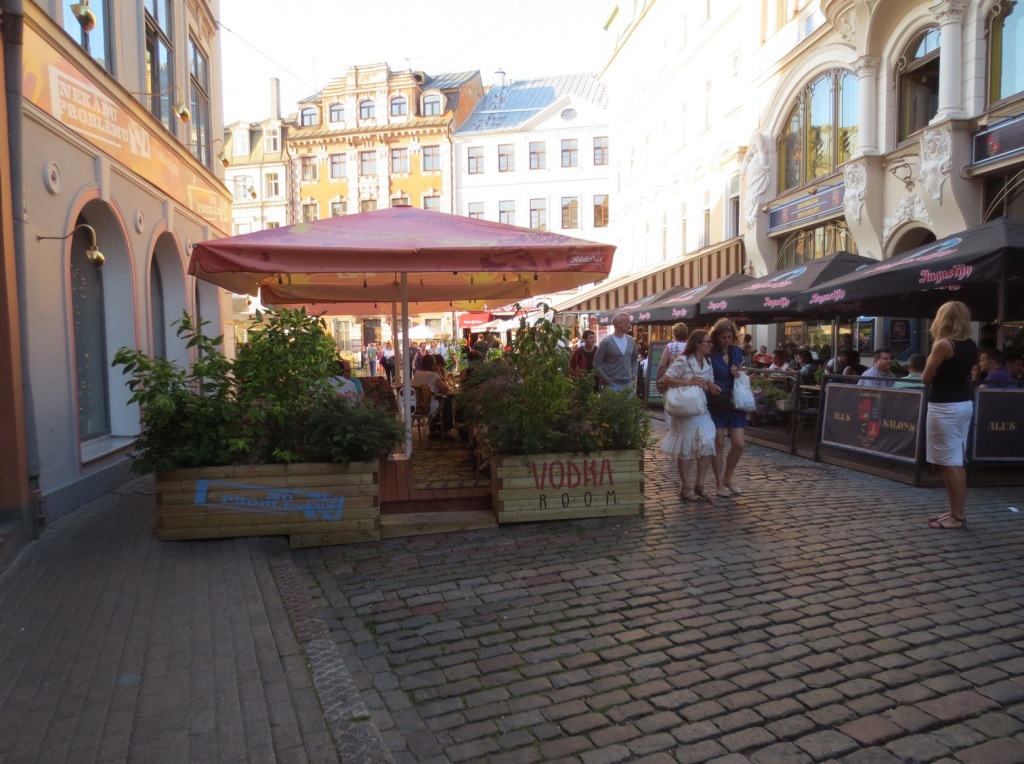
    This is Riga, Latvia. The Baltic Republics had a particularly difficult time during the twentieth century with Nazi Germany invading in 1941 and Soviet Russia occupying them until 1991. What had been a prosperous group of small Scandinavian style countries became relatively impoverished and isolated.


    Screen Shot 2016-04-15 at 1.23.01 PM

    Screen Shot 2016-04-15 at 12.43.07 PM

    Screen Shot 2016-04-15 at 12.38.34 PM

    Screen Shot 2016-07-25 at 12.20.40 PM

    This is Riga, Latvia. The Baltic Republics had a particularly difficult time during the twentieth century with Nazi Germany invading in 1941 and Soviet Russia occupying them until 1991. What had been a prosperous group of small Scandinavian style countries became relatively impoverished and isolated.

    Screen Shot 2016-07-26 at 1.52.14 AM

    Screen Shot 2016-07-26 at 1.45.59 AM

    Screen Shot 2016-07-25 at 8.57.20 PM

    Screen Shot 2016-07-25 at 10.38.32 AM

    Screen Shot 2016-07-25 at 10.37.13 AM

    Screen Shot 2016-07-25 at 8.52.43 PM

    This is nothing new. The Baltic has been repeatedly dominated by larger nations since the 1200’s. Riga is equidistant from both Berlin and Moscow. It’s a rough neighborhood and it seems likely there will be more such impositions in the future. The region is too important to left alone. But the people will adapt as they always have.

    Screen Shot 2016-04-15 at 12.43.47 PM

    Screen Shot 2016-07-25 at 8.57.48 PM

    Screen Shot 2016-07-25 at 8.58.01 PM

    Screen Shot 2016-04-15 at 12.44.00 PM

    Between the various wars and occupations when the country was allowed to flourish on its own Latvia proved to be industrious and highly cultured. The buildings that survived the tumults of history attest to the quality of the people, economy, and place.

    Screen Shot 2016-07-25 at 9.22.34 PM

    Screen Shot 2016-07-25 at 9.23.13 PM

    Screen Shot 2016-07-25 at 9.22.03 PM

    Screen Shot 2016-07-25 at 9.49.04 PM

    Screen Shot 2016-04-15 at 1.26.03 PM

    Screen Shot 2016-04-15 at 1.23.58 PM

    Screen Shot 2016-07-25 at 9.49.21 PM

    It was a matter of national pride for the Latvian people to completely restore the historic core of Riga after the Soviets left things in Havana style dishevelment. This is their homeland and the repository of their culture, language, music, and history. It was also an excellent business model. The city is a dynamic and highly profitable venue for foreign investment, trade, and tourism. Every inch of the old city is productive.

    Screen Shot 2016-04-15 at 1.06.58 PM

    Screen Shot 2016-07-25 at 10.33.44 AM

    Screen Shot 2016-07-26 at 12.44.15 AM

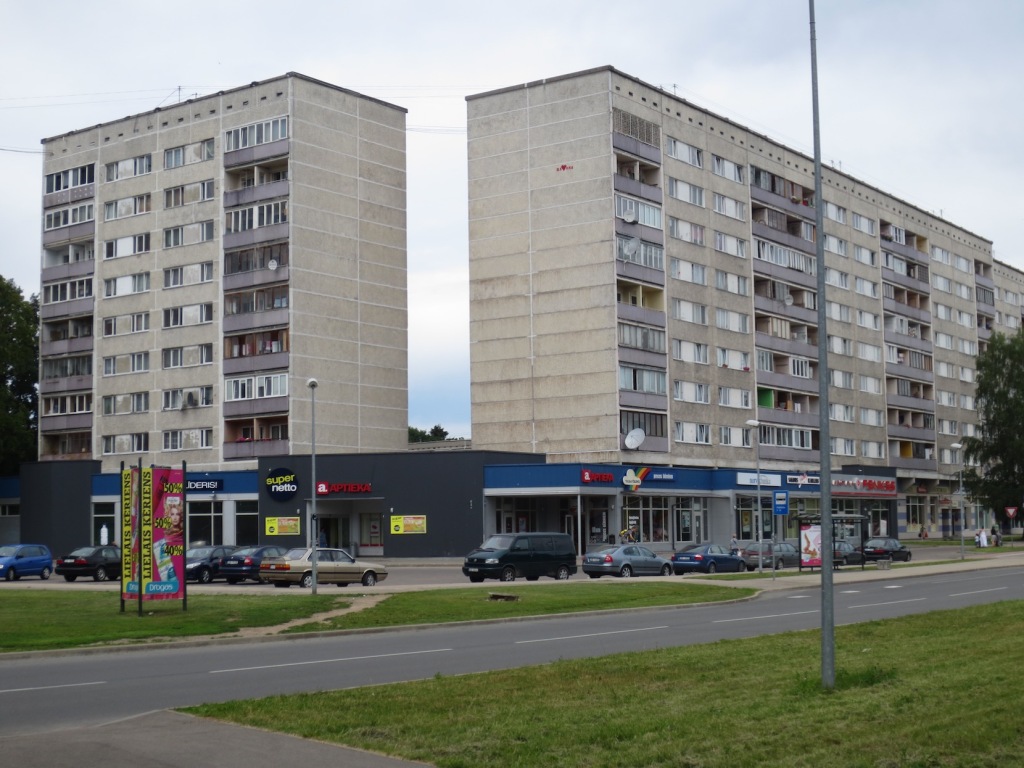
    But then there’s all that left over communist stuff ringing the city. What exactly do you do with it all? Pulling it down and replacing it is too expensive. And many of these buildings are occupied by ethnic Russians not Latvians. (Latvia is a quarter Russian as a result of the Soviet occupation, but the city of Riga is closer to half Russian.)

    Screen Shot 2016-07-26 at 1.38.49 AM

    Screen Shot 2016-07-26 at 1.39.50 AM

    Screen Shot 2016-07-26 at 1.33.09 AM

    Screen Shot 2016-07-26 at 12.44.29 AM

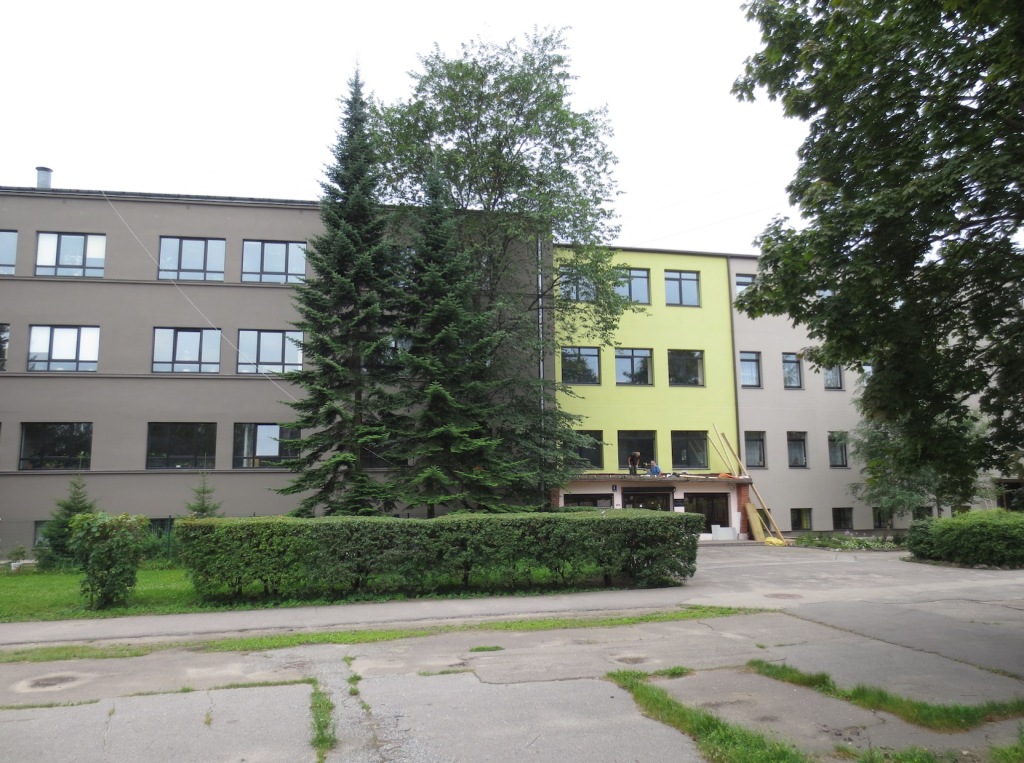
    This was top down bureaucratic central planning at its finest. Residential buildings were isolated from industry and from each other for health and safety. Operating a business of any kind in these apartment buildings was strictly forbidden. Tightly regulated shops were provided at convenient but segregated locations. Highly consolidated schools and isolated office and manufacturing parks were constructed in their own little pods at some distance.

    Screen Shot 2016-07-25 at 9.47.26 PM

    Screen Shot 2016-07-25 at 12.24.22 PM

    The preservation of green open space was a hallmark of Soviet design. Grass and trees were necessary for recreation, health, and social tranquility. There’s also a coincidental side effect of this kind of land use planning that worked in favor of central authority. Where exactly would people organize a protest rally in this environment? There is no prominent central square or iconic rallying point. What exactly would the rebel cry be here? Rise up and storm the shrubbery!

    Screen Shot 2016-07-25 at 12.25.50 PM

    Screen Shot 2016-07-26 at 1.37.09 AM

    Screen Shot 2016-07-26 at 1.42.37 AM

    Honestly it’s not that different from American suburbia. Communists just preferred concrete tower blocks to wood framed tract homes. If you’ve ever been inside an original 1947 Levittown house then you’ve essentially been inside one of these Soviet apartments. I spent a chunk of my childhood in a beige stucco apartment in Los Angeles that was nearly identical on the inside. The kitchens are small, there’s only one bath, the ceilings are low, there’s no craft or workmanship in the architecture. It’s utilitarian. It’s not terrible. People can and do live perfectly comfortable lives in these places. It’s just bland and there’s never anything to do in the neighborhood. It’s the precise opposite of the historic city center. No tourist ever ventures out to this part of town and you’ll never see photos of these neighborhoods in brochures.

    Screen Shot 2016-07-25 at 10.35.31 AM

    Screen Shot 2016-07-25 at 10.34.48 AM

    Screen Shot 2016-07-25 at 10.40.09 AM

    Screen Shot 2016-07-26 at 1.39.07 AM

    Screen Shot 2016-07-26 at 1.35.13 AM

    So here’s what the pragmatic Latvians are doing. First, these inherited communist buildings are given a quick skin job. They’re scrubbed clean, fitted with new cupboards and fixtures, painted, given new windows and doors, and generally made to feel fresh. If you squint these buildings look like the lesser offerings of 1960s Sweden or Germany. There are worse places to live in the world. A tidy apartment in a boring suburb of Riga is what some people genuinely prefer. There’s plenty on offer here for them. And there isn’t much else that can be done with these places.

    John Sanphillippo lives in San Francisco and blogs about urbanism, adaptation, and resilience at granolashotgun.com. He’s a member of the Congress for New Urbanism, films videos for faircompanies.com, and is a regular contributor to Strongtowns.org. He earns his living by buying, renovating, and renting undervalued properties in places that have good long term prospects. He is a graduate of Rutgers University.

  • Ireland Adopts Plan to Increase Housing Supply and Improve Housing Affordability

    The government of Ireland has adopted a new policy (Rebuilding Ireland: Action Plan for Housing and Homelessness) intended to improve the quality of life and the national economy by making housing more affordable. In this regard, Ireland joins New Zealand (and Florida) in having recognized the disadvantages of overpriced housing and signaling reforms to alleviate the problem.

    Background: The Great Recession in Ireland

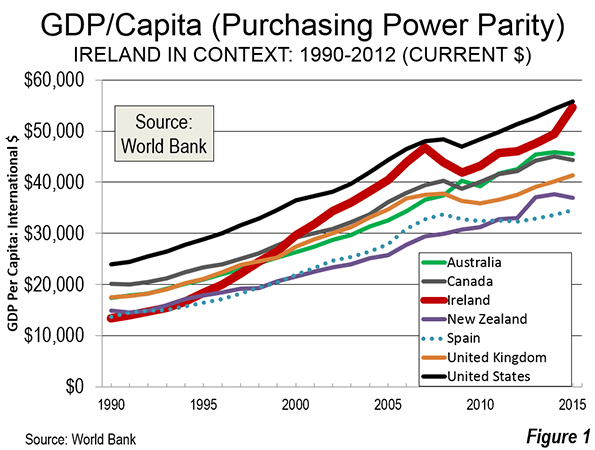
    Probably no nation suffered more during the housing bust induced Great Recession than Ireland. By 2007, the Irish economy had reached its peak, having achieved a gross domestic product (GDP) per capita, purchasing power adjusted, only 2.8 percent below that of the United States. This was an incredible accomplishment, given that as late as 1990 Ireland’s GDP per capita was approximately 45 percent below that of the United States, Australia, Canada, the United Kingdom, New Zealand and Spain, which are shown on Figure 1.  .

    However, as the overheated housing market tanked, Ireland’s GDP per capita dropped 8.4 percent relative to that of the United States, despite own housing bust economic losses. Things were so bad that Ireland was forced to take a large loan from the European Union and the International Monetary Fund to help stabilize its economy.

    Ireland’s economic losses were even greater than that of Spain, which had a particularly severe housing bust and whose economy continues to languish. But Ireland has done much better. The EU loan has been repaid. According to World Bank data, Ireland has reached a new peak, reaching within 2.1 percent of the US GDP per capita (Figure 1).

    The Housing Bubble and Bust

    During the housing bubble,   Dublin and Cork became severely unaffordable, where the median multiples (median house price divided by median household income) reached 6.0 and 5.4, respectively. This was to be expected as demand increased, well beyond the supply permitted by Ireland’s urban containment land-use regulations. As Dublin economist Colm McCarthy of  University College, put it: "Ireland passed its first major piece of land-use planning legislation in 1963, modeled on the UK’s Town and Country Planning Act of 1947. The intentions were laudable, to restrict the construction of unwelcome developments and to empower local authorities to take a more active role in shaping the built environment. There was no desire to screw up the residential housing market, but that is eventually what happened."

    As the economy get began to recover, house prices again began their rise simply because the reforms in   that would have prevented it were not implemented.

    Rebuilding Ireland

    The new housing policy announced July 20  is comprehensive, with strategies to reduce homelessness, improve the rental market and supply sufficient owned housing at affordable prices. Ireland has a high homeownership rate, at 68.6 percent and is important to the national economy.

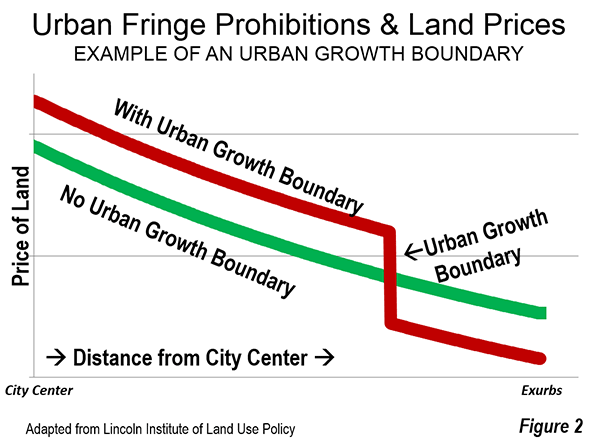
    As has occurred in the United Kingdom, Australia, New Zealand and some markets in Canada and the United States, large  house price increases relative to incomes were   experienced where urban containment policies were in effect. This is because urban fringe development prohibitions are associated with higher land prices inside urban containment boundaries (Figure 2). Indeed, this type of urban fringe regulation is present in virtually all major markets rated as severely unaffordable in the Demographia International Housing Affordability Survey, which rates 87 such markets in nine nations.

    Rebuilding Ireland policy acknowledges the importance of the housing market the national economy. As has been typical under urban containment planning regimes, house construction has fallen significantly short of demand. Under this policy, the government intends to accelerate the release of land for new development, especially in making government owned land available for development.

    Rebuilding Ireland is intended to double the rate of home building in Ireland over the period of 2017 to 2021. This will be aided by "Opening up land supply and low-cost State lands." This is important not only to meet the needs of Irish households, but also to diminish the potential for a highly volatile housing market that led to Ireland’s financial distress in the Great Recession.

    The government also intends to take action to support infrastructure development for new housing projects. A €200 million "Local Infrastructure Housing Activation Fund" will assist in "enabling infrastructure that opens up large sites for early development."

    As in California, virtually all large new housing projects today are appealed on various grounds. In recognition of this, Ireland intends to speed up the development process by allowing larger developments to proceed directly to the national planning appeals board ("An Bord Pleanála") for approval. The intention is to "jumpstart" the development of new housing.

    Defining Affordability

    Unlike most governments, the government of Ireland has supplied a definition of housing affordability. Rebuilding Ireland will hold a competition to develop new housing that can be delivered for than €200,000 in construction costs.

    Rebuilding Ireland also notes that land costs must be kept affordable and should add no more than €30,000 to €50,000 to the price of a new home. This would result in a "development ratio" of 15 percent to 20 percent (land price divided by total price including land). This development ratio is similar to US development ratios where urban containment policy has not been implemented and similar to development ratios in Australia and New Zealand before urban containment policy was adopted across those nations.

    Moreover, based on Irish household incomes, housing that costs between €230,000 and €250,000 would be generally consistent with the median multiple of 3.0 or less that is rated by the Demographia International Housing Affordability Survey as affordable (new house prices are generally more expensive than those of existing housing).

    Enforcement

    The government is signaling the seriousness of its intentions, indicating that local authorities must strive in their statutory development plans for “affordable prices to meet the housing needs of each local authority area, across tenures and types as well as the social housing requirement."

    This is a unique requirement in view of the fact that there has been virtually no serious attention to the issue of delivering housing affordability in other markets that have had strong urban containment policies.

    Implementation will not be without challenges. In the longer run, the inertia of currently in vogue planning philosophy could well prevent achievement of the housing affordability goals of Rebuilding Ireland. Yet, as Rebuilding Ireland indicates, the stakes are high. Rebuilding Ireland notes that "Excessive housing costs have demographic impacts, including a tendency for households to defer important lifecycle choices in order to prioritise home purchase" (such as having children).

    Further, as Rebuilding Ireland indicates: "Rising prices for residential accommodation impact adversely on competitiveness. The attractiveness of Ireland as a potential investment location and, of course, the cost base for existing businesses will be impaired should price inflation continue, as rising prices place upward pressure on wages, deter inward migration and impede the labour market."

    This could be particularly important in light of Brexit (the exit of the United Kingdom from the European Union). To the extent that international businesses may decide to leave the United Kingdom to stay within the European Union, Ireland and especially Dublin could be attractive for relocation because of the dominance in the nation of the English language, which would be made more attractive by improved housing affordability.

    Wendell Cox is principal of Demographia, an international pubilc policy and demographics firm. He is a Senior Fellow of the Center for Opportunity Urbanism (US), Senior Fellow for Housing Affordability and Municipal Policy for the Frontier Centre for Public Policy (Canada), and a member of the Board of Advisors of the Center for Demographics and Policy at Chapman University (California). He is co-author of the "Demographia International Housing Affordability Survey" and author of "Demographia World Urban Areas" and "War on the Dream: How Anti-Sprawl Policy Threatens the Quality of Life." He was appointed to three terms on the Los Angeles County Transportation Commission, where he served with the leading city and county leadership as the only non-elected member. He served as a visiting professor at the Conservatoire National des Arts et Metiers, a national university in Paris.

    Photo: Custom House, Dublin by Peter Brown from Dublin, Ireland (The Custom House, Dublin) [CC BY 2.0], via Wikimedia Commons

  • Lessons Learned from Long-Term Privatizations

    Is long term privatization of government assets in the form of leases or concessions a good idea?

    The answer is not Yes or No but rather What and How.

    Done right, long-term privatization can be a great thing to the public. But given the multi-decade nature of some of these deals, the risk of getting it wrong is high.

    My new Manhattan Institute research paper The Lessons of Long-Term Privatizations: Why Chicago Got It Wrong and Indiana Got It Right looks at two privatization deals, the Chicago parking meter lease and the Indiana toll road lease, and draws lessons about the right kinds of assets to lease and the things you need to get right while leasing them.

    I identify several flaws in the Chicago parking meter lease as compared to the Indiana Toll Road one, grouped into two categories:

    • Things Chicago managed poorly in the transaction (how items). These include the public review process, the transition to the private vendor, squandering the proceeds, and impairing future revenue streams. None of these invalidates the idea of privatization, but rather are areas where governments need to focus to get it right.
    • Reasons why parking meters are a bad kind of asset for long term leases (what items). These include regular, recurring compensation events and the dynamic and close interaction of on street parking with neighborhood health and other public policy considerations.

    Note that I do not critique the amount of money Chicago got for leasing its parking meters. This is a debatable item at best.

    I also do not criticize privatization of parking meter operations. Nobody cares who takes the quarters out of the meter.

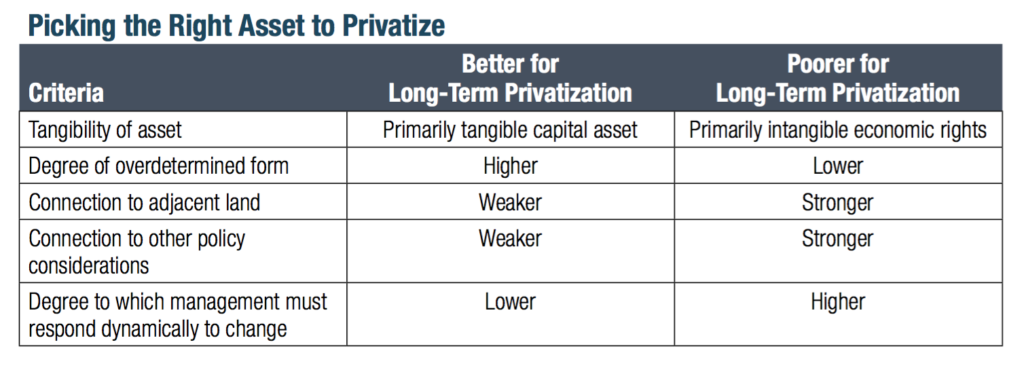
    Contrasting toll roads with parking meters, I created a matrix of characteristics to help determine whether or not an asset is a good candidate for privatization.

    privatization-asset-matrix

    Items that would appear to be better candidates for long term privatizations would be toll roads and bridges, airports, ports, and hospitals.

    Click through to read the entire report.

    Greg Hinz at Crain’s Chicago Business kindly posted some of his thoughts about the study.

    Aaron M. Renn is a senior fellow at the Manhattan Institute, a contributing editor of City Journal, and an economic development columnist for Governing magazine. He focuses on ways to help America’s cities thrive in an ever more complex, competitive, globalized, and diverse twenty-first century. During Renn’s 15-year career in management and technology consulting, he was a partner at Accenture and held several technology strategy roles and directed multimillion-dollar global technology implementations. He has contributed to The Guardian, Forbes.com, and numerous other publications. Renn holds a B.S. from Indiana University, where he coauthored an early social-networking platform in 1991.

  • Surprising Ordos: The Evolving Urban Form

    Ordos, in China’s Autonomous Region of Inner Mongolia (equivalent to a province) has received international notoriety as a "ghost city." I had already visited one other ghost city and found the reports considerably exaggerated (The Zhengzhou New Area in Henan, a commercial and residential district). But Ordos has received by far the most publicity.

    It turns out that in reality the people far outnumber the ghosts, something I should have recognized when it was difficult to find a hotel room six months before my visit. Ghosts do not generally need hotel rooms.   But the ghost city label is an exaggeration.

    Defining Ordos

    What is Ordos? Ordos (E’erduosi) is one of the more than 300 municipality level jurisdictions that constitute China and cover virtually all of its land area. Like other municipalities, Ordos is divided into districts which are translated broadly as county level jurisdictions. China has about 2,900 county level jurisdictions, compared to the 3,100 county level jurisdictions in the United States. There is an important difference, however. In the United States, with a few exceptions, municipalities are within counties and there may be many municipalities within counties. In China, counties are within municipalities.

    Ordos is one of 12 municipalities in Inner Mongolia. Ordos is composed of eight districts. The Ordos metropolitan area is located in the urban district of Dongsheng and the "banner" (Inner Mongolian title for county) of Ejin Horo (the urbanized part of which is Azhen). The Kangbashi new area, to which the ghost city stories refer, is split between Dongsheng and Ejin Horo.

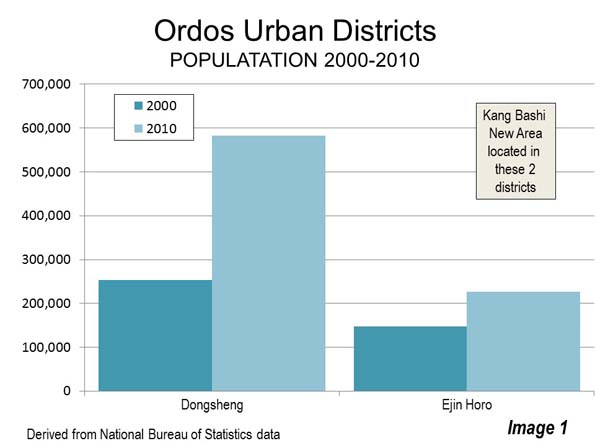
    Contrary to the “ghost city” meme, population growth has been strong in these two districts. In Dongsheng, the 2010 census counted approximately 580,000 residents, an increase of 130 percent over the 2000 census. The population of Ejin Horo rose 53 percent to approximately 225,000 residents. Overall, these two adjacent districts represent a labor market (metropolitan area) of nearly 810,000 residents, which grew more than 100 percent between 2000 and 2010 (Image 1).

    Ordos is located in the northern half of the Ordos Loop of the Yellow River, which with the Yangtze is one of China’s two great rivers. After passing Lanzhou (capital of Gansu), the eastward flowing river takes a sharp left turn to the north for approximately 600 kilometers (375 miles), then a sharp right turn back to the east for 300 kilometers (200 miles), turning south for 600 kilometers and finally turning east toward the Yellow Sea.
    Overall, the population of Ordos was approximately 1.94 million in the 2000 census and had grown 42 percent since 2000. As a result, Ordos was by far the fastest growing of the 12 municipalities in Inner Mongolia. The municipality grew at more than double the rate of the capital, Hohhot (Huhehaote), and approximately seven times the overall rate of Inner Mongolia. The growth rate of Ordos was also five times China’s national 10 year growth rate of 7.8 percent.

    The municipality covers a land area of 87,000 square kilometers, somewhat larger than Austria. Ordos Most of the population is in the more rural districts.

    Genghis Khan

    Genghis Kahn, founder of the Mongol empire (13th century), history’s largest contiguous empire plays importantly in the history of Ordos. Genghis Kahn is reputed to have been so impressed by Ordos that he wanted his personal effects buried here. The effects are buried at a mausoleum approximately 10 miles (25 kilometers) south of Kangbashi. The actual burial place of Genghis Kahn is not known, and consistent with Mongol tradition, is secret.

    The So-Called "Ghost City:" Kangbashi New Area

    The part of Ordos to which the "Ghost City" stories have referred is the Kangbashi New Area. It is adjacent to and north of the urbanization of Azhen in Ejin Horo. The Kangbashi new area covers approximately 350 square kilometers (135 square miles) in the Dongsheng and Ejin Horo districts at the time of the 2010 census. Thus, a census population count is not readily available. Informal estimates placed the population at under 30,000 in 2010. A more recent informal estimate by an Ordos municipal official indicated that the registered population had reached 72,000 in 2012 and would soon rise to 100,000. 

    Development of the Kangbashi New Area

    Ordos is one of the most affluent municipalities of China. It is comparatively new wealth, which is the result of vast coal reserves that have been increasingly called upon since 2000 to support China’s spectacular growth.  . According to People’s Daily, by 2012 the gross domestic product per capita of Ordos exceeded that of both Spain and South Korea.

    With the huge natural resource revenue gains, municipal officials decided to build a new city approximately 16 miles (25 kilometers) south of the municipal seat in Dongsheng. In 2006, the municipal seat was moved from Dongsheng to the Kangbashi new area. Both the Kangbashi New Area and Ejin Horo are within commuting distance of much larger Dongsheng, via the Dongsheng Expressway. As of 2012, the municipality indicated that at least one half of the municipal functions had been moved to Kangbashi.

    The Ordos Ceremonial Mall

    Some national governments in the world have built new capital cities or districts and taken the opportunity to order them around what might be called ceremonial malls — government buildings, monuments and cultural institutions arranged around a central axis. Governments that build new capital cities have unique opportunities to build ceremonial malls. Perhaps the first of these was Washington, with its Capitol Mall (The Supreme Court to the Lincoln Memorial) and the later developed mall from the White House to the Jefferson Memorial.

    Other particularly notable examples are Delhi, Canberra and Brasília. Perhaps the most famous such mall, though without the adjacent buildings and memorials, which had already been built elsewhere, is The Mall, running from Buckingham Palace to Trafalgar Square in London. This mall is somewhat different than the others, because it was built after most of the government buildings, which are located elsewhere.

    Ceremonial malls can be built by local governments as well, and Ordos has built one of world-class dimensions. The table below compares the Ordos mall with other representative government malls. With a length of 2.7 miles (4.3 kilometers), the Ordos mall is approximately the equal of Washington’s Capitol Mall and Canberra’s middle mall, (Federation Mall/ANZAC Parade). The Ordos mall is somewhat shorter than the Delhi mall and less than one half the length of the Brasília mall, parts of which remain undeveloped. The Ordos mall is more than twice as long as The Mall in London.

    The Ordos mall is more extensive, for example, than what may be the largest local government mall in the United States, in Los Angeles. This mall is shared by the city and the county of Los Angeles, with more than five times as many residents. In fact, the Ordos mall is of sufficient expanse and design to be mistaken for the centerpiece of a newly built national capital.

    In short, the Ordos mall is world class and already attracting tourists, principally from around China. As with the rest of China, international tourism is in its infancy and holds great potential for growth.

    Selected Ceremonial Malls
    Dimensions (KM) Dimensions (Miles)
    Location Length Axis Width Length Axis Width Government Population (Millions)
    Brasilia 9.7 0.21 6.0 0.13 National 195
    Delhi 5.2 0.24 3.2 0.15 National 1225
    Washington (Capitol Mall) 4.3 0.50 2.7 0.31 National 310
    Ordos 4.3 0.18 2.7 0.11 Local 2
    Canberra (Federation Mall/ANZAC Parade) 4.3 0.03 2.7 0.02 National 22
    London (The Mall) 1.3 0.06 0.8 0.04 National 62
    Los Angeles 1.1 0.08 0.7 0.05 Local 10
    Axis width is minimum central area around which buildings and monuments are organized
    Canberra & Washington have more than one mall
    Some of Brasilia mall is undeveloped

    Touring the Ordos Mall

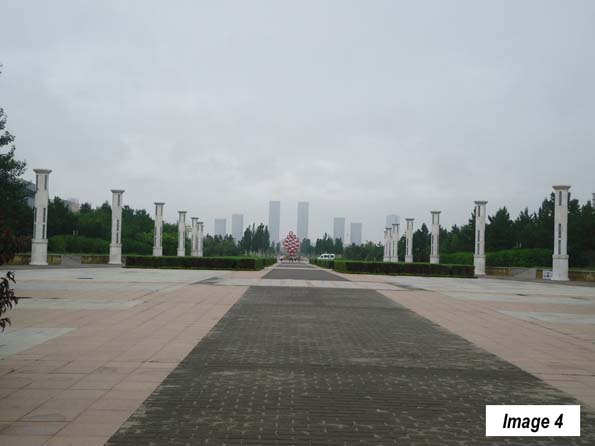
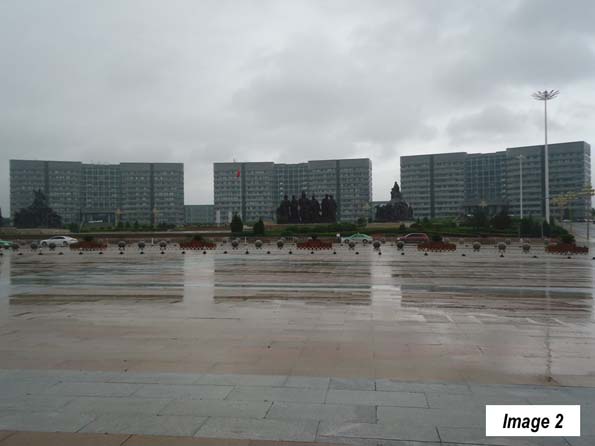
    The core of the mall is an axis, one large block wide, composed of greenery and statues (Images 2-13).

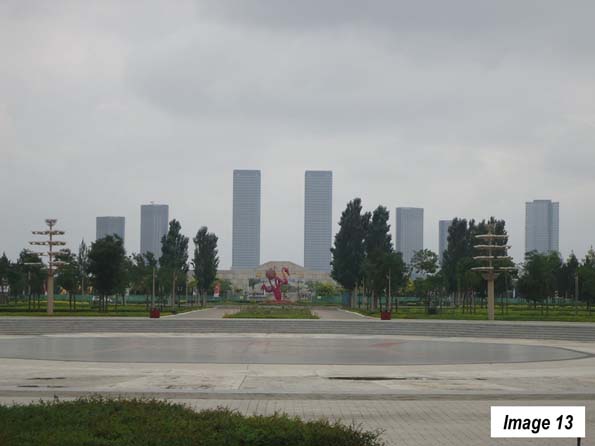
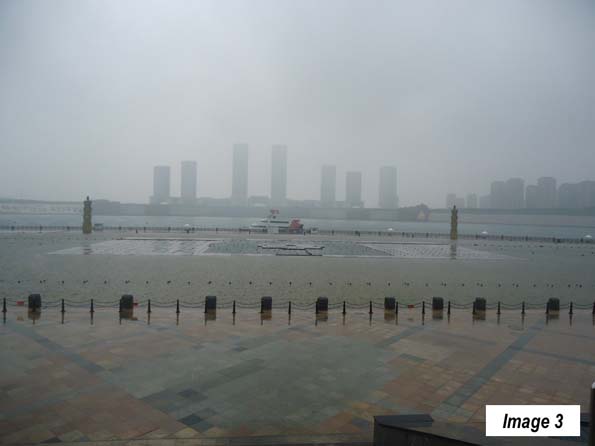
    The mall stretches from municipal buildings at the north (Image 2) to a lake (Image 3), across which are skyscrapers, anchoring the mall on the south (Images 4 and 13). This interruption by a lake is similar to the Canberra mall described above

    Near the north end of the mall is the Genghis Khan statue (Image 5).

    The two horse’s statue is in the square to the south of the Genghis Khan statue (Image 6).

    Each side of the mall is defined by one-way streets that are four lanes wide.

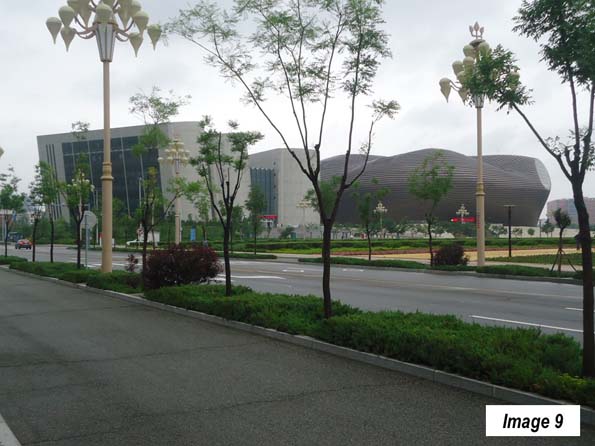
    Among the two most important government buildings on the mall are the Library of Ordos and the Ordos Museum (to the left and right, respectively, in Image 9). Neither of these buildings will be pleasing to aficionados of traditional architecture, including the author. I agree with Chinese President Xi, who suggested that China needed no more weird buildings, referring to the CCTV Tower in Beijing, which local taxi drivers told me is referred to as the  "underpants" building. Of course, architecture is a matter of taste.

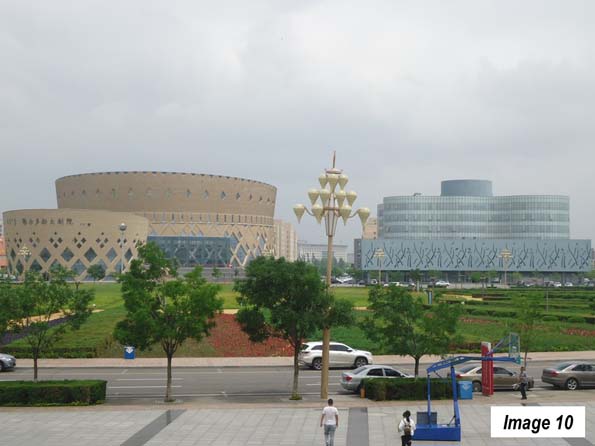
    Across the mall is the Ordos National Theatre and the Ordos Culture and Arts Center (Image 10, left and right). The circular and curved lines of these buildings offer a welcome refuge from the more courageous architecture of the Library and Museum, in the author’s view.

    The mall also includes commercial buildings (Image 11). These buildings include a wide array of retail stores, such as large electronic and home appliance outlets, banks and other facilities. Within a one block walk of my hotel there were at least seven restaurants from which to choose. Generally, ghosts do not require this density of eating establishments.
    Residential Areas

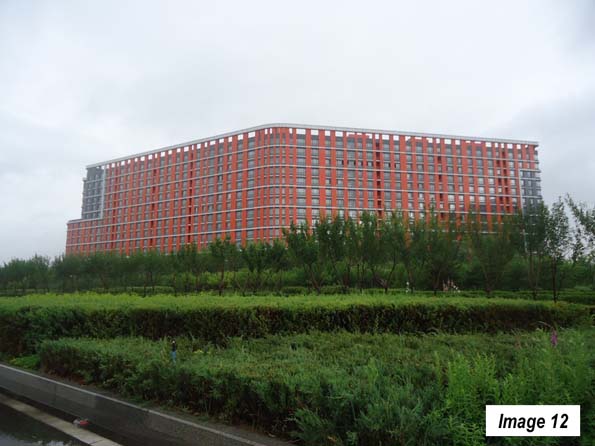
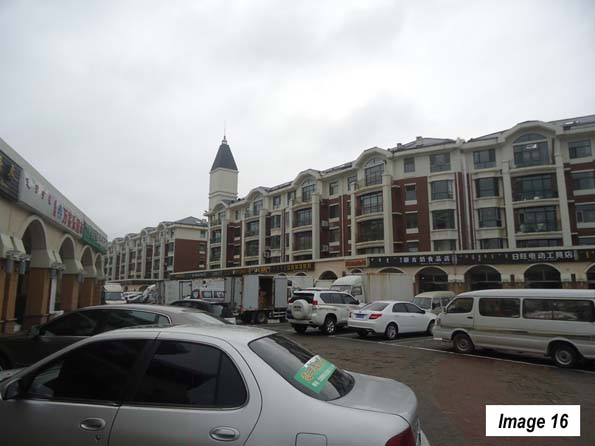
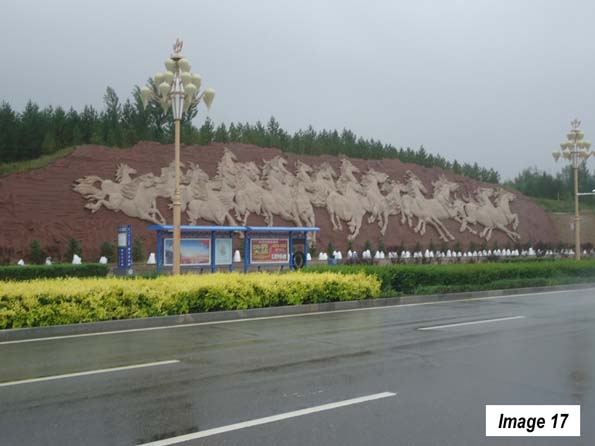
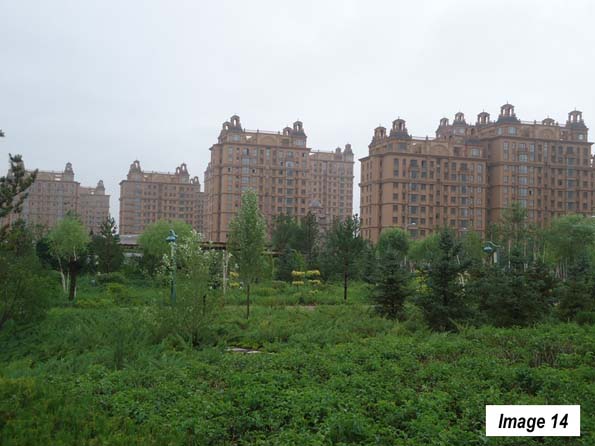
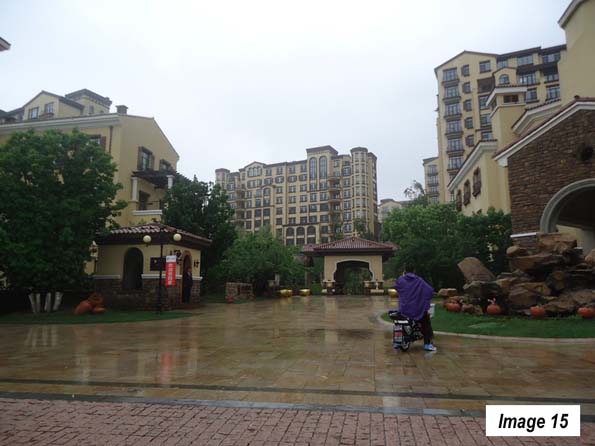
    There are a variety of residential areas surrounding the mall on three sides (the south end of the mall is bordered by the urbanization of Ejin Horo). The residential buildings tend to be from 5 to 12 floors (Images 14 – 16), and include the equivalent of strip malls (Image 16) that are close at hand for residents and can have full parking lots. The residential areas also include some monumental treatments (Image 17).
    Outside the Built-Up Urban Area

    The built-up area of Kangbashi is relatively small, covering less than 10 square miles (25 square kilometers), or less than 10 percent of the Kangbashi new area.

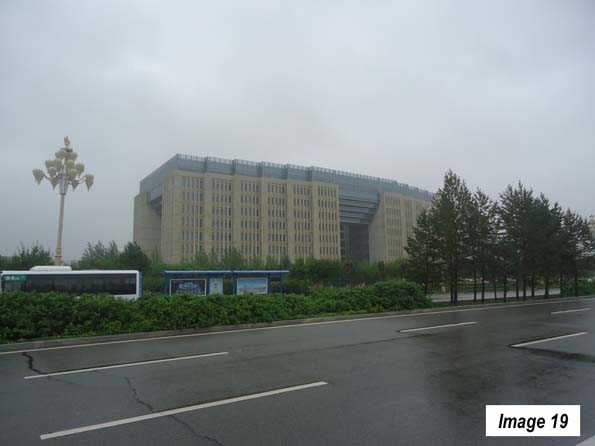
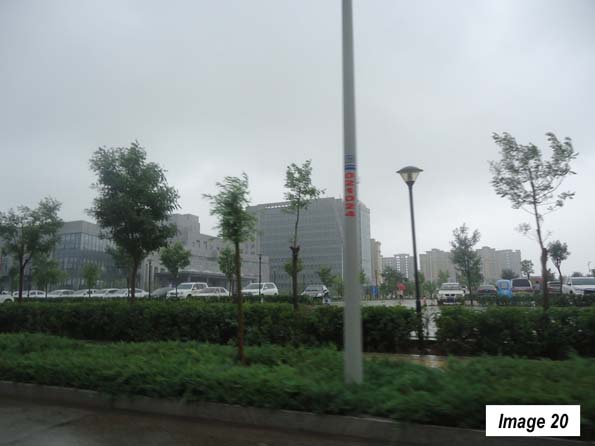
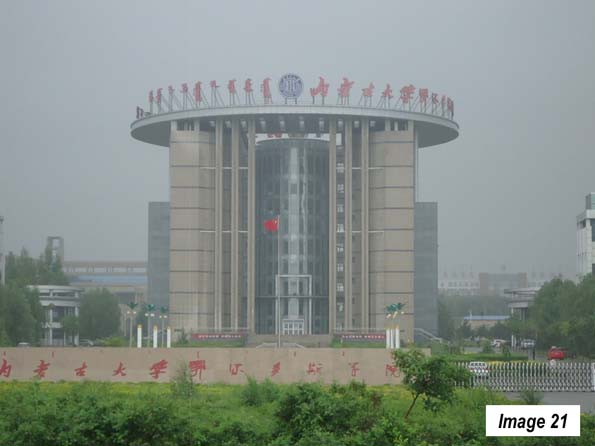
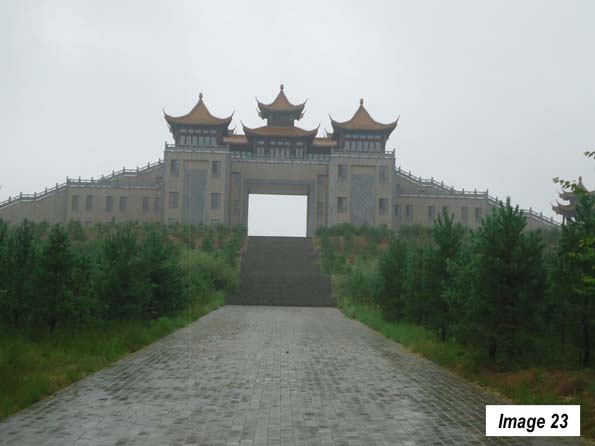
    Most of the "Ghost City" articles to limit their coverage to the small developed area. With the exception of a major roadway skeleton (along which there is virtually no development in many areas), much of the Kangbashi New Area is not a city at all. There are some small pockets of residential development spread throughout the area and a number of government buildings similarly dispersed beyond the built-up area (Images 18-24). At the same time, the parking lots were far from empty.

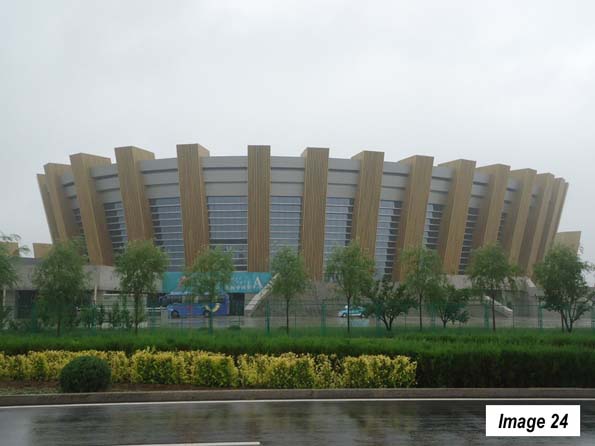
    There are also a number of religious sites outside the built up urban area (Images 22 & 23) and three similarly designed sports facilities (Image 24).

    The traffic volumes are well below the capacity of the more than ample arterial street system. But this is not unusual for newer suburban areas in China, where eight lane streets can be the rule.

    What About the People?

    Much of the ghost city coverage has been based on an assumption that   few if any residents have arrived. A number of articles point out that the present development has been built for 300,000 residents and that the population is much less (above). Yet, the municipality indicates that the 300,000 resident projection is for 2020. Whether or not Ordos will reach that population by 2020 cannot yet be known.

    Some of the ghost city articles have claimed that the Kangbashi new area was projected to have 1 million residents. However, the municipality’s website indicates that the 1,000,000 vision was for a much larger area than the Kangbashi new area. It also included Dongsheng, which alone already has nearly 600,000 residents as well as the urbanization of Ejin Horo. In other words, under the plan the area was already well on its way to achieving the eventual projection.

    Other articles point out that there are few people walking on the streets. But, as Chai Jiliang, chief publicity officer of Kangbashi told China Daily in 2012: "So, why do local residents who mostly own private cars and have convenient public transportation have to walk on the streets if there are no major public events?" There is further evidence of people, the establishment of a campus of the Beijing Normal University in the Kangbashi new area. Indeed a recent article in The New York Times Style Magazine, by Jody Rosen,   reported not only that there were people in the Kangbashi new area, but that they were generally happy with their city.

    Ejin Horo

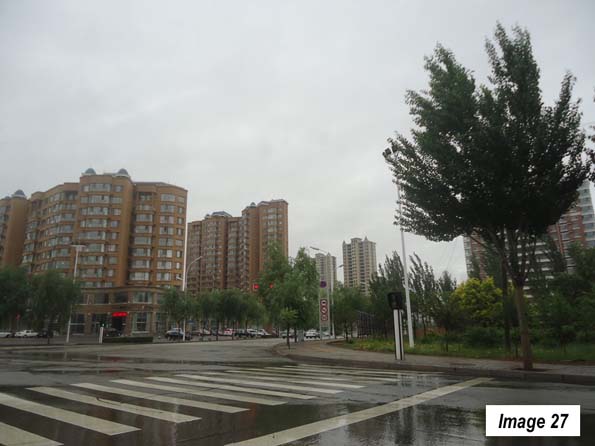
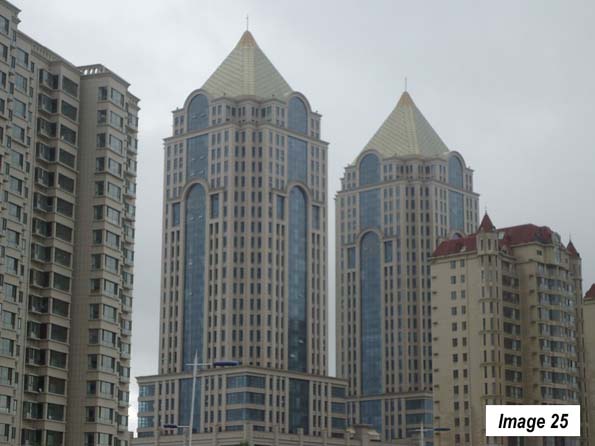
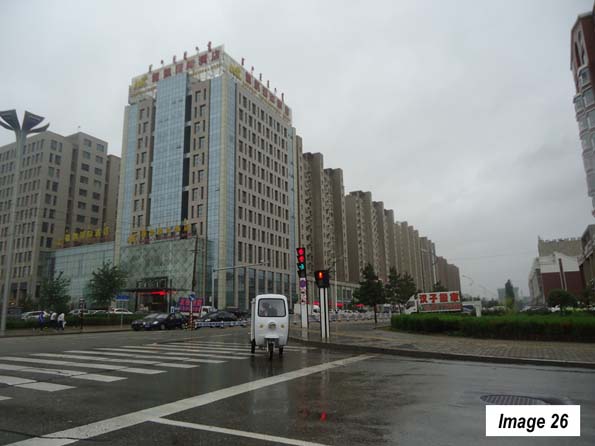
    Perhaps the biggest surprise was the Ejin Horo urbanization (Azhen), immediately to the south of the Kangbashi New Area (Images 25-27). The tallest buildings are here and some of the most impressive commercial architecture. Just across the principal bridge from the Kangbashi New Area are two buildings resembling the One World Wide Tower on Eighth Avenue in New York (Image 25). Ejin Horo also has many condominium towers that are often taller than those in the Kangbashi New Area. Unlike the Kangbashi New Area, Ejin Horo appears to have grown more organically in response to market demand. The area’s international airport is also located in Ejin Horo.
    Big Dreams, Big Challenges

    The Kangbashi new area  does face some problems. Like the rest of China, there are a number of uncompleted building projects, as the economy is not growing nearly as quickly as before. Though, again, I expected many more based on the negative published reports.

    There has been a severe reduction in house prices, as the Chinese economy has gotten worse. There are reports that many of the apartments and condominiums are empty, though no information was found on the extent of unsold houses or the number that have been purchased simply as investments to hold (and have no residents). It is not unusual for Chinese buyers to invest in additional properties, leaving them empty, a situation that is also been reported in central Vancouver. However, there was no lack of cars in the parking lots of the residential districts.

    Peoples Daily reports that coal extraction volumes are down significantly, which when combined with substantially lower coal prices in recent years has cut severely into the revenues of the Ordos municipality. The municipality is seeking additional revenue enhancing strategies, such as tourism (there are 9 million tourists annually), automobile manufacturing and solar power facilities.

    Liu Qiang, a People’s Daily columnist noted that "There are worries that Ordos, with its huge debts and years of mismanagement, will repeat Detroit’s road to bankruptcy," While noting that Chinese municipalities are not permitted to file bankruptcy, the columnist suggests that " China’s local government debt, if not being better managed, might potentially pose a systematic risk greater than in Detroit."

    Big dreams are not limited to cities in China. Ordos may have built civic monuments and infrastructure beyond its means. Only time will tell whether such visions can be sustained. The reality, however, is that Ordos, including the Kangbashi new area, is surprisingly vibrant and functioning with real people.

    Note 1: Inner Mongolia is a part of China. Mongolia (often called "Outer Mongolia) is an independent nation located between China and Russia.

    Note 2: The Evolving Urban Form is a newgeography.com metropolitan and urban area profiles from around the world. The more than 50 articles on in the series can be accessed here.

    Photo: Genghis Kahn Mausoleum, Ordos, Inner Mongolia, China by Fanghong (Own work) [CC BY-SA 3.0 or GFDL], via Wikimedia Commons

    Wendell Cox is principal of Demographia, an international pubilc policy and demographics firm. He is a Senior Fellow of the Center for Opportunity Urbanism (US), Senior Fellow for Housing Affordability and Municipal Policy for the Frontier Centre for Public Policy (Canada), and a member of the Board of Advisors of the Center for Demographics and Policy at Chapman University (California). He is co-author of the “Demographia International Housing Affordability Survey” and author of “Demographia World Urban Areas” and “War on the Dream: How Anti-Sprawl Policy Threatens the Quality of Life.” He was appointed to three terms on the Los Angeles County Transportation Commission, where he served with the leading city and county leadership as the only non-elected member. He served as a visiting professor at the Conservatoire National des Arts et Metiers, a national university in Paris.

  • The U.S. Cities Creating The Most White-Collar Jobs, 2016

    The information sector may have glamour and manufacturing, nostalgia appeal, but the real action in high-wage job growth in the United States is in the vast realm of professional and business services. This is not only the largest high-wage part of the economy, employing just under 20 million people at an average salary of $30 an hour, it’s also one the few high-wage sectors in which employment has expanded steadily since 2010, at more than 3% a year, adding nearly 3 million white-collar jobs.

    In many ways, the business and professional service sector may be the best indicator of future U.S. economic growth. It is not nearly as vulnerable to disruption as energy, manufacturing or information employment, and more deeply integrated into the economy, including professions like administrative services and management, legal services, scientific research, and computer systems and design.  In a pattern we have seen in other sectors, much of the growth is concentrated in two very different kinds of places: tech-rich metro areas and those that offer lower costs, and often more business-friendly atmospheres.

    To generate our rankings of the best places for business services jobs, we looked at employment growth in the 366 metropolitan statistical areas for which BLS has complete data going back to 2005, weighting growth over the short-, medium- and long-term in that span, and factoring in momentum — whether growth is slowing or accelerating. (For a detailed description of our methodology, click here.)

    Tech Strikes Again

    There is a growing confluence between technology and business services, as more companies use the Internet to conduct commerce.

    This can be seen in several of our top-ranked large cities. Business service employment in the San Francisco-Redwood City-South San Francisco MSA has grown a remarkable 45% since 2010, placing it second on our list, slightly faster than third-ranked Austin-Round Rock, which clocked 42% growth over the same span, and No. 4 San Jose-Sunnyvale-Santa Clara, where business services employment expanded 36%.

    It’s questionable whether this pattern will continue, particularly in the high-cost Bay Area. There are signs of a slowdown in Silicon Valley and San Francisco, with more space being subleased and property prices seeming to have peaked, albeit at extraordinary high levels. In contrast the future for less expensive areas — increasingly attractive to millennials as well as companies — may be far brighter, as companies shift employment to places their employees can live decently.

    Resurgence In Middle America

    This pattern can be seen in the balance of our top-performing regions. It starts with our top-ranked metro area, Nashville, Tenn., which has seen business service employment grow 47.2% since 2010 to 152,700 jobs, with 7.7% growth last year alone. Some of this comes from the establishment of branch offices of Silicon Valley companies like Lyft and Everbright, as well as the expansion of the area’s strong health care and entertainment industries.

    Nashville’s appeal to millennials is unsurpassed, with the strongest growth rate in net migration of college-educated people aged 25-34 of any metro area in the country, and the reasons are not hard to find. It’s a charming city located in a temperate part of the country, with both excellent, and affordable, urban and suburban options.

    But if Nashville is the belle of the business service ball, fifth-ranked Dallas-Ft. Worth is now the beast. The Texas powerhouse’s business services workforce has expanded 28.9% since 2010 to 458,200. The Dallas-Ft. Worth area has plenty of appeal to big companies with a large cohort of middle-income managers, as a paper to be published this fall by Southern Methodist University’s Klaus Desmet and Cullum Clark well describes. These jobs pay well enough to live well in Dallas’ nicer suburbs, such as Plano and Frisco, but not remotely enough to buy a house, or even a condo, in Los Angeles, San Francisco or New York.

    This accounts, in part, for the relocation of Toyota America’s headquarters from Torrance, Calif., to the north Dallas suburbs, and likely plays a role in the plans of Jacobs Engineering, a longtime fixture in Pasadena, to relocate its headquarters to downtown Dallas.

    In many ways, argues urban analyst Aaron Renn, Dallas is becoming the new Chicago. It is anchored by a large airport, a diverse economy and a location in the middle of country. Even as downtown Chicago has attracted some notable new corporate headquarters in recent years, these generally employ relatively few people, while companies that need access to a large white-collar workforce, like Toyota and Jacobs, have been gravitating to the Big D.

    How About The Big Boys?

    As manufacturing has declined in our largest cities, professional and business services have become the prime generator of high-end jobs. Yet among the country’s largest business service centers there is a growing divergence between the winners and laggards.

    The most impressive performance among metro areas with over 500,000 business and professional service jobs has been New York. With 714,000 business service jobs, the Big Apple is without question the leader in the field, but more importantly it continues to grow. Since 2010, New York has grown its professional and business service employment by an impressive 22%, helping it rank 14th on our list. This reflects the city’s continued preeminence in such fields as law, design, marketing, public relations and advertising.

    But the other traditional business service leaders have not fared nearly as well. Gotham’s traditional rival, Chicago-Naperville-Arlington Heights, still has 673,000 business service jobs but has seen only a modest growth just under 15%, ranking 43rd. Whatever may have been gained in generally small scale “executive headquarters” has not been enough to make the vast Chicagoland region a big winner.

    Things are even less positive in 60th place Los Angeles-Long Beach-Glendale, the third largest business service area. Since 2010, its 13.8% growth is well below the national average. Nor is the slack in the Southland being picked up by the area’s sprawling suburbs, with Santa Ana-Anaheim-Irvine ranking a modest 39th and San Bernardino-Riverside clocking in at 52nd. The Bay Area business services world may be still booming, but south of the Tehachapi, progress is slow.

    Will Business Services Continue To Disperse?

    Those who suggest dense concentrations have efficiencies that overcome higher costs can take some solace from our numbers, but not too much. Many of the fastest growing business service centers are hardly paragons of dense urbanism, including No. 7 Orlando-Kissimmee-Sanford, Fla., and No. 8 Richmond, Va., where employment jumped 10% last year. Even sprawling Atlanta, which has lost some of its ‘90s era luster, is now growing its business service sector at a faster pace than New York and light years ahead of much denser Chicago and Los Angeles. It ranks 13th.

    The shift to less expensive places seems certain to continue, in part due to the growing role of Internet communications, which breaks down formerly insurmountable distance barriers. Looking at the full list of the 366 metro areas we examined, the fastest-growers include many smaller communities, led by overall No. 1 New Bedford, Mass., where business services employment has grown 58.5% since 2010 to 6,200 jobs, as well as No. 3 Monroe, Mich., No. 4 Lake Charles, La., and No. 6 Lawton, Okla.

    Essentially business service growth seems destined to break down into three types: (1) large and expensive metro areas — San Francisco-Silicon Valley and New York — whose economic dynamism is strong enough to counter high costs; (2) less expensive, but still large metros such as Nashville, Dallas-Ft. Worth, Richmond and a host of Florida cities that can be expected to garner a lion’s share of the new growth; and (3) smaller communities where business service sector jobs, particularly at the lower end, may be increasingly attracted as employers pursue an affordable quality of life. While the short term has favored the largest cities, the long term is pointing toward more migration to midsized and smaller destinations.

    This piece first appeared at Forbes.

    Joel Kotkin is executive editor of NewGeography.com. He is the Roger Hobbs Distinguished Fellow in Urban Studies at Chapman University and executive director of the Houston-based Center for Opportunity Urbanism. His newest book, The Human City: Urbanism for the rest of us, will be published in April by Agate. He is also author of The New Class ConflictThe City: A Global History, and The Next Hundred Million: America in 2050. He lives in Orange County, CA.

    Michael Shires, Ph.D. is a professor at Pepperdine University School of Public Policy.

    Photograph: Downtown Nashville from BigStockPhoto.com

  • A Different Approach to Redevelopment

    As part of a thought experiment I examined one specific neighborhood in a typical small city in Georgia. I’m using this town not because it’s unique, but because it’s absolutely normative. I could do the same analysis on the town where my mom, sisters, and brother live in southern New Jersey and it would be nearly identical. This is Everytown, USA.


    Screen Shot 2016-07-11 at 1.25.14 AMGoogle

    This particular neighborhood is halfway between the historic town center and the newer suburbs. It’s been completely skipped over and neglected in recent decades. What might be possible given the prevailing political and economic reality? The goal here is to improve the quality of life for existing residents, attract new residents, increase employment and economic activity, raise property values, and expand the tax base. The trick is to do all these things while keeping public spending and infrastructure to an absolute minimum and not use subsidies or tax abatements. I’ve rejected all the usual suspects that take too long, cost too much, and often make things worse.

    Screen Shot 2016-07-06 at 2.33.05 AMGoogle

    Screen Shot 2016-07-11 at 1.34.55 AMGoogle

    This neighborhood can’t compete with newer suburbs for folks looking for the usual quiet leafy environment. It shouldn’t even try. Instead it could offer the one thing the new suburbs don’t – a walkable human scaled place with some modicum of vitality and street life. There’s pent up market demand for such places and almost no supply. My first suggestion is for this business district to turn its back on the main road. Call it what it is – a sewer for cars. It serves its purpose and keeps things flowing, but no one wants to sit and watch the material drift by. Ignore it.

    Instead, the parallel secondary street should become the focus of attention. That’s the more appropriate Main Street location. Next, sort out local businesses that are “in” or “out.” The national chains won’t be interested. Let them continue doing what they do. Many of the independent merchants and landlords may not be so inclined either. That’s fine. Work with the folks who are. Baby steps.

    Screen Shot 2016-06-24 at 9.06.53 AMGoogle

    Screen Shot 2016-06-24 at 8.17.07 AM

    Screen Shot 2016-07-11 at 11.29.13 AM

    Here’s an interstitial space formed by the back of a generic aging strip mall and an adjacent one story professional building. It’s a parking lot that doesn’t appear to get much use, but it’s an excellent outdoor room with good proportions that faces a quiet side street. If the city regulators and fire marshal could see their way to make it legal this is an ideal spot for a great gathering space.

    Screen Shot 2016-07-06 at 10.11.40 AM

    Screen Shot 2016-07-06 at 10.14.03 AM

    Screen Shot 2016-07-12 at 1.02.23 AM

    Screen Shot 2016-07-06 at 10.14.15 AM

    Plants, inexpensive outdoor furniture, and simple food and drink (most likely served by existing merchants from the rear of their shops) would be a fast cheap method of making the area worth frequenting. Only the locals know exactly what would provide the best draw. Coffee? Beer? Ice cream? Barbecue? Or maybe this is the perfect spot for outdoor movies served with popcorn and lemonade on weekend nights. Total cost to the city? Some paperwork. Total cost to the property owners? Lawn furniture, plants, and Christmas lights. The “product” on offer is spontaneous conviviality. Effective management is more powerful than pouring concrete and laying asphalt.

    Screen Shot 2016-07-11 at 11.29.25 AM

    Screen Shot 2016-06-24 at 8.38.04 AM

    Screen Shot 2016-06-24 at 8.51.49 AM

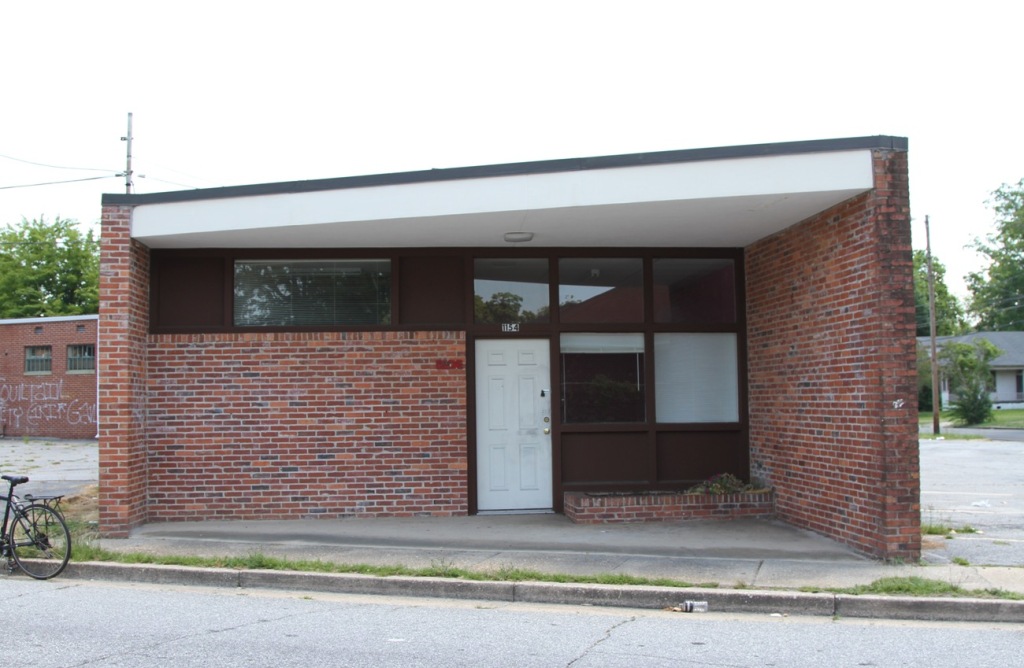
    The professional building appears to be vacant or less productive than it could be. The property owner may be happy with the current arrangement, but if not this could be a fantastic live/work space. There are a lot of people who find this sort of place appealing since it’s a blank slate and extremely flexible. It’s no doubt illegal to live in a commercial space due to zoning regulations. But those rules could be changed or quietly ignored by the authorities. Who’s to say what happens behind those brick walls? Live/work is the perfect in-between use for a building that sits halfway between a busy road and a calm residential street.

    Screen Shot 2016-07-06 at 2.49.45 AMGoogle

    Screen Shot 2016-07-11 at 11.30.17 AM

    Screen Shot 2016-06-25 at 8.19.44 AM

    Screen Shot 2016-06-25 at 8.20.30 AM

    All the ice cream parlors, outdoor cafes, and beer gardens in the world won’t help if there aren’t enough people nearby to fill the seats. This building appears to be some kind of Class C office building. I walked around in the middle of the afternoon on a weekday and didn’t see a soul. I didn’t even hear the hum of an air conditioner. It may be a thriving hub of business activity for all I know, but it looks like a storage facility for old paperwork. I could see someone from a local neighborhood improvement organization brokering a deal between the landlord and the local orchestra, film and video school, or art museum to convert this place into studio space.

    Screen Shot 2016-03-07 at 5.05.26 PM

    Screen Shot 2016-03-07 at 5.03.25 PM

    Screen Shot 2016-03-03 at 3.40.33 PM

    Actually, I’d love to see it as residential space for such people. It’s probably hard to practice the French horn in a garden apartment complex without people complaining. If the building were populated with a self selecting group of folks with an established affinity it might be a value added proposition.

    If you’re horrified by the idea of living in a place like this… Great! You’ve self selected out. Perfect. Now move over and make room for the people who love it. The Mad Men era architecture could be celebrated just as it is. Howard Johnson’s meets Denny’s with a hint of 1960’s car wash. A little turquoise and orange paint and some Malibu lighting would work wonders.

    Screen Shot 2016-07-11 at 1.16.49 AM

    Screen Shot 2016-07-11 at 1.17.18 AM

    Screen Shot 2016-07-11 at 1.13.23 AM

    Screen Shot 2016-06-25 at 8.06.20 AM

    Screen Shot 2016-06-25 at 8.07.23 AM

    Screen Shot 2016-07-11 at 1.18.56 AM

    There’s an abundance of commercial buildings that are simply not performing as intended. There’s no market demand for this kind of space in this location – and it’s been this way for a very long time.

    Screen Shot 2016-01-31 at 2.34.04 AM

    Screen Shot 2016-01-31 at 2.34.57 AM

    Screen Shot 2016-01-31 at 2.34.36 AM

    Why not make these living spaces? Again, I need to belabor the point. This isn’t about attracting suburban families. Instead, these places are perfect for a subset of the population that actually likes cheap ugly spaces. Cheap and ugly are the primary amenities for some people. They value other things and enjoy the freedom that comes with such accommodations.

    Screen Shot 2016-07-08 at 4.27.16 PM

    Screen Shot 2016-07-08 at 5.20.08 PM

    Screen Shot 2016-07-08 at 1.27.57 PM

    This is the secondary street that’s more suited to humans than the primary road full of vehicular traffic. It’s lifeless at the moment, but it could be transformed on the cheap with weekly pop up events organized around food trucks and a farmers market.

    Screen Shot 2016-07-12 at 12.24.08 AM

    Screen Shot 2016-07-12 at 12.24.33 AM

    Screen Shot 2016-07-12 at 12.23.53 AM

    Screen Shot 2016-07-12 at 12.22.40 AM

    Screen Shot 2016-07-12 at 12.27.16 AM

    Screen Shot 2016-07-12 at 12.26.45 AM

    Over time the empty parking lots and food trucks could mature with brick and mortar infill development that make the arrangement permanent. The food trucks are incubators for small scale entrepreneurs on a tight budget. You need a million dollars to open a franchise doughnut shop. A food truck comes at a much lower price point.

    Screen Shot 2016-07-03 at 2.57.15 PMGoogle

    Screen Shot 2016-07-11 at 5.42.57 PMGoogle

    Screen Shot 2016-07-02 at 4.31.19 AM

    Screen Shot 2016-06-25 at 8.14.03 AM

    Screen Shot 2016-07-03 at 5.50.29 PM

    Screen Shot 2016-07-03 at 5.51.16 PM

    Screen Shot 2016-07-03 at 5.51.35 PM

    Here’s a dead strip mall on the other side of the neighborhood that’s facing another busy commuter road. Again, the sweet spot is in the back that faces the residential side streets. Both the shops and the homes have seen better days. What can be done with this space?

    Screen Shot 2016-03-02 at 1.02.53 PM

    Screen Shot 2016-06-28 at 12.41.51 AM

    Screen Shot 2016-06-28 at 12.41.30 AM

    Screen Shot 2016-07-11 at 2.12.00 PM

    Screen Shot 2016-07-11 at 2.11.46 PM

    Screen Shot 2016-03-02 at 1.06.22 PM

    Screen Shot 2016-03-02 at 1.05.07 PM

    Screen Shot 2016-03-02 at 1.04.08 PM

    Screen Shot 2016-03-02 at 1.06.48 PM

    This is an example of a non profit organization that specializes in the often neglected industrial arts. Welding, glass blowing, carpentry, neon arts, enameling, stone cutting, fashion, ceramics, and so on. Thousands of people – particularly young people – are trained in useful skills each year. People rent space and pay a modest tuition for instruction. This isn’t a government facility. It was established and continues to be maintained by locals who are passionate about the place. This is the kind of thing that could draw in precisely the variety of people who might look favorably on living in one of the fantastically affordable nearby homes. And they’d actually have the skills to fix them up.

    Screen Shot 2016-06-25 at 8.13.39 AM

    I’m well aware of the arguments against this sort of thing. It will attract the wrong element. People will cook meth in spaces like that. People will have wild parties all night long and disturb the peace. This is just a bunch of Hipster nonsense.We can’t have people drinking beer outdoors near a church or school. I totally understand. From my perspective there are ways of managing those concerns, but I personally won’t invest ten minutes of my time attempting to change anyone’s opinion. Instead I’ll wait another ten or fifteen years for the current decline to continue. This place may not be ripe for reinvention yet. The local culture may not be receptive. Honestly, the neighborhood may not be miserable enough just yet. Let’s wait until these places start to burn down one by one. Or let them be bulldozed to make room for more parking or a heavily subsidized garden apartment complex next to the newly widened commuter road. That’s absolutely an option.

    John Sanphillippo lives in San Francisco and blogs about urbanism, adaptation, and resilience at granolashotgun.com. He’s a member of the Congress for New Urbanism, films videos for faircompanies.com, and is a regular contributor to Strongtowns.org. He earns his living by buying, renovating, and renting undervalued properties in places that have good long term prospects. He is a graduate of Rutgers University.

  • The Shorter Commutes in American Suburbs and Exurbs

    An examination of American Community Survey (ACS) data in the major metropolitan areas of the United States shows that suburbs and exurbs have the shortest one-way work trip travel times for the largest number of people. The analysis covers metropolitan areas with more than 1,000,000 population in 2012, from the 2010-2014 ACS (2012 average data) using the City Sector Model.

    The City Sector Model

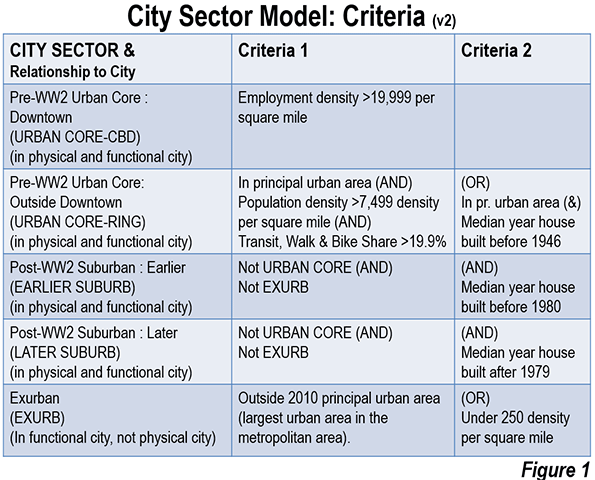
    The City Sector Model classifies small areas (zip codes) of major metropolitan areas by their urban function (lifestyle). The City Sector Model includes five sectors (Figure 1). The first two are labeled as “urban core,” (Urban Core: CBD and Urban Core: Ring) replicating the urban densities and travel patterns of pre-World War II US cities, although these likely fall short of densities and travel behavior changes sought by contemporary urban planning (such as Plan Bay Area). There are two suburban sectors, the Earlier Suburbs and Later Suburbs. The fifth sector is the Exurbs, which is outside the built-up urban area. The principle purpose of the City Sector Model is to categorize metropolitan neighborhoods based on their intensity of urbanization, regardless of whether they are located within or outside the boundaries of the historical core municipality (Note 1).

    One Way Commute Times by Urban Sector

    The commuting data excludes employees who work at home, whose commute times would be zero.

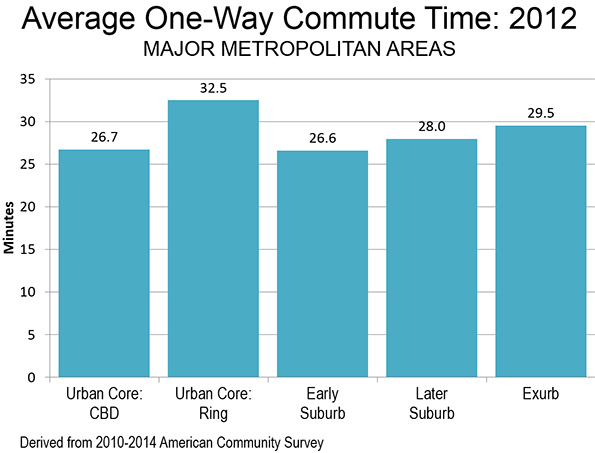
    The shortest one-way commute times are experienced by residents of the Earlier Suburbs, with a 26.6 minute travel time. This is nearly equalled for residents of the central business districts (Urban Core: CBD), with an average commute of 26.7 minutes. Commuters living in the Later Suburbs had a somewhat longer commute, at 28.0 minutes, while commuters living in the Exurbs had an average one-way commute of 29.5 minutes. The longest commute times were experienced by residents of the Urban Core: Ring (32.5 minutes), which is the part of the urban core that excludes the central business district, (Figure 2) and is characterized by high densities and lower levels of automobile use than in the suburbs and exurbs.

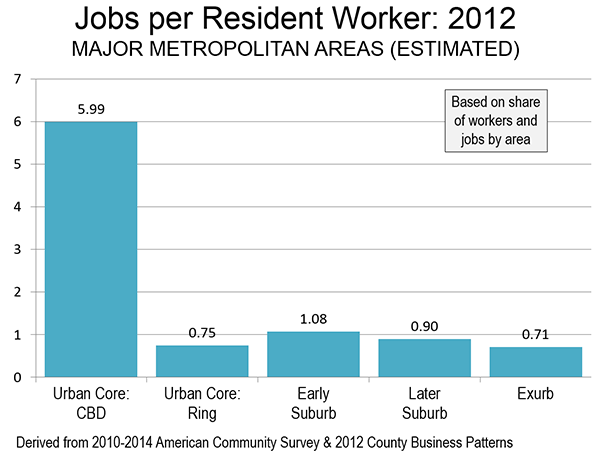
    The functional city sectors with the shortest commutes had more jobs than resident workers. The Earlier Suburbs possess 1.08 jobs for every resident worker (Note 2). The ratio was much higher in the Urban Core: CBD, where there were nearly 5.99 jobs for every resident worker. Such an imbalance could not be replicated throughout a metropolitan area, because by definition, a labor market has a ratio of jobs to resident workers of approximately 1.00. To replicate the national CBD ratio throughout the metropolitan area would require, for example, that the New York metropolitan area have  54 million jobs for its 9 million workers.   

    Not surprisingly, with such a surplus jobs relative to workers, the Urban Core: CBD, the chances of finding suitable employment nearby is far greater. However, this advantage can, by definition, be available only to a very few, as is indicated by the fact that the Urban Core: CBD’s are home to only 1.5 percent of the resident workers in the major metropolitan areas. In the broader context of the urban core (including both the CBD and the Ring), this advantage is offset and average travel times are greater (below).

    In the Later Suburbs, there were 0.90 jobs per resident worker, which matches that sector’s ranking in work trip travel time (third). The  ring around the urban core (Urban Core: Ring) , had the longest average work trip travel time. The Exurbs had the lowest ratio of jobs to resident workers, at 0.71, yet had an average travel time that was shorter than that of the Urban Core: Ring (Figure 3).

    Pre-World War II and Post-War Urban Form

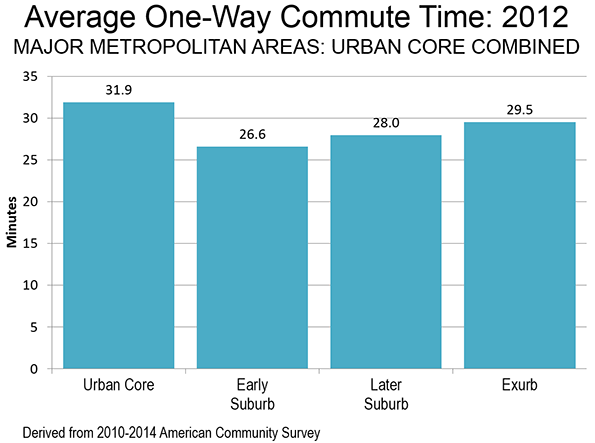
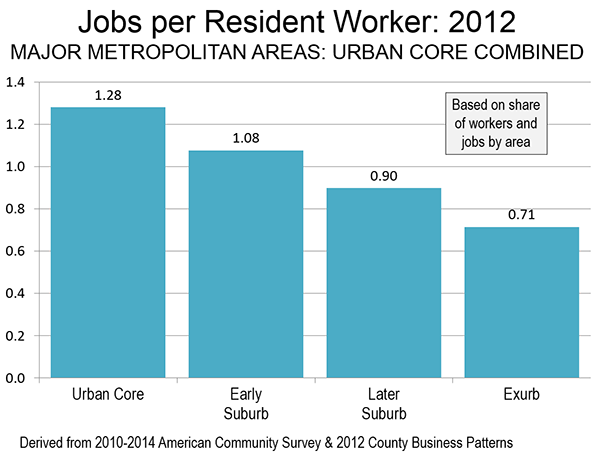
    The two combined urban core sectors are defined in the City Sector Model to replicate what remains of the pre-World War II city that was characterized by far higher densities and less reliance on automobile transportation, as opposed to the suburban and exurban sectors that have dominated urban growth for seven decades. If the two urban core sectors are combined (Urban Core: CBD and Urban Core: Ring), the number of jobs per resident worker is 1.28. This healthy ratio, however, is not sufficient to preserve any travel time advantage for residents of the combined urban core. In the combined urban core sectors, the average one-way travel time of 31.9 minutes, well above each of the other three functional sectors (Figures 4 and 5). The Urban Core: Ring has nearly nine times as many resident workers as the Urban Core: CBD.

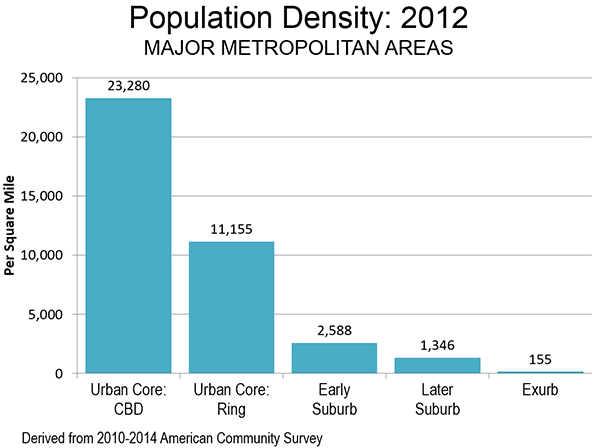
    The Pre-War urban form has considerably higher population densities than those of the post-war urban form. For example, the Urban Core: CBD has a population density exceeding 23,000 per square mile (9,000 per square kilometer), more than 80 percent of the New York City population density level. The Urban Core: Ring has a population density exceeding 11,000 per square mile. The combined area population density of the two Urban Core sectors is 11,500 per square mile, or 4,400 per square kilometer (Figure 6).

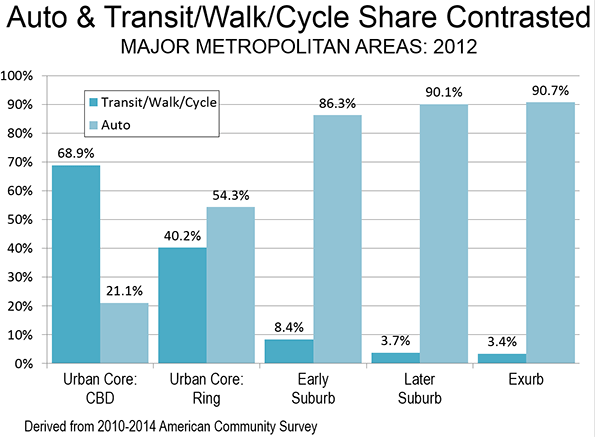
    The two Urban Core sectors largely rely on commuting modes currently favored by urban planning policy, transit, cycling and walking. In contrast, the suburban and exurban sectors rely on commuting modes discouraged by urban planning policy, automobiles and car and van pools (Figure 7).

    The combined urban core sectors have more than four times the density of the Earlier Suburbs and nearly nine times the density of the Later Suburbs. With these much higher densities and their reliance on the favored transport strategies, it might be expected that they would enjoy the best commute times. However, as noted above, when the two urban core sectors are combined, their average travel time is longer than the suburban and exurban sectors. This is despite the far lower densities of the two suburban sectors and the often world densities of the exurban sector.

    The Key: Lower Densities & Job Dispersion

    These results are likely to be surprising to many in the press as well as planners who often equate residential distance from central business districts as resulting in longer commutes. The reality, however, is that central business districts account for only 8 percent of employment in major US metropolitan areas, and reach the highest at 22 percent in New York, 50 percent above second place San Francisco (14.4 percent) and nearly 10 times that of Los Angeles (2.4 percent).

    Generally speaking, employment is dispersed throughout the metropolitan area. When combined with the generally lower density urbanization within metropolitan areas, the result is shorter commutes for residents  in the suburbs and exurbs. As it turns out the data shows that higher employment densities in the urban core are associated with longer, not shorter commutes, as is commonly assumed.

    Note 1: In some cases the functional urban core extends beyond the boundaries of the historical core municipality (such as in New York and Boston). In other cases, there is virtually no functional urban core (such as in San Jose or Phoenix). Functional urban cores accounted for 14.7 percent of the major metropolitan area population in 2012. By comparison, the jurisdictional urban cores (historical core municipalities) had 26.6 percent of the major metropolitan population, many of which have large tracts of functional suburban development.

    Note 2: Estimated by dividing the percentage of jobs in each sector by the percentage of resident workers. Working at home is excluded.

    Wendell Cox is principal of Demographia, an international pubilc policy and demographics firm. He is a Senior Fellow of the Center for Opportunity Urbanism (US), Senior Fellow for Housing Affordability and Municipal Policy for the Frontier Centre for Public Policy (Canada), and a member of the Board of Advisors of the Center for Demographics and Policy at Chapman University (California). He is co-author of the "Demographia International Housing Affordability Survey" and author of "Demographia World Urban Areas" and "War on the Dream: How Anti-Sprawl Policy Threatens the Quality of Life." He was appointed to three terms on the Los Angeles County Transportation Commission, where he served with the leading city and county leadership as the only non-elected member. He served as a visiting professor at the Conservatoire National des Arts et Metiers, a national university in Paris.

  • Population Change, 2015: Not Very Good News for Those Angry White Men

    Data on population growth from 2010 to 2015 show a continuing concentration of people in metropolitan areas, especially in the large areas with over a million people, where presumably traditional values are most challenged.  I show an amazing table, in which I have disaggregated population change by type of settlement, from the million-metro areas to the purely rural counties, comparing growth amounts and rates, plus noting how these areas actually voted in 2012. From the title, the news that growth is greatest in the biggest places seems bad for Republican prospects, but the accompanying maps also show that the greatest growth may well be in more Republican parts of metropolitan America – a story of geography vs. demographics.

    The data from the table are dramatic. Note that 275 million, or 86%, live in census-defined metropolitan areas (with urban agglomerations over 50,000), and 55.5% in just the 58 metro areas of over 1,000,000.  The biggest metro areas (but not the super large New York, Los Angeles, and Chicago) grew by 9.4 million, or 5.5%, the smaller metro areas by 3.4 million, or at 3.3 %, while non-metropolitan America dropped from 46.3 million to 46.1 million, down to 14% of the total population. 

    The final column of the table shows how these areas voted in the 2012 presidential election. Obama won the big metro areas of over one million by taking 57.6 percent of the 2 person vote, which enabled him to get almost 52% of the total US vote while winning the three megacities – New York, Los Angeles and Chicago – by an even wider margin. This meant that despite LOSING all other settlement categories – 48% in smaller metro areas, only 41% in micropolitan areas, and a pathetic 40 percent in rural small town America, the President still won handily.

    Population Change by Settlement Type, 2010 2015
      # Counties 2010 Pop 2015 Pop Change % Chg % of Pop 2015 % Obama, 2012
    Million Metro Center Counties          255   156,143    164,749      8,606 5.5% 51.3%
    Million Metro Outlying Counties          179     13,661      14,416         749 5.5% 4.5%
    Total Million Metros          434   169,804    179,165     9,355 5.5% 55.7% 57.6
    Other Metro Center Counties          473     85,634      89,005      3,371 3.9% 27.7%
    Other Metro Outlying Counties          259       7,025         7,086           61 0.9% 2.2%
    Total Other Metros          732     92,659      96,091     3,432 3.7% 29.9% 48.3
    Micro Center Counties          559     26,422      26,533         111 0.4% 8.3%
    Micro outly            92       1,080         1,070          (10) -0.9% 0.3%
    Total Micropolitan Areas          651     27,502      27,603         101 0.4% 8.6% 41.4
    Rural Sm Town          727     14,058      13,899       (159) -1.1% 4.3%
    Rural Sm Town          598       4,731         4,663          (68) -1.4% 1.5%
    Total Non-metro Counties      1,325     18,789      18,462       (327) -1.7% 5.7% 40
    ALL      3,142   308,774    321,435   12,664 4.1% 100.0% 52


    So the good news for the Democrats is that the greatest population growth occurred in larger cities where Obama did best in and fell in areas he did poorest in.

    But the story gets complicated once you get beyond the metro level. I now show maps, first of the pattern of population change by type of settlement, and then show how well Obama did in 2012 by these same settlement types. First we have a general map of population change for all US counties, in which I can display both the absolute change by symbol size and the percent change by color. Most apparent are the dominance of growth in metropolitan areas, especially in suburbs, and notably in the South and West. Note that quite a few of the growing counties appear to be in areas where Obama was not that strong (in maps to follow).

    Population Change by Settlement Type

    Rural and rural-small town areas include about 40% of counties and of the territory, but now hold under 6 percent of the population. Modest population loss is most common, especially across the eastern half of the country, while the pattern of change is more complex in the western half, with pockets of gain in areas of energy development, as in ND-MT, and TX-OK, undoubtedly temporary, and scattered areas of growth in environmental amenity areas farther west. The greatest extent of rurality is still from west Texas, north through Oklahoma, Kansas, Nebraska, South and North Dakota  and Montana.

    Politically, Republican Romney swept most rural, small town territory over sizeable contiguous areas in the high plains, as well as the Mormon realm, but Democrats did win in majority Black counties in the south, Latino counties in Texas, and in Native American Indian counties in the far west. In sum, not a story to comfort Republican hopes.

    Micropolitan areas now include about 20 percent of counties and of territory, and house almost nine percent of the population. They experienced only modest population growth from, 2010 to 2015. They are quite widely dispersed across the country, with the exception of most of California.  Just as with rural small-town territory, a pattern of modest loss prevails over the eastern half of the country and a more mixed pattern in the west, echoing the higher growth in areas of energy development, and in parts of the Mountain states and far west, including some environmentally attractive areas.

    Politically, the micropolitan areas, with urban agglomerations between 10 and 50 thousand were almost as supportive of Republican Romney as the more rural areas, and in essentially the same geographic areas, in southern Appalachia, the high plains from Texas to North Dakota and in the Mormon realm, and with the same Democratic outliers in majority minority areas. Again, a pattern not too comforting for Republican prospects.

    Metropolitan areas under 1 million  represent what could be called middle, compromise America, with about one-fourth of US counties, and with 30% of the population. Their geographic pattern is one of broad distribution in the interior of the country, but with a marked coastal concentration in the Gulf and South Atlantic.  Similarly, growth was modest or losses occurred in most of the interior eastern US,  but big gains in southeastern coastal areas, and across most of the far west.

    Politically, too, these areas are intermediate, with Obama receiving 48% of the vote in 2012.  The outlying smaller metropolitan counties are indeed often quite rural.  Some of the growing areas were tilted  more  Republican, as on the Gulf coast and especially in the Mormon west, but in the Atlantic coastal states, and Pacific coast states, Obama did much better.  

    Metro areas over 1 million.  Okay, these are the behemoths, one-seventh of counties with over half the population, and three-quarters of the growth.  But the fastest growth was across the south and in the west, with moderate growth and even modest losses in the north. The biggest metros – NY, Chicago and LA — grew well below national averages. Also, contrary to the perception of the death of suburbia, the outlying counties of this set experienced very high growth. 

    Politically, these suburban areas around the big metros may prove decisive, with the voting eligibility and inclinations of a diverse population critical to outcomes of the presidency and of Congress. Those suburban counties in the South appear to vote Republican, while those in the north and west became modestly Democratic. Size may benefit Democrats, but growth tilts Republican. Ultimately whichever proves most decisive may determine the election.

    Richard Morrill is Professor Emeritus of Geography and Environmental Studies, University of Washington. His research interests include: political geography (voting behavior, redistricting, local governance), population/demography/settlement/migration, urban geography and planning, urban transportation (i.e., old fashioned generalist).