Category: Urban Issues

  • Learning from Medellín with Alejandro Echeverri

    “I think, if you want to write a new narrative at some specific moment in the story of a city, it is important that you have to feel the transformation and see the transformation. So the physical transformation is important but always there is more a spiritual thing, as happens with emotional connections and inspirational things.” ______Architect Alejandro Echeverri.

    If you have an interest in Latin America or in urban matters, you will have read by now that the city of Medellín, Colombia has undergone a startling transformation in the past fifteen years. In the 1980s and 1990s, the name of Medellín evoked fearsome drug cartels, violence and terrorism.

    But in the 2000s, Medellín took a dramatic turn for the better. In 2012, it was selected from 200 contenders as Innovative City of the Year in a survey organized by the Wall Street Journal and the Urban Land Institute. Today, it features regularly among lists of forward-looking cities and must-see destinations.

    EcheverriPhoto

    One of the most important actors in this giant leap is the Medellín architect Alejandro Echeverri. With the inspired leadership of Mayor Sergio Fajardo and a team of architects, engineers, communicators and social workers, Echeverri in his post as Medellín’s Director of Urban Projects set out to bring real improvements through a strategy of “social urbanism” which included large and small projects in the most troubled parts of the city.

    Echeverri who is currently a 2016 Loeb Fellow at Harvard’s Graduate School of Design shared his thoughts with Sami Karam in this 50 minute podcast. A few highlights are transcribed below.

    On giving value to local conditions: “It is better to add than to erase.”

    From the start, Echeverri and his team avoided the top-down approach favored by past urban planners and worked to develop what he describes as a holistic collaboration between architects, community representatives, social workers, city administrators and the private sector.

    At another time in another city, planners might have decided to clear existing low-income settlements and to restart with a clean slate, for example by building high-rise apartments in a parklike setting. Many such projects in the US and Europe are seen today as expensive failures where traditional relations of community and family break down and where crime and vandalism are chronic problems.

    An important differentiator in Medellín was to leave existing homes and communities in place. Echeverri explains:

    “First came respect and [the idea] to give value to the local conditions, give value to the memories. There is a lot of value. Sometimes because you have some different preconceptions and you belong to a different world, it is difficult for you to see the value of these things. I am talking not only about the value of the physical environment. I am talking about the value of the social engagement, the economy, most of it informal, but they have a lot of solidarity, networks and so on… The process of Medellín, the singularity is some special sensibility about local conditions and houses and thinking that it is better to add than to erase.”

    “These projects don’t just have the goal of increasing the quality of life for people, but also to increase their pride and self-esteem.”

    On gondolas, transit stations and library parks

    Among the most visible physical improvements was the introduction of metro cable cars or gondolas that connect poor areas on the hillsides (the barrios) to the subway in the city below. The new transport system facilitated the commute to work, school etc. but as importantly, it created nodes of communal activity around the transit stations.

    800px-Metrocable_de_Medellín,_Colombia

    Metrocable and Biblioteca Espana. Photo via Wikimedia Commons by Ben Bowes.

    Echeverri says:

    “We wanted to do a holistic intervention around each station, combining physical transformation and programs of education, innovation, entrepreneurship and so on. So we used each station as a magnet to develop a public space. We focused as well on the itineraries of the common people, how the people use the barrios, from the houses to the schools to the stations and how to improve that condition and give them more public services and public spaces and new cultural facilities.  So, working with the community, and thinking that big infrastructures are important but the same importance is given to the small details, small interventions. And the intervention has to be with the people as well.”

    In addition to the gondolas, as many as nine library parks designed by Colombian architects were built in poorer areas and stand today as symbols of a fresh approach to education and culture. One of the them, the Parque Biblioteca España is shown in the photo above.

    How do you measure success?

    With a decline in violence, all of Colombia has enjoyed a resurgence in investment and tourism. In 2011-15, foreign direct investment was over three times what it had been a decade earlier (source: colombiareports.com). In 2015, the number of foreign visitors, 76% of whom were vacationers, was over 2.5x higher than in 2005 (source:colombiareports.com). Bogota was the number one destination with 45% of visitors, followed closely by Medellín with 39%.

    pui-fotos-04

    Photo from Proyecto Urbano Integral / Alejandro Echeverri + Valencia Arquitectos.

    Echeverri sees vindication and success in these figures and adds the following:

    “The externalities that happened after we recovered the confidence and spirit of society permitted many other interests to start to see Medellín as an opportunity. International companies started to appear. Medellín started to be again one of the main cities for events in Latin America. A lot of researchers and universities were interested again to have partnerships with different institutions of Medellín. So, it is like a virtual cycle but we still have a structural problem. The challenge is big.”

    “The main [way we measure success] is how the quotidianity [the daily life] happens today in our city. I am talking about the quotidianity, about the every day life in different parts of the city, mostly in some of the problematic areas, where the kids and the  people and the mothers could be out and move and have facilities of education and could spend half of the time in the public transport system going to work. When the kids go out of the houses or the schools, they don’t see the informal armies, the paramilitaries, that used to be in charge of the public space. So they have different opportunities. We still have problems and so on but the every day life changed a lot. Change the priority because the city today is thinking of education and innovation and not of violence and security.”

    Can some lessons be applied to other cities?

    With urbanization increasing all over the world, most cities face considerable challenges in infrastructure, housing and security. Echeverri believes that some ideas can be borrowed from Medellín’s experience.

    “Every city has some singularity and some local conditions. But always, you find everybody is in agreement on what are the problematic issues and problematic areas of the city, but the political decision to solve those problematic areas and issues doesn’t happen. So focus on problematic areas, be strategic and continuous. Work with ethics, it is important. I strongly believe in the connection with the local conditions, the connection of the public policy and urban transformation with where the people live and where the people have an identity, where the life of the city is happening. I am talking about barrios and neighborhoods.

    “To develop a holistic intervention in strategic areas is not easy but it is very powerful if you can combine simultaneously a package of actions: physical transformations, I am talking about public transport systems, public spaces, spaces for culture, education etc., a programmatic package in relation with innovation, local economies.”

    To be sure, Echeverri is not declaring victory. He says that there remains much work ahead to cement and prolong the city’s achievements of recent years. He stresses the necessity of having a suitable organizational structure and institutional partnerships between the municipality, the private sector and academia. Other topics covered in the podcast include funding issues and the need for political continuity.

    “You cannot change the story of a city in eight years or ten years.  I believe that the process of transformation of Medellín started and was very consistent because some processes happened in a good way but it needs continuity, more years to develop. You improve some specific conditions in some areas but you cannot transform and recover all the problems. For example, the housing problem which is still there.”

    There is much more in the podcast. Listen to the whole thing.

    TO HEAR THE PODCAST, CLICK HERE OR ON THE TIMELINE BELOW:

    Sami Karam is the founder and editor of populyst.net and the creator of the populyst index™. populyst is about innovation, demography and society. Before populyst, he was the founder and manager of the Seven Global funds and a fund manager at leading asset managers in Boston and New York. In addition to a finance MBA from the Wharton School, he holds a Master’s in Civil Engineering from Cornell and a Bachelor of Architecture from UT Austin.

    Top photo by User: (WT-shared) CONOCER at wts wikivoyage (Own work) [Public domain], via Wikimedia Commons
  • Chicago’s Advantages

    When I wrote that Chicago is the duck-billed platypus of American cities, I noted that there were a lot things about Chicago that were unique – both good and bad – putting it in a class of its own and making it hard to compare Chicago with other cities.

    Today I want to put together a starter list of some of the positive distinguishing factors about Chicago. This doesn’t include things like a downtown construction boom because lots of places have one of those. If Chicago’s boom is big, well, it’s a big city. I only want to put something on the list if it is truly distinguishing, or perhaps something limited to only one or two other places.

    I’ll create a starter list. Feel free to share yours in the comments.

    • Cheap – least expensive major urban center in America. A middle management level couple can afford a very nice condo in Chicago.
    • Only globally important financial exchange in America outside NYC (the CME Group)
    • Only full slate of globally renowned cultural institutions outside NYC
    • Only large scale, transit oriented central business district outside NYC – and with a skyline to match
    • Fantastic architecture
    • Not only does Chicago have great skyline, it’s got great vistas of the skyline even from within the city (something missing in NYC inside Manhattan)
    • It’s the alley capital of America
    • Improv capital of the world, and one of only three major training locations for comedy in the US (with NYC and LA)
    • Incredible lakefront park system
    • Most car friendly urban big city in America (traffic is bad, but much of housing stock comes with a parking spot, and there are plenty of stores you can drive to – great for families)

    There are probably some things like food and music scene were you can rate Chicago as in a league above most cities, but it’s tougher to make that case since you can get great food everywhere now, etc.

    Share your thoughts in the comments because I don’t want to leave anything out.

    Aaron M. Renn is a senior fellow at the Manhattan Institute, a contributing editor of City Journal, and an economic development columnist for Governing magazine. He focuses on ways to help America’s cities thrive in an ever more complex, competitive, globalized, and diverse twenty-first century. During Renn’s 15-year career in management and technology consulting, he was a partner at Accenture and held several technology strategy roles and directed multimillion-dollar global technology implementations. He has contributed to The Guardian, Forbes.com, and numerous other publications. Renn holds a B.S. from Indiana University, where he coauthored an early social-networking platform in 1991.

    Photo by Doug Siefken

  • Fastest Metropolitan Area Growth Continues in Prairie Provinces

    The latest Statistics Canada population estimates indicate that much of the nation’s growth continues to be in the census metropolitan areas (CMAs) of the Greater Golden Horseshoe, centered on Toronto, and in the Prairie Provinces of Alberta, Saskatchewan and Manitoba.

    In addition to Toronto, the Greater Golden Horseshoe includes Hamilton, Kitchener-Waterloo, Oshawa, Brantford, Barrie, Peterborough St. Catherine’s-Niagara and Guelph census metropolitan areas. The Prairie Provinces metropolitan areas are Calgary, Edmonton, Winnipeg, Saskatoon and Regina.

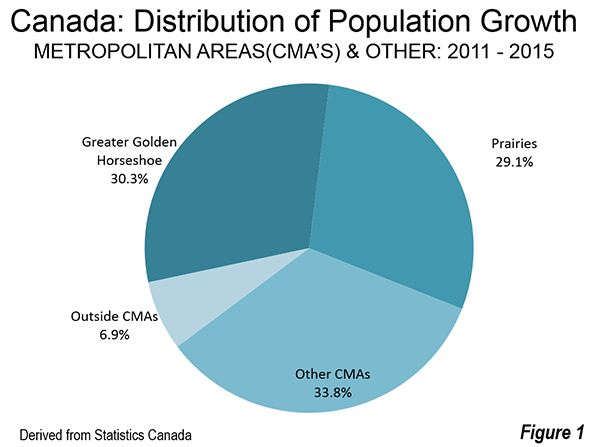
    Between the 2011 census and 2015, the Greater Golden Horseshoe accounted for 30.3 percent of the national population increase (Figure 1). The five Prairie Province metropolitan areas had 29.1 percent of the growth.

    Growth in the Greater Golden Horseshoe was above its national share of the population of 25 percent. The Prairie Province CMA growth was more than 2.5 times its population share, which was less than 11 percent in 2011.

    The CMAs outside the Greater Golden Horseshoe and the Prairie Provinces accounted for approximately 34 percent of the growth, somewhat more than their 30 percent share of the population. Areas outside the CMA’s accounted for only seven percent of the growth, a fraction of their 34 percent population share. This is a continuing indication that the metropolitan areas continue to draw more of the population growth.

    Changing Distribution of Growth

    The last decade and a half has seen substantial changes in the distribution of CMA growth. Between 2001 and 2006, the Golden Horseshoe metropolitan areas welcomed 40 percent of Canada’s population growth, well above the 30 percent over 2011 to 2015. At the same time, the Greater Golden Horseshoe reduction in the share of growth has been compensated by the gain in the Prairie Province metropolitan areas. Between 2001 and 2006, the share of national growth was 19 percent, which rose to 29 percent over 2011 to 2015.

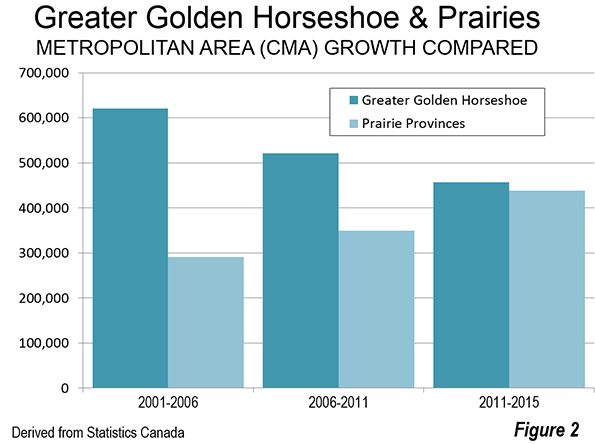
    The population growth rate has slowed considerably in the Greater Golden Horseshoe metropolitan areas, from 1.7 percent annually between 2001 and 2006 to 1.1 percent between 2011 and 2015. Growth has risen considerably in the Prairie Province metropolitan areas, from 1.2 percent annually between 2001 and 2006 to 2.8 percent between 2011 and 2015. Numerically, the Prairie Province metropolitan area growth is now challenging that of the Greater Golden Horseshoe, despite the latter’s more than twice as many residents (Figure 2).

    Winnipeg’s would pass Québec in population by the 2021 census, if the growth rates of the last four years continue and would become the 7th largest metropolitan area.

    Fastest Growing Metropolitan Areas

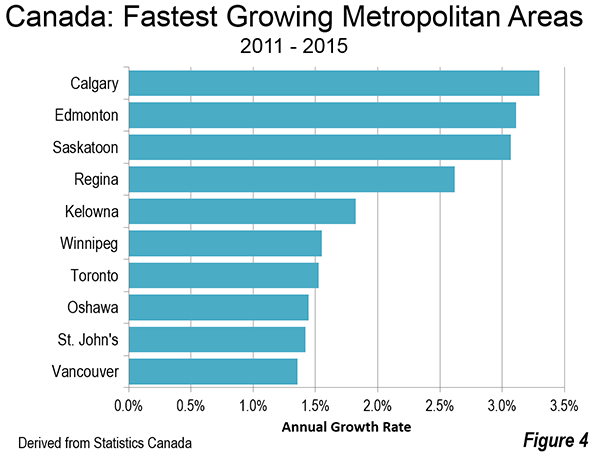
    Five of the six fastest growing metropolitan areas between 2011 and 2015 were in the Prairie Provinces. Calgary, Edmonton and Saskatoon topped the list, growing more than three percent annually (Figure 3). This is an extraordinary rate, better than three times the national growth rate. Regina grew 2.5 percent annually. Over this period, Calgary and Edmonton have both grown larger than Ottawa-Gatineau, which had been the fourth largest CMA for at least 40 years. One can expect growth in the two Alberta cities to slow with the decline in energy prices,  while the other prairie metropolitan areas, less oil dependent, though resource dependent, should do better.  

    Winnipeg, which was the nation’s fourth largest metropolitan area until 1961 and nearly as large as Vancouver as late as 1931, has begun once again  to grow more quickly, after decades of lackluster growth. Having slipped to 8th largest by 2001, Winnipeg ranked sixth in growth since 2011, trailing only the four other Prairie Province metropolitan areas and fast growing Kelowna, BC (1.8 percent annual growth). Unusually, Winnipeg’s growth rate exceeded that of Toronto between 2011 and 2015. Winnipeg’s annual growth rate was 1.6 percent, more than double its 2001-2011 growth (0.7 percent). Should Winnipeg’s growth continue at the most recent rate through the 2021 census, it could exceed the population of the Québec CMA and would trail only the six metropolitan areas with more than 1,000,000 population.

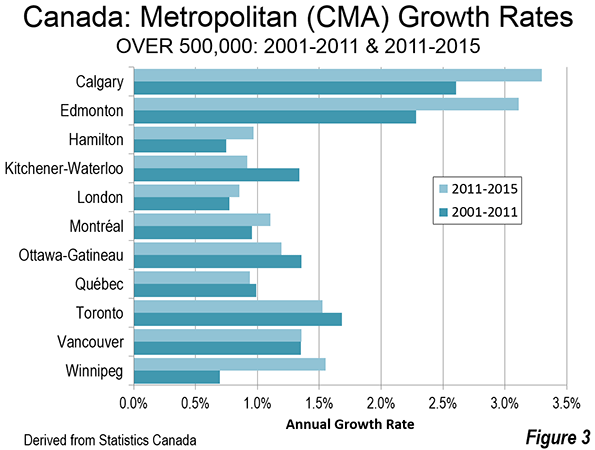
    The changing growth rates of the largest CMAs is indicated in Figure 4, which indicates the rising growth rates in the Prairie province metropolitan areas, with more mixed performance among the other larger CMAs.

    Largest Metropolitan Areas

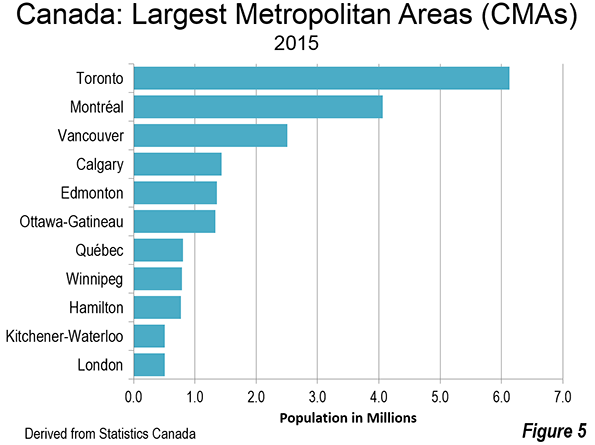
    Canada has eleven metropolitan areas with more than 500,000 residents. Toronto remains by far the largest, at more than 6 million and seems unlikely to be challenged in the foreseeable future. Montréal is closing in on 4.1 million, while Vancouver has just passed 2.5 million (Figure 5).

    The Future

    Canada’s fastest growing metropolitan areas also face the greatest growth challenges. The energy downturn has been particularly rough on Calgary and Edmonton, exacerbated by the disastrous Fort McMurray fire. There was a noticeable downturn in growth between 2014 and 2015 in both CMAs, yet only Kelowna grew faster in the last year. Other Prairie province metropolitan areas, less impacted by the energy decline, have seen their population growth rates fall. The growth rate was one third less than the 2011 to 2015 rate in Saskatoon and about 30 percent less in Regina between 2014 and 2015. Winnipeg fared best, maintaining 90 percent of its 2011-2015 growth rate.

    Other metropolitan areas face challenges every bit as complex. The economic dynamo of Toronto should continue to grow, though has faced strong domestic out-migration between 2004 and  2014, as the population disperses to outer metropolitan areas in the Greater Golden Horseshoe and outside Ontario altogether (See: "Moving from Canada’s Biggest Cities"). Montréal also experienced strong domestic migration losses, with half moving to other parts of Québec and half to other provinces. Vancouver, despite its incomparable attractiveness is also losing net domestic migrants. In all three metropolitan areas, the rising cost of living seems likely to be a major factor in the losses, with "tanking" housing affordability the apparent cause. Vancouver now ranks as the third least affordable major metropolitan area among 87 in the nine nations covered by the Demographia International Housing Affordability Survey, while Toronto’s house prices have risen at more than four times average household incomes since 2001 (see the Frontier Centre policy report: "Canada’s Middle-Income Housing Affordability Crisis"). House prices escalated almost as much in Montréal.

    With the outcomes of these conflicting influences unclear, Canada’s metropolitan area growth could go in different directions. This could range from growth patterns that are similar in the coming years, to the continued discovery by households of smaller metropolitan areas, a higher quality of life is possible because of the lower cost of living. This, has already been evident in the smaller metropolitan areas of Ontario and Québec, as households have been exiting Toronto and Montréal. Meanwhile, Canada is in the midst of its every five year census for 2016, the results of which should be available in seven months (February 2017).

    Photo: North Saskatchewan River from Edmonton central business district (by author).

    Wendell Cox is principal of Demographia, an international pubilc policy and demographics firm. He is a Senior Fellow of the Center for Opportunity Urbanism (US), Senior Fellow for Housing Affordability and Municipal Policy for the Frontier Centre for Public Policy (Canada), and a member of the Board of Advisors of the Center for Demographics and Policy at Chapman University (California). He is co-author of the "Demographia International Housing Affordability Survey" and author of "Demographia World Urban Areas" and "War on the Dream: How Anti-Sprawl Policy Threatens the Quality of Life." He was appointed to three terms on the Los Angeles County Transportation Commission, where he served with the leading city and county leadership as the only non-elected member. He served as a visiting professor at the Conservatoire National des Arts et Metiers, a national university in Paris.

  • Homesteading Detroit

    I was in Detroit recently for the Congress for New Urbanism, the Strong Towns gathering, and a Small Developers Workshop. I used Airbnb instead of the corporate hotel option while in town.


    c5c26459-7aac-4bb9-8551-4f32bbe3ee04

    IMG_3272 (1024x683)

    3d8901d3-8940-41c7-b3ee-3f1ab363ef85

    dc613c34-9a0e-4703-a6b2-f617c096ad49

    e295af4c-4a56-4511-8a36-f51d779bff0a

    66b0716b-00d9-4a6c-bff8-248ad7e70d50

    dff01bb7-2176-4b01-8a4c-60199b81f376

    IMG_3340 (1024x683)

    This is what $13,000 buys you in Detroit. Well… $13,000 and four years of blood, sweat, and tears. Detroit allows people with the right attitude to substitute personal effort for money. This solid brick century old duplex is within bicycle distance of downtown and it came with the adjacent vacant lots. This young couple paid cash from savings and is homesteading in the city. They live upstairs and rent out the downstairs to visitors like me.

    IMG_3251 (1024x683)

    IMG_3261 (1024x683)

    IMG_3132 (1024x683)

    IMG_3188 (1024x683)

    When people have a spacious comfortable place to live with no rent or mortgage they have time to pursue their real interests. Gardening, woodworking, metalworking, fashion, painting…

    IMG_3087 (1024x683) (2)

    87333c7d-b83c-488e-942c-0de9c1ac2d9d

    58e21315-c170-4107-b1ac-9a446e914272

    IMG_3229 (1024x683)

    IMG_3203 (1024x683)

    Instead of taking jobs that would chain them to someone else’s schedule and values the couple continuously cultivates small ventures from their home. The internet allows them to reach out to a global customer base with their Frontier Industry.

    IMG_4695 (1024x683)

    IMG_4702 (1024x683)

    IMG_4795 (1024x683)

    IMG_4782 (1024x683)

    IMG_4709 (1024x683)

    I’ve said this before. I’ll say it again. If you’re tired of spending $1,000 a month for your share of a rented two bedroom apartment with five room mates in Brooklyn or San Francisco… do what Americans have always done. Hitch up your Conestoga wagon and head out to the territories. It’s a big country. Be a pioneer.

    John Sanphillippo lives in San Francisco and blogs about urbanism, adaptation, and resilience at granolashotgun.com. He’s a member of the Congress for New Urbanism, films videos for faircompanies.com, and is a regular contributor to Strongtowns.org. He earns his living by buying, renovating, and renting undervalued properties in places that have good long term prospects. He is a graduate of Rutgers University.

  • Outer California: Sacramento Sends Jobs (and People) to Nashville

    A reader comment on a feature by John Sanphillipo (“Finally! Great New Affordable Bay Area Housing! Caught my eye.”). The comment ("You shouldn’t have to go to Nashville") expressed an understandable frustration about the sad reality that firms leaving coastal California often skip right over the Central Valley “where the housing costs are reasonable, there are some lovely old homes on tree lined streets, the humidity is less, the mountains are nearby, and you can drive there in 2-3 hours rather than fly.”

    Would that it were true. In fact, as this article will show, housing costs are anything but reasonable, given the median income, in the Central Valley, which along with the rest of the non-coastal portion of the state, will be referred to as Outer California in this article.

    California Housing Affordability: Into the Abyss

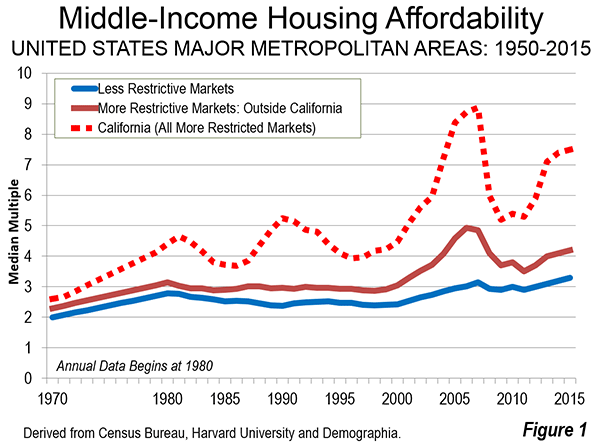
    California’s severely unaffordable housing is legendary, having escalated from approximately the average national price to income ratio in 1970. This is most evident in the four largest coastal metropolitan areas, Los Angeles, San Francisco, San Diego and San Jose. Out of the 87 major markets (over 1 million population) in nine nations, these markets ranked fourth, seventh and in a ninth place tie for the least affordable 8n the 12th Annual Demographia International Housing Affordability Survey. Their median multiples (median house price divided by median household income) required from 8.1 to 9.8 years income to purchase the median priced house. This compares to the affordability of these and other California markets which had median multiples of approximately 3.0 or less in 1970 and in prior years (Figure 1).

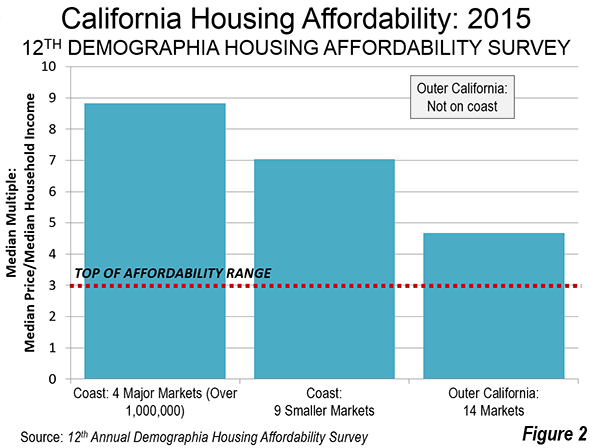
    The housing unaffordability of these markets, with an average median multiple of 8.8 is rivaled by the smaller coastal markets (such as Monterey County, San Luis Obispo, Santa Barbara and Ventura County), with their median multiple of 7.0. Both market categories are rated as severely unaffordable. But housing has become seriously unaffordable even in Outer California, where the average median multiple is 4.7(Figure 2). House prices have been escalating relative to incomes in Outer California since the housing bust, before which their housing affordability was even worse than now (below).

    Housing Affordability in Outer California

    A few examples will make the point. Riverside-San Bernardino, and exurban metropolitan area adjacent to Los Angeles had a severely unaffordable median multiple of 5.2 in 2015. Sacramento, had a seriously unaffordable median multiple of 4.7. Both of these major metropolitan areas reached far higher median multiples in the run-up to the housing bust, with Riverside San Bernardino reaching 7.6 and Sacramento reaching 6.6.

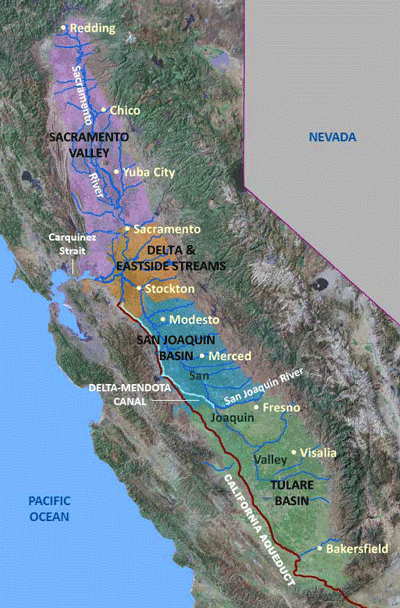
    But the problem is by no means limited to the largest metropolitan areas. Stockton, now officially a part of the larger San Jose-San Francisco combined statistical area as a result of a housing cost driven exodus of commuters from the Bay Area has a severely unaffordable median multiple of 5.3. Things were much worse in the run-up to the bust, at 8.6. Even long depressed Fresno, far from either the Bay Area or Los Angeles, is nearing severe unaffordability, with a median multiple of 5.0 and reached 7.2 during the bubble. More remote Chico, one of the smallest US markets in the Demographia survey also has a median multiple of 5.0 (see Central Valley map at the top).

    Modesto, a 2020 candidate for addition to the San Jose – San Francisco combined statistical area due to the overspill of households seeking houses they can afford, also has a seriously unaffordable median multiple of 4.5. Modesto reached 7.6 during the bubble.

    Among the 29 markets rated in California, the most affordable was Bakersfield, which in a few years is likely to follow Fresno into the over 1 million category. During the bubble, Bakersfield reached a median multiple of 6.6. Small town Visalia, nestled against the Sierra foothills, tied Bakersfield’s most affordable 4.3 median multiple, and reached an astounding 5.8 during the bubble. Hanford also tied for the most affordable.

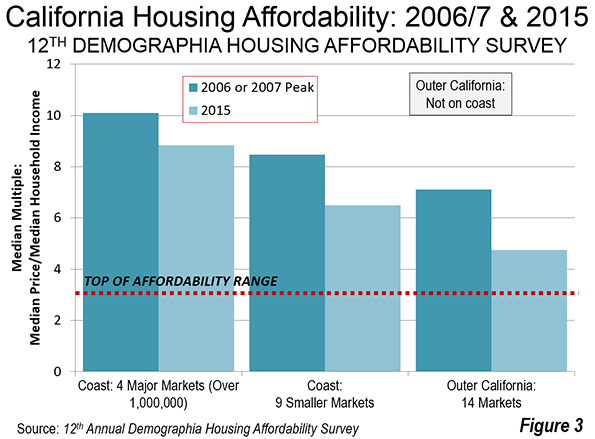
    The comparison to the bubble peaks is particularly important because it illustrates the volatility of housing markets. Even in small markets, house prices are prone to explode when demand exceeds supply, due in large part to land use regulatory and environmental law structure that restricts housing even in more remote areas,   driving prices up (See William A. Fischel, Regulatory Takings). Figure 3 shows that California house prices in each of the three geographic categories were even more unaffordable during the bubble than today.

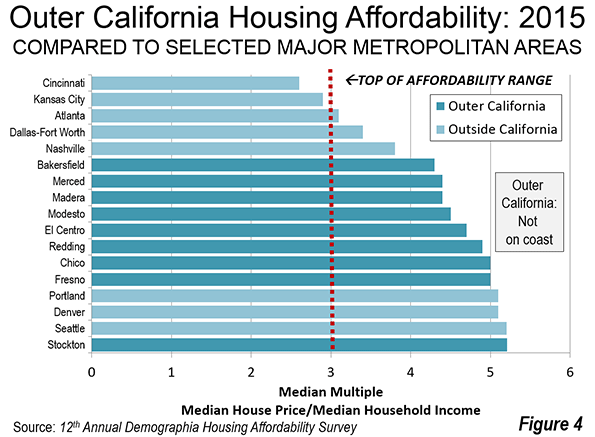
    Even at their current housing affordability levels, the housing markets of Outer California are considerably overpriced. This is indicated by Figure 2, which compares the median multiples in Stockton, Fresno, Bakersfield, Modesto, Redding, Chico, Merced, Madera and the Imperial Valley’s El Centro with severely unaffordable and overregulated Portland, Seattle and Denver, as well as Nashville and other major markets that are more affordable than any in California (Figure 4).

    Indeed, out of the 231 US markets in the Demographia International Housing Affordability Survey, the 27 California markets represent nearly half of the 58 most expensive.

    Meanwhile, a recent report by Zumper indicated among the 50 largest municipalities in the nation, four of the most expensive seven are also in California, with the city of San Francisco ranked number one, followed   San Jose at third, the city of Oakland at fifth and the city of Los Angeles at seventh. Eight of the most expensive municipalities out of the 100 largest are also in California, such as Palo Alto in the Bay Area, Coronado in the San Diego area and Santa Monica in the Los Angeles area.

    As if the regulatory and legal structure that combined with the artificially higher demand from loose lending policies were not enough, barely a decade later California is in the process of implementing one of the most radical land-use regulatory structure in a liberal democracy. It will be far more difficult in many areas to build the detached housing that is been the mainstay of the state, which already has the highest urban population density in the nation (see: “California declares war on suburbia"). This suggests that housing affordability is likely to worsen further.

    There is good reason for a both companies and middle income households to stay away from or leave California.

    More than Housing Affordability

    But people and businesses are moving to places like Nashville for reasons other than housing affordability. The state could hardly make it more clear that most business is not welcome. For at least 10 years, CEO Magazine has rated California as having the least favorable business climate. With competition like Illinois, Connecticut and New Jersey, to be ranked 50th with such regularity is a notable underachievement.

    Data recently released by the California Manufacturers & Technology Association (CMTA) indicated that California ranked last among the states in per capita attraction of manufacturing investments in 2015. Corporate relocation specialist Joseph Vranich continues to add to a long but for California unfortunate list of companies and jobs that have recently left the state (see: "California companies had for greatness – out of California).

    Of course, California is a beautiful place with one of the best climates in the world. But   millions of people and many companies have found greener pastures in Nashville, Austin, Dallas-Fort Worth, Houston, Charlotte, Atlanta and elsewhere. People will continue to visit, but the exodus is likely to continue.

    Wendell Cox is principal of Demographia, an international pubilc policy and demographics firm. He is a Senior Fellow of the Center for Opportunity Urbanism (US), Senior Fellow for Housing Affordability and Municipal Policy for the Frontier Centre for Public Policy (Canada), and a member of the Board of Advisors of the Center for Demographics and Policy at Chapman University (California). He is co-author of the “Demographia International Housing Affordability Survey” and author of “Demographia World Urban Areas” and “War on the Dream: How Anti-Sprawl Policy Threatens the Quality of Life.” He was appointed to three terms on the Los Angeles County Transportation Commission, where he served with the leading city and county leadership as the only non-elected member. He served as a visiting professor at the Conservatoire National des Arts et Metiers, a national university in Paris.

    Photo: Map of Central Valley (Sacramento Valley to the north, San Joaquin Valley to the south) courtesy of the U.S. Geological Survey

  • Vote For Brexit Explodes the Myth of the Global City-State

    The UK has voted to leave the European Union.

    The Brexit campaign was revealing because it was based on the exact opposite of the urban triumphalist vision that so often dominates the discourse.

    Globalization doesn’t respect borders we’re told. Cities, not provinces or nation-states, are the real actors in the global economy.  Some have fantasized about the Singapore model of the city-state as ideal.  Virtually all mayors express great dissatisfaction about their national governance arrangements. Benjamin Barber even wrote that mayors should rule the world.

    The ultimate vision of this would be an independent, polyglot London, arguably the world’s most truly global city, bestriding the global economy like a colossus.

    Yet most of the London establishment – and 60% of Londoners themselves in the vote – strongly supported the Remain option. They warned of disaster for London if it lost access to the EU single market.

    This more or less demolishes the arguments for the city-state. If London, the world’s ultimate global city, can’t thrive without access to a continental scale de facto state in the EU, there’s little prospect anyone else can either.

    It’s telling that so many city leaders hate their state or national governments, but love supra-national governments like the EU.  The shows that their real desire isn’t to go it alone in the marketplace, but to create replacement governance structures that are more amenable to their way of thinking, that constitutionally enshrine their preferences, and are insulated from democratic accountability.

    What’s more, if London suffers because it loses access to the single market, it shows that borders to matter to globalization, and that states and quasi-states like the EU very much can exert control on global flows. They are not simply helpless in the face of the global marketplace.

    Of course when I say these arguments are destroyed, I only mean that the people advancing them don’t really believe them themselves. We will find out in a real life test to what extent those ideas are actually valid. Will London’s unparalleled global orientation, talent concentrations, unique and specialized functions enable it to thrive outside the EU? Or will it take a permanent hit? (This assumes, of course, that Brexit actually does happen).

    If London does actually continue thriving in the long term, then that would actually back up the city-state idea to some extent, as London will have gone from being part of a gigantic state to a much smaller one. That might suggest that a further devolution to a greater London city-state might be viable after all, if highly unlikely.

    But if London can’t recover from the inevitable turbulence around Brexit, this would show that not only do cities need to be part of states, they need to be part of very large and powerful ones.

    If you think about it, history suggests that is the case to some extent. London is London because it was the capital of the British Empire. Dittos for Paris and Moscow, both imperial capitals. New York isn’t New York just because of its own characteristics – though those do play a role – but because it is the most important city in the world’s most important country. Shanghai and Beijing are coming on strong because they are in China.

    In any event, the city-state theory is going to get something of a trial run, if an imperfect one. Ironically, that real life trial will come over the objections of the city itself, and much of the urbanist class who otherwise preach urban independence.

    Aaron M. Renn is a senior fellow at the Manhattan Institute, a contributing editor of City Journal, and an economic development columnist for Governing magazine. He focuses on ways to help America’s cities thrive in an ever more complex, competitive, globalized, and diverse twenty-first century. During Renn’s 15-year career in management and technology consulting, he was a partner at Accenture and held several technology strategy roles and directed multimillion-dollar global technology implementations. He has contributed to The Guardian, Forbes.com, and numerous other publications. Renn holds a B.S. from Indiana University, where he coauthored an early social-networking platform in 1991.

    Image via Shutterstock

  • The U.S. Cities Where Manufacturing Is Thriving

    Perhaps no sector in the U.S. economy generates more angst than manufacturing. Over the past quarter century, manufacturing has hemorrhaged over 5 million jobs. The devastation of many regional economies, particularly in the Midwest, is testament to this decline. If the information sector has been the golden child of the media, manufacturing has been the offspring that we pity but can’t comfortably embrace.

    Yet manufacturing remains critically important. Over the period from 1997 to 2012, labor productivity growth in manufacturing—3.3% per year—was a third higher than the rest of the economy. Clearly manufacturing is no technological laggard, accounting in 2012 for 68.9% of all R&D expenditures by U.S. businesses and employing 36% of the nation’s scientists and engineers, the largest share of any industry.

    So even as employment has declined or stagnated, the impact of manufacturing on local economies remains profound. Manufacturing has the highest multiplier effect of any sector of the economy. According to the Commerce Department, a dollar of final demand for manufacturing generates $1.33 in output from other sectors of the economy, considerably higher than the multiplier for information ($0.80) and more than twice as high as such fields as retail trade ($0.66) and business services ($0.61). Other estimates place this impact far higher.

    The Midwest Revival

    Our list of the fastest-growing manufacturing regions differs considerably from our rankings of the best cities for jobs overall, and of the strongest information economies. To avoid the distortions and wild swings that can occur in economies with few industrial jobs, we focused on the 48 metropolitan statistical areas with at least 50,000 manufacturing positions.

    As with our other rankings in this series, the list is based on employment growth in the sector over the short-, medium- and long-term, going back to 2005, and we factor in momentum — whether growth is slowing or accelerating. (For a detailed description of our methodology, click here.)

    Manufacturing has enjoyed something of a renaissance since 2009 — after 12 years of declines, it has gained back 828,000 jobs. But like everything in economics, or life, the resurgence has not been equally distributed. In sharp contrast to other areas of the economy, the industrial heartland has some real winners.

    Grand Rapids-Wyoming, Mich., has boosted its industrial workforce by 29% since 2010 to 110,800 workers, with 5.4% job growth last year alone, placing it first on our list. This growth has been very diversified, with many specialty firms engaged not only in auto parts, but also food, aerospace and defense. The metro area seems to be breaking all the shibboleths ascribed to the “Rust Belt” — unemployment dropped to 3.3% this year, population growth and the birthrate are now well above the national average. For most of our strongest manufacturing economies, however, the real driver has been the recent resurgence in automobile sales, which are now at record levels. Despite all the talk of “peak car” a few years ago, with oil prices in the dumps and the population now once again headed to lower-density areas, driving hit a new peak in 2015 in terms of total vehicle miles traveled.

    The next four fastest-growing industrial areas are all auto-dependent, led by second-ranked Elkhart-Goshen, Ind., where the big business is the highly cyclical recreational vehicle industry. Since 2010, industrial employment has grown 37% in the area to 60,500 jobs.

    In No. 3 Louisville/Jefferson County, which abuts the border of Indiana and Kentucky, the industrial workforce has expanded 25.6% since 2010 to 60,500 jobs. Like Grand Rapids, its base is widely diversified. The largest industrial employers include Ford, which makes pickup trucks and SUVs at two plants in the area; GE Appliances, whose sale to China’s Haier was just completed; Publishers Printing and spirits maker Brown-Forman Corp.

    But the big story, and the big numbers, are in the greater Detroit area, where there are roughly 240,000 manufacturing jobs. About 149,000 of them are in suburban Warren-Troy-Farmington Hills, also known as “automation alley,” where the area’s industrial workforce has expanded by 30.6% since 2010, helping it to a fifth-place showing on our list. In fourth place is Detroit-Dearborn-Livonia, where industrial employment surged 27% since 2010.

    High-Tech Centers Rebound

    Although their growth rates are roughly half those of the auto stars that dominate the top of the list, there has been a healthy recovery in manufacturing jobs in traditional high-tech and aerospace-dominated economies, mostly in the west. No. 6 San Diego-Carlsbad, which, like most metro areas, has lost industrial employment over the past decade, has seen a bit of a rebound since 2010, with an 11.5% expansion to 106,700 jobs concentrated mostly in aerospace and nondurable goods.

    No. 7 Denver-Aurora-Lakewood’s industrial workforce has grown 12.7% since 2010 and 3.7% last year alone, while No. 10 Portland-Vancouver-Hillsboro, Ore.-Wash., where Intel recently completed an expansion, has posted industrial job growth of 12.4% since 2010. A $3 billion plant in suburban Hillsboro has spurred a migration of suppliers as well.

    Despite concerns about the loss of electronics manufacturing to Asia, there has even been a small surge in industrial employment in high-cost, highly regulated Silicon Valley. After losing tens of thousands of manufacturing jobs in the wake of the bursting of the dot.com bubble in 2000, No. 19 San Jose-Sunnyvale-Santa Clara has seen a modest 5.9% upsurge in industrial employment since 2010, helped by the growth of electric vehicle maker Tesla, which now employs about 15,000. The Valley will likely never be the industrial powerhouse it was in decades past (today’s manufacturing employment of 161,900 is still 38% lower than the peak in 2000), but, as firms seek to marry digital technology into the “internet of things,” the area may still continue to produce some real goods, likely before any mass production phase, for the foreseeable future.

    The Big Losers: Los Angeles And Chicago

    A large number of manufacturing-rich areas are continuing to lose industrial jobs, often at a rapid rate. Nearly a third of the 100 largest manufacturing metro areas registered declines in employment in the last two years. This year’s worst performer is Newark, N.J., where manufacturing employment is off almost 4% since 2013 and more than 6% since 2010.

    Perhaps even more disturbing has been the decline of the nation’s two largest agglomerations of industrial jobs, No. 43 Chicago-Naperville-Arlington Heights and No. 27 Los Angeles-Long Beach. Chicago’s decline can be traced, at least in part, to the decline of its traditional industries, such as steel and metal fabrication. For decades, many of these jobs have disappeared, moved south or abroad, and the decline continues,  with  jobs down nearly 1.7% since 2010. Since 1990, the area has lost a remarkable 45% of its industrial jobs.

    But if Chicago’s loss can be attributed to the overall decline of the old industrial base, Los Angeles’ steady losses have come from a more modern mix of aerospace, design and specialty manufacturing. Since 2010 — despite the rapid growth in many manufacturing areas — Los Angeles has managed to lose an additional 3.37% of its industrial jobs. Over the past 25 years, the Big Orange has seen its once thriving industrial base fall from 785,400 to 356,100 jobs—a decline of almost 55%. In both Chicago and Los Angeles, the decline of manufacturing has accompanied demographic stagnation, high rates of poverty and mediocre overall job growth.

    Does Manufacturing Actually Matter?

    In many ways, the answer to that question depends on who you are and the structure of your local economy. To be sure, the San Francisco metro area (San Francisco-Redwood City-South San Francisco), despite a mere 35,500 industrial jobs, too few to even make our list, has transformed its economy so dramatically that the loss of industry seems to have had little impact. New York, once a manufacturing mecca, makes the list at No. 30, but now has barely 78,900 industrial jobs. Yet the city continues to outperform most other large metro areas in terms of overall job growth.

    In places where other sectors such as information or business services have picked up the slack, the overall impact has not led to regional decline. The old blue collar workforce may have suffered, but the shift to a post-industrial future has not been disastrous for the overall economy.

    But few places are as glamorous or alluring as New York or San Francisco, with their appeal to the highly educated, foreign capital and millennial workers. As we can see in Los Angeles and Chicago, as well as many places in the middle of the country, manufacturing still matters, and its decline, or resurgence, remains an issue of paramount importance.

    This piece first appeared at Forbes.

    Joel Kotkin is executive editor of NewGeography.com. He is the Roger Hobbs Distinguished Fellow in Urban Studies at Chapman University and executive director of the Houston-based Center for Opportunity Urbanism. His newest book, The Human City: Urbanism for the rest of us, will be published in April by Agate. He is also author of The New Class ConflictThe City: A Global History, and The Next Hundred Million: America in 2050. He lives in Orange County, CA.

    Michael Shires, Ph.D. is a professor at Pepperdine University School of Public Policy.

  • Southern California Still Best place to Get Creative

    Over the past decade, Southern California has lagged well behind its chief rivals – New York and the Bay Area, as well as the fast-growing cities of the Sun Belt – in everything from job creation to tech growth. Yet, in what the late economist Jack Kyser dubbed “the creative industries,” this region remains an impressive superpower.

    By creative industries, we mean not just Hollywood’s film and television complex, which remains foundational, but those serving a host of other lifestyle-oriented activities, from fashion and product design to engineering theme parks, games and food. We may be lagging Silicon Valley in technology and New York in finance or news media, but when it comes to entertaining people, and defining lifestyle, the Southland remains a powerful, even primal, force.

    Overall, according to the Los Angeles County Economic Development Corp., creative industries employ more than 418,000 people in L.A. and Orange counties. This is larger than second-place New York, and more than five times larger than the San Francisco and Seattle regions. Orange County and Los Angeles account for 80 percent of statewide employment in entertainment and fashion. In toys, L.A. and O.C. account for over two-thirds of statewide jobs.

    As a whole, visual- and performing-arts providers have done best in percentage terms, growing by 23.8 percent, followed closely by fine arts and performing-arts schools, with 23.2 percent growth. The SoCal creative economy took a big hit during the recession, when overall employment decreased 14.5 percent, compared with 8 percent for all other industries. But recent trends speak to the resiliency of the region’s creative industries. From 2009-14, employment finally began to grow, even as the rest of L.A.’s economy was still shrinking.

    As other local industries fade, the creative ones become more important, making up a growing share of the regional economy. New research by Chapman University’s Marshall Toplansky and Nate Kaspi found Orange and Los Angeles counties boast among the highest per capita employment in these creative fields of any major region in the country.

    Read the entire piece at The Orange County Register.

    Joel Kotkin is executive editor of NewGeography.com. He is the Roger Hobbs Distinguished Fellow in Urban Studies at Chapman University and executive director of the Houston-based Center for Opportunity Urbanism. His newest book, The Human City: Urbanism for the rest of us, will be published in April by Agate. He is also author of The New Class ConflictThe City: A Global History, and The Next Hundred Million: America in 2050. He lives in Orange County, CA.

    Charlie Stephens is a researcher and MBA candidate at Chapman University’s Argyros School of Business and Economics; he is founder of substrand.com.

  • Dublin Facing Another Housing Bubble?

    In a recent column in the Sunday Independent, Ireland’s largest weekend newspaper, one of Ireland’s leading economists, Colm McCarthy of University College (Dublin) raised the prospect another housing bubble in Dublin, Ireland’s leading weekend newspaper. Dublin is the nation’s capital and home to approximately 40% of the population. This is a potentially serious concern, given the economic devastation that the previous Dublin housing bubble contributed to across Ireland during 2006-2010.

    The Housing and Economic Bust in Ireland

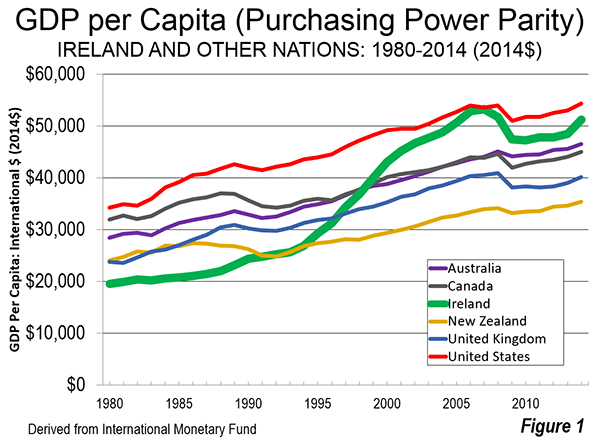
    Ireland suffered one of the worst economic reversals of any nation during the Great Financial Crisis. This had been preceded by Ireland’s impressive economic advance, which had the nation registering a higher gross domestic product per capita-purchasing power parity (GDP-PPP) than even its former colonial overlord, the United Kingdom. Anyone who had predicted in 1960 that Ireland would be more prosperous than the United Kingdom would have been summarily dismissed.

    But the Great Financial Crisis brought an 11.3 percent reduction in GDP-PPP to Ireland between 2006 and 2010. This was nearly double the reduction in the United Kingdom (6.0 percent). The loss was nearly three times the peak to trough decline in the United States (4.0 percent). Unemployment reached above 15 percent and Ireland required bail-out loans totaling €67.5 billion ($75 billion or C$95 billion) from the European Union and the International Monetary Fund.

    Happily, however, Ireland has struggled back and now has nearly reached its peak 2006 GDP-PPP. But as in the United States and elsewhere, restoration of previous levels of prosperity at the national level has not made whole many of the individual victims of the downturn (Figure 1).

    Urban Containment Policy and Higher House Prices

    In a previous Sunday Independent commentary, McCarthy noted asserted  Ireland’s land use regulations had been an important contributor to the housing bubble (see: “Urban Containment and the Housing Bubble in Ireland”).

    Ireland’s planning regulations have been copied and imported from the British Town and Country Planning Act of 1947, which have been largely responsible for the continuing and worsening housing crisis in the United Kingdom. In Ireland, as in the United Kingdom, these regulations deny planning permission to suburban locations. McCarthy attributes the "dysfunctionality of the housing market" in Dublin to such land use restrictions, which are called "urban containment” as well as other terms (such as growth management, smart growth, livability, compact city policy, etc.).

    McCarthy notes that the housing shortage in Dublin is not caused by a lack of housing so much as it is by restrictions imposed by planners (planning permission), which slows the pace of home building. This policy environment drives house prices up, which reduces household discretionary incomes and results in a lower standard of living than would have occurred without urban containment.

    Urban Growth Boundaries

    As elsewhere, Ireland’s urban containment policies seek to minimize the urban footprint (urban land area) by rationing land for housing development, often by urban growth boundaries. Urban growth boundaries come in various forms, such as lines around cities that forbid new urban residential development on the outside, euphemistic "growth areas," usually small and  inadequate, outside of which building is not permitted. This includes the apparent intention very difficult to build new detached housing on the urban fringes in California metropolitan areas, with a strong policy preference for high density, transit oriented development. Urban growth boundaries may be urban containment’s "killer app."

    The problem is that restricting the supply of any good or service (such as land for housing) leads to higher prices as demand swamps supply (other things being equal). A similar relationship between supply restrictions and higher prices can be seen in the fluctuating price of oil, based especially on OPEC production decisions, the large increases in banana prices in Australia, when periodic cyclones produce shortates by devastating crops.

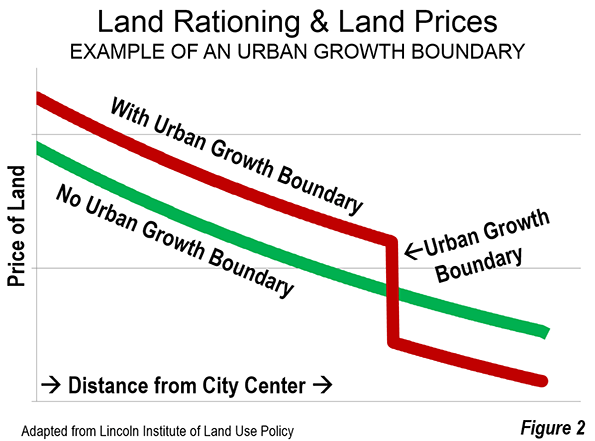
    Urban growth boundaries and related land rationing strategies are associated with huge price differentials between land that may or may not be developed. In Auckland and Portland, virtual “across the street” land values vary on average by 10 or more times at the urban growth boundary. In the United Kingdom, differences of hundreds of times have been cited in the UK by London School of Economics researchers Paul Cheshire, Max Nathan and Henry Overman. The impact of urban growth boundaries on land within a metropolitan area is illustrated in Figure 2. The theoretical economic relationship is that land prices are forced higher within the urban growth boundary, while declining to the outside, where development is severely restricted (other things being equal, with the assumption that the urban growth boundary is “binding,” or strongly enforced).

    Not surprisingly, urban growth boundaries are the most common feature of the severely unaffordable housing markets (where the median multiple exceeds 5,0) in the 12 annual editions of the Demographia International Housing Affordability Survey.

    The Next Housing Bubble?

    McCarthy details rising land and house prices in the Dublin area that have largely driven first time home buyers out of the Dublin area. Many are being forced to buy housing that is affordable 70 to 80 kilometers (35 to 40 miles) away. This requires “a daily commute of up to two hours through the vacant countryside. “McCarthy refers to the "huge rolling prairies of land that can be found north and west of the ring road” (The M-50 belt route) on which new housing could be built as close as 10 to 12 km from the city center (6 to 7 miles).

    The locations McCarthy refers to could easily shelter households in less expensive housing, without the necessity of long commutes, producing, ironically, perhaps  less of the dreaded “sprawl”.

    Not surprisingly, rents in Dublin are now reported to be higher than at the peak of the property bubble. Further, the problem is spreading to other parts of the country. In Cork, with its burgeoning information technology growth, with firms like Apple and Pay Pal, there are concerns that the shortage of housing could limit further business expansion.

    Needed Reform

    A Dublin and an Ireland interested in not repeating the devastating economics of a decade ago would be wise to heed economist McCarthy’s advice. He calls for cheaper housing, which requires “the zoning for residential development of the very large volume of derelict and undeveloped land in the Dublin area.” Ireland’s middle-class needs more jobs, but it also needs lower house prices to maintain its affluence.

    Photograph: Dublin by Barcex (Own work) [CC BY-SA 3.0], via Wikimedia Commons

    Wendell Cox is principal of Demographia, an international pubilc policy and demographics firm. He is a Senior Fellow of the Center for Opportunity Urbanism (US), Senior Fellow for Housing Affordability and Municipal Policy for the Frontier Centre for Public Policy (Canada), and a member of the Board of Advisors of the Center for Demographics and Policy at Chapman University (California). He is co-author of the “Demographia International Housing Affordability Survey” and author of “Demographia World Urban Areas” and “War on the Dream: How Anti-Sprawl Policy Threatens the Quality of Life.” He was appointed to three terms on the Los Angeles County Transportation Commission, where he served with the leading city and county leadership as the only non-elected member. He served as a visiting professor at the Conservatoire National des Arts et Metiers, a national university in Paris.

  • What Happens When There’s Nobody Left to Move to the City?

    Following up on the Pew study that found many states will face declining work age populations in the future, I want to highlight a recent Atlantic article called “The Graying of Rural America.” It’s a profile of the small Oregon town of Fossil, which is slowly dying as the young people leave and a rump population of older people – median age 56 – begin to pass on.
    Like the Pew study, this one has implications that weren’t fully traced out.

    There’s a lot of urban triumphalism these days, as cities crow about Millennials wanting to live downtown and such.

    But the dirty little secret is that a lot of these places have been growing their youth populations by hoovering up the children of their hinterlands. To the extent that urban population growth is dependent on intrastate migration in these states with declining working age populations, at some point there are just plain going to be a lot fewer youngster to move to the big city. That will start to crimp urban population dynamics.

    Indianapolis is a poster-child for this.  About 95% of the metro area’s net migration has come from elsewhere in the state of Indiana since 2000, according to IRS tax return data.

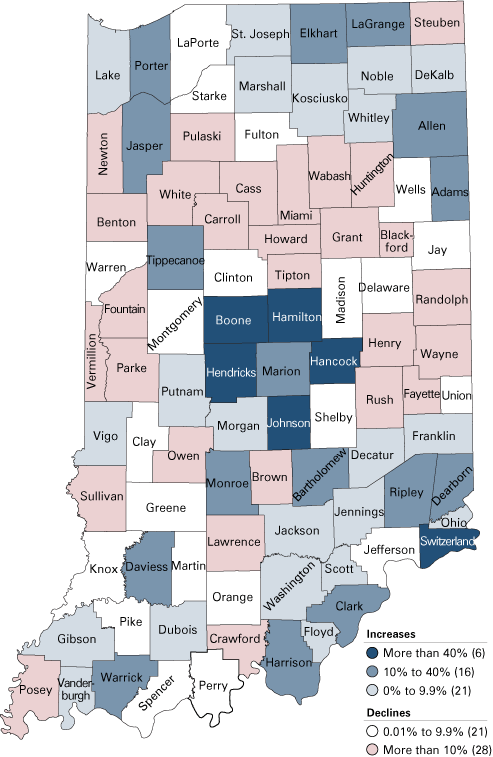
    Looking at the future, about half of the states counties (49 out of 92) are projected to actually lose population by 2050. Here’s the map from the Indiana Business Research Center.


    Projected population change in Indiana counties, 2010-2050. Source: Indiana Business Research Center

    The entire state is only projected to add 100,000 15-44 year olds by 2050. Even if 100% of them, or even more than 100% of them, are in Indianapolis, this still implies a fairly modest growth rate.

    Given the projected demographics of its migration shed, we should expect Indianapolis to start seeing a falloff in migration. In fact, we are already seeing it. Indy was previously the Midwest champ in net domestic in-migration, but recent Census Bureau estimates show a fall-off.

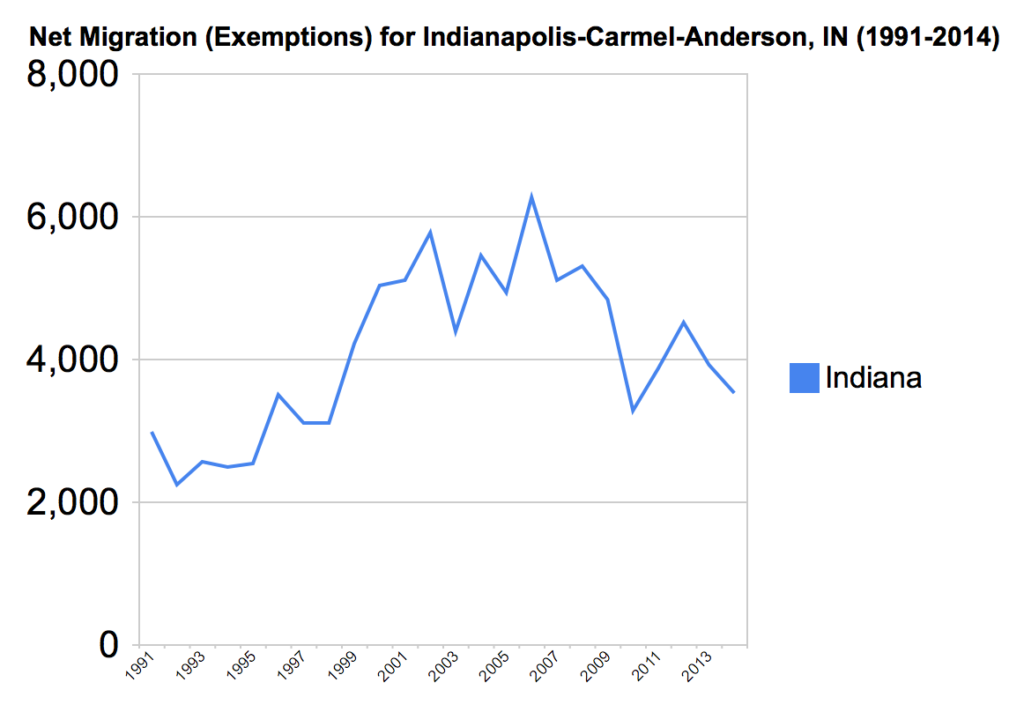
    Here’s what the IRS migration data says about net migration into Indy metro from the rest of the state.

    Net migration into metro Indianapolis from the rest of the state, 1991-2014. Source: Aaron Renn analysis of IRS county to county migration data

    There was a spike up starting around 1997, the dawn of the dotcom era. This more or less corresponded with the rise of the city talk. (Richard Florida’s Rise of the Creative Class came out in 2002).

    During the 2000s, Indianapolis was the Midwest growth champ, and killed it on net domestic migration. This graph helps explain why.

    But starting around 2010, inbound migration from the rest of the state has fallen off. I don’t want to claim this is entirely demographic related. Migration declined nationally during the Great Recession. And there were some methodology tweaks in this data during that time. But we can see already in the numbers what happens to metro growth if migration from the rest of the state slows down.

    At some point, the decline of rural and small manufacturing counties is going to have to show up in the migration numbers to cities like Indy. Other cities that draw primarily from a national base – like Nashville or Dallas – will be less affected.

    But cities that are dependent on a regional migration shed need to start doing the math on how the decline of their hinterlands will affect them.

    The collapse of rural and small manufacturing economies may have been good for cities in the short term, but those cities might discover down the road that they ended up eating their seed corn.

    Aaron M. Renn is a senior fellow at the Manhattan Institute, a contributing editor of City Journal, and an economic development columnist for Governing magazine. He focuses on ways to help America’s cities thrive in an ever more complex, competitive, globalized, and diverse twenty-first century. During Renn’s 15-year career in management and technology consulting, he was a partner at Accenture and held several technology strategy roles and directed multimillion-dollar global technology implementations. He has contributed to The Guardian, Forbes.com, and numerous other publications. Renn holds a B.S. from Indiana University, where he coauthored an early social-networking platform in 1991.