Category: Urban Issues

  • America’s Software And Tech Hotspots

    Where is America’s tech and software industry thriving? In a new study conducted for the San Diego Regional Economic Development Corp., researchers took an interesting stab at that question, assessing which metro areas have the strongest concentrations of software developers, spread across a broad array of industries, as well as the best compensation and job growth, and access to venture capital funding.

    What they found is a geography dominated by traditional tech centers, particularly those with strong universities. The San Jose, Calif., metro area and Seattle led the way, followed by San Francisco and Boston. The back half of the top 10 is a bit more surprising, featuring Baltimore, Atlanta and Washington, D.C.

    All these metro areas have outsized concentrations of software developers compared to the national average. San Jose boasts an unparalleled concentration of talent, with 69.7 software developers per 1,000 employees, five times the average among the nation’s 50 largest metro areas. Seattle runs second with a concentration of 38.3 per 1,000 workers.

    These areas tend to have different areas of expertise. Software is now critical to many industries; not just computers, but also manufacturing, finance and services. In places like Washington and Baltimore, much of the work is related to the federal government, as is also true for seventh-ranked San Diego, which has long had a major military presence. The Bay Area, of course, dominates fields such as new media, search and computer systems design. In San Diego they tend to work in scientific research much more than their counterparts elsewhere in California.

    These ratings matter not so much in terms of the number of jobs — software publishers have added a net of 50,000 jobs since 2001, up 19%. Yet as software use has grown, there has been impressive growth across the board in the number of programmers: According to EMSI, the profession has added 350,000 jobs since 2003, 27 percent growth. Jobs in this category also carry a decent paycheck, with a median hourly wage of $44. In 2015, notes the San Diego report, software firms received $23.8 billion in venture capital—a 400% increase in investment since 2010.

    Greater Concentration Or Decentralization?

    Clearly metro areas like San Diego have good reason to sell themselves as software hotspots; the industry has grown three times faster in employment than the overall economy and expects 18.1 percent growth this year.

    But not all hotspots are equal, which is also true of tech in general. Indeed, according to EMSI data, the share of high-tech employment in the Silicon Valley/San Jose area’s economy  is more than six times the national average. Others that rank more than twice the national average include Washington D.C., San Francisco, Seattle, Boston, Raleigh and Austin, who are also our leaders in software. Others on the software list, such as San Diego, are above the national average, but only slightly – San Diego’s overall share of tech jobs relative to the national average has actually declined since 2001.

    Clearly metro areas that have had long-established tech communities do well, but perhaps this may prove not so much the wave of the future but the resonance of the past. In fact, if we look at which areas are having the most tech growth, many are not what would be widely considered tech hubs. Indianapolis, for example, has seen a 102 percent growth since 2001 in tech jobs while Las Vegas, Jacksonville and Nashville have seen strong growth of over 80 percent or more, and each has boosted its share of jobs in tech dramatically.

    But perhaps the most critical advantage is to those areas which have both high concentrations of tech jobs and also rapid growth. These areas would seem best positioned to advance in the coming years and include some of the study’s software superstars. Austin for example has expanded tech employment since 2001 by 89% and boosted its location quotient (the ratio of local share to national share of jobs in a sector) for tech employment from 2.14 to 2.32. Raleigh, San Francisco and Seattle have also expanded both in relative and absolute tech employment.

    Essentially we may be witnessing two parallel, and notionally conflicting developments, notes analyst Mark Schill of the Praxis Strategy Group. There are clearly a series of regions, as identified by the report, that have achieved critical mass in software and across many other tech fields. Yet at the same time, the most rapid growth is taking place largely in non-traditional tech hubs, including places like Salt Lake City, San Antonio, and Phoenix, all seeing rapid growth in tech jobs as well as a growing concentration.

    Big City Tech Bust

    The software study also reveals something that might not please many advocates for an urban-centered tech world. Despite their strident efforts to promote themselves as tech and software centers, our three largest cities — New York, Los Angeles and Chicago — have not fared terribly well. The one dense urban center that has seen rapid growth in terms of tech jobs and share has been the San Francisco-Oakland area, which has the advantage of being located next to Silicon Valley and the dominant centers of venture capital. The region also includes parts of the Peninsula, like San Mateo, that have emerged as important suburban tech hubs.

    In Los Angeles, the decline of the aerospace industry has stripped away its primary tech anchor. L.A., Chicago and NYC have posted average tech growth. If all the hype ascribed to “Silicon Alley” or “Silicon Beach” were matched by their performance, the numbers would look very different.

    This can be seen by comparing growth in software jobs, an area where dense urban areas are widely held to have big advantages. Between 2010 and 2014 software employment expanded only 13.6 percent in New York, and 11.7 percent in Los Angeles, compared to the median growth of 13.4 percent.

    This parallels their less than spectacular performance in our analysis of EMSI tech employment. Despite the almost endless discussion of Gotham as tech job hub, New York’s tech growth since 2001 has been a below average 27% while its tech locational quotient has dropped from 1.15 to 1.06, roughly the national average. Chicago did even worse, growing just 24% and actually seeing its locational quotient drop to 0.98, below the national average. But the big loser has been Los Angeles, once a premier tech hub, but clearly losing its edge. Since 2001 L.A. has managed only 9 percent tech growth and its relative concentration in tech jobs has fallen to 0.74, well below the national average.

    Looking Ahead

    The San Diego study, as well as our own analysis, suggests a diverse future for software and other tech related fields. First, there are the clear winners — places like San Francisco, Silicon Valley, Raleigh, Seattle, Austin — which continue to add both new jobs and boost their share of tech and software employment. Areas like these enjoy both momentum and critical mass, which all but guarantees a prosperous future for these metro areas as software comes to dominate more of our lives, and other industries.

    The second group, which includes key players like San Diego and Boston, will be fighting to hold onto their positions. They have experienced some growth, but their share of tech jobs has been falling and they may not have the momentum to make up for other disadvantages such as high housing prices and taxes. Such things may not slow superstar cities like San Francisco, but they seem to take some of the wind out of the sales of these less dynamic tech centers.

    Third, and most troubling, will be those places like New York and Los Angeles where the tech economy is often hailed as a savior, but does not seem, in relative terms, to be living up to the feverish advertising. Here high housing prices may be exacting a strong toll on the workforce. NYC and L.A. are both among the bottom six in terms new jobs in STEM (science, technology, engineering and mathematics-related positions); both actually have lost such workers since 2001, and now have workforces considerably less skilled in tech fields than the national average.

    Finally, and this is not something widely acknowledged, has been the strong gains of less expensive, less heralded cities. They do not always have above average concentrations of tech and software workers, but are experiencing impressive gains. Take Phoenix, where tech employment has expanded 78 percent since 2000, while software employment has grown 28.8 percent since 2010. Phoenix’s tech location index is, remarkably, now higher than that of Los Angeles. Other, not widely appreciated big gainers in software include Nashville (43.5 percent gain), Atlanta (48.6 percent) and Charlotte (up 42 percent).

    Given the ability of software firms to locate where they wish due to the intrinsic nature of their industry, we should expect not just consolidation to continue in certain markets, but also a simultaneous rapid dispersion of tech jobs. Yet neither the agglomeration nor the dispersion is likely to be evenly distributed. Among the nation’s 53 largest metropolitan areas, just 20 saw their relative concentrations of high-tech employment increase since 2001. Mapping the future of tech and software employment will need to consider both factors and those regions which fit neither the low-cost model or that of the hyper-concentrated area may need to sit and reconsider how they can get back into the digital game.

    This piece first appeared in Forbes.

    Full List: America’s Top 10 Software Hotspots (Forbes slideshow)

    Joel Kotkin is executive editor of NewGeography.com. He is the Roger Hobbs Distinguished Fellow in Urban Studies at Chapman University and executive director of the Houston-based Center for Opportunity Urbanism. His newest book, The Human City: Urbanism for the rest of us, will be published in April by Agate. He is also author of The New Class ConflictThe City: A Global History, and The Next Hundred Million: America in 2050. He lives in Orange County, CA.

  • Liberals — Except When it Comes Home

    My old boss, Bruce Brugmann, who ran the Bay Guardian, told me early on in my career that you could tell the real politics of a big-city newspaper by the person they endorse for mayor.

    Nice liberal outfits like the New York Times support Democrats for president and (typically) governor and US Senate. The SF Chronicle doesn’t endorse many Republicans any more. But when it comes to the local stuff, the decisions on who should run the city where they live and operate and connect with the power structure, the truth comes out.

    The Times loved Ed Koch and backed Michael Bloomberg. The paper didn’t endorse Bill DeBlasio in the Democratic primary. The Chron backed Dianne Feinstein, John Molinari, Willie Brown, Gavin Newsom, and Ed Lee.

    There’s a perception that cities like SF, because they tend to vote overwhelmingly for Democrats, and send Democrats to the state Legislature and Congress, are by nature progressive communities. And that all breaks down when it comes to local issues, particularly when they involve real estate.

    The biggest Democratic Party donors in SF in the 1980 and 1990s were the members of the Shorenstein family, who hosted Bill Clinton at their home. They were also big downtown developers who spent that same Democratic money blocking any attempts to development limits.

    Our Democratic member of Congress, Nancy Pelosi, is either missing or on the wrong side on pretty much every land-use and development issue back at home.

    Gavin Newsom, who wants to be the next governor of California, got his start in local politics attacking homeless people.

    In other words, the gentrification and displacement in San Francisco is happening despite, and I could argue with the concurrence of, some of those “liberal” Democrats who, from a distance, seem much more progressive than they are when you look at their records right here at home.

    So we get what I call the David Chiu phenomenon – a person who pushed and promoted legislation backed by and in part written by Airbnb, which has driven thousands of housing units off the market, gets seen as a San Francisco progressive when he’s away in Sacramento.

    You can tell what a newspaper really thinks by its endorsement for mayor. And you can tell what a politician really thinks by what they do on the local issues that pit the power structure (in this case, tech, real estate, and the mayor) against the rest of the community.

    Which brings me, more or less, to Paul Krugman, the great liberal economist of the New York Times.

    Krugman is great on a lot of big national economic issues. He’s terrible when it comes to cities.

    The guy famously came out against rent control years ago, when any urban economist with any sense knows that rent control is one of the most powerful tools agaist displacement. It’s what makes an urban middle class possible in a city like San Francisco.

    And now he’s saying that cities need to reduce zoning rules and allow more housing, or any height, pretty much anywhere. He praises the idea that NY Mayor DeBlasio is pushing, which is similar to what SF Mayor Lee is pushing, which in essence cedes to the private market the responsibility to provide affordable housing and assumes that some modest percentage of “affordable” units in luxury towers that are geared to the same crooks and despots now in the news will be a real solution to the urban housing crisis.

    I shouldn’t have to keep saying this, but I will: You need to build at least 30 percent affordable housing in every luxury project just to stay even, and not make things worse. Which means if you want to add to the stock of affordable housing, you have to force developers to build 40, 50, 60 percent of the units for people of more modest means.

    That’s not even on the agenda in SF or NYC.

    If we took Krugman’s national approach – the rich ought to pay more taxes to pay for investment in the nation’s service and infrastructure – and applied it to cities, you’d get a very different approach. Urban developer profits have created great fortunes (Shorenstein, Trump); to a great extent, local governments have failed to tax those profits at a level that’s necessary to mitigate the impacts of their projects.

    Krugman ought to know that the middle class in an American city is not a natural consequence of capitalism. It requires strict regulations and controls. It means, sometimes, slowing down the booms that make a few rich so that the rest of us have a chance, too.

    That’s perfect liberalism, in the old school. Except that these great scholars and writers (and politicians) don’t seem to want to bring those policies back home.

    Author Tim Redmond, the former longtime editor of the San Francisco Bay Guardian, edits the online San Francisco publication 48 hills.

    This piece originally appeared at 48hills.org.

    By Prolineserver (Own work) [GFDL 1.2], via Wikimedia Commons

  • A Commentary on the Notion of Extreme Commutes

    A recent piece by Joe Cortright in the City Observatory touched on the often discussed issue of extreme commutes, a favored topic among reporters complaining about sprawl and traffic congestion. The notion of extreme commutes is obviously a fun topic. But it is one that is ripe for analysis based on  travel time data that has been available through the Census since 1980 .

    Reporters like to focus on the longest commutes, generally anything more than an hour.  In early census data many of the travel time tabulations presented an upper limit category of “45 minutes or more”.   The 1980 census showed an average travel time of 21.7 minutes, rising to 22.4 minutes in 1990, a rather trivial increase of about 40 seconds in a decade in which we added 22 million commuters driving alone.  Not surprisingly such consumption of our road capacity couldn’t continue and in 2000 average travel times rose by more than three minutes despite an increase on the order of only 13 million solo drivers.  

    In my early work in Commuting in America I realized that averages are dangerous things, especially when the subject is speeds and travel times, so I began tracking the percentage of commuters who got to work in under 20 minutes and more than 60 minutes.  Twenty minutes is used because if you got to work in under 20 minutes you had absolutely nothing to complain about; and if you were over an hour then maybe some sympathy was in order.  As the data got better and the travel times got worse the Census Bureau introduced the notion of a 90 minute or greater commute which they labeled an “extreme commute”. 

    What’s behind it all? Is it as catastrophic as the average reporter will try to make it?  (They always manage to find someone who gets up at 4 am and travels three hours on a bus from Pennsylvania to Manhattan).  Examining the current trends reintroduced the substantial concern that all analysts must recognize – you have to keep asking: “is this a new trend I am seeing or just another part of the long, slow recovery from an extreme economic event?”  The passage of time suggests the latter, often to the disappointment of those who saw a new dawn of the behaviors they tend to endorse. The figure below shows that between 2000 and 2012 travel times were effectively constant at 25.5 minutes. After that, as employment began to improve travel times inched forward to 26 minutes in the 2014 ACS data. 

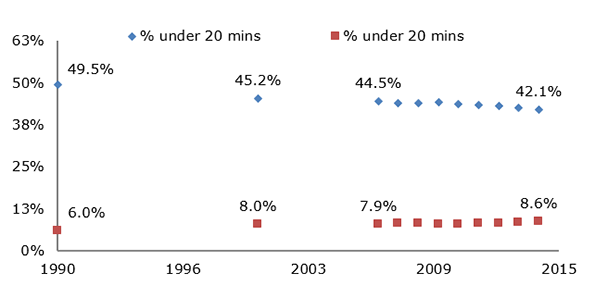
    Looking at the longer term patterns, back in 1990 just about half of the workers in America got to work in under 20 minutes.  That dropped to 45% in 2000 and now is trending further down to about 43% in 2014.   Much of the Midwest is still in that range, and if you add in the dramatic increases in those who work at home then we are still in the 50% range in much of America. 

    In comparaison the over 60 minutes category  is remarkably small. In 1990 we were at about 6% and at 8% in 2000. It has been rising slowly and at the present rate of change we still won’t reach 9% in this decade.  Having said that, we must recognize that we are now talking about over 11 million workers in the 60 minute plus category.

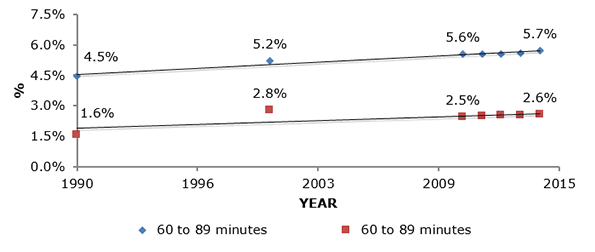
    Looking in greater detail at the disaggregate patterns we see that the trend in 60 to 89 minutes continued to rise, while the over 90 minute element dropped off.  What happened is that both categories rose through 2008 or so and then with the recession dropped off and now have gone through a slow resumption of expansion in the new decade.  

    Some of the trends that define travel

    One would expect that when jobs are scarce, as during the recent recession and long limited recovery, the average distance people would be willing to travel to find work would increase.   Not finding a  job in a preferred 30 minute travel time labor market shed around one’s home makes expansion to 45 minutes or an hour more feasible after being unemployed for months.  I am sure much of that happened, but the broad statistics tell a varying story.  The share of commuters over 90 minutes dropped; two important factors were in play that overwhelmed the statistics:

    #1 there’s nothing like 10% unemployment to improve congestion. When the number of workers declined road speeds improved, or at least didn’t continue to get worse.  So a previous 90+ minute trip might have improved to 85 minutes.   When your travel mate lost his job your solo commute got to be shorter.

    #2  The more important factor was that the kinds of jobs lost in the recession were exactly those that tended to be long distance.  A large share of the job losses were in construction and factory work.  Home construction, of course, mostly occurs at the edges of the region where workers often arrive by carpool.  And large factories today are often located in rural areas for logistical purposes – with workers traveling immense distances – for example  the car plants and refineries of the south. Note also that there were parallel very severe declines in carpooling in the period.  This was at least one of the many factors in that decline.  As the economy slowly improved we have seen the return to greater travel times as construction, manufacturing and other activities return and roads congest again. 

    The significant long term factors we need to recognize in our assessments of future prospects are these:

    The key driver of future commuting will be the need to find replacements for the retiring baby-boomers, particularly skilled workers.  In general that suggests large metro areas where the access to a variety of workers will be greatest. The larger areas have the best answer to the question “how many people with the skills I need can I reach in a half hour’s travel commuter shed from this location?” 

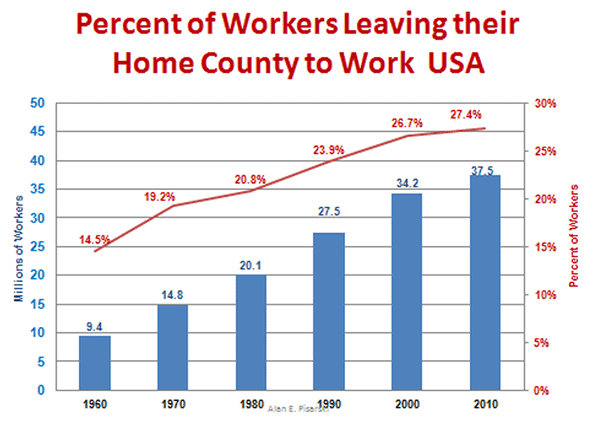
    One of the fundamental patterns of American commuting today is massive flows between counties.   In 1960 a bit more than nine million workers left their residence county to work, today it is over 37 million and the share of work travel is over 27% almost double the 60’s percentage.

    Planners have a dream of better “balance” in jobs and workers in communities that will promote walking/biking to work.  Some of that will happen as both suburban and central city Job/Worker ratios approach 1.0  from opposite directions. But  the realities of work travel are sharply different.  First of all about two-thirds of workers live in a household with other workers – whose job will they live near?  Workers, particularly the young, change jobs often. Will they move, incurring costs and further disruption in their lives every time they change jobs?  Not likely! 

    My own county of Fairfax County, Virginia illustrates the national pattern.  In 1980 it was a standard bedroom suburb with roughly 400,000 workers and 300,000 jobs for those workers, a J/W ratio of .73, the very definition of a suburb .  Flash forward to 2010 and the J/W ratio was at balance, .99, so that if all the workers who could, stayed in the county to work only 8,000 would have to leave to reach available jobs. But, in fact the county exported 280,000 workers and imported 272,000 with an overall flow of over 550,000 crossing its borders every day rather than 8,000. That’s what commuting is really all about.  Today, Fairfax County fits the definition of a central city with more jobs than workers yet still  the border crossings have reached over 570,000 every day.  The key point is that having a numeric balance in jobs and workers has little value, it is the match in the skills needed by employers and the skills possessed by resident workers that is crucial.

    Some closing thoughts

    These changes in a long term trend of people traveling significant distances to work with an interruption brought on by national employment trends.  The current penchant of rail transit proposals to reach farther and farther into the hinterlands to support the central city does not address the dynamic of ever more dispersed employment.  Transit has its highest share in trips over 60 minute and are a very significant part of intercounty and interstate travel.  The fact that they are a great deal slower than alternatives adds to the shares over 60 minutes. Many of our “metro” systems are closer to being commuter rail lines than city subways, BART, for example, the new Silver line in DC, for another, are excellent example.  Think if the entire subway investment in the Washington area had occurred inside the District borders, or at least inside the Beltway, there would have been a very real difference in being inside or not. 

    We can expect to see longer distance travel as more specialized skills are demanded by employers.  I recall in the eighties in China where the workers at the number one bicycle factory lived in apartments across the road and walked across the street every day to work.  Even where the government owned the factories, the housing, and the people that still didn’t work. When we are hiring systems engineers or any other highly skilled workforce element it will be even more impossible.     

    The dominant flow today is circumferential from suburb to suburb from far lower density housing to smaller work places than the number one plant in Shanghai. We don’t live outside the factory gate anymore. About 5% of those who move are seeking a better commute.  Most moving focuses on a better place with the amenities the household’s prefer and their commute is often the residual. As hard as we might try, minimizing the commute will not define people’s housing or job patterns in the future. Did I hear someone say autonomous vehicles.

    Alan E. Pisarski is the author of the long running Commuting in America series. A consultant in travel behavior issues and public policy, he frequently testifies before the Houses of the Congress and advises States on their investment and policy requirements.

    Photo by Nathan Harper, Bottleleaf

  • California Leaders Double Down on Dry

    “What do we do with this worthless area, the region of savages and wild beasts, of shifting sands and whirlwinds of dust, of cactus and prairie dogs? To what use could we ever hope to put these great deserts and these endless mountain ranges?”

    – U.S. Secretary of State Daniel Webster, on the American West, 1852

    The drought, if somewhat ameliorated by a passably wet winter in Northern California, reminds us that aridity defines the West. Our vulnerability is particularly marked here in Southern California, where the local rivers and springs could barely support a few hundred thousand residents, as opposed to the 20 million or so who live here. Bay Area, we’re talking about you, too, since about two-thirds of your drinking water is imported.

    The prospect of continued water shortfalls – perhaps made worse by climate change – poses something of an existential question for this state. In the past, California met the challenge of persistent dryness much as the Romans did in their heyday, by constructing massive waterworks that connected mountain runoff with the thirsty urban masses. Everything that made California the harbinger of the future, from rich farmland to semiconductors and our great cities, was predicated on water transfer.

    Now there is a sense that California’s expansion, its ability to create new communities and industries – outside of a few fields, like media and software – faces insurmountable constraints on water and other resources. This perspective has been favored by greens, anti-development NIMBYs and those who seek to corral all California growth into ever-denser, family-unfriendly environments.

    This mindset has been predominant over the past decade, as the state has invested little in new water storage or delivery systems, essentially doing nothing since the late 1970s, when the population was 16 million less. Like the Roman Empire in its dotage, we seem to have decided to live off the blessings of the past, a sure way, it seems, to guarantee a diminished future.

    Read the entire piece at The Orange County Register.

    Joel Kotkin is executive editor of NewGeography.com. He is the Roger Hobbs Distinguished Fellow in Urban Studies at Chapman University and executive director of the Houston-based Center for Opportunity Urbanism. His newest book, The Human City: Urbanism for the rest of us, will be published in April by Agate. He is also author of The New Class ConflictThe City: A Global History, and The Next Hundred Million: America in 2050. He lives in Orange County, CA.

    Photo of Lake Palmdale California Water Project by Kfasimpaur (Own work) [Public domain],via Wikimedia Commons

  • Moving to the Middle: Domestic Migration by Metropolitan Area Size

    Americans are moving to middle-sized metropolitan areas, according to the latest Census Bureau population estimates. Between 2010 and 2015, all of the domestic migration gain was in a broadly defined middle of metropolitan areas between 250,000 and 5,000,000. Both above and below that range there were huge domestic migration losses.

    Middle Sized Metropolitan Areas (250,000 to 5,000,000 Population)

    Between 2010 and 2015, more than 1.4 million people moved to the metropolitan areas that had between 250,000 and 5,000,000 population in 2010. These movers came from larger metropolitan areas, as well as smaller metropolitan areas, micropolitan areas and areas that are not within these core-based statistical areas (Note). The larger metropolitan areas lost nearly 800,000 domestic migrants, while the smaller areas lost more than 600,000.

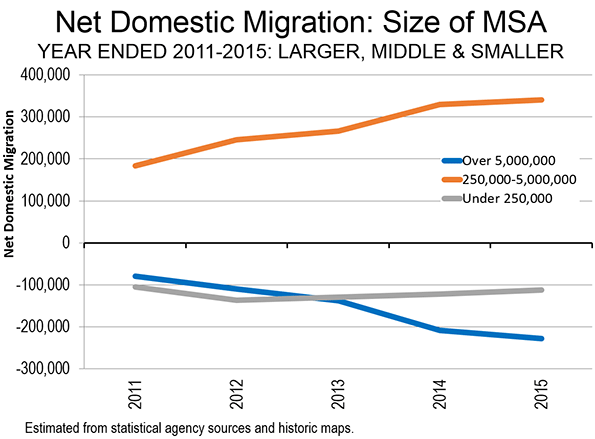
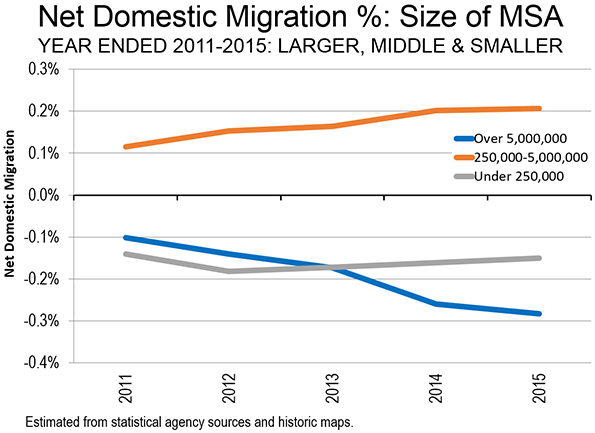
    Moreover, the trend is getting stronger. In each year since 2010, the middle sized metropolitan areas have increased their net domestic migration. In 2011, the middle sized metropolitan areas gained 184,000 net domestic migrants. This has gradually moved up to the 2015 figure of 341,000 net domestic migrants (Figure 1). In percentage terms, the middle sized metropolitan areas strongly increased their net domestic migration growth as a percentage of their population, from 0.12 percent to 0.21 percent (Figure 2).

    Larger Metropolitan Areas (5,000,000 Population and Over)

    At the same time, the nine larger metropolitan areas with over 5,000,000 residents and more have lost net domestic migrants in every year. In 2011, the loss was 80,000. It has increased every year since, to 228,000 in 2015. The percentage losses have grown dramatically. In 2011, the larger metropolitan areas lost 0.10 percent of their population to net domestic migration. By 2015, this had nearly tripled, to a loss of 0.28 percent.

    Over time, the position of our largest metropolitan regions has deteriorated, even in comparison with smaller areas. In 2011, the largest metropolitan areas, though losing, did better than the smaller areas (those with under 250,000 residents). The smaller areas lost 105,000 net domestic migrants in 2011, compared to the smaller loss of 80,000 net domestic migrants in the larger metropolitan areas.

    The largest metropolitan areas continued to do better than the smaller areas in 2012, as the gap was about the same. All of that changed in 2013, as the larger metropolitan areas began to sustain larger domestic migration losses than the smaller areas. By 2014, the losses in the smaller areas were less than one-half that of the metropolitan areas with more than 5 million residents. The smaller areas, including those outside the metropolitan areas, lost 113,000 net domestic migrants in 2015, while the larger metropolitan areas lost 228,000.

    These losses are all the more remarkable given that some large metros, notably   Houston and Dallas-Fort Worth have been gaining net migrants, up 255,000 and 241,000 respectively. Two other metropolitan areas in the above 5,000,000 category also gained. Atlanta added 116,000 domestic migrants, albeit at a much slower rate than during the 2000s. Miami also gained, but only modestly (3,000).

    The shift away from the largest metropolitan area group was driven by huge losses in the largest of the metropolitan areas in that category.  New York  lost 701,000 domestic migrants during the decade. Chicago lost 319,000 and Los Angeles was close behind at 280,000. Philadelphia lost 100,000, while Washington lost 13,000.

    Smaller Areas (Under 250,000 Population)

    Among the smaller areas, the peak loss was reached in 2012, at 136,000 net domestic migrants. Since that time, the smaller areas have improved on their net domestic migration losses modestly each year, dropping to the 113,000 in 2015. The annual domestic migration rates have been more constant in the smaller areas, starting at a loss of 0.14 percent in 2011 and fluctuating up and down to a maximum of 0.18 percent and a minimum of 0.15 percent in 2015.

    More Detailed Analysis

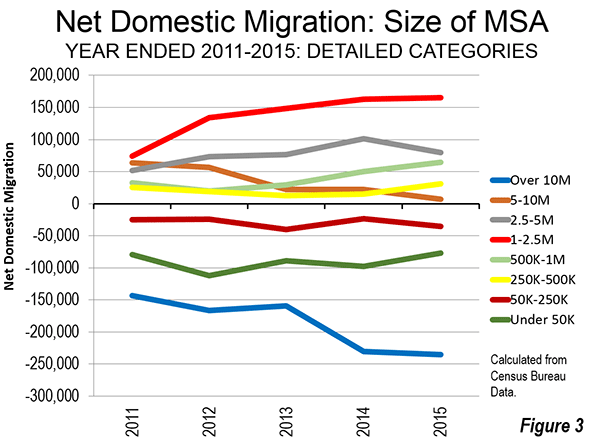
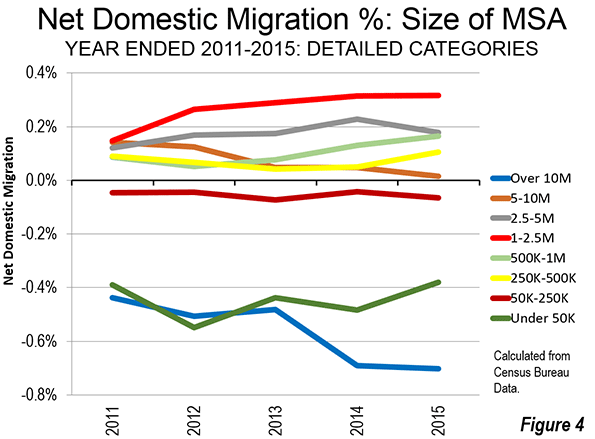
    Figures 3 and 4 show the domestic migration trends in more detailed population categories. By far the largest losses have been sustained by the megacities, New York and Los Angeles, with more than 10,000,000 residents. The metropolitan areas with between 5,000,000 and 10,000,000 population had done relatively well in the early part of the decade, but have dropped substantially. If the same trend continues to next year, net domestic migration losses would occur across this category.

    By far the strongest gains were in the 1,000,000 to 2,500,000 category, where net domestic migration more than doubled from 2011 to 2015. There was also strong growth in the 500,000 to 1,000,000 category and in the 250,000 to 500,000 category. There was a more mixed record among the metropolitan areas with between 2,500,000 and 5,000,000 population, with a rise to 2014, but a reduction in 2015.

    The smallest categories, from 50,000 to 250,000 population and under 50,000 population lost in each year, though there were not large fluctuations.

    A Trend?

    The trend that favors the migration from the largest and smallest areas to the broad middle of metropolitan areas may be an aberration. But we may see an even larger share of future domestic migration to middle-sized metropolitan areas, together with two or three larger areas (Houston, Dallas-Fort Worth and maybe Atlanta).

    Note: Core based statistical area is a term that includes metropolitan areas and micropolitan areas, which are larger and smaller labor market areas, with slightly different definitions. Additional information can be obtained from the Office of Management and Budget.

    Wendell Cox is principal of Demographia, an international pubilc policy and demographics firm. He is a Senior Fellow of the Center for Opportunity Urbanism (US), Senior Fellow for Housing Affordability and Municipal Policy for the Frontier Centre for Public Policy (Canada), and a member of the Board of Advisors of the Center for Demographics and Policy at Chapman University (California). He is co-author of the "Demographia International Housing Affordability Survey" and author of "Demographia World Urban Areas" and "War on the Dream: How Anti-Sprawl Policy Threatens the Quality of Life." He was appointed to three terms on the Los Angeles County Transportation Commission, where he served with the leading city and county leadership as the only non-elected member. He served as a visiting professor at the Conservatoire National des Arts et Metiers, a national university in Paris.

  • A $15 Minimum Wage Is A Booby Prize For American Workers

    In principle, there is solid moral ground for the recent drive to boost the minimum wage to $15, with California and New York State taking dramatic steps Monday toward that goal. Low-wage workers have been losing ground for decades, as stagnant incomes have been eroded by higher living costs.

    This has been particularly tragic for workers in high-priced cities like San Francisco, Seattle, Los Angeles and New York, where the movement has achieved irresistible momentum. If the Democrats manage to win a sweeping victory in the fall, the $15 minimum could also be imposed nationwide, with huge impacts on “laggard” regions like the South.

    Yet if the campaign to boost the minimum wage reflects progressive ideals, the underlying rationale also exposes the failure of these high-priced cities to serve as launching pads for upward mobility for the vast majority of their residents. In effect, the fight for $15 is a by-product of giving up – capitulating on the idea that better opportunities can be created than the menial service jobs that increasingly are the only opportunities for the urban poor. Higher wages will make these jobs moderately more tolerable, while further cementing the wide gulf between the haves and have knots.

    It is not a coincidence that inequality — the issue most closely tied to the minimum wage drive — is consistently worst in larger, denser, deep blue cities such as New York, Los Angeles, San Francisco. Manhattan, the densest and most influential urban area in North America, exhibits the most profound level of inequality and bifurcated class structure in the United States. If it were a country, New York City would rank 15th worst out of 134 nations, according to James Parrott of the Fiscal Policy Institute, landing between Chile and Honduras.

    New York, San Francisco, L.A. and Seattle are at the forefront of a new urban economy, based on industries such as finance, technology and media, that generally creates jobs for the highly educated only. Virtually every region at the cutting edge of the minimum wage movement has seen a rapid decline in traditional blue-collar jobs — notably in manufacturing — which often paid well above the minimum wage, and offered potential for further individual advancement.

    In these and other core cities, we are seeing something reminiscent of the Victorian era, where a larger proportion of workers are earning their living serving the wealthy and their needs as nannies, restaurant workers, dog-walkers and the like. In New York City, as of 2012, over a third of workers were employed in low-wage service jobs, a percentage that rose through the recovery from the Great Recession, according to a study by the Center for an Urban Future. The largest growth in new jobs in NYC between 2009 and 2014 came primarily in low-wage fields. Of the 401,800 net jobs the city gained over that span, 76,400 were in food services and drinking establishments, with an average annual wage of $26,200. The sector that added the second largest number of jobs: ambulatory health care, at 55,400, with an average wage of $46,200. Meanwhile at the high-wage end of the spectrum, Wall Street employment was flat, and the glitzy fields of information services and movies and sound recording added 26,000 jobs.

    Given shrinking opportunities for middle and working class people, it’s not surprising that many seek a more direct redress from the government. If the odds of working your way up are limited, and a working-class job cannot pay for your basic necessities, people have to resort to political solutions, much as occurred in the early decades of the last century. If you have been relegated to the expanding precariat –those essentially living check to check — raising the wage floor might seem very appealing.

    Essentially the minimum wage campaign rests on the notion that traditional middle class uplift cannot be achieved. The problem is, a $15 an hour income represents hardly enough to pay the rent for a small apartment anywhere near the blue cities where the new minimum will hit first. It does allow, however, a way of allowing the dominant wealthy wings of the Democratic Party — financial, real estate, media and tech interests — to hand out a convenient sop to their erstwhile labor allies.

    In some places, the hike may not have an immediate discernible economic impact. Higher wages and prices can likely be absorbed in high-cost areas with lots of wealth, such as Seattle, Manhattan and San Francisco. Some recent research shows that Seattle, which was the first big city to pass a wide-scale, phased in increase, with some wages now hitting $13 an hour, has seen slower growth in restaurant employment than its periphery. However, its economy has hardly collapsed.

    The impacts may be less positive in places like the Bronx and ungentrified Brooklyn. It is in these areas where the likely shrinking of lower-wage opportunities in response to higher salaries may be felt the strongest; the flow of jobs that can move to lower-wage states will likely accelerate.

    The  impact in California will, if anything be larger, as the wage hike will be imposed in a wider fashion on a hugely diverse state. Some 25 percent of workers would get a raise through the kindness of Sacramento. By 2022, by some estimates, the California minimum wage would represent 69 percent of the median hourly wage in the state, assuming 2.2 percent annual growth from the current median of roughly $19 per hour. This compares with a current federal minimum that is 38 percent of the median. Economic modeling suggests the precipitous rise on such a mass scale will slow the state’s employment growth, particularly at the lower end.

    To be sure, higher wages could be a blip in wealthy and thoroughly de-industrialized places like San Francisco – if higher labor costs boost the price of beet-filled ravioli, it doesn’t undermine the market in a place where hipsters and elite workers still have dollars to spend. But it could mean the loss of employment in the lower ends of construction, manufacturing and logistics, and a broader impact in the state’s interior and more heavily minority cities, where much of the state’s poverty is concentrated. The $15 dollar minimum represents only 40 percent of median wages in San Jose/Silicon Valley and 44 percent in San Francisco, but 61 percent for Los Angeles and 74 percent in Fresno.

    Ultimately local workers in poorer areas may see higher wages, but less opportunity. One possible harbinger may be the decision by Wal-Mart to leave Oakland.

    Who Wins: Reviving the Blue Model

    Of course, not all jobs can be moved — but they can be automated. This is already occurring in parts of the restaurant industry, where chains have been introducing touch screen devices to take orders in lieu of waiters and waitresses. The mass automation of industries such as fast food will accelerate, eliminating all but necessary jobs. Some of this would occur naturally; it’s interesting that some of the most cutting-edge developments in the low-labor content restaurant model have occurred in high cost, progressive San Francisco, where the new restaurant Eatsa has almost entirely automated service, and the startup Momentum Machines is developing a mechanized system to cook and assemble burgers, and other meals. Those who will find their way to a new minimum will sing its praises, and rightly so, but many others –notably entry level workers and teenagers — may find themselves forced out of the labor market, or joining the growing ranks of contingent workers.

    Perhaps the greatest beneficiaries of the minimum wage hike will not be the bulk of lower wage workers in blue states, but the people who increasingly dominate their economies. For one thing, a higher minimum removes the stigma of extreme inequality that gives a bad reputation to an economic system that has little need for broad categories of workers. They can feel better about themselves, and avoid the kind of redistribution promised by the likes of Bernie Sanders.

    And as the American Interest recently predicted, those most likely to benefit down the line from the higher wages will be the tech companies that will come up with the software and automated systems that replace the service jobs now made less economically competitive by the wage hikes. It’s not a loony fringe concept: the President’s Council of Economic Advisers recently estimated that lower-wage service jobs have an 80% probability of being automated.

    So in the end, a $15 minimum wage, set in the low growth economy of our times, may end up boosting the very class-based hierarchies that are already increasingly evident. Ultimately it may represent a case of a well-intentioned measure that, while sounding radical, only accelerates our road back to feudalism: a society dominated by the few where many depend on the generosity of their betters and the middle class, already shrinking, fades into the dustbin of history.

    This piece originally appeared at Forbes.

    Joel Kotkin is executive editor of NewGeography.com. He is the Roger Hobbs Distinguished Fellow in Urban Studies at Chapman University and executive director of the Houston-based Center for Opportunity Urbanism. His newest book, The Human City: Urbanism for the rest of us, will be published in April by Agate. He is also author of The New Class ConflictThe City: A Global History, and The Next Hundred Million: America in 2050. He lives in Orange County, CA.

    Unemployed woman photo by BigStockPhoto.com.

  • Future of Suburbia: Report from Cambridge

    In the United States, over 69 percent of all residents live in suburban areas. Across the globe many other developed countries are primarily suburban, while developing countries are increasingly suburbanizing. By 2050, an additional 2.7 billion people are anticipated to live in metropolitan regions around the world, and suburbs are a significant portion of this urban expansion. Over the past two years, 150 experts from numerous, diverse disciplines contributed research that explores this contemporary global phenomenon – and on April 1st their work was showcased at the MIT Media Lab for the Future of Suburbia conference.

    The “Future of Suburbia” was chosen as MIT’s Center for Advanced Urbanism biennial theme in order to shed light on the growing role suburbs play in our lives and how they may be improved for the future.   Suburbia is an often polarizing issue that should no longer be ignored by the fields of Planning and Design.

    The conference is just one of three products the Center for Advanced Urbanism created for its biennial research theme. An exhibition, located on the ground floor of the MIT Media Lab included infographic mappings, a 22ft x 8ft dynamic model of a 3 million population polycentric region in the year 2100, and aerial footage of global suburbs. The third product, a publication entitled Infinite Suburbia (Fall 2017), brings together 50+ authors and about 700 references, providing groundbreaking research on our low-density future.

    Each of MIT’s five schools were represented at the conference, spanning twelve key fields. Attendees also included students from Harvard and Chapman University, and speakers in demographics, entrepreneurship, history, urban design and media production. The findings were presented within four design frameworks, including heterogeneous, productive, autonomous and experimental, which were explored through a variety of fields; including design, architecture, urban planning, history and demographics, policy, energy, mobility, health, environment, economics, and applied and future technologies.

    The conference centered on the question, how might suburbia be upgraded to better suit our needs? Can new suburban models be created for developed, but also developing, countries? What challenges will suburbs face in the future? Despite such a large and complex topic, enlightening data, opinions and predictions were given regarding suburbs and their role in a sustainable future.

    Forgetting the Urban-Suburban Divide

    The urban-suburban dichotomy is highly debated (in fact, urbanists and planners themselves use 200 different terms to describe suburbia), but the Future of Suburbia conference tried to stay above the fray, instead describing the two camps as one evolving continuum. Throughout the day points were made that the suburb and urban can and should learn from one another. Traditionally, we have failed to recognize just how important suburbia is in this country and globally. By polarizing the suburb and the city we ignore how the making of peripheries can greatly contribute to urban centers, and vice-versa. However, this conference did not focus on trying to define suburbia, but on how we should think of urbanization’s holistic impact.

    Historian Robert Bruegmann kicked off the conference by outlining its history and persistence worldwide despite economic and political differences. Bruegmann finished his introduction by advocating that we be “more modest in what we think we know and what we plan for our future.”

    The Suburbs as a Heterogeneous and Productive Form

    The conference’s first panel of the day, on heterogeneity, dealt largely with numbers and trends. One statistic that stood out – 90 percent of Americans live in suburban areas, while only 10 percent live in urban cores. Also, 80 percent of Americans wish to live in a detached home. As millennials get older, more will be married and begin having children, making suburban living all the more desirable. In the United States, the denser the community, the fewer children there are. Just take a look at San Francisco, where there are more dogs than children and families are increasingly moving out of the city, or Manhattan, which has the lowest percentage of children in the country.

    It is also the highly educated and majority white that are moving to city centers, while two thirds of millennials do not have college degrees. It seems that what people truly want in their hearts, is being mixed up with costs, in both the city and suburbs. Economist Jed Kolko described the process as circular – where do people want to go, what is the economic situation, and where are the externalities. Kolko admitted it’s hard to quantify how much demand for suburbia is an impact of policy, or consumers’ hearts.  

    Ali Modarres, director of Urban Studies at University of Washington Tacoma, presented on the suburbanization of immigrants, stating, “Immigration is redefining and complicating the word suburb”. He explained, “…suburbs, old and new, are more likely to become super diverse.” Why are immigrants moving increasing to suburbs and not city centers? Because suburbs are home to a growing working class population, seeking affordable housing close to emerging job centers. For example, Orange County and northern LA County have seen significant foreign born population growth. And David Rudlin, winner of the prestigious Wolfson Prize, has high hopes for the future of the polycentric city. He emphasized the importance of a strong economy in suburban settings, asserting, “If you don’t have the economic driver of a city, you end up with a dormitory.” He called for the open sourced suburb as a way for creating a bio-system that allows diversity to develop.

    How can we design suburbs in a more productive, environmentally friendly way? The next panel explored this question beginning with Susannah Hagan, professor of Architecture at the University of Westminster, who emphasized that the suburban and urban are different, but should not be thought of as separate entities. The suburb can benefit the city, while the city, in turn, can benefit the suburb. Hagan also discussed strategies for post-industrial cities, to “manage degraded industrial spaces.” She talked about different types of seeds – actual plant seeds, investment seeds, and the concept of idea seeds for regenerating cities and suburbs.

    Joan Nassauer, professor of Landscape Architecture in the School of Natural Resources and Environment at the University of Michigan, showed that suburbs can be environmentally productive places, making the point that by area, as much carbon is stored in Michigan’s southeast exurban residential landscapes as in the managed forests of North Country.

    Mitchell Joachim, co-founder of Terreform ONE and associate professor at NYU, proposed that agriculture should be brought back into the suburbs which would create a “new kind of nature” that can shrink our ecological footprint. Innovative ecological designs such as living houses, urban farm pods, and cricket shelters were explored. The question then becomes, are suburban residents ready to break the model?

    An Autonomous and Experimental Future

    The main challenges of autonomy in the suburbs are regulatory, technical, and complicated by the user experience. But with the right tools, autonomy has the ability to transform the way people live and travel outside the city. Joseph Coughlin, professor and Director of the MIT Age Lab moderated the panel that included Knut Sauer of Hyperloop Technologies, Eran Ben-Joseph of MIT’s Urban Studies and Planning department, and Nick Roy of the Department of Aeronautics & Astronautics at MIT.

    New technologies will change our lives, allowing us to travel from LA to San Francisco in 25 minutes, or purchase something in the middle of the night and have it delivered by drone within the hour. The ideas presented look promising – in just a couple years the Hyperloop will be a reality for human passengers. But the innovations may still need tweaking, since people tend to reach out to drones and dangerously interfere with their motors.

    If these weren’t experimental enough, the next panel consisted of conceptual housing models and the creation of an entire city dedicated to testing. The experimental panel was moderated by ex-suburbanite and writer for the New York Times, Allison Arieff, who explained how she wanted to see cities and suburbs learn from each other rather than fight.

    Paul Fieler laid out upcoming plans for CITE City, a New Mexico based model city that will be built to test, evaluate, and certify new urban technologies. The development will look and function as a real city, and thousands of people will move into the houses and apartments to conduct real-life experiments. David Neustein of Other Architects proposed another urban concept for Australia, the most suburbanized nation in the world. As the population ages and preferences shift towards sustainability, Neustein’s model would facilitate the downsizing of Australia’s many “McMansions” so that the elderly could rent out their second stories. It would also boost Australia’s housing stock and redesign facades to become more integrated into nature.

    Meanwhile, Bob Geolas of the Research Triangle Foundation in North Carolina cities must understand what to embrace in terms of their brand, culture, and urban form. He outlined how the Research Triangle is overcoming its outdated research park form and building upon its values and strengths to become relevant in the economy and contribute to a sustainable future. Physical and programmatic collaboration, unique and relevant design, events and programs, and public spaces will all be key components for making the Triangle an attractive place to work in the suburbs.

    Takeaways

    Topics included innovation in cities, and economic and cultural trends, including immigration, demographics and lifestyle preferences, and how these forces interact in the urban, or suburban milieu. As population grows and technology improves, the researchers predict that the urban-suburban divide will disintegrate, resulting in a continuum of urbanity, one that takes form as a poly-nodal fabric of different hubs of innovation, living and sustainability.

    Also, we learned how important it is for urban designers to collaborate with business leaders, economists, and city officials, and the community residents themselves to design and implement the most appropriate and beneficial suburban structures. These fields traditionally function in silos, but the future requires that these disciplines co-mingle in the creation of sustainable, productive, and creative places to live. If we focus less on the semantics of the urban-suburban divide, and channel our energies on creating better places to live for all types of people, more will benefit.

    Alicia Kurimska is a researcher at the Chapman University Center for Demographics and Policy. She is a first generation American with a Slovakian background who graduated from Chapman University with a degree in history, writing her thesis on Czech President Edvard Benes’s struggle to preserve the Czechoslovak nation, inspired by her year-long studies at the Anglo-American University in Prague.

    Charlie Stephens is a researcher at the Chapman University Center for Demographics and Policy, and an MBA candidate at the Argyros School of Business and Economics at Chapman University. He is also a regular contributor to the creative business site PSFK.com and the founder of substrand.com, a hub for sharing and discussing the creative, intellectual and emotional aspects of cities.

    Photos by Justin Knight.

  • Singapore’s Midlife Crisis

    Lee Kwan Yew, one of the great political architects of our time, died a year ago, but the regime he established in Singapore remains entrenched in power. In fact, the parliamentary elections last year—to the surprise and consternation of Lee’s critics—enlarged his People’s Action Party (PAP) majority in Parliament from a record low of 60 percent to close to 70 percent. Despite talk of a “new normal” defined by more competitive politics, the city-state’s norms remain very much as they have been for the better part of a half century. Voters have their reasons for remaining in thrall to the PAP. The party’s cadre of well-educated civil servants has turned the Republic of Singapore into arguably the best-run city on the planet, a place of almost surreal efficiency. Thanks to its reputation for cleanliness, safety, and prosperity, Singapore is attracting growing numbers of immigrants from around the world. In 2013, the International Monetary Fund estimated Singapore’s per-capita GDP to be $78,000, making the average Singaporean wealthier than the average American.

    Yet, despite clear support for the regime among the electorate, many thoughtful Singaporeans look to the future with foreboding. One major worry is that the city-state has reached maximum capacity, with 5.3 million people crammed onto a flood-prone island of just 225 square miles. The newcomers have driven up home prices and displaced natives. Talk among the city’s planning and business elites about luring even more immigrants—raising Singapore’s population to roughly 7 million by 2030—has generated a growing sense of unease among the usually well-behaved local residents in this most orderly of places. Even amid their prosperity, Singaporeans are now among the most pessimistic people in the world, alongside the understandably dour residents of Greece, Cyprus, Slovenia, and Haiti. Some have voted with their feet—almost one in ten Singapore citizens now lives abroad, and according to a recent survey, half of Singaporeans would leave if they could.

    Since the city broke off from its short-lived federal union with Malaysia in 1965, the PAP has exercised an iron grip on Singaporeans’ political loyalties, but there are growing concerns—including high up in the ranks of business, government, and academia—that this prosperous nation faces a new and more uncertain era, one for which the government’s top-down planning model may no longer be well suited.

    At the time of its independence from Great Britain in 1959, Singapore was a poor, isolated, and overcrowded Asian metropolis, with high levels of unemployment and illiteracy. Western observers questioned whether the city could survive on its own—the Times of London, for example, predicted that the Singaporean economy “might collapse” without the presence of the British military. The 1963 union with Malaysia fell apart over racial and ideological tensions. China is the mother country of most Singaporeans; ethnic Chinese form 74 percent of Singapore’s population, with Malays constituting just 13 percent and Indians most of the rest.

    In 1965, the quasi-socialist PAP, led by 41-year-old Cambridge-educated lawyer Lee Kuan Yew, took power and sought to diversify the Singaporean economy. A scion of an old Hakka Chinese trading family, Lee created an “authoritarian constitutional democracy,” as British historian C. M. Turnbull described it. Determined to avoid both the corruption afflicting most of Asia’s nonaligned countries and the crushing rigidities of Communism, Lee served in effect as an elected dictator. In a 1980 biography, author Alex Josey compared Lee’s leadership of the PAP with Mao Tse-tung’s role in the Chinese Communist Party. But Lee played things very differently. As much a product of British political ideology as of Chinese culture, Lee came to Fabian socialism directly from the source: he was, as Josey put it, “a patient revolutionary,” and the PAP’s philosophy of governance was rooted in the British socialist tradition of gradual reform. Speaking in 1965 at an Asian socialist conference in India, Lee embraced the notion that “the socialist has got to be realistic and practical in his approach.” Under Lee, the PAP nurtured the economy much like greenhouse agronomists nurture crops, implementing policies only after intense study and input from experts, local and global.
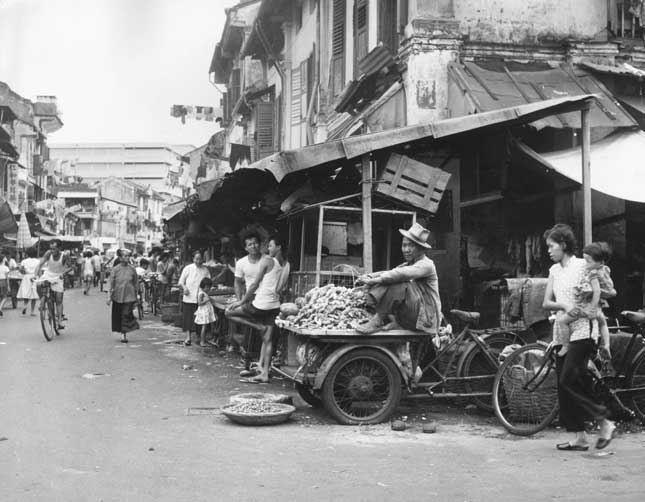
    Bustling street in Singapore, 1962. (Photo by John Pratt/Keystone Features/Getty Images)Bustling street in Singapore, 1962. (Photo by John Pratt/Keystone Features/Getty Images)

    In his bid to modernize Singapore—celebrated last year in the production there of The LKY Musical—Lee embraced a commitment to trade and the rule of law. During the 1970s, due largely to new investments and better use of personnel, productivity in Singapore’s trade sector grew by roughly 40 percent. Under Lee, the PAP invested heavily in the island’s great natural advantage: the 16-kilometer-wide Singapore Strait, connecting East Asia with the Indian Ocean. One of the party’s early accomplishments was a labor deal with the port’s labor unions, allowing for relaxed work rules and an updating of the facility. By 1980, the majority of Singaporeans worked in the trade sector, which led much of the city’s productivity growth.

    The PAP administrators weren’t content to see Singapore become a mere trading post, however. In contrast to other developing Asian economies, which emphasized local entrepreneurship and state-owned or -directed companies, Lee’s planners set about enticing American, European, and Japanese multinationals to relocate by touting Singapore’s English-speaking workforce, low-tax environment, and by-now first-class infrastructure. The country’s big break, Lee later suggested, came in 1968, when Texas Instruments—then one of the world’s largest manufacturers of semiconductors—opened a factory employing 1,000 people at the Kallang Basin industrial estate. “We had to create a new kind of economy, try new methods and schemes never tried before anywhere else in the world, because there was no other country like Singapore,” Lee reminisced in his 2000 memoir, From Third World to First.

    Continuing to look ahead, Lee and his mandarins understood that Singapore couldn’t thrive solely as a manufacturing hub, either. They correctly anticipated the evolution of an economy more reliant on technology and high-end services—for which education would be crucial. “Education must serve a purpose,” the PAP declared in 1965, and schooling was tailored to meet development goals, including instruction in English. It worked: Singaporean students do far better on tests than either their American counterparts or the average of OECD countries, and the Center on International Education Benchmarking describes Singapore’s workforce as “among the most technically competent in the world.” The national educational formula—especially the Singaporean approach toteaching math, based on intensive instruction and a focus on problem solving—has been widely adopted, including in the United States and Canada.

    Singapore’s development model also influenced its neighbors, especially China. Deng Xiaoping visited in 1978, and the famously pragmatic Communist autocrat saw an ideal formula for lifting his country out of poverty. Yet as China moved forward, Singapore ascended even higher.

    In a recent study that I conducted with the Manhattan Institute’s Aaron Renn and demographer Wendell Cox for Chapman University and the Singapore Civil Service College, we ranked global cities on factors including connectivity to the world economy, demographic diversity, cultural influence, technical workforce, foreign investment, and financial power. Singapore placed fourth, just behind London, New York, and Paris, but ahead of Tokyo and Hong Kong, and far ahead of much larger Beijing or Shanghai. Singapore has earned similar scores in other studies: ninth in the A. T. Kearney 2014 Global Cities index and fifth in the London-based Globalization and World Cities Network. These rankings are remarkable, considering that Singapore is much smaller than its prime competitors. Thirteen cities in China alone have larger populations.

    Lee Kwan Yew in 2013. (Photo by Chris McGrath/Getty Images)Lee Kwan Yew in 2013. (Photo by Chris McGrath/Getty Images)

    But Singapore’s appeal to foreign investors and migrants is easy to understand. The city has developed arguably the world’s best urban infrastructure, and its streets are rarely congested. Subways and buses, though crowded, are clean and generally well-functioning. The PAP regime’s intelligent planning also extended to housing. Before the PAP came to power, Singapore’s housing stock was dominated by run-down slums. By establishing the Housing Development Board, the state created decent, if small, residences for its citizens. This helped keep housing prices well below those in other Asian cities. Wendell Coxestimates that the city’s housing costs relative to income are roughly one-third to one-half those in Hong Kong, Shenzen, Beijing, and Shanghai. Its homeownership rates are well above those in the United States.

    Singapore also offers a stable legal and business climate. Like Hong Kong, the city-state benefits from a tradition of British governance and law. According to the World Justice Project’s ranking of civil justice systems—assessing the ability of ordinary citizens “to resolve their grievances and obtain remedies through formal institutions of justice”—Singapore ranks sixth, behind Norway, the Netherlands, Germany, Denmark, and Sweden, but ahead of Canada (13th) and the U.S. (27th). By comparison, China ranks 79th. Along with Hong Kong, Singapore also appears regularly at the top of global rankings for business climate. A combination of legal norms and transparency has lifted Singapore to become the world’s fourth global financial center, behind only New York, London, and Hong Kong. Singapore is home to twice as many regional headquarters for multinationals as much larger Tokyo. A 2011 Roland Berger study named Singapore the leading location for European companies to establish headquarters in the Asia-Pacific.

    To the extent that Singapore has a current economic weakness, it is tied to the PAP’s top-down planning model: key economic decisions are made not by entrepreneurs but by government-led agencies and large conglomerates like Singapore Airlines, GIC, and Temasek Holdings. In Hong Kong, Taiwan, and South Korea, by contrast, privately owned firms generate wealth while also wielding power. Singapore has no equivalents of Hong Kong’s Li Ka Shing, whose net worth is estimated by Forbes at over $30 billion; his Cheung Ho conglomerate employs 280,000 people in 52 countries. Nor does the city-state boast any companies like Taiwan’s Foxcomm, a dominant global power in manufacturing; South Korea’s Samsung, among the world’s leading tech and telecommunications firms; or even China’s Ali Baba, a start-up that has grown into one of the world’s top Internet firms.

    Singapore has avoided a common trap for governments throughout Asia: corruption. Lee and the PAP kept Singapore’s government clean by paying top bureaucrats high salaries. Freed from temptation, these bureaucrats, as one history of the civil service put it, could focus on ways “to mould people’s behaviors.” If Singaporeans did as they were told, they would benefit: this was the PAP’s essential promise.

    For a long time, it seemed to work. Most Singaporeans continued to back the PAP, in large part because the party delivered the material goods. “In Singapore, we’ve been very looked after. The social contract was if we vote for you, we the government will look after you,” says Singapore-born entrepreneur Calvin Soh. This “patriarchal system of governing,” as he calls it, was ideally suited for a manufacturing economy, where people were “efficient, obedient, and followers.” The bureaucracy carefully built the city’s economy, expanding opportunity for the city’s middle and working classes. Unemployment, 14 percent at the time of independence, became rare, and it remains so today, at around 2 percent.

    But “moulding people’s behaviors” has proved more difficult than building new transit lines or improving port facilities. Even in the early days, the PAP’s approach prompted some opposition and grumbling about the regime’s authoritarian bent. David Marshall, a former Singaporean ambassador to France, suggested in 1994 that the PAP was possessed of “a computer brain and a plastic heart.” He chastised the ruling party’s “suffocation of dissent,” which many observers believe continues, though to a lesser degree than in the past.

    Today’s Singaporeans, notes Soh, have less faith in the PAP than their forefathers did, partly because of economic factors. As recently as 2011, annual GDP growth chugged along at 6 percent, but last year it grew by just 2 percent, a rate similar to that of the United States and other high-income countries. Meanwhile, mirroring another problem in the affluent world, real wages for ordinary Singaporeans have stagnated. From 1998 to 2008, the income of the bottom 20 percent of households dropped an average of 2.7 percent, while the salaries of the richest 20 percent rose by more than half. Singapore’s educated population also faces growing competition from China and India, which are as hungry for success as Singapore was a half-century ago. “We went from wild animals forging a new country to tamed, well-fed animals in a zoo,” Soh jokes. “We kind of got contented and lost that hunger, that desperation, that edge for the hunt. We are a victim of our success.”

    Once, the bureaucracy thought that it could “create” a new culture. But many young Singaporeans don’t want their culture manufactured for them any more. Singaporeans, notes graduate student Arthur Chia, are “proud of what we have built, but many Singaporeans are also concerned with what we may be losing.”

    In a sense, there are two Singapores: one seen by multinationals and business travelers; and the other serving the local population. A trip down Orchard Road, the city’s historic shopping boulevard, reminds one of Hong Kong’s Causeway Bay, New York’s Fifth Avenue, or London’s Regent Street. Much of this Singapore—so anxious to appeal to the global rich and corporations—has become uniform and predictable. A once-unique urban environment has been transformed into what architect Rem Koolhaus calls “the generic city,” “a city without qualities,” and a “Potemkin metropolis.”

    The young are drawn to the other Singapore. In areas such as Geylang, restaurants, bars, and ill-disguised houses of prostitution coexist with a heavy concentration of Buddhist temples and Islamic mosques. Also popular is Tiong Bahru, an old art-deco district of open-air restaurants, hip bars, and charming apartments. But even here, independent restaurants and shops, which once proliferated, struggle with high rents, as they do in other prosperous global cities.

    These districts satisfy native Singaporeans’ nostalgia for an earlier version of the city, imagined as more romantic and less relentlessly hygienic. Eager to rediscover what they see as a grittier and more human past, younger Singaporeans have pushed to save what’s left of Singapore’s architectural heritage. They express a desire to return to the values of community they associate, interestingly enough, not with old China but with communal Malay culture. This “kampong spirit” reflects a deep disconnect between the goals of the bureaucracy and those of many citizens. “The starting point for the government is not values, and that’s part of the problem,” notes Alfred Wu, a professor at the Singapore Management University. “It’s all about utilitarianism. The government sets the path and people are not that involved. This makes it hard to change.”
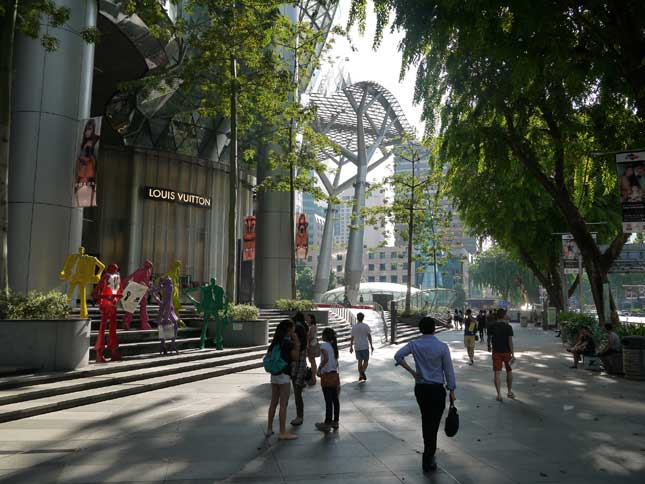
    Singapore's Orchard Road (Photo by wikubaskoro)Singapore’s Orchard Road (Photo by wikubaskoro)

    The movement of foreign capital and workers into Singapore has intensified the feeling of cultural drift and worries about the future. As the labor supply has dwindled, partly because of a plunging birthrate and consistent out-migration, the city-state has become ever more dependent on foreign labor. As recently as 1980, over 90 percent of residents were Singaporean citizens. Today, that number has fallen to 63 percent; by 2030, if the government plans hold up, foreigners will actually outnumber the natives.

    Many Singaporeans feel that the foreign influx is making them strangers in their own land. Most students at the Civil Service College are of Chinese descent. Yet even they view the city’s Chinatown district, now largely populated by people from mainland China, as foreign territory. “We don’t relate to it. We don’t see it as Singaporean,” one student confided to me. These tensions can be seen in other global cities, of course, such as New York, London, and Toronto, but these are large, sprawling metropolitan regions. The impact of population growth and immigration is more intensely felt in space-constrained Singapore.

    Like other successful global cities, Singapore is also becoming an abode of the rich; its millionaire households now number 188,000. As in other global cities, rising levels of real-estate investment from China, the Indian diaspora, and the Middle East have driven up prices, particularly in the private housing market. Many see the influx of foreign wealth as undermining the egalitarian nature of traditional Singaporean society. Some Singaporeans of Chinese descent take a particularly dim view of newly arrived Indians, whether professionals or lower-wage workers. Local playwright Alfian Sa’at’s 2013 play, Cook a Pot of Curry, was inspired by a well-publicized incident involving a Chinese migrant family’s objections to the pungent aroma coming from a neighboring Indian family’s kitchen. The play touched off a heated media debate about the purpose of immigration, the need for assimilation, and the preservation of national identity. Some government officials were troubled by the controversy, which undermined their vision of engineered social harmony.

    The presence of so many skilled foreign workers from China and India is unquestionably threatening social cohesion. Increased competition for low-wage jobs has stoked tension among the city’s south Indian and Sri Lankan immigrants, who occupy much of the lower employment tier. Last year, for the first time since 1969, a riot took place in the city—in Little India, after police rousted some inebriated workers. These disturbances have led the government to tighten its immigration policies.

    Photo by Peter Kirkeskov RasmussenPhoto by Peter Kirkeskov Rasmussen

    Singapore’s challenges go beyond its changing population. A diminishing portion of Singaporeans say that they are interested in marriage. Singapore’s birthrate is now one of the world’s lowest. Since 1990, the number of births to Singapore residents has dropped from almost 50,000 annually to barely 37,000. The government has sought to reverse this pattern with well-funded incentives to encourage families—such as subsidies for housing—but the fertility rate still stands at 1.3 per woman, well below replacement level.

    “Demographically, there’s really no way out, no way to stop the decline,” suggests longtime University of Singapore demographer Gavin Jones, over a dim-sum lunch in Holland Village, an old Singaporean neighborhood popular with expats. “The government has tried to address this with incentives, but it doesn’t work. The culture of not having children is now very much internalized. It is seen as something that limits your options.” To some extent, this view reflects trends throughout East Asia, where family bonds are weakening. The low-birth pattern is also evident in Singapore’s competitors, notably Hong Kong, where nearly half of young couples believe that they can’t afford to have children. Shanghai, notes Jones, now has one of the lowest peacetime fertility rates ever recorded.

    Young Singaporeans say that the decision not to have children is pragmatic. “Having kids was important to our parents,” noted one thirtyish civil servant, “but now we tend to have a cost and benefit analysis about family. The cost is tangible, but the benefits are not knowable or tangible.” Many Singaporeans suspect that, however good things may be now, they won’t be better for the next generation.

    “Delivering babies is not such a good business now,” suggests Fong Yoke Fai, a prominent local gynecologist. “There’s a change in perception. Personal goals are more important than social or religious ones. People don’t think they can afford the housing for children, so they opt not to have them.”

    Singaporean planners, who in the 1960s and 1970s fretted about overpopulation, now must confront what their Japanese peers face—an aging population that can only be sustained by immigration. By 2030, Singapore could have many more people over 65 than under 25. If this trend continues, the main question facing the city-state may not be how to remake itself but how to get rich enough, fast enough, to support millions of elderly citizens.

    Going forward, it seems clear that Singapore must change its model, and perhaps jettison the idea of mold making entirely. The city-state needs less planning and more spontaneity. Government attempts to promote creativity or start new cutting-edge industries are bound to fail in a society where bloggers can lose their jobs or get arrested for offending the sensibilities of the bureaucratic elite. Singaporean authorities have also banned films, such as local director Ken Kweck’s 2012 feature, Sex.Violence.FamilyValues, which they found racially controversial. “Even Chinese citizens who take up Singapore citizenship wouldn’t want [censorship],” suggests Soh, whose new company produces archival photos of various locations in the city, many of which have long since been destroyed. “They didn’t leave China to be in China.”

    Singapore’s planners will be tempted to meet the new challenges by doing what they do best—designing, implementing, and managing vast new projects, especially physical infrastructure, that promise to keep the city competitive. In recent years, these efforts have included a remarkable “greening” of the city, with many small parks and a network of nature trails as well as Gardens by the Bay, a large indoor collection of trees, recently completed near the central core. The Gardens represent a broader effort to grow Singapore’s service and tourism sectors, notably through the construction of a massive casino—a remarkable development, as gambling was long considered a curse in Chinese culture. Lee Kwan Yew promised that casinos would appear in his country only “over my dead body,” but even before his death, gambling had become big business: Singapore has vaulted ahead of Las Vegas to boast the world’s second-largest casino revenue. Only Macau takes in more.

    But turning Singapore into an Asian Las Vegas won’t solve the city’s fundamental problems. The real crisis is not in how Singapore is regarded in New York and London, or even in Beijing and Shanghai, but how it meets the needs and aspirations of its own people. Singapore’s leaders must revamp their approach to governance, becoming more responsive to local needs and less focused on defined goals.

    “No amount of analysis and forward planning,” says longtime government advisor Peter Ho, “will eliminate volatility and uncertainty in a complex world.” The old managerial model, he concedes, has become outdated. To thrive in the future, Singapore will have to find its way without a predrawn map. As Asia modernizes and develops a modern infrastructure, Singaporeans cannot remain competitive merely by being more efficient or better educated. The city-state will have to rediscover the boldness of its founding generation, even while discarding many of its methods. “We will have to be pioneers again,” notes Calvin Soh, “and recognize that we don’t have the same strategic advantages that we used to have. We have to start planning for the next ten years from that viewpoint. And that plan has to come from the grassroots, not from above.”
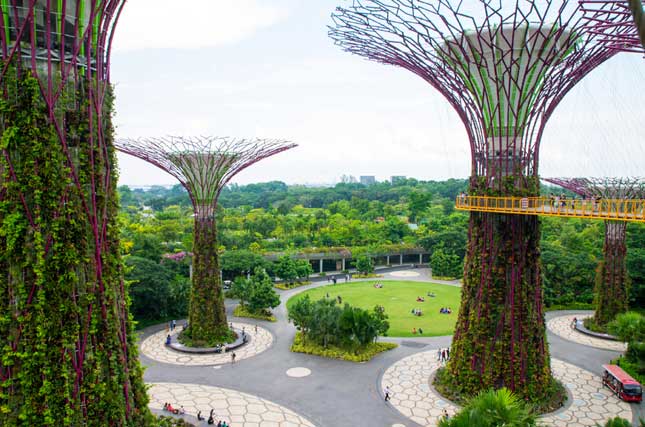
    Singapore's Gardens by the Bay (Photo by M!cka)Singapore’s Gardens by the Bay (Photo by M!cka)

    This piece originally appeared in The City Journal.

    Joel Kotkin is executive editor of NewGeography.com. He is the Roger Hobbs Distinguished Fellow in Urban Studies at Chapman University and executive director of the Houston-based Center for Opportunity Urbanism. His newest book, The Human City: Urbanism for the rest of us, will be published in April by Agate. He is also author of The New Class ConflictThe City: A Global History, and The Next Hundred Million: America in 2050. He lives in Orange County, CA.

    Singapore skyline photo by Bigstockphoto.com.
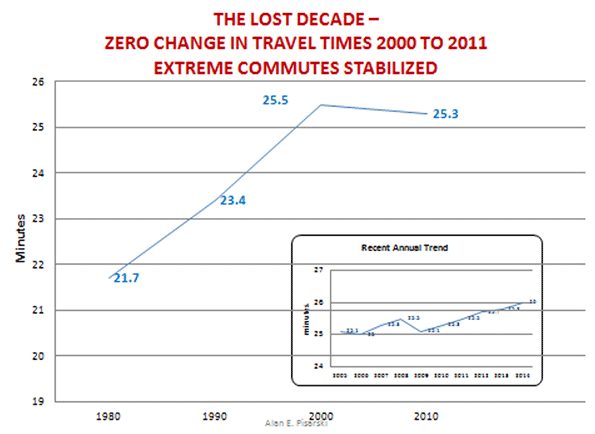
  • In Praise of Plain Old Bus Service

    My recent post on counting the long term costs of building rail transit got a lot of hits – and as expected a lot of pushback.

    There are a lot of people out there that are simply committed to the idea of rail transit, no matter how unwarranted a particular line or system might be.

    I find it interesting that the place with the most people applying serious skepticism to transit projects seems to be New York – the place with the biggest slam dunk of a case for it of any city.

    Lots of people, for example, have critiqued the proposed Brooklyn-Queens light rail line. In a city where there’s a desperate need for more transit, advocates are very focused on making sure the limited capital we have gets spent on useful projects. Not everyone agrees with each other, but there’s a robust debate, focused on the actual merits.

    In cities without much experience of transit, there appears to be a huge bias in favor of very expensive rail projects regardless of their merits.

    Some have asked me whether I support Bus Rapid Transit. I can, in some circumstances. Though Alon Levy has convinced me that the economics of South American style BRT don’t necessarily transfer to high income countries.

    What I do very much support is significantly improved Plain Old Bus Service (POBS).

    Most cities in America have pretty awful bus service, with meandering, radial routes that run infrequently and are basically deployed as a social service.

    Contrast that with Chicago or LA (or even New York, despite its subway dominance), where we see bus grid networks that run with reasonable frequency.

    I define “reasonable frequency” as meaning I can show up at the stop without consulting a schedule or tracker app, confident that my max burn on wait time is at least semi-humane. Ten minute or less headways would be best, but I can live with 15.

    Jarrett Walker has highlighted the role of Portland’s high frequency bus grid, launched in 1982, as changing the game there and making the city’s subsequent light rail system actually functional.

    Thirty years ago next week, on Labor Day Weekend 1982, the role of public transit in Portland was utterly transformed in ways that everyone today takes for granted.  It was an epic struggle, one worth remembering and honoring.

    I’m not talking about the MAX light rail (LRT) system, whose first line opened in 1986. I’m talking about the grid of frequent bus lines, without which MAX would have been inaccessible, and without which you would still be going into downtown Portland to travel between two points on the eastside.

    Pretty much any city could benefit from a better POBS network and higher frequencies.  This is where there is vast opportunity to invest in American transit without breaking the bank.

    Yes, buses cost money. I’m not saying its free. This is where I say we should spend more. A solid POBS system is just the basics to be in the game for any city looking to retrofit transit culture.

    Even Portland, the city held up as the exemplar for light rail investment, started by getting its bus system right.

    Aaron M. Renn is a senior fellow at the Manhattan Institute, a contributing editor of City Journal, and an economic development columnist for Governing magazine. He focuses on ways to help America’s cities thrive in an ever more complex, competitive, globalized, and diverse twenty-first century. During Renn’s 15-year career in management and technology consulting, he was a partner at Accenture and held several technology strategy roles and directed multimillion-dollar global technology implementations. He has contributed to The Guardian, Forbes.com, and numerous other publications. Renn holds a B.S. from Indiana University, where he coauthored an early social-networking platform in 1991.

    Portland Bus Grid. Image via Human Transit

  • Population Growth in the Largest Counties: Texas, Florida and the South

    As last week’s US Census Bureau population estimates indicated, the story of population growth between 2014 and 2015 was largely about Texas, as it has been for the decade starting 2010 (See: “Texas Keeps Getting Bigger” The New Metropolitan Area Estimates).  The same is largely true with respect to population trends in the nation’s largest counties, with The Lone Star state dominating both in the population growth and domestic migration among 135 counties with more than 500,000 population. Florida also did very well, especially in view of the population and migration reversals that occurred around the Great Recession. Strong showings in other Southern states ensured that 80 percent of the fastest-growing large counties and those with the fastest domestic migration rates were in the South. The few remaining positions were taken up by metropolitan areas in the West (Table).

    Large County Growth in Texas

    Houston, which is the fastest growing major metropolitan area (over 1 million population) in the nation includes the two fastest growing large counties. Fort Bend County added 4.29 percent to its population between 2014 and 2015 and now has 716,000 residents. Montgomery County grew 3.57 percent to 538,000. In addition to these two suburban Houston counties, Harris County, the core County ranked 16th in growth, adding 2.03 percent to its population and exceeding 4.5 million population.

    Dallas-Fort Worth, the second fastest-growing major metropolitan area has two counties among the top 20. The third fastest-growing county is Denton (located north of Dallas-Fort Worth International Airport), which added 3.42 percent to its population over the past year and now has 781,000 residents. Collin County, to the north of Dallas County, grew 3.17 percent and now stands at 914,000 residents. Its current growth rate would put Collin County over 1 million population by the 2020 census.

    Travis County, with its county seat of Austin, grew 2.22 percent to 1,177,000 and ranked 12th. Bexar County, centered on San Antonio grew 2.01 percent and ranks 17th.

    The I-4 & Middle Florida Corridor

    But there is another impressive growth story in the "I-4 & Middle Florida" corridor (the term “Central Florida“ is not used, because that usually just denotes the Orlando area).  This includes counties along the Interstate 4 corridor, which runs from Tampa-St. Petersburg through Orlando to Daytona Beach as well as one county along Interstate 95 just south of Daytona Beach and adjacent to the Orlando metropolitan area.

    Five of the fastest growing 20 counties with more than 500,000 population are located in this corridor. Orange County, the core of highly suburban Orlando grew at a rate of 2.49 percent between 2014 and 2015 and ranked seventh. Polk County (Lakeland metropolitan area), located midway between Orlando and Tampa-St. Petersburg grew 2.33 percent and ranked 10th. The south western terminus of Interstate 4 in   Hillsborough County, which includes Tampa, Hillsborough County, grew 2.33 percent, though slightly slower than adjacent Polk County and ranked 11th. The other, north eastern terminus of Interstate 4 is located in Daytona Beach, in Volusia County. Volusia County grew at a rate of 2.00 percent and ranks 19th in population growth. Just to the south of is Brevard County, straddling Interstate 95. Brevard County (Palm Bay-Melbourne metropolitan area) grew 2.01 percent and ranked 18th in growth.

    But Florida’s fastest-growing large county was Lee, centered on Cape Coral and Fort Myers. Lee County added 3.35 percent to its population and now has 702,000 residents.

    Other Fast Growing Counties

    Denver County continued its strong growth (2.80 percent) and ranked sixth. Wake County, core of the Raleigh metropolitan area, grew at 2.49 percent and ranked eighth. Utah County, in the Provo metropolitan area grew 2.43 percent and ranked ninth.

    Other counties in the top 20 included Clark (Las Vegas) in Nevada, Mecklenburg (Charlotte) in North Carolina, Gwinnett, a suburban county of Atlanta and Washington, a suburban county of Portland.

    Overall, sixteen of the 20 fastest growing large counties were in the South and four in the West (Figure 1).

    Largest Domestic Migration

    As with population growth, the top 20 in domestic migration was dominated by the South with 16 entries. Four of the migration magnets were located in  metropolitan areas from the West (Figure 2).

    Not surprisingly, the counties with the largest net domestic migration were often near the top of the list in population growth. Lee County, Florida (Cape Coral and Fort Myers) had the greatest net domestic migration between 2014 and 2015, at 3.10 percent. This is a particularly important reversal for Lee County, which experienced some of the most catastrophic house price declines during the housing bust.

    Houston’s Fort Bend and Montgomery counties (Texas), the fastest growing large counties had the second and third largest domestic migration respectively. Denton County and Collin County, in the Dallas-Fort Worth metropolitan area ranked 5th and 7th respectively. Bexar County (San Antonio) ranked 18th, while Travis County (Austin) ranked 20th.

    The I-4 & Middle Florida corridor also did well. Volusia County (Daytona Beach) ranked 4th in domestic migration, followed by its neighbor to the south, Brevard County. Polk County (Lakeland) ranked 9th, Hillsborough County (Tampa) ranked 13th and Orange County (Orlando) ranked 16th. In addition, Pinellas County (St. Petersburg), just across the bridge from Tampa ranked 12th. Palm Beach County, which is outside the I-4 & Middle Florida corridor ranked 14th.

    Denver County, at 8th, was the highest ranking in domestic migration outside Texas and Florida. Other high ranking counties included #10 Wake County (Raleigh), #11 Clark County (Las Vegas), #15 Maricopa County (Phoenix), Mecklenburg County (Charlotte) and #19 Washington County (suburban Portland).

    Slowest Growing Counties

    Seventeen of the 135 largest counties lost population. The 20 large counties with the least percentage population growth (or loss) were fairly evenly distributed outside the West. Eight were in the Northeast, seven in the Midwest and five in the South (Figure 3). The largest losses occurred in the counties containing core cities with some of the largest population losses in the last seven decades. These include Wayne County (Detroit), Cuyahoga County (Cleveland) Baltimore city, Cook County (Chicago) and Allegheny County (Pittsburgh), Hartford County, Monroe County (Rochester) and Erie County (Buffalo). The bottom 10 also included New Haven County, Connecticut and Summit County, Ohio (Akron).

    Largest Domestic Migration Losses: A New York Story

    Among the 20 largest domestic migration losses, 10 were in the Northeast, four in the Midwest, and six in the South (Figure 4)

    The largest domestic migration losses are taking place  in the New York metropolitan area, which accounted for eight of the 13 largest counties in terms of domestic migration losses. This includes Hudson County New Jersey, which had the largest loss. It also included Kings County (Brooklyn), which had the fourth largest domestic migration loss. Bronx County had the seventh largest loss, Queens County the eighth largest loss and Manhattan County the 11th largest loss. In addition, other New Jersey suburban counties had substantial domestic migration losses, including Passaic County, Middlesex County and Essex County (Newark).

    The South rated best in population growth and net domestic migration, but some large southern counties had among the largest domestic migration losses. These include Fairfax County (Washington suburb), El Paso County in Texas, Miami-Dade County in Florida and Baltimore city. Cook County (Chicago) was also among the top 10 domestic migration losers.

    Moreover, the 13 large counties with the greatest losses excluded   Wayne County, with its core city (Detroit) that has lost more of its population (percentagewise) than any other large municipality in the world. Yet, all of the counties listed above, including the eight in the New York metropolitan area lost a greater share of their population by domestic migrants than Wayne County.

    Dominance by the South and the West

    Overall, the largest counties added approximately 1.53 million residents over the past year. More than one half of that net domestic migration was in 19 counties of the South, 11 in the West, none in the Midwest and none in the Northeast. Three quarters of the net domestic migration was in just 52 of the 135 counties, with the South accounting for 30 counties. There were also 20 counties in the West, two in the Midwest and none in the Northeast. The two Midwestern counties were Franklin, Ohio (Columbus) and Dane, Wisconsin (Madison).

    US Counties Over 500,000 Population: Ranked By Population Growth 2014-2015 %
    2014-2015 & 2010-2015
    Population Change Dom. Migra.
    Rank County, State 4/2010 7/2014 7/2015 Fr2010 Fr2014 Fr2010 Fr2014 Fr2010 Fr2014
    1 Fort Bend, Texas      585        687        716      131        29 22.4% 4.29% 13.1% 2.69%
    2 Montgomery, Texas      456        519        538        82        19 17.9% 3.57% 11.8% 2.48%
    3 Denton, Texas      663        755        781      118        26 17.8% 3.42% 10.4% 2.14%
    4 Lee, Florida      619        679        702        83        23 13.5% 3.35% 10.8% 3.10%
    5 Collin, Texas      782        886        914      132        28 16.8% 3.17% 9.3% 1.86%
    6 Denver, Colorado      600        664        683        83        19 13.8% 2.80% 7.2% 1.59%
    7 Orange, Florida   1,146     1,256     1,288      142        32 12.4% 2.52% 3.6% 0.84%
    8 Wake, North Carolina      901        999     1,024      123        25 13.7% 2.49% 6.6% 1.22%
    9 Utah, Utah      517        562        575        59        14 11.3% 2.43% 0.3% 0.45%
    10 Polk, Florida      602        635        650        48        15 8.0% 2.33% 4.2% 1.53%
    11 Hillsborough, Florida   1,229     1,318     1,349      120        31 9.7% 2.33% 3.4% 1.11%
    12 Travis, Texas   1,024     1,151     1,177      152        26 14.9% 2.22% 6.5% 0.77%
    13 Clark, Nevada   1,951     2,069     2,115      164        46 8.4% 2.21% 3.1% 1.20%
    14 Mecklenburg, North Carolina      920     1,012     1,034      114        22 12.4% 2.19% 4.9% 0.84%
    15 Gwinnett, Georgia      805        878        896        90        18 11.2% 2.06% 3.6% 0.69%
    16 Harris, Texas   4,093     4,448     4,538      445        90 10.9% 2.03% 2.0% 0.38%
    17 Bexar, Texas   1,715     1,860     1,898      183        37 10.7% 2.01% 4.4% 0.82%
    18 Brevard, Florida      543        557        568        25        11 4.5% 2.01% 4.5% 1.97%
    19 Volusia, Florida      495        508        518        23        10 4.7% 2.00% 5.3% 2.14%
    20 Washington, Oregon      530        563        574        44        11 8.4% 1.96% 2.3% 0.80%
    21 Maricopa, Arizona   3,817     4,090     4,168      351        78 9.2% 1.91% 3.9% 0.92%
    22 Washington, District of Columbia      602        660        672        70        12 11.7% 1.88% 4.3% 0.57%
    23 Tarrant, Texas   1,810     1,946     1,982      173        36 9.6% 1.86% 3.0% 0.61%
    24 Arapahoe, Colorado      572        620        631        59        11 10.3% 1.85% 4.0% 0.72%
    25 El Paso, Colorado      622        663        674        52        12 8.4% 1.75% 2.2% 0.55%
    26 Palm Beach, Florida   1,320     1,399     1,423      103        24 7.8% 1.74% 4.2% 1.00%
    27 Snohomish, Washington      713        759        773        59        13 8.3% 1.72% 3.0% 0.67%
    28 King, Washington   1,931     2,082     2,117      186        35 9.6% 1.67% 2.4% 0.29%
    29 Multnomah, Oregon      735        778        790        55        12 7.5% 1.60% 2.8% 0.68%
    30 Alameda, California   1,510     1,613     1,638      128        25 8.5% 1.57% 1.2% 0.22%
    31 Pierce, Washington      795        831        844        49        13 6.1% 1.54% 1.1% 0.58%
    32 San Joaquin, California      685        715        726        41        11 6.0% 1.54% 0.6% 0.52%
    33 Duval, Florida      864        899        913        49        14 5.6% 1.52% 0.5% 0.47%
    34 DeKalb, Georgia      692        724        735        43        11 6.2% 1.47% -2.5% -0.10%
    35 Davidson, Tennessee      627        669        679        52        10 8.3% 1.46% 2.0% 0.30%
    36 San Francisco, California      805        853        865        60        12 7.4% 1.44% 0.6% 0.20%
    37 Broward, Florida   1,748     1,870     1,896      148        27 8.5% 1.43% 1.7% 0.11%
    38 Franklin, Ohio   1,164     1,234     1,252        88        18 7.6% 1.43% 1.0% 0.17%
    39 Fulton, Georgia      921        996     1,011        90        14 9.8% 1.41% 3.4% 0.28%
    40 Cobb, Georgia      688        731        741        53        10 7.7% 1.41% 1.4% 0.24%
    41 Riverside, California   2,190     2,328     2,361      171        33 7.8% 1.40% 3.0% 0.51%
    42 Tulsa, Oklahoma      603        630        639        36          9 5.9% 1.40% 1.5% 0.53%
    43 Contra Costa, California   1,049     1,112     1,127        78        15 7.4% 1.35% 2.8% 0.49%
    44 Sacramento, California   1,419     1,481     1,501        83        20 5.8% 1.34% 0.4% 0.28%
    45 Dallas, Texas   2,368     2,520     2,553      186        34 7.8% 1.34% 0.0% -0.10%
    46 Salt Lake, Utah   1,030     1,093     1,107        78        14 7.5% 1.32% -0.1% -0.09%
    47 Oklahoma, Oklahoma      719        767        777        58        10 8.1% 1.31% 2.5% 0.23%
    48 Dane, Wisconsin      488        517        524        36          7 7.3% 1.30% 1.9% 0.25%
    49 Hidalgo, Texas      775        832        842        68        11 8.7% 1.29% -1.1% -0.52%
    50 Pinellas, Florida      917        938        950        33        12 3.6% 1.25% 3.7% 1.18%
    51 Stanislaus, California      514        532        538        24          6 4.7% 1.21% -0.7% 0.12%
    52 Santa Clara, California   1,782     1,896     1,918      136        22 7.7% 1.16% -1.5% -0.53%
    53 Jefferson, Colorado      535        559        566        31          6 5.8% 1.16% 3.4% 0.69%
    54 Douglas, Nebraska      517        544        550        33          6 6.4% 1.12% 0.2% -0.07%
    55 Suffolk, Massachusetts      722        770        778        56          8 7.8% 1.08% -2.1% -0.75%
    56 Johnson, Kansas      544        574        580        36          6 6.6% 1.08% 1.6% 0.12%
    57 San Diego, California   3,095     3,266     3,300      204        34 6.6% 1.04% -0.2% -0.29%
    58 Fresno, California      930        965        975        44        10 4.8% 1.02% -1.7% -0.21%
    59 Kent, Michigan      603        630        636        34          6 5.6% 0.97% 0.6% 0.02%
    60 Bronx, New York   1,385     1,442     1,455        70        14 5.1% 0.95% -6.0% -1.10%
    61 Montgomery, Maryland      972     1,030     1,040        68        10 7.0% 0.94% -2.2% -0.80%
    62 Kern, California      840        874        882        43          8 5.1% 0.91% -1.5% -0.31%
    63 Hennepin, Minnesota   1,152     1,212     1,223        71        11 6.1% 0.91% -0.1% -0.29%
    64 Miami-Dade, Florida   2,498     2,669     2,693      195        24 7.8% 0.91% -3.3% -1.23%
    65 Guilford, North Carolina      488        513        518        29          5 6.0% 0.90% 1.9% 0.15%
    66 San Mateo, California      718        758        765        47          7 6.5% 0.90% 0.2% -0.21%
    67 Ramsey, Minnesota      509        534        538        29          4 5.8% 0.84% -1.5% -0.60%
    68 San Bernardino, California   2,035     2,110     2,128        93        18 4.6% 0.84% -1.1% -0.23%
    69 Middlesex, Massachusetts   1,503     1,573     1,585        82        13 5.5% 0.80% -0.8% -0.42%
    70 Hudson, New Jersey      634        670        675        41          5 6.4% 0.80% -6.6% -1.65%
    71 Orange, California   3,010     3,145     3,170      160        25 5.3% 0.79% -0.4% -0.32%
    72 Essex, Massachusetts      743        770        776        33          6 4.4% 0.72% 0.1% -0.18%
    73 Queens, New York   2,231     2,322     2,339      109        17 4.9% 0.72% -5.1% -1.09%
    74 Anne Arundel, Maryland      538        560        564        27          4 4.9% 0.70% 1.0% -0.04%
    75 Prince George’s, Maryland      864        903        910        46          6 5.3% 0.68% -2.4% -0.72%
    76 Honolulu, Hawaii      953        992        999        46          7 4.8% 0.67% -2.4% -0.75%
    77 Plymouth, Massachusetts      495        507        510        15          3 3.1% 0.66% 0.7% 0.14%
    78 Kane, Illinois      515        528        531        16          3 3.0% 0.63% -1.8% -0.23%
    79 New Castle, Delaware      538        553        557        18          3 3.4% 0.62% -0.6% -0.18%
    80 Kings, New York   2,505     2,621     2,637      132        16 5.3% 0.61% -5.0% -1.25%
    81 Bergen, New Jersey      905        933        939        33          6 3.7% 0.61% -0.8% -0.28%
    82 Los Angeles, California   9,819   10,109   10,170      352        61 3.6% 0.60% -2.7% -0.60%
    83 Jackson, Missouri      674        684        688        13          4 2.0% 0.58% -1.4% -0.06%
    84 Pima, Arizona      980     1,004     1,010        30          6 3.0% 0.58% 0.1% 0.02%
    85 Lancaster, Pennsylvania      519        534        537        17          3 3.3% 0.56% -0.6% -0.28%
    86 Ventura, California      823        846        851        27          4 3.3% 0.52% -1.3% -0.34%
    87 Chester, Pennsylvania      499        513        516        17          3 3.4% 0.52% 0.1% -0.16%
    88 Union, New Jersey      536        553        556        19          3 3.6% 0.49% -3.0% -0.70%
    89 Worcester, Massachusetts      799        815        819        20          4 2.6% 0.49% -1.1% -0.27%
    90 Norfolk, Massachusetts      671        693        696        25          3 3.8% 0.48% 0.0% -0.29%
    91 Marion, Indiana      903        935        939        36          4 3.9% 0.48% -1.6% -0.55%
    92 Ocean, New Jersey      577        586        589        12          3 2.1% 0.48% 0.6% 0.07%
    93 New York, New York   1,586     1,637     1,645        59          8 3.7% 0.46% -4.4% -0.99%
    94 Sedgwick, Kansas      498        509        512        13          2 2.7% 0.45% -2.3% -0.48%
    95 Middlesex, New Jersey      810        837        841        31          4 3.8% 0.43% -3.8% -1.02%
    96 Baltimore, Maryland      805        828        831        26          3 3.3% 0.40% -0.4% -0.31%
    97 Westchester, New York      949        973        976        27          4 2.9% 0.40% -1.9% -0.46%
    98 Jefferson, Kentucky      741        761        764        23          3 3.0% 0.39% -0.3% -0.27%
    99 Bristol, Massachusetts      548        555        557          8          2 1.5% 0.39% 0.0% 0.04%
    100 Philadelphia, Pennsylvania   1,526     1,562     1,567        41          6 2.7% 0.38% -3.1% -0.68%
    101 Macomb, Michigan      841        862        865        24          3 2.8% 0.37% 0.6% -0.12%
    102 Montgomery, Pennsylvania      800        817        819        19          3 2.4% 0.33% -0.2% -0.24%
    103 Essex, New Jersey      784        795        797        13          2 1.7% 0.31% -4.9% -0.89%
    104 Fairfax, Virginia   1,082     1,139     1,142        61          3 5.6% 0.28% -4.3% -1.47%
    105 Will, Illinois      678        686        687        10          2 1.4% 0.24% -2.4% -0.47%
    106 Fairfield, Connecticut      917        946        948        31          2 3.4% 0.24% -1.9% -0.74%
    107 Providence, Rhode Island      627        632        633          7          1 1.1% 0.23% -3.4% -0.67%
    108 Nassau, New York   1,340     1,359     1,361        22          3 1.6% 0.20% -1.2% -0.33%
    109 Passaic, New Jersey      502        510        511          9          1 1.9% 0.20% -5.6% -1.20%
    110 Oakland, Michigan   1,202     1,240     1,242        40          2 3.3% 0.19% -0.3% -0.53%
    111 Delaware, Pennsylvania      559        563        564          5          1 0.9% 0.17% -1.8% -0.43%
    112 Hamilton, Ohio      802        806        808          5          1 0.7% 0.16% -2.4% -0.40%
    113 Bernalillo, New Mexico      663        676        677        14          1 2.1% 0.15% -1.2% -0.47%
    114 Bucks, Pennsylvania      625        627        627          2          1 0.3% 0.12% -0.8% -0.14%
    115 St. Louis, Missouri      999     1,002     1,003          4          1 0.4% 0.12% -1.8% -0.35%
    116 El Paso, Texas      801        836        836        35          0 4.4% 0.01% -3.3% -1.44%
    117 Jefferson, Alabama      658        660        660          2        (0) 0.3% 0.00% -1.6% -0.33%
    118 DuPage, Illinois      917        934        934        17        (0) 1.8% 0.00% -2.5% -0.80%
    119 Camden, New Jersey      514        511        511        (3)        (0) -0.5% -0.01% -4.0% -0.68%
    120 Milwaukee, Wisconsin      948        958        958        10        (0) 1.1% -0.02% -3.4% -0.86%
    121 Lake, Illinois      703        704        704          1        (0) 0.1% -0.03% -4.1% -0.80%
    122 Shelby, Tennessee      928        938        938        10        (0) 1.1% -0.04% -3.2% -0.83%
    123 Monmouth, New Jersey      630        629        629        (2)        (0) -0.3% -0.05% -2.0% -0.37%
    124 Montgomery, Ohio      535        533        532        (3)        (0) -0.5% -0.05% -2.4% -0.45%
    125 Suffolk, New York   1,493     1,502     1,502          8        (1) 0.6% -0.05% -2.5% -0.63%
    126 Erie, New York      919        923        923          4        (1) 0.4% -0.07% -1.4% -0.47%
    127 Monroe, New York      744        750        750          5        (1) 0.7% -0.10% -2.6% -0.80%
    128 Hartford, Connecticut      894        897        896          2        (1) 0.2% -0.11% -3.4% -0.81%
    129 Summit, Ohio      542        543        542          0        (1) 0.0% -0.12% -1.4% -0.41%
    130 Allegheny, Pennsylvania   1,223     1,233     1,230          7        (2) 0.6% -0.20% -0.4% -0.46%
    131 Cook, Illinois   5,195     5,249     5,238        43      (10) 0.8% -0.20% -4.0% -1.06%
    132 New Haven, Connecticut      862        861        859        (3)        (2) -0.3% -0.21% -3.4% -0.84%
    133 Baltimore city, Maryland      621        624        622          1        (2) 0.1% -0.30% -3.8% -0.92%
    134 Cuyahoga, Ohio   1,280     1,261     1,256      (24)        (5) -1.9% -0.37% -3.7% -0.76%
    135 Wayne, Michigan   1,821     1,766     1,759      (61)        (7) -3.4% -0.38% -6.2% -0.87%
    In 000s
    Data from Census Bureau


    Wendell Cox is principal of Demographia, an international pubilc policy and demographics firm. He is a Senior Fellow of the Center for Opportunity Urbanism (US), Senior Fellow for Housing Affordability and Municipal Policy for the Frontier Centre for Public Policy (Canada), and a member of the Board of Advisors of the Center for Demographics and Policy at Chapman University (California). He is co-author of the “Demographia International Housing Affordability Survey” and author of “Demographia World Urban Areas” and “War on the Dream: How Anti-Sprawl Policy Threatens the Quality of Life.” He was appointed to three terms on the Los Angeles County Transportation Commission, where he served with the leading city and county leadership as the only non-elected member. He served as a visiting professor at the Conservatoire National des Arts et Metiers, a national university in Paris.

    Photograph: Lee County, Florida (Cape Coral-Fort Myers), Top domestic migration gainer (by author)