Category: Urban Issues

  • People Rather than Places, Ends Rather than Means: LSE Economists on Urban Containment

    “People rather than places” should be the focus of urban policy, according to Urban Economics and Urban Policy: Challenging Conventional Policy Wisdom. (paperback, Edward Elgar Publishing, 2015 $39.95). The book is among the most effective critiques of contemporary urban planning thought,  characterized by such approaches as urban containment, compact city, and densification. The authors are Paul C. Cheshire, Max and Nathan and Henry G. Overman, all economists at the London School of Economics and Political Science. Cheshire has a long list of publications analyzing urban planning policy. The authors characterize the central thesis of urban planning’s misdirected priorities stating that:

    "… that the ultimate objective of urban policy is to improve outcomes for people rather than places; for individuals and families rather than buildings."

    They argue that there is a place for urban planning, but that it must be in the appropriate context.

    "This is not to say that we should stop caring about what is happening in different cities and neighbourhoods but serves to remind us that improving places is a means to an end, rather than an end in itself." (emphasis added)

    This theme is applauded and characterized as “revolutionary” in the Foreword by Harvard University economist Edward Glaeser, who posits:

    "All policies need to be judged by the impact on people, not places."

    Basic Economics

    It has long been known that urban containment policy is fundamentally flawed, principally by its inconsistency with the fundamentals of economics, which leads to destructive housing affordability losses.

    Cheshire et al begin with the basics:

    “…there are some things on which nearly all mainstream economists would agree. Perhaps the nearest to unanimity one could find would be the proposition that if the supply of a good does not vary much as its price changes, and if the demand for that good rises proportionally more than incomes as incomes rise but is subject to cyclical fluctuations, then the price of that good will rise over the long run relative to other prices and its price will be volatile over the cycle.”

    They remind us that this is: “…one of the fundamental elements of economic analysis with a history of research and application going back at least 200 years.”

    The Problem

    This denial of economic realities, rooted in human nature itself, sets urban containment policy up to inflict major consequences, when evaluated based on outcomes for people.

    Urban containment’s forbidding or severely limiting house construction on the urban fringe has been associated with huge house price increases. This is particularly evident across the United Kingdom, which receives the principal attention from the authors. There house prices have doubled and even tripled compared to incomes. Obviously, being forced to spend more money on housing, people have less discretionary income to spend on other goods and services (and discretionary income virtually defines the standard of living and poverty).

    Rather than improving the standard of living and reducing poverty, which are fundamental domestic policy objectives, urban containment leaves in its wake “rising real house prices, falling affordability and increasing price volatility.” The authors note that price fluctuations are significantly greater where restrictions on development do not allow the supply of new housing to sufficiently respond to increases in consumer demand. To this they add concerns that all of this is leading to greater inequality.

    The problems with urban containment policy have long been known, not only to economists, but also to urban planners dispassionately examining the outcomes. On this score, the authors give well-deserved credit to a team of researchers led by the late Sir Peter Hall, one of history’s pre-eminent urban scholars. Hall led a team that was “…seriously sympathetic to the ideals of planning but who saw that the rigid policy of urban containment and the specific way in which the boundaries of the Greenbelts had been determined during the 1950s was perverting what they saw as the underlying purpose of town planning.” (See The Costs of Smart Growth Revisited: A 40 Year Perspective.)

    According to the authors, Hall et al had become convinced that “Far from providing people with greener environments and garden cities, the planning system had developed in a way which produced higher densities and made housing space more difficult to acquire.”

    Glaeser expands on this in the Foreword:

    “…we must never forget that any time we say ‘no’ to new building, whether in the city centre or on the edge, we are saying ‘no’ to families that want to experience the magic of urban life. We also ensure that every other family that lives in the city is paying more for their own homes.”

    Ignoring the Consequences

    The authors suggest that the planning objective of a compact city may “be a planner’s dream but for ordinary people it is more like a nightmare." They further imply that urban planning establishment has been “tone deaf” on the consequences of urban containment policy, noting that it is well and good to:

    “…argue that the costs imposed by the planning system are prices worth paying to ‘protect the countryside’ or achieve other policy objectives. However, it is not helpful for public debate to pretend that the costs we have documented do not exist; or even that they are negligible. Existing research shows that this is simply not the case; indeed research shows the costs are very substantial even if some are difficult to measure exactly."

    Cheshire et al express concern that the planning system is spreading beyond Great Britain. They continue: “…the British experience also provides some idea of what the future might hold for other countries as planning systems become increasingly restrictive.” Indeed that prediction is already being fulfilled with a vengeance.

    This can be seen across Australia and New Zealand, where the housing affordability losses have been at least as severe as in Britain. In the United States the predicament is highly regionalized. We can see its impacts in Portland, as well as huge losses in housing affordability in California, Seattle, Denver and elsewhere. And in Canada there is Vancouver, with the second worst housing affordability among the major markets in the 11th Annual Demographia International Housing Affordability Survey, and Toronto, where house prices have nearly doubled relative to incomes since 2000, under the Places to Grow Greenbelt initiative.

    They add a sobering assessment:

    "The problem is it is utterly unviable in the long term. With every passing decade the problems would get worse, the wider economic costs would become more penalising, the economy and monetary policy more unmanageable and the outcomes – the divide between the property haves and the property have-nots – more unacceptable."

    They add a perspective that should be appreciated by both students of history and politics:

    "In our judgment there is no doubt that if things go on as they are then at some point there will be a system breakdown and perhaps serious social unrest."

    Towards Resolution

    Cheshire and his colleagues suggest that: “any useful and rational debate should attempt to rigorously quantify the benefits conferred by the system rather than just assert them as ‘fact’.”

    More importantly, they offer workable solutions that can put urban policy back “on track” by seeking ends rather than means. Generally, they say that land use restrictions should be relaxed except where “there are amenity reasons not to do so.”

    This would start with an understanding that the large urban containment policy land price discontinuities be recognized for what they are — price signals that the demand for housing in an area is far greater than the supply.

    According to the authors,

    “…observed price discontinuities – the difference in market prices across boundaries of use categories – should become a ‘material consideration’ leading to a presumption in favour of any proposed development unless (a very important ‘unless’) it could be shown that the observed monetary value of the discontinuity reflected wider environmental, amenity or social values of the land in its current use.” (emphasis added)

    This would make sufficient land for development available to serve the economic well-being of households: “there is a very large amount of land where the ‘wider’ values are negligible.”

    A similar proposal was offered by the Productivity Commission of New Zealand in its recent report, which suggested setting a discontinuity maximum standard. When the standard is violated, land would be released.

    Getting Urban Policy Back on Track

    The authors say that “the economic and welfare – even environmental – damage done by Britain’s current planning system is overwhelming.” Moreover “the impact will get progressively more damaging over time.” The same damage can be expected beyond Britain, to the United States, Canada and wherever else urban containment policy is implemented, because of its fatal aversion to the realities of economics.

    Cheshire et al describe the dilemma that the policy detour urban containment has created.

    “The question is not will we reform it but when will we reform it and will that be before a catastrophic collapse? … The problem is that any radical reforms are politically unpalatable, but no alternative strategy will work.”

    Forty years ago, Hall and his colleagues lamented the disinterest of economists in urban planning. Cheshire et al similarly noted that economists have “contributed very little to the development and evaluation of real-world urban policy.” That needs to change and Urban Economics and Urban Policy: Challenging Conventional Policy Wisdom could be an important first step.

    Wendell Cox is Chair, Housing Affordability and Municipal Policy for the Frontier Centre for Public Policy (Canada), is a Senior Fellow of the Center for Opportunity Urbanism (US), a member of the Board of Advisors of the Center for Demographics and Policy at Chapman University (California) and principal of Demographia, an international public policy and demographics firm.He is co-author of the “Demographia International Housing Affordability Survey” and author of “Demographia World Urban Areas” and “War on the Dream: How Anti-Sprawl Policy Threatens the Quality of Life.” He was appointed to three terms on the Los Angeles County Transportation Commission, where he served with the leading city and county leadership as the only non-elected member. He served as a visiting professor at the Conservatoire National des Arts et Metiers, a national university in Paris.

    Photograph: The Shard, London © User:Colin / Wikimedia Commons, via Wikimedia Commons

  • The Cities Doing The Most To Address The U.S. Housing Shortage

    America is suffering from the severest undersupply of housing since the end of the Second World War. Although population growth has slowed significantly since the 1950s and 1960s, production has slowed down even more so. It’s not surprising that homebuilding declined after the housing bubble burst in 2008, but from 2011 to 2015 it continued to fall, dropping almost a quarter.

    Meanwhile, housing price inflation has re-emerged. Housing now accounts for roughly 35% of household expenditures, up from about 30% in 1985, while expenditures on food, apparel and transportation have dropped or stayed about the same.

    High home prices help to boost rents by forcing potential buyers into the apartment market. As of midyear, rental costs were eating up the largest share of renters’ income in recent U.S. history, 30.2%. Since 1990, renters’ income has not increased, but rents have soared 14.7% (both inflation adjusted).

    In high-priced markets like New York, Los Angeles, Miami and San Francisco, the average renters spend from 42% to 48% of their income on rent, well above the national average. In New York, rents increased between 2010 and 2015 by 50%, while incomes for renters between ages 25 and 44 grew by just 8%.

    The Cities Building The Most New Homes

    Some metropolitan areas are doing a much better job than others at meeting this pent-up demand by building new housing.

    We looked at the volume of construction permits for single and multifamily units in the 53 largest metropolitan statistical areas in the country from 2011 through 2014, and compared them to those metro areas’ existing housing bases.

    To a large extent, the superstars of the past four years have been those areas that have enjoyed both the greatest job and population growth. The top of our list of cities that are increasing their housing supply the most is dominated by metro areas that have generally better housing affordability, with a multiple of median incomes to median housing prices between three and four.

    Leading the way is Austin, Texas, which issued permits for the construction of roughly 71,000 housing units from 2011 through 2014, equal to 11.5% of its existing housing base in 2010. Austin’s new construction was split almost 50-50 between single family and multifamily units.

    Other Texas cities in our top 10 include No. 3 Houston, which permitted the construction of 189,634 new units from 2011-14, the most in the nation over that span, equal to 9.7% of its 2010 base. Dallas-Ft. Worth ranks seventh, with a total of 148,329 units, second most in the nation behind Houston, for a 6.7% expansion of its housing supply from 2010. Most of the rest of our top 10 — including the North Carolina boom towns Raleigh (No. 2) and Charlotte (No. 4) — are located in or adjacent to the southern rim of the country. Only No. 10 Seattle can be considered a “smart growth” region, with the predictable high prices relative to incomes.

    Families vastly favor single-family homes, and they can still find them at a relatively affordable price in many Southern cities. Some two-thirds of housing construction permits in Houston from 2011-14 was for single-family homes, and six of the top 10 metro areas for single-family construction over that span were located in the South. Houston alone produced nearly as many new single-family homes in 2014 as the entire state of California, which has about six times as many residents.

    If you go by new single-family construction as a percentage of the existing housing base, sprawling, suburban, smaller and mid-sized metropolitan areas in the South are in the lead: Raleigh, Austin, Nashville, Charlotte, Orlando, Oklahoma City and Jacksonville.

    But it’s important to recognize that as these areas “sprawl” they are also densifying. Houston ranks second nationally for new multifamily units over the span we looked at with 65,261; Austin, seventh (35,687, representing 18% of its 2010 base); and Charlotte ranks 15th. Some of this growth is concentrated near their urban cores, which have revived in recent years.

    The Doyennes Of Density

    In expensive parts of the Northeast and the West Coast, the favored solution to the housing affordability crisis is to pack more people into a smaller space: force households into smaller homes and apartments by raising the price of single-family dwellings for middle-income buyers through land-use restrictions.

    This approach may produce some units, but it hardly addresses the affordability issue. By most measures, higher-density housing is far more expensive to build. Gerard Mildner of the Center for Real Estate at Portland State University, notes that a high rise over five stories costs nearly three times as much per square foot as a garden apartment. Even higher construction costs are reported in the San Francisco Bay Area, where townhome developments can cost up to double that of detached houses per square foot to build (excluding land costs), and units in high rise condominium buildings can cost up to 7.5 times as much.

    New York epitomizes the limitations of density to address the affordability crisis. The Big Apple ranks third behind Houston and Dallas-Ft. Worth in total residential construction permits from 2011-14 at 140,041 units, but that’s underwhelming given that it’s the most populous metro area in the nation by far. That total represents only 2.0% of the metro area’s 2010 housing base, 42nd best out of the nation’s 53 largest MSAs.

    Nearly 75% of the New York area’s housing construction over that span was multifamily, with permits for 103,000 units from 2011-14, but that only makes for a 2.6% increase in apartment supply over 2010, placing it a meager 39th among the major metro areas over that span.

    That 75% multifamily proportion is common in other expensive, highly regulated markets such as Los Angeles and San Francisco. In Boston, regulatory and land costs have boosted the cost of building a 1,600 square foot apartment to $438,000.

    The failure of high-density housing to relieve the affordability crisis is most evident in the Golden State. The state’s largest metro areas have among the highest ratios of home prices to income. Prices in San Diego, Los Angeles have all risen considerably above the national average, despite only meager economic recoveries. San Jose and San Francisco have also experienced huge home price increases and are among the most unaffordable major metropolitan markets in the nation. Among these, only San Jose ranks in the top 10 in multi-family building permits as a percentage of the 2010 base (fifth).

    The Metro Areas That Are Lagging, And What Lies Ahead

    The lowest rung of our rankings are mostly smaller, old industrial cities with little in the way of population growth. Providence, R.I., barely eked out 1% growth in its housing supply since 2011. Other low-ranking areas include Hartford, Cleveland, Detroit, Milwaukee, Chicago and Rochester.

    Overall, future prospects seem to be brighter in cities that have both reasonable prices and strong economies. These metro areas, which dominate our list, have the advantage also of being able to offer millennials, as they age, the sort of affordable single-family housing that they tend to move into during their 30s and beyond, notes economist Jed Kolko.

    By building both single-family and multifamily housing at a higher clip, these areas are building the foundations for future growth, particularly for the next generation. There will be ups and down in the years ahead, but metropolitan areas producing adequate, diverse and affordable housing seem likely to enjoy future advantages in the race for talent and jobs.

    No. 1: Austin, TX

    New Permitted Multifamily Units, 2011-14: 35,687

    New Permitted Single-Family Units, 2011-14: 35,288

    New Units As Pct. of 2010 Housing Base: 11.5%

    No. 2: Raleigh, NC

    New Permitted Multifamily Units, 2011-14: 15,478

    New Permitted Single-Family Units, 2011-14: 26,892

    New Units As Pct. of 2010 Housing Base: 10.6%

    No. 3: Houston, TX

    New Permitted Multifamily Units, 2011-14: 65,261

    New Permitted Single-Family Units, 2011-14: 124,373

    New Units As Pct. of 2010 Housing Base: 9.7%

    No. 4: Charlotte, NC

    New Permitted Multifamily Units, 2011-14: 20,195

    New Permitted Single-Family Units, 2011-14: 35,536

    New Units As Pct. of 2010 Housing Base: 7.1%

    No. 5: Orlando, FL

    New Permitted Multifamily Units, 2011-14: 19,306

    New Permitted Single-Family Units, 2011-14: 30,883

    New Units As Pct. of 2010 Housing Base: 6.8%

    No. 6: Nashville, TN

    New Permitted Multifamily Units, 2011-14: 13,966

    New Permitted Single-Family Units, 2011-14: 27,292

    New Units As Pct. of 2010 Housing Base: 6.7%

    No. 7: Dallas, TX

    New Permitted Multifamily Units, 2011-14: 63,978

    New Permitted Single-Family Units, 2011-14: 84,351

    New Units As Pct. of 2010 Housing Base: 6.7%

    No. 8: Oklahoma City, OK

    New Permitted Multifamily Units, 2011-14: 4,342

    New Permitted Single-Family Units, 2011-14: 21,000

    New Units As Pct. of 2010 Housing Base: 5.5%

    No. 9: Jacksonville, FL

    New Permitted Multifamily Units, 2011-14: 5,812

    New Permitted Single-Family Units, 2011-14: 20,404

    New Units As Pct. of 2010 Housing Base: 5.5%

    No. 10: Seattle, WA

    New Permitted Multifamily Units, 2011-14: 38,803

    New Permitted Single-Family Units, 2011-14: 31,563

    New Units As Pct. of 2010 Housing Base: 5.4%

    This piece first appeared at Forbes.com

    .

    Joel Kotkin is executive editor of NewGeography.com and Roger Hobbs Distinguished Fellow in Urban Studies at Chapman University, and a member of the editorial board of the Orange County Register. He is also executive director of the Houston-based Center for Opportunity Urbanism. His newest book, The New Class Conflict is now available at Amazon and Telos Press. He is also author of The City: A Global History and The Next Hundred Million: America in 2050. He lives in Orange County, CA.

    Wendell Cox is Chair, Housing Affordability and Municipal Policy for the Frontier Centre for Public Policy (Canada), is a Senior Fellow of the Center for Opportunity Urbanism (US), a member of the Board of Advisors of the Center for Demographics and Policy at Chapman University (California) and principal of Demographia, an international public policy and demographics firm.He is co-author of the “Demographia International Housing Affordability Survey” and author of “Demographia World Urban Areas” and “War on the Dream: How Anti-Sprawl Policy Threatens the Quality of Life.” He was appointed to three terms on the Los Angeles County Transportation Commission, where he served with the leading city and county leadership as the only non-elected member. He served as a visiting professor at the Conservatoire National des Arts et Metiers, a national university in Paris.

    Photo by LoneStarMike (Own work) [CC BY-SA 3.0], via Wikimedia Commons

  • Our Anemic Suburbs: Every Urban Area Needs its Outskirts — and New York City’s Are in Trouble

    New York City has prospered since the great recession of 2008, buoyed by an endless supply of free money from Washington that’s elevated the stock and real estate markets. But the broader metro region has struggled, in an ominous sign of tougher times to come.

    Little acknowledged in the discussion of New York’s “tale of two cities” is something beyond the control of Mayor de Blasio: the fading of the city’s once-thriving suburbs, even as the city grows more populous and more expensive.

    Although some urban boosters blame suburbs for city ills and wish for their demise, the truth is they depend upon one another. Suburbs, including in New York, have long provided a local outlet for people to migrate to from the urban core as they start families and otherwise age out of cloistered living. But in the outskirts of Gotham, this model now appears to be in decline.

    At a time when New York City itself is growing, the suburban dream here has slowly died, choked off by a difficult commutes, stagnant local economies, rapidly rising house prices and punishing property taxes. House prices have increased in New York’s suburbs in New York and New Jersey at double the increase of household incomes since 2000. In Suffolk and Passaic, N.J., they’ve tripled. The suburbs in New York also have among the nation’s highest property taxes.

    When New Yorkers get to the point they want to start a family and buy a house, those who can — the best and brightest — are no longer decamping for places like Great Neck or Scarsdale but appear to be leaving the region entirely.

    The decline is evident in Long Island, where there is very little new building and time seems to have stopped around 50 years ago. New restaurants, malls and cultural facilities are rare. Long Island and New Jersey have lost sports franchises to Brooklyn. Unlike in other regions, few businesses leave the city for the surrounding suburbs.

    Nor is this just a matter of mass migration to one or two places. Greater New York loses net migrants to virtually every big urban region of the country, including Los Angeles as well as such diverse places as Philadelphia, Washington, Boston, Atlanta, Dallas-Fort Worth and Houston.

    To some urbanists, this decline of New York’s suburban belt represents welcome news. After all, between 1950 and 2010, more than 95% of the region’s growth took place on its periphery, and worries focused on the hollowing out of the urban core.

    Since 2010, those trends have had a stunning reversal: The boroughs have added 316,000 people — a growth rate four times that of the burbs.

    But what makes urban boosters trill in ecstasy also suggests that greater New York is no longer a place that accommodates upward mobility.

    A lot of that comes down to the bottom line. Between property values and property taxes, the cost of suburban living in Nassau and Westchester no longer offers the relief it once did. Throw in arduous commutes, and even the appeal of a yard and a good school fades for many.

    The point comes into especially sharp focus when you stack New York City up against other big metro areas. Across the country, suburbs are still growing faster, often much faster, than cities, according to a Brookings Institution analysis of Census statistics.

    Many of those places — including Austin, Charlotte and Nashville — are experiencing a revival of both their cores and their suburban rings. In Houston, which has enjoyed one of the biggest inner-city booms in the nation, two-thirds of all new units are single-family houses, usually in the suburbs. This preponderance of single-family homes is common in the areas that New Yorkers are going to, such as Charlotte, Orlando and Dallas.

    Of the nation’s 52 largest metropolitan areas, New York had the lowest percentage of single-family homes, some 26%. Nor are enough new apartments being built to accommodate New Yorkers. Between 2011 and 2014, the New York region was 42nd in the percentage increase in the number of building permits issued.

    To some extent, the ailment reflects Gotham’s unique economic climate, increasingly dominated by key industries — tourism and hospitality, media and finance — that tend to concentrate in high-cost, high-density urban centers. These sectors, along with tourism, have driven New York’s recovery, unlike in the Bay Area, Raleigh or Austin, where technology has played the key role.

    Once, greater New York boasted a large and important technology industry (remember IBM?), but no longer. Despite the endless hype about New York being a “high-tech” capital, today the region suffers one of the lowest percentages of engineers per capita — 77th out of 85 large metro areas. Greater New York City is never going to be the next Silicon Valley.

    With no economic engine, but with property taxes among the highest in the nation, New York’s suburbs are a drag. In a recent ranking of the best places for jobs we developed for Forbes, New York City, although slipping somewhat, ranked a respectable 17th. But Northern New Jersey, Long Island and close-in parts of Connecticut were all near the bottom of the 70 metropolitan areas studied.

    The result is that even as the city swells, giddy with gentrification and Brooklynization, the region continues to hemorrhage people at the highest rate of any large metropolitan area. Over the past four years, 528,000 more people left for other parts of the country than came here from them.

    New Yorkers tend to think of the city as diverse and of suburbs as lily-white. But in other parts of the country, suburbs are increasingly the geography of opportunity not just for young families, but for immigrants and minorities in particular.

    New York is the exception. Few African-Americans head to Westchester, but many leave for the sprawling reaches of Atlanta, Dallas or Houston — places where they are twice as likely to own their own homes.

    It may be fine for the jaded offspring of the wealthy who can afford to stay in Gotham to look down on these new sunbelt residents and suburb-dwellers. But for many, these geographies offer unprecedented opportunity to live in safer and less poor areas.

    And the New Yorkers who leave — like migrants in general — tend to be those who are most ambitious. One doesn’t move to Texas to gain access to government benefits, which are much less generous there than in New York, but for greater opportunity.

    One could argue that New York City can thrive simply by drawing ever more highly educated millennials to the five boroughs. Between 2010 and 2014, the city gained 106,000 college-educated people ages 25 to 34, with nearly half of them moving to Brooklyn. The suburban rings gained barely 38,000.

    But new research shows the millennial rush to Gotham is already slowing. Between 2008 and 2010, according to an analysis by demographers at Cleveland State University, New York ranked a respectable eighth among the 40 largest metropolitan areas in terms of attracting young, college-educated people, growing by 15.6%. But it dropped to 27th between 2010 and 2013 with a growth rate of barely 5%.

    One reason for this shift: the rising cost of shelter. In New York City, market-rate renters now spend 40% of their incomes on rent, well above the national average of under 30%. Rents increased between 2010 and 2015 by a staggering 50%, while incomes for renters between ages 25 and 44 grew by just 8%.

    Some suggest that young New Yorkers will be willing to live in ever-smaller places, like the “micro-apartments” now being pushed by developers and the mayor, in order to stay in the city. But basic research does not support this assertion. As the price of housing in the city has skyrocketed, young people have instead begun opting for less expensive metropolitan areas entirely. People move to such places to live an urban lifestyle that, although hardly as exciting as New York, does not require living in a glorified shipping crate.

    Half-hearted attempts in places like Nassau to become a bit more urban haven’t helped, since they ignore the fundamental advantage — particularly to families — of a less dense, village-like atmosphere.

    And ignore trend stories about retirees moving back to the city. In fact, urban residence drops precipitously with age. Between 2000 and 2010, America’s dense urban cores registered a decline of more than 100,000 seniors, while the suburbs and exurbs gained 2.8 million.

    A final note of warning: If trends hold, and middle-class families with no affordable place to settle flee the region entirely, it is likely that New York’s already deepening inequality will get worse.

    As Mayor de Blasio continually reminds us, poverty here co-exists cheek-to-jowl with wealth. If it were a country, New York City would have the 15th highest inequality level out of 134 countries, landing between Chile and Honduras.

    To bridge this growing gap, the larger New York area needs homes not only for investment bankers and media moguls, but also for ordinary middle-class families. In a functioning economic ecosystem, those homes are naturally found in Levittown and other towns in the suburban rings.

    Which means the fate of de Blasio’s project to build a fairer city depends in no small part on the revival of the suburbs once considered escape valves from the five boroughs. If the suburbs continue to flail, the region — and the city itself — will suffer.

    This piece originally appeared in The New York Daily News.

    Joel Kotkin is executive editor of NewGeography.com and Roger Hobbs Distinguished Fellow in Urban Studies at Chapman University, and a member of the editorial board of the Orange County Register. He is also executive director of the Houston-based Center for Opportunity Urbanism. His newest book, The New Class Conflict is now available at Amazon and Telos Press. He is also author of The City: A Global History and The Next Hundred Million: America in 2050. He lives in Orange County, CA.

    Wendell Cox is Chair, Housing Affordability and Municipal Policy for the Frontier Centre for Public Policy (Canada), is a Senior Fellow of the Center for Opportunity Urbanism (US), a member of the Board of Advisors of the Center for Demographics and Policy at Chapman University (California) and principal of Demographia, an international public policy and demographics firm.He is co-author of the “Demographia International Housing Affordability Survey” and author of “Demographia World Urban Areas” and “War on the Dream: How Anti-Sprawl Policy Threatens the Quality of Life.” He was appointed to three terms on the Los Angeles County Transportation Commission, where he served with the leading city and county leadership as the only non-elected member. He served as a visiting professor at the Conservatoire National des Arts et Metiers, a national university in Paris.

  • Black Friday: Scenes From A Mall

    It’s Black Friday and I thought I’d do something out of character for me, but entirely in keeping with the season. I went to a shopping mall. For those of you not used to the customs of the United States, the day after Thanksgiving is the official start of the Christmas present purchasing period. Most people have off from work, kids don’t have school, so everyone hits the malls.

    IMG_6445 (1024x683)

    IMG_6481 (1024x683)

    IMG_6595 (1024x683)

    IMG_6495 (1024x683)

    IMG_6641 (1024x683)


    IMG_6626 (1024x683)

    IMG_6790 (1024x683)

    IMG_6775 (1024x683)

    IMG_6613 (1024x683)

    This mall is pretty typical with all the usual chain stores. Families were out in force. Young people were milling about. Old folks were enjoying a leisurely walk in the climate control since the weather outside was a bit harsh.

    IMG_6487 (1024x683)

    IMG_6446 (1024x683)

    IMG_6675 (1024x683)

    IMG_6655 (1024x683)

    IMG_6721 (1024x683)

    IMG_6493 (1024x683)

    IMG_6488 (1024x683)

    And of course there’s a food court with a Texas Roadhouse, a P.F. Chang’s with the trademark fiberglass horse statue, a Tim Horton’s, a little Italian, a little sushi, a little Mexican, and a few upscale white tablecloth places.

    IMG_6547 (1024x683)

    IMG_6517 (1024x683)

    IMG_6520 (1024x683)

    IMG_6549 (1024x683)

    IMG_6606 (1024x683)

    IMG_6574 (1024x683)

    IMG_6690 (1024x683)

    IMG_6642 (1024x683)

    The twist? This mall happens to be in Dubai. Go figure.

    John Sanphillippo lives in San Francisco and blogs about urbanism, adaptation, and resilience at granolashotgun.com. He’s a member of the Congress for New Urbanism, films videos for faircompanies.com, and is a regular contributor to Strongtowns.org. He earns his living by buying, renovating, and renting undervalued properties in places that have good long term prospects. He is a graduate of Rutgers University.

  • 2010-2012: More Modest Dispersion Within Metropolitan Areas

    American cities seemed to be re-centralizing in the years immediately following the Great Recession, but new American Community Survey data indicates that, contrary to conventional wisdom, Americans continue to disperse though at a much reduced rate. The Census Bureau has just released the five year American Community Survey (2010-2014) small area data used by the City Sector Model to report on population trends within functional sectors of metropolitan areas. The City Sector Model classifies small areas as the urban core, suburban or ex-urban without reference to the more traditional analysis method that relied on core cities and suburbs (Note 1). The principal purpose is to compare finer-grained data and trends in parts of the metropolitan area that are more reflective of pre-World War II urban forms and lifestyles (the Urban Core: CBD and the Urban Core Ring) and the balance of the metropolitan area, which is automobile oriented (the Earlier Suburbs, Later Suburbs and Exurbs).

    These data were collected over a five year period, with the middle year being 2012. General trends can be examined in comparison to the 2008-2012 American Community Survey, with a middle year of 2010. At the same time, caution is warranted since the American Community Survey is not a count, such as is collected in the decennial censuses. For simplicity, this article refers to the 2010 to 2014 data as 2012 and the 2008 to 2012 data as 2010.

    More Modest Dispersion

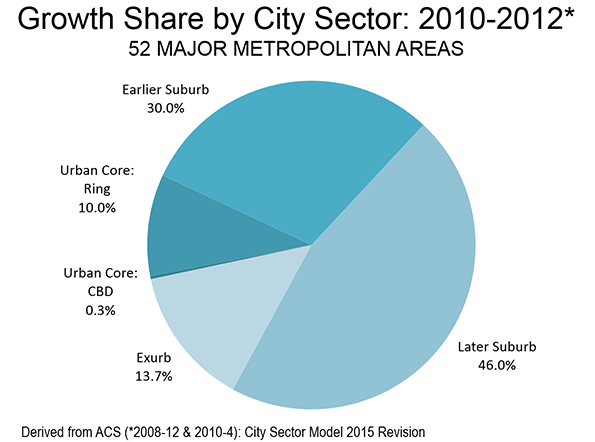
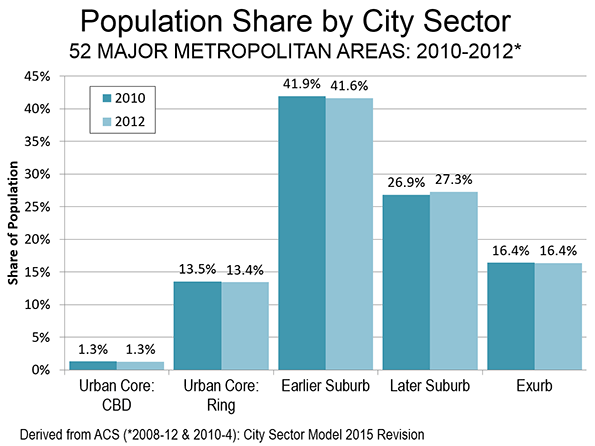
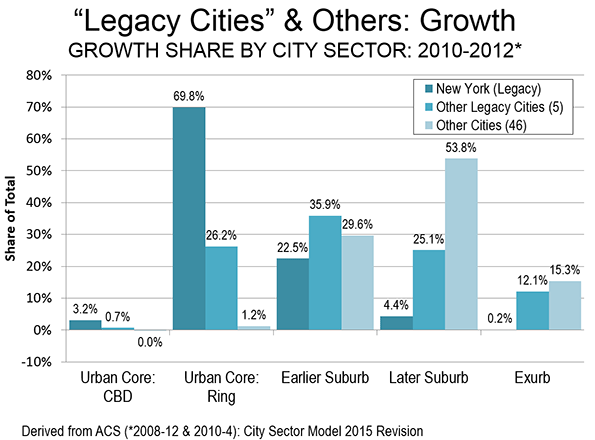
    The continuing dispersion was most evident in the rising 0.4 percentage point share (from 26.9% to 27.3%) in the Later Suburbs – with mid-point construction dates of 1980 or later. Two of the other four functional city sectors experienced declines in their shares, with the higher density, transit-, walking- and cycling-oriented Urban Core Ring dropping from 13.5% to 13.4% and the Earlier Suburbs dropping from 41.9% to 41.6% of the major metropolitan population. The earlier suburbs are automobile oriented and have houses with median construction dates of 1946 through 1979. The Urban Core CBD sector and the exurbs have retained their previous share of the population since 2010 (Figure: Growth Share by City Sector: 2010-2012 and Population Share by City Sector).

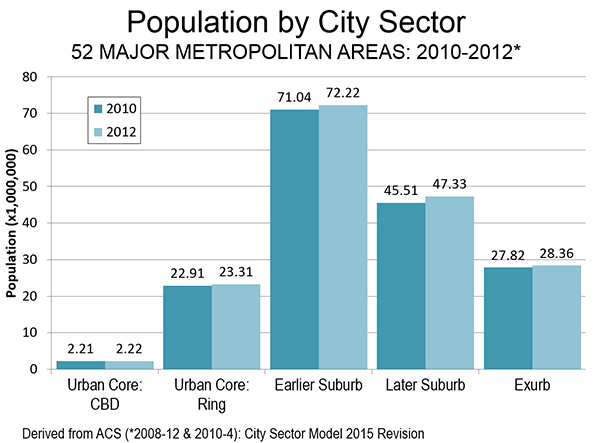
    Overall the Urban Core, which consists of the CBD and Ring dropped from 14.8% of the population to 14.7%. If this rate were to continue through the 2020 census, the Urban Core share of the major metropolitan area population would drop by 0.5 percentage points, considerably less than the 1.7 percentage point loss between 2000 and 2010. Nonetheless, the suburbs and exurbs accounted for nearly 90% of the growth between 2010 and 2012 (Figure: Population by City Sector). Suburbia, even exurbia, is where the growth is

    The new data also suggests that much of that growth was in the suburban areas of the historical core municipalities (newer and automobile oriented). For example, large areas of core cities are functionally suburban, such as in Phoenix, Dallas, Los Angeles, Portland, Atlanta, Charlotte, and elsewhere.

    The bottom line , as we have indicated in previous articles, is this: the data shows virtually no “return to the city.” Between 2010 and 2012 the suburbs and exurbs gained 3.5 million residents, while the Urban Cores gained 400,000. The Exurbs alone gained more population than the Urban Core (CBD and Ring combined). This has also been evident in each year of this decade by the continuing domestic migration to suburban and exurban counties, which has exceeded that of counties that contain the urban cores.

    New York, Other Legacy Cities and the Balance

    There is considerable variation in the size and growth of Urban Cores among the major metropolitan areas. The Urban Cores in the “legacy cities” are far larger and are capturing a far higher share of their metropolitan area growth. The legacy cities are the six metropolitan areas that have downtowns (central business districts or CBD’s) with more than 200,000 jobs (New York, Chicago, Philadelphia, San Francisco, Boston and Washington), These are generally older cities and the strength of their Urban Cores is illustrated by the fact that, combined, the core cities of these metropolitan areas account for 55% of the destinations of transit committing trips in the nation.

    Even among the legacy cities, strong distinctions exist. New York, with central business district employment of nearly 2 million, has nearly 4 times the jobs that of its Chicago counterpart. Indeed, New York’s central business district employment exceeds that of the combined employment in the downtowns other five legacy cities. Thus, as in other indicators of intense urbanism (such as transit ridership and the share of the national transit ridership increase), New York is in a “league” of its own.

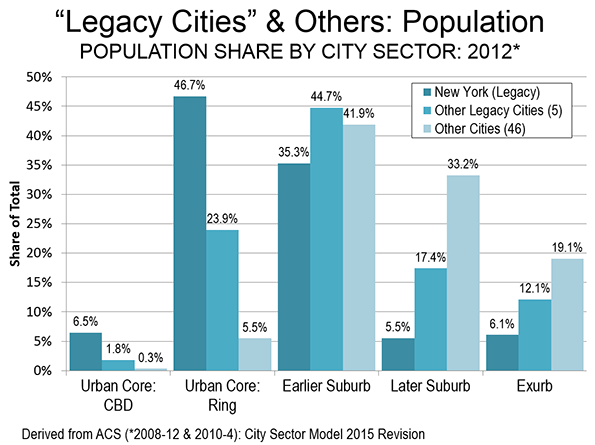
    As of 2012, New York’s Urban Core included approximately 53% of the metropolitan area population. This is more than double the 26% share of the metropolitan population in the urban cores of Chicago, Philadelphia, San Francisco, Boston and Washington (Figure Legacy Cities and Others: Population).

    The difference between the legacy cities and the other 46 metropolitan areas is even more stark. On average, other metropolitan areas have on average only approximately seven percent of their populations in their urban cores, compared to 53 percent in New York and 26 percent in the other five.

    There are even greater disparities in population growth. Between 2010 and 2012, 73% of the population growth in the New York metropolitan area was in the Urban Core. This is 2.7 times the average 27% of metropolitan growth in the urban cores of the other five legacy cities. Thus, by two measures, population concentration and population growth in the urban cores, Chicago, Boston and the other legacy cities cannot even present themselves as “little New York’s”.

    Most other cities are not even in the same league as Chicago or Boston. None achieved a 20 percent Urban Core growth percentage, though St. Louis was close (19.8 percent), and Seattle was next (15.0 percent). The urban core growth in the other 46 cities was less than 6% (Figure Legacy Cities and Others: Growth). Even in Portland, with its strong densification policies biased toward urban core development and discouraging towards suburban development, no more than average 10% of its growth took place in its Urban Core. Nearly 90 percent of Portland’s growth was in the suburbs and exurbs.

    Back to Normalcy?

    The 2010-2012 data does not indicate a return to the near monopoly on growth enjoyed by the suburbs and exurbs in the 1990s and 2000s. But more recent data suggests stronger suburban performance, as chronicled by William Frey at the Brookings Institution and Jed Kolko at Trulia. At the same time, it is good to see the upward trends in the in the urban cores, which as metropolitan areas as diverse as St. Louis and Seattle show, do not depend on suburban misfortune to prosper. The cores are an important part of a healthy metropolitan system, although in most places they are far smaller in population, and growth, than the suburban rings.

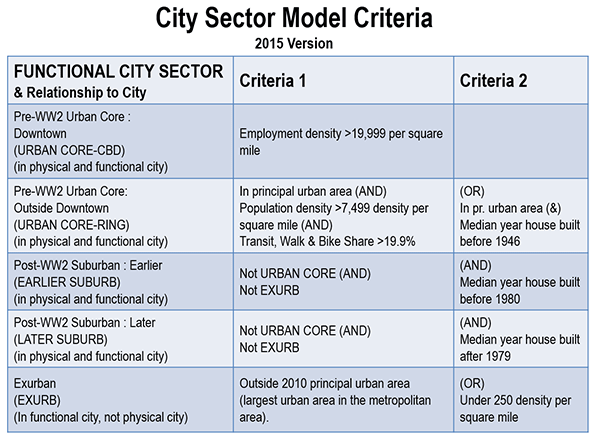
    Note: The “City Sector Model” provides data for areas (Zip Code Analysis Zones) within metropolitan areas, as opposed to data based on jurisdictional boundaries, such as city limits. The data is based on small areas, Zip Code Tabulation Areas (ZCTA’s). The criteria for classification is indicated in the Figure: City Sector Model Criteria.

    Wendell Cox is Chair, Housing Affordability and Municipal Policy for the Frontier Centre for Public Policy (Canada), is a Senior Fellow of the Center for Opportunity Urbanism (US), a member of the Board of Advisors of the Center for Demographics and Policy at Chapman University (California) and principal of Demographia, an international public policy and demographics firm.He is co-author of the "Demographia International Housing Affordability Survey" and author of "Demographia World Urban Areas" and "War on the Dream: How Anti-Sprawl Policy Threatens the Quality of Life." He was appointed to three terms on the Los Angeles County Transportation Commission, where he served with the leading city and county leadership as the only non-elected member. He served as a visiting professor at the Conservatoire National des Arts et Metiers, a national university in Paris.

    Photo: New York’s Growing Skyline by Citizen59 (Own work) [CC BY 3.0], via Wikimedia Commons

  • Losing the Narrative of Their Lives

    study released a few weeks ago, conducted by Anne Case and Angus Deaton, documented a significant increase in the death rate among the white working class in the US, much of it due to suicide and substance abuse. In one interview about the report, Deaton suggests that the reason for the increase is the increasing economic insecurity this group faces. As he told Vox’s Julia Bellus, they have “lost the narratives of their lives.” Not surprisingly, op-eds flew right and left about this report, from Rod Dreher in The American Conservative and R.R. Reno in First Things to Paul Krugman in the New York Times and Harold Meyerson in the Washington Post. This study is the latest contribution to an expanding public discussion about changes in white working-class culture, which Jack Metzgar has traced in a series of posts here about books by Andrew CherlinRobert Putnam, and others.

    As both Ross Douthat and Krugman note in their New York Times columns responding to the study, the rising death rate cannot be explained solely in economic terms. Douthat rejects the claims of some conservatives, including Reno, that the report reflects the consequences of liberal policy and moral decline, arguing that we must recognize that “stagnating wages” play a part in changing social patterns. But, he argues, what matters most is how economic changes have left white working-class people with “a feeling thatwhat you were supposed to have has been denied you.” As Krugman puts it, they were “raised to believe in the American Dream, and are coping badly with its failure to come true.”

    While, as Metzgar has pointed out, recent studies of white working-class culture often begin with problematic assumptions, they nonetheless (and sometimes inadvertently) make clear that economic restructuring has social consequences that extend far beyond the factory floor or corporate offices. We are rightly concerned not only with what this means for income inequality and social justice but also for the quality of people’s lives and the way working-class experience translates into politics. As Dreher argues, we can draw a clear connection between the “dispossession” of the white working class and the popularity of Donald Trump. The “politics of resentment” that John Russo and I traced in Youngstown twenty years ago seems to have become a national pattern.

    If we want to understand the social and cultural patterns fully, I would argue, we must consider not only the material conditions or social structures that shape economic experience but also how people interpret those experiences and construct their identities in response to them. We would do well to attend not only to statistical evidence but also to stories, which provide insight into how people experience and make sense of economic and social changes. This is the kind of insight that literature can provide. By representing the social world through the stories of individuals, fiction, especially, can help us understand what large-scale change looks and feels like on a personal, subjective level.
    The long-term effects of deindustrialization – what I refer to as its half-life – have generated not only measurable social patterns like rising death rates but also a growing body of literature. If you want to understand the “lost narrative” of contemporary working-class lives, you might well begin with these books.
    In Coal Runby Pennsylvania writer Tawni O’Dell, we meet a character who exemplifies the lost sense of self as well as the addiction, anger, and self-destructive behavior reflected in the rising death rates. Ivan Zoschenko is a former high school and college football star who has returned to his home town, where the last of the local mines is about to shut down. He feels like a failure, especially in comparison with his hard-working miner father, who taught him the importance of finding a sense of purpose through one’s work. Working as a deputy sheriff, Ivan mediates domestic disputes spurred by the town’s economic struggles, and in the process he reconnects with his working-class community and gains a renewed sense of purpose and belonging.

    Philipp Meyer offers a less hopeful story in American Rustwhich follows two young men in a former steel town, both struggling to figure out their futures. One, known as the smartest kid in his high school class, dreams of escaping his hometown, studying astrophysics, and working at a research institute, but as the sole caregiver for his father, who was seriously injured in an accident in the steel mill, he cannot bring himself to leave. His dream remains beyond his reach. His best friend, Billy Poe, can’t even imagine a future for himself, and when he is jailed for a murder he didn’t commit, he gives up. In his eyes, “this place had been waiting for him. There were those who had capabilities and those who didn’t and even in his glory days he had known it, known they would figure it out one day, a bullet he would never dodge.” Meyer’s characters are younger than the middle-aged white working-class people whose death rates Case and Deaton tracked, but they display a similar sense of hopelessness.

    Indeed, deindustrialization literature suggests that – as Jennifer Silva found in her study, Coming Up Short – younger working-class people have inherited a feeling of being at once trapped and betrayed, though often with a fuzzier idea of exactly how they have been let down. Two contemporary novels focused on workers in service jobs highlight this well. In Stewart O’Nan’s Last Night at the Lobsterwe follow restaurant manager Manny DeLeon through his last shift at a suburban Red Lobster that is about to close. He takes pride in his work, but that provides only partial compensation for the conflicts he experiences in his interactions with both the corporation and the other workers, yet he sees no other options for himself.

    Finally, one of the most entertaining but also troubling novels I’ve read about contemporary working-class life is Grady Hendrix’s Horrorstör. Designed as a mock-Ikea catalog, the novel highlights the soul sucking working conditions of corporate retail through the encounters of the “partners” (sales clerks) of Orsk, an Ikea knock-off, with a horde of zombies. The zombies were imprisoned on that site in the 1830s, when it was the Cuyahoga Panopticon, run by a sadistic warden who believed that hard labor was a “moral treatment that will mend your degraded minds,” while also generating profits for him. While readers may laugh at the line drawings of torture devices like the Alboterk treadmill desk, complete with spikes and shackles, the novel also critiques the limitations that working-class people face when working conditions are exploitative and wages stagnant. As the main character laments, “for all the fighting, all the struggle, all the scrimping, and saving, and double shifts” of recent years, she never has enough money to buy gas and food, and she is always in debt. Rather than recognizing the external causes of her difficulties, however, she internalizes the situation and accepts her fate, believing that this is what she deserves, what “she’d been born to do: wear a uniform and work a register. . . . to answer phones in call centers, to carry bags to customers’ cars, to punch a clock, to measure her life in smoke breaks.”   Reading this novel, it’s easy to understand why some might turn to drugs and alcohol, or even to suicide.

    Among the most troubling insights from these novels is this: most of these novels focus on characters who are younger than the subjects of Case and Deaton’s study, which suggests a disturbing pattern as the next generation of working-class people come of age. High rates of addiction, depression, and suicide may well continue as some struggle with what has become a long-term “dispossession,” while others accept low expectations as a new normal, as Silva observed in her study. Like the protagonist of Horrorstör, working-class people may come to believe that low wages, poor working conditions, and perpetual struggle are what they deserve. And that is the stuff of tragedy.

    This article first appeared at Working-Class Perspectives.

    Sherry Linkon is a Professor of English and Director of the Writing Program at Georgetown University.  She is co-author, with John Russo, of Steeltown USA: Work and Memory in Youngstown(Kansas 2002) and is working on a book-length study of contemporary American literature about deindustrialization.

  • Los Angeles: City Of Losers?

    When I arrived in Los Angeles four decades ago, it was clearly a city on the rise, practicing its lines on the way to becoming the dominant metropolis in North America. Today, the City of Angels and much of Southern California lag behind not only a resurgent New York City, but also L.A.’s longtime regional rival, San Francisco, both demographically and economically.

    Forty years ago, San Francisco was a quirky, backward-looking town, a haven for the gilded rich and hippies, a quaint but increasingly insignificant town. The Dodgers and the Lakers ruled the California sporting world.

    Today things couldn’t be more different. San Francisco and its much bigger southerly neighbor, Silicon Valley, have morphed into the global epicenter of the technology industry, with 25 tech companies on the Fortune 500. In contrast, Los Angeles County, which has almost twice as many people, is home to only 15 Fortune 500 firms total.

    Meanwhile, the Giants and the Golden State Warriors have become consistent winners while the Dodgers, Angels and Clippers disappoint and the Lakers are painfully unwatchable.

    Although there is a desire to repeat L.A.’s success with the 1984 Olympics and bring football back to town, that would only put a happy veneer over the city’s core problem: the long-term decline of its business sector. In 1984, the city had a strong and highly motivated business elite highlighted by 12 Fortune 500 companies, who could help sponsor the games and provide management expertise. Now there are only three within city limits, with the departure of major corporations such as Lockheed, Northrop Grumman, Occidental Petroleum and Toyota, and the loss of hundreds of thousands of manufacturing jobs.

    In contrast, the Bay Area is full of thriving companies and successful entrepreneurs, many of them astoundingly young. Of the 30 richest people in the country, five live in the Bay Area; Southern California has only one, the Irvine Company visionary Chairman Donald Bren, and he’s in his eighties. The Bay Area accounts for the vast majority of American billionaires under 40; if not for Snapchat’s founders, Evan Spiegel and Bobby Murphy, as well Elon Musk, who lives in L.A. but spends much of his time working in Northern California, where Tesla and Solar City are located, L.A. would be off the list.

    This unfavorable contrast with the Bay Area, sadly, is not just a recent development. Since 1990 Los Angeles County has added a paltry 34,000 jobs while its population has grown 1.2 million. In contrast, the Bay Area, which added roughly the same number of people during the same time, gained a net 500,000 jobs, mostly in the suburbs. In 1990 Los Angeles had around the same number of private-sector jobs per person as the Bay Area, roughly 410 per 1,000; today Los Angeles’ private-sector jobs to population ratio has dropped to 364 per 1,000 while the Bay Area’s has grown to 415. Worse yet, while the Bay Area has increased its share of high-wage jobs to 33 percent since 1990, Los Angeles percentage fell to 27.7 percent.

    How L.A. Blew It In Technology

    As recently as the 1970s, as UCLA’s Michael Storper has pointed out, L.A. stood on the cutting edge not only in hardware, but also software. Computer Sciences Corp. was the first software company to be listed on a national stock exchange. In 1969, UCLA’s Leonard Kleinrock invented the digital packet switch, one of the keys to the Internet.

    In 1970, IT’s share of the economy in greater Los Angeles and in the Bay Area was about the same (in absolute terms it was bigger in L.A.). By 2010, IT’s share was four times bigger in the north than in the south.

    Storper links the decline in large part to the strategies of the biggest high-tech companies in the L.A. area: Lockheed Martin, Rockwell and TRW focused on defense and space, essentially becoming dependent on government spending. In contrast, the Bay Area technology community, although also initially tied to Washington, began to move into more commercial applications. In the process they also developed a huge network of venture capitalists who would continue to help found and finance fledgling firms.

    Today the San Jose area enjoys the highest percentage of workers in STEM (science technology engineering and mathematics-related jobs) in the country, over three times the national average. San Francisco and its immediate environs, largely as a result of the social media boom, now has a location quotient for STEM jobs of 1.75, meaning it has 75% more tech jobs per capita than the national average. In contrast, the Los Angeles area barely makes it to the national average.

    Southern California remains an attractive to place to live, but it’s hard to imagine it as the next Silicon Valley. L.A. had its chance, and, sadly, it blew it.

    The Growing Demographic Crisis

    Storper and other critics suggest that Los Angeles failed in part because it tried to maintain high-wage blue collar industries while the Bay Area focused on information and biotechnology. The problem now, however, are the factors in L.A. that drive industry away, such as ultra-high electricity prices and a high level of regulation. Even amidst the recent industrial boom in many other parts of the country, Los Angeles has continued to lose manufacturing jobs; Los Angeles’ industrial job count stands at 363,900, still the largest number in the nation, but down sharply from 900,000 just a decade ago.

    This decline places L.A in a demographic dilemma. Like the Midwestern states that lured African-American to fill industrial jobs during the Great Migration, L.A. attracted a large number of largely poorly educated immigrants, mostly from Mexico and Central America. These people came for jobs in factories, logistics and home-building, but now find themselves stranded in an economy with little place for them outside low-end services.

    Although inequality and racial disparities also exist in the Bay Area, the issue is far more relevant in Southern California. The Bay Area’s population is increasingly dominated by well-educated Anglos and Asians. San Francisco’s population is 22 percent black or Hispanic; in Los Angeles, this percentage approaches 60 percent.

    Poverty and lack of upward mobility are the biggest threats to the region. In Los Angeles, a recent United Way study found 35 percent of households were “struggling,” essentially living check to check, compared to 24 percent for the Bay Area.

    recent study by the Public Policy Institute of California and the Stanford Center on Poverty and Inequality found that, once adjusted for cost of living, Los Angeles has the highest level of poverty in the state, 26.1 percent. Rents are out of control for many people who are struggling in an increasingly low-wage dominated economy. In fact, Los Angeles now is the least affordable city for renters, based on income, according to a recent UCLA paper.

    Is There A Way Out?

    Despite these myriad challenges, Los Angeles, and indeed all of Southern California, is far from a hopeless case. It is unlikely to become the next Detroit and is better positioned by natural and human resources than it’s similarly troubled big city competitor Chicago. It still enjoys arguably the best climate of any major city in the world, remains the home of Hollywood, the nation’s dominant ports and a still impressive array of hospitals and universities.

    At least some of the city’s leadership has begun to recognize the challenges facing the region. “The city where the future once came to happen,” a devastating blue ribbon report recently intoned, “is living the past and leaving tomorrow to sort itself out.”

    This recognition might be the first step toward a turnaround, but the area really has increasingly little control over its own fate. Today San Francisco and its immediate environs, despite its much smaller population, is home to virtually every powerful politician in the state: both its U.S. Senators, the Governor, the Lieutenant Governor and the Attorney General. Not surprisingly, state policies on everything from greenhouse gases, urban density and transit to social issues follows lines that originate in, and largely benefit, San Francisco.

    Most troubling of all, the local leadership seems clueless about how to resuscitate the economy, or even how this vast region actually operates. Neither another Olympics nor getting a football team or two will make a difference. Even worse is the effort by Mayor Eric Garcetti to densify the city to resemble a sun-baked version of New York.

    This has been part of the agenda for developers, greens and most local academics for the better part of 30 years. But the problem remains: Los Angeles, and even more so its surrounding region, is notNew York, nor can it ever be. It is, and will remain, a car-dominated, multi-polar city for the foreseeable future. After all the vast majority of Southern California’s population growth — roughly 75 percent — came after the Second World War and the demise of the Red Cars, L.A.’s  much lamented pre-war transit system.

    Some outside observers such as progressive blogger Matt Yglesias now envision L.A. as “the next great transit city.” Yet in reality, despite spending $10 billion on new transit projects, the share of transit commuters has actually dropped since 1990; today nearly 31 percent of New York area commuters take public transportation, while 6.9 percent do so in Los Angeles-Orange County.

    People take cars because, for most, it’s the quickest way to work. Few transit trips take less time, door to door than traveling by car, not to mention the convenience of working at home. The average transit rider in Los Angeles spends 48 minutes getting to work, compared to people driving alone, at 27 minutes.

    This reflects L.A.’s great dispersion of employment, which is not compatible with a transit-driven culture. In greater New York, 20 percent of the workforce labors in the central core; in San Francisco, the percentage is roughly 10 percent. But barely 2 percent do so in Los Angeles. The current, much ballyhooed revival of downtown Los Angeles then is less a reflection of economic forces, than the preferences of a relatively small portion of population for a more urban lifestyle and as market for Asian flight capital. Its population of 50,000 is about the same as Sherman Oaks or the recently minted city of Eastvale in the Inland Empire.

    Rather than seek to become someplace else, Los Angeles has to confront its key problems, like its woeful infrastructure, particularly roads, among the worst in the country, and a miserable education system. These are among the likely reasons why people with children are leaving Los Angeles faster than any major region of the country.

    Yet Los Angeles is not without allure. Overall Los Angeles-Orange has grown its ranks of new educated workers between 25 and 34 since 2011 as much as New York and San Francisco and much more than Portland.

    Perhaps most promising is the region’s status as the number one producer of engineers in the country, almost 3,000 annually. This raw material is now being somewhat wasted, with as many as 70 percent leaving town to find work.

    What Los Angeles needs to do is to provide the entrepreneurial opportunities to keep its young at home, particularly the tech oriented. As the Bay Area has shown, it is possible to reshape an economy based on pre-existing strength. For L.A. the best regional strategy would be based on a remarkably diverse economy dominated by smaller firms, a population that, for the most part, seeks out quiet residential neighborhoods and often prefers working closer to home than battling their way to what remains a still unexceptional downtown.

    One place where Los Angeles could shine is in melding the arts and technology. Unlike New York, which has relatively few engineers, Los Angeles still has the largest supply in the country. The Bay Area may be more appealing to nerddom, but is unexceptional in the arts. This revival will not come from the remaining suits in L.A.; roughly half of workers in the arts are self-employed, according to the economic forecasting firm EMSI.

    This entrepreneurial trend will continue since, with the studio system clearly in decline, as large productions go elsewhere, digital players such as Netflix, Amazon, Apple as well as Los Angeles based Hulu have become more important. Los Angeles could expand its arts-related niche by supplying the content that these expanding digital pipelines require.

    Given the corporate exodus, and the difficult California business climate, overall L.A.’s recovery must come from the bottom up, and be dispersed throughout the region. According to Kauffman Foundation research, the L.A. area already has the second highest number of entrepreneurs per 100 people in the country, just slightly behind the Bay Area.

    The next L.A. can succeed, but not by trying to duplicate New York or San Francisco. Instead there’s a need for greater appreciation why so many millions migrated here in the first place: great weather, beaches, suburban-like living and entrepreneurial opportunities. Only when the local leadership rediscovers the uniqueness of L.A.’s DNA can the region undergo the renaissance of this most naturally blessed of places.

    This article first appeared at Forbes.

    Joel Kotkin is executive editor of NewGeography.com and Roger Hobbs Distinguished Fellow in Urban Studies at Chapman University, and a member of the editorial board of the Orange County Register. He is also executive director of the Houston-based Center for Opportunity Urbanism. His newest book, The New Class Conflict is now available at Amazon and Telos Press. He is also author of The City: A Global History and The Next Hundred Million: America in 2050. He lives in Orange County, CA.

    Photo: Downtown Los Angeles toward the Hollywood Hills and the San Fernando Valley (by Wendell Cox)

  • How Oklahoma City Decided to Change Its Image

    I was in Oklahoma City for the first time earlier this year. I got to see a lot of the things I’d heard about, such as the in-progress Project 180, a $175 million plan to rethink and rebuild every downtown street.

    OKC is not yet where it needs to be in a number of respects. Very little of the side has sidewalks, for example. But they are pedaling in the right direction, and making some smart choices about what to do – and equally as importantly, how to pay for it. If you visit you’ll also get a sense of the city’s ambitions for more.

    I have a short piece in the most recent City Journal about OKC, which is now available online.  Here’s an excerpt:

    In 1991, Oklahoma City lost out to Indianapolis in the competition for a United Airlines maintenance base. Mayor Ron Norick wanted to know why. He was certain that Oklahoma City had put the most compelling financial deal on the table for United. The company answered that its decision had nothing to do with the subsidy package. Rather, United simply couldn’t imagine its employees living in a place as bleak as Oklahoma City. “The quality of life had sunk so low we couldn’t buy someone’s attention,” as current mayor Mick Cornett puts it. “No matter how many incentive dollars we put in place, corporate America wasn’t interested in us.”

    Click through to read the whole thing.

    Aaron M. Renn is a senior fellow at the Manhattan Institute and a Contributing Editor at City Journal. He writes at The Urbanophile, where this piece originally appeared.

  • How Many People Will Live in Africa in 2050 and 2100?

    Large declines in fertility will depend on raising female literacy above 80%.

    Every few years, the United Nations Population Division releases demographic projections for the entire world and for every country, region and continent. Although the UN’s database is the most used source on demographics, the data is not equally reliable for all countries.

    Countries in the developed world conduct regular censuses and produce detailed numbers that are considered reliable. Less developed countries conduct censuses on an irregular basis or are completely unable to conduct them and have instead to rely on demographic sampling. In the poorest countries of the world, most of which are in sub-Saharan Africa, censuses are infrequent or nonexistent and even sampling can be irregular and unreliable.

    This poses a problem today because the biggest population growth by far is expected to take place in these same poor countries. In order to get a fair picture of the world population in the 21st century, we need to get reliable data from the fastest growing region.

    François Pelletier who heads the UN’s Population Estimates and Projections Section told populyst that he considers the data for the next 35 years, that is the projections for the years 2015-2050, to be fairly reliable, with greater confidence in the near years than in the later years. The further the horizon of the projections, the greater the uncertainty. In this regard, Pelletier suggested that the projections beyond 2075, especially those focusing on the median trajectory at the country level, be treated with some degree of caution.

    This makes perfect sense because a small change in the assumptions for child mortality and total fertility ratios (TFR = average children per woman) will have a relatively small impact in the near years and a cumulatively larger impact in the later years.

    For example, if we assume for sub-Saharan Africa a low variant fertility ratio of 4.02 children per woman in 2020-2025 instead of a medium variant closer to 4.42, the cumulative impact of this change adds up to a difference in population size of ‘only’ 80 million people after ten years, a 5% deviation, but of as many as 600 million after fifty years, a 20% deviation.

    Another source of demographic projections is the Vienna-based Wittgenstein Centre and it has cast doubt on the UN’s projections for world and Africa populations. In a note written by Samir KC, the Centre argues that the UN’s projections are too high because the fertility ratio in Africa is likely to fall faster than the UN predicts.

    The Centre’s rationale is reached through analogy with the Asian fertility decline between 1970 and 1990 which was steeper than is predicted by the UN for Africa. Samir KC writes (our emphasis):

    Once countries urbanize and citizens become wealthier, fertility declines everywhere.

    The most important factor is women’s education. Already today, an Ethiopian woman with secondary education has on average only 1.6 children, compared to a woman with no education who has 6 children.

    This relationship is true across Africa (see figure).

    Fertility-rate

    We know that access to education is expanding across Africa. There is even talk of an education dividend.

    Once all girls go to school and stay there longer, they will have fewer children, especially as they will also be exposed to a more modern lifestyle, be it through TV, the cell phone and the fact that Africa is urbanizing rapidly.

    This has also been the experience in Asia. It took about 20 years in Asia for its fertility to decline from more than 5 children per woman during early 1970s to less than 3 children per woman in early 1990s.

    Similarly, India took about 20 years for its fertility to decline from 4.7 children per woman in early 1980s to 3.1 by early 2000s.

    With new development and the plans for the better future in the making, it won’t be a surprise if the average African family would have only three children as soon as 2035.

    If that assumption bears out, then Africa cannot reach 4 billion — and the world would peak this century at below 10 billion.

    So who is right, the UN or the Wittgenstein Centre?

    First, let us look at what each party is projecting. Second, let us examine in greater depth the correlation between fertility ratios and female literacy. Finally, let us see if the Wittgenstein Centre’s use of the Asian precedent makes sense for Africa.

    Running the Numbers

    Screen Shot 2015-11-17 at 8.16.19 PM

    The adjoining tables (click to enlarge) show the UN’s projections for its low and medium variants. We ignore the high variant and other variants for now because our main purpose is to discuss whether the medium variant is too high, as alleged by the Wittgenstein Centre.

    If we look at the two variants for the year 2050 in the table below, we can see that the difference in population size in sub-Saharan Africa is about 200 million or approximately 10% of the total, a non negligible deviation but one that does not fundamentally alter one’s view of the future. Looking further out to 2100, the difference is much more significant at nearly 1.2 billion or about 30% of the total.

    Going through the same comparison for the whole world, the difference is 1 billion in 2050 and a big 4 billion in 2100, respectively 10% and 50% of the total. Also highlighted are figures for India, another high growth country.

    Screen Shot 2015-11-17 at 8.15.20 PM

    The Wittgenstein forecast is a bit lower than the UN’s low variant and assumes a sub-Saharan fertility ratio of 3.0 instead of 3.25 for the UN. Its population estimates for Africa in 2100 is 2.6 billion people, marginally lower than the UN’s low variant which is at 3 billion. We say “marginally” only in the sense that this difference looks large but it results from a small change in assumptions starting now 85 years earlier.

    Female literacy and Fertility Ratios

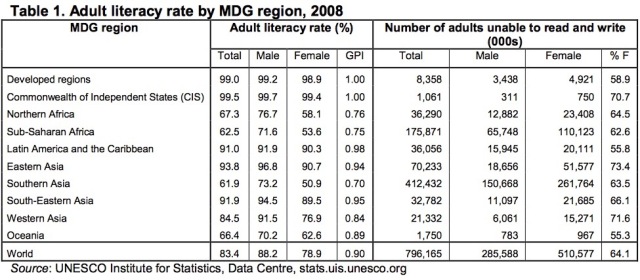
    Looking at women’s education, it is clear that female literacy, the cornerstone of Wittgenstein projections, is further behind in sub-Saharan Africa than in any other region of the world. The Indian subcontinent and the Middle East/North Africa also lag the rest of the world. Table 1 below shows that the lag in female literacy has been most pronounced in Southern Asia, Africa and the Middle East (Western Asia). Encouragingly, table 2 shows that the lag is significantly narrower among younger people.

    Screen Shot 2015-11-21 at 6.29.19 AM

    Screen Shot 2015-11-21 at 6.29.11 AM

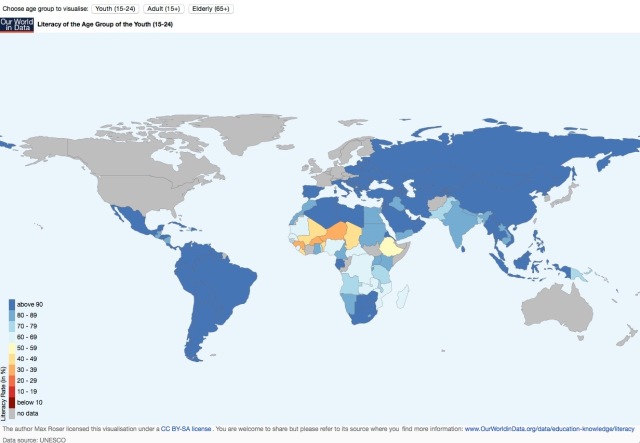
    It is clear that literacy is improving in Africa. The Oxford economist Max Roser compiled this map from UNESCO data and published it on his site Our World in Data. Click on the map to use the interactive feature.

    Screen Shot 2015-11-20 at 12.10.37 PM (2)

    The data shows solid progress in the literacy rate for youth aged 15-24, compared to older groups. For example, 66% of Nigeria’s youth (15-24) are literate, compared to 51% for the overall adult population (defined as 15+ here) and only 22% for the elderly population (65+). Other sub-Saharan countries show a similar progression.

    The countries with the highest literacy rate among the youth group are also the ones with the lowest fertility ratios. Botswana and South Africa have youth literacy rates of 95% and 99% and TFRs of 2.9 and 2.4, respectively.

    One surprising data point is Kenya with a literacy rate of 82% and a TFR of 4.4. Though lower than the 5.1 sub-Saharan average, Kenya’s TFR is still quite high, suggesting that the biggest decline in fertility may occur at a literacy rate that is higher than 80% or 85%. It may be that the TFR falls slowly as literacy rises from 50% to 85% and falls rapidly as it rises from 85% to 100%.

    In order to examine this hypothesis, we compiled the following tables and charts.

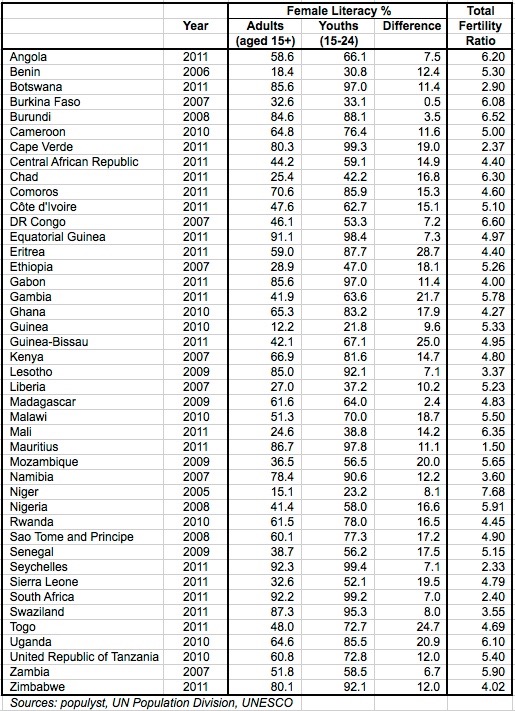
    The table shows rates of female literacy for all sub-Saharan countries (except Congo, Somalia and South Sudan). Many of these figures may not be reliable but the trend is clear that female literacy is improving all over the African subcontinent.

    Screen Shot 2015-11-23 at 11.25.32 AM (2)

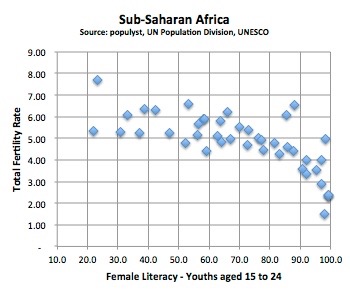
    Plotting these figures, we reach the most important conclusion which is that the biggest decline in total fertility takes place after female literacy rises over 80%. Under 80%, the fall in TFRs and correlation with literacy is very weak. Excluding all countries with female adult literacy over 80%, the regression has an r-squared of only 0.29 (0.21 if the outlier Niger is also removed). Data from Burundi, Equatorial Guinea and Uganda look somewhat suspect with literacy over 80% and TFRs at 6.5, 4.97 and 6.1.

    Screen Shot 2015-11-23 at 11.19.09 AMVersion 2


    There may be cultural factors that may slow down this dynamic. In order to get a fuller picture, we looked for data on gender inequality. The United Nations Development Programme ranks countries by gender inequality. As shown in the table below, sub-Saharan African countries dominate the bottom of the ranking. It is not surprising that countries ranked lowest on the Gender Inequality Index also have the lowest female literacy and highest fertility ratios. Niger, Mali, Chad, DR Congo, Mozambique, Liberia, CAR all still have youth female literacy well below or barely above 50%. Niger looks especially challenging with a TFR of 7.7 and very low female literacy.

    Screen Shot 2015-11-19 at 2.03.39 PM (2)


    Non-African countries among the bottom 30 include lowest-ranked Yemen (152nd), Afghanistan (149th), Papua New Guinea (135th), Haiti (132nd), Egypt (130th), Pakistan (127th), India (127th) and Syria (125th). Nigeria and a number of others were not ranked in the latest data.

    Analogy with Asia 1970-1990

    Finally, does the Wittgenstein’s use of the precedent of Asia in 1970-1990 make sense for Africa now? We can see in the tables above that the fertility ratio in Asia fell from 5 in 1970 to 3 in 1990.

    We can also see that China played a big role in this decline with its own TFR falling from 5 to 2. The one-child policy contributed to this accelerated decline but a big leap in literacy from about 50% to well over 90% was also a big contributor. Our hypothesis that fertility falls modestly under 80% female literacy, and collapses precipitously above 80% is supported by the Chinese experience. Literacy rose in the 1950s and 1960s but the TFR was still at 6.3 children per woman in 1965-70, very close to the 1950-55 TFR of 6.11. But twenty years later in 1985-90, female youth literacy exceeded 90% and the TFR fell to 2.75.

    India is following a similar path with its female youth literacy ratio rising from 67.7 in 2001 to 87.2 in 2015 and its TFR falling from 3.3 in 2001 to 2.48 now. In the case of India however, the decline appears more gradual and is not obviously faster above the 80% literacy threshold. The table and graph below show that in the case of India the correlation holds well for literacy rates that are well below 80%.

    Screen Shot 2015-11-23 at 4.11.32 PM (2)Screen Shot 2015-11-23 at 4.11.55 PM (1)


    Other considerations

    Another way to gauge the validity of the Asia analogy is to see whether Asia was more or less developed in 1970 than sub-Saharan Africa is today. If Asia was more developed, then the analogy may not be valid and the decline in African TFR will likely be slower. In order to answer this question, we look at electricity consumption per capita as a proxy for development.

    According to the World Bank, electricity consumption per capita in 1970 was 150 kilowatt hour (kWh) in China and 95 kWh in India. Below are the figures for the most populous countries in sub-Saharan Africa.

    Screen Shot 2015-11-19 at 1.20.03 PM (2)


    Per capita electricity consumption in Kenya and Nigeria in 2012 (most recent World Bank data) looked roughly in line with China in 1970, while DR Congo and Tanzania in 2012 looked closer to India’s consumption in 1970. In the absence of a more robust method, we could say that the TFR in Kenya and Nigeria could decline like China’s in 1970-90, while the TFR in DR Congo and Tanzania could decline like India’s, and the TFR in Ethiopia and Uganda could decline even more slowly.

    Under this scenario, the TFR for Kenya and Nigeria would fall to 2 by 2035, while in DR Congo and Tanzania, it would fall to only around 4, and in Ethiopia and Uganda to a still higher level.

    In a similar vein, we could look at urbanization since people living in urban areas tend to have fewer children. With the exception of Uganda, all the countries in the table appear more urbanized than China was in 1970. The percentages shown for DR Congo (42%) and Nigeria (46.9%) look suspect because they are not far below China’s current percentage of urbanization 54.4%. It looks like definitions of urbanization differ across countries and we may fall back on electricity consumption as a more reliable indicator.

    Version 2


    Conclusion

    All in, the answer to how fast African TFRs will decline remains elusive. We can however draw the following conclusions:

    • Demographics are not on automatic pilot. Proactive intervention to raise female literacy, to invest in infrastructure and to improve governance will all have a significant impact on future fertility rates. Absent these measures, it should not be assumed that TFRs will decline in Africa as fast as they did in Asia. They may remain high or they may decline for other reasons such as food or water scarcity.
    • The correlation between female literacy and fertility ratios is neither linear nor gradual. In the case of sub-Saharan Africa, TFRs seem to decline rapidly above 80% female literacy. Below 80%, the correlation is negligible or nonexistent.
    • The recent history of Asian fertility may or may not be a reliable precedent for Africa. China’s evolution in particular was greatly impacted by government policy, including the one-child policy, the literacy campaigns and the expansion of global trade.
    • Data from Africa and other less developed countries is generally unreliable. For example, it is possible that literacy rates and/or fertility rates for some African countries are inflated. It is also possible as a consequence that the relationship between literacy and fertility is in fact quite linear, as seen in the case of India.

    Sami Karam is the founder and editor of populyst.net and the creator of the populyst index™. populyst is about innovation, demography and society. Before populyst, he was the founder and manager of the Seven Global funds and a fund manager at leading asset managers in Boston and New York. In addition to a finance MBA from the Wharton School, he holds a Master’s in Civil Engineering from Cornell and a Bachelor of Architecture from UT Austin.

    Some sources used in this article:

    UNESCO Institute for Statistics: ADULT AND YOUTH LITERACY: National, regional and global trends, 1985-2015

    UNESCO Institute for Statistics: ADULT AND YOUTH LITERACY: Global Trends in Gender Parity

    Population Institute: How Female Literacy Affects Fertility: The Case of India

    Sreemarti Chakrabarti: Women and Adult Literacy in China

    World image by BigStockPhoto.com.

  • Deindustrialization, Depopulation, and the Refugee Crisis

    The refugee crisis facing Western nations has begun to peak both demographically and politically.  The United Nations has reported that more than 6.5 million Syrians have fled to neighboring countries and Europe, and even nations that until recently welcomed refugees are frantically trying to change immigration policy or protect borders. In contrast, as migration has swelled the population in some places, in others, like the Rust Belt of the United States, depopulation undermines future economic development.  Some have begun to ask whether population trends can or should determine policy. The answer is yes.

    To understand the significance of depopulation in the Rust Belt, imagine that a plague hit the Midwest and four million people had vanished. What would be the economic consequences for the region, its institutions and for individuals?  Deindustrialization has operated much like a plague, and just as with a plague, the long term social and economic costs are substantial. The region can’t “just get over it.”  Deindustrialization, and the depopulation associated with it, continues to be a drag on the region both economically and socially.

    For example, in Youngstown, Ohio, steel mills began closing almost 40 years ago.  The city’s population is now around 62,000, a decline of more than 50 percent since the 1970s.  A community once known at the “City of Homes” now has more than 4000 vacant properties. Youngstown’s economic redevelopment program has largely failed. Attempts at economic redevelopment around prisons, fracking, 3-D printing and casinos have had only limited success, at best. They seem more like examples of the economics of desperation than serious efforts to revitalize the local economy. Appeals by business and government leaders to redefine this as a  “shrinking city” and exhortations for the community to exhibit “adaptive resilience” have proven shallow.  With little economic growth, such approaches feel too much like cruel optimism.

    Youngstown mayor John McNally has said that his most important task is to stop the depopulation.  A city like Youngstown needs to stop the hemorrhaging and get an infusion of energy.  Would the city gain by encouraging refugees to move to Youngstown? Other communities have tried this approach, encouraging immigrants to move to depopulated areas and gaining new economic activity in the process. Weather-challenged Winnipeg, the capital of Manitoba, has taken advantage of the Manitoba Provincial Nominee Program, which “selects applicants who demonstrate they have the potential and the desire to immigrate and settle themselves and their families in the Canadian province of Manitoba.” Immigrants may apply through different categories such as General, Family Support, International Student, Employer, Strategic Initiative, or Business Immigration. An Economic Development study reports that Winnipeg’s metropolitan population has grown to 780,000, 100,000 higher than earlier projections. The population increase includes about 85,000 immigrants. Between 2009-2014, the local economy stabilized with unemployment below the national average and higher labor force participation and wage growth. In 2014, the city was touted by KPMG as the No. 1 low cost manufacturing location in aerospace, chemical, electronics assembly, pharmaceuticals and telecommunications equipment in North America.

    On a smaller scale, some locations have also stemmed depopulation through the employment of existing ethnic enclaves as portal communities. Even in places like deindustrialized metro Detroit, depopulation was offset by an influx of Mexican and Middle Eastern immigrants into existing enclaves, transforming areas that were thought of as ghost towns. While traditional immigrant/refugee communities, like those in the Detroit Metro region were quite large, much of the new resettlement has been more geographically diverse and dispersed than it once was. For example, over 70,000 Bosnian refugees have resettled in St. Louis within the region over the last 20 years.

    The New York Times reported in 2014 that new immigrants are more often to be found in midsize cities, like Dayton, Ohio than in New York, Chicago, and other large cities.   Like Youngstown, Dayton had lost over 40% of its population.  But city officials embraced immigration by establishing a “Welcoming Dayton” plan in 2011. The plan encouraged new immigrants and refugees to relocate in this Southwestern Ohio community and developed support groups to help newcomers adjust to their new community.  Most of the new growth in Dayton has been the result of the relocations and the city is in the process of accelerating the plan.

    Another example is Utica, New York. In 2002, this deindustrialized city established the Mohawk Valley Resource Center for Refugees (MVRCR). Over 10,000 immigrants, largely from Bosnia and Vietnam, relocated to the Utica Area.  The 2012 U.S. census reports that 17.6 percent of Utica’s population was foreign born and 26.6 could speak a language other than English. NPR reported that the resettlement succeeded in part because Utica had low housing costs and many low-skilled jobs that were unfilled as result of depopulation. Refugees found jobs as meat cutters, greenhouse workers, and nursing home attendants. Some saved enough money to go into business themselves. They bought low-priced homes and rehabbed them, began to pay taxes, and purchased goods and services. No doubt, the refugees initially generated costs to taxpayers in terms of housing subsidies, Medicaid, Welfare, and education, but over time, repopulation stemmed depopulation and provided a glimmer of hope for economic revitalization.

    Winnipeg, Dayton, and Utica are examples of small-scale attempts at repopulation using relatively small-scale government initiatives and ethnic portal communities. But the scale of today’s refugee crisis suggests the need for larger scale efforts, including, perhaps, a national program.  For example, the German government has developed an administrative formula that distributes refugees and asylum seekers among the 16 German states.  According to Thomas Greven, a political scientist at the Free University of Berlin, the distribution plan is based primarily on population and economic data, with the most refugees assigned to the depopulated parts of East Germany. The hope is that these new arrivals will develop their own micro-economies that will contribute to the revitalization of the region.

    No doubt, the surge in refugees in Germany has caused resentment toward the policy and government in the short term.  Yet the German government has announced its willingness to accept 800,000 new refugees largely from the Syrian war, promised greater economic aid to state and local communities, and enlisted German companies to cope with the influx of refugees. While the German efforts reflect ethical and moral commitment, there is more to the story. The German population has been dropping for some time. Its population has become older and new birth rates are among the lowest in the world.  The German government and business leaders understand that “demographics are destiny,” and if it is to be a leader in economic growth it needs not only more people but also younger people – like the refugees.

    Will any large immigration/refugee repopulation policy be considered in the US? It does not appear so given some recent attempts – by localities, states, and even the U.S. Congress — to discourage immigration and refugees. But the Federal government has final authority over immigration policy matters. If the US were to follow Germany’s approach and offer relocation incentives, Rust Belt communities have the infrastructure and housing to accommodate many refugees. In turn, the new immigrants could establish microeconomic communities, compliment established markets, invest earnings and consume in the local economy and become a source for new tax revenue.

    No doubt, this will be a political challenge given the current zeitgeist. But such a policy would be moral and ethical and in the best traditions of America. It could also help boost the economies of cities that are still struggling to recover from deindustrialization.  One thing that is for certain, if St. Louis can resettle 70,000 Bosnians in a15 year period, the US can certainly accommodate more than the 10,000 Syrian refugees currently slated for resettlement, especially in the deindustrialized and depopulated in the Rust Belt.

    John Russo is a visiting fellow at Kalmanovitz Initiative for Labor and Working Poor at Georgetown University and at the Metropolitan Institute at Virginia Tech. He is the co-author with Sherry Linkon of Steeltown U.S.A.: Work and Memory in Youngstown (8th printing).