Category: Urban Issues

  • White House Economist Links Land Use Regulations: Housing Affordability and Inequality

    There is a growing body of research on the consequences of excessive land use regulation. The connection between excessive land use regulation and losses in housing affordability, has been linked to  the doubling or tripling of house prices relative to incomes in places as diverse as Hong Kong, the United States, Canada, Australia, New Zealand and the United Kingdom.

    More recently, research has identified serious consequences to national economies, beyond the fact that many households cannot afford to live, much less buy a home in the metropolitan areas with excessive land use regulation. Because residents such area have less income to spend due to the higher house costs, job creation and economic growth are hobbled. Rising inequality is also being cited as a consequence of excessive land use regulation.

    The White House Economic Chairman’s Address

    The issue has caught the attention of the White House (See: “Why White House Economists Worry about Land Use Regulations”). The Chairman of the White House Council of Economic Advisers, Jason Furman delivered an address on the subject to a conference hosted by the Urban Institute and Core Logic in Washington on November 20 (See: Barriers to Shared Growth: The Case of Land Use Regulation and Economic Rents).

    Furman starts with the fundamentals: “Basic economic theory predicts—and many empirical studies confirm—that housing markets in which supply cannot keep up with demand will see housing prices rise.”

    Furman cites research by Christopher Mayer of the University of Pennsylvania and C. Tsuriel Somerville of the University of British Columbia who “conclude that land use regulation and levels of new housing construction are inversely correlated, with the ability of housing supply to expand to meet greater demand being much lower in the most heavily regulated metro areas.” (see Note 1.)

    The Association with Deteriorating Housing Affordability

    Furman told the conference that: “While land use regulations sometimes serve reasonable and legitimate purposes, they can also give extranormal returns to entrenched interests at the expense of everyone else.” He suggested that: “There can be compelling environmental reasons in some localities to limit high-density or multi-use development. Similarly, health and safety concerns—such as an area’s air traffic patterns, viability of its water supply, or its geologic stability—may merit height and lot size restrictions.”

    But, according to Furman, excessive land use regulation can severely impact the housing market:

    "…zoning regulations and other local barriers to housing development allow a small number of individuals to capture the economic benefits of living in a community, thus limiting diversity and mobility. The artificial upward pressure that zoning places on house prices—primarily by functioning as a supply constraint—also may undermine the market forces that would otherwise determine how much housing to build, where to build, and what type to build, leading to a mismatch between the types of housing that households want, what they can afford, and what is available to buy or rent."

    In effect, excessive land use restrictions feed upon themselves to exacerbate the losses in housing affordability (Note 2):

    "… some individuals are priced out of the market entirely, and homes in highly zoned areas also become even more attractive to wealthy buyers. Thus, in addition to constraining supply, zoning shifts demand outward, exerting further upward pressure on prices…"

    Broader Consequences: Rising Inequality and Labor Mobility Stagnation

    But the impacts go well beyond housing affordability losses. Furman expresses concern that the housing affordability losses in some cities make it difficult for households to move from elsewhere to take advantage of higher paying positions. He notes the impact of artificial constraints on housing supply as hindering mobility and suggesting that:

    "Zoning and other land use regulations, by restricting the supply of housing and so increasing its cost, may make it difficult for individuals to move to areas with better-paying jobs and higher-quality schools. Barriers to geographic mobility reduce the productive use of our resources and entrench economic inequality."

    He elaborated on this point:

    "Reduced labor mobility may be a contributing factor to both increased inequality and lower productivity growth in the United States. This reduction in mobility has manifested itself in a wide variety of ways, including the fact that individuals are less likely to change jobs, to switch occupations or industries, or to move within States or across State lines. Businesses are creating and destroying jobs at a lower rate and fewer new businesses are being formed, both of which could be causes or consequences of a decline in labor mobility."

    Part of the key to improving economic growth is greater job mobility.

    "…increasing mobility ‘is going to be an important part of the solution of increasing incomes and increasing incomes across generations,’"

    The greater restrictions imposed on mobility by excessive land use regulation particularly injures middle income and lower income households.

    "But when zoning restricts the supply of housing and renders housing more expensive—even relative to the higher wages in the high productivity cities—then workers are less able to move, particularly those who are low income to begin with and who would benefit most from moving. As a result, existing income inequality across cities remains entrenched and may even be exacerbated, while productivity does not grow as fast it normally would."

    Economic Growth and Distributional Consequences of Excessive Regulation

    Mr. Furman cited ground-breaking research on the economic and distributional effects of excessive land use regulation. This includes:

    Research by Raven Saks of the Federal Reserve Board, which “shows that an increase in labor demand in high regulation cities leads to a smaller increase in the housing stock, greater house price appreciation, and lower employment growth than in low regulation cities.”

    Research by Peter Ganong and Daniel Shoag of Harvard University finding that the historic convergence of incomes between higher and lower income areas of the US has declined substantially. Furman said “One story for this lack of any convergence is that only high-income workers can afford to relocate to the high-productivity cities that have tight land use regulations, which reinforces existing inequality.”

    Research by Chang-Tai Hseih of the University of Illinois, Chicago and Enrico Moretti of the University of California, Berkeley estimating a nearly 10 percent loss in national output from the reduced job mobility (Furman characterizes this modeled estimate as “tentative.”) Furman reported that the researchers attributed most of this loss to restrictions on housing supply.

    Furman also expresses concern about intergenerational equity losses and the fact that over the past four decades land use regulations, along with larger income gains for the more affluent: “have worked toward pricing middle- and lower-income families out of the communities with the best schools.” In fact, in the major metropolitan areas, excessive land use regulations started four decades ago in California and Oregon, but with effects generally similar to what Furman suggests.

    Toward Relief for Future Generations

    The answer, according to Furman is better policies:

    "Thus, within the broader context of declining migration rates, divergence across labor markets, and worsening housing affordability, pursuing more prudent zoning policies could also reduce inequality that is entrenched across generations."

    Furman also notes the importance of studying restrictions, such as excessive land regulation because such an effort can: “…make the economy more competitive by artificial barriers, thus improving both the distribution of income and the productive capacity of the economy.”

    Such improvements are genuine concerns. A year ago, the G-20 group of nations, meeting in Brisbane, adopted a communiqué declaring “better living standards” as their highest priority. They also committed to eradicating poverty. However, since last year, economic growth has been disappointing, as the post-Great Recession recovery appears stalled in second gear, at best. Yet despite the weak economy, housing affordability has deteriorated even more sharply in G-20 member states Australia, Canada, China and the United Kingdom.

    As the US research indicates, real household income growth can be severely hobbled if much or all of the modestly rising incomes is consumed by extraordinarily rising housing costs. This also does nothing to reduce, much less eradicate poverty. Governments from Sacramento and Olympia to Sydney and London should strive to improve the situation by reforming counterproductive and economically destructive land use regulations.

    Note 1: The academic references in this article are detailed in longer discussions in our new reports, A Question of Values: Middle-Income Housing Affordability and Urban Containment Policy, and Putting People First: An Alternative Perspective with an Evaluation of the NCE Cities “Trillion Dollar” Report.

    Note 2: In a footnote to the speech transcript, Furman notes that housing housing affordability requires comparison to incomes rather than simple house price comparisons: “Yet, affordability measures are relative to wages in an area not levels of house prices across cities.” This required nexus to income is not always evident in research on housing affordability.

    Wendell Cox is Chair, Housing Affordability and Municipal Policy for the Frontier Centre for Public Policy (Canada), is a Senior Fellow of the Center for Opportunity Urbanism (US), a member of the Board of Advisors of the Center for Demographics and Policy at Chapman University (California) and principal of Demographia, an international public policy and demographics firm.He is co-author of the "Demographia International Housing Affordability Survey" and author of "Demographia World Urban Areas" and "War on the Dream: How Anti-Sprawl Policy Threatens the Quality of Life." He was appointed to three terms on the Los Angeles County Transportation Commission, where he served with the leading city and county leadership as the only non-elected member. He served as a visiting professor at the Conservatoire National des Arts et Metiers, a national university in Paris.

    Photo: Entering Oregon sign
  • How Portland Is a Lot Like Texas

    One theme I always hammer is that you have to look at proposed policy solutions in the context of the area where you want to apply them.

    A great example of this is Portland’s Urban Growth Boundary (UGB). The UGB, a policy that limits suburban development outside of a line drawn around the Portland region, is widely admired and perhaps even seen a type of holy grail policy in terms of preventing sprawl.

    Obviously restricting development outside the UGB raised demand for land inside of it and thus housing prices. Portland’s median home price multiple – that is, the median home price divided by the median household income – is 4.8. The average household in Portland would need to spend 4.8 times its annual income to buy a house there.  This compares with 2.9 in Kansas City, 3.0 in Columbus, and 3.9 in Austin.

    So Portland is less affordable than many similar sized housing markets around the US.

    But despite this, Portland remains the most affordable major West Coast metro area.  That’s because housing prices in other major coastal cities are even higher, including Seattle (5.2), Los Angeles (8.0), San Diego (8.3), the Bay Area (9.2), and Vancouver (10.6).

    So even while its home prices have risen, Portland remains the cheapest major city to live apart from Sacramento (4.7).  That is, even with the UGB Portland has a big cost advantage over its regional competition. In short, it’s cheap.

    In this way, the attraction of Portland is a lot like Texas. Its draw is more a cost arbitrage play for people leaving San Francisco than an upgrade to superior urbanism from the interior. As it happens, California refugees make up the bulk of the net migrants into Portland.

    The Texas comparison is relevant on the tax front too. Portland is one of the rare places you have the potential for double border tax arbitrage. Washington state has no income tax and Oregon has no sales tax. While only a limited number of people can take advantage of both (you have to both live and work in Washington to avoid the income tax), being able to zero out one or more major tax categories is a win.

    This is not to say that Portland is a lousy place to live. It’s fantastic as near as I can tell. The point is that Portland was able to put in place policies to create good enough urbanism to lure a certain number of San Franciscans without compromising its competitive position because it was in a high cost neighborhood.

    The story would be very different for a place like Oklahoma City or Columbus. These cities are in low cost regions, and if they undertook policies that raised their housing prices, they’d rapidly find themselves the most expensive market in their area.

    Cloning Portland’s UGB is simply not a viable policy for most interior cities, even if they had the political alignment to make it happen.

    There are many policies that can be broadly implemented across cities. The general principle is to first understand why a policy worked in the original context, then ask whether it is applicable to the target context, and if so how to implement it most successfully.

    Aaron M. Renn is a senior fellow at the Manhattan Institute and a Contributing Editor at City Journal. He writes at The Urbanophile, where this piece originally appeared.

  • 2014 Journey to Work Data: More of the Same

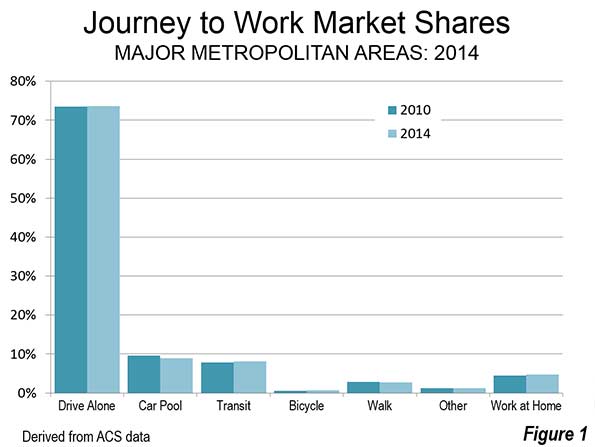
    The major metropolitan area journey to work data is out, reported in the American Community Survey ‘s 2014 one year edition. The news is that there is not much news. Little has changed since 2010 despite all the talk about “peak car” and a supposed massive shift towards transit. Single occupant driving remains by far the largest mode of transport to work in the 53 major metropolitan areas (with over 1,000,000 population), having moved from 73.5 percent of commutes to 73.6 percent. Little upward change in single occupant commuting can be expected, since it is probably already a virtual saturation rate.

    The only significant change is the most important trend that is occurred for decades in US commuting: the reduction in carpooling. Between 2010 and 2014, carpooling dropped from 9.8 percent to 8.8 percent in the major metropolitan areas.

    Transit continued to hold on to third place, with an increase from 7.9 percent to 8.1 percent in the major metropolitan areas. Working at home, including telecommuting, continued its more dramatic rise, from 4.4 percent in 2010 to 4.7 percent in 2014. Walking remained constant at 2.8 percent, while cycling continued its increase but from a small 0.5 percent to 0.7 percent. Other modes of transport, such as taxis and motorcycles remained constant at 1.2 percent (Figure 1).

    In the major metropolitan areas, transit continued to lead over working at home (8.1 percent compared to 4.7 percent), though at the national level the margin was much smaller (5.2 percent compared to 4.5 percent). Transit strength was far more concentrated principally in a few metropolitan areas with “legacy” cities and, as a result, working at home exceeded transit’s market share in 39 of the 53 markets.

    Should carpooling continue its downward trend, it would fall below transit before the end of the decade among the major metropolitan areas (now at 8.8 percent compared to transit 8.1 percent), though the carpooling lead is sufficient to retain second-place far longer at the national level (9.2 percent compared to 5.2 percent). As in working at home, however, transit’s strength is highly concentrated relative to carpooling. Transit leads carpooling only in the six metropolitan areas with transit legacy cities (New York, Chicago, Philadelphia, San Francisco, Boston, and Washington), while carpooling leads in 47 metropolitan areas.

    Commuting market share data for the major metropolitan areas is shown in Tables 1 and 2.

    Transit Gains and Losses

    With by far the most attractive urban environment for transit use in the United States and far and away the largest system, New York dominated the transit share of the  journey to work data, adding 240,000 daily transit commuters between 2010 and 2014 (out of a national total of 576,000). Six other metropolitan areas with the strongest transit gains were San Francisco at 66,000, Chicago with 41,000, Boston with 38,000, Seattle with 34,000 and Washington with 32,000. All of these were above the next highest, Philadelphia, with 16,000. Each of these metropolitan areas, with the exception of Seattle, has a transit legacy city at its core. Overall the other 45 metropolitan areas, with nearly 70 percent of the population, accounted for less than 20 percent of the transit increase.

    Los Angeles, which has been hailed as the becoming "next transit city," seems long on intentions and construction, but wanting in results.  The laggard transit performance of Los Angeles, despite one of the world’s most aggressive rail construction programs has been described in a recent Orange County Register commentary. In 2014-2015, ridership on the legacy MTA (former SCRTD) bus and rail system was almost 10 percent below the bus only system of 1985, despite an increase in the Los Angeles County population of approximately one-quarter (see: Los Angeles; Rail for Others).

    Thirteen metropolitan areas experienced modest transit commuting losses (less than 3,000). In addition to Los Angeles, these included rail metropolitan areas Virginia Beach-Norfolk, San Diego, Buffalo, Cleveland, and Pittsburgh.

    Working at Home Gains and Losses

    The largest working at home gain was also in New York, at 40,000 (out of 499,000 in the major metropolitan areas). The second largest gain was in Los Angeles at 32,000. San Diego added 27,000 people accessing work from home. Four metropolitan areas lost commuters who work at home, though the losses were modest (less than 1,000) in all but Virginia Beach-Norfolk, where the decline was more than 11,000.

    Driving Alone Gains, No Losses

    New York also led in the number of additional commuters driving alone to work, adding more than 420,000. The other largest gainers were in Los Angeles at 325,000 and Houston at 309,000. All of the 53 major metropolitan areas added single occupant commuters and in each single occupant commuting added more than any other mode, including transit. Rochester had the smallest increase, at 7,000.

    Carpool Gains and Losses

    Despite its continuing overall losses, carpooling made gains in some metropolitan areas. Detroit led with nearly 14,000 new carpoolers, followed closely by Orlando, Portland, and Dallas-Fort Worth both added more than 10,000 new carpoolers, adding more commuters than their rail oriented transit systems.

    However, the car pool losses were generally more severe. Chicago lost nearly 36,000 carpooling commuters. Los Angeles lost 30,000, New York lost 29,000 and Tampa-St. Petersburg lost 19,000. Losses of more than 10,000 were also sustained in Washington, St. Louis, San Diego, Pittsburgh, Phoenix, Memphis, Baltimore, and Boston.

    Cycling Gains and Losses

    New York also gained the most cycling commuters, at nearly 14,000, followed by San Francisco at 13,000, Los Angeles at 10,000. Eight metropolitan areas lost cycling commuters, but only two exceeded 250, Grand Rapids (800 loss) and Riverside-San Bernardino (700 loss).

    More of the Same

    U.S. commuters continue to travel to work using the modes that have dominated for decades, with the exceptions of substantial increases in working at home and big losses in car pooling. Though even in these modes, the changes are slight in view of the dominance of single-occupant commuting, as Figure 1 indicates. This is not surprising, commuters who drive alone reach virtually anywhere in the metropolitan area and nearly always at a faster speed than any other method of commuting, save working at home.

    Table 1
    Transit Work Trip Market Share: 2014
    Major Metropolitan Areas (53 over 1,000,000 Population)
    MARKET SHARE              
    MSA Drive Alone Car Pool Transit Bicycle Walk Other Work at Home
    Atlanta, GA 77.6% 10.3% 3.1% 0.2% 1.4% 1.4% 6.2%
    Austin, TX 76.6% 10.1% 2.5% 0.7% 1.7% 1.5% 6.9%
    Baltimore, MD 77.2% 8.2% 6.6% 0.3% 2.6% 1.1% 4.0%
    Birmingham, AL 85.2% 9.1% 0.5% 0.2% 1.1% 1.1% 2.9%
    Boston, MA-NH 67.6% 6.8% 12.9% 1.0% 5.3% 1.2% 5.1%
    Buffalo, NY 82.3% 7.7% 3.0% 0.4% 2.9% 0.9% 2.9%
    Charlotte, NC-SC 81.0% 9.4% 1.9% 0.2% 1.4% 1.1% 5.1%
    Chicago, IL-IN-WI 70.9% 7.7% 11.9% 0.7% 3.2% 1.2% 4.5%
    Cincinnati, OH-KY-IN 82.8% 7.9% 2.1% 0.3% 2.0% 0.8% 4.1%
    Cleveland, OH 82.3% 6.8% 3.2% 0.3% 2.6% 0.9% 3.9%
    Columbus, OH 83.0% 7.7% 1.8% 0.5% 2.1% 0.7% 4.4%
    Dallas-Fort Worth, TX 80.8% 9.9% 1.6% 0.2% 1.2% 1.7% 4.6%
    Denver, CO 76.3% 8.8% 4.5% 0.9% 2.0% 0.8% 6.6%
    Detroit,  MI 84.0% 9.0% 1.6% 0.3% 1.3% 0.8% 3.1%
    Grand Rapids, MI 81.6% 8.9% 1.7% 0.3% 2.2% 1.4% 4.0%
    Hartford, CT 81.4% 7.8% 2.7% 0.2% 2.6% 1.1% 4.2%
    Houston, TX 80.3% 10.7% 2.4% 0.3% 1.3% 1.6% 3.4%
    Indianapolis. IN 84.2% 8.5% 1.2% 0.3% 1.3% 0.7% 3.8%
    Jacksonville, FL 80.4% 9.7% 1.2% 0.6% 1.2% 1.7% 5.2%
    Kansas City, MO-KS 83.4% 8.5% 1.0% 0.2% 1.2% 1.0% 4.7%
    Las Vegas, NV 77.6% 10.2% 4.8% 0.5% 1.6% 2.3% 3.1%
    Los Angeles, CA 74.6% 9.7% 5.8% 1.0% 2.5% 1.3% 5.1%
    Louisville, KY-IN 81.8% 9.5% 2.0% 0.3% 1.7% 1.0% 3.7%
    Memphis, TN-MS-AR 84.9% 8.6% 1.0% 0.1% 1.1% 1.7% 2.6%
    Miami, FL 78.7% 8.9% 3.7% 0.6% 1.7% 1.4% 5.0%
    Milwaukee,WI 80.6% 8.4% 3.5% 0.5% 2.6% 0.8% 3.6%
    Minneapolis-St. Paul, MN-WI 77.3% 8.6% 4.8% 1.0% 2.4% 0.9% 4.9%
    Nashville, TN 81.7% 9.8% 1.3% 0.2% 1.6% 0.8% 4.6%
    New Orleans. LA 79.2% 9.7% 3.1% 1.3% 2.3% 1.5% 2.9%
    New York, NY-NJ-PA 50.2% 6.4% 31.1% 0.6% 6.0% 1.5% 4.2%
    Oklahoma City, OK 82.8% 10.1% 0.4% 0.4% 1.5% 1.1% 3.7%
    Orlando, FL 79.8% 9.9% 2.0% 0.6% 0.9% 1.2% 5.6%
    Philadelphia, PA-NJ-DE-MD 73.0% 7.8% 9.7% 0.6% 3.7% 0.8% 4.3%
    Phoenix, AZ 77.0% 10.5% 2.1% 0.9% 1.5% 1.9% 6.1%
    Pittsburgh, PA 77.5% 8.1% 5.6% 0.4% 3.4% 0.8% 4.1%
    Portland, OR-WA 70.0% 10.2% 6.5% 2.6% 3.3% 1.0% 6.4%
    Providence, RI-MA 81.1% 7.9% 2.8% 0.5% 3.4% 0.9% 3.5%
    Raleigh, NC 80.0% 9.0% 1.0% 0.2% 1.3% 1.1% 7.3%
    Richmond, VA 81.8% 9.1% 1.7% 0.4% 1.6% 1.2% 4.2%
    Riverside-San Bernardino, CA 77.4% 13.3% 1.6% 0.3% 1.7% 1.0% 4.7%
    Rochester, NY 82.5% 6.9% 2.5% 0.7% 3.1% 0.7% 3.7%
    Sacramento, CA 76.4% 10.2% 2.7% 1.8% 2.0% 1.3% 5.5%
    Salt Lake City, UT 74.9% 12.2% 3.8% 0.8% 2.1% 0.8% 5.3%
    San Antonio, TX 80.0% 10.8% 2.1% 0.2% 1.7% 0.9% 4.3%
    San Diego, CA 76.0% 8.6% 2.7% 0.8% 2.9% 1.4% 7.5%
    San Francisco-Oakland, CA 59.2% 9.4% 16.7% 2.2% 4.7% 1.6% 6.2%
    San Jose, CA 76.2% 10.4% 4.0% 1.6% 1.7% 1.2% 4.8%
    Seattle, WA 69.0% 9.8% 9.6% 1.2% 3.6% 1.1% 5.7%
    St. Louis,, MO-IL 82.7% 7.3% 2.9% 0.3% 1.8% 0.8% 4.1%
    Tampa-St. Petersburg, FL 81.1% 7.4% 1.5% 0.9% 1.5% 1.7% 5.9%
    Virginia Beach-Norfolk, VA-NC 82.4% 8.2% 1.6% 0.5% 3.0% 1.2% 3.1%
    Tucson, AZ 77.0% 9.1% 2.9% 2.1% 2.5% 2.0% 4.5%
    Washington, DC-VA-MD-WV 66.1% 9.7% 14.3% 0.8% 3.1% 1.0% 5.1%
    Major Metropolitan Areas 73.6% 8.8% 8.1% 0.7% 2.8% 1.2% 4.7%
    Outside Major Metropolitan Areas 80.4% 9.8% 1.2% 0.5% 2.7% 1.2% 4.1%
    United States 76.5% 9.2% 5.2% 0.6% 2.7% 1.2% 4.5%
    From American Community Survey: 2014 (1 Year)


    Table 2
    Transit Work Trip Market Share: 2010 (2008-2012 ACS)
    Major Metropolitan Areas (53 over 1,000,000 Population)
    MARKET SHARE              
    MSA Drive Alone Car Pool Transit Bicycle Walk Other Work at Home
    Atlanta, GA 77.6% 10.7% 3.2% 0.2% 1.3% 1.4% 5.6%
    Austin, TX 75.0% 11.3% 2.6% 0.8% 1.8% 1.9% 6.6%
    Baltimore, MD 76.3% 9.7% 6.3% 0.3% 2.7% 0.9% 3.9%
    Birmingham, AL 84.0% 10.6% 0.7% 0.1% 1.1% 0.6% 3.0%
    Boston, MA-NH 68.8% 7.9% 11.9% 0.9% 5.3% 0.9% 4.4%
    Buffalo, NY 81.8% 8.1% 3.5% 0.4% 3.0% 0.9% 2.4%
    Charlotte, NC-SC 80.5% 10.4% 1.8% 0.1% 1.4% 0.9% 4.9%
    Chicago, IL-IN-WI 70.9% 8.8% 11.3% 0.6% 3.1% 1.1% 4.2%
    Cincinnati, OH-KY-IN 82.6% 8.7% 2.2% 0.2% 2.1% 0.7% 3.6%
    Cleveland, OH 82.1% 7.8% 3.5% 0.3% 2.1% 0.8% 3.4%
    Columbus, OH 82.6% 8.2% 1.6% 0.4% 2.1% 0.8% 4.2%
    Dallas-Fort Worth, TX 80.9% 10.5% 1.5% 0.2% 1.2% 1.3% 4.5%
    Denver, CO 75.7% 9.5% 4.5% 0.9% 2.1% 1.2% 6.0%
    Detroit,  MI 84.2% 8.7% 1.6% 0.2% 1.4% 0.8% 3.1%
    Grand Rapids, MI 82.8% 8.9% 1.2% 0.5% 1.9% 0.7% 3.9%
    Hartford, CT 81.0% 8.2% 3.1% 0.2% 2.7% 1.0% 3.8%
    Houston, TX 79.2% 11.7% 2.4% 0.3% 1.4% 1.6% 3.4%
    Indianapolis. IN 83.6% 9.0% 1.1% 0.3% 1.7% 0.8% 3.6%
    Jacksonville, FL 81.1% 9.9% 1.3% 0.6% 1.4% 1.3% 4.4%
    Kansas City, MO-KS 82.9% 9.2% 1.2% 0.2% 1.3% 1.0% 4.1%
    Las Vegas, NV 78.5% 11.1% 3.7% 0.4% 1.8% 1.5% 3.0%
    Los Angeles, CA 73.6% 10.8% 6.1% 0.9% 2.7% 1.2% 4.9%
    Louisville, KY-IN 82.9% 9.3% 2.1% 0.3% 1.7% 0.8% 2.9%
    Memphis, TN-MS-AR 82.8% 10.7% 1.3% 0.1% 1.3% 1.0% 2.8%
    Miami, FL 78.2% 9.8% 3.7% 0.6% 1.8% 1.4% 4.5%
    Milwaukee,WI 79.9% 9.2% 3.6% 0.5% 2.8% 0.7% 3.2%
    Minneapolis-St. Paul, MN-WI 78.1% 8.6% 4.6% 0.9% 2.3% 0.8% 4.7%
    Nashville, TN 81.5% 10.4% 1.1% 0.2% 1.2% 0.9% 4.6%
    New Orleans. LA 79.0% 10.9% 2.6% 0.8% 2.4% 1.6% 2.6%
    New York, NY-NJ-PA 51.0% 7.1% 29.9% 0.5% 6.1% 1.6% 3.9%
    Oklahoma City, OK 82.9% 10.4% 0.5% 0.3% 1.6% 1.1% 3.3%
    Orlando, FL 81.1% 9.3% 1.9% 0.5% 1.1% 1.7% 4.5%
    Philadelphia, PA-NJ-DE-MD 73.4% 8.2% 9.4% 0.6% 3.7% 0.8% 3.8%
    Phoenix, AZ 76.4% 11.9% 2.1% 0.8% 1.6% 1.6% 5.6%
    Pittsburgh, PA 76.9% 9.3% 5.7% 0.2% 3.6% 0.9% 3.5%
    Portland, OR-WA 71.2% 9.7% 6.1% 2.2% 3.5% 1.0% 6.3%
    Providence, RI-MA 80.8% 8.8% 2.7% 0.3% 3.2% 0.9% 3.3%
    Raleigh, NC 80.6% 9.6% 1.0% 0.3% 1.4% 1.2% 5.9%
    Richmond, VA 81.3% 9.6% 2.0% 0.4% 1.4% 0.8% 4.5%
    Riverside-San Bernardino, CA 76.2% 14.4% 1.6% 0.4% 1.8% 1.1% 4.4%
    Rochester, NY 81.4% 8.4% 1.9% 0.5% 3.6% 0.7% 3.5%
    Sacramento, CA 75.1% 11.6% 2.7% 1.8% 2.0% 1.2% 5.6%
    Salt Lake City, UT 75.9% 12.0% 3.5% 0.8% 2.3% 1.2% 4.3%
    San Antonio, TX 79.1% 11.5% 2.2% 0.1% 1.9% 1.2% 3.9%
    San Diego, CA 75.9% 10.2% 3.1% 0.7% 2.7% 1.1% 6.3%
    San Francisco-Oakland, CA 61.5% 10.3% 14.7% 1.7% 4.3% 1.4% 6.0%
    San Jose, CA 76.5% 10.4% 3.2% 1.7% 2.1% 1.4% 4.7%
    Seattle, WA 69.7% 11.0% 8.3% 1.0% 3.6% 1.1% 5.3%
    St. Louis,, MO-IL 82.6% 8.4% 2.5% 0.3% 1.7% 0.8% 3.7%
    Tampa-St. Petersburg, FL 80.3% 9.5% 1.4% 0.7% 1.6% 1.4% 5.2%
    Virginia Beach-Norfolk, VA-NC 80.6% 9.0% 1.8% 0.4% 2.6% 1.1% 4.4%
    Tucson, AZ 76.5% 10.3% 2.4% 1.5% 2.5% 2.0% 4.8%
    Washington, DC-VA-MD-WV 66.0% 10.6% 14.0% 0.6% 3.2% 0.9% 4.7%
    Major Metropolitan Areas 73.5% 9.6% 7.9% 0.6% 2.8% 1.2% 4.4%
    Outside Major Metropolitan Areas 80.8% 9.8% 0.9% 0.5% 2.7% 1.2% 4.2%
    United States 76.6% 9.7% 4.9% 0.5% 2.8% 1.2% 4.3%
    From American Community Survey:2008-2012


    Wendell Cox is Chair, Housing Affordability and Municipal Policy for the Frontier Centre for Public Policy (Canada), is a Senior Fellow of the Center for Opportunity Urbanism (US), a member of the Board of Advisors of the Center for Demographics and Policy at Chapman University (California) and principal of Demographia, an international public policy and demographics firm.He is co-author of the “Demographia International Housing Affordability Survey” and author of “Demographia World Urban Areas” and “War on the Dream: How Anti-Sprawl Policy Threatens the Quality of Life.” He was appointed to three terms on the Los Angeles County Transportation Commission, where he served with the leading city and county leadership as the only non-elected member. He served as a visiting professor at the Conservatoire National des Arts et Metiers, a national university in Paris.

    Photo: Harbor Freeway (I-110), Los Angeles (by author)

  • The Cities Where Your Salary Will Stretch The Furthest 2015

    Average pay varies widely among U.S. cities, but those chasing work opportunities would do well to keep an eye on costs as well. Salaries may be higher on the East and West coasts, but for the most part, equally high prices there mean that the fatter paychecks aren’t necessarily getting the locals ahead.

    To determine which cities actually offer the highest real incomes, Mark Schill, research director at Praxis Strategy Group, conducted an analysis for Forbes of the 53 largest metropolitan statistical areas, adjusting annual earnings by a cost factor that combines median home values from the U.S. Census (20%) with a measure of regional price differences from the U.S. Bureau of Economic Analysis (80%).

    The takeaway: When cost of living is factored in, most of the metro areas that offer the highest effective pay turn out to be in the less glitzy middle part of the country. 

    Ranking first is the Houston-the Woodlands-Sugar Land metro area, followed by one high-cost outlier: San Jose-Sunnyvale-Santa Clara, Calif., aka Silicon Valley. Although average wages in the San Jose area are $38,000 higher than Houston’s $60,096, the much lower cost of living in Houston means residents there are effectively slightly better off. Adjusted for costs, Houston’s average real income is $62,136. A big contributing factor is Houston’s low home prices: the ratio of the median home price there ($215,000 in the third quarter) to median annual household income is 3.1, compared to 7.5 in the San Jose area (median 3Q home price: $795,000).

    San Jose’s high ranking is somewhat of an anomaly: the very high salaries paid by the tech industry in a metro area made up of largely affluent suburban communities go a long way to make up for the high prices. San Jose’s prices were the third highest among major U.S. metro areas in 2013, the most recent year for which the BEA has data — 21.3% above the national average — while the average annual wage of $98,247 as of this year ranks first.

    Another example of a higher-cost success story is the Hartford, Conn., metro area, which ranks fourth on our list with adjusted annual real earnings of $54,590. One of the lowest-density regions in the country, it boasts many small, prosperous communities with high housing prices surrounding a largely impoverished but small core city (population: 125,000 ). In 2011, the Harford metro area was ranked by Brookings as the most productive metropolitan region in the world.

    But for the most part, it’s the low-cost heartland that dominates the top 15 of our ranking of Cities Where Your Salary Stretches The Furthest. Manufacturing powerhouse Detroit-Warren-Dearborn ranks third with cost-adjusted annual earnings of $55,950. The metro area is comfortably affordable, including an average home price value of $136,400, but also boasts strong wages given the area’s high concentration of factory and engineering jobs, which tend to pay better than other industries, particularly for blue-collar workers.

    Low costs are an advantage that unites a number of the top-ranked heartland metro areas, including Cleveland-Elyria (seventh), where prices of goods and services are 10.5% below the national average, and Cincinnati (ninth), where prices are 9.5% below the national average. In all these areas, the cost of a house is about 20% of what passes for normal in Silicon Valley.

    Hip, But Increasingly Not Worth It

    Perhaps the biggest surprise in our survey is the low rankings of the “cool” cities that are widely discussed as the places that offer the best economic opportunities.

    Take for instance San Francisco, a city that has become the epicenter of “disruptive” tech companies Uber, Lyft, Airbnb, Salesforce.com that are changing our service economy, as well as Twitter. With an average annual salary of $74,794, you would think people would be fat and happy in Baghdad by the Bay. But soaring home prices — median value, $657,300 — have raised costs so high that the area ranks a poor 41st on our list.

    The tech boom has also raised prices in Austin, which ranked fifth when we last did this ranking in 2012, but falls to 19th this year. Over the past year, the average home value in the Texas capital has risen by $24,000, twice the increase experienced in the rest of the country. Median prices now average $217,9000, well above the national median of $188,000 for all large metropolitan regions. This is still not ridiculous, but costs do seems to be eroding some of Austin’s still powerful advantage.

    Similarly, greater New York City also fared poorly, ranking 33rd, in large part due to high housing prices and the overall cost of living: prices there are 22.3% above the national average, according to BEA data, making it the second-costliest metro area in the nation.

    Some of the biggest gaps between cost of living and salary are in Southern California, which has experienced significant house price gains without the income growth that makes San Jose more competitive. Already high, prices in San Diego-Carlsbad (51st), Los Angeles-Long Beach-Anaheim (52nd) and Riverside-San Bernardino (last among the 53 largest metro areas) have all risen considerably above the national average.

    Long-Term Implications

    Our paycheck analysis does not impact everyone equally. Given the central role of housing, for example, long-term residents who bought their homes before prices began to rise dramatically can keep a bigger portion of their take-home pay, and if they decide to sell, they’ll benefit greatly from inflated values. More directly impacted may be young adults and immigrants, most of whom do not own their own homes, and often lack the resources to buy in the more expensive markets.

    Over time this could influence where young families and singles chose to migrate. Since 2010, according to an upcoming study by Cleveland State’s Center for Population Dynamics, there has been a marked shift of college educated workers aged 25 to 34. While between 2008 and 2010, metro areas like San Francisco, New York, Los Angeles, San Jose and Chicago enjoyed the biggest upticks in this coveted population, over the most recently studied period, 2010-13, the leaders were generally less expensive places like Nashville, Pittsburgh, Orlando, Cleveland, San Antonio, Houston and Dallas-Ft. Worth.

    This suggests that areas that have both high-wage jobs and low costs are likely to gain momentum in coming years, particularly if the economy expands. This is not to say that people do not like the excitement and culture associated with San Francisco, Los Angeles or New York, but many may be finding that the price of admission to these fabled places may be too high.

    This could be a great opportunity for less-heralded communities, from Arizona and Texas to Ohio, to gain more educated workers and the companies that require them.

    Metropolitan Average Annual Earnings Adjusted for Cost of Living and Home Values
    Rank MSA Name Adjusted Ave Annual Earnings
    1 Houston-The Woodlands-Sugar Land, TX $62,136
    2 San Jose-Sunnyvale-Santa Clara, CA $56,147
    3 Detroit-Warren-Dearborn, MI $55,950
    4 Hartford-West Hartford-East Hartford, CT $54,590
    5 Dallas-Fort Worth-Arlington, TX $54,497
    6 Atlanta-Sandy Springs-Roswell, GA $53,922
    7 Cleveland-Elyria, OH $53,841
    8 Pittsburgh, PA $53,726
    9 Cincinnati, OH-KY-IN $53,405
    10 St. Louis, MO-IL $53,115
    11 Charlotte-Concord-Gastonia, NC-SC $52,508
    12 Birmingham-Hoover, AL $51,710
    13 Kansas City, MO-KS $51,460
    14 Memphis, TN-MS-AR $51,339
    15 Boston-Cambridge-Newton, MA-NH $50,373
    16 Columbus, OH $50,369
    17 Chicago-Naperville-Elgin, IL-IN-WI $50,351
    18 Nashville-Davidson–Murfreesboro–Franklin, TN $50,168
    19 Austin-Round Rock, TX $50,154
    20 Minneapolis-St. Paul-Bloomington, MN-WI $50,117
    21 Indianapolis-Carmel-Anderson, IN $49,790
    22 Oklahoma City, OK $49,771
    23 Seattle-Tacoma-Bellevue, WA $49,514
    24 Philadelphia-Camden-Wilmington, PA-NJ-DE-MD $48,976
    25 Louisville/Jefferson County, KY-IN $48,807
    26 Milwaukee-Waukesha-West Allis, WI $48,341
    27 Denver-Aurora-Lakewood, CO $48,287
    28 Washington-Arlington-Alexandria, DC-VA-MD-WV $48,102
    29 Buffalo-Cheektowaga-Niagara Falls, NY $48,071
    30 New Orleans-Metairie, LA $47,956
    31 San Antonio-New Braunfels, TX $47,837
    32 Rochester, NY $47,660
    33 New York-Newark-Jersey City, NY-NJ-PA $47,649
    34 Jacksonville, FL $47,230
    35 Raleigh, NC $47,164
    36 Richmond, VA $47,002
    37 Grand Rapids-Wyoming, MI $46,480
    38 Phoenix-Mesa-Scottsdale, AZ $46,281
    39 Tampa-St. Petersburg-Clearwater, FL $45,826
    40 Baltimore-Columbia-Towson, MD $45,184
    41 San Francisco-Oakland-Hayward, CA $45,082
    42 Portland-Vancouver-Hillsboro, OR-WA $44,451
    43 Salt Lake City, UT $43,857
    44 Sacramento–Roseville–Arden-Arcade, CA $43,254
    45 Miami-Fort Lauderdale-West Palm Beach, FL $42,976
    46 Las Vegas-Henderson-Paradise, NV $42,960
    47 Providence-Warwick, RI-MA $42,827
    48 Orlando-Kissimmee-Sanford, FL $42,463
    49 Tucson, AZ $42,264
    50 Virginia Beach-Norfolk-Newport News, VA-NC $42,226
    51 San Diego-Carlsbad, CA $37,395
    52 Los Angeles-Long Beach-Anaheim, CA $35,691
    53 Riverside-San Bernardino-Ontario, CA $34,040
    Figure is the average annual wages, salaries and proprietor earnings adjusted for cost of living usine BEA Regional Price Parities (80%) and variation in Census median home value among the 53 regions (20%). Data Sources: EMSI 2015.2 Employment Data, U.S. Bureau of Economic Analysis Regional Price Parities, U.S. Census American Community Survey
    Analysis by Mark Schill, mark@praxissg.com


    This piece first appeared at Forbes.com.

    Joel Kotkin is executive editor of NewGeography.com and Roger Hobbs Distinguished Fellow in Urban Studies at Chapman University, and a member of the editorial board of the Orange County Register. He is also executive director of the Houston-based Center for Opportunity Urbanism. His newest book, The New Class Conflict is now available at Amazon and Telos Press. He is also author of The City: A Global History and The Next Hundred Million: America in 2050. He lives in Orange County, CA.

    Photo by w:Flickr user Bill Jacobus [CC-BY-2.0], via Wikimedia Commons

  • When Detroit Stood Tall and Shaped the World

    My recent post about how urban planning decisions helped lead to the Motown sound in Detroit was inspired by David Maraniss’ new book Once in a Great City: A Detroit Story.

    The book takes a deep dive into Detroit 1963, a city that was, although in some ways already in decline, in others near its zenith.

    It’s a great read, in particularly for the depth of characterization. Too often Detroit writing is a story of heroes, villains, and victims. Maraniss rejects that approach and provides mostly nuanced portrayals of Detroiters that allows them to be the actual real, red-blooded human beings that they are.

    I just posted a review of the book over at City Journal.  Here’s an excerpt:

    In his new book, Once in a Great City: A Detroit Story, Pulitzer Prize winner David Maraniss takes a fascinating and engrossing look at the Motor City during this fateful year. Under Henry Ford II (“the Deuce”) and hard-charging salesman Lee Iacocca, the Ford Motor Company was set to unveil its revolutionary Mustang. The civil rights struggle was creating tensions in Detroit and elsewhere, but Mayor Jerome Cavanagh was committed to addressing discrimination and reforming the police. Detroit was about to transform the American musical landscape with Motown Records, whose roster of superstar artists included Smokey Robinson, Diana Ross and the Supremes, Stevie Wonder, and Marvin Gaye. The United States Olympic Committee even nominated Detroit as the American representative to host the 1968 summer Olympics, though it lost out to Mexico City. On the more dubious side, the mafia had a powerful presence in the Motor City, where colorful mob boss Tony Jack Giacalone rode around town in his garish “Party Bus” painted blue and silver, the colors of the NFL’s Detroit Lions.

    Click through to read the whole review or buy the book.

    Aaron M. Renn is a senior fellow at the Manhattan Institute and a Contributing Editor at City Journal. He writes at The Urbanophile, where this piece originally appeared.

  • Too Many Places Will Have too Few People

    The adage “demographics are destiny” is increasingly being replaced by a notion that population trends should actually shape policy. As the power of projection grows, governments around the world find themselves looking to find ways to counteract elaborate and potentially threatening population models before they become reality.

    Nowhere is this clearer than in China’s recent announcement that it was suspending its “one child” policy. The country’s leaders are clearly concerned about what demographer Nicholas Eberstadt has labeled “this coming tsunami of senior citizens” with a smaller workforce, greater pension obligations and generally slower economic growth.

    A second example is Europe’s open migration policy. Despite widespread opposition by its own citizens, and cost estimates that run to a trillion euros over 30 years, Europe’s political and business leaders regard migration as critical to address the Continent’s aging demographics. Germany knows it may not be able to keep its economic engine running without a huge influx of workers.

    In defense of the migration policy, European Union economists project that refugees from the Middle East, Africa and Central Asia could boost Europe’s GDP by 0.2 percent to 0.3 percent by 2020.

    This all speaks to a kind of demographic arbitrage between countries with aging demographics and those with youth to spare. Half the world’s population already lives in countries with fertility rates below replacement level (2.1 per woman).

    Read the entire piece at The Orange County Register.

    Joel Kotkin is executive editor of NewGeography.com and Roger Hobbs Distinguished Fellow in Urban Studies at Chapman University, and a member of the editorial board of the Orange County Register. He is also executive director of the Houston-based Center for Opportunity Urbanism. His newest book, The New Class Conflict is now available at Amazon and Telos Press. He is also author of The City: A Global History and The Next Hundred Million: America in 2050. He lives in Orange County, CA.

    Photo “Nursery Cart” by flickr user Pieterjan Vandaele

  • How Land Use Regulations Hurt the Poor

    Sandy Ikeda and I have published a new Mercatus paper on the regressive effects of land use regulation. We review the empirical literature on how the effects of rules such as maximum density, parking requirements, urban growth boundaries, and historic preservation affect housing prices. Nearly all of the studies on the price effects of land use regulations find that — as supply and demand analysis would predict — these rules increase the price of housing. While the broad consensus on the price effects of land use regulations is probably to no surprise to Market Urbanism readers, some policy analysts continue to insist that in fact rules requiring detached, single family homes help cities maintain housing affordability.

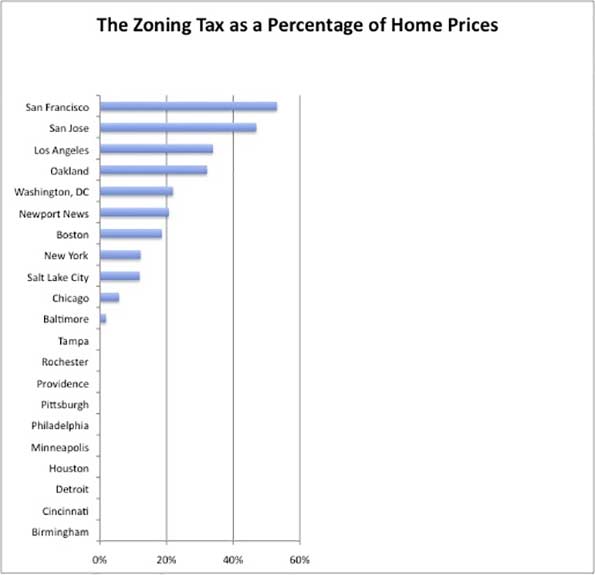
    Ed Glaeser, Joseph Gyourko, and Raven Saks estimate the effects of regulations on house prices in their paper “Why Is Manhattan So Expensive? Regulation and the Rise in Housing Prices.” They estimate what they call the “zoning tax” in 21 cities. The zoning tax indicates the proportion of housing costs that are due to land use regulations. The chart below shows the percentage of housing costs that this “tax” accounts for:

    The zoning tax as calculated by Edward Glaeser, Joseph Gyourko, and Raven Saks in 'Why Is Manhattan So Expensive? Regulation and the Rise in House Prices' (2003).

    The zoning tax as calculated by Edward Glaeser, Joseph Gyourko, and Raven Saks in “Why Is Manhattan So Expensive? Regulation and the Rise in House Prices” (2003).

    Policies that increase housing costs have a clear constituency in all homeowners, but they hurt renters and anyone who is hoping to move to an expensive city. The burden of land use regulations are borne disproportionately by low-income people who spend a larger proportion of their income on housing relative to higher income people. These regressive effects of land use policy extend beyond reducing welfare if the least-advantaged Americans. Additionally, rules that increase the cost of housing in the country’s most productive cities reduce income mobility and economic growth.

    In our paper Sandy and I also discuss proposals for reducing the inefficiency of cities’ current land use regulation practices. David Schleicher has proposed some of innovative policy improvements, including a zoning budget that a city can implement to commit itself to permitting a certain amount of new development. A zoning budget would create a situation in which local policymakers are forced to make tradeoffs between different land use restrictions, as opposed to the current situation in which there is no limit to policies restricting building. Another proposal that Schleicher suggests is a tax increment local transfer, or a TILT. With TILTs, homeowners who live near new development would receive some portion of the additional property taxes that the city raises by allowing the development. The purpose of TILTs is to reduce NIMBY opposition to development.

    We hope that our paper will be a helpful resource to those looking for an accessible overview of this area of research and point to future research opportunities for institutional reforms to allow for the construction of affordable housing.

    This piece first appeared at Market Urbanism.

    Emily Washington is a policy research manager for the Mercatus Center at George Mason University. She manages the Spending and Budget Initiative and State and Local Policy Project portfolios. Her writing has appeared in USA Today, The Christian Science Monitor, Economic Affairs, and The Daily Caller. She contributes to the blogs Neighborhood Effects and Market Urbanism.

  • Public Transport’s Biggest Problem: The Public (That’s Us)

    When’s the last time you heard some futurist or management guru suggest that in the future more of us will be working at the same desk doing routine tasks on a predictable working week schedule? No? That’s just one of many problems that advocates of limitless spending on public transport need to keep in mind in dealing with the issue of urban congestion.

    Increasing urban congestion is said to cost the economy dearly and if Infrastructure Australia is to be believed, it will cost even more in the future unless something is done now. They warn the current estimate of a $13.7 billion annual cost will balloon to $53 billion by 2031.

    Congestion is without dispute a handbrake on economic productivity but the range of solutions for reducing congestion range from the outright zany (see Elizabeth Farrelly’s suggestions  for Prime Minister Turnbull as one example) to milder versions of zany. They all tend to be very expensive and many impose unacceptable compromises on our basic freedoms (such as proposals to ban cars from cities).

    Increased investment in public transport is a feature of many proposed solutions for alleviating congestion. It is true that we have under-invested in public transport systems in past decades and it’s equally true that we’ve under-invested in private transport. Basically, we’ve cheered a rising population while passing the buck for funding and delivering the infrastructure needed to support that growth to future generations. Rising congestion levels are making it feel like crunch time now.

    But there are valid questions about the capacity of public transport to alleviate congestion which are rarely getting asked. Rather than a magical silver bullet, there are a few things to keep in mind before you climb aboard the merry bandwagon of limitless investment in public transport…

    The nature of work is changing. Public transport systems work best on a hub and spoke model of employment and commuting, built on predictable schedules designed around predictable commuter needs. Central business districts of very high employment concentrations, where people work in the same workplace from day to day and for the same hours each day, are ideal candidates for public transport.  But increasingly this is looking like a 20th century model of work. Technology has been the primary driver of change, allowing more workplace flexibility and providing for increased location diversity. ‘Standard hours’ of work are being diluted and at the same time companies increasingly realise the high costs of ‘paper factories’ for administrative staff in costly CBD locations makes little sense. With this, the centralised nature of work is also being diluted and this is working against the centralised economic model that makes fixed public transport systems (especially rail) effective.

    Society is changing. There was a time when commuting trips to work in central locations were mainly a case of getting there and getting home.  Much has changed. A rising proportion of women in the workforce and how this has changed family responsibilities means that commutes to and from work are also often tied in with other objectives: dropping off or picking up school kids or children in child care is only a part of this (but one which is said to contribute to 20% of private vehicle traffic on the roads in peak periods during school terms).  Add in to this the increasing propensity to shop less but more frequently (who owns a chest freezer anymore?) and to mix in pre and post work social or recreational appointments, and you have a very different pattern of commuting which public transport will struggle to service.

    The suburban economy. A telling reality for proponents of increased public transport investment is that employment remains – and in some cases is increasingly – suburban by nature. Between 8 and 9 out of 10 of all jobs in metropolitan regions are suburban by location, and when you consider that the same proportion of residents in any metropolitan location are also suburban by residence, the problem of servicing this reality through public transport is apparent. In the last inter censal period, the proportion of metropolitan wide jobs located in the CBD actually fell in Brisbane (to 12.5%), while in Melbourne it remain unchanged (at 10%) and Sydney recorded a small rise (to 13.5%). The raw numbers of jobs in suburban locations are growing faster, as a rule, than those in CBDs.  The cost of creating a public transport system designed around suburban home to suburban workplace commutes is beyond calculation. In Australia, we will be in flying cars like the Jetsons long before this happens.

    The new and emerging economy. The way cities were designed – with concentrations of white collar workers in CBDs and with discrete areas set aside for industrial, retail or other specified activities – is no longer as important for new or emerging economies. Technology in particular means that physical place is less essential for connectivity to markets. Communication is less dependent on physical proximity. This doesn’t mean CBDs will lose their higher order function but it does mean that disruptive or emerging businesses, for which new technologies are more than just a novelty but a foundation, will have less need for the types of places offered by centralised business districts. They can locate in lower cost areas of the metropolitan area, and make use of the central business districts on occasion, rather than routine. Attracting and retaining these emerging types of businesses will also put the onus on suburban business centres to lift their game, but in many cases this isn’t difficult. Just think of any number of start ups or tech based companies you’ve read of recently and think about how many of these have been in non-traditional locations. Even when these businesses mature, their lack of interest in a CBD style presence doesn’t seem to change. Witness the many technologically innovative businesses in the USA or Europe, by way of example.

    Where does this leave us with solutions for congestion? Ironically, increasing public transport investment designed to ferry people into and out of central business areas is unlikely to make much difference to metropolitan wide congestion. It can’t – simply because only a minority of jobs (between 10% and 15% in the case of Australia’s major cities) are in these locations. People with jobs in these locations may currently have relatively high rates of public transport usage already (often 40% plus) but imagine the cost of increasing this to 80%? The cost of getting there is incalculable for cities of our size, and in any way, it would only benefit 10% to 15% of the urban workforce. Ironically, the people most likely to benefit from this type of public transport prescription tend be much higher wage earners, living close to the inner city in highly valued real estate. (Have a look at this analysis from The Pulse a couple of years ago). Yet their higher capacity to pay is not reflected in most policy debate.

    The reality is that public transport can only go so far in alleviating congestion. Social and economic change to the nature of work is changing the shape of employment decisions and has forever changed the nature of the commute. Public policy officials, urbanists and politicians who pretend that all that’s needed to ‘solve congestion’ is massively increased investment in heavy rail, light rail or dedicated busway networks are deluded: this thinking is rooted in nostalgic notions of work, unrelated to the future of work.

    And as if to demonstrate the fact we should not expect better from our various governments, when a technological innovation comes along that promises to realize the long held dream of ride sharing and increased persons per vehicle – which if widely embracedwould go a long way to solving congestion at no cost to taxpayers –  governments stand in the way. It’s called Uber. Go figure.

    Ross Elliott has more than 20 years experience in property and public policy. His past roles have included stints in urban economics, national and state roles with the Property Council, and in destination marketing. He has written extensively on a range of public policy issues centering around urban issues, and continues to maintain his recreational interest in public policy through ongoing contributions such as this or via his monthly blog The Pulse.

  • A Question of Values: Middle-Income Housing Affordability

    This is the Executive Summary from a new report “A Question of Values: Middle-Income Housing Affordability and Urban Containment Policy" authored by Wendell Cox and published by the Frontier Centre for Public Policy. Ailin He, a PhD doctoral candidate in economics at McGill University served as research assistant.

    The "report is a public policy narrative on the relationships between urban containment policy, housing affordability and national economies. It is a synthesis of economic and urban planning analysis that is offered as a policy evaluation of urban containment. The analysis is presented in the context of higher-order objectives of domestic policy: improving the standard of living and eradicating poverty" (Page 9). The research focuses on the international experience, especially in Canada, Australia, New Zealand, the United Kingdom and the United States. Download the full report (pdf) here.

    Middle-income housing affordability is important to people and the economy: Canada’s house prices have risen more than house prices in most other high-income nations. This is of concern, because higher house prices reduce discretionary incomes, which defines the standard of living and poverty. If discretionary incomes are reduced, households will have less to spend on other goods and services, which can retard job creation and economic growth. Improving the standard of living and eradicating poverty are among the highest-order domestic priorities.

    Urban containment policy can lead to higher house prices: Urban land-use regulation has become stronger in many metropolitan areas and often includes urban containment policy. Urban containment severely restricts or bans development in urban fringe areas. Consistent with basic economics, this increases land values and house prices (all else equal). The planning intention and expectation is that higher housing densities will offset the land-price increases and that housing affordability will be maintained.

    Severe losses in housing affordability have been experienced in urban containment markets: Top housing and economic experts attribute much of the loss in housing affordability to stronger land-use policy.

    Housing affordability losses have been sustained in the five nations this report focuses upon: Across the United Kingdom, Australia, New Zealand and some markets in Canada and the United States, house prices have nearly doubled or tripled compared with household incomes as measured by price to income ratios. Much of this has been associated with urban containment policy.

    Demand and supply: Some research suggests that the huge house-price increases have occurred due to higher demand and the greater attractiveness of metropolitan areas that have urban containment policy. However, the interaction of supply and demand sets house prices. Claims that metropolitan areas with urban containment policy are more attractive are countered by their net internal out-migration and diminished amenities for some households.

    An intrinsic urban containment amenity seems doubtful: Some urban containment advocates claim that urban containment policy intrinsically improves amenities (such as a dense urban lifestyle). However, whether a feature is an amenity depends on individual preferences. Moreover, the strong net internal migration away from many metropolitan areas with urban containment policy is an indication that there is no urban containment amenity for most households.

    Higher densities have not prevented huge losses in housing affordability: In contrast with planning expectations, the land-value increases expected from urban containment have not been nullified by higher densities within urban containment boundaries.

    Intervening urban containment boundaries are more influential than topographic barriers: It has been suggested that topographic barriers such as mountains and the ocean cause higher house prices. However, in urban containment metropolitan areas, urban containment boundaries are usually placed between the built-up urban areas and the topographic barriers. As a result, house-price increase associated with the land shortage will be principally associated with the urban containment boundary, not the topographic barrier.

    A competitive land supply is required for housing affordability: A risk with urban containment policy is that by limiting the land for sale, large landholders will seek to buy up virtually all of the land for future gain. Without urban containment, there will not be a land shortage, and there will not be an incentive to monopolize the land supply. A sufficient land supply can be judged to exist only if prices relative to incomes are not higher than before the urban containment policy came into effect.

    Urban containment policy has been associated with reduced economic growth: Evidence suggests that urban containment policy reduces job creation and economic growth. The increased inequality noted by French economist Thomas Piketty is largely attributed to the housing sector and is likely related to strong regulation. Other research estimated a US$2-trillion loss to the U.S. economy, much of it related to strong land-use regulation, and called this “a large negative externality.”

    Urban containment policy has important social consequences: There are also important social consequences such as wealth transfers from younger to older generations and from the less-affluent to the more-affluent households.

    Urban containment policy has failed to preserve housing affordability: Some have expressed concern that urban containment policy might not have been implemented if there had been the expectation of losses in housing affordability. In fact, the administration of urban containment policy has been deficient, with corrective actions largely not taken despite the considerable evidence of losses in housing affordability. In urban containment markets, programs should be undertaken to stop the further loss of housing affordability and transition toward restoring housing affordability. Further, urban containment should not be implemented where it has not already been adopted.

    Canada could be at risk: Canada could be at greater risk in the future. Already, huge losses in housing affordability have been sustained in Vancouver and Toronto. Other metropolitan areas are strengthening land-use regulations. This could lead to severe consequences such as lowering middle-income standards of living and greater poverty with less job creation and less economic growth.

    The urban containment debate is fundamentally a question of values: Ultimately, the choice is between the planning values of urban design or urban form and the domestic policy values of improving the standard of living and reducing poverty. Urban containment policy appears to be irreconcilable with housing affordability. Proper prioritization requires that the higher-order values of a better standard of living and less poverty take precedence.

    Download the full report (pdf) here.

    Wendell Cox is Chair, Housing Affordability and Municipal Policy for the Frontier Centre for Public Policy (Canada), is a Senior Fellow of the Center for Opportunity Urbanism (US), a member of the Board of Advisors of the Center for Demographics and Policy at Chapman University (California) and principal of Demographia, an international public policy and demographics firm.He is co-author of the “Demographia International Housing Affordability Survey” and author of “Demographia World Urban Areas” and “War on the Dream: How Anti-Sprawl Policy Threatens the Quality of Life.” He was appointed to three terms on the Los Angeles County Transportation Commission, where he served with the leading city and county leadership as the only non-elected member. He served as a visiting professor at the Conservatoire National des Arts et Metiers, a national university in Paris.

  • Collingswood: The Main Street Model

    There’s a weird war raging these days. There are people who advocate high rise living and public transit in the urban core to the exclusion of other arrangements. And then there are folks who can’t hold their head up high in church on Sunday if they don’t live on a quarter acre lot out on the far fringe of the metroplex with four cars parked in front of their fully detached home. I always choose the thing in the middle. It’s called a “town”. I’m a Main Street kind of guy.

    IMG_2543 (1024x683)

    IMG_2294 (1024x683)

    IMG_2490 (1024x683)

    IMG_2497 (1024x683)

    IMG_2546 (1024x683)

    IMG_2559 (1024x683)

    IMG_2564 (1024x683)

    IMG_2561 (1024x683)

    This is Haddon Avenue in Collingswood, New Jersey. It’s an intact functioning pre World War II Main Street town complete with hardware store, local mom and pop shops, great places to eat, business incubators, post office, public parks, and City Hall. The majority of the buildings are one and two stories tall.

    IMG_2419 (1024x683)

    IMG_2601 (1024x683)

    IMG_2453 (1024x683)

    Transit exists in Collingswood in the form of a PATCO train station and bus service, but transit isn’t necessary to travel within Collingswood itself. The train and bus are there to get people from one town center to another. Philadelphia is fifteen minutes away. Once you’re in town you can walk or bike everywhere. That includes the young, the elderly, people with limited physical mobility, the rich, the poor… everyone.

    IMG_2479 (1024x683)

    IMG_2469 (1024x683)

    IMG_2394 (1024x683)

    The most affordable apartments are directly above the shops. These are perfect for young adults as well as older people on a fixed income. Both groups enjoy the convenience of nearby shops and activities. As you turn off of Haddon Avenue the commercial buildings transition to residential side streets.

    IMG_2396 (1024x683)

    IMG_2296 (1024x683)

    IMG_2300 (1024x683)

    IMG_2344 (1024x683)

    Duplexes nestle up against the commercial corridor and provide moderately priced homes and rental accommodations. These in-between properties work well for couples, empty nesters, and young families on a budget.

    IMG_2752 (1024x683)

    IMG_2767 (1024x683)

    IMG_2772 (1024x683)

    IMG_2750 (1024x683) (2)

    IMG_2788 (1024x683)

    IMG_2758 (1024x683)

    IMG_2776 (1024x683)

    A couple of blocks away are fully detached homes on larger lots. Collingswood is built in such a way that a person could go from childhood to old age and find a comfortable place to live at an appropriate price point within a half mile.

    IMG_2744 (1024x683)

    IMG_2745 (1024x683)

    IMG_3066 (1024x683)

    IMG_3061 (1024x683)

    IMG_3059 (1024x683)

    Schools and public parks are located right in the residential neighborhoods.

    IMG_2363 (1024x683)


    IMG_2498 (1024x683)

    unnamed

    All levels of employment from a first teen aged service job to an advanced career in Center City Philadelphia (fifteen minutes away by train) are available.

    This arrangement satisfies nearly all the metrics for both of the warring factions. A traditional Main Street town is neither sprawl nor a hyper dense concrete city. It’s economical as well as ecological. It’s beautiful and family friendly. And perhaps most importantly, a Main Street town is physically structured in a way that allows its diversified local tax base to support the required infrastructure over the long haul.

    Too bad it’s essentially illegal to build new places like this anymore…

    John Sanphillippo lives in San Francisco and blogs about urbanism, adaptation, and resilience at granolashotgun.com. He’s a member of the Congress for New Urbanism, films videos for faircompanies.com, and is a regular contributor to Strongtowns.org. He earns his living by buying, renovating, and renting undervalued properties in places that have good long term prospects. He is a graduate of Rutgers University.