Category: Urban Issues

  • Jessie: Over-The-Rhine, Cincinnati

    This is Jessie. She’s a well educated thirty year old professional with a good income. She could live anywhere she wants. She was offered excellent positions with good companies in San Francisco. While she was excited by the opportunity to live in a top tier coastal city she was smart enough to actually run the numbers before taking a job. Her income would be comparable to what she was already making in Cincinnati, but her cost of living (particularly the astronomical cost of housing) in San Francisco meant that she would actually be accepting a massively lower standard of living in California compared to Ohio.

    IMG_3667 (1024x683)

    IMG_3661 (1024x683)

    Cincinnati isn’t just affordable. It’s also a fabulous place to live. Ten years ago the cost of property in San Francisco was high, but still within the reach of people like Jessie. No more. And ten years ago the urban core of Cincinnati hadn’t yet revived sufficiently to reach a critical mass of livability. But today the scales are tipped decidedly in Cincinnati’s favor as San Francisco (New York, D.C, Boston, Seattle, LA, etc.) have gone off the charts in terms of cost while Cincinnati has matured and proven itself.

    IMG_3694 (1024x683)

    IMG_3681 (1024x683)

    Last year Jessie bought this entire three family building in the Over-the Rhine neighborhood in Cincinnati for $279,000. She then spent $126,000 in renovations. So she’s in for a grand total of $405,000. She lives in the top two floors and rents two apartments on the lower levels. The rental income goes a long way to offsetting her monthly expenses. I just checked the real estate listings here in San Francisco. There’s a 300 square foot studio condo on the market for $399,999, but it will almost certainly sell for considerably more once potential buyers outbid each other. And the monthly HOA fees are ridiculous.

    IMG_3705 (1024x683)

    IMG_3730 (1024x683)

    IMG_3711 (1024x683)

    IMG_3718 (1024x683)

    IMG_3761 (1024x683)

    If you’d like a more detailed account of how older buildings in Cincinnati are being purchased and rehabbed by ordinary people, including Jessie, I encourage you to check out the “Owner Occupied OTR” episode of the Urban Cincy Podcast.

    John Sanphillippo lives in San Francisco and blogs about urbanism, adaptation, and resilience at granolashotgun.com. He’s a member of the Congress for New Urbanism, films videos for faircompanies.com, and is a regular contributor to Strongtowns.org. He earns his living by buying, renovating, and renting undervalued properties in places that have good long term prospects. He is a graduate of Rutgers University.

  • No Wiggle Room in Housing Market

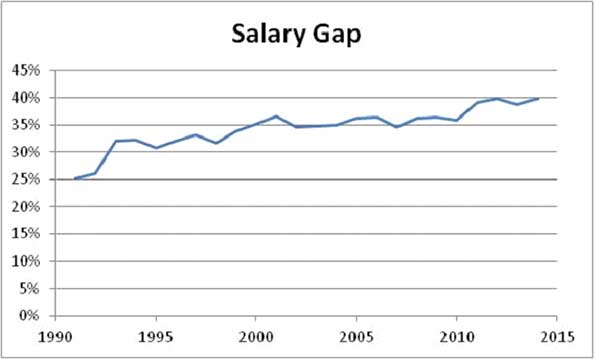
    The salary gap – where top-end incomes are rising faster than middle- and lower-end salaries – plays a large role in the affordability of middle-class housing along with interest rates and prices. Which factor has more influence depends on where you live and how you make your living.

    Using some simplifying assumptions (20 percent down payment and a 30-year fixed-rate mortgage), today’s middle-class household increasingly cannot afford a middle-class home. Two things hurt this market: poor job outlook (impacts income) and interest rates (impacts affordability).

    Cities

    Salary Needed

    Mortgage Rate

    Salary Gap

    Jobs/People Ratio

    Unemployment Rate

    Cleveland

    $33,714.17

    3.96

    10%

    .59

    5.3

    Pittsburgh

    $33,838.57

    3.87

    7%

    .61

    5.1

    Detroit

    $37,544.40

    4.05

    2%

    .54

    5.6

    Cincinnati

    $36,357.35

    3.98

    1%

    .60

    4.0

    St Louis

    $36,784.94

    3.94

    0%

    .62

    5.0

    Atlanta

    $39,356.45

    3.97

    -7%

    .61

    5.5

    Phoenix

    $43,170.07

    3.97

    -19%

    .59

    5.3

    Tampa

    $41,488.22

    4.04

    -23%

    .56

    5.0

    Minneapolis

    $50,969.96

    3.96

    -20%

    .69

    3.5

    Philadelphia

    $54,385.77

    3.96

    -34%

    .59

    5.5

    Baltimore

    $55,842.76

    3.89

    -34%

    .62

    5.3

    Houston

    $53,684.45

    3.94

    -41%

    .64

    4.3

    Orlando

    $46,300.92

    3.99

    -52%

    .61

    4.8

    San Antonio

    $48,092.30

    3.99

    -50%

    .60

    3.4

    Dallas

    $52,947.58

    3.97

    -44%

    .65

    3.7

    Sacramento

    $61,517.63

    4.03

    -47%

    .55

    5.6

    Chicago

    $61,068.50

    3.97

    -58%

    .60

    5.5

    Portland

    $65,009.41

    4.01

    -61%

    .61

    5.5

    Denver

    $69,912.24

    4.04

    -68%

    .67

    3.7

    Miami

    $63,289.86

    4.00

    -93%

    .59

    5.2

    Washington

    $83,027.24

    3.90

    -61%

    .67

    4.3

    Seattle

    $78,118.97

    4.05

    -69%

    .66

    4.2

    Boston

    $86,164.15

    3.91

    -78%

    .63

    4.1

    New York City

    $90,750.14

    3.97

    -102%

    .58

    5.1

    Los Angeles

    $88,315.32

    3.94

    -124%

    .59

    6.0

    San Diego

    $104,839.73

    4.04

    -161%

    .56

    4.8

    San Francisco

    $157,912.06

    3.95

    -211%

    .63

    4.0

    Salary Gap expressed as percent of Median Salary (that is, Salary Gap = (Median Salary minus Salary Needed) divided by Median Salary); negative numbers mean the salary needed to buy the median-priced home is greater than the median salary in that city. Data on salary needed and mortgage rates from http://www.hsh.com/finance/mortgage/salary-home-buying-25-cities.html; data on median salary from http://www.bls.gov/oes/current/oessrcma.htm. Unemployment rate for August 2015 and Participation rate is 2014 annual average from www.bls.gov.

    In some ways, Minneapolis is not unlike San Francisco: both enjoy relatively low levels of unemployment and low mortgage costs. Nationally, the average 30-year mortgage rate is 4.09% (for July 17, 2015). Minneapolis and San Francisco are at 3.96% and 3.95%, respectively. Compared to the national unemployment rate of 5.3%, Minneapolis is at 3.5% and San Francisco is at 4.0%. So how do we explain the difference in affordability, aside from the realtor’s rant of “location, location, location”? San Francisco has a higher jobs/population ratio than Minneapolis, but that is only part of the story. As someone once told me when I was trying to understand why the jobs/housing relationship in Orange County didn’t fit the model: “What makes you think those people have jobs?”

    In other words, where a population is less dependent on the traditional economy, higher home prices may be sustainable. This occurs in areas with a concentration of rich (“high-net-worth”) individuals. Some cities, like San Francisco and New York, are also attractive to rich homebuyers from outside the US. About 5% of existing home sales in California were to buyers from China (mainland, Hong Kong and Taiwan), who spent about $12 billion on homes primarily in San Francisco, Los Angeles and San Diego. The Chinese buyers paid an average of $831,000 per home – 69% paid with all-cash. In that sense, San Francisco is more like New York. The New York metro has an unemployment rate slightly below the national average, but only 57.8% as many jobs as there are people, compared to the national average of 59.2%. Foreign buyers from Canada and Mexico – who, along with China, make up about half of all foreign home buyers in the US – tend to buy in lower-priced housing markets in Florida, Arizona and Texas. Although more units are sold to international buyers in Florida (about 21% in 2015), the higher dollar volume is in California and New York. Homebuyers from Canada spent $6.4 billion in Florida and Arizona last year while buyers from China spent a total of $12 billion in California and New York. These statistics hint at a population that is less job-dependent, less “middle-class” than the national average.

    The behavior of middle-class households in the decade before the 2008 collapse confirmed what I called a “distinct shift in the paradigm governing the housing market.” In November 2004, the stock market was climbing and the Fed was raising interest rates. The combination brought out talk of a real estate bubble. If investors started moving money away from housing they would be selling houses at a time when higher mortgage interest rates would make it more difficult to find buyers. That was 2004, mind you, not 2008; there were four years of housing prosperity ahead.

    Under the new paradigm, rising stock market prices are neither cause nor effect for changes in residential real estate prices. (One exception is the New York metropolitan area, where Wall Street drives home prices by virtue of its impact on employment and income.) The break in the statistical relationship between Wall Street and Main Street started around 1980. In 1979, the Federal Reserve changed their policy away from interest rate targeting. As they attempted to control the supply of money, interest rates began to swing wildly. Households put more money in real estate when they saw more uncertainty in the economy. At the time I dubbed housing “A New Kind of Gold.” It wasn’t that the prices of houses behaved the same way as gold prices but because of the shared attitude from buyers. Gold is a traditional hedge against economic uncertainty. In the 1990s, people started buying homes when other investments seemed uncertain.

    Prior to 1995, the Federal Reserve kept secret their monetary policy objectives. Twenty years later, we know that they are using the federal funds rate to reach targets for the money supply. Technically, the federal funds rate is the rate at which the Federal Reserve would like banks to lend to each other (although the banks are free to charge each other whatever they want). Banks also use the federal funds rate as the basis for setting consumer interest rates, like mortgage rates. Real estate investments are sensitive to interest rate changes in very specific ways. The total impact of current events on home prices will come from the Federal Reserve, regardless of what happens in the stock market. When interest rates rise it makes expansion more expensive for businesses by raising their borrowing costs. When businesses don’t expand, neither does employment. In addition to the fact that homes with mortgages become affordable to a smaller portion of the population, the impact on jobs is another reason why rising interest rates would reduce the demand for homes.

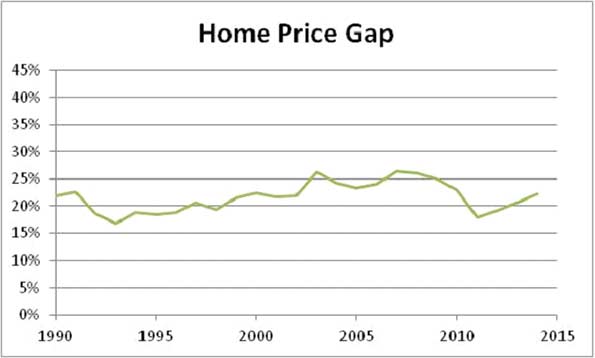
    The gap between the mean- and median-priced homes was increasing across the country before the 2008 crisis, indicating that prices at the top of the scale were rising faster than the prices of more modest homes. The return of the home price gap to pre-1995 levels could have equalized affordability for middle-class Americans if income had followed suit. In addition to the poor employment outlook, fewer and fewer people will be able to afford the higher priced homes because the gap between mean- and median-income is rising faster than the home price gap is falling.

    Median and mean (average) home sales prices are for new homes sold in the U.S. where the sales price includes land. Data from www.census.gov. Median and mean (average) salary from www.census.gov (Table H-13).

    If the long-anticipated strengthening in the jobs market had appeared after the Great Recession, it could have made a real difference for middle-America. But so far, the employment recovery has not appeared. As weak job growth appeared in September, the previously encouraging July and August growth numbers were revised downward. The labor force participation rate declined, leaving only 59.2% of the population working. Population growth in the US is less than 1% per year but job growth is not keeping up with it.

    Month 2015

    Civilian Population Growth

    Employment Growth

    June

    199,362

    -56,000

    July

    205,661

    101,000

    August

    220,858

    196,000

    September

    233,715

    -236,000

    4-Month Total

    859,596

    5,000

    Civilian Population Growth based on population estimates from www.FactFinder.census.gov, Employment Growth based on number of persons employed from www.bls.gov.

    As long as the monthly payments on median-priced homes are out of reach for median-income households, demand in the middle-class housing market cannot strengthen. This is one more reason the Federal Reserve cannot afford to raise interest rates this year. That doesn’t mean that they won’t do; just that they shouldn’t – that don’t always do that smart thing.

    Housing photo courtesy of BigStockPhoto.com.

    Susanne Trimbath, Ph.D. is CEO and Chief Economist of STP Advisory Services. Dr. Trimbath’s credits include appearances on national television and radio programs and the Emmy® Award nominated Bloomberg report Phantom Shares. She appears in four documentaries on the financial crisis, including Stock Shock: the Rise of Sirius XM and Collapse of Wall Street Ethicsand the newly released Wall Street Conspiracy. Dr. Trimbath was formerly Senior Research Economist at the Milken Institute. She served as Senior Advisor on United States Agency for International Development capital markets projects in Russia, Romania and Ukraine. Dr. Trimbath teaches graduate and undergraduate finance and economics.

  • Light Rail in the Sun Belt is a Poor Fit

    There is an effective lobby for building light rail, including in cities such as Houston. But why build light rail? To reduce car use? To improve mobility for low-income citizens? This certainly seems a worthwhile objective, with the thousands of core-city, low-income residents whose transit service cannot get them to most jobs in a reasonable period of time.

    ut rather than accept the flackery that accompanies these projects, maybe we should focus on effectiveness, judged by ridership, and the impact of such expensive projects on the transportation of the transit-dependent.

    Take the Dallas light rail system, which serves growing Dallas and Collin counties. The DART light rail system expanded its lines by approximately three quarters between 2000 and 2013, yet the number of transit commuters declined, and transit’s commuting market share dropped by one-quarter. More than twice as many Dallas workers are employed at home than ride transit, and do not require the massive capital and operating subsidies of light rail.

    Even the widely praised Denver system has barely moved the needle for transit ridership; before opening its massive light rail system in 1990, 4.3 percent of Denver commuters used transit to get to work.

    The share did rise – by a total of 0.1 percent to 4.4 percent. Even Portland, considered the Mecca of the “smart growth” strategy, actually has seen a decrease in its transit market share, from 7.9 percent before light rail to 6.4 percent in 2013. San Diego, arguably one of the more successful light rail systems, has seen its transit market share stagnate, from 3.3 percent in 1980 before light rail to 3.2 percent in 2013.

    And then there is Los Angeles, a city that was essentially built around the Pacific Electric “Red Car” system in the early 20th Century, and is the densest in the United States, more than twice as dense as Houston. Yet despite this, the regional MTA, which operates its large bus and rail system, as well as a subway, still struggles to reach its ridership record reached in 1985, when transit consisted of only buses. Despite spending over $10 billion in public funds, Los Angeles has seen ridership decline while the once-more thriving bus system has deteriorated. Nearly three quarters of all Angelenos still drive to work.

    No surprise then that Houston, where the light rail system opened in 2004, has not been notably successful.

    Between 2003 and 2014, Harris County’s population grew 23 percent, but transit ridership decreased 12 percent, according to American Public Transportation Association data. This means that the average Houstonian took 30 percent fewer trips on the combined bus and light rail system in 2014 than on the bus only system in 2003.

    Finally, in each of these cities, driving alone has increased and, with the exception of Los Angeles, more people now work at home than ride transit to work.

    These results reflect stubborn historical facts. Transit works well generally in older cities with historically large downtowns built largely before the ascendency of the car. These “legacy” cities, notably New York, are hard-wired for transit and have the largest downtowns; in New York the Manhattan business districts accounts for about 20 percent of the workforce. Together these legacy cities – New York, Boston, Chicago, Philadelphia, San Francisco and Washington – account for 55 percent of all transit work trip destinations in the nation.

    In contrast, most Sun Belt cities have far fewer downtown jobs. In Los Angeles, downtown amount for less than 3 percent of employment and Dallas’ downtown accounts for only 2 percent of metropolitan employment. In Houston the number is only 6.4 percent.

    With population and jobs concentrating in the periphery, light rail service ends up serving a geography to which relatively few commute. They have not materially increased transit’s share of travel, or reduced car travel. Worse still, their intense expense on single lines (routes) has precluded greater and less costly bus expansions that could have provided neglected communities – the young, the poor, the disabled, immigrants and minorities – with access to more jobs. The performance of light rail simply has not justified the expense.

    Houston and other metropolitan areas need to take advantage instead of an incipient transportation revolution. Working at home is likely to increase substantially and automated vehicles promise to increase mobility while reducing traffic congestion. Companies like Uber could offer other private-sector based solutions. Houstonians should address the needs of the 21st century city not as some wish it to be but based how things really work.

    This piece first appeared in the Houston Chronicle.

    Joel Kotkin is executive editor of NewGeography.com and Roger Hobbs Distinguished Fellow in Urban Studies at Chapman University, and a member of the editorial board of the Orange County Register. He is also executive director of the Houston-based Center for Opportunity Urbanism. His newest book, The New Class Conflict is now available at Amazon and Telos Press. He is also author of The City: A Global History and The Next Hundred Million: America in 2050. He lives in Orange County, CA.

    Wendell Cox is Chair, Housing Affordability and Municipal Policy for the Frontier Centre for Public Policy (Canada), is a Senior Fellow of the Center for Opportunity Urbanism (US), a member of the Board of Advisors of the Center for Demographics and Policy at Chapman University (California) and principal of Demographia, an international public policy and demographics firm.He is co-author of the “Demographia International Housing Affordability Survey” and author of “Demographia World Urban Areas” and “War on the Dream: How Anti-Sprawl Policy Threatens the Quality of Life.” He was appointed to three terms on the Los Angeles County Transportation Commission, where he served with the leading city and county leadership as the only non-elected member. He served as a visiting professor at the Conservatoire National des Arts et Metiers, a national university in Paris.

  • Should Older Americans Live in Places Segregated from the Young?

    Demographers frequently remind us that the United States is a rapidly aging country. From 2010 to 2040, we expect that the age-65-and-over population will more than double in size, from about 40 to 82 million. More than one in five residents will be in their later years. Reflecting our higher life expectancy, over 55% of this older group will be at least in their mid-70s.

    While these numbers result in lively debates on issues such as social security or health care spending, they less often provoke discussion on where our aging population should live and why their residential choices matter.

    But this growing share of older Americans will contribute to the proliferation of buildings, neighborhoods and even entire communities occupied predominantly by seniors. It may be difficult to find older and younger populations living side by side together in the same places. Is this residential segregation by age a good or a bad thing?

    As an environmental gerontologist and social geographer, I have long argued that it is easier, less costly, and more beneficial and enjoyable to grow old in some places than others. The happiness of our elders is at stake. In my recent book, Aging in the Right Place, I conclude that when older people live predominantly with others their own age, there are far more benefits than costs.

    Why do seniors tend to live apart from other age groups?

    My focus is on the 93% of Americans age 65 and older who live in ordinary homes and apartments, and not in highly age-segregated long-term care options, such as assisted living properties, board and care, continuing care retirement communities or nursing homes. They are predominantly homeowners (about 79%), and mostly occupy older single-family dwellings.

    Older Americans don’t move as often as people in other age groups. Typically, only about 2% of older homeowners and 12% of older renters move annually. Strong residential inertiaforces are in play. They are understandably reluctant to move from their familiar settings where they have strong emotional attachments and social ties. So they stay put. In the vernacular of academics, they opt to age in place.

    Over time, these residential decisions result in what are referred to as “naturally occurring” age-homogeneous neighborhoods and communities. These residential enclaves of old are now found throughout our cities, suburbs and rural counties. In some locales with economies that have changed for the worse, these older concentrations are further explained by the wholesale exit of younger working populations looking for better job prospects elsewhere – leaving the senior population behind.

    Even when older people decide to move, they often avoid locating near the young. The Fair Housing Amendments Act of 1988 allows certain housing providers to discriminate against families with children. Consequently, significant numbers of older people can move to these “age-qualified” places that purposely exclude younger residents. The best-known examples are those active adult communities offering golf, tennis and recreational activities catering to the hedonistic lifestyles of older Americans.

    Others may opt to move to “age-targeted” subdivisions (many gated) and high-rise condominiums that developers predominantly market to aging consumers who prefer adult neighbors. Close to 25% of age-55-and-older households in the US occupy these types of planned residential settings.

    Finally, another smaller group of relocating elders transition to low-rent senior apartment buildings made possible by various federally and state-funded housing programs. They move to seek relief from the intolerably high housing costs of their previous residences.

    Is this a bad thing?

    Those advocates who bemoan the inadequate social connections between our older and younger generations view these residential concentrations as landscapes of despair.

    In their perhaps idyllic worlds, old and young generations should harmoniously live together in the same buildings and neighborhoods. Older people would care for the children and counsel the youth. The younger groups would feel safer, wiser and respectful of the old. The older group would feel fulfilled and useful in their roles of caregivers, confidants and volunteers. In question is whether these enriched social outcomes merely represent idealized visions of our pasts.

    A less generous interpretation for why critics oppose these congregations of old is that they make the problems faced by an aging population more visible and thus harder to ignore.

    Residents play shuffleboard at Limetree Park in Bonita Springs, Florida. Steve Nesius/Reuters
    A better social life

    But why should we expect older people to live among younger generations? Over the course of our lives, we typically gravitate to others who are at similar stages in life as ourselves. Consider summer camps, university dormitories, rental buildings geared to millennials or neighborhoods with lots of young families. Yet we seldom hear cries to break up and integrate these age-homogeneous residential enclaves.

    In fact, studies show that when older people reside with others their age, they have more fulfilled and enjoyable lives. They do not feel stigmatized when they practice retirement-oriented lifestyles. Even the most introverted or socially inactive older adults feel less alone and isolated when surrounded with friendly, sympathetic, and helpful neighbors with shared lifestyles, experiences, and values – and yes, who offer them opportunities for intimacy and an active sex life.

    Moreover, tomorrow’s technology is especially on the side of these elders. Because of online social media communications, older people can engage with younger people – as family members, friends, or as mentors – but without having to live next to what they sometimes feel are noisy babies, obnoxious adolescents, indifferent younger adults or insensitive career professionals.

    Age-specific enclaves prolong independent living

    Could living in these age-homogeneous places help older people avoid a nursing home stay?

    Studies say yes – because here they have more opportunities to cope with their chronic health problems and impairments. Now their greater visibility as vulnerable consumers becomes a plus because both private businesses and government administrators can more easily identify and respond to their unmet needs.

    These elder concentrations spawn a different mindset. The emphasis shifts from serving troubled individual consumers to serving vulnerable communities or “critical masses” of consumers.

    Consider how many more clients home-care workers can assist when they are spared the traveling time and costs of reaching addresses spread over multiple suburbs or rural counties. Or recognize how much easier it is for a building management or homeowners’ association to justify the purchasing of a van to serve the transportation needs of their older residents or to establish an on-site clinic to address their health needs.

    Consider also the challenges confronted by older people seeking good information about where to get help and assistance. Even in our internet age, they still mostly rely on word of mouth communications from trusted individuals. It becomes more likely that these knowledgeable individuals will be living next to them.

    These enclaves of old have also been the catalyst for highly regarded resident-organizedneighborhoods known as elder villages.

    Their concerned and motivated older leaders hire staff and coordinate a pool of their older residents to serve as volunteers. For an annual membership fee, the predominantly middle-income occupants in these neighborhoods receive help with their grocery shopping, meal delivery, transportation and preventive health needs. Residents also benefit from knowing which providers and vendors (like workers performing home repair) are the most reliable, and they often receive discounted prices for their goods and services. They also enjoy organized educational and recreational events enabling them to enjoy the company of other residents. Today, about such 170 villages are open and 160 are in planning stages.

    A question of preference

    Ageist values and practices are indeed deplorable. However, we should not view the residential separation of the old from the young as necessarily harmful and discriminatory but rather as celebrating the preferences of older Americans and nurturing their ability to live happy, dignified, healthy and autonomous lives. Living with their age-peers helps these older occupants compensate for other downsides in their places of residence and in particular presents opportunities for both private and public sector solutions.

    Tihs piece was first published by The Conversation.

    Stephen M. Golant, Ph.D, a gerontologist and geographer, is now a Professor in the Department of Geography at the University of Florida. Previously, he was a faculty member in the Committee on Human Development and in the Department of Geography at the University of Chicago. Dr. Golant has been conducting research on the housing, mobility, transportation, and long-term care needs of older adult populations for most of his academic career. He is a Fellow of the Gerontological Society of America and a Fulbright Senior Scholar award recipient. He earlier served as a consultant to the Congressionally appointed Commission on Affordable Housing and Health Facility Needs for Seniors in the 21st Century (Seniors Commission). He has written or edited about 140 papers and books. His latest book is Aging in the Right Place (Health Professions Press, 2015).

    Laed photo by Steve Nesius/Reuters.

  • Who Should Pay for the Transportation Infrastructure?

    Urban regions are significantly more important than any one city located within them. Housing, transportation, economy, and politics help produce uneven local geographies that shape the individual identities of places and create the social landscapes we inherit and experience. As such, decisions made within one city can ripple through the entire urban region. When affordable housing is systematically ignored by one city, neighboring cities become destinations for those who cannot afford higher housing costs. Even when the minimum wage is adjusted in one city, others cannot ignore it.

    In fact, a differential wage structure can produce diverse economic and labor geographies. Affordable housing and uneven economic development, in their turn, impact the regional transportation and infrastructure: if the cost of living and wages in one city in a particular region are high (as in San Francisco and Seattle), then low and middle-income workers will move to a more affordable neighboring city and pay a higher price, particularly in time spent, for transportation. They also pay more in fuel, and hence taxes that fund infrastructure maintenance and expansion.

    In other words, while companies and the more affluent population benefit from the agglomeration economies of alpha cities, it is the lower-wage workers and the population at large that pay for these uneven development. Therefore, a company deciding to locate in Seattle or San Francisco, or any location, does not have to bear the cost their decision imposes on urban transportation and the infrastructure needed to support their operation. Instead it’s their employees, particularly those with lower earning power, who do.

    How many LEED certified buildings and downtown redevelopment projects does it take to make up for this inequity?  Should a city be considered green, if a significant portion of its low earners has to commute to neighboring cities to afford a home? Can a city be seen as sustainable, if in a style akin to medieval cities, serfs have to leave every evening and return in the morning to make sure that the ‘creative class’ is adequately served?

    As states such as Washington engage with the old “pay as you go” policy of increasing fuel taxes to pay for the infrastructure, the question of what forces created the emergent commuting patterns remains unanswered. Was it just the commuters, acting as informed participants in the market economy, who sought to optimize their housing and transportation trade offs? Or did the locational choices of employers contribute to the growing commuting problems in the region? If commuters are subjected to “pay as you go” policies, shouldn’t employers who locate in expensive housing markets, irrespective of their employees’ income profile, be subjected to “pay as you locate” policies?

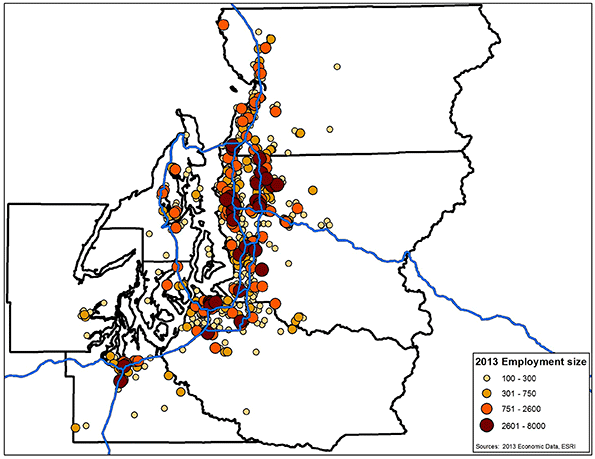
    Perhaps no metro region will make a better case study for this inequity than the area that ‘serves’ Seattle. The Puget Sound Region consists of four counties; however, to make sure that no one county that might have an economic connection with Seattle is left behind, we can look at six counties: Snohomish, King (where Seattle is located), Pierce, Kitsap, Thurston, and Mason.

    The entire urban region is served by a small number of highways, including Interstate 5. According to 2013 economic data, these six counties housed nearly 62% of all firms in the state. Furthermore, a quarter of all businesses in these counties were located within half a mile of a freeway. In terms of total employees, the six counties contained 69% of the state employment, and workplaces within half a mile of a freeway employed 37% of all employees in the counties. The inequity in the regional economic distribution is further exacerbated by the fact that the small area in West King county bounded by I-405 houses 30% of workplaces and 47% of employment, and generates a significant portion of the sales/revenue in the six counties. This area relies on I-5, I-405 and I-90 for the delivery of its employees from near and far.   

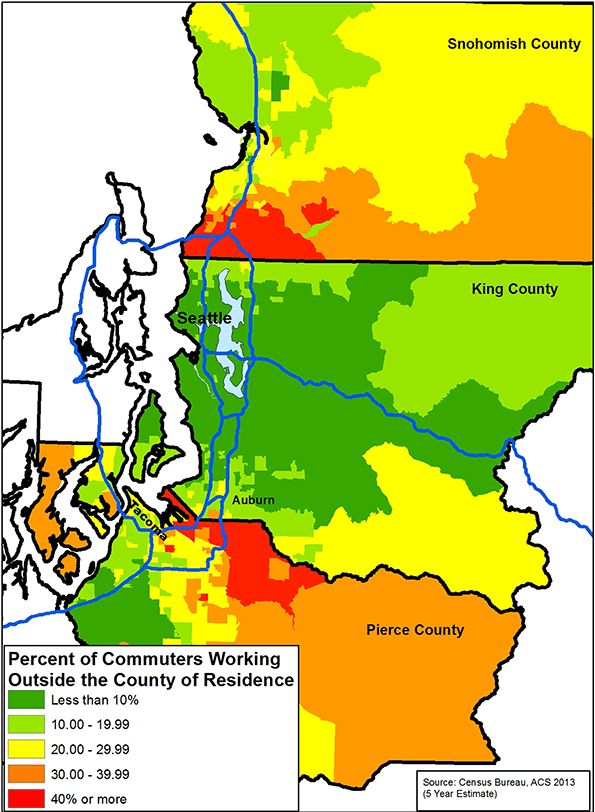
    The economic calculus of the early days of Interstate construction may have suggested that the trucking industry would benefit from this transportation infrastructure, but 1960s economists might be surprised by the type of companies now located within half a mile of freeways. In the six counties in Western Washington, the economic sectors over-represented in these geographies are: services and finance, real estate, and insurance (FIRE). Anyone driving on I-5 and I-405 (where Microsoft and other corporations are visible) can see this.  None of these workplaces require trucking. While their well-paid employees can afford to live in well-to-do places, including Bellevue and Seattle, many others reside in less expensive places such as Auburn, Tukwila, Tacoma, and Federal Way.

    A map of the region clearly suggests that neighboring counties and cities are housing those who work in West King County. Mobility has been the answer to unaffordability in this and other similar urban regions. If a city is unaffordable, is it fair to ask those who search for affordability in ‘other’ geographies pay for their so-called choices? Is this truly a choice? Are employers, current and future, asked to pay for their locational ‘choices?’ 

    Surely, we can do better than asking employees to bear the burden of a regional economic imbalance. Freeways should not be freer to some than others.  If this nation is about people paying for choices they make, then everyone should do so: employers and employees alike.

    Ali Modarres is the Director of Urban Studies at University of Washington Tacoma.  He is a geographer and landscape architect, specializing in urban planning and policy. He has written extensively about social geography, transportation planning, and urban development issues in American cities.

    Seattle photo courtesy of BigStockPhoto.com.

  • The Cities Americans Are Thronging To And Fleeing

    Cities get ranked in numerous ways — by income, hipness, tech-savviness and livability — but there may be nothing more revealing about the shifting fortunes of our largest metropolitan areas than patterns of domestic migration.

    Bright lights and culture may attract some, but people generally move to places with greater economic opportunity and a reasonable cost of living, particularly affordable housing.

    So who moves? Census data suggests that it is primarily the young — those aged 25 to 34 — followed by people approaching retirement. Family and friends are a big motivating factor in both age groups. According to the moving company Mayflower,   one in four millennials aged 18 and 34 moved back to their hometowns over the past five years. At the same time seniors also express a strong desire to live close to their children and grandchildren; most elderly who do not make such moves age in place.

    Forbes took a close look at the most recent data on domestic migration — that is movement within the U.S. between metro areas — between 2010 and 2014. We ranked the nation’s 53 largest metropolitan areas based on their annualized rates of population change attributable to migration. What we found is that to a remarkable extent, Americans still seem to be whistling Dixie. Eight of the 10 fastest gainers were in the former Confederacy, led by Austin, Texas, which gained 126,296 more migrants over that time span from other parts of the country than it lost in outmigration, accounting for an annual increase in its population of 1.69%. No other metro area in the country enjoyed anything like this rate of in-migration.

    Austin’s high job creation rate — over 3% growth annually since 2010 — has a great deal to do with its ability to lure new residents not only from other Texas cities, but from the coasts as well.

    The other Southern standouts are from the northern and western edges of the region. They include several Texas cities — No. 3 San Antonio (1.02% annual increase in population from migration) and No. 8 Houston — which have logged strong job growth and offer housing prices, adjusted for incomes, that are less than half those in coastal California, New York and parts of New England.

    The oil bust could slow down the allure of some of these cities, notably Houston as well as No. 9 Oklahoma City. But lower petroleum prices could prove a boon to nearly universally suburbanized cities such as No. 2 Raleigh, N.C. (1.14% annual growth in population from migration), and No. 5 Nashville, Tenn.,  both of which have economies built around technology, manufacturing and business services. Raleigh is growing so strongly that local officials expect the population of the metro area will double over the next 20 years.

    It’s a continuation of a longstanding shift to the South, a trend that some pundits were quick to declare was over after the Great Recession amid a perceived rise in interest in urban living. There have certainly been some Southern metro areas that seem to have lost appeal since 2010, notably Atlanta, Tampa-St. Petersburg and Jacksonville, all of whose rates of in-migration have slowed, although they’re still comfortably among the 20 top destinations.

    The Rockies And The Pacific Northwest

    In this century, the other great migration draw has been two parts of the West: the Mountain States and the Pacific Northwest. This vast region extending from Colorado to Oregon has enjoyed generally strong economic growth and reasonable housing costs, particularly in comparison with coastal California. The big winner here has been No. 4 Denver, which gained a net 103,785 domestic migrants from 2010 to 2014.

    The other strong performers in the region include No. 11 Phoenix, which gained 119,000 net migrants since 2010. But this is a slowdown from its previous pace; between 2000 and 2009 (the Census Bureau did not produce migration figures for 2009-2010), Phoenix ranked fifth in the nation. But an even bigger decline has occurred in Las Vegas, the boomtown of the last decade, which has fallen from the No. 2 in the first decade of the new millennium to 16th place in 2010-14. On an annual basis, Las Vegas is now attracting about 9,000 net migrants a year compared to 35,000 in the 2000s.

    The Pacific Northwest continues to attract more migrants than it loses, many from California. The big winner here has been No. 15 Seattle, which has gained 60,000 net migrants since 2010; in the last decade, the Emerald City barely managed 40,000 net migrants from 2000 to 2009. Portland has added about 49,000 net migrants, though its annual inflow has dropped somewhat.

    Winners And Losers

    It is frequently claimed by fiscal conservatives that politics and regulation drive these patterns. Generally speaking, there tends to be more growth in lower-tax states than in higher-taxed ones, but this analysis only goes so far. Blue metro areas like Seattle, Portland and Denver are luring new residents despite somewhat higher costs and stringent regulation. It seems likely that their success is that they are not California, a regulatory state on steroids.

    Indeed economic booms can make up for a lot of sins. No. 20 San Francisco may not be drawing newcomers like an Austin or a Nashville, but super-high costs have not been enough to overcome the lure of riches from the current tech boom. Since 2010, the area, which includes suburban San Mateo County, Marin County and the East Bay, has attracted a net 49,000 new migrants, a big turnaround compared to the massive outflow of 347,000 suffered in the first decade of this millennium.

    But other expensive and expansive metropolitan areas are not doing as well in the population sweepstakes. The nation’s three largest metropolitan areas fall to the bottom of our list: Los Angeles (46th), Chicago (52nd) and, in last place New York. Since 2010, the New York metro area has lost a net 529,000 domestic migrants, adding to the 1.9 million who departed from 2000 to 2009.

    Yet these great metropolitan areas are not shrinking, due to a steady flow of new residents from overseas and a surplus of births over deaths. In this sense, they are less vulnerable to migration losses than cities such as Cleveland, Pittsburgh and Detroit, where the rate of domestic outmigration is lower, but the number of new foreign immigrants is relatively low.

    Clearly America’s migration trends are always changing, but for the most part the basics remain the same. Places that are more affordable, and also have thriving economies, tend to attract new residents while those with relatively tepid economies and high costs fare, all things being equal,  far worse.

    The Winners: No. 1: Austin, Texas

    Metro Area Population, 2014: 1.94 million

    Net Domestic Migration Gain, 2010-14: 126,296

    Annual Rate Of Pop. Increase Since 2010 From Migration: 1.69%

    No. 2: Raleigh, NC

    Metro Area Population, 2014: 1.24 million

    Net Domestic Migration Gain, 2010-14: 55,920

    Annual Rate Of Pop. Increase Since 2010 From Migration: 1.14%

    No. 3: San Antonio, TX

    Metro Area Population, 2014: 2.33 million

    Net Domestic Migration Gain, 2010-14: 94,159

    Annual Rate Of Pop. Increase Since 2010 From Migration: 1.02%

    No. 4: Denver, CO

    Metro Area Population, 2014: 2.75 million

    Net Domestic Migration Gain, 2010-14: 103,785

    Annual Rate Of Pop. Increase Since 2010 From Migration: 0.95%

    No. 5: Nashville, TN

    Metro Area Population, 2014: 1.79 million

    Net Domestic Migration Gain, 2010-14: 63,477

    Annual Rate Of Pop. Increase Since 2010 From Migration: 0.88%

    No. 6: Charlotte, NC-SC

    Metro Area Population, 2014: 2.38 million

    Net Domestic Migration Gain, 2010-14: 83,305

    Annual Rate Of Pop. Increase Since 2010 From Migration: 0.87%

    No. 7: Orlando, FLA

    Metro Area Population, 2014: 2.32 million

    Net Domestic Migration Gain, 2010-14: 72,735

    Annual Rate Of Pop. Increase Since 2010 From Migration: 0.79%

    No. 8: Houston, TX

    Metro Area Population, 2014: 6.49 million

    Net Domestic Migration Gain, 2010-14: 191,796

    Annual Rate Of Pop. Increase Since 2010 From Migration: 0.75%

    No. 9: Oklahoma City, OK

    Metro Area Population, 2014: 1.34 million

    Net Domestic Migration Gain, 2010-14: 37,528

    Annual Rate Of Pop. Increase Since 2010 From Migration: 0.70%

    No. 10: Dallas-Fort Worth, TX

    Metro Area Population, 2014: 6.95 million

    Net Domestic Migration Gain, 2010-14: 184,021

    Annual Rate Of Pop. Increase Since 2010 From Migration: 0.67%

    The Losers: No. 10: Milwaukee, WI

    Metro Area Population, 2014: 1.57 million

    Net Domestic Migration Loss, 2010-14: 22,597

    Annual Rate Of Pop. Decrease Since 2010 From Migration: -.34%

    o. 9: Virginia Beach-Norfolk, VA-NC

    Metro Area Population, 2014: 1.72 million

    Net Domestic Migration Loss, 2010-14: 24,374

    Annual Rate Of Pop. Decrease Since 2010 From Migration: -.34%

    No. 8: Los Angeles, CA

    Metro Area Population, 2014: 13.26 million

    Net Domestic Migration Loss, 2010-14: 208,635

    Annual Rate Of Pop. Decrease Since 2010 From Migration: -.39%

    No. 7: Rochester, NY

    Metro Area Population, 2014: 1.08 million

    Net Domestic Migration Loss, 2010-14: 17,665

    Annual Rate Of Pop. Decrease Since 2010 From Migration: -.39%

    No. 6: Memphis, TN-MS-AR

    Metro Area Population, 2014: 1.34 million

    Net Domestic Migration Loss, 2010-14: 21,999

    Annual Rate Of Pop. Decrease Since 2010 From Migration: -.39%

    No. 5: Cleveland, OH

    Metro Area Population, 2014: 2.06 million

    Net Domestic Migration Loss, 2010-14: 38,424 

    Annual Rate Of Pop. Decrease Since 2010 From Migration: -.44%

    No. 4: Detroit, MI

    Metro Area Population, 2014: 4.30 million

    Net Domestic Migration Loss, 2010-14: 89,649

    Annual Rate Of Pop. Decrease Since 2010 From Migration: -.50%

    No. 3: Hartford, CT

    Metro Area Population, 2014: 1.21 million

    Net Domestic Migration Loss, 2010-14: 27,425

    Annual Rate Of Pop. Decrease Since 2010 From Migration: -.54%

    No. 2: Chicago, IL-IN-WI

    Metro Area Population, 2014: 9.55 million

    Net Domestic Migration Loss, 2010-14: 237,666

    Annual Rate Of Pop. Decrease Since 2010 From Migration: -.60%

    No. 1: New York, NY-NJ-PA

    Metro Area Population, 2014: 20.09 million

    Net Domestic Migration Loss, 2010-14: 528,742

    Annual Rate Of Pop. Decrease Since 2010 From Migration: -.64%

    This piece first appeared at Forbes.

    Joel Kotkin is executive editor of NewGeography.com and Roger Hobbs Distinguished Fellow in Urban Studies at Chapman University, and a member of the editorial board of the Orange County Register. He is also executive director of the Houston-based Center for Opportunity Urbanism. His newest book, The New Class Conflict is now available at Amazon and Telos Press. He is also author of The City: A Global History and The Next Hundred Million: America in 2050. He lives in Orange County, CA.

    Wendell Cox is Chair, Housing Affordability and Municipal Policy for the Frontier Centre for Public Policy (Canada), is a Senior Fellow of the Center for Opportunity Urbanism (US), a member of the Board of Advisors of the Center for Demographics and Policy at Chapman University (California) and principal of Demographia, an international public policy and demographics firm.He is co-author of the “Demographia International Housing Affordability Survey” and author of “Demographia World Urban Areas” and “War on the Dream: How Anti-Sprawl Policy Threatens the Quality of Life.” He was appointed to three terms on the Los Angeles County Transportation Commission, where he served with the leading city and county leadership as the only non-elected member. He served as a visiting professor at the Conservatoire National des Arts et Metiers, a national university in Paris.

  • The Green Urbanization Myth

    Once a fringe idea, the notion of using technology to allow humanity to “decouple” from nature is winning new attention, as a central element of what the Breakthrough Institute calls “ecomodernism.” The origins of the decoupling idea can be found in 20th century science fiction visions of domed or underground, climate-controlled, recycling-based cities separated by forests or deserts. A version of decoupling was promoted in the 1960s and 1970s by the British science writer Nigel Calder in The Environment Game (1967) and the radical ecologist Paul Shepard in The Tender Carnivore and the Sacred Game (1973). More recent champions of decoupling include Martin Lewis, Jesse Ausubel, Stewart Brand, and Linus Blomqvist.  

    Proponents of decoupling point out correctly that the greatest threat to wilderness is not urban sprawl, but agricultural sprawl. The amount of the earth’s surface devoted to the unnatural, simplified ecosystems of agriculture—that is, farms and ranches—dwarfs the small amount consumed by cities, including low-density suburbs. Industrial, energy- and fertilizer-intensive agriculture has permitted us to grow far more food on far less land—with costs, to be sure, including water pollution from fertilizer runoff. Genetically modified crops will make it possible to shrink the footprint of global agriculture altogether, and if human beings ever derive most of their diet from laboratory-synthesized foods like in vitro meat and vegetables created from stem cells, most of today’s farmland can be freed for other uses.

    The decouplers are right to predict that technology will free up vast amounts of land for purposes other than farming. But many of them go wrong, I believe, when they assume that the decline of agricultural sprawl will be accompanied by the decline of urban sprawl, for two reasons. First, as societies become richer, more and more people choose low-density housing and can afford it. Second, whatever may be the case in other countries, in the United States, the private market for land—including retired farmland—ensures that little if any of the land freed by technology from agriculture will be turned into public wilderness preserves.

    One of the great urban legends of our time is the claim, endlessly repeated by urban gentry journalists, that Americans are tired of the suburbs and are moving back into the city in the search of walkable neighborhoods. The data disprove the claim. As Wendell Cox points out at Newgeography:

    But the core municipalities now contain such a small share of major metropolitan area population that the suburbs have continued to add population at about three times the numbers of the core municipalities…Indeed, if the respective 2010-2013 annual growth rates were to prevail for the next century,  the core municipalities would house only 28.0 percent of the major metropolitan area population in 2113 (up from 26.4 percent in 2013).           

    Thanks to decoupling, the low-density metro areas will probably become even bigger and even less dense. As farmland on the periphery of metro areas is retired from agriculture, much of it will be converted into cheap housing, low-rent office parks and inexpensive production facilities.

    The rise of robocars may accelerate metro area decentralization. Congestion will be reduced, and the greater safety of driverless cars may permit higher speeds on metro area beltways and cross-town freeways. Once taxi drivers are replaced by robot taxis, the cost of taxis will plummet and the greater convenience of point-to-point personal travel anywhere in a sprawling metro area will make rail-based mass transit obsolete except in places like airports and tourist-haven downtowns.  As in the past, most working-class families with children will probably prefer a combination of a longer commute with a bigger single-family house and yard to a shorter commute and life in a cramped apartment or condo. 

    Nor will most working-class and middle-class retirees move to walkable downtowns. They won’t be able to afford to. And robocars plus in-home medical technology will make it much easier for the elderly to age in place in car-based suburbs. 

    As great numbers of middle- and low-income Americans move to bigger, cheaper homes on the former farmland that rings expanding metro areas, they will be leap-frogged by the rich. Absent a reversal of today’s top-heavy income concentration, much of America’s wealth will continue to be concentrated in the hands of a few people. And when farmland is retired, thanks to GM crops, in vitro food, or other new land-sparing technologies, a lot of the former farm acreage will be bought by One Percenters and turned into rural retreats.

    The decouplers hope that retired farmland will be “rewilded” and transformed into nature parks that everyone can enjoy. But how realistic is this hope? At least in the United States, it is impossible to imagine federal or state governments buying more than a negligible portion of retired farmland and turning it into public parks. What is more likely, that most retired Midwestern farmland will be turned into rewilded public prairie preserves—or that it will be divided into the vast baronial estates of super-rich bankers, tech oligarchs, and trust-fund heirs and heiresses, who commute from their downtown skyscraper penthouses to their high-tech Downtown Abbeys?

    A certain amount of the former farm acreage owned by the plutocracy may be rewilded, with the encouragement of tax incentives like conservation easement laws. But rewilding on the scale imagined by some environmentalists is unlikely. For one thing, the former farmland will still be chopped up by fences, roads, power lines, and other structures. And all but the greatest recreational ranches will be too small to support self-sustaining populations of bison and other megafauna. Nor are voters likely to smile on the restoration of predators like wolves, coyotes, bears, and mountain lions, even if a few of eccentric rich landowners fancied the idea.

    And then there is the aesthetic factor. The biologist E.O. Wilson has suggested that, because we are descended from hominids who evolved on African savannahs, we naturally prefer vistas with grassy expanses to forests, deserts, and other biomes. Some evidence for this comes from the work of the Russian artists Komar and Melamid, who polled members of different nationalities and then painted the “Most Wanted Paintings” based on the results. In most countries, if they are to be believed, the favorite sofa painting shows a grassy landscape with a river and some woods in the background. 

    As Paul Shepard pointed out, the country-house landscape of 18th century Britain was anything but natural. The natural landscape of most of Britain, as of most of Western Europe, is dense forest. But the British rural upper class cleared the forests to create grassy vistas—the ancestors of the modern British and American suburban lawn. Shepard blamed this on the influence of Renaissance Italian landscape painting, which showed once-forested Mediterranean coast land that had been denuded by goats and sheep. But the Wilson theory may provide another explanation.

    Whether for cultural or instinctive reasons, the rich who buy up most of the land spared by technology may wish to keep open spaces, even if the area would naturally be forest. The late architect Philip Johnson waged a constant war on the New England forest in order to maintain grassy lawns over which to view his Glass House and other iconic buildings on his 47-acre New Canaan, Connecticut, estate. In prairie biomes, conversely, the rural rich are likely to plant some trees, to make the land conform to conventional notions of the scenic.   

    If the American rich are given a free hand to shape the former farm acreage they have bought, the most likely result will be a park-like landscape, with open vistas and clumps of trees—regardless of what the natural environment of the area would look like. The rewilding would be limited chiefly to small animals and birds, like raccoons and turkeys. No bison herds and no wolf packs. And as acreage was converted from farmland to One Percenter parkland, the already excessive deer population, freed from natural predators and rural American hunters alike, would swell even more. 

    The decouplers are right, I believe, to predict that advances in food production technology will free enormous amounts of former farmland for other uses. But very little of that land will be converted into the public wilderness preserves envisioned by Calder and Shepard and others. A minority of the former farmland will be converted into single-family housing on the edges of major metro areas. Most of the land retired from farming, instead of being spared for nature, will become rural estates for the plutocracy, surrounded by signs reading PRIVATE PROPERTY: KEEP OUT and overrun by starving deer.

    Michael Lind is the Policy Director of the Economic Growth Program at the New America Foundation in Washington, D.C., editor of New American Contract and its blogValue Added, and a columnist forSalon magazine. He is also the author of Land of Promise: An Economic History of the United States. Lind was a guest lecturer at Harvard Law School and has taught at Johns Hopkins and Virginia Tech. He has been an editor or staff writer at the New YorkerHarper’s Magazine, the New Republic and the National Interest.

    Image from BigStockPhoto.com

  • Is This Hell or Indianapolis?

    I’ve observed many times that cities outside of the very top tier almost always come across as generic, cheesy, and trying too hard in their marketing efforts. They highlight everything about their city that is pretty much a variant on things everybody else already has (beer, beards, bicycles, etc) while downplaying the things that truly reflect their community. Call it “aspirational genericism.”

    Most places are extremely desperate to be part of the cool kids club, and so they buy the right preppy clothes, etc. and treat the things that are authentic and true about themselves as something to be ashamed of instead of celebrated.

    Today lots of cities produce videos to showcase themselves. But a while back it was cities commissioning songs, hoping for something like Frank Sinatra’s standards about New York and Chicago. These were for the most part embarrassingly cringe worthy.

    Indianapolis did the same a while back, in an effort I won’t given specifics on to protect the guilty, who were, after all, operating with the utmost sincerity.

    What I do want to highlight is though is that Indianapolis has one of the greatest songs ever recorded about a city, the Bottle Rockets’ “Indianapolis.” I have not, however, ever heard anyone in the city actually bring it up.

    And it’s easy to understand why. The song is an extremely negative take on the city in every respect. The refrain is:

    Can’t go west
    can’t go east
    I’m stuck in Indianapolis
    with a fuel pump that’s deceased

    Ten days on the road
    Now I’m four hours from my hometown
    Is this Hell or Indianapolis
    with no way to get around?

    He proceeds to regale us with a series of humorous but negative observations about the city, such as:

    Who knows what this repair will cost
    Scared to spend a dime
    I’ll puke if that jukebox
    Plays John Cougar one more time.

    Having seen the Bottle Rockets in concert many times, I can tell you that songwriter and lead singer Brian Henneman really does seem to dislike Indianapolis, where he apparently had an actual bad experience. (His hometown is somewhere near St. Louis, and he spent a lot of time with the Uncle Tupelo crew in Southern Illinois – and environment one would not expect to encounter someone looking down on Indy).

    Nevertheless, this is an amazingly great song. Here’s a 1991 acoustic demo version recorded with Jeff Tweedy and Jay Farrar. If the video doesn’t display, click over to listen on You Tube.

    While it’s probably a bridge too far to suggest that the city should embrace this song as a branding anthem, I’d like to point out that many nicknames and branding aspects of cities started out as digs. And let’s be honest, the idea of being trapped in Indy without a car isn’t that far from the truth. I might also observe that gangster rap became a phenom precisely because it did not deny the reality of life in the inner city.

    Here’s another, though not a song but a TV commercial. This one is a local legend. You’ll have to watch it to believe it. It’s a TV ad for local institution “Don’s Guns.” The eponymous Don was famous for his slogan, “I don’t want to make any money, folks. I just love to sell guns.” If the video doesn’t display for you, click over to watch on You Tube.

    If you search “Don’s Guns” on You Tube you can watch a variety of other colorful ads.

    Again, this is not likely to be something that will be used in the chamber of commerce’s marketing materials anytime soon. But if you don’t live in Indy, wouldn’t you find the idea of a bunch of people there who love guns believable? Of course you would, because it’s true. Indiana is a state that explicitly includes a right to bear arms for self defense in its constitution. Now, many people locally may not like guns, but at some point people are going to discover the actual reality of the place, even if you don’t tell them about it. And believe it or not there’s a large market of people who have an interest in guns. If you want to try to market to the gun-free crowd, are they likely to put Indy at the top of their list anyway? You’re probably fighting an uphill battle.

    Then lastly back to music. If there’s one thing that people around the world know about Indianapolis, its the Indianapolis 500. So it’s no surprise that the city and race were featured in the 1983 song “Indianapolis” by Puerto Rican boy band Menudo. There’s even a music video for it. You should click over to watch on You Tube as this copyrighted music has playback restrictions.

    This one, it’s true, is a cultural relic that has not stood the test of time, other than for retro flourish purposes (though it’s not a bad song). But it seems to be little known locally. I didn’t know about it until a message board commenter linked some years back. And I haven’t seen a marketing campaign around the city focused on auto racing in a long time.

    The struggles of working class life in a car dependent town, guns, and auto racing. Not the makings of glamour, but certainly authentic. Jim Russell and others have written a lot about rembracing the industrial heritage of the Midwest as “Rust Belt chic.” Indy is not really Rust Belt in the same sense as Cleveland or Pittsburgh. But these items are part of its own unique take on the formula. What could potentially be done with them?

    Certainly Texas has done well by being Texas. And Nashville has succeeded by being unapologetic about country music. And I’ll point out again that the Midwest repudiated its own heritage of agriculture, workwear, and blue collar lagers only to have them picked up by Brooklyn hipsters and made cool again. The Midwest threw its culture away and Brooklyn bought it out of the thrift store. Now the region is reimporting is own birthright after it has been made “safe” by the embrace of the cool kids. Midwest cities should have owned local and urban agriculture. But of course, in a region of places like Columbus that are deeply ashamed of being seen as “cow towns”, that was simply impossible. If Brooklynites ever start buying up old Chevy Vans, expect that only then will a place like Indy embrace the reality of that culture as well.

    Aaron M. Renn is a senior fellow at the Manhattan Institute and a Contributing Editor at City Journal. He writes at The Urbanophile, where this piece first appeared.

  • New Report: Putting People First

    This is the abstract from a new report “Putting People First: An Alternative Perspective with an Evaluation of the NCE Cities ‘Trillion Dollar’ Report,” authored by Wendell Cox and published by the Center for Opportunity Urbanism. Download the full report (pdf) here.

    A fundamental function of domestic policy is to facilitate better standards of living and minimize poverty. Yet favored urban planning policies, called "urban containment" or "smart growth," have been shown to drive the price of housing up, significantly reducing discretionary incomes, which necessarily reduces the standard of living and increases poverty.

    This makes the alleviation of poverty, the opportunity for better living standards and aspirations for upward mobility secondary to contemporary urban planning prescriptions. Despite this, calls to intensify land use regulations are becoming stronger and more insistent.

    A New Climate Economy report (NCE Cities report), by Todd Litman, "Analysis of Public Policies that Unintentionally Encourage and Subsidize Urban Sprawl," contends that the failure to implement urban containment policy (smart growth) costs more than $1.1 trillion annually in the United States. The urban containment policies favored by the NCE Cities report seek substantially increase urban population densities and transfer urban travel from cars to transit, walking and cycling.

    There are serious consequences to such policies, which lead to lower standards of living and greater poverty. This report evaluates the NCE Cities report which places urban containment policy as its most important priority. This Evaluation report offers an alternate vision, focused on improving living standards for all, while seeking to eradicate poverty.

    The NCE Cities report relies heavily on social costing and externality analysis of lower density development. While these are useful tools, they are ultimately subjective and should be used with great caution.

    This Evaluation identifies a number of issues with respect to the NCE Cities report cost analysis.

    1. Nearly 90% of the cost is attributable to personal vehicle use, and is based on a fixed cost per mile differential between the Most Compact (densest) quintile of US urban areas and the four quintiles that are less dense. This Evaluation finds a range of differences in per capita mileage among the quintiles that is far smaller than the NCE Cities report estimates. Adjustment for this and other issues would reduce the NCE Cities report cost estimate by nearly 85 percent, to a maximum that is under $200 billion. Other, unquantified issues are identified that could reduce the reduced estimate even further.

    2. The NCE Cities report largely dismisses the housing affordability consequences of urban containment policy. By rationing land, urban containment policy drives up the price of housing and has been associated with an unprecedented loss of housing affordability in a number of metropolitan areas in the United States and elsewhere. Urban containment policy has also been associated with greater housing market volatility. This is a particular concern given the role of the 2000s US housing bubble and bust in precipitating the Great Financial Crisis that resulted in a reduction of international economic output.

    3. Urban containment policy has significant negative externalities. A recent economic analysis associates an annual loss of nearly $2 trillion in gross domestic product in the United States with more stringent housing regulation. This estimate would nullify the NCE Cities report cost of dispersion estimate by more than 1.5 times. More significantly, it would dwarf the NCES Report cost estimate as adjusted in this Evaluation.

    The purpose of public policy in cities is not to focus a particular urban form, planning philosophy, type of housing, population density, or mode of transport. The purpose is rather to seek better lives for people. The most appropriate form of urban planning policy is that which facilitates better living standards and less poverty. There is increasing evidence that urban containment policy is not only irreconcilable with housing affordability and price stability but also with better standards of living and reduced poverty.

    Download the full report (pdf) here.

    Wendell Cox is Chair, Housing Affordability and Municipal Policy for the Frontier Centre for Public Policy (Canada), is a Senior Fellow of the Center for Opportunity Urbanism (US), a member of the Board of Advisors of the Center for Demographics and Policy at Chapman University (California) and principal of Demographia, an international public policy and demographics firm.He is co-author of the "Demographia International Housing Affordability Survey" and author of "Demographia World Urban Areas" and "War on the Dream: How Anti-Sprawl Policy Threatens the Quality of Life." He was appointed to three terms on the Los Angeles County Transportation Commission, where he served with the leading city and county leadership as the only non-elected member. He served as a visiting professor at the Conservatoire National des Arts et Metiers, a national university in Paris.

  • China’s Planned City Bubble Is About to Pop—and Even You’ll Feel It

    Seven years after the last housing debacle devastated the world economy, we may be on the verge of another, albeit different, bubble. If the last real estate collapse was created due to insanely easy lending policies aimed at the middle and working classes, the current one has its roots largely in a regime of cheap money married to policies of planners who believe that they can shape the urban future from above.

    This time, the potential property blowout has roots in large part outside the United States. Many of China’s current problems, in fact, can be traced in part to its unhealthy inflation of real estate values spurred by a drive to increase urbanization and density. Last year, The Economist estimated median home price to median income of nearly 20 in Shenzhen, 17 in Hong Kong, and more than 15 in Beijing, between 50 percent and 100 percent higher than ultra-expensive places (PDF) like San Francisco, Vancouver, or Sydney.

    At the same time, China’s response to these soaring prices has been to limit demand, but there’s little effort to liberalize land use that would allow for more affordable, less congested housing.

    This emphasis on high-density development also threatens the country’s demographic future. Fertility rates in Shanghai and Beijing, notes Singapore-based demographer Gavin Jones (PDF), are already among the lowest found anywhere in the world, as low as one-third the necessary rate to replace their population. Jones’s research has shown an association between higher density living and far below replacement fertility rates.

    As a highpoint in social engineering, a whole new dense city (Kangbashi) has been constructed by the Ordos, Inner Mongolia city government, in the middle of nowhere, growing, but still apparently mainly vacant.

    The key here is not so much planning, per se, but planning in a manner that ignores the aspirations of people. Americans no more want to live stacked in boxes in the middle of nowhere than do their Chinese counterparts. America’s public housing may have been a notable disaster, but many private-sector-led planned developments have been remarkably successful. What works is planning that matches people’s aspirations, like those developments made by such giants as the late Bill Simon, who died Monday, in Reston, Virginia. But Simon’s development was not unique. Valencia and Irvine in southern California as well as the Woodlands and Cinco Ranch on the fringes of Houston have continued to thrive, and generally outperform their less planned alternatives.

    Catching China’s Cold

    For the first time in a century, America may not be the source of the next “global recession;” that honor, so to speak, notes Morgan Stanley’s Ruchir Sharma, could well go to China. The country’s sky high real estate prices—and the prospect of their fall—will mean far more to the world than the recent widely ballyhooed downturn in the country’s stock markets. In reality, relatively few Chinese actually participate in equities. Only one in 30 Chinese owns stock. Investment in property is by far the favorite means by which affluent Chinese invest in the future.

    This obsession with property is now being felt around the world. Real estate and hospitality, mostly hotels, accounted for 65 percent of China’s $6.4 billion investment in the US in the first half of 2015. This has been a major part of theoutflow of capital from China, which, at least until recently, has been accelerated by the perception of a weakening economy. Now the government appears ready to impose greater restrictions on private overseas investment, something that is already noted among real estate insiders in California. A devalued yuan, a sure sign of a weakening economy, also means Chinese investors will have less to spend in dollar terms.

    Nowhere will this be more keenly felt than in countries like Australia, which has been a primary recipient of Chinese flight capital as well as immigration. Chinese students, as well as investors, have been critical to boosting the prices of Australian property, and losing their dollars could cause what some see as an impending crash in multi-family apartment across Australia. Census authorities in Australia indicate that mainland Chinese represent the third largest foreign-born segment of the population, trailing only the United Kingdom and New Zealand, long the principal contributors of overseas immigrants.

    Making matter worse

    The blame for the pending Australian meltdown however comes not just from China, but from the policies embraced by most of Australia’s planning authorities. Despite the fact that barely one-quarter of 1 percent of the country’s land is occupied, these authorities insist on promoting high-density development, even in old attractive suburbs. The result has been soaring prices for single-family homes, which, in Australia as elsewhere, are far more popular than the high-density housing preferred by planners. Upwards of 90 percent of people surveyed felt it was worthwhile to buy a house. This was marked particularly among people with children.

    This disconnect between people and planners has turned Australia, a country of boundless spaces, into a nation with some of the most expensive cities in the world. Remarkably, Sydney is more expensive than virtually any American city and Melbourne is not far behind. Even middle-of-nowhere Adelaide, in the country’s temperate south, has housing costs, relative to income, of much larger and infinitely more consequential Seattle.

    Australia is not alone in suffering the potentially lethal combination of planning orthodoxy and dependence on Chinese investment—this toxic mash up also applies to Canadian cities such as Toronto and Vancouver, which have imbibed the high density mantra, producing home prices well above those of most North American cities. Like Australians, the vast majority of Canadians prefer single-family houses. The Organization for Economic Cooperation and Development (OECD) has noted that Canada’s house prices have risen faster in recent years than those in any other high-income nation.

    American realities

    Traditionally, planning in the United States was liberal in the classical sense, that is, responsive to market forces. But increasingly, particularly during the Obama years, state planning agencies, notably in California, and the federal Department of Housing and Urban Development (HUD) have embraced a largely anti-suburban, pro-density agenda. In 2010, HUD Secretary Shaun Donovan, pointing to foreclosures in suburban Phoenix, claimed that the die was already cast: “we’ve reached the limits of suburban development,” Donovan claimed. “People are beginning to vote with their feet and come back to the central cities.”

    In embracing density as a preferred national policy, HUD is now following a path blazed earlier by planners in England, China, the former Soviet Bloc, and a handful of U.S. metropolitan areas.

    Alexei Gutnov, one of the authors of the book The Ideal Communist City,acknowledged that in suburban development “ideal conditions for rest and privacy are offered by the individual house situated in the midst of nature.” But Gutnov feared that such housing might lead the citizen to “separate himself from others, rest, sleep, and live his family life,” which would make it harder for the state to steer him to the proper “cultural options.”

    Socialist planning led to few Levittowns, but such mass and affordable housing flourished in capitalist America—albeit to the horror of many planners, academics, urban boosters, and inner city real estate developers.

    Yet roughly 80 percent of Americans prefer the sort of single family housing found primarily in suburbia, according to a 2011 study conducted by the National Association of Realtors and Smart Growth America. Among home-owning households, apartment style dwellings (multi-family, including high rise condominiums) are the fourth most popular type of housing (5.3 percent), following detached (82 percent), mobile homes (6.4 percent), and attached or townhomes (5.7 percent). Only boats, RVs, etc. have less of the market, at 0.1 percent, according to the newly released 2014 American Community Survey.

    Even in the Portland metropolitan area, where smart growth policy is perhaps the most entrenched in the United States, a public opinion research report (PDF) co-sponsored by the agency managing the land use regulation system, found that 80 percent of respondents would prefer a detached house.

    Yet, like Soviet planners and their Chinese counterparts, our political elite and the planning apparat seem to care little about preferences, and have sought to limit single-family homes through regulations. This is most evident in California, notably its coastal areas, where house prices and rents have risen to hitherto stratospheric levels.

    The losers here include younger middle and working class families. Given the regulatory cost, developers have a strong incentive to build homes predominately for the affluent; the era of the Levittown-style “starter home”, which would particularly benefit younger families, is all but defunct. Spurred by the current, highly unequal recovery, these patterns can be seen elsewhere, with a sharp drop in middle income housing affordability while the market shifts towards luxury houses.

    These distortions in the market have been exacerbated by rising demand fromChinese buyers, which tends to concentrate at the luxury end of the market. Decreasing middle income housing supply has driven declining affordability for both renters and owners for a decade or more. Overall, U.S. housing production dropped not only since the 2007 recession but also by almost a quarter between 2011 and 2015. In California, production has fallen so far that one Texas metropolitan area, Houston, produced nearly as many new single-family homes in 2014 as the entire state of California.

    The resultant boost in housing prices has worked its way into rents, too, largely by forcing buyers into the apartment market, and driving up rental rates to the largest share of income in modern U.S. history. In part this is due to a still weak economy that is generating little in the way of income gains; overall housing prices have been rising by more than twice that of incomes. Since 1990 renters’ income has been stagnant, while inflation-adjusted rents have soared 14.7 percent.

    This situation, of course, is most severe in the highest priced markets. In New York, Los Angeles, Miami, and San Francisco, for example, renters spend 40 percent of their income on rent, well above the national average of less than 30 percent. In each of these markets there have been strong income adjusted increases relative to historic averages. In New York, rents increased by 50 percent between 2010 and 2015, while incomes for renters between 25 and 44 grew by just 8 percent.

    One critical point: high density does not, as is commonly claimed by urban containment advocates, help solve the affordability issue. High density housing is far more expensive to build than single family or townhouse developments. Gerard Milder (PDF), the academic director at the Center for Real Estate at Portland State University, notes that a high rise of more than five stories costs nearly three times as much to build as a garden apartment. An analysis of costs in the San Francisco Bay Area found townhome developments can cost up to double that of detached houses per square foot (excluding land costs) and units in high-rise condominium buildings can cost up to 7.5 times as much. Not surprising, we now face an impending surplus of expensive, multi-family units in places where single-family housing is preferred by most and affordable housing is a dire necessity for many others.

    The Shape of the Next Bust: The Planners’ Recession

    The new real estate bust will be markedly different from the last one. In the last bubble, there was a surfeit of cheap capital loaned, often without adequate financials, to working and middle class people. The results were particularly harsh in places where strong urban containment (“smart growth”) policies were in effect—notably California, Arizona and Florida—and prices elevated as a result. In contrast more liberal markets, notably Texas, suffered far less while Florida has since repealed its urban containment requirements.

    Today’s emerging potential bubble is driven in large part by low interest rates and a new post—TARP financial structure, anchored by ultra-low interest rates, which favor wealthy investors, including those from China and other capital exporting countries. This, plus planning policies, has accelerated a boom in multi-family construction, much of it directed at high-end consumers. In New York andLondon, wealthy foreigners as well as the indigenous rich have invested heavily in high-rise apartments, many of which remain empty for much of the year. In San Francisco, for example, roughly half of all new condos are owned by non-residents, including both Chinese investors and Silicon Valley executives.

    Since the vast majority of people cannot afford to buy these apartments, even if they want them, this kind of construction does little to address the country’s housing shortage. Much of the building in the most expensive markets, such asWashington, is well out of the reach of the vast majority of residents, which should be sending warning signals to investors.

    The signs of an impending downturn are already there, for those who wish to look for them. In Southern California, which has seen the most multi-family construction in recent years, multi-family starts have dropped dramatically this year from last; a similar process seems to be occurring in the ultra-expensive San Francisco metropolitan area, where currently only 11 percent of homes can be afforded by the median income family. This is one-sixth the national rate. Washington, Philadelphia, Dallas-Fort Worth, Houston and Phoenix—once hotbeds of apartment construction—have also slowed appreciably.

    The high-density push by investors and regulators also misses the larger demographic trend. Suburban growth may have slowed in the immediate aftermath of the recession, but Trulia reported that between 2011 and 2012 less-dense-than-average ZIP codes grew at double the rate of more-dense-than-average ZIP codes in the 50 largest metropolitan areas. By 2013 urban core growth, then about as fast as suburbs, had once again slipped behind suburbs and exurbs. These trends intensified by 2014, with the biggest growth in exurban areas, repeating the patterns that existed before the crash.

    Nor are the preferences likely to change—despite the predilections of pundits, planners, and the political class. As most millennials enter their 30s by 2018, economist Jed Kolko suggests that demand for suburban single family houses is likely to increase dramatically. Contrary to urban legend, most surveys reveal that millennials overwhelming prefer a home in the suburbs. Even the Urban Land Institute, historically no fan of the suburbs, found that more than 60 percent of the entire generation (PDF) expects to be living in a single family house by 2020, six times as many who plan to reside in a mid- or high-rise building.

    The payback for ignoring the market could be imminent. In Boston, demand for space in expensive residential buildings—where a 500-square-foot studio in the Fenway Park area starts at $2,700 a month, and new two-bedrooms stretch into the $7,000s—may be headed toward a glut. Sound familiar?

    Even some ascendant markets like Nashville, where apartment construction is growing more than 3 percent annually, appear to be on the way to being overbuilt. If there’s a downturn in tech, which seems likely in the next year or so, expect San Jose, Raleigh, and Austin to start seeing a decline in rents and greater competition for tenants. As we can see in China, Australia, Canada, and now at home, planners’ hubris about what is best seems to lead inevitably to a new real estate bust. What we don’t need is not so much more pack and stack housing, luxury units, and absentee owners but a return to an updated version of Levittown or Lakewood. This would help middle class families and would supercharge the economy, producing three times as many jobs as multifamily construction.

    It’s about time for the political class to acknowledge that, in most cases, people know what they want better than those who claim to know best. That’s as true in Beijing or Shanghai as it is in Sydney, Toronto, or Los Angeles.

    This piece first appeared at The Daily Beast.

    Joel Kotkin is executive editor of NewGeography.com and Roger Hobbs Distinguished Fellow in Urban Studies at Chapman University, and a member of the editorial board of the Orange County Register. He is also executive director of the Houston-based Center for Opportunity Urbanism. His newest book, The New Class Conflict is now available at Amazon and Telos Press. He is also author of The City: A Global History and The Next Hundred Million: America in 2050. He lives in Orange County, CA.

    Wendell Cox is Chair, Housing Affordability and Municipal Policy for the Frontier Centre for Public Policy (Canada), is a Senior Fellow of the Center for Opportunity Urbanism (US), a member of the Board of Advisors of the Center for Demographics and Policy at Chapman University (California) and principal of Demographia, an international public policy and demographics firm.He is co-author of the “Demographia International Housing Affordability Survey” and author of “Demographia World Urban Areas” and “War on the Dream: How Anti-Sprawl Policy Threatens the Quality of Life.” He was appointed to three terms on the Los Angeles County Transportation Commission, where he served with the leading city and county leadership as the only non-elected member. He served as a visiting professor at the Conservatoire National des Arts et Metiers, a national university in Paris.

    Photo: Shenzhen:  Binhe Avenue from the Shun Hing Tower (by Wendell Cox)