Category: Urban Issues

  • Recent Growth and Decline of Children in Major Metropolitan Areas

    That America has an aging population is well known. Estimates data released this summer by the Census Bureau illustrate this transition in progress – and paint a picture of an actual shrinking number of children in many major American metro areas.

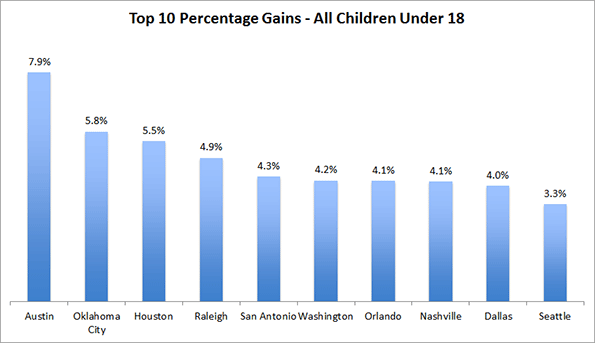
    From 2010 to 2014, the percentage of the population of residents under the age of 18 shrank in every single metro area with more than a million people. This reflects the aging of the population in progress.  But it’s not just that there are more older people. In about half of these major American metros, the actual number of children declined

    These results roughly fall alone lines that would be expected, with regions that are rapidly growing their total population, like Austin, also strongly growing in children. In fact, Austin was the top gainer with a 7.9% increase in children. Houston (+5.5%), Washington, DC (+4.2%) and Denver (+3.1%) were also among those posting strong gains.

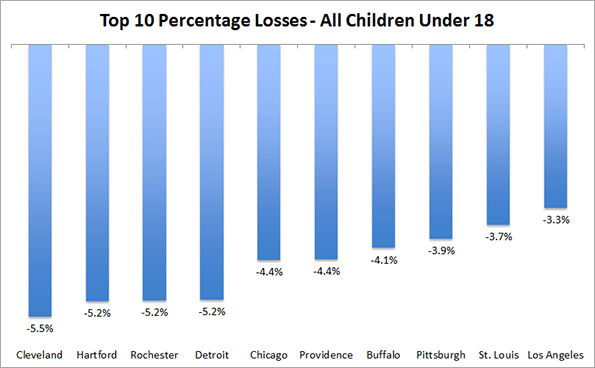
    The loss department is dominated by usual post-industrial suspects, with Cleveland being the “biggest loser” at -5.5%. Detroit (-5.2%), Chicago (-4.4%), and Philadelphia (-2.7%) were also among the losers.  But you don’t have to have crummy weather to lose kids. Notable among those losing children is Los Angeles, whose child population dropped by 3.3% or over 100,000 people. This loss is not being made up, as in the past, by the Inland Empire, with Riverside-San Bernardino also seeing its child population shrink, by 2.1% or over 25,000 people. This is a remarkable reversal for Los Angeles, once one of America’s great growth stories.

    This loss of children augurs poorly for reversing population loss or stagnation in many of these regions. With the next generation of women of childbearing age smaller than the one before it, this suggests even further declines are possible.

    In sum, while very few regions are losing population on a total basis, many more   are failing at creating the next generation of residents. Of course it  is possible to make up for natural increase in population by attracting newcomers, but consider that these statistics include the children of those recent arrivals as well.

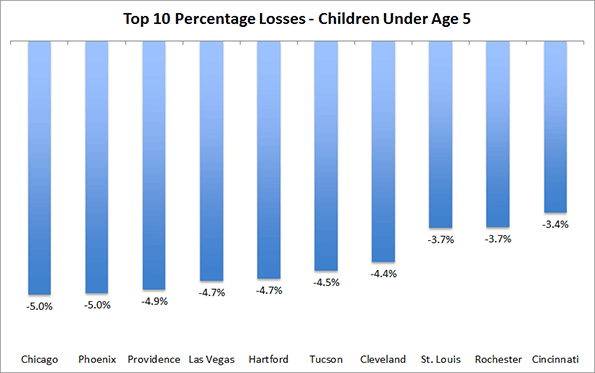
    Looking at younger, pre-school age children under the age of five, even more – 34 out of 54 – large metro areas showed a decline. This includes surprising small losses even in rapidly growing, traditional family magnets like Atlanta, Charlotte, Nashville and Kansas City. This reflects how pervasive low birthrates have become.

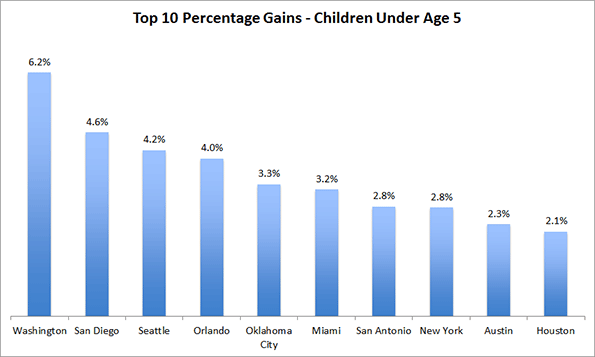
    Conversely, again some traditionally slower growth cities and some conventionally viewed as not child friendly– San Francisco, Seattle, and Boston  are seeing slight  gains in their population of young children even though their percentages drop. Keep in mind these are metropolitan area numbers, not central city ones, as most children, particularly those older than five, end up in suburbs. But even so, the performance of these regions is remarkable compared to declines in celebrated urban areas like Chicago and Los Angeles.

    The Pacific Northwest cities of Portland and Seattle also make for an interesting contrast. Both have experienced similar, and healthy, overall population growth since 2010, with Portland growing slightly faster.  But the Seattle area was a much stronger performer when looking at children. In fact, Seattle ranked #10 (out of 53) large metros in the country with 3.3% growth.  Portland, however, eked out only 0.4% growth.  Looking at children under age five, Seattle actually ranked third in growth at 4.2% while Portland shrank by 2.6%.

    And New York City is a particularly interesting case. Its total child population declined by over 47,000 people, or 1.1%.  But its under five population grew by over 33,000, or 2.8%, and it was one of only two large metros, along with Buffalo, that actually increased it share of the population in that age group.  Brooklyn and Manhattan led the way, each posting double digit percentage growth, though from a low base in Manhattan’s case. Queens did nearly as well.  Staten Island, traditionally the most family centered area, was the only borough to lose young children.  Long Island, Westchester, and Dutchess County lost them as well. 

    The real question is whether places like Manhattan will be able to retain these families as the kids reach school age. Its population of those 5-17 has continued to decline. Given its high costs, it’s not realistic to expect Manhattan to ever be a premier family magnet. But there are surely some city-dwellers with children who might want to stay if life with children could be incrementally better supported in the city with things, such as low crime, clean parks and good schools, that tend to matter to families. This challenge will be felt by all cities as their youth populations begin to enter their prime childbearing years.

    Aaron M. Renn is a senior fellow at the Manhattan Institute and a Contributing Editor at City Journal. He writes at The Urbanophile.

    Baby photo by Bigstock.

  • Low Hanging Fruit

    As a San Franciscan I get a lot of raised eyebrows when I mention that I recently bought property in Cincinnati. “Huh?” Then I walk them through it. Here’s the mom and pop business district along Hamilton Avenue in the Northside neighborhood during a recent Summer Streets event. This is a classic 1890’s Norman Rockwell Main Street with a hardware store, a Carnegie library, barbers, cafes, bars, funky little shops, and seriously good architectural bones.

    Screen Shot 2015-08-27 at 1.05.03 AMTravis Estell UrbanCincy

    Screen Shot 2015-08-27 at 1.04.38 AMTravis Estell UrbanCincy

    Screen Shot 2015-08-27 at 1.04.25 AMTravis Estell UrbanCincy

    It’s the perfect human scaled neighborhood. Kids walk to school. Older people make their way to shops and the farmers market on foot. Riding a bicycle to work is a normal natural activity that doesn’t involve spandex and Tour de France levels of endurance. Bus service to the university and downtown is frequent and convenient. And you can hop on the highway and be anywhere in Cincinnati in minutes.

    Screen Shot 2015-08-28 at 1.39.24 AM

    Screen Shot 2015-08-28 at 1.50.14 AM

    Screen Shot 2015-08-28 at 1.47.48 AM

    Screen Shot 2015-08-28 at 1.49.25 AM

    I tell folks around here that Northside is the kind of neighborhood where you can buy a quality home next door to great neighbors like these and thisand enjoy public events like this for less than the cost of a really good parking space in California. No one builds homes or neighborhoods like these anymore. We no longer have the culture that created these places.

    Screen Shot 2015-08-28 at 4.12.27 AMGoogle

    Screen Shot 2015-09-05 at 4.00.34 AM

    Screen Shot 2015-09-05 at 3.59.17 AM

    Screen Shot 2015-09-05 at 4.00.13 AM

    Screen Shot 2015-09-05 at 3.21.11 AM

    Screen Shot 2015-09-05 at 3.20.05 AM

    Screen Shot 2015-09-05 at 3.20.45 AM

    On the one hand Northside is a compact walkable neighborhood with a distinctive urban feeling at its center. But on the other it’s surrounded by forested hills, a vast historic cemetery, and productive small scale agriculture with farm houses that date back to the 1840’s. It’s a true suburb in the best sense of the word. It offers a good balance of urban convenience and vitality at your front door with the countryside at your back.

    Screen Shot 2015-08-28 at 2.16.43 AMGoogle

    Screen Shot 2015-08-27 at 9.17.59 PM

    Screen Shot 2015-09-05 at 4.55.02 AM

    Screen Shot 2015-09-05 at 4.55.23 AM

    I spend a lot of time talking to people who long for a particular kind of urban living environment. It’s not Manhattan or Hong Kong exactly. It’s smaller and more intimate. It’s more like a friendly small town with ready access to big city opportunity and culture. The old street car suburbs of the 1880’s to 1940’s like Northside are pretty much spot on. But we just haven’t built great urban places like these for three or four generations. As a society we don’t seem able to do it any more.

    Screen Shot 2014-10-27 at 12.16.25 PM

    Screen Shot 2014-10-27 at 11.03.26 AM

    Screen Shot 2014-10-27 at 12.08.29 PM

    Screen Shot 2014-10-27 at 12.17.27 PM

    Screen Shot 2014-10-27 at 11.05.22 AM

    In most places built after about 1950 you can live in a French Provincial tract house on a cul-de-sac near the strip malls and office parks, or… you can live in a Spanish colonial tract house on a cul-de-sac near the strip malls and the office parks. Those are your modern choices. The best you can hope for is an enlightened city planner or civil engineer who stripes a few bike lanes on the sides of the high speed eight lane arterials. Big whoopee.

    New Urbanists and the Smart Growth crowd are up against a massive wall of cultural resistance and institutional barriers. Trying to build new towns in the historical pattern or retrofit post war suburbs is not for the faint of heart. Personally I don’t have the desire to chip away at that mountain. Life’s too short. But there’s so much low hanging fruit out there. Neighborhoods like Northside exist all over the country. They’re already fabulous. They’re already filled with great people. They’re often very reasonably priced. And the best part is that all the obstructionist people who hate walkable urban places and obsess about how to accommodate all the cars have self-selected out. They live an hour away in the distant suburbs and want nothing to do with the city.

    John Sanphillippo lives in San Francisco and blogs about urbanism, adaptation, and resilience at granolashotgun.com. He’s a member of the Congress for New Urbanism, films videos for faircompanies.com, and is a regular contributor to Strongtowns.org. He earns his living by buying, renovating, and renting undervalued properties in places that have good long term prospects. He is a graduate of Rutgers University.

    Lead photo by Travis Estell UrbanCincy

  • Behind the Facade in St. Petersburg

    St. Petersburg, Peter the Great’s new European style capital for imperial Russia, is the most visited city for tourists in Russia. It has a ton of great buildings, energetic street life in its smallish central core, and world-renowned cultural institutions like the Hermitage Museum and the Mariinsky Theater.

    As with Moscow, however, I am not going to attempt to replicate what you can find better elsewhere online or in a guidebook. Rather, I want to show a few things that reflect on something a person there told me, namely that “St. Petersburg is like a facade of a city,” similar to the Hollywood western sets in which the “storefronts” have nothing behind them.

    I’m not sure exactly what this guy was trying to communicate about his city, but I did experience a few things that I think relate to it, in which the interior of a space is completely different from what you might expect from the exterior. St. Petersburg would appear to be, like many places, a city where you need a local in the know to really show you around.

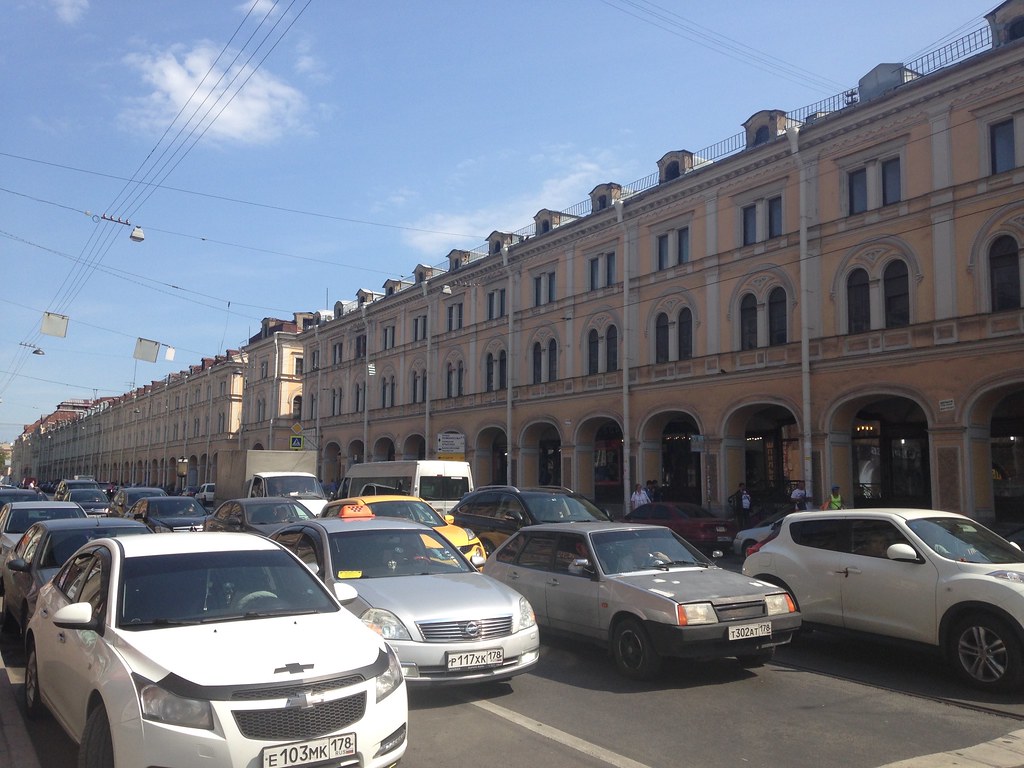
    Consider, for example, this long, well-maintained, genteel, colonnaded, and I think somewhat dull facade.

    St. Petersburg - August 2015

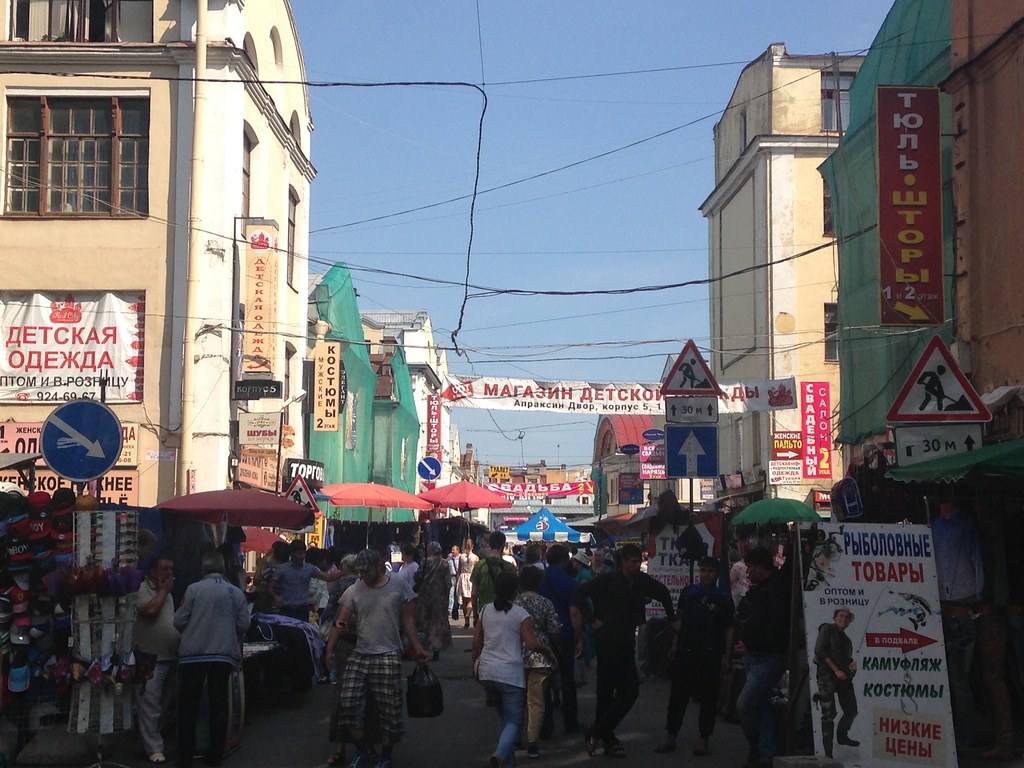
    What do you think is behind it? Would you believe this:

    St. Petersburg - August 2015

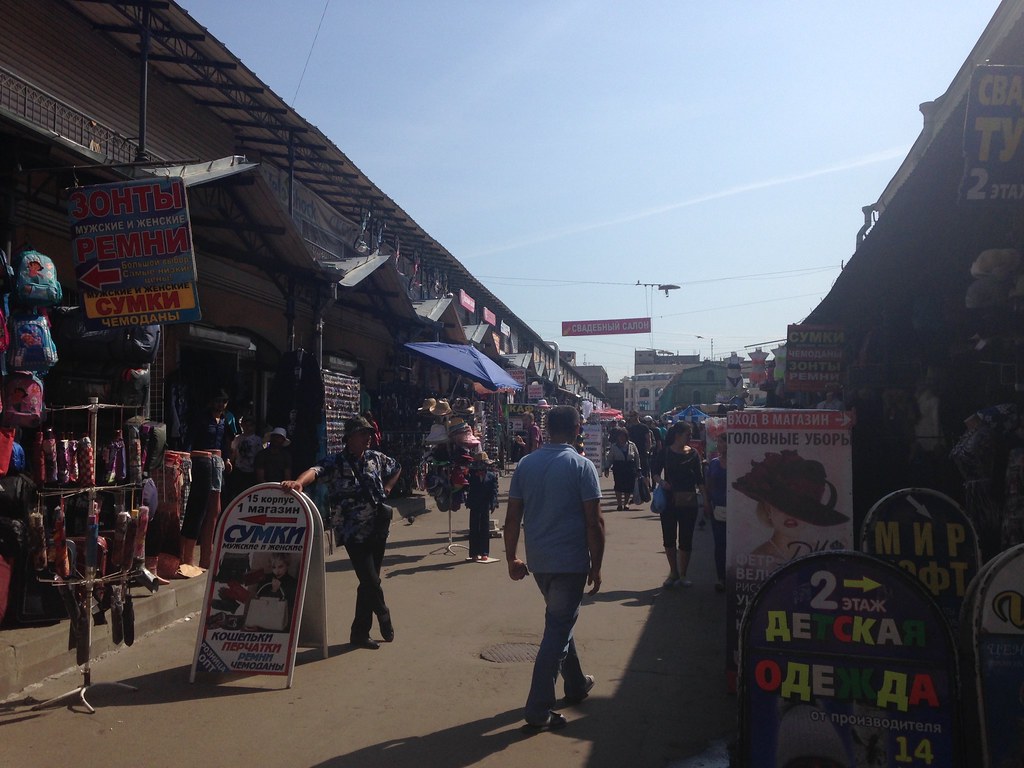
    It’s a large and high energy street market in a sort of courtyard space. Here’s another passageway with vendor:

    St. Petersburg - August 2015

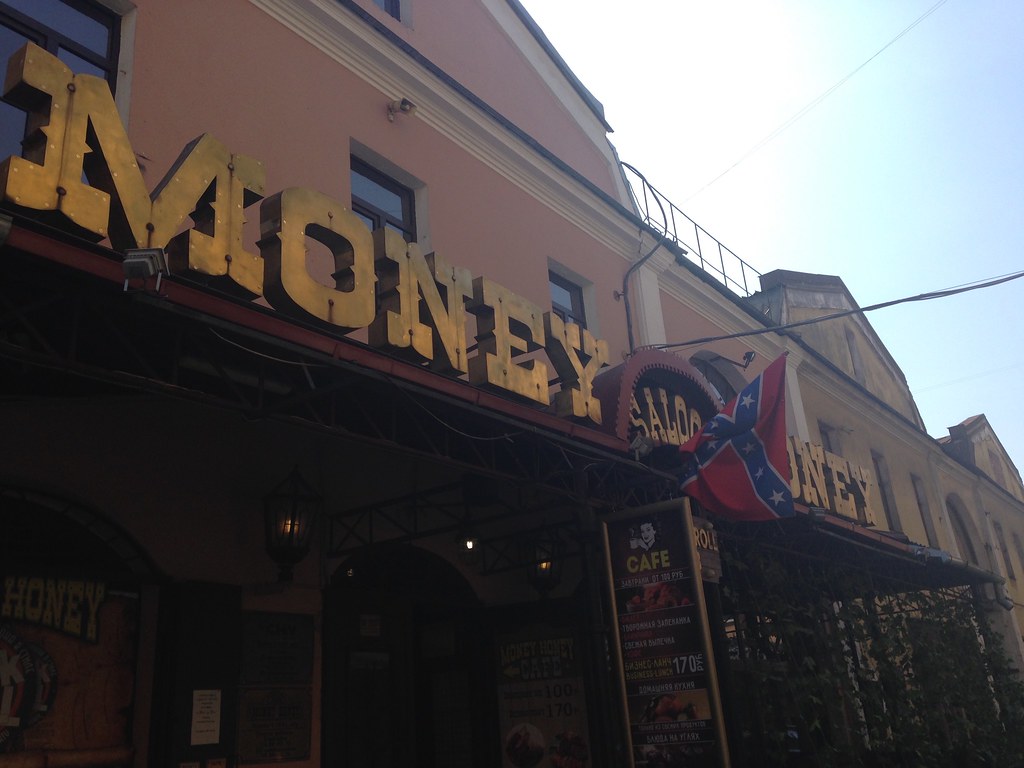
    And this place, which left me speechless:

    St. Petersburg - August 2015

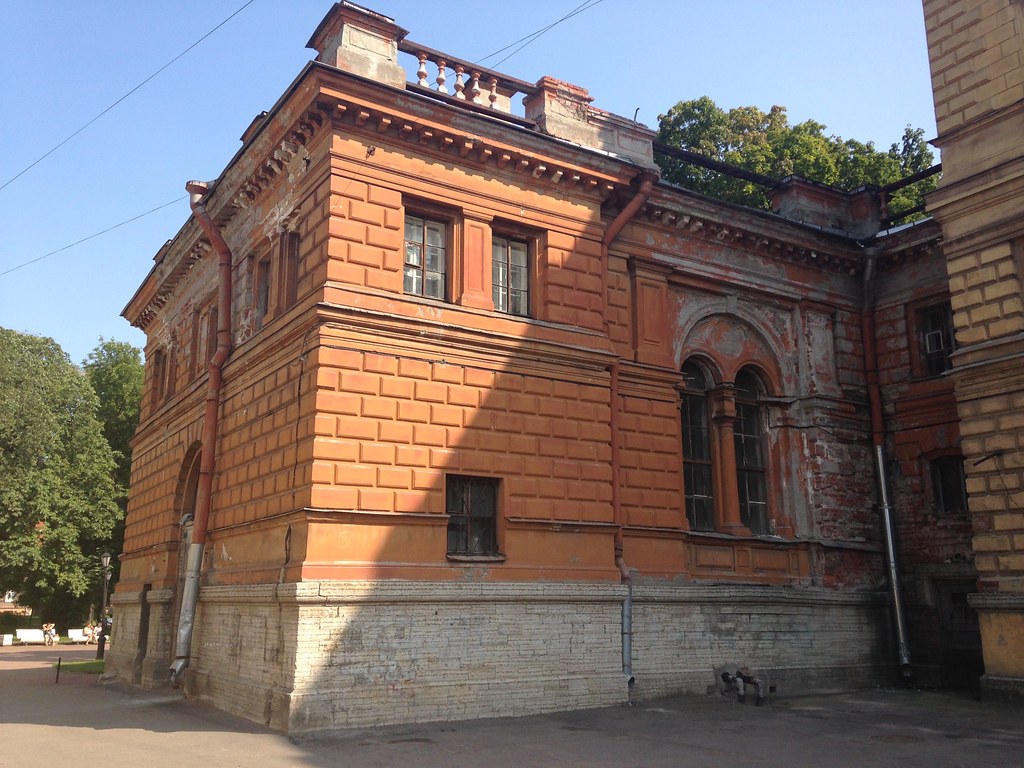
    Then there’s this building, which the person I was with thought was actually abandoned.

    St. Petersburg - August 2015

    There was somebody sitting out front on a folding chair who looked like a construction worker because his trousers were covered in plaster. We asked to take a peek and it turns out the whole thing was being used as a studio by several artists.

    St. Petersburg - August 2015

    I had a much cooler picture of an amazing sculpture someone was working on, but he didn’t want it photographed.

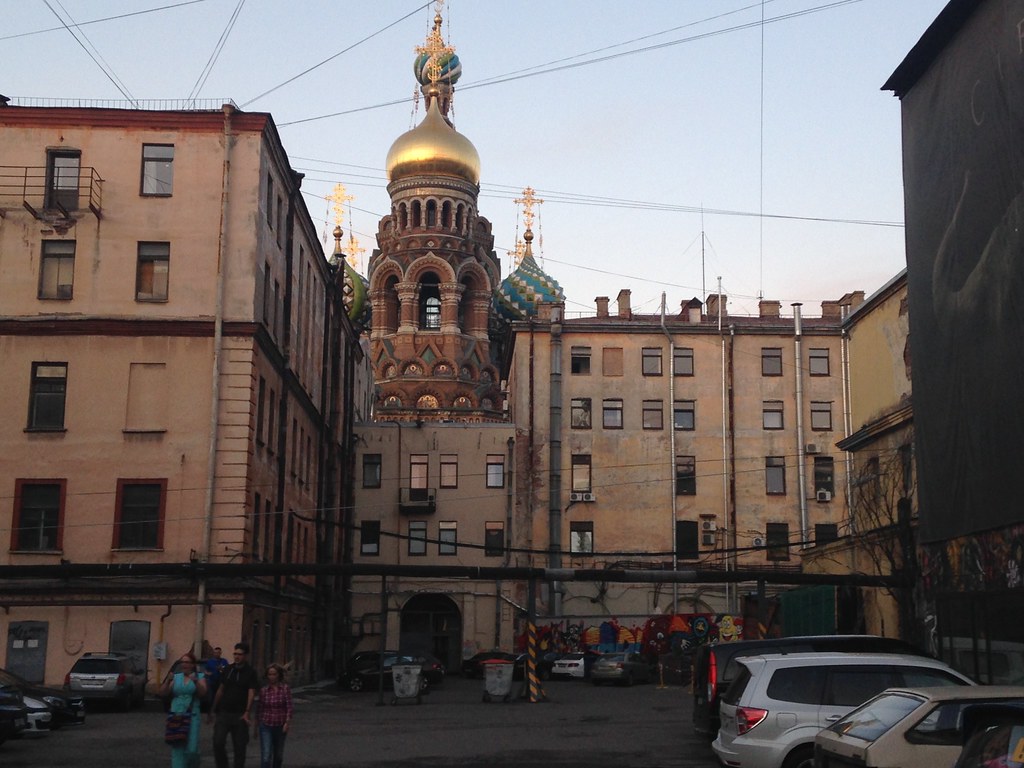
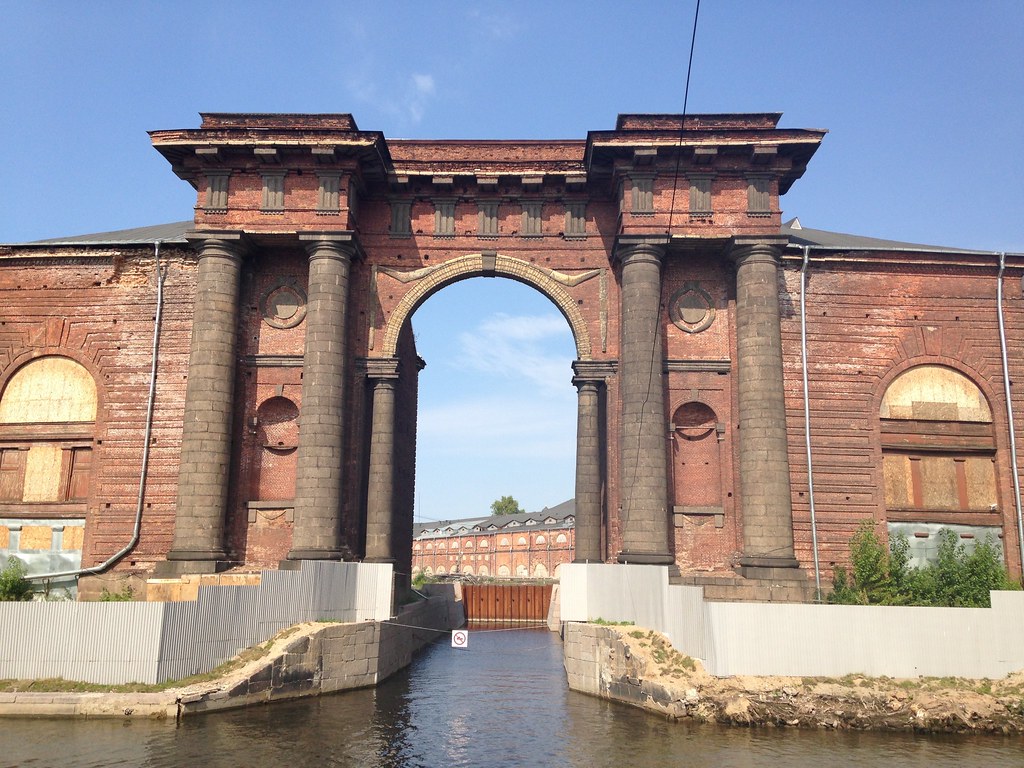
    Then there are derelict industrial buildings that are more than what they seem, like this one which is in the very center of town, which you can tell from the cathedral sticking up behind it.

    St. Petersburg - August 2015

    In addition to being home to several creative firms and software companies, the interior of this space also has clubs and bars, one of which I enjoyed a craft beer at. It was a very cool space but I sadly neglected to take a picture.

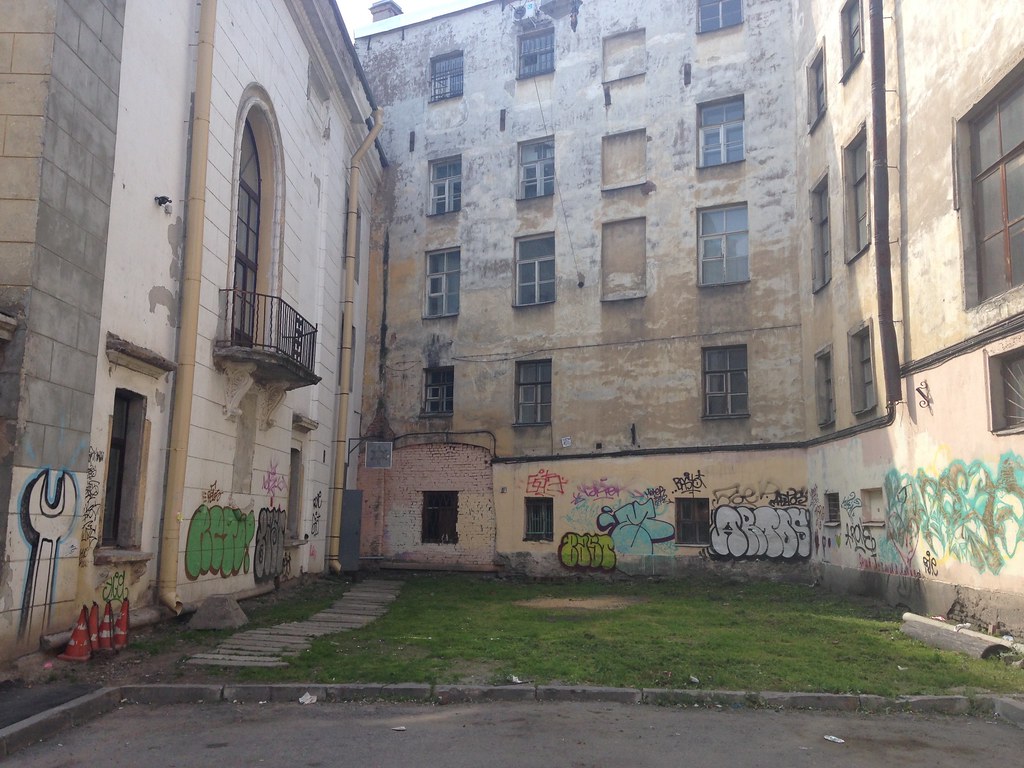
    Here’s another building that at first look doesn’t appear to have much promise.

    St. Petersburg - August 2015

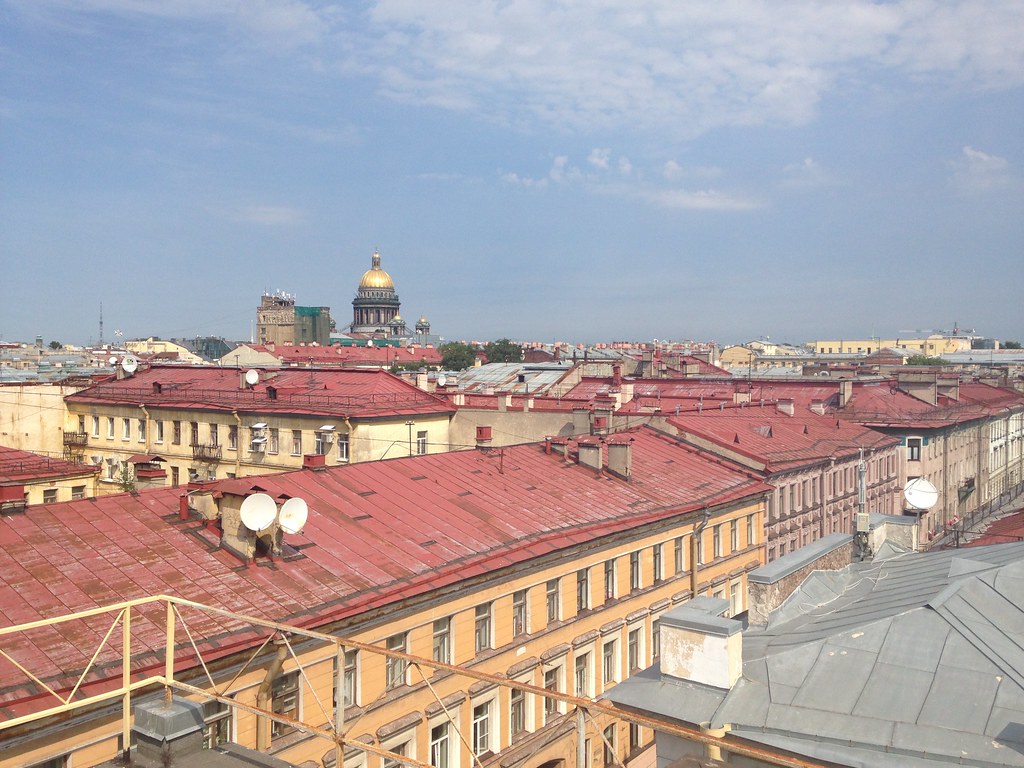
    But follow that path to a metal door on the back left corner, walk up the staircase to the roof, and there’s a great cafe with excellent coffee and amazing rooftop views of the city.

    St. Petersburg - August 2015

    What’s in here, I wonder? Not sure. It’s owned by Roman Abramovich, who did not invite me over for tea.

    St. Petersburg - August 2015

    I’ll wrap up with a couple of urban planning notes. First, a street sign warning of, well, you get it.

    St. Petersburg - August 2015

    Both St. Petersburg and Moscow have Uber, by the way. I’m not sure how useful it is for tourists, since the two times I took it in St. Petersburg, extensive phone conversations with the driver needed to take place to physically connect, and my Russian speaking companion took care of that. St. Petersburg, as you might have gathered, has a lot of canals and other bodies of water, and they have rolled out UberBOAT service there as well.

    I’ll wrap up with a picture of a newish building.

    St. Petersburg - August 2015

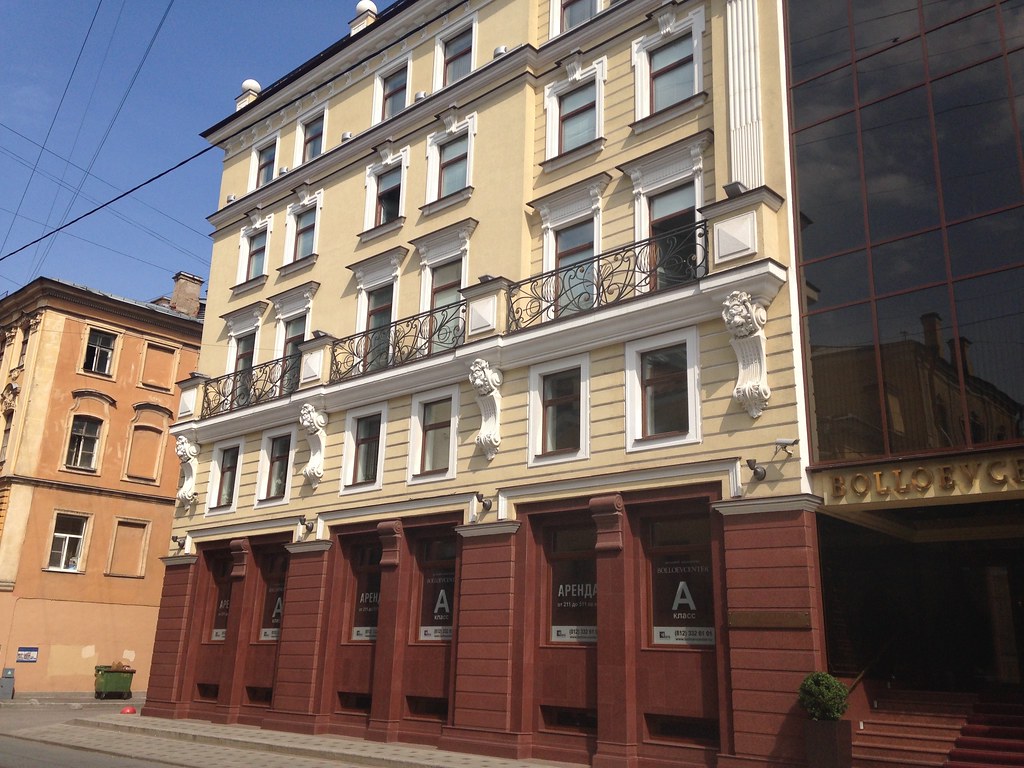
    The local person who was showing me around noted that there were often disputes over buildings like this, with some architects demanding better designs. You’ll note the ground floor treatment could be improved, and the upper floors are EIFS or some similar product, which urbanists there seem not to like any more than we do here.

    You can view more of my iPhone pictures of St. Petersburg on Flickr.

    Aaron M. Renn is a senior fellow at the Manhattan Institute and a Contributing Editor at City Journal. He writes at The Urbanophile.

  • Peak People in Japan

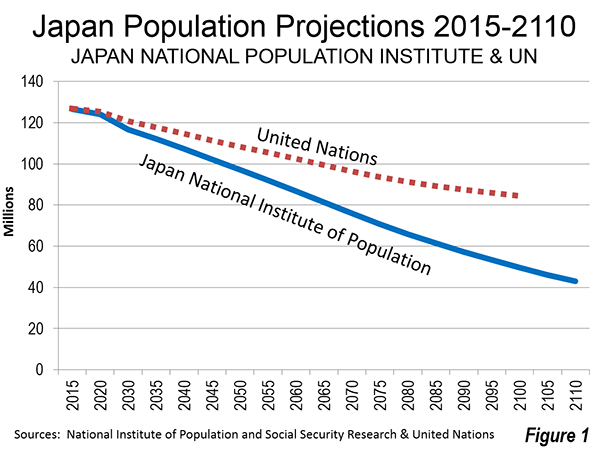
    Japan reached "peak people" in 2011, when its population reached 127.4 million residents. From that point, all trends point to significant population losses. But, there is by no means unanimity on the extent of those population losses. Population projection is anything but an exact science, and Japan provides perhaps the ultimate example.

    Dueling National Population Projections

    Japan’s agency responsible for projecting population, the National Institute of Population and Social Security Research forecasts a stunning reduction of population to only 42.9 million residents in 2110. For every three Japanese residents today, there will be one in 2110 according to the National Institute of Population. If this projection is realized, Japan’s population would drop to a level not seen since the middle 1890s.

    The National Institute of Population projects a population loss to 97.0 million residents by 2050, for an annual population loss rate of 0.7 percent from 2015. By 2100, the population would fall to 49.6 million, for an annual loss rate of 1.3 percent. Over the 95 years from 2015, the annual population loss rate would accelerate from 0.4 percent annually to nearly 1.5 percent.

    The United Nations is considerably more optimistic about Japan’s future population than the National Institute of Population. The UN forecasts a population of 108.3 million residents by 2050, or 11 million more residents than expected by the National Institute of Population. The annual loss rate is 0.4 percent, one half the rate projected by the National Institute of Population. By 2100, the last year of the UN series, the population would be 84.5 million, 35 million more than the National Institute of Population figure. The UN’s annual population loss rate would be 0.8 percent (Figure 1).

    Major Metropolitan Areas

    Much of Japan’s urban population is in the dense corridor from Tokyo-Yokohama to Osaka-Kobe-Kyoto, a distance of approximately 300 miles (500 kilometers). The four metropolitan areas of this corridor (Tokyo-Yokohama, Shizuoka-Hamamatsu, Nagoya, and Osaka-Kobe-Kyoto) contain approximately 75 million residents. By comparison, the US Northeast Corridor is about 1.5 times as long and has under 50 million residents.

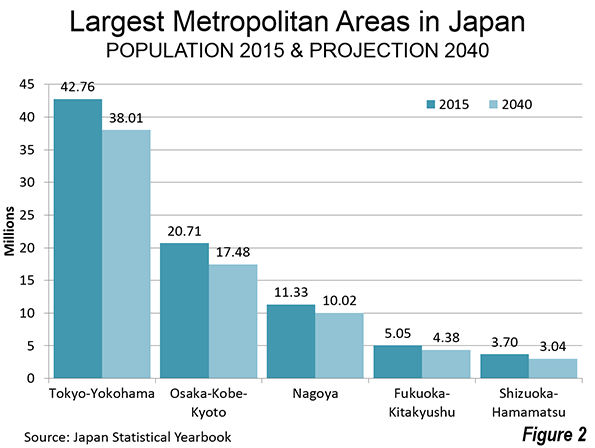
    According to National Institute of Population data, each of the 10 largest metropolitan has reached its population peak. The most populous, Tokyo-Yokohama is the only major metropolitan area to have gained population between 2010 and 2015. Each of the others had already reached their population peaks, according to the forecasts that end in 2040 (Figure 2).

    Tokyo-Yokohama:Tokyo-Yokohama is the world’s largest metropolitan area (labor market area). Much of it is located on the Kanto plain that stretches in three directions from Tokyo Bay. Between 2010 and 2015, Tokyo-Yokohama grew from a population of 42.6 million to 42.8 million. However a strong turnaround is anticipated. By 2020, the population is expected to fall to 42.4 million. Tokyo-Yokohama is expected to decline to 38.0 million residents in 2040, a reduction approximately equal to the population of metropolitan areas such as Phoenix, Montréal, and Melbourne. The 2040 population would represent a loss of approximately 11 percent from 2015.

    Osaka-Kobe-Kyoto: Osaka-Kobe-Kyoto has been Japan’s second largest metropolitan area for decades. Osaka-Kobe-Kyoto is a true conurbation, with three separate core cities and their suburbs that have grown together to form a single urban area, which now also encompasses smaller Nara, the country’s ancient capital. Some of Japan’s most important historical sites are in Kyoto and Nara. Despite having less than one half the population of Tokyo-Yokohama, Osaka-Kobe-Kyoto has been one of the world’s largest metropolitan areas for at least the last half of the century. Osaka-Kobe-Kyoto’s population fell from 20.9 million in 2010 to 20.7 million in 2015. By 2040, this large urban agglomeration is forecast to have a population of 17.5 million, down 16 percent from its 2015 level.

    Nagoya: Nagoya is Japan’s third largest metropolitan area and is located about two thirds of the way between Tokyo-Yokohama and Osaka-Kobe-Kyoto. Nagoya is renowned as the headquarters of Toyota. Nagoya is expected to fall from its 11.3 million residents in 2015 to 11.2 million in 2020 and 10.0 million in 2040. This population loss rate would be similar to that of Tokyo-Yokohama, at approximately 11 percent.

    Fukuoka-Kitakyushu: The Fukuoka-Kitakyushu metropolitan area is comprised of two large and separate urban areas. It is the only metropolitan area of the largest five that is not in the Tokyo to Osaka corridor. Further, Fukuoka-Kitakyushu is on the island of Kyushu, to the south of the main island of   Honshu. Fukuoka-Kitakyushu had a population of 5.0 million in 2015 and is expected to fall to 4.4 million in 2040. This is an approximately 12 percent population loss rate, somewhat worse than Tokyo-Yokohama and Nagoya.

    Shizuoka-Hamamatsu:The Shizuoka-Hamamatsu metropolitan area is located between the Tokyo-Yokohama and Nagoya metropolitan areas. In 2015, the population was 3.7 million, which is expected to drop to 3.0 million in 2040. This area, long a critical part of Japan’s industrial complex, would suffer the largest loss among the five largest metropolitan areas, at 18 percent.

    The Rest of Japan: The balance of Japan would experience an even greater loss, dropping from 43 million in 2015 to 34 million in 2040. This would represent a decline of 20 percent.

    Japan: Leading the Way?

    Japan is just the first of a wave of nations that are expected to experience population declines. The challenges are likely to be great as the nation is forced to downsize its considerable infrastructure to accommodate a smaller population. With a growing imbalance of senior citizens relative to working age adults, there are likely to be significant difficulties in financing social services. Japan’s strategies and successes or failures will be watched closely by national leaders from Berlin to Beijing and Brasilia whose nations  are likely to experience reductions in population and demographic imbalances starting mid-century or sooner.

    Wendell Cox is Chair, Housing Affordability and Municipal Policy for the Frontier Centre for Public Policy (Canada), is a Senior Fellow of the Center for Opportunity Urbanism (US), a member of the Board of Advisors of the Center for Demographics and Policy at Chapman University (California) and principal of Demographia, an international public policy and demographics firm.
    He is co-author of the "Demographia International Housing Affordability Survey" and author of "Demographia World Urban Areas" and "War on the Dream: How Anti-Sprawl Policy Threatens the Quality of Life." He was appointed to three terms on the Los Angeles County Transportation Commission, where he served with the leading city and county leadership as the only non-elected member. He served as a visiting professor at the Conservatoire National des Arts et Metiers, a national university in Paris.

    Photo: Fukuoka (by author)

  • Neither Olympics Nor NFL Will Rescue Los Angeles

    We all tend to have fond memories of our greatest moments, and for Los Angeles, the 1984 Olympics has served as a high point in the city’s ascendency. The fact that those Summer Games were brilliantly run, required relatively little city expenditure and turned a profit confirmed all those things we Angelenos loved about our city – its flexibility and pragmatism and the power of its civic culture.

    After Boston turned down its chance to be the U.S. entrant in the sweepstakes to host the 2024 Olympics, it’s natural that Mayor Eric Garcetti and the city establishment, at least what’s left of it, desire a return engagement. But the Los Angeles of today barely resembles the vibrant, optimistic city of 30 years ago.

    “The city where the future once came to happen,” a devastating report from the establishmentarian Los Angeles 2020 Commission recently intoned, “is living the past and leaving tomorrow to sort itself out.”

    Last Best Chance?

    So rather than a bold move toward establishing the city’s preeminence, the current move smacks more of a Hail Mary pass. It also seems to embody a kind of nostalgia, a sentiment reflected not only in the desire to relive Olympic glory but also in the efforts to bring pro football back to town, including, perhaps, a return of the long-departed Rams.

    Yet ultimately, neither a third Olympics (the first was in 1932) nor the return of NFL football can alter a city’s fate. After all, the 2000 Athens Olympics did not lead to a new Greek renaissance, but may, instead, have contributed to that country’s fiscal morass. Summer Games in Montreal (1976) and Atlanta (1996) did not usher in a golden age for those cities, but periods of decline.

    Read the entire piece at The Orange County Register.

    Joel Kotkin is executive editor of NewGeography.com and Roger Hobbs Distinguished Fellow in Urban Studies at Chapman University, and a member of the editorial board of the Orange County Register. He is also executive director of the Houston-based Center for Opportunity Urbanism. His newest book, The New Class Conflict is now available at Amazon and Telos Press. He is also author of The City: A Global History and The Next Hundred Million: America in 2050. He lives in Orange County, CA.

    Olympic Torch Tower of the Los Angeles Coliseum” by unknown, U.S. Air Force – http://www.defenseimagery.mil; VIRIN: DD-SC-85-08929. Licensed under Public Domain via Wikimedia Commons.

  • Family Friendly Cities

    One of the common criticisms leveled at people who promote urban living goes something like this. “Cities are great for college kids, people starting off in their careers, bohemians, and maybe some older empty nesters with money who have a taste for theater and art. But most people have families and tight budgets. Suburbia is the only place that provides a high quality, safe, affordable life for regular folks with children.”

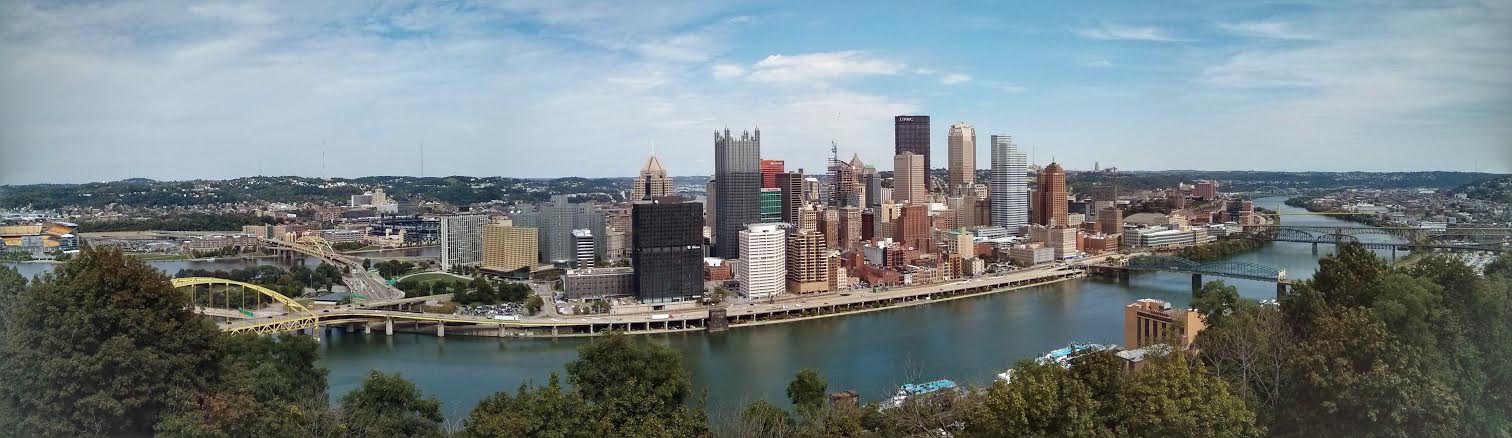
    Last year I flew to Pittsburgh, Pennsylvania to attend a wedding. As we were all milling about with friends and family on the porch eating ice cream on a gorgeous September afternoon I noticed some of my fellow out-of-town visitors from New York and San Francisco looking around with a peculiar expression. It was the same kind of look that dogs get when they’re curious and a little confused – one ear up and one ear down. They looked at their kids playing in the grass and sitting on grandma’s lap. I knew very well what they were thinking. They were a family of four living in a tiny one bedroom apartment in Brooklyn and their oldest child will be starting school next year.

    IMG_0202 (800x533) (2) Screen Shot 2014-10-11 at 11.03.48 PM Screen Shot 2014-10-11 at 11.08.00 PM Screen Shot 2014-10-11 at 11.02.26 PM

    Now, I need you to picture the neighborhood so you get the context here. This is a century old streetcar suburb five miles from downtown. There are tree lined streets, front porches on elegant old homes, a charming Main Street with mom and pop shops a couple of blocks away, and an elementary school directly across the street. Even in this very comfortable and pricey neighborhood a grand home with a patch of grass could be purchased for significantly less than the cost of a one bedroom apartment in Brooklyn. You can actually ride a bicycle to downtown Pittsburgh – and it would be a pleasant and convenient ride. Carnegie Mellon University and a dozen other prominent institutions are nearby.

    Screen Shot 2014-10-11 at 11.00.56 PM Screen Shot 2014-10-11 at 11.00.36 PM Screen Shot 2014-10-11 at 11.41.36 PM Screen Shot 2014-10-11 at 10.40.35 PM

    In large expensive cities many young families are having to make harsh choices. They can stay where they are and pay exorbitant rents or a shockingly high mortgage for less than ideal accommodations in order to have access to good jobs and urban amenities. Or they can move to a more affordable suburb and spend a couple of hours each day schlepping in and out of the city. Or they can step away from the city entirely and organize their lives around a purely suburban set of arrangements: the subdivision, the office park, the shopping mall… For many people who value urban life these are difficult decisions with a lot of unsavory trade offs.

    Screen Shot 2014-10-11 at 11.31.54 PM Screen Shot 2014-10-11 at 11.46.03 PM Screen Shot 2014-10-11 at 11.26.11 PM

    Pittsburgh is just one of hundreds of small and medium sized cities in the interior that people in coastal cities like to dismiss as part of “Flyover Country”. What isn’t clearly understood is that Pittsburgh isn’t competing with New York or San Francisco. Instead Pittsburgh is competing with the distant suburbs of places like New York and San Francisco out in the endless smear of anonymous tract homes and strip malls that ring those cities. Pittsburgh wins that taste test hands down every time for anyone who shows up and actually looks around and experiences what’s on offer.

    unnamed

    John Sanphillippo lives in San Francisco and blogs about urbanism, adaptation, and resilience at granolashotgun.com. He’s a member of the Congress for New Urbanism, films videos for faircompanies.com, and is a regular contributor to Strongtowns.org. He earns his living by buying, renovating, and renting undervalued properties in places that have good long term prospects. He is a graduate of Rutgers University.

  • The Comeback Of The Great Lakes States

    For generations the broad swath of America along the Great Lakes has been regarded as something of a backwater. Educated workers and sophisticated industries have tended to gather in the Northeast and on the West Coast, bringing with them strong economic growth.

    Yet increasingly these perceptions are outdated. The energy hotbeds of Texas, Oklahoma and North Dakota may have posted the strongest employment growth since 2007, and were among the first states to gain back all the jobs lost in the recession. But a group of less heralded places from Minnesota to western Pennsylvania have also enjoyed a considerable revival, as energy, manufacturing, logistics and other basic industries have rebounded.

    Every Great Lakes state except for Illinois now has an unemployment rate below the national average, a stunning reversal from previous decades.

    Ironically the state most popularly associated with long-term economic decline, Michigan, has been lauded in a Pew study as perhaps the ”biggest success story.” From the state’s nadir of household employment in November 2009 through this July, the Wolverine State has added 302,543 jobs, a 7.2% increase.

    An Industrial Comeback

    One clear key to improving conditions in Michigan and elsewhere is the revival of America’s industrial economy. Following a generation of falling employment, the sector has been on something of a rebound since 2010, adding some 855,000 jobs. Although many of these new jobs are in the Southeast and Texas, Great Lakes states have been at the center of the turnaround. The fastest growth in industrial employment over the past five years has been in three Michiganmetro areas — Detroit, Warren and Grand Rapids – and Toledo, Ohio.

    Structural and political factors are behind the Midwestern recovery. Rising wages in China and the North American energy boom have helped make U.S. companies more cost competitive. German electricity prices, for example, are almost three times the average for the United States. Energy production has been a major driver in large swaths of the heartland, notably Pennsylvania, Ohio, and Oklahoma, where fracking has sparked new development.

    This growing competitiveness can be seen in a surge of capital investment. Four of the top 10 statesfor new plant and equipment investment in 2014 are in the Great Lakes region, according to Site Selection Magazine: Ohio, Illinois, Michigan, and Pennsylvania.

    Changing Geography Of Human Capital

    For generations the Great Lakes has been hemorrhaging people to the rest of the country, mainly the South and West. But that outflow has recently slowed, and in some cases reversed. According to demographer Wendell Cox, the rate of outmigration from Cleveland and Detroit has been cut by half or more while some metro areas, including Indianapolis and Columbus, Ohio, are firmly in positive territory. In contrast, Los Angeles, New York and even the Silicon Valley hub of San Jose continue to lose people to other regions.

    More surprising is the movement of younger college-educated people. American Community Survey numbers show some of the fastest growth in the population of educated workers between 2005 and 2013 occurred in places such as Pittsburgh, Columbus, Indianapolis and, yes, Cleveland, which, according to Cleveland State’s Richey Piiparinen, are attractive due to lower costs and a more family-friendly environment.

    Another analysis of the changes in the population of educated workers since 2005, by Mark Schill at the Praxis Strategy Group, reflects this shift. The rate of increase in the population of people 25 to 35 with graduate degrees was slightly higher in Pittsburgh than in San Francisco. Grand Rapids, Buffalo, Indianapolis, Columbus and Louisville did even better (albeit off low bases). These citiesare even considered something of new “hipster havens,” as young people look to these old industrial cities as better bargains for life and work.

    This brain gain parallels another important shift — the growing relevance of the Great Lakes workforce to companies here and around the world. The region already possesses the nation’s largest store of engineers in the country. STEM employment in a host of fields from manufacturing and medicine to business services is surging fast in many of these areas. Between 2004 and 2014, according to an analysis by Schill, several Midwestern states — Iowa, Michigan, Oklahoma, the Dakotas — added STEM jobs at double digit rates, equaling the percentage increases enjoyed by California and easily outpacing New York.

    It turns out that much STEM growth takes place out of the high-profile world of search engines, social media and “disruptive” business service firms. In many cases technical innovations, in the words of the French sociologist Marcel Mauss, constitute “a traditional action made effective,” often in manufacturing, medicine and other fields not always associated with “tech.” The social media and search explosion, so prominent in the Bay Area, home to a remarkable 40% of such jobs, often obscures the serious innovation taking place in the Midwest. For example, much of the earliest advances in self-driving vehicles came not from Google but tractor maker John Deere.

    As it looks to develop auto software for cars, Google looks to, in the words of the autonomous car project’s director, “a lot of amazing companies in the Detroit area and international than know how to make cars.”

    The Great Lakes position as an innovation center is based on a unique combination of engineeringschools and a high concentration of engineers. Dayton and Detroit rank among the top 12 metro areas in the country in terms of engineers per capita, with a higher concentration than Boston, San Francisco, New York, Los Angeles and Chicago.

    One particular hot spot is the area around Warren and Troy, Mich., sometimes referred to “automation alley.” This is where software meets heavy metal, with a plethora of companies focusing on factory software and new computer-controlled systems for automobiles. It is home to engineering software firms like Altair, which has been expanding rapidly, and also where General Motors recently announced plans for a $1 billion tech center, employing 2,600 salaried workers.

    Other tech development has been tied to the health care industry, including such regional standouts as the Cleveland Clinic and Mayo Clinic. Madison, Wisc., has a strong government and education employment base but also is home to growing number of technology firms, with information employment since 2009 up an impressive 36.1%. But much of the growth is related to health care, with the leading local company being medical software maker Epic, which employs 6,800 at its sprawling campus in nearby Verona.

    Qmed ranks California as the best state for medical device makers, but also ranking highly are Minnesota, Indiana, Pennsylvania and Wisconsin.

    In the coming years, more talent should be heading to these area. Housing prices in the San Francisco Bay Area, Los Angeles and New York are at least two to three times higher than most Great Lake metro areas. This is a boon to those who bought far in the past, but a barrier to entry to young aspirational families. To live in San Francisco, particularly for those who hope to raise a family, is increasingly impossible.

    It has also led some companies to locate elsewhere, particularly to the Pacific Northwest. In 2011, 1 in 7 people in the Bay Area searched Redfin.com for homes outside of the Bay Area. Now it’s 1 in 4. Adam Wiener, Redfin’s chief growth officer, announced to other executives last month: “The dam has broken.”

    Potential Threats

    Ultimately the durability of the Great Lakes recovery depends on building off its natural strengths in engineering, its central location along water routes, ample natural resources and low living costs. Pro-business policies have enhanced these advantages and made several Midwestern governors intoserious national political figures, namely Snyder in Michigan, Walker in Wisconsin, and Ohio’s Kasich.

    Yet there are serious clouds on the horizon, perhaps the biggest of which is looming EPA greenhouse gas regulations, which could shut down many coal-fired power plants in the region and raise electric rates. 

    International forces – notably the devaluation of the Chinese yuan – threaten the industrialresurgence. A strong dollar tends to make exports pricier and imports more competitive. Such changes may not matter too much on the coasts, but Midwestern states are far more dependent on manufacturing. According to the U.S. Bureau of Economic Analysis, many of the states with the highest percentage of their GDP tied to manufacturing are in the region, led by Indiana, where 25%of GDP is tied to industry, followed closely by Iowa, Ohio, Wisconsin, and Michigan.

    Ultimately the Great Lakes cannot recover fully unless it continues the revival of its core industries, while expanding in other fields based on the movement of skilled labor coming to the region. If the region can continue its progress, it will be a major boon not only to the people who live there, but to the country that needs an infusion of economic sanity, and down to earth production, to complement the growth of finance, media and communications that dominate so many business headlines.

    This piece first appeared in Forbes.

    Joel Kotkin is executive editor of NewGeography.com and Roger Hobbs Distinguished Fellow in Urban Studies at Chapman University, and a member of the editorial board of the Orange County Register. He is also executive director of the Houston-based Center for Opportunity Urbanism. His newest book, The New Class Conflict is now available at Amazon and Telos Press. He is also author of The City: A Global History and The Next Hundred Million: America in 2050. He lives in Orange County, CA.

    Photo courtesy of BigStockPhoto.com.

  • Traffic Congestion: The Latest Urban Mobility Report Ratings

    In recent years there has been a proliferation of traffic congestion rating reports. Tom Tom and Inrix are now making it possible to compare traffic congestion in Louisville or even Lexington to Moscow or Paris. The Castrol Magnatic Start-Stop Index adds places like Jakarta and Bangkok. But the granddaddy of them all is the Texas A&M Transportation Institute Urban Mobility Report, which has just been released with 2014 data.

    Los Angeles

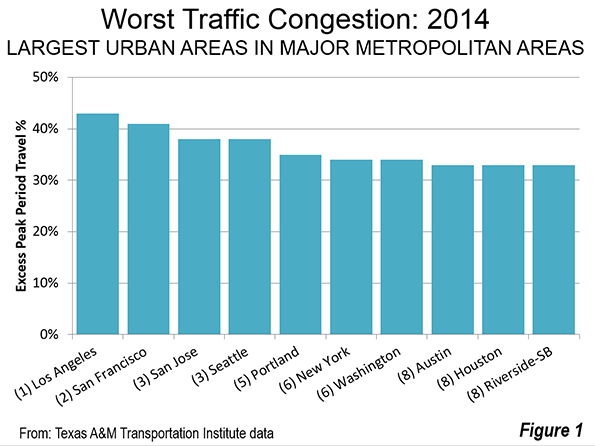
    Los Angeles remains the most congested major urban area in the nation with an average 43 percent added to travel times during peak hours. This article discusses the largest urban areas in the 53 US metropolitan areas with more than 1 million population.

    Los Angeles is long been the champion of traffic congestion in the United States. Since Texas A&M began publishing a traffic congestion scorecard in 1982, Los Angeles has usually had the worst traffic congestion, though Houston was reported to have the worst congestion for a few years in the mid-1980s.

    It should not be surprising that Los Angeles has the worst traffic congestion. Los Angeles is the nation’s most densely populated larger urban area, with 7000 residents per square mile. This high density means that the demand for both car and truck travel is higher than it would be in a lower density city. The Los Angeles freeway system is extensive and its roadways tend to be very wide. Part of the problem is that much of the planned freeway system was not built, such as the Slauson Freeway, the Reseda Freeway, the Topanga Canyon Freeway, the Laurel Canyon Freeway, the Beverly Hills Freeway and the missing link northern extension of the Long Beach Freeway through South Pasadena. None of these freeway cancellations drove people to transit, as some might suggest, as traffic volumes just continued to increase. Despite billions that were spent on rail and busway systems, Southern California’s largest transit system continues to draw fewer riders than when there were only buses in 1985.

    Congested in Other Urban Areas

    The top 10 congested urban areas include two that share commuting sheds with larger urban areas. These are third-ranked San Jose and 10th ranked Riverside-San Bernardino, which can blame part of their traffic congestion on their larger neighbors, Los Angeles and San Francisco (Figure 1).

    San Francisco is the second most congested urban area in the nation. The three most congested urban areas are also the three densest urban areas, Los Angeles, San Francisco and San Jose. Seattle ranks fourth and Portland ranks fifth, despite their much lower densities. Seattle’s intense traffic congestion is understandable, given its long, narrow geographical shape and the fact that there are only two north to south freeway routes through the urban area. Moreover, things are likely to get worse, as Seattle seeks to implement urban containment (densification) policies that are likely to worsen traffic congestion (Greater  traffic congestion is associated with higher densities).

    Portland has obtained the worldwide praise of urban planners who like its densification and anti-automobile policies. Portland, however is paying the price for that with traffic congestion 80 percent as bad as Los Angeles, even with a population density barely half that of Los Angeles.

    Austin may also be surprising, because it has a relatively small population (about 2 million) compared to most of the 10 worst congested urban areas. Austin was not large enough to justify more than a single route when the interstate system was designed in the 1950s and was very slow to develop its freeway system. At the same time, in recent years Austin has been the fastest-growing major metropolitan area in the United States, which has also added to traffic pressures.

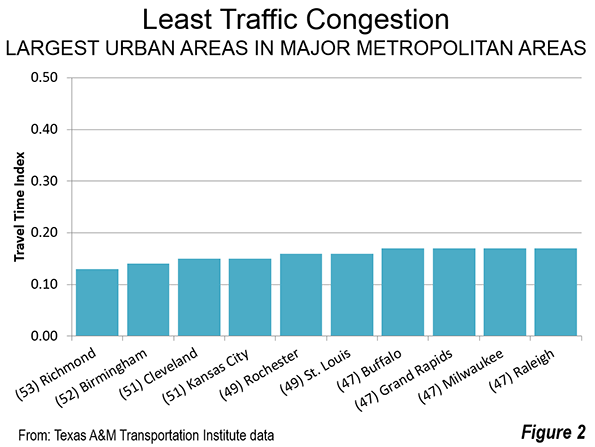
    The least traffic congestion is in Richmond, which has also been estimated to have the best composite traffic congestion among international scorecards. Most of the least congested urban areas have metropolitan population between 1 million and 2 million residents and are located in the East, South or Midwest (Figure 2).

    Wasted Fuel

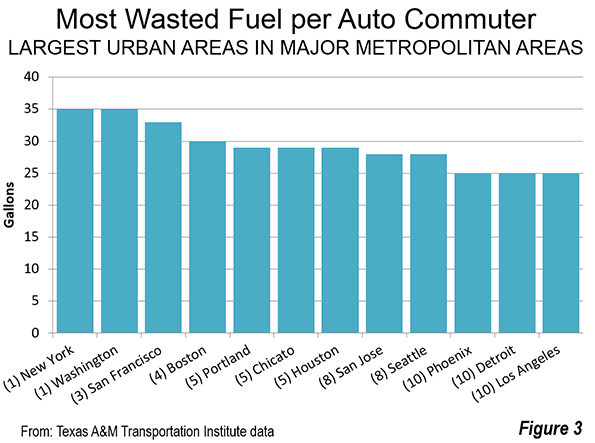
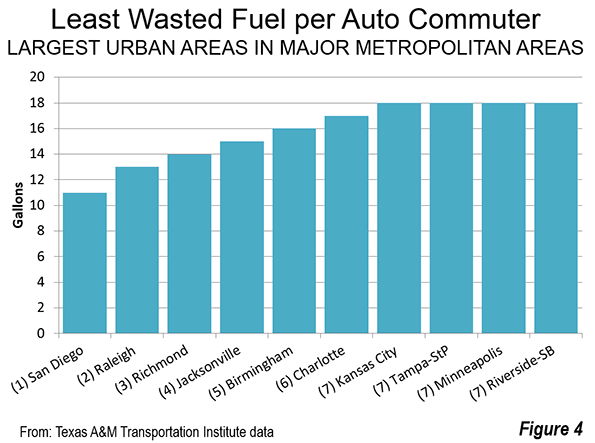
    Driving in congested traffic reduces fuel economy and results in wasted fuel (each gallon of gasoline consumed produces the same amount in greenhouse gas emissions). New York and Washington have the largest amount of wasted fuel per commuter, followed by San Francisco, Boston and Portland (Figure 3). The least wasted fuel per peak period commuter is in San Diego, Raleigh, Richmond, Jacksonville and Birmingham (Figure 4).

    Changes Since 1982

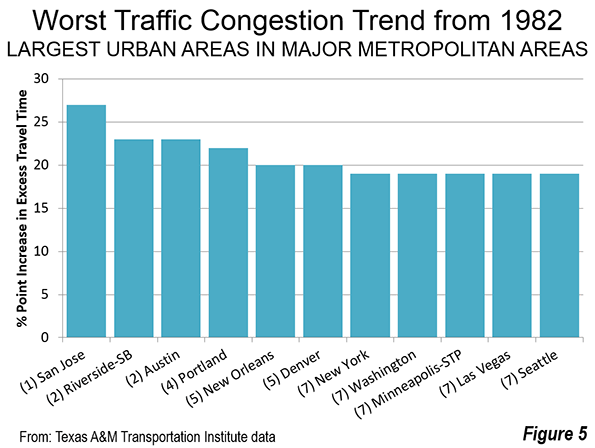
    There have been major changes in traffic congestion indexes among the 53 urban areas since 1982. San Jose has experienced the worst percentage point increase in excess travel time, adding 27 percentage points to its excess peak period travel time. Riverside-San Bernardino, Austin, Portland and New Orleans round out the five urban areas with the greatest increases in traffic congestion (Figure 5). With less growth in recent decades, however, traffic congestion has not increased enough to place in the worst ten in trend.

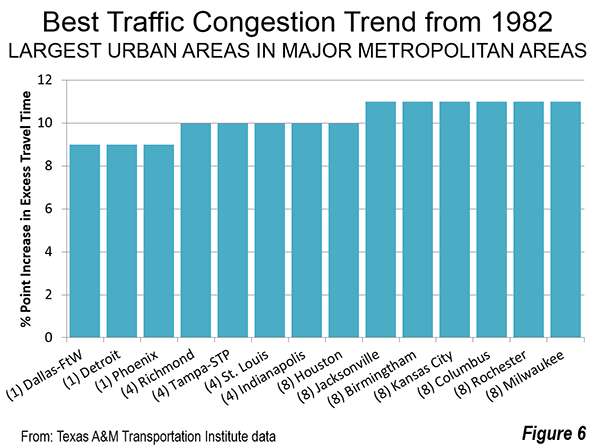
    The urban areas best at controlling their traffic congestion include some surprises. Dallas-Fort Worth has been one of the three fastest growing metropolitan areas in the high income world over the period, but has managed to keep up with its traffic congestion as well as any other urban area (Figure 6).

    Similarly, Phoenix has been very rapidly growing and has tied Dallas-Fort Worth for first place in best traffic congestion trend. Phoenix undertook a substantial Freeway building program in the 1980s. Detroit also ties Dallas-Fort Worth and Phoenix, though this reflects its long term economic difficulties and shows that better traffic congestion that results from less growth and job creation is not a positive. Five urban areas tied for fourth best traffic congestion trend, Richmond, Tampa St. Petersburg, St. Louis, Indianapolis and Houston. Like Dallas-Fort Worth, Houston was among the three fastest growing metropolitan areas of more than 5 million people over the period. Like Phoenix, Houston began a major freeway and arterial street improvement program in the late 1980s (perhaps partially in response to the publicity about having the worst congestion).

    Four Other Cities

    Four urban areas rank in the worst ten in each of the categories of traffic congestion, wasted fuel and congestion trend. San Jose abuts San Francisco which has the second worst congestion in the nation. Among the four, Portland is the most consistent, ranking 5th worst in traffic congestion, tied for 5th worst in wasted fuel and ranked fourth worst in congestion trend. Portland also seems the most out of place, being smaller and not having a more congested, larger urban area abutting it. New York is not a surprise, being the nation’s largest urban area, and having many bridges and tunnels, which concentrates traffic. Seattle has long been one of the most congested urban areas and also has geographical challenges, with a number of water crossings, as well as its limited north-south freeway capacity.

    The Texas A&M Annual Mobility Report pioneered the way for important urban competitiveness information that allows comparisons by public official and companies that were not possible before. The latest edition advances that purpose.

    Wendell Cox is Chair, Housing Affordability and Municipal Policy for the Frontier Centre for Public Policy (Canada), is a Senior Fellow of the Center for Opportunity Urbanism (US), a member of the Board of Advisors of the Center for Demographics and Policy at Chapman University (California) and principal of Demographia, an international public policy and demographics firm.

    He is co-author of the "Demographia International Housing Affordability Survey" and author of "Demographia World Urban Areas" and "War on the Dream: How Anti-Sprawl Policy Threatens the Quality of Life." He was appointed to three terms on the Los Angeles County Transportation Commission, where he served with the leading city and county leadership as the only non-elected member. He served as a visiting professor at the Conservatoire National des Arts et Metiers, a national university in Paris.

    Top Image: Los Angeles Traffic Congestion: AM Peak, September 2, 2015 From: Google Traffic

  • America’s Shrinking Cities Are Gaining Brains

    If there’s one thing that’s a nearly universal anxiety among cities, it’s brain drain, or the loss of educated residents to other places. I’ve written about this many times over the years, critiquing the way it is normally conceived.

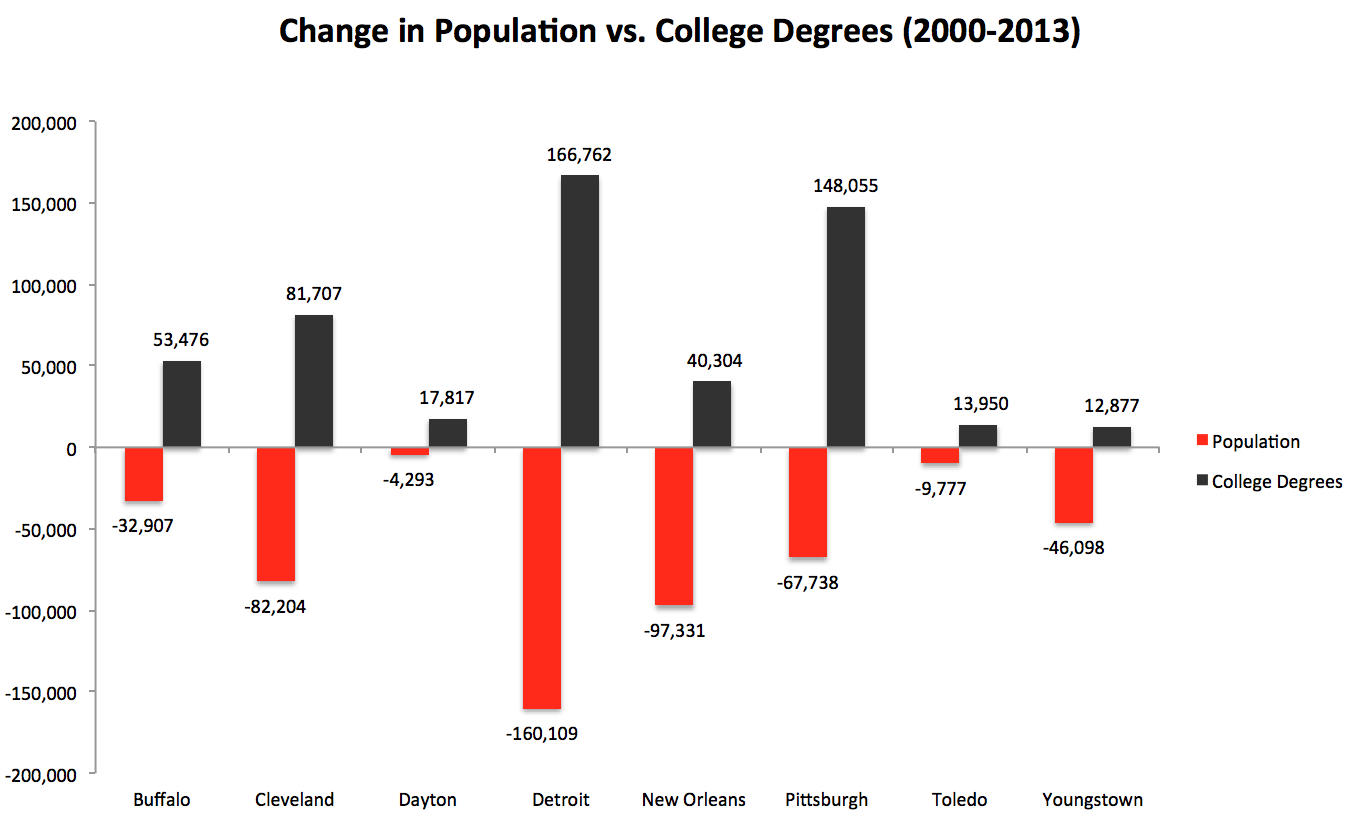
    Since brain drain seems to be a major concern in shrinking cities, I decided to take a look at the facts around brains in those places. Looking at the 28 metro areas among the 100 largest that had objective measures of shrinkage – in population and/or jobs – between 2000 and 2013, I looked what what happened to their educational attainment levels.

    My results were published in my Manhattan Institute study “Brain Gain in America’s Shrinking Cities.” As the title implies, my key findings were:

    • Every major metro area in the country that has been losing population and/or jobs is actually gaining people with college degrees at double digit rates.
    • As a whole the shrinking city group is holding its own with the country in terms of educational attainment rates, and in many cases outperforming it.
    • Even among younger adults, most shrinking cities are adding more of them with degrees, increasing their educated population share, and even catching up with the rest of the country in their college degree attainment levels.

    The following chart of metro area population change vs. degree change for select cities should drive the point home.

    Click through to read the whole thing.

    In short, for most places, it looks like the battle against brain drain has actually been won. As people there can attest, thanks to many improvements public and private over the years, they are now viable places to live for higher end talent in a way they weren’t say 20 years ago. This means the attention and resources that have been devoted to this issue can now be put to more present day tasks such as repairing civic finances, rebuilding core public services, and creating more economic opportunity for those without degrees.

    More commentary later perhaps, but for now please check out the report and share widely.

    Aaron M. Renn is a senior fellow at the Manhattan Institute and a Contributing Editor at City Journal. He writes at The Urbanophile.

  • An Improbable And Fragile Comeback: New Orleans 10 Years After Katrina

    In the fall of 2005, many saw in postdiluvial New Orleans another example of failed urbanization, a formerly great city that was broken beyond repair.Yet 10 years after a catastrophe that drove hundreds of thousands of its citizens away, the metro area has made an impressive comeback.

    New Orleans’ resurgence since Katrina has come courtesy of $71 billion in federal funds and the determination and verve of New Orleanians themselves, as documented by Tulane geographer Rich Campanella, who provided research and direction for this article. It also benefited from the generosity of thevolunteers who worked in the recovery efforts as well as that of neighboring cities, notably Houston, which housed thousands of evacuees. Many have now returned, joined by newcomers from around the country, determined to turn around the city. “A city,” notes urban historian Kevin Lynch, “is hard to kill,” and New Orleans is proving that assertion.

    New Orleans’ comeback reflects not only improved levees and disaster management planning but a break from the region’s famously corrupt politics. Author Joel Garreau once described the city as a “marvelous collection of sleaziness and peeling paint.”  Today the metro area, and Louisiana, is earning higher marks for efficiency and business friendliness.  In Forbes’ annual ranking of the Best States For Business, Louisiana has risen from dead last in 2006 to 29th place in 2014, while Chief Executive Magazine ranks the state as having the ninth best business climate in the country, up from 45th in 2008.

    Perhaps most compelling has been the improvement in the public schools, which were  once among the worst in the country. After the storm, most of the campuses were converted to charter schools, which now educate over 80% of the parish’s schoolchildren. New Orleans now outperforms not only the rest of the state but the nation in terms of high school graduation rates, which have risen to 73% in 2014 from 54% in 2004, and the percentage of students on grade level in grades 3-11 is at 68%, up from 25% in 2000.  As Allison Plyer, executive director of the Greater New Orleans Community Data Center, put it in 2013, “Greater New Orleans is in some ways rebuilding better than before.”

    Growth, But Also A Rebound In Poverty

    The improvements in governmental institutions have, along with federal aid, sparked something of a jobs boom in New Orleans. The metro area recovered all the jobs lost in the recession by 2012 while the nation remained 3% below its pre-recession level.  The economy has expanded into some new sectors, such as digital media, while there has been a strong recovery in longtime core sectors liketourism and shipping, with an expansion of the port. After lagging the country for a generation, post-Katrina New Orleans surprised everyone by outperforming it.

    But there are signs that New Orleans’ rate of growth is leveling out, as might be expected with the tailing off of federal recovery spending. In our annual ranking of the cities creating the most jobs, themetro area has dropped from 26th place in 2013 to 43rd. This slowdown could worsen the biggest challenge facing New Orleans: its historic legacy of poverty.

    Greater New Orleans and the central city in particular have among the nation’s highest poverty rates and inequality. Even before Katrina, the city had over 26,000 blighted properties, a number that doubled after the storm.

    As more evacuees have returned, poverty rates in the city and the metro area have resurged. Between 2007 and 2013 Orleans Parrish’s poverty rate rose from 21% to 27%, just about where it was in 1999. At the same time, the gap between white and African-American incomes and poverty rates remain well above the national averages.  Incarceration rates in Orleans parish are almost four times as high as the national average, and  the rest of the metro area also has incarceration rates considerably above the national average.  New Orleans’ murder rate fell to the lowest level last year since 1971, but it was still the ninth highest among major U.S. cities.

    A Demographic Resurgence

    Yet some new demographic trends offer hope.Critically, the region finally has begun to reverse a demographic decline spanning more than a generation in which the urban core steadily lost young, educated people and families to the suburban periphery and beyond.  

     The immediate aftermath of Katrina saw an influx of “YURPS,” or Young Urban Rebuilding Professionals — urbanists, environmentalists and social workers who headed South to work in the recovery efforts, in nonprofits and government programs, seeking to be part of something important.After that came a wave of well-educated professionals, who saw personal opportunity in the region’s rebounding economy. Campanella estimate this latter group at around 15,000 to 20,000strong.   Along with them, says Campanella, have come a fair number of artists, musicians, and creative types seeking to join in what they perceived to be an undiscovered bohemia in the lower faubourgs of New Orleans.

    The New Orleans metro area’s population of college graduates increased by roughly 44,000 from 2007 to 2012, a 25% increase, double the national average of 12.2% over that span.

    These educated newcomers are widely credited not only with helping rebuild New Orleans, but also sparking an increase in start-up companies well above the national pace and boosting the city’s economic diversification. Employment in the New Orleans area’s information sector — high-paying jobs in entertainment, games, software — grew 21.2% between 2007 and 2012, more than twice the national average, according to Praxis Strategy Group.

    Is Gentrification A Threat?

    This promising development, however, brings with it a set of problems, among them concern, particularly among African-Americans, about gentrification of inner-city neighborhoods. Many African-Americans, notes city employee Lydia Cutrer, have “trust issues after many broken promises, and feel like outsiders are taking over.” Or, as former New Orleanian Sherby Guillory, a health care worker and now a Houston resident put it acidly, “They want to build a shining city on a hill, but without the people.”

    A map of the city by Campanella (below) shows where this turnover in population is the most advanced. He observes that the newcomers are attracted to a particular type of neighborhood – places with distinctive, historic housing stock, and close to areas that have already gentrified, or that never economically declined, like the Garden District. The arc of gentrification spreads through uptown New Orleans, around Audubon Park and Tulane and Loyola universities, with a curving spout along the St. Charles Avenue/Magazine Street corridor through the French Quarter and into the Faubourg Marigny and Bywater. These areas have in many cases been incubators of New Orleans’heavily African-American music and food culture, and now are losing some of those old connections.

    Courtesy of Richard Campanella

    Courtesy of Richard Campanella

    As elsewhere gentrification is widely welcomed in the real estate and business communities, but also poses dilemmas, even for newcomers. Indeed gentrification threatens to undermine one of the very reasons young people are so attracted to New Orleans — its unique local culture. Boilerplate yuppie restaurants selling beet-filled ravioli is no substitute for fried okra and other traditional specialties.
     The Physical Challenge Of Rebuilding

    As Katrina demonstrated all too well, poverty in New Orleans is deeply intertwined with  the geographic challenges of the region. Most predominately African-American neighborhoods were located in the low-lying areas of the city, easily susceptible to flooding, while more affluent, usually white neighborhoods were on higher ground.  

    Some have suggested moving the region’s entire population to higher ground, but political and fiscal realities, plus social resistance to closing down heavily damaged, far-flung neighborhoods, paved the way for resettlement patterns that have not reduced human exposure to the hazard of surge flooding.

    But there’s no question that $14.5 billion in taxpayer dollars have gone to good use in keeping thosehazard at bay — at least for the next few decades. The Army Corps of Engineers’ new Hurricane Storm Surge Risk Reduction System — composed of heightened levees, floodwalls, surge barriers, gates, and pumps — now  protects the metropolis from storms that have a 1% change of occurring in any given year. That’s much less than the city needs, but it’s a lot more than it had before Katrina, and the Risk Reduction System (note that it’s no longer called a “flood protection system”) worked well during Hurricane Isaac in 2012.

    That’s the good news. The bad news, Campanella observes, is that the coastal wetlands beyond the system, starved of sediment and freshwater, continue to subside and erode at rapid paces in the face of rising sea levels and intruding sea water.

     A Difficult Road Ahead 

    Solving New Orleans’ geophysical problems is critical for long-term growth.  “We have to approach this as a win-win proposition,” says the Nature Conservancy’s Seth Blitch. “Everyone knows if we do nothing, it’s a lose-lose for everyone.”

     In the near term obstacles include the growing disparities of race and class, the fall in oil prices, and the strengthening dollar,which could slow the recent surge in capital investment into Louisiana’s industrial economy that has come on the heels of the surge in natural gas production.  

    While challenges abound, progress over the past 10 years is undeniable, and few  would have predicted the city would have come this far so soon in addressing its long-term challenges. “None of this would have happened without Katrina,” says Loyola theologian and philosopher Michael Cowan. “It changed forever what had been an inertial environment. After Katrina, it was like operating in zero gravity. Katrina broke the pattern.”  

    This piece first appeared at Forbes.com.

    Joel Kotkin is executive editor of NewGeography.com and Roger Hobbs Distinguished Fellow in Urban Studies at Chapman University, and a member of the editorial board of the Orange County Register. He is also executive director of the Houston-based Center for Opportunity Urbanism. His newest book, The New Class Conflict is now available at Amazon and Telos Press. He is also author of The City: A Global History and The Next Hundred Million: America in 2050. He lives in Orange County, CA.

    Photo montage by Richard Campanella.