Category: Urban Issues

  • Growth and the Suburban Chassis

    I tend to explore what happens to suburbs as they age and begin to decline. But this time I’m going to explore what happens to suburbs that thrive and continue to grow and work their way up the value chain. It isn’t exactly what many people expect. “Be careful what you wish for.”

    A friend moved from San Francisco to San Jose this winter. Now that I’ve been visiting her on a regular basis I have an excuse to poke around. It’s actually pretty fascinating.

     Screen Shot 2015-04-08 at 1.35.48 AM Screen Shot 2015-04-08 at 1.36.12 AM

    A friend moved from San Francisco to San Jose this winter. Now that I’ve been visiting her on a regular basis I have an excuse to poke around. It’s actually pretty fascinating. Her tract home was built in 1947 on land that had previously been orchards. By the 1960’s the area had become home to military and aerospace firms that then spun off civilian electronics companies in little low rise office parks. By the 1980’s the area had officially emerged as Silicon Valley. Oracle, Apple, Facebook, Hewlett-Packard, Microsoft, Google, eBay, Juniper Network, PayPal… these companies stretch out for miles in every direction. It’s an economic development dream for local governments. While there are a dozen separate municipalities (Redwood City, Cupertino, Mountain View, Palo Alto, Santa Clara, Fremont, Los Gatos, and so on) the entire southern end of San Francisco Bay is essentially one giant suburban corporate office park blur.

    Screen Shot 2015-04-11 at 3.49.19 PM Google Screen Shot 2015-04-08 at 1.09.30 AM Screen Shot 2015-04-08 at 1.06.01 AM Screen Shot 2015-04-08 at 1.10.00 AM

    Here are three examples of the kinds of commercial buildings that served earlier waves of businesses in Silicon Valley. They were probably built between the 1970’s and 1990’s. This office park happens to be in the town of Sunnyvale, but nearly identical arrangements can be found all over the Bay Area. In fact, I bet there are buildings just like these in whatever town you live in too whether it’s in Florida, Michigan, or Utah.

    Screen Shot 2015-04-11 at 4.25.53 PM GoogleScreen Shot 2015-04-08 at 1.52.00 AM   Screen Shot 2015-04-08 at 1.09.00 AM

    Here’s what’s happening to these office parks as the economy heats up. The land has become very valuable and it makes good economic sense to build new eight or ten story office blocks on vacant land and surface parking lots. It’s good for the tech companies who want to expand their existing operations. It’s good for the land owners who can cash in on the sale. It’s good for the city since it brings increased tax revenue to the municipal coffers. And it’s good for people looking for high paying jobs, both in the initial construction phase and later office workers and support staff. There are, of course, also problems associated with this kind of redevelopment, which I’ll get to in a minute.

    Screen Shot 2015-04-11 at 6.33.25 PM Google Screen Shot 2015-04-11 at 6.32.52 PM  Screen Shot 2015-04-08 at 1.52.32 AM

    Here’s another construction site directly across the street. The old one story buildings were scraped and are being replaced by parking decks and office blocks. These are all part of the same company that is experiencing rapid expansion and doubling their corporate campus that already has over a million square feet of space. These few buildings alone will ultimately house another eight hundred well paid workers. Part of the long term plan for this site is to include a two hundred room hotel for business travelers associated with the company. Perhaps that new hotel will replace the existing one story motel.

    Screen Shot 2015-04-11 at 5.26.01 PM Google   Screen Shot 2015-04-11 at 8.04.09 PM Screen Shot 2015-04-11 at 8.04.26 PM Screen Shot 2015-04-11 at 7.27.03 PM Screen Shot 2015-04-11 at 7.26.05 PM

    Here’s the bigger picture. Zooming out on Google Earth you can see how multiple older office parks are being absorbed and folded in to much larger more unified corporate complexes. The scale of the construction is too large to capture even with a macro lens on the ground. These tech workers were walking between buildings at lunchtime and it was quite a trek. This kind of land use intensification is actually very similar to how old orchards were converted to residential subdivisions. Land values increased and property was pressed into service for tract homes which were much more lucrative than apricots or prunes. The same process is now unfolding at the next higher economic level with office parks. If I hadn’t taken these photos myself I would swear some of them were computer generated. The buildings have such a generic AutoCAD look about them. And there are dozens of them at this one site alone.

    Screen Shot 2015-04-11 at 7.44.08 PM Google   Screen Shot 2015-04-11 at 8.14.31 PM  Screen Shot 2015-04-08 at 3.40.10 AM Screen Shot 2015-04-13 at 5.58.20 PM 

    Here’s another corporate campus. This one is in Redwood City. Everywhere you look the old one and two story buildings are being razed and replaced with significantly larger buildings. The schmaltzy motels, strip malls, and office parks of previous decades have been upscaled both physically and economically. This was once open water and marshland that was filled, dredged and contoured in the 1960’s, but has since been redeveloped to a higher value use.

    Screen Shot 2015-04-13 at 5.42.01 PM Google Screen Shot 2015-04-13 at 5.43.28 PM Google

    Companies are fond of the “theme park” suburban campus where the environment is akin to an all inclusive resort destination for workers. These are islands – sometime literal islands – in the suburban landscape. From the air these corporate campuses look a lot like Epcot Center at Disney World or a regional shopping mall off the side of a highway.

    Screen Shot 2015-04-14 at 9.24.20 AM Google Screen Shot 2015-04-14 at 9.12.06 AM Google

    Screen Shot 2015-04-14 at 9.22.14 AM Google  Screen Shot 2015-04-14 at 9.13.02 AM Google

    This inward looking mega block form of development is common in suburbia. The images above show a college, an amusement park, and a corporate office park. When you’re inside one of these bubbles it’s actually very pleasant. But getting to and from these locations is pretty much impossible without a car. Even if you live directly across the street walking wouldn’t work all that well. Add in the fact that many of the nearby residential subdivisions are gated communities and that each of these bubbles are separated by highways, walls, and drainage canals… a car becomes essential. That loads the road network with an insane amount of traffic. If the one story buildings incrementally ramp up to eight story buildings you have a very big transportation problem on your hands.

    Screen Shot 2015-04-11 at 9.05.27 PM Google Screen Shot 2015-04-08 at 2.00.16 AM Screen Shot 2015-04-11 at 9.15.54 PM Screen Shot 2015-04-08 at 1.56.54 AM

    Here’s an intersection halfway between my friend’s house and the corporate campus where she works. It’s a typical suburban commercial corridor lined with standard one story buildings of the office park and light industrial variety that were built anytime from the 1960’s to the 1990’s.

    Screen Shot 2015-04-11 at 9.16.34 PM Screen Shot 2015-04-08 at 1.59.10 AM Screen Shot 2015-04-11 at 9.17.10 PM Screen Shot 2015-04-13 at 8.24.15 PM Screen Shot 2015-04-08 at 1.58.53 AM Screen Shot 2015-04-08 at 2.00.03 AM

    Here’s what’s happening all around Silicon Valley. The small old buildings are being replaced with much larger ones. These aren’t exactly skyscrapers, but they’re significantly more substantial than what was there before.

    Screen Shot 2015-04-13 at 7.26.36 PM Google Screen Shot 2015-04-12 at 11.56.58 AM Screen Shot 2015-04-12 at 11.31.13 AM

    The same thing is happening with residential property. The old suburban roads lined with gas stations and Kwickie Marts are giving way to multi-story apartment buildings with underground parking decks. These two photos show two sides of the same street. This spot is immediately adjacent to a 1950’s residential subdivision of single family homes. The apartment building fills a need for workforce housing at a high, but tolerable price. One bedroom apartments in this neighborhood rent for about $2,000 a month. Two bedroom units rent for closer to $3,000. If you want to buy an actual house the bargain basement fixer uppers start at $600,000. There are a lot of people in the area who can afford to carry a mortgage of that size, but the problem is often the down payment. Twenty per cent of $600,000 is $120,000. That’s a hurdle many people struggle with. I’ve seen some very nice double wide trailers for sale in the $320,000 range, but that doesn’t include the land under the trailer which you would still need to rent. So rental apartments and condo complexes are in fact necessary in this area if many workers are to live anywhere near where the jobs are.

    Screen Shot 2015-04-13 at 5.16.11 PM Google

    That brings us to some of the serious problems with an economically successful suburb. Silicon Valley, as the name suggests, is hemmed in by mountains and water. All the flat, easily developed land has already been built on in the standard suburban fashion. Over the decades highways have been built through mountain passes to access new land on the other side of these mountains and many people and businesses have expanded outward to the far edges where possible. But the resulting transportation bottlenecks and commute times are severe. Driving to and from Silicon Valley to the outer outer outer suburbs is like pouring molasses through a funnel. People are willing to pay a lot extra to not have to endure that schlep every day. In theory public transportation could ease the commute for many people, but the dispersed development pattern guaranties that transit will never be efficient or cost effective since most people need to drive from their house to a transit center and then take a shuttle bus to the office at the other end of the train line. Living closer to work is a better option for many people. If you have a million dollars on hand you can buy a nice big home with a front lawn and swimming pool in the back yard. Many people in the area do. The median income in Silicon Valley for people with a bachelor’s degree is $95,000 a year. That’s the median, so half the working population earns more than that. A million dollar house is within reason, particularly if there are two incomes per household to carry the mortgage. If not, living in a condo or apartment complex is the next best option.

    Screen Shot 2015-04-08 at 3.41.17 AM Screen Shot 2015-04-08 at 3.41.49 AM Screen Shot 2015-04-13 at 8.29.38 PMScreen Shot 2015-04-13 at 8.28.45 PMScreen Shot 2015-04-13 at 8.29.00 PM 

    From my perspective these intensifying suburbs are in an adolescent phase of development. They are rapidly losing the qualities that people like about the suburbs: open space, privacy, convenience, quiet, lower cost, ample free parking, and so on. But they aren’t yet delivering the things people like about cities: culture, vibrant street life, walkability, convenient public transportation, night life, and such. I stopped and took photos of large numbers of tech workers walking along the side of the eight lane highways at lunchtime. There isn’t anyplace for these folks to walk to. There’s nothing but parking lots, highway fly-overs, gas stations, landscaped berms, and convenience stores as far as the eye can see. When I ask the workers where they’re going they say they’re just stretching their legs and getting some air. They eat lunch (and very often breakfast and dinner) inside their office compounds in subsidized cafeterias. Perhaps in another thirty years the transformation from suburb to something more vital may be complete. Given the suburban chassis these places inherited I don’t see how the underlaying infrastructure will ever support anything other than a bad compromise.

    Joel Garreau calls places like this Edge City: a place that has a suburban form but at an urban density. Driving private cars is no longer convenient here anymore, but transit will never function well either. Jobs are plentiful, but housing is too expensive. It lacks the privacy and peace of a good suburb, but is deficient in the vibrancy and culture available in a real city. It’s too thick to be jam, but too thin to be jelly. 

    John Sanphillippo lives in San Francisco and blogs about urbanism, adaptation, and resilience at granolashotgun.com. He’s a member of the Congress for New Urbanism, films videos for faircompanies.com, and is a regular contributor to Strongtowns.org. He earns his living by buying, renovating, and renting undervalued properties in places that have good long term prospects. He is a graduate of Rutgers University.
  • The French housing Bubble also has Roots in Excessive Land Use Regulations

    Despite the claim to uniqueness that is quintessentially French, the housing bubble shares the same root as we see in the Anglo-Saxon world. To be sure, some analysts blame it only on low interest rates: they made the households more solvent, and thus drove home prices up. This rise in purchasing power might have been enhanced by some specific subsidies to new rental units. Some also y point to normative constraints on new buildings have added to production costs.

    These facts are undisputed, but a demand-only driven bubble can’t happen in a really free market where price signals provide incentives to supply more units, moderating price escalation, and eventually revert the price curve. After all, there hasn’t been anything like a “car price bubble”. So there has to be a supply side factor constraining the building of new homes. And since building itself doesn’t require scarce skills, the constraint has to come from land. These analysts observe that in middle America booming cities like Texas’ Houston and Dallas, or others in Kansas, Georgia, Oklahoma, and elsewhere didn’t experience such a price bubble despite identical credit conditions, despite in some cases, as in Texas, an even greater surge in demand.

    Numbers

    Let’s take a look at official French statistics.

    Professor Joseph Comby (From Institut d’Urbanisme de Paris) summarizes essential data in an exhaustive article (not available online) published in the very specialized peer reviewed "Revue Foncière" (n°3, January 2015), dedicated to land and housing issues. His graphs can be accessed from data provided by our national institute of statistics (INSEE).

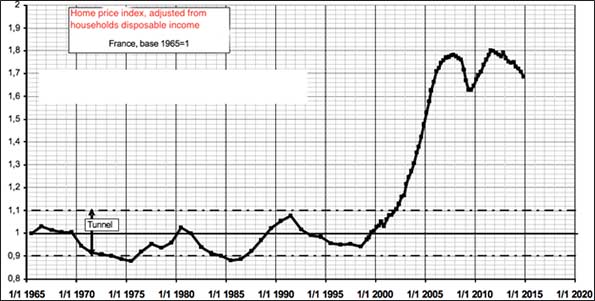
    The first graph shows that home prices surged between 1997 and 2007, and that the prices didn’t really slump then, despite worldwide economic crisis. Average home price rose by a whopping 150% in 11 years, and rose 86% faster than households’ disposable income.


    Fig 1. Home price Index, adjusted from households’ disposable income – Base 1, 1965.
    Source: French Ministry of Sustainable Development (
    doc format)

    In this period, the median multiple in France (Average Home price / Average Household disposable income) rose from a stunningly low 2.25 to 4.21, and these average figures hide numerous regional discrepancies.

    Home prices can be truncated between land costs and building costs, including the home and the infrastructure costs (road access, sewage, water and energy adduction, and so on). Had this price hike uniquely "credit and demand" driven, we should have seen a relatively parallel evolution between land and building components in home prices.

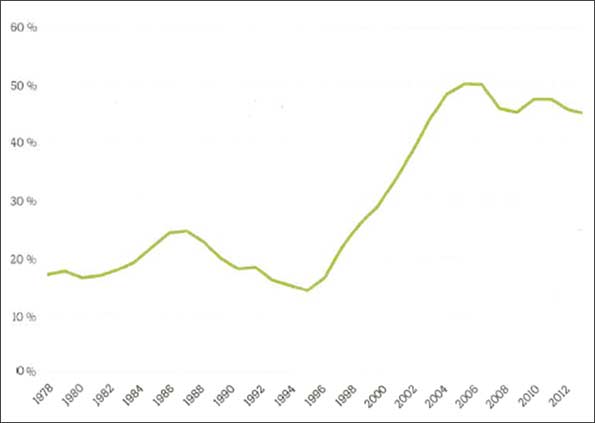
    Our national statistics institute conducts regular wealth inquiries on the total wealth of French households. These studies show that the  share of aggregate land value in  homes value rose from 15% in 1996, to 50% in 2007, and slowly decreased then to 45% in 2013.


    Fig 2. France – Share of land in aggregate real estate value
    Source: J. Comby, computed from
    INSEE Annual wealth surveys

    So, from these data, let’s compute how the prices of land and building components evolved between the 1996 low and 2007 peak, relatively to households revenue. The following table summarizes it all:


     1996

    2007

    Price Increase

    Existing homes, average price – (current prices, €) (INSEE)

    77 100

    192 800

    +150%

    Average disposable income per household (current values, €)

    34 149

    45 800

    • 33%

    Ratio Home price / disposable income

    2.25

    4.21

    +86 %

    Land, % of home value

    15

    50


    Land, average value in existing homes (€)

    11 565
    (15% of 77100)

    96 400
    (50% of 192800)

    + 733 %

    Land price appreciation, adjusted from household disposable income appreciation

    + 520 %

    Building, average value in existing homes (€)


    65 535

    96 400

    + 47 %

    As has been seen in the Anglo-Saxon regulated markets, land appreciation overwhelms construction costs appreciation. Figures show clearly that the 1996-2007 real estate bubble is driven by land prices appreciation.

    As a confirmation pattern, INSEE figures from its annual wealth studies show that the total value of built land plots went from 67% of GDP in 1998 (no figures for 1996) to 308% in 2007. So owning developable land in the end of the 90s provided returns that no other asset class could offer, despite creating absolutely no new added value for society. On the contrary, high home prices have been harmful to modest households, with 6% of people experiencing very bad housing conditions (obsolete and/or overcrowded units), 9% other having tough times financing their housing needs (1).  And according to INSEE, there were 112 000 homeless people in 2012, a 44% increase from 2001 (2).

    Since there is no physical shortage of land in France (most of the country is rather flat, and only 7% of land is developed), this suggests loudly to look at our land use regulations to understand how they fed the monster.

    Our regulation of land belongs to the “prescriptive” family, according to Wendell Cox and Hugh Pavletich classification (3). It means that land is, by default, limited for natural or agricultural usage, and turning it into developable land must endure a long and politically complex zoning process. Worst of all, not only each city is zoned, but every local zoning has to comply, since the new millennium, with “territorial coherence schemes” which tend to cap the maximal amount of land available for development through years. Prescriptive regulations can be opposed to “responsive” ones, which can be seen in central parts of America and Canada. In a responsive regulatory frame, default status of land is let to the free choice of the owner, and only limitations for some collective purpose have to pass through a political process, and open a right   for owners to be compensated for the loss of land value resulting of limitations. As Cox and Pavletich as well as the Brookings institution showed, places with prescriptive regulations experienced a much tougher bubble than responsive ones during the years of wild credit expansion. France is not different and the same phenomenon happened.

    The idea of a bubble driven by strong regulatory constraints put on land meets a lot of resistance among several groups familiar in other countries: Local politicians, who get power from a population prone to NIMBY attitudes, and feeling richer through home value appreciation, are the first of them; most farmers, 70% of whom are renters, have an interest in preserving legal interdiction to turn  plots at the fringe of cities into housing developments; and there are about 40,000 employees in public and private jobs who make a living from elaborating and implementing these regulations. 

    So we can see that in France, like other countries, the role of artificial restriction of land supply for new development can’t be dismissed. The costs and benefits of these regulations should be publicly questioned. Can their advocates still deny that that this price bubble is largely an unintended outcome of regulations. Nor can they acknowledge that this  results in increasing levels of “housing poverty” and drives so much resources from more productive investments. Is this  more desirable than “sprawl containment”, “farmland preservation” and other pretenses which provided justifications for these regulations in first place ?

    Vincent Benard is senior economic analyst for the Turgot Insitute (www.turgot.org), a french classical liberal think tank. His principal interests are housing, land use and infrastructure policies, and the study of the unintended consequences of regulations.  Since 2006, he authored one book and many articles about the French housing crisis. " 

    (FYI: The book : https://www.scribd.com/mobile/doc/80163334 – Free, PDF, in French) 

    ———

    Notes: (1) Figures from the annual report of the “Abbe Pierre” Foundation, dedicated to homelessness and poverty assistance  www.fondation-abbe-pierre.fr/
    (2) Source: “L’express”, November 2014 – http://www.lexpress.fr/actualite/societe/le-nombre-de-sdf-en-france-a-explose-en-dix-ans_1623371.html
    (3) See Annual Housing affordability report, by Cox and Pavletich, www.demographia.com

    Photo by Benh LIEU SONG (Own work) [GFDL or CC BY-SA 4.0-3.0-2.5-2.0-1.0], via Wikimedia Commons

  • China’s Shifting Population Growth Patterns

    As demographers have projected for some time, China’s population growth is slowing. The nation gained population at a rate of 0.49% between 2010 and 2013, according to data from the National Bureau of Statistics. This is a reduction from the rate of 0.57% between 2000 and 2010. Further growth rate declines are expected until the 2030s when the total population, according to United Nations projections, will actually begin to decline.

    Right now the biggest slowdown is taking place in regions with the greatest and densest urbanization such as in the province of Guangdong, home of the Pearl River Delta and the Yangtze Delta, anchored by Shanghai. At the same time, the northern plains economic region of Beijing-Tianjin continues its growth, but following a more decentralized pattern that sees more growth away from Beijing.

    Guangdong and the Pearl River Delta

    Guangdong is unique in being home to two of the world’s megacities (urban areas over 10 million population), Guangzhou-Foshan and Shenzhen. No other sub-national jurisdiction (province or state) in the world has more than one. The province, anchored along the Pearl River Delta, has been the heart of China’s three decade long economic advance. Between Guangzhou-Foshan and Shenzhen, the Dongguan urban area has 8 million residents. Across the Pearl River, Jiangmen, Zhongshan and Zhuhai all have more than one million residents. If the China’s adjacent special economic regions of Hong Kong and Macau are included, the area’s population reaches 55 million, nearly one-half more than Tokyo, with nearly the same land area. However, with little day-to-day work trip commuting between, they do not, at least as of yet, represent a single labor market (metropolitan area).

    This slowdown comes after years of spectacular growth. Between 1990 and 2000, the province added more than 40 million new residents, more people than live in California. On average, the the population rose 2.1 million every year, an annual rate of 2.6 percent. Just between 2009 and 2010 the increase was 3.1 million. However, over the three years between 2010 and 2013 Guangdong added only 700,000 each year, for an annual growth rate of 0.66 percent., 

    Shanghai and the Yangtze Delta

    Shanghai, a city province that contains nearly all of the Shanghai mega-city, also experienced a huge drop in its population growth rate (Parts of Shanghai’s continuously built-up area are now stretching into neighboring Jiangsu and Zhejiang provinces). Between 2000 and 2010, Shanghai grew at an annual rate of 3.65% and added nearly 7 million new residents. Over the last three years, the annual rate of population growth has dropped by more than half, to 1.67% as only 1.1 million new residents have been added. Shanghai was estimated to have a population of 24,150,000 at the end of 2013.

    Shanghai is at the core of the larger Yangtze River Delta, home to nearly 160 million residents crowded into an area the size of Oregon. The Yangtze Delta includes the provinces of Zhejiang, Shanghai and Jiangsu and stretches from Ningbo, through Hangzhou, Shanghai, Suzhou, Changzhou, and Zhenjiang to Nanjing. Like Guangdong, the Yangtze Delta experienced a substantial drop in its rate of population growth. Between 2000 and 2010, the Yangtze Delta added approximately 20 million new residents, or 1.4 percent annually. This dropped to only 2 million between 2010 and 2013, dropping the annual growth rate  to 0.5%.

    Beijing, Tianjin and the Northern China Plain

    All the population of the Beijing mega-city is contained within the municipal province of Beijing. With its adjacent megacity of Tianjin (also a municipal province) the two provinces combined have a population of 35 million. When combined with the surrounding province of Hebei (capital Shijiazhuang), the population of this Northern China Plain megalopolis is nearing 110 million. Unlike China’s other two major economic regions, the North China Plain is sustaining its population growth. Between 2000 and 2010, the annual population growth rate was 1.47 percent. Over the past three years, it was 1.46 percent.

    Beijing was estimated to have a population of 21,150,000 at the end of 2013.Yet, there has been a substantial slowdown in growth but not as marked as that of Shanghai. Between 2000 and 2010, Beijing added more than 6 million residents, growing at an annual rate of 3.70 percent. Another 1.5 million residents were added between 2010 and 2013, but the growth rate dropped to 2.67 percent.

    The trajectory of growth has now shifted to Tianjin. Tianjin is by far the fastest growing provincial level jurisdiction in China. Between 2010 and 2013, Tianjin grew at an annual rate of 4.49 percent, and added 1.7 million new residents. This is more in total numbers than either Beijing or Shanghai, which are both larger. Among the provincial level jurisdictions, only Guangdong, seven times as large, added more residents. Tianjin is estimated to have a population of 14,720,000.

    Tianjin appears to be an opportunity corridor for growth. Tianjin is located approximately 90 miles (145 kilometers) from Beijing and is the principal seaport in the area. High speed trains between Tianjin and Beijing operate about 100 times each way daily, completing the trip in 35 minutes. Tianjin is a natural safety valve for the continuing growth of the North China Plain megalopolis.

    Hebei continued its stronger than national growth. In the 2000s, Hebei added 5.2 million residents, and added another 1.4 million over the past three years.

    This shift of growth from Beijing to surrounding areas could indicate some success in the policy initiatives of the national and Beijing governments to control Beijing’s rapid population growth and shift it to more peripheral areas. More decentralization initiatives are due, such as the planned seventh ring road, which will traverse most of its distance in surrounding Tianjin and Hebei.

    The Dongbei Rust Belt

    Population growth continues to elude China’s historic Rust Belt, the Dongbei ("East North," also called Manchuria). This area, consisting of Lioaning, Jilin and Heliongjiang provinces, with major cities Shenyang, Harbin and Dalian grew by only 200,000 residents, an annual rate of 0.06 percent. This is down from 0.26 percent in the 2000s, which was less than one-half the national growth rate. The Dongbei has nearly 110 million residents.

    Other Areas

    At the same time, population in the interior province of Hubei (capital Wuhan) has been propelled from 0.14 percent annually between 2000 and 2010 to a near national rate of 0.41 percent since 2010. Adjacent interior province Hunan (capital Changsha) recovered from a 0.01 percent annual growth rate in the 2000s to 0.62 in the last three years. Next to Hunan, city province Chongqing recovered from a lethargic 0.12 percent growth rate between 2000 and 2010, to an impressive 0.99 percent over the last three years. These cases may also be another indication of the success of government policies to encourage growth away from the East Coast.

    Outside of Tianjin, only four regions of China are growing at a greater than one percent annual rate. Three are to the west, including Tibet (1.31 percent), Xinjiang (1.21 percent) and Ningxia (1.12 percent). All are experiencing slower growth than before. To the south, Hainan, the island province, is also growing at just above one percent), about the same rate as in the 2000s.

    Floating Population: Slower Growth

    China’s large floating population, — internal migrants who have moved to the cities to provide the work force for much of the manufacturing and construction boom — continued to grow, but at a somewhat slower rate. The floating population grew 8 million annually between 2010 and 2013, down from 15 million annually between 2005 and 2010. Of course, that is still a big number. With reform of the internal passport system ("hukou" system) promised, there may be an important incentive for many to remain in the cities, where economic aspirations may be more likely to be met.

    China’s Changing Growth Patterns

    China is going through an important transition from nearly speed-of-light economic expansion to much slower growth that is, nonetheless the envy of just about every other major economy. Nonetheless, these changes are already bringing spatial changes.

    Photo: Dalian (Liaoning), in the Dongbei (by author)

    Wendell Cox is principal of Demographia, an international public policy and demographics firm. He is co-author of the "Demographia International Housing Affordability Survey" and author of "Demographia World Urban Areas" and "War on the Dream: How Anti-Sprawl Policy Threatens the Quality of Life." He was appointed to three terms on the Los Angeles County Transportation Commission, where he served with the leading city and county leadership as the only non-elected member. He served as a visiting professor at the Conservatoire National des Arts etMetiers, a national university in Paris and is a Senior Fellow at the Center for Opportunity Urbanism.

  • Southern California Housing Figures to Get Tighter, Pricier

    What kind of urban future is in the offing for Southern California? Well, if you look at both what planners want and current market trends, here’s the best forecast: congested, with higher prices and an ever more degraded quality of life. As the acerbic author of the “Dr. Housing Bubble” blog puts it, we are looking at becoming “los sardines” with a future marked by both relentless cramming and out-of-sight prices.

    This can be seen in the recent surge of housing prices, particularly in the areas of the region dominated by single-family homes. You can get a house in San Francisco – a shack, really – for what it costs to buy a mansion outside Houston, or even a nice home in Irvine or Villa Park. Choice single-family locations like Irvine, Manhattan Beach and Santa Monica have also experienced soaring prices.

    Market forces – overseas investment, a strong buyer preference for single-family homes and a limited number of well-performing school districts – are part of, but hardly all, the story. More important may be the increasingly heavy hand of California’s planning regime, which favors ever-denser development at the expense of single-family housing in the state’s interior.

    Read the entire piece at The Orange County Register.

    Joel Kotkin is executive editor of NewGeography.com and Roger Hobbs Distinguished Fellow in Urban Studies at Chapman University, and a member of the editorial board of the Orange County Register. He is also executive director of the Houston-based Center for Opportunity Urbanism. His newest book, The New Class Conflict is now available at Amazon and Telos Press. He is also author of The City: A Global History and The Next Hundred Million: America in 2050.  He lives in Los Angeles, CA.

    Photo by Downtowngal (Own work) [CC BY-SA 3.0 or GFDL], via Wikimedia Commons

  • Iran’s Urban Future: Tehran and Beyond

    With Iranian-American nuclear relations back on the front burner — make that front and center — I was able to secure a visa and travel counter-clockwise by train around Iran, covering more than a thousand miles. In American headlines and Congressional outbursts, Iran is thought only to be grappling with its nuclear dilemma. But I came to the conclusion that Iran’s future is tied more closely to its cities, where some 60 percent of the population lives, than it is to its nuclear capabilities or its revolutionary doctrines.

    By the time I left, a few weeks ago, nothing I saw lined up with its sinister reputation for revolutionary violence or near-fascist religious zeal. Mostly, I saw a developing country — like China in many ways — moving its young population sideways from the countryside into the cities (usually in an old car, spewing fumes). Herewith, an urban rundown:

    Tehran: I flew into and out of Tehran, the city that dominates the life of Iran. Even at 3:00 AM the traffic was heavy, and when I went around on the metro, there was never a moment when I wasn’t as squeezed as canned caviar.

    For a city of never-ending tenements (similar to Queens or Brooklyn), Tehran remains comparatively calm. I never heard shouting, car horns, or confrontations, just as I never saw an armed police officer (except at the airports) or Revolutionary Guard. Omnipresent portraits of ayatollahs Khomeini and Khamenei are the only symbols of sidewalk politics.

    Diplomats and wealthier Iranians prefer to remain crowded into North Tehran, which feels like an alpine village, given the snowcapped peaks that soar in the background. This is where the last two Shahs had their palaces (which are now open as museums of imperialist decadence). The poor live in the desert flatlands to the south. I walked outside the embassy complex where in 1979 the American diplomats were held hostage; its twenty-seven acres looks like an 1850s textile mill in Pawtucket.

    For reasons few can explain, Tehran works well as a city. The subway trains — while packed — come and go on schedule. The bazaar is a mall of plenty, even with all the sanctions; the university attracts the best students (including my gifted guide), and even the dense traffic seems to move.

    Tehran may lack architectural grace, central focus, cozy neighborhoods, restaurants (I saw few), tea gardens, and sufficient parks. But it doesn’t feel as if it is on the edge of a fundamentalist abyss, as it’s portrayed in the Western press. It struck me more as an endless block party.

    Mashad: Iran’s most holy city. With a population of three million, Mashad is holy because it is where the remains of the Eighth Imam (Reza) are entombed. Pilgrims from all over Iran and Iraq come to the shrine, which is at the center of a large complex of mosques, museums, minarets, and open courtyards.

    Before the 1979 revolution, Mashad had an old-city feel, with the shrine at the core of narrow twisting lanes and alleys. Now the shrine is at the center of an open, polished-marble mall that would be a skateboarder’s dream, were dudes ever called to prayers.

    Faith is the serious business in Mashad, and most of the women I saw wore black, no-nonsense chadors and hijabs. (In Tehran, younger women, especially, wear their headscarves as fashion statements, and wrap themselves in vibrant colors.)

    What surprised me is how welcoming the shrine is to non-believers. I came and went from the courtyard at all hours. Inside the shrine, I was free to sit on the Persian carpets, take pictures, read my book, or check my iPhone. Who knew that Iran’s holiest site doubles as a vibrant city park?

    Esfahan: Iran’s cultural capital. I rented a bicycle to get around this city of seventeenth-century splendor that fans out from the vast Naqsh-e Jahān Square (think of an enormous college quadrangle). In one direction are the warrens of the grand bazaar, while off at other angles there are palaces, mosques, and the incomparable mosaic dome of the Sheikh Lotfollah mosque (the inside of a Swiss watch, done in turquoise comes to mind). I was reminded of Florence (the good and bad), sensing that someday, when Iran has rejoined the travelers’ universe, bus tours will overrun the delicate Renaissance balance of the city center.

    The new city of Esfahan is bland by comparison to the old town and the bazaar. It stretches into the desert on the other side of the Zayandeh River, arched by an iconic bridge. There is also an old Armenian Quarter, which testifies, if on a small scale, that Iran is a polyglot mix of Persians (51 percent), Azeris (24 percent), Gilakis and Mazandaranis (8 percent), Kurds (7 percent), and Arabs (3 percent).

    Yazd: Southeast of Esfahan, in the center of Iran; an oasis of sorts. Come the restoration, Yazd — a city of mud-colored palaces and soaring minarets — will become the end of the rainbow for Persian Empire tourists, complete with five-star boutique hotels set around interior pools (there are some already) and rooftop gardens that serve tea at sunset and deliciously warm bread for breakfast.

    Shiraz: Near the ruins of Persepolis, the Persian showcase city in the desert. After the intensity of Tehran and Mashad, Shiraz came as a relief, with its palm trees, wide sidewalks, cool interiors, laid-back atmosphere, and many places in the shade to drink bottled water. Travelers come much as they used to pay homage to local vineyards that gave the world (but no longer Iran) Shiraz wines.

    Traffic is detoured from the city center, although on the edges it has the confusion associated with American cities in which interstates blaze their way through downtowns. Only the car speaks to most Iranians. While I loved my trains, they were largely for school kids on excursions and pilgrims on the move. VIP buses are for intercity connections. For the rest, there are cars, a gamut from clunkers to new SUVs that run on $1-a-gallon gasoline.

    Qom: The city of mullahs. South of Tehran by about 100 miles, and not far from the new Imam Khomeini International Airport, which was built to serve both cities. The clerics who control Iran from behind veils of secrecy live in Qom, which is — so to speak — the Vatican City of Iran. Ayatollah Khomeini lived here for much of his life, although later the Shah had him deported.

    Qom surprised me with its Disney-esque qualities. I had expected mullahs ready to flagellate themselves, or perhaps angry crowds of the faithful eager to demonstrate their spiritual purity to the ayatollahs. Instead, it brought to mind what might be thought of as Allah’s Asbury Park, complete with blinking lights, souvenir stands, food stalls, cruising teenagers, and a summer holiday atmosphere. Even inside the shrine I watched mullahs checking their iPhones and small boys playing tag.

    Even in Qom, as elsewhere throughout the country, Iran did not strike me as obsessively religious. Yes, the chadors and hijabs give the impression of a devout society. But those answering the call to prayers struck me as a minority. For example, nobody did anything in the metro when the muezzin was piped over the intercom. (Eternity just sounded like another stop.)

    When, at sunset one evening, my train stopped at a station for evening prayers, only a few passengers went into the platform mosque. The rest, it seemed, bought chewing gum.

    Matthew Stevenson, a contributing editor of Harper’s Magazine, is the author of, among other books, Remembering the Twentieth Century Limited and Whistle-Stopping America. He has just returned from Iran, and lives in Switzerland.

    Flickr photo of Tehran at night by Loizeau.

  • The Big Idea: California Is So Over

    California has met the future, and it really doesn’t work. As the mounting panic surrounding the drought suggests, the Golden State, once renowned for meeting human and geographic challenges, is losing its ability to cope with crises. As a result, the great American land of opportunity is devolving into something that resembles feudalism, a society dominated by rich and poor, with little opportunity for upward mobility for the state’s middle- and working classes. 

    The water situation reflects this breakdown in the starkest way. Everyone who follows California knew it was inevitable we would suffer a long-term drought. Most of the state—including the Bay Area as well as greater Los Angeles—is semi-arid, and could barely support more than a tiny fraction of its current population. California’s response to aridity has always been primarily an engineering one that followed the old Roman model of siphoning water from the high country to service cities and farms.  

    But since the 1970s, California’s water system has become the prisoner of politics and posturing. The great aqueducts connecting the population centers with the great Sierra snowpack are all products of an earlier era—the Los Angeles aqueduct (1913), Hetch-Hetchy (1923), the Central Valley Project (1937), and the California Aqueduct (1974). The primary opposition to expansion has been the green left, which rejects water storage projects as irrelevant. 

    Yet at the same time greens and their allies in academia and the mainstream pressare those most likely to see the current drought as part of a climate change-induced reduction in snowpack. That many scientists disagree with this assessment is almost beside the point. Whether climate change will make things better or worse is certainly an important concern, but California was going to have problems meeting its water needs under any circumstances.  

    Not Meeting the Challenges. 

    It’s not like we haven’t been around this particular block before. In the 1860s, a severe drought all but destroyed LA’s once-flourishing cattle industry. This drought was followed by torrential rains that caused their own havoc. The state has suffered three major droughts since I have lived here—in the mid ’70s, the mid ’80s and again today—but long ago (even before I got there) some real whoppers occurred, including dry periods that lasted upwards of 200 years.  

    This, like the threat of earthquakes, is part of the price we pay to live in this most beautiful and usually temperate of states. The real issue is how to meet this challenge, and here the response has been slow and lacking in vision. Not all of this is to be blamed on the greens, who dominate the state politically. California agriculture, for example, was among the last in the nation to agree to monitoring of groundwater. Farmers have also been slow to adjust their crops toward less water-dependent varieties; they continue to plant alfalfa, cotton, and other crops that may be better grown in more water-rich areas. 

    Many cities, too, have been slow to meet the challenge. Some long resisted metering of water use. Other places have been slow to encourage drought-resistant landscaping, which is already pretty de rigeur in more aridity-conscious desert cities like Tucson. This process may take time, but it is already showing value in places like Los Angeles where water agencies provide incentives. 

    But ultimately the responsibility for California’s future lies with our political leadership, who need to develop the kind of typically bold approaches past generations have embraced. One step would be building new storage capacity, which Governor Jerry Brown, after opposing it for years, has begun to admit is necessary. Desalinization, widely used in the even more arid Middle East, notably Israel, has been blocked by environmental interests but could tap a virtually unlimited supply of the wet stuff, and lies close to the state’s most densely populated areas. Essentially the state could build enough desalinization facilities, and the energy plants to run them, for less money than Brown wants to spend on his high-speed choo-choo to nowhere. This piece of infrastructure is so irrelevant to the state’s needs that even many progressives, such as Mother Jones’ Kevin Drum, consider it a “ridiculous” waste of money. 

    And there needs to be, at least for the short term,an end to dumping water into San Francisco Bay for the purpose of restoring a long-gone salmon run, or to the Delta, in order to save a bait-fish, the Delta smelt, which may already be close to extinct. This dumping of water has continued even as the state has faced a potentially crippling water shortage; nothing is too good for our fish, or to salve the hyper-heated consciousness of the environmental illuminati. 

    The Political Equation 

    The biggest reason California has been so slow, and uncharacteristically feckless, in meeting this existential challenge lies with psychology and ends with political power. The generation that built the sinews of modern California—most notably the late Governor Pat Brown Sr., the current governor’s father—sprang from the old progressive spirit which saw in infrastructure development a chance not only to create new wealth, but also provide opportunity to working- and middle-class Californians. 

    Indeed, if you look at California’s greatest achievements as a society, the Pat Brown legacy stands at the core. The California Aqueduct turned vast stretches of the Central Valley into one of the most productive farming regions in the world. The freeway system, now in often shocking disrepair, allowed for the construction of mass suburbia that offered millions a quality of life never experienced by previous generations. At the same time the development of energy resources—California still boasts the nation’s third-largest oil production—helped create a huge industrial base that included aerospace, semiconductors, and a host of specialized industries, from logistics to garment manufacturing. 

    In contrast, Jerry Brown has waged a kind of Oedipal struggle against his father’s legacy. Like many Californians, he recoiled against the sometimes haphazard and even ugly form of development that plowed through much of the state. Cutting off water is arguably the most effective way to stop all development, and promote Brown’s stated goal of eliminating suburban “sprawl.” It is typical that his first target for cutbacks this year has been the “lawns” of the middleclass suburbanite, a species for which he has shown little interest or tolerance.  

    But it’s not just water that exemplifies the current “era of limits” psychology. Energy development has always been in green crosshairs and their harassment has all but succeeded in helping drive much of the oil and gas industry, including corporate headquarters, out of the state. Not building roads—arguably to be replaced by trains—has not exactly reduced traffic but given California the honor of having eight of the top 20 cities nationally with poor roads; the percentage of Los Angeles-area residents who take transit has, if anything, declined slightlysince train-building began. All we are left with are impossible freeways, crumbling streets, and ever more difficulty doing anything that requires traveling.  

    The Road to Feudalism 

    These policies have had numerous impacts, like weakening California’s industrial sector, which cannot afford energy prices that can be twice as high as in competing states. Some of those who might have worked in the factories, warehouses, and farms of California now help swell the numbers of the welfare recipients, who remarkably make up one-third of the nation’s total. As recently as the 1970s and ’80s, the percentage of people living in poverty in California wasbelow the national average; California today, based on cost of living, has thehighest poverty rate in the country.  

    Of course, the rich and entitled, particularly in Silicon Valley have achieved unprecedented riches, but those middle-class Californians once served by Pat have largely been abandoned by his son. California, long a relative beacon of equality and opportunity, now has the fourth-highest rate of inequality in the country. For those who, like me, bought their first home over 30 years ago, high housing prices, exacerbated by regulation, are a personal piggybank. But it’s doubtful either of my daughters will ever be able to buy a house here. 

    What about “green jobs”? California leads in total number of green jobs, simply by dint of size, but on a per-capita basis, a recent Brookings study notes, California is about average. In wind energy, in fact, California is not even in first place; that honor goes to, of all places, Texas, which boasts twice Californias level of production. Today even  The New York Timeshas described Governor Jerry Brown’s promise about creating a half-million green jobs as something of a “pipe dream.” Even surviving solar firms, busy in part to meet the state’s strict renewable mandates, acknowledge that they won’t be doing much of the manufacturing here, anyway. 

    The Cost of Narcissism 

    Ultimately this is a story of a state that has gotten tired, having lost its “animal spirits” for the policy equivalent of a vegan diet. Increasingly it’s all about how the elites in the state—who cluster along the expensive coastal areas—feel about themselves. Even Brown knows that his environmental agenda will do little, or nothing, to combat climate change, given the already minimal impact of the state on carbon emissions compared to escalating fossil fuel use in China, India and elsewhere. But the cosmopolitan former Jesuit gives more priority to his spiritual service to Gaia than the needs of his non-affluent constituents.  

    But progressive narcissism is, as some conservatives assert, not the main problem. California greens are, to be sure, active, articulate, well-organized, and well-financed. What they lack is an effective counterpoint from the business class, who would be expected to challenge some of their policies. But the business leadership often seems to be more concerned with how to adjust the status quo to serve privileged large businesses, including some in agriculture, than boosting the overall economy. The greens, and their public-sector allies, can dominate not because they are so effective as that their potential opposition is weak, intimidated, and self-obsessed. 

    What we are witnessing the breakdown of a once-expansive, open society into one dominated by a small group of plutocrats, largely in Silicon Valley, with an “amen” crew among the low-information donors of Hollywood, the public unions, the green lobby, and wealthy real estate developers favored by Brown’s pro-density policies. This coalition backs Brown and helps maintain the state’s essentially one-party system. No one is more adamant about reducing people’s carbon footprint than the jet set of Silicon Valley or the state’s planning elite, even if they choose not to live in a manner that they instruct all others.

    This fundamentally hypocritical regime remains in place because it works—for the powerful and well-placed. Less understandable is why many Hispanic politicians, such as Senate Leader Kevin de Leon, also prioritize “climate change” as his leading issue, without thinking much about how these policies might worsen the massive poverty in his de-industrializing L.A. district—until you realize that de Leon is bankrolled by Tom Steyer and others from the green uberclass.

    So, in the end, we are producing a California that is the polar opposite of Pat Brown’s creation. True, it has some virtues: greener, cleaner, and more “progressive” on social issues. But it’s also becoming increasingly feudal, defined by a super-affluent coastal class and an increasingly impoverished interior. As water prices rise, and farms and lawns are abandoned, there’s little thought about how to create a better future for the bulk of Californians. Like medieval peasants, millions of Californians have been force to submit to the theology of our elected high priest and his acolytes, leaving behind any aspirations that the Golden State can work for them too.

    This piece originally appeared at The Daily Beast.

    Joel Kotkin is executive editor of NewGeography.com and Roger Hobbs Distinguished Fellow in Urban Studies at Chapman University, and a member of the editorial board of the Orange County Register. He is also executive director of the Houston-based Center for Opportunity Urbanism. His newest book, The New Class Conflict is now available at Amazon and Telos Press. He is also author of The City: A Global History and The Next Hundred Million: America in 2050.  He lives in Los Angeles, CA.

    Los Angeles aqueduct photo by BigStockPhoto.com.

  • Dispersion in Europe’s Cities

    For any who had been following demographic trends closely in Western Europe, it is long been obvious that suburbanization was following generally the same track as in Canada (more than 75 percent suburban), Australia and the United States (85 percent suburban). Nearly all growth in the major cities has been in the suburbs for the last four decades.

    The massive postwar automobile oriented suburbanization of Europe started a bit later than in the Western offshoots of the British Empire as the fabled economic historian Angus Maddison called them. It took a while for Western Europe to recover from World War II, but by 1970 much had been restored.

    This article reviews citywide population trends, divided into their core and suburban (or exurban) components from 1971 to 2011. This is a far more complicated exercise than reviewing the urban trends of Canada, Australia, and the United States. Ten years ago I published an examination of European trends relying principally on using data from the Ranally Metropolitan Areas, which had been established by my friend Richard Forstall, then at Rand McNally. Metropolitan areas are particularly difficult to compare across international lines because the few nations that designate them use different criteria and most nations do not designate them at all.

    Regretfully, the internet and perhaps other commercial considerations made the Ranally Metropolitan Areas a thing of the past.

    Data Difficulty in Western Europe

    The only source that approaches consistency is the United Nations Urban Agglomerations (urban areas) list. In its latest iteration the list includes data from 1950 through projections to 2030 in five year increments for approximately 1700 cities around the world. But, the United Nations must rely on member states to provide the information, which is often not urban agglomeration data at all.

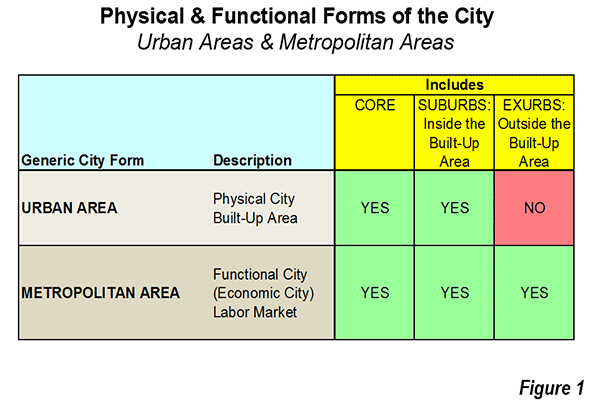
    Some nations report urban area data. Others report metropolitan area data. Urban areas and metropolitan areas are not the same thing. Urban areas are built up areas defined by the extent of the urban form, rather than by jurisdictional boundaries (see Demographia World Urban Areas). Metropolitan areas encompass both the urban area and the economically connected areas to the outside (exurbs). The difference is that urban areas do not include exurbs and metropolitan areas do (Figure 1).

    Some nations report only core municipality data, which is incomplete. Characterizing cities as only the core is rather like declaring a leg or a lung to be the same thing as a human body. These nations include Germany and Austria. Data for Valencia, Spain is also for the core municipality only.

    Perhaps the best source for citywide trends over the last 40 years in Western Europe is the United Nations data. The results are reported for urban areas and metropolitan areas, ignoring the irrelevant reported core data. Cities are included that had a population of 750,000 or more in any year from 1970 to 2010 on the UN World Agglomerations list. As of 2011, there are 24 urban areas and 16 metropolitan areas with comparable United Nations data (Table).

    How the Cities have Dispersed

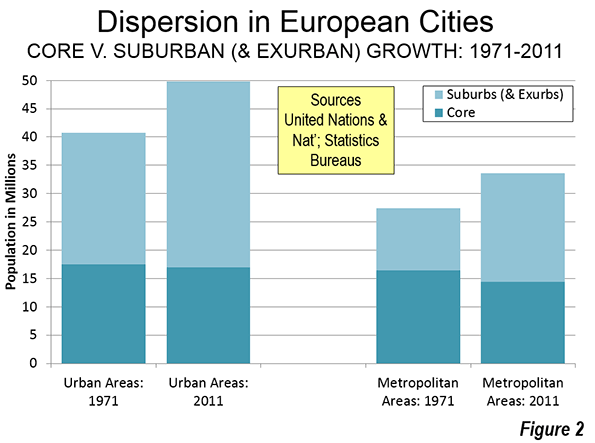
    Among the urban areas, the suburbs monopolized population growth over the period (1971 to 2011). Overall, the 24 urban areas increased their population by 9.1 million residents. This was the combination of a 9.7 million increase in the suburbs and a 600,000 loss in the cores. With the core losses, the suburbs accounted for 107% of the urban area growth.

    The monopolization of suburban and exurban growth was even greater in the 16 metropolitan areas. The overall citywide population increase was 6.2 million. This included 8.2 million in the suburbs and exurbs and the loss of 2.1 million in the cores.

    Combining these two different urban conceptions for statistical purposes shows how dominant suburban and exurban growth has been. In 1971, the cores and suburbs had about the same population. By 2011, the suburbs had grown to have 60% more residents than the cores (Figure 2).

    Some of the disparities were large. In Madrid, the suburbs grew 450 percent between 1971 and 2011, compared to only 5 percent in the core. In Toulouse, the suburbs grew 327 percent, while the core edged up only 20 percent, while in Zurich, the suburbs grew 186 percent compared to the core decline of 12 percent.

    Overall, core population performance exceeded that of the suburbs in only three of the 40 cases. The most significant is slow-growing Birmingham, which is closing in on its 1951 peak. Then there is Liverpool, which is managed to drop from the population peak of more than 850,000 in 1931 to under 475,000 in 2011. Liverpool’s loss over the 40 years was even less percentage wise than that of the suburbs. The core of Southampton also grew faster than the suburbs.

    Core Resurgence

    At the same time, it notable cores have reversed their previous loss patterns in recent years. Some resurgent cores remain well below their much earlier peaks. The ville de Paris has regained little more than 100,000 of its 800,000 loss since 1921. Inner London (Note) has regained much more (800,000), but still needs another 1.3 million to restore its 1901 peak (Outer London is so suburban that it provided much of the ammunition for the British anti-suburban movement). Others cores, like Stockholm and Madrid have risen above previous peaks.

    As in the United States, this urban resurgence should not lead to a perception that suburbanites are "flocking" to the urban cores. Domestic migration data continues to show net population movements from the cores to the suburbs and exurbs. Much of the resurgence has been propelled by international migration since enlargement of the European Union (such as from the growing London core), which has virtually eliminated westward barriers to immigration from the less affluent former Soviet satellites. Even the core of Stockholm, now at its population peak, has lost domestic migration to the suburbs in Stockholm County in each of the last five years according to Statistics Sweden data.

    Earlier Core Troughs

    The forty-year perspective masks some huge core population losses that occurred earlier. Perhaps the most spectacular is Copenhagen, which dropped from 768,000 in 1950 to 464,000 in 1992, for a percentage loss near that of Detroit from 1950 to 1990. Copenhagen’s population loss was 40 percent, compared to Detroit’s 44 percent (See: Shrinking Cities, Chapter 2). Since 1992, the core of Copenhagen has made up only a quarter of its loss since 1950.

    The core of Glasgow also suffered earlier losses. In 1931, the core municipality had a population nearing 1.1 million. By 1971, Glasgow became the first core municipality in the world to fall below 1,000,000 population after having achieved that status. Glasgow has since been followed by Naples, Turin and Detroit. Glasgow increased its population modestly after 2001, to just under 600,000.

    The Missing Cities

    What can be said about Germany and Austria, which do not provide data for either urban areas or metropolitan areas? If such data were available, it would likely show the same general trends. By the early 2000s, cores such as Berlin, Dresden, Frankfurt, Hamburg, Leipzig, Munich and Stuttgart had lost population from their peaks. Between 1987 and 2001, all growth in the Rhine-Ruhr, Western Europe’s third largest city, was in the suburbs and exurbs. This area, which defines the very term conurbation, may have been the first truly polycentric metropolitan area in the world, with its historic municipalities like Essen, Dusseldorf, Bochum, Gelsenkirchen, Oberhausen, Dortmund, Duisburg, Dusseldorf and Wuppertal.  Vienna reached its population peak in 1910,when  capital of the Austro-Hungarian under Emperor Franz Josef.

    Better Data Ahead

    Meanwhile, the state of urban statistics is improving significantly in Europe. It is to be expected that historical data would be non-comparable and cumbersome with Europe’s multiple nations. However, Eurostat now publishes its own, consistent metropolitan area data. Generally data is available back to the early or mid 2000s, which will make the lives of interested statisticians better in the future.

    The suburbanization of Europe may be surprising to New World tourists, who rarely venture beyond the historical cores. I called this the Louvre Syndrome, which describes New World tourists who jealousy wonder why their cites cannot look like attractive European cores, but never experience, predictably,  their extensive and   less historically appealing  suburbs. And why should they? Americans and Canadians go to Europe to see what’s different, not what’s similar.

    What is similar is that the cities of Europe, like those in Japan and the New World have dispersed as they have become more affluent, a dynamic pointed out by Robert Bruegmann in Sprawl: A Short History. There is also considerable dispersion going on in developing world cities. There is also an imperative to disperse the inhuman densities and living conditions in many parts of African, Asia and South America. These include shantytowns like Dharavi in Mumbai, Kibera in Nairobi, Rio’s notorious favelas and in Manila, with its all too frequent fires that destroy thousands of homes at once.

    Core & Suburban Growth in Cities
    Western Europe: 1971-2011
    Urban Areas (Urban Agglomerations) and Metropolitan Areas
    Population in 000s 1971 Population 2011 Population
      UA/MA Core Suburbs UA/MA Core Suburbs
    URBAN AREAS (URBAN AGGLOMERATIONS)      
    Amsterdam 938 820 118 1,064 780 284
    Athens 2,535 862 1,673 3,089 664 2,425
    Birmingham 2,369 1,013 1,356 2,446 1,086 1,360
    Bordeaux 590 254 336 853 239 614
    Dublin 783 569 214 1,114 528 586
    Glasgow 1,732 897 835 1,210 593 617
    Helsinki 522 529 -7 1,134 588 546
    Lille 912 233 679 1,020 228 792
    Liverpool 1,253 607 646 865 466 399
    London 7,787 2,959 4,828 10,297 3,232 7,065
    Lyon 1,128 507 621 1,563 491 1,072
    Manchester 2,391 542 1,849 2,559 503 2,056
    Marseille 1,197 894 303 1,569 851 718
    Newcastle 876 222 654 776 149 627
    Nice 649 328 321 947 344 603
    Oslo 643 488 155 916 599 317
    Paris 8,278 2,504 5,774 10,537 2,250 8,287
    Rotterdam 959 687 272 995 606 389
    Stockholm 1,031 747 284 1,385 847 538
    Southampton 740 213 527 857 254 603
    Thessaloniki 557 340 217 754 325 429
    Toulouse 476 372 104 891 447 444
    West Yorkshire 1,705 506 1,199 1,787 475 1,312
    Zurich 711 423 288 1,198 373 825
    Urban Areas 40,763 17,516 23,247 49,824 16,918 32,906
    METROPOLITAN AREAS (LABOR MARKETS)      
    Antwerp 858 227 631 976 185 791
    Barcelona 3,521 1,828 1,693 4,999 1,621 3,378
    Bergamo 561 126 435 799 115 684
    Bologna 746 488 258 766 371 395
    Brussels 1,576 143 1,433 1,975 170 1,805
    Copenhagen 1,338 626 712 1,207 540 667
    Florence 725 460 265 694 358 336
    Genoa 918 832 86 701 586 115
    Lisbon 1,874 782 1,092 2,826 553 2,273
    Madrid 3,595 3,121 474 5,870 3,265 2,605
    Milan 3,040 1,732 1,308 3,065 1,242 1,823
    Naples 2,019 1,267 752 2,213 962 1,251
    Palermo 757 653 104 855 658 197
    Porto 941 326 615 1,288 238 1,050
    Rome 3,168 2,656 512 3,617 2,617 1,000
    Turin 1,775 1,142 633 1,742 872 870
    Metropolitan Areas 27,413 16,409 11,004 33,594 14,353 19,241
    All 68,177 33,925 34,252 83,418 31,271 52,148
    Populaton Change 1971 Population 2011 Population
      UA/MA Core Suburbs UA/MA Core Suburbs
    URBAN AREAS (URBAN AGGLOMERATIONS)      
    Amsterdam 126 -40 166 13% -5% 141%
    Athens 553 -198 751 22% -23% 45%
    Birmingham 77 73 4 3% 7% 0%
    Bordeaux 263 -15 278 45% -6% 83%
    Dublin 331 -41 372 42% -7% 173%
    Glasgow -522 -304 -218 -30% -34% -26%
    Helsinki 611 59 552 117% 11%
    Lille 108 -5 113 12% -2% 17%
    Liverpool -389 -141 -248 -31% -23% -38%
    London 2,510 273 2,237 32% 9% 46%
    Lyon 435 -16 450 39% -3% 72%
    Manchester 169 -39 208 7% -7% 11%
    Marseille 372 -43 415 31% -5% 137%
    Newcastle -101 -73 -28 -11% -33% -4%
    Nice 298 16 282 46% 5% 88%
    Oslo 272 111 161 42% 23% 104%
    Paris 2,259 -254 2,513 27% -10% 44%
    Rotterdam 36 -81 117 4% -12% 43%
    Stockholm 354 100 254 34% 13% 90%
    Southampton 118 41 77 16% 19% 15%
    Thessaloniki 197 -15 212 35% -4% 97%
    Toulouse 415 75 340 87% 20% 327%
    West Yorkshire 82 -31 113 5% -6% 9%
    Zurich 487 -50 537 69% -12% 186%
    Urban Areas 9,061 -598 9,659 22% -3% 42%
    METROPOLITAN AREAS (LABOR MARKETS)      
    Antwerp 118 -42 160 14% -19% 25%
    Barcelona 1,477 -207 1,684 42% -11% 99%
    Bergamo 238 -11 249 43% -9% 57%
    Bologna 21 -117 138 3% -24% 54%
    Brussels 399 27 372 25% 19% 26%
    Copenhagen -131 -86 -45 -10% -14% -6%
    Florence -31 -102 71 -4% -22% 27%
    Genoa -217 -246 29 -24% -30% 34%
    Lisbon 952 -229 1,181 51% -29% 108%
    Madrid 2,275 144 2,131 63% 5% 450%
    Milan 24 -490 514 1% -28% 39%
    Naples 194 -305 499 10% -24% 66%
    Palermo 97 5 92 13% 1% 88%
    Porto 347 -88 435 37% -27% 71%
    Rome 449 -39 488 14% -1% 95%
    Turin -33 -270 237 -2% -24% 37%
    Metropolitan Areas 6,181 -2,056 8,237 23% -13% 75%
    All 15,242 -2,654 17,896 22% -8% 52%
    Population in 000s
    Sources:
       Urban Area/Metropolitan Area data estimated from UN
       Core data from national statistics bureaus
    Core: Core municipality or previous core municipality where data available
    Urban Areas/Metropolitan Areas over 750,000 in 1971 or 2001
    No data for Germany, Austria or Valencia (Spain)
       Do not report data in urban area or metropolitan area format
    Some cores may have added land area during the period


    Wendell Cox is principal of Demographia, an international public policy and demographics firm. He is co-author of the "Demographia International Housing Affordability Survey" and author of "Demographia World Urban Areas" and "War on the Dream: How Anti-Sprawl Policy Threatens the Quality of Life." He was appointed to three terms on the Los Angeles County Transportation Commission, where he served with the leading city and county leadership as the only non-elected member. He served as a visiting professor at the Conservatoire National des Arts et Metiers, a national university in Paris and is a Senior Fellow at the Center for Opportunity Urbanism.

    Photograph: Paris: Eifel Tower & La Defense from Tour Montparnasse (by author)

  • In NYC, Throwing Good Infrastructure Money After Bad

    Ten billion dollars — for a bus station. And if other projects are any guide, this price tag for a Port Authority Bus Terminal replacement is only going up from there.

    That’s after we’ve committed: $4.2 billion at the PATH World Trade Center station; $1.4 billion for the Fulton St. subway station; $11 billion for the East Side Access project; $4.5 billion for just two miles of the Second Ave. Subway, and $2.3 billion for a single station extension of the 7-train.

    Having grown numb to multi-billion price tags for building almost anything, New Yorkers might not know just how messed up all this is. In any other American city, even just one of these fiascoes might well have sunk the entire town.

    Read the entire piece at the New York Daily News.

    Photo by Metropolitan Transportation Authority of the State of New York (East Side Access: January 13, 2014) [CC BY 2.0], via Wikimedia Commons

  • The Valley And The Upstarts: The Cities Creating The Most Tech Jobs

    No industry generates more hype, and hope, than technology. From 2004 to 2014, the number of tech-related jobs in the United States expanded 31%, faster than other high-growth sectors like health care and business services. In the wider category of STEM-related jobs (science, technology, engineering and mathematics), employment grew 11.4% over the same period, compared to 4.5% for other jobs. The Commerce Department projects that growth in STEM employment will continue to outpace the rest of the economy through 2018.

    But all the new tech jobs have not been evenly distributed across the country. To determine which areas are benefiting the most from the current tech boom, Mark Schill, research director at Praxis Strategy Group, analyzed employment data from the nation’s 52 largest metropolitan statistical areas from 2004 to 2014. He looked at the change in employment over that timespan in companies in industries we associate with technology, such as software, engineering and computer programming services. (Note that this includes everyone at these companies, such as non-tech employees like janitors and receptionists). He also looked at the change in the numbers of workers in other industries who are classified as having STEM occupations (science, technology, engineering and mathematics-related jobs). This captures the many tech workers who are employed in businesses that at first glance may not seem to have anything to do with technology at all. For instance just 7% of the nation’s 1.5 million software developers and programmers work at software firms — the vast majority are employed in industries as disparate as manufacturing, finance, and business services.

    Our list features some well-known outperformers, but also some surprising metro areas usually not associated with venture capital and Silicon Valley. We also found that some high-profile metro areas that like to tout themselves as the “next Silicon Valley” are actually at best the middle of the pack in terms of tech and STEM job growth.

    The Strongest Engines

    At the top of our list is a group of cities that have long been identified with tech growth. Our No. 1 city, Austin, Texas, boasts the strongest expansion in tech sector employment of any of the nation’s 52 largest metropolitan areas from 2004 to 2014, 73.9%,  as well as 36.4% growth in STEM jobs, the fourth-highest growth rate in the country. Coming in a close second is Raleigh, N.C.,  part of the renowned Research Triangle region, home to outposts of multinationals like Bayer, BASF, GlaxoSmithKline, IBM and Cisco. The Raleigh metro area posted a 39% increase in STEM jobs from 2004-14, the fastest growth in the nation, albeit from a smaller base than many of the other biggest metro areas.

    However, the Bay Area continues to reign as the tech center with the most momentum. San Jose, which covers most of Silicon Valley, ranks third with 70.2% growth in tech sector employment since 2004 and a hefty 25.8% increase in STEM employment. The San Francisco metro area, which includes San Mateo to the south, ranks fifth with a 67.4% jump in tech industry employment as well as a STEM jobs increase of 27.5%.

    There may be more tech industry employees and workers in STEM occupations in the New York City, Washington, D.C., and Los Angeles metro areas, but San Jose has the strongest concentration of tech horsepower in the nation, with by far the highest per capita concentration of people in engineering professions. San Jose’s tech industry is responsible for 14.1% of all jobs, almost five times the national average of 2.9%. The share of STEM workers is 15.5% of its total workforce, three times the 5.0% proportion in the overall U.S. population. Both figures are easily the highest in the nation. San Francisco clocks in at second nationally with 7.6% of its jobs in tech industries and is fifth in STEM representation, at 8.7% of all workers, behind San Jose, the nation’s capital, Seattle, and our No. 1 city, Austin.

    Silicon Valley’s thick concentration of titans like Intel, Apple, Oracle, Google and Facebook has created an innovative ecosystem, which, as Pando Daily’s Michael Carney describes, supports a “systematic irrationality and a feedback loop” that encourages many tech entrepreneurs to turn down the easy early exit of selling out to a bigger company and make the commitment to grind for a decade or more in the hopes of joining the afore-mentioned standouts as a massive success.

    No other area apart from Seattle (No. 7 on our list) comes close in this regard to nurturing tech giants. The success of the Bay Area and Valley also attracts outsiders who want to be close to the action, including foreign players like Samsung, and old economy stalwarts that need a tech infusion like Wal-Mart.

    The Surprise Tech Upstarts

    Some of the others in our top 10 are not as renowned as tech centers, but have experienced rapid growth over the past decade. The biggest surprise may be No. 4 Houston, which enjoyed a 42.3% expansion of jobs in tech industries and a big 37.8% boost in STEM jobs from 2004-14. Much of the growth was in the now sputtering energy industry, but also medical-related technology, which continues to grow rapidly. Houston is the home to the Texas Medical Center, the world’s largest concentration of medical facilities. It also ranks second to San Jose in engineers per capita.

    The Mountain West metropolises of Salt Lake City (sixth) and Denver (11th) also have posted impressive growth, and now boast considerably higher share of tech and STEM workers in their populations than the national average; in Salt Lake City 5.9 percent of jobs are in tech industries and 4.1% are in STEM. Denver is even more impressive with 7.3% of jobs in tech industries and 5.1% working in STEM.  Salt Lake City’s gains are linked to a continued migration of tech firms, largely from Silicon Valley, whereas Denver is making waves as a start-up incubator.

    The other top cities on our growth list all tend to be emerging tech centers. These include No. 8 Nashville, where strong growth in data centers and systems design firms is at least partially tied to its strength in the health sector, No. 9 Jacksonville, driven by IT and computer programming services firms, and, perhaps most surprising, No. 10 Memphis, whose 35% tech growth since 2012 is due mostly to significant recent growth in engineering services. However, the tech sectors in these cities are still very small — Memphis had only 7,800 tech industry workers last year — and all three still trail the national average for the share of tech workers in the population.

    More Hat Than Cattle?

    Some journalists and pundits believe tech is moving from its suburban roots and towards dense, large cities. And there’s some truth to the fact that the social media boom, and some tech-driven services, appeal naturally to the same creative and culturally minded workforce concentrated in core cities. But this shift is not too evident in terms of job creation. High-tech growth in city centers may have more to do with tech sector expansion in general occurring in every type of geography.

    Suburban Silicon Valley, for example, has nearly twice the concentration of tech jobs as San Francisco; even amidst the social media boom, the Valley since 2012 has greatly outpaced the City and its immediate suburbs in terms of both new tech and STEM employment. The largest tech projects going up in the Bay Area — new headquarters for Google, LinkedIn and Apple – are being built in the Valley, not the city.

    Unlike San Francisco, cities located far from tech centers have not done nearly as well as often reported. Chicago has been desperate to portray itself as a major tech center, developing elaborate facilities for companies, while promoting its own high-tech icon, Groupon, and crowing over the high-profile names its lured to open up offices in the city, like Google. Mayor Rahm Emmanuel has even proposed expanded bike lanes as part of his plan to lure tech-savvy members of the “creative class” to his city.

    Yet despite all the noise, Chicago ranked a mediocre 33rd on our growth list, with 20.3% tech industry employment growth from 2004-14 and a mere 3.8% growth in STEM jobs. Both numbers are below the national average, as is the region’s percentage of employees in tech and STEM.

    How about Los Angeles, with its fabulous weather, elite universities (Caltech, University of Southern California, UCLA, Cal Poly Pomona and Harvey Mudd College) and close ties to the creative engine of Hollywood? Local boosters like to claim that the metro area is undergoing a full-scale “tech boom” focused on the west side in its so-called “Silicon Beach.” To be sure, the region still boasts the second largest pool of STEM workers in the country, in part due to its legacy of manufacturing, led by its shrunken but still sizable aerospace industry (63,000 jobs, down by 90,000 since the end of the Cold War). But Los Angeles’ large STEM numbers are to a great degree a function of the massive population of the metro area – the percentage of STEM employees in the workforce is 4.9%, a hair below the national average of 5%, while 2.5% of its workforce is in tech industries, trailing the national average of 2.9%. Los Angeles lands a poor 38th on our growth list, with an 18.7% expansion in tech industry jobs since 2004 and a 4% increase in STEM jobs, a shade below the national average of 4.2%.

    But perhaps the biggest surprise is New York, whose boosters are now claiming it to be the No. 2 tech center in the nation and the Valley’s chief rival. However, on our job growth list New York sits in a mediocre 35th place, with 24.3% growth in tech industry employment over the past 10 years, and only 4% in the last two. In STEM, New York still has the largest number of jobs of any metro area in the nation at 428,000 as of 2014, but that’s up a paltry 2.7% since 2004, and, as in the case of L.A., is a function of its large population. The percentage of STEM employees in the local workforce falls short of the national average at 4.4%. New York has gained about 51,000 technology industry jobs since 2004 and 12,000 since 2012, giving it a total of roughly 265,000 tech jobs. But that’s some 70,000 fewer than the Bay Area, an economy about one third the size of New York’s.

    Critically, most New York “tech” seems more linked to media than actual physical products, essentially replacing many of its old media jobs with newer ones. Part of the problem for New York is that it’s profoundly weak in engineering talent, ranking 78th out of 85 metropolitan areas in engineers per capita.

    The Bay Area Versus The Rest

    The current social media bubble will surely pop, but as Michael S. Malone and others have noted, the Bay Area’s preeminence will likely continue, fueled by its unique concentration of engineers, entrepreneurs, and risk capital. Instead of losing out to New York, Silicon Valley and San Francisco are luring many top performers from Wall Street. Google alone has 1,200 employees who formerly worked for large U.S. investment banks, and migration from the Big Apple to California is now at its highest level since 2006.

    In the coming years the engineering-centered Valley seems better positioned to seize on the challenges posed by the “Internet of things,” including systems for heating and cooling and autonomous cars, as well as biotechnology. In the long run, the Valley’s hegemony is threatened not by any one place, but by several that offer significant technical expertise, with far lower housing costs. San Francisco is already by far the nation’s least affordable metro area. Only 11% of residents making the median annual income can afford to buy a home, according to the NAHB/Wells Fargo Housing Opportunity Index – and the median income is in the San Francisco area is a hefty $100,400. The Valley is not far behind at 21.8%. The high prices throughout the Bay Area has become a concern of tech executives, who fear they will have troubles attracting more experienced engineers and managers.

    No matter the headlines, the reality is that future tech growth is more likely to be created by the less sexy business services sectors than by Internet media or software publishers. In the last decade three often-ignored industries — engineering services, systems design and custom programming – added nearly 750,000 jobs, while software providers and Internet properties added less than 200,000. The decentralizing force of these boring sectors is what’s driving growth in the second- and third-tier tech cities.

    But despite these trends, don’t expect the landscape of American technology, particularly at the high end, to change dramatically in the near future. Inertia is a powerful force, as is the enormous concentration of venture funds and expertise around the Bay Area. But if no one area can hope to challenge Silicon Valley’s lead position, it is likely tech growth will continue to flow to other areas that could collectively take the tech capital of the world down a notch or two.

    2015 Metropolitan Tech-STEM Growth Index
    Rank Region (MSA) Score 2004-2014 Tech Industry Growth 2012-2014 Tech Industry Growth 2014 Tech Industry LQ 2004-2014 STEM Occuptn Growth 2012-2014 STEM Occuptn Growth 2014 STEM Occuptn LQ
    1 Austin 87.4 73.9% 21.8% 1.90 36.4% 11.2% 1.77
    2 Raleigh, NC 85.7 62.3% 17.0% 2.23 39.0% 13.4% 1.63
    3 San Jose 78.1 70.2% 19.6% 4.92 25.8% 10.2% 3.11
    4 Houston 77.8 42.3% 18.5% 1.26 37.8% 12.3% 1.30
    5 San Francisco 70.5 67.4% 13.0% 2.64 27.5% 7.9% 1.74
    6 Salt Lake City, UT 70.0 62.4% 11.0% 1.44 33.3% 7.5% 1.17
    7 Seattle 66.5 58.3% 7.4% 2.34 37.6% 6.2% 1.94
    8 Nashville 65.3 68.6% 15.1% 0.68 14.7% 7.6% 0.80
    9 Jacksonville, FL 62.7 58.4% 13.5% 0.87 16.0% 8.2% 0.84
    10 Memphis, TN 61.0 35.3% 34.9% 0.41 5.0% 7.4% 0.63
    11 Denver 56.4 34.5% 10.1% 1.79 24.4% 7.8% 1.47
    12 Indianapolis 55.9 52.2% 8.2% 0.88 15.0% 7.4% 1.04
    13 Charlotte, NC 54.8 36.4% 8.7% 0.81 23.8% 7.1% 0.96
    14 Phoenix 54.1 51.1% 13.3% 0.90 13.9% 5.1% 1.10
    15 Kansas City, MO 54.0 46.2% 11.2% 1.49 16.5% 6.0% 1.11
    16 Portland, OR 52.5 33.2% 9.6% 1.10 19.8% 7.2% 1.31
    17 San Antonio 52.1 43.5% 4.3% 0.92 26.6% 4.8% 0.82
    18 Dallas 52.1 43.9% 6.0% 1.11 22.0% 5.4% 1.20
    19 Boston, MA 50.9 43.4% 9.9% 2.28 16.0% 5.2% 1.59
    20 Sacramento 47.5 47.8% 6.7% 0.94 11.6% 4.7% 1.36
    21 Grand Rapids 46.7 26.4% 13.2% 0.50 7.1% 7.6% 0.95
    22 Louisville, KY 46.5 23.7% 10.8% 0.57 16.4% 6.0% 0.74
    23 San Diego 45.4 33.8% 7.2% 1.81 16.0% 4.7% 1.44
    24 Las Vegas 45.1 13.6% 15.0% 0.57 8.8% 8.0% 0.47
    25 Tampa 43.7 26.8% 10.7% 0.99 4.2% 7.4% 0.91
    26 Orlando 42.9 18.3% 8.7% 0.96 13.9% 6.4% 0.82
    27 Baltimore 40.0 30.4% 5.2% 1.55 16.6% 2.6% 1.42
    28 Atlanta 38.0 19.1% 5.7% 1.22 10.2% 5.4% 1.10
    29 Minneapolis 37.8 17.8% 7.7% 1.07 11.0% 4.6% 1.24
    30 Cincinnati, OH 37.0 20.6% 8.7% 0.81 8.1% 4.0% 1.04
    31 Pittsburgh, PA 35.8 25.2% 3.1% 1.06 14.4% 2.5% 1.06
    32 Miami 35.0 3.6% 13.3% 0.64 -1.0% 7.3% 0.62
    33 Chicago, IL 34.3 20.3% 8.8% 0.91 3.7% 3.8% 0.93
    34 Richmond, VA 32.4 33.9% -2.9% 0.79 9.7% 2.2% 1.00
    35 New York 32.2 24.3% 4.7% 0.96 5.0% 2.7% 0.89
    36 Cleveland 32.1 21.7% 5.3% 0.74 4.1% 3.2% 0.91
    37 Hartford 31.9 30.7% 4.9% 0.89 4.9% 1.2% 1.12
    38 Los Angeles 31.1 18.7% 4.9% 0.86 2.1% 4.0% 0.99
    39 Detroit 29.2 6.2% 8.5% 1.97 -2.3% 5.4% 1.44
    40 Columbus, OH 27.9 9.5% 3.1% 1.07 9.4% 2.3% 1.19
    41 Riverside 25.5 12.8% 0.1% 0.33 4.7% 2.7% 0.53
    42 Providence 24.9 13.1% 1.3% 0.76 0.5% 3.1% 0.88
    43 New Orleans 24.8 21.6% 8.0% 0.68 -11.1% 2.4% 0.68
    44 Oklahoma City, OK 23.9 0.4% -4.8% 0.49 15.5% 2.6% 0.96
    45 Buffalo 23.2 26.3% -2.4% 0.80 3.1% -0.1% 0.85
    46 Birmingham 22.7 3.3% 2.7% 0.65 1.7% 2.8% 0.82
    47 St. Louis, MO 21.9 9.5% -3.5% 0.89 3.1% 2.9% 1.00
    48 Philadelphia, PA 21.6 10.0% 2.4% 1.17 0.6% 1.2% 1.09
    49 Rochester, NY 19.9 12.0% 8.1% 0.74 -4.5% -0.8% 1.06
    50 Washington, DC 16.4 7.3% -4.7% 2.59 10.8% -2.0% 2.07
    51 Milwaukee 16.3 0.1% -2.8% 0.76 1.5% 1.6% 0.99
    52 Virginia Beach 8.0 -2.2% -7.3% 1.04 1.5% -1.5% 1.05

    To determine the metro areas that are generating the most tech jobs, Mark Schill of Praxis Strategy Group,  mark@praxissg.com, examined employment data in two different categories. Half our ranking is based on changes in employment at companies in high-technology industries, such as software and engineering. (This includes all workers at these companies, some of whom, like janitors or receptionists, do not perform tech functions). Half is based on changes in the number of workers classified as being in STEM occupations, which captures tech workers who are employed in all industries, including those not primarily associated with technology, such as finance or business services. We ranked the 52 largest U.S. metropolitan statistical areas by the growth in tech and STEM employment from 2004 to 2014, as well as for their more near-term growth from 2012 to 2014 to give credit for current momentum.

    This piece originally appeared at Forbes.

    Joel Kotkin is executive editor of NewGeography.com and Roger Hobbs Distinguished Fellow in Urban Studies at Chapman University, and a member of the editorial board of the Orange County Register. He is also executive director of the Houston-based Center for Opportunity Urbanism. His newest book, The New Class Conflict is now available at Amazon and Telos Press. He is also author of The City: A Global History and The Next Hundred Million: America in 2050.  He lives in Los Angeles, CA.

    Mark Schill is a community process consultant, economic strategist, and public policy researcher with Praxis Strategy Group.

    Photo “Sixth Street Austin” by Larry D. Moore. Licensed under CC BY-SA 3.0 via Wikimedia Commons.

  • Why California’s Salad Days Have Wilted

    “Science,” wrote the University of California’s first President Daniel Coit Gilman, “is the mother of California.” In making this assertion, Gilman was referring mostly to finding ways to overcoming the state’s “peculiar geographical position” so that the state could develop its “undeveloped resources.”

    Nowhere was this more true than in the case of water. Except for the far north and the Sierra, California – and that includes San Francisco as well as greater Los Angeles – is essentially a semiarid desert. The soil and the climate might be ideal, but without water, California is just a lot of sunny potential, but not much economic value.

    Yet, previous generations of Californians, following Gilman’s instructions, used technology to build new waterworks, from the Hetch Hetchy Dam to the L.A. Aqueduct and, finally, the California State Water Project and its federal counterpart, the Central Valley Project. These turned California into the richest farming area on the planet and generated opportunities for the tens of millions who came to live in the state’s cities and suburbs.

    Read the entire piece at The Orange County Register.

    Joel Kotkin is executive editor of NewGeography.com and Roger Hobbs Distinguished Fellow in Urban Studies at Chapman University, and a member of the editorial board of the Orange County Register. He is also executive director of the Houston-based Center for Opportunity Urbanism. His newest book, The New Class Conflict is now available at Amazon and Telos Press. He is also author of The City: A Global History and The Next Hundred Million: America in 2050.  He lives in Los Angeles, CA.

    Photo of Lake Palmdale California Water Project by Kfasimpaur (Own work) [Public domain], via Wikimedia Commons