Category: Urban Issues

  • Welcome to the Billion-Man Slum

    When our urban pundit class speaks of the future of cities, we are offered glittering images of London, New York, Singapore, or Shanghai. In reality, the future for most of the world’s megacities—places with more than 10 million people—may look more like Dhaka, Mumbai, or Kinshasa: dirty, poverty- and disease-ridden, and environmentally disastrous.

    Harvard’s Ed Glaeser suggests that megacities grow because “globalization” and “technological change have increased the returns to being smart.” And to be sure, megacities such as Jakarta, Kolkata (in India), Mumbai, Manila, Karachi, and Lagos—all among the top 25 most populous cities in the world—present a great opportunity for large corporate development firms and thrilling treasure troves for both journalists and academic researchers. But surely there’s a better alternative to celebrating misery, as one prominent author did recently in aForeign Policy article bizarrely entitled “In Praise of Slums.”

    Bigger is no longer better.

    Let’s start with the idea that, in an urbanizing world, bigger is no longer necessarily better. In a recent study I conducted with Ali Modarres, Aaron Renn, and Wendell Cox for Singapore’s Civil Service College and Chapman University, we ranked cities by importance as global centers. Of the world’s estimated 29 megacities, only a handful made into the top 20. Most leading megacities were either long-established Western cities—Tokyo, New York, London, Los Angeles—or located in booming East Asia, including Beijing, Shanghai, and Seoul.

    Notably missing are fast-growing growing megacities such as Lagos, Karachi, and Dhaka, as well as the 16 additional megacities—mostly in developing countries in Africa and south Asia—that will pass the 10 million mark by 2030. Yet despite their girth, the majority of megacities are not particularly attractive for foreign investors or as locations for regional corporate offices. These firms tend to cluster instead in westernized cities such as Singapore, Hong Kong, or Dubai, and visit places like Jakarta, Manila, and Cairo only when necessary.

    History drives some of this. The great global cities rose as centers of industry and trade, while developing from there an excellence in related services. They created pockets of a more advanced economy to serve the predominately rural hinterland, or in some cases colonial possessions. This imperial relationship spurred the rise of London, Paris, and New York in the early 20th century, and also that of Tokyo, still the world’s biggest city.

    Some new megacities, some such as Guangzhou and Shenzhen (which in 1979 had roughly 30,000 people, compared to its 10.6 million today) have a real economic shot at becoming top global cities due to China’s emergence as the world’s workshop. But, as we explain in a recent paper from Chapman University, this is far less the case for most megacities in the developing world.

    Unlike their Chinese counterparts, these megacities’ expansion has not been driven by economic growth but more by bringing people from their own impoverished countryside into the city. Critically, in contrast to the peasants who came to Tokyo in the ’50s or Shanghai in the ’90s, there is no huge demand for an industrial workforce in cities in South Asia, Africa, or Latin America, where manufacturing is far less prevalent—manufacturing’s share of India’s GDP, for example, is half that of China.

    Here’s the difficult truth: Most emerging megacities, particularly outside of China, face bleak prospects. Emerging megacities like Kinshasa or Lima do not command important global niches. Their problems are often ignored or minimized by those who inhabit what commentator Rajiv Desai has described as “the VIP zone of cities,” where there is “reliable electric power, adequate water supply, and any sanitation at all.” Outside the zone, Desai notes, even much of the middle class have to “endure inhuman conditions” of congested, cratered roads, unreliable energy, and undrinkable water.

    The slums of Bangladesh’s capital, Dhaka, swell by as many as 400,000 new migrants each year. Some argue that these migrants are better off than previous slum dwellers since they ride motorcycles and have cellphones. Yet access to the wonders of transportation and “information technology” don’t compensate for physical conditions demonstrably worse than those endured even by Depression-era poor New Yorkers. My mother’s generation at least could drink water out of a tap and expect consistent electricity, if the bill was paid, something not taken for granted by their modern-day counterparts (PDF) in the developing world.

    More serious still, the slum dwellers face enormous risk from unsafely built environments. Traffic, as anyone who has spent time in these cities easily notices, poses particular threats to riders and pedestrian alike. According to researchers, developing countries now experience a “neglected epidemic” of road-related injuries accounting for 85 percent of the world’s traffic fatalities.

    And don’t drink the water, please. Nearly two-thirds of the sewage in the megacity of Dhaka, with 15 million people, is untreated. As Dr. Marc Reidl, a specialist in respiratory disease at UCLA, puts it, “Megacity life is an unprecedented insult to the immune system.”

    Cities of disappointment.

    Over these environmental problems loom arguably greater social ones. Many of the megacities—including the fastest growing, Dhaka—are essentially conurbations dominated by very-low-income people; roughly 70 percent of Dhaka households earn less than $170 (U.S.) a month, and many of them far less. “The megacity of the poor,” is how the urban geographer Nazrul Islam describes his hometown.

    Inequality is expanding in most of these places. A recent Euromonitor International study found that larger “city size remains the key explanatory factor for income inequalities across the world’s urban agglomerations.” Even megacities that we might refer to as “middle income,” such as Tehran and Istanbul, are becoming what geographer Ali Modarres calls “cities of disappointment.” In many cases, high housing prices and a lack of space have already reduced the birthrate to well below the replacement level. Increasingly, many women are choosing to remain single—heretofore something rare in these countries.

    One scholar, Jan Nijman, suggests that most gains in recent years have accrued to the upper echelons of the middle class in Indian cities while “the ranks of the lower middle income classes have shrunk, and the ranks of the poor have expanded rapidly.” Much of the growth in a perceived middle class, Nijman argues, is based not on income but on consumption driven by credit. The informal sector—drivers, stall-owners, repair-people, household industries—account for much of Mumbai’s employment growth.

    Housing costs are the key here. Researcher Vatsala Pant estimates a monthly total household “middle class income” in Mumbai at 40,000-50,000 rupees; equivalent to less than $1,000 U.S. dollars. Yet monthly salaries for teachers, police officers, and other mid-level jobs are often half that amount. Not surprisingly, even these workers often find themselves living in slum neighborhoods, which are also known as jhopad-patti, jhuggi-jhopadi or busties. “It’s the dream of an immigrant for a place in Mumbai … and ends up with a slum,” she notes.

    Is there a better alternative?

    Future urbanization does not need to pose a choice between rural hopelessness and urban despair. This is a critical issue, even for high-income countries. The rise of a mass of poor slum dwellers—estimated as high as 1 billion—threatens the social stability not only of the countries they inhabit, but the world, as they tend to generate high levels of both random violence and more organized forms ofthuggery, including terrorism.

    Fortunately, an alternative structure of urbanization is beginning to emerge that emphasizes a spreading diversity of cities as opposed to gigantic agglomerations. In the coming decade, McKinsey predicts megacities will underperform economically and demographically, as growth shifts to “fast growing middleweights,” many of them in China and India.

    There needs to be a far greater emphasis on these smaller cities, as well as working to develop a viable economy for the villages. In India, migration to large cities already is beginning to slow, as more potential migrants weigh the costs and opportunities of making such a move as opposed to staying closer to home. This phenomenon has been called “rurbanization” and was an important provision of the campaign of India’s new prime minister, Narendra Modi, who implemented such programs as chief minister of the state of Gujarat. Modi speaks of human settlements with the “heart of a village” and developing “the facilities of the city.”

    A growing array of critics understand the need to break with the megacity mantraAshok R. Datar, chairman of the Mumbai Environmental Social Network and a longtime adviser to the Ambani corporate group, says the emerging megacities of the developing world need to stop emulating the Western model of rapid, dense urbanization. “We are copying the Western experience in our own stupid and silly way,” Datar says.

    He suggests a policy focusing on more human-scale growth. One does not have to be a Gandhian idealist to suggest that Ebenezer Howard’s “garden city” concept—conceived as a response to miserable conditions in early 20th century urban Britain—may be a better guide to future urban growth than the current trend of relentless concentration.

    The “garden city” alternative could help ameliorate the downsides of  mass urbanization in China as well, where the government is seeking to move 250 million more people from the countryside to urban areas over the next decade. “There’s this feeling that we have to modernize, we have to urbanize, and this is our national-development strategy,” said Gao Yu, China country director for the Landesa Rural Development Institute, based in Seattle. Referring to the disastrous Maoist campaign to industrialize overnight, he added, “it’s almost like another Great Leap Forward.”

    As the world urbanizes, we need to start thinking about how to make cities better, not simply bigger. The primary goal of a city should not be to enrich already wealthy landlords and construction companies. It should not be to make politicians more powerful. And it certainly should not be mindless, pointless growth for its own sake. Urbanism should not be defined by the egos of planners, architects, politicians, or the über-rich but by what works best for the most people.

    This piece originally appeared at The Daily Beast.

    Joel Kotkin is executive editor of NewGeography.com and Distinguished Presidential Fellow in Urban Futures at Chapman University, and a member of the editorial board of the Orange County Register. His newest book, The New Class Conflict is now available for pre-order atAmazon and Telos Press. He is author of The City: A Global History and The Next Hundred Million: America in 2050. His most recent study, The Rise of Postfamilialism, has been widely discussed and distributed internationally. He lives in Los Angeles, CA.

    Dhaka photo by Wendell Cox.
  • A Typology of Gentrification

    Patterns of gentrification vary by city, and the spread of gentrified areas is partly determined by the city’s predominant development form and the historic levels of African-American populations within them. Gentrification is a nuanced phenomenon along these characteristics, but most people engaged in any gentrification fail to acknowledge the nuances.

    Spurred on by the recent debate on the impact of limited housing supply on home prices and rents, thereby “capping” gentrification, (taken on fantastically by geographer Jim Russell in posts like this), I decided to do a quick analysis of large cities and see how things added up. The analysis was premised on a couple observations of gentrification, one often spoken and one not. One, gentrification seems to be occurring most and most quickly in cities that have an older development form, offering the walkable orientation that is growing in favor. Two, gentrification seems to be occurring most and most quickly in areas that have lower levels of historic black populations. This less noted observation was the thrust of a study by Harvard sociology professor Robert Sampson and doctoral student Jackelyn Hwang, recently described here. Here’s what they said, after conducting an exhaustive study of gentrification patterns in Chicago:

    After controlling for a host of other factors, they found that neighborhoods an earlier study had identified as showing early signs of gentrification continued the process only if they were at least 35 percent white. In neighborhoods that were 40 percent or more black, the process slowed or stopped altogether.

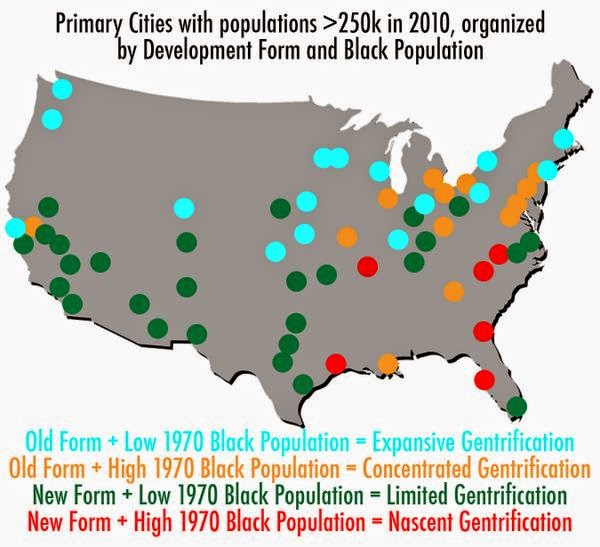
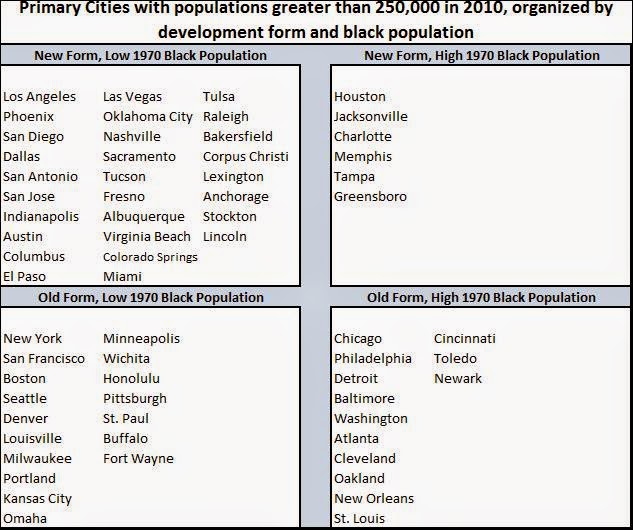
    That prompted my quick study. I wanted to categorize cities by old and new development forms, and low and high historic levels of black population. To do that I came up with an arbitrary proxy for the age of development form. Using decennial Census data, if a city reached 50 percent of its peak population by 1940, it was deemed to have an old development form; if a city reached 50 percent of its peak population in 1950 or later, it was deemed to have a new development form. Here’s a quick example of how this works. Baltimore, currently with a population of a little over 600,000, reached its peak of 949,000 in 1950. Baltimore reached half its peak, or about 475,000, by 1890, a time at which it could be said that Baltimore’s form as a city had been firmly established. Similarly, Austin reached its peak of 790,000 in 2010. The fast-growing Texas city was half that size in only 1990, a year in which it could be said that its development form was established and the city began to see itself as a major city. Imprecise, yes, but a decent proxy for examining old and new city development forms.

    The second piece of analysis was gathering Census data on central city black populations in 1970. This decade was chosen largely because it represents the end of the Great Migration, when millions of African-Americans left the rural South for cities across the nation. By that time the cities which are generally recognized as having large black populations had already been identified, and it’s possible to explore the impact of the migration on them. I arbitrarily said cities with black populations lower than 25 percent of the total in 1970 had a low black population, and those above 25 percent had a high black population.

    Using those two factors, I put together this table of the 64 primary cities over 250,000 in the U.S.:


    There are more than a few cities that are exceptions, largely because recent consolidations or large-scale annexations have boosted them into more unfamiliar boxes. But some patterns are evident, and if you think of these in terms of gentrification, you might be able to make the following general assumptions:

    Old Form + Low Black Population = Expansive Gentrification (OFLB)
    Old Form + High Black Population = Concentrated Gentrification (OFHB)
    New Form + Low Black Population = Limited Gentrification (NFLB)
    New Form + High Black Population = Nascent Gentrification (NFHB)

    Identifying the examples might be the best way to explain what I mean. New York, San Francisco and Boston are the prototypical OFLB cities, and gentrification has made its widest impact in these three cities. Chicago, Washington and Atlanta are the classic OFHB cities, where gentrification is concentrated in certain areas of the city (or region), and eludes the heavily African-American parts of the city. Phoenix, San Diego and Las Vegas might be the prototypical NFLB cities, all of which came of age with the car as the dominant mode of transport and with few African-Americans. NFLB cities may also be the leaders and innovators in seeking ways to catalyze their inner cities, with greater tangible investments in public transit and mixed use development. The relatively few NFHB cities are a distinctly Southern phenomenon, and by all appearances gentrification activity lags behind other cities, with sprawl still the dominant development engine.


    Cities by gentrification type. Special thanks to Adam Carstens for producing this map.

    Why would any of this matter? Nationally, the gentrification debate is defined by the experiences of the OFLB types like New York, San Francisco and Boston. There, the issues are rapidly growing unaffordability, concerns with displacement and growing inequality. But the gentrification debate is quite different in OFHB cities like Philadelphia and Atlanta, where seeking ways to more equitably spread the positive benefits of revitalization might lead such discussions.

    In other words, it’s not exactly correct to look at what’s happening in Los Angeles or San Diego, or Baltimore or St. Louis, in the New York-San Francisco-Boston context. Different forces and different experiences are creating different outcomes in each city, and if we want to understand how to look at gentrification’s impact, we need to understand its foundations.

    This post originally appeared in Corner Side Yard on August 15, 2014.

    Pete Saunders is a Detroit native who has worked as a public and private sector urban planner in the Chicago area for more than twenty years.  He is also the author of “The Corner Side Yard,” an urban planning blog that focuses on the redevelopment and revitalization of Rust Belt cities.

  • The Problem With Being Global

    The globalization of cities and their elites often comes at the expense of many of the people who live there. Forced to compete with foreign capital and immigrant workers, native-born residents of cities from Los Angeles and London to Singapore often feel displaced, becoming strangers in what they thought was their own place.

    This phenomena is common for virtually all the leading lights on our list of The Most Influential Global Cities. Higher prices and greater labor force competition seem to be the natural result of global city status, posing enormous challenges to local populations and those that govern them.

    Since the late Enlightenment, great cities, often built around markets, were typically places for the aspirational middle and lower classes. The ability to rise in cities from North America and Europe to Asia — through what historian Peter Hall calls “this unique creativity of great cities” — stands as one of the great social achievements of modern times.

    But in this era of powerful oligarchs and growing inequality, these planetary centers are less places for upward mobility than most other cities. This is clearly true in the United States, where its premier global city, New York, as well as its prime competitors for international standing, Chicago, Los Angeles and the San Francisco Bay Area, rank among the 10 most unequal cities in the nation.

    The property market has a distorting effect. Home prices in affordable markets tend to average three times household incomes. The ratio for the top 10 global cities tend to be much higher, often upward of 10 times incomes.

    Pied a terre and investment purchases by wealthy residents of the former Soviet Union, China, the Indian diaspora and the Middle East play a role in this inflation, particularly in London, where an onslaught of Asian buyers, now, by one estimate, purchases 70% of the city’s newly built homes.For young people in London, the possibility of home ownership has begun to evaporate. Regulations that restrict new construction and raise development costs also play a substantial role in the diminishing amount of affordable housing in cities like London, New York and San Francisco.

    The Disappearance Of The Middle Class

    Rising home prices are among the impacts of globalization that tend to force out the middle class. Even in traditionally egalitarian Toronto, a study by the University of Toronto found that between 1970 and 2001 the proportion of middle-income neighborhoods in the core city had dropped from two thirds to a third, while poor districts had more than doubled to 40%. By 2020, according to the study, middle-class neighborhoods could fall below 10%, with the balance made up of affluent and poor residents.

    This leads even usual urban booster to question the direction of their cities, as they lose their counter-culture gloss. As one green journalist laments: “But what are we getting when we throw away height limits and barriers to development, stop worrying about shadows and views, and let the developers loose? Also importantly, who are we getting?”

    The impact of rising prices clearly reshapes societies. In Manhattan, half of households are single, according to the American Community Survey; in the city of San Francisco, there are now 80,000 more dogs than children. Similar trends can be seen in London, Paris, Tokyo, Hong Kong, Singapore and other top global cities. Due to high prices, some 45% of Hong Kong’s middle-class couples have abandoned the idea of having children anytime soon, according to a survey commissioned by Citibank.

    The Jobs Dilemma

    Property prices and development pressures represent just one aspect of how globalization impacts the native working and middle class. The globalized economy often favors the employment of the very skilled, and those who serve them. Many companies, such as in finance, move their middle management jobs to other, less pricey places, from Sioux Falls to India and virtually anywhere else, reducing global cities’ mid-income employment and middle-class populations.

    At its apex, in places like New York and London, the new global economy creates what economist Ajay Kapur calls a “plutonomy,” an economy that revolves around serving the wealthiest. This leaves the primary global cities as centers for both concentrated wealth and the greatest poverty, as we have seen in London, New York and other major global cities.  In New York, over a third of workers labor in low wage, service jobs, a percentage that has increased steadily through the recovery, notes a recent study by the Center for an Urban Future.

    Not surprisingly the luxury cities — the most affluent parts of certain metropolitan areas — tend to have the highest concentrations of inherited and other rentier wealth in the nation, as well as some of the greatest concentrations of poverty. An asset-based recovery, like America’s current one, favors places like Manhattan, but does little for the Bronx, just across the Harlem River, which ranks at the bottom among the nation’s large counties for the percentage of residents’ income that comes from investments, rents and dividends.

    Increasingly, the cores, and often the suburbs, of global cities such as New York San Francisco, London, Paris and other cities where the cost of living has skyrocketed are no longer places where one goes to be someone; they are where you live when already successful or living on inherited largess. They are, as journalist Simon Kuper puts it, “the vast gated communities where the one percent reproduces itself.”

    Political Consequences

    These trends could shape the future of cities socially and politically. In New York, the election of a strong left-wing mayor, Bill de Blasio,reflected the concerns of working- and middle-class Gothamites that they were becoming superfluous in their own town. Similar leftward trends can be seen in Seattle, another city that has experienced widespread gentrification, and recently passed a $15 an hour minimum wage.

    This shift represents, in part, a reaction to the fact that gentrification has done little to address the large and growing population of the poor in many global cities. London may, by recent accounts, have more billionaires than any city on the planet, but it also has the highest incidence of child poverty in the United Kingdom.

    Even many of the lower-end service jobs in restaurants, construction and retail have not redounded to the benefit of the native-born in Britain; more than 70% of the jobs created between 1997 and 2007 in the United Kingdom went to foreigners, according to the OECD. Indeed, economist Tony Travers at the London School of Economics estimated that during the last decade London received more immigrants, many from the rest of the EU, than New York or Los Angeles.

    Cultural Displacement

    The combination of mass migration and the power of the city-hopping global wealthy makes many native-born residents in global cities worried, as one London writer put it, about losing “the soul” of their city.

    This trend can be discerned in almost any global city. A Tommy Hilfiger or other chain store in Causeway Bay in Hong Kong, Fifth Avenue in New York, or Regent Street in London is pretty much like any other. Yet for independent merchants in global cities, the price of being there is often too much to bear. In the process many of the most unique shops and restaurants are displaced by the largely high-end chains that can handle the rent.

    At the same time, globalization and migration have inspired dangerous reactions, notably nativism, and a growing chasm between guest workers and residents. This has become a political issue even in the most cosmopolitan cities such as London, Singapore and the Randstadt (Amsterdam-Rotterdam-the Hague-Utrecht ).

    The fundamental challenge: the global city must accommodate two identities, a global and a local one. A great global city must serve its international role as well as its local economy and the needs of its local residents. A city must be more than a fancy theme park or a collection of elite headquarter towers. It needs a middle and working class, not just the global rich and their servants. It needs families and ordinary residents who may rarely leave town, not just globe-trotters. It needs to be true to itself and the people who, in the first place, created it.

    This piece originally appeared at Forbes.

    Joel Kotkin is executive editor of NewGeography.com and Distinguished Presidential Fellow in Urban Futures at Chapman University, and a member of the editorial board of the Orange County Register. His newest book, The New Class Conflict is now available for pre-order atAmazon and Telos Press. He is author of The City: A Global History and The Next Hundred Million: America in 2050. His most recent study, The Rise of Postfamilialism, has been widely discussed and distributed internationally. He lives in Los Angeles, CA.

    Hong Kong photo by BighStockphoto.com

  • Beyond Polycentricity: 2000s Job Growth (Continues to) Follow Population

    The United States lost jobs between 2000 and 2010, the first loss between census years that has been recorded in the nation’s history. The decline was attributable to two economic shocks, the contraction following the 9/11 attacks and the Great Recession, the worst financial crisis since the Great Depression. Yet, even in this moribund job market, employment continued to disperse in the nation’s major metropolitan areas.

    This is the conclusion of a small area analysis (zip code tabulation areas) of data from County Business Patterns, from the Census Bureau, which captures nearly all private sector employment and between 85 and 90 percent of all employment (Note 1). 

    The small area analysis avoids the exaggeration of urban core data that necessarily occurs from reliance on the municipal boundaries of core cities (which are themselves nearly 60 percent suburban or exurban, ranging from as little as three percent to virtually 100 percent). This "City Sector Model" small area analysis method is described in greater detail in Note 2.

    Distribution of Employment in Major Metropolitan Areas

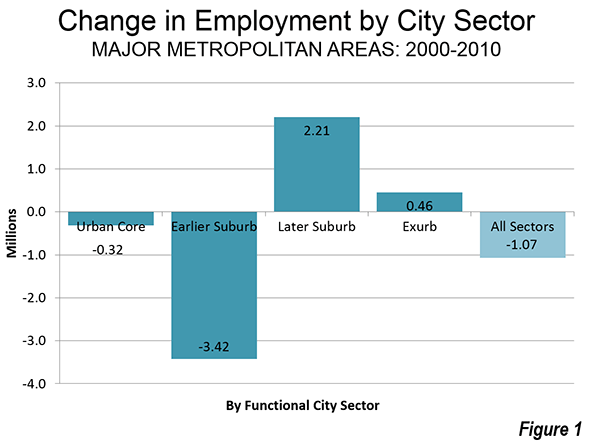
    County Business Pattern data indicates that employment dropped approximately 1,070,000 in the 52 major metropolitan areas (those with more than 1,000,000 population) between 2000 and 2010. The inner city sectors (the functional urban cores and earlier suburbs) were hard-hit. Together the inner sectors, the functional urban cores and the earlier suburbs, lost 3.74 million jobs. The outer sectors, the later suburbs and the exurbs, gained 2.67 million jobs (Figure 1).

    There were job losses of more than 300,000 in the functional urban cores, and even larger losses (3.2 million) in the earlier suburbs. The functional urban cores are defined by the higher population densities that predominated before 1940 and a much higher dependence on transit, walking and cycling for work trips. The earlier suburbs have median house construction dates before 1980.

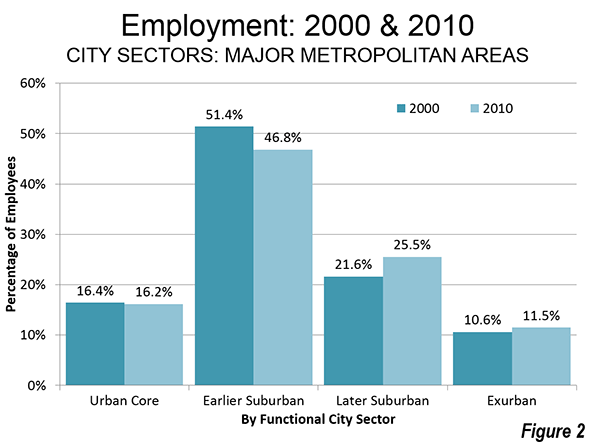
    The share of major metropolitan area employment in the functional urban cores dropped from 16.4 percent in 2000 to 16.2 percent in 2010. This compares to the 8 percent of major metropolitan employment that is downtown (central business district) areas. The notion, however, that metropolitan areas are dominated by their downtowns is challenged by the fact that 84 percent of jobs are outside the functional urban cores.

    The largest percentage of major metropolitan areas is clustered in the earlier suburbs, those with median house construction dates from 1946 to 1979. In 2010, 46.8 percent of the jobs were in the earlier suburbs, a decline from 51.4 percent in 2000.

    These losses in employment shares in the two inner city sectors were balanced somewhat by increases in the outer sectors, the later suburbs (with median house construction dates of 1980 or later) and the exurbs, which are generally outside built-up urban areas. The increase was strongest in the later suburbs, where, where employment increased by 2.6 million. The share of employment in the later suburbs rose to 25.5 percent from 21.6 percent. There was also a 600,000 increase in exurban employment. The exurban share of employment rose to 11.5 percent from 10.6 percent (Figure 2).

    The Balance of Residents and Jobs

    There is a surprisingly strong balance between population and employment within the city sectors, which belies the popular perception by some press outlets and even some urban experts that as people who farther away from the urban core, they have to commute farther. In fact, 92 percent of employees do not commute to downtown, and as distances increase, the share of employees traveling to work downtown falls off substantially. As an example, only three percent of working residents in suburban Hunterdon County, New Jersey (in the New York metropolitan area), work in the central business district, Manhattan, while 80 percent work in relatively nearby areas of the outer combined metropolitan area.

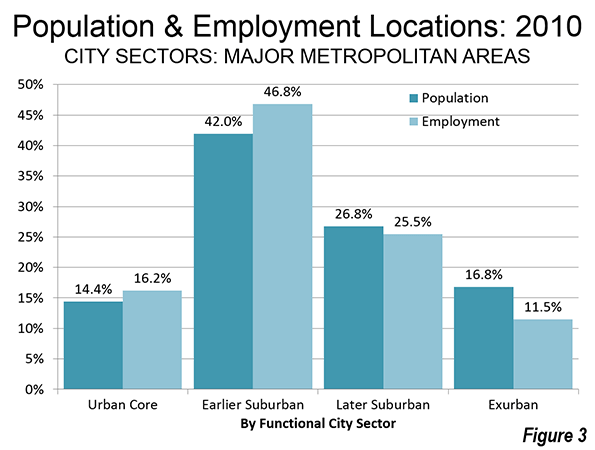
    It is to be expected that the functional urban core would have a larger share of employment than population. However the difference is not great, with 16.2 percent of employment in the functional urban core and 14.4 percent of the population. The earlier suburbs have by far the largest share of the population at 42.0 percent. They also have the largest share of employment, at 46.8 percent. The later suburbs have 26.8 percent of the population, slightly more than their 25.5 percent employment share. The largest difference is, as would be expected, is in the exurbs, with 16.8 percent of major metropolitan area residents and 11.5 percent of employment (Figure 3). It is notable, however, that the difference between the share of population and employment varies less than 15 percent in the three built-up urban area sectors (urban core, earlier suburbs and later suburbs), though the difference was greater in the exurbs.

    How Employment Followed Population in the 2000s

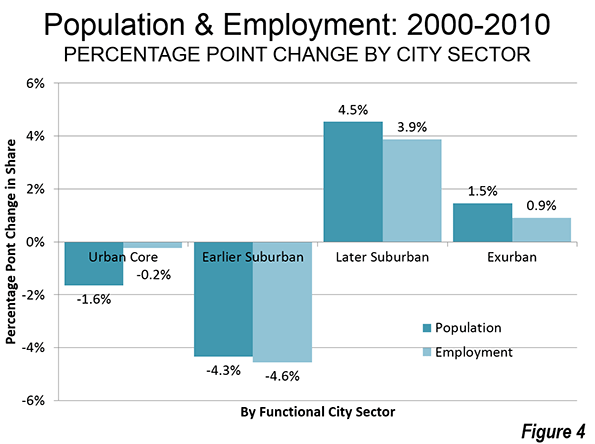
    The outward shifts of population and employment are between in the city sectors. In the earlier suburbs, where the population and employment is the greatest, the population share declined 4.3 percentage points, while the employment share declined a near lockstep 4.6 percentage points. The later suburbs had a 4.5 percentage point increase in population share, followed closely a near lockstep 3.9 percentage point increase in employment share. In the exurbs, a 1.5 percentage point increase in the population share was accompanied by a 0.9 percentage point increase in the employment share. The connection is less clear in the functional urban core, where a 1.6 percentage point drop in the population share was associated with a 0.2 percentage point reduction in the employment share (Figure 4).

    The similarity in population and employment shares between the city sectors is an indication that employment growth has been geographically tracking population growth for decades, as cities have evolved from moncentricity to polycentricity and beyond.

    "Job Following" by Relative Urban Core Size

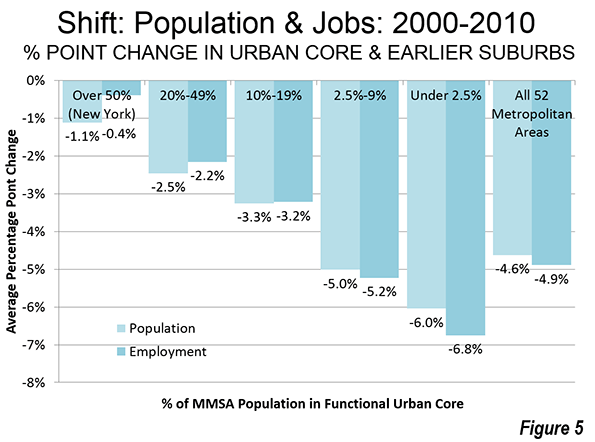
    Similar results are obtained when cities are categorized by the population of their urban cores relative to the total city population. Each category indicates an outward shift from the functional urban cores and earlier suburbs to the later suburbs and exurbs, in both the population share and the employment share. However, the shift is less pronounced in the cities with larger relative urban cores, which tend to be in the older urban regions  (Figure 5). Out of the 18 cities with functional urban cores amounting to more than 10 percent of the metropolitan area, 16 are in the Northeast (including the Northeastern corridor cities of Washington and Baltimore) and the Midwest, where strong population growth ended long ago.

    As usual, New York is in a category by itself, New York, has a functional urban core with more than 50 percent of its population. New York experienced an outward shift of 1.1 percent in its population, and a 0.4 percent outward shift of its employment (the total shift in share, from the urban core and earlier suburbs to the later suburbs and exurbs, expressed in terms of percentage points).

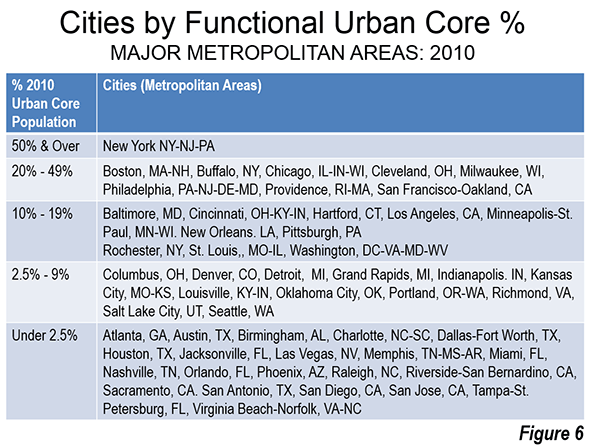
    Generally speaking, the stronger the functional urban core, the less the movement of jobs and people from the center. The actual percentages of functional urban core population by city are shown in From Jurisdictional to Functional Analysis of Urban Cores and Suburbs (Figure 6).

    On average, there was a shift of nearly five percent from the inner sectors (functional urban cores and earlier suburbs) to the outer sectors (later suburbs and exurbs)

    Commute Times: Less Outside the Urban Cores

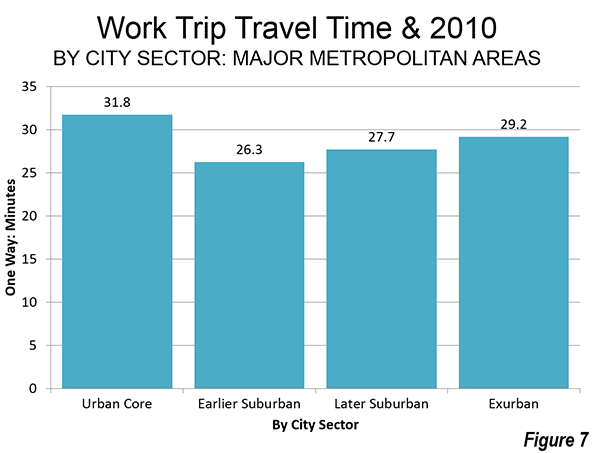
    The earlier suburbs are generally between the functional urban cores and the later suburbs geographically. As a result, jobs are particularly accessible to residents from all over the metropolitan area. A further consequence is that commute times are shortest (26.3 minutes) in the earlier suburbs, where approximately half of the people also live. Commute times are a bit higher in the later suburbs (27.7 minutes). The exurbs have the third longest commutes, at 29.2 minutes. Finally, commute times are longest in the functional urban cores (31.8 percent), both because traffic congestion is greater (to be expected, not least because of their higher densities), and more people take transit, which is slower (Figure 7).

    The dispersed, and well coordinated location of jobs and residences is one reason that United States metropolitan areas have shorter commute times and less traffic congestion than its international competitors in Europe, Australia, and Canada. All this is testimony to the effectiveness with which people and the businesses established to serve them have produced effective labor markets, which are the most affluent in the world, in which the transaction related impacts of work trip travel time are less than elsewhere.

    Beyond Polycentricity

    These are not new concepts, despite the continuing tendency to imagine the city as a monocentric organism where everyone works in downtown skyscrapers and lives in suburban dormitories. The lower density US city has not descended into the illusion of suburban gridlock that some planners have declared so stridently. Indeed, traffic congestion is considerably less intense in US cities than it is in the other parts of the high income world for which there is data.

    A quarter century ago, University of Southern California economists Peter Gordon and Harry Richardson said that "the co-location of firms and households at decentralized locations has reduced, not lengthened commuting times and distances. Decentralization reduces pressures on the CBD, relieves congestion and avoids ‘gridlock.’"  In 1996 they Los Angeles as "beyond polycentricity" Both of these observations fit well as a description of trends in the 2000s. Most US major metropolitan areas are now "beyond polycentricity," not just Los Angeles.

    Wendell Cox is principal of Demographia, an international public policy and demographics firm. He is co-author of the “Demographia International Housing Affordability Survey” and author of “Demographia World Urban Areas” and “War on the Dream: How Anti-Sprawl Policy Threatens the Quality of Life.” He was appointed to three terms on the Los Angeles County Transportation Commission, where he served with the leading city and county leadership as the only non-elected member. He was appointed to the Amtrak Reform Council to fill the unexpired term of Governor Christine Todd Whitman and has served as a visiting professor at the Conservatoire National des Arts et Metiers, a national university in Paris.

    ——

    Note 1: The Census Bureau describes "County Business Pattern" data as follows: "Statistics are available on business establishments at the U.S. level and by State, County, Metropolitan area, and ZIP code levels. Data for Puerto Rico and the Island Areas are available at the State and county equivalent levels. County Business Patterns (CBP) covers most NAICS industries excluding crop and animal production; rail transportation; National Postal Service; pension, health, welfare, and vacation funds; trusts, estates, and agency accounts; private households; and public administration. CBP also excludes most establishments reporting government employees.

    Note 2: The City Sector Model allows a more representative functional analysis of urban core, suburban and exurban areas, by the use of smaller areas, rather than municipal boundaries. The more than 30,000 zip code tabulation areas (ZCTA) of major metropolitan areas and the rest of the nation are categorized by functional characteristics, including urban form, density and travel behavior. There are four functional classifications, the urban core, earlier suburban areas, later suburban areas and exurban areas. The urban cores have higher densities, older housing and substantially greater reliance on transit, similar to the urban cores that preceded the great automobile oriented suburbanization that followed World War II. Exurban areas are beyond the built up urban areas. The suburban areas constitute the balance of the major metropolitan areas. Earlier suburbs include areas with a median house construction date before 1980. Later suburban areas have later median house construction dates.

    Urban cores are defined as areas (ZCTAs) that have high population densities (7,500 or more per square mile or 2,900 per square kilometer or more) and high transit, walking and cycling work trip market shares (20 percent or more). Urban cores also include non-exurban sectors with median house construction dates of 1945 or before. All of these areas are defined at the zip code tabulation area (ZCTA) level.

    —–

    Photo: Beyond Polycentric Houston (by author)

  • Tracking America’s ‘Hidden Millennials’

    When it comes to attracting the hip and cool, Southern California, long a cultural trendsetter, appears to be falling behind – at least in the view of the national media. Articles about where millennials are, or should be, going rarely mention anywhere in this region as a top choice.

    Rather than hang out at the beach or enjoy poolside ambience, the conventional wisdom is that the millennial generation – those born after 1983 – would rather go anywhere else. Southern California is not on a list of the top 12 regions (although San Diego gets a mention) for millennials, published in the Huffington Post. Other “best” lists and similar compilations invariably highlight New York, San Francisco, Chicago, Austin, Texas, Raleigh, N.C., and Boston, but rarely SoCal.

    What numbers tell us

    But sometimes, before succumbing to conventional wisdom, one has to look at the numbers. We examined the percentages of millennials – we took the ages 20-29 – and their growth in all 52 major U.S. metropolitan areas. To our surprise, Los Angeles-Orange County scored very high – No. 5 – with a 15.5 percent share. That’s well above the 14 percent total nationally. San Bernardino-Riverside, at 15 percent, ranked ninth.

    This research placed Southern California well ahead of such supposed youth magnets as Seattle, Boston, New York and San Francisco, whose population is actually under-represented in terms of millennials. Nor, despite the social media bubble, are things shifting to the denser “hip,” “cool” cities so widely celebrated in the media. In fact, with the exception of Seattle, the Los Angeles area’s rate of millennial growth far outstripped that of Austin, New York, Boston, Chicago and San Francisco.

    Southern California turns out to be more of a youth magnet than one might think. In terms of millennials’ share of population growth, San Bernardino-Riverside ranked second of 52 metro areas, adding 50,000 millennials, an 8.3 percent increase since 2010. Los Angeles and Orange counties – older, settled areas with far lower population growth – together registered 18th, adding 90,000 twenty-somethings since 2010. That’s the most of any metropolitan area, including New York.

    Reality and Perception

    What accounts for this gap between perception and reality? One key factor lies with the media, which, outside Hollywood, has abandoned Southern California. Like many shrinking industries, news media is consolidating in a few strongholds – New York, Washington and, increasingly, San Francisco. Reporters from these cities tend to like (at least for now) dense, urban, transit-dependent places. Many of their friends do, too,rejecting “sprawling, car-dependent cities.” Like it or not, that sums up Southern California.

    Yet, the common assertion that most millennials hate suburbs, cars and “sprawl” may be yet another urban myth promulgated by developers, planners and their handmaidens in the media. It turns out that the percentage of twenty-somethings nationally living in the denser core counties in 2013 is slightly lower than in 2010. The vast majority of millennials, roughly 70 percent, live well outside the core counties, and their numbers grew overall by three times as much over the past three years.

    In fact, virtually all the densest core areas – New York, Chicago, San Francisco, Boston – lost millennials. Everybody’s favorite millennial destination, Portland, Ore., experienced the second-greatest loss of population ages 20-29 in its core county, surpassed only by St. Louis.

    It appears that being part of a “sprawling area,” in fact, does not discourage millennial growth. The fastest-growing millennial regions – San Antonio, the Inland Empire, Orlando, Fla. – are all renowned for spreading out. Instead of living in high-density areas, these millennials reside in apartments and homes distant from the core; many, perhaps one in three, are still at their parents’ houses.

    We refer to them as the “hidden millennials.” They are not the high-profile Brooklyn hipsters and their imitators nationally; nor are they attached to the social media oligarchy around San Francisco. They live far from the iPads of the reportorial class and the promotors of the “hip and cool” urban gospel. They are, for all intents and purposes, invisible in the minds of most media.

    One last thing to keep in mind. Many of these hidden millennials are working-class and minorities. One possible explanation for Southern California’s millennial surge lies with large Hispanic communities, which for three decades have maintained a considerably higher birth rate than that of non-Hispanic whites. Nationally, Latinos constitute 20 percent of millennials, compared with 13 percent of U.S. residents over age 30. In Southern California, Latinos account for slightly over half of twenty-somethings and 37 percent of older cohorts.

    Where do Southern California millennials Live?

    The widely embraced “back to the city core” mantra attributed to millennials is partially true but definitely overstated, particularly in Southern California. To be sure, from 2000-10, Downtown Los Angeles gained more than 4,200 twenty-somethings, an impressive 25 percent increase. But these gains were essentially offset by losses of more than 17,000 in the areas bounded by the South Bay, Southeast L.A. County, West L.A. and the Santa Monica Mountains. As we have seen in many American regions, strong gains of millennials in the core have been counterbalanced by a loss of younger people in the surrounding areas.

    In contrast, the big growth has occurred in places that are not usually associated with hip youth culture. The biggest percentage increases in millennial populations – far higher than for Downtown L.A. – have occurred in various Inland Empire communities, as well as Valencia, the Victor Valley, Irvine and Coachella. In actual numbers, the predominance of these outlying areas is overwhelming. Irvine’s and South Orange County’s gain of more than 19,000 millennials stands out, not to mention the Inland Empire’s gain of 95,000 or even the nearly 20,000 who have appeared in far-flung Valencia-Antelope Valley. Southwestern Riverside County (Temecula-Murrieta-Perris) gained nearly 50,000, the largest of any area subregion.

    Overall, millennial growth in the urban core, with the exception of Downtown L.A., is very slow or even negative. It is also negligible in extra-expensive areas of the Westside and coastal Orange County; high rents and housing prices make these areas increasingly off-limits to all but the most well-heeled millennials. Policymakers, often obsessed with the urban core and its hipster denizens, need to recognize this varied millennial geography. Most of the next generation are not hanging out in cool Hollywood cafes but in malls in the outer periphery or in middle- and upper-middle-class, family-friendly enclaves such as Valencia or Irvine.

    These millennials may be “hidden” but servicing their needs and desires deserves a far more concerted effort by policymakers. This means such things as looking to the periphery for expanding parks, cultural events and educational opportunities that may persuade these millennials to stay and help rebuild this region’s economy.

    The demographic future of Southern California will not be determined primarily on Spring Street or Rodeo Drive but across, literally, hundreds of communities, often far-flung, where the bulk of our twenty-somethings reside.

    This piece originally appeared at The Orange County Register.

    Joel Kotkin is executive editor of NewGeography.com and Distinguished Presidential Fellow in Urban Futures at Chapman University, and a member of the editorial board of the Orange County Register. His newest book, The New Class Conflict is now available for pre-order atAmazon and Telos Press. He is author of The City: A Global History and The Next Hundred Million: America in 2050. His most recent study, The Rise of Postfamilialism, has been widely discussed and distributed internationally. He lives in Los Angeles, CA.

    Wendell Cox is principal of Demographia, a St. Louis public policy consultancy, and a former member of the Los Angeles County Transportation Commission.

  • A Look at College Degree Migration

    Net migration of people to or from metro areas is reported annually by the Census Bureau and widely discussed.  Less well known is that their American Community Survey (ACS) provides migration figures broken down by characteristics such as race, age, income, and educational attainment. This lets us drill into finer grained details about who is moving where.

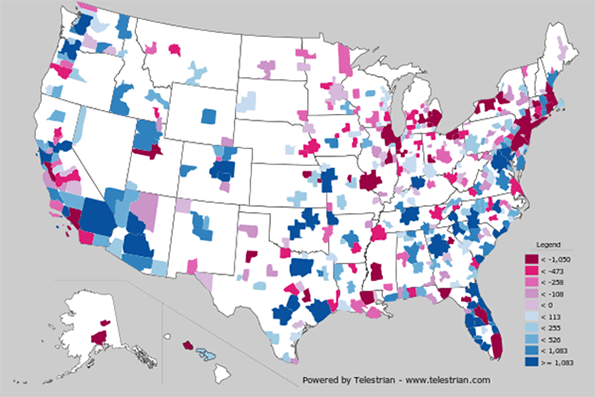
    Here is a map of net migration of people with a bachelor’s degree or higher, based on data from the 2007-2011 ACS, with blue indicating net migration gains and red net migration losses:


    Net domestic migration of adults age 25+ with a bachelor’s degree or higher by metropolitan area. Source: 2007-2011 ACS with rollups and mapping via Telestrian

    Unsurprisingly, this data correlates with overall net migration. For example, at first glance it might seem odd that a metro area like New York would be a net loser of people with college degrees. It lost a net of nearly 29,000 of them, highest net outflow in the country. But the New York metro as a whole lost almost two million people to domestic migration during the 2000s.  Given that, it would be surprising indeed if the region didn’t lose people with degrees. It’s similar for runners-up in the loss department Los Angeles (-11,000) and Chicago (-9,500).

    The list of leaders is unsurprisingly headed by Austin, Texas (+9,500), Dallas (+9,200) and Phoenix (+9,200) and other population boomtowns. But there are some areas that punch above their weight versus overall migration, such as #5 Portland (+7000) and #9 Washington, DC (+5000). These cities are known as talent magnets and this data points in that direction. Their net in-migration is disproportionately highly educated.

    I have rounded the numbers above because this data is based on samples with a margin of area. Keep in mind when reviewing the tables below with detailed statistics not to read into this a false degree of precision.

    Regions like New York, Los Angeles, and Chicago can take heart from the fact that they are still among the top destinations of in-migrants with college degrees.

    Rank

    Metro Area

    In-Migrants

    1

    New York-Newark-Jersey City, NY-NJ-PA

    79,156

    2

    Washington-Arlington-Alexandria, DC-VA-MD-WV

    74,048

    3

    Los Angeles-Long Beach-Anaheim, CA

    66,209

    4

    San Francisco-Oakland-Hayward, CA

    49,980

    5

    Chicago-Naperville-Elgin, IL-IN-WI

    49,016

    6

    Dallas-Fort Worth-Arlington, TX

    47,198

    7

    Atlanta-Sandy Springs-Roswell, GA

    44,892

    8

    Boston-Cambridge-Newton, MA-NH

    42,006

    9

    Houston-The Woodlands-Sugar Land, TX

    37,408

    10

    Phoenix-Mesa-Scottsdale, AZ

    36,349

    Domestic In-Migration, Adults 25+ with a bachelor’s degree or higher. Source: 2007-2011 ACS with rollups and analysis via Telestrian

    Unfortunately for them, even higher numbers of people left.

    Rank

    Metro Area

    Out-Migrants

    1

    New York-Newark-Jersey City, NY-NJ-PA

     108,118

    2

    Los Angeles-Long Beach-Anaheim, CA

     77,190

    3

    Washington-Arlington-Alexandria, DC-VA-MD-WV

     69,179

    4

    Chicago-Naperville-Elgin, IL-IN-WI

     58,680

    5

    San Francisco-Oakland-Hayward, CA

     47,201

    6

    Boston-Cambridge-Newton, MA-NH

     45,407

    7

    Atlanta-Sandy Springs-Roswell, GA

     40,363

    8

    Philadelphia-Camden-Wilmington, PA-NJ-DE-MD

     38,640

    9

    Dallas-Fort Worth-Arlington, TX

     37,958

    10

    Miami-Fort Lauderdale-West Palm Beach, FL

     34,191

    Domestic Out-Migration, Adults 25+ with a bachelor’s degree or higher. Source: 2007-2011 ACS with rollups and analysis via Telestrian

    This in part reflects the status of America’s tier one cities as talent refineries. People move there after school when young, but then leave after they get older and have been upskilled by their experiences – and when their life priorities change.  We should expect cities like New York to have a lot of churn.

    A place like New York can also take solace in the fact that its migration loss of the college degreed was better than for those with lesser educational attainment.  Metro New York has 37% college degree attainment, but college grads only accounted for 28% of net migration losses. This is good news from the standpoint of retaining highly educated people, but raises the question of why New York is not so attractive to those without degrees.

    While each metro area has its own nuanced story to tell in migration, on the whole this report shows that the migration of the educated overall appears to be following that of the population as a whole. This means increasing numbers of people with college degrees moving to lower-cost Sunbelt boomtowns and other metros with rapidly expanding populations.

    Here is a complete ranking of net migration for adults with college degrees for all metro areas greater than one million people.

    Rank

    Metro Area

    Net Migrants

    1

    Austin-Round Rock, TX

     9,384

    2

    Dallas-Fort Worth-Arlington, TX

     9,240

    3

    Phoenix-Mesa-Scottsdale, AZ

     9,208

    4

    Houston-The Woodlands-Sugar Land, TX

     8,015

    5

    Portland-Vancouver-Hillsboro, OR-WA

     6,933

    6

    Denver-Aurora-Lakewood, CO

     6,132

    7

    Seattle-Tacoma-Bellevue, WA

     5,935

    8

    Riverside-San Bernardino-Ontario, CA

     5,308

    9

    Washington-Arlington-Alexandria, DC-VA-MD-WV

     4,869

    10

    Raleigh, NC

     4,674

    11

    Tampa-St. Petersburg-Clearwater, FL

     4,665

    12

    San Antonio-New Braunfels, TX

     4,542

    13

    Atlanta-Sandy Springs-Roswell, GA

     4,529

    14

    Charlotte-Concord-Gastonia, NC-SC

     4,096

    15

    San Francisco-Oakland-Hayward, CA

     2,779

    16

    Jacksonville, FL

     2,113

    17

    Kansas City, MO-KS

     2,072

    18

    Nashville-Davidson–Murfreesboro–Franklin, TN

     2,069

    19

    Sacramento–Roseville–Arden-Arcade, CA

     1,816

    20

    Louisville/Jefferson County, KY-IN

     1,647

    21

    Oklahoma City, OK

     1,189

    22

    Baltimore-Columbia-Towson, MD

     1,157

    23

    New Orleans-Metairie, LA

     985

    24

    Richmond, VA

     931

    25

    Birmingham-Hoover, AL

     905

    26

    Salt Lake City, UT

     844

    27

    Las Vegas-Henderson-Paradise, NV

     745

    28

    Pittsburgh, PA

     179

    29

    Cincinnati, OH-KY-IN

     32

    30

    Indianapolis-Carmel-Anderson, IN

     2

    31

    Minneapolis-St. Paul-Bloomington, MN-WI

     (46)

    32

    Columbus, OH

     (343)

    33

    San Diego-Carlsbad, CA

     (476)

    34

    Virginia Beach-Norfolk-Newport News, VA-NC

     (610)

    35

    Milwaukee-Waukesha-West Allis, WI

     (723)

    36

    Hartford-West Hartford-East Hartford, CT

     (749)

    37

    Memphis, TN-MS-AR

     (928)

    38

    Buffalo-Cheektowaga-Niagara Falls, NY

     (1,139)

    39

    St. Louis, MO-IL

     (1,199)

    40

    Miami-Fort Lauderdale-West Palm Beach, FL

     (1,225)

    41

    Rochester, NY

     (1,295)

    42

    Providence-Warwick, RI-MA

     (1,366)

    43

    Cleveland-Elyria, OH

     (1,563)

    44

    San Jose-Sunnyvale-Santa Clara, CA

     (1,825)

    45

    Orlando-Kissimmee-Sanford, FL

     (2,603)

    46

    Boston-Cambridge-Newton, MA-NH

     (3,401)

    47

    Philadelphia-Camden-Wilmington, PA-NJ-DE-MD

     (4,127)

    48

    Detroit-Warren-Dearborn, MI

     (9,472)

    49

    Chicago-Naperville-Elgin, IL-IN-WI

     (9,664)

    50

    Los Angeles-Long Beach-Anaheim, CA

     (10,981)

    51

    New York-Newark-Jersey City, NY-NJ-PA

     (28,962)


    Aaron M. Renn is an independent writer on urban affairs and the founder of Telestrian, a data analysis and mapping tool. He writes at The Urbanophile.

  • The Problem with Megacities

    This is the introduction to a new report from the Center for Demographics and Policy at Chapman University. The report was authored by Joel Kotkin with contributions from Wendell Cox, Ali Modarres, and Aaron M. Renn. Download the full report here (pdf).

    No phenomenon more reflects the sheer power and appeal of urbanism than the rise of megacities, which we define as an urban area with more than 10 million residents (defined as areas of continuous urban development). Until recent decades there were only three — Tokyo and New York, joined by a third, Mexico City, only in 1975. Now the megacity has become a global phenomenon that has dispersed around the planet. There were 29 such cities in 2014 and now account for roughly 13% of the world’s urban population and 7% of the world’s total population (Figure 1).

    Urban boosters such as Harvard’s Ed Glaeser suggest that megacities grow because “globalization” and “technological change have increased the returns to being smart.” 2 And to be sure, megacities such Jakarta, Kolkata (in India), Mumbai, Manila, Karachi, and Lagos — all among the top 25 most populous cities in the world — present a great opportunity for large corporate development firms who pledge to fix their problems with ultra-expensive hardware. They also provide thrilling features for journalists and a rich trove for academic researchers.

    Like Mr. Glaeser, many Western pundits find much to celebrate about the megacities mushrooming in low-income countries. To them, the growth of megacities is justified because it offers something more than unremitting rural poverty. But surely there’s a better alternative than celebrating slums, as one prominent author did recently in Foreign Policy bizarrely entitled “In Praise of Slums”3.

    As demonstrated in our new paper on global cities developed with the Civil Service College of Singapore, many of these emergent megacities in Africa and elsewhere in the developing world lack of an economic basis sufficient to substantially compete beyond their national or nearby regional markets. As a result, the rise of megacities in the developing world may be laying the foundation for an emerging crisis of urbanity, where people crowd into giant cities that lack of the economic and political infrastructure to improve their lives. At the end of this paper, we try to suggest that they may be better solutions that steer growth to smaller cities and towns, and even seek out ways to improve the life in rural villages.

    Download the full report here (pdf).

    Joel Kotkin is executive editor of NewGeography.com and Distinguished Presidential Fellow in Urban Futures at Chapman University, and a member of the editorial board of the Orange County Register. His newest book, The New Class Conflict is now available for pre-order atAmazon and Telos Press. He is author of The City: A Global History and The Next Hundred Million: America in 2050. His most recent study, The Rise of Postfamilialism, has been widely discussed and distributed internationally. He lives in Los Angeles, CA.

  • The People Designing Your Cities Don’t Care What You Want

    What is a city for?

    It’s a crucial question, but one rarely asked by the pundits and developers who dominate the debate over the future of the American city.

    Their current conventional wisdom embraces density, sky-high scrapers, vastly expanded mass transit and ever-smaller apartments. It reflects a desire to create an ideal locale for hipsters and older, sophisticated urban dwellers. It’s city as adult Disneyland or “entertainment machine,” chock-a-block with chic restaurants, shops and festivals.

    Overlooked, or even disdained, is what most middle-class residents of the metropolis actually want: home ownership, rapid access to employment throughout the metropolitan area, good schools and “human scale” neighborhoods.

    A vast majority of people — roughly 8o percent — prefer a single-family home, whether in the city or surrounding communities. And they may not get “creative” gigs at ad agencies or writers collectives, but look instead for decent-paying opportunities in fields such as construction, manufacturing or logistics. Over the past decade, these jobs have been declining rapidly in “luxury cities” like New York, Chicago and Los Angeles.

    In contrast, such jobs, which pay $60,000 to $100,000 annually, have been growing — particularly as the industrial and energy sectors have recovered — in cities like Houston, Austin, Nashville and Salt Lake City. These locales also feature housing, relative to incomes, that is more affordable.

    Of course, few urbanists wax poetic about Dallas or Des Moines. They lack Brooklyn’s hipster charm, and often maintain some of the trappings of the suburbs. But these “opportunity cities” offer what Descartes called “an inventory of the possible” — urbanity as an engine of upward mobility for the middle and working classes.

    Ever since the Great Recession, many in America’s urban-focused pundit class have written off these cities, particularly in the Sunbelt, as places where the “American dream” has gone to die. Yet over the past 30 years, and now again, virtually all of the fastest-growing American metropolitan areas were located in the  West or the South. In 2012, nine of the ten fastest-growing large metropolitan areas were in the Sunbelt, including big Texas cities like Austin, Houston and Dallas-Fort Worth, along with Denver, Raleigh and Phoenix. In 2013, Houston alone had more housing starts than the entire state of California.

    At the same time, immigrants — traditionally the most determined seekers of upward mobility — are now also flocking to places like low-cost Dallas-Fort Worth and Houston, which ranked second to New York in the last decade as a destination for the foreign-born. Immigrants are even heading in large numbers to locales such as Charlotte and Nashville, where foreign-born populations have doubled over the past decade. Finally, and perhaps most surprisingly given the prevailing tone of media coverage, these cities also have enjoyed generally faster growth in both college graduates and people ages 20 to 29  than New York, Chicago, Boston, San Francisco or Los Angeles.

    These trends can also be seen in population projections. The U.S. Conference of Mayors study predicts that Dallas-Fort Worth and Houston will grow to be nearly as large as Chicago by 2042. If the same growth rate were to continue through 2050, both Dallas-Fort Worth and Houston would be ahead of Chicago by 2050.

    To a large extent, this growth is fueled by middle-class movement to regions that offer both better economic prospects and more affordable housing prices. Before 1970, housing prices were largely even, relative to incomes, across the nation. Today, in large part due to regulatory and tax policies, they differ by as much as two to three times between  cities like Atlanta, Dallas-Fort Worth and Houston, on the one hand, and New York, Los Angeles or San Francisco.

    Then there is the critical issue of employment. Since 2008, Houston has added more than 185,000 jobs and Dallas 115,000, more than New York, which is much larger. Los Angeles and Chicago still remain well below their 2008 employment levels.

    It is also often alleged that these are primarily “crummy,” low-income jobs, but the opportunity cities have generally enjoyed strong mid-skilled growth and, over the past decade, also higher levels of STEM jobs. Since 2001, Houston has led the nation’s large metropolitan areas in the percentage growth of net STEM jobs; Dallas-Fort Worth and Phoenix have expanded these jobs more than San Francisco, even accounting for the current social media bubble. Los Angeles, Boston and Chicago have suffered a net loss since 2001.

    Perhaps most important of all, these are overwhelmingly the places where people choose to start families and raise children. All 10 of the cities (metropolitan areas) with the largest shares of children 0-14 years of age are opportunity cities, with Salt Lake City, Dallas-Fort Worth, Houston, Riverside-San Bernardino and San Antonio taking the top five positions. On the other hand, luxury cities, such as San Francisco, New York, Boston, Seattle and Miami, tend to rank in the bottom third, according to American Community Survey data.

    Meanwhile, cities like New York and San Francisco continue to reflect the media’s preferred form of urbanism, first articulated by former New York mayor Michael Bloomberg that, to survive, a city must be primarily “a luxury product,” a place that focuses on the very wealthy whose surplus can underwrite the rest of the population.

    “If we can find a bunch of billionaires around the world to move here, that would be a godsend,” Bloomberg, himself a multibillionaire, suggests. “Because that’s where the revenue comes to take care of everybody else.”

    This reliance on the rich, notes a Citigroup study, creates a “plutonomy,” an economy and society driven largely by the wealthy class’s investment and spending.

    Luxury cities, increasingly, are less places of aspiration than geographies of inequality. New York, for example, is by some measurements the most unequal of major U.S. cities, with a level of inequality that approximates South Africa before apartheid. New York’s wealthiest 1 percent earn a third of the entire municipality’s personal income — almost twice the proportion for the rest of the country.

    Other luxury cities exhibit somewhat similar patterns. A recent Brookings report found that virtually all the most unequal metropolitan areas – with the exception of Atlanta and Miami — are luxury regions, including San Francisco, Boston, Washington, D.C., New York, Chicago and Los Angeles.

    Smaller luxury cities such as San Francisco are generally the ones gentrifying fastest, notes a recent Cleveland Fed study. They also tend to be, as urban analyst Aaron Renn has noted, “white cities,” with relatively small and often shrinking populations of historically disadvantaged minorities. San Francisco’s black population, for example, is roughly half of what it was in 1970. In the nation’s whitest major city, Portland, African Americans are being driven out of the urban core by gentrification, partly supported by city funding. Similar phenomena can be seen in Seattle and Boston, where long-existing black communities are gradually disappearing.

    What this all suggests is that the future of American urbanism cannot follow the trajectory of luxury cities that, by their very nature, are difficult places for the vast majority of the population to live. Instead, the new role models — including for the hard-hit cities of the Rustbelt — will be found in those regions that have been able to provide the basic elements of middle-class aspiration: decent jobs, affordable housing and the chance to start a growing business.

    For years, Rustbelt cities have pegged their aspirations on mimicking “luxury cities.” But now local scholars, like Cleveland State’s Richey Piiparinen, believe these areas need to follow the opportunity city model. He points out that lower costs and a more family-friendly appeal is allowing Cleveland to attract more young, educated people to their region than they now send to places like Chicago or New York

    To achieve an urbanism that works for most Americans, cities need to develop a very different focus, emphasizing such things as affordability, middle-class jobs and opportunity. No doubt the luxury city model will continue to flourish in places, particularly for the well-heeled, but this paradigm is not applicable to most places, or most people.

    This piece originally appeared at The Washington Post.

    Joel Kotkin is executive editor of NewGeography.com and Distinguished Presidential Fellow in Urban Futures at Chapman University, and a member of the editorial board of the Orange County Register. His newest book, The New Class Conflict is now available for pre-order at Amazon and Telos Press. He is author of The City: A Global History and The Next Hundred Million: America in 2050. His most recent study, The Rise of Postfamilialism, has been widely discussed and distributed internationally. He lives in Los Angeles, CA.

    Photo by Mike Lee

  • The World’s Most Influential Cities

    In the past century, the greatest global cities were generally the largest and centers of the world’s great empires: London, Paris, New York and Tokyo. Today size is not so important: Of the world’s 10 most populous cities, only Tokyo, New York and Beijing are in the top 10 of our ranking of the world’s most important cities. Instead, what matters today is influence.

    To rank the world’s global cities, I worked with urban geographer Ali Modarres, former Accenture analyst Aaron Renn and demographer Wendell Cox. We have attempted to go beyond some of the standard methods of evaluating the global importance of cities, which include assessing the concentration of support services available for multinationals, such as financial and accounting firms, or the size of the overall economy. Efficiency and access to capital and information, we believe, is more critical to being an important global city than number of jobs, and regional GDP is a false measure, since it doesn’t reflect whether the source is domestic or global economic activity.

    In order to quantify cities’ global influence, we looked at eight factors: the amount of foreign direct investment they have attracted; the concentration of corporate headquarters; how many particular business niches they dominate; air connectivity (ease of travel to other global cities); strength of producer services; financial services; technology and media power; and racial diversity. (Click here for a more detailed description of our methodology.) We found those factors particularly important in identifying rising stars that, someday, might challenge the current hegemony of our two top-ranked global cities, London and New York.

    Inertia and smart use of it is a key theme that emerged in our evaluation of the top global cities. No city better exemplifies this than London, which after more than a century of imperial decline still ranks No. 1 in our survey. The United Kingdom may now be a second-rate power, but the City’s unparalleled legacy as a global financial capital still underpins its pre-eminence.

    Ranked first in the world on the Z/Yen Group’s 2013 Global Financial Centres Index, which we used for our list, London not only has a long history as a dominant global financial hub, but its location outside the United States and the eurozone keeps it away from unfriendly regulators. Compared to New York, it is also time-zone advantaged for doing business in Asia, and has the second best global air connections of any city after Dubai, with nonstop flights at least three times a week to 89% of global cities outside of its home region of Europe.

    A preferred domicile for the global rich, London is not only the historic capital of the English language, which contributes to its status as a powerful media hub and major advertising center, but it’s also the birthplace of the cultural, legal and business practices that define global capitalism.London hosts the headquarters of 68 companies on the 2012 Forbes Global 2000 list and is a popular location for the regional HQs of many multinationals. (Our HQ ranking component, in which London ranks third, is based on GaWC’s 2012 Command and Control Index, which factors in company size and financial performance, as well as total number of Forbes Global 2k HQs).

    Beyond these traditional strengths, London has become Europe’s top technology startup center, according to the Startup Genome project. The city has upward of 3,000 tech startup sas well as Google’s largest office outside Silicon Valley.

    nearly four times that of second place Tokyo New York, which comes in a close second in our study (40 points to London’s 42), is home to most of the world’s top investment banks and hedge funds, and the stock trading volume on the city’s exchanges is and more than 10 times that of London.

    Like London, New York is a global leader in media and advertising, the music industry (home to two of the big three labels), and also one of the most important capitals of the fashion and luxury business. With iconic landmarks galore, international visitors spend more money in New York each year than in any other city in the world.

    The Challengers And Those Slowly Fading

    London and New York are clearly the leaders but they are not the hegemonic powers that they were throughout much of the 20thcentury, and their main competitors are now largely from outside Europe. Paris may rank third in our survey, but it is way below New York and London by virtually every critical measure, and the city’s future is not promising given that France, and much of the EU, are mired in relative economic stagnation.

    Rather than a true indication of global reach, Paris’ high ranking is partly the product of the city’s utter domination of the still sizable French economy and the concentration of virtually all the country’s leading companies there (it ranks fifth on GaWC’s Command and Control Index with 60 HQs of Forbes Global 2K companies).

    Elsewhere, Europe boast a veritable archipelago of globally competitive cities — Munich, Rome, Hamburg — but none is large enough, or unique enough, to break into the top 10 in the future. East Asia is likely to place more cities at the top of the list.

    For most of the last century, Tokyo has been Asia’s leading city. It is still the world’s largest city, with the largest overall GDP. In her seminal work on world cities, Saskia Sassen placed it on the same level as London and New York. Tokyo’s limitations resemble those of Paris — its high ranking stems partly from the extreme concentration of domestic companies — and it will be handicapped in the future by a severe demographic crisis, a lack of ethnic diversity and very determined regional rivals.

    China’s Global Cities

    China’s share of the world economy has grown from 5% in 1994 to 14% in 2012.The combined volume of trading on the Shanghai and Shenzhen stock exchanges already exceeds that of Tokyo, and Shenzhen’s volume is approximately three times that of nearby Hong Kong.

    Hong Kong still enjoys greater freedom than the rest of China and remains the largest financial center in the Asia-Pacific region, ranking third in the world after London and New York. The vast majority of the world’s major investment banks, asset managers, and insurance companies maintain their Asia-Pacific headquarters in the former British colony.

    But its preeminence is being threatened by Shanghai, traditionally Hong Kong’s chief rival, and Beijing. We ranked China’s capital eighth, ahead of Shanghai (19th). With the advantage of being the country’s all-powerful political center, Beijing is the headquarters of most large state-owned companies and is home to the country’s elite educational institutions and its most innovative companies.

    But right now the leading global city in East Asia is Singapore, which ranks fourth on our list. With a relatively small population of just over 5 million, Singapore’s basic infrastructure is among the best on the planet. Like Hong Kong, it also benefits from a tradition of British governance and law, one reason the World Bank ranked its business climate the world’s best; China ranked 96th. Singapore’s justice system is ranked 10th in the world in The Rule of Law Index.

    That is all drawing in international business: Singapore places first among global cities in our ranking of foreign direct investment, with a five-year average of 359 greenfield transactions. It’s a favored location in many industries for Asia-Pacific headquarters; a study by the consultancy Roland Berger named Singapore the leading location for European companies to establish an Asia-Pacific HQs.

    Singapore vies with Hong Kong as the financial center of Asia, ranking fourth in the world in that category.

    Global Capital of the Middle East

    Much of what we see in the media about Middle Eastern cities are scenes of destruction and chaos. Yet in a relatively quiet corner of the Arabian Peninsula, Dubai is ascending, ranked seventh on our list. Its globalization strategy hinges largely on its expanding airport, which includes the world’s largest terminal and an even larger airport under construction. It ranks first in the world in our air connectivity ranking, with nonstop flights at least three times a week to 93% of global cities outside of its home region.Its hub location and business-friendly climate have made it a favorite for companies looking to establish a Middle East headquarters or point of presence. As a crossroads of humanity, Dubai is unparalleled among global cities for its diversity: 86% of its residents are foreign born.

    North America

    Our rankings rewarded cities that are both ethnically diverse and, in some cases, dominate a critical industry. This is what we refer to as a “necessary city,” a place one must go to conduct business in a particular field, or to service a particular region of the world.

    This focus on the “necessary” city led to what will no doubt be a controversial result: a 10th place ranking for the San Francisco Bay Area, on the strength of its central role in the tech industry, tied on our list with Los Angeles and Toronto. The Bay Area did not even make the top 20 in the 2014 A.T. Kearney rankings, which placed both Chicago and Los Angeles in the top 10.

    Not long ago Los Angeles, North America’s second-largest metro area, saw itself as a potential rival to New York and a legitimate world city. Hollywood is nearly synonymous with the American entertainment industry and is by far the world’s largest in terms of revenue and influence. Last year the industry enjoyed exports of almost $15 billion.

    But L.A.’s share of entertainment employment is shrinking and its former second industry, aerospace, has declined significantly, losing over 90,000 jobs since the end of the Cold War. Several key companies have decamped from the metro area in recent years — Nissan, Occidental Petroleum, Toyota — for more business-friendly places.

    The situation is arguably worse in Chicago, which ties for 20th. The Windy City first rose to world prominence after overcoming rival St. Louis in the late 19th century. It boasts one of the world’s most diverse economies, but has not developed strong dominance in any industry. Chicago is an also ran in media and technology and, outside of commodities, is no longer a major global financial center.

    The big winner today is the Bay Area, which overwhelmingly dominates the list of technology leaders; not only is the metro area home to a glittering array of tech standouts, companies based elsewhere in the U.S., and in other countries, feel compelled to site operations there. Even a penny pinching retailer like Wal-Mart is growing its Silicon Valley presence.

    Other North American cities with a growing global footprint include 10th ranked Toronto, tied with Los Angeles and Bay Area. Toronto, as the economic capital of Canada, has becomes a focus for international investment into that stable and resource rich country. It is also among the most diverse cities on the planet — 46 % of its population is foreign born.

    Rising Stars

    In North America up and comers include No. 14 Houston, with its domination of the U.S. energy industry, a huge export sector and an increasingly diverse population. The Washington, D.C., metro area ranks 16th, a testament to the capital’s growth as an aerospace and technology center.

    Overseas, other urban centers that could move up in the future include No. 16 Seoul, Shanghai and No. 20 (tie) Abu Dhabi. But outside of Dubai no other cities in our top 20 come from the developing world. The Indian megacities Delhi and Mumbai rank in the low 30s along with Johannesburg in South Africa. In Latin America, the place to watch is No. 23 Sao Paulo. But until these areas can develop adequate infrastructure — from roads, transit and bridges to relatively non-corrupt judicial systems — none can be expected to crack the top 10, or even 20, for at least a decade.

    For the time being, the future of the global city belongs not to the biggest or fastest growing but the most efficient and savvy, and those with a strong historical pedigree. This raises the bar for all cities that wish to break into this elite club.

    No. 1: London

    FDI Transactions (5-Year Avg.): 328
    Forbes Global 2000 HQs: 68<
    Air Connectivity:  89%*
    Global Financial Centres Index Rank: 1

    * The air connectivity score is the percentage of other global cities outside the city’s region (e.g., for London, cities outside of Europe) that can be reached nonstop a minimum of three times per week.

    No. 2: New York

    FDI Transactions (5-Year Avg.): 143
    Forbes Global 2000 HQs: 82
    Air Connectivity:  70%
    GFCI Rank: 2

    No. 3: Paris

    FDI Transactions (5-Year Avg.): 129
    Forbes Global 2000 HQs: 60
    Air Connectivity:  81%
    GFCI Rank: 29

    No. 4: Singapore

    FDI Transactions (5-Year Avg.): 359
    Forbes Global 2000 HQs: N/A
    Air Connectivity:  46%
    GFCI Rank: 4

    No. 5: Tokyo

    FDI Transactions (5-Year Avg.): 83
    Forbes Global 2000 HQs: 154
    Air Connectivity:  59%
    GFCI Rank: 5

    No. 6: Hong Kong

    FDI Transactions (5-Year Avg.): 234
    Forbes Global 2000 HQs: 48
    Air Connectivity:  57%
    GFCI Rank: 3

    No. 7: Dubai

    FDI Transactions (5-Year Avg.): 245
    Forbes Global 2000 HQs: N/A
    Air Connectivity:  93%
    GFCI Rank: 25

    No. 8 (TIE): Beijing

    FDI Transactions (5-Year Avg.): 142
    Forbes Global 2000 HQs: 45
    Air Connectivity:  65%
    GFCI Rank: 59

    No. 8 (TIE): Sydney

    FDI Transactions (5-Year Avg.): 111
    Forbes Global 2000 HQs: 21
    Air Connectivity:  43%
    GFCI Rank: 15

    No. 10 (TIE): Los Angeles

    FDI Transactions (5-Year Avg.): 35
    Forbes Global 2000 HQs: N/A
    Air Connectivity:  46%
    GFCI Rank: N/A

    No. 10 (TIE): San Francisco Bay Area

    FDI Transactions (5-Year Avg.): 49
    Forbes Global 2000 HQs: 17
    Air Connectivity:  38%
    GFCI Rank: 12

    No. 10 (TIE): Toronto

    FDI Transactions (5-Year Avg.): 60
    Forbes Global 2000 HQs: 23
    Air Connectivity:  49%
    GFCI Rank: 11

    Remaining Cities

    City Region Rank

    Zurich

    Europe

    13

    Frankfurt

    Europe

    14

    Houston

    North America

    14

    Amsterdam/Randstad

    Europe

    16

    Seoul

    Asia-Pacific

    16

    Washington Metropolitan Area

    North America

    16

    Shanghai

    Asia-Pacific

    19

    Abu Dhabi

    Middle East

    20

    Chicago

    North America

    20

    Moscow

    Europe

    20

    Boston

    North America

    23

    Brussels

    Europe

    23

    Dallas-Fort Worth

    North America

    23

    Madrid

    Europe

    23

    Melbourne

    Asia-Pacific

    23

    São Paulo

    South America

    23

    Istanbul

    Middle East

    29

    Miami

    North America

    29

    Johannesburg

    Africa

    31

    Kuala Lumpur

    Asia-Pacific

    31

    Mumbai

    Asia-Pacific

    31

    Bangkok

    Asia-Pacific

    34

    Delhi

    Asia-Pacific

    34

    Geneva

    Europe

    34

    Atlanta

    North America

    37

    Berlin

    Europe

    37

    Seattle

    North America

    37

    Tel Aviv

    Middle East

    37

    Mexico City

    North America

    41

    Milan

    Europe

    41

    Montreal

    North America

    41

    Buenos Aires

    South America

    44

    Jakarta

    Asia-Pacific

    44

    Philadelphia

    North America

    44

    Cairo

    Middle East

    47

    Guangzhou

    Asia-Pacific

    47

    Ho Chi Minh City

    Asia-Pacific

    47

    Lagos

    Africa

    47

    Osaka

    Asia-Pacific

    47


    This piece originally appeared at Forbes.

    Joel Kotkin is executive editor of NewGeography.com and Distinguished Presidential Fellow in Urban Futures at Chapman University, and a member of the editorial board of the Orange County Register. His newest book, The New Class Conflict is now available for pre-order atAmazon and Telos Press. He is author of The City: A Global History and The Next Hundred Million: America in 2050. His most recent study, The Rise of Postfamilialism, has been widely discussed and distributed internationally. He lives in Los Angeles, CA.

    Photo: "City of London skyline at dusk" by jikatu – Licensed under Creative Commons Attribution-Share Alike 2.0 via Wikimedia Commons

  • Boomers: Moving Further Out and Away

    There have been frequent press reports that baby boomers, those born between 1945 and 1964, are abandoning the suburbs and moving "back" to the urban cores (actually most suburban residents did not move from urban cores). Virtually without exception such stories are based on anecdotes, often gathered by reporters stationed in Manhattan, downtown San Francisco or Washington or elsewhere in urban cores around the nation. Clearly, the anecdotes about boomers who move to suburbs, exurbs, or to outside major metropolitan areas are not readily accessible (and perhaps not as interesting) to the downtown media.

    Yet there is a wide gulf between the perceived reality of the media stories and what is actually occurring on the ground, as is indicated by comprehensive sources. The latest available small area data shows that baby boomers continue to leave the urban cores in large numbers. They have also left the earlier suburbs in such large numbers that their population gains in the later suburbs and exurbs have been insufficient to stem boomer movement out of the major metropolitan areas to smaller cities and rural areas.

    These conclusions are drawn from an analysis of population at the zip code tabulation area (ZCTA) among those 35 to 54 years of age in 2000 and the same cohort in 2010 (then 45 to 64 years of age). This small area analysis avoids the exaggeration of urban core data that necessarily occurs from reliance on the municipal boundaries of core cities (which are themselves nearly 60 percent suburban or exurban, ranging from as little as three percent to virtually 100 percent). This is described in further detail in the "City Sector Model" note below.

    Overall Trend

    The national population of the baby boomer generation declined 1.82 million between 2000 and 2010, a 2.2 percent loss (the result of an inevitably increasing death rate from the aging of cohorts). A small increase of 350,000 (1.0 percent) outside the largest cities was more than offset by a 2.17 million loss in the major metropolitan areas (over 1 million population), where the decline was of 4.7 percent.

    Boomers and the Urban Core

    The largest percentage loss occurred in the functional urban cores, which experienced a decline of 1.15 million baby boomers, a reduction of 16.7 percent. The functional urban cores are defined by the higher population densities that predominated before 1940 and a much higher dependence on transit, walking and cycling for work trips (further details are provided in the "City Sector Model" note below). In 2000, baby boomers accounted for 14.9 percent of the major metropolitan area population, a figure that declined to 13.0 percent by 2010 (Figure 1).

    The losses were pervasive. Among the 24 major metropolitan areas with functional urban core populations above 100,000, all experienced reductions in their baby boomer population shares. The average share reduction was approximately 12 percent.

    Not surprisingly, the leading urban core magnets of New York and San Francisco did the best, losing 4.3 percent and 5.8 percent of their boomer population share between 2000 and 2010. Providence, Los Angeles,and Boston rounded out the best five.

    Among the 24 metropolitan areas with the largest functional urban cores, Detroit experienced the largest proportional boomer loss, at 21.2 percent. Kansas City, Washington, and Minneapolis-St. Paul lost from 17 percent to 19 percent, proportionally, of their boomer urban core populations. Despite its reputation for core renewal, Portland experienced an approximate 15 percent proportional loss of its urban core boomers, along with Milwaukee and Cleveland (Figure 2).

    Boomers and the Earlier Suburbs

    The reduction in baby boomer population was even greater in the earlier suburban areas (those with median house construction dates of 1979 or before). The 2.33 million earlier suburban population loss was double that of the functional urban core loss, but because of this population is much larger than the functional cores, the overall drop was a smaller 11.1 percent. Nonetheless, the earlier suburbs continue to house the largest share of major metropolitan boomers. This fell, however, from 45.3 percent in 2000 to 42.2 percent in 2010.

    Combined, the urban cores and earlier suburbs lost 3.48 million boomers between 2000 and 2010.

    Boomers and the Later Suburbs and Exurbs

    In contrast, the later suburban areas (median house construction date 1980 or later) added approximately 750,000 baby boomers, for an increase of 6.8 percent. The later suburbs also experienced an increase in their share of major metropolitan boomers, rising from 24.0 percent in 2000 to 26.9 percent in 2010.

    The exurban gain was greater than the later suburbs in percentage terms (7.7 percent) but less in population gain (560,000). This was enough to increase the exurban share of boomers from 15.8 percent in 2000 to 17.9 percent in 2010. Indeed, the exurban areas of the 24 major metropolitan areas with urban cores over 100,000 population all did better in attracting or retaining boomer populations than both the urban cores and the earlier suburbs.

    Overall there was a 5.0 percentage point transfer of boomer share from the functional urban cores and earlier suburbs to the later suburbs and exurbs, reflecting their more than 1.3 million gain between 2000 and 2010.

    Boomers and the Nation

    Moreover, the data indicates that boomers are leaving the major metropolitan areas to move to smaller cities or even to rural areas. In contrast with the 2.17 million major metropolitan area loss, areas outside the major metropolitan areas added 350,000 boomers between 2000 and 2010. In 2000, smaller cities and rural areas housed 44.4 percent of the boomer population. By 2010, the smaller city and rural share had risen to 45.8 percent (Figure 3). By contrast, over the same period, the major metropolitan areas increased their proportion of the US population, from 54.5 percent in 2000 to 54.9 percent in 2010.

    America’s downtowns (generally a smaller area than the larger urban cores), have done much better in recent years, as they have become safer and as a "100 year flood" of economic retrenchment has reduced many to renting rather than buying. Yet, overall, urban cores have done less well, with Census Bureau data showing that the population gains within two miles of largest municipality city halls being more than offset by losses in the two to five mile radius between 2000 and 2010. These loses are not limited to the overall population, but extend to share losses among Millennials and population losses among the boomers.

    Wendell Cox is principal of Demographia, an international public policy and demographics firm. He is co-author of the "Demographia International Housing Affordability Survey" and author of "Demographia World Urban Areas" and "War on the Dream: How Anti-Sprawl Policy Threatens the Quality of Life." He was appointed to three terms on the Los Angeles County Transportation Commission, where he served with the leading city and county leadership as the only non-elected member. He was appointed to the Amtrak Reform Council to fill the unexpired term of Governor Christine Todd Whitman and has served as a visiting professor at the Conservatoire National des Arts et Metiers, a national university in Paris.

    ———–

    City Sector Model Note: The City Sector Model allows a more representative functional analysis of urban core, suburban and exurban areas, by the use of smaller areas, rather than municipal boundaries. The more than 30,000 zip code tabulation areas (ZCTA) of major metropolitan areas and the rest of the nation are categorized by functional characteristics, including urban form, density and travel behavior. There are four functional classifications, the urban core, earlier suburban areas, later suburban areas and exurban areas. The urban cores have higher densities, older housing and substantially greater reliance on transit, similar to the urban cores that preceded the great automobile oriented suburbanization that followed World War II. Exurban areas are beyond the built up urban areas. The suburban areas constitute the balance of the major metropolitan areas. Earlier suburbs include areas with a median house construction date before 1980. Later suburban areas have later median house construction dates.

    Urban cores are defined as areas (ZCTAs) that have high population densities (7,500 or more per square mile or 2,900 per square kilometer or more) and high transit, walking and cycling work trip market shares (20 percent or more). Urban cores also include non-exurban sectors with median house construction dates of 1945 or before. All of these areas are defined at the zip code tabulation area (ZCTA) level.