Category: Urban Issues

  • Columbus, Know Thyself

    What Is Your Ambition?

    Columbus doesn’t have a powerful brand in the market outside of Ohio. Having said that, the city is growing rapidly in population and jobs, is extremely livable and improving day by day, and seems to make its residents very happy. Is there any reason the city has to be better nationally known in order to be complete or something?

    I say No.  It’s a valid choice to simply stay with the status quo.

    Many citizens may indeed feel that way, but much of the city’s leadership doesn’t. This was hammered home in a 2010 New York Times piece on the city’s rebranding efforts. That desire to be seen as a high caliber city at the national level clearly came through in my most recent trip, even from Mayor Coleman himself.

    I also tend to be personally biased towards high ambition, particularly in a place where it’s obvious that the ambition can be realized.  Columbus is that place, in contrast to long troubled regions  like Detroit and Cleveland are really struggling to rebound from severe problems. And no matter what they do, they will never recover the national stature they once enjoyed.   

    Columbus is both operating from a baseline of strength, and also at a point where it is still on the way up as a city.   Columbus has never been a larger, more important, more prominent city in the world than it is right now – and it has the potential to reach still higher  Not every city and not every generation is granted the opportunity that Columbus has right now.  

    Finding Columbus’ Mojo

    But assuming the answer is go for it, then what needs to be done? There is a need to go beyond the checklist.

    The first thing  is to really be committed to change and going after the brass ring. This is not an easy journey to make. Some of the things you are going to have to do are really, really hard because they involve looking  closely at civic insecurities, and also questioning perhaps your most fundamental and cherished truths, especially the truth about what you’re best at.

    It’s very hard for cities to admit where they are weak, but it can actually be even harder for them to admit where they are strong.

    One of the sayings of the Greek oracle was “Know Thyself.” Sage wisdom, indeed. Knowledge of yourself is often the most difficult to come by but valuable of commodities. Because as the saying goes, “Without awareness there is no choice.”

    Where does a city get knowledge of itself that’s useful for branding? I argue it very often comes from the past. Cities didn’t just take their present form overnight. They are the process of a long process of growth and change. In particular, the founding ethos of a place profoundly stamps its character, usually in a permanent way. The Dutch trading culture and spirit of openness of New Amsterdam is still present in contemporary New York, for example.

    When a new creative director comes in to revive a failing fashion house, what’s the first thing he does? He goes to the archives. He investigates the history of the house. What does this brand stand for? Who were the people who founded it? How did they become who they were? What happened along the journey of that house?

    To use a hackneyed phrase, that new creative director wants to understanding the “Brand DNA,” and the key to the brand DNA is in the past.

    I think that’s as true of Columbus as anyplace. Columbus certainly had good luck in getting where it is today, but I’d argue there’s more to it. One of their historical keys to success was a fateful decision in the 1950s to pursue an aggressive annexation strategy. You can say that was one mayor’s choice, but I believe the fact that it happened in Columbus and not elsewhere in Ohio signaled  that there was something different about the city. What is it?
    You need to start with an anthropological, archeological, historical deep dive into a city, its people and its culture. I’d suggest tapping into Ohio State’s cultural anthropology resources. There might even be a dissertation in it for someone.

    Aspirational Narrative

    One you have the mojo, you not only use it to build the future reality, you also sell it by telling the story of Columbus to the world. You need to create an aspirational narrative of the city that people can imagine themselves being a part of.

    Think of the story of New York. TV shows like Friends, Sienfield, and Sex and the City have created a contemporary positive narrative of life in New York. People know what it’s about. If you can make it there, etc. (This wasn’t always the case. Escape from New York, Death Wish, and Fort Apache the Bronx told quite a different narrative in a previous era). Portlandia tells a story about the place where young people go to retire. Think about the Bay Area, LA, Miami, etc. and the stories come to our heads without much thinking.

    What’s that story of life in Columbus? You create that story around the authentic mojo of the city.

    What’s on your rap sheet?

    Beyond finding the mojo, there’s another key task that goes along with the investigation. That’s finding the missing or defective genes in the civic DNA that could sabotage the city’s ambitions.

    Everybody’s got a rap sheet. The only question is whether or not we know what’s on ours. When I was working in corporate America I knew if I was getting nothing but glowing feedback from my boss, if Ihad nothing I need to get better at, I was dangerously blind. If not, why was I not the CEO of the company? Clearly, there’s a reason why I am where I am and not the President of the United States.

    So Columbus needs to understand not just checklist items it is missing like a major transit investment, but also cultural items that are holding the city back and what they are rooted in. Then it can attack them with a change program that can hopefully work, like the civic equivalent of therapy.

    On a related note though methodologically different, the city needs to be willing to take a hard look in the mirror and realistic assess its assets and accomplishments and how compelling they are in the market. The cold reality is that while Columbus is a great city in many ways and has lots of great stuff, what it has doesn’t add up to a nationally or globally compelling story. You need to take the marketing glasses off and ask how people who aren’t in or from the city   see things.

    That doesn’t necessarily mean you recategorize your assets as bad. But you have to understand that checklist items that lots of other cities are doing (e.g., bike infrastructure) are probably not going to set the city apart in the marketplace. If you don’t have it, you’re in trouble. But if you do, it doesn’t win the game. These things are just the new urban ante.

    Illustrative Applied Examples

    I want to give a quick examples – and let me stress this is provisional and speculative to some extent – illustrating these three points.

    On the mojo front, the city’s previous branding effort that identified “smart” and “open” as two key civic attributes is right on in my view. It’s a good start. But why is Columbus open? That is, why is it easier for newcomers to acclimate, penetrate networks, accomplish things, etc. in Columbus than in many other places?

    I speculate it’s rooted in being the state capital. I’ve seen a similar trait in other capitals. I speculate that because people from all over the state are coming to Columbus on political business, and because there’s always churn in elected office, civic networks don’t become closed and calcify in a sort of “Why the Garden Club Couldn’t Save Youngstown” effect.

    For the missing gene example, I think it’s very possible that one reason Columbus didn’t create a compelling, unique product in the market is that it it’s just not in the civic DNA. One local leader I talked to speculated that the city’s values were shaped by those of Ohio State football and Woody Hayes. That is, the secret to success is to work relentlessly at the fundamentals and always be pounding the ball ahead with the running game – “three yards and a cloud of dust.” Not exactly the West Coast Offense. This may be too facile, but it is clear that Columbus excels at the fundamentals, the blocking and tackling of city stuff, but hasn’t thrown the civic equivalent of the long bomb.  

    For the asset evaluation example, I think Columbus needs to be realistic about Ohio State’s stature. Ohio State is a great school, but it’s not Harvard or Stanford. I went to Indiana University and I’d say the same about them. Now, obviously you’d never come out in public and downplay Ohio State, which legitimately is a power house for the city. But you don’t want to mistakenly believe it’s doing to spawn the next Cambridge or Palo Alto without some major change either.

    It’s Cow Town, Jake

    To truly discover the secret of its mojo, Columbus needs to be willing to stare into the abyss of cow town.

    Talk to people in Columbus and you’ll hear them claim that they are not a “cow town” anymore or how people used to refer to them as a “cow town.” I have seen this as an analogy to the case of Indianapolis and “naptown.” I’ve always doubted that hardly anyone outside of Indianapolis itself ever used the term Naptown historically as an insult. No one would ever have cared enough about the city to even bother insulting it.

    Similarly, I’d never heard the term cow town until somebody from Columbus told me about it. I strongly doubt it’s ever really been a term of derision nationally, at least not outside Ohio. I know there’s a strain of Cincinnatian who loves heaping abuse on places like Columbus and Indy. As Columbus has grown while other cities in Ohio wandered in the wilderness, it’s easy for me to believe there’s been a lot of sniping. So while the market would never think of Columbus as cow town, there may be some legitimate in state reasons for them to be sensitive to the term.

    The impression I get, again provisional based on my limited experience, is that in an attempt to rid itself of the stigma of being a cow town, Columbus has sheared off its past, in effect repudiating everything that happened before 1990 or 2000.

    I observed to Mayor Coleman that Indianapolis in recent years has downplayed the 500 Mile Race. I asked him whether or not Columbus was similarly neglecting its greatest brand asset in the market by downplaying Ohio State football. He said, “No. There was a time in the 60s and 70s and the 80s, and even the 90s, where Columbus was nothing but Ohio State football. And I love the Buckeyes; I love the football team. It’s better than any professional team in the state of Ohio. And they’re still amateurs. That’s good. But having said that, Columbus is no longer just the Ohio State football team. We don’t view ourselves that way anymore [emphasis added].”

    This seems consistent with what I hear from other people. There’s an embedded idea here that there’s little to nothing of value in the city’s past and in fact that past is something to be embarrassed about or outgrown. I have never heard anyone from Columbus brag about their city for anything related to the past, apart from historic architecture.   For example, the mayor went on to talk about the importance of Ohio State in terms of its contemporary research impact. I’m not sure I’ve ever heard a city talk less about its heritage.  That lack of historic rooting may be one reason why the city can come across as somewhat generic.

    As I’ve noted before, this is normal for us to go through. When we go off to college, Mom puts our high school letter jacket up in the attic. We try as hard as we can to fit in at the new level, and treat the stuff we left behind as little kids stuff.

    But eventually we become comfortable in our own skin. We learn who we are and what we stand for, and we stop becoming so concerned about what other people think of us. Of course we are social creatures and will never stop caring about others’ perceptions of us. We find a healthier balance.

    The same is true of cities. Columbus is far enough along in its growth path to really be comfortable being itself, and acknowledging and embracing its past.

    This doesn’t mean Columbus should be or ever was a cow town. What it does mean is that things from its past that Columbus   are actually its strongest brand assets and things to be proud of and build its future on.

    Let’s give some examples. The Midwest has a history of local, low grade lager brands. Virtually all of these were abandoned and ceased production. The hip, cool thing to do was to drink microbrews, not even Bud or Miller Lite, to say nothing of Sterling (my dad’s brand).

    Then one day the hipsters on the coasts started drinking Pabst Blue Ribbon, and all of a sudden back in the Midwest, we started drinking it too and now are re-launching or re-embracing all those old blue collar brands (including Sterling). The same thing happened with workwear clothing, which is now selling for quite a premium in some places and very popular among the Bearded Ones.

    In effect, we had to re-import our own heritage after a bunch of other people elsewhere saw the value in it – the same heritage we rejected as “cow town.”

    The clearest example of this is agriculture. The Midwest is all about ag. Ohio State is a huge ag power house. Columbus could have owned urban agriculture, farm to table, organics, etc. But it didn’t. And now it’s doing them, but it’s doing them as the follower, not the leader.   

    This is one of the tragedies of the Midwest. We turned away from our heritage and a bunch of guys in Brooklyn bought it from a thrift store for a song.

    The South avoided this. Look at Nashville. Did they turn their back on country music as “cow town”? No, they embraced it as central to their identity past, present, and future. Of course they are more than country. But they kept it front and center. But they also updated it. It’s not the old AM radio country. It’s not Hee Haw. They respect those people and institutions and see them as in continuity with today, but they have evolved. Today’s it’s glitzier, “Nashvegas.” Think Carrie Underwood, not Minnie Pearl.

    This is what it means to know thyself and build the future out of the authentic mojo of the past. Columbus surely has many things in its past and in its historic civic character   of immense value. The question and the challenge to the city is being willing to find out what those are and own and embrace them and champion them as a key part of the mojo on which it will build its future reality and aspirational civic narrative.

    I believe the potential is right there. The question is whether the city is ready and willing to step up and grab it.

    Aaron M. Renn is an independent writer on urban affairs and the founder of Telestrian, a data analysis and mapping tool. He writes at The Urbanophile, where this piece originally appeared.
  • Shaking Off The Rust: Cleveland Workforce Gets Younger And Smarter

    In virtually every regional economic or demographic analysis that I conduct for Forbes, Rust Belt metro areas tend to do very poorly. But there’s a way that they could improve, based in large part on the soaring cost of living in the elite regions of California and the Northeast. And one of the rustiest of them appears to be capitalizing on the opportunity already: that perpetual media punching bag, Cleveland.

    Between 2000 and 2012, the Cleveland metro area logged a net gain of about 60,000 people 25 and over with a college degree while losing a net 70,000 of those without a bachelor’s, according to a recent report from Cleveland State University. The number of newcomers aged 25 to 34 increased by 23 percent from 2006 to 2012, with an 11 percent increase from 2011 to 2012 alone. Most revealingly, half of these people came from other states. When it comes to net migration, Atlanta, Detroit, and Pittsburgh were the biggest feeders for those arriving with a bachelor’s degree, while Chicago, Manhattan, Brooklyn and Pittsburgh sent the most net migrants with a graduate or professional degree.

    The picture of Cleveland that emerges from the Cleveland State University study is a very different one from that to which we are accustomed. Rather than a metro area left behind by the information revolution, Cleveland boasts an increasingly youthful workforce that is among the better educated in the nation. In 2009. notes University of Pittsburgh economist Chris Briem, some 15% of Cleveland’s workforce between 25 and 34 has a graduate degree, ranking the area seventh in the nation, ahead of such “brain centers” as Chicago, Austin and Seattle. Old Clevelanders as a whole will remain undereducated, but likely not the next generation.

    What is driving this migration? Some of it has to do with a 25% expansion of STEM employment from 2003-13, much of it in health care tied to the region’s prestigious hospitals. This has helped spark a healthy increase in per capita income, from $33,359 in 2003 to $44,775 in 2012, a gain of 34%.

    This growth has animated many neighborhoods, not only in the “cool” central cores but in a host of inner and outer ring neighborhoods. This process, note researchers Richey Piiparinen and Jim Russell, is even more evolved in a Rust Belt city that has been on the rise for some time now, Pittsburgh. Migration trends there first turned favorable in 2007 after decades of decline, and have remained positive.

    The cost of living in Cleveland is considerably below the national average, not to mention that of the ultra-expensive coastal regions. Indeed, when cost of living is taken into account, per capita income in both Cleveland and Pittsburgh are now well above the national average.

    Piiparinen and Russell also see a gradual movement of educated young people to other lower-cost, family-friendly places in the Rust Belt, including Indianapolis, St. Louis and Minneapolis.

    These phenomena suggest that Rust Belt cities need to adopt new approaches to economic development. For years, civic boosters in places such as Cleveland fixed hopes on attracting the much ballyhooed “creative class” by building such things as the Rock and Roll Hall of Fame, art galleries, trendy restaurant and even a massive downtown chandelier. This tactic recalls the old lite beer commercials: everything you want in a city, but less.

    Yet, as Piiparinen and Russell point out, this approach simply expands consumption opportunities, and when it comes to consumption, Cleveland, Detroit and Pittsburgh can never top the U.S. capitals of excess: Manhattan, San Francisco, Los Angeles, or even Seattle. It’s hard to see hipsters moving en masse to any of these places without some degree of economic opportunity.

    Piiparinen sees the current migration trends as reflecting “the Rust Belt’s productive economy versus its consumptive economy.” He proposes the focus should be to accelerate talent migration based on economic advantages natural to the region, such as medical services, advanced manufacturing and logistics.

    These industries have high economic impact. Manufacturing, he traditional core of the local economy, adds 50 cents of GDP for every dollar in output, considerably more than information employment and almost three times the multiplier for retail jobs.

    Despite the hopes to emulate post-industrial Boston, New York or San Francisco, Rust Belt states remain dependent on manufacturing; it accounts for 18 percent of Ohio’s GDP and 14 percent of Pennsylvania’s, more than twice as much as in New York and well above that in California. Increasingly, manufacturing will not provide many jobs for unskilled workers, but rather for trained technicians, certified crafts workers as well as highly educated college graduates. Ohio has established an extensive network of skilled training facilities to fill this need.

    Critical to the process are the current manufacturing rebound, in which Ohio has added 50,000 industrial jobs since 2009, and the energy boom tied to the development of shale in both Ohio and Pennsylvania. Since 2001, energy employment in Pennsylvania has more than doubled, with much of the action in western part of the state abutting Pittsburgh.

    Does that mean that Cleveland, or Pittsburgh, are about to experience Houston-like growth? Don’t hold your breath. The weather is too harsh, and the cities too small to compete with the vast opportunities presented by the burgeoning Sun Belt economies. Nor do they rank high as destinations for foreign immigrants, who have provided a boost to many larger local economies but as of yet have not “discovered” the Rust Belt in large numbers.

    Yet not achieving hyper-growth does not mean continued decline. As older, less educated workers retire or leave the region, often for warmer climes, there is an opportunity for the Rust Belt to replace its current labor pool with one more attuned to the emerging economy and enjoy strong boosts in GDP growth.

    The key here is melding the “legacy” strengths of these regions with shifting demographic and economic forces. The region is not only home to abandoned steel mills, but also six of the country’s top top 20 graduate engineering programs, according to U.S. News & World Report. The intellectual capital is there.

    And economic forces could soon make these cities more attractive to newcomers from the rest of the country and abroad. The “spiky” cities embraced by urban boosters such as Richard Florida – who famously dissed Pittsburgh on his way out of town — increasingly are too expensive for even the educated middle class. This is why we are seeing young people who flocked to the Bay Area leave in their 30s or 40s. Places like San Francisco and Manhattan are great to the well-educated (and well-heeled), but as you get older, and look to buy a house or start a family, they are not ideal, unless you are extraordinary successful or have the right parents.

    In contrast, the Rust Belt offers a vastly better value proposition. Housing in Cleveland is about one-fourth the cost, based on income, as in San Francisco. Not only that, but the choices are fairly broad, from new and old suburban to charming, single-family dominated urban neighborhoods.

    These choices are encapsulated by the turn of phrase “Pittsburgh rich,” which essentially means that people settling there simply have better options than in places like New York or San Francisco. “We have an old housing stock that is very affordable,” notes University of Pittsburgh’s Briem. “Places like Pittsburgh and Cleveland offer a lot of areas that are very attractive at a low cost.”

    Of course, such a transition will require some major rethinking among regional leaders and the abandonment of their traditional wannabe approach. Rather than apologizing for not being San Francisco, they should look at the prospects for a revival of energy and manufacturing. It’s working out for Pennsylvania and Ohio, which were among the largest recipients of new investment in 2012, ranking third and fourth among U.S. states. They were behind Texas and Louisiana, but well ahead of both California and New York.

    Over time, this transition in the Rust Belt could prove a boon for the entire country. It does little good for either the resurgent Sun Belt or the sophisto havens on the coasts to have to subsidize a region along the Great Lakes in permanent decline. The Rust Belt retains many natural resources — oil, gas and, perhaps most importantly, water — that position it to be a major contributor to national growth. If the opportunity is recognized by a new generation, the future could prove surprising bright in what has long been seen as a fading region.

    This article first appeared at Forbes.com.

    Joel Kotkin is executive editor of NewGeography.com and Distinguished Presidential Fellow in Urban Futures at Chapman University, and a member of the editorial board of the Orange County Register. He is author of The City: A Global History and The Next Hundred Million: America in 2050. His most recent study, The Rise of Postfamilialism, has been widely discussed and distributed internationally. He lives in Los Angeles, CA.

    Creative Commons photo “Cleveland Skyline from the Flats” by Flickr.com user Erik Drost.

  • Will the World’s Emerging Megacities Turn the Corner? For Most of Them, Probably Not

    Two distinct expressions of urbanism, the global city and the mega city, are often conflated in the public’s mind. This can lead people to implicitly link the future fortunes of megacities (urban regions of more than 10 million people) with the success of global cities (defined roughly as a very important node at the high end of the global economy), especially as there’s overlap between the two types. They can then assume that the world’s emerging megacities will ultimately be successful, maybe even very successful. Places like São Paulo and Istanbul are held up as global cities in the making. Even more clearly struggling megacities like Jakarta and Lagos are sometimes portrayed as up and coming hip.

    But in reality most emerging megacities likely will never turn the corner to developed status and achieve a decent standard of living and quality of life for their residents. They may be important national centers of aspiration, but most of them will never become influential global cities.  Their huge size and vast problems will leave them with perpetual entrenched poverty, poor infrastructure and public services, and low quality of life by global standards.

    The general rule seems to be that a megacity can only achieve escape pervasive dysfunction if they are a major city in a country that is the world’s current rising economic (or historically imperial) power.

    Rank

    City

    Population

    1

    Tokyo-Yokohama, Japan

    37,555,000

    2

    Jakarta, Indonesia

    29,959,000

    3

    Delhi, India

    24,134,000

    4

    Seoul-Incheon, South Korea

    22,992,000

    5

    Manila, Philippines

    22,710,000

    6

    Shanghai, China

    22,650,000

    7

    Karachi, Pakistan

    21,585,000

    8

    New York, USA

    20,661,000

    9

    Mexico City, Mexico

    20,300,000

    10

    São Paulo, Brazil

    20,273,000

    11

    Beijing, China

    19,277,000

    12

    Guangzhou, China

    18,316,000

    13

    Mumbai, India

    17,672,000

    14

    Osaka-Kobe-Kyoto, Japan

    17,234,000

    15

    Moscow, Russia

    15,885,000

    16

    Los Angeles, USA

    15,250,000

    17

    Cairo, Egypt

    15,206,000

    18

    Bangkok, Thailand

    14,910,000

    19

    Kolkata, India

    14,896,000

    20

    Dhaka, Bangladesh

    14,816,000

    21

    Buenos Aires, Argentina

    13,913,000

    22

    Tehran, Iran

    13,429,000

    23

    Istanbul, Turkey

    13,187,000

    24

    Shenzhen, China

    12,860,000

    25

    Lagos, Nigeria

    12,549,000

    26

    Rio de Janeiro, Brazil

    11,723,000

    27

    Paris, France

    10,975,000

    28

    Nagoya, Japan

    10,238,000

    29

    London, United Kingdom

    10,149,000

    Table 1: World’s Megacities, 2010, based on urban agglomeration size. Source: Demographia World Urban Areas, 10th Edition (May 2014)

    This is the case with most developed world megacities. Moscow was the capital of the Soviet Empire. New York and Los Angeles came of age when America was the rising, and ultimately dominant, economic colossus. It’s the same for Paris and London, two borderline megacities, which rose as imperial capitals. London remains arguably the premier global city in the world.

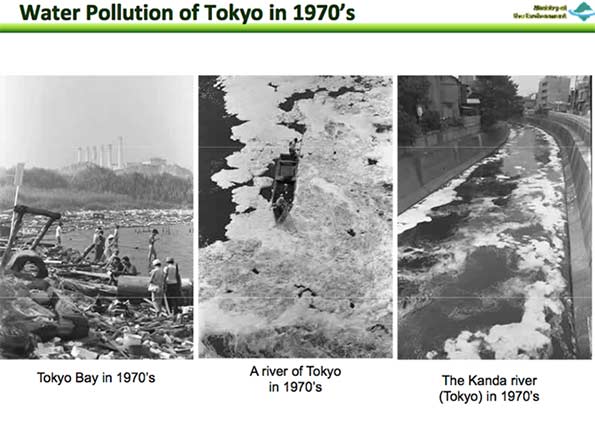
    But it’s also true of other megacities you might not consider. Tokyo only achieved its fully developed state when Japan was the rising power. Until fairly recently, much of Japan’s capital was backwards by developed world standards. For example, despite Japan’s famously high tech toilets, even in the inner 23 wards of Tokyo it was only in 1995 that 100% sewer service was achieved. In the second edition of Peter Hall’s landmark book The World Cities, he describes a 1970s Tokyo in which the night soil pickup industry was alive and well.  Only in an era of national economic hyper growth – culminating in the 1980s – was Japan able to fully modernize its urban infrastructure and clean up the massive environmental problems resulting from its rapid industrialization and urbanization. This was the time when Japan seemed destined to become the world’s leading economic power, and America was fretting as Japanese investors bought trophy assets ranging from Columbia Pictures to Rockefeller Center.


    Image from 2011 presentation by Takatoshi Wako, “Night Soil Management and Decentralized Wastewater Treatment Systems in Japan”

    We are witnessing the same today in China. It’s no accident that cities like Beijing and Shanghai are becoming fully modernized at the same time that China is the world’s rising economic power.  Even there, serious problems with social integration, pollution, and low quality development remain. China had best hope its economic growth continues until such time as it’s rich enough to solve those problems too.

    Apart from the developed West, Japan, and China, only one world megacity has ever pulled off the transition to full modernity is Seoul. Seoul, however, followed a similar trajectory to Tokyo. Destroyed in the Korean War, it was rebuilt with the help of massive foreign aid. As dictatorship gave way to democracy, South Korea emerged as the leading “Asian Tiger” economy, a sort of mini-Japan. Yet it’s only recently that Seoul has begun to transcend its soulless apartment towers and focus on building a quality of life to match its advanced subways and broadband networks, for example, by uncovering a stream previously channeled underground into storm sewers to create an attractive greenway.


    Cheonggyecheon stream in Seoul, daylighted in 2005. Image: Wikipedia

    The world’s other megacities, sadly, are located in countries on a less positive trajectory.  Many of them are in impoverished developing countries in South and Southeast Asia and Africa. Others are in economies like the BRICs once touted as emerging powers, but many of which , have badly stumbled.  India and Brazil are not following the path of Japan and South Korea – not even that of China. Their economies are large and in a sense important, but face massive structural challenges.


    Pavãozinho favela, Rio de Janeiro. Photo: Wikipedia

    Brazil is planning a coming out party with the World Cup and Olympics. The city of São Paulo has even established its own foreign ministry to develop direct diplomatic and other ties with countries overseas to flex its global muscles.  Yet the social reality is less impressive: Paulistanos rioted last year in response to transit fare increases. Income inequality in São Paulo is stark, and public safety very questionable.  Rio has numerous favelas where military style units are trying to establish basic security, albeit with heavy handed tactics.  Rowers training for the Olympics have described Rio’s waterways as the most polluted they’ve ever seen, with one of them telling the New York Times, “I’ve never seen anything like this before.” In next door Argentina, once wealthy Buenos Aires continues to decay along with the nation, the consequences of lengthy misrule.


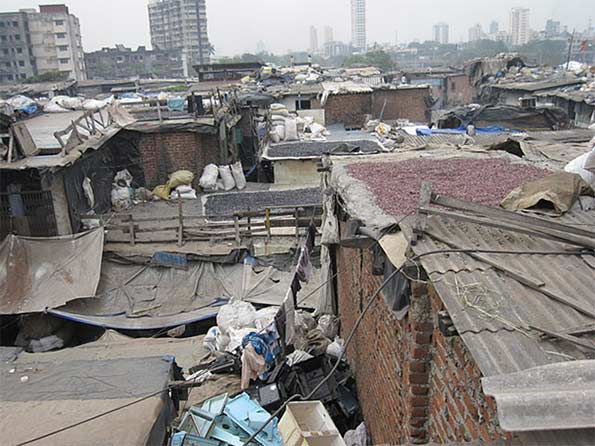
    Dharavi slum, Mumbia. Photo: Wikipedia

    But problems in Latin America’s megacities pale next to those elsewhere. In India’s financial and commercial capita of Mumbai, over half the population lives in slums. Delhi was recently noted as having the world’s worst air pollution. Dhaka, Bangladesh is both impoverished and has extreme flooding problems. Karachi, Manila, and Jakarta suffer severe poverty and infrastructure problems.  Large African cities like Lagos can’t overcome the basic development problems of the continent.


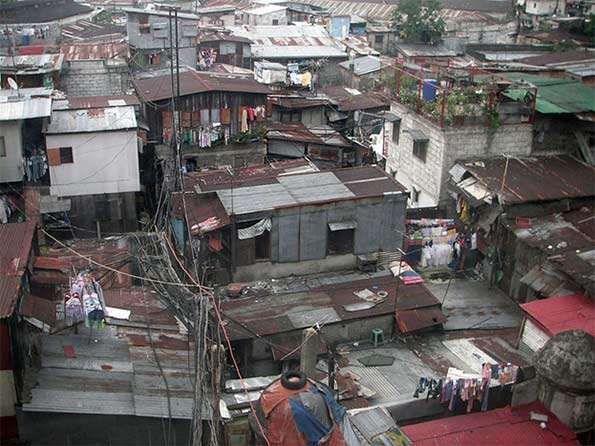
    Shantytown in Manila. Photo: Wikipedia

    Some argue that these megacities are actually opportunities zones for their country and even that their slums should be praised – or might eventually, as one article claimed, save the planet. After all, people are voting with their feet to move there. Perhaps that’s true in some sense, though some of the advantage of cities stems from a decline in the viability of rural life. 

    But the problem is that there’s no clear path to prosperous maturity for these megacities.  They are so huge, and their problems so immense that they are difficult to even conceptualize, much less do something about.  The amount of needed infrastructure provision alone – water, sanitation, drainage, transport, telecom, electricity, parks, schools, etc. – is staggering. And that doesn’t even touch arguably more difficult problems like corruption and good governance. Absent national hyper growth – a la Japan or Korea – of a level that creates a plausible claim to being the world’s rising economic power, or the proceeds of empire, it seems unlikely any of these cities will ever succeed. By contrast, smaller cities have a much more addressable problem space.

    Megacities may have their virtues and short term advantages, but unlike yesterday’s imperial or economic capitals like New York and Tokyo, today’s emerging world megacities will have a hard time even achieving the basics of urban quality of life, much less succeed in rising to join the world’s elite.

    Aaron M. Renn is an independent writer on urban affairs and the founder of Telestrian, a data analysis and mapping tool. He writes at The Urbanophile.

    Lead Photo: São Paulo City by Julio Boaro

  • From Jurisdictional to Functional Analysis of Urban Cores & Suburbs

    The 52 major metropolitan areas of the United States are, in aggregate, approximately 86 percent suburban or exurban in function. This is the conclusion from our new City Sector Model, which divides all major metropolitan zip codes into four functional categories, based on urban form, population density and urban travel behavior. The categories are (1) Pre-Auto Urban Core, (2) Auto Suburban: Earlier, (3) Auto Suburban: Later and (4) Auto Exurban. It is recognized that automobile-oriented suburbanization was underway before World War II, but it was interrupted by the Great Depression during the 1930s and was small compared to the democratization of personal mobility and home ownership that has occurred since that time.

    For decades there has been considerable analysis of urban core versus suburban trends. However, for the most part, analysts have been jurisdictional, comparing historical core municipalities to the expanse that constitutes the rest of the metropolitan area. Most core municipalities are themselves substantially suburban, which can mask (and exaggerate) the size of urban cores.

    The Queen’s University Research

    The City Sector Model is generally similar to the groundbreaking research published by David L. A. Gordon and Mark Janzen at Queen’s University in Kingston Ontario (Suburban Nation: Estimating the Size of Canada’s Suburban Population) with regard to the metropolitan areas of Canada. Researchers used travel behavior (journey to work data from the 2006 census) and density for classifying metropolitan areas into four sectors, (1) Active Core, (2) Transit Suburbs, (3) Auto Suburbs, and (4) Exurbs. The active core was that portion of metropolitan areas with a high share of work trip travel by walking and cycling. I covered the research in a newgeography.com article last autumn.

    Gordon and Janzen concluded that the metropolitan areas of Canada are largely suburban. Among the major metropolitan areas of Canada, the Auto Suburbs and Exurbs combined contain 76 percent of the population, somewhat less than the 86 percent we found in the United States.

    The City Sector Model follows the same general approach as the Queens University research, although there are important differences. For example, the City Sector Model is principally aimed at identifying the Pre-Auto Urban Core component of the modern metropolitan area and does not identify an active core.

    All US Major Metropolitan Area Growth Has Been Suburban and Exurban

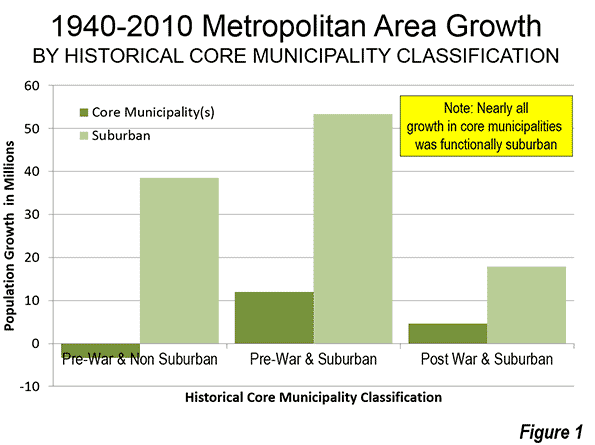
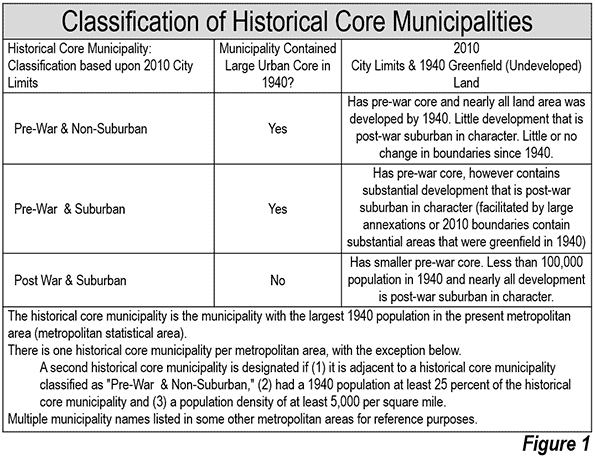
    Virtually all population growth in US metropolitan areas (as currently defined) has been suburban or exurban since before World War II (the 1940 census). The historical core municipalities that have not annexed materially and were largely developed by 1940 have lost population. As a result, approximately 110 percent of their metropolitan area growth has occurred in suburbs and exurbs. Further, among the other core municipalities, virtually all of the population growth that has occurred in annexed areas or greenfield areas that were undeveloped in 1940 (Figure 1).

    Identifying the Pre-Auto Urban Core

    The City Sector Model is not dependent upon municipal boundaries (the term "city" is generic, and refers to cities in their functional sense, metropolitan areas, or in their physical sense, urban areas). Not being constrained by municipal boundaries is important because core municipalities vary substantially. For example, the core municipality represents less than 10 percent of the population of Atlanta, while the core municipality represents more than 60 percent of the population of San Antonio. The City Sector Model applies data available from the US Census Bureau to estimate the population and distribution of Pre-Auto Urban Cores in a consistent manner.

    At the same time, the approach is materially different from the Office of Management and Budget (OMB) classification of "principal cities." It also differs from the Brookings Institution "primary cities," which is based on the OMB approach. The OMB-based classifications classify municipalities using employment data, without regard to urban form, density or other variables that are associated with the urban core. These classifications are useful and acknowledge that the monocentric nature of US metropolitan areas has evolved to polycentricity. However, non-urban-core principal cities and primary cities are themselves, with few exceptions, functionally suburban.

    The City Sector Model Criteria

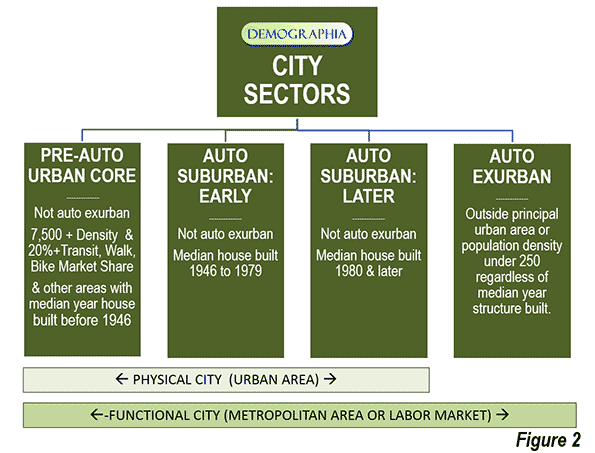
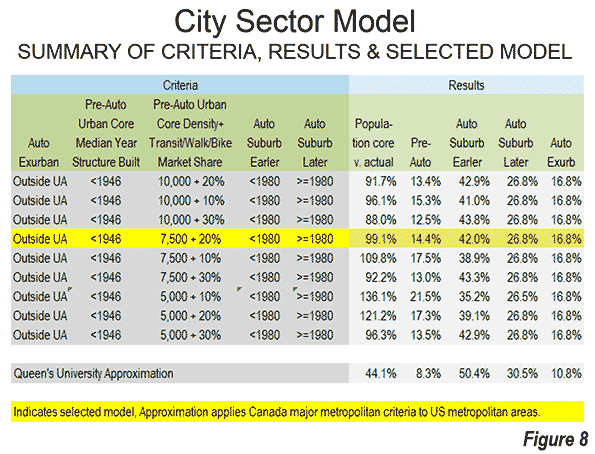
    Due to media and academic interest in the Pre-Auto Urban Core, a number of data combinations were used to best fit the modeled population to that of the core municipalities that have virtually the same boundaries as in 1940 and that were virtually fully developed by that time (the Pre-War & Non-Suburban classification in historical core municipalities). A number of potential criteria were examined, and the following were accepted (Figure 2).

    The Auto Exurban category includes any area outside a principal urban area.

    The Pre-Auto Urban Core category includes any non-exurban with a median house construction date of 1945 or before and also included areas with a population density of 7,500 per square mile (2,900 per square kilometer) or more and with a transit, walk and cycling journey to work market share of 20 percent or more.

    The Auto Suburban Earlier category included the balance of areas with a median house construction date of 1979 or before.

    The Auto Suburban Later category later included the balance of areas with a median house construction date of 1980 or later.

    Additional details on the criteria are in Note 1

    Results: 2010 Census

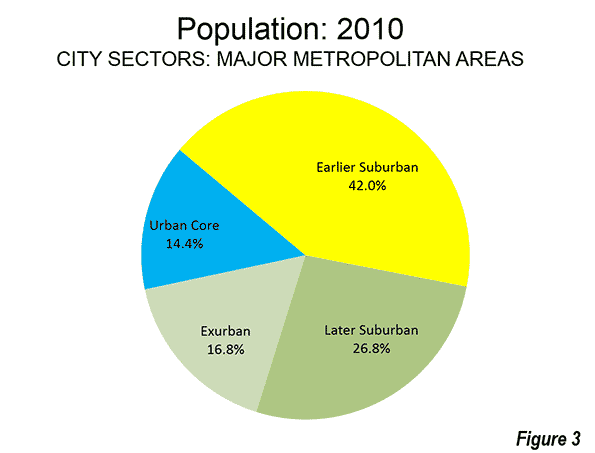
    The combined Pre-Auto Urban Core areas represented 14.4 percent of the population of the major metropolitan areas in 2010 (2013 geographical definition). This compares to the 26.4 percent that the core municipalities themselves represented of the metropolitan areas, indicating nearly half of their population was essentially suburban.

    The Auto Suburban: Earlier areas accounted for 42.0 percent of the population, while the Auto Suburban: Later areas had 26.8 percent of the population. The Auto Exurban areas had 16.8 percent of the population (Figure 3).

    The substantial difference between US and Canadian urbanization is illustrated by applying an approximation of the Gordon-Janzen criteria, which yielded an 8.4 percent Pre-Auto Urban Core population. The corresponding figure for the six major metropolitan areas of Canada was 24.0 percent. This difference is not surprising, since major Canadian urban areas have generally higher densities and much more robust transit, walking and cycling market shares. Yet, the Gordon-Janzen research shows Canada still to be overwhelmingly suburban (Note 2).

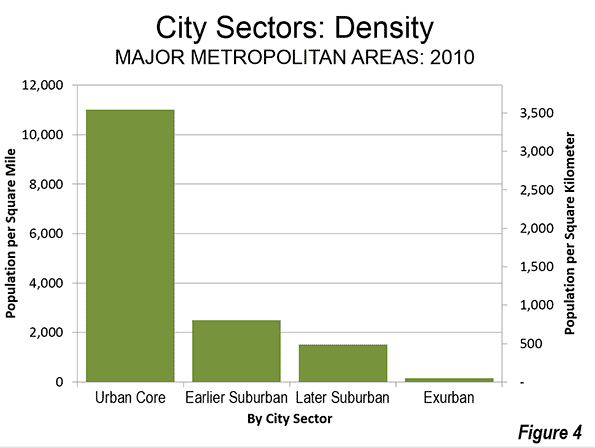
    Population Density: As would be expected, the Pre-Auto Urban Core areas had the highest densities (Figure 4), at 11,000 per square mile (4,250 per square kilometer). The Auto Suburban: Earlier areas had a density of 2,500 per square mile (1,000 per square kilometer), while the Auto Suburban: Later had a population density of 1,300 per square mile (500 per square kilometer), while the Auto Exurban areas had a population density of 150 per square mile (60 per square kilometer)).

    Individual Metropolitan Areas (Cities)

    The metropolitan areas with the highest proportion of Pre-Auto Urban Core population are New York (more than 50 percent), and Boston (nearly 35 percent), followed by Buffalo, Chicago, San Francisco-Oakland, and Providence, all with more than 25 percent (Table).

    Table
    City Sectors: 2010
    Major Metropolitan Areas
    City (Metropolitan Area) Pre-Auto Urban Core Auto Suburban: Earlier Auto Suburban: Later Auto Exurban
    Atlanta, GA 0.5% 14.9% 70.7% 13.8%
    Austin, TX 1.8% 15.7% 62.5% 20.0%
    Baltimore, MD 16.2% 41.8% 19.9% 22.0%
    Birmingham, AL 0.0% 42.1% 24.6% 33.3%
    Boston, MA-NH 34.2% 49.7% 3.2% 12.9%
    Buffalo, NY 28.8% 51.6% 3.1% 16.5%
    Charlotte, NC-SC 0.0% 10.0% 38.4% 51.6%
    Chicago, IL-IN-WI 25.8% 45.0% 18.3% 10.9%
    Cincinnati, OH-KY-IN 10.1% 38.8% 24.3% 26.8%
    Cleveland, OH 22.2% 46.8% 10.5% 20.6%
    Columbus, OH 5.0% 28.7% 37.5% 28.9%
    Dallas-Fort Worth, TX 0.3% 34.4% 43.0% 22.4%
    Denver, CO 3.1% 42.9% 42.4% 11.6%
    Detroit,  MI 6.3% 60.6% 16.1% 16.9%
    Grand Rapids 3.8% 32.9% 15.3% 48.1%
    Hartford, CT 11.1% 58.6% 1.1% 29.2%
    Houston, TX 0.3% 34.2% 48.9% 16.6%
    Indianapolis. IN 4.6% 28.0% 41.8% 25.6%
    Jacksonville, FL 0.0% 26.4% 48.2% 25.4%
    Kansas City, MO-KS 5.4% 37.6% 26.3% 30.6%
    Las Vegas, NV 2.4% 17.5% 76.7% 3.5%
    Los Angeles, CA 10.4% 76.4% 5.2% 8.0%
    Louisville, KY-IN 8.1% 45.4% 25.6% 20.8%
    Memphis, TN-MS-AR 1.8% 40.6% 34.3% 23.3%
    Miami, FL 1.4% 51.4% 44.8% 2.4%
    Milwaukee,WI 22.1% 52.0% 10.4% 15.5%
    Minneapolis-St. Paul, MN-WI 12.7% 31.6% 33.8% 22.0%
    Nashville, TN 0.0% 25.0% 36.1% 38.9%
    New Orleans. LA 10.6% 49.9% 7.0% 32.4%
    New York, NY-NJ-PA 52.4% 35.3% 5.6% 6.7%
    Oklahoma City, OK 2.5% 35.1% 31.6% 30.8%
    Orlando, FL 0.0% 16.1% 50.5% 33.4%
    Philadelphia, PA-NJ-DE-MD 24.6% 51.1% 15.1% 9.2%
    Phoenix, AZ 0.0% 29.4% 51.7% 18.8%
    Pittsburgh, PA 15.7% 56.1% 4.8% 23.4%
    Portland, OR-WA 9.3% 36.7% 39.5% 14.6%
    Providence, RI-MA 25.5% 47.7% 2.8% 24.0%
    Raleigh, NC 0.0% 7.5% 54.4% 38.1%
    Richmond, VA 4.5% 38.8% 38.0% 18.8%
    Riverside-San Bernardino, CA 0.0% 29.1% 29.4% 41.4%
    Rochester, NY 11.1% 46.9% 7.7% 34.3%
    Sacramento, CA 1.6% 38.0% 40.2% 20.1%
    St. Louis,, MO-IL 11.7% 39.9% 25.7% 22.8%
    Salt Lake City, UT 4.6% 47.9% 38.4% 9.1%
    San Antonio, TX 0.1% 39.7% 42.6% 17.6%
    San Diego, CA 1.2% 61.6% 30.3% 6.9%
    San Francisco-Oakland, CA 25.7% 55.5% 7.6% 11.2%
    San Jose, CA 0.1% 77.7% 9.1% 13.1%
    Seattle, WA 7.8% 38.9% 40.2% 13.0%
    Tampa-St. Petersburg, FL 0.0% 44.8% 39.7% 15.5%
    Virginia Beach-Norfolk, VA-NC 1.5% 44.4% 37.7% 16.4%
    Washington, DC-VA-MD-WV 15.9% 29.2% 36.2% 18.7%
    Overall 14.4% 42.0% 26.8% 16.8%


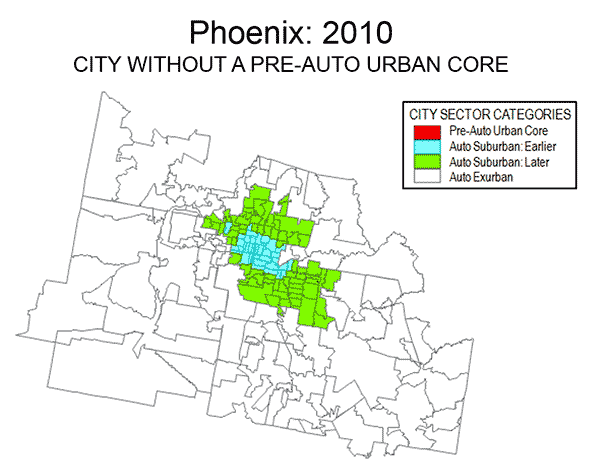
    It may be surprising that many of the major metropolitan areas are shown with little or no Pre-Auto Urban Core population. For example, five metropolitan areas have virtually no Pre-Auto Urban Core population, including Phoenix, Riverside-San Bernardino, Tampa-St. Petersburg, Orlando, Jacksonville, and Birmingham. By the Census Bureau criteria of 1940, two of these areas were not yet metropolitan and only Birmingham (400,000) had more than 250,000 residents.  Many of the newer and fastest growing metropolitan areas were too small, too sparsely settled or insufficiently dense to have strong urban cores before the great automobile suburbanization that followed World War II. Further, many of the Pre-Auto Urban Cores have experienced significant population loss and some of their neighborhoods have become more suburban (automobile oriented). Virtually no urban cores have been developed since World War II meeting the criteria.

    Thus, no part of Phoenix, San Jose, Charlotte and a host of other newer metropolitan areas functionally resembles the Pre-Auto Urban Core areas of metropolitan areas like Chicago, Cincinnati, or Milwaukee. However, new or expanded urban cores are possible, if built at high enough population density and with high enough transit, walking, and cycling use. 

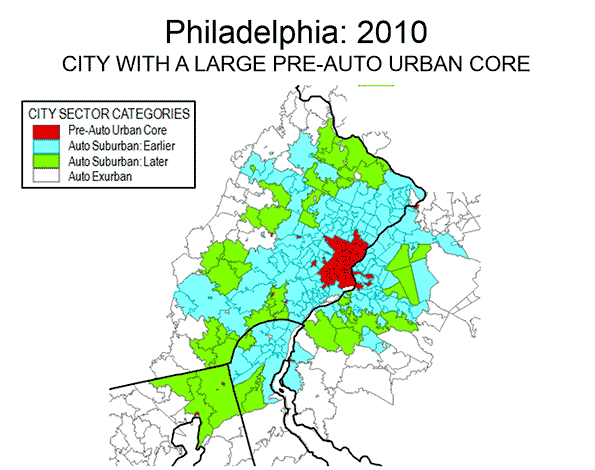
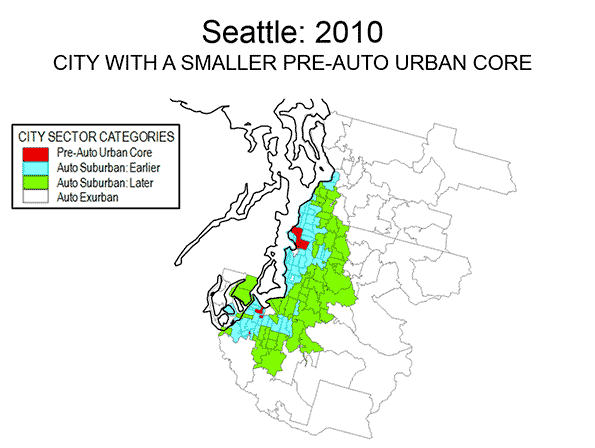
    Examples of three differing metropolitan areas are provided. Philadelphia (Figure 5) is a metropolitan area with a strong Pre-Auto Urban Core, which is indicative of an older metropolitan area that has been among the largest in the nation since its inception, Seattle (Figure 6) is a much newer metropolitan area, yet exhibits a larger Pre-Auto Urban Core than most. Phoenix (Figure 7) may be the best example of a post-War metropolitan area, with virtually no Pre-Auto Urban Core. In 1940, the Phoenix metropolitan area had only 120,000 residents and could be 40 times that large by 2020. Virtually all of Phoenix is automobile-oriented. Even three years after opening its light rail line, 88 percent of Phoenix commuters go to work by car and only two percent by transit, virtually the same as in 2000.

    Despite the comparatively small share of the modern metropolitan area represented by the Pre-Auto Urban Core in the City Core Model, the definition is broad and, if anything over-estimates the size of urban core city sectors. The population density of Pre-Auto Urban Core areas is below that of the historical core municipalities before the great auto oriented urbanization (11,000 compared to 12,100 in 1940) and well above their 2010 density (8,400), even when New York is excluded. The minimum density requirement of 7,500 per square mile (not applied to analysis zones with a median house construction data of 1945 or earlier) is slightly less than the density of Paris suburbs (7,800 per square mile or 3,000 per square kilometer) and only 20 percent more dense than the jurisdictional suburbs (suburbs outside the historical core municipality) of Los Angeles (6,400 per square mile or 2,500 per square kilometer). Some urban containment plans require higher minimum densities, not only in urban cores but also in the suburbs.

    In describing the Canadian results, Professor Gordon noted that there is a tendency to “overestimate the importance of the highly visible downtown cores and underestimate the vast growth happening in the suburban edges.” That is true to an even greater degree in the United States. 

    —–

    Note 1:

    The City Sector Model is applied to the 52 major metropolitan areas in the United States (over 1 million population). The metropolitan areas are broken into principal urban areas, with all other areas considered to be exurban. The principal urban areas also include the Concord urban area and the Mission Viejo urban area, which are adjacent to and included in the San Francisco and Los Angeles urban areas respectively. As a result, some smaller urban areas, such as Palm Springs (Riverside-San Bernardino metropolitan area), Lancaster (Los Angeles metropolitan area) and Poughkeepsie (New York metropolitan area) are considered exurban. Areas with less than 250 residents per square mile (100 per square kilometer) are also considered exurban, principally for classification of large areas on the urban fringe that have a substantial rural element.

    The Pre-Auto Urban Core includes all non-– exurban areas in which is the median house (single-family or multi-family) was built is 1945 or before. Three density levels were considered, 10,000, 7,500 and 5,000 per square mile (4,000, 2,900 and 2,000 per square kilometer). The lower 5,000 per square mile was examined to test the extent to which such a low density would increase the urban core population. This density, less than the entire urban area (urban core and suburban) of the Los Angeles, San Francisco, San Jose and New York urban areas would have, at the most raised the urban core population to 21.5 percent of the metropolitan population, even with a modest 10 percent transit, walking and cycling market share (Figure 8)

    The pre-auto urban core specification results in a 2010 population for the metropolitan areas with Pre-war and non-suburban historical core municipalities within one percentage point of the actual total, excluding the far higher density case of New York.

    The analysis showed that a lower transit, walking and cycling market share at a 7,500 per square mile floor (2,900 per square kilometer) would substantially increase the Pre-Auto Urban Core category population, while diluting its urban core nature. More than one-half of the increase would be in Los Angeles which has added literally millions of residents in high density suburban areas that are as automobile oriented as suburbs elsewhere.

    The analysis zones (zip codes) have an average population of 19,000, with from as many as 1,000 zones in New York to 50 in Raleigh.

    Note 2:

    An approximation based on the Gordon and Janzen approach would indicate an urban core population of only 8 percent in the major metropolitan areas of the United States. This approximation results in a modeled population for the metropolitan areas with pre-war and non-suburban historical core municipalities of less than one-half the actual 2010 population.

    This Queen’s University research comparison in Figure 8 is referred to as an approximation, since it applies an overall transit, walking, and cycling market share for the six major metropolitan areas, instead of a factor corresponding to each metropolitan area (the Gordon and Janzen approach).

    The differences in transit market share relative to the US are substantial. This may be best shown by considering Calgary, which with a population of 1.2 million in 2011 would have ranked as the 47th largest metropolitan area if it were in the United States. Yet, Calgary would rank second only to the New York metropolitan area in transit market share if it were in the United States. Even so, Calgary is found to be the most suburban of Canada’s major metropolitan areas in the Queen’s University research and Statistics Canada data from 2011 indicates strong domination of urban travel by the automobile.

    Wendell Cox is principal of Demographia, an international public policy and demographics firm. He is co-author of the “Demographia International Housing Affordability Survey” and author of “Demographia World Urban Areas” and “War on the Dream: How Anti-Sprawl Policy Threatens the Quality of Life.” He was appointed to three terms on the Los Angeles County Transportation Commission, where he served with the leading city and county leadership as the only non-elected member. He was appointed to the Amtrak Reform Council to fill the unexpired term of Governor Christine Todd Whitman and has served as a visiting professor at the Conservatoire National des Arts et Metiers, a national university in Paris.

    Photo: Los Angeles

  • California’s Green Bantustans

    One of the core barriers to economic prosperity in California is the price of housing. But it doesn’t have to be this way. Policies designed to stifle the ability to develop land are based on flawed premises. These policies prevail because they are backed by environmentalists, and, most importantly, because they have played into the agenda of crony capitalists, Wall Street financiers, and public sector unions. But while the elites have benefit, ordinary working families have been condemned to pay extreme prices in mortgages, property taxes, or rents, to live in confined, unhealthy, ultra high-density neighborhoods. It is reminiscent of apartheid South Africa, but instead of racial superiority as the supposed moral justification, environmentalism is the religion of the day. The result is identical.

    Earlier this month an economist writing for the American Enterprise Institute, Mark J. Perry, published a chart proving that over the past four years, more new homes were built in one city, Houston Texas, than in the entire state of California. We republished Perry’s article earlier this week, “California vs. Texas in one chart.” The population of greater Houston is 6.3 million people. The population of California is 38.4 million people. California, with six times as many people as Houston, built fewer homes.

    And when there’s a shortage, prices rise. The median home price in Houston is $184,000. The median price of a home in Los Angeles is $530,000, nearly three times as much as a home in Houston. The median price of a home in San Francisco is $843,000, nearly five times as much as home in Houston. What is the reason for this? There may be a shortage of homes, but there is no shortage of land in California, a state of 163,000 square miles containing vast expanses of open space. What happened?

    You can argue that San Francisco and Los Angeles are hemmed in by ocean and mountains, respectively, but that really doesn’t answer the question. In most cases, these cities can expand along endless freeway corridors to the north, south, and east, if not west, and new urban centers can arise along these corridors to attract jobs. But they don’t, and the reason for this are the so-called “smart growth” policies. In an interesting report entitled “America’s Emerging Housing Crisis,” Joel Kotkin calls this policy “urban containment.” And along with urban containment, comes downsizing. From another critic of smart growth/urban containment, economist Thomas Sowell, here’s a description of what downsizing means in the San Francisco Bay Area suburb Palo Alto:

    “The house is for sale at $1,498,000. It is a 1,010 square foot bungalow with two bedrooms, one bath and a garage. Although the announcement does not mention it, this bungalow is located near a commuter railroad line, with trains passing regularly throughout the day. The second house has 1,200 square feet and was listed for $1.3 million. Intense competition for the house drove the sale price to $1.7 million. The third, with 1,292 square feet (120 square meters) and built in 1895 is on the market for $2.3 million.”

    And as Sowell points out, there are vast rolling foothills immediately west of Palo Alto that are completely empty – the beneficiaries of urban containment.

    The reason for all of this ostensibly is to preserve open space. This is a worthy goal when kept in perspective. But in California, NO open space is considered immediately acceptable for development. There are hundreds of square miles of rolling foothills on the east slopes of the Mt. Hamilton range that are virtually empty. With reasonable freeway improvements, residents there could commute to points throughout the Silicon Valley in 30-60 minutes. But entrepreneurs have spent millions of dollars and decades of efforts to develop this land, and there is always a reason their projects are held up.

    The misanthropic cruelty of these polices can be illustrated by the following two photographs. The first one is from Soweto, a notorious shantytown that was once one of the most chilling warehouses for human beings in the world, during the era of apartheid in South Africa. The second one is from a suburb in North Sacramento. The scale is identical. Needless to say, the quality of the homes in Sacramento is better, but isn’t it telling that the environmentally enlightened planners in this California city didn’t think a homeowner needed any more dirt to call their own than the Afrikaners deigned to allocate to the oppressed blacks of South Africa?

    The Racist Bantustan

    201402_Soweto-500px


    Soweto, South Africa  –  40′ x 80′ lots, single family dwellings

    When you view these two studies in urban containment, consider what a person who wants to install a toilet, or add a window, or remodel their kitchen may have to go through, today in South Africa, vs. today in Sacramento. Rest assured the ability to improve one’s circumstances in Soweto would be a lot easier than in Sacramento. In Sacramento, just acquiring the permits would probably cost more time and money than doing the entire job in Soweto. And the price of these lovely, environmentally correct, smart-growth havens in Sacramento? According to Zillow, they are currently selling for right around $250,000, more than five times the median household income in that city.

    The Environmentalist Bantustan

    201402_Sacramento-500px


    Sacramento, California  –  40′ x 80′ lots, single family dwellings

    When you increase supply you lower prices, and homes are no exception. The idea that there isn’t enough land in California to develop abundant and competitively priced housing is preposterous. According to the American Farmland Trust, of California’s 163,000 square miles, there are 25,000 square miles of grazing land and 42,000 square miles of agricultural land; of that, 14,000 square miles are prime agricultural land. Think about this. You could put 10 million new residents into homes, four per household, on half-acre lots, and you would only consume 1,953 square miles. If you built those homes on the best prime agricultural land California’s got, you would only use up 14% of it. If you scattered those homes among all of California’s farmland and grazing land – which is far more likely – you would only use up 3% of it. Three percent loss of agricultural land, to allow ten million people to live on half-acre lots!

    And what of these lots in North Sacramento? What of these homes that cost a quarter-million each, five times the median household income? They sit thirteen per acre. Not even enough room in the yard for a trampoline.

    There is a reason to belabor these points, this simple algebra. Because the notion that we have to engage in urban containment is a cruel, entirely unfounded, self-serving lie. You may examine this question of development in any context you wish, and the lie remains intact. If there is an energy shortage, then develop California’s shale reserves. If fracking shale is unacceptable, then drill for natural gas in the Santa Barbara channel. If all fossil fuel is unacceptable, then build nuclear power stations in the geologically stable areas in California’s interior. If there is a water shortage, than build high dams. If high dams are forbidden, then develop aquifer storage to collect runoff. Or desalinate seawater off the Southern California coast. Or recycle sewage. Or let rice farmers sell their allotments. There are answers to every question.

    Environmentalists generate an avalanche of studies, however, that in effect demonize all development, everywhere. The values of environmentalism are important, but if it weren’t for the trillions to be made by trial lawyers, academic careerists, government bureaucrats and their union patrons, crony green capitalist oligarchs, and government pension fund managers and their partners in the hedge funds whose portfolio asset appreciation depends on artificially elevated prices, environmentalism would be reined in. If it weren’t for opportunists following this trillion dollar opportunity, environmentalist values would be kept in their proper perspective.

    The Californians who are hurt by urban containment are not the wealthy elites who find it comforting to believe and lucrative to propagate the enabling big lie. The victims are the underprivileged, the immigrants, the minority communities, retirees who collect Social Security, low wage earners and the disappearing middle class. Anyone who aspires to improve their circumstances can move to Houston and buy a home with relative ease, but in California, they have to struggle for shelter, endlessly, needlessly – contained and allegedly environmentally correct.

    Ed Ring is the executive director of the California Policy Center.

  • Know Your City’s Marketplace Leverage

    I’ve noticed so often that urbanist policy suggestions or case studies are treated as universals. That is, with a presumption that a good idea or policy can be replicated pretty much anywhere. Clearly, there are a number of items like bike lanes and trails that would appear to be widely applicable, and for which the best practice standards would appear to work without much modification in most places. On the other hand, this isn’t true of everything.

    Where do most urban progressive policy ideas come from? From what I’ve seen, these tend to get wide currency when the come from one of the major urbanist citadels like London, New York, Washington, San Francisco, or Portland. This doesn’t always mean that was the place that came up with the idea, but it often is. But these cities are very different from your average, workaday type place.

    One problem with our analysis of these things is that they seldom take into account the amount of marketplace leverage a particular place has. Let’s take New York, for example. That’s a city with immense marketplace leverage, meaning that people and businesses are willing to put up with enormous cost and hassles to live, work, and do business there. In particular, the finance industry, which remains heavily centralized in New York as one of the two top global finance centers, generates tons and tons of cash. Most places don’t have that. It’s similar for tech in the Bay Area, government in Washington, DC, etc. These places have high value industries that are bound to the geography they are located and generate immense wealth and tax revenue. That means these places can get away with a lot of things other cities can’t. They’ve got a cash register that never stops ringing.

    One current case study is Seattle’s raising of the minimum wage to $15. First the small city of SeaTac raised its minimum wage to that level. SeaTac has 27,000 residents, but also includes SeaTac airport as the name implies. Airports employ a large service class who can benefit from a minimum wage increase. And most airport service businesses don’t have the luxury of moving off airport. That gave SeaTac marketplace leverage to raise the minimum wage significantly without huge risk to its employment base. SeaTac airport isn’t going anywhere.

    The city of Seattle itself has followed suit with a graduated increase to $15/hr. Again, Seattle is, like San Francisco, a city of the elite or on its way. The cost of doing business there is such that most businesses that are cost sensitive are already gone or on their way out the door. The coffee shops and other establishments with lower paid workforces mostly can’t move without losing their customer base. So in my view Seattle also has more leverage than your average city in setting this policy.

    It would be tempting to look at the Seattle case and say that other cities should raise their minimum wage. But for places without the concomitant marketplace leverage, it could prove to be economically disastrous.

    So understanding that degree of marketplace leverage you have is critical to evaluating local policies where the result could affect competitive positioning. Cities with greater marketplace leverage will have more flexibility to have local specific policies that might otherwise disadvantage them by raising costs, regulatory hurdles, etc. They can afford to be in the vanguard of policy experimentation.

    Places that fail to take stock of this do so at their peril. One place that has clearly done that is Rhode Island. It has basically acted like it’s entitled to put into place the same sorts of policies as next door Massachusetts and Connecticut, but without the captive high value industries to finance it. Massachusetts has the global power of greater Boston with its unmatched universities, tech, and biotech clusters. Connecticut has access to New York money. Rhode Island doesn’t have anything like this.

    Unfortunately for the Ocean State, it doesn’t seem to get it. I think in part that’s because the state’s intellectual elite – its cultural 1%, so to speak – live in a different reality. Many of them have lived and worked elsewhere like Manhattan and chose to move to Providence for lifestyle. Or they are affiliated with Brown or RISD, two atolls of actual competitive advantage in the state. They look around and see that they are in Rhode Island and they can compete at the global level, so they push for the same sorts of ideas that they used to have back when they actually did live in Manhattan or wherever, without realizing that the other 99% of Rhode Island can’t compete at that level.

    Back in early 2013, I summed it up like this:

    The basic problem of Providence (and by extension the rest of Rhode Island) becomes obvious: it is a small city, without an above average talent pool or assets, but with high costs and business-unfriendly regulation. Thus Providence will neither be competitive with elite talent centers like Boston, nor with smaller city peers like Nashville that are low cost and nearly “anything goes” from a regulatory perspective.

    One reason it’s unlikely they’ll escape from this dilemma is that in my view they aren’t ready to face up to the reality of where they stand in the market competitively.

    Acting like you have leverage when you don’t can be a serious problem, but you can also “leave money on the table” when you do have leverage and fail to take advantage of it. Just as one example, Indianapolis has a “beggar’s mentality” when it comes to development. It just so happens that because of the tourism/sports business and the locals penchant for chain dining that upscale national chains have some of their best locations anywhere in downtown Indianapolis. It’s literally one of the most profitable places in the country for that kind of business – not that you’d know it from the way the city treats them.

    As one example, a BW-3 was built on Washington St. downtown a couple years back. As it turned out, they built something contrary to their approved plans and which violated numerous design guidelines of the city. Did the city make them fix it? Nope. So BW-3′s insult to streetscape humanity was allowed to stand. The city had a lot of marketplace leverage in this case, but didn’t recognize it or wasn’t willing to use it.

    The lesson here is that you need to take stock of the amount of marketplace leverage you have, and tailor your approach accordingly. This is part of coming up with an urban solution set that is right for a specific place and not just a bunch of imported ideas from elsewhere pursued without thought.

    Also, cities should also be asking what they can do to add to their marketplace leverage. Hopefully over time as they continuously improve, their intrinsic attractiveness will go up, which will accrue leverage benefits right there.

    Aaron M. Renn is an independent writer on urban affairs and the founder of Telestrian, a data analysis and mapping tool. He writes at The Urbanophile, where this piece originally appeared.

    Top Photograph: Downtown Seattle from the Space Needle (by Wendell Cox)

  • The Cities Winning The Battle For Information Jobs 2014

    In the town of Verona on the rural fringes of Madison, Wisc., there’s a Google-like campus that houses one of the country’s most rapidly growing tech companies, and one of the least well known. Founded in 1979, the medical software maker Epic has grown to employ 6,800 people, most of whom work at its 5.5 million-square-foot headquarters complex, which sprawls over 800 acres of what was farmland until the early 1990s.

    Despite annual revenue estimated at $1.5 billion, the company is congenitally publicity shy, a characteristic associated with its founder and CEO, Judy Faulkner. Yet in its quiet, unassuming way, Epic is emblematic of the expansion of the information industry in the Madison area. Employment in the metropolitan area’s information sector is up 28% since 2008, among the fastest growth in the country over that period. This has occurred despite the city’s reputation for left-wing, often anti-business politics—a culture that its left-leaning mayor (and Epic booster), Paul Soglin, describes as “76 square miles surrounded by reality.”

    To come up with our list of the cities with the fastest-growing information sectors, we zeroed in on the 55 metropolitan statistical areas that have at least 10,000 information jobs, which includes software, publishing, broadcasting and telecommunications services. We used the same methodology as for our overall ranking of the Best Cities for Jobs: we ranked the MSAs based on job growth in the sector over the long-term (2002-13), mid-term (2008-13) and the last two years, as well as recent momentum.

    View the Best Cities for Information Jobs 2014 List

    Our top 10 is dominated by large metro areas renowned as tech hubs – Madison, at No. 5,  is the smallest by far. In first place is Silicon Valley — San Jose-Sunnyvale-Santa Clara — followed by San Francisco-San Mateo-Redwood City, which together employ over 110,000 information workers. Both have been primary winners in the latest high-tech bubble. Since 2008 information employment is up 23% in San Jose and 27% in San Francisco.

    They’re followed by Boston-Cambridge-Quincy in third place, and Austin-Round Rock-San Marcos, Texas in fourth. The foundation built in previous tech booms — including venture capital, educational institutions, corporate headquarters, and skilled workers — has helped many of the strongest tech regions become even more so this go around.

    But there are some surprising places on our list, including a few Sun Belt metro areas that were hard hit in the housing bust. Take Atlanta-Sandy Springs-Marietta, Ga., which ranks sixth on our list, with a 7.7% expansion in information employment since 2010. Less expensive than the West Coast hotbeds or Boston, Atlanta could be emerging as a player in the sector. Last year General Motors opened a software facility in suburban Roswell, with plans to create over 1,000 new jobs.

    Phoenix-Mesa-Glendale, Ariz., ranks ninth with 11% growth in information employment since 2008. In 2013, the metro area added as many information jobs, roughly 2,000, as the Bay Area, according to an Arizona State University study.

    The Big Players

    Historically, information jobs have clustered in the nation’s largest metropolitan areas. Los Angeles still leads the nation with 201,000 information jobs, while New York is No. 2 with 182,000.

    Yet the fortunes of the biggest players appear to be changing. New York ranks a respectable 13th on our list of the fastest-growing cities for information jobs, with a 7.7% expansion since 2008. This reflects not only the growth of the city’s relatively small tech sector but also its robust film, television and media industries. Los Angeles-Long Beach-Santa Ana, however, has not fared nearly so well, ranking a middling 27th, on our list. This reflects, in part, the erosion of the region’s once dominant entertainment industry. This is particularly true of feature films, where production has dropped 50% from 1996 levels. Since 2000, L.A. has lost 9,000 entertainment industry jobs, leaving it with 132,000.

    With tech companies such as Apple and Google targeting content, and the massive shift of readers over to the web, the preeminence of New York and Los Angeles could continue to erode over time.

    This shift can be seen in the growing forays of the Valley into film and television production through companies such as Netflix and Google’s YouTube, as well as in the already longstanding decline of the music industry — undermined by both legal and illegal forms of music distribution online.

    Information Jobs Set To Disperse

    For New York, a more worrisome development is the massive decline of newspaper, magazine and book industry employment. At a time when Google alone reaps more advertising revenues than the entire newspaper business, it’s not surprising that media growth is shifting toward the Left Coast. Since 2001, the book publishing industry, dominated by New York, has contracted nationally by 17,000 jobs. Newspapers lost 190,000 positions and magazines 50,000 in that same span. But internet publishing, dominated by the Bay Area, expanded by 77,000 jobs during the same window.

    In many ways, the recent tech boom, with its emphasis on social media, has been a blessing to high-cost areas such as Silicon Valley, San Francisco and even New York. Yet at the same time, as we have seen in our other jobs lists, the information sector is expanding most rapidly in some fairly unexpected places. Some of the fastest growers on a percentage basis are still minor players– Janesville, Wisc., Lansing, Mich., and Flint Mich. –  and are tied largely to the up and downs of the manufacturing sector.

    But some, like Madison, are heading toward critical mass. Provo-Orem, Utah, for example, with some 9,800 information jobs, did not make the 10,000 job cut for our list, but should soon given its 21% growth since 2008. Others are in regions just outside the main information hubs, including Santa Barbara-Santa Maria-Goleta, north of Los Angeles, and San Luis Obispo, south of San Jose, as well as Bridgeport-Stamford-Norwalk, north of New York, and Durham-Chapel Hill, N.C., just outside Raleigh-Cary. There has also been rapid information job growth in Huntsville, Ala., a tech center that built up around NASA, and Baton Rouge, La., which has benefited from growth in energy and manufacturing along the lower Mississippi.

    Ultimately, price pressures, particularly on housing, are likely to feed growth in some of these emerging regions. In this way, what is happening in Madison foreshadows the growth of a whole series of new information hotbeds. These may not challenge Silicon Valley, New York or Hollywood in the near future, but they are likely to make their presence known as information jobs continue to spread to fast-growing and more affordable regions.

    View the Best Cities for Information Jobs 2014 List

    This story originally appeared at Forbes.

    Joel Kotkin is executive editor of NewGeography.com and Distinguished Presidential Fellow in Urban Futures at Chapman University, and a member of the editorial board of the Orange County Register. He is author of The City: A Global History and The Next Hundred Million: America in 2050. His most recent study, The Rise of Postfamilialism, has been widely discussed and distributed internationally. He lives in Los Angeles, CA.

    Michael Shires, Ph.D. is a professor at Pepperdine University School of Public Policy.

    Madison, Wisconsin photo by Patrick43470.

  • From Anecdotes to Data: Core & Suburban Growth Trends 2010-2013

    According to the Wall Street Journal, there are "Signs of a Suburban Comeback." This is a turnaround from the typical media coverage of US population estimates in recent years, which have more often than not heralded a "return to the cities" generally more rooted in anecdote than data.

    There were always at least two problems with the "return to the city" thesis. First of all, most people who live in the suburbs came from areas outside metropolitan areas and they couldn’t return to where they had never lived (see Cities and Suburbs: The Unexpected Truth). More importantly, in every year for which there is data, the net inward migration to suburbs has been far greater than to the core counties, which have nearly always had net outward migration (see Special Report: 2013 Metropolitan Area Population Estimates. Under these conditions, there could not have been net migration from the suburbs to the core municipalities.

    Historical Core Municipalities: The Differences

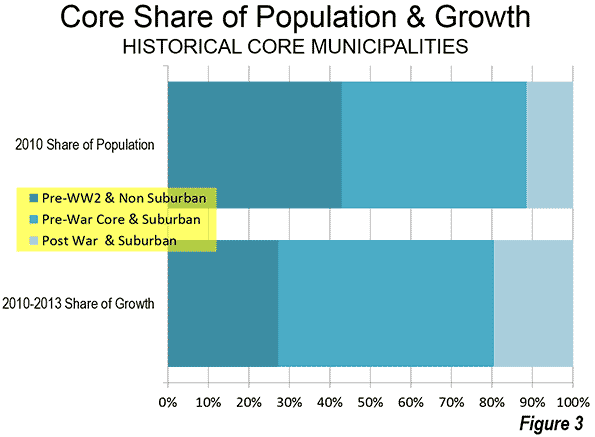
    I have classified historical core municipalities based on their extent of automobile oriented suburbanization (Figure 1). The break point is World War II, after which the great automobile suburbanization occurred in the United States. There had been automobile oriented suburbanization before 1940. During the 1920s, annual rates of suburban growth exceeded five percent in the 14 metropolitan areas with more than 500,000 population. The decade of the Great Depression (1930 to 1940) saw annual growth rates drop three quarters (Note). By the end of World War II, transit had seen its motorized urban travel market share restored to 35 percent, equal to early 1920s levels, a figure that has since fallen to under two percent. 

    Historical Core Municipalities: Improving Trends

    Even so, in recent years, the core municipalities have done better than in the past. The nightmare that occurred between 1970 and 1990 seems to be over in many places. This has made it feasible for an increase in core living by many Millennials and singles. However, even this has been exaggerated by anecdotal research that dominates the media. More than 80 percent of Millennials live outside the core municipalities, where they are less visible to the anecdote-driven media.

    On a percentage basis, the historical core municipalities of the 52 major metropolitan areas (more than 1,000,000 population) managed to grow 3.4 percent between 2010 and 2013, more than the suburban rate of 3.1 percent. This is probably the first time this has occurred in any three year period since the end of World War II.

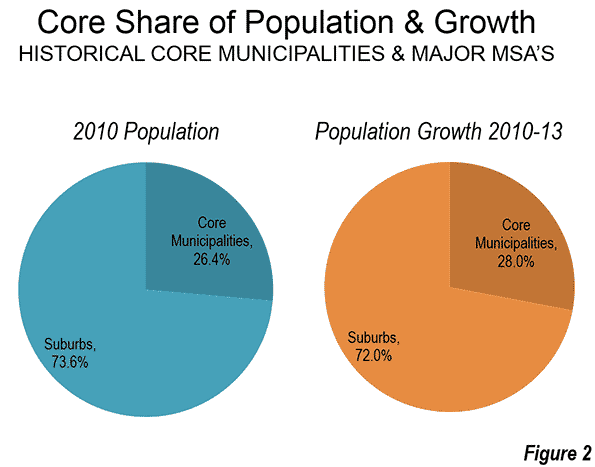
    But the core municipalities now contain such a small share of major metropolitan area population that the suburbs have continued to add population at about three times the numbers of the core municipalities (Figure 2). Indeed, if the respective 2010-2013 annual growth rates were to prevail for the next century,  the core municipalities would house only 28.0 percent of the major metropolitan area population in 2113 (up from 26.4 percent in 2013).

    Despite the publicity to the contrary, only six core municipalities added more population than suburbs in the same metropolitan areas between 2010 and 2013. These were New York, San Antonio, Columbus, San Jose, Austin, and New Orleans, all except New York with substantial suburbanization within their city limits. The core municipalities did better in percentage gains, with 19 gaining faster than the suburbs, compared to 33 suburban areas growing faster than the core municipalities.

    Core Municipality Growth

    Most of the 2010 to 2013 core growth occurred in municipalities with a larger suburban component. The core municipalities that have little suburban development ("Pre-War & Non-Suburban") had 43 percent of the core population in 2010. Yet they attracted only 27 percent of the growth (Figure 3). The two other categories, which include large areas of functional suburbanization (low density and strong automobile orientation) attracted 73 percent of the core population (Figure 3). These include suburbanized pre-War core municipalities, such as Los Angeles, Seattle, and Atlanta. They also include cores that are nearly all suburban, with nearly all of their population growth having occurred during the great automobile suburbanization (such as Austin, Sacramento, Phoenix, and San Jose).

    Core Municipalities: Top Gainers

    New York led the core municipalities by adding 230,000 new residents between 2010 and 2013. This was 56 percent of the population growth among the "Pre-War & Non-Suburban” core municipalities. The core municipality accounted for 60 percent of the population growth in the metropolitan area. However, domestic migrants continued to move away from New York City. Core municipality losses were 215,000 from 2010 to 2013, while the suburbs, with more than 55 percent of the population, lost less than a third as many (70,000).

    Houston gained 96,000 new residents between 2010 and 2013, followed by Austin (95,000), Los Angeles (92,000), and San Antonio (82,000).  Houston, Los Angeles, and San Antonio each have large suburban areas within their city limits, while the core municipality of Austin is virtually all automobile-oriented. The sixth through 10th positions were taken by Phoenix, Dallas, San Jose, Denver, and San Diego, all with substantial suburbanization.

    The largest core municipality population gains were in Austin (12.0 percent), still recovering New Orleans (10.1 percent), Denver (8.3 percent), Washington (7.4 percent), and Orlando (6.1 percent). Seattle, Raleigh, Atlanta, San Antonio and San Jose rounded out the top ten. Among the 10 fastest growing core municipalities, all but Washington have large automobile-oriented suburban components.

    There was also bad news. Detroit continued its population slide, now down to 689,000 from its 1950 peak of 1,850,000. This 62.76 percent loss, however, is not the worst among major US core municipalities. St. Louis still holds that title, having fallen from 857,000 in 1950 to 318,000 in 2013, a loss of 62.84 percent. However, one more year of losses at the 2010-2013 rates will transfer this dubious title to Detroit.

    Suburban Areas: Top Gainers

    The largest suburban gains were in Dallas-Fort Worth (325,000), Houston (296,000), Washington (269,000), Miami (245,000) and Los Angeles (211,000). Atlanta, which had virtually set the world standard for suburbanization before the Great Financial Crisis, managed to re-emerge with the sixth fastest largest suburban increase (208,000).

    Measured on a percentage basis, Texas dominated the suburban gains. The suburbs of Houston added 7.8 percent to their population between 2010 and 2013. Austin added 7.7 percent, San Antonio added 6.6 percent, and Dallas-Fort Worth 6.2 percent. The only non-Texas entry in the top five was Raleigh, which, like Austin, posted a 7.7 percent increase.

    The metropolitan area and historical core municipality data is summarized in the Table.

    Table: Metropolitan Area & Historical Core Municipality Population: 2010-2013
    Metropolitan Area Historical Core Municipality
    Rank Metropolitan Area 2010 2013 % Change 2010 2013 % Change
    1 New York, NY-NJ-PA 19.566 19.950 2.0% 8.175 8.406 2.8%
    2 Los Angeles, CA 12.829 13.131 2.4% 3.793 3.884 2.4%
    3 Chicago, IL-IN-WI 9.461 9.537 0.8% 2.696 2.719 0.9%
    4 Dallas-Fort Worth, TX 6.426 6.811 6.0% 1.198 1.258 5.0%
    5 Houston, TX 5.920 6.313 6.6% 2.099 2.196 4.6%
    6 Philadelphia, PA-NJ-DE-MD 5.965 6.035 1.2% 1.526 1.553 1.8%
    7 Washington, DC-VA-MD-WV 5.636 5.950 5.6% 0.602 0.646 7.4%
    8 Miami, FL 5.565 5.828 4.7% 0.399 0.418 4.6%
    9 Atlanta, GA 5.287 5.523 4.5% 0.420 0.448 6.6%
    10 Boston, MA-NH 4.552 4.684 2.9% 0.618 0.646 4.6%
    11 San Francisco-Oakland, CA 4.335 4.516 4.2% 1.196 1.244 4.0%
    12 Phoenix, AZ 4.193 4.399 4.9% 1.446 1.513 4.7%
    13 Riverside-San Bernardino, CA 4.225 4.381 3.7% 0.210 0.214 1.8%
    14 Detroit,  MI 4.296 4.295 0.0% 0.714 0.689 -3.5%
    15 Seattle, WA 3.440 3.610 5.0% 0.609 0.652 7.2%
    16 Minneapolis-St. Paul, MN-WI 3.349 3.459 3.3% 0.668 0.695 4.1%
    17 San Diego, CA 3.095 3.211 3.7% 1.307 1.356 3.7%
    18 Tampa-St. Petersburg, FL 2.783 2.871 3.1% 0.336 0.353 5.1%
    19 St. Louis,, MO-IL 2.788 2.801 0.5% 0.319 0.318 -0.3%
    20 Baltimore, MD 2.711 2.771 2.2% 0.621 0.622 0.2%
    21 Denver, CO 2.543 2.697 6.1% 0.600 0.649 8.2%
    22 Pittsburgh, PA 2.356 2.361 0.2% 0.306 0.306 0.0%
    23 Charlotte, NC-SC 2.217 2.335 5.3% 0.787 0.823 4.5%
    24 Portland, OR-WA 2.226 2.315 4.0% 0.584 0.609 4.4%
    25 San Antonio, TX 2.143 2.278 6.3% 1.327 1.409 6.1%
    26 Orlando, FL 2.134 2.268 6.3% 0.238 0.255 7.2%
    27 Sacramento, CA 2.149 2.216 3.1% 0.466 0.480 2.8%
    28 Cincinnati, OH-KY-IN 2.115 2.137 1.1% 0.297 0.298 0.2%
    29 Cleveland, OH 2.077 2.065 -0.6% 0.397 0.390 -1.7%
    30 Kansas City, MO-KS 2.009 2.054 2.2% 0.460 0.467 1.6%
    31 Las Vegas, NV 1.951 2.028 3.9% 0.584 0.603 3.4%
    32 Columbus, OH 1.902 1.967 3.4% 0.787 0.823 4.5%
    33 Indianapolis. IN 1.888 1.954 3.5% 0.820 0.843 2.8%
    34 San Jose, CA 1.837 1.920 4.5% 0.946 0.999 5.6%
    35 Austin, TX 1.716 1.883 9.7% 0.790 0.885 12.0%
    36 Nashville, TN 1.671 1.758 5.2% 0.601 0.634 5.5%
    37 Virginia Beach-Norfolk, VA-NC 1.677 1.707 1.8% 0.243 0.246 1.4%
    38 Providence, RI-MA 1.601 1.604 0.2% 0.178 0.178 0.0%
    39 Milwaukee,WI 1.556 1.570 0.9% 0.595 0.599 0.7%
    40 Jacksonville, FL 1.346 1.395 3.6% 0.822 0.843 2.5%
    41 Memphis, TN-MS-AR 1.325 1.342 1.3% 0.647 0.653 1.0%
    42 Oklahoma City, OK 1.253 1.320 5.3% 0.580 0.611 5.3%
    43 Louisville, KY-IN 1.236 1.262 2.1% 0.597 0.610 2.1%
    44 Richmond, VA 1.208 1.246 3.1% 0.204 0.214 4.8%
    45 New Orleans. LA 1.190 1.241 4.3% 0.344 0.379 10.1%
    46 Hartford, CT 1.212 1.215 0.2% 0.125 0.125 0.2%
    47 Raleigh, NC 1.130 1.215 7.4% 0.404 0.432 6.9%
    48 Salt Lake City, UT 1.088 1.140 4.8% 0.186 0.191 2.5%
    49 Birmingham, AL 1.128 1.140 1.1% 0.212 0.212 -0.1%
    50 Buffalo, NY 1.136 1.134 -0.1% 0.261 0.259 -0.9%
    51 Rochester, NY 1.080 1.083 0.3% 0.211 0.210 -0.1%
    52 Grand Rapids, MI 0.989 1.017 2.8% 0.188 0.192 2.3%
    Total 169.512 174.942 3.2% 44.739 46.258 3.4%
    In Millions: Data from US Census Bureau


    Normalcy Knocks?

    Ken Johnson, the frequently quoted University of New Hampshire demographer told the Wall Street Journal, "The slowing growth in these urban cores and the increasing gains in the suburbs may be the first indication of a return to more traditional patterns of city-suburban growth." These patterns are of long standing. Nearly all urban population growth since World War II has been suburban, whether within or outside the core municipalities. It should not be surprising that suburban growth dropped during the second greatest economic decline in a century and has been slow to recover during the Great Recession and the Great Malaise that has followed. The one-quarter suburban growth rate drop was more modest than during the Great Depression, but still substantial. Should genuine prosperity return, it will likely be accompanied by a renewal of more robust suburban growth.

    Note: Core municipality growth also dropped in the 1930s, as the high rate of migration from rural to urban areas in the 1920s was interrupted due to the economic reversal.

    Wendell Cox is principal of Demographia, an international public policy and demographics firm. He is co-author of the “Demographia International Housing Affordability Survey” and author of “Demographia World Urban Areas” and “War on the Dream: How Anti-Sprawl Policy Threatens the Quality of Life.” He was appointed to three terms on the Los Angeles County Transportation Commission, where he served with the leading city and county leadership as the only non-elected member. He was appointed to the Amtrak Reform Council to fill the unexpired term of Governor Christine Todd Whitman and has served as a visiting professor at the Conservatoire National des Arts et Metiers, a national university in Paris.

  • Is Something Wrong With Chicago’s Suburbs?

    I previously talked about Connecticut becoming a suburban corporate wasteland as well as the rise of the executive headquarters in major global city downtowns. What we see is that high end functions have shown anecdotal signs of re-centralizing, while the more bread and butter – though still often well-paying – jobs are heading to less expensive suburban locales in places like Austin, Charlotte, and Salt Lake City. These leaves expensive and business hostile suburbs around global cities, like most of those in Connecticut, in a tough spot.

    Suburban Chicago isn’t as expensive or business hostile as say Connecticut or New Jersey, but there are so many stories about businesses leaving it that I can’t help but wonder if something is seriously wrong there.

    First, downtown Chicago has attracted a number of marquee executive headquarters locations like Boeing, MillerCoors, and now ADM. The suburbs have only picked up a handful of smaller operations, like Mead Johnson Nutritionals.

    Second, a number of suburban companies have relocated (or announced relocations of) headquarters to downtown. This includes a Sara Lee spinoff, the old Motorola cell phone division, United Airlines, and Gogo Internet. What distinguishes this from the executive headquarters relocations is that some of these involved big numbers of jobs. I believe there were about 3,000 United Airlines employees and about 2,500 Motorola ones.

    Third, even companies that haven’t moved their headquarters have opened downtown offices or relocated operations there. Walgreens moved its e-Commerce operations to the Loop and BP relocated some employees, for example.

    Fourth, some suburban based companies have simply abandoned the Chicagoland area outright. Office Max comes to mind, which is moving 1,600 jobs to Boca Raton. Sears is having a slow-motion going out of business sale.

    Two recent news articles this week reinforce to me the lack of competitiveness of Chicago’s suburbs. First, when Toyota announced it was relocating its headquarters from Los Angeles and Cincinnati to suburban Dallas, Greg Hinz at Crain’s Chicago Business asked why Chicago wasn’t even on the list of candidate cities for this operation.

    I believe Toyota wanted to be in the South. But if you look at where they located, namely the suburb of Plano, you’ll see that this is why Chicago is off the list. Chicago’s suburbs have been losing these types of corporations, not gaining them. If you’re going to choose a suburban location, why would you pick Schaumburg over Plano? You probably wouldn’t unless you had a major reason to be in Chicagoland, such as having a primarily Midwest presence or if your company was founded in the area.

    What this shows is that while Chicago’s stellar Loop environment is great for executive headquarters type operations, the suburbs lack appeal to people looking to build a greenfield operation from out of town. This hurts the region’s ability to attract large scale employers like Toyota.

    Then yesterday Crain’s reported that Walgreens is looking at relocating its entire headquarters downtown in the old Main Post Office building. This isn’t a done deal by any means, but the fact that a company I’d always considered dyed-in-the-wool suburban would consider this is incredible. (Investors have been pressuring Walgreens to move its HQ overseas, but like Aon’s re-domicle to London, even if it happened it might not involve many jobs, especially since the pharmacy business in the United States is so radically different from that in the rest of the world).

    So unlike in even other global cities, Chicago’s suburbs can’t even seem to hang on to large scale employers within the region. I don’t want to overstate a trend here, but this would be at least the third company moving thousands of jobs downtown. That’s huge and I don’t see it happening anywhere else at this scale.

    Which raises the question of what might be wrong with Chicago’s suburbs. They can’t seem to be competitive for greenfield operations like Toyota, and they are losing some marquee established employers. I took a quick peek at suburban vacancy rates, and it looks like at first glance every major sub-market is over 20% and there was net negative absorption last year (do some further research before quoting me on that). Is there a big problem going on out there?

    I’ve long observed that while Chicago has some great residential suburbs, its business suburbs are weak. Places like Schaumburg and Oak Brook are just generic, unattractive edge cities of a typology that, like the enclosed mall, appears falling out of favor. Chicago seems to lack the kind of suburb that combines residential appeal with a strong business presence and a significant regional amenity draw. Only Naperville would seem to fit the bill here.

    So while Chicago’s suburbs are not super-high cost by global city standards, and Illinois isn’t the worst when it comes to taxes and a poor business climate by any means, those suburbs appear to have a serious competitiveness issue. It’s a major concern that regional suburban business centers should look to address. As other edge city environments around the country like Stamford (one part of Connecticut I would say has significant strengths) and Tyson’s Corner upgrade themselves, Chicago’s suburbs are only going to fall further behind.

    Aaron M. Renn is an independent writer on urban affairs and the founder of Telestrian, a data analysis and mapping tool. He writes at The Urbanophile, where this piece originally appeared.

    Photograph: Outer suburbs of Chicago (by Wendell Cox)

  • China’s Ascent in World Transport

    After years of closing the gap with the United States, China built enough freeways in 2013 to amass the greatest length of freeways in the world. Between 2003 and 2013, China expanded its national expressway system, with interstate (motorway in Europe) standard roadways from 30,000 to 105,000 kilometers (18,000 to 65,000 miles). This compares to the 101,000 kilometers (63,000 miles) in the United States in 2012. China’s freeway system is also longer than that of the European Union, which was 70,000 kilometers in 2010 (43,000 miles) and Japan (8,000 kilometers or 5,000 miles) as is indicated in Figure 1 (Note 1). The ascent of China is evident across the spectrum of transport data, both passenger and freight.

    A review of transport statistics in the four largest world economies (nominal gross domestic product) shows considerable variation in both passenger and freight flows. It also reflects the rapid growth of China. Generally comparable and complete data is available for the European Union, the United States, China and Japan.

    Passenger Travel

    All four of the world’s largest economies rely principally on roads for their passenger transport. The United States continues to lead in road volume (in passenger kilometers, see Note 2) by a substantial margin, followed by the European Union. In the United States, automobiles account for 83 percent of domestic passenger travel, which compares to 76 percent in the European Union and 58 percent in Japan. China’s combines automobile and bus data, which makes it impossible to obtain automobile comparisons with the other three economies.

    Road travel increased more than 150 percent between 2003 and 2013 in China. Yet roads have barely held their market share as China has built new world-class airports, such as Capital City in Beijing, Baiyun in Guangzhou and many others. Over the same 10 years air travel has increased 350 percent. Meanwhile, China has built the world’s most extensive high-speed rail system and has experienced healthy rail travel growth. Yet, despite this, passenger rail’s market share has dropped from 35 percent to 29 percent over the period (Figure 2).

    China is dominant among the four economies in passenger rail volumes, with its 1.05 trillion annual passenger kilometers (0.65 trillion passenger miles) accounting for more than 2.5 times the rail travel in both the European Union and Japan. US rail travel is no more than 1/20th that of China (equal to the road travel volume in the state of Arkansas).

    The United States continues to lead in a domestic airline travel, with a volume approximately 60 percent greater than those of the European Union and China. China trails the European Union by only two percent and with its growth rate seems likely to assume the second position before long (Figure 3).

    Passenger travel market shares are indicated in Figure 4.

    Freight Transport

    After having led the world in rail freight volumes in recent decades, the United States has recently yielded the title to China. In 2013, China moved nearly 3 trillion tonne kilometers (Note 3) of freight by rail, compared to the US total of 2.5 trillion (2012). It may be surprising to find out that Europe, with its extensive passenger train system moves so little of its freight by rail. However, the European Union moved approximately 60 percent less of its freight by rail. However, much of the capacity of the EU’s rail system is consumed by passenger trains, leaving little for freight.  This is despite a policy commitment in the EU to substantially increase the rail freight market share relative to trucks. As a result, in Europe, the freight trains are "on the highway" (see Photo below). China has been uniquely successful among the world’s economies in developing both a world class freight rail system and a world class passenger rail system. One of China’s early objectives in developing its high speed rail program was to free space for its large freight train volumes.


    Caption: Trucks on the A7, north of Barcelona (by author)

    Among other nations, only Russia can compete with China and the United States in rail freight, having moved approximately 2.2 trillion tonne kilometers in 2012.

    Rail freight remains by far the most important in the United States compared to the other three largest economies. Rail freight continues to carry more tonne kilometers in the United States than trucks. The situation is much different in Europe, where trucks carried four times the volume of freight rail. Rail freight is even less significant in Japan, where trucks carry more than 15 times the volume of rail freight.

    One possibly surprising fact lies with the substantial increase in China’s truck volumes over the last decade. China now has a volume of truck traffic that is four times that of trucks in either the European Union or the United States.

    In 2003, trucks carried 60 percent less of the nation’s metric tonne mileage than freight rail. By 2013, that had been reversed with tracks carrying 130 percent more volume than freight rail.

    However China’s dominance is even greater in water borne freight, at nearly 6 times the European Union volume and more than 10 times the volume of the United States (Figure 5). Even so, China’s largest freight volumes are carried on waterways, such as the Yangtze River. Over the past 10 years waterway volumes tripled. It is even expected that there will be a significant increase in shipping on the ancient Grand Canal (Figure 6).

    Freight market shares among the major modes are shown in Figure 7.

    India

    Another of the world’s largest economies, India, also relies heavily on roads. According to the World Bank 65 percent of the freight and nearly 90 percent of passengers are carried by roads in India, though late detailed data is not available. Yet India also has the largest passenger rail usage in the world. Only China is close, and the two nations have been near equal, at least over the last decade. In 2003, China trailed India by seven percent in passenger kilometers by train. Complete Indian Railway data for 2013 is not yet available. However, if the average trip length in 2013 was the same as in 2012, China will have moved to within two percent of India’s passenger rail volume. Both nations are far above Japan and the European Union, ranked third and fourth, and almost 90 percent above Russia, which has a reputation for high passenger rail volumes.

    The Future

    With economic growth in China slowing (though still at rates that would satisfy virtually any other nation) its transport growth of the past decade seems likely to moderate. On the other hand, the other large emerging economy, India, which has substantially trailed China, could assume a Chinese trajectory. The newly elected Bharatiya Janata Party (BJP) government is committed to economic advance and infrastructure development. Market facilitating policies like those that have propelled China (see the late Noble Laureate Ronald Coase and Ning Wang, How China Became Capitalist), could lead to a similar story about India in a decade or two.

    ——

    Note 1: The latest data on international transport varies by year, even within nations (such as the United States). This analysis compares the latest data, which is 2012 (Europe and Japan), 2013 (China) and the United States (2011, with some 2009). This latest years available permit comparing the general scale of differences and, particularly in the United States, changes from the earlier data are likely to have been modest, as a result of the Great Financial Crisis and the great economic malaise that has followed. The principal data sources are the Bureau of Transportation Statistics in the United States, the National Bureau of Statistics in China and Eurostat for the European Union and Japan.

    Note 2: A passenger kilometer (or passenger mile) is the distance traveled times the number of passengers. Thus, a car going 5 kilometers with one passenger produces 5 passenger kilometers. With two passengers, there are 10 passenger kilometers.

    Note 3: A tonne kilometer is a metric tonne (2.204 pounds or 1,000 kilograms) of freight times the number of kilometers traveled. The US ton (short ton) has 2,000 pounds or 907 kilograms.

    —-

    Wendell Cox is principal of Demographia, an international public policy and demographics firm. He is co-author of the "Demographia International Housing Affordability Survey" and author of "Demographia World Urban Areas" and "War on the Dream: How Anti-Sprawl Policy Threatens the Quality of Life." He was appointed to three terms on the Los Angeles County Transportation Commission, where he served with the leading city and county leadership as the only non-elected member. He was appointed to the Amtrak Reform Council to fill the unexpired term of Governor Christine Todd Whitman and has served as a visiting professor at the Conservatoire National des Arts et Metiers, a national university in Paris.

    Photograph: Grand Canal in Suzhou (by author)