Category: Urban Issues

  • The Best Cities For Jobs 2014

    As the recovery from the Great Recession stretches into its fifth year, the locus of economic momentum has shifted. In the early years of the recession, the cities that created the most jobs — sometimes the only ones — were either government- or military-dominated (Washington, D.C.;  Kileen-Temple-Fort Hood, Texas), or were powered by the energy boom in Texas, Oklahoma and the northern Great Plains.

    Now the recovery has shifted to a new group of cities that have benefited from the boom on Wall Street and the parallel IPO surge in Silicon Valley — call them asset inflation cities. Last year the S&P 500 clocked its biggest rise since 1997, helped by aggressive monetary easing by the Federal Reserve and a return to the stock market by investors who had retreated to the sidelines after the financial crisis. The high times have brought on a surge in IPOs: 2013 was the busiest year for public offerings in over a decade, and the pace has if anything quickened this year, with healthcare and technology offerings leading the way. M&A has also surged, with some very impressive valuations in the tech sector, such as Facebook’s $19 billion purchase of 50-person What’s App. The biggest beneficiaries employment-wise: the Bay Area, Silicon Valley and New York City.

    View the Best Cities for Jobs 2014 List

    Our rankings are based on short-, medium- and long-term job creation, going back to 2002, and factor in momentum — whether growth is slowing or accelerating. So the top of our list includes both cities that have had the most striking comebacks since the Great Recession as well as those that have consistently created jobs over the long haul. We have compiled separate rankings for large cities (nonfarm employment over 450,000), which are our focus this week, as well as medium-size cities (between 150,000 and 450,000 nonfarm jobs) and small cities (less than 150,000 nonfarm jobs) in order to make the comparisons more relevant to each category. (For a detailed description of our methodology, click here.) Small cities, as a rule, show more volatility than their larger counterparts since the decision of one major business to expand or contract can have an enormous effect on a relatively tiny employment base. (Check back next week for our ranking of mid-size and small cities).

    Big Money, Big Gains

    Yet even among the largest metropolitan areas, shifts in the economy can have a dramatic impact. This is clearly the case with the two metro areas that top our list this year, first-place San Jose-Sunnyvale-Santa Clara, Calif. (aka Silicon Valley), where the number of jobs surged 4.3% last year, and San Francisco-San Mateo-Redwood City, where employment expanded 3.6%. Before the current tech boom, largely centered on social media companies, these metro areas were lagging badly. In 2010, San Jose ranked 47th on this list out of the 66 metro areas with more than 450,000 nonfarm jobs and San Francisco was 42nd.

    The information sector has driven this remarkable change in fortunes. Since 2008, the number of information jobs in the San Jose area has risen 37% to 60,800, while in San Francisco, employment in that category has grown 28% to 52,300 jobs. This has been accompanied by strong increases in such high-wage fields as professional and business services, where Silicon Valley has clocked 10% growth, and San Francisco twice that, adding 42,500 jobs, since 2008.

    The housing bubble helped to launch New York City from its doldrums a decade ago (it rose from 54th on our list of the Best Cities For Jobs in 2005 to 22th in 2008). In recent years, New York has been well served by Washington’s bailout of the financial sector, which accounts for roughly 15% of the metro area GDP — the Big Apple climbed to 10th place in our ranking in 2010 and to seventh this year. This is in good part a result of asset inflation; the number of finance jobs in New York has actually declined in recent years, but with a lot of extra spending money in the pockets of the city’s relatively high concentration of wealthy people, some jobs are being created. Most of the growth has been in hospitality, health and education and retail, fields that do not generally offer top salaries. New York City has also seen steady growth in information jobs — although at only a third the rate of Silicon Valley — as well as professional and business services.

    Bring On The Usual Suspects

    Many of the other metro areas at the top of our 2014 list have been adding jobs consistently over the past decade. Some are also beneficiaries of the high-tech boom, though mostly as a result of big West Coast companies deciding to site new offices in these attractive locations. In third place is perennial high-flyer Austin-Round Rock-San Marcos, Texas, where the number of jobs grew 4.1% last year, and 13.7% since 2008. Raleigh-Cary N.C. places fourth (3.9%/7.2% over the same time spans). These metro areas routinely attract people and companies from California and the Northeast with lower taxes and real estate costs that, on an income basis, are as much as half those in the asset-rich areas.

    Unlike the asset-based economies, which ebb and flow with the markets, these and the other usual suspects have a record of consistent growth not only in jobs but also population. This reflects the more blue-collar economic foundation of many of these cities, based on energy, manufacturing and logistics — sectors that tend to create higher-paid blue- and white-collar jobs. Growth has continued in these areas throughout all the changes in the economy, which has encouraged long-term migration and investment.

    Viewed over the last five years, for example, fifth-place Houston has expanded its total employment by 218,000 jobs, growing at the same rate as both the San Francisco and San Jose metro areas—an impressive feat given that it is almost 20 percent larger than the two Silicon Valley cities combined. But an arguably bigger difference can be seen in demographics. The Houston metro area’s population has grown over 50% faster since 2010 than the Bay Area regions, and roughly twice as fast as New York. Houston is on track this year to build more new housing units than the entire state of California. This combination of rapid population and job growth – the former itself a major source of jobs in construction and services — can be seen in places such as No. 6 Nashville-Franklin-Murfreesboro, Tenn.; No. 10 Denver-Aurora-Broomfield, Colo.; and No. 14 Charlotte-Gastonia-Round Hill, N.C.

    The Sun Belt Bounces Back

    Perhaps the biggest surprise on this year’s list is the resurgence of the Sun Belt metro areas that were hardest hit by the housing bust. Ever since, the Northeast-centric pundit class has been giddily predicting these cities’ demise. Strangled by high energy prices, cooked by record droughts, rejected by a new generation of urban-centric millennials, the Atlantic proclaimed this vast southern region to be where the American dream has gone to die.

    But the data show that many of these metro areas are in the midst of a powerful comeback. Take Orlando-Kissimmee, Fla., ranked eighth this year, up 23 places from last year. Similarly Phoenix has risen 17 places from last year to 22nd and is way up from its 51st place ranking in 2010.

    Perhaps even more surprising  is the resurgence of 17th-place Riverside-San Bernardino, Calif., which ranked near the bottom of the big city table at 63rd in 2010. Now foreclosures have dropped and job growth has picked up. In fact, the Inland Empire is now doing considerably better in job creation than Southern California’s older urban regions, including Los Angeles-Long Beach (37th), Santa Ana-Anaheim-Irvine (34th) and San Diego-Carlsbad-San Marcos (32nd).

    Bringing Up The Rear

    Many large cities continue to lag. Philadelphia, despite being close to New York and its considerable urban amenities, ranks 51st, with paltry 0.9% job growth since 2008. Not much better off, despite its connections to the Obama White House, is Chicago, which places 47th. Not only is the Windy City not adding many jobs (0.5% growth since 2008) but every county in the area, according to recent Census numbers, is losing migrants to other parts of the country.

    But Chicago is certainly doing better than the host of old industrial cities that continue to dominate the nether reaches of our survey. These include last-place Camden, N.J.; second to last Detroit-Livonia-Dearborn, Mich.; Cleveland-Elyria- Mentor, Ohio (62nd), Kansas City, Mo. (61st), Newark-Union, N.J. (60th), and St. Louis (59th). All these cities, apart from Kansas City, have occupied the bottom of our list for nearly a decade now, and seem unlikely to move up in the immediate future.

    View the Best Cities for Jobs 2014 List

    What’s Next

    It seems clear that as long as the tech and financial sectors retain their momentum, New York and the Bay Area should continue to fare well. But if asset growth slows, these areas could slip quickly.

    The Texas cities and the other usual suspects are probably a better bet to continue to generate new jobs, but they too face challenges. If the economy slows down energy prices will follow, hampering growth in energy meccas like Houston, Dallas and San Antonio. A surge in interest rates could undermine the comeback of the Sun Belt cities, which remain highly dependent on housing and construction-related economic activity.

    But overall, for reasons ranging from housing costs to business climate, we expect the usual suspects to remain high on our list of the best cities for jobs for years to come, in part due to their growing populations. What remains unknown is how the evolving industrial structure of the economy will affect the slower-growing cities along the coasts whose fortunes have tended to ebb and flow in recent years.

    This story originally appeared at Forbes.

    Joel Kotkin is executive editor of NewGeography.com and Distinguished Presidential Fellow in Urban Futures at Chapman University, and a member of the editorial board of the Orange County Register. He is author of The City: A Global History and The Next Hundred Million: America in 2050. His most recent study, The Rise of Postfamilialism, has been widely discussed and distributed internationally. He lives in Los Angeles, CA.

    Michael Shires, Ph.D. is a professor at Pepperdine University School of Public Policy.

    Photo: Market Street, San Francisco by Wendell Cox.
  • Should Middle Class Abandon the American Dream?

    Over the past few years, particularly since the bursting of the housing bubble, there have been increasing calls for middle-class Americans to “scale down” from their beloved private homes and seek a more constrained existence. Among these voices recently was Michael Milken, for whom I have worked and have enormous respect. He suggested Americans would be better off not buying homes and living smaller, for the sake of their own economic situations, families and the environment.

    To some extent, the Great Recession has done much to make downsizing a reality, just as Milken and others propose. Homeownership in America, which peaked in 2002 at nearly 70 percent, dropped, according to the U.S. Census Bureau, to 65 percent in 2013, the lowest level in 15 years. Some of this may be seen as correcting the excesses of the housing bubble, but the trajectory suggests – and many analysts agree – that ownership may continue to fall in years ahead.

    The question now is, do we want Americans to abandon homeownership, leave the less-crowded periphery for congested areas, adopting the chock-a-block lifestyle much as many of their grandparents did? This poses an easier proposition for the ultrarich, who already live far larger than the average American and whose biggest real estate worry more likely involves which pied a terre or country house they want to purchase next.

    This is very different than the reality of the average middle-class family, whose concerns are more prosaic, such as finding room for home offices, deciding how few bathrooms a family can accommodate without armed conflict and if it is even feasible to afford the close-in communities their betters want them to inhabit.

    Unable to play the stock game on the scale of gain like those who invest in private equity, hedge funds or venture capital, for the middle classes the home remains the one place where they can gain equity and, perhaps more importantly, some sense of autonomy. For many, it is the only large investment they can afford, since at least it provides a place to live and offsets the rent that they would have to pay otherwise.

    The recovery has been sweet for the rich, in large part because they have the extra money to invest in stocks. They have 24 percent of their wealth in homes, compared with 40 percent for middle-income families.

    And, since the rich can afford to send their kids to elite schools, where degrees increasingly are the last ones to produce much value at the high end of the job market, to such people, the investment in education urged by Milken may seem like a good bet. Investing more in conventional education, however, is no panacea for many middle-class and working-class families, whose kids are often saddled with debt and attend the second-tier schools whose returns on income are far less attractive, say, than those who can send their kids to Harvard.

    This is not to say that many larger homes seem foolhardy investments. But there are many legitimate reasons why people may need larger spaces. Among the most prominent is the growing tendency for people to work at home – most metro areas have far more telecommuters than transit commuters – as well as the increasing numbers of multigenerational households, which, after falling for decades, have risen from 12 percent of total households to 16 percent since 1980.

    The phenomena of some among the rich calling for the middle class to scale back represents one of the least-attractive aspects of the current gentry liberal ascendency. In one remarkable piece, Dave Zahniser, writing for the LA Weekly, went to the homes of L.A.’s “smart growth” advocates, most of whom want ever more density and multifamily apartments as opposed to houses. And where did they live? Almost all in large houses, often in gated communities, far from any bus line. Zahnhiser’s headline captured the hypocrisy: “Do what we say, not what we do.”

    Cloaked in sensible rhetoric, the current drive to discourage middle-class homeownership really represents a kind of class warfare, albeit unacknowledged, waged by wealthy people upon the middle class, who, the wealthy suggest, should live smaller even as they indulge ever-expanding luxury. Talk about adding insult to injury: Middle-income groups have fared far worse during the recovery than the rich or, in relative terms, the poor.

    Some advocacy for middle-class downsizing is brazenly self-interested. The Wall Streetadvocates of a “rentership” society see a great opportunity for profit as Americans are deprived of their aspirations by the weak economy. As the dream of some autonomy fades, more families are forced to become renters in apartments or houses that such hedge funds as Blackstone have collected from distressed former owners.

    In the process, a huge portion of the population is being transformed from property owners to renting serfs; money that might have gone to building a family nest egg ends up paying the mortgages for the investor class. In this neofeudalist landscape, landlords replace owner-occupants, perhaps for as long as the next generation.

    “There is the possibility that Wall Street and the banks and the affluent 1 percent stand to gain the most from this,” said Jack McCabe, a real estate consultant based in Deerfield Beach, Fla. “Meanwhile, lower-income Americans will lose their opportunity for the American Dream of building wealth through owning a home.”

    Other wealthy folks – notably some in Hollywood and Silicon Valley – also support a California planning regime that makes difficult the purchasing and construction of family-size homes, largely as a means to reducing the dreaded human “carbon footprint.” Yet they, too, are often unconsciously hypocritical, as many of them live in palatial houses, and often fly on private jets, one of the quickest ways to boost one’s carbon emissions. Google’s top executives, among the most reliable allies of the middle-class-destroying green and urban-planner lobby, famously have a fleet of planes based at San Jose Airport.

    Others, like the environment magazine Grist, embrace a more idealistic vision of a new generation that rarely owns and doesn’t embrace conventional ambitions. They see the current millennial generation, facing limited economic prospects and high housing prices, as “a hero generation,” rejecting the material trap of suburban living and work that engulfed their parents.

    This story originally appeared at The Orange County Register.

    Joel Kotkin is executive editor of NewGeography.com and Distinguished Presidential Fellow in Urban Futures at Chapman University, and a member of the editorial board of the Orange County Register. He is author of The City: A Global History and The Next Hundred Million: America in 2050. His most recent study, The Rise of Postfamilialism, has been widely discussed and distributed internationally. He lives in Los Angeles, CA.

  • Silicon Valley’s Giants Are Just Gilded Age Tycoons in Techno-Utopian Clothes

    Silicon Valley’s biggest names—Google, Apple, Intel and Adobe—reached a settlement today in a contentious $3 billion anti-trust suit brought by workers who accused the tech giants of secretly colluding to not recruit each other’s employees. The workers won, but not much, receiving only a rumored $300 million, a small fraction of the billions the companies might have been forced to pay had they been found guilty in a trial verdict. 

    The criminality that the case exposed in the boardrooms the tech giants, including from revered figures like Steve Jobs who comes off as especially ruthless, should not be jarring to anyone familiar with Silicon Valley.  It may shock much of the media, who have generally genuflected towards these companies, and much of the public, that has been hoodwinked into thinking the Valley oligarchs represent a better kind of plutocrat—but the truth is they are a lot like the old robber barons.

    Starting in the 1980s, a mythology grew that the new tech entrepreneurs represented a new, progressive model that was not animated by conventional business thinking. In contrast to staid old east coast corporations, the new California firms were what futurist Alvin Toffler described as “third wave.” Often dressed in jeans, and not suits, they were seen as inherently less hierarchical and power-hungry as their industrial age predecessors.  

    Silicon Valley executives were not just about making money, but were trying, as they famously claimed, to “change the world.” One popularizing enthusiast, MIT’s Nicholas Negroponte, even suggested that “digital technology” could turn into “a natural force drawing people into greater world harmony.”

    This image has insulated the tech elite from the kind of opprobrium meted out to their rival capitalist icons in other, more traditional industries. In 2011, over 72 percent of Americans had positive feelings about the computer industry as opposed to a mere 30 percent for banking and 20 percent for oil and gas. Even during the occupy protests in 2012, few criticisms were hurled by the “screwed generation” at tech titans. Indeed, Steve Jobs, a .000001 per center worth $7 billion, the ferocious competitor who threatened “war” against Google if they did not cooperate in his wage fixing scheme, was openly mourned by protestors when news spread that he had passed away.

    But the collusion case amply proves what has been clear to those watching the industry: greed and the desire to control drives tech entrepreneurs as much as any other business group. The Valley is great at talking progressive but not so much in practice. In the very place where private opposition to gay marriage is enough to get a tech executive fired, the big firms have shown a very weak record of hiring minorities and women. And not surprisingly, firms also are notoriously skittish about revealing their diversity data. A San Jose Mercury report found that the numbers of Hispanics and African Americans employees in Silicon Valley tech companies, already far below their percentage in the population, has actually been declining in recent years. Hispanics, roughly one quarter of the local labor force, account for barely five percent of those working at the Valley’s ten largest companies. The share of women working at the big tech companies – despite the rise of high profile figures in management—has also showed declines.    

    In terms of dealing with “talent,” collusion is not the only way the Valley oligarchs work to keep wages down.  Another technique is the outsourcing of labor to lower paid foreign workers, the so called “techno-coolies.” The tech giants claim that they hire cheap workers overseas because of a critical shortage of skilled computer workers but that doesn’t hold up to serious scrutiny. A 2013 report from the labor-aligned Economic Policy Institute found that the country is producing 50% more IT professionals per year than are being employed. Tech firms, notes EPI, would rather hire “guest workers” who now account for one-third to one half of all new IT job holders, largely to maintain both a lower cost and a more pliant workforce.

    Some of this also reflects a preference for hiring younger employees at the expense of older software and engineering workers, many of whom own homes and have families in the area.  

     “I want to stress the importance of being young and technical,” Facebook’s CEO Mark Zuckerberg said at an event at Stanford University in 2007. “Young people are just smarter. Why are most chess masters under 30? I don’t know. Young people just have simpler lives. We may not own a car. We may not have family. Simplicity in life allows you to focus on what’s important.”

    Of course what’s really “important” to Zuckerberg, like moguls in any time and place, is maximizing profits and raking in money, both for themselves and their investors. The good news for the bosses has been that employees are rarely in the way.  Unlike the aerospace, autos or oil industries, the Valley has faced little pressure from organized labor, which has freed them to hire and fire at their preference.  Tech workers wages, on the other hand, have been restrained both by under the table agreements and the importation of “technocoolies.”

    Rather than being a beacon of a new progressive America, the Valley increasingly epitomizes the gaping class divisions that increasingly characterize contemporary America.  Employees at firms like Facebook and Google enjoy gourmet meals, childcare services, even complimentary house-cleaning to create, as one Google executive put it, “the happiest most productive workplace in the world.” Yet, the largely black and Hispanic lower-end service workers who clean their offices, or provide security, rarely receive health care or even the most basic retirement benefits. Not to mention the often miserable conditions in overseas factories, notably those of Apple.

    It’s critical to understand that the hiring restrictions exposed by Friday’s settlement, reflect only one part of the Valley’s faux progressiveness and real mendacity. These same companies have also been adept at circumventing user privacy and avoiding their tax obligations.

    One might excuse the hagiographies prepared by the Valley’s ever expanding legion of public relations professionals, and their media allies,  but the ugly reality remains. The  Silicon Valley tech firms tend to be  every bit as cutthroat and greedy as any capitalist enterprise before it. We need to finally see the tech moguls not as a superior form of oligarch, but as just the latest in long line whose overweening ambition sometimes needs to be restrained, not just celebrated.

    This story originally appeared at The Daily Beast.

    Joel Kotkin is executive editor of NewGeography.com and Distinguished Presidential Fellow in Urban Futures at Chapman University, and a member of the editorial board of the Orange County Register. He is author of The City: A Global History and The Next Hundred Million: America in 2050. His most recent study, The Rise of Postfamilialism, has been widely discussed and distributed internationally. He lives in Los Angeles, CA.

  • Insights into Planning for the Future From Long Island

    Recently, Long Island-based Foggiest Idea launched an all-new feature called The Foggiest Five, which asks influential Long Islanders five questions regarding the future of the region. The first participant was Andrew Freleng, who serves as Suffolk County’s Chief Planner. Freleng’s experience and dedication to the field made for the perfect first featured guest.

    The Foggiest Idea was started in 2010 as a dedicated effort to make land use and development issues approachable and understandable to the general public. Since its creation, the site has been used by journalists, policymakers and residents in order to research and understand the issues that shape their community. The Foggiest Five serves to present different viewpoints and perspectives on development issues, while at the same time adhering to strict urban planning principles often forgotten in the name of simplifying the issues for quick consumption.

    The feedback to the feature has been positive, with the first round of answers by Suffolk County’s Chief Planner Andrew Freleng generating much discussion on the Nassau and Suffolk’s future. Freleng’s segment can be read here.

    What makes Freleng’s commentary so compelling is that despite his entrenchment in the milieu of Long Island’s development scene, his instinct for and adherence to following sound planning principles is not only intact, but heightened. The questions presented were simple:
    1. What is your favorite part of living on Long Island?
    2. What is our greatest regional challenge?
    3. What is an easy first step to solving this challenge?
    4. What has been the biggest change that you’ve seen on Long Island during the course of your career?
    5. What do you think Long Island will be like in 20 years?

    The answers reflected greater undertones that showed an underlying frustration with the way land use planning is conducted on Long Island, and a sense of optimism that we can always improve.

    What was most compelling about Freleng’s answers was that he touched upon many aspects of regional development now often ignored. Those engaged with the issues forget that development issues are complex, and cannot solely be captured by buzzwords or agendas.

    In recent years, the conversation regarding the future of America’s definitive suburb has been dominated by involved stakeholders, "advocates" and politicians. All of these groups have something to gain when it comes to the successful promotion of hard, aggressive solutions that push for infrastructure improvements and increasing density yield. To have developers dictating the terms and conditions of the regional debate on housing is akin to having Oil Barons from Texas singularly dictating energy policy – it just doesn’t make sense. On Long Island, it truly is a case of the foxes watching the hen house when it comes to urban development.

    Long Island, like so many other regions nationwide, is a victim of its own success. The rapid expansion of both Nassau and Suffolk overwhelmed the municipalities preference for home-rule community building, allowing development to run rampant on any vacant lot from Elmont to Riverhead with very limited regulation until it was proven necessary by groundwater studies. These federally funded studies, conducted in the late 1970s through mid-1980s, provided the scientific justification for the county to pursue its nationally trailblazing open space preservation efforts and employ stricter land use controls.  

    In recent years, the solution to high cost of living, lack of affordable housing and limited economic opportunity has been clustered development in various downtown centers across Long Island, a concept backed by valid planning principles. However, the excellence is in execution, with developers taking the once-valid planning terms "walkable", "sustainable" and "mixed-use", and using them to justify large increases of density without the appropriate infrastructure upgrades to support it – all in the name of Smart Growth that lately has been anything but.

    The lessons learned from Nassau and Suffolk Counties can be applied broadly across the United States. First and foremost, planning is a mixture of public education, participation, and implementation. The minute any one of these aspects are forgotten by the municipality or developer looking to increase their yield, the legitimacy of their endeavor is compromised. Nationwide, the smart growth movement has been used to justify anything from storefront apartments to roundabouts. What is needed is a focus that doesn’t dumb down the concepts, but rather, presents them in an approachable manner.

    Overall, Freleng’s responses capture two distinct needs that get lost in the zeal to build “smart growth mixed-use walkable communities” to “plug the brain drain”: the need for further utilization of Transfer of Development Rights (TDR) in conjunction with increased efforts to preserve open space. These important land use tools, paired with the proper use of home-rule authority that maintains the distinct “sense of place” that Freleng mentions in his favorite part of living on the Island, can help Long Island not only be fiscally and environmentally sustainable, but help the region grow in future decades.

    As Chief Planner for the County, Freleng has worked on a multitude of projects both large and small, allowing him a unique perspective to the issues that many don’t share. When asked what Long Island’s greatest regional challenge is, Freleng succinctly responded:

    “…to recognize that there is a carrying capacity/saturation population to our island.  In that respect, finding a model for sustained economic growth is a huge challenge.”

    It’s very telling for a planner to state that the greatest challenge we face as a region is admitting that we have limits. He did not say that we need more development, nor did he claim that more growth is needed to capture millennials, as countless others have said when asked the same question. Those answers would serve as the easy way out. Unfortunately, many opt for that path. Development and growth is needed, but in the right places, and offset by equal (if not more) preservation.

    Freleng chose to point out the fact that despite what stakeholders and others claim, our land use decisions are determined by environmental factors first and economic interests second. For Long Island to remain competitive in the coming decades, we must start planning for the needs of our environment, not doing so as an afterthought. To be blunt, we as an Island cannot build our way to a solution to many of our regional challenges.

    Often, I write that the key to planning is maintaining the balance between Long Island’s environment, economy and social equity. In recent years, the tone and pace of the conversation regarding our approach to critical regional issues has been determined by involved stakeholders (housing groups, environmentalists and builders), and invested policymakers more concerned about the election cycle and maintaining their fiefdoms.

    Despite the stacked odds, Long Island must always have prevailing sense of optimism. Freleng’s final response noted that the Long Island of the future will have room for all generations, which is an encouraging sign we may finally be able to diversify our housing stock. Suffolk County Government seems to be optimistic that the Island’s carrying capacity can be increased thanks to advanced wastewater treatment techniques and traffic congestion management, two key factors that limit the Island’s growth. Advances in both would help ease the burdens of growth, but sound planning now is necessary for both to be successful.

    Now, more than ever, we must properly lay the foundation for a stronger, sustainable Long Island. If we just throw density at the issue, we’ll have a whole host of other problems that are far more extensive and expensive to deal with.

    Richard Murdocco writes regularly on land use, planning and development issues for various publications. He has his BA in both Political Science and Urban Studies from Fordham University, and his MA in Public Policy from Stony Brook University, and studied planning under Dr. Lee Koppelman, Long Island’s veteran planner. You can follow Murdocco on Twitter @TheFoggiestIdea, Like The Foggiest Idea on Facebook, and read his collection of work on urban planning at TheFoggiestIdea.org.

  • Largest World Cities: 2014

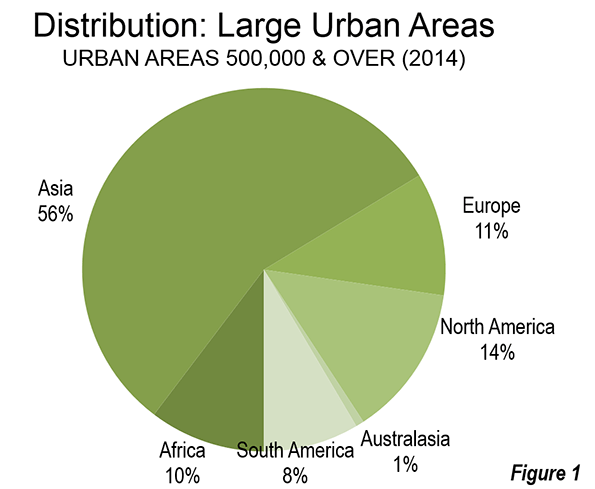
    The recently released 10th edition of Demographia World Urban Areas provides estimated population, land area and population density for the 922 identified urban areas with more than 500,000 population. With a total population of 1.92 billion residents, these cities comprise approximately 51 percent of the world urban population. The world’s largest cities are increasingly concentrated in Asia, where 56 percent are located. North America ranks second to Asia, with only 14 percent of the largest cities (Figure 1). Only three high income world cities are ranked in the top ten (Tokyo, Seoul and New York) and with present growth rates, Tokyo will be the lone high-income representative by the middle 2020s.

    Demographia World Urban Areas is the only regularly published compendium of urban population, land area and density data for cities of more than 500,000 population. Moreover, the populations are matched to the urban land areas where sufficient data is available from national census authorities.

    The City

    The term "city" has two principal meanings. One is the "built-up urban area," which is the city in its physical form, encompassing virtually all of the land area encircled by rural land or bodies of water. Demographia World Urban Areas reports on cities as built-up urban areas, using the following definition (Note 1).

    An urban area is a continuously built up land mass of urban development that is within a labor market (metropolitan area or metropolitan region). As a part of a labor market, an urban area cannot cross customs controlled boundaries unless the virtually free movement of labor is permitted. An urban area contains no rural land (all land in the world is either urban or rural).

    The other principal definition is the labor market, or metropolitan area, which is the city as the functional (economic) entity. The metropolitan area includes economically connected rural land to the outside of the built-up up urban area (and may include smaller urban areas). The third use, to denote a municipal corporation (such as the city of New York or the city of Toronto) does not correspond to the city as a built-up urban area or metropolitan area. This can – all too often does –   cause confusion among analysts and reporters who sometimes compare municipalities to metropolitan areas or to built-up urban areas.

    A Not Particularly Dense Urban World

    Much has been made of the fact that more than one-half of humanity lives in urban areas, for the first time in history. Yet much of that urbanization is not of the high densities associated with cities like Dhaka, New York, or even Atlanta.

    The half of the world’s urban population not included in Demographia World Areas lives in cities ranging in population from the hundreds to the hundreds of thousands (see: What is a Half-Urban World). In the high income world, residents of large urban areas principally live at relatively low densities, with automobile oriented suburbanization accounting for much of the urbanization in Western Europe, North America, Japan and Australasia. This point was well illustrated in research by David L. A. Gordon et al at Queen’s University (Kingston, Ontario), released last year which concluded that the metropolitan areas of Canada are approximately 80 percent suburban.

    Population

    There are now 29 megacities, with the addition in the last year of London. London might be thought of as having been a megacity for decades, however the imposition of its greenbelt forced virtually all growth since 1939 to exurban areas that are not a part of the urban area, keeping its population below the 10 million threshold until this year (Demographia World Urban Areas Table 1).

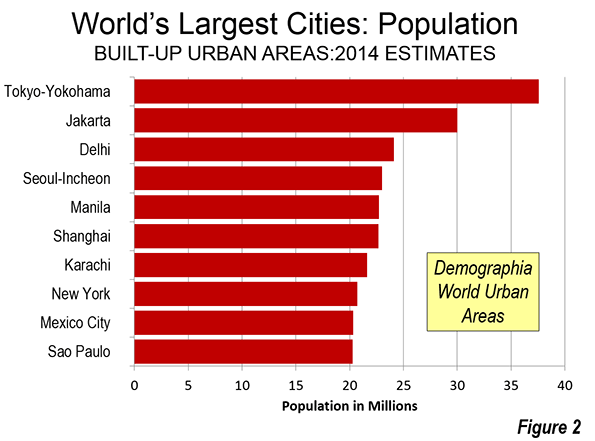
    The largest 10 contain the same cities as last year, though there have been ranking changes. Tokyo, with 37.6 million residents, continues its half century domination, though its margin over growing developing world cities is narrowing, especially Jakarta. Manila became the fifth largest urban area in the world, displacing Shanghai, while Mexico City moved up to 9th, displacing Sao Paulo (Figure 2).

    Land Area

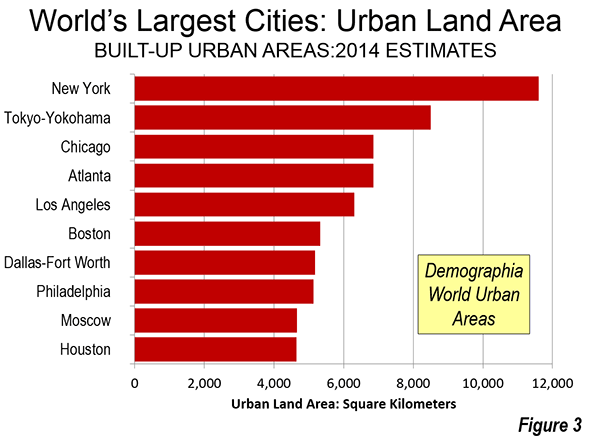
    Often seen as the epitome of urban density, the urban area of New York continues to cover, by far, the most land area of any city in the world. Its land area of nearly 4,500 square miles (11,600 square kilometers) is one-third higher than Tokyo’s 3,300 (8,500 square kilometers). Los Angeles, which is often thought of as defining low-density territorial expansion ranks only fifth, following Chicago and Atlanta, with their substantially smaller populations (Figure 3). Perhaps more surprisingly is the fact that Boston has the sixth largest land area of any city in the world. Boston’s strong downtown (central business district) and relatively dense core can result in a misleading perception of high urban density. In fact, Boston’s post-World War II suburbanization is at urban densities little different than that of Atlanta, which is the world’s least dense built-up urban area with more than 3 million population. Now, 29 cities cover land areas of more than 1,000 square miles or 2,500 square kilometers (Demographia World Urban Areas Table 3).

    Urban Density

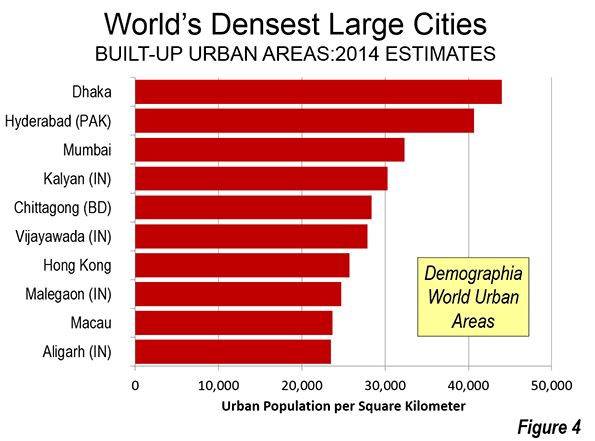
    All but two of the 10 densest cities are on the Indian subcontinent. Dhaka continues to lead in density, with 114,000 residents per square mile (44,000 per square kilometer).  Hyderabad (Pakistan, not India) ranks a close second. Mumbai and nearby Kalyan (Maharashtra) are the third and fourth densest cities. Hong Kong and Macau are the only cities ranking in the densest ten outside the subcontinent (Figure 4). Despite its reputation for high urban densities, the highest ranking city in China (Henyang, Hunan) is only 39th (Demographia World Urban Areas Table 4).

    Smaller Urban Areas

    Demographia World Urban Areas Table 2 includes more than 700 additional cities with fewer than 500,000 residents, mainly in the high income world. Unlike the main listing of urban areas over 500,000 population, the smaller cities do not represent a representative sample, and are shown only for information.

    Density by Geography

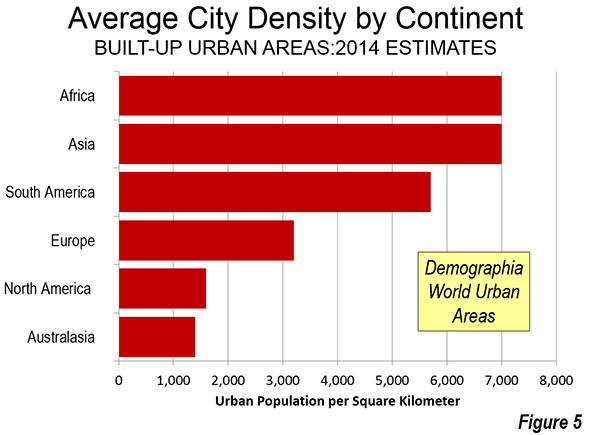
    Demographia World Urban Areas also provides an average built-up urban area density for a number of the geographical areas. Africa and Asia had the highest average city densities, at 18,000 per square mile (7,000 per square kilometer), followed by South America. Europe was in the middle, while North America and Oceania have the lowest average city densities (Figure 5).

    Some geographies, however, had much higher average urban densities. Bangladesh was highest, at 86,800 per square mile (33,000 per square kilometer), nearly five times the Asian average. Other geographies above 30,000 per square mile (11,500 per square kilometer) included Pakistan, the Democratic Republic of the Congo, the Philippines, India and Colombia, the only representative from the Western Hemisphere (Demographia World Urban Areas Table 5).

    Wendell Cox is principal of Demographia, an international public policy and demographics firm. He is co-author of the "Demographia International Housing Affordability Survey" and author of "Demographia World Urban Areas" and "War on the Dream: How Anti-Sprawl Policy Threatens the Quality of Life." He was appointed to three terms on the Los Angeles County Transportation Commission, where he served with the leading city and county leadership as the only non-elected member. He was appointed to the Amtrak Reform Council to fill the unexpired term of Governor Christine Todd Whitman and has served as a visiting professor at the Conservatoire National des Arts et Metiers, a national university in Paris.

    ———————-

    Note 1: Urban areas are called also called "population centres" (Canada), "built-up urban areas" (United Kingdom, "urbanized areas’ (United States), "unités urbaines" (France)  and "urban centres" (Australia). The "urban areas" of New Zealand include rural areas, as do many of the areas designated "urban" in the People’s Republic of China, and, as a result, do not meet the definition of urban areas above.

    Note 2: Demographia World Urban Areas is a continuing project. Revisions are made as more accurate satellite photographs and population estimates become available. As a result, the data in Demographia World Urban Areas is not intended for comparison to prior years, but is intended to be the latest data based upon the best data sources available at publication.

    Photograph: Slum, Valenzuela City, Manila (by Author)

  • The New Downtown Los Angeles

    There was a time when downtown Los Angeles was the commercial center of Southern California. According to Robert Fogelson, writing in his classic Downtown: Its Rise and Fall (1880-1950)"nearly half" of Los Angeles residents went downtown every day in the middle 1920s. A time traveler from 1925 might think that to still be the case, with the concentration of tall buildings, and the frequent press reports about downtown’s resurgence.  

    Downtown LA got a late start with high-rises. Until the middle 1960s, there were few buildings exceeding the 13 story height limit repealed in 1958 by city of Los Angeles. The most important exception is City Hall, opened in 1928, which is 454 feet tall (137 meters). By 1989, the city’s tallest building, Library Tower (First Interstate Tower), had been opened, topping out at 1,018 feet (310 meters). The under-construction Wilshire-Grand Tower will soon rise 80 feet (25 meters) above Library Tower. From the flight path to Los Angeles International Airport (above) and many ground vistas, the vertical profile of downtown Los Angeles will continue to stand tall over the city.

    Yet, far less understood is that downtown has declined in metropolitan importance for decades. Now, downtown has only 2.4 percent of employment the metropolitan area (Los Angeles and Orange Counties).  Between the 2000 Census and the 2006-2010 American Community Survey, employment in the central business district dropped approximately five percent. At least four other employment areas, all freeway oriented with lower employment density, equal or exceed downtown’s employment (these include the Airport-El Segundo area and nameless employment areas straddling the Santa Ana Freeway in Los Angeles County, the Harbor and San Diego Freeways in the South Bay and the Costa Mesa Freeway in Orange County). More important still, approximately two-thirds the metropolitan area’s employment is not in a large employment area at all. This dispersion of employment is one reason why Los Angeles –despite its reputation for horrendous traffic – has the shortest one-way commute time of any world megacity for which there is data.

    Shifting Downtown

    Following World War II, the heart of downtown Los Angeles shifted west from Broadway, Hill and Spring Streets, leaving a large stock of quality commercial buildings vacant. This was well before the end of their useful lives, yet decades of disuse followed. Most of these buildings rose to the 13 floors height limit, though one, the 18 story United California Bank headquarters at 6th and Spring, was completed not long before its competitors hired moving vans to move west. Soon after, the United California Bank built the UCB Tower (now Aon Tower) on Hope Street, with 62 floors (1973), which at the time was the tallest building in the world outside New York and Chicago.

    Adaptive Reuse

    The UCB Building and many more on the now more residential east side of downtown been converted to apartments and condominiums under the city’s creative "adaptive reuse" ordinance, which facilitates conversions from office to residential use. According to the city of Los Angeles, the ordinance has facilitated conversion of downtown commercial space into more than 3,000 residential units. Another 7,000 are either under construction or being considered.  

    The conversion of office buildings to residential has spread to post war structures, such as the Mobil Oil Building (now the Pegasus Apartments). This building, on Flower Street, was one of the earliest examples of the more modern styles that were to proliferate throughout the downtown areas of the nation. The Signal Oil Building, also one of the first to exceed the 13 story limit has also become residential (1010 Wilshire). This building had been the subject of an unusual 1980s remodeling that enlarged the footprint and the floors, while materially changing the outside angles and the decor. Another nearby office building (1100 Wilshire) sat empty for two decades after construction, before being converted to residential use.

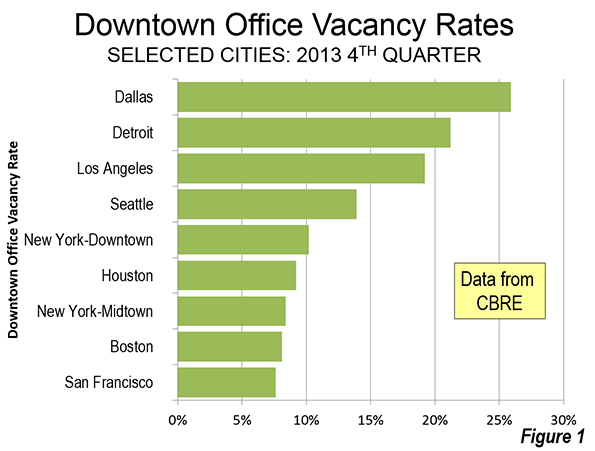
    The shift to residential makes sense given that most downtown office buildings are having difficulty filling their space. Downtown’s glutted office market is indicated by a 19.2 percent vacancy rate in the fourth quarter of 2013. This is better than such market laggards as downtown Detroit or downtown Dallas, both over 20 percent, but higher than the Los Angeles suburban office vacancy rate, at 15.9 percent. Downtown’s vacancy rate is also approximately double or more those of dynamic downtowns such as San Francisco, Boston, New York, and Houston, which are all under 10 percent (Figure 1).

    It appears likely that the Crocker Citizens Plaza, opened as the city’s tallest building in 1969 (42 floors), is slated for conversion to residential. After Crocker Bank moved to its new Crocker Center (now Wells Fargo Center) on Bunker Hill, Crocker Citizens Plaza became the AT&T Building. AT&T vacated the building and moved to the earlier 1960s Transamerica Building, which urban legend indicates was built well south of downtown because consultants convinced the developers that this would be the center of an even larger downtown. The Transamerica, now AT&T, is even more divorced from the commercial core than when it was built. By the time Crocker Citizens Plaza (now "611 Place") is converted to residential, it could be the third tallest mixed use building in downtown.

    The second tallest mixed use tower could well be the prestigious Library Tower, which stands half-empty. There are rumors that the new owners may convert a large part of the structure to condominiums and a hotel. No major office skyscraper has opened in downtown Los Angeles in the last 20 years. Nor will that change when the Wilshire Grand Tower is completed. Wilshire-Grand will only be partially an office tower and will include a hotel. Only 30 of the 73 floors will be offices. This is a climb-down from the original design, which included two buildings – a 60 story office tower and a 40 floor hotel and condominium project. The new building is little of an endorsement of downtown’s office demand.

    Transitioning from Adaptive Reuse?

    This conversions may be the tail end of trend. DT News reports that it has become more economical for many developers to construct new residential buildings, rather than to convert empty commercial buildings. As demand has increased, so have prices of existing buildings, which makes adaptive reuse   less attractive. Further, many of the structures on Broadway, which casual observation might indicate have potential for conversion, but the density of development may make offering enough natural light difficult for residences.

    Ups and Downs of Downtowns

    As employment has dispersed throughout the Los Angeles area, there has been less of a need for a central business district. Among the nation’s larger downtowns, only downtown Los Angeles has undertaken wholesale abandonment of its commercial core and built a new one. Perhaps this is, in part, because the 13-story height limit rendered the older buildings uneconomic for the second half of the 20th century.

    New York (Manhattan), south of 59th Street also has seen its ups and downs. But New York did not abandon large swaths of development, only to move elsewhere. Downtown Chicago expanded northward along Michigan Avenue, but little if any of the Loop was ever abandoned and it has undergone continuous renewal. The West Coast’s premium downtown areas, San Francisco and Seattle, have interspersed new development along with the old, and remain more important to their metropolitan areas than downtown Los Angeles, accounting for from four to six times its employment share (though still less than 15 percent). Even Houston, which most resembles Los Angeles in its post war downtown rebuild, managed its transformation without abandoning the historic core. And, at the same time, all are enjoying increasing residential demand, like downtown Los Angeles.

    Rising Demand

    Downtown interests are rightly proud of the rising residential population. This has occurred in many downtowns across the nation. Between 2000 and 2010, areas within 2 miles of City Hall gained 206,000 residents in the major metropolitan areas (over 1 million population). However, within in the next ring, from 2 to 5 miles from City Hall the decline in population more than compensated for the core gains (minus 272,000).

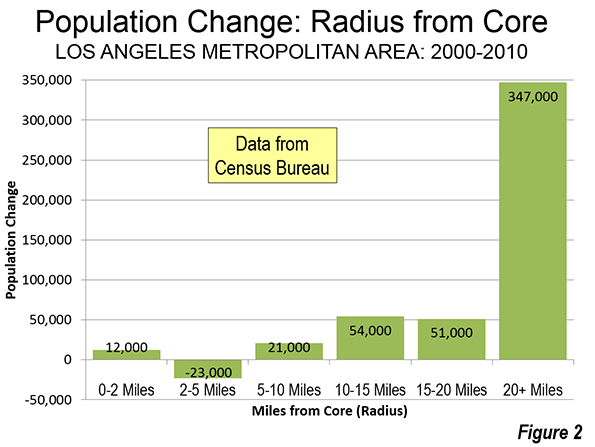
    The situation was the same in Los Angeles, where the Census Bureau reports that population within 2 miles of City Hall rose 12,000, while it declined 23,000 between 2 and 5 miles. The growth of downtown Los Angeles is impressive in part because it was stagnant for so many decades. In context, however, it is no "game-changer." Overall in the last decade all growth in the Los Angeles metropolitan area was outside the 5 mile ring, and 75 percent of that was more than 20 miles from City Hall (Figure 2).

    A New Species is Born

    It would be a mistake to characterize the emerging downtown Los Angeles as reasserting any economic primacy. Its former function is beyond revival. This was indicated by UCLA Anderson Forecast economist David Shulman, who indicated that he was "not bullish on Downtown Los Angeles." The report by public radio station KPCC continued:

    "That view runs counter to the impression that downtown L.A. is staging an urban comeback. But the resurgence is more about sports and entertainment venues, restaurants and bars, loft conversions, and hotels than it is about companies that need a lot of floors in tall buildings. Nightlife and streetscapes trump florescent light and cubicles."

    This refers to the new entertainment venues, such as the Staples Center, the Walt Disney Concert Hall and "LA Live," which may be joined by a new football stadium for a proposed National Football League franchise.

    The transformation of downtown Los Angeles is not so much a renaissance of a business core, but a shift into a new, and different, function. The new downtown serves a function similar to that of Wilshire Boulevard’s more heavily residential high-rise district. But it’s not likely to ever resemble the Upper East Side or Upper West Side in New York, not only because its residential base will remain  small, but because downtown is hardly an ascendant business center. Downtown’s recovery as a residential district – with a population roughly equivalent to the suburb of Diamond Bar – is indeed impressive, but its role as a vital urban economic center remains relatively small. 

    ——-

    Photo: Downtown Los Angeles toward the Hollywood Hills and the San Fernando Valley (by author)

    Wendell Cox is principal of Demographia, an international public policy and demographics firm. He is co-author of the "Demographia International Housing Affordability Survey" and author of "Demographia World Urban Areas" and "War on the Dream: How Anti-Sprawl Policy Threatens the Quality of Life." He was appointed to three terms on the Los Angeles County Transportation Commission, where he served with the leading city and county leadership as the only non-elected member. He was appointed to the Amtrak Reform Council to fill the unexpired term of Governor Christine Todd Whitman and has served as a visiting professor at the Conservatoire National des Arts et Metiers, a national university in Paris.

  • The Rise of the Executive Headquarters

    Headquarters were once a defining characteristic of urban economic power, and indeed today cities that can still brag of the number of entries they boast on the Fortune 500 list of largest American firms. Yet as urban centers increasingly lost headquarters, boosters started to downplay them as a metric, particularly with the rise of the so-called “global city” concept. Today the HQ is back into the urban mix, but increasingly as what I would call the “executive headquarters” which brings bragging rights to a city but not much in terms of middle class jobs.

    The corporate headquarters in a downtown skyscraper took a beating during the 70s, 80s, and 90s as America’s inner cities went into decline. Why locate in a decaying, lawless, dysfunctional urban setting that seemed destined for the scrap heap when the shiny suburbs beckoned?  Indeed, companies increasingly vacated downtowns for massive suburban office campuses, frequently in idyllic, pastoral settings where employees would exist in a cocooned bubble without any but approved distractions such as on site gyms, dry cleaning, cafeterias, and daycare.

    Tom Wolfe, writing of the early 90s recession in New York, presciently pointed out the one thing that continued to hold urban allure for many CEOs, namely the lavish lunch:

    Eight years before 9/11, financial services and commercial real estate were superseded as driving forces in the New York economy by the restaurants appearing in boldface in Zagat’s. The exodus of corporations from New York during the near-depression of 1992-95 was stanched by a single thing: lunch. The C.E.O.’s would do anything rather than give up the daily celebrations of their eminence at eateries in the town where the wining and dining were as good azagats. (I know, I know; just read it out loud.) The case could be made that any post-9/11 federal appropriations to prop up business in New York should go first to the places where you can get Chilean sea bass with a Georgia plum marmalade glaze on a bed of mashed Hayman potatoes laced with leeks, broccoli rabe and emulsion of braised Vidalia onions infused with Marsala vinegar.

    Many CEOs might prefer to be close to home, but others enjoyed hobnobbing with their peers and getting treated like royalty at the Four Seasons.

    Yet even as many corporate headquarters were leaving and as Time magazine published its “Rotting of the Big Apple” cover in 1990, it was clear major change was already afoot. The cleanup had begun in the mid-1980s and by the 90s Americas biggest cities were on the way back.

    How could the urban center be coming back while headquarters bled away? The answer was the rise of the global economy and the services based “global city”. Saskia Sassen and other writers pioneered the analysis of this new entity.  In this world the complexities of the global economy generated demand for new forms of financial and producer services needed to manage and control the far flung networks of the global corporation. These highly specialized services providers were subject to clustering economics and concentrated in large urban centers like New York, London, and Chicago where they provided a new type of urban economic vitality.

    Sassen specifically says, “The key sector specifying the distinctive production advantages of global cities is the highly specialized and networked intermediate economy rather than corporate headquarters. In developing this argument, I am responding to a very common notion that the number of headquarters is what specifies a global city.”

    This not only provided an explanation for why urban centers could economically rebound while simultaneously losing headquarters, but from a civic marketing perspective it provided a justification for pooh-poohing the loss of HQs as much ado about nothing.  Headquarters were yesterday’s news anyway.

    Except that they weren’t. In recent years we’ve seen increasing evidence of the return of the corporate headquarters to the global city, a phenomenon I identified in 2008.  Today the “back to the city” theme for corporations is much written about, and the headquarters is once again conveniently seen as a signifier of urban strength.

    But in most cases this is not the old monolithic headquarters of yore, with their thousands of employees. Rather this takes the form of an “executive headquarters.” That is, a headquarters consisting largely of the C-suite and a small number of other very senior leaders and support staff.

    These have been around for a while, but traditionally existing to serve the desire of the CEO to live in a particular city. Men’s Wearhouse established headquarters in Fremont, CA for example, but most of the corporate employees are located in Houston. Lincoln National moved its executive headquarters to Philadelphia from Ft. Wayne, IN but the distribution of employment was barely affected. Both were CEO living preference driven.

    The people in “executive headquarters” are precisely those who most need proximity to the global city service providers that increasingly form a key part of company operations. Also, recruiting executive talent and proximity to airports play a role. And when companies want to think in a totally global manner, they can want to have their main office physically separate from any particular operating location.

    There are numerous examples. In Chicago alone, MillerCoors moved its top staff from Milwaukee. Mead Johnson Nutrionals established an executive headquarters in the suburbs away from its main Evansville, IN base. Boeing’s move to Chicago from Seattle can be seen in the same light. And just recently agribusiness giant ADM announced it was moving its HQ from Decatur, IL to Chicago.

    The Mead Johnson case is instructional. According to press reports at the time:

    Working in a large city will make it easier to conduct business throughout the world. Mead Johnson makes Enfamil and similar products and about half of its sales come from overseas. Having offices near Chicago, for instance, will place executives in close proximity to global-business consultants, leaders in the field of nutrition and an international airport.

    Between 40 and 60 people will work in the corporate offices, most of them in new positions. Evansville will retain the company’s operations in research and development, U.S. sales and marketing and information management, as well as a bulk of the finance and human-resources departments, Paradossi said. Mead Johnson’s liquid products will continue to be made in Evansville, he said.

    Note the stated reasons for the move, as well as the small number of people involved.  The ADM move is similar, with only about 100 jobs initially. This suggests that while headquarters are in some cases coming back to the global city, they aren’t brining many jobs.  Also, many second tier business centers like Indianapolis continue to see their downtown job base hollowed out apart from hot sectors like technology.

    The executive headquarters is one more example of the increasing bifurcation of America’s elite cities. A handful of top executives gather in America’s capitals of capitalism while the good paying core of the old headquarters – including many upper middle class positions – remain in more workaday cities. This but one example of the “growth without growth” model in which cities dispense with “old fashioned” notions like population and job growth in favor of higher per capita GDP and income in which parts of cities thrive by becoming downtown versions of the exclusive gated subdivision.

    A few cases have gone beyond this, with even more wholesale moves back to the core. United Airlines moved 3,000 to the Chicago Loop from Elk Grove Village. And Google is moving 2,500 people from Libertyville as a result of the Motorola Mobility purchase. (This unit is already being sold to Lenovo, however). These more substantial moves could bring more bread and butter jobs.

    But as a recent column in the Economist noted, investors are putting huge pressures on companies to slim down bloated overheads. This does not bode well for bringing middle-skilled jobs to expensive headquarters locations. Additionally, the rise of telecommuting the and 1099 economy, just in time offices, co-working spaces, etc. are transforming the way people work and putting further pressure on the traditional HQ.  Office floor plates are expensive, and increasing numbers of people no longer want to spend their days toiling away in the salt mines of cubicle farms anyway.

    Where does this lead?  If there’s one thing the last few decades have shown it’s that the only constant is constant change.  With unpredictable market dynamics and various iterations of the cycle of reincarnation (centralizing vs. decentralizing, etc), even the shift to selected downtowns may bring fewer benefits to the urban economy than imagined, and could ultimately accelerate the bifurcation between a small elite population and largely poor communities around them.

    Aaron M. Renn is an independent writer on urban affairs and the founder of Telestrian, a data analysis and mapping tool. He writes at The Urbanophile.

    Boeing Chicago photo by J. Crocker.

  • Don’t make big-city mayors regional rulers

    Given the quality of leadership in Washington, it’s not surprising that many pundits are shifting focus to locally based solutions to pressing problems. This increasingly includes many progressives, who historically have embraced an ever-more expansive federal government.

    In many ways, this constitutes an extraordinarily positive development. Political decentralization is built into the very framework of American democracy, as Alexis de Tocqueville, among others, recognized. If Paris dominated France and London dominated England, in America, he noted, “intelligence and power is dispersed abroad.”

    Yet, there’s a problem with how the decentralist argument is taking shape. Increasingly, it is becoming a movement to create ever more powerful regional governments, which tend to be dominated by large cities, their mayors and their power blocs, whether unions, bureaucracies or politically connected developers. The notion of mayors running the world has been endorsed by writers such as Benjamin Barber, and has had the strong backing of Bruce Katz of Brookings, who appears to have lost sight of his long-held faith in the federal government.

    Not surprisingly, Katz and other have found a new way to press their agenda: regional governments as essentially extended cities. Like many progressive decentralists, he likes handing more power to big-city mayors, themselves generally presiding over one-party (Democratic) systems.

    This notion of mayors uber alles was recently celebrated at an event in Chicago where mayors such as Atlanta’s Karim Reed, Eric Garcetti of Los Angeles, New York’s Bill de Blasio and Chicago’s Rahm Emanuel claimed that big cities were the future and, where, as Reed put it, “the action is.”

    It’s hard to underestimate the hubris of this assessment. Despite the slowing down from the Great Recession, the vast majority of American demographic growth and job growth continues to go either into the suburban rings or to low-density sprawling regions, such as Houston, Phoenix and Dallas-Fort Worth, where urban areas and their peripheries are more similar than different.

    U.S. suburbs now account for 2.7 times the population of core cities. High-density migration, much-heralded by the urban decentralizers, remains a distinctly minority phenomena, while the largest outmigration tends to be from big, dense cities and to suburbs, less-dense and smaller cities and towns.

    Nor can we see in the mayors some sort of archetype for greater governance. Chicago, under Rahm Emanuel, is hardly an exemplar of efficiency or good fiscal management. The city’s credit rating is among the worst of any municipality, while the economy remains “sub-par,” as a recent bank analyst report shows. Chicago schools are almost bankrupt, and the city’s murder rate is higher than during the Prohibition years.

    In fact, the city, whose debt load is now the heaviest of any large American city other than Detroit, has now experienced repeated downgrades, and estimated debt now exceeds, by some estimates, more than $60,000 per household.

    Yet despite this, Emanuel is still hailed, most recently in a Financial Times profile, as “Mayor America” and even touted as a presidential candidate. Emanuel’s backers can note that many of these problems stem from the more than two-decade Daley regime. Yet, Emanuel was, and remains, part of the Daley machine, and even got his start as a Daley fundraiser. To consider him primarily a tough reformer – outside his often foul-mouthed manner – is patently ludicrous.

    Much the same can be said about L.A.’s Eric Garcetti, who, although certainly an upgrade from Antonio Villaraigosa, was a member, even president, of the same City Council that has driven the city to the brink of financial ruin.

    Much of the problem stems from union power: the city is spending 18 percent of its budget on pensions, three times the level a decade ago. Los Angeles has among the nation’s weakest urban economies – 28 percent of residents are considered poor – and its unemployment rate of roughly 10 percent is well above both the county and statewide averages and twice that of San Francisco.

    In many ways, Atlanta’s Reed is barely qualified to speak for his region, as his city constitutes not even 10 percent of the area’s population. Nor is it a particularly successful locale, suffering among the highest crime rates of any big city in the country and, according to one recent study, the most severe inequality of any U.S. core city.

    Generally speaking, big-city leaders chant a populist rap, but generally it’s the densest urbanized places – San Francisco, Washington D.C., Boston, New York, Miami and, sadly, Los Angeles – that are also the most unequal places.

    Perhaps the only real potential reformer in the group is New York City’s de Blasio, who took office a few months ago. While de Blasio wants to shake things up, his tendency seems to be making things worse. Certainly his attempt to shut down charter schools, which offer an alternative to traditional public schools, particularly for poorer families, hardly represents a step forward. He may be the people’s choice, but it’s likely he will serve, first and foremost, public employee interests, who have been his main political backers.

    This story originally appeared at The Orange County Register.

    Joel Kotkin is executive editor of NewGeography.com and Distinguished Presidential Fellow in Urban Futures at Chapman University, and a member of the editorial board of the Orange County Register. He is author of The City: A Global History and The Next Hundred Million: America in 2050. His most recent study, The Rise of Postfamilialism, has been widely discussed and distributed internationally. He lives in Los Angeles, CA.

    City Hall photo by Flickr user OZinOH.

  • No Joke: It Couldn’t Get Much Better In Fargo

    This week the coastal crowd will get another opportunity to laugh at the zany practices of those living in the frozen reaches of the Great Plains. The new television series “Fargo,” based on the 1996 Coen brothers movie, will no doubt be filled with fearsome violence mixed with the proper amount of Scandinavian reserve and wry humor — the very formula that made the original such a hit.

    Yet how much will “Fargo” the series resemble the real places? Probably not much. For one thing the series only uses Fargo as a kind of marker; the action actually takes place in Bemidji, Minn., a small town of 12,000 over two hours away. I know distances are seen differently in the northern Plains, but the whole idea seems a bit of a stretch. Located in forest and lake country, many locals would not even consider the Minnesota town part of the Plains.

    Less known to the sophistos who will watch the show is that Fargo, a metro area with over 200,000 people, and the state of North Dakota have been enjoying a sustained boom for a decade. This resurgence — in demographics, economics and real estate — follows decades of relative decline and an almost sullen sense of isolation that drove many people out of the state.

    In a state where the unofficial motto seems to be “it could be worse” — not a bad notion given the often miserable weather — things couldn’t be much better. North Dakota leads the nation in virtually every indicator of prosperity: the lowest unemployment rate, and the highest rates of net in-migration, income growth and job creation. Last year North Dakota wages rose a remarkable 8.9%, twice as much as Utah and Texas, which shared honors for second place, and many times the 1% rise experienced nationwide.

    The once dreary predictions of demographic decline — epitomized by the proposal two New Jersey academics to turn the area into a “Buffalo Commons” — have been reversed. North Dakota now lures many college graduates from out of state and keeps more of its own as well. Today more than half of North Dakotans aged 25-44 have post-secondary degrees, among the highest percentages in the nation, and well above the roughly 40% number for the rest of the country.

    Many will ascribe the state’s rise primarily to the energy boom. To be sure the fastest growth in North Dakota and other Plains states has been in the areas closest to the oil and gas finds. But over the past decade, the population of the Plains has expanded by 14%, well above the national average and far faster than the Midwest, the Northeast or California.

    This Plains resurgence is taking place even in areas far from energy development. Fargo, for example, is six hours hard driving from Williston, the center of the Bakken range. Yet despite this the area’s population has been growing, up 20% in the last decade, twice the national average. Since 2010, over 8,000 more people have come to the Fargo metro area, which extends to the Minnesota city of Moorhead, than have left. In fact, the small cities of the Dakotas have been growing faster than the nation for well more than a decade, before the recent energy boom took off.

    The growth in Fargo has come not so much from energy, but an expanding industrial and technology sector. STEM employment is up nearly 40% since 2001, compared to 3% nationally. It also leads all other U.S. metro areas in the growth in the number of mid-skilled jobs, providing good wages to people with two-year or certificate degrees. Between 2009 and 2011, mid-skilled employment grew 5%, roughly 10 times the national average. No surprise then that the population with BAs in Fargo has grown 50% in the last decade, well above the 40% rate for the rest of the country.

    Yet perhaps nothing illustrates the dramatic changes in Fargo better than its downtown area. Twenty years ago, when I first visited the city, downtown was torpid on a good day. Storefronts were old, funky and often empty. The local hotels ranged between acceptable to sorry.

    But in the past decade downtown Fargo has seen a crush of new investment; property values have more than doubled since 2000. Mid-range apartment complexes are sprouting up, all pitching themselves to millennial professionals who value a more pedestrian-oriented environment. The founder of Great Plains Software, now Microsoft Business Systems, Doug Burgum, has proposed to build a 23-story office tower downtown. Not surprisingly, it would be the tallest building in the state.

    Some are rightfully skeptical about some of these ambitious plans given the low cost of development on the periphery and the region’s basically non-urban mindset. But the feel has certainly changed, with several high-end restaurants, huge numbers of bars (befitting the German and Scandinavian roots of the area’s population), offering a rising number of local brews. There’s even a boutique hotel, the Donaldson, founded by Burgum’s ex-wife Karen, decorated with Plains art, and run by a friendly, highly professional staff.

    The people even look different than a decade or two ago. The bars and restaurants now host a more attractive group of young professionals and meandering divorcees. The change is so striking that I have been pitching friends in L.A. to produce a North Dakota version of the “Real Housewives” reality series.

    None of this is likely to be revealed in the new “Fargo” TV show. After all, the place has one of the lowest crime rates in the country, a full third below the national average; with only 11 murders since 2000, it’s hardly the Baltimore of the “Wire” or “Treme.” But murder sells better than contentment, or at least makes for more riveting entertainment about the place, unless I can find buyers for my “Housewives” idea. But unlike in the past, Fargo residents don’t have to cringe about this latest Hollywood assault and its impact on their image. Things are good enough that they can afford to laugh; it certainly could be a lot worse.

    This piece originally appeared in Forbes.

    Joel Kotkin is executive editor of NewGeography.com and Distinguished Presidential Fellow in Urban Futures at Chapman University, and a member of the editorial board of the Orange County Register. He is author of The City: A Global History and The Next Hundred Million: America in 2050. His most recent study, The Rise of Postfamilialism, has been widely discussed and distributed internationally. He lives in Los Angeles, CA.

    Hotel Donaldson photo By jeffreykreger

  • Guess What? The Parties are About Even!

    I’ve written extensively about American presidential elections, trying to understand the nature of Democratic success in 2008 and 2012. Many pundits use these elections and changing demographics and public attitudes to write off the future of the Grand Old Party. But this would be a mistake, because we also know that Republicans have a majority in the House of Representatives and in the state legislatures. They also could well get a majority in the US Senate in 2014. Hardly a death spiral.

    Certainly, gerrymandering played a role, and Democrats won a majority of the popular vote for Congress, but the majority was smaller than the margin for president, which was not as large as widely believed, and considerably less than in 2008. Given this confusion it is worth trying to make a more accurate assessment of the D and R balance.  It turns out that there is a peculiar geography of the electorate at all levels and across states, that tends to help Democrats at the statewide level, due to concentrated block voting and concentrations in cities while Republicans, who hold sway over a wider geographic area, at sub-state levels. Obama won 332 electoral votes, 61%, far above his 52% share of the national vote. Democrats won 51 % of the total vote for Congress but won only 200 seats, 46 % of 435, a shortfall of up to 21 seats.

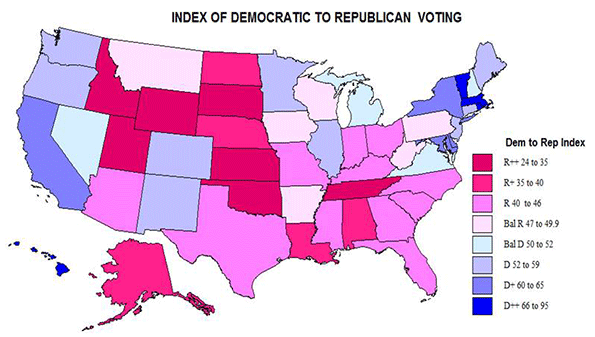
    Besides the votes for president and the House of Representatives in 2012, we can look at the latest result for all 100 Senate seats, for governors of the states, and for all state legislators, in order to get a more honest assessment of Red and Blue America. What states are truly blue or red, and how many are actually more balanced than we might have thought?  Finally it may be useful to compare the actual votes with opinion polls, which seem to show a country somewhat less “liberal” than electoral results. Perhaps voters are a little more liberal than they admit, but let’s see what the fuller set of data show.

    President

    Democrats won 332 electoral votes, 52 or 10% more than their “fair share” of 280  (52% of 538 electors).  The reason for the imbalance is simply that the peculiar geography in 2012 gave the Democrats small margins in some critically large states. For Obama, CA, 55 electoral votes, FL, 29, NY, 29, IL, 20, PA 20, OH, 18, and MI, 16, versus for Romney, TX, 38, GA, 16 and NC, 15. If Romney had carried just the close OH, FL, and PA, he would have won the election!  No wonder Republicans became interested in adopting the Maine and Nebraska allocation of electors by congressional district! However there is no logical basis for allocation by congressional districts, an unrelated office. Rather there is a rational and logical argument to allocate simply by the party shares of the popular vote in states. Table A shows the effect. Obama would have won but by the small margin of 275 to 263 electoral votes, reflecting the actual close division in the electorate.

    Table A
    Electoral Votes 2012 Electoral Votes 2012
      Actual D Electoral Votes Actual R Electoral Votes D If Allocated by Statewide Vote Shares R If Allocated by Statewide Vote Shares
    AL 9 3 6
    AK 3 1 2
    AZ 11 5 6
    AR 6 2 4
    CA 55 33 22
    CO 9 5 4
    CT 7 4 3
    DE 3 2 1
    DC 3 3 0
    FL 29 15 14
    GA 16 7 9
    HI 4 3 1
    ID 3 1 2
    IL 20 12 8
    IN 11 5 6
    IA 6 3 3
    KS 6 2 4
    KY 8 3 5
    LA 8 3 5
    ME 4 2 2
    MD 10 6 4
    MA 11 7 4
    MI 16 9 7
    MN 10 5 5
    MS 6 3 3
    MO 10 4 6
    MT 3 1 2
    NE 5 2 3
    NV 6 3 3
    NH 4 2 2
    NJ 14 8 6
    NM 5 3 2
    NY 29 18 11
    NC 15 7 8
    ND 3 1 2
    OH 18 9 9
    OK 7 2 5
    OR 7 4 3
    PA 20 10 10
    RI 4 3 1
    SC 9 4 5
    SD 3 1 2
    TN 11 4 7
    TX 38 16 22
    UT 6 1 5
    VT 3 2 1
    VA 13 7 6
    WA 12 7 5
    WV 5 2 3
    WI 10 5 5
    WY 3 1 2
    Total 332 205 275 263


    House

    The situation is quite different for Congress (the House), where Republicans won 235 seats to the Democrats 200, while according to the total popular vote, the Democrats would gain a small majority based on their 50.8% share of the total vote,  of 221 to 214 seats (Table B) .  A lot has already been written about this, including charges of theft by gerrymandering. But if we analyze the peculiar geography again carefully, we will find that the net additional seats for the Democrats, if the seats in each state reflected the actual vote, would only be 15, not enough for a majority, simply because so many D votes are “wasted” in safe districts. In 17 states, Democrats won more seats than their share of the vote, 23, but Republicans won 38 “extra” seats in the other 33 states. 

    Table B
    Actual and ideal seats in the House of Representatives
    State Seats in state Ideal D (according to vote share) Actual D Difference Dem %
    CA 53 33 38 5 62%
    NY 27 18 21 3 65%
    MA 9 7 9 2 75%
    IL 18 10 12 2 55%
    MD 8 5 7 2 65%
    CT 5 3 5 2 66%
    NH 2 1 2 1 52%
    AZ 9 4 5 1 46%
    RI 2 1 2 1 59%
    ME 2 1 2 1 62%
    HI 2 1 2 1 67%
    WA 10 5 6 1 54%
    OR 5 3 4 1 58%
    MN 8 5 5 0 56%
    NM 3 2 2 0 55%
    DE 1 1 1 0 66%
    VT 1 1 1 0 76%
    165 100 124 23
    NV 4 2 2 0 50%
    MT 1 0 0 0 45%
    IA 4 2 2 0 52%
    WV 3 1 1 0 40%
    WY 1 0 0 0 26%
    AK 1 0 0 0 31%
    UT 4 1 1 0 33%
    CO 7 3 3 0 49%
    SDS 1 0 0 0 43%
    ND 1 0 0 0 43%
    LA 6 1 1 0 24%
    MS 4 1 1 0 37%
    ID 2 1 0 1 34%
    NJ 12 7 6 1 56%
    GA 14 6 5 1 41%
    KS 4 1 0 1 21%
    WI 8 4 3 1 51%
    NE 3 1 0 1 36%
    AR 4 1 0 1 32%
    TN 9 3 2 1 37%
    KY 6 2 1 1 40%
    MO 8 3 2 1 43%
    AL 7 3 1 2 36%
    OK 5 2 0 2 32%
    SC 7 3 1 2 42%
    IN 9 4 2 2 46%
    MI 14 7 5 2 53%
    TX 36 14 12 2 40%
    VA 11 5 3 2 49%
    NC 13 7 4 3 51%
    FL 27 13 10 3 47%
    OH 16 8 4 4 48%
    PA 18 9 5 4 51%
    US 270 119 77 38 49%


    Note that 54 Democrats won by over 75%, compared to 34 for Republicans. Still, this does leave  probably 8 or 9 districts won by Republicans because of clever gerrymanders, sometimes proudly proclaimed, as in OH and PA, 2 each, and one each in FL, MI, NC,VA and WI, more than offsetting the likely D gerrymander against Republicans in IL. But Democrats would still have lost if there had been no gerrymandering, and the net implication is that the peculiar geography of the Democrat vote means   that it takes at least a 53% total Democratic plurality to win enough of the relatively few close seats to win a majority of the House.

    Senate

    At 2 seats per state regardless of population, Republicans have an inherent advantage to obtain a majority of senators (or governors), since they dominate a majority of states, and Democrats are over-concentrated in a few larger states. The fact that Democrats currently hold 52 of seats plus the support of independents in VT and ME, is a consequence of the timing of Senate elections and perhaps reflects the extremism of some Republican candidates, who alienated enough middle road, independent voters to swing races to the Democrats. It is also significant that in 15 states voters clearly chose to have senators from both  major parties, indicating either that polarization is not so extreme as proclaimed, or that there are a number of closely divided states, that can vote R or D depending on  issues, personalities, and timing. Please see the summary table C for a listing by strength of the D or R votes for senators across the states. The highest D shares (both seats) were in VT, RI, and NY, for Republicans in WY, TN, SD, and ID.

    Governors  

    Republicans hold 29 of the 50 governors, perhaps an underlying indicator of a Republican majority. Yet, from the table you will see that Democrats elected governors in several states that lean Republican overall e.g., MO, AR, MT, and WV, and that there are Republican governors in several states won by Obama, e.g., MI, NV, NM, ME, and NJ. This ambivalence undermines any simple and strict Red versus Blue dichotomy. Many voters are not as utterly polarized as proclaimed. The most extreme Republican votes were in WY, NE, UT LA, and TN, and the highest Democratic shares in DE, NY and yes, AR, which voted only 38% for Obama.

    Legislatures  

    Legislatures are controlled by Republicans in a majority, 26, of states, with Democrats in control in 20 states, with four state divided: Iowa, Kentucky, New Hampshire and Virginia (almost), and even Washington (de facto). The legislatures are overall the most Republican-leaning of the elections analyzed. But even here, the average share of Democrats in legislatures is a respectable 46 percent. The most extremely Republican legislatures are in WY, UT, ID, KS, TN, and SD and the most extremely Democratic are, predictably, in HI, RI, MA, VT and MD. Again in recognition that a simple red and blue dichotomy is not that certain is the fact that in four states, KY, IA, VA, and NH, the legislative houses are split between the parties.

    So what is the best estimate of the real division between Red and Blue America?

    Table C ranks the states by my composite average index based on the races for president, the House of Representatives, state legislatures, US senators and governors. The numbers (percents) are the Democratic share of the vote for president, for the US house, for US senators and for governors, but for state legislatures, the percent shares of legislators who are Democrats. The final column Is a simple average of these five values. In this way I can distinguish those states which are consistently Democrat or Republican, from those which really are less polarized and more balanced.

    TABLE C: Summary of Democratic-Republican Voting Record
    Electoral Votes President %D Congress %D State Legislatures Senators %D Governors %D Number of D Wins Composite Index
    Sen %D House %D Legis Ave. Type
    WY 3 28.8 25.7 13.3 13.3 13.3 25 27 0 24.0 R++
    UT 6 25.4 33.4 17.2 18.7 18.0 34.75 34 0 29.1 R++
    KS 6 38.9 20.9 22.5 26.4 24.5 33.25 36 0 30.7 R++
    ID 4 33.6 33.9 17.1 18.6 17.9 33.5 39 0 31.6 R++
    OK 7 33.2 32.4 25.0 28.7 26.9 35 40 0 33.5 R++
    TN 11 39.6 36.8 21.2 27.6 24.4 34 35 0 34.0 R++
    SD 3 40.8 42.6 20.0 24.3 22.1 31.25 38.5 0 35.0 R++
    NE 5 38.9 35.8 42 27 0 35.9 R+ 
    ND 3 39.9 43.2 28.3 24.5 26.4 36.75 35.5 0 36.3 R+ 
    AL 9 38.8 36.0 25.5 37.1 31.3 35.6 42 0 36.7 R+ 
    LA 8 41.3 23.9 41.0 42.9 41.9 47.5 34 0 37.7 R+ 
    AK 3 42.7 30.9 35.0 37.5 36.3 38.25 41 0 37.8 R+ 
    MS 6 44.2 36.9 36.5 47.9 42.2 40.3 38 0 40.3 R
    GA 16 46.0 40.8 32.1 33.3 32.7 41.75 46 0 41.5 R
    TX 38 42.0 40.0 38.7 36.7 37.7 43.25 45 0 41.6 R
    SC 9 44.7 42.0 39.1 37.7 38.4 38.25 48 0 42.3 R
    IN 11 44.8 45.8 26.0 31.0 28.5 47.25 48.2 0 42.9 R
    AZ 11 45.4 45.6 43.3 40.0 41.7 43.25 45 0 44.2 R
    FL 29 50.4 47.0 35.0 38.3 36.7 40.5 49.3 1 44.8 R
    MO 10 45.2 43.3 29.4 32.5 31.0 49.5 55.5 1 44.9 R
    KY 8 38.5 40.0 40.0 55.0 47.5 45.7 56 1 45.5 R
    NC 15 49.0 50.9 36.0 35.8 35.9 48.5 44.5 1 45.8 R
    OH 18 51.5 47.9 30.3 39.4 34.8 47 49.5 1 46.2 R
    239
    AR 6 37.8 32.3 40.0 49.0 44.5 59.75 64.5 2 47.8 BalR
    MT 3 43.0 44.5 46.0 37.0 41.5 62 50.5 2 48.3 BalR
    WI 10 53.5 50.8 45.5 39.4 42.4 50.5 47 3 48.8 BalR
    PA 20 52.7 50.8 46.0 45.8 45.9 51.5 45.5 3 49.3 BalR
    IA 6 53.0 51.5 52.0 47.0 49.5 48.6 45 2 49.5 BalR
    WV 5 36.3 40.1 70.6 54.0 62.3 57.5 52 3 49.6 BalR
    50
    MI 16 54.8 52.7 31.6 46.4 39.0 61.5 42 3 50.0 BalD
    VA 13 52.0 49.0 50.0 32.0 41.0 59 50.8 3 50.4 BalD
    NH 4 52.8 52.2 45.8 55.3 50.5 45.25 54 4 51.0 BalD
    NV 6 53.4 49.8 52.4 64.3 58.3 50.5 46 3 51.6 BalD
    39
    CO 9 52.7 48.6 54.3 56.9 55.6 52.25 56 4 53.0 D
    NM 5 55.3 55.2 59.5 55.7 57.6 56.5 46.4 4 54.2 D
    ME 4 57.9 61.7 60.0 56.7 58.3 46.5 49 3 54.7 D
    WA 12 57.6 54.4 51.0 56.1 53.6 56.5 51.5 5 54.7 D
    OR 8 56.3 58.0 53.3 57.6 55.5 54.75 50.4 5 55.0 D
    MN 10 53.9 56.3 58.2 54.5 56.3 58.25 50.5 5 55.1 D
    NJ 14 59.0 55.6 60.0 60.0 60.0 58 46 4 55.7 D
    IL 20 58.6 55.4 67.8 60.2 64.0 59.5 50.5 5 57.6 D
    CT 7 58.8 65.5 61.1 64.9 63.0 55.25 50.3 5 58.6 D
    CA 55 61.9 62.0 68.4 70.0 69.2 58.25 53 5 60.9 D+
    MD 10 63.3 65.5 74.5 69.5 72.0 61.25 56 5 63.6 D+
    NY 29 64.3 64.8 52.4 70.5 61.4 67.25 62 5 64.0 D+
    DE 3 59.4 65.8 61.9 65.9 63.9 62.75 70 5 64.4 D+
    RI 4 64.0 59.0 84.2 92.0 88.1 69 53 5 66.6 D++
    MA 11 61.8 74.9 90.0 81.9 85.9 60 52 5 66.9 D++
    VT 3 68.2 75.6 76.7 67.6 72.1 69 51 5 67.2 D++
    HI 4 71.7 67.5 96.0 86.3 91.1 69.3 58 5 71.5 D++
    DC 3 95.0                  
    211


    Overall 23 states with 239 electoral votes lean fairly strongly Republican across the 5 measures, despite Obama carrying FL and OH, and six more states were somewhat balanced, but leaning moderately Republican, with 50 electoral votes. Of these Obama won 3, WI, PA, and VA, but none of the 5 Obama-carried states in these sets can be considered safely Democratic. Seven states had composite indices less than 35% D, a fairly extreme set. Five states were quite Republican with indices 35 to 40 Democratic, and a larger number, 11, were less strongly or consistently Republican (indices 40 to 46}. The six marginally Republican states, with indices 47.8 to 49.6, all have a mixed pattern of Democratic and of Republican majority percents. AR, MT and WV are an interesting subset, with a less “urban liberal” kind of Democratic tradition.

    Seventeen states (plus the District of Columbia) have Democratic indices over 53. With four (RI, VT, HI, MA) and DC in the over 65 set, 4 in the moderately strong D set, 60 to 65, CA, MD, NY, and DE, and then  9 is the group with D indices from 53 to 60.  But note that 4 of these had a Republican majority in some category. The remaining 4 states with indices from 50 to 52, are only marginally D, and indeed are quite mixed across the categories, almost a classic definition of balance. What all the 21 D leaning states have in common is that Obama won them in 2012.

    In summary Republicans are stronger overall in 29 states with 289 electoral votes, to Democrats in 21 states (+DC) with 249 electoral votes. Democrats can overcome this territorial Republicanism only by the peculiar geography of their huge urban vote, which can enable them to carry marginally Republican states.

    Thus, as to the presidential election in 2016, is there hope for the Republicans? I am convinced that there is now a national consensus that the time has come for a woman president, and that Hilary Clinton can match or even beat Obama’s lopsided 2008 victory, because potentially millions of women will defy their husbands and desert their otherwise moderate conservatism and vote for Clinton. Otherwise the Democrats would be in a desperate situation.

    But 2014 is an entirely different proposition. If we ignore the first column (presidential), Republicans are in a very strong position for the Senate, the House, governors, and legislatures.  This outcome is likely, despite the demographic transition from domination by older white males to younger, more liberal, more urban generations. But moderately conservative folk remain the majority, as attested to by the latest national polls. For example, Gallup polls show conservatives at 38%, liberals at 23 (the highest ever but still unimpressive) and moderates at 34%. The Republican failure to take advantage of this inherent moderate majority reflects the problem with reactionary conservatism that enables Democrats, and liberals (not coincident) to thrive beyond their numbers.

    Richard Morrill is Professor Emeritus of Geography and Environmental Studies, University of Washington. His research interests include: political geography (voting behavior, redistricting, local governance), population/demography/settlement/migration, urban geography and planning, urban transportation (i.e., old fashioned generalist).