Category: Urban Issues

  • Focusing on People, Not Sprawl

    For seven decades urban planners have been seeking to force higher urban population densities through urban containment policies. The object is to combat "urban sprawl," which is the theological (or ideological) term applied to the organic phenomenon of urban expansion. This has come at considerable cost, as house prices have materially increased relative to incomes, which is to be expected from urban containment strategies that ration land (and thus raise its price, all things being equal).

    Smart Growth America is out with its second report that rates urban sprawl, with the highest scores indicating the least sprawl and the lowest scores indicating the most (Measuring Sprawl 2014).

    Metropolitan Areas and Metropolitan Divisions

    For the second time in a decade Smart Growth America has assigned a "sprawl" rating to what it calls metropolitan areas. I say "what it calls," because, as a decade ago, the new report classifies "metropolitan divisions" as metropolitan areas (Note 1). Metropolitan divisions are parts of metropolitan areas. This is not to suggest that a metropolitan division cannot have a sprawl index, but metropolitan divisions have no place in a ranking of metropolitan areas. Worse, metropolitan areas with metropolitan divisions were not rated (New York, Los Angeles, Chicago, Dallas-Fort Worth, Philadelphia, Washington, Miami, San Francisco, Detroit, and Seattle).

    This year’s highest rating among 50 major metropolitan areas (over 1,000,000 population) goes to part of the New York metropolitan area (the New York-White Plains-Wayne metropolitan division) at 203.36. The lowest rating (most sprawling) is in Atlanta, at 40.99. This contrasts with 2000, when the highest rating was in part of the New York metropolitan area (the New York PMSA), at 177.8, compared to the lowest, in the Riverside-San Bernardino PMSA portion of the since redefined Los Angeles metropolitan area, at 14.2. Boston is excluded due to insufficient data (Note 2)

    Rating Sprawl

    The sprawl ratings are interesting, though obviously I would have done them differently.

    Overall urban population density would seem to be a more reliable indicator (called urbanized areas in the United States, built-up urban areas in the United Kingdom, population centres in Canada, and urban areas just about everywhere else). For example, the Los Angeles metropolitan area (combining its two component metropolitan divisions), has an index indicating greater sprawl than Springfield, Illinois. Yet, the Los Angeles urban area population density is about four times that of Springfield (6,999 residents per square mile, compared to 1747 per square mile, approximately the same as bottom ranking Atlanta). The implication is that if Los Angeles were to replicate the individual ratings that make up its index, and covered (sprawled) over four times as much territory, it would be less sprawling than today.

    This case simply illustrates the fact that sprawl has never been well defined. Indeed, the world’s most dense major urban area, Dhaka (Bangladesh), with more than 15 times the urban density of Los Angeles and 65 times the urban density of Springfield, has been referred to in the planning literature as sprawling.

    Housing Affordability

    The principal problem with the report lies with its assertions regarding housing affordability. Measuring Sprawl 2014 notes that less sprawling areas have higher housing costs than more sprawling areas (Note 3). However, it concludes that the lower costs of transportation offset much more all of the difference. This conclusion arises from reliance the US Department of Housing and Urban Development (HUD) and US Department of Transportation (DOT) Location Affordability Index, which bases housing affordability for home owners on median current expenditures, not the current cost of buying the median priced home. Nearly two thirds of the nation’s households are home owners, and most aspire to be.

    HUD-DOT describes its purpose as follows:

    "The goal of the Location Affordability Portal is to provide the public with reliable, user-friendly data and resources on combined housing and transportation costs to help consumers, policymakers, and developers make more informed decisions about where to live, work, and invest." 

    Yet, a consumer relying on the Location Affordability Index could be seriously misled. The HUD-DOT index (Note 4) does not begin to tell the story to people seeking to purchase homes. The costs are simply out of pocket housing costs, regardless of whether the mortgage has been paid off and regardless of when the house was bought (urban containment markets have seen especially strong house price increases).An index including people who have no mortgage and people who have lower mortgage payments as a result of having purchased years ago cannot give reliable information to consumers in the market today.

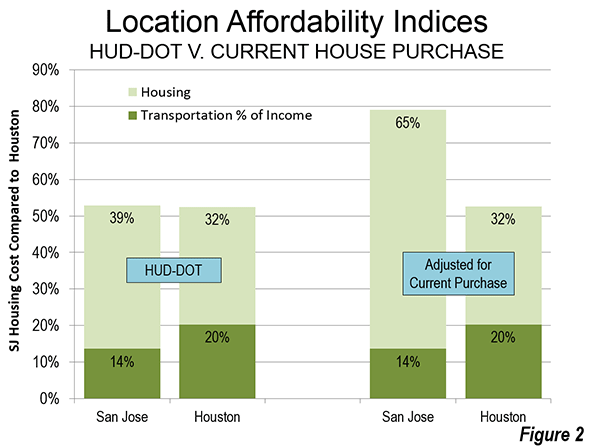
    A household relying on this source of information would be greatly misled. For example, comparing Houston with San Jose, according to HUD-DOT, owned housing and transportation consume virtually the same share of the median household income in each of the two metropolitan areas. In Houston, 52.5 percent of income is required for housing and transportation, while the number is marginally higher than San Jose (52.9 percent).

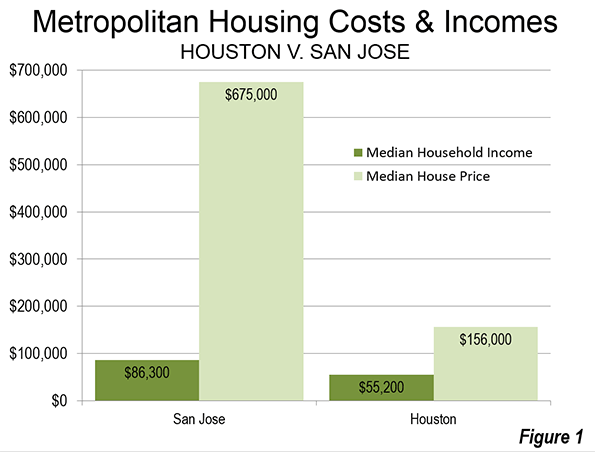
    But the HUD-DOT numbers reflect nothing like the actual costs of housing in San Jose relative to Houston. The median price house in Houston was approximately $155,000, 2.8 times the median household income of $55,200 (this measure is called the median multiple) during the 2006-10 period used in calculating the HUD-DOT index. In San Jose, the median house price was approximately $675,000, 7.8 times the median household income of $86,300 (Figure 1).
    If the Location Affordability Index reflected the real cost for a prospective home owner (HUD-DOT costs including a market rate mortgage for the house), a considerable difference would emerge between San Jose and Houston. The combined San Jose Location Affordability Index for home owners would rise to 85 percent of median household income, a full 60 percent above the Houston figure, rather than the minimal difference of less than one percent indicated by HUD-DOE (Figure 2).
    Under-Estimating the Cost of Urban Containment

    There is a substantial difference between the HUD–DOT housing and transportation cost and the actual that would be paid by prospective buyers. Five selected urban containment markets indicate a substantially higher actual housing cost than reflected in the HUD–DOT figures. On the other hand, in the selected liberally regulated markets (or traditionally regulated markets), the HUD–DOE figure is much closer to the current cost of home ownership (Figure 3). This is a reflection of the greater stability (less volatility) of house prices in liberally regulated markets. Overall, based on data in the 50 major metropolitan areas, owned housing costs relative to incomes rise approximately 6 percent for each 10 percent increase in the sprawl index – that is, less sprawl is associated with higher house prices relative to incomes (Note 6).
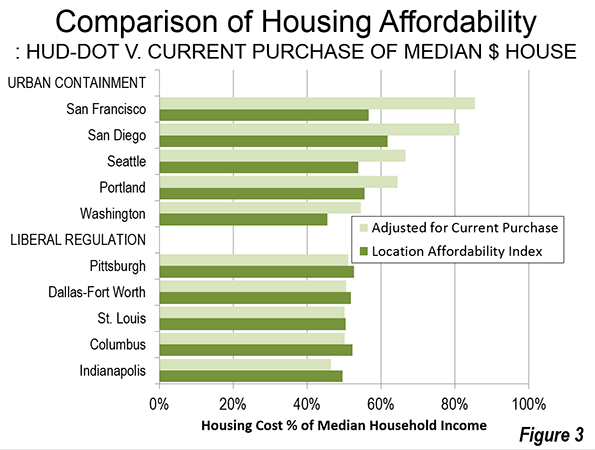
    The increasing impacts of urban containment’s housing cost increases have been limited principally to households who have made recent purchases. The effect will become even more substantial in the years to come as the turnover of the more expensive housing stock continues.

    Granted, the 2006 to 2010 housing data includes part of the housing bubble and its higher house prices. However, house prices relative to incomes have returned to levels at or above that recorded during the period covered by Measuring Sprawl 2014 in "urban containment" markets, such as San Francisco, San Jose, Los Angeles, San Diego, Seattle, Portland, and Washington.

    Economic Mobility and Human Behavior

    Another assertion requires attention: economic mobility is greater in less sprawling metropolitan areas. The basis is research by Raj Chetty and Nathaniel Hendren of Harvard University and Patrick Kline and Emmanuel Saez of the University of California, Berkeley. However, the realities of domestic migration suggest caution with respect to the upward mobility conclusions, as is indicated in Distortions and Reality About Income Mobilityand in commentary by Columbia University urban planner David King.

    Virtually all urban history shows city growth to have occurred as people have moved to areas offering greater opportunity. Jobs, not fountains, theatres and art districts, drive nearly all the growth of cities. This means that there should be a strong relationship between the cities net domestic migration and the economic mobility conclusions of the research. The strongest examples show the opposite relationship.

    Domestic migration is strongly away from some metropolitan areas identified in the research as having the greatest upward income mobility also had substantial net domestic migration losses. For example, despite claims of high economic mobility New York, Los Angeles and the San Francisco Bay area, each lost approximately 10 percent of their population to net domestic migration in the 2000s. On the other hand, some metropolitan areas scoring the lowest in upward economic mobility drew substantial net domestic migration gains. For example, low economic mobility Charlotte and Atlanta gained 17 percent and 10 percent due to net domestic migration in the 2000s. Thus, the results of the economic research appear to be inconsistent with expected human behavior (Note 7).

    Sprawl: An Inappropriate Priority

    The new sprawl report is just another indication that urban planning policy has been elevated to a more prominent place than appropriate among domestic policy priorities. The usual justification for urban containment is a claimed sustainability imperative for its densification and anti-mobility policies. Yet, these policies are hugely expensive and thus ineffective at reducing greenhouse gas emissions, and thus have the potential to unduly retard economic growth (read "the standard of living and job creation"). Far more cost-effective alternatives are available, which principally rely on technology.

    There is a need to reverse this distortion of priorities. Little, if anything is more fundamental than improving the standard of living and reducing poverty (see Toward More Prosperous Cities). Housing is the largest element of household budgets and policies of that raise its relative costs necessarily reduce discretionary incomes (income left over after paying taxes and paying for basic necessities). There is no legitimate place in the public policy panoply for strategies that reduce discretionary incomes.

    London School of Economics Professor Paul Cheshire may have said it best, when he noted that urban containment policy is irreconcilable with housing affordability.

    ———

    Note 1: The previous Smart Growth America report used primarily metropolitan statistical areas (PMSAs), which have been replaced by metropolitan divisions. The primary metropolitan statistical areas were also subsets of metropolitan areas (labor market areas). This is problem is best illustrated by the fact that the Jersey City PMSA, composed only of Hudson County, NJ, is approximately one mile across the Hudson River from Manhattan in New York. Manhattan is the world’s second largest central business district and frequent transit service connects the two. Obviously, Jersey City is a part of the New York metropolitan area (labor market area), not a separate labor market.

    Note 2: Because of incomplete data, Boston is not given a sprawl rating in Measuring Sprawl 2014. A different rating system in the previous edition resulted in a Boston rating among the least sprawling. Yet, the Boston metropolitan area is characterized by low density development. Outside a 10 mile radius from downtown, the population density within the urban area is slightly lower than that of Atlanta (same square miles of land area used).

    Note 3: Higher house prices relative to household incomes are more associated with policies to control urban sprawl (such as urban growth boundaries and other land rationing devices), than with the extent of sprawl. More compact (less sprawling) urban areas do not necessarily have materially higher house prices. For example, in 1970, the Los Angeles urban area was one of the most dense in the United States, yet it was within the historical affordability range (a median multiple of less than 3.0). The emergence of Los Angeles as the nation’s most dense urban area in the succeeding decades (and 30 percent increase in density) is largely the result of a change in urban area criteria. Through 1990, the building blocks of urban areas were municipalities, which meant that many square miles of San Gabriel Mountains wilderness were included, because it was in the city of Los Angeles. Starting in 2000, the building blocks or urban areas became census blocks, which are far smaller and thus exclude the large swaths of rural territory that were included before in some urban areas.

    Note 4: The transport costs from the Location Affordability Index are accepted for the purposes of this article.

    Note 5: The current purchase housing cost is based on the average price to income multiple over the period of 2006 to 2010, relative to the median household income (calculated from quarterly data from the Joint Center for Housing Studies of Harvard University, State of the Nation’s Housing 2011). It is assumed that the buyer would finance 90 percent of the house cost at the average 30 year fixed mortgage rate with points over the period. The 10 percent down payment is allocated annually in equal amounts over the 360 months (30 years). The final annual cost estimate is calculated by adding the monthly mortgage payment and down payment allocation to the median monthly housing cost in each metropolitan area for households without a mortgage.

    HUD-DOT uses the "selected monthly owner cost" from the American Community Survey (ACS) for its cost of home ownership. According to ACS, “Selected monthly owner costs are calculated from the sum of payment for mortgages, real estate taxes, various insurances, utilities, fuels, mobile home costs, and condominium fees."

    Note 6: This is based on a two-variable regression estimation (log-log) with the sprawl index as the independent variable and the substituted housing share of income as the dependent variable for the 50 largest metropolitan areas (excluding Boston), It is posited that most of the variation in housing costs is accounted for by variation in land costs. Other significant factors, such as construction costs and financing costs in this sample vary considerably less. A sprawl index for each metropolitan areas represented by metropolitan divisions (not provided in the sprawl report) is estimated by population weighting.

    Note 7: Another difficulty with that research is that it measured geographic economic mobility at age 30, well before people reach their peak earning level. This is likely to produce less than reliable results, since those who achieve the highest incomes as well as the most educated such as medical doctors and people with advanced degrees) are likely to have larger income increases after age 30 than other workers.

    Wendell Cox is principal of Demographia, an international public policy and demographics firm. He is co-author of the “Demographia International Housing Affordability Survey” and author of “Demographia World Urban Areas” and “War on the Dream: How Anti-Sprawl Policy Threatens the Quality of Life.” He was appointed to three terms on the Los Angeles County Transportation Commission, where he served with the leading city and county leadership as the only non-elected member. He was appointed to the Amtrak Reform Council to fill the unexpired term of Governor Christine Todd Whitman and has served as a visiting professor at the Conservatoire National des Arts et Metiers, a national university in Paris.

    Suburban neighborhood photo by Bigstock.
  • Concentrated Wealth or Democracy, but Not Both

    In many uncomfortable ways, American politics now resemble those that arose late in the Roman Republic. As wealth and land ownership concentrated in few hands, a state built on the discipline of soldiers who tended their own farms became ever more dominated by fractious oligarchs. As property consolidated into huge slave-owning estates, more citizens became landless and ever more dependent on the patronage of the rich generals and landowners who increasingly seized control of politics.

    In much the same way, as the wealth has concentrated in America, so, too, has the power exercised by those with money. The wealthy have always played an outsized role in our politics, but today, emboldened by Supreme Court rulings easing controls on contributions, oligarchs are dominating the electoral map in ways that have not been seen at least since the abuses of the Nixon years.

    Perhaps the most notable, or infamous, example is the Koch brothers, David and Charles, billionaire industrialists whose role in conservative politics has made them the ultimate “bogeymen” for crusading liberal journalists concerned with the growing power of the ultrarich on our political system. Campaigning against the Kochs has become standard issue for Democrats such as Senate Majority Leader Harry Reid.

    What makes the Koch brothers such great targets is that they come from an industry – energy – that itself is held in the lowest esteem by the progressive activist community and its media allies. Although they tend to be libertarian in their social views, the Kochs are notably, and not surprisingly, skeptical about climate change policies that might impact their vast oil and gas holdings as well as their industrial companies, which, in the words of former New York Times columnist Frank Rich, “spew” such unhappy products as Lycra and Dixie cups. The Kochs’ ties to the Tea Party have led reliably liberal commentators to suggest that the moguls have played the supposedly grass-roots Tea Party for “suckers.”

    As they rail against the Kochs, few progressives note that the balance of oligarchic politics are increasingly shifting toward the Democratic Party. This, of course, includes the predictable Hollywood figures, such as Dreamworks’ Jeffrey Katzenberg and a large section of Wall Street, notably financier George Soros, long a major source of funding for President Obama.

    These well-heeled progressives have had little to fear from an administration that, despite its occasional populist outbursts, has adopted an economic policy that has exacerbated an already yawning gap in income growth between the wealthy and everyone else. Indeed, Obama, for all his populist rhetoric, retained close ties to firms like Goldman Sachs, staffing his administration with people from, and associated with, that most-detested of Wall Street firms. Indeed the ultrarich so backed the ostensibly left-wing president that, at his first inaugural, notes sympathetic chronicler David Callahan, the biggest problem for donors was finding sufficient parking space for their private jets.

    An examination of campaign contributions shows that the vast majority of America’s wealthiest households may already tilt in this direction. Among the .01 percent who increasingly dominate political giving, three of the largest contributions, besides the conservative Club for Growth, backed by Republican oligarchs, went to groups such as Emily’s List, Act Blue and Moveon.org. Liberal groups accounted for eight of the top 10 ideological causes of the ultra-rich; seven of the 10 congressional candidates most dependent on their money were Democrats.

    This ideological shift among the rich, particularly the new rich, in what author Chrystia Freeland has dubbed an “age of elites,” is critical to understanding contemporary political conflict. There have always been, of course, affluent individuals who backed liberal or Democratic causes, out of a mixture of philosophy and self-interest but, for the most part, the wealthy backed Republicans. This has begun to change.

    Perhaps most ominous for the Right, the biggest growth in oligarchic politics has been from the very group – the so-called “high tech community” – that has flourished under the current easy-money regime. Once primarily middle-of-the-road Republican, the tech oligarchs have moved “left” in their politics, particularly on social and environmental issues. Many also have profited, or attempt to, through “green” energy investments. The leading tech companies, mostly based in the Silicon Valley, routinely send over four-fifths of their contributions to Democratic candidates.

    For the political parties, which are losing influence with every election, the rise of the oligarchs in politics represents a mixed blessing. To be sure, the tens of millions poured into the coffers of party candidates is welcomed, but at the same time, the oligarchs have become so powerful that they have altered, likely for a long time, the nominating and electing process.

    Republicans, for example, must deal with the likes of casino billionaire Sheldon Adelson, whose millions kept the quixotic, and seemingly pointless, Newt Gingrich campaign alive in the most-recent presidential primary campaign. The Koch brothers and others have also supported the supposedly grass-roots Tea Party, whose opposition to the Republican establishment has roiled GOP politics since 2010 and ended up with the nomination of some weak candidates.

    This year, it may be the Democrats’ chance to lament the rise of the oligarchs. At a time when economic growth and inequality are primary issues to most Americans, the presence of oligarchs all but guarantees that other issues – notably, environmental issues or social concerns like gay marriage – dominate the party’s fundraising. After all, it’s hard to imagine a party increasingly dependent on the wealthy seriously advocating, for example, for the equalization of capital gains and regular income taxes.

    Nobody better epitomizes the rise of economic royalist politics in the Democratic Party than San Francisco-based hedge-fund billionaire and green-energy investor Tom Steyer. Steyer has pledged to work against any Democrat who dares express the slightest skepticism about the need to diminish use of fossil fuels, no matter the economic cost. This could prove particularly tough on Democrats from energy states, like Louisiana, Texas, the Dakotas, Colorado and Montana, who historically have supported the fossil fuel industry as a prime generator of high-wage employment, including thousands of unionized blue-collar jobs.

    With Steyer pledging some $100 million to his anti-oil campaign, centered on opposition to the Keystone XL pipleline, the party is running against the popular grain. According to a recent Washington Post poll, the project is favored among the public by a margin of roughly three to one.

    So, Democrats find themselves pressured to oppose something favored by a large majority, all for an issue – climate change – that barely rates as a priority among voters far more worried about their jobs and families than carbon emissions. Just as well-financed Tea Party extremists have led the Republicans to nominate some lamentable candidates, Steyer’s efforts could undermine Democratic prospects – at least outside the solid coastal precincts – by forcing party figures further toward the gentry version of the Left.

    Ultimately, the biggest issue revolves not around the politics of the oligarchs but their overall potential to dominate our entire political culture. As Supreme Court Justice Louis Brandeis suggested in the last century, “We can have democracy in this country, or we can have great wealth concentrated in the hands of a few, but we can’t have both.”

    The founders, too, understood this basic truth. James Madison embraced the ideal of dispersed property – “the possession of different degrees and kinds of property” – as necessary in a functioning republic. Thomas Jefferson, admitting that the “equal division of property” was “impractical,” believed “the consequences of this enormous inequality producing so much misery to the bulk of mankind” that “legislators cannot invent too many devices for subdividing property.”

    It’s time we started listening to Brandeis and the founders. Until we address this issue of concentrated economic power – be it in the hands of oil barons or tech types – our politics will continue to devolve like those of Rome in the late Republic, undermining the last vestiges of citizen-based politics. Whether or not it results in the rise of an actual Caesar, this could be a sad day for what is left of our old Republic.

    This story originally appeared at The Orange County Register.

    Joel Kotkin is executive editor of NewGeography.com and Distinguished Presidential Fellow in Urban Futures at Chapman University, and a member of the editorial board of the Orange County Register. He is author of The City: A Global History and The Next Hundred Million: America in 2050. His most recent study, The Rise of Postfamilialism, has been widely discussed and distributed internationally. He lives in Los Angeles, CA.

    Photo by Peoplesworld.

  • Replicating Bourbon Street

    Editor’s note: following is an excerpt from Tulane University geographer Richard Campanella’s new book, “Bourbon Street: A History” (LSU Press, 2014), which traces New Orleans’ most famous and infamous space from its obscure colonial origins to its widespread reknown today. This chapter, titled “Replicating Bourbon Street: Spatial and Linguistic Diffusion” and drawn from a section called “Bourbon Street as a Social Artifact,” recounts how this brand has spread worldwide and become part of the language—to both the benefit and chagrin of New Orleans.

    Perhaps the best evidence of Bourbon Street’s success is the fact that, like jazz, it has diffused worldwide. It’s a claim few other streets can make. As early as the 1950s, a nightclub named “Bourbon Street” operated in New York City, and apparently successfully, because in 1957 the Dupont family formed a corporation to purchase it with plans to bring “Mambo City” entertainment to clubs named Bourbon Street in Miami and Chicago.1 Today, at least 160 businesses throughout the United States and Canada have “Bourbon Street” in their names and themes; 77 percent are restaurants, bars, and clubs; 11 percent are retailers (mostly of party and novelty items); and the remainder are caterers, banquet halls, hotels, and casinos—more eating, drinking, and entertaining. They span coast to coast, from Key West to Edmonton and from San Diego to Montreal. Greater New York has eleven, while Calgary has six, as does San Antonio (mostly near the River Walk, “the Bourbon Street of San Antonio”). Greater Toronto has sixteen, most of them franchises of the Innovated Restaurant Group’s “Bourbon St. Grill” chain—including one on Yonge Street, which has been described as “the Bourbon Street of Toronto.” There are also Bourbon-named restaurants, bars, and clubs in London, Amsterdam, Hamburg, Naples, Moscow, Tokyo, Shanghai, Dubai, and many other world cities. These replicas enthusiastically embrace Bourbon Street imagery and material culture (lampposts, balconies, Mardi Gras jesters, beads) in their signage, décor, and Web sites. Menus attempt to deliver the spice and zest deemed intrinsic to this perceptual package, as does the atmospheric music. How convincingly do these meta-Bourbons replicate the original? A review of one such venue in Amsterdam (“the New Orleans of Europe”) could easily apply to the actual street:

    [T]he jovial Bourbon Street Jazz and Blues Club…attracts a casual, jean-clad crowd of all ages [dancing to] cover bands with a pop flavor [or] blues rhythms. Three glass chandeliers hanging over the bar provide an incongruous dash of glamour to an otherwise low-key and comfortable scruffy décor.2

    In this spatial dissemination we see a trend: while local replication of the Bourbon Street phenomenon usually takes the form of competition tinged with contempt (witness the “anti-Bourbons”), external replicas of Bourbon Street view themselves as payers of homage to the “authentic” original, and modestly present themselves as the next best thing without the airfare. No licenses are needed in replicating Bourbon Street; there are no copyrights, trademarks, or royalties due. The name, phenomenon, and imagery are all in the public domain, a valuable vernacular brand free for anyone to appropriate. Try doing that to The New Orleans Jazz and Heritage Festival Presented by Shell and you’d have a lawsuit on your hands.

    Bourbon is also among the few streets to be replicated structurally—by the State of Louisiana, which sponsored a three-acre exhibit at the 1964 World’s Fair in Queens, New York. It featured all the standard architectural tropes of the French Quarter topped off with a huge arch emblazoned LOUISIANA’S BOURBON STREET accompanied by towering Carnival royalty. In typical Louisiana fair tradition, however, the exhibit experienced construction delays and filed for bankruptcy, which caused the state to wash its hands of the fiasco and officially change the name of the exhibit to “Bourbon Street.” “The so-called Louisiana area in its present condition,” state officials solemnly proclaimed, “reflects discredit upon the State of Louisiana, its culture, heritage and people.” Wags pointed out that this was pretty much what locals thought of the original Bourbon Street. But unlike the original, a corporate entity named Pavilion Properties, Inc. took over the exhibit, and after removing all references to Louisiana and spiffing up the props, it managed the Creole food booths, Dixieland trios, sketch artists, organ grinders, street performers, and nightclubs (including the popular “Gay New Orleans”) for the remainder of the fair. Also unlike the original, Pavilion Properties’ exhibit, just like the state’s attempt, failed commercially and also filed for bankruptcy. Nevertheless, it introduced a generation of New Yorkers to the Bourbon Street brand.3

    At the opposite end of the country two years later, another private-sector entity built a “New Orleans Square” at Disneyland. Based on field research conducted in the French Quarter by Walt Disney himself plus a staff of artists in 1965, the $13.5 million West Coast replica (nearly the cost of the Louisiana Purchase, Disney joked) eschewed the Bourbon moniker, presumably not to scare off parents, but nevertheless incorporated everything that worked on the real Bourbon Street minus the breasts and booze. Disney later replicated New Orleans Square at its Adventureland in Tokyo (1983), which may partly explain the popularity of the real New Orleans with Japanese visitors today. It did not, however, build a New Orleans Square at Disneyland Paris (Euro Disney) when it opened in 1992.4

    Bourbon Street has also been thematically and structurally referenced in countless shopping malls, amusement parks, casinos, cruise ship parties, festivals, convention banquets, and wedding receptions, not to mention on film and theatrical sets and in computer animation for movies like The Princess and the Frog. “Bourbon Street” as an adjective has found its way onto menus, usually for spicy dishes, and into household décor, generally to describe old-world filigree inspired by the iron-lace balconies. It’s a case study of cultural diffusion which serves as free worldwide advertising for the original, across various media forms and demographic cohorts, all with zero encouragement and oversight from Bourbonites. Now that’s success.

    Imitation may be the sincerest form of flattery, but it also produces competition. Once there was a time when the forbidden pleasures available on Bourbon Street were in high demand and low supply nationwide, particularly in the South. That made Bourbon Street valuable. Today the nation is a whole lot less judgmental about pleasure and much better supplied with comparable pleasure districts. A visit to Galveston’s The Strand, St. Louis’ Soulard, and Mobile’s Dauphine Street, all of which have adopted Bourbon-style Mardi Gras, may satisfy many people’s desire for the escapism that Bourbon Street once monopolized. Even just a few blocks away in downtown New Orleans, Harrah’s has quietly overseen the creation of a Bourbon alternative on the Fulton Street Mall, complete with outdoor dining, festival space, and a growing inventory of venues, all adjacent to the corporation’s hotel and casino. Might such meta-Bourbons erode the market share of the original, in the same way that regional casinos have chipped away at Las Vegas’ domination? Bourbonites would be ill-advised to rely on their fame; better to experiment with innovations, rediscover what worked in the past, and tame that which damages. That said, The Street does have certain inherent advantages: it’s bigger and longer than the competition; it’s embedded into the world-famous French Quarter and enjoys a symbiotic relationship with its tourism industry; and perhaps most importantly, it boasts that intimate historical streetscape and centuries-old civic reputation that infuses in visitors a certain credibility—shall we call it authenticity?—in a way unmatched by places like Las Vegas. On a dark note, Bourbon is also disturbingly vulnerable to accidental or intentional trauma, such as a balcony collapse, crowd stampede, or terrorist bombing, which, in addition to the human toll, could poison The Street’s allure for years. Bourbon, in short, has bright prospects and a record of widespread economic and cultural influence, but should not take its fame and success for granted.

    Speaking of cultural influence, Bourbon Street has entered the language of American English, which, curiously, does not have a perfect word for the Bourbon Street phenomenon. Shall we call it an adult entertainment area? A cluster? A strip? A pedestrian mall? A tenderloin, red-light, or vice district? All are awkward, some are imprecise, and none are perfect. The linguistic lacuna is particularly perplexing because nearly every city since Sybaris has developed such spaces.

    To fill the gap, some speakers convert common nouns into proper toponyms; examples include Las Vegas’ The Strip, Baltimore’s The Block, and historic New Orleans’ The Swamp or The Line. Others craft “antonamasias,” which, in rhetoric, are attempts to describe the characteristics of a new phenomenon by invoking the name of a comparable known entity, e.g., “the Paris of…,” “the Barbary Coast of…,” “the Greenwich Village of….”5 The antonamasia “the Bourbon Street of….” is among the most popular ways for Americans to refer efficiently and effectively to pedestrian-scale drinking, eating, and entertainment districts. It’s exceedingly common to hear 6th Street, for example, described as the Bourbon Street of Austin. Ybor City is routinely characterized as the Bourbon Street of Tampa, as is Carson Street of Pittsburgh, and Duval Street of Key West (or of the entire Caribbean). Beale Street was completely redeveloped by a real estate corporation in the 1980s from a boarded-up eyesore to become, inevitably, the Bourbon Street of Memphis. A review of 67 published articles since 1986, plus over 300 Internet sources, showed that at least eighty social spaces worldwide have been described as “the Bourbon Street of” their respective communities. They span from Hamburg’s Reeperbahn to Bangkok’s Patpong; from Spain’s Pamplona during the Running of the Bulls to Las Ramblas in Barcelona, from Quay Street in Galway to Lan Kwai Fong in Hong Kong. They are not always urban; sometimes the phrase it used for frisky beaches at vacation destinations, for boating coves (most notoriously in Lake of the Ozarks, a popular rendezvous for nudity and inebriation), or the Mall of America in Minneapolis, the entire town of Hyannis (“the Bourbon Street of the Cape”) or the city of Ogden (“the Bourbon Street of Utah,” historically). Some use it as a warning (“Let’s not turn the Underground into the Bourbon Street of Atlanta”) or as an ambition (“the big goal is for the Mill Avenue District to become the Bourbon Street of the Southwest”). The phrase even found a home in its own backyard; a travel writer called “Jackson Square…the Bourbon Street of daytime New Orleans,” and the Times-Picayune dubbed the Fulton Street Mall as “the Bourbon Street of the [1984] world’s fair.” Some uses emphasize the spatial clustering over the piquant aspect (“Canyon Road [is] the Bourbon Street of Santa Fe’s art scene”); others do the exact opposite: “USA Network [is] the Bourbon Street of basic cable;” “Louisiana Fried Chicken [is] the Bourbon Street of chicken.”6

    One would be hard-pressed to think of another street so richly representational. The very matriculation of a street to metaphor status is fairly rare. To be sure, we speak of Wall Street to mean corporate power, Madison Avenue to mean marketing, and Broadway for theater, but as we go further down the list, we find fewer linguistic uses and users. Bourbon Street is one of the American English language’s handiest and most evocative place metaphors, a testament to The Street’s widespread renown and iconic resonance.

    Richard Campanella, a geographer with the Tulane School of Architecture, is the author of Bienville’s Dilemma, Geographies of New Orleans, Lincoln in New Orleans, and Bourbon Street: A History (LSU Press, 2014), from which this article was excerpted. Please see the book for sources. Campanella may be reached through http://richcampanella.com or rcampane@tulane.edu ; and followed on Twitter at @nolacampanella.

    1 “Dupont Dough Backs Murphy,” Billboard, December 2, 1957, p. 19.

    2 Corinne LaBalme, “Night Moves of All Kinds: The Club Scene in Seven Cities—Amsterdam,” The New York Times, September 17, 2000.

    3 Francis Stilley, “Visitors to World’s Fair Will ‘Ride Magic Carpet,’ Times-Picayune, April 15, 1964; “Hot Flashes,” Times-Picayune, May 31, 1964, p. 37; Charles M. Hargroder, “Governor, Firm Announce Plant,” Times-Picayune, June 17, 1964, pp. 1-16; Richard Phalon, “Bourbon Street Operator at Fair Is 11th Bankrupt Exhibitor,” New York Times, February 5, 1965, p. 32.

    4 “Disneyland N.O. Replica, Aim,” Times-Picayune, April 11, 1965, p. 17.

    5 I thank sociolinguist Christina Schoux Casey for informing me of this obscure but useful term.

    6 Research by author using hundreds of news and online sources, 1986-present, searched throughout 2012.

  • America’s New Brainpower Cities

    Brainpower rankings usually identify the usual suspects: college towns like Boston, Washington, D.C.,  and the San Francisco Bay area. And to be sure, these places generally have the highest per capita education levels. However, it’s worthwhile to look at the metro areas that are gaining college graduates most rapidly; this is an indicator of momentum that is likely to carry over into the future.

    To determine where college graduates are settling, demographer Wendell Cox analyzed the change in the number of holders of bachelor’s degrees and above between 2007 and 2012 in the 51 metropolitan statistical areas with over a million people (all saw gains). For the most part, the fastest-growing brain hubs are in the South and Intermountain West (which excludes the states on the Pacific Coast). Some of these places are usually not associated with the highest levels of academic achievement, and for the most, they still lag the national average in college graduation rates.

    But times are changing, and educated people are increasingly heading to these metro areas, notably in the South, were job growth has been robust and the cost of living is far lower than in the San Francisco Bay Area, New York or Los Angeles. This includes New Orleans, which ties for first place on our list with San Antonio. The New Orleans metro area’s population of college graduates grew by 44,000 from 2007 to 2012, a 20.3% increase, nearly double the national average of 10.9%. (The percentage of college grads in the U.S. stood at 19.4% in 2012, up from 18% in 2007.)

    New Orleans’ story, of course, is unique; the jump certainly is partly due to the return of evacuees to the city after Katrina, and some scoff that the region is destined to return to its historical pattern of exporting its educated young. But right now the American Community Survey data seems to indicate otherwise, as does the decision in recent years by numerous technology, videogame and media businesses to establish operations in the metro area, including General Electric, Paris-based Gameloft and the satellite communications company Globalstar, which in 2010 moved its headquarters from Silicon Valley to Covington, a prosperous suburb of the Crescent City.

    What is happening in New Orleans, where I have worked as a consultant, is unique, but it also follows a broader pattern that we see in other areas. Unable to afford to settle long-term in traditional “brain centers,” educated people are increasingly looking for places that have strong economies but also many of the cultural and natural amenities associated with the traditional meccas for the educated. With housing prices that are half to a third of Silicon Valley or San Francisco, New Orleans offered educated workers, particularly younger ones, many of the things they look for, but at an affordable cost.

    “For $65,000 a year in San Francisco you get a shared apartment and no car,” says long-time New Orleans tech entrepreneur Chris Reed. ”Here, you get great restaurants and clubs, and you get to have a car and your own nice apartment. It’s a no-brainer.”

    Other cities with some of the same characteristics are also winning in the race to bring in more educated workers. Nowhere is this more true than in Texas, which is home to four of the top 12 metro areas on our list. Tops is co-first place San Antonio, which had a net gain of 76,000 college-educated people since 2007, or 20.3%.

    Like New Orleans, the San Antonio area has traditionally lagged behind in attracting educated people; nearly one resident in six does not have a high school diploma. But the old Texas town also has many amenities that appeal to educated workers, notably great food and a good nightlife scene. In addition, it boasts one of the fastest-growing regional economies in the country, with expanding tech and energy businesses, something that may have a particular appeal in this still weak recovery.

    “When the buzz starts … and hipsters start to get wise to the neighborhood assets that are here, once the hipsters get wind of it – you’ll have to beat them away with a stick,” says economic geographer Jim Russell.

    Austin places third, which should come as no surprise — the area is home to the main campus of the University of Texas, boasts a thriving music scene and a strong technology infrastructure. Nor should the rapid growth of educated residents in sixth-ranked Houston, up 16% since 2007, which also enjoys low costs, an increasingly attractive cultural scene and one of the fastest growing hubs of dense urban living in the country. Dallas, also a fast-growing area, lands in 12th place on our list, boosting its college graduate population by 13%, or 175,000.

    One of the more surprising metro areas in our top 10 is fifth place Louisville, Ky.-Ind. The home of Humana, it has a thriving health care sector, and also is strong in the food industry and logistics. It has seen a 16.2% increase in the number of educated residents.

    Strong growth has also occurred in the Intermountain West, led by Denver (seventh) and Salt Lake City (eighth). Both areas have been beneficiaries of the migration of people and companies from California. This may also explain the growth of 11th place Phoenix, an area that has made remarkable strides since the disastrous days of the housing bust and is once again attracting migrants in larger numbers than any large metro area outside Texas.

    So if these areas are leading the race to capture “talent,” who is lagging behind? Not surprising at the bottom of the list are a series of Rust Belt cities with relatively weak economies, led by last place Detroit, where the number of college-educated residents rose 4.1%. Its followed by Providence,  Cleveland and Cincinnati.

    Boston, long styled as the “Athens” of America, ranks 47th on our list. Over the past five years Boston has gained some 98,000 college educated people, an increase of 7.2%, well below the national average. Beantown, of course, can always claim it has the highest “quality” brains but even in terms of percentage gains of people with graduate degrees it ranks only 41st .

    The data show the universe of educated people is not becoming more “spiky” as some suggest, but is spreading out. This is true not only in terms of percentage growth, but in absolute numbers. Since 2007, for example, the Houston and Dallas metro areas have added more BAs than San Francisco-Oakland, and nearly twice as many as Boston. As a result, these and other such cities are gaining a critical mass in brainpower not widely recognized in the Eastern-dominated media.

    At very least, we can say that the conventional wisdom favoring the traditional “brain” cities seems flawed. There will always be areas with more educated people per capita than others, if for no other reason than historical inertia and lack of migration, particularly among the less educated. But the clear pattern now is for brainpower, like population and jobs, to continue dispersing, largely to the South, the Southeast and the Intermountain West, with ramifications that will be felt in the economy in the decades ahead.

    Educational Attainment: BAs & Higher
    Corrected (2015-05-07)
    Major Metropolitan Area 2007 2012 Change Change % Rank
    Atlanta, GA    1,151,723     1,243,122       91,399 7.9% 45
    Austin, TX       382,119        477,058       94,939 24.8% 3
    Baltimore, MD       589,874        677,837       87,963 14.9% 14
    Birmingham, AL       187,094        214,201       27,107 14.5% 17
    Boston, MA-NH    1,271,193     1,369,597       98,404 7.7% 47
    Buffalo, NY       207,907        231,718       23,811 11.5% 34
    Charlotte, NC-SC       348,923        401,116       52,193 15.0% 13
    Chicago, IL-IN-WI    1,984,496     2,190,424     205,928 10.4% 40
    Cincinnati, OH-KY-IN       393,076        419,714       26,638 6.8% 48
    Cleveland, OH       380,479        405,731       25,252 6.6% 49
    Columbus, OH       367,811        419,136       51,325 14.0% 20
    Dallas-Fort Worth, TX    1,155,069     1,330,312     175,243 15.2% 12
    Denver, CO       595,437        708,325     112,888 19.0% 6
    Detroit,  MI       786,153        819,347       33,194 4.2% 51
    Hartford, CT       276,002        305,100       29,098 10.5% 39
    Houston, TX       972,615     1,157,627     185,012 19.0% 6
    Indianapolis. IN       333,079        377,189       44,110 13.2% 24
    Jacksonville, FL       221,907        258,893       36,986 16.7% 9
    Kansas City, MO-KS       410,109        460,391       50,282 12.3% 32
    Las Vegas, NV       257,886        293,001       35,115 13.6% 23
    Los Angeles, CA    2,458,215     2,720,654     262,439 10.7% 36
    Louisville, KY-IN       195,760        233,566       37,806 19.3% 5
    Memphis, TN-MS-AR       197,292        222,813       25,521 12.9% 26
    Miami, FL    1,058,815     1,186,398     127,583 12.0% 33
    Milwaukee,WI       308,214        337,253       29,039 9.4% 42
    Minneapolis-St. Paul, MN-WI       774,669        881,581     106,912 13.8% 21
    Nashville, TN       287,154        355,630       68,476 23.8% 4
    New Orleans. LA       172,965        216,970       44,005 25.4% 1
    New York, NY-NJ-PA    4,433,180     4,836,321     403,141 9.1% 43
    Oklahoma City, OK       210,720        237,329       26,609 12.6% 28
    Orlando, FL       379,636        409,263       29,627 7.8% 46
    Philadelphia, PA-NJ-DE-MD    1,204,380     1,377,684     173,304 14.4% 18
    Phoenix, AZ       709,284        818,434     109,150 15.4% 11
    Pittsburgh, PA       456,717        513,838       57,121 12.5% 30
    Portland, OR-WA       479,207        549,825       70,618 14.7% 16
    Providence, RI-MA       301,591        320,262       18,671 6.2% 50
    Raleigh, NC       278,754        324,318       45,564 16.3% 10
    Richmond, VA       244,277        280,650       36,373 14.9% 14
    Riverside-San Bernardino, CA       469,381        519,680       50,299 10.7% 36
    Rochester, NY       205,014        226,912       21,898 10.7% 36
    Sacramento, CA       403,140        435,485       32,345 8.0% 44
    Salt Lake City, UT       193,167        229,140       35,973 18.6% 8
    San Antonio, TX       300,114        376,445       76,331 25.4% 1
    San Diego, CA       631,996        722,819       90,823 14.4% 18
    San Francisco-Oakland, CA    1,251,139     1,414,393     163,254 13.0% 25
    San Jose, CA       527,167        592,703       65,536 12.4% 31
    Seattle, WA       814,902        918,119     103,217 12.7% 27
    St. Louis,, MO-IL       521,047        586,547       65,500 12.6% 28
    Tampa-St. Petersburg, FL       496,826        544,121       47,295 9.5% 41
    Virginia Beach-Norfolk, VA-NC       284,924        317,741       32,817 11.5% 34
    Washington, DC-VA-MD-WV    1,658,902     1,885,862     226,960 13.7% 22
    Total  34,181,501   38,352,595  4,171,094 12.2%
    Outside MMSAs  20,152,010   22,389,927  2,237,917 11.1%
    United States  54,333,511   60,742,522  6,409,011 11.8%


    Joel Kotkin is executive editor of NewGeography.com and Distinguished Presidential Fellow in Urban Futures at Chapman University, and a member of the editorial board of the Orange County Register. He is author of The City: A Global History and The Next Hundred Million: America in 2050. His most recent study, The Rise of Postfamilialism, has been widely discussed and distributed internationally. He lives in Los Angeles, CA.

    Graduation image by BigStockPhoto.com.

  • Leadership and the Challenge of Making a City Visible

    Cities of varying sizes struggle with two related, but seemingly opposing, global and local forces. At one level, every city would like to benefit from the global flow of capital and the emerging landscapes of prosperity seen in “other” places. At another level, to be a recipient of such attention, a city has to offer something more than cheaper real estate and tax benefits.

    What cities need is a sense of uniqueness; something that separates them from other cities. Without uniqueness, a city can easily be made invisible in a world of cities. In other words, without defining the “local,” there is no “global.” Here is where identifying a coherent message about a place, based on its identity, becomes crucial. One of the major challenges facing many cities, small and large, is how to make themselves visible, and how to identify, activate, and communicate their place identity – their brand – through actions.

    The challenge of urban branding is that cities are not commodities. As such, urban branding is not the same as product or corporate-style branding. Cities are much more complex and contain multiple identity narratives; whatever the business and leadership says, there are other local voices that may challenge the accepted “script”. In fact, while city marketing may focus mainly on attracting capital through economic development and tourism, urban branding needs to move beyond the simply utilitarian, and consider   memories, urban experiences, and quality of life issues that affect those who live in a city. A brand does not exist outside the reality of a city. It is not an imported idea. It is an internally generated identity, rooted in the history and assets of a city.

    Catchy phrases, logos, shiny booklets, invented cultural events, or the latest urban design schemes are not the answer. Copying tactics from other cities won’t make a city recognizable; it will make it less visible and less unique. The challenge is, then, to ask what assets a city has that others do not possess; which of these assets can be seen as a city’s mark of achievement or recognizable characteristics; and how does one activate, elevate and sustain those characteristics?

    This search necessarily starts with residents, who are best suited to answer the first question. And who can respond to the second question better than the collective leadership of a city, including its public and private sectors? Leadership needs to be inclusive of all stakeholder groups, as should the voice of the residents, which must include gender, race, class, and age differences.

    At every step of the way, from collecting the diverse narratives to formulating and activating a brand, leadership and inclusive governance play central roles. But who are the leaders? As Robin Hambleton suggested at a recent Urban Studies Lecture at University of Washington Tacoma, leadership does not exclusively translate to political leaders, and governance is not the same as government. He identified four categories of leaders: political, managerial/professional, community, and business. He was careful to distinguish between predatory businesses that are typically place-less and care little about the future of a city, and producer businesses that are typically rooted and place-bound. His fourth category of leaders came from the latter and not the former group of businesses.

    Based on his international observation of various cities, many of which suffered a post-industrial condition (e.g. Malmo, Sweden and Melbourne, Australia) the convergence and collaboration of the four leadership categories created an innovation zone that allowed them to turn their cities around and adopt a way forward. The example of Freiburg in Germany, a city of slightly larger than 200,000 residents, is instructive. With the persistence of the Green political party, the mayor, community activists and an imaginative public servant (the Director of Planning and Building), Freiburg was able to enact a particular vision that elevated its status regionally, nationally and internationally. The city is recognized today as a leading European ‘eco-city;’ its history, geography and natural settings at the edge of the Black Forest in Germany allow Freiburg to incorporate this brand with ease. The four categories of leadership converged on this issue and their innovation paid off.

    The challenge before most post-industrial and mid-size cities is as follows: who are the leaders within each of these four sectors who can help convene, identify, and activate an urban brand, befitting of this urban region? Are these categories equally powerful? Do political and community leaders carry the same clout as the business and the managerial class? Most mid-size cities typically lack predatory businesses, but who are the producer businesses? More importantly, who are the leaders from that sector that could play an active role in the branding process? Is the leadership balance-sheet lopsided in favor of the managerial/professional class? With limited budget, can they carry forward a bold plan that could make this city visible?

    To make a city visible takes more than a logo. The future of a city region depends on a diversity of political, managerial, community and business leaders who will participate and sustain a process that will lead to an inclusively created brand, followed by actions that embrace it. Cities without articulated identities will remain invisible, lamenting at every historical turn the loss of yet another opportunity to be like their more successful neighbors.

    Ali Modarres is the Director of Urban Studies at University of Washington Tacoma.  He is a geographer and landscape architect, specializing in urban planning and policy. He has written extensively about social geography, transportation planning, and urban development issues in American cities.

    Photo by FLickr user belem

  • Special Report: 2013 Metropolitan Area Population Estimates

    The 2013 annual metropolitan area population estimates by the US Census Bureau indicate a continuing and persistent dominance of population growth and domestic migration by the South. Between 2010 and 2013, 51 percent of the population increase in the 52 major metropolitan areas (over 1 million population) was in the South. The West accounted for 30 percent of the increase, followed by the Northeast at 11 percent and eight percent in the North Central (Midwest).

    Components of Population Change: Major Metropolitan Areas

    The dominance of the South was even greater when we turn to net domestic migration between Census Bureau regions. Nearly 785,000 more people moved to the major metropolitan areas of the South from other parts of the country than left. A much smaller 170,000 net domestic migrants moved to major metropolitan areas in the West. At the same time the Northeast lost 485,000 net domestic migrants and the Midwest lost 280,000.

    Perhaps even more remarkable, the South, long a laggard as an immigrant destination, even led in net international migration (666,000 for a 1.2 percent over three years), though the Northeast added 546,000, for a 1.0 percent rate). Net international migration to the West was about the same, some 454,000 for a 1.0 percent rate. The Midwest had the lowest net international migration in the country and well below any other region (280,000, for a 0.6 percent rate), as is indicated in Table 1.

    There was a substantial gap in the natural increase (births minus deaths) between the regions as well. The West (2.1 percent relative to the 2010 population over the three years) lead the South (2.0 percent) slightly in rate. Both were well ahead of the Midwest at 1.5 percent and especially the Northeast, at 1.2 percent (Table 1).

    Table 1
    Components of Population Change by Region
    Major Metropolitan Areas
      Total Natural Growth (Births Minus Deaths) Net Domestic Migration Net International Migration
    Northeast              546,742              434,872             (434,029)              545,899
    South           2,555,304           1,105,631              783,438              666,235
    North Central              398,536              472,017             (280,022)              206,541
    West           1,543,319              917,852              171,444              454,023
    Change Compared to 2010 Population
    Northeast 1.5% 1.2% -1.2% 1.5%
    South 4.6% 2.0% 1.4% 1.2%
    North Central 1.2% 1.5% -0.9% 0.6%
    West 3.5% 2.1% 0.4% 1.0%
    From Census Bureau Data


    Population Growth

    The New York metropolitan area continues to hold the top position, having added nearly 400,000 residents since 2010 to rise to a population of 19,950,000 residents. At its current rate of growth, New York will exceed a population of 20 million in 2014. There was a time that many expected second-place Los Angeles to overtake New York. However, since 1990 the New York population advantage over Los Angeles has expanded from 6.1 million to 6.8 million, including a further 80,000 advantage built up since 2010 (present geographical definitions). Part of this because much of the growth has been pushed to the more distant Riverside-San Bernardino area.

    Los Angeles and Chicago continued to retain the second and third positions, which they seem likely to maintain for decades. Population projections by the National Conference of Mayors indicates strong growth in Dallas-Fort Worth and Houston over the next three decades could have them by pass Chicago by 2050. The challenge could be even more immediate, since Chicago’s growth rate over the first three years of the decade is approximately one half the annual rate projected by the US Conference of Mayors between 2012 and 2042.

    Late in the last decade, Dallas-Fort Worth passed Philadelphia to become the fourth largest metropolitan area. Then, Philadelphia was passed by Houston in 2011. The result is that, for the first time since the nation’s founding, two of the five largest cities (which are functionally defined as metropolitan areas) are in a single state (Texas).

    Philadelphia seems likely to fall further. The strong growth rate of seventh ranked Washington suggests that this nearby rival may also pass Philadelphia as early as 2015. Eighth ranked Miami is growing fast enough that it also could drop Philadelphia a position, to 8th place the 2020 census.

    But Philadelphia is not the only metropolitan area in relative decline. Detroit started the decade as the nation’s 12th largest metropolitan area, but has since fallen to 14th. Detroit has been passed by both Riverside-San Bernardino and Phoenix. Phoenix rose 14th to 12th, passing Riverside-San Bernardino (which remained in 13th position) in the process.

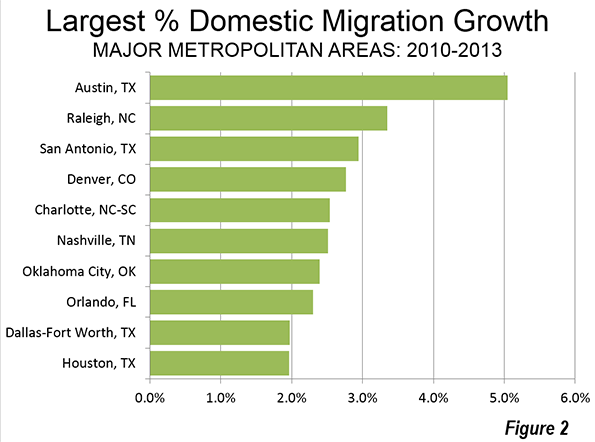
    Among the 52 major metropolitan areas, Austin has grown at the greatest percentage rate since 2010 with Raleigh was the second fastest growing. Houston was the third fastest growing major metropolitan area over the three year period. Orlando ranked 4th in growth from 2010, while San Antonio was the fifth. The top ten was rounded out by Denver, Washington, Dallas-Fort Worth, Charlotte and Oklahoma City. Thus, among the 10 fastest-growing major metropolitan areas, nine were in the South and one (Denver) was in the West (Table 2).

    Table 2
    Major Metropolitan Area Population: 2010, 2012 & 2013
    Metropolitan Areas 2010 2012 2013 2010-13 2012-13
    Atlanta, GA       5,304,197       5,454,429       5,522,942 4.12% 1.26%
    Austin, TX       1,727,784       1,835,110       1,883,051 8.99% 2.61%
    Baltimore, MD       2,715,312       2,753,922       2,770,738 2.04% 0.61%
    Birmingham, AL       1,129,096       1,134,915       1,140,300 0.99% 0.47%
    Boston, MA-NH       4,564,054       4,642,095       4,684,299 2.63% 0.91%
    Buffalo, NY       1,135,314       1,133,767       1,134,115 -0.11% 0.03%
    Charlotte, NC-SC       2,223,635       2,294,990       2,335,358 5.02% 1.76%
    Chicago, IL-IN-WI       9,470,335       9,514,059       9,537,289 0.71% 0.24%
    Cincinnati, OH-KY-IN       2,117,344       2,129,309       2,137,406 0.95% 0.38%
    Cleveland, OH       2,075,690       2,064,739       2,064,725 -0.53% 0.00%
    Columbus, OH       1,906,243       1,944,937       1,967,066 3.19% 1.14%
    Dallas-Fort Worth, TX       6,452,758       6,702,801       6,810,913 5.55% 1.61%
    Denver, CO       2,553,829       2,646,694       2,697,476 5.62% 1.92%
    Detroit,  MI       4,291,400       4,292,832       4,294,983 0.08% 0.05%
    Grand Rapids, MI          989,196       1,005,493       1,016,603 2.77% 1.10%
    Hartford, CT       1,214,014       1,214,503       1,215,211 0.10% 0.06%
    Houston, TX       5,948,689       6,175,466       6,313,158 6.13% 2.23%
    Indianapolis. IN       1,892,323       1,929,207       1,953,961 3.26% 1.28%
    Jacksonville, FL       1,349,095       1,378,040       1,394,624 3.37% 1.20%
    Kansas City, MO-KS       2,013,691       2,038,690       2,054,473 2.03% 0.77%
    Las Vegas, NV       1,953,106       1,997,659       2,027,868 3.83% 1.51%
    Los Angeles, CA     12,844,070     13,037,045     13,131,431 2.24% 0.72%
    Louisville, KY-IN       1,237,851       1,251,538       1,262,261 1.97% 0.86%
    Memphis, TN-MS-AR       1,326,595       1,340,739       1,341,746 1.14% 0.08%
    Miami, FL       5,581,524       5,763,282       5,828,191 4.42% 1.13%
    Milwaukee,WI       1,556,549       1,566,182       1,569,659 0.84% 0.22%
    Minneapolis-St. Paul, MN-WI       3,355,167       3,422,417       3,459,146 3.10% 1.07%
    Nashville, TN       1,675,945       1,726,759       1,757,912 4.89% 1.80%
    New Orleans. LA       1,195,757       1,227,656       1,240,977 3.78% 1.09%
    New York, NY-NJ-PA     19,596,183     19,837,753     19,949,502 1.80% 0.56%
    Oklahoma City, OK       1,257,883       1,297,397       1,319,677 4.91% 1.72%
    Orlando, FL       2,139,372       2,223,456       2,267,846 6.01% 2.00%
    Philadelphia, PA-NJ-DE-MD       5,971,397       6,019,533       6,034,678 1.06% 0.25%
    Phoenix, AZ       4,208,770       4,327,632       4,398,762 4.51% 1.64%
    Pittsburgh, PA       2,356,658       2,360,989       2,360,867 0.18% -0.01%
    Portland, OR-WA       2,232,177       2,289,038       2,314,554 3.69% 1.11%
    Providence, RI-MA       1,601,798       1,601,160       1,604,291 0.16% 0.20%
    Raleigh, NC       1,137,351       1,188,504       1,214,516 6.78% 2.19%
    Richmond, VA       1,210,015       1,232,954       1,245,764 2.95% 1.04%
    Riverside-San Bernardino, CA       4,244,089       4,342,332       4,380,878 3.22% 0.89%
    Rochester, NY       1,080,081       1,082,375       1,083,278 0.30% 0.08%
    Sacramento, CA       2,154,417       2,193,927       2,215,770 2.85% 1.00%
    St. Louis,, MO-IL       2,789,893       2,796,506       2,801,056 0.40% 0.16%
    Salt Lake City, UT       1,091,452       1,123,943       1,140,483 4.49% 1.47%
    San Antonio, TX       2,153,288       2,234,494       2,277,550 5.77% 1.93%
    San Diego, CA       3,104,182       3,176,138       3,211,252 3.45% 1.11%
    San Francisco-Oakland, CA       4,344,584       4,454,159       4,516,276 3.95% 1.39%
    San Jose, CA       1,842,076       1,892,894       1,919,641 4.21% 1.41%
    Seattle, WA       3,448,425       3,552,591       3,610,105 4.69% 1.62%
    Tampa-St. Petersburg, FL       2,788,961       2,845,178       2,870,569 2.93% 0.89%
    Virginia Beach-Norfolk, VA-NC       1,680,120       1,698,410       1,707,369 1.62% 0.53%
    Washington, DC-VA-MD-WV       5,664,789       5,862,594       5,949,859 5.03% 1.49%
    Major Metropolitan Areas   169,898,524   173,253,232   174,942,425 2.97% 0.97%
    From Census Bureau Data


    Domestic Migration

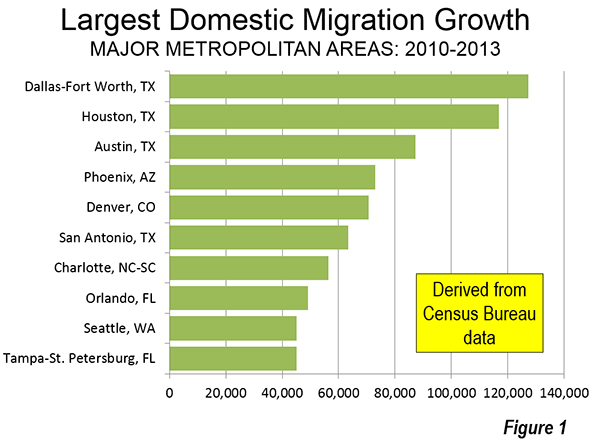
    Net domestic migration is, not surprisingly, dominated by the major metropolitan areas of the South, especially Texas and Florida. Dallas-Fort Worth and Houston led the nation with more than 100,000 net domestic migrants (Figure $$$). Austin placed third in San Antonio was sixth. Charlotte ranked seventh, while the Florida entries Orlando stood at eighth and Tampa-St. Petersburg at 10th. The West had three big domestic migration lures, Phoenix (4th), Denver (5th), and Seattle (9th).

    Austin also led in the percentage of net domestic migration gain relative to its 2010 population. Again, nine of the top gainers were in the South, with one entry from the West, Denver (Figure 2).

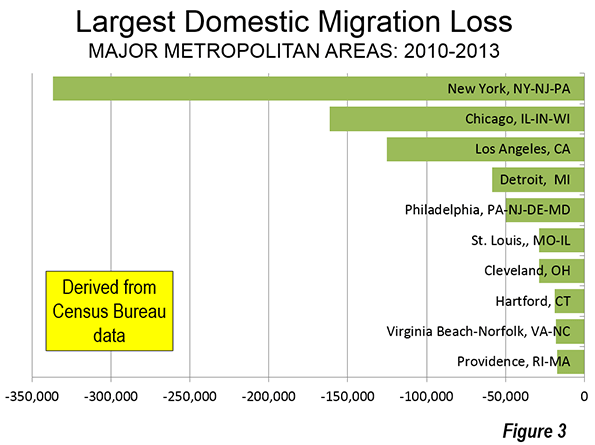
    The largest net domestic migration losses were more dispersed across the country, with metropolitan areas from every region represented. New York lost the most net domestic migrants (more than 300,000) and was joined by Philadelphia, Hartford, and Providence from the East. Chicago lost the second most domestic migrants (more than 150,000) and was joined by Detroit, St. Louis and Cleveland from the Midwest. Los Angeles ranked third in the bottom 10, losing more than 100,000 net domestic migrants, the only western metropolitan area to suffer a significant migration loss. The South’s only representative in the bottom 10 was Virginia Beach-Norfolk (Figure 3).

    Table 3
    Major Metropolitan Area Net Migration: 2010 to 2013
    Metropolitan Areas Net Domestic Migration Change Relative to 2010 Population Net International Migration Change Relative to 2010 Population
    Atlanta, GA      44,433 0.84%         49,375 0.93%
    Austin, TX      87,189 5.05%         15,685 0.91%
    Baltimore, MD          (121) 0.00%         24,366 0.90%
    Birmingham, AL       (2,918) -0.26%           3,585 0.32%
    Boston, MA-NH           101 0.00%         70,356 1.54%
    Buffalo, NY       (7,774) -0.68%           7,341 0.65%
    Charlotte, NC-SC      56,478 2.54%         14,590 0.66%
    Chicago, IL-IN-WI   (161,558) -1.71%         69,041 0.73%
    Cincinnati, OH-KY-IN     (16,893) -0.80%           9,703 0.46%
    Cleveland, OH     (28,780) -1.39%         10,837 0.52%
    Columbus, OH      11,425 0.60%         13,752 0.72%
    Dallas-Fort Worth, TX    127,315 1.97%         57,403 0.89%
    Denver, CO      70,668 2.77%         14,160 0.55%
    Detroit,  MI     (58,343) -1.36%         30,281 0.71%
    Grand Rapids, MI        4,594 0.46%           3,290 0.33%
    Hartford, CT     (18,979) -1.56%         15,206 1.25%
    Houston, TX    116,956 1.97%         74,817 1.26%
    Indianapolis. IN      13,698 0.72%         12,031 0.64%
    Jacksonville, FL      16,932 1.26%           9,760 0.72%
    Kansas City, MO-KS       (3,738) -0.19%           9,162 0.45%
    Las Vegas, NV      17,419 0.89%         19,041 0.97%
    Los Angeles, CA   (125,037) -0.97%       145,101 1.13%
    Louisville, KY-IN        4,874 0.39%           6,530 0.53%
    Memphis, TN-MS-AR     (13,723) -1.03%           4,868 0.37%
    Miami, FL      31,750 0.57%       152,998 2.74%
    Milwaukee,WI     (14,282) -0.92%           6,547 0.42%
    Minneapolis-St. Paul, MN-WI        2,664 0.08%         30,341 0.90%
    Nashville, TN      42,090 2.51%         10,201 0.61%
    New Orleans. LA      20,721 1.73%           8,727 0.73%
    New York, NY-NJ-PA   (336,566) -1.72%       372,651 1.90%
    Oklahoma City, OK      30,086 2.39%           6,759 0.54%
    Orlando, FL      49,244 2.30%         43,230 2.02%
    Philadelphia, PA-NJ-DE-MD     (49,564) -0.83%         51,244 0.86%
    Phoenix, AZ      72,985 1.73%         24,885 0.59%
    Pittsburgh, PA        7,564 0.32%           8,129 0.34%
    Portland, OR-WA      30,244 1.35%         15,350 0.69%
    Providence, RI-MA     (17,253) -1.08%         13,365 0.83%
    Raleigh, NC      38,088 3.35%         10,875 0.96%
    Richmond, VA      10,777 0.89%           9,542 0.79%
    Riverside-San Bernardino, CA      18,321 0.43%         14,997 0.35%
    Rochester, NY     (11,558) -1.07%           7,607 0.70%
    Sacramento, CA        6,922 0.32%         17,662 0.82%
    St. Louis,, MO-IL     (28,809) -1.03%         11,556 0.41%
    Salt Lake City, UT        3,367 0.31%           7,560 0.69%
    San Antonio, TX      63,391 2.94%         10,778 0.50%
    San Diego, CA           455 0.01%         35,199 1.13%
    San Francisco-Oakland, CA      37,157 0.86%         68,510 1.58%
    San Jose, CA       (6,245) -0.34%         41,207 2.24%
    Seattle, WA      45,188 1.31%         50,351 1.46%
    Tampa-St. Petersburg, FL      45,071 1.62%         28,621 1.03%
    Virginia Beach-Norfolk, VA-NC     (17,944) -1.07%         15,650 0.93%
    Washington, DC-VA-MD-WV      32,749 0.58%       107,875 1.90%
    Total    240,831 0.14%    1,872,698 1.10%
    From Census Bureau Data


    Migration Gains in the Suburbs, Losses in the Core

    This year was notable for the virtual absence of the customary "return to the city" stories. In recent years, historical core municipalities have done better in population growth than in the past. In previous decades, some lost large amounts of their population. However, an improving urban environment, not least because of better crime control, has led to something of a residential resurgence, especially in the immediate area of downtowns, though inner core populations (within five miles of City Hall) have continue to decline (see Flocking Elsewhere: The Downtown Growth Story).

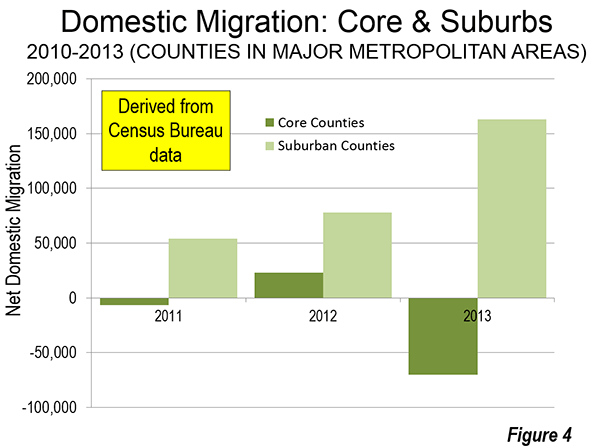
    Specious claims of a net suburban movement to the cores have been refuted by the domestic migration data. Net domestic migration is reported by the Census Bureau only at the county level. Thus, any analysis of domestic migration between the cores and the suburbs must be county-based. During the Great Recession, domestic migration declined substantially, as is to be expected when the economy is depressed.

    Yet, in each of the three years of this decade, suburban counties have experienced net domestic migration gains and in each year have substantially led the core counties. In only one year, 2012, was there a net domestic migration gain in the core counties. The most recent 2013 data shows that core counties experienced a 70,000 net domestic migration loss, while the suburban counties gained 163,000 net domestic migrants. This difference of 233,000 was approximately four times the demographic gains made by the suburbs in both of the previous years Figure 4).

    Returning to Normalcy?

    With the economy still depressed, it would be premature to declare that the more typical results of the last year presage a return to normalcy. Any such reliable judgment must await restoration of broad-based, job and salary driven – as opposed to asset-based – economic growth. However, the trends of the last year indicate more than anything that the basic patterns of at least the past quarter century – with higher suburban growth and a shift towards the South – to be reasserting themelves.

    Wendell Cox is principal of Demographia, an international public policy and demographics firm. He is co-author of the "Demographia International Housing Affordability Survey" and author of "Demographia World Urban Areas" and "War on the Dream: How Anti-Sprawl Policy Threatens the Quality of Life." He was appointed to three terms on the Los Angeles County Transportation Commission, where he served with the leading city and county leadership as the only non-elected member. He was appointed to the Amtrak Reform Council to fill the unexpired term of Governor Christine Todd Whitman and has served as a visiting professor at the Conservatoire National des Arts et Metiers, a national university in Paris.

    Photo: Downtown Houston (by author)

  • Sunday Night Dinner in Indianapolis

    Urban culture varies radically from city to city. Yet to a great extent the culture of the usual suspects type of places tends to get portrayed as normative. In New York, for example, with its tiny apartments, the social life is often in public, in many cases literally on the streets of the city, which pulse with energy. As the ne plus ultra of cities, the street life of New York is often seen as what every place should aspire to. There’s a body of literature which attributes all sorts of positive effects to this New York style urbanism, such as the notion of “collisions” and “serendipitous encounters”. But while New York’s street life and social scene may indeed be engaging, how often does one actually strike up a conversation with someone random on the street or in a coffee shop there that turns into something meaningful? The only collisions I’ve ever had there were literal.

    New York is the most well known and championed style of interaction, though hardly the only one. Think of San Francisco and something clearly distinct will come to mind, albeit with some similarities. LA has its own mythos. The TV show Portlandia does a great job of capturing our idea of the quirky urban life of that city.

    Cities that lack the cachet of an NYC, SF, or Portland can often find their own urban culture lacking in comparison. To be taken seriously, the logic goes, they must measure up to the yardstick defined by others. But while I do not subscribe to the idea of value free cultural comparisons, I do believe cities need not judge themselves as wanting just because they don’t function like New York City. Rather, they should seek to be the best they can be on their own terms. Since few cities are anything like New York, aspiring to that kind of urbanism would only be a case study in frustration anyway.

    Indianapolis cultural commentator David Hoppe once said something to the effect that “the social life of Indianapolis happens in back yards.” And this is true. Unlike a New York City, Indianapolis does not wow you just by walking down the street. While I believe in trying to contextualize the facts on the ground in the most positive way possible for moving forward, that doesn’t mean reclassifying genuine defects as virtues. In the case of Indianapolis, the generally poor impression left by its built environment and lack of street life can’t be denied. There are plenty of great places to go, but you generally need someone to point you in the right direction.

    But there are countervailing virtues as well, ones generally under appreciated. Unlike New York, Indy has a far more robust social life in private spaces like houses and back yards. This produces a qualitatively different type of social capital, one with its own unique set of strengths.

    One example of this is the emergence of community based Sunday dinners. This was an organic movement and as a result lacks a fancy name, but in keeping with the generally low key and unpretentious character of the city, let’s just call it Sunday Night Dinner.

    Sunday night dinners are a type of intentional community in which 6-8 families in a neighborhood decide to get together for dinner every Sunday night on a rotating basis. This originated in 2006 on Pleasant St. in the Fountain Square neighborhood when a group of neighbors decided to start getting together regularly for dinner. Here’s how Tonya Beeler, one of the founding members, describes it:

    When most of us talk about it, we just call it Sunday Night Dinner. It’s unassuming, I know – but that’s what Sunday Dinner is to us. We’ve had it consistently for almost 8 years – having only cancelled dinner a handful of times. The majority of the families on the original list are still regular participants and we’ve added and lost a few through the years.

    What is Sunday Night Dinner to us? In this stage in our lives, its sometimes difficult to physically connect to your neighbors, but we know that each Sunday we’re going to see our friends. It’s also a good time to have newcomers to the neighborhood connect with some of us old timers. We’ve also had visits from Mayor Ballard (before he was elected) and Melina Kennedy (when she was running) and I still have a fond memory of John Day sitting down to sup with us. But what is it mostly? Just a day in the week where we meet to take a breath, sit down, and eat together. It’s my favorite day of the week.

    I used to be part of a quarterly dinner club in Chicago. Given the frequency, our idea was to make each dinner “special” in the sense that we went all out with super high-quality food, etc. In Indy, while good food is certainly part of the equation, the regular weekly cadence means it’s as much about friends and neighbors as it is special ambiance. It’s about regular life lived in the city. In the picture at the top it’s paper plates and plastic cups all the way – and that’s just fine. Can’t stay for some reason? No worries, bring some tupperware, grab some food, and run. In a sense, it’s the Kinfolk Magazine ethic (motto: doing things simple sure is complicated – and expensive) in genuine form, shorn of Portland pretense.


    Sunday night dinner in the Beeler’s backyard in Fountain Square, Indianapolis, Easter 2012. Photo: Cindy Ragsdale

    Oh, and typically with children, which actually exist in abundance in Indianapolis.

    The idea spread and now there are Sunday night dinner groups all over the city. I’m told there are three in Herron-Morton Place alone, which I can’t quite wrap my head around given how small the area is.

    I can’t help but notice the similarity of these dinner groups to religious small group gathering. In the last couple decades, Evangelical churches have moved away from mid-week services in favor of small group gathering during the week (sometimes called home groups or other names). The idea is to promote more actual community than is possible in a larger assembly format. These dinner groups are in effect secular small groups, ones that help provide the sense of connectedness, regularity, and rootedness that’s so often missing from our contemporary world.


    Outdoor fun on Sunday night isn’t just for summer in Herron-Morton Place, Indianapolis. Photo by Amanda Reynolds.

    These groups aren’t just walled garden cliques, however. The host generally invites guests to attend. So there’s a type of brokered introduction which in my experience is the real source of “serendipitous” encounters of genuine value. An arranged guest invite is one way to get people connected in their neighborhood, or even to help people who are deciding whether or not to take the plunge into city living to get a feel for what life lived in a particular neighborhood is actually like.

    In fact, if you are visiting Indianapolis on a Sunday night, or live there and want to check it out, email the City Gallery at the Harrison Center For the Arts and they will set you up. The email address is citygallery@harrisoncenter.org

    I don’t want to suggest that Indianapolis invented the concept of the dinner club or is the only place such events occur. For all I know, lots of places do this. (Heck, as big as it is, odds are that includes New York City). And as with all traditions, this particular instantiation will likely die off at some point (though it’s still growing eight years after starting on Pleasant St). Yet the prevalence of this type of cultural phenomenon is part of the explanation for why Indianapolis has consistently managed to punch above its weight class in so many areas. Although the type of obvious assets and strength evidenced by super-cool buildings or crowds on the street may be lacking in Indianapolis vis-a-vis some other places, the city contains deep reservoirs of cultural capital that aren’t as visible and may never be fully understood or mapped, but nevertheless are of profound importance. This is the real secret sauce of the city.

    Copying this idea, locally or anywhere, is definitely welcomed. Should you be interested, here are the “Indianapolis Rules” for Sunday night dinners, courtesy of Tonya Beeler:

    1. Dinner is every Sunday night, with six to eight families, each hosting on a rotating basis.

    2. The host is responsible for preparing all of the food for everyone. (Work? Yes, but it also means seven weeks of not having to do anything but show up).

    3. The host is responsible for inviting all guests. Do not invite guests without checking with the host first.

    4. If you’re not coming, tell the host as far in advance as possible.

    5. At the very beginning of the dinner, the host makes sure all the guests know of any rules for the house (no one allowed upstairs, kids can’t eat in the living room, toilet handle needs to be held down for 3 seconds, whatever).

    6. If your family will not be coming for dinner, but you still want food, there’s no need to let the host know, just stop by early in the meal (so you don’t miss anything, food goes fast!!!) with some tupperware and fill it to go.


    Sunday night dinner in Fountain Square, Indianapolis. Painting by Kyle Ragsdale.

    Aaron M. Renn is an independent writer on urban affairs and the founder of Telestrian, a data analysis and mapping tool. He writes at The Urbanophile, where this piece originally appeared.

    Lead photo: Sunday night dinner in Herron-Morton Place, Indianapolis. This is one of three dinner groups in that neighborhood. Photo by Amanda Reynolds (check out the mirror!)

  • New Central Business District Employment and Transit Commuting Data

    Photographs of downtown skylines are often the "signature" of major metropolitan areas, as my former Amtrak Reform Council colleague and then Mayor of Milwaukee (later President and CEO of the Congress of New Urbanism) John Norquist has rightly said. The cluster of high rise office towers in the central business district (CBD) is often so spectacular – certainly compared with an edge city development or suburban strip center – as to give the impression of virtual dominance. I have often asked audiences to guess how much of a metropolitan area’s employment is in the CBD. Answers of 50 percent to 80 percent are not unusual. In fact, the average is 7 percent in the major metropolitan areas (over 1,000,000) and reaches its peak at only 22 percent in New York (Figure 1), which sports the second largest business district in the world (after Tokyo).

    Only seven of the 52 major metropolitan areas have CBDs with 10 percent or more of employment. Some are much lower. For example, Los Angeles and Dallas have had some of the nation’s tallest skyscrapers outside New York or Chicago for decades, yet these downtowns have only 2.4 percent and 2.3 percent of their metropolitan area employment respectively (Figure 2).

    This and similar information has been summarized in the third edition of Demographia Central Business Districts, which is based on the 2006-2010 Census Transportation Planning Package, a joint venture of the Census Bureau and the American Association of State Highway and Transportation Officials (AASHTO). The two previous editions of the report summarized data from the 1990 and 2000 censuses.

    The Declining Role of Downtown

    Downtowns have become far less important than before World War II, when a large share of American households did not have access to automobiles and when employment was far more concentrated than today. Indeed, the highly concentrated American downtown area is "unique," as Robert Fogelson indicates in Downtown: Its Rise and Fall: 1880-1950, and could be easily located as the destination of the "street railways." Downtown was a product of transit and remains transit’s principal destination today. The concentrated US style CBD form is really quite rare outside other new world nations, such as Canada, Australia, South Africa and New Zealand. Some, but only a few Asian cities have also followed the example, most notably Shanghai, Hong Kong, Nanjing, Chongqing, Singapore, and Seoul.

    The US, however, for all its role as originator of the downtown paradigm has also led the world in employment dispersion. This reflects the dominance in the US of automobiles. Dispersion is more amenable to mobility by the car, which dominates motorized mobility in virtually all major metropolitan areas of North America and Western Europe. This has led in the US to generally shorter work trip travel times and less traffic congestion, according to Tom Tom and Inrix. The continuing expansion of working at home could improve the situation even more.

    New York has the largest CBD in the nation by far, with nearly 2,000,000 jobs. Chicago’s CBD (the Loop and North Michigan Avenue) has about one-quarter as many jobs (500,000) and Washington approximately 375,000. San Francisco, Boston and Philadelphia, also ranked among the nation’s transit "legacy cities," have between 200,000 and 300,000 jobs. Automobile oriented Houston and Atlanta are the largest otherwise, with Houston’s downtown being much more compact than Atlanta’s. Atlanta’s downtown has expanded strongly (and less densely) to the north and includes "Midtown" (Figure 3)

    Transit is About Downtown

    Transit is about downtown. Approximately 55 percent of transit commuting in the United States is to jobs in just six municipalities (not to be confused with metropolitan areas), which I have called transit’s "legacy cities." Most of that commuting is to the six downtown areas. Of course, the city of New York is dominant, which alone accounts for 55 percent of the country’s CBD transit commuting (Figure 4), with much of the balance in the other five legacy cities (Figure 4). Only 14 percent of the CBD commuting is to the other 46 smaller downtowns.

    More than 1.5 million transit commuters converge on jobs in Manhattan every day. In the other five legacy cities, the figure ranges from 100,000 to 300,000 daily. All of the other central business districts draw fewer than 100,000 daily commuters. Seattle ranks 7th, at 60,000, and has double or more the CBD transit commuters of any of the other 44 CBDs (Figure 5). 

    New York has by far the highest transit commuting share of any downtown in the nation. Approximately 77 percent of people who work in the New York central business district commute by transit. The other legacy cities post impressive market shares as well, though well below those of New York. The CBDs in Chicago, Boston, and San Francisco draw between 50 percent and 60 percent of their commuters by transit. Downtown Philadelphia and Washington attract more than 40 percent of their commuters by transit (Figure 6).

    Transit is About Downtown II

    The importance of downtown to transit is also indicated by its predominance in transit commuting destinations. In the New York metropolitan area, with a transit market share of approximately 30 percent, 57 percent of all transit commuting is to downtown jobs. Chicago’s transit commuting is concentrated in downtown to a slightly greater degree than in New York. One half of all the transit commuting in the San Francisco metropolitan area is to downtown. The CBDs of Boston, Philadelphia, and Washington account for between 40 percent and 50 percent of all transit commuting in their downtown areas. Seattle and Pittsburgh also are in this range (Figure 7). Seven of the eight metropolitan areas with the largest transit market shares have a CBD commuting dominance of 40 percent or more (Pittsburgh is the exception).

    The 52 major metropolitan area CBDs combined have less than five percent of the nation’s jobs. Elsewhere, downtowns and otherwise, the other 95 percent of American commuters use transit at only a three percent rate.

    Other Employment Centers

    In a new feature, Demographia Central Business Districts also provides data for selected employment centers other than the principal central business districts. These also include some surprises. For example, downtown Brooklyn, long since engulfed by the expansion of New York, has the second highest transit market share of any employment center identified other than New York, at 60 percent. Across the river, the Jersey City Waterfront area achieves a transit market share of more than 50 percent, greater than the downtowns of legacy cities Philadelphia and Washington.

    Data on supplemental employment center and corridor data is selected and therefore not representative. It is notable that some employment corridors and centers have employment totals that dwarf those of the principal downtown areas in their respective metropolitan areas, such as Los Angeles, Portland, Dallas, and Kansas City.

    With a few exceptions, the transit commuting shares for most of these selected centers and corridors is modest. Many are served by new rail systems, which are simply not up to the task of providing mobility to these dispersed centers. Nor can they provide the radial, high quality service that makes transit such a success in the six legacy city downtowns. For example, the Dallas light rail system provides service along virtually the entire US-75 corridor from north of downtown to Plano. Transit’s share of commutes in this corridor is only 2 percent, far below the downtown Dallas share of 14 percent and the legacy city downtown average of 65 percent.

    Wendell Cox is principal of Demographia, an international public policy and demographics firm. He is co-author of the "Demographia International Housing Affordability Survey" and author of "Demographia World Urban Areas" and "War on the Dream: How Anti-Sprawl Policy Threatens the Quality of Life." He was appointed to three terms on the Los Angeles County Transportation Commission, where he served with the leading city and county leadership as the only non-elected member. He was appointed to the Amtrak Reform Council to fill the unexpired term of Governor Christine Todd Whitman and has served as a visiting professor at the Conservatoire National des Arts et Metiers, a national university in Paris.

  • Era of the Migrant Moguls

    Southern California, once the center of one of the world’s most vibrant business communities, has seen its economic leadership become largely rudderless. Business interests have been losing power for decades, as organized labor, ethnic politicians, green activists, intrusive planners, crony developers and local NIMBYs have slowly supplanted the leaders of major corporations and industries, whose postures have become, at best, defensive.

    Increasingly, a search for inspiration about the region’s future must focus, first and foremost, on immigrants. As major companies disappear, merge or shift more of their operations elsewhere, the foreign-born represent a significant asset for our grass-roots economy. With many of the region’s legacy industries – from oil and gas to aerospace and entertainment – stagnating or declining, the area desperately needs new blood to avoid ending up like the older cities of the slow-growth Northeast or Midwest, albeit with much better weather.

    Amid a graying and, increasingly, marginal generation of regional business leaders, there have emerged new foreign-born dynamic figures. Some great examples: South African native and Tesla founder Elon Musk, who lives in Los Angeles and runs SpaceX, headquartered in Hawthorne and with more than 2,000 employees, and John Tu and David Sun, owners of Fountain Valley’s Kingston Technology, a leading independent memory-chip manufacturer founded in 1987 and now employing 4,000 people worldwide.

    Our new moguls increasingly are minted abroad. Pharmaceutical entrepreneur Patrick Soon-Shiong, the son of Chinese immigrants from South Africa, is now widely considered the richest man in Los Angeles, according to the Los Angeles Business Journal. But he’s not alone; five of the 13 richest people in the City of Angels are immigrants; in 1997 there was one, Australia’s Rupert Murdoch.

    Why are these immigrants so bright when much of our business leadership is dark grey? Part of it has to do with the nature of people who risk everything to migrate to another country. Overall they account for one out of every five U.S. business owners. They are three times as likely to start a new business than non-immigrants; in 2010 they accounted for almost one-in-three new firms, twice their share in 1995. Roughly 40 percent of the engineering-based firms started in Silicon Valley, notes the Kauffman Foundation, had at least one immigrant founder.

    Whether in high-tech, pharmaceuticals or running the local coffee shop, immigrants tend both to innovate and take risks. That’s because, as Kingston’s John Tu explained to me, they don’t have a choice. “The key thing about being an immigrant makes you flexible,” he said. “IBM, Apple and Compaq were inflexible. They told the memory customers to take it or leave it. We thought about the customer and the relationship with the employees. I guess we didn’t know any better.”

    Rise of the ethnoburb

    Most of the growth being generated by Southern California’s immigrants is taking place in suburban communities – what geographer Wei Li describes as ethnoburbs. Despite the hopes that more Southlanders can be lured into high-density, high-rise rental housing, immigrants, particularly Asians, here and elsewhere, continue to move further from the city core to areas where they can live with a degree of privacy and quiet virtually impossible in their homelands.

    This can be seen in the migration numbers. As foreign-born numbers have dropped in expensive and crowded Los Angeles and Orange County, the big growth has taken place in other areas, notably in fast-growing Texas cities such as Dallas and Houston, as well as numerous low-cost, pro-business states in the Southeast. The one Southland area that has continued to see a boom in foreign-born residents – the Inland Empire – has the lowest population density and house prices in the region.

    According to demographer Wendell Cox, the Inland Empire’s immigrant population has swelled by more than 50 percent, or more than 300,000 people, since 2000, roughly three times the increase in actual numbers seen in Los Angeles and Orange counties. Much of this growth is taking place not in the older cities such as Riverside and San Bernardino, as might be expected, but in generally more affluent, newer suburbs such as Rancho Cucamonga, whose foreign-born population soared a remarkable 61.6 percent over the past decade. Even Moreno Valley, on the edge of the urbanization, has more foreign-born residents than does San Bernardino.

    Even within the coastal counties, much of the growth in the Asian population, now the largest source of immigrants to the U.S., has been outside the densest, more-urbanized parts of the region. As the immigrant share of the population has declined in traditional immigrant strongholds such as the city of Los Angeles (down 5 percent) and Santa Ana (more than 11 percent), Cox notes, the immigrant population is shifting to more upscale suburbs. In Glendale, a major destination for both Armenian and Asian immigrants, more than 56 percent of the population is foreign-born, up 4 percent since 2000.

    Other popular immigrant destinations include once-heavily white suburban communities, such as Irvine, which is now more than 38 percent foreign-born, up almost 19 percent since 2000. Fullerton, like Irvine, favored largely by Asian migrants, saw its foreign-born population increase by 21 percent since 2000, now accounting for more than one-third of the city’s total.

    Other places that seem to be attracting immigrants include Santa Clarita, Palmdale and Lancaster, all communities further out on the periphery of the region.

    Harnessing entrepreneurial energy

    If Southern California’s future lies largely in the hands of newcomers and their offspring, how can we best respond to their needs? One way is by maintaining a large supply of single-family houses or townhomes. Today’s immigrants, particularly Asians, favor settling in ethnoburbs more than the dense Chinatowns, Little Indias and barrios that may strike many other Americans as somehow more colorful. Now, the best place to encounter immigrant food and culture is frequently at the strip malls of Monterey Park, the Hispanicized shopping complexes like Plaza Mexico, Irvine’s Diamond Jamboree Center or the amazing 626 Night Market at Santa Anita Park in Arcadia.

    Of course, immigrants are less interested in providing neighbohoods with local color than in moving to places with good schools, safe streets and parks – as most middle-class families prefer. This preference runs afoul of the kind of extreme land-use regimen being imposed on the region, including the Inland Empire, planning that seeks to promote the construction of high-density housing that, to be honest, many immigrants, particularly Asians, could enjoy at home, with far more amenities.

    Planners and some developers seem keen on this shift, thinking it will appeal to young childless couples and empty-nesters. What they ignore is that, without plentiful, and at least somewhat affordable, single-family houses, immigrants will continue to shift to other parts of the country, notably, the Southeast and Texas, where they can afford them.

    Perhaps even more important may be the economy. Immigrants are the ultimate canaries in the coalmine – they tend to gravitate toward opportunity. When Southern California’s economy was burgeoning in the 1970s and 1980s, immigrants also flocked here, buying homes and starting businesses. Few immigrant entrepreneurs reached the level of a John Tu or an Elon Musk, but many have launched small manufacturing firms that supported larger firms, engaged in international trade and started small service businesses.

    Unfortunately, the business climate in Southern California increasingly makes such enterprise ever more difficult, and may lead these entrepreneurs to relocate or expand where their efforts may be more appreciated. Not helping these businesses is an L.A. political climate dominated by a crony capitalist regime – not at all friendly to plucky startups of any kind – or by a Republican Party that still seems unable to make peace with the demographic realities of our region.

    The good news is, however, that these immigrants, and their kids, are still here. They have many reasons to stay, including the presence of ethnic media, churches, schools and shops not likely to be remotely as well-developed in places like Las Vegas, Phoenix, Atlanta or Nashville. But this does not mean they can be taken for granted. We need to recognize that they are our greatest asset, and, if we can appeal to their aspirations, they could help fashion a resurgence in this region.

    This story originally appeared at The Orange County Register.

    Joel Kotkin is executive editor of NewGeography.com and Distinguished Presidential Fellow in Urban Futures at Chapman University, and a member of the editorial board of the Orange County Register. He is author of The City: A Global History and The Next Hundred Million: America in 2050. His most recent study, The Rise of Postfamilialism, has been widely discussed and distributed internationally. He lives in Los Angeles, CA.

    Photo by LHOON

  • Where Inequality Is Worst In The United States

    Perhaps no issue looms over American politics more than worsening  inequality and the stunting of the road to upward mobility. However, inequality varies widely across America.

    Scholars of the geography of American inequality have different theses but on certain issues there seems to be broad agreement. An extensive examination by University of Washington geographer Richard Morrill found that the worst economic inequality is largely in the country’s biggest cities, as well as in isolated rural stretches in places like Appalachia, the Rio Grande Valley and parts of the desert Southwest.

    Morrill’s findings puncture the mythology espoused by some urban boosters that packing people together makes for a more productive and “creative” economy, as well as a better environment for upward mobility. A much-discussed report on social mobility in 2013 by Harvard researchers was cited by the New York Times, among others, as evidence of the superiority of the densest metropolitan areas, but it actually found the highest rates of upward mobility in more sprawling, transit-oriented metropolitan areas like Salt Lake City, small cities of the Great Plains such as Bismarck, N.D.; Yankton, S.D.; Pecos, Texas; and even Bakersfield, Calif., a place Columbia University urban planning professor David King  wryly labeled “a poster child for sprawl.”

    Demographer Wendell Cox pointed out that the Harvard research found that commuting zones (similar to metropolitan areas) with less than 100,000 population average have the highest average upward income mobility.

    The Luxury City

    Most studies agree that large urban centers, which were once meccas of upward mobility, consistently have the highest level of inequality. The modern “back to the city” movement is increasingly less about creating opportunity rather than what former New York Mayor Michael Bloomberg called “a luxury product” focused on tapping the trickle down from the very wealthy. Increasingly our most “successful cities” have become as journalist Simon Kuper puts it, “the vast gated communities where the one percent reproduces itself.”

    The most profound level of inequality and bifurcated class structure can be found in the densest and most influential urban environment in North America — Manhattan. In 1980 Manhattan ranked 17th among the nation’s counties in income inequality; it now ranks the worst among the country’s largest counties, something that some urbanists such as Ed Glaeser suggests Gothamites should actually celebrate.

    Maybe not. The most commonly used measure of inequality is the Gini index, which ranges between 0, which would be complete equality (everyone in a community has the same income), and 1, which is complete inequality (one person has all the income, all others none).  Manhattan’s Gini index stood at 0.596 in 2012, higher than that of South Africa before the Apartheid-ending 1994 election. (The U.S. average is 0.471.) If Manhattan were a country, it would rank sixth highest in income inequality in the world out of more than 130 for which the World Bank reports data. In 2009 New York’s wealthiest one percent earned a third of the entire municipality’s personal income — almost twice the proportion for the rest of the country.

    The same patterns can be seen, albeit to a lesser extent, in other major cities. A 2006 analysis by the Brookings Institution showed the percentage of middle income families declined precipitously in the 100 largest metro areas from 1970 to 2000.

    The role of costs is critical here. A 2014 Brookings study showed that the big cities with the most pronounced levels of inequality also have the highest costs: San Francisco, Miami, Boston, Washington, D.C., New York, Oakland, Chicago and Los Angeles. The one notable exception to this correlation is Atlanta. The lowest degree of inequality was found generally in smaller, less expensive cities like Ft. Worth, Texas; Oklahoma City; Raleigh, N.C.; and Mesa, Ariz. Income inequality has risen most rapidly in the bastion of luxury progressivism, San Francisco, where the wages of the 20th percentile of all households declined by $4,300 a year to $21,300 from 2007-12. Indeed when average urban incomes are adjusted for the higher rent and costs, the middle classes in metropolitan areas such as New York, Los Angeles, Portland, Miami and San Francisco have among the lowest real earnings of any metropolitan area.

    Rural Poverty

    But cities are not the only places suffering extreme inequality. Some of the nation’s worst poverty and inequality, notes Morrill, exist in rural areas. This is particularly true in places like Texas’ Rio Grande Valley, Appalachia and large parts of the Southwest.

    Perhaps no place is inequality more evident than in the rural reaches of California, the nation’s richest agricultural state. The Golden State is now home to 111 billionaires, by far the most of any state; California billionaires personally hold assets worth $485 billion, more than the entire GDP of all but 24 countries in the world. Yet the state also suffers the highest poverty rate in the country (adjusted for housing costs), above 23%, and a leviathan welfare state. As of 2012, with roughly 12% of the population, California accounted for roughly one-third of the nation’s welfare recipients.

    With the farm economy increasingly mechanized and industrial growth stifled largely by regulation, many rural Californians particularly Latinos, are downwardly mobile, and doing worse than their parents; native-born Latinos actually have shorter lifespans than their parents, according to a2011 report. Although unemployment remains high in many of the state’s largest urban counties, the highest unemployment is concentrated in the rural counties of the interior. Fresno was found in one study to have the least well-off Congressional district.

    The vast expanse of economic decline in the midst of unprecedented, but very narrow urban luxury has been characterized as “liberal apartheid. ” The well-heeled, largely white and Asian coastal denizens live in an economically inaccessible bubble insulated from the largely poor, working-class, heavily Latino communities in the eastern interior of the state.

    Another example of this dichotomy — perhaps best described as the dilemma of being a “red state” economy in a blue state — can be seen in upstate New York, where by virtually all the measurements of upward mobility — job growth, median income, income growth — the region ranked below long-impoverished southern Appalachia as of the mid-2000s. The prospect of developing the area’s considerable natural gas resources was welcomed by many impoverished small landowners, but it has been stymied by a coalition of environmentalists in local university towns and plutocrats and celebrities who have retired to the area or have second homes there, including many New York City-based “progressives.”

    Where Inequality Is Least Pronounced

    According to the progressive urbanist gospel, suburbs are doomed to be populated by poor families crowding into dilapidated, bargain-priced former McMansions in the new “suburban wastelands.” Suburbs, not inner cities, suggests such urban boosters as Brookings Chris Leinberger, will be the new epicenter of inequality, even though the percentage of poor people, as shown above, remained far higher in the urban core.

    Yet , according to geographer Morrill, in comparison with urban cores, suburban areas remain heavily middle class, with a high proportion of homeowners, something rare inside the ranks of core cities.The average poverty rate in the historical core municipalities in the 52 largest U.S. metro areas was 24.1% in 2012, more than double the 11.7% rate in suburban areas. Between 2000 and 2010, more than 80% of the new population.

    in America’s urban core communities lived below the poverty line compared with a third of the new population in suburban areas, although the majority of poor people lived there, in large part because they are also the home to the vast majority of metropolitan area residents.

    An analysis by demographer Wendell Cox of American Community Survey Data for 2012 indicates that suburban areas suffer considerably less household income inequality than the core cities. Among the 51 metropolitan areas with populations over 1 million, suburban areas were less unequal (measured by the Gini coefficient) than the core cities in 46 cases.

    The Racial Dynamic

    There is also a very clear correlation between high numbers of certain groups — notably African Americans but also Hispanics — and extreme inequality. Morrill’s analysis shows a huge confluence between states with the largest income gaps, largely in the South and Southwest, with the highest concentrations of these historically disadvantaged ethnic groups.

    In contrast, Morrill suggests, areas that are heavily homogeneous, notably the “Nordic belt” that cuts across the northern Great Lakes all the way to the Seattle area, have the least degree of poverty and inequality. Morrill suggests that those areas dominated by certain ethnic backgrounds — German, Scandinavian, Asian — may enjoy far more upward mobility and less poverty than others.

    Some, such as UC Davis’ Gregory Clark even suggest that parentage determines success more than anyone suspects — what the Economist has labeled “genetic determinism.” None of this is particularly pleasant but we need to understand the geography of inequality if we want to understand the root causes of why so many Americans remain stuck at the lower ends of the economic order.

    This story originally appeared at Forbes.com.

    Joel Kotkin is executive editor of NewGeography.com and Distinguished Presidential Fellow in Urban Futures at Chapman University, and a member of the editorial board of the Orange County Register. He is author of The City: A Global History and The Next Hundred Million: America in 2050. His most recent study, The Rise of Postfamilialism, has been widely discussed and distributed internationally. He lives in Los Angeles, CA.