Category: Urban Issues

  • The Great Skills Gap Myth

    One of the great memes out there in trying to diagnose persistently high unemployment and anemic job growth during what is still, I argue, the Great Recession is the so-called “skills gap”. The idea here is that the fact that there are millions of unfilled job openings at the same time millions of people can’t find work can be chalked up to a lack of a skills match between unemployed workers an open positions. To pick one random example out of many, here’s the way US News and World Report put it last year:

    Some 82 percent of manufacturers say they can’t find workers with the right skills. Even with so many people looking for jobs, we’re struggling to attract the next generation of workers. The message about the opportunities in manufacturing doesn’t seem to be reaching parents and counselors who help guide young people’s career ambitions.

    We face two major problems – a skills gap and a perception gap. Today’s modern, technology-driven manufacturing is not your grandparents’ manufacturing, yet for many, talk of the sector evokes images from the Industrial Revolution.

    What’s interesting about this is that the “skills gap” continues to have tremendous resonance in public policy discussions I come across although it’s very easy to find many mainstream press articles that challenge it. So I want to take my shot at the problem.

    Is there a skill gap? In select cases I’m sure there’s a mismatch in skill, but for the most part I don’t think so. I believe the purported inability of firms to find qualified workers is due largely to three factors: employer behaviors, limited geographic scope, and unemployability.

    Employer Behaviors

    Let’s be honest, it’s in the best interest of employers to claim there’s a skills gap. The existence of such a gap can be used as leverage to obtain public policy considerations or subsidies. So there’s a self-serving element.

    But beyond that, several behaviors of present day employers contribute to their inability to hire.

    1. Insufficient pay. If you can’t find qualified workers, that’s a powerful market signal that your salary on offer is too low. Higher wages will not only find you workers, they also send a signal that attracts newcomers into the industry. Richard Longworth covered this in 2012. He explains that companies have refused to adjust their wages due to competitive pressures:

    In other words, Davidson said, employers want high-tech skills but are only willing to pay low-tech wages. No wonder no one wants to work for them….So why doesn’t GenMet pay more? In other words, why doesn’t it respond to the law of supply and demand by offering starting wages above the burger-flipping level? Because GenMet is competing in the global economy. It can pay more than Chinese-level wages, but not that much more.

    In other words, this company in question doesn’t have a skill gap problem, they have a business model problem. They aren’t profitable if they have to pay market prices for their production inputs (in this case labor). It’s no surprise firms in this position would be seeking help with their “skill gap” problem – it’s a backdoor bailout request.

    2. Extremely picky hiring practices enforced by computer screening. If you’ve looked at any job postings lately, you’ll note the laundry list of skills and experience required. The New York Times summed it up as “With Positions to Fill, Employers Wait for Perfection.” Also, companies have chopped HR to the bone in many cases, and heavily rely on computer screening of applicants or offshore resume review. The result of this automated process combined with excessive requirements is that many candidates who actually could do that job can’t even get an interview. What’s more, in some cases the entire idea is not to find a qualified worker to help legally justify bringing in someone from offshore who can be paid less.

    3. Unwillingess to invest in training. In line with the above, companies no loner want to spend time and money training people like they used to. I strongly suspect most of those over 50 machinists and such we keep hearing about learned on the job. Why can’t companies simply train people in the skills they need? When I started work at Andersen Consulting in 1992, we weren’t expected to have any specific skill. Instead, they were looking for general aptitude and spent big to train us in what we needed to know. In a sense, outside of some professional services fields, today’s companies, despite their endless talk about talent, don’t actually recruit talent at all. They are recruiting people with specific skills and experience. That’s a very different mindset.

    4. Aesthetic hiring. This one I think is specific to select industries, but in some fields if you don’t have the right “look”, you’re going to find it difficult. For example, the NYT Magazine just today has a major piece called “Silicon Valley’s Youth Problem” talking about this very issue. Hip, cool startups see their working environment and culture as critical to success. And that’s true, but those cultures aren’t very inclusive, which is why many Silicon Valley firms are continuously under fire for various forms of discrimination. When they’re trying to be the hot new thing, the last thing an app startup wants is some 55 year old dude with a pocket protector cramping their style, no matter how much of a tech guru he might be.

    Limited Geographic Scope

    You frequently see the skills gap phrased in terms of specific geographies. For example, a state. Rhode Island has X number of unemployed people and Y number of unfilled jobs. So what do we do to match them up?

    This type of thinking is too limited. I attended an hour brainstorming session on the Rhode Island skills gap a while back and not once did anyone suggest anything that crossed the state boundary. One person mentioned these technical high schools in Boston that produce grads with exactly the skills the market is needing. His idea was that Rhode Island needed to create these types of institutions. Not a bad idea, but I was struck that nobody thought about sending these Rhode Island employers who can’t find workers on the one hour drive to Boston to go hire some of those grads directly out of Boston’s high schools. Problem solved. And maybe while bringing some young, fresh blood into the state to boot.

    Similarly, no one ever suggested that an unemployed person in Rhode Island might seek work out of state. Realistically, America has often solved unemployment problems through migration. People need to be willing to move to where the job opportunities are. In fact, if you look at the highly educated people who might say telling people to move in order to find work is evil awful, they are actually the most mobile people there are. Clearly the highly skilled see the value in pursuing opportunity through migration. We need to extend the same opportunity to those who are currently stuck in place.

    Unemployability

    A third problem is that a significant number of adults in this country are simply unemployable. If you’re a high school dropout, a drug user, etc. you are going to find it tough slogging to find work anywhere, regardless of skills required.

    Watching the Chicagoland documentary and seeing what kids in these inner city neighborhoods face, a lack of machine tool or coding skills is far from the problem. Similar problems are now hitting rural and working class white communities where the economic tide has receded. Heroin, meth, etc. were things that just didn’t exist in my rural hometown growing up – but they sure do now.

    These aren’t skill problems, they are human problems. And the answer isn’t simply job training. These problems are much, most more complex and they are incredibly difficult to solve. They need to be tackled by very different means than a job skills problem.

    If you want more info that documents that there is no skills gap, google around and find plenty of economists crunching the numbers to show that’s the case. But I hope this gives you a sense of some of the trends that explain why there can be persistent unemployment with many job openings without recourse to a skills gap to explain it.

    Aaron M. Renn is an independent writer on urban affairs and the founder of Telestrian, a data analysis and mapping tool. He writes at The Urbanophile, where this piece originally appeared.
    Auto manufacturing photo by BigStockPhoto.com.

  • No Fundamental Shift to Transit: Not Even a Shift

    The American Public Transportation Association (APTA) is out with news of higher transit ridership. APTA President and CEO Michael Melaniphy characterizes the new figures as indicating "a fundamental shift going on in the way we move about our communities.” Others even characterized the results as indicating "shifting consumer preferences." The data shows either view to be an exaggeration.

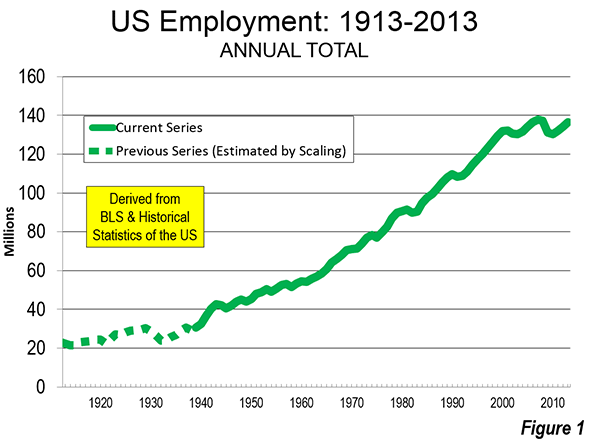
    1935 and 2013

    This is hardly a reliable time for making judgments about fundamental shifts or shifts in consumer preferences. Economic performance has been more abysmally abnormal only once in the last century –during the Great Depression – than at present.

    The last year, 2013, is the sixth year in a row that total employment, as reported by the Bureau of Labor Statistics was below the peak year of 2007 (Figure 1). This run of dismal job creation was exceeded only between the Great Depression years of 1929 and 1936 in the last 100 years (Note 1). From World War II until the Great Recession, the maximum number of years that employment fell below a previous peak was two, following the 9/11 terrorist attacks (2001 to 2003). The Great Recession may have ended, according to the National Bureau of Economic Research, but the Great Malaise continues as the economy is performing well below historic levels. Judgments about fundamental shifts and consumer choice today are not more reliable than they would have been in the Great Depression year of 1935.

    Transit’s Market Share: Stuck in Neutral

    But more importantly, there is no shift to transit.  APTA is right to point out that transit ridership has grown faster than vehicle travel in the United States since 1995. Nonetheless, transit’s share of urban travel has barely budged, because its 1995 share of travel was so small. This is indicated by Figure 2, which compares the overall market share of transit to that of cars and light trucks from 1995 to 2013. Indeed, the top of Figure 2 (the 100 percent line) is virtually indistinguishable from the personal vehicle share over the entire period. The bottom of the chart (the zero percent line) is virtually indistinguishable from the transit share. This is not the stuff of fundamental shift.

    Commuting: The Story is Not Transit

    A similar pattern of little or no change is indicated by the commuting (work access) data from the Census Bureau’s American Community Survey.

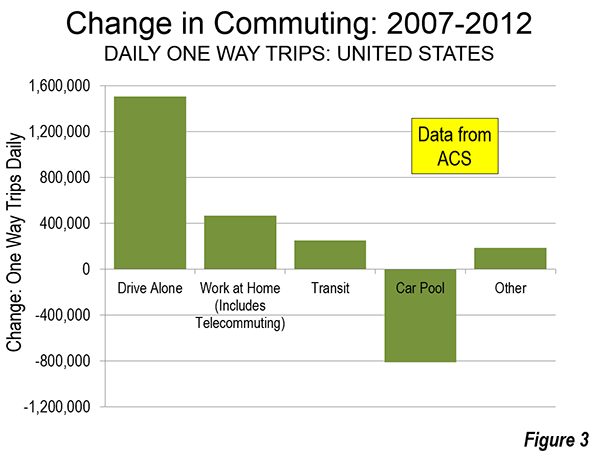
    Over the past five years, as with virtually all the years since such data has been collected, the overwhelming majority of new commuters have driven alone (Figure 3). Indeed, transit has not taken a single net automobile off the road since 1960, and not in the last five years. Between 2007 and 2012, 93 percent of the additional commuters drove alone (Note 2). The drive alone market, which might have been thought to be saturated, actually rose from 76.1 percent to a 76.3 percent market between 2007 and 2012.

    The biggest change has been the continuing loss in carpool use, which dropped from 10.4 percent to 9.7 percent from 2007 to 2012. It is estimated that nearly 450,000 passengers left carpools (excluding drivers), approximately 1.8 passengers for each additional commuter using transit (250,000).

    The largest gain from 2007 to 2012 was in working at home, including telecommuting. Working at home increased from 4.1 percent to 4.4 percent. In actual numbers, working at home added 1.9 times the increase in transit commuting. Its change in market share was greater than that of transit in 42 of the 52 major metropolitan areas. Surprisingly, this includes New York, with its incomparable transit system (by US standards).

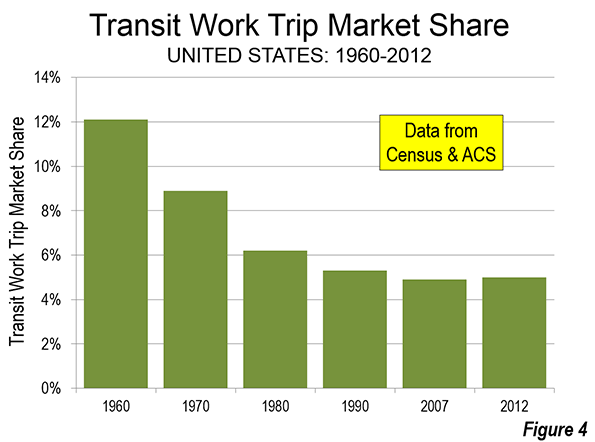
    Transit’s share of commuting inched up only 0.1 percentage points between 2007 and 2012. This is so small that if this rate of annual increase were sustained for 50 years, transit’s commute market share would  edge up to only 6 percent (Figure 4), approximately transit’s 1980 market share (doubling to 10 percent would require 130 years). The latest data indicates both gains and losses for transit, with market shares up in 28 major metropolitan areas and down in 24.

    Transit Losses

    In Atlanta, with the nation’s second largest Metro (subway) system built since 1975, a declining overall employment base was accompanied by a loss of 13,000 transit commuters, at the same time that there was an increase in working at home of 19,000.

    In Portland, considered by many around the world to be an urban planning Utopia, the data is hardly favorable. Since 1980, the last year with data before the first of five light rail lines and one commuter rail line opened, transit’s market share has dropped from 8.4 percent to 6.0 percent. While spending billions of dollars on rail, working at home – which involves little or no public expenditure – increased by triple the number of people drawn to transit. And things have not changed materially, even during the claimed "fundamental shift." In the last five years, the working at home increase is more than double that of transit.

    In Los Angeles, ridership at the largest transit agency continues to languish below its 1985 peak, despite having opened 9 light rail, Metro, and rapid busway lines and adding more than 1.5 million residents. Even this decline may be under-stated because of how transit counts passengers. Each time someone steps on a transit vehicle, they are counted (as a boarding). A person who transfers between two or three buses to make a trip counts as two or three boardings, which is what the APTA data reports.

    When rail is added to a transit system, bus services are reconfigured to serve the rail system. This can mean many more boardings from transfers without more passenger trips. This potential inflation of ridership is likely to have occurred not only in Los Angeles, but in all metropolitan areas that added rail systems.

    Transit Gains

    At the same time, gains are being made in some metropolitan areas. Ridership has risen more strongly in transit’s six "legacy cities," the municipalities (not metropolitan areas) of New York, Chicago, Philadelphia, San Francisco, Boston, and Washington. Between 2007 and 2012, 68 percent of the additional transit commuting occurred to employment locations in these six municipalities. This is higher than the 55 percent of national transit commuting that these areas represented in 2012. The much larger share being attracted by these areas in the last 5 years is an indication that transit ridership, already highly concentrated in just a few places, is becoming even more concentrated.  Further, 50 percent to 75 percent of commuters to the corresponding six downtowns reach work by transit.

    Rational Consumer Behavior

    Even when the nation finally emerges from the Great Malaise, only vain hope will be able to conceive of a large scale consumer preference driven shift toward transit. The rational consumer will not choose transit that is slower or less convenient than the car. Where transit access is impractical or impossible, people will use cars. This is the case for most trips in all US metropolitan area, as the Brookings Institution research cited below indicates

    The Brookings Institution research indicated that the average employee in the nation’s major metropolitan areas are able to access fewer than 10 percent of jobs in 45 minutes. This is not only a small number of jobs, but it is a travel time that is approximately twice that of the average employee in the United States (most of whom travel by car).

    More funding for transit cannot solve this problem. The kind of automobile competitive transit system needed to provide rational consumer choice between cars and transit would require annual expenditures rivaling the total personal income in the metropolitan area, as Jean-Claude Ziv and I showed in our 2007 11th World Conference on Transport Research paper (2007). It is no wonder that not a single comprehensive automobile competitive transit system exists or has been seriously proposed in any major US or Western European metropolitan area (Note 3).  Transit is about the largest downtowns and the largest urban cores.

    Unbalanced Coverage

    All of this appears to have escaped many media outlets, which largely parroted the APTA press release. For example, The New York Times, CBS News, the Washington Post, and the Chicago Tribune were as parish newsletters commenting on a homily by the priest, for their failure to report both sides. A notable exception was USA Today, whose reporter consulted outsider Alan Pisarski (who has written for newgeography.com). Pisarski placed the APTA figures in historical context and expressed reservations about restoration of the transit commuting share numbers of 1980 or before. 

    Wendell Cox is principal of Demographia, an international public policy and demographics firm. He is co-author of the "Demographia International Housing Affordability Survey" and author of "Demographia World Urban Areas" and "War on the Dream: How Anti-Sprawl Policy Threatens the Quality of Life." He was appointed to three terms on the Los Angeles County Transportation Commission, where he served with the leading city and county leadership as the only non-elected member. He was appointed to the Amtrak Reform Council to fill the unexpired term of Governor Christine Todd Whitman and has served as a visiting professor at the Conservatoire National des Arts et Metiers, a national university in Paris.

    Photograph: DART light rail train in downtown Dallas (by author)

    ———————

    Note 1: Current Employment Statistics Survey data, 1939 to 2013. 1913 to 1938 estimated from data in Historical Statistics of the United States: Bicentennial Edition.

    Note 2: The source for the commuting data is the American Community Survey of the Census Bureau, which indicates an employment level in 2012 that is higher than in 2007. The Current Employment Statistics Survey of the Bureau of Labor Statistics indicates a decline.

    Note 3: I would be pleased to be corrected on this. In 2004, we issued a challenge on this subject, and while there were some responses, none met the required criteria (see http://demographia.com/db-challenge-choice.htm). The criteria are repeated below:

    To identify an actual system or propose a system that provides the following in an urban area of more than 1,000,000 population:

    · Transit choice (automobile competitive public transport service) for at least 90 percent of trips and passenger kilometers in the particular urban area.

    · Automobile competitiveness is defined as door to door trip times no more than 1.5 times automobile travel time.

    The description of any system not already in operation should also include an estimate of its cost, capital and annual operating.

  • City of Villages

    Los Angeles is unique among the big, world-class American cities. Unlike New York, Boston, or Chicago, L.A. lacks a clearly defined core. It is instead a sprawling region made up of numerous poly-ethnic neighborhoods, few exhibiting the style and grace of a Paris arrondissement, Greenwich Village, or southwest London. In the 1920s, the region’s huge dispersion was contemptuously described—in a quotation alternately attributed to Dorothy Parker, Aldous Huxley, or H. L. Mencken—as “72 suburbs in search of a city.” Los Angeles’s lack of urbane charm led William Faulkner to dub it “the plastic asshole of the world.” But to those of us who inhabit this expansive and varied place, the lack of conventional urbanity is exactly what makes Los Angeles so interesting. My adopted hometown is the exemplar of the modern multipolar metropolis: less a conscious city than a series of alternatives created by its climate, its diversity, and a congested but still-functional system of freeways that historian Kevin Starr calls “absolute masterpieces of engineering.”

    PHOTOGRAPHS BY TED SOQUI


    Transplants from the East Coast make great sport of belittling Los Angeles as an adolescent New York or a second-rate Chicago. Developers and city boosters, eager to counter that image, placed their hopes on big projects such as the region’s ultraexpensive rail system. Yet billions of investment dollars have done almost nothing to increase the L.A. Metro’s ridership, which remains stuck at 6 percent of city population. By contrast, a majority of New Yorkers and about a quarter of Chicagoans use their cities’ public transportation. Critics also (rightly) depict the downtown residential revival as a misguided attempt to create a mini-Manhattan. That’s not in the cards: downtown L.A.’s 50,000 or so residents—about on par with San Fernando Valley neighborhoods such as Sherman Oaks and suburban areas such as San Bernardino County’s Eastvale—are a drop in the bucket for a region of some 18 million people. And despite billions in direct and indirect public subsidies, downtown boasts barely 3 percent of the region’s jobs. In the minds of most Angelenos, the only reason to go downtown is for jury duty or the occasional sporting or cultural event.


    626 Night Market, at the Santa Anita track

    The “real” L.A., as experienced by most residents, exists at the neighborhood level. Spread across the region, a multiplicity of neighborhoods offers an unusual variety of housing options in a great global city. Gardener Aurelio Rodriguez and his family choose to live in Sylmar, where he keeps a lush half-acre filled with fruit trees, tropical plants, and aging farm equipment, while remaining within the Los Angeles city limits. It’s the kind of place where pedestrians need to keep an eye out for more than just cars. Like Juan, some residents amble through the narrow streets on horseback.


    Juan on horseback in Sylmar

    Los Angeles’s myriad little villages are enjoying a new surge of interest. City politics are at a low ebb—with voter turnout in 2013 the tiniest ever for a contested citywide election—yet neighborhood groups proliferate, including some 90 neighborhood councils. People may not be passionate about what goes on at City Hall, but they care deeply about where they live.

    I live in Valley Village, a tree-lined corner of Los Angeles made up of single-family houses built on lots that range from 5,000 to 20,000 square feet. Enclosed between four major thoroughfares, my part of Valley Village manages to be both diverse and highly cohesive—a city within a city. Crime tends to be limited to petty thefts from cars. Monthly neighborhood-watch meetings draw middle-class families as well as gay and childless couples. Armenians and orthodox Jews live side by side. The local markets have an ethnic flavor. At the Cambridge Farms supermarket on Burbank Boulevard, signs are posted in English and in Hebrew. Oxnard Boulevard has an Armenian feel, with a functioning lavash bakery and restaurants selling kabobs.

    “We fell in love with the neighborhood once we got settled in,” says Grettel Cortes, who lives in a modest house several doors down with her husband, Efraim, and her three young children, Gaea, Eva, and Benjamin. “There’s a great family feeling here. If I need something, I ask Patty across the street. It’s a great place for kids to grow up.” Cortes manages the neighborhood’s heavily trafficked Shutterfly site. A recent article about a coyote devouring a local cat was big news for weeks.

    The hot topic in Valley Village these days is the rise of the McMansions. New homes are going up on a scale that feels out of sync with the neighborhood’s low-rise character. One of the larger parcels has sprouted a gigantic, two-and-a-half-story monstrosity that neighbors have christened “the hotel.” During construction, the property’s owner chopped down several trees, some of which may have been protected by city ordinances. Only relentless protests from the locals kept him from further destruction.

    “We love the neighborhood but hate the mansionization,” notes Tim Coffey, a 30-year resident whose wife, Chary, led the fight to save the trees. “To us, chopping down trees ruins what this place is all about.”

    Despite the McMansions, Valley Village has remained mostly unchanged since I moved here over a decade ago. The area’s appeal lies in the quality of its private spaces—backyards, front yards, gardens—and its neighborliness: people actually say hello to strangers on the street. The many trees also provide an ecosystem for a vast array of birds, from hawks to hummingbirds, as well as various mammals, including raccoons, opossums, and, as we now know, the occasional coyote.

    As neighbors, we share a fierce determination to protect and preserve our shaded enclave. Yet the people here are not your stereotypical suburbanites. Chary, for example, sells her own line of lingerie. Grettel is a website developer. Many others work in the entertainment industry. Studios such as Disney, CBS Radford (where Seinfeld was produced), NBC, Universal, and Warner Brothers are all a ten- to 15-minute drive away. Many of my neighbors work from home, including a voice-over artist, a scriptwriter, several actors and musicians, and even a magician. It turns out that Hollywood people want many of the same things from a neighborhood that the rest of us do.


    Grettel Cortes’s neighbor Patty


    Blind Melon guitarist Brad Smith


    Native Mississippian Brad Smith, a successful songwriter and performer with the band Blind Melon, sees Valley Village as a refuge from the insanity of the entertainment business. Brad and his wife, Kim, a Michigan native, like the homey and familiar feel. They have lived here since 2000 and are raising a young daughter, Frankie. They have a dog and a trampoline out back. “In L.A., a lot of places seem like you can live there but never leave the car,” he says as he strums a tune in his backyard. “But here, it’s different. You come home from tour, and you come to a neighborhood with dogs, cats, and kids. It makes living in the big city far more palatable, even for someone from a small town.” This is one of L.A.’s enduring charms: the option to live in a quiet neighborhood in the heart of an important city.

    Los Angeles is constantly reinventing itself, combining and recombining people and neighborhoods from the ground up. Out of its crazy quilt of ethnic enclaves, new districts arise all the time, often spontaneously, notes Thomas Tseng, a native of the suburban San Gabriel Valley and a student of urban planning. Take the neighborhood now known as “Little Osaka,” which follows along Sawtelle Boulevard in West Los Angeles. Forty years ago, when I lived there, the area was home mostly to working-class Japanese and Mexican families. The few modest restaurants were far from fashionable, mostly offering ethnic home-style cuisine. But over the past few years, Tseng says, many of the old families—as well as investors from Korea, Taiwan, and China—have opened new restaurants, bars, and clubs in the neighborhood. Far from the downtown hotspots and the Hollywood scene, Little Osaka’s streets bustle with young people, a majority of them Asian. Many live in the area or attend nearby UCLA. “There was nothing planned,” says Tseng, who has been getting his hair cut and belly filled in the area for years. “It just happened.”


    Little Osaka


    Little Osaka


    Even more impressive is the 626 Night Market in the parking lot of the Santa Anita Track. Every month, some 160 food vendors descend on the place. You can get everything from preserved fertilized eggs to sea-urchin rice balls (my favorite), lamb skewers, stinky tofu, and grilled squid. Up to 40,000 people gather in this monthly celebration of L.A.’s entrepreneurial grassroots food scene. After all, Los Angeles invented the food truck—the perfect analogy for a city perpetually on the road and spanning hundreds of neighborhoods.

    Los Angeles may lack the kind of dynamic urban core that we associate with traditional great cities. But to most of its residents, the city is an urban feast on a gourmet scale. We wouldn’t trade it for the world.

    This story originally appeared at The City Journal.

    Joel Kotkin is executive editor of NewGeography.com and Distinguished Presidential Fellow in Urban Futures at Chapman University, and a member of the editorial board of the Orange County Register. He is author of The City: A Global History and The Next Hundred Million: America in 2050. His most recent study, The Rise of Postfamilialism, has been widely discussed and distributed internationally. He lives in Los Angeles, CA.

  • Taking the Main Street Off-ramp

    To some, the $19 billion paid by Facebook for the Silicon Valley start-up What’s App represents the ultimate confirmation of the capitalist dream. After all, these riches are going first and foremost to plucky engineers whose goals are simply to make life better for the public. Got a problem with that?

    Yes, actually. Sure, people should be rewarded, even lavishly, for their innovations. But $19 billion for 50-something people in a company with no profits and no prospects of having any, at least in the short term? Is this app worth more than Southwest Airlines, or Sony, or scores of other companies with thousands of employees and decades’ worth of profits? Put another way, the $19 billion makes Vladimir Putin’s now-defunct bailout of Ukraine seem puny. Ukraine, the homeland of What’s App’s CEO, if you don’t remember, is a country of 46 million people.

    Yet, this is the form of capitalism that we now have, one tilted so heavily to the few well-connected souls, whether on Wall Street or among the chummy “directors club” keiretsu of Silicon Valley. But the heart and soul of free enterprise – small and medium-size companies – remain in the doldrums. They are producing jobs at rates lower than those before the most-recent recession. According to the Bureau of Labor Statistics, firms with less than 50 employees are adding jobs at rates well below 2007 levels. Drivers of the recovery early in the prior decade, they have become laggards as larger firms have expanded modestly.

    Indeed, by 2013, smaller firms, those with less than 100 employees, added far fewer jobs than in the decade before. In previous recoveries, small firms led the way, but in the post-2007 recovery, these grass-roots companies continued to lose ground. In 1977, Small Business Administration figures show, Americans started 563,325 businesses with employees. In 2009, they started barely 400,000.

    This is not just a story of clueless mom-and-pops left behind by progress. Business start-ups, long a key source of new jobs – as a portion of all businesses – have declined from 50 percent in the early 1980s to 35 percent in 2010.

    Many people who once had decent incomes and may have owned, or hoped to start, a business have slipped to the economic lower rungs. Their decline is not widely mourned in the academic, financial or media worlds. Last year, one Financial Times columnist contended that the middle class, “after a good run” of some two centuries, now faces “relative decline” and even extinction. Not that this trend disturbed the author, who noted that “classes come and classes go” and that, when the middle orders disappear, about the only ones sorry to see them go might be the “middle classes themselves. Boo hoo.”

    Like the yeoman farmer, the artisan and the shopkeeper during the 19th century’s Gilded Age or in Victorian England, millions of smaller business entrepreneurs are threatened with what I call “proleterianization,” that is, a descent from the relatively secure, property-owning class to the permanently insecure masses, living paycheck to paycheck. This process is driven largely by powerful economic forces, such as technological change and globalization, but has been exacerbated by the actions of the political class.

    Much of the blame starts with Federal Reserve policy, which has been totally designed to favor high-risk investments – like What’s App – at the expense of the more modest savers along Main Street. The winners in the era of low interest rates and the Fed’s bond-buying binge have been venture capital firms, hedge funds and Wall Street investment banks. Capital has not been flowing to consumers, or smaller firms, noted one top former manager. The Fed has lost “any remaining ability to think independently from Wall Street,” asserts Andrew Huszar, who managed the Federal Reserve’s $1.25 trillion agency mortgage-backed security purchase program.

    Fed policy, through TARP, bailed out the big banks, which generally are loath to loan money to small businesses, but has done little for smaller banks, who generally do make such loans, and which have continued to contract. The rapid decline of community banks, for example, down by half since 1990, has hit small-business people most directly, as those institutions have been a traditional source of small-business loans.

    All these problems have been made worse by a tide of new regulations, notably the Affordable Care Act, which, like most top-down systems, most hurts the middle class. When Obamacare took effect in 2013, it was the small-business owners and the self-employed who suffered the brunt of health insurance cancellations and higher premiums. In addition, the ever-growing net of regulations, covering everything from labor to the environment, has placed a far greater burden on smaller firms than their larger counterparts.

    2010 SBA report found that federal regulations cost firms with less than 20 employees more than $10,000 a year per employee, while bigger firms paid roughly $7,500 per employee. The biggest hit to small business is environmental regulations, which cost small firms 364 more percent than large ones. Small companies spend an average $4,101 per employee on such regulations, compared with $1,294 at medium-size companies (20 to 499 employees) and $883 at the largest companies. This has come over a period when many of the key costs faced by the business-owning middle class – house prices, health insurance, utilities and college tuition – have all soared.

    Given these conditions, it’s not surprising that small-firm owners are about the most alienated large constituency in America, according to Gallup. Yet, their once-considerable clout has faded, particularly among Democrats, who have found new allies within Silicon Valley, much of Wall Street and, most of all, a growing, connected clerisy of government workers, academics, high-end professionals and much of the media.

    Progressive theorists, such as Ruy Teixeira, have suggested that, in the evolving class structure, the rise of a mass “upper-middle class” consisting largely of professionals, tech workers, academics and high-end government bureaucrats, allows Democrats to win without the support of shopkeepers or even industrial workers.

    Such people may turn to the GOP, or elements of the Tea Party, but neither of those groups really addresses their needs. Mainstream Republicans remain fundamentally loyal to those big-business and the money powers that still tolerate them. The Tea Party, sadly, now captive to the well-financed hard Right, has diverted its attention from crony capitalism to tired social issues like gay marriage and immigration. In doing so, the Tea Party has unwittingly alienated many small businesses, notably those owned by minorities, women and gays.

    This political calculus is devastating to the interests of smaller firms. Main Street may remain the symbol of the American Dream, and it represents “the human face” of capitalism. It is roughly three times as popular as unions, big business, banks and, of course, the political class itself.

    Yet, for all its popularity, Main Street increasingly is in danger of becoming an off-ramp from the American Dream. It may be celebrated in countless political speeches, but, for the most part, gets ignored in the legislative process, being unable to compete against better-organized, and better-funded, business, labor and issue-oriented lobbies.

    Main Streeters, to preserve themselves and provide for their children, need to develop, for lack of a better word, a kind of class consciousness. They must understand that, in today’s world, what’s good for Facebook, Google or General Electric may not necessarily be good for them. Indeed, policies that encourage shoving billions into the hands of the few – whether pinstriped Wall Street sharpies or hoodie-wearing techies – will not leave much on the table for those small-scale entrepreneurs now finding themselves increasingly on the fringe of American capitalism, looking in.

    This story originally appeared at The Orange County Register.

    Joel Kotkin is executive editor of NewGeography.com and Distinguished Presidential Fellow in Urban Futures at Chapman University, and a member of the editorial board of the Orange County Register. He is author of The City: A Global History and The Next Hundred Million: America in 2050. His most recent study, The Rise of Postfamilialism, has been widely discussed and distributed internationally. He lives in Los Angeles, CA.

    Facebook photo by BigStockPhoto.com.

  • East of Egan: Success in California is Not Evenly Distributed

    The New York Times ran a Timothy Egan editorial on California on March 6.  The essay entitled Jerry Brown’s Revenge was reverential towards our venerable Governor.  It did, however, fall short of declaring Brown a miracle worker, as the Rolling Stone did last August.  These and other articles are part of an adoring press’s celebratory spasm occasioned by the facts that California has a budget surplus and has had a run of strong job growth.

    Egan at least pauses in his panegyrical prose to mention that all is not perfect in California:

    Without doubt, California has serious structural problems, well beyond the byzantine hydraulic system that allows the state to flourish. For all the job growth, the unemployment rate is one of the highest in the nation. It has unsustainable pension obligations, a bloated public-employee sector led by the prison guard union. And it is so expensive to live here that clashes over the class divide are threatening to get nasty.

    That’s not the worst of it.  Before going there, though, let’s consider Brown’s most celebrated achievement, a budget surplus. 

    California has a budget surplus because of a temporary income tax on its highest earning citizens and because of large capital gains reaped during an amazing year for stocks.  The S&P 500 was up almost 30 percent last year, an event unlikely to be repeated.  California’s tax revenues are excessively dependent on a relatively few wealthy tax payers.  This makes revenues extremely volatile.  When these tax payers do well, Sacramento is flush with cash.  When the high end tax payers don’t do well, Sacramento has very serious problems.

    By increasing California’s reliance on a few wealthy tax payers, Brown’s tax increase made California’s revenues more volatile.  The ongoing bull stock market would have generated higher tax revenues for California without the tax increase.  It generated even more with the tax increase.  When a bear market comes, the state will again face deficits.  This is one reason that Standard and Poors ranks California’s credit as second worst in the country, only above Illinois.

    So far, to his credit and in stark contrast to what we saw in the dot-com boom under Gray Davis, Jerry Brown has, with the exception of his pet project, the high-speed train, effectively resisted the legislature’s knee-jerk impulse to increase long-term spending commitments.  What he has not done is perhaps more important: addressing California’s other financial issues, the ones that are contributing to California’s dismal credit rating.

    California has had several quarters of stronger-than-the-nation job growth, but is still 113,500 jobs below the level in 2007; in contrast Texas is 844,300 jobs above that number.  

    Nor can it be sure that growth will continue. Unfortunately, the day after Egan’s celebratory essay, California’s Economic Development Department announced that the state had lost 31,600 jobs in January.  That’s an initial estimate, and it will be changed, but it’s hard to tell which direction.  The data released with that estimate appear to be a bit of a mess and are internally inconsistent.  We’ve asked for some clarification.

    Regardless of the most recent data point, California’s job performance has been better than expected, and we should all be thankful for that.  However, comparison with the United States average is not the only metric.  Comparison with California’s potential is the correct metric, and there California is underperforming in a big way.  Given all of its advantages, California should be leading the nation in job creation and opportunity.

    California has been averaging about 27,000 new jobs a month over the most recent 12 months for which we have data.  It should be averaging at least 40,000.  This would be slightly more than Texas’ average of 33,900,.  But, it still represents only 3.2 percent job growth, well below Texas’ 3.7 percent job growth rate.

    The state is sitting over estimated oil reserves that are about four times as large as the Bakken Shield, a major contributor to North Dakota’s boom.  Any serious effort to tap that resource would generate huge numbers of jobs.  Many of those jobs would be high wage positions for less educated workers who were hurt the most by the recession.

    California has many advantages over North Dakota, or Texas for that matter, besides oil.  These are well known and include location between Pacific Rim producers and the world’s largest consumer market, ports, workforce, and climate.  Even without oil, we should be doing better.  Policy though, particularly environmental policy, is restraining the state’s job creation.

    Egan makes a big deal of migration.  Here is his first paragraph (emphasis is his):

    Let’s review. Just a few years ago California was a punching bag for conservative scolds — a failed state, profligate with its spending and promiscuous with its ambition. Ungovernable. And everybody’s leaving.

    Later, he returned to the topic:

    Third, the great exodus never happened. Since the dawn of the recession, the state has added about 1.5 million people — almost three Wyomings. And yes, 67,702 people moved from California to Texas in 2012. But 43,005 people moved from Texas to California. (Population growth is not necessarily a good thing, especially in this overstuffed state, but that’s another topic).

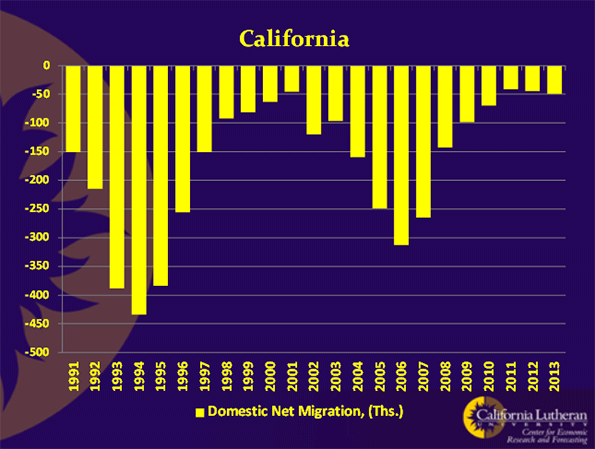
    This is really curious.  A whopping 57 percent more people moved from California to Texas than moved from Texas to California, which was the case for decades.  This is an argument that people aren’t leaving California?  California’s population is up 1.5 million?  California’s population growth is mostly a result of California’s fertile young people.  Census data show that California’s domestic migration has been negative for over 20 consecutive years.   It may not be The Great Exodus, but it’s a reversal of about a 150 year of migratory trend.

    Then there is poverty and unemployment.  Poverty, unemployment and lack of opportunity are why California’s domestic migration data is negative.  Lack of opportunity may be hard to measure, but we have lots of data on unemployment and poverty.   Some examples:

    • San Bernardino has the second highest poverty rate of any major U.S. metropolitan areas.  Only Detroit is worse.
    • California, with about 12 percent of the U.S. population, has 34 percent of U.S. welfare recipients.
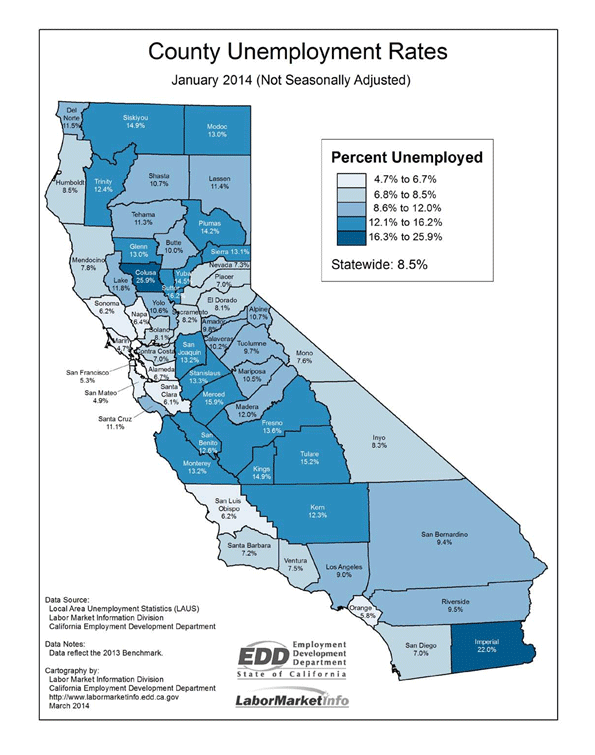
    • Two California counties, the geographically separated Colusa and Imperial, have unemployment rates over 20 percent.
    • Thirty-one of California’s 58 counties have unemployment rates in double digits.

    The geographic distribution of California’s poverty is one reason many people fail to understand California.  Most of California’s poverty is concentrated in regions where the political class —or wayfaring editorialists — seldom venture.  It’s mostly inland, not where most of California’s elite live or travel.  If you stay on the 101 corridor, or hug scenic Route 1, it’s easy to avoid.  You can find it, but you have to have eyes that are open to it, and it helps if you get off the beaten path. 

    Egan wrote his piece in Santa Barbara, where life can be as good as it gets, particularly for the affluent and boomers who bought their homes decades ago.  But, the city of Guadalupe in Santa Barbara County could give him a taste of how the other half lives. Just take a look sometime: it’s about as hardscrabble a town as the Texas town in the movie “The Last Picture Show”.

    California’s poverty is harder to ignore along the 99, but is even more evident in roads like 33 which winds along the eastern side of the coastal range.  Go there, and you will find it hard to believe that you are still in the United States, much less California.  There you will find grinding, hopeless poverty more reminiscent of the Third World than the center of the economic jobs.

    A high speed train won’t help these people.  Neither will Silicon Valley tech jobs, even if they don’t shrink in the inevitable social media shakeout.  Neither will Sacramento, apparently.  Until we start doing something for the state’s huge and struggling working and middle class, and that means creating opportunity for them, we should refrain from congratulating ourselves and each other for our good work.

    Bill Watkins is a professor at California Lutheran University and runs the Center for Economic Research and Forecasting, which can be found at clucerf.org. A slightly different version of this story appeared in CLU Center for Economic Research and Forecasting’s September, 2013 California Economic Forecast.

  • Work Access in the Non-centered San Francisco Bay Area

    The San Francisco Bay Area (San Jose-San Francisco combined statistical area or CSA) has a superior access to work systems, including its important work at home element. The freeway system provides primary access between all points, importantly supplemented by arterial streets, and accounts for nearly 70 percent of all work trips. There are more types of transit than in other metropolitan regions (metro, street car, commuter rail, light rail, ferry, and cable car) and generally with a higher level of service. The Silicon Valley virtually defines information technology and is behind the huge increase in working at home, much of it telecommuting.

    The recently released American Community Survey five-year file provides the opportunity to examine state of employment access in all Bay Area municipalities

    Employment Access by Car

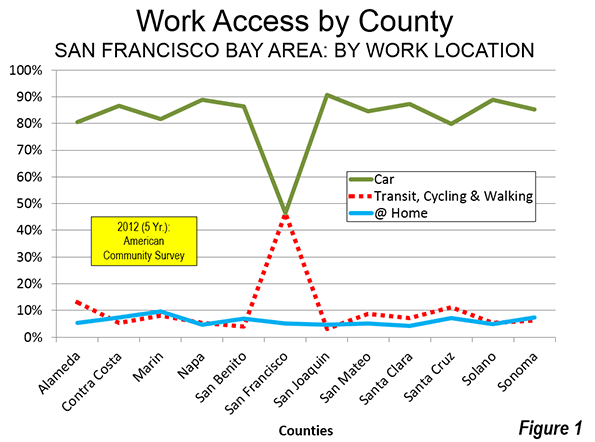
    Like every major metropolitan area in the United States, more people use cars or light trucks (for simplicity called "cars" in this article) to get to work than any other mode of transport. In the Bay Area, 68 percent of commuting is by car. Cars provide the overwhelming majority of work access to jobs in 11 of the Bay Area’s 12 counties. This ranges from 80 percent in Alameda County (secondary core municipality Oakland is the county seat) to 91 percent in San Joaquin County, which was recently added to the San Jose-San Francisco CSA (Figure 1). In the 12th county, San Francisco, cars provide work access for nearly equal to that of transit, walking and cycling combined (both approximately 46 percent).

    Employment Access from Home

    Working at home continues to grow and, to an even greater extent than car travel, is relatively evenly distributed throughout the 12 Bay Area counties. The highest percentage is in Marin County, at 9.6 percent. The combination of a technology friendly regional environment and horrific traffic on the primary commuting routes to most of the Bay Area (US-101 and the Golden Gate Bridge) probably drive this figure higher. Contra Costa County and Santa Cruz County also have a high work at home shares, at 7.3 percent and 7.1 percent respectively. This is than 50 percent above the national rate.

    Most surprisingly, however, the lowest work at home share in the Bay Area is in Santa Clara County, the very heart of Silicon Valley. This is slightly less than the national average. Another surprise is counties on the periphery of the Bay Area also have small work at home shares. Sonoma, Napa and San Joaquin counties have work at home shares of under 5.0 percent.

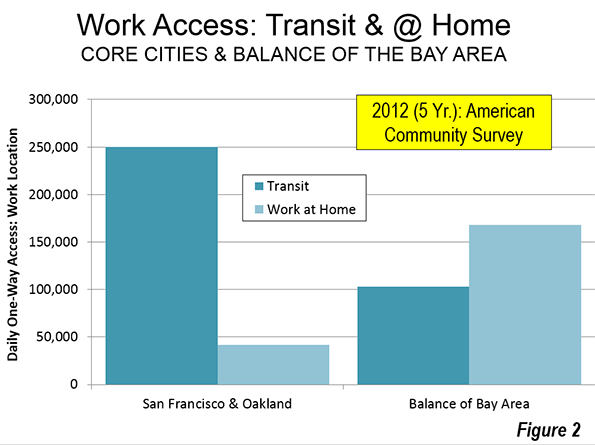
    Outside the core cities of San Francisco and Oakland, more than 1.5 times as many employees work at home (including telecommuting) than access work by transit (Figure 2).

    Employment Access by Transit

    The Bay Area remains monocentric only in aerial photographs and transit market share. San Francisco is served by one of the nation’s busiest metro (subway or underground) systems in the nation, Bay Area Rapid Transit (BART), which carries over 400,000 one-way rides daily. BART was the first of the major post-World War II rapid transit systems in the United States and was followed by other fully grade separated Metro systems in Washington and Atlanta and individual lines in Los Angeles.

    As we indicated in Transit Legacy Cities, most of the transit commuting (55 percent) in the United States is to just six core municipalities, New York, Chicago, Philadelphia, Boston, Washington, and San Francisco. Approximately 60 percent of commuting to those cities is to the downtown areas, which are also the largest in the United States. Yet these legacy cities, with a majority of the nation’s transit commuting, account for only six percent of the nation’s employment.

    Nearly two-thirds of Bay Area transit commuters work in the city of San Francisco and that figure rises to more than 70 percent, including the city of Oakland, with its strong downtown. Yet, these two core cities have only 21 percent of employment in the Bay Area. The downtowns of both core cities are well served by transit, including BART and radial surface transit systems. Buses serve downtown Oakland, while buses, trolley buses (electric buses), street cars and cable cars are focused on downtown San Francisco.

    The Non-Centered Metropolis

    Even with a regional Metro system, the Bay Area has developed in a strongly dispersed and polycentric form. Polycentricity is represented by edge cities (suburban office centers) such as Walnut Creek (with a BART station), the San Francisco Airport office area (not generally walkable from any rapid transit) and in the Silicon Valley (San Mateo and Santa Clara counties). Even more, however, employment is dispersed well beyond even these nodes.  Authors Robert Lang and Jennifer LeFurg have called this phenomenon "edgeless cities," though their other term, the "non-centered metropolis," says it better.

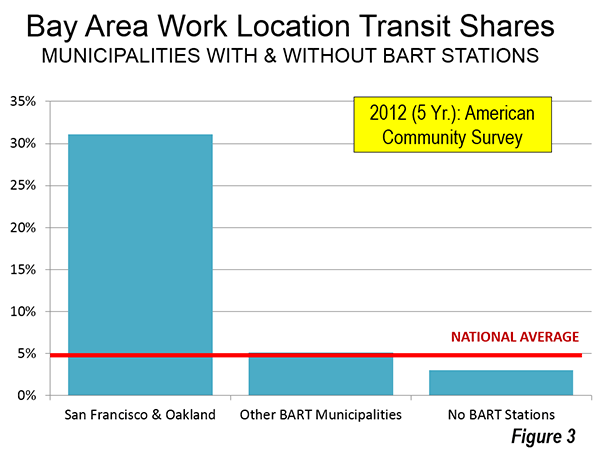
    Outside the San Francisco-Oakland core, the commuting pattern in the Bay Area is little different than in the rest of the nation (as is also the case in New York, outside the urban core). Nearly 80 percent of the Bay Area’s jobs are outside the cities of San Francisco and Oakland, however only 4.0 percent of commuters use transit to jobs located outside these cores. Among municipalities other than San Francisco and Oakland with BART stations, work access by transit is 5.1 percent, only slightly higher than the national average (which includes all urban and rural areas). Commuting by transit is even lower (3.0 percent) to jobs in outside municipalities with BART stations (Figure 3).

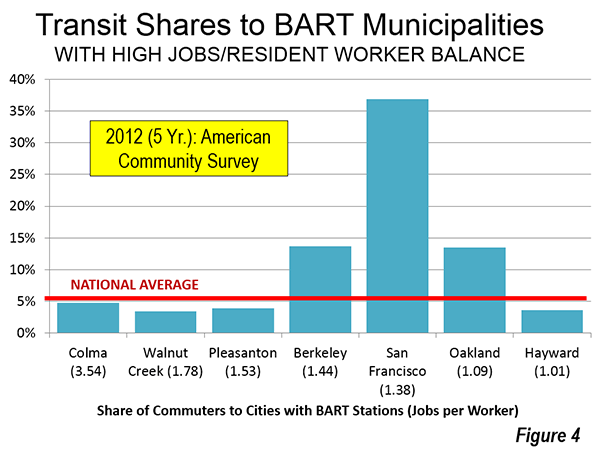
    Among the municipalities with BART stations and favorable "jobs-housing balances," only San Francisco, Oakland and Berkeley (home of the University of California) attract more transit commuters than the national average. Walnut Creek illustrates the problem of regional transit commuting to suburban locations. Walnut Creek has a strong suburban office center and a stronger jobs-housing balance than all BART municipalities but much smaller Colma. Yet, only 3.5 percent of commuters who work in Walnut Creek used transit to get to work (Figure 4).

    Overall, outside the core cities of San Francisco and Oakland, approximately 20 times as many people commute to jobs by car as by transit.

    The Illusion of Monocentricity

    With transit’s failure to carry large numbers of workers to jobs throughout the Bay Area (not just to the two older core municipalities), planners have switched strategies. Now the focus is on urban villages (transit oriented development), by which people and jobs will be located close together, reducing the need for long automobile commutes. The adopted regional plan, "Plan Bay Area" imagines people living in transit oriented developments and walking, cycling or using transit to get to employment. However, former principal planner of the World Bank Alain Bertaud says that this "urban village model exists only in the mind of urban planners" and worse, that "it contradicts the economic justification of large cities:  the efficiency of large labor markets." (see: Urban Planning 101) That means a lower standard of living and more poverty.

    The reality for the Bay Area and for metropolitan areas around the world is that transit is structurally incapable of replacing the automobile for the bulk of the workforce. The fundamental problem is that no transit system can attract drivers to jobs by offering travel times competitive with the automobile (Note). Transit can compete to some downtowns, but downtowns have only a small minority of employment. Outside of those, trip patterns are simply too dispersed for transit to serve as well as cars. Monocentric cities, to duplicate Bertaud’s logic, exist "only in the mind of urban planners."

    Wendell Cox is principal of Demographia, an international public policy and demographics firm. He is co-author of the "Demographia International Housing Affordability Survey" and author of "Demographia World Urban Areas" and "War on the Dream: How Anti-Sprawl Policy Threatens the Quality of Life." He was appointed to three terms on the Los Angeles County Transportation Commission, where he served with the leading city and county leadership as the only non-elected member. He was appointed to the Amtrak Reform Council to fill the unexpired term of Governor Christine Todd Whitman and has served as a visiting professor at the Conservatoire National des Arts et Metiers, a national university in Paris.

    ————–

    Note: In 2003, I issued a challenge to identify an existing or proposed transit system design that would achieve automobile competitiveness throughout a metropolitan area of more than 1,000,000 in Western Europe or the United States (see: Smart Growth Challenge: Transportation Choice for All, Not Just a Few [Automobile Competitiveness]). No complete responses were received. This is not surprising. In 2007, Professor Jean-Claude Ziv and I authored a paper for the 11th World Conference on Transport Research (2007 WCTRS) that estimated such a system could cost as much as the total gross domestic product of any such metropolitan area each year).

    Photo: Bart A car Oakland Coliseum Station

  • The U.S. Cities Profiting The Most In The Stock Market And Housing Boom

    If anything positive can be said for the current tepid economic recovery, it has been very good to those who invest in the stock market or own real estate.

    Property owners have been able to reap higher rents and sale prices, and the stock market has soared while the overall economy has registered only modest gains. However, only a precious few have benefited from the bull market on Wall Street. According to Pew Research, only 47% of American households own some stock, down from nearly two-thirds in 2007.

    And of those who do own equities, the upper crust control the lion’s share. As of 2010, the wealthiest 20% of U.S. households held 91.7% of all U.S. stock; the top 5%, a shade over two-thirds; and the top 1% controlled 35%.

    While incomes for the middle and working class have stagnated in the recovery, the booming stock market helped swell the income of the top 1% by 31.4% through 2012. Overall, the rich now account for 50% of the country’s wealth, more than at any time since 1917, when the income tax was introduced, and well above the level in 1928, at the end of the Roaring Twenties stock boom.

    Just as the current asset-driven recovery has had disparate impacts depending on social class, it has affected different regions in divergent ways. To gauge which areas have benefited the most from asset inflation, Mark Schill, head of research at Praxis Strategy Group, looked at the percentage of income derived from rents, dividends and interest in the nation’s 52 largest metropolitan areas and 100 most populous counties.

    The Codger Economy

    The top of our list is dominated by areas where retirees and aging boomers, particularly the more affluent, are concentrated. Some 57% of Americans aged 50 to 64 own stock, according to Pew, twice as high a percentage as those under 30. People over 55 control well over half the nation’s wealth.

    Also as they reach retirement, seniors are less likely to be earning income from wage and salary work, further driving up the share of income from rents, interest and dividends in retirement hot spots. The most well-to-do retirees are the most likely to become migratory snow birds, clustering in the nation’s warmest climes.

    This includes the top five metro areas on our list, led by the Miami-Fort Lauderdale-West Palm Beach Metropolitan Statistical Area, where roughly 26.5% percent of income was earned this way in 2012, compared to a national average of 18.2%.

    It’s followed by Tampa-St. Petersburg-Clearwater, Fla., and San Diego-Carlsbad, Calif.

    These trends are even more evident when we look at the nation’s 100 largest counties. The top of the list is dominated by wealthy retirement counties, led by Palm Beach, Fla., where a remarkable 39.8% of income comes from stocks, rents and interest payments. It’s followed by two other affluent Florida counties: Lee (39.6%), whose largest city is Cape Coral, and Pinellas (29.1%), which is the home county for both St. Petersburg and Clearwater. Other retirement counties at the top of the list include No. 7 Broward (Ft. Lauderdale) and Pima, Ariz., which contains the city of Tucson.

    Superstar Cities

    The surge of profits for investors also boosts incomes in some of the metro areas whose economies have done the best overall in the asset-driven recovery. This is most marked in the San Francisco Bay area, which added more billionaires  last year than anyplace else in the country.

    San Francisco-Oakland-Hayward ranks sixth on our metro area list, with 20.7% of residents’ income coming from rents, dividends and interest, and San Jose-Sunnyvale-Santa Clara comes in seventh (19.3%). This places them well ahead of traditional centers for plutocrats, such as Boston-Cambridge-Newton (16th) and, remarkably, the home of Wall Street, the primary beneficiary of asset inflation, New York-Newark-Jersey City (23rd).

    Our counties list offers a more precise map of where asset-driven wealth is, showing that much of it is concentrated in the suburban reaches. Although much of the hype about new billionaires revolves around San Francisco, the real star in the Bay Area is somewhat more prosaic San Mateo County (fifth on our county list), home to tech giants such as Genentech and Oracle , and seven of the 10 largest venture capital firms in the Bay Area. In contrast, San Francisco County ranks 36th.

    This diversion in the patterns of where investors and rentiers congregate can also be seen in the sprawling metropolitan area that contains the nation’s financial capital, the 19 million-person New York region. Greater Gotham is home to a remarkable four of the top 15 counties on our list, starting with No. 4 Fairfield County, Conn., a major center for the hedge fund and private equity industries, followed by two affluent suburban counties, Westchester (ninth) and Nassau (13th).

    Among the five boroughs only one, No. 14 Manhattan (New York County) ranks in the upper echelon, while three outer boroughs — Queens, Brooklyn (Kings County) and the Bronx — are in the bottom 15 of the 100 largest counties. The heavily minority and poor Bronx ranks last.

    Strongest Economies At The Bottom

    Not surprisingly, many of the metropolitan areas at the bottom of our ranking are older Rust Belt towns, such as Cleveland-Elyria (44th) and Detroit (46th). These are places where poverty is more concentrated and much of the money has moved away, often to Sun Belt locales such as Florida.

    However, the bottom of our list also features many of the nation’s most dynamic economies, including Raleigh, N.C. (43rd); Dallas-Ft. Worth-Arlington, (45th); Charlotte-Concord-Gastonia, N.C. (47th); Columbus, Ohio, (49th); and third to last and second to last among the 52 biggest metro areas, Houston-The Woodlands-Sugar Land, Texas, and Nashville-Davidson–Murfreesboro-Franklin, Tenn.

    This appears to be largely a function of age. All these fast-growing areas are also thosemost attractive to young families  with children. These people are drawn primarily by the good prospects for wage employment — needed to support their families and buy houses — and are less likely to depend on rentier profits. Clipping bond coupons may play a big role in some economies, largely on the East and West Coasts, and notably Florida, but far less in those areas that are growing the old-fashioned way, by working for a paycheck.

    Income from Interest, Dividends, and Rent
    52 Largest U.S. Metropolitan Areas
    Rank Area Population 2012 Share of Income from interest, dividends, & rent
    United States (Metropolitan Portion) 267,664,440 18.2%
    1 Miami-Fort Lauderdale-West Palm Beach, FL 5,762,717 26.5%
    2 Tampa-St. Petersburg-Clearwater, FL 2,842,878 24.6%
    3 San Diego-Carlsbad, CA 3,177,063 21.9%
    4 Jacksonville, FL 1,377,850 21.5%
    5 Virginia Beach-Norfolk-Newport News, VA-NC 1,699,925 21.3%
    6 San Francisco-Oakland-Hayward, CA 4,455,560 20.7%
    7 San Jose-Sunnyvale-Santa Clara, CA 1,894,388 19.3%
    8 Richmond, VA 1,231,980 19.2%
    9 San Antonio-New Braunfels, TX 2,234,003 19.0%
    10 Las Vegas-Henderson-Paradise, NV 2,000,759 19.0%
    11 Los Angeles-Long Beach-Anaheim, CA 13,052,921 18.8%
    12 St. Louis, MO-IL 2,795,794 18.6%
    13 Sacramento–Roseville–Arden-Arcade, CA 2,196,482 18.6%
    14 Washington-Arlington-Alexandria, DC-VA-MD-WV 5,860,342 18.5%
    15 Orlando-Kissimmee-Sanford, FL 2,223,674 18.5%
    16 Boston-Cambridge-Newton, MA-NH 4,640,802 18.5%
    17 Hartford-West Hartford-East Hartford, CT 1,214,400 18.4%
    18 Austin-Round Rock, TX 1,834,303 18.4%
    19 Seattle-Tacoma-Bellevue, WA 3,552,157 18.2%
    20 Rochester, NY 1,082,284 18.1%
    21 Denver-Aurora-Lakewood, CO 2,645,209 18.1%
    22 Portland-Vancouver-Hillsboro, OR-WA 2,289,800 18.1%
    23 New York-Newark-Jersey City, NY-NJ-PA 19,831,858 17.9%
    24 Baltimore-Columbia-Towson, MD 2,753,149 17.9%
    25 Chicago-Naperville-Elgin, IL-IN-WI 9,522,434 17.4%
    26 New Orleans-Metairie, LA 1,227,096 17.4%
    27 Milwaukee-Waukesha-West Allis, WI 1,566,981 17.3%
    28 Salt Lake City, UT 1,123,712 17.1%
    29 Buffalo-Cheektowaga-Niagara Falls, NY 1,134,210 17.0%
    30 Minneapolis-St. Paul-Bloomington, MN-WI 3,422,264 16.7%
    31 Providence-Warwick, RI-MA 1,601,374 16.7%
    32 Oklahoma City, OK 1,296,565 16.6%
    33 Kansas City, MO-KS 2,038,724 16.6%
    34 Phoenix-Mesa-Scottsdale, AZ 4,329,534 16.4%
    35 Philadelphia-Camden-Wilmington, PA-NJ-DE-MD 6,018,800 16.2%
    36 Riverside-San Bernardino-Ontario, CA 4,350,096 16.2%
    37 Atlanta-Sandy Springs-Roswell, GA 5,457,831 16.2%
    38 Birmingham-Hoover, AL 1,136,650 16.2%
    39 Grand Rapids-Wyoming, MI 1,005,648 16.0%
    40 Cincinnati, OH-KY-IN 2,128,603 15.9%
    41 Pittsburgh, PA 2,360,733 15.8%
    42 Louisville/Jefferson County, KY-IN 1,251,351 15.7%
    43 Raleigh, NC 1,188,564 15.7%
    44 Cleveland-Elyria, OH 2,063,535 15.4%
    45 Dallas-Fort Worth-Arlington, TX 6,700,991 15.2%
    46 Detroit-Warren-Dearborn, MI 4,292,060 14.8%
    47 Charlotte-Concord-Gastonia, NC-SC 2,296,569 14.4%
    48 Indianapolis-Carmel-Anderson, IN 1,928,982 14.3%
    49 Columbus, OH 1,944,002 13.3%
    50 Houston-The Woodlands-Sugar Land, TX 6,177,035 13.3%
    51 Nashville-Davidson–Murfreesboro–Franklin, TN 1,726,693 12.8%
    52 Memphis, TN-MS-AR 1,341,690 12.7%
    Source: Bureau of Economic Analysis
    Analysis by Mark Schill, Praxis Strategy Group
    Income from Interest, Dividends, and Rent
    Top & Bottom 25 Among the 100 Largest U.S. Counties
    Rank County Population 2012 Share of Income from interest, dividends, & rent
    1 Palm Beach, FL 1,356,545 39.8%
    2 Lee, FL 645,293 39.6%
    3 Pinellas, FL 921,319 29.1%
    4 Fairfield, CT 933,835 25.4%
    5 San Mateo, CA 739,311 24.4%
    6 Lake, IL 702,120 23.8%
    7 Broward, FL 1,815,137 23.0%
    8 St. Louis, MO 1,000,438 22.8%
    9 Westchester, NY 961,670 22.5%
    10 Pima, AZ 992,394 22.0%
    11 Hillsborough, FL 1,277,746 21.9%
    12 San Diego, CA 3,177,063 21.9%
    13 Nassau, NY 1,349,233 21.7%
    14 New York, NY 1,619,090 21.7%
    15 Honolulu, HI 976,372 21.4%
    16 El Paso, CO 644,964 21.3%
    17 Montgomery, MD 1,004,709 20.9%
    18 Norfolk, MA 681,845 20.5%
    19 Ventura, CA 835,981 20.3%
    20 Travis, TX 1,095,584 20.2%
    21 Bergen, NJ 918,888 20.2%
    22 Middlesex, MA 1,537,215 20.1%
    23 Fairfax, Fairfax City + Falls Church, VA 1,155,292 20.0%
    24 Orange, CA 3,090,132 19.7%
    25 Baltimore, MD 817,455 19.7%
    76 Snohomish, WA 733,036 14.8%
    77 Mecklenburg, NC 969,031 14.8%
    78 Worcester, MA 806,163 14.7%
    79 Suffolk, MA 744,426 14.6%
    80 Collin, TX 834,642 14.5%
    81 San Bernardino, CA 2,081,313 14.5%
    82 Gwinnett, GA 842,046 14.4%
    83 Marion, IN 918,977 14.2%
    84 Jackson, MO 677,377 14.2%
    85 Kern, CA 856,158 14.1%
    86 Queens, NY 2,272,771 14.0%
    87 Tarrant, TX 1,880,153 14.0%
    88 Franklin, OH 1,195,537 13.9%
    89 Wayne, MI 1,792,365 13.8%
    90 Macomb, MI 847,383 13.7%
    91 Shelby, TN 940,764 13.6%
    92 Harris, TX 4,253,700 13.2%
    93 Denton, TX 707,304 13.2%
    94 Davidson, TN 648,295 12.8%
    95 Kings, NY 2,565,635 12.8%
    96 Will, IL 682,518 12.8%
    97 Hudson, NJ 652,302 12.7%
    98 Philadelphia, PA 1,547,607 12.5%
    99 Hidalgo, TX 806,552 11.1%
    100 Bronx, NY 1,408,473 11.1%
    Source: Bureau of Economic Analysis
    Analysis by Mark Schill, Praxis Strategy Group


    This story originally appeared at Forbes.com.

    Joel Kotkin is executive editor of NewGeography.com and Distinguished Presidential Fellow in Urban Futures at Chapman University, and a member of the editorial board of the Orange County Register. He is author of The City: A Global History and The Next Hundred Million: America in 2050. His most recent study, The Rise of Postfamilialism, has been widely discussed and distributed internationally. He lives in Los Angeles, CA.

    Miami photo by Wiki Commons user Comayagua.

  • Welcome to Chicagoland

    As part of his plan to boost sagging ratings at the network, CNN chief Jeff Zucker commissioned an eight part reality series about Chicago and its mayor called Chicagoland that premiers tonight at 10pm ET. The show is produced by the same people who did the Brick City series about Newark Mayor Cory Booker, with support from mega-star executive producer Robert Redford.

    Rahm and the Media

    Given that Brick City seems to have only helped Booker’s reputation, cynics in Chicago have already noted the fact that show’s producers are represented by the William Morris Endeavor Agency, which just so happens to be the home of Chicago Mayor Rahm Emanuel’s brother Ari. This is as much because of as in spite of a well-publicized move by directors Marc Levin and Mark Benjamin to ask the agency to recuse themselves from representing them when it comes to the show.


    Trailer for CNN series “Chicagoland” – click here if the video does not display.

    One need not believe in such a conspiracy to see this show as yet another example of Rahm’s media power – and his fearlessness in pursuing high profile opportunities to get his message out even in venues where he’s not in complete control. Rahm has had significant success in getting high profile national and global attention – for example, a glowing profile from NYT columnist Thomas Friedman – since taking office. He didn’t shy away from getting out there even when a spike in murders made global headlines Chicago of the type Chicago didn’t want – a time when many mayors would have crawled into their bunkers. And although he’s been in office a while now, Rahm fatigue seems not to have set in. Sun-Times columnist Neil Steinberg has a lengthy piece on him in the March issue of Esquire with the colorful title of “And Now For the Further Adventures of Rahm the Imapler.” The Financial Times recently ran a mostly positive piece called “Rahm Emanuel: Mayor America.” It even includes a high production quality six and a half minute video that will give you a flavor of it (if the video doesn’t display, click here):


    With his ambition for Chicago as a global city, Rahm clearly sees global media as the ones that really count. Chicago’s status as a media center afterthought means few out of town reporters actually know that much about the city, hence Rahm has a huge opportunity to shape the message. This must infuriate the local media, which to a great extent Rahm is free to ignore because of his ability to go direct at the national and global level. Chicagoland should thus be seen as part of Rahm’s global media push, both for Chicago and for himself.

    Reality TV vs. Journalism

    The series is probably as good for Rahm and the city as it could possible get. Certainly the problems – high crime, poor schools, and labor troubles – are not glossed over. But given that they’ve been well publicized globally, it’s hard to imagine how they could be without sacrificing all credibility. Within the context of realism, this is a big win for the city.

    Whether it’s a big win for journalism is another story. Like most modern documentaries or reality TV shows, Chicagoland is non-fiction in a sense, but also heavily scripted and edited to provide a compelling narrative. This makes for great TV drama and characterizations, but whether it represents truth as a reporter would tell it is much more doubtful.

    Just as one example, the producers clearly had extensive access to Rahm and he’s frequently shown as concerned about crime, battling with unions, boosting the local economy, talking to school kids and even mentoring an inner city kid he brought on as an intern. But is that a fair representation of how Rahm Emanuel spends his time? The Chicago Reader did a two part series analyzing Rahm Emanuel’s schedule and published a two part series about it called “The Mayor’s Millionaire Club” (see part one and part two). They show that access to Rahm is heavily dependent on your wealth, influence, and donations. Yet that doesn’t come through in Chicagoland at all. Instead when the occasional powerful people are shown, they are always doing a good turn for the city, such as a group of tech executives donating products to schools.

    I’m not suggesting this series should have been a bulldog investigative piece. However, I strongly suspect that CNN’s actual journalists will be seething at seeing their network and its relatively strong reputation being used for what is clearly not the type of work they themselves would undertake. Right or wrong, the CNN brand carries an expectation of a certain type of journalistic standard that the Sundance Channel (where Brick City originally ran) doesn’t. Right now on CNN’s Chicagoland page there’s an ad for Anderson Cooper 360. Something tells me that were Anderson Cooper in charge of Chicagoland, it would look quite different.

    Compelling Drama and Characters

    However, taken on the terms of a Sundance series, Chicagoland succeeds, and my guess is that Rahm will be overall pleased. The show sets up the drama by structuring the series as battles between opposing forces. In the first couple episodes, this is the battle between Rahm and Chicago Public Schools leadership on the one hand, and the teachers union and some affected parent groups on the other over plans by CPS to shutter 50 schools. Frankly, I thought it overly portrayed Chicago as if it were Newark. The segments were introduced by short positive vignettes of some aspect of Chicago (like the Stanley Cup playoffs), followed by more extensive coverage of the school closing dispute, and educational and crime problems in Chicago’s impoverished South Side. It would be like doing a flyby of Times Square before doing a deep dive on some of the worst blocks in Newark. While I myself have written on the two Chicagos theme, I was feeling that Chicago was being unfairly stigmatized.

    I need not have worried. After the initial focus on the school closing dispute, the focus shifts. The drama is now between the good guys (basically every single person featured in the show) and the bad guys (gangsters and such who exist almost entirely offscreen, or so we’re led to believe). Almost without exception, the good guy characters are shown as 100% white knight types. Instead of positive vignettes followed by something Newarkesque, there’s a more balanced take in time allocation and the threads start merging across the two Chicagos. The show also starts laying the Chicago sales job on with a trowel. In Chicagoland’s coverage of things like the food scene, the music scene, the comedy clubs, or even footage of Rahm protesting a neo-Nazi march back in the 70s as a teenager, it’s hard to see how this could have been any more positive in its portrayal of the city if it had been produced directly by the Chicago Convention and Tourism Bureau. This is a huge win for the city.

    The show also manages to create several compelling characters. One of them is the surgeon who leads the trauma unit at Cook County Hospital, a job I certainly would not want. How that guy manages to balance family life in Roscoe Village (my old neighborhood) with the reality of what he deals with every night at his job is beyond me.

    But the star of the show is clearly Elizabeth Dozier, principal at Fenger High School in the South Side neighborhood at Roseland. She’s shown fighting not only to only educate her students, but keep them safe over the summer, and even invest in their lives after graduation when they get in trouble. (Dozier trying to help a former student who’s in jail for robbery realistically shows the need for “retail” 1:1 or N:1 investment in the lives of specific troubled people, not just programs, to make a real difference in a troubled person’s life – and even so the difficulty in seeing life change happen). Her obvious passion and dedication in the face of tough odds clearly come through. Yet even here there’s a sense of manufacture. Dozier is a young, attractive, stylish black professional who not only runs a South Side High School, but also gets personal face time with Rahm, knows Grant Achutz of Alinea, and hangs out with Billy Dec on his boat. How much of this A-list hob-nobbing was happening prior to Chicagoland coming to town I wonder? Regardless, it makes for compelling TV.

    While I have my quibbles, I think on the whole Chicagoland is an enjoyable watch that will end up being good for the city and the mayor. Just don’t go in expecting journalism. This is first and foremost reality TV style drama. With that caveat in mind, I recommend watching it.

    Takeaways From the Chicagoland

    Watching Chicagoland made me think again two bigger picture issues.

    First, in watching gangs take revenge on each other in an endless cycle of retaliation that literally stretches on for years and in which no one can actually recall the original offense, I was reminded of Hannah Arendt writing on the role of forgiveness:

    Forgiveness is the exact opposite of vengeance, which acts in the form of re-acting against an original trespassing, whereby far from putting an end to the consequences of the first misdeed, everybody remains bound to the process, permitting the chain reaction contained in every action to take its unhindered course. In contrast to revenge, which is a natural, automatic reaction to transgression and which because of the irreversibility of the action process can be expected and even calculated, the act of forgiving can never be predicted; it is the only reaction that acts in an unexpected way and thus retains, though being a reaction, something of the original character of action. Forgiving, in other words, is the only reaction which does not merely re-act but acts anew and unexpectedly, unconditioned by the act which provoked it and therefore freeing from its consequences both the one who forgives and the one who is forgiven. The freedom contained in Jesus’ teachings of forgiveness is the freedom from vengeance, which incloses both doer and sufferer in the relentless automatism of the action process, which by itself need never come to an end.

    Forgiveness is not the only way to put a stop to a cycle of revenge. Arendt posits official punishment as another. But forgiveness is clearly the fastest and surest route. Until either the police are able to impose order and mete out genuine justice, or the grieving family and aggrieved gang compatriots of these murder victims are able to forgive and forswear vengeance, the cycle is unlikely to ever end.

    I don’t want to judge too harshly teenagers in a ghetto living out the only life script they’ve ever known. But what’s our excuse? We too often live out in miniature the same process ourselves. How often do most of us forgive genuine wrong done against us, even of a much less consequential nature? Tune into the internet any day of the week and see untold amounts of shrieking over some offense or another, real or imagined. I suspect the vast majority of us would be behave no differently from those gangbangers in similar circumstances. We are blessed not to be there, however. But will we use that privileged position to end or perpetuate cycles of wrong in our own lives?

    Secondly, Chicagoland made me think about the bigger picture of leadership in our cities and the major problems they face. I voted for Rahm as mayor, for three reasons. 1) I saw him as like his mentor Bill Clinton, namely someone to whom getting elected and staying in power is more important than pushing any ideological agenda. In short, I saw him as a pragmatist, not an ideologue with a policy ax to grind like Bill de Blasio. 2) Rahm spent a lot of time outside of Chicago. He’s got a global perspective and a global network that’s critical in this era. He’s also got the gravitas to interact at the highest levels of power in America, which is something few mayors can say. 3) Rahm has no natural constituency in Chicago. So if he wants to be re-elected, he needs to perform. He clearly has future political ambitions, and flaming out as mayor wouldn’t be helpful in pursuing them.

    Looking back, while I’ve criticized Rahm for an excessive focus on the elite, I believe my judgment then was correct and on the whole I think he’s done a decent job in a very difficult situation. Apropos of point #3, if Chicago thinks differently, the popular and competent Cook County Board President Toni Preckwinkle is waiting in the wings. Whatever you think of his neoliberal policies, it’s clear Rahm is an actual leader, one with a ton of intelligence, drive, power, and the will to get things done.

    Yet watching Chicagoland, it’s evident that even leadership ability of Rahm’s caliber struggles mightily with the city’s huge challenges. Chicago has a massive fiscal hole, and a very serious problem with a two tier society that has left vast tracts of the city behind. It’s by no means certain that Rahm will be able to make Chicago soar in the way that Daley did in the 90s, or even get re-elected if a there’s any stumble and a credible candidate like Preckwinkle gets into the race.

    When I think about the difficulties in solving the problems in Chicago, which has not only Rahm’s leadership but a massively successful global city economy in the Loop and hundreds of thousands of well-heeled residents, it makes me pause. If Chicago struggles with its problems, how much more so other cities facing similar or worse problems but with much weaker leadership and no global city money and firepower? It really makes me wonder if a lot of places are simply going to die a slow death barring some lucky break from a change in the marketplace.

    This ultimately is what I’d challenge the residents of other cities to think about when watching this show. Look at Chicago and what it is dealing with. Think about your own problems and your resources for combating them vis-a-vis Chicago. If that doesn’t make you sober up, I’m not sure what will.

    Aaron M. Renn is an independent writer on urban affairs and the founder of Telestrian, a data analysis and mapping tool. He writes at The Urbanophile, where this piece originally appeared.
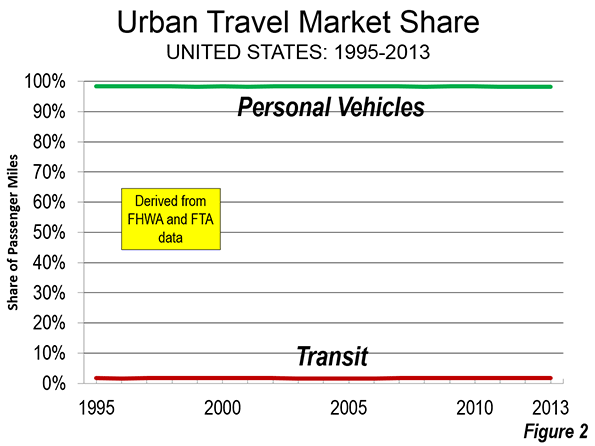
  • Bubble Trouble in Silicon Valley

    Third-generation venture capitalist Tim Draper believes he has a solution for California’s problems that will make the Silicon Valley safe for its wealthy: secession. In a recent interview, Draper suggested that California be divided into six states, including one dominated by the Valley and its urban annex, San Francisco.

    By jettisoning California’s deeply troubled components – the Central Valley, the Inland Empire, Los Angeles – the Silicon Valleyites can create their own enclave, where incomes will be far higher – $63,288 per capital compared with the $46,477 for the whole state. If adopted, Draper’s proposal would mean our self-styled cognitive leaders wouldn’t have to deal with interior California’s massive poverty, double-digit unemployment, farmer demands for scarce water supplies or manufacturers seeking reasonable energy prices.

    Yet, for some in the Valley, Draper’s proposals don’t go far enough. Another venture capitalist recently suggested that the Valley do away with this whole United States thing entirely and form its own Republic. “We need to run the experiment, to show what a society run by Silicon Valley looks like,” venture capitalist Chamath Palihapitiya argued.

    The notion here is that Silicon Valley might do best if detached from the limitations of American citizenship, with firms essentially running their own countries from islands or man-made, offshore facilities, as proposed by libertarian investor Peter Thiel. What the Valley wants, then, is to be left alone – unencumbered by the masses – so that the clever crowd can live with low taxes, in a perfectly socially liberated environment, but without the encumbrances that come with having to worry about the less-cognitively gifted.

    “People,” as technology author Jaron Lanier has noted, “are the flies in Moore’s Law’s ointment.”

    This can be seen in the growing pushback over such things as massive wealth accumulation for dubiously useful ventures, and egregious privacy violations. The luxurious Google employee buses shuttling in and out of San Francisco are resented by some residents stuck riding the often poorly maintained, sometimes awful Muni.

    One top venture capitalist, Thomas Perkins was so upset over what he sees as scapegoating of the rich that he compared their condition to Jews in Nazi Germany. His directness upset some, but may have expressed more of what is really thought by smoother, younger, more PC-conscious executives.

    This is more than simply the usual case of rich people being out of touch. These are not media constructs like Kim Kardashian or Paris Hilton but very powerful, incredibly wealthy people who increasingly are a dominant force in California and national politics. Yet, their political positions often have a “let them eat cake” character. And to be sure, some new oligarchs lean right, mostly on the libertarian side, but these are a distinct minority. The notion of some in the Republican Party who see the Valleyites as saviors is nothing short of delusional.

    For the most part, executive and workers at firms such as Google, Apple, Facebook and Twitter are strong proponents of every politically correct idea from climate change legislation to opposing the expansion of suburbia and favoring gay marriage. Yet they are also becoming the wealthiest entities in the nation; besides GE, a classic conglomerate, the largest cash hoards now belong to Apple, Microsoft, Cisco, Oracle and Google, all of which sometimes have more dollars on hand than the U.S. government. Seven of the eight biggest individual winners from stock gains in 2013 were tech entrepreneurs. They were led by Amazon’s Jeff Bezos, who added $12 billion to his paper wealth; Mark Zuckerberg, who raked in an additional $11.9 billion; and Google co-founders Sergey Brin and Larry Page, who each gained roughly $9 billion.

    Given their phenomenal wealth, one observer compared Silicon Valley politics to those of a mall outlet selling Che Guevara t-shirts. They no doubt nod their heads when President Obama speaks of economic inequality, but when it comes to doing something about it, their general response is: Nevermind.

    However they color themselves politically, the oligarchs live above and apart from the rest of society – and, like Draper, want to keep it that way. Their desire to separate from the hoi polloi is natural and stems, in part, from their notion of being a class apart from mere mortals. “We live in a bubble, and I don’t mean a tech bubble or a valuation bubble. I mean a bubble as in our own little world,” Google CEO Eric Schmidt boasted to the San Francisco Chronicle in 2011. “And what a world it is. Companies can’t hire people fast enough. Young people can work hard and make a fortune. Homes hold their value. Occupy Wall Street isn’t really something that comes up in a daily discussion, because their issues are not our daily reality.”

    Certainly, politically correct gestures, like support for climate change legislation, don’t change this calculus. Google executives, for example, urge the middle class and working class to pay for subsidized, expensive energy – which they also invest in – but maintain their own fleet of private planes.

    The distinct sets of rules for oligarchs and everyone else extends even to the most personal issues. Yahoo’s Marissa Mayer, a former Google executive, banned telecommuting options for employees – particularly critical for those unable to house their families anywhere close to Yahoo’s ultrapricey Sunnyvale home town. Yet, Mayer, pregnant at the time, saw no contradiction in building a nursery in her office.

    Nor can it be said that the Valley elite gives at the office. Rather than “share the pain,” tech firms are notorious for not paying much in the way of taxes, including taxes on their properties. Facebook, for example, paid no taxes in 2012, despite making a profit of over $1 billion. Apple, which the New York Times recently described as “a pioneer in tactics to avoid taxes,” has kept much of its cash hoard as part of its basic corporate strategy.

    Individuals like Microsoft Chairman Bill Gates have voiced support for higher taxes on the rich, yet Microsoft has saved nearly $7 billion on its U.S. tax bill since 2009 by using loopholes to shift profits offshore, a Senate panel said in a recent report. As former congressman Barney Frank noted recently, Microsoft and other tech titans “have as good a record of tax evasion as anybody.”

    Such miserliness also extends to private philanthropy. There is no equivalent financed by Silicon Valley of anything comparable with the energy-industry-financed Texas Medical Center, nor can we expect any of the tech elite to leave behind anything so durable as the Carnegie libraries. For all their loud advocacy on environmental and education issues, the Valleyites are generally considered miserly when it comes to charity, as only four of the top 50 charitable contributors in 2011 came from the tech sector.

    They may give big to the elite universities, like Stanford, but they seem oddly unengaged in the struggles of the vast working-class population around them: Poverty rates in the Valley’s home of Santa Clara County since 2001 have soared from 8 percent to 14 percent, a jump of 75 percent. The self-proclaimed “capital of Silicon Valley,” the city of San Jose,notes urban geographer Jim Russell, is beginning to resemble a post-industrial “rust belt” city. To expect the Valley elite, ensconced in superpricey Palo Alto or San Francisco, to concern themselves with the Central Valley, beyond the Diablo Range to the east, is beyond wishful thinking.

    Remarkably some people, on both the right and left, believe that the Valley’s tech community should reform the nation, and recreate the government in their image. True, the likes of Harry Reid and Mitch McConnell do not inspire much confidence, but a society run by the tech lords would be very cold, and highly stratified.

    Silicon Valley’s problem, as author Jaron Lanier has put it, “is people.” Ultimately, human beings will resent being transformed into little more than digits in a Google algorithm that is then sold to advertisers. Most Americans reject being looked down on by a group that, given accidents of birth, access to money, social networks or even high intelligence, wishes not to share a state, or even a nation, with those who have less. That these attitudes now emanate from people who consider themselves both progressive and uniquely enlightened is not only hypocritical, but almost qualifies as obscene.

    This story originally appeared at The Orange County Register.

    Joel Kotkin is executive editor of NewGeography.com and Distinguished Presidential Fellow in Urban Futures at Chapman University, and a member of the editorial board of the Orange County Register. He is author of The City: A Global History and The Next Hundred Million: America in 2050. His most recent study, The Rise of Postfamilialism, has been widely discussed and distributed internationally. He lives in Los Angeles, CA.

  • Boeing’s Long Shadow

    The recent wrangling over decisions on where to build the next version of Boeing’s 777 has left a residue of bitterness and rancor around the Puget Sound region. Were the Machinists forced to give too much? Were the taxpayers squeezed too far? While views will differ on those questions, one thing is clear: jobs lost at Boeing are very difficult, if not impossible to replace.

    In the Seattle region we can easily forget how insanely fortunate we are to have Boeing Commercial Airplanes located here. As much as we love to talk about software, gaming, life sciences, internet commerce and other 21st century industries, Seattle owes its status as a large and prosperous metropolitan area almost entirely to the economic base established by Boeing fifty years ago.

    And if we can avoid becoming another San Francisco, with high levels of income inequality, outrageous housing prices, a shrinking middle class and a consequent increase in social tensions, we will owe Boeing for that too.

    Maybe we paid too much for the 777. But the alternative – Puget Sound minus Boeing – is a frightening idea. Ever since the Boeing Bust of 1969, Seattle area leaders have been trying to diversify the region’s manufacturing economy, and with few major successes. The reason for this is obvious: our location in the upper left hand corner of the map.

    Manufacturing industries tend to locate near their customers and suppliers to minimize transportation costs. Puget Sound is simply too far from national markets to make sense as a location for heavy industry. By the 1950s, the region had maxed out its potential in timber, fishing and shipping, and the economy stagnated. The manufacturing boom that followed World War II largely passed the region by, and in 1957 a prominent businessman accurately described the Northwest as "America’s most important colony."

    Then came Boeing’s entry into the commercial jet aircraft business. Prior to World War II Boeing had served as a sort of R&D shop for the U.S. government, developing innovative military and airmail planes that never sold very well. Boeing developed the first modern commercial transport, the 247, which was immediately eclipsed by the Douglas DC-3. Boeing had some commercial success, but was still a minor player in the propeller age.

    After World War II the military stopped buying B-17 and B-29 bombers, for obvious reasons, and Boeing fell into a slump. It gradually revived itself with the successful B-47 and B-52 jet bomber programs. But it was another military program–developing a jet powered refueling tanker that could keep up with the new jet bombers–that was the key. That tanker airframe was repurposed into the 707, an aircraft that revolutionized civilian air transport and led to the transformation of the Puget Sound economy.

    With commercial jet aircraft factories, the region finally had a large, scalable manufacturing industry that did not depend on low transportation costs. In fact, the products deliver themselves! With the success of the 707 Boeing began a very aggressive strategy, launching four new airplane programs during the 1960s: the 727, 737, 747 and the ill-fated SST. Before the bust of 1969, Boeing employed well over 100,000 people in the region, accounting for nearly all the net job growth of the decade.

    Since then, Boeing’s Puget Sound area employment has fluctuated between 60,000 and 110,000. And although it is gradually shrinking as a share of the economy, Boeing provides one thing that fewer and fewer industries can offer: large numbers of secure, high-paying blue collar jobs. Boeing investments are measured in decades, and even with recent give-backs, the machinists enjoy a very nice compensation package. The layer of middle class employment at Boeing is what makes the Puget Sound region different from San Francisco, and holds the line against our evolution into a Superstar City.

    Yes, Boeing’s tactics have wounded pocketbooks and left a bad taste in the region’s mouth. And its status as a largely Midwestern company (just try to find any Northwest connections on its board) further diminishes the emotional tie. But we cannot lose sight of the value it brings. There is simply no better industry around which to build a regional economy and we are incredibly lucky to have it here. So we’ll swallow some pride and hold tight to a company that every region in the world would kill to get its hands on.

    The Seahawks 12th Man paint job that Boeing workers put on a brand new 747 freighter just before the Super Bowl brought back a glimpse of the Boeing connection that we used to take for granted. The challenge for Boeing and for regional leaders is to rebuild that connection. In Seattle we will always live in the "Jet City."

    Michael Luis is a consultant in public affairs and communications, based in the Seattle area, and is the author of Century 21 City: Seattle’s Fifty Year Journey from World’s Fair to World Stage. He also serves as councilmember and Mayor of the city of Medina, Washington. He can be reached at luisassociates@comcast.net.

    Seattle photo courtesy of BigStockPhoto.com.