Category: Urban Issues

  • Did the Midwest Ever Have Strong Coastal Connections?

    Pete Saunders recently described how, after being built in part with eastern money, West Coast outposts like San Francisco and Los Angeles never relinquished their East Coast connections. This created bi-coastal connectivity that continues to play dividends for both coast at the expense of relatively disconnected “flyover country.”

    But I wonder: did most places in the Midwest ever have great connections to the East Coast (especially New York City) to begin with? It brought to mind William Cronon’s tour de force book “Nature’s Metropolis: Chicago and the Great West” in which he documented the rise of Chicago and the rest of the Midwest together as an integrated system. One of the things he did was try to trace financial flows. This wasn’t easy, but he looked at things like bankruptcy and probate records, as well as other people’s research into correspondent banking relationships.

    What Cronon found is that Chicago served as the the gateway that connected the rest of the Midwest to eastern markets. This was true physically via the industrial works in Chicago that converted raw materials into finished goods, railroads, etc. But it was also true financially. Cronon notes:

    By choosing Chicago to be the greatest concentration of railroad capital on the continent, and by giving Chicago merchants special access to credit and discounts that made wholesaling possible, New Yorkers and other eastern capitalists place it atop the western system at the very moment that settlement in the region began its most explosive growth
    ….
    Canadian geographer A. F. Burghardt has used less grandiloquent language to describe this same process. In his phrase, Chicago became a “gateway city” by serving as the chief intermediary between newly occupied farms and town in the West and the maturing capitalist economy of the Northeast and Europe.

    Writing specifically about finance, Cronon notes:

    In 1884 a Chicago guidebook author could report, “Our banks are now depended on to a great extent to furnish Eastern exchange for other cities, and Chicago has become the recognized financial center of the West – bearing the same relation to the West that New York does to the entire country.”

    If one moves further down the urban hierarchy, the implications of these banking linkages for Chicago’s regional hinterland become clearer still. By looking at medium-sized cities that used Chicago banks for their principal correspondent relations, one discovers that Chicago’s financial hinterland extended from Cleveland in the east to Denver in the west. Three decades later, in 1910, it extended all the way west to Seattle, San Francisco, and Los Angeles.

    What this suggests to me, though I didn’t see Cronon explicitly state it, is that much of the Midwest may never have had much in the way of independent East Coast connections. Rather, their connections were with Chicago, relationships that definitely continue to the modern day. Thus it may be less a matter of Midwestern cities giving up East Coast ties as never having had much of them in the first place.

    Chicago, by contrast, had not only its original East Coast connections, but also developed networks to the West. The persistence of these networks is one of the many factors that enabled Chicago to more readily adapt to the global era than other Rust Belt locales. Chicago may be the only Midwest city with reasonably strong coastal connections.

    It would be interesting to study the development of financial relationships in cities over time. Saunders posited that New York money originally financed San Francisco, but Cronon notes the dominance of Chicago connections by 1910. San Francisco ultimately became the major west coast financial center in its own right and retains a significant finance center function through its venture capital concentrations.

    Cleveland as the easternmost extent of Chicago’s hinterland is something we see today. Indeed, I’ve been told the west side of the Cleveland region tilts towards Chicago and the east side towards New York even today.

    In any case, I’m not making definitive claims, just looking for potential explanations for the paucity of Midwest networks. Cronon basically makes the argument that Chicago and the Midwest were the original “megaregion” and as a result, perhaps Midwestern cities developed networks that were excessively Chicago-centric. Given the historic status of Chicago as a gateway city to national and global markets, my idea that Chicago should see itself as the Midwest’s global gateway seems directionally correct.

    Aaron M. Renn is an independent writer on urban affairs and the founder of Telestrian, a data analysis and mapping tool. He writes at The Urbanophile where this piece originally appeared.

    Photo by Doug Siefken

  • America’s Fastest-Growing Cities Since The Recession

    It was widely reported that the Great Recession and subsequent economic malaise changed the geography of America. Suburbs, particularly in the Sun Belt, were becoming the “new slums” as people flocked back to dense core cities.

    Yet an analysis of post-2007 population trends by demographer Wendell Cox in the 111 U.S. metro areas with more than 200,000 residents reveals something both very different from the conventional wisdom and at the same time very familiar. Virtually all of the 20 that have added the most residents from 2007 to 2012 are in the Old Confederacy, the Intermountain West and suburbs of larger cities, notably in California. The lone exception to this pattern is No. 15 Portland. The bottom line: growth is still fastest in the Sun Belt, in suburban cities and lower-density, spread out municipalities.

    The No. 1 city on our list, New Orleans, fits this picture to a degree as a quintessentially Southern city, but it’s a bit of an anomaly. Its fast growth is partially a rebound effect from its massive population loss after Katrina, but is also a function of a striking economic revival that I have seen firsthand as a consultant in the area.

    Since 2007 New Orleans’ population has grown 28% to 370,000. Many are newcomers who came, at least initially, to rebuild the city.  But the city is still way below the 2002 population of 472,000, much less its high of 628,000 in 1960.

    New Orleans is one of six cities where the population of the core has grown more in total numbers than the surrounding suburbs. (The other five are New York; San Jose, Calif.; Providence, R.I.; Columbus, Ohio; and San Antonio.) This is also a product of the fact that, when the Greater New Orleans region began to recover, the return to the suburban regions, for the most part, came before that to the city.

    Nothing in the data, however suggests a revival of the older, dense “legacy” cities that were typical of the late 19th century and pre-war era. Most of the fastest-growing big cities since 2007 are of the sprawling post-1945 Sun Belt variety, including Charlotte, N.C. (No. 4); Ft. Worth, Texas (No.  6); Austin, Texas, (10th); El Paso, Texas (11th); Raleigh, N.C. (12th); and Oklahoma City (18th). Some of the fastest-growers are also outside the major metropolitan areas,  such as No. 5 Bakersfield in California’s Central Valley, the North Carolina cities of Greensboro and Durham, (9th and 14th, respectively), and  Corpus Christi, Texas (16th).

    Among the big Northeast cities, the best performer is Washington (27th with 7.8% population growth) followed by Boston (71st, 2.2%). New York has managed only 0.3% population growth since 2007 (88th). Among other leading U.S. cities San Francisco’s population is up 3.3%, Los Angeles has grown 2.1%, and Chicago’s population has dropped 3.4%.

    The other somewhat surprising result is the strong performance of more purely suburban cities, that is, ones that have grown up since car ownership became nearly universal. They are not the historic cores of their regions but have developed into major employment centers with housing primarily made up of single-family residences. These include the city that has grown the second most in the U.S. since 2007: Chula Vista, a San Diego suburb close to the Mexican border, whose population expanded 17.7%. It’s followed in third place by the Los Angeles suburb of Irvine (16.3%); No. 7 Irving, Texas; and the California cities of Fremont (13th) , located just east of San Jose-Silicon Valley, and Oxnard (17th), north of Los Angeles.

    What do these results tell us? First, that Americans continue to move decisively to both lower-density, job-creating cities and to those less dense areas of major metropolitan areas particularly where single-family houses, good schools and jobs are plentiful.

    Irvine, a planned postwar city of some 230,000 which ranks as the country’s seventh-wealthiest municipality, has three jobs for every resident; roughly two in five residents work in the city. Irvine’s 16.3% growth rate since 2007 has been bolstered by a strong inflow of Asians. Once overwhelmingly white, Irvine’s population is now roughly 40% Asian and 9% Hispanic.

    Similarly, Irving, Texas, also thrived through the recession. Like Irvine this Dallas-area suburb is a major job center. Headquarters for Nokia , NEC Corporation of America, Blackberry, and Exxon Mobil, Irving’s population has soared over 13% over the past five years to 225,000.

    This contrasts with some similarly sized suburbs that boomed in the first part of the decade. North Las Vegas added 80,000 people between 2002 and 2007 but its growth slowed down considerably as the Nevada economy cratered. This extension of Las Vegas has added a relatively paltry 12,000 people since 2007. With Phoenix losing 3.2% of its population since ’07, the nearby former boomtowns of Mesa and Scottsdale have also seen net outflows of residents.

    Migration numbers for 2010 to 2012 alone hammer home that suburban areas are continuing to attract people, and that the more dense core areas do not generally perform as well. Although their growth has slowed compared to the last decade, suburban locales, with roughly three-quarters of all residents of metropolitan areas, have added many more people than their core counterparts.

    Where do we go from here? The urban future will continue to evolve in directions that contradict the prevailing conventional wisdom of a shift toward more crowded living. The continued dispersion of America’s population is evidenced by the persistent, and surprising, strength of suburban towns, as well as the low-density cities of Texas and the Plains. The key to growth in the next decade may depend largely on whether these rising municipalities can continue to create the jobs, favorable educational environment and amenities necessary to attract more newcomers in the future.

    MUNICIPALITIES OVER 200,000 IN 2012
    25 Fastest Growing 2007-2012
    POPULATION CHANGE
    RANK MUNICIPALITY 2002 2007 2012 2007-2012
    1 New Orleans, Louisiana     472,744     288,113     369,250 28.2%
    2 Chula Vista, California     194,167     214,506     252,422 17.7%
    3 Irvine, California     162,205     197,714     229,985 16.3%
    4 Charlotte, North Carolina     590,857     669,690     775,202 15.8%
    5 Bakersfield, California     259,146     312,454     358,597 14.8%
    6 Fort Worth, Texas     570,808     680,433     777,992 14.3%
    7 Irving, Texas     195,764     198,119     225,427 13.8%
    8 Laredo, Texas     189,954     215,789     244,731 13.4%
    9 Greensboro, North Carolina     231,415     245,767     277,080 12.7%
    10 Austin, Texas     684,634     749,120     842,592 12.5%
    11 El Paso, Texas     570,336     600,402     672,538 12.0%
    12 Raleigh, North Carolina     313,829     379,106     423,179 11.6%
    13 Fremont, California     205,034     199,187     221,986 11.4%
    14 Durham, North Carolina     196,432     216,943     239,358 10.3%
    15 Portland, Oregon     538,803     546,747     603,106 10.3%
    16 Corpus Christi, Texas     276,877     283,445     312,195 10.1%
    17 Oxnard, California     176,594     183,235     201,555 10.0%
    18 Oklahoma, Oklahoma     519,100     545,910     599,199 9.8%
    19 Aurora, Colorado     282,707     309,007     339,030 9.7%
    20 Denver, Colorado     561,072     578,789     634,265 9.6%
    21 Fontana, California     158,916     184,814     201,812 9.2%
    22 Fresno, California     442,987     465,669     505,882 8.6%
    23 Orlando, Florida     199,358     230,239     249,562 8.4%
    24 Colorado Springs, Colorado     376,341     399,751     431,834 8.0%
    25 Riverside, California     272,814     290,601     313,673 7.9%


    Joel Kotkin is executive editor of NewGeography.com and a distinguished presidential fellow in urban futures at Chapman University, and a member of the editorial board of the Orange County Register. He is author of The City: A Global History and The Next Hundred Million: America in 2050. His most recent study, The Rise of Postfamilialism, has been widely discussed and distributed internationally. He lives in Los Angeles, CA.

    This piece originally appeared at Forbes.com.

    New Orleans photo by Bigstock.

  • As the North Rests on Its Laurels, the South Is Rising Fast

    One hundred and fifty years after twin defeats at Gettysburg and Vicksburg destroyed the South’s quest for independence, the region is again on the rise. People and jobs are flowing there, and Northerners are perplexed by the resurgence of America’s home of the ignorant, the obese, the prejudiced and exploited, the religious and the undereducated. Responding to new census data showing the Lone Star State is now home to eight of America’s 15 fastest-growing cities, Gawker asked: “What is it that makes Texas so attractive? Is it the prisons? The racism? The deadly weather? The deadly animals? The deadly crime? The deadly political leadership? The costumed sex fetish conventions? The cannibal necromancers?” 

    The North and South have come to resemble a couple who, although married, dream very different dreams. The South, along with the Plains, is focused on growing its economy, getting rich, and catching up with the North’s cultural and financial hegemons. The Yankee nation, by contrast, is largely concerned with preserving its privileged economic and cultural position—with its elites pulling up the ladder behind themselves.

    This schism between the old Confederacy and the Northeastern elites is far more relevant and historically grounded than the glib idea of “red” and “blue” Americas. The base of today’s Republican Party—once the party of the North—now lies in the former secessionist states, along with adjacent and culturally allied areas, such as Appalachia, the southern Great Plains, and parts of the Southwest, notably Arizona, largely settled by former Southerners.

    “In almost every species of conceivable statistics having to do with wealth,” John Gunther wrote in 1946, “the South is at the bottom.” But even as Gunther was writing, the region had begun a gradual ascendancy, now in its seventh decade. That began with a belated post-WWII push to promote industrialization, much of it in relatively low-wage industries such as textiles. “Southerners don’t have any rich relatives. God was a Northerner,” the head of the pro-development Southern Regional Council told author Joel Garreau in 1980. “Without a heritage of anything except denial, Southerners, given a chance to improve their standard of living, are doing so.”

    While the Northeast and Midwest have become increasingly expensive places for businesses to locate, and cool to most new businesses outside of high-tech, entertainment, and high-end financial services, the South tends to want it all—and is willing to sacrifice tax revenue and regulations to get it. A review of state business climates by CEO Magazine found that eight of the top 10 most business-friendly states, led by Texas, were from the former Confederacy; Unionist strongholds California, New York, Illinois, and Massachusetts sat at the bottom.

    The South’s advantages come in no small part from decisions that many Northern liberals detest—lack of unions, lower wages, and less stringent environment laws. But for many Southerners, particularly in rural areas, a job at the Toyota plant with a $15-an-hour starting salary, and full medical benefits, is a vast improvement over a minimum-wage job at Wal-Mart, much less your father’s fate chopping cotton on a tenant farm.

    And the business-friendly policies that keep costs down appeal to investors. Ten of the top 12 states for locating new plants are in the former confederacy, according to a recent study by Site Selection magazine. In 2011 the two largest capital investments in North America (PDF)—both tied to natural-gas production—were in Louisiana.

    More recently, the region—led by Texas—has moved up the value-added chain, seizing a fast-growing share of the jobs in higher-wage fields such as auto and aircraft manufacturing, aerospace, technology, and energy. Southern economic growth has now outpaced the rest of the country for a generation and it now constitutes by far the largest economic region in the country. A recent analysis by Trulia projects the edge will widen over the rest of this decade, owing to factors including the region’s lower costs and warmer weather.

    These developments are slowly reversing the increasingly outdated image of the South as hopelessly backward in high-value-added industries. Alabama and Kentucky are now among the top-five auto-producing states, while the Third Coast corridor between Louisiana and Florida ranks as the world’s fourth-largest aerospace hub, behind Toulouse, France; Seattle; and California.

    Southern growth can also be seen in financial and other business services. The new owners of the New York Stock Exchange are based in Atlanta.

    While the recession was tough on many Southern states, the area’s recovery generally has been stronger than that of Yankeedom: the unemployment rate in the region is now lower than in the West or the Northeast. The Confederacy no longer dominates the list of states with the highest share of people living in poverty; new census measurements (PDF), adjusted for regional cost of living, place the District of Columbia and California first and second. New York now has a higher real poverty rate than Mississippi.

    Over the past five decades, the South has also gained in terms of population as Northern states, and more recently California, have lost momentum. Once a major exporter of people to the Union states, today the migration tide flows the other way. The hegira to the sunbelt continues, as last year the region accounted for six of the top eight states attracting domestic migrants—Texas, Florida, North Carolina, Tennessee, South Carolina, and Georgia. Texas and Florida each gained 250,000 net migrants. The top four losers were New York, Illinois, New Jersey, and California.

    These trends suggest that the South will expand its dominance as the nation’s most populous region. In the 1950s, the Confederacy, the Northeast, and the Midwest all had about the same populations. Today the South is nearly as populous as the Northeast and the Midwest combined, and the Census projects the region will grow far more rapidly (PDF) in the years to come than its costlier Northern counterparts.

    Yankees tend to shrug off such numbers as largely the chaff drifting down. “The Feet are moving south and west,” The Atlantic’s Derek Thompson wrote in 2010, “while the Brains are moving toward coastal cities.”

    To be sure, some Yankee bastions, such as Massachusetts and Connecticut, enjoy much higher percentages of educated people than the South. Every state in the Southeast falls below the national average of percentage of residents 25 and over with at least a bachelor’s degree—but virtually every major Southern metropolitan region has been gaining educated workers faster than their Northeastern counterparts. Over the past decade, greater Atlanta added over 300,000 residents with B.A.s, more than the larger Philadelphia region and almost 70,000 more than Boston.

    The region—as recently as the 1970s defined by its often ugly biracial politics—has become increasingly diverse, as newly arrived Hispanics and Asians have shifted the racial dynamics. While the vast majority of 19th-century immigrants to America settled in the Northeast and Midwest, today the fastest-growing immigration destinations—including Nashville, Atlanta, and Charlotte—are in the old Confederacy. Houston ranked second in gaining new foreign-born residents in the past decade, just behind New York City, with nearly three times its size. And Houston and Dallas both now attract a higher rate of immigration than Boston, Chicago, Seattle, or Philadelphia.

    These immigrants are drawn to the South for the same reasons as other Americans—more jobs, a more affordable cost of living and better entrepreneurial opportunities. A 2011 Forbes ranking of best cities for immigrant entrepreneurs—measuring rates of migration, business ownership, and income—found several Southeastern cities at the top of the list, with Atlanta in the top slot, and Nashville coming in third.

    Then there’s the most critical determinant of future power: family formation. The South easily outstrips the Yankee states in growth in its 10-and-under population. Texas and North Carolina expanded their kiddie population by over 15 percent; and every Southern state gained kids except for Katrina-ravaged Louisiana. In contrast New York, Rhode Island, and Michigan lost children by a double-digit margin while every state in the Northeast as well as California suffered net losses.

    The differences are most striking when looking at child-population growth among the nation’s 51 largest metropolitan areas. Eight of the top ten cities for growth in children under 15 were located in the old Confederacy—Raleigh-Cary, Austin, Charlotte, Dallas, Houston, Orlando, Atlanta, and Nashville. New York, Los Angeles, and Boston, along with several predictable rust-belt locals, ranked in the bottom 10.

    Historically, regions with demographic and economic momentum tend to overwhelm those who lack it. Numbers mean more congressional seats and more electoral votes, and governors who command a large state budget and the national stage. Unless there is a major political change, the South’s demographic elevation will do little to help Democrats there, who, like Northern Republicans, appear to be an endangered species.

    Pundits including the National Journal’s perceptive Ron Brownstein suggest that the GOP’s Southern dominance has “masked” the party’s decline in much of the rest of the country. Other, more partisan voices, like the New Yorker’s George Packer simply dismiss Southern conservatives as overmatched by the Obama coalition of minorities, the young, and the highly educated. The even more partisan Robert Shrum correctly points out that the Southern-dominated GOP is increasingly out of step with the rest of the country on a host of social and economic issues, from income inequality to support for gay marriage.

    “A lot of sociologists have projected that the South will cease to exist because of things like the Internet and technology,” Jonathan Wells told Charlotte Magazine. An associate professor of history at UNCC and author of Entering the Fray: Gender, Culture, and Politics in the New South, Wells predicts the region “will lose its distinctive identity that it had in the past.”

    It’s unlikely, though, that the South will emulate the North’s social model of an ever-expanding welfare state and ever more stringent “green” restrictions on business—which hardly constitutes a strong recipe for success for a developing economy. It’s difficult to argue, for example, that President Obama’s Chicago, broke and with 10 percent unemployment, represents the beacon of the economic future compared to faster-growing Houston, Dallas, Raleigh, or even Atlanta. People or businesses moving from Los Angeles, New York, or Chicago to these cities will no doubt carry their views on social issues with them, but it’s doubtful they will look north for economic role models.

    Instead, you might see some political leaders, even Democrats, in states such as Pennsylvania, Ohio (a Civil War hotspot for pro-Southern Copperheads), and Michigan come to realize that pro-development policies, such as fracking, offer broader benefits than the head-in-the-sand “green” energy policy that slow growth in places like New York and California. The surviving Southern Democrats (by definition, a tough breed) like Houston Mayor Anise Parker have shown that you can blend social liberalism with “good old boy” pro-business policies.

    Politicians like Parker, along with Republicans such as former Florida governor Jeb Bush, represent the real future of the states that once made up the Confederacy. As they look to compete with the Northeast and California for the culture, and high-test and financial-service firms that are forced to endure the high cost of the coasts, Southerners are likely to at least begin shrugging off their regressive—and costly—social views on issues like gay marriage.

    Bluntly put, if the South can finally shake off the worst parts of its cultural baggage, the region’s eventual ascendancy over the North seems more than likely. High-tech entrepreneurs, movie-makers, and bankers appreciate lower taxes and more sensible regulation, just like manufacturers and energy companies. And people generally prefer affordable homes and family-friendly cities. Throwing in a little Southern hospitality, friendliness, and courtesy can’t hurt either.

    Joel Kotkin is executive editor of NewGeography.com and a distinguished presidential fellow in urban futures at Chapman University, and a member of the editorial board of the Orange County Register . He is author of The City: A Global History and The Next Hundred Million: America in 2050. His most recent study, The Rise of Postfamilialism, has been widely discussed and distributed internationally. He lives in Los Angeles, CA.

    This piece originally appeared at The Daily Beast.

    Photo by Belle of Louisville.

  • The Evolving Urban Form: The Rhine-Ruhr (Essen-Düsseldorf)

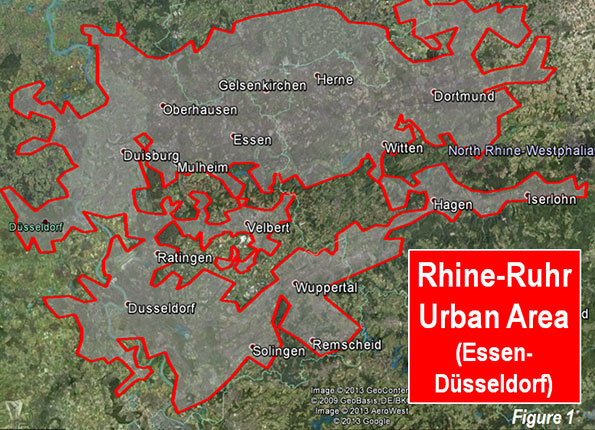
    Rhine-Ruhr, or Essen-Düsseldorf, is among the world’s least recognized larger urban areas (Figure 1).  Germany does not designate urban areas according to the international standard, and for that reason the Rhine-Ruhr does not appear on the United Nations list of largest urban areas. Yet, in reality this contiguous urban area is Germany’s largest urban area, a position as it has held since at least the end of World War II. The Rhine-Ruhr is the third largest urban area in Western Europe, trailing only Paris and London. The area was one of the strongest early urban industrial areas in the 18th century and continued as a major manufacturing and coal mining center through the first half of the 20th century.

    An Early Polycentric Urban Area

    The Rhine Ruhr is unusual in not having evolved around a single core municipality. The Rhine Ruhr has multiple core municipalities, which have grown together to form a conurbation, the second largest in the world following Osaka –Kobe – Kyoto. But the Rhine Ruhr is probably the most polycentric urban region in the world, with a minimum of eight older, large municipalities now linked by urbanization. These include Essen and Düsseldorf, which were until recently the two largest municipalities. In addition there are Dortmund, Duisburg, Bochum, Wuppertal, Gelsenkirchen and Oberhausen. Each of these eight municipalities reached a population of 250,000 or more by 1961.

    Like nearly all prewar municipalities in the high income world that had not expanded their boundaries, each of these has lost population since 1961. By 2011, the combined population of these eight municipalities was under 3.4 million, a reduction of 700,000 (Table) from their 1961 total (a 17% loss).

    Table
    Larger Rhine-Ruhr Municipalities: Population 1961-2011
      1961 2011 Change %
    Bochum      441,000      362,000     (79,000) -17.9%
    Dortmund      645,000      571,000     (74,000) -11.5%
    Duisburg      504,000      488,000     (16,000) -3.2%
    Dusseldorf      705,000      586,000   (119,000) -16.9%
    Essen      730,000      566,000   (164,000) -22.5%
    Gelsenkirchen      384,000      259,000   (125,000) -32.6%
    Oberhausen      258,000      210,000     (48,000) -18.6%
    Wuppertal      422,000      343,000     (79,000) -18.7%
    Total   4,089,000   3,385,000   (704,000) -17.2%


    Data for the balance of the urban area and the broader Rhine-Ruhr region (Note 1) is not readily available for 1961. As a result, this analysis considers the Rhine-Ruhr region to consist of the Dusseldorf, Arnsberg and Münster subregions of the state (lander) of North Rhine-Westphalia, which had a combined population of 11.22 million in 2011, up only modestly from 11.06 million in 1987. The urban area has a population of approximately 6.5 million residents, covering a land area of approximate 950 square miles (2,450 square kilometers). The urban density is approximately 6,800 per square mile (2,650 per square kilometers), less than that of Los Angeles (7,000 per square mile or 2,700 per square kilometer) or Toronto (7,600 per square mile or 2,900 per square kilometer).

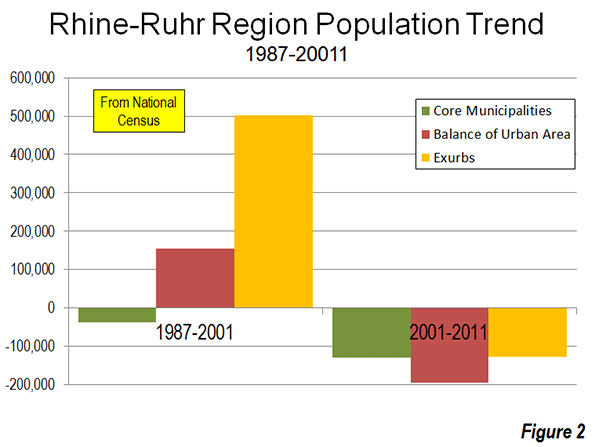
    Since 1987, the Rhine-Ruhr has added 161,000 residents, having gained 617,000 residents between 1987 and 2001, and losing 456,000 from 2001 to 2011. The eight older cities lost 170,000 residents from 1987 to 2011, while the balance of the urban area lost 42,000. The exurbs, outside the urban area have added 373,000 residents, and account for more than all of the modest growth since 1987. All three sectors lost population after 2001 (Figure 2).

    Slow Growth, Even for Germany

    The Rhine-Ruhr is located in the lander of North Rhine-Westphalia, which has the largest population in Germany. Its growth, however, has been glacial. Since 1961, the average annual growth rate of the lander was 0.2%. This is one third the growth rate of the other lander that constituted the former Federal Republic of Germany (West Germany).

    North Rhine-Westphalia’s performance is stellar compared to the lander of the former Democratic Republic of Germany (East Germany), which have fallen back to their 1961 population, having lost 10% of their residents since 1990. Germany itself lost more than 2 million people in the last decade, reflecting its well-below replacement fertility rate. Based upon this rate, Germany could lose more than the 5 million more residents projected by United Nations projectionsto 2050 (to 75 million).

    But even within the slow growth environment of North Rhine Westphalia, the  Rhine Ruhr region is falling behind as nearly all the growth has shifted elsewhere to the regions of the lander that surround other urban areas, Cologne (Köln), which includes the former West German capital of Bonn, and Aachen (which stretches into the Netherlands). Local authorities in the Ruhr Valley are forecasting a population loss of approximately 8 percent by 2030.

    The Setting

    The Rhine-Ruhr conurbation is organized around confluences of two rivers with the Rhine. The northern part of the urban area stretches from the west bank of the Rhine eastward along the Ruhr River Valley with the large municipality of Duisburg anchoring the West and Dortmund the East. The southern part of the urban area stretches along the Wupper River Valley starting at Düsseldorf and continuing eastward to south of Dortmund. The elevation at the two river junctions is less than 100 feet (40 meters). A transverse, low mountain range (Rhenish Massif) separates the northern and southern parts of the urban area (maximum elevation 800 feet or 300 meters), though much of the hilly area is urban.

    Transport

    Without a dominant, large center, the Rhine-Ruhr has a lower transit work trip market share – 18 percent – than would be expected for a European urban area of its size. This is well below the 30 percent share of Berlin and the approximately 35 percent shares of Madrid, Lisbon, and Stockholm, which are all smaller than the Rhine-Ruhr. Wuppertal is home to one of the icons of mass transit, the Wuppertal Monorail, which opened in 1901. The Monorail is suspended for much of its route above the Wupper River, with supports straddling the river (such a configuration would probably not be permitted to be constructed today in any high-income world metropolitan area because of environmental regulations).

    The Rhine-Ruhr’s polycentricity requires substantial reliance on its road system. The region is well served by an extensive freeway (autobahn) system consisting of at least four east-west routes and five north-south routes. Traffic congestion is worse than in most US urban areas, but the Rhine-Ruhr’s traffic flows better than in any metropolitan area of similar size in Europe, according to 2012 data from the INRIX Traffic Scorecard. The average peak hour delay is 14.8 percent compared to “free flow.” This is less than one-half the average delay in smaller Milan (30.2 percent) and well below Paris (27.8 percent) and London (26.1 percent). In 2005, the Rhine-Ruhr had the fifth highest rated freeway access among 30 surveyed international urban areas.

    Shrinking City

    Shrinking cities (where cities are defined as metropolitan areas or urban areas) have been unusual in the high income world (Pittsburgh and Liverpool are exceptions). Even as core municipalities have lost population, such as in Atlanta and Copenhagen, metropolitan areas have continued to grow. This is likely to change because of the severe national population declines forecast in a number of countries. The Rhine-Ruhr, and other similarly situated cities, will face serious challenges in retaining dynamic economies and delivering public services in the years to come for an aging population supported by a smaller work force.

    Wendell Cox is a Visiting Professor, Conservatoire National des Arts et Metiers, Paris and the author of “War on the Dream: How Anti-Sprawl Policy Threatens the Quality of Life.

    ———–

    Note 1: The entire Rhine-Ruhr and Cologne areas are considered by Germany to be the Rhine-Ruhr metropolitan area (ballungsräume). This article is limited to an area roughly conforming to the northern part of the ballungsräume. Eurostat defines a much smaller Düsseldorf-Ruhrgebiet metropolitan area that includes the Rhine-Ruhr urban area and most of the exurban area in this analysis. There is no international standard for the designation of metropolitan areas (labor markets).

    Note 2: INRIX classifies the Rhine-Ruhr as two areas (north and south). This is the population weighted congestion delay.

    Photo: Wuppertal Monorail

  • The Mad Drive to Subvert Democracy in Toronto

    Let me stipulate that I think Toronto’s Rob Ford is a terrible mayor. In fact, while I might not go so far as Richard Florida, who labeled Ford “the worst mayor in the modern history of cities, an avatar for all that is small-bore and destructive of the urban fabric, and the most anti-urban mayor ever to preside over a big city,” I’m willing to say he’s probably in the running for the title.

    The roots of Rob Ford lie in “amalgamation,” the forcible merging of the city of Toronto government with various of its suburbs by the Ontario provincial government. The idea was cost savings, but of course costs went up. Also, it created a Mars-Venus situation that ultimately led to Ford, a former city councilor in Etobicoke, being elected mayor. This would be like a consolidation of Chicago with Cook County in which a member of the Schaumburg city council ended up mayor. Not good. The urban intelligentsia that despises Ford now find themselves in the embarrassing position of having to explain to their friends that they are in total agreement with Wendell Cox, an implacable foe of government consolidations, who predicted these results.

    But there’s a big difference between Florida’s bashing of Ford, which falls within the principles of democratic discourse as we’ve come to know it, and what appears to be an effort by some to subvert democracy by finding any pretext to run Rob Ford out of office.

    I’m not sure where the idea that the loser in an election tries to undermine the legitimacy of the government of the winner came from. But in the modern era it could be the Republican impeachment of Bill Clinton that launched it. This quickly proved to be standard fare. There was the brouhaha over the “selected not elected” George W. Bush as well as the more passionate strain of “birthers” when it comes to President Obama. Given that, especially in the big leagues, there is always some dirtiness in politics, it’s easy to find things to seize upon to claim someone’s holding of an office is invalid. After all, it appears that Clinton really did commit perjury and there was shall we say some murkiness down in Florida. However, these aren’t truly what the people raising a ruckus cared about. What they cared about was the man in office they didn’t like – and getting him out of it.

    Canada has a reputation as a kinder, gentler nation, but they now appear to have imported from America what Clinton labeled “the politics of personal destruction.” Rob Ford has been the target of a series of vicious attacks, generally aided and abetted (if not outright instigated) by the old city Toronto media that clearly don’t like him, designed to drive him out of office.

    One was a lawsuit that claimed he should be tossed out of office because of events related to his using official letterhead and such to raise $3,500 for a charity. Believe it or not, the trial judge actually agreed with this and ordered him removed from office. If that’s the threshold for getting someone kicked out of office, I dare say every major politician in America would be gone. Yes, politicians do often use affiliated charities as a, shall we say, lubricating mechanism. Yes, there’s the appearance or even the reality of some impropriety in these things. But this is such small fry stuff that to throw the mayor of the biggest city in the country out of office over it defies belief. If you think this is removal worthy, I’m confident I can find something just as bad in almost any politician that you actually like. Fortunately, saner heads at the appeals level prevailed and the ruling was overturned.

    Recently we’ve also seen reports originating from, I kid you not, Gawker, in which some shady Somalis supposedly showed a reporter a cell phone video of Rob Ford smoking crack. Shortly thereafter the Toronto Star got in on the act, saying their reporters had seen the video in the back seat of the car, though with the CYA proviso that they had “no way to verify the authenticity of the video.” Other media that may not have directly originated such a story have piled on and thus there’s a firestorm awhirl.

    Where is the video, you might ask? Good question. Supposedly it’s for sale for $200K but oddly no one snapped it up, not even one of the extremely wealthy Ford haters that Toronto has in abundance. So you want to buy it? Oh, Gawker now tell us it might be “gone.” Hmmm…..

    I’m not saying there’s no video. Rob Ford has certainly acted like he’s guilty of something. But it seems amazing to me that in this era in which all types of tapes and documents spontaneously get loose, this one is no where to be found. Also, the idea of the mayor of Toronto smoking crack with a bunch of Somalis while they film him falls into the “extraordinary claims require extraordinary proof” category. The still photo is interesting, but I’ve seen many compromising photos of mayors, who are routinely snapped with all sorts of random people who they may find out later are unsavory characters. I can’t imagine this sort of media feeding frenzy over say, similar allegations against Michael Bloomberg or Rahm Emanuel.

    The Toronto Globe and Mail is a serious newspaper that’s roughly Canada’s New York Times. Though they didn’t break the video story, they did follow-up with a rather tabloidesque article about the history of Rob Ford’s family with drugs. Ford’s brother Doug, the focus of the piece, is on the city council himself, so is a legitimate investigative target so to speak, but the piece also digs into other family members.

    Not only is the Globe and Mail digging up dirt on Rob Ford’s family, this piece did it entirely with anonymous sources. They claimed to talk to no fewer than ten people who called Doug Ford a drug-dealer, but curiously none of them were willing to talk on the record. That didn’t stop the Globe and Mail from reporting:

    Ten people who grew up with Doug Ford – a group that includes two former hashish suppliers, three street-level drug dealers and a number of casual users of hash – have described in a series of interviews how for several years Mr. Ford was a go-to dealer of hash. These sources had varying degrees of knowledge of his activities: Some said they purchased hash directly from him, some said they supplied him, while others said they observed him handling large quantities of the drug.

    The events they described took place years ago, but as mayor, Rob Ford has surrounded himself with people from his past. Most recently he hired someone for his office whose long history with the Fords, the sources said, includes selling hashish with the mayor’s brother.

    There’s nothing on the public record that The Globe has accessed that shows Doug Ford has ever been criminally charged for illegal drug possession or trafficking. But some of the sources said that, in the affluent pocket of Etobicoke where the Fords grew up, he was someone who sold not only to users and street-level dealers, but to dealers one rung higher than those on the street. His tenure as a dealer, many of the sources say, lasted about seven years until 1986, the year he turned 22. “That was his heyday,” said “Robert,” one of the former drug dealers who agreed to an interview on the condition he not be identified by name.

    Upon being approached, the sources declined to speak if identified, saying they feared the consequences of outing themselves as former users and sellers of illegal drugs.

    The Globe also tried to contact retired police officers who investigated drugs in the area at the time. One said he had no recollection of encountering the Fords.

    The article is full of innuendo about the Ford’s such as the idea that Rob Ford recently hired a drug dealing associate of Doug’s from the old days (highlighted above), along with curious mentions and links to beatings, killings, and white supremacy/KKK. (Rob Ford is a white supremacist who likes to smoke crack with Somalis???) It’s capped off by having various anonymous sources given pseudonyms so that they appear to be actual people on the record. As this excerpt notes, the police record and police contacts don’t back up the story, which just adds to the general notion of dubiosity and suggests this is a very exaggerated piece that tries to throw things to the wall to see what sticks.

    All it all, given the extreme reactions to financial dealings that, even if they were proven, would have been a non-issue almost anywhere else, along with a firestorm of allegations about smoking crack and so much more with no actual proof, the Rob Ford affair has thus far generated much more smoke than fire.

    Rob Ford is the price Toronto is paying for the foolishness of the provincial government and the failure of an urban candidate to offer a compelling vision for the entire amalgamated city. But it strikes me very much that a group of old Toronto city partisans, who are incensed a guy like Ford had the temerity to win an election, are determined to use any means necessary to correct what they see is that injustice. But just as with what happened in America and its politics in the wake of the Clinton impeachment, Canada may come to rue the day a group of its citizens decided to try to overturn an election by destroying the winner rather than waiting for their next opportunity at the ballot box.

    Aaron M. Renn is an independent writer on urban affairs and the founder of Telestrian, a data analysis and mapping tool. He writes at The Urbanophile, where this piece originally appeared.

    Photo by Wiki Commons user MTLskyline.

  • Housing Boom Is The Best Chance For A Recovery For The Rest Of Us

    Our tepid economic recovery has been profoundly undemocratic in nature. Between the “too big to fail” banks and Ben Bernanke’s policy of dropping free money from helicopters on the investor class, there have been two recoveries, one for the rich, and another less rewarding one for the middle class.

    Viewed in this light, the recent run-up in home prices, the biggest in seven years, offers some relief from this dreary picture. Home equity accounts for almost two-thirds of a “typical” family’s wealth (those in the middle fifth of U.S. wealth distribution); there is no other investment by which middle-class families can so easily grow their nest eggs.

    But the housing recovery’s benefit extend beyond owners. The housing industry drives a significant portion of the nation’s economy, accounting for millions of jobs. According to the National Association of Home Builders, the average single-family detached house under construction results in an additional three jobs for one year. This includes the employees working on the house, and those employed in producing products to build the house.

    Overall, residential construction and upkeep generates between 15% and 18% of GDP. If the economy is to expand in a sustainable way that helps a broad section of Americans, suggests Roger Altman, a Clinton administration deputy Treasury secretary, “a housing boom will be the biggest driver.”

    Perhaps even more important, the growth of housing sales also revives something many have written off as obsolete: “the American dream” of owning a home. Since the great recession, some economists have argued that the future of America will be a “rentership” society.

    Others such as Richard Florida have argued forcibly that home ownership is “over-rated,” maintaining that America’s fixation on it has fostered “countless forms of over-consumption that have a horribly distorting affect on the economy.” Workers, he argues, are better off as renters since this allows them to change jobs more nimbly. If anything, he suggests, the government would be better off encouraging “renting, not buying.”

    Greens have also embraced this downscaled future, with people living cheek to jowl in some urbanized form of ecological harmony. They envision a new generation that will reject materialism, suburbs, single-family homes and other expressions of acquisition. In other words, forget ambition and save the whales. One writer at Grist argues, the fact the millennial generation can’t afford homes is a good thing, since it will lead to “a rejection of the mindset that got us into this mess.”  Welcome back to the green Age of Aquarius: “we’re looking for ways to avoid that ladder altogether — maybe by climbing a tree instead.”

    Perhaps this is true for some, but overall the desire to own a home is far from dead. A 2012 study by the Woodrow Wilson Center found that over 80% of Americans associated homeownership with the American dream. A 2012 study by the Joint Center for Housing Studies at Harvard, found “little evidence to suggest that individuals‘ preferences for owning versus renting a home have been fundamentally altered by their exposure to house price declines and loan delinquency rates, or by knowing others in their neighborhood who have defaulted on their mortgages.”

    Some predict that changing demographics — and attitudes — will erode such sentiments. Yet homeownership seems to be embraced by two groups who will dominate our future: the emerging millennial generation and immigrants . Between 2000 and 2011, there has been a net increase of 9.3 million in the foreign-born (immigrant) population, largely from Asia and Latin America. These newcomers have accounted for roughly two out of every five new homeowners.

    What about millennials? Despite the hopes of the counter-culture enthusiasts, a full 82% of adult millennials surveyed said it was “important” to have an opportunity to own their home. This rose to 90% among married millennials, who generally represent the first cohort of their generation to start settling down. Another survey, by TD Bank, found that 84% of renters aged 18 to 34 intend to purchase a home in the future. Still another, this one from Better Homes and Gardens, found that three in four saw homeownership as “a key indicator of success.”

    Over time, these demographics could provide the basis for a new and more widely distributed economic boom hopefully healthier than that which accompanied the last housing boom. For one thing, there are far fewer dubious loans, and lending standards are somewhat stricter. And building activity, although bouncing back, is not as fevered as last time, except perhaps in the somewhat over-hyped multi-family sector. Two-thirds of all housing starts, now at the highest level since June 2008, are single-family homes, a sure sign that the traditional buyer is back.

    Yet there are some disturbing aspects of the current housing boom. In much of the country, much of the activity has been fueled by investors; in states such as California they account for roughly one-third of buyers. Large players such as Blackstone and Colony Capital have been particularly active in buying distressed properties in places like Tampa, the Inland Empire and Phoenix, in the process boosting prices.

    This has set up what could become a potential conflict between prospective middle-income homeowners and the very deep-pocketed investors who have been the primary beneficiaries of the age of Obama. Although investors have indeed set a “floor” that has prevented a further deterioration of prices, their investment appear to be threatening to push homes out of the reach of middle-income buyers. Some local officials also worry that when the investors tire of their new properties, they may leave them to languish on the market.

    This can be seen even in California, which has experienced a weak recovery in jobs and income, but a decisive and escalating increase in housing prices, largely due to the prescence of investors, domestic and foreign, as well as the resurgent flippers. Over the past five years inventory has dwindled from 16 months supply to less than three months. Prices are up over 30% from 2008 in San Francisco and over 17% in the Los Angeles area, driving down affordability.

    But, still, the housing recovery is the best news to hit the American middle class in at least half a decade. Some investors seem to be realizing there are limits to rental income and might be persuaded to start selling homes to individuals. Already in Phoenix, a hotbed of investor interest, the percentage of homes sold to investors dropped to about 25% in March from a high of 36% last summer.

    If this trend takes hold, investors, rather than undermining the market, could be seen as having played a critical role in maintaining housing during a very hard time. If they start an orderly withdrawal, or start selling their homes to families, the speculators, not always a lovable group, could end up being among the unlikely saviors of the American dream, particularly for the next generation.

    Joel Kotkin is executive editor of NewGeography.com and a distinguished presidential fellow in urban futures at Chapman University, and a member of the editorial board of the Orange County Register. He is author of The City: A Global History and The Next Hundred Million: America in 2050. His most recent study, The Rise of Postfamilialism, has been widely discussed and distributed internationally. He lives in Los Angeles, CA.

    This piece originally appeared at Forbes.com.

  • Falling In Love With Where You Are

    Where I live is where most Californians live: in a tract house on a block of more tract houses in a neighborhood hardly distinguishable from the next, and all of these houses extending as far as the street grid allows.

    My exact place on the grid is at the southeast corner of Los Angeles County, between the Los Angeles and San Gabriel rivers. But my place could be almost anywhere in the suburbs of Los Angeles and Orange counties.
    My suburb may seem characterless, but it has a complex history of working class aspiration, of assumptions about social hygiene, of urban politics, and the decisions of many who imposed their imagination on the landscape.

    Where I live is a tract of wood-framed houses on a 5,000-square-foot lot at a density of about seven units per acre, where houses are set back 20 feet from the sidewalk and a street tree the city trims, and where neighborhood businesses are clustered at intersections so that anyone can walk to the store or a bar or to a fast food place.

    It’s also a place with 10 parks of 20 or more acres each so that everyone is about a mile from supervised open space with playgrounds, ball diamonds, picnic tables, and bar-b-cues.

    There is a persistent belief that suburban places like mine must be awful places they must be inhuman and soul-destroying places. That belief persists partly because of these photographs, taken by a brilliant young aerial photographer named William Garnett who worked for the developers of Lakewood between 1950 and 1952.

    The historian and social critic Lewis Mumford used Garnett’s photographs in 1961 to indict the post-war suburbs which, he said, had become “A multitude of uniform unidentifiable houses, lined up inflexibly at uniform distances on uniform roads, in a treeless command waste inhabited by people of the same class, the same incomes, the same age group, witnessing the same television performances, eating the same tasteless prefabricated foods, from the same freezers … .Thus the ultimate effect of the suburban escape in our time is, ironically, a low grade uniform environment from which escape is impossible.”

    The architectural historian Peter Blake used these photographs in 1964 to define the post-war suburbs as “God’s own junkyard.”

    In 1969, Garnett’s photographs were part of Nathaniel Owings’s The American Aesthetic, a passionate critique of 20th century urban planning.

    Today, you can go to the Getty Museum in Brentwood and the Autry National Center in Los Angeles and see these photographs used as defining images of the suburbs of Los Angeles.

    They are beautiful and terrible photographs.

    With no little irony, these images of Lakewood became emblematic of the suburbs at the moment when Lakewood no longer was the eerie and empty place Garnett had photographed only a few months before. Between 1950 and 1953 – in less than 33 months – 17,000 houses had been built, sold, and made someone’s home. Nearly 100,000 people lived there, including my parents. In 1954, Lakewood had even become a city in the political sense, having completed the first municipal incorporation in California since 1939.

    Listen to Lakewood Blvd by Sara Lindsay

    We can presume that the developers of Lakewood – Mark Taper, Ben Weingart, and Louis Boyar – saw Garnett’s photographs mostly as a record to be filed with work logs and construction accounts when the project ended. But I also imagine that they looked at Garnett’s photographs and read into them a grandeur, a collective heroism that still attaches itself to the great construction projects of the 1930s and 1940s.
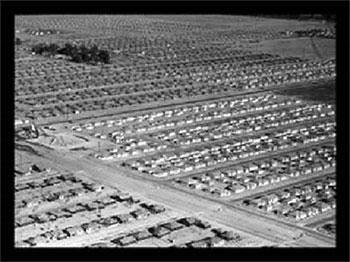
    And we know that Boyer, Taper, and Weingart and Fritz Burns and Joseph Eichler and Henry Kaiser understood that the Progressive era model of low-cost housing they had adapted to mass production would result in new relationships to the idea of place. Garnett’s photographs of deeply shadowed forms on a titanic grid would for some critics and many Americans permanently define that relationship as dread.

    In a memorable speech by James Howard Kunstler at the 1999 Congress for the New Urbanism, the kind of place where I live was described as a perversion of a place. “It is the dwelling place of untruth,” Kunstler told the New Urbanists. The title of his speech was “The place where evil dwells.”

    My parents and their neighbors more generously than Mumford or Blake or Kunstler understood what they had gained and lost in owning a small house on a small lot in a neighborhood connected to square miles of just the same.
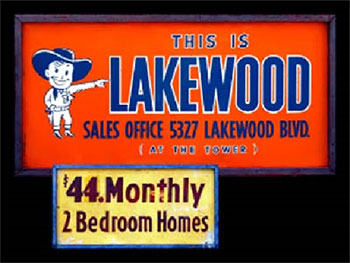
    Despite everything that was mistaken or squandered in making my suburb, I believe a kind of dignity was gained. More men than just my father have said to me that living in my kind of place gave them a life made whole and habits that did not make them feel ashamed.

    As far as I could tell by their lives, my parents did not escape to their mass-produced suburb. They never considered escaping from it. Nor have I.

    I’ve lived my whole life in the 957-square-foot house my parents bought when the suburbs were new, when no one could guess what would happen after tens of thousands of working-class husbands and wives – so young and so inexperienced – were thrown together without an instruction manual and expected to make a fit place to live.
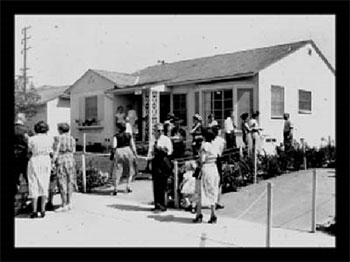
    What happened after was the usual redemptive mix of joy and tragedy.

    The suburb where I live is a place that once mass-produced a redemptive future for displaced Okies and Arkies, Jews who knew the pain of exclusion, Catholics who thought they did, and anyone white with a job. Left out were many tens of thousands of others: people of color whose exclusion was not just a Californian transgression.

    Today, futures still begin here, except the anxious, hopeful people who seek them are as mixed in their colors and ethnicities as all of southern California.

    I continue to live in Lakewood with anticipation because I want to find out what happens next to new narrators of suburban stories who happen to be my Latino, black, Filipino, Chinese, Korean, and Vietnamese neighbors.
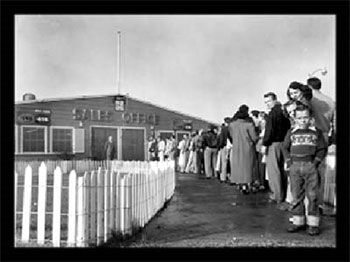
    There are Californians who don’t regard a tract house as a place of pilgrimage, but my parents and their friends did. They were grateful for the comforts of their not-quite-middle-class life. Their aspiration wasn’t for more but only for enough despite the claims of critics then and now who assume that suburban places are about excess.

    I actually believe that the place where I live is, in words of the Californian philosopher Josiah Royce, a “beloved community.” The strength of that regard, Royce thought, might be enough to form what he called an “intentional community” – a community of shared loyalties – even if the community is as synthetic as a tract-house suburb or the Gold Rush towns that Royce knew in his boyhood. I believe Royce was right: At a minimum, loyalty to the idea of loyalty is necessary, even if the objects of our loyalty are uncertain.

    Urban planners tell me that my neighborhood was supposed to have been bulldozed away years ago to make room for something better, and yet the houses on my block stubbornly resist, loyal to an idea of how a working-class neighborhood should be made.
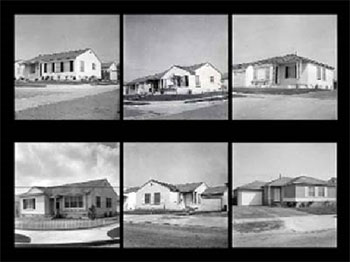
    It’s an incomplete idea even in Lakewood, but it’s still enough to bring out 400 park league coaches in the fall and 600 volunteers to clean up the weedy yards of the frail and disabled on Volunteer Day in April and over 2,000 residents to sprawl on lawn chairs and blankets to listen to the summer concerts in the park.

    I don’t live in a tear down neighborhood, but one that makes some effort to build itself up. All this is harder now, for reasons we all know.

    The suburbs aren’t all alike, of course, and there are plenty of toxic places to live in gated enclaves and McMansion wastelands. Places like that have too much – too much isolation and mere square footage – but, paradoxically, not enough. Specifically, they don’t have enough of the play between life in public and life in private that I see choreographed by the design of my suburb.

    With neighbors just 15 feet apart, we’re easily in each other’s lives – across fences, in front yards, and even through the thin, stucco-over-chicken-wire of house walls. When I walk out my front door, I see the human-scale, porous, and specific landscape into which was poured all the ordinariness that has shaped my work, my beliefs, and my aspirations. Out there, I renew my “sense of place” and my conviction that a “sense of place,” like a “sense of self,” is part of the equipment of a conscious mind.

    We often find it difficult to talk coherently about these issues or to make coherent policy choices for places to which our loyalty is only lightly attached.

    It seems to me that the abiding problem of southern California indeed of the entire West is the problem of home. We long for a home here, but doubt its worth when we have it. We depend on a place to sustain us, but dislike the claims on us that places make. Each of us is certain about our own preference for a place to live, but we’re always ready to question your choice.

    How do we make our home here, in new and sudden and places like Lakewood, like Irvine, like Santa Clarita? We’ve been asking that question for a very long time sometimes in despair. At almost the beginning of California, a disillusioned 49er named Thomas Swain wrote in 1851, “Large cities have sprung into existence almost in a day. . . The people have been to each other as strangers in a strange land ….”

    And too many of us are strangers still in a place that too many regard as uniquely perverse. And because much of southern California looks roughly the same too many of us see all these suburban places as aesthetically, politically, and morally perverse as well. And no place – however well crafted – is immune from the peculiarly American certainty that something better – something more adequate to the demands of our desire – is just beyond the next bend in the road.

    The question of “home” is increasingly acute because there’s hardly anywhere left to build another Lakewood or Irvine or Santa Clarita.

    The closing of the suburban frontier in southern California ends a 100-year experiment in place making on an almost unimaginable scale. The experiment was based on a remarkably durable consensus about the way ordinary people ought to be housed, beginning with turn-of-the-century beliefs about the power of a “home in its garden” to ameliorate the lives of working people and ending in the 1950s with tract houses turned into an affordable commodity.

    Today, most of southern California is what it will continue to be: uniformly dense and multi-polar, urbanized in fact but suburban in appearance, characterized by single-family homes in neighborhoods with a strong – but provisional – dependence on more “urban-like” nodes.

    This is a form for living and working, but it is neither “incoherent” nor “mindless sprawl.” That form in the future will, of course, be somewhat more dense – but our evolving suburbs cannot deliver mere density. In tandem with greater concentration of housing types must come what working-class people have always sought in southern California: a home with enough private space around it and enough public space adjacent to it so that this assemblage of house, lot, street, and transportation grid form the neighborhood-specific space that answers our desires.

    We can lament that too many suburban places are less than they some wish them to be, but I see no perfect way to bring “utopias” out of these suburban habits both good and bad. I see only a persistent longing to make fit places in which to live.

    Many of these places will look an awful lot like Orange County – dispersed, uniformly dense, and embedded in a metropolitan region in which historic downtowns function as “nodes.” The contest for the soul of our suburban region hinges on whether this constitutes enough to make a place where memories might be unblighted and desires assuaged.

    The author and environmentalist Barry Lopez considered some years ago what might be needed to make a durable life for ourselves in southern California. And in considering the problem of home, Lopez asked a challenging question: “How can we become vulnerable to the place where we live?”

    If that might be a goal if that tenderness were possible we might ask different questions when we build or approve a development project. We could ask, "What aspects of its design encourage loyalty to this place? What is built into this place that might evoke someone’s sympathy? Would anyone ever become vulnerable to this place?”

    What I have been speaking of is the acquisition something more than an idiosyncratic sensibility but a communal achievement that requires something from all of us. Built-out, maximally diverse, and more grown up, southern California requires courage to extend one’s imagination across its whole, tragic, human, and humanizing body.

    As for me, my suburb’s modesty keeps me there. When I stand at the head of my block, I see a pattern of sidewalk, driveway, and lawn, set between parallel low walls of house fronts that aspires to be no more than harmless. We live in a time of great harm to the ordinary parts of our lives and I wish that I had acquired all the resistance that my neighborhood offers.

    What I hope we might gain is a larger “moral imagination” … the imagination by which we might write ourselves into the story of our place and negotiate a way from the purely personal to the public.

    I don’t really know how (or perhaps I do only dimly). But faithfulness to what can be found in our history – to what can be found in our shared stories – impels me forward.

    It may surprise you to learn the object of Lopez’s meditation on vulnerability was the place where he grew up – a tract house neighborhood in the San Fernando Valley. And Lopez had this additional insight while contemplating his Valley home. He wrote . . . “Always when I return there, I have found again the ground that propels me past the great temptation of our time to put one’s faith in despair.”
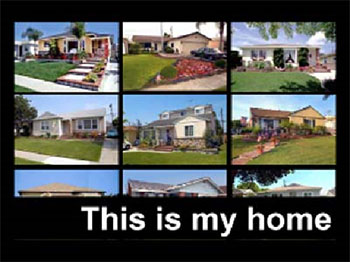
    Despair or regret: “There once was a perfect Eden,” the conventional story goes, “to which gullible people were lured and as a result this Edenic place declined into the horrors of suburbanization.” And the moral of that story is “people ruin places.”

    I believe that people and places form each other … the touch of one returning the touch of the other. What we seek, I think, is tenderness in this encounter, but that goes both ways, too. I believe that places acquire their sacredness through this giving and taking. And with that ever-returning touch, we acquire something sacred from the place where we live. What we acquire, of course, is a home.

    It’s a question of falling in love … falling in love with the place where you are; even a place like mine … so ordinary, so commonplace, and my home.

    # # #

    D. J. Waldie is a contributing editor at the Los Angeles Times and a contributing writer for Los Angeles magazine. He is the author most recently of California Romantica with Diane Keaton. He blogs for KCET TV at http://www.kcet.org/user/profile/djwaldie.
  • Suburbs and Sacred Space

    Suburbs are often unfairly maligned as lacking the qualities that make cities great. But one place that criticism can be fair is in the area of sacred space. There most certainly is sacred space in the suburbs, but usually less of it than in the city both quantitatively and qualitatively.  In fact, the comparative lack of sacred space is one of the distinguishing characteristics of the suburb that makes it “sub” urban, that is, in a sense lesser than the city.

    Lewis Mumford put it this way:

    Behind the wall of the city life rested on a common foundation, set as deep as the universe itself: the city was nothing less than the home of a powerful god. The architectural and sculptural symbols that made this fact visible lifted the city far above the village or country town….To be a resident of the city was to have a place in man’s true home, the great cosmos itself.

    Mumford was onto something here in positing how great temples and such distinguished the city as unique.

    What Is Sacred Space?

    Mumford also hints at what makes something truly sacred space. We should clearly distinguish between what is merely public space and truly sacred space. The key to sacred space is the linkage to the transcendent.  That is, sacred space connects us to something beyond or bigger than our surroundings, our present existence, and even ourselves.

    Here are three ways sacred space can do that. It can:

    1. Connect us to a larger spiritual or religious reality, as in our Mumford example.  This is the most obvious case.
    2. Serve as a locus or repository of the culture and traditions of a people.
    3. Be a temporal connection between the present and the past and/or the future.

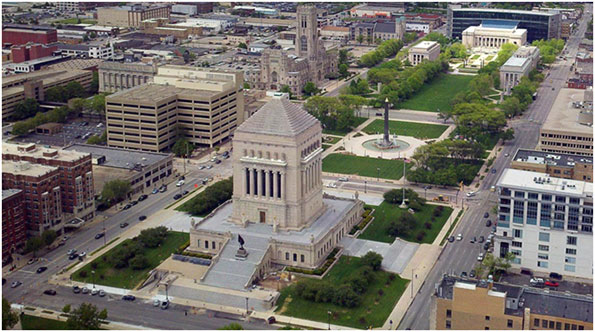
    As one example, consider the Indiana World War Memorial in downtown Indianapolis.

    This building is of course a symbol of the bedrock American values of that community and the willingness of its people to die to defend them yesterday, today, and tomorrow. Thus it is both a cultural repository and a temporal linkage.

    Also note the use of neoclassicism. The use of neoclassical architecture anchors Indianapolis and Indiana firmly within the 2,500 year history of Western Civilization, as a link in a chain of peoples connected by shared, timeless values and extending backwards and forward throughout time, thus achieving a sort of immortality.  This building is a statement of the permanence of this community, its people, and their values.

    We can also think of a radically different space such as Times Square, and how it has played host to so many civic celebrations and traditions over the years such that it has become not just a local but a national repository of our culture. The ball dropping on New Year’s Eve is an obvious example. But consider also this iconic photo.

    This is one of the most famous pictures from the war era and I don’t think it’s any surprise it was taken Times Square.

    How Suburbs Are Comparatively Lacking in Sacred Space

    Let’s apply the definition of sacred space to the suburbs. Yes, suburbs do have war memorials and culture and traditions and churches, but in general these are qualitatively different from what is found in the city core.  Here are three reasons why.

    1. Suburban traditions and spaces are often ephemeral and generational. When I was in high school, everybody liked to go to a place called Down Home Pizza in Corydon on the weekends. And that was something kids from every high school in the area did, not just those from mine. Today that place is long gone. And the kids are doing something else, whatever that may be.  In fact, it’s amazing how many of the places and traditions from my high school days are already gone after only 25 years because of physical and economic changes in the community such as restaurants and stores going out of business.

    This happens in the city too, like when the department stores went under, taking their white-gloved tea rituals and the like with them. But to a much greater extent than the city, suburbs rely on commercial establishments as focal points of shared experience, and by their very nature those tend to come and go. And suburbs have not to nearly as a great a degree established truly trans-generation rituals and spaces.

    2. Lack of transcendent scale. This is also something Mumford hints at. The “human scale” is a big buzzword in urbanism today. Contrary to what many say, the suburbs actually do a pretty good job of the human scale, especially from an automobile era perspective. But a unique essence of urbanity and often of transcendent experience itself is what we might call the “anti-human scale.” British writer Will Wiles put it this way:

    The “human scale” only tells part of the story of the city – after all, this can be found in villages and small towns. All cities need sublimity, a touch of holy terror, a defiance of human scale that asserts connection to the greater urban whole.

    The sheer scale of something like the Indiana War Memorial, which is a very imposing structure inside and out, renders it qualitatively different that your average small scale suburban memorial. This is true not just physically but also in terms of the humanity represented. That memorial stands for an entire state, not just a single town. Which is the same reason there may be more suburban school kids who have visited their state capital or the US Capitol than their local village hall.  There’s a reason the US Capitol and Lincoln Memorial and such have such powerful resonance. They represent an entire nation and a vast sea of humanity. Cities also participate in this scale effect.

    3. Low quality religious architecture. When it comes to the most obvious category of sacred space, the religious building, the suburbs also fall flat. That’s because Protestant Christianity, the largest suburban religious strain, has itself become unmoored from the transcendent. This is clear, for example, from the rise of what has been dubbed “Moralistic Therapeutic Deism” as a dominant worldview, especially among the young.

    The average suburban megachurch is an architectural horror show. The best of them generally rise to the level of an upscale corporate conference center. The worst are like “That 70’s High School”.

    Someone once said that all sin results from failing to believe one of the “4 G’s” about God, namely, God is great, God is good, God is gracious, and God is glorious. Applying that to religious life generally, in modern Evangelical churches, God may be very good and gracious, but He’s doesn’t seem all that great, and He’s certainly not very glorious.  This is religion that can inspire good works, but not great ones. There’s no trace of the overwhelming glory of God in nearly any of these structures. There’s no longer a faith like the Lutheranism of Johann Sebastian Bach that can inspire the greatest works of human artistic achievement.  Because modern suburban church architecture is so poor and so disposable, it diminishes the impact of sacredness in the space.

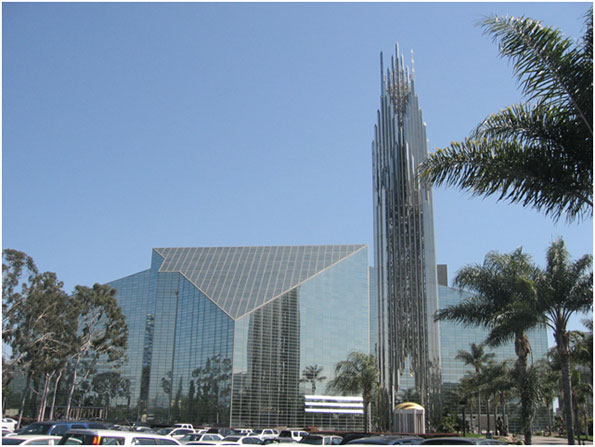
    The recent stories about the sale of Orange County’s Crystal Cathedral, designed by Philip Johnson, brings to mind an exception that proves the rule.

    Unsurprisingly it was the Catholic Church that bought it. Unlike Protestantism, Catholicism has always had a theology of place. And they’ve always used architecture and art as a way of telling the story of the gospel. Though obviously not in this case, they’ve also used Gothic sort of like neoclassical architecture as a way creating a sense of permanence and linkage to an everlasting, eternal church.

    So sacred space is one area where the suburbs really are deficient versus the city. But how important is this? Metropolitan areas today are mosaics. In an ever more complex and competitive global economy, every part of a region, city and suburb, needs to know its role on the team and bring it’s A-game. Just as there’s no need for every job to be located downtown, there’s no need for every major piece of sacred space in a region to be replicated in every suburb. Downtown does just nicely. However, this is one reason that while economically the core may no longer dominate a region, a healthy center still plays a key role in overall regional vitality. That’s because it remains home to things like the major pieces of sacred space such as war memorials and cathedrals that bind a region together and give it civilizational permanence, meaning, and purpose beyond the mundane.

    This article was adapted from remarks at the No Place Like Home conference on June 3, 2013 in Anaheim, CA.

    Aaron M. Renn is an independent writer on urban affairs and the founder of Telestrian, a data analysis and mapping tool. He writes at The Urbanophile.

    Suburbs photo by Bigstock.

  • Retrofitting the Dream: Housing in the 21st Century, A New Report

    This is the introduction to "Retrofitting the Dream: Housing in the 21st Century," a new report by Joel Kotkin. To read the entire report, download the .pdf attachment below.

    In recent years a powerful current of academic, business, and political opinion has suggested the demise of the classic American dream of home ownership. The basis for this conclusion rests upon a series of demographic, economic and environmental assumptions that, it is widely suggested, make the single-family house and homeownership increasingly irrelevant for most Americans.

    These opinions — which we refer to as ‘retro-urbanist’ — gained public credence with the collapse of the housing bubble in 2007. The widespread media reports of foreclosed housing in suburban tracts, particularly in the exurban reaches of major metropolitan areas, led to widespread reports of the “death of suburbia” and the imminent rise of a new, urban-centric “generation rent.”

    Yet despite this growing “consensus” about the future of housing and home ownership, our analysis of longer-term demographic trends and consumer preferences suggests that the “dream,” although often deferred, remains relevant. We see this in the strength of suburbs, as well as in the growth of the post-war “suburbanized cities” that generally have been the fastest growing regions of the country. These trends are notable in the three key demographic groups that will largely define the American future: aging boomers, immigrants, and the emerging millennial generation.

    This does not mean that suburbia, or home construction patterns, will not change in the coming decades. Higher energy prices, for example, could necessitate shorter commutes, even with automobile fuel efficiency improvements. The emerging concentration of employment centers could help bring this about by improving job housing balance. There is a need to fully make use of the high speed digital communication that can promote both dispersed and home-based work.

    For these and other reasons McKinsey & Company, among others, has noted that meeting environmental challenges does not require the kind of radical alteration of lifestyles and aspirations so widely promoted in the media, academia, and among some real estate interests. Equally important, there has been little consideration of the profound economic and social benefits of both home ownership and low to medium density living. These include, on the economic side, the huge impact on employment from home construction and the ancillary industries associated with household upkeep and improvement.

    More important still may be the social benefits. Most serious studies have shown that lower-density, homeowner-oriented communities are more socially cohesive in terms of volunteerism, neighborly relations, and church attendance, than denser, renter-oriented communities. Suburban and lower density urban neighborhoods are particularly critical for the growth of families and the raising of children, an increasingly important factor in a ‘post-familial’ era of plunging birthrates.

    To be sure, housing has been changing rapidly from the model developed in the 50s, and this process will continue over the next generation. Houses today are more energy efficient, and look to accommodate home-based work, as well as extended, multigenerational families. Similarly, the suburbs and low/mid density urban communities are already far more diverse, in terms of ethnicity and age profile, than the homogeneous communities often portrayed in media and academic accounts. This trend is also likely to accelerate.

    Ultimately, we believe that the dream is not at all dead, but is simply evolving. America’s tradition of property ownership, privacy, and the primacy of the family has constituted a critical aspect of our society since before the nation’s founding. It will need to remain so in the decades ahead if the country is to prove true to the aspirations of its people and the sustainability of its demographics.

    Joel Kotkin is executive editor of NewGeography.com and a distinguished presidential fellow in urban futures at Chapman University, and a member of the editorial board of the Orange County Register. He is author of The City: A Global History and The Next Hundred Million: America in 2050. His most recent study, The Rise of Postfamilialism, has been widely discussed and distributed internationally. He lives in Los Angeles, CA.

  • Market Surge Confirms Preference for Homeowning

    Ever since the housing bubble burst in 2007, retro-urbanists, such as Richard Florida, have taken aim at homeownership itself, and its “long-privileged place” at the center of the U.S. economy. If anything, he suggested, the government would be better off encouraging “renting, not buying.”

    Similar thinking has gained currency with some high-rise (or multi-unit) builders, speculators and Wall Street financiers, who would profit by keeping Americans permanent renters, with encouragement from former Morgan Stanley financial analyst Oliver Chang, who predicted we were headed toward a “rentership society.”

    Some support comes from research suggesting that higher ownership rates actually create unemployment. A study by the proausterity Peterson Institute for International Economics, cited recently both by Florida and the New York Times’ Floyd Norris, lays out an econometric case against homeownership.

    The authors justified their findings by pointing to larger unemployment-rate changes from 1950-2010 in states, mostly in the South, such as Alabama, Georgia, Mississippi, South Carolina and West Virginia, compared with California, North Dakota, Oregon, Washington and Wisconsin. They then noted that, in the states with the larger unemployment rate increases, homeownership had increased more. Hence, the connection between higher homeownership and higher unemployment rates.

    This analysis is staggeringly ahistorical. It fails to correct for the massive labor market changes that have occurred in the Southern states, as the agricultural and domestic employment common in 1950 has largely disappeared. The analysis begins with a year in which three of the states cited to prove that lower homeownership is associated with lower unemployment had unusually high unemployment in 1950 (California was No. 1, Oregon, No. 4, and Washington, No. 6); unemployment in these three West Coast states averaged nearly double that of the Southern examples.

    Another ahistorical implication is that that the South experienced a huge increase in homeownership since 1950, as economically disadvantaged African-Americans began to buy their residences. An analysis by demographer Wendell Cox indicates that, even as labor markets were being radically altered, per capita incomes in relatively underdeveloped Alabama, Georgia, Mississippi, South Carolina and West Virginia rose during 1950-2010 at more than double the rate experienced in California, North Dakota, Oregon, Washington and Wisconsin (more than 140 percent, adjusted for inflation, compared with approximately 65 percent).

    The Peterson thesis is also undermined by a close examination of county homeownership and unemployment rates, which finds, generally, that large counties with higher rates of homeownership have lower unemployment rates. For example, among the nation’s approximately 260 counties with more than 250,000 residents, those with homeownership rates above 70 percent have average unemployment rates of 8.1 percent. Among the counties with homeownership rates below 50 percent, unemployment rates average 9.6 percent. This is exactly the opposite relationship that would be expected from the Peterson Institute research.

    Finally, many large urban counties with the lowest homeownership rates – Los Angeles, Kings County (Brooklyn), New York County (Manhattan), Queens, Cook County (Chicago) and Philadelphia – also suffer well-above-average levels of unemployment and high levels of poverty. In contrast, suburban counties with high homeownership rates, like Nassau County, N.Y., Chester County (in the Philadelphia area), or Fairfax County, Va., boast considerably lower unemployment than their urban neighbors, and higher per-capita incomes. Most of the cities with the highest ownership rates, like Fort Worth and Austin, Texas, Indianapolis, Denver and Columbus, Ohio, all did very well in the most recent Forbes “Best Cities for Jobs” study.

    It is also alleged that countries with high ownership rates do worse than those with lower ones. And to be sure, troubled countries like Portugal and Spain have high levels of homeownership, while Germany, Sweden and Denmark have somewhat lower ones. Yet, many successful countries – Taiwan, Singapore, Norway, Australia, Canada and Israel – actually do quite well with higher ownership rates than in America.

    Dream that refuses to die.

    From a historic perspective, the present U.S. homeownership rate, 65.4 percent, does not represent a structural decline from the middle 2000s, as is often argued, but remains consistent with the virtual equilibrium achieved over the past half century. As recently as 1940, only 40 percent of Americans owned their homes, a share that reached 60 percent by 1960s. Since then, it has remained fairly stable. The modest decline from the middle 2000s was from an artificially high level that resulted from the virtual suspension of mortgage credit standards – egged on by Wall Street and government agencies – which was followed by a deep recession and a weak recovery.

    The housing bust changed the market, but not because of some fundamental shift in buyer preferences, as is sometimes alleged. Indeed, the recent spike in home sales confirms that Americans continue to aspire to homeownership. Research at the Woodrow Wilson Center indicated that 91 percent of respondents identified it as essential to the American Dream, and most favored steering government policy to spur homeownership.

    Much has been written about how the under-30 population is either living at home or cannot buy a house. Yet, surveys by generational chroniclers Morley Winograd and Mike Hais found that a full 82 percent of adult millennials surveyed said it was “important” to own their own home, which rose to 90 percent among married millennials. Another survey, this one by TD Bank, found that 84 percent of renters ages 18-34 intend to purchase a home in the future.

    Homeownership achieves almost cultish status among immigrants, who account for some 40 percent of all new owner households over the past decade. Among Asians who entered the country before 1974, a remarkable 81 percent own their home, while Latino homeownership is projected to rise to 61 percent by 2020.

    Societal advantages of owning

    Critics of homeownership often point out that renters have far more flexibility to move; that’s true and important particularly for people in their 20s. But, as people age, get married and, especially, have children, they seek to become involved in their communities on a more permanent basis. Pundits and economists often fail to recognize that people are more than simply profit-maximization machines ready to cross the country for an income increase of a few thousand dollars; they also seek out friends, stable neighbors, familial comfort, community and privacy.

    Homeowners reap the financial gains of any appreciation in the value of their property, so they tend to spend more time and money maintaining their residence, which also contributes to the overall quality of the surrounding community. The right to pass property to an heir or to another person also provides motivation for proper maintenance.

    Given their stake, homeowners participate in elections much more frequently than renters. One study found that 77 percent of homeowners had, at some point, voted in local elections, compared with 52 percent of renters. The study also found a greater awareness of the political process among homeowners. About 38 percent of homeowners knew the name of their local school board representative, compared with 20 percent of renters. The study also showed a higher incidence of church attendance among homeowners.

    People who own their homes also tend to volunteer more in their community, notes the National Association of Realtors. This applies to the owners of both expensive and modest properties. One 2011 Georgetown study suggests that homeownership increases volunteering hours by 22 percent.

    Perhaps the largest social benefits relate to children. Owners remain in their homes longer than do renters, providing a degree of stability valuable for children. Research published by Habitat for Humanity identifies a number of other advantages for children associated with homeownership versus renting, ranging from higher academic achievement, fewer behavioral problems and lower incidence of teenage pregnancy.

    ‘A share in their land’

    Even before the American Revolution, the notion of ownership, usually of a farmstead, was a critical lure. Even after the yeoman utopia of the early 19th century faded, Americans continued to yearn for their own homes, something that led them in two great waves, first in the 1920s and again in the 1950s and 1960s, to the suburban periphery.

    In contrast to today’s progressives, many traditional liberals embraced the old American ideal of dispersed land ownership. “A nation of homeowners,” President Franklin D. Roosevelt believed, “of people who own a real share in their land, is unconquerable.”

    Legislation under Roosevelt and successor presidents supported this ideal. More than a response to the market, governments embraced homeownership as a positive societal and economic good for the majority of Americans. This policy – brilliantly exploited by entrepreneurs – worked for both people and the economy. Almost half of suburban housing, notes historian Alan Wolfe, depended on some form of federal financing.

    Road to serfdom?

    The suggestion that we need to abandon what the New York Times denounces as the “dogma on owning a home” has grown deeply entrenched among retro-urbanists. Rather than facilitate the broad dispersion of property ownership across economic classes, the new orthodoxy suggests we would be better off as a nation of renters, living cheek-to-jowl in apartments. This works to the advantage of the Wall Streeters and other investors, who profit from our paying off their mortgages rather than our own. The assault on homeownership also pleases some advocates of austerity, such as Pete Peterson, who would like to eliminate the mortgage interest deduction as a way to raise revenue at the expense of the middle class.

    Turning against homeownership undermines the very promise of American life and the culture of independence critical to our identity as a people. Housing accounts for about two-thirds of a family’s wealth and the vast majority of the property owned by middle- and working-class households. The house represents for the middle class, devastated by the weak recovery, both a chance to make a long-term investment as well as a place to raise a family; a Wall Street portfolio, for all but the very affluent, who can afford the best advice, provides no reasonable alternative.

    We have to consider what kind society we wish to have. The nomadic model now in fashion suggests Americans should simply move from place to place, untethered to any one spot, seeking personal fulfillment and the best financial deal for themselves. Such a model fits with current planning dogma and facilitates a source of profit for some, but undermines the dispersion of property that can sustain our society, and our families, over the long run.

    Joel Kotkin is executive editor of NewGeography.com and a distinguished presidential fellow in urban futures at Chapman University, and a member of the editorial board of the Orange County Register. He is author of The City: A Global History and The Next Hundred Million: America in 2050. His most recent study, The Rise of Postfamilialism, has been widely discussed and distributed internationally. He lives in Los Angeles, CA.

    This piece originally appeared in the Orange County Register.

    Home illustration by Bigstock.
    Update: The Pete Peterson referred to here is not the Pete Peterson running for office in California.