Category: Urban Issues

  • The Swaps of Damocles

    "Privileged people don’t march and protest; their world is safe and clean and governed by laws designed to keep them happy…." Michael Brock in John Grisham’s The Street Lawyer (Doubleday, 1998).

    "There can be nothing happy for the person over whom some fear always looms…” Cicero, Tusculan Disputations 5.62, via Wikipedia.com

    If you were fearful after Wall Street decimated your life-savings in September 2008 then you should know that the sword of Damocles remains above your head.

    Absolutely nothing of any significance has changed. Not rules, laws or regulations. Not government oversight or external auditing. Nothing. What happened to our financial well-being in the Fall of 2008 can happen again tomorrow. If anything is being done, it is being expertly designed to make things worse for Main Street and better for Wall Street. When the tech bubble burst in March 2000, the Federal Reserve dropped dollar bills from helicopters and inflated the housing market. At least that time around, it was obvious where the next bubble would come. In an effort to hide the inflation this time around, the Fed is pumping money into dark corners of finance where it will eventually impact everything everywhere.

    First, a quick recap: During 2007, mortgage-backed bonds began failing faster than actual mortgages. Wall Street wrote bonds faster than Main Street needed mortgages – two bankruptcy judges estimated that one-third of the bonds didn’t have mortgages backing them.

    Meanwhile, insurance companies like AIG were writing credit default swaps even faster – some say there were as many as 15 swaps for every bond (by value). In 2008, AIG was unable to pay off on the credit default swaps (like insurance contracts) they wrote for the Wall Street bankers. The bankers had named themselves beneficiaries and they began cashing in – again – when the whole thing went up in flames.

    Then-Secretary of the Treasury Hank Paulson went to Congress and said the world would end if taxpayers did not give him $750 billion to bailout the banks. Congress said, “Sure, why not, you seem like a nice guy” and the Wall Street Bailout was signed into law by George W. Bush on October 1, 2008. In the months that followed, we learned that the Federal Reserve topped off the Wall Street tanks with trillions more dollars – a lot of which went to foreigners and private companies not under their regulatory purview. Since then, Federal Reserve Chairman Ben Bernanke has been dropping dollar bills out of helicopters by buying more and more mortgage un-backed bonds from Wall Street because – well, no one is quite sure why he is doing this.

    Eventually, Senator Chris Dodd (D-CT) and Representative Barney Frank (D-MA) got their names attached to a new public law, which President Obama signed on July 21, 2010 – about two years after the bailout – that was supposed to reform Wall Street and protect Consumers. Five months after the signing, Sen. Dodd announced his retirement (not long after it was made public that he and several Senators received very friendly terms on a mortgage from sub-prime mortgage bond King Angelo Mozilo of Countrywide). Rep. Frank will not seek reelection in November 2012. Neither Dodd nor Frank planned to be around when the bill is actually effective. You see, a lot of Dodd-Frank was only to require that someone else do studies, write reports and propose rules. Less than half of the rules were required to be written before Rep. Frank leaves office – Dodd left office before any action was required under the public law with his name on it.

    Both Dodd and Frank are retiring with full pensions, but the same cannot be said about the public law with their names on it. As of September 21, 2012, about as many Dodd-Frank rules have been proposed as there are mortgages backing those mortgage-bonds the Fed is buying. According to a review by New York law firm Davis Polk (as of September 4, 2012):

    • Of the 398 total Dodd-Frank rulemaking requirements:
      • 131 (32.9%) have final rules
      • 135 (33.9%) have proposed rules
      • 132 (33.2%) have not yet been proposed
    • Of the 247 rulemaking deadlines that have passed:
      • 145 (61.2%) have been missed
      • 31 (13%) have not even had proposals
        Source: http://regreformtracker.aba.com

    So far as I was concerned, the only actual success of Dodd-Frank came from an amendment which required the Federal Reserve to disclose exactly to whom they gave the bailout money  – information on 21,000 transactions valued at $16 trillion that Fox News, Bloomberg and Rolling Stone Magazine sued to get after the Chairman and Vice Chairman of the Fed refused to reply to questions from Congress. Turns out the Fed officials went from sins of omission to sins of commission – Bloomberg reported in December that they hid billions of dollars in loans from the mandated reports. Despite now knowing that the Federal Reserve is giving money to unregulated companies with no means of retrieving it, the U.S. public – outside of a faithful few Occupy Wall Street protestors still out there – have failed to notice or react. Hence, nothing has changed that would prevent a repeat of the events that precipitated the 2008 bailouts from occurring again tomorrow.

    “But wait! That’s not all!” as they say in late-night TV infomercials. More than ignoring the law, more than delaying the reforms, Wall Street is now actively working to get new laws written to exempt themselves from Dodd-Frank – which, we thought, was specifically written to reform their activities. On September 19, H.R. 2827 was passed by Congress to exempt from any Dodd–Frank rulemaking the very activity that is bankrupting some US cities and states and counties.

    The law they are now exempted from is the one that would require them to accept legal responsibility for putting the best interests of the municipalities and taxpayers first – a blanket requirement for fiduciary duty that already exists but is consistently ignored by the “survivors of Wall Street survivors of the financial crisis” as they are called by William D. Cohan, author of the New York Times bestseller House of Cards: A Tale of Hubris and Wretched Excess on Wall Street. Cohan emphasizes that bribing clients like Jefferson County is not new – although it seems evident that the problem may be more wide spread now than ever before in US history. Jefferson County (AL) may be the best known – bankruptcy followed on the heels of bribes and billions of dollars worth of toxic swap deals. The Wall Street banks not only bribe officials to commit municipal taxpayers to financial obligations they can never repay, they also pay competing banks so they can charge higher fees and interest rates. This breaches the simple trust you are entitled to expect even from used car salesmen (in states with “Lemon Laws”) – but no such protection is afforded anyone who has to deal with Wall Street.

    In the end, we are all required to deal with Wall Street. This is a danger more real, and more imminent, than anything the world may ever have faced. It is as if we have been told that an asteroid the size of Texas is barreling toward Earth and Ben Bernanke hit the button that launched the nuke — that missed. It’s still coming. Wall Street remains unreformed and consumers of financial services remain unprotected.

    Susanne Trimbath, Ph.D. is CEO and Chief Economist of STP Advisory Services. Dr. Trimbath’s credits include appearances on national television and radio programs and the Emmy® Award nominated Bloomberg report Phantom Shares. She appears in four documentaries on the financial crisis, including Stock Shock: the Rise of Sirius XM and Collapse of Wall Street Ethics and the newly released Wall Street Conspiracy. Dr. Trimbath was formerly Senior Research Economist at the Milken Institute. She served as Senior Advisor on United States Agency for International Development capital markets projects in Russia, Romania and Ukraine. Dr. Trimbath teaches graduate and undergraduate finance and economics.

  • The Land Premium That’s Punishing Property

    High land prices have all but killed the Australian housing industry.

    Lower housing starts has led to lower GST revenues (house construction attracts full GST) and lower stamp duty receipts are crippling state budgets and cruelling the chances of low and middle income earners to get a start in the housing market.

    What has caused this slump in housing starts? Land prices.

    Raw land for new housing developments should be close to its agricultural value – in other words, around $10,000 per hectare. But land released for residential development fetches up to $1 million per hectare – 100 times the agricultural price.

    Government land management agencies and private land developers may well argue a lot of land has been released for residential development, but clearly it is not enough.

    Only when urban growth boundaries are removed will we know a piece of land’s true value. It will then be a trade-off between price and distance. People may be prepared to travel another 10 or 15 minutes by car (10 to 20km) to get a cheaper block.

    To highlight the “‘X’ years supply of land available” argument, I heard a state bureaucrat say recently that the government had released enough land for 15 years supply. I raised my hand and asked “15 years supply – at what price?” He didn’t know what I meant. I said “at $200,000 a block it may well take 15 years to sell. So why don’t you double the price and then you’ll have 30 years supply?”

    These points highlight the fact that, as with most central planning, housing planning is based on a fundamental flaw – that price does not matter. But as we know, price does matter. Imagine the demand for housing if land was $100,000 per block cheaper. Think LCD, LED and plasma TVs over the past five years.

    Australia does not have, and never has had, a housing affordability problem, it has a land affordability problem. The cost of building a new house has hardly moved in 20 years. Land prices however have skyrocketed. By restricting the amount of land available on the urban fringes of our cities, state governments have sent the price of entry-level housing through the roof.

    The reasons state governments give for these restrictions all centre on urban planning. They have persisted with their policies of urban densification (squeezing more and more people into existing suburbs), an idea that has failed all over the world.

    Whether it’s traffic congestion, air pollution, the destruction of bio-diversity or the unsustainable pressure on electricity, water, sewage or stormwater infrastructure, urban densification has been a disaster. The evidence is overwhelming; urban densification is not good for the environment, it does not save water, it does not lead to a reduction in motor vehicle use, it does not result in nicer neighbourhoods, it does not stem the loss of agricultural land, it does not save on infrastructure costs for government and, worst of all, it puts home ownership out of the reach of those on low and middle incomes.

    State governments use urban planning laws to restrict the amount of fringe land available and then drip feed it through their land management agencies to a land- starved housing industry at inflated prices. Hmmm. After a change of state government a few years ago, a former cabinet minister was asked why her government didn’t release more land to kick-start the housing industry. She replied: “We needed the money.” So much for urban planning.

    And of course land developers with massive land banks on their books urge state governments to maintain the scarcity to maintain the ‘value’ of the developers’ inventory. Developers would be better off if they supported the removal of urban growth boundaries and allowed more broadacre land to come onto the market which they could buy at greatly reduced prices. With land prices significantly lower than they are today it wouldn’t take long for the industry to recover. Until land prices fall, there will be no recovery.

    The Australian housing industry is building 40,000 fewer homes a year than it should be. That’s more than $10 billion worth of work a year the industry is missing out on. That’s a lot of bricks, concrete, timber, tiles, steel and, of course, labour.

    Governments and industry associations have known for years this was coming but just played footsies with each other – read US economist George Stigler’s book Regulatory Capture to understand how and why this happens.

    Australia’s economy has been seriously distorted due to a massive overinvestment in household debt. We have a housing industry on its knees. Getting all this back into alignment with reality will take time but it is a realignment that is necessary.

    We cannot continue to deny the next generation a home of their own merely to satisfy the indulgences of urban planners and state government treasury officials.

    This piece originally appeared in Business Spectator.

    Bob Day AO is managing director of national homebuilder Home Australia.

    Brighton Beach bathing box photo by Bigstock.

  • A Planet of People: Angel’s Planet of Cities

    Professor Shlomo Angel’s new book, Planet of Cities, seems likely to command a place on the authoritative bookshelf of urbanization between Tertius Chandler’s Four Thousand Years of Urban Growthand Sir Peter Hall’s Cities and Civilization and The Containment of Urban England. Chandler produced the definitive volume of gross population figures for urban areas (cities) over millennia. Angel, takes the subject much further, describing detail how urban areas have grown over the last two centuries, both in population and continuous urban land area. The book focuses principally on population growth,  urban spatial expanse, and density. Moreover, Professor Angel develops both a statistical and analytic framework that complements the voluminous work of Peter Hall. Planet of Cities is liberally illustrated, which greatly aids understanding the trends.

    Urban Population, Land Area & Density Evolution from 1800

    Planet of Cities looks at the urbanization trend from various dimensions. A sample of 30 urban areas was used to gauge urban expansion and density changes from 1800 to 2000.

    At the same time, he describes the well documented urban density declines in the United States as well as the similar trends in Western European urban areas  often been missed by analysts who imagine that spatial expansion is limited to America.

    He goes further, showing that the rapidly growing urban areas of the developing world are also declining in urban density, with spatial expansion rates far exceeding those of population growth. This has been evident in New Geography’s  Evolving Urban Areas series (such as Mumbai, Jakarta, Manila, Ho Chi Minh City and others).

    Angel uses examples, such as Cairo and Accra, Ghana to illustrate both longer term and recent expansions of urban land area and the consequent drastic declines in urban density. In Cairo, the urban land area increased 16 times from 1938 to 2000, well in excess of the approximately 10 times population increase. In Accra, a 50 percent population increase from 1985 to 2000 was dwarfed by a 150 percent increase in urban land area.

    The analysis also includes a larger number (3600) with populations greater than 100,000. He estimates that all of the world’s urbanization covers no more than 0.5 percent of the world’s land. Angel suggests that the world the urban footprint could double or triple in the next few decades. However, he concludes that, even with this expansion, there are "adequate reserves of cultivatable land sufficient to feed the planet in perpetuity."

    Taking note of the slow growth or even population declines in the more developed world, he reminds readers that that nearly all of future population growth will occur in the urban areas of the less developed world. Angel strongly contends that this urban expansion is necessary. This, of course, places him "swimming upstream" against the prevailing doctrines of urban planning. The title of his first chapter "Coming to Terms with Urban Expansion" gives fair warning of his challenge to current planning doctrines. Throughout the volume, Angel expresses the view that declining urban densities are "inevitable," based upon his historic analysis, review of current trends and perceptions of the future.


    A Mumbai slum

    The Prime Concern: Housing

    Angel’s "primary policy concern" as "that in the absence of ample and accessible land for expansion on the urban periphery, artificial shortages of residential land will quickly extinguish any hope that housing will remain affordable, especially for the urban poor…"

    Angel expresses concern that the urban containment policies that so dominate American and Western European planning could be damaging to less developed nations, cancelling out much of the economic rewards of rapid urbanization. He expresses surprise that the attempt to impose Western planning models on the developing world raises so little objection (see China Should Send the Western Planners Home).

    Consistent with his "primary policy concern," Angel offers a "decent housing proposition," countering the present one-dimensional focus on environmental issues. In contrast, Angel suggests a more rounded approach to urban planning. He surmises \ the very purpose of cities:  to improve the economic lot of those who are attracted there. People are not generally attracted to cities because of the quality of their planning or the uniqueness of their architecture. In short, as he puts it, "few move to the city for its fountains." Unless they perform their economic task, cities stagnate or die, as so often happened before the modern age. The near exclusive draw of cities is household economics. Beyond the unprecedented value of the quantitative data and analysis provided, Planet of Cities is rooted in the reality of that   measure.

    At the same time, Angel is himself is unabashedly a planner. He is an adjunct professor of urban planning at the Robert F. Wagner School of Public Service at New York University, a lecturer at the Woodrow Wilson School at Princeton University and a senior research scholar at the urbanization project at the Stern School of Business at New York University.

    Restoring a Genuine Focus to Planning

    Angel expresses a strong interest in the most fundamental of planning issues: the provision of infrastructure that allows the urban area to better serve its residents and those it attracts. He is thus simultaneously for both more and less planning. He would curb the excesses of intervention in land markets that are now rife because they compromise the ability of cities to perform their primary function of improving affluence. He would expand the focus of planning to facilitate the organic urban expansion associated with growing cities.  This means that sufficient available land must be available for development without materially increasing land and house prices. It also requires making provision for the basic infrastructure such as an arterial grid of dirt roads on the expanding fringes of developing world cities.

    Abandoning Destructive Planning Doctrines

    Angel calls for abandonment of artificial limits on urban expansion and population growth (such as urban growth boundaries and housing moratoria) and instead seeks economic development and improvements in the quality of life.

    Professor Angel does not mince words about the consequences of relying of urban containment policy ("smart growth," "growth management," "compact cities,") as a strategy for reducing greenhouse gas emissions. The consequence would be that the "protection of our planet would likely come at the expense of the poor." He adds that strict measures to protect the natural environment by blocking urban expansion   could "choke the supplies of affordable lands on the fringes of cities and limit the abilities of ordinary people the house themselves."  He decries the notion that "cities should simply be contained and enclosed by greenbelts or impenetrable urban growth boundaries as "uninformed and utopian" because it makes sustainability "an absolute end that justifies all means to attain it." This policy approach sacrifices such imperatives as the quality of life and full employment.  

    A Planet of People

    Angel’s treatment is consistent with the urban scaling research of West et al at the Santa Fe Institute, which found that as cities increased in population they become more productive (As we indicated in a previous article, the Santa Fe Institute research did not deal with urban densities, despite misconceptions of some analysts).

    Angel’s concern about the impact on low income households is consistent with the focus of the international sustainability movement, which , declared at the recent Rio +20 conference:

    Eradicating poverty is the greatest global challenge facing the world today and an
    indispensable requirement for sustainable development. In this regard we are committed to
    free humanity from poverty and hunger as a matter of urgency.

    Angel’s Planet of Cities is about urban areas that serve their residents instead of theoretical, often utopian notions.

    Wendell Cox is a Visiting Professor, Conservatoire National des Arts et Metiers, Paris and the author of “War on the Dream: How Anti-Sprawl Policy Threatens the Quality of Life.”

    —–

    Publication information:
    Shlomo Angel, Planet of Cities (2012) Lincoln Institute of Land Policy

    Photo: Cover: Planet of Cities.  http://www.lincolninst.edu/pubs/images/2094_Planet_of_Cities_Cover_web.jpg

  • Thoughts on Chicago’s Tech Scene

    I’ve said before that I don’t think Chicago is well positioned to become some type of dominant tech hub, but should only seek to get its “fair share” of tech. However, as the third largest city in America, Chicago’s fair share on tech is still pretty darn big. If you look at what’s been happening in the city the last couple of years, I think you’d have to have to say it’s something real. Built in Chicago lists 1145 companies in its inventory, and that’s definitely something. I’ll give a bit of a mea culpa by admitting that the tech community has done better than I probably thought it would a couple years ago, though I still stand behind the statement I made at the beginning of the paragraph.

    Part of what has happened in Chicago is the general decentralization of technology in America. It used to be that tech in America was heavily concentrated in the Bay Area and Boston. In an era when pretty much literally anybody can start a company, you simply don’t need to be in any particular place to be successful these days.

    Mark Suster made this point in his Tech Crunch post, 12 Tips To Building A Successful Startup Community Where You Live:

    I would point out that these days there are really talented tech developers and teams everywhere. And I really mean everywhere. Ever play Zynga’s “Words with Friends” or any of their “with Friends” games? Didn’t come out of the SF facility. It came from an amazing small startup in McKinney, Texas (30 miles North of Dallas) called NewToy, which they acquired.

    Think the next big startup can’t come from Dallas? Think again. Angry Birds? From startup Rovio in Finland.

    Think USV is only invested around Union Square in NYC? How about in the last 12 months deals were announced with Dwolla (Iowa) and Pollenware (Kansas City). I met the Pollenware team myself – they were KILLER.

    In this environment, it’s possible for lots of cities to find success. This is why places like New York and Chicago have been table to reboot their tech ambitions, and why some of those hot startups Suster mentioned are in smaller Midwest cities. Strong tech/startup scenes have been emerging all over the country. Being a startup hub isn’t what it used to be in terms of joining a highly exclusive club.

    This is a case where there aren’t of necessity winners and losers. It isn’t like the Midwest can have just one tech center, for example, and thus the battle for Chicago is to be the winner, while everyone else gets to be a loser. The good news here is that Chicago can win and other places can win too. This might be one economic change that really can start rebranding a region.

    Not only has there been legitimate strength in the Chicago tech community of late, it is also starting to get some good press. For example, just this week the New York Times ran a story on tech businesses moving into the Merchandise Mart. (An unfortunate subtext of this piece appears to be a serious decline in Chicago’s vaunted design community, however). This is one of a number of positive pieces that have appeared recently.

    The city has really put on the full court press for tech, with Mayor Rahm Emanuel in effect making it the signature economic development cluster of his administration. I cannot think of any other sector of the economy in which Emanuel has so put his personal imprimatur. He has repeatedly stood up to endorse Chicago tech and its ambitions, and I think it’s fair to say he’s got a lot riding on it being successful – and not just successful, but an outsized success compared to peer cities.

    Rahm has also put city action behind the marketing. For example, making an open data push, and also the recent broadband deployment initiative to underserved areas.

    The trendlines certainly appear positive for Chicago at this point, but I want to highlight a few areas I find lacking and/or risky to the future.

    The Booster Club Society

    I’ll lead off a video from last year’s Chicago Ideas Week. This is JB Pritzker’s keynote at the Midwest Entrepreneur’s Summit. (If the video doesn’t display for you, click here).

    This is a pretty good talk, but thinking about it a bit, a few things jumped out at me.

    First, this is a talk in the finest tradition of “the sun is always shining on Chicago.” I’ve noted many times that under the Daley administration there was in effect a gag rule against saying anything that could be construed as even slightly negative about the city. I’ve noticed a change in that under Emanuel, but there’s one big exception, and that’s the tech sector. In Chicago tech pretty much everybody is pretty much 100% on the rails of the marketing message all of the time.

    Listening to this, you’d think Chicago basically is tech nirvana, with the exception of a central gathering place for techies, something that Pritzker conveniently has a plan to create. Strong as Chicago may be, I can’t believe everything could possibly be this rosy. Similar sentiments from various members of the tech community are prominently on display in pretty much every article out there.

    There’s nothing wrong with being a champion for your city, but when you become too much the booster club society, it’s not healthy. A little more paranoia and a little less spin would probably do the city good. Chicagoans would clearly recognize the excess earnestness that characterizes such rhetoric if they saw it in another city – I see it all over the place, as all kinds of cities make the case for why they too are one of the next great tech hubs by closing ranks and presenting a unified, totally positive marketing front to the outside world – so I’d suggest they think about how they’d evaluate the statements they make if those same statements were being made by boosters of another place like say Kansas City.

    Here’s another example. Announcing some additional protected bike lanes, Rahm Emanuel had this to say:

    It’s part of a planned bike lane network that Mayor Rahm Emanuel on Sunday said will help Chicago to attract and keep high tech companies and their workers who favor bicycles.

    “By next year I believe the city of Chicago will lead the country in protected bike lanes and dedicated bike lanes, and it will be the bike friendliest city in the country,” Emanuel said Sunday at Malcolm X College.

    “It will help us recruit the type of people that have been leaving for the coast. They will now come to the city of Chicago. The type of companies that have been leaving for the coast will stay in the city of Chicago.”

    I like protected bike lanes. I applaud Chicago’s protected bike lane program. But this is a bit over the top. I got unsolicited email from as far away as the West Coast mocking this.

    I think Emanuel’s media savvy and willingness to sell Chicago is a big plus for the city. But he has had a tendency to sometimes step over the line and make extravagant statements that just don’t pass the sniff test. I think this comes from his days in Washington where that sort of thing is expected, understood, and discounted by everyone. It’s just the way the game is played there. But for mayors there’s a different standard of judgement. Yes, everyone expects you to make the aggressive case for your city. But mayoral statements that seem un-moored from reality – like the various claims that have been made about crime and shootings, for example – end up calling into question the truth of everything else you say. This in my view is a danger for Rahm or anyone else who has been overly steeped in Beltway style communications.

    So I would suggest that Chicago continue to be aggressive on marketing, but tone down some of the orgasmic rhetoric and take care that they don’t end up believing too much of their own press. This can be a fine line to walk. I hope that in private at least the city’s tech community has a huge punch list of things that need to be better they are actively working on.

    Better Tech Media

    Another aspect of Pritzker’s talk that jumped out at me immediately at the time he gave it (I attended the event), was his failure to mention that Chicago already had a very successful version of his own 1871 incubator called Tech Nexus. Tech Nexus is a self-described “clubhouse” for Chicago’s tech community, a co-working space, and an incubator (ranked one of the top ten in the United States by Forbes) that has served over 100 companies. Tech Nexus also hosts tons of meetups and other events, and through the affiliated Illinois Technology Association has been an instrumental booster of the Chicago tech scene the last few years.

    Now Pritzker did mention them in passing in a long list of institutions he gave in the talk. But to claim Chicago lacked the central gathering place for tech until he, JB, rode to the rescue with 1871 is a) not true and b) pretty obviously a deliberate snub of Tech Nexus.

    I certainly don’t think everybody needs to be on the same page in a city’s tech community. I actually think that would be a weakness. I think it’s healthy to have different groups of people with different visions each pushing them. Building a space like 1871 is a positive. The more the merrier I say. But this type of talk smells to me like pretty much just a political power play in the Chicago tech community.

    Speaking of which, Pritzker may be a venture capitalist, but he’s also an heir to the Pritzker family fortune and one of the richest men in America. (Oh, the irony of having as the keynote speaker for your entrepreneurship conference a guy who inherited over a billion dollars – that tells you a lot about how Chicago works). The Pritzkers have long been power players in Chicago and a key part of what I’ve called the Nexus. So being on the executive committee of World Business Chicago is not so far a leap as he may have us believe. (I also wonder if perhaps Pritzker is the guy who convinced Emanuel to make the very risky move of piling all those chips on the tech square, as he’d appear to be one of the few guys with an interest who would have the clout to do it).

    My point here isn’t to bash JB Pritzker, but rather to wonder why no one is asking questions or talking about stuff like this in the press. There are lots of very rich guys with no doubt big egos involved Chicago tech. There’s bound to be lots of interesting politics and personality clashes and maneuverings going on behind the scenes. I want to be able to pop some popcorn and follow the drama. But it doesn’t get covered. I think the local media is basically out of their depth when it comes to covering Chicago tech.

    My believe is that Chicago needs a new, independent media source covering the local tech market. This would not be part of the marketing machine of Chicago tech, though like TechCrunch would of course be institutionally favorable to the industry, but instead would provide real, credible coverage of the what’s what and who’s who of the community. As Mark Suster said in the post I linked to earlier, “Local press matters.”

    In my review of Enrico Moretti’s book, I noted how he took a face value some mainstream media reports on how tech giants like Facebook were acquiring startups just to get their talent while shutting down the actual companies. He apparently didn’t read Gawker, which gave a fuller story. New York tech community also benefits from other sites, such as the irreverent Betabeat from the New York Observer. Suster mentions sites like GeekWire in Seattle and SoCalTech as well but I don’t know them personally so can’t say they’d be the models to replicate.

    In any event, I believe Chicago needs a first class tech media site. A site like Technori does a good job, but it strikes me more as a “how to” site than a media property. Chicago needs a someone asking tough questions, and looking at the people and politics around tech, not just the bits and the bytes. Because IMO the traditional Chicago media hasn’t really shown any interest in pursuing this.

    Why Digital?

    I’m also a bit puzzled as to why Chicago is leading its marketing with the digital/social media/consumer space. Obviously Groupon (which seems to be in the process of getting airbrushed out of the Chicago tech politburo photo) played a role in this. But this seems like a shaky place to stake a claim. I don’t see consumer type brands as Chicago’s strong suit, and the digital market seems weak in any case. Even juggernaut type companies like Facebook and Groupon have struggled financially. There’s a big question mark over the whole space. What’s more, it seems like lots of places, ranging from San Francisco to New York, are rushing to tell basically the same story in digital and are frankly ahead in the space.

    By contrast, Chicago has a long and successful history of business to business and information technology. Flip Filipowski’s Platinum Technology was a great example of this. These types of companies might not have the sexiest brands, but they deliver value and make money. What’s more, because of the support demands of corporate clients, these businesses often employ a material amount of highly skill, highly paid people, unlike most digital startups.

    Also, Chicago has been a major center of corporate IT for a long time. This is often not valued by the pure tech crowd, but is a huge source of value and good paying jobs. Terry Howerton (who runs TechNexus) said of State Farm:

    “State Farm has 12,000 employees in IT in Bloomington,” Howerton said. “I’m sure many of those employees are really smart people, but how innovative can you be with 12,000 IT workers in your bureaucratic corporate environment in an industry as historic as insurance?”

    Well, to start with, 12,000 IT employees is likely more than the total local employee count of every digital startup in Chicago combined. And that’s just one company. Howerton is the best advocate out there for a B2B vision for Chicago tech, but I would also add the IT part to the equation as well.

    Chicago’s IT shops have a long track record of innovation going back to before a lot today’s digital folks were even born. Walgreen’s Intercom system, for example, linked all their pharmacies nationwide together back in the 1980s so that you could get your prescription refilled anywhere you needed it. And they didn’t have today’s open systems and frameworks to make life easy. They had to use a proprietary satellite system and a specialized high volume, 24×7 uptime mainframe operating system called TPF (originally developed for airline reservations). I’m not sure most of today’s digital coders could figure out how to build and support a TPF application if their lives depended on it.

    Given Chicago’s heritage as a center for professional and business services, and corporate headquarters, I believe its natural strengths in technology are in B2B tech companies, technology consulting, and corporate IT. If you can get digital/consumer startups that’s great, but I wouldn’t make that the public face of the city. Instead, take all that corporate services mojo and embed it in tech.

    The Big Risk

    If you look at what I’ve written about changes so far, most of them are tweaks around the margins. They don’t indicate core weaknesses. Frankly they are sort of nit-picky. That should tell you something. As I said, I think the Chicago market has been doing well – better than I thought it would. I’m not even concerned about the so-called “developer drought” of which I’m extremely skeptical (see more here).

    But there’s one thing that is a clear risk to Chicago, one that could undo all its effors – and it’s one that the city can’t do anything about. That’s the risk of another tech crash.

    Technology is very cyclical. Every so often, Silicon Valley has had a major crash. I believe it is these crashes that have actually helped to keep the tech industry concentrated in its major hubs. That’s because when crashes come, industries retrench and reconsolidate. For example, Joel Kotkin has said that it was actually the 1980’s energy crash, the one that devastated Houston, that actually helped trigger the industry consolidation there. We’re seeing something similar in media, where financial pressure is consolidating it into NYC and to a somewhat lesser extent DC while secondary markets get wiped out.

    So too in tech. Think about the dot com era. Lots of cities had their startup dreams back then too, and it seemed like parts of the country outside the major hubs would be able to get their bite at the apple. Chicago had its “Silicon Prairie” and New York its “Silicon Alley.” All of them got blown up by the dot com crash. But Silicon Valley and Boston survived. Chicago and New York tech eventually came back, but it was on a totally new basis.

    There’s a tendency locally in Chicago to now talk about the flaws of the city’s tech ambitions in the Silicon Prairie days in contrast to how it now has its act together. The idea is that Silicon Prairie collapsed because people didn’t get along, or because they chased away their entrepreneurs, etc. But the reality is that it most likely collapsed simply because the market did, not because of flaws or mistakes. I’m not convinced there’s anything the city could have done to survive that shakeout. And if another crash hit, the same thing might easily happen all over again.

    We’re seeing the early part of the cycle repeat again today. We’ve had a frothy investment climate with a spread of tech around the country to a whole slew of me-too places. But as I said, the whole digital startup thing has questions marks. It’s not clear that there’s a lot of sustainable, cash generating businesses out there. Many of them (e.g. Groupon) are not even really tech companies. A lot of them are basically media type entities, and like much media in the world have more eyeballs than profits.

    Regardless of whether the digital wave crashes soon, another tech crash would appear to be inevitable at some point. If it happens at a time when Chicago hasn’t built some sort of a sustainable franchise, that would be bad. Right now, I don’t believe the Chicago tech scene as currently conceived would survive a major crash. I’m somewhat skeptical New York’s would either. That’s not because the city is doing anything wrong, but because of where it is in the maturity cycle.

    That is really the key weakness in the Chicago story. It’s not the fortress hub that Silicon Valley is. I believe it is benefiting from a general decentralization of tech along with a boom cycle investment climate. That can be very good for Chicago, but unless and until it can turn the corner into something that can survive the next big crash, there will continue to be a major question mark over its viability.

    This is what I find most interesting about Rahm’s all-in bet on tech. The last go round ended badly. There’s lots of reasons to believe Chicago can be a strong player in the current market, but the city doesn’t have intuitive structural advantages that would make it a slam dunk candidate to become a fortress hub in tech. The digital market is looking somewhat questionable, as the stock charts on Groupon and Facebook show. This was a risky bet. Not to say a bad one, but a risky one. That’s why I think it would be a very intriguing story to find out how it came to be.

    In the meantime, while we wait for the judgement of history, Chicago should enjoy where it’s at, build on the present success, and look to shore up those addressable areas of weakness around an excessive booster club mentality, the need for stronger media, and getting away from an overly digital based marketing approach to Chicago tech.

    Aaron M. Renn is an independent writer on urban affairs and the founder of Telestrian, a data analysis and mapping tool. He writes at The Urbanophile, where this piece originally appeared.

    Photo by Doug Siefken

  • Even After the Housing Bust, Americans Still Love the Suburbs

    For decades, Americans have chosen to live in suburbs rather than in cities. Suburban growth has outpaced urban growth, and many big cities have even lost population. But in recent years, some experts have said it’s time for cities to make a comeback. Why? Urban crime rates have fallen; many baby boomers want to live near restaurants, shops, and all the other good things that cities offer; and the housing bust has caused more people to rent instead of buy – sometimes by choice and sometimes out of necessity. Moreover, cities offer shorter commutes, a big draw given today’s higher gas prices and growing concerns about the environment.

    So is there evidence that cities are really making a comeback? Earlier this year, a widely-reported Brookings analysis using 2011 Census estimates suggested that they were, reversing the long-term trend of faster suburban growth. However, it later became clear that those 2011 Census estimates should not be used for areas smaller than counties, which includes most cities and suburbs (see “the fine print” at the end of this post).

    Knowing that we couldn’t use these Census data, we decided to tackle this question another way. Using U.S. Postal Service data on occupied addresses receiving mail, we calculated household growth in every ZIP code from September 2011 to September 2012. (A previous Trulia Trends post explains in more detail how these data are collected.) Consistent with earlier studies of city versus suburb growth, we compared the growth in a metro area’s biggest city with the growth in the rest of the metropolitan area, across America’s 50 largest metros.

    By this measure, there was essentially no difference between city and suburban growth. When we looked at all 50 metros together, household growth was 0.536% in the metros’ biggest cities and 0.546% in the rest of the metro area over the past year – which means that suburbs grew ever so slightly faster than big cities. The biggest city grew faster than the suburbs in 24 of those metros, including New York, Los Angeles, Chicago, Miami and Philadelphia; the suburbs grew faster than the biggest city in the other 26 metros, including Dallas, Houston, Atlanta, Detroit and Phoenix.

    But comparing the biggest city with the rest of the metro area misses some of the action. In most metros, there are neighborhoods outside the biggest city that are more urban than some neighborhoods in the biggest city (as measured by density). For example, Hoboken NJ, just across the river from New York City, is denser and feels more urban than much of Staten Island, which is part of New York City. Central Square in Cambridge, next to Boston, feels more urban than West Roxbury and Hyde Park, two quiet neighborhoods within the City of Boston. In southern California, Santa Monica and Pasadena – which are outside the Los Angeles city boundary – feel more urban than Sylmar, Chatsworth and other outlying neighborhoods in the San Fernando Valley that are technically part of the City of Los Angeles.

    Therefore, we took a new approach. We compared growth in neighborhoods based on whether they actually are more urban or suburban based on their density, regardless of whether those neighborhoods happen to be inside or outside the boundary of a metro area’s biggest city. Within each metro area, we ranked every neighborhood – as defined by ZIP codes — by household density. Neighborhoods with higher density than the metro area average are “more urban”; neighborhoods with lower density than the metro area average are “more suburban.” (See “the fine print” at end of this post.)

    By defining “urban” and “suburban” in this way, suburban growth is clearly outpacing urban growth. Growth in the “more suburban” neighborhoods was 0.73% in the past year, more than twice as high as in the “more urban” neighborhoods, where growth was just 0.35%. In fact, urban neighborhoods grew faster than suburban neighborhoods in only 5 of the 50 largest metros: Memphis, New York, Chicago, San Jose and Pittsburgh – and often by a really small margin. In the other 45 large metros, the suburbs grew faster than the more urban neighborhoods.

    Top 5 Metros Where Urban Growth Outpaced Suburban Growth
    U.S. Metro

    Urban Growth

    Suburban Growth

    Difference: Urban minus Suburban

    Memphis, TN

    0.92%

    0.42%

    0.50%

    New York, NY

    0.58%

    0.27%

    0.31%

    Chicago, IL

    0.31%

    0.26%

    0.06%

    San Jose, CA

    0.73%

    0.71%

    0.02%

    Pittsburgh, PA

    0.44%

    0.43%

    0.01%

    Note: among largest 50 metros.

    Top 5 Metros Where Suburban Growth Most Outpaced Urban Growth
    U.S. Metro

    Urban Growth

    Suburban Growth

    Difference: Urban minus Suburban

    San Antonio, TX

    0.40%

    2.46%

    -2.07%

    Oklahoma City, OK

    0.38%

    1.87%

    -1.49%

    Houston, TX

    0.44%

    1.91%

    -1.48%

    Austin, TX

    0.88%

    2.13%

    -1.25%

    Detroit, MI

    -0.94%

    0.20%

    -1.14%

    Note: among largest 50 metros.

    Looking more closely: what happened to growth in not just in the “more urban” neighborhoods, but in the MOST urban? Within each metro, we split neighborhoods into ten categories, based on their density. The highest-density category covers just the “most urban” parts of big cities (much of Manhattan, for instance, but none of Brooklyn) including a few neighborhoods that are technically outside the metro’s biggest city (parts of Cambridge MA, Arlington VA and Scottsdale AZ, for instance). On the other end of the spectrum, the lowest-density neighborhoods are the “most suburban” (in fact, in some metros, the lowest-density neighborhoods feel downright rural). Now the pattern gets interesting:

    Trulia City vs. Suburban Growth Bar Chart

    In general, the “more suburban” neighborhoods grew faster than the “more urban” neighborhoods. But the “most urban” neighborhoods actually had solid growth, as the leftmost bar in the graph shows. Household growth was 0.54% in these “most urban” neighborhoods,” which matched the overall growth rate for the metro areas examined. Furthermore, among only the largest 10 metros, household growth was 0.65% in the “most urban” neighborhoods, compared with 0.48% growth in these metros overall.

    That’s the punchline: America’s suburban areas are continuing to grow faster than America’s urban areas. Despite falling homeownership, rising gas prices, downsizing baby boomers and improvements to city living, American suburbanization hasn’t reversed. Even though the highest-density neighborhoods, particularly in the largest metros, have grown in the past year, the suburbanization of America marches on.

    We’ve provided the full data set of urban and suburban growth in the 50 largest U.S. metro areas below.

    The fine print:

    • This Brookings analysis showed cities growing faster than their suburbs between 2010 and 2011, based on 2011 Census estimates. Posts at newgeography.com here and here criticized the 2011 Census estimates and questioned research based on those estimates, including the Brookings analysis. The problem with the 2011 Census estimates is that the 2010-2011 growth rates for subcounty areas – which includes most cities and suburbs — were assumed to be the same as the growth rate for the whole county (with the exception of population in “group quarters”).
    • We used the largest 50 metro areas. In this report, the “San Francisco” metro area includes Oakland; “Dallas” includes Fort Worth; “Washington DC” includes the Bethesda metro division; “New York” includes Long Island; and so on. (Most Trulia Trends posts use the smaller “metropolitan division” where they exist for consistency with other housing data reports.)
    • The U.S. Postal Service reports delivery statistics by ZIP codes. We calculated density using 2010 Census data for ZCTA’s, a Census approximation of ZIP codes. 

    Jed Kolko is Trulia’s Chief Economist, leading the company’s housing research and providing insight on market trends and public policy to major media outlets including TIME magazine, CNN, and numerous others. Read more of his work at Trulia Trends blog.

    This piece originally appeared at the Trulia blog.

    Suburban neighborhood photo by Bigstock.

  • How California Lost its Mojo

    The preferred story for California’s economy runs like this:

    In the beginning there was prosperity.  It started with gold.  Then, agriculture thrived in California’s climate.  Movies and entertainment came along in the early 20th Century.  In the 1930s there was migration from the Dust Bowl.  California became an industrial powerhouse in World War II.  Defense, aerospace, the world’s best higher education system, theme parks, entertainment, and tech combined to drive California’s post-war expansion.

    Then, in the evening of November 9th, 1989, the Berlin Wall came down.  On December 25, 1991, the Soviet Union was dissolved.  The Cold War was over.  America responded by cutting defense spending and called the savings the Peace Dividend.

    California paid that peace dividend.  A huge portion of California’s military industrial complex was destroyed.  The aerospace industry was downsized, never to come back.  Hundreds of thousands of well-paying manufacturing and engineering jobs were lost.

    The ever-resilient California bounced back though.  Tech, driven by an entrepreneurial culture and fed by California’s great universities drove California’s economy to new heights.

    Then, there was the dot.com bust.  A mild national recession was much more painful for a California dependent on its tech sector.  Eventually California recovered.  California’s tech sector and climate, aided by a housing boom, restored California’s prosperity.

    The housing boom was followed by a housing bust.  Again, California paid a high price, and unemployment skyrocketed to 30 percent above the national average.

    Today, California is recovering.  Its tech sector is once again bringing prosperity to the state.  Furthermore, California’s green legislation is providing the motivation for a brave new future of economic growth and environmental virtue.

    The story is true through the Peace Dividend.  California did pay a high price for the collapse of the Soviet Union.  California’s defense sector did begin a decline, and it never recovered.  But, defense recovered in other places, as the country expanded defense spending by 21 percent in the 2000s.  The United States has constantly been engaged in wars and conflicts for over a decade.  On a real-per-person basis, the United States is spending as much on defense as it has at any time since 1960. 

    But when it comes to the present, the narrative falls down.  Defense has rebounded, but not in California.  California’s defense sector is small and declining, not because of a permanently smaller U.S. defense sector, but because of something about California.

    California’s tech sector did boom after the collapse of California’s defense sector, but that doesn’t mean that California recovered.  In fact, much of California never recovered.  It’s the aggregation problem. 

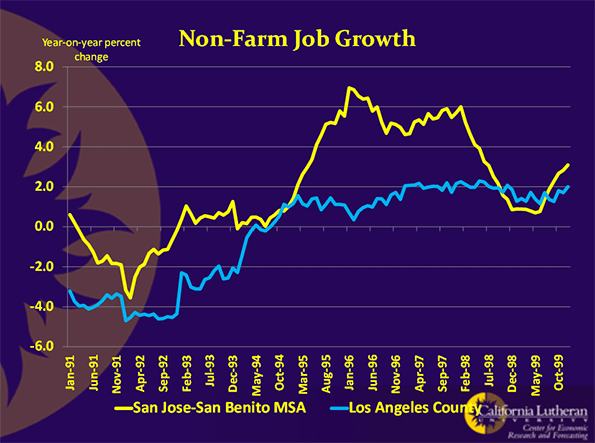
    The 1990s’ recovery was largely a Bay Area recovery.  Los Angeles hardly saw any uptick in employment.  Here is a chart comparing Los Angeles County’s jobs growth rate with the San Jose Metropolitan Statistical Area (MSA): 

    San Jose probably had California’s fastest growing job market in the 1990s.  Los Angeles was not the states slowest.  Still, the differences are striking.

    A few years ago, a couple of my graduate students looked at California data from 1990 through 1999.  They divided California into two regions, the Bay Area and everywhere else.  The Bay Area was defined as Sonoma, Marin, Napa, Solano, Contra Costa, Alameda, Santa Clara, Santa Cruz, San Mateo, and San Francisco counties.  Using seven indicators of economic growth, they performed relatively simple statistical tests to see if the two geographies experienced similar economies.  The indicators were employment, wages, home prices, bank deposits, population growth, construction permits, and household income.

    By every measure except population growth, the Bay Area outperformed the rest of the state.  The exception was probably due to commuters to the Bay Area, given that region’s exceptionally high housing prices. 

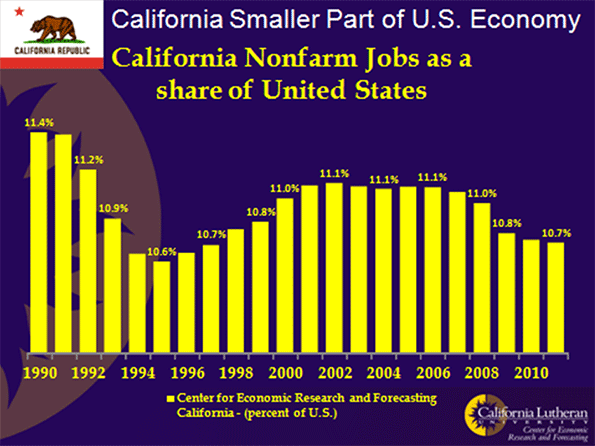
    Some economists will tell you that California saw faster-than-national job growth from the mid 1990s until the great recession.  This is another aggregation problem.  The claim is technically true, but only in the sense that California had a higher proportion of the nation’s jobs in 2007 than it did in 1995.  If you look at annual data, you will see that California’s share of the nation’s jobs only grew from 1995 through 2002.  Since then, California’s share of United States jobs resumed its decline:

    In reality, California never recovered from the dot.com bust.  California, perhaps the best place on the planet to live, couldn’t keep up in a housing boom.  Something was wrong.

    California had lost its mojo. 

    Opportunity is now greater outside California than inside California.  For almost 150 years, California was as widely known for its opportunity as it was for its sunshine.  The combination was like a drug.  George Stoneman, an army officer destined to become California’s 15th governor, spoke for millions when he said "I will embrace the first opportunity to get to California and it is altogether probable that when once there I shall never again leave it." 

    They did come to California, and they made an amazing place.  Opportunity-driven migrants are different than other people.  They take big risks to leave everything they know for an uncertain future in a new place.  They are confident, bold, and brash.   California became just as confident, bold, and brash.  The Anglo-American novelist Taylor Caldwell spoke the truth when she said "If they can’t do it in California, it can’t be done anywhere."

    That was then.  Today, California can’t even rebuild an old Hotel.

    The Miramar Hotel is a partially-demolished eyesore beside the 101 Freeway in Montecito, just south of Santa Barbara.  The Hotel’s initial structure was built in 1889.  Over the years, it was expanded to a 29 structure luxury hotel and resort.  In September 2000 it was closed for renovations which were expected to take 18 months.  That was when the fighting started.  Community groups, neighbors, and governments all had their own idea of what the Miramar should be.  Two owners later, and after millions of dollars, the future to the Miramar is still uncertain.

    The Miramar Hotel is a case study of what is wrong with post-industrial California, precisely because it should have been easy, and because it is not unique.  Everything is hard to do in California.  The state that once moved rivers of water hundreds of miles across deserts and over or through mountain ranges can’t rebuild a hotel.

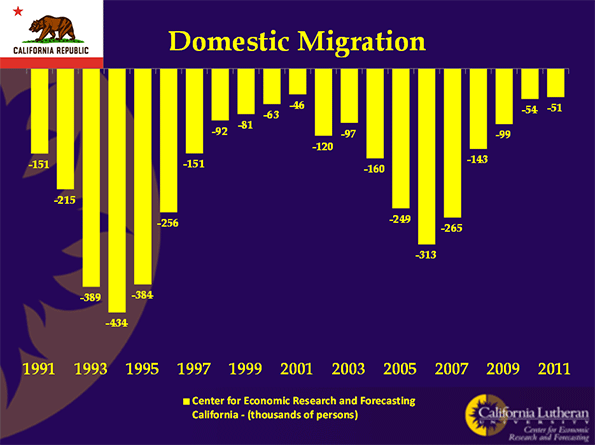
    The situation will get worse.  California has become the place people are leaving.  The following chart shows that for 20 years more people have left California for other states than came to California from other states:

    California’s population is still increasing because of births and international immigration. 

    Two decades of negative domestic migration has taken its toll.  Millions of risk-taking, confident, bold, and brash people have left California.  They took California’s mojo with them.

    That seems pretty clear when you look at some statistics:  California’s unemployment is way above the national average.  With only about 12 percent of the nation’s population, California has over 30 percent of the nation’s welfare recipients.  San Bernardino has the nation’s second highest poverty rate among cities over 200,000.

    Sometimes though, aggregated data can hide California’s weakness, and some, representing the always-present constituency for the status quo, use these data to deny that California’s future is any less golden. 

    Most recently, those representing the constituency for the status quo have used California’s aggregated jobs data to argue that all is well in California.  They argue that California’s tech sector is leading California to a new golden future.

    Year-over-year data confirm that, through August 2012, California gained jobs at a faster pace than the United States.  Once again, though, that growth is largely confined to one industry and one geography.  California’s tech sector is recovering, and amidst a generally weak recovery, it appears strong enough to generate pretty impressive aggregated results.  If we disaggregate California’s data, we will find that there is not just one California.  There is a rich and mostly coastal California, with a few smaller inland counties on the San Francisco-Lake Tahoe corridor.  Another California is very poor and mostly inland.

    Here’s a list of California’s poorest counties by poverty rate:

    County

    Poverty Rate

    Child Poverty Rate

    Rank

    Del Norte

    23.5

    30.6

    3

    Fresno

    26.8

    38.2

    1

    Imperial

    22.3

    31.8

    6

    Kern

    21.4

    30.3

    10

    Kings

    22.5

    29.7

    5

    Madera

    21.7

    31.7

    8

    Merced

    23.1

    31.4

    4

    Modoc

    21.9

    32.5

    7

    Siskiyou

    21.5

    30.7

    9

    Tulare

    33.6

    33.6

    2

    Here’s a list of California richest counties by poverty rate:

    County

    Poverty Rate

    Child Poverty Rate

    Rank

    Calaveras

    11.1

    18.3

    10

    Contra Costa

    9.3

    12.7

    4

    El Dorado

    9.4

    11.6

    5

    Marin

    9.2

    10.9

    3

    Mono

    10.8

    15

    8

    Napa

    10.7

    14.7

    7

    Placer

    9.1

    10.7

    2

    San Mateo

    7

    8.5

    1

    Santa Clara

    10.6

    13.3

    6

    Ventura

    11

    15.3

    9

    There are some big differences here.  The percentage of Fresno’s children living in poverty is four and half times the percentage of San Mateo children living in poverty.  In fact, the data for California’s poorest counties looks like third-world data.

    When disaggregated, the job-growth data shows the same story.  Through 2012’s second quarter, jobs in the San Jose MSA were up 3.6 percent on a year-over-year basis.  In Los Angeles, jobs were up only 1.1 percent, while in Sacramento they were up only 0.6 percent.  For comparison, U.S. jobs were up about 1.3 percent for the same time period.

    You can perform this analysis for all types of data.  When the data are disaggregated, the story is always the same.  It’s telling us that California needs to get its mojo back, and the current tech boom is likely not to be enough for its recovery.

    Bill Watkins is a professor at California Lutheran University and runs the Center for Economic Research and Forecasting, which can be found at clucerf.org.

    Unemployment photo by BigStockPhoto.com.

  • The Evolving Urban Form: Barcelona

    Among those for whom Paris is not their favorite European city, Barcelona often fills the void. Barcelona is the capital of Spain’s Catalonia region. Catalonia has been in the news in recent weeks because of the rising a settlement for independence from Spain, or at a minimum, considerably expanded autonomy. In part, the discontent is driven by a concern about the extent to which more affluent Catalonia subsidizes the rest of Spain. Another driving factor is the interest in separating Catalonian language and culture from that of Spain.

    Barcelona is nestled on the Mediterranean coast with mountains and valleys immediately behind. It would be easy to visit Barcelona without being aware of the huge expanse of suburbanization that has developed especially over the last 50 years.

    The Core City

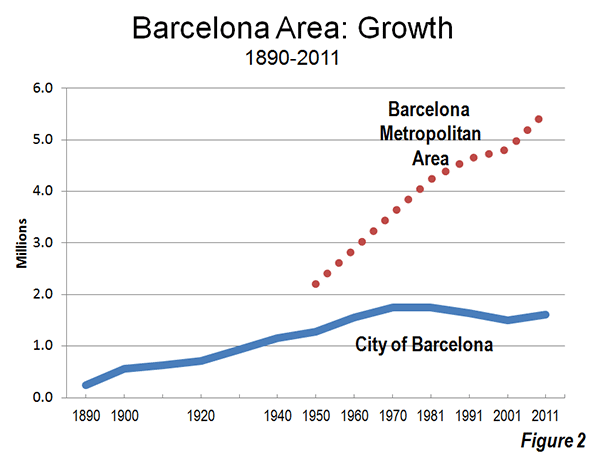
    Like virtually all European core cities that have not annexed or combined with other jurisdictions, Barcelona’s population had peaked well before the turn of the 21st century. In 1960, the city of Barcelona had a population of just below 1.6 million people. Today, after having risen to 1.75 million in 1981, Barcelona’s population has dropped to approximately 1.62 million. Nonetheless, like other European core cities, Barcelona experienced strong growth before 1970, rising to nearly 7 times its 1890 population of 250,000.

    At the same time, like some other European and North American core cities, the city of Barcelona has begun to grow again. Having reached a modern low point of 1.5 million in 2001, the city grew by approximately 7 percent by the 2011 census.

    The city itself covers a land area of approximately 55 square miles/143 square kilometers, slightly less than that of Washington, DC. Barcelona’s density is much higher, at approximately 40,700 per square mile/15,700 per square kilometer, as opposed to the approximately 10,000 per square mile/4,000 per square kilometer of Washington. Yet, other core areas are considerably more dense, such as the ville de Paris, which is at least 30 percent more dense and Manhattan, which is approximately 50 percent more dense.

    The Metropolitan Area and the Urban Area

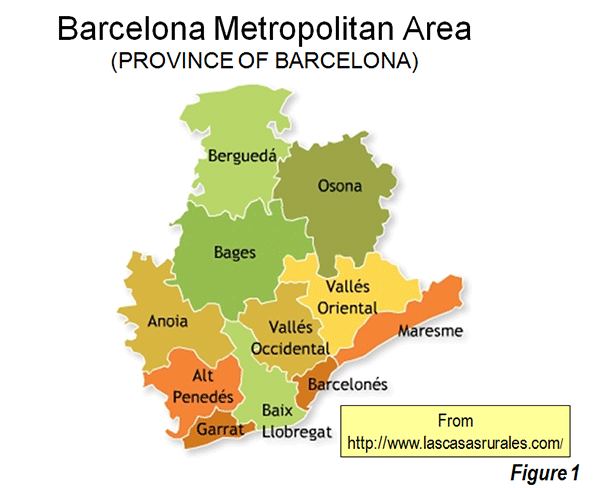
    The metropolitan area is generally considered to be the province of Barcelona, which is a part of the region of Catalonia (Figure 1). Since 1950, the metropolitan area has expanded from 2.2 million to 5.6 million people. Since 1960, nearly all of the population growth has been outside the city of Barcelona. The city has added approximately 60,000 people, while the balance of Barcelona province has added approximately 2.7 million people (Figure 2).


    The province of Barcelona is divided into comarques, which are the equivalent of counties. The core comarca (the singular form) is also called Barcelona and includes the city as well as other municipalities (or local government authorities), the largest of which is Hospitalet de Llobregat, with a population of 250,000.

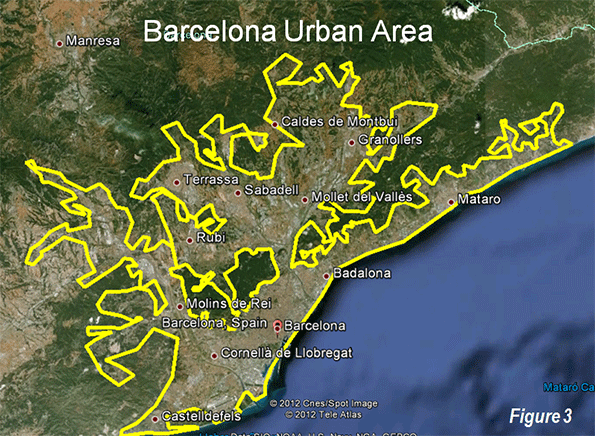
    Barcelona’s urban area (area of continuous urban development) continues along the Mediterranean coast to the southwest into the comarca of Baix Llobregat, which includes the international airport. To the northwest the urbanization continues along the coast for some distance into the comarca of Maresme.

    The urbanization then surrounds Tibidabo Mountain behind the city along freeway routes on either side. These roadways connect with the AP-7 autopista (toll motorway), which provides direct access between Madrid, Valencia, Andalusia and France. The large valley through which the AP-7 runs contains the largest suburbs of Barcelona, which are divided into two comarques, the Valles Oriental (East Valley) and the Valles Occidental (West Valley).

    The Barcelona urban area covers approximately 415 square miles/1,075 square kilometers (Figure 3) and has a population of 4.6 million. At approximately 11,000 persons per square mile/4200 per square kilometer, Barcelona is one of Western Europe’s most dense urban areas. It is approximately 15 percent more dense than Paris and among the larger urban areas trails only Madrid (11,800 per square mile/4,500 per square kilometer) and London (15,100 per square mile/5,800 per square kilometer).

    The Barcelona urban area’s high density is also illustrated by comparison to the Zürich urban area, with its reputation for high density. As defined by the Federal Statistical Office of Switzerland, Zürich covers virtually the same land area as Barcelona, yet has less than one quarter of its population.

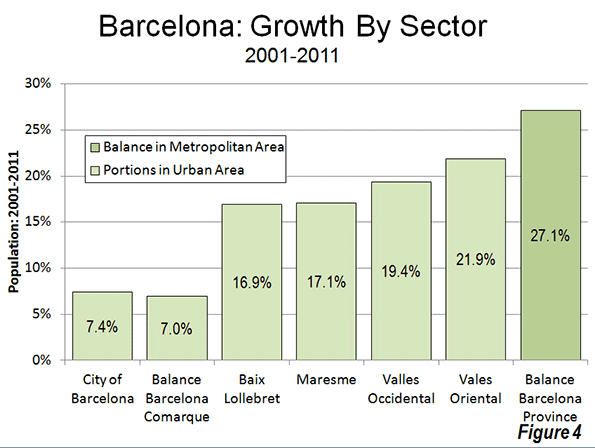
    Between the 2001 and the 2011 censuses, there was seven percent growth in the inner suburbs surrounding the city of Barcelona within the comarca of Barcelona. Much greater growth, however, was experienced in the more peripheral parts of the urban area. The coastal suburbs of Baix Llobregat and Maresme grew approximately 17 percent and now have a population of more than 1,000,000.

    Growth was even stronger in the interior valley, with the Valles Occidental growing at 19 percent and the Valles Oriental, which and with much more vacant land for development, grew 22 percent (Figure 4). Now the population of the Valles approaches 1.2 million.

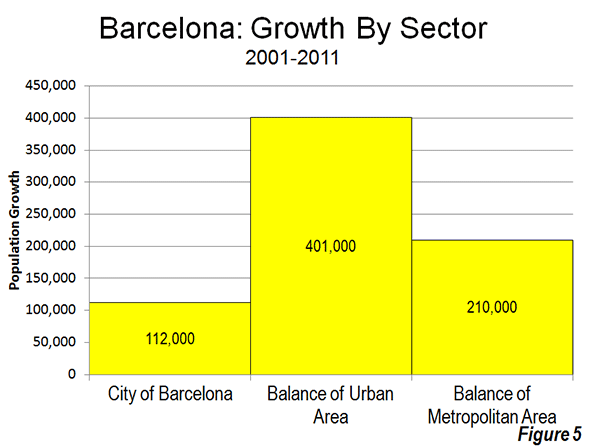
    However the largest growth was outside the urban area entirely, in the balance of the metropolitan area, where the population increased 27 percent (Figure 5), and now approaches 1,000,000.

    Newer Development

    Much of the most recent growth has been relatively unusual for large Spanish urban areas, which have largely experienced high density expansion, with multi-family buildings (often high rise), even in the suburbs (see top photo). However, considerable detached housing has been built in the Barcelona metropolitan area over the past decade.

    Barcelona’s Dispersion

    Thus, the Barcelona metropolitan area is generally following the trend of greater growth in the urban periphery and the strongest growth in the rural and smaller urban areas that are outside the continuous urbanization.

    Wendell Cox is a Visiting Professor, Conservatoire National des Arts et Metiers, Paris and the author of “War on the Dream: How Anti-Sprawl Policy Threatens the Quality of Life.”

    Photo: Residential area in Valles Occidentale (Barcelona suburbs), by author.

  • Top Cities for Engineers Based on Actual vs. Expected Wages

    EMSI recently developed a methodology for calculating expected wages for occupations by region. The analysis is aimed at helping us better understand what regional earnings should be given the performance of a set of standardized occupations that are ubiquitous, stable, and diverse across the US economy. It’s a bit like the consumer price index, just for occupations.

    Read more about that here.

    To illustrate how enlightening this can be, we produced a high-level summary for architecture and engineering occupations (SOC 17) to see what cities rank above and below where you might expect. In this case, we limited our analysis to metros with greater than 190,000 jobs. Also note, we are using 2011 wages in this model, and most of the occupations in the group are related to engineering.

    Looking for a job?

    The top six MSAs on our list are the cities (190,000+ jobs) with the highest actual-to-expected ratios in that nation. They are therefore good regions for jobseekers and employees because of the higher-than-expected wages. Also notice how these are cities you might not expect (e.g., San Francisco and Seattle aren’t on the list). Why? Well, the wages in those cities are good, but there is more competition (in the form of talent), the cost of living is quite high, and the other occupations in the region are also pretty high-paying. The regions we have listed here have architecture and engineering jobs that are paid substantially higher than what we would predict given the local economy.

    1. Augusta-Richmond MSA

    Right off the bat, the model gives us some data that we might not have expected. The Augusta-Richmond MSA, which is spread between the Georgia-South Carolina border, has the highest actual-to-expected ratio (1.15). Based upon our analysis of a set of standardized occupations, we expect that architecture and engineering occupations would make $34.29 per hour (average earnings for all occupations in this category) in this MSA. In reality, wages are just about $5.00 per hour more ($39.36), which is significant.

    This means that the Augusta-Richmond MSA has the highest national earnings for architecture and engineering given the conditions in the local economy. This also makes Augusta-Richmond the second-highest paying region for these jobs among cities where wages are higher than we would expect. This MSA also has the highest percent job growth since 2009, which might be a prime factor contributing to the higher-than-expected wages. High local demand means that companies have to pay more to get the workers they want. This region also has a concentration of architecture and engineering workers above the national average.

    Oddly enough, the labor market in this area has actually declined by 1% since 2009, which equals a loss of more than 3,000 jobs. Sectors like construction and education are still not doing very well.

    So what companies might we be talking about in Augusta-Richmond? After all, if you are considering a job as an engineer or architect, this seems like a good region to focus on. We searched through Equifax data, which is now part of our tools, and found that URS has a strong presence in the region. If you are not familiar, URS is on the list of top 500 largest companies in America. CH2M Hill, Ingersoll Rand, and John Deere also employ engineers in this area.

    2. Knoxville, Tenn.

    With an actual-to-expected ratio of 1.14, Knoxville is No. 2 on the list. Actual wages ($37.35 per hour) are $4.69 more than we would expect and, like Augusta-Richmond, we see good job growth since 2009. Also note that there are 2,000 more jobs in this region than Augusta-Richmond. In general, Knoxville’s economy is healthier than the top city in our list. Since 2009, the region has expanded by 4%, adding some 14,000 new jobs.

    A high demand for engineers in the region is also likely driving the wages up to levels higher than we would expect. A big factor here is Oak Ridge National Laboratory. URS also has a presence in Knoxville, as does Navarro Research, a big government contracting firm, and ABSG Consulting, a company that designs products and services for risk management.

    Obviously, people who focus on engineering and architecture would have many other employment opportunities with different types of companies, but these are just good examples of groups that employ engineers.


    3. Oklahoma City, Okla.

    The third city with better-than-expected wages for architecture and engineering occupations is Oklahoma City. Wages are $4.50 above where we would expect and job growth is strong (more than 10% since 2009). Also, with nearly 14,000 current jobs, OKC is a good spot for engineers to be looking.

    OKC is also demonstrating very healthy growth. Architecture and engineering gained 1,300 new jobs since 2009 and the overall economy grew by over 14,000 jobs. This is even better than our previous two cities.

    With companies like Interim Solutions for Government, OKC is a big city for government contracting. Firms like Northrop Grumman, CH2M Hill, Chesapeake Energy, Wyle, and Boeing also have a strong presence there.


    4. Baton Rogue, La.

    Unlike our previous three cities, Baton Rogue has experienced overall decline since 2009. Despite this, the actual-to-expected ratio is quite high (1.13) and wages are $4.32 per hour higher than we would expect.

    A more stagnant economy combined with a dip in total employment should result in a drop in wages in the coming years. It should also be noted that the region has more than 9,000 jobs in this sector and a relatively high concentration (when compared to the state and nation) for architecture and engineering jobs. However, the regional concentration is slipping more toward the national average and away from specialization. Basic summary: Wages are still pretty high, but the job market isn’t as good as Knoxville or Augusta-Richmond.

    Jacobs Engineering, Richard Design Services, and Stebbins Engineering have a presence in this region.


    5. Huntsville, Ala.

    Huntsville, which is fifth on our list, is the highest-paying metro region on the list. Despite that good news, architecture and engineering jobs have contracted by a surprising 8% since 2009, making it the second-worst city in terms of decline on this list. The regional labor market in general has contracted by 2% in that same period. The only occupation category to lose more jobs than architecture and engineering is production. Pretty much every engineering occupation — from aerospace, which is the largest engineering sector, to mechanical — lost jobs.

    As it stands, hourly wages for architecture and engineering occupations are still $5.00 higher than we would predict and even $5.00 higher than a place like the New York City MSA. So, if you can find an architecture or engineering job here, it’s likely going to be well-paying for the economy. Again, wages are high, but the labor market is pretty shaky.

    Huntsville is pretty well known for aerospace and defense (companies like Northrop Grumman, Raytheon and Lockheed Martin) and the Cummings Research Park.


    6. Ogden-Clearfield, Utah

    Ogden, Utah, is ranked sixth for cities where actual architecture and engineering wages are higher than expected and is the only non-Southern city in the top six. Current pay stands at $36.48 per hour, which is $4.00 greater than we would expect ($32.54).

    Ogden is also the smallest city in our top six. Despite its size, architecture and engineering jobs play a big role in the regional economy. We can say this because, next to military occupations, architecture and engineering jobs have the second-highest concentration in Ogden relative to the national average.

    Since 2009, there really hasn’t been any job growth, however. And the local economy has only increased by 2%, so it might be a tough area to find a job right now. As far as employers go, the Air Force has a strong presence as well as Northrop Grumman, General Dynamics, and General Atomics.

    Where Actual < Expected

    So now we reverse the perspective a bit. In our previous analysis, we looked at the top six cities where architecture and engineering occupations make more than we would expect. Now we will look at the top six (or bottom six, depending on how you want to think about it) cities where pay for architecture and engineering is below what you would expect. These might be good targets for employers who are looking for lower-wage areas.

    1. Milwaukee-Waukesha-West Allis, Wisc.

    Expected wages for architecture and engineering occupations in Milwaukee are $36.69 per hour. In reality, the average is more like $32.81, which is $3.88 below what we would expect. There also hasn’t been much job growth (in percent terms) for either engineering or the general economy.

    There are 16,000 jobs in the region, and if you are employer looking to hire or relocate, Milwaukee might be a good target. Wages are a bit lower than we would expect, so workers might move jobs for slightly higher offers, and there is a fairly large pool of workers. Milwaukee is the second largest city on this list.

    In terms of employment, Siemens and Johnson Controls have a presence in the region.


    2. Columbus, Ohio

    Architecture and engineering jobs in Columbus have contracted by 3% while the rest of the economy has actually increased by 3.4%. Actual hourly wages ($32.26) are similar to Milwaukee and are $4.00 below what we would expect.

    The basic story: Columbus appears to have a rapidly decreasing share of engineering jobs. In three short years, the region’s location quotient — a measure of concentration — for architecture and engineering jobs dropped from .93 to .85 (1.0 is the national average). So what is driving this region’s growth? The healthy sectors appear to be health care and computer-related jobs.

    If you’re an engineer looking for work in Columbus or you’re thinking of setting up a shop there, note that the region seems to be de-specializing in the architecture and engineering occupation sector. One notable engineering group in the Columbus area is the Honda R&D group. Again, if you are an employer looking for underpaid engineers, Columbus could be a good target.


    3. New York-Northern New Jersey-Long Island

    The expansive New York City MSA, which covers half of New Jersey, is third on our list of metros where wages are below what we would expect. The NYC MSA has 92,500 architecture and engineering jobs, with average pay about $5.00 per hour below what we would expect given the economy. There hasn’t been job growth either. Since 2009, architecture and engineering jobs have contracted by 1% in an economy that grew by 2%.

    Another important statistic: The NYC MSA is pretty far below the national average when it comes to the concentration of engineering jobs. This means that even though the region has nearly 100,000 jobs, it is actually below what we would expect for a region of its size.

    Finally, the NYC MSA has the highest expected wage (nearly $45 per hour) on our list, which isn’t surprising (note: Huntsville’s actual wage is in this range). In reality, the actual wage for the NYC metro area is much closer to what is seen in metros like Augusta-Richmond or Oklahoma City.

    The number of well-known companies in this region are more numerous than we can include. For now, here are three to consider: Foster Wheeler, Hazen and Sawyer, and Syska Hennessy.

    4. Lakeland-Winter Haven, Fla.

    Next we jump from the largest city to the smallest in terms of architecture and engineering employment. The economy of Lakeland-Winter Haven has about 210,000 jobs total and only 1,900 jobs related to architecture and engineering. In addition, since 2009, the economy has increased by 1% while architecture and engineering jobs have contracted by 9%. This means that the metro area, which has a very low concentration of engineering jobs, is quickly losing the architecture and engineering base it has. Not surprisingly, wages are $3.50 per hour below what we would expect.

    Furthermore, the average wage for architects and engineers in Lakeland-Winter Haven is the lowest on our list. Wages in Hunstville are a whopping $17.71 greater than Lakeland-Winter Haven. If you are an employer looking for underpaid engineers, this region is a good target. Lockheed Martin, DCR Services, and AMEC have a presence in the region.

    5. Trenton-Ewing, NJ

    When it comes to cities with actual-to-expected wages lower than we would expect, Trenton, N.J., is second-to-last on the list. Actual wages are $38.61 per hour, which is $5.19 below the expected level of $43.80.

    There are 4,000 architecture and engineering jobs in this economy, which, given its total workforce of 247,000, means it has a architecture and engineering workforce similar to the national average for its size. This is another region where the economy has had 1% growth, but fairly significant decline (-5%) in architecture and engineering occupations since 2009. If you are an employer looking for engineers who might be a bit footloose, the Trenton area could be worth checking out.

    RMJM, URS, and Raytheon are located in this region.


    6. Fayetteville-Springdale-Rogers, AR-MO

    So now we reach the bottom. The city with the lowest actual-to-expected ratio (.85) in the nation for engineering and architecture jobs is Fayetteville-Springdale-Rogers, a MSA in northwest Arkansas and southwest Missouri. This region has the unique distinction of having architecture and engineering wages that are nearly $6.00 per hour below what we would expect for the economy. Fayetteville is also about $12 an hour below places like Oklahoma City, Augusta-Richmond, and New York City — and $17 below Huntsville.

    Furthermore, this metro has the second-fewest jobs on our list. As of 2012, there are about 223,000 jobs in the economy and just 2,475 are related to architecture and engineering. This means that the Fayetteville area has a concentration very similar to Lakeland-Winter Haven and the New York MSA — far below the national average.

    Oddly enough, this is also the only region with an actual-to-expected ratio below 1.0 that had some growth (a modest 1.2%). The rest of the regional economy grew by 5% since 2009, making it the fastest-growing region for our lower-cost cities. Wages should jump a bit if these trends continue. Again, this would be a good region for employers to target workers because of the relatively low wages.

    Some of the top regional employers are Walmart, the Benchmark Group, Cisco, and Oracle.

    Further Information & Observations

    So, if you’re curious, here is a look at architecture and engineering occupations. Most of them are engineering jobs that have grown at a rate consistent with the national economy (2% growth since 2009).

    SOC Code Description 2009 Jobs 2012 Jobs Change % Change Median Hourly Wage
    Source: QCEW Employees, Non-QCEW Employees & Self-Employed – EMSI 2012.3 Class of Worker BETA
    17-1010 Architects, Except Naval 140,119 130,859 (9,260) (7%) $32.20
    17-1020 Surveyors, Cartographers, and Photogrammetrists 56,884 55,873 (1,011) (2%) $27.02
    17-2010 Aerospace Engineers 84,304 86,455 2,151 3% $49.54
    17-2020 Agricultural Engineers 3,429 3,551 122 4% $37.04
    17-2030 Biomedical Engineers 16,062 19,387 3,325 21% $40.43
    17-2040 Chemical Engineers 28,311 29,003 692 2% $44.86
    17-2050 Civil Engineers 270,999 269,908 (1,091) 0% $37.18
    17-2060 Computer Hardware Engineers 75,483 78,174 2,691 4% $46.76
    17-2070 Electrical and Electronics Engineers 300,133 302,289 2,156 1% $42.85
    17-2080 Environmental Engineers 49,868 51,953 2,085 4% $38.07
    17-2110 Industrial Engineers, Including Health and Safety 234,314 245,694 11,380 5% $37.38
    17-2120 Marine Engineers and Naval Architects 6,849 7,158 309 5% $41.17
    17-2130 Materials Engineers 22,979 24,540 1,561 7% $40.78
    17-2140 Mechanical Engineers 239,935 253,033 13,098 5% $38.28
    17-2150 Mining and Geological Engineers, Including Mining Safety Engineers 7,662 8,087 425 6% $40.11
    17-2160 Nuclear Engineers 21,776 22,847 1,071 5% $48.44
    17-2170 Petroleum Engineers 32,187 37,513 5,326 17% $59.25
    17-2190 Miscellaneous Engineers 139,248 145,169 5,921 4% $43.29
    17-3010 Drafters 218,065 207,185 (10,880) (5%) $23.72
    17-3020 Engineering Technicians, Except Drafters 449,601 459,529 9,928 2% $25.72
    17-3030 Surveying and Mapping Technicians 54,551 51,896 (2,655) (5%) $19.39
    Total 2,452,759 2,490,105 37,346 0.02 35.56

    Drafters and architects have taken the biggest hit nationally. Surveyors and surveying/mapping tech haven’t fared too well either. Otherwise, engineers are doing pretty well. Biomedical engineers have grown by 21% and petroleum engineers have grown by 17% since 2009.

    If you are interested in finding a good spot to be an engineer, we suggest taking a look at the Augusta-Richmond area, the metro region with the highest actual-to-expected ratio in the nation. Architecture and engineering occupations in Augusta-Georgia make nearly $40 per hour, which is the third highest on this list and on par with the wages seen in the NYC MSA. To put that in perspective, if you want to work as an engineer in the NYC MSA and live in a place like Long Island, where the average home price is $815,000, the dollar isn’t going to stretch quite as far as it would in a place like Augusta, Ga., where the average home price is $163,000.

    Other top cities to consider based on the actual-to-expected ratio are Knoxville and Oklahoma City. Both have strong labor markets, a decent amount of jobs, and wages quite a bit above what we would expect.

    In general, cities in the South seem to be pretty competitive for architecture and engineering wages. Ogden was our only non-Southern city to have wages higher than we would expect. This could indicate that there is more of a scarcity of good talent in these regions, which should drive the price up. Baton Rouge and Huntsville have shakier labor markets, but the pay tends to be good if you have a job there.

    Cities that tend to demonstrate underpay for engineering are spread about a bit more. Two are in the New York/New Jersey area (NYC MSA and Trenton MSA), two are more Southern (Lakeland-Winter Haven and the Fayetteville-Springdale-Rogers MSA), and two are in the Rust Belt (Columbus and Milwaukee). This could be due to labor markets that are more unstable and therefore slightly saturated with engineers.

    Finally, if employers are complaining about skills shortage in cities where the actual pay is far below the expected, chances are they are not willing to pay enough. To put it in perspective: If you are an employer in Milwaukee that is looking for engineers and are only willing to pay $32 per hour, you will likely find a limited pool of candidates. This might prompt you think there’s a skills shortage. Before you jump to that conclusion, try raising the hourly wage to $36 or higher and you will likely see a lot more interested engineers flocking in your direction.

    Data and analysis from this report came from Analyst, EMSI’s web-based labor market tool. Please contact Rob Sentz (rob@economicmodeling.com) if you have questions or comments. Follow us @desktopecon. Read more about our wage estimating process here.

    Illustration by Mark Beauchamp.

  • Where Do You Live?

    I recently moved to Providence, Rhode Island, where I live in the town of West Warwick. I’ve been learning the place more and soaking in New England culture (and seafood). This area has a Rust Belt type profile: declining population, post-industrial economic landscape, high unemployment, etc. So I’ve been trying to get a handle on conditions and think a bit about what the opportunities are.

    I have been really struck by the way people here seem to think about their geographic identity. All of us have various layers of identity. Some of these are more primary than others. But let’s consider three possibilities in trying to answer the basic question “Where do you live?” Those are your state, your metro, or your town. Which of these forms the most important basis of identity?

    My observation so far is that most people here think of themselves first as Rhode Islanders, and secondly as residents of their town. Providence, possibly because at 178,000 people it’s fairly small, is sort of seen as just another town. (Southern Massachusetts is maybe seen as a type of Canadian province with its own collection of towns).

    So what? you might ask. Unit recently I probably would have said that it doesn’t matter that much. But now I see that it has a profound effect on creating the lens through which people process the world. Here are some local implications.

    First, it leads people to exaggerate the uniqueness here. Rhode Island is geographically the smallest state, and also quite small in population. I heard people say that only in Rhode Island can you get pretty much every leader in the place to show up for a conference on the state’s economic future. If your worldview is the state, that may be true. But if your worldview is metro area, I think there are many similar sized regions that could pull this off. There are many things that appear unique if your lens is Rhode Island that are not if your lens is Metro Providence. It may be that there’s uniqueness in the small geography of Rhode Island from the standpoint of state policy, but if I may be so bold, this is hardly its strong suit. (But for a positive example of how this can work in a place like Rhode Island where it’s more difficult elsewhere, see the example of pension reform).

    Second, the economic geography of the new economy is metro regions. When you look state first, you are missing the bigger picture. If you doubt that the metro area is the primary economic unit, I suggest spending some time perusing material over at the Brookings Institution. States are more or less irrelevant economically, except that they can screw things up for the metro and non-metro regions they contain.

    Third, Providence is a bi-state metro area that includes Southern Massachusetts. You can also see Providence as an extended node in the Greater Boston economy. If you look primarily at the state, you miss this, or even see Massachusetts as the competition. You also lose about 60% of the population scale you have to work with.

    Fourth, when you look state first, your natural inclination is to compare yourself against other states. In Rhode Island’s case, there really aren’t many similar places, so the default is other New England states. On the other hand, one can imagine many similar Rust Belt type metros to compare Providence too. Places like Buffalo, Pittsburgh, and Cleveland come to mind. Of course these aren’t exactly the same, but they’ve been grappling with the legacy of de-industrialization seriously for a really long time. There have got to be many things that could be learned by studying and networking with these areas. There’s a lot of pan-Rust Belt discussion going on these days, but Providence isn’t part of it. This is part of that new economic geography of cities I was talking about.

    In short, I think treating state identity as primary has problems. Rhode Island is most certainly not the only place where this crops up, but it is noticeable here and perhaps more important here since the state is a subset of a metro geography instead of a superset.

    Aaron M. Renn is an independent writer on urban affairs and the founder of Telestrian, a data analysis and mapping tool. He writes at The Urbanophile, where this piece originally appeared.

    Downtown Providence photo by Bigstock.

  • Cooling Off: Why Creative California Could Look to Western New York

    Sometimes the stakes are bogus, sometimes the fast lane hits a fork.
    Sometimes southern California wants to be western New York
    –Lyrics from Dar Williams’ song “Sometimes California Wants to Be Western New York”.

    For long, making cultures and making people have been deemed outmoded. It is largely a knowledge economy. And since knowledge has been diverging into “spiky locales” known to be hotbeds of innovation, consider it a double whammy, as most of the relevant geographies are on the coast. The middle of the country is thus irrelevant if you care to survive. It is a man with a pitchfork in a sea of MacBook’s and iLife’s.

    For instance, in Edward Glaeser’s 2007 City Journal article he asks: “Can Buffalo Ever Come Back?” Glaeser answers quickly, “Probably not—and government should stop bribing people to stay there”.

    It’s true that many cities in the Rust Belt, Appalachia, Iron Range, Great Plains and the like have declined. Many people left. We all know why: jobs mostly, the weather a bit, or too damn depressing—the vacancy and all. We also know that the “flyover country’s” crème de la cream migrated to those gathering pools of talent like San Francisco, Boston, New York, Portland, and the Midwest’s own: Chicago. The reasons this was occurring was because (1) these places were “cool”, and (2) the cluster of talent created for innovation milieus because all the big brains colliding made big ideas, which made products not near the death of their life cycle like, for instance, iron or ovens.

    But suppose we are on the cusp of this divergence changing into a convergence of talent spreading back out into the heartland. In short, maybe these spiky locales are overheating, thus releasing “cool” elsewhere, not to mention the freedom to create. The following explains how and why this scenario could unfold.

    Allow me to digress for a moment to talk about the Second Law of Thermodynamics, and how it figuratively relates to the flow of capital. Consider it a working metaphor. Components of the Second Law state that whenever energy is out of equilibrium with its surroundings a natural potential exists to return a setting to equilibrium. For instance, if you bring a hot cup of coffee into a cold room, eventually the energetic tension between the cup and the room will dissipate as the heat leaves the coffee until there is thermodynamic equilibrium between the cup and the room. In many respects, I see the same energetic tension existing precariously between the spiky “have’s” of America and the Buffalo-like “have not’s”, with a subsequent resetting coming as talent and capital leak back into a convergent, equilibratory state.

    Now, what’s creating this tension, other than feeling sorry for Buffalo, Sioux City, etc.? Well, it’s part cultural, part social, and part economic. But all wholly real.

    First, the economic: as the GDP of spikiness goes up so does worker expense. For example, New York City’s cost of living is becoming unsustainable, even for knowledge laborers. From a recent Philadelphia Magazine article discussing a growing trend of New Yorkers moving (to) and commuting (from) Philly, the author notes:

    Those of us with young families, in the so-called creative class…were now high-status, poorly paid culture workers who could no longer afford to live in New York, especially with children. Things no longer seemed possible because they weren’t.

    This exodus is not a blip. For instance, the borough of Brooklyn has lost nearly a half-million people from 2001 to 2009. To that end, the “spikiness” in this case is the unsustainable nature of global city price points, with fewer and fewer folks able to hang on as expenses skyrocket toward the needle-head of the elite.

    What will this mean for the future of jobs? Blogger Jim Russell believes that demand for labor will follow the out-migrating labor supply, even for tech companies. The reasons for this are simple: an increasingly available talent pool in geographies lauded for hard work, and cost. From a Silicon Valley exec who headed to a beer and sausage city:

    “I was very skeptical five years ago that I would do a meaningful expansion in Milwaukee…But what I have found is the majority of talent we need in our company, we are able to acquire in that area.”

    Space is less expensive, it takes less time to find qualified employees in Milwaukee, and they stay with the company for longer than they would in California, [Edward] Jackson said.

    Tied closely to the economic pressures of spiky locales are the social costs. For example, Chicago, once a City of Broad Shoulders, had long ago ditched its industrial ethos and swagger to become the City of Slim Hips. In short, under Mayor Daley, Chicago went all in with global city development, which meant using public funds and incurring public debt to build a place to serve its growing global city clientele. The cost was high, though: crippling municipal debt, a situation no doubt aided by the fact that luring the elite did nothing for jobs, with the city having fewer total jobs in 2009 than it did in its blighted heyday of 1989. Said Richard Longworth:

    In other words, Chicago — the only old industrial city in the Midwest to transform itself into a global city, a big success story in the global rankings — still can’t provide as many jobs for its residents as the old sooty City of the Big Shoulders.

    And that social cost? It has to do with the effect of creating cities within cities, for as Chicago pumped money into its various beautification endeavors, disparity and poverty festered on its West and South sides. The consequence for the city—for anyone who has been paying attention—is one of the most violent summers in Chicago history, with 56 people shot in a recent three-day period alone. Naturally, violence does nothing to attract talent, with one study showing that for every homicide that occurs in a city, total population declines by 70 people. And while many cities do not rival Chicago’s spike in crime, disparity-driven tensions are deepening fast in spiky locales, thus fermenting the possibility of unrest and subsequent flight.

    But at least there are oodles of creativity in “hot and spiky” locales, right? Here, things get interesting.

    There exists a subtle yet growing tension in various creative-laden camps regarding the globalization of creativity which—when implemented as a product—is marketed as “cool”. It’s an old tension really, one between selling yourself and being yourself, and the predicament was spelled out nicely in a recent article by Justin Moyer entitled “Our Band Could Be Your Band–How the Brooklynization of culture killed regional music scenes”.

    In it, the author laments the dissolving regional sound of music in America that has arisen from a decades-long divergence of musical talent into Brooklyn. For Moyer, vanning to “regional music scenes” allowed for a distinct back and forth between one’s own sound and the sound of the other, with the ping pong in musical differentiation allowing for a betterment of one’s own sound as well as the sound of the other. You know, how creative escalation and interplay is supposed to work.

    But somewhere along the way this stopped. As was recently proved in a study detailed in Scientific Reports, everybody started to sound like everybody else. How does Brooklyn do this? What is Brooklyn exactly? Moyer explains, before venting:

    Brooklyn has a downside. Those who abandon their [regional music scene] to come to Brooklyn risk co-option by an aesthetic Borg. Things get mushy. There’s too much input, and there’s not a lot that’s not known…There aren’t many secrets. There are no mountains to go over.

    …There are many Brooklyns. Los Angeles is Brooklyn. Chicago is Brooklyn. Berlin and London are Brooklyn. Babylon was the Brooklyn of the ancient world. In the 1990s, Seattle was Brooklyn…

    Some Brooklyns aren’t even places. MySpace is Brooklyn. YouTube is Brooklyn. Facebook is Brooklyn. Spotify and iTunes are perversely, horribly, unapologetically, maddeningly Brooklyn.

    I’m against it.

    Moyer is on to something, and he has got good theory behind him; that is: diversity and differentiation drive creativity, be it in the political, social, cultural, or economic realm, whereas homogeneity cloaked in popularity does not. What’s more, creative destruction rarely occurs in places perceptibly intact—be it in Park Slope or posh Naples. It occurs where there is urgency, or where it is needed most. It occurs in places very broken, like Detroit. And so eventually the next wave of a new system can very likely be rippled out from places that have been saturating in the pieces. Said Atlantic writer Alexis Madrigal, who just finished touring the Rust Belt: “[T]here are a lot of places where the apocalypse has already happened”.

    Of course this is all very speculative at the moment. The winners are still seen as the winners and the losers still the losers. But the writing is on the wall: the future is in the seams, between the lights and monotone, loud-ass beats.

    Even Twitter creator Jack Dorsey thinks so. The Rust Belt native was in Detroit recently discussing how he gets his creative fix. Is it soaking in Silicon Valley with other visionaries? Not exactly. Rather, by taking the bus to work. Why? Dorsey states:

    “I actually see real things… That encourages me and gives me a stronger purpose, sense of purpose about what I want to change and how my work might apply to that change

    Hear that Buffalo? Don’t listen to your death sentence. You are becoming. Just like Dar Williams predicted.

    Richey Piiparinen is a writer and policy researcher based in Cleveland. He is co-editor of Rust Belt Chic: The Cleveland Anthology. This piece originally appeared at his blog.

    American Gothic statue in Chicago photo by flickr user GYLo.