Category: Urban Issues

  • Form Follows Zoning

    When Louis Sullivan, purveyor of modern American high-rise architecture, said more than 100 years ago that ‘Form Follows Function’, he perhaps didn’t realize the extent to which building form would not be determined only by building type and the laws of physics, but by zoning laws, building safety codes, real estate developer balance sheets and even vocal neighborhood groups.

    For every new building project, an architect’s role is to balance these opposing forces, while also delivering a scheme that is aesthetically pleasing and appropriate for its surroundings. This can be a challenge, but also an opportunity for designers to find creative solutions working within constraints.

    Following are just a few of the many parameters an architect must work with when designing this type of project:

    Form Follows Zoning

    Zoning is a term with broad implications, used to describe the set of regulations put forth by local governments that dictate what type of building can be built where. For each land plot, zoning laws also indicate floor area ratio (FAR, or how much area of building can be constructed), allowable building height, bulk limits, site density, setbacks, and parking requirements, among other constraints.

    The FAR number is of paramount importance: it is the magic number used as a multiplier of a site’s area, resulting in the allowable gross floor area. The higher the FAR number, the more area is allowed to be built on a given plot. In most U.S. cities FAR numbers are difficult to amend except through cumbersome political and legal processes. On the other hand, in developing countries such as China, FAR numbers change on an almost daily basis as zoning regulations remain malleable in order to meet of the moment economic growth needs.

    For high-density commercial and multi-family residential buildings, real estate developers typically seek to maximize FAR to get the highest return on investment. For tall buildings, that means building to the height limit, and then asking for a variance to exceed the height limit if it does not max out the FAR.

    Bulk limits deal with the ascending bulk of skyscrapers, mandating setbacks in the building form as the tower rises up to mitigate shadow impact. That is how you end up with ‘wedding cake’ buildings like the Chrysler Building and the GE Building at Rockefeller Center, both of which were a result of setback mandates in New York City’s 1916 Zoning Resolution. These Art Deco masterpieces are prime examples of how architects cleverly worked within zoning laws to design handsome buildings.

    Form Follows Parking Requirements

    While parking requirements are indicated in zoning laws, this constraint warrants its own category. It is remarkable how much influence the personal automobile has in shaping the modern city, not only in terms of road infrastructure but also in the space required for parking when cars are stopped. Parking requirements are responsible for urban design situations like the ubiquitous linear strip mall setback a great distant from the street, separated by a sea of parking spaces.

    Even in dense urban environments, parking is usually a requirement for new buildings. This means that when designing a multi-story building, the parking layout is what sets the structural column grid that stacks vertically throughout the entire height of the building. A typical 30 ft. column bay (measured from center to center) will accommodate 3 parking spaces, which then results in the building’s entire structure being based on the 30’ column grid.

    Parking garages are either below grade or above grade (above lobby level), and usually do not count towards FAR. There are various reasons (including geological/topographical) for placing a parking garage either below or above grade, but in either case, structure is ultimately designed to accommodate the needs of automobiles.

    Form Follows Rentable/Saleable Area

    In addition to zoning requirements, architects must also meet the needs of their developer clients. This entails realizing in form what real estate bean counters calculate to be the appropriate mix of area for what is to be built.

    If it is commercial office space, developers follow the Building Owners and Managers Association (BOMA) standards of measurement to calculate how much ‘rentable area’ can be squeezed out of a building’s floor given a building’s envelope. Of utmost importance in this calculation is the ‘load factor’ or ratio of rentable area to usable area, determining how much building owners can charge their tenants.

    Also important is the ‘lease span’, with a 45 ft. clear span from service core to exterior wall being the ideal. This allows flexibility in office layout and also ensures enough natural light penetrates deep enough into the office space.

    In residential buildings, saleable are is what developers are after and that determines the mix of unit types (studios, 1 bedrooms, 2 bedrooms, etc…) in a given market. This can frequently change during the design process based on changing market conditions

    For towers with a mix of uses, designing a functional building places tremendous onus on the architect to balance competing forces of different building types consolidated into one vertical structure. With financial rewards ultimately more important than aesthetic outcome, architects have to struggle to create a beautiful building within these constraints.

    Form Follows NIMBY Demands

    In the U.S., and other democratic countries with strong property rights, new building projects are subject to the scrutiny of local neighborhood and vocal environmental groups. Often derided as NIMBYs (Not-In-My-Back-Yard) by those on the pro-development side of a new project, these groups usually have predictable objections, the most common being    increases in traffic. Yet if these NIMBYs, especially in urban settings, have objections to traffic, rather than protest individual projects, they should write their local city councilman suggesting a change in zoning to modify parking requirements.

    Even after the approval of extensive traffic and environmental studies, NIMBYs may criticize a building’s appearance in a last ditch effort to prevent construction. Objections include obscure criticisms such as a design does not fit in with ‘neighborhood character’. This criticism reflects a fundamental misunderstanding that even in historic neighborhoods, a well designed counterpoint or contrast can be a suitable proposal. After all, cities are not static museums frozen in time but dynamic and evolving organisms.

    Unfortunately, the NIMBY victory can often be a final blow to what would’ve otherwise been a successful, beautiful design.

    Conclusion

    For architects, designing a building is more like solving a puzzle rather than an exercise in unrestrained creativity. Surprisingly, there is little discussion of the real world constraints in architecture schools. This is perhaps due in part to the fact that regulations vary greatly from place to place, but the fundamental importance of planning and zoning should be emphasized more often.

    For all stakeholders involved in new building projects (developers, local officials and planning departments, the design team, concerned neighbors) what is written in the local zoning code provides the basis for every decision made. For those interested in making better, more informed planning decisions, individuals and governments should focus less on singular building projects and more on easing the process of making changes to local zoning codes.

    Adam Nathaniel Mayer is an architectural design professional from California. In addition to his job designing buildings he writes the China Urban Development Blog.

    Follow him on Twitter: AdamNMayer

    Chicago skyline photo by Bigstockphoto.com.

  • Cities of Aspiration

    Drew Klacik’s recent post on how he ended up in Indianapolis got me thinking about the unique status of what I’d describe as “cities of aspiration.” Pretty much all cities seem to be reasonably good at attracting people in the following cases:

    1. Recruiting someone to a specific career or other opportunity. In this case, the value of the opportunity is really the question at stake. The attractiveness of the community itself is generally a secondary consideration though may have an impact pro or con.

    2. Luring residents based on a family connection. This would often be the case for “boomerang migration” – people who left and came back, ordinarily after marriage and children. More broadly we could think of this as retaining or attracting those with a historic connection to a place, such as being born there.

    3. Drawing people from a city’s natural catchment area. The size of this area depends on a variety of factors, but pretty much every city has some natural hinterland from which it draws people.

    I call this the “normal model” of attraction. Clearly, a place like Indianapolis does well on all of these types of attraction, as do most similar sized cities I’d argue. That’s how Drew ended up in Indy.

    However, there’s another basis of attraction. This is what I call “aspirational attraction” – it’s people deciding to move or desiring to move to a city from outside of its natural catchment area despite a lack of a job offer or historical connection. I see this as based in one of three primary motivations:

    1. Desire to work in a particular industry that is centered in a particular location. Want to be a country musician? Moving to Nashville helps. Similarly, if you want to be an actor, New York, LA, or Chicago are basically your only options.

    2. Desire to live in a particular city for lifestyle reasons. Portland would be the paradigmatic example here. People sure don’t move there for its job market.

    3. Desire to live in a city because of its reputation for a rapidly growing economy or superior job market. Many of the Sun Belt boomtowns might fall into this category. They’ve got similar quality of life to many other places, but their robust job markets (and perhaps a bit of nicer weather) draw people in.

    Clearly, there are comparatively few places that function as a aspirational cities in a meaningful sense.

    Back to Drew’s piece, I don’t want to put words into his mouth, but my impression was that he sees Indianapolis having a strong “normal model” of attraction but not functioning as an aspirational city. I agree. More than 80% of Indy’s net domestic in-migration comes from elsewhere in Indiana, the city’s natural catchment area, and it isn’t hard to believe that specific opportunities and boomeranging account for almost all the rest. Perhaps the implication of his notion of tradeoffs is that if a city like Indy isn’t aspirationally attractive, you have the luxury of compromise since you probably already have a lock on the market you’re currently capturing. That’s a perfectly valid conclusion to reach, IMO.

    A very serious question cities that function nearly exclusively as normal attractors need to ask themselves is whether they desire to become aspirationally attractive. If so, then some exploration of the basis of that, and a realistic assessment of whether or not it is possible is important to undertake. Included in this would be the implications of not becoming aspirationally attractive. It seems to me that not having some type of aspirational component to your city’s attractiveness ultimately puts a ceiling on what it can achieve. On the other hand, it is far from clear that it’s easy to consciously create an aspirational value proposition where none currently exists.

    Aaron M. Renn is an independent writer on urban affairs and the founder of Telestrian, a data analysis and mapping tool. He writes at The Urbanophile, where this piece originally appeared.

    Photo: sparktography

  • Why I Do Live in Indianapolis

    When a friend constantly tells you how much he or she likes you and then one day says, “But I’d never live with you,” the predictable reaction is to feel hurt and angry. That’s how I felt when The Urbanophile posted “Why I Don’t Live in Indianapolis.”

    But last night, while riding my bike on one of Indianapolis’ many bike trails (yes, we have them), I started thinking about why I do live in Indianapolis. The answer surprised me.

    While I honestly buy into the quality-of-life, amenity-based strategies that are all the rage these days, that’s not how I arrived here. I live in Indianapolis because I grew up in the Indiana part of Chicago and my late wife grew up near Fort Wayne. We chose Indianapolis because it was close to our families and we had job offers – simple as that. This decision is even more stunning because just a few years earlier, I’d visited Indianapolis for the first time and went home convinced that I would never live in a city that only had one tall building and appeared to be virtually empty at night.

    When I moved to Indianapolis, I had no idea that the new mayor had a vision that Indianapolis could rebuild its downtown, obtain an NFL team and one day host a Super Bowl. I had no idea whether the city wanted to be great or accepted mediocrity. And I certainly didn’t base my decision on the architectural design of a parking garage.

    I also didn’t grow up dreaming of life in a specific city. When I asked some friends (admittedly not a big or random sample), I found only one who dreamt of living in a specific place. That place: New York City. That friend’s current residence: Nashville, Tenn. Turns out my friend lives in Nashville because it’s reasonably close to family and he had a job offer. Most everyone I talked with told me the same story. Maybe this is because we grew up Midwesterners—and as ESRI’s human tapestry data tells us, we are more likely than those who live elsewhere to value family, tradition and stability. But the key point is our choices weren’t predicated on urban amenities or ambitions. They were all about location and employment. I’d wager that most of us – yes, even us pro-amenity types – are less idealistic in our choices than we profess to be.

    This is not to argue that high-quality amenities and bold visions are unimportant. But for those who initially decide where to live based on more practical and personal considerations, it may mean that urban amenities and ambitions are more important to retention than they are to attraction. If so, then a key issue is what residents – rather than potential residents – value in a community. Prior to reading The Urbanophile post about Indianapolis, I wouldn’t have thought that.

    Cities, in a way, are like households: What’s our priority? For most of us mortals (maybe not global cities or the “one percenters,”), the answer involves compromise. I might choose to buy a great TV and a nice driver for my golf game. A neighbor might choose a fast car. Another might choose to travel. What we choose doesn’t determine whether we’re striving. We might all be striving, yet we can’t have it all. The same holds true for a community.

    So how did Indianapolis advance from that city with one tall building to a city able to dazzle and delight as Super Bowl host? Choices. Compromises. We chose to focus our ambitions and our resources on a sports-based, downtown-festival-marketplace strategy. It’s worked – repeatedly – with the Super Bowl being the latest and greatest sign of success.

    Now it’s time to build on what’s working, and to turn our sights to what’s next. Part of moving on likely will be to sustain, enhance and further capitalize on a great downtown – one that’s more appealing to current and prospective urban dwellers. That’s where the new parking garage comes into play – the one the Urbanophile and others so dislike.

    The garage, as best I understand, is being developed to rid us of three large asphalt surface lots in the heart of downtown. Good riddance! That, in turn, will clear space for an additional downtown grocery store and more downtown housing. Good additions!

    I’m all for quality design. But given a choice – the kind of compromise required of cities and households – the developers of these three blocks chose to focus on the grocery store and the housing without stressing a world-class garage.

    In a world of limited means and compromise, does the design or lack of design in a parking garage indicate an entire city’s failure to strive? Or does it reflect a practical desire to balance ambition, cost, and progress? Put another way: If the choice was a nicer garage and a less-grand grocery and housing development, would that be better? If some think the garage should have first-floor retail space, but there is already a glut of unused retail space nearby, should one include it in the design for design’s sake, knowing it likely would sit empty?

    While most responses to The Urbanophile article were about design, another key point was urban aspiration. On that point, Indianapolis and many other Midwestern cities have reached a critical moment as they seek to balance the notion of striving with the realities of living within their means. As they choose and compromise, it doesn’t mean that Indianapolis and its counterparts are lacking in ambition any more than a family balancing the cost of a Caribbean cruise vs. sending the kids to college.

    Sure, some in Indianapolis would let the lack of resources limit ambition. Others would have us aspire without considering cost. Still others will realize that finding the money – even in the toughest economies – is a measure of our city’s commitment to aspire.

    In all likelihood, though, compromise will be necessary. While many look down on the notion of compromise, I think of it as the key component of incremental progress and the failure to compromise as the enabler of inaction. When choices must be made, it’s critical that incremental progress be viewed from two perspectives: How far have we come and how our progress compares with that of other communities.

    In the final analysis, each city is likely to make different compromises. Ideally, those compromises reflect the current demands and long-term aspirations of their citizens and institutions. Some may choose well-designed parking garages. Others will focus on neighborhoods, parks, schools or some combination of services and amenities. Those with internal perspectives will view progress as change over time. Those who think more globally will choose to measure progress relative to other cities.

    Is Indianapolis perfect? Nope. Could and should it try harder? Yes. Should it seek to get more people and, thus, more perspectives involved? Of course. Should, it keep in mind that it is competing globally for human capital and private investment? Yes again.

    But like many, non-global Midwestern cities, Indianapolis will have to make choices and compromises. In so doing, it will pursue a strategy that’s different from other places, and those differences won’t appeal to all.

    Ricky Nelson once sang, “You can’t please everyone, so you got to please yourself.” I’m pleased to look at it this way: For some, Moby Dick was just a whale; for me, the parking garage is just a parking garage, but a new urban grocery and more downtown housing that is incremental progress.

    Drew Klacik is a Senior Policy Analyst at the Indiana University Public Policy Institute.

    This piece originally appeared at The Urbanophile. It is a response to “Why I Don’t Live in Indianapolis” by Aaron M. Renn.

  • Is California the New Detroit?

    Most Californians live within miles of its majestic coastline – for good reason. The California coastline is blessed with arguably the most desirable climate on Earth, magnificent beaches, a backdrop of snow-capped mountains, and natural harbors in San Diego and San Francisco. The Golden State was aptly named. Its Gold Rush of 1849 was followed a century later by massive post-war growth.

    There is no mystery why California’s population and economy boomed after the Second World War. Education in California became the envy of the world. California’s public school system led the nation in innovation with brand new schools and classrooms. The Community College system that fed its universities was free for its students. A college education at the UC and Cal State systems was inexpensive. UC-Berkeley, with its graduate schools, was arguably the greatest in the world while Stanford developed into the Harvard of the West. An efficient highway system moved California’s automobile driven commerce while fertile soil of the Central Valley became the fruit and vegetable basket of the world.

    The next wave hit in the 80s as former orchards south of San Francisco morphed into the Silicon Valley. Intel and other chip manufacturers led the computer and software revolution bringing high tech jobs and immense new wealth to the Golden State. The dot-com revolution of the 90s brought more gold to California. Innovators like Google and Apple cashed in by nurturing the Internet era. The next decade heralded the greatest housing and mortgage boom in the nation’s history. Developers from Orange County, south of Los Angeles, invented creative financing vehicles that drove home sales, and profits, to record heights by 2006.  
     
    This success has created a problem: Californians, due to their golden history, live unreflective lives. The Tea Party movement generated a political tsunami that swept more than 60 incumbents from political office in 2010, but the wave petered out at California’s state line as Democrats take every elected office in the state.

    The state budget, mandated to balance by law, has been billions in the red for ten straight years. Yet Californians re-elect the same politicians, year after year, who produce budgets with multi-billion dollar deficits. California voters rejected Meg Whitman, the billionaire founder of Ebay, in favor of Jerry Brown. California now has a $16 billion deficit which “assumes” that California voters will pass massive tax increases on themselves. If they do not, the 2013 deficit becomes a mind numbing $20 billion. Yet despite the red ink, Governor Brown signed into law a “high speed rail” bill that will spend $6 billion on a train between Fresno and Bakersfield – not LA and San Francisco as promised. Polls turned against the choo-choo, but there remain no outcry from California voters.

    California voters rejected Carly Fiorina, who ran Hewlett Packard, for Barbara Boxer in the 2010 Senate race. To protect the endangered Delta Smelt, a fish known better as bait, water has been diverted from Central Valley farms to the Pacific Ocean. Orchards in the Central Valley were allowed to wither and die resulting in unemployment in the Central Valley as high as 40%. Imagine Californians on food stamps, living in what was the fruit basket of American.  

    California’s business climate now ranks dead last according to 650 CEOs measured by Chief Executive Magazine. Apple will take 3,600 jobs to its new $280,000,000 facility in Austin Texas – jobs that California would have had in the past. Texas ranked first in the same survey. California’s unemployment rate is consistently higher than 10% of its work force, and there are few jobs for college students who graduate with as much as $100,000 in student loans. Despite overwhelming evidence that bad public policy is chasing away jobs, the same state politicians are sent back to Sacramento every two years.

    California’s public education system, once the envy of the world, now ranks 46th in the nation in per pupil spending and faces a $1.4 billion cut in the fall. In the last month, three California cities declared bankruptcy. More will follow. Take Poway for example. Its school board borrowed $100,000,000 (for 33,000 students) through a Capital Appreciation Bond. The politicians told the voters there would be no payments for 20 years. What they did not explain was the residents must pay back $1 billion dollars on their $100 million loan. Beginning in 2021, tiny Poway will be forced to pay $50 million per year in bond payments. Huge property tax assessments will be required if homes do not appreciate 400% by then, which is unlikely under foreseeable circumstances.   

    Rather than stare at themselves in the mirror, Californians should take a look at Michigan. In the 50s greater Detroit was the fourth-largest city in America with 2 million inhabitants and the world’s most dominant industry: the automobile.

    Most people had a good paying job. Its burgeoning middle class was the model of the world with excellent public schools and universities. Detroit in 2012 is a shadow of that once great metropolis. Its population has shrunk to 714,000. The average price of a home has fallen to $5,700. Unemployment stands at 28.9%. It has a $300,000,000 deficit. There are 200,000 abandoned buildings in the derelict city. Its public education system, in receivership, is a disgrace producing more inmates than graduates. In 2006, the teacher’s union forced the politicians to reject a $200,000,000 offer from a Detroit philanthropist to build 15 new charter schools. Jobs long ago abandoned Detroit for places like South Carolina and Alabama, with their “right to work” laws and low taxes.

    Now Detroit’s Mayor has proposed razing 40 square miles of the 138 square miles of this once great American city returning 70,000 abandoned homes to farmland. Even such a draconian plan may not be enough to save the city. If a hurricane had hit Detroit, more of us would know of this tragedy in our midst, but this fate was man-made and not wrought by nature. Detroit has had one party rule for more than fifty years. Louis C. Miriani served from September 12, 1957 to January 2, 1962 as Detroit’s last Republican mayor. Since that time the Democrats have ruled the Motor City.  John Dingell has served region since 1956. His father was the Congressman from 1930 to 1956. Despite the disastrous decline of their city, Detroit voters send him back to Congress twenty-two times.

    Like Detroit, California now has one party rule. The Democrats of California did not need a single Republican vote to pass their budget. Governor Brown’s plan is to address the nation’s largest deficit by raising taxes instead of cutting spending. If passed, the deficit would drop from $20 billion to a mere $16 billion. The budget does nothing to cure the systemic problems of a bloated bureaucracy. It does not eliminate one of California’s 519 state agencies.  

    Caltrans stopped building highways under Brown’s first term, but the people kept coming. Now 37 million Californians are locked in traffic jams each day. Brown was rewarded for such prescience with re-election as Governor. California’s egotistical politicians passed the Global Warming Solutions Act in 2006 (AB32) to “solve” climate change. Dan Sperling, an appointee to the California Air Resources Board (CARB) and a professor of engineering and environmental science at UC Davis, is the lead advocate on the board for a “low carbon fuel standard.” The powerful state agency charged with implementing AB 32 and other climate control measures, claims the low carbon fuel standard will “only” raise gasoline prices $.30 gallon in 2013. The California Political Review reported implementation of these the policies will raise prices by $1.00 per gallon.

    Detroit was once the most prosperous manufacturing city in the world, a title later secured by California.    Will California follow Detroit down a tragic path to ruin? In 1950, no one could imagine the Detroit of 2010. In 1970, when foreign imports started to make a foothold, the unions and their bought and paid for politicians resisted any change. In the 1990s as manufacturers fled to Alabama and South Carolina, the unions and their political minions held firm, even as good jobs slipped away. No one in Detroit envisioned their future.

    Today, California is following Michigan’s path with exploding pension obligations, a declining tax base, and disastrous leadership. Housing prices have fallen 30 to 60% across the state, evaporating trillions of dollars of equity and wealth. Unemployment remains stubbornly high and under-employment is rife. Do our politicians need any more signs?

    Governor Brown’s budget will first slash money to schools and raise tuition on its students while leaving all 519 state agencies intact. He apparently will protect political patronage at all costs. Jobs, and job creators, are fleeing the state. Intel, Apple, and Google are expanding out of the state. The best and brightest minds are leaving for Texas and North Carolina. The signs are everywhere. Meanwhile, the voters send the same cast of misfits back to Sacramento each year – just as Detroit did before them.

    The beaches are still beautiful. The mountains are still snow capped and the climate is still the envy of the world. Detroit never had that. But will California’s physical attributes be enough? If the people of California want to glimpse their future, they need look no farther than once proud City of Detroit and the once wealthy state of Michigan.

    It can happen here.

    Robert J Cristiano PhD is the Real Estate Professional in Residence at Chapman University in Orange, CA, a Senior Fellow at the Pacific Research Institute in San Francisco, CA and President of the international investment firm, L88 Companies LLC in Denver – Newport Beach – Washington DC – Prague. He has been a successful real estate developer for more than thirty years.

  • The Evolving Urban Form: Istanbul

    Istanbul is unique in straddling two continents. The historical city was concentrated on the European side of the Bosporus, the wide, more than 20 mile long strait linking the Sea of Marmara (Mediterranean Sea) in the south to the Black Sea in the north. Nearly all of the historic city was located on a peninsula to the south of the Golden Horn, an inlet off the Bosporus. By 1990, the urban area had expanded to occupy large areas on both sides of the Bosporus.

    The Urban Area

    Istanbul, like many other developing world urban areas, has grown rapidly since World War II. In 1950, the urban area contained a population of less than 1,000,000. That is similar to the present population of urban areas like Edmonton, Adelaide and Raleigh. By 2012, the urban area had   a population of nearly 12.7 million.

    Few of the world’s cities boast a more storied history than Istanbul. It started as the Greek colony of "Byzantium," in the 7th century, BCE. By the fourth century, CE, Byzantium , taking advantage of Rome’s decline, was designated capital of the Roman Empire by the Emperor Constantine. The city was subsequently renamed "Constantinople." The final name change, to "Istanbul," was finalized in the early years of the post-Ottoman Empire Republic in the 1920s.

    Constantinople became capital of the Eastern empire. Constantinople eventually emerged as the seat of Eastern Christianity (Easter Orthodoxy) and remains so today, despite more than 500 years of Islamic predominance under the Ottomans and later, the Republic of Turkey.

    Like many ancient cities, Constantinople experienced wide swings in population, reaching 400,000 in 500 C.E. then dropping to under 50,000 by the time of the Ottoman conquest (1453). But the conquest proved a boon to the city.

    By 1550, the population had risen to 660,000. At the time only Beijing was larger (690,000). At that point, the city walls (the present district municipality of Fatih) and urbanization north of the Golden Horn amounted to an estimated six square miles (15 square kilometers), for a population density of approximately 110,000 per square mile (42,500 per square kilometer). Such hyper-densities were typical of pre-1800 cities, when walking was the predominant mode of transport. Some older cities were even more dense:  17th century, Paris approached 175,000 per square mile (67,000 per square kilometer (Note: Walking Cities)


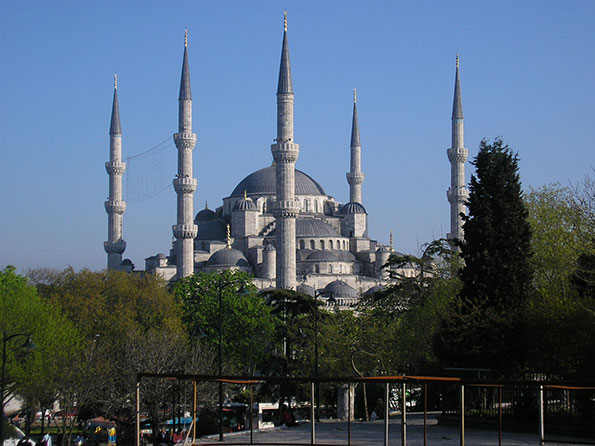
    Caption: Sultan Ahmed Mosque (Blue Mosque), 17th Century, CE

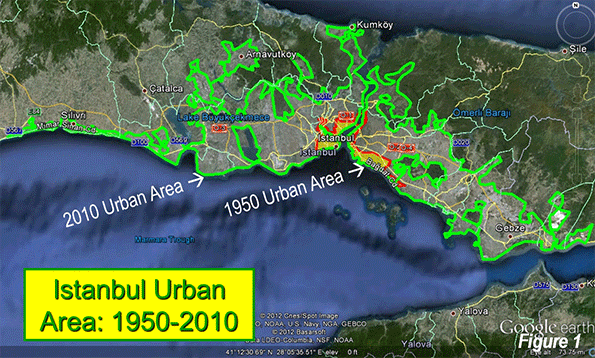
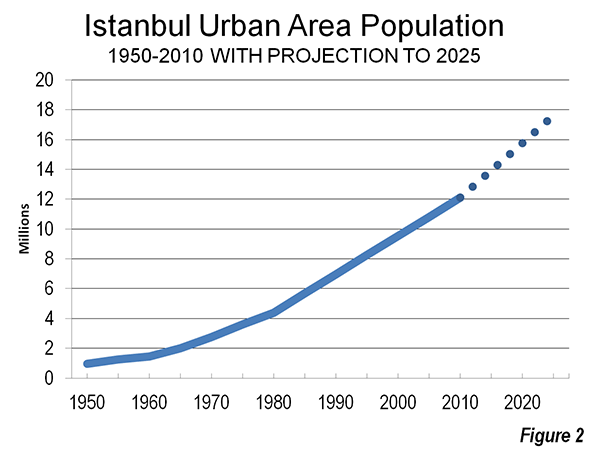
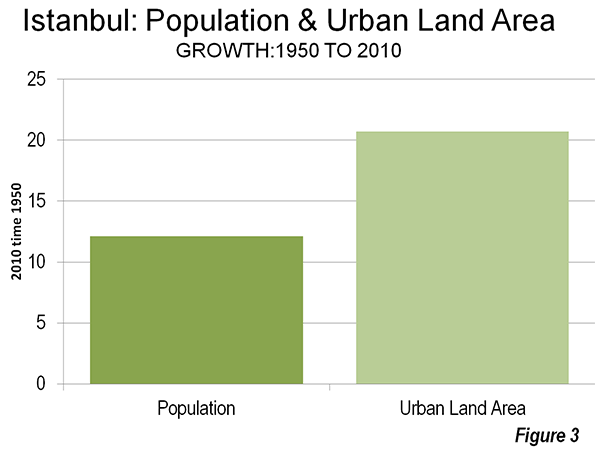
    In the ensuing centuries, the urban area grew modestly to less than 1,000,000 in 1950, when the urban population density fell to 40,400 per square mile (15,600 per square kilometer). Rapid growth was to follow to today’s more than 12 million, along with a further drop in urban density, to 24,300 per square mile or 9,400 per square kilometer (Note: The Density of Istanbul). The physical expansion of the urban area now stretches north all the way to the Black Sea (Figure 1 shows the present extent of the urban area and the 1950 urban area). Over the 60 years, the urban area population grew more than 12 times, but the urban land area grew nearly 21 times (Table 1). Istanbul demonstrates the near universal truth that as cities grow, they become less dense  (Figure 2).

    Table 1          
    Istanbul Urban Area: Population & Density from 1550    
    Year Population in Millions Land Area: Square Miles Land Area: Square Kilometers Density:Square Mile Density: Square Kilometer
    1550 0.66 6 16 110,000 42,500
    1950 0.97 24 62 40,400 15,600
    2012 12.66 520 1,347 24,300 9,400
               
    Change: 1550-1950 47% 288%   -63%  
    Change: 1950-2010 1205% 2073%   -40%  


    At United Nations projected growth rates, the urban area should approach 18 million by 2025 (Figure 2). There are reports of increased migration to Istanbul from Asian Turkey, which if continued, could make the 2025 figure even higher.

    The Metropolitan Metropolis and Province

    Istanbul is a both a metropolitan municipality and a province and can be considered a metropolitan area (labor market area). The province, most of it rural, covers land area of more than 2,100 square miles (5,300 square kilometers) and had a population of approximately 13.5 million according to the 2011 census. The urban area (area of continuous urban development) is much smaller, at only 520 square miles (1,347 square kilometers). Nearly all the population is concentrated in the urban area.

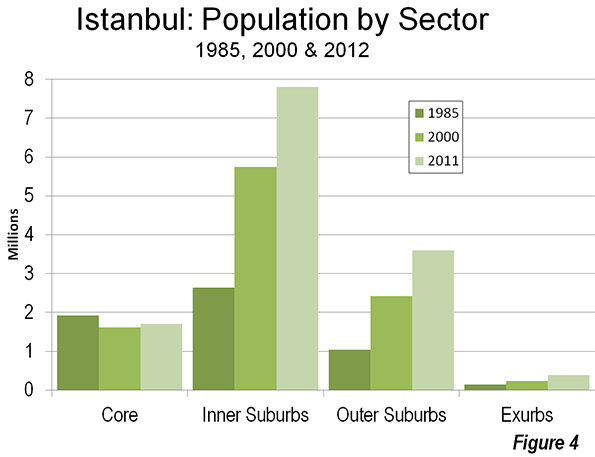
    Since 1985, the metropolitan area’s growth largely has been outside the core. The historic core, on the peninsula (Fatih), lost 27 percent of its population, while the balance of the core, district municipalities to the north of the Golden Horn and to the west, lost 5 percent. Such core area losses have frequently occurred in many  major metropolitan areas   (for example, Osaka, Seoul, Mumbai, Chicago, Milan, Buenos Aires, and Mexico City).

    The inner ring, including district municipalities further to the west and north of the core on the European side and municipalities on the Asian side have captured nearly all the growth. From 1985 to 2011, inner ring district municipalities added 5,000,000 residents. The outer ring of suburban district municipalities gained 2.5 million residents with the greatest percentage growth, at nearly 250 percent. There has also been growth in exurban district municipalities (beyond the urban area), though it has been much more modest (Figure 4 and Table 2).

    Table 2          
    Istanbul: Population Growth by Sector: 1985-2012  
               
        1985 2000 2011 Change: 1985-2011
     Historic Core: Fatih             591          459          429 -27%
     Balance of Core          1,336      2,175      1,270 -5%
     Inner Ring          2,635      5,747      7,800 196%
     Outer Ring          1,044      2,424      3,598 245%
     Exurbs               147          240          386 162%
     Total            5,753    11,045    13,483 134%
               
     Population in 000s         


    Ascendant Asia

    While European Istanbul has been dominant for millennia, it is perhaps fitting that Asian Istanbul is on the rise, with nearly 40 percent of the population, up from 31 percent in 1985. Asian Istanbul was made substantially more accessible by the first bridge over the Bosporus (1973).

    Linking Istanbul

    Istanbul is served by two major east-west freeways. Each (the O-1 and O-2) both have their own crossings of the Bosporus. Other freeways feed these both in Europe and Asia. The development of the mass transit system is somewhat curious. The inner Fatih area and Beyoğlu contain the historically most important commercial centers. However, they are being fast replaced by new skyscraper developments in Levent and Maslak. This is similar to the emergence of newer commercial cores that have become more important the older cores, such as in Mexico City, Sao Paulo, Beijing, and Manila, where multiple, large cores have grown.

    Yet, Istanbul’s urban rail system keys on the old commercial centers. Both Levent and Maslak are located on a single Metro line, which makes them less convenient than if radial lines were being built to these centers instead. Both centers have good road access. Levent is located between the O-1 and the O-2 motorways, while Maslak is located just north of the O-2.

    A passenger rail tunnel between Asia and Europe, the first, is scheduled for opening to Fatih in 2015. Local authorities predict that this and other pending projects could increase the share of trips by rail in Istanbul from 3.6 percent to as much as 27.6 percent. No such market share increase has ever occurred in the world since automobiles have become widely available. Further, like Istanbul’s transit system in general, the project will not provide direct service to Levent or Maslak.

    Becoming Europe’s Largest Urban Area

    Istanbul has always been considered European and remains so even with its huge suburbs in Asia. Istanbul trails Moscow as Europe’s largest urban area, but by 2025 should be the largest. Indeed, it seems likely that Istanbul will be the only European urban area to reach a population of 20 million, as much of Europe faces stagnant or even declining population.

    Wendell Cox is a Visiting Professor, Conservatoire National des Arts et Metiers, Paris and the author of “War on the Dream: How Anti-Sprawl Policy Threatens the Quality of Life.”

    ——————–

    Note: Walking Cities: Walking constrained the physical expansion of cities, and thus the population. As result, few pre-1800 cities reached 1,000,000 population and most were not able to sustain that level. The great expansion of urban areas followed, as walking was replaced by the more efficient transport modes of transit and automobiles, both of which permitted a sizeable expansion of urban footprints and labor markets. The subsequent economic growth is legendary and accounts for having attracted so many people from the countryside. In 1800, estimates suggest that urban areas contained under 10 percent of the world population. Today, the figure is 52 percent, according to the United Nations. This includes all urbanization, from the largest cities to the smallest towns.

    Note: The Density of Istanbul. The province, most of it rural, covers land area of more than 2,100 square miles (5,300 square kilometers) and had a population of approximately 13.5 million according to the 2011 census. The urban area (area of continuous urban development) is much smaller, at only 520 square miles (1,347 square kilometers). This article highlights the urban density of Istanbul, which is the population per square mile or square kilometer. Other sources cite much lower figures, for the province/metropolitan municipality (metropolitan area). However, metropolitan area densities are not urban area densities. Metropolitan areas virtually always have more rural land than urban land, so their population cannot be included in calculations of urban density. The population and density noted above is based upon the 2011 census and will be reflected in the next edition of Demographia World Urban Areas.

    Photo: Hagia Sophia (Santa Sophia) Church (now museum) built by Justinian (6th Century CE). Photos by author.

  • The U.S. Cities Getting Smarter The Fastest

    It’s a commonplace among pundits and economic developers that smart people flock to “smart” places like sparrows to Capistrano. Reflecting the conventional wisdom, The New York Times recently opined that “college graduates gravitate to places with many other college graduates and the atmosphere that creates.”

    Yet an analysis of Census data shared with Forbes by demographer Wendell Cox tells a different story. In the past decade, the metropolitan areas that have enjoyed the fastest growth in their college-educated populations have not been the places known as hip, intellectual hotbeds.

    Perhaps the myth most devastated by the study, which looked at the change in the number of people with bachelor’s degrees in the 51 largest metropolitan statistical areas from 2000-2010, is that there is, as the Atlantic’s Derek Thompson has insisted, a “bipolar population shift” in which the educated go to the expensive blue regions while families and dummies (often conflated as the same thing) flock to the brain-dead reaches of the Sunbelt. In fact, during the first decade of the 21st century, the number of college graduates in Las Vegas increased by a remarkable 78%, the biggest jump in the nation over the period, while in second place Riverside-San Bernardino, Calif., the college-educated population expanded by 60%. Other surprise cities in the top 10 — Charlotte, N.C. , (No. 5) ; San Antonio (No. 6); Jacksonville, Fla. (No. 7); Orlando (eighth); and Nashville, Tenn. (ninth) — all saw 40% to 50% increases in their college-educated population.

    Among the more conventional “brain” cities, the biggest winners from 2000 to 2010 tended to be lower-cost metropolitan areas with less dense cores, such as Raleigh–Durham, N.C. (No. 3), and Austin, Texas (No. 4). In contrast, the more expensive places celebrated for being smart expanded their populations of college grads at roughly half that rate, such as San Francisco (48th), San Jose (43rd), Boston (45th) and New York (39th).

    This is not to say that these cities don’t boast huge concentrations of educated people. The largest metro areas, led by New York, Los Angeles and Chicago, have the biggest populations with bachelor’s degrees. And on a per capita basis, Washington D.C. (aka “parasite city”), San Francisco, Boston, Denver and Minneapolis lead the way, with a share of college grads 20% or more above the national average.

    But other metro areas are catching up. In Tampa-St. Petersburg, Fla., for example, the share of the population that’s college-educated grew from 21.7%  to 26.2%, a gain of 21%. This is roughly twice the increase in the Washington, San Francisco and Seattle metropolitan areas.

    This trend  doesn’t extend to all lower-cost regions. The Sunbelt has generally gained, but some Rust Belt towns have not fared as well. Cleveland, for example, ranked 50th in terms of its growth of its college-educated population, Detroit 49th and Buffalo 48th. Low costs, not surprisingly,  don’t compensate for poor economic conditions, decayed infrastructure and bad weater.

    Yet the pattern is clear: brainpower is spreading out. The notion that companies seeking skilled labor have to go to one of the “hip” cities — an idea relentlessly marketed by the New York and D.C.-based press — appears greatly overstated. In reality, skilled, college-educated people are increasingly now scattered throughout the country, and often not where you’d expect them. For example, Charlotte, N.C., Columbus, Ohio, Kansas City and Atlanta now boast about the same per capita number of college grads as Portland and Chicago, and have higher per capita concentrations of grads over the age of 25 than Los Angeles.

    These trends also suggest that, in many ways, the highly educated are not so different from Americans who never went to college or never graduated. The factors that have driven economic outperformance by some cities over the past decade — lower home prices, better business climate, job opportunities — also attract people with bachelor’s degrees.

    Atlanta, Houston and Dallas each have added 300,000 college grads in the past decade. This is far more than Boston’s increase of 240,000 or San Francisco’s 211,000. Once considered backwaters, these Sunbelt cities now all enjoy a critical mass of educated people.

    Houston boasts a percentage of college grads over 25 somewhat above the national average. Dallas-Fort Worth is just about at the national average. The total Houston increase in college grads over the past decade amounts to three times that of the capital of Silicon Valley, San Jose, Calif., twice that of San Diego and more than Philadelphia. Since hipness is not a well-known Houston trait (though it did place first this year on Forbes’ list of America’s Coolest Cities), and climate can hardly be seen as a positive, one has to imagine this growth has something to do with a job machine that has created over 100,000 new positions between 2006 and 2011.

    The addition of college grads leads to changes on the ground that tend to make cities even more attractive to future graduates. In the case of Houston, there’s been a proliferation of more sophisticated restaurants, clubs and bars in growing inner-city districts like Houston Heights, Montrose and Midtown.

    In the past, executives often turned up their noses at the prospect of relocating to the Gulf Coast metropolis, says Chris Schoettelkotte, founder of the Houston-based recruiting firm Manhattan Resources. Now, particularly given the weak national economy, Houston is increasingly competitive in the race to recruit skilled, educated labor, he says. This is particularly true with people at the beginning of their career. “I don’t get the pushback I used to get,” Schoettelkotte says. The message to recruits: “ You try to find a city with a better economy and better job prospects than us.”

    A democratization and dispersion of educated workers bodes well for the U.S. economy. When highly skilled labor is concentrated in a few places, such as Boston or the Bay Area, opportunities for growth tend to be limited by extremely high business and housing costs. Having more places with educated workers gives employers and entrepreneurs more options for where to start a business or relocate.

    Looking ahead, we can expect this trend to continue, particularly as the current bulge of millennial graduates mature and start to look for affordable places to live and work. Regions that maintain strong job growth, and keep their housing costs down, are likely to keep gaining on those metropolitan areas celebrated for being the winners of the race for educated people.

    Metropolitan Growth in Age 25+ Population with Bachelor Degrees
    Rank Region Total Growth Percent Growth
    1 Las Vegas 122,304 78.4%
    2 Riverside 187,406 60.0%
    3 Raleigh 107,075 55.2%
    4 Austin 147,341 52.3%
    5 Charlotte 126,226 51.7%
    6 San Antonio 111,739 48.1%
    7 Jacksonville 77,102 46.8%
    8 Orlando 125,299 46.6%
    9 Nashville 92,823 42.4%
    10 Phoenix 216,585 42.1%
    11 Tampa 145,675 39.6%
    12 Houston 300,952 39.5%
    13 Louisville 61,312 37.6%
    14 Portland 134,935 37.2%
    15 Dallas 336,993 36.9%
    16 Atlanta 308,306 36.1%
    17 Sacramento 108,151 35.8%
    18 Denver 169,553 35.2%
    19 Indianapolis 90,001 34.5%
    20 Oklahoma City 56,117 33.5%
    21 Richmond 67,012 33.4%
    22 Columbus 96,905 33.2%
    23 Miami 262,394 31.7%
    24 Virginia Beach 73,110 31.2%
    25 Seattle 205,977 31.2%
    26 Kansas City 103,527 31.0%
    27 Salt Lake City 46,205 30.5%
    28 Washington 410,679 30.5%
    29 Minneapolis 189,209 29.9%
    30 Baltimore 146,285 29.6%
    31 San Diego 154,845 29.6%
    32 St. Louis 128,617 29.5%
    United States 13,115,437 29.5%
    33 Cincinnati 90,374 28.3%
    34 Los Angeles 559,904 27.7%
    35 Memphis 45,141 27.4%
    36 Philadelphia 281,686 27.2%
    37 Birmingham 41,436 26.3%
    38 Chicago 429,001 25.5%
    39 New York 905,618 24.4%
    40 Milwaukee 63,508 24.3%
    41 Providence 59,926 24.1%
    42 Rochester 44,268 23.6%
    43 San Jose 102,609 22.5%
    44 Pittsburgh 88,370 22.3%
    45 Boston 240,426 22.0%
    46 Hartford 49,225 20.8%
    47 Buffalo 36,578 20.1%
    48 San Francisco 211,835 19.2%
    49 Detroit 109,429 16.2%
    50 Cleveland 51,259 14.9%
    51 New Orleans 19,307 10.1%

    Data source: U.S. Decennial Census 2000 and 2010.

    Joel Kotkin is executive editor of NewGeography.com and is a distinguished presidential fellow in urban futures at Chapman University, and contributing editor to the City Journal in New York. He is author of The City: A Global History. His newest book is The Next Hundred Million: America in 2050, released in February, 2010.

    This piece originally appeared in Forbes.

    Graduation image by BigStockPhoto.com.

  • Why I Don’t Live In Indianapolis

    It’s no secret that Indianapolis has been a huge focus of my blog over the years. One of the biggest criticisms I get here, especially when I ding some other city, is that I’m nothing more than a mindless booster for Indy. While I like to think I’ve given the city a lot of tough love over the years, it’s definitely true that I’ve had many, many good things to say, and I have no problem saying that I’m a big fan of the city overall.

    Why then, might one ask, don’t I actually live in Indianapolis?

    The answer is multifaceted, but without a doubt one key reason is that I simply can’t sign up to what the city is doing in its urban environment. Indy is going one direction, I’m going another. It’s as simple as that.

    Let me give you an example of what I’m talking about. The city recently announced a plan to subsidize a mixed used development on a parcel in the core of downtown, a project called “Block 400.” It would include apartments, retail, etc – all good. While the concept is great, the design is another matter. I could go into depth on the monotony of the structure and other matters, but what I want to show you instead is a parking garage that will house employees from One America insurance. Here was an initial rendering of the garage:

    It’s about as boring a garage as can be imagined. It’s on a prime block just steps from Monument Circle, but has no street level retail or other interest. It’s just a dead parking garage.

    Various folks took umbrage at this, so the developer decided to tack on some awnings, which got them approved by the city’s hearing examiner. Here’s their updated design:

    Let’s be honest: this isn’t a garage, it’s urban design garbage. And guess what? The city of Indianapolis itself is paying to build it.

    I don’t want to let the perfect be the enemy of the good. I can certainly understand that there are economic constraints, tradeoffs to be made, etc. And not every project can be a home run.

    But this isn’t unusual at all – this is standard operating procedure for Indianapolis. This is par for the course. This is just what Indianapolis builds. I cannot name another major city in the United States where the city’s own developer community (including Flaherty and Collins, the developer of this property), own architectural firms (including CSO Architects, who designed this) and own city government so consistently produce subpar development.

    I’m not exaggerating at all. And this isn’t even the worst offender. For example, here’s another downtown development that not only sucks out loud, but the state fire marshal condemned it and forced residents to move out:

    While I’ve named the names of the folks involved in the parking garage and they certainly deserve it, let’s not focus overly on them. This trend goes back a really long way, and is pervasive. The previous city administration, which was of a different political party, behaved no differently. Partially it’s a result of a lack of good urban history of the type that exists in other places. So there isn’t a good template ingrained in the city to follow.

    But ultimately, as I’ve written before, it’s a crisis of values.

    Indianapolis is the place where, as a rule, not good enough is more than good enough for most people, even community leadership.

    That’s why I don’t live there. Because that’s not good enough for me. I may not be perfect, but I aspire to more than mediocrity. I don’t expect any city to be perfect or all the way there yet. You can inspire people, including me, to join your army to take hamburger hill or to get behind the rock and push, if you provide a vision of what can be. That’s one reason people are planting their flag in Detroit. It’s the hope of the possible.

    But when it’s clear that the city itself – and I mean that in the broadest sense – has decided it wants to go march off in a different direction, it’s a lot harder to enlist in that army, no matter how much you might want to.

    Alas, it seems lots of people agree with me – on the actions if not the reasons – as Center Township (the urban core) lost another 24,000 people in the 2000s. They voted with their feet – just like tens of thousands of others have been continuously voting with their feet since 1950 – to go build a better life for themselves somewhere else.

    And in a decade where downtowns made strong residential comebacks, with young people streaming in to live in them, Indianapolis was an exception. Its downtown* added less than a 1000 residents, and their distribution suggests that almost all of that might be a result of jail population expansion. Even downtown Cleveland did better.

    I’m sure Indy’s boosters will be happy to talk about world class parts of downtown like Monument Circle, the Cultural Trail, Georgia St., etc. And these are legitimately first rate. Actually, that makes it worse. It shows that Indianapolis can compete with the best if it wants to, but most of the time it just doesn’t care to. It’s not ignorance. The city knows that to do, it just doesn’t want to do it.

    For some reason locals seem to think that doing it right should be reserved for a handful of special places and occasions. But the mark of at great city isn’t how it treats its special places – everybody does that right – but how it treats its ordinary ones. Indy is like the guy who thinks he can get away with wearing the same old dirty clothes fives days in a row and not taking showers, as long he slaps on a little top shelf cologne before he leaves the house. I’ve got news for you, people are going to notice.

    Indianapolis retains a very compelling regional story to tell. There are tons of reasons for people to come to or build a business in, metropolitan Indianapolis. But the real story there is mostly in the suburbs.

    Yet I believe even the urban core of this not very historically urban city could be compelling as well – if it wanted to be. Indianapolis has all the potential in the world. Indy is like the up and coming star at a company whose boss pulls him aside one day and says, “You’ve got all the potential in the world, but if you want to get that big promotion, you need to stop doing/start doing X, Y, or Z.” Anybody who has made it to the top was fortunately enough to have somebody give them one or more of those good kicks in the pants along the way.

    Indy, unfortunately, has heard the message many times before from many different people, and has elected not to do anything about it.

    Locals love to make excuses for why things can’t be better. F&C’s development director for the project said of the garage, “Some things aren’t achievable.” What is so different about Indianapolis that makes that true there but no where else? What miracle of economics allowed similar cities like Nashville or Cincinnati or Columbus to build many urbanistically correct new developments in those places while somehow it is impossible in Indianapolis? Maybe it’s time to recruit some out of town developers and architectural firms who have a different attitude towards the possible.

    I would encourage Indy’s leaders to take a short hour and a half drive to downtown Cincinnati and take a look around what’s there. Not the old buildings, but the new ones. Most of them are candidly quite bland architecturally, but from an urbanism perspective – and be sure to take someone with you know what’s what they are talking about on this so that they can point it all out – even the bottom quartile of new buildings in downtown Cincinnati beat most of the top 5% of what’s been build in downtown Indy.

    I’ve listened to various civic leaders of late talk about how rebuilding the urban core is now a big priority of the city. If that’s true, and business as usual has been leading to a catastrophic population collapse for some time, wouldn’t you think that you might, you know, try something different? Apparently not.

    When people in Indy want to do something, they can. That’s why they built an amazing franchise in events hosting, particularly sports. They understand what world class is there, they understand the competitive marketplace, and they do what it takes to succeed – including building world class venues, districts, and capabilities to make it happen. So why hasn’t it happened elsewhere?

    I was involved in a discussion about building a high tech industry in Indianapolis a few years ago. Someone boldly said that since Indy had been able to pull off building the sports cluster, it should be very capable of equally pulling off a high tech cluster to rival top hubs in the country. A friend of mine was very dubious about this, and said insightfully, “Sports succeeded because sports is consistent with the state of mind (i.e, the culture, values, and patterns of life) of Indiana. But high tech is more consistent with the state of mind of other places and not so much with Indiana.” Indianapolis is #1 in sports. And while it’s done well in some parts of tech, I don’t see how you could really rate it as more than the middle of the pack nationally on that.

    “State of mind” makes a big difference. That’s ultimately a question people ask themselves these days, whether it is a company and a prospective employee sizing each other up, a consultant and client, or a city and a prospective resident or business. The most important question is always, “Is there a cultural fit?”

    In an era where an ability to attract talent is perhaps the defining characteristic of urban success over the long term, Indy needs to ask itself the hard questions. How competitive is it? I’d have to say right now that it does a great job for people who want to live in a suburban environment like Carmel or Fishers. That’s very, very important and not to be minimized.

    But there are people out there that want more, who prefer different types of environments. Right now Indy is simply not very competitive in that market. And if it keeps on its current path, it never will be. Convince yourself otherwise by finding the exceptions to the rule and getting them to gush about how great things are. But the numbers don’t lie.

    Like that young up and coming employee who’s got the goods but has a few problem areas that will, if not fixed, hold him back, Indy needs to take a serious gut check about the things that hold it back – and an embrace of mediocrity and lack of seriousness in its approach to urban core development are chief among them.

    Ultimately as I said it’s a question a values. There’s nothing wrong with being happy about where you are. Most people don’t have that burning ambition to make it higher, nor a passion for excellence. In this competitive world a lax attitude will probably undermine your performance in the end, but if that’s what you want be, go for it. I won’t judge a place for that. Just don’t expect those who want better for themselves to sign up for it.

    In any choice a city makes, somebody is going to be unhappy. Any branding choice is, in a sense, a choice to exclude by focusing on something rather than something else. There’s nothing wrong with setting down a marker of what you’re going after – and being comfortable with fall out from that.

    Ultimately it’s not about me or any other specific individual. I’m under no illusion that I’m someone who is personally important to future of any city I might find myself. But it about people generally, and being able to attract enough of them – particular of those that are critical to the 21st century economy – to make the city successful and indeed sustainable over the long term.

    Just remember, talented, ambitious people – those with big dreams and hopes for themselves and their societies – want to live in a place where the civic aspiration matches their personal aspiration.

    What do you aspire to, Indianapolis?

    * Downtown defined as the area inside the inner freeway loop and the White River.

    Aaron M. Renn is an independent writer on urban affairs and the founder of Telestrian, a data analysis and mapping tool. He writes at The Urbanophile, where this piece originally appeared.

  • Evolving Urban Form: Dhaka

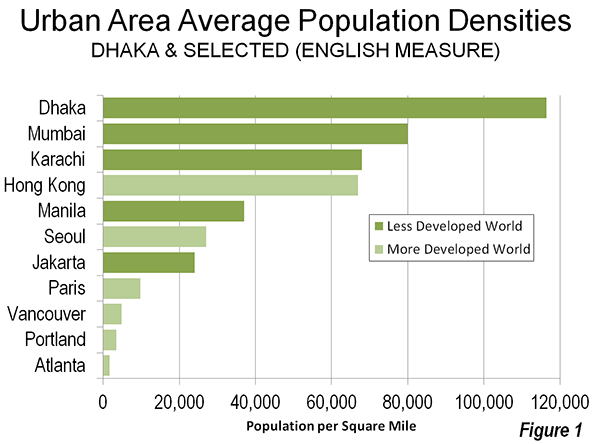
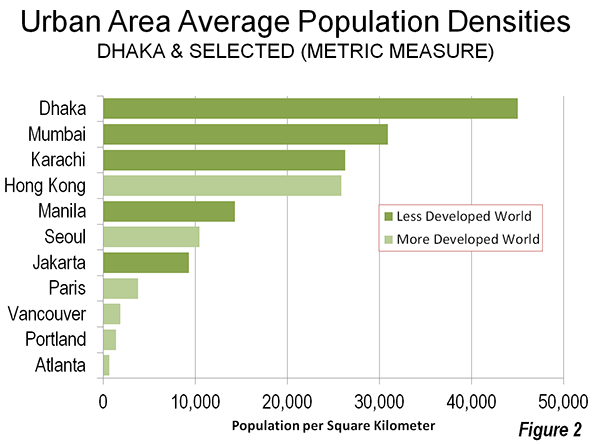
    A few weeks ago, we suggested that Hong Kong was the "smart growth" ideal, for having the highest urban population density in the high income world. But, if you expand the universe to the poorer, developing countries, Hong Kong barely holds a candle to Dhaka. Dhaka’s 14.6 million people live in just 125 square miles (325 square kilometers). At more than 115,000 people per square mile (Figure 1), or 45,000 per square kilometer (Figure 2), the capital of Bangladesh is nearly 75 percent more dense than Hong Kong.

    The Ultimate in Average Urban Area Density

    None of the world’s megacities comes close to Dhaka’s population density. Mumbai is about one-third less dense, despite its reputation as crowded and congested. The only other megacity (minimum 10 million population) more than one-third as dense as Dhaka is Karachi. Twenty three other megacities fall at least two-thirds short of Dhaka’s density (such as Jakarta, Seoul and Paris). New York’s core, Manhattan, is 40 percent less dense, and the New York urban area does not reach 1/20th of Dhaka’s density


    No city in the world uses land so efficiently as Dhaka. But this comes at a price. With an urban area ranked among the 20 most populous in the world, Dhaka’s average income is so low that it does not even place in the top 100 metropolitan area economies as measured by the Brookings Institution. Thus, the world’s most dense urban area is among the least economically productive. Brookings rated the principally suburban and exurban Hartford metropolitan area number one, with an urban density approximately 1/100th that of Dhaka, Hartford includes the old core city; but as well as the much more substantial primarily suburban or even exurban areas.. Hartford is among the least dense urban areas in the world, at half as dense as Portland and one-fourth as dense as Los Angeles. So much for the illusion that urban density and productivity are joined at the hip.

    Despite Dhaka’s hyper-density, critics complain about Dhaka’s urban sprawl. If Dhaka is "urban sprawl," then the term is meaningless. Perhaps the critics would prefer the rural poor to live in even more crowded shantytowns, or maybe better yet, that they go back home to even more desperate rural poverty. Aspiration is not a bad thing, and if that means cities with more people, covering more land area, so be it.

    Not only does Dhaka have the highest average urban density, but it also has some of the highest neighborhood densities: some slum (shantytown) population densities reach 4,200 per acre, which converts to more than 2,500,000 per square mile or more than 1,000,000 per square kilometer. Estimates of the slum population vary, ranging from a quarter to 60 percent of the area population.

    Dhaka in the Neighborhood

    Dhaka is only 150 miles (250 kilometers) from Kolkata. Both cities were located in the province of Bengal for all but six years of the centuries long period of  British rule. After the division of India and Pakistan in 1947, Dhaka was located in East Pakistan. Kolkata became the capital of the Indian state of West Bengal. For most of their histories, Kolkata was larger than Dhaka. But the Dhaka urban area has just overtaken Kolkata in population. By 2025, the United Nations forecasts that Dhaka will reach 23 million, well ahead of Kolkata’s projected 19 million (Figure 3).

    Dhaka’s growth has been spectacular. In 1970, just before East Pakistan separated from Pakistan to become Bangladesh, the urban area had a population of 1.3 million. Its population grew by more than 10 times, Dhaka growth over four decades trails only Shenzhen among the megacities, which expanded by 30 times over the same period.

    The Metropolitan Area

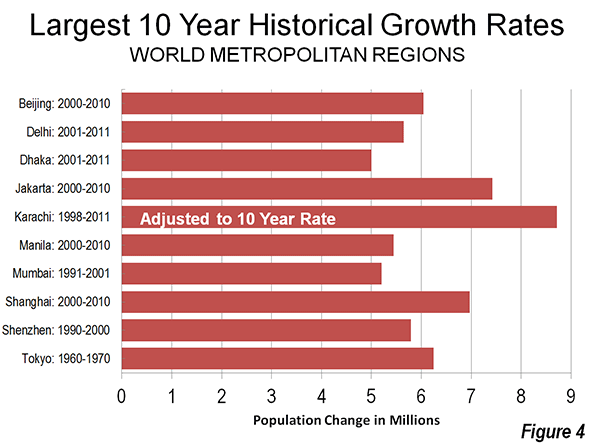
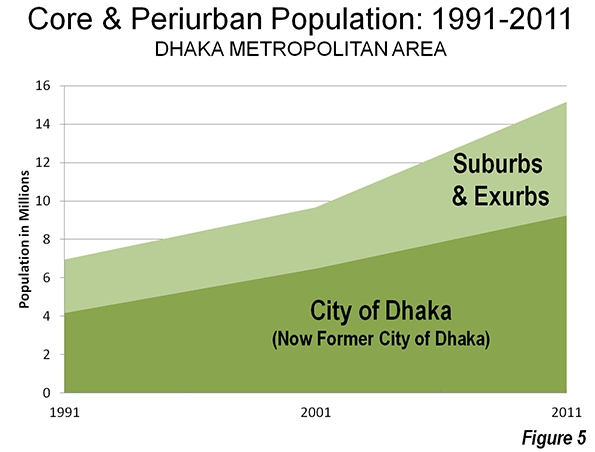
    Dhaka’s metropolitan area (which includes the urban area and economically integrated rural environs) added approximately 5,000,000 new residents between 2001 and 2011. Dhaka added at least a 50 percent to its population, rising from just under 10 million population to just over 15 million during the decade (Note 1). Few, if any of the world’s largest metropolitan areas or urban areas have achieved such a large percentage population increase in a period of 10 years. Even so, Dhaka’s population added fewer people than some larger metropolitan areas over a similar period, such as Karachi, Jakarta and Shanghai (Figure 4).

    Spatial Expansion

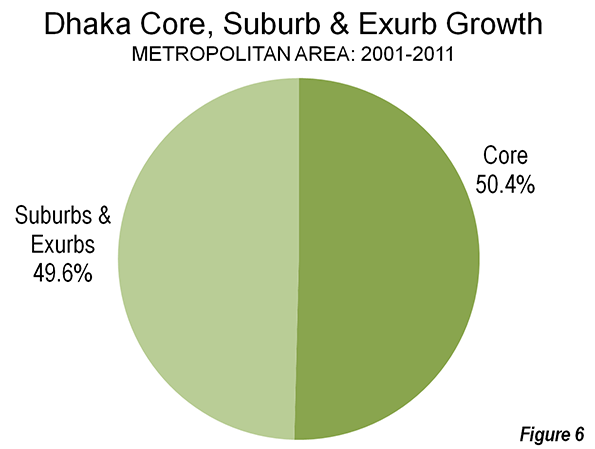
    Consistent with the trend since cities escaped walls, Dhaka has been expanding spatially as its population has increased. Over the past decade, the core municipality, Dhaka, increased its population 45 percent. The suburban and exurban population increase was nearly twice as great, at 85 percent (Figure 5). The core city of Dhaka managed to capture just over one-half the population growth, but because of its larger size, the slower percentage growth rate still resulted in half the additional population being in the city (Figure 6). Dhaka thus further confirms the axiom that as cities become larger, they become less dense.


    River City

    Dhaka may be the worst situated urban area in the world. Dhaka is located in wetlands and virtually surrounded by rivers, some of the greatest in the world.

    • Dhaka is 20 miles (32 kilometers) east of the Padma River, which is the main course of the Ganges River.
    • Only a few miles north of this point, the Padma is joined by the Jamuna River, which is the main course of the Brahmaputra River.
    • The Meghna River, the secondary Brahmaputra River course is 15 miles (25 kilometers) to the east of Dhaka.
    • Little more than 30 miles (50 kilometers to the south is the confluence of the Padma River and the Meghna River, which flows the last few miles to the Bay of Bengal as the Meghna.

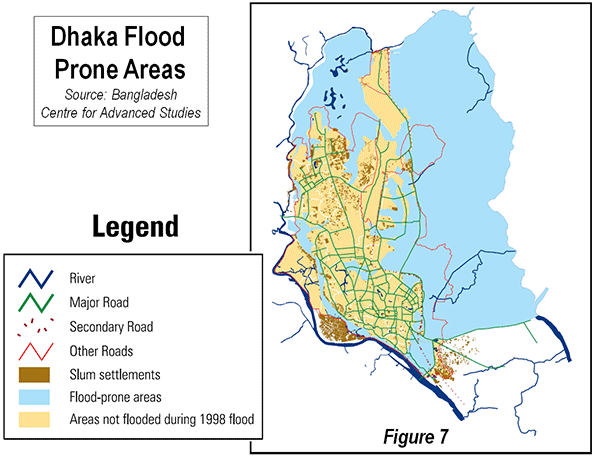
    Though Dhaka is 100 miles (160 kilometers) from the Bay of Bengal (the Indian Ocean), the lowest parts of the city are little more than five feet (two meters) above sea level. This means serious flooding. The risk is illustrated in Figure 7. The extent of the risk is illustrated by the fact that the areas not prone to flooding cover less land than the urban area. That means that the necessary urban expansion will be very expensive. With the understandable exodus from rural areas to the city, the problems of high density and, particularly slums could become more acute.

    A City Designed for a Metro?

    The river courses and wetlands have forced Dhaka into a generally north-south orientation. The urban area averages from three to seven miles east to west (five to 11 kilometers) and is nearly 30 miles (50 kilometers north to south. The more circular development that would be expected for an inland urban area is precluded by the rivers and wetlands.

    This unusual city form could serve the city well, however, as it builds its first Metro line. Stations on the planned north to south line will be within a long walk of a much of the urban area. It is hard to imagine an urban form and density more suited for a Metro. Construction is supposed to begin within the next two years.

    Not only is Dhaka the largest world urban area without an urban rail system, it is also the largest without a motorway (freeway). That too will soon change, as two should be under construction soon.

    Political Reform and the Future

    Meanwhile, in an attempt to improve city services, the national government has divided the city of Dhaka into two. The Dhaka City Corporation has now been replaced by the Dhaka North City Corporation and the Dhaka South City Corporation. There is an increasing body of literature suggesting that smaller municipalities perform better (and spend less) than larger municipalities. The Dhaka demerger may be the first significant such move since the 1986 breakup of the Greater London Council by the Thatcher government (Note 2).

    Dhaka begins the next decade undertaking significant challenges in infrastructure, economic growth and government reform. However, perhaps the biggest challenge will be to figure out where to put the additional five million people expected by the 2021 census.

    Wendell Cox is a Visiting Professor, Conservatoire National des Arts et Metiers, Paris and the author of “War on the Dream: How Anti-Sprawl Policy Threatens the Quality of Life.”

    —–

    Note 1: There was an undercount in the 2011 census, ranging from 3.8 percent in rural areas to 5.3 percent in urban areas. This complicates comparison between the 2001 and 2011 census data.

    Note 2: Even after the subsequent creation of the Greater London Council, by the Blair government, most local functions were not transferred, remaining in the 32 local boroughs. A forced amalgamation of Montréal with suburbs was partially reversed by voter referenda in the early 2000s.

    —-

    Photograph: Farmview Supermarket Transit Transfer Center, on one of the urban area’s few north-south arterial  roadways. (by author)

  • Swing State Geography: The I-4 Corridor

    Overheated presidential politics have done few favors to Florida, except to put 132 miles of hot asphalt on everyone’s lips:  Interstate 4.  Completed in the late 1960s, this interstate (in fact, the only interstate highway to be entirely contained within one state) is known by millions who have  visited there at least once on vacation.  But the social and political reality in the world  around Interstate 4 is little known outside of Central Florida.  Like Ypres, the Flemish town continually under assault during World War 1, I-4 will receive the brunt of both side’s forces.  It deserves to be known a bit for its quirky uniqueness,   even if, like Ypres, it will recede to obscurity once the election is over.

    America’s other single-digit interstate, I-5 in southern California, has such a singular personality that its users refer to it as “the five.” Not so I-4, although many users spit when they say it. With the third highest accident rate in the nation with 1.58 fatal accidents per mile 2004-2008 , Interstate 4 is notorious   for its congestion, dangerous drivers and bad karma. A section of it is even rumored to be haunted.

    I-4 begins rather inauspiciously in Tampa, at a highway interchange with I-275 that even the state Department of Transportation calls “malfunction junction.”   Tampa itself is a brew of German, Italian, Spanish, and Cuban immigrants largely supplanted in the 1980s by in-migration from other states. With a port poised to take advantage of Tampa’s proximity to the Panama Canal, Tampa, and its sister city, St. Petersburg, offer a fantastic coastal setting for urban development. 

    Unfortunately, the two cities now squabble eternally over what has recently been diminishing economic opportunity, often leaving their geography a large, low-grade commercial wasteland. With little to offer except beaches and waterfront real estate, Tampa and St. Pete struggle for their existence. Their airport,  considered the world’s best in the 1980s and 1990s, has been overtaken by newer, better facilities in Orlando, Denver, and other international cities, and like Tampa in general, it suffers as a has-been. No matter; Tampa’s feisty nightlife has turned Ybor City from a quaint, vacant historic district into a wet-zoned bar district that still houses the best music scene in Central Florida.

    Over the bay, St. Petersburg features lovely waterfront sidewalk life with delightful galleries and museums, but it remains “God’s waiting room” with shuffleboard courts and early bird specials at local diners. Beautiful older neighborhoods surround both downtowns, but the outer-ring growth that reaches out beyond these prewar suburbs seems unremarkable and bland. The area, once a diverse mix of blue-collar industry and office workers, has lost a lot of both.

    St. Petersburg is set in Pinellas County, a peninsula that reaches downward just as the San Francisco bay area’s peninsula reaches upward.  But as San Francisco took off  Pinellas did not.  Even the gulf coast of Pinellas County, with beautiful beaches, fails to reach its potential, housing gritty, second-rate motels and paint-peeled condos catering to vacationers unable to afford Sarasota further on down the shore.

    Downtown Tampa these days possesses the sad, romantic air of places once important but now in a state of vanished grandeur. The sidewalks are harsh, bricky, and hot; almost no one traverses the sun-grilled open space at noon. Vacant, boarded-up storefronts are prevalent, punctuated by sleazy, vacant eateries. Channelside, a redeveloped area between downtown and the historic district, has suffered the blight of new, cheesy-looking condominiums built over storefronts, awaiting the throngs of young singles seeking an urban lifestyle but never quite arriving. Channelside looks like an empty stage set, et, “for lease” signs flapping in the breeze.

    Beltways like Interstate 4 can be dividers or uniters, and this one is both and neither at the same time.  East of Tampa, it makes little difference which side of I-4 you reside on; north of Interstate 4 is Temple Terrace and the University of South Florida, and south of Interstate 4 lies Brandon, an unincorporated town. Interstate 4 presents no barrier between the two sides, with fluid movement suggesting that in this section, I-4 presents no obstacle or defining boundary.

    Further east, however, one encounters the city of Lakeland, hanging like a pendulous fruit just south of the freeway. There is a rather fascinating notion that Florida’s urban areas are all aspects of one very large, complex web of urban settlement  most of whom are net consumers, taking in more than they produce. Unlovely Lakeland, the agro-industrial capital of central Florida, is just the opposite. Rich with phosphate, one of Florida’s only natural resources, Lakeland mines and processes this mineral for fertilizer and soap additives. It sends the phosphate by truck and by rail to the Port of Tampa for export.  Lakeland also processes orange juice and a variety of Florida’s agricultural products, and has clusters of food-packaging industries to support this activity. Lakeland, in the heart of what locals call “Florida Cracker country”, works hard and is definitively blue collar.

    North of I-4, Lakeland quickly fades into suburbs and ranchlands. Here, one passes through the Green Swamp, a wetlands that remains undeveloped and remote. An aviation museum reminds you that you are in Central Florida indeed, but little else of man’s handiwork is evident until US 27, an old, pre-war highway that runs along a nice, high ridge which brought so many people to Florida before the interstates came.

    As a boundary, Interstate 4 here is still largely symbolic, with a truck-stop cluster of gas stations and fast-food restaurants that eke out a living. On either side, however, the population remains rural and at this juncture, US 27 unites both sides of I-4, negating its myth as a boundary between red and blue Florida. By now, the alert traveler may have noticed that he is trending more northerly than easterly, and indeed Interstate 4 is slowly turning one to the north into the fringes of greater Orlando.

    At one time, Interstate 4 had seasonally fluctuating traffic. In the late summer heat, one could hit stretches of I-4 where no other cars could be seen on the horizon. Today, however, it frequently slows to parking-lot crawl on the outskirts of Lake Buena Vista. For this is the pleasantly named region in which Disney resides, and I-4 straddles this region. On the left side is Walt Disney World.  On the right side, Celebration:  Disney’s tribute to high-design community living.  Both sides lie within the Reedy Creek Improvement District, a self-governing singularity cleverly established by Walt Disney to prevent annoying regulation.

    The first time one arrives to this section of I-4, no matter what age, is special.  Little things like the power line pole artfully shaped like a Mickey Mouse or the words “Magic Kingdom” on the big green signboards.  Here, I-4 is a conduit of anticipation, a rim from which one anxiously departs to plunge into  a fantasy world.

    Flipping conventional wisdom on its head, cosmopolitan Orange County is mainly to the north of I-4, while Osceola County to the south is pretty much…well, country, in a Silver Spurs Rodeo sort of way. Osceola County houses a great deal of the service industry that maintains the machines of tourism. It also contains a large immigrant population, and the mix has raised tensions in this region. Presidential politics must intimately understand the problems of this county, or risk alienation of its voters over gaffes.

    As I-4 finally turns due north you pass through an area once considered Orange County’s back door, the county jail, large sewage treatment facilities, and Lockheed Martin all sit, surrounded now by development pressures and the occasional stray theme park. Universal Studios is surrounded by residents so close they can hear the screams from the roller coasters in their back yards. Holy Land is isolated, crammed against I-4’s huge wall; and the spectacle of International Drive, one of the most interesting and unstudied urban conditions ever, is visible from much of I-4 as one trends northward towards downtown.

    After twisting and turning through more blah suburbia, I-4 finally ascends to an elevated, straight bridge and threads its way past downtown Orlando.  This is actually, when traffic is flowing, a terrific urban experience, especially at night. To the right, Orlando’s small collection of meek towers, marked by the Captain Crunch hat of a failed condominium; to the left, the Magic’s basketball arena.  This drive continues northward through Orlando’s mosaic of adjacent towns. Younger than Florida’s average population, and largely from somewhere else, this region seems to be perpetually seeking itself, but never quite finding it. The allure of New York and Chicago seem to pick off the best and the brightest, but these folks are always backfilled with newcomers. With the leftist firebrand Alan Grayson   counterbalanced by the Tea Party’s right wing voice, Daniel Webster, the area will be critical in  this election season.

    Past Orlando’s heat and light, Interstate 4 traverses one last stretch of Florida’s untamed wilds, the Tomoka wetlands. This is the stretch that is rumored to be haunted, for traffic fatalities seem more common than normal as one traverses through region here. Perhaps the proximity of Cassadega , home to many spiritualists, has something to do with it, or perhaps the vengeful souls from a graveyard  supposedly under the roadbed are to blame. Either way, one is relieved to see signs of civilization when one finally reaches the end of Interstate 4 as it tees into I-95 near Daytona, Florida.

    One of many cities trying to reinvent itself, Daytona’s allegiance to Nascar and motorcycles is legendary, but it has suffered heavy joblessness and unsettlement in this Millennial Depression. With its share of overbuilt beachfront condos, an unusually blighted amusement park in the center of town, and a restless, angry inner-city population, Daytona’s dire straits resembles, in some ways, Detroit or other hard-hit areas. 

    And so, Interstate 4 begins and ends. Like Ypres, it may come to represent the battleground of an ugly war. The front at one end of I-4, St. Petersburg, represents genteel poverty, at the other the angry poor are looking for answers. In the middle, Orlando has the two extremes of political viewpoints personified by real candidates with passionate followers. Interstate 4, in the Orlando area, was a recipient of a new congressional district, thanks to population growth that continues into the state. What this population growth brings, and how it changes the character of this interesting, complex corridor, will be revealed after the election in November.

    Richard Reep is an architect and artist who lives in Winter Park, Florida. His practice has centered around hospitality-driven mixed use, and he has contributed in various capacities to urban mixed-use projects, both nationally and internationally, for the last 25 years.

    Interstate 4 sign photo by Bigstockphoto.com.
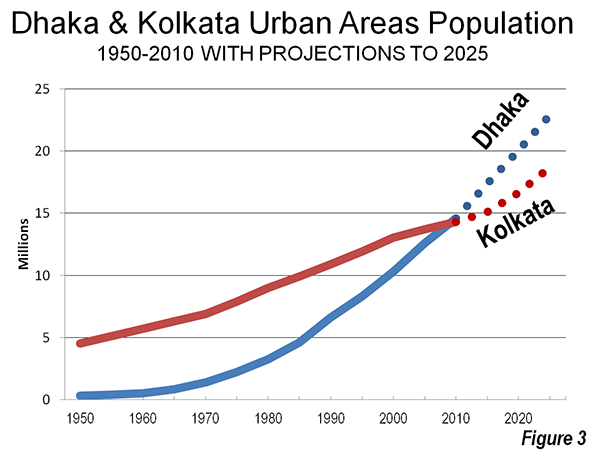
  • State of Chicago: Explaining the 1990s Versus the 2000s

    In my article “The Second-Rate City?” I noted Chicago’s very strong economic and demographic performance in the 1990s and contrasted it with the very poor performance in the 2000s. Then I outlined several problems with Chicago I thought helped drive the struggles. A few people asked a very fair question, saying, “All the negative factors you cite about Chicago (e.g., clout, business climate) were equally as true in the 1990s as in the 2000s, so what really made the difference?” I want to try to respond to that today.

    First, let’s ask ourselves, why did Chicago decline into its Rust Belt malaise? Was it some unique to Chicago factor? No, clearly not, as a broad swath of the industrial United States experienced a similar collapse. Likewise, lots of big cities (I mentioned New York before) seemed to be on the fast track to oblivion in the 1970s. In a sense, the city was a victim of outside macro-economic forces and secular trends.

    Next, why did Chicago come back? Saskia Sassen helps us understand why. Globalization, which enabled the global distribution of many functions of production, also simultaneously created the demand for new types of functions to help control and manage these far flung networks, especially new types of financial and producer services. These require very specialized, high skill workers operating in dense knowledge networks, which led to agglomeration effects and the emergence of so-called “global cities.”

    So, in a sense, the rise of global cities is simply an emergent property of the new global economy. The global transformation that renewed Chicago, New York, London, etc. had little to do with good leadership or great mayors, and everything to do with a historical context that was ripe for repositioning in a new world economy that demanded it. In other words: outside forces again. This includes other secular changes like the start of a new wave of people who prefer urban to suburban living. These forces laid the cities low and they brought them back.

    So as I’ve said before, when it comes to Chicago’s transformation, the city was the artifact, not the architect.

    The 1990s were a great decade nationally. Combine that with these forces I mentioned, and Chicago really had the wind at its back. It’s easy to do well in that environment. However, when the national economy took at turn for the worse in the 2000s and we experienced a “lost decade,” things were very different. It’s when the tide goes out that, as Warren Buffett likes to put it, you get to see who’s been swimming naked.

    In a sense, the 2000s tough times exposed the weaknesses of Chicago in the same way that the financial meltdown blew up so many Ponzi schemes.

    Also, I believe there were some particular characteristics about the way the markets changed in the 1990s and 2000s that particularly benefited Chicago in the 1990s and hurt it in the 2000s. I can’t claim to have done a rigorous study on it (though I think there is some good research to be done), but working in the industries affected and living it myself – and having some personal knowledge of various firm employee counts during the period – I feel somewhat qualified to state this as a hypothesis.

    I’ve outlined this before, particularly in a very extensive post called “A Better Tomorrow” but I’ll restate it in part here.

    There were two main forces that converged on Chicago in the 1990s: the tech revolution and the nationalization of industry. Note that I consider the 1990s really the prelude to globalization, which was the dominant force of the 2000s.

    Consider the technology world of 1990. It was an era dominated by staid mainframe shops. By the end of the decade, the world was completely transformed. Just think of some of what we went through: the client/server revolution, the emergence of the web and the dot com boom, the ERP revolution, the Y2K retrofit problem, and the emergence of mobile telephony and laptops as ubiquitous. These were all huge, gut wrenching changes that required not just incredibly large numbers of people skilled in new technologies themselves, but also with tremendous business, functional, and people skills so they could be deployed effectively.

    At the same time, the 1990s was the Great Rollup era. Back in the 1980s most cities had their three big local banks, their local electric and gas companies, their local retailers, even their local manufacturers. Only AT&T seemed to be a true national player of the type we know today. Fast forward through the 1990s and industry after industry was subject to national rollups. First was the emergence of “super-regional” banks, which led to today’s huge giants. (It was also when Glass-Steagall fell, arguably to our chagrin). Utilities merged, department stores merged, and major big boxes and category killers like Wal-Mart, Target, Walgreens, Best Buy, and Home Depot developed national footprints. Integrating these businesses, and building scalable processes and technology to manage these huge enterprises, was another gigantic effort.

    Both of these worked enormously to Chicago’s benefit. Chicago had always been the dominant location in the interior for professional services, with core sub-industries including: management consulting (e.g., McKinsey), technology consulting (e.g., Accenture), IT/business process outsourcing (e.g., TCS), accounting (e.g., KPMG), and law (e.g., Mayer Brown).

    Both the technology and nationalization trends generated huge amounts of demand for new people to manage them, which drove a huge increased demand generally for consultants and other service providers. What’s more, unlike the old back office “data processing” mainframes, the new technology was directly embedded into the fabric of the business. This meant that people working with it needed industry knowledge like never before. Clearly, to help executives merge and manage large national firms, consultants and such needed a lot of industry expertise as well, and needed to be able to serve their clients on a national, not just local basis.

    This led to a sea change in the organization of professional services firms. Historically they had been organized by local office practice. But in the 1990s they reorganized along industry lines, with national practices. Instead of a Chicago consultant serving Chicago clients primarily, you’d have, for example, a retail consultant serving retailers where ever they might be nationally.

    If you need to fly consultants all over the country to work with clients, where do you want to do it from? The two best options are Chicago and Dallas. So Chicago, with its huge labor market, its urban environment hitting at the emerging youth trend, its status as a major air hub, its central location, and its head start through its already robust professional services sector, became the best location in America for professional services overstaffing. That is, hiring people into a city with the idea that they’ll fly around the country servicing clients coast to coast. I believe this explains why Chicago boomed like nobody’s business during the 1990s. I suspect most major professional services companies doubled or tripled employment in Chicago in this period.

    The 2000s were very different. First, the dotcom bust deflated demand for tech generally and Chicago as a hub got blasted. Second, the 2000s really didn’t see the same sorts of technology revolutions that we saw in the 1990s. I believe that things like Web 2.0 were mostly evolutionary. (Smart devices and such may be leading us through another fundamental revolution, but that wasn’t mostly a 2000s phenomenon). Third, the rise of the global age led to the emergence of offshore software development and business process delivery. Thus, much of the new demand, and existing demand, could be satisfied offshore, and didn’t require an army of expensive onshore consultants anymore. This new competition caused traditional firms to have to revamp themselves to become much more efficient internal business operators. (Law seems to be the last holdout, and is in the early stages today of a major shakeup in how legal business gets done).

    This hurt Chicago badly. You didn’t need to overstaff in Chicago because you could do it in India. When there was recovery from the dotcom bust, much of it was offshore. I suspect that even 12 years later, there isn’t a single technology consultancy that employs as many people in Chicago as it did in 2000, new companies excepted. Consider that major firms like Arthur Andersen and Whitman-Hart don’t even exist anymore. Many smaller sized internet era firms also experienced the same fate, and Chicago’s “Silicon Prairie” ambitions more or less got wiped out, which cost a huge number of telecom jobs. Also, industries like finance have been subject to increasing centralization in global hubs. Chicago went from being #2 nationally as a financial hub to something further down the chart in a global hierarchy. Chicago retains great strengths in derivatives and risk management generally, but second tier financial hubs like Chicago and Boston have been feeling the pinch.

    This, in a nutshell, is what I think explains the difference in performance. The general “wind at the back” of Chicago and big cities in a boomtime economy papered over a multitude of civic sins in the 1990s that the lean years of the 2000 exposed. And the tech/nationalization era of the 1990s particularly benefited Chicago, helping to explain why it rated so highly in that decade.

    I’ve got one more piece in my “current conditions” segment of State of Chicago. Then I’ll turn to articulating my rationale for some of the structural weakness factors I outline in the article, then move on to a series of proposed fix-its.

    This is the third installment in my “State of Chicago” series. Read part one here and part two here.

    Aaron M. Renn is an independent writer on urban affairs and the founder of Telestrian, a data analysis and mapping tool. He writes at The Urbanophile, where this piece originally appeared.