Category: Urban Issues

  • World Urban Areas Population and Density: A 2012 Update

    The latest edition of Demographia World Urban Areas has just been released. The publication includes population estimates, urban land area estimates and urban densities for all nearly 850 identified urban areas in the world with a population of 500,000 or more. These urban areas account for approximately 48% of the world’s urban population. Overall, data is provided for approximately 1500 urban areas, comprising approximately 1.9 billion people, or 52% of the world’s urban population.

    Urban areas (or urban agglomerations) are areas of continuous urban development within a metropolitan area (labor market area), and are the physical form of that constitutes the essence a city. Generally, urban areas can be identified by the lights one would see from an airplane at night or in a satellite photograph. Urban areas are not metropolitan areas, which represent the economic or functional form of a city. Urban areas are a component of metropolitan areas, the other component of which is non-urban or rural territory. A metropolitan area is the combination of the urban area(s) and rural areas, which together comprise the economic region or labor market (commute shed).

    Over the last year, new census reports have become available in such nations as India, Indonesia, China, Canada, Bangladesh, the United States and South Korea. The new data has resulted in a number of ranking changes from before.

    The Megacities: In 2012, 26 urban areas qualify as megacities (Rental Car Tours for 24 of the megacities are available), with populations of greater than 10 million people (Table). As has been the case for nearly six decades, Tokyo remains the largest urban area in the world, with approximately 37 million. New York, which Tokyo displaced in 1955, has fallen to seventh largest and has the lowest population density of any megacity, at 4600 per square mile or 1800 per square kilometer (Note 2). London, which New York displaced in the 1920s never became a megacity due to the imposition of its greenbelt. Instead urbanization leapfrogged into the exurbs of southeast England, where all of the London area’s net population growth has occurred since World War II (London ranked third as late as 1960).  

    Table 1          
    LARGEST URBAN AREAS IN THE WORLD (MEGACITIES): Estimated 2012
    (Over 10,000,000 Population)          
             
    Rank Geography Urban Area Population Estimate Land Area: Square Miles Density Land Area: Km2 Density
    1 Japan Tokyo-Yokohama 37,126,000 3,300 11,300 8,547 4,300
    2 Indonesia Jakarta 26,063,000 1,075 24,200 2,784 9,400
    3 South Korea Seoul-Incheon 22,547,000 835 27,000 2,163 10,400
    4 India Delhi, DL-HR-UP 22,242,000 750 29,700 1,943 11,500
    5 Philippines Manila 21,951,000 550 39,900 1,425 15,400
    6 China Shanghai, SHG 20,860,000 1,350 15,500 3,497 6,000
    7 United States New York, NY-NJ-CT 20,464,000 4,495 4,600 11,642 1,800
    8 Brazil Sao Paulo 20,186,000 1,225 16,500 3,173 6,400
    9 Mexico Mexico City 19,463,000 790 24,600 2,046 9,500
    10 Egypt Cairo 17,816,000 660 27,000 1,709 10,400
    11 China Beijing, BJ 17,311,000 1,350 12,800 3,497 5,000
    12 Japan Osaka-Kobe-Kyoto 17,011,000 1,240 13,700 3,212 5,300
    13 India Mumbai, MAH 16,910,000 211 80,100 546 30,900
    14 China Guangzhou-Foshan, GD 16,827,000 1,225 13,700 3,173 5,300
    15 Russia Moscow 15,512,000 1,700 9,100 4,403 3,500
    16 Bangladesh Dhaka 15,414,000 134 115,000 347 44,400
    17 United States Los Angeles, CA 14,900,000 2,432 6,100 6,299 2,400
    18 India Kolkota, WB 14,374,000 465 30,900 1,204 11,900
    19 Pakistan Karachi 14,198,000 300 47,300 777 18,300
    20 Argentina Buenos Aires 13,639,000 1,020 13,400 2,642 5,200
    21 Turkey Istanbul 13,576,000 540 25,100 1,399 9,700
    22 Brazil Rio de Janeiro 12,043,000 780 15,400 2,020 6,000
    23 China Shenzhen, GD 11,885,000 675 17,600 1,748 6,800
    24 Nigeria Lagos 11,547,000 350 33,000 907 12,700
    25 France Paris 10,755,000 1,098 9,800 2,844 3,800
    26 Japan Nagoya 10,027,000 1,475 6,800 3,820 2,600


    Jakarta (Jabotabek) has emerged as the world’s second largest urban area, with a population of 26 million. This is a larger population than reported by the United Nations, since its estimates include little more than DKI Jakarta, the national capital district and beyond which urbanization stretches for a considerable distance. Continuing suburban growth in Seoul-Incheon secured that urban area a ranking of third, with approximately 22.5 million people. As was reported last year, new estimates indicate that Delhi has emerged as India’s largest urban area, with a population of 22.2 million and a growth rate that should result in its passing Seoul-Inchon in a matter of a few years. Mumbai, which like Mexico City in the 1980s has often been promoted as being destined to become the largest urban area in the world, was passed by Delhi over the past decade and has become the second largest urban area in India.

    Manila is ranked as the fifth largest urban area in the world, with 22.0 million people. In Manila, as in Jakarta, the population reported to the United Nations is far below that of the genuine urban area. The reported population is for the National Capital Region (popularly and misleadingly called "Metro Manila), which represents approximately one-half of the population of the urban area, which stretches into four additional provinces (Cavite, Laguna, Rizal and Batangas). If the population of the Washington urban area were reported in the same manner, it would be 600,000 – the population of the District of Columbia – rather than the 4.6 million indicated in the 2010 census for the entire urban area.

    Los Angeles, until recent years one of the fastest growing urban areas in the world, has dropped to 17th largest in the world and seems destined to drop out of the top 20 in the next decade or two. Fast growing Karachi, Istanbul, Lagos and others could become larger than Los Angeles. Los Angeles reached its peak ranking of 6th largest in the world from 1965 through 1980 and entered the top ten by 1950.

    Over the past decade, Paris became a megacity, reaching a population of 10.7 million. Paris has been Western Europe’s fastest growing large urban area since World War II. All of its growth since 1921 has been in the suburbs, which stretch over more than 1,000 miles (2,600 square kilometers).  This is more land area than Houston’s suburbs, but more densely populated. Since 1921, the historical core municipality (the ville de Paris) has dropped in population from 2.9 million to 2.2 million.

    By world standards, the Paris urban area has grown slowly, having fallen from being the world’s third largest in 1965 to its current ranking of 23rd. However, over the past census period, Paris added 600,000 residents, compared to less than 200,000 in the previous period, indicating a decline in out-migration and a higher natural population rate increase.

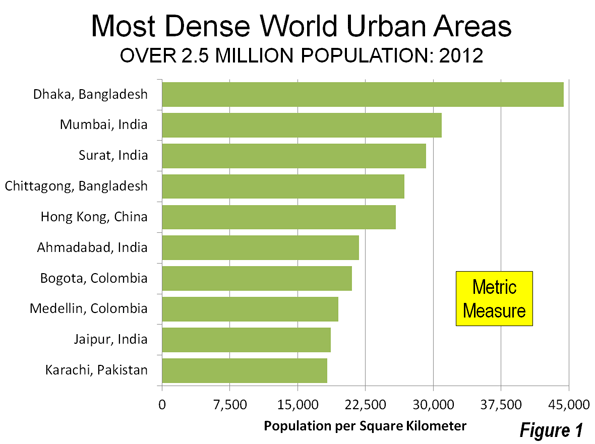
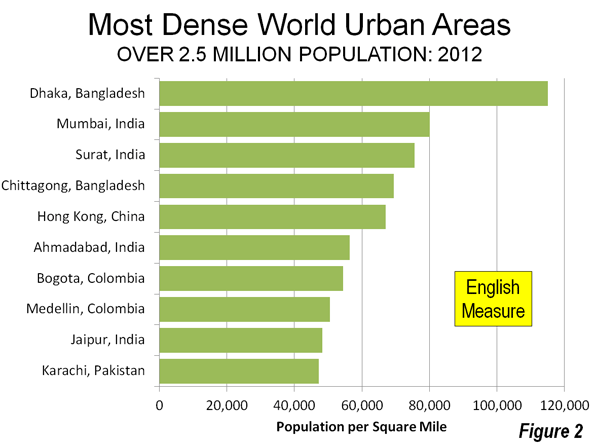
    Urban Area Densities: Dhaka, the capital of Bangladesh grew strongly between 2001 and 2011 and is by far the most densely populated urban area in the world. Dhaka’s density is estimated at 115,000 per square mile or 44,000 per square kilometer, with slum (informal dwelling) densities reported report up 4,210 per acre, or 2.7 million per square mile (1 million per square kilometer). At this density, all of the world’s 3.7 billion urban residents could be accommodated in an area approximately equal to that of the Washington (DC-MD-VA) urban area. All of Dhaka’s urban population of 15.4 million fits into a land area equal to that of the city (municipality) of Portland (population less than 600,000). Nonetheless, analysts have referred to this example of the ultimate of urban density to be "sprawling."

    Among the urban areas with more than 2.5 million population, the second-most dense is Mumbai, at 80,100 per square mile or 30,900 per square kilometer. The most dense high income world urban area is Hong Kong, at 67,000 persons per square mile or 25,900 per square kilometer. Of course, Hong Kong’s density is the result of an accident of history, which resulted in huge migration to the former British colony following World War II. Hong Kong is more than twice as dense as the second most dense high income world urban area, Busan, Korea. The smaller nearby, yet historically similar enclave of Macau (560,000) has an even higher density than Hong Kong, at 70,000 per square mile (27,000 per square kilometer).

    Seven of the densest urban areas with more than 2.5 million population are on the Asian subcontinent. These include Dhaka and Chittagong in Bangladesh, Mumbai, Ahmedabad, Surat and Jaipur in India and Karachi, in Pakistan. Colombia has two of the densest, Bogota and Medellin. Hong Kong is the only high income nation urban area among the 10 densest (Figures 1 & 2).
    The least dense urban areas with more than 2.5 million population are all in the United States. The least dense is Atlanta, with 1800 people per square mile or 700 per square kilometer. The second least dense is, perhaps surprisingly, Boston, despite its reputation for high density. Boston’s population density is 2200 per square mile or 800 per square kilometer. Also, perhaps surprisingly, Philadelphia is the least dense urban area in the world with more than 5 million population, while Chicago is the least dense urban area of more than 7.5 million. The lower density of US urban areas is illustrated by the fact that Portland, with its reputation for higher density and densification planning, would have ranked 11th least dense, if it had reached the 2.5 million threshold used in this ranking.

    Most Extensive Urban Areas: New York covers the most land area of any urban area at nearly 4500 square miles or 11,000 square kilometers. Tokyo covers 3300 square miles or 8500 kilometers. Chicago is the third most expansive urban area, at 2,600 square miles (6,900 square kilometers). Los Angeles, which has long been perceived as the most sprawling of world urban areas, ranks fifth, covering 2400 square miles or 6,300 square kilometers. Atlanta and Boston, the world’s least dense major urban areas, rank 4th and 6th, covering 2,600 and 2,100 square miles respectively (6,900 square kilometers and 5,400 square kilometers).

    The Continuing Exodus from Rural Areas: Around the world, people continue to seek the promise of better economic outcomes in urban areas. United Nations forecasts indicate that another 2.5 billion people will be added to urban areas by 2050, while rural areas (which contain all population not urban) will be reduced in population by 300 million. The world’s urban population is expected to rise from today’s nearly 53 percent to 67 percent. More than 90 percent of the urban growth is expected to be in less developed nations.

    Wendell Cox is a Visiting Professor, Conservatoire National des Arts et Metiers, Paris and the author of “War on the Dream: How Anti-Sprawl Policy Threatens the Quality of Life”.

    ——

    Note 1: Demographia World Urban Areas uses national census authority urban area population and land area data in the few nations designating urban areas on a basis generally consistent with that of the United States Census Bureau. Elsewhere, land area estimates are determined using satellite photography (Google Earth). Population estimates are also obtained from a variety of sources, such as United Nations data, where it is reflective of the urban area population (some data reported to the United Nations is for jurisdictions that are only a part of the urban area and in other cases, metropolitan area data is reported), estimates relying on a "build-up" of local authority data from national census authorities and other sources. Demographia combines some adjacent urban areas when they are contained within the same metropolitan area or consolidated area, such as in New York and Los Angeles (for a complete list see Demographia World Urban Areas). Also see: Urban Terms Defined.

    Note 2: Exceptions: In some cases, continuous urbanization does not constitute a single urban area because they are not within a single labor market (metropolitan area). This can be the case within a nation, such as in the Pearl River Delta of China, where Shenzhen, Dongguan, Zhongshan, Jiangmen, Huizhou, Zhuhai, Guangzhou-Foshan and Hong Kong, which are separate labor markets. International borders (and the Hong Kong-Shenzhen border) also define separate urban areas if free movement of labor is not permitted. Thus Detroit and Windsor or San Diego and Tijuana are separate urban areas because free movement of labor is not permitted. On the other hand, treaties permit virtual free movement of labor between the French and Belgian sides of the Lille urban area and between the Swiss and French components of the Geneva urban area.

    —-

    Photo: Recent migrants to Dhaka slum in NGO school (photo by author)
  • The Best Cities for Jobs 2012

    Throughout the brutal recession, one metropolitan area floated serenely above the carnage: Washington, D.C.  Buoyed by government spending, the local economy expanded 17% from 2007 to 2012. But for the first time in four years, the capital region has fallen out of the top 15 big cities in our annual survey of the best places for jobs, dropping to 16th place from fifth last year.

    It’s a symptom of a significant and welcome shift in the weak U.S. economic recovery:  employment growth has moved away from the public sector to private businesses. In 2011, for the first time since before the recession, growth in private-sector employment outstripped the public sector. More than half (231) of the 398 metro areas we surveyed for our annual study of employment trends registered declines in government jobs, with public-sector employment dropping 0.9 percent overall. Meanwhile, private-sector employment expanded 1.4 percent.

    Read about how we selected the 2012 Best Cities for Job Growth

    Instead of government, the big drivers of growth now appear to be three basic sectors: energy, technology and, most welcome all, manufacturing. Energy-rich Texas cities dominate our list — the state has added some 200,000 generally high-paying oil and gas jobs over the past decade — but Texas is also leading in industrial job growth, technology and services. In first place in our ranking of the 65 largest metropolitan areas is Austin, which has logged strong growth in manufacturing,  technology-related employment and business services. Houston places second, Ft. Worth fourth, and Dallas-Plano-Irving sixth. Another energy capital, Oklahoma City, ranks 10th, while resurgent New Orleans-Metairie places 13th among the largest metro areas.

    To determine the best cities for jobs, we ranked all 398 current metropolitan statistical areas based on employment data from the Bureau of Labor Statistics covering November 2000 through January 2012. Rankings are based on recent growth trends, mid-term growth, long-term growth and the region’s momentum. (Here is a detailed description of our methodology.) We also broke down rankings by size — small, medium and large — since regional economies differ markedly due to their scale.

    The strong growth of the energy sector, and Texas, is even more evident in our overall ranking, which includes many small and medium-sized metropolitan areas. The top 10 fastest growers overall include such energy-centric places as No. 1 Odessa, Texas; second-place Midland, Texas;  Lafayette, La. (fourth place); Corpus Christi, Texas (sixth), San Angelo, Texas (seventh); and Casper, Wyo. (10th).

    The shift from public to private can be seen in the falling rankings of many of the most government-dependent economies. Outside of Washington, D.C. (where federal employment actually has continued to grow), Bethesda-Rockville-Frederick, Md., took an even more dramatic tumble in our big city table,  dropping 34 places to No. 46.There were sizable relative declines in the rankings of many state capitals such as Springfield, Ill. and Madison, Wisc. College towns, which had previously done well in the face of the recession, have also moved sharply lower in our rankings, due to a combination of state budget cuts and better performance elsewhere. College Station, Texas, plummeted from fourth last year on our overall list to 167th; Fairbanks, Alaska, slid from 15th place to 165th, Corvallis, Ore., tumbled from 40th place to 203rd place; and Cedar Rapids, Iowa, dropped from 81st to 246th.

    Budget constraints have also hurt military towns, which previously had been largely immune to the recession. Last year’s overall No. 1, Killeen-Ft. Hood, Texas, slid to 43rd place; Jacksonville, N.C., home to Camp Lejeune, fell to 102nd from 19th last year; and Lawton, Okla., home to Fort Sill, slipped to 274th from  No. 20 last year.

    In addition to energy, the technology sector has been on a tear. After a decade of tepid growth and some years of job losses, Silicon Valley has blown itself another huge tech bubble, this time driven by the social media craze and a surge in private-equity investment. In the San Jose-Sunnyvale-Santa Clara metro area, the number of information sector jobs is up 36 percent over the past five years; this year the epicenter of Silicon Valley jumped 22 places to No. 5 among the 65 biggest metro areas. The social media boom has also been very good for the San Francisco-San Mateo-Redwood City area, which rocketed 16 places to a solid 17th this year.

    But much of the tech growth in the country has continued to flow to more affordable regions less dependent on venture investment. At the head of the pack is Austin, where Apple recently announced a large expansion,  and Salt Lake City, No. 2 on our big cities list, which is a major destination for expansion for Silicon Valley firms such as Adobe, Twitter and  Electronic Arts. Other big players benefiting from the tech boom include seventh-place Raleigh-Cary, N.C., which has been a consistent top 15 performer for the past seven years; Seattle, which rose 18 places to 14th, and Denver at No. 15.

    Perhaps most encouraging of all has been the expansion of the manufacturing sector. In 2011 manufacturing expanded at three time the rate of overall GDP, according to Mark Perry of the University of Michigan-Flint, and the sector added 425,000 jobs, also outpacing the national average.

    As a result, the fortunes of some of America’s hardest-hit manufacturing regions are improving. Columbus, Ind., rose from 235th overall last year to No. 3 on our list this year.  Michigan is beginning to see some signs of new life: perennial cellar dweller Holland-Grand Haven rose a remarkable 202 places to 19th on the overall list. A slew of other Michigan cities rose more than 100 places, including Grand Rapids (64th place), Bay City (136th), Warren-Troy-Farmington Hills (199th), Muskegon-Norton Shores (219th), and Jackson (233th).  It is a glimmer of hope in a region that has lurked near the bottom of our Best Places rankings for as long as we have published it.

    Another group of big cities that may be seeing light at the end of the tunnel are some of the metro areas hit hardest by the bursting of the housing bubble. Miami, Fla., which ranks 21st among the 65 largest metros, Tampa-St.Petersburg-Clearwater, Fla.  (33rd), Phoenix (45th), Riverside-San Bernardino, Calif. (50th), and even Las Vegas (56th) began to show some signs of new life this past year.

    So amidst all the good news, which big cities are still doing badly, or even relatively worse? Sadly, many of the places still declining are located in our home state of California, including Los Angeles (59th place among the biggest metro areas), Sacramento (60th), and, and just across the Bay from Silicon Valley, Oakland (63rd). Only the old, and to date still not recovering,  industrial towns of Providence, R.I. (64th), and Birmingham-Hoover, Ala. (dead last at No. 65), did worse.  And the glad tidings in manufacturing have not touched all the Rust Belt cities: Camden, N.J. (57th), Newark, N.J. (58th), Cleveland, Ohio (61st), and Detroit (62nd) still feature prominently near the bottom.

    Read about how we selected the 2012 Best Cities for Job Growth

    This piece originally appeared in Forbes.

    Joel Kotkin is executive editor of NewGeography.com and is a distinguished presidential fellow in urban futures at Chapman University, and contributing editor to the City Journal in New York. He is author of The City: A Global History. His newest book is The Next Hundred Million: America in 2050, released in February, 2010.

    Michael Shires, Ph.D. is a professor at Pepperdine University School of Public Policy.

    Austin photo by Bigstockphoto.com.

  • Understanding Chongqing and the Fall of Bo Xilai

    The demise of Bo Xilai, the former Party Secretary of Chongqing, has turned into one of the biggest political scandals in China in recent memory and now includes allegations that Bo’s wife Gu Kailai is connected to the murder of a British businessman close to Bo’s family. It is even rumored the businessman, Neil Heywood, may have had an affair with Gu.

    Yet the international espionage drama has not shed much light on the peculiar politics and evolution of Chongqing, the western Chinese city which has become its unlikely setting. As a three year resident of Chengdu, a city two hours northwest by train and a traditional economic rival, I have been fascinated by Chongqing’s unique history and political culture.

    1940-1946: China’s Wartime Capital

    In many ways, Chongqing is China’s version of the Wild West. Known for the rough and tumble nature of its locals, the city, divided by the mighty Yangtze River, has carried with it a crude reputation since the days of Chiang Kai-Shek when his Kuomintang (KMT) held the city as their capital. Even after the remainder of the KMT fled from the Mainland to Taiwan after defeat, the atmosphere of gangsterism and corruption nurtured by Chiang Kai-Shek and the KMT remained deeply imbedded.

    China might’ve taken a different path had the American forces succeeded in getting the KMT and the Communist Party to unite against the common Japanese enemy. It was in Chongqing at the KMT compound where U.S. General Joseph Stilwell arranged a meeting between Chiang-Kai Shek and Mao Zedong to try to broker the deal that ultimately failed. On an official tour of the city last year, Joel Kotkin and I had the opportunity to visit the site of the meeting- a leafy hillside compound which is now a museum and a must see for visitors to the city.

    1997: The Creation of Chongqing ‘Direct-Controlled Municipality’

    After breaking from Sichuan province 15 years ago, Chongqing direct-controlled municipality became by some measures the biggest city in the world.

    Though the specific reasons for the creation of Chongqing municipality were never officially articulated, general consensus is that the decision was to administratively abate the negative effects of Three Gorges Dam project and the resulting destruction of nearby villages. Incorporating these villages as part of Chongqing was an easy way to solve the administrative problem of transferring household registration (‘hukou’) status and mobility for the hundreds of thousands of residents who had to relocate.

    Separating Chongqing from Sichuan also had the added benefit of removing competition with the provincial capital of Chengdu. Under the administration of the Central Government, Chongqing could now move forward with unfettered development without having to deal with the demands of Chengdu. This would also provide Bo Xilai a far greater stage to promote his career ambition.

    2007 – 2012 : The Reign of Bo Xilai

    Bo landed in Chongqing in late 2007 with what some analysts saw at the time a demotion from his previous position as China’s Minister of Commerce. Prior to working for the Central Government, Bo was governor of north China’s Liaoning Province and Mayor of Dalian- the second largest city in the province.

    A port city of about 3 million people, Dalian sits on the Liaodong Peninsula that juts out into the Bohai Sea. It is here where Bo proved himself as an adept politician, serving the city as Mayor from 1992 – 2000. Bo was noted for his progressive urban planning policies, putting emphasis on modernizing the city, improving the environment, adding greenbelt corridors and preserving architectural gems from Russian and Japanese colonial periods. For his progressive urban planning policies, Bo was even awarded a UN-HABITAT “Scroll of Honour” award in 1999.

    To this day, Dalian still often ranks as one of China’s most ‘livable’ cities, a title that the city’s residents attribute to the work of Bo. Yet, if top-down urban planning initiatives were a popular success in Dalian, the same could not be said as unequivocally for Chongqing. While some applauded Bo’s efforts, others saw his overly aggressive methods as detrimental to the existing urban fabric.

    Chongqing and Dalian couldn’t be further apart in character or its stage of economic development. Whereas Dalian is a pleasant seaside town based on tourism, banking and IT, Chongqing is a rough manufacturing megalopolis, known for its craggy mountains chopping through the city and unbearably hot summers.

    Perhaps Bo thought he get away with a more strong-arm approach given Chongqing’s history of being a city on the frontier far away (both physically and psychologically) from Beijing. When he became Party Secretary of the municipality, he came in with guns blazing, initiating a bloody campaign to crack down on organized crime. He and Wang Lijun (his former right-hand man and police chief who would later try to defect to the U.S. Consulate in Chengdu) took down the previous police chief, Wen Qiang, sentencing him to death for corruption.

    Initially many locals were pleased with Bo’s very public display of taking down the gangs, but not everyone was as easily convinced. As one of my friends who is a native of the city once said to me “Bo Xilai just replaced the previous mafia with his own mafia”. If this is ultimately discovered to be the case, then it is perhaps not surprising for a city with a history of such internal struggles.

    In Chongqing, Bo also initiated similar strategies he employed in Dalian by promoting greenbelts, the development of public transportation networks (including monorails to traverse the unforgiving topography), and an ambitious affordable housing program. Yet these urban planning projects were overshadowed by Bo himself, who wanted to be seen both by the residents of Chongqing and the decision-makers in the Communist Party headquarters in Beijing as the new star in China’s political firmament.

    In addition to the organized crime crackdown, Bo also initiated the now well-documented ‘red’ campaigns, promoting the singing of Mao-era songs in public parks and converting the local television stations into 24-hour commercial free broadcasts of red propaganda. He even went so far as to establish a museum at the city’s Public Security Bureau (PSB) displaying his crackdown on crime to show off to visiting delegations.

    Somewhat unnervingly, Kotkin and I were taken to the PSB as the last stop on our visit to the city. The compound, a huge Stalinist piece of architecture, features two quarter-mile long covered colonnades extending out in front of each side of the building. We were led down the first wing by an attractive young woman shouting into a microphone, introducing us first to pictures of the ‘great leader’ Bo shaking hands with China’s top leaders, Hu Jintao and Wen Jiabao, as well as with visiting foreign officials.

    Immediately following, we were bombarded with gruesome images of Bo and Wang’s campaign to oust crime, showing the horrors committed by the gangs. Dead, mutilated bodies filled the walls, as well as photomontage of images from the execution of Wen Qiang. Inside the PSB main building, the contraband seized from Wen Qiang and his associates was on display, including every kind of narcotic you can think of, weapons including AK-47s and gigantic machetes, and millions of dollars worth of historic Chinese art pieces that were used for money laundering.

    The exhibit was meant to show the righteous power of Bo, and belittle the previous group who ruled Chongqing. Afterwards, we were invited to coffee in the opposite wing, where prominent images of Josef Stalin, Vladimir Putin, and Mao Zedong were displayed next to imaged of Bo. The experience was so bizarre that by the time we made it onto the high-speed train to Chengdu both Kotkin and I breathed a sigh of relief to make it out of the city alive.

    All of that is gone now, and Chongqing moves on without Bo. The Bo Xilai saga is a very telling narrative about where China is today. On the political side of things, Bo’s takedown is a message to Chinese citizens and the world that nothing will get in the way of the country’s urban development program, especially a rogue politician who draws too much attention to himself.

    It also means that, for commentators in the West who think that China needs to urgently reform to a more democratic system of free elections, the individuation of high-level charismatic politicians required for this kind of style of government cannot be tolerated at this stage in development. Unfortunately at this stage, popular elections run the risk of choosing someone who cultivates a personality cult.

    From the urban development standpoint (which is actually inextricably linked to the political realm, both in China and in the West), the more top-down local government policies are, the more there is the risk that those in power will abuse those powers in other ways. Finding a balance is key. Many of Bo’s initiatives both in Dalian and Chongqing have their merit in improving urban life, but the manner they were initiated, and the authoritarian, self promoting style, appear now to have been a cover for something more sinister.

    Adam Nathaniel Mayer is an American architectural design professional currently living in China. In addition to his job designing buildings he writes the China Urban Development Blog. Follow him on Twitter: AdamNMayer.

    Chongquing at Night photo by Wiki Commons user Jonipoon.

  • Staying the Same: Urbanization in America

    The recent release of the 2010 US census data on urban areas (Note 1) shows that Americans continue to prefer their lower density lifestyles, with both suburbs and exurbs (Note 2) growing more rapidly than the historic core municipalities.  This may appear to be at odds with the recent Census Bureau 2011 metropolitan area population estimates, which were widely mischaracterized as indicating exurban (and suburban) losses and historical core municipality gains. In fact, core counties lost domestic migrants, while suburban and exurban counties gained domestic migrants. The better performance of the core counties was caused by higher rates of international migration, more births in relation to deaths and an economic malaise that has people staying in (counties are the lowest level at which migration data is reported). Nonetheless, the improving environment of core cities in recent decades has been heartening.

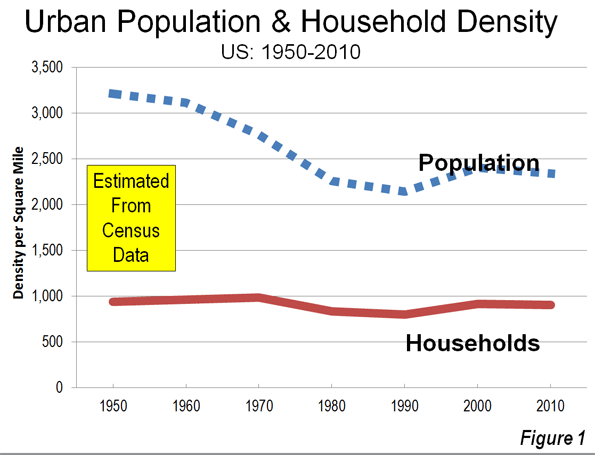
    The urban area data permits analysis of metropolitan area population growth by sector at nearly the smallest census geography (census blocks, which are smaller than census tracts). Overall, the new data indicates that an average urban population density stands at 2,343 per square mile (904 per square kilometer). This is little different from urban density in 1980 and nearly 10 percent above the lowest urban density of 2,141 per square mile (827) recorded in the 1990 census. Thus, in recent decades, formerly falling US urban densities have stabilized .

    Urban density in 2010, however, remains approximately 27 percent below that of 1950, as many core municipalities lost population while suburban and suburban populations expanded. This resulted in the substantial expansion of urban land area reflecting the preference for low-density lifestyles among Americans and most people in other high-income areas of the world.   Between the 1960s and 2000, nearly all of the growth in the major metropolitan regions of Western Europe and Canada has taken place in suburban areas, as these nations’ urban areas have dispersed in a manner similar to that of the United States. The trend continued through 2011 in Canada and domestic migration data in Western Europe shows a continuing movement of people from the historical cores to the suburbs and exurbs.

    This dispersion, pejoratively called "urban sprawl" has been routinely linked with everything from obesity and global warming to "bowling alone." In fact, while population densities have fallen, households densities have remained steady, barely droppping at all. Average household size has fallen dramatically, as fewer children have been born and divorce rates have soared. New households have been formed at more than 1.5 times the rate of population growth. The result is that a 27 percent decline in urban density since 1950 translated into a much more modest 4 percent decline in household density. A more genuine target for anti-suburban crusaders would be household sprawl rather than urban sprawl (Figure 1).

    Smaller Urban Areas Growing Faster

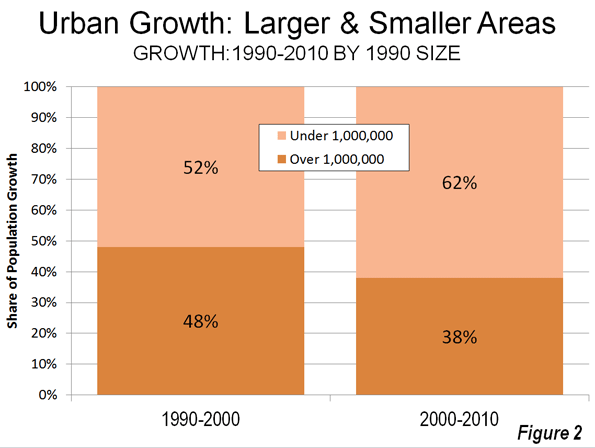
    Even as urban densities have reached a floor, Americans still continue to move to areas of lower density and smaller populations. For example, the urban areas of more than 1 million population in 1990 attracted 48 percent of the nation’s urban growth between 1990 and 2000. Between 2000 and 2010, these areas attracted a smaller 38 percent of urban growth (Figure 2).

    The Exurbs: A Two-Way Exodus

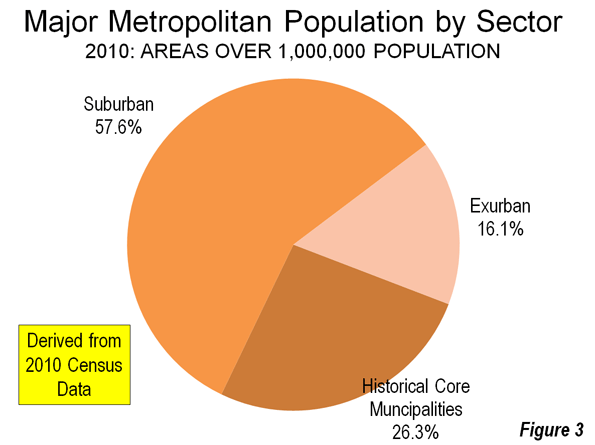
    For much of the last decade (and even before), the media has been heralding an epochal “return” to core cities. This idea is fundamentally misleading since most suburbanites actually came not from core cities but smaller towns and rural areas. The census results have made it clear that the urban focus of population growth was largely anecdotal, although  small inner city areas of some core cities (such as small sections of  St. Louis, Chicago, Dallas, Seattle, San Diego and Portland)  have experienced uncharacteristic growth. But overall, most growth continued to be in the suburbs and exurbs.  Measured at the census block level, exurbs are constantly at risk of being converted into suburbs as they become a part of the continuously developed area. Even so, as of 2010, exurban areas accounted for 16.1 percent of the population in the 51 major metropolitan areas. The historical core municipalities accounted for 26.3 percent of the population, while suburban areas housed 57.6 percent of the population (Figure 3).

    It should be considered, however, that in many urban areas — such as Houston, Los Angeles, Phoenix, Portland, Seattle and Orlando — many historic city neighborhoods were developed as and remain suburban in their form, being dominated detached homes and automobiles. It is unlikely that exurban areas (measured at the census block level) will exceed the historical core cities in population, since they are at constant risk of being merged with suburbs (as the urban area expands).

    Smaller Urban Areas: Where the Sprawl Is

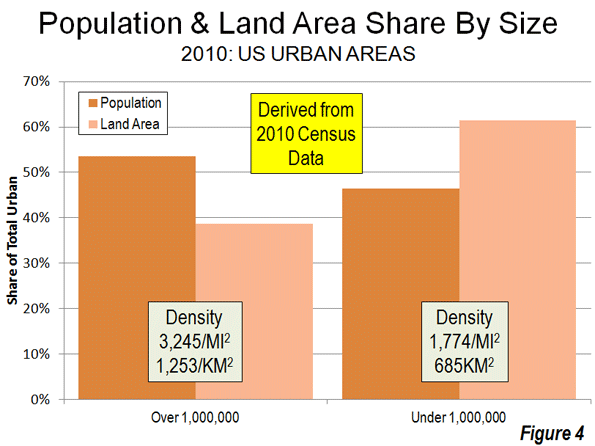
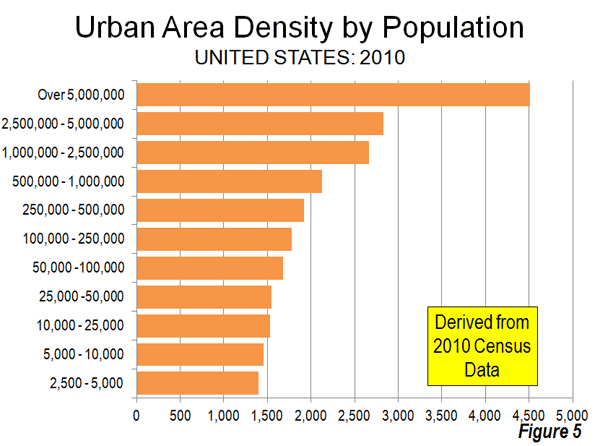
    The principal urban areas of the major metropolitan areas are nearly twice as dense as the rest of America’s urban areas. These urban areas have 53 percent of the urban population, but occupy only 39 percent of the urban land area. By contrast, the smaller urban areas have 47 percent of the urban population, while occupying 61 percent of the urban land area (Figure 4). It seems odd  that the fury of urban planners is directed at the larger, more dense urban areas rather than the smaller, much less dense urban areas, that sprawl to a far greater degree (Figure 5).

    Most and Least Dense Major Urban Areas

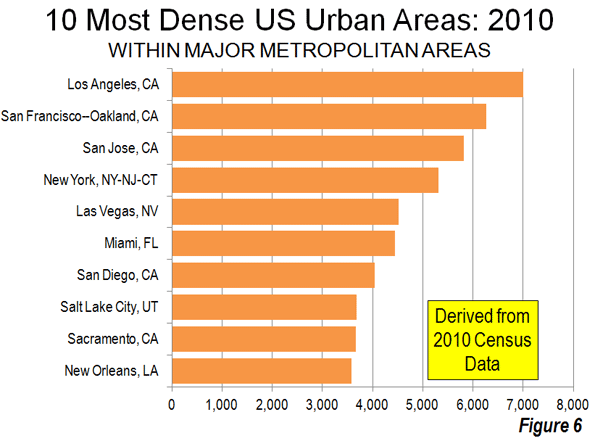
    Among the major metropolitan areas, the most dense urban area is Los Angeles, at a density of 6,999 per square mile (2,702 per square kilometer). This is a 32 percent denser than fourth ranked New York whose  hyper-dense core is offset by its low density suburbs. In fact, San Jose, which is virtually all suburban in its urban form and was a small urban area in 1950 (link to 1950-2010 data), ranks third and also is more dense than the New York urban area. Second ranked San Francisco is also more dense than New York (Figure 6). New Orleans ranked 10th most dense, however experienced a reduction in density of more approximately 30 percent due to the devastation of Hurricanes Katrina

    It may be surprising that Portland, with by far the most radical densification policies in the nation, does not even rank among the 10 most dense urban areas. Portland ranked 13th, behind urban areas like Las Vegas, Salt Lake City, San Diego, Sacramento, Denver and exclusively suburban Riverside-San Bernardino (and even the much smaller urban areas of Fresno, Bakersfield, Turlock and Los Banos in California’s San Joaquin Valley). However Portland did densify, reaching one-half the density of Los Angeles.  Portland will catch Los Angeles in density by 2120 at the current rate.   

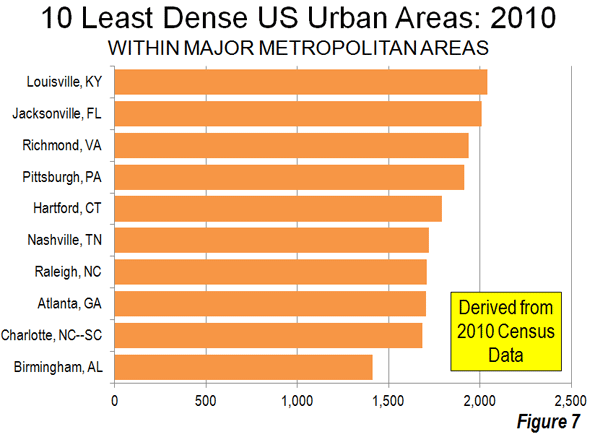
    The least dense urban area is Birmingham, with a population density of 1,414 per square mile (546 per square kilometer). Atlanta, the least dense urban area of more than 3 million population in the world right is the third least dense at 1,707 per square mile (659 per square kilometer). The second least dense urban area, Charlotte, had a density of 1,685 per square mile (651 per square kilometer), while increasing its land area over the decade at twice the rate of Atlanta (Figure 7).

    Staying the Same

    Urbanization in the United States over the last decade can be characterized by the old French proverb that "the more things change the more they stay the same."

    As in Europe and elsewhere (see the Evolving Urban Form series), when they move, Americans go to less dense areas such as to suburban and exurban areas within the larger metropolitan areas as well as smaller, lower density urban regions. The extent to which they move, however, will depend more upon economic improvement than the lure of core areas that, in reality, continue to lose younger people in their thirties while continuing not attracting their boomer parents as they get older.

    Wendell Cox is a Visiting Professor, Conservatoire National des Arts et Metiers, Paris and the author of “War on the Dream: How Anti-Sprawl Policy Threatens the Quality of Life

    —-

    Note 1: Urban Areas and Metropolitan Areas: An urban area is the area of continuous development and as Sir Peter Hall put it, is thus the "physical" urban form. The urban area is a similar, but fundamentally different concept than a metropolitan area and analysts routinely confuse the terms. The United States Census Bureau calls urban areas over 50,000 population "urbanized areas." The metropolitan area is larger, and includes one or more urban areas as well as economically connected rural areas. . The metropolitan area is the "functional" urban form. There is no rural territory within urban areas, but there can be substantial rural territory in a metropolitan area (For example, the US defines metropolitan areas by counties. This can lead to artificially large metropolitan areas. For example, the Riverside San Bernardino metropolitan area, in the West where counties tend to be larger, covers 27,300 square miles (a land area larger than Ireland). The Cleveland metropolitan area, with a principal urban area similar in population to Riverside-San Bernardino, covers only 2,000 square miles, because it is located in Ohio, where counties are smaller. At the same, the far lower population density of the Riverside-San Bernardino metropolitan area is despite the fact that the urban area is approximately 50 percent more dense than the Cleveland urban area

    Note 2: Historical Core Municipalities, Suburbs and Exurbs: For the purposes of this article, an area outside a historical core municipality is considered a suburb if it is in the urban area and an exurb if it is in the corresponding metropolitan area, but outside the principal urban area. Urban areas are delineated at a small census geographical area (the census block), which makes more precise analysis possible than is available at the county level, the lowest level at which domestic migration data is available.

    Note 3: Principal Urban Areas: The principal urban area is the urban area within a metropolitan area that has the largest population. For example, in the Riverside-San Bernardino metropolitan area, the Riverside-San Bernardino urban area is the principal urban area. Other urban areas, such as Murrietta, Hemet and Indio (Palm Springs) would be secondary urban areas.

    —-

    Photograph: Exurban St. Louis (photo by author)

  • Homebuilding: Recovery & Red Tape

    The Recovery Blueprint is a multipart series of articles that offers suggestions on how to recover from the homebuilding recession.

    Since the recession began, there haven’t been any significant changes in how regulations could be improved to energize the housing market and foster innovation. Three areas where big regulation changes are needed? Environmental subsidies, density requirements, and zoning laws.

    Environmental Incentives: Repeating the mistakes of the Carter era, federal and state governments have thrown vast sums of tax money at ‘green’ solutions likely to fail. A massive amount of our nation’s total energy use seeps out of inefficient housing, draining families of income at a time when they can least afford it. The subsidization of inefficient construction that incorporates energy saving alternatives is as flawed today as it was 25 years ago. Federal and state credits allow funding for improvements such as insulation, solar panels, wind generation, geothermal systems, and the like. These tax credits have to be balanced against taxes paid by families who are barely surviving this recession, if they are still in their homes making mortgage payments.

    Who benefits? Not the mortgage companies that repossess energy inefficient homes. Not the families in traditional homes burdened with high energy costs. Only those wealthy enough to need tax breaks can benefit. But a household at the income level where it makes financial sense to upgrade an existing home can easily afford the upgrade without burdening the already overtaxed public.

    In a low income, possibly downtrodden neighborhood, upgrading a home for energy efficiency results in an expense (even after tax breaks) not likely to be recovered at the sale of the home. It would make more sense to use the same amount of funds to replace older, inefficient homes with new construction. New construction essentially replaces homes with the least efficient HVAC (heating/ventilation/ air conditioning) and insulation with new ones that operate the most efficient systems. But new construction gets almost no tax benefits; only geothermal or solar systems on new construction are subsidized. Does that make sense?

    Density Targets: Making funds available to cities on the condition that certain higher densities are met is not a solution, either. What I hear most often is that we need to provide high-density housing and public transportation so that poor people can get to their jobs, assuming, of course, that all people of low income work downtown.

    Are multi-billion dollar light rail projects and heavily subsidized low-income high-rise towers justified by such rhetoric? A low-income family on the 6th floor of a high-density building will not have the same quality of living or the pride-of-place that a home with a yard would provide. Travel dependent on a train or bus schedule does not offer the independence of owning a vehicle and travelling on one’s own schedule. Travel by foot or bike makes perfect sense for some of those who live in San Diego, but in the rest of the world those alternatives are viable only for the few nice weather days.

    When the recession began, urban architects and planners celebrated the death of the suburbs and the coming advent of an urban rebirth. While the suburbs were certainly hard hit, urban areas did not receive the expected mass migration.

    There is a myth that sprawl was the result of large lots and low density in the suburbs. Over the past 20 years, the firm I founded has planned over 730 developments in 46 States and 15 countries. I would estimate the average density of our suburban developments at between four and five units per useable acre. Today’s suburban development must preserve wetlands, steep slopes, wooded areas, and most often contain a minimum percentage of the site in open space. None of those requirements were in place when our core cities were built. One simply gridded streets through swamps (the previous term for wetlands) and bulldozed slopes and woodlands. Had our existing core cities been built under today’s regulations, they would likely sprawl 30% or more beyond the areas they currently occupy.

    Density targets that must be hit in order to receive government financial assistance not only doesn’t increase the quality of lower income life, it doesn’t result in more sustainable and affordable cities. Instead, most funding has resulted in displacing low-income neighborhoods with gentrified, wealthy development. Many of these projects were initial financial failures. The next developer — the one who picked up the project at bargain prices — realized the profit. Successful, affordable urban redevelopment remains elusive.

    Ordinances & Codes: The designer of any development, suburban or urban, will squeeze every inch out of the site to stay within the most minimal dimensions allowed by local ordinances. This effort to maximize the client’s profits can only result in monotonous, cookie-cutter development.

    Many city planning boards have been manipulated into believing the illusion that a ‘forms based’ or ‘smart-code’ approach is a solution. These new regulations simply increase the number of minimum standards, and restrict innovative solutions. What a ‘forms based’ or ‘smart’ code does accomplish is to significantly increase the consulting income of the firm that promotes this alternative.

    Many engineers and architects base their fees on a percentage of the final construction costs. A consultant who charges on a percentage of infrastructure costs has an incentive to introduce excessive sewer pipes, retaining walls, or other non-needed construction. A fee structure based upon increased profit derived on the least efficient design is a huge roadblock to developing sustainable cities.

    Innovations in land development and in methods of design now allow a reduction of both environmental and economic impact from 15% to over 50%, compared to conventional or New Urban planning methods. While these new methods take more time and effort to design, the reward is more attractive, affordable, and functional neighborhoods.

    What’s the blueprint for better planning? For starters, two ideas: government aid should be based on a ‘plan’ showing how the resulting development will enhance the living standards, and not be tied only to density levels. And agencies should reward contracts to the consultant with the best solution. This means creating a financial mechanism to increase – not decrease — profitability for sustainable planning and engineering solutions that require the least amount of construction costs.

    Photo by Stripey Anne: “I am an NHS Bureaucrat…These, dear friends, are the tools of my trade: red tape, pen, ink…”

    Rick Harrison is President of Rick Harrison Site Design Studio and Neighborhood Innovations, LLC. He is author of Prefurbia: Reinventing The Suburbs From Disdainable To Sustainable and creator of Performance Planning System. His websites are rhsdplanning.com and pps-vr.com.

  • Goodbye, Chicago

    Odd as it may seem for someone known as The Urbanophile, I actually grew up in the countryside. I spent most of my childhood on a country road about four miles outside the town of Laconia, Indiana, population 50.  I always used to get confused when John Cougar sang about living in a small town, because I knew he was from Seymour, and with over 15,000 people that seemed a big town in my book.

    Today I still laugh at these urbanites who brag about their green ways like having “rain barrels” to catch reclaimed rainwater from the roof for watering their yard.  For many years that’s what I drank growing up, as we didn’t have city water supplies and had to rely on our cistern.

    After graduating high school I went to Indiana University. Then armed with my bachelors it was on to Chicago, the result of an accident: that’s where my job offer came from.  I had no strong feelings on where to live other than that I didn’t want to go back to my home town. In Chicago I ended up, like many young professionals, in the Lincoln Park neighborhood on the North Side. Though this too was pretty much an accident. I had relatives who lived there and invited me to stay with them when looking for an apartment.

    For many people from small town or suburban environments, going to college is a time of tremendous personal transformation and growth. I didn’t have that experience. For me, the great transformation came from moving to Chicago. Exiting the L in the Loop on my first day going to work, wearing a suit, surrounded by tall buildings and crowds of people, I felt like I was on the set of a movie. It was an almost surreal experience.

    Though urban life was new to me, I fell in love with it. And I was transformed by the experience. I knew nothing about culture, food, fashion, architecture, actually relating to people with different backgrounds from me, traveling, or how to get around in anything other than a car.  Beyond merely learning how to go to work every day, living in Chicago provided a non-stop stream of stimulating and educational experiences that helped me grow as a person.

    But it wasn’t just me who was being  transformed. The urban renaissance of Chicago was underway by the time I arrived in 1992, but it was very early in the process. I recall recruiters for the company I worked for bragging about how Chicago was now an outpost of that uber-hip coffee chain Starbucks. The gentrified areas were still largely confined to a narrow strip along the north Lakefront. Many of the places that later became yuppie playgrounds were then ethnic enclaves or undeveloped. Some were still close to slums.  On the outer reaches of Lincoln Park itself, streetwalkers openly plied their trade along North Ave.

    The 90s were heady a heady decade for  Chicago. The city, like select other major urban metros around the country, exploded with new growth and attracted many new migrants. Chicago experienced perhaps the largest urban condo building boom in America, transforming huge tracts of the city.  The quality on offer improved radically.  The population increased, and the city even added more jobs than Houston. It was a great time to be a Chicagoan, and I enjoyed every minute of it.

    But come the 2000s, the condo boom continued but an economic and political malaise  had clearly set in. Even new mayor Rahm Emanuel has labeled it a lost decade. As the decade ended, I had increasingly made up my mind to leave the city, now the place where I’d spend nearly as many years as my native Indiana. Early this year, I left Chicago behind.

    What made me decide to leave?  There are a few factors, some more personal than others.

    The first is that I simply had done Chicago. The Chicago experience had been transformational when I got there, but after nearly 20 years it was getting stale. It was just more of the same. It was time for new challenges.

    I was also motivated by the bleak economy. I owned a condo, an  anchor that left me at great risk of getting marooned in the city, a phenomenon recently written about by Crain’s Chicago Business. I was willing to sell near the bottom of the market to avoid the risk of getting stranded. There is no clear sense of an imminent major turnaround. There are huge unfunded liabilities at all levels of government in the region and state. The city’s economy seems to have lost a clear raison d’etre. No longer the “city of big shoulders”, it is losing out to urban areas with stronger economic identities — New York, San Francisco, Los Angeles, Washington and, even emerging cities like Houston.  So in the end I decided it was worth paying a “breakup penalty” to get out. Interestingly, no one, not even my alderman, suggested I was wrong in this.

    Lastly, I no longer saw Chicago as a good platform for my personal ambitions. The city likes to see itself as occupying a “sweet spot” as a legitimate urban oriented big city with a lower price tag and higher quality of life. Yet for me Chicago was a “sour spot” that offered neither the opportunities of say a New York, Washington, or San Francisco, but still came with a high price tag. I would rather live in a small city that’s dirt cheap where I can have more impact, or in a place like New York where the cost of living might be greater, but the opportunities are matchless.

    That is ultimately where the city will stand or fall. I’m but one example, but it’s a decision repeated with various results day after day: is this where I’ll plant my flag, seek my fortune and dreams, raise my family, or build my business?  Chicago has to be seen as a success platform for both people and businesses. The demographic and economic results of the 2000s suggest it is losing that battle for the moment, though given the 90s results, it is certainly possible to think that might change again tomorrow.

    As for me, Chicago will always hold a special place in my heart and I’ll treasure my experiences there.   But for now it’s on to new adventures.

    Aaron M. Renn is an independent writer on urban affairs and the founder of Telestrian, a data analysis and mapping tool. His writings appear at The Urbanophile.

    Chicago skyline photo by Bigstockphoto.com.

  • Megalopolis and its Rivals

    Jean Gottman in 1961 coined the term megalopolis (Megalopolis, the Urbanized Northeastern Seaboard of the Unites States) to describe the massive concentration of population extending from the core of New York north beyond Boston and south encompassing Washington DC. It has been widely studied and mapped, including by me. (Morrill, 2006, Classic Map Revisited, Professional Geographer).  The concept has also been extended to describe and compare many other large conurbations around the world.

    Maybe it’s time to see how the original has fared?   And what has happened to other metropolitan complexes in the US, most notably Los Angeles, San Francisco, Chicago and should we say Florida?


    Table 1 summarizes the population of Megalopolis from 1950 to 2010 and Table 2 compares Megalopolis with other US mega-urban complexes.  Megalopolis grew fastest in the 1950s and 1960s, with growth rates of 20 and 18.5 percent. The  northeast has since been outpaced by the growth in other regions, but growth was still substantial in the last decade. Megalopolis added almost 3 million people, by 6.8 %, to reach an amazing 45.2 million.

    Table 1: Growth of Megalopolis 1950-2010
    Year Population Change % Change
    2010 45,357 2,983 7
    2000 42,374 5,794 15.8
    1990 36,580 2,215 6.4
    1980 34,365 360 1.2
    1970 34,005 5,436 18.5
    1960 29,441 4,910 20
    1950 24,534

    From Table 2 I note four major subregions of Megalopolis: Boston, New York, Philadelphia and Washington, DC. New York is still the biggest player, but the locus of growth over time has shifted South. This reflects the increasing world importance of Washington, DC. New York’s almost 20 million may not surprise, but the fact that greater Boston has grown to almost 9.5 million may be more surprising.  The Washington-Baltimore area grew by far the fastest at almost 15 percent (not much sign of shrinkage of government!). In contrast New York, Boston and Philadelphia’s growth was relatively paltry.

    Table 2: Megalopolis and Its Rivals
    Place
    2010 Pop
    2000 Pop
    Change
    % change
    Megalopolis
      New York 19,923 19,209 717 3.7
      Boston   9,445 8,967 478 5.3
      Philadelphia 8,415 76,781 773 9.5
      Baltimore-Washingt 7,403 7,681 960 14.9
    All 45,181 42,302 2,888 6.8
    Chicago 10,817 10,305 512 5
    Los Angeles 12,151 11,789 362 3.1
      Central 903 857 46 5.4
      North 928 634 294 46
      East 2,884 2,105 475 37
      South 3,543 3,210 337 10.4
    All Los Angeles 20,404 18,599 1,810 9.8
    San Francisco-Sacramento
      San Francisco 7,330 6,946 384 5.5
      Sacramento 3,171 2,604 572 22
    All San Francisco-Sacramento 10,501 9,550 951 10
    Florida
      Miami 6,027 5,311 716 13.5
      Tampa 4,818 3,894 974 25.3
      Orlando 2,915 2,193 722 33
      Jacksonville 1,483 1,191 2,242 24.5
    All Florida 15,243 12,544 2,699 21.5

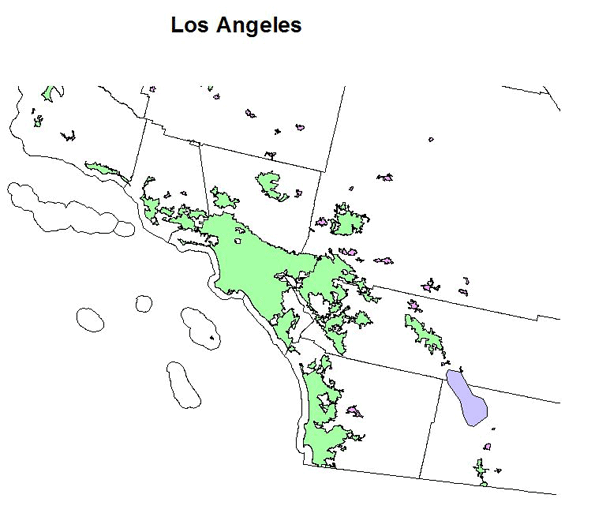
    Greater Los Angeles is the second largest conurbation, with some 20.4 million, growing by 1.8 million, and 10 percent from 2000. In the table I distinguish between the core Los Angeles urbanized area and the satellite urbanized areas west, north, south and east. The core LA area grew by only 3 percent, while the spillover areas to the north and east had astonishing growth, at 46 and 37 percent over the decade.  These include several places with a fairly long history, such as Riverside and San Bernardino, San Diego and Santa Barbara, but many are rapidly growing large suburbs and exurbs, a spillover of growth from the Los Angeles core. Much of the fastest growth has been in  Mission Viejo, Murietta-Temecula, Indio, Lancaster, Santa Clarita and Thousand Oaks.

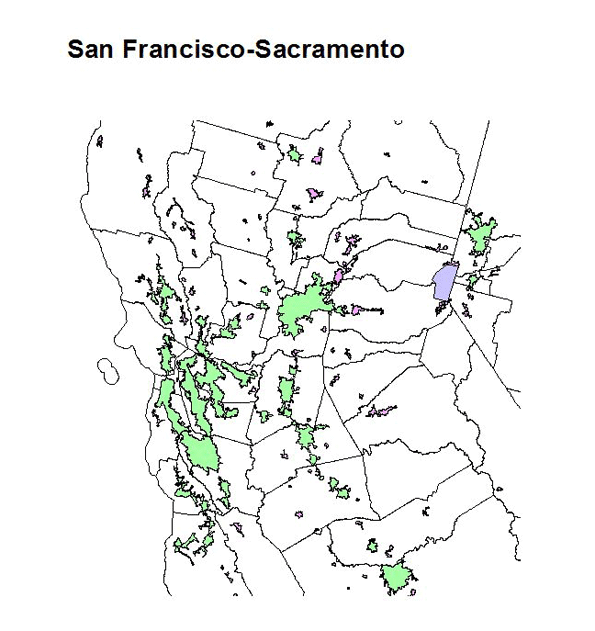
    For greater San Francisco, I distinguish two subregions, the Bay area of San Francisco-San Jose (west) and Sacramento (central valley).  Some might consider these totally distinct, but they have become one in a conurbation sense, as evidenced by commuting patterns. Many people live in the less costly Central Valley area but commute to the expensive Bay Area cities. Together, the conurbation is now 10.5 million, up 10 percent from 2000. The central valley (Sacramento) portion grew far more rapidly than San Francisco-San Jose (22 percent compared to 5.5 percent).  

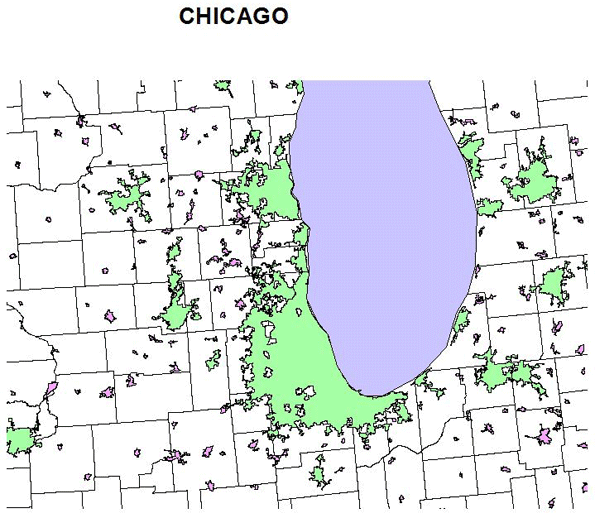
    Compared to its rivals the Chicago conurbation has grown less rapidly but is still large, with a population of 10.8 million in 2010 , growing 512,000 (5 percent) since 2000.  Chicago and Milwaukee are the well-known core cities, but there are also less well known components with far faster growth such as Round Lake-McHenry and West Bend, WI.   

    Florida

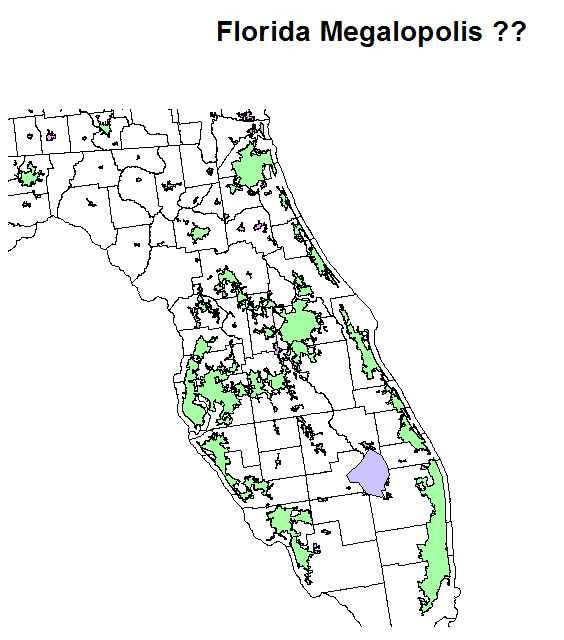
    The more interesting and difficult conurbation to try to define is what might be called the Florida archipelago. Greater Miami has long been recognized as a conurbation, but I contend that virtually all the urbanized areas of the state are in effect a complex web of urban settlement, with little clear demarcation. This is in part a reflection of   rapid and expansive  growth.  Nevertheless it makes sense to recognize four sub-regions, centered on Miami, Tampa-St. Petersburg, Orlando and Jacksonville. 

    Together these areas have reached an astonishing 15.2 million, up 2.7 million or 21.5 percent in one decade.  Because settlement is spread across the state in such a web-like fashion with no single dominant center, they constitute a newish form of urban concentration. Besides the well-known centers such as   Miami, Tampa-St. Petersburg ), Orlando and Jacksonville,  there are many satellite cities, often quite large. These include North Port, Cape Coral  encompassing older Ft. Meyers, Bonita Springs, Kissimmee, Palm Bay-Melbourne, Palm Coast-Daytona, and Port St. Lucie.  An interesting but hard to answer question is how much of Florida’s phenomenal growth is a result of transfer of people and accumulated wealth from the North (and especially from the original Megalopolis).

    The United States is a large and diverse country, with many other giant cities and a vast countryside. But it is important to realize the importance of these megalopolitan areas, with an aggregate population of 102.6 million, one third of the nation’s population.

    What’s next? Look for the rise of now just somewhat smaller conurbations such as Houston, Dallas, Atlanta, Minneapolis, Seattle, Phoenix, and Denver. In terms of numbers and rates of growth Texas is a front runner, but its stars do not coalesce into a megalopolis, at least not yet. The belt of urban growth from Atlanta, through Greenville, SC, Charlotte to Raleigh-Durham is also a likely future conurbation candidate.

    Richard Morrill is Professor Emeritus of Geography and Environmental Studies, University of Washington. His research interests include: political geography (voting behavior, redistricting, local governance), population/demography/settlement/migration, urban geography and planning, urban transportation (i.e., old fashioned generalist).

  • Review: The Great Inversion and the Future of the American City

    Is gentrification the “fifth great migration,” that will fill old downtowns with upper-middle-class white folks, while the tract mansions of the outer ring become slums for immigrants? So suggests Alan Ehrenhalt, the former executive editor of Governing magazine. In The Great Inversion and the Future of the American City, he proposes that a demographic shift is under way that is reversing generations of suburbanization and white flight.

    This book will gain Ehrenhalt nothing but friends, admirers, and speaking engagements among the New Urbanist set, just as Richard Florida, perhaps today’s best-known urban theorist, has made a good living with his work. Ehrenhalt believes that “the massive outward migration of the affluent that characterized the second half of the 20th century is coming to an end.” Soon, he predicts, scarcely anyone “will be buying large, detached single family houses 30 miles from the city limits.” And, more specifically, “Chicago in 2030 will look more like the Paris of 1910 than like the Detroit of 1970.”

    As corroboration of this vision of the future, he notes the undeniable fact that the ’burbs have not been lily white for decades. Their good jobs, good schools, property values, and low crime rates continue to attract great numbers of hard-working, middle-class Africa Americans and immigrants. Meanwhile, as some inner-city neighborhoods become safer, they are drawing the market segment that developers refer to as “the risk oblivious.” Often, these are intrepid young white people without school-age children who recognize that it was always nuts to ignore the marvelous real estate near the old downtowns. Frequently, they are followed by the somewhat less adventurous and more affluent.

    For those of us who have long admired Ehrenhalt’s astuteness, however, this book’s theme is undercut by some real head scratchers: His “great inversion” thesis isn’t supported by the 2010 Census data, the location of high paying white-collar jobs, or the rise of the Internet as a social and economic force.

    As demographer Wendell Cox and others have noted, suburbs are capturing a growing share of the population increase in the nation’s major metropolitan areas. “Historical core municipalities accounted for nine percent of metropolitan area growth between 2000 and 2010,” Cox writes, “compared to 15 percent in the 1990–2000 period. Overall, suburban areas captured 91 percent of metropolitan area population growth between 2000 and 2010, compared to 85 percent between 1990 and 2000.”

    The old real estate mantra “location, location, location” applies to American jobs, too. If you imagined the map of the Washington, D.C., metropolitan area as a waiter’s tray, with each white-collar job assigned the same weight, you’d discover that the balance point was just east of the “edge city” of Tysons Corner in Fairfax County, Virginia. New residential areas such as wealthy Loudoun County, Virginia, are booming because of their proximity to concentrations of high-paying jobs around Dulles International Airport, Reston, Fair Oaks, and Tysons. People living in these areas can go years without visiting the District of Columbia, much less commuting to it.

    Because the Internet is, in effect, a transportation device, it is transforming the built environment. There are nearly 100 classes of real estate—including grocery stores, warehouses, and offices—from which cities are built, noted the late urban theorist William J. Mitchell of MIT. All are being transfigured more swiftly and dramatically than they were by the rise of the automobile.

    In addition, the Internet is, counterintuitively, putting a new value on face-to-face contact. This has led to the rise of village-like places where people can easily meet. Some are embedded in old downtowns—the sort of places Ehrenhalt cites, such as Chicago’s University Village. Some are part of what traditionally have been regarded as suburbs. But the fastest-growing segment consists of places such as Santa Fe, New Mexico. Home to a world-renowned opera, charming architecture, distinguished restaurants, quirky bookstores, sensational desert and mountain vistas, and a great deal of diversity, Santa Fe, with a population of 68,000, is also little more than a village, far from the nearest metropolis. It represents aggregation and dispersal.

    If and when real estate begins to increase in value, it may be instructive to look at the metropolitan areas that were appreciating fastest before the recent crash. Number one was Wenatchee, Washington. On the dry, east side of the Cascade Range, it has lots of sunshine, great skiing, and beautiful views, and thus attracted a lot of hip people who brought with them the arts, cafés and restaurants, and increased educational opportunities. Then came the Seattle-area software people, who extended their outdoorsy weekends using cell phones and laptops to stay in touch with the office, eventually moving there and starting their own businesses. Almost the entire top-20 list of fast appreciating metro areas similarly became urbane without really becoming urban.

    Ehrenhalt is absolutely correct that “we are moving toward a society in which millions of people with substantial earning power or ample savings will have the option of living wherever they want.” Whether that choice will amount to a great inversion, in which the roles of cities and suburbs “will very nearly reverse themselves,” remains to be seen.

    © 2012 Joel Garreau as first published in The Wilson Quarterly.

    Joel Garreau’s is the Lincoln Professor of Law, Culture, and Values at the Sandra Day O’Connor College of Law at Arizona State University and aFuture Tense Fellow at the New America Foundation. His books include Edge City: Life on the New Frontier (1991) and Radical Evolution: The Promise and Peril of Enhancing Our Minds, Our Bodies—and What It Means to Be Human (2005). He is Director of “The Prevail Project: Wise Governance for Challenging Futures.”

  • As Filmmaking Surges, New Orleans Challenges Los Angeles

    For generations New Orleans‘ appeal to artists, musicians and writers did little to dispel the city’s image as a poor, albeit fun-loving, bohemian tourism haven. As was made all too evident by Katrina, the city was plagued by enormous class and racial divisions, corruption and some of the lowest average wages in the country.

    Yet recently, the Big Easy and the state of Louisiana have managed to turn the region’s creative energy into something of an economic driver. Aided by generous production incentives, the state has enjoyed among the biggest increases in new film production anywhere in the nation. At a time when production nationally has been down, the number of TV and film productions shot in Louisiana tripled from 33 per year in 2002-2007 to an average of 92 annually in 2008-2010, according to a study by BaxStarr Consulting. Movies starring Leonardo DiCaprio, Morgan Freeman, Harrison Ford are being made in the state this year.

    Of course many states and cities have thrown money at the film industry, hoping to establish themselves as cultural centers. Texas, Georgia, British Columbia, Toronto and Michigan all wagered millions in tax dollars to lure producers away from Hollywood and the industry’s secondary hub of New York. There were 279 movies shot in New York State in 2009 and 2010. For all its gains, Louisiana still trails far behind the Empire State with 95 film productions in that period.

    Yet New Orleans and Louisiana possess unique assets which make its challenge far more serious than that of other places. A Detroit, Atlanta or Dallas might be a convenient and cost-efficient place to make a film or television show, but they lack the essential cultural richness that can lure creative people to stay. The Big Easy is attracting that type, plus post-production startups, and animation and videogame outfits, giving a broader foundation to the nascent local entertainment industry.

    “This is different,” notes Los Angeles native and longtime Hollywood costumer Wingate Jones, who started Southern Costume Co. last year to cash in on the growth in production in the state. “It’s the combination of the food and the culture that appeals to people. It must have been a lot like what Hollywood was like in the ’20s and ’30s. It’s entrepreneurial and growing like mad.”

    Critically, Jones adds, Louisiana’s unique culture comes without the fancy New York or Malibu price tag. This is a place where small roadside cafes serve up bowls of gumbo, crayfish and shrimp that would cost three to five times as much in New York, the Bay Area or Los Angeles. Excellent music — from rap to jazz to blues and gospel — can be found simply by walking into a bar and paying the price of a couple of beers. And then there are housing costs, roughly half as high, adjusted for income, than the big media centers.

    This mixture of affordability and culture is attracting young people — the raw material of the creative economy — as well as industry veterans like Jones. In 2011, we examined migration patterns of the college-educated and found, to our surprise, that New Orleans was the country’s leading brain magnet. New Orleans was growing its educated base, on a per capita basis, at a far faster rate than much-ballyhooed, self-celebrated places like New York or San Francisco. In fact, its most intense competition was coming from other Southern cities such as Raleigh, Austin and Nashville, the last two of which also share a strong, and unique, regional culture.

    Another sure sign of the city’s growing appeal has been a torrent of applications to Tulane University, the city’s premier institution of higher education. In 2010 the school received 44,000 applications, more than any other private university in the country. The largest group, more than even those from Louisiana, came from California, with New York and Texas not far behind.

    Increasingly, the Big Easy merits comparison not only to the Hollywood of the 1920s but also Greenwich Village of the ’50s, Haight-Ashbury in the ’60s and “grunge” Seattle in the mid-’80s. These, too, were once appealing places that were less expensive, less predictable and more open to cultural outsiders. Now they’re increasingly too pricey and yuppified for creative people bereft of large trust funds.

    Ironically, Katrina provided the critical spark for this transformation. It devastated the torpid, corrupt political and business culture that viewed the arts as quaint and fit only as a selling point for tourists. In its place came more business-minded administrations in New Orleans and in Baton Rouge, the state capital. In both places, economic developers seized on motion pictures, television, commercials and videogames as potential growth industries that fit well with the state’s expanding appeal to this generation’s creators.

    This piece originally appeared in Forbes.com.

    Joel Kotkin is executive editor of NewGeography.com and is a distinguished presidential fellow in urban futures at Chapman University, and contributing editor to the City Journal in New York. He is author of The City: A Global History. His newest book is The Next Hundred Million: America in 2050, released in February, 2010.

    New Orleans Jazz Band photo by BigStockPhoto.com.

  • Census Estimates: Slowing Metropolitan Growth and the Future of the Exurbs

    Recently the Census Bureau released 2011 county and metro area population estimates that showed overall slowing population growth and particularly showing slow to halting growth in exurban counties.

    Someone once said to me about Chicago’s Mayor Daley that if he did something you liked, he was a visionary genius leader, but if he did something you hated, he was a corrupt machine dictator.

    That seems to be how too many urbanists view the Census Bureau.

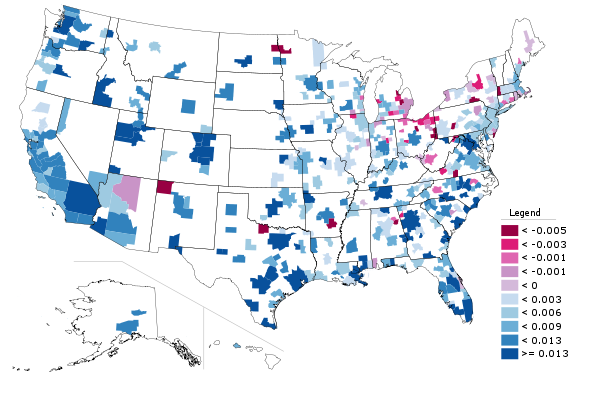
    I’ll come back to the exurbs in a minute, but first a look at a map of metro area growth last year:


    Metro area percent change in population, July 1, 2010 to July 1, 2011. Source: Census Estimates via Telestrian

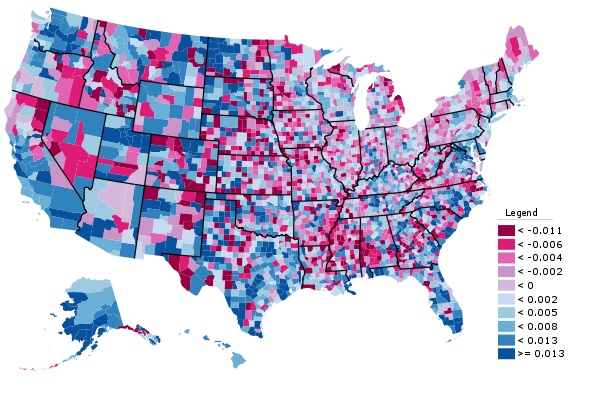
    Here’s the county map:


    County percent change in population, July 1, 2010 to July 1, 2011. Source: Census Estimates via Telestrian

    Someone once said to me about Chicago’s Mayor Daley that if he did something you liked, he was a visionary genius leader, but if he did something you hated, he was a corrupt machine dictator.

    That seems to be how too many urbanists view the Census Bureau.

    Back in the 90s when the Census estimates showed cities growing more slowly than boosters believed, they pressured the Census Bureau into adjusting the estimates to provide higher values. As it turned out, in most cases even the original estimates for cities proved inflated. In fact, the 90s were actually better for a lot of major cities than the 2000s were (e.g, New York, Los Angeles, and Chicago). This led to a new narrative that the Census had undercounted cities somehow.

    Now this new data shows slowing exurban growth. All of a sudden, the Census Bureau has become once more a source of Gospel Truth, and I’ve seen many articles suggesting that the exurbs are dead, killed by rising gas prices and new Millennial preferences.

    Let’s not get ahead of ourselves here.

    Yes, exurban growth slowed recently. While cities on the whole fared more poorly than expected in the last census, we did see strong growth in downtowns and adjacent areas. I myself wrote about improving migration trends for core cities. That’s good news worth celebrating for cities. But don’t overstate the case.

    I have a different though admittedly speculative take on the exurbs. I think a chunk of the fringe migration was from very low end home builders skipping out beyond established jurisdictions into unincorporated territory with few buildings restrictions. They threw up dirt cheap homes there and often sold them to people with marginal credit and income who had no business buying homes, using a variety of gimmicks to do so. (I know someone who sold homes for one of these builders, so I heard about some of these). Loose credit policies and government guarantees fueled this. The housing crash killed this market. Now that subsidies for this type of growth aren’t available, so that market is probably never coming back.

    But when the economy improves and the market normalizes, I’d expect some level of suburbanization to resume. Part of the logic is simple math. If you add up the population of the municipalities of New York City, Los Angeles, Chicago, Philadelphia, San Francisco, Boston, Seattle, Washington, Portland, and Miami you only get 20 million people. That’s only about 20% of what the Census Bureau is projecting for just population growth by 2050. With the difficulties of building in urban areas, there’s no way to accommodate just the new growth even if everybody wanted into the city. In other words, there’s just no way there is going to be some massive back to the city movement. I hate to break it to you, but that’s reality.

    Here’s the full list of large metros, sorted by population growth percentage:

    Row Metro Area 2010 2011 Total Change Pct Change
    1 Austin-Round Rock-San Marcos, TX
    1,728,247
    1,783,519
    55,272
    3.20%
    2 Raleigh-Cary, NC
    1,137,297
    1,163,515
    26,218
    2.31%
    3 Dallas-Fort Worth-Arlington, TX
    6,400,511
    6,526,548
    126,037
    1.97%
    4 San Antonio-New Braunfels, TX
    2,153,891
    2,194,927
    41,036
    1.91%
    5 Houston-Sugar Land-Baytown, TX
    5,976,470
    6,086,538
    110,068
    1.84%
    6 Charlotte-Gastonia-Rock Hill, NC-SC
    1,763,969
    1,795,472
    31,503
    1.79%
    7 Denver-Aurora-Broomfield, CO
    2,554,569
    2,599,504
    44,935
    1.76%
    8 Washington-Arlington-Alexandria, DC-VA-MD-WV
    5,609,150
    5,703,948
    94,798
    1.69%
    9 Miami-Fort Lauderdale-Pompano Beach, FL
    5,578,080
    5,670,125
    92,045
    1.65%
    10 Oklahoma City, OK
    1,258,111
    1,278,053
    19,942
    1.59%
    11 Salt Lake City, UT
    1,128,269
    1,145,905
    17,636
    1.56%
    12 Seattle-Tacoma-Bellevue, WA
    3,447,886
    3,500,026
    52,140
    1.51%
    13 New Orleans-Metairie-Kenner, LA
    1,173,572
    1,191,089
    17,517
    1.49%
    14 Orlando-Kissimmee-Sanford, FL
    2,139,615
    2,171,360
    31,745
    1.48%
    15 Riverside-San Bernardino-Ontario, CA
    4,245,005
    4,304,997
    59,992
    1.41%
    16 Nashville-Davidson–Murfreesboro–Franklin, TN
    1,594,885
    1,617,142
    22,257
    1.40%
    17 Atlanta-Sandy Springs-Marietta, GA
    5,286,296
    5,359,205
    72,909
    1.38%
    18 Portland-Vancouver-Hillsboro, OR-WA
    2,232,896
    2,262,605
    29,709
    1.33%
    19 Tampa-St. Petersburg-Clearwater, FL
    2,788,151
    2,824,724
    36,573
    1.31%
    20 Phoenix-Mesa-Glendale, AZ
    4,209,070
    4,263,236
    54,166
    1.29%
    21 San Jose-Sunnyvale-Santa Clara, CA
    1,841,787
    1,865,450
    23,663
    1.28%
    22 San Diego-Carlsbad-San Marcos, CA
    3,105,115
    3,140,069
    34,954
    1.13%
    23 San Francisco-Oakland-Fremont, CA
    4,343,381
    4,391,037
    47,656
    1.10%
    24 Indianapolis-Carmel, IN
    1,760,826
    1,778,568
    17,742
    1.01%
    25 Sacramento–Arden-Arcade–Roseville, CA
    2,154,583
    2,176,235
    21,652
    1.00%
    26 Minneapolis-St. Paul-Bloomington, MN-WI
    3,285,913
    3,318,486
    32,573
    0.99%
    27 Columbus, OH
    1,840,584
    1,858,464
    17,880
    0.97%
    28 Jacksonville, FL
    1,348,702
    1,360,251
    11,549
    0.86%
    29 Las Vegas-Paradise, NV
    1,953,927
    1,969,975
    16,048
    0.82%
    30 Los Angeles-Long Beach-Santa Ana, CA
    12,844,371
    12,944,801
    100,430
    0.78%
    31 Richmond, VA
    1,260,396
    1,269,380
    8,984
    0.71%
    32 Louisville/Jefferson County, KY-IN
    1,285,891
    1,294,849
    8,958
    0.70%
    33 Boston-Cambridge-Quincy, MA-NH
    4,559,372
    4,591,112
    31,740
    0.70%
    34 Kansas City, MO-KS
    2,039,766
    2,052,676
    12,910
    0.63%
    35 Memphis, TN-MS-AR
    1,318,089
    1,325,605
    7,516
    0.57%
    36 Baltimore-Towson, MD
    2,714,546
    2,729,110
    14,564
    0.54%
    37 New York-Northern New Jersey-Long Island, NY-NJ-PA
    18,919,649
    19,015,900
    96,251
    0.51%
    38 Philadelphia-Camden-Wilmington, PA-NJ-DE-MD
    5,971,589
    5,992,414
    20,825
    0.35%
    39 Chicago-Joliet-Naperville, IL-IN-WI
    9,472,584
    9,504,753
    32,169
    0.34%
    40 Milwaukee-Waukesha-West Allis, WI
    1,556,953
    1,562,216
    5,263
    0.34%
    41 Virginia Beach-Norfolk-Newport News, VA-NC
    1,674,502
    1,679,894
    5,392
    0.32%
    42 Birmingham-Hoover, AL
    1,129,068
    1,132,264
    3,196
    0.28%
    43 Cincinnati-Middletown, OH-KY-IN
    2,132,415
    2,138,038
    5,623
    0.26%
    44 St. Louis, MO-IL
    2,814,722
    2,817,355
    2,633
    0.09%
    45 Pittsburgh, PA
    2,357,951
    2,359,746
    1,795
    0.08%
    46 Hartford-West Hartford-East Hartford, CT
    1,212,491
    1,213,255
    764
    0.06%
    47 Rochester, NY
    1,054,723
    1,055,278
    555
    0.05%
    48 Providence-New Bedford-Fall River, RI-MA
    1,601,065
    1,600,224
    -841
    -0.05%
    49 Buffalo-Niagara Falls, NY
    1,135,293
    1,134,039
    -1,254
    -0.11%
    50 Detroit-Warren-Livonia, MI
    4,290,722
    4,285,832
    -4,890
    -0.11%
    51 Cleveland-Elyria-Mentor, OH
    2,075,540
    2,068,283
    -7,257
    -0.35%

    Aaron M. Renn is an independent writer on urban affairs based in the Midwest. His writings appear at The Urbanophile, where this piece originally appeared. Renn is the founder of Telestrian, a data analysis and mapping tool used to create the maps seen here.