Category: Urban Issues

  • California Declares War on Suburbia II: The Cost of Radical Densification

    My April 9 Cross Country column commentary in The Wall Street Journal (California Declares War on Suburbia) outlined California’s determination to virtually outlaw new detached housing. The goal is clear:    force most new residents into multi-family buildings at 20 and 30 or more to the acre. California’s overly harsh land use regulations had already driven housing affordability from fairly typical levels to twice and even three times higher than that of much of the nation. California’s more recent tightening of the land use restrictions (under Assembly Bill 32 and Senate Bill 375) has been justified as necessary for reducing greenhouse gas (GHG) emissions.

    It is All Unnecessary: The reality, however, is that all of this is unnecessary and that sufficient GHG emission reductions can be achieved without interfering with how people live their lives. As a report by the McKinsey Company and The Conference Board put it, there would need to be "no downsizing of vehicles, homes or commercial space," while "traveling the same mileage." Nor, as McKinsey and the Conference Board found, would there be a need for a "shift to denser urban housing." All of this has been lost on California’s crusade against the lifestyle most Californians households prefer.

    Pro and Con: As is to be expected, there are opinions on both sides of the issue. PJTV used California Declares War on Suburbia as the basis for a satirical video, Another Pleasant Valley Sunday, Without Cars or Houses? Is California Banning Suburbia?

    California’s Increasing Demand for Detached Housing? A letter to the editor in The Wall Street Journal suggested that there are more than enough single-family homes to accommodate future detached housing demand in California for the next 25 years. That’s irrelevant, because California has no intention of allowing any such demand to be met.

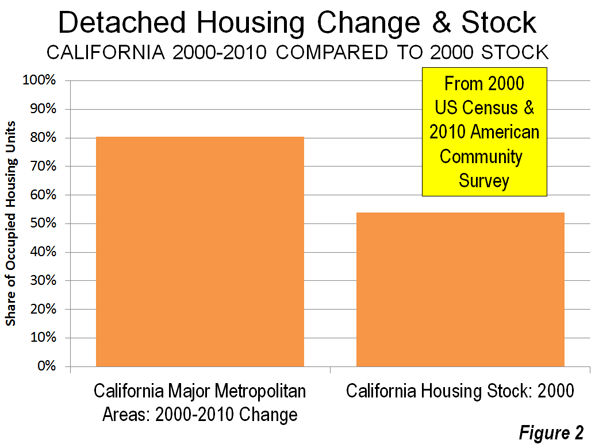
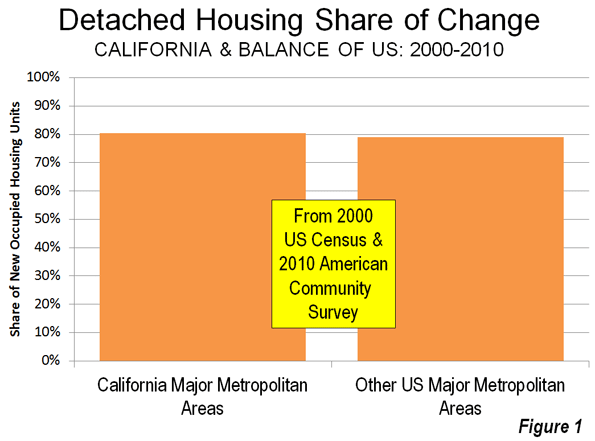
    The data indicates continuing robust demand. In California’s major metropolitan areas, detached houses accounted for 80 percent of the additions to the occupied housing stock between 2000 and 2010, which slightly exceeds the national trend favoring detached housing (Figure 1). If anything, the shift in demand was the opposite predicted by planners, since only 54 percent of growth in occupied housing in the same metropolitan areas was detached in 2000 (Figure 2).


    Watch What they Do, Not What they Say: It does no good to point to stated preference surveys indicating people preferring higher density living. Recently, Ed Braddy noted in newgeography.com (Smart Growth and the New Newspeak) that a widely cited National Association of Realtors had been "spun" to show that people preferred higher density living, from a question on an "unrealistic scenario," and ignoring an overwhelming preference for detached housing – roughly eighty percent – in other questions in the same survey. People’s preferences are not determined by what they say they will do, but rather by what they do.

    Off-Point Criticism: There was also "off-point" criticism, which can be more abundant than criticisms that are "on-point." Perhaps the most curious was by Brookings Institution Metropolitan Policy Program Senior Researcher Jonathan Rothwell (writing in The New Republic) in a piece entitled "Low-Density Suburbs are Are Not Free-Market Capitalism." I was rather taken aback by this, since none of these three words ("free," "market" or "capitalism") appeared in California Declares War on Suburbia. I was even more surprised at the claim that I defend "anti-density zoning and other forms of large lot protectionism." Not so.

    Indeed, I agree with Rothwell on the problems with large lot zoning. However, it is a stretch to suggest, as he does, that the prevalence of detached housing results from large lot zoning. This is particularly true in places like Southern California where lots have historically been small and whose overall density is far higher than that of greater New York, Boston, Seattle and double that of the planning mecca of Portland.

    Rothwell’s own Brookings Institution has compiled perhaps the best inventory of metropolitan land use restrictions, which indicates that the major metropolitan areas of the West have little in large lot zoning. Yet detached housing is about as prevalent in the West as in the rest of the nation (60.4 percent in the West compared to 61.9 percent in the rest of the nation, according to the 2010 American Community Survey). Further, there has been little or no large lot zoning in Canada and Australia, where detached housing is detached, nor in Western Europe and Japan (yes, Japan, see the Note below).  

    On-Point: Urban Growth Boundaries Do Increase House Prices: However, to his credit, Rothwell points out the connection between urban growth boundaries and higher house prices. This is a view not shared by most in the urban planning community, who remain in denial of the economic evidence (or more accurately, the economic principle) that constraining supply leads to higher prices. This can lead to disastrous consequences, as California’s devastating role in triggering the Great Recession indicates.

    The Purpose of Urban Areas: From 1900 to 2010, the urban population increased from 40 percent to 80 percent of the US population. Approximately 95 percent of the population growth over 100 years was in urban areas. People did not move to urban areas the cities for "togetherness" or to become better citizens. Nor did people move out of an insatiable desire for better urban design or planning. The driving force was economic: the desire for higher incomes and better lives. A former World Bank principal urban planner, Alain Bertaud stated the economic justification directly: "large labor markets are the only raison d’être of large cities."

    And for the vast majority of Americans in metropolitan areas, including those in California, those better lives mean living in suburbs and detached houses. All the myth-making in the world won’t change that reality, even if it pushes people out of the Golden State to other, more accommodating pastures.

    The performance of urban areas is appropriately evaluated by results, such as economic outcomes, without regard to inputs, such as the extent to which an area conforms to the latest conventional wisdom in urban planning.

    • Land use policies should not lead to higher housing costs relative to incomes, as they already have in California, Australia, Vancouver, Toronto and elsewhere. If they do, residents are less well served.
    • Transport policies should not be allowed to intensify traffic congestion by disproportionately funding alternatives (such as transit and bicycles) that have little or no potential to improve mobility as seems the likely outcome of radical densification. If they do, residents will be less well served.

    This gets to the very heart of the debate. The “smart growth on steroids” policies now being implemented in California are likely to lead to urban areas with less efficient personal and job mobility, where economic and employment growth is likely to be less than would otherwise be expected. The issue is not urban sprawl. The issue is rather sustaining the middle-income quality of life, which is now endangered by public policy in California, and for no good reason.

    Wendell Cox is a Visiting Professor, Conservatoire National des Arts et Metiers, Paris and the author of “War on the Dream: How Anti-Sprawl Policy Threatens the Quality of Life

    —-

    Note: Despite its reputation for high density living, Japan’s suburbs have many millions of detached houses. In 2010, 47 percent of the occupied housing in Japan’s major metropolitan areas was detached (Tokyo, Osaka-Kobe-Kyoto, Nagoya, Sapporo, Sendai, Hiroshima, Kitakyushu-Fukuoka, Shizuoka and Hamamatsu).

    Photo: An endangered species: Detached houses in Ventura County (Photo by author)

  • California Recovery: No, It Is Not East vs. West

    Every now and then, some East Coast based publication sends a reporter out to California to see how the West Coast’s economy is doing.  I think they write these things sitting at a restaurant patio overlooking the Pacific Ocean.  That can be seductive, and lulled into a comfortable sense that all is well with the world, the reporter always gets it wrong. 

    The most recent example is this New York Times article.  The second paragraph summarizes the article:

    Communities all along the state’s coastline have largely bounced back from the recession, some even prospering with high-tech and export businesses growing and tourism coming back. At the same time, communities from just an hour’s drive inland and stretching all the way to the Nevada and Arizona borders struggle with stubbornly high unemployment and a persistent housing crisis. And the same pattern holds the length of the state, from Oregon to the Mexican frontier.

    The next paragraph contains the mandatory quote from California’s favorite economic Pollyanna, Steve Levy:

    “This is really a tale of two economies,” said Stephen Levy, the director of the Center for Continuing Study of the California Economy. “The coastal areas are either booming or at least doing well, and the areas that were devastated still have a long way to go. The places that existed just for housing are not going to come back anytime soon.”

    The article is accompanied by a photo of a couple driving a red Ferrari convertible.  The caption says "Driving through Newport Beach in Orange County. Communities along the coast have largely rebounded from the recession."

    This is all nonsense.

    There are two reasonable measures of recovery, jobs and real estate values.  You can forget the real estate values measure.  Values throughout California are down from pre-recession highs.  They are down a lot.  Only San Francisco and Marin counties, with median home prices down 27.7 percent and 32.3 percent, respectively, have seen net median home price declines of less than 40 percent.  Monterey and Madera counties top the state in median home price declines, in excess of 67 percent.

    So let’s use jobs.  An area has recovered if it has as many jobs today as it had at the beginning of the recession, December 2008. 

    We monitor 37 California MSAs.  Combined they represent about 96 percent of California’s population.  By jobs, only one of California’s larger MSAs has recovered, and that county does not fit the story.  Not only is Kings County not on the ocean, it doesn’t even border or have a naturally occurring year-round piece of water.  Kings County, with 37,700 jobs, has about 900 more jobs than it had at the beginning of the recession.  Still, Kings County’s unemployment rate is 17 percent.  Some recovery!

    Orange County, which the New York Times article cites as largely rebounded, is down 127,800 jobs from its pre-recession high.  That’s an 8.5 percent decline.  Los Angeles County is down 337,000 or 8.1 percent of jobs.  The difference between unemployment rates, 8.0 percent in Orange County versus 12.1 percent in Los Angeles County, reflects different unemployment levels at the beginning of the recession and the high cost of living in Orange County.  Most people can’t afford to be unemployed long in Orange County.  You either find a job, or you leave.

    Here are the Counties that have lost, on net, less than 6 percent of jobs in the recession:


    County/MSA

    Job gain
    or Loss

    percent change

    Unemployment
    Rate

    Imperial

    -100

    -0.2%

    26.7%

    Kings

    900

    2.4%

    17.0%

    Merced

    -2,800

    -4.8%

    20.0%

    Monterey

    -5,600

    -4.3%

    15.3%

    San Diego

    -66,400

    -5.1%

    9.3%

    San Francisco
    San Mateo
    Marin

    -33,600

    -3.4%

    8.0%
    7.3%
    6.6%

    Santa Clara
    San Benito

    -19,900

    -2.1%

    8.8%
    18.3%

    San Luis Obispo

    -5,900

    -5.7%

    8.7%

    Santa Barbara

    -8,200

    -4.7%

    8.9%

    Santa Cruz

    -3,800

    -4.1%

    13.6%

    Solano

    -6,100

    -4.8%

    10.9%


    It’s hard to find real recovery here.  Three of the sub-10-percent-unemployment-rate counties (Marin, San Luis Obispo, and Santa Barbara) are home to the wealthy, those who serve them, and a very small middle class.  They have not had and will never have anything like robust economies.  Think of them as big Leisure Villages for the terminally fashionable.

    That leaves San Diego, San Francisco, San Mateo, and Santa Clara counties as potential vigorous economies.  Let’s look at these regions’ job creation last month.  Unfortunately, the data are only available by MSA.  San Diego County saw job growth of 1,300 jobs in February, an increase of about 0.11 percent.  Santa Clara/San Benito saw job growth of about 4,100, or 0.46 percent.  San Francisco/San Mateo/Marin saw growth of about 7,100 jobs, or 0.74 percent.

    It looks to me like there is a small island of relative prosperity: San Francisco, San Mateo, and Santa Clara Counties, but even these counties have not fully recovered.  This island is indeed on the coast, but it represents just a small fraction of the coastal county population. 

    The idea that there is some sort of Coastal resurgence in California is just absurd.  Certainly, the 593,800 still unemployed in Los Angeles — by far the state’s most populous — are not likely to agree that “The coastal areas are either booming or at least doing well…"

    Bill Watkins is a professor at California Lutheran University and runs the Center for Economic Research and Forecasting, which can be found at clucerf.org.

    California coast photo by BigStockPhoto.com.

  • Making Stuff Up at Atlantic Cities

    Editor Sommer Mathis over at The Atlantic Cities has taken to making stuff up. In a recent post she reported on a dispute in the city of Seattle over minimum parking requirements relating to multi-unit buildings. She said:

    Defenders of suburban-style development like Wendell Cox and Joel Kotkin would argue that these young people just don’t understand how their lives and desires are going to change once they start families. Single-family, detached homes with a quarter acre of land and two cars in the garage are suddenly going to look a lot better to all these idealistic, bicycle riding twenty-somethings once the reality of parenthood sets in.

    Kotkin and Cox also worry that developers and city planners rushing to meet the youth-driven demand for denser housing options that don’t necessarily include parking are shooting themselves in the foot.

    The only problem is that I have never commented on minimum parking requirements. I checked with Joel Kotkin and he advises that he has never covered the issue.

    Mathis continues (after an citing a quote by Joel Kotkin article in Forbes):

    What’s funny about these assumptions is their total lack of faith in the free market.

    Of course, since our alleged positions on minimum parking requirements are figments of Mathis’ imagination, her "free market" conclusion misses the mark. Indeed, the most destructive impact on urban land markets today is urban growth boundaries and "winner picking" land use restrictions that deny people their preferences (as my Wall Street Journal piece, California’s War on Suburbia, argued on Saturday). I am most concerned about these because of their potential for hampering the metropolitan economy, interfering with upward mobility and increasing poverty (I suspect Joel would agree). Moreover, young households soon figure out that they need more than the 4th floor (or 40th floor) balcony to raise a child.

  • Alternative Growth Paths for Sydney: A New Report and its Implications

    Population growth in Australia is double the world average and the New South Wales Department of Planning has projected that the population of the Sydney region will increase by 57,000 people annually. How will these extra people be housed?  The NSW Government follows the usual doctrines based on higher population densities. Its planning policy, known as The Metropolitan Strategy, works on locating some 70% of new dwellings within existing urban communities (in-fill) and 30% in new greenfield sites. 

    This policy is implemented by orders issued by the New South Wales Minister of Planning and imposed by ministerial fiat which are neither tabled nor debated in parliament.

    To achieve this 70/30 strategy the Department of Planning in effect has placed a restrictive growth boundary around Sydney to force higher-densities into existing residential areas. Greenfield land release has been reduced from an historic 10,000 lots per year to less than 2,000. This has caused a severe land shortage. 

    These policies are undemocratic and widely resented. What is more, the government has not justified them in terms of public good.  Indeed they might find that hard to do. For example, Australian studies show that greenhouse gas emissions per person are higher in high-density living, congestion is worse, human health is compromised, the costs of electricity, gas and water services increase, heritage conservation areas valued by the community are often lost and irreplaceable urban patchwork of greenery and wildlife within the city is decimated.

    The CIE Report

    The previous Labor Government commissioned a report on possible planning alternatives for Sydney. This report, by the Centre for International Economics (CIE) titled The Benefits and Costs of Alternative Growth Paths for Sydney: Economic, Social and Environmental Impacts was delivered back in December 2010. It has only now been released by the current government. 

    The report discusses three different scenarios for Sydney.  These portray alternatives of 90%, 70% and 50% of new housing to be built in existing urban areas (in-fill) – and correspondingly 10%, 30% and 50% in greenfield sites.

    The report compares the costs of the 90/10 and 50/50 scenarios with those of the current Metropolitan Strategy 70/30 ratio over a twenty-five-year period. It finds the cost differences between them are comparatively trivial. When compared to the Metropolitan Strategy 70/30 policy, the annual non-discounted cost saving per new dwelling for the 90/10 scenario is only A$151.  For the 50/50 scenario the additional annual cost per new dwelling is found to be A$950.

    This report contains two significant flaws. The first is an implicit assumption that the price of land will be the same for all three scenarios. It also fails to properly consider additional cost factors.

    Price of Land

    Each scenario examined changes the amount of new land that would be released for development. When compared with the current baseline 70/30 strategy, the 90/10 scenario would require even greater restrictions on the release of new housing land and hence an even greater land shortage. By contrast, the 50/50 scenario would allow for a more generous release of new land and hence more land available for construction.  The immutable laws of supply and demand ensure that the degree of land restriction would significantly affect the cost of housing in each scenario, completely swamping the relatively minor cost differences due to other factors.

    Incredibly, the report appears to fail to take the effect of relative scarcity on costs into consideration. It simply assumes that the price of land will remain the same for each scenario.

    This is significant because the report includes in its calculations factors that are highly dependent on the cost of land. If the report’s findings are to be credible, the variation of these factors caused by land price variation in each scenario examined should also be taken into account.  When land is scarce high-density developers can make greater profits as they have less competition from low-priced houses and landholders can get higher prices for their land than would be the case otherwise. 

    Other Costs

    The report alleges that electricity consumption is greater in houses than it is in apartments. This is incorrect. Studies show that consumption per capita is greater in apartments. It appears that the data the report relies on does not take into account the consumption of electricity common to the whole apartment block such as lifts and lighting common areas such as foyers and car spaces. 

    The report also does not take into account costs to existing residents arising from forcing high-density into communities originally designed for low-density. These include:

    • The impact on a single-residential property that has high-rise built next to it. This can involve theft of amenity: new in-fill residents look over gardens of existing residents while the latter have to look onto unsightly structures, and suffer lack of privacy and overshadowing.
    • Congestion. Existing residents have to suffer from increasingly congested streets and shortage of street parking.
    • Shortage of recreational facilities. As more vacant land is built upon in a community originally designed for low-density, it becomes difficult to secure new open areas to service the needs of the additional population at a reasonable standard.
    • Reduction in housing choice, particularly for families.  Most infill development consists of apartments which are not suitable for bringing up young children.  Indeed the majority of those currently living in apartments do not do so by choice. A survey indicates multi-story apartments are not even acceptable to most people wishing to downsize, if they have other choices such as smaller single residential houses or villas.
    • Reduction in biodiversity. When gardens and open space are replaced with unit blocks this has a severe effect on urban plant and animal life.
    • Heritage items valued by the community such as traditional period architect designed housing are often lost.
    • Atmospheric pollution.  There is a local effect on residents of atmospheric pollution in high-density areas.  This is due to higher traffic densities and to less volume of air being available for the dilution and dispersion of pollutants.

    If these considerations had been quantified into the report’s calculations, they would have changed its overall findings.

    Conclusions

    As is not unusual in reports by density advocates throughout the English-speaking world, the report’s findings are marred by the fact that significant factors are omitted.  If costs and benefits were fully accounted for, including the costs and benefits borne by existing residents, an already weak case for emphasising densification over fringe development would vanish.

    As we have seen, even with the flawed accounting used in the report, the magnitude of the cost differences that it finds between its three scenarios is trivial. These tiny differences make the unpopular Metropolitan Strategy 70/30 policy hard to justify, and any intensification of this strategy to 90/10 impossible to justify.   Cost differences of either A$151 or A$950 are small compared to the price that people have to pay for a house (the median price in Sydney is A$650,000). These insignificant figures need to be considered in the light of providing people with the opportunity of living in the housing style of their choice.

    If costs and benefits were to be fully accounted for, including those borne by existing residents, the case for a policy of enforced densification cannot be supported.   When asked voters want less rather than more densification.

    High land prices due to restrictive land-releases are already making housing unaffordable for the next generation.  Unwanted high-rise development represents theft from the community, reducing the amenity of existing residents and transfers that value to property developers without recompense. This theft is aided and abetted by the policies of the State Government. Moreover, it continues to result in well-publicised favours being granted to developers with connections to government.

    The Metropolitan Strategy needs to be replaced. A good start would be for the New South Wales government to adopt the suggested 50/50 strategy as the first step towards reform.  The provision of more choice will allow people to demonstrate whether they prefer to live in high-density or in lower cost, more spacious housing with a garden in the suburbs.

    (Dr) Tony Recsei has a background in chemistry and is an environmental consultant. Since retiring he has taken an interest in community affairs and is president of the Save Our Suburbs community group which opposes over-development forced onto communities by the New South Wales State Government.

    Sydney suburb photo by BigStockPhoto.com.

  • The Urban US: Growth and Decline

    The urban population of the United States is now 249 million, according to the 2010 Census, 81 percent of the total. This is impressive, and not all surprising for a large developed economy. Yet the urban population — meaning cities, suburbs and exurbs — is not everything. And in many ways for everything from food, resources and recreation, the urban areas still depend on the nearly sixty million who live in rural America

    It is fascinating to review how American demography has changed over the last decade. So I will briefly look at some obvious points, such as the largest, most important, places, those that grew the most absolutely and relatively, and those that, on the contrary, declined.

    Our Giant Metropolises 

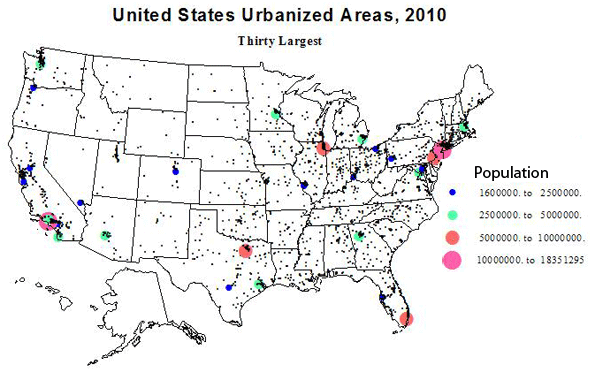
    The Census is very generous, probably way too generous, in their defining the outer limits of our urbanized areas (agglomerations with over 50,000 people). They tend to respect the independence of historically separate places, which from a satellite view would appear to be part of a united larger agglomeration. For example, New York, as defined, is huge enough but dense settlement goes far beyond its census limits. (I’ll take a look at conurbations, like Megalopolis, in a separate discussion). The 30 giants are shown in Table 1. The top three, New York, Los Angeles and Chicago have kept their positions for decades, but  story of more recent times has been the upsurge of Southern giants of Houston, Dallas, Miami, Atlanta, and of course, Washington, DC. Detroit is still in the top 15, but its position has fallen to 11th, while other historic places like Cleveland, St. Louis and Pittsburgh have dropped into the second set of 15.

    Table 1: Largest US Urbanized Areas
    Urbanized Area Name  2010 Population 2000 Population Change % Change
    1 New York–Newark, NY–NJ–CT 18,351,295 17,799,861 551,434 3.10
    2 Los Angeles–Long Beach–Anaheim, CA 12,150,996 11,789,487 361,509 3.07
    3 Chicago, IL–IN 8,608,208 8,307,904 300,304 3.61
    4 Miami, FL 5,502,379 4,919,036 583,343 11.86
    5 Philadelphia, PA–NJ–DE–MD 5,441,567 5,149,079 292,488 5.68
    6 Dallas–Fort Worth–Arlington, TX 5,121,892 4,145,659 976,233 23.55
    7 Houston, TX 4,944,332 3,822,509 1,121,823 29.35
    8 Washington, DC–VA–MD 4,586,770 3,933,920 652,850 16.60
    9 Atlanta, GA 4,515,419 3,499,840 1,015,579 29.02
    10 Boston, MA–NH–RI 4,181,019 4,032,484 148,535 3.68
    11 Detroit, MI 3,734,090 3,903,377 -169,287 -4.34
    12 Phoenix–Mesa, AZ 3,629,114 2,907,049 722,065 24.84
    13 San Francisco–Oakland, CA 3,281,212 3,228,605 52,607 1.63
    14 Seattle, WA 3,059,393 2,712,205 347,188 12.80
    15 San Diego, CA 2,956,746 2,674,436 282,310 10.56
    90,064,432 82,825,451
    16 Minneapolis–St. Paul, MN–WI 2,650,890 2,388,593 262,297 10.98
    17 Tampa–St. Petersburg, FL 2,441,770 2,062,339 379,431 18.40
    18 Denver–Aurora, CO 2,374,203 1,984,889 389,314 19.61
    19 Baltimore, MD 2,203,663 2,076,354 127,309 6.13
    20 St. Louis, MO–IL 2,150,706 2,077,662 73,044 3.52
    21 San Juan, PR 2,148,346 2,216,616 -68,270 -3.08
    22 Riverside–San Bernardino, CA 1,932,666 1,506,816 425,850 28.26
    23 Las Vegas–Henderson, NV 1,886,011 1,314,357 571,654 43.49
    24 Portland, OR–WA 1,849,898 1,583,138 266,760 16.85
    25 Cleveland, OH 1,780,673 1,786,647 -5,974 -0.33
    26 San Antonio, TX 1,758,210 1,327,554 430,656 32.44
    27 Pittsburgh, PA 1,733,853 1,753,136 -19,283 -1.10
    28 Sacramento, CA 1,723,634 1,393,498 330,136 23.69
    29 San Jose, CA 1,664,496 1,538,312 126,184 8.20
    30 Cincinnati, OH–KY–IN 1,624,827 1,503,262 121,565 8.09
    29,923,846 26,513,173

    Cities with the Largest Gains  

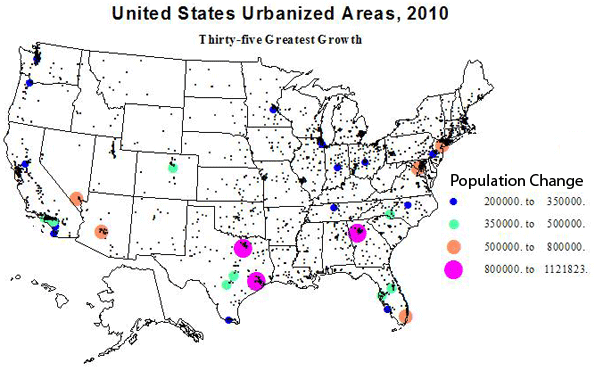
    Urbanized areas which gained the most population over the last decade are listed in Table 2. These numbers are truly large; these are clear leaders in “population power”. I’ll first draw our attention to the five cities which are in the top 35 in both absolute growth and in percent growth. These include Temecula-Murrieta, CA (most folks will never have even heard of it: think inland sunshine of Riverside county); Charlotte and Raleigh, NC; Cape Coral, FL (again, huh?); and Austin, TX (you were thinking Dallas or Houston? See below).

    Temecula-Murietta : 25th absolute growth, 6th % growth               
    Charlotte : 9th and 19th
    Raleigh : 18th and 21st               
    Cape Coral : 30th and 27th  
    Austin : 10th and 34th

    North Carolina wins the race for the fastest growing areas.  But in sheer growth in people, the winners are (Table 2) Houston, Atlanta, Dallas, Phoenix, Washington, Miami, Las Vegas (despite the recession), New York, Charlotte and Austin. Giant New York is the only non-sunbelt place in the elite, and it had a quite slow rate of growth (3%). The next places outside the southern tier are Denver (13th) and Seattle (18th).  The total absolute growth in these top 15 cities was a phenomenal 7.24 million, a rate of growth of 8.7 %. For the top 30 urbanized areas, the growth was 10.3 million, with a percent growth of 9.7 – the same as the rate of growth of the nation. This includes slow growing but still very big places like Los Angeles (growth displaced to its satellites), Philadelphia, Chicago, Indianapolis, Portland and Minneapolis.

    Table 2: Largest Absolute Change in US Urbanized Areas
    Urbanized Area Name  2010 Population 2000 Population Change % Change
    1 Houston, TX 4,944,332 3,822,509 1,121,823 29.35
    2 Atlanta, GA 4,515,419 3,499,840 1,015,579 29.02
    3 Dallas–Fort Worth–Arlington, TX 5,121,892 4,145,659 976,233 23.55
    4 Phoenix–Mesa, AZ 3,629,114 2,907,049 722,065 24.84
    5 Washington, DC–VA–MD 4,586,770 3,933,920 652,850 16.60
    6 Miami, FL 5,502,379 4,919,036 583,343 11.86
    7 Las Vegas–Henderson, NV 1,886,011 1,314,357 571,654 43.49
    8 New York–Newark, NY–NJ–CT 18,351,295 17,799,861 551,434 3.10
    9 Charlotte, NC–SC 1,249,442 758,927 490,515 64.63
    10 Austin, TX 1,362,416 901,920 460,496 51.06
    11 San Antonio, TX 1,758,210 1,327,554 430,656 32.44
    12 Riverside–San Bernardino, CA 1,932,666 1,506,816 425,850 28.26
    13 Denver–Aurora, CO 2,374,203 1,984,889 389,314 19.61
    14 Tampa–St. Petersburg, FL 2,441,770 2,062,339 379,431 18.40
    15 Los Angeles–Long Beach–Anaheim, CA 12,150,996 11,789,487 361,509 3.07
    16 Orlando, FL 1,510,516 1,157,431 353,085 30.51
    17 Seattle, WA 3,059,393 2,712,205 347,188 12.80
    18 Raleigh, NC 884,891 541,527 343,364 63.41
    19 Sacramento, CA 1,723,634 1,393,498 330,136 23.69
    20 Chicago, IL–IN 8,608,208 8,307,904 300,304 3.61
    21 Philadelphia, PA–NJ–DE–MD 5,441,567 5,149,079 292,488 5.68
    22 San Diego, CA 2,956,746 2,674,436 282,310 10.56
    23 Indianapolis, IN 1,487,483 1,218,919 268,564 22.03
    24 Portland, OR–WA 1,849,898 1,583,138 266,760 16.85
    25 Minneapolis–St. Paul, MN–WI 2,650,890 2,388,593 262,297 10.98
    26 Columbus, OH 1,368,035 1,133,193 234,842 20.72
    27 Nashville-Davidson, TN 969,587 749,935 219,652 29.29
    28 Murrieta–Temecula–Menifee, CA 441,546 229,810 211,736 92.14
    29 McAllen, TX 728,825 523,144 205,681 39.32
    30 Cape Coral, FL 530,290 329,757 200,533 60.81

    Rate of Population Growth

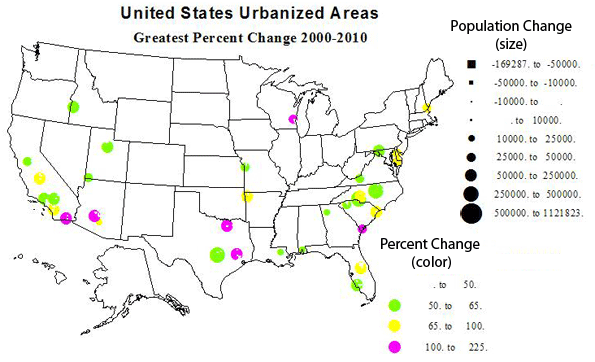
    Thirty six cities had a growth rate of more than 50 percent between 2000 and 2010, a decade not that fabulous in economic growth!  Only three of these are independent metropolises of over a half-million: Charlotte and Raleigh, NC, and Austin, TX. With growth numbers and rates of 491000 (65%), 343000 (63%), and 460000 (51%)—clearly places on the move up. The others fall more or less into these categories: (please see table 3 for a list of all 35).

    Satellite places to larger urban areas: 21 places
    Smaller regional capitals or centers: 10 place

    The superstars in rate of growth were McKinney, TX (Dallas satellite), 212% growth; Avondale, AZ (Phoenix suburb), 190%; The Woodlands, TX (Houston satellite), 168%; Lady Lake, FL (Orlando satellite), 123%; West Bend, WI (Milwaukee satellite, 106%); El Centro , CA (Imperial Valley center), 103%; and  Hilton Head, SC (retirement, etc.), 101%.

    Table 3: Greatest Percent Gains
    Urbanized Area Name  2010 Population 2000 Population Change % Change
    1 McKinney, TX 170,030 54,525 115,505 211.84
    2 Avondale, AZ 197,041 67,875 129,166 190.30
    3 The Woodlands, TX 239,938 89,445 150,493 168.25
    4 Lady Lake, FL 112,991 50,721 62,270 122.77
    5 West Bend, WI 68,444 33,288 35,156 105.61
    6 El Centro, CA 107,672 52,954 54,718 103.33
    7 Hilton Head Island, SC 68,998 34,400 34,598 100.58
    8 Temecula–Murrieta, CA 441,546 229,810 211,736 92.14
    9 Concord, NC 214,881 115,057 99,824 86.76
    10 Visalia, CA 219,454 120,044 99,410 82.81
    11 Los Lunas, NM 63,758 36,101 27,657 76.61
    12 Myrtle Beach, SC 215,304 122,984 92,320 75.07
    13 Portsmouth, NH–ME 88,200 50,912 37,288 73.24
    14 Casa Grande, AZ 51,331 29,815 21,516 72.17
    15 Fayetteville–Springdale, AR 295,083 172,585 122,498 70.98
    16 Dover, DE 110,769 65,044 45,725 70.30
    17 Kissimmee, FL 314,071 186,667 127,404 68.25
    18 Salisbury, MD–DE 98,081 59,426 38,655 65.05
    19 Charlotte, NC–SC 1,249,442 758,927 490,515 64.63
    20 Victorville–Hesperia–Apple Valley, CA 328,454 200,436 128,018 63.87
    21 Raleigh, NC 884,891 541,527 343,364 63.41
    22 Manteca, CA 83,578 51,176 32,402 63.31
    23 Cape Coral, FL 530,290 329,757 200,533 60.81
    24 Provo–Orem, UT 482,819 303,680 179,139 58.99
    25 Nampa, ID 151,499 95,909 55,590 57.96
    26 St. George, UT 98,370 62,630 35,740 57.07
    27 Cartersville, GA 52,477 33,685 18,792 55.79
    28 Hammond, LA 67,629 43,458 24,171 55.62
    29 Mauldin–Simpsonville, SC 120,577 77,831 42,746 54.92
    30 Blacksburg, VA 88,542 57,236 31,306 54.70
    31 Lee’s Summit, MO 85,081 55,285 29,796 53.90
    32 Hagerstown, MD–WV–PA 182,696 120,326 62,370 51.83
    33 Santa Clarita, CA 258,653 170,481 88,172 51.72
    34 Austin, TX 1,362,416 901,920 460,496 51.06
    35 Daphne–Fairhope, AL 57,383 38,110 19,273 50.57

    Losers

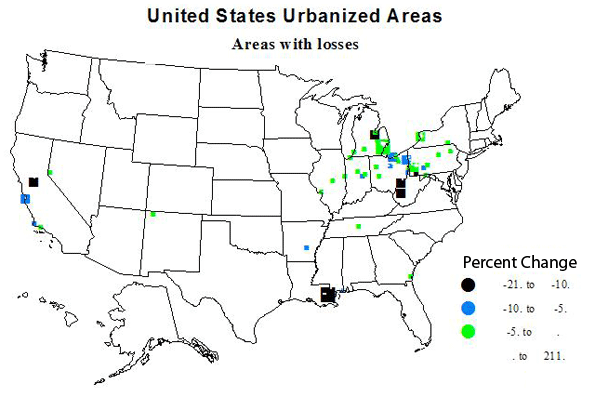
    Urban growth is the expected norm, but not all areas of the country prospered 2000-2010. What kinds of place lost population and why? See Table 4 for a list of larger absolute and percent losses. Despite the comeback of the automobile industry, Detroit experienced the greatest loss, arguably because much of the industry has moved to the non-union and lower wage South. New Orleans had the second biggest loss, with almost an 11 percent loss, recovering only gradually from hurricane Katrina. Partly race or perhaps more a legacy of poverty and inept governance?  Other large numerical losses were in rust belt industrial and mining cities, such as Buffalo, Youngstown and Pittsburgh and Charleston, WV.  At least one was quite different: Seaside-Monterey CA, with losses due to reduced military operations as well as a generally weak California economy.

    High rates of losses were mostly in the same places, but included several smaller industrial towns in Ohio, Indiana and Pennsylvania.

    Table 4: Greatest Percent Losses  and Greatest Absolute Losses
    Relative posses
    Urbanized Area Name  2010 Population 2000 Population Change % Change
    1 Mansfield, OH 75,250 79,698 -4,448 -5.58
    2 Lorain–Elyria, OH 180,956 193,586 -12,630 -6.52
    3 Pascagoula, MS 50,428 54,190 -3,762 -6.94
    4 Youngstown, OH–PA 387,550 417,437 -29,887 -7.16
    5 Wheeling, WV–OH 81,249 87,613 -6,364 -7.26
    6 Lompoc, CA 51,509 55,667 -4,158 -7.47
    7 Mayagüez, PR 109,572 119,350 -9,778 -8.19
    8 Hightstown, NJ 64,037 69,977 -5,940 -8.49
    9 Pine Bluff, AR 53,495 58,584 -5,089 -8.69
    10 Seaside–Monterey–Marina, CA 114,237 125,503 -11,266 -8.98
    11 Anderson, IN 88,133 97,038 -8,905 -9.18
    12 Johnstown, PA 69,014 76,113 -7,099 -9.33
    13 Saginaw, MI 126,265 140,985 -14,720 -10.44
    14 New Orleans, LA 899,703 1,009,283 -109,580 -10.86
    15 Uniontown–Connellsville, PA 51,370 58,442 -7,072 -12.10
    16 Yauco, PR 90,899 108,024 -17,125 -15.85
    17 Charleston, WV 153,199 182,991 -29,792 -16.28
    18 Lodi, CA 68,738 83,735 -14,997 -17.91
    19 Parkersburg, WV–OH 67,229 85,605 -18,376 -21.47
    20 Ponce, PR 149,539 195,037 -45,498 -23.33
    Absolute Losses
    Urbanized Area Name  2010 Population 2000 Population Change % Change
    1 Seaside–Monterey–Marina, CA 114,237 125,503 -11,266 -8.98
    2 Lorain–Elyria, OH 180,956 193,586 -12,630 -6.52
    3 Saginaw, MI 126,265 140,985 -14,720 -10.44
    4 Lodi, CA 68,738 83,735 -14,997 -17.91
    5 Yauco, PR 90,899 108,024 -17,125 -15.85
    6 Parkersburg, WV–OH 67,229 85,605 -18,376 -21.47
    7 Pittsburgh, PA 1,733,853 1,753,136 -19,283 -1.10
    8 Charleston, WV 153,199 182,991 -29,792 -16.28
    9 Youngstown, OH–PA 387,550 417,437 -29,887 -7.16
    10 Buffalo, NY 935,906 976,703 -40,797 -4.18
    11 Ponce, PR 149,539 195,037 -45,498 -23.33
    12 San Juan, PR 2,148,346 2,216,616 -68,270 -3.08
    13 New Orleans, LA 899,703 1,009,283 -109,580 -10.86
    14 Detroit, MI 3,734,090 3,903,377 -169,287 -4.34

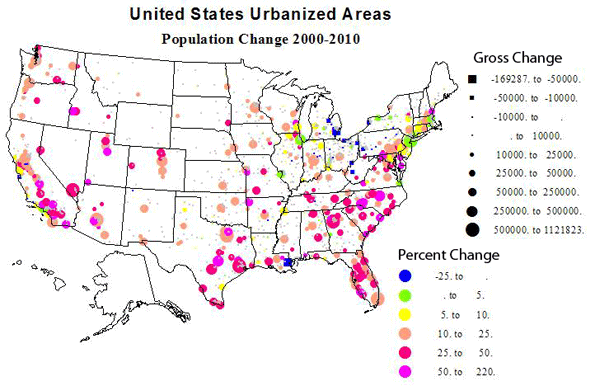
    These statistics are also summarized in 5 maps – one showing the size and rate of growth of all urbanized areas, followed by maps of the largest 30 places, the 35 places with the highest absolute and highest relative growth, then a map of the largest absolute and percent losses.

    Density, Size and Location

    People are often surprised by the fact that the highest urban densities are not in the historic eastern cities but in newer western cities. Los Angeles, often called the epitome of sprawl, is in fact the densest urbanized area in the US, for the third straight census! Table 5 lists the densest urbanized areas and the densities of the largest areas.

    Table 5: Highest and lowest urban densisties
    Highest urbanzed area densities
    Place State Population (Thousands) Density
    Los Angeles CA 12,151 6,999
    San Francisco CA 3,281 6,266
    San Jose CA 1,664 5,820
    Delano CA 54 5,483
    New York NY 18,351 5,319
    Davis CA 73 5,157
    Lompoc CA 52 4,816
    Honolulu HI 802 4,716
    Woodland CA 56 4,551
    L:as Vegas NV 1,886 4,525
    Densities of largest places (not on above list)
    Chicago IL 8,608 3,524
    Miami FL 5,502 4,442
    Philladelphia PA 5,442 2,746
    Dallas TX 5,122 2,879
    Houston TX 4,944 2,979
    Washington DC DC 4,586 3,470
    Atlanta GA 4,515 1,707
    Boston MA 4,182 2,232
    Detroit MI 3,734 2,793
    Phoenix AZ 3,629 3,165
    Seattle WA 3,059 3,028
    Lowest density places
    Hickory NC 212 811
    Hammond LA 68 883
    Barnstable MA 247 890
    Gadsden AL 64 892
    Homosassa Spgs FL 81 895
    Anniston AL 80 920
    Los Lunas NM 64 921
    Spartanburg SC 181 952
    Hilton Head SC 69 1,020
    Anderson SC 76 1,022

    The remarkable story is that of the 10 densest areas, 9 are in the west, and 7 in the Golden State. Four of these are fairly small, another surprise. The only eastern city in the top 10 is New York, which is fairly sharply limited by the census. Los Angeles, San Francisco and San Jose are the three most densely settled areas. The main underlying reason is not just planning regulations, although these probably play a role, but the issue of providing water to developable land. Both are restricted. This is one reason why growth in the southwest tends to be relatively dense. These drier areas lack the local water supplies that enable the kind of low density sprawl typical of the historic eastern cities like, yes, Boston with a density of only 2231, less than one-third that of Los Angeles!!  Other large urban areas with lower densities include Chicago, Philadelphia, Detroit, Houston, Dallas and Atlanta, a mere 1707!

    The winners for low density are an interesting mix of satellite places, such as Hammond, Barnstable, Los Lunas, and independent places like Hickory, Gadsden and Anniston, AL, and Spartanburg and Anderson, SC, many in hilly Appalachian environments, with settlement limited to valley floors. This is why the density could be below 1000 per square mile, the usual demarcation point of urban densities. Several are rather resort-like, e.g., Barnstable, Hilton Head and Homosassa Springs.

    Even if our urban definition is a little generous, 80 percent of the population or 250 million persons is an impressive total. Most of us cannot escape the city, where most jobs and opportunities are. We need to live in cities and perhaps most of us love the city. So the settlement issue in our lives becomes what city to live in and where to live within that place.
    Richard Morrill is Professor Emeritus of Geography and Environmental Studies, University of Washington. His research interests include: political geography (voting behavior, redistricting, local governance), population/demography/settlement/migration, urban geography and planning, urban transportation (i.e., old fashioned generalist).

    Next: Megalopolis and its rivals.

    Los Angeles skyline photo by Bigstockphoto.com.
  • Still Moving to the Suburbs and Exurbs: The 2011 Census Estimates

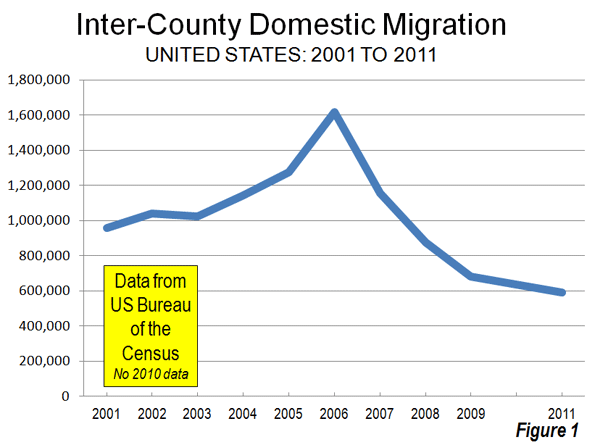
    The new 2011 Census Bureau county and metropolitan area population estimates indicate that Americans are staying put. Over the past year, 590,000 people moved between the nation’s counties. This domestic migration (people moving within the nation) compares to an annual rate of 1,080,000 between the 2000 and 2009. Inter-county domestic migration peaked in 2006 at nearly 1,620,000 and has been falling since that time (Figure 1). The continuing low rate of domestic migration has been reinforced by the economic malaise that has kept job and income growth well below levels that would be expected in a more genuine recovery.

    Yet the nation has continued to grow. With less domestic migration, natural growth (births minus deaths) and considerable, but slower international migration, growth over the past year has been more in proportion to total population. The movement between counties within major metropolitan areas has become less of a factor. Predictably, there the usual doom and gloom reports  about suburbs and exurbs and how poorly they are doing compared to before, and how people are returning to the cities (Note 1). As usual, the data shows no such thing, as people continue to move from core counties in greater numbers than others move in (See Note 2 on county classifications).

    Domestic Migration: Despite the higher gasoline prices and the illusions of a press that is often anti-suburban, both the suburbs and the exurbs continued to attract people from elsewhere in the nation. The core counties, which contain the core cities, continued to lose domestic migrants to other parts of the country, principally to the suburbs and the exurbs of the large metropolitan areas.

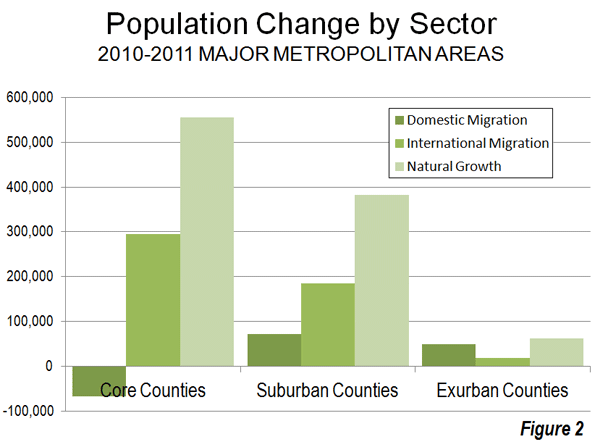
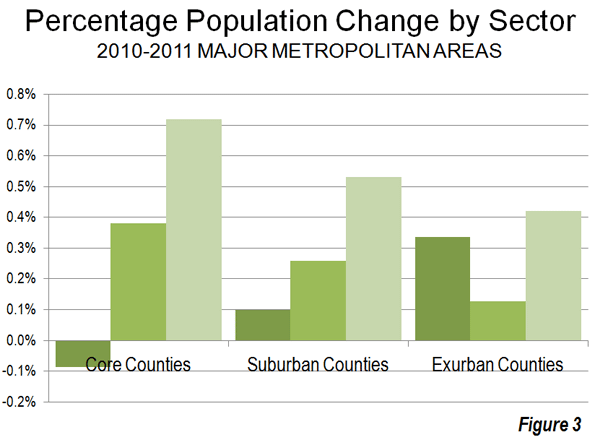
    Over the past year, the core counties of major metropolitan areas lost 67,000 domestic migrants (people move between a metropolitan area and somewhere else in the nation). Suburban counties gained approximately 72,000 domestic migrants, while exurban counties gained 49,000 domestic migrants (Figure 2). Because of their lower population base, exurban counties had the highest relative rate of net domestic migration, at 0.34% of their 2010 population. This is more than three times the rate of the suburban counties (0.11%) and far higher than the minus 0.09% of the core counties (Figure 3). Thus, the overall slower rate of growth among exurban counties was due to a lower natural growth rate and less international migration, not the result of any losses to the core. The same is true, to a lesser extent, of the suburban counties.


    Overall, the major metropolitan areas gained 48,500 domestic migrants between 2010 and 2011. By contrast, between 2000 and 2009, the major metropolitan areas lost, on average, nearly 200,000 domestic migrants to the rest of the nation each year. The huge domestic out migration in the last decade has been associated with the housing bubble. Less affordable housing markets lost 3.2 million domestic migrants between 2000 and 2009. More affordable markets gained 1.7 million domestic migrants. This was not enough to negate the losses in the higher cost markets, and major metropolitan markets lost 1.5 million domestic migrants overall.

    Natural Growth: As the grim economic times induced people to stay put, core counties grew marginally faster than suburban and exurban counties principally because of higher natural growth rates, which is the net of births minus deaths. More than 70% of the higher population in core counties was from natural growth. Natural growth was less of a factor in the suburban counties, at 60%. In the exurban counties, natural growth accounted for only 47% of the population growth (Table 1). The higher core county natural growth rates are especially evident where there are large foreign born populations, due to their generally higher birth rates (such as Los Angeles, Dallas-Fort Worth, Houston, Austin and Riverside-San Bernardino, as well as Raleigh and Salt Lake City).

    International Migration: The other component of growth was international migration, which contributed 38% of the growth in core counties and 29% of the growth in suburban counties. International migration was much less important in the exurban counties, contributing only 15% of the growth (Table 1)

    Table 1
    Major Metropolitan Areas
    Components of Population Change: 2010-2011: Summary by Sector
     Net Domestic Migration   Net International Migration   Natural Increase (Births Minus Deaths) 
    Core Counties -8.5% 37.6% 70.8%
    Suburban Counties 11.2% 29.0% 59.8%
    Exurban Counties 37.9% 14.5% 47.4%
    Multi-County Major Metropolitan Areas 3.5% 32.1% 64.3%
    Single County Major Metropolitan Areas -10.9% 34.5% 76.7%
    Major Metropolitan Areas with More Than 1 County 3.0% 32.2% 64.7%
    Single County Major Metropolitan Areas: San Diego and Las Vegas


    The Gainers: The fastest growing major metropolitan areas were dominated by the four largest Texas metropolitan areas. Austin (3.2%), Dallas-Fort Worth (2.0%), Houston (1.9%) and San Antonio (1.9%) were all among the five fastest growing. Raleigh placed second, with a one-year growth rate of 2.3%. The top five numeric gainers in domestic migration were in all in Texas or Florida — Dallas-Fort Worth (39,000), Miami (36,000), Austin (31,000), Tampa-St. Petersburg (27,000) and Houston (21,000). The much improved housing affordability in Florida seems likely to be a factor in the recovery of Miami and Tampa-St. Petersburg. Further, Houston became the second Texas metropolitan area to exceed Philadelphia in population, following Dallas-Fort Worth in the last decade. Texas thus becomes the first state to place two metropolitan areas in the five largest in the nation (Table 2).

    Table 2
    Major Metropolitan Areas: Population
    Population: 2010-2011
    Metropolitan Area 2010 2011 Change % Change
    New York, NY-NJ-PA        18,919,649        19,015,900                  96,251 0.51%
    Los Angeles, CA        12,844,371        12,944,801                100,430 0.78%
    Chicago, IL-IN-WI          9,472,584          9,504,753                  32,169 0.34%
    Dallas-Fort Worth, TX          6,400,511          6,526,548                126,037 1.97%
    Houston. TX          5,976,470          6,086,538                110,068 1.84%
    Philadelphia, PA-NJ-DE-MD          5,971,589          5,992,414                  20,825 0.35%
    Washington, DC-VA-MD-WV          5,609,150          5,703,948                  94,798 1.69%
    Miami, FL          5,578,080          5,670,125                  92,045 1.65%
    Atlanta, GA          5,286,296          5,359,205                  72,909 1.38%
    Boston, MA-NH          4,559,372          4,591,112                  31,740 0.70%
    San Francisco-Oakland, CA          4,343,381          4,391,037                  47,656 1.10%
    Riverside-San Bernardino, CA          4,245,005          4,304,997                  59,992 1.41%
    Detroit. MI          4,290,722          4,285,832                   (4,890) -0.11%
    Phoenix, AZ          4,209,070          4,263,236                  54,166 1.29%
    Seattle, WA          3,447,886          3,500,026                  52,140 1.51%
    Minneapolis-St. Paul, MN-WI          3,285,913          3,318,486                  32,573 0.99%
    San Diego, CA          3,105,115          3,140,069                  34,954 1.13%
    Tampa-St. Petersburg, FL          2,788,151          2,824,724                  36,573 1.31%
    St. Louis, MO-IL          2,814,722          2,817,355                     2,633 0.09%
    Baltimore, MD          2,714,546          2,729,110                  14,564 0.54%
    Denver, CO          2,554,569          2,599,504                  44,935 1.76%
    Pittsburgh, PA          2,357,951          2,359,746                     1,795 0.08%
    Portland, OR-WA          2,232,896          2,262,605                  29,709 1.33%
    San Antonio, TX          2,153,891          2,194,927                  41,036 1.91%
    Sacramento, CA          2,154,583          2,176,235                  21,652 1.00%
    Orlando, FL          2,139,615          2,171,360                  31,745 1.48%
    Cincinnati, OH-KY-IN          2,132,415          2,138,038                     5,623 0.26%
    Cleveland, OH          2,075,540          2,068,283                   (7,257) -0.35%
    Kansas City,  MO-KS          2,039,766          2,052,676                  12,910 0.63%
    Las Vegas, NV          1,953,927          1,969,975                  16,048 0.82%
    San Jose, CA          1,841,787          1,865,450                  23,663 1.28%
    Columbus, OH          1,840,584          1,858,464                  17,880 0.97%
    Charlotte, NC-SC          1,763,969          1,795,472                  31,503 1.79%
    Austin, TX          1,728,247          1,783,519                  55,272 3.20%
    Indianapolis, IN          1,760,826          1,778,568                  17,742 1.01%
    Virginia Beach (Norfolk), VA-NC          1,674,502          1,679,894                     5,392 0.32%
    Nashville, TN          1,594,885          1,617,142                  22,257 1.40%
    Providence, RI-MA          1,601,065          1,600,224                      (841) -0.05%
    Milwaukee, WI          1,556,953          1,562,216                     5,263 0.34%
    Jacksonville, FL          1,348,702          1,360,251                  11,549 0.86%
    Memphis, TN-MS-AR          1,318,089          1,325,605                     7,516 0.57%
    Louisville, KY-IN          1,285,891          1,294,849                     8,958 0.70%
    Oklahoma City, OK          1,258,111          1,278,053                  19,942 1.59%
    Richmond, VA          1,260,396          1,269,380                     8,984 0.71%
    Hartford, CT          1,212,491          1,213,255                        764 0.06%
    New Orleans, LA          1,173,572          1,191,089                  17,517 1.49%
    Raleigh, NC          1,137,297          1,163,515                  26,218 2.31%
    Salt Lake City, UT          1,128,269          1,145,905                  17,636 1.56%
    Buffalo, NY          1,135,293          1,134,039                   (1,254) -0.11%
    Birmingham, AL          1,129,068          1,132,264                     3,196 0.28%
    Rochester, NY          1,054,723          1,055,278                        555 0.05%
    Total      167,462,456      169,067,997             1,605,541 0.96%
    Data derived from US Bureau of the Census
    Major Metropolitan Areas: Over 1,000,000 Population


    The Losers: Four metropolitan areas, Detroit, Cleveland, Providence and Buffalo suffered small population losses. Pittsburgh had a small gain, but was alone in having an excess of deaths over births. New York again led the nation in its net domestic migration loss, at 99,000. Chicago lost 54,000 and Los Angeles lost 51,000 residents to other areas of the country between 2010 and 2011, while Detroit lost 24,000. Domestic migration data is available for New York City because it is composed of five counties. New York City lost 57,000 domestic migrants (Table 3).

    Table 3
    Major Metropolitan Areas
    Components of Population Change: 2010-2011
     Net Domestic Migration   Net International Migration   Natural Increase (Births Minus Deaths)  Total Components of Change (Note)
    New York, NY-NJ-PA              (98,975)                83,322                112,336               96,683
    Los Angeles, CA              (50,549)                54,725                  96,150             100,326
    Chicago, IL-IN-WI              (53,908)                24,422                  61,483               31,997
    Dallas-Fort Worth, TX                39,021                23,291                  63,504             125,816
    Houston. TX                21,580                24,105                  64,363             110,048
    Philadelphia, PA-NJ-DE-MD              (13,133)                11,413                  22,769               21,049
    Washington, DC-VA-MD-WV                21,517                24,872                  48,235               94,624
    Miami, FL                36,191                35,215                  20,440               91,846
    Atlanta, GA                12,419                17,370                  42,908               72,697
    Boston, MA-NH                 (1,627)                15,494                  18,143               32,010
    San Francisco-Oakland, CA                  5,880                17,996                  23,939               47,815
    Riverside-San Bernardino, CA                15,131                  9,065                  35,826               60,022
    Detroit. MI              (24,170)                  7,468                  11,734                (4,968)
    Phoenix, AZ                  5,585                15,866                  32,847               54,298
    Seattle, WA                17,598                12,228                  22,280               52,106
    Minneapolis-St. Paul, MN-WI                      536                  7,832                  24,296               32,664
    San Diego, CA                      816                  9,591                  24,703               35,110
    Tampa-St. Petersburg, FL                27,157                  6,857                     2,318               36,332
    St. Louis, MO-IL              (10,260)                  2,671                  10,256                 2,667
    Baltimore, MD                 (1,341)                  5,004                  10,941               14,604
    Denver, CO                19,565                  5,204                  19,997               44,766
    Pittsburgh, PA                  3,740                  1,426                   (3,260)                 1,906
    Portland, OR-WA                11,388                  4,806                  13,511               29,705
    San Antonio, TX                19,515                  3,841                  17,486               40,842
    Sacramento, CA                  2,856                  6,173                  12,659               21,688
    Orlando, FL                10,394                  9,767                  11,557               31,718
    Cincinnati, OH-KY-IN                 (7,149)                  2,152                  10,624                 5,627
    Cleveland, OH              (12,521)                  1,896                     3,344                (7,281)
    Kansas City,  MO-KS                 (2,820)                  3,009                  12,705               12,894
    Las Vegas, NV                 (6,353)                  8,007                  14,395               16,049
    San Jose, CA                 (2,704)                11,072                  15,376               23,744
    Columbus, OH                  2,219                  3,329                  12,390               17,938
    Charlotte, NC-SC                13,778                  4,581                  13,038               31,397
    Austin, TX                30,669                  6,134                  18,085               54,888
    Indianapolis, IN                  1,940                  2,953                  12,827               17,720
    Virginia Beach (Norfolk), VA-NC                 (7,086)                  2,382                  10,044                 5,340
    Nashville, TN                  9,323                  3,015                     9,867               22,205
    Providence, RI-MA                 (6,254)                  2,487                     2,940                   (827)
    Milwaukee, WI                 (4,862)                  1,796                     8,384                 5,318
    Jacksonville, FL                  2,911                  1,935                     6,691               11,537
    Memphis, TN-MS-AR                 (2,933)                  1,841                     8,615                 7,523
    Louisville, KY-IN                  1,886                  1,711                     5,400                 8,997
    Oklahoma City, OK                  8,746                  2,228                     8,904               19,878
    Richmond, VA                  1,546                  1,965                     5,519                 9,030
    Hartford, CT                 (4,749)                  3,066                     2,493                     810
    New Orleans, LA                10,153                  1,563                     5,630               17,346
    Raleigh, NC                13,262                  3,228                     9,608               26,098
    Salt Lake City, UT                      915                  3,090                  13,674               17,679
    Buffalo, NY                 (2,558)                  1,185                        176                (1,197)
    Birmingham, AL                 (2,452)                  1,245                     4,421                 3,214
    Rochester, NY                 (3,320)                  1,235                     2,650                     565
    Total                48,513              517,129             1,039,221         1,604,863
    3.0% 32.2% 64.8% 100.0%
    Data derived from US Bureau of the Census
    Major Metropolitan Areas: Over 1,000,000 Population
    Excludes San Diego and Las Vegas, which have only a single county


    Captive v. Discretionary Markets? One year’s data does not make a trend, especially in unusual times. Until the nation returns to normal economic growth, many young who would otherwise move are staying put, as well as young families that would be looking for larger houses. The driving factor in the more modest domestic migration trends observed today could well be necessity rather than desire.

    Wendell Cox is a Visiting Professor, Conservatoire National des Arts et Metiers, Paris and the author of “War on the Dream: How Anti-Sprawl Policy Threatens the Quality of Life

    —-

    Note 1: It is a misconception that suburbs and exurbs have grown principally because people have moved from cities. In fact, most suburban and exurban growth has been from smaller towns and rural areas. See Cities and Suburbs: The Unexpected Truth. Components of change data (domestic migration, international migration and natural growth) is available only at the county level. Thus, city or municipality data is only available where a municipality and a county are combined.

    Note 2: The core county contains all or most of the largest historical core municipality (see Suburbanized Core Cities) in the metropolitan area, except in New York, where all five counties that comprise the city of New York are classified as core counties. The suburban counties are those designated by the Bureau of the Census as central counties, but exclude the core counties. The exurban counties are as classified by the Bureau of the Census.

    Note 3: The largest historical core municipalities comprise slightly more than 55 percent of the core county population (both figures combined).

    Photo: Chicago (West Wacker Drive) By Author

  • Peyton Manning for President?

    Is the free agency of Colts quarterback Peyton Manning, or the trade of the evangelic Tim Tebow to the New York Jets a far more compelling story than anything yet to emerge from the presidential election news?

    Compared with Peyton Manning’s dignified handling of his neck injuries and his complicated departure from Indianapolis, Mitt Romney seems about as stately as those hair-rinsed, middle-aged men who show up on halftime advertisements with that Viagra look in their eye. (In Romney’s case he is trying to get a few primary delegations to head upstairs.)

    Even those seeking a greater religious presence in public life seem to find the faith of All-American Tim Tebow more engaging than the awkward positions of Rick Santorum, who sounds like he would pass out scarlet letters after his inauguration. And the YouTube Tebowing craze has breathed more fun and light into Christianity than any of Newt Gingrich’s C-SPAN homilies.

    Ron Paul, who speaks in complete sentences about Federal Reserve economics and the national surveillance state, must wish he could command the respect of a retired football coach, someone like John Madden, so that people would listen when he is drawing his Xs and Os to explain the gold standard.

    Had Peyton Manning tearfully retired from the Colts and announced his intention to campaign for president, I am sure he could have given Romney a run for his money. At least no one would begrudge him his millions. Romney’s two-Cadillac wife, $10,000 friendly bets, and country club bearing have doomed him with large swathes of the electorate. By contrast, Manning was able to spin four neck surgeries, a 36-year-old arm, and bad playoff performances into a Denver contract that could pay him $96 million over five years.

    When he signed his deal, you would have thought he had won a Nobel or negotiated a truce in Syria, such was the public acclaim, relief, and satisfaction that he would not have to face the off-season playing fantasy football or that he might be down to his last $200 million.

    The reason the electorate cares more about its quarterbacks than its candidates is because those running for office all sound like team owners, promising everyone season tickets to the American dream, while siphoning the revenue from the concessions and the sky boxes. At least NFL quarterbacks have to play the games and get their uniforms dirty.

    To be sure, professional football organizations no more want to dilute their market share than Democrats or Republicans want to open up the U.S. electoral system to all the small parties — greens, social democrats, Christian socialists, trade unionists, nationalists, etc. — that you find in European countries.

    The reason that the Broncos can afford to gamble $100 million on Peyton Manning’s neck surgeon is because professional football enjoys antitrust exemption, and collectively cashes the dividends of a market rigged more closely than one of Leland Stanford’s freight lines.

    With the blessings of Congress, football hires indentured servants (the draft), limits ownership franchises (the protected guild of the NFL), shares cable contracts, and raids public treasuries to build billion dollar stadiums that only benefit the owners (and perhaps a few beer vendors). Think of the NFL as just another political action committee.

    No wonder Mitt Romney campaigns for president as if auditioning to become the league commissioner, who serves at the grace of the owners and whose job it is speak sternly on 60 Minutes about “the integrity of the game.” In recent years, the real NFL Commissioner, Roger Goodell, has taken to fining players for violent hits and suspending coaches for tolerating bounties on opposing players.

    NFL careers are nasty, brutish and short. Who would pay NFL stars tens of millions if on any given Sunday the game looked like Ultimate Frisbee? As a result of football’s violence, ex-NFL players are prone to dementia and other crippling diseases, with little more support from the league than a handshake when their time on the field is up.

    Listening the bounty tapes, the NFL has no more claim to “integrity” than a hockey enforcer, but the façade is maintained that the league promotes “sport” and “fairness,” even if the Saints’ locker room was home to the mentality of a hit squad.

    Just as Goodell’s job is to preside over a closed chop shop but make it all look and sound like Chariots of Fire, President Obama is the league commissioner of the Fortune 500. That team can only dream of football’s antitrust exemption, even if it got in on some revenue sharing through the stimulus plan and TARP bailouts.

    If the president, even in a minor way, were serious about creating jobs, he could deregulate the football industry by ending the antitrust exemption and allow other owners and cities to form their own teams. Why does the US limit the supply of its professional football?

    Going long, the president could campaign against state and local subsidies ($20 billion by some accounts) for white-elephant stadiums that benefit only political cronies. He could take on the cable television oligopoly and let anyone with a webcam “broadcast” games that should be considered news events, not pay-per-view entertainments. He could also urge that college players be paid, as they work hard at many things, although school usually isn’t one of them.

    The reason that the football establishment has trouble tolerating quarterback Tim Tebow is because he represents the sandlot game as it was played before the sport became a subsidiary of the advertising business — a colorful if violent spectacle around which to plug Taco Bell or Coors Lite. (Players are best understood as animated billboards.) His passes may flutter like wounded ducks, but he’s a free spirit. Tebow is closer to democratic rule than to the corporate hierarchy of the football industry, no doubt one reason that the Broncos moved him along to the Jets, who at least have credentials in preferring anarchy to victories.

    In the presidential election, candidates Romney and Obama will raise and spend more than $1 trillion, and speak endlessly about the “integrity of the country,” even as the CIA posts bounties on the heads of American citizens living abroad. (Maybe disgraced Saints coach Sean Payton should pass his suspended year in Yemen? At least there his talents would not be wasted.)

    An election between Manning and Tebow would at least be fun, instructive, engaging, and offer clear choices. Manning would be the voice of protected industry, in which team owners or corporate sponsors are always munificent and wise, and always in the game for yet another government protection racket under the banner of competition. By contrast, Tebow would stand for a grassroots revival, prairie chapels, and the sense that the game has yet to be fixed.

    Flickr Photo by Tennessee Journalist: Peyton Manning at the podium, looking presidential.

    Matthew Stevenson is the author of Remembering the Twentieth Century Limited, a collection of historical travel essays, and recently edited Rules of the Game: The Best Sports Writing from Harper’s Magazine. His next book is Whistle-Stopping America.

  • Smart Growth: The Maryland Example

    This is Part Two of a two-part series.

    Evidence that people just don’t like Smart Growth is revealed in findings from organizations set up to promote Smart Growth. In 2009, the Washington Post reported, “Scholars at the National Center for Smart Growth Research and Education found that over a decade, smart growth has not made a dent in Maryland’s war on sprawl.”

    Citing the “most comprehensive review to date” from the same Center, the Baltimore Sun in 2011 argued that Maryland had made “little progress with Smart Growth” despite adopting laws and policies hailed across the country as models for growth management.

    One of the innovative policies was the establishment of Priority Funding Areas (PFAs) where development was to be directed and incentivized with money for cash-strapped jurisdictions. Yet the representative bodies closest to the people continued to permit development outside the PFAs.

    Assessing the failure of incentives to concentrate development, the Center concluded: “As the Maryland experience suggests, without statutory requirements, tools that matter to the state are not always those that matter to local governments.”

    The anti-democratic outlook among Smart Growthers was evident in a comment by Gerrit Knapp, the director of the National Center for Smart Growth Research and Education, who said, “What makes incentives so politically attractive is that governments and individuals can choose to ignore them if they wish. Unfortunately, in Maryland over the last decade, that’s exactly what many have been doing.”

    This “unfortunate” behavior by free people is consistent with the conclusion of Robert Bruegmann, author of Sprawl: A Compact History, who found that low density development was “the preferred settlement pattern everywhere in the world where there is a certain measure of affluence and where citizens have some choice in how they live.”

    Deconstructing Density

    Under the new PlanMaryland, Priority Funding Areas essentially become urban growth boundaries. People still can choose to live outside PFAs, but new housing can be built at no greater than one unit per 20 acres, making such dwellings unaffordable to all but the extremely rich. Ninety percent of new development must be inside the PFAs at a minimum density of 3.5 units per acre.

    The impact of increased densities is hard to gauge when presented in this manner, but 3.5 units per acre converts to 2,240 units per square mile. Maryland averages 2.62 people per dwelling unit, so the minimum population density for almost all new development will be on a scale of 5,846 people per square mile, a density higher than Portland or San Francisco, and just shy of Copenhagen, Denmark.

    Furthermore, reviewing previous drafts of PlanMaryland leads one to believe that this minimum density will be the exception to the rule of even higher densities. The earliest draft available for public comment, April 2011, was unapologetic about the need for significantly higher densities, saying this “threshold for new development – a relatively low density of 3.5 units per acre – is not accommodating growth in PFAs as needed to minimize continued impacts on our rural and resource lands and industries.”

    A later draft, September 2011, established ranges for “medium density” (3.5 to 10 units per acre) and “high density” (10+ units per acre) and repeatedly showed a preference for the high density classification, which converts to a scale of at least 16,704 people per square mile.

    For example, on page 18 is the complaint that incentive-based planning “hindered high-density urban development,” and page 35 says there would be dramatic per capita savings “if 25 percent of the low-density development projected to be built from 2000 to 2025 was shifted to high-density development.”

    But a strange thing happened on the road to the final draft: high density was euphemized. The sixteen-page Executive Summary does not once mention density. “Low density” makes numerous appearances in the final draft in the context of wasteful land use patterns, and “high density” appears just once.

    Instead, PlanMaryland relies on the phrase “compact development”. A comparison table, laughably labeled “Low Density versus Compact Development,” steers clear of medium or high density labels even though, when converted to population per square mile, the “compact” living arrangement would be more than seven times Maryland’s current density.

    To discern the density thresholds that Maryland planners have in mind, consider, PlanMaryland claims that “Compact development leads people to drive 20 to 40 percent less, at minimal or reduced cost, while reaping fiscal and health benefits.”

    This appears to be lifted from the influential 2007 Growing Cooler report, sponsored by the National Center for Smart Growth Research and Education, Smart Growth America, and other advocacy organizations. The authors call on “all housing growth” to be built at an average density of 13 units per acre (21,798 people per square mile), in order to increase the overall metropolitan density to 9 units per acre (15,091 people per square mile) by the year 2025. There’s not a lot of room for detached single family homes in this scenario.

    PlanMaryland’s Best Practices section highlights White Flint in North Bethesda for redeveloping “an auto-dominated suburban strip into an environment where people walk to work, shops and transit.” This project puts 1,400 apartments on 32 acres, for a density of 44 units per acre.

    Hyattsville’s Arts District is recognized because “this mixed-use community features row homes, condominiums, live-work units, shops and a new community center,” but there is no room for detached, single family homes among the 500 dwellings crowded onto 25 acres, or 20 units per acre. Also featured is Carroll Creek Park that has 300 residential units, all multi-family, mixed among commercial and office space along a linear 1.3-mile strip.

    As a “Traditional Neighborhood Development,” Kentlands is closer to the norm, and features some single family housing among its mix of shops, apartments, and condos, but the 1,655 residential units on 352 acres is still 35 percent higher than the “minimum” densities mentioned in PlanMaryland, and thirteen times the state’s current density level.

    These places are architecturally striking and aesthetically attractive, but they are unaffordable to most of the state’s population. Furthermore, the dearth of detached single family housing, the predominance of multi-family dwellings mixed with (not nearby) other uses, and dramatically higher densities are not at all what an overwhelming majority of people want in Maryland or anywhere else.

    The emergence of Smart Growth in Maryland is indicative of the movement in general: For successful implementation, it would be necessary to replace incentives with mandates, and continue to rely on euphemistic language to avoid a candid discussion of density.

    In October, I spoke — along with Wendell Cox and a few others — at a technical forum on PlanMaryland, addressing many areas of concern including density. Signed into law by Governor Martin O’Malley in December 2011, PlanMaryland weakens the authority of local governments, eviscerates property rights, and expresses hope for declining interest in the single family home.

    Defenders will argue that most people support Smart Growth; after all, O’Malley and others like him were popularly elected. Yet these politicians never campaign on the specifics of Smart Growth, such as how many people per square mile they believe is necessary, or what kinds of restrictions they will impose on single family housing in the suburbs, or the impacts on affordability.

    The September draft of PlanMaryland said, “PlanMaryland, we believe, is what the public says it wants and deserves in government.” Tellingly, this statement is missing from the final report. That’s because what planners want and what people prefer are starkly different.

    Photo: New residential smart growth, from the state of Maryland’s, “Smart, Green, and Growing” site.

    Ed Braddy is the executive director of the American Dream Coalition, a non-profit organization promoting freedom, mobility and affordable homeownership. Mr. Braddy often speaks on growth management related issues and their impact on local communities or at ed@americandreamcoalition.org

  • Smart Growth and The New Newspeak

    It’s a given in our representative system that policies adopted into law should have popular support. However, there is a distinction to be made between adopting a policy consistent with what a majority of people want, and pushing a policy while making dubious claims that it harnesses “the will of the people.”
    The former is a valid exercise in democracy; the latter is a logical fallacy. Smart Growth advocates are among the most effective practitioners of Argumentum ad Populum, urging everyone to get on the bandwagon of higher densities, compact mixed-uses, and transit orientation because all the “cool cities” are doing it.

    Smart Growth advocates also claim this is what people prefer, even if it is not how they currently live. The two core features of Smart Growth land use — high densities and multi-family dwellings — are simply not preferred by most Americans in most places, despite the trendy push for Livability, New Urbanism, Resilient Cities, Smart Codes, Traditional Neighborhood Design, Transit Oriented Developments or any other euphemistic, clever name currently in fashion.

    Survey Says!

    In the internal data of the 2011 Community Preference Survey commissioned by the National Association of Realtors, no specific question was asked about density, but 52 percent of respondents said, if given a choice, they would prefer to live in traditional suburbs, small towns or the rural countryside. Another 28 percent chose a suburban setting that allowed for some mixed uses (Question 5). Taken together, this shows an overwhelming preference for low densities. Only 8 percent of the respondents favored a central city environment.

    As for vibrant urbanism, only 7 percent were “very interested” in living in a place “at the center of it all.” Most people wanted to live “away from it all” (Question 17). An astonishing 87 percent said “privacy from neighbors” was important to them in deciding where to live. One can reasonably infer that a majority of this majority would favor low density places with separated uses rather than crowded, noisy mixed use locations that blur the line between public and private.

    When presented with a range of housing choices, 80 percent preferred the “single-family detached house” (Question 6). Only eight percent chose an apartment or condominium. Furthermore, 61 percent preferred a place where “houses are built far apart on larger lots and you have to drive to get to schools, stores, and restaurants” over 37 percent who wanted a place where “houses are built close together on small lots and it is easy to walk to schools, stores and restaurants” (Question 8).

    So — absent the loaded terms and buzzwords that are central to Smart Growth — a large majority of randomly selected people from across the country showed a strong preference for the land use pattern derisively referred to as “sprawl.”

    Yet the press release from the National Association of Realtors proclaimed that “Americans prefer smart growth communities.” This is because on Question 13, respondents were given a description of two communities:

    Community A, a subdivision of only single family homes with nothing around them. Not even sidewalks!

    Community B: lots of amenities all “within a few blocks” of home. Of course, the description neglected to mention the population density and degree of residential stacking required to put all those dwellings in such close proximity to walkable retail. This was a significant omission, since the first housing option offered in Community B was “single family, detached,” on “various sized lots.”

    Community B received 56 percent support.

    So, with just one response to an unrealistic scenario, out of twenty answers that included many aversions to Smart Growth, the myth that people prefer Smart Growth was spread. The National League of Cities released a Municipal Action Guide to thousands of elected and appointed officials declaring the preference for Smart Growth, and the online network Planetizen, among others, uncritically helped spread the news.

    Missing from the triumphalism was this important caveat in the 98-page analysis of the results by the consultants who conducted the survey:

    “Ideally, most Americans would like to live in walkable communities where shops, restaurants, and local businesses are within an easy stroll from their homes and their jobs are a short commute away; as long as those communities can also provide privacy from neighbors and detached, single-family homes. If this ideal is not possible, most prioritize shorter commutes and single-family homes above other considerations.”

    In addition to spinning the results of preference surveys, Smart Growthers also ignore them. Maryland is a case study in how to disregard what people want while claiming the opposite. In drafting a statewide growth management plan that anticipated “increased demand for housing, an aging population, and diverse communities,” Maryland officials ignored a robust 55+ Housing Preference Survey from Montgomery County that specifically addressed this concern.

    The survey showed that most seniors planned to remain in their present homes upon retirement. Only 30 percent planned to move, and, of that group, only a small percentage would consider an apartment or condominium. This should have mattered to Maryland officials trying to gauge housing preferences for their senior population. Instead, the architects of PlanMaryland looked elsewhere to find studies that reinforced their assumptions.

    The Great Conflation

    There is an abundance of examples like these, and the key to understanding how they influence decision-makers lies in the conflation of specific amenities with the overarching concept of Smart Growth. For example, Todd Litman’s Where We Want to Be, published by the Victoria Transport Policy Institute, claims that “preference for smart growth is increasing due to demographic, economic and market trends such as aging population, rising future fuel prices, increasing traffic congestion, and increasing health and environmental concerns.”

    Does this mean most seniors – such as those in Maryland – want to live in high density, mixed use, transit-oriented apartments even when they say they don’t? Hardly. Litman concedes that “most Americans prefer single-family homes,” but finds “a growing portion want neighborhood amenities associated with Smart Growth including accessibility, walkability, nearby services, and improved public transport.”

    Those amenities are things like sidewalks, which evidently are now a Smart Growth invention, and shops that are close to (but not mixed into) residential areas. Litman’s clever construction – e.g., sidewalks equal walkability equal Smart Growth policy – is convincing to officials who mistakenly conclude that their constituents must want Smart Growth when, in fact, they do not.

    This has been Part One of a Two-Part Series on Smart Growth by Ed Braddy.

    Photo by W. Cox: Rail station in Evry, a suburb of Paris

    Ed Braddy is the executive director of the American Dream Coalition, a non-profit organization promoting freedom, mobility and affordable homeownership. Mr. Braddy often speaks on growth management related issues and their impact on local communities. He can be reached at ed@americandreamcoalition.org.

  • Buffalo, You Are Not Alone

    It hurts. When a bigtime Harvard economist writes off your city as a loss, and says America should turn its back on you, it hurts. But Ed Glaeser’s dart tossing is but the smallest taste of what it’s like to live in place like Buffalo. To choose to live in the Rust Belt is to commit to enduring a continuous stream of bad press and mockery.

    I write mostly about the Midwest, but whether we think Midwest or Rust Belt or something else altogether, the story is the same. From Detroit to Cleveland, Buffalo to Birmingham, there are cities across this country that are struggling for a host of historic and contemporary reasons. We’ve moved from the industrial to the global age, and many cities truly have lost their original economic raison d’etre. Reviving them requires the hard work of rebuilding and repositioning them for a new era, a daunting task to be sure.

    But beyond their legitimate challenges, these cities also face the double burden that they are unloved by much of America, and all too often by their own residents. They are forlorn and largely forgotten, except as cautionary tales or as the butt of jokes.

    These cities aren’t sexy. They aren’t hip. They don’t have the cachet of a Portland or Seattle. The creative class isn’t flocking. They are behind in the new economy, in the green economy. Look at any survey of the “best” cities and find the usual suspects of New York, Austin, San Francisco. Look at yet another Forbes “ten worst” list and see Cleveland and Toledo kicked again when they are down. They are portrayed as hopeless basket cases with no hope and no future.

    But I reject that notion. I do not believe in the idea that these cities are beyond repair and unworthy of attention—or affection.

    Someone asked me once why I bother. Why does it matter that these cities come back? Why not just let nature take its course? Why not let Buffalo die, and its people scatter to the winds?

    It’s because it doesn’t just matter to a few proud people in Buffalo, it matters to America. The idea of disposable cities is one that is incompatible with a prosperous and sustainable future for our country. Fleeing Rust Belt cities for neo-Southern boomtowns is nothing more than sprawl writ large. Rather than just abandoning our cores, we’ll now abandon entire regions in the quest for new greenfields to despoil. We can’t have a truly prosperous and sustainable America with only a dozen or so superstar cities that renew themselves from age to age while others bloom like a flower for a season, then wither away. An America littered with an ever increasing number of carcasses of once great cities is not one most of us want to contemplate.

    But beyond that, it’s because I believe we can make it happen. Look closely and the change is already in the air. Globalization taketh away—but it also giveth. Cities like Buffalo or St. Louis now have access to things that even people in Chicago didn’t not that long ago. Amazon, iTunes, and a host of specialty online retailers put the best of the world within reach. Where once you couldn’t get a good cup of coffee, there are now micro-roasters aplenty. Where once your choices were Bud, Miller, or Coors, an array of specialty brews are on tap, often brewed locally. Restaurants are better, with food grown locally and responsibly. Slowly but surely the ship is turning on sustainability, with nascent bike cultures in almost every city, LEED certified buildings, recycling programs, and more. House by house, rehab by rehab, neighborhoods in these cities are starting to come to life.

    Where once moving to one of these cities would have been likened to getting exiled to Siberia, it’s now shocking how little you actually give up. And for every high-end boutique or black tie gala you miss, you get something back in low-cost and easy living. The talent pool may be shallower, but it’s a lot more connected.

    Let’s not get ahead of ourselves. There’s still a long and hard journey ahead. And not every place is going to make it, particularly among cities without the minimum scale. We have to face that reality. But more of them will revive than people think.

    That’s because a new generation of urbanists believes in these cities again. These people aren’t bitter, burdened by the memories of yesteryear and all the goodness that was lost. The city to them isn’t the place with the downtown department store their mother used to take them to in white gloves for tea. It isn’t the place full of good manufacturing jobs with lifetime middle class employment for those without college degrees. The city isn’t a faded nostalgia or a longing for an imagined past. Most of them are young and never knew that world.

    No, this new generation of urbanists sees these cities with fresh eyes. They see the decay, yes, but also the opportunity—and the possibilities for the present and future. To them this is Rust Belt Chic. It’s the place artists can dream of owning a house. Where they can live in a place with a bit of an authentic edge and real character. Where people can indulge their passion for renovating old architecture without a seven-figure budget. Where they have a chance to make a difference—to be a producer, not just a consumer of urban life, and a new urban future. Above all, these people, natives or newcomers, have a deep and abiding passion and love for the place they’ve chosen—yes, chosen—to live.

    Still, it can get lonely, and often depressing. It so often seems like one step forward, two steps back. Making change happen can seem like pushing a rock uphill, like you are up there on some far frontier of the country alone, fighting a quixotic battle. Every historic building demolished, every quality infill project sabotaged by NIMBY’s, every massively subsidized business-as-usual boondoggle, every DOT-scarred transport project is a discouragement.

    But Buffalo, you are not alone. It’s not just you, it’s cities and people across across this country, from St. Louis to Pittsburgh to Milwaukee to Cincinnati to New Orleans to Birmingham, fighting to build a better future. There’s a new movement in all these cities, made up of passionate urbanists committed to a different and better path. Sometimes they are few in number, but they are mighty in spirit— and they are making a difference. Together, they and you can win the battle and make the change happen.

    It won’t be easy. The road will be long. Some, like the great cathedral builders of Europe, may never see completely the fruit of their labors. But the long-ago pioneers who founded these great cities never got to see them in their first glory either. We’ve come full circle. We are present again at the re-founding of our cities. This is the task, the duty, the calling that a new generation has chosen as its own, to write the history of their city anew.

    Go make history again, Buffalo.

    This article originally appeared in Buffalo Rising on June 14, 2010.

    Aaron M. Renn is an independent writer on urban affairs based in the Midwest. His writings appear at The Urbanophile.

    Taste of Buffalo photo by Bigstockphoto.com.