Blog

  • The ‘Not Good’, Bad & Ugly of Mapping

    Today, useful demographic, real estate, and economic information is instantly accessed from your bedroom laptop. A few decades ago you would have to make a trip to city hall and wait for someone to go through hundreds of files.

    Information (data) is only as good as the source, hand entered from someone – subject to human error. Yet in reality, after 3 decades of use, mapping software — used by virtually every city and county agency — is actually getting worse not better.

    What is occurring

    To understand the decline of mapping data, let’s go back in time – three decades ago when GIS was first introduced. There were many players competing to be the leader in the industry, however, the graphic capability and speed of computers was pitiful back then. Yet even today, with much faster computers and infinitely more storage, the quality of mapping programs has declined.

    Today’s GIS industry leader, ESRI, a company from Redlands, California, overcame speed limitations by defining parcel of land into a single ‘polyline’ which is a series of straight lines along a boundary bypassing the need to draw curves. They coined these parcels (or lots): ‘shapes’, thus a GIS ‘shape map’ is essentially the parcel information of a city.

    How can a curve be represented by straight lines? By having a series of itsy-bitsy lines drawn along an arc so that it appears as a curve, requiring a massive number of additional points to be generated.

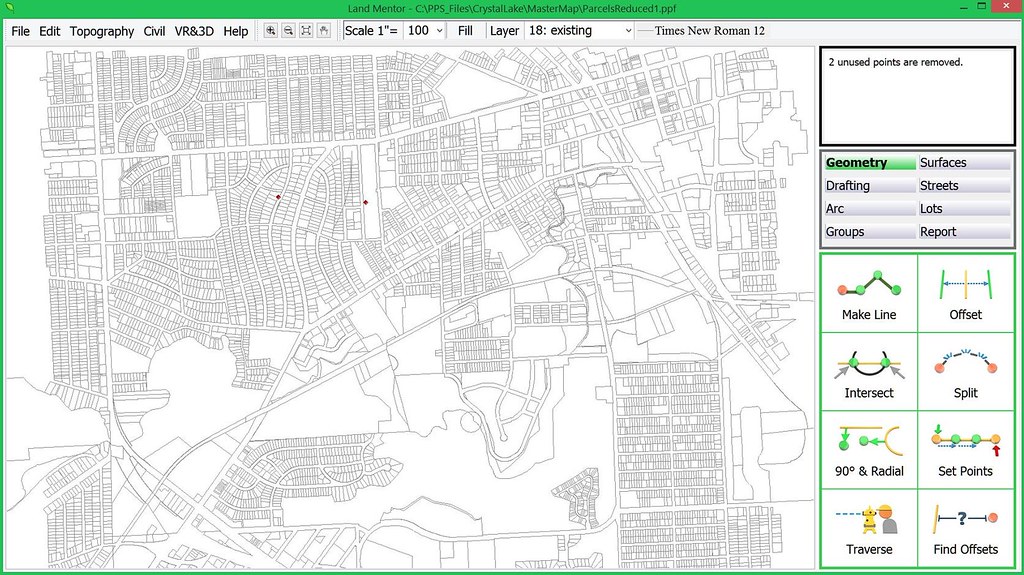
    The problem is that in the typical city with many curved streets, a shape map would add hundreds of thousands (likely millions) of inaccurate traced points.

    Take for example this small area in Pontiac, Michigan which took over 160,000 lines to define – none of which are precise:
    Today, ESRI pretty much controls the multi-billion dollar GIS industry. There’s no intent in this article to say ESRI provides bad or good software, but to hopefully reverse a very disturbing trend in the data in which maps are based upon and why it’s counter-productive to sustainable growth.

    Ask yourself:

    • With multiple billions of dollars invested in GIS technology and mapping – most by you – the tax payer, why is the very fabric of today’s growth worse, than that of the 1960’s – before any digital technology existed?

    • Why is it that at every city council and planning commission meeting are presentations and submittals materially no different today than in the past 6 decades?

    • Why is it that the regulatory system continues to produce (actually promote) the cookie-cutter mundaneness that plagues every city?

    Why we need to go back to surveying

    At this point to understand the problem in GIS mapping, you need a short lesson on land surveying. The person in blue jeans standing on the roadside looking into the scope of the transit is a land surveyor.

    Land surveying is more art than science. A proper boundary survey requires those in the field to find the corners along the streets and nearby. The land surveyor looks for differences between adjacent site dimensions of what is recorded, if any. Using judgments based upon extensive knowledge, the land surveyor can adjust the inconsistencies and set new corners.

    Why Accuracy is Critical

    Once the actual corners of a boundary are known, the land surveyor collects all man-made improvements (stuff) on the site to determine if fences overlaps onto the neighbor’s property, or their shed encroaches within the parcels boundary. Is the home set the required minimum 10’ from the side yard or is it less? This would be a violation. This is stuff lawsuits are made of.

    How can bad data be fixed?

    Those purchasing the GIS are told that they could quickly put a map in and then later on collect accurate control points which cold be ‘rubber sheeted’ (stretched). In other words, an inaccurate map that was traced decades ago, then rubber sheeted 10 or 20 feet (or more) to be made ‘accurate’, produces results in 4 good points and hundreds of thousand bad ones. Those GIS purchasers with no knowledge of surveying somehow saw logic in this false premise.

    Are there any accurate base maps?

    Yes! For example, decades ago, Gary Stevenson the County Surveyor in Dakota County, Minnesota decided to hand key in the plat dimensions of deeds and recorded plats (site plans of developments) into a coordinated geometry system upon which land surveying and civil engineering is based upon.

    The Dakota County Surveyors office created a map, complete with parcels of land and subdivision plats that conflict with each other showing overlaps and void areas. This precision map using recorded information adjusts each parcel and plat to a common angle basis (rotation). This way a land surveyor can use the information to determine problems in the adjoining property and can make an attempt to adjust conflicts and solve them ultimately fixing the map and creating a geometrically perfect city.

    Technology that changed land surveying

    Today’s Global Positioning Systems (GPS) has a much higher degree of accuracy for land surveying applications and has made exact measurements of control points along great distances without error possible. However, with all the technology, the skill and knowledge of the land surveyor is required to work the puzzle pieces of creating an accurate base map, as well as correctly defining any property – even yours!

    Can an inaccurate map be fixed over time?

    Absolutely, but only if a city or county wanted to pay far more to fix a bad map than starting over with a good map from scratch. Today, there are far better software technologies, based upon the future of mapping without data structures designed in the past when speed was the ball and chain.

    The ‘not good’, bad & ugly of today’s mapping

    The software our firm develops is designed the same way as we did nearly four decades ago – extremely efficient with data to let the lightning fast processor work, needing very little disk space for storage and access.

    The problem in particular with the leading CAD and GIS software developers is that they have access to a massive amount of memory and disk space. This allows programmers to work with less effort.

    Throwing excessive amount of information to the disk is a quick way to write software code – why not? – you got the space.

    Efficient coding is painfully long and expensive.

    The problem with monopoly

    Today’s mapping systems have essentially the same data structure as four decades ago because they have almost no competition that forces change. This is an increasingly common problem in a tech world increasingly dominated by an ever smaller group of increasingly giant companies.

    One thing about inefficiency: For those with overwhelming market share, it’s also potentially very profitable, as Microsoft, Google, Apple and Facebook can tell us.

    Back to Basics

    It was just few decades ago that contours showing the varied organic shape of the land surface was somewhat efficient and accurate.

    With just a few hundred points collected on the ground by a land surveyor an accurate representation of the ground surface could quickly be computed and drawn by software. You could clearly see where the elevation of the ground changed direction and where walls, curb lines, or drainage ditches were.

    In other words, in general, from a physical data structure perspective, there was little to be concerned with working with contours of the land. Below is an example from decades ago of an on the ground survey with all the boundary and improvements, created from a total 640 field collected points:



    The depiction above is the exact land surface essential for reconstruction and earthwork calculations. Note the contours along the street which show the fine detail of the center of the street along with contour lines that adjust at the street curb line. Because of the digital terrain model is created with only 640 total data points, all calculations such as earthwork and street redesign will be instant.

    Modern laser-based remote sensing technology allows the creation of complete topographic maps without requiring any manual labor to create as was the case in the past, or at least in theory – but not in the real world use for using the data for design and 3D application.

    Essentially the industry was really efficient until modern computers effectively threw topographic efficiency into the garbage, and producing what can be best described as ‘spastic’ jiggly contour lines as shown on this typical LiDAR map:

    The Mayors and Administrators in charge of tax payer funded contracts approving contours such as the above are not aware that this information is pure garbage, because they, nor did their staff (who should have known better) did not have this knowledge.

    With all the information and technological abilities we have today, why are these contours so awful? Because software cannot think – it can only use math. When the land is relatively flat, as most land, streets, and parking areas are, to draw a contour line when points exist within a few feet of each other, it will need to create a short line a particular direction, a few feet in length. Then it needs to determine a direction for the next short line, and ignores a trend or path and simply goes ‘to and fro’ not ‘knowing’ where to go. This of course, is because software cannot ‘know’ anything – only a person can make such judgments.

    You take the person out of the equation, and bad things like this happen.

    Can this excess data be filtered?

    Why has nobody brought this up as a key issue?

    Well, the consultants serving cities – why should they give up all that continual updating of a map to reinvent their services offering accurate consulting requiring the services of a Professional Land Surveyor instead of CAD and GIS technicians? Virtually every convention, periodical, and blog that serves government agencies depend heavily of the advertising dollars of the current GIS and CAD leaders – they would never print a series like this which could damage their relationships with the enormous companies and cut their income stream.

    We can reverse the damage, but it will take key decision makers in government to stop writing tax payer funded checks for substandard, wasteful, and just plain bad – mapping data.

    Rick Harrison is President of Rick Harrison Site Design Studio and Neighborhood Innovations, LLC. He is author of Prefurbia: Reinventing The Suburbs From Disdainable To Sustainable and creator of LandMentor. His websites are rhsdplanning.com and LandMentor.com

    By Karen Capria (esri.com) [Public domain], via Wikimedia Commons
  • Diners and the Decline of Shared Social Institutions

    Grub Street posted another installment in the decline of the New York diner genre.

    I’ve made the point before that many of these old line institutions are going out of business because their product simply isn’t very good. I’m a fan of diner food, but I’ve never had a good meal in a Manhattan diner.

    But there are many other forces at work, including changes in the structure of our society. One thing the disappearance of diners illustrates is the loss of shared social infrastructure spanning across social classes.

    Something I’ve always liked about diners is that they are the kinds of places that you could find people from all walk of life. There were cops and blue collar workers, college students, professionals grabbing breakfast, etc. It was the kind of institution that was broadly patronized across social groups.

    These kinds of institutions are in decline. There has a been fragmentation of the shared American common culture that existed as recently as 1990 into a multiplicity of niche markets.

    There’s also been a gulf that has opened between the consumption and cultural practices of the upper middle class (the top 20% by education and income) and everyone else. They shop in different stores, eat in different restaurants, drink different beers, etc.

    There are fewer of the spaces were classes intersect as they did in diner. There are still NYC restaurants where multi-class patronage does occur – pizza by the slice places and delis come to mind. Those are both great. But in my experience, in diners it’s more likely that people will actually strike up a conversation with others, and thus have real cross-class conversation, even if just idle banter.

    So the decline of the diner is not just about the loss of a restaurant format – those come and go – but also the decline of shared social space and the increasing alienation between social classes and groups.

    You might also like: The fact that you get to interact in a positive way with people of so many different backgrounds is why I love jury duty.

    This piece originally appeared on Urbanophile.

    Aaron M. Renn is a senior fellow at the Manhattan Institute, a contributing editor of City Journal, and an economic development columnist for Governing magazine. He focuses on ways to help America’s cities thrive in an ever more complex, competitive, globalized, and diverse twenty-first century. During Renn’s 15-year career in management and technology consulting, he was a partner at Accenture and held several technology strategy roles and directed multimillion-dollar global technology implementations. He has contributed to The Guardian, Forbes.com, and numerous other publications. Renn holds a B.S. from Indiana University, where he coauthored an early social-networking platform in 1991.

    Photo Credit: Coyote-mania, CC BY-SA 3.0

  • Should Transit Fares Cover Operating Costs?

    Maryland has long had a state law requiring transit systems to collect enough fares to cover at least 35 percent of their operating costs. While it is admirable to set a target, this particular target is disheartening for two reasons.

    First, 35 percent is a pretty low goal. The 2015 National Transit Database lists 48 transit operations that cover between 100 and 200 percent of their costs, including New York ferries, the Hampton Jitney, several other bus lines, and a bunch of van pooling systems. No rail lines cover 100 percent of their operating costs, but BART covers 80 percent, Caltrains covers 72 percent, New York and DC subways cover 64 percent, and New York commuter trains cover 60 percent. On average, commuter bus and commuter rail systems earn half their operating costs. So 35 percent lacks ambition.

    Even worse, most Maryland transit operations don’t come close to meeting the target. Maryland commuter trains cover 45 percent of their costs. But Baltimore’s light rail only covers 17 percent, and its heavy rail covers a pathetic 13 percent. Standard bus service also covers just 13 percent of its costs, though commuter buses come closer to the target, reaching 28 percent.

    Maryland lawmakers have figured out a solution to the second problem, if not the first. They simply passed a bill abolishing the target. Now, transit advocates hope, the state can spend even more money building obsolete transit systems that won’t be able to afford to maintain because they can’t even cover a third of their operating costs.

    Transit is “not profitable,” said one advocate, “but it’s essential for an economically competitive region.” Just how economically competitive has Baltimore been since it sunk billions of dollars into light- and heavy-rail lines that don’t cover even a fifth of their operating costs? Maryland certainly won’t make itself more economically competitive by increasing the tax burden still further so they can build more obsolete transit lines.

    Failing to cover costs isn’t a symptom that you are economically competitive. It is a symptom that you’ve failed to provide things that people need and want. The Antiplanner can understand why people think we need to subsidize food stamps or other aid to low-income people. I can’t understand why people think nothing of throwing huge amounts of money towards marketable operations like transit.

    C. Northcote Parkinson, the author of Parkinson’s Law, said that organizations that set goals low so they would be easy to meet were suffering from a disease he called injelititis. The transit industry has been suffering from this disease since the mid-1960s, when it discovered it could live off the public trough rather than actually have to provide services that people want. Once this disease reached its late stages, he said, the only cure required “a change of name, a change of site, and an entirely different staff.”

    There’s still a chance that Maryland’s governor may veto the bill. Let’s hope he does.

    This piece first appeared on The Antiplanner.

    Randal O’Toole is a senior fellow with the Cato Institute specializing in land use and transportation policy. He has written several books demonstrating the futility of government planning. Prior to working for Cato, he taught environmental economics at Yale, UC Berkeley, and Utah State University.

  • High-Flying California Charts Its Own Path — Is A Cliff Ahead?

    As its economy bounced back from the Great Recession, California emerged as a progressive role model, with New York Times columnist Paul Krugman arguing that the state’s “success” was proof of the superiority of a high tax, high regulation economy. Some have even embraced the notion that California should secede to form its own more perfect union.

    Pumped up by all the love, California’s leaders have taken it upon themselves to act essentially as if they were running their own nation. In reaction to President Trump’s abandonment of the Paris accords, Gov. Jerry Brown trekked to Beijing to show climate solidarity with President Xi, whose country is by far the world’s largest greenhouse gas emitter and still burns coal at record rates, but mouths all the right climate rhetoric.

    At the same time California’s Attorney General is spending millions to protect undocumented workers and there’s legislation being proposed to transform the entire place into a “sanctuary state.” Sacramento also recently banned travel by government workers to Texas and seven other states that fail to follow the California line on gay and transgender rights.

    Past performance and future trajectory

    When progressive journalists, including those in Texas, speak about the California model, they usually refer to the state’s economic performance since 2010, which has been well above the national average. Yet this may have been only an aberrant phenomenon. Since 2010, Texas’ job count has grown by 20.6 percent compared to 18.6 percent for California. If you pull the curtain even further, to 2000, however, the gap is even bigger, with employment growing 32.7 percent in Texas compared to 18 percent in California.

    The main problem is that California’s once remarkably varied and vital economy has become dangerously dependent on the Bay Area tech boom. Since 2010, the Silicon Valley-San Jose economy and San Francisco have been on a tear, growing their employment base by 25 percent. Job growth in the rest of the state has been a more modest 15 percent. “It’s not a California miracle, but really should be called a Silicon Valley miracle,” notes Chapman University forecaster Jim Doti. “The rest of the state really isn’t doing well.”

    Tech starts to slow

    Such dependency poses dangers. The tech economy is very volatile, and now seems overdue for a major correction. People tend to forget the depth of the tech bust at the turn of the century. If you go back to 2000, San Jose’s job growth rate is among the lowest in the state, less than half the state average.

    Now tech is clearly slowing – job growth in the information sector has slowed over the past year from almost 10 percent to under 2 percent. Particularly hard-hit is high-tech startup formation, down almost half in the first quarter from two years ago; the National Venture Capital Association reported that the number of deals in the quarter was the lowest since the third quarter of 2010.

    The growing hegemony of a few very large firms – chiefly Apple, Google and Facebook — has created a very difficult environment for upstarts. As one recent paper demonstrates, these “super platforms” depress competition, squeeze suppliers and reduce opportunities for potential rivals, much as the monopolists of the late 19th century did.

    And as we found in our recent survey of the hot spots for high wage professional business services jobs, last year’s growth rates for this critical middle class sector in Silicon Valley and San Francisco lagged considerably behind those of boomtowns such as Nashville, Dallas, Austin, Orlando, San Antonio, Salt Lake City and Charlotte. Most other California metro areas, including Los Angeles, have languished in the bottom half of the rankings. These trends suggest that the state’s job performance will at least drop to the national average over the next two years and perhaps below, says California Lutheran University forecaster Matthew Fienup.

    Rising inequality

    California is home to a large chunk of the world’s richest people and particularly dominates the list of billionaires under 40. Yet, by one new measure introduced by the Census Bureau last year, the state also suffers the nation’s highest poverty rate; while a 2015 United Way study found that close to one in three Californians were barely able to pay their bills. No surprise then that as of 2015, the state was the most unequal in the nation, according to the Social Science Research Council.

    As of 2011, nearly half of the 16 counties with the highest percentages of people earning over $190,000 annually were located in California but denizens of the state’s interior have done far worse. A 2015 report found California was home to a remarkable 77 of the country’s 297 most “economically challenged,” cities based on levels of poverty and employment. Altogether these cities had a population of more than 12 million in 2010, roughly one third of the state at the time. Six of the ten metropolitan areas in the country with the highest percentage of jobless are located in the central and eastern parts of the state.

    What is disappearing faster than any state, according to a survey last year, is California’s middle class, a pattern also seen in a recent Pew study. One clear sign of middle class decline: California’s homeownership rates now rank among the lowest in the nation and Los Angeles-Orange County, the state’s largest metropolitan area, suffers the lowest level of homeownership of any major region.

    Jerry’s Jihad and its consequences

    State policies tied to Jerry Brown’s climate jihad have widened these divides. Inland Empire economist John Husing asserts that Brown has placed California “at war“ with blue-collar industries like home building, energy, agriculture and manufacturing. These jobs are critical for regions where almost half the workforce has a high school education or less.

    Richard Chapman, President and CEO of the economic development arm of Kern County, an area dependent on these industries, complains that most polices promulgated in Sacramento — from water and energy regulations to the embrace of sanctuary status and a $15 an hour minimum wage — give little consideration given to the needs of the interior. “We don’t have seats at the table,” he laments. “We are a flyover state within a state.”

    The recent legislation to raise the minimum wage to $15 an hour will have more severe ramifications for less affluent areas than San Francisco. As for climate policies, the state no longer even assesses the economic implications. Yet the state’s costly renewable energy mandates make a lot of difference in the less temperate interior when energy prices are 50 percent rise above neighboring states. A recent study found that the average summer electric bill in rich, liberal and temperate Marin County was $250 a month, while in the impoverished, hotter Central Valley communities, where air conditioners are a necessity, the average bill was twice as high. Some one million Californians, many in the state’s hotter interior, were driven into “energy poverty,” a 2012 Manhattan Institute study stated.

    Housing has arguably emerged as the biggest force accentuating inequality. Environmental restrictions that have cramped home production of all kinds, particularly the building of affordable single-family homes on the periphery. The ever increasing restrictions have made the state among the most unaffordable in the nation, driving homeownership rates to the lowest levels since the 1940s. New “zero emissions” housing policies alone are likely to boost the already bloated cost of new construction by tens of thousands of dollars per home.

    Demographic crisis looms

    In much of California, particularly along the south coast, the number of children has dropped sharply. Since 2000, there has been a precipitous 13.6 percent drop in the number of residents under 17 in Los Angeles, while that number has remained flat in the Bay Area. In contrast, there has been 20 percent growth or better in the under 17 population in more affordable metropolitan areas such as Dallas-Fort Worth, Atlanta, Charlotte, Raleigh, Phoenix and San Antonio.

    Housing prices, in part driven by state and regional regulation, are gradually sending the seed corn — younger workers — to more affordable places. Despite claims that people leaving California are old and poor, the two most recent year’s data from the IRS shows larger net losses of people in the 35 to 54 age group. Losses were particularly marked among those making between $100,000 and $200,000 annually.

    Young people particularly are on the way out. California boomers, as we discussed in a recent Chapman University report, have a homeownership rate around the national average but the state has the third lowest home ownership rate in the nation for people 25 to 34, behind just New York and Washington. The drop among this demographic in San Jose and the Los Angeles areas since 1990 are roughly twice the national average and a recent San Jose Mercury News poll found nearly half of all Bay Area millennials planning to move, mostly motivated by housing and costs. The one population on the upswing in the state are seniors, particularly in the coastal countries, who bought their homes when they were much less expensive.

    As long as home prices stay high, and opportunities for high-wage employment highly limited, the state will continue to suffer net domestic migration outflows, as it has for the last 22 of the past 25 years. Given that the state’s birthrate is also at a historic low and immigration from abroad has slowed, there’s a looming shortage of new workers. Between 2013 and 2025 the number of California high school graduates is expected to drop by 5 percent compared to a 19 percent increase in Texas, 10 percent growth in Florida and a 9 percent increase in North Carolina.

    And for what?

    Of course, many environmental activists generally prefer smaller families to cut greenhouse gas emissions; smaller families also serve the needs of developers of high-density housing, who might prefer that younger people remain long-term adolescents.

    Sadly, many of these climate policies, which cause so much damage, won’t have much of an impact on the actual climate unless the rest of the country adopts similar measures. This stems from the state’s already low carbon footprint and the impact of people as well as firms moving elsewhere, where they usually expand their carbon footprint. Nor does densification make sense as a climate antidote, given the rising temperatures associated with “urban heat islands.”

    The tech boom has been used to justify Sacramento’s crushing regulatory and tax regime. It has also made it possible for apologists to ignore some 10,000 businesses that have left or expanded outside the state, many of them employing middle and working class people.

    Ultimately California’s growing class bifurcation will demand solutions. Hedge fund billionaire-turned green patriarch Tom Steyer now insists that, to reverse our worsening inequality, we should double down on environmental and land use regulation but make up for it by boosting subsidies for the struggling poor and middle class. Certainly the welfare state in California — home to over 30 percent of United States’ on public assistance as of 2012 — will have to expand if the state stays on its present course.

    In the coming years the state’s business leaders fear an ever more leftist, and fiscally damaging, regime after the departure of the somewhat frugal Brown. There are increased calls in Sacramento for new subsidized housing, a single payer healthcare system as well as a big boost to the minimum wage already enacted.

    Ultimately California will pay — demographically, economically and socially — from its current surfeit of good intentions. Those who already own houses will not suffer immediately, but the new generation, immigrants and minorities will face an increasingly impossible burden. With its unparalleled natural assets, and economic legacy, California may be able to survive this toxic policy mix better than most places, but even in the Golden State reality has a way of showing its ugly face.

    This piece originally appeared on Forbes.

    Joel Kotkin is executive editor of NewGeography.com. He is the Roger Hobbs Distinguished Fellow in Urban Studies at Chapman University and executive director of the Houston-based Center for Opportunity Urbanism. His newest book is The Human City: Urbanism for the rest of us. He is also author of The New Class ConflictThe City: A Global History, and The Next Hundred Million: America in 2050. He lives in Orange County, CA.

    Photo by Neon Tommy, via Flickr, using CC License.

  • Is Anybody Really Listening: Pizza with Perez in Youngstown

    Ohio has long been seen as a battleground state, up for grabs in most Presidential elections. The state supported winning candidates of both parties for decades. But as the state shifted back and forth, the Mahoning Valley (Mahoning and Trumbull Counties) in Northeastern Ohio remained a Democratic stronghold. If Democratic candidates could garner more than 62% of the vote in this region – as they often did — they would win the state. In years when Republicans won, the Mahoning Valley still voted for the Democrats, but with less enthusiasm.

    Not this time. In the 2016 primaries, a number of Mahoning Valley Democrats changed their party affiliation to vote for Donald J. Trump. Last year’s big shift came from people who had sat out the past few elections but showed up to vote this year. In November, Hillary Clinton won Mahoning County but received less than 50% of the vote. She actually lost in neighboring Trumbull County. She lost Ohio by more than 8 points, the biggest loss of any candidate in the state since Michael Dukakis gave up the state to George H.W. Bush in 1988.

    That’s why political operatives and journalists are now paying even more attention to the Youngstown area. Even the Ohio Democratic Party (ODP), which has long counted on the Mahoning Valley, is taking notice of a region they didn’t think they needed to worry about.

    In what has become a familiar practice following a series of defeats in recent state-wide elections, the ODP sponsored a “Listening Tour.” On June 12, 2017, the tour came to Youngstown with National Democratic Party Chairperson Tom Perez, who reiterated that Youngstown was a political “bellwether.”

    The event was held at a local pizzeria, Wedgewood Pizza, and billed as “Pizza with Perez.” Approximately 75 attendees, mostly loyal Democratic Party supporters, including a number of local and state politicians, paid $25 to attend the midday event. I paid my $25 to find out whether Party leaders were seriously listening to the concerns of voters and to see how they would react.

    What I saw was a typical campaign event, with the audience doing the listening while Democratic operatives touted their positions. After brief introductions by state and local Party chairs David Peppers and David Betras, Perez explained his commitment to Democratic politics by recalling his father’s experience of moving to Buffalo from the Dominican Republic. Perez talked about how the community and especially the labor movement helped his family make a home there. He promised that Democrats could be counted on to speak to hopes and fears of the working class and to fight for working people.

    When someone asked about why Democrats had lost the election, Perez criticized Republican social and economic policy, but he also acknowledged several mistakes that the Democratic Party had made during the last campaign. “We could have done a better job of speaking more directly to the pocketbook issues that bring people to the ballot,” he said. Among other things, the Party should have recognized that NAFTA hurt working people and acknowledged its role in that trade bill.

    Perez noted that the Party’s “message got muddled,” but he quickly turned to typical campaign trail rhetoric: “I’m here to say very clearly that the Democratic Party is the party that’s fighting for the labor movement. The Democratic Party is the party fighting for quality public education and access to health care and the issues that matter most to the people in the Valley.” But there were very few questions and much of the time devoted to meet and greet. Clearly, no one identified themselves as crossover voters or first time Republican registrants. So much for this being a listening tour.

    The ODP’s misstep of charging admission for a fake listening tour was not lost on local Mahoning County Republican Party Chairman, Mark Munroe, who called it a “strange” event and organized a parallel gathering where he invited crossover voters to explain their positions. As Munroe commented, “If they want to find out why Democrats have become Republicans they need to talk to Republicans because the Dems who have crossed over are not going to be inclined to pay $25 contribution to a Democrat party event.” One of the speakers, Geno DiFabio, explained his party switch: “Every 2 years, every 4 years, locally they’d come around and say, ‘oh, we’ll fight for you and take care of you,’ and then they’d disappear. It was like an abusive relationship.”

    Despite what the invitation promised, the ODP’s tour didn’t involve listening to local voters or even to their leaders, but that’s a familiar pattern for Mahoning Valley Democrats. Voters here remember how the national Party leaders dismissed former Congressman James Traficant when he bitterly criticized the Democratic Party for contributing to deindustrialization, making false promises, and prophetically warned that NAFTA would harm working people. But nobody listened.

    In 2015, Ohio Congressman Tim Ryan told a reporter that “a lot of bad things happened” in 2010 and 2014, and the Party needed “a new approach—a more grounded approach—to turning out voters.” Nobody listened.

    A year ago, after the Ohio primaries, local Party leaders wrote a widely publicized letter to the Clinton campaign and the ODP warning that they should pay more attention to working-class issues. Once again, nobody listened.

    A tone-deaf, let-us-tell-you-how-much-we-care faux listening tour won’t accomplish anything, But the ODP and the DNC should pay more attention to Northeastern Ohio Democrats. They might start by heeding Ryan’s recent critique that the Democratic Party brand has become “toxic.” He has called for a wholesale change, starting with the Party’s leadership in the House of Representatives.

    The Democrats should also pay attention to Ohio Senator Sherrod Brown, who is the only statewide Democratic office holder and one of very few national Party leaders with a consistent pro-worker economic vision.

    If they don’t start actually listening to voters in places like Youngstown, the Democratic Party may well end out talking to itself.

    John Russo is the former co-director of the Center for Working-Class Studies at Youngstown State University and currently a visiting scholar at Georgetown University’s Kalmanovitz Initiative for Labor and the Working Poor.

    Photo by Lonnie Tague for the United States Department of Justice [Public domain], via Wikimedia Commons

  • Red State Conundrum

    How do you raise incomes when your state’s economic appeal is based on low costs?

    That’s the basic conundrum facing a number of red states. They rightly talk about their cost climate, touting tax rates and such. But the biggest component of cost for many businesses is labor. Being a low cost state is tantamount to being a low wage one in many cases.

    A recent workforce survey from the Indiana Chamber of Commerce highlights this dilmmea. Some key findings:

    • Applicants not willing to accept pay offered (45% agree or strongly agree). Lack of minimal educational requirements was only 27% [problems in recruitment]
    • Only 26% very likely or extremely likely to add high-wage jobs in next two years

    Employers are having trouble finding workers. A big problem is pay, but not many employers plan to add higher wage jobs.

    The survey asked how firms dealt with positions they couldn’t fill. Here were the results:

    • 55% left unfilled until a candidate was found< • 18% assigned duties internally to other workers • 11% hired an underqualified candidate • 16% other

    Notice what’s missing from this list: raising the wage on offer in order to attract qualified applicants. Maybe some of that is included in “other” but it’s clearly a small amount.

    The real question that needs to be asked is why these firms aren’t offering a market clearing wage.

    If they can’t afford to pay the going rate, then these firms don’t have a skills gap problem, they have a business model problem. The problem is with the companies, not the workforce.

    That’s not to say there isn’t some skills gap, training gap, etc. But when the pay problem is screaming at you loud and clear and you refuse to address it, something bigger is going on.

    It’s not government’s job to underwrite a highly skilled but poorly paid workforce.

    This piece originally appeared on Urbanophile.

    Aaron M. Renn is a senior fellow at the Manhattan Institute, a contributing editor of City Journal, and an economic development columnist for Governing magazine. He focuses on ways to help America’s cities thrive in an ever more complex, competitive, globalized, and diverse twenty-first century. During Renn’s 15-year career in management and technology consulting, he was a partner at Accenture and held several technology strategy roles and directed multimillion-dollar global technology implementations. He has contributed to The Guardian, Forbes.com, and numerous other publications. Renn holds a B.S. from Indiana University, where he coauthored an early social-networking platform in 1991.

    Photo by Bidgee/Wikipedia – CC BY 3.0.

  • Can the Chicago White Sox Help Turn Around the South Side?

    As a displaced Detroit Tigers fan who adopted the Chicago White Sox as my team, I often wonder how our city’s other team, the Cubs, became an integral institution in the remaking of our city, while the White Sox have not. I published a piece at my Forbes site some time ago that detailed my thoughts on how the Cubs facilitated that transition. The Cubs’ growth in prominence, particularly from 1969 until today, parallels the city’s transition from Rust Belt to Global City. Conversely, the White Sox have diminished in prominence over the same span. I realized the Sox missed out on the locational advantages the Cubs enjoyed, and circumstances and mistakes have hurt them.

    Once again, readers may ask, “what does any of this have to do with cities?”, so let me explain. Baseball, I believe, holds a special place as a sport that is an institution and amenity for the places they call home. As the nation’s oldest professional team sport, it has an enduring history in many of our largest cities. In its early years, major league teams sought to establish close relationships with the neighborhoods that surrounded them; with 77 (and now 81) home games scheduled each year, that was just a good business practice. Teams in other sports have tried to replicate the institution/amenity feel, with varying degrees of success. Basketball and hockey are winter sports and played indoors. Football plays to much larger crowds and with far fewer games, and is far more likely to be viewed as a neighborhood intrusion than an amenity. But baseball is summer. It’s (mostly) outdoors. It can be easily integrated into a neighborhood fabric. So, yes, I see baseball teams, baseball stadiums, as having an outsized impact on city revitalization that other sports teams can’t compete with.

    What I tried to capture in my Forbes piece is that before the Cubs enjoyed their current baseball success, they have for some decades enjoyed that locational success, and parlayed that into a successful partnership with the surrounding neighborhood. From that piece:

    “Starting in 1969, the Cub mythology begins to grow, and television becomes a bigger part of it. Chicago kids would come home from school to watch day baseball games. Plays by David Mamet were being written about bleacher bums. At the same time, the economies of north and south were continuing to diverge. Institutions like DePaul and Loyola University, Children’s Hospital, and others, were attracting more of the Midwest’s best and brightest to study and work. And the Cubs became a very attractive amenity to people returning to cities exactly for that reason.

    It was in the 1980s that the real and enduring changes occurred. WGN became a cable television superstation, and now Cub games were broadcast nationally. Throughout the ’80s, especially with Harry Caray at the helm in the broadcast booth, every game was a celebration of what Chicago, and specifically North Side Chicago, had to offer. A jewel of a ballpark, day baseball, views of sailboats on Lake Michigan and a dramatic skyline nearby — all of this became not just a Midwestern phenomenon, but a national one. Suddenly, it wasn’t just Midwestern kids who dreamed of moving to big city Chicago. It became national.”

    In other words, the heart of Cubbie fandom lies in its place: the old ballpark, the surrounding neighborhood, the bars and restaurants, the nearby lakefront, even the nearby eds and meds institutions that employ many of the neighborhood’s residents — they all blend together to create a unique and enviable environment.

    Conversely, over the last 50 years or so the White Sox lost whatever locational advantage they had. Deeply identified as the “South Side’s Team”, their fortunes diminished just as the South Side’s:

    Meanwhile, as the Cubs became more popular in the late ’60s, the luster on the White Sox began to dim. The Bridgeport neighborhood that is home to the Sox is in many respects the polar opposite of the Cubs’ Lake View neighborhood. It’s working-class, with far fewer eds and meds institutions, and a Bronzeville neighborhood — also known as the Black Belt — that stood between it and the south lakefront. While Cubs fans sitting in the upper reaches could see sailboats on the lake, Sox fans could see a never-ending row of public housing towers.

    Beginning in the late ’60s and early ’70s the fortunes of the Cubs and White Sox diverged as dramatically as their respective parts of the city.

    First, Some Facts

    Let’s try to establish a context for the Cubs and White Sox by using the most accepted measure of popularity in baseball, attendance. Since 2001 the Cubs have been in the top tier of MLB attendance, with an average annual rank of eighth out of thirty teams. The Cubs are regularly in the mix with the Yankees, Dodgers, Cardinals, Giants, Mets, Red Sox and Angels as a top MLB draw. Over this period the Cubs have averaged just under 3 million fans per season, or about 37,000 per game. Cubs attendance has proven to be remarkably consistent and impervious to big fluctuations in wins and losses. The Cubs paid a big price in 2013 when attendance dropped by 11.8% after disappointing seasons in 2011 and 2012, but overall the Cubs increased attendance at a rate of 1.2% a year over the last sixteen seasons. MLB attendance has grown at a rate of about 0.6% annually since 2001.

    The White Sox, however, are quite a different story. Since 2001 the Sox have consistently ranked in the bottom third in MLB attendance. They’ve averaged just over 2 million fans annually, or nearly 26,000 per game. That’s enough to rank them 21st out of thirty teams in that span.

    I haven’t been able to document this yet, but I suspect the Sox may be among the more win-sensitive teams in MLB. Attendance jumped 21.3% from 2004 to 2005, the year the Sox won the World Series, and jumped another 26.2% in 2006, in the World Series afterglow. The Cubs have no such huge year-to-year gains over the last sixteen seasons. However, subsequent poor seasons meant attendance has dropped for eight consecutive seasons before ticking upward again in 2015. The Sox have gained about 0.5% annually in attendance since 2001, just under the MLB average.

    Cubs fans, and Chicagoans in general, seem to accept the Cubs/Sox fandom differential as an immutable fact, but that’s not the case. Historically speaking, as I wrote previously about this at Forbes, the White Sox regularly outdrew the Cubs following World War II and into the ’60s. From the late ’60s to early ’80s, there was general attendance parity between the teams. Since the early ’80s, the Cubs have regularly outdrawn the Sox. The Cubs have outpaced the Sox in attendance every year since 1992.

    Downtown, Neighborhood and Suburban Teams

    The Cubs are one of just a handful of major league baseball teams that have maintained a strong neighborhood identity and association. Out of 30 MLB teams, just nine are located in neighborhood locations today, with 18 located in downtown areas and three in the suburbs (including the Atlanta Braves, who moved to suburban Cobb County this season). Here are the nine so-called neighborhood teams, located at least two miles outside of the center of a city’s CBD:

    • New York Yankees
    • Boston Red Sox
    • Chicago White Sox
    • New York Mets
    • Philadelphia Phillies
    • Washington Nationals
    • Miami Marlins
    • Oakland Athletics
    • Chicago Cubs

    Philadelphia, Washington, Oakland and Miami deserve special attention. By my eyes, the Phillies, Nationals and A’s all play in stadiums that are beyond their cities’ central business districts, but appear to be located in areas that are largely warehouse or former manufacturing districts, as opposed to residential or mixed-use areas. The home of the Miami Marlins opened in Miami’s Little Havana in 2012, so one could argue it’s had little time to develop — yet — a strong relationship with the surrounding neighborhood. (Kansas City — the Royals’ Kauffman Stadium, although within the city’s limits, is so far from the city’s downtown, and relies on interstate access to reach it, that it gets a “suburban” designation from me.)

    The Yankees, Red Sox and Cubs are each intimately connected with their surrounding neighborhoods. Yankee Stadium is in the Bronx; while it doesn’t seem to have the same revitalization impact on its surrounding area, it is within easy reach affluent Manhattan. The Red Sox’ Fenway neighborhood and Fenway Park might be the closest analogue to the Cubs’ Lake View/Wrigleyville neighborhood and Wrigley Field in terms of vibrancy and impact on the city. I’m less familiar with the connection between the Mets and the nearby Queens neighborhoods.

    What Happened?

    The White Sox, however, seem to have far less impact than the others on the surrounding neighborhoods. In fact, the White Sox’ home seem most similar to the Oakland A’s — beyond downtown, and in the less-favored area of a two-team baseball market.

    I don’t know what happened with the A’s and Oakland, but I think it’s easy to figure out how the neighborhood fortunes, and subsequently the fan fortunes, of the Cubs and White Sox diverged. Keep in mind that prior to about 1950, the areas around Wrigley Field and Comiskey Park were more similar than they are today. But the area around Clark and Addison retained its neighborhood fabric, while the area around 35th and Shields mostly lost it. A few things factored into the divergence:

    Macro: the general decline of the South Side. A quick and easy way of seeing the difference between the North and South sides is looking at the median household incomes for the communities that house the respective teams, Lake View (Cubs) and Bridgeport (Sox). In 1970, the median household income in Lake View (in 2014 dollars) was $44,889. In Bridgeport, it was $48,548. In 2015, median household income in Lake View was $76,424, and in Bridgeport it was $42,951. This plays out more broadly as well; wealth has flowed into the north lakefront neighborhoods of the Near North Side, Lincoln Park, Lake View and Edgewater, and it flowed away from Bridgeport, Bronzeville, Washington Park and Woodlawn.

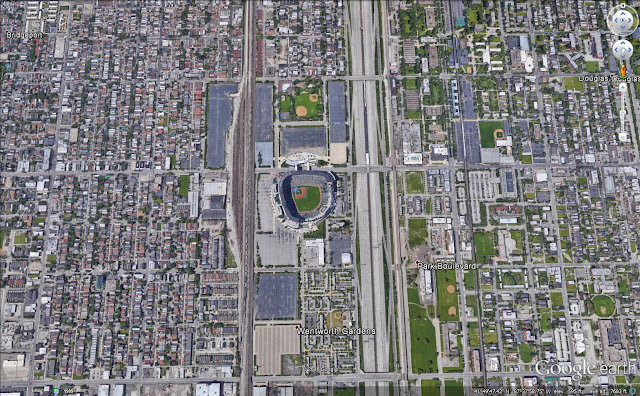
    Micro: Sox Park’s hemmed-in geography. The home of the White Sox has long been hemmed in by two freight rail lines, about a third of a mile apart — the Norfolk Southern line on the west and the Rock Island on the east. For much of its stretch on the South Side, the narrow corridor has been treated as a no-man’s land with manufacturing uses, intermodal facilities, and poor quality housing strewn in. The intact Bridgeport neighborhood lies further west, and Bronzeville further east. A look at an aerial of U.S. Cellular Field highlights this:

    Lack of nearby institutions and amenities. Several key institutions are located near Wrigley Field — DePaul and Loyola universities, several hospitals — that make the area an attractive place to live. Near old Comiskey, the much smaller Illinois Institute of Technology and Mercy Hospital are still there, but their presence might not be felt in the same way in the community as those further north.

    Public housing construction. The year 1949 began a 20-year period where public housing was constructed just to the east of Comiskey Park. Dearborn Homes, Stateway Gardens, and Robert Taylor Homes were built within eyesight of Comiskey over that period, concentrating tens of thousands of low-income residents along the area’s eastern edge.

    Dan Ryan Expressway construction. Between 1957 and 1962, the Dan Ryan Expressway was constructed just feet from Comiskey’s eastern edge. Remember the narrow rail corridor? The 16-lane expressway, with a new public transit line in the median, made it even narrower.

    When you combine these with some management differences between the Sox and Cubs, like the spotty radio and TV presence the Sox had when compared to their Cub brethren, and the failed venture to showcase Sox as a pay-per-view attraction on CableVision in the early ’80s, and it becomes clearer how the two teams took vastly different tracks.

    Paths to White Sox Success — And Urban Revitalization

    That being said, I think there are ways the White Sox could reclaim the kind of locational advantage they once had and the Cubs currently enjoy. However, it would mean the Sox would have to view themselves as a city institution invested in the revitalization of its surrounding area and employ unconventional tactics. Otherwise, they may need to consider other options. Here’s what they can do:

    Stay at 35th and Shields — and partner with commercial and residential developers. In the late ’80s, when the White Sox threatened to leave Chicago and received the public gift of U.S. Cellular Field in return, a counter-proposal was floated by Chicago architect Philip Bess to create Armour Field. It was to be a stadium that wouldn’t just be firmly integrated into the fabric of the surrounding community — it would create community where none currently existed. Take a look:


    The oddly-shaped outfield harkens back to the New York Giants’ Polo Grounds, and Bess took pains to re-create the outlines of old Comiskey. More importantly, Bess frames the stadium with mixed-use development to the east, west and south of the stadium, and includes a circle at 35th and Wentworth that creates a signature entrance into the area. I’m guessing this type of development would bring the same types of residents who live near Wrigley today. I’ve never heard an explanation from the Sox for why this proposal was rejected, but I assume costs had much to do with it. And yes, working on the commercial and residential sides of the project would be a challenge.

    This, of course, is just one redevelopment option. If the Sox are serious about staying at 35th and Shields, it would be in their best interest to lead the revitalization of the surrounding area.

    Find another neighborhood site on the South Side. There are likely other spots on the South Side that don’t have the constraints that prevent Cubs-style community cohesiveness and neighborhood connection. One such site could’ve been the 49-acre site of the former Michael Reese Hospital on the Near South lakefront; it was formerly considered as the site for the Olympic Village in Chicago’s 2016 Olympic bid, but is now being redeveloped as a major mixed-use development. I’ve also considered locations in largely manufacturing areas adjacent to the Southwest Side’s Orange Line. I’m sure there are other possible sites out there. All, however, would probably come with some significant neighborhood resistance, and have the same cost challenges inherent in the above scenario.

    Find a downtown or near-downtown location. It’s quite possible that in a two-team baseball market, only one team can be the “neighborhood” team. If so, the Cubs are it. The White Sox could find a site downtown or nearby (to be sure, very expensive) and begin to shed their South Side identity by becoming the team at the center of the metro area. Even though they’re not in a two-team market, the Detroit Tigers invigorated their fan base by moving from antiquated Tiger Stadium to Comerica Park in 2000, leaving the city’s Corktown neighborhood for a downtown locale. During the ’90s the Tigers were among the lower rung teams in attendance, drawing 1.5 million annually. The Tigers vaulted into the middle tier with the new stadium (and some on-field success) in the 2000’s, averaging 2.5 million a season. Of course, the last option would be to…

    Move to the suburbs. The White Sox flirted with suburban locations in the late ’80s. However, suburban stadium locations are seen less often today, particularly for baseball stadiums (Atlanta Braves excepted). Perhaps it’s because suburbs or suburban counties are less able to put together the public financing packages that team owners often demand (or extort?). If it were to happen, my guess is that the Sox would target relatively affluent south or southwest suburban communities like Orland Park or Bolingbrook, so that the team could easily attract fans from a broad spectrum of the metro area without completely compromising its South Side heritage. Honestly, I see this as highly unlikely, as the return-to-the-city movement is moving ahead in Chicago as much as anywhere.

    I couldn’t fathom a move to another city now, so I won’t explore it as an option.

    Bottom line, despite their on-field failures over the years, the Cubs have done a masterful job of taking advantage of locational opportunities presented to them. The White Sox have had a more difficult go of it for the last 60 years or so, but could turn it around with the right kind of thinking. Here’s hoping the White Sox can become the kind of integral institution of South Side change that the Cubs have been up north.

    This piece originally appeared on The Corner Side Yard.

    Pete Saunders is a Detroit native who has worked as a public and private sector urban planner in the Chicago area for more than twenty years.  He is also the author of “The Corner Side Yard,” an urban planning blog that focuses on the redevelopment and revitalization of Rust Belt cities.

    Top photo: U.S. Cellular Field, home of the White Sox. Source: sportingnews.com

  • Moving Away from Toronto and Montréal

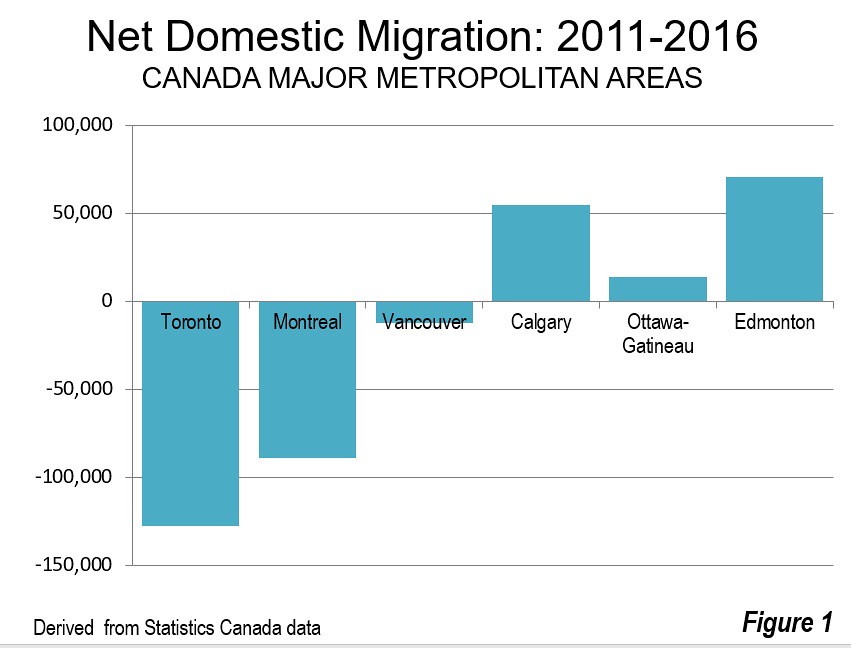
    The latest Statistics Canada data indicates that people are leaving Toronto and Montréal in large numbers since the 2011 census. Even so, both metropolitan areas continued to grow through the 2016 census as a result of net international migration and the natural increase of births over deaths (Figure 1). It turns out that Canada’s urban pattern is much more like that of the US, as well as other high-income countries, than many may suppose.

    Toronto

    Toronto lost 128,000 net domestic migrants, while Montréal lost 89,000 representing 2.3 percent of its total 2011 population.

    At the same time, the migration has been regional rather than national. In the case of Toronto, more than 90 percent of the net migration loss was to other areas of Ontario (118,000), as opposed to other provinces (10,000). The metropolitan area losses were concentrated in the city of Toronto, which lost a net 119,000 domestic migrants, while the suburbs lost 9,000. The city’s loss of 4.5 percent was nearly double that of the metropolitan area and 15 times that of the suburbs.

    Despite the late 1990s municipal amalgamation that increased the population of the city by three times, Toronto has become a majority suburban metropolitan area. The city of Toronto now has fallen to 46 percent of the population from 53 percent in 2001.

    Part of the metropolitan area loss is likely the result of Toronto’s higher house prices and shortage of single family homes that people prefer (see: Ryerson University Research Cites Urban Containment Policy as Major Factor in Toronto House Price Escalation), with nearby metropolitan areas experiencing strong net domestic migration gains. Up to one-half of Toronto’s loss may have been picked up by Oshawa (16,000), Hamilton (12,000), St. Catharine’s-Niagara (8,000), Barrie (7,000), Guelph (4,000), Brantford (4,000) Kitchener-Cambridge-Waterloo (1,000) and Peterborough (1,000), which are served by the commuter rail or bus services of Go Transit (Metrolinx).

    Moreover, with its highly dispersed employment patterns, commuters from exurban metropolitan areas can find employment much closer to home than downtown Toronto, with its less than 15 percent of metropolitan employment. A few years ago, it was reported that the largest employment center in Canada was the sprawling area around Pearson International Airport (Toronto-Missassauga-Brampton), rather than downtown Toronto. Meanwhile, the Kitchener-Cambridge-Waterloo area has emerged as Canada’s answer to Silicon Valley.

    Montréal

    Things were similar in Montréal, which lost 89,000 net domestic migrants, also representing 2.3 percent of its 2011 population. Unlike Toronto, Montréal’s loss was evenly split, with 45,000 moving out of Quebec and 44,000 moving to other parts of Québec.

    The concentration of net domestic migration losses were even more concentrated in the core than in Toronto. The ville de Montréal lost 117,000 net domestic migrants, while the suburbs gained 28,000. The ville’s loss of 7.0 percent was three times the rate of the total metropolitan area.

    Vancouver

    Vancouver, the third largest metropolitan area, also lost domestic migrants (12,000) at a rate of 0.5 percent relative to its 2011 population. Vancouver gained 10,000 net domestic migrants from other provinces, while losing 22,000 to other parts of British Columbia. Kelowna and Victoria appear to have prospered at Vancouver’s expense, both adding a 7,000 net intraprovincial migrants.

    Alberta: Calgary and Edmonton

    As has been the case for years, Alberta’s two largest metropolitan areas have led the national statistics. Calgary, the fourth largest metropolitan area added 55,000 net domestic migrants between 2011 and 2016. Much of this 4.6 percent gain was from other provinces (41,000). With the recent oil bust, which has hit Alberta hard, net interprovincial migration dropped from 7,000 in 2014-2015 to minus 1,000 in 2015-2016.

    Edmonton, Alberta’s second largest metropolitan area and Canada’s sixth largest, added even more net domestic migrants (72,000), for the strongest performance in the country. This 6.2 percent gain was also concentrated in people from outside the province (48,000). As in Calgary, net interprovincial migration fell strongly from 2014-2015 to 2015-2016, from 10,000 to 2,000.

    It remains to be seen how the recovering energy industry will impact the economy and migration trends in Alberta.

    Ottawa-Gatineau

    Ottawa-Gatineau (Ontario- Québec) has Canada’s capital and is the only major metropolitan area that spans two provinces. Ottawa-Gatineau is Canada’s fifth largest metropolitan area although likely to be overtaken almost at any time by faster growing Edmonton. Ottawa-Gatineau gained 14,000 net domestic migrants between 2011 and 2016 (1.1 percent). Most of the net domestic migration was from other parts of Ontario or Québec (10,000).

    Smaller Census Metropolitan Areas

    Among the other 27 census metropolitan areas that had been designated by the 2011 census, the largest percentage gain was in Kelowna, BC, at 8.4 percent. Saint John, New Brunswick had the largest net domestic migration loss at minus 3.5 percent.

    Overall Results

    Approximately two thirds of Canada’s population resides in the census metropolitan areas. Between 2011 and 2016, there was a net domestic migration of only 17,000 from outside the metropolitan areas (Table). Among the six major metropolitan areas, there was a net domestic migration loss of 89,000, probably driven in large measure by the “severely” or “seriously” unaffordability of housing virtually everywhere but Ottawa-Gatineau. While new metropolitan areas are likely to be designated (like Lethbridge, Alberta since 2011), it may be that there will be little additional net domestic migration to the largest metropolitan areas, and what will occur is largely in the suburbs.

    Net Domestic Migration: Canada Metropoltian Areas: 2011-2016
    Census Metropolitan Area 2016 Census Population Net Domestic Migration % of 2011 Population
    Toronto, Ontario      5,928,040         (128,432) -2.3%
    Montréal, Quebec      4,098,927           (88,913) -2.3%
    Vancouver, British Columbia      2,463,431           (11,928) -0.5%
    Calgary, Alberta      1,392,609             55,415 4.6%
    Ottawa-Gatineau, Ontario/Quebec      1,323,783             14,119 1.1%
    Edmonton, Alberta      1,321,426             71,620 6.2%
    Québec, Quebec         800,296               2,683 0.3%
    Winnipeg, Manitoba         778,489           (17,812) -2.4%
    Hamilton, Ontario         747,545             12,208 1.7%
    Kitchener-Cambridge-Waterloo, Ontario         523,894               1,390 0.3%
    London, Ontario         494,069               4,534 1.0%
    St. Catharines-Niagara, Ontario         406,074               8,030 2.0%
    Halifax, Nova Scotia         403,390               2,926 0.7%
    Oshawa, Ontario         379,848             16,028 4.5%
    Victoria, British Columbia         367,770             17,647 5.1%
    Windsor, Ontario         329,144                  (48) 0.0%
    Saskatoon, Saskatchewan         295,095               8,672 3.3%
    Regina, Saskatchewan         236,481               2,004 0.9%
    Sherbrooke, Quebec         212,105               1,792 0.9%
    St. John’s, Newfoundland and Labrador         205,955               7,949 4.0%
    Barrie, Ontario         197,059               6,943 3.7%
    Kelowna, British Columbia         194,882             15,171 8.4%
    Abbotsford-Mission, British Columbia         180,518               2,952 1.7%
    Greater Sudbury, Ontario         164,689             (1,285) -0.8%
    Kingston, Ontario         161,175               5,572 3.5%
    Saguenay, Quebec         160,980                (782) -0.5%
    Trois-Rivières, Quebec         156,042               2,721 1.8%
    Guelph, Ontario         151,984               3,384 2.4%
    Moncton, New Brunswick         144,810               2,425 1.7%
    Brantford, Ontario         134,203               3,603 2.7%
    Saint John, New Brunswick         126,202             (4,512) -3.5%
    Peterborough, Ontario         121,721               1,394 1.2%
    Thunder Bay, Ontario         121,621                (330) -0.3%
    Total    24,724,257             17,140 0.1%
    Derived from Statistics Canada data


    Wendell Cox is principal of Demographia, an international public policy and demographics firm. He is a Senior Fellow of the Center for Opportunity Urbanism (US), Senior Fellow for Housing Affordability and Municipal Policy for the Frontier Centre for Public Policy (Canada), and a member of the Board of Advisors of the Center for Demographics and Policy at Chapman University (California). He is co-author of the “Demographia International Housing Affordability Survey” and author of “Demographia World Urban Areas” and “War on the Dream: How Anti-Sprawl Policy Threatens the Quality of Life.” He was appointed to three terms on the Los Angeles County Transportation Commission, where he served with the leading city and county leadership as the only non-elected member. He served as a visiting professor at the Conservatoire National des Arts et Metiers, a national university in Paris.

    Photo: Photo: Old City Hall, Toronto (by author)

  • Is California Anti-Family?

    In its race against rapidly aging Europe and East Asia, America’s relatively vibrant nurseries have provided some welcome demographic dynamism. Yet, in recent years, notably since the Great Recession and the weak recovery that followed, America’s birthrate has continued to drop, and is now at a record low.

    Nowhere is this decline more marked than here in California. Once a state known for rapid population growth, and above-average fecundity, the state’s birthrate is also at a historic low. The results are particularly dismal in coastal Southern California. Los Angeles’ population of people under 17 already has dropped a precipitous 13.6 percent, with drops even among Latinos and Asians, while Orange County has fallen by 6 percent since 2000. The national growth, in contrast, was up 2.2 percent. Despite claims that people leaving California are old and poor, the two most recent years of data from the IRS show larger net losses from people in the 35 to 54 age group. Net out-migration is also larger among those making between $100,000 and $200,000 annually. This is your basic child-bearing middle class.

    Why are we eating our seed corn?

    Why is this shift to an increasingly child-free population occurring more in Southern California than elsewhere? One logical source may be housing prices, particularly near the coast, which present a particular problem for middle-class, middle-aged families. In contrast, the growth in the number of children under 17 is much higher in more affordable metropolitan areas such as Dallas-Fort Worth, Atlanta, Phoenix, San Antonio, and Charlotte and Raleigh in North Carolina.

    Housing affordability certainly drives migration. Major metropolitan areas where the cost of housing is at least four times that of annual incomes have seen a net out-migration of 900,000 since 2010. This compares to a net gain of 1.1 million in the more affordable areas.

    Hardest hit of all are the groups who will dominate our future — young people, minorities and immigrants. California boomers, as we discussed in a recent Chapman University report, have a homeownership rate around the national average, but for people aged 25 to 34 the rate is the third-lowest in the nation, behind just New York and Washington, D.C. The drops among this demographic in the San Jose and Los Angeles areas since 1990 are roughly twice the national average.

    It is no surprise, then, that places like Southern California have also seen a decline in the next demographic group: people between 35 and 49, who are generally the age of parents, and also tend to be at their peak earning years. The one population group on the upswing is seniors, particularly in Orange County, who bought their homes when they were much less expensive.

    Read the entire piece at The Orange County Register.

    Joel Kotkin is executive editor of NewGeography.com. He is the Roger Hobbs Distinguished Fellow in Urban Studies at Chapman University and executive director of the Houston-based Center for Opportunity Urbanism. His newest book is The Human City: Urbanism for the rest of us. He is also author of The New Class ConflictThe City: A Global History, and The Next Hundred Million: America in 2050. He lives in Orange County, CA.

    Photo by Kat Grigg, via Flickr, using CC License.

  • Meet Marble

    I’ve lived in this neighborhood for so long that I’ve grown used to tech start ups beta testing their schemes on my doorstep. I remember the first time I saw a car drive by with a huge furry pink mustache strapped to the front grill between the headlights. That was the start of Lyft. I have a clear memory from 2008 when a friend rented her apartment out on a new internet platform. That was Airbnb. Back in the late 1990s during the dot com bubble there was a start up that would deliver everything from milk to condoms via bicycle courier.

    Meet Marble. This little pushcart size machine is launching the next generation of tech based business models. It’s using fine grained real time lidar navigation so autonomous machines can learn to negotiate the city “on foot.”

    The initial concept is for robots to deliver Chinese food to your door. My guess is that Marble’s electronic pizza boy is just the first baby step to much larger and more lucrative contracts. The postal service, private package delivery systems, and utility meter readers will ultimately save billions on labor by switching to such machines. See also city parking enforcement. Meter maids will go the way of buggy whips. Humans and their endless need for salaries, medical insurance, pensions, and workers compensation will melt away.

    New jobs will be created around the production, maintenance, and management of these new systems of course. But there’s the tricky business of getting people who are qualified to deliver pastrami sandwiches or check VIN numbers to craft algorithms – especially when a lot of this work can be done remotely from anywhere on the planet. Don’t expect the people who clean and reload these machines to get paid enough to rent a studio apartment anywhere near the Bay Area. Oh, wait. There’s an automated system that will do that too…

    We don’t have a technology problem. We have a societal distribution problem. These trends are going to make an ever larger proportion of the population redundant. Wealth has not and will not “trickle down.” Instead it will continue to concentrate into specific hands in particular geographic locations. Focusing on the technology itself is a mistake. The challenge is to create a culture and a political framework where everyone has the opportunity to enjoy the benefits of these shifts. History tells us that existing institutions don’t self reform. They fail and are replaced by entirely new systems. From where I’m looking that process has already begun and it ain’t gonna be pretty.

    This piece first appeared on Granola Shotgun.

    John Sanphillippo lives in San Francisco and blogs about urbanism, adaptation, and resilience at granolashotgun.com. He’s a member of the Congress for New Urbanism, films videos for faircompanies.com, and is a regular contributor to Strongtowns.org. He earns his living by buying, renovating, and renting undervalued properties in places that have good long term prospects. He is a graduate of Rutgers University.